Protest

Save our homes

9

yael@sfbg.com


This story has been edited


Bay Area activists, fueled in part by the Occupy movement, have recently taken stands against police brutality, for the rights of the homeless, against the corporate power of banks, and much more. But, arguably, nowhere has the movement been more successful than in the fight against foreclosures and evictions.


With the support of Alliance of Californians for Community Empowerment (ACCE) and the Bayview Foreclosure Fighters, several Bayview residents whose homes had already been sold continue to occupy them, and in some cases sales have been rescinded. Occupy Bernal has used civil disobedience to postpone six housing auctions, keeping their neighbors in their homes that much longer. They secured a meeting with Diana Stauffer, Wells Fargo Home Mortgage senior vice president, and David Campos, District 9 supervisor, to delay foreclosure proceedings.


But the activists are pushing for a full moratorium on foreclosures and evictions in San Francisco. Such a moratorium is not without precedent. In recent years, sheriffs have stopped evictions and foreclosures in Wayne Country, Michigan; Cook County, Illinois; Butler County, Ohio; and Philadelphia County, Pennsylvania.


When Cook County Sheriff John Dart imposed his moratorium in 2010, he said, “I can’t possibly be expected to evict people from their homes when the banks themselves can’t say for sure everything was done properly. I need some kind of assurance that we aren’t evicting families based on fraudulent behavior by the banks.”


San Francisco seems ripe for a similar stance, as Assessor-Recorder Phil Ting recently released a report revealing widespread lawbreaking in foreclosure proceedings. The report found that 84 percent of foreclosures in San Francisco over the last three years involved faulty paperwork, some of it amounting to fraud.


Representatives from the District Attorney’s and the City Attorney’s offices told the Guardian that they are concerned about the report. These bodies may be starting the process of further investigating findings. Last week, Sheriff Ross Mirkarimi, whose office carries out the county’s evictions, said he has begun an initiative to collect and analyze the city’s foreclosure data.


But Mirkarimi’s hands may be tied. As he told Ann Garrison of KPFA radio Feb. 25, “I don’t have the latitude or discretion, much as I would like, because there would need to be a change in state law that empowers municipal sheriffs to be able to use that discretion.”


Occupy Bernal formed just a couple months ago, but it has emerged as a powerful advocate for homeowners facing foreclosure. The neighborhood-based branch of the Occupy movement chose to focus specifically on preventing the evictions of Bernal Heights residents, where over 100 homes face foreclosure.


They kept the pressure up Feb. 25, when a group of supporters convened at 1090 Chestnut Street, the residence of John Stumpf, the CEO of Wells Fargo. That bank owns the majority of mortgages on Bernal homes facing foreclosure.


The protest wasn’t meant to block the street and no one tried to enter the building where Stumpf owns three of the 14 floors. But police decided that the group of about 150 warranted blocking off the entire block to traffic, to the annoyance of many neighbors.


“You collected $43.7 billion in taxpayer money and have since made record profits at the expense of low-income communities, while repeatedly breaking your legal and moral obligations as a creditor. You have failed to comply with loan modification requirements under your own lending agreements,” said a blown-up “foreclosure notice” outside Stumpf’s home.


In the spirited street theater scene, activists dressed as an auctioneer and a larger-than-life John Stumpf played out a fake auction of Stumpf’s property.


Dexter Cato, a father of four whose wife was recently killed in a car crash in the midst of months-long loan modification proceedings, faces foreclosure from his Bayview home of 40 years.


“Stumpf, we want a new address for you,” said Archbishop Franzo King of the Western Additions’ John Coltrane church, “850 Bryant Street!”


The crowd then proceeded to chant this address: the San Francisco Hall of Jusice and County Jail.


“We understand that some of our customers are going through difficult times during this economic recovery,” said Jim Foley, president of Wells Fargo’s Greater Bay Area region, in a press release responding to the Feb. 25 protest. The company plans to hold “Home Preservation Workshops” in Richmond March 7 and 8 to help homeowners facing foreclosure.


Public officials may be a long way from locking up CEOs for foreclosure fraud, but some have taken notice of complaints against the banks. On Feb. 2, the Berkeley City Council voted not to extend its contract with Wells Fargo to manage $300 million in city assets, citing its foreclosures on city residents.


On a national level, activists have been successful in persuading people to transfer their money to local banks and credit unions in recent months. Javelin Strategy and Research came out with statistics that 5.6 million Americans have switched bank service providers in the past 90 days, three times the normal transfer rate. Bank Transfer Day in early October was specifically cited as the trigger by 610,000 of those people.


The recent $25 billion settlement between the five largest banks and attorneys general in California and other states over mortgage fraud made big headlines, but activists note that it allocates a measly $2,000 to some people who have lost their homes to foreclosure. Occupy Bernal’s Buck Bagot said people need more protection from powerful banks. “Banks suckered people into this stuff, and they have made billions,” Bagot said. “We’re not saying people shouldn’t have to pay off the money they borrowed, but it took two to tango.”

Occupy and Castlewood Workers to join up for “perhaps the biggest and most vibrant march Pleasanton has ever seen”

10

Organizers hope for a big turnout Feb. 25 for the latest protest in a two-year saga to demand a better contract.

Food service workers at Castlewood Country Club were put on lockout on Feb. 25, 2010 when they refused the terms of a contract with the club. The contract stipulated that workers pay $849 per month for health care, a change from the free health care the contract had previously provided.

Lockouts, when employers refuse to let employees come back to work until they agree to contract terms, are a rare but powerful tool used against unions.

“A lockout is the opposite of a strike,” said Sarah Norr, organizer with UNITE HERE local 2850, which represents the Castlewood workers.

Since the lockout began, the club has hired non-union replacement workers and most of the union workers have taken other jobs. But, in order to end the lockout legally, the company must resolve the contract issues.

According to Norr, “It’s illegal to permanently replace locked out workers.”

Workers brought the case to the National Labor Relations Board (NLRB), which filed a complaint against Castlewood August 30, 2010. The complaint states that the club “has been interfering with, restraining, and coercing employees in the exercise of the rights guaranteed in Section 7 of the [National Labor Relations] Act” and “has been failing and refusing to bargaining [sic] collectively and in good faith with the exclusive bargaining representative of its employees.”

An ongoing NLRB hearing on the case is expected to conclude on March 1.

Meanwhile, workers have been picketing daily since the lockout began two years ago. This has sometimes resulted in dramatic clashes with the club members.

One of the workers’ protests last June. Golfers’ reponses, complete with property desctruction, begin around 1:35

“Members of the club harass them on a daily basis. Hitting golf balls at them, throwing racial slurs at them. Some of them are really supportive but some are not so nice,” said Norr.

But workers persevere, and tomorrow they hope for a larch march on the club, joined by OccupySF and Occupy Oakland.

Said Norr, “It’s going to be a big, vibrant march, perhaps biggest and most vibrant march Pleasanton has ever seen. There will be a babies’ and children’s brigade.”

For Occupy organizers, joining up with the protest makes perfect sense.

“Many of Castlewood’s member-owners spent $25,000 for their memberships,” said Ann Worth, a longtime union member and participant in Occupy Oakland, in a press release. “They can justify spending that kind of money to play golf, but they still think it’s okay to squeeze more out of the people who work for them for $10 or $12 an hour. They expect workers to subsidize their expensive game by giving up affordable health care for their kids. It’s a perfect example of what’s been going wrong in this country: the rich are getting richer by denying everyone else their share in the American Dream.”

Dick Meister: The IWW Legacy

0

By Dick Meister

Dick Meister, former labor editor of the SF Chronicle and KQED-TV Newsroom, has covered labor and politics for more than a half-century. Contact him through his website, www.dickmeister.com, which includes more than 350 of his columns.

The Occupy Wall Street Movement and the other anti-capitalist forces of today could find no greater inspiration than the Industrial Workers of the World – the IWW, one of the most influential organizations in U.S. history, that was founded in Chicago in 1905 by a band of fiercely dedicated idealists.

The Wobblies, as they were called, battled against overwhelming odds. Their only real weapon was an utter refusal to compromise in a single-minded march toward a Utopia that pitted them against the combined forces of government and business.

Their weapon, their goals, the power of their opponents, the imperfect world about them made it inevitable that they would lose. But this is not to say the Wobblies failed because they didn’t reach their goal of creating “One Big Union” to wage a general strike that would put all means of production in the hands of workers and transform the country into a “Cooperative Commonwealth of Workers.”

To say the Wobbles failed would be to misinterpret the history of the Wobbly battle that left the world, as few battles leave it, a little less imperfect.

You need not believe in the simple Marxism and direct action techniques of the Wobblies to appreciate their great contribution to democracy, to union theory and practice, to folk music and literature, to the American idiom.

The IWW was founded by a group of socialists and dissident union organizers as an alternative to the American Federation of Labor, which they saw as an elitist and racist handmaiden of the capitalist class that controlled the economy. They denounced the AFL for ignoring the racially and ethnically mixed mass of unskilled workers in favor of the far fewer skilled and semi-skilled white craftsmen who were organized into separate unions according to their crafts.

The Wobblies would bring all workers, all of them members of the working class, into the “One Big Union” regardless of their race, nationality, craft or work skills.

Wobbly organizers crisscrossed the country on freight trains to spread their message. They mounted street corner soapboxes in many cities, often battling police and vigilantes who tried to silence them. They organized lumberjacks, mine workers, farm workers, factory and mill hands. They led strikes.

The speeches, the written statements and the songs of the Wobblies were powerful, simple, direct and moving. So were the cartoons, posters and other material that filled the IWW’s tremendous outpouring of publications, among them a dozen foreign-language newspapers that were distributed among the many unskilled immigrants from European nations where unions had goals similar to those of the IWW.

Much of what was said and sung and written is still with us, a century later. Probably most important are the brilliant insights of the IWW’s chief leaders, Bill Haywood and Elizabeth Gurley Flynn, and the songs of famed IWW martyr Joe Hill, those simple satirical rhymes set to familiar melodies that focused workers on a common body of ideals.

You’ve probably heard at least one of Hill’s songs. Remember? “You will eat, bye and bye/ In that glorious land above the sky/ Work and pray, live on hay/You’ll get pie in the sky when you die.”

The IWW legacy goes far beyond words and song. There’s still much of value that we can draw from its history, sadly including what the IWW’s ultimate fate tells us about how excessively undemocratic our government can be if left unchecked.

The Wobblies’ refusal to support U.S. entry into World War I and their refusal to abandon strikes and other organizational activities during the war were used as an excuse by officials at all levels of government to side with employers. They called out troops and police to attack non-violent IWW strikers and raid IWW offices. They encouraged vigilantism and lynchings and generally raised public hysteria against “IWW terror” that allegedly hampered the war effort.

After the war ended in 1918, officials seized on the IWW’s open support for the Bolshevik revolutionaries in Russia as an excuse to crush Wobbly strikes and organizing efforts by mass arrests and imprisonment of strikers and IWW leaders for engaging in “Bolshevik conspiracies.”

The IWW was all but destroyed. Membership shrank steeply and steadily, to the point that today the organization has only a relative handful of members, most of them employed at coffee shops, bookstores and other small businesses, their message spread primarily via websites.

Make no mistake, though. Employers did make some concessions in response to the IWW, and the very example of the Wobblies, their spirit of protest, their tactics, their history, and their courage continue to inspire labor and political activists worldwide.

As author Joyce Kornbluh notes in her magnificent IWW anthology, “Rebel Voices,” the Wobblies made “an indelible mark on the American labor movement and American society” – laying the groundwork for later mass unionization, inspiring the formation of groups to protect the civil liberties of dissidents, prompting prison and farm labor reforms and leaving behind “a genuine heritage … industrial democracy.”

Dick Meister, former labor editor of the SF Chronicle and KQED-TV Newsroom, has covered labor and politics for more than a half-century. Contact him through his website, www.dickmeister.com, which includes more than 350 of his columns.


Occupy 4 Prisoners hits San Quentin

5

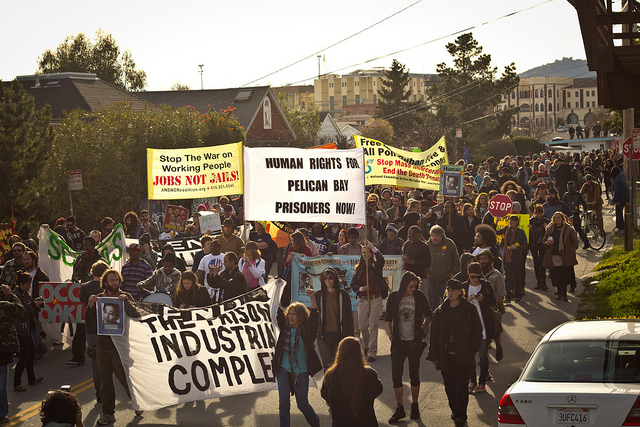
About 800 protesters marched to San Quentin’s East Gate in a day to protest what they called inhumane conditions in prison Feb. 20

Protesters called for an end to the practice of trying children as adults, three strikes laws, life sentences, life without the possibility of parole, and the death penalty.They did not call for the dismantling of the prison system or an end to the practice of incarceration, as Chip Johnson implies here.

In San Quentin– and in prisons across the country—inmates are subjected to solitary confinement, sometimes for decades. Kids as young as 13 are tried as adults and sometimes sentenced to life without the possibility of parole. In three-strikes states, people are sentenced to decades in prison for non-violent crimes that sometimes amount to less than a couple hundred dollars in damages. And in death penalty states, state-sponsored execution means that lives, sometimes innocent, are thrown away.

Twenty-four US states do not have three strikes laws, many countries cap prison sentences at 15 years regardless of the severity of the crime, and only one European country- Belarus- continues to impose the death penalty. The United States incarcerates its citizens at a rate that far surpasses any other country in the world; second on the list in Rwanda.

Conditions and laws like these have spurred decades of prison reform and prison abolition activism, both from inmates and supporters on the outside. Feb. 20, this movement joined with Occupy Oakland to protest outside San Quentin prison and demand that these issues be addressed.

As protesters arrived, organizers blasted music, hoping to reach the ears of prisoners. Dozens of prison guards and representatives from the Marin County sheriff’s department were stationed in front of the prison gate, and well as on hills looking down on the protest group.

The loud music continued with a performance from the Brass Liberation Orchestra, and subsequently a drumming ritual.

“As First Nations people, we’re no strangers to occupation. We’re also no strangers to prison. The first prisons were the reservation and the slave plantation,” said George Galvis, Executive Director of Communities United for Restorative Youth Justice.

“We have post-colonial stress disorder in our communities,” added Galvis.

Author, film producer (Redemption: The Stan Tookie Williams Story) and 2006 California gubernatorial candidate Barbara Becnel helped facilitate the event.

In her opening statements, Becnel praised the crowd, packed with Occupy activists, family members of incarcerated people, formerly incarcerated people, and others.

“We should really be proud of ourselves today. Because today, we are history makers. We have merged the prison rights movement with the Occupy movement,” said Becnel to an eruption of applause.

Throughout the program, speakers read solidarity statements addressed to Occupy Oakland from prisoners across the country, including Mumia Abu Jamal, Leanard Peltier, Kevin Cooper, and group statements from Pelican Bay human rights organizers, and those involved in state-wide prison strikes in Georgia.

A movement has coalesced around the claim that Cooper, a death row inmate at San Quentin since 1985, is innocent. Cooper was denied an appeal in 2009 in a ninth-circuit court case in which five judges dissented, declaring that, “the state of California may be about to execute an innocent man.” Their 103-page dissent statement includes descriptions of evidence tampering leading to Cooper’s conviction.

Cooper helped call for the Occupy 4 Prisoners day of action.

Speakers at the rally called for Cooper’s freedom, and for the end of death row entirely.

Becnel related a story about some prisoners, charged with life without the possibility of parole, that she had met while campaigning against the death sentence for Stan “Tookie” Williams.

The men, Becnel said, told her: “We only leave here in a casket also. We are also dead men walking.”

Speakers also decried the use of solitary confinement as a punishment in prisons.

Sarah Shourd, known for her imprisonment in Iran after accidentally crossing the border during a hike, spoke along with fellow imprisoned hikers Josh Fattal and Shane Bauer.

Shourd, who was held in solitary confinement for 14 months, related her experiences.

“After just two months my mind began to slip. I would spend large portions of my day crouched down by a small slot in my door, listening for any sounds from the outside that might distract me from the sheer terror of my isolation.”

A statement from a Texas prisoner, read by an Occupy Wall Street organizer, also addressed solitary confinement.

“We tend to think of man as a collection of individuals, each complete in himself, who just happen to come together to satisfy certain needs. Actually, however, there is nothing distinctly human that can be exhibited by an individual in isolation,” said the philosophical letter.

The Pelican Bay Hunger Strike last year highlighted solitary confinement, and prisoners demanded an end to the practice, in which inmates are held in isolated rooms with no sunlight for 23 hours a day, often for years on end. Some inmates at Pelican Bay have been held in these conditions for over 30 years.

Organizers of the hunger strike called it off when the California Department of Corrections promised to investigate the issue, but started to strike again several months later when no changes had been made to any of the conditions that they were protesting.

Kelly Turner, 42, who was sentenced to 25 years to life for writing a bad check for $146.16 in 1997, was also placed in solitary confinement for one year. However, she focused her speech at the rally on California’s three strikes law, the legislation that turned what would have been a three-year sentence for forgery into a possible life sentence for Turner. Turner said she was lucky that good pro bono lawyers defended her, and would likely still be in prison had they not; she now owns her own business.

Turner, who advocates for Families to Amend California Three Strikes (FACTS), urged the crowd to vote for an initiative to amend the law that is slated to appear on the California ballot this November. 

In her speech, Turner described meeting women in the Central California Women’s Facility is Chowchilla that were also serving decades-long sentences after having been charged with a third strike.

“I am here today for the woman that was on my dorm that had 27 years to life for drinking a 99 cent lemon line soda out of a store. Or the woman who stole a jar of Vaseline, a bottle of vitamins, two pairs of boxers,” said Turner.

Tatiana, a young prisoners rights advocate who spent time in juvenile hall, read a statement from incarcerated youth Veronica Hernandez.

Hernandez, 20, has been imprisoned since age 16.

She was tried as an adult, an outcome that she attributes to a public defender who did not do his best to fight for her.

“There are no law libraries or legal services at juvenile hall, so a juvenile, for better or for worse, is entirely dependent on his or her court-appointed attorney, and must trust that he or she will lead them in the right direction. Unfortunately for me, that direction was to adult court. I now face a life sentence should I be convicted,” said Hernandez in her statement.

No speaker argued for the dismantling of the prison system, instead focusing on what they saw as unjust sentencing and inhumane treatment in prisons.

In a statement calling for Occupy 4 Prisoners, Kevin Cooper connected a call to end the death penalty with struggle for correct racial and economic justice and an end police brutality:

“America has a deep-seeded philosophy in which it only allows for the execution of its poorest people. These seeds have taken root and have grown in such a way that no person who this system sees as a ‘have-not’ is safe from the death machine. Whether they are within (San Quentin) or on a BART platform.”

Bauer also expressed the importance of tying prison rights to the Occupy movement, saying, “This Occupy movement needs to permeate the prisons. God forbid one day some people here will be on the other side of this fence. But when movements get strong, people start getting locked up. We should know this. This happens in every country. Prisons are places where movements are killed. But at the same time, when movements successfully permeate prisons, a space built to break people down, the movement is at its strongest. This is true all over the world.”

Occupy Oakland organizers have already been hit with bizarre and seemingly invalid charges, such as “lyching,” “bike,” “boat,” and umbrella. In one of the most extreme cases, Khali, an Occupy Oakland protester, may face life in prison after being arrested for a allegedly taking a blanket out of a garbage can. Advocates for Khali say that he was denied prescription medications in jail for ten days before allegedly assaulting a police officer; his third strike.

Well-known prison rights advocate and former Black Panther Elaine Brown ended the program. After remarking that “there aren’t enough songs in this movement,” she sang Oh, Freedom as the crowd peacefully exited the site, as several volunteers picked up any trash that was left behind.

“Before I’ll be a slave, I’ll be buried in my grave, and go home to my comrades and be free,” sang Brown.

Valentine’s Day dump the banks rally: If only all break-ups involved this much singing (VIDEO)

7

Protesters across the country participated in “break up with your bank” day on Feb. 14. Several protesters happened throughout the Bay Area, including a demonstration organized by Causa Justa :: Just Cause, Occupy Bernal, Occupy SF Housing, and the San Francisco Tenants Union.

In past months those organizations have variously stopped evictions and foreclosures, prevented homes from being auctioned off, and organized mass protests. They’ve created trouble shutting down bank branches, sometimes for hours, on dozens of occasions.

For Valentine’s Day, protesters decided to have a little fun.

“Our intention is not to shut down the banks,” insisted Causa Justa organizer Maria Zamudio. “Just to break up with them.”

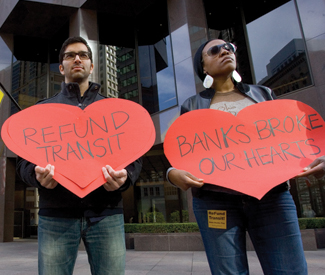
About 60 marched through the financial district Feb. 14, presenting large red broken hearts and “dump the banks” banners decorated with pink balloons.

http://www.youtube.com/watch?v=6-f6pHXQkbs

Security guards at the banks that the group approached locked their doors. Protesters, amused, began chanting “the banks shut themselves down.”

Bank of America building locked their doors when they saw the protest approaching. At the Wells Fargo west coast headquarters around the corner, a representative who identified himself as David accepted the card.

Afterwards, a dozen members of the group headed to City Hall for a Board of Supervisors meeting in support of a resolution brought by Supervisor John Avalos and co-sponsored by Supervisor Eric Mar. The resolution supports the city treasurer’s office in its recent efforts to include social responsibility and community reinvestment in its evaluation criteria as it searches for new banks in which to invest San Francisco’s money. The resolution passed.

“It’s not a victory, but a great step in the right direction,” said Zamudio. She hopes that the social responsibility assessment will look at a bank’s history with predatory loans, investment in small businesses, and refinancing mortgages.

Alerts

0

yael@sfbg.com

WEDNESDAY 15

Which way forward?

Four panelists will speak on their approach to creating progressive change in the United States. Speakers include Rocky Anderson, former mayor of Salt Lake City and presidential candidate with the Justice Party; Margaret Flowers of Physicians for National Health Program and organizer with Occupy DC; Tom Gallagher, former state legislator in Massachusetts; and Dave Welsh of the San Francisco Labor Council. With moderator Rose Aguilar of KALW’s Your Call radio. A forum organized by the 99% Coalition, a group focused on anti-war and non-violence activism working alongside Occupy San Francisco.

7 p.m., $10 suggested donation

Unitarian Universalist Church

1187 Franklin, SF

(415) 710-7464

www.sf99percent.org


Black history film and discussion

A screening of Freedom Riders, the film detailing the story of 400 groundbreaking Civil Rights Movement activists that rode on integrated buses throughout the South despite violent resistance everywhere they turned.

7pm, $5 suggested donation

2969 Mission, SF

415-821-6545

answer@answersf.org


FRIDAY 17

Join the Un-Conference

Reverend Billy Talen, the performance artist pastor of the anti-consumerist Church of Life After Shopping, will give a sermon Friday evening. That part is $10, and all proceeds go to whistleblower Bradley Manning’s defense. But that’s just the first night of a free, three-day “un-conference.” Participants will set their own agenda, and range from experts and stars like Daniel Ellsberg, Annie Sprinkle, and Colonel Ann Wright to your run-of-the-mill folks interested in justice for whistleblowers.

6 p.m., $10

UC Berkeley International House

2299 Piedmont, Berk

www.freshjuiceparty.com


MONDAY 20

Stand with prisoners

A demonstration to protest racism and economic injustice perpetuated by mass incarceration and the prison-industrial complex and to stand in solidarity with prisoners and their families. This event is called by prisoners and sponsored by Occupy Oakland, reminding us that “there are more African Americans under correctional control today — in prison or jail, on probation or parole — than there were enslaved in 1850.” It will feature speakers and musical performances.

10 a.m., free

1540 Market, SF for bus and carpool

www.occupuy4prisoners.org


Occupying elders

The Gray Panthers present a discussion with participants in Occupy Bernal and the Wild Old Women, Occupy Oakland, and Occupy San Francisco. How can elders contribute to Occupy? Come find out from the people on the ground, including Ginny Jordan of the Wild Old Women, who have shut down more banks than any other Bay Area Occupy group, and Tova Fry of Occupy Oakland.

1 p.m., free

Unitarian Universalist Center

1187 Franklin, SF

graypanther-sf@sbcglobal.net

Hearing today on bizarre Occupy Oakland stay-away order case

8

The first Occupy Oakland protester to allegedly be in violation of a stay-away order has a hearing today.

Joseph Briones, 30, was arrested along with 408 others at an Occupy Oakland protest Jan. 28. He is one of 12 who were apparently issued the restraining orders, and is therefore barred from being within 300 yards of Oakland City Hall, potentially for the next three years, according to Alameda County Deputy District Attorney Teresa Drenick.

But based on a Feb. 8 hearing, Briones and his lawyer understood that he did not have a stay-away order against him, said Occupy Oakland media committee member Omar Yassin.

“That’s why he was at the plaza, carefree, on Wednesday,” said Yassin. That’s when Briones was arrested.

In a Feb. 9 press release, Officer Johnna Watson of Oakland Police media relations said that “Joseph Briones is one of four individuals charged with a violent felony offense stemming from the Jan. 28 protest.” But according to records at the District Attorney’s office, that’s incorrect; Briones is charged with three misdemeanors.

While everyone scrambles to get their story straight, Briones is still in jail. He has a hearing at 2 o’ clock today. If found to have violated a stay-away order, he could face six months in prison.

So far, Briones is legally innocent of any crime; he has not been convicted of any of the charges leveled on him in connection with Jan. 28. None of the other 11 who are prohibited from going near City Hall have been convicted of anything either.

Besides all that, the stay-away orders may be entirely illegal.

According to Jivaka Candappa, one of the attorneys working on the stay-away order cases, “the orders are unconstitutional and unreasonable.”

Most of the charges on the twelve are as benign as blocking the sidewalk and remaining at the scene of a riot (the latter is the same charge that was placed on  hundreds who were cited and released with no bail, and whose charges will likely be dropped—including me.) Even the felony charges, such as assault of a police officer, are common charges leveled on protesters that are usually dismissed. It is highly unusual to ban individuals from any public place, for any reason, let alone City Hall and a public plaza so obviously necessary for access to First Amendment rights, under any circumstances.

“This is legitimate action in, for example, a domestic violence situation. Here, protesters have not attacked anybody and they’re not a physical threat,” said attorney Mike Flynn, president of the San Francisco chapter of the National Lawyers Guild.

Candappa says that he and his colleagues may file motions in the Alameda County Superior Court challenging constitutionality of the stay-away orders.

Said Candappa, “preventing someone from exercising their First Amendment rights doesn’t promote public safety. Courts are very reluctant to restrain someone’s expressive rights, because its really a cornerstone of any democracy and if you want to be able to participate in democracy you’ve got to have a right to express yourself. To take away that fundamental right to express yourself is something courts are very reluctant to do, especially when those conditions are applied against someone who has not yet been convicted.”


Trader Joe’s signs agreement in labor victory

6

Trader Joe’s, known for being really more of a snack emporium than a grocery store, can now be known for something else; buying tomatoes picked by people with basic human rights.

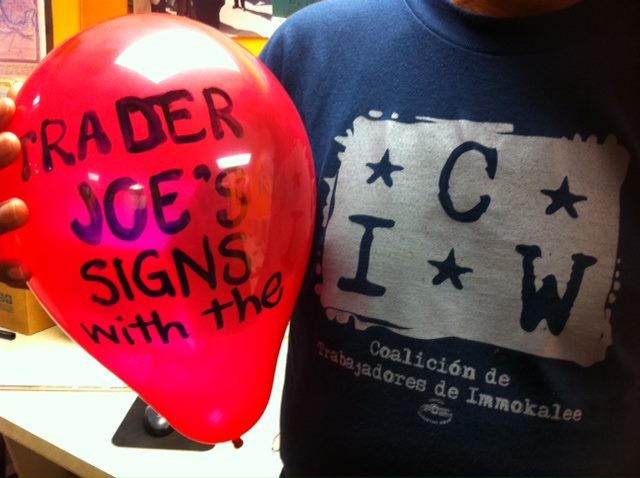
Feb. 9, it became the second grocery store chain– the first was Whole Foods– to sign an agreement with the Coalition of Immokalee Workers (CIW), a group based in Immokalee, Florida famous for its successful Fair Food campaign.

By signing a Fair Food agreement with the CIW, Trader Joe’s pledged to buy their Florida tomatoes only from companies that comply with the CIW’s list of working conditions. According to Bay Area CIW solidarity organizer Liz Fitzgerald, a 23-year-old San Francisco resident, the “code of conduct” includes “zero tolerance for sexual harassment or modern day slavery, having places where farmworkers can wash their hands, basic human rights like that.

The agreement also includes an increase in price for tomatoes—one penny per pound—to augment workers salaries.

Its just pennies, and its only tomatoes. But the Fair Food Campaign is one of the most successful farmworkers rights efforts in past decades, and seems to be growing stronger still.

Acitivists in Florida teamed up with allies across the country for the two-year campaign it took to win over Trader Joe’s, mainly consisting of protests and educational campaigns complementing behind-the-scenes meetings. The efforts targeting Trader Joe’s were amicable compared to their first campaign, aimed at Taco Bell, when begin in 2001. Then, the CIW led a nationwide boycott of the fast food chain and a “Boot the Bell” effort to get Taco Bells off college campuses. Taco Bell finally agreed to sign the agreement after four years of pressure.

Since then, the Fair Food Agreement has gained an impressive list of adherents. After Taco Bell, McDonalds, Burger King, and Subway signed on. In April 2009, CIW made a deal with Compass Group, the world’s largest contract food service provider. Industry giants Bon Appetit Management Company, Aramark, and Sodexo have also signed on to the agreement.

“The goal of the Fair Food Program is to promote the development of a sustainable Florida tomato industry that advances both the human rights of farmworkers and the long-term interests of Florida tomato growers,” according to a joint CIW-Trader Joe’s press release.
Fitzgerald says that, after two years organizing on the steering committee of the Bay Area’s Student-Farmworker alliance (highlights include a Lady Gaga impersonation during a flash mob-style protest last year), she is eager to keep up the fight.

“Its incredible because this is one of so many victories…CIW, along with allies, we are an unstoppable force. This makes me want to not stop until we change this entire agricultural system that’s so exploitative,” said Fitzgerald.

The sex worker struggle

3

yael@sfbg.com

Google has come under fire in the past year for everything from privacy policies to censorship. But in December, some Bay Area residents were protesting the tech giant for a very different reason. The group that marched in front of the company’s San Francisco office was angry over the company’s donation to organizations fighting human trafficking.

The flyers declared, “Google: Please fund non-judgmental services for sex workers, NOT the morality crusaders that dehumanize us!”

Google had donated a whopping $11.5 million to organizations that “fight slavery” last December, including the anti-sex trafficking groups International Justice Mission, Polaris Project, and Not For Sale.

But the activists said that these are religious organizations that ignored the rights of consensual sex workers.

According to a press release from Sex Worker Activists, Allies, and You (SWAAY), “As frontline sex-worker support services struggle for funding to serve their communities, it is offensive to watch Google shower money upon a wealthy faith-based group like the International Justice Mission, which took in nearly $22 million in 2009 alone.”

“I appreciate what they’re trying to do, but I wish that they had done more research,” Kitty Stryker, a local performer, sex worker and activist, of Google’s choice to fund the organizations.

In a society where the term “sex worker” — coined to describe those who consensually engage in commercial sex and consider it legitimate labor — is still new to most people, this sex workers rights struggle can be an uphill battle. But it rages on, and San Francisco remains one of its most important front lines.


FREE SEX FOR HIRE

The heart of the struggle is, and or years has been, fighting the prohibition of prostitution, and the ultimate goal of the sex workers movement is the repeal of the laws that criminalize sex for hire. Decriminalization would be a vital safety measure for escorts, people working on the street, phone-sex operators, exotic dancers, porn actors, and other occupations that fall under the umbrella category of sex work.

Sex workers held worldwide conferences in the 1980s, meeting in Amsterdam and Brussels. Sex work was legalized and decriminalized in several countries around the world, including New Zealand, the Netherlands and Germany. The Sex Workers Outreach Project (SWOP) became one of the most important organizations fighting for the cause, with chapters around the world.

Here in San Francisco, the city remains a hub for sex-workers rights advocates, who raise awareness about issues ranging from STD prevention to consent in BDSM contexts. The Saint James Infirmary supports and treats sex workers when they need medical assistance, and the Center for Sex and Culture is a resource and community center that embraces all San Franciscan’s with their minds in the gutter, sex industry workers included.

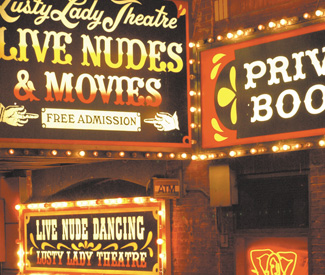
San Francisco’s sex workers rights history includes two unions. Workers at the North Beach strip club the Lusty Lady formed the Exotic Dancers Union in 1997. The union became part of the Service Employees International Union, and the Lusty Lady remains the only collectively run, sex-worker-owned strip club in the United States.

Maxine Doogan founded the Erotic Service Providers Union (ESPU) in 2004 as an umbrella organization for sex workers in various industries. The ESPU has been active in opposing regulations of the massage industry and sponsoring Proposition K, a 2008 ballot measure that would have decriminalized sex work in San Francisco.

I spoke to a handful of Bay Area sex-workers rights activists to get a sense of the major issues and priorities for the next year.

NO VISAS

Activists are currently planning for the July, 2012 International AIDS Conference in Washington, D.C.

Many international sex workers rights advocates have been denied visas to get to the conference. The U.S. typically bars convicted felons — but there’s a special exception for people guilty of misdemeanor prostitution charges.

“SWOP has an idea of getting in touch with some of the people denied entrance and asking them what they were going to present on and to try and present their papers in their place, to make sure these organizers voices are heard,” said SWOP-Bay Area spokesperson Shannon Williams.

But that’s not where the government’s weird exclusion of sex workers from its efforts to fight AIDS ends.

The Presidents Emergency Plan for AIDS Relief (PEPFAR) fund allocates $48 billion to organizations around the world engaged in AIDS treatment and prevention. But thanks to the religious right, the law, approved in 2003, includes a stipulation that all recipient groups must make a pledge decrying prostitution. It’s known as the “anti-prostitution loyalty oath.”

A court ruling July 6, 2011 declared the oath a violation of the free-speech rights of organizations in the United States, but the U.S. still blocks PEPFAR funding for international organizations based on the “loyalty oath.”

“Sex worker activists are going to converge in D.C. for the AIDS conference and talk about the loyalty oath. The US is exporting its ideology through this funding requirement” said Carol Leigh, a longtime activist who curates the annual San Francisco Sex Worker Film and Art Festival.


EMPHASIZING CONSENT

Sex workers rights activists continue to be engaged in their complex, decades-long struggle with anti-sex trafficking organizations.

People who want safer working conditions say that decriminalization would make it easier for police to distinguish between coerced and consensual prostitution and encourage those with knowledge of crimes perpetuated against sex workers to come forward without risking prosecution for their own illegal work.

But many anti-trafficking advocates dismiss the distinction between forced and consensual prostitution in their efforts. According to a document called “Ten reasons for not legalizing prostitution,” on the website of the Coalition Against Trafficking in Women, “There is no doubt that a small number of women say they choose to be in prostitution, especially in public contexts orchestrated by the sex industry… In this situation, it is harm to the person, not the consent of the person that is the governing standard (emphasis theirs).”

It’s this refusal to acknowledge the importance of consent that really pisses off advocates —and has a powerful effect on the policy that governs them.

The federal definition of sex trafficking includes consensual prostitution, and defines coerced prostitution as “severe sex trafficking.” “Law enforcement agencies can use anti-trafficking funds to arrest sex workers in prostitution, on the grounds that the feds define all prostitution as trafficking, even though the government distinguishes between trafficking and severe trafficking,” said one sex workers rights activist.

According to Leigh, anti-trafficking organizations are not all bad; she named the Global Alliance Against Traffic in Women as an organization that “has been allied with sex workers rights movement and takes rights-based approach.”

But organizations that conflate consensual and coerced commercial sex are often big-time recipients of public and private funding.

Doogan is wary of any attempt to further regulate or criminalize sex work. She says that often, laws meant to deter prostitution trap people who may want to change occupations.  “Women have to continue working in the industry because no one else will take them for work when they have those convictions on their record,” said Doogan.

That may be the case with Lola, an occasional Erotic Service Providers Union volunteer who was arrested on prostitution-related charges outside California earlier this year. She moved to the Bay Area and is looking for a job, but after a promising interview last week, she’s nervous that a background check will reveal her arrest.

“I’m waiting to hear whether that’s going to be an issue or not. They could tell my landlord, and then I could lose my house too…all I’m trying to do is get a job,” Lola told the Guardian.


THE WORK GOES ON

For most sex-workers rights activists, the long-term goal remains decriminalization. For now education, creative projects, and protest in service of that goal continue.

Members of SWOP-Bay Area have a program called Whorespeak that does outreach at colleges, and “we’ve also been speaking in classes for therapists about how to work with current and former sex workers and not pathologize them,” said Williams.

According to Stryker, one of the most exciting projects happening now is Karma Pervs. The website, run by local queer porn star Jiz Lee, sells unique sex-positive porn and donates the proceeds to organizations like the Saint James Infirmary.

Then, of course, there’s the International Day to End Violence Against Sex Workers, when sex workers and allies gather to commemorate sex workers who have been assaulted and killed.

Sex workers often can’t go to police to report crimes for fear of being locked up themselves, society retains a huge stigma surrounding sex work, and there is an insidious cultural myth that “you can’t rape a prostitute.” These all add up to put sex workers at high risk for assault and murder; serial killers, such as the Green River Killer in Seattle and a murdered in Long Island-area this past summer, are disproportionately likely to target prostitutes.

That’s why, for Williams, “Our long-term goal is to decriminalize prostitution. But the real goal is to end violence against sex workers.”

Hello, Carol!

1

FILM It is close to impossible not to love Carol Channing; those who would protest otherwise are simply heartless. The only adequate response to her is unconditional surrender, as if standing before an oncoming cyclone filled with puppies.

With her saucer eyes topped with false lashes that could give Bette Davis’ a run for her money and a mouth that seems as if it could swallow the world, Channing is a living incarnation of a Muppet (to watch her duet with Miss Piggy just seems natural, somehow). And yet, despite her cartoonish physicality and exaggerated appearance, there is nothing false or put-on about Channing.

When I hear that voice — dripping with whiskey, smoke, and honey, begging to be imitated — the effect is instant happiness. Everything just feels right. As Roland Barthes writes in his essay “The Grain of the Voice,” I then must face the task of articulating “the impossible account of an individual thrill I constantly experience in listening to singing.”

Dori Bernstein’s sweet if worshipful documentary Carol Channing: Larger Than Life necessarily fails at that task, even as it proves the now 91-year-old Broadway legend more than lives up to the second half of the film’s title.

Now slightly stooped, her hair in a choppy gray bob, which she occasionally pulls into a Peggy Moffitt-esque topknot, and her lips a smear of Malibu pink, Channing is still ever the professional, hilariously impersonating a Russian theater troupe one moment and chatting with young dancers in Times Square the next.

The life Channing recounts is an abbreviated and selective version of the one detailed in her 2002 memoir Just Lucky I Guess: her childhood in San Francisco spent being the class clown and worshiping Ethel Waters; her first big Broadway break playing Lorelei Lee in Gentlemen Prefer Blondes; and her career-cementing role as Dolly Levi in Hello, Dolly! And many of the memoir’s same supporting characters, such as frequent TV variety show co-star Loni Anderson and Dolly composer Jerry Herman, also make appearances here.

What Bernstein’s documentary offers is the rare chance to witness the palpable impact Channing has made on others. In personal interactions, she gives her attention equally and wholly to anyone who seeks it (including the camera). Those who have worked with her — particularly the many gay chorus members interviewed here — speak of her as a mother rather than a diva.

The film’s most touching footage is of Channing with her late husband Harry Kullijian, who passed away last year. The two were childhood sweethearts who some 70 years later tied the knot (in Channing’s fourth go at marriage), and seeing them joke together and read aloud poetry passages they shared as love-struck teens is the very definition of adorable.

Curiously, Kullijian’s passing is not mentioned in the film, even as a postscript. You get the sense more generally that Bernstein tried to stay clear of reopening any old wounds with her subject. The awful tempestuousness of Channing’s second marriage to her publicist and manager Charles Lowe is referenced by others but not Channing, who speaks only in passing of the toll life on the road took on her relationship with her son from her first marriage.

Additionally, despite her fame, Channing has always had to share the larger cultural spotlight with Marilyn Monroe and Barbra Streisand, powerhouses in their own right who became associated with the roles she originally made famous on stage (Channing would have her Hollywood comeuppance in 1967 when she was nominated for a Best Supporting Actress Oscar for 1967’s Thoroughly Modern Millie). Larger Than Life attempts to provide a corrective to this, but its motivations for doing so are as transparent as they are understandable. This film is a mash note to Channing as much as it is a gift to her fans, who, rest assured, didn’t need any more reason to love her. *


CAROL CHANNING: LARGER THAN LIFE opens Fri/3 in Bay Area theaters.

After the tear gas clears

3

yael@sfbg.com

After a chaotic day of marches and confrontations between police and protesters Jan 28, I was arrested along with about 400 others who were trapped by police in front of the downtown Oakland YMCA. Seven of us were journalists.

The goal of the march was to take over an abandoned building — an the vacant Kaiser Convention Center, a city-owned building that’s been closed since 2005, was a prime target.

I have not yet been able to retrieve my property, including my recorder and notebook, which is being held by the Oakland Police Department. What follows is a pieced-together account and a perspective on what the events of Jan. 28.

I spend 20 hours behind bars, and missed the later parts of the action. But I was able to observe what happened in jail and make some sense of what happened.

Occupy people are constantly debating tactics and goals, and for many, the idea of occupying a vacant building made sense. When Occupy Oakland had a camp in Frank Ogawa Plaza, also known as Oscar Grant Plaza, and commonly shortened to OGP, it created a strong community. That community bridged divides between the homeless and the housed, between students and labor organizers, and between Oakland residents of different races, genders and levels of ability in an unprecedented fashion.

The camp had a kitchen that fed hundreds of people everyday and a network of shared tents and blankets which welcomed in hundreds who otherwise would have slept on the streets, often feeling isolated from other residents of their city and made to feel inferior.

The camp was repeatedly raided, Occupiers were tear gassed and shot with rubber bullets, and when OGP was cleared out, the community no longer had a home. And the police started that violence.

That was the practical reason for wanting to occupy a vacant building: to have a social center for Occupy Oakland.

Of course, there are other reasons. There’s the question that many squatters and homeless advocacy groups have been making for decades: why let buildings lie vacant while people freeze on the street?

Remember: The building that Occupy wanted to occupy is public property, and right now nobody is using if for anything.

In one exchange in jail, a guard asked a protester why the activists thought they had the right to take over a vacant building. “I mean, it’s not yours,” he insisted. The protester replied that many vacant buildings are government-owned and therefore public.

“So it’s the government’s,” the cop said.

“But I pay taxes,” the protester responded.

“Me too!” replied the cop. “It’s mine!”

“It’s both of ours,” smiled the protester. “It’s all of ours.”

That’s what made the convention center action such a clear and easy political decision.

A lot of people in Occupy would go further, saying that at a time of a severe housing crisis, it’s perfectly legitimate to take over privately owned buildings that are sitting there vacant. It’s part of the central argument of Occupy — that corporations and the rich unfairly own and continue to acquire much more wealth than the majority of people. For many people, owning a vacant building and doing nothing with it, while hundreds freeze on the streets, is a crime itself.


UP AGAINST THE COPS

Then there’s the question of the police — and violence.

The word “nonviolent” has a specific meaning in the history of political movements. Martin Luther King Jr. defined it in his essay “The Meaning of Non-Violence”: “If you are hit you must not hit back; you must rise to the heights of being able to accept blows without retaliating … But it also means that you are constantly moving to the point where you refuse to hate your enemy. You are constantly moving to the point where you love your enemy.”

It’s a philosophy but also, in political terms, a tactic.

Many of the people who make up Occupy Oakland get their start as activists organizing against police brutality in a city that has longstanding problems with violent and undisciplined officers.

Police Chief Howard Jordan said in a press release that “It became clear that the objective of this crowd was not to peacefully assemble and march, but to seek opportunity to further criminal acts, confront police, and repeatedly attempt to illegally occupy buildings.”

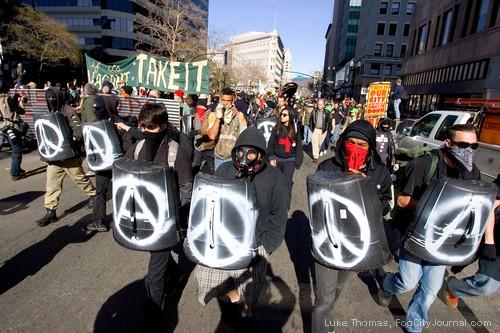
It was certainly clear that the intent of the crowd was to illegally occupy a building. And any honest assessment of Occupy Oakland would have to acknowledge that some members are not wedded to King-style nonviolent civil disobedience. (Neither, by the way, were a lot of the protest movements of the 1960s.) Many protesters wore masks and bandanas to disguise their identities and protect them from tear gas and pepper spray, and the march was led by protesters with makeshift shields, which suggests that they expected to be attacked. You could certainly argue that what those people were doing wasn’t confrontation; it was self-defense.

Frankly, it made sense to be prepared: In other Occupy Oakland actions, police have attacked with batons, tear gas, pepper spray, flash-bang grenades, and smoke bombs. And for quite a few Oakland residents, the police have always been seen as an outside force that can’t be trusted.

In fact, violence did break out. Many, including myself, have eyes still stinging from tear gas. I saw several wounds caused by rubber bullets shot at protesters. I spoke individually to at least a dozen people — one of them a pregnant woman — who were struck with police batons.

And protesters did not remain peaceful while this violence was being used against them.

Some picked up tear gas canisters and threw them back towards police; that much I saw. I also saw protesters throw empty plastic bottles at police.

According to the police, they also threw metal pipes, rocks and bricks. According to the protesters, they threw mainly empty plastic bottles and fruit at police. But as protesters often say of the police, “They’re the ones who showed up with the guns.” If the cops didn’t want violence, why unleash such an arsenal of weapons?

People got hurt, protesters and police alike. Several bystanders who had nothing to do with the situation were swept up in the mass arrest.

The city of Oakland, already in dire financial straits, likely spent hundreds of thousands of dollars reacting to the protests. Police claim that they were unable to sufficiently respond to violent crimes over the weekend, including five murders, because they were overwhelmed with Occupy troublemakers.

Of course, city officials were the ones who decided to arrest 400 people — with all the expense that involves.

There are, at this point, no reports of serious injuries to any police officers. However, at least a dozen protesters had welts on their faces or bodies from being beaten by clubs or shot with rubber bullets. One woman was shot in both arms with rubber bullet; one man was shot in the face with rubber bullets while holding a video camera to document the events. Several protesters were shoved to the ground and received wounds on their faces while being arrested. Police raised their rubber-bullet rifles to the faces of protesters throughout the day, threatening attacks. A rubber bullet to the face can cause brain damage and blindness.


DID IT HAVE TO HAPPEN?

How could this have been prevented?

Police say that “while peaceful forms of expression and free speech rights will be facilitated, acts of violence, trespassing, property destruction and overnight lodging will not be tolerated.” But 40 people were arrested during an ongoing Occupy Oakland vigil in the first weeks of January for having “illegal property” at OGP in what many saw as clearly a peaceful expression of First Amendment rights.

On KGO radio Jan. 29, Chief Jordan said that he has allowed Occupy Oakland to protest without a permit and would continue to do so, but those early January raids were ostensibly due to permit violations — violations of the terms of a permit that Occupy Oakland did in fact have.

There’s no question: The police response to Occupy Oakland over the past few months has caused some people in the movement to get more radical.

Many Occupy Oakland-affiliated medics condemned those who threw objects at police, saying that they provoked a backlash that caused more injuries. Many Oakland residents who might be in line with the socio-economic critique presented by the Occupy movement feel endangered and confused by marches that result in the massive use of police weapons in broad daylight. A lot of people would rather protest in a lot of ways that less resemble urban warfare.

On the other hand, there are also ways that Oakland officials could have prevented the consequences of weapons deployed and 400 arrested Jan. 28. They could, for example, have allowed protesters to occupy the vacant building.

When protesters seized a building Jan. 20 in San Francisco, police first attempted to prevent them. They lined up in front of the targeted building. They deployed pepper spray and struck several protesters with batons. When they were unsuccessful, and protesters entered the building from the back, they opted to block the surrounding streets and wait until the time seemed right to enter the situation and make arrests. Police spokesperson Carlos Manfredi told me that the cops were not going to rush into the situation and were trying to prevent injury and violence.

The Kaiser Convention Center has been vacant for years. The city of Oakland recently made plans to sell it to its Redevelopment Agency, but that plan fell into legal limbo when Gov. Jerry Brown signed AB26, a bill that dissolved all California redevelopment agencies.

At this point, nobody at Oakland City Hall has any plans whatsoever for the big, empty structure.

Why not allow Occupy to use the convention center? It’s not downtown, where Mayor Quan says businesses have been adversely affected by Occupy Oakland’s presence. It would give the movement a chance to stop focusing on trying to occupy spaces and start focusing on benefiting the community with food, shelter, and community programs that they provided when they had a camp. It would give the building tenants who could be held responsible for maintaining it. It might even help get Occupy Oakland and the Oakland Police Department out of the cycle of violence that they have been spiraling into for months.

Each time arrests occur, each time violence occurs, both sides blame the other. Both sides are correct that they were provoked. Both sides are correct that something that they think is worth defending was violated — for the cops, it’s the law. For the protesters, it’s the right of the people to assemble.

In fact, many Oakland residents have experienced violence at the hands of the Oakland Police Department for years before Occupy began. There was already a mass movement formed around the murder of Oscar Grant, and thousands of people fed up with police murders of unarmed, often black, suspects.

In recent decades, other radical groups, notably the Black Panthers, insisted that their community lacked basic needs because the city of Oakland refused to prioritize them. The Black Panther free breakfast program served food in a strikingly similar way to Occupy Oakland. Black Panthers were also notorious for carrying guns to defend themselves against police violence.

Occupy Oakland protesters (unlike Tea Party members) certainly don’t carry guns. But, more and more, they cry “fuck the pigs” as much as any Panther.

For much of the Occupy movement’s 99 percent, unjust actions by banks, corporations, and the government officials that they have often bought and paid for are the worst problems facing the United States today. For others, particularly the poor and people of color, these problems are magnified and exacerbated by the fact that they feel the threat of police harassment every day. For years, they’ve understood that police disproportionately do not investigate or solve crimes that happen to them and their families.


THE RADICALS AND THE BROADER MOVEMENT

The Oakland General Assembly Jan. 29 was the biggest it’s been in weeks. While there were still over 300 people in jail, 300 more came out to get involved with the meeting. That happened at the same time that many who felt that inexcusable violence and property destruction occurred Jan. 28 and concluded they could no longer have anything to do with Occupy Oakland.

It’s a challenge for the movement nationally, too: How do you accept and encourage the people whose legitimate anger at economic injustice and police abuse turns them toward more radical responses — and at the same time make room for a people who want nothing to do with the black bloc Fs, vandalism, and confrontation with the police?

There are tactical issues with the way the building occupation was planned. Many who were completely in line with the concept felt unsafe and uncomfortable with the secretive nature of the organizers who planned it. The location of the building targeted for occupation was kept secret for practical reasons; police could easily prevent a successful takeover. Supporters must often be led to the locations of planned takeovers without knowing where the action is and how they’ll get there. But how do you reconcile this with the transparency required when organizers are leading more than 1,000 people who want to use tactics they feel comfortable with and make their own choices?

Occupy Oakland is asking the people to imagine a world where property rights wouldn’t prevent them from doing all the good that they could do with a building like the Kaiser Convention Center. They must also ask themselves to imagine a world in which goals like a building occupation can be achieved in a way that everyone involved is able to consent to their involvement.

These debates continue to occur at Occupy Oakland. Some will leave the movement, some will join. Some will take the ideas and try to manifest them in new and different ways. Participants in Occupy Oakland desperately want basic needs of food and shelter met for their community members, and for the system that governs the city to do so in a way that allows people to thrive when it comes to health, education, and opportunities for creativity and growth. They think that they have the beginnings of a community and a process that can achieve those visions, better than the city government ever has, and they care more about achieving it than respecting the property rights of the owners of abandoned buildings.


Editor’s notes

13

tredmond@sfbg.com

I used to go to Grateful Dead shows at the Oakland Auditorium, which is now called the Kaiser Convention Center. One night I saw Bill Graham, the late concert promoter, ride a zip line from up near the ceiling to the stage in a giant paper mache joint called the “S.S. Columbian,” which looked like it was going to fall apart at any minute as he swung back and forth 50 feet over the crowd, trying to smile and wave in a bizarre promotional stunt that confused even the deadheads. I bet he shit his pants.

The place was a pretty good venue for a big concert, but it never worked out as a convention center, and the city shut it down in 2005. It needs seismic work and about $5 million in maintenance. It sits near Lake Merritt, on the edge of downtown Oakland, a giant empty building just waiting for something to happen to it.

It’s a perfect spot for an Occupy Oakland headquarters. I’m surprised it took the Occupy folks this long to figure it out.

Look: Oakland’s a working-class city, and it’s having severe financial problems, and sending hundreds of cops to arrest Occupy protesters is sucking up money that’s desperately needed for other things. Mayor Jean Quan complains that police were unable to respond to emergency calls in other parts of the city because they were all downtown dealing with the demonstration.

Understood — and it’s clear that the Oakland Police, whether the Occupy folks like it or not, are going to arrive in mass numbers to make sure that there’s no damage to local businesses or City Hall (where, oddly, there were no arrests, because the cops were elsewhere).

But the empty Kaiser Center, which isn’t even in the downtown center? Why bother?

Seriously: Why not just give it to Occupy Oakland? Tell the group that the city will strictly enforce fire and health codes, that the Occupy people will have to clean the place up and keep it clean, that they can’t damage the place … and hand over the keys?

It’s public property. Nobody using it now. Occupy might actually bring some excitement to the scene. If it became a center for political meetings and organizing, for education and performances, it could be a be a very positive thing.

Declare at truce in the Occupy wars. Let the cops go after murderers; give Occupy the vacant convention center. Nothing else is working. It’s worth a try.

Alerts

0

yael@sfbg.com

THURSDAY 2

Violence in Mexico

How does the war on drugs perpetuate violence in Mexico, and what can be done? Juan Fraire Escobedo, an activist from Ciudad Juarez, will discuss the human cost of the drug war, militarism, and human trafficking.

7 p.m., $5-$10 donation

Eric Quezada Center

518 Valencia, SF

(510) 282 8983


SATURDAY 4

No war on Iran

The ANSWER coalition leads a march and rally demanding “No war on Iran, no sanctions, no intervention, no assassinations.” Dozens of demonstrations around the country will protest the threat of war on Iran.

Noon, free

Powell and Market, SF

www.answercoalition.org/national/news/no-war-on-iran.html


SUNDAY 5

Situationists and the Occupy Movement

Author of “The Joy of Revolution” and celebrated translator Ken Knabb discusses links between the Occupy movement and the Situationists, the revolutionary group that influenced the Paris uprisings of May 1968.

10:30 a.m., free

Niebyl-Proctor Library

6501 Telegraph, Oakl

www.marxistlibr.org


MONDAY 6

LGBTQ Singing Class

The first day of a series of singing workshops, taught in a supportive space for LGBTQ individuals and their allies. The class will focus on solo singing with one group song. Glitter optional but highly encouraged.

6:30 p.m., $25

Women’s Building

3584 18th St., SF

www.eliconley.com/singing-classes.html

Occupy Oakland inmates at Santa Rita attacked- developing story

153

(THIS STORY HAS BEEN UPDATED)

In the aftermath of the mass arrests of Occupy Oakland protesters– and whoever else happend to be on the wrong street at the wrong time– on Jan. 28 in Oakland, there have been loads of reports and rumors about brutality inflicted on those arrested. Most of those arrested were held in Santa Rita jail.


My observations:

I spent 20 hours in jail, and I saw some cruel treatment. I saw people suffering after being denied medication. I saw people with allergies to the food that was provided refused any substitute and unable to eat, sometimes for more than 24 hours. I saw people crammed into holding cells meant for groups a third their size, so that some people had to remain standing, sometimes for more than 24 hours. As many arrestees were wearing clothing coated in tear gas and pepper spray, those chemicals continued to waft through cells and affect all present.

Reports:

I have reports directly from sources of arrested occupiers being beat up in jail with police batons. At least 20 people were ziptied, meaning their hands were cuffed behind their backs– and more often than not, if they happen to be cuffed too tightly and their hands go numb and even blue, police won’t loosen them– for more than eight hours. I know that some people who were denied access to a restroom ended up sitting in their own vomit and urine for at least four hours in some cases.

UPDATE Another report from Joshua Clover, a professor of English at UC Davis, who was released Monday night, :
“I was held for 53 hours for a misdemeanor charge which every single person here, and there, knows will never be brought, and indeed which will be met with a class action suit for wrongful arrest that the city of Oakland will be compelled to settle. I have a perforated peptic ulcer. Early on in the stay I requested non—prescription care — liquid antacid, which the jail keeps on hand — when I began to have an ulcer attack, which is to say, when I began to bleed internally. I was not given such care until an attorney was able to intervene by phone many hours later. I received one capful, which was mildly effective for about three hours. Further requests were ignored. As many will know, a bleeding ulcer attack is both painful and potentially fatal”

UPDATE When I questioned Alameda County Sheriff’s Department Public Information Officer Sergeant JD Nelson about this, he responded that “[Clover] was obviously seen by a medical person, and they said that was enough medicine.”

But accoridng to Clover, via an email, “The one time that I received medication, a deputy came to the cell door accompanied by someone who may have been a nurse, holding a capful of antacid. I asked for more but was not given it.” And was Clover seen by a medical professional to determine the correct amount of medication? He says, “Definitely not.”

Also according to Clover, “Food was often not provided for periods of up to 14 hours. For a long period I shared a cell with 27 other people; it was about ten by ten feet. For a period I was in a cell labeled ‘Maximum Occupancy: Two.’ There were ten of us, three very sick. We stood. One of the people slumped over on the toilet, that being the alternative to standing.”

UPDATE

“Three people I know were denied medication for HIV infections while being held for multiple days, which is a life-threatening choice made by the county”

“two women were denied anti-depressants that they had with them when they went to jail”

UPDATE According to an anonymous source, “My 12×12 cell had 28 people. There was a toilet, a concrete bench, and enough hard floor space for three or four of us to sleep at a time. A girl in the cell across from ours told the guards she needed Lexapro or she would go into withdrawl. They ignored the request. One of my cellmates was HIV-positive. When I last saw him at 2 a.m. on Monday morning he had not yet been given his medications. As I exited the jail I saw a woman who had just been released lying on the floor. She was having a seizure and being tended to by a couple of firemen.”

UPDATE From Alyssa Eisenberg, who has multiple sclerosis:
“I take my medication at least twice a day…without it, the pain is, everything kind of goes numb and tightens up. Somtimes I can’t even see without it. When  had to sign the booking form about noon i couldn’t even see it, my vision was so blurry…I was told they don’t give meds to people that are going to be cited and released, only to people that are going to stay and get charged.”

Unconfirmed reports:

Daily Kos quotes an anonymous source who reports that “prisoners from the Oakland Commune were being denied medications (some had seizures) while the guards said they didnt care if they died. Some people were brutally beaten. The put tear gas in the vents of my cell twice.”
According to Occupy Oakland media spokesperson Omar Yassin, a report that someone was tear gassed in the jail’s hallway is likely credible.

Then there’s the peolpe who were injured during the protests Jan. 28. Also according to Yassin:

At least a dozen people had welts on their faces or bodies from being beaten by clubs or shot with rubber bullets. One woman was shot in both arms with rubber bullet; one man was shot in the face with rubber bullets while holding a video camera to document the events. Several protesters were shoved to the ground and received wounds on their faces while being arrested. Police raised their rubber-bullet rifles to the faces of protesters throughout the day, threatening attacks– a rubber bullet to the face can cause brain damage and blindness.


A spokesperson for the Alameda County Sheriff’s Department refused to comment, although she did say that they’ve “been bombarded with calls about this all day.” Shocker.

UPDATE According to Alameda County Sheriff’s Department Public Information Officer Sergeant JD Nelson, no complaints of mistreatment at Santa Rita have been filed.

Nelson said that peanut butter was made avaliable to vegans those allergic to meat, in direct contrast to what I witnessed in jail.

In response to reports that some detainees were held on buses in the Santa Rita parking lot for up to eight hours, during which time they were refused bathroom access and in some cases made to sit in their own urine and vomit, Nelson said that “Generally when they come to the jail the buses are unloaded fairly quickly. Obviously some people are going to go first, some last.”

He told me that detainees were denied medication because “We do we allow them to take their medication in jail. People will try to smuggle stuff in.”

When asked about reported beating in jail, Nelson replied, “I haven’t gotten any reports of any skirmishes between officers and those arrested. We would report it if  there was any use of force,”

According to Nelson, the Alameda County Sheriff’s Office has video footage of all of the areas in the jail where arrestees were held, and, unless there was a lawsuit preventing its release, he would make the footage available to me soon. For now he said, “I don’t even know if they’ve been developed.” (Is this 1984? Not in the Orwellian sense. In the technology sense.)

More on this soon. Send me information that you have, yael@sfbg.com

Inside the Occupy Oakland protest

57

UPDATE: We’ve corrected a few factual mistakes. We originally reported that protesters forced open the door of the YMCA; in fact, they asked to be let in and they were. We regret the error.

An Occupy Oakland march that turned violent Jan. 28 led to the arrest of 400 people, including me.

The march, which peaked at about 2,000 protesters, was organized with the intention of entering a vacant building — the Kaiser Convention Center — and turning it into a new “Social Center” that participants in Occupy Oakland hoped to use to gather, teach, and organize.

The move was more than symbolic. Occupy activists have engaged in constant debate about tactics and goals, particularly when it comes to violence and property destruction, and it’s hard to argue at this point that Occupy Oakland is a nonviolent movement.

But many thought that the goal of occupying a vacant building made sense. When Occupy Oakland had a camp in Frank Ogawa Plaza, also known as Oscar Grant Plaza, commonly described as OGP, it created a strong community. It’s a community that bridged divides between the homeless and the housed, between students and labor organizers, and between Oakland residents of different races, genders and levels of ability in an unprecedented fashion.

Besides that, the camp had a kitchen that fed hundreds of people everyday. The camp had a network of shared tents and blankets that welcomed in hundreds who would have slept freezing on the streets, often feeling isolated from other residents of their city and made to feel inferior. Now, they had a place to stay that was warmer, more safe and secure, and was embedded in a community bound together by ties of solidarity.

That community was able to thrive in it’s centralized camp location.

That was the practical reason for wanting to occupy a vacant building: to have a social center for Occupy Oakland.

Of course, there are other reasons. There’s the question that many squatters and homeless advocacy groups have been making for decades: why let buildings lie vacant while people freeze on the street?

The march set off from OGP at 1 p.m. Jan. 28. There was no ambiguity about group’s goal: Many pushed carts stacked with furniture, hoping to furnish the new center; others held a large banner reading “Vacant? Take it!” 

Many other Occupy groups around the world, including protesters in Washington DC, London, England, and Belfast, Ireland, have taken over vacant buildings in an attempt to create social centers, house homeless community members and protest injustice symbolized by buildings lying vacant while people live on the street.

In Oakland, the attempts were staved off when riot police lined up in front of the march and declared unlawful assemblies.

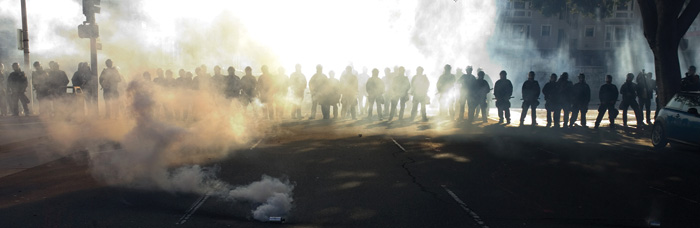
In front of the  Convention Center, police threw smoke bombs into the crowd and warned that those who refused to disperse would be arrested. The march continued around the corner to 12th St and Oak, where protesters and police were involved in another confrontation. Police shot smoke bombs and “pepper bombs,” canisters of pepper spray that explode on impact, into the crowd. Some in the march responded by throwing canisters, along with plastic bottles, back at police. Masked protesters in the front of the group brandished makeshift shields. Protesters say the shields were there to protect them from rubber bullets and bean bag rounds.

The cops had a different perspective. “It became clear that the objective of this crowd was not to peacefully assemble and march, but to seek opportunity to further criminal acts, confront police, and repeatedly attempt to illegally occupy buildings,” said Oakland Police Chief Howard Jordan in a press release.

In a tense moment, hundreds knelt to hide behind the frontline shields while police fired rubber bullets into the crowd.
When police began to advance at both the front and back end of the group, protesters retreated, marching on 12th St back to Ogawa/Grant Plaza.

As they marched on 12th street, Occupy Oakland-affiliated street medics treated injuries from tear gas, pepper spray, and rubber bullets. Police followed in the rear of the march, continuing to project exploding flash-bang grenades at the crowd.

At about 5:30, another march left from the plaza, again with the stated attention of occupying a building. Police marched behind protesters. When the march cut through Fox Square in Oakland’s Uptown neighborhood, police filled in all surrounding sides of the march. Protesters have used the term “kettling” to describe a situation in which police line up on all sides of a group, blocking anyone in the group from leaving.
After “kettling” hundreds of protesters at this location, police began to deploy tear gas. Some protesters with makeshift plastic and metal shields, many marked with the “circle-A” anarchy symbol, advanced towards police. Several police beat the shield back with batons and struck some protesters.

One 19-year-old woman who was struck with a baton to the kidneys was brought to the hospital and treated for internal bleeding.
At Fox Square, police announced that the gathering was an unlawful assembly. Minutes later, some protesters knocked over a line of chain-link fencing, allowing the march to exit the “kettle.” The march continued on Telegraph.

When the march arrived at Broadway between 22nd and 23rd streets, protesters asked to be let into the YMCA and someone who was in there opened the doors. Police later closed in on both sides until they had formed a line preventing the approximately 400 protesters from exiting.

On Broadway, there was no dispersal order issued. This is in violation of the Oakland Police Department’s crowd control policy, which states that “If after a crowd disperses pursuant to a declaration of unlawful assembly and subsequently participants assemble at a different geographic location where the participants are engaged in non-violent and lawful First Amendment activity, such an assembly cannot be dispersed unless it has been determined that it is an unlawful assembly and the required official declaration has been adequately given.”

About 6:30 p.m., police announced that all of the blocked-in group was under arrest.

It was more than six hours before the sidewalk was cleared of all detainees. Most are charged with failure to disperse. Some, such as those who entered the YMCA, have been charged with burglary.

Dozens of protesters who had avoided arrest marched back to City Hall. There, they illegally entered the building and committed several acts of vandalism. According to a press release, these included “breaking an interior window to a Hearing Room, tipping over and seriously damaging the historic model of City Hall, destroying a case containing a model of Frank Ogawa Plaza, and breaking into the fire sprinkler and elevator automation closet.” Protesters also report setting off fireworks in the counsel chambers.

Some protesters took an American flag from City Hall and burned it in front of the government building.

Oakland officials have complained about the cost of the protests. The city had reportedly spent $2.4 million policing Occupy Oakland protesters as of November 15, just weeks after announcing the decision to close down five elementary schools to save $2 million.
Occupy activists say the huge — expensive — police presence is an overreaction.

“The amount of property damage by protesters has been minimal next to Mayor Quan’s destruction of the humanitarian Occupy Oakland community and excessive force against peaceful people, said Wendy Kenin, an Occupy Oakland spokesperson. “The City of Oakland’s commitment to militarism far outweighs its investment in schools. 

Kenin said she was back at Occupy Oakland outside City Hall, with her four children, the day after the incidents.
There were no arrests made in the City Hall incident, partly because so many police resources were deployed at the YMCA.

Cities and counties that provided police reenforcements to handle the mass arrests include Alameda County, San Mateo County, Santa Clara County, San Francisco County and Marin County and the cities of Fremont, Hayward, Berkeley, Pleasanton, San Francisco and Union City/Newark; and the University of California-Berkeley, according to an Oakland Police Department press release. 

Dozens of those detained were brought to Glenn Dyer jail, which quickly filled up; the rest were brought to Santa Rita jail in Dublin.
Several members of the press, as well as passers-by who were on their way to work in the area, were swept up in the arrests.

In jail, those detained debated tactics involved in the day’s demonstrations and discussed the future of Occupy Oakland.

The number of injured protesters is unknown, but in the 19-person sampling of arrestees with whom I spent 20 hours, two had bruises from baton strikes, one suffered from an injured foot after a pepper-bomb exploded upon impact with her ankle, and most had irritation in their eyes, ears, and throat from exposure to tear gas and pepper spray.

Oakland police report that three officers were injured.

As of the morning of Jan. 30, about 100 remained in Santa Rita.

The sex heard ‘round the world: [SSEX BBOX] documentary premieres

1

Scenes from [SSEX BBOX], the global sexuality documentary project whose long-awaited first episode will premiere at the Center of Sex and Culture on Mon/30:

One. A protest in Berlin, where a presentation is being made on the 16th century physical punishments that religious institutions imposed on sexually “immoral” people. 

Two. A conversation between two transgendered men living in Brazil.

Filmed in the form of interviews and group discussions, [SSEX BBOX] is a social justice film project that takes viewers on tour through the different understandings of gender and sexuality from around the globe. The documentary engages the ongoing conversation regarding the cultural, social, and even linguistic implications that are intertwined within sexuality. It will air 15 10-minute episodes bi-weekly from January to August 2012 — but the Mon/30 screening will offer the chance to talk face-to-face with the team behind the project. 

[SSEX BBOX] sexuality out of the box! from SSEX BBOX on Vimeo.

Priscilla Bertucci, the executive producer and director of [SSEX BBOX], holds that in an environment where something so primary as a noun is categorized as male or female, sexism and strict gendering become strongly embedded in cultural perceptions of sexuality. Looking back at the project, she commented to the Guardian in a recent phone interview:

SF and Berlin are pioneering cities in that there is a lot of sexual education and many years of work have been [put into those places towards] bringing about awareness. [Exploring sexuality] is definitely more difficult in Barcelona and Brazil where there are still a lot judgments.  People perceive gender as male or female, straight or gay, and don’t really think of what may be outside of this divided box. 

On location with [SSEX BBOX]. Photo by Danila Bustamante

When shooting in Sao Paulo, Bertucci encountered numerous individuals who had never been exposed to the idea of alternative sexual orientations. That lack of experience wasn’t a surprise to her — she was raised there:

I grew up in Brazil and I experienced a gap in information first hand. In places like Sao Paulo, there is a huge lack of sex education in schools and sex educators in general. When I was very young, I was aware of the gay and lesbian community. But at some point, I started not fitting in the box because I would sometimes be attracted to men and I didn’t really identity as bisexual. But later, I became aware that I could identify as queer or gender queer. But it took me a long time and I had to go out and learn a lot of things on my own. A project like [SSEX BBOX] helps people understand that they don’t have to choose [from] a binary.

Bertucci’s film features interviews with sex activists, educators, psychotherapists, and average citizens from all over the spectrum of sexuality. The documentary was mostly edited here in San Francisco, but its crew was comprised of a globetrotting crew of directors and cinematographers traveling through Sao Paulo, Berlin, and Barcelona. 

The international affair was made possible through efficient Skype meetings and Dropbox, and [SSEX BBOX] will continue to embrace the web as a way to distribute their films. The team also launched a pocket-size zine in fall of 2011 that included photography, personal narratives, cartoons, paintings, and writings on gender expression which you can order online in digital or paper form.


[SSEX BBOX] documentary premiere 

Mon/30 7:30-11 p.m., free. 

Center for Sex and Culture

1349 Mission, SF

(415) 902-2071

www.sexandculture.org

What are people?

4

Protesters from the Occupy movement and beyond gathered in front of the Ninth Circuit Court of Appeals in San Francisco on Jan. 20, calling for the adoption of a 28th amendment to the U.S. Constitution aimed at refuting the idea that corporations should have the same rights as people, a legal doctrine know as corporate personhood.

The event was part of a day of action at courthouses around the country, seeking to raise public awareness about the unfettered influence of corporate money in U.S. elections and draw attention to the second anniversary of the landmark corporate personhood decision by U.S. Supreme Court, Citizens United vs the Federal Elections Commission.

“We are here not to protest, not to petition, and not to plead, but to proclaim a truth that should be self evident, even to the Supreme Court: Corporations are not people; money is not speech,” said Abraham Entin, of North Bay Move To Amend, addressing a crowd gathered at the courthouse. “Corporations work very hard to convince us that we cannot do without them and the products they produce. They tell us they are too big to fail, and that our survival is dependent on their survival … Occupy has changed all that.”

In a contentious 5-4 ruling handed down on Jan. 21, 2010, the Citizens United case solidified the legal framework that bequeaths corporations the same rights under the Constitution as real, living, breathing, U.S. citizens, and by merit of their First Amendment rights as citizens bars any restrictions placed on a corporation’s ability to spend money to influence elections.

When Republican presidential candidate Mitt Romney famously said on the campaign trail that “corporations are people, my friend, because corporations have people inside them,” he is reflecting the logic of the majority opinion in the Citizens United case. The court’s majority asserted that corporations are essentially an association of people and thus enjoy the same rights as individuals.

The court also claimed that it is impossible to distinguish between the corporate media outlets and other corporate speech, so all corporations should enjoy the free speech rights saved for the press. Furthermore, because journalists often have to spend money to achieve speech, money spent on messaging by all corporations represents protected speech.

Corporations, a relatively modern invention, aren’t actually discussed in the Constitution. But the notion of corporation personhood began around 1886 in the case of Santa Clara County v. Southern Pacific Railroad. What Citizens United did was equate corporate money spent to influence elections with protected political speech, upending attempts at election reforms and gutting the McCain-Feingold Act of 2002 that regulated federal election campaigns.

That corporations act to corrupt our democratic systems for their own profit is not conspiracy, it’s simply a byproduct of what they are. Corporations are legally obligated to act to maximize their profits for the benefit of their shareholders, otherwise their board and corporate officers are considered negligent of their obligations to their shareholders’ financial interests. Unlike journalists, whose professional credo calls for fairness and acting in the public interest, corporations are designed to act in their own interests.

As Justice John Paul Stevens wrote for the dissenting judges in Citizens United, “Corporations have no consciences, no beliefs, no feelings, no thoughts, no desires. Corporations help structure and facilitate the activities of human beings, to be sure, and their ‘personhood’ often serves as a useful legal fiction. But they are not themselves members of ‘We the People’ by whom and for whom our Constitution was established.”

The resulting flood of corporate money into election campaigns since the court’s ruling is delivered through an aqueduct known as the Super PAC (political action committee). In the wake of Citizens United, election spending by Super PACs in the 2010 midterm elections exceeded $300 million dollars, more spending than the overall spending in the previous five midterm elections combined.

Unlike donations to campaigns, which so far remain regulated, Super PAC money is spent directly by the Super PAC, and can be spent attacking as well as supporting candidates, leading to fears that corporations can exert influence on incumbents before a re-election campaigns by threatening to spend money attacking them in the upcoming election cycle.

“Corporations are human creations, state creations, legal entities … There is no reason we cannot limit their spending,” said Carlos Villarreal, executive director of the National Lawyers Guild’s Bay Area chapter. “Nonprofit organizations are limited in their political spending. Churches and charitable organizations are also limited in their spending. So why not for-profit corporations?”

Perhaps no group knows more about government limits to free speech than participants of the Occupy movement. Elastic restrictions on individual free speech and freedom of association rights spelled out in the First Amendment, resting on alleged risks to health and public safety, have led to Occupy encampments across the nation being restricted and evicted, at times enforced by brutal police crackdowns.

The right of the government to restrict individual and group speech that officials believe represents a clear and present danger was established by the Supreme Court in the 1919 Schenck v United States case — the famous “don’t yell fire in a crowded theater” case. What is not widely known is that this case was a re-examination of the famous 1917 Espionage Act. The “crowded theater” was our nation’s entry into World War I, and those being jailed for “yelling fire” were labor organizers and pacifists expressing their opposition to our entry into the war.

Relying on Schenck, courts have consistently defended restrictions on individual free speech when there is a compelling interest to public safety, the so-called “clear and present danger” standard. Villarreal and the crowd gathered before the Ninth Circuit asserted that corporate influence in our democratic processes represents a clear and present danger to society. “There is no more compelling interest than protecting democracy,” said Villarreal.

Despite the apparent double standard, legal experts say the courts action in the Citizens United case leaves a constitutional amendment as the only avenue left for regulating corporate money in elections and ending corporate personhood, but the movement to take on that Herculean task has already begun.

U.S. Sen. Bernie Sanders (I-VT) and Rep. Ted Deutch (D-FL) have introduced legislation proposing a 28th Amendment to the Constitution. While the language differs from another amendment presented by the group Move to Amend, it also takes aim at ending corporate personhood.

“Two years ago, the United States Supreme Court betrayed our Constitution and those who fought to ensure that its protections are enjoyed equally by all persons regardless of religion, race or gender, by engaging in an unabashed power-grab on behalf of corporate America,” Sanders wrote in a Jan. 20 Guardian(UK) column.

In Sanders’ home state of Vermont, the state Senate is also considering a resolution calling for a constitutional amendment against corporate personhood. A similar resolution, authored by Alix Rosenthal, was adopted by the San Francisco Democratic County Central Committee during a special meeting on Jan. 21. There was just one dissenting vote, and DCCC members say they plan to push for the state party organization to also adopt the stance.

The hurdles set forth to amend the U.S. Constitution, outlined in Article V, are substantial. In order for an amendment to even be considered, a super majority of both houses of Congress must initiate the process, or two-thirds of states must call for the amendment. Proposed amendments passing this threshold are then adopted only after three-quarters of state legislatures ratify the proposed amendment. But that difficult road is one the protesters said they are ready to travel. “We are here on a rainy day with warm hearts and wet feet. We are the 100 percent, the humans. No corporation has every experienced the thrill of wet feet,” said Gangs of America author Ted Nace. “We are the fools who go out on a wet day to fix a broken world. Eighty percent of the public want to fix this. That means we are halfway to our goal. What remains is organization, mobilization.”

Occupy is back — with horns and glitter

8

yael@sfbg.com

On Jan. 20, hundreds of activists converged on the Financial District in a day that showed a reinvigorated and energized Occupy movement.

The day of action was deemed “Occupy Wall Street West.” Despite pouring rain, the numbers swelled to 1,200 by early evening.

Critics have said that the Occupy movement is disorganized and lacks a clear message. Some have decried its supposed lack of unity. Others have even declared it dead.

But the broad coalition of community organizations that came together to send a message focused on the abuses of housing rights by corporations and the 1 percent sent a clear message:

The movement is very much alive.


A FULL SCHEDULE

Protesters packed the day with an impressive line-up of marches, pickets, flash mobs, blockades, and everything in between.

The action began at 6:30 a.m., when dozens chained and locked themselves together, blocking every entrance to Wells Fargo’s West Coast headquarters at 420 Montgomery Street. The bank didn’t open for business that morning.

Another group of protesters did the same thing at the Bank of America Building around the corner. A dozen blockaded one of the bank’s entrances from 8:30 a.m. to 6 p.m., preventing its opening. A group organized by Act Now to Stop War and End Racism (ANSWER) closed down the Bank of America branch at Powell and Market for several hours.

The Bank of America branch at Market and Main was also closed when activists turned it into “the Food Bank of America.” Several chained themselves for the door, while others set up a table serving donated food to hundreds of people.

Meanwhile, activists with the SF Housing Rights Coalition and Tenants Union occupied the offices of Fortress Investments, a hedge fund that has overseen the destruction of thousands of rent controlled apartments at Parkmerced. Direct actions also took place at the offices of Bechtel, Goldman Sachs, and Citicorp.

Hundreds picketed the Grand Hyatt at Union Square in solidarity with UNITE HERE Local 2 hotel workers.

A group of about 600 left from Justin Herman Plaza at noon and marched to offices of Fannie Mae, Wells Fargo, and the Immigration and Customs Enforcement Agency (ICE) in a protest meant to draw attention to housing and immigrant-rights issues.

“It’s not just a corporate problem. The government has been complicit in these abuses as well,” said Diana Masaca, one of the protest’s organizers.

More than 100 activists from People Organized to Win Employment Rights (POWER) and the Progressive Workers Alliance “occupied Muni,” riding Muni buses on Market Street with signs and chants demanding free transit for youth in San Francisco.

Another 200 participated in an “Occupy the Courts” action at the Ninth Circuit Court of Appeals, in protest of the Citizens United Supreme Court decision and corporate personhood.


GLITTER AND BRASS

Exhausted, soaked protesters managed to keep a festive spirit throughout the day, with colorful costumes, loud music, and glitter — lots of glitter.

The Horizontal Alliance of Very Organized Queers (HAVOQ) and Pride at Work brought the sparkly stuff, along with streamers and brightly colored umbrellas, to several different actions. Many painted protest slogans onto their umbrellas, proclaiming such sentiments as “I’ll show you trickle down” and “Not gay as in happy, queer as in fuck capitalism.”

According to protester Beja Alisheva, “HAVOQ is about bringing fabulosity to the movement with glitter, queerness, and pride. All day we’ve been showing solidarity between a lot of different types of oppression.”

There was also the Occupy Oakland party bus — a decked-out former AC transit bus — and carnival, a roving party that shut down intersections and bank entrances in its path while providing passengers a temporary respite from rain.

The Brass Liberation Orchestra, a radical marching band that has been energizing Bay Area protests for a decade, showed up in full force with trumpets, drums, trombones, and a weathered sousaphone.

The Interfaith Allies of Occupy also used horns to declare their message. About 30 participated in a mobile service, sounding traditional rams’ horns and declaring the need to “lift up human need and bring down corporate greed.”

Said Rabbi David J. Cooper of Kehela Community Synagogue in Oakland: “Leviticus 19 says, do not stand idly by in the face of your neighbor’s suffering. Well, we’re all neighbors here. Ninety-nine percent of us are suffering in some way, economically or spiritually. And maybe that number is 100 percent.”


FOCUS ON HOUSING

A coalition called Occupy SF Housing called for and organized the day of action, but the messages ranged from environmental to anti-war to immigrant rights.

Many groups did focus in on housing-related issues — and a takeover of a vacant hotel building stressed the urgency and need to house homeless San Francisco residents.

Housing protests included an anti wage-theft occupation led by the Filipino Community Center and the National Alliance for Filipino Concerns at the offices of CitiApartments, an action at the offices of Fortress Investments to demand a halt to predatory equity, and an “Occupy the Auction” demonstration in which protesters with Occupy Bernal stopped the day’s housing auction (at which foreclosed homes are sold) at City Hall.

“A lot of the displacement in this city is happening because of banks and because of things that are out of peoples’ control,” said Amitai Heller, a counselor with the San Francisco Tenants Union. “People will live in a rent controlled apartment for 20 years thinking that they have their retirement planned. A lot of the critiques of the movement are, if you couldn’t afford it you should move. But these people moved here knowing they could afford it because of our rent controls.”


LIBERATE THE COMMONS

Most of the early protests drew a few hundred people. But when the 5 p.m. convergence time rolled around, many people got off work and joined the march. A rally at Justin Herman Plaza brought about 600; by the time the march joined up with others at Bank of America on Montgomery and California, the numbers had doubled.

The evening’s demonstration, deemed “liberate the commons,” was also more radical than other tactics throughout the day; organizers hoped to break into and hold a vacant building, the 600-unit former Cathedral Hill Hotel at 1101 Van Ness.

When protesters arrived at the site, police were waiting for them. Wearing riot gear and reinforced by barricades, the cops successfully blocked the Geary entrance to the former hotel.

The darkness, rain, and uncertainty created a chaotic environment as protesters decided how to proceed. Some attempted to remove barricades; others chanted anti-police slogans.

Soon, cries of “Medic! We need a medic!” pierced the air. A dozen or so protesters had been pepper sprayed.

Police Information Officer Carlos Manfredi later claimed that the pepper spray was in response to “rocks, bottles and bricks” thrown by protesters. He also claimed that one officer was struck in the chest by a brick, and another “may have broken his hand.”

But I witnessed the entire incident, and I can say that no rocks, bottles or bricks were thrown at police.

When protesters opted to march down Van Ness, apparently towards City hall, several broke windows at a Bentley dealership at 999 Van Ness.

The march then turned around and headed back up Franklin, ending at the former hotel’s back entrance. There, it became clear that some protesters had successfully entered the building; they unfurled a banner from the roof reading “liberate the commons.”

Soon, many other protesters streamed into the building. They held it, with no police interference, for several hours.

Around 9:30, police entered the building and arrested three protesters for trespassing. About 15 others remained in the building, but left voluntarily by midnight.

This building has been a target of protest campaigns in San Francisco since it was purchased by California Pacific Medical Center, which closed the hotel in 2009. There are plans underway for a hospital to open at the site in 2015.

The project has been met with opposition from unions such as SEIU United Healthcare Workers West and UNITE HERE Local 2. The California Nurses Association (CNA) has also come out against the hospital proposal. In fact, it was the target of a CNA protest earlier in the day Jan. 20, when protesters created a “human billboard” reading “CPMC for the 1 percent.”

At a Jan.18 press conference, CNA member Pilar Schiavo said that at the former Cathedral Hill Hotel site, “A huge hospital is being planned with is being likened by Sutter to a five-star hotel. At the same time, Sutter is gutting St. Lukes Hospital, which is essential to providing healthcare for residents in the Mission, the Excelsior and Bayview- Hunter’s Point.”

Homes Not Jails, a group that finds housing for the homeless, often without regard to property rights, was crucial to planning the “Liberate the Commons’ protest. The group insists that the 30,000 vacant housing units in San Francisco should be used to shelter the city’s homeless, which they estimate at 10,000.


RAINY REBIRTH

Wet and cold conditions were not what Occupy SF Housing Coalition organizers had in mind they spent weeks planning Occupy Wall Street West, which was billed as the reemergence of the Occupy Movement in San Francisco for 2012.

Yet for many, the day was still a success.

“The rain’s a downer. But I think it speaks to the power of the movement, the fact that all these people are still out getting soaked,” said Heller on Jan. 20.

Perhaps hundreds of “fair-whether activists” did forgo the day’s events to stay out of the cold. If that’s the case, then occupy protesters with big plans for the spring should be pleased.

At this rate, it seems that Occupy will survive the winter- and emerge with renewed energy in 2012.


This article has been to corrected. We originally reported that a demonstration at the offices of Citi Apartments was led by the Chinese Progressive Association (CPA). In fact, it was led by the Filipino Community Center and the National Alliance for Filipino Concerns, and supported by a number of organizations including the Progressive Workers Alliance, of which CPA is a member organization. We regret the error.

Protesters “occupy” vacant building

38

After a long day of protest that began at 6 a.m., 1200 joined a march affiliatiated with Occupy SF  last night. The march aimed to “liberate the commons”; organizers said they succeeded when they were able to enter a vacant building, the former Cathedral Hill Hotel at 1101 Van Ness.

The march left from Justin Herman Plaza just after 5 p.m. and arrived at the former hotel around 7 p.m. after rallying at several sites along the way.

There, protesters were greeted by a police line and barricades protecting the buildings.

SFPD Officer Carlos Manfredi reports that protesters tried to remove barricades with the hooks of their umbrellas, and then threw “rocks, bottle and bricks” at police. Police responded by pepper spraying a dozen protesters.

Many eyewitness reports confirm manipulation of barricades, but deny that anything was thrown at police, instead attributing the pepper spray usage to anti-police slogans chanted by the crowd.

After the confrontation, the march turned down Van Ness. Some protesters broke windows at a Bentley dealership at 999 Van Ness.

The march soon turned back around, and protesters regrouped near the building’s back entrance on Franklin between Geary and Post.

There, the crowd looked up to see figures on the roof unfurl a banner reading “Liberate the Commons.” The back door was then opened from the inside by activists, largely from Homes Not Jails, who had broken into the building.

Soon after, demonstrators began streaming into the building.

Police arrived around 8 p.m. and redirected traffic, blocking Geary between Van Ness and Franklin, while a mass of several hundred protesters continued to block Franklin street between Post and Geary.

At 8:30, Manfredi said that police had no plans to rush into the “occupied” building.

“RIght now officer safety is our number one priority so we’re not going to go in there and rush into this event. Obviously Van Ness and Geary is a very busy street…We’re monitoring the situation, we’re talking with the owner, and we’re going to come up with a game plan…We’re going to see if we can open up some line of communication and speak to them, and see if we can come to some form of resolution,” Said Manfredi.

Manfredi also discussed the difficulties police find in communicating with Occupy SF protesters, noting that “a lot of times with these protesters, there’s not one single person responsible for leading the pack. So it’s very difficult, when you talk to one person they may not agree with the other ten. So that’s where the problem comes in.”

This “leaderless” quality, as well as privileging immediate human needs like shelter and food over some aspects of capitalism such as property rights, has been a running theme in the Occupy movement. Homeless advocacy was a large part of the Occupy SF focus in past months, as the encampment at Justin Herman Plaza created a community of homeless and housed activists.

Homes Not Jails, an organization that has been working with Occupy SF, was crucial in planning the “liberate the commons” protest. The group insists that the 30,000 vacant housing units in San Francisco should be used to shelter the city’s homeless, which they estimate at 10,000. San Francisco’s Human Services Agency reports the number of homeless at 6,455.

The cold rain pouring down throughout the night’s events increased the urgency many felt to find shelter for homeless colleagues. Said one demonstrator, “if we can prevent just one homeless person from dying of exposure in the rain tonight, the building takeover was worth it.”

The former Cathedral Hill Hotel, which has been vacant since it closed in 2009, is now owned by Sutter Health and California Pacific Medical Center, with plans to open a hospital at the site in 2015.

The project has been a target of several protests campaigns, including opposition from SEIU-United Healthcare Workers West, UNITE HERE Local 2, and the California Nurses Association (CNA). They also say the hospital will not cater to patients with medicare and medicaid.

At a press conferenece Jan. 18, CNA member Pilar Schiavo announced a protest at the site for the afternoon of Jan. 20.

Said Schiavo, “A huge hospital is being planned which is being likened by Sutter to a five-star hotel. At the same time, Sutter is gutting St. Lukes Hospital, which is essential to providing health care for residents in the Mission, the Excelsior and Bayview-Hunter’s Point. We know that the five-star hospital’s not aimed at serving the 99 percent, and we must hold Sutter accountable to all communities, not just those fortunate enough to have private insurance.”

Police cleared the street of protesters and entered the building around 9:30. Those who wished to were allowed to leave; several did, while about 15 remained. Protesters discussed plans to continue the building occupation through the night.

But most protesters providing support from the outsid had left by midnight, and those inside decided to leave voluntarily, according to organizer Craig Rouskey.

This post has been updated.

“Occupy Wall Street West” hopes to see massive protest

14

A coalition from across San Francisco is hoping to make tomorrow – Friday, Jan. 20 – a monumental day in the history of Bay Area activism, the Occupy movement, and the fight against home foreclosures and other manifestations of corporate greed.Organizers call the day of protests, marches, street theater, pickets, and more “Occupy Wall Street West.”

Those that urged Occupy protesters to focus in on a list of demands should be pleased, as the day includes a list of demands on banks, including a moratorium on foreclosures and an end to predatory and speculative loans.


Organizers note that Occupy SF Housing, the coalition that planned the day, is separate from OccupySF. In fact, a subset of the group known best for its months-long tent city at Justin Herman Plaza was only one part of a substantial coalition that planned this day of action. Among others, the coalition includes the SF Housing Rights Committee, Homes Not Jails, Alliance of Californians for Community Empowerment (ACCE), and Occupy Bernal, a neighborhood-focused Occupy group specifically aimed at preventing evictions and foreclosures.

Justin Herman Plaza – or Bradley Manning Plaza, as many in OccupySF like to refer to the park just across from the Ferry Building – will be a crucial meeting point. A press spokesperson said that “down at Bradley Manning Plaza at 6 a.m.,12 p.m., and 5 p.m., we’re going to be launching various segments of the protests, and there will be information desks and education all for those who are interested.”

Organizers hope to culminate the day with a mass march at 5 p.m. A map of the planned actions can also be found here.

Many of the groups in the coalition have focused on specific cases of homeowners and tenants facing eviction and foreclosure; tomorrow, they bring their power to the Financial District.

Vivian Richardson, a member of the coalition who has also worked with ACCE and the newer Foreclosure Fighters group in Bayview, says that she remains in her home after being threatened with foreclosure due to community support.

“On my own, I tried everything to get out of this bad loan… I fought for two years on my own, only to have my home foreclosed on and taken away,” Richardson said at a press conference held yesterday.

“With the help of my community, unions, and ACCE members throughout the state, we generated over 1,400 emails and a few hundred calls to the CEO of [lender] Aurora Bank, and within one hour they called me to reopen my case,” she said. “As of today, the bank has voided the sale of my home and rescinded the foreclosure.”

Groups hoping to prevent foreclosures have had many success stories like Richardson’s. But tomorrow, they will put pressure on large corporate banks.

As SF Housing Rights Committee Executive Director Sarah Shortt said at the rally, “What we’re trying to do here is draw connections between some of those issues and the banking industry… I think that’s one of the most important pieces of the Occupy movement: starting to educate ourselves and each other about how ubiquitous the toll that’s been taken on cities, neighborhoods, communities by banking industry and the one percent.”

The focus is on housing, but in typical Occupy fashion, protesters will draw connections between all kinds of concerns that they see as abuses by banks and corporations.

According to OccupySF member Lisa Guide, the day is about “war profiteering, unjust foreclosures and evictions for profits by the big banks, exploitation of labor and union workers, and liberation of the commons for public good, among many other [issues].”

Guide also mentioned that Jan. 20 is “the eve of the Citizens United Supreme Court case, the court case that gave corporations the power to buy our government.” Simultaneous actions are planned to protest Citizens United, including an Occupy the Courts action at the Ninth District Court of Appeals at noon, to coincide with a national call to “Occupy the Courts

More than 55 organizations are involved in the day of action, and their focuses go beyond housing rights. These include students from Occupy SF State, Occupy Modesto Junior College, and other campus Occupy groups; anti-war organizations such as Iraq Veterans Against the War; environmental organizations such as the Rainforest Action Network; several unions, including UNITE HERE Local 2 and the California Nurses Association; the Chinese Progressive Alliance; and the Interfaith Allies of Occupy, which will be hosting an all-day “respite area” at Saint Patrick’s Roman Catholic Church at 756 Mission.

The array of events planned for Friday is overwhelming. There are demonstrations, pickets, and occupations planned at dozens of banks and corporations throughout the Financial District. Street theater is planned in several places, including an adaptation of A Christmas Carol by the San Francisco Mime Troupe at Justin Herman Plaza at noon and a show from Iraq Veterans Against the War that, according to IVAW member Jason Matherne, a Navy veteran who served in Qatar, “is called Operation First Casualty, because the first casualty of war is the truth.”

Matherne said, “corporations are profiting off the war at the expense of the 99 percent. Specifically, the Bechtel Corporation is using–misusing–billions of dollars to rebuild the infrastructure in Iraq.”

Tomorrow should be big. In a press release, organizers claim that “this is predicted to be the largest street protest of the Financial District since anti-war protests in 2003.”

Whatever the turnout, the Saint Patrick’s “respite” should be a boon, as weather reports indicate rain for tomorrow. Luckily, as Vicki Gray, a Deacon in the Episcopal Diocese of California, Occupy supporter and Interfaith Organizer, said of the sanctuary: “All are welcome. It will be warm, it will be quiet, and you will be loved.”

What recession?

0

Also in this issue: Guardian culture editor Caitlin Donohue on Art Basel Miami 2011’s street art scene

VISUAL ART Now in its 10th year, Art Basel Miami Beach (ABMB)— the art world’s annual “spring beak” during which power brokers, status-seekers, and a curious public descend on Miami Beach over the first weekend in December — makes for an easy target, engorging South Beach’s already cartoonish version of “living large” by bringing its own cold strains of entitlement, status, and exclusivity.

Perhaps this is what advertising mogul and mega-collector Charles Saatchi decried (somewhat sanctimoniously) as “the hideousness of the art world” in an op-ed piece for the UK Guardian, conveniently published during the fair’s run. Those who liked to show off certainly did: luxury SUVs continually clogged the viaducts across Biscayne Bay; I counted more blue-chip handbags and heels than in the September issue of Vogue; and there was always buzz of a party or dinner you weren’t on the list for. (Party-crashing is ABMB’s unofficial blood sport).

“I just stopped Tweeting,” remarked a social media manager for a San Francisco museum, as we shared a bleary-eyed ride to the airport on Monday night. “I mean, how many jokes can you make about the money?”

My van-mate’s fatigue was understandable. The fair itself is exhausting, having grown to include some 260 international exhibitors that transform the Miami Beach Convention Center into a warren of aisles and booths, as well as programs of outdoor sculpture, video, and a series of panel discussions and Q&As. And this isn’t even including the aforementioned endless circuit of afterhours soirées.

But his bafflement also pointed towards the way business is done at Art Basel, bringing to mind Marx’s characterization of capital as a kind of magic act. Most of the transactions happened offstage, with a majority of pieces selling before the fair had even opened. As a curator friend jokingly asked, echoing sentiments she has been hearing all weekend from gallery associates: “Where’s the recession?”

There certainly wasn’t much in the way of finger-pointing on the convention center floor. Threats of an Occupy-style protest remained just that. Danish collective Superflex’s giant flags emblazoned with logos of bankrupt banks (at Peter Blum Gallery) attempted to reveal the elephant in the room. They might have been overpowered, however, by the flash of Barbara Kruger’s riotous wall texts at Mary Boone, which proclaimed “Money makes money” and “Plenty should be enough.” The ripest visual metaphor for wasteful abundance was certainly Paulo Nazareth’s “Banana Market/Art Market,” a green Volkswagen van filled with real bananas that spilled out onto the convention floor.

Even though the writing was on the wall, visitors seemed more keen on getting their pictures taken with some of the single-artist installations that were part of the”Ark Kabinett” program. Ai Weiwei’s barren tree made from pieces of dead tree trunks collected in Southern China had almost as long of a queue as Elmgreen and Dragset’s marble sculpture of a neoclassical male nude hooked up to an IV, the centerpiece of Amigos, the un-ambiguously gay duo’s deconstructed bathhouse that took over Galeria Helga de Alvear’s booths.

There were a few welcome surprises: new LA-based artist Melodie Mousset’s mixed-media piece “On Stoning and Unstoning” (at Vielmetter) offered a politically astute and formally bold tonic to the generally conservative, painting-heavy selection, as did older sexually and politically frank pieces by second-wave feminist artists such as Martha Rosler and Joan Semmel.

However, the most exciting art could be found outside the convention center, mainly in the rapidly-gentrifying Wynwood neighborhood which now boasts more than 40 galleries (nearly quadruple the number from eight years ago). Many of Miami’s biggest collectors have followed suit, setting up warehouses in the adjacent Design District where their collections are on view to the public.

“Frames and Documents,” the Ella Fontanalas-Cisneros Collection’s sensitively curated selection of Conceptualist art from the 1960s to the late ’80s— which juxtaposed the work of Central and South American artists with that of their American and European contemporaries — was brimful with lush aesthetic rewards delivered with the barest of means.

I renewed too many loves that afternoon (and found some new ones, as well) to list in full, but another institutional stand-out was the Miami Art Museum’s “American People, Black Light,” a retrospective of Faith Ringgold’s early paintings from the ’60s that capture with unflinching clarity the anguish, ambivalence and rage of the Civil Rights era. Given Ringgold’s profile, it’s shocking that they’ve never been the subject of their own exhibition until now.

Much has been made of the “trickle down” effect ABMB has had on the cultural revitalization of Miami. (Wynwood is the most frequently cited example). The most hopeful and lasting sign I saw of any such change was a few blocks down from the Cisneros collection, at the small gallery Wet Heat Project. For the group show “A Piece of Me” pairs of art students from local high schools had been matched with four mid-career alumni from Miami’s New World School of the Arts. Each student team then conceived, developed, and produced a video installation in response to a piece by their alumni mentor, with both the final video pieces and those works that inspired them on display in the gallery.

What could’ve been a gimmicky set-up resulted in some truly inventive, thoughtful, and original work on the part of the students. Moreover, “A Piece of Me” offers one portable model for bridging the community at large and the art community. As Max Gonzalez, one of the participating students who was on hand, said of his installation, “It was go big or go home for us.”

Next to that vote of confidence, the Miami Beach Convention Center floor — littered with big names and bigger baubles destined for law firm lobbies and penthouse living rooms — seemed that many more miles away.

Matt Sussman writes the Guardian’s biweekly Hairy Eyeball column.

Alerts

0

yael@sfbg.com


FRIDAY, JAN 20

Occupy Wall Street West

OccupySF revs back up for a day of nonviolent mass action to connect their protest against Wall Street banks and corporations to foreclosures, evictions, and homelessness here in San Francisco. The day will include teach-ins, marches, rallies, and “many ways to participate without risking arrest!”

Mobilizations at 6 a.m., noon, and 5 p.m., free

101 Market, SF

www.occupywallstwest.org/wordpress


SATURDAY 21

Chalk screening

A screening of the landmark Bay Area grassroots/indie film Chalk, which tells the story of competition, family, justice, and a game of pool. The film is a product of the Tenderloin Action Group, which creates “responsive cinema, generated out of the streets from pain and sacrifice, made from sweat, tears, and anguish.” Join producers Ethan Sing and Rand Crook for this screening.

2 p.m., free

Koret Auditorium, San Francisco Public Library main branch

100 Larkin, SF

www.sfpl.org

ggood@sfpl.org


Rally for Reproductive Justice

This annual rally for a woman’s right to choose started to counter-protest the pro-life Walk for Life march. This year, a rally will be held with speakers Sen. Mark Leno, Sup. David Chiu, and representatives from Slutwalk, Radical Women, and CA NOW. Also featuring a DIY art/activist tent and balloon artists and face paint for kids. Organized by Bay Area Coalition for our Reproductive Rights (BACORR.)

11 a.m., free

Justin Herman Plaza

Embarcadero and Market, SF

www.bacorr.org


SUNDAY 22

Remember Harding

The Kenneth Harding Jr. Foundation, in commemoration of the 19-year-old who was killed by San Francisco Police officers on July 16, calls for a protest to demand justice. Harding was unarmed when he exited the T train and was asked by police to show his transfer.

Instead, he ran away and police shot and killed him. Organizers plan to surround Candlestick Park during the NFC championship game to “raise awareness that police in the Bay View/Hunters Point community are killing our kids, violating our rights, and trying to silence us.”

Noon, free

Candlestick Park

602 Jamestown Ave, SF

www.poormagazine.org/node/4238