Poverty

How the UC regents avoided a PR mess with Bill Clinton

0

Things were calm and peaceful outside San Francisco’s Fairmont Hotel, perched high atop a windy hill on Mason Street, as dark shiny vehicles rolled up to the stately entrance and well-dressed patrons filed in on the evening of Feb. 24. They were there to hear former President Bill Clinton deliver a speech titled “Don’t Stop Thinking About Tomorrow: Building a Better World,” as a benefit for the American Himalayan Foundation. The AHF is chaired by Richard Blum, a member of the University of California Board of Regents who is married to Sen. Diane Feinstein.

As guests arrived, a small group of workers tried to thrust neon green fliers into their hands. The fliers were headlined, “Tell Richard Blum to Stop Poverty at UC!” and charged that the UC Regents had approved a package of raises for UC executives on Jan. 21 even as front-line UC workers faced layoffs and cuts. The stack of Xeroxed fliers was a mere blip compared with what AFSCME Local 3299, the union that represents workers throughout the University of California system, had originally planned.

The union had organized a picket against Blum’s AHF event, which would have forced Clinton to cross a picket line in order to go in. Not only would this have created an unwanted spectacle, it could have marred the entire event. As AFSCME Local 3299 member Tim Thrush put it, “Bill Clinton is a friend of labor. AFSCME has worked with him a lot in the past … And Clinton will not cross the picket line.”

UC workers have been reeling in the face of massive layoffs and budget cuts. While the university administration contends that there is little it can do in the face of a decimated state budget, union workers point to examples of privatization on the UC campus as an alarming trend that is supplanting public-sector jobs and eroding California’s renowned public-education system.

AFSCME Local 3299 laid out three demands, according to organizer Danielle DiSilverio. While two — involving benefits for custodians at the Irvine campus and concerns about “reductions in time” at the Santa Cruz and San Diego campuses — have not been met, they did secure an agreement to abandon a plan to contract out jobs for shuttle drivers at UC Berkeley. Since the UC Berkeley shuttle drivers would be able to keep their jobs, Local 3299 called off the picket.

“We would prefer to not have to do this kind of stuff,” Thrush told the Guardian. “But unfortunately, in the world that Dick Blum operates in, we can’t get his attention unless we do stuff like this. As he works hard on poverty issues and gives money and time to poverty issues, he also makes decisions at UC that further the poverty problem of our lowest-paid workers. We want to keep reminding him that it’s not OK to do that.”

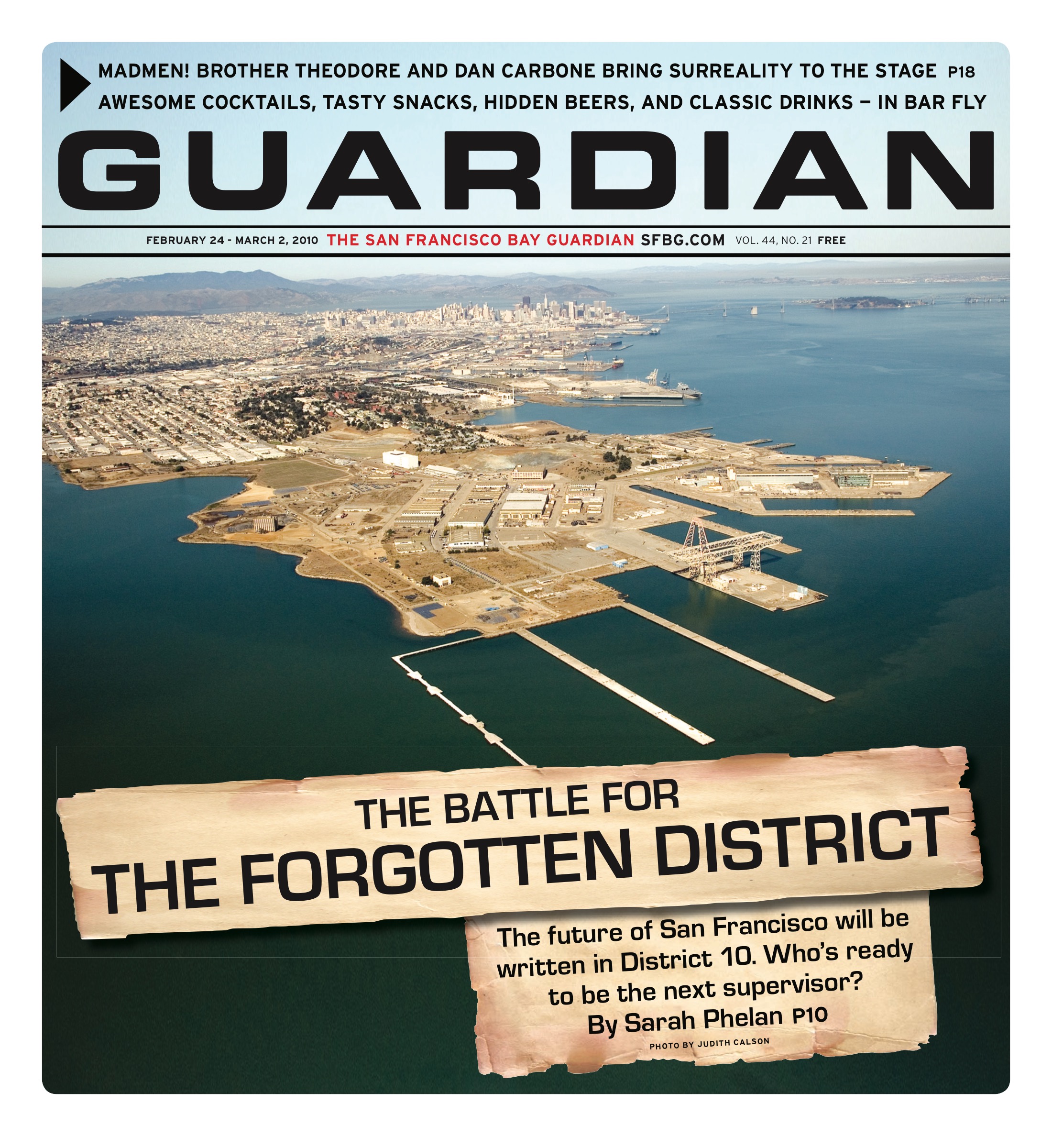
The battle for the forgotten district

24

sarah@sfbg.com

This November, when voters in District 10 — the largest, sunniest, and most diverse of the city’s 11 supervisorial districts — replace termed out Sup. Sophie Maxwell, they’ll be making a selection that could have pivotal implications for the entire city.

That’s because the next supervisor from southeast San Francisco inherits a district that is home to some of the city’s biggest environmental and public health challenges, as well as the most potential for development that will determine what kind of city San Francisco becomes.

District 10 is where you’ll find the most polluted and most underdeveloped lands in San Francisco, areas that could either be transformed into models of a sustainability or, in the words of Tony Kelly, the president of Potrero Boosters Neighborhood Association, “be turned into a toxic Foster City.”

District 10 is where the slaughterhouses, tanneries, and glue factories set up shop and used the bay as a dumping ground. It’s where the smokestacks of coal and oil fired power plants polluted the air. It’s where the Navy filled the Bay, built a shipyard at Hunters Point and loaded parts of the first atomic bomb onto the USS Indianapolis in 1945.

District 10 is where the bottom fell out of this industrial economy in 1974, when the Navy left, taking with it people’s jobs, pay, and hopes for a home of their own and a better future, particularly for what was then a predominantly African American population.

And District 10 is ground zero for plans that will triple the population and double the number of homes — homes that likely will only be “affordable” to Google executives and retirees from Marin, forever changing the face of San Francisco’s southeast sector. Critics fear that will accelerate what has been a steady exodus of black residents, replaced by megadeveloper Lennar’s vision for a new D10.

It’s against this dark history and difficult present that a wide open field of more than a dozen candidates are vying to replace Maxwell, who came to power in 2000 and has had a mixed voting record in her decade on the board. Sometimes, Maxwell was the eighth vote that let the progressive majority on the Board override Mayor Gavin Newsom’s veto and pass trailblazing legislation. Other times, she was the swing vote that allowed the moderate minority to carry Newsom’s water.

So, in addition to D10’s many internal challenges, this seat could determine the political balance of power on the Board of Supervisors, placing all the more importance on voters in this long-marginalized part of town.


DISTRICT OF DISCONTENT

Eric Smith, a biodiesel activist who has thrown his hat in the D10 ring, says that there is a lot of frustration in the air, and looking at the problems the district is facing, it’s hardly surprising that it has what nearly every candidate agrees is a fractured political culture.

“The Bayview, the Hunters Point Shipyard’s toxic Superfund site, the homicide rate, unemployment, poor public transportation, dwindling services and community resources have made D10 one of the city’s largest melting pots of discontent,” Smith said.

Smith’s words were spoken while the Elections Department was verifying signatures earlier this month on a second failed effort to qualify a petition to recall Maxwell.

Bayview resident and D10 candidate Marie Franklin didn’t support the attempt to recall Maxwell, but she understood it as “a frustration movement.”

“People are sinking in the sand, we’ve already lost so many of them, and they felt Sophie wasn’t doing anything for them,” said Franklin, who praised Maxwell for helping get Franklin’s apartment building complex renovated — a job that was completed 18 months ago, at a cost of $65 million, creating 500 local jobs.

“There are 654 units here, and they were uninhabitable,” Franklin said. “There was black mold, rain falling inside. We had people living worse than Haiti.”

Franklin, who said she is running because she “knows the history,” came here in 1978, when she and her son were living in a car after a fire left them homeless. She said the Bayview was a totally isolated area, barely part of mainstream San Francisco.

“There were no taxis, no services,” she recalled. “Nobody would come here, it was the stigmatized area where no one was accountable to provide services.”

The Bayview — which in some ways is the heart of D-!0 — wasn’t always a black community. But African Americans have been living here for 70 years, dealing with all the racism, denial of services, poverty, and pollution. And it bothers Franklin that 85 percent of the 10,500 homes that Lennar plans to develop won’t be affordable to the elderly, disabled, unemployed and low-income people who currently live in the Bayview.

“We need to preserve the diversity of the community and make sure their issues and information will flow to City Hall,” she said. “You must give the people a handle. If you don’t reach out, they’ll slip. That’s why folks out migrated.

Whoever succeeds Maxwell will be a central player in addressing some very big and dirty issues: the future of the Navy’s radiologically impacted shipyard at Hunters Point, Lennar’s massive redevelopment plan for the Shipyard and Candlestick Point, the polluting power plants, replacement of stinky digesters at the sewage plant, and the SF Hope public lousing rebuild.

There’s also the chance to address violence and crime. James Calloway, a candidate who has long worked in Bay Area schools, told us he believes that education and jobs are part of the keys to rejuvenating the district.

“Job opportunities are not as plentiful in the district,” Calloway said. “When I was a kid, you could walk down Third Street at 2 a.m. Now I wouldn’t walk down it at 9 p.m., and I know the area.”

Calloway is hopeful that the massive redevelopment plan, if done correctly, could start the district’s comeback. “Not a lot of black folks stay here when they have extensive education,” he said. “But it’s not only them. Many were displaced by redevelopment and had no way to go back.”


ELECTION UP FOR GRABS

The largest of the city’s 11 electoral districts, D10 is a huge triangular piece of land in the city’s southeast sector that was used as an industrial dumping zone for decades. Today, the district runs from the Giants stadium at AT&T Park to the 49ers stadium at Candlestick Point and encompasses Mission Bay, Potrero Hill, Dogpatch, India Basin, Portola, Little Hollywood, and Visitacion Valley. It’s also crossed by two freeways that isolate it from the rest of the city, and is home to a large number of crumbling housing projects that are in the process of being rebuilt.

Candidate Ed Donaldson grew up in the projects until he was 10 years old, when the Redevelopment Agency kicked his family out in the 1970s. “We landed on our feet, but others weren’t so lucky,” said Donaldson, who works as a housing counseling director at the San Francisco Housing Development Corporation.

“There is a sense that the Bayview and Visitacion Valley have not been included within the San Francisco family,” Donaldson said. “There is a sense of being forgotten.”

In 2007, Donaldson co-founded the Osiris Coalition to tackle the city’s dormant Certificate of Preference program, in which the Redevelopment Agency issued a document to displaced residents and businesses in the 1960s promising that they could return.

He also tried to rescue some 700 foreclosed properties and recycle them as affordable housing stock. And now he is trying to prevent the city from bulldozing seven SF Hope projects without guaranteeing residents that they have right to remain.

In 2007, Mayor Gavin Newsom and Maxwell convened an African American Outmigration Task Force that didn’t get a public hearing about its findings until August 2008. The timing angered some, who questioned why the report’s findings and implications for urban planning weren’t released before June 2008, when the residents of San Francisco voted for the Lennar-led Proposition G, a proposal to build 10,000 market rate homes at one of San Francisco’s last remaining black communities, which Newsom and Maxwell endorsed.

The taskforce didn’t publish its recommendations until the end of 2009, allegedly because of insider squabbling. Meanwhile, gentrification was going on actively, and many blamed Newsom, and by extension Maxwell, for failing to do anything with the group’s findings as D10 residents continued to suffer from high rates of asthma, cancer, unemployment and an ongoing black exodus.

It wasn’t always this way. In the 1940s, the district’s black population exploded when migrants from the south and World War II veterans came to work at the Hunters Point Naval Shipyard. Some moved to Alice Griffith Public Housing complex, or Double Rock, which was built as military housing in 1962. Others relocated to the Bayview when the Redevelopment Agency took over the Fillmore/Western Addition in the ’60s and ’70s as part of a controversial urban renewal effort.

But when the Navy abandoned the shipyard in 1974, unemployment hit the black community hard. Today, hundreds of the city’s lowest income residents live in Alice Griffith’s crumbling units and endure sewage backups, no heat, cloudy drinking water and leaking ceilings, as they wait for the projects to be rebuilt.

“Generations have been trapped in the silo of public housing and cannot get out, because of lack of opportunity and education, so when we legislate, we need to take that into consideration,” said candidate Malia Cohen, whose grandfather came from Texas to work at the shipyard where he met her grandmother, whose family came from New Orleans.

“My grandfather’s father was a longshoreman. He worked with the infamous Leroy King [a commissioner at the city’s Redevelopment Agency] and he has fantastically vivid stories of racism,” said Cohen, who works for the Federal Reserve Bank of San Francisco, previously served on the executive staff of Mayor Gavin Newsom, and has already raised over $18,000 in the D10 race and qualified for public matching funds.

“My family came here to work hard, they lived on Navy road in the projects, and then they bought a house here. My parents were born here, and we were all public schooled,” Cohen recalled as she took me on a tour of D10 that ended up in Visitacion Valley, an increasingly Chinese-American neighborhood that reflects a district-wide trend.

Census data show that by 2000, Asians were the largest racial group in the district (30 percent), followed by blacks (29 percent), whites (26 percent), and Latinos (19 percent). By 2003, according to the California Urban Issues project, the trend continued. Asians were the largest racial group (32 percent), followed by blacks (27 percent), whites (21 percent) and Latinos (17 percent) of the population.

This means that D10 candidates will have to garner support from more than one ethnic group to win. Over a dozen candidates have already filed papers in the race, but so far there is no clear front-runner.

Also frustrating the prognosticators is that fact that D10 has had the lowest voter turnout in the city, so the winner will also depend on who goes to the polls.

D10 candidate Geoffrea Morris, who is the grand daughter of longtime Bayview activist Charlie Walker, has been knocking on doors and participating in voter registration drives.

“We need new blood,” Morris said

Getting elected will be a complicated equation. Although Bayview’s population was 50 percent African American at the time of the 2000 census, it didn’t turn out the vote. In the 2006 election, only 14,000 of the district’s 37,000 registered voters went to the ballot, and 50 percent were from whiter, richer, and more Asian neighborhoods.

“It’s very important to the future of the city that the ethnicity diversity of the board be maintained and that the African American community have representation,” former Board President and current Democratic Party chair Aaron Peskin told the Guardian.

Maxwell recently told the Guardian that she’s not ready to endorse any D10 candidates yet. “I’m waiting for people to have a better understanding of what this community is, what the common thread running through it is, and how to use rank choice voting,” she told us.

The only candidate who currently holds elected office is BART director Lynette Sweet, who had her answers down pat when we reached her by phone, and even used wording that was eerily similar to Maxwell’s words.

“D10 is a pretty diverse district, but there is only one common thread: the need for economic development,” Sweet told me. “That’s true in Potrero Hill, Portola, Dog Patch and the Bayview. It’s the same mantra: a lot of small businesses need help, and the only way to help them is through economic development. In Potrero Hill it’s about land use. In the Bayview, it’s about the shipyard and better transportation and truancies.”


THE COMMON THREAD

District 10 is ground zero for the Lennar’s $2.2 billion plan to develop 10,500 market rate condos at the Shipyard and Candlestick Point. The plan will allegedly create thousands of jobs and new parks, deliver on an historic community benefits agreement that labor groups claim is so “lawyered up” that the developer can’t renege on its promises.

The package is framed as the one and only way to revitalize the southeast’s formerly vibrant economic engine. Indeed, any time anyone tries to slow down the process—to take time to thoroughly read the draft EIR and see if it adequately addresses the impacts of this massive urban reengineering project — a chorus of “no delays” starts up, either from residents of the housing projects desperate to see their homes rebuilt, or the labor contractors who hope to get jobs.

“It’s as if the city is playing checkers, while Lennar is playing three-dimensional chess,” Eric Smith observed.

Lennar has stated that it will contribute $711 million to finance this massive project. The remainder will be leveraged by Mello-Roos bonds, state taxes based on the use and size of a property and intended to raise money for needed services, and tax increment financing, which creates funding for projects by borrowing against future property tax revenues.

The conceptual plan won Maxwell’s backing but environmental groups are critical of the draft EIR.

During DEIR hearing, environmentalists questioned the wisdom and the cost of filling the Bay to build a bridge over Yosemite Slough, and building condos on Candlestick Point state recreation area, the only open major open space in the district.

But the city’s Planning Department also has 20,000-30,000 units of housing in its pipeline. This means that if all these plans get approved in the next decade, they’d account for 80 percent of residential development citywide. And D10’s population could triple, further skewing the district’s already shifting demographics.

In other words, D10 as we know it could become nothing more than a historic relic in a few years, and the next supervisor will play a key role in deciding whether that happens. SFHDC’s Ed Donaldson warns that any supervisor who does not understand the complexity of the city’s largest district can expect a similar recall backlash in future.

“There is no one homogenous voice in the community,” Donaldson said. “The grass-roots organizing that brought about the recall effort was a result of a changing political structure in the area, but is not yet on par with other districts in town. We still allow our politics to be controlled from downtown.”

Fellow candidate Eric Smith warns that the issues—and politics—are complex.

“People were emotional, angry, and desperate because they feel no one listens to them,” Smith said. “That’s part of the problem here; they would rather have a supervisor go down swinging for them, rather than watch one seemingly side with Lennar, PG&E and the mayor on issues contrary to their interests. That’s the terrible irony and one of the biggest problems in District 10. Folks are so mad, they’re willing to do whatever it takes to make them feel they have a voice in the outcome, even if it’s potentially worse.”

Smith cited the sequence of events that culminated last year in the Navy dissolving the community-based shipyard Restoration Advisory Board (RAB), which for years has reviewed technical documents and commented on the Navy’s clean-up proposals. But in December, the Navy made its official decision to disband the RAB, citing dysfunctional behavior and off-topic discussions that got in the way.

“Some of the same folks who were frustrated by the process, tried to send a signal to the Navy that they weren’t being heard and for all their well-intentioned efforts got the RAB dissolved,” Smith said. “I truly feel for them, it’s absolutely heartbreaking, but at times, they can be their own worst enemy.”

One of the looming issues about the shipyard is that the land has been polluted and needs to be cleaned. The shipyard contains radioactive debris from ships towed to the shipyard, after a 90-foot wave washed over them during an atomic test gone awry. The Navy burned 610,000 gallons of radioactively contaminated ship fuel at the shipyard, and workers showered on the shipyard, raising concerns that radioactive materials got into the drains and sewers. And questions have been raised about radiological tests on animals at the yard.


LEAKS AND FLOODS

It’s not just the shipyard that’s toxic. Even the buildings that were constructed to house workers 50 years ago are a serious mess.

Realtor Diane Wesley Smith, who grew up in public housing projects, took me on a walking tour of Alice Griffith last week to see conditions that tenants will likely have to endure until at least 2014, if the city sticks to its plan to relocate people into a new replacement unit in the same geographical area, if not the exact same site.

What we found was pretty messed up.

“The water sometimes comes out brown and feels like sand. It’s been like that for a year,” one resident said.

“The water is cloudy, the bath tub isn’t working and the sink keeps stopping up,” said another.

A woman named Silvia showed us how the water from the tap in her elderly mother’s kitchen flows out cloudy and then doesn’t settle properly, like foamy beer.

“The roof’s been leaking for years, the sewage backs up, but they just fixed the lights,” Silvia said. A neighbor named Linda was using her oven as a heater.

“The toilet backs up a lot, and my grandson’s been coughing a lot from asthma,” Linda said.

“Roaches is always a problem,” said a woman named Stormi, dressed in black sweats and a black T-shirt that read, “Can’t knock the hustle.”

“They’re trying,” said Stormi, a member of the Alice Griffith Residents Association, as a couple of Housing Authority trucks pulled up to do repairs.

“They promise that you will not have to leave your unit, but if they try to move us down to the waterfront, well, there’s a reason there’s no housing there, and it’s because the land will flood,” Stormi said.

“If we don’t end up at the table, we’ll end up on the menu,” Wesley Smith warned, as she stopped to chat with a group of young men, who were worried they would pushed out of the Alice Griffith rebuild through the criteria being established.

“Fred Blackwell, the executive director of the Redevelopment Agency, assures me that’s not the case, but Alice Griffith is a Housing Authority property, and empty promises have the potential to be great promises provided they are made in writing,” Wesley Smith said as we walked out of the projects and onto the road where a yellow and black sign announced “flooded” next to Candlestick Point park, where Lennar wants to build.

Malia Cohen expressed concern about Hope SF residents, as we drove through the Sunnydale housing project.

“We have to be diligent and mindful that people are not pushed out,” Cohen said, noting the sweeping views at Gleneagles golf course above Sunnydale, and the value of housing for a golf course community. “When public housing gets taken offline, we must work with Redevelopment and the Housing Authority to make sure no one is changing the rules halfway. We have to make sure the talks and walks line up. We need to be equal partners. We cannot be bulldozed by City Hall.”

Geoffrea Morris is a Calworks employee, at the Southeast Community College facility on Oakdale, which was built to mitigate the city’s expansion of the sewage plant in 1987. She cited concerns about the literacy levels of people who live in the 2200 public housing units that cluster D10. “A lot of people in Alice Griffith don’t even know the dates or when it’s going to be reconstructed,” Morris said. “Folks like to be told stuff like that, but the city gives you a stack of papers. Some will read them, but others rely on folks they think are trustworthy. They need stuff in layman’s terms written on one sheet of paper.”

Morris is a fan of the Internet who posted a community survey online, and made sure every housing project got some literature telling people to get informed. She worries about the digital divide in D10:

“A lot of folks don’t have computers and access to important information,” Morris said. “And let’s talk about the way ‘affordable’ is used to trick people.”

Michael Cohen, Newsom’s top economic adviser, recently stated in a memo that over the expected 15-20 year phased build out, Lennar’s Candlestick-Shipyard development would include, “up to 10,500 residential units, about 32 percent of which (3,345) will be offered at below market rates.”

“But 892 units of this ‘affordable category’ will be sold to folks earning $100,000,” Morris said. “So if you subtract 892 units from affordable unit category, you’re back to 25 percent affordable.”

Candidate Kristine Enea, an attorney and a former RAB member, chairs the India Basin Neighborhood Association, which administers a US EPA grant to hire experts to translate the Navy’s cleanup documents into plain English and comment on them She was frustrated by the Navy’s decision to dissolve the RAB.

“The lack of a forum does nothing to bolster the community’s trust in the cleanup or the redevelopment process,” Enea said.

Enea generally supports the Lennar project, but has concerns about whether it will adequately mitigate increased car traffic, or result in commercial development that benefits her neighborhood.

“India basin is a pocket of Hunters Point right along the shoreline,” Enea said. “Right now, we have no shops or restaurants, no ATM, no groceries, nothing beyond one liquor store and a few industrial businesses.

Potrero Boosters president Tony Kelly told us that District 10 residents can think for themselves. “D10 residents don’t need to rely on corporations to solve their problems,” he said.

“Folks in the eastern neighborhoods came up with a better revitalization plan than what the city proposed and community activists managed to close the power plant, after the city said it was impossible,” Kelly recalled.

And there’s no shortage of good ideas.

Kelly suggested that an urban agriculture center could immediately put low-skilled folks to work by erecting greenhouses on unused land. Smith said the industrial zone could be “incredible eco-park made from sustainable sources.

‘D 10 is the dumping ground for everything, including all the city’s waste,” he said. “We could be a shining example, not just for D 10, but the rest of the state.”

The D 10 candidate line up includes Calloway, Cohen, Donaldson, Smith, Enea: civil rights attorney Dewitt Lacy, Morris, Potrero View publisher Steve Moss; District 7 BART director Lynette Sweet, Wesley-Smith. Bill Barnes, who works for Sup. Michela Alioto-Pier, and Linda Richardson, who was appointed to the Human Rights Commission in 2007 by Mayor Newsom, have also expressed interest in the race.

In such a huge field, name identification will play a major role. Sweet is in office, but BART Board is not a high-profile job and won’t give her a huge advantage.

Cohen has a slight edge right now in that she’s raised $18,505, including $500 from former Newsom flak Peter Ragone, making her the first D. 10 candidate to qualify for campaign financing. The oldest of five girls, Cohen recalls how her mother got laid off from her city job as a school-based mental health worker and then rehired, as part of the city’s budget cuts.

“We felt that pinch and the frustrating games that are played out between the leadership and the rank and file,” she said.

Cohen who worked for Newsom in his first term as mayor, but has since left his administration , said she is uncomfortable at being framed as Newsom’s candidate.

“Because I’m not, but I am one of the few candidates who has seen how the mayor and the Board work—and don’t work—together,” she said.

Moss sees the city’s southeast as a “district in transition.” Over coffee at Farley’s in Potrero Hill, he told me that the southeastern neighborhoods could be “launching pads for environmentally sustainable growth.”

“The district’s been in a frozen period for 30 years, But despite the problems, people are deeply committed to and in love with their community.

“This district is the future of San Francisco and its social fabric—the diversity, income –and its problems are leftovers from the city’s industrial age.”


DISTRICT 10, BY THE NUMBERS

Total Acres: 5,650

Average household income: $85,000

Population: 73,000

Registered voters: 37,700

Average housing price: $335,000

Ethnicity (2003 figures): Asian 32%, African American, 27%, white 21%, Hispanic 17%

Development status of land: 18% residential, 38% is commercial, 38% undevelopable

All figures the latest available. Sources: SFGIS, Association of Bay Area Governments, U.S. Census, California Urban Issues Project. Ethnicity and income data is from 2003 and almost certainly has changed.


Unhappy days

3

FILM Brother Theodore had a way with words. Possessed by a message he had to deliver, in monologue he’d refer to days of yore when his articulate charisma could cause “duchesses [to] laugh freely and dance like dervishes” and “the sick at heart, same-day cleaners, women’s clubs and horseflies [to follow] me in a whirlwind of ecstasy.” Those last three words, so pulpy they’re worthy of George Kuchar, are vintage Theodore. With his trademark guttural voice shifting from deep rumble to surface quake, he’d compare his sweaty skin to “rancid pork” and say he’d “rather be a contented pinworm than a tormented Brother Theodore.” But a tormented Brother Theodore he was, an E.M. Cioran-caliber comic of melancholy and misery who viewed life as a fatal disease.

Jeff Sumerel’s documentary portrait To My Great Chagrin layers performance footage of Brother Theodore (birth name: Theodore Gottleib) from different eras to create a baying chorus of Theodores: young ones, older ones, almost always sporting a furrowed brow and a silly mini-bouffant haircut. Sumerel also has small puppets mouth Theodore’s words, in a nod to the existential curse at the core of his subject’s dramatic philosophy — a philosophy born from life experience and unflinching intelligence. It turns out that the boy who became Brother Theodore played chess in a Vienna apartment with his mother’s lover, Albert Einstein, before the Nazis annihilated his family and changed his fortune from one of tremendous wealth to abject poverty.

To My Great Chagrin is at its best when it presents unfiltered — and even magnified — Brother Theodore. A fixture of the New York stage who in some ways presages performance art, Brother Theodore dedicatedly honed his monologues over the course of decades. His mid-’80s appearances on Late Night with David Letterman were such a revelation to me as a teenager that my first visit to Manhattan had to include a trip to see him perform in Greenwich Village. His hostility towards that fraternal show’s host (I remember him likening Letterman to a “fishwife”) paved the way for similar though less substantive TV stunts and pranks by the likes of Crispin Glover. In the YouTube era, those clips of Brother Theodore are beginning to find an audience again, but Sumerel’s movie provides a much fuller dose of the Teutonic titan’s towering, glowering torment. Through the wonders of recording, this fiery orator and cosmo-dynamic personality lives on, long past the prime of his senility.

TO MY GREAT CHAGRIN: THE UNBELIEVABLE STORY OF BROTHER THEODORE

Thurs/25, 7:30 p.m., $8

Yerba Buena Center for the Arts

701 Mission, SF

(415) 978-2787

www.ybca.org


The war on suburbs? Huh?

10

Joel Kotkin, the author and urban scholar, was on KQED’s Forum this morning talking about what he called “the war on the suburbs.” He’s got a new book out, called The Next Hundred Million: America in 2050, and he’s arguing, among other things, that the election of Scott Brown in Massachusetts signals that the Democratic Party and progressives in America have lost touch with the suburbs and are being mean to the poor suburbanites.


He talked, for example, about Tracy, California, and noted that a suburbanite living in Tracy doesn’t want to pay taxes because he doesn’t see what he’s getting for his money. Kotkin sugggestes that the state ought to go back to the Pat Brown era, and focus on spending money on infrastructure, instead of on “state employee pensions.”


Never mind that when Pat Brown was governor, the population of California was less than half what it is today — and the state was far less diverse, had far fewer immigrants, far fewer residents whose primary language is not English and, frankly, was a lot more tolerant of poverty.


That was also before the passage of Prop. 13, so the state didn’t have to spend money on schools and local government; local property taxes covered those things.


In fact, I think what’s going on is just the opposite of what Kotkin is talking about. (He, by the way, says that suburbs are going to be more and more sustainable as more jobs relocate and we start using natural gas in our cars.) I realize that suburban voters can easily shift to the Republican party if the Democrats aren’t careful, but I also think that what’s happening in the United States today is not a war on suburbs but a war on cities.


The state and federal governments have systematically defunded urban America for more than 30 years now, and we’re paying the price. The hypothetical suburbanite in Tracy may think he’s not getting his money’s worth, but the truth is just the opposite; the suburbs — typically, not always but typically — have better-funded schools, better maintained streets, better sewage systems, less crime … and less of an income gap among residents.


Cities are, and will remain, America’s future, and we ignore that at our peril.  


Uproot: Playing with the new Food Environment Atlas

0

By Robyn Johnson

The USDA’s freshly released Food Environment Atlas has been getting some buzz the last few days, coinciding with Michelle Obama’s recent vow to tackle childhood obesity and food accessibility issues and a lot of dialogue and ranting going on in the media about big bad Agribusiness and the hyper-idealism and hypocrisy of the locavore movement. (Mrs. Obama herself has drawn some fire — critics have taken aim at her overstatement of the severity of the rise of obesity and its possible fallout, the “inappropriateness” of mentioning her own daughters’ brush with chubbiness, and her dodginess about important societal causes of childhood obesity. Oh, the pitfalls of a crusading First Lady!)


The atlas interactively charts 90 indicators of the food environment, like availability of fresh produce, fast food restaurants, and grocery stores, amount of physical activity evidenced in the population, and food costs and taxes. Users can generate maps showing variations countywide, regionally, or by state, depending on the data available. Users can also make advance searches for multiple factors, like poverty prevalence plus number of farmers markets available, if you want to carefully dance the line between correlation and causation. Other features include percentages of low-income homes over a mile away from grocery stores, types and quantities of foods eaten at home, food insecurity, obesity rates, farm to school programs, and a slew of other statistical information. (For a real horror show search for low-income preschool obesity rates).

This map shows the availability of farmers markets (or lack thereof) throughout the country.

I can’t say for certain since the highly trafficked link has been breaking throughout the day, but the atlas seems to work best at giving a broader comparative perspective of the food-related socioeconomic issues of the US. When trying to identify the relative culinary desert commonly known as West Oakland, the entire Bay Area portion of the map stayed the same minty green that denotes a high access to grocery stores — clearly not the case. That being said, some interesting disparities crop up. Colorado is among the highest of the states for fast food spending per person, but also has one of the least obese populations — Coloradoans also drink the least amount of soda and rank in the highest category for exercise. Play around and see what you can find, but you may not want to jump to any conclusions ….

A union that made black history

0

The Brotherhood of Sleeping Car Porters was a pioneering union that led the battle from the l930s to l950s against racial discrimination that laid the groundwork for the civil rights movement of the l960s. 

Few of the groups that we should honor during Black History Month are more deserving than the Brotherhood of Sleeping Car Porters, a pioneering union that played a key role in the winning of equal rights by African Americans. The union, the first to be founded by African Americans, was involved as much in political as in economic activity, joining with the NAACP to serve as the major political vehicle of African Americans from the late 1930s through the 1950s. It led the drives in those years against racial discrimination in employment, housing, education and other areas that laid the groundwork for the civil rights movement of the 1960s.

The need for a porters’ union was distressingly obvious. Porters commonly worked 12 or more hours a day, six or even seven days a week, on the Pullman Company’s luxurious sleeping car coaches for a mere $72.50 a month. And out of that, they had to pay for their meals, uniforms, even the polish they used to shine passengers’ shoes. They got no fringe benefits, although they could ride the trains for half-fare on their days off – providing they were among the very few with the time and money to do so. And providing they didn’t ride a Pullman coach. Pay was so low porters often had to draw on the equally meager earnings of their wives, almost invariably employed as domestics, to pay the rent at month’s end. It was a marginal and humiliating experience.

Porters were rightly proud of their work, a pride that showed in their smiling, dignified bearing. But they knew that no matter how well they performed, they would never be promoted. They could never be conductors. Those jobs were reserved for white men. Porters knew most of all that their white passengers and white employers controlled everything. It was they alone who decided what the porters must do and what they’d get for doing it. No point in arguing. No point in even correcting the many passengers who called all porters “George” — as in George Pullman, their boss — whatever their actual names, just as slaves had been called by their masters’ given names. When a passenger pulled the bell cord, porters were to answer swiftly and cheerfully. Just do what the passengers asked – or demanded. Shine their shoes, fetch them drinks, make their beds, empty their cuspidors. No questions, no complaints, no protests. No rights. Nothing better epitomized the huge distance between black and white in American society. Hundreds of porters who challenged the status quo by daring to engage in union activity or other concerted action were fired.

But finally, the administration of President Franklin D. Roosevelt granted workers, black and white, the legal right to unionize, and finally, in 1937, the Brotherhood of Sleeping Car Porters won a union contract from Pullman. The contract was signed precisely 12 years after union founder and president A. Philip Randolph had called the union’s first organizing meeting in New York City. But the long struggle was well worth it. The contract pulled the porters out of poverty. It brought them pay at least equal to that of unionized workers in many other fields, a standard work week, full range of fringe benefits and, most important, the right to continue to bargain collectively with Pullman on those and other vital matters. Union President Randolph and Vice President C.L. Dellums, who succeeded him in 1968, led the drive that pressured President Roosevelt into creating a Fair Employment Practices Commission aimed at combating discrimination in housing as well as employment. FDR agreed to set up the commission — a model for several state commissions – only after Randolph and Dellums threatened to lead a march on Washington by more than 100,000 black workers and others who were demanding federal action against discrimination.

Dellums and Randolph struggled as hard against discrimination inside the labor movement, particularly against the practice of unions setting up segregated locals, one for white members, one for black members. Randolph, elected in 1957 as the AFL-CIO’s first black vice president, long was known as the civil rights conscience of the labor movement, often prodding federation President George Meany and other conservative AFL-CIO leaders to take stands against racial discrimination.

The sleeping car coaches that once were the height of travel luxury have long since disappeared, and there are very few sleeping car porters in this era of less-than-luxurious train travel. The Brotherhood of Sleeping Car Porters is gone, too. But before the union disappeared, it had reached goals as important as any ever sought by an American union – or any other organization. Dick Meister, formerly labor editor of the SF Chronicle and KQED-TV Newsroom, has covered labor and politics for a half-century. Contact him through his website, www.dickmeister.com, which includes more than 250 of his recent columns.

(Dick Meister, formerly labor editor of the SF Chronicle and KQED-TV Newsroom, has covered labor and politics for a half-century.)

Black History Month in SF kicks off with dancing, future visions

0

By the time I made it to the 2010 Black History Month kickoff ceremony at San Francisco City Hall, on Friday, Feb. 5, California Public Utilities Commissioner Tim Simon was talking about how the African American community can make sure it doesn’t get left on the sidelines in future.

Simon advised folks to know their resources, community and strategy to ensure that people of color are included in the burgeoning Green economy—a topic in keeping with the history-of-black-economic-empowerment theme.

“And I want to encourage all of us to celebrate the month of Black History and teach it to our children, because we could lose this generation,” Smith said, noting that just three blocks away from City Hall in the Western Addition/Filmore, “young men talk about and celebrate it when they reach 25 years old.”

California Public Utilities Commissioner Tim Simon advised folks how not to get left behind in the Green economy.

The community was encouraged to attend the Human Rights Commission’s Feb. 18 meeting in the Bayview and to get involved in the 2010 Census, which will provide temporary, part-time jobs with flexible hours.

Destined to Dance enlivens the corridors of power at San Francisco’s City Hall.

And then dancers with Destined to Dance wowed the audience by infusing the typically staid marble corridors of power with a “Swing low, sweet chariot” inspired blend of energy, grace and light-footed gaiety.

After the main program concluded, a who’s who of San Francisco’s black community lingered for a moment to chat.

Sup. Sophie Maxwell told me that she saw the failed attempt to recall her as “democracy at work.” She also repeated earlier statements that she is not yet ready to endorse any of the candidates vying to replace her when she is termed out in January 2011.

“It’s not just about Bayview Hunters Point,” Maxwell observed. “The common thread is the entire District 10 community.”


D. 10 candidates Eric Smith and Tony Kelly smile for the camera.

Kelly told me that to his mind the common thread is that residents of the district, which is home to the worst toxic hot spots in the city, can’t rely on corporations to solve their problems.

“District 10 can think for itself,” Kelly said. “They don’t have to look outside. But to my mind, up until now, the approach in city hall has been that there is no mess in D. 10 that can’t be fixed by a friendly corporation.”

Kelly observed that folks in the eastern neighborhoods came up with a better revitalization plan than what the city proposed, and that community activists managed to close the power plant, after the city said it was impossible.

“We have the worst schools, transportation and pollution,” Kelly said. “Candidates in the D. 10 race tend to fall into one of two groups: those that are responsive to Lennar and PG&E’s plans, and those who oppose them.”

D. 10 candidate Kristine Enea, who attended the Navy’s Feb. 2 “community involvement plan” meeting at the Bayview YMCA told me that at least the Navy showed some willingness to let the community speak at that meeting,

Chris Jackson San Francisco Community College Board Trustee chats with D. 10 candidates Tony Kelly and Kristine Enea.

“But they need to stop being so defensive,” Enea said, as she questioned why the Navy refuses to speak in public about why it dissolved the Shipyard Restoration Advisory Board.

D 10 candidate Lynette Sweet told me that she thought California PUC commissioner Tim Simon “hit it on the head with his comments,” at the Black History Month kickoff event.

D. 10 candidate Lynette Sweet poses for the camera.

“We’re not the sum of our parts, we’re not murderers and poverty pimps, there is some real leadership and quality people within our community,” Sweet observed.

Alerts

0

WEDNESDAY, FEB. 3

No time to let up

Help raise money for the earthquake victims in Haiti at this fundraiser lunch and dinner where 100 percent of the proceeds go to the 3 million people in need of aid. Sen. Leland Yee (D-SF, San Mateo), SF Assemblywoman Fiona Ma, and Betty Yee, chair of the state Board of Equalization will be on hand.

Lunch 11 a.m.–3 p.m.;

dinner 5 p.m.–9 p.m.; $20 minimum

Moonstar Buffet Restaurant

383 Gellert, Daly City

(650) 992-2888

THURSDAY, FEB. 4

La Pelanga por Haiti

Help raise money for Partners in Health, an aid agency with more than 20 years’ experience in Haiti and more than 4, 000 Haitian employees, at this community street party featuring DJs Posoule, Papicultor, China tu Madre, and Juancho 3000 spinning cumbia, salsa dura, dancehall, hip-hop, Haitian kompa, and more. East Oakland artist Favianna Rodriguez will be selling prints; 100 percent of proceeds will be donated.

9 p.m., $5–$20 donation

Sub-Mission Arts

2183 Mission, SF

lapelanga.com

BayNVC workshop

Learn how to be a resource for your community at this workshop with Miki Kashtan from the Bay Area Nonviolent Communication and North American Leadership programs. Brush up on skills like how to stay present in a challenging situation and how to reflect understanding during conflict.

4:30 p.m., free

First Congregational Church of Oakland

2501 Harrison, Oakl.

(510) 433-0700 to register

Stand with Haiti

Attend “Stand with the People of Haiti: What the U.S. Government Isn’t Telling You,” a benefit dinner for Haiti. Pierre Labossiere of the Haitian Action Committee will discuss how U.S. policies contribute to chronic malnutrition and poverty in Haiti. The event is a Black History Month forum sponsored by the ANSWER Coalition.

7 p.m., $10–$20 donation

Centro del Pueblo

474 Valencia, SF

(415) 821-6545

SATURDAY, FEB. 6

Get on the march

Attend this organizing meeting for the March 20 antiwar protest in San Francisco. The meeting is open to all antiwar organizations and individuals and will be followed by mass outreach. A Jan. 9 meeting approved a plan for the protest to begin at Civic Center and march to downtown hotels in solidarity with the Local 2 hotel workers.

2 p.m., free

Centro del Pueblo, 2nd floor auditorium

474 Valencia, SF

(415) 821-6545

TUESDAY, FEB. 9

500 Years Later

Watch this award winning documentary directed by Owen ‘Alik Shahadah chronicling the struggle of people of African descent from enslavement through the continued fight for human rights, filmed in more than 20 countries.

7:30 p.m., $6 donation

Artists Television Access

992 Valencia, SF

(415) 821-6545

Mail items for Alerts to the Guardian Building, 135 Mississippi St., SF, CA 94107; fax to (415) 255-8762; or e-mail alert@sfbg.com. Please include a contact telephone number. Items must be received at least one week prior to the publication date.

Meister: Obama’s promise to women

0

It’s time to enact the Paycheck Fairness Act that would allow women to negotiate with employers for equal pay with men

By Dick Meister

(Dick Meister, former labor editor of the SF Chronicle and KQED-TV Newsroom, has covered labor and politics for a half-century.)

One of the most important promises made by President Obama in his State of the Union address has been largely overlooked – his promise to “crack down on violations of equal pay laws, so that women get equal pay for an equal day’s work.”

The need for that is great. Despite the 47-year-old law that promises women equal pay, their earnings remain well below men’s pay. They average only 77 cents for every dollar earned by men, even though their work is obviously every bit as valuable to employers and society at large as the work of men.

The pay discrepancy is even greater for women of color. African American women earn 63 cents and Latinas 52 cents for every dollar earned by men.

It’s estimated that if women were granted equal pay, they could earn as much as $2 million more over the whole of their working lives. It’s also estimated that if women were paid equally, the number of families living in poverty could be reduced by as much as half. Women’s earnings are needed by most families, and in many cases, women are their family’s only breadwinner.

Even women doing the same work as men, or work that’s as valuable to employers as that of their male counterparts, almost always are paid less. It’s as bad for women in the professions as for others. Female nurses, for instance, physicians and surgeons, professors, school teachers and lawyers earn as much as 30 percent less than men in their fields.

President Obama already has signed a bill that should help narrow the male-female pay gap. It was, in fact, the very first bill he signed after taking office – the Lilly Ledbetter Fair Pay Restoration Act. It’s named for a retired tire plant supervisor in Alabama who discovered after nearly 20 years on the job that she was being paid less than male supervisors.

Ms. Ledbetter sued for discrimination under the 1964 Civil Rights Act. But the Supreme Court ruled in 2007 that the law requires workers to sue no later than 180 days after their discriminatory pay rate was set – even if, like Ms. Ledbetter, they don’t discover the pay discrimination until years later. As the result of the decision, hundreds of pay discrimination cases were thrown out of court.

Shortly after the Supreme Court acted, the House passed a bill that would have overturned the court’s outrageous decision. But Senate Republicans, claiming the bill would lead to a flood of unfounded suits against employers, blocked a vote, and President Bush vowed to veto the bill if it ever crossed his desk.

The bill that finally reached Obama’s desk for signing provides that the 180-day time limit for filing lawsuits under the Civil Rights Act doesn’t begin to run until the last discriminatory act by an employer.

What’s most needed now is enactment of the Paycheck Fairness Act that’s been pending for a dozen years. The bill made it through the House last year, but was blocked by Senate Republicans. Obama, who voted for the bill as a senator, is certain to sign the new bill – if it’s not kept from him by a Republican filibuster in the Senate.

The Fairness Act would close loopholes in the 1963 Equal Pay Act that have made it relatively easy for employers to pay women less than their male co-workers holding the same jobs. The law would empower women to negotiate with employers for equal pay; prohibit retaliation against workers who share salary information with co-workers; strengthen government outreach, education and enforcement, and generally make the law much stronger.

There ‘s no doubting President Obama’s firm support for the act. As he’s said, “We won ‘t truly have an economy that puts the needs of the middle class first until we ensure that when it comes to pay and benefits at work, women are treated like the equal partners they are.”

Dick Meister, former labor editor of the SF Chronicle and KQED-TV Newsroom, has covered labor and politics for a half-century. Contact him through his website, www.dickmeister.com

Queer and present

0

DANCE In the middle of Keith Hennessy’s “A Queer 20th Anniversary” performances — which end this weekend with the Bay Area premiere of his 2008 Crotch (all the Joseph Beuys references in the world cannot heal the pain, confusion, regret, cruelty, betrayal, or trauma …) — the reprise of his two-part How to Die (2006) nearly filled Dance Mission Theatre. At the end of the evening, he asked for donations to help him defray a looming $5,000 deficit. Just about everyone gave.

Perhaps Hennessy didn’t mind begging. Stepping out of a persona and addressing the audience directly, after all, is part of his artistic make-up. Still, I winced. After two decades of investigating theater as a locus for truth-seeking, of innovating formal structures, of honing performance skills and creating work that is serious and thought-provoking, an artist deserves better.

Although Hennessy has a sizable, loyal audience, primarily in the queer community, his theatrically pungent work rattles everyone’s cage; injustice, poverty, violence, and hypocrisy set him off. Broadway it ain’t. Compelling — and sometimes uncomfortable — dance theater it is. You don’t have to agree with Hennessy’s perspective on sex’s redemptive power to appreciate the richness of his references, the skill with which he translates ideas to the stage, and the force of his commitment to what he does.

Hennessy is a stripper, not because he often performs in the nude, but because he tears off the blinders that protect him and us from what we don’t want to see. The question, of course, is what remains. Vulnerability for sure. But perhaps Hennessy is also a romantic, hoping to find something pure underneath all the garbage we accumulate.

In Homeless USA, part one of How to Die, he makes us look at the homeless in front of our noses. In part two, American Tweaker, he conjures up the drug-addled sexual abandon of the early 1980s. Even on second viewing, neither work was easy to watch. There is something of the fleshy rawness of a Francis Bacon canvas about them. But Hennessy also pushes theatrical verisimilitude to the point of absurdity, which allows an audience to step back from the emotional onslaught.

Homeless USA was derived from research on homeless men — many of them veterans — who commit suicide by being decapitated by passing trains. Hennessy started out gently, with Jules Beckman as a pugnacious sidekick, but turned up the heat by “masturbating” on the train tracks, and stumbling over the list of reasons to commit suicide. While “drowning” himself in a bucket, he became his own lighting designer. Attached to a string threaded through his nose, he recalled a delicate Petrouchka. In these scenes, Hennessy’s intensity — he often approaches a kind of religious fervor in his performances — was riveting.

At the core of the manic American Tweaker, a train-wreck evocation of a sex-obsessed disco and bathhouse scene, was a prolonged, extremely violent (though simulated) scene of anal intercourse. It ended with Hennessy whimpering on the floor. Addressing the audience, he confessed that at this point “I usually don’t know what to say.” Neither did I. The final healing ritual had Hennessy hanging upside down, Seth Eisen as an apparition from A Thousand and One Nights, and Beckman’s wondrous music. Rituals necessitate a community of believers. I wish I could have been one of them.

In Crotch, Hennessy draws props from his performance theory studies and (as the piece’s full title suggests) the work of the late German artist and philosopher Joseph Beuys. Among the most clearly referential are a tub of lard and a piece of felt: Beuys claimed after his Luftwaffe plane crashed on the Crimean Front in 1944, Tatar tribes people saved his life by wrapping him in lard and felt. The way Hennessy uses the lard is simultaneously freaky and profound.

CROTCH (ALL THE JOSEPH BEUYS REFERENCES IN THE WORLD CANNOT HEAL THE PAIN, CONFUSION, REGRET, CRUELTY, BETRAYAL, OR TRAUMA …)

Fri/29–Sun/31, 8 p.m., $15–$25

Dance Mission Theatre

3316 24th St, SF

www.brownpapertickets.com/event/82278

Know Your Class

0

(Dick Meister, former labor editor of the SF Chronicle and KQED-TV Newsroom, has covered labor, politics and other matters for a half-century.)

When Jack Hall died, flags were flown at half-staff throughout Hawaii, longshoremen closed the ports of San Francisco, Los Angeles and San Diego for 24 hours, and thousands of other workers in Hawaii and all along the west coasts of the United States and Canada also stopped work to show their respect.

That was 40 years ago. Yet Jack Hall, one of America’s greatest labor leaders, is still remembered fondly by many working people. In Hawaii, where he was regional director of the International Longshoremen’s and Warehousemen’s Union, many ILWU members had a paid holiday on Jan. 2, the date of his death. Others will have a holiday on the Feb. 28th anniversary of Hall’s birth.

It would be hard to exaggerate Jack Hall’s importance. He was director of organization for the ILWU and one of its two vice presidents when a stroke killed him in 1971 at age 55 in San Francisco. But it was not what he had done during the previous 18 months in the drafty, run-down headquarters presided over by the legendary Harry Bridges that made Hall extraordinary.

Rather, it was what Hall had done before then in Hawaii, where he served for more than a quarter-century as the ILWU’s regional director. He was the key leader in bringing industrial democracy to Hawaii, transforming Hawaii from virtually a feudalistic territory controlled by a few huge financial interests into a modern pluralistic state in which workers and their unions have a major voice.

As former Gov. John Burns of Hawaii said, Hall Brought about “the full flowering of democracy in our islands.”

Hall’s first job was as a sailor in 1932. He sailed to the Far East, where he saw grinding poverty that sickened and angered him and, he later recalled, “determined which side of the fence I was on.” Hall landed in Hawaii four years later, a tall, skinny 26-year-old sent by the Sailors Union to help striking longshoremen win union recognition. Hall soon emerged as a leader of the longshoremen and later as a principal leader in organizing sugar and pineapple plantations.

Virtually all phases of life in the islands were controlled by five extremely powerful holding companies, popularly known as “the Big Five,” that owned the plantations. The workers, Japanese, Filipino, Chinese, Portuguese, Spanish, Puerto Rican and others, were purposely segregated by race and ethnicity to keep them from acting jointly. They lived in company housing on the plantations where they worked, bought their food and clothing in company stores there, and had little choice but to do exactly what the bosses told them to do, at pay of less than 50 cents an hour.
The battles waged by Hall and his fellow organizers to overcome the employers’ absolute domination of their workers’ lives often got brutal. There were beatings, an attempt on Hall’s life, and a great furor over Hall’s admitted political radicalism.

The strike was the only weapon available to the workers. But when workers of a particular nationality struck to demand union rights, they’d be replaced immediately with workers of another nationality.

Hall, a tough, plainspoken, hard-drinking man, talked with the workers endlessly about the obvious need to bring them together in a single union. He spoke to them individually and often in meetings that were held in secret, outside the closely guarded plantations. He told the workers over and over that they could not achieve the unified strength necessary to overcome exploitation if they continued to remain apart because of racial and ethnic differences.

“Know your class,” Hall told them, “and be loyal to it.”

Finally, by the mid-1940s, the ILWU managed to organize workers on the plantations, as well as on Hawaii’s waterfronts. That gave the ILWU a powerful role in Hawaii’s economy that led the union quickly to a major role in Hawaii’s political life as well.

Hall helped put together a political league that became one of the most important political forces in Hawaii and the most racially and ethnically mixed such group anywhere. The union league helped break 50 consecutive years of Republican control of the State Legislature, which in turn led to passage of the most progressive laws of any state and helped make the ILWU as dominant in Hawaiian life as were the Big Five plantation owners before the coming of the union.

Plantation and longshore workers still are the backbone of the ILWU in Hawaii, but Hall long ago led the union into just about every other industry in the islands. Bakers, factory workers, automobile salesmen, supermarket clerks and a wide variety of other workers, especially including hotel workers and others in Hawaii’s ever-expanding tourist industry – all carry union cards.

Union membership is their guarantee of economic and political rights and rewards, of dignity and self-respect and the chance to determine their own destinies, of an effective voice on the job and in their communities, of fair and equal treatment their forebears could only dream of.

Jack Hall left a truly remarkable legacy.

Dick Meister, former labor editor of the SF Chronicle and KQED-TV Newsroom, has covered labor, politics and other matters for a half-century. Contact him through his website, www.dickmeister.com, which includes more than 250 of his recent columns.

Our weekly picks

0

WEDNESDAY 9th

DANCE/PERFORMANCE

Keith Hennessy: Saliva: The Making of and Saliva


Saliva is probably Keith Hennessy’s best known and least seen work of the last 20 years. When it premiered on a cold December night in 1988 under a San Francisco freeway overpass — and when it was performed again in March 1989 — it had not been advertised, word got around in the underground arts community. Saliva was a ritualistic solo in which Hennessy forcefully, poetically, and hopefully spoke for his own manhood and for a community caught in the anguish of AIDS. To use spit — an "uncouth" bodily fluid — as healing balm was a revolutionary act in both humanistic and theatrical terms. It may be difficult in 2009 to recreate the sense of pain, helplessness, and fury that generated the work. But isn’t that what memorials are for? Lest we forget, these events are the opening act of a celebration of Hennessy’s work and contribution to the Bay Area that continues in January. (Rita Felciano)

Saliva: The Making of discussion and screening: 7:30 p.m., free

CounterPULSE

1310 Mission, SF

Saliva performance: Sun/13, 8 p.m.; $15–$25 (no one turned away)

check www.circozero.org for location, SF

www.brownpapertickets.com

THURSDAY 10th

MUSIC

Espers


Don’t expect fairy folk and mythical critters to prance through the new Espers album, III (Drag City) — regardless of song titles like "Trollslända." That’s Swedish for dragonfly, band member Meg Baird assures me. Despite appearances and a name that evokes paranormal-minded cultists, it’s clear the group of mostly Philadelphians is more earthy and no-nonsense, as Baird reels off the various scratch song names and ideas Espers toyed with as they were making III — a witchy, intoxicating blend of psychedelia, prog, and English folk revival. For Baird’s interview, see this week’s Noise blog. (Kimberly Chun)

With Wooden Shjips and Colossal Yes

8 p.m., $13–$15

The Independent

628 Divisadero, SF

(415) 771-1421

www.independentsf.com

EVENT

Historic Libations


San Franciscans have long enjoyed a romance with alcohol — from the debauchery of the Barbary Coast era to the modern renaissance of the artisan cocktail, the City by the Bay knows how to knock ’em back. You can celebrate this high-proof history at Historic Libations, a party inspired by Cocktail Boothby‘s American Bartender (Anchor Distilling, 152 pages, $14.95), an expanded reprint of a classic 1891 book by one of the city’s earliest and most influential mixologists. Revelers can sample a variety of uniquely San Francisco cocktails, including the pisco sour and the Martinez. At the end of the festivities, they’ll be given their own copy of the book to take home and consult to perfect historic and potent concoctions. (Sean McCourt)

6 p.m., $40–$50

California Historical Society

678 Mission, SF.

(415) 357-1848, ext. 229

www.californiahistoricalsociety.org.

THEATER

SF Mime Troupe 50th Anniversary Exhibition Birthday Bash


Even if 50 is the new 40, it’s rare for many 50-year-olds to be as robust as the SF Mime Troupe. Challenging entrenched racism, endemic poverty, and politics-as-usual regionally and nationally since 1959, the Mime Troupe has earned theatre’s greatest awards — three Obies, a Tony, and an obscenity trial. Celebrate a half-century of provocative street performance — and toast the next 50 with one of San Francisco’s most venerable, anti-institutional institutions— at this birthday party, which includes a special staging of its 1981 Christmas Carol remix Ghosts, an ode to those displaced by the building of the nearby Moscone Center. Stop back on Saturday for a four-hour interactive workshop with Mime Troupe collective members Ed Holmes and Keiko Shimosanto in which participants will be called upon to create their own "anticonsumption" pageant and parade it through downtown SF. (Nicole Gluckstern)

Performance: 7:30 p.m., free

Workshop: Sat/12, 12:30 p.m., $15

Yerba Buena Center for the Arts

701 Mission, SF

(415) 978-2787

www.ybca.org

www.sfmt.org

FRIDAY 11th

FILM/MUSIC

Artists’ Television Access 25th Anniversary


The year 1984 contained delights and horrors, some more Orwellian than others: Ronald Reagan, Apple computers, Cabbage Patch Kids, Mary Lou Retton, Gremlins, Dynasty, New York’s "subway vigilante," American punk rock, etc. Amid that churning, neon-wearing, Cold War-tensed milieu, Artists’ Television Access was formed, and the activism-through-art hub has been keeping tabs on news and culture ever since. Toast 25 years of independent, radical, community-oriented programming at ATA’s Valencia Street gallery, the site of both a decades-spanning screening of works by staff and associates (Lise Swenson, Craig Baldwin, Rigo 23, Konrad Steiner) and a day-long musical get-down (with Ash Reiter, Eats Tapes, a raffle, and much more). (Cheryl Eddy)

"ATA 25: Quarter Century of Alternative Work": 7:30 p.m., free

"Underground — Experimental — Unstoppable": Sun/13, 11 a.m.–10 p.m., $10

Artists’ Television Access

992 Valencia, SF

(415) 824-3890

www.atasite.org

MUSIC

Eyehategod


Hell yeah, y’all: New Orleans’ legendary Eyehategod is coming to town, seeping into your eardrums on a slow-moving sludge tide of doom, noise, reefer smoke, and fuck-the-system politics. Singer Mike Williams famously overcame his heroin addiction during a post-Katrina jail stint, and the band — semi-dispersed since the early aughts, with most members engaged in other projects (Down, Mystick Krewe of Clearlight, Soilent Green, etc.) — is at last back on the road. Everyone who’s been fiending since 1993’s Take as Needed for Pain (Century Media) can finally feast on what Decibel magazine called "a series of buzzing, lurching dirges steeped in feedback and contempt." (Eddy)

With Stormcrow, Brainoil, Acephalix

8 p.m., $20

DNA Lounge

375 11th St, SF

(415) 626-1409

www.dnalounge.com

DANCE

Mark Morris Dance Company: The Hard Nut


If you have never seen The Hard Nut, Mark Morris’ extraordinarily musical and equally touching and hilarious version of the holiday classic, go now. The times are a-changing in Berkeley as well, and it may be quite some time until this glittering jewel comes back. The company is not scheduled to perform it here again in the near future. Morris set the piece in a cartoon version of the ’60s, removed some of the sugar but not much of the sweetness, kept the family spirit (though somewhat reinterpreted) alive, and heard things in the music as only he can. You will never see a dance of the Snowflakes — brilliant — like that and the grand pas de deux becomes a glorious grand pas de tutti. The score — Morris used every single note — will be performed live by the Berkeley Symphony conducted by Robert Cole. (Rita Felciano)

7 p.m., (through Dec. 20), $36–$62

Zellerbach Hall

UC Berkeley Campus, Berk.

(510) 642-9988

www.calperfs.berkeley.edu

SATURDAY 12th

EVENT

Tetris Tournament


Hey Tetris Master, here’s your chance to finally go out on Saturday night, do something semi-social at an art gallery, and win a prize — all while playing your favorite game of Tuck-Every-Tile-Rack-In-Snugly. But don’t get carried away: although you’ll have a chance to impress everyone with your phenomenal organizational skills, you won’t be taking anyone home. One other thing: you’re not going to have those cute little Tetris ditties to keep you in rhythm. Instead, there will be live bands (Microfiche, White Cloud, and Middle D). They might remind of those well-worn synth loops, but they’re more dynamic, more human. This is the night you’ve been waiting for; don’t let that sheep baaaaaah. (Spencer Young)

8 p.m., $5–$15 (free with membership)

The Lab

2948 16th St., SF

(415) 864 8855

www.thelab.org

FILM

San Francisco Silent Film Festival Winter Event


Perfectly timed as an antidote for all the year-end noise at first-run theaters, the SF Silent Film Festival Winter Event dips into cinema history, unspooling films made long before Peter Jackson got his mitts on CG technology or Guy Ritchie decided Sherlock Holmes should learn kung fu. The four selections include a 1927 Thailand-shot adventure from the future minds behind the original King Kong (1933), Chang: A Drama of the Wilderness; a U.S. premiere (90 years after the fact!) in Abel Gance’s 1919 World War I epic J’accuse; the Tod Browning-Lon Chaney collabo West of Zanzibar (1928); and a pair for Buster Keaton fans: the 1921 short The Goat, and delightful 1924 featurette Sherlock Jr. (Eddy)

11:30 a.m., $14–$17 per film (all-day pass, $52)

Castro Theatre

429 Castro, SF

1 (800) 838-3006

www.silentfilm.org

EVENT

Bazaar Bizarre


Handmade letterpress stationery, Scottish shortbread, dolls dressed up in home-knitted pinafores, wind chimes made from rusted dining utensils — love those old fairs and festivals. This local incarnation of the nationwide Bazaar Bizarre includes a one-woman metal studio, ceramic wares, boutique cupcakes, children’s clothes, hand-bound books, silk-screened apparel — and birds as finger jewelry. There will also be music by Slide and Spin Studios, crafty workshops, and giveaways. Get ready to overdose on cuteness and creativity. (Jana Hsu)

Noon–-6 p.m. (also Sun/13, noon–6 p.m.), $2 (children free)

San Francisco County Fair Building

Golden Gate Park

Ninth Ave and Lincoln, SF

(415) 831-5500

www.bazaarbizarre.org

SUNDAY 13th

MUSIC

Jenny Scheinman


As any music aficionado knows, describing an act that avoids prescribed categories can result in verbal apoplexy of a most unfortunate kind. How then to best convey the many talents of one Humboldt County-born Jenny Scheinman, whose collaborative projects and studio sessions have ranged over the years from avant-garde jazz to moody blues, and whose formidably-wielded violin is the perfect foil for her straight-shooting, honky-tonk-inflected voice? From John Zorn’s Tzadik label to Lucinda Williams’ recording sessions, Sheinman’s been making a widening splash since leaving the Bay Area in 1999. Skillfully combining a wiser-than-her-years strain of down-home melancholia with sturdy yet evocative multilayered orchestral composition, her appeal lies not in a narrowness of focus, but an expansive, expressive musical palette. She’s showcasing her range in three separate sets — an instrumental duet with pianist Myra Melford, a vocal set with guitarist Robby Giersoe, and a final act with singer-songwriter Bruce Cockburn. (Nicole Gluckstern)

8 p.m., $18.50–$19.50

Freight and Salvage

2020 Addison, Berkeley

(510) 644-2020

www.freightandsalvage.org

www.jennyscheinman.com

TUESDAY 15th

MUSIC

Kid Cudi


More Urban Outfitters than the rooftops of Brooklyn, Kid Cudi has successfully capitalized off of Kanye West’s hipster niche. For the MTV crowd in search of someone less embarrassing than West, Kid Cudi is their go-to neon hoodie. He makes intergalactic pop-hop mixed with lazy lyrics like "The lonely stoner needs to free his mind at night" and "I’ve got some issues that nobody can see<0x2009>/And all of these emotions are pouring out of me." A poet he ain’t. It’s more spectacle than speculation. The songs "Heart of Lion" and "Up Up & Away" are infectious with youthful ambition, and we’re reminded this is a kid from Cleveland who now wears his Air Yeezys on the streets of Brooklyn. Is this the future of hip-hop? I don’t know. I just came here to get high and dance in my skinny jeans. (Lorian Long)

8 p.m., $29.75–$33.00

Regency Ballroom

1290 Sutter, SF

415-673-5716

www.theregencyballroom.com

The Guardian listings deadline is two weeks prior to our Wednesday publication date. To submit an item for consideration, please include the title of the event, a brief description of the event, date and time, venue name, street address (listing cross streets only isn’t sufficient), city, telephone number readers can call for more information, telephone number for media, and admission costs. Send information to Listings, the Guardian Building, 135 Mississippi St., SF, CA 94107; fax to (415) 487-2506; or e-mail (paste press release into e-mail body — no text attachments, please) to listings@sfbg.com. We cannot guarantee the return of photos, but enclosing an SASE helps. Digital photos may be submitted in jpeg format; the image must be at least 240 dpi and four inches by six inches in size. We regret we cannot accept listings over the phone.

State of the art displacement

0

OPINION What does the loss of 11 residences and a few jobs matter if it means a state-of-the-art hospital will be built?

That’s the question Examiner columnist Ken Garcia asked Oct. 20. The line cut like sharp knives into my eyes and heart as I read about Sutter Health/California Pacific Medical Center’s proposal to put a billion-dollar hospital subsequently displacing elder and disabled tenants and low-income workers at Geary and Van Ness streets, on the edge of one of the poorest neighborhoods in San Francisco.

As I read and reread the hypothetical question, I knew it could only have been written by someone who hadn’t witnessed countless low-income elders die or become seriously ill after they were evicted or displaced or hundreds of poor migrant workers and their families struggle and go hungry because they couldn’t find a steady job with a living wage.

How do you quantify the importance of even one decent job for a poor person struggling to survive? Or one business owned by a small business owner who treats his or her employees with respect and love? Or the loss of one long-term residence of a disabled and elder tenant?

How do you rationalize the pain of relocation and job eradication in lieu of the building of a huge structure supposedly there to “heal people?”

And then there is the question of the building of a “state of the art” hospital – read: rich people’s hospital – in a community where the majority of people are poor. And the issue of how the corporation funding the building made another, perhaps more devastating, decision to leach resources and support from St. Luke’s, a truly community-based hospital.

“I won’t be able to sit in Mama Dee’s chair anymore.” My six-year-old son looked down as he spoke. We were sitting in the Van Ness Bakery & Cafe at the corner of Van Ness and Geary, one of the many small businesses facing displacement.

When my son and I heard about the pending proposal to demolish and build, not only did we know that the spirit of my Mama Dee, cofounder of POOR Magazine who passed on her spirit journey in March 2006, was very angry with the demolition of her favorite spot. But more important, as someone who struggled with poverty, racism, and gentrification her entire life, I knew my mama was also mad, as I was, at the lie of California Pacific Medical Center, for proposing to build a hospital that isn’t really needed, in a community it isn’t really geared toward, and in the process dismantling the jobs, homes, and livelihoods of tenants, poor workers, and small business owners.

“This is a bad economy, and I really have no other job options. I don’t know what we workers will do” said Ruthie Seng and Oy, two of the workers at the family-owned and humanely-operated Van Ness Bakery.

As we consider granting the plans for this $1.7 billion dollar hospital proposal, perhaps we should reassess what hospitals are there to do and whom, they are doing it for.

Tiny a.k.a. Lisa Gray-Garcia is a poverty scholar and daughter of Dee, coeditor of POOR Magazine and the author of Criminal of Poverty: Growing Up Homeless in America.

Film listings

0

Film listings are edited by Cheryl Eddy. Reviewers are Kimberly Chun, Michelle Devereaux, Max Goldberg, Dennis Harvey, Johnny Ray Huston, Louis Peitzman, Lynn Rapoport, Ben Richardson, Matt Sussman, and Laura Swanbeck. The film intern is Fernando F. Croce. For rep house showtimes, see Rep Clock. For first-run showtimes, see Movie Guide.

OPENING

Invictus Elected President of South Africa in 1995 — just five years after his release from nearly three decades’ imprisonment — Nelson Mandela (Morgan Freeman) perceives a chance to forward his message of reconciliation and forgiveness by throwing support behind the low-ranked national rugby team. Trouble is, the Springboks are currently low-ranked, with the World Cup a very faint hope just one year away. Not to mention the fact that despite having one black member, they represent the all-too-recent Apartheid past for the country’s non-white majority. Based on John Carlin’s nonfiction tome, this latest Oscar bait by the indefatigable Clint Eastwood sports his usual plusses and minuses: An impressive scale, solid performances (Matt Damon co-stars as the team’s Afrikaaner captain), deft handling of subplots, and solid craftsmanship on the one hand. A certain dull literal-minded earnestness, lack of style and excitement on the other. Anthony Peckham’s screenplay hits the requisite inspirational notes (sometimes pretty bluntly), but even in the attenuated finals match, Eastwood’s direction is steady as she goes — no peaks, no valleys, no faults but not much inspiration, either. It doesn’t help that Kyle Eastwood and Michael Stevens contribute a score that’s as rousing as a warm milk bath. This is an entertaining history lesson, but it should have been an exhilarating one. (2:14) Sundance Kabuki. (Harvey)

Me and Orson Welles See “Citizen Welles.” (1:54)

*The Princess and the Frog Expectations run high for The Princess and the Frog: it’s the first Disney film to feature an African American princess, the first 2D Disney cartoon since the regrettable Home on the Range (2004), and the latest entry from the writing-directing team responsible for The Little Mermaid (1989) and Aladdin (1992). Here’s the real surprise — The Princess and the Frog not only meets those expectations, it exceeds them. After years of disappointment, many of us have given up hope on another classic entry into the Disney 2D animation canon. And yet, The Princess and the Frog is up there with the greats, full of catchy songs, gorgeous animation, and memorable characters. Set in New Orleans, the story is a take off on the Frog Prince fairy tale. Here, the voodoo-cursed Prince Naveen kisses waitress Tiana instead — transferring his froggy plight to her as well. A fun twist, and a positive message: wishing is great, but it takes hard work to make your dreams come true. For those of us raised on classic Disney, The Princess and the Frog is almost too good to believe. (1:37) Shattuck. (Peitzman)

*The Private Lives of Pippa Lee See “Life Out of Balance.” (1:40) Albany, Bridge, Smith Rafael.

A Single Man Tom Ford directs Colin Firth and Julianne Moore in this 1960s-set tale of a man mourning the death of his longtime partner. (1:39) Sundance Kabuki.

Uncertainty A knocked-up girl (Lynn Collins) and a guy with a coin in his pocket (Joseph Gordon-Levitt) stand on the Brooklyn Bridge, circle the issue, flip the coin, then bolt in opposite directions. The coin was clearly purchased in some dusty, mysterious Chinatown magic shop from a loopy-seeming octogenarian codger, because at each end of the bridge, the pair reunite for two 24-hour bouts of the title’s psychological state that unspool side by side in time but diverge in mood and pace and genre: on the Brooklyn side, we get a slow-paced family drama; in Manhattan, a pulse-raising action-thriller. In other words, a monument, a monumental decision, and a premise spun out of such pure and visible artifice that it seems unlikely to translate into absorbing filmmaking. It does, though, somehow, in the hands of writer-directors Scott McGehee and David Siegel (2005’s Bee Season, 2001’s The Deep End), who adroitly move Uncertainty’s central characters through familial scenes weighted down by quiet grief, strife, love, and worry and through the more heightened anxiety of chase and gunplay and ceaseless surveillance. While the framework remains a distracting fact, something constructed while we watched and then imposed on us, the film, heavily improvised, is carefully edited to guide us without tripping between the two threads of story. And in each — in what is becoming a pleasurable habit — we watch Gordon-Levitt bring texture and depth to the smallest moments in a conversation or scene. (1:45) Roxie. (Rapoport)

ONGOING

Armored (1:28) 1000 Van Ness, Shattuck.

*Bad Lieutenant: Port of Call New Orleans Consider that ridiculous title. Though its poster and imdb entry eliminate the initial article, it appears onscreen as The Bad Lieutenant: Port of Call New Orleans. That’s the bad lieutenant, not to be confused with Abel Ferrara’s 1992 Bad Lieutenant. The bad lieutenant has a name: Terence McDonagh, and he’s a police officer of similarly wobbly moral fiber. McDonagh’s tale — inspired by Ferrara and scripted by William Finkelstein, but perhaps more important, filmed by Werner Herzog and interpreted by Nicolas Cage — opens with a snake slithering through a post-Hurricane Katrina flood. A prisoner has been forgotten in a basement jail. McDonagh and fellow cop Stevie Pruit (Val Kilmer) taunt the man, taking bets on how long it’ll take him to drown in the rising waters. An act of cruelty seems all but certain until McDonagh, who’s quickly been established as a righteous asshole, suddenly dives in for the rescue. Unpredictability, and quite a bit of instability, reigns thereafter. Every scene holds the possibility of careening to heights both campy and terrifying, and Cage proves an inspired casting choice. At this point in his career, he has nothing to lose, and his take on Lt. McDonagh is as haywire as it gets. McDonagh snorts coke before reporting to a crime scene; he threatens the elderly; he hauls his star teenage witness along when he confronts a john who’s mistreated his prostitute girlfriend (Eva Mendes); he cackles like a maniac; he lurches around like a hunchback on crack. Not knowing what McDonagh will do next is as entertaining as knowing it’ll likely be completely insane. (2:01) Shattuck, Smith Rafael. (Eddy)

The Blind Side When the New York Times Magazine published Michael Lewis’ article “The Ballad of Big Mike” — which he expanded into the 2006 book The Blind Side: Evolution of a Game —nobody could have predicated the cultural windfall it would spawn. Lewis told the incredible story of Michael Oher — a 6’4, 350-pound 16-year-old, who grew up functionally parentless, splitting time between friends’ couches and the streets of one of Memphis’ poorest neighborhoods. As a sophomore with a 0.4 GPA, Oher serendipitously hitched a ride with a friend’s father to a ritzy private school across town and embarked on an unbelievable journey that led him into a upper-class, white family; the Dean’s List at Ole Miss; and, finally, the NFL. The film itself effectively focuses on Oher’s indomitable spirit and big heart, and the fearless devotion of Leigh Anne Tuohy, the matriarch of the family who adopted him (masterfully played by Sandra Bullock). While the movie will delight and touch moviegoers, its greatest success is that it will likely spur its viewers on to read Lewis’ brilliant book. (2:06) 1000 Van Ness, Sundance Kabuki. (Daniel Alvarez)

Brothers There’s nothing particularly original about Brothers — first, because it’s based on a Danish film of the same name, and second, because sibling rivalry is one of the oldest stories in the book. The story is fairly straightforward: good brother (Tobey Maguire) goes AWOL in Afghanistan, bad brother (Jake Gyllenhaal) comforts his sister-in law (Natalie Portman), attraction develops, but then — and here’s where things get awkward — good brother comes home. Throughout much of Brothers, the script is surprisingly restrained, holding the film back from Movie of the Week territory. Those moments of subtlety are the movie’s strongest, but by the end they’ve given way to giant, maudlin explosions of angst, which aren’t nearly as impressive. Still, the acting is consistently strong. Maguire is especially good as Captain Sam Cahill in a performance that runs the gamut from doting father to terrifyingly unbalanced. It’s unfortunate that the quiet scenes, in which all the actors excel, are overshadowed by the big, plate-smashing ones. (1:50) 1000 Van Ness, Shattuck, Sundance Kabuki. (Peitzman)

*Capitalism: A Love Story Gun control. The Bush administration. Healthcare. Over the past decade, Michael Moore has tackled some of the most contentious issues with his trademark blend of humor and liberal rage. In Capitalism: A Love Story, he sets his sights on an even grander subject. Where to begin when you’re talking about an economic system that has defined this nation? Predictably, Moore’s focus is on all those times capitalism has failed. By this point, his tactics are familiar, but he still has a few tricks up his sleeve. As with Sicko (2007), Moore proves he can restrain himself — he gets plenty of screen time, but he spends more time than ever behind the camera. This isn’t about Moore; it’s about the United States. When he steps out of the limelight, he’s ultimately more effective, crafting a film that’s bipartisan in nature, not just in name. No, he’s not likely to please all, but for every Glenn Beck, there’s a sane moderate wondering where all the money has gone. (2:07) Roxie. (Peitzman)

Christmas with Walt Disney Specially made for the Presidio’s recently opened Walt Disney Family Museum, this nearly hour-long compilation of vintage Yuletide-themed moments from throughout the studio’s history (up to Walt’s 1966 death) is more interesting than you might expect. The engine is eldest daughter Diane Disney Miller’s narrating reminiscences, often accompanied by excerpts from an apparently voluminous library of high-quality home movies. Otherwise, the clips are drawn from a mix of short and full-length animations, live-action features (like 1960’s Swiss Family Robinson), TV shows Wonderful World of Disney and Mickey Mouse Club, plus public events like Disneyland’s annual Christmas Parade and Disney’s orchestration of the 1960 Winter Olympics’ pageantry. If anything, this documentary is a little too rushed –- it certainly could have idled a little longer with some of the less familiar cartoon material. But especially for those who who grew up with Disney product only in its post-founder era, it will be striking to realize what a large figure Walt himself once cut in American culture, not just as a brand but as an on-screen personality. The film screens Nov 27-Jan 2; for additional information, visit http://disney.go.com/disneyatoz/familymuseum/index.html. (:59) Walt Disney Family Museum. (Harvey)

*Collapse Michael Ruppert is a onetime LAPD narcotics detective and Republican whose radicalization started with the discovery (and exposure) of CIA drug trafficking operations in the late 70s. More recently he’s been known as an author agitator focusing on political coverups of many types, his ideas getting him branded as a factually unreliable conspiracy theorist by some (including some left voices like Norman Solomon) and a prophet by others (particularly himself). This documentary by Chris Smith (American Movie) gives him 82 minutes to weave together various concepts — about peak oil, bailouts, the stock market, archaic governmental systems, the end of local food-production sustainability, et al. — toward a frightening vision of near-future apocalypse. It’s “the greatest preventable holocaust in the history of planet Earth, our own suicide,” as tapped-out resources and fragile national infrastructures trigger a collapse in global industrialized civilization. This will force “the greatest age in human evolution that’s ever taken place,” necessitating entirely new (or perhaps very old, pre-industrial) community models for our species’ survival. Ruppert is passionate, earnest and rather brilliant. He also comes off at times as sad, angry, and eccentric, bridling whenever Smith raises questions about his methodologies. Essentially a lecture with some clever illustrative materials inserted (notably vintage educational cartoons), Collapse is, as alarmist screeds go, pretty dang alarming. It’s certainly food for thought, and would make a great viewing addendum to concurrent post-apocalyptic fiction The Road. (1:22) Shattuck. (Harvey)

La Danse: The Paris Opera Ballet (2:38) Smith Rafael.

Disney’s A Christmas Carol (1:36) 1000 Van Ness.

*An Education The pursuit of knowledge — both carnal and cultural — are at the tender core of this end-of-innocence valentine by Danish filmmaker Lone Scherfig (who first made her well-tempered voice heard with her 2000 Dogme entry, Italian for Beginners), based on journalist Lynn Barber’s memoir. Screenwriter Nick Hornby breaks further with his Peter Pan protagonists with this adaptation: no man-boy mopers or misfits here. Rather, 16-year-old schoolgirl Jenny (Carey Mulligan) is a good girl and ace student. It’s 1961, and England is only starting to stir from its somber, all-too-sober post-war slumber. The carefully cloistered Jenny is on track for Oxford, though swinging London and its high-style freedoms beckon just around the corner. Ushering in those freedoms — a new, more class-free world disorder — is the charming David (Peter Sarsgaard), stopping to give Jenny and her cello a ride in the rain and soon proffering concerts and late-night suppers in the city. He’s a sweet-faced, feline outsider: cultured, Jewish, and given to playing fast and loose in the margins of society. David can see Jenny for the gem she is and appreciate her innocence with the knowing pleasure of a decadent playing all the angles. The stakes are believably high, thanks to An Education’s careful attention to time and place and its gently glamored performances. Scherfig revels in the smart, easy-on-eye curb appeal of David and his friends while giving a nod to the college-educated empowerment Jenny risks by skipping class to jet to Paris. And Mulligan lends it all credence by letting all those seduced, abandoned, conflicted, rebellious feelings flicker unbridled across her face. (1:35) Albany, Piedmont. (Chun)

The End of Poverty? (1:46) Four Star.

Everybody’s Fine Robert De Niro works somewhere between serious De Niro and funny De Niro in this portrait of a family in muffled crisis, a remake of the 1991 Italian film Stanno Tutti Bene. The American version tracks the comings and goings of Frank (De Niro), a recently widowed retiree who fills his solitary hours working in the garden and talking to strangers about his children, who’ve flung themselves across the country in pursuit of various dreams and now send home overpolished reports of their achievements. Disappointed by his offspring’s collective failure to show up for a family get-together, he embarks on a cross-country odyssey to connect with each in turn. Writer-director Kirk Jones (1998’s Waking Ned Devine) effectively underscores Frank’s loneliness with shots of him steering his cart through empty grocery stores, interacting only with the occasional stock clerk, and De Niro projects a sense of drifting disconnection with poignant restraint. But Jones also litters the film with a string of uninspired, autopilot comic moments, and manifold shots of telephone wires as Frank’s children (Kate Beckinsale, Drew Barrymore, and Sam Rockwell) whisper across the miles behind their father’s back — his former vocation, manufacturing the telephone wires’ plastic coating, funded his kids’ more-ambitious aims — feel like glancing blows to the head. A vaguely miraculous third-act exposition of everything they’ve been withholding to protect both him and themselves is handled with equal subtlety and the help of gratingly precocious child actors. (1:35) 1000 Van Ness. (Rapoport)

*Everything Strange and New In Frazer Bradshaw’s Everything Strange and New, Wayne (Jerry McDaniel), wears overalls too large and a look of pained, dazed acquiescence. It’s as if not just his clothes but his life were given to the wrong person — and there’s a no-exchange policy. He loves wife Reneé (the writer Beth Lisick) and their kids. But those two unplanned pregnancies mean she’s got to stay home; daycare would cost more than she’d earn. So every day Wayne returns from his dead-end construction job to the home whose mortgage holds them hostage; and every time Reneé can be heard screaming at their not-yet-school-age boys, at the end of her tether. Sometimes he silently just turns around to commiserate over beer with buddies likewise married with children, but doing no better. Wayne’s voiceover narration endlessly ponders how things got this way — more or less as they should be, yet subtly wrong. He might be willing (or at least able) to let go of the idea of happiness. But Reneé’s inarticulate fury at her stifling domestication keeps striking at any nearby punching bag, himself (especially) included. Something’s got to change. But can it? Veteran local experimentalist and cinematographer Bradshaw’s first feature, which he also wrote, never stoops to narrative cliché. Or to stylistic ones, either — there’s a spectral poetry to the way he photographs the Oakland flats. (1:24) Roxie. (Harvey)

*Fantastic Mr. Fox A lot of people have been busting filmmaker Wes Anderson’s proverbial chops lately, lambasting him for recent cinematic self-indulgences hewing dangerously close to self-parody (and in the case of 2007’s Darjeeling Limited, I’m one of them). Maybe he’s been listening. Either way, his new animated film, Fantastic Mr. Fox, should keep the naysayer wolves at bay for a while — it’s nothing short of a rollicking, deadpan-hilarious case study in artistic renewal. A kind of man-imal inversion of Anderson’s other heist movie, his debut feature Bottle Rocket (1996), his latest revels in ramshackle spontaneity and childlike charm without sacrificing his adult preoccupations. Based on Roald Dahl’s beloved 1970 book, Mr. Fox captures the essence of the source material but is still full of Anderson trademarks: meticulously staged mise en scène, bisected dollhouse-like sets, eccentric dysfunctional families coming to grips with their talent and success (or lack thereof).(1:27) Empire, 1000 Van Ness, SF Center, Sundance Kabuki. (Devereaux)

The Maid In an upper-middle class subdivision of Santiago, 40-year-old maid Raquel (Catalina Saavedra), perpetually stony and indignant, operates a rigorous dawn-to-dusk routine for the Valdez family. Although Raquel rarely behaves as an intimate of her longtime hosts, she remains convinced that love, not labor, bonds them. (Whether the family shares Raquel’s feelings of devotion is highly dubious.) When a rotating cast of interlopers is hired to assist her, she stoops to machinations most vile to scare them away — until the arrival of Lucy (Mariana Loyola), whose unpredictable influence over Raquel sets the narrative of The Maid on a very different psychological trajectory, from moody chamber piece to eccentric slice-of-life. If writer-director Sebastián Silva’s film taunts the viewer with the possibility of a horrific climax, either as a result of its titular counterpart — Jean Genet’s 1946 stage drama The Maids, about two servants’ homicidal revenge — or from the unnerving “mugshot” of Saavedra on the movie poster, it is neither self-destructive nor Grand Guignol. Rather, it it is much more prosaic in execution. Sergio Armstrong’s fidgety hand-held camera captures Raquel’s claustrophobic routine as it accentuates her Sisyphean conundrum: although she completely rules the inner workings of the house, she remains forever a guest. But her character’s motivations often evoke as much confusion as wonder. In the absence of some much needed exposition, The Maid’s heavy-handed silences, plaintive gazes, and inexplicable eruptions of laughter feel oddly sterile, and a contrived preciousness begins to creep over the film like an effluvial whitewash. Its abundance makes you aware there is a shabbiness hiding beneath the dramatic facade — the various stains and holes of an unrealized third act. (1:35) Shattuck. (Erik Morse)

The Men Who Stare at Goats No! The Men Who Stare at Goats was such an awesome book (by British journalist Jon Ronson) and the movie boasts such a terrific cast (George Clooney, Kevin Spacey, Jeff Bridges, Ewan McGregor). How in the hell did it turn out to be such a lame, unfunny movie? Clooney gives it his all as Lyn Cassady, a retired “supersolider” who peers through his third eye and realizes the naïve reporter (McGregor) he meets in Kuwait is destined to accompany him on a cross-Iraq journey of self-discovery; said journey is filled with flashbacks to the reporter’s failed marriage (irrelevant) and Cassady’s training with a hippie military leader (Bridges) hellbent on integrating New Age thinking into combat situations. Had I the psychic powers of a supersoldier, I’d use some kind of mind-control technique to convince everyone within my brain-wave radius to skip this movie at all costs. Since I’m merely human, I’ll just say this: seriously, read the book instead. (1:28) Shattuck. (Eddy)

*The Messenger Ben Foster cut his teeth playing unhinged villains in Alpha Dog (2006) and 3:10 to Yuma (2007), but he cements his reputation as a promising young actor with a moving, sympathetic performance in director Oren Moverman’s The Messenger. Moverman (who also co-authored the script) is a four-year veteran of the Israeli army, and he draws on his military experience to create an intermittently harrowing portrayal of two soldiers assigned to the U.S. Army’s Casualty Notification Service. Will Montgomery (Foster) is still recovering from the physical and psychological trauma of combat when he is paired with Tony Stone (Woody Harrelson), a by-the-book Captain whose gruff demeanor and good-old-boy gallows humor belie the complicated soul inside. Gut-wrenching encounters with the families of dead soldiers combine with stark, honest scenes that capture two men trying to come to grips with the mundane horrors of their world, and Samantha Morton completes a trio of fine acting turns as a serene Army widow. (1:45) Shattuck, Smith Rafael. (Richardson)

Ninja Assassin Let’s face it: it’d be nigh impossible to live up to a title as awesome as Ninja Assassin –- and this second flick from V for Vendetta (2005) director James McTeigue doesn’t quite do it. Anyone who’s seen a martial arts movie will find the tale of hero Raizo overly familiar: a student (played by the single-named Rain) breaks violently with his teacher; revenge on both sides ensues. That the art form in question is contemporary ninja-ing adds a certain amount of interest, though after a killer ninja vs. yakuza opening scene (by far the film’s best), and a flashback or two of ninja vs. political targets, the rest of the flick is concerned mostly with either ninja vs. ninja or ninja vs. military guys. (As ninjas come “from the shadows,” most of these battles are presented in action-masking darkness.) There’s also an American forensic researcher (Noemie Harris) who starts poking around the ninja underground, a subplot that further saps the fun out of a movie that already takes itself way too seriously. (1:33) 1000 Van Ness, Shattuck. (Eddy)

Old Dogs John Travolta and Robin Williams play lifelong friends, business partners, and happily child-free bachelors whose lives change when the latter is forced to care for the 7-year-old twins (Conner Rayburn, Ella Bleu Travolta) he didn’t know he’d sired. You know what this will be like going in, and that’s what you get: a predictable mix of the broadly comedic and maudlin, with a screenplay that feels half-baked by committee, and direction (by Walt Becker, who’s also responsible for 2007’s Wild Hogs) that tries to compensate via frantic over-editing of setpieces that end before they’ve gotten started. The coasting stars seem to be enjoying themselves, but the momentary cheering effect made by each subsidiary familiar face –- including Seth Green, Bernie Mac, Matt Dillon, Ann-Margret, Amy Sedaris, Dax Shepard, Justin Long, and Luis Guzman, some in unbilled cameos –- sours as you realize almost none of them will get anything worthwhile to do. (1:28) 1000 Van Ness. (Harvey)

Pirate Radio I wanted to like Pirate Radio, a.k.a., The Boat That Rocked –- really, I did. The raging, stormy sounds of the British Invasion –- sex, drugs, rock ‘n’ roll, and all that rot. Pirate radio outlaw sexiness, writ large, influential, and mind-blowingly popular. This shaggy-dog of a comedy about the boat-bound, rollicking Radio Rock is based loosely on the history of Radio Caroline, which blasted transgressive rock ‘n’ roll (back when it was still subversive) and got around stuffy BBC dominance by broadcasting from a ship off British waters. Alas, despite the music and the attempts by filmmaker Richard Curtis to inject life, laughs, and girls into the mix (by way of increasingly absurd scenes of imagined listeners creaming themselves over Radio Rock’s programming), Pirate Radio will be a major disappointment for smart music fans in search of period accuracy (are we in the mid- or late ’60s or early or mid-’70s –- tough to tell judging from the time-traveling getups on the DJs, played by Philip Seymour Hoffman and Rhys Darby, among others?) and lame writing that fails to rise above the paint-by-the-numbers narrative buttressing, irksome literalness (yes, a betrayal by a lass named Marianne is followed by “So Long, Marianne”), and easy sexist jabs at all those slutty birds. Still, there’s a reason why so many artists –- from Leonard Cohen to the Stones –- have lent their songs to this shaky project, and though it never quite gets its sea legs, Pirate Radio has its heart in the right place –- it just lost its brains somewhere along the way down to its crotch. (2:00) Oaks, Piedmont, 1000 Van Ness. (Chun)

Planet 51 (1:31) Oaks, 1000 Van Ness.

*Precious: Based on the Novel Push By Sapphire This gut-wrenching, little-engine-that-could of a film shows the struggles of Precious, an overweight, illiterate 16-year-old girl from Harlem. Newcomer Gabourey Sidibe is so believably vigilant (she was only 15 at the time of filming) that her performance alone could bring together the art-house viewers as well as take the Oscars by storm. But people need to actually go and experience this film. While Precious did win Sundance’s Grand Jury and Audience Award awards this year, there is a sad possibility that filmgoers will follow the current trend of “discussing” films that they’ve actually never seen. The daring casting choices of comedian Mo’Nique (as Precious’ all-too-realistically abusive mother) and Mariah Carey (brilliantly understated as an undaunted and dedicated social counselor) are attempts to attract a wider audience, but cynics can hurdle just about anything these days. What’s most significant about this Dancer in the Dark-esque chronicle is how Damien Paul’s screenplay and director Lee Daniels have taken their time to confront the most difficult moments in Precious’ story –- and if that sounds heavy-handed, so be it. Stop blahging for a moment and let this movie move you. (1:49) SF Center, Shattuck, Sundance Kabuki. (Jesse Hawthorne Ficks)

Red Cliff All Chinese directors must try their hands at a historical epic of the swords and (arrow) shafts variety, and who can blame them: the spectacle, the combat, the sheer scale of carnage. With Red Cliff, John Woo appears to top the more operatic Chen Kaige and a more camp Zhang Yimou in the especially latter department. The body count in this lavishly CGI-appointed (by the Bay Area’s Orphanage), good-looking war film is on the high end of the Commando/Rambo scale. The endless, intricately choreographed battle scenes are the primary allure of this slash-’em-up, whittled-down version of the Chinese blockbuster, which was released in Asia as a four-hour two-parter. Yet despite some notably handsome cinematography that rivals that of the Lord of the Rings trilogy in its painterliness, seething performances by players like Tony Leung and Fengyi Zhang, and recognizable Woo leitmotifs (a male bonding-attraction that’s particularly pronounced during Leung and Takeshi Kaneshiro’s zither shred-fests, fluttering doves, a climactic Mexican standoff, the added jeopardy of a baby amid the battle), the labyrinthian complexity of the story and its multitude of characters threaten to lose the Western viewer –- or anyone less than familiar with Chinese history –- before strenuous pleasures of Woo’s action machine kick in. The completely OTT finale will either have you rolling your eyes its absurdity or laughing aloud at its contrived showmanship. Despite Woo’s lip service to the virtues of peace and harmony, is there really any other way, apart from the warrior’s, in his world? (2:28) Shattuck. (Chun)

The Road After an apocalypse of unspecified origin, the U.S. –- and presumably the world –- is depleted of wildlife and agriculture. Social structures have collapsed. All that’s left is a grim survivalism in which father (Viggo Mortensen) and son (whimpery Kodi Smit-McPhee) try to find food sources and avoid fellow humans, since most of the latter are now cannibals. Flashbacks reveal their past with the wife and mother (Charlize Theron) who couldn’t bear soldiering on in this ruined future. Scenarist Joe Penhall (a playwright) and director John Hillcoat (2005’s The Proposition) have adapted Cormac McCarthy’s novel with painstaking fidelity. Their Road is slow, bleak, grungy and occasionally brutal. All qualities in synch with the source material –- but something is lacking. One can appreciate Hillcoat and company’s efforts without feeling the deep empathy, let alone terror, that should charge this story of extreme faith and sacrifice. The film just sits there –- chastening yet flat, impact unamplified by familiar faces (Robert Duvall, Guy Pearce, Molly Parker) road-grimed past recognition. (1:53) California, Piedmont. (Harvey)

*A Serious Man You don’t have to be Jewish to like A Serious Man — or to identify with beleaguered physics professor Larry Gopnik (the grandly aggrieved Michael Stuhlbarg), the well-meaning nebbishly center unable to hold onto a world quickly falling apart and looking for spiritual answers. It’s a coming of age for father and son, spurred by the small loss of a radio and a 20-dollar bill. Larry’s about-to-be-bar-mitzvahed son is listening to Jefferson Airplane instead of his Hebrew school teachers and beginning to chafe against authority. His daughter has commandeered the family bathroom for epic hair-washing sessions. His wife is leaving him for a silkily presumptuous family friend and has exiled Larry to the Jolly Roger Motel. His failure-to-launch brother is a closeted mathematical genius and has set up housekeeping on his couch. Larry’s chances of tenure could be spoiled by either an anonymous poison-pen writer or a disgruntled student intent on bribing him into a passing grade. One gun-toting neighbor vaguely menaces the borders of his property; the other sultry nude sunbather tempts with “new freedoms” and high times. What’s a mild-mannered prof to do, except envy Schrodinger’s Cat and approach three rungs of rabbis in his quest for answers to life’s most befuddling proofs? Reaching for a heightened, touched-by-advertising style that recalls Mad Men in look and Barton Fink (1991) in narrative — and stooping for the subtle jokes as well as the ones branded “wide load” — the Coen Brothers seem to be turning over, examining, and flirting with personally meaningful, serious narrative, though their Looney Tunes sense of humor can’t help but throw a surrealistic wrench into the works. (1:45) California, Piedmont. (Chun)

2012 I don’t need to give you reasons to see this movie. You don’t care about the clumsy, hastily dished-out pseudo scientific hoo-ha that explains this whole mess. You don’t care about John Cusack or Woody Harrelson or whoever else signed on for this embarrassing notch in their IMDB entry. You don’t care about Mayan mysteries, how hard it is for single dads, and that Danny Glover and Chiwetel Ejiofor jointly stand in for Obama (always so on the zeitgeist, that Roland Emmerich). You already know what you’re in store for: the most jaw-dropping depictions of humankind’s near-complete destruction that director Emmerich –- who has a flair for such things –- has ever come up with. All the time, creative energy, and money James Cameron has spent perfecting the CGI pores of his characters in Avatar is so much hokum compared to what Emmerich and his Spartan army of computer animators dish out: the U.S.S. John F. Kennedy emerging through a cloud of toxic dust like some Mary Celeste of the military-industrial complex, born aloft on a massive tidal wave that pulverizes the White House; the dome of St. Paul’s flattening the opium-doped masses like a steamroller; Hawaii returned to its original volcanic state; and oodles more scenes in which we are allowed to register terror, but not horror, at the gorgeous destruction that is unfurled before us as the world ends (again) but no one really dies. Get this man a bigger budget. (2:40) Empire, California, 1000 Van Ness. (Sussman)

The Twilight Saga: New Moon Oh my God, you guys, it’s that time of the year: another Twilight chapter hits theaters. New Moon reunites useless cipher Bella (Kristen Steward) and Edward (Robert Pattinson), everyone’s favorite sparkly creature of darkness. Because this is a teen wangstfest, the course of true love is kind of bumpy. This time around, there’s a heavy Romeo and Juliet subplot and some interference from perpetually shirtless werewolf Jacob (Taylor Lautner). Chances are you know this already, as you’ve either devoured Stephenie Meyer’s book series or you were one of the record-breaking numbers in attendance for the film’s opening weekend. And for those non-Twilight fanatics — is there any reason to see New Moon? Yes and no. Like the 2008’s Twilight, New Moon is reasonably entertaining, with plenty of underage sexual tension, supernatural slugfests, and laughable line readings. But there’s something off this time around: New Moon is fun but flat. For diehard fans, it’s another excuse to shriek at the screen. For anyone else, it’s a soulless diversion. (2:10) Empire, 1000 Van Ness, SF Center, Sundance Kabuki. (Peitzman)

Up in the Air After all the soldiers’ stories and the cannibalism canards of late, Up in the Air’s focus on a corporate ax-man — an everyday everyman sniper in full-throttle downsizing mode — is more than timely; it’s downright eerie. But George Clooney does his best to inject likeable, if not quite soulful, humanity into Ryan Bingham, an all-pro mileage collector who prides himself in laying off employees en masse with as few tears, tantrums, and murder-suicide rages as possible. This terminator’s smooth ride from airport terminal to terminal is interrupted not only by a possible soul mate, fellow smoothie and corporate traveler Alex (Vera Farmiga), but a young tech-savvy upstart, Natalie (Anna Kendrick), who threatens to take the process to new reductionist lows (layoff via Web cam) and downsize Ryan along the way. With Up in the Air, director Jason Reitman, who oversaw Thank You for Smoking (2005) as well as Juno (2007), is threatening to become the bard of office parks, Casual Fridays, khaki-clad happy hours, and fly-over zones. But Up in the Air is no Death of a Salesman, and despite some memorable moments that capture the pain of downsizing and the flatness of real life, instances of snappily screwball dialogue, and some more than solid performances by all (and in particular, Kendrick), he never manages to quite sell us on the existence of Ryan’s soul. (1:49) SF Center. (Chun)

*William Kunstler: Disturbing the Universe A middle-class suburban lawyer radicalized by the Civil Rights era, Kunstler became a hero of the left for his fiery defenses of the draft-card-burning Catonsville Nine, the Black Panthers, the Chicago Twelve, and the Attica prisoners rioting for improved conditions, and Native American protestors at Wounded Knee in 1973. But after these “glory days,” Kunstler’s judgment seemed to cloud while his thirst for “judicial theatre” and the media spotlight. Later clients included terrorists, organized-crime figures, a cop-killing drug dealer, and a suspect in the notorious Central Park “wilding” gang rape of a female jogger –- unpopular causes, to say the least. “Dad’s clients gave us nightmares. He told us that everyone deserves a lawyer, but sometimes we didn’t understand why that lawyer had to be our father” says Emily Kunstler, who along with sister Sarah directed this engrossing documentary about their late father. Growing up under the shadow of this larger-than-life “self-hating Jew” and “hypocrite” –- as he was called by those frequently picketing their house –- wasn’t easy. Confronting this sometimes bewildering behemoth in the family, Disturbing the Universe considers his legacy to be a brave crusader’s one overall –- even if the superhero in question occasionally made all Gotham City and beyond cringe at his latest antics. (1:30) Roxie. (Harvey)

Out of reach

0

news@sfbg.com

On a sunny afternoon in Civic Center Plaza, a remarkable bounty covered a buffet table: coconut quinoa, organic mushroom tabouli, homemade vegan desserts, and an assortment of other yummy treats. The food and event were meant to raise awareness about public school lunches, although it was hard to imagine these dishes, brought by well-heeled food advocates, sitting under the fluorescent lights of a San Francisco public school cafeteria.

The spread was for the Slow Food USA Labor Day “eat-in,” a public potluck meant to publicize the proposed reauthorization of the Child Nutrition Act, national legislation that regulates the food in public schools. The crowd was in a festive, light-hearted mood. There was a full program of speeches by sustainability experts and a plant-your-own-vegetable-seeds table set up in one corner of the plaza.

A bedraggled couple who appeared homeless made their way through the jovial crowd and started scooping up the food in a way that suggested it had been a long time since their last roasted local lamb shish kebob. Their presence shouldn’t have been a surprise; most events involving free trips down a food table are geared toward a different demographic in this park, which borders the Tenderloin.

In a flash, an event volunteer was on the case, nervous in an endearingly liberal manner. “Sir,” she began. “This food is for the Child Nutrition Act.” And then she paused, searching for what to say next. I imagined her thinking: “Sir, this food is to raise awareness about the availability of sustainable food to the lower classes, not to be eaten by them,” or, “Sir, this good, healthy, local food is not for you.”

But there was no good way to say what she meant to convey. She knew it, and delivered her final line hurriedly before walking away. “If you could just, well, just don’t take like 25 things, okay?” Indifferent to the volunteer’s unspoken reprimand, the couple continued to eat, ignoring the whispers and stares of the social crusaders around them, who all seemed to take issue with their participation in this carefully planned political action.

It was a telling scene from a movement that has yet to really confront its class issues. Though organic grocery stores and farmers markets have sprung up on San Francisco’s street corners, it remains to be seen whether our current mania for sustainable, local food will positively affect the lower classes, be they farm workers or poor families.

Even iconic food writer Michael Pollan acknowledges the challenge the sustainability movement faces in widening its relevance for the poor, citing the high cost of local and organic food as just one of the issues that Slow Foodies and their allies must tackle before they can count the “good food” movement a success.

LOCAL ORGANIC LABOR

For the average heirloom tomato eater, the words “organic farm” often conjure up an idyllic agrarian picture: happy communes of earnest farmers growing veggies straight from the goodness of their hearts. In reality, a lot of the people who plant, tend, and harvest produce are poorly paid Latino immigrants. And it might come as a surprise that those who work on small or organic farms often face the same exploitative working conditions as those in conventional agriculture.

To learn how organic farm workers should be treated, consider Swanton Berry Farm, whose fields stretch out along the coastal highway just north of Santa Cruz. Swanton was the first organic farm in California to sign a contract with the United Farm Workers, a move that highlights the owners’ conviction that farm workers be viewed as skilled professionals. Employees are offered ownership shares in the farm and are provided health insurance, retirement plans, comfortable housing, and unlimited time off to attend to pressing family matters.

“Organic is a lot cleaner. Working with pesticides, you have to worry about wearing gloves and covering your skin. Here, you can pick that strawberry right off the plant and eat it,” Adelfo Antonio told the Guardian. He has worked these fields for 20 years, the last five as a supervisor. His high regard for his job and employers is apparent. As we talked, he kept at least one eye fixed on his coworkers, who stretched plastic sheets across the dirt of the field to protect their rows of seed from the coming autumn winds.

Antonio said he appreciates the culture of mutual respect on this farm. “People like how they are treated here. When conflicts come up, our management is open to working through them,” he said. A few minutes later, a break was called, illustrating his point. There had been some disruptive behavior in the company housing and a discussion ensued between the crew and one of the farm’s owners about house rules. The group formulated a plan to avoid trouble in the future.

But Swanton’s egalitarian fields are the exception among American organic farms. The average salary of the estimated 900,000 farm workers in California — the birthplace of the organic and farm labor movements in the U.S. — is around $8,500, more than $2,000 below the federal poverty line.

In 2006, the California Institute for Rural Studies put out a rare study of working conditions on the state’s 2,176 organic farms that suggested that in some respects, workers are better off on conventional farms. Although the average wage was higher on organic fields — $8.20 for entry-level work, compared with $7.91 on conventional farms — traditional agriculture outstripped organic on certain employee benefits. A mere 36 percent of organic businesses were found to provide health insurance to their employees, as opposed to 46 percent on conventional farms.

Unable to rely on chemicals for pest control, organic farms often face higher labor costs in the fields. “Wages and benefits should always be viewed in the wider context of sustainability, and that includes a farm’s ability to stay in business from one year to the next, i.e. its profitability,” said Jane Baker, a spokesperson for California Certified Organic Farmers, the state’s major organic certification agency.

The inequity faced by farm workers belies the fact that the organic movement began as an alternative to the industrialized food system. “Back then, we never would have imagined that you’d be buying an organic product that was built on the backs of workers. For us, social justice was every bit as important as the environmental part,” said Marty Mesh, an organic farmer since 1973 and executive director of Florida Certified Organic Growers & Consumers.

Mesh was involved in the debates over the U.S. Department of Agriculture’s first codification of the National Organic Program. He said that although many farmers advocated for regulations surrounding working conditions, the federal government found it hard to stomach labor stipulations. Many involved felt their inclusion would hurt the growth of the organic industry. So the social movement aspect of organic farming was left on the cutting room floor.

That has not been the case overseas. The International Federation of Organic Agriculture Movements, whose organic label is recognized worldwide, adopted explicit social justice language in its basic standards in 2003, stating in their “Principles of Organic Agriculture” document that “organic agriculture should provide everyone involved with a good quality of life and contribute to … reduction of poverty.”

CCOF now offers a dual track certification process wherein California farms can forgo specific IFOAM requirements. The lack of guidelines of worker treatment has led to some problems. “We’ve seen many of the same issues on organic farms that we do in conventional agriculture, on small and big farms alike,” Michael Marsh, directing attorney of California Rural Legal Assistance, told us. CRLA is an organization that regularly provides low cost legal assistance to agricultural workers, whom Marsh has seen bring charges against organic farmers for cases of sexual harassment, underpayment, and job safety concerns.

Sometimes the organic label is even used to justify vioutf8g workers rights. In 2003, the California Legislature considered a bill that would ban “stoop labor,” activities like hand-weeding which require working in bent positions that can cause musculoskeletal degeneration. Organic farmers’ associations lobbied against the bill, claiming that pesticide-free agriculture would suffer under such restrictions. Also, although chemical pest-killers are banned from organic farming, some popular natural pesticides like copper and sulfur have been known to cause irritation of the throat, eyes, and respiratory system.

“This is one of the hardest nuts to crack in the sustainable food world,” said Michael Dimock, executive director of Roots of Change, a San Francisco-based foundation that has developed campaign strategies for improving agricultural working conditions. Three years ago, Dimock left his post as chairman at Slow Food USA, at a time when farm labor conditions “were generally not at the top of the list. Slow Food as an organization is just beginning to figure out what it can do in a meaningful way on this issue.”

Roots of Change has found some success in identifying farm labor challenges and possible solutions through a series of worker-grower forums. It has pinpointed immigration reform as one key to progress. Anywhere from 50 to 90 percent of farm workers in California are undocumented, which puts even fair bosses at risk of being prosecuted for employing illegal immigrants.

Many farm owners turn to labor contractors — essentially agricultural temp agencies — to supply field hands. Use of these middle men largely shields the owner from legal responsibility for illegal hiring, but “the bad farm labor contractors cheat workers, take their pay, and risk their health and safety,” Dimock said.

Some Californian farm labor contractors have become notorious for their disregard of minimum wage and other labor standards, taking advantage of workers who are discouraged to seek help for fear of deportation. The role played by irresponsible contractors is one of many issues that can remain unseen by the buyers of food from farms that rely on the inadequate public information available on agricultural working conditions.

WHEN BUSINESS AND LABOR COLLABORATE

Food management company Bon Appetit in Palo Alto has built a good reputation as a sustainable company, buying its produce and other foodstuffs as locally and organically as possible. “I’ve learned a lot working here,” said Jon Hall, head chef of Bon Appetit’s University of San Francisco cafeteria. “In other kitchens, if you can get something for five cents a pound cheaper, that’s what you buy. If I did that here, people would notice. [My bosses at Bon Appetit] would say, ‘Why’d you buy that?’ ”

But when Bon Appetit executives decided to take on the issue of worker treatment on the farms that supplied their food, they found it difficult to find reliable information on the subject. “We always felt like there was something there that needed to be done and change that needed to take place,” said vice president Maisie Greenwalt. “But we didn’t know who to talk to.”

Her cue to act came from the Coalition of Immokalee Workers, a group from Immokalee County, Fla. The farm workers’ organization brought nationwide publicity to the slavery-like conditions in the area’s tomato fields. Greenwalt accompanied the group on an information-gathering trip to Immokalee and saw firsthand the places where recent immigrants were held to work against their will, living in squalor and being paid little as $20 a week.

Greenwalt saw the travesty as a wake-up call. Collaborating with the Immokalee activists, Bon Appetit developed a workers’ rights contract that all their tomato suppliers must now sign. “After Bon Appetit sent me the contract, I sort of at first didn’t see the point. But then I spoke with the [Coalition of Immokalee Workers] and it made sense. Worker abuse has been around for centuries,” said Tom Wilson of Alderman Farms, one of the company’s tomato growers.
Greenwalt says Bon Appetit cafeterias were prepared to eliminate tomatoes from their menus. “Every chef and manager I talked to said they would rather not serve tomatoes than serve the tomatoes that were coming from these conditions.” But every one of their suppliers signed, agreeing to conditions such as a mandatory worker-controlled safety committee and a “minimum fair wage.”

The success convinced Bon Appetit that this style of food buyer participation is crucial to making positive progress on farm worker treatment. The company is now conducting a nationwide survey of working conditions on organic farms. “Labor’s not a new issue,” said Carolina Fojo, one of the company’s researchers. “But for some reason, people are just now talking about it. We’ve found it can be a sensitive topic for a lot of farmers.”

Visually, Hall’s USF food court is similar to traditional college eateries. But plate-side, Bon Appetit’s commitment to sustainability is clear; specials vary seasonally and food is sourced locally whenever possible. The price for a semester’s meal plan is $3,810, more than twice that of San Francisco State University. Hall’s customers, college students who may eat three meals a day here, often approach him with questions about their food. Queries range from where to how the food was grown, but in no instances that Hall has been aware of, about the workers who grew it.

Labor issues are not the popular cause these days, at least in the sustainable food movement. Unlike the “eat local” and organic food movements, equitable treatment of farm workers has yet to spawn trendy slogans for tote bags or a book on the best-seller list.

One UC Santa Cruz study found that, when asked to rank their concern about food system related topics, Central Coast grocery shoppers assigned higher concern levels to animal treatment on farms than that of humans. But Hall is confident this will change as Bon Appetit and others continue to bring attention to the economically disadvantaged on the front lines of our local and organic food systems.

“This is the next frontier,” he said. “I can see it brewing.”

SERVING THE CHILDREN

In school cafeterias across the city, a different low-income group has its own challenges fitting into the sustainable food movement. San Francisco Unified School District manages one of the city’s most important food sources.

Every school day, Student Nutrition Services dishes out 31,000 cafeteria meals; of those, 84 percent go to students who qualify for free lunch or for the reduced price of $2 for elementary school students. It is not a stretch to say that for many of these kids, this is their one chance at healthy food for the day — certainly their only chance to learn about local and organic food. But the school district faces one of the major issues the sustainability movement has yet to resolve. Local and organic food costs a lot to produce, which makes it more expensive. If pricing was more socially equitable and accounted for living wages for farm workers, costs might rise even more. This is a problem. Federal funds supply about $2.49 for each free student lunch in San Francisco and less for the meals of students who do not qualify for reduced prices. After logistical costs like labor and transportation are accounted for, 90 cents per meal is left over for the food itself.

This is not enough to fund a menu like Hall’s. Given the numbers, it should come as no surprise that examining an average SFUSD school lunch — as San Francisco Chronicle food critic Michael Bauer did in his Oct. 29 “Between Meals” online column — turns up a lot of recently thawed, bland food matter. But this is not to say that cafeteria meals have not seen progress. Student Nutrition Services eliminated junk food in 2003, signaling a new attention to nutrition on a menu previously dominated by pizza and french fries.

Unlike working conditions for farm workers, school lunches have the benefit of visibility to middle class consumers and activists. Demonstrable efforts are being made to send some of that 90-cent budget toward local food. But with such a limited budget, institutions like SFUSD can only address a small slice of what is important about sustainable food. Yes, efforts are being put toward buying kids local, pesticide-free food that doesn’t further jeopardize their future by using excessive fossil fuel on transportation. But these limited efforts do nothing to affect the social aspect of sustainability — those who produce the food are again left invisible.

The school salad bar program, started in 2007, uses organic and local vegetables in its buffet line as much as possible. The majority of the bars are strategically located in schools where more than half the student body qualifies for free and reduced-price lunches, a response to a Community Healthy Kids survey that put the number of ninth-graders who had eaten a single vegetable in the last week at 29 percent. Student reaction to the bars has been encouraging. Many poor families credit them with increasing the amount of produce in their kids’ diets.

“This program is an anomaly,” said Paula Jones, director of San Francisco Food Systems. “Other schools around the country just don’t see things like this.”

But a generation’s worth of antitax sentiment has limited the variety of the salad bars and other attempts at getting fresh food onto kids’ lunch trays. Due to high labor costs, the school district buys pre-chopped vegetables, severely limiting sourcing options. In the meantime, another generation of low-income kids is growing up on processed, packaged foods. Jones said making sustainable food available to all children is an issue the community must help take on. “The bottom line is, it’s going to take a lot of people talking about this to realize this is not just the school district’s problem.”

Jones’ organization works on getting healthy food to the city’s underserved populations. Nutritionally, this is the salient mission of our age. Despite its current vogue, only 10 percent of Americans buy organic, and shoppers who consistently choose healthy foods usually find themselves spending 20 percent more. Several California studies have indicated that socioeconomically depressed neighborhoods have disturbingly high rates of food insecurity and obesity.

Despite the enormity of the challenge, Jones remains positive. “We lead in this issue. San Francisco is ready, and we have the will.” She counts among the city’s biggest successes in this area the fact that all farmers markets, typically more expensive than average supermarkets, now accept food stamps.

THE FRESHEST FOR THE POOREST

On a bright autumn Wednesday, market assistant manager John Fernandez stands outside his “office,” a white van with the Heart of the City logo. The Heart of the City Farmers Market takes place in a plaza just between City Hall and the Tenderloin twice a week, year-round. Fernandez said it has the highest food stamp sales — second only to that of the Hollywood market — in California and has played a role in allowing low income families and individuals in the area to fit local and organic food into their budget.

Fernandez has worked here for 13 years, and said that the use of food stamps has doubled since last summer. Most of his food stamp customers are families and individuals coming back week after week. They pass by the van to have Fernandez swipe their food stamp cards through a machine and hand them the yellow plastic coins used to buy everything from persimmons to what is far and away the market’s most popular item: the live chickens that squawk from cages at one end of the line of stalls.

Efreh Ghanen was one of the shoppers we talked to who felt that being able to use her food stamps at the farmers market had improved the health of her family. Ghanen, who shops with her mother and sister, likened Heart of the City to the Yemeni markets where they bought their food growing up. “The honey, fruit, and vegetables here are fresher,” she said. “They just taste better.”

“I definitely wouldn’t be able to shop here if it weren’t for the food stamp program,” echoed Shana Lancaster. She teaches at Paul Revere Elementary School in Bernal Heights, a position funded through AmeriCorps whose low pay automatically qualifies her for the food stamp program. She selects an armful of organic Gala apples while noting the value of shopping local for working people like herself. “I like supporting the farmers. Everyone here at the market has a story. These days, everyone is struggling.”

But both Lancaster and Ghanen tell us that when they can’t afford to shop at the farmers markets, they head straight for corporate retailers like Safeway and Walgreens, buying whatever they need to get by.

Programs like these are essential if the sustainability movement is to remain relevant and widen its reach. Just as the environment will degrade if industrial agriculture continues unabated, so too will local and organic food sources falter if the majority of our society cannot afford to buy their wares.

In the end, the obstacles are about class. Low-income groups, be they the people who grow the organic food or the schoolchildren who benefit from eating it, need to become more of a focus of the “good food” movement. What Slow Foodies and other activists must keep in mind is that over-accessorizing a cause (as with esoteric artisan products and exclusive dining experiences) makes it less a vehicle for change and more like reshuffling of the same old injustices. Social change, by definition, has to be for everyone. Because elitism tastes as bad as it always has.

For more information, check out “Fair Food: Field to Table,” a multimedia project recently released by the California Institute for Rural Studies. CIRS is one of the leading researchers of working standards on Californian farms and its data is found throughout this article. Watch the Fair Food documentary for free at www.fairfoodproject.org.

Film Listings

0

Film listings are edited by Cheryl Eddy. Reviewers are Kimberly Chun, Michelle Devereaux, Max Goldberg, Dennis Harvey, Johnny Ray Huston, Louis Peitzman, Lynn Rapoport, Ben Richardson, Matt Sussman, and Laura Swanbeck. The film intern is Fernando F. Croce. For rep house showtimes, see Rep Clock. For first-run showtimes, see Movie Guide at www.sfbg.com. For complete film listings, see www.sfbg.com.

OPENING

Armored Matt Dillon, Laurence Fishburne, and Jean Reno star in this action flick about a group of armored-truck workers who plot to steal $42 million. (1:28) Shattuck.
Brothers One’s a decorated Marine (Tobey Maguire) and one’s a fuckup (Jake Gyllenhaal) in this remake of a 2004 Danish film. (1:50) Embarcadero, Presidio, Shattuck, Sundance Kabuki.
*Collapse Michael Ruppert is a onetime LAPD narcotics detective and Republican whose radicalization started with the discovery (and exposure) of CIA drug trafficking operations in the late 70s. More recently he’s been known as an author agitator focusing on political cover-ups of many types, his ideas getting him branded as a factually unreliable conspiracy theorist by some (including some left voices like Norman Solomon) and a prophet by others (particularly himself). This documentary by Chris Smith (American Movie) gives him 82 minutes to weave together various concepts — about peak oil, bailouts, the stock market, archaic governmental systems, the end of local food-production sustainability, et al. — toward a frightening vision of near-future apocalypse. It’s “the greatest preventable holocaust in the history of planet Earth, our own suicide,” as tapped-out resources and fragile national infrastructures trigger a collapse in global industrialized civilization. This will force “the greatest age in human evolution that’s ever taken place,” necessitating entirely new (or perhaps very old, pre-industrial) community models for our species’ survival. Ruppert is passionate, earnest and rather brilliant. He also comes off at times as sad, angry, and eccentric, bridling whenever Smith raises questions about his methodologies. Essentially a lecture with some clever illustrative materials inserted (notably vintage educational cartoons), Collapse is, as alarmist screeds go, pretty dang alarming. It’s certainly food for thought, and would make a great viewing addendum to concurrent post-apocalyptic fiction The Road. (1:22) Lumiere, Shattuck. (Harvey)
La Danse: The Paris Opera Ballet Famed documentarian Frederick Wiseman turns his camera on the storied ballet company. (2:38) Elmwood, Smith Rafael.
The End of Poverty? Martin Sheen narrates this doc about the root causes of poverty. (1:46) Four Star.
Everybody’s Fine Robert De Niro works somewhere between serious De Niro and funny De Niro in this portrait of a family in muffled crisis, a remake of the 1991 Italian film Stanno Tutti Bene. The American version tracks the comings and goings of Frank (De Niro), a recently widowed retiree who fills his solitary hours working in the garden and talking to strangers about his children, who’ve flung themselves across the country in pursuit of various dreams and now send home overpolished reports of their achievements. Disappointed by his offspring’s collective failure to show up for a family get-together, he embarks on a cross-country odyssey to connect with each in turn. Writer-director Kirk Jones (1998’s Waking Ned Devine) effectively underscores Frank’s loneliness with shots of him steering his cart through empty grocery stores, interacting only with the occasional stock clerk, and De Niro projects a sense of drifting disconnection with poignant restraint. But Jones also litters the film with a string of uninspired, autopilot comic moments, and manifold shots of telephone wires as Frank’s children (Kate Beckinsale, Drew Barrymore, and Sam Rockwell) whisper across the miles behind their father’s back — his former vocation, manufacturing the telephone wires’ plastic coating, funded his kids’ more-ambitious aims — feel like glancing blows to the head. A vaguely miraculous third-act exposition of everything they’ve been withholding to protect both him and themselves is handled with equal subtlety and the help of gratingly precocious child actors. (1:35) Presidio. (Rapoport)
*Everything Strange and New See “Triumph of the Underdog.” (1:24) Roxie.
Serious Moonlight From a screenplay by the late actor, writer, and director Adrienne Shelly, Curb Your Enthusiasm’s Cheryl Hines constructs a few scenes from a marriage in various kinds of jeopardy. The caddish-seeming Ian (Timothy Hutton) is on the verge of leaving his powerhouse-lawyer wife of 13 years, Louise (Meg Ryan), for a considerably younger and somewhat dimmer woman (Kristen Bell) when Louise throws a wrench in his plans with the help of a well-aimed flower pot and a roll of duct tape (are there any household problems this miracle material can’t solve?) What follows, with the unpredictable assistance of a gardener (Justin Long) who wanders onto the scene, is a sort of marathon couple’s-counseling session under duress that largely takes place within the confines of their bathroom — a roomy space, but rather smaller than your average therapist’s office. It’s not always easy to be in such close quarters with the pair as they rehash their relationship — a lot of decibels bounce off the walls as Ian yells and Louise endeavors to force him to recall, and feel, what he once felt. And while the circumstances, and the camera, give Ryan and Hutton the opportunity to leisurely express their characters’ conversational and interrelational habits, the larger issues are too much to work through all at once. The faint overlying tone of darker comedy and a scattering of physical gags restrain us from much emotional involvement, the backstory of the marriage gets pieced together in large, unlikely sections, and the film feels like an exercise or a sketch, rather than a deeply considered undertaking. (1:35) Opera Plaza. (Rapoport)
Transylmania Holy Vlad, another vampire movie? At least this one’s a spoof. (1:32).
Up in the Air After all the soldiers’ stories and the cannibalism canards of late, Up in the Air’s focus on a corporate ax-man — an everyday everyman sniper in full-throttle downsizing mode — is more than timely; it’s downright eerie. But George Clooney does his best to inject likeable, if not quite soulful, humanity into Ryan Bingham, an all-pro mileage collector who prides himself in laying off employees en masse with as few tears, tantrums, and murder-suicide rages as possible. This terminator’s smooth ride from airport terminal to terminal is interrupted not only by a possible soul mate, fellow smoothie and corporate traveler Alex (Vera Farmiga), but a young tech-savvy upstart, Natalie (Anna Kendrick), who threatens to take the process to new reductionist lows (layoff via Web cam) and downsize Ryan along the way. With Up in the Air, director Jason Reitman, who oversaw Thank You for Smoking (2005) as well as Juno (2007), is threatening to become the bard of office parks, Casual Fridays, khaki-clad happy hours, and fly-over zones. But Up in the Air is no Death of a Salesman, and despite some memorable moments that capture the pain of downsizing and the flatness of real life, instances of snappily screwball dialogue, and some more than solid performances by all (and in particular, Kendrick), he never manages to quite sell us on the existence of Ryan’s soul. (1:49) (Chun)

ONGOING

Art and Copy (1:30) Roxie.
*Bad Lieutenant: Port of Call New Orleans (2:01) Lumiere, Shattuck, Smith Rafael, Sundance Kabuki.
The Blind Side When the New York Times Magazine published Michael Lewis’ article “The Ballad of Big Mike” — which he expanded into the 2006 book The Blind Side: Evolution of a Game —nobody could have predicated the cultural windfall it would spawn. Lewis told the incredible story of Michael Oher — a 6’4, 350-pound 16-year-old, who grew up functionally parentless, splitting time between friends’ couches and the streets of one of Memphis’ poorest neighborhoods. As a Sophomore with a 0.4 GPA, Oher serendipitously hitched a ride with a friend’s father to a ritzy private school across town and embarked on an unbelievable journey that led him into a upper-class, white family; the Dean’s List at Ole Miss; and, finally, the NFL. The film itself effectively focuses on Oher’s indomitable spirit and big heart, and the fearless devotion of Leigh Anne Tuohy, the matriarch of the family who adopted him (masterfully played by Sandra Bullock). While the movie will delight and touch moviegoers, its greatest success is that it will likely spur its viewers on to read Lewis’ brilliant book. (2:06) Cerrito, 1000 Van Ness, Presidio, Sundance Kabuki. (Daniel Alvarez)
*Capitalism: A Love Story (2:07) Red Vic, Roxie.
Christmas with Walt Disney (:59) Walt Disney Family Museum.
Coco Before Chanel (1:50) Opera Plaza, Shattuck.
Defamation (1:33) Roxie.
Disney’s A Christmas Carol (1:36) 1000 Van Ness.
*An Education (1:35) Albany, Embarcadero, Piedmont.
*Fantastic Mr. Fox A lot of people have been busting filmmaker Wes Anderson’s proverbial chops lately, lambasting him for recent cinematic self-indulgences hewing dangerously close to self-parody (and in the case of 2007’s Darjeeling Limited, I’m one of them). Maybe he’s been listening. Either way, his new animated film, Fantastic Mr. Fox, should keep the naysayer wolves at bay for a while — it’s nothing short of a rollicking, deadpan-hilarious case study in artistic renewal. A kind of man-imal inversion of Anderson’s other heist movie, his debut feature Bottle Rocket(1996), his latest revels in ramshackle spontaneity and childlike charm without sacrificing his adult preoccupations. Based on Roald Dahl’s beloved 1970 book, Mr. Foxcaptures the essence of the source material but is still full of Anderson trademarks: meticulously staged mise en scène, bisected dollhouse-like sets, eccentric dysfunctional families coming to grips with their talent and success (or lack thereof).(1:27) Elmwood, Empire, Four Star, Marina, 1000 Van Ness, SF Center, Sundance Kabuki. (Devereaux)
*Good Hair (1:35) Opera Plaza.
The Maid (1:35) Clay, Shattuck.
The Men Who Stare at Goats (1:28) 1000 Van Ness, Roxie, Shattuck.
*The Messenger (1:45) Albany, Opera Plaza, Smith Rafael.
*Michael Jackson’s This Is It (1:52) 1000 Van Ness, SF Center.
New York, I Love You (1:43) Lumiere.
Ninja Assassin (1:33) 1000 Van Ness, Shattuck.
Old Dogs (1:28) Elmwood, Oaks, 1000 Van Ness.
Pirate Radio (2:00) Elmwood, 1000 Van Ness, Piedmont, Presidio, Sundance Kabuki.
Planet 51 (1:31) Oaks, 1000 Van Ness.
*Precious: Based on the Novel Push By Sapphire (1:49) SF Center, Shattuck, Sundance Kabuki.
Red Cliff (2:28) Embarcadero, Shattuck, Smith Rafael.
The Road (1:53) Embarcadero, California, Piedmont.
*A Serious Man (1:45) California, Embarcadero, Piedmont.
2012 (2:40) California, Empire, 1000 Van Ness.
The Twilight Saga: New Moon (2:10) Cerrito, Empire, 1000 Van Ness, Presidio, SF Center, Sundance Kabuki.
(Untitled) (1:30) Bridge, Shattuck.
*William Kunstler: Disturbing the Universe (1:30) Shattuck.

REP PICKS

The Cardinal In 1963 Otto Preminger was an old-guard titan of prestige Hollywood projects as yet unaware he’d just passed his peak. That this three-hour epic of priestly life got six Oscar nominations –- winning none, including what was only Preminger’s second go at Best Director –- testifies more to its scale and expense than to any great enthusiasm from press or public. Soon the famously tyrannical director would be considered by many a dinosaur in need of extinction so that new, less lumbering species could invigorate the medium. He did go away, too, or at least became irrelevant, via a painful late-career stretch of movies. Still, as a next-to-last effort (preceding 1965 John Wayne war spectacular In Harm’s Way) from his “superproduction” period, the seldom-revived Cardinal is not without interest. Based on a 1950 novel by Henry Morton Robinson, it charts the steady rise of idealistic but occasionally self-doubting Boston priest Stephen Fermoyle (Tom Tryon). Taking him from humble beginnings to Vatican insiderdom, the episodic narrative features Carol Lynley as a sister who becomes (for forbidden love of a Jew) a fallen woman; John Huston, Burgess Meredith, Raf Vallone, and Josef Meinrad as mentoring fellow men of the cloth; Ossie Davis as a black Georgia priest whose agitation against racism attracts KKK violence; and Romy Schneider as the Viennese girl who nearly lures Stephen from his vocation, then encounters him years later as a married woman threatened by the Gestapo. There’s also a completely unnecessary musical sequence with “Bobby (Morse) and His Adora-Belles,” a Passion of the Christ-like whipping scene, and other sporadic incongruities. For the most part, however, The Cardinal is all too steady of pulse, its 175 minutes consistently interesting yet without cumulative power. That’s long been blamed on Tryon, a tall, handsome, placid actor who fails to communicate a difficult role’s inner turmoil. But it’s also the producer-director’s fault. He hews to the cinematic era’s disinterest in real period atmosphere, renders gritty episodes corny, and demonstrates no stage-management flair for big setpieces like a late Nazi riot. Nonetheless, the film’s seriousness about church politics –- especially conflicting personal ethics and institutional necessity –- remains potent. This Film on Film Foundation screening features a very rare surviving 35mm widescreen Technicolor print, and is shown as a sidebar to but not an official part of the PFA’s current Preminger retrospective. (2:55) Pacific Film Archive. (Harvey)

*“Four by Hungarian Master Miklós Janksó” See “They Were Expendable.”

Live Shots: Fauxnique’s “Luxury Items,” ODC, 11/8/09

0

Photos and text by Ariel Soto

luxury14_1109.jpg

luxury6_1109.jpg

luxury3_1109.jpg

“Luxury Items” at ODC, starring Monique Jenkinson (aka female drag goddess Fauxnique, is a sparkling and often very funny and touching performance piece that explores the idea that beautiful objects have to show their worth. I spoke with Monique about her performance and she described it as the artist’s process of creating beauty through an imposed vow of poverty. The artist’s dilemma is to make things of priceless value, while struggling against the brutality of the profession, creating a socially conscious and frustrated aesthete. The character in the show is based more on Monique than Fauxnique, but drag is present and alive nonetheless. Monique told me that her performance is like an essay, using maps, video and movement to create each and every decadent story. Her complex and riveting vision is part of what snagged her a Guardian GOLDIE award this year. Monique says that “Luxury Items” will be repeated in February, so be on the look out!

luxury4_1109.jpg

luxury12_1109.jpg

luxury5_1109.jpg

Crossing the line

0

sarah@sfbg.com

Estella (a fake name she used to protect her identity) is a single mother of five who came to the United States from Latin America when her oldest daughter was a baby, hoping for a better future for her family.

But thanks to a shift in San Francisco’s sanctuary policy that Mayor Gavin Newsom ordered last year, Estella’s daughter — we’ll call her Maria, now 15 — was seized by federal immigration authorities this fall, ripped from her family and community, and shipped to a detention center in Miami.

Her crime: she got in a fight with her younger, U.S.-born sister.

The experience shattered Estella’s dreams and terrified her family, whom immigration experts describe as "mixed status" because Estella also has U.S.-born children.

It also convinced Estella to speak out publicly to try to convince Newsom that legislation that ensures due process for kids like her daughter is the right thing to do.

Last month, a veto-proof majority of the Board of Supervisors voted to support amendments to Newsom’s current policy in an effort to make sure juveniles get their day in court before being hastily and needlessly referred to federal immigration authorities.

But the next day, Newsom vetoed the legislation introduced by Sup. David Campos, claiming it violates federal law. And now Newsom is refusing to debate the issue with Campos or meet with the community whose kids are at risk of being deported because someone in local law enforcement suspects them of being here without paperwork and accuses them of committing a serious crime.

Under Newsom’s policy, which he ordered without public review in June 2008, city officials are required to refer juveniles whom they suspect of being undocumented felons to U.S. Immigration and Customs Enforcement (ICE) when they book them at Juvenile Hall.

Last month Newsom defended his policy, saying that the city’s sanctuary ordinance, as originally conceived and adopted, was designed to protect law-abiding city residents.

"It was never meant to serve as a shield for people accused of committing serious crimes in our city," Newsom wrote in his veto letter.

His comments followed close on the heels of a San Francisco Chronicle editorial claiming the majority of these juveniles detained are subsequently found guilty of serious crimes.

But this is not true: the Juvenile Probation Department’s 2008 statistics show that 68 percent of the young people arrested in San Francisco that year were found to be innocent.

And as Estella’s story shows, under Newsom’s policy juveniles who have not committed serious crimes are at risk of being reported and detained for possible deportation.

This means a teenager — a 15-year-old girl in this case — could get dropped off in a country she last saw when she was a baby, with no family to meet and take care of her. These kids are at risk of being preyed upon by criminal gangs or "coyotes," often-unscrupulous human traffickers known to abuse and abandon young people during the perilous border crossing.

Most kids in Maria’s situation would want to return to their U.S. home — to their parents, families, friends — the only community they know. But since the federal government has made border crossings increasingly perilous, getting back to the U.S. often requires several thousand dollars in smuggler fees — leaving teens open to harsh exploitation.

In other words, deportation — in Maria’s case, for the crime of a fight with her sister — could be a sentence to years of forced labor, life in a violent gang … or death.

BAD DAY AT SCHOOL


It’s not clear how Maria got into the altercation at school with her sister; fights between siblings and friends in high school are hardly a rare or even terribly remarkable experience. But in this case, Estella told us, a school official reported her daughters’ fight to a social worker, who brought a police officer to Estella’s house for questioning.

As a result, Estella’s daughter was taken to Juvenile Hall. A year ago, she would have had access to a lawyer, who would have helped sort things out. If the fight had been serious or violent, she might have been placed on supervised probation.

But thanks to Newsom’s new policy, probation officers referred her to ICE and its agents swooped in, seized her, and shipped her to Miami.

Ultimately, a juvenile judge in San Francisco recommended Estella’s daughter be put on probation — but by that time, Maria was already in Florida, in a detention center run by a private company under contract to the Department of Health and Human Services’ Office of Refugee Resettlement (ORR).

Detainees have no right to a public defender or free legal services. It’s often hard for their families to find out exactly where they are, so detainees wait in detention for immigration officials to decide what to do next.

Maria was fortunate that ORR recommended temporary reunification. Immigrant advocates say that Estella’s daughter is now back in the Bay Area with her family, but is still under deportation proceedings.

They note that one way parents can get their kids back from ICE is by giving up information — including the names, fingerprints, and addresses of other family members — to federal immigration authorities. But parents are not always willing to do that, especially if it could lead to other family members, including children, being deported.

As of press time, a super-majority on the Board of Supervisors is planning to override Newsom’s veto of Campos’ legislation at its Nov. 10 meeting. But the mayor has said he intends to ignore the Campos legislation — a posture that is not only legally questionable, but leaves immigrant parents facing the ongoing nightmare that their teens could get deported to a country they never knew for a crime they didn’t commit.

Immigrant advocates cite the case of a 14-year-old boy who is under ICE removal proceedings after he brought a BB-gun to school, and a Mexican youth who was deported, even though the District Attorney’s Office dismissed the robbery charges against him.

Patti Lee, managing attorney for the San Francisco Public Defender’s Office Juvenile Unit, described how the feds recently snatched a kid outside juvenile court, even though the District Attorney’s Office had dismissed his case.

"The kid was coming into court with his mother and the ICE agent had a photo of him, and grabbed him outside the building," Lee said. "His mom was hysterical and it was traumatic for our staff."

These are not isolated cases. ICE spokesperson Virginia Kice told us that 150 juveniles from San Francisco have been referred to ICE, and 114 have been taken into federal custody and transferred to detention facilities since Newsom ordered his policy change in 2008.

Immigration advocates say some of the kids have been sent to Yolo County, while others have been shipped to Oregon, Washington, Indiana, and Florida, making visits from family members, who may themselves be undocumented, extremely difficult.

Eric Quezada, an immigrant advocate and the executive director of Dolores Street Community Services, told us that while kids may try crossing the border to rejoin their families and friends, "lacking the serious dollars to come back, many are deported into extreme poverty or to be part of a gang."

Lee notes that federal immigration authorities have a duty to reunite children with their families. "But if the family is undocumented, its members are afraid to step forward, afraid to step into the Youth Guidance Center," Lee said. "So there are some children sent back to their alleged country of origin, without a family and resources. Because we can’t track them, that may be a death sentence."

DEATH MARCH


As a volunteer with No Mas Muertes (No More Deaths), a humanitarian camp in Arizona, SF Pride member Molly Goldberg has seen firsthand what being deported and trying to cross the border means to immigrants in terms of loss of dignity and life.

Arizona has been an immigrant rights testing ground for years. Shortly after its creation as an agency, the Department of Homeland Security provided millions of dollars to build a wall blocking the easiest terrain, forcing border crossers into the most rugged and dangerous areas, Goldberg said.

"They are bottle-necking it so folks cross in the most difficult, deadly area," she said.

Since the wall went up, the numbers crossing have gone down — but numbers dying have gone up. Goldberg said 184 people have died so far this year. But the numbers of dead could be much higher. "Because of the vultures and other scavengers, bodies are gone pretty quickly," she said.

This year, Service Employee International Union Local 1021 organizer Robert Haaland accompanied Goldberg to the border. Haaland says what he saw convinced him of the need for Campos’ amendment.

"I kept thinking about the Campos legislation in terms of seeing the impact of people crossing the border after being deported," Haaland said. He described a makeshift memorial to a 14-year-old El Salvadoran girl named Josseline whom smugglers left behind after she got sick from eating a bad can of tuna, according to her younger brother. He managed to cross the border, but Josseline died after wandering alone and without water in the border’s dry and inhospitable no man’s land for a week.

Others get left behind and die because they are wearing the wrong shoes and end up with badly blistered feet or are too weak to continue the grueling trek. Haaland recalled seeing water bottles that volunteers had left on the coyote trails but had subsequently been slashed, presumably by nativist vigilantes.

"The Border Patrol is using the desert as a weapon and harassing people who go to the border to give humanitarian aid," Haaland said.

That’s where some of the kids Newsom has sent for deportation will wind up.

WHERE ARE THEY NOW?


Although Newsom has made it clear he intends to keep referring kids to ICE, their whereabouts and fate under his policy remains somewhat of a mystery.

Kenneth Wolfe, a spokesperson for ORR, which is responsible for detained juveniles deemed "unaccompanied" (a category they could be placed in if they refuse to divulge the whereabouts of undocumented family members in the U.S.) said he can’t divulge their precise whereabouts because of juvenile confidentiality rules.

Wolfe told the Guardian that kids could be placed in juvenile halls or shelter-like facilities run by private contractors, depending on their crimes. He said ORR is required to report to Congress annually about the program, but the report for FY 2008-09 won’t be available for a few months.

In the meantime, Wolfe e-mailed the Guardian a copy of ORR’s 2007-08 report, which includes a map featuring colored circles to represent the numbers of apprehended kids based on Department of Homeland Security referrals.

The map shows that in 2007-08, less than 100 juveniles were apprehended in Los Angeles, New York, Philadelphia, and Washington; 100-250 were apprehended in San Diego; 1,000-1,600 in Phoenix; and 1,600-2,600 at the U.S.-Mexico border.

Presumably, next year’s map will include a colored circle around San Francisco, representing an apprehension rate similar to San Diego. But it probably won’t reveal which facilities these kids were sent to or whether they were ultimately deported, even though these kids were apprehended on the basis of referrals made by local city officials.

Nor will it show what the local community knows full well: that many deported kids cross back over the border to rejoin their families. Only now, because they have been deported, they are forced to go underground and are at risk if being recruited by gangs.

The federal government’s Unaccompanied Alien Children (UAC) program was transferred from ORR to the Department of Homeland Security in 2003. "The program is designed to provide for the care and placement of unaccompanied alien minors apprehended in the U.S. by Homeland Security agents, border patrol officers, or other law enforcement agencies and are taken into care pending resolution of their claims for relief under U.S. immigration law or released to adult family members or responsible adult guardians," reads the U.S. Catalog of Federal Domestic Assistance. "Resolution of their claims may result in release, granting of an immigration status (such as special immigrant juvenile or asylum), voluntary departure, or removal."

According to a 2008 ORR report, "a great number of UAC have been subjected to severe trauma, including sexual abuse and sexual assault in their home countries or on their journey to the U.S.: gang violence, domestic violence, traumatic loss of a parent, and physical abuse and neglect. In addition, UAC experience the increased probability of ongoing trauma as a result of their uncertain legal status and return to difficult life circumstances."

The report also notes that "UAC have indicated that, among other reasons, they leave their home countries for the U.S. to rejoin family, escape abusive family relationships in their home country, or find work to support their families in their home country."

ORR has approximately 7,200 UAC a year in its facilities, which are operated by organizations such as the U.S. Catholic Conference of Bishops and Lutheran Immigration and Refugee Services. There are more than 41 ORR-funded care provider facilities in 10 different states.

Last year’s ORR report noted that average length of stay in federal detention facilities is 55 days before children are released to family members and other sponsors, move into the adult system, or are returned to their home countries.

"As these programs increase and ICE increasingly places people in them, there’s a financial incentive to keep detaining people." Francisco Ugarte, an immigration lawyer with San Francisco Immigrant Legal and Education Network, told us.

But Abigail Trillin, staff attorney for Legal Services for Children, says ORR is doing a better job of handling juveniles than ICE did. "ORR has the right and obligation to try and place these kids in the least restrictive option," Trillin said. "But being reunified with your family does not in any way change the fact that you are under federal removal proceedings. So you still have a very significant risk of being deported alone to your country of origin."

Having a documented parent helps a juvenile make the case for staying in the U.S. permanently, as does having grounds for asylum. Having siblings who are U.S. citizens or having been here since you were a small child does not significantly help someone’s case.

But ending up in lockup can makes things worse. "If a child is in an ORR secure detention facility, they are less likely to fight their deportation case — a fight that could take up to two years — than if they were reunified with their family," Trillin said. "We have not yet seen a juvenile move from a secure facility to a foster home, but we have in the case of kids who are in ORR shelters for more than three months and have a legal case for staying."

Still, she said it’s possible a child could be flown to an airport in their country of origin without much subsequent support in most Latin American countries. "If they are Mexican, they are flown to the airport in Tijuana, and if there are no relatives, they are turned over to a child welfare agency in Mexico," Trillin said. "I don’t believe that level of cooperation exists elsewhere, though there might be some temporary shelters for them to wait in while their relatives are coming."

All countries of origin will have some involvement, Trillin noted, to the extent that they are contacted because all these kids need travel documentation. But that support is minimal. As she said, "Our country feels that it’s done its duty once the consulates are contacted."

LETTER OF THE LAW


In his Oct. 28 veto letter, Newsom claimed that the supervisors had changed the sanctuary ordinance by "restricting the ability of local law enforcement officers to report juveniles who are in custody after being booked for the alleged commission of a felony and are suspected of vioutf8g the civil provisions of our sanctuary ordinance."

But in a Nov. 2 response to Newsom’s veto, Campos countered that his amendment won’t shield anyone guilty of such crimes and he invited Newsom to publicly debate the issue. "The board and the people of San Francisco deserve to understand more fully why you intend to ignore this policy and the time-honored democratic processes followed in enacting it," Campos wrote. "At stake is the protection of innocent immigrant children that have been unjustly separated from their families."

He also accused Newsom of spreading misinformation about what federal law requires. "City officials have no affirmative legal duty under federal law to expend limited local resources and funding on immigration enforcement," Campos wrote, citing a July 1, 2008 public memo from the City Attorney’s Office and legal experts from Yale Law School, Stanford Law School, and UC Davis Law School who "have all agreed that there is no federal duty to inquire or report."

Noting that the City Attorney’s Office has made it clear that his proposed amendment is "a legally tenable measure," Campos concluded that "the point at which a referral of a minor is made to ICE is ultimately not a legal decision but a policy decision.

"Our criminal justice system rests on the principle that everyone is innocent until proven guilty; that is why providing youth an opportunity to contest a charge in court is a matter of basic due process," Campos continued. "The current policy is creating a climate of fear in immigrant communities, which means that immigrants who have been victims or witnesses to crimes are afraid to come forward."

The City Attorney’s Office has declined to comment on whether the mayor has the authority to ignore properly approved legislation. "We are not going to comment on legislation that’s still in the legislative process," City Attorney spokesperson Matt Dorsey told us.

But Campos believes the mayor lacks any such authority. "Can the mayor ignore legislation because he believes it’s illegal? Does he have the authority to have the final say? I don’t think so," said Campos, who is an attorney.

Trillin sees Newsom’s refusal to debate the issue with Campos as further confirmation that the Mayor’s Office doesn’t have a substantive argument that its sanctuary policy is a good one. "They can’t defend their position. They can’t win on substance," said Trillin, whose organization frequently provides legal guidance and support for immigrant youth.

She noted that the controversy that prompted Newsom’s policy change started with family reunification efforts. City officials were trying to reunite undocumented teenagers who were caught selling crack in downtown San Francisco with their families in Honduras when ICE officials intercepted them at George Bush Intercontinental/Houston Airport in December 2007 and May 2008.

These interceptions led U.S. Attorney Joe Russoniello, who opposed San Francisco’s sanctuary ordinance when it was introduced in the 1980s, to claim that flying youth back to their families without first referring them to ICE was tantamount to harboring criminals.

After the apprehended city officials claimed they were acting in accordance with San Francisco’s sanctuary ordinance, Russoniello convened a federal grand jury to investigate the city’s juvenile probation department. That investigation still hangs over JPD, even as Sen. Barbara Boxer mulls recommending candidates to replace Russoniello.

Meanwhile, right-wing activists have been blaming the city’s sanctuary policy for the tragic 2008 shootings of three members of the Bologna family, after they discovered that 23-year-old Edwin Ramos, the alleged killer and an MS-13 gang member, was apprehended by San Francisco’s juvenile justice system as a teen, but was never referred to the feds.

Facing this firestorm, Newsom caved to public pressure and followed the advice of Kevin Ryan, his Republican criminal justice director and the only prosecutor fired for cause during the 2006 U.S. attorneys firing scandal, by ordering that the city treat juvenile immigrants as adults, referring them to ICE at the moment of arrest on felony charges.

CHILDREN ON ICE


The same day supervisors approved Campos’ amendment, outgoing LAPD Chief William Bratton urged his department to keep its focus on fighting crime, not illegal immigration, plunging headfirst into the controversy over the federal 287(g) program.

Created in 1996 and expanded in the wake of 9/11 purportedly to counter terrorism and violent crime, the 287(g) program allows the federal government to enter into agreements giving local police the authority to enforce federal immigration laws. This has led many immigrants to mistrust and refuse to cooperate with local cops.

"My officers can’t prevent or solve crimes if victims or witnesses are unwilling to talk to us because of the fear of being deported," Bratton wrote in a Los Angeles Times opinion piece.

"I think what Chief Bratton is saying is different from what we are hearing in San Francisco" Campos said. "Mayor Gavin Newsom seems to be implying that San Francisco’s juvenile probation officers have no choice. But really, there is no law requiring them to refer kids to ICE. So it seems that what the mayor is doing is creating a de facto 287(g) program that gives local officers the power of federal agents."

That’s why Campos said it’s important for Newsom to participate in a public discussion of his intentions. "We need to ask the mayor if what he is saying is that JPD is an arm of ICE. If that’s the case, we need to know."

President Obama promised during the campaign that immigration reform would be part of his legislative agenda, but the White House hasn’t acted much on the issue. Yet immigration attorney Francisco Ugarte is hopeful that the tide is turning locally, as witnessed by the outpouring of support for Campos’ legislation. "Thirty-three percent of San Francisco residents are foreign-born," Ugarte observed. "That’s a really high number, a significant part of the constituency."

Russoniello told the Guardian that immigrants are not entitled to the same level of due process as citizens, implying that the U.S. has a two-tier criminal justice system. "There are citizens, and then there are people," Russoniello said.

Ugarte finds such arguments laughable. "The federal government has to make the argument that the Fourth Amendment does not apply to undocumenteds," Ugarte said. "These are hare-brained ideas that stem from hate and fear. The wonderful part of our country is that we have respect in the laws for all."

Ugarte believes that blaming the tragic Bologna murders on the city’s immigrant youth policy is like arguing that putting people on parole leads to crime. "Yes, there are going to be bad apples," Ugarte said. "But that doesn’t mean we can solve our problems by sending people to another country. L.A. thought it could get rid of gangs by deporting people to El Salvador. But guess what? They only grew the problem."

Patti Lee of the Public Defender’s Office doesn’t believe that the sanctuary policy will change unless the Board exerts financial pressure on Juvenile Probation. "I do not believe the policy will change because JPD is under orders from the mayor," Lee explained. "But JPD is supposed to comply with the legislation. So the Board of Supervisors, through its Public Safety Committee, could question JPD’s chief about his current process and why he isn’t complying with it. The board does have control over JPD’s budget, so it can put the squeeze on them."

"When police arrest and detain an undocumented child and bring them into detention charged with a felony, the minute they come in front gate, JPD has been directed to contact ICE," Lee said. "So we are not even aware until a day or two later, when we receive a police report or when we get a house list the next day, if someone is ICEed or not."

If the kids are unaccompanied and there are no family members in town, they typically go to juvenile lock-up for 30 days and then are released to ICE and get deported," Lee said.

"They are being ICEed even if they are adjudicated," Lee added, noting how her department got one youth’s charges reduced to misdemeanors but JPD reported the youth to ICE anyway, based on the current policy that any undocumented person booked on a felony should be reported at the moment of booking. "So they were ICEed without due process," Lee said. "And these are children."

Am I illegal mama?

0

OPINION "Am I illegal mama?" My mixed-race, Mexican, Chinese, Puerto Rican, and Irish six-year-old son gazed up at me with the largest of puppy eyes after we watched a corporate media television report on Mayor Gavin Newsom’s rejection of the legislation by David Campos that would give due process to migrant youth caught up in the criminal in-justice system.

After recovering from my sorrow at my son’s logical interpretation of our criminalizing, dehumanizing society, I went on to explain that as far as I was concerned no human is illegal — or an alien, for that matter. I told him that the whole concept of "illegal people" is rooted in our society’s attempt to create more products for the ever-hungry prison-industrial-complex by criminalizing poor youth of color, migrant workers, and houseless adults and elders in poverty for the sole act of being poor, seeking work not having housing, and so on. (Yes, I do talk to my son with truth and candor about such things because that is how my African-Boricua-Taina mama raised me.)

His discovery, albeit terrible, did not shock me. Rather, it was the final nudge I needed to release a public statement from all the multiracial, multicultural, multilingual mamas, grandmothers, aunties, uncles, fathers, and grandfathers I write with, make art with, co-mama with, co-teach with, and am in relationships with at POOR Magazine/Prensa POBRE. We are people who believe that not only is no human being illegal, but that all these borders are false constructs of imperialism. We believe in the rights of children, if you believe that all children, and all people, deserve basic due process rights — which is all the sanctuary legislation by Sup. David Campos grants.

So Mayor Newsom, why reject this modest legislation? Have you become so blinded by your desire to be tough on crime that you don’t even recognize the voices and desires of your voting public in San Francisco, who overwhelmingly organized and spoke in favor of this?

But you can’t blame Newsom alone. Corporate media and corporate government fuels this notion of illegality in relation to human beings and has so ingrained the terms "illegal" and "alien" as ways of describing human beings that many people use these words without direct malice or intent to harm. So, like most insidious racially unjust policies and practices in American culture, these terms and notions roll along, gaining steam and power.

In an attempt to address this ongoing disinformation campaign about migration and immigrants, POOR Magazine launched the Voces de Inmigrantes en Resistencia Project to ensure that the silenced voices of immigrants in poverty are not only heard but are redefined as journalists, poets, media producers, and scholars.

After our talk, my son looked up at me and said, "Mama, I have an idea — if all us people, kids, and adults in the world all stand together holding hands, then they won’t be able to separate us or hurt any of us." Then he stopped and very slowly and carefully added, "Or crim-in-alize us." *

Tiny a.k.a. Lisa Gray-Garcia is the coeditor, cofounder and co-madre of POOR Magazine. She is also the author of Criminal of Poverty: Growing Up Homeless in America, published by City Lights.

Poor turnout

0

news@sfbg.com

The Guinness World Record for the largest mobilization of human beings was recently broken when 173 million people demanded that their governments eradicate extreme poverty around the world. But U.S. media barely noted the call and San Francisco’s event had low attendance, suggesting an uphill struggle for the cause in the world’s richest nation.

Millions gathered at more than 3,000 Stand Up, Take Action events in 120 countries Oct. 16-18 in an attempt to put pressure on governments to achieve the United Nations Millennium Development Goals, but less than 30 people gathered on the steps of San Francisco City Hall to support the movement.

Sup. John Avalos was one of the speakers at the event, organized by a coalition of local activist groups and student volunteers. Admitting that he was "expecting it to be a little bigger," Avalos said the event was just the start of what needed to be a much larger movement by the American people.

"There is a strange phenomenon occurring at the moment. It’s as if people are a little bit asleep about the need to be active," Avalos told the Guardian. "Because we have an administration they view as being more supportive of human rights and economic and social justice, people are being lulled into thinking things will just get better."

Standing just a short walk away from the birth place of the United Nations, Avalos bought attention in his speech to the rich history San Francisco has in mobilizing social change. "We do the best to live up to it, but we have a long way to go. Around the world this is the time to uproot poverty — we try to provide a safety net, but it could be stronger."

The Stand Up, Take Action, End Poverty Now! campaign is in its fourth year and is organized by the UN Millennium Campaign in an attempt to raise awareness of the Millennium Development Goals (MDGs), a series of benchmarks designed to eradicate global poverty.

At the United Nations Millennium Development Summit in 2000, 189 world leaders promised to "end poverty by 2015." The eight goals include eliminating extreme poverty and hunger, achieving universal primary education, and combating HIV/AIDS, malaria, and other diseases.

Rep. Barbara Lee (D-Oakland) has authored or coauthored every major piece of legislation dealing with global HIV/AIDS issues since she was elected to Congress. She told the Guardian that MDGs must be placed in context with poverty in America. "Sometimes people argue that we must look after our own first, but my position is that if you look at the eight Millennium goals, they all apply to our own country too," Lee said. "Look at the plight of people who are disproportionately affected by HIV/AIDS in our country — especially in African American and Latino communities.

"With the economic downturn, poverty rates in America are soaring, putting more people into circumstances the MDGs focus on outside of America," she continued. "I think it really is important to make those connections."

Lee compared the foreclosure crisis and lack of regulation in the financial markets over the last eight to 10 years to the "wild West" and calls America’s 47 million uninsured a "moral disgrace."

"It is about priorities and political will, and this will be determined by the voices of people saying it must be done," she said. "People have to push for these changes and remember that it didn’t just stop with the election. We have to raise awareness while at the same time working on changing policy. Otherwise we can get stuck debating issues and not doing the work that has to be done to change these very deplorable conditions."

Sup. David Campos was the only other supervisor to speak at the Civic Center event. He said he is committed to the fight against global poverty and wants to see the government represent the values San Francisco was founded on.

"We need to shed light and bring attention to one of the largest issues facing the world today — severe poverty," Campos said. "I really believe that as a city, as a state, and as a country, we not only need to make sure we push the U.S. to follow the lead of other countries, but actually become a leader in making these Millennium goals a reality."

After the event, Campos told the Guardian: "It doesn’t surprise me that more people didn’t show up to the event. But part of the task is to spread the word. San Francisco has been a leader in a number of these issues in the past, and I think we should play a key role in this one."

Campos said that one solution might be to put forward a resolution before the Board of Supervisors to support MDGs and have the city take a formal position on it.

"It is definitely something we are talking about to demonstrate San Francisco’s commitment to the issue," he said. "A lot of people don’t know about the goals, or the fact that the U.S. hasn’t really made them a priority. We need to spread the word and let people know this kind of a movement is only going to be a success if people take it upon themselves to play a leadership role."

Brian Webster, a volunteer who organized the SF event, drew attention to the large number of supporters for the MDGs in California. More than 250,000 people have signed up for the One Campaign, a global NGO that partnered with the U.N. Millennium Campaign in the events.

"For campaigners, it is now a matter of trying to join together and identify vast strategies to communicate what needs to be done," Webster said. "We will continue to educate communities, politicians, and civic leaders in what can be done this month, in the next six months, and ultimately, in the next six years."

While the Bush administration rarely mentioned MDGs while in office, many activists believe President Barack Obama’s public recognition of the goals at a recent U.N. summit demonstrates a change in American policy.

"In other countries, there has been more education and awareness about the goals. But here in America, it is almost like we are starting eight years late," said Anita Sharma, the North American director for the U.N. Millennium Campaign. "President Obama has said that the MDGs are American goals and has even talked about his plans for achieving them."

Also, despite the low numbers at the San Francisco event, Sharma says more than 190,000 people from North America participated in last weekend’s campaign, an increase of more than 70,000 from last year’s attempt.

"It’s not like Americans don’t care about global poverty — in fact we give more in charitable contributions than any other country in the world," she said. "It just takes quite a lot to get Americans into the streets and mobilized. There needs to be more education out there, that’s all."

Ananya Roy, a UC Berkeley professor of city and regional planning and education director of the Blum Center for Developing Economies, says she doesn’t think MDGs can be achieved worldwide by 2015. Even so, she stressed the important role they played in the framework of development.

Speaking at UC Berkeley’s Stand Up and Take Action Event, she said: "The goals are important because they are seen as a new global social contract that makes issues of poverty and inequality quite urgent. They also come with measurements and targets, which is meant to create accountability."

Roy placed particular emphasis on the eighth goal: building a global partnership for development. She noted that that increased awareness can change the ways the U.S. and European governments operate in terms of aid and trade.

"This multilateral contract requires more than simply the action and leadership of the U.S. and Western Europe," she said. "We need to think about poverty and inequality that is immediately around us, understand how we are involved in the production of depravity, and then we must act in solidarity.

"We need to be thinking about poverty as it exits here in the U.S. and not just as an abstract problem that belongs to someplace else," she added. "It is also our problem."

According to a 2009 U.N. report, progress toward achieving the MDGs has been slow in some cases and certain achievements have been reversed by the economic downturn. The report estimates that there will be 55 million to 90 million more people living in extreme poverty than anticipated before the crisis.

For Chandler Smith, media coordinator for the One Campaign — which campaigns for better development policies and more effective aid and trade reform — the Guinness certification marks progress toward achieving the MDGs. "That this year is breaking another world record speaks to the power of people to organize around the world, shows that we are a global community, and that there is a sustainability in the movement," he said.

"As for the North American aspect, we are always trying to educate people more about these issues. Our results show that a lot of our work has been done — but that we also have more work to do."

The case against Prop. D

0

OPINION Proposition D is a classic developer’s scam. It was written by a mid-Market Street property owner who is spending more than $250,000 million to push hollow propaganda pieces preaching the wonders of his bill. When you strip away the glossy photos and misleading language, Prop. D is an attempt by private real estate owners to put up huge, flashing billboards and keep virtually all the money for themselves.

There is all kinds of misleading information in this thing. Individual signs are limited to 500 square feet — but the legal text encourages property owners to cluster as many signs as they want to display a single, massive, synchronized, electricity-sucking advertisement. What really pisses us off about the campaign for Prop. D is how the backers market it as "for the kids." (Because what kind of monster would vote against helping the kids, right?)

But that’s all a bunch of non-binding fakery. The 20 percent to 40 percent of advertising revenue that doesn’t go straight into the property owners’ pockets would go to the Central Market Community Benefits District — a self-selecting, self-reguutf8g group made up of the very landlords who own the buildings on Market Street. Then the CBD would get to decide how to spend the money with no public input or regulation. There’s no definition of what the "youth programs" would be. The backers also plan on spending money on a new ticket booth and on their own staff and expenses.

Back in 2002, 77 percent of San Franciscans voted to ban new advertising signs anywhere in the city. The Planning Department has issued a brutal analysis of Prop. D, calling it an unprecedented power grab that would strip regulatory oversight of the billboards from the (public) Planning Department and hand it over to the private CBD.

The mid-Market area needs help, for sure. But Prop. D is not the way to do it. If you really want to clean up Market Street, it’s gonna require some actual elbow grease in the neighborhood, some community input, a comprehensive revitalization plan, and real solutions for homelessness. Prop. D has zilch. If developers are serious about helping the underserved youth of the Tenderloin, why is there no binding language requiring a mandatory minimum of money for community benefits? Since when have digital billboards ever improved the quality of life of anyone — let alone cured poverty or homelessness?

We’re pretty bummed at the miserable press coverage of this totally sneaky proposition. We’re joining with a diverse group of community leaders and organizations, including state Sen. Mark Leno, Assembly Member Tom Ammiano, Sups. John Avalos and Ross Mirkarimi, School Board Vice President Jane Kim, Community College Trustee Steve Ngo, SoMa Community Action Network, the Coalition on Homelessness, the Alliance for a Better District 6, Senior Action Network, League of Conservation Voters, Livable City, and others in saying a big "hell no" to Prop. D. If Prop. D somehow does pass, we plan on working to put something on the 2010 ballot that would put real community input and oversight into this clusterfuck.

Jeremy Pollock and Ali Uscilka are on the steering committee of the SF League of Pissed Off Voters, which empowers young people to become politically engaged and educated on the issues. Since 2003 we’ve been organizing broad-based coalitions to create permanent, progressive, grassroots change. Read our entire voter guide at www.theballot.org.

Killing the dream

0

tredmond@sfbg.com

When the first issue of the Bay Guardian hit the stands in 1966, it was still really possible to talk about the California dream. The state had seemingly limitless potential and was in many way a model for the nation — a free public university system that was the envy of the world, an economy that provided jobs to hundreds of thousands of new arrivals, the beginnings of what would be the nation’s premier environmental movement pushing to save San Francisco Bay, save the coast, save Lake Tahoe … and the Free Speech Movement, the Summer of Love, the United Farm Workers Union, and so much more that was transforming politics and culture in the United States from the West Coast.

Twelve years later, it was all falling apart. Eight years of Gov. Ronald Reagan and then the passage of Proposition 13 launched a very different kind of movement out of the West, a movement that sought to dismantle the public sector and the social safety net, to treat government as the enemy, and to use culture wars to convince working-class Americans to vote against their own economic interests.

And now California is being described as the nation’s first failed state. Gov. Arnold Schwarzenegger — the second Republican actor to hold that role — has driven the state to the brink of bankruptcy. The University of California is drowning in red ink, raising fees and turning away students. The state’s water system is a mess; cities and counties are in fiscal collapse; the economy’s in the tank; and nobody seriously talks about a California dream anymore.

The story of how that happened — and how the diseases of tax-revolts, privatization, government corruption, and public disempowerment spread east from California — is the focus of this 43rd anniversary issue. It’s both enlightening and a bit scary to read through old issues, because in hundreds of stories over the past four decades, the Guardian has warned of exactly what was to come.

The very first issue of the Bay Guardian talked about the "historic election" pitting the incumbent, Democrat Pat Brown, against Reagan. A lot of people in the emerging "new left" were arguing that there wasn’t a bit of difference between the two, and that you might as well sit out the election. But the Guardian had a different take. The election was really about the direction California wanted to go, the paper said, a choice between a state that cares about the public sector and social welfare and a state where those things don’t matter.

"Reagan’s stands typify the temper of the cause," the Nov. 7, 1966 editorial stated. "He is on record, at various times, in opposition to the progressive income tax, Social Security, Medicare, the anti-poverty program, farm subsidies, the TVA, the Civil Rights Act, the Voting Rights Act, public housing, federal aid to education, and veterans hospitalization for anything other than service-connected disabilities. How can a man or a movement govern the state of California with such a political philosophy?"

Reagan’s election may have seemed like a fluke, but it was nothing of the sort. By the mid 1960s, with the counterculture — and equally important, the economic left — looking to make major inroads in American policy, the broad outlines of a right-wing attack plan were in place.

That’s something the Guardian always recognized — that powerful people who moved the levers of government typically did so with a long-term plan.

In San Francisco, part of that plan was the transformation of a human-scale city to a West Coast version of Manhattan. The idea: tear up South of Market (then mostly low-income housing) for a shiny new convention center and hotels. Dump dozens of big high-rise office buildings downtown. Construct a fixed-rail system to carry suburban commuters into the dense downtown. Drive up property values — massively — and if that means blue collar jobs and working class people had to go to make way for wealthier office workers, so be it. In the end, of course, the architects of the plan — landowners, developers, bankers, and big business leaders — became immensely wealthy.

On the state and national level, their plans were broader. Even so, they had one major aim: throttle the pubic sector. Cut off the funding for government programs, reduce regulations, undermine any concept of a welfare estate — and cut taxes on the rich.

As we report on page 8, the architects of this plan are happy today to talk about how it worked — how Reagan launched his war on government back in the 1970s, how a group of well-funded think tanks developed plans, and political consultants took advantage of people’s fears (and the Democratic Party’s failures) to put those plans into action.

The movement really got off the ground in 1978 with the passage of Proposition 13.

Prop. 13 emerged from a state in the middle of a massive growth spurt and a heated political cauldron of money, race, and Legislative failure. Howard Jarvis, a Republican landlord lobbyist who hated taxes, hated government, hated public schools, and disdained most Californians — "63 percent of [public school] graduates are illiterate" and would have no need for public libraries, he once quipped — took advantage of a gaping hole in political leadership and set off a movement that would cripple the United States of America.

The measure marked the final, fatal end in California of the era known as the ’60s — a period when the left was ascendant, when taxes on the wealthy funded education, infrastructure and programs for inner cities, and when economic and cultural liberalization seemed to be spreading across the nation.

Rising property values, driven by rapid population growth, were driving up property taxes — and the problem was real. Long-time residents, particularly people on fixed incomes, saw their taxes rise so high they couldn’t afford to stay in their homes. The Legislature could have addressed that (with, say, a split-roll measure that taxed residential and commercial property at different rates) but utterly failed to move on the crisis.

A series of assessor’s office scandals didn’t help, either. And, at the same time, the California Supreme Court ruled that rich school districts had to share revenue with poor districts, infuriating wealthy white property owners.

Jarvis and his partner Paul Gann circulated petitions to roll back property taxes and make it almost impossible to raise taxes in the future. It passed with 65 percent of the vote.

Of course, big businesses (particularly utilities) were the big winners. As the Guardian pointed out on June 1, 1978, the top five utilities in California alone (including Pacific Gas and Electric Co.) would gain billions from the tax cuts.

But beneath it all was a simmering discontent with government — something Jarvis had set afire and would later be used by Ronald Reagan and the right-wing operatives who backed him to undermine the New Deal, the social safety net, and the basic social contract in America. The antitax folks played to white people who didn’t want to see their money going to minorities, to the middle-class folks who thought (thanks to the assessor scandals) their tax money was being wasted by corruption — and to a lot of younger people coming out of the 1960s who had learned from Vietnam, COINTELPRO, and Watergate not to trust government.

The Bay Guardian opposed the measure strongly: "Most analyses indicate that without replacement taxes, hundreds of thousands of California public servants would be thrown out of work (which is exactly what Howard Jarvis intends) … " a May 18, 1978 editorial noted. "Vote for Prop. 13 only if you favor decreased government services (including cutbacks in everything from libraries to schools to street-cleaning crews and possibly police and fire departments) and are fond of half-baked measures that favor the rich."

Prop. 13 set off a national movement to cut taxes — and riding that wave, Reagan was elected president in 1980. He immediately set about attempting to slash taxes on big business and the wealthiest Americans, and eliminate environmental, workplace safety, and employment regulations.

You can see the results in California — and across the nation. The very strategies that emerged in this state and that the right has supported over the years have come very close to destroying the United States economy, leaving millions out of work — while the gap between the rich and the poor has risen to unsustainable levels.

Part of the reason this national attack on government and the public sector worked was the failure of Democrats to recognize that corruption matters. It was no small wonder that Californians were losing faith in government — in the 1970s and 1980s, the state Legislature, under the Democratic control of Speaker Willie Brown, was awash in sleaze, paralyzed by lobbyist influence and campaign money. Yet leading Democrats, fearful of Brown’s power, did little to reign in the appalling corruption.

In fact, when Brown became mayor of San Francisco, the entire Democratic Party, from the president of the United States on down, seemed to treat him as royalty — despite the fact that he was selling the city to every developer and corporate lobbyist who waved money under his nose. When taxpayers knew that a large part of their money was going to fund juicy jobs for Brown’s cronies and pet projects, it was hard to argue for higher taxes.

And it was the Democratic Party leadership in San Francisco who presided over two of the greatest examples of privatization of public resources in modern history: the Presidio and the Raker Act. Rep. Nancy Pelosi was the author of the bill that, for the first time, turned a national park over to the private sector — and hardly a Democratic leader in the city dared to lift a finger in opposition. And for decades — since the Guardian first broke the story in 1969 — the city’s Democratic power brokers have bowed and genuflected to PG&E and allowed the private utility to control the local electric grid and block implantation of the federal law that mandates public power for San Francisco.

And now PG&E wants to pull off one of the greatest feats of privatization in American history. The company has launched a ballot initiative that would wipe out any further attempts at public power in California, essentially guaranteeing that private companies, not the public sector, control the vast, critical resource of electric power in this state.

It’s the latest big battle between two divergent visions of America — and this time, the folks who have done so much damage to this state and this nation can’t be allowed to win. In fact, maybe the campaign against PG&E can be the turning point, the time when California realizes that privatization, attacks on the public sector, tax cuts for the rich, and political sleaze are a formula for disaster.

The lesson of California

0

news@sfbg.com

Much of the right-wing agenda that has thrown this nation into economic chaos can be traced back to what was once called the Golden State.

The tax revolts that started here under Gov. Ronald Reagan and continued to sweep the country and the world under President Reagan never abated. Indeed, they have only been strengthened by the big business power that created and benefited from them.

But now that California is showing signs of being the country’s first failed state — caught in fiscal freefall and mired in political gridlock as a generation’s worth of neglected problems surge to the surface — this state has become a cautionary tale for that anti-government ideology.

Trends in America tend to start out west, and the economic and political disaster that California has become contains critical lessons for the rest of the country.

Lewis Uhler — president and founder of the National Tax Limitation Committee — speaks candidly and proudly of his key early role in helping build a conservative movement to limit the size of government and do battle with those who want the public sector to actively promote social and economic justice.

Uhler, a UC Berkeley Boalt Hall School of Law graduate who did legal work for conservative causes in the 1960s, was tapped by then-Gov. Reagan in 1970 to be the director of the Office of Economic Opportunity, a federally-funded legal assistance program created as part of President Lyndon Johnson’s war on poverty.

While that may seem like a strange role for an avowed conservative and former member of the John Birch Society, Uhler says Reagan basically brought him in to wreck the program and fight the feds. “I was asked to put my money where my mouth was for my conservative philosophy,” Uhler told the Guardian. “OEO was set up to ensure conflict and confrontation … The mission of legal services was to change public policy through lawsuits they decided to file. I thought it was a corruption of the legal system.”

At the time, public-interest law and liberal economic and social policies were on the rise in California and spreading to the rest of the nation. So the Reaganites fought back.

Rather than helping poor plaintiffs file environmental, consumer protection, equal rights, or other types of lawsuits designed to level the playing field with powerful interests, Uhler blocked lawsuits brought by attorneys he calls “ambulance-chasers” and gutted the program. “Ultimately,” he said, “we vetoed funding for California Rural Legal Assistance.”

And for his efforts, Uhler was rewarded with a cabinet-level position: assistance secretary of the Health and Welfare Agency. Again, his role wasn’t to make the agency more effective, but to make it less effective in a realm where he believes government was too big and too active.

“The problem was uncontrolled state and local spending,” Uhler said. “Intuitively, everyone who gathered around Reagan shared the same philosophy that government doesn’t really contribute anything to economic growth.”

In 1972, Reagan gave Uhler the opportunity to work more directly on the mission of cutting taxes and shrinking the size of government, naming him chair of the Governor’s Tax Reduction Task Force. It was, in many ways, the beginning of the vast right-wing conspiracy.

“I asked to be given the chance to go across the country and find the best free market minds in the country to develop these policies,” Uhler said, explaining that he wanted to borrow the liberal strategy of giving an academic veneer to their ideas, as presidents Kennedy and Johnson had done in the realm of foreign policy. “Our side had never really done that.”

Uhler’s first stop was the University of Chicago School of Economics, where he met with noted free market economists Milton Friedman, James Buchanan, and George Stigler, who were brought into the cause.

Today’s vast network of conservative think tanks didn’t exist at that time, so Uhler tapped conservative thinkers from the American Enterprise Institute and the Hoover Institute at Stanford University, as well as other conservative economists such as Peter Drucker from Claremont McKenna College.

“There were 35 people who helped us design the first effort at a constitutional initiative in California to limit year-over-year growth of the state’s general fund,” Uhler said. “All of us as free market enthusiasts and economists all shared the belief that government beyond a certain level eats the seed corn of the nation and doesn’t produce anything.”

While voters narrowly rejected their group’s first effort to cap government growth — Proposition 1 on the November 1973 ballot — the ground had been prepared and the seeds had been sown for the tax revolts that would sweep the country in the late 1970s, with many of the campaigns coordinated by Uhler and the organization he formed for that purpose in 1975, the National Tax Limitation Committee, and a rapidly growing network of similar, interconnected organizations.

As Uhler worked with Reagan to weaken California’s government from within, his fellow travelers were developing national and international strategies to create aggressive, coordinated, well-funded campaigns to attack government and spread the free market dogma.

In August 1971, Lewis Powell — a conservative corporate attorney who President Richard Nixon had just nominated to the U.S. Supreme Court (where he served from 1972-87) — wrote a confidential memorandum to the leadership of the U.S. Chamber of Commerce titled “Attack on the American Free Enterprise System.”

He sounded the alarm that the ascendant environmental and consumer movements were going to destroy capitalism in the country unless corporate America aggressively fought back in a coordinated fashion, which he spelled out in great detail.

He called for all major corporations to develop aggressive legal and public relations strategies for fighting the left, creation of a network of think tanks and media outlets to push the conservative message, manipulation of the legal system, and sponsorship of university programs to study conservative ideas and incubate future leaders — which all came to pass in the coming decades.

“American business [is] ‘plainly in trouble’; the response to the wide range of critics has been ineffective and has included appeasement: the time has come — indeed, it is long overdue — for the wisdom, ingenuity, and resources of American business to be marshaled against those who would destroy it,” Powell wrote.

Part of that strategy involved having the federal government promote and popularize free market economic theories being developed by Friedman and his colleagues at the University of Chicago, a movement that is well-documented by journalist Naomi Klein in her book The Shock Doctrine: The Rise of Disaster Capitalism.

In 1971, Friedman and his colleagues began working with rich conservatives in Chile who were allied with Gen. Augusto Pinochet, who in turn were conspiring with the CIA to overthrow and assassinate the democratically elected, leftist President Salvador Allende, which they successfully did on Sept. 11, 1973.

Friedman’s economic theories called for a radical restructuring of society — slashing taxes and social spending; removing most regulation and trade restrictions; crushing labor unions; promoting economic growth at any cost — and Pinochet executed the strategy in brutal fashion, ordering the death of at least 3,200 of his political opponents, including the car-bomb assassination of economist Orlando Letelier in Washington, D.C., in 1976.

Friedman and Pinochet consulted openly and shared a basic disdain for social programs and progressive taxation. “The major error, in my opinion,” Friedman wrote in a letter to Pinochet in 1975, referring to the government antipoverty programs Pinochet dismantled, was “to believe that it is possible to do good with other people’s money.”

The model Pinochet and Friedman developed in Chile would eventually go global — promoted by its top cheerleaders, Reagan and British Prime Minister Margaret Thatcher — and be implemented (with disastrous results for most citizens but creating huge profits for wealthy individuals and corporations) in Indonesia, Bolivia, Argentina, Peru, Russia, Poland, South Africa, Japan, and elsewhere.

But with the corporate media and conservative opinion-shapers focused mostly on economic growth — ignoring persistent poverty and the brutal tactics used to suppress the popular movements that tried to resist Friedman’s “economic shock therapy” — Friedman had become a sort of free-market prophet by the time he died in 2006.

“In the torrent of words written in eulogy to Milton Friedman, the role of shocks and crises to advance his worldview received barely a mention,” Klein wrote. “Instead, the economist’s passing provided an occasion for a retelling of the official story of how his brand of radical capitalism became government orthodoxy in almost every corner of the globe.”

California’s fiscal shackles have been in place since 1978, when Proposition 13 and subsequent measures capped property taxes and required an undemocratic two-thirds vote to either raise taxes or pass the annual budget.

A Republican landlord lobbyist named Howard Jarvis charged onto the field that Reagan, Uhler, and their team had prepared and took advantage of a gaping hole in political leadership to set off a movement that would cripple the United States of America.

There was some logic to it then. Times were good in California in the 1970s, good enough that people were flocking to the state by the millions. That was driving up property values — and thus property taxes.

Jarvis bought his home for $8,000 in 1946; 30 years later, it was assessed at $80,000. In fact, inflation was running at close to 10 percent a year in California. Homeowners were getting huge tax hikes each year, and tenants were getting huge rent hikes at a time when state government had a budget surplus.

Homeowners saw millions of dollars sitting in the coffers in Sacramento while they couldn’t pay their tax bills. Yet nobody in the Legislature or governor’s office came up with a solution.

So when Jarvis showed up with petitions to roll back property taxes and prevent future increases, he found a broad base of support. Even tenants went along — Jarvis and his gang promised that property-tax cuts would be passed on to tenants and would mean the end of the escautf8g rent hikes.

Jarvis collected signatures for a radical measure that essentially blocked all property tax increases and allowed new assessment only when a parcel sold. It was, in the end, a huge tax giveaway to major corporations. Since commercial property turned over far less often than residential property (and since commercial sales could be hidden as stock transfers), big businesses wound up paying far less of the state’s tax burden. Corporations used to pay about two-thirds of the state’s property taxes, and individuals one-third; now that is reversed.

It didn’t help tenants, either. Few of the landlords who saw the benefits of Prop. 13 passed the money along to their renters. Most just kept it. San Francisco activist Calvin Welch likes to say that Howard Jarvis was “the father of rent control.”

The campaign against Prop. 13 warned of the dangers of cutting local government; police and fire chiefs appeared in ads opposing it. But the No on 13 folks never talked about the huge windfall big corporations would get from the measure, or the huge disparities in wealth that would be created by defunding government and dereguutf8g corporations.

If the goal was to skew the concentration of wealth in the state, it worked brilliantly. According to the California Budget Project (CBP) of the Franchise Tax Board, recent data taken before the current economic recession illustrates an ever-widening chasm between the wealthiest taxpayer and the working-class person.

The total adjusted personal income for Californians rose by nearly $64 billion in 2006-07 — with approximately three-quarters of that increase going to the top fifth of wealthiest taxpayers, and 30 percent going to the top 1 percent. That left only $19 billion for everyone else.

“The average taxpayer in the top 1 percent experienced a $128,261 increase in AGI [adjusted gross income] between 2006 and 2007, which was more than three times the total AGI of the average middle-income taxpayer in 2007 ($36,115),” stated the June 2009 report.

This continues a long-term trend in which the wealthy continue to leave the average income-earner behind in a trail of dollar-sign dust. From 1995 to 2007, income gains for that top 1 percent come to a whopping 117.3 percent increase — nearly 13 times more than the gains of the middle-income taxpayer.

The nation’s income gap has reached a “level higher than any other since 1917,” according to a paper by University of California, Berkeley economic professor Emmanuel Saez. According to Saez’s analysis of census data, there’s been a steady increase in the income gap since the 1970s, rising 20 percent over the years.

Yet even today, the defenders of Prop. 13 continue to sound the same consistent themes. “Those who are directly involved in government are a militant special interest,” Howard Jarvis Taxpayer Association executive director Kris Vosburgh told us. “They don’t like anything that limits their revenue stream.”

While that last statement could be applied equally to corporations or other private sector enterprises, as Vosburgh reluctantly admitted when asked, he continues to imply malevolence to those who defend government. He said the state’s current fiscal collapse can only be solved by slashing government expenditures.

“It is not valid to be talking about revenue-side solutions,” he said. “Our position is the state has enough money to accomplish its goals.”

People have never liked paying taxes, but the antitax movement is about far more than just that basic individual desire to hold onto our money.

The attacks were well planned, carefully targeted, and part of a much larger effort aimed at maintaining corporate and conservative power, undermining the New Deal, reducing taxes on the rich, and radically reducing the size and scope of the public sector.

As Powell called for, corporations have aggressively challenged, in legal courts and those of public opinion, every significant progressive advance — from San Francisco’s attempt at universal health care to California’s tentative first steps to address global warming.

With a level of discipline unheard of on the left, conservative opinion-shapers pound their talking points and enforce party unity through mechanisms like the “no new taxes” pledge that every Republican in the California Legislature has signed and heeded, under the very real threat of recall.

Opposition to taxes is now so deeply embedded into the psyche of the California electorate, and such a core tenet of today’s Republican Party, that elected officials who tout fiscal responsibility allowed the state’s debts to go unpaid (destroying its credit rating in the process) and its education and transportation systems to be decimated rather considering new revenues.

Gov. Arnold Schwarzenegger’s spokesperson Aaron McLear told us, “He believes we ought to live within our means and pay for only the programs we can afford.”

That simple talking point gets repeated no matter how the question is asked, or when we point out that it means we’re being forced to live within historic lows this year. But they claim the people support them.

“We had tax increases on the May ballot and they were rejected by a 2-1 margin. We should listen to the will of the voters,” McLear said.

Never mind that this regressive, dishonest package of temporary tax hikes was opposed by the Guardian and a variety of pro-tax progressive groups. McLear wouldn’t even admit that point or respond to it honestly.

And he’s certainly right that most polls show a majority of Californians don’t want new taxes. But these polls also show that people want continued government services, more investment in our neglected state infrastructure, and a whole bunch of other contradictory things.

That’s why newspapers and analysts around the world are looking at California, the world’s eighth largest economy, and wondering (as the Guardian of London headline asked Oct. 4): “Will California become America’s first failed state?”

In many ways, it already is. The question now is whether we’ll try to learn from and correct our mistakes. Ryan Riddle contributed to this report. ———–

THE CONSERVATIVE RELIGION

When I asked Lewis Uhler, one of the architects of the Reagan revolution, what Americans believed in these days — where the people he likes to talk about who hate the government (but are also admittedly disillusioned with Wall Street) turn — he answered simply: religion.

It should come as no surprise that many religious fundamentalists tend to side with the free market conservatives — both ideologies require a leap of faith and ignoring certain troubling facts, such as increasing disparities of wealth, natural resource depletion, and global warming.

Their arguments mostly make sense — until these inconvenient truths come up.

Certainly, turning over more public resources to free market capitalists, cutting taxes, and slashing government regulation will spur private sector economic growth, just as advocates claim.

But that growth has a cost. The wealth won’t be shared by everyone. Indeed, poverty has persisted even through even the economic boom of the 1990s — but almost everyone will be affected by underfunded road, education, public safety, and other essential systems.

As the conservative movement has successfully limited taxes and cut regulation over the last 40 years, working class wages have stagnated as the rich have gotten richer. Many of the world’s oil reserves have peaked and gone into decline, and rapidly increasing carbon emissions have collected in the atmosphere and caused global warming.

So how do conservatives respond to these realities as they argue for the continued dismantling of government, which is the only entity with the scope and incentive to deal with these problems? They simply deny them.

Uhler decried the “pseudoscience of climate change” as hindering economic progress and claimed that there’s actually been a global cooling trend in the last 10 years. (Actually the last 10 years have been some of the hottest on record, causing glaciers around the world to melt, according to data and observations from a consensus of the world’s climate scientists, including NASA, the Union of Concerned Scientists, and the United Nations Climate Change Conference.)

It’s the same story with the consolidation of wealth, which hurts the free market fantasy that letting the super-wealthy keep more money will eventually trickle down to benefit us all. Uhler simply denied the growing disparity of wealth, saying the “movement between quintiles is significant.”

He was talking about people’s ability to go from poor to rich with a little hard work and initiative, the core idea of free market conservatives. But data from the U.S. Census Bureau and many other entities indicate that median wages have been stagnant for decades (which wouldn’t be true if there was lots of upward mobility) and that most of the wealth created in the U.S. over the last 40 years has pooled with the top 1 percent.

In fact, when it comes to measuring social impacts, Uhler has simply one metric: “Governments at all levels are twice the size they should be to maximize economic growth.” (Steven T. Jones)


Film listings

0

Film listings are edited by Cheryl Eddy. Reviewers are Kimberly Chun, Michelle Devereaux, Max Goldberg, Dennis Harvey, Johnny Ray Huston, Louis Peitzman, Lynn Rapoport, Ben Richardson, Matt Sussman, and Laura Swanbeck. The film intern is Fernando F. Croce. For rep house showtimes, see Rep Clock. For first-run showtimes, see Movie Guide.

SF DOCFEST

The eighth annual San Francisco Documentary Film Festival runs through Oct 29 at the Roxie, 3117 16th St, SF. Tickets ($11) are available by visiting www.sfindie.com. For commentary, see "Is the Truth Out There?" All times p.m.

WED/21

"Bay Area Shorts: The People and Places of the SF Experience" (shorts program) 7. Shooting Robert King 7. Cat Ladies 9:15. Houston We Have a Problem 9:15.

THURS/22

Dust and Illusion 7. What’s the Matter With Kansas? 7. The Entrepreneur 9:15. Homegrown 9:15.

FRI/23

Johnny Cash at Folsom Prison 7. Mine 7. October Country 9:15. Speaking in Code 9:15.

SAT/24

Johnny Cash at Folsom Prison 2:30. Nursery University 2:30. Apology of an Economic Hitman 4:45. Youth Knows No Pain 4:45. Marina of the Zabbaleen 7. Trimpin: The Sound of Invention 7. The Philosopher Kings 9:15. Proceed and Be Bold! 9:15.

SUN/25

Pop Star on Ice 2:30. "Worldwide Shorts: Snapshots of Life in Five Different Countries" (shorts program) 2:30. Junior 4:45. Only When I Dance 4:45. The Great Contemporary Art Bubble 7. Rabbit Fever 7. American Artifact 9:15. Cropsey 9:15.

MON/26

Vampiro: Angel, Devil, Hero 7. "Worldwide Shorts" 7. Proceed and Be Bold! 9:15. Youth Knows No Pain 9:15.

TUES/27

Junior 7. "Worldwide Shorts" 7. Marina of the Zabbaleen 9:15. Mine 9:15.

OPENING

Amelia Mira Nair directs Hilary Swank in this Amelia Earhart biopic. (1:51) Albany, Piedmont, Sundance Kabuki.

Antichrist See "Lars Loves Lars." (1:49) Embarcadero.

Astro Boy The popular manga and Japanese television series finally gets an animated film, featuring voice work by Freddie Highmore, Nicolas Cage, Kristen Bell, and others. (1:34) Presidio, Shattuck.

*Big Fan The Wrestler screenwriter Robert Siegel continues to trawl tri-state working class blues for his directorial debut, Big Fan, a darkened fairy tale of sports mania and the male ego. Sandpaper rough comic Patton Oswalt is Paul Aufiero, a thirtysomething New York Giants nut who lives with his mother and scripts huffy raps for his nightly 1AM "Paul from Staten Island" call to the local sports radio station. Siegel locates a revealing stage for anxious performances of masculinity in the motor-mouthed rituals of sports talk radio. Big Fan is at its best when Aufiero is locked in dubious battle with abstract foes like "Philadelphia Phil," but the film starts to slow down as soon as our anti-hero and his lone pal Sal (Kevin Corrigan) spot Giants QB Quantrell Bishop (Jonathan Hamm) at a Staten Island gas station. They tail him to a strip club in New York City, where Bishop gives Aufiero a bruising upon discovering he’s been followed, thus compromising the Giants’ playoff chances. What a tangled web we weave and all that. It’s telling of Siegel’s limited talents that the best part of the fateful trip into Manhattan is Oswalt’s grimace when faced with a nine buck Budweiser. We’re so hungry for any kind of regionalism in mainstream filmmaking that even Big Fan‘s cheapest shots (all its women characters, for instance) don’t overpower the pleasure of Oswalt’s marshy profanities and the provincial jabber of New York vs. Philadelphia and Staten Island vs. Manhattan. (1:35) Lumiere, Shattuck. (Goldberg)

Cirque du Freak: The Vampire’s Assistant Time to officially declare a vampire overload. (1:48) Shattuck.

*The Damned United Like last year’s Frost/Nixon, The Damned United features a lush 70’s backdrop, a screenplay by Peter Morgan, and a commanding performance by Michael Sheen as an ambitious egotist. A promising young actor, Sheen puts on the sharp tongue and charismatic monomania of real-life British soccer coach Brian Clough like a familiar garment, blustering his way through a fictionalized account of Clough’s unsuccessful 44-day stint as manager of Leeds United. Though the details of high-stakes professional "football" will likely be lost on American viewers, the tale of a talented, flawed sports hero spiraling deeper into obsession needs no trans-Atlantic translation, and the film is an engrossing portrait of a captivating, quotable character. (1:38) Embarcadero. (Richardson)

*Good Hair Spurred by his little daughter’s plaintive query ("Daddy, how come I don’t have good hair?"), Chris Rock gets his Michael Moore freak on and sets out to uncover the racial and cultural implications of African-American hairstyling. Visiting beauty salons, talking to specialists, and interviewing celebrities ranging from Maya Angelou to Ice-T, the comic wisecracks his way into some pretty trenchant insights about how black women’s coiffures can often reflect Caucasian-set definitions of beauty. (Leave it to Rev. Al Sharpton to voice it ingeniously: "You comb your oppression every morning!") Rock makes an affable guide in Jeff Stilson’s breezy documentary, which posits the hair industry as a global affair where relaxers work as "nap-antidotes" and locks sacrificially shorn in India end up as pricey weaves in Beverly Hills. Maybe startled by his more disquieting discoveries, Rock shifts the focus to flamboyant, crowd-pleasing shenanigans at the Bronner Bros. International Hair Show. Despite such softball detours, it’s a genial and revealing tour. (1:35) Lumiere. (Croce)

Motherhood Introducing this film at the Mill Valley Festival recently, director Katherine Dieckmann — of 2000’s awkward A Good Baby and ingratiating 2006 Diggers, on whose screenplays she did and didn’t contribute, respectively — said she made it because she’d never seen a movie reflecting modern motherhood "as it really is." So why does this slick indie seriocomedy feel like a baby-burpup of things we’ve seen a million times before? Perhaps because its beleaguered heroine (Uma Thurman, straining for stringy-haired, sweaty "realism") is the same comically frazzled, faux-deglamorized, supposedly endearing quirky girl sitcoms have served up for decades. She’s got a brash single-mom pal (Minnie Driver, suddenly doing Catherine Zeta-Jones), a semi-negligent husband (Anthony Edwards), aching authorial aspirations (currently expressed via an unconvincingly delightful motherhood blog), and two very young children. Taking place over a single day’s contrived mummy stressouts, Motherhood self-sabotages at nearly every turn. It renders the seldom unappealing Thurman a tiresome ditz whose potential extra-parental fulfillment arrives stupidly deus-ex-machina. No less plastic than Baby Boom (1987), this movie suffocates her, while that one at least gave Diane Keaton room to rise above condescending material. (1:30) (Harvey)

The Nightmare Before Christmas 3D The Tim Burton-produced tale returns in 3D form. (1:16) Castro, Grand Lake.

Ong Bak 2: The Beginning Important: though it does star the original’s Tony Jaa, this is not a sequel to 2003 Thai hit Ong-bak, about a pious martial-arts master who journeys to the big city to retrieve the stolen head of his village’s sacred Buddha. Rather, Ong Bak 2 travels back in time so that lethally limber star Jaa (who also directs) can portray a young man adopted by bandits after his noble parents are slaughtered by a corrupt general. Along the way, he learns multiple fighting styles; bones are crunched, elephants are charmed, and emo flashbacks abound. The cool thing about Ong-bak was that it showcased Jaa’s unique Thai fighting style in an urban environment — his country-bumpkin character took down mobs of petty hoods and smugglers, and he faced an array of ridiculous foes in underground pit fights (for righteous reasons, natch). Ong Bak 2‘s historic setting feels a tad generic, even if it does provide an excuse for a crocodile-wrestling scene. Also, the tragic storyline calls for the kind of acting depth Jaa simply doesn’t have. Though he glowers with conviction, his fists and feet are the most charismatic things about him. (1:55) Lumiere, Shattuck. (Eddy)

Saw VI If this keeps up, ol’ Jigsaw will soon have as many movies as Godzilla. (1:30)

The Vanished Empire Pink Floyd records may become contraband once behind the Iron Curtain, but coming-of-age clichés remain the same in Karen Shakhnazarov’s seriocomic tale of adolescent ecstasies and agonies in 1973 Moscow. Lenin’s words are taught in school, though 18-year-old Sergey (Alexander Lyapin) is more interested in chasing girls, scoring pot, and savoring such illicit pop pleasures as jeans and rock music. Cool Kostya (Ivan Kupreyenko) and geeky Stepan (Yegor Baranovsky) are his contrasting cohorts, forming a trio of pubescent anxiety whose rites of passage are complicated by the arrival of Sergey’s girlfriend, Lyuda (Lidiya Milyuzina). The empire of the title is an ideological one, crumbled by a pleasure-seeking new generation who sell their grandfathers’ Marxist tomes in order to pay for Mick Jagger’s latest hit. Despite its evocative sense of time and place, however, the film’s teen nostalgia remains frustratingly amorphous, squandering the chance to find the youthful pulse of the nation’s transitory upheavals. (1:45) Sundance Kabuki. (Croce)

ONGOING

*Bright Star Is beauty truth; truth, beauty? John Keats, the poet famed for such works as "Ode on a Grecian Urn," and Jane Campion, the filmmaker intent on encapsuutf8g the last romance of the archetypal Romantic, would have undoubtedly bonded over a love of sensual details — and the way a certain vellum-like light can transport its viewer into elevated reverie. In truth, Campion doesn’t quite achieve the level of Keats’ verse with this somber glimpse at the tubercular writer and his final love, neighbor Fanny Brawne. But she does bottle some of their pale beauty. Less-educated than the already respected young scribe, Brawne nonetheless may have been his equal in imagination as a seamstress, judging from the petal-bonneted, ruffled-collar ensembles Campion outfits her in. As portrayed by the soulful-eyed Abbie Cornish, the otherwise-enigmatic, plucky Brawne is the singularly bright blossom ready to be wrapped in a poet’s adoration, worthy of rhapsody by Ben Whishaw’s shaggily, shabbily puppy-dog Keats, who snatches the preternaturally serene focus of a fine mind cut short by illness, with the gravitational pull of a serious indie-rock hottie. The two are drawn to each other like the butterflies flittering in Brawne’s bedroom/farm, one of the most memorable scenes in the dark yet sweetly glimmering Bright Star. Bathing her scenes in lengthy silence, shot through with far-from-flowery dialogue, Campion is at odds with this love story, so unlike her joyful 1990 ode to author Janet Frame, An Angel at My Table (Kerry Fox appears here, too, as Fanny’s mother): the filmmaker refuses to overplay it, sidestepping Austenian sprightliness. Instead she embraces the dark differences, the negative inevitability, of this death-steeped coupling, welcoming the odd glance at the era’s intellectual life, the interplay of light and shadow. (1:59) Empire, Four Star, Opera Plaza, Piedmont. (Chun)

*Capitalism: A Love Story Gun control. The Bush administration. Healthcare. Over the past decade, Michael Moore has tackled some of the most contentious issues with his trademark blend of humor and liberal rage. In Capitalism: A Love Story, he sets his sights on an even grander subject. Where to begin when you’re talking about an economic system that has defined this nation? Predictably, Moore’s focus is on all those times capitalism has failed. By this point, his tactics are familiar, but he still has a few tricks up his sleeve. As with Sicko (2007), Moore proves he can restrain himself — he gets plenty of screen time, but he spends more time than ever behind the camera. This isn’t about Moore; it’s about the United States. When he steps out of the limelight, he’s ultimately more effective, crafting a film that’s bipartisan in nature, not just in name. No, he’s not likely to please all, but for every Glenn Beck, there’s a sane moderate wondering where all the money has gone. (2:07) California, Empire, Grand Lake, 1000 Van Ness, Presidio, SF Center. (Peitzman)

Cloudy With a Chance of Meatballs (1:21) Oaks, 1000 Van Ness.

Coco Before Chanel Like her designs, Gabrielle "Coco" Chanel was elegant, très chic, and utterly original. Director Anne Fontaine’s French biopic traces Coco (Audrey Tautou) from her childhood as a struggling orphan to one of the most influential designers of the 20th century. You’ll be disappointed if you expect a fashionista’s up close and personal look at the House of Chanel, as Fontaine keeps her story firmly rooted in Coco’s past, including her destructive relationship with French playboy Etienne Balsar (Benoît Poelvoorde) and her ill-fated love affair with dashing Englishman Arthur "Boy" Capel (Alessandro Nivola). The film functions best in scenes that display Coco’s imagination and aesthetic magnetism, like when she dances with Capel in her now famous "little black dress" amidst a sea of stiff, white meringues. Tautou imparts a quiet courage and quick wit as the trailblazing designer, and Nivola is unmistakably charming and compassionate as Boy. Nevertheless, Fontaine rushes the ending and never truly seizes the opportunity to explore how Coco’s personal life seeped into her timeless designs that were, in the end, an extension of herself. (1:50) Albany, SF Center, Sundance Kabuki. (Swanbeck)

Couples Retreat You could call Couples Retreat a romantic comedy, but that would imply that it was romantic and funny instead of an insipid, overlong waste of time. This story of a group of married friends trying to bond with their spouses in an exotic island locale is a failure on every level. Romantic? The titular couples — four total — represent eight of the most obnoxious characters in recent memory. Sure, you’re rooting for them to work out their issues, but that’s only because awful people deserve one another. (And in a scene with an almost-shark attack, you’re rooting for the shark.) Funny? The jokes are, at best, juvenile (boners are silly!) and, at worse, offensive (sexism and homophobia once more reign supreme). There is an impressive array of talent here: Vince Vaugh, Jason Bateman, Kristen Bell, Jean Reno, etc. Alas, there’s no excusing the script, which puts these otherwise solid actors into exceedingly unlikable roles. Even the gorgeous island scenery — Couples Retreat was filmed on location in Bora-Bora — can’t make up for this waterlogged mess. (1:47) Marina, 1000 Van Ness, SF Center, Shattuck. (Peitzman)

*District 9 As allegories go, District 9 is not all that subtle. This is a sci-fi action flick that’s really all about racial intolerance — and to drive the point home, they went and set it in South Africa. Here’s the set-up: 20 years ago, an alien ship arrived and got stuck, hovering above the Earth. Faster than you can say "apartheid," the alien refugees were confined to a camp — the titular District 9 — where they have remained in slum-level conditions. As science fiction, it’s creative; as a metaphor, it’s effective. What’s most surprising about District 9 is the way everything comes together. This is a big, bloody summer blockbuster with feelings: for every viscera-filled splatter, there’s a moment of poignant social commentary, and nothing ever feels forced or overdone. Writer-director Neill Blomkamp has found the perfect balance and created a film that doesn’t have to compromise. District 9 is a profoundly distressing look at the human condition. It’s also one hell of a good time. (1:52) Castro. (Peitzman)

*An Education The pursuit of knowledge — both carnal and cultural — are at the tender core of this end-of-innocence valentine by Danish filmmaker Lone Scherfig (who first made her well-tempered voice heard with her 2000 Dogme entry, Italian for Beginners), based on journalist Lynn Barber’s memoir. Screenwriter Nick Hornby breaks further with his Peter Pan protagonists with this adaptation: no man-boy mopers or misfits here. Rather, 16-year-old schoolgirl Jenny (Carey Mulligan) is a good girl and ace student. It’s 1961, and England is only starting to stir from its somber, all-too-sober post-war slumber. The carefully cloistered Jenny is on track for Oxford, though swinging London and its high-style freedoms beckon just around the corner. Ushering in those freedoms — a new, more class-free world disorder — is the charming David (Peter Sarsgaard), stopping to give Jenny and her cello a ride in the rain and soon proffering concerts and late-night suppers in the city. He’s a sweet-faced, feline outsider: cultured, Jewish, and given to playing fast and loose in the margins of society. David can see Jenny for the gem she is and appreciate her innocence with the knowing pleasure of a decadent playing all the angles. The stakes are believably high, thanks to An Education‘s careful attention to time and place and its gently glamored performances. Scherfig revels in the smart, easy-on-eye curb appeal of David and his friends while giving a nod to the college-educated empowerment Jenny risks by skipping class to jet to Paris. And Mulligan lends it all credence by letting all those seduced, abandoned, conflicted, rebellious feelings flicker unbridled across her face. (1:35) Albany, Embarcadero, Empire, Sundance Kabuki. (Chun)

The Horse Boy Rupert Isaacson and Kristin Neff are a Texas couple struggling to raise their five-year-old autistic son Rowan. When they discover that the boy’s tantrums are soothed by contact with horses, they set out on a journey to Mongolia, where horseback riding is the preferred mode of traveling across the steppe and sacred shamans hold the promise of healing. Michael Orion Scott’s documentary is many things — lecture on autism, home video collage, family therapy session, and exotic travelogue. Above all, unfortunately, it’s a star vehicle for Isaacson, whose affecting concern for his son is constantly eclipsed by his screen-hogging concern for his own paternal image (more than once he declares that he’s a better father thanks to Rowan’s condition). The contradiction brings to mind doomed activist Timothy Treadwell in Grizzly Man (2005), and indeed the film could have used some of Werner Herzog’s inquisitive touch, if only to question the artistic merits of showing your son going "poopie." Twice. (1:33) Opera Plaza, Shattuck. (Croce)

*In the Loop A typically fumbling remark by U.K. Minister of International Development Simon Foster (Tom Hollander) ignites a media firestorm, since it seems to suggest war is imminent even though Brit and U.S. governments are downplaying the likelihood of the Iraq invasion they’re simultaneously preparing for. Suddenly cast as an important arbiter of global affairs — a role he’s perhaps less suited for than playing the Easter Bunny — Simon becomes one chess piece in a cutthroat game whose participants on both sides of the Atlantic include his own subordinates, the prime minister’s rageaholic communications chief, major Pentagon and State Department honchos, crazy constituents, and more. Writer-director Armando Iannucci’s frenetic comedy of behind-the-scenes backstabbing and its direct influence on the highest-level diplomatic and military policies is scabrously funny in the best tradition of English television, which is (naturally) just where its creators hail from. (1:49) Opera Plaza. (Harvey)

Inglourious Basterds With Inglourious Basterds Quentin Tarantino pulls off something that seemed not only impossible, but undesirable, and surely unnecessary: making yet another of his in-jokey movies about other movies, albeit one that also happens to be kinda about the Holocaust — or at least Jews getting their own back on the Nazis during World War II — and (the kicker) is not inherently repulsive. As Rube Goldbergian achievements go, this is up there. Nonetheless, Basterds is more fun, with less guilt, than it has any right to be. The "basterds" are Tennessee moonshiner Pvt. Brad Pitt’s unit of Jewish soldiers committed to infuriating Der Fuhrer by literally scalping all the uniformed Nazis they can bag. Meanwhile a survivor (Mélanie Laurent) of one of insidious SS "Jew Hunter" Christoph Waltz’s raids, now passing as racially "pure" and operating a Paris cinema (imagine the cineaste name-dropping possibilities!) finds her venue hosting a Third Reich hoedown that provides an opportunity to nuke Hitler, Himmler, Goebbels, and Goering in one swoop. Tactically, Tarantino’s movies have always been about the ventriloquizing of that yadadada-yadadada whose self-consciousness is bearable because the cleverness is actual; brief eruptions of lasciviously enjoyed violence aside, Basterds too almost entirely consists of lengthy dialogues or near-monologues in which characters pitch and receive tasty palaver amid lethal danger. Still, even if he’s practically writing theatre now, Tarantino does understand the language of cinema. There isn’t a pin-sharp edit, actor’s raised eyebrow, artful design excess, or musical incongruity here that isn’t just the business. (2:30) Oaks, 1000 Van Ness, SF Center. (Harvey)

*The Informant! The best satire makes you uncomfortable, but nothing will make you squirm in your seat like a true story that feels like satire. Director Steven Soderbergh introduces the exploits of real-life agribusiness whistleblower Mark Whitacre with whimsical fonts and campy music — just enough to get the audience’s guard down. As the pitch-perfect Matt Damon — laden with 30 extra pounds and a fright-wig toupee — gee-whizzes his way through an increasingly complicated role, Soderbergh doles out subtle doses of torturous reality, peeling back the curtain to reveal a different, unexpected curtain behind it. Informant!’s tale of board-room malfeasance is filled with mis-directing cameos, jokes, and devices, and its ingenious, layered narrative will provoke both anti-capitalist outrage and a more chimerical feeling of satisfied frustration. Above all, it’s disquietingly great. (1:48) Oaks, Opera Plaza, 1000 Van Ness, SF Center. (Richardson)

The Invention of Lying Great concept. Great cast. All The Invention of Lying needed was a great script editor and it might have reached classic comedy territory. As it stands, it’s dragged down to mediocrity by a weak third act. This is the story of a world where no one can lie — and we’re not just talking about big lies either. The Invention of Lying presents a vision of no sarcasm, no white lies, no — gasp —creative fiction. All that changes when Mark Bellison (Ricky Gervais) realizes he can bend the truth. And because no one else can, everything Mark makes up becomes fact to the rubes around him. If you guessed that hilarity ensues, you’re right on the money! Watching Mark use his powers for evil (robbing the bank! seducing women!) makes for a very funny first hour. Then things take a turn for the heavy when Mark becomes a prophet by letting slip his vision of the afterlife. Faster than you can say "Jesus beard," he’s rocking a God complex and the audience is longing for the simpler laughs, like Jennifer Garner admitting to some pre-date masturbation. (1:40) 1000 Van Ness, Piedmont, Shattuck. (Peitzman)

Law Abiding Citizen "Spike Lee’s Inside Man (2006) as re-imagined by the Saw franchise folks" apparently sounded like a sweet pitch to someone, because here we are, stuck with Jamie Foxx and Gerard Butler playing bloody and increasingly ludicrous cat-and-mouse games. Foxx stars as a slick Philadelphia prosecutor whose deal-cutting careerist ways go easy on the scummy criminals responsible for murdering the wife and daughter of a local inventor (Butler). Cut to a decade later, and the doleful widower has become a vengeful mastermind with a yen for Hannibal Lecter-like skills, gruesome contraptions, and lines like "Lessons not learned in blood are soon forgotten." Butler metes out punishment to his family’s killers as well as to the bureocratic minions who let them off the hook. But the talk of moral consequences is less a critique of a faulty judicial system than mere white noise, vainly used by director F. Gary Gray and writer Kurt Wimmer in hopes of classing up a grinding exploitation drama. (1:48) 1000 Van Ness, Presidio. (Croce)

My One and Only (1:48) Opera Plaza.

New York, I Love You A dreamy mash note to the city that never sleeps, New York, I Love You is the latest installment in a series of omnibus odes to world metropolises and the denizens that live and love within the city limits. Less successful than the Paris, je t’aime (2006) anthology — which roped in such disparate international directors as Gus Van Sant and Wes Craven, Alfonso Cuaron and Olivier Assayas — New York welcomes a more minor-key host of directors to the project with enjoyable if light-weight results. Surely any bite of the Big Apple would be considerably sexier. Bradley Cooper and Drea de Matteo tease out a one-night stand with legs, and Ethan Hawke and Maggie Q generate a wee bit of verbal fire over street-side cigs, yet there’s surprisingly little heat in this take on a few of the 8 million stories in the archetypal naked city. Most memorable are the strangest couplings, such as that of Natalie Portman, a Hasidic bride who flirtatiously haggles with Irrfan Khan, a Jain diamond merchant, in a tale directed by Mira Nair. Despite the pleasure of witnessing Julie Christie, Eli Wallach, and Cloris Leachman in action, many of these pieces — written by the late Anthony Minghella, Israel Horovitz, and Portman, among others — feel a mite too slight to nail down the attention of all but the most desperate romantics. (1:43) Bridge, Shattuck. (Chun)

*Paranormal Activity In this ostensible found-footage exercise, Katie (Katie Featherson) and Micah (Micah Sloat) are a young San Diego couple whose first home together has a problem: someone, or something, is making things go bump in the night. In fact, Katie has sporadically suffered these disturbances since childhood, when an amorphous, not-at-reassuring entity would appear at the foot of her bed. Skeptical technophile Micah’s solution is to record everything on his primo new video camera, including a setup to shoot their bedroom while they sleep — surveillance footage sequences that grow steadily more terrifying as incidents grow more and more invasive. Like 1999’s The Blair Witch Project, Oren Peli’s no-budget first feature may underwhelm mainstream genre fans who only like their horror slick and slasher-gory. But everybody else should appreciate how convincingly the film’s very ordinary, at times annoying protagonists (you’ll eventually want to throttle Micah, whose efforts are clearly making things worse) fall prey to a hostile presence that manifests itself in increments no less alarming for being (at first) very small. When this hits DVD, you’ll get to see the original, more low-key ending (the film has also been tightened up since its festival debut two years ago). But don’t wait — Paranormal‘s subtler effects will be lost on the small screen. Not to mention that it’s a great collective screaming-audience experience. (1:39) Metreon, 1000 Van Ness, Presidio, Sundance Kabuki. (Harvey)

*Paris Cédric Klapisch’s latest offers a series of interconnected stories with Paris as the backdrop, designed — if you’ll pardon the cliché — as a love letter to the city. On the surface, the plot of Paris sounds an awful lot like Paris, je t’aime (2006). But while the latter was composed entirely of vignettes, Paris has an actual, overarching plot. Perhaps that’s why it’s so much more effective. Juliette Binoche stars as Élise, whose brother Pierre (Romain Duris) is in dire need of a heart transplant. A dancer by trade, Pierre is also a world-class people watcher, and it’s his fascination with those around him that serves as Paris‘ wraparound device. He sees snippets of these people’s lives, but we get the full picture — or at least, something close to it. The strength of Paris is in the depth of its characters: every one we meet is more complex than you’d guess at first glance. The more they play off one another, the more we understand. Of course, the siblings remain at the film’s heart: sympathetic but not pitiable, moving but not maudlin. Both Binoche and Duris turn in strong performances, aided by a supporting cast of French actors who impress in even the smallest of roles. (2:04) Embarcadero, Shattuck. (Peitzman)

The Providence Effect Located in Chicago’s gang-infested West side, the illustrious Providence St. Mel School rises above its surroundings like a flower in a swamp. Or at least it does in Rollin Binzer’s documentary, where analysis of the institution’s great achievements at times edges into a virtual pamphlet for enrollment. Focusing mainly on affable school president Paul J. Adams III, a veteran of the civil rights movement whose "impossible dream" made Providence possible, the film chronicles the daily activities of teachers and students vying for success in the face of poverty and crime. Given the school’s notoriously unwholesome environment, it’s a bit disappointing that the film chooses to exclusively follow the trajectory of model pupils, trading grittier tales of struggle in favor of a smoother ride of feel-god buzzwords and uplifting anecdotes. The documentary isn’t free of scholarly platitudes straight out of Goodbye, Mr. Chips (1939), but, in times when teachers get as much respect as Rodney Dangerfield, its celebration of the importance of education is valuable. (1:32) Opera Plaza, Shattuck. (Croce)

*The September Issue The Lioness D’Wintour, the Devil Who Wears Prada, or the High Priestess of Condé Nasty — it doesn’t matter what you choose to call Vogue editor-in-chief Anna Wintour. If you’re in the fashion industry, you will call her — or at least be amused by the power she wields as the overseer of style’s luxury bible, then 700-plus pages strong for its legendary September fall fashion issue back in the heady days of ’07, pre-Great Recession. But you don’t have to be a publishing insider to be fascinated by director R.J. Cutler’s frisky, sharp-eyed look at the making of fashion’s fave editorial doorstop. Wintour’s laser-gazed facade is humanized, as Cutler opens with footage of a sparkling-eyed editor breaking down fashion’s fluffy reputation. He then follows her as she assumes the warrior pose in, say, the studio of Yves St. Laurent, where she has designer Stefano Pilati fluttering over his morose color choices, and in the offices of the magazine, where she slices, dices, and kills photo shoots like a sartorial samurai. Many of the other characters at Vogue (like OTT columnist André Leon Talley) are given mere cameos, but Wintour finds a worthy adversary-compatriot in creative director Grace Coddington, another Englishwoman and ex-model — the red-tressed, pale-as-a-wraith Pre-Raphaelite dreamer to Wintour’s well-armored knight. The two keep each other honest and craftily ingenious, and both the magazine and this doc benefit. (1:28) Presidio. (Chun)

*A Serious Man You don’t have to be Jewish to like A Serious Man — or to identify with beleaguered physics professor Larry Gopnik (the grandly aggrieved Michael Stuhlbarg), the well-meaning nebbishly center unable to hold onto a world quickly falling apart and looking for spiritual answers. It’s a coming of age for father and son, spurred by the small loss of a radio and a 20-dollar bill. Larry’s about-to-be-bar-mitzvahed son is listening to Jefferson Airplane instead of his Hebrew school teachers and beginning to chafe against authority. His daughter has commandeered the family bathroom for epic hair-washing sessions. His wife is leaving him for a silkily presumptuous family friend and has exiled Larry to the Jolly Roger Motel. His failure-to-launch brother is a closeted mathematical genius and has set up housekeeping on his couch. Larry’s chances of tenure could be spoiled by either an anonymous poison-pen writer or a disgruntled student intent on bribing him into a passing grade. One gun-toting neighbor vaguely menaces the borders of his property; the other sultry nude sunbather tempts with "new freedoms" and high times. What’s a mild-mannered prof to do, except envy Schrodinger’s Cat and approach three rungs of rabbis in his quest for answers to life’s most befuddling proofs? Reaching for a heightened, touched-by-advertising style that recalls Mad Men in look and Barton Fink (1991) in narrative — and stooping for the subtle jokes as well as the ones branded "wide load" — the Coen Brothers seem to be turning over, examining, and flirting with personally meaningful, serious narrative, though their Looney Tunes sense of humor can’t help but throw a surrealistic wrench into the works. (1:45) California, Embarcadero, Piedmont, Sundance Kabuki. (Chun)

The Stepfather (1:41) 1000 Van Ness.

Toy Story and Toy Story 2 1000 Van Ness, SF Center.

Where the Wild Things Are From the richly delineated illustrations and sparse text of Maurice Sendak’s 1963 children’s book, director Spike Jonze and cowriter (with Jones) Dave Eggers have constructed a full-length film about the passions, travails, and interior/exterior wanderings of Sendak’s energetic young antihero, Max. Equally prone to feats of world-building and fits of overpowering, destructive rage, Max (Max Records) stampedes off into the night during one of the latter and journeys to the island where the Wild Things (voiced by James Gandolfini, Catherine O’Hara, Forest Whitaker, Chris Cooper, Lauren Ambrose, Paul Dano, and Michael Berry Jr.) live — and bicker and tantrum and give in to existential despair and no longer all sleep together in a big pile. The place has possibilities, though, and Max, once crowned king, tries his best to realize them. What its inhabitants need, however, is not so much a visionary king as a good family therapist — these are some gripey, defensive, passive-aggressive Wild Things, and Max, aged somewhere around 10, can’t fix their interpersonal problems. Jonze and Eggers do well at depicting Max’s temporary kingdom, its forests and deserts, its creatures and their half-finished creations from a past golden era, as well as subtly reminding us now and again that all of this — the island, the arguments, the sadness — is streaming from the mind of a fierce, wildly imaginative young child with familial troubles of his own, equally beyond his power to resolve. They’ve also invested the film with a slow, grim depressive mood that can make for unsettling viewing, particularly when pondering the Maxes in the audience, digesting an oft-disheartening tale about family conflict and relationship repair. (1:48) Four Star, Grand Lake, Marina, 1000 Van Ness, Sundance Kabuki. (Rapoport)

Whip It What’s a girl to do? Stuck in small town hell, Bliss Cavendar (Ellen Page), the gawky teen heroine of Drew Barrymore’s directorial debut, Whip It, faces a pressing dilemma — conform to the standards of stifling beauty pageantry to appease her mother or rebel and enter the rough-and tumble world of roller derby. Shockingly enough, Bliss chooses to escape to Austin and join the Hurl Scouts, a rowdy band of misfits led by the maternal Maggie Mayhem (Kristin Wiig) and the accident-prone Smashley Simpson (Barrymore). Making a bid for grrrl empowerment, Bliss dawns a pair of skates, assumes the moniker Babe Ruthless, and is suddenly throwing her weight around not only in the rink, but also in school where she’s bullied. Painfully predictable, the action comes to a head when, lo and behold, the dates for the Bluebonnet Pageant and the roller derby championship coincide. At times funny and charming with understated performances by Page and Alia Shawcat as Bliss’ best friend, Whip It can’t overcome its paper-thin characters, plot contrivances, and requisite scenery chewing by Jimmy Fallon as a cheesy announcer and Juliette Lewis as a cutthroat competitor. (1:51) 1000 Van Ness, SF Center. (Swanbeck)

*Zombieland First things first: it’s clever, but it ain’t no Shaun of the Dead (2004). That said, Zombieland is an outstanding zombie comedy, largely thanks to Woody Harrelson’s performance as Tallahassee, a tough guy whose passion for offing the undead is rivaled only by his raging Twinkie jones. Set in a world where zombies have already taken over (the beginning stages of the outbreak are glimpsed only in flashback), Zombieland presents the creatures as yet another annoyance for Columbus (Jesse Eisenberg, who’s nearly finished morphing into Michael Cera), a onetime antisocial shut-in who has survived only by sticking to a strict set of rules (the "double tap," or always shooting each zombie twice, etc.) This odd couple meets a sister team (Emma Stone, Abigail Breslin), who eventually lay off their grifting ways so that Columbus can have a love interest (in Stone) and Tallahassee, still smarting from losing a loved one to zombies, can soften up a scoch by schooling the erstwhile Little Miss Sunshine in target practice. Sure, it’s a little heavy on the nerd-boy voiceover, but Zombieland has just enough goofiness and gushing guts to counteract all them brrraiiinss. (1:23) 1000 Van Ness, Shattuck, Sundance Kabuki. (Eddy)

REP PICKS

*Sorry, Thanks Though part of San Francisco Film Society’s week-long "Cinema by the Bay" program and featuring plenty of choice views of the Mission district, Dia Sokol’s feature debut is really set in the mythical land of Mumblecoria, where conversations are only half heard and fuzzy twentysomethings looking for self-discovery make up most of the population. We meet Kira (Kenya Miles) and Max (Wiley Wiggins) in the awkward aftermath of a one-night stand, hoping to not run into each other as they go their separate paths. Naturally, the opposite happens and the two develop a tentatively flirtatious relationship, complicated by Kira’s recent romantic woes and Max’s sweet-natured girlfriend (Ia Hernandez). Brimming with alternately whimsical and irritating mumblecore staples (complete with an appearance by mumble-auteur Andrew Bujalski as Max’s crabby pal), Sorry, Thanks is a modest but often affecting deadpan comedy that, due to Sokol’s deft sense of crisscrossing emotions and winning performances by Miles and Wiggins (who still has the softness he showed in 1993’s Dazed and Confused), ends up more "thanks" than "sorry." (1:33) Clay. (Croce)