Poverty

Quick Lit: July 7-July 13

0

Literary readings, book tours, and talks this week

“RADAR Reading Series”, “Why there are words,” naked ladies, the poetics of resistance,  Alison Arngrim, “Monthly Rumpus”, and more.

Wednesday, July 7 

A Poetics of Resistance
Author Jeff Conant will read and discuss his new book, A Poetics of Resistance: The Revolutionary Public Relations of the Zapatista Insurgency, an engaging study for organizers to understand how to develop their messages of bottom-up revolution.
7 p.m., free
Modern Times Bookstore
888 Valencia, SF
www.mtbs.com

Breast Strokes
Authors Cathy Edgett  and Jane Flint present their inspiring story about two friends who help each other through the diagnosis of breast cancer.
7 p.m., free
Books Inc. Berkeley
1760 4th St., Berk.
(510) 525-7777


Intergenerational Writers Lab

A unique literary workshop for emerging writers featuring readings and performances by Lorna Dee Cervantes, Ben Fong-Torres, Leticia Hernandez, Genny Lim, and the 2010 IWL participants: C. Adán Cabrera, Emilie Coulson, Lyndsey Ellis, Marisa Gedney, Bill Gong, Meldy Hernandez, Nancy Larson, Page McBee, Ruby Rain and Natalia Vigil.
7 p.m., $5-$20 sliding scale
Intersection for the Arts
446 Valencia, SF
www.theintersection.org

“RADAR Reading Series”
Attend this showcase of underground and emerging artists and writers featuring Ryka Aoki de la Cruz, Diane di Prima, Mica Sigourney, and Tony Tulathimutte. Hosted by Michelle Tea.
6 p.m., free
San Francisco Pubic Library
Main Branch
100 Larkin, SF
www.radarproductions.org

Thursday, July 8

California Rocks
Join Katherine Baylor for a reading and discussion of her new book, California Rocks: A Guide to Geologic Sites in the Golden State.
6 p.m., free
University Press Books
2430 Bancroft, Berk.
(510) 548-0585

Flood Earth
Species extinction expert Peter Ward describes what the world will look like in 2050 and beyond.
Books Inc. Marina
2251 Chestnut, SF
(415) 931-3633

Sometimes Too Hot the Eye of Heaven Shines
Attend this reading and release party for Ryka Aoki’s new book, with readings by Ali Liebegott, Jusin Chin, and Ryka Aoki.
7 p.m., free
Modern Times Bookstore
888 Valencia, SF
www.mtbs.com

To Have Not
Author Frances Lefkowitz shares and reflects on her own life of poverty.
7 p.m., free
Books Inc. Berkeley
1760 4th St., Berk.
(510) 525-7777

Unlikely Allies
Author Joel Richard Paul weaves together a fascinating account of three people who, each for his own reasons, connived, betrayed, and spied to help win the revolution for the Americas.
6 p.m., $12
Mechanics’ Institute
57 Post, SF
(415) 393-0100

“Why There Are Words”
This installment of the “Why There Are Words” literary series asks authors to weigh in on what the word “accident” means to them. Featuring Elissa Bassist, editor and essayist from The Rumpus, Glen David Gold, author of the bestselling novel Carter Beats the Devil, Joshua Mohr, author of the novel Some Things that Meant the World to Me, Anne Raeff, author of Two Serious Ladies and Clara Mondschein’s Melancholia, Jason Roberts, author of A Sense of the World: How a Blind Man Became History’s Greatest Traveler, and Tatjana Soli, author of The Lotus Eaters.
7 p.m., $5
Studio 333
333 Caledonia, Sausalito
(415) 331-8272

Friday, July 9

“Poets and Writers on the Depression Era”
Part of LaborFest 2010, hear poets and writers speak on the struggle of working people to survive in this desperate world.
7 p.m., free
Kaleidoscope Gallery
3104 24th St., SF
www.laborfest.net

Saturday, July 10

The Butterfly Mosque
Hear the first American Muslim woman to become a professional comic book writer, G. Willow Wilson, discuss her new book, The Butterfly Mosque: A Young Woman’s Journey to Love and Islam.
6 p.m., $7
ICCNC
1433 Madison, Oakl.
(510) 219-2431

Confessions of a Prairie Bitch
Star of the hit TV show Little House on the Prairie, author Alison Arngrim presents her comic memoir of growing up as one of television’s most memorable characters.
3 p.m., free
Borders
400 Post, SF
(415) 399-1633

Sunday, July 11

Last Dog on the Hill
At this benefit for Hopalong rescue, author Steve Duno presents his new book.
6 p.m., free
Books Inc. Berkeley
1760 4th St., Berk.
(510) 525-7777

“Naked Girls Reading”
Get tips, advice and how-to’s from a naked girl at this latest installment of the “Naked Girls Reading” series featuring Carol Queen, Dottie Lux, Lady Monster, Isis Starr, Kimberlee Cline and Hollie Stevens providing their favorite words of advice.
7 p.m., $15-$20
Center for Sex and Culture
1519 Mission, SF
www.nakedgirlsreading.net

Monday, July 12

Awaken Your Strongest Self
Author Neil Fiore talks about his four-step program for breaking self-destructive habits, increasing productivity, and performing at your best.
7 p.m., free
Books Inc. Berkeley
1760 4th St., Berk.
(510) 525-7777

“Monthly Rumpus”
Enjoy this reading with authors Justine Sharrock, Matt Stewart, Eli Horowitz, Mac Barnett, Lauren Wheeler, and Matthew L. Mosely featuring a performance by Richard Porter, music by Ember Shrag, and comedy by Janine Brito. There will also be food, raffles, and more.
7 p.m., $10
Make-Out Room
3225 22nd St., SF
www.therumpus.net

Presumed Dead
Crime reporter for the San Francisco Chronicle and author Henry Lee discussed his new book titled, Presumed Dead: A True Life Murder Mystery.
7:30 p.m., free
The Booksmith
1644 Haight, SF
(415) 863-8688

Tuesday, July 13

An Intimate Ecology
Author Julia Whitty talks about her new book filled with gripping adventure, cutting-edge science, and an intimate understanding of our deep blue home.
7 p.m., free
Books Inc. Berkeley
1760 4th St., Berk.
(510) 525-7777

Golden Gate
Librarian, professor and author Kevin Starr discusses his new book titled, Golden Gate: The Life and Times of America’s Greatest Bridge.
7 p.m., free
BookShop West Portal
80 West Portal, SF
(415) 564-8080

The Unaccountable G-8

0

By Jeffrey Sachs

(Jeffrey D. Sachs is Professor of Economics and Director of the Earth Institute at Columbia University. He is also Special Adviser to United Nations Secretary-General on the Millennium Development Goals.)

NEW YORK – In hosting the 2010 G-8 summit of major economies (Canada, France, Germany, Italy, Japan, Russia, the United Kingdom, and the United States), Canadian Prime Minister Stephen Harper called for an “accountability summit,” to hold the G-8 responsible for the promises that it made over the years. So let’s make our own account of how the G-8 did. The answer, alas, is a failing grade. The G-8 this year illustrates the difference between photo-ops and serious global governance.


Of all of the G-8’s promises over the years, the most important was made to the world’s poorest people at the 2005 G-8 Gleneagles Summit in Scotland. The G-8 promised that, by this year, it would increase annual development assistance to the world’s poor by $50 billion relative to 2004. Half of the increase, or $25 billion per year, would go to Africa.

The G-8 fell far short of this goal, especially with respect to Africa. Total aid went up by around $40 billion rather than $50 billion, and aid to Africa rose by $10-$15 billion per year rather than $25 billion. The properly measured shortfall is even greater, because the promises that were made in 2005 should be adjusted for inflation. Re-stating those commitments in real terms, total aid should have risen by around $60 billion, and aid to Africa should have risen by around $30 billion.

In effect, the G-8 fulfilled only half of its promise to Africa – roughly $15 billion in increased aid rather than $30 billion. Much of the overall G-8 increase in aid went to Iraq and Afghanistan, as part of the US-led war effort, rather than to Africa. Among G-8 countries, only the UK is making a bold effort to increase its overall aid budget and direct a significant portion to Africa.

Since the G-8 was off track in its aid commitments for many years, I long wondered what the G-8 would say in 2010, when the commitments actually fell due. In fact, the G-8 displayed two approaches. First, in an “accountability report” issued before the summit, the G-8 stated the 2005 commitments in current dollars rather than in inflation-adjusted dollars, in order to minimize the size of the reported shortfall.

Second, the G-8 Summit communiqué simply did not mention the unmet commitments at all. In other words, the G-8 accountability principle became: if the G-8 fails to meet an important target, stop mentioning the target – a cynical stance, especially at a summit heralded for “accountability.”

The G-8 did not fail because of the current financial crisis. Even before the crisis, the G-8 countries were not taking serious steps to meet their pledges to Africa. This year, despite a massive budget crisis, the UK government has heroically honored its aid commitments, showing that other countries could have done so if they had tried.

But isn’t this what politicians like to do – smile for the cameras, and then fail to honor their promises? I would say that the situation is far more serious than that.

First, the Gleneagles commitments might be mere words to politicians in the rich world, but they are matters of life and death for the world’s poor. If Africa had another $15-$20 billion per year in development aid in 2010, as promised, with the amounts rising over future years (also as promised), millions of children would be spared an agonizing death from preventable diseases, and tens of millions of children would be able to get an education.

Second, the emptiness of G-8 leaders’ words puts the world at risk. The G-8 leaders promised last year to fight hunger with $22 billion in new funds, but so far they are not delivering. They promised to fight climate change with $30 billion of new emergency funds, but so far they are not delivering. My own country, the US, shows the largest gap between promises and reality.

Hosting this year’s G-8 summit reportedly cost Canada a fortune, despite the absence of any significant results. The estimated cost of hosting the G-8 leaders for 1.5 days, followed by the G-20 leaders for 1.5 days, reportedly came to more than $1 billion. This is essentially the same amount that the G-8 leaders pledged to give each year to the world’s poorest countries to support maternal and child health.

It is absurd and troubling to spend $1 billion on three days of meetings under any circumstances (since there are much cheaper ways to have such meetings and much better uses for the money). But it is tragic to spend so much money and then accomplish next to nothing in terms of concrete results and honest accountability. 

There are three lessons to be drawn from this sorry episode. First, the G-8 as a group should be brought to an end. The G-20, which includes developing countries as well as rich countries, should take over.

Second, any future promises made by the G-20 should be accompanied by a clear and transparent accounting of what each country will do, and when. The world needs true accountability, not empty words about accountability. Every G-20 promise should spell out the specific actions and commitments of each country, as well as the overall promise of the group.

Third, the world’s leaders should recognize that commitments to fight poverty, hunger, disease, and climate change are life-and-death issues that require professional management for serious implementation.

The G-20 meets later this year in South Korea, a country that has emerged from poverty and hunger over the past 50 years. South Korea understands the utter seriousness of the global development agenda, and the poorest countries’ needs. Our best hope is that South Korea will succeed as the next host country, picking up where Canada has fallen far short.

Jeffrey D. Sachs is Professor of Economics and Director of the Earth Institute at Columbia University. He is also Special Adviser to United Nations Secretary-General on the Millennium Development Goals.

Copyright: Project Syndicate, 2010.
www.project-syndicate.org
For a podcast of this commentary in English, please use this link:
http://media.blubrry.com/ps/media.libsyn.com/media/ps/sachs167.mp3

Our Weekly Picks: June 31-July 6

0

WEDNESDAY 30

FILM

The Hidden Fortress

There are certain experiences that, when given the chance, you should never pass up. Skydiving, for instance. Eating unusually good pizza. Seeing a Kurosawa film on the big screen. Well rejoice, reader, because at least one of those three is within your immediate grasp. UC Berkeley’s Pacific Film Archive is celebrating the centennial of Akira Kurosawa’s birth with a summer-long retrospective. On June 30, it will be showing The Hidden Fortress (1958), which directly inspired the (good) Star Wars trilogy and by proxy, pretty much every lighthearted action/fantasy caper you’ve ever seen. Also keep an eye out for The Seven Samurai (1954) on July 17, Yojimbo (1961) on July 24, and Ran (1985) on Aug. 21. (Zach Ritter)

7 p.m., $5.50–$9.50

Pacific Film Archive

2575 Bancroft, Berk

(510) 642-5249

www.bampfa.berkeley.edu


EVENT

God’s Lunatics

One of the main problems with today’s secularist revival is that it has no sense of the grotesque. Richard Dawkins and Sam Harris are bright dudes, but they can be just as dour and unyielding as their fundamentalist targets. They tend to lose sight of the notion that fanatics are more susceptible to mockery than they are to sober polemics. Enter award-winning author Michael Largo, whose new book God’s Lunatics takes the reader on a whirlwind tour of faith’s more ridiculous manifestations. The work presents a Victorian freak show of cult leaders, mystics, and crusaders from throughout history, chronicling the chaos and pitch-black comedy that inevitably results when humans exchange rational thought for passionate, earnest insanity. (Ritter)

7 p.m., free

Modern Times Bookstore

888 Valencia, SF

(415) 282-9246

www.mtbs.com


THEATER

Young Frankenstein

If you’ve seen Mel Brooks’ classic spoof Young Frankenstein (1974), you know that migrating humps, rolls in ze hay, and correcting people’s mispronunciation of his name are all in a day’s work for the young Dr. Frankenstein. But apart from his monster’s debut, which features a classy take on “Puttin’ on the Ritz,” he’s not necessarily one for musical numbers. Until 2007, that is, when the stage musical adaptation of the film premiered in Seattle, then migrated to Broadway, following in the footsteps of Brooks’ successful musical reworking of The Producers (1968) with collaborator Thomas Meehan. Now SF gets a taste of the wackiness, perhaps followed by the inevitable (if unfortunate) readaptation into film. (Sam Stander)

Through July 25

Tues.–Sat., 8 p.m. (also Wed. and Sat., 2 p.m.);

Sun, 2 p.m., $30–$99

Golden Gate Theatre

One Taylor, SF

(415) 551-2000

www.shnsf.com


THURSDAY 1

VISUAL ART

“Renaissance”

Many of the images in Bill Armstrong’s “Renaissance” series possess the eeriness of a certain strain of uncanny portrait photography, but these photos don’t incorporate living models. They’re defocused captures of Renaissance-era drawings that Armstrong has painted over with bright swathes of color. The out-of-focus effect combines with his choice of colors to lend the photos a haunting depth, so much so that it’s sometimes easy to forget the inanimate qualities of the subjects. Despite their vivaciousness, the sometimes bizarre hues prevent the images from seeming entirely organic. By photographing works of printed art, Armstrong plays with the idea of the photographic subject, resulting in these deceptively simple and fascinating shots. (Stander)

Through Aug. 28

Opening 5:30–7:30 p.m., free

Dolby Chadwick Gallery

210 Post, SF

(415) 956-3560

www.dolbychadwickgallery.com


FRIDAY 2

FILM

San Francisco Frozen Film Festival

The San Francisco Frozen Film festival’s mission statement insists “we seek to unfreeze the arts frozen beneath the weighty realities of prejudice, poverty, ignorance, and isolation.” I’m just hoping that means the name does not, in fact, reference Mark Twain’s played-out ol’ chestnut about summer temperatures in San Francisco. Whatever. This intriguing, up-and-coming fest plunges into its fourth incarnation with Dive, a doc about Dumpster diving, and continues with a variety of shorts programs (doc, experimental, animated, comedic — there’s even a “crime and western” category!), plus features like Do It Again (Kinks), about a fan’s rabid quest to get his favorite band to reunite, and 16 mm New Jersey surf film A Pleasant Surprise. (Cheryl Eddy)

Through Sat/3, $10

Roxie, 3117 16th St, SF

www.frozenfilmfestival.com


THEATER

Left of Oz

No matter how many times The Wizard of Oz is revamped, remade, or spoofed, the results are always different from what came before. This summer season, Left of Oz comes to Ashby Stage, and if you couldn’t guess by the title, the tagline — “Dorothy Comes Out!” — gives away the game. Dorothy swaps the yellow brick road for a bus to San Francisco, where she hopes to find herself and some Sapphic loving. Left borrows clichés associated with San Francisco (tie-dye, marijuana, yoga) and merges them with the fantasy elements of Victor Fleming’s 1939 movie, flipping the whole sparkly thing on its head. There may have been previous queer readings of Oz, but Left has to be among the most playful. (Ryan Lattanzio)

Through July 18

Fri.–Sat., 8 p.m.; Sun, 7 p.m., $25–$50

Ashby Stage

1901 Ashby, Berk.

(510) 841-6500

www.leftofoz.com


MUSIC

Carte Blanche

It may be impossible to predict the music game, but so far DJ Mehdi is 1 for zero. Sure, these days it’s not uncommon for a hip-hop single to blatantly cop a beat from Daft Punk, but French DJ Mehdi Favéris-Essadi has been mixing the hip-hop and dance since the days when finding Daft Punk on your rap CD was like finding a cockroach in your cereal. Now the Ed Banger cohort has hooked up with U.K. house DJ Riton to form the duo Carte Blanche, and the pair are banging out hard Chicago house like it’s next in line to take over the world. With Mehdi’s track record, I wouldn’t necessarily count it out. With White Girl Lust, Alona, and Shane King. (Peter Galvin)

9 p.m., $15

Mezzanine

444 Jessie, SF

(415) 625-8880

www.mezzaninesf.com


EVENT

“Mission Muralismo Celebrates the Graff Convention”

If there’s one thing the de Young Museum is prospering at recently, it’s the way it has been bringing SF communities not usually done right by the fine art world into its fold, and respectfully. From establishing its Native American Programs Board to this week’s continuation of the Mission Muralismo street art event series, more of the neighborhood is finding reasons to get its bags searched to enter that crazy bronze building. At the Graff Convention, the city’s top burners and sprayers will share their knowledge in lecture form, and Audiobraille will supply funky Latin jazz beats. Just don’t bring your new aerosol — that shit will get taken for sure. (Caitlin Donohue)

5–8:45 p.m., free

de Young Museum

50 Hagiwara Tea Garden Dr., SF

(415) 750-3600

www.famsf.org


SATURDAY 3

MUSIC

Fillmore Jazz Festival

San Francisco has no shortage of street fairs. But unlike those held in the duller byways of suburbia, each gathering has its own neighborhood flavor: the Haight hosts a hippie happening, Union Street conveys a yuppie flair, and the Fillmore pays homage to the music that made it famous back in the day: jazz. Ella Fitzgerald and Duke Ellington rocked the local clubs then, and while the area has changed dramatically over the years, there’s a bit of a flashback feel during this annual fest. Along with the usual street food and craft vendors, there’ll be stages of talent, including Bobbie Webb and the Smooth Blues Band, Kim Nalley, Marcus Shelby Orchestra, the Coltrane Church, and much more. (Eddy)

Through Sun/4

10 a.m.–6 p.m., free

Fillmore between Jackson and Eddy, SF

www.fillmorejazzfestival.com


SUNDAY 4

EVENT

“Pooches on Parade”

For its second year in a row, Half Moon Bay hosts “Pooches On Parade,” where you can show off your dog-walking skills — oh, and your dog, of course — if Fido or Fifi is up to par, that is. If you don’t have a dog, the event coordinators are willing to spare their imaginary dogs, Cuff and Link. Even a stuffed animal will suffice. Afterward, if all the doggone mayhem awakens your carnivorous appetite, there’s a “Bark BQ” where you and your pooch can dine while enjoying a live band. Unless you’re a staunch cat person, so many dogs in one place is probably reason enough to make the trip down coastside. (Lattanzio)

Noon, free ($10 for same-day parade registration)

Main Street

Half Moon Bay

www.poochesonparade.org


EVENT/DANCE

“Tango in the Square”

As we’ve all been repeatedly reminded, “it takes two to tango.” But before pairing off, it might be useful to learn a few basics by yourself. You can start by promenading (yes, that’s a step) over to Union Square for “Tango in the Square.” The event is part of Union Square’s 2010 Jewels in the Square series, which offers free lessons in milonga, tango, and vals (tango waltz). With hot new moves, you’ll be ready to hit the square’s open dance floor. Choose among a variety of partners (professional and amateur), watch performances by experienced tango dancers, or simply enjoy the live music by the Argentine tango band Tangonero. (Gaydos)

2 p.m., free

Union Square

Powell and Geary, SF

www.unionsquarepark.us/JewelsJuly


EVENT

Fourth of July Waterfront Celebration

If patriotic displays of gunpowder are what you seek on America’s 234th birthday, Bay Area skies will not let you down. Particularly brave San Francisco residents and their pushy out-of-town guests can head to Pier 39 for a full day of Uncle Sam-endorsed fun, with live music (including “the soft rock explosion of Mustache Harbor” — God bless irony, and God bless the U.S.A.), street performers, and fireworks galore. Pray for an unfoggy night, kids. Alternative: live in the Mission? Get thee to your roof to spot all the homespun, charmingly dangerous fireworks that inevitably appear every July 4. You’ll be up all night listening to them anyway. (Eddy)

3–9:30 p.m., free

Pier 39, SF

www.pier39.com/Events


The Guardian listings deadline is two weeks prior to our Wednesday publication date. To submit an item for consideration, please include the title of the event, a brief description of the event, date and time, venue name, street address (listing cross streets only isn’t sufficient), city, telephone number readers can call for more information, telephone number for media, and admission costs. Send information to Listings, the Guardian Building, 135 Mississippi St., SF, CA 94107; fax to (415) 487-2506; or e-mail (paste press release into e-mail body — no text attachments, please) to listings@sfbg.com. We cannot guarantee the return of photos, but enclosing an SASE helps. Digital photos may be submitted in jpeg format; the image must be at least 240 dpi and four inches by six inches in size. We regret we cannot accept listings over the phone.

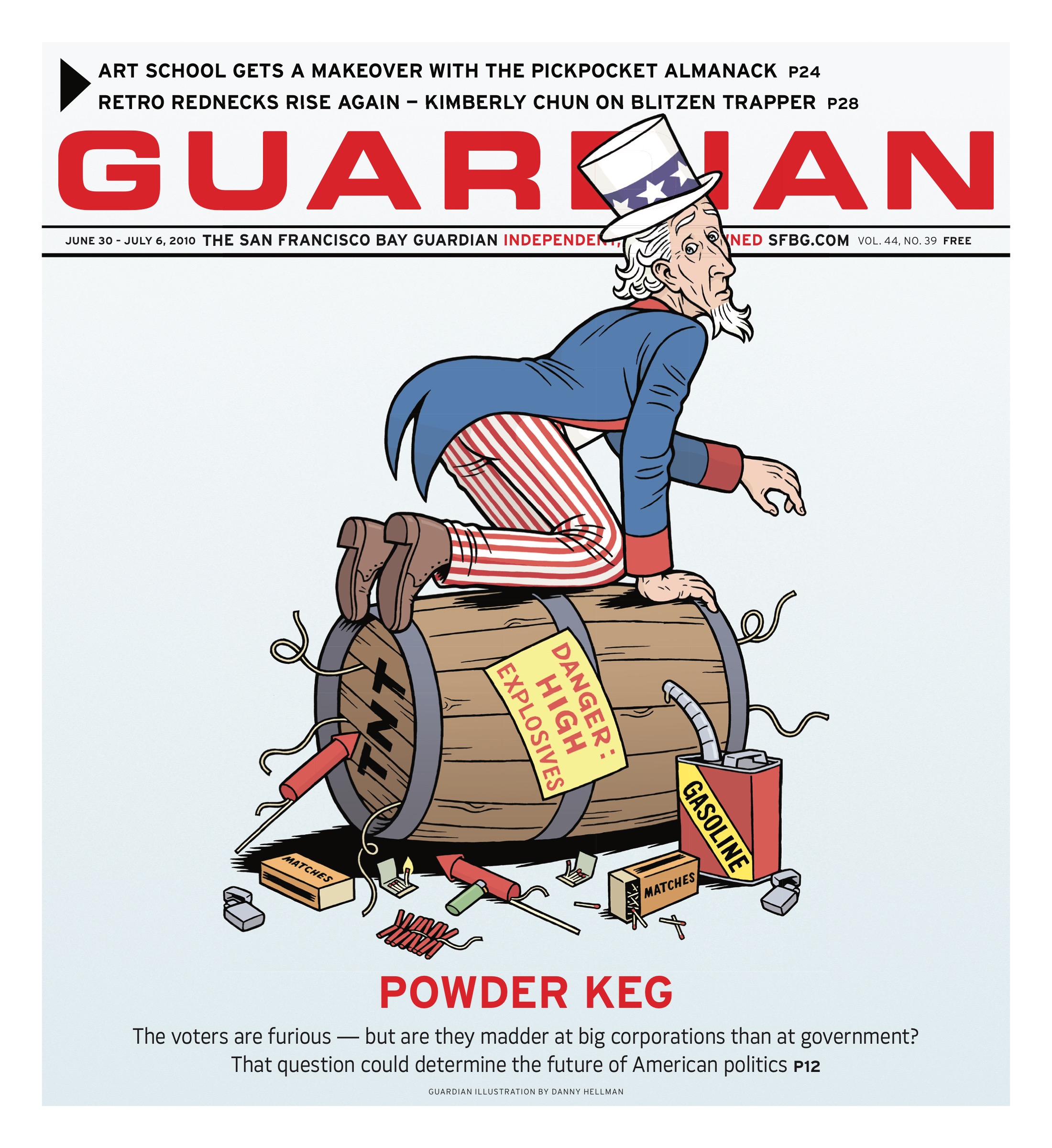
Powder keg

5

news@sfbg.com

Ask any pollster, political consultant, or academic who studies the American electorate about the mood of the voters this year and you’ll get the same one-word answer: Angry.

Everyone’s pissed — the liberals, the conservatives, the moderates, the people who don’t even know where they fit in. It’s an unsettled time and, potentially, very bad news for a progressive agenda that seeks to address issues ranging from poverty and war to the long-term health of the public and the planet.

The Democrats, who swept into power with an enormously popular president just 18 months ago, may lose control of Congress. The tea partiers have driven the Republicans so far to the right that some candidates for Senate are openly talking about eliminating Social Security. The unemployment rate — the single most important factor in the politics of the economy — remains high and doesn’t show any signs of improving.

And the progressive left seems frustrated and demoralized, particularly in California. The Golden State, which once led the nation in innovation and enlightened social policy, now seems to be leading the politically dysfunctional race to the bottom.

The nation could be headed for a dangerous era, rife with the potential for right-wing demagoguery and other nasty political schisms. The state of the economy could easily fuel a more powerful movement to shrink the scope of government and a continuing backlash against the public sector — and the financial backers of the antitax and antiregulation movement are drooling at the prospect.

But there’s also a chance for progressives to seize a populist narrative and shift the discussion away from traditional disagreements and toward those areas, particularly the destructive influence on government by powerful corporations, where the grassroots right and grassroots left might actually agree.

The anger that voters feel toward a government that isn’t meeting their needs is starting to find other outlets. People are as mad about the abuses of big business — the Wall Street meltdown, the bailouts, the BP oil spill, the political manipulation — as they are about the failures of Congress and the president. If you ask Americans of every political stripe who they least trust — big government or big business — even conservatives aren’t so sure anymore.

For 30 years, the central narrative of American politics has revolved around the size and effectiveness of government. Now there’s a chance to shift that entire debate in American politics toward the largely unchecked power of corporations. It is, populist writer Jim Hightower told us, “an enormous opportunity handed to us by the bastards.”

But so far, none of the Democratic leaders in California are taking advantage of it to start dispelling damaging myths and crafting political narratives that might begin to create some popular consensus around how to deal with society’s most pressing problems.


THE PEOPLE WANT TAXES

There have been many polls gauging voter anger, but one of the most comprehensive and interesting recent ones was “Californians and Their Government,” a collaborative study by the Public Policy Institute of California and the James Irvine Foundation that was released in May.

It shows that Californians are mad about the state’s fiscal problems, disgusted with their political leaders, divided by ideology, and deeply conflicted over the best way forward. An astounding 77 percent of respondents say California is headed in the wrong direction and 81 percent say the state budget situation is a “a big problem.”

But the anti-incumbent message isn’t necessarily an anti-government message. Most Californians are willing to put more of their cash into public-sector programs, even during this deep recession. When asked to name the most important issues facing the state, 53 percent mentioned jobs and the economy . The state budget, deficit, and taxes only got the top billing of 15 percent.

And contrary to the conventional wisdom espoused by moderate politicians and political consultants, most voters say they are willing to pay higher taxes to save vital services. “Californians tell us they continue to place a high value on education and want education to be protected from cuts. And they’re willing to commit their money to help fund that,” PPIC director Mark Baldassare told the Guardian.

The survey found that 69 percent of respondents say they would pay higher taxes to protect K-12 education from future cuts, while 54 percent each say they would pay higher taxes to prevent cuts to higher education and to health and human services programs. In other words, voters seem to recognize where we’ve cut too deeply — and where we haven’t cut enough: only 18 percent of respondents would be willing to pay higher taxes to prevent cuts to prisons and corrections.

Baldassare said the June primary results also showed that people are willing to pay more in taxes for the services they value. “Around the state, there was a lot of evidence that people responded favorably to requests by their local governments for money, particularly for schools,” he said.

Both the California Legislature and Gov. Arnold Schwarzenegger are held in very low esteem with voters, according to the PPIC study, and Schwarzenegger’s 23 percent rating is the lowest in the poll’s history.

Barbara O’Connor, political communications professor who heads the Institute for the Study of Politics and the Media at Sacramento State University, told us that voter unhappiness with elected leaders is no surprise. Right now, most people are afraid that their basic needs won’t be met over the long run.

“The common narrative is fear, and fear channels into anger,” O’Conner said.

And that fear is being tapped into strongly this year by the Republican candidates, who are trying to scare voters into embracing their promises to gut government and keep taxes as low as possible.

“If there’s any lesson to be learned from Meg and Carly’s early ads, it’s fear-mongering, fear-mongering all the time — and that doesn’t create a very positive narrative,” O’Connor said of gubernatorial candidate Meg Whitman and U.S. Senate candidate Carly Fiorina.

O’Connor noted that Barack Obama’s campaign had great success in using a positive, hopeful message and said she believes the right leader can also do so in California. “I talked to Jerry [Brown]’s people about it and said you can’t just run a negative campaign because that’s what Meg is doing.”

Despite the tenor of the times, O’Connor said she’s feeling hopeful about hope. She also believes Californians would respond well to a leader like Obama who tried to give them that hope — if only someone like Brown can pick up that mantle. “I think the environment is right for a positive message. But the question is: do we have people capable of delivering it?”

She said the no-new-taxes, dismantle-government rhetoric has started to wear thin with voters. “The real fiscal conservatives are badly outnumbered in Californian,” O’Connor said. As for the corporate sales jobs, O’Connor said voters have really started to wise up. “They aren’t going to be scammed.”

The results of the June primary election showed that voters across the spectrum were also disturbed by big special-interest money. Proposition 16, backed by $46 million from Pacific Gas and Electric Co., went down to defeat — even in counties that tend to vote Republican.

And this fall, with two rich former CEOs spending their personal wealth to win two of California’s top elected offices and energy companies pushing a measure to roll back California’s efforts to combat global warming, there could be great opportunity in a narrative targeting those at the top of our economic system.


THE TOP AND THE BOTTOM

Some observers say that whatever their shared feelings about corporate scams, conservatives and liberals in the state are just too far apart, and that there’s little hope for any substantive agreement. “People are becoming more polarized,” said consultant David Latterman, who often works for downtown candidates and interests. “I think we’re beyond compromise.”

Allen Hoffenblum, a Los Angeles-based Republican strategist, agreed. “The voter are all mad, but they’re mad at different things. I just don’t see where they come together.”

But Hightower, who has spent a lifetime in politics as a journalist, elected official, author, and commentator, has a different analysis.

“As I’ve rambled through life,” he wrote in a recent essay, “I’ve observed that the true political spectrum in our society does not range from right to left, but from top to bottom. This is how America’s economic and political systems really shake out, with each of us located somewhere up or down that spectrum, mostly down.

“Right to left is political theory; top to bottom is the reality we actually experience in our lives every day — and the vast majority of Americans know that they’re not even within shouting distance of the moneyed powers that rule from the top of both systems, whether those elites call themselves conservatives or liberals.”

In an interview, he told us he sees a lot of hope in the fractured and potentially explosive political ethos. “There’s all this anger,” he said. “People don’t know what to do. And I think the one focus that makes sense is the arrogance and abuse of corporate executives.”

In fact, Hightower pointed out, the teabaggers didn’t start out as part of the Republican machinery. “Wall Street and the bailouts sparked the tea bag explosion,” he said. It wasn’t until big right-wing outfits like the Koch brothers, who own oil and timber interests and fund conservative think tanks, started quietly funding tea party rallies that the anti-corporate, anti-imperial edge came off that particular populist uprising.

“At first, the teabaggers didn’t even know where the money was coming from,” Hightower said. “You can’t be mad at the teabaggers; we should have been out there organizing them first.”

There’s plenty of evidence that anger at big business is growing rapidly — and rivals the distrust of big government that has defined so much of American politics in the past 30 years. The bailouts were “the first time in a long time that people have been slapped in the face by collusion between big business and its Washington puppets,” Hightower noted.

Then there’s the Supreme Court decision in Citizens United v. Federal Elections Commission. In January, a sharply divided court ruled 5-4 that corporations had the right to spend unlimited amounts of money supporting or opposing political candidates. Progressives were, of course, outraged — but conservatives were, too.

Polls show that more than 80 percent of Democrats think the decision should be overturned. So do 76 percent of Republicans. “This is a winner for our side,” Hightower noted. “But our side’s not doing anything about it.”

Sure, President Obama denounced the ruling in his State of the Union speech and promised reform. But the bill the Democrats have offered in response does nothing to stop the flow of money; it would only increase disclosure requirements. And in response to furor from the National Rifle Association, it’s been amended and is now so full of holes that it doesn’t do much of anything.

Political consultants advising Whitman are clearly looking for ways to direct the voter unhappiness into a demand for lower taxes and smaller budgets. She’s already vowed to fire 40,000 state workers, and her most recent campaign ad attacks Brown for expanding public programs and raising the state deficit.

So far Brown hasn’t challenged that narrative — and some Democrats say he shouldn’t. It would be safer, they say, for Brown to get out front and demand his own cuts in Sacramento. “Going after public-sector pensions is a winner,” one Democratic campaign consultant, who asked not to be named, told us. “If Whitman beats Brown on those issues, she wins.”

But that approach is never going to be effective for Democrats. If the argument is over who can better cut government spending, the GOP candidates will always win. The better approach is to see if progressives can’t shift the debate — and the anger — toward the private sector.

As Hightower put it: “You can yell yourself red-faced at Congress critters you don’t like and demand a government so small that it’d fit in the backroom of Billy Bob’s Bait Shop and Sushi Stand, but you won’t be touching the corporate and financial powers behind the throne.”

That’s where the discussion has to start. And there’s no better place than California.

The Golden State is a great example of what happens when the tax- cutters win. In 1978, the liberals in Sacramento, operating with a huge state budget surplus, couldn’t figure out how to derail the populist anger of property tax hikes. So Proposition 13, the beginning of the great tax revolt, passed overwhelmingly. Over the next decade, more antitax initiatives went before the voters, and all were approved.

Now the state is heading toward fiscal disaster. The schools are among the worst-funded in the nation. The world-famous University of California system is on the brink of collapse. Community colleges are turning away students. The credit rating on California bonds have fallen so far that it’s hard for the state to borrow money. And there’s still a huge budget gap.

The tax-cut mentality that led to the so-called Reagan revolution started in California; a political movement that shifts the blame for many of the state’s problems away from government and onto big business ought to be able to start here as well. And it’s potentially a movement that could bring together people who normally find themselves on opposite sides of the fence.

A case in point: the measure the oil companies have put on the November ballot to repeal the state’s greenhouse gas limits. The corporations backing the initiative, led by Valero, argue that California’s attempts to slow climate change will cost jobs. That’s a line we’ve heard for decades. Every tax cut, every move toward deregulation, is defended as helping spur job growth.

But the past four presidents have done nothing but cut taxes and reduce regulations — and the result is facing Americans on the streets every day. There is also growing evidence that even Republican voters don’t believe everything big businesses tell them anymore. And they’re starting to grasp that sometimes deregulation leads to outcomes like larcenous CEOs and unstoppable oil leaks.

So the potential for a successful progressive populist movement is out there. But it’s not going to happen by spontaneous combustion.


SF SHOWS THE WAY

On the national level, one of the factors creating this gloomy electorate is the failure of President Obama to keep the coalition that elected him active and engaged. The intense partisanship in Washinton has turned off many independent Obama voters, while his progressive supporters have been disappointed by issues ranging from his escalation in Afghanistan to tepid reforms on health care and Wall Street.

“One of the narratives now is where are the Obama voters and will they participate?” Jim Stearns, a San Francisco political consultant who works mostly on progressive campaigns, told us. “They still love Obama but they’re not moved by him anymore.”

Perhaps more important, they have lost the sense of hope that he once instilled. The Republican Party’s descent into right-wing extremism and the strong anticorporate narratives that have emerged in the last year — from BP’s oil spill to PG&E’s political manipulation to Goldman Sachs’ self-dealing to the prospect of unrestricted corporate campaign propaganda unleashed by the Citizens United ruling — have created the possibility that the negative narratives by the left may crowd out the positive ones.

“Meg Whitman is someone you can hate. She’s the rich Republican CEO trying to buy her way into office,” Stearns said. “But it’s a depressing message.”

But Stearns said there is another, most hopeful political narrative that is emerging in San Francisco, one that might eventually grow into a model that could be used at the state and federal levels. “We’re lucky in San Francisco. Progressive voters are engaged.”

He noted that San Francisco’s voter turnout was higher than expected in the June primary, and far higher than the record low state number, even though there really weren’t any exciting propositions or closely contested races on the local ballot — except for the Democratic County Central Committee, where progressives maintained their newfound control. And it’s because of the organizing and coalition-building that the left has done.

“What you’ve seen over the last few years is a coalition of labor, neighborhood groups, environmentalists, and the progressives now operating through the Democratic Party. That’s a great coalition with a lot for people to trust,” Stearns said.

Meanwhile, downtown has all but collapsed as a unified political force. “They don’t really have a political infrastructure,” Stearns said of downtown. “Normally it would be the mayor who gets everyone in line and working together.”

Even Latterman, the downtown-oriented consultant, agrees that the business community is no longer setting San Francisco’s agenda because it’s become fractured and unable to push a consistent political narrative: “There’s certainly been a lack of coordination.”

He also agrees that progressives have become more organized and effective. “Clearly, the Democratic Party of San Francisco has become a conduit for progressive politics and politicians, but not issues,” Latterman said. “What a lot of people get wrong in the city is the difference between politics and policy.”

Part of the reason is economic. With scarce resources, a high threshold for approving new revenue sources, and a fiscally conservative mayor unwilling to talk taxes, it’s been difficult to move a progressive agenda for San Francisco. And in Sacramento, it’s barely part of the discussions.

“The people of California have been held hostage by a handful of Republicans who are making us cut everything we care about,” while in San Francisco “Newsom is taking an entirely Republican approach to the budget,” Stearns said.

Looking toward the fall races, Stearns said the progressive coalition and majority on the Board of Supervisors will be tested on issues such as Muni reform, and the question will be whether fiscal conservatives like Sup. Sean Elsbernd can blame Muni’s problems on drivers, or whether progressives can create and sell a broader package that includes new revenue and governance reforms.

“The drivers are going to get their guarantee taken out of the charter, that’s going to happen. But people know that isn’t all that’s wrong with Muni,” Stearns said.

But to craft a more comprehensive solution, he said the progressives are going to need to use their growing coalition to connect the dots for voters. “We need to run a citywide campaign around a whole constellation of issues,” Stearns said, citing Muni, schools, taxes, resistance to mean-spirited measures like sit-lie, and the larger issues raised by the Brown and Barbara Boxer campaigns. “We need to figure out a way to put all that in the same coalition and run one campaign around it. And we can do that because progressives retained control of the DCCC.”


THE STRUGGLE AHEAD

Although they’ve made great strides, San Francisco progressives are still struggling with a mayor who sees the solution to every budget crisis as cuts — and with a growing number of efforts to blame public employees for the city’s fiscal problems. Even Jeff Adachi, the public defender once considered a standard-bearer for progressive causes, is pushing a ballot measure that would require city workers to pay more for their pensions.

Gabriel Haaland, who works with Service Employees International Union Local 1021, made the right point in the pension debate. “Big financial institutions crashed the stock market,” he said recently, “and now they want to blame city workers.”

In a blog post on the political website Calitics, Robert Cruickshank put it clearly: “The notion that ‘everyone needs to give back’ just doesn’t make sense given our economic distress. We’ve already given back too much. We gave back our wages. We gave back our ability to afford health care and housing and transportation. We gave back the robust public- sector services that created widespread prosperity in the 1950s and 1960s. We gave back affordable, quality education. And too many of us have given back our future.

“No, it’s time for someone else to give back. It’s time for the wealthiest Californians and the large corporations to give back. For 30 years now they have benefited from economic policy designed to take money and benefits from the rest of us and give it to those who already have wealth and power.”

That’s a message that ought to appeal to anyone who’s hurting from this recession. It ought to cross red and blue lines. It ought to be the mantra of a new progressive populism that can channel voter anger toward the proper target: the big corporations that created the problems that are making us all miserable.

If Jerry Brown could adopt that narrative, he could change the state of California — and the state of the nation.


25 ideas for our queer future

1

What does the future hold in store for us? In an age of mainstream assimilation and aspiration, is there even such a thing as the queer future? We asked 25 queer leaders, artists, and activists to offer visions in their areas of expertise. The results — philosophical, poetic, practical, and priceless — are inspiring. One thing’s for sure, we’ll never lose our creative spark. Nor will we lose our motivational zeal. Fate is for the lazy: take action now. (Marke B.)

>>Click here for ideas from our amazing 2010 Hot Pink List

>>Click here for our Pride listings, and get out there!

THE FUTURE OF QUEER ACTIVISM We need to take back the power and stop being led by what the other side is doing. We need to empower ourselves enough so that we are no longer reacting but acting. We must use online social networks the way we used the streets and bullhorns to show our strength, speak out against wrongdoing, change minds, and win back our rights. We also must unite with our allies in other communities that are underrepresented and maligned in much of the same ways we are. When we stand with one another, we have that much stronger a voice.

Kelly Rivera Hart is the founder of Poz Activists Network (pansf.blogspot.com).

THE FUTURE OF QUEER COMMUNITY The difference between straight and gay cultures seems to be breaking down more and more, which is one of our goals, but we still need to support our own businesses, nonprofits, and leaders. We need to continue interacting with each other in the real world and not lose sight of who we are and what we share. Despite how the rest of the world sees us, there is still a lot of loneliness and isolation in the queer community. I think many of us have forgotten even simple things, like how to make actual friends, not just online. And it’s so easy! Renewing that spirit of interaction, freeing ourselves from fear of judgment, and moving outside our “safe zone” can lead to the greatest rewards.

Mark Rhoades is a charitable event planner and fundraiser who throws the annual Cupid’s Back and City Hall Pride parties.

THE FUTURE OF QUEER FASHION The past decade has witnessed an obsession with bulky, voluminous silhouettes disguised as “futuristic avant-garde” and inspired by GaGa and the ’80s. Let’s move on. Through clean lines, elegance, and wearable pieces, the future of queer fashion will shine light on socially relevant issues like bottom shame, positive-negative status reinforcement, and elite subcultures by using gay textiles and forgotten, non-era-specific imagery.

Allán Herrera is the design head of fashion house Homo Atelier (www.homoatelier.com) and a founder of HomoChic (www.homochic.com).

THE FUTURE OF QUEER FILM Future queer film will depend on the gays being at the forefront of distribution technology in the same way we pioneered social networking 15 years ago, spreading provocative and sexually honest/explicit films beyond the film festival circuit and toward a global audience. Special attention must be paid to the creeping homophobia of cultural and technological juggernauts like Apple. Our stories will need to bust through the pigeonhole, weaving our traditional themes (AIDS, coming-of-age) into larger storylines that are relevant to multicultural and transcontinental viewers.

Leo Herrera is a video artist, filmmaker, and a founder of HomoChic (www.homochic.com).

THE FUTURE OF QUEER YOUTH To be a true leader, one must envision the future. The future is a diverse society where LGBTQQ youth are embraced for who they are and encouraged to be who they want to be. In my pursuit for LGBTQQ youth rights, leadership has been about fostering the awareness in LGBTQQ young people about their own power as individuals and as a group, supporting them to access, develop, and master the skills and knowledge they need to transform their power into action, and building bridges to opportunities where their action can create just communities.

Jodi Schwartz is the executive director of LYRIC Lavender Youth Recreation and Information Center (www.lyric.org).

THE FUTURE OF QUEER LABOR Storm of protest drives Congress to pass trans-inclusive ENDA! Support by labor unions critical to passage of this landmark legislation. Screaming, “We’re too queer for this bullshit!” workers hold drag-runway picket lines at transphobic companies across the country. Activists redefine the crisis of trans poverty and unemployment as the most critical queer civil rights issue of our time.

Bad hotel boycott forces Hyatt to sign a fair contract and treat their employees with respect. LGBTQ organizations rally with labor unions for immigration reform, hold signs reading “No borders on my cunt, no border on our countries!

Jane Martin is a queer labor activist and community organizer with SF Pride at Work (www.sfprideatwork.org).

THE FUTURE OF QUEER DRAG (PART ONE) My vision for the future of queer drag requires you to take a moment, stop, look, and listen to our past. We have such a rich history of fierce and amazing queens to learn from. The key is to get involved with a queer family that supports and loves you and what you do. Next, figure out your niche — whether it’s high drag or low camp, just be sure to always do it like you don’t need the money! Then pull it together and serve it up with lots of love and generosity. And, of course, top it all off with a fabulous wig!

Juanita More! (www.juanitamore.com) is the queen. Attend her boisterous Pride party on Sun/27 (see Pride listings), benefiting Bay Area Young Positives (www.baypositives.org).

THE FUTURE OF QUEER DRAG (PART TWO) Meg Whitman will become president of the United States and hire Lady Bunny as one of her speech writers. Oprah and Gayle will finally come out, and gender illusionist shows will dominate the OWN Network — every other channel will follow. In 2050, Heklina will clone herself, twice, and perform the hospital-convalescent home circuit as the Del Rubio Triplets. Apple will come out with a product called the iDrag, that transforms anyone into anything.

Fudgie Frottage is the king. He puts on the annual, wonderful SF Drag King Contest (www.sfdragkingcontest.com).

THE FUTURE OF QUEER DANCE FLOORS Lets start with a nice, clean piece of paper. Black paper. A clean slate. Say, for example, a deliriously rich and tasteful daddy were to buy the Stud. Step one: a deep, five-stage gay cleaning. Step two: gut the interior, maybe keep the bar and choo-choo train intact, they are cute. Otherwise keep it simple. Step three: install an exact copy of the sound system used by Dave Mancuso at the Loft parties in New York City. The tasteful daddy would have a matte gray private jet at our disposal to bring guests of our choosing. For the launch party we would have an all Kenny line-up: Kenny Dixon Jr., Kenny Hawkes, Kenny Carpenter, and Ken Collier (back from the dead) would DJ. Live PA by Kenny Bobien. Oh, and Kenny Kenny on the door. At the end, everyone would get together and cry like they do on those exploitative renovation reality shows. Daddy would miss the ribbon-cutting, but that’s OK — he sent flowers and bought an $80 Diptyque candle for the new bathroom. That would be a good start.

Honey Soundsystem is a future-past DJ collective. Catch the old-school house Honey Pride party on Sun/27 (see Pride listings).

THE FUTURE OF QUEER COMEDY The future is here. And now that gay marriage is mandatory for everyone, queer and straight, the same goes for comedy. All comedians, regardless of sexual orientation, are now required to do at least 75 percent queer comedy in their acts unless they obtain Permit No. 758219B through the Comedy Board, allowing for the special provision to do only 50 percent queer material. That’s right: comedy is now regulated by law. No jokes are allowed to have homophobic content, especially if you’re performing for tourists. Remember, you are ambassadors now. If you’re straight and have no queer material, just ask your aunt or your second cousin or your bachelor uncle whose best friend of 40 years, Bruce, comes to all the family functions.

Lisa Geduldig (www.koshercomedy.com) is a comic and MC who puts on such shows as Kung Pao Kosher Comedy, Funny Girlz, and Comedy Returns to El Rio!

THE FUTURE OF QUEER HOUSING It is beyond time for us queers to focus our fabulous and substantial God-given talents toward a vision of the future of queer housing. We are the trailblazers, the social entrepreneurs, the avant-garde. Imagining and creating the future is what we do best. Let’s put those substantial talents to work to realize our very own “No Place Like Home” dream of a home for our LGBT elders, our homeless LGBT youth, our people with HIV/AIDS, our artists, our activists, and everything in between. I’ll show you mine: the largest affordable housing for people with HIV/AIDS in the nation next to the Castro Theater and an LGBT homeless shelter at Geary and Polk. Now you show me yours.

Brian Basinger is the director of AIDS Housing Alliance/SF (www.ahasf.org).

THE FUTURE OF QUEER COMICS The future of LGBT comics will be about creators moving out of the traditional queer media ghetto and into new digital undergrounds, indie markets, and even the publishing mainstream. Web comics, graphic novels, minicomics, and zines … Queer comics will have to continue to diversify their formats to survive. At the core, though, remains the need to tell good stories! Look for more poignant narratives about the intersection of queer identities and the human condition. Also, robo-dykes, super-powered trannies, bisexual Lotharios, and zombie fags!

Justin Hall, a queer and erotic comics artist, runs All Thumbs Press (www.allthumbspress.com).

THE FUTURE OF QUEER LAW We would like to see the law catch up with the reality of transgender lives. Your gender identity is an innate and deeply felt sense of who you are. Whether you feel male, female, both, or neither, we envision a future where your legal gender will be exclusively determined by you and not by doctors or lawyers. By respecting your autonomy and your ability to know yourselves better than anyone else, the law will finally reflect society at large. The law is not far from fully recognizing that fact of life, but there is still work to be done. So break out your queer legal briefs and join in the fight for transgender civil rights!

Executive Director Masen Davis and the staff of the Transgender Law Center (www.transgenderlawcenter.org)

THE FUTURE OF QUEER SPIRIT As I look toward the future, I want to see the consciousness shift that Harry Hay and other gay pioneers were pushing for manifest itself more fully in both the gay culture and the larger hetero culture. As queer liberationists, we’ve already taught the world that we are a people. I want to see us recognized as always having been a people. I want to see us given the opportunity to cocreate a new, more beautiful world. To paraphrase: what if there were no “faggots,” only master healers, teachers, shamans? I hope to see the end of shame.

Zac Benfield is the president of the radical faerie Church of Nomenus. Attend his “Woo 101 for Hipster Faggots” workshop, part of the Faetopia Festival (See “Ongoing” in our Pride listings)

THE FUTURE OF QUEER SCIENCE

The alien scientist pipettes liquid
Into a flask to be shaken vigorously.
The origins of gay life.

On Earth, planets align, exposing
Realities once thought to be utterly impossible:
Gays are outta this world!

Queer scientists make the future
Always brighter, cleaner, sexier, and more fabulous
Stopping only for a cocktail.

Quietly, the gay scientist works,
Inching closer to the final answer that
Will change the world forever.

In the future of science
We see the world with different eyes,
All judged by ability alone.

Chris Waddling is a PhD scientist at UCSF.

THE FUTURE OF THE QUEER PAST The future of the queer past has always been fragile — and despite some positive developments in the past 25 years, it remains fragile today. The legacy of LGBT people is still largely invisible in the settings where our society formalizes its history. Our stories are rarely told in high school classrooms, in the galleries of museums, on the plaques of public monuments. Supporting the efforts and the growth of such organizations as the GLBT Historical Society and other pioneering queer history institutions will be key to ensuring that the memory of LGBT lives, struggles, setbacks, and triumphs can inform and inspire future generations.

Writer, editor, and antiquarian book dealer Gerard Koskovich is a founding member of the GLBT Historical Society and a member of the board of directors of the Mémorial de la Déportation Homosexuelle, a French national group that commemorates the homosexual victims of the Nazis.

THE FUTURE OF THE QUEER FUTURE My future selves are always popping back from the year 2023 or 2034 for the weekend, mostly because they know I’ll be their sex slave. They remember what 2010-me was like. (And apparently in the mid-2020s, time-traveling self-flagellation becomes a big fetish.) They’re not supposed to tell me anything about The Future, but they let slip wee details here and there — the 20-teens are a troubling time, but then we discover queer telepathy, and everybody starts secreting empathy endorphins and building communal gardens in the upper atmosphere. Hang in there until we get the first queer president, they always say. Once she comes out during her second term, that’s when the government really starts building something.

Charlie Anders is the managing editor of science fiction-forward site io9.com

Bread and Circuses: Mexico and the World Cup

0

MEXICO CITY (June 11th) — The Caliente Sports Book down the street is buzzing with betters studying dog and horse races, Major League Baseball, even golf, on the multiple screens. Of particular interest are those channels running wrap-ups of the afternoon match between Mexico and 2006 World Cup champion Italy, from which the national team emerged victorious in a final prelim before this year’s edition of the Copa del Mundo gets underway later this week.


Italy, it may be remembered, won the much-coveted cup four years ago on penalty kicks after France was reduced to playing with ten men on the field when super-star Zenedine Zidane was disqualified for ferociously head-butting a rival who purportedly called his mother and sister “whores.” Beating Italy was a decided plus for Mexico’s downtrodden spirits as the Mundiales approach.


One group of aficionados was not much interested in Mexico’s fortunes in the upcoming fandango in South Africa. Instead, they gathered around a big screen in one corner of the betting parlor cheering on the Los Angeles Lakers in a National Basketball Association Finals match-up with the Boston Celtics. “Forget about football,” sneered “El Guerro” Gonzalez, a regular, “this is where the real money gets made.” Because pro basketball games routinely rack up hundred-point scores, betters have multiple opportunities to wager on winners and losers, over and under point spreads, total points in a quarter, and whether Kobe Bryant will hit the next three-pointer.


But the basketball euphoria will dissipate post haste as the World Cup takes center stage. Although the NBA’s despotic commissioner David Stern promotes his product as the world game, basketball hardly holds a candle to what the U.S. provincially terms “soccer” and the rest of the Planet Earth calls football.


Indeed, the “Copa del Mundo” (“Cup of the World”) will soon sweep every other sporting event from the screens — let alone political scandal, of which there is plenty in this distant neighbor nation, including the upcoming Super Sunday gubernatorial elections July 4th, and even droughts, floods, and other natural disasters. The interminable drug war that has taken 23,000 lives in the past three years will move to the backburner. Ditto an economy that is tailspinning out of control — a million workers lost their jobs in the first three months of this year alone despite President Felipe Calderon’s rosy claims of “recovery.”


Speculation about the disappearance of one of the nation’s most powerful politicians will fade from the primetime news, and the first year anniversary of the incineration of 49 babies in a government-run day care center owned in part by the first lady’s cousin will not even be noticed. The military takeover of the great Cananea copper mine and the dissolution of the miners union, is not news. New revolutions — this is, after all, the hundredth year anniversary of our landmark revolution — could rock the land, but for the next month, Mexico will live and die on what happens to the national team in South Africa.
“In football, we find our revenge against the adversaries of our lives,” philosophizes sociologist Jose Maria Candia in a recent Contralinea magazine interview, “if it goes badly at work, in the economy, politics, the project of the nation, when 11 boys put on the green jersey and do well in an international tournament, we feel vindicated by life.”
With 32 national teams from all five continents in the competition for the World Cup, the fate of the “seleccion” will have palpable impact on domestic tranquility. The political outfall of the Mundiales is unpredictable. Pumped up on toxic nationalism and xenophobia, football is a blood sport in southern climes. Honduras and El Salvador once fought a full-fledged war over soccer.


If the national team wins or acquits itself well, success will strengthen the government in charge no matter how poorly it has served the country. Likewise, a shoddy performance can topple rulers. In Mexico, increasingly unpopular president Felipe Calderon, who won high office in fraud-marred elections three years ago, is banking on the national selection’s triumphs in the opening round to invigorate his deteriorating image. Calderon’s bet is hardly a sure thing.


Mexico, Number 17 on the Federation of World Football Federation’s rankings (now the Coca Cola FIFA rankings), plays host South Africa in the inaugural match of the tournament, and “His Excellency” Felipe Calderon (dixit South African president Jacob Zuma) will be a guest of honor. The “Bafana Bafana” (“Boys Boys”) as the locals are worshipped, have won their last four prelim matches and in the 2009 Confederation Cup took Spain, which some football gurus fix as the best team in the world, into overtime. Their fanatics’ incessantly droning “vuvazelas” or plastic trumpets are said to drive opponents mad.


On the other hand, should Mexico beat sentimental favorite South Africa, it will make Calderon few friends on the African continent — five other African teams are in the draw, with war-torn Cote d’Ivoire the cream of the crop.


Aside from the Bafana Bafana, France and Uruguay are the real class of Mexico’s four-team group — while the French have appeared lackadaisical of late, whipping the South Americans is improbable. Anything less than reaching the quarterfinals will not rehabilitate Calderon’s popularity.


Mexico has a young team that fluctuates between indifference and playing out of control. It is anchored by seven Mexican players from the European and Turkish leagues, and the wily but slow-footed veteran Cuauhtemoc Blanco. Burned repeatedly by the national team’s poor performances in the Mundiales, many fans such as Manuel Garcia, a waiter at the old quarter Mexico City eatery Café La Blanca, consider that only divine intervention can save Mexico — and Calderon — from ignominious elimination.


When and if Mexico wins its matches though, wild celebrations are guaranteed to erupt around the gilded Angel of Independence on the bustling Paseo de Reforma — drunkenness, fisticuffs, and hooliganism are de rigor. Flag-draped caravans of honking cars will jam the boulevards of this conflictive megalopolis. On game days, half the population of Mexico, led by its president, will don green jerseys and play hooky from work and school. Saloons will fill to the brim with fans spilling out into the streets, jostling for a peek at the plasma screens. Masses to insure that God is on Mexico’s side will be pronounced from the altars and saints dressed up in the national colors.


Although football is tantamount to religion in this country where 70% of the population lives in and around the poverty line, only the super rich will have the wherewithal to jet off to Africa. Instead, the underclass will monitor the Mundiales at the “FIFA Fan Fest” on giant screens erected in the great Zocalo plaza from which nearly a hundred hunger-striking members of the Mexican Electricity Workers Union (SME), near death after a month of voluntary starvation, will no doubt be evicted so as not to dampen the fiesta.


Televisa and TV Azteca, Mexico’s two-headed television monopoly, which will transmit the games (the premium package includes 3-D) will have the nation eating out of its hands (and guzzling Corona beer.)  The TV monoliths have leased rights to broadcast the Mundiales from the Swiss-based FIFA, the absolute dictator of the sport for the past 106 years that counts 204 out of 208 football federations worldwide on its roster. FIFA TV revenues are expected to top $167,000,000 for the 2010 World Cup.


This year’s Copa del Mundo is awash with drama. Will the Argentine selection, a perennial favorite, graced by the world’s best player, Leonel “the Flea” Messi, blow up under their sometimes psychotic coach Diego Maradona, himself a Mundiales’ immortal? Will the first round match between England and the U.S. (14th on the FIFA listings with a world-class star, Landon Donovan, to prove it) invoke the star-crossed Yanqui upset of the Brits 60 years ago in 1950 in Brazil, the only time these two teams have ever met in the World Cup?


If the U.S. gets by England, a match between Mexico and its hated gringo rival would up the drama quotient here considerably. A face-off between South Korea and North Korea, both of which are in the draw albeit in separate groups, could lead to nuclear confrontation.


How will tiny, bruised Honduras, which played through a coup d’etat to qualify, fare against the big guns? What kind of karmic reward is in store for France, which slimed its way into the World Cup with mega-star Thierry Henry’s illegal hand-slap goal against the Irish? Will Germany be dispirited by the suicide of its troubled veteran goalie (is this a Wim Wenders’ film)? Will five-time champ Brazil, which is hosting both the 2014 World Cup and the 2016 Olympics, be so overloaded with hubris that the selection will forget to play football?


But unquestionably the drama of dramas is focused on host South Africa, the land of blood and gold, Nelson Mandela, Steve Biko, Joe Slovo, and the last great struggle for liberation from colonialism.


South Africa, an unlikely site for the World Cup, was promised the games by Swiss football impresario Joseph Batter during his 1998 campaign to become the czar of the FIFA. Blatter, who was said to have been backed by Middle East oil money, needed African votes to put him over the top. Although Nigeria and Morocco were also proposed to host the 2010 Cup, South Africa, the continent’s fastest-growing economy, was chosen both as a tribute to African football and to Nelson Mandela. Blatter even flew the frail, aging apostle of African liberation, to London to ballyhoo the designation.
Whether the beloved Mandiba will be well enough to attend the inauguration is the drama within the drama.


In his youth, Nelson Mandela was a keen amateur boxer and enthusiasm for sports has colored his life. Football is indeed the national sport of black South Africans, 75% of the population. During Mandela’s 28 years of imprisonment on Robbin Island for the crime of defying apartheid, his fellow prisoners and comrades in the African National Congress (ANC), played football incessantly, taping up rags into balls, and booting them up and down the narrow prison corridors. But Madiba was held in isolation and could never participate.


Nelson Mandela’s vision for the new South Africa encompassed sports as a path to racial reconciliation. If football was a black sport in South Africa, rugby is an Afrikaner obsession — the Springboks were the maximum icon of the apartheid regime. As president, Mandela brought the 1995 World Rugby Cup to Johannesburg, a story fictionalized in the film “Invictus,” and won the hearts and minds of his former persecutors. Now the World Cup 2010 is slated to project South Africa before the world as a dynamic, multi-racial powerhouse.


The truth is always more diffuse. Jacob Zuma, the country’s very corruptible third president, and his predecessors have sunk between $3.7 and $6 billion USD in infrastructure to burnish their images in a nation where 43% of South Africa’s 45.000.000 peoples live on $2 or less a day. The gleaming $300,000,000 Soccer City Stadium where the July 11th finals will be staged, abuts Soweto, the festering high-crime enclave of 3,000,000 mostly threadbare citizens, 30% of whom suffer from AIDS, according to the World Health Organization. Gangs of orphaned children rule the street.


Similarly, the stadium at Port Elizabeth on Nelson Mandela Bay, which came in at $287,000,000, was built over a slum from which hundreds were evicted. A school complex was demolished to make way for the Neusprot venue (only $140,000,000) — 13 such stadiums have risen from the dust amidst a storm of charges of kickbacks, bribery, and favoritism.
If recent history is any hint, the new stadiums will quickly become certifiable white elephants. Even Beijing’s much-praised “Birds’ Nest” coliseum designed for the 2008 Olympics is reportedly tenantless, and the Greek economy just collapsed in part thanks to  the burden of debt incurred for infrastructure for its Olympic Games. 


With a population scuffling just to feed itself, filling all this dazzling stadia with paying customers is problematic. Even the $18 cheap seats — a week’s wages in the cities and a month’s income in some rural areas — are mostly out of reach in a country where 50% of the work force is out of work. To deflect a grave social crisis in the making, the FIFA is offering 120,000 free admissions, about 2,200 seats for each of the World Cup’s 62 contests. Riots have already occurred at “friendly” preliminary games.


Ever since the bad old days of ancient Rome, bread and circuses have been a powerful formula for social control. In South Africa, as in Mexico, the World Cup is designed to make the discontented forget their discontent. For the next month, the violence, corruption, and class and race hatreds that dominate daily life in Mexico, South Africa, and the rest of what used to be called the third world will disappear beneath the social surface.


Although conflict is my bread and butter, I’m not going to miss the 2010 Mundiales for the world. 


John Ross is at home in the maw of the Monstruo watching the World Cup. You can complain to him at johnross@igc.org


Benefits: June 9-June 15

0

Ways to have fun while giving back this week


Wednesday, June 9

Friends of Saint Francis Childcare
Explore the local food and drink movement while helping to raise funds for Saint Francis Childcare Center at this Center for Urban Education about Sustainable Agriculture (CUESA) cocktail party featuring local wine and microbrews, local food, music, and a silent auction. Proceeds to benefit the Friends of Saint Francis Childcare Center, a non-profit preschool.
6:30 p.m., $50-$100
CUESA a
One Ferry Building, SF
(415) 861-1818

www.fosfchildcare.org

From the Ground Up
Celebrate grassroots action with IDEX as they recognize local partners in Africa, Asia, and Latin America for building sustainable community solutions to poverty and developing livelihoods. With guest speakers, Rajasvini Bhansali, IDEX’s new Executive Director, and Prativa Subedi, Founder and President of IDEX’s Partner Women’s Awareness Center, Nepal and featuring a silent auction, appetizers, wine and beer, and music.
6:30 p.m., $60
The Solarium
55 2nd St., SF
(415) 824-8384
http://idexfromthegroundup.eventbrite.com

Got Kidney?
Hip Hop(e) for Healing kicks off their U.S. southwest tour for RasCue and Organ Donor Registration Awareness featuring an all star line up of underground hip hop artists, including Rasco, Big Pooh, Kam Moye aka Supastition, and local MCs Otayo Dubb and 7 Daize.
9 p.m., $12
Mighty
119 Utah, SF
http://donatelife.net/

Friday, June 11

Hawaiian Luau Fundraiser
Hula for a good cause at this fundraiser for Connecting Point, Tenderloin Child Care Center, Positive Parenthood Project, Compass Family Center, and Clara House featuring live music, DJs, dancing, island food, and prizes for best Hawaiian costume and shirt, including 2010 tickets to Burning Man.
8 p.m., $25
Kelly’s Mission Rock
817 Terry Francois, SF
http://tikitodd.com/

Saturday, June 12

Bikers for Barkers
Join the motorcycle and pet communities as they come together to help rescue dogs that are in danger of being euthanized at this fundraising party where proceeds will go to Rocket Dog Rescue and Hearts for Hounds. Bid on one of the many local items and services, including Teatro Zinzanni, Kabuki Hot Springs, tattoo time from several local artists, gift baskets, and more, while enjoying live entertainment, DJ music, refreshments, and vegan delights. Please leave your pets at home.
6:30 p.m.; $20 donation, includes one raffle ticket
Dainese D-Store
131 South Van Ness, SF
www.bikersforbarkers.com

Hopalong Picnic and Bark-B-Que
Enjoy a fun-filled afternoon at this picnic lunch featuring a silent auction, music, and more to help raise funds for Hopalong and Second Chance Animal Rescue.
1 p.m.; $25 adult, $10 children
Miller Knox Regional Park
900 Dornan Dr., Point Richmond
www.hopalong.org

Intersection for the Arts Anniversary Gala
Celebrate Intersection’s 45th anniversary and the launch of their new art space in partnership with the Hub Bay Area with the exhibition, “Let’s Talk of a System.” Featuring live art auction, live entertainment, wine and food, and an awards ceremony to honor artists and organizations that impact the world.
7 p.m., $60-$250
Intersection at 5M
The San Francisco Chronicle Building
901 Mission, SF
(415) 626-2787 ext. 110
www.theintersection.org

Sunday, June 13

Radical History Bike Ride
Learn about the radical history of San Francisco from the 1800s through today on this bike ride and benefit for the National Lawyers Guild, San Francisco chapter. Tour led by Rai Sue Sussman will visit sites of protest and dissent relating to workers’ rights, immigrant rights, civil rights, women’s rights, environmental struggles, and more.
10:45 p.m., $15-$50 sliding scale donation
Meet at Harry Bridges Plaza
Front of Ferry Building along Embarcadero, SF
RSVP to raul@nlgsf.org
www.nlgsf.org

Nevius family values

6

The Chron’s C.W. Nevius has made a big deal of moving back into town from the suburbs — and the offhand comment by Steve Jones in an email to Nevius has almost become a sticky nickname. In fact, his own newspaper’s website, sfgate, headlined his column “Suburban twit moves to city.”

But Chuck’s got some work to do before he starts to understand San Francisco values.

Take his latest column, about the Democratic County Central Commitee. Now, any Chron columnist (or anyone else) has the right to endorse and advocate for any candidates he or she wants. And Nevius is absolutely right to point out that the DCCC race is crucial, that control of the committee will have a significant impact on the fall supervisorial elections.

Here’s what made me want to scream:

“So, if you’re happy with the far-left agenda, check out the Bay Guardian. (Progs with name recognition like Peskin, David Campos, David Chiu, and John Avalos are probably shoo-ins. Daly is not running.) For those who’d like to see a swing to families, kids, and civility on the streets, here are some suggestions.”

 A swing to families and kids? You must be kidding.

The single greatest issue facing families and children in this city is the cost of housing. That’s why Coleman Advocates for Children and Youth, which almost everyone agrees is the premier family-advocate group in the city, has made affordable housing a huge priority.

Some of what a recent Coleman report says:

 “Two-thirds of all children in the city do not have a secure future in San Francisco

More families in San Francisco are low-income (43%) than middle-income (23%), and face economic hardship even when working full-time jobs.

Extreme racial disparities in family income and access to opportunity mean that the majority of children who do not have a secure future in SF are children  of color, and the majority of children who do have a secure future are white.”

Coleman’s recommendations: Build and preserve affordable housing for families — not market-rate condos, not condo conversions, but below-market-rate housing.

From the report:

“1. Prioritize the needs of 45,000 children growing up in 20,000 extremely-poor and low-wage working families.  trategies must combine investing in a stronger social safety-net for families now, and investing in anti-poverty strategies that will prepare today’s poor children to become economically secure San Franciscans of the future. The city’s housing and educational policies must focus on the children and families with the greatest need, and not get sidetracked by the demands of middle-income or upper-income families whose needs are legitimate but not as urgent.

 2. Invest in affordable homeownership programs for middle-income families, but focus the vast majority of limited housing resources on building permanently affordable family rental housing.”

That is exactly what the progressives — the “far left” folks that Nevius decries — have been talking about all these years. The candidates Nevius endorses are of the political camp that advocates more market-rate housing, more condo conversions, fewer tenant protections — more of the kind of things that drive lower-income families out of the city.

The next priority is education. Families that don’t have a lot of money have no option other than the public schools, and a lot of us who might be able to afford private schools still think public education is the way to go. What the schools need in San Francisco is pretty simple: They need more money. The “moderates: Nevius endorses — who actually count as fiscal conservatives, by San Francisco standards — are generally against raising taxes, as is our mayor. The San Francisco city government doesn’t oversee the schools, and most of the education money in California comes from the state — but San Francisco’s Rainy Day Fund, and the willingness of the supervisors to put money into the local schools, has saved hundreds of teacher layoffs and helped the quality of the local public schools.

 Where did that idea come from? Progressive leader Tom Ammiano.

I’m a San Francisco parent with two kids, and I have a lot of friends who are San Francisco families, and none of us see the Nevius agenda as family-friendly. That’s why we’re supporting the progressives.

An extraordinarily good man

0

Dick Meister, former labor editor of the SF Chronicle and KQED-TV Newsroom, has covered labor and politics for a half-century. Contact him through his Web site, www.dickmeister.com, which includes more than 250 of his recent columns.

It was 40 years ago this month that Walter Reuther died in a plane crash. Forty years. Yet the auto workers leader remains an important inspirational figure – a man whose life holds crucial lessons for those who are today seeking to revitalize the American labor movement.
 
I came upon him late in his career, and to me he seemed verbose, distant and a bit pompous: a do-gooder who didn’t smoke, didn’t drink, didn’t wench; who did only good things, and always in the artfully arranged glare of publicity.
 
He couldn’t possibly be as good as those who had known the man for a long time claimed him to be. But they were right. Walter Reuther was an extraordinarily good man.
 
He was truly the conscience of organized labor – a crusader struggling very, very hard against the stagnation he found in a movement he had helped found, lead, and, finally, had tried to reform.
 
Reuther was the conscience as well of a lot of people who never paid union dues in their lives. I mean those who saw him as the embodiment of their hopes to change this imperfect society in ways that would better the lives of those at the bottom of its social, economic and political ladder.
 
It was Reuther, as much as any union leader, who brought dignity and economic security to the mass of Americans, expanding the country’s major concerns beyond the elementary economic concerns that preoccupied most people in the years before World War II.
 
Reuther’s specific contributions were many. There was the central role he played in establishing the United Auto Workers Union, over which he eventually presided.  There was his role in forging together the country’s industrial unions and in leading them, as president of the Congress of Industrial Organization – the CIO – in struggles for broad economic and social causes.
 
There was Reuther’s exceptional success in negotiating better wages, hours and working conditions for the auto workers that were pace-setting marks for workers in all industries and all occupations.
 
And there were Reuther’s many efforts to shift the labor movement in new directions.  His last attempt, and surely his boldest, came in 1969 when he led the United Auto Workers out of the AFL-CIO and into an “Alliance for Labor Action” with the then-unaffiliated Teamsters Union.
 
Reuther hoped the alliance of the country’s two largest unions could begin carrying out the programs he had suggested repeatedly to the AFL-CIO, only to be rebuffed by the former American Federation of Labor leaders who dominated the federation.
 
The alliance planned organizing drives among white-collar workers and other groups, particularly in the South, that the AFL-CIO had been neglecting. But the new organization hoped to go beyond organizing the unorganized, as important as that was.
 
The goals of the alliance were nothing less than a summary of the great needs of the country: Helping build low-cost housing, for instance; developing new job training programs; unifying the poor and minority groups; vastly improving education and health services; effectively attacking racial discrimination, poverty,  consumer fraud, and the particular problems of the young and the aged, and attacking urban decay, pollution and other environmental problems.
 
The alliance never really got going before Reuther’s death and dissolved shortly afterward.  Some of Reuther’s fellow labor leaders had scoffed, in any case, that it was actually nothing more than an attempt by Reuther to satisfy the ambitions for broad union leadership he had been unable to realize within the AFL-CIO.
 
“Walter,” they would tell you, “is just being Walter – all talk and no action.”
 
Well, they were right about one thing at least. The man could talk. Others were accustomed to it, after three decades of Reuther-watching, But he was new to me, and I marveled to see him hold audiences of thousands for an hour and more while speaking without a single note – strictly off the top of his head – and doing so with great and forceful eloquence.
 
I especially remember a talk he gave in 1966, in a dilapidated little auditorium in Delano, California, where vineyard workers led by Cesar Chavez just a few months before had begun the strike that someday would capture the attention of the entire country.
 
I played the sophisticate and smiled knowingly over Reuther’s wordy and dramatic promises to the farm workers. But then came the terrible news, four years later, of a plane down in Michigan, and I thought back to that cold December day in the grape country.
 
I remembered what those words had meant to the penniless, obscure and powerless band of farm workers who had gathered in the auditorium. There he was, one of the great leaders of America, promising to “stand with you until the end.”
 
I may have been fooled, but the farm workers were not fooled.  They knew that Walter Reuther meant exactly what he said.  He always did.
 
Dick Meister, former labor editor of the SF Chronicle and KQED-TV Newsroom, has covered labor and politics for a half-century. Contact him through his website, www.dickmeister.com, which includes more than 250 of his recent columns.

The feminization of Mexican agriculture

0

SANTA CRUZ TANACO (May 20th) – When I first settled into this tiny Purepecha Indian village high in the Meseta Tarasca of west-central Michoacan state 50 years ago, few women tilled the land. Tending the “milpa” (corn patch) was strictly a man’s work. The men ploughed the fields and planted in the spring and the wives and daughters would help to weed (“barbechar”) and glean in the harvest — but it was the men who strapped on the “tchundi” basket as they moved up and down the rows, snapping off the big ears of maiz to be sold in the markets of neighboring cities.

While the men lorded it over the corn patch, women had dominion over the home and the children. They cared for the kids and the chickens and prepared the meals. At mid-day, they wrapped up fresh, warm tortillas in colorful “servietas” and carried them out to the fields to feed their husbands.    

Only two women in Tanaco actually worked their own “parcelas” (plots.)  Dona Teresa Garcia had a handful of fields scattered up and down the valley she had inherited from her murdered husband and many sons to work them, and although she was known to get her hands dirty, she was more an overseer and administrator.


Slight and sprightly, Tere delighted in a full storehouse and was proudest of her purple and red and blue pinto corn she grew from her cache of grandfather seeds.  

Nana Eloisa, on the other hand, was a mountain of a woman who ploughed the rocky valley soil at the foot of volcanic mountains and lush pine forests — when she didn’t have an ox or the wherewithal to rent one, Eloisa was known to harness up the plough and pull it herself. Nana Eloisa had no husband although men sometimes hid in her long serge skirts. Unlike Dona Teresa, who preferred to negotiate off stage with the men who ruled the community, Eloisa, who was equipped with a stentorian voice, often spoke up at assemblies of the “comuneros” (indigenous landholders.) The neighbors talked about her in awed whispers.

Times have changed up in the Meseta — and changed again. In the 1980s, as the first of five neo-liberal regimes took hold far away in Mexico City, the Purepechas — who never strayed far from the Meseta, unlike their mestizo neighbors in Tangancicuaro and Gomez Farias who first began trekking north a hundred years ago — plunged into the immigration stream with a vengeance. Fathers and sons went off to find their fortunes in El Norte and many never came back.

The women were left in charge of the house and the milpa both, a double workday (“doble jornada.”) Their husbands would send home the “remisas” (money orders) with instructions on where and how much corn to plant. Any cash left over was destined to pay off loans for the “coyotes” who charged thousands of pesos to get the men across the border.  

Often the women would hire “peones” and “jornaleros” to do the fieldwork, but others worked the milpas on their own. Gradually the women began to make their own decisions about their husbands’ land.  Many stepped out of the traditional long Purepecha skirts and literally and figuratively put on the “pantalones.”

There are more women than men in Mexico 53,000,000 to 50,000,000, according to the 2005 half census. Although many are still tied to the home, women now comprise 40% of the workforce.


In the rural sector where 28% of the population continues to subsist, the stats are even more skewed. One estimate is that 18 million women are now the primary workers on the land — but only 4.5 million actually have title to it. Title allows them membership and voice and vote in the ejido (villages that are designated rural production units) and community, access to agricultural credits, and full agrarian rights. But women landholders are often relegated to servant stature in the ejido assemblies where only 2.5% serve as officials of the 28,000 communal farms so designated by the Secretary of Agriculture.

Although many women farmers or “campesinas” join mixed gender farmers organizations like the PRI party-run National Confederation of Campesinos (CNC) or the more left UNORCA and El Barzan, the dismaying disparity in their recognition as producers have motivated the women to form their own groupings such as the Ecological Campesinas of the Sierra of Petatlan Guerrero and the CONOC (National Council of Women Farmers’ Organizations.)  

But whether within the male-dominated farmers centrals or those of their own making, equal recognition has been slow in coming for the campesinas. Although agricultural budgets put together by the Secretary of Agriculture (SAGARPA) and the Secretary of Social Development (SEDESO) appear to allocate 42% of their resources to women, the numbers are deceiving – most of the money designated for women farmers is assistencial aid drawn down from the “Oportunidades” poverty program.  

Other monies are assigned to crafts collectives such as the ceramicists of Ocumicho just over the mountain from Tanaco, where the women throw the much-in-demand pots and the men bring the wood to keep the ovens fired up. Funds for micro-projects such as keeping chickens are available to women farmers but as Blanca Rubio writes in the left daily La Jornada, the campesinas would rather be recognized as producers of maiz than for their ancillary talents.          

In addition to the gender of farming, the gender of out-migration from feeder states like Michoacan, Jalisco, Guanajuato, Zacatecas, and more indigenous Chiapas and Oaxaca, has changed radically. Once upon a time only men headed for El Norte and the potentially mortal consequences of this dangerous migration but womens’ numbers in the flow north have tripled in the last decade as neo-liberal agrarian policies imposed from Mexico City have devastated the “campo” and the bottom has fallen out of Mexican agriculture.

Under presidents Carlos Salinas and Ernesto Zedillo (1988-2000), the Constitution was mutilated to allow the privatization of communally-held land, grain distribution was handed over to transnationals like the Cargill Corporation, guaranteed prices were scrapped, and credit for poor farmers dried up. Vicente Fox and Felipe Calderon (2000-2010), presidents chosen from the right-wing PAN party, have hastened the demise of the agricultural sector.

The coffin nail was the 1994 North American Free Trade Agreement.  Every year since, millions of tons of cheap U.S. and Canadian corn swamp Mexico forcing small-hold campesinos and campesinas out of business. A Carnegie Endowment investigation into the impacts of NAFTA on poor Mexican farmers published on the tenth anniversary of the trade treaty calculated that 1.8 million farmers had abandoned their milpas in NAFTA’s first decade – since each farm family represents five Mexicans, the real number of expulsees comes in close to 10,000,000, at least half of them women.

One consequence is that women now swim in the migration stream in dramatically increased numbers. Sisters follow their brothers north and wives their husbands, leaving the children at home with the grandmothers. A third of the households in Tanaco and just down the valley in Cucucho have no mother or father at home.  

For those women who stay behind, lifestyles have changed.  Families have abandoned or sold off their milpas and the remisas from El Norte (which decreased 20% in recession-ridden 2009) are now invested in building up the house, laying cement floors and hooking up electricity lines. Women open “changaros,” storefronts where they sell knicknacks and snacks to their neighbors.

Women farmers who still till their parcelas now have to work a triple workday (“triple Jornada”) just to make ends meet, finding jobs outside of the community as domestics or factory workers, taking care of the house and the kids and the chickens, and tending to the milpa. When the husbands do come home, the once rigidly defined roles of men and women in the Mexican countryside have been irreversibly altered. Men are not the sole breadwinners now and decisions must be taken together. Left to their own devices to survive, the campesinas have become empowered.  They have feminized agriculture.

The feminization of the Mexican campo is a bright light in a dismal prospectus, thinks the much-respected agrarian analyst Armando Bartra. Gender articulates how farmers approach the land, Bartra writes. Men wrest the crops from the soil. They plant to achieve bigger and better harvests and resort to chemical fertilizers and pesticides and genetically modified seed to speed up the bounty. They pin their hopes on the market, Bartra underscores, “and the market has no future” for small farmers.

By way of contrast, women are more in sync with the land. They don’t till the soil for profit as much as to keep their families well nourished. They are commited to auto-sufficiency first and do not poison the land upon which they grow their family’s food with chemicals. The feminization of farming, Bartra concludes, is “the only salvation for Mexican agriculture.”

John Ross has returned to El Monstruo (Mexico City), the title of his most recent volume “El Monstruo – Dread & Redemption in Mexico City” and the most contaminated, crime-ridden, corrupt, and conflictive megalopolis in the Americas.      


Quick Lit: May 19-May 25

0

Literary readings, book tours, and talks this week

Michael Chabon, Chuck Palahniuk, a celebration of Bukowski, Carol Queen revisits exhibitionism, Rebecca Solnit and Mona Caron create a California bestiary, and more

Wednesday, May 19

A California Bestiary
Authors Rebecca Solnit and Mona Caron partnered to create their own book of magical California beasts inspired by medieval bestiaries that were more fanciful than factual.
7 p.m., free
Green Arcade
1680 Market, SF
(415) 431-6800

Celebrate Bukowski
Celebrate the release of Absence of the Hero: Uncollected Stories and Essays by Charles Bukowski with editor David Calonne in conversation with Garrett Caples and readings from Stephen Elliot and Daphne Gottlieb.
7 p.m., free
City Lights Bookstore
261 Columbus, SF
(415) 362-8193

The Empire Strikes Out
Author Robert Elias reads from his new book The Empire Strikes Out: How baseball sold U.S. foreign policy and promoted the American way abroad, which takes an eye-opening look at baseball’s relationship to the American empire, from the revolutionary era to the present.
7:30 p.m., free
Pegasus Books Downtown
2349 Shattuck, Berk
(510) 649-1320

Michael Chabon
Join bestselling and Pulitzer Prize-winning author Michael Chabon as he discusses his new memoir, Manhood for Amateurs.
7:30 p.m., free
The Booksmith
1644 Haight, SF
(415) 863-8688

“Massive Stars and Their Temper Tantrums”
Join UC Berkeley professor Dr. Nathan Smith as he discusses the properties of the most massive stars, and the life and death of large, unstable stars, such as Eta Carinae.
7:30 p.m., free
Randall Museum
199 Museum Way, SF
(415) 554-9600
www.randallmuseum.org

Carol Queen
Attend a book party for Queen’s 1996 book, Exhibitionism for the Shy, featuring new chapters on internet exhibitionism and added interviews. Dress up, show off, and talk hot at this discussion on finding your own erotic identity and comfort zone to become the erotically outgoing soul you’d like to be.
6:30 p.m., free
Good Vibrations Berkeley
2504 San Pablo, Berk.
http://events.goodvibes.com

Thursday, May 20

An evening with Chuck Palahniuk
Hear the famed author of Fight Club discuss his new book Tell All, a Sunset Boulevard homage to Old Hollywood, filled with name-dropping and nostalgia.
7:30 p.m., $36
Swedish American Hall
2174 Market, SF
(415) 863-8688

California Condors
Learn more about the reestablished population of California Condors after their near extinction 30 years ago at this talk with National Park Service wildlife biologist Daniel George titled, “The Natural History and Future of California Condors.”
7:30 p.m., free
First Unitarian Universalist Church
1187 Franklin, SF
www.goldengateaudubon.org

The Food Industry
Hear Pulitzer Prize winner and New York Times reporter Michael Moss discuss lapses in food safety, nutrition related issues, the White House’s war on obesity and more in conversation with KQED reporter Sarah Varney.
Noon, $20
Commonwealth Club
2nd floor
595 Market, SF
(415) 597-6700

Hearts for Madeline
Hear author Page Hodel talk about her new book about when she met Madelene Rodriguez, who soon after died of cancer, and how she still leaves crafted hearts on her doorstep to say ‘I love you.’
7:30 p.m., free
Books Inc.
2275 Market, SF
(415) 864-6777

InsideStorytime: Crime
Enjoy readings from crime writers Lisa Lutz, author of The Spellmans Strike Again, Mark Coggins, author of The Big Wake-up, Seth Harwood, author of Jack Wakes Up, Mitzi Ngim, and Julie Graham with MC Ransom Stephens.
6:30 p.m., $3-$5 sliding scale
Café Royale
800 Post, SF
(415) 505-0869
www.insidestorytime.com

Low Bite
Attend this launch of Sin Soracco’s new prison novel about survival, dignity, friendship, and insubordination inside a women’s prison.
7 p.m., free
Modern Times Bookstore
888 Valencia, SF
www.mtbs.com

“Lyman vs. Niman: Can you be a good environmentalist and still eat meat?”
Raising livestock is resource-intensive and, we are beginning to learn, a significant contributor to greenhouse gas emissions. Nicolette Hahn Niman, a Marin rancher and author of Righteous Porkchop, will argue that there is an ecologically sustainable way to eat meat against Howard Lyman, the author of Mad Cowboy: Plain truth from a cattle rancher who won’t eat meat.
7 p.m., $10-$20
David Brower Center
Richard & Rhoda Goldman Theater
2150 Allston, Berk.
(510) 859-9100

Friday, May 21

To Teach: The Journey, In Comics
Graphic artist Ryan Alexander-Tanner brings William Ayers’ memoir To Teach: The journey of a teacher to life in this new graphic novel.
7 p.m., free
Green Arcade
1680 Market, SF
(415) 431-6800

Saturday, May 22

“Shanghai”
Attend an Asian Art Museum docent talk featuring a lecture and slideshow presentation about the museum’s exhibition “Shanghai.” The talk will be in English and Cantonese.
2:30 p.m., free
Chinatown Branch Library
Community Room
1135 Powell, SF
(415) 355-2888

Very Good-Looking Seeks Same
Author Robert Philipson will read from his new book, Very Good-Looking Seeks Same: Gay profiles in search of love, a new volume of transgressive, internet inspired poems, at this event featuring refreshments and live jazz music.
5 p.m., free
San Francisco LGBT Center
4th floor
1800 Market, SF
(415) 865-5555

Sunday, May 23

Broken Promises, Broken Dreams
Hear author Alice Rothchild explore the complexities of Jewish Israeli attitudes and the hardships of Palestinians living in the West Bank and Gaza through personal narratives based on work with medical delegations in the region.
3 p.m., free
Modern Times Bookstore
888 Valencia, SF
www.mtbs.com

Monday, May 24

Sunnyside
Bay Area author Glen David Gold discusses his new American epic, Sunnyside, starring Charlie Chaplin, about dreams, ambition, and the birth of modern America.
7:30 p.m., free
The Booksmith
1644 Haight, SF
(415) 863-8688


War: As Soldiers Really Live It

Hear Sebastian Junger discuss his new book about the reality of combat, the fear, honor and trust among men in an extreme situation whose survival depends on their absolute commitment to one another. His on-the-ground account follows a single platoon through a 15 month tour of duty in the most dangerous outpost in Afghanistan’s Korengal Valley.
7:30 p.m., $12
First Congregational Church of Berkeley
2345 Channing, Berk.
(510) 848-6767

Tuesday, May 25


A Poem for Mother Earth

Attend this poetry sharing and community healing ceremony featuring poetry, spoken word, and music from migrant Raza, indigenous youth, adults, and elders in poverty focused on the impacts of climate change  on indigenous peoples and poor people of color.
Noon, free
Galleria de la Raza
2857 24th St., SF
www.poormagazine.org

Alerts

0

alert@sfbg.com

WEDNESDAY, MAY 19

Solutions for Survival

Empower young people, support vivacious media, and support work on climate justice at this launch/fundraiser for this global youth media program that aims to uncover local, equitable solutions for climate change. Featuring guest speakers, food and wine, DJs, a silent art auction, and more.

7:30 p.m., free

Women’s Building

3543 18th St., SF

www.projectsurvivalmedia.org

THURSDAY, MAY 20

"Stand-In" for Safety


Protest the proposed "sit/lie" ordinance, which would make it illegal to sit or lie on SF sidewalks. The law would target sex workers, homeless people, youths, and immigrants, pushing them further underground and into more isolated, dangerous situations and areas.

Noon, free

Corner of Polk and Sutter, SF

www.allwomencount.net

FRIDAY, MAY 21

Rally for Peace


Say no to the war in Afghanistan, where deaths of U.S. troop Afghan civilians continue to rise. Demand that we bring our troops home now.

2 p.m., free

Corner of Acton and University, Berk.

(510) 841-4143

Berkeleygraypanthers.mysite.com

SATURDAY, MAY 22

Live in Peace March


Join KIPP Bayview Academy (KBA) students and community members for this peace march through the Bayview neighborhood to promote peaceful resolutions to social issues culminating in a scholarship ceremony. The Live in Peace March offers students and community members the opportunity to take a public stance against issues plaguing southeastern SF and attempts to ignite social change from within neighborhoods.

Noon, free

KIPP Bayview Academy

1060 Key, SF

www.kippbayarea.org

Walk to End Poverty


Help raise awareness about poverty at this walk around Lake Merritt followed by a multicultural family party featuring jazz, dance, kids activities, a community awards ceremony, and more.

10 a.m. walk, 11 a.m. party; free

Lake Merritt Bandstand

666 Bellevue, Oakl.

(510) 238-2362

SUNDAY, MAY 23

Beach cleanup


Celebrate World Turtle Day by removing plastic litter and garbage from Ocean Beach to help endangered leatherback sea turtles. The waters off San Francisco are popular with leatherbacks looking to feed on jellyfish, but ingesting plastic bags and other human garbage is known to kill leatherbacks worldwide.

10 a.m., free

Meet at north Ocean Beach

1000 Great Highway, SF

www.seaturtles.org

Rally against the pope


Join San Francisco and East Bay atheists in a call for a transparent investigation into the policies of the Catholic Church, which have perpetuated the sexual abuse of children all over the world. Demand the resignation of Pope Benedict XVI.

9:30 a.m., free

St. Mary’s of the Assumption Catholic Church

111 Gough, SF

www.atheists.meetup.com

Save the Whales


Show your opposition to the International Whaling Commission’s proposal to remove the ban on commercial whaling at this rally featuring SF Sup. Ross Mirkarimi and others.

Noon, free

Steps of San Francisco City Hall

1 Dr. Carlton B. Goodlett Place, SF

www.greenpeace.org 2

Mail items for Alerts to the Guardian Building, 135 Mississippi St., SF, CA 94107; fax to (415) 255-8762; or e-mail alert@sfbg.com. Please include a contact telephone number. Items must be received at least one week prior to the publication date.

Moyers: Plutocracy and democracy can’t co-exist

0

The great public-interest journalist Bill Moyers, 75, ended his long-running Journal program on Friday with a warning: Plutocracy and democracy don’t mix. And these days, it appears that the former has all but destroyed the latter, turning American democracy into a cruel and deceptive farce. The fact that many readers will need to scramble to their dictionaries or computers to look up “plutocracy” is a good sign of how unaware the average citizen is of what ails this country and keeps them down. So let me save y’all the trouble, it means rule by the rich, and it’s what we now have in this country.

I got a lot of criticism last week when I raised the issue of how Meg Whitman, Goldman Sachs, and the other scions of our plutocracy have fatally undermined our democratic values, which used to involve taxing the rich adequately enough to fund our infrastructure, alleviate poverty, and protect the planet. So rather than repeating that point, I thought I’d just let Moyers carry the argument, as he did so effectively on his final Journal broadcast, calling for a kind of public-interest journalism, biased in favor of the people and the planet, that I firmly believe in. He’ll be missed, and we would all be wise to heed his words and his warning.

Moyers said: 

You’ve no doubt figured out my bias by now. I’ve hardly kept it a secret. In this regard, I take my cue from the late Edward R. Murrow, the Moses of broadcast news.

Ed Murrow told his generation of journalists bias is okay as long as you don’t try to hide it. So here, one more time, is mine: plutocracy and democracy don’t mix. Plutocracy, the rule of the rich, political power controlled by the wealthy.

Plutocracy is not an American word but it’s become an American phenomenon. Back in the fall of 2005, the Wall Street giant Citigroup even coined a variation on it, plutonomy, an economic system where the privileged few make sure the rich get richer with government on their side. By the next spring, Citigroup decided the time had come to publicly “bang the drum on plutonomy.”

And bang they did, with an “equity strategy” for their investors, entitled, “Revisiting Plutonomy: The Rich Getting Richer.” Here are some excerpts:

“Asset booms, a rising profit share and favorable treatment by market-friendly governments have allowed the rich to prosper…[and] take an increasing share of income and wealth over the last 20 years…”

“…the top 10%, particularly the top 1% of the US– the plutonomists in our parlance– have benefited disproportionately from the recent productivity surge in the US…[and] from globalization and the productivity boom, at the relative expense of labor.”

“…[and they] are likely to get even wealthier in the coming years. [Because] the dynamics of plutonomy are still intact.”

And so they were, before the great collapse of 2008. And so they are, today, after the fall. While millions of people have lost their jobs, their homes, and their savings, the plutonomists are doing just fine. In some cases, even better, thanks to our bailout of the big banks which meant record profits and record bonuses for Wall Street.

Now why is this? Because over the past 30 years the plutocrats, or plutonomists — choose your poison — have used their vastly increased wealth to capture the flag and assure the government does their bidding. Remember that Citigroup reference to “market-friendly governments” on their side? It hasn’t mattered which party has been in power — government has done Wall Street’s bidding.

Don’t blame the lobbyists, by the way; they are simply the mules of politics, delivering the drug of choice to a political class addicted to cash — what polite circles call “campaign contributions” and Tony Soprano would call “protection.”

This marriage of money and politics has produced an America of gross inequality at the top and low social mobility at the bottom, with little but anxiety and dread in between, as middle class Americans feel the ground falling out from under their feet. According to a study from the Pew Research Center last month, nine out of ten Americans give our national economy a negative rating. Eight out of ten report difficulty finding jobs in their communities, and seven out of ten say they experienced job-related or financial problems over the past year.

So it is that like those populists of that earlier era, millions of Americans have awakened to a sobering reality: they live in a plutocracy, where they are disposable. Then, the remedy was a popular insurgency that ignited the spark of democracy.

Now we have come to another parting of the ways, and once again the fate and character of our country are up for grabs.

So along with Jim Hightower and Iowa’s concerned citizens, and many of you, I am biased: democracy only works when we claim it as our own.

The invaluable legacy of Willard Wirtz

2

Dick Meister, formerly labor editor of the SF Chronicle and KQED-TV Newsroom, has covered labor and politics for a half –century.

Never has there been a greater champion of U.S. workers than former Secretary of Labor Willard Wirtz, who died on April 24 at 98. Certainly in more than a half-century of covering labor, I’ve never met anyone more dedicated – or more effective – in winning and preserving vital protections for working people.

That was the lifelong task of Wirtz, who served as secretary under presidents Kennedy and Johnson from 1962 to 1969, a brilliant, charming Harvard Law School graduate who spent his life helping ordinary Americans, especially the poor.

Much can be said of Wirtz’ long and distinguished career in government and academia, and his work in government and private practice as a mediator and arbitrator who helped prevent or settle many strikes and resolve many other serious labor-management disputes.

Wirtz expanded the Labor Department’s job-training and education programs that were developed especially for the underemployed and undereducated and at-risk youth, increased unemployment assistance for those who lost jobs to foreign trade, created literacy programs for workers and sharply and publicly chastised construction unions for their bias against African-American workers.

Wirtz was also a leader in the passage of laws that prohibit discrimination against women and older workers in pay and otherwise. And he was one of the first to call for laws protecting workers with disabilities from discrimination.

Wirtz clearly was what current Labor Secretary Hilda Solis calls “President Johnson’s general in the war on poverty.”

Wirtz himself said of his time as secretary that “If there was a central unifying theme . . . It was in the insistence that wage earners – and those seeking that status – are people, human beings for whom ‘work,’ but not just ‘labor’ . . . constitutes one of the potential ultimate satisfactions.”

I particularly remember a trip Wirtz made to California in 1965 in response to grower requests for creation of an “emergency program” that would in effect restore the highly exploitative Bracero Program that for more than two decades had enabled growers to hire underpaid, overworked and generally mistreated poverty-stricken Mexicans.

The Braceros had to silently accept the rotten conditions or be sent back to Mexico to be replaced by other poverty-stricken Braceros. And domestic workers had to uncomplainingly accept the conditions or be replaced by Braceros – if they were even hired, Growers much preferred the necessarily compliant Mexicans.

Wirtz did his utmost to enlighten the general public about the abysmal conditions of those who harvest most of our fruits and vegetables. He took a whirlwind tour of California’s lush farmlands with a planeload of reporters in a battered DC3, popping up unannounced at farms to ask embarrassing questions and point to conditions that most newspaper readers and television viewers associated only with the dim past recorded by John Steinbeck in “The Grapes of Wrath.” Growers tried to limit his agenda to farms where they had hastily and improved conditions for a token number of workers. But Wirtz would not be denied.

By closely examining the true conditions of Mexican and domestic workers alike, Wirtz was hoping to show the rest of the country the need for major reforms that would promise decent pay and working conditions and deny growers their request for Mexican workers under an “emergency program.”

On the ground, he sped with a busload of reporters over dusty roads from one huge square patch of green and brown to another. We had a hard time keeping up with Wirtz, Neither his good humor nor his seemingly inexhaustible energy lessened as he put probing questions to men and women working in the fields.

At one stop in Southern California, for instance, he strode briskly down one long dirt row after another, a pipe gripped tightly in his teeth, shoes covered with dust, to greet workers as they stooped painfully, grasping the short-handled hoes used to weed and otherwise prepare the strawberry, sugar beet and lettuce crops for harvest.

“Wirtz is my name, good to see you” was a typical icebreaker – first voiced at 5:30 a.m. – only five hours after Wirtz had gone to bed.

At another stop, he walked away shuddering from the communal lavatory in the center of a circle of a ramshackle two- and three- room buildings overrun with barefoot children.

He greeted me, his face twisted in disgust.

“Did you see it?” he asked. “God!”

At yet another stop, Wirtz stood in the center of a field, surrounded by workers, looking out over tall rows of asparagus that covered the land in all directions.

“Where,” he asked the grower, “are the toilets?” The grower, genuinely incredulous that the question would even be asked, explained that “there are none.”

Elsewhere, Wirtz paid a surprise visit to a farm labor camp at breakfast time, finding conditions that “make me ashamed anything of this kind exists in this country. Looking at the food, I wonder how anyone can eat it!”

Wirtz returned from California determined to greatly limit, if not halt, the flow of Mexican workers that growers hired in lieu of improving conditions to attract domestic workers.

As Wirtz and others predicted, curtailing grower use of Mexican workers forced growers to improve conditions in order to attract more domestic workers. The improvements were generally short-lived, however, as growers turned to the masses of undocumented Mexicans for workers.

Yet thanks in large part to Willard Wirtz, the country had seen clearly the great need to improve the conditions of some of our most necessary but most exploited workers. That helped lay the groundwork for Cesar Chavez and the United Farm Workers and others who are continuing the struggle today for decent farm labor conditions.

That’s but a small part of the invaluable legacy of Willard Wirtz, who helped guarantee decent conditions to millions of working people in a wide variety of fields.

What’s not generally known is Wirtz’ role in desegregating the Labor Department staff.  As former Labor Department Director of Information John Leslie notes, at the time that Wirtz became Labor Secretary in 1962, the only African Americans on the staff were messengers and drivers. Leslie recalls that “Bill decided to send a message by starting in the deep South . . .We went to Atlanta and called all the regional directors together . . . and immediately drew agitated opposition.

“Every excuse not to hire blacks in professional positions was given – history, local custom, no qualified Blacks, employee relations ” and more, including an assertion that “our female staff won’t go to the bathroom with Blacks “… Bill quietly answered, ‘Then they will be mighty uncomfortable by the end of the day.'”

Despite the objections of his regional directors, Wirtz prevailed. The Labor Department staffs were integrated, in the South and elsewhere.

We shouldn’t forget, either, Wirtz’ courageous stand against the Vietnam War, including the bombing of North Vietnam ordered by his boss, President Lyndon Johnson. That drew a demand from Johnson in 1968 that Wirtz resign. But two days later, Johnson relented, fearing that Wirtz’ resignation would embarrass him and hurt Hubert Humphrey, the Democratic presidential nominee. Wirtz stayed on, but didn’t mute his opposition to the war.

EVERY CRANNY AND CROOK

Among his other considerable talents, former Secretary of Labor Willard Wirtz was one of the country’s foremost collectors of malaprops. His collection, naturally, was studded with gems from Washington, that font of bureaucratese and other language butchery.

Wirtz, for instance, told of a Labor Department official who insisted that “it’s just a matter of whose ox is being goosed.” And there was:

A newspaperman who ‘d “been keeping my ear to the grindstone.”

A bureaucrat who was certain that “we’ve got to do something to get a toe hold in the public eye.”

A politician who demanded that “we hitch up our trousers and throw down the gauntlets.”

A corporate official who wanted to know “if you’ve got any plans underfoot.”

 Another official who warned that “if this keeps up, we’ll all go down the drain in a steamroller,” One official was concerned that “we’re being sold down the drain.”

But not to worry, said an optimistic official, “We can get this country out of the eight ball.”

“It may not work,” said a high union official, “but let’s take a flying gambit at it.” An Agriculture Department official insisted that “we have to deal with the whole gambit of this affair.”

And that wasn’t the half of it. Consider these gems, also uttered by labor and management leaders and, of course, bureaucrats:

“That kind of business gets my dandruff up.”

“When I smell a rat, I nip it in the bud.”

“That idea doesn’t have a Chinaman’s chance in hell.”

“Let’s don’t go off the deep end of the reservation.”

“If we try this we’re likely to have a bear by the horns.”

“Somebody’s going to think there’s dirty work behind the crossroads.”

“Let’s grasp this nettle by the horns.”

“Somebody’s likely to rear up on his back.”

Wirtz himself was no slouch at malaprops. For example, there was his, “We’ve got to be careful about getting too many cooks in the soup.”

But few men, the secretary included, are likely to top the explanation of an unsuccessful candidate for the Maryland Legislature that Wirtz recalled.

“I think I deserved to win,” he told a gathering of his supporters after his defeat. “I went to every cranny and crook in this district.”

Dick Meister, formerly labor editor of the SF Chronicle and KQED-TV Newsroom, has covered labor and politics for a half-century. Contact him through his website, www.dickmeister.com, which includes more than 250 of his recent columns.

Whitman and Goldman should be rich fodder for Democrats

12

Democrats are now benefiting from the confluence of the public’s outrage over reckless self-dealing on Wall Street, debate over a Democratic bill to regulate such casino-style financial practices, and prosecution of Goldman Sachs for profiting from an economic collapse it helped cause. But the bigger question is whether top Democrats are willing to make the sustained case that it’s the rich who have screwed over the vast majority of Americans, and it’s time to recover that plundered wealth to deal with pressing problems like poverty, global warming, and infrastructure needs.

Central to that question is Meg Whitman, the Republican gubernatorial candidate who should be a poster child for a campaign against the predatory rich, whose increasing wealth has come at the expense of the working class and public institutions. As the Sacramento Bee reports today, Whitman is a former Goldman Sachs board member who profited from insider trading deals that are now illegal. And now she’s using her ridiculously over-inflated net worth to try to buy the governor’s office with unprecedented spending, something that should profoundly offend our basic democratic values.

Presumptive Democratic gubernatorial nominee Jerry Brown and some union officials have tried to highlight Whitman’s extensive Wall Street connections, but Brown has been way too tepid. Maybe that’s because he has his own Goldman Sachs ties, as the Los Angeles Times reported this week, although they pale in comparison to Whitman’s, which continue to this day and help pay for her takeover of California airways with her deceptive yet poll-tested propaganda.

As we wrote in our endorsement of Brown this week, it’s frustrating that Brown has been so unwilling to go after the rich, whether it be raising income taxes on millionaires (who have weathered the Great Recession far better than working stiffs) or letting commercial property be assessed at fair market value (since Prop. 13 passed, corporations that used to pay about two-thirds of the property taxes in California now pay about one-third, with individual property owners now paying two-thirds).

This is fertile ground for some long-overdue class warfare on behalf of the vast majority of people whose livelihoods have been threatened by the greedy, self-dealing rich. Anger at Wall Street for destroying the economy and then being bailed out by the federal government cuts across traditional ideological lines. It is felt by progressives, by conservative members of the Tea Party movement, and even by many political moderates.

At this point, few people trust the Democratic Party to lead the way toward a real accounting for the financial collapse, a recovery of the money from those who profited from the disaster, and an application of that money toward the most pressing public problems.

That’s a shame, but it’s also a real opportunity for a Democrat-led populist movement that unites disaffected factions on the left and right. After all, the problem only lies with about the richest 5 percent of Americans, those who have used elaborate financial ruses and tax shelters to hoard the wealth this country needs, even as the rest of us have lost financial ground. If there is any real democracy left in this country, it shouldn’t be that difficult for 95 percent of Americans to act in their own best interests.

After all, just this afternoon, even the most stubborn Republican leaders relented on allowing debate on the Democrats’ financial regulatory legislation, bowing to the very political pressures that I’m talking about. But if the Democrats want to try to regain their status as the party of the people, and begin to finally deal with this country’s long-neglected needs, they’ll need to see this as just the first small step down a path they should have taken decades ago.

DCCC: Thumbs down on sit / lie

San Francisco’s Democratic County Central Committee voted last night in favor of a resolution opposing San Francisco’s proposed sit / lie ordinance, a law backed by Mayor Gavin Newsom and Police Chief George Gascon that would make it illegal to sit or lie down on city sidewalks. Gabriel Haaland introduced the resolution, and it passed with overwhelming support.

Here’s a YouTube clip of Haaland’s comments during the committee discussion, filmed by Linda Post.

The DCCC is the policy-making body for the Democratic Party in San Francisco, chaired by former Board of Supervisors President Aaron Peskin. The vote followed a lengthy public comment session in which a wide variety of people voiced their opposition to sit / lie, including homeless youth advocates, residents of the Haight, and surprise guest Malia Cohen — formerly an executive staff member for Mayor Gavin Newsom. Some comments provoked laughter (“Sit /lie is like the fungus that won’t go away!” one Tenderloin resident exclaimed), while others framed their arguments in moral terms (“It’s hard to think of it as anything less than criminalizing poverty,” attorney David Waggoner charged). Cohen, for her part, called the ordinance “mean-spirited.”

The central committee members held a meaty discussion too, in which several members shared deeply personal stories to explain their feelings about the ordinance. Haaland described how, after graduating from law school in the mid-1990s, he found it so difficult to find work as a transgendered person that he worried about becoming homeless himself.

Committee member Tom Hsieh, who said he’d lived in the Haight for 10 years, spoke about his young daughter and expressed his discomfort about the “anything goes attitude” he’d seen people on the streets exhibit in her presence. Hsieh was one of a handful of committee members who voted against Haaland’s resolution. The others were Scott Wiener, Meagan Levitan, Mary Jung, and the proxy for Sen. Dianne Feinstein, while Matt Tuchow and the proxy for Assemblymember Fiona Ma abstained.  

Sup. David Campos addressed Hsieh’s concerns directly, saying that he did not believe the proposed ordinance actually addressed the sort of behavior that he found upsetting. “Sit / lie is the wrong focus,” Campos said. “The focus should be, how do we make policing better in San Francisco?” Noting that he had formely served as a police commissioner, he called for more effective community policing.

When he met with the mayor’s office about sit / lie, Campos added, he got the impression that the law was not actually meant to stop people from sitting or lying down on the sidewalk, but to target hostile behavior occurring on the street. “When you pass a law, you have to mean what it says,” he noted. He also pointed out that day laborers who wait on sidewalks for work would essentially be criminalized by the ordinance, since it’s unreasonable to expect that they wouldn’t occasionally sit down while waiting for a job.

Meanwhile, Scott Wiener’s resolution to endorse the Community Justice Center and encourage its expansion into the Haight failed with 14 voting against it and 10 voting to support it, while two abstained. While many committee members voiced general support for the CJC, a few said they resisted the idea of dictating to the Haight that it should install a similar court.

The DCCC also endorsed Linda Colfax and Michael Nava as candidates for Judge.

Stop mistreating working women!

0

Dick Meister, formerly labor editor of the SF Chronicle and KQED-TV Newsroom, has covered labor and politics for a half century. Contact him through his website www.dickmeister.com

Although the global recession has had a serious impact on working men and women alike, two new reports make clear that women in the United States and throughout the world have suffered most because of long-standing discrimination.

The findings come from two highly regarded sources – the United Nations’ International Labor Office (ILO), and the New Center for American Progress (CAP), a think tank headed by John Podesta, former chief of staff for President Clinton.

Above all, the reports show the critical need to combat the worldwide mistreatment of working women, especially in these times of economic distress. The initial blow of the recession was felt in work dominated by men, such as finance, manufacturing and construction. But the main impact has shifted to other areas of work, including service work, where women generally are dominant.

Nevertheless, as the CAP report notes, “Most of the jobs that have been lost have been lost by men, leaving millions of women and mothers to support their families.”

That’s a rough task for many women. For though they’re usually doing essentially the same work as men, or the equivalent of it, women earn substantially less than the men – internationally, 30 to 40 percent less, despite a narrowing of the gap in recent years. The gap is narrower within the United States, but even so, U.S. women average only 77 cents for every dollar earned by men.

The pay gaps exist in part because, as the ILO’s Sara Elder says,  “We still find many more women than men taking up low pay and precarious work, either because this is the only type of job made available or because they need to find something that allows them to balance work and family responsibilities. Men do not face these same constraints.”

And it may get worse for women, even after the recession ends, since “we know from previous crises that female job-losers find it more difficult to return to work as economic recovery settles in.”

What’s needed everywhere, of course, is equal treatment for working women – paying them the same as men doing comparable work and otherwise treating them the same.

In the United States that would mean cracking down on the widespread violations of the 47-year-old Equal Pay Act that has never delivered its promise to guarantee women equal treatment on the job.

Better yet would be the passage – and strict enforcement  – of the long stalled Paycheck Fairness Act. It would close loopholes in the Equal Pay Act that have made it relatively easy for employers to discriminate against women in pay and other matters.

It’s estimated that if U.S. women were granted equal pay , they could each earn as much as $2  million more over the whole of their working lives. It’s estimated as well that equal pay would reduce the number of families living in poverty by as much as half.

Probably the most essential reform aside from paycheck fairness would be, as the CAP report recommends, worldwide updating of basic labor standards “to recognize that most workers have family responsibilities and need predictable and flexible work schedules, family and medical leaves and paid sick days.” That would assure that women “who stay employed to support their families” won’t end up unemployed because of  “family-work.

At least in the United States, those and other reforms would likely win broad public support. A recent poll cited in the CAP report showed that “a large majority of Americans support new, more family-friendly workplace policies.” Eighty-five percent “said businesses that fail to adapt to needs of modern families risk losing good workers.”

And businesses that fail to adapt will be furthering the mistreatment of working women that’s gone virtually unchecked for far too many years. No matter what the recession – or its end – brings, we will not have a truly healthy economy until working women are guaranteed their full rights.

Dick Meister, formerly labor editor of the SF Chronicle and KQED-TV Newsroom, has covered labor and politics for a half century. Contact him through his website www.dickmeister.com

Revenue for all

2

OPINION Cut, cut, cut, cut, cut: this is the sound of your government — parks, schools, playgrounds, hospitals, clinics, public transportation, programs for youth and seniors, arts, social services, the whole fabric that makes San Francisco what it is — fading away as state and local politicians refuse to raise revenue to revitalize our economy.

Mayor Gavin Newsom and big business groups have promoted a defeatist politics of low expectations, cutting spending, laying off city workers by the thousands, and offering tax breaks to businesses and developers rather than tapping San Francisco’s deep pockets of wealth to generate economic opportunities citywide.

It’s time for a new path: a fiscal politics of optimism, opportunity, and addition rather than subtraction. It’s time for an unapologetic progressive taxation movement for this November’s ballot and beyond, to make the city’s great wealth — individual and corporate, often badly undertaxed — work for all San Franciscans.

As California crumbles, local revenue movements could fuel a statewide campaign of towns, cities, and counties to overturn Proposition 13. San Francisco can take the lead with progressive taxation to create jobs, promote small neighborhood businesses, expand affordable housing and public transit, save public health, and more.

A citywide campaign for progressive taxes is building, including leaders from community-based nonprofits, grassroots organizing and neighborhood groups, labor unions, and some corners of City Hall. There are many promising ideas; with the right political will and organizing, the city could, for instance, tax large-scale real estate and levy profits from large firms. Progressive taxes could, at minimum, bring in close to $100 million and help save critical city services.

To win this campaign, a strong coalition must educate and mobilize the public about the vital importance — and citywide benefit — of raising revenue through targeted taxes on large firms and wealthy individuals. The city’s political leaders will need prodding, pressure, and support to get this done.

Progressive taxation will benefit all of San Francisco, not just some — working-class people of color and immigrants who endure the cuts’ harshest effects, everyone from youths to seniors, and vitally needed city employees like social workers, nurses, librarians, park workers, and firefighters.

The politics of austerity poses false choices between public safety and public health — as if health isn’t a safety issue. San Franciscans of all stripes must reject the pitting of services and "constituencies" against each other, reject the wedge politics that pit labor against nonprofits (both of which work to uplift working-class and poor residents), and unify around progressive revenue.

Nobody likes taxes, least of all the middle class, working class, and poor (the vast majority of us) who shoulder the bulk of the burden. But wealthy individuals and corporations can and must pay their fair share. According to a 2007 World Wealth Report produced by Merrill Lynch, 123,621 households in the Bay Area — many of them in San Francisco — "had $1 million or more in financial assets in 2007, up 10.8 percent from the year before," the San Francisco Chronicle reported.

At a Feb. 14, 2007 Town Hall on Poverty in Bayview-Hunters Point, Newsom asserted, "we haven’t addressed the wealth divide; we haven’t addressed the health divide; we haven’t addressed the economic divide … why in a city like San Francisco has income inequality grown like it has?"

Yet Newsom and others continue to avoid progressive taxation — despite polls suggesting such measures can win. Tell Mayor Newsom, and your district supervisor, to make San Francisco’s wealth work for everyone. Now. *

Christopher Cook, an award-winning journalist and former Bay Guardian city editor, is communications director for the Revenue for All campaign of Budget Justice, a coalition of members from dozens of community organizations, labor unions and their allies working to raise revenue and protect the most vulnerable San Franciscans from budget cuts.

Si Se Puede: The legacy of Cesar Chavez

0

(Scroll down for a personal note from Dick Meister)

March 31st is a special day in eleven states, including California, and in dozens of cities and counties nationwide– and should be. It’s Cesar Chavez Day, honoring the late founder of the United Farm Workers union on the 83rd anniversary of his birth.

Certainly there are few people in any field more deserving of such an honor, certainly no one I’ve met in more than 50 years of labor reporting.

I first met Cesar Chavez when I was reporting on labor for the SF Chronicle.  It was a hot summer night in 1965 in the little San Joaquin Valley town of Delano, California. Chavez, shining black hair trailing across his smooth brown forehead, wearing a red plaid shirt that had become almost a uniform, sat behind a makeshift desk topped with bright red Formica, deadly serious but quick to smile.

 “Si se puede,” he said repeatedly to me, a highly skeptical reporter, as we talked deep into the early morning hours there in the cluttered shack that served as headquarters for him and the others who were trying to create an effective farm workers union.  “Si se puede — it can be done!”

But I would not be swayed.  Too many others, over too many years, had tried and had failed to win for farm workers the union rights they had to have if they were to escape the severe economic and social deprivation inflicted on them by their grower employers.

Although they did the indispensable work of harvesting the food that sustains us all, farm workers typically were paid at or below the poverty level, had few fringe benefits and very little legal protection from employer mistreatment. Most lacked even such on-the-job amenities as toilets and fresh drinking water, and were regularly exposed to pesticide poisoning and other hazards. Their living conditions were generally as abominable.

The futile attempts to arm the workers with the essential weapon of unionization began with  the Industrial Workers of the World,  who stormed across western fields early in the last century. Next came Communists, socialists, AFL and CIO organizers. All their efforts had collapsed under the relentless pressure of growers and their powerful political and corporate allies.

I was certain Chavez’ effort would be no different.  I was wrong.  I had not accounted for the tactical brilliance, creativity, courage and just plain stubbornness of Cesar Chavez, a sad-eyed, disarmingly soft-spoken man who talked of militancy in calm, measured tones, a gentle and incredibly patient man who hid great strategic talent behind shy smiles and an attitude of utter candor.

Chavez grasped the essential fact that farm workers had to organize themselves.  Outside organizers, however well-intentioned, could not do it. Chavez, a farm worker himself, carefully put together a grass-roots organization that enabled the workers to form their own union, which then sought out — and won — widespread support from influential outsiders.

The key weapon of this United Farm Workers union was the boycott. The UFW’s boycotts against grape and lettuce growers and wineries in the late 1960s won the first farm union contracts in history.  That in turn led to enactment in 1975 of the California law — also a first — that requires growers to bargain collectively with workers who vote for unionization. That has brought  substantial improvements in the pay, benefits, working conditions and general status of the state’s farmworkers.

The struggle was extremely difficult for the impoverished workers, and Chavez risked his health — if not his life — to provide them extreme examples of the sacrifices necessary for victory.  Most notably, he engaged in lengthy, highly publicized fasts that helped rally the public to the farm workers’ cause and that may very well have contributed to his untimely death in 1993 at age 66.

Fasts, boycotts.  It’s no coincidence that those were among the principal tools of Mohandas Gandhi, for Chavez drew much of his inspiration from the Indian leader.  Like Gandhi and another of his models, Martin Luther King Jr., Chavez believed fervently in the tactics of non-violence. Like them, he showed the world how profoundly effective they can be in seeking justice from even the most powerful of opponents.

As Chavez explained,  “We have our bodies and spirits and the justice of our cause as our weapons.”

What the UFW accomplished, and how the union accomplished it, will never be forgotten — not by the millions of social activists who have been inspired and energized by the farm workers’ struggle, nor by the workers themselves.

The struggle continues, for despite the UFW’s successes, most farm workers are still mired in poverty. But because of the union, they have a genuine hope of bettering their condition.

The UFW won important legal rights for them.  But more than union contracts, and more than laws, farm workers now have what Cesar Chavez insisted was needed above all else.  That, as he told me so many years ago, “is to have the workers truly believe and understand and know that they are free, that they are free men and women, that they can stand up and say how they feel.”

Freedom.  No leader has ever left a greater legacy.

Dick Meister, former labor editor of the SF Chronicle and KQED-TV Newsroom, is co-author of “A Long Time Coming: The Struggle to Unionize America’s Farm Workers (Macmillan). Contact him through his website, www.dickmeister.com.

Sidebar: Let’s truly honor Cesar Chavez

It’s way past time that Congress declared the birthdate of Cesar Chavez a national holiday. President Obama agrees. So do the millions of people who are expected to sign petitions being circulated by the United Farm Workers, the union founded by Chavez. And so do Democratic Rep. Joe Barca of California and 43 co-sponsors who have introduced a bill designating March 31st as Cesar Chavez Day nationwide.

President Obama says Chavez should be honored  “for what he’s taught us about making America a stronger, more just, and more prosperous nation” and for providing inspirational strength “as farm workers and laborers across America continue to struggle for fair treatment and fair wages.”

Like Martin Luther Jr., who’s rightly honored with a national holiday, Chavez inspired and energized millions of people worldwide to seek – and to win – basic human rights that had long been denied them, and inspired millions of others to join the struggle.  He, too, showed that the poor and oppressed can prevail against even the most powerful opponents – if they can organize themselves and adopt non-violence as their principal tactic.

A national holiday would be a well-deserved tribute, not only to Chavez, but also to Latinos generally, to organized labor and to all those who do the hard, dirty and dangerous work that puts food on our tables.

–Dick Meister

Study: Cuts to health programs a bad plan for state economy

It doesn’t take a Ph.D. to understand that people who earn less shell out a greater percentage of their income from month to month than those occupying more elite ranks. Anyone fortunate enough to be holding down even a low-paying gig in a state where unemployment stands at 12.5 percent knows that basic living expenses can quickly consume a paycheck in San Francisco.

A study released by the Center for Labor and Research Education at the University of California at Berkeley has found that cutting relatively low-paying jobs in the state’s health and human services sector would deal a harsher blow to California’s financial health than alternative budget-balancing measures, like raising taxes on the wealthiest residents. Gov. Arnold Schwarzenegger has proposed cutting $6.4 billion from California’s health and human services budget, part of his solution for closing a roughly $20 billion budget gap.

“The budget proposals that the governor is making would … significantly worsen the economic crisis in the state, rather than pull us out,” said Ken Jacobs, chair of the Labor Center at UC Berkeley.

The report highlights “multiplier” effects of hypothetical cuts to statewide health and human services programs. The study examined the impacts of cutting $1 billion each from Medi-Cal, Healthy Families, and CalWORKS – state programs that assist low-income families – and found that the resulting losses would total 98,600 jobs for all three combined. The worst impacts from cuts to those programs would come from indirect consequences, according to Jacobs. Since those programs are funded in part from federal dollars, a loss in federal funding matched for every dollar the state invests also takes a toll.

A $1 billion cut to state funding for In-Home Supportive Services (IHSS), which aids disabled and elderly people who want to remain in their homes, would result in a statewide loss of 215,900 jobs, the report found.

Meanwhile, generating that same $1 billion through taxes from households in the highest income bracket in California would result in a comparatively lower job loss of 6,400, the research group estimated.

Health Access, a nonprofit consumer advocacy group, used the study’s findings in its own report to predict ramifications of the actual proposals in Schwarzenegger’s budget. According to Health Access, a minimum of 42,384 jobs would be lost as a result of proposed health cuts to Healthy Families and Medi-Cal, with more than $2.7 billion lost in business activity. It predicted 370,000 jobs would be wiped out if IHSS were eliminated altogether.

In a tumultuous economic downturn like the one facing California right now, “the best stimulus is funds in the pockets of low-income families,” according to Jacobs. Cutting these health and human service programs, which employ low-income workers and serve residents living near the poverty line, would do just the opposite.

Speaking of multipliers, Jacobs noted that corporate tax cuts produce the absolute worst bang for the buck out of any other schemes to fix the economy.

Stage listings

0

Stage listings are compiled by Guardian staff. Performance times may change; call venues to confirm. Reviewers are Robert Avila, Rita Felciano, and Nicole Gluckstern. Submit items for the listings at listings@sfbg.com. For further information on how to submit items for the listings, see Picks.

THEATER

OPENING

The Diary of Anne Frank Next Stage, 1620 Gough; 1-800-838-3006, www.custommade.org. $10-28. Previews Fri/26-Sat/27, 8pm; Sun/28, 7pm. Opens Tues/30, 8pm. Runs Thurs-Sat, 8pm; Sun, 7pm. Through May 1. Custom Made performs Wendy Kesselman’s modern take on the classic.

An Enemy of the People Randall Museum Theatre, 199 Museum Wy; http://sffct.wordpress.com. Free. Opens Fri/26, 7:30pm. Runs Sat/28, 7:30pm; Sun/28, 3pm. Also: Eureka Valley Recreation Center Auditorium, 100 Collingwood. April 2-3 and 9-10, 7:30pm; April 11, 3pm. Through April 11. San Francisco Free Civic Theatre performs Henrik Ibsen’s drama.

Othello African American Art and Culture Complex, 762 Fulton; 1-800-838-3006, www.african-americanshakes.org. $20-30. Previews Thurs/25, 10am. Opens Fri/26, 8pm. Runs Wed-Thurs, 10am (school matinees); Sat/27, April 10, and April 17, 8pm; Sun/28, April 3, April 11, and April 18, 3pm. Through April 18. African-American Shakespeare Company closes its 15th season with this adaptation of Shakespeare’s play, set during a modern-day military tribunal in Iraq.

BAY AREA

A Seagull in the Hamptons Ashby Stage, 1901 Ashby, Berk; www.shotgunplayers.org. $15-30. Previews Thurs/24-Fri/25, 8pm. Opens Sat/26, 8pm. Runs Wed, 7pm; Thurs-Sat, 8pm; Sun, 5pm. Through April 25. Shotgun Players perform Emily Mann’s fresh spin on Chekhov’s The Seagull.

ONGOING

*…And Jesus Moonwalks the Mississippi Cutting Ball Theater, 277 Taylor; 1-800-838-3006, www.cuttingball.com. $15-30. Thurs-Sat, 8pm; Sun, 5pm. Through April 11. Amid the tumult of the American Civil War, a former slave named Damascus (a subtle, commanding Aldo Billingslea) searches for his daughter, desperate to pass on his song to her lest it be forgotten. Plucked from a tree and a noose by a god moved to see him get a second chance, he searches on, now as a woman named Demeter, until he finds a white family called the Verses, served by a downhome Shakespearean schemer named Brer Bit (Martin F. Grizzell, Jr.) and headed by a bitter matriarch (Jeanette Harrison) in the absence of the paterfamilias (David Sinaiko), a deserter-turned-scavenger making his way back with a Yankee bugler (Zac Schuman) in tow. Twin daughters Blanche (Sarah Mitchell) and Free (Erika A. McCrary), meanwhile, are not so very identical, and Demeter suspects that Free — whose imaginary friend is an African American Jesus with a decidedly 20th-centruy mojo (played by a beautifully deadpan-beatific David Westley Skillman) — is actually his/her own kin. In this inspired poetical-historical counter-narrative from Bay Area playwright Marcus Gardley, Greek mythology, African American folklore, personal family history, and Christian theology are all drawn irresistibly along in a great sweep of wild and incisive humor, passion, pathos and rousing gospel music as buoyant and wide as the Mississippi — or rather Miss Sippi (the impressive Nicole C. Julien), personification of the mighty and flighty river, backed by a chorus of blue-gowned sisters (Rebecca Frank, Halili Knox, Erica Richardson). The Cutting Ball–Playwrights Foundation coproduction, lovingly directed by Amy Mueller, sports exquisite design touches from Cutting Ball regulars like Michael Locher, whose gorgeous plank-wood set serves as the ideal platform for a work both magnificently simple and eloquently evocative. (Avila)

Baby: A Musical Off-Market Theatres, 965 Mission; 1-800-838-3006, www.roltheatre.com. $20-32. Thurs-Sat, 8pm; Sun, 2pm. Through April 18. Ray of Light Theatre performs a comedy about pregnancy.

Caddyshack: Live! Dark Room, 2263 Mission; 401-7987, www.brownpapertickets.com/event/99361. $20. Fri/26-Sat/27, 8pm. The Dark Room presents Jim Fourniadis’ live adaptation of the iconic movie.

Death Play EXIT Theatre, 156 Eddy; 673-3847, www.theexit.org. $15-20. Thurs/25-Sat/27, 8pm. Thunderbird Theatre Company presents the third installment in the comedy series by Sang S. Kim.

*Den of Thieves SF Playhouse, 533 Sutter; 677-9596, www.sfplayhouse.org. $40. Tues, 7pm; Wed-Sat, 8pm (also Sat, 3pm). Through April 17. Stephen Adly Guirgis has been good to SF Playhouse. The company already scored big with two of the New Yorker’s gritty, dark and sharply funny plays, Our Lady of 121st Street and Jesus Hopped the ‘A’ Train. Director Susi Damilano continues the streak with SF Playhouse’s latest, the less heavy but very funny Den of Thieves, about an unlikely foursome of inept bandits caught trying to heist a Mafioso’s safe under a discotheque in Queens — a simple tale that gives plenty of scope to Guirgis’s muscular way with dialogue and the clash of characters. The story opens on a depressed recovering kleptomaniac, Maggie (an affectingly understated Kathryn Tkel), and her 12-step sponsor Paul (the excellent Casey Jackson), a nerdy fast-talking mixed-race former safecracker, whose Jewish grandfather headed up a famous crime ring that robin-hooded their take to library construction for kids in the neighborhood. Enter Maggie’s former boyfriend, a Puerto Rican tough named Flaco (a hilariously spot-on Chad Deverman), with his new squeeze, erotic dancer Boochie (a deftly comic Corinne Proctor), and a lead on a large traceless sum of cash. Suddenly the smell of big money sends recovery out the window and makes uneasy bedfellows of the motley, hostile bunch. Enter angry but softhearted mobster Little Tuna (Ashkon Davaran), his sadistic sidekick Sal (Peter Ruocco), and big gun Big Tuna (Joe Madero). Facing mob vengeance, it’s time for some fast-talking and deal making among the mini-den, and all bets are off. The ending seems to have eluded Guirgis a little, but the way there makes for meaty comedy, while the exceptional cast sells the conceit so beautifully they make it a crime to miss. (Avila)

Desperate Affection Royce Gallery, 2901 Mariposa; www.expressionproductions.com. $28. Thurs-Sat, 8pm. Through April 10. Expression Productions presents a dark comedy by Bruce Graham.

Eat, Pray, Laugh! Off-Market Theaters, 965 Mission; www.brownpapertickets.com. $20. Wed, 8pm. Through April 28. Off-Market Theaters presents stand up comic and solo artist Alicia Dattner in her award-winning solo show.

KML Preaches to the Choir Jewish Theater, 470 Florida; www.killingmyblobster.com. $15-20. Thurs/25-Fri/26, 8pm; Sat/27, 7 and 10pm; Sun/28, 7pm. The award-winning sketch comedy group takes aim at the higher powers in this piece directed by Paco Romane.

*Loveland The Marsh, 1074 Valencia; 826-5750, www.themarsh.org. $15-50. Sat, 8:30pm; Sun, 7pm. Through April 25. Starting May 8, runs Sat, 5pm and Sun, 2pm at the Marsh Berkeley, 2120 Allston, Berk. Through June 13. Los Angeles–based writer-performer Ann Randolph returns to the Marsh with a new solo play partly developed during last year’s Marsh run of her memorable Squeeze Box. Randolph plays loner Frannie Potts, a rambunctious, cranky, and libidinous individual of decidedly odd mien, who is flying back home to Ohio after the death of her beloved mother. The flight is occasion for Frannie’s own flights of memory, exotic behavior in the aisle, and unabashed advances toward the flight deck brought on by the seductively confident strains of the captain’s commentary. The singular personality and mother-daughter relationship that unfurls along the way is riotously demented and brilliantly humane. (Avila)

Now and at the Hour EXIT Stage Left, 156 Eddy; 673-3847, www.theexit.org. $15-25. Fri/26-Sat/27, 8pm. EXIT presents the subtly unnerving show by theatrical magician Christian Cagigal.

Pearls Over Shanghai Hypnodrome, 575 Tenth St.; 1-800-838-3006, www.thrillpeddlers.com. $30-69. Sat, 8pm; Sun, 7pm. Through April 24. Thrillpeddlers presents this revival of the legendary Cockettes’ 1970 musical extravaganza.

Ramble-Ations: A One D’Lo Show Brava Theater Center, 2781 24th St; 647-2822, www.brava.org. $10-25. Thurs-Sat, 8pm; Sun, 3pm. Through April 3. Performance artist D’Lo offers up a comedic solo show from a unique (gay, Hindi, Sri Lankan, SoCal, hip-hop) perspective.

The Real Americans The Marsh, 1062 Valencia; 826-5750, www.themarsh.org. $18-50. Wed-Fri, 8pm (April 16, show at 9pm; starting April 24, no Fri shows except May 28, 8pm); Sat, 5pm; Sun, 3pm. Through May 30. The Marsh presents the world premiere of Dan Hoyle’s new solo show.

Shopping! The Musical Shelton Theater, 533 Sutter; 1-800-838-3006, www.brownpapertickets.com. $27-29. Fri-Sat, 8pm. The musical is now in its fifth year at Shelton Theater.

Something You Might Want Stagewerx Theatre, 533 Sutter; www.catchynametheatre.org. $16. Fri/26-Sat/27, 8pm; Sun/28, 3pm. CatchyNameTheatre presents this dark comedy written and directed by Jim Strope.

Suddenly Last Summer Actors Theatre, 855 Bush; 345-1287, www.actorstheatresf.org. $15-35. Thurs-Sat, 8pm. Through April 10. Actors Theatre presents one of Tennessee Williams’ finest and most famous plays.

The Sugar Witch New Conservatory Theatre Center, 25 Van Ness; 861-4914, www.nctcsf.org.

Wed-Sat, 8 pm; Sun, 2pm. Through April 4. NCTC presents the premiere of Nathan Sanders’ crime story.

Truce Noh Space, 2840 Mariposa; 826-1958. $10-25. Wed-Sat, 8pm. Through April 3. Playwright-performer Marilee Talkington stars in Vanguardian Productions’ presentation of her autobiographical work about a woman struggling with impending blindness.

What Mama Said About Down There Our Little Theater, 287 Ellis; 820-3250, www.theatrebayarea.org. $15-25. Thurs-Sun, 8pm. Through July 30. Writer-performer-activist Sia Amma presents this largely political, a bit clinical, inherently sexual, and utterly unforgettable performance piece.

BAY AREA

Concerning Strange Devices from the Distant West Roda Theatre, 2015 Addison, Berk; (510) 647-2949, berkeleyrep.org. $13.50-27. Days and times vary. Through April 11. Berkeley Rep presents a sexy and intriguing new show from Naomi Iizuka.

*East 14th: True Tales of a Reluctant Player Marsh Berkeley, 2120 Allston, Berk; www.themarsh.org. $20-35. Fri/26, April 9, 16, 30, and May 7, 9pm; Sun/28, 7pm; April 10, May 1, and May 8, 8pm; April 18 and 25, 2pm. Don Reed’s solo play, making its Oakland debut after an acclaimed New York run, is truly a welcome homecoming twice over. (Avila)

Handless Central Stage, 5221 Central, Richmond; 1-800-838-3006, www.raggedwing.org. $15-30. Thurs/25-Sat/27, 8pm. Ragged Wing Ensemble presents Amy Sass’ re-invention of the folk-tale The Handless Maiden.

*Learn to be Latina La Val’s Subterranean, 1834 Euclid, Berk. impacttheatre.com. $10-20. Thurs/25-Sat/27, 8pm. Impact Theatre continues its 14th season with the world premiere of Enrique Urueta’s play.

PERFORMANCE

"Act Wright Performance" Bayanihan Community Center, 1010 Mission; 239-0249. Wed, 8pm. $10. Kularts presents this ensemble theater showcase directed by Anthem Salgado.

Alicia Dattner Off-Market Theatre, 965 Mission; 538-9232, www.cafearts.com. Wed, 8pm, $20. The comedian performs her solo show.

"Funny That Way" Actors’ Theatre, 855 Bush; www.brownpapertickets.com/event/102787. Sun, 7pm. $8. Bay Area comedians perform to raise money for anti-poverty organization Tripura Foundation.

"King Tut: The Boy Who Would Be King" Bayview Opera House, 4705 Third St; 824-0386. Fri-Sat, 8pm (also Sat, 2:30pm); Sun, 4pm. $10-20. Farah Dews’ play recreates King Tut’s coronation.

"Naked Comedy!" Clubhouse, 414 Mason, Ste 502; 921-2051. Sat, 9pm. $12-15. Will Franken headlines.

PianoFight Studio 250 at Off-Market, 965 Mission; www.pianofight.com. Mon, 8pm. $20. The female-driven variety show Monday Night ForePlays returns with brand-new sketches, dance numbers, and musical performances.

"Sheherezade X: A Year in Review (2009)" Phoenix Theatre, 414 Mason; 885-8526. Fri-Sat, 8pm. $25. Short plays by local writers take on topics as varied as Muni and Bernie Madoff.

Virgin Play Series Magic Theatre, Fort Mason Center, Bldg D, Marina at Laguna, SF; 240-4454, http://magictheatre.org. Mon, 6pm. Free (reservations recommended). Magic Theatre presents Martha Heasley Cox’s series of staged readings of works currently in development.

DANCE

"Dance Anywhere" Various locations; www.danceanywhere.org. Fri, noon. This worldwide conceptual art piece celebrates the power of dance. Check website for local events.

"ODC Pilot 56: My Young Nostalgic Life" ODC Dance Commons, Studio B, 351 Shotwell; 863-9834. Sat-Sun, 8pm (also Sun, 5pm). $12. Six emerging choreographers present new works.

BAY AREA

Ballet Folklórico de México de Amalia Fernandez Marin Center, 10 Avenue of the Flags, San Rafael; www.marincenter.rorg. Fri, 8pm. $25-65. The distinguished company performs traditional dance from Mexico.

Merce Cunningham Dance Company Zellerbach Hall, UC Berkeley, Bancroft at Telegraph, Berk; (510) 642-9988, www.calperformances.org. Fri-Sat, 8pm. $30-50. The company presents the late legend’s final work, Nearly 90².

Joyful noise

0

Even if Music by Prudence’s recent Oscar win for Best Documentary Short is currently garnering more blog pixels for its producer’s Kanye-like acceptance speech takedown, African music is experiencing an upsurge in attention these days. We could all use some uplift every now and again, and artists from the developing world, many of them singing through years of conflict and soul crushing poverty, somehow make that missed bus- even that found pink slip- seem like less of an end game.

Plus, some of them sing with the conviction and force of angels.

I’d like to introduce you to the Soweto Gospel Choir. A 26 singer strong troupe of some of the best singers in South Africa, the Grammy award winning Choir performs in big bright dashikis an interesting blend of traditional Zulu songs and “Many Rivers to Cross,” a combination that when stirred together in an exuberant pot yields African gospel. They’re coming to the Paramount Theater (Sat/27), and the show should be great. Their music gets soaring, it gets heartfelt, it gets jazzy- it’s an epic listening experience that recalls what it means when the people you’re watching onstage are singing to carry out their mission on earth.

So what is that mission? Well, besides to have what looks to be a grand old time dancing and singing with their bandmates in front of audiences that have included Nelson Mandela, Archbishop Desmond Tutu (the group’s “patron”) and Oprah, the aim of the Soweto Gospel Choir is to give back to the community that birthed them.

Children in South Africa nosh down thanks to Soweto Gospel Choir

South Africa has the highest amount of children left without parents from AIDS in Africa- 1.4 million by 2007 estimates- a cloudy future for the country’s next generation. Every performance by the Soweto Gospel Choir sends 50% of their net earnings towards helping these overlooked victims of the AIDS epidemic.

In 2003, the group created Nkosi’s Haven Vukani, a long term residential care center that provides safe shelter for infected mothers and their children, shelter that remains available to the children in the event that the mother passes away. So far, the group’s ecstatic sounds have garnered over $3 million for Nkosi’s- helping to feed over 9,000 kids.

Which means that watching the troupe rock and roll through their soul clapping renditions of “Amazing Grace” and “O Nkosi Yam” might get a ‘hallejuah’ out of even the nonbelievers in the stands. 

Soweto Gospel Choir

8 p.m., $25-$65

Paramount Theatre

2025 Broadway, Oakland

(415) 575-6100

www.ciis.edu

U.S. Census begins, officials work to quell fears

14

By Adrián Castañeda

Federal Census forms are being mailed out today, March 15. It’s a massive government effort to count everyone who lives in the United States that comes every 10 years, and it’s being matched by an equally strong effort by nonprofit groups to ensure that even marginalized residents get counted.

In a country that once counted slaves as 3/5 a person and did not count Native Americans at all, it appears that the 2010 census will come the closest to counting all people living in the U.S. Millions of dollars are being spent to inform people of the importance, and the function, of responding to the decennial census – and saving the feds from spending further millions on door-to-door enumerating. 

Among other things, the population count is used to determine the apportionment of public funds to various communities and of seats in the U.S. House of Representatives. Despite all the immigrant-bashing by right-wingers who claim to revere the U.S. Constitution, that guiding document requires that all persons, not just citizens, be counted. It is for this reason that special care is being taken to include the historically undercounted communities such as low-income families, non-English speakers, and immigrants both undocumented and documented.

For Alex Darr, office manager of the San Francisco census office that covers all of the Mission and Bayview districts, the task is difficult but familiar. A veteran of the 2000 census, when some estimates say as many as 100,000 San Francsicans were not counted, Darr says the census has evolved in both form and execution. 

What used to be a multi-page document with as many as 52 questions per person has now been whittled down to just 10. “Ten questions in ten minutes, we like to say around here,” says Darr. The questions are of the most basic sort, requesting the age, sex and race of every member of a household. It does not ask about citizenship. Even more reassuring to immigrants, 2010 is the first census that will be available en Español. Spanish language forms will be arriving in the Mission, but that and the laws that require participation may not be enough to encourage people to respond.

 The U.S. Census Bureau is actively recruiting bilingual speakers to work in the Mission and educate residents of the importance of the census for things like social services and infrastructure. Employing residents of the area, Darr says, will reassure people that responding to the census is not a risk when census-takers begin knocking on doors in late May because, “it’s easier to hear this from your neighbor.”

A document released by the census bureau estimates that for each percentage point of the population that does not return its census form by the April 14th deadline, the government will spend $80-90 million sending out census-takers to visit homes. Darr says that his office’s efforts will, “save [residents] some trouble, save the government some money as well.” San Francisco’s census-takers, with a starting salary of $22 per hour, will be among the highest paid in the country.

In addition to the boost in recruitment, Darr’s office has teamed up with a variety of community organizations to form the Mission Complete Count Committee and build on the existing relationships with residents. Rosario Anaya of the Mission Language and Vocational School (MLDS) says students at the center are being urged to pass on information about the census to their families and the building is being used as a training center for census workers. Anaya says the response has been good but there is hesitation. Some residents have told her, “We get counted but there’s no services coming back to us.”

Joel Aguiar of the SF Day Laborer program says his group trained day laborers and domestic workers to go out and engage their friends in discussion about the census. “When they think of the census, they’re not going to think of somebody knocking on their door,” Aguiar says of their program. Many of the workers are worried that by responding to the census, they would put their housing at risk by inadvertently revealing to the landlord or housing authorities how many live in their crowded homes.

But Aguiar says the laborers found that, “really a lot of their fears are unfounded.” Many of the community groups in the Mission will also be hosting Questionnaire Assistance Centers starting March 19th, with multilingual staffs to help anyone who needs help filling out forms. Information on individual QAC sites and much more on the census will be printed in El Tecolote’s late March issue.

MLDS is one of several groups who participated in conjunction with the city and the SF Recreation and Parks Department in a community soccer tournament over the weekend at Garfield Park. The tournament featured both adult and children’s teams representing the various social justice groups as well as a team fielded by the census bureau. Aguiar says the soccer games strengthened the census education effort by “associating it with something which is already a community event.”

The Mission is also home to a number of single room occupancy hotels, or SROs, that are another community that was vastly undercounted by the last census. “Many SROs don’t have buzzers, have absent managers, or have managers who will not let us in,” says Kendra Froshman of the Mission SRO Collaborative. In response, the Mission SRO has joined a citywide coalition formed by the Community Housing Partnership to push for legislation that would change SRO visitor policies to allow census workers to enter.

The Mission is not the only area on Darr’s agenda. While citizenship is not a major issue in Bayview-Hunter’s Point, investigation into the low mail-back rate after the 2000 census found that many residents did not return their forms simply because they did not have a mailbox on their street. It remains unclear if mailbox distribution is one of the many things the government uses census data to calculate, but for the 2010 census, the Postal Service and the Housing Authority have set up various locations in the neighborhood where people can drop off their completed forms to be mailed.

“We are starting at a new beginning point for people to understand the importance of being counted,” Bayview Census representative Omar Khalif says of the outreach effort he has been working on since last July. Khalif attributes the low return rate to misinformation, saying many of the people in the area are hesitant to divulge personal information to the government despite being on government assistance and living in government housing.

As part of the effort, many different groups, such as the SF Housing Development Corporation, have come together to form the Bayview Complete Count Committee and host a series of community events such as a Gospel feast on March 28, giving residents a chance to win prizes for turning in their forms early. Flyers posted in community centers urge residents that being counted could mean thousands of government dollars in funding for their neighborhood. Working with all the established groups has given the census office better access to an often-disenfranchised community, Khalif says: “This is something that benefits us as a whole.”

The first census since the 9/11 attacks and the federal government crackdown that followed has many has many people understandably worried about giving too much personal information to the government. Census data is used by a variety of government agencies as well as private entities for everything from allocating federal funds to academic research and even advertising.

Many undocumented people fear that participating in the Census will tip off ICE agents. However, personal census information, including names, is strictly confidential even to other agencies within the government. “If the president asked me for your census form, I can say ‘No, you can’t get it,'” U.S. Census Bureau Director, Robert Groves recently told a crowd of immigrants in a Texas bordertown.

The long form of the 2000 census asked a variety of questions including employment, living expenses, and citizenship. These questions are now found on the American Community Survey (ACS), which is sent out every year to a small percentage of homes and gives the Department of Commerce more up to date and in depth data on how Americans live. Yet fears on both sides of the issue persist.

Some Latino advocacy groups such as the National Coalition of Latino Clergy and Christian Leaders (CONLAMIC) have launched a campaign urging Latinos to boycott the census until Congress passes comprehensive immigration reform. “Before you count us you must legalize us,” proclaims the president and founder of CONLAMIC, Rev. Miguel Angel Rivera, on his website. Similarly, several conservative politicians have spoken out about counting non-citizens, as it will shift Congressional power and federal money to areas with high populations of immigrants.

Conservative U.S. Rep. Michelle Bachman (R-Minnesota) briefly called for a boycott of the census, saying on air that the survey is intrusive but does not ask the right questions. “This would be your perfect opportunity to find out how many illegal aliens are in [the] United States,” she suggested. She also cited the internment of Japanese-Americans in World War II as a misuse of Census data. Census Bureau officials have stated that the USA Patriot Act does not override the explicit, legally mandated confidentiality of the census. Government assurances do little to quell public fears, but it is possible that the boots on the ground work done by census takers and their partners in the various community groups around the city will make the 23rd census a success.