Poverty

Rep Clock

0

As David Fincher prepares to collect his Social Network (2010) Oscar (place your bets at one of the assorted Oscar parties listed below), the Castro screens his 2007 Zodiac Wed/23.

Schedules are for Wed/23–Tues/1 except where noted. Director and year are given when available. Double and triple features are marked with a •. All times are p.m. unless otherwise specified.

ARTISTS’ TELEVISION ACCESS 992 Valencia, SF; www.atasite.org. $6-10. “Fog Tropes,” film and live experimental sound pieces, Thurs, 8. “Noise Pop Film Festival:” Pool Party (Aala, 2010), Fri, 7; Tom Zé: Astronauta Libertado (González, 2010), Fri, 9; Ivory Tower (Gonzales, 2010), Sun, 2; Miroir Noir: Neon Bible Archives (Morisset, 2009), Sun, 4.

ASIAN ART MUSEUM 200 Larkin, SF; www.asianart.org. Free with museum admission ($7-17). On Wayang: My Life With Shadows (2011), and Shadow Master (1979), Sun, 1:30.

BALBOA THEATRE 3630 Balboa, SF; www.balboamovies.com. $10. “Balboa’s Unique Oscar Party,” Sun, 3:30.

CASTRO 429 Castro, SF; (415) 621-6120, www.castrotheatre.com. $7.50-12. •Zodiac (Fincher, 2007), Wed, 12:30, 6:15, and The Dark Knight (Nolan, 2008), Wed, 3:25, 9:10. •Chinatown (Polanski, 1974), Thurs, 1:45, 7, and L.A. Confidential (Hanson, 1997), Thurs, 4:10, 9:25. We Were Here (Weissman, 2011), Fri, 7:30 (benefit premiere; tickets, $25); Feb 26-March 3, 7, 9:15 (also Sat-Sun and Wed, 2:30, 4:45). Director David Weissman in person after the premiere, 7 p.m. shows, and both Sat-Sun early shows.

CHRISTOPHER B. SMITH RAFAEL FILM CENTER 1118 Fourth St, San Rafael; (415) 454-1222, www.cafilm.org. $6.50-15. Even the Rain (Bollaín, 2010), call for dates and times. The Illusionist (Chomet, 2010), call for dates and times. Nora’s Will (Chenillo, 2009), Feb 25-March 3, call for times. “Oscar Night America,” Sun, 3:30. This event, $55.

HUMANIST HALL 390 27th St, Oakl; www.humanisthall.org. $5. The End of Poverty? (Diaz, 2008), Wed, 7:30. To Dream of Falling Upwards (Alli, 2011), Fri, 8.

JEWISH COMMUNITY CENTER OF THE EASY BAY 1414 Walnut, Berk; (510) 848-0237, www.brownpapertickets.com. $6-8. Father’s Footsteps (Carmel, 2007), Thurs, 7:30.

MECHANICS’ INSTITUTE 57 Post, SF; (415) 393-0100, rsvp@milibrary.org. $10. “CinemaLit Film Series: New Year’s Revolutions:” This Gun For Hire (Tuttle, 1942), Fri, 6.

PACIFIC FILM ARCHIVE 2575 Bancroft, Berk; (510) 642-5249, www.bampfa.berkeley.edu. $5.50-9.50. “Film 50: History of Cinema: Fantasy Films and Realms of Enchantment:” “Silly Symphonies,” (Walt Disney Productions, 1931-1937), Wed, 3:10. “Cinema Across Media: 1920s:” Rien que les heures (Cavalcanti, 1926), Wed, 7:30; L’Inhumaine (L’Herbier, 1924), Thurs, 7; “Silent Comedies of the 1920s,” Fri, 7. “Suspicion: The Films of Claude Chabrol and Alfred Hitchcock:” Merci pour le chocolat (Chabrol, 2000), Fri, 9:05. Shoah, Part 1 (Lanzmann, 1985), Sat, 5; Shoah, Part 2 (Lanzmann, 1985), Sun, 1.

RED VIC 1727 Haight, SF; (415) 668-3994; www.redvicmoviehouse.com. $6-10. White Material (Denis, 2009), Wed, 2, 7:15, 9:20. “Cinematic San Francisco: A Benefit for the Red Vic Movie House,” multi-media event with Rebecca Solnit, Christian Bruno, Sam Freen, and more, Thurs, 7:30. This event, $20. Gumby (Clokay, 1995), Sat, 2. The Adventures of Mark Twain (Vinton, 1985), Sat, 4. Meet the Feebles (Jackson, 1989), Fri-Sat, 7:15, 9:15. The Muppet Movie (Frawley, 1979), Sun-Mon, 7:15, 9:20 (also Sun, 2, 4). Megamind (McGrath, 2010), March 1-3, 7:15, 9:20 (also March 2, 2).

ROXIE 3117 and 3125 16th St, SF; (415) 863-1087, www.roxie.com. $10. “Noise Pop Film Festival:” This is Noise Pop (Werbach, 2011), Wed, 7; The Extraordinary Ordinary Life Of José González (Karlsson and Egerstrand, 2010), Wed, 9. “Laurel Nakadate: Fever Dreams” (Nakadate, 2009-2010), Thurs, 7, 9:40. The Woman Chaser (Devor, 1999), Feb 25-March 3, 7, 9:15 (also Sat, 2, 4:30). “Up the Oscars Benefit Bash,” Sun, 3:45. This event, $15. “Brushes With Fame Presented by Porchlight,” Tues, 7:30. This event, $10.

ST. AIDAN’S CHURCH 101 Gold Mine, SF; www.brownpapertickets.com. $10-15. Lesson Plan (Neel, 2011), Sat, 8.

VIZ CINEMA New People, 1746 Post, SF; www.vizcinema.com. $10. “Noise Pop Film Festival:” Look at What the Light Did Now (Seck, 2010), Thurs, 7; The Family Jams (Barker, 2009), Thurs, 9. YERBA BUENA CENTER FOR THE ARTS 701 Mission, SF; (415) 978-2787, www.ybca.org. $6-8. “Volume 14: Middle East,” nine videos focusing on the Middle East compiled by ASPECT: The Chronicle of New Media Art, Jan 13-March 27 (gallery hours Thurs-Sat, noon-8; Sun, noon-6). Uncle Boonmee Who Can Recall His Past Lives (Weerasethakul, 2010), Wed, 7. “Around the World in 33 Films: The Jeonju Digital Project,” Thurs and Sat, 7, 9; Sun, 2, 4.

We are worse than Egypt

5

The revolution in Egypt was about a demand for democracy and resistance to repression — but it was also spurred in part by legions of angry young people who have no economic opportunity. And since the dramatic inequalities in Egypt were a factor in a stunning popular uprising, it’s worth noting an interesting fact:


Things are even worse here. According to Richard Eskow at the Campaign for America’s Future:


Here’s the reality: Income inequality is actually greater in the United States than it is in Egypt. Politicians here have close financial ties to big corporations, both personally and through their campaigns. Corporate lawbreakers often do go unpunished. Poverty and unemployment statistics for US minorities are surprisingly similar to Egypt’s.


Now, I’m not saying that poverty in the U.S. is worse than Egyptian poverty — the poor in Cairo are way worse off than the poor in New York or San Francisco. But when you compare the two countries, you get some disturbing similarities:


19.6% of Egyptians and 14.5% of Americans live below the poverty line. 21% of Egyptians are considered “near poor,” and 40% of Americans will fall below the poverty line at some point in their lives. One in six American children lives in poverty. So do one in four African Americans, which means the poverty rate for African Americans is greater than it is for Egyptians.


So why aren’t we out marching in the streets and demanding change? (Oh, wait, we did that two years ago, when we elected President Obama.)

Dick Meister: Black Porters Led the Way

0

Dick Meister, formerly labor editor of the SF Chronicle and KQED-TV Newsroom, has covered labor, politics and other matters for a half-century.


February is Black History Month, a good time to honor the Brotherhood of Sleeping Car Porters, one of the most important yet too often overlooked leaders in the long struggle for racial equality.

The union, the first to be founded by African Americans, was involved deeply in political as well as economic activity. It joined with the NAACP to serve as the major political vehicle of African Americans from the late 1930s through the 1950s.

Together, the two organizations led the drives in those years against racial discrimination in employment, housing, education and other areas, and in doing so, laid the groundwork for the civil rights movement of the 1960s.

The need for a porters’ union was painfully obvious. Porters commonly worked 12 or more hours a day on the Pullman Company’s sleeping car coaches for less than $100 a month. And out of that, they had to pay for their meals, uniforms, even the polish they used to shine passengers’ shoes. They got no fringe benefits, although they could ride the trains for half-fare on their days off – providing they were among the very few with the time and money to do so. And providing they didn’t ride a Pullman coach.

In order to meet their basic living expenses, porters had to draw on the equally meager earnings of their wives, who were almost invariably employed as domestics.
 
It was a marginal and humiliating experience for porters. They were rightly proud of their work, a pride that showed in their smiling, dignified bearing. But porters knew that no matter how well they performed, they would never be promoted to higher-paying conductors’ jobs. Those jobs were reserved for white men.

Porters knew most of all that their white passengers and white employers controlled everything. It was they alone who decided what the porters must do and what they’d get for doing it.

When a passenger pulled the bell cord, porters were to answer swiftly and cheerfully. Just do what the passengers asked – or demanded. Shine their shoes, fetch them drinks, make their beds, empty their cuspidors. And more. No questions, no complaints, no protests. No rights. Nothing better epitomized the vast distance between black and white in American society.

Hundreds of porters who challenged the status quo by daring to engage in union activity or other concerted action were fired. But finally, the administration of President Franklin D. Roosevelt granted workers, black and white, the legal right to unionize. And finally, in 1937, the Brotherhood of Sleeping Car Porters won a union contract from Pullman.

The contract was signed exactly 12 years after union president and founder A. Philip Randolph had called the union’s first organizing meeting in New York City. It was a long arduous struggle, but it brought the porters out of poverty. It won them pay at least equal to that of unionized workers in many other fields , a standard workweek, and full range of fringe benefits. Most important, porters won the right to continue to bargain collectively with Pullman on those and other vital matters.

Union President Randolph and Vice President C.L. Dellums, who succeeded Randolph in 1968, led the drive that pressured President Roosevelt into several important actions against discrimination, including the creation of a Fair Employment Practices Commission in housing as well as employment. FDR agreed to set up the commission – a model for several state commissions – and take other anti-discrimination steps only after Randolph and Dellums threatened to lead a march on Washington by more than 100,000 black workers  and others who were demanding federal action against discrimination.

Dellums and Randolph struggled as hard against discrimination inside the labor movement, particularly against the practice of unions setting up segregated locals, one for white members, one for black members.

Randolph, elected in 1957 as the AFL-CIO’s first African-American vice president, long was known as the civil rights conscience of the labor movement, often prodding federation President George Meany and other conservative AFL-CIO leaders to take stands against racial discrimination.

The sleeping car coaches that once were the height of travel luxury have long since disappeared, and there are very few sleeping car porters in this era of less-than-luxurious train travel. The Brotherhood of Sleeping Car Porters is gone, too. But before the union disappeared, it had reached goals as important as any ever sought by an American union – or by any other organization anywhere.

Dick Meister, former labor editor of the SF Chronicle and KQED-TV Newsroom, has covered labor and politics for a half-century. Contact him through his website, www.dickmeister.com, which includes more than 250 of his columns.

Medi-Cal and cell phones: The ugly truth

3

There’s a chilling comment from political consultant Dan Schnur in the Los Angeles Times. In a fascinating story by Tony York, Schnur talks about the difference between image and reality in California’s budget wars:


“Cut $1 billion out of Medi-Cal and most voters won’t notice. Take away some cellphones and make legislators sit on a picnic bench, and they pay attention,” he said.


Yep: Jerry Brown is saving the state a few million dollars by cutting cell phones for state workers and replacing a fancy conference table in his office with a cheap one. And that’s gotten a lot of press — as Jerry, the old master, knew that it would. We still live in a state, and a nation, where symbolism matters more than substance.


Republicans still get away with saying that the governor needs to cut state employee pay and benefits — although you could fire (that is, cut all pay and benefits) for every one of the state’s 240,000 employees and you wouldn’t be close to balancing the budget. (What nobody says is that the majority of state spending in California goes for local programs — what legislator wants to call on the governor to cut funding for his or her district? Not even the Republicans do that.) Little cuts like Brown’s mean nothing, and are easily wiped up by the daily, unpredictable ebb and flow of tax receipts.


And yet, Brown has to send a message that he’s being frugal, so he gets rid of his conference table (did he sell it? For how much?) And it works.


And, of course, nobody ever talks about how much the state wastes in corporate tax breaks; it’s much easier to take away some Caltrans worker’s phone.


I wish Brown could really tell the truth in his State of the State speech — that the stuff people get agitated about is chump change, that a huge cut to Medi-Cal means people dying (but not today, and you can’t prove the link, and poor people die all the time and the press never notices), that cuts to education mean more poverty (and crime, and public expense) in the future, that we’ve already cut (or pupt off with gimmicks) about $30 billion in spending, and that the state has a serious revenue problem.


But he knows he can’t do that. People won’t vote for his tax plan unless he looks like he’s somehow punishing state workers and flagellating himself. Good thing the Jesuits trained him.


Protest in solidarity with Egypt and Tunisia uprising

30

As President Barack Obama insists that governments must maintain power “through consent and not coercion” organizers have announced a protest this Saturday, January 29, in San Francisco, in solidarity with people in Egypt, Tunisia, and other countries struggling against 30 years of dictatorship, poverty, unemployment and torture–and are condemning what they call Obama’s “refusal to condemn the Mubarak regime.”

In a press release, Mohammed Talat, an Egyptian organizer of Saturday’s protest commented that “Despite the extreme Egyptian government repression of its citizens on the streets, mass police violence, killings, and arrests, the blocking of internet and cell phone communication, the US government is still refusing to condemn the Mubarak regime.  As individuals in the US, we protest this inaction and express support for our brothers and sisters in Egypt.”

The protest begins noon, Saturday, at Montgomery BART, followed by a march to the UN Plaza.

Editor’s Notes

2

tredmond@sfbg.com

This is how strange things are in the world:

I read a piece on SFGate Jan. 21, by an editor named David Curran, who claimed (in that kind of “wow-I’m-funny” tone) that young people should stop trying to be doctors and college professors. Instead, he says, he wants to “quietly sneak our kids into some midlevel bureaucrat position where they can hang out for decades, get decent vacation, loads of holidays, and, yes, face a few pay cuts and furlough days because in the end they hit the pension jackpot!” Of course, those jobs are easy, since all public employees are stupid and lame: “Whenever the kids take forever to set the table, I get a little angry and they reply, ‘But dad, we’re just getting ready for our future job at the DMV!'”

Three days later, I picked up the Jan. 22 edition of The Economist and read a flattering profile about a group called Tiger 21 — “A self-help group for rich people.”

“Only those with more than $10 million of investable assets are eligible for membership, so no one assumes that, just because you have truckloads of cash, your problems are trivial. Whether you are worried that your kids might turn out like Paris Hilton, or fed up with your brother in law who wants to borrow money for the umpteenth time, someone in the room has faced a similar problem before.”

And The Economist writer wasn’t joking.

I worry so much about the poor rich. I’ve read all those stories about lottery winners who are suddenly miserable, and I think, nah. Long-term unemployment makes you miserable. The prospect of reaching old age in poverty makes you miserable. Being forced into a Medicare nursing home because the visiting nurse who allowed you to be independent lost his job in budget cuts makes you miserable. Dealing with too much money? It’s not the same. It’s really not.

The very rich have problems too, I’m sure — but if I had to choose between cat food and Paris Hilton, I think I could handle Paris just fine.

Or I could just blame all of society’s problems on the folks who work at Caltrans and the DMV. After all, middle class people with pensions that give them a decent retirement are such a burden on society. And such a waste! People who work for the government can’t do anything right. When’s the last time you had a good experience registering your car?

Well, I’ve waited in line at the DMV, and I’ve waited on hold with those efficient private-sector tech companies, and I’ll take the DMV any day. My son just bought a computer game that didn’t load; at 4:02 in the afternoon, I called Electronic Arts tech support, which was supposedly open until 5. At 4:05, I was fifth in the queue; at 4:56, I was second in the queue. At 4:59:57, the line went dead. Sorry, sucker — we close at five.

Comcast: efficient private sector. The wait to exchange your cable box when it doesn’t work is far, far worse than anything any government bureaucracy has ever thrown at me.

Somehow, somebody’s missing the point here.

Film Listings

0

Film listings are edited by Cheryl Eddy. Reviewers are Kimberly Chun, Michelle Devereaux, Peter Galvin, Max Goldberg, Dennis Harvey, Johnny Ray Huston, Louis Peitzman, Lynn Rapoport, Ben Richardson, and Matt Sussman. For rep house showtimes, see Rep Clock. For first-run showtimes, see Movie Guide at www.sfbg.com. For complete film listings, see www.sfbg.com.

OPENING

Biutiful See “Que Tristeza.” (2:18) California.

*Ip Man 2: Legend of the Grandmaster There’s an ounce of irony that the Wing Chun master who ended up popularizing martial arts throughout the world by way of his most famous pupil, Bruce Lee, would still be the subject of contention (see dueling biopics like Wong Kar-wai’s forthcoming The Grandmasters) and the center of passionate nationalism. In 2008’s Ip Man, the modest master (Donnie Yen) pit his considerable skills against the karate of the invading Japanese army, and here, in ’50s Hong Kong, he tests his skills against the British colonists’ boxing champion. Imperial villainy is painted in broad strokes, but that’s the only predictable stumble in this otherwise step-above effort, with its handsome, sepia-toned art direction and its martial arts choreography by Sammo Hung. As 2 opens, the noble Ip Man has survived the tribulations of WWII only to find himself tussling with rival martial arts groups in rough-and-tumble HK in his efforts to start a Wing Chun school. His most formidable opponent is the powerful master Hung Chun-nam (Hung, who threatens to steal scenes from an earnest if adept Yen), until the two are finally brought together by shared Chinese family values in the ugly face of colonial injustice. The focus of this sequel, once pegged to Ip Man and Lee’s relationship, shifted when director Wilson Yip and company failed to finalize film rights with the star’s descendants, yet much like its near-saintly subject, Ip Man 2 succeeds despite all obstacles. (1:48) Four Star, Shattuck. (Chun)

*Lemmy: 49% Motherfucker, 51% Son Of A Bitch One thing is certain: Motorhead’s Lemmy Kilmister is a total badass. Greg Olliver and Wes Orshoski’s adoring portrait is strongest when it captures the legend going about his everyday business: rocking out onstage before thousands; obsessing over a video game at his favorite Sunset Strip hangout, the Rainbow; kicking it at his humble, jam-packed, rent-controlled apartment. The seemingly ageless Lemmy (he’s 65!) is a fascinating character, a complete original who does whatever he likes (gambles, collects Nazi memorabilia as an offshoot of his military-history fascination, speed) and doesn’t particularly give a fuck what anyone thinks. This lifestyle works only because he is such an inherently cool cat, with a mystifying ability to put away endless amounts of booze and drugs. As such, he’s worshiped not just by average-human Motorhead fans, but also a huge array of celebrities, many of whom were apparently lining up to appear in this film. Some participants make sense (Ozzy Osbourne), others (Billy Bob Thornton?) just pad the doc’s already overlong running time. Still, despite quite a bit of unnecessary fawning, Lemmy offers an entertaining look at the man behind the myth — and pretty leads one to believe that the myth is, indeed, 100 percent real. (1:57) Roxie. (Eddy)

The Mechanic B-movie bros Jason Statham and Ben Foster play assassins with revenge on the brain. (1:40)

Nenette Veteran French documentarian Nicolas Philibert’s latest spends just over an hour gazing into the infinitely weary visage of its title figure, a Bornean orangutan who’s spent nearly all of her 40 years as a star resident at the zoo within Paris’ Jardin des Plantes. Now very old by the species’ standards, she’s “had three husbands and wore them all out” — as her longest-running attendant says — along with four babies, one of whom still lives with her. As Nenette can’t speak for herself, the director lets humans try to do so while revealing much about themselves, from the institution’s multinational visitors (one child regards the doughy, pendulant-breasted subject and says “She’s almost as big as Mum!”) as well as her professional keepers, who reveal some surprising insights into Nenette’s personality. One of the latter waxes philosophic about the “life in captivity” that has left Nenette so inert and seemingly depressed: “she spends her whole life doing nothing. Everything comes to her. She doesn’t have to fight or resist or come up with ways to deal with things. She’s like a kept woman, a hairy one. A victim of her rarity.” In its wry and modest way, Philibert’s film ponders the relationship between keepers and kept, wondering if in response to an endless parade of spectator curiosity Nenette might simply be thinking “When are they going to leave me alone?” It is preceded by the director’s 11-minute Night Falls on the Menagerie. (1:17) Lumiere, Shattuck. (Harvey)

The Rite Anthony Hopkins plays a priest whose exorcism-y past comes back to haunt him. (1:47) Shattuck.

ONGOING

*Another Year (2:09) Albany, Embarcadero.

Barney’s Version (2:12) Embarcadero, Shattuck, Sundance Kabuki.

Bhutto (1:51) Opera Plaza.

*Black Swan (1:50) California, Empire, 1000 Van Ness, Piedmont, Presidio, Sundance Kabuki.

*Blue Valentine Sometimes a performance stands out and grabs attention for embodying a particular personality type or emotional state that’s instantly familiar yet infrequently explored in much depth at the movies. What’s most striking about Derek Cianfrance’s Blue Valentine is the primary focus it lends Michelle Williams’ role as the more disgruntled half of a marriage that’s on its last legs whether the other half knows that or not. Ryan Gosling has the showier part — his Dean is mercurial, childish, more prone to both anger and delight, a babbler who tries to control situations by motor-mouthing or goofing through them. But Williams’ Cindy has reached the point where all his sound and fury can no longer pass as anything but static that must be tuned out as much as possible so that things get done. Things like parenting, going to work, getting the bills paid, and so forth. It’s taken a few years for Cindy to realize that she’s losing ground in her lifelong battle for self-improvement with every exasperating minute she continues to tolerate him. Williams’ bile-swallowing silences and the involuntary recoil that greets Dean’s attempts to touch Cindy are the film’s central emotional color: that state in which the loyalty, obligation, fear, pity, or whatever has kept you tied to a failing relationship is being whittled away by growing revulsion. Gosling’s excellent stab at an underwritten part is at a disadvantage compared to Williams, who just about burns a hole through the screen. (1:53) 1000 Van Ness, SF Center, Shattuck, Sundance Kabuki. (Harvey)

Casino Jack (1:48) Opera Plaza.

Country Strong (1:51) 1000 Van Ness.

The Dilemma (1:58) 1000 Van Ness, SF Center.

Evangelion 2.0: You Can (Not) Advance (1:52) Viz Cinema.

The Fighter (1:54) Marina, 1000 Van Ness, SF Center, Sundance Kabuki.

*The Girl Who Kicked the Hornet’s Nest (2:28) Opera Plaza.

*The Green Hornet (1:29) 1000 Van Ness, SF Center, Sundance Kabuki.

*I Love You Phillip Morris (1:38) Lumiere.

*The Illusionist (1:20) Clay, Shattuck, Smith Rafael.

Inside Job (2:00) Lumiere, Shattuck.

The King’s Speech (1:58) Albany, Embarcadero, Empire, Marina, 1000 Van Ness, Piedmont, Sundance Kabuki.

No Strings Attached The worst thing about No Strings Attached is its advertising campaign. An eyeroll-worthy tagline — “Can sex friends stay best friends?” distracts from the fact that this is a sharp and satisfying romantic comedy. Perhaps it’s not the most likely follow-up to Black Swan (2010), but Natalie Portman is predictably charming, and Ashton Kutcher proves he’s leading man material after all. They’re aided by an exceptional supporting cast, including indie darlings Greta Gerwig and Olivia Thirlby, and underrated comic actors Lake Bell and Mindy Kaling. No Strings Attached is a welcome return to form from director Ivan Reitman, who gave us classics like Ghostbusters (1984) before tainting his image with Six Days Seven Nights (1998) and My Super Ex-Girlfriend (2006). There are likely going to be many who will dismiss Reitman’s latest out of hand — and with those misleading trailers and posters, it’s hard to blame them. But I advise you to give No Strings Attached a chance: at the very least, it’ll counter the image of Portman tearing at a stubborn hangnail. (1:50) 1000 Van Ness, Presidio. (Peitzman)

*Nuremberg: Its Lesson For Today (1:18) Opera Plaza, Shattuck, Smith Rafael.

127 Hours (1:30) Presidio.

*Rabbit Hole (1:32) Embarcadero.

Season of the Witch (1:38) 1000 Van Ness.

*The Social Network (2:00) Four Star, Shattuck.

Somewhere (1:38) SF Center, Shattuck.

Tangled (1:32) 1000 Van Ness.

Tron: Legacy (2:05) 1000 Van Ness.

*True Grit (1:50) California, Empire, Four Star, 1000 Van Ness, Presidio, SF Center, Sundance Kabuki.

*Two in the Wave Emmanuel Laurent chronicles the hugely influential French nouvelle vague through the lives of its flagship auteurs in Two in the Wave. Raised in hardscrabble poverty, Francois Truffaut made films that reflected an increasingly sentimental yearning for the middle class. Jean-Luc Godard was raised in Swiss bourgeois comfort — yet he gravitated toward a Marxist proletarianism perversely avant-garde in the extreme. Both shared (and fought over) onscreen muse Jean-Pierre Léaud, plucked from Parisian streets to star in Truffaut’s 1959 The 400 Blows. One might reasonably conclude from evidence here that Truffaut, dead from a brain tumor in 1984, was the greater artist — or at least humanitarian. Yet coldly intellectual, ever-more-bilious Godard continues into his 80s, last year’s abstract Film Socialisme restoring him to rarefied critical if not popular favor. This dual portrait reaches an ingratiating zenith toward its end, when we see surviving interviewee Léaud growing up onscreen, anxious to please twin mentors. The Roxie’s weeklong showcase is double-billed with all five films in which the actor played Truffaut alter ego Antoine Doinel, from Blows to 1979’s Love on the Run. (1:33) Roxie. (Harvey)

The Way Back Master director Peter Weir returns to the man-versus-nature-and-each-other canvas of his previous film, 2003’s Master and Commander: The Far Side of the World, for this truth-based tale about a multinational crew of gulag escapees during the early days of World War II. Figuring he’d rather take his chances battling the elements (bitter cold, extreme heat, wolves, bounty-hunting natives, would-be cannibals) than face certain death doing back-breaking work in Siberia, Polish prisoner Janusz (Jim Sturgess from 2007’s Across the Universe) organizes a breakout. Joining him are a ragtag group, most of whom have been incarcerated for minor offenses that nonetheless rankled the ruling Communists. (One exception: Colin Farrell’s heavily tattooed, knife-wielding career criminal.) As the men, including taciturn American Mr. Smith (Ed Harris), slog across treacherous terrain, they lose some of their own numbers, and pick up another fugitive, fragile teenager Irina (Saoirse Ronin). The Way Back is a high-quality production, and certainly one of recent years’ most successful attempts at this kind of survivalist epic. But it throws exactly no curveballs (see: Werner Herzog’s 2006 Rescue Dawn, similar but far less predictable), and like its characters trudges toward a dutifully noble finish. (2:13) Bridge, Shattuck. (Eddy)<\!s>


 

What you can do for your country

31

The radio’s been full of stories about the Kennedy inauguration, about that cold, snowy day in 1961 when a young president inspired the nation and the world with a call to civic engagement and sacrifice. Kennedy spoke of the torch being passed to a new generation, and in some ways, he was the first real post-War president. But his most stirring line — “Ask not what your country can do for you; ask what you can do for your country” — was very much a WWII-era sentiment, a notion that everything wasn’t about getting rich and demanding things, but that America stood for public service.


Not surprisingly, the taxes on rich people back then were much higher, and the income and wealth gap much smaller, and the middle class much larger. There was, of course, terrible poverty, but Kennedy and his successor, Lyndon Johnson, talked about using government resources to end it. The idea of a “war on poverty” wasn’t even that radical.


It’s stunning to me how quickly that spirit vanished.


The Vietnam War, the Nixon-era crackdown on protesters, COINTELPRO, the war on drugs … by the 20th anniversary of that famous speech, it was all over. And the anthem of the late 1970s, in the leftist circles where I hung out, went like this:


Ask not what you can do for your country


What’s your country been doin’ to you?


And when Ronald Reagan said government is not the solution, it’s the problem, lots of those Avengers fans cheered, too.


Now it’s almost impossible to get anyone to support even modest taxes to pay for basic government services, and the public sector is under constant attack.


Man, if I were into conspiracies, I could go a long way with this one.


Our Weekly Picks: January 19-25

0

WEDNESDAY 19

EVENT

“20 Under 40: Stories from The New Yorker”

Leave it to The New Yorker to pull out a short story series of “young fiction writers who we will believe are, or will be, key to their generation” who makes good on the promise. The 20 Under 40 class of 1999 featured Junot Díaz, Jhumpa Lahiri, and Jonathan Franzen — before the three had soared to the forefront of modern literature. This year’s edition has now been anthologized after being run story by story in the magazine. This event at City Lights gives Left Coasters a chance to thrill to readings by the collection’s exciting West Coast names: Chris Adrian, Daniel Alarcón, and Yiyun Li. (Caitlin Donohue)

7 p.m., free

City Lights Bookstore

261 Columbus, SF

(415) 362-4921

www.citylights.com


EVENT

“Nerd Nite”

Last year’s megahit The Social Network proved that nerds are now totally mainstream (see also: Mark “Person of the Year” Zuckerberg’s face taking up the entire cover of Time magazine). Geeks are golden (literally — Zuck’s worth like $7 billion), so there’s no shame in hitting up “Nerd Nite,” the monthly gathering for those who enjoy celebrating the cerebral (also, drinking; it’s at a bar, after all). As you might suspect, January’s edition goes way beyond center parts and suspenders; featured smarty-pants include an engineer heading up an open-source team competing for a $30 mil prize offered by Google to anyone who can fund, build, and land a robot on the Moon (what, like it’s hard?) and an actual (necro)neuroscientist speaking on “Scanning the Zombie Brain.” Brains: trendy, and delicious! (Cheryl Eddy)

7:30 p.m., $8

Rickshaw Stop

155 Fell, SF

www.rickshawstop.com


THURSDAY 20

MUSIC

Tobacco

Dusting off the confetti and party debris that usually accompanies Black Moth Super Rainbow’s performances, Tobacco breaks from his so-called side project to take matters into his own smokin’ hot meat hooks and show off last year’s Maniac Meat and his freshest slab of sound, La Uti EP. It’s all bewitching stuff, even without the motor-mouthed rap by Aesop Rock that graced Tobacco’s debut Fucked Up Friends. These days matters are less manic though plenty witchy (“Fresh Hex,” featuring Beck) with beats that land as heavily as heck (“Sweatmother”). Hex, if the Butthole Surfers can luck into a hit, who’s to say that the Pittsburgh music meister won’t have the kids singing along to “Motorlicker” or “Lamborghini Meltdown” sometime soon? (Kimberly Chun)

With Seventeen Evergreen and Odd Nosdam

10 p.m., $13–$16

New Parish

579 18th St., Oakl.

www.thenewparish.com


PERFORMANCE

Raw-Dios

Sing it, Roots (from the group’s song “Rising Up”): “Yesterday I saw a B-girl crying/ She told me that the radio’s been playing the same song all day long.” Clear Channel now owns 10 percent of all radio stations in this country, 776,000 advertising displays, and 200 major concert venues. Small wonder the truth is hard to come by. But this stage production, starring veterans of the Teatro Campesino activist theater and the spoken word scene, finds hope: the based-on-truth story of a raunchy morning show DJ that flips the corporate script when the U.S. starts bombing Iraq in 2003. A play to hope to … (Donohue)

Thurs/20-Sat/22, 8 p.m., $16

Mission Cultural Center for Latino Arts

2868 Mission, SF

(415) 643-2785

www.missionculturalcenter.org


THEATER

Bone to Pick and Diadem

Cutting Ball Theater presents a reimagining of the myth of Ariadne, Theseus, and the Minotaur. Bone to Pick premiered in 2008 to critical acclaim, and now returns with its sequel, Diadem. Bone to Pick begins with Ariadne as a waitress in a diner — 3,000 years after being left on the island of Naxos, which now happens to be a deserted U.S. Army base. Diadem flashes back to the day Ariadne was left on Naxos by Theseus. Written by Eugenie Chan and directed by Rob Melrose, Greek mythology takes a new twist in this postmodern explanation of love, war, and complicity. (Emmaly Wiederholt)

Through Feb. 13

Thurs.–Sat., 8 p.m.; Sun., 5 p.m., $15–$50

Exit on Taylor

277 Taylor, SF

(415) 419-3584

www.cuttingball.com


FILM/COMEDY

“RiffTrax Presents Night of the Shorts”

In the tradition of Mystery Science Theater 3000, RiffTrax can help turn even the lamest piece of cinematic garbage into worthwhile viewing. Selling audio commentaries through its website meant to be played in sync with various current or justifiably forgotten films, the RiffTrax team wastes no opportunity to exploit plot holes or bash lame special effects and embarrassingly awful acting. As part of the SF Sketchfest, Kevin Murphy and Bill Corbett, two of the company’s founding members and former MST3000 writers, will be ripping apart PSAs and training and safety shorts alongside comedians such as Maria Bamford, Paul F. Tomkins, and Adam Savage. (Landon Moblad)

9:30 p.m., $25

Castro Theatre

429 Castro, SF

www.sfsketchfest.com


FRIDAY 21

MUSIC

Witchburn

Jamie Nova’s voice takes no prisoners. Bluesy and deep, gritty and unfaltering — think, “Black Velvet, If You Please” but without all the drama. It makes sense considering her years of practice in her other endeavor, the AC/DC tribute band Hells Belles, as Bon Scott-Brian Johnson. In the Seattle-based Witchburn, Nova’s strong vocals are a quintessential match for straightforward rock. Guitarist Mischa Kianne, who’s been hammering away metal riffs since junior high, is her six-string equivalent. With a debut album produced by Jack Endino, the man behind seemingly every good band from Nirvana to High on Fire, Witchburn is rock incarnate. (Kat Renz)

With Sassy!!! and Diemond

9 p.m., $5

El Rio

3158 Mission, SF

(415) 282-3325

www.elriosf.com FILM


FILM

Two in the Wave and “Bringing Up Léaud: The Antoine Doinel Cycle”

Emmanuel Laurent chronicles the hugely influential French nouvelle vague through the lives of its flagship auteurs in Two in the Wave. Raised in hardscrabble poverty, Francois Truffaut made films that reflected an increasingly sentimental yearning for the middle class. Jean-Luc Godard was raised in Swiss bourgeois comfort — yet he gravitated toward a Marxist proletarianism perversely avant-garde in the extreme. Both shared (and fought over) onscreen muse Jean-Pierre Léaud, plucked from Parisian streets to star in Truffaut’s 1959 The 400 Blows. One might reasonably conclude from evidence here that Truffaut, dead from a brain tumor in 1984, was the greater artist — or at least humanitarian. Yet coldly intellectual, ever-more-bilious Godard continues into his 80s, last year’s abstract Film Socialisme restoring him to rarefied critical if not popular favor. This dual portrait reaches an ingratiating zenith toward its end, when we see surviving interviewee Léaud growing up onscreen, anxious to please twin mentors. The Roxie’s weeklong showcase is double-billed with all five films in which the actor played Truffaut alter ego Antoine Doinel, from Blows to 1979’s Love on the Run. (Dennis Harvey)

Jan. 21–27, $5–$9.75

Roxie

3117 16th St., SF

(415) 863-1087

www.roxie.com


SATURDAY 22

MUSIC

“Jersey Score”

It’s not enough that the Situation, Ronnie, and Vinny graced a certain New York alt weekly’s 2010 Queer Issue cover. It’s not enough that Snooki’s novel, A Shore Thing, could be read as an homage to Truman Capote’s Answered Prayers. (Sample line: “She could pour a shot of tequila down his belly and slurp it out of his navel without getting splashed in the face.”) Nor is it sufficient that the gay community has enough G.T.L. freaks — call them gaydos — to fill a million grenade-filled hot tubs. No, now we must celebrate Jersey Shore‘s beachy meatballs with a one-off party dedicated to “tanned-up muscle boys and fist-pumping homos that are D.T.F.” Exuberant promoter Joshua J.’s shindigs are equal parts irony and earnestness, which in this case basically equals frickle bombs no matter how you slice it. With creepin’ DJs Robert Jeffrey and Juan Garcia playing Pauly D classics. (Marke B.)

9 p.m., $5

UndergroundSF

424 Haight, SF

www.joshuajpresents.com


MUSIC

Juan MacLean DJ set

“The” Juan MacLean, club cornerstone of heralded New York City dance punk label DFA: that affiliation goes back to Six Finger Satellite, the band in which MacLean (at that time John) played guitar and future LCD Soundsystem mastermind James Murphy produced material and ear-drum destroying live setups. Since then MacLean has transitioned to creating steady dance grooves, where drums hit hard and fast atop a background of melancholy melodies, uncompressed and rarely distorted. His recent !K7 release, DJ-Kicks, is a straightforward ode to house music and was labeled the best compilation of last year by DJ Mag. (Ryan Prendiville)

With Conor and Vin Sol, and Jason Kendig

10 p.m., call for price

Public Works

161 Erie, SF

(415) 932-0955

www.publicsf.com


MUSIC

Fu Manchu

Sometimes, when I can’t get warm to save my life, I’ll bundle up, find a south-facing hillside full of sage and agave, and listen to Fu Manchu. I’ll forget I’m in San Francisco where I haven’t had tan legs in more than four years, reveling instead in that consummate blend of 1970s classic rock, 1980s SoCal punk, 1990s stoner metal, and skate-movie soundtrack sunshine. This is the band’s 20th anniversary tour, it’s playing two sets: one of its third album, “In Search of …” from an unprecedented start to finish, and the other with songs off its first two records. Opening band Santa Cruz’s Dusted Angel is worth being on time. (Renz)

With Dusted Angel

10 p.m., $12

Bottom of the Hill

1233 17th St., SF

(415) 621-4455

www.bottomofthehill.com


MONDAY 24

EVENT

“Porchlight”

This month at Porchlight, San Francisco’s “premiere storytelling series,” hosts Arline Klatte and Beth Lisick present “Giving It Up! Stories about Quitting, Stopping, Letting Go, and Never Coming.” Featured anecdotalists this month include up-and-coming comedian and “Lazy Sunday” counter clerk Emily Heller, and working-class weirdo Scott “Meatman” Vermiere, a self-admitted expert in hiding places whose nickname is absolutely not ironic. With an ever-changing cast of yarn-spinners, there’s no way of knowing where the 10-minute tales will go. But that’s the point. (Prendiville)

8 p.m., $15

Verdi Club

2424 Mariposa, SF

www.porchlightsf.com


The Guardian listings deadline is two weeks prior to our Wednesday publication date. To submit an item for consideration, please include the title of the event, a brief description of the event, date and time, venue name, street address (listing cross streets only isn’t sufficient), city, telephone number readers can call for more information, telephone number for media, and admission costs. Send information to Listings, the Guardian Building, 135 Mississippi St., SF, CA 94107; fax to (415) 487-2506; or e-mail (paste press release into e-mail body — no text attachments, please) to listings@sfbg.com. Digital photos may be submitted in jpeg format; the image must be at least 240 dpi and four inches by six inches in size. We regret we cannot accept listings over the phone.

Lee should stop the recycling eviction

3

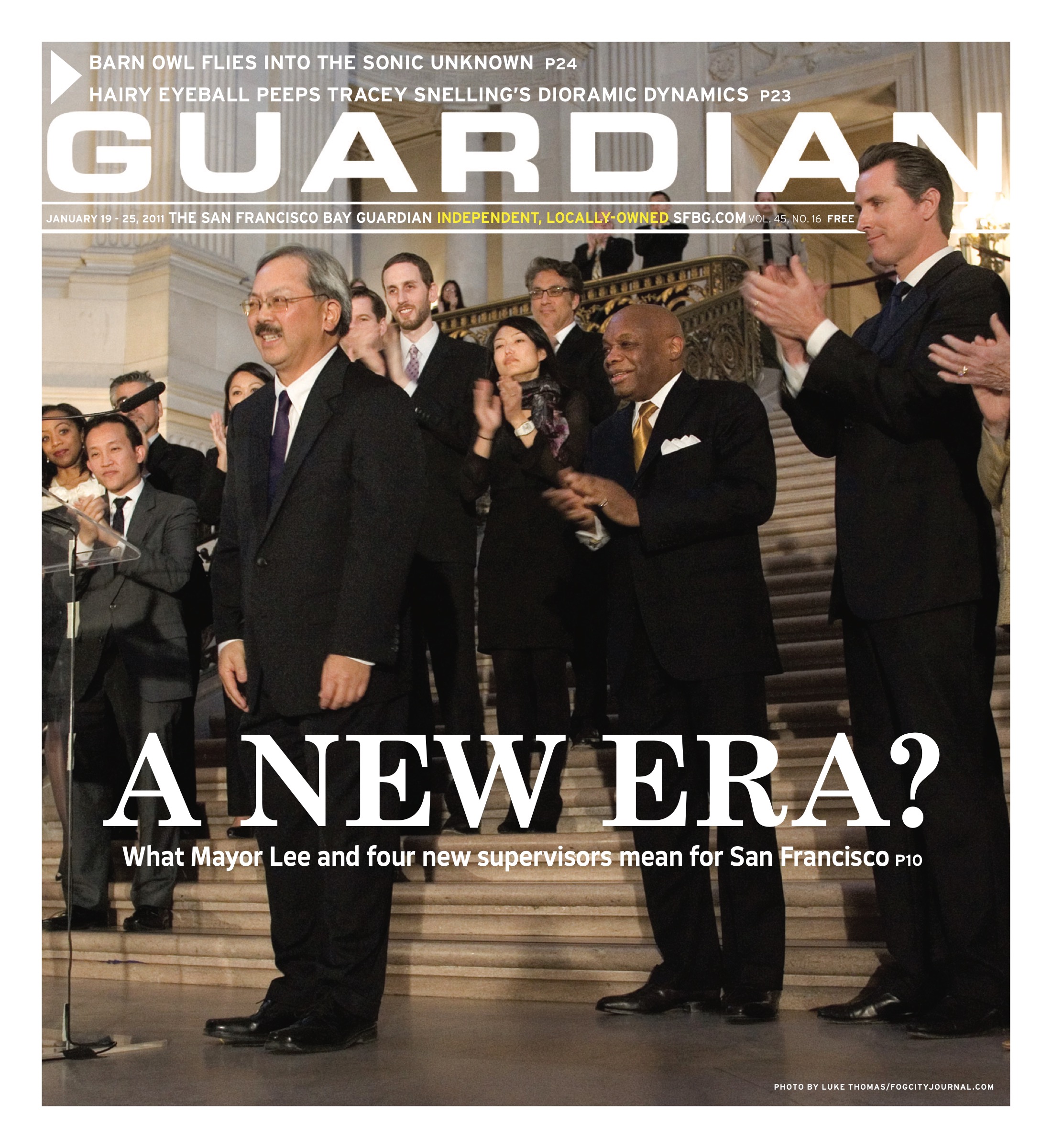
EDITORIAL Mayor Ed Lee needs to demonstrate, as we noted last week, that he’s making a clean break from the politics and policies of the Newsom administration — and there are things he can do immediately to reassure San Franciscans that he’s going to offer more than another 11 months of a failed administration.

He can start by calling off the eviction of the Haight Ashbury Neighborhood Recycling Center.

The move by Newsom to evict the recycling center, on the edge of Golden Gate Park, was part of his administration’s war on the poor. It made no sense from a financial or environmental perspective. The center, which pays rent to the city, would be replaced by a community garden, which would pay nothing. The center creates green jobs that pay a living wage; all the workers would be laid off under Newsom’s plan. The center also operates a native plant nursery and provides a drop-off recycling site for local businesses.

A community garden makes only limited sense in a shady area that gets fog most of the year.

The only reason Newsom was determined to get rid of the place is that low-income people who collect bottles and cans around the city (an environmentally positive activity, by the way) come by the center to drop them off and pick up a little cash. Some of the wealthier residents of the Haight don’t like poor people wandering through their neighborhood. It’s class warfare, declared by the Newsom administration — and Lee, who got his start as a poverty lawyer, doesn’t have to tolerate it.

Lee should direct the Recreation and Parks Department to cease the eviction proceedings and negotiate a long-term lease for the Frederick Street site.

It seems like a small item in the long list of issues the new mayor will have to deal with — but the HANC recycling center has strong symbolic importance. Ending the eviction and allowing the center to stay would be a sign that Lee intends to be a mayor who is willing to work with the progressives and that he’s not going to try to solve all the city’s problems by blaming, harassing, and criminalizing people who are barely surviving in San Francisco.

The new mayor could take another simple step toward broad credibility by opening up his office — to the public and the press. Under Newsom, Room 200 was an unfriendly place to outsiders, and often the news media were treated as enemies. Lee should start holding regular press conferences — not just stage-managed events designed to showcase one issue, but broad-ranging, open sessions where reporters can ask questions about anything his administration is doing. And he ought to direct his press office to make compliance with the Sunshine Ordinance a priority.

For starters, he could release whatever proposed budget cuts Newsom left behind. It’s hard to believe the former mayor just turned them over to Lee without a list of things that were on the chopping block. The sooner the public sees where the previous administration was going, the sooner we can all determine what, if anything, Lee will do differently.

Editorial: New Mayor Ed Lee should stop the recycling eviction

8

Mayor Ed Lee needs to demonstrate, as we noted in last week’s editorial, that he’s making a clean break from the politics and policies of the Newsom administration and there are things he can do immediately to reassure San Franciscans that he’s going to offer more than another 11 months of a failed administration.

He can start by calling off the eviction of the Haight Ashbury Neighborhood Recycling Center.

The move by Newsom to evict the recycling center, on the edge of Golden Gate Park, was part of his administration’s war on the poor. It made no sense from a financial or environmental perspective. The center, which pays rent to the city, would be replaced by a community garden, which would pay nothing. The center creates green jobs that pay a living wage; all the workers would be laid off under Newsom’s plan. The center also operates a native plant nursery and provides a drop-off recycling site for local businesses.

A community garden makes only limited sense in a shady area that gets fog most of the year.

The only reason Newsom was determined to get rid of the place is that low-income people who collect bottles and cans around the city (an environmentally positive activity, by the way) come by the center to drop them off and pick up a little cash. Some of the wealthier residents of the Haight don’t like poor people wandering through their neighborhood. It’s class warfare, declared by the Newsom administration and Lee, who got his start as a poverty lawyer, doesn’t have to tolerate it.

Lee should direct the Recreation and Parks Department to cease the eviction proceedings and negotiate a long-term lease for the Frederick Street site.

It seems like a small item in the long list of issues the new mayor will have to deal with but the HANC recycling center has strong symbolic importance. Ending the eviction and allowing the center to stay would be a sign that Lee intends to be a mayor who is willing to work with the progressives and that he’s not going to try to solve all the city’s problems by blaming, harassing, and criminalizing people who are barely surviving in San Francisco.

The new mayor could take another simple step toward broad credibility by opening up his office to the public and the press. Under Newsom, Room 200 was an unfriendly place to outsiders, and often the news media were treated as enemies. Lee should start holding regular press conferences not just stage-managed events designed to showcase one issue, but broad-ranging, open sessions where reporters can ask questions about anything his administration is doing. And he ought to direct his press office to make compliance with the Sunshine Ordinance a priority.

For starters, he could release whatever proposed budget cuts Newsom left behind. It’s hard to believe the former mayor just turned them over to Lee without a list of things that were on the chopping block. The sooner the public sees where the previous administration was going, the sooner we can all determine what, if anything, Lee will do differently.  

Debt-defying futures

4

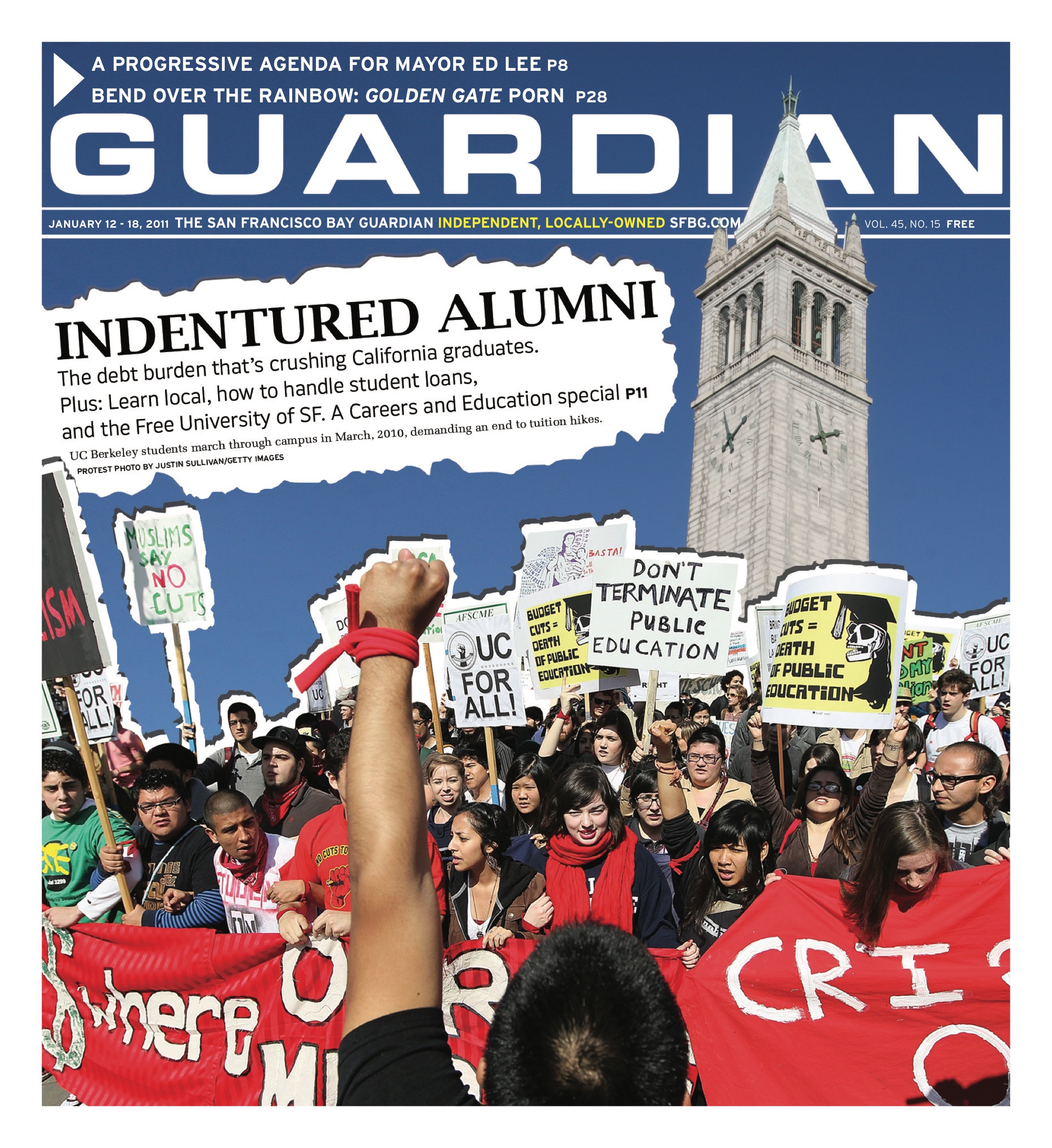
CAREERS AND ED Student loans are a very special kind of debt. Like an armored car or an airplane’s black box, they are practically indestructible. While a person could sign up for a credit card, max it out on luxury items, and then wriggle off the hook of repayment by filing for bankruptcy, this escape hatch is blocked when it comes to taking out a nondischargeable student loan. Like tattoos, they stick to a borrower for life — or at least, until they are repaid.

“It’s almost impossible to discharge this debt in bankruptcy,” says Edie Irons, communications director for Oakland-based The Institute for College Access and Success (TICAS). “When you make that investment in a home, you have collateral, and you can use that asset. But when you invest in education, it’s not a guarantee. And if you can’t make those payments, the cost of collection can be pretty dear. They can garnish your wages. They can take your Social Security, your tax refunds. For federal loans, they have a lot of pretty scary powers of collection.”

Fortunately for those borrowers facing insurmountable debt, a few options (aside from feigning one’s own death) do exist for reducing, if not eliminating, the burden of student loans.

Volunteer opportunities through AmeriCorps, the Peace Corps, and Volunteers in Service to America (VISTA) provide stipends and money that can be put toward loan repayment in exchange for service. Graduates who serve through AmeriCorps (www.americorps.gov) for one year can receive up to $7,400 in stipends plus $4,725 toward loan repayment. Peace Corps volunteers can apply for deferment of Stafford, Perkins, and consolidation loans, and may receive cancellation of their Perkins Loans at a rate of 15 percent per year. Graduates volunteering with a nonprofit through VISTA can receive $4,725 for 1,700 hours of service.

Students who opt to become teachers in elementary or secondary schools serving students from low-income families can have portions of their Perkins Loan forgiven at increasing rates over the first five years of teaching, and members of the Teach for America corps program are eligible to receive a $5,350 award for each year of teaching plus postponed loan repayment with interest paid.

Two recently created programs also broaden the options for graduates facing insurmountable loan debt. The federal Income-Based Repayment (IBR) program is a new payment option for federal loans for borrowers who have enough debt relative to income to qualify for a reduced payment. Borrowers who earn less than 150 percent of the poverty level (that’s $16,245 for an individual) pay nothing; those who earn more can have loan payments capped at 15 percent of whatever they earn above that amount and forgiven entirely after 25 years of payments.

The Public Service Loan Forgiveness programs offer debt forgiveness for graduates entering certain fields. According to the program website (www.ibrinfo.org), eligible borrowers are people employed in nonprofit, 501(c)(3) organizations and people who work for federal, state, local, or tribal government. The program forgives remaining student loan debt on most federal loans after 10 years of eligible employment and qualifying loan payments. Law students entering public service can learn more about this program and others through Equal Justice Works (www.equaljusticeworks.org).

While these options may offer a boost for borrowers with federal student loans, those with private loan debt may not be as lucky. Irons notes that TICAS is engaged in efforts to encourage legislators in Washington to consider treating private loans “more like other consumer debt rather than this extra harsh treatment.”

“We want to see that changed,” she said. “People who are playing by the rules shouldn’t be punished when things go horribly wrong for them. Right now, there’s almost no way out of private loan debt.”

Revolution 101

1

caitlin@sfbg.com

CAREERS AND ED Of course, you could just stop paying for school all together. Instead of putting their hopes for the future of education behind state reinvestment in university systems, a group of SF radical intellectuals are seeking to revamp the definition of learning by introducing the Free University of San Francisco. The nascent institution holds its first teach-in Feb. 5-6.

“Education is revolution,” says the incubator of the Free University, writer and poet Alan Kaufman. This ain’t Kaufman’s first rodeo. In 2004, while an instructor at SF’s Academy of Art University, he organized a student walk-out to protest the school’s violations of free speech rights. Employed through a temporary contract with the academy, Kaufman was not hired back the next term.

For him, it was a wake-up call that the current university system was teaching for the wrong reasons, not the least of which was the hefty price tag for classes that left his pupils in poverty. One student, he said in a recent phone interview with SFBG, had been “starving before my eyes, surviving on Ramen Noodle Cups” — all she could afford on top of tuition fees. He gave her $60 for food. But it wasn’t enough. Something had to be done.

When asked what he thinks the point of education is, Kaufman barely hesitates. “Liberation, freedom.” The current trends of privatization in public colleges, coupled with soaring school fees that far outpace students’ budgets, is symptomatic of a system that, as he prettily puts it, “funnels hearts and minds into narrowing corridors of survival. Creating profits for the university — that is the end game.”

He’s not the only person who thinks so. Kaufman and other Free University supporters have organized a teach-in next month that will feature college-level lectures from leading Bay Area artists and intellectuals, including Beat poet and SF poet laureate Diane Did Prima, former president of the Board of Supervisors Matt Gonzalez, and Pirate Cat Radio’s Diamond Dave Whitaker. The courses are no-credit, but the event is a symbol that the current educational system isn’t fulfilling some basic student needs. Instructors will teach on subjects that range from 19th-century poetry to natural geography.

Eventually Kaufman he envisions an “actual mobile university” capable of bringing the possibility of a college education to places where such a thing might be considered unattainable. And it wouldn’t just be beneficial to students. Guest faculty could experience “a kind of cleansing,” a temporary return to their original ideal of academia.

Of course, there are a few — ahem — challenges involved in starting a school that has no tuition, teacher salaries, or even monetary donors (Kaufman says the Free University will accept gifts in the form of books or other resources, but no cash). University supporters have decided to eschew accreditation for now, and true to Kaufman’s nomadic vision of the school, no location for classes has been set. First the teach-in, Kaufman says, and based on feedback, the consensus-based, hierarchy-free project will take it from there. The idea of the Free University, it would seem, is the thing for now.

It’s been done before. In the wake of the French Revolution, France established its Grandes Écoles system, a 250-school system that remains for the large part, tuition-free. The East Bay Free Skool is one outlet in the Bay that offers skill training, gratis. So for all the pie-in-the-sky idealism involved, perhaps the true test of the Free University of San Francisco won’t be its creation at all — crazy things have happened, haven’t they? Instead, it may be the extent that humanist students can steel a harsh economic climate that tends to reward monetarily-driven educations.

So why would a student chuck their pursuit of an accredited degree to participate in an uncertain radicalization of education? “Would it have practical application in a corporatized universe? Good question!” Kaufman chuckles. He launches into a torrid Marxist prediction: that our patently unfair education system cannot stand. “The system must be changed. When the pain is bad enough, people start to change.” *

FREE UNIVERSITY TEACH-IN

Feb. 5–6, 9 a.m.–5 p.m., free

Viracocha

998 Valencia, SF

(415) 374-7048

fusf.wordpress.com

The agenda for Mayor Lee

0

EDITORIAL San Francisco has its first Chinese American mayor, and that’s a major, historic milestone. Let’s remember: Chinese immigrants were among the most abused and marginalized communities in the early days of San Francisco. In 1870, the city passed a series of laws limiting the rights of Chinese people to work and live in large parts of the city. Chinese workers built much of the Transcontinental Railroad — at slave wages and in desperately unsafe conditions that led to a large number of deaths. The United States didn’t even repeal the Chinese Exclusion Act (an anti-immigration law) until 1943, and for years, Chinatown was one of the poorest and most neglected city neighborhoods.

So there’s good reason for Asians to celebrate that the last door in San Francisco political power is now open. And Mayor Ed Lee comes from a civil rights background; he got his start in politics working as a poverty lawyer and tenant organizer.

Unfortunately, his path to Room 200 was badly marred by some ugly backroom dealing involving Willie Brown, the most corrupt mayor in modern San Francisco history. Even Lee’s supporters agree the process was a mess and that it undermines Lee’s credibility. So it’s important for Mayor Lee to immediately establish that he’s independent of Brown and his cronies, that his administration will not just be a Gavin Newsom rerun, and that progressives can and should support him.

He has a tough job ahead. We urge him to make a clean break with the past and set the city in a new direction. Here are a few ways to get started.

Clear out the Newsom operatives and bring some new people with progressive credentials into the senior ranks. Newsom’s chief of staff, Steve Kawa, has been a shadow mayor for the past year while Newsom was on the campaign trail, and is the architect of much of what the outgoing administration has done to sow political division and cripple city government. Lee needs his own chief advisor.

Show up for question time and work with the district-elected supervisors. Newsom was openly dismissive of the board and refused to take the supervisors seriously as partners in city government. Lee should appear once a month to answer questions from the board in public, should meet regularly with all the supervisors and appoint a liaison that the board can work with and trust. He needs to make his administration as transparent and open as possible and ensure that everyone at City Hall follows the letter and spirit of the Sunshine Ordinance.

Make it clear that the next city budget includes substantial new revenue. Newsom offered nothing but Republican politics when it came to city finance; his only solutions to the massive structural deficit involved service cuts.

The deficit will be even worse than projected this year, since Gov. Jerry Brown wants to transfer much of the state’s responsibility for public safety and public health back to local government — and there won’t be enough state money attached to handle the new burden. Lee needs to publicly call on Brown and the Legislature to give cities more ability to raise taxes on the local levee. Then he should start planning for a June ballot package that will raise as much as $250 million in new revenue for the city.

A substantially higher vehicle license fee on expensive cars, a congestion management fee, a significant annual transit impact fee on downtown offices, a restructured business tax, and a progressive tax on income of more than $50,000 a year would more than eliminate the structural deficit.

There are plenty of other revenue ideas out there; not all can or would pass on a single ballot. But Lee needs to make it clear that revenue will be part of the solution — and that he will use all the political capital he can muster to convince the voters to go along.

<\!s> Get serious about community choice aggregation. Newsom loved to talk about his environmental agenda, but when it came to challenging the hegemony of Pacific Gas and Electric Co. and its dirty power portfolio, he ran for cover. His hand-picked Public Utilities Commission director, Ed Harrington, has been an obstacle to implementing the city’s CCA plan. Lee needs to get rid of Harrington or direct him to cooperate with the supervisors and get San Francisco on the path to clean public power.

<\!s> Establish a real affordable housing program. The city plans to build housing for as many as 60,000 new residents in the southeast neighborhoods — but only a fraction of them will be affordable. This city is already well on its way to becoming a high-end bedroom community for Silicon Valley; only a clear policy that limits new market-rate condos until there’s a plan for adequate affordable housing will turn things around.

<\!s> Support Sanctuary City and quit helping federal immigration authorities break up families. Newsom was just awful on this issue; Lee needs to work with Sup. David Campos to implement more humane laws.

<\!s> End the demonization of homeless people and public employees. Newsom came to power attacking the homeless (with Care Not Cash) and went out attacking the homeless (with the sit-lie law). Lee ought to tell the Police Department not to aggressively enforce the ordinance.

<\!s> Take on the sacred cows of the Police and Fire departments. The biggest salary and pension problems in the city are in the two public safety departments. The Fire Department budget has been bloated for years. If everyone else is taking cuts, so should the highest-paid cops and the overstaffed fire stations.

Some of Lee’s supporters insist he’s a solid progressive and that we shouldn’t hold the details of his selection — or the fact that he was chosen by people who are openly hostile to the progressive agenda — against him. We’re open to that — but the progressive community will judge him on his record. And he has to start right away.

EDITORIAL: The Agenda for Mayor Lee

6

San Francisco has its first Chinese American mayor, and that’s a major, historic milestone. Let’s remember: Chinese immigrants were among the most abused and marginalized communities in the early days of San Francisco. In 1870, the city passed a series of laws limiting the rights of Chinese people to work and live in large parts of the city. Chinese workers built much of the Transcontinental Railroad at slave wages and in desperately unsafe conditions that led to a large number of deaths. The United States didn’t even repeal the Chinese Exclusion Act (an anti-immigration law) until 1943, and for years, Chinatown was one of the poorest and most neglected city neighborhoods.

So there’s good reason for Asians to celebrate that the last door in San Francisco political power is now open. And Mayor Ed Lee comes from a civil rights background; he got his start in politics working as a poverty lawyer and tenant organizer.

Unfortunately, his path to Room 200 was badly marred by some ugly backroom dealing involving Willie Brown, the most corrupt mayor in modern San Francisco history. Even Lee’s supporters agree the process was a mess and that it undermines Lee’s credibility. So it’s important for Mayor Lee to immediately establish that he’s independent of Brown and his cronies, that his administration will not just be a Gavin Newsom rerun, and that progressives can and should support him.

He has a tough job ahead. We urge him to make a clean break with the past and set the city in a new direction. Here are a few ways to get started.

Clear out the Newsom operatives and bring some new people with progressive credentials into the senior ranks. Newsom’s chief of staff, Steve Kawa, has been a shadow mayor for the past year while Newsom was on the campaign trail, and is the architect of much of what the outgoing administration has done to sow political division and cripple city government. Lee needs his own chief advisor.

Show up for question time and work with the district-elected supervisors. Newsom was openly dismissive of the board and refused to take the supervisors seriously as partners in city government. Lee should appear once a month to answer questions from the board in public, should meet regularly with all the supervisors and appoint a liaison that the board can work with and trust. He needs to make his administration as transparent and open as possible and ensure that everyone at City Hall follows the letter and spirit of the Sunshine Ordinance.

Make it clear that the next city budget includes substantial new revenue. Newsom offered nothing but Republican politics when it came to city finance; his only solutions to the massive structural deficit involved service cuts.

The deficit will be even worse than projected this year, since Gov. Jerry Brown wants to transfer much of the state’s responsibility for public safety and public health back to local government and there won’t be enough state money attached to handle the new burden. Lee needs to publicly call on Brown and the Legislature to give cities more ability to raise taxes on the local levee. Then he should start planning for a June ballot package that will raise as much as $250 million in new revenue for the city.

A substantially higher vehicle license fee on expensive cars, a congestion management fee, a significant annual transit impact fee on downtown offices, a restructured business tax, and a progressive tax on income of more than $50,000 a year would more than eliminate the structural deficit.

There are plenty of other revenue ideas out there; not all can or would pass on a single ballot. But Lee needs to make it clear that revenue will be part of the solution and that he will use all the political capital he can muster to convince the voters to go along.

Get serious about community choice aggregation. Newsom loved to talk about his environmental agenda, but when it came to challenging the hegemony of Pacific Gas and Electric Co. and its dirty power portfolio, he ran for cover. His hand-picked Public Utilities Commission director, Ed Harrington, has been an obstacle to implementing the city’s CCA plan. Lee needs to get rid of Harrington or direct him to cooperate with the supervisors and get San Francisco on the path to clean public power.

Establish a real affordable housing program. The city plans to build housing for as many as 60,000 new residents in the southeast neighborhoods but only a fraction of them will be affordable. This city is already well on its way to becoming a high-end bedroom community for Silicon Valley; only a clear policy that limits new market-rate condos until there’s a plan for adequate affordable housing will turn things around.

Support Sanctuary City and quit helping federal immigration authorities break up families. Newsom was just awful on this issue; Lee needs to work with Sup. David Campos to implement more humane laws.

End the demonization of homeless people and public employees. Newsom came to power attacking the homeless (with Care Not Cash) and went out attacking the homeless (with the sit-lie law). Lee ought to tell the Police Department not to aggressively enforce the ordinance.

Take on the sacred cows of the Police and Fire departments. The biggest salary and pension problems in the city are in the two public safety departments. The Fire Department budget has been bloated for years. If everyone else is taking cuts, so should the highest-paid cops and the overstaffed fire stations.

Some of Lee’s supporters insist he’s a solid progressive and that we shouldn’t hold the details of his selection or the fact that he was chosen by people who are openly hostile to the progressive agenda against him. We’re open to that but the progressive community will judge him on his record. And he has to start right away.

Hennessey, Lee and change

8

I’m not surprised that Randy Shaw is defending Ed Lee and arguing that either Lee or Mike Hennessey would be fine as interim mayor:


Ed Lee is not Gavin Newsom. Lee has dedicated his life to public service, spent years as a poverty lawyer, and has proved an outstanding administrator over the past two decades.


Shaw worked with Lee way back in the 1980s, when they were both young, underpaid lawyers doing housing work for some of the poorest San Franciscans. Both of them were doing crucial work that nobody else would handle; both of them were making San Francisco a better place. While I sometimes disagree with Shaw (and he seems to be all about attacking the Guardian these days) we have been close allies over the years on almost all the issues that matter. And I’m not going to attack Ed Lee or suggest that he’s forgotten his roots in immigrant rights and poverty law.


Here’s what I will say: If Ed Lee is interim mayor, you can expect very little change in Room 200. There’s a reason that Newsom wants Lee in office, and it’s not that he was a great progressive lawyer once. Newsom (and Sean Elsbernd, who nominated Lee) don’t want to see the mayor’s staff infrastructure — the people really running the city — dismantled. They don’t want any real changes in how business is done — and how the budget is addressed — from the way things worked the past seven years.


Lee hasn’t survived (and thrived) under so many different mayors by rocking the boat. He would be a cautious administrator who, I suspect, would avoid anything controversial (like tax increases on the wealthy or big cuts in the bloated Fire Department). Ed Lee is not Gavin Newsom — but his staff will be Gavin Newsom’s staff and, through the inertia that is San Francisco bureaucracy, not much will change in the next 11 months.


That’s what the conservatives on the board want, and I understand that. I don’t think Hennessey would make dramatic changes, either — the whole idea of a caretaker mayor is that the person who fills out Newsom’s term won’t try to put his own stamp on city government. (And let’s remember, Hennessey sided with Newsom on privatizing jail health services) But I think Hennessey would bring some new blood into the office and would be more likely to consider an approach to the budget that differs significantly from what Newsom has offered.


Everyone agrees that Lee is a smart, competent manager; that’s why he won unanimous approval as the City Administrator, an office that doesn’t involve major policy initiatives. So if you think things are basically okay in San Francisco, and you don’t want any major policy shifts out of the Mayor’s Office until after the next election, Ed Lee will do a fine job for you. That’s not demonizing him; that’s just explaining the reality here.


Me, I don’t think things are okay in this city at all. I’m looking for dramatic, profound, radical change in the next mayor. I’m not going to get it from either of these interim candidates, but after talking to Hennessey, I think if the supervisors pushed for a better, more progressive budget, he’d go along. I’m not so sure about Lee. And the fact that Newsom and every member of the conservative wing of the board wants Lee over Hennessey says something to me. These people aren’t fools; they don’t want any surprises. That’s why they’re making this move.


I’ve been wrong before. Hope I’m wrong this time. Maybe Mayor Ed Lee will support $250 million worth of new revenue measures, like a city income tax and a business tax overhaul that makes the biggest companies pay more. But if that was part of his agenda, I suspect Elsbernd and Newsom would have a clue — and then he wouldn’t be their choice.


Chris Daly’s Final Say

18

As part of my effort to compile a list of most roastable moments of Sup. Chris Daly‘s decade-long career at City Hall, I asked the termed-out D6 supervisor if he would sit down for an exit interview. And shortly before Christmas, when there was still hope the Board would select a progressive interim mayor, and Daly had not yet vowed to politically haunt Board President David Chiu with shouts of, “It’s on like Donkey Kong” , we arranged to meet me at the Buck Tavern on Market Street, which Daly, who now holds the liquor license, is threatening to rename “Daly’s Dive.”

As it happens, the lion’s share of our conversation ended up taking place by cell, since Daly got stuck in late afternoon commuter traffic, as he drove to San Francisco from Fairfield, where his wife and children have lived since April 2009, making him a fitting symbol of the East-Bay-and-beyond migration pattern of couples who live in San Francisco, until they have more than one kid.

Except not all couples with two small kids get to move into one of two foreclosed properties that the in-laws bought with $545,000 cash in spring 2009. At the time, Daly’s critics accused him making such a mess of governing the city that he had decided against raising his own family here. Daly predictably disagreed. “There are few people who think about the future of San Francisco and the health of the city more than me,” Daly told reporters, explaining that his wife wanted family support raising their children, so she had moved to the same cul-de-sac as her parents, as Daly continued to live in a condo in San Francisco with roommates and to see his family on weekends.

Anyways, on the dark and stormy night that I interviewed Daly in mid-December, he acknowledged that he was going to be in for one helluva roast at the Independent on Jan. 5. in the worst possible sense of the tradition.
“Will there be controversial subjects, things that on the face of it, are not very nice? Yes,” Daly said.

And then he claimed he had agreed to this ordeal, because, under the roast’s traditional format , he would get to go last—and thus would get to have the last word.
“Why would I want to end my City Hall career like this? Because I get to go last, and can really say what’s on my mind,” Daly said. “Unless the D.J. wants to say something as he’s spinning.”

Daly’s comment suggests that folks who attend his roast at the Independent will witness a historically vicious verbal drubbing on all sides, since no one has ever accused Daly of holding back from saying what was on his mind. Even if it has led to seemingly counterproductive “We are shocked, SHOCKED!” responses. Like the time Sup. Michela Alioto Pier introduced an ultimately doomed etiquette ordinance, after Daly swore at a constituent during a City Hall meeting, in 2004.

Daly said at the time that he comes from a background as a housing-rights organizer on the streets of Philadelphia and San Francisco, where confrontation was an effective political tool. But he also claimed that he had learned an important lesson.
“In the future it’s going to be better for me personally and politically to focus my energy positively on the people I care about instead of negatively on the people I think are doing them harm,” Daly reportedly said.

Fast forward six years, and Daly is unrepentant about his record of fighting for low-income people, while openly defying City Hall’s unwritten rules of etiquette.
“Etiquette always seemed a little silly, something for the ‘other’ San Francisco, for the prim and the proper and that’s not what I am concerned about,” Daly said. “I’m aware of the turn-the-other-check philosophy, and, if I were religious, I’d be out of the Old Testament. I’d be, if someone pokes you in the eye, I’d poke back.”

Daly says he stopped caring about etiquette towards the end of his first year in office. “When those in power use that power to put down those who are less advantaged, when I see that, I respond quickly and with as much force as I can to prevent them from doing that kind of thing again,” he said. “ If you want to attack homeless people for political advantage, I’m going to attack you right back. That’s not ‘proper,’ but I think it’s just.”

Daly says he also soon realized tthat the truth wasn’t the driver.
“I already knew that money, power and significant forces would be pushing back against me but then I discovered that the actual truth wasn’t what played out there in the world of spin. It’s like when the Examiner’s Josh Sabatini asked me how I want to be remembered, and I said, “Not as the caricature the Examiner created of me.”

Daly, who moved to San Francisco in 1993 to work on homeless and affordable housing issues, was at the heart of the movement around Ammiano’s 1999 write-in campaign for mayor, and part of the progressive sweep onto the Board, in 2000.

“For me, it’s never been about being a ‘good’ vote. I breathe leftist progressive politics,” Daly said. “Where I can make more of a mark is in terms of setting the stage for those votes and holding the line in districts that are not progressive. I’m very proud of my attempts to hold the line on issues, but the work doesn’t make any friends.”

Daly noted that after he made comments about Newsom’s alleged cocaine use during the 2007 Mayor’s race, downtown interests threw everything they had left at him.
‘They got a lot of hits in, but no total blows,” he opines. “Last time I checked, I saved the city $150 million on the Americas Cup deal that they were going to ram rod through.”

And so, as he prepares to begin life as a bar owner, don’t expect Daly to pass up opportunities to launch verbal attacks, if he believes they are warranted, political consequences be damned.

“People want to have the power without any of the negativity they associate with all the shit we have to deal with to build this power,” Daly added. “So, it’s all, Daly and [former Board President Aaron] Peskin took control of the Democratic Party at midnight. Well, how did you want us to take over? “

Daly claims if you take away “negatives” attributed to him, you take away his wins. “People call me a lot of things, but I’m not a loser, I win a lot” Daly added, noting that Democrats being nice to Republicans has led to losses in D.C., not gains. “So, yes, I’ve got a lot of negatives, and they’ve clearly been made into a target, but if I can take the hits, and help people I care about, I’m happy to do it. That’s what I’ve done for ten years.”

Daly says he’s become “pretty desensitized to criticism,” even as he admits to being a sensitive person, deep inside. “I don’t think I’d have quite the visceral response to poverty and oppression, if I wasn’t sensitive,” he said. “I care deeply about people’s struggles. That’s why I’m here, but I also have a pretty solid critique of capitalism and I know how to follow the money, so when I get criticized by some downtown mouthpiece, I know what time it is.”

Daly says he started the Daly Blog several years ago, to push back against what he felt was unfair treatment in the media. And he says he endorsed outgoing mayor Newsom for Lt. Governor, despite their long and antagonistic history, so progressives could have a shot at installing a mayor in Room 200.

“My money now is on the selection of the mayor going to the new Board, and Avalos getting it in the 13th round of voting,” Daly said.

Daly made that prediction three weeks before the progressives on the Board seem poised to hand the keys to R.200 to City Administrator Ed Lee—thereby eliciting Daly’s ballistic “Donkey Kong” outburst.

With the outgoing Board set to meet Friday to make a selection, here’s another Daly roastable moment, this time from Peskin, related to the fall-out that ensued after Daly made two appointments to the SFPUC, while serving as acting mayor for one day, while then Mayor Willie Brown was out of the country, on a trip to Tibet.

“When Mayor Willie Brown left office, Charlotte Schultz had an unveiling ceremony of Brown’s picture. Newsom, who by then was mayor, was presiding. And Charlotte had a beautiful easel with a golden drape over it. When she pulled back the curtain there was a picture of Daly, who was listed as “41st and a half” mayor presiding from 9 a.m. to 2 p.m. on October 22,” Peskin recalled, noting that under Daly’s picture there was another curtain that contained Brown’s actual portrait.”

And while Daly’s controversial statements and outbursts always make headlines, there is no denying that he helped make the progressive agenda, including establishing mandatory paid sick days, universal healthcare, and forcing developers to contribute in affordable housing or services for poor, an integral part of city policy.
 “The Chronicle used him as the poster child to try and dissuade anyone from supporting a progressive agenda,” former Sup. Jake McGoldrick observed. “He was used to smear any of our good ideas. And Chris never seemed to understand that some of us needed to be a little more sensitive, since we needed to get re-elected and didn’t represent districts that were as progressive as his. Personal attacks make the whole situation smell bad.”

Sup. John Avalos, who served as Daly’s legislative aide until he was elected as D11 supervisor, acknowledged that a lot of folks have accused Daly of doing irreparable harm to the progressive movement and being a gift to Newsom and the moderates at City Hall.
“People try and make hay out of it,” he said. “But his antics have probably hurt him more than anyone,” Avalos added, noting that he ran in 2008 as Daly’s former legislative aide.
‘And it didn’t hurt me, and I made no bones about where I came from.”

And then there’s the fact Daly defeated the Chamber ’s Rob Black in the 2006 election. “We don’t do enough to have better relationships between ourselves,” Avalos added , reflecting on the divided progressive movement. “It’s more than just one person.”
 
Peskin for his part acknowledges that Daly will be missed on the Board.
 “He sucked the oxygen out of the room and made it all super lefty and caustic, and it certainly did not allow a better conversation to evolve,” Peskin said. “But it’s still going to be a pretty profound loss.”

Editor’s Notes

0

tredmond@sfbg.com

Social inequality is morally wrong, politically dumb, and economically unsustainable. It also makes you fat.

Seriously.

There’s a book by two British epidemiologists that argues the physical and mental health case for economic equality — and it’s full of great stuff. It’s a year old, but I read a nice analysis of it in Nicholas Kristof’s column in the Jan. 2 New York Times. Kristof notes that Richard Wilkinson and Kate Pickett, both British epidemiologists, cited vast and growing evidence that societies with greater equality are in general more healthy. And by that they mean not only that those societies have less crime and violence; the people who live with greater equality actually have less heart disease, mental illness, and obesity.

The book is called The Spirit Level: Why Greater Equality Makes Societies Stronger. A lot of it’s kind of touchy-feeley, but in the end, they come to a scientific conclusion: “The relationships between inequality and poor health and social problems are too strong to be attributable to chance.”

The two scientists also take on one of the great taboos of modern economics. They argue that growth isn’t necessarily good, that the standard goal of every official government policy in every major nation in the world — capitalist, socialist, or communist — over at least the past half-century, has been based on a flawed assumption.

There aren’t even that many progressives in this country who want to challenge the idea that the economy needs to grow to solve problems like unemployment and poverty. Sim Van Der Ryn, the visionary planner and architect, once told me that it makes no sense to have “a perpetually adolescent economy.” But in most polite company, that’s heresy.

But our new governor, who once employed Van Der Ryn as the director of the Office of Appropriate Technology, has a few heretical cells in his Jesuit-trained brain. And while I don’t expect him to turn the state’s growth frenzy on its head, he ought to be willing to think about this:

The solution to California’s problems may lie more with redistributing the pie than with making it larger.

I’m not arguing that we should abandon growth, particularly at a time of high unemployment. But keep in mind: corporate profits are already up, both here and nationwide — but the big companies are hoarding their cash and not hiring. Banks are making money again — but they’re not lending it out. We’re in a different sort of recovery here, one that may, for the moment, be structurally jobless. During the deep recession, businesses figured out how to survive with fewer employees, and they’re not about to start expanding the payroll.

And of course, the public sector has done nothing but shrink, and there’s little talk of anything but more shrinking.

So maybe the only way we’re going to get out of this is to inject more money into the economy, not by borrowing but by sending some of the idle wealth at the top back down to the level where it might become production. It might make us all a lot healthier. Because it turns out that you don’t have to eat the rich; just tax them.

Goal difference

0

cheryl@sfbg.com

YEAR IN FILM Making a mistake on the playing field can haunt an athlete for the rest of his or her career. For Colombian soccer star Andrés Escobar, a particularly heartbreaking blunder — an own goal during the 1994 World Cup — proved fatal. Just two weeks after Colombia’s first-round defeat in the tournament they’d been favored to win, team captain Escobar was shot after leaving a nightclub in his hometown of Medellín. There were rumors the killer yelled “Goal!” as he unloaded.

Presented merely as a sports-history anecdote, Escobar’s demise is sad and senseless. But his murder wasn’t an isolated incident, just a particularly high-profile one; it was part of an unimaginable tide of violence that swept Colombia in the 1980s and ’90s. If you watched the 2010 World Cup on ESPN, you probably saw commercials for The Two Escobars, presented as part of the channel’s “30 for 30” documentary series. Participants included genre pioneer Albert Maysles, whose film was about Muhammed Ali; Ice Cube, who used his own South Central childhood to reflect on the Raiders’ 1982 move from Oakland to Los Angeles; and brothers Jeff and Michael Zimbalist, whose longer entry The Two Escobars sifted through years of Colombian history to trace the corresponding lives of Andrés “The Gentleman of Football” Escobar and drug kingpin Pablo Escobar.

At 32, Jeff, who lives in San Francisco, is the older brother by 17 months. In 2005, he codirected the award-winning Brazilian music doc Favela Rising. Michael, an actor and writer who ran a theater company in Mexico for several years, lives in New York City. Though they’re Americans, the Zimbalists feel a strong connection to Colombian culture. They were researching another film in the country (previous endeavors included a project with Colombian superstar Shakira) when ESPN asked them to pitch an idea for “30 for 30.” Though the shared last name of the unrelated Andrés and Pablo makes for a memorable title, the brothers didn’t use the coincidence as a starting point.

“We didn’t choose the title until really late, actually, because it felt like it was more of a portrait of a time period. It was about the hopes and dreams of the Colombian people as told through the vehicle of these two characters,” Jeff says. “The choice to use the two characters came about more organically than that, too. Initially we had the assignment to go find story ideas for the ESPN series that were about the impact of sports on society, and vice versa.”

After learning more about Andrés, they knew they’d found a captivating subject. They also realized that they would need to contextualize his story in order to tell it properly.

“We didn’t want to make a whodunnit about who pulled the trigger,” Jeff says. “It was a lot more interesting to ask the question of how an athlete gets killed for making a mistake. But in order to understand that, you need to understand what narco-soccer is. We quickly realized that hadn’t been covered before. And that meant that people were very reluctant to talk about it for a number of reasons: out of fear, shame, or they didn’t want to revisit a traumatic time period.”

The idea of “narco-soccer” led the filmmakers directly to their other subject. “You can’t really explain the whole context of narco without understanding Pablo Escobar. And it also felt unwieldy to not tie the societal story to a subject, or to a personal narrative,” Jeff explains. “So using Pablo as the tool through which we could explain society, and Andres as the tool through which we could understand sports, the next challenge was finding their overlaps. They only literally overlap a number of times in their lives. So how does the story justifies the use of these two characters? It has to be thematic — and there was tons of great, thematic overlap, and parallel and contrast, between the two Escobars.”

If you weren’t among the millions who watched The Two Escobars‘ repeat showings on ESPN (or caught it at the Sundance Kabuki as part of the San Francisco Film Society’s “SFFS Screen” programming), here’s a crash course in narco-soccer, as explained by the movie: during the ’80s and ’90s, Colombian drug lords invested in soccer teams as a way to launder their ill-gotten gains. As teams’ coffers grew, so did their ability to hire top-notch players. Sides flush with dirty cash racked up victories and corruption behind the scenes grew to outlandish proportions. Referees could easily be bought — or eliminated. A huge soccer fan who’d risen from poverty, then used his wealth to build fields in the slums, Pablo was one of these investors. Andrés, of course, was one of the league’s stars.

Using no narrator, The Two Escobars instead weaves its account with contemporary interviews (the exhaustive list of talking heads includes soccer legends, jailed gangsters, coaches, cops, and the sisters of both Escobars) and expertly edited archival footage that enables the viewer to witness just about everything discussed: the might of Colombia’s national team in the run-up to the 1994 World Cup; the sight of Pablo enjoying soccer on both his palatial estate and, incredibly, while incarcerated; the horrific violence that became an everyday occurrence during Pablo’s war on Colombia’s government.

Obtaining these hours of interviews and footage — only a fraction of which made it into the final cut — posed various challenges. “[Subjects] were reluctant to talk for many reasons: it’s taboo; it’s often felt to be dangerous still,” Jeff says. “So there is fear. And also, it is traumatic to go back and visit those emotions. A lot of people would rather bottle that up. I’m not one to judge because I didn’t live during the reign of Pablo Escobar and [anti-Escobar vigilante group] Los Pepes in Colombia. But I do believe that expressing that stuff and getting it out can be cathartic.”

Culling the archival footage used in The Two Escobars took months of plowing through broadcast vaults, the private archives of both Escobars, and films shot by military police and amateur videographers. “We knew it wasn’t gonna be as powerful a film, as accessible a film, if we just rooted it in present-day talking head interviews,” Jeff says. “We needed to transport the viewer back into that time period. A lot of our decision to tell both the narratives of Pablo and Andrés, and make it bigger than just the ESPN assignment, to make it a theatrical movie, was hanging on whether or not we were able to find enough compelling visuals to create real scenes. We had myself, my brother, and a team of people just going through tapes.”

Editing was a monumental task, proving both labor-intensive and emotionally trying. “It was very difficult to whittle down the story,” Michael says. “At one point, we had a film that was sort of focused on being the first exposé of this secret world of narco-soccer. We had hours of anecdotes that really blew our minds. We ended up reducing that whole part of the story to what you could call act one of the movie, and that was certainly difficult. You’re just sorry to see things go.”

Though The Two Escobars screened worldwide, not just on ESPN but at the Tribeca and Cannes film festivals, one place it hasn’t been seen is, ironically, Colombia. Due to the sensitive subject matter, and objections to the final product by Andrés Escobar’s family — who didn’t appreciate being associated with Pablo Escobar — “it’s been completely censored,” Jeff says, noting that he and his brother did not intend to mislead anyone during the filming.

“We always knew it was going to be extremely controversial,” Michael says. “I was nervous in terms of what the reactions from Colombians would be, because obviously it’s very delicate, very loaded subject matter. There’s so much visceral emotion for any Colombian who went through that period of time. Virtually everyone who lived there in the ’80s and ’90s was touched by that violence.”

Though the brothers are disappointed the film hasn’t been shown in Colombia, that doesn’t mean no Colombians have seen it.

“Everywhere we’ve shown the film and done a Q&A, there have been Colombians present,” Michael says. “That’s been a really rewarding experience.”

“For Colombians, it’s not an easy 100 minutes to sit through,” adds Jeff. “But by the end, [the Colombians we’ve met] do feel that it’s an accurate portrayal, that it’s balanced journalism, and that the message is an important one about Colombia moving forward. It presents a lot of hope through Andrés’ family. That was our goal, to create a portrayal of Andrés that was heroic. We made sure the voice of his family is the takeaway from the movie. I think it couldn’t be more clear once you see the film how opposite Pablo and Andrés are in terms of who they are and what they stand for. I hope that Colombians get a chance to see the film because they’ll realize that.” 

www.the2escobars.com

Homelessness: Newsom’s real legacy

4

OPINION His voice tinged with modest pride, Gavin Newsom recently announced that he has housed 12,000 people since becoming mayor. This is an absurdly high number, four times larger then any street count of homeless people since he has been in office, but it’s been accepted by the media and public.

Homelessness has been a key issue for Newsom. He first got elected in large part by taking it on, and has been celebrated in some quarters as a champion for homeless people.

But digging behind the veneer, removing bus tickets out of town, permanent housing his predecessor, Willie Brown, created, and temporary stays and duplication, there are 1,395 permanently affordable housing units that Newsom can truly take credit for. More frequently his administration has housed people (fewer then 2,000) by leasing residential hotel rooms from slumlords and charging homeless people unaffordable rents to live there.

Only 14 percent of the units have been for families, although they make up 40 percent of the homeless population.

Newsom put three different initiatives on the ballot that have spurred hatred against homeless people. His signature operation was mixing kindness with punishment. This way, he wooed conservatives who saw through the camouflage, and liberals who did not.

Care Not Cash was the first measure. That campaign focused on accusing homeless welfare recipients of spending all their money on booze and drugs. The proponents claimed they would take public assistance away, in return for housing and treatment. The treatment part never came to fruition, and of course proponents never mentioned they were counting shelter as housing.

Care Not Cash catapulted Newsom into the limelight. His self-deprecating charm conveyed the message: “The status quo simply isn’t working.” In the end, benefits were slashed and perpetual shelter vacancies were created while shelter-seekers were turned away. Food lines exploded.

Newsom could have used his power to raise the money to house people — without stealing it from other destitute people. He chose not to.

The next year Newsom ran for mayor and simultaneously put an anti aggressive panhandling initiative on the ballot. In classic Newsom strategy, the proposition loosely defined the term “aggressive” and bizarrely required, but did not fund, substance abuse treatment for perpetrators.

It was the meanest campaign in three decades. Several violent acts were wrongly attributed to homeless people. The Golden Gate Restaurant Association put out billboards claiming homeless people spread venereal disease. Once implemented, the initiative made no visible impact on the number of panhandlers in San Francisco.

Most recently, Newsom introduced Proposition L, an ordinance that could put people in jail for 30 days on a second offense just for sitting or lying on the sidewalk. It passed, and set the parameters for very nasty dialogue about poor people once again in San Francisco.

All three of these votes took place very strictly along class lines — affluent people supported them and poor people did not.

Homelessness is not a lifestyle choice; it’s a symptom of poverty. Yet Newsom’s legacy of hatred against homeless people has made it difficult to amass the public support needed to create true solutions. Overstating his accomplishments and spreading myths about homeless people sets us back. It gives San Franciscans the impression homeless people have the help they need but simply choose to remain out on the cold hard pavement.

In a city filled with thousands of destitute people, it is now illegal to sleep unsheltered. After Newsom’s plaster media façade crumbles, this will be his lasting legacy. *

Jennifer Freedenbach is executive director of the Coalition on Homelessness.


Hiring at home

1

sarah@sfbg.com

The lame duck Board of Supervisors made history Dec. 7 when it voted 8-3 to approve mandatory local hire legislation for city-funded construction projects. The measure ends a decade-long effort to reach 50 percent local hiring goals through good-faith efforts.

“That’s a sea change in our local hiring discussion,” said Sup. John Avalos, who launched the legislation in October as part of the LOCAL-SF (Local Opportunities for Communities and Labor) campaign, which seeks to strengthen local hiring, address high unemployment rates, and boost the local economy.

The veto-proof passage of Avalos’ measure comes in the wake of a city-commissioned study indicating that San Francisco has failed to meet good-faith local hiring goals for public works projects even as unemployment levels rise in the local construction industry and several local neighborhoods face concentrated poverty.

Although Cleveland also has a local-hire law, the Avalos measure will be the strongest in the nation. Avalos’ legislative aide Raquel Redondiez told the Guardian that Cleveland’s 2003 legislation requires 20 percent local hire.

“This legislation doesn’t just have a mandated 50 percent goal,” Avalos explained, noting that San Francisco will require that each trade achieve a mandated rate and that 50 percent of apprentices be residents.

“This will ensure that our tax dollars get recycled back into the local economy, and that San Franciscans who are ready to work are provided the opportunity to do so,” Avalos said.

Avalos’ groundbreaking legislation phases in mandatory requirements that a portion of San Francisco public works jobs go to city residents and includes additional targets for hiring disadvantaged workers.


WHO GETS $25 BILLION?

The legislation replaces the city’s First Source program, under which contractors were required only to make good faith efforts to hire 50 percent local residents on publicly-funded projects. But the measure begins slowly by mandating levels some contractors are already reaching. According to a study commissioned by the city’s Office of Employment and Workforce Development and released in October, 20 percent of work hours on publicly-funded construction projects are going to San Francisco residents.

Avalos’ legislation, which is supported by a broad coalition of labor and community groups including PODER, the Filipino Community Center, Southeast Jobs Coalition, Kwan Wo Ironworks Inc., Rubecon, and Chinese for Affirmative Action, comes at a critical moment for the recession-battered construction industry.

Under the city’s capital plan, more than $25 billion will be spent on public works and other construction projects in the next decade — and two-thirds of this money will be spent over the next five years.

The measure has environmental benefits too. Transportation still accounts for more greenhouse gas emissions generated in the Bay Area than any other source, and San Francisco residents are more likely to take transit, walk, or bike to work than residents of other Bay Area counties. “When local citizens are able to work locally, there are fewer cars on the road and less air pollution,” Avalos said.

Sup. Ross Mirkarimi said that Avalos’ legislation is “just a start.”

“People have talked a good game about local hiring,” observed Mirkarimi, whose district includes the high unemployment-affected Western Addition.

“We are going to have to go beyond construction and start thinking about delving into the private sector,” Mirkarimi continued, pointing to the need to build 100,000 housing units over the next 25 years if the city is to keep up with a projected population increase. “Who is going to build that housing?” he asked.

Sup. Eric Mar noted that “the Sierra Club endorsed the measure early on because of the environmental benefits of having people work close to where they live.”

Sup. David Campos, whose district includes the Mission, said the measure was one of the most significant pieces of legislation to emerge from the board in recent years. “In the past, a lot of obstacles got in the way, including some legal challenges,” said Campos, who credited Avalos for navigating a complicated legal structure. “At the end of the day, I think this is going to benefit everyone.”

Mike Theriault, secretary-treasurer for the San Francisco Building Trades Council, told the Guardian he remains opposed to the legislation because the union presers to allocate jobs based on seniority, not residency. But he said the amendments make the measure “less harmful and more survivable in the short-term.”


THE ECONOMIC GAP

Termed-out Sup. Sophie Maxwell, who represents the city’s economically distressed southeast sector, has often noted that the construction industry provides a path to the middle class for people without advanced degrees or facing barriers to employment. She thanked Avalos for pushing legislation that promises to provides opportunities for “growing the middle class instead of importing it.”

“This industry closes the economic gap,” she said.

Board President David Chiu and termed-out Sups. Chris Daly and Bevan Dufty also supported Avalos legislation. But Dufty, who is running in the 2011 mayoral race, cast the eighth vote, which gave the measure a veto-proof majority.

The board’s Dec. 7 vote came a few hours after Bayview-based Aboriginal Blacks United founder James Richards and a score of unemployed local residents rallied at City Hall in the hopes of securing Dufty’s vote.

ABU has recently been protesting at UCSF’s Mission Bay hospital buildings site on 16th and Third streets. Its members also triggered a shut down at the Sunset Reservoir last month after a court ruled that locals promised jobs installing solar panels at the plant be replaced by higher-skilled engineers,

“It’s been too long that we have been protesting and fighting this good faith effort,” Richards told the Guardian. “We need a mandatory policy.”

Dufty is also hoping the Avalos measure could spread to other cities and benefit workers nationwide. “At a certain point I looked at labor and said, ‘Yes, I’m going for this legislation. But not just for San Francisco — you want to take this concept to other cities,’ ” Dufty said, as he made good on his promise to Richards to vote to support Avalos’ law.

Dufty seemed hopeful that Mayor Gavin Newsom would get behind the legislation. “But I respect that there may be a little bit of coming together between now and the second reading.”

Newsom spokesman Tony Winniker told the Guardian that the mayor has 10 days to review Avalos’ legislation after its Dec. 14 second reading. “He supports stronger local hire requirements but does want to review the many amendments that were added before deciding,” Winnicker said.

But will Newsom, who is scheduled to be sworn in as California’s next lieutenant governor Jan. 3, issue a veto on or before Christmas Eve on legislation that has been amended to address the stated concerns of the building trades?

That would be ironic since the amended legislation appears to match recommendations that the Mayor’s Taskforce on African American Outmigration published in 2009. The California Department of Finance projected that San Francisco’s black population would continue to decline from 6.5 percent (according to 2005 census data) to 4.6 percent of the city’s total population by 2050 — in part because of a lack of good jobs.


WILL NEWSOM VETO?

Avalos originally proposed to start at 30 percent and reach 50 percent over three years. But after the building trades complained that these levels were unworkable, Avalos amended the legislation to require an initial mandatory participation level of 20 percent of all project work-hours within each trade performed by local residents, with no less than 10 percent of all project work-hours within each trade to be performed by disadvantaged workers.

He also amended his legislation to require that this mandatory level be increased annually over seven years in 5 percent increments up to 50 percent, with no less than 25 percent within each trade to be performed by disadvantaged workers in the legislation’s sixth year.

A Dec. 1 report from city economist Ted Egan estimated that the local hire legislation would create 350 jobs and cost the city $9 million annually. But Egan clarified for the Guardian that this cost equals only 1 percent of the city’s spending on public works in any given year.

Vincent Pan of Chinese Affirmative Action, which supports Avalos’ local hiring policy, suggested that the mayor “check the temperature.”

“It would be leadership on the part of the mayor not to veto legislation that’s about San Francisco,” Pan said.

And Mindy Kener, an organizing member of the Southeast Jobs Coalition breathed a deep sigh of relief when Dufty’s vote made the law veto-proof. “It’s gonna go across the country,” Kener said. “We just made history.”

Pass the DREAM Act, now

11

by Eric Mar and Eric Quezada

news@sfbg.com

OPINION Imagine for a moment that you are 14 years old. Your parents, stuck in perpetual poverty and unemployment (or perhaps worse), move your family to a foreign country to begin a new life.

You work hard, struggle to fit in, study constantly, and fill your spare time with school activities. Maybe you even work a little on the side to chip in. You are a parent’s dream, and a model of young citizenship.

Except that you’re not a citizen. And one day, even as you’ve mastered English and flourished in school and in the community, you are stopped like a criminal by federal authorities.

This is what happened to Steve Li, an engaging and industrious 20-year-old student at City College of San Francisco and a graduate from George Washington High School. He always thought he was an average San Franciscan until the morning of Sept. 15, when Immigration and Customs Enforcement agents suddenly raided his home and arrested him and his parents. Steve was incarcerated in Arizona for more than 60 days, far from his friends and family. Through a full-court legal and legislative press, and a groundswell of immigrant community organizing leading to a private emergency bill by Sen. Dianne Feinstein, Li has temporarily staved off deportation. But Li and thousands of other hard-working young immigrant Americans could soon be summarily tossed out of the country if Congress doesn’t act now to pass the Development, Relief, and Education for Alien Minors (DREAM) Act.

The DREAM Act is a common-sense, bipartisan measure that is urgently needed to avoid countless other Steve Li cases. Despite congressional wavering on comprehensive immigration reform (which a consistent majority of Americans support), everyone should be able to agree on the basic right of undocumented immigrant minors, who are moved here by their parents, to gain steps toward obtaining citizenship.

In brief, the DREAM Act would enable some immigrant students who have grown up in the U.S. to apply for temporary legal status and to eventually obtain permanent status and become eligible for U.S. citizenship if they go to college or serve in the U.S. military.

According to the National Immigration Law Center (NILC), about 65,000 U.S.-raised high school students could qualify for the DREAM Act’s benefits each year. As NICL puts it, “These include honor roll students, star athletes, talented artists, homecoming queens, and aspiring teachers, doctors, and U.S. soldiers. They are young people who have lived in the U.S. for most of their lives and desire only to call this country their home … they face unique barriers to higher education, are unable to work legally in the U.S., and often live in constant fear of detection by immigration authorities.”

It makes no moral, economic, or social good sense to continue tearing apart families and communities and disrupting young people’s lives — all at great expense to the American public and taxpayers.

The time to act is now: please call your congressional representatives today and urge them to vote yes on the DREAM Act — without any amendments that might undermine its effectiveness. Although Nancy Pelosi and most Bay Area Democrats support the bill, Rep. Jerry McNerney (D-Stockton) and the Republicans are either on the fence or opposed. There’s no time to waste in giving hard-working young immigrant students this most American ideal — the opportunity to make their dreams a reality.

Eric Mar is a member of the San Francisco Board of Supervisors. Eric Quezada is executive director of Dolores Street Community Services in San Francisco.

Dufty was Avalos’ eighth vote on local hire

3

History was made at City Hall on December 7, when the Board voted 8-3 to approve local hire legislation for city-funded construction projects.
“This is the strongest local hiring measure in the nation, “ said Sup. John Avalos, the legislation’s chief sponsor. “It doesn’t just have a mandated 50 percent goal. It has a ‘by trade’ mandate. It requires 50 percent of apprentices to be residents. More than anything we are moving away from a good faith policy. That’s a sea change in our local hiring discussion.”
Sup. Sophie Maxwell thanked Avalos “for taking up the mantle” and pushing construction industry legislation that will provide opportunities for ”growing the middle class instead of importing it.”
“This industry closes the economic gap,” Maxwell said,
Board President David Chiu, Sups. John Avalos, David Campos, Chris Daly, Bevan Dufty, Eric Mar, Sophie Maxwell and Ross Mirkarimi voted for the legislation. But Dufty was the eighth vote that gave the measure a veto-proof majority. His vote came after he met ABU (Aboriginal Blacks United) leader James Richards and other advocates of unemployed residents. They see the legislation as a way to invest local tax dollars in local communities, reduce crime and poverty, and lessen pollution by reducing workers’ commutes.


“It’s been too long that we have been protesting and fighting this good faith effort,” Richards said.” We need a mandatory policy.”
ABU member Troy, 47, who was born and raised in the Bayview, and has two sons, said he had been unemployed for six months.
“If we don’t work, nobody works, that’s ABU’s motto,” Troy said. ‘We can’t have nobody come from Marin, taking our jobs and pushing us back onto the streets, selling drugs. We gotta put the merry back into Christmas.”


“A lot of moving parts had to come together for this legislation to be successful,” Dufty told the Board, a couple of hours after he met ABU’s Richards. “This is very reminiscent of Healthy San Francisco, which was one of the most monumental changes in the city.”
Dufty said he believes that, much like Healthy San Francisco, local hire legislation is bigger than just San Francisco. “At a certain point, I looked at labor and said, yes, I’m going for this legislation, but not just for San Francisco,” Dufty said. “You want to take this concept to other cities.”


Dufty  was hopeful that Mayor Gavin Newsom will get behind the legislation, before its Dec.14 second reading.
“But I respect that there may be a little bit of coming together between now and the second reading,” he said.
Newsom spokesperson Tony Winniker told reporters that the mayor plans to review the amended legislation and consult with impacted contractors and unions before deciding whether to veto the legislation.
A December 1 report from city economist Ted Egan estimated that the local hire legislation will create 350 jobs and cost the city $9 million annually, or 1 percent of whatever it spends on public works. (San Francisco is set to spend an estimated $27 billion on capital projects over the next decade.)
Vincent Pan of Chinese Affirmative Action, which supports Avalos’ local hiring policy, suggested that the mayor “check the temperature.”
“It would be leadership on the part of the mayor not to veto legislation that’s about San Francisco,” Pan said.