Poverty

Rep Clock

0

Schedules are for Wed/3–Tues/9 except where noted. Director and year are given when available. Double features are marked with a •. All times are p.m. unless otherwise specified.

BALBOA 3620 Balboa, SF; www.balboamovies.com. $7.50-20. Cameraman: The Life and Work of Jack Cardiff (McCall, 2010), Wed, 2; Thurs, 4:30, 7. “From Britain with Love:” In Our Name (Welsh, 2010), Wed, 4:30; Africa United (Gardner-Paterson, 2010), Wed, 7; Third Star (Dalton, 2010), Wed, 9; A Boy Called Dad (Percival, 2009), Thurs, 2; Neds (Mullan, 2010), Thurs, 9.

CASTRO 429 Castro, SF; (415) 621-6120, www.castrotheatre.com. $7.50-13. “Legendary Composer Max Steiner (1888-1971):” •The Big Sleep (Hawks, 1946), Wed, 2:50, 7, and Key Largo (Huston, 1948), Wed, 4:55, 9:05; •King Kong (Cooper and Schoedsack, 1933), Thurs, 2:40, 7, and The Searchers (Ford, 1956), Thurs, 4:35, 9. “Midnites for Maniacs: Dance Till the Cows Come Home Triple Feature:” Flashdance (Lyne, 1983), Fri, 7:30; Dirty Dancing (Ardolino, 1987), Fri, 9:30; The Apple (Golan, 1979), Fri, 11:45. Moulin Rouge! (Luhrmann, 2001), Sat, 2, 4:30, 7, 9:30.

CHRISTOPHER B. SMITH RAFAEL FILM CENTER 1118 Fourth St, San Rafael; (415) 454-1222, www.cafilm.org. $10.25. The Names of Love (Leclerc, 2010), call for dates and times. Cameraman: The Life and Work of Jack Cardiff (McCall, 2010), Wed-Thurs, 7. Crime After Crime (Potash, 2011), Aug 5-11, call for times.

“FILM NIGHT IN THE PARK” This week: Creek Park, 451 Sir Francis Drake, San Anselmo; (415) 272-2756, www.filmnight.org. Donations accepted. Gasland (Fox, 2010), Fri, 8; Toy Story 3 (Unkrich, 2010), Sat, 8.

JACK LONDON SQUARE 66 Franklin, Oakl; www.jacklondonsquare.com. Free. “Waterfront Flicks:” Ratatoullie (Bird and Pinkava, 2007), Thurs, sunset.

PACIFIC FILM ARCHIVE 2575 Bancroft, Berk; (510) 642-5249, www.bampfa.berkeley.edu. $5.50-9.50. “John Musker on the Art of Animation:” “The Animator’s Art: Lecture and Clips,” Wed, 6:30; The Princess and the Frog (Musker and Clements, 2009), Thurs, 6:30; Pinocchio (Ferguson, Hee, Jackson, Kinney, Luske, Roberts, and Sharpsteen, 1940), Sun, 3. “Hands Up: Essential Skolimowski:” Four Nights With Anna (2008), Fri, 7 and Sun, 5; King Queen Knave (1972), Fri, 8:50. “Japanese Divas:” Equinox Flower (Ozu, 1958), Sat, 6:30. “Bernardo Bertolucci: In Search of Mystery:” Besieged (1998), Sat, 8:55.

PARAMOUNT 2025 Broadway, Oakl; 1-800-745-3000, www.ticketmaster.com. $5. Back to the Future (Zemeckis, 1985), Fri, 8.

ROXIE 3117 and 3125 16th St, SF; (415) 863-1087, www.roxie.com. $5-9.75. World on a Wire (Fassbinder, 1973), Wed-Thurs, 7. Crime After Crime (Potash, 2010), Aug 5-11, 7, 9 (also Sat-Sun, 3, 5).

2969 MISSION 2969 Mission, SF; (415) 8*1-6545, www.answersf.org. $5-10 (no one turned away for lack of funds). The End of Poverty? (Diaz, 2009), Thurs, 7.

YERBA BUENA CENTER FOR THE ARTS 701 Mission, SF; (415) 978-2787, www.ybca.org. $6-8. “Smut Capital of America: San Francisco’s Sex Cinema Revolution:” “Hard Shorts,” introduced by pre-1986 American hardcore cinema expert Joe Rubin, Thurs, 7:30; The Meatrack (Stockton, 1968), Fri, 7:30.

Dick Meister: New hope for domestic workers

0


With a lot of luck, we may finally take decisive action to guarantee decent treatment for the world’s highly exploited housekeepers, maids, nannies and other domestic workers. There are an estimated 100 million of them, working in more than 180 countries.

Their pay is generally at the poverty level, and very few have fringe benefits such as pensions and employer-paid health care. Few have the protection of unions or labor laws, and they’re often at the mercy of unscrupulous labor contractors.  Almost half of them are not entitled to even one day off per week. About a third of the female workers are denied maternity leave.

The hope for improving the domestics’ slavery-like conditions has arisen from action taken in Geneva this month at the annual meeting of the United Nation’s International Labor Organization – the ILO.

Delegates representing unions, employers and governments voted 396 to 16  for what’s called a “Convention on Domestic Workers.” The non-binding convention spells out how domestics should be treated in UN member countries – most importantly in the pace-setting United States.

In the U.S., as in most other countries, an estimated 80 percent of the domestics are women of color, subject to racial discrimination and physical and sexual abuse.  In the United States, most of them are immigrants as well . They’re easy targets for exploitation, especially since, as elsewhere, domestics mainly work in private unregulated households, usually alone.

What’s more, U.S. domestics lack most of the protections of state and federal labor laws that are granted most U.S. workers outside of agriculture . Most other non-agricultural workers at least have the right to unionize. But domestics don’t even have that basic right.

The National Labor Relations Act specifically denies union rights to anyone “in the domestic service of any family or person.” That’s right. The Depression-era law that was designed to pull poverty-stricken workers out of poverty and build a middle class does indeed prohibit an entire group of exceptionally needy workers  from taking a major step to improve their extremely poor working conditions. The word for that is “un-American.” 

That outrageous legal prohibition has its roots in racism. Pressures from southern states, which objected to granting union rights to the mainly black domestics, was the main reason domestics were excluded from the National Labor Relations Act.

 Some domestics have nevertheless formed union-like organizations to seek better treatment. But they need the force of law behind them.

The ILO convention calls for guaranteeing domestic workers in the United States and everywhere else some of the key rights that unionized workers invariably have, among them, regular working hours, vacations, maternity leaves and Social Security benefits.

Domestics would be promised what amount to contracts with employers that would make clear just what they would be expected to do, for how long, and for how much pay.  Their working conditions would have to include time off of at least 24 hours a week.

Migrant workers would have to be provided with a written job offer of employment or a contract before crossing  the border into another country to work.

It took several years for ILO representatives to adopt the domestic workers convention. It was finally adopted as a direct result of campaigning here and aboard by groups of activists from unions and other organizations. They will  be working for the next few years to get as many nations as possible to implement the ILO convention with their help.

The effort in this country is being led by the National Domestic Workers Alliance, with major support from the AFL-CIO, which has arranged to have some domestic workers represent themselves in ILO meetings and voting.

Among other things, proponents hope to make it clear that “domestic workers are real workers, NOT powerless individuals who are expected to remain in quiet servitude and endure long hours without overtime pay, along with hazardous working conditions without access to health and safety protections.”

Proponents also hope to end the “cultural relativity excuse that sleeping on a mattress in an unheated garage is better than he or she would get in their home country, or that the poor treatment of domestics is a tradition.”  The ILO convention says otherwise and workers in the United States and other countries where it is adopted  “will be armed with the knowledge that there is an international standard that protects them.”

Domestics already are granted labor rights in New York State, and California legislators are considering a proposal to bring them under that state’s labor laws. But winning basic rights for the badly exploited domestic workers elsewhere will be very difficult. But so was convincing ILO representatives to take on the task, the long needed task of granting domestic workers union rights and, with them, the decent wages, hours and working conditions that come with unionization.

Yes, winning the union rights for domestics worldwide will be very difficult. But we know it can be done.  And certainly we know that it should be done. 


Dick Meister, former labor editor of the SF Chronicle and KQED-TV Newsroom, has covered labor and politics for more than a half-century.  He can be reached through his website, dickmeister.com, which includes more than 300 of his columns.


Couscous with Al Qaeda part 2

0

TRUE TRAVEL TALES: This is part two of Marke B.’s culinary journey through the Arab Spring. You can read part one — spicy! — here.

Before we left Tunis, the lovely people and open vibe of which which we’d rapidly fallen in love with, we ate at a mind-blowing West African lunch off a small street near the African Development Agency building, El Khalifa. Heaping plates of sauce-covered, deeply flavored attiéké poulet brasse (a creamy, manioc-based specialty of Côte d’Ivoire) and choucouya de poulet au cancancan, smothered with onions over berberé-spiked rice, were served cafeteria-style to a bustling room of suits talking international affairs in a head-swimming number of languages.

All the development-speak in the air got us scheming about how to bring more tourists back to this great city, with its intense cosmopolitan air, historical riches, and perfectly enchanting old city section — although we’d already witnessed one option in play: activist tourism

In the medina (old city) of Tunis

Fortunately or unfortunately, our hotel (the majestic, insanely reasonable Grand Hôtel de France, go stay there) had played host to a coterie of trendy-anarchisty Western student-types, perpetual cigarette smoke wreathing their immaculately styled dreadlocks. They had come, like us, to see the after-effects of the revolution and make contact with some of the people behind it. But they also wanted a piece of the action, joining demonstrations and breathlessly relating tales of being chased by police — before heading out for a day at the beach. Part of a loose organization called the Knowledge Liberation Front, they had gathered from all parts of Europe, hoping to formulate new models of resistance to the austerity measures sweeping the Union. (The fact that there were so many Italians there, raging against Berlusconi, was kind of encouraging.) They were cute! If, of course, deadly serious. Whatever Tunisian group that had facilitated their “revolution experience” certainly had a great thing started in terms of possible revenue streams.  

But now we were on our way south via Tunisia’s main railroad line, hoping to reach the Grand Erg Oriental, a rippling sea of sand in the Sahara that looks like the pictures in your head when you hear “Sahara.” From there, our ultimate destination would be El Ghriba on the island of Djerba, the oldest synagogue in North Africa, and its huge annual Lag B’Omer festival, which draws tens of thousands of Jews from around the world in a celebrated pilgrimage.   

The third-century Roman-style amphitheater at El Djem 

On the way, we stopped in El Djem, a neat little town that just so happens to contain a humungous, remarkably intact Roman coliseum-like amphitheatre, a 35,000-seat wonder built in the 3rd century (with ancient graffiti carved into its stone!), which we had practically to ourselves. It also has a well-designed museum of ravishing mosaics, including some depicting the martyrdom-by-wild-beasts that the amphitheatre (actually more like a killing factory, really) showcased. Innumerable christians and animals – including now-extinct species of elephants, tigers, even giraffes — were sacrificed horribly for the crowd’s entertainment.

We had the most extraordinary lunch. At Cafe Le Bonheur, a traditional central Tunisian feast with several salads and a main course of tender rabbit stewed in saffron, served in casual French style by a hip young waiter for cheap. Score! Some balmy afternoon time in cafes over cafe filter (coffee served in a glass) confirmed that El Djem is one of those magical little places you could sink into for a while.

The only other tourists in El Djem belonged to a random British family. Hang in there, Tunisia!

Then it was on to Gabes at the end of the train line, an unremarkable oil town (with attendant pollution — but also plentiful alcohol and solid business-traveler restaurants), where we planned to rent a car and drive to the desert. As soon as we got to Gabes, though, we saw our plans would be interrupted. The barbed-wire around the city square was not an encouraging sign. We were now officially in the south, where the revolution had started and which, with its large and impoverished Berber population, had always been restive. 

Now that the Libyan revolution had begun, and tens of thousands of refugees were flooding into Tunisia (which, wonderfully, had welcomed them with open arms, providing housing and resources), the situation had grown more complicated. According to the press and the government, some of the Libyans were bringing weapons into the country with them — weapons stashes had been found in nearby caves. And, alas, on the route to the Grand Erg from Gabes, an Al Qaeda plot had been foiled, with more evidence of Al Qaeda presence being found in the region. (Both Tunisia and Morocco had remained almost Al Qaeda-free until recently, this was all sad news, although it still seemed divorced from the citizen’s everyday reality. Tunisians, especially, seemed casually or privately religious on the whole.)

We realized that it might not be the best thing to drive through the desert countryside, already a tricky operation, without a guide. So we switched plans and headed to tourist center Douz, where once busloads of tourists unloaded to ride camels and 4x4s into the scrubby surroundings, but which was now slowly but valiantly weathering the almost complete lack of tourist traffic since the revolution.

Livestock market at Douz

(First, it’s kind of gross that thousands of package tours cancelled now that there was no dictator, although people on package tours seem like the most vulnerable to feelings of uncertainty. Secondly, it was pretty inspiring to see people who were slowly slipping into poverty due to lack of income hold their heads up because they had won freedom — and remain positive that once things had settled down, people would come back. We heard that again and again.)   

So, swallowing my environmental eeks, we chartered a 4×4 to drive us over the dunes (after we had passed any cryptobiotic hotspots) to the hot springs oasis of Ksar Ghilane in the Grand Erg Oriental sand sea, which I probably don’t need to mention was aaaaah-mazing.

We rode camels named Caramel and Ghaniya (“pretty girl”) through a halcyon sunset into a full moon. And then it rained! In the freakin’ Sahara! Awesome.

We were, as usual, the only tourists there (and devoured delectable chicken tagine in an empty, cavernous mess hall right out of The Shining: camel-riding makes you ravenous!). As we were as well at our next stop, mountainous Matmata, the famous “trogolodyte” Sand People/ Mos Eisley Cantina town from Star Wars. I think that’s right — don’t kill me Star Wars nerds. There things, however, took another unexpectedly sinister turn.

Matmata is one of the biggest tourist draws in Southern Tunisia, thanks to the whole Skywalker connection. We rode in bumpily aboard a louage, the shared minivan taxis that are the main means of transport in these remote regions. But as we approached we saw smoke — and a tour bus, the only one of that week we later heard, rapidly retreating. As we entered the town center, the smoke grew overwhelming. A large group of men were burning tires in front of the government outpost. We were told that a govenment official was supposed to arrive from the capital that morning with news of a jobs program, but he never materialized. Out here the unemployment rate is around 70-80 percent, so this was a big deal (even though driving away the few tourists seemed like a bad idea.)

In the morning, after the tire fire

We managed to stay the night in one of the sunken, white-washed, fantasy-come-true underground trogolodyte dwellings, mingle with the locals, and stuff ourselves with kousksi bil djaj (chicken couscous), shakshouka (eggs poached with tomatoes, peppers, and tumeric) and makrouth — sweet, date-filled pastries native to the city of Kairoun.

The next morning, though, protesters had blocked the highway and were burning more tires. 

With no means of transportation, we started hiking the 12 kilometers to the next biggest city — luckily the day was overcast, this was still the Sahara after all! A nice man in a truck with government plates stopped to give us a ride, but as we rounded a large curve we hit another roadblock. A gang of young men from a nearby mountain town were standing ominously behind rocks piled on the road, makeshift weapons of former highway signs in their hands. As we slowly approached, they silently surrounded the truck.

“Uh oh,” I telegraphed to Hunky Beau, “I’ve seen this movie, and it doesn’t end well.” And then, “Well, at least a couple of them are hot.”

The guy giving us a ride backed slowly out and we retreated while he made a few calls. We went back to Matmata, our hearts sinking because the situation was getting heavier there as well. We waited a couple of stomach-wrenching hours on a bend outside of town, wondering what to do, at least enjoying the clifftop views. Lo and behold, our guardian angel in the truck returned with two hardcore, seasoned military men aboard (one of them a thick-faced number who looked like he saw a lot of torture under the old regime — and he wasn’t on the receiving end). We quickly squeezed in. As soon as we got back to the roadblock, the army dudes leapt out of the truck and charged the gang, bellowing and waving their arms.

“That’s the way to do it,” I thought, watching through laced fingers. “Barge the fuck right in.” There was a scuffle, one of the kids tried to grab an officer’s gun, weapons were hectically raised, but the kids eventually backed off after getting to vent a bit, and we charged through. Government escort? I’d never been so happy to have one. And all to help two complete strangers make it to their next vacation stop. Tunisia, I love ya.

But yeah, frustration out there is growing. When we eventually made it back to Douz, we had one of the best meals of my life. Finally, we found a great bowl of Ojja, the egg stew cooked with merguez sausages, served by the wonderful women who run Restaurant Chez Magic —  it really was a house of sausage stew magic!

Ojja at last. Crappy iPhone photo by Marke B.

Final destination: Djerba island, the legendary “Land of the Lotus Eaters.” Probably beautiful in its normal, sunny, sparkling blue Mediterranean state. Racked by magnificent storms when we were there. No Tunisian martinis at the beach for me.

No problem, though — there was plenty to enjoy, including one of Tunisia’s most bewitching specialties: brik. I know that there was a lot of other stuff involved, but if ol’ Odysseus and his Greek crew had trouble leaving this isle behind on their quest to return home, I’m pretty sure brik was involved.

Brik at Bric

Imagine, if you will, a thin-skinned pastry, stuffed with mashed potatoes, tuna, capers, parsley, olives, chopped onion, and harissa folded into a triangle and lightly deep-fried. But wait! Before the pastry is folded, and egg is gently broken into it, so that when your fork pierces the pastry skin, the yolk gently breaks and oozes out like a swoosh of golden flavor. I am sorry my vegan friends! Magnificent, and the place to get them is called Bric Belgacem in Houmt Souk, the capital, on January 14, 2011 Street (named after the date of the dictator Ben Ali stepped down). Gaaah, I want one.    

We had come to Djerba, like supposedly tens of thousands of other pilgrims, for the huge annual Lag B’Omer festival at the ancient synagogue of El Ghriba, in one of Northern Africa’s last remaining Jewish communities. Yep, on this small island, Jew and Muslim live side by side in peace — we’d unfortunately seen a dismaying share of anti-Semitism (not just anti-Israelism) on our journey in the form of graffiti, alas. We felt bouyant to be a part of this giant celebration.

And sure, in 2002 Al Qaeda had tried to blow up El Ghriba, which holds possibly the world’s oldest Torah (paraded through the streets during the festival). A truck bomb had killed 21. But that was long enough ago not to frighten people away, right?

El Ghriba synagogue

Not really. Spooked by the revolution and the turmoil just a few kilometers away in Libya (a flood of Libyan refugees was engulfing the island: there were more Libyan license plates than Tunisian ones), so many tourists had cancelled their pilgrimage that the celebration itself was cancelled. And boy, was it cancelled. When we showed up at the ornately-decorated, marvelously Moorish-style synagogue, there were just five old men praying, a father-daughter pair from Kansas (who had just crossed dangerous Southern Algeria for the heck of it) and the effervescent Zoey, a middle-aged Englishwoman who was receiving text messages from God. Let’s let her finish out this account:

“I woke up one day at my home in Norwich one day and I heard God telling me to drive to Israel.” She looked me in the eyes, completely calmly. “So I loaded up my camper and began to drive, trusting him to provide — and he has, oh how has. I made it to Libya and I asked God how was I going to get in. And you know what? He opened the borders for me, just opened them right up so I could drive through. As I was driving toward the border post, the rebels captured it, peacefully, and in the confusion I just drove. I met the rebels and slept in the mountains with them, until it was time to go. I drove on to Benghazi” — she was in a station wagon towing a trailer with a Jesus fish on the bumper — “where God taught me to accept my fear of being bombed, as bombs rained down all around me. I can tell you that was something.

“Checkpoint after checkpoint opened up before me. Sometimes they would search my car, but I had a Koran, and when they saw I had the Word of God with me they let me through. Once when danger approached, I received a text to avoid a certain area. Then finally, I was stopped and they ransacked my trailer. They tried to ransack me as well, but God put a stop to that! I was blindfolded and sent to a prison in Tripoli for a week. They ended up deporting me, and so I’m waiting here at the border until God tells me to try again. Really, you just need to trust sometimes. I can see that you’ll be hearing from him today, just by coming here.

“Sometimes,” she continued, “we have to do whatever crazy thing our heart tells us we should do, and call it belief.”

And with that, she went to drop a harboiled egg in an ancient well, which is the tradition at such occasions.


The energy of Arab Spring uprisings soon spread to Spain, although with a very different effect: you can read my report here.


Dick Meister: Farm workers need drastic change

0

No workers are more in need of union protection than the nation’s miserably treated farm workers. Yet a promising new effort to ease their path to unionization has been blocked by one of their former champions, Gov. Jerry Brown.

Brown was rightly hailed for signing, in an earlier term as governor, the 1975 law that granted farm workers in California the collective bargaining rights denied them nationwide. It’s the weapon farm workers must have if they are to escape poverty and the arbitrary and often harmful actions of grower employers.

But now, Brown has vetoed a bill sponsored by the United Farm Workers union, the UFW, that would have made it much easier for farm workers to unionize. Currently, they can be granted bargaining rights only if a majority working for a particular grower votes for unionization. The vetoed measure, the so-called Card-Check Bill, would have granted bargaining rights simply on the showing of union membership cards or petitions for union recognition signed by a majority of workers.

Farm workers, of course, are among our most important workers. They help feed us, after all. Their pay nevertheless averages less than $10,000 a year, and most lack employer-paid health care and other benefits. They work hard, frequently under the blazing sun, with few  – if any – rest breaks and without even such simple on-the-job amenities as fresh drinking water and toilets.

The UFW, which sponsored California’s 1975 law, has been trying for many years to remedy farm workers’ conditions by leading them in drives aimed at winning union contracts that promise them decent treatment and an effective voice in determining their wages, hours and working conditions.

 It’s not been easy for the UFW, even with the law in effect. Thanks mainly to employer intimidation and high worker turnover, the union has been able to sign up only a small part of California’s farm labor force and to win only a relatively few contracts from growers. But it’s an important start. Without the law, it would have been nearly impossible.

So why in the world did self-proclaimed farm worker advocate Jerry Brown veto the bill that would have strengthened the union rights granted farm workers in the bill he signed 36 years earlier?

Well, Brown didn’t say much, but did say he didn’t like the bill because it called for “drastic change.”  Which it did, of course. That, as Brown must know, is exactly what’s needed.

Requiring union rights to be granted only by elections gives growers a great opportunity to unfairly pressure workers into voting against unionization – and many take full advantage of the opportunity.

It’s common for growers faced with elections to require workers to attend meetings at which they rail against unions, threaten to fire union supporters and warn that they might have to go out of business if their farms are unionized, or at least greatly curtail operations and thus job opportunities.

“You’re talking about voting on the employer’s site, with foremen and supervisors making eye-contact with you after they’ve alluded to or flat out threatened you with the loss of your job or your housing,” notes a UFW vice president, Armando Elenes. “It takes a lot of strength to even vote.”

There’s plenty of evidence that employers do indeed put lots of pressure on workers to vote against unionization. UFW President Arturo Rodriguez notes, for example, instances of growers pulling guns on workers who were trying to organize.  That may seem exaggerated – but not to anyone who’s experienced the superheated grower-worker confrontation up close.

The UFW is not giving up the struggle for Card-Check recognition. The union will soon re-introduce the Card-Check bill in Congress with the strong backing of the nation’s labor leaders. Some of them call it the single most important labor bill in the country this year.

It certainly is for farm workers and should be for workers in other industries throughout the country who also seek Card-Check rights, and for anyone who wants decent treatment for those whose vital work helps put food on our tables.


Dick Meister is co-author of “A Long Time Coming: The Struggle to Unionize America’s Farm Workers” (Macmillan). He can be reached through his website, www. dickmeister.com.


Cleaning up UC’s mess

5

news@sfbg.com

By 7 a.m., when engineering students begin to trickle into Cory Hall at UC Berkeley, Arnold Meza has already scrubbed the floors, wiped clean the chalkboards, and emptied the trash of 30 offices and many of the classrooms and hallways of the six-floor building.

His early shift as a custodian is a gift, he says, because it is steady compared to his former swing-shift schedule, but Meza is still barely making rent. And he is a single father of four. Like many service workers in the University of California system, Meza wonders how the university can refuse to give him a 3 percent wage increase while top UC executives receive six-figure bonuses every year.

“It falls on broken promises,” Meza said while tying up a bag of trash, one of hundreds he would take out that week. Meza was referring to an agreement in 2009 between the university and its service workers unions, including Meza’s union, AFSCME (American Federation of State, County and Municipal Employees). At that time, the administration established a minimum wage (currently $13 per hour) for the more than 7,000 service workers and agreed, if funding was available, to increase wages annually to bring their low-wage workers out of poverty.

But the university is going back on its promise, refusing to increase wages with the funding dedicated for that very purpose, the East Bay Alliance for a Sustainable Economy and the Partnership for Working Families (EBASE) notes in its recent report titled “Bad Budgeting, Broken Promises.”

As the UC Office of the President sees it, the 2009 discussion was not an agreement at all, but a “conditional memorandum of understanding” that would only be effective if state funding was available, said UCOP spokeswoman Dianne Klein.

“We’ve already taken $500 million in cuts. We’ll have to take another $500 million in cuts. Because there is no new money, the memorandum of understanding is moot,” Klein told us.

The state budget vetoed by Governor Jerry Brown last week would have set the UC system back $150 million in cuts on top of the $500 million in cuts approved by Brown in January. How much more will actually be cut from UC funding remains to be seen, but the forecast is not promising.

Despite the cuts, the proposed budget bill states that $3 million in distributed state funds should go toward the salaries and benefit of service workers in the UC system. In a March 24 letter to the governor, UC President Mark Yudof requested that the governor veto that restriction so the university could use the dedicated $3 million “to preserve our flexibility in dealing with the $500 million reduction.”

Compared to the total UC budget of $21.8 billion, that $3 million makes up only 0.014 percent — nickels and dimes to give employees a living wage.

Meanwhile, Meza and his fellow coworkers struggle to put food on the table, making ends meet by working two jobs. After his 4 a.m. to noon Monday through Friday shift, Meza works eight-hour shifts as a car mechanic on weekends. Similarly, many UC service workers collect cans to get a few dollars from the recycling center.

“When I started here 20 years ago, I was making close to $9 an hour. That wasn’t enough,” recalled Meza, who put his four children through public high school on that salary. Today, Meza brings home about $2,400 a month, barely enough to cover rent and a few bills at his El Cerrito home.

“I want my kids to go to college. But financially, I can’t afford it,” he said. “For me, it’s a sad reality.”

Meza’s union, AFSCME, is working with UC to lower the workers’ contribution to retirement pensions to 1.5 percent. The university proposes a 3.5 percent pension plan to go into effect this July and 5 percent in July 2012—the same amount requested from top UC executives. At their low wage, that would cost the service workers the equivalent of one biweekly paycheck a year.

Some UC executives, such as UC Berkeley Chancellor Robert Birgeneau, receive additional retirement perks. Roughly 200 highly paid UC executives receive a supplemental retirement benefit of 5 percent of their annual pay, said Nikki Fortunato Bas, the executive director of EBASE. That’s a total annual cost to UC of $4 million.

“If UC gets its way in 2011, instead of getting to climb that next rung on the ladder out of poverty, [the low wage workers] will take a step backward through a combination of increased contributions to retirement and healthcare and UC withholding a 3 percent raise,” Bas said. “All the while, UC is showering already highly-paid executives with six-figure bonuses.”

In an infamous budget battle that has required the UC system to restructure its quickly diminishing funding from the state, more than 100,000 employees’ paychecks have been reduced while top execs like UCLA Ronald Reagan Medical Center CEO David Feinberg receive thousands of dollars in bonuses. In September 2010, Feinberg’s base pay was increased by 22 percent and he received a $250,000 “retention bonus,” for a total compensation of $1.33 million.

These astounding numbers, as part of a $3.1 million package in bonuses for 37 UC executives last September, were quoted in the EBASE report, using data from the UC Regents website (www.universityofcalifornia.edu/regents).

UCOP says the retention bonuses are necessary “because we pay below market as it is [for top executives’ salaries],” said Klein, and the UC needs to offer huge bonuses to keep the executives from moving to higher paying universities. “You have two options: sayonara or we’ll match it,” Klein said. “You can’t recruit in the classifieds for these people … and you’ll have to replace them for the same money, anyway.”

The bonuses are not state-funded, said Klein, but are taken from research grants, patient care, and even federal funding. But Bas said the problem is with UC’s priorities: “Time and again, they have shown that they can find money to give bonuses or backfill sports programs,” she said. “UC may look at this as a matter of technicalities, but we cannot ignore the stories of employees and their families who are struggling to get by.”

As it stands, UC is short-staffed when it comes to service workers. “We’ve been short-staffed for the last 10 years,” said Meza, who estimates that UC Berkeley employs about 140 custodians, less than one-third of the 460 or so custodians the university employed in the 1980s. The result is that the students suffer, said Meza. “The students are getting the short end of the stick because we can only clean once a week in some classrooms because we’re short staff. We see the students pay a lot with tuition, and they’re getting less.”

Already, student fees have increased by more than 32 percent, and another 8 percent fee increase is pending, reported EBASE. As the state continues to make cuts, students and low wage service workers suffer the consequences.

According to the California Budget Project, a single-parent family needs to make $68,375 a year just to make ends meet in Alameda County. “UC workers have reduced-cost healthcare, so this number could be adjusted downward to $58,544,” said Bas. “For a custodian at UC Berkeley or UC San Francisco making $30,000 or even $40,000 a year, this means working two jobs and collecting cans just to scrape by.”

When his oldest was nine years old, Meza remembers, he used to drive his family to the recycling center to get cash for cans he had taken out of the garbage. “The kids were happy in the car because I was going to get money for food when I recycled cans,” which meant there would be dinner on the table that night, Meza said, apologizing for getting teary-eyed at the memory.

“I just don’t want people who work here to go through what I went through to raise a family,” he said.

No matter how many cars Meza fixes on the weekend, he never seems to have a break from the stress of trying to cover fuel, rent, heating bills, doctors’ bills, and other necessities. He’s only 43, but he feels much older after 20 years of working two jobs, seven days a week, providing for four children on his own.

UC workers, unions like AFSCME and other stakeholders have proposed $600 million in budget alternatives such as reducing the excessive 7-to-1 employee-to-management ratio (at UC Berkeley, the average is four employees to one manager). Yet UC does not appear to be seriously considering these alternatives; its current goal is to take back the $3 million dedicated to its low-wage service workers.

“We think this is a matter of finding the will within the UC administration to do what’s right by honoring their word to protect working families’ a path out of poverty,” Bas said.

Two months ago, Meza and his fellow union members marched into UC Berkeley’s Chancellor Robert Birgeneau’s office and asked him to spend one day in the life of a service worker on campus. He still hasn’t answered their request.

“People are really struggling here. We are committed to working and we give 110 percent — that should be accounted for,” said Meza. “Give us our 3 percent. We earned it.”

Dick Meister: The minimum wage is a poverty wage

1

Imagine trying to live on pay of $7.25 an hour. Even if you managed to work full eight-hour days, you’d be making only about  $58 a day, $290 a week, or a measly $15,000 a year.  And out of that would come taxes and other deductions.

According to the standards of the federal government, you’d be living in poverty. Yet $7.25 an hour is the federal minimum wage set by Congress. State legislatures can and do set state minimums higher than the federal rate, but never lower, much as some would like to.

Far too many workers have no choice but to take minimum wage jobs, no choice that is, but to live in poverty. New research out of Columbia University’s law school lays out the sorry details of the minimum wage workers’ very serious situation, one that should never be tolerated in a country with such riches as ours.

In many states, the minimum wage laws are but barely enforced, in part because there’s little or no money budgeted for enforcement. But it’s also because the government agencies charged with enforcing the laws are clearly not much interested in carrying out their mandate.

Equally at fault are the governors and state legislators who’ve done virtually nothing to try to help their state’s neediest workers earn a decent living. They have to be aware that no one can make a decent living at the current minimum wage rates.

The government officials who have been ignoring the problems could at least try to make sure that employers pay workers the legal minimum, however inadequate it might be.  And the government officials could apply effective pressure to raise the minimum. They could, but given their record in such matters, that’s most doubtful.

Congress could raise the federal minimum, but having just recently raised it, that’s extremely unlikely, even though it should be obvious to everyone that a higher rate is needed to effectively help the many working people who badly need help.

It may be hard to believe, but despite the great need of workers and despite the widespread violations of the minimum wage laws, five states – Alabama, Florida, Georgia, Louisiana and Mississippi – have no agency assigned to enforce the minimum wage laws and other laws designed to protect workers rights.

The researchers also found that a majority of states do not fine or penalize employers who violate the minimum wage laws and other wage and hour laws. Which means that employers “have little or no incentive to obey wage and hour laws if the only repercussion for violating them is to have to pay wages owed in the first place.”

The report warns that “without meaningful enforcement by state regulators, some employers will simply disregard their legal obligation if doing so allows them to save time, money or effort, putting the majority who wish t abide by the law at a significant competitive disadvantage, This creates a regulatory race to the bottom by states as they seek to compete to attract businesses.”

Most important, it denies workers the basic rights and protections the law promises them but often fails to deliver.


Dick Meister, former labor editor of the SF Chronicle and KQED-TV Newsroom, has covered labor and politics for more than half-century. Contact him through his website, dickmeister.com, which includes more than 300 of his columns.


A mother’s touch

0

arts@sfbg.com

FILM The Rome of Pier Paolo Pasolini’s spirited second feature is that of the outer rings, the transitional borgata where ugly high-rise apartments interrupt wild grass and occasional industry. Pasolini, who lived for many years in such an outskirt with his mother, pointedly blurs development and ruin in his fluid camera observations of this liminal zone, much as he blurs the figure of mother and lover in Anna Magnani’s titular heroine. Like Mildred Pierce, Mamma Roma wishes prosperity for her child at any cost. She moves him from what she deems a rural backwater to the borgata for a shot at a “decent life,” which for her means selling vegetables rather than sex. Their new home is cruel in many ways, however. Ettore (Ettore Garofolo) slides toward delinquency, and soon an ex-lover presses Mamma Roma back into prostitution.

The basis of this mustachioed man’s hold on the proud woman is unclear, but it’s enough that we grasp the indentured terms of their relationship. The gaps in time and exposition feed the film’s tonal volatility. Poignant coming-of-age scenes in the grass slide into Magnani’s loud declamations, sociological analysis intermingles with passionate iconoclasm, all too brief glimpses of joy give way to degradation, and startling cuts between scenes set the whole thing aquiver. The basic dilemma is between critical detachment and confessional intimacy (the poet’s taste in men ran to young street kids like Ettore, and he had a worshipful relationship with his own mother, going so far as to cast her as Mary in his 1964 film, The Gospel According to St. Matthew). Mamma Roma is a study of the Italian postwar landscape, to be sure, but one which extends to the realms of desire and emotion.

Much of this comes down to the casting of Magnani, then entering the twilight of her career after a successful stint in Hollywood (where she nabbed the 1955 Oscar for her role in The Rose Tattoo, written expressly for her by a smitten Tennessee Williams). Jean-Luc Godard also made a film about a prostitute with an actress named Anna in 1962 (Vivre Sa Vie), but whereas he needed to make an imaginative leap to place Mlle. Karina in film history (her character goes to see fellow Dane Falconetti in The Passion of Joan of Arc), Magnani requires no such transference: her singular career thread the relative truths of neorealism and the Method. As Pasolini’s chosen symbol of self-sacrifice and Rome itself, perhaps the signal reference is her death scene in Roberto Rossellini’s Rome, Open City (1945).

Pasolini documents an economic occupation rather than a military one, and the spiritual malaise that hangs over the picture is more diffuse than in Rossellini’s picture. Nothing illustrates the director’s bending neorealism so well as a pair of recessive tracking shots of Mamma Roma walking the night. The shots are underexposed so that the street lights appears abstracted and the men who emerge from darkness as ghosts — or is she the ghost, persisting in her monologues no matter who’s listening? Done with a poverty of means, these sequences nonetheless conjure a kind of spiritual possession in the grip of material disgrace.

There are glimmers of Pasolini’s later films in Mamma Roma (a stray mention of Dante’s Circle of Shit flashing forward to his notorious 1975 movie, Salò, or the 120 Days of Sodom), but its most significant innovation may lie in its yoking melodrama to a caustic modernist sensibility, thereby preparing a whole vein of art cinema later epitomized by R.W. Fassbinder. Mamma Roma‘s lessons may well have been absorbed, but it still looks tender and dire as ever. *

MAMMA ROMA

Thurs/2 and Sat/4, 7:30 p.m;

Sun/5, 2 p.m.; $6–$8

Yerba Buena Center for the Arts

701 Mission, SF

(415) 978-2787

www.ybca.org


Alerts

0

WEDNESDAY 18

Sex and public opinion

Legendary Hustler publisher Larry Flynt — smut peddler or trailblazing hero? You be the judge at this special presentation by the man himself, whose Supreme Court case, Hustler Magazine vs. Jerry Falwell, ended with a landmark ruling protecting satire. Flynt recently teamed up with historian David Eisenbach to coauthor the book One Nation Under Sex: How the Private Lives of Presidents, First Ladies and Their Lovers Changed the Course of American History, which tackles the hypocrisy of our sexual mores and the role of the media in shaping public opinion.

6:30-8 p.m., $25–$45 ($15 for members)

Commonwealth Club

595 Market, SF

www.commonwealthclub.org


SATURDAY 21

NAMIWalk fundraiser

Just in time for National Mental Health Month, you can help raise funds to benefit much-needed free mental health programs just by taking a walk. These 5K and 1.5K walks benefit several National Alliance on Mental Illness (NAMI) affiliates in the San Francisco Bay Area, as well as educating the public and helping to remove the stigma associated with mental illness. Preregistration required.

9 a.m., free

Lindley Meadow

Golden Gate Park, SF

www.namiwalksfbay.org


Community forum on Mexico

Attend this discussion on the crises in Mexico, which include organized crime, border patrols, and labor struggles, and the role of U.S. intervention there. Speakers Elvira Villescas Sanchez, founding member of Las Hormigas; Frank Lara, May Day Coalition and ANSWER Coalition organizer; and David Bacon, renowned journalist and documentarian of the immigrant and labor struggles in Mexico and the U.S., will all be on hand.

7–9 p.m., $5–$10 donation

ANSWER Coalition

2969 Mission, SF

www.balasc.org

www.answersf.org


Walk to end poverty

Show support for those at-risk and living in poverty in Oakland with a walk and rally around Lake Merritt. Demand that the issue of poverty stays on the national agenda and help raise awareness about the conditions of more than 76,000 people in Oakland currently living in poverty. Afterward, attend a community services fair with community heroes and live multicultural entertainment for the whole family. Also, be sure to bring nonperishable food items to donate to the Alameda County Community Food Bank — the first 500 people to do so will receive a free T-shirt.

9 a.m.–1 p.m., free

Lake Merritt Bandstand

666 Bellvue, Oakl.

(510) 326-3553

www2.oaklanndnet.com/Government/o/DHS 

Mail items for Alerts to the Guardian Building, 135 Mississippi St., SF, CA 94107; fax to (415) 437-3658; or e-mail alert@sfbg.com. Please include a contact telephone number. Items must be received at least one week prior to the publication date.

Supervisors and activists decry businesses that deny wages to low-income workers

13

For one of this country’s first government hearings regarding wage theft yesterday (Thurs/12), San Francisco activists, public employees, and politicians alike were determined to find ways to address issues surrounding low-income workers who are paid below minimum wage or otherwise deprived of money they’re entitled to.

Wage theft may involve a number of different violations including payment below the minimum wage, obligation to work off the clock, and denial of overtime and sick pay. Low-income jobs such as construction work, hospitality and domestic care are the most cited types of employment for wage theft and wage theft disproportionately affects communities of color and those with language barriers.

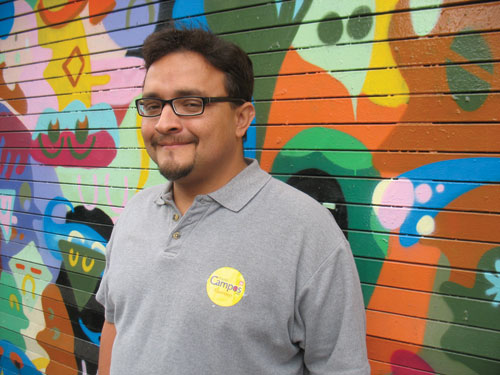
“We are not going to allow any worker in San Francisco to be exploited,” said Sup. David Campos said on the steps of City Hall, later presiding over the Government Audit and Oversight Committee hearing on the issue. “Wage theft affects the lowest wage workers and their ability to make a living and survive in these tough economic times.”

The pre-hearing protest and the meeting was comprised of workers with emotional stories of poverty and injustice. Other speakers included Donna Levitt, the director of the Office of Labor Standards Enforcement, the agency in charge of overseeing claims of employers withholding wages, and Rajiv Bhatia, the director of Occupational and Environmental Health at the San Francisco Department of Public Health.

Levitt said that 500 claims of wage theft have been addressed by the OLSE since the minimum wage law’s inception in 2003. Dan Goncher of Harvey M. Rose Associates, which does budget analysis for the city, cited data showing that the OLSE takes significantly longer to go through the hearing process for back wages than other agencies. However, Levitt mentioned that 97 percent of cases are settled and never go to the City Attorney’s Office for a hearing.

“Very little thought from our policymakers was made on how this was going to be enforced,” Levitt said of the current minimum wage law.

The coalition of community organizations including Young Workers United, Filipino Community Center, Chinese Progressive Association, San Francisco Tenants Association, Unite Here Local 2, Mujeres Unidas y Activas, and others joined together for the protest in order to raise awareness of some proposed amendments to the current minimum wage enforcement law.

Co-sponsored by Campos and Sup. Eric Mar, the amendments would add additional penalties such as raising the fine for employers from $500 to $1,000 for retaliating against workers exercising rights under the current law, the ability to interview employees and inspect payroll records at places of business, the requirement of notifying employees when an employer is being investigated, and to posting of a public notice when an employer fails to comply with a settlement agreement.

“We want to see the city taking a stronger commitment to addressing the issue of wage theft,” said lead organizer of the Chinese Progressive Association Shaw San Liu. “We don’t want this to be a one-day publicity stunt.”

One of the workers, who spoke about his experience of wage theft, recalled working long hours without the assurance of payment. “We would wait for hours for them to come back pay us but they never came,” Jose Cruz, a day laborer and client of La Raza Centro Legal, said about one of his jobs.

Bhatia explained to the supervisors and crowded audience in the committee hearing room that in the last week, 26 percent of the nation’s low wage workers were paid less than minimum wage. He also outlined different steps such as tracking chronic violators and training health inspectors to make referrals to local enforcement agencies in cases of non-compliance, so the SFDPH could support the community efforts in decreasing wage theft.

In addition, both Campos and Board President David Chiu made a point of speaking about how wage theft also detrimentally affects businesses.

“Most businesses play by the rules and those businesses are at a disadvantage when we allow businesses to not follow the rules,” said Campos.

“This is not about workers versus businesses,” Chiu said. “The issue of wage theft effects workers and workers’ families across the city.”

Ross for boss (of the sheriff’s department)

3

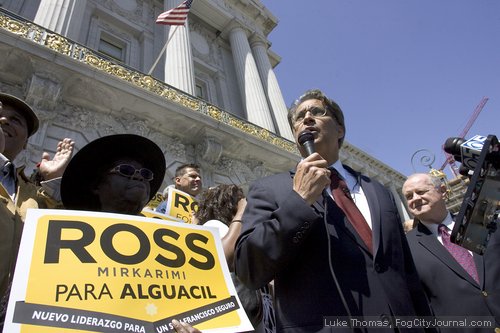
City Hall’s steps were awash in multi-lingual black and yellow “Ross Mirkarimi for Sherrif” signs at noon today, as Mirkarimi supporters watched Sheriff Mike Hennessey, who is stepping down after 31 years of service and eight elections, endorse Sup. Mirkarimi as the next sheriff.  “New Leadership for a Safe San Francisco” was printed on the English version of the signs that Mirkarimi’s supporters carried. They included former Mayor Art Agnos, Sups. David Campos and Eric Mar, Tim Paulson of the Labor Council, Debra Walker, Linda Richardson, Sharen Hewitt, Terry Anders, and Mirkarimi’s partner Eliana Lopez and their almost two-year old son Theo. And everyone had plenty of great things to say about outgoing sheriff Hennessey and sheriff candidate Mirkarimi. And Hennessey even pinned a shiny toy sheriff’s badge onto the T-shirt of Mirkarimi’s son Theo, making him the happiest kid in town. At least for the day.

Campos kicked off the event by honoring Hennessey as the “most progressive and most effective sheriff in the country.”
“Mike Hennessey is also my neighbor in District 9. I see him taking out the trash so I know he’s a good neighbor,” Campos joked, as he listed the many achievements in Hennessey’s long career as an elected official in San Francisco. These achievements included Hennessey’s pioneering innovations in criminal justice and culminated in his decision to blow the whistle in 2010 on the federal government’s plan to activate its controversial Secure Communities program in San Francisco—without telling the public.
“He’s not afraid to stand up for what’s right,” Campos said.

‘This is the time for me to move on,” Hennessey announced, as he laid out his reasons for endorsing Mirkarimi as Sheriff, over other candidates in the field.
Hennessey described the Sheriff’s Department as a “large enterprise” that has over 1,000 employees, a $150 million budget and whose jail houses an average population of 2,000 folks in custody, on a daily basis.
“It’s not something that can be handled lightly,” Hennessey said. “That’s why I’m here to endorse Ross Mirkarimi as the next sheriff.”

Hennessey listed the many endeavors that he and Mirkarimi have worked closely on, including a number of criminal justice issues, and he cited Mirkarimi’s extensive law enforcement background, his significant legislative accomplishments in the areas of criminal justice and public safety, and his ability to find innovative solutions and overcome obstacles to progress, as reasons to support Mirkarimi.

Hennessey observed that criminal justice is “one of the thornier issues” that members of the Board of Supervisors are often asked to get involved in, but often duck.”But Ross has not shied away from working on them,” Hennessey said, citing Mirkarimi’s involvement in shaping the “No Violence Alliance Project” and his leadership in creating the Safe Communities Re-entry Council.

Hennessey also noted that in face of AB 109, the Governor’s plan to transfer state inmates to county jails, “it’s vitally important to have person in charge of sheriff’s office that understands these alliances and can make them work more effectively.”

Hennessey concluded by observing that the Sherrif’s Department has to deal with a lot of bureaucracy, so it’s important to understand how the Board, the budget process and other city departments, including the District Attorney’s office and the police, work.
‘And that’s why I’m endorsing Ross as Sheriff,” Hennessey said

Then it was the turn of Mirkarimi, who graduated from the San Francisco Police Academy, did Naval Reserve training and worked for more than 8 years as an investigator for the District Attorney’s office, to speak.

“I have never been at a loss for words,” Mirkarimi acknowledged, as he launched into a speech that began by thanking everyone for showing up at short notice “for one of the most important occasions of my political career.”

Mirkarimi did a great job of giving Hennessey the praise he deserves.
“He is a living legend,” Mirkarimi said. “It’s completely impossible to fill his shoes.”
Citing Hennessey’s integrity and his ability to innovate, Mirkarimi warned that, “Maybe it’s come to the point where we have taken him for granted. He’s the longest serving elected official in the history of San Francisco, and he’s probably the most understated.”

“And the most important endorsement in this race is that of Mike Hennessey,” Mirkarimi added, as he gave Hennessey his commitment “to build upon your legacy as effectively as possible.”

Mirkarimi cited some of the most immediate and serious challenges that face the next sheriff. These include AB 109, which Gov. Jerry Brown just signed, which. Mirkarimi said, threatens to increase the reentry prisoner level by 30 percent in California. “It will take creative ingenuity and resources to make sure we are effective in taking care of this population,” he said.

Mirkarimi also touched on the rising number of veterans that are ending up in the prison system, talked more about the No Violence Alliance Project, and suggested that certified deputy sheriffs could help serve warrants, transfer prisoners, and patrol Muni, “when the police department finds itself understaffed” so as to ensure that San Francisco is safe.

“For every four people arrested and jailed in San Francisco, three out of four are repeat offenders in a three-year period,” Mirkarimi warned, by way of explaining why he wants to advance a more collaborative spirit between SPPD and the Sheriff’s department.

Mirkarimi also noted that one out of every 15 African American males are in jail, at any time in the year, compared to I out of 300 males who are not black or brown. “So, we must step up our game in dealing with poverty,” he said, as he recommended increased access to job training and good jobs, “so work doesn’t become a seasonal hope but a permanent job.” He also made the connections between a lack of good housing, childcare, and schools and a rise in poverty, crime and recidivism.

Mirkarimi concluded by crediting Hennessey for “walking that fine pirouette” between upholding the principles of public safety and understanding the power of redemption at the same time.

I asked Sheriff Mike Hennessey what he considers to be the biggest challenges of running for sheriff/
“Letting people know what you are going to do, and what your issues are,” Hennessey said, noting that San Francisco has an intelligent, issues-driven electorate.

And Mirkarimi’s supporters weren’t shy about letting folks know the issues that the current D5 Supervisor has helped them with, over the years.

“Ross, as a supervisor and me, as someone who comes from a community of color, we know the habits that ex-offenders can bring with them, if there are no safety nets,” said Terry Anders who sits with Mirkarimi on the Safe Communities Reentry Council. “And I believe in what Ross stands for and the integrity of his person. He’s one of the first people to show up when there are crimes and victims, and he attends basketball games and boxing matches.”

Paulette Brown, whose son Aubrey Abraska Jr, was murdered in August 2006, but whose killers have still not been brought to justice.
“We shouldn’t have to run and leave our families, we should be protected,” Brown said. “Ross is my district supervisor and if he can get in, and do something about crime and solve unsolved homicides, then I’m for him. Maybe if he gets in, he’ll have more pull to do something about these unresolved cases.”

And then it was back to work, which for Mirkarimi now includes the somewhat daunting task of trying to raise money in an election year that also includes a mayor’s race, but does not include the help of public financing, at least not for the sherrif’s race….

USF hosts mayoral forum focused on service

2

The University of San Francisco’s Leo T. McCarthy Center for Public Service will host the political season’s first major mayoral candidate forum – this one focused on public service and staged in partnership with the nonprofit group buildOn – on Thursday, May 5, at 6 pm.

Candidates Michela Alioto-Pier, John Avalos, David Chiu, Bevan Dufty, Tony Hall, Dennis Herrera, Joanna Rees, Phil Ting, and Leland Yee are expected to attend. Admission is free and the public is encouraged to attend this event held at USF’s McLaren Conference Center, 2130 Fulton Street.

“The intent of the forum is to help frame the mayoral campaign and also encourage candidates to talk about what drove them to service and how people can get involved in San Francisco, especially the youth,” Corey Cook, assistant professor in the USF Department of Politics, told us. Cook will moderate the event, which will include questions from high school students participating in buildOn and McCarthy Center service programs.

Carrie Pena, buildOn’s communications director, told us, “Students from public high school will ask questions based on bare thoughts on public service and what it means to be a good public servant.”

BuildOn provides programs for students to break the cycle of poverty and illiteracy. About 90 percent of buildOn students go to college. There are 19 schools in the Bay Area working with buildOn and in the previous year, the students contributed more than 24,000 hours to the Bay Area community.

At USF, service learning is a core class part of the graduation requirement where each student dedicates at least 20-25 hours of service per 15-week semester. “Co-hosting a mayoral forum is a fitting project for USF and buildOn because it will engage high school and college students, as well as the greater community, into the process of local politics,” Cook said on the USF website.

Catarina Schwab, buildOn’s vice president of development, said the partnership is a good match: “We aligned with USF because they focus a lot on service. Both were interested in a forum on service. We are even going to have a buildOn chapter at USF.”

This place

0

arts@sfbg.com

LIT Begun in part as a series of maps accompanying public lectures, Rebecca Solnit’s Infinite City: A San Francisco Atlas (University of California Press, 167 pages, $24.95) is a remarkable act of gathering, one that presents myriad versions and visions of San Francisco and its surrounding areas that can inform a reader’s experience.

Infinite City was recently selected by the Northern California Independent Booksellers as one of its 2011 winners. Duality is a fundamental aspect of the book’s breadth and depth and sense of sharply critical appreciation — structurally, Solnit pairs distinct maps with corresponding chapter-length essays. In keeping with that characteristic, and also with the book’s group spirit (though admittedly on a much smaller and less intensive scale), I asked different Guardian contributors to share appraisals of one, or in most cases two, of the 22 sections. The result provides just a hint of what can be found within Infinite City. (Johnny Ray Huston)

MAP 3. “Cinema City: Muybridge Inventing Movies, Hitchcock Making Vertigo

The map for this chapter tracks the San Francisco life of Eadweard (sic) Muybridge, alongside landmarks from Alfred Hitchcock’s Bay Area masterpiece Vertigo. In “The Eyes of the Gods,” Solnit, who won the National Book Critics Circle award for her 2003 Muybridge bio River of Shadows, writes of the 19th century artist’s breakthrough high-speed photography, “It was as though the ice of frozen photographic time had broken free into a river of images.”

Many such rivers flowed all over this fair city when Vertigo premiered at the Stage Door Theatre at 420 Mason St. on May 9, 1958. Alas, only 10 of the more than 60 single-screen venues extant that year, all demarcated on Shizue Seigel’s fine map, are still functioning. Solnit rightly describes the shift to watching films on various digital delivery mechanisms as leaving contemporary culture with a “curious imagistic poverty.” As she concisely describes watching Milk and Once Upon a Time in the West on the Castro Theatre’s giant screen, we’re reminded that there is no comparison between enjoying cinema in such a grand setting and staring at a laptop. The great 20th century memoirist and observer Quentin Crisp wrote, “We ought to visit a cinema as we would go to a church. Those of us who wait for films to be made available for television are as deeply suspicious as lost souls who claim to be religious but who boast that they never go to church.”

That applies to you too, Netflix subscribers! The Roxie, Castro, Red Vic, Clay, and a small number of other houses of worship are still in business, so what are you waiting for? (Ben Terrall)

MAP 4. “Right Wing of the Dove: The Bay Area as Conservative/Military Brain Trust”

In “The Sinews of War are Boundless Money and the Brains of War Are in the Bay Area,” Solnit argues that antiwar, green, and left Bay Area hotspots are well known and don’t need to be charted again — unlike military contractors and assorted other forces of reaction in the region.

Solnit notes that many military bases that used to operate in the Bay Area are closed, “but the research, development, and profiteering continue as a dense tangle of civilian and military work, technological innovation, economic muscle, and political maneuvering for both economic and ideological purposes.”

Among the hard-right compounds providing counterevidence for that demonstration chestnut “the people united will never be defeated”: Lawrence Livermore National Labs (birthplace of Star Wars — the Reagan era money pit, not the George Lucas movie); Lockheed Martin, world’s largest “defense” contractor; the Hoover Institution, Stanford’s reactionary think tank; and Northrop Grumman, missile component designer. It’s useful to have so many of them in one place, if queasy-making.

On the lower left of the map sits Sandow Birk’s beautifully warped code of arms, which features the Cicero quote (Nervi belli pecunia infinita) that Solnit cites in her chapter title, under a half eagle/half dove, a rifle-toting soldier, and a scythe-clutching skeleton. It should be on the door of every U.S. military recruiting center. (Terrall)

MAP 6. “Monarchs and Queens: Butterfly Habits and Queer Public Spaces”

“How thoroughly the lexical landscape of gay history is invested with [a] paradigm of emergence,” notes poet Aaron Shurin in “Full Spectrum,” the chapter accompanying Infinite City‘s sixth map. Like one of the dazzlingly-named butterfly species rendered by Mona Caron on the map, Shurin flits gracefully between memoir and historiography as he tracks San Francisco’s ongoing evolution as a locus for queer emergence.

From North Beach to Polk Gulch, from Folsom to Castro, LGBT folk — be they American painted ladies, Satyr angel wings, or Mission blues — have continually migrated to and within the city to shed their cocoons and show their true colors. Local faux-queen Fauxnique traced this metamorphosis at the 2003 Miss Trannyshack Pageant when she climatically emerged as a regal butterfly to Elton John’s “Someone Saved My Life Tonight” (apropos to Shurin’s royalty motif, she won the crown). So too did the late Age of Aquarius painter Chuck Arnett, who often nestled butterfly imagery into his portraits of SoMa’s leather demimonde, and whose murals once adorned some of the many now-extinct bars also denoted by Ben Pease’s cartography. Only more than half a dozen of these “wildlife sanctuaries,” in Shurin’s parlance, have survived, with the Eagle Tavern’s announced closure marking another loss of habitat. Queers, though, are if anything adaptive, and my hope is that the future fluttering tribes of San Francisco will keep alighting on new ground to unfurl their wings. (Matt Sussman)

MAP 7. “Poison/Palate: The Bay Area in Your Body”

“Food is part of the Bay Area you hear about nowadays, exquisite upscale food at famous restaurants and gourmet markets. But it’s so boring we couldn’t stay focused on it in this map.” These refreshing, if rarely uttered words come two-thirds of the way through the chapter that accompanies the “Poison/Palate” map, Rebecca Solnit’s “What Doesn’t Kill You Makes You Gourmet.”

The phony Tuscany of Napa and the once-orchard-filled, now-EPA-Superfund-site-speckled Silicon Valley are wisely singled out for derision, a convenient duality in both geography and culture and the perfect framework on which to hang a critique of the local culinary community’s smug, myopic self-indulgence, by raising the not-so-elite-specters in Bay Area food history (the It’s It, the Popsicle, the Hangtown Fry, the Rice-a-Roni), and reintroducing the politics of food into the conversation, in the form of the chemical tonnage used to produce wine grapes, food giveaways at community gardens, Diet for a Small Planet, and Black Panther breakfast programs for school-kids. The sprawling topic is almost given too short a shrift, threatening to leap its mutant-mermaid-bedecked map.

Better is the 18th chapter, “How to Get From Ethiopia to Ocean Beach.” Solnit begins by loosely charting the ingredients that go into your cuppa joe: the water from Hetch Hetchy, the milk from West Marin, the coffee that courses through the port of Oakland, and, impishly, the leavings that flow toward the Southeast Water Pollution Control Plant. All that’s missing from the equation is the sugar that I need to make the darkest, brandy-and-cherry-tinged brew palatable. SF’s cafe culture is also deservedly lionized — though some might want to hurl china due to the exclusions on the accompanying map: why, for instance, call out Blue Danube Coffee House and not the grungier, more Chinese-populated Java Source? (Kimberly Chun)

MAP 8. “Shipyards and Sounds: The Black Bay Area since World War II”

Though author Joshua Jelly-Schapiro opens this chapter, subtitled “High Tide, Low Ebb,” with an eloquent invocation of Otis Redding’s “(Sittin’ on) The Dock of the Bay” — penned in Sausalito, by the way — it was the slight mention of Lowell Fulson’s “San Francisco Blues” that most resonated with me. “Ohh, San Francisco,” the lyric goes, “Please make room for me.” The facts presented in “Shipyards and Sounds” record The City’s answer as a genteel and progressive “No nigger.”

Beginning at the start of WWII, when Southern blacks migrated to the Bay Area to build ships in Hunters Point, Jelly-Schapiro points out that the main areas of wartime shipbuilding (Richmond, Hunters Point, Marin City) are “places that today remain centers of black population and of black poverty.” Indicating, to me, that little has changed since the 1940s in some significant ways. Don’t get mad at me, I didn’t say it. Jelly-Schapiro did.

Jelly-Schapiro also shows how terms like “redevelopment” displaced black Fillmore District residents to housing projects they’d been banned from during the war and land-grab euphemisms like “urban renewal” decimated black neighborhoods such as West Oakland. Electoral laws mandating that the SF Board of Supervisors be elected by citywide contests and not by district allowed a city that desegregated its schools and transit system in the 1860s to remain progressive and very, very white.

Jelly-Schapiro’s conclusion contains a critique of Bay Area celebrations when “Negro president” Barack Obama was elected in 2008. What he won’t say is covered in Shizue Seigel’s map. A sidebar shows the dwindling soul of a city, while the headers cover the founding of the Black Panthers and Sylvester’s solo debut at Bimbo’s. (D. Scot Miller)

MAP 9. “Fillmore: Promenading the Boulevard of Gone”

After the damned disheartening facts presented in the previous chapter, it’s both merciful and hopeful that “Little Pieces of Many Wars” — though just as rage-inducing — establishes some kind of equilibrium.

Gent Sturgeon’s incredible Rorschach-inspired artwork opens a thoroughly-researched piece on Fillmore Street and its many incarnations. Mary Ellen Pleasant’s abolitionist work and her eucalyptus trees — which still stand on the corners of Bush and Octavia streets — are a starting point for a leisurely stroll with Solnit, who runs the voodoo down, “The war between the states left its traces here,” she says, “as did the Second World War, and the war on poverty, the war on drugs, the stale and ancient war of racism, and the various forms of freelance violence.”

She remembers San Francisco as an abolitionist headquarters, and Fillmore Street as the first place Allen Ginsberg read “Howl.” Recalling the Fillmore’s rich heritage of jazz, poetry, and art, Solnit takes it even further, adding, “The wealthy sometimes claim to bring civilization to rough neighborhoods, but the Upper Fillmore neighborhood that was so culturally rich when it was the property of poor people in the 1950s is smoothed over in significance now.”

The tragedy of Japanese internment, and the cross-cultural exchange that was demolished by it and redevelopment loom like white sheets over the city to this day. But Solnit closes with an optimistic sense of resurgence, even though Nickie’s has gone Irish.

Ben Pease’s cartography shows the cross-currents of culture of yesterday’s Fillmore Street, but not much else. That’s not a complaint, really. (Miller)

 MAP 13. “The Mission: North of Home, South of Safe”

Two 2009 shootings on 24th Street pop out, in blood red, on the map accompanying Adriana Camarena’s “The Geography of the Unseen,” in much the same way that the spate of shooting deaths the previous year marked my brief time spent living in the Mission. In ’08, I lived in a Victorian flat at Treat and 23rd, distinguished by the fact that it was a favorite hang for the teenaged homies — its steps were slightly tucked back off the street, ideal when it came to hiding out, smoking dope, and snacking out — until my landlords installed a fence, ostensibly to keep the steps free of spit.

We were on the same block as an appliance-loaded junkyard; the last stop of an ancient Mission industrial railroad; and the Parque Niños Unidos, with its swampy, grassy corner, so often cordoned off to keep the tots from wading in the mud, its circling ice cream carts and its de facto refreshment stand, El Gallo Giro taco truck; and the community garden, where the feral kittens tumbled and hid and fresh produce was given away free every Sunday afternoon.

The Parque likely was the last thing 18-year-old poet Jorge Hurtado saw when he was shot and killed on our corner at 1 a.m. that year. I remember waking up that night to what sounded like a cannon boom, only the first of a slew that sweltering, ominous summer — Mark Guardado, president of the SF chapter of the Hells Angels, was killed a little over a week later, down Treat, in front of Dirty Thieves. The tension was thick and gooey in the air — who was next? The beauty of Shizue Seigel’s Mission map lies in how intimate it is, how it’s threaded around the shaggy-dog snatches of yarns Camarena catches among the day laborers waiting at Cesar Chavez and Bayshore, from the long litany of splintered families, time spent in the refuge of gangs at 24th and Shotwell, and then, in Frank Pena’s case, lives cut sadly short farther up 24th at Potrero. The included stories, rarely straying beyond the tellers’ voices and the facts they choose to reveal, stay with you — even if her sources’ internal lives remain, as the chapter’s subtitle goes, “the Geography of the Unseen.” (Chun)


NORTHERN CALIFORNIA INDEPENDENT BOOKSELLERS 2011 BOOK OF THE YEAR AWARDS


FICTION


Gold Boy, Emerald Girl, stories, Yiyun Li (Random House, 240 pages, $25)

Nonfiction

Packing for Mars: The Curious Science of Life in the Void, Mary Roach (W.W. Norton and Company, 336 pages, $15.95)

Honorable Mention: Autobiography of Mark Twain, Vol. 1, (University of California, 760 pages, $34.95)


POETRY

Come On All You Ghosts, Matthew Zapruder (Copper Canyon, 96 pages, $16)

Food Writing

My Calabria: Rustic Family Cooking from Italy’s Undiscovered South, Rosetta Costantino, Janet Fletcher, and Shelley Lindgren (W.W. Norton and Company, 416 pages, $35)

Children’s Picture Book

The Quiet Book, Deborah Underwood and Renata Liwska (Houghton Mifflin Books for Children, 32 pages, $12.95)

Honorable mention: Zero, Kathryn Otoshi (KO Kids, 32 pages, $17.95)


TEEN LIT

The Sky is Everywhere, Jandy Nelson (Dial, 288 pages, $17.99)

Honorable mention: The Mockingbirds, Daisy Whitney (Little, Brown Books for Young Readers, 352 pages, $16.99)


REGIONAL TITLE

Infinite City: A San Francisco Atlas, Rebecca Solnit (University of California, 167 pages, $24.95)

Honorable mention: A State of Change: Forgotten Landscapes of California, Laura Cunningham (Heyday, 352 pages, $50)


Let cities raise taxes

44

There’s a move in the California legislature to allow local government much broader authority to raise taxes — and the GOP types have their panties in a major bunch.


Dan Morain at the Sacramento Bee says it’s all a tactical move: The Republicans won’t allow any tax hikes at the state level, but the Democrats, by simple majority vote, can authorize cities and counties to do all kinds of things that the no-tax crowd hates. Maybe, Morain suggests, this is just a way to bring the recalcitrant Reps back to the budget table. But I don’t know about that: Senate President Darrel Steinberg may be playing games, but his legislative partner, Budget Chair Mark Leno, has been pushing for years to allow cities to raise their own vehicle license fees.


Leno’s brought that bill back this year, and it’s going to commitee next week. And I have to say, tactical or not, the Steinberg bill (PDF) is one of the best things I’ve seen out of Sacramento in years. It would allow local government agencies to impose an income tax, a car tax, an oil severance tax, and a series of excise taxes. It could make the budget deficit in San Francisco vanish.


I agree with Brian at Calitics: There are problems here.


What we’ll end up with is Bay Area counties with more stable revenue streams, while the Central Valley faces ever deepening cuts.  The inequality would be both troubling, and possibly violate some laws.   


And if the state Legislature weren’t paralyzed by a ridiculous two-thrids rule and a handful of die-hard no-tax Republicans, we might not need to go in this direction. But even so, it’s fair to ask: Why can’t the San Francisco voters decide they’d rather pay higher taxes than see the schools collapse?


It’s the same reason I’ve argued in favor of splitting California into three states. Those of us who live in the Bay Area have a very different vision of government than those who live in the no-tax districts. Why should they be able to hold us hostage?


Yes, there will be inequities. But there are only a few parts of the state that so utterly lack economic activity and wealth that there simply is nothing to tax (and the state would have to help them out). Much of Ag Land (and much of no-tax burbland) has plenty of wealthy people and businesses. The poverty is as much a result of inequality as it is a bum economy. In other words: those places can raise taxes, too.


And maybe over time the people in those crumbling tax-free towns will look over at San Francisco, with good schools, healthy, well-educated kids, clean, well-maintained streets, professional fire and police services and the like and say: Why can’t we have that?


And the answer will be: You can.

The failed experiment

27

news@sfbg.com

For three decades we have conducted a massive economic experiment, testing a theory known as supply-side economics. The theory goes like this: Lower tax rates will encourage more investment, which in turn will mean more jobs and greater prosperity — so much so that tax revenues will go up, despite lower rates.

The late Milton Friedman, the libertarian economist who wanted to shut down public parks because he considered them socialism, promoted this strategy. Ronald Reagan embraced Friedman’s ideas and made them into policy when he was elected president in 1980.

For the past decade, we have doubled down on this theory of supply-side economics with the tax cuts sponsored by President George W. Bush in 2001 and 2003, which President Barack Obama has agreed to continue for two years.

You would think that whether this grand experiment worked would be settled after three decades. You would think the practitioners of the dismal science of economics would look at their demand curves and the data on incomes and taxes and pronounce a verdict, the way Galileo and Copernicus did when they showed that geocentrism was a fantasy because the Earth revolves around the sun (known as heliocentrism). But economics is not like that. It is not like physics with its laws and arithmetic with its absolute values.

Tax policy is something the framers of the Constitution left to politics. And in politics, the facts often matter less then who has the biggest bullhorn.

The Mad Men who once ran campaigns featuring doctors extolling the health benefits of smoking are now busy marketing the dogma that tax cuts mean broad prosperity, no matter what the facts show.

As millions of Americans prepare to file their annual taxes, they do so in an environment of media-perpetuated tax myths. Here are a few points about taxes and the economy that you may not know, to consider as you prepare to file your taxes. (All figures are inflation adjusted.)

1. Poor Americans do pay taxes.

Gretchen Carlson, the Fox News host, said last year “47 percent of Americans don’t pay any taxes.” John McCain and Sarah Palin both said similar things during the 2008 campaign about the bottom half of Americans.

Ari Fleischer, the former Bush White House spokesman, once said “50 percent of the country gets benefits without paying for them.”

Actually, they pay lots of taxes — just not lots of federal income taxes.

Data from the Tax Foundation shows that in 2008, the average income for the bottom half of taxpayers was $15,300.

This year the first $9,350 of income is exempt from taxes for singles and $18,700 for married couples, just slightly more than in 2008. That means millions of the poor do not make enough to owe income taxes.

But they still pay plenty of other taxes, including federal payroll taxes. Between gas taxes, sales taxes, utility taxes and other taxes, no one lives tax free in America.

When it comes to state and local taxes, the poor bear a heavier burden than the rich in every state except Vermont, the Institute on Taxation and Economic Policy calculated from official data. In Alabama, for example, the burden on the poor is more than twice that of the top 1 percent. The one-fifth of Alabama families making less than $13,000 pay almost 11 percent of their income in state and local taxes, compared with less than 4 percent for those who make $229,000 or more.

2. The wealthiest Americans don’t carry the burden.

This is one of those oft-used canards. Senator Rand Paul, the tea party favorite from Kentucky, told David Letterman recently that “the wealthy do pay most of the taxes in this country.”

The Internet is awash with statements that the top 1 percent pays, depending on the year, 38 percent or more than 40 percent of taxes.

It’s true that the top 1 percent of wage earners paid 38 percent of the federal income taxes in 2008 (the most recent year for which data is available). But people forget that the income tax is less than half of federal taxes and only one-fifth of taxes at all levels of government.

Social Security, Medicare, and unemployment insurance taxes (known as payroll taxes) are paid mostly by the bottom 90 percent of wage earners. That’s because, once you reach $106,800 of income, you pay no more for Social Security, though the much smaller Medicare tax applies to all wages. Warren Buffett pays the exact same amount of Social Security taxes as someone who earns $106,800.

3. In fact, the wealthy are paying less taxes.

The Internal Revenue Service issues an annual report on the 400 highest income-tax payers. In 1961, there were 398 taxpayers who made $1 million or more, so I compared their income tax burdens from that year to 2007.

Despite skyrocketing incomes, the federal tax burden on the richest 400 has been slashed, thanks for a variety of loopholes, allowable deductions and other tools. The actual share of their income paid in taxes, according to the IRS, is 16.6 percent. Adding payroll taxes barely nudges that number.

Compare that to the vast majority of Americans, whose share of their income going to federal taxes increased from 13.1 percent in 1961 to 22.5 percent in 2007.

(By the way, during seven of the eight Bush years, the IRS report on the top 400 taxpayers was labeled a state secret, a policy that the Obama overturned almost instantly after his inauguration.)

4. Many of the very richest pay no current income taxes at all.

John Paulson, the most successful hedge fund manager of all, bet against the mortgage market one year and then bet with Glenn Beck in the gold market the next. Paulson made himself $9 billion in fees in just two years. His current tax bill on that $9 billion? Zero.

Congress lets hedge fund managers earn all they can now and pay their taxes years from now.

In 2007, Congress debated whether hedge fund managers should pay the top tax rate that applies to wages, bonuses and other compensation for their labors, which is 35 percent. That tax rate starts at about $300,000 of taxable income; not even pocket change to Paulson, but almost 12 years of gross pay to the median-wage worker.

The Republicans and a key Democrat, Sen. Charles Schumer of New York, fought to keep the tax rate on hedge fund managers at 15 percent, arguing that the profits from hedge funds should be considered capital gains, not ordinary income, which got a lot of attention in the news.

What the news media missed is that hedge fund managers don’t even pay 15 percent. At least, not currently. So long as they leave their money, known as “carried interest,” in the hedge fund, their taxes are deferred. They only pay taxes when they cash out, which could be decades from now for younger managers. How do these hedge fund managers get money in the meantime? By borrowing against the carried interest, often at absurdly low rates — currently about 2 percent.

Lots of other people live tax-free, too. I have Donald Trump’s tax records for four years early in his career. He paid no taxes for two of those years. Big real-estate investors enjoy tax-free living under a 1993 law President Clinton signed. It lets “professional” real-estate investors use paper losses like depreciation on their buildings against any cash income, even if they end up with negative incomes like Trump.

Frank and Jamie McCourt, who own the Los Angeles Dodgers, have not paid any income taxes since at least 2004, their divorce case revealed. Yet they spent $45 million one year alone. How? They just borrowed against Dodger ticket revenue and other assets. To the IRS, they look like paupers.

In Wisconsin, Terrence Wall, who unsuccessfully sought the Republican nomination for U.S. Senate in 2010, paid no income taxes on as much as $14 million of recent income, his disclosure forms showed. Asked about his living tax-free while working people pay taxes, he had a simple response: everyone should pay less.

5. And (surprise!) since Reagan , only the wealthy have gained significant income.

The Heritage Foundation, the Cato Institute, and similar conservative marketing organizations tell us relentlessly that lower tax rates will make us all better off.

“When tax rates are reduced, the economy’s growth rate improves and living standards increase,” according to Daniel J. Mitchell, an economist at Heritage until he joined Cato. He says that supply-side economics is “the simple notion that lower tax rates will boost work, saving, investment, and entrepreneurship.”

When Reagan was elected president, the marginal tax rate for income was 70 percent. He cut it to 50 percent and then 28 percent starting in 1987. It was raised by George H.W. Bush and Clinton and then cut by George W. Bush. The top rate is now 35 percent.

Since 1980, when President Reagan won election promising prosperity through tax cuts, the average income of the vast majority — the bottom 90 percent of Americans — has increased a meager $303, or 1 percent. Put another way, for each dollar people in the vast majority made in 1980, in 2008 their income was up to $1.01.

Those at the top did better. The top 1 percent’s average income more than doubled to $1.1 million, according to an analysis of tax data by economists Thomas Piketty and Emmanuel Saez. The really rich, the top 10th of 1 percent, each enjoyed almost $4 in 2008 for each dollar in 1980.

The top 300,000 Americans now enjoy almost as much income as the bottom 150 million, the data show.

6. When it comes to corporations, the story is much the same — less taxes.

Corporate profits in 2008, the latest year for which data is available, were $1.8 billion, up almost 12 percent from $1.6 billion in 2000. Yet even though corporate tax rates have not been cut, corporate income-tax revenues fell to $230 billion from $249 billion — an 8 percent decline, thanks to a number of loopholes. The official 2010 profit numbers are not added up and released by the government, but the amount paid in corporate taxes is: in 2010 they fell further, to $191 billion — a decline of more than 23 percent compared with 2000.

7. Some corporate tax breaks destroy jobs.

Despite all the noise that America has the world’s second highest corporate tax rate, the actual taxes paid by corporations are falling because of the growing number of loopholes and companies shifting profits to tax havens like the Cayman Islands.

And right now America’s corporations are sitting on close to $2 trillion in cash that is not being used to build factories, create jobs or anything else, but act as an insurance policy for managers unwilling to take the risk of actually building the businesses they are paid so well to run. That cash hoard, by the way, works out to nearly $13,000 per taxpaying household.

A corporate tax rate that is too low actually destroys jobs. That’s because a higher tax rate encourages businesses (who don’t want to pay taxes) to keep the profits in the business and reinvest, rather than pull them out as profits and have to pay high taxes.

The 2004 American Jobs Creation Act, which passed with bipartisan support, allowed more than 800 companies to bring profits that were untaxed but overseas back to the United States. Instead of paying the usual 35 percent tax, the companies paid just 5.25 percent.

The companies said bringing the money home — “repatriating” it, they called it — would mean lots of jobs. Sen. John Ensign, the Nevada Republican, put the figure at 660,000 new jobs.

Pfizer, the drug company, was the biggest beneficiary. It brought home $37 billion, saving $11 billion in taxes. Almost immediately it started firing people. Since the law took effect, it has let 40,000 workers go. In all, it appears that at least 100,000 jobs were destroyed.

Now Congressional Republicans and some Democrats are gearing up again to pass another tax holiday, promoting a new Jobs Creation Act. It would affect 10 times as much money as the 2004 law.

8. Republicans like taxes too.

President Reagan signed into law 11 tax increases, targeted at people down the income ladder. His administration and the Washington press corps called the increases “revenue enhancers.” Among other things, Reagan hiked Social Security taxes so high that by the end of 2008, the government had collected more than $2 trillion in surplus tax.

George W. Bush signed a tax increase, too, in 2006, despite his written ironclad pledge to never raise taxes on anyone. It raised taxes on teenagers by requiring kids up to age 17, who earned money, to pay taxes at their parents’ tax rate, which would almost always be higher than the rate they would otherwise pay. It was a story that ran buried inside The New York Times one Sunday, but nowhere else.

In fact, thanks to Republicans, one in three Americans will pay higher taxes this year than they did last year.

First, some history. In 2009, President Obama pushed his own tax cut—for the working class. He persuaded Congress to enact the Making Work Pay Tax Credit. Over the two years 2009 and 2010, it saved single workers up to $800 and married heterosexual couples up to $1,600, even if only one spouse worked. The top 5 percent or so of taxpayers were denied this tax break.

The Obama administration called it “the biggest middle-class tax cut” ever. Yet last December the Republicans, poised to regain control of the House of Representatives, killed Obama’s Making Work Pay Credit while extending the Bush tax cuts for two more years — a policy Obama agreed to.

By doing so, Congressional Republican leaders increased taxes on a third of Americans, virtually all of them the working poor, this year.

As a result, of the 155 million households in the tax system, 51 million will pay an average of $129 more this year. That is $6.6 billion in higher taxes for the working poor, the nonpartisan Tax Policy Center estimated.

In addition, the Republicans changed the rate of workers’ FICA contributions, which finances half of Social Security. The result:

If you are single and make less than $20,000, or married and less than $40,000, you lose under this plan.

But the top 5 percent, people who make more than $106,800, will save $2,136 ($4,272 for two-career couples).

9. Other countries do it better.

We measure our economic progress, and our elected leaders debate tax policy, in terms of a crude measure known as gross domestic product. The way the official statistics are put together, each dollar spent buying solar energy equipment counts the same as each dollar spent investigating murders.

We do not give any measure of value to time spent rearing children or growing our own vegetables or to time off for leisure and community service.

And we do not measure the economic damage done by shocks, such as losing a job, which means not only loss of income and depletion of savings, but loss of health insurance, which a Harvard Medical School study found results in 45,000 unnecessary deaths each year

Compare this to Germany, one of many countries with a smarter tax system and smarter spending policies.

Germans work less, make more per hour and get much better parental leave than Americans, many of whom get no fringe benefits such as health care, pensions or even a retirement savings plan. By many measures the vast majority live better in Germany than in America.

To achieve this, single German workers on average pay 52 percent of their income in taxes. Americans average 30 percent, according to the Organizations for Economic Cooperation and Development.

At first blush, the German tax burden seems horrendous. But in Germany (as well as Britain, France, Scandinavia, Canada, Australia, and Japan), tax-supported institutions provide many of the things Americans pay for with after-tax dollars. Buying wholesale rather than retail saves money.

A proper comparison would take the 30 percent average tax on American workers and add their out-of-pocket spending on health care, college tuition, and fees for services and compare that with taxes that the average German pays. Add it all up and the combination of tax and personal spending is roughly equal in both countries, but with a large risk of catastrophic loss in America, and a tiny risk in Germany.

Americans take on $85 billion of debt each year for higher education, while college is financed by taxes in Germany and tuition is cheap to free in other modern countries. While soaring medical costs are a key reason that since 1980 bankruptcy in America has increased 15 times faster than population growth, no one in Germany or the rest of the modern world goes broke because of accident or illness. And child poverty in America is the highest among modern countries — almost twice the rate in Germany, which is close to the average of modern countries.

On the corporate tax side, the Germans encourage reinvestment at home and the outsourcing of low-value work, like auto assembly, and German rules tightly control accounting so that profits earned at home cannot be made to appear as profits earned in tax havens.

Adopting the German system is not the answer for America. But crafting a tax system that benefits the vast majority, reduces risks, provides universal health care and focuses on diplomacy rather than militarism abroad (and at home) would be a lot smarter than what we have now.

Here is a question to ask yourself: We started down this road with Reagan’s election in 1980 and upped the ante in this century with George W. Bush.

How long does it take to conclude that a policy has failed to fulfill its promises? And as you think of that, keep in mind George Washington. When he fell ill his doctors followed the common wisdom of the era. They cut him and bled him to remove bad blood. As Washington’s condition grew worse, they bled him more. And like the mantra of tax cuts for the rich, they kept applying the same treatment until they killed him.

Luckily we don’t bleed the sick anymore, but we are bleeding our government to death.


ABOUT THE AUTHOR:

David Cay Johnston is a columnist for tax.com and teaches the tax, property, and regulatory law of the ancient world at Syracuse University College of Law and Whitman School of Management. He has also been called the “de facto chief tax enforcement officer of the United States” because his reporting in The New York Times shut down many tax dodges and schemes, just two of them valued by Congress at $260 billion.

Johnston received a 2001 Pulitzer Prize for exposing tax loopholes and inequities. He wrote two bestsellers on taxes, Perfectly Legal and Free Lunch. Later this year David Cay Johnston will be out with a new book, The Fine Print, revealing how big business, with help from politicians, abuses plain English to rob you blind.


 

Working on it

4

caitlin@sfbg.com

GREEN ISSUE With the recession fast seeping into the everyday fabric of American life (or at least Monday through Friday’s fabric), the enthusiasm that the term “green jobs” generates can be well understood. But can we really call a $10 hourly pay rate for installing solar panels sustainable? And what would be the bigger of the two triumphs: creating a carbon-free country or a more equitable nation? With partnerships springing up across the country like the Blue Green Alliance, created by the United Steelworkers and the Sierra Club, maybe the two goals aren’t so separate after all. Here are some West Coast organizations fighting to make sure that the environmentally-friendly jobs that do exist — and have yet to be created — pay a decent wage.


OAKLAND GREEN JOBS CORPS

Created by the long-time civil rights champions at the Ella Baker Center and other community partners, this program recruits poor young adults to a 38-week course of study that recognizes what it takes to break the cycle of unemployment. Participants begin with classes in basic job skills, literacy, and substance abuse counseling, then continue on to classes at Laney College in basic construction skills, eco-literacy, and specialized green building practices. At graduation, participants are hooked up with well-paying jobs in the green construction sector or traditional building trade union apprenticeships — where their newfound environment-saving skills will make them leaders in the years to come.

www.ellabakercenter.org


CALIFORNIA INTERFAITH POWER AND LIGHT

Pray for change — or change the way you pray? Created 10 years ago in SF, CIPL, whose work has since spread to 38 state affiliates, aides faith communities of all denominations in greening their place of worship. Greatest hits include installing a geothermal heating system in a Berkeley synagogue, work on First Chinese Baptist Church in San Francisco, and tricking out a Bayview-Hunters Point church with solar panels on the congregation’s extremely limited budget. Workers hired to make the holy places sing a song of sustainability are usually sourced from organizations like Richmond Build, which provides training to many people living in public housing and with criminal records.

www.interfaithpower.org


APOLLO ALLIANCE

Apollo Alliance, another nationwide coalition-building organization that got its start in SF, is making green jobs happen in Los Angeles — with or without federal dollars. The group sponsored the city’s Green Retrofit and Workforce ordinance, which required that municipal buildings achieve LEED certification at the silver level or higher, prioritizing updates on the buildings that were near areas with low income and high unemployment rates. Linked directly to workforce training programs, the ordinance is already under attack in Washington by H.R.1, a bill that would strip its funding. But L.A. is making the first move on the threat — the city is hoping to fund the successful program through energy conservation bonds.

www.apolloalliance.org


GREEN FOR ALL

Erstwhile Obama appointee, environmental rock star, and Ella Baker Center founder Van Jones started this organization in 2008 to place the war on poverty at the heart of the sustainability movement. Sure, with offices around the country, it’s not exactly local. But the group plays an important role supporting nationwide policies that will make green jobs fair and just for workers. Plus, it led the charge against last year’s Prop. 23 challenge to the growth of green technologies, taking to the road in a bus that interviewed community members and green energy experts in 10 Californian cities. Plus, it kicked ass with a media campaign smart enough to best the bummers at PG&E and other public utilities.

www.greenforall.org


Drawing a line in the toxic triangle

5

rebeccab@sfbg.com

GREEN ISSUE California is often viewed as being among the brightest shades of green. The Golden State’s landmark climate-change legislation has proven magnetic for green-tech startups, while Northern California is defined in part by its longstanding love affair with natural foods and solar power. San Francisco boasts a well-used network of bike routes, a ban on plastic bags, mandated composting of kitchen scraps, and a host of urban agriculture projects.

While much of the Bay Area’s environmental reputation is well-deserved, things look different from poor neighborhoods where homes are clustered beside hulking industrial facilities and public health suffers. For years, grassroots organizations working in Richmond, Oakland, and Bayview-Hunters Point have sought to improve air quality and promote environmental justice in neighborhoods plagued by higher-than-average rates of respiratory disease, cancer, and other preventable illnesses.

The Rev. Daniel Buford of Oakland’s Allen Temple Baptist Church told the Guardian that he began talking about the polluted areas of Richmond, Oakland, and San Francisco as a “toxic triangle” two decades ago. It was an analogy, he explained, that plays off the mysterious deaths that the Bermuda Triangle is famous for. Yet the label also served a purpose — to unite three communities of color that were fighting separate yet similar battles against health hazards associated with their surroundings.

“There were a lot of things that weren’t in place with public consciousness that are in place now,” Buford said.

Today, he isn’t the only one uttering the catch phrase. A host of community organizations banded together as the Toxic Triangle Coalition last year to organize three forums on environmental justice in the three cities. Advocates cast the neighborhood-specific problems as three parts of a regionwide phenomenon, highlighting how pollution from shipping, crude oil processing, freeway transportation, abandoned manufacturing sites, hazardous waste handlers, and other industrial facilities disproportionately affect communities of color, where poverty and unemployment rates are already high.

Buford views the Toxic Triangle Coalition as a strategy to mount pressure for stronger enforcement of environmental laws in disproportionately affected areas. “We live in the whole Bay Area — we don’t live in one little part of the Bay Area,” he noted. “Our coalition strongly urges our state representatives in each of the counties to call for a hearing at the state level.”


OIL WARS

In Richmond, California’s top greenhouse-gas emitter looms as an expansive backdrop of the city, a tangled network of smokestacks and machinery near a hillside cluster of large, cylindrical oil storage containers. Chevron Corporation’s Richmond Refinery was built more than a century ago. A few years ago, the oil company began making noise about how it was in need of an upgrade.

Weaving through a blue-collar residential area of Richmond in her sedan, Jessica Guadalupe Tovar recounted how Communities for a Better Environment (CBE), the nonprofit she works for, revealed that Chevron hadn’t told the whole story when it was petitioning for a permit to expand the refinery. The oil company’s long-term goals, CBE learned from a financial report, included gaining capability to process thicker crude that tends to be sourced from places like Canada’s Alberta tar sands.

“We call it dirty crude,” she said. “But it’s really dirtier crude.”

Converting thicker crude to fuel requires higher temperatures and pressures — and that translates to higher greenhouse-gas emissions and a heightened risk of flaring and fires.

The refinery expansion could have meant an air-quality situation going from bad to worse. Public health problems such as asthma and cancer have spurred campaigns led by the West County Toxics Coalition, CBE, and other environmental justice groups. Tovar explained how CBE orchestrated an air-monitoring program in 2006, collecting samples from 40 homes in Richmond and 10 in Bolinas as a point of comparison.

While trace amounts of chemicals from household cleaners were present in both, samples from the Richmond residences also contained the same toxic compounds that spew from Chevron’s refinery. “We found pollution known to come from the oil refinery settling inside people’s homes,” Tovar explained. “Once it’s trapped in your home, it starts to accumulate.”

Chevron won its expansion permit by a slim margin in 2008 with a city council dominated by officials who had reputations for being friendly to the oil giant. Yet environmental organizations filed suit, saying the environmental impact report (EIR) approval was based on was illegal because it failed to analyze the company’s likely plans for heavier crude processing. A Contra Costa County judge ruled in favor of the environmentalists, halting the expansion project in 2009. Chevron appealed, but the decision was upheld in 2010.

Stopping the expansion was a substantial victory, but environmental justice advocates remain wary of Chevron — particularly after the company attempted to blame job losses on the green coalition that filed suit. “Chevron pit workers against us,” Tovar noted. “And also started saying, ‘This is why environmental laws are bad for the economy.'”


GLOBAL TRADE, LOCAL FUMES

Each day, the Port of Oakland fills with trucks waiting to load up on goods shipped in from around the globe on massive cargo vessels. It’s a local symbol of a globalized economy. But for the West Oakland neighborhoods surrounding the port, the daily gathering of diesel rigs means an unhealthy infusion of particulate matter into the air.

A report issued by the East Bay Alliance for a Sustainable Economy (EBASE), the Pacific Institute, and the Coalition for Clean and Safe Ports found that West Oakland residents are exposed to particulate matter concentrations nearly three times higher than the regional average. Health studies have shown that asthma rates in West Oakland are five times higher than that of people living in the Oakland hills, and cancer risks are threefold compared to other Bay Area cities. For the truck drivers, the risk of cancer is significantly higher than average.

A state air-quality law that went into effect in early 2010 banned pre-1994, heavily polluting diesel trucks from the port, thanks in part to years of environmental campaigning that has publicized public-health impacts associated with the diesel pollution. Yet the new regulation brought an unintended consequence: for truck drivers who must purchase their own gas and pay for their own upgrades, the new rule was ruinous. A survey by the Public Welfare Foundation found that since the new environmental regulation went into effect, 25 percent of Oakland truck drivers had declared bankruptcy, been evicted, or faced foreclosure.

Retrofitting the trucks with new air filters is a five-figure prospect, while the cost of a new truck can clear $100,000. “At the end of the day … a lot of them will only take home about $25,000 a year,” explained EBASE spokesperson Nikki Bas. “It’s an immigrant workforce who are living in poverty.”

So the Coalition for Clean and Safe Ports, which pushed for tougher air-quality regulations, is now pressuring for a reform of the trucking industry to place the cost of clean upgrades onto powerful trucking companies instead of low-wage drivers. The coalition’s campaign has sought to link the needs of the drivers and the surrounding community, organizing rallies with blue-green signs bearing the motto “Good Jobs & Clean Air” to call for a change to the truckers’ employment classification from independent contractors to employees, which would shift the cost of compliance onto employers instead of drivers.

West Oakland isn’t the only East Bay area inflicted by excessive levels of diesel particulate matter from trucks entering the Port of Oakland. The fumes also affect East Oakland neighborhoods bisected by the big rigs’ primary thoroughfares. In addition to truck traffic and freeways, East Oakland is also the site of numerous hazardous-waste handlers and abandoned industrial sites.

Nehanda Imara, an organizer with CBE who also helped put together the Toxic Triangle Coalition forums, described how her organization recruited volunteers to count the number of trucks passing through a heavily traveled East Oakland strip as a way to quantify the source of particulate matter pollution. They reached a tally of around 11,700 over the course of 10 days.

Some progress has been made to limit the exposure of diesel pollution for East Oakland residents. The city is working on a comprehensive plan to assess trucking routes, and a campaign to limit truck idling is helping to limit unnecessary tailpipe emissions.

Yet youth hospitalizations for asthma in East Oakland are 150 percent to 200 percent higher than Alameda County taken as a whole, and an air-monitoring project in that area revealed high levels of particulate matter exceeding state and federal standards.

“That’s also an environmental injustice,” Imara said. “When the laws are there, but not being enforced.”


TOXIC SOUP

In San Francisco’s Bayview-Hunters Point neighborhood, environmental justice groups have spotlighted the toxic stew associated with the naval shipyard and other pollution sources for years. A 2004 report produced jointly by Greenaction for Health and Environmental Justice, the Bayview-Hunters Point Mothers Environmental Justice Committee, and the Huntersview Tenants Association outlined a “toxic inventory” of the area. The inventory depicts a more complicated web of toxic sources than the asbestos dust and naval shipyard cleanup that have been focal points of news coverage surrounding Lennar Corp.’s massive redevelopment plans for that neighborhood.

“Over half of the land in San Francisco that is zoned for industrial use is in Bayview-Hunters Point,” this report noted. “The neighborhood is home to one federal Superfund site, the Hunters Point Naval Shipyard … a sewage treatment plant that handles 80 percent of the city’s solid wastes, 100 brownfield sites [a brownfield is an abandoned, idled, or underused commercial facility where expansion or redevelopment is limited because of environmental contamination], 187 leaking underground fuel tanks, and more than 124 hazardous waste handlers regulated by the U.S. Environmental Protection Agency.”

The shipyard, meanwhile, has been the central focus of controversy surrounding plans to clean up and redevelop the area. People Organized to Win Employment Rights (POWER) and Greenaction are currently challenging the EIR for Lennar’s massive redevelopment plan for the neighborhood, charging that the study is inadequate because a cleanup effort on the part of the U.S. Navy has yet to determine the level of toxicity that will need to be addressed, so the assessment is based on incomplete information. Asthma is commonplace in the Bayview, and health surveys have shown that the rates of cervical and breast cancer are twice as high as other places in the Bay Area.

“Our environmental issues are massive still, and it’s not just Bayview- Hunters Point,” notes Marie Harrison, a long-time organizer for Greenaction and a Bayview resident.

Harrison recalled the many times she’d gotten out of bed in the middle of the night to drive a friend’s or neighbor’s asthmatic child to the hospital. “That story has repeated itself tenfold in Richmond and in Oakland,” she added. Nor is the problem simply limited to those Bay Area cities, she said, noting that communities of color throughout the Environmental Protection Agency’s Region 9 face similar issues.

As awareness about the scope of the problem has increased over the years, she said, “We start to say, my God, this triangle has to become a circle.”


Appetite: 3 ways to eat and drink for a better world this month

0

We are blessed with a city full of entrepreneurs and humanitarians who work to create a better world. It’s encouraging to know one can eat and drink well while also meeting a need. Here are three upcoming ways to make your food dollars stretch towards some crucial causes:

4/5 Umamimart’s The Gift of Food at Burritt Room for earthquake relief in Japan
Head to one our favorite cocktail bars, Burritt Room, for a fundraising party benefiting earthquake relief efforts in northern Japan. Many have contributed towards the cause, whether it’s Tommy Guerrero and DJ Toph One setting the mood with music or Peko Peko Japanese Catering and Sandbox Bakery serving bites. Plenty of booze has been donated ensuring fine sips throughout the evening: Yamazaki Whisky, Joto Sake, The Glenrothes Whisky, Brugal Rum, GlenGrant Scotch, Bulleit Bourbon + Rye. 100% of your ticket goes to Second Harvest Japan, the country’s first food bank.
Tuesday, 4/5, 8pm
$40
Burritt Room,
417 Stockton, SF. (at Sutter)
(415) 400-0500
umamimartjapanbenefit.eventbrite.com

4/7 22nd Annual Share Our Strength Taste of the Nation to fight childhood hunger
Taste of the Nation is annually one of our most meaningful events, fighting childhood hunger in America, where nearly 17 million children (almost one in four) face daily hunger. Every dollar donated buys $9 of groceries to feed children in need, while 100% of ticket sales go towards Share Our Strength’s No Kid Hungry in the Bay Area. Participating restaurants, chefs and mixologists all give of their time, talent and resources… the line-up is no less than stellar, including honorary chef co-chairs, Traci Des Jardins of Jardiniere and Incanto’s Chris Cosentino. Check out the impressive participator list here.
Thursday, 4/7, 6:30-9:30pm (VIP reception at 5:30pm)
The Bently Reserve, 301 Battery Street
1-877-26-TASTE
$95 for General Admission – This ticket will feed a child in need for 6 months
$165 for VIP Level access – This ticket will feed a child in need for 1 year
$500 for Executive Level access – This ticket will feed a child in need for 3 years
www.TasteOfTheNation.org

4/7 Toast of the Town at City Hall towards global poverty with San Francisco CARE
There’s a humble, little venue called City Hall (!) that will be overrun with food and wine on the night of April 7th for Wine Enthusiast’s annual Toast of the Town. Over 500 wines/65 wineries and food from more than 30 local restaurants (including Saison, Twenty Five Lusk, Bar Agricole, Alexander’s Steakhouse, Comstock Saloon), will keep you well satiated into the night in City Hall’s dramatic, elegant environs. A portion of the tickets goes towards San Francisco CARE, fighting global poverty with everything from education to economic development.
Thursday, April 7, 6pm (VIP), 7-10pm Grand Tasting
$109 Grand Tasting, $169 VIP
City Hall, 1 Dr Carlton B. Goodlett Place
http://www.toastofthetown.com

–Subscribe to Virgina’s twice monthly newsletter, The Perfect Spot

Fruits of labor

0

arts@sfbg.com

FILM One of the first things cinema learned to say was “you are there.” The Lumières sent their lightweight cameras around the world and were soon able to transport their Parisian audience to remote settings — a fine flexing of industrial capitalism. If Werner Herzog used to have the market on art-cinema primitivism cornered, the recent films making up the “First Person Rural” series at the Pacific Film Archive take a different tack, disavowing outlandish narratives of madness and expedition for reality-hungry visions of work and rough beauty. As a group, they privilege phenomenal experience to exposition; affective texture to intelligibility; nonverbal utterance to patent explication. They often seem more in line with epic poetry than documentary realism.

Argentine director Lisandro Alonso’s stoic debut La Libertad (2001) led the way to many of the decade’s shorn agricultural narratives. To begin, we watch a young man work a tree into lumber and eat and nap in a lean-to a few shades rougher than Thoreau’s Walden. In the film’s second half, the man turns his labor into capital, transporting, selling, and spending before returning to camp to eat a freshly caught armadillo as lightning flashes in the distance. The slow time of the man’s routines defines the temporality of the film, and Alonso’s bold compositions in turn monumentalize the man’s tasks. What to make of this aesthetic surplus of the man’s labor remains an open question.

The issue of poetic license is even more pressing in Agrarian Utopia (2009), a work of social (hyper) realism focused on a family of Thai subsistence farmers. In contrast to their crushing penury is the rich HD cinematography: every grain of rice and droplet of water makes its stunning mark. Hitching scripted social drama to a loose documentary style joining scenes, director Urophong Raksasad proposes three possible utopic frameworks for the farming family: urban demonstrations calling for political reform, a hippie neighbor’s sustainable farming practices, and the ecstatic vision of the camera itself. The limitations of the first two should give us pause over the third; this is the rare film about poverty that doesn’t imagine its lyricism as a redemptive force.

There’s no question of any kind of utopia in Eugenio Polgovsky’s Tropic of Cancer (2004), a video report from the Mexican desert that’s bruising and cunning in equal measure. Polgovsky shows us the hard lives of peasants who scour the arid landscape for (unfriendly) critters they can sell alongside a godforsaken highway. Their middle-class customers seem primarily concerned with animals’ living conditions — one of many bitter ironies registered in Polgovsky’s sharply assertive montage.

Strong as it is, Tropic of Cancer doesn’t cry out for repeat viewings — not the case with Sweetgrass (2010) and Alamar (2009), both among the finest films of recent years. With Sweetgrass especially, it’s only after you’ve surrendered to its sensory richness as a recording (the multichannel sound mix combines with the physical camerawork for a nearly Whitmanesque extension of perception) that you can begin to digest its cross-purposed contemplation of the final sheep drive across a mountainous western-mythic landscape.

Writing about Jean-François Millet’s peasant subjects, the critic John Berger observed that the French painter’s personal nostalgia extended to history: “Most of what he knew about peasants was that they were reduced to a brutal existence, especially the men. He sensed, it seems to me, two things which, at the time, few others foresaw: that the poverty of the city and its suburbs; and that the market created by industrialization, to which the peasantry was being sacrificed, might one day entail the loss of all sense of history.” The “First Person Rural” films mark this loss with immersion, and in so doing leave us with the lingering sense that it is we and not the films’ subjects who are “out of time.”

“FIRST PERSON RURAL: THE NEW NONFICTION”

March 26–April 27, $5.50–$9.50

Pacific Film Archive

2575 Bancroft, Berk.

(510) 642-5249

www.bampfa.berkeley.edu

Redevelopment debate full of bum choices

3

At the Potrero Hill Democratic Club’s debate about Gov. Jerry Brown’s proposal to ax local redevelopment agencies to balance the state’s $26 billion deficit, folks attempted to evaluate if redevelopment agencies are essential for job creation and community revitalization, if reform, not total destruction, is possible, and if bum choices are all we have to look forward to.

The Chronicle’s Marisa Lagos, who moderated the debate, noted that redevelopment agencies were created over 60 years ago to create economic development opportunities by borrowing against future tax increases that agencies think they can create.

 “That’s a fancy way to say ‘borrow against future taxes,’” Lagos joked, pointing to the Candlestick Point/Hunters Point Shipyard project as an example of an ongoing project, and the Yerba Buena project as an example of a completed success.

 “The Governor is arguing that when the state is cutting schools and other essential services, this is not the best use of tax dollars,” Lagos stated.

 Panelist Olson Lee, deputy executive director of San Francisco’s Redevelopment Agency, pointed to affordable housing as evidence of the agency’s positive impact.

 “I think Redevelopment is important because of the good things it has done,” Lee said, pointing to 11,000 units of affordable housing that the agency helped build in the city.

 Panelist Carroll Wills, the communications director for the California Professional Firefighters, said “many wonderful projects” have occurred under Redevelopment. But he pointed to what he called “a decade of tricks and games,” on the part of Redevelopment agencies as one reason why the state is in a fiscal crisis that threatens firefighters’ jobs.

 “Concrete does not trump core services,” Wills said, arguing that it’s not clear that many affordable housing projects would not have been built without redevelopment aid

Arc Ecology’s Saul Bloom accused Gov. Brown of “short-circuiting” what could have been an important statewide discussion about redevelopment reform, with his bombshell suggestion in January to eliminate redevelopment agencies entirely

 “I’m sympathetic to the argument that Redevelopment takes money away from core services,” Bloom said. “But what do we do to replace it? And is economic development versus core services a false choice?”

Lee pointed to Mission Bay as further evidence of Redevelopment’s success.

“It was considered a brown field, and through development, it’s much different,” Lee said, noting that 20 percent of tax increment financing goes to the General Fund to pay for redevelopment infrastructure. “Clearly the university would not have been there. It was an opportunity to place UC there and generate economic opportunities.”

 Wills argued that Redevelopment Agencies are a luxury we can no longer afford, even as he acknowledged being unfamiliar with local redevelopment projects.

“At best, redevelopment moves around the pieces,” Wills said. “It doesn’t increase economic development and it doesn’t necessarily pay for itself.”

Bloom noted that developments like Mission Bay are dependent on large institutions, like the University of California, which can’t be forced to implement city laws like local hire.

And he said he found it “disappointing” that there wasn’t much more of a dialogue around the plans to redevelop Candlestick Point and the Shipyard, despite the fact that the city held hundreds of meetings over the past decade.

“It was more a case of, Here’s our idea, tell us what you think of it,’” Bloom said. “Perhaps if we had invited the nation’s largest industrial developer, instead of the nation’s second largest home developer, we would have had a different dialogue.”

 Lee replied that the Shipyard has been under discussion for 15 years.

“It’s a very large project, the largest in the Western United States,” Lee said. “It’s a brownfield, though I know Espanola will say it’s a Superfund site,” he continued, as Bayview elder Espanola Jackson bristled under her hat, and the audience wondered if Lee meant that the US E.P.A. somehow got it all wrong.

Lee further shocked audience members by saying Treasure Island was not a redevelopment project (leading Bloom to clarify that Treasure Island is under the jurisdiction of the local Treasure Island Development Authority, if not the SF Agency).

“People felt they wanted economic development at the shipyard,” Lee continued, noting that the neighborhood suffered after the Navy withdrew from the shipyard in the 1970s. But he did not mention that major bones of contention around the redevelopment proposal, centered on plans to build 10,000 mostly market-rate condos, a bridge over an environmentally sensitive slough, the taking of a chunk of the community’s only major park, and no proof that thousands of promised jobs will materialize.

Wills noted that most local redevelopment commissions are peopled by the members of each municipality’s city council, a situation he believes leads to a lack of accountability. But members of the audience, including this reporter, noted that San Francisco’s Redevelopment Agency consists entirely of mayoral appointees, who, unlike elected officials, can’t easily be voted off the proverbial island.

It was at this point that panelist Calvin Welch, a longtime housing activist, showed up at the debate, apologizing for being late, but blaming his tardiness on being on a phone call with Sen. Mark Leno to discuss Brown’s redevelopment proposal.

And from there, the conversation veered towards discussions of what could happen to existing redevelopment projects if Brown goes through with his elimination threat.

 Lee noted that if projects simply had a disposition and development Aagreement (DDA), but Redevelopment was no longer there, there would be no project financing. “The devil’s in the details,” Lee said. “Because if you don’t have bonds, what’s the point of having an agreement.”

 Wills opined that Gov. Brown’s proposal has “a vehicle to roll back the bum’s rush” of projects that local municipalities have been trying to push across the finish line, ever since Brown dropped his Redevelopment elimination bomb in January.

 Welch went off on a historical riff about how the San Francisco Redevelopment Agency (SFRA) was met with controversy and outrage until 1988, when Art Agnos was elected mayor, and brokered a deal under which SFRA could do tax increment financing, provided the majority of funds were used for affordable housing.

“It became a finance agency to build infrastructure and affordable housing,” Welch said, noting that attempts to build out Mission Bay around commercial offices and high rises failed, until the Agency used tif to redevelop the site.

 “But mark my words, Lennar is going to come out of this just fine,” Welch added, reminding me of a recent comment that former Lennar executive Emile Haddad reportedly made that suggests Haddad believes the California housing market is poised for a rebound.

(The article outlined how Haddad sold 12,000 acres in California for a $277 million profit at the housing market’s peak four years ago, reacquired it at half the price in 2009, and is now saying it’s time to build in his new role as CEO of FivePoint Communities Inc., which is developing four new master-planned communities with a combined 45,000 residences at Newhall Ranch north of L.A., the El Toro Marine Corps Air Station in Orange County, the Candlestick Point/Hunters Point shipyard and Treasure Island  in San Francisco, with investors including Lennar, Michael S. Dell’s MSD Capital LP, Ross Perot Jr.’s Hillwood Development Co. and Rockpoint Group LLC. “I don’t want the party to show up and I’m not dressed,” Haddad, 52, reportedly said in a recent interview. “When the market says ‘I’m here,’ we’ll be one of the few that can deliver inventory.” 

(The Haddad article, which appears to be a non-bylined reprint from Bloomberg News, also claimed that Hunters Point sales are set to begin by late 2012 with prices starting at $525,000, as the Navy continues its cleanup of the 700-acre site. And that the plan now calls for as many as 12,000 homes, 3 million square feet (of commercial space and a new stadium for the 49ers. And that 7,000 homes may eventually be built on Treasure Island and adjoining Yerba Buena Island, under terms of a final development agreement that may go before the San Francisco Board of Supervisors for approval in May, with units averaging  $800,000 and reaching up to $2 million, according to Lennar V.P Kofi Bonner.)

And during the Potrero Hill Dems debate, Bloom noted that the Treasure Island plan is being “sped up” and that the Board is expected to vote on the plan as soon as possible. “But since these plans were not bonded before January [when Gov. Brown took office], what’s the point of speeding up the process?” Bloom asked.

“We’re basically seeing a brick wall,” Welch interjected. “There are virtually no funds for permanent affordable housing in San Francisco.But Jerry Brown is not going to commit financial hari kari. Every major developer of market rate housing will come out just fine, because of state actions, not because of a local vote. Deals are going to be made. It’s the question of affordable housing that’s our challenge. You’re gonna be stuck with public housing, as it is, unless there’s affordable housing financing.”

 Wills claimed that Prop. 22, which voters approved last November, “created a mechanism so rigid,” that the state’s only option was to eliminate redevelopment. “Basic services are dying on the vine,” he said. “We can’t afford to give developers subsidies.”

 Lee noted that SFRA built thousands of affordable units over the years that saved the city thousands in terms of core services it would otherwise have to provide. “Affordable housing is so basic, you can’t do things we take for granted if you are living under a freeway,” he said.

 Bloom suggested Redevelopment could do a better job of economic development, including the creation of permanent and sustainable jobs, like his proposal to create maritime uses at the Shipyard—something not entertained under the city’s Shipyard plan.

 Welch connected the dots between the taxpayer revolt that led to Prop. 13’s passage and the current fiscal woes of municipalities unable to raise taxes on commercial development. “That’s a killer,” he said, noting that housing costs more to build and maintain than it generates property taxes, especially if it’s family housing. ‘It’s those damn kids,” he joked.

Welch noted that Gov. Brown used redevelopment money to enable market rate development in downtown Oakland when he was mayor of Oakland—and claimed that Brown equated affordable housing with crime, at the time.

“We love Brown better than Meg Whitman, but it’s 2011 and we face bum choices.”

Community advocate Sharen Hewitt, who heads the C.L.A.E.R. project, asked if the panel thought San Francisco could be a “demonstration model” for using Redevelopment funds to build 50 percent affordable housing.

Welch said conversations have “already happened” between Mayor Ed Lee and Gov. Jerry Brown that have led him to believe that, “all of San Francisco’s redevelopment projects will be made whole, affordable housing will be protected and Brown will be committed to a San Francisco model.”

“It’s like the film Casablanca, when people are shocked to find out that gambling is going on in a casino,” Welch said. “People are shocked to find out that capital talks in a capitalist system.”

 Espanola Jackson asked Welch what will happen to the shipyard development, in face of a lawsuit that POWER brought that’s due to be heard March 24.

“The shipyard plan has a political function,” Welch said, noting that it was the result of a citywide vote in 2008. ‘We opposed it, but we lost. The structure of that deal flows from the vote.”

 City College Board member Chris Jackson expressed frustration that the Redevelopment conversation had devolved into a housing conversation.

“Mission Bay is all about biotech, but who works at UCSF?” Jackson said, noting that Redevelopment, as a state-funded agency, does not have to agree to the city’s newly approved local hire law.

Welch acknowledged that there has never been a study to determine the tipping point required to lift the Bayview out of poverty.

Lee admitted that Redevelopment’s focus has been housing, “because San Francisco is such an unaffordable city.” But he claimed that SFRA had a “much more aggressive program on local hire than the city, for many years.” Noting that SFRA has tried to attract restaurants and food establishments to Third Street, over the years, Lee said, “It hasn’t been something we’ve been particularly successful at.”

Welch opined that the “skills and abilities of the San Francisco community are far greater at stopping projects and protecting neighborhood character, but we can’t figure out how community-based organizations can employ their own people.”

 And then it was time to go back out into the cold March wind and try to wrap our minds about the true meaning of “bum choices” in 2011.

Yee plans to block Crane’s UC Regents confirmation

11

Citing UC Regent David Crane’s op-ed in the Chronicle, in which Crane questioned if public sector workers should have collective bargaining rights, Sen. Leland Yee says he wants to stop Crane’s UC Regents confirmation and protect the vital services provided in our communities by public employees.”

In his op-ed, Crane argues that “collective bargaining for public employees in California changed the balance of power and – most importantly – gave public employees power over their compensation and benefits.”

But Yee, who is running in the San Francisco mayor’s race this fall, counters that the only public employees at the UC that have any real power over their compensation are the top executives.

“The Regents consistently cater to the elite and ignore their unionized workers – nurses, janitors, technicians, bus drivers, teaching assistants, and others,” Yee stated. “Collective bargaining is vital in addressing this disparity and fighting the unconscionable acts of UC administrators.”

Crane, who identifies as a Democrat, was an adviser to Republican Gov. Arnold Schwarzenegger, who appointed him to the Board of Regents during his final days as governor. And Crane awaits final confirmation to the Board of Regents by the Senate.

But Sen. Yee and a bunch of community members and public employees hope to block Crane’s confirmation, starting with a noontime rally in San Francisco on Friday, March 4, at UC’s Medical Center at 513 Parnassus Avenue.

“UC Regent David Crane recently took his cue from Republican Wisconsin Governor Scott Walker and called for an end to collective bargaining rights for California’s teachers, nurses, firefighters, university employees, and other public sector workers,” Yee stated in a press release. “While the Regents approve million dollar contracts for their top administrators, David Crane wants to take away the rights of working class families. It is time for Regent Crane to put away his Wisconsin playbook and come down from his ivory tower.”
 
“While the Regents have approved million dollar contracts for their top administrators, they allow many UC workers and their families to live in poverty,” Yee continued. “Now, Regent Crane wants to take away their only avenue to earning a livable wage and a respectable retirement – their collective bargaining rights.”

Yee notes that UC service workers wages’ can be as low as $13 an hour. That 96 percent of these workers are income eligible for at least one of the following public assistance programs: food stamps, WIC (women, infants, and children), public housing subsidies, and reduced lunch. That many work two or three jobs to meet their families’ basic needs.  And that all this is happening against a backdrop in which the UC Board of Regents has consistently provided double-figure raises to their top administrators. 

Yee cites the “retention salary adjustment” for UCLA Medical Center CEO David Feinberg, whose salary was recently increased by an additional $160,300 per year to $900,000.  The Regents also voted to award Feinberg an additional $250,000 annual retention bonus. And if you add in his annual Medical Center incentive payment, Feinberg’s annual compensation is more than $1. 3 million. UC President Mark Yudof also pulls in over a million annually, when salary, housing, and benefits are factored in.


Should Lyon-Martin be saved?

0

OPINION Last month, when the startling news broke that Lyon-Martin Health Services, a community health clinic that serves primarily queer women and transgender people, was about to close its doors forever, the community rose up even before the official announcement was made.

Within hours of first hearing the news, more than 150 clients, former clients, and members of the community gathered at an emergency town hall meeting to fight to save the clinic. People testified about what Lyon-Martin had meant to their health. Many expressed fears it would close and anger that they hadn’t known the clinic was in trouble.

To their credit, two members of the board of directors and interim Executive Director Dr. Dawn Stacy Harbatkin came to the meeting to answer questions from the community. This powerful meeting transformed and dramatically altered the outcome. In response to the opposition, the board backed off closing the center for at least a month and promised the community that there would be at least a month to find ways to save the clinic.

However, the board members also explained that the clinic was in serious trouble and needed to raise more than $500,000 to stay open. By the end of the meeting, a "Save Lyon Martin" coalition was born.

Within a week, more than 700 community members came to a fundraiser that raised more than $60,000, and within a month, more than $300,000 had been raised.

But at the same time, some have asked: should we save Lyon-Martin?

It’s a legitimate question. Over the past two years Lyon-Martin expanded its services, almost doubling its staff and patient load. However, the management failed to build the infrastructure to accommodate these changes. One of the known factors that led to the current situation was Lyon-Martin’s inability to stay current with its Medi-Cal billing, and there was a significant loss in revenue as a result. A substantial amount of debt is owed to the IRS and a long-term bank loan. Given the financial problems, some say, we should close the clinic; other community health clinics could simply incorporate the 3,500 patients served by Lyon-Martin.

While it’s true that the financial issues are troubling, and that hard questions need to be answered, dumping 3,500 patients into a public health system that has been cut to the bone over the last few years would be a disaster in San Francisco. The clinics that serve queer and transgender people are already stretched to the limit. No other place in the city has the capacity and culturally competency to serve this population.

Lyon-Martin has taken on the mission of caring for a group of low-income, mostly uninsured patients who have rarely, if ever, gotten culturally competent care. Almost 90 percent of Lyon-Martin patients are uninsured; 87 percent have incomes below 200 percent of the federal poverty line; 17 percent are homeless; 33 percent are people of color.

As a transgender person who has received poor and even hostile treatment by a health care provider, it doesn’t surprise me that in a recent survey more than 50 percent of transgender individuals reported that they have had to teach their health care providers about transgender health care. More than half of lesbians, bisexual, or transgender people report that they avoid health care for fear of discrimination.

In this context, closing Lyon-Martin is simply not an option.

We have many questions about how Lyon-Martin got into this situation and what needs to be done to avoid it happening again. We want the community to have stronger oversight over this important resource. We want people held accountable. But most of all, we want to ensure that we continue to have access to the excellent care that Lyon-Martin has provided to so many of us.

On March 2 at 4 p.m. at the Budget Committee of the Board of Supervisors, Sup. Ross Mirkarimi will be holding a hearing addressing these questions. We hope you can join us.

Gabriel Haaland is a member of the Save Lyon-Martin Health Coalition, and a former transgender client of Lyon-Martin.

Alerts

0

WEDNESDAY 2

Day of Action for public education

Protest Gov. Jerry Brown’s proposed budget cuts to public higher education with a picnic, musical performance, teach-in, and rally. Check the website for a complete schedule of events and to sign up if you would like to perform or teach a class.

12 p.m.–12 a.m., free

UC Berkeley Memorial Glade

ca.defendpubliceducation.org

Facebook: Day for action for public education


FRIDAY 4

Danny Glover on health and wealth

Actor and humanitarian Danny Glover comes to the Bayview to talk about community health and prosperity, discussing ways to bring about positive changes in the community. Glover will also discuss his collaboration with the Bayview Rotary Club to provide scholarships to benefit Bayview-Hunter’s Point college-bound youth.

5 p.m., $40–$50

San Francisco City College

Alex L. Pitcher Jr. Community Room

1800 Oakdale, SF

www.sfbayviewrotary.org


SATURDAY 5

International Women’s Day

Join the Reggae Gyals at a benefit for the Family Violence Law Center of Alameda County, featuring live performances by Queen Makedah , Sistah Beauty, Djs and dance crews, a spoken word competition, and much more.

10 p.m.–2 a.m., $10

Pier 23 Cafe

The Embarcadero, SF

www.reggaegyals.com


SUNDAY 6

Discussion with Tony Serra and Paulette Frankl

Join KPFA and author/illustrator Paulette Frankl for a discussion of her book Lust for Justice: The Radical Life and Law of Tony Serra. Frankl spent 12 years following Serra from courtroom to courtroom as he defended the likes of Black Panther Huey Newton, the Hell’s Angels, the Symbionese Liberation Army, and more to bring you this definitive account of an antiestablishment hero and legal legend.

7:30 p.m., $12–$15

Berkeley Hillside Club

2286 Cedar, Berk.

(800) 838-3006

www.kpfa.org/events

www.brownpapertickets.org


MONDAY 7

Russia’s foremost LGBT activist

To bring to light the violence and government oppression faced by the Russian LGBT community and to promote Moscow’s Pride Parade, Nikolai Alekseev will talk about the efforts of major Russian religious and political parties to quell the Pride Parade, the European Court ruling that the Russian government committed crimes to its LGBT community, and more.

5:30–7:30 p.m., free

San Francisco LGBT Center

1800 Market, SF

www.gayliberation.net


TUESDAY 8

Mothers march to end poverty

Mothers in cities will gathering all over the world today to demand the end of poverty, war, oversees occupations, the criminalization of communities of color, and other global issues. San Francisco’s march — inclusive to all — begins at the 16th Street BART Station and stops at major corporate banks along the way. See the website for updates on the route.

4:30 p.m., free

16th and Mission BART Station, SF

www.globalwomenstrike.net


Mail items for Alerts to the Guardian Building, 135 Mississippi St., SF, CA 94107; fax to (415) 437-3658; or e-mail alert@sfbg.com. Please include a contact telephone number. Items must be received at least one week prior to the publication date.

Protest this weekend in support of Libya, Bahrain, Yemen, Morocco uprisings

36

There’s a protest this weekend in San Francisco, in support of folks in Libya, Bahrain, Yemen, Morocco, and other Arab popular movements as they struggle against dictatorships and repressive governments.

Folks are invited to meet Saturday, February 26 at 1 p. m. at the U.N. Plaza at Market and 7th Street in San Francisco for a march that will feature 20 organizations, including Arab Resource and Organizing Center and American Friends Service Committee. [Update: Just got a call from ANSWER Coalition to say they did not approve the inclusion, by protest organizers, of their name as a feature organization at Saturday’s protest, because they do not agree with some of the wording in the protest organizers’ press release.]

“Across Arab nations popular movements for governmental, social, and economic change are arising daily since the start of 2011, with people going to the streets in the thousands and millions,” states a press release from march organizers. “ In many cases, these popular movements are being met by extreme use of force at the hands of governments and dictators whose repression has been supported by foreign assistance from the US.  The most horrific of this repression has been witnessed internationally through social media broadcasting from Libya and Bahrain, where hundreds of innocent protesters have been massacred.”,p.

Organizers note that thousands of Bay Area residents demonstrated solidarity over the last month in support of the Tunisian and Egyptian revolutions, and now they are inviting folks to turn out in solidarity with the people of countries who are mourning those who have lost their lives in this struggle for democratic ideals, and in standing with those who continue to come out into the streets despite brutal repression.

“We are marching in San Francisco to support one another as Libyans, and as Arabs who are all fighting for freedom. We are demanding that governments around the world end their complicity with Gaddafi that has kept him in power for 42 years, and take a firm stance against the brutal repression of our people.” Wafa, a Libyan-American educator and activist, said in a press release.

“For the past week, tens of thousands of Libyans have been marching and demonstrating to put an end to 42 years of dictatorship, poverty, unemployment, and torture at the hands of the ruthless Gadaffi regime,” protest organizers stated. “The people of Libya continue to make history, struggling to defend their country and demand a real end to Gadaffi’s regime, following in the footsteps of their brothers and sisters in Tunisia, Egypt, and in tandem with Bahrain, Yemen, Morocco, Jordan, Syria, Iran, and all nations fighting for freedom.”