Politics

Putting power into perspective

0

Amount the US Department of Energy granted SF San Francisco in 2007 to help encourage the deployment of solar energy: $200,000

Amount the DOE says it has spent nationwide over the last year making solar power more accessible on the energy market and underwriting new research and development: $288 million

Amount San Ramon–based Chevron Corp. made in net income (profit) during 2007: $18.7 billion

Amount David J. O’Reilly earned in total compensation per business day during 2007 as the San Ramon–based Chevron Corp.’s chairman and CEO: $121,153

Amount O’Reilly earned in total compensation during 2007: $31.5 million

Amount Chevron spent during 2006 defeating Proposition 87, a California ballot measure that would have funded renewable energy research through a drilling fee imposed on oil producers: $38 million

Amount oil and gas industries spent attempting to influence Sacramento during 2006: $97.8 million

Amount the oil and gas industries spent contributing to federal political candidates and parties and for lobbying expenses in 2006: $94.9 million

These figures came from the California Secretary of State’s Office, the Center for Responsive Politics, Followthemoney.org, and financial documents publicly traded companies are required to maintain by the Securities and Exchange Commission.<

Watch what she makes

0

> a&eletters@sfbg.com

Feminist art has reemerged in the past few years as the focus of major exhibitions including "WACK! Art and the Feminist Revolution" at the Museum of Contemporary Art, Los Angeles, and "Global Feminisms" at the Brooklyn Museum, which coincided with the unveiling of the museum’s permanent home for Judy Chicago’s iconic The Dinner Party (1974–79). On one hand, it’s inspiring to see such work resurface, especially at this political moment, when it becomes increasingly important to recall dissident factions in our country’s history. On the other hand, exhibitions such as "WACK!" can feel like regurgitations of the same old feminist art show with the same discourse, participants, and audience. It’s not enough to dust off these works and lump them under the vague and often misunderstood descriptor "feminist." To engage today’s audiences, it’s necessary to pull apart the threads, identifying what was and is at stake for these artists.

"The Way That We Rhyme: Women, Art & Politics," curated by Berin Golonu and on view at Yerba Buena Center for the Arts, unites a new generation of women artists who honor their feminist predecessors while embracing new and more sly and subversive tactics. I increasingly hear women of my generation and younger vehemently disavow feminism, despite the current curatorial interest, as if there’s a stigma attached to the word. But "Way" takes feminist art out of the past and into the present.

In The Counterfeit Crochet Project (Critique of a Political Economy), Stephanie Syjuco takes aim at the luxury goods industry: the beautiful and coveted couture accoutrements that promise to make women equally beautiful and coveted, for a price. Seeking to reconcile the desire to possess such items with not wanting to invest in multinational corporations or sweatshops, Syjuco posted instructions on her Web site on how to crochet one’s own Fendi or Prada bag. Many women heeded the instructions, and their finished products are on display. The project also alludes to crochet as a traditionally devalued variety of "women’s craft." Similar knitted works appear throughout "Way," such as Lisa Anne Auerbach’s 2007 wool sweater and skirt sets, inscribed with political slogans.

Aleksandra Mir captures an unprecedented landmark in First Woman on the Moon, a 1999 video work that might be described as a "small step for a woman, a giant leap for the history of womankind." Playing off some people’s belief that Neil Armstrong’s moon landing was a hoax, Mir creates her own version of the event, wielding her camera — the instrument of news media — to insert women into history. After all, if Armstrong’s landing was — at the very least — plausible, then so is this landing. Filmed on a Dutch beach, Mir doesn’t try too hard to make the setting look authentic; in her version, the moon landing is less a colonization of outer space and more a celebration of life on Earth.

In a more somber piece, Portrait of Silvia-Elena, street artist SWOON and documentarian Tennessee Jane Watson collaborate to bring visibility to the horrifically high numbers of young women disappearing and turning up dead in Juárez, Mexico, and throughout the Americas. Some 400 women’s bodies have been recovered in Juarez, and an additional 1,000 are still recorded missing; in Guatemala, 2,000 women have been murdered. At the entrance to the installation — made to look like a dilapidated brick wall — is SWOON’s beautiful, angelic relief-print portrait of a 15-year-old victim in her quinceañera dress. The installation is also made up of photos of missing girls, as they are found plastered in Juarez, and an audiotrack of Watson’s interviews with the mothers of the disappeared.

One of the more challenging works is Beg for Your Life (2006) by Laurel Nakadate. A video artist accustomed to being looked at by men, Nakadate collapses her experience as subject and object, placing herself in front of her own camera to enact scenes with various older men — all strangers whose gaze she met on the street. In one scene, Nakadate’s back is to the camera as she seductively poses for her admirer. The man thinks he is in the subject seat, dictating his fantasies to the object of his desire, but really the camera is on him. Nakadate scores the video with 1980s pop songs, yet the content is not always amusing: some of the men’s fantasies are violent, and you wonder if the artist didn’t put herself at real risk.

The interplay between female and male subjects and objects in Nakadate’s work brings to mind one thing I might add to "Way": male artists. While I understand the rationale for creating a dedicated space for women’s art, I think in some ways it only further marginalizes women. Let’s integrate women’s political art into the larger context and invite men to participate, reminding them that feminism is — and has always been — about men too.

THE WAY THAT WE RHYME: WOMEN, ART & POLITICS

Through June 29

Tues.–Wed., Fri.–Sun., noon–5 p.m.; Thurs., noon–8 p.m.

Yerba Buena Center for the Arts

701 Mission, SF

$6, $3 seniors, students, and youths; free for members (free first Tues.)

(415) 978-ARTS

www.ybca.org

Man hating: the new U.S. birth control

0

By Paula Connelly

A highly effective birth control shot, made specifically for men, has been developed in Australia! It has been proven to be as effective as a vasectomy but without long-term effects. Unfortunately, pharmaceutical companies are not funding efforts to make this revolutionary mode of contraception available to the public. They don’t think men will buy it, even though it has demonstrated a fraction of the side effects associated with the female birth control pill. Unsurprising considering that politics, pricing and culture have been limiting access to contraceptives in the U.S. for years, resulting in inflated teenage and unwanted pregnancy rates, according to the Male Contraception Information Project. It is insulting to all the women who have suffered the insane mood swings, nausea, weight gain, diminished sex drive, increased risk of heart attack and breast cancer to hear men being quoted in the media saying, ‘”I would rather rely on a solution that doesn’t involving medicating myself and the problems women have had with hormone therapy doesn’t make me anxious to want to sign on to taking a hormone-type therapy,” says Hardin, 40, who is single and a college administrator.’

But this is just what’s being reported.

The reality is that plenty of men will use this option, and this trend would only increase over time as male birth control methods broke through the negative, emasculating stigma. I personally know many men who would love to try a non-barrier male birth control option and I know even more women poised to convince their partners to try it. Hell, I’ll even support the ‘girl’s secretly trying to get pregnant’ argument if that gets more guys thinking outside the (ahem) box.

Bigger than life

0

> a&eletters@sfbg.com

How would you define an improbable Tilt-A-Whirl Technicolor or Vistavision or Cinemascope view of American virtue and vice? Jean-Luc Godard’s term for it was Tashlinesque. Watching the feverish films in the Pacific Film Archive’s short Frank Tashlin retrospective, we see an artist pushing the outermost limits of cinematic realism, gorging 1950s America on its desire for bigger, better, and faster.

The Tashlinesque land of excess encompasses Jayne Mansfield’s breasts, Kool Aid-red convertibles, and bubblegum teenagers. If there is a milk bottle in a Tashlin film, it will cream when a pin-up walks by. Ten-gallon hats spontaneously ejaculate oil. "The room temperature is changing, if you catch my cruder meaning," Mansfield coos in Will Success Spoil Rock Hunter? (1957), and we do, over and over again. Tashlin’s America is a nation of alcoholics and dupes, softheaded nincompoops and sexpot cynics. France had Jacques Tati, and we had — and have — Tashlin.

Just as it did with other stateside pulp visionaries, it took the French to recognize Tashlin’s genius. "There is not a difference in degree between Hollywood or Bust [1956] and It Happened One Night [1934]… but a difference of kind," Godard wrote in a 1957 assessment for Cahiers du Cinéma. There’s a touch of cruelty (and a trace of the director’s cartoon roots) in Tashlin’s preference for physically excessive actors like Mansfield and Jerry Lewis, though the way he uses these figures to channel the distorting nature of American gluttony and naïveté is brutally effective.

It’s not just the bodies that are inflated. The frame itself seems to be stretched over the course of these films, with camera angles and props used to accentuate the horizontality of the widescreen image. Just as Preston Sturges outdid his era of talky screwballs with dialogue-mad farces, Tashlin amplified ’50s Hollywood’s taste for grandiosity and crudeness to a pointedly unmanageable extreme. His self-aware movies give a sharp sense of the studio system in its death throes.

As satire, Tashlin’s send-ups of ad men and agents are as prescient as they are unsparing. A typical Tashlin alarm is sounded when Dean Martin’s character in Artists & Models (1955) announces at the outset that he moved to New York to make money in order to study art. In Will Success Spoil Rock Hunter?, Tony Randall’s title character turns on the television to hear what the starlet Rita Marlowe (Mansfield) is saying to reporters on his front lawn — an apt commentary on the way technologies abstract reality and invade our privacy. The spin cycles continue to gain speed: the ’90s were an especially prime slice of the Tashlinesque, what with a booming economy, celebrity sex tapes, and the Monica Lewinsky scandal. Cinematically speaking, Richard Kelly just tried his hand at Tashlinesque with Southland Tales (2006), though I can’t help thinking the originator would have done better with the musical numbers.

Tashlin’s burlesque is dexterous, but it doesn’t hatch from any stable logic. Television is clearly the enemy, but the movies aren’t much better. With every bathing beauty and each overripe burst of Technicolor, the director indulges and implicates our most blithering desires. (One feels like a child reaching out for a lollipop while watching Tashlin’s films: when Godard famously quipped that there was no blood in his own 1965 Pierrot le fou but only red, he might have been quoting his American forebear.) If the plots nominally resolve themselves, the tone and visual style remain pitched between splendor and disgust.

"By exposing people to an endless stream of advertising, television taught them to take nothing at face value, to read everything ironically," Louis Menand recently wrote in the New Yorker. It was Tashlin who taught us to see this way. If there were any justice to art history, he would be in the pantheon of Pop Art, not just for his content, but also for his bold use of color and scale. But he of all people would have known that artistic success is on the same shaky ground as achievement in politics, entertainment, and business — same as it ever was.

FRANK TASHLIN: AMERICAN NONSENSE

Fri/11 through April 18

PFA Theater

2575 Bancroft, Berk.

(510) 642-5249

www.bampfa.berkeley.edu

Endorsement: Barry Hermanson

0

Let’s not fool ourselves: Jackie Speier, the former state senator from San Mateo County, will be replacing the late Tom Lantos in Congress. The odds are pretty good that she’ll emerge with enough votes in the special election April 8 to take the seat immediately, and she’s bound to win the Democratic primary in June and get elected to a full term in November.

And that’s not a terrible thing. Speier’s an experienced legislator, was a solid advocate for consumers and for privacy rights in Sacramento, and is already better on the war than Lantos was. Speier told us that she favors immediate troop withdrawal, and that she would was unlikely to vote for any more appropriations for the war unless the money was earmarked for drawdown and withdrawal activities.

But on a lot of issues, she’s something of a disappointment to progressives in the district. She talks about single-payer health care, but wants to keep the private insurance companies in the picture and she talked a lot to us about forcing consumers to limit medical expenses to contain costs. She wasn’t willing to commit to seeking to overturn the privatization of the Presidio and she supports Don Fisher’s plans to build a private museum there. Although she wants to let the Bush tax cuts expire, she was very, very shaky about raising taxes on the very rich (even capital gains taxes). When we asked her what she would do about preventing the financial-services mess that created the home mortgage crisis, she only said she would be “more willing to support an increased regulatory environment than not.”

In other words, she’s promising to be a mainstream Democrat who’s unwilling to push the edge on a lot of issues that people in her district care about.

So, if only as a protest vote (and to remind Speier that she has to be accountable to the progressives) we’re backing Green Party candidate Barry Hermanson.

Hermanson, who for years ran a small business in town, talks openly not just about ending the war but about dramatically cutting defense spending, which, he points out, sucks up more than 60 percent of the entire federal discretionary budget. He’s for government-run single payer, for tighter regulation of the financial sector and for a massive public investment in infrastructure and green technology.

Michelle McMurry, who is running as a Democrat, is a physician, a smart and articulate person with a thoughtful approach to health care. We’d love to see her stay active in politics, but she needs a bit more seasoning before she’s ready for Congress.

So we’ll go with Hermanson in the April 8 special election.

Adopt 8-pound Tatiana the cat

0

We like to check the San Francisco SPCA’s Web site from time to time, because, well, we really, really like kittehs. We’d posted more images of cats looking for homes on the blog, but we’re afraid our colleagues might ridicule us for liking kittehs so much. Well screw them. We’ve long embraced the politics of kittehs, and if you’ve ever reported on animal welfare and animal rights, you know there’s no shortage of politics surrounding kittehs.

Anyway, someone at the SPCA has a sense of humor. The shelter’s site won’t let us save the image of Tatiana the cat for some reason, so you’ll have to go here to actually see her.

Meet the other Tatiana:
TATIANA – ID#A066862
I am a spayed female, brown tabby Domestic Shorthair.
The shelter staff think I am about 10 years old.
I weigh approximately 4 kgs (8 lbs).
I have been at the shelter since Mar 15, 2008.

Shelter Staff made the following comments about this animal:
“Tatiana is a tabby but a tender tiger at heart. This shy and delicate little girl will need some extra time getting to know you and your home. She will benefit from a patient adopter willing to spend the time necessary to make her comfortable in her new surroundings.”

tiger1.jpg

Metal Mania: The return of the kings

0

› a&eletters@sfbg.com

It’s a Sunday night in late February, and the facade of Slim’s is shrouded by the shadow of a monstrous black tour bus. Inside, middle-aged bikers rub shoulders with teenagers in skin-tight jeans and garish print hoodies. At the bar, tattooed hipsters vie for position against glowering heshers and balding suburban fathers in polo shirts. As New Orleans black metal band Goatwhore kicks into a crescendo, the masses teem, pumping their fists and offering devil-horn salutes. Song finished, vocalist Ben Falgoust gulps for air before raising the mic to his mouth: "Are you guys ready for Exodus!?"

The multitude roars. They are ready for Exodus; ready to rock out to a band that formed in San Francisco 28 years ago, before many of them were even born. They are ready to help write a new chapter in the bloodstained tome of American metal and ready to crank their iPods to 11. After the winter of the ’90s, when the genre hibernated through grunge, boy bands and rap-rock, metal is back in bearlike force, packing halls across the nation and charting albums with astounding frequency. (Most recently Lamb of God’s Sacrament (Epic) hit number eight on the Billboard charts in September 2007, and the Bay Area’s Machine Head reached no. 54 with The Blackening [Roadrunner] last April.)

While it’s true that some of this success is due to the work of our nation’s talented young headbangers, it is the reinvigoration of the genre’s veteran warriors that makes the renaissance so momentous. Almost three decades ago, the Bay Area witnessed the birth pangs of thrash metal: a frantic mixture of hardcore punk and the burgeoning new wave of British Heavy Metal that would come to define heavy music in America for much of the ’80s. This generation of thrashers produced Metallica, who need no introduction, but it also produced a pair of massively influential bands that never quite garnered the spotlight they deserved: Exodus and Testament.

After years of strife, drug addiction, illness, and disregard, these two titans are both back on the road, promoting brand new albums to brand new fans with the same fury they mustered in their youth. As Exodus guitarist Gary Holt puts it over the phone while taking a well-earned respite from the road: "We’re proving that the founding fathers still know how to do it better than anyone else."

Rob Flynn — guitarist for the vintage Oakland thrash band Vio-lence and current frontman for local groove-metal crowd-pleasers Machine Head, who were recently nominated for a Grammy — has witnessed the thrash revival from both sides of the stage. Speaking by phone from his tour bus, he lauds the two bands’ success: "Exodus and Testament are appealing to an entirely new generation of kids, as they should." This appeal is the result of a national hunger for musical authenticity that both outfits are eager to sate. Similarities between Reagan- and George W. Bush-era politics have fueled a new wave of thrash polemics, and the bands’ undiminished ability to slay from onstage has won them a new legion of supporters.

EARLY SUCCESS


Exodus was the first of the two bands to coalesce. Holt joined forces with childhood friend Tom Hunting on drums and Kirk Hammet on guitar; Hammet would play on the band’s early demos before leaving in 1983 to join Metallica. In 1985, the group released Bonded by Blood (Torrid), an incendiary full-length filled with breakneck tempos and anthemic, shout-along choruses, eminently deserving of its place on the short list of best metal albums.

Testament got off to a slower start, forming in 1983 under the name Legacy, which had to be scuttled after a jazz combo of the same name complained. Joined in 1986 by a man-mountain of a singer named Chuck Billy, the group released their debut, The Legacy in 1987 on Megaforce Records. While they retained the pummeling tempos that defined the thrash idiom, they drew heavily on the progressive leanings of lead guitar player Alex Skolnick, a prodigy who joined the band when he was just 16. Their third album, Practice What You Preach (Megaforce) was extremely well-received, with the title track garnering video plays on MTV throughout 1989.

When interviewed by phone, Billy is quick to point to two catalysts for the music’s early success. The first was its combative nature, which pitted ascetic thrashers against their mortal enemies, the so-called posers. Groups sought out ever more extreme tempos and tunings in order to alienate the hair-sprayed acolytes of glam metal, whose temple was located on Los Angeles’s Sunset Strip. Beyond distinguishing themselves from their gussied-up foils in Mötley Crüe, bands strove to out-do each other: "It was all friendly competition, the desire to be bigger and do better," explains Billy.

Flynn sums up the impact of Testament and Exodus memorably: "If it wasn’t for those bands, there wouldn’t be a Machine Head. When I was a kid, Exodus was my favorite band of all time. Bonded by Blood was like my life. I once punched some kid in the face for saying that Gary Holt sucked."

In addition to Vio-lence, local outfits like Death Angel and Forbidden released classic albums during this period, taking advantage of a record industry shopping spree that was triggered by the success of the Big Four — Metallica, Megadeth, Anthrax, and Slayer — during the years 1988 to 1990. This success had its consequences as the towering reputation of those four groups began to overshadow the lesser-known acts that had helped pioneer the thrash idiom. The slight sticks with Holt to this day: "We were one of the first thrash metal bands ever, and it certainly sucks when you hear people referring to the ‘Big Four’ and you’re left out, considered by some to be a ‘second-tier’ band."

THE DARK AGE


For Exodus and Testament, things would get much worse before getting better. As the airwaves clogged with one metal band after another, the genre’s countercultural status began to erode. Diagnosing the problem, Holt recalls the beginning of the music’s slow implosion: "I’ve always thought metal needed a common enemy. It became a parody of itself." On Jan. 11, 1992, Nirvana’s Nevermind (DGC) hit No. 1 on the Billboard’s album sales chart, neatly coinciding with Capitol Records’s decision to drop Exodus from its lineup, and ushering in a long winter for metal in America. Exodus broke up. Testament sustained itself by touring in Europe, where, as Billy explains, "they didn’t have that grunge thing, so it’s been all metal, all the way." Faced with uninterested record executives and a fan base that was buying flannel, thrash retreated into the underground.

Financial struggles were soon compounded by medical woes. In 1999, Testament guitarist James Murphy was diagnosed with a brain tumor. Although he made a full recovery, Murphy was forced to rely on a number of local fundraisers to afford treatment. In 2001, lightning struck twice, and Billy developed a rare form of cancer known as germ cell seminoma, which also necessitated extensive and expensive treatment. In August 2001, San Francisco’s dormant thrash community banded together for "Thrash of the Titans," a benefit concert to raise money for Billy and Death frontman Chuck Schuldiner, another metal god battling cancer (Schuldiner passed away in December of that year). The concert showcased reunions by Exodus, Death Angel, and Legacy, the pre-Billy incarnation of Testament.

As the metal community united around its stricken heroes, old grudges were put aside, and the two bands began making tentative comeback plans. The reinvigoration of Exodus was tragically put on hold in 2002 when original vocalist Paul Baloff suffered a stroke while riding his bike and lapsed into a coma, eventually being taken off life support at his family’s request. While Holt was pained by the loss of his old friend and bandmate, he was determined to soldier on: "I felt like I still have something to prove, even if I don’t. I still keep a chip on my shoulder."

Billy recovered fully in 2003, and Testament was offered a slot at a metal festival in Eindhoven, the Netherlands. Reenlisting the participation of Skolnick, who had left the band to pursue his interest in jazz, Testament rediscovered the pleasures of touring for new audiences and found itself poised to regain some of its past glory. As Billy explains, "The whole music business is all about timing. The reunion show that brought people together again enabled people to put their problems aside, to do it for the music. The reason those bands weren’t touring was that the climate of metal wasn’t right.

"I think the bands like Shadows Fall, Trivium, and Chimaira — all these bands making names for themselves by bringing back our style of music — its perfect for a band like us," he continues.

By the time this article is published, Testament will have played two sold-out shows at the Independent, a triumphant homecoming in a city eager to acknowledge its extensive thrash history. On April 29, they will release their first album of new material in nine years, The Formation of Damnation, on Nuclear Blast, a label that is also the new home of Exodus, who released The Atrocity Exhibition … Exhibit A in October 2007.

Billy describes the Testament release as a return to form, with more traditional thrash elements replacing the midtempo brutality that defined their ’90s material. "We hadn’t written a record that had lead guitar sections," he says. "We have Alex Skolnick back in the band — it was feeling good, like it used to. I wanted to sing more, not do death metal vocals. I wanted it to be heavy, but have catchy melodies." The few tracks that Nuclear Blast has divulged to journalists confirm his analysis: they include scorching Skolnick shred and singing that is at times almost hooky.

The Atrocity Exhibition is a more modern-sounding recording, appropriating the blast beats and Byzantine song structures of death metal and continuing the trend established by the act’s two other recent releases, 2004’s Tempo of the Damned and 2005’s Shovelheaded Kill Machine (both Nuclear Blast). This evolution has its detractors, much to Holt’s frustration. "Some people want me to write Bonded by Blood over and over again," he says, "But I can’t." Despite the protestations of the purists, Exodus’s recent material is invariably successful at adapting the techniques and innovations of a new generation of metal without compromising the group’s essential sound.

Both bands will continue to tour voraciously throughout the spring and summer, eager to win over new fans with their daunting chops and undimmed energy. According to Holt, their hard work on the road is already paying off. "It’s a change for us to look out in the audience and see kids that are 17 or 18 years old," he says. "In the last five years we’ve been beating ourselves to death on tour and we’ve acquired a new audience. The old guys all have mortgages and their wives won’t let them go to shows anymore." This time around, even the subprime lending crisis is unlikely to deter Exodus and Testament. Far from being nostalgia acts, the two bands have relied on their competitive natures to keep their music on the bleeding edge of metal, refusing to sacrifice even a lone beat-per-minute to old age. Buoyed by fans both old and new and revered by a rapidly expanding metal world eager to give them their due, the new order is bonded by the blood of the past — but looking toward the future.

Speed Reading

0

THE DEATH OF THE CRITIC

By Rónán McDonald

Continuum

160 pages

$21.95

Rónán McDonald notes that upon hearing his book’s Roland Barthes–inspired title, people assume he is celebrating the death of so-called (and often self-deemed) experts. The Death of the Critic‘s jacket image mordantly plays off this assumption — one might think the contents were a fictive, rather than nonfiction, whodunit. Those who look beneath the red-and-black color scheme will discover McDonald has penned a passionate four-chapter eulogy for a practice that he believes can be reborn. His reference points are United Kingdom–centric, and in this newspaper critic’s opinion, he could go beyond name-dropping certain populist writers with vernacular voices to engage with their ideas as seriously as he does those of scholars. But in a pair of core chapters — about critical value, and science and sensibility — McDonald’s phrasing and historical erudition are as sharp as the bloody knife on the cover. (Johnny Ray Huston)

HEADLESS BODY IN TOPLESS BAR

By the staff of the New York Post

HarperEntertainment

191 pages

$14.95

Probably the greatest headline ever written (outside of The Onion) is the title of this book, a collection of New York Post zingers that prove no news is above mockery ("Al-Qa-ught: Cops catch five London bombers") and that a good pun never gets old ("NO KWAN DO: Michelle threatens to quit Games"). The cover artwork, reproduced with full-page treatments for notable efforts, is worth mentioning, such as the "755: Bonds breaks home-run record" cover, which illustrated the feat by spelling out "755" with syringes. Divided into chapters by subject (politics, celebrities, mafia, etc.) Headless Body is well worth reading through in one sitting before stashing in the john for future, random-page chuckles. (Cheryl Eddy)

Sharing the pain

0

EDITORIAL We’re generally not for cutting employee salaries to address the city’s budget deficit. And we’ve never been fond of claiming that doctors and lawyers who earn less-than-market wages working for the city of San Francisco should be penalized because they earn what appear in newspaper stories to be fat paychecks.

But Sup. Aaron Peskin was not on the wrong track when he suggested, only slightly facetiously, that Mayor Gavin Newsom ought to be looking for high-paid staffers to cut instead of slicing services for the poor. Peskin’s point was not so much that the top layers of city bureaucracy were outrageously overpaid (although a few of the mayor’s aides and some of the department heads he’s hired could fit in that category) but that all of the cuts have come at the bottom. Find 10 surplus bureaucrats making $150,000 a year and you could save the entire program that provides public-health nurse visits for chronically ill San Franciscans.

Sure, some of this is politics: Newsom is taking a stab at the mayor with a suggestion bound to win popular support. But it’s also a serious policy issue: when the city’s in the red, where should the burden fall? In Newsom’s current budget proposals, it falls almost entirely in the wrong places.

Eliminating a deficit of more than $300 million is daunting. Of course, the city wouldn’t have this problem if Newsom and his predecessors had been willing to look at obvious (and flexible) sources of new revenue. Public power alone would’ve brought in almost enough to cover this year’s shortfall (and would have earned the city so much cash during the better years that it could have been set aside in a rainy-day fund to prevent these kinds of budget roller-coasters). The city’s major taxes are a regressive mess; fixing the business tax alone (and making it more progressive) would help the economy and allow the city to raise cash from those most able to pay.

In other words, instead of axing nurses who help sick and housebound senior citizens, Newsom ought to be looking for money from the wealthy.

But right now, the mayor is talking only cuts — and for the most part, only cuts of lower-paid, front-line workers. The least the mayor could do is make a good-faith effort to share the pain. Looking for 10 useless high-paid execs in order to save public health nursing? How about former Sup. Bill Maher, who earns $144,838 out at the airport, where the last time we checked (see Here’s Bill; 5/26/06) he hardly ever showed up for work? Nine more patronage cronies, Mr. Mayor, and you’ll make the nut.

To China, with (tough) love.

0

“If there is not alarm, if there is not protest, that too would be news, that would be San Francisco complicit,” said Sup. Chris Daly today.

Daly’s words came as he and Sups Tom Ammiano, Bevan Dufty, Jake McGoldrick, Sophie Maxwell, Ross Mirkarimi, Aaron Peskin and Geraldo Sandoval passed a resolution that condemns China’s human rights record and directs San Francisco to accept the Beijing Olympic torch, with “alarm and protest,” when it arrives April 9.

The 8-3 vote was met with applause and whoops of “Free Tibet” and came on the heels of Daly’s eloquent speech in which he highlighted China’s ongoing violations of human rights, its brutal pre-Olympic crackdown that left 140 dead in Tibet, its persecution of the Falun Gong, its suppression of democracy, as illustrated by students facing down the tanks in Tiennemen Square, and its support of genocide in Darfur and dictatorship in Burma.

“The torch is coming to our City. With it comes China’s record and the attention of the press. The eyes of the world will be watching San Francisco,” Daly said.

“Our mayor and the President of the United States share the notion that the Olympics and politics somehow need to be compartmentalized, that we should deal with them separately, but t that’s impossible with an event on this scale and this magnified ,” said Daly, as he referenced the Olympic Games of 1936, 1968, 1980 and 1984–all heavily loaded occasions

“Our history and politics are intertwined with the Olympics,” said Daly, who also referenced the “land use politics” that dogged the 1996 Olympic Games in Atlanta.

Voting against Daly’s resolution were Newsom allies, Sups. Michela Alioto-Pier, Carmen Chu and Sean Elsbernd.
A second resolution to welcome the Olympic torch, the Human Rights Torch and the Tibetan Freedom Torch failed.

Mayor Gavin Newsom immediately sought to undermine the importance of Daly’s resolution, telling the Chronicle that “it’s only a statement and not a law,” as the Mayor’s Office tried to upstage Daly’s victory by releasing details of the torch’s route.

But Daly remained the hero of the hour, swarmed by a crowd of paparazzi as he left the Board’s Chambers.

Acknowledging that his resolution is “highly symbolic,” Daly gave the credit to US Speaker Nancy Pelosi for bringing the world’s attention to China’s human rights’ abuses, and expressed his hope that the Board’s vote, coupled with Pelosi’s actions and statements, andother protests along the way, “can lead to greater change.”

The April 9 torch relay start 1 p.m with an opening ceremony at McCovey Cove. The torch will then travel along 3rd Street from McCovey Cove to the Embarcadero and past Fisherman’s Wharf to Jefferson Street.
From Jefferson, the torch will turn left on Hyde Street and travel a short distance to Beach Street, then to Polk Street near Aquatic Park.
The torch will head up Polk to Bay Street, then back to the Embarcadero and the Ferry Building at Justin Herman Plaza, where an area is designated for protesters.Protesters will also be allowed in Union Square, Portsmouth Square, Civic Center and Washington Square.

But city officials also say that groups won’t need a permit and and that they are expecting more protesters along the torch’s relay route than in the designated “free speech” areas.

The parasitic blog

0

Eric Alterman has a detailed assessment of the tie that binds newspapers and blogs in this week’s New Yorker. The Nation-blogger, prof and journo, known for his books on the media, democracy, and Bruce Springsteen, takes us back to the 1920’s, the great days of Walter Lippman and John Dewey’s battle over how engaged the public really can be in democracy. As Alterman writes, “Lippman identified a fundamental gap between what we naturally expect from democracy and what we know to be true about people.” He called the average American a “deaf spectator in the back row” and essentially said that politics and society was, for the most part, too complex for the plain folk and that the newspapers that dared wade into its nuance would never get it right. We’re only good at reporting “the score of a game or a transatlantic flight, or the death of a monarch.”

Touche.

Don’t stop the torch protests

0

EDITORIAL We (almost) sympathize with Mayor Gavin Newsom: The Olympic torch is a political nightmare. House Speaker Nancy Pelosi is pushing in one direction; Senator Dianne Feinstein is pushing in another. The local Chinese community is far from unanimous — many residents are proud of the Beijing Olympics and don’t want politics to mar the celebration, while others think the Chinese government’s actions in Tibet are inexcusable and need to be publicized. The mayor has tried to split the difference, welcoming the torch but promising (for now) to keep it out of Chinatown — and to limit protest.

In fact, the Mayor’s Office has talked of establishing isolated "free-speech zones" — an oxymoron if there ever was one — to keep the more vocal demonstrators away from the feel-good imagery of the torch passing through this city.

That’s a bad mistake.

Olympic officials and their allies like to say the games are not about politics, and that’s fine, as far as it goes — but it really doesn’t go that far. China, which has a long list of political problems, wants to use the games to burnish its international reputation. We’re not for boycotting the games (the United States’ boycott of the Moscow Olympics in 1980 was foolish, as was the Soviet Union’s retaliation in Los Angeles four years later). But it’s entirely appropriate for critics of the host nation’s government to use the occasion to make some points.

And there’s plenty to talk about: China has sealed off Tibet to the news media, preventing the world from learning anything beyond the official line. The oppression and human-rights issues are hard to hide, though, and reminding a world audience of that battle for justice and self-determination is a worthy goal of Olympic protests. So is the situation in Darfur, where New York Times columnist Nicholas Kristof writes that "in exchange for access to Sudanese oil, Beijing is financing, diplomatically protecting and supplying the arms for the first genocide of the 21st century."

We’re a little baffled at why Newsom is so worried about the torch passing through Chinatown (where there are at least as many people who would cheer as would protest) and why he’s trying to prevent visible demonstrations as the icon is carried along the streets of one of the world’s most politically active cities. As Vincent Pan, executive director of Chinese for Affirmative Action, told us, "we want to allow dissent and model it for the rest of the world."

The politics are tricky, but the answer ought to be simple: forget the "free-speech zones." Bring the torch to town, publicize the route — and allow anyone who has a strong opinion on any side of the issue to show up and be heard.

Obama’s moment

0

Okay, I didn’t hear the speech live. And I didn’t have a chance until tonight to watch the clip and read the entire text..

But wow. I must say, I agree with the NY Times — its was a a profile in courage. Obama broke through a huge barrier — he actually talked about race in an intelligent way and gave white Americans a reason to understand that he shares their pain, but that he expects them to share his. Yes, it was historic.

I don’t know if it’s over now; I was just watching the idiots on the O’Reilly factor talk about how the polls in Pennsylvania are favoring Hillary Clinton and that one of the great moments in political oratory of our generation might actually cost Obama votes. Still, for the superdelegates, this will be tough to ignore.

And I think that femlaw at kos is right: This was Obama’s swift-boat test, and he did far better than John Kerry could dream of in showing how he will deal with vicious attacks from the GOP.

God, it would be nice to have a president who can demand that Americans rise to their best instincts. I don’t agree with Obama on everything, and I’m the world’s worst cynic when it comes to national politics, but tonight I’m thinking that his candidacy is truly something special. He got me.

Half a decade of war

0

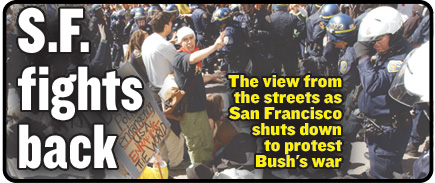
EDITORIAL Five years ago, the antiwar movement shut down San Francisco. It was a moment in history, one of those times that those of us who were there will never forget. No cars on Market Street. No cars on Mission Street. No business as usual anywhere downtown. Just a powerful statement that the city was not going to pretend that invading Iraq was an acceptable move.

And yet, for five years, the war has gone on. Sometime this spring, it’s likely the total number of American soldiers killed in the pointless military adventure will pass 4,000. And that’s just a fraction of the carnage: according to iraqbodycount.org, more than 89,000 civilians have died since the George W. Bush administration launched the invasion in March 2003.

There will be any number of newspaper stories, special reports and anniversary programs in the next few weeks, but of all the facts and statistics they’ll cite about the war, one ought to be at the top:

The antiwar movement was right.

Everything that the activists in the streets (and the very few newspapers that supported them, like this one) said at the time would prove to be absolutely true. As Steven T. Jones notes on page 14, there were no weapons of mass destruction. There was no link between Saddam Hussein and al-Qaeda. Iraq had nothing to do with Sept. 11. United States troops were not welcomed as liberators. There is no functioning Iraqi democracy. The situation in the Middle East is more unstable now than it was five years ago. Nothing has come of this war except disaster, death, and a bill to the American people that could reach $3 trillion.

In fact, Bush’s war is one of the main reasons that the economy is such a mess today — and that’s something the Democratic presidential candidates need to be talking about.

There has been nowhere near enough debate over the cost of the war. Bush has managed to fund the entire effort through supplemental appropriations, without once presenting a full budget to Congress. And the Democrats, fearing political criticism if they cut funding to troops who are in harm’s way, have gone along with every single spending request.

That’s been a huge factor in the nation’s mounting budget deficits and rapidly growing debt. And unlike deficit spending that funds social and infrastructure priorities, the red ink has done little to create jobs or improve the economy. It’s well known that military spending does less to help economic growth and recovery than any other type of government program. Put another way: If the $3 trillion that will go to the Iraq war were put into any other public venture, it would have tremendous positive consequences for society. It could, for example, preserve Social Security for another entire generation without new taxes or benefit cuts.

But those sorts of choices haven’t been presented to the public, because the war has been sold as a painless effort that requires no national sacrifice. And the bills won’t all come due until this president is gone and his successor has to deal with a deep recession, a horrible budget mess, growing unemployment, and a legacy of international distrust.

The good news is that the antiwar activism has forced both presidential candidates to pledge to bring the troops home — and Barack Obama could be the first president in years to be elected in large part on the basis of a strong grassroots peace movement. But the next president won’t stop the war without continued, constant pressure. It’s easy to think of the antiwar movement as a failure and to get discouraged — but this is not time to let down. If a Democrat wins the White House, visible and organized activism will be more important than ever. And this time, it might actually change American politics.

Resistance is futile — or is it?

0

It was a time without precedent in American history. The commander-in-chief voiced his intention to take the country to war — a voluntary, preemptive war with no clear catalyst, no faraway invasion or Pearl Harbor or sinking of the Maine and millions of people shouted their opposition. With plenty of time to avert war, the protesters warned the invasion would be a costly disaster.

They were right. And it didn’t matter.

The war in Iraq was a test of our democratic ideals. It was a test that this country failed, a failure that has been felt by the people of the United States, Iraq, and elsewhere for the last five years. For many, the refusal of the US government to heed the demands of its citizens left them disillusioned and disempowered.

But others say it sparked a political change that woke up an apathetic citizenry, pulled the Democratic Party back to the left, and may have averted war with Iran.

It’s certainly arguable that the presidential campaign of Barack Obama owes its energy and success in part to the antiwar movement — and if Obama wins, he will be the first president in a long time who took office thanks to the support of a strong grassroots progressive movement.

Nowhere was the clash of people power and government will more acute than on the streets of San Francisco, where a series of massive marches, some drawing nearly 100,000 people, filled the streets prior to the invasion of Iraq on March 19, 2003. The onset of war led protesters to effectively shut down the city, resulting in about 2,300 arrests and millions of dollars in costs to the city.

President George W. Bush dismissed the protests, of course, but he wasn’t the only one. Political leaders such as Rep. Nancy Pelosi, then-Mayor Willie Brown and soon-to-be Mayor Gavin Newsom (who didn’t attend any of the marches, unlike progressives on the Board of Supervisors) condemned the peace movement for hurting an innocent city. But with the “battle for San Francisco” making international news, the protesters were more concerned with the global audience.

A month earlier, on the weekend of Feb. 15 and 16, there were coordinated protests against the impending war in about 800 cities around the world, drawing around 10 million people. The peace march in Rome included about 3 million people, earning a listing in the Guinness Book of World Records as the largest anti-war rally in history. People have never made such a loud and clear statement against an incipient war.

Beyond the numbers, the antiwar movement was also right. On every major issue and prediction, the messages from the street proved correct while those from the White House were wrong. The US wasn’t welcomed as liberators. There were no weapons of mass destruction. Iraq after the invasion isn’t a stable democracy or shining beacon to anyone but the new generation of jihadis Bush created.

We can blame a hard-headed president, ineffectual opposition party, failure of the national media, or the national climate of fear following Sept. 11. But rather than refighting that lost battle, now is the time to gain perspective on the events of five years ago and determine what it means for democracy and the post-Bush national agenda.


TO THE STREETS

There were two main umbrella groups organizing protests before the war: Direct Action to Stop the War (DASW) and International ANSWER (Act Now to Stop War and End Racism). ANSWER has remained active and DASW has recently been reconstituted for the fifth anniversary of the war, using direct action in San Francisco as well as other urban centers and outposts like Chevron’s refinery in Richmond, which has reportedly been processing Iraqi oil.

“With the fifth anniversary coming up, we’re going back to direct action on the streets,” said Henry Norr of DASW. “But I don’t have any illusions that it’s going to be like it was five years ago.”

The maddening march to an ill-advised war created a political dynamic in which a broad cross-section of Americans was willing to hit the streets.

“We had a wonderfully diverse group of people, from soccer moms to anarchists,” said Mary Bull, who cofounded DASW, a collective of various affinity groups and concerned individuals formed in October of 2002 as Bush started beating the drums of war.

It was a group fiercely determined to prevent the war — and really believed that was possible. In fact, Bull recalls how she and other members of the group burst out crying at one meeting when a key activist said the war was going to happen.

Richard Becker, who cofounded ANSWER and serves as its West Coast coordinator, said that in the summer of 2002, “we came to the conclusion that [the war] was going to happen.” The group called its first big protest for Sept. 15, 2002, and another one two weeks later. But the movement really exploded on Oct. 26 when almost 100,000 people took to Market Street, much of it a spontaneous popular uprising.

“We were overwhelmed,” Becker said. “We were in a perpetual state of mobilization to keep up with what was going on. But then it didn’t stop the war.”

Did he think they could?

“I think a lot of people thought maybe it was possible to stop it. And we thought maybe it was possible to stop it,” Becker said.

The high point, according to Becker and Norr, was Feb. 17, 2003, when the New York Times ran a front page analysis piece entitled “A new power in the streets” that claimed “the huge anti-war demonstrations around the world this weekend are reminders that there may still be two superpowers on the planet: the United States and world public opinion.” But then Colin Powell went to the United Nations to argue for the invasion, and the Democrats in Congress did nothing, and it became clear war was coming.

Norr stayed out there protesting, being arrested several times and even shot in the leg by Oakland police with a rubber bullet during a protest at the Oakland docks. And he thinks some good came from the experience.

“The lesson for people is the political and economic elites are committed to preserving and extending empire. And they basically say as much in their own writing,” Norr said. “Wars are not anomalies.”

Despite being a frustrating and depressing exercise, most saw benefits to the failed movement. “People got an incredible education about how the system really worked,” Becker said. “Building a movement is mostly about a series of setbacks.”

Medea Benjamin, cofounder of both Global Exchange and CodePink and fixture of the anti-establishment peace movement for years, was upbeat about the protests. “We did our job as citizens. We did what we were supposed to do: organize, get people to take action, get people onto the streets,” she said. “We did everything we could think of.

“What you take from it is we don’t have a very well-developed democracy because the people spoke and the government didn’t listen.”

25war2_Lars1.jpg The ever-evolving “Democracy Wall” on Valencia Street, March 2003, helped stir up debate (Photo by Lars Howlett)


FACING ARREST

The collective action of five years ago starts with a series of personal stories — tens of thousands of them — so let me briefly begin with mine.

My arrival in San Francisco was closely tied to the march to war. I was living in Sacramento and working as the news editor of the Sacramento News & Review when Bush began his saber rattling against Saddam Hussein, but by the end of 2002 I had a falling out with my boss and found myself jobless.

Like most Northern Californians who opposed the war, I came to San Francisco on Jan. 18 to make my voice heard and experienced a bit of serendipity on my way to Justin Herman Plaza: while reading the Guardian on Muni, I saw their advertisement for a city editor, a job that was ideal for me at a paper I’ve always loved. Needless to say, it was a great day, empowering and full of possibilities.

Less than two months later I was on the job, and on the second week of that job I was back on the turbulent streets of San Francisco, part of a Guardian team covering the eruption of this city on the first full day of war. When I stepped off the cable car just after 7 a.m., people were streaming up Market Street and I joined them.

When a large group stopped at the intersection of Market and Beale, I stopped too, taking notes and bearing witness to this historic, exciting event. I had a press pass issued by the California Highway Patrol that allowed me to cross police lines, so when police in riot gear surrounded us and threatened arrest, I held my ground with 100 or so protesters.

After interviewing about a dozen people about why they were there and that they hoped to accomplish (see “On the bus: Journalists, lawyers, four-year-olds — the cops were ready to bust anyone Thursday morning“), I was arrested with the others and taken to a makeshift jail and processing center at Pier 27 (no charges were filed in my case, and charges against all of the 2,300 people arrested here in those first few days of the war were later dropped).

I recently tracked down a few of the people who appeared in my article, including Daphne and Ross Miller, who were at the center of the most interesting drama to play out during our standoff with the police. She’s a family practice physician, he’s an architect, and they live in Diamond Heights with their two children, Emet, who is almost 9, and Arlen, 12, who was away on vacation when the war began.

“We were genuinely shocked that the war started,” Ross told me. “We were at some of the earlier protests and really thought there was no way [Bush] could do it.”

They woke up March 20, 2003, to news that the war had begun and immediately walked to the BART station with Emet and rode to the Embarcadero station, not really planning for the day ahead but just knowing that they had to make themselves heard.

“We were pissed as hell. I don’t think I’ve ever been so angry in my life,” Daphne said.

They quickly came up with a plan. “We basically decided that if anyone was going to be arrested, it was going to be Ross and I’d stay with Emet. But it didn’t end up that way and I ended up in the arrest circle.”

Daphne had their house keys and threw them over the police line to Ross at one point. A photographer in the circle had gotten shots of a man named Roman Fliegel being roughed up by police as they pulled him off his bicycle, which was towing a trailer with a sound system, and decided to throw his backpack with camera gear out as well. When Ross — who had four-year-old Emet on his shoulders — caught it and refused police orders to give it to them, police grabbed Emet and roughly arrested Ross, leaving a gash on his forehead.

“Rage surged through the crowd, and it seemed as if things might get ugly, but the police kept a tight lid on the situation, using their clubs to shove back protesters who had moved forward,” I wrote at the time.

Emet was delivered into the circle with Daphne as the arrests continued, many quite rough. “At that point, as a mom, I had to exercise the most restraint ever,” said Daphne, who was angry about the situation but fearful about what she was exposing her son to. “Please, don’t let any violence happen here,” she pleaded with the crowd. Eventually, commanders on the scene let the mother and child go.

“The officer who let me go said that if he saw me again out there, he would call Child Protective Services on me,” Daphne said. But two days later, still brimming with outrage at her country’s actions, she ditched a downtown medical conference to rejoin the street protests, this time solo.

The couple say they’ve lost friendships over the war and have become more engaged with politics, coming to believe that Bush and the neocons are malevolent figures who knew how badly the war would go and did it anyway to establish a large, permanent military base in Iraq.

“Since that day, we’ve been far more active,” Ross said. “We realized you can’t just trust the system. You have to push.”

But that determination was mixed with feelings of disempowerment and depression. They attended some of the protests that following year, but the couple — like most people — just stopped going at some point because they seemed so futile.

“There was a horrible sense of resignation and a genuine depression that followed,” Ross told me.

The nadir was when Bush was reelected and they considered leaving the country. But then, Ross said, “we decided we’re not just going to run away and we’re not going to accept this.” Looking back, even with the scare over Emet, they express no regrets.

“It was the right thing to do because it was the wrong war to have. I’d do it again and again and again if I had to,” Ross said

They’re guardedly hopeful that Barack Obama could begin to turn things around if he’s elected. “I think the right president can at least start to dismantle this,” Daphne said. “I think thousands of people marching in the streets is something he would listen to.”

25war3_Charles1.jpg A die-in on the streets of San Francisco in March 2007 marked the fourth anniversary of the invasion (Photo by Charles Russo)


WITNESS TO HISTORY

Covering the peace movement in those early days was a heady experience, like reporting on a revolutionary uprising or working in a foreign country where the people are organized and active enough to be able to shut down society and brave enough to risk bodily injury for their beliefs.

I was at the founding meeting of CodePink — which became the most effective group at personally confronting the warmongers and keeping the war in the public eye — one evening at Muddy Waters in the Mission District shortly after the war started.

Looking back, Benjamin rattled off a long list of the alliances the group built — with labor, churches, businesses, and a wide array of social movements — and creative actions intended to build and demonstrate popular support for ending the war.

“We’ve done so many things and what did we get? We got a surge,” she said. “It shows the crisis in our democracy, the crisis of the two-party system, the crisis of a dysfunctional opposition party.”

Yet she said the peace movement has been remarkably successful in convincing the public that the war was a mistake and that it’s time for the troops to come home, even if the Democrats have been slow to respond to that shift.

“The progress we’ve made is turning around public opinion and that’s going to play a big role in the upcoming elections,” she said. For Norr, the role of the news media is a particular sore spot. He was a technology reporter for the San Francisco Chronicle who called in sick on the first full day of war and was arrested on Market Street with his wife and daughter, resulting in suspension by editor Phil Bronstein for his actions.

I wrote several stories on the issue, which culminated in Norr being fired and Bronstein unilaterally banning Chron employees from peace protests. I even borrowed CodePink’s guerilla tactics when Bronstein repeatedly refused to return my calls or address why he had singled out antiwar protesters for uniquely punitive treatment. I confronted him during a speech he gave at the Commonwealth Club (see “Lies and half-truths,” 5/7/03). That was the tenor of the times: we were all tired of being lied to and we decided to push back.

Norr was particularly frustrated with his own paper’s reporting of the war and started sending articles by the foreign press to his paper’s news desk, trying to wake his colleagues up to the pro-war propaganda being passed off as journalism in this country.

He was also disappointed with the country and with the Chronicle — both the management and his fellow reporters, who did little to support him — but the experience caused him to return to his roots as a progressive activist.

“The war and losing the job and everything brought an abrupt end to my consumerist phase and dumped me back into the world of being an activist,” said Norr, who serves on the KPFA 94.1 FM local station board and has made three recent trips to the Palestinian territories while working with the International Solidarity Movement.

Benjamin said Americans shouldn’t expect the next president to end the war — not without lots of pressure from a renewed and vocal peace movement. “This is the time to set the stage for the post-Bush agenda,” Benjamin said. “Don’t put your hopes in Barack Obama in getting us out of Iraq. Put your hopes in the people.”

25war4_Lane1.jpg A rally and nonviolent direct action at the Richmond refinery targeted Chevron on March 15 (Photo by Lane Hartwell)


THE AFTERMATH

The San Francisco Police Department, which spent more than $2 million on overtime costs responding to peace protests between March 15 and April 16, 2003, generally behaved with restraint and professionalism, but there were several exceptions.

The most costly and disturbing incident came when Officer Anthony Nelson began aggressively swinging his long riot baton at protesters, badly shattering the arm of peaceful protester Linda K. Vaccarezza, who suffered a permanent disability in her career as a court reporter.

Nelson’s incident report falsely stated that Vaccarezza had threatened him with a sign attached to a solid pole, but video of the incident later clearly showed there was no pole and that she was retreating when he teed off on her (see “The home front,” 05/19/04).

Vaccarezza received an $835,000 settlement from the city in November of 2004. On Oct. 5, 2005, two and a half years after the incident, SFPD fired Nelson for lying about what happened that day, and the City Attorney’s Office has been successfully fighting Nelson’s appeals in court ever since, putting in more than $100,000 in attorney time and costs into the Nelson and Vaccarezza cases.

The other significant ongoing litigation from the antiwar protests involved Mary Bull, who was arrested during an early protest for pouring fake blood in front of the entrance to Chevron’s San Francisco office before being allegedly strip searched and left naked in her San Francisco Jail cell for 36 hours.

Ironically, Bull was among those who brought a successful class action lawsuit against Sacramento County after she and others protesting a logging plan were strip searched, setting a precedent and led most counties to reform their strip-search policies. She used her share of the $15 million judgment to buy an organic permaculture farm in Sebastopol.

Her San Francisco case, in which Bull won a multimillion-dollar judgment, is still under appeal and now in mediation. Bull said the protests five years ago did make a difference, something she tells those who fret about its apparent failure. “I tell them to look at what issues the candidates are talking about now and I thank them for protesting then.”

“Even though we had millions throughout the world, we were sort of blocked, but now we’re regaining that momentum,” Melodie Barclay, a massage therapist who was also arrested with me on the first day of the war, told me recently. “We can’t judge it by the fact that we didn’t get the momentum we wanted.”

Norr started his antiwar activism working with Students for a Democratic Society in Boston, protesting the Vietnam War, which he said shares many similarities with the current situation, for good or for ill. He said that people tend to forget that while the protests then were huge and helped end the war, the movement did wane after Nixon ended the draft and substituted massive aerial bombardment for boots on the ground.

“The protests dropped off considerably,” he said. “A lot of the things that drove people to take risks in the late ’60s had faded by the early ’70s.”

He thinks the current administration learned a lesson from those days: it’s easier to maintain a war effort if the average citizen isn’t affected.

But there are other factors as well keeping a lid on the antiwar outrage.

“The culture has changed too. Young people are oversaddled with debt. People in schools seem to be docile. The culture as a whole seems to be more individualist and consumerist,” Norr said.

Yet some young people have woken up and many of them are funneling their energies into a peace group that was formed in the summer of 2005: World Can’t Wait, as in: the world can’t wait for the end of Bush’s second term before we change our direction and leadership.

“We don’t just want them gone, we need to repudiate their program,” said Giovanni Jackson, a 26-year-old WCW student organizer. “If we’re going to change anything, we need the youth.”

Jackson was at WCW’s founding convention in New York City, which came just as New Orleans was being flooded and then essentially abandoned by the federal government.

“When [Kerry] lost, people felt demoralized and World Can’t Wait kind of stepped into that situation,” Jackson said. “There was a lot of demoralization in the antiwar movement at that time.”

The group organized protests and student walkouts on Nov. 2, 2005.

“Everyone has their moments of doubt,” he said, “but I’m motivated by the crimes we see everyday.”


THE LESSONS

One of the biggest barriers to galvanizing people and turning the fifth anniversary of the war into something that might make a difference is the presidential election, which is diverting the energy of many potential protesters — and at the same time, offering some hope that a new president may lead to peace.

After all, every single one of the Democratic presidential candidates has promised to withdraw troops from Iraq, with varying timelines and numbers of US personnel left behind. And with enough encouragement, they might be willing to help change the status quo.

Many of the activists who volunteered their time and money to help move the Obama campaign into its front-runner position came out of the antiwar movement, and Obama’s strong stand against the war has been a key factor in his popularity.

Becker and some other activists don’t have much faith that a change in presidents will change the course in Iraq, although he agrees that much of the energy now surrounding Barack Obama derives directly from the antiwar movement.

“There’s been a huge upsurge of hope for Obama and that he might bring about the kind of change we need,” Bull said, adding that she doesn’t share that hope, believing the only path to peace is to pressure Obama and other leaders to commit to more progressive positions.

Norr said, “On one level, people have illusions about the power of peaceful protests. People believe in democracy, as well they should. We feel like the rulers should be paying attention to public opinion.

“It’s a remarkable story how broadly and quickly the American people have turned against the war. Public opinion was certainly ahead of the Democrats.”

And people will only grow more disenchanted with Iraq and its multitude of costs. “The people here are paying for this war, and everyday we have new stories about health clinics being shut down,” Becker said.

Becker was amazed last March as massive demonstrations for immigrant rights seemed to explode out of nowhere. “We think there will be more things like that,” he said.

Because after five years of organizing communities to resist the military-industrial complex’s plans, Becker thinks there’s been some visible progress.

“There isn’t a town or hamlet in the US that doesn’t have activism going on, but you wouldn’t know it from the corporate media,” Becker said. “It’s a mistake for people to feel discouraged.”


South By Culture: Home again … and advice for next year

0

Culture editor Molly Freedenberg hits SXSW for the first time to explore the festival’s extracurricular aspects. For Music Editor Kimberly Chun’s take on SXSW’s tunes, click here.

I’m finally back from South by Southwest. And by “back” I don’t only mean “in San Francisco.” The latter happened early Sunday morning. But I only recovered, brushed my teeth, got out of bed, and unpacked last night. Yes, it was that much fun, and that exhausting. (Yes, I also have a habit of squeezing every bit of fun out of every moment I can, which often leads to days of bed rest, but that’s another story…)

Now that I have some time to reflect, I can say deciding to go was one of the best ideas I ever had. (Way better than paying $180 to see Buffy the Musical.) First off, Austin’s rad. Now I completely understand why everyone I know is moving there. Rent is cheap. People are interesting. It’s got the politics, art, music, and culture of Portland and San Francisco but without the rain and gloom of either; and it’s got the weather of Los Angeles, but without the smog, the sprawl, or the especially high ratio of douche-bags to cool people our sister to the South has got.

IMG_2396.JPG
The unofficial SXSW (female) uniform: summer dresses and cowboy boots.

And second, the festival itself. How do I explain this? It isn’t simply that there’s music everywhere. It’s that everyone is there because they love being there. This is summer camp for music geeks. Or Sturgis. Or (don’t kill me for saying this) Burning Man. Southby isn’t just a big, spread-out Coachella or Bonnaroo – both of which are contained, commercial festivals in the traditional sense. This is more of a temporary culture – where every venue is dedicated to playing music from morning to night, and where every person there is so dedicated to music they want to spend several days immersed in it.

In fact, I found the experience of being at Southby much the same as being at Burning Man: intending to go one place and ending up at another, running into people I never expected to see, leaving the house at 11 a.m. with the intention of coming home for dinner and not seeing my bed until 4 a.m. Drinking early, forgetting to eat, thinking I’d found the most inspiring thing I’d ever seen and then, two blocks later, finding something even more inspiring. Sure, at Burning Man it’s guerrilla art or random performance or the joy of seeing Barbie Death Camp for the first time – at Southby, it’s rock bands that sound like Led Zeppelin (Parlour Mob) or discovering the punk band I’m listening to actually sings one my favorite song on an old, unlabelled mix tape (Meat Men) or finding my way into the Perez Hilton party (not as exciting as it sounds) with a writer friend from L.A. But the fundamental feeling is the same: riding the wave of the unexpected. I bet you could even draw parallels between relationships at Burning Man – how some are formed and how some are ruined – and those at Southby.

And just like Burning Man, Southby isn’t for everyone. The pace is breakneck. The beer is unlimited. And if you don’t like crowds, walking, or loud noise, it could be your biggest nightmare. But for people like me, it’s an absolute fantasy.

Which is to say, yes, of course, I’m going to go again. But I’ll do a few things differently. Here’s my advice for other Southby virgins, based on what I learned this year:

Desperately seeking cinema

0

> a&eletters@sfbg.com

Jennifer Reeves’s movies are personal wishing wells, each a repository of dreams and worries. As we see ourselves reflected in the water’s surface after tossing in a coin, so too is Reeves’s presence apparent in the handmade, fussed-over quality of her moving pictures. I use that broad designation pointedly, as her films are as varied in material and form as they are prosaic in mood and temperament. Over 15 years of independent filmmaking, the New York–based artist has created hand-painted films in the style of her mentor Stan Brakhage, freewheeling shorts, fiction fantasias, 16mm double-projections, feature narratives, and experiments in high definition. San Francisco Cinematheque hosts the formally restless filmmaker for a three-program tour.

Reeves’s early shorts channel riot-grrrl spark with scratched-up film stock. Elations in Negative (1990) is a good sample of the celluloid-mad sexual politics of these 16mm beaters, though Taste It Nine Times (1992), with its vivid pickle-biting innuendos, will be missed from the Cinematheque run. In painted films like The Girl’s Nervy (1995) and Fear of Blushing (2001), Reeves’s appropriation of Brakhage’s technique conveys playful femininity in color, pattern, and music.

Though Reeves toyed with narrative early on, most notably in 1996’s psychodrama Chronic, 2004’s The Time We Killed represented a kind of breakthrough. An unhurried 94 minutes passes through the dark mirror of an agoraphobic poet keeping to her New York apartment during the buildup to the Iraq War. "Terrorism brought me out of the house, but the war on terror drove me back in," Robyn (Lisa Jarnot) says in her peripatetic voice-over, adding later, "I’m afraid of catching the amnesia of the American people." Reeves’s magnetically immersive filmmaking is such that the political situation neatly folds into an extended experiment in subjectivity — besides being an unstinting portrait of madness (it’s everywhere in this film: in a record’s spin and neighbors’ voices echoing through the walls, in dogs’ faces, bathwater, and masturbation), The Time We Killed also serves as an understated chronicle of the collateral psychic and moral damage of our country’s manufactured warmongering.

The Time We Killed is heavier than Reeves’s other work, though it’s not without humor; she finds the ridiculous, unwieldy side of depression in Robyn’s litany of death fantasies and a painfully misguided interaction with a curious neighbor. Robyn’s locked in, but Reeves is formally unfettered, mixing conventional 16mm footage with lyrical, associative streams of inner life shot in high-contrast black-and-white. The filmmaker raids her home-movie archive for the film, in addition to using her own apartment and acting as Jarnot’s body double during the extended shooting. This air of transference makes The Time We Killed weirdly transparent, so we feel as intimately connected to Reeves’s isolated work in the editing room as we do to Robyn’s experience in the apartment.

Since The Time We Killed, Reeves has returned to more typically experimental filmmaking. Her 2006–07 Light Work variations strike an ideal balance of abstract and representational visions, in the process cataloging the changing textures of cinema. In the affecting He Walked Away (2007), Reeves dissects, refracts, and abstracts footage from her older movies to create a tri-tipped memorial piece in which the intrinsically elegiac nature of cinema is connected to the dissolution of film technology, which is then tied to the disappearing loves and friendships that shadow personal lives.

As with Guy Maddin — another filmmaker who favors overheated evocations — one has the sense that Reeves could make a hundred interesting movies from the same scraps of footage. "I want to counter the turncoats who say film’s dead," Reeves announces on her excellent new blog. "Try telling a painter that she can only use digital paint on a Mac for the rest of her life. She’d be pissed." But if she were Jennifer Reeves, she certainly wouldn’t slow down.

IMMERSIVE CINEMA: JENNIFER REEVES

Artists’ Television Access, Sat/15, 8:30 p.m.

Yerba Buena Center for the Arts, Sun/16, 7:30 p.m.;
Tues/18, 7:30 p.m.; $6–$8

See Rep Clock for venue information

The users are revolting

0

› annalee@techsploitation.com

TECHSPLOITATION One of the social traditions that’s carried over quite nicely from communities in the real world to communities online is revolution. You’ve got many kinds of revolt taking place online in places where people gather, from tiny forums devoted to sewing, to massive Web sites like Digg.com devoted to sharing news stories.

And while they may be virtual, the protests that break out in these digital communities have much in common with the ones that raise a ruckus in front of government buildings: they range from the deadly serious to the theatrically symbolic.

How can a bunch of people doing something on a Web site really be as disruptive or revolutionary as those carrying signs, yelling, and storming the gates of power in the real world? By way of an answer, let’s consider three kinds of social protest that have taken place in the vast Digg community.

According to Internet analysis firm ComScore, Digg has 6 million visitors per month who come to read news stories rounded up from all over the Web. About half of those visitors log in as users to vote on which stories are the most important: the one with the most votes are deemed "popular," and make it to Digg’s front page to be seen by millions. A smaller number of people on Digg — about 10 percent — choose to become submitters of stories, searching the Web for interesting things and posting them to be voted on — in categories that range from politics to health. Digg’s developers use a secret-sauce algorithm to determine at what point a story has received enough votes to make it popular and worthy of front-page placement.

You can imagine that a community like this one, devoted to the idea of democratically generated news and controlled by a secret algorithm, might be prone to controversy. And it is.

Two years ago, I was involved in what I would consider one type of user revolt on Digg. It was a prank that I pulled off with the help of an anonymous group called User/Submitter. The group’s goal was to reveal how easy Digg makes it for corrupt people to buy votes and get free publicity on Digg’s front page. My goal was to see if U/S really could get something on the front page by bribing Digg users with my cash. So I created a really dumb blog, paid a couple hundred dollars to U/S, and discovered that you could indeed buy your way to the front page. Think of it as an anarchist prank designed to show flaws in the so-called democracy of the system.

But there have also been massive grassroots protests on Digg, one of which I wrote about in a column more than a year ago. Thousands of Digg users posted a secret code, called the Advanced Access Content System key, that could be used as part of a scheme to unlock the encryption on high definition DVDs. The goal was to protest the fact that HD DVDs could only be played in "authorized" players chosen by Hollywood studios. So it forced people interested in HD to replace their DVD players with new devices. It was a consumer protest, essentially, and a very popular one. Hollywood companies sent Digg cease-and-desists requesting that they take down the AACS key whenever it was posted, but too many users had posted it. There was no way to stop the grassroots protest. Digg’s founders gave up, told the community to post the AACS key to their hearts’ content, and swore they would fight the studios to the end if they got sued (no suit ever materialized).

Another kind of protest that’s occurred on Digg came just last month, and it was a small-scale rebellion among the people who submit stories and are therefore Digg’s de facto editors. After Digg developers changed the site’s algorithm so that it was harder to make stories popular, a group of Digg submitters sent a letter to Digg’s founders saying they would stop using the site if the algorithm wasn’t fixed. You could compare this protest to publishing an editorial in a newspaper — it reflected grassroots sentiment but was written by a small minority of high-profile individuals. Though the company didn’t change its algorithm, this protest did result in the creation of town hall meetings where users could ask questions of Digg developers and air their grievances.

Each of these kinds of protests has its correlates in the real world: the symbolic prank, the grassroots protest, and the angry editorial. So forgive me if I laugh at people who say the Internet doesn’t foster community. Not only is there a community there, but it’s full of revolutionaries who fight for freedom of expression.

Annalee Newitz (annalee@techsploitation.com) is a surly media nerd who wants a revolution.

SFIAAFF: Are you lonesome tonight?

0

› kimberly@sfbg.com

Brad Renfro wasn’t the only cinematic figure neglected in the recent Academy Awards’ "In Memoriam" montage: the academy fumbled even harder in its omission of Taiwanese filmmaker Edward Yang, who died last June of colon cancer in Los Angeles at 59. The self-taught father of Taiwan’s cinematic new wave and a runaway Seattle software engineer who abandoned the tech field that made his classmates wealthy for his true love of filmmaking, Yang only created only eight films during his short, multi-career life, but during that brief span the Shanghai-born, Taipei-raised auteur managed to lend an influential, helping hand in the difficult birth of serious Taiwanese movie making.

Yang’s so-called old drinking buddies, screenwriter Wu Nien-chen and fellow director Hou Hsiao-hsien, were more than just sodden shoulders to cry on; they grappled with manifold frustrations of working independently in the Taiwanese film industry (described by Yang as "fragmented and run-down," with only a limited pool of experienced actors). This gang of three supported each other financially and artistically: according to Jeff Yang’s account in Once upon a Time in China (Atria, 2003), Wu spearheaded the anthology In Our Time (1982), which showcased Yang’s first theatrical film, and Hou mortgaged his house to underwrite Yang’s second feature, Taipei Story (1985), which Hou also starred in — and ended up losing his shirt for after it lasted all of four days in theaters.

Twin brothers by different mothers and both born in 1947, Hou and Yang created their breakthrough films in 1986: the former’s Dust in the Wind was also — surprise! — written by Wu, while the latter’s The Terrorizers is a handsome, cerebral urban psychological drama that flaunts new wave roots like a glittering pop offspring of Jean-Luc Godard. Inspiring critic Fredric Jameson to praise its "archaically modern" textures, The Terrorizers broke down, as writer David Leiwei Li writes in Chinese Films in Focus (BFI, 2003), the hidebound binaries of East and West as "tradition versus modernity, enabling readings that recognize both the border-transcending flow of global commerce and the reflexive capacity of residual local cultures."

It’s easy to read Hou’s and Yang’s early works as responses to one another, a relic of their barroom-pal give-and-take back in the day, and some might view Yang’s masterpiece, A Brighter Summer Day (1991), as simply a rejoinder to Hou’s critically acclaimed, box office record-breaker City of Sadness (1989), though it was made amid far more hazardous conditions — 1989 was the year the bottom fell out of the Taiwanese market for locally produced films, and audiences turned to Hong Kong–made entertainments. A few critics might even tag Yi Yi: A One and a Two as Yang’s greatest feature — for its warm, humanist blend of The Terrorizer‘s postmodern urban landscape, Yang’s evocative roundelay of reflective surfaces, and the gentle gaze he levels on its quietly deteriorating family, headed by a software company manager pater familias, played by Yang’s old friend Wu, and a mother in the throes of spiritual crisis (Day‘s Elaine Jin).

For its unseen but subtly telegraphed depths, referential richness, and the sheer breadth and long-shot scope of its four-hour running time, Day nonetheless deserves the praise lavished on it. Much like City, writes Emilie Yueh-Yu Yeh and Darrell William Davis in Taiwanese Film Directors: A Treasure Island (Columbia University Press, 2005), Day‘s "local history turns the lock on long-suppressed ideas," convincingly plunging the personal into an epic sphere. Rarely screened and unavailable on DVD (much like The Terrorizer), Day has been described as a Taiwanese Rebel Without a Cause (1955) — a true descriptor if one discounts the very specific mise-en-scène of early ’60s Taipei and the film’s dense connective web of cultural, political, and familial allusions, obligations, and affiliations, one that’s as many-tendrilled and enmeshing as that of your average multigenerational Chinese family.

Ensnared by filial duty as well as street gang politics and placed in the sweepingly de-centered core of Day is its proto–James Dean, Xiao Si’r, portrayed by the baby-faced Chang Chen (the nomadic hottie in Yang’s Taiwanese cohort Ang Lee’s Crouching Tiger, Hidden Dragon [2000]). The director opens Day with Si’r’s Shanghainese intellectual father arguing with teachers about his son’s grades, and then widens his aperture imperceptibly, ingeniously onto the arboreal byways, flat-lit classrooms, vertigo-inducing corridors, and shadowy hideouts of Si’r’s world. It’s a realm in which the children of the Kuomintang live an uneasy existence much like their elders: residing in Japanese houses less than 20 years after their parents fought the Imperial army on the mainland, these Taiwanese teens listen to American doo-wop and early rock and form street gangs that parallel the battling political factions of the People’s Republic. Tanks rumble by as brownouts underline the sense of rupture.

Resembling in its panorama and chapterlike parts such historical epics as Bernardo Bertolucci’s 1900 (1976), Day unfurls like a scroll, peppered by the shouts and orders of parents, peddlers, and teachers, and peopled with pungent characters like the Tolstoy-reading, romantically heroic hood Honey and his guilelessly calcuutf8g survivor of a sweetheart Ming — as well as Si’r’s bookish father, who’s torn from his self-absorption when taken into custody by the secret police. All bear the marks of severance from one’s past, papers, homeland, and other familiar signposts of identity. The quiet, troubled, and piercing irony that Yang applies to the scene of Si’r’s father’s arrest, one in which his children repeatedly play Presley’s "Are You Lonesome Tonight" in order to translate the lyric "Does your memory stray to a brighter summer day" to sing at some future sock hop haunted by the specter of Honey’s death — shades of the Jesus and Mary Chain — makes this teeming opus worth turning over again and again in your own memory. It’s like a battle hymn to a faltering family, or a love song to the death of innocence.

TRIBUTE TO EDWARD YANG

The Terrorizer

March 14, 9 p.m.

Yi Yi: A One and a Two

March 20, 7 p.m.

Pacific Film Archive

A Brighter Summer Day

March 19, 7 p.m.

Clay Theater

>> Complete Asian American Film Fest coverage

Questioning Matt

0

Matt Gonzalez consulted few of his colleagues in San Francisco’s progressive political community before announcing Feb. 28 at the National Press Club in Washington, DC, that he’ll be Ralph Nader’s running mate on another quixotic run for president.

That’s fairly typical for Gonzalez, who has tended to keep mostly his own counsel for all of his big political decisions: switching from Democrat to Green in 2000; successfully running for president of the San Francisco Board of Supervisors in 2002; jumping into the mayor’s race at the last minute the next year; abruptly deciding not to run for reelection to his supervisorial seat in 2004; and — last year — deciding against another run for mayor while being coy about his intentions until the very end.

But if he had polled those closest to him politically, Gonzalez would have learned what a difficult and divisive task he’s undertaken (something he probably knew already given what a polarizing figure Nader has become). Not one significant political official or media outlet in San Francisco has voiced support for his candidacy, and some have criticized its potential to pull support away from the Democratic Party nominee and give Republican John McCain a shot at the White House.

In fact, most of his ideological allies are enthusiastically backing the candidacy of Barack Obama, who Gonzalez targeted with an acerbic editorial titled “The Obama Craze: Count Me Out” on the local BeyondChron Web site on the eve of his announcement (while not telling BeyondChron staffers of his impending announcement, to their mild irritation).

It’s telling that all of the top Green Party leaders in San Francisco — including Sup. Ross Mirkarimi, school board president and supervisorial candidate Mark Sanchez, and Jane Kim, who got the most votes in the last school board election after Gonzalez encouraged her to run — have endorsed Barack Obama.

Mirkarimi, who ran Nader’s Northern California presidential effort in 2000 and ran Gonzalez’s 2003 mayoral campaign, has had nothing but polite words for Gonzalez in public, but he reaffirmed in a conversation with the Guardian that his support for Obama didn’t waver with news of the Nader-Gonzalez ticket.

Mirkarimi has a significant African American constituency in the Western Addition and has worked hard to build ties to those voters. He’s also got a good head for political reality — and it’s hard to blame him if he thinks that the Nader-Gonzalez effort is going nowhere and will simply cause further tensions between Greens and progressive Democrats.

Sup. Chris Daly is strongly supporting Obama and said the decision of his former colleague to run didn’t even present him with a dilemma: “It’s unfortunately not a hard one — or fortunately, depending on how you look at it.”

Daly doesn’t think the Nader-Gonzalez will have much impact on the presidential race or the issues it’s pushing. “The movement for Obama is so significant that it eclipses everything else,” Daly told us. “This is a once-in-a-lifetime opportunity to change how politics happens in this country.”

While few San Francisco progressives argue that Obama’s policy positions are perfect, Daly doesn’t agree with Gonzalez’s critique of Obama’s bad votes and statements. “I don’t understand the argument that you should only back a candidate that you agree with all the time,” Daly said. “If that was the case, I would only ever vote for myself.”

On the national level, Gonzalez told us that he was running to challenge the two-party hold on power and to help focus Nader’s campaign on issues like ballot access for independent candidates. “If I’m his running mate, then we’ll be talking about electoral reform,” he said.

On a local level, the Gonzalez move will have a complicated impact. It will, in some ways, damage his ability to play a significant role in San Francisco politics in the future. That’s in part because Gonzalez has taken himself out of the position of a leader in the local progressive movement.

San Francisco progressives don’t like lone actors: the thousands of activists in many different camps don’t always agree, but they like their representatives to be, well, representative. That means when housing activists — one of Daly’s key constituencies — need someone to carry a major piece of legislation for them, they expect Daly to be there.

Sup. Tom Ammiano hasn’t come up with his landmark bills on health care, public power, and other issues all by himself; he’s been part of a coalition that has worked at the grassroots level to support the work he’s doing in City Hall.

Daly sought to find a mayoral candidate last year through a progressive convention. That seemed a bit unorthodox to the big-time political consultants who like to see their candidates self-selected and anointed by powerful donors, but it was very much a San Francisco thing. This is a city of neighborhoods, coalitions, and interest groups that try to hold their elected officials accountable.

Obama’s politics are far from perfect, and Nader and Gonzalez have very legitimate criticisms of the Democratic candidates and important proposals for electoral reform. But right now the grassroots action in San Francisco and elsewhere in the country the movement-building excitement — is with Barack Obama. The activists who made the Gonzalez mayoral effort possible are now working on the Obama campaign.

In fact, Daly has repeatedly voiced hope that an Obama victory could help empower the progressive movement in San Francisco and give it more leverage against moderates like Mayor Gavin Newsom who support Hillary Clinton (see “Who Wants Change?” 1/30/08).

Daly said the Gonzalez decision complicates that narrative a little. “I don’t think it’s undercut,” Daly said, “but I think it’s confused a bit.”

More on the Nader-Gonzalez question

0

nader gonzo.jpg
Photo courtesy of National Press Club
I got a call from Matt Gonzalez this morning and he wasn’t happy about my post yesterday on his decision to run for vice president, which wasn’t surprising. But I was surprised to hear him sound so wounded and to say that my tone “was almost like a personal animosity.”

Displaying such thin skin is an inauspicious way to begin a presidential campaign, particularly one in which they’re arguing for the right to compete on the same playing field as the heavily scrutinized Democratic and Republican nominees. Ralph Nader was going to run anyway, Gonzalez said, and “if I’m his running mate then we’ll be talking about electoral reform.”

Less than a half-hour after our conversation, Gonzalez and Nader appeared on KQED’s Forum, in which the host brought up my criticisms, to which Gonzalez answered, “That particular journalist needs a basic civics lesson.” Nader also used the “civics lesson” barb against other critics.

Nobody is questioning their right to run, and I don’t dispute the need for electoral reforms that would chip away at the two-party hold on power. But Civics 101 also teaches that in electoral politics, it’s not enough to be right. You still must find a way to coalesce majority support behind your ideas, and at this point in history, a Nader-Gonzalez campaign might just be counterproductive to that goal.

Beyond beds

0

› news@sfbg.com

What do army barracks, prisons, hospitals, and dog pounds have in common? They all have minimum and legally enforceable standards of care, something absent in San Francisco’s homeless shelters. Legislation to fix that problem now appears to be shaping up as the latest political skirmish pitting fiscally conservative Mayor Gavin Newsom against progressives on the Board of Supervisors.

The Board of Supervisors’ Budget and Finance Committee met Feb. 20 to hear testimony and discuss proposed legislation that seeks to impose basic requirements on city-funded shelters, improve complaint procedures, and allow fines for noncompliance (see "Setting Standards," 1/30/07).

Prior to the hearing, dozens of activists, city officials, and homeless people rallied on the steps of City Hall in support of the legislation, holding colorfully painted signs with references to some of the proposed requirements, including "nutritious meals," "clean sheets," and "8-hour-a-day sleep."

Marlon Mendieta, program director at the Dolores Street shelter, took to the podium to make his case for supporting the legislation: "It may seem strange that a service provider would be here to support legislation that will cost money and more time and more work — it’s easy though. It’s an issue of human rights."

The scene was just as lively inside as demonstrators and officials packed the board’s chambers. The committee — composed of Sups. Aaron Peskin, Bevan Dufty, and Tom Ammiano (sponsor of the ordinance) — took testimony, almost all of it urging the committee to pass the legislation on to the full Board of Supervisors for approval.

Dariush Kayhan, who has been on the job for six weeks as the mayor’s appointed homeless policy director, gave the only testimony urging the committee not to pass the legislation.

"This is the part where we have some concerns, the fiscal part," Kayhan said. "Give us more time, maybe we can plow some of these items — the ones we can agree on — into the existing contracts," he said, referring to the contracts awarded to nonprofit organizations who manage the city’s shelters.

While the city’s contracts with shelter providers do spell out many standards, a recent Guardian investigation (see "Shelter Shuffle," 2/12/08) and work by the Shelter Monitoring Committee, which developed the recommendations embodied in Ammiano’s legislation, found they are often ignored with no consequences. The Guardian also found that people are being turned away from the shelters every night despite vacancies.

Mayor Gavin Newsom, in a letter to supervisors obtained by the Guardian, voiced his concern with the fiscal impact of the legislation, citing a $2.4 million price tag, the high end of costs developed by the Budget Analyst’s Office, which said the legislation could cost $1.7 million or even less. Advocates of the legislation are confident they can bring its price down.

The $2.4 million estimate assumes a new security guard will be hired at each shelter to meet safety requirements. The legislation does not specifically mandate new personnel and many argue increased staff training and facility improvements could provide cheaper alternatives.

The Shelter Monitoring Committee, composed of mayoral and board appointees, estimates the cost will be closer to $1 million, which amounts to less than half of 1 percent of the city’s total projected deficit of $225 million.

"This is an investment in a population that has not been invested in in a long time," committee chair Quintin Mecke said at the hearing. "I don’t think there is any reason to wait to make sure people have access to toilet paper, have access to clean conditions, have access to ADA [Americans with Disabilities Act] -compatible beds."

At Ammiano’s request, the committee decided to postpone the vote for two more weeks to try to work out differences with the Mayor’s Office, and set the next hearing for March 5. If the supervisors proceed without Newsom’s support and he ends up vetoing the legislation, it would take the vote of eight supervisors to override and implement the standards anyway.

Newsom and the board have been at odds over homelessness and other budget priorities. Buster’s Place, the city’s only 24-hour drop-in shelter, is now caught in the middle of the political tug-of-war between budget cuts and shelter improvements. There is a provision within the standards of care legislation that mandates a 24-hour emergency drop-in center. At the time it was drafted, Buster’s Place filled this requirement.

However, due to the timing of the midyear budget cuts ordered by Newsom, the Department of Public Health cut off funding for Buster’s, effectively closing the center at the end of March (see "No Shelter from the Budget Storm," 2/20/08). It is now unclear how the requirement will be met if the legislation passes.

"We’re tired of having centers like Buster’s Place on the chopping block," Mecke told the Guardian. "It’s ludicrous to keep going in this cycle over and over again." Buster’s was slated to close six months ago but was rescued by a Board of Supervisors’ budget add-back, and a year before that, McMillan’s (another 24-hour center) was forced shut its doors.

The ordinance seems to challenge Newsom’s recent efforts to whittle back shelter services. It would allocate more funds to a department Newsom is trying to cut and assure the existence of an emergency 24-hour center, a clear departure from Newsom’s recent announcement that he wants to ultimately "get San Francisco out of the shelter business."

The most controversial requirement within the standards of care legislation seems to be its enforcement mechanism, calling for fines of $2,500 levied against the nonprofit service providers for noncompliance. While Kayhan voiced reservations about creating new staff positions to carry out enforcement, the SMC has insisted the fines are crucial and will only be used as a last resort.

"In 2004, the supervisors [created the] Shelter Monitoring Committee because contract compliance was not working," Mecke said. "If there are policies in theory, they should be legalized and should become mandates and be enforced."

Barbra Wismer, the medical director of Tom Waddell’s clinic, which frequently serves homeless men and women, urged attendees at the budget meeting to put politics aside and remember the importance of shelter standards, not just for the current homeless population, but for all San Francisco residents.

"If there was a natural disaster like an earthquake, or a fiscal disaster like increased foreclosures, and 1 to 2 percent of people — 14,000 in San Francisco — had to be put in emergency shelters," Wismer said, "we do not have any standards to protect them."

Newsom’s woman problem

0

OPINION Be nice, wait your turn, pay your dues, your time will come.

This is the “guidance” given to women in politics, and many of us have bided our time and paid our share of dues. But what happens when our time comes, and we speak out for what we believe in? We are called pushy, mean, controlling, or cold. And worse — we are stripped of our positions.

In the last month, four of the most respected women in city government have been removed from their posts:

Susan Leal is considered one of city government’s best managers and was leading the city toward a future of sustainable energy usage. According to the Chronicle, she was fired from her position as director of the San Francisco Public Utilities Commission because the Mayor did not consider her to be a “team player,” and because it appeared that Leal was readying herself for another run for Mayor in 2011.

Leah Shahum is a fearless bike advocate and Executive Director of the San Francisco Bicycle Coalition. She was removed from the city’s Municipal Transportation Agency for being an outspoken critic of the city’s inaction on promoting alternative forms of transportation.

Roma Guy is a fierce advocate for women’s health, a former lecturer in San Francisco State University’s health education department and a longtime progressive activist. She was removed from the city’s Health Commission without explanation.

Debra Walker is the only woman on the city’s powerful Building Inspection Commission, a longtime affordable housing activist, and a fighter for reform and transparency in the Department of Building Inspection (a male-dominated department in a male-dominated field). Walker lost her leadership position on the commission after she was targeted by the mayor’s office for openly disagreeing with his positions.

We can’t allow these affronts to go unnoticed and we can’t afford to lose more good women in poweror let the few that remain be silenced into inaction. It is time for women to stand behind our sisters who work hard every day to represent us in government, many on a volunteer basis, while also pursuing full time careers and caring for their families.

The National Women’s Political Caucus and the San Francisco Women’s Political Committee are working to increase the number of women in positions of influence in city government. In September of last year, 47 elected officials and other community leaders from the San Francisco women’s community came together for a Women’s Policy Summit where the participants agreed that our top priority is to promote more women to positions of influence in government.

Even though women comprise 51 percent of the voting population, we hold only 16 percent of the seats in Congress, 23 percent of state legislative seats nationwide, and 27 percent of the seats on the San Francisco Board of Supervisors. Only one elected executive office in San Francisco — district attorney — is held by a woman.

San Francisco must do more to promote women to leadership positions. We must also call on the mayor to appoint women to positions of influence in city government and demand an explanation when he removes qualified women from their posts without good cause. The time for patience and waiting our turn has passed. *

Alix Rosenthal, Amy Moy and Micha Liberty

Alix Rosenthal is the founder of the San Francisco Women’s Policy Summit. Amy Moy is president of the San Francisco Women’s Political Committee. Micha Liberty is president of the National Women’s Political Caucus (SF chapter).


Years of Lead

0

› a&eletters@sfbg.com

REVIEW Reflecting on his work on millenarian Europe, the autonomist and political philosopher Antonio Negri stated, "This is certainly one of the central and most urgent political paradoxes of our time: in our much-celebrated age of communication, struggles have become all but incommunicable."

Long an influential campaign in Negri’s native Italy, autonomia, or self-rule, has received little critical attention from the English-speaking world. Editors Sylvère Lotringer and Christian Marazzi’s Autonomia: Post-Political Politics (Semiotext(e), 340 pages, $24.95), originally released as part of the short-lived Semiotext(e) magazine series in 1980, proffers the first English-language introduction to one of the most controversial movements of postmodernity.

Developed in the vibrant Götterdämmerung of the late 1960s in reaction to the largely corrupt and co-opted Eurocommunist parties, the worker-inspired Potere Operaio and its immediate descendent Autonomia Operaia were a philosophical umbrella, or, as one government critic put it, "a veritable mosaic made of different fragments, a gallery of overlapping images of circles and collectives without any social organization." At its heart, autonomia was a rejection by individuals and marginalized groups of not only the capitalist state but also its traditional ideological enemy — Marxism and its central doctrine of class struggle — for a postideological and immaterial way of life.

Brokered in universities throughout Bologna and Rome but dedicated to labor activism and the street-level situationism of sessantotto (student unrest), autonomia was powered by a number of formidable philosophical proponents. They included Negri, Oreste Scalzone, and Paolo Virno, as well as French sympathizers and arch collaborators Félix Guatarri, Gilles Deleuze, and Paul Virilio. Autonomia collects the various polemics, letters, and récits of these authors in an attempt to again dramatize the revolutionary and sometimes violent struggles between neofascists, unionists, and the ultraleft during the ensuing "Years of Lead."

Semiotext(e) editor Lotringer prefaces this new edition with a short travelogue describing his interactions with the various underground factions of Rome and Bologna in the shadow of politician Aldo Moro’s assassination by the dreaded Red Brigades, or Brigate Rosse. Long associated with the neofascists and socialists as the armed division of the Autonomia Operaia, the Red Brigades began resorting to terrorist propaganda, bombings, and assassination in the wake of government crackdowns in the late 1970s.

Lotringer encounters a gaggle of activists, intellectuals, and simulationists who may or may not pledge loyalty to the Red Brigades and who live in compounds and squats hiding from the omnipresent carabinieri, who continue to surveil the streets. Some are in costume and others spin Velvet Underground records; still others may be government informants or simply thrill to the hip simulacra of espionage. According to Lotringer, this alternative and autonomist space may have accomplished, however briefly, the utopic "non-fascist living" of Deleuze and Guattari.

Throughout Autonomia‘s 300 pages of densely translated text — from theorists and tricksters, reporters and members of the lumpen proletariat — the truly inclusive and sometimes circuitous worlds of the title movement become all the more apparent, yet never transparent. Negri’s contributions are particularly inspiring and frustrating in their brilliant opacity. Ultimately, in rejecting the verticality of hierarchies of power — textual, political, and economic — the autonomists opened up larger interpretative spaces: realms that existed beyond capital and beyond empire.