Politics

Newsom and the next chapter

3

By Tim Redmond

It’s a little weird that Gavin Newsom just disappeared after dropping out of the governor’s race. I had a feeling that he wasn’t going to hold up well under the pressure; he loves celebrity, loves to be on the A-List and loves to hear himself talk, but he can’t take a punch. And getting hit, a lot, is a big part of statewide politics. So I suspect that when he realized that this particular dream was over — clunk! — and that in two years, he’s not going to be anything but Gavin Newsom, citizen, he had a little meltdown.

This ought to be cause for concern: Somebody has to run the city for the next two years, and either Newsom is going to buck up, get back to work and try to change the way he does business — or he’s going to be a bitter lame-duck who can’t get anything accomplished except to go all Nixonian and attack his enemies.

I’m really hoping it’s the former — and now that he’s off his statewide horse, I think it’s safe to say that most of the supervisors, including the progressives he so disdains, would be more than willing to start working with him. I’d love to see the mayor come back from Hawaii with a clear understanding of what went wrong with his campaign. As we point out in an editorial today:

If the real Gavin Newsom had been anything like the campaign picture his handlers tried to present, he would have been a serious candidate. Newsom the candidate was a leader who brought San Franciscans together to get things accomplished. He was a progressive thinker who created universal health care and an effective budget process with a rainy day fund that prevented teacher layoffs. He was bold enough to challenge federal and state law on same-sex marriage and demand equality for all.

But Newsom the mayor was actually a snippy politician who refused to work with the Board of Supervisors and would never engage his opponents. He was great at press releases but short on accomplishments — universal health care and the rainy day fund were projects put together by Tom Ammiano, one of the supervisors the mayor disdained, who is now a state Assembly member. He refused to take a lead role fighting Pacific Gas and Electric Co. to promote clean energy and public power. And for all his success in moving same-sex marriage forward, he never once managed to bring that kind of progressive energy or policy-making to economic issues. His budget this year was the same as Republican Gov. Arnold Schwarzenegger’s budget — cuts and fees only. No new taxes.

As a result, the progressives and independent voters in his own town didn’t support his campaign — and without the environmentalists, labor, tenants, and progressive elected officials from San Francisco behind him, there was no way he could generate an honest grassroots movement.

I’d love to see the mayor reach out to the folks who have been snubbed all these years. Let’s talk about making the city budget work for everyone — and if that means some new revenue sources (which lots of other cities seemed to be able to pull off), at least he doesn’t have to worry about running statewide after raising local taxes.

He can take a hard look at where his cuts have really hit and try to work with labor to spread the pain a little better and chop from the top, not just the bottom.

He can become a real, serious clean-energy leader by strongly supporting CCA and taking a visible public role in the campaign against PG&E’s anti-public-power initiative.

The city’s ready for a Gavin, Chapter Two. And he wouldn’t be the first politician to rebound from a defeat, learn his lesson and start his career up again.

Any bets on whether that’s going to happen?

Inside Oaksterdam University

1

Photos, audio and slideshow by Rebecca Bowe


A tour of Oakland’s “Cannabis College,” featuring spokesperson Salwa Ibrahim and co-founder Richard Lee.

This week, we report on two efforts currently underway to tax and regulate marijuana — AB 390, legislation introduced by Assembly member Tom Ammiano that would legalize marijuana and regulate it in similar fashion to alcohol, and Tax Cannabis 2010, a ballot initiative that would give California counties the option to legalize.

Oakland-based Oaksterdam University — a.k.a. “Cannabis College” — is the driver behind the ballot initiative. Since OU opened its doors in 2007, about 5,000 students have taken classes to learn the politics and practical skills associated with the medical marijuana industry. Co-founder Richard Lee says he expects to be able to enroll 5,000 students per year once the school moves into new digs at a 30,000 square-foot facility several blocks away.

For now, OU’s courses are primarily taught out of a single classroom located nearby the 19th Street Bart station in downtown Oakland. When the Guardian stopped by last week, spokesperson Salwa Ibrahim led us on a tour of OU’s classroom, horticulture center, and one of its dispensaries for medical marijuana. We also chatted with Lee about courses at OU and his view on the economic benefits associated with legalization. To check it out, watch the slideshow.

The battle for District 6

0

tredmond@sfbg.com

The race to replace Chris Daly — the always progressive, sometimes hotheaded supervisor who has dominated District 6 politics for almost a decade — is becoming one of the most important battles of 2010, with the balance of power on the board potentially in play.

Through whatever accident of politics and geography, San Francisco’s even-numbered districts — five of which will be up for election next fall — haven’t tended to fall in the progressive column. Districts 2 (Marina-Pacific Heights) and 4 (Outer Sunset) are home to the city’s more conservative supervisors, Michela Alioto-Pier and Carmen Chu. District 8 (the Castro) has elected the moderate-centrist Bevan Dufty, and District 10 is represented by Sophie Maxwell, who sometimes sides with the progressives but isn’t considered a solid left vote.

District 6 is different. The South of Market area is among the most liberal-voting parts of San Francisco, and since 2000, Daly has made his mark as a stalwart of the board’s left flank. And while progressive are hoping for victories in districts 8 and 10 — and will be pouring considerable effort and organizing energy into those areas — Daly’s district (like District 5, the Haight/Western Addition; and District 9, Mission/Bernal Heights) ought to be almost a gimme.

But the prospect of three progressive candidates fighting each other for votes — along with the high-profile entry of Human Rights Commission director Theresa Sparks, who is more moderate politically — has a lot of observers scratching their heads.

Is it possible that the progressives, who have only minor disagreements on the major issues, will beat each other up and split the votes enough that one of the city’s more liberal districts could shift from the progressive to the moderate column?

A FORMIDABLE CANDIDATE


A few months ago, District 6 was Debra Walker’s to lose. The Building Inspection Commission member, who has lived in the district for 25 years, has a long history on anti-gentrification issues and strong support in the LGBT community.

Jim Meko, who also has more than a quarter century in the district and chaired the Western SOMA planning task force, was also a progressive candidate but lacked Walker’s name recognition and all-star list of endorsements.

Then rumors began to fly that school board member Jane Kim — who moved into the district a few months ago — was interested in running. Kim has been a leading progressive voice on the school board and has proven she can win a citywide race. She told me she’s thinking seriously about running, but hasn’t decided yet.

Having Kim in the race might not have been a huge issue — in District 9 last year, three strong progressives competed and it was clear that one would be the ultimate winner. But over the past two weeks, Theresa Sparks has emerged as a likely contender — and if she runs, which seems more than likely at this point, she will be a serious candidate.

Sparks picked up the kind of press most potential candidates would die for: a front-page story in SF Weekly and a long, flattering profile in San Francisco magazine, which called her "San Francisco’s most electrifying candidate since Harvey Milk." Sparks does have a compelling personal tale: a transgender woman who began her transition in middle age, survived appalling levels of discrimination, became a civil rights activist and now is seeking to be the first trans person elected to the San Francisco Board of Supervisors.

She has experience in business and politics, served on the Police Commission, and was named a Woman of the Year by the California State Assembly (thanks to her friend Sen. Mark Leno, who would likely support her if she runs).

"Anyone who knows Theresa knows that she is smart, a formidable candidate, can fundraise, and will run a strong race," Robert Haaland, a trans man and labor activist who supports Walker, wrote on a Web posting recently.

She’s also, by most accounts (including her own) a good bit more moderate than Walker, Meko, and Kim.

LAW AND ORDER


Sparks doesn’t define herself with the progressive camp: "I think it’s hard to label myself," she said. "I try to look at each issue independently." Her first major issue, she told me, would be public safety — and there she differs markedly from the progressive candidates. "I was adamantly against cuts to the police department," she said. "I didn’t think this was a good time to reduce our police force."

She said she supported Sup. David Campos’ legislation — which directs local law enforcement agents not to turn immigrant youth over to federal immigration authorities until they’re found guilty by a court — "in concept." But she told me she thinks the bill should have been tougher on "habitual offenders." She also said she supports Police Chief George Gascón’s crackdown on Tenderloin drug sales.

And she starts off with what some call a conflict of interest: Mayor Gavin Newsom just appointed her to the $160,000-a-year post as head of the HRC, and she doesn’t intend to step down or take a leave while she runs. She told me she doesn’t see any problem — she devoted more than 20 hours a week to Police Commission work while holding down another full-time job. "I don’t know why it would be an issue," she said, noting that Emily Murase ran for the school board while working as the director of the city’s Commission on the Status of Women.

But some see it differently. "It would be as if the school superintendent hired someone to a senior job just as that person decided to run for school board," Haaland said.

Sparks’ election would be a landmark victory for trans people. For a community that has been isolated, dismissed, and ignored, her candidacy (like Haaland’s 2004 run in District 5) will inspire and motivate thousands of people. And it’s a tough one for the left — opposing a candidate whose election would mean so much to so many members of one of the city’s most marginalized communities could be painful. "A lot of folks will say that the progressives will never support a transgender candidate," Haaland noted.

But in terms of the city’s geopolitics, it’s also true that electing Sparks would probably move District 6 out of the solidly progressive column.

"If we lose D6, it’s huge," Walker noted. "This is where most of the new development is happening, where law-and-order issues are playing out, where we can hope to save part of the city for a diverse population."

More than that, if progressives lose District 6 and don’t win District 8, it will be almost impossible to override mayoral vetoes and control the legislative agenda. And that’s huge. On issue like tenants rights, preventing evictions, controlling market-rate housing development, advancing a transit-first policy — and raising new revenue instead of cutting programs — the moderates on the board have been overwhelmingly on the wrong side.

Kim, for her part, doesn’t want to talk about the politics of the 2010 elections — except to say that she’s thinking about the race and will probably decide sometime in the next two months. But she agreed with my analysis of how any left candidate should view this election: if she’s going to enter, she needs to present a case that, on the issues that matter, she’d be a better supervisor than either of the two long-term district residents with strong progressive credentials already in the race.

"I don’t have an answer to that now," Kim told me. "And when I make my decision, I will."

Editorial: The next Gavin Newsom

0

EDITORIAL It’s possible that Mayor Gavin Newsom took a long look at himself, his life, and his future last week and decided that politics — intense, 24/7/365 politics — wasn’t what he wanted right now. It’s possible (as Randy Shaw noted in Beyondchron.org) that Newsom "now joins longtime adversary Chris Daly in putting family relationships ahead of one’s political career." It’s possible that he never really wanted a future in electoral politics and was driven to run for governor less by personal ambition than by the desire of his advisors to see him in a higher political role.

In that case, Newsom has a responsibility to do the best job he can over the final two years of his term as mayor, then step away and find something else to do with his life.

But since it’s also possible — even likely — that Newsom still hopes to have a political career, and that his decision to drop out of the governor’s race was as much about his failure to gain any traction as it was about his family obligations, it’s worth talking about why his campaign failed and what he can and should do next.

For starters, Newsom never expected to beat Attorney General Jerry Brown in the big-donor fundraising battle. He was hoping to put together a grassroots operation, to mobilize the Obama constituency, and build a war chest with tens of thousands of small donors organized through social media and technology. And that kind of effort could have worked — Brown has name recognition and money, but not much else. It’s hard to imagine large masses of young activists donating time and energy to his primary campaign.

The problem was, those legions of California activists weren’t terribly excited about Newsom either. And there are good reasons for that — reasons Newsom needs to understand if he wants to run for statewide elected office in the future.

If the real Gavin Newsom had been anything like the campaign picture his handlers tried to present, he would have been a serious candidate. Newsom the candidate was a leader who brought San Franciscans together to get things accomplished. He was a progressive thinker who created universal health care and an effective budget process with a rainy day fund that prevented teacher layoffs. He was bold enough to challenge federal and state law on same-sex marriage and demand equality for all.

But Newsom the mayor was actually a snippy politician who refused to work with the Board of Supervisors and would never engage his opponents. He was great at press releases but short on accomplishments — universal health care and the rainy day fund were projects put together by Tom Ammiano, one of the supervisors the mayor disdained, who is now a state Assembly member. He refused to take a lead role fighting Pacific Gas and Electric Co. to promote clean energy and public power. And for all his success in moving same-sex marriage forward, he never once managed to bring that kind of progressive energy or policy-making to economic issues. His budget this year was the same as Republican Gov. Arnold Schwarzenegger’s budget — cuts and fees only. No new taxes.

As a result, the progressives and independent voters in his own town didn’t support his campaign — and without the environmentalists, labor, tenants, and progressive elected officials from San Francisco behind him, there was no way he could generate an honest grassroots movement in a Democratic primary.

Now he’s back from the campaign trail — and he has two years to pick up on the lessons of his ignominious political collapse. If he wants any kind of a political future, he needs to change. First, he needs to start engaging and working with the supervisors — even the ones who disagree with him. (Showing up for "question time" would be a huge step). He needs to take the city’s structural budget deficit seriously and present plans for progressive taxes to help close it. He needs to show he can take on big powerful local interests — PG&E, for example — by opposing the utility’s anti-public power initiative and putting his political capital on the line to support community choice aggregation.

Newsom the imperial mayor has, we hope, been a bit humbled. Let’s see if he comes out of this chapter as an embittered, angry (and ultimately unsuccessful) mayor committed to punishing his enemies — or a serious city leader who can live up to his own hype.

Editorial: The next Gavin Newsom

0


Will Newsom emerge as an embittered, angry, and ultimately unsuccessful mayor committed to punishing his enemies or a serious leader who can live up to his own hype?

EDITORIAL It’s possible that Mayor Gavin Newsom took a long look at himself, his life, and his future last week and decided that politics — intense, 24/7/365 politics — wasn’t what he wanted right now. It’s possible (as Randy Shaw noted in Beyondchron.org) that Newsom "now joins longtime adversary Chris Daly in putting family relationships ahead of one’s political career." It’s possible that he never really wanted a future in electoral politics and was driven to run for governor less by personal ambition than by the desire of his advisors to see him in a higher political role.

In that case, Newsom has a responsibility to do the best job he can over the final two years of his term as mayor, then step away and find something else to do with his life.

We want free parking!

0

steve@sfbg.com

GREEN CITY The strong visceral reactions to extending parking meter hours in San Francisco and Oakland present a difficult challenge to those who seek to have motorists pay for more of their societal impacts and help offset declining public transit resources.

When the San Francisco Municipal Transportation Agency held an Oct. 20 public hearing on its proposal to extend parking meter hours to evenings and Sundays in order to better manage parking demand and raise $8.8 million for Muni in the process, the proposal was fiercely attacked as a tax on motorists and burden on businesses.

That outrage was expected from conservative factions — landlords, west side residents, and much of the business community — who consistently oppose progressive reforms. But it was surprising to hear the antiwar ANSWER coalition, an immigrant group, and self-described socialists also angrily opposing the proposal.

"The working class is being driven out, and I hope this is the straw that breaks the camel’s back," ANSWER’s Forrest Schmidt said at the hearing, calling for taxes on rich individuals and companies instead. "Someone else needs to pay for the budget deficit that giant corporations created."

"This is a class issue. The rich and the well-to-do don’t have to worry about where to park in this small and crowded city. They have garages or can afford to pay for parking. It is overwhelmingly working class people who are being hit and who will be hit much, much harder if the new policy goes into effect," ANSWER (which stands for Act Now to Stop War and End Racism) wrote in a press release the next day.

But it’s a demonstrably false statement that the working class will be disproportionately affected by the proposal. Average incomes for drivers are far higher than those of Muni riders, who have borne the brunt of MTA budget cuts and will be hit even harder if this proposal fails.

A recent Transportation Authority study associated with the stalled proposal to charge a congestion-pricing fee on motorists entering the city core found that only 6 percent of them earned less than $50,000 per year. And in the census tract around ANSWER’s Mission District office, where Schmidt said poor workers who need cars are being aggressively ticketed, less than half the households actually own cars.

Beyond the fact that drivers are generally richer than the carless, there’s the established fact that they don’t come anywhere close to paying for their full societal impacts, from road building and maintenance to health care costs from accidents and air pollution to global warming.

"These are facts that a lot of people ignore," said Tom Radulovich, executive director of Livable City, calling ANSWER’s position "just a very limited perspective that they haven’t thought through yet."

Indeed, when I discussed the campaign with ANSWER’s regional director, Richard Becker, his arguments were almost entirely anecdotal. "I participate in the scramble for parking on a daily basis," he said.

The emotional reactions to taking away free parking also cause critics to lose sight of the facts. The proposal only affects metered spots in commercial districts, not street parking in neighborhoods. And the study treats every neighborhood differently based on parking demand, with the goal of reaching 85 percent occupancy to make parking more available — the very thing many critics of the proposal are demanding.

"They don’t understand that if we don’t raise the price of parking, we’re going to raise the price of Muni. They are extremely naïve beyond all reason," said Jason Henderson, a San Francisco State University geography professor who has studied the politics of parking and is current writing a book on the subject.

"There are people who want to democratize unsustainable lifestyles," Radulovich said, calling it "a strategy without a future."

Transportation activist Dave Snyder got into a heated discussion with some ANSWER members outside the hearing room, faulting them for failing to oppose the Muni fare hikes and service cuts that were approved last spring and for refusing to accept the need to discourage environmentally damaging activities like driving cars.

"To use price to discourage that is indeed a regressive tax. It’s still worth doing, but we have to think about [ANSWER’s reaction]," Snyder later told us.

But Henderson, Snyder, and Radulovich see a silver lining in this discussion. "It’s a sign of progress," Henderson said. "The more this floats to the surface and we can deal with it now, the better we’ll all be in the long run."

Beer here!

0

molly@sfbg.com

It all started with Stella.

I’d made my weekly (OK, sometimes twice or thrice-weekly) stop at Amnesia and ordered a pint of the Belgian lager not-so-affectionately known among beer snobs as "British Budweiser." Why Stella? It’s light, easy to drink a lot of, and feels classier than PBR. So when I’m not on a $2-a-beer budget, Stella Artois is often what I order.

This time, however, the mustachioed bartender Matthew Harman didn’t simply poor me a glass. It was earlier than usual. He had some time. And he knew me well enough to guess I might be open to the speech he was about to give.

"Do you really want a Stella?" he asked. "Because there are better beers that aren’t shipped halfway across the world and owned by InBev." I consented to let him give me tastes of alternatives and eventually settled on a slightly more hoppy but equally drinkable lager from Sudwerk brewery in Davis.

I enjoyed the beer. But better yet, I enjoyed the wake-up call. Though I’ve become accustomed to buying groceries, clothing, gifts, coffee, and even liquor from local, independent manufacturers and retailers, when it comes to beer, I’ve been lazy. I don’t think before I drink.

What’s worse? I live in the land of craft brews. Though there are now 1,500 craft breweries nationwide, the movement started in Northern California, Oregon, and Washington — with flagship brands like Anchor, Pyramid, and Anderson Valley within driving distance (or, in the case of Anchor, a stone’s throw) from my office. And as the industry has grown and changed, there are ever more options for a range of palates — and purses. In short: there’s little excuse for thoughtless imbibing.

So why drink local? First, there’s the environmental reason: it requires a lot of energy to ship all those heavy bottles and kegs full of liquid across the country and around the world. Then there’s wanting to support the local economy: money spent on Bay Area businesses stays in the Bay Area. There’s the more intangible concept of local pride. "We support our lousy local sports teams," says Lars Larson, master brewer at Berkeley’s Trumer Brauerei. "Why not support our local brewing excellence?" And perhaps most important is taste: beer, like produce and dairy products, is best when fresh.

But the world of beer-making is complex. When it comes to assessing a brewery’s greenness, for example, the question often becomes: how green? If you grow your own hops but send them to Wisconsin for brewing, is that still environmentally sound? Or if a brewery is based in Seattle but makes beer in Berkeley, does it still support the local economy? The answers vary and can be subjective. But the good news is that whatever the reason for wanting to choose brews more thoughtfully, there’s a nearby option — or 12 — to satisfy it.

If you still just love the taste of Stella, or want an import that has no local substitute (like Guinness), or appreciate that the Budweiser you’re sipping was probably made in a brewery 60 miles away, well, more power to you. Even Harman won’t argue (though he’ll happily give tastings of alternatives to anyone who stops by the Valencia Street bar Sundays at 6 p.m.). The real point is to use the same criteria for choosing beer — values, politics, and palate — you do for food and wine. Here’s hoping our guide to some of the Bay Area’s famed and favorite breweries will help you make that decision.

ANCHOR BREWING COMPANY


This landmark brewery has existed in one form or another since 1896, making it the granddaddy of Bay Area brewing. Its current identity comes to us with thanks to Fritz Maytag, who bought 51 percent of the operation in 1965 and is still the driving force behind the company best known for its unique Anchor Steam beer. We love Anchor’s handcrafted brews, commitment to the community, and willingness to experiment with new ideas, including distilling gin and whiskey.

1705 Mariposa, SF. (415) 863-8350, www.anchorbrewing.com

ANDERSON VALLEY BREWING COMPANY


This pillar of the Bay Area craft brew scene has been building its reputation on balanced, drinkable options like Boont Amber since 1987. Other favorites include the nearly hopless Summer Solstice, the oh-so-hoppy Hop Ottin’ IPA, and the Brother David line of abbey-style ales (named for Toronado owner David Keene). But we’re particularly excited about the 2009 Estate Fresh Hop beer, produced with hops grown on brewery grounds (where, by the way, all water is taken from wells on the property and all beer is made in a facility that’s 40 percent solar-powered).

17700 Hwy 253, Boonville. (707) 895-2337, www.avbc.com

MOONLIGHT BREWING


Beer drinkers looking for a truly local, truly independent brewery need look no further than this Sonoma County one-man operation. Well-respected brewer Brian Hunt established the tiny business in 1992 and still delivers his keg-only offerings like Death and Taxes black beer, Reality Czeck pils, and Homegrown Fresh Hop Ale himself. Hunt also has been growing a share of his hops onsite since 2003.

Santa Rosa. (707) 528-2537, www.moonlightbrewing.com

PYRAMID BREWING COMPANY


One of the first craft breweries to appear on the public’s radar, this Seattle-based company also has been operating out of its Berkeley brewery and alehouse since 1997. Until recently, Pyramid operated as a publicly-owned company; now it is part of the Independent Brewers Union. Under this arrangement, the brewery is owned by East Coast brewers Mad Hat but conducts its business as an autonomous unit. The company also has revamped its image, renaming classics like Pyramid Hefeweizen (now Haywire Hefeweizen) and Pyramid Apricot Ale (now Audacious Apricot Ale) and introducing a host of new offerings — some only available at Pyramid brewpubs. But with locations in Sacramento, Walnut Creek, and Berkeley, that means plenty of access to exclusives like the nitrogenated Draught Pale Ale or the session beer Crystal Wheat Ale.

901 Gilman, Berk. (510) 527-9090, www.pyramidbrew.com

RUSSIAN RIVER


Now based in Santa Rosa, the brewery most famous for its Pliny the Elder Double IPA used to be owned by Korbel Champagne Cellars. Vinnie Cilurzo and his partner bought the business in 2003, but have continued to combine aspects of both industries, including a line of beers that are aged in used wine barrels from local wineries. Look for tasting nights of this special line, nicknamed the "’Tion" beers, at pubs like Toronado.

725 Fourth St., Santa Rosa; (707) 545-BEER, www.russianriverbrewing.com

SIERRA NEVADA


The big news surrounding the Chico-based brewery that introduced much of America to Pale Ale is its upcoming Estate Harvest Ale, inspired by the winemaking of its Napa and Sonoma neighbors and made with hops and barley grown onsite. Also exciting? Two collaborations with Maryland-based brewery Dogfish Head — Limb and Life, released on draft this month, and Life and Limb, due out in 24-oz bottles and limited draft in November.

1075 E. 20th St., Chico. (530) 893-3520, www.sierranevada.com

SPEAKEASY ALES & LAGERS


Many beer drinkers gravitate to Speakeasy because of the distinctive, noir-feeling of its packaging and stay for the big, satisfying taste of classics like Big Daddy I.P.A. and Prohibition Ale. Though the Bayview-based brewery’s offerings are available on tap and in the bottle all over the Bay Area, we suggest visiting a Firkin’ Friday happy hour open house at the brewery from 4 to 9 p.m. every week.

1195 Evans Ave, SF. (415) 64-BEER-1, www.goodbeer.com

TRUMER BRAUEREI


This Berkeley brewery encompasses what’s advantageous about imported and local beers. The only non-Austrian outlet for this 400-year-old recipe gets many of its ingredients from its sister company in Salzburg. But bottles, packaging, and, of course, the beer, all are made in the East Bay. What makes Trumer special is a process called "endosperm mashing," which means brewers separate the barley husks from the starchy endosperm during milling, then reintroduce them at the end of the process to highlight the warm, toasty flavor of the malt. Trumer also uses a process called krausening, a slow, secondary fermentation that helps build natural carbonation. (One reason for its signature glassware is to show off the tiny Champagne-like bubbles.)

1404 Fourth St., Berk. (510) 526-1160

21ST AMENDMENT


This Prohibition-themed South Park brewery has been getting lots of attention lately for its canned craft beers — Hell or High Watermelon Wheat Beer and Brew Free! Or Die IPA — and for good reason. Though cans are the best way to keep beer fresh (since sunlight can’t penetrate metal), convenient for carrying, allowed at locales where glass isn’t, and (let’s face it) good for shotgunning, the delivery method has long been associated with cheap, watery beer. But this stigma seems to be slowly eroding, thanks in no small part to forward-thinking breweries like 21st Amendment.

563 Second St., SF. (415) 369-0900, www.21st-amendment.com

We realize that this list is only a tiny glimpse at the myriad breweries, alehouses, brewpubs, and better beer bars in and around the Bay Area. Indeed, Northwest Brewing News lists more than 100 such places between Bakersfield and Blue Lake — and we’re willing to bet there are many more. Check our Web site for information and extended interviews about breweries like Bear Republic, Shmaltz, Thirsty Bear, Triple Rock, and Magnolia, plus recommendations from beer experts at Toronado, City Beer, and Healthy Spirits.

Still think we’re missing someone? Let us know.

———

Light beer’s plight

I like to drink beers. Plural. I’m the guy the ad men were thinking of in that classic jingle, the one that goes "Shaefer is the one beer to have when you’re having more than one." One summer a few years back, my friends and I polished off 1,000 cans of beer over a four-day weekend on Lake Shasta; there were only about 10 of us drinking. Do the math on that one, and you get a sense of my taste for the blessed amber fluid.

But that was then, and this is now. And today I have two kids who wake up at 6 a.m. and keep me on the go day and night; I’m not as young as I used to be; and I can’t handle the intoxication the way I once did.

But I still drink beers, plural, every day, and I’m not about to give it up. What I’ve done is switched to light beer. Correction: "Light" is a bad word. Among serious drinkers, it’s called "session beer."

It’s a choice more and more people are making in this country — beer with lower alcohol content is one of the fastest growing parts of the industry. But it presents a problem: how do you drink local (and high quality beer) when most of the craft breweries and brewpubs focus almost entirely on the heavy and the strong?

Quick definition here: light beer is generally promoted and advertised as having fewer calories than regular brew. But I could care less about beer making me fat (I can always give up food). What I’m talking about is what’s known in the business as ABV; that’s alcohol by volume. Typical American beer — say, Budweiser — runs about 5 percent. Typical craft brew — say, Anchor Liberty Ale — is about 6 percent. The more serious stuff is even stronger — Lagunitas Maximum India Pale Ale, for example, clocks in at 7 percent.

Typical light beer — say, Bud Light, at 4.2 percent ABV — has almost 20 percent less alcohol than Bud, 30 percent less than Liberty Ale, and only about half as much as some of the more extreme brews.

And for those of us who would rather have four light beers than two Imperial Red Ales (and really — in America, is that even a choice?), the craft brew pickings are fairly slim. Especially in Northern California.

"You are living in the land of the IPA," Bill Manley, communications coordinator for Sierra Nevada brewery, which makes no lighter beers, told me.

It’s not as if we’re without choices. Anchor makes a Small Beer (with the leftovers from it’s brutally strong Barleywine Ale) that comes in at about 3.5 percent ABV, but you almost never see it in stores. The 21st Amendment brewpub makes an excellent Great American Bitter that meets the session-beer standard of less than 4.5 percent. Magnolia makes an English Mild, and there’s Stone Levitation Ale (4.4 percent). But again: check out most liquor stores and none of those are on the shelf.

Across the country, that’s starting to change. Lew Bryson, a beer writer and blogger in Pennsylvania, has started the Session Beer Project (sessionbeerproject.blogspot.com) to share information about full-flavored, high-quality brews that don’t knock you silly after a bottle or two. "There are more people like us than most craft brewers would credit," Bryson told me.

The term "session beer" comes from England. By some accounts, it dates back to World War II when pubs were only open for short "sessions" so the workers could get back to the munitions plants in a relatively functional state. By Bryson’s definition, a session beer has an ABV below 4.5 percent and doesn’t overwhelm the party.

There are distinct advantages to lower-alcohol beers. "I was at a session brew festival two years ago and went through six pints in about two hours," he said. "I keep a Breathalyzer in my car, and when it was time to go home, I blew .02" — well within the legal limit in every state in America.

A brewpub near Bryson’s house on the outskirts of Philly sells a Belgian ale called Mirage with an ABV of just 2.9 percent. "I can have a couple of pints with lunch and it doesn’t blow my entire afternoon," he said.

Yet the reluctance remains. "A lot of brewers, they hear low-alcohol and they think light beer — and that’s the enemy," Bryson said.

Mike Riley, marketing director at Anderson Valley Brewing that makes no beer with less than 5 percent ABV, added: "It’s one of those stigmas that’s gone on for a long time."

In fact, I could only find one craft brewer in the country that actually makes a "light" beer: Minhas Brewery in Monroe, Wis., which makes Huber Light and Minhas Light. "People were asking for it," Gary Olsen, the brewery manager told me. "Our first reaction was, why make something that doesn’t taste like anything? But we found out you can make a very good lighter beer."

Yes, indeed. And when Anchor starts making (and marketing) Liberty Ale Light, I promise — I’ll give up Bud Light forever. (Tim Redmond)

Gavin Newsom, lawbreaker

0

EDITORIAL Mayor Gavin Newsom has set off something of a crisis in San Francisco government by insisting that he will defy the city law that seeks to protect immigrant youth from deportation. While Newsom claims that the sanctuary policy approved 8-2 by the supervisors last week violates federal law (something the same-sex marriage advocate hasn’t worried so much about in the past), this is really a matter of politics. Newsom, candidate for governor of California, doesn’t want to seem soft on crime — so Newsom, mayor of San Francisco, is siding with the federal immigration authorities.

He’s also putting out a misleading message about the law.

The sanctuary legislation, by Sup. David Campos, is an attempt to deal with a very real — and serious — problem. Under the city’s current policy, any time a young person is arrested and the juvenile probation department thinks he or she might lack documentation, the officers involved contact Immigration Control and Enforcement. That means kids who have lived in this country for years and have no ties to their birth nation can be deported — just on the basis of an arrest that could turn out to be groundless.

Campos’ law establishes a city policy that prohibits local law enforcement from reporting juvenile offenders to ICE until they’ve been convicted of a crime. That’s just basic due process.

Newsom insists (and the city attorney’s office agrees) that no city employee can be penalized for contacting ICE. But that’s not the point of this law. Right now, juvenile officers are required to call ICE when they have someone in custody who may be undocumented. There’s no federal law saying this has to happen. And it’s perfectly legal — and appropriate — to lift that mandate and to say, in effect, that no city employee should be penalized for declining to turn a kid over to the feds.

At this point, the city attorney hasn’t argued that the Campos bill is illegal or unenforceable, and no judge has overturned it. When, as expected, the supervisors override Newsom’s certain veto, the bill will become city law — presumptively valid until a court rules otherwise. And Newsom has a legal obligation as mayor to abide by and enforce that law.

City Attorney Dennis Herrera is in something of a bind here since he has to represent both the mayor and the supervisors. But he needs to make clear, in public, that while he warned of possible legal implications of the Campos legislation, right now there is nothing preventing the law from taking effect — and that the mayor, like any other city official, is required to follow it.

The supervisors need to keep pushing the issue, too. And they need to be prepared to go to court to seek a writ mandating that the city’s chief executive follow his sworn oath and faithfully execute the law.

None of this needs to happen. Newsom could have worked with Campos on the legislation. Instead, the mayor continues to defy the board and act like the sort of imperial executive who is utterly unqualified for any higher office. For the sake of innocent kids facing the horrors of deportation, San Francisco’s reputation as a sanctuary city and Newsom’s own political future, he needs to back off and agree to abide by the city’s own laws.

Editorial: Gavin Newsom, lawbreaker

2

Gavin Newsom, candidate for governor of California, doesn’t want to seem soft on crime, so Newsom, mayor of San Francisco, is siding with the federal authorities on deporting immigrant youth

EDITORIAL Mayor Gavin Newsom has set off something of a crisis in San Francisco government by insisting that he will defy the city law that seeks to protect immigrant youth from deportation. While Newsom claims that the sanctuary policy approved 8-2 by the supervisors last week violates federal law (something the same-sex marriage advocate hasn’t worried so much about in the past), this is really a matter of politics. Newsom, candidate for governor of California, doesn’t want to seem soft on crime — so Newsom, mayor of San Francisco, is siding with the federal immigration authorities.

He’s also putting out a misleading message about the law.

Parking meter proposal hit from the right and the left

40

By Steven T. Jones
parkcov.jpg
The politics of parking in San Francisco has always been intensively visceral, particularly among those who assert a right to park their cars on public property at little or no cost (and who often have a hard time finding a spot). So yesterday’s San Francisco Municipal Transportation Agency hearing on its proposal to extend parking meter hours was bound to get heated.

MTA chief Nat Ford anticipated the high emotions to come when he said in his introductory remarks, “It’s not easy to find parking in San Francisco, and it’s not easy to talk about parking in San Francisco…We know this study is creating a lot of discussion and feedback from elected officials and the general public.”

And just as predicted, representatives from the business community, landlords, westside residents, and other conservative interests decried the parking proposal as an unfair tax on motorists and an unnecessary intrusion of government do-gooders.

But the real surprise of the hearing was the angry opposition from a handful of leftists – self-described socialists, poor students, and other young members of the anti-war ANSWER Coalition – who blasted the proposal as a tax on working class motorists and called for the city to tax the rich and big corporations instead.

Bikes rule and cars suck!

6

By Steven T. Jones
339-cover.web.jpg
My cover story on bicycling in May provoked strong reactions, both positive and negative. I called out motorists for their oversized sense of entitlement to such a damaging and heavily subsidized transportation choice, and was called out for being self-righteous and admitting to routinely breaking traffic laws.

I never apologized for my position and I intend to push it even further tonight at CounterPULSE when I’ll be on a panel talking about bicycling politics in San Francisco, along with author/activist Chris Carlsson, transportation planner Janel Sterbentz, and San Francisco Bicycle Coalition program director Andy Thornley. The free event starts at 7:30 pm, is co-sponsored by City Lights Foundation, and goes down at 1310 Mission Street at 9th.

So, all you haters out there (and hopefully a few lovers as well), you know where to find me. Bring it on.

Killing the dream

0

tredmond@sfbg.com

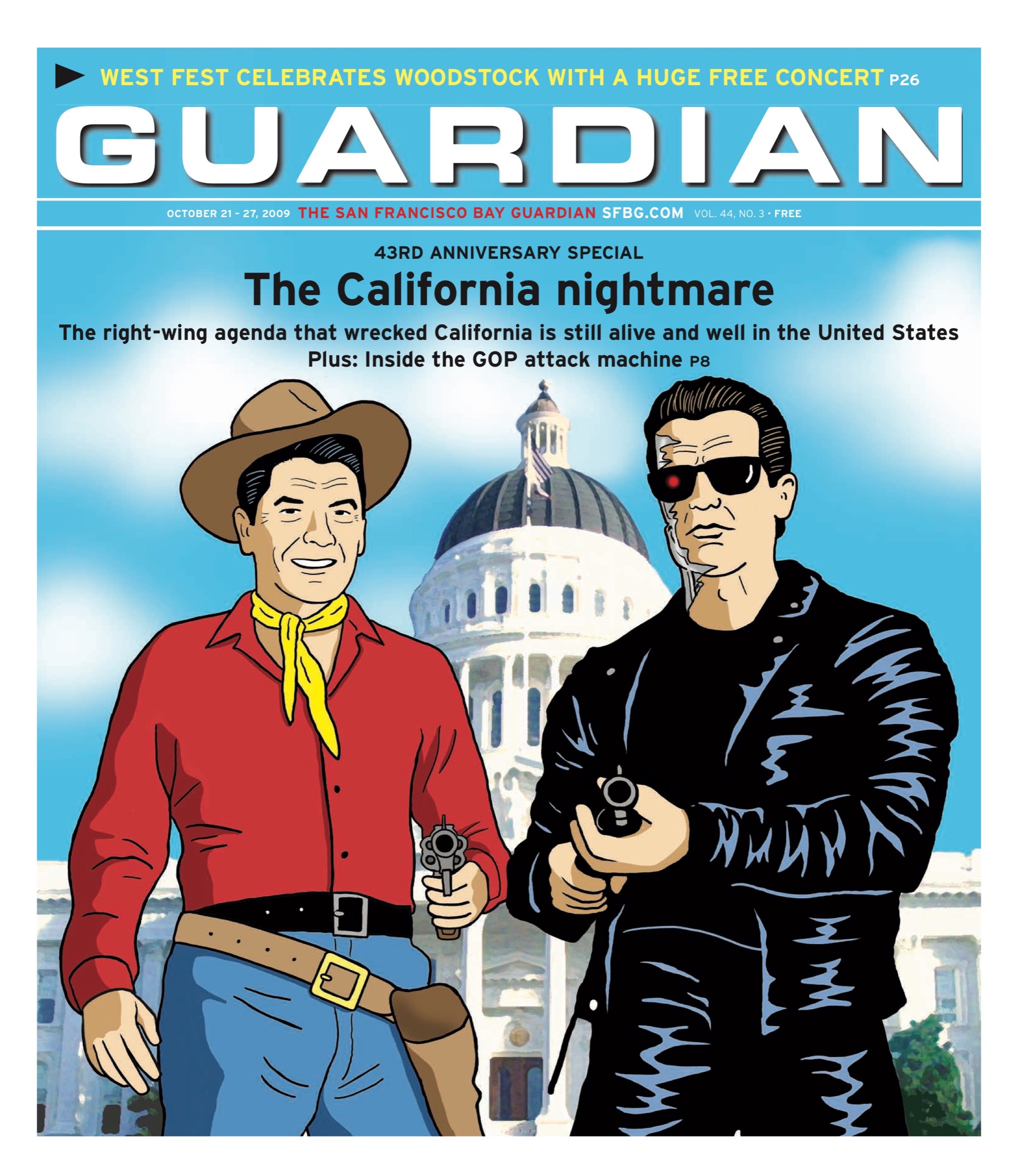
When the first issue of the Bay Guardian hit the stands in 1966, it was still really possible to talk about the California dream. The state had seemingly limitless potential and was in many way a model for the nation — a free public university system that was the envy of the world, an economy that provided jobs to hundreds of thousands of new arrivals, the beginnings of what would be the nation’s premier environmental movement pushing to save San Francisco Bay, save the coast, save Lake Tahoe … and the Free Speech Movement, the Summer of Love, the United Farm Workers Union, and so much more that was transforming politics and culture in the United States from the West Coast.

Twelve years later, it was all falling apart. Eight years of Gov. Ronald Reagan and then the passage of Proposition 13 launched a very different kind of movement out of the West, a movement that sought to dismantle the public sector and the social safety net, to treat government as the enemy, and to use culture wars to convince working-class Americans to vote against their own economic interests.

And now California is being described as the nation’s first failed state. Gov. Arnold Schwarzenegger — the second Republican actor to hold that role — has driven the state to the brink of bankruptcy. The University of California is drowning in red ink, raising fees and turning away students. The state’s water system is a mess; cities and counties are in fiscal collapse; the economy’s in the tank; and nobody seriously talks about a California dream anymore.

The story of how that happened — and how the diseases of tax-revolts, privatization, government corruption, and public disempowerment spread east from California — is the focus of this 43rd anniversary issue. It’s both enlightening and a bit scary to read through old issues, because in hundreds of stories over the past four decades, the Guardian has warned of exactly what was to come.

The very first issue of the Bay Guardian talked about the "historic election" pitting the incumbent, Democrat Pat Brown, against Reagan. A lot of people in the emerging "new left" were arguing that there wasn’t a bit of difference between the two, and that you might as well sit out the election. But the Guardian had a different take. The election was really about the direction California wanted to go, the paper said, a choice between a state that cares about the public sector and social welfare and a state where those things don’t matter.

"Reagan’s stands typify the temper of the cause," the Nov. 7, 1966 editorial stated. "He is on record, at various times, in opposition to the progressive income tax, Social Security, Medicare, the anti-poverty program, farm subsidies, the TVA, the Civil Rights Act, the Voting Rights Act, public housing, federal aid to education, and veterans hospitalization for anything other than service-connected disabilities. How can a man or a movement govern the state of California with such a political philosophy?"

Reagan’s election may have seemed like a fluke, but it was nothing of the sort. By the mid 1960s, with the counterculture — and equally important, the economic left — looking to make major inroads in American policy, the broad outlines of a right-wing attack plan were in place.

That’s something the Guardian always recognized — that powerful people who moved the levers of government typically did so with a long-term plan.

In San Francisco, part of that plan was the transformation of a human-scale city to a West Coast version of Manhattan. The idea: tear up South of Market (then mostly low-income housing) for a shiny new convention center and hotels. Dump dozens of big high-rise office buildings downtown. Construct a fixed-rail system to carry suburban commuters into the dense downtown. Drive up property values — massively — and if that means blue collar jobs and working class people had to go to make way for wealthier office workers, so be it. In the end, of course, the architects of the plan — landowners, developers, bankers, and big business leaders — became immensely wealthy.

On the state and national level, their plans were broader. Even so, they had one major aim: throttle the pubic sector. Cut off the funding for government programs, reduce regulations, undermine any concept of a welfare estate — and cut taxes on the rich.

As we report on page 8, the architects of this plan are happy today to talk about how it worked — how Reagan launched his war on government back in the 1970s, how a group of well-funded think tanks developed plans, and political consultants took advantage of people’s fears (and the Democratic Party’s failures) to put those plans into action.

The movement really got off the ground in 1978 with the passage of Proposition 13.

Prop. 13 emerged from a state in the middle of a massive growth spurt and a heated political cauldron of money, race, and Legislative failure. Howard Jarvis, a Republican landlord lobbyist who hated taxes, hated government, hated public schools, and disdained most Californians — "63 percent of [public school] graduates are illiterate" and would have no need for public libraries, he once quipped — took advantage of a gaping hole in political leadership and set off a movement that would cripple the United States of America.

The measure marked the final, fatal end in California of the era known as the ’60s — a period when the left was ascendant, when taxes on the wealthy funded education, infrastructure and programs for inner cities, and when economic and cultural liberalization seemed to be spreading across the nation.

Rising property values, driven by rapid population growth, were driving up property taxes — and the problem was real. Long-time residents, particularly people on fixed incomes, saw their taxes rise so high they couldn’t afford to stay in their homes. The Legislature could have addressed that (with, say, a split-roll measure that taxed residential and commercial property at different rates) but utterly failed to move on the crisis.

A series of assessor’s office scandals didn’t help, either. And, at the same time, the California Supreme Court ruled that rich school districts had to share revenue with poor districts, infuriating wealthy white property owners.

Jarvis and his partner Paul Gann circulated petitions to roll back property taxes and make it almost impossible to raise taxes in the future. It passed with 65 percent of the vote.

Of course, big businesses (particularly utilities) were the big winners. As the Guardian pointed out on June 1, 1978, the top five utilities in California alone (including Pacific Gas and Electric Co.) would gain billions from the tax cuts.

But beneath it all was a simmering discontent with government — something Jarvis had set afire and would later be used by Ronald Reagan and the right-wing operatives who backed him to undermine the New Deal, the social safety net, and the basic social contract in America. The antitax folks played to white people who didn’t want to see their money going to minorities, to the middle-class folks who thought (thanks to the assessor scandals) their tax money was being wasted by corruption — and to a lot of younger people coming out of the 1960s who had learned from Vietnam, COINTELPRO, and Watergate not to trust government.

The Bay Guardian opposed the measure strongly: "Most analyses indicate that without replacement taxes, hundreds of thousands of California public servants would be thrown out of work (which is exactly what Howard Jarvis intends) … " a May 18, 1978 editorial noted. "Vote for Prop. 13 only if you favor decreased government services (including cutbacks in everything from libraries to schools to street-cleaning crews and possibly police and fire departments) and are fond of half-baked measures that favor the rich."

Prop. 13 set off a national movement to cut taxes — and riding that wave, Reagan was elected president in 1980. He immediately set about attempting to slash taxes on big business and the wealthiest Americans, and eliminate environmental, workplace safety, and employment regulations.

You can see the results in California — and across the nation. The very strategies that emerged in this state and that the right has supported over the years have come very close to destroying the United States economy, leaving millions out of work — while the gap between the rich and the poor has risen to unsustainable levels.

Part of the reason this national attack on government and the public sector worked was the failure of Democrats to recognize that corruption matters. It was no small wonder that Californians were losing faith in government — in the 1970s and 1980s, the state Legislature, under the Democratic control of Speaker Willie Brown, was awash in sleaze, paralyzed by lobbyist influence and campaign money. Yet leading Democrats, fearful of Brown’s power, did little to reign in the appalling corruption.

In fact, when Brown became mayor of San Francisco, the entire Democratic Party, from the president of the United States on down, seemed to treat him as royalty — despite the fact that he was selling the city to every developer and corporate lobbyist who waved money under his nose. When taxpayers knew that a large part of their money was going to fund juicy jobs for Brown’s cronies and pet projects, it was hard to argue for higher taxes.

And it was the Democratic Party leadership in San Francisco who presided over two of the greatest examples of privatization of public resources in modern history: the Presidio and the Raker Act. Rep. Nancy Pelosi was the author of the bill that, for the first time, turned a national park over to the private sector — and hardly a Democratic leader in the city dared to lift a finger in opposition. And for decades — since the Guardian first broke the story in 1969 — the city’s Democratic power brokers have bowed and genuflected to PG&E and allowed the private utility to control the local electric grid and block implantation of the federal law that mandates public power for San Francisco.

And now PG&E wants to pull off one of the greatest feats of privatization in American history. The company has launched a ballot initiative that would wipe out any further attempts at public power in California, essentially guaranteeing that private companies, not the public sector, control the vast, critical resource of electric power in this state.

It’s the latest big battle between two divergent visions of America — and this time, the folks who have done so much damage to this state and this nation can’t be allowed to win. In fact, maybe the campaign against PG&E can be the turning point, the time when California realizes that privatization, attacks on the public sector, tax cuts for the rich, and political sleaze are a formula for disaster.

Attack of the right-wing nuts

0

news@sfbg.com

In April 2006, with the approval ratings of President George W. Bush plummeting, his senior political advisor, Karl Rove, began discussing a plan to turn things around.

His strategy: attack progressive organizations that were registering low-income people to vote and helping them fight corporate power — and claim it was about voter fraud.

The main White House target, newly released records show, was the Association of Community Organizations for Reform Now (ACORN). By the end of 2006, Rove would oversee the removal of eight U.S. attorneys, including two who refused to press bogus charges against ACORN in New Mexico and Missouri, and a third under similar suspicions in Washington state.

ACORN made a convenient target for Rove and his gang — and the well-orchestrated attacks on that group, which have exploded into the headlines this year, provide a compelling case study in how the right wing operates in this country.

Although it was the GOP that removed tens of thousands of likely Democratic voters from the rolls in the 2000 and 2004, the Republicans and their allies were able to make the issue of voter fraud all about ACORN, using a handful of isolated problems to undercut an organization focused on giving a voice to poor people.

Founded in Little Rock, Ark. at the end of the 1960s, ACORN has grown into the nation’s top community-organizer group, thanks to success in improving poor people’s housing, wages, and educational access. By the eve of the 2008 presidential election, ACORN had helped register more than 1.3 million voters — mostly young, low-income minorities — in 21 states, including the battleground states of Florida, Pennsylvania, Michigan, and Ohio.

As The Nation put it, these successes made ACORN “something of a right-wing bogeyman.”

And while the recent furor over a conservative videographer secretly taping ACORN employees saying dumb things has somehow become one of the big political stories of the year, the major media have mostly ignored how this attack is part of a larger conservative strategy.

In August, hundreds of pages of e-mails and transcripts related to the 2006 U.S. attorney-firing scandal were released to the press and public — but few news outlets mentioned that Rove was focused on attacking ACORN’s voter registration efforts, even though ACORN and voter fraud are repeatedly mentioned in these documents.

“This is about a campaign that goes back a decade to big business and that people who don’t like what ACORN does and is effective at — namely, helping groups to organize and put pressure on banks around sub[prime] mortgage loans to stop racial discrimination,” Peter Dreier, a professor of politics at Occidental College, told us.

It wasn’t really about voter fraud. As former U.S. Attorney David Iglesias, a Republican from New Mexico, recently stated on The Rachel Maddow Show: “They were looking at numbers [and] didn’t like the demographic tidal wave that was coming their way so they wanted to engage the machinery of the Justice Department to stop that wave.”

After two years of investigating ACORN and other supposed perpetrators of left-wing voter fraud, Igelias said, “I couldn’t find one case I could prosecute.”

But for the right-wing attack machine, it didn’t matter — the damage was done.


THEIR MASTERS’ VOICE

White House communications strategist Anita Dunn created a stir in mid-October when she told CNN host Howie Kurtz that Fox News “is really more of a wing of the Republican Party. … Let’s not pretend they’re a news network like everybody else is.”

It didn’t take long for Fox commentator Glenn Beck to retaliate. In a series of broadcasts, he attacked Dunn, compared the Obama administration to a communist dictatorship, and likened the criticism to the Holocaust. “Ask yourself this question,” Beck said during a radio segment, vaguely addressing people he called “good journalists” at other mainstream news networks. “When they’re done with Fox, and you decide to speak out on something — it’s the old ‘first they came for the Jews, and I wasn’t Jewish.'” Beck concluded the segment by warning his audience, “this is how a dictatorship always starts.”

Beck’s comment may strike San Francisco progressives as outrageous, but given the rhetoric routinely issuing from the right-wing megaphone, it’s also 100 percent predictable.

But when Dunn called Fox News Channel an arm of the GOP, she was dead on. Consider the history of its chairman and CEO, Roger Ailes, who ran Richard Nixon’s 1968 presidential campaign and later those of presidents Ronald Reagan and George H.W. Bush, guiding them all to victory through his brilliant and successful media campaign strategies.

“Roger Ailes is a newsman with a profound disdain for newsmen,” according to a New York magazine profile. “Fox News is being promoted as an anti-network, a news channel designed to appeal to the people … who don’t trust [the others].” Portrayed in the story as a “self-described paranoid,” Ailes reportedly resigned from an earlier position as head of CNBC after questions were raised about his desire to use his position as a weapon against his enemies.

Fox News is an outgrowth of its parent company, Rupert Murdoch’s News Corporation. A look at the board of directors of this multinational giant yields some startling insight into who controls the “fair and balanced” news network. Ailes himself has a seat at the table — but not every board member has a background in media.

News Corp. board member Viet Dinh, for example, is an attorney who came to the United States as a boy from Vietnam. In a 2002 interview with the Los Angeles Times, Dinh, who then served as an assistant attorney general at the Department of Justice, recalled an exchange he had with then-Attorney General John Ashcroft in the wake of the Sept. 11 attacks. “He told me: ‘The art of leadership is the redefinition of the possible. I want you to be the think tank to help me redefine the possible for the Department of Justice.'”

Dinh successfully redefined “the possible” by acting as a primary author of the USA PATRIOT Act, quickly propelling himself to prominence as a darling of conservatives and an enemy of civil liberties watchdog groups. A law professor at Georgetown University, Dinh is also founder and chief of Bancroft Associates PLLC, a consulting firm that specializes in helping Fortune 500 companies “navigate the federal and state criminal or civil investigations, congressional investigations, and complex litigation,” according to the firm’s Web site. It also specializes in public relations.

Another board member is José Maria Aznar, former prime minister of Spain. Aznar was born into a politically active, conservative family in Spain in 1953, and both his father and grandfather held government jobs under Gen. Francisco Franco, the fascist dictator. Aznar was handpicked by Manuel Fraga, a minister under Franco, to succeed him in leading Spain’s center-right People’s Party (Partido Popular), according to an article in the U.K.’s The Independent.

Aznar now serves as president of the Foundation for Social Studies and Analysis, a right-wing think tank based in Spain that, according to its Web site, works closely with the CATO Institute, the Heritage Foundation, and other conservative U.S. think tanks.

Occupying other seats at News Corp.’s board table is an assortment of professors, attorneys, public-relations experts, and businessmen with their fingers in a variety of banks and multinational corporations. Among the more familiar names are Phillip Morris, Ford Motor Co., Hewlett Packard, Goldman Sachs, HSBC North America, and JP Morgan Chase. Lesser known are the investment banking firms that have stakes in the petroleum industry, utilities, mining companies, and real estate.

While the connections between corporate interests and the country’s leading conservative propagandist are extensive and obvious, there’s a stark contrast between the message delivered by Fox News and the interests of its parent company.

Fox News plays up the theme of patriotism and reinforces the idea that there is a distinction between “real Americans” and outsiders. But Fox’s board is made up of members whose lives and economic interests are scattered across the globe, but have one common thread: they all control extraordinary sums of concentrated wealth.


PROPAGANDA AND EMOTIONS

While Dunn called Fox News Channel an arm of the Republican Party, others have gone so far as to label its content pure propaganda — and incredibly effective propaganda at that.

“This is very, very sophisticated propaganda,” says Bryant Welch, a clinical psychologist, author, and expert on political manipulation. “I don’t think progressives really get it that it’s a technique being used all the time.”

Welch said when he began working as a Washington, D.C., lobbyist on behalf of the American Psychological Association years ago, he started observing the tricky political maneuverings at play in the nation’s capital through the eyes of a psychotherapist who had spent some 30,000 hours helping patients confront their deep-seated hang-ups.

To his surprise, Welch found that some of the most successful right-wing political operatives also seemed to have an understanding of psychology — although they use the knowledge very differently. “A lot of it is psychological manipulation,” Welch asserts.

George Lakoff, a professor of linguistics at UC Berkeley and author of Don’t Think of an Elephant: Know Your Values and Frame the Debate, offered a similar analysis. He said Republicans approach issues as a marketing challenge. “They’ve learned from the cognitive scientists. Even if they don’t understand the science, they know how to do marketing.”

Welch, who is also an attorney and Huffington Post blogger, provides an analysis of how the right wing gets its message across in his book, State of Confusion: Political Manipulation and the Assault on the American Mind. He argues that public relations professionals, right-wing commentators, and others in the business of shaping public opinion are skilled at tapping into widespread feelings of anxiety and uncertainty.

“In this world, things are confusing,” he explains. “You’ve got to be constantly adapting and assimiutf8g new information. When times get confusing, people have a hard time forming a sense of what’s real.”

Right-wing television and radio personalities like Sean Hannity, Glenn Beck, or Rush Limbaugh prey on this widespread uncertainty, Welch argues, by providing viewers and listeners with an absolute version of reality that is easily grasped, neatly divided into right and wrong, and spelled out in very certain terms.

“The thing that Bill O’Reilly and Sean Hannity do is, they sound very powerful, certain, and aggressive,” Welch told us. “[Viewers] identify with that strength. They draw a sense of security from someone who has certainty about what is real.”

Viewers who find that their anxiety subsides when they tune in are hard-pressed to go back and reexamine their views later on, Welch said, because they’re satisfied with the answers they’ve been given. And in right-wing messaging, those answers consistently cast government as the enemy.

On Fox and AM radio, the use of repetition helps drive home an idea until it becomes a conviction in the mind of a listener. Television reinforces those key phrases with patriotic color schemes. The whole package is designed to transform an audience’s sense of bewilderment over a complex world into trust in spokespeople helping them make sense of it.

The right-wing commentators’ success lies partly in their ability to harness core human emotions such as paranoia or envy, Welch said. He pointed to the health care debate as an example, noting how Fox News has repeatedly played up the false concept of “death panels” to create fear.

To counter this tactic, Lakoff suggests that the left would do well to learn how to frame things in moral terms instead of playing defense against right-wing spin masters.

President Obama’s problem, Lakoff said, is that he is still trying to unify the country. “More power to him, but I don’t believe it’s possible,” Lakoff said. “Republican presidential candidate Sen. John McCain got 47 percent of the vote, bad as he was, and given how terrible a campaign he ran, and given that Obama ran a perfect campaign. So Obama’s election was not a landslide, even though he had one of the best campaign organizations and one of the best framed campaigns ever.” Obama doesn’t play the same manipulative games, Lakoff noted. “Obama believes that if you just tell the truth, it’ll be OK, and every day have a truth squad to find the conservative lies,” Lakoff said. “What he didn’t understand was that by focusing on the conservative lies, he was in fact helping the conservative cause. It’s like Richard Nixon saying, ‘I’m not a crook.'” That why Lakoff says it’s so important for Obama, and for the progressive movement in general, to define the moral imperative behind empowering the people and their government to create a better world, then aggressively push a campaign to do so. “It’s the ‘this is the right thing to do’ approach,” Lakoff explained. “And once it’s been framed that way, then you can say what’s false or true. But you should never go on the defensive first. As soon as you go point by point, you are on the defensive.”

Happy belated Alaska Day

0

October 18 is Alaska Day, something I discovered while working on a piece about right wing nuts—which led me to wonder what people in the home state of one of the nuttiest right wing nuts think of their nut.

Yes, I know most folks on the left feel like they never want to hear from Sarah “moose-in-the headlights” Palin again, but that could be a mistake, according to a blog called The Mudflats: Tiptoeing Through the Muck of Alaskan Politics, which is home to this piece about Palin’s waning popularity, full of cool charts with arrows pointing (sigh of relief) mostly downwards.

As Mudflats notes, “69 percent of 20 percent may be good enough to sell books, but good enough to get her elected to the highest office in the land? Not so much. Really, it should be every Democrat’s dream to see a Palin 2012 run for the White House. It would not only be enough to secure Obama a second term, but it might actually cause the complete destruction of the Republican Party.

Then, Eisenhower can quit rolling over in his grave.”

All of which is worth remembering when it’s raining outside and the healthcare debate is droning on and it feels like the Dems got stuck in a rut, with Palin kicking mud in their faces with the wheels of her Chevy Suburban. But while I admire Mudflats’ humor, I’m not sure I’m willing to go so far as to stick this bumper sticker on my beat-up black Anonomobile:

palinbachmann-500x166.gif

Michael Pollan’s modest proposals

0

By Sarah Morrison

While down-to-earth food expert and journalist Michael Pollan might not quite have offered the definitive “Omnivore’s Solution” — to cite the title of his talk — when he kick-started the 2009/10 Strictly Speaking series at Berkeley’s Zellerbach Hall (9/30/2009), he did provide an entertaining and accessible critique of what he called America’s “unhealthy obsession with healthy eating.”

“We are lost, really lost in the supermarket,” said the author of three New York Times bestsellers, shortly after he took the stage humorously laden down with Safeway bags, and enough packets of Twinkies, Fruit Loops, Soda and Wonder Bread to make even the most gluttonous in the audience start to feel queasy. Promising to “connect the dots between diet and health in food systems as a whole,” Pollan guided the enthusiastic audience through his easy-to-follow theory of food politics – a theory that he summed up in seven words: “Eat food, not too much, mostly plants.”

pollan.jpg
Michael Pollan

Satirising the nation’s obsession with “nutritionism,” a pseudo-science that Pollan compared to surgery in the 1650’s (“promising and fascinating to watch, but are you really ready to let them operate on your life?”), the lecture went on to critique the demonising of certain nutrients in American society (think trans fat, carbohydrates, sugars), and the intellectualising of food to the point where the regular American feels unable to eat anything without the help of an expert by their side.

Film listings

0

Film listings are edited by Cheryl Eddy. Reviewers are Kimberly Chun, Michelle Devereaux, Max Goldberg, Dennis Harvey, Johnny Ray Huston, Louis Peitzman, Lynn Rapoport, Ben Richardson, Matt Sussman, and Laura Swanbeck. The film intern is Fernando F. Croce. For rep house showtimes, see Rep Clock. For first-run showtimes, see Movie Guide.

SF DOCFEST

The eighth annual San Francisco Documentary Film Festival runs Oct 16-29 at the Roxie, 3117 16th St, SF. Tickets ($11) are available by visiting www.sfindie.com. For commentary, see "Is the Truth Out There?" All times p.m.

FRI/16

The Entrepreneur 7. Shooting Robert King 7. Drums Inside Your Chest 9:15. Houston We Have a Problem 9:15.

SAT/17

Drums Inside Your Chest 2:30. Waiting for Hockney 2:30. Between the Folds 4:45. Finding Face 4:45. HomeGrown 7. The Wild and Wonderful Whites of West Virginia 7. Dust and Illusions 9:15. The Earth Is Young 9:15.

SUN/18

"Bay Area Shorts" (shorts program) 2:30. We Said, No Crying 2:30. Another Planet 4:45. I Need That Record: The Death (or Possible Survival) of the Independent Record Store 4:45. Cat Ladies 7. Off and Running 7. Vampiro 9:15. What’s the Matter with Kansas? 9:15.

MON/19

Between the Folds 7. We Said, No Crying 7. October Country 9:15. Waiting for Hockney 9:15.

TUES/20

The Earth Is Young 7. I Need That Record: The Death (or Possible Survival) of the Independent Record Store 7. Another Planet 9:15. The Wild and Wonderful Whites of West Virginia 9:15.

MILL VALLEY FILM FESTIVAL

The 32nd Mill Valley Film Festival runs through Sun/18 at the Century Cinema, 41 Tamal Vista, Corte Madera; CinéArts@Sequoia, 25 Throckmorton, Mill Valley; 142 Throckmorton Theatre, 142 Throckmorton, Mill Valley; and Smith Rafael Film Center, 1118 Fourth St, San Rafael. Tickets (most shows $12.50) available by calling 1-877-874-MVFF or visiting www.mvff.org. All times p.m. unless otherwise noted.

WED/14

Rafael The Horse Boy 4:30. "5@5: America Is Not the World" (shorts program) 5. "Spotlight on Jason Reitman:" Up in the Air 6:30. White Wedding 7. Linoleum 7:15. Tapped 9. The Eclipse 9:15. Up in the Air 9:40.

Sequoia The Swimsuit Issue 4:15. "5@5: Oscillate Wildly" (shorts program) 5. Trimpin: The Sound of Invention 6:30. Surrogate 7. Elevator 8:45. Hellsinki 9.

Throck "Insight: The Cassel Touch" (interview and discussion) 8.

THURS/15

Rafael The Girl on the Train 4. Reach for Me 4:30. "5@5: The More You Ignore Me, the Closer I Get" (shorts program) 5. Icons Among Us: jazz in the present tense 6:30. Meredith Monk: Inner Voice 6:45. "Tribute to Woody Harrelson:" The Messenger 7. Hipsters 9. Barking Water 9:15.

Sequoia "5@5: Sister I’m a Poet" (shorts program) 5. Jim Thorpe: The World’s Greatest Athlete 5:15. Apron Strings 6:45. The Missing Person 7:30. This Is the Husband I Want! 9. Winnebago Man 9:30.

Throck Storm 7.

FRI/16

Rafael Sweet Rush 4. "5@5: The Edges Are No Longer Parallel" (shorts program) 5. Stalin Thought of You 6. "Tribute to Anna Karina:" Victoria 6:30. Zombie Girl: The Movie 7. Jermal 8:15. Trimpin: The Sound of Invention 9. Red Cliff 9:30.

Sequoia Shylock 4. Shameless 5. Tenderloin 6:45. A Thousand Suns and Mustang: Journey of Transformation 7. One Crazy Ride 8:45. Happy Tears 9:15.

Throck Troupers: 50 Years of the San Francisco Mime Troupe 7:30.

SAT/17

Rafael [Blank.] 11am. A Thousand Suns and Mustang: Journey of Transformation noon. Ricky Rapper 1. The Girl on the Train 1:45. Hellsinki 2. Oh My God 3. The Strength of Water 4:15. Awakening from Sorrow 4:45. The Missing Person 5:30. The Most Dangerous Man in America: Daniel Ellsberg 6:45. The Swimsuit Issue 6:45. Surrogate 7:45. Tenderloin 9. Hipsters 9:15.

Sequoia The Letter for the King 10:30am. Eat the Sun noon. White Wedding 1:30. Miracle in a Box: A Piano Reborn 2:30. Dark and Stormy Night 3:45. Mine 5. A Year Ago in Winter 6:15. Reach for Me 7:15. "Hi De Ho Show" (shorts and music) 9:15. Winnebago Man 9:45.

Throck "New Movie Labs: Distribution of Specialty Film" (seminar) 12:30. Project Happiness 3. "5@5: The Edges Are No Longer Parallel" (shorts program) 5. "Cinemasports" (shorts program of films made in one day) 7:30.

SUN/18

Rafael Stella and the Star of the Orient noon. This Is the Husband I Want! noon. Mine 12:30. Apron Strings 2:30. Soundtrack for a Revolution 2:45. One Crazy Ride 3. Project Happiness 5. The Young Victoria 5:15. Race to Nowhere 5:45. Skin 7:30. Bomber 7:45.

Sequoia The Ten Lives of Titanic the Cat 12:30. Meredith Monk: Inner Voice 1. Oh My God 2:30. The Most Dangerous Man in America: Daniel Ellsberg 3:15. Looking for Eric 5:15. The Strength of Water 5:45.

Throck "New Movies Lab: Active Cinema" 12:30. "A Sweeter Music: Live Concert with Sarah Cahill and John Sanborn" 3:30.

OPENING

Birdwatchers War-painted natives don bows and arrows and watch from the Amazon riverbank as a boat of tourists passes by. Away from white eyes, they slip back into their modern clothes and are paid by the tour guide for a job well done. Had it sustained the evocative wryness of its opening scene throughout its running time, Marco Bechi’s film would have been more than a frequently striking culture-clash tract. As it is, there’s much to admire in this Brazil-set account of a disbanded Guarani-Kaiowà tribe struggling to hang on to their expiring heritage, from its clear-eyed view of the lingering human toll of colonialism to its uncondescending portrait of indigenous mysticism. Unfortunately, Bechi’s penchant for underlined contrasts and clumsy staging often threaten to sabotage his evocative mix of ethnography, satire, and social critique. While far from being as complacent as the titular sightseers, in the end the film is similarly content to merely skim over an ongoing cultural genocide. (1:40) Sundance Kabuki. (Croce)

*An Education See "Culture Class." (1:35) Albany, Embarcadero.

The Horse Boy Rupert Isaacson and Kristin Neff are a Texas couple struggling to raise their five-year-old autistic son Rowan. When they discover that the boy’s tantrums are soothed by contact with horses, they set out on a journey to Mongolia, where horseback riding is the preferred mode of traveling across the steppe and sacred shamans hold the promise of healing. Michael Orion Scott’s documentary is many things — lecture on autism, home video collage, family therapy session, and exotic travelogue. Above all, unfortunately, it’s a star vehicle for Isaacson, whose affecting concern for his son is constantly eclipsed by his screen-hogging concern for his own paternal image (more than once he declares that he’s a better father thanks to Rowan’s condition). The contradiction brings to mind doomed activist Timothy Treadwell in Grizzly Man (2005), and indeed the film could have used some of Werner Herzog’s inquisitive touch, if only to question the artistic merits of showing your son going "poopie." Twice. (1:33) Embarcadero, Shattuck. (Croce)

Law Abiding Citizen "Spike Lee’s Inside Man (2006) as re-imagined by the Saw franchise folks" apparently sounded like a sweet pitch to someone, because here we are, stuck with Jamie Foxx and Gerard Butler playing bloody and increasingly ludicrous cat-and-mouse games. Foxx stars as a slick Philadelphia prosecutor whose deal-cutting careerist ways go easy on the scummy criminals responsible for murdering the wife and daughter of a local inventor (Butler). Cut to a decade later, and the doleful widower has become a vengeful mastermind with a yen for Hannibal Lecter-like skills, gruesome contraptions, and lines like "Lessons not learned in blood are soon forgotten." Butler metes out punishment to his family’s killers as well as to the bureocratic minions who let them off the hook. But the talk of moral consequences is less a critique of a faulty judicial system than mere white noise, vainly used by director F. Gary Gray and writer Kurt Wimmer in hopes of classing up a grinding exploitation drama. (1:48) Presidio. (Croce)

*More Than a Game In the late 1990s, armed with a camera and a certain amount of tenacity, Kristopher Belman set out to capture the glory that was regularly manifesting itself on a certain Akron, Ohio basketball court. The main reason: a future superstar named LeBron James. But James’ remarkable teenage career (at least until the age of 18, when the St. Vincent-St. Mary High School grad became the number one NBA draft pick) wasn’t completely a solo act; his core group of friends, the team’s starting line-up, was so tight they were called "the Fab Five." Despite Belman’s determination to equally divide the spotlight, James was clearly a star then as he is now, slam-dunking on hapless opponents even as he grappled with his burgeoning celebrity status. I’ll never tire of the tale of how James raised eyebrows when he started driving a brand-new Hummer — only to quash whispers of misconduct when it was revealed that his mother, Gloria, was able to secure a loan for the gift based solely on the understanding (shared by all) that her son’s skills would make him a zillionaire before his next birthday. (1:45) (Eddy)

New York, I Love You A variety of filmmakers (including Fatih Akin, Shekhar Kapur, Mira Nair, and Brett Ratner) directed segments of this stateside answer to 2006’s Paris, je t’aime. (1:43) Bridge, Shattuck.

The Providence Effect Located in Chicago’s gang-infested West side, the illustrious Providence St. Mel School rises above its surroundings like a flower in a swamp. Or at least it does in Rollin Binzer’s documentary, where analysis of the institution’s great achievements at times edges into a virtual pamphlet for enrollment. Focusing mainly on affable school president Paul J. Adams III, a veteran of the civil rights movement whose "impossible dream" made Providence possible, the film chronicles the daily activities of teachers and students vying for success in the face of poverty and crime. Given the school’s notoriously unwholesome environment, it’s a bit disappointing that the film chooses to exclusively follow the trajectory of model pupils, trading grittier tales of struggle in favor of a smoother ride of feel-god buzzwords and uplifting anecdotes. The documentary isn’t free of scholarly platitudes straight out of Goodbye, Mr. Chips (1939), but, in times when teachers get as much respect as Rodney Dangerfield, its celebration of the importance of education is valuable. (1:32) Lumiere, Shattuck. (Croce)

The Stepfather Dylan Walsh: as scary as Terry O’Quinn? Discuss. (1:41)

Where the Wild Things Are Spike Jonze directs a live-action version of Maurice Sendak’s classic children’s tale. (1:48) Four Star, Grand Lake, Marina.

ONGOING

*Bright Star Is beauty truth; truth, beauty? John Keats, the poet famed for such works as "Ode on a Grecian Urn," and Jane Campion, the filmmaker intent on encapsuutf8g the last romance of the archetypal Romantic, would have undoubtedly bonded over a love of sensual details — and the way a certain vellum-like light can transport its viewer into elevated reverie. In truth, Campion doesn’t quite achieve the level of Keats’ verse with this somber glimpse at the tubercular writer and his final love, neighbor Fanny Brawne. But she does bottle some of their pale beauty. Less-educated than the already respected young scribe, Brawne nonetheless may have been his equal in imagination as a seamstress, judging from the petal-bonneted, ruffled-collar ensembles Campion outfits her in. As portrayed by the soulful-eyed Abbie Cornish, the otherwise-enigmatic, plucky Brawne is the singularly bright blossom ready to be wrapped in a poet’s adoration, worthy of rhapsody by Ben Whishaw’s shaggily, shabbily puppy-dog Keats, who snatches the preternaturally serene focus of a fine mind cut short by illness, with the gravitational pull of a serious indie-rock hottie. The two are drawn to each other like the butterflies flittering in Brawne’s bedroom/farm, one of the most memorable scenes in the dark yet sweetly glimmering Bright Star. Bathing her scenes in lengthy silence, shot through with far-from-flowery dialogue, Campion is at odds with this love story, so unlike her joyful 1990 ode to author Janet Frame, An Angel at My Table (Kerry Fox appears here, too, as Fanny’s mother): the filmmaker refuses to overplay it, sidestepping Austenian sprightliness. Instead she embraces the dark differences, the negative inevitability, of this death-steeped coupling, welcoming the odd glance at the era’s intellectual life, the interplay of light and shadow. (1:59) Empire, Piedmont, Presidio, Sundance Kabuki. (Chun)

*Capitalism: A Love Story Gun control. The Bush administration. Healthcare. Over the past decade, Michael Moore has tackled some of the most contentious issues with his trademark blend of humor and liberal rage. In Capitalism: A Love Story, he sets his sights on an even grander subject. Where to begin when you’re talking about an economic system that has defined this nation? Predictably, Moore’s focus is on all those times capitalism has failed. By this point, his tactics are familiar, but he still has a few tricks up his sleeve. As with Sicko (2007), Moore proves he can restrain himself — he gets plenty of screen time, but he spends more time than ever behind the camera. This isn’t about Moore; it’s about the United States. When he steps out of the limelight, he’s ultimately more effective, crafting a film that’s bipartisan in nature, not just in name. No, he’s not likely to please all, but for every Glenn Beck, there’s a sane moderate wondering where all the money has gone. (2:07) California, Empire, Grand Lake, 1000 Van Ness, Presidio, SF Center, Sundance Kabuki. (Peitzman)

Cloudy With a Chance of Meatballs (1:21) Oaks, 1000 Van Ness.

Coco Before Chanel Like her designs, Gabrielle "Coco" Chanel was elegant, très chic, and utterly original. Director Anne Fontaine’s French biopic traces Coco (Audrey Tautou) from her childhood as a struggling orphan to one of the most influential designers of the 20th century. You’ll be disappointed if you expect a fashionista’s up close and personal look at the House of Chanel, as Fontaine keeps her story firmly rooted in Coco’s past, including her destructive relationship with French playboy Etienne Balsar (Benoît Poelvoorde) and her ill-fated love affair with dashing Englishman Arthur "Boy" Capel (Alessandro Nivola). The film functions best in scenes that display Coco’s imagination and aesthetic magnetism, like when she dances with Capel in her now famous "little black dress" amidst a sea of stiff, white meringues. Tautou imparts a quiet courage and quick wit as the trailblazing designer, and Nivola is unmistakably charming and compassionate as Boy. Nevertheless, Fontaine rushes the ending and never truly seizes the opportunity to explore how Coco’s personal life seeped into her timeless designs that were, in the end, an extension of herself. (1:50) Albany, SF Center. (Swanbeck)

Couples Retreat You could call Couples Retreat a romantic comedy, but that would imply that it was romantic and funny instead of an insipid, overlong waste of time. This story of a group of married friends trying to bond with their spouses in an exotic island locale is a failure on every level. Romantic? The titular couples — four total — represent eight of the most obnoxious characters in recent memory. Sure, you’re rooting for them to work out their issues, but that’s only because awful people deserve one another. (And in a scene with an almost-shark attack, you’re rooting for the shark.) Funny? The jokes are, at best, juvenile (boners are silly!) and, at worse, offensive (sexism and homophobia once more reign supreme). There is an impressive array of talent here: Vince Vaugh, Jason Bateman, Kristen Bell, Jean Reno, etc. Alas, there’s no excusing the script, which puts these otherwise solid actors into exceedingly unlikable roles. Even the gorgeous island scenery — Couples Retreat was filmed on location in Bora-Bora — can’t make up for this waterlogged mess. (1:47) Grand Lake, Marina, 1000 Van Ness, SF Center, Shattuck. (Peitzman)

*District 9 As allegories go, District 9 is not all that subtle. This is a sci-fi action flick that’s really all about racial intolerance — and to drive the point home, they went and set it in South Africa. Here’s the set-up: 20 years ago, an alien ship arrived and got stuck, hovering above the Earth. Faster than you can say "apartheid," the alien refugees were confined to a camp — the titular District 9 — where they have remained in slum-level conditions. As science fiction, it’s creative; as a metaphor, it’s effective. What’s most surprising about District 9 is the way everything comes together. This is a big, bloody summer blockbuster with feelings: for every viscera-filled splatter, there’s a moment of poignant social commentary, and nothing ever feels forced or overdone. Writer-director Neill Blomkamp has found the perfect balance and created a film that doesn’t have to compromise. District 9 is a profoundly distressing look at the human condition. It’s also one hell of a good time. (1:52) Four Star. (Peitzman)

Eating Out 3: All You Can Eat A third entry in the low-budget gay franchise that goes mano-a-mano for crassness with mainstream teen sex comedies, this latest ages past even collegiate youth. That’s doubtless due to the expired jeune-fille status of series fave Rebekah Kochan, whose character Tiffani is a bitchy, potty-mouthed, horndoggie drag queen improbably inhabiting the person of an actual heterosexual born-female. Who operates a nail shop in West Hollywood, yet. That she bears no resemblance to credible real-world womanhood doesn’t entirely erase the line-snapping panache of Kochan herself, a gifted comedienne. If only she had better material to work with. After a truly horrific opening reel — duly tasteless but so, so unfunny — director Glenn Gaylord (is that really his name?) and scenarist Phillip J. Bartell’s sequel mercifully goes from rancid to semisweet. There’s little surprise in the Tiffani-assisted pursuit of slightly nelly dreamboat Zack (Chris Salvatore) by pseudo-nerdy, equally bodyfat-deprived new kid in town Casey (Daniel Skelton). But there is a pretty amusing climax involving a three-way (theoretically four) recalling the original’s hilarious phone-sex-coaching highlight. (1:23) Roxie. (Harvey)

Fame Note to filmmakers: throwing a bunch of talented young people together does not a good film make. And that’s putting it mildly. Fame is an overstuffed mess, a waste of teenage performers, veteran actors, and, of course, the audience’s time. Conceptually, it’s sound: it makes sense to update the 1980 classic for a new, post-High School Musical generation. But High School Musical this ain’t. Say what you will about the Disney franchise — but those films have (at the very least) some semblance of cohesion and catchy tunes. Fame is music video erratic, with characters who pop up, do a little dance, then disappear for a while. The idea that we should remember them is absurd — that we should care about their plights even stranger. It doesn’t help that said plights are leftovers from every other teen song-and-dance movie ever: unsupportive parents, tough-love teachers, doomed romance. "Fame" may mean living forever, but I give this movie two weeks. (1:45) 1000 Van Ness. (Peitzman)

(500) Days of Summer There’s a warning at the tender, bruised heart of (500) Days of Summer, kind of like an alarm on a clock-radio set to MOPEROCK-FM, going off somewhere in another room. Tom (Joseph Gordon-Levitt), a student of architecture turned architect of sappy greeting card messages, opts to press snooze and remain in the dream world of "I’m the guy who can make this lovely girl believe in love." The agnostic in question is a luminous, whimsical creature named Summer (Zooey eschanel), who’s sharp enough to flirtatiously refer to Tom as "Young Werther" but soft enough to seem capable of reshaping into a true believer. Her semi-mysterious actions throughout (500) Days raise the following question, though: is a mutual affinity for Morrissey and Magritte sufficient predetermining evidence of what is and is not meant to be? Over the course of an impressionistic film that flips back and forth and back again through the title’s 500 days, mimicking the darting, perilous maneuvers of ungovernable memory, first-time feature director Marc Webb and screenwriters Scott Neustadter and Michael H. Weber answer this and related questions in a circuitous fashion, while gently querying our tendency to edit and manufacture perceptions. (1:36) Shattuck. (Rapoport)

*In the Loop A typically fumbling remark by U.K. Minister of International Development Simon Foster (Tom Hollander) ignites a media firestorm, since it seems to suggest war is imminent even though Brit and U.S. governments are downplaying the likelihood of the Iraq invasion they’re simultaneously preparing for. Suddenly cast as an important arbiter of global affairs — a role he’s perhaps less suited for than playing the Easter Bunny — Simon becomes one chess piece in a cutthroat game whose participants on both sides of the Atlantic include his own subordinates, the prime minister’s rageaholic communications chief, major Pentagon and State Department honchos, crazy constituents, and more. Writer-director Armando Iannucci’s frenetic comedy of behind-the-scenes backstabbing and its direct influence on the highest-level diplomatic and military policies is scabrously funny in the best tradition of English television, which is (naturally) just where its creators hail from. (1:49) Shattuck. (Harvey)

Inglourious Basterds With Inglourious Basterds Quentin Tarantino pulls off something that seemed not only impossible, but undesirable, and surely unnecessary: making yet another of his in-jokey movies about other movies, albeit one that also happens to be kinda about the Holocaust — or at least Jews getting their own back on the Nazis during World War II — and (the kicker) is not inherently repulsive. As Rube Goldbergian achievements go, this is up there. Nonetheless, Basterds is more fun, with less guilt, than it has any right to be. The "basterds" are Tennessee moonshiner Pvt. Brad Pitt’s unit of Jewish soldiers committed to infuriating Der Fuhrer by literally scalping all the uniformed Nazis they can bag. Meanwhile a survivor (Mélanie Laurent) of one of insidious SS "Jew Hunter" Christoph Waltz’s raids, now passing as racially "pure" and operating a Paris cinema (imagine the cineaste name-dropping possibilities!) finds her venue hosting a Third Reich hoedown that provides an opportunity to nuke Hitler, Himmler, Goebbels, and Goering in one swoop. Tactically, Tarantino’s movies have always been about the ventriloquizing of that yadadada-yadadada whose self-consciousness is bearable because the cleverness is actual; brief eruptions of lasciviously enjoyed violence aside, Basterds too almost entirely consists of lengthy dialogues or near-monologues in which characters pitch and receive tasty palaver amid lethal danger. Still, even if he’s practically writing theatre now, Tarantino does understand the language of cinema. There isn’t a pin-sharp edit, actor’s raised eyebrow, artful design excess, or musical incongruity here that isn’t just the business. (2:30) 1000 Van Ness, SF Center, Shattuck. (Harvey)

*The Informant! The best satire makes you uncomfortable, but nothing will make you squirm in your seat like a true story that feels like satire. Director Steven Soderbergh introduces the exploits of real-life agribusiness whistleblower Mark Whitacre with whimsical fonts and campy music — just enough to get the audience’s guard down. As the pitch-perfect Matt Damon — laden with 30 extra pounds and a fright-wig toupee — gee-whizzes his way through an increasingly complicated role, Soderbergh doles out subtle doses of torturous reality, peeling back the curtain to reveal a different, unexpected curtain behind it. Informant!’s tale of board-room malfeasance is filled with mis-directing cameos, jokes, and devices, and its ingenious, layered narrative will provoke both anti-capitalist outrage and a more chimerical feeling of satisfied frustration. Above all, it’s disquietingly great. (1:48) Empire, Four Star, Oaks, 1000 Van Ness, SF Center. (Richardson)

The Invention of Lying Great concept. Great cast. All The Invention of Lying needed was a great script editor and it might have reached classic comedy territory. As it stands, it’s dragged down to mediocrity by a weak third act. This is the story of a world where no one can lie — and we’re not just talking about big lies either. The Invention of Lying presents a vision of no sarcasm, no white lies, no — gasp —creative fiction. All that changes when Mark Bellison (Ricky Gervais) realizes he can bend the truth. And because no one else can, everything Mark makes up becomes fact to the rubes around him. If you guessed that hilarity ensues, you’re right on the money! Watching Mark use his powers for evil (robbing the bank! seducing women!) makes for a very funny first hour. Then things take a turn for the heavy when Mark becomes a prophet by letting slip his vision of the afterlife. Faster than you can say "Jesus beard," he’s rocking a God complex and the audience is longing for the simpler laughs, like Jennifer Garner admitting to some pre-date masturbation. (1:40) 1000 Van Ness, Piedmont, Shattuck. (Peitzman)

Julie and Julia As Julie Powell, disillusioned secretary by day and culinary novice by night, Amy Adams stars as a woman who decides to cook and blog her way through 524 of Julia Child’s recipes in 365 days. Nora Ephron oscillates between Julie’s drab existence in modern-day New York and the exciting life of culinary icon and expatriate, Julia Child (Meryl Streep), in 1950s Paris. As Julia gains confidence in the kitchen by besting all the men at the Cordon Bleu, Julie follows suit, despite strains on both her marriage and job. While Streep’s Julia borders on caricature at first, her performance eventually becomes more nuanced as the character’s insecurities about cooking, infertility, and getting published slowly emerge. Although a feast for the eyes and a rare portrait of a female over 40, Ephron’s cinematic concoction leaves you longing for less Julie with her predictable empowerment storyline and more of Julia and Streep’s exuberance and infectious joie de vivre. (2:03) Oaks, Sundance Kabuki. (Swanbeck)

*9 American animation rarely gets as dark and dystopian as the PG-13-rated 9, the first feature by Shane Acker, who dreamed up the original short. The end of the world has arrived, the cities are wastelands of rubble, and the machines — robots that once functioned as the War of the Worlds-like weapons of an evil dictator — have triumphed. Humans have been eradicated — or maybe not. Some other, more vulnerable, sock-puppet-like machines, concocted with a combination of alchemy and engineering, have been created to counter their scary toaster brethren, like 9 (voiced by Elijah Wood), who stumbles off his worktable like a miniature Pinocchio, a so-called stitch-punk. He’s big-eyed, bumbling, and vulnerable in his soft knitted skin and deprived of his guiding Geppetto. But he quickly encounters 2 (Martin Landau), who helps him jump start his nerves and fine-tune his voice box before a nasty, spidery ‘bot snatches his new friend up, as well a mysterious object 9 found at his creator’s lab. Too much knowledge in this ugly new world is something to be feared, as he learns from the other surviving models. The crotchety would-be leader 1 (Christopher Plummer), the one-eyed timid 5 (John C. Reilly), and the brave 7 (Jennifer Connelly) have very mixed feelings about stirring up more trouble. Who can blame them? People — and machines and even little dolls with the spark of life in their innocent, round eyes — die. Still, 9 manages to sidestep easy consolation and simple answers — delivering the always instructive lesson that argument and dialogue is just as vital and human as blowing stuff up real good — while offering heroic, relatively complicated thrills. And yes, our heros do get to run for their little AI-enhanced lives from a massive fireball. (1:19) SF Center. (Chun)

*Paranormal Activity In this ostensible found-footage exercise, Katie (Katie Featherson) and Micah (Micah Sloat) are a young San Diego couple whose first home together has a problem: someone, or something, is making things go bump in the night. In fact, Katie has sporadically suffered these disturbances since childhood, when an amorphous, not-at-reassuring entity would appear at the foot of her bed. Skeptical technophile Micah’s solution is to record everything on his primo new video camera, including a setup to shoot their bedroom while they sleep — surveillance footage sequences that grow steadily more terrifying as incidents grow more and more invasive. Like 1999’s The Blair Witch Project, Oren Peli’s no-budget first feature may underwhelm mainstream genre fans who only like their horror slick and slasher-gory. But everybody else should appreciate how convincingly the film’s very ordinary, at times annoying protagonists (you’ll eventually want to throttle Micah, whose efforts are clearly making things worse) fall prey to a hostile presence that manifests itself in increments no less alarming for being (at first) very small. When this hits DVD, you’ll get to see the original, more low-key ending (the film has also been tightened up since its festival debut two years ago). But don’t wait — Paranormal‘s subtler effects will be lost on the small screen. Not to mention that it’s a great collective screaming-audience experience. (1:39) Metreon. (Harvey)

*Paris Cédric Klapisch’s latest offers a series of interconnected stories with Paris as the backdrop, designed — if you’ll pardon the cliché — as a love letter to the city. On the surface, the plot of Paris sounds an awful lot like Paris, je t’aime (2006). But while the latter was composed entirely of vignettes, Paris has an actual, overarching plot. Perhaps that’s why it’s so much more effective. Juliette Binoche stars as Élise, whose brother Pierre (Romain Duris) is in dire need of a heart transplant. A dancer by trade, Pierre is also a world-class people watcher, and it’s his fascination with those around him that serves as Paris‘ wraparound device. He sees snippets of these people’s lives, but we get the full picture — or at least, something close to it. The strength of Paris is in the depth of its characters: every one we meet is more complex than you’d guess at first glance. The more they play off one another, the more we understand. Of course, the siblings remain at the film’s heart: sympathetic but not pitiable, moving but not maudlin. Both Binoche and Duris turn in strong performances, aided by a supporting cast of French actors who impress in even the smallest of roles. (2:04) Shattuck. (Peitzman)

*The September Issue The Lioness D’Wintour, the Devil Who Wears Prada, or the High Priestess of Condé Nasty — it doesn’t matter what you choose to call Vogue editor-in-chief Anna Wintour. If you’re in the fashion industry, you will call her — or at least be amused by the power she wields as the overseer of style’s luxury bible, then 700-plus pages strong for its legendary September fall fashion issue back in the heady days of ’07, pre-Great Recession. But you don’t have to be a publishing insider to be fascinated by director R.J. Cutler’s frisky, sharp-eyed look at the making of fashion’s fave editorial doorstop. Wintour’s laser-gazed facade is humanized, as Cutler opens with footage of a sparkling-eyed editor breaking down fashion’s fluffy reputation. He then follows her as she assumes the warrior pose in, say, the studio of Yves St. Laurent, where she has designer Stefano Pilati fluttering over his morose color choices, and in the offices of the magazine, where she slices, dices, and kills photo shoots like a sartorial samurai. Many of the other characters at Vogue (like OTT columnist André Leon Talley) are given mere cameos, but Wintour finds a worthy adversary-compatriot in creative director Grace Coddington, another Englishwoman and ex-model — the red-tressed, pale-as-a-wraith Pre-Raphaelite dreamer to Wintour’s well-armored knight. The two keep each other honest and craftily ingenious, and both the magazine and this doc benefit. (1:28) Presidio, Shattuck, Sundance Kabuki. (Chun)

*A Serious Man You don’t have to be Jewish to like A Serious Man — or to identify with beleaguered physics professor Larry Gopnik (the grandly aggrieved Michael Stuhlbarg), the well-meaning nebbishly center unable to hold onto a world quickly falling apart and looking for spiritual answers. It’s a coming of age for father and son, spurred by the small loss of a radio and a 20-dollar bill. Larry’s about-to-be-bar-mitzvahed son is listening to Jefferson Airplane instead of his Hebrew school teachers and beginning to chafe against authority. His daughter has commandeered the family bathroom for epic hair-washing sessions. His wife is leaving him for a silkily presumptuous family friend and has exiled Larry to the Jolly Roger Motel. His failure-to-launch brother is a closeted mathematical genius and has set up housekeeping on his couch. Larry’s chances of tenure could be spoiled by either an anonymous poison-pen writer or a disgruntled student intent on bribing him into a passing grade. One gun-toting neighbor vaguely menaces the borders of his property; the other sultry nude sunbather tempts with "new freedoms" and high times. What’s a mild-mannered prof to do, except envy Schrodinger’s Cat and approach three rungs of rabbis in his quest for answers to life’s most befuddling proofs? Reaching for a heightened, touched-by-advertising style that recalls Mad Men in look and Barton Fink (1991) in narrative — and stooping for the subtle jokes as well as the ones branded "wide load" — the Coen Brothers seem to be turning over, examining, and flirting with personally meaningful, serious narrative, though their Looney Tunes sense of humor can’t help but throw a surrealistic wrench into the works. (1:45) California, Piedmont. (Chun)

*Still Walking Hirokazu Kore-eda’s 1998 After Life stepped into a bureaucratic beyond. His 2001 Distance probed the aftermath of a religious cult’s mass suicide. Likewise loosely inspired by fact, Nobody Knows (2004) charted the survival of an abandoning mother’s practically feral children in a Tokyo apartment. 2006’s Hana was a splashy samurai story — albeit one atypically resistant to conventional action. Despite their shared character nuance, these prior features don’t quite prepare one for the very ordinary milieu and domestic dramatics of Still Walking. Kore-eda’s latest recalls no less than Ozu in its seemingly casual yet meticulous dissection of a broken family still awkwardly bound — if just for one last visit — by the onerous traditions and institution of "family" itself. There’s no conceptually hooky lure here. Yet Walking is arguably both Kore-eda’s finest hour so far, and as emotionally rich a movie experience as 2009 has yet afforded. One day every summer the entire Yokohama clan assembles to commemorate an eldest son’s accidental death 15 years earlier. This duty calls, even if art restorer Ryota (Hiroshi Abe) chafes at retired M.D. dad’s (Yoshio Harada) obvious disappointment over his career choice, at the insensitivity of his chatterbox mum (Kiri Kirin), and at being eternally compared to a retroactively sainted sibling. Not subject to such evaluative harshness, simply because she’s a girl, is many-foibled sole Yokohama daughter Chinami (Nobody Knows‘ oblivious, helium-voiced mum You). Small crises, subtle tensions, the routines of food preparation, and other minutae ghost-drive a narrative whose warm, familiar, pained, touching, and sometimes hilarious progress seldom leaves the small-town parental home interior — yet never feels claustrophobic in the least. (1:54) Roxie. (Harvey)

Surrogates In a world where cops don’t even leave the house to eat doughnuts, Bruce Willis plays a police detective wrestling with life’s big questions while wearing a very disconcerting blond wig. For example, does it count as living if you’re holed up in your room in the dark 24/7 wearing a VR helmet while a younger, svelter, pore-free, kind of creepy-looking version of yourself handles — with the help of a motherboard — the daily tasks of walking, talking, working, and playing? James Cromwell reprises his I, Robot (2004) I-may-have-created-a-monster role (in this case, a society in which human "operators" live vicariously through so-called surrogates from the safe, hygienic confines of their homes). Willis, with and sans wig, and with the help of his partner (Radha Mitchell), attempts to track down the unfriendly individual who’s running around town frying the circuits of surrogates and operators alike. (While he’s at it, perhaps he could also answer this question: how is it that all these people lying in the dark twitching their eyeballs haven’t turned into bed-sore-ridden piles of atrophied-muscle mush?) Director Jonathan Mostow (2003’s Terminator 3) takes viewers through the twists and turns at cynically high velocity, hoping we won’t notice the unsatisfying story line or when things stop making very much sense. (1:44) 1000 Van Ness. (Rapoport)

Toy Story and Toy Story 2 Castro, Grand Lake, 1000 Van Ness, SF Center, Sundance Kabuki.

*We Live in Public Documentarian Ondi Timoner (2004’s DiG!) turns her camera on a longtime acquaintance, internet pioneer Josh Harris, as talented and maddening a subject as DiG! trainwreck Anton Newcombe. From the internet’s infancy, Harris exhibited a creative and forward-thinking outlook that seized upon the medium’s ability to allow people to interact virtually (via chat rooms) and also to broadcast themselves (via one of the internet’s first "television" stations). Though he had an off-putting personality — which sometimes manifested itself in his clown character, "Luvvy" (drawn from the TV-obsessed Harris’ love for Gilligan’s Island) — he racked up $80 million. Some of those new-media bucks went into his art project, "Quiet," an underground bunker stuffed full of eccentrics who allowed themselves to be filmed 24/7. Later, he and his girlfriend moved into a Big Brother-style apartment that was outfitted with dozens of cameras; unsurprisingly, the relationship crumbled under such constant surveillance. His path since then has been just as bizarre, though decidedly more low-tech (and far less well-funded). Though I’m not entirely sold on Timoner’s thesis that Harris’ experiments predicted the current social-networking obsession, her latest film is fascinating, and crafted with footage that only someone who was watching events unfurl first-hand could have captured. (1:30) Roxie. (Eddy)

The Wedding Song Continuing the examination of Muslim-Jewish tensions and female sexuality that she started in La Petit Jerusalem (2005), writer-director Karin Albou’s sophomore feature places the already volatile elements in the literally explosive terrain of World War II. Set in Tunis in 1942, it charts the relationship between Nour (Olympe Borval), a young Arab woman engaged to her handsome cousin, and Myriam (Lizzie Brocheré), the outspoken Jew she’s known since childhood. Bombs rain down from the sky and toxic Nazi propaganda fills the air, but to Albou the most trenchant conflict lies between the two heroines, who bond over their place in an oppressive society while secretly pining for each other’s lives and loves. Jettisoning much of the didacticism that weighted down her previous film, Albou surveys the mores, rituals, and connections informing the thorny politics of female identity with an assured eye worthy of veteran feminist filmmaker Margarethe von Trotta (1986’s Rosa Luxemburg). (1:40) Sundance Kabuki. (Croce)

Whip It What’s a girl to do? Stuck in small town hell, Bliss Cavendar (Ellen Page), the gawky teen heroine of Drew Barrymore’s directorial debut, Whip It, faces a pressing dilemma — conform to the standards of stifling beauty pageantry to appease her mother or rebel and enter the rough-and tumble world of roller derby. Shockingly enough, Bliss chooses to escape to Austin and join the Hurl Scouts, a rowdy band of misfits led by the maternal Maggie Mayhem (Kristin Wiig) and the accident-prone Smashley Simpson (Barrymore). Making a bid for grrrl empowerment, Bliss dawns a pair of skates, assumes the moniker Babe Ruthless, and is suddenly throwing her weight around not only in the rink, but also in school where she’s bullied. Painfully predictable, the action comes to a head when, lo and behold, the dates for the Bluebonnet Pageant and the roller derby championship coincide. At times funny and charming with understated performances by Page and Alia Shawcat as Bliss’ best friend, Whip It can’t overcome its paper-thin characters, plot contrivances, and requisite scenery chewing by Jimmy Fallon as a cheesy announcer and Juliette Lewis as a cutthroat competitor. (1:51) 1000 Van Ness, SF Center, Sundance Kabuki. (Swanbeck)

*Zombieland First things first: it’s clever, but it ain’t no Shaun of the Dead (2004). That said, Zombieland is an outstanding zombie comedy, largely thanks to Woody Harrelson’s performance as Tallahassee, a tough guy whose passion for offing the undead is rivaled only by his raging Twinkie jones. Set in a world where zombies have already taken over (the beginning stages of the outbreak are glimpsed only in flashback), Zombieland presents the creatures as yet another annoyance for Columbus (Jesse Eisenberg, who’s nearly finished morphing into Michael Cera), a onetime antisocial shut-in who has survived only by sticking to a strict set of rules (the "double tap," or always shooting each zombie twice, etc.) This odd couple meets a sister team (Emma Stone, Abigail Breslin), who eventually lay off their grifting ways so that Columbus can have a love interest (in Stone) and Tallahassee, still smarting from losing a loved one to zombies, can soften up a scoch by schooling the erstwhile Little Miss Sunshine in target practice. Sure, it’s a little heavy on the nerd-boy voiceover, but Zombieland has just enough goofiness and gushing guts to counteract all them brrraiiinss. (1:23) 1000 Van Ness, Shattuck, Sundance Kabuki. (Eddy)

REP PICKS

*"Robert Beavers: My Hand Outstretched to the Winged Distance and Sightless Measure" See "Camera Lucida." Pacific Film Archive.

Gavin Newsom’s “reform” pitch

6

By Tim Redmond

Mayor Gavin Newsom doesn’t have enough money to do a major statewide TV buy, but he’s making his early pitch, and trying to define the race, with a new internet ad. Calitics points out that the ad

mentions not once, but twice, both the Constitutional Convention and eliminating the 2/3rds rule. Newsom is positioning himself as the candidate of not just “change” but of structural reform:

Of course, those of us who live in San Francisco know that Newsom has done nothing — nothing — in terms of real structural reform in the city, and has pused a Schwarzenegger-style no-new-taxes budget. He was at first very wary about Constitutional change, but now is embracing it, sensing, no doubt, that the mood of the public is so down on Sacramento and Sacto politiciians that the concept of fundamental change is attractive — even when peddled by someone who has no credentials as a “change” candidate.

But for Jerry Brown, this is serious stuff — the candidate who defines the race first is often in a much better position to make the case for his or her election. And Newsom is trying to define the race as insider-outsider, change v. politics as usual. Brown may have the poll numbers and the money, but if he sits around and lets Newsom define the race, he’s playing a dangerous game.

The fabulous Ms. Bernhard!

0

By Louis Peitzman

Outspoken, controversial, and riotously funny: Sandra Bernhard is, in a word, loud. For her fans, that’s never been a problem. Now we can enjoy Whatever It Takes, her latest album, and see her live at the Rrazz Room in an intimate new show. I spoke to Sandra about the Bay Area, her politics, and — well — what it takes.

Sandra 1 big.jpg

San Francisco Bay Guardian: What brings you back to San Francisco?

Sandra Bernhard: A gig and money. (laughs) And the fact that somebody actually wants me to come back to San Francisco. How could I ever say no to San Francisco?

SFBG: Well, what’s different about performing in San Francisco as opposed to New York?

SB: You know, I can never really quite figure out what San Francisco is at this point. It’s kind of a weird hybrid of the old hippie, you know, Castro Street life, and post-Silicon Valley, you know, the money that was made off the Internet and all that. It’s sort of a weird combination of people with a lot of money and people with absolutely no money at all. But that said, I don’t know. San Francisco’s just a mellower New York, and although I get great response there, people are just not quite as harried, or on the run like they are in New York City.

Dick Meister: Young workers and our future

0


One of every five U.S. workers aged 18 to 25 live below the official poverty line. More than one third of U.S. workers under 35 are living with their parents because they can’t afford to live on their own.There are solutions.

By Dick Meister

(Dick Meister, former labor editor of the SF Chronicle and KQED-TV’s Newsroom, has covered labor, politics, and other matters for a half-century.)

These are exceptionally painful economic times for the young Americans who will shape our future.

Newsom reneges on parking, but the MTA shouldn’t

11

By Steven T. Jones
409-cover.web.jpg
The Guardian explored the politics of parking in our July 1 cover package.

The San Francisco Municipal Transportation Agency, which will soon consider a long-awaited study into how to generate more than $1 million in additional parking meter revenue that was part of a May budget deal, faces another test of whether it is truly an independent agency or merely Mayor Gavin Newsom’s puppet.

As the backlash over extended meter hours in Oakland caused the City Council there to cave in to driver and merchant demands, Newsom – who likes to dress in green but has never really challenged the dominant car culture’s sense of entitlement – has signaled that he now wants to break the deal he helped broker and stop meter hours from being extended.

But under 2007’s Proposition A, which Newsom supported, this isn’t a decision for either the mayor or the Board of Supervisors, but instead for the theoretically independent MTA board. In fact, the whole argument for that change was based on giving that body the power to do the right thing even when craven, conflict-averse politicians get cold feet.

“Any decision on whether to extend meter hours is under the SFMTA Board of Directors,” confirmed SFMTA spokesperson Judson True, who also said the study is almost complete and could be released as soon as next week. He said it is a “study of parking with a variety of factors that will determine whether extended hours is a good idea.”

Drivers and merchants may squawk over extending meters into the evening hours, but with the city failing to put general revenue measures on the ballot and motorists not even coming close to paying for their full impacts and use of public spaces, this is a basic equity issue.

Muni riders took the biggest hit in the May budget deal, with their fares doubling since Newsom took office. Unlike in Oakland, San Francisco is well-served by public transportation, so there’s no good reason why motorists need such fiscal coddling. Newsom may be afraid, but the MTA board shouldn’t be.

Seamy dreams

0

arts@sfbg.com

Sex and violence are old bedfellows in art cinema. A line can be drawn from the sliced eyeball in Un Chien Andalou (1929) through A Clockwork Orange (1971), Bonnie and Clyde (1967), and David Cronenberg’s earlier films, right up to Charlotte Gainsbourg’s clitoridectomy in Lars von Trier’s latest provocation Antichrist. The quickest way to expose the hypocrisies of bourgeois morality still seems to be the willful conflation and graphic depiction of bodily harm and bodily pleasure.

The late ’60s and early ’70s films of Koji Wakamatsu — showcased in Yerba Bunea Center for the Arts’ thrilling retrospective, "Pink Cinema Revolution" — present a fascinating case for the political uses of gratuity. Extremely low-budget, alternately frenetic and plodding, frontloaded with sexualized violence, grizzly killings, S&M and rape, and pulsing with the radical politics of their era, Wakamatsu’s films are disturbing, messy, and electric. When, by a fluke, Secrets Behind the Wall (1965) got past Japan’s film rating board and screened at the Berlin International Film Festival that year, the audience couldn’t have prepared themselves for the sight of a stifled housewife hungrily licking the keloid scars of her lover, a Hiroshima survivor.

Although he was a contemporary of Seijun Suzuki, Shohei Imamura, and Nagisa Oshima, Wakamatsu doesn’t slot so easily into the cannon of the nuberu bagu, Japan’s response to the cinematic new waves churning across Europe at the time (noted Japanese film scholar Donald Richie still contends that Wakamatsu "makes embarrassing soft-core psychodramas"). A farmer’s son who had worked odd construction jobs and served time before ever stepping behind a camera, Wakamatsu fell into filmmaking without the formal training or academic background held by many of his peers. Hired by Nikkatsu in 1963, he quickly started churning out pinku eiga or "pink films," the highly profitable genre of soft-core quickies that often displayed wild creativity in the face of a the (still-standing) taboo against onscreen genital realism.

Wakamatsu eventually quit Nikkatsu (after the studio, fearing government action, gave the potential embarrassment Secrets a low-profile domestic release despite the acclaim it received in Berlin) and formed his own studio, Wakamatsu Pro, using the pink film industry mainly as a distribution network for his increasingly extreme experiments, which could barely be described as "soft-core." In Violent Virgin (1969), men and women brutally subject a young couple to all manner of sexual degradations, resulting in the woman’s crucifixion; Violated Angels (1967), based on Richard Speck’s 1966 killing spree, ends with the killer surrounded by a bloody rosette of his flayed victims; Go, Go Second Time Virgin (1969) follows the strange, nihilistic love that develops between two abused teenagers.

Paralleling the growing output of Wakamatsu Pro was the off-screen rise of the radical left wing and student movements. Extremist political groups like the Red Army Faction, and the closely related Japanese Red Army and United Red Army (whose twisted genealogy and downfall Wakamatsu follows in his most recent feature United Red Army (2007), which closes out the series), held the Japanese government accountable for aiding and abetting the U.S. in Vietman and demanded a complete overhaul of the standing social and political structure by any means necessary.

While one can see in the radical assaults on the status quo of sexual relations, filmmaking, and normative citizenship staged in Wakamatsu’s films as being in concert with the rhetoric of the extreme political left, he was not above pointing out its ridiculousness as well. More often than not, the leftists in Wakamatsu films are a confused bunch whose political motives are frequently (and humorously) cross-wired to their libidinal impulses. In Ecstasy of the Angels (1970) the hormonal militants (named, perhaps in a nod to G.K. Chesterton’s anarchist satire The Man Who Would be Thursday, after the days of the week) spout secret code meaningless even to them in between having sex at the drop of a hat.

A fitting close to the series, United Red Army finds Wakamatsu taking a sober look back over the era that fuelled his most prolific years as a filmmaker, accounting for both the revolutionary promises and grim dissolution of Japan’s student protest movement. Combining documentary footage with staged reenactments, United Red Army is a stylistic 360 from Wakamatsu’s earlier work. The grueling, three-hour history lesson spares no detail in documenting the titular faction’s descent from idealism into the sadistic purging of its own members to its highly publicized last stand at a mountain ski resort.

Much like Uli Edel’s The Baader Meinhof Complex, another recent film that examines ’60s political terrorism, United Red Army is difficult to watch because of the factual nature of its exposition and its refusal to judge, even when depicting the URA’s darkest hours. It’s a surprisingly objective coda to the wild, dark films that precede it in "Pink Cinema Revolution," which are as much documents as products of their time. As Jasper Sharp writes in his recent survey of pink cinema, Behind the Pink Curtain, Wakamatsu’s films are, "not only visual testimonies to an era of new sexual frankness and a deep uncertainty in which oblivion seemed to lurk around the corner," but they also offer, in retrospect, prescient glimpses of the underlying forces that would propel the radical left to its own dissolution.


"Pink Cinema Revolution: The Radical Films of Koji Wakamatsu"

Oct 8-29, $8

Yerba Buena Center for the Arts

701 Mission, SF
(415) 978-2787, www.ybca.org

SF vs. Frank Lembi

0

news@sfbg.com

One of San Francisco’s largest and most notorious landlords and the many shell corporations under his control have been withholding money from their tenants, the banks that financed their rapid real estate acquisitions, and even San Francisco’s public treasury.

But while the banks have acted, seizing property from the delinquent borrowers, city officials have let Skyline Realty, CitiApartments, Lembi Group, and related corporations stonewall the city and pay far less property taxes than they should have owed, depriving city programs of hundreds of thousands of dollars.

The various corporations run by real estate mogul Frank E. Lembi (who has not returned our calls seeking comment) have earned a terrible reputation in San Francisco, even as they’ve expanded their rental property holdings in recent years.

An award-winning, three-part Guardian series ("The Scumlords," March 2006) documented how the companies used intimidating goons and an arsenal of nefarious tactics meant to drive out low-income tenants from rent-controlled units, prompting City Hall hearings and an ongoing lawsuit against the enterprise by the City Attorney’s Office.

Then, earlier this year, many tenants joined a class action lawsuit against the Lembi enterprises, alleging the landlords have been illegally withholding deposits from departing tenants as a routine business practice, even after admitting that the tenants were entitled to full refunds (see "CitiApartments once again accused of mistreating tenants," Politics blog, July 15).

Attorneys for the firm Seeger Salvas LLP filed the complaint, which tells several appalling stories, including that of Joy Anderson. When Anderson went to retrieve the deposit she was owed, CitiApartments employees allegedly threatened her in front of her eight-year-old son, telling her that if she wanted her money back, she should talk to a lawyer.

Yet in that lawsuit and the one filed by City Attorney Dennis Herrera, which deals with harassment of tenants and other business practices that the city contends are illegal, Lembi’s empire has refused to cooperate, employing a variety of delay tactics. The city’s lawsuit has been stuck in the discovery process for years.

A court filing by the city alleges Lembi’s enterprise has participated in "well over a year of discovery gamesmanship." New counsel for the defendants has promised to speed things up, but Herrera told us it is still an ongoing battle. "It has been incredibly hard to get documents and information in this case. He’s been stonewalling us," Herrera told the Guardian.

Seegar Salvas attorney Brian Devine said six defendants named in his complaint didn’t respond to discovery requests and were found to be in default by the judge, meaning they basically opted not to contest their culpability. Meanwhile, 75 other defendants did respond but haven’t turned over any documents to the plaintiffs, dragging out the discovery process.

"It’ll take sometime for anything to happen," Devine told us. "There’s no Matlock moment where it all comes to a head. There are a lot of procedures to go through."

And apparently the Lembi enterprises know a little something about how to use legal and bureaucratic procedures to hang onto their money for as long as possible, judging from how they’ve worked the process to avoid paying the full amount of property taxes on their holdings.

At last count, there were 13 property foreclosure lawsuits pending on Lembi properties because he couldn’t pay the loans. The banks have seized many of his properties and started selling them off. But while the banks are getting their due, the Assessor’s Office and city taxpayers seem to be getting stiffed.

Lembi has been on the radar of city officials for quite awhile, but he is still managing to avoid getting some of his recently purchased properties reassessed, according to a Guardian investigation of city records. For example, one Lembi-controlled corporation — Trophy Properties X — snatched up a Russian Hill parking garage for $4.7 million in 2007.

Under Proposition 13, that property should have been reassessed when it was purchased, but it wasn’t. The current taxable price tag on the property is still slightly more than $443,000, a gap that costs the city upwards of $50,000 a year in taxes.

In general, property is reassessed at fair market value when there is a change in ownership, increasing the taxes owed on the property. According to the California Board of Equalization, the purchase price is the basis for reassessed value in most cases, although officials can also take into account comparable sales and other factors to increase value even more.

Yet nearly three years later, this property still hasn’t been reassessed.

Assessor-Recorder Phil Ting told the Guardian the reason for the delay is because Lembi hasn’t been cooperative in providing the information needed to do a reassessment. We obtained an October 2007 letter sent out by the Assessor’s Office requesting Lembi’s limited liability corporation provide information on the acquisition of the property and statistics on the garage itself. That letter and others went unanswered.

Common sense suggests that the sale price be used to reassess the garage and be done with it. Yet Ting said he fears that using that price would result in an inaccurate reassessment, which in turn might screw up the amount of taxes the city could ultimately collect. Then again, simply waiting on the unresponsive Lembi enterprise has resulted in less taxes being collected on the parking garage last year and again this year, according to public tax records.

"We try to get it right the first time. If we don’t get it right the first time, then oftentimes it creates a lengthier appeals process and a much lengthier, more adversarial [relationship] between us and the taxpayer," Ting said. "We absolutely don’t want to reassess that property too low because of Prop. 13. You only get one chance, so you have to be high."

Ting told us that the only recourse he has with an uncooperative taxpayer like Lembi is to reassess using information from similar properties in the same area. Once this is done, the negligent taxpayer can either agree with or challenge the new market value, a move that would switch the burden to Lembi. But that wasn’t done for the Russian Hill parking garage.

"That’s the only recourse we have, meaning that we can’t fine them; we can’t subpoena them; we can’t force them to give us the information," Ting said. "By law, they’re supposed to give us the information. But there are no real enforcement powers behind it."

According to Section 480 of the Revenue and Taxation Code, the assessor does have an option and can levy a penalty if a property owner fails to file a change in ownership statement, which can be up to 10 percent of the taxes due on the newly appraised value.

Several other Lembi-controlled properties have been reassessed recently after a delay, including 19,650-square-foot apartment building down the street from the parking garage at 2238 Hyde St. Before the reassessment, the property was valued at a little over $1 million. The current value is $11.7 million, which amounts to a tax bill of more than $137,000 this year.

Lembi bought the building in December 2005, and the Assessor’s Office got in just under the wire of the four-year statue of limitations for reassessments. Last year the taxes paid on the building came to a little more than $13,000, based on its previous $1 million value.

Then there is the 31,812-square-foot apartment building on 1735 Van Ness Ave. that Lembi bought back in June 2006. According the city records, the taxes paid last year on the property were nearly $48,000 based on a market value of $3.9 million. Recently the building was reassessed with a value of $9.6 million. This year’s taxes amount to more than $114,000. Whether or not the Van Ness Avenue building is a case in which the Lembi Group also withheld information is currently being looked into by the Assessor’s Office.

Yet on the Russian Hill parking garage, Lembi is still getting away with withholding the necessary documents for an accurate reassessment — and time is running out. In a little over a year, the statue of limitations runs out and the city will no longer be able to collect anything from Lembi.

Further complicating the city’s efforts to collect is the fact that some other the properties in question have been foreclosed on.

When the Russian Hill garage and other Lembi properties went back to the banks, the Assessor’s Office looked into what could be done to collect the city’s lost revenue. Its solution: a transfer tax. But that was not an option because the bank held the main mortgage, so it wasn’t considered a change of ownership.

Even though the parking garage and other properties have slipped out of Lembi’s control, he is still responsible for the taxes on them during his period of ownership, according to Ting. But given the experiences of others who have tried to collect money from Lembi, that could be a long, expensive process.

While the Lembi enterprises may be stingy in giving the city and tenants their money, they haven’t had a problem making political campaign contributions. Taylor Lembi, grandson of Frank, gave $500 to Mayor Gavin Newsom’s reelection campaign in 2006, according to public campaign contribution records, although Newsom’s campaign offices returned the money exactly two months later (Newsom’s campaign office didn’t respond to our questions about the contributions or reason for returning it).

Skyline Properties, parent of Skyline Realty, also donated $100 to Newsom’s initial mayoral campaign in 2003, and supported Mayor Willie Brown before that. Lembi continues to be a prominent landlord, the subject of a sympathetic profile by the San Francisco Apartment Association in August 2008.

Yet with lawsuits mounting, the banks foreclosing, and the real estate market slumping, the multigenerational Lembi empire that once controlled more rental units in San Francisco than any other entity appears to be in trouble.

And lest anyone slide under its control unaware, the Lembi empire’s many enemies have organized into a group called CitiStop, supported by groups that include the San Francisco Tenants Union and Pride at Work, which argues that "nothing frightens CitiApartments more than knowledgeable tenants."

www.citistop.live.radicaldesigns.org/index.php

www.sfaa.org/aug2008/0808chapleau.html

Film listings

0

Film listings are edited by Cheryl Eddy. Reviewers are Kimberly Chun, Michelle Devereaux, Max Goldberg, Dennis Harvey, Johnny Ray Huston, Louis Peitzman, Lynn Rapoport, Ben Richardson, Matt Sussman, and Laura Swanbeck. The film intern is Fernando F. Croce. For rep house showtimes, see Rep Clock. For first-run showtimes, see Movie Guide.

MILL VALLEY FILM FESTIVAL

The 32nd Mill Valley Film Festival runs October 8-18 at the Century Cinema, 41 Tamal Vista, Corte Madera; CinéArts@Sequoia, 25 Throckmorton, Mill Valley; 142 Throckmorton Theatre, 142 Throckmorton, Mill Valley; and Smith Rafael Film Center, 1118 Fourth St, San Rafael. Tickets (most shows $12.50) available by calling 1-877-874-MVFF or visiting www.mvff.org. For commentary, see article at www.sfbg.com. All times p.m. unless otherwise noted.

THURS/8

Sequoia The Boys Are Back 7 and 7:15. The Road 9:40.

Smith Rafael Precious: Based on the Novel Push By Sapphire 7.

FRI/9

Sequoia An Education 6:30. Saint Misbehavin’: The Wavy Gravy Movie 6:45. The Bass Player: A Song for Dad 9. Ricky 9:15.

Smith Rafael Aching Hearts 6. Bomber 6:30. "Spotlight on Clive Owen: Croupier" 7. Eat the Sun 8:30. Original 8:45.

SAT/10

Sequoia Ricky Rapper 1:30. Breath Made Visible 2. Race to Nowhere 3:30. Awakening from Sorrow 4:30. Here and There 6. Soundtrack for a Revolution 7. Fish Tank 8:30. Guy and Madeline on a Park Bench 9:30.

Smith Rafael The Ten Lives of Titanic the Cat 1. Stalin Thought of You 1:15. Miracle in a Box: A Piano Reborn 3. Four of a Kind 3:30. Aching Hearts 3:45. "Tribute to Uma Thurman: Motherhood" 6. Original 6:15. Passengers 6:30. Superstar 8:30. Imbued 9. Dark and Stormy Night 9:15.

Throck Zombie Girl: The Movie 1. Concert for a Revolution 9:30.

SUN/11

Sequoia Stella and the Star of the Orient 10:30am. Homegrown 1. Jim Thorpe, the World’s Greatest Athlete 1:15. Ricky 3:30. Icons Among Us: jazz in the present tense 4. Tapped 6. Motherhood 6:30. The Maid 8:15. Sorry, Thanks 9.

Smith Rafael The Letter for the King 12:30. Shylock 1:15. "New Movies Lab: Girl Geeks" 1. "Insight: Henry Selick and the Art of Coraline" 3:15. Guy and Madeline on a Park Bench 3:30. The Red Machine 3:45. Elevator 5:30. The Private Lives of Pippa Lee 5:45. Room and a Half 6. The Bass Player: A Song for Dad 7:30. The Eclipse 8:15. Imbued 9.

Throck "Children’s FilmFest Party" 12:30. "Live Show: Jazz Icons Among Us" 8.

MON/12

Sequoia "5@5: America is Not the World" (shorts program) 5. Barking Water 6. Storm 6:45. The Private Lives of Pippa Lee 7. Four of a Kind 8. Sparrow 9:30.

Smith Rafael Room and a Half 4. The Red Machine 4:30. "5@5: Oscillate Wildly" (shorts program) 5. Breath Made Visible 6:45. Linoleum 7. Jermal 7:15. A Year Ago in Winter 9. Here and There 9:15. Sorry, Thanks 9:30.

TUES/13

Cinema Youth in Revolt 7.

Sequoia "5@5: The More You Ignore Me, the Closer I Get" (shorts program) 5. The Horse Boy 6:30. Skin 6:45. Fish Tank 9. Passengers 9:15.

Smith Rafael "5@5: Sister I’m a Poet" 5. Pierrot le fou 6. HomeGrown 6:45. Saint Misbehavin’: The Wavy Gravy Movie 7. Shameless 8:45. Superstar 9. The Maid 9:15.

OPENING

The Boys Are Back "Inspired by a true story," as its poster trumpets, The Boys Are Back is truly all about inspiration. It hopes to propel its parenting-age demographic to be their better selves, wooing them with elusive shots of adorable, floppy-haired youngsters whooping it up — or at least to make them feel good about their own attempts at child-rearing. Director Scott Hicks (1996’s Shine) positively luxuriates in Australia’s countryside — its rippling, golden waves of grass, dazzling vistas of ocean — in way that seems to simulate the honey-hued memories of an adult looking back fondly on his or her own childhood. But alas, despite some lyrical cinematography, The Boys Are Back doesn’t rise far beyond its heart-tugging TV movie material. Clive Owen is a sports writer who finds his life torn asunder when his wife dies of cancer: like a true sportsman, he’s game to the task of learning to care, solo, for the scrumptiously shaggy 7-year-old Arthur (Nicholas McAnulty) as best he can — all is permissible in his household except swearing and do whatever dad says. And when his guarded older son Harry (George MacKay) jets in from boarding school in England, it’s as if The Dangerous Book for Boys has come to cinematic fruition, with a few mildly tough lessons to boot. Owen does his best to transfigure that scary, albeit sexy, rage lurking behind blue eyes into the stuff of parental panic, but for half the audience at least, that can’t save this feel-gooder designed for women about a man among boys. The gender breakdown at my screening could be encapsulated by the woman quietly sobbing at the start and the man gently snoring through two-thirds. (1:45) California, Embarcadero. (Chun)

Chelsea on the Rocks Abel Ferrara’s first documentary should be a sure thing: a storied New York extremist contemplates the place where others before him went to push the edge in a kind of ritualized bohemia. The Chelsea Hotel is a long poem of death at an early age, with a registry that includes Dylan Thomas’s chasers, Harry Smith’s debts, Warhol’s superstars, Leonard Cohen and Janis Joplin in a room, and Sid and Nancy at the end. One doesn’t expect a straight-laced historical record from the prowling Ferrara; what disappoints about Chelsea on the Rocks isn’t the film’s loose, marinating narration, but rather Ferrara’s refusal to pursue any conversational threads past a convivial but stultifying, "No fucking way." One wants more of the longtime residents’ molasses-slow anecdotes and further investigation of their own private Xanadus. The film is a fount of New York conversation, but it’s also teeming with irritating "wish you were here" postcards from a bygone underground. The question isn’t one of self-regard — the Chelsea wouldn’t exist without it — so much as editing. Milos Foreman’s Cheshire grin is fun, but do we really need to watch him network with Julian Schnabel’s daughter? At the heart of Chelsea on the Rocks is a fairly conventional underdog story: longtime manager and patron Stanley Bard has been cut out by a new board looking to cash in on the Chelsea’s legend, leaving the "real" bohemians in the lurch. But then, pace Ethan Hawke, hasn’t this hipster haunted house been cannibalizing its own past all along? (1:28) Lumiere, Shattuck. (Goldberg)

Couples Retreat Vince Vaughn heads up an ensemble cast in this comedy about four couples who unwittingly vacation at a resort for couples who need relationship therapy. (1:47) Grand Lake, Marina.

Eating Out 3: All You Can Eat A third entry in the low-budget gay franchise that goes mano-a-mano for crassness with mainstream teen sex comedies, this latest ages past even collegiate youth. That’s doubtless due to the expired jeune-fille status of series fave Rebekah Kochan, whose character Tiffani is a bitchy, potty-mouthed, horndoggie drag queen improbably inhabiting the person of an actual heterosexual born-female. Who operates a nail shop in West Hollywood, yet. That she bears no resemblance to credible real-world womanhood doesn’t entirely erase the line-snapping panache of Kochan herself, a gifted comedienne. If only she had better material to work with. After a truly horrific opening reel — duly tasteless but so, so unfunny — director Glenn Gaylord (is that really his name?) and scenarist Phillip J. Bartell’s sequel mercifully goes from rancid to semisweet. There’s little surprise in the Tiffani-assisted pursuit of slightly nelly dreamboat Zack (Chris Salvatore) by pseudo-nerdy, equally bodyfat-deprived new kid in town Casey (Daniel Skelton). But there is a pretty amusing climax involving a three-way (theoretically four) recalling the original’s hilarious phone-sex-coaching highlight. (1:23) Roxie. (Harvey)

*Paranormal Activity In this ostensible found-footage exercise, Katie (Katie Featherson) and Micah (Micah Sloat) are a young San Diego couple whose first home together has a problem: someone, or something, is making things go bump in the night. In fact, Katie has sporadically suffered these disturbances since childhood, when an amorphous, not-at-reassuring entity would appear at the foot of her bed. Skeptical technophile Micah’s solution is to record everything on his primo new video camera, including a setup to shoot their bedroom while they sleep — surveillance footage sequences that grow steadily more terrifying as incidents grow more and more invasive. Like 1999’s The Blair Witch Project, Oren Peli’s no-budget first feature may underwhelm mainstream genre fans who only like their horror slick and slasher-gory. But everybody else should appreciate how convincingly the film’s very ordinary, at times annoying protagonists (you’ll eventually want to throttle Micah, whose efforts are clearly making things worse) fall prey to a hostile presence that manifests itself in increments no less alarming for being (at first) very small. When this hits DVD, you’ll get to see the original, more low-key ending (the film has also been tightened up since its festival debut two years ago). But don’t wait — Paranormal‘s subtler effects will be lost on the small screen. Not to mention that it’s a great collective screaming-audience experience. (1:39) Metreon. (Harvey)

*A Serious Man You don’t have to be Jewish to like A Serious Man — or to identify with beleaguered physics professor Larry Gopnik (the grandly aggrieved Michael Stuhlbarg), the well-meaning nebbishly center unable to hold onto a world quickly falling apart and looking for spiritual answers. It’s a coming of age for father and son, spurred by the small loss of a radio and a 20-dollar bill. Larry’s about-to-be-bar-mitzvahed son is listening to Jefferson Airplane instead of his Hebrew school teachers and beginning to chafe against authority. His daughter has commandeered the family bathroom for epic hair-washing sessions. His wife is leaving him for a silkily presumptuous family friend and has exiled Larry to the Jolly Roger Motel. His failure-to-launch brother is a closeted mathematical genius and has set up housekeeping on his couch. Larry’s chances of tenure could be spoiled by either an anonymous poison-pen writer or a disgruntled student intent on bribing him into a passing grade. One gun-toting neighbor vaguely menaces the borders of his property; the other sultry nude sunbather tempts with "new freedoms" and high times. What’s a mild-mannered prof to do, except envy Schrodinger’s Cat and approach three rungs of rabbis in his quest for answers to life’s most befuddling proofs? Reaching for a heightened, touched-by-advertising style that recalls Mad Men in look and Barton Fink (1991) in narrative — and stooping for the subtle jokes as well as the ones branded "wide load" — the Coen Brothers seem to be turning over, examining, and flirting with personally meaningful, serious narrative, though their Looney Tunes sense of humor can’t help but throw a surrealistic wrench into the works. (1:45) Embarcadero. (Chun)

The Wedding Song Continuing the examination of Muslim-Jewish tensions and female sexuality that she started in La Petit Jerusalem (2005), writer-director Karin Albou’s sophomore feature places the already volatile elements in the literally explosive terrain of World War II. Set in Tunis in 1942, it charts the relationship between Nour (Olympe Borval), a young Arab woman engaged to her handsome cousin, and Myriam (Lizzie Brocheré), the outspoken Jew she’s known since childhood. Bombs rain down from the sky and toxic Nazi propaganda fills the air, but to Albou the most trenchant conflict lies between the two heroines, who bond over their place in an oppressive society while secretly pining for each other’s lives and loves. Jettisoning much of the didacticism that weighted down her previous film, Albou surveys the mores, rituals, and connections informing the thorny politics of female identity with an assured eye worthy of veteran feminist filmmaker Margarethe von Trotta (1986’s Rosa Luxemburg). (1:40) Smith Rafael. (Croce)

ONGOING

Amreeka Dreaming of freedom and white picket fences in the US, West Bank transplants Muna (Nisreen Faour) and son Fadi (Melkar Muallem) instead get racist slurs and White Castle. Despite being overqualified with previous experience as a banker, Muna must work at the restaurant chain to make ends meet while Fadi struggles with bigotry and culture shock in school. Set in the days following September 11, Amreeka (the Arabic word for "America") details the backlash against innocent, unsuspecting minorities who many labeled as terrorists. Cherien Dabis’ feature film debut is smart and enticing (a sign outside White Castle meant to spell "Support Our Troops" drops the "tr" to display a clever preternatural clairvoyance) and creates a lively debate on immigration and discrimination. Ending with a symbolic dance between two nationalities, Dabis recognizes that while people may be bombarded with empty promises of freedom and hope on the Internet, the real American Dream doesn’t exist online but, instead, in small pockets of the community where a Palestinian and a Polish Jew can dance side by side. (1:37) Opera Plaza. (Swanbeck)

*The Baader Meinhof Complex "The Baader Meinhof gang? Those spoiled, hipster terrorists?" That was the response of one knowledgeable pop watcher when I told her about The Baader Meinhof Complex, the new feature from Uli Edel (1989’s Last Exit to Brooklyn). The violence-prone West German anarchist group, otherwise known as the Red Army Faction (RAF), still inspires both venomous spew and starry-eyed fascinatio; Edel’s sober, clear-eyed view of the youthful and sexy yet arrogant and murderous, gun-toting radicals at the center of Baader-Meinhof’s mythology — a complex construct, indeed — manages to do justice to the core of their sprawling chronology, while never overstating their narrative’s obvious post-9/11 relevance. The director’s far from sympathetic when it comes to these self-absorbed, smug rebels, yet he’s not immune to their cocky, idealistic charms. Cool-headed yet fully capable of thrilling to his subjects’ eye-popping audacity, the filmmaker does an admirable job of contextualizing the group within the global student and activist movements and bringing the viewer, authentically, to the still timely question: how does one best (i.e., morally) respond to terrorism? (2:24) Opera Plaza. (Chun)

*Bright Star Is beauty truth; truth, beauty? John Keats, the poet famed for such works as "Ode on a Grecian Urn," and Jane Campion, the filmmaker intent on encapsuutf8g the last romance of the archetypal Romantic, would have undoubtedly bonded over a love of sensual details — and the way a certain vellum-like light can transport its viewer into elevated reverie. In truth, Campion doesn’t quite achieve the level of Keats’ verse with this somber glimpse at the tubercular writer and his final love, neighbor Fanny Brawne. But she does bottle some of their pale beauty. Less-educated than the already respected young scribe, Brawne nonetheless may have been his equal in imagination as a seamstress, judging from the petal-bonneted, ruffled-collar ensembles Campion outfits her in. As portrayed by the soulful-eyed Abbie Cornish, the otherwise-enigmatic, plucky Brawne is the singularly bright blossom ready to be wrapped in a poet’s adoration, worthy of rhapsody by Ben Whishaw’s shaggily, shabbily puppy-dog Keats, who snatches the preternaturally serene focus of a fine mind cut short by illness, with the gravitational pull of a serious indie-rock hottie. The two are drawn to each other like the butterflies flittering in Brawne’s bedroom/farm, one of the most memorable scenes in the dark yet sweetly glimmering Bright Star. Bathing her scenes in lengthy silence, shot through with far-from-flowery dialogue, Campion is at odds with this love story, so unlike her joyful 1990 ode to author Janet Frame, An Angel at My Table (Kerry Fox appears here, too, as Fanny’s mother): the filmmaker refuses to overplay it, sidestepping Austenian sprightliness. Instead she embraces the dark differences, the negative inevitability, of this death-steeped coupling, welcoming the odd glance at the era’s intellectual life, the interplay of light and shadow. (1:59) Marina, Piedmont, Sundance Kabuki. (Chun)

*Capitalism: A Love Story Gun control. The Bush administration. Healthcare. Over the past decade, Michael Moore has tackled some of the most contentious issues with his trademark blend of humor and liberal rage. In Capitalism: A Love Story, he sets his sights on an even grander subject. Where to begin when you’re talking about an economic system that has defined this nation? Predictably, Moore’s focus is on all those times capitalism has failed. By this point, his tactics are familiar, but he still has a few tricks up his sleeve. As with Sicko (2007), Moore proves he can restrain himself — he gets plenty of screen time, but he spends more time than ever behind the camera. This isn’t about Moore; it’s about the United States. When he steps out of the limelight, he’s ultimately more effective, crafting a film that’s bipartisan in nature, not just in name. No, he’s not likely to please all, but for every Glenn Beck, there’s a sane moderate wondering where all the money has gone. (2:07) California, Empire, Grand Lake, Marina, 1000 Van Ness, SF Center, Sundance Kabuki. (Peitzman)

Cloudy With a Chance of Meatballs (1:21) Grand Lake, 1000 Van Ness.

Coco Before Chanel Like her designs, Gabrielle "Coco" Chanel was elegant, très chic, and utterly original. Director Anne Fontaine’s French biopic traces Coco (Audrey Tautou) from her childhood as a struggling orphan to one of the most influential designers of the 20th century. You’ll be disappointed if you expect a fashionista’s up close and personal look at the House of Chanel, as Fontaine keeps her story firmly rooted in Coco’s past, including her destructive relationship with French playboy Etienne Balsar (Benoît Poelvoorde) and her ill-fated love affair with dashing Englishman Arthur "Boy" Capel (Alessandro Nivola). The film functions best in scenes that display Coco’s imagination and aesthetic magnetism, like when she dances with Capel in her now famous "little black dress" amidst a sea of stiff, white meringues. Tautou imparts a quiet courage and quick wit as the trailblazing designer, and Nivola is unmistakably charming and compassionate as Boy. Nevertheless, Fontaine rushes the ending and never truly seizes the opportunity to explore how Coco’s personal life seeped into her timeless designs that were, in the end, an extension of herself. (1:50) Albany, Clay, SF Center. (Swanbeck)

*District 9 As allegories go, District 9 is not all that subtle. This is a sci-fi action flick that’s really all about racial intolerance — and to drive the point home, they went and set it in South Africa. Here’s the set-up: 20 years ago, an alien ship arrived and got stuck, hovering above the Earth. Faster than you can say "apartheid," the alien refugees were confined to a camp — the titular District 9 — where they have remained in slum-level conditions. As science fiction, it’s creative; as a metaphor, it’s effective. What’s most surprising about District 9 is the way everything comes together. This is a big, bloody summer blockbuster with feelings: for every viscera-filled splatter, there’s a moment of poignant social commentary, and nothing ever feels forced or overdone. Writer-director Neill Blomkamp has found the perfect balance and created a film that doesn’t have to compromise. District 9 is a profoundly distressing look at the human condition. It’s also one hell of a good time. (1:52) Four Star, 1000 Van Ness, Sundance Kabuki. (Peitzman)

Fame Note to filmmakers: throwing a bunch of talented young people together does not a good film make. And that’s putting it mildly. Fame is an overstuffed mess, a waste of teenage performers, veteran actors, and, of course, the audience’s time. Conceptually, it’s sound: it makes sense to update the 1980 classic for a new, post-High School Musical generation. But High School Musical this ain’t. Say what you will about the Disney franchise — but those films have (at the very least) some semblance of cohesion and catchy tunes. Fame is music video erratic, with characters who pop up, do a little dance, then disappear for a while. The idea that we should remember them is absurd — that we should care about their plights even stranger. It doesn’t help that said plights are leftovers from every other teen song-and-dance movie ever: unsupportive parents, tough-love teachers, doomed romance. "Fame" may mean living forever, but I give this movie two weeks. (1:45) 1000 Van Ness. (Peitzman)

(500) Days of Summer There’s a warning at the tender, bruised heart of (500) Days of Summer, kind of like an alarm on a clock-radio set to MOPEROCK-FM, going off somewhere in another room. Tom (Joseph Gordon-Levitt), a student of architecture turned architect of sappy greeting card messages, opts to press snooze and remain in the dream world of "I’m the guy who can make this lovely girl believe in love." The agnostic in question is a luminous, whimsical creature named Summer (Zooey eschanel), who’s sharp enough to flirtatiously refer to Tom as "Young Werther" but soft enough to seem capable of reshaping into a true believer. Her semi-mysterious actions throughout (500) Days raise the following question, though: is a mutual affinity for Morrissey and Magritte sufficient predetermining evidence of what is and is not meant to be? Over the course of an impressionistic film that flips back and forth and back again through the title’s 500 days, mimicking the darting, perilous maneuvers of ungovernable memory, first-time feature director Marc Webb and screenwriters Scott Neustadter and Michael H. Weber answer this and related questions in a circuitous fashion, while gently querying our tendency to edit and manufacture perceptions. (1:36) Shattuck. (Rapoport)

*Five Minutes of Heaven Most bad guys were good guys once — it’s a process, not a natal condition. It’s unpleasant but valuable work to imagine exactly how fanaticism can create a sense of righteousness in violence. Who really knows what we’re be capable of after a few weeks, months, years of deprivation or indoctrination? It took Patty Hearst just 71 days to become machine-gun-wielding Tania. Who can blame her if she chose a life of John Waters cameos and never discussed the matter afterward? Alistair, the character played by Liam Neeson in Five Minutes of Heaven, deals with his terroristic youth in precisely the opposite fashion — it’s become both penitentiary cause and ruination of his life. At age 17, he assassinated a young Catholic local to prove mettle within a midsize Irish city’s pro-England, Protestant guerrilla sect. He served 12 years for that crime. But in mind’s eye he keeps seeing his young self committing murder — as witnessed by the victim’s little brother, Joe. Directed by Oliver Hirschbiegel, German director of 2004’s Downfall, Five Minutes of Heaven — the ecstatic timespan James Nesbitt’s flop-sweating adult Joe figures he’d experience upon killing Alistair — is divided into three acts. The first is a vivid, gritty flashback. The second finds our anxious protagonists preparing for a "reconciliation" TV show taping that doesn’t go as planned. Finally the two men face each other in an off-camera meeting that vents Joe’s pent-up lifetime of rage. Heaven has been labeled too theatrical, with its emphasis on two actors and a great deal of dialogue. But there’s nothing stagy in the skillful way both rivet attention. This very good movie asks a very human question: how do you live with yourself after experiencing the harm fanaticism can wreak, as perp or surviving victim? (1:30) Opera Plaza, Smith Rafael. (Harvey)

*Food, Inc. Providing a broader survey of topics already covered in prior documentaries like 2004’s Super Size Me and 2007’s King Corn, Robert Kenner’s feature taps the expertise of authors Eric Schlosser (Fast Food Nation), Michael Pollan (The Omnivore’s Dilemma), and others to explore how agribusiness’ trend toward "faster, fatter, bigger, cheaper" is bad news for your health, and that of the planet. Corporations have monopolized factory farming, slaughterhouses, and processing plants — and made themselves largely immune from regulatory agencies while creating more risks of food poisoning and diabetes through the use of food engineering, antibiotics, pesticides, and even ammonia. Lobbyists, in-pocket legislators (Clarence Thomas is just one of the many policy-setters still loyal to their behemoth ex-employer Monsanto), immigrant worker exploitation, grotesque livestock conditions, and much more figure among the appetite-suppressing news spread here. This informative, entertaining documentary with slick graphics ends on an upbeat note, stressing that your own consumer choices remain the most powerful tool for changing this juggernaut of bad culinary capitalism. (1:34) Roxie. (Harvey)

*In the Loop A typically fumbling remark by U.K. Minister of International Development Simon Foster (Tom Hollander) ignites a media firestorm, since it seems to suggest war is imminent even though Brit and U.S. governments are downplaying the likelihood of the Iraq invasion they’re simultaneously preparing for. Suddenly cast as an important arbiter of global affairs — a role he’s perhaps less suited for than playing the Easter Bunny — Simon becomes one chess piece in a cutthroat game whose participants on both sides of the Atlantic include his own subordinates, the prime minister’s rageaholic communications chief, major Pentagon and State Department honchos, crazy constituents, and more. Writer-director Armando Iannucci’s frenetic comedy of behind-the-scenes backstabbing and its direct influence on the highest-level diplomatic and military policies is scabrously funny in the best tradition of English television, which is (naturally) just where its creators hail from. (1:49) Lumiere, Shattuck. (Harvey)

Inglourious Basterds With Inglourious Basterds Quentin Tarantino pulls off something that seemed not only impossible, but undesirable, and surely unnecessary: making yet another of his in-jokey movies about other movies, albeit one that also happens to be kinda about the Holocaust — or at least Jews getting their own back on the Nazis during World War II — and (the kicker) is not inherently repulsive. As Rube Goldbergian achievements go, this is up there. Nonetheless, Basterds is more fun, with less guilt, than it has any right to be. The "basterds" are Tennessee moonshiner Pvt. Brad Pitt’s unit of Jewish soldiers committed to infuriating Der Fuhrer by literally scalping all the uniformed Nazis they can bag. Meanwhile a survivor (Mélanie Laurent) of one of insidious SS "Jew Hunter" Christoph Waltz’s raids, now passing as racially "pure" and operating a Paris cinema (imagine the cineaste name-dropping possibilities!) finds her venue hosting a Third Reich hoedown that provides an opportunity to nuke Hitler, Himmler, Goebbels, and Goering in one swoop. Tactically, Tarantino’s movies have always been about the ventriloquizing of that yadadada-yadadada whose self-consciousness is bearable because the cleverness is actual; brief eruptions of lasciviously enjoyed violence aside, Basterds too almost entirely consists of lengthy dialogues or near-monologues in which characters pitch and receive tasty palaver amid lethal danger. Still, even if he’s practically writing theatre now, Tarantino does understand the language of cinema. There isn’t a pin-sharp edit, actor’s raised eyebrow, artful design excess, or musical incongruity here that isn’t just the business. (2:30) Lumiere, 1000 Van Ness, SF Center, Shattuck. (Harvey)

*The Informant! The best satire makes you uncomfortable, but nothing will make you squirm in your seat like a true story that feels like satire. Director Steven Soderbergh introduces the exploits of real-life agribusiness whistleblower Mark Whitacre with whimsical fonts and campy music — just enough to get the audience’s guard down. As the pitch-perfect Matt Damon — laden with 30 extra pounds and a fright-wig toupee — gee-whizzes his way through an increasingly complicated role, Soderbergh doles out subtle doses of torturous reality, peeling back the curtain to reveal a different, unexpected curtain behind it. Informant!’s tale of board-room malfeasance is filled with mis-directing cameos, jokes, and devices, and its ingenious, layered narrative will provoke both anti-capitalist outrage and a more chimerical feeling of satisfied frustration. Above all, it’s disquietingly great. (1:48) Bridge, Empire, Four Star, Marina, Oaks, 1000 Van Ness, SF Center. (Richardson)

The Invention of Lying Great concept. Great cast. All The Invention of Lying needed was a great script editor and it might have reached classic comedy territory. As it stands, it’s dragged down to mediocrity by a weak third act. This is the story of a world where no one can lie — and we’re not just talking about big lies either. The Invention of Lying presents a vision of no sarcasm, no white lies, no — gasp —creative fiction. All that changes when Mark Bellison (Ricky Gervais) realizes he can bend the truth. And because no one else can, everything Mark makes up becomes fact to the rubes around him. If you guessed that hilarity ensues, you’re right on the money! Watching Mark use his powers for evil (robbing the bank! seducing women!) makes for a very funny first hour. Then things take a turn for the heavy when Mark becomes a prophet by letting slip his vision of the afterlife. Faster than you can say "Jesus beard," he’s rocking a God complex and the audience is longing for the simpler laughs, like Jennifer Garner admitting to some pre-date masturbation. (1:40) 1000 Van Ness, Piedmont, Shattuck. (Peitzman)

Irene in Time With a scheduled limited release following Father’s Day, Irene in Time no doubt hoped to capitalize on its father/daughter sob stories of altruism and abandonment alike. Set in modern-day L.A., the film opens with Irene, a neurotic, self-absorbed singer, listening eagerly to recollections of her late father, a compulsive gambler and philanderer whom she nonetheless idealizes. Plagued by "daddy issues," Irene believes that her father’s inconsistent presence has left her unable to form a mature and lasting relationship. When not strung along by a procession of two-timing suitors, she is scaring them away with her manic bravado. Additionally, her fundamental need to recapture her father in the form of a lover (can you say "Electra complex"?) comes across as creepy and borderline incestuous. This self-indulgent endeavor of epic proportions finally descends into soap-opera kitsch when a family secret surfaces (explaining Irene’s pipes but not her grating personality) and sinks further still with a slow-mo musical montage using old footage of Irene and her father frolicking in the surf. (1:35) Opera Plaza. (Swanbeck)

Julie and Julia As Julie Powell, disillusioned secretary by day and culinary novice by night, Amy Adams stars as a woman who decides to cook and blog her way through 524 of Julia Child’s recipes in 365 days. Nora Ephron oscillates between Julie’s drab existence in modern-day New York and the exciting life of culinary icon and expatriate, Julia Child (Meryl Streep), in 1950s Paris. As Julia gains confidence in the kitchen by besting all the men at the Cordon Bleu, Julie follows suit, despite strains on both her marriage and job. While Streep’s Julia borders on caricature at first, her performance eventually becomes more nuanced as the character’s insecurities about cooking, infertility, and getting published slowly emerge. Although a feast for the eyes and a rare portrait of a female over 40, Ephron’s cinematic concoction leaves you longing for less Julie with her predictable empowerment storyline and more of Julia and Streep’s exuberance and infectious joie de vivre. (2:03) Oaks, Piedmont. (Swanbeck)

My One and Only (1:48) Opera Plaza, Shattuck.

*9 American animation rarely gets as dark and dystopian as the PG-13-rated 9, the first feature by Shane Acker, who dreamed up the original short. The end of the world has arrived, the cities are wastelands of rubble, and the machines — robots that once functioned as the War of the Worlds-like weapons of an evil dictator — have triumphed. Humans have been eradicated — or maybe not. Some other, more vulnerable, sock-puppet-like machines, concocted with a combination of alchemy and engineering, have been created to counter their scary toaster brethren, like 9 (voiced by Elijah Wood), who stumbles off his worktable like a miniature Pinocchio, a so-called stitch-punk. He’s big-eyed, bumbling, and vulnerable in his soft knitted skin and deprived of his guiding Geppetto. But he quickly encounters 2 (Martin Landau), who helps him jump start his nerves and fine-tune his voice box before a nasty, spidery ‘bot snatches his new friend up, as well a mysterious object 9 found at his creator’s lab. Too much knowledge in this ugly new world is something to be feared, as he learns from the other surviving models. The crotchety would-be leader 1 (Christopher Plummer), the one-eyed timid 5 (John C. Reilly), and the brave 7 (Jennifer Connelly) have very mixed feelings about stirring up more trouble. Who can blame them? People — and machines and even little dolls with the spark of life in their innocent, round eyes — die. Still, 9 manages to sidestep easy consolation and simple answers — delivering the always instructive lesson that argument and dialogue is just as vital and human as blowing stuff up real good — while offering heroic, relatively complicated thrills. And yes, our heros do get to run for their little AI-enhanced lives from a massive fireball. (1:19) Four Star, 1000 Van Ness, SF Center. (Chun)

*Oblivion We go to documentaries to learn about the lives of others, but rarely are we put in touch with the patience, sensitivity, and grit required of listening. Heddy Honigmann’s films privilege the social aspect of these encounters and are the emotionally richer for it — I’d bet her hard-earned humanism would appeal to a wide cross-section of audiences if given the chance, but her documentaries remain woefully under-distributed. Oblivion is her first set in Lima since 1992’s Metal and Melancholy, still my favorite film of hers. Honigmann, who was born in Lima to Holocaust survivors but left the city to study and work in Europe, made that first film to clarify the everyday reality of Peru’s economic ruin. In Oblivion, Honigmann reverses angle, following children and adolescents as they flip cartwheels for stopped traffic, the crosswalk their stage. She also zeroes in on the more established service class, from a stunned shoeshine boy up to a dexterous master of the pisco sour. Slowly, we realize Honigmann’s interviews are an exercise in political geography: she talks to people in the near proximity of the presidential palace, the long shadow of Peru’s ignominious political history framing their discreet stories. Oblivion exhibits both class consciousness and formal virtuosity in its coterminous realizations of an Altman-numbered array of characters. As ever, Honigmann’s ability to transform the normally airless interview format into a cohesive band of intimate encounters is simply stunning. History consigned them to oblivion, but as Honigmann adroitly shows by periodic cut-aways to past presidential inaugurations, personal memory often outlasts the official record. (1:33) Sundance Kabuki. (Goldberg)

Pandorum (1:48) 1000 Van Ness.

*Paris Cédric Klapisch’s latest offers a series of interconnected stories with Paris as the backdrop, designed — if you’ll pardon the cliché — as a love letter to the city. On the surface, the plot of Paris sounds an awful lot like Paris, je t’aime (2006). But while the latter was composed entirely of vignettes, Paris has an actual, overarching plot. Perhaps that’s why it’s so much more effective. Juliette Binoche stars as Élise, whose brother Pierre (Romain Duris) is in dire need of a heart transplant. A dancer by trade, Pierre is also a world-class people watcher, and it’s his fascination with those around him that serves as Paris‘ wraparound device. He sees snippets of these people’s lives, but we get the full picture — or at least, something close to it. The strength of Paris is in the depth of its characters: every one we meet is more complex than you’d guess at first glance. The more they play off one another, the more we understand. Of course, the siblings remain at the film’s heart: sympathetic but not pitiable, moving but not maudlin. Both Binoche and Duris turn in strong performances, aided by a supporting cast of French actors who impress in even the smallest of roles. (2:04) Albany, Embarcadero. (Peitzman)

*Passing Strange: The Movie Spike Lee should do more concert films. His records of theatrical events like the all-star stand-up gathering in The Original Kings of Comedy (2000) or Roger Guenveur Smith’s one-man show in A Huey P. Newton Story (2001) are not without the director’s trademark stylistic bombast, yet they show how, when serving the material, Lee’s overheated camera tricks become rollicking rather than overbearing. So it goes with this kinetic filmed performance of the Tony-winning Broadway rock musical, shot during its last two nights at New York’s Belasco Theater. Starting slow but building to a cheering frenzy, the show takes its timbre from the rich rumble of writer-composer-narrator Stew (nee Mark Stewart), who regales the audience with an autobiographical tale of restless youth (energetically embodied by Daniel Breaker), clinging motherhood (Eisa Davis), and burgeoning artistic identity. Performed and directed with celebratory vigor, this is Lee’s most purely enjoyable work in nearly a decade. (2:15) Shattuck. (Croce)

*The September Issue The Lioness D’Wintour, the Devil Who Wears Prada, or the High Priestess of Condé Nasty — it doesn’t matter what you choose to call Vogue editor-in-chief Anna Wintour. If you’re in the fashion industry, you will call her — or at least be amused by the power she wields as the overseer of style’s luxury bible, then 700-plus pages strong for its legendary September fall fashion issue back in the heady days of ’07, pre-Great Recession. But you don’t have to be a publishing insider to be fascinated by director R.J. Cutler’s frisky, sharp-eyed look at the making of fashion’s fave editorial doorstop. Wintour’s laser-gazed facade is humanized, as Cutler opens with footage of a sparkling-eyed editor breaking down fashion’s fluffy reputation. He then follows her as she assumes the warrior pose in, say, the studio of Yves St. Laurent, where she has designer Stefano Pilati fluttering over his morose color choices, and in the offices of the magazine, where she slices, dices, and kills photo shoots like a sartorial samurai. Many of the other characters at Vogue (like OTT columnist André Leon Talley) are given mere cameos, but Wintour finds a worthy adversary-compatriot in creative director Grace Coddington, another Englishwoman and ex-model — the red-tressed, pale-as-a-wraith Pre-Raphaelite dreamer to Wintour’s well-armored knight. The two keep each other honest and craftily ingenious, and both the magazine and this doc benefit. (1:28) Presidio, Shattuck, Sundance Kabuki. (Chun)

*Still Walking Hirokazu Kore-eda’s 1998 After Life stepped into a bureaucratic beyond. His 2001 Distance probed the aftermath of a religious cult’s mass suicide. Likewise loosely inspired by fact, Nobody Knows (2004) charted the survival of an abandoning mother’s practically feral children in a Tokyo apartment. 2006’s Hana was a splashy samurai story — albeit one atypically resistant to conventional action. Despite their shared character nuance, these prior features don’t quite prepare one for the very ordinary milieu and domestic dramatics of Still Walking. Kore-eda’s latest recalls no less than Ozu in its seemingly casual yet meticulous dissection of a broken family still awkwardly bound — if just for one last visit — by the onerous traditions and institution of "family" itself. There’s no conceptually hooky lure here. Yet Walking is arguably both Kore-eda’s finest hour so far, and as emotionally rich a movie experience as 2009 has yet afforded. One day every summer the entire Yokohama clan assembles to commemorate an eldest son’s accidental death 15 years earlier. This duty calls, even if art restorer Ryota (Hiroshi Abe) chafes at retired M.D. dad’s (Yoshio Harada) obvious disappointment over his career choice, at the insensitivity of his chatterbox mum (Kiri Kirin), and at being eternally compared to a retroactively sainted sibling. Not subject to such evaluative harshness, simply because she’s a girl, is many-foibled sole Yokohama daughter Chinami (Nobody Knows‘ oblivious, helium-voiced mum You). Small crises, subtle tensions, the routines of food preparation, and other minutae ghost-drive a narrative whose warm, familiar, pained, touching, and sometimes hilarious progress seldom leaves the small-town parental home interior — yet never feels claustrophobic in the least. (1:54) Roxie. (Harvey)

Surrogates In a world where cops don’t even leave the house to eat doughnuts, Bruce Willis plays a police detective wrestling with life’s big questions while wearing a very disconcerting blond wig. For example, does it count as living if you’re holed up in your room in the dark 24/7 wearing a VR helmet while a younger, svelter, pore-free, kind of creepy-looking version of yourself handles — with the help of a motherboard — the daily tasks of walking, talking, working, and playing? James Cromwell reprises his I, Robot (2004) I-may-have-created-a-monster role (in this case, a society in which human "operators" live vicariously through so-called surrogates from the safe, hygienic confines of their homes). Willis, with and sans wig, and with the help of his partner (Radha Mitchell), attempts to track down the unfriendly individual who’s running around town frying the circuits of surrogates and operators alike. (While he’s at it, perhaps he could also answer this question: how is it that all these people lying in the dark twitching their eyeballs haven’t turned into bed-sore-ridden piles of atrophied-muscle mush?) Director Jonathan Mostow (2003’s Terminator 3) takes viewers through the twists and turns at cynically high velocity, hoping we won’t notice the unsatisfying story line or when things stop making very much sense. (1:44) Empire, 1000 Van Ness, Sundance Kabuki. (Rapoport)

Toy Story and Toy Story 2 Castro, Grand Lake, 1000 Van Ness, SF Center, Sundance Kabuki.

*We Live in Public Documentarian Ondi Timoner (2004’s DiG!) turns her camera on a longtime acquaintance, internet pioneer Josh Harris, as talented and maddening a subject as DiG! trainwreck Anton Newcombe. From the internet’s infancy, Harris exhibited a creative and forward-thinking outlook that seized upon the medium’s ability to allow people to interact virtually (via chat rooms) and also to broadcast themselves (via one of the internet’s first "television" stations). Though he had an off-putting personality — which sometimes manifested itself in his clown character, "Luvvy" (drawn from the TV-obsessed Harris’ love for Gilligan’s Island) — he racked up $80 million. Some of those new-media bucks went into his art project, "Quiet," an underground bunker stuffed full of eccentrics who allowed themselves to be filmed 24/7. Later, he and his girlfriend moved into a Big Brother-style apartment that was outfitted with dozens of cameras; unsurprisingly, the relationship crumbled under such constant surveillance. His path since then has been just as bizarre, though decidedly more low-tech (and far less well-funded). Though I’m not entirely sold on Timoner’s thesis that Harris’ experiments predicted the current social-networking obsession, her latest film is fascinating, and crafted with footage that only someone who was watching events unfurl first-hand could have captured. (1:30) Roxie. (Eddy)

Whip It What’s a girl to do? Stuck in small town hell, Bliss Cavendar (Ellen Page), the gawky teen heroine of Drew Barrymore’s directorial debut, Whip It, faces a pressing dilemma — conform to the standards of stifling beauty pageantry to appease her mother or rebel and enter the rough-and tumble world of roller derby. Shockingly enough, Bliss chooses to escape to Austin and join the Hurl Scouts, a rowdy band of misfits led by the maternal Maggie Mayhem (Kristin Wiig) and the accident-prone Smashley Simpson (Barrymore). Making a bid for grrrl empowerment, Bliss dawns a pair of skates, assumes the moniker Babe Ruthless, and is suddenly throwing her weight around not only in the rink, but also in school where she’s bullied. Painfully predictable, the action comes to a head when, lo and behold, the dates for the Bluebonnet Pageant and the roller derby championship coincide. At times funny and charming with understated performances by Page and Alia Shawcat as Bliss’ best friend, Whip It can’t overcome its paper-thin characters, plot contrivances, and requisite scenery chewing by Jimmy Fallon as a cheesy announcer and Juliette Lewis as a cutthroat competitor. (1:51) 1000 Van Ness, Presidio, SF Center, Sundance Kabuki. (Swanbeck)

A Woman in Berlin As titles go, A Woman in Berlin is rather vague. A clearer option, to borrow from a popular children’s books series, would be A Series of Unfortunate Events. Based on a true story published anonymously by, well, a woman in Berlin, the film recounts the tribulations faced by German women at the end of World War II. As the Russian army occupies Berlin, these ladies must defend themselves against rape and domination while they await their husbands’ return. It’s a dark chapter in history—and a frequently forgotten one at that. But though A Woman in Berlin may be an important film, it’s not a good one. Without the cinematic flair required to handle a story of this magnitude, writer-director Max Färberböck turns the movie into something monotonous and draining. The characters are morally ambiguous but not interesting; the plot is depressing but tedious. I’m reminded of a quote from The History Boys (2006), another film that touches on (albeit briefly) the atrocities of the second world war: "How do I define history? It’s just one fuckin’ thing after another." (2:11) Four Star. (Peitzman)

*Zombieland First things first: it’s clever, but it ain’t no Shaun of the Dead (2004). That said, Zombieland is an outstanding zombie comedy, largely thanks to Woody Harrelson’s performance as Tallahassee, a tough guy whose passion for offing the undead is rivaled only by his raging Twinkie jones. Set in a world where zombies have already taken over (the beginning stages of the outbreak are glimpsed only in flashback), Zombieland presents the creatures as yet another annoyance for Columbus (Jesse Eisenberg, who’s nearly finished morphing into Michael Cera), a onetime antisocial shut-in who has survived only by sticking to a strict set of rules (the "double tap," or always shooting each zombie twice, etc.) This odd couple meets a sister team (Emma Stone, Abigail Breslin), who eventually lay off their grifting ways so that Columbus can have a love interest (in Stone) and Tallahassee, still smarting from losing a loved one to zombies, can soften up a scoch by schooling the erstwhile Little Miss Sunshine in target practice. Sure, it’s a little heavy on the nerd-boy voiceover, but Zombieland has just enough goofiness and gushing guts to counteract all them brrraiiinss. (1:23) 1000 Van Ness, Shattuck, Sundance Kabuki. (Eddy)

REP PICKS

*"Pink Cinema Revolution: The Radical Films of Koji Wakamatsu" See article at www.sfbg.com. Yerba Buena Center for the Arts.