Police

Halloween en ‘Mass’: Critical Masquerade takes to the streets

0

Stop signs, moving automobiles, propriety be damned. If you have a bike and it’s after 5 p.m. on the last Friday of the month in the city, pedal hard down to the Ferry Building ’cause it’s time for some Critical Mass action. The monthly ride, meant to call attention to how tough it is to be on a bicycle in the city, has garnered its share of frustrated honks and hateration, but despite it has grown to include thousands of two wheeled participants.

critical mass 1 1009.jpg
The troops rally before the 6:30 start (Photo by Troy Holden)

This being the end of October, the spooookiest time of the year, Friday’s ride is dubbed ‘Critical Masquerade’ and marked by a bigger flash mob than usual. Think lots and lots of costumes on bikes, experiencing varying degrees of mobility.

Because there’s nothing like jumping a curb dressed as Delta Burke on ‘Designing Woman.’ Because you’re trying to clear some caloric space out for all the mini-Twix and Sugar Babies. It’s big and bad and the police can’t shut it down because I’m fairly sure it’s already illegal. So slap on some flair, throw your refreshments in your basket and start pushing pedal down to the Embarcadero.

Fri/30, 6 p.m., free
Justin Herman Plaza (in front of Ferry Building)
www.criticalmass.wikia.com

Anti-doofus agenda

0

arts@sfbg.com

LIT/MUSIC With influences ranging from the Cuban Revolution and Malcolm X to musical orishas such as Ornette Coleman, John Coltrane, Thelonius Monk, and Sun Ra, Amiri Baraka is renowned as the founder of the Black Arts Movement in Harlem in the 1960s that became, though short-lived, the virtual blueprint for a new American theater aesthetic. The movement and his published work — such as 1963’s signature study on African American music Blues People and the same year’s play Dutchman — practically seeded "the cultural corollary to black nationalism" of that revolutionary American milieu.

Baraka lives in Newark, N.J., with his wife and author Amina Baraka; they have five children and head the word-music ensemble Blue Ark: The Word Ship and co-direct Kimako’s Blues People, an art space housed in their theater basement for some 15 years. I spoke with him on the eve of an upcoming visit.

SFBG What brings you to the Bay Area this time around?

AMIRI BARAKA We’re doing two sets at Yoshi’s with Howard Wiley. Those are the kinds of musical things we have a nice time doing. I hope to bring the poetry and music to Oakland, San Francisco, and Los Angeles. And I’m giving a talk at the library.

SFBG What will you be discussing?

AB Obama and his first 10 months, based on an essay I wrote a few months ago called "We’re Already in the Future." I support Obama and I think that the people who supported him initially should keep supporting him because they are forgetting the huge difficulty he faces. This society, they don’t want any kind of change. They do not want him, first of all. Only 43 percent of the white people even voted for him, and a lot those people resent the fact that white America is now mulatto. That election proved that it’s not white America, it’s multinational America, so they’ve set up this roadblock to almost anything he does.

Anytime you can, you see how doofus Americans are, to oppose their own quality of life improvement, their own health care. They’d rather mope along with little health care or none simply because the corporations have convinced them it’s bad for them — it shows you that we have a real education gap in America. Not to mention the racism, which is behind a lot of it, big time.

The people who support Obama need to stand together to fight the right wing. It’s the right wing that is the enemy. Those huge corporations including those mouthpieces they have. The media is just absurd, with [Sean] Hannity, [Bill] O’Reilly, [Glenn] Beck, Rush Limbaugh. These guys are just too much. If they’re not racist, there is no such thing as racism.

SFBG I know that you spent some time in SF. What are your impressions of our city?

AB I was a visiting professor at San Francisco State for about three or four months, that was the extent of my residency. I like San Francisco. I’m drawn to the vibe there. The last time I was in San Francisco, I was reading at Ferlinghetti’s bookstore [City Lights]. Most of my stuff is in Oakland, but whenever I’m in Oakland, I stop by San Francisco.

Seems to me that San Francisco is very expensive, like New York. I live in Newark, N.J., which is 12 miles outside of New York City — it’s got that Oakland-San Francisco relationship. When you’re dealing with New York, you have that high-rent district all the way around. San Francisco is a beautiful city, but going there and being there are two different things.

SFBG Happy birthday. I know you just turned 75. Any wisdom to impart from three-quarters of a century?

AB I’ve been 75 for about five days. I can say that you really need to take care of yourself. That’s the cliché: "If I knew I was going be this old, I would have taken better care of myself," but it’s some better wisdom than what you hear generally.

SFBG You coined the term "Afrosurreal Expressionism." Can you share your definition?

AB If you know the African tales or even African writers and African cultures, then you know they understand the concept of having relationships reversed, which exposes new concepts and dimensions. They understood the power of the conscious and unconscious mind to change the dimensions of the world. The various forces of nature that people developed, that people saw as gods, these elemental forces: the wind, the water, the sun, the moon. They understood how human beings interrelate to those forces. Henry Dumas’ work dealt with these changing dimensions, and people who do strange things in realistic situations. It was Surrealism that changed the relationship to things. Dumas influenced Toni Morrison, who was his editor at Random House. He was a strong writer and he went out of here in a tragic way, being murdered by the police. His stories and poems are Afrosurreal, with African psychology imposing these dimensions on reality.

SFBG What is the role of the artist in the current climate, and what are the tools we can use to bring about social change?

AB The way things work: cause and effect, action and reaction. The ’60s and the ’70s were a period of intense struggle. The Black Arts Movement and the antiimperialist movement laid the foundation to get Obama elected. But then you get a reaction, and it has been quite evident. Imperialist commerce has taken over the arts. Once we were struggling to get black movies made — now we see what kinds of movies are being made by black people, and they are very backward. Act, react. We have to struggle anew to do something about these backwards elements.

Black people have 27 cities: we need 27 theaters, 27 galleries, 27 periodicals. We need to have poets, rappers, painters, actors struggling to raise the consciousness of the people. That is the role of the artist. Black people still live in these ghettos and these ‘hoods. There may be more of a black middle-class, but they often are the ones helping to keep us duped and bamboozled. This is a struggle that has to be. This is reality — like they say, "Keep it real." This is a struggle that has to be.

AMIRI BARAKA WITH THE HOWARD WILEY TRIO

Nov. 9, 8 p.m., $16–$20

Yoshi’s San Francisco

1330 Fillmore, SF

www.yoshis.com

Sanctuary showdown

0

sarah@sfbg.com

City Hall echoed with delighted whoops of Si se puede! last week, as a veto-proof majority of the Board of Supervisors voted to give juvenile immigrants their day in court before referring them to federal immigration authorities.

But the battle over the civil rights of immigrant kids is far from over, as Mayor Gavin Newsom, Police Chief George Gascón and U.S. Attorney Joseph Russoniello all insist that they will ignore or defy the city ordinance.

That puts the city in a strange legal position: the supervisors have passed a law that the mayor won’t implement — so it’s not clear what will happen next.

But here’s what is clear — and alarming: under Newsom’s policy, which the sanctuary legislation by Sup. David Campos would overturn, large numbers of immigrant kids are facing possible deportation. U.S. Immigration and Customs Enforcement (ICE) spokesperson Virginia Kice told the Guardian that 150 juveniles from San Francisco have been referred to ICE since June 11, 2008 when Newsom began requiring that the city’s probation officials refer youth to ICE on arrest.Of those, 114 have come into federal custody (and may be facing deportation). Campos, who came to this country from Guatemala as an undocumented teen, said his legislation is a "balanced response" to the shift in sanctuary policy

Under Newsom’s policy, city probation officials are required to refer juveniles booked on a felony and appear undocumented to ICE at the time of arrest.

But under Campos’ amendment, ICE referral would not occur unless a juvenile justice court finds the youth guilty as charged.

Mayoral spokesperson Nathan Ballard short-circuited the immigrant community’s hopes for due process by announcing that Newsom simply plans to ignore Campos’ legislation.

"The Campos bill isn’t worth the paper it’s written on — it’s unenforceable and he knows that," Ballard told the San Francisco Chronicle.

Campos says that’s nonsense. "The whole point of having a sanctuary ordinance is that we choose not to be in the business of federal immigration enforcement," Campos said. "We are not an arm of ICE."

In a phone interview, Russoniello told the Guardian that Newsom’s policy accords juveniles due process at the federal level, and that federal immigration authorities are not interested in going after people who are obeying laws or are simply out of status.

"Our focus is guns, gangs, and drugs," Russoniello said. "But people who are detained should have no expectation that they will not be deported."

In other words, kids who are arrested on felony charges — who may not be guilty — could be deported anyway.

"Juvenile Probation Department alerts ICE when an individual comes in that they believe may be a deportable juvenile alien," Kice said. "We dispatch an officer to interview the juvenile, elicit biographical information, and do background checks to see if they have a legal basis for being in the country."

So where are the kids Newsom has turned over in the past year? Hard to say. Kice said the federal Human and Health Services’ Office of Refugee Resettlement is responsible for ensuring that kids receive appropriate care and protection. "We no longer deal with the custody issues related to juvenile cases," Kice added.

Russoniello said he doesn’t know the whereabouts of the 114 juveniles placed in federal custody since Newsom’s policy took effect in June 2008, but dismissed such concerns as "pretextual."

"Before June 2008, the city’s pretext for sending [Honduran teenagers] back home was to reunite them with their family. Now the complaints are they are being ripped away from their families," he said. "The Campos legislation is mute, it’s irrelevant, and it’s contrary to federal law, and I think the mayor and the chief of police both agree."

Chief Gascón, concerned about the lack of due process and kangaroo courts at the federal level that he experienced as police chief in Mesa, Ariz,, recently told the Guardian he hoped to see Campos and Newsom find a compromise.

Gascón, who was appointed by the mayor, now says he believes Newsom’s hands are tied because of federal laws. "I don’t think the mayor has a choice," Gascón told the Chronicle.

But Sheriff Mike Hennessey, whom ICE pressured to amend his department’s policy toward immigrant detainees last year, thinks the Campos amendment is reasonable. "I don’t think we want to be reporting people who aren’t worthy of prosecution," Hennessey said. "Federal law says that if a probation officer violated the Campos’ amendment, they could not be penalized, under federal law," Hennessey explained. "That’s different from saying they are mandated to report juveniles to the federal authorities."

Juvenile Probation Department Chief William Siffermann told the Guardian that his agency "will continue to discharge its duties and responsibilities in a manner that conforms with all laws and await the outcome of the San Francisco legislative process."

"At the conclusion of that, we will confer with the city attorney and outside legal counsel around any impacts this would have on existing protocols."

Editor’s Notes

0

Tredmond@sfbg.com

The new police chief, who started out with a lot of promise, has been sending some very bad signals the past week.

Chief George Gascón told us earlier this month that he was sympathetic to the efforts of Sup. David Campos to protect immigrant kids from deportation. He also said he agreed that the cops and probation officers shouldn’t be deciding when to call in the federal immigration authorities. Yet now that the mayor said he will defy the Campos legislation (see page 11), Gascón told the San Francisco Chronicle he’s siding with Newsom. That’s a pretty cosmic wimp-out — and it only took a few days.

Then there’s the shake-up of top staff — which looks to me like a total cave-in to the Police Officers Association. The POA types (who have been associated with a lot of bad stuff over the years) got tough-guy cop Greg Corrales assigned back as captain of Mission Station (where he got in trouble during the Fajitagate scandal, but ultimately faced no discipline. They got Greg Suhr, who had been demoted on a pretty bogus technicality, a new career shot as captain of the Bayview station.

Paul Chignell, one of the rare almost-liberals in the department who was doing a good job at Taraval Station, has been exiled to the night shift. Al Casciato, who supported community policing, has been bounced out as captain of Northern Station in the Western Addition. "This completely belies Gascón’s promises about community policing," Sup. Ross Mirkarimi told me. "These unannounced and unplanned rotations (of district captains) undermine the whole community-policing idea."

And perhaps most alarming, the chief wants to bring back the old SFPD intelligence unit — once again turning local cops into spies.

The intelligence squad was a nightmare. Back in the early 1990s, an intel cop was spying on Arab American and Palestinian groups and passing along the data to the private Anti-Defamation League of B’nai B’rith. Cops were spying on peace activists and protesters. They even had a file on me. When all that started to come out, the city properly shut the spy shop down.

Now Gascón wants to bring it back, citing fears about terrorism. As if there aren’t enough government agencies spying on people already. And SFPD has enough trouble solving murders and keeping its own house in order — opening a spy agency is a really, really bad idea.

Gascón is also refusing to tell Mirkarimi and the other supervisors how much taxpayer money gets spent sending officers around with the mayor as he campaigns up and down the state. I could argue that the Newsom for Governor campaign ought to reimburse the city for those expenses — but Gascón won’t even produce a gross figure. His claim: Telling the taxpayers how much the mayor’s security detail costs threaten Newsom’s security.

I don’t buy it. We’re not asking for protection plans, schedules, deployments, or anything else — just a bottom-line cash number. SFPD doesn’t need spies or a black budget. If Gascón thinks that style is going to work here, he’s going to run into trouble, quick.

Culture war at City Hall

0

text and photos by Caitlin Donohue

Entertainment Comission 2 1009.JPG
Jazz Mafia’s horn section trumpets their support for the EC at yesterday’s City Hall demonstration

It’s not everyday that Jazz Mafia plays the steps of City Hall. Hell, it’s not everyday that the San Francisco nightclub community rallies for an event before five p.m. But both went down yesterday in observation of a big battle in the war on fun.

The Friends of the Entertainment Commission turned out hundreds of venue owners, festival promoters and music fans for a committee hearing on legislation that would increase the Commission’s autonomy. Should the proposed changes be signed into law, the regulatory body that oversees nightclubs and special events would have the power to quickly shut down troublesome nightspots and give out special event extended hours permits. Also under debate was a proposal by Sup. David Chiu that would cap the special hours permits if they rose 15% above their current level (a “small amount” now, even in the words of Chiu) over the next year.

The scene inside the hearing room made it clear that we’re in the middle of a culture war. Protesting the increase of the EC’s authority were police officers insisting that public safety demanded clubs and events be given a shorter leash and NIMBY activists showing grainy peeping tom-like videos that showed two scuffles outside Union Square clubs and a whole lot of… people standing in lines. Look, that man is leaning against a wall! Mayhem! We’re under siege!

West Fest: Mel Belli’s friends gather again

0

Well, promoter Boots Houston put out an email summarizing his West Fest event:

“West Fest, Woodstock 40th Anniversary this Sunday October 25th, 72 acts, 4 stages, 26 poster artists- FREE-9 a.m. to 6 p.m.Golden Gate Park. Let the magic begin.”

But I like to think of the event as full of Mel Belli’s friends and coming in a direct line from the famous Human Be-In of l967 and the Summer 0f Love and the Summer of Love anniversaries and other such events in Golden Gate Park.

Let me explain the story as told to me by the late Michael Bowen, a promoter with Allen Cohen of the Be-In. Bowen called me from Sweden, where he was living, on the eve of the 40th Summer of Love event in 2007. He said the story, a closeted San Francisco classic, had never before been told and he wanted it out. Mel Belli was the famous San Francisco attorney and King of Torts, as he liked to call himself. He’s been dead for many years, but to me his spirit will live on in Sunday’s Woodstock event.
Bowen said he and Cohen were in desperate need of a permit for their event because, as hippie activists, they were persona non grata at City Hall. So Bowen went to the downtown office of his friend Mel Belli and asked for help.

Belli sent his secretary down to City Hall and she returned later that afternoon with a permit.

It read, “A permit for Mel Belli and his friends.” And so Mel Belii and his friends showed up by the tens of thousands and turned the Human Be-In into a world famous cultural event and the precursor to the Summer of Love and anti-war events that followed. The event drove the tac squad crazy and police and City Hall officials scurried about trying to find out how this huge event blossomed almost over night. Bowen loved retelling the story and swore up and down to me that it was true. I believed him.

There will once again be tens of thousands at the Woodstock event. And they will all be in an Oraclean sense Mel Belli’s friends. Mel would like that. B3

#9_carolyn_ferris.jpg
Poster by Carolyn Ferris

#14_mike_dolgushkin.jpg
Poster by Mike Dolgushkin

To view more West Fest posters click here, here, and here.

Click here to read Johnny Ray Huston’s preview of West Fest, Park life — and 3,000 guitars.

Who the hell is Esinchill?

0

arts@sfbg.com

MUSIC "Esinchill is one of the most … " Mistah F.A.B. pauses to reconsider. "No, Esinchill is the most underrated rapper in the Bay."

I agree, and "underrated" in this case means "underknown," because, once heard, Esinchill’s talents are undeniable. His is a lyrical wit based more on word choice ("I go from extremely docile to routinely hostile") than punchlines. With a million flows at his disposal, he’s equally able to freestyle or compose. Esinchill himself thematizes this: "Once you play me, then you like me, then you love me, and it’s ugly from there," he raps over the guitar-driven K-MAXX production "I Dare You," which opens Vigilante, his second solo album, released digitally (with CDs to follow) by Jake Records. Put him on a track with more famous rappers and, as F.A.B. says, "He overshines them all."

So why isn’t Esinchill better known? Partly because his career path has been atypical. The man born Erick Campbell started out with Digital Underground. He spent five years touring with DU, playing more than 200 nights a year, with crowds ranging from a couple hundred to 60,000. He even appears with DU on DJ Quik’s classic Balance & Options (Arista, 2000). Few Bay rappers can boast these types of credentials. Yet after two local releases — his solo debut Everything to Lose! (Rceason, 2002) and a duo disc with King Beef, Choice Cuts (Rceason, 2005) — Esinchill remains East Oakland’s best-kept secret.

"People don’t know how to market me," Esinchill says by phone from Atlanta, where’s he’s writing R&B and rock songs for Outkast’s Dungeon Family. Songwriting is Esinchill’s latest industry endeavor; in 2007, he even penned a Top 20 adult contemporary hit "Tuesday" for former Tower of Power singer Lenny Williams. His remark refers to the difficulty of landing a deal, but it also summarizes the second obstacle to his reputation: in the promiscuous world of Bay rap, where the primary way to build a buzz is through collaborations with well-known artists, the hard-to-categorize Esinchill remains aloof. He comes from the same East Oakland streets as gangsta rappers like Keak Da Sneak or Beeda Weeda, but he doesn’t rap about gangsta topics.

"If an artist chooses to rap about those kinds of things, selling dope, killing people, and robbing, it boxes you in," Esinchill says. "I would say the majority of the cats who rap like that don’t live that lifestyle. But I wouldn’t talk about nothing unless I’m doing it or seen it."

On the other hand, Esinchill’s not a backpack rapper. While there’s an undeniable political dimension to his work, it invokes direct emotional response. On "Where’s the Justice?" — the most overt number on the album, invoking the Black Panthers’ "Off the Pigs" — Esinchill tells of a DUI he got "when he wasn’t drivin’," shouting "I was a passenger! I was a passenger!" Anyone who has dealt with the arbitrary injustice of the police can identify, even as he emphasizes that whites don’t realize the extent of what African Americans endure regularly.

Such stranger-than-fiction personal anecdotes underscore what makes Esinchill compelling. Only on "All the Way Live," a parodic pimp song produced by Jake-One, does E assume a character. Otherwise he raps as himself, displaying an entire, idiosyncratic personality rather than the one-dimensional gangsta persona common even among great rappers. His lyrics retain their comic flair, but his subject matter is mostly serious, even somber.

"Growth is essential," Esinchill says, inadvertently punning on his name. "I’ve matured as a person, but also as an artist. And with song topics as well. Of course, I got the miscellaneous shit. But I also got thought-provoking songs and conceptual songs."

Such songs range include "Daddy Was a Sailorman," in which he travels through time to meet his 18-year-old father; "I Feel U," where he expresses his angst about a compendium of social evils; and "The ’70s," an homage to one of the characterful decades of the 20th century, featuring vocals by Latoya London — star of American Idol and the stage musical version of Color Purple — for whom E also has been writing songs. Aside from a few vocalists like London, David Hollister, and the Bay’s premier hookstress, Naté, collaborators are scarce, limited to the few locals who can vibe with Esinchill, like Casual from Hieorglyphics, and FAB himself. Otherwise E goes it alone, and the result is a true album. Apart from the Jacka’s long-awaited triumph Tear Gas (Artist Records/SMC), Vigilante has no competition among Bay releases this year.

"My goal is to put out hot shit and not fold under pressure to veer into the normal lane," Esinchill concludes. "At my core, I’m just different. I’m incapable of being normal, as far as music goes. I gotta stay to the left — that’s just me."

Killing the dream

0

tredmond@sfbg.com

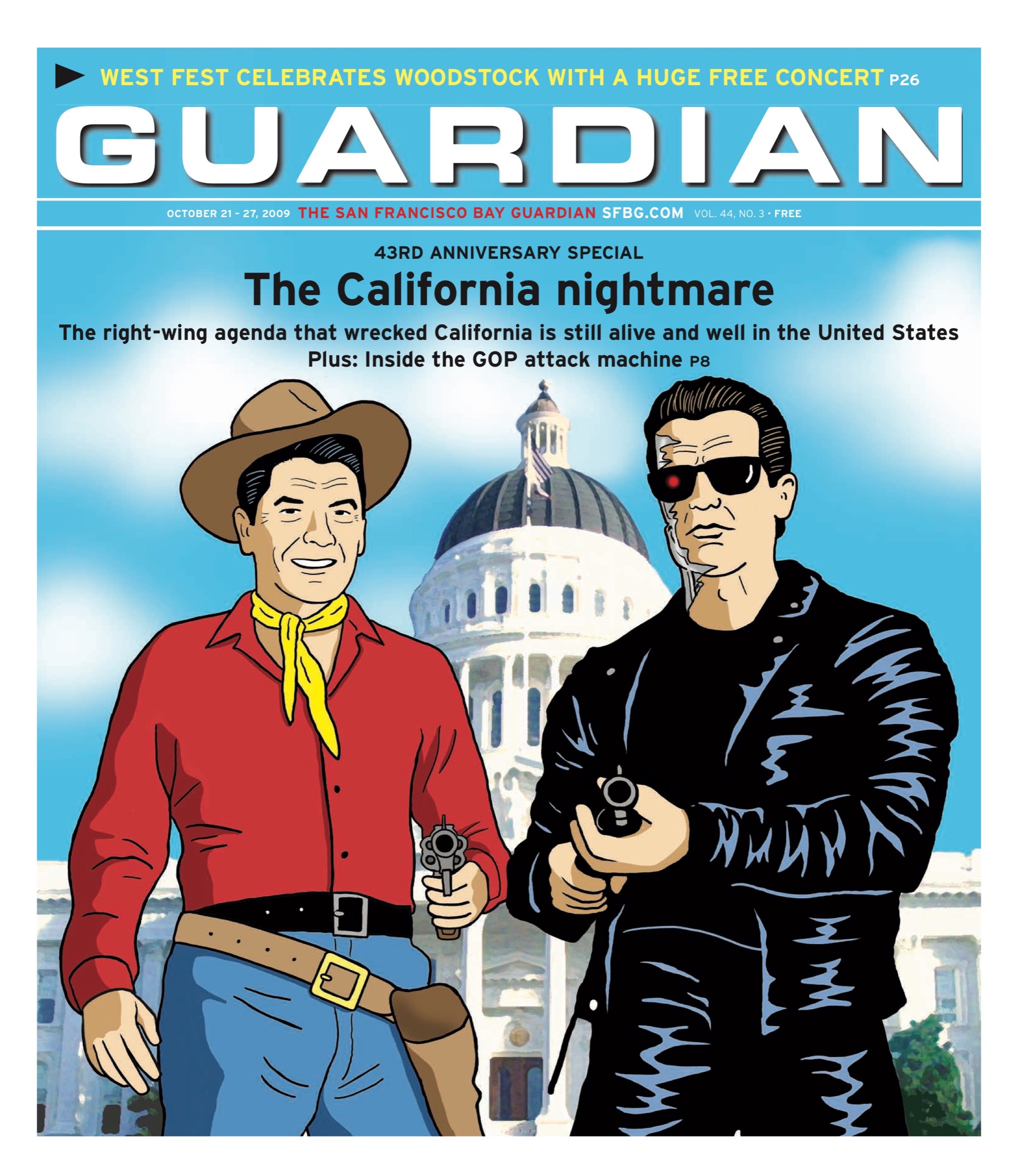
When the first issue of the Bay Guardian hit the stands in 1966, it was still really possible to talk about the California dream. The state had seemingly limitless potential and was in many way a model for the nation — a free public university system that was the envy of the world, an economy that provided jobs to hundreds of thousands of new arrivals, the beginnings of what would be the nation’s premier environmental movement pushing to save San Francisco Bay, save the coast, save Lake Tahoe … and the Free Speech Movement, the Summer of Love, the United Farm Workers Union, and so much more that was transforming politics and culture in the United States from the West Coast.

Twelve years later, it was all falling apart. Eight years of Gov. Ronald Reagan and then the passage of Proposition 13 launched a very different kind of movement out of the West, a movement that sought to dismantle the public sector and the social safety net, to treat government as the enemy, and to use culture wars to convince working-class Americans to vote against their own economic interests.

And now California is being described as the nation’s first failed state. Gov. Arnold Schwarzenegger — the second Republican actor to hold that role — has driven the state to the brink of bankruptcy. The University of California is drowning in red ink, raising fees and turning away students. The state’s water system is a mess; cities and counties are in fiscal collapse; the economy’s in the tank; and nobody seriously talks about a California dream anymore.

The story of how that happened — and how the diseases of tax-revolts, privatization, government corruption, and public disempowerment spread east from California — is the focus of this 43rd anniversary issue. It’s both enlightening and a bit scary to read through old issues, because in hundreds of stories over the past four decades, the Guardian has warned of exactly what was to come.

The very first issue of the Bay Guardian talked about the "historic election" pitting the incumbent, Democrat Pat Brown, against Reagan. A lot of people in the emerging "new left" were arguing that there wasn’t a bit of difference between the two, and that you might as well sit out the election. But the Guardian had a different take. The election was really about the direction California wanted to go, the paper said, a choice between a state that cares about the public sector and social welfare and a state where those things don’t matter.

"Reagan’s stands typify the temper of the cause," the Nov. 7, 1966 editorial stated. "He is on record, at various times, in opposition to the progressive income tax, Social Security, Medicare, the anti-poverty program, farm subsidies, the TVA, the Civil Rights Act, the Voting Rights Act, public housing, federal aid to education, and veterans hospitalization for anything other than service-connected disabilities. How can a man or a movement govern the state of California with such a political philosophy?"

Reagan’s election may have seemed like a fluke, but it was nothing of the sort. By the mid 1960s, with the counterculture — and equally important, the economic left — looking to make major inroads in American policy, the broad outlines of a right-wing attack plan were in place.

That’s something the Guardian always recognized — that powerful people who moved the levers of government typically did so with a long-term plan.

In San Francisco, part of that plan was the transformation of a human-scale city to a West Coast version of Manhattan. The idea: tear up South of Market (then mostly low-income housing) for a shiny new convention center and hotels. Dump dozens of big high-rise office buildings downtown. Construct a fixed-rail system to carry suburban commuters into the dense downtown. Drive up property values — massively — and if that means blue collar jobs and working class people had to go to make way for wealthier office workers, so be it. In the end, of course, the architects of the plan — landowners, developers, bankers, and big business leaders — became immensely wealthy.

On the state and national level, their plans were broader. Even so, they had one major aim: throttle the pubic sector. Cut off the funding for government programs, reduce regulations, undermine any concept of a welfare estate — and cut taxes on the rich.

As we report on page 8, the architects of this plan are happy today to talk about how it worked — how Reagan launched his war on government back in the 1970s, how a group of well-funded think tanks developed plans, and political consultants took advantage of people’s fears (and the Democratic Party’s failures) to put those plans into action.

The movement really got off the ground in 1978 with the passage of Proposition 13.

Prop. 13 emerged from a state in the middle of a massive growth spurt and a heated political cauldron of money, race, and Legislative failure. Howard Jarvis, a Republican landlord lobbyist who hated taxes, hated government, hated public schools, and disdained most Californians — "63 percent of [public school] graduates are illiterate" and would have no need for public libraries, he once quipped — took advantage of a gaping hole in political leadership and set off a movement that would cripple the United States of America.

The measure marked the final, fatal end in California of the era known as the ’60s — a period when the left was ascendant, when taxes on the wealthy funded education, infrastructure and programs for inner cities, and when economic and cultural liberalization seemed to be spreading across the nation.

Rising property values, driven by rapid population growth, were driving up property taxes — and the problem was real. Long-time residents, particularly people on fixed incomes, saw their taxes rise so high they couldn’t afford to stay in their homes. The Legislature could have addressed that (with, say, a split-roll measure that taxed residential and commercial property at different rates) but utterly failed to move on the crisis.

A series of assessor’s office scandals didn’t help, either. And, at the same time, the California Supreme Court ruled that rich school districts had to share revenue with poor districts, infuriating wealthy white property owners.

Jarvis and his partner Paul Gann circulated petitions to roll back property taxes and make it almost impossible to raise taxes in the future. It passed with 65 percent of the vote.

Of course, big businesses (particularly utilities) were the big winners. As the Guardian pointed out on June 1, 1978, the top five utilities in California alone (including Pacific Gas and Electric Co.) would gain billions from the tax cuts.

But beneath it all was a simmering discontent with government — something Jarvis had set afire and would later be used by Ronald Reagan and the right-wing operatives who backed him to undermine the New Deal, the social safety net, and the basic social contract in America. The antitax folks played to white people who didn’t want to see their money going to minorities, to the middle-class folks who thought (thanks to the assessor scandals) their tax money was being wasted by corruption — and to a lot of younger people coming out of the 1960s who had learned from Vietnam, COINTELPRO, and Watergate not to trust government.

The Bay Guardian opposed the measure strongly: "Most analyses indicate that without replacement taxes, hundreds of thousands of California public servants would be thrown out of work (which is exactly what Howard Jarvis intends) … " a May 18, 1978 editorial noted. "Vote for Prop. 13 only if you favor decreased government services (including cutbacks in everything from libraries to schools to street-cleaning crews and possibly police and fire departments) and are fond of half-baked measures that favor the rich."

Prop. 13 set off a national movement to cut taxes — and riding that wave, Reagan was elected president in 1980. He immediately set about attempting to slash taxes on big business and the wealthiest Americans, and eliminate environmental, workplace safety, and employment regulations.

You can see the results in California — and across the nation. The very strategies that emerged in this state and that the right has supported over the years have come very close to destroying the United States economy, leaving millions out of work — while the gap between the rich and the poor has risen to unsustainable levels.

Part of the reason this national attack on government and the public sector worked was the failure of Democrats to recognize that corruption matters. It was no small wonder that Californians were losing faith in government — in the 1970s and 1980s, the state Legislature, under the Democratic control of Speaker Willie Brown, was awash in sleaze, paralyzed by lobbyist influence and campaign money. Yet leading Democrats, fearful of Brown’s power, did little to reign in the appalling corruption.

In fact, when Brown became mayor of San Francisco, the entire Democratic Party, from the president of the United States on down, seemed to treat him as royalty — despite the fact that he was selling the city to every developer and corporate lobbyist who waved money under his nose. When taxpayers knew that a large part of their money was going to fund juicy jobs for Brown’s cronies and pet projects, it was hard to argue for higher taxes.

And it was the Democratic Party leadership in San Francisco who presided over two of the greatest examples of privatization of public resources in modern history: the Presidio and the Raker Act. Rep. Nancy Pelosi was the author of the bill that, for the first time, turned a national park over to the private sector — and hardly a Democratic leader in the city dared to lift a finger in opposition. And for decades — since the Guardian first broke the story in 1969 — the city’s Democratic power brokers have bowed and genuflected to PG&E and allowed the private utility to control the local electric grid and block implantation of the federal law that mandates public power for San Francisco.

And now PG&E wants to pull off one of the greatest feats of privatization in American history. The company has launched a ballot initiative that would wipe out any further attempts at public power in California, essentially guaranteeing that private companies, not the public sector, control the vast, critical resource of electric power in this state.

It’s the latest big battle between two divergent visions of America — and this time, the folks who have done so much damage to this state and this nation can’t be allowed to win. In fact, maybe the campaign against PG&E can be the turning point, the time when California realizes that privatization, attacks on the public sector, tax cuts for the rich, and political sleaze are a formula for disaster.

The lesson of California

0

news@sfbg.com

Much of the right-wing agenda that has thrown this nation into economic chaos can be traced back to what was once called the Golden State.

The tax revolts that started here under Gov. Ronald Reagan and continued to sweep the country and the world under President Reagan never abated. Indeed, they have only been strengthened by the big business power that created and benefited from them.

But now that California is showing signs of being the country’s first failed state — caught in fiscal freefall and mired in political gridlock as a generation’s worth of neglected problems surge to the surface — this state has become a cautionary tale for that anti-government ideology.

Trends in America tend to start out west, and the economic and political disaster that California has become contains critical lessons for the rest of the country.

Lewis Uhler — president and founder of the National Tax Limitation Committee — speaks candidly and proudly of his key early role in helping build a conservative movement to limit the size of government and do battle with those who want the public sector to actively promote social and economic justice.

Uhler, a UC Berkeley Boalt Hall School of Law graduate who did legal work for conservative causes in the 1960s, was tapped by then-Gov. Reagan in 1970 to be the director of the Office of Economic Opportunity, a federally-funded legal assistance program created as part of President Lyndon Johnson’s war on poverty.

While that may seem like a strange role for an avowed conservative and former member of the John Birch Society, Uhler says Reagan basically brought him in to wreck the program and fight the feds. “I was asked to put my money where my mouth was for my conservative philosophy,” Uhler told the Guardian. “OEO was set up to ensure conflict and confrontation … The mission of legal services was to change public policy through lawsuits they decided to file. I thought it was a corruption of the legal system.”

At the time, public-interest law and liberal economic and social policies were on the rise in California and spreading to the rest of the nation. So the Reaganites fought back.

Rather than helping poor plaintiffs file environmental, consumer protection, equal rights, or other types of lawsuits designed to level the playing field with powerful interests, Uhler blocked lawsuits brought by attorneys he calls “ambulance-chasers” and gutted the program. “Ultimately,” he said, “we vetoed funding for California Rural Legal Assistance.”

And for his efforts, Uhler was rewarded with a cabinet-level position: assistance secretary of the Health and Welfare Agency. Again, his role wasn’t to make the agency more effective, but to make it less effective in a realm where he believes government was too big and too active.

“The problem was uncontrolled state and local spending,” Uhler said. “Intuitively, everyone who gathered around Reagan shared the same philosophy that government doesn’t really contribute anything to economic growth.”

In 1972, Reagan gave Uhler the opportunity to work more directly on the mission of cutting taxes and shrinking the size of government, naming him chair of the Governor’s Tax Reduction Task Force. It was, in many ways, the beginning of the vast right-wing conspiracy.

“I asked to be given the chance to go across the country and find the best free market minds in the country to develop these policies,” Uhler said, explaining that he wanted to borrow the liberal strategy of giving an academic veneer to their ideas, as presidents Kennedy and Johnson had done in the realm of foreign policy. “Our side had never really done that.”

Uhler’s first stop was the University of Chicago School of Economics, where he met with noted free market economists Milton Friedman, James Buchanan, and George Stigler, who were brought into the cause.

Today’s vast network of conservative think tanks didn’t exist at that time, so Uhler tapped conservative thinkers from the American Enterprise Institute and the Hoover Institute at Stanford University, as well as other conservative economists such as Peter Drucker from Claremont McKenna College.

“There were 35 people who helped us design the first effort at a constitutional initiative in California to limit year-over-year growth of the state’s general fund,” Uhler said. “All of us as free market enthusiasts and economists all shared the belief that government beyond a certain level eats the seed corn of the nation and doesn’t produce anything.”

While voters narrowly rejected their group’s first effort to cap government growth — Proposition 1 on the November 1973 ballot — the ground had been prepared and the seeds had been sown for the tax revolts that would sweep the country in the late 1970s, with many of the campaigns coordinated by Uhler and the organization he formed for that purpose in 1975, the National Tax Limitation Committee, and a rapidly growing network of similar, interconnected organizations.

As Uhler worked with Reagan to weaken California’s government from within, his fellow travelers were developing national and international strategies to create aggressive, coordinated, well-funded campaigns to attack government and spread the free market dogma.

In August 1971, Lewis Powell — a conservative corporate attorney who President Richard Nixon had just nominated to the U.S. Supreme Court (where he served from 1972-87) — wrote a confidential memorandum to the leadership of the U.S. Chamber of Commerce titled “Attack on the American Free Enterprise System.”

He sounded the alarm that the ascendant environmental and consumer movements were going to destroy capitalism in the country unless corporate America aggressively fought back in a coordinated fashion, which he spelled out in great detail.

He called for all major corporations to develop aggressive legal and public relations strategies for fighting the left, creation of a network of think tanks and media outlets to push the conservative message, manipulation of the legal system, and sponsorship of university programs to study conservative ideas and incubate future leaders — which all came to pass in the coming decades.

“American business [is] ‘plainly in trouble’; the response to the wide range of critics has been ineffective and has included appeasement: the time has come — indeed, it is long overdue — for the wisdom, ingenuity, and resources of American business to be marshaled against those who would destroy it,” Powell wrote.

Part of that strategy involved having the federal government promote and popularize free market economic theories being developed by Friedman and his colleagues at the University of Chicago, a movement that is well-documented by journalist Naomi Klein in her book The Shock Doctrine: The Rise of Disaster Capitalism.

In 1971, Friedman and his colleagues began working with rich conservatives in Chile who were allied with Gen. Augusto Pinochet, who in turn were conspiring with the CIA to overthrow and assassinate the democratically elected, leftist President Salvador Allende, which they successfully did on Sept. 11, 1973.

Friedman’s economic theories called for a radical restructuring of society — slashing taxes and social spending; removing most regulation and trade restrictions; crushing labor unions; promoting economic growth at any cost — and Pinochet executed the strategy in brutal fashion, ordering the death of at least 3,200 of his political opponents, including the car-bomb assassination of economist Orlando Letelier in Washington, D.C., in 1976.

Friedman and Pinochet consulted openly and shared a basic disdain for social programs and progressive taxation. “The major error, in my opinion,” Friedman wrote in a letter to Pinochet in 1975, referring to the government antipoverty programs Pinochet dismantled, was “to believe that it is possible to do good with other people’s money.”

The model Pinochet and Friedman developed in Chile would eventually go global — promoted by its top cheerleaders, Reagan and British Prime Minister Margaret Thatcher — and be implemented (with disastrous results for most citizens but creating huge profits for wealthy individuals and corporations) in Indonesia, Bolivia, Argentina, Peru, Russia, Poland, South Africa, Japan, and elsewhere.

But with the corporate media and conservative opinion-shapers focused mostly on economic growth — ignoring persistent poverty and the brutal tactics used to suppress the popular movements that tried to resist Friedman’s “economic shock therapy” — Friedman had become a sort of free-market prophet by the time he died in 2006.

“In the torrent of words written in eulogy to Milton Friedman, the role of shocks and crises to advance his worldview received barely a mention,” Klein wrote. “Instead, the economist’s passing provided an occasion for a retelling of the official story of how his brand of radical capitalism became government orthodoxy in almost every corner of the globe.”

California’s fiscal shackles have been in place since 1978, when Proposition 13 and subsequent measures capped property taxes and required an undemocratic two-thirds vote to either raise taxes or pass the annual budget.

A Republican landlord lobbyist named Howard Jarvis charged onto the field that Reagan, Uhler, and their team had prepared and took advantage of a gaping hole in political leadership to set off a movement that would cripple the United States of America.

There was some logic to it then. Times were good in California in the 1970s, good enough that people were flocking to the state by the millions. That was driving up property values — and thus property taxes.

Jarvis bought his home for $8,000 in 1946; 30 years later, it was assessed at $80,000. In fact, inflation was running at close to 10 percent a year in California. Homeowners were getting huge tax hikes each year, and tenants were getting huge rent hikes at a time when state government had a budget surplus.

Homeowners saw millions of dollars sitting in the coffers in Sacramento while they couldn’t pay their tax bills. Yet nobody in the Legislature or governor’s office came up with a solution.

So when Jarvis showed up with petitions to roll back property taxes and prevent future increases, he found a broad base of support. Even tenants went along — Jarvis and his gang promised that property-tax cuts would be passed on to tenants and would mean the end of the escautf8g rent hikes.

Jarvis collected signatures for a radical measure that essentially blocked all property tax increases and allowed new assessment only when a parcel sold. It was, in the end, a huge tax giveaway to major corporations. Since commercial property turned over far less often than residential property (and since commercial sales could be hidden as stock transfers), big businesses wound up paying far less of the state’s tax burden. Corporations used to pay about two-thirds of the state’s property taxes, and individuals one-third; now that is reversed.

It didn’t help tenants, either. Few of the landlords who saw the benefits of Prop. 13 passed the money along to their renters. Most just kept it. San Francisco activist Calvin Welch likes to say that Howard Jarvis was “the father of rent control.”

The campaign against Prop. 13 warned of the dangers of cutting local government; police and fire chiefs appeared in ads opposing it. But the No on 13 folks never talked about the huge windfall big corporations would get from the measure, or the huge disparities in wealth that would be created by defunding government and dereguutf8g corporations.

If the goal was to skew the concentration of wealth in the state, it worked brilliantly. According to the California Budget Project (CBP) of the Franchise Tax Board, recent data taken before the current economic recession illustrates an ever-widening chasm between the wealthiest taxpayer and the working-class person.

The total adjusted personal income for Californians rose by nearly $64 billion in 2006-07 — with approximately three-quarters of that increase going to the top fifth of wealthiest taxpayers, and 30 percent going to the top 1 percent. That left only $19 billion for everyone else.

“The average taxpayer in the top 1 percent experienced a $128,261 increase in AGI [adjusted gross income] between 2006 and 2007, which was more than three times the total AGI of the average middle-income taxpayer in 2007 ($36,115),” stated the June 2009 report.

This continues a long-term trend in which the wealthy continue to leave the average income-earner behind in a trail of dollar-sign dust. From 1995 to 2007, income gains for that top 1 percent come to a whopping 117.3 percent increase — nearly 13 times more than the gains of the middle-income taxpayer.

The nation’s income gap has reached a “level higher than any other since 1917,” according to a paper by University of California, Berkeley economic professor Emmanuel Saez. According to Saez’s analysis of census data, there’s been a steady increase in the income gap since the 1970s, rising 20 percent over the years.

Yet even today, the defenders of Prop. 13 continue to sound the same consistent themes. “Those who are directly involved in government are a militant special interest,” Howard Jarvis Taxpayer Association executive director Kris Vosburgh told us. “They don’t like anything that limits their revenue stream.”

While that last statement could be applied equally to corporations or other private sector enterprises, as Vosburgh reluctantly admitted when asked, he continues to imply malevolence to those who defend government. He said the state’s current fiscal collapse can only be solved by slashing government expenditures.

“It is not valid to be talking about revenue-side solutions,” he said. “Our position is the state has enough money to accomplish its goals.”

People have never liked paying taxes, but the antitax movement is about far more than just that basic individual desire to hold onto our money.

The attacks were well planned, carefully targeted, and part of a much larger effort aimed at maintaining corporate and conservative power, undermining the New Deal, reducing taxes on the rich, and radically reducing the size and scope of the public sector.

As Powell called for, corporations have aggressively challenged, in legal courts and those of public opinion, every significant progressive advance — from San Francisco’s attempt at universal health care to California’s tentative first steps to address global warming.

With a level of discipline unheard of on the left, conservative opinion-shapers pound their talking points and enforce party unity through mechanisms like the “no new taxes” pledge that every Republican in the California Legislature has signed and heeded, under the very real threat of recall.

Opposition to taxes is now so deeply embedded into the psyche of the California electorate, and such a core tenet of today’s Republican Party, that elected officials who tout fiscal responsibility allowed the state’s debts to go unpaid (destroying its credit rating in the process) and its education and transportation systems to be decimated rather considering new revenues.

Gov. Arnold Schwarzenegger’s spokesperson Aaron McLear told us, “He believes we ought to live within our means and pay for only the programs we can afford.”

That simple talking point gets repeated no matter how the question is asked, or when we point out that it means we’re being forced to live within historic lows this year. But they claim the people support them.

“We had tax increases on the May ballot and they were rejected by a 2-1 margin. We should listen to the will of the voters,” McLear said.

Never mind that this regressive, dishonest package of temporary tax hikes was opposed by the Guardian and a variety of pro-tax progressive groups. McLear wouldn’t even admit that point or respond to it honestly.

And he’s certainly right that most polls show a majority of Californians don’t want new taxes. But these polls also show that people want continued government services, more investment in our neglected state infrastructure, and a whole bunch of other contradictory things.

That’s why newspapers and analysts around the world are looking at California, the world’s eighth largest economy, and wondering (as the Guardian of London headline asked Oct. 4): “Will California become America’s first failed state?”

In many ways, it already is. The question now is whether we’ll try to learn from and correct our mistakes. Ryan Riddle contributed to this report. ———–

THE CONSERVATIVE RELIGION

When I asked Lewis Uhler, one of the architects of the Reagan revolution, what Americans believed in these days — where the people he likes to talk about who hate the government (but are also admittedly disillusioned with Wall Street) turn — he answered simply: religion.

It should come as no surprise that many religious fundamentalists tend to side with the free market conservatives — both ideologies require a leap of faith and ignoring certain troubling facts, such as increasing disparities of wealth, natural resource depletion, and global warming.

Their arguments mostly make sense — until these inconvenient truths come up.

Certainly, turning over more public resources to free market capitalists, cutting taxes, and slashing government regulation will spur private sector economic growth, just as advocates claim.

But that growth has a cost. The wealth won’t be shared by everyone. Indeed, poverty has persisted even through even the economic boom of the 1990s — but almost everyone will be affected by underfunded road, education, public safety, and other essential systems.

As the conservative movement has successfully limited taxes and cut regulation over the last 40 years, working class wages have stagnated as the rich have gotten richer. Many of the world’s oil reserves have peaked and gone into decline, and rapidly increasing carbon emissions have collected in the atmosphere and caused global warming.

So how do conservatives respond to these realities as they argue for the continued dismantling of government, which is the only entity with the scope and incentive to deal with these problems? They simply deny them.

Uhler decried the “pseudoscience of climate change” as hindering economic progress and claimed that there’s actually been a global cooling trend in the last 10 years. (Actually the last 10 years have been some of the hottest on record, causing glaciers around the world to melt, according to data and observations from a consensus of the world’s climate scientists, including NASA, the Union of Concerned Scientists, and the United Nations Climate Change Conference.)

It’s the same story with the consolidation of wealth, which hurts the free market fantasy that letting the super-wealthy keep more money will eventually trickle down to benefit us all. Uhler simply denied the growing disparity of wealth, saying the “movement between quintiles is significant.”

He was talking about people’s ability to go from poor to rich with a little hard work and initiative, the core idea of free market conservatives. But data from the U.S. Census Bureau and many other entities indicate that median wages have been stagnant for decades (which wouldn’t be true if there was lots of upward mobility) and that most of the wealth created in the U.S. over the last 40 years has pooled with the top 1 percent.

In fact, when it comes to measuring social impacts, Uhler has simply one metric: “Governments at all levels are twice the size they should be to maximize economic growth.” (Steven T. Jones)


Is the truth out there?

0

cheryl@sfbg.com

FILM Habitual attendees of documentary films in San Francisco might be surprised to see so many familiar titles in this year’s SF DocFest lineup. At least one (American Artifact: The Rise of American Rock Poster Art, which played the Red Vic a few months back) is skippable. Others — like I Need That Record: The Death (or Possible Survival) of the Independent Record Store, Johnny Cash at Folsom Prison, Off and Running, and especially Johnny Weir portrait Pop Star on Ice — make welcome returns. But the standout film is brand-new to these parts, and since it’s the closing-night film, it screens only once. Fans of true crime, urban legends, twisted suburbia, and serial killers won’t want to miss Cropsey.

For kids growing up on Staten Island — including codirectors Barbara Brancaccio and Joshua Zeman — "Cropsey" was the name given to the faceless boogeyman who lurked in the woods, slaking his bloodthirsty urges with disobedient children. (The name spread into popular culture with 1981 summer-camp slasher The Burning, featuring a bad guy named "Cropsy.") Sure, logic dictates that boogeymen aren’t real, but kids of Staten Island might’ve had trouble believing that. First of all, the husk of Willowbrook State School, subject of an infamous 1972 TV expose by a young Geraldo Rivera, loomed nearby; it closed in 1987, years after the horrible conditions within were exposed. Then, that same year, a 12-year-old girl with Down syndrome disappeared, and was found dead a month later. Suddenly, the Cropsey legend no longer felt like fiction.

A multilayered doc that’s clearly the product of a genuinely curious filmmaking team, Cropsey digs into Staten Island’s history to explore the community’s reaction to the tragedy, and to the man eventually charged for it: Andre Rand. Rand’s wild-eyed, drooling perp walk was enough to convince the general public, police, and media (the New York Daily News called him the "Hannibal Lecter of Staten Island") of his guilt. And he was a shady character, a former Willowbrook employee who’d taken to camping out among its abandoned buildings. He also had a history of sexual crimes against children. But, as Brancaccio and Zeman discover, there was no evidence, beyond unreliable eyewitnesses, that tied him to the girl’s disappearance. As Cropsey unfolds in true crime-drama style, fact and folklore become increasingly tangled; the viewer is openly encouraged to consider every angle with equal gravity.

Just as disturbing, but in a marginally less sinister and more overtly entertaining way, is the Johnny Knoxville-produced The Wild and Wonderful Whites of West Virginia. Fans of Jesco "Dancing Outlaw" White, take note: Wild follows White’s entire family, all as quotable and lawbreaking as he is, for a year, chronicling births, deaths, jail ins and outs, pill-popping, pill-snorting, public drunkenness, gunplay, DIY tattooing, and questionable parenting (and grandparenting). Fortunately it’s not completely exploitative, though the above description may suggest otherwise.

SF DOCFEST

Oct 16–29, $11

Roxie, 3117 16th St., SF

www.sfindie.com

Fighting for juvenile justice

0

sarah@sfbg.com

Sup. David Campos’ proposal to amend San Francisco’s sanctuary policy so that the city guarantees due process to juvenile immigrants heads for a full vote of the board next week with the support of a veto-proof majority of supervisors.

Board President David Chiu and Sups. John Avalos, Chris Daly, Bevan Dufty, Eric Mar, Sophie Maxwell, and Ross Mirkarimi have signed on as cosponsors of the amendment, which also has the support of a broad coalition of civil and immigrants’ rights organizations.

But with the mayor opposed to the bill and the daily newspapers agitating against reform, it’s important to remember what’s really at stake here.

As a team of civil rights experts notes, the Campos bill "will ensure that families are not torn apart because a youth is mistakenly referred for deportation and will encourage cooperation between law enforcement and immigrant communities by reestablishing a relationship based on trust, therefore increasing public safety."

Campos, who came to this country as an undocumented youth from Guatemala and represents San Francisco’s heavily immigrant Mission District, says his proposal is a balanced solution to the draconian policy Newsom ordered last summer, without public input, the day after the mayor launched his 2010 gubernatorial bid.

When Campos introduced his amendment this summer, after months of public conversations with law enforcement agencies and the immigrant community, Newsom responded by leaking a confidential legal memo that outlined possible challenges to the proposal.

Angered but undaunted, a group of civil rights organizations responded by issuing their own brief explaining why Campos’ proposal is legally tenable and defensible.

As Angie Junck of the Immigrant Legal Resources Center, Robert Rubin of the Lawyer’s Committee for Civil Rights, Julia Mass of the American Civil Liberties Union of Northern California, professor Bill Ong Hing of UC Davis Law School, and Angela Chan of the Asian Law Caucus explained, Campos’ proposal "will allow immigrant youths to have their day in court and be heard by an impartial judge, ensuring due process is upheld for all of San Francisco’s youth."

They argue that Campos’ legislation seeks to "lessen the risk that the city will be liable for racial profiling, unlawful detention, and mistaken referrals of U.S. citizens and lawful immigrants for deportation while bringing the city’s juvenile probation practices into compliance with state confidentiality laws for youth."

And as they point out, Campos’ proposal won’t prevent youths who have been found by a court to have committed a felony from being referred to ICE.

"The sanctuary ordinance has stood strong for 20 years, and the proposed amendment strengthens the ordinance by taking steps to bring the city’s practices more into compliance with state juvenile justice law," the brief states. "The legislation is a measured step in the right direction that will help restore accountability and fairness in the city’s treatment of immigrant youth."

Or as Campos put it: "It’s something we drafted very carefully in close consultation with the City Attorney’s Office."

ARRESTED OR CONVICTED?


Campos’ amendment seeks to shift the point at which immigrant kids get referred to ICE agents for possible deportation. Newsom’s policy allows the police to refer kids to ICE the moment they’re arrested. That means someone who turns out to be innocent and was arrested in error can still be deported. Campos wants the cops to wait until the felony charge is upheld in juvenile court.

Since July 2008, when Newsom ordered the city’s current policy shift, 160 youths have been referred to ICE, increasing the risk they will be sent to detention facilities across the country, far from their families, without access to immigration legal services, based on accusations and racial profiling.

Abigail Trillin, staff attorney with the Legal Services for Children, told us that the Newsom policy makes San Francisco bedfellows with Texas and Orange County.

"A bunch of our kids go to Yolo County and Oregon, a lot to Los Angeles, others to Miami, Virginia, and Indiana, and some have already been deported," Trillin said.

Trillin noted that Newsom’s policy is destroying families by allowing innocent kids to be reported for deportation without the basic right to due process — often for minor offenses. She has already seen youth who are documented or innocent erroneously referred to ICE by juvenile probation officers, who often lack expertise in immigration law.

She also fears this miscarriage of justice could result in abuse and even death — especially if kids try to return to their homes and families by crossing the border, which has became increasingly militarized and perilous in the aftermath of the Bush administration’s decision to spend billions to build a fence along the border.

Last week, the battle for juvenile justice took a fresh twist locally when Newsom’s newly appointed Police Chief George Gascón said he hoped for a compromise involving third party review by the District Attorney’s Office.

"I fully understand the concerns Campos brings to the table," Gascón said, referring to his previous job as chief of police in Mesa, Ariz., where he saw the anti-immigrant excesses of Maricopa County sheriff Joe Arpaio.

"I have the benefit of seeing the other side, where you have police agencies aggressively engaged in immigration enforcement, where people that were frankly not engaged in any criminal activity other than that of being here without authority, are being deported," Gascón said. He noted that being here without papers often is not a crime; it’s just an administrative violation.

"I’ve seen very young people, people that basically came to this country when they were three or four years old and are staying clean and going to school, get stopped for a traffic violation at age 17 or 18, and now all of a sudden they’re getting deported to a country where they have no roots," he said.

But the chief remains convinced that the criminal justice system needs to be able to use all legally available tools to deal with violent criminal juveniles.

"I’m not saying the district attorney needs to make the reporting. The triggering event could be the determination to file the case," Gascón said. "Frankly, I wish I’d been here a year earlier to deal with this issue," he added, noting that federal immigration hearings are "a kangaroo court."

"It’s not a beyond-reasonable-doubt standard for people to get deported," he said.

"The other side of the coin is that this would be putting people in situations where they could be federally indicted for violations of law. And you also have problems at state," he continued, noting that two federal grand juries are currently reviewing the behavior of the Juvenile Probation Department.

DUE PROCESS


Campos, a lawyer, appreciates that the new police chief is "genuinely trying to see if there is something he can do to resolve the situation. I believe if he had been in place where this discussion was going on a year ago, the mayor would have received better advice."

"The chief’s comments reflect that what is happening here is pretty extreme," Campos added. "I recognize that changing the reporting process to a third party would definitely be better than what we have now, where the final decision rests with a police officer. But while it’s better, it’s not sufficient. Due process necessarily entails giving people their day in court, and letting a judge decide what actually happens."

Sup. Chiu, a former prosecutor, also said he appreciates Gascón’s resolution attempt. "But the point of our system is that once you are arrested and charged, there are due process rights so you can respond to those charges."

Sup. Dufty, a mayoral candidate, said he expects that when the board passes laws, those laws will be implemented by Newsom. "As CEO of San Francisco, he has to comply with all legislation, including local laws the legislative body passes that he may not like," Dufty said.

"My mother was born in Czechoslovakia and was stateless when I was a boy," he added. "She had to register every year as an alien, so this is very visceral for me. If we are to be a sanctuary city, it’s because everyone has due process. It’s denying people’s humanity and dignity and creating a two-tiered system for justice."

But mayoral spokesperson Nathan Ballard continued to assert that Newsom’s current policy is balanced. "While he remains open to argument, the mayor believes the current policy strikes the right balance between protecting public safety and safeguarding the rights of accused criminals," Ballard, who had not replied to the Guardian‘s questions as of press time, told the Examiner last week.

But Trillin says she can’t stand to hear Ballard falsely claim, one more time, that the city is going to shield criminals. "Ballard keeps repeating a completely false position, because Newsom’s actual position is morally indefensible," Trillin said. "You can’t have the mayor publicly say that young people don’t deserve due process, so you have to make up stuff like this instead."

New coach, new approach

0

news@sfbg.com

The chief was running late. As a group of Guardian reporters filed into his modest, comfortable conference room on the fifth floor of the Hall of Justice, an aide told us that Police Chief George Gascón was still meeting with Mayor Gavin Newsom at City Hall, and that we’d all have to cool our heels for a while.

While we were waiting, Michelangelo Apodaca, a public affairs officer in the chief’s office (he called himself an “image strategist”) stressed the recent sea change at SFPD, labeling it “new coach, new approach.” (It appears, however, that the mayor is still pushing his so-called “quality of life” agenda. “I just came from a meeting where I got beat up for not doing enough about public drinking and public disorder,” the chief belatedly told us.)

But once we got into the interview, Gascón was friendly, candid, thoughtful, and accommodating, and spent nearly an hour discussing his philosophy of law enforcement, his vision for San Francisco, and his positions on some tricky and divisive problems.

We left with the impression that the new chief, although hardly in agreement with us on a number of issues, is far more open than his predecessor, willing to shake things up in the moribund department — and sometimes, interested in discussion and compromise on progressive concerns.

“My philosophy of policing is very heavy in community involvement, very transparent,” Gascón told us.

Gascón said he’s moving quickly on implementing many of the items that he’s promised, such as creating a COMPSTAT (computerized crime and staffing statistics) system that will be accessible to the public. He plans to launch it Oct. 21.

And beyond the technology, he seems interested in shifting the top-down structure of the department. “I said that we would reorganize the department in certain levels and do certain levels of decentralization to increase resources at the neighborhood level so that we actually have people within the police department who have greater ownership of neighborhood issues,” he said. “And we’re going to do that in November. I stated that we would have community police advisory boards at each of the stations, and those basically will be neighborhood-level people, anywhere from 10 to 20, for each station. We’ll work with our local captains on neighborhood-related issues.”

He said that improving how the department does community policing will have a two-fold impact. “One is, the cops get to understand better what the community really wants. The other is that the community gets to understand better what the resources really are.

“Everybody wants a foot-beat cop,” he continued. “Everybody wants a fixed-post cop. Everybody wants a cop in every bus. If we had 10,000 people, then perhaps we could fulfill all those wishes. The reality is that we don’t.”


EXPENSIVE CRACKDOWN

But the most tangible impact of Gascón’s tenure so far has been his crackdowns on drug-related activity in the Tenderloin, where more than 300 people at a time have been swept up in sting operations, and on marijuana-growing operations in the Sunset District, where 36 locations were raided (four of which Gascón said were discovered to be “legitimate” medical marijuana growers who had their crops returned by police).

The arrest surge generated a lot of positive press — but also is costing the city a bundle. Sheriff Michael Hennessey, who runs the county jail, told us that he had to reopen several jail housing units that had been slated to close to meet his budget for the current fiscal year. He said the average daily jail population in July was 1,861, but that it has risen to 2,146 in September, a 285 inmate increase.

If it stays at this level, Hennessey estimates that he’ll need up to $3.5 million in additional annual funding to house the larger population, as he indicated in a letter that he wrote to the Board of Supervisors last month, letting them know that he will probably need a supplemental budget appropriate this year.

When we asked Gascón whether affected city agencies — including the Sheriff’s Department, District Attorney’s Office, and Public Defender’s Office — should increase their budgets to deal with the SFPD’s new approach, he said they should.

There’s a touch of the corporate manager about Gascón. When we challenged him to defend the efficacy of the crackdowns, Gascón pulled out a pen and paper and started drawing a Venn diagram, with its three overlapping circles. He explained that many criminal justice studies have shown that about 10 percent of criminal suspects commit about 55 percent of the crime, that 10 percent of crime victims are the targets of about 40 percent of crimes, and that crime is often concentrated in certain geographic areas.

By concentrating on the overlap of these realms, Gascón said police can have a major impact on crime in the city. Although Gascón admits that “police can never arrest themselves out of social problem,” he also said “there are people who do need to be arrested … Most of the arrests are for serious felonies.”

It’s a potentially tricky approach — in essence, Gascón is saying that when you mix some people and some places (in this case, mostly people of color and mostly poor neighborhoods) you create crime zones. The difference between that and racial profiling is, potentially, a matter of degree.

But Gascón defended the surge in arrests over the last two months as targeting those who need to be arrested and, just as important, sending a message to the greater Bay Area that San Francisco is no longer a place where open-air drug dealing, fencing stolen goods, and other visible crimes will be tolerated.

“We need to adjust the DNA of the region,” he said.

And while Gascón said the arrest surge might not be sustained indefinitely, he also frankly said that the city will probably need to spend more money on criminal justice going forward. In other realms of the recent crackdown, such as the police sweeps of Dolores Park and other parks ticketing those drinking alcohol, Gascón said that was more of a balancing act that will involve ongoing community input and weighing concerns on both sides of the issue.

It was when we pushed for the SFPD to ease up busting people in the parks who were drinking but not causing other problems that Gascón told us that the mayor had a different opinion and had been chiding his new chief to be tougher on public drinking.

In light of several recent shootings by SFPD officers of mentally ill suspects, we asked Gascón whether he’s satisfied with how the department and its personnel handle such cases. He didn’t exactly admit any problems (saying only that “there’s always room for improvement”) but said he was concerned enough to create a task force to investigate the issue last month, headed by Deputy Chief Morris Tabak.

When we asked if we can see the report on the 90-day review, Gascón didn’t hesitate in answering yes, “the report will be public.”


FIRE TEN COPS?

If Gascón follows through with his promises, internal discipline — one of the worst problems facing the department — could get a dramatic overhaul. The new chief wants to clear up a serious backlog of discipline cases, possibly by reducing the penalties — but claims to be willing to take a much tougher stand on the serious problem cases.

In fact, Gascón said he wants the authority to fire cops — that power now rests entirely with the Police Commission — and said there are eight to 10 police officers on the San Francisco force who should be fired, now, for their past record of bad behavior. That would be a radical change — in the past 20 years, fewer than five officers have ever been fired for misconduct, despite the fact that the city has paid out millions in legal settlements in police-abuse cases.

Gascón also discussed controversial legislation by Sup. David Campos that would require due process before undocumented immigrant youths arrested by the SFPD are turned over to federal immigration authorities, an amendment to the sanctuary city policy that was weakened by Newsom.

Just days after arrived in town, Gascón had made comments to the San Francisco Chronicle supporting Newsom’s position and saying that under Campos’ legislation, “drug or even violent offenders could be released by judges on reduced charges in lieu of reporting them for possible deportation.”

But in the interview with us, while not backing away from his previous statement, Gascón seemed to take a more nuanced position that pointed toward the possibility of compromise. He reminded us that he’d spent time in Mesa, Ariz., tangling with a county sheriff, Joe Arpaio, who has gone far beyond any reasonable standard in trying to arrest and deport undocumented residents. He also told us that he doesn’t think the cops, by themselves, should decide who gets turned over the feds for deportation.

That alone is a significant step — and suggests that Gascón could turn out to be one of Newsom’s best hires.

————-

GASCON ON IMMIGRATION

SFBG Are you still concerned about waiting for the courts to determine a suspect’s guilt before turning him over to the feds? Gascón Yes, it’s very much a concern. And by the way, I fully understand the concerns Sup. David Campos brings to the table.

I have the benefit of being on the other side also, where you have police agencies aggressively engaged in immigration enforcement, where people that frankly were not engaged in any criminal activity other than being here without authority — which sometimes, by the way, is not criminal. In fact, depending on whose numbers you listen to, anywhere from 30 to 50 percent of people who are here without authority in this country have not committed a criminal violation; they have committed an administrative violation.

And people get deported. I have seen very young people, people that basically came to this country when they were three, four years old, they are actually staying clean, they are going to school, and they get stopped for a traffic violation at age 17 or 18, and now all of a sudden they are getting deported to a country where they really have no roots at all. I have seen that, and I’m very sensitive to that.

On the other hand, I think it’s important also to recognize that in any group, whether you were here legally or not legally, whether you were born here or not, whether you are green, red, or brown, there are people that for a variety of reasons aren’t willing to live by the social norms we all need to live by to be able to have a peaceful environment.

I think that allowing the process to go all the way to the point where a judge decides whether to allow this to continue … is probably too far down the food chain for my comfort level. On the other hand, I would not want to have police officers on the streets stopping people and trying to assess whether they are here legally or not.

So I think we need to find somewhere down the middle, that if person is arrested, there is a non-law enforcement review. And quite frankly, probably the best person would be the D.A. They determine whether they have a prosecutable case or not. If it’s prosecutable case and a predictable offense that requires reporting, then that would be a good time where a flag could go up.

SFBG But that’s not the process right now.  Gascón No, the process now is triggered by the Probation Department, which is a law enforcement entity. So I think we have a process where law enforcement is making a decision and Sup. Campos is looking at a process of adjudication.

SFBG It sounds as if you agree substantially with Sup. David Campos. Is there room for compromise? 

Gascón I’m hoping there is room for compromise, that is something we’re trying to work with.

Sarah Phelan and Rebecca Bowe contributed to this report.

Film listings

0

Film listings are edited by Cheryl Eddy. Reviewers are Kimberly Chun, Michelle Devereaux, Max Goldberg, Dennis Harvey, Johnny Ray Huston, Louis Peitzman, Lynn Rapoport, Ben Richardson, Matt Sussman, and Laura Swanbeck. The film intern is Fernando F. Croce. For rep house showtimes, see Rep Clock. For first-run showtimes, see Movie Guide.

SF DOCFEST

The eighth annual San Francisco Documentary Film Festival runs Oct 16-29 at the Roxie, 3117 16th St, SF. Tickets ($11) are available by visiting www.sfindie.com. For commentary, see "Is the Truth Out There?" All times p.m.

FRI/16

The Entrepreneur 7. Shooting Robert King 7. Drums Inside Your Chest 9:15. Houston We Have a Problem 9:15.

SAT/17

Drums Inside Your Chest 2:30. Waiting for Hockney 2:30. Between the Folds 4:45. Finding Face 4:45. HomeGrown 7. The Wild and Wonderful Whites of West Virginia 7. Dust and Illusions 9:15. The Earth Is Young 9:15.

SUN/18

"Bay Area Shorts" (shorts program) 2:30. We Said, No Crying 2:30. Another Planet 4:45. I Need That Record: The Death (or Possible Survival) of the Independent Record Store 4:45. Cat Ladies 7. Off and Running 7. Vampiro 9:15. What’s the Matter with Kansas? 9:15.

MON/19

Between the Folds 7. We Said, No Crying 7. October Country 9:15. Waiting for Hockney 9:15.

TUES/20

The Earth Is Young 7. I Need That Record: The Death (or Possible Survival) of the Independent Record Store 7. Another Planet 9:15. The Wild and Wonderful Whites of West Virginia 9:15.

MILL VALLEY FILM FESTIVAL

The 32nd Mill Valley Film Festival runs through Sun/18 at the Century Cinema, 41 Tamal Vista, Corte Madera; CinéArts@Sequoia, 25 Throckmorton, Mill Valley; 142 Throckmorton Theatre, 142 Throckmorton, Mill Valley; and Smith Rafael Film Center, 1118 Fourth St, San Rafael. Tickets (most shows $12.50) available by calling 1-877-874-MVFF or visiting www.mvff.org. All times p.m. unless otherwise noted.

WED/14

Rafael The Horse Boy 4:30. "5@5: America Is Not the World" (shorts program) 5. "Spotlight on Jason Reitman:" Up in the Air 6:30. White Wedding 7. Linoleum 7:15. Tapped 9. The Eclipse 9:15. Up in the Air 9:40.

Sequoia The Swimsuit Issue 4:15. "5@5: Oscillate Wildly" (shorts program) 5. Trimpin: The Sound of Invention 6:30. Surrogate 7. Elevator 8:45. Hellsinki 9.

Throck "Insight: The Cassel Touch" (interview and discussion) 8.

THURS/15

Rafael The Girl on the Train 4. Reach for Me 4:30. "5@5: The More You Ignore Me, the Closer I Get" (shorts program) 5. Icons Among Us: jazz in the present tense 6:30. Meredith Monk: Inner Voice 6:45. "Tribute to Woody Harrelson:" The Messenger 7. Hipsters 9. Barking Water 9:15.

Sequoia "5@5: Sister I’m a Poet" (shorts program) 5. Jim Thorpe: The World’s Greatest Athlete 5:15. Apron Strings 6:45. The Missing Person 7:30. This Is the Husband I Want! 9. Winnebago Man 9:30.

Throck Storm 7.

FRI/16

Rafael Sweet Rush 4. "5@5: The Edges Are No Longer Parallel" (shorts program) 5. Stalin Thought of You 6. "Tribute to Anna Karina:" Victoria 6:30. Zombie Girl: The Movie 7. Jermal 8:15. Trimpin: The Sound of Invention 9. Red Cliff 9:30.

Sequoia Shylock 4. Shameless 5. Tenderloin 6:45. A Thousand Suns and Mustang: Journey of Transformation 7. One Crazy Ride 8:45. Happy Tears 9:15.

Throck Troupers: 50 Years of the San Francisco Mime Troupe 7:30.

SAT/17

Rafael [Blank.] 11am. A Thousand Suns and Mustang: Journey of Transformation noon. Ricky Rapper 1. The Girl on the Train 1:45. Hellsinki 2. Oh My God 3. The Strength of Water 4:15. Awakening from Sorrow 4:45. The Missing Person 5:30. The Most Dangerous Man in America: Daniel Ellsberg 6:45. The Swimsuit Issue 6:45. Surrogate 7:45. Tenderloin 9. Hipsters 9:15.

Sequoia The Letter for the King 10:30am. Eat the Sun noon. White Wedding 1:30. Miracle in a Box: A Piano Reborn 2:30. Dark and Stormy Night 3:45. Mine 5. A Year Ago in Winter 6:15. Reach for Me 7:15. "Hi De Ho Show" (shorts and music) 9:15. Winnebago Man 9:45.

Throck "New Movie Labs: Distribution of Specialty Film" (seminar) 12:30. Project Happiness 3. "5@5: The Edges Are No Longer Parallel" (shorts program) 5. "Cinemasports" (shorts program of films made in one day) 7:30.

SUN/18

Rafael Stella and the Star of the Orient noon. This Is the Husband I Want! noon. Mine 12:30. Apron Strings 2:30. Soundtrack for a Revolution 2:45. One Crazy Ride 3. Project Happiness 5. The Young Victoria 5:15. Race to Nowhere 5:45. Skin 7:30. Bomber 7:45.

Sequoia The Ten Lives of Titanic the Cat 12:30. Meredith Monk: Inner Voice 1. Oh My God 2:30. The Most Dangerous Man in America: Daniel Ellsberg 3:15. Looking for Eric 5:15. The Strength of Water 5:45.

Throck "New Movies Lab: Active Cinema" 12:30. "A Sweeter Music: Live Concert with Sarah Cahill and John Sanborn" 3:30.

OPENING

Birdwatchers War-painted natives don bows and arrows and watch from the Amazon riverbank as a boat of tourists passes by. Away from white eyes, they slip back into their modern clothes and are paid by the tour guide for a job well done. Had it sustained the evocative wryness of its opening scene throughout its running time, Marco Bechi’s film would have been more than a frequently striking culture-clash tract. As it is, there’s much to admire in this Brazil-set account of a disbanded Guarani-Kaiowà tribe struggling to hang on to their expiring heritage, from its clear-eyed view of the lingering human toll of colonialism to its uncondescending portrait of indigenous mysticism. Unfortunately, Bechi’s penchant for underlined contrasts and clumsy staging often threaten to sabotage his evocative mix of ethnography, satire, and social critique. While far from being as complacent as the titular sightseers, in the end the film is similarly content to merely skim over an ongoing cultural genocide. (1:40) Sundance Kabuki. (Croce)

*An Education See "Culture Class." (1:35) Albany, Embarcadero.

The Horse Boy Rupert Isaacson and Kristin Neff are a Texas couple struggling to raise their five-year-old autistic son Rowan. When they discover that the boy’s tantrums are soothed by contact with horses, they set out on a journey to Mongolia, where horseback riding is the preferred mode of traveling across the steppe and sacred shamans hold the promise of healing. Michael Orion Scott’s documentary is many things — lecture on autism, home video collage, family therapy session, and exotic travelogue. Above all, unfortunately, it’s a star vehicle for Isaacson, whose affecting concern for his son is constantly eclipsed by his screen-hogging concern for his own paternal image (more than once he declares that he’s a better father thanks to Rowan’s condition). The contradiction brings to mind doomed activist Timothy Treadwell in Grizzly Man (2005), and indeed the film could have used some of Werner Herzog’s inquisitive touch, if only to question the artistic merits of showing your son going "poopie." Twice. (1:33) Embarcadero, Shattuck. (Croce)

Law Abiding Citizen "Spike Lee’s Inside Man (2006) as re-imagined by the Saw franchise folks" apparently sounded like a sweet pitch to someone, because here we are, stuck with Jamie Foxx and Gerard Butler playing bloody and increasingly ludicrous cat-and-mouse games. Foxx stars as a slick Philadelphia prosecutor whose deal-cutting careerist ways go easy on the scummy criminals responsible for murdering the wife and daughter of a local inventor (Butler). Cut to a decade later, and the doleful widower has become a vengeful mastermind with a yen for Hannibal Lecter-like skills, gruesome contraptions, and lines like "Lessons not learned in blood are soon forgotten." Butler metes out punishment to his family’s killers as well as to the bureocratic minions who let them off the hook. But the talk of moral consequences is less a critique of a faulty judicial system than mere white noise, vainly used by director F. Gary Gray and writer Kurt Wimmer in hopes of classing up a grinding exploitation drama. (1:48) Presidio. (Croce)

*More Than a Game In the late 1990s, armed with a camera and a certain amount of tenacity, Kristopher Belman set out to capture the glory that was regularly manifesting itself on a certain Akron, Ohio basketball court. The main reason: a future superstar named LeBron James. But James’ remarkable teenage career (at least until the age of 18, when the St. Vincent-St. Mary High School grad became the number one NBA draft pick) wasn’t completely a solo act; his core group of friends, the team’s starting line-up, was so tight they were called "the Fab Five." Despite Belman’s determination to equally divide the spotlight, James was clearly a star then as he is now, slam-dunking on hapless opponents even as he grappled with his burgeoning celebrity status. I’ll never tire of the tale of how James raised eyebrows when he started driving a brand-new Hummer — only to quash whispers of misconduct when it was revealed that his mother, Gloria, was able to secure a loan for the gift based solely on the understanding (shared by all) that her son’s skills would make him a zillionaire before his next birthday. (1:45) (Eddy)

New York, I Love You A variety of filmmakers (including Fatih Akin, Shekhar Kapur, Mira Nair, and Brett Ratner) directed segments of this stateside answer to 2006’s Paris, je t’aime. (1:43) Bridge, Shattuck.

The Providence Effect Located in Chicago’s gang-infested West side, the illustrious Providence St. Mel School rises above its surroundings like a flower in a swamp. Or at least it does in Rollin Binzer’s documentary, where analysis of the institution’s great achievements at times edges into a virtual pamphlet for enrollment. Focusing mainly on affable school president Paul J. Adams III, a veteran of the civil rights movement whose "impossible dream" made Providence possible, the film chronicles the daily activities of teachers and students vying for success in the face of poverty and crime. Given the school’s notoriously unwholesome environment, it’s a bit disappointing that the film chooses to exclusively follow the trajectory of model pupils, trading grittier tales of struggle in favor of a smoother ride of feel-god buzzwords and uplifting anecdotes. The documentary isn’t free of scholarly platitudes straight out of Goodbye, Mr. Chips (1939), but, in times when teachers get as much respect as Rodney Dangerfield, its celebration of the importance of education is valuable. (1:32) Lumiere, Shattuck. (Croce)

The Stepfather Dylan Walsh: as scary as Terry O’Quinn? Discuss. (1:41)

Where the Wild Things Are Spike Jonze directs a live-action version of Maurice Sendak’s classic children’s tale. (1:48) Four Star, Grand Lake, Marina.

ONGOING

*Bright Star Is beauty truth; truth, beauty? John Keats, the poet famed for such works as "Ode on a Grecian Urn," and Jane Campion, the filmmaker intent on encapsuutf8g the last romance of the archetypal Romantic, would have undoubtedly bonded over a love of sensual details — and the way a certain vellum-like light can transport its viewer into elevated reverie. In truth, Campion doesn’t quite achieve the level of Keats’ verse with this somber glimpse at the tubercular writer and his final love, neighbor Fanny Brawne. But she does bottle some of their pale beauty. Less-educated than the already respected young scribe, Brawne nonetheless may have been his equal in imagination as a seamstress, judging from the petal-bonneted, ruffled-collar ensembles Campion outfits her in. As portrayed by the soulful-eyed Abbie Cornish, the otherwise-enigmatic, plucky Brawne is the singularly bright blossom ready to be wrapped in a poet’s adoration, worthy of rhapsody by Ben Whishaw’s shaggily, shabbily puppy-dog Keats, who snatches the preternaturally serene focus of a fine mind cut short by illness, with the gravitational pull of a serious indie-rock hottie. The two are drawn to each other like the butterflies flittering in Brawne’s bedroom/farm, one of the most memorable scenes in the dark yet sweetly glimmering Bright Star. Bathing her scenes in lengthy silence, shot through with far-from-flowery dialogue, Campion is at odds with this love story, so unlike her joyful 1990 ode to author Janet Frame, An Angel at My Table (Kerry Fox appears here, too, as Fanny’s mother): the filmmaker refuses to overplay it, sidestepping Austenian sprightliness. Instead she embraces the dark differences, the negative inevitability, of this death-steeped coupling, welcoming the odd glance at the era’s intellectual life, the interplay of light and shadow. (1:59) Empire, Piedmont, Presidio, Sundance Kabuki. (Chun)

*Capitalism: A Love Story Gun control. The Bush administration. Healthcare. Over the past decade, Michael Moore has tackled some of the most contentious issues with his trademark blend of humor and liberal rage. In Capitalism: A Love Story, he sets his sights on an even grander subject. Where to begin when you’re talking about an economic system that has defined this nation? Predictably, Moore’s focus is on all those times capitalism has failed. By this point, his tactics are familiar, but he still has a few tricks up his sleeve. As with Sicko (2007), Moore proves he can restrain himself — he gets plenty of screen time, but he spends more time than ever behind the camera. This isn’t about Moore; it’s about the United States. When he steps out of the limelight, he’s ultimately more effective, crafting a film that’s bipartisan in nature, not just in name. No, he’s not likely to please all, but for every Glenn Beck, there’s a sane moderate wondering where all the money has gone. (2:07) California, Empire, Grand Lake, 1000 Van Ness, Presidio, SF Center, Sundance Kabuki. (Peitzman)

Cloudy With a Chance of Meatballs (1:21) Oaks, 1000 Van Ness.

Coco Before Chanel Like her designs, Gabrielle "Coco" Chanel was elegant, très chic, and utterly original. Director Anne Fontaine’s French biopic traces Coco (Audrey Tautou) from her childhood as a struggling orphan to one of the most influential designers of the 20th century. You’ll be disappointed if you expect a fashionista’s up close and personal look at the House of Chanel, as Fontaine keeps her story firmly rooted in Coco’s past, including her destructive relationship with French playboy Etienne Balsar (Benoît Poelvoorde) and her ill-fated love affair with dashing Englishman Arthur "Boy" Capel (Alessandro Nivola). The film functions best in scenes that display Coco’s imagination and aesthetic magnetism, like when she dances with Capel in her now famous "little black dress" amidst a sea of stiff, white meringues. Tautou imparts a quiet courage and quick wit as the trailblazing designer, and Nivola is unmistakably charming and compassionate as Boy. Nevertheless, Fontaine rushes the ending and never truly seizes the opportunity to explore how Coco’s personal life seeped into her timeless designs that were, in the end, an extension of herself. (1:50) Albany, SF Center. (Swanbeck)

Couples Retreat You could call Couples Retreat a romantic comedy, but that would imply that it was romantic and funny instead of an insipid, overlong waste of time. This story of a group of married friends trying to bond with their spouses in an exotic island locale is a failure on every level. Romantic? The titular couples — four total — represent eight of the most obnoxious characters in recent memory. Sure, you’re rooting for them to work out their issues, but that’s only because awful people deserve one another. (And in a scene with an almost-shark attack, you’re rooting for the shark.) Funny? The jokes are, at best, juvenile (boners are silly!) and, at worse, offensive (sexism and homophobia once more reign supreme). There is an impressive array of talent here: Vince Vaugh, Jason Bateman, Kristen Bell, Jean Reno, etc. Alas, there’s no excusing the script, which puts these otherwise solid actors into exceedingly unlikable roles. Even the gorgeous island scenery — Couples Retreat was filmed on location in Bora-Bora — can’t make up for this waterlogged mess. (1:47) Grand Lake, Marina, 1000 Van Ness, SF Center, Shattuck. (Peitzman)

*District 9 As allegories go, District 9 is not all that subtle. This is a sci-fi action flick that’s really all about racial intolerance — and to drive the point home, they went and set it in South Africa. Here’s the set-up: 20 years ago, an alien ship arrived and got stuck, hovering above the Earth. Faster than you can say "apartheid," the alien refugees were confined to a camp — the titular District 9 — where they have remained in slum-level conditions. As science fiction, it’s creative; as a metaphor, it’s effective. What’s most surprising about District 9 is the way everything comes together. This is a big, bloody summer blockbuster with feelings: for every viscera-filled splatter, there’s a moment of poignant social commentary, and nothing ever feels forced or overdone. Writer-director Neill Blomkamp has found the perfect balance and created a film that doesn’t have to compromise. District 9 is a profoundly distressing look at the human condition. It’s also one hell of a good time. (1:52) Four Star. (Peitzman)

Eating Out 3: All You Can Eat A third entry in the low-budget gay franchise that goes mano-a-mano for crassness with mainstream teen sex comedies, this latest ages past even collegiate youth. That’s doubtless due to the expired jeune-fille status of series fave Rebekah Kochan, whose character Tiffani is a bitchy, potty-mouthed, horndoggie drag queen improbably inhabiting the person of an actual heterosexual born-female. Who operates a nail shop in West Hollywood, yet. That she bears no resemblance to credible real-world womanhood doesn’t entirely erase the line-snapping panache of Kochan herself, a gifted comedienne. If only she had better material to work with. After a truly horrific opening reel — duly tasteless but so, so unfunny — director Glenn Gaylord (is that really his name?) and scenarist Phillip J. Bartell’s sequel mercifully goes from rancid to semisweet. There’s little surprise in the Tiffani-assisted pursuit of slightly nelly dreamboat Zack (Chris Salvatore) by pseudo-nerdy, equally bodyfat-deprived new kid in town Casey (Daniel Skelton). But there is a pretty amusing climax involving a three-way (theoretically four) recalling the original’s hilarious phone-sex-coaching highlight. (1:23) Roxie. (Harvey)

Fame Note to filmmakers: throwing a bunch of talented young people together does not a good film make. And that’s putting it mildly. Fame is an overstuffed mess, a waste of teenage performers, veteran actors, and, of course, the audience’s time. Conceptually, it’s sound: it makes sense to update the 1980 classic for a new, post-High School Musical generation. But High School Musical this ain’t. Say what you will about the Disney franchise — but those films have (at the very least) some semblance of cohesion and catchy tunes. Fame is music video erratic, with characters who pop up, do a little dance, then disappear for a while. The idea that we should remember them is absurd — that we should care about their plights even stranger. It doesn’t help that said plights are leftovers from every other teen song-and-dance movie ever: unsupportive parents, tough-love teachers, doomed romance. "Fame" may mean living forever, but I give this movie two weeks. (1:45) 1000 Van Ness. (Peitzman)

(500) Days of Summer There’s a warning at the tender, bruised heart of (500) Days of Summer, kind of like an alarm on a clock-radio set to MOPEROCK-FM, going off somewhere in another room. Tom (Joseph Gordon-Levitt), a student of architecture turned architect of sappy greeting card messages, opts to press snooze and remain in the dream world of "I’m the guy who can make this lovely girl believe in love." The agnostic in question is a luminous, whimsical creature named Summer (Zooey eschanel), who’s sharp enough to flirtatiously refer to Tom as "Young Werther" but soft enough to seem capable of reshaping into a true believer. Her semi-mysterious actions throughout (500) Days raise the following question, though: is a mutual affinity for Morrissey and Magritte sufficient predetermining evidence of what is and is not meant to be? Over the course of an impressionistic film that flips back and forth and back again through the title’s 500 days, mimicking the darting, perilous maneuvers of ungovernable memory, first-time feature director Marc Webb and screenwriters Scott Neustadter and Michael H. Weber answer this and related questions in a circuitous fashion, while gently querying our tendency to edit and manufacture perceptions. (1:36) Shattuck. (Rapoport)

*In the Loop A typically fumbling remark by U.K. Minister of International Development Simon Foster (Tom Hollander) ignites a media firestorm, since it seems to suggest war is imminent even though Brit and U.S. governments are downplaying the likelihood of the Iraq invasion they’re simultaneously preparing for. Suddenly cast as an important arbiter of global affairs — a role he’s perhaps less suited for than playing the Easter Bunny — Simon becomes one chess piece in a cutthroat game whose participants on both sides of the Atlantic include his own subordinates, the prime minister’s rageaholic communications chief, major Pentagon and State Department honchos, crazy constituents, and more. Writer-director Armando Iannucci’s frenetic comedy of behind-the-scenes backstabbing and its direct influence on the highest-level diplomatic and military policies is scabrously funny in the best tradition of English television, which is (naturally) just where its creators hail from. (1:49) Shattuck. (Harvey)

Inglourious Basterds With Inglourious Basterds Quentin Tarantino pulls off something that seemed not only impossible, but undesirable, and surely unnecessary: making yet another of his in-jokey movies about other movies, albeit one that also happens to be kinda about the Holocaust — or at least Jews getting their own back on the Nazis during World War II — and (the kicker) is not inherently repulsive. As Rube Goldbergian achievements go, this is up there. Nonetheless, Basterds is more fun, with less guilt, than it has any right to be. The "basterds" are Tennessee moonshiner Pvt. Brad Pitt’s unit of Jewish soldiers committed to infuriating Der Fuhrer by literally scalping all the uniformed Nazis they can bag. Meanwhile a survivor (Mélanie Laurent) of one of insidious SS "Jew Hunter" Christoph Waltz’s raids, now passing as racially "pure" and operating a Paris cinema (imagine the cineaste name-dropping possibilities!) finds her venue hosting a Third Reich hoedown that provides an opportunity to nuke Hitler, Himmler, Goebbels, and Goering in one swoop. Tactically, Tarantino’s movies have always been about the ventriloquizing of that yadadada-yadadada whose self-consciousness is bearable because the cleverness is actual; brief eruptions of lasciviously enjoyed violence aside, Basterds too almost entirely consists of lengthy dialogues or near-monologues in which characters pitch and receive tasty palaver amid lethal danger. Still, even if he’s practically writing theatre now, Tarantino does understand the language of cinema. There isn’t a pin-sharp edit, actor’s raised eyebrow, artful design excess, or musical incongruity here that isn’t just the business. (2:30) 1000 Van Ness, SF Center, Shattuck. (Harvey)

*The Informant! The best satire makes you uncomfortable, but nothing will make you squirm in your seat like a true story that feels like satire. Director Steven Soderbergh introduces the exploits of real-life agribusiness whistleblower Mark Whitacre with whimsical fonts and campy music — just enough to get the audience’s guard down. As the pitch-perfect Matt Damon — laden with 30 extra pounds and a fright-wig toupee — gee-whizzes his way through an increasingly complicated role, Soderbergh doles out subtle doses of torturous reality, peeling back the curtain to reveal a different, unexpected curtain behind it. Informant!’s tale of board-room malfeasance is filled with mis-directing cameos, jokes, and devices, and its ingenious, layered narrative will provoke both anti-capitalist outrage and a more chimerical feeling of satisfied frustration. Above all, it’s disquietingly great. (1:48) Empire, Four Star, Oaks, 1000 Van Ness, SF Center. (Richardson)

The Invention of Lying Great concept. Great cast. All The Invention of Lying needed was a great script editor and it might have reached classic comedy territory. As it stands, it’s dragged down to mediocrity by a weak third act. This is the story of a world where no one can lie — and we’re not just talking about big lies either. The Invention of Lying presents a vision of no sarcasm, no white lies, no — gasp —creative fiction. All that changes when Mark Bellison (Ricky Gervais) realizes he can bend the truth. And because no one else can, everything Mark makes up becomes fact to the rubes around him. If you guessed that hilarity ensues, you’re right on the money! Watching Mark use his powers for evil (robbing the bank! seducing women!) makes for a very funny first hour. Then things take a turn for the heavy when Mark becomes a prophet by letting slip his vision of the afterlife. Faster than you can say "Jesus beard," he’s rocking a God complex and the audience is longing for the simpler laughs, like Jennifer Garner admitting to some pre-date masturbation. (1:40) 1000 Van Ness, Piedmont, Shattuck. (Peitzman)

Julie and Julia As Julie Powell, disillusioned secretary by day and culinary novice by night, Amy Adams stars as a woman who decides to cook and blog her way through 524 of Julia Child’s recipes in 365 days. Nora Ephron oscillates between Julie’s drab existence in modern-day New York and the exciting life of culinary icon and expatriate, Julia Child (Meryl Streep), in 1950s Paris. As Julia gains confidence in the kitchen by besting all the men at the Cordon Bleu, Julie follows suit, despite strains on both her marriage and job. While Streep’s Julia borders on caricature at first, her performance eventually becomes more nuanced as the character’s insecurities about cooking, infertility, and getting published slowly emerge. Although a feast for the eyes and a rare portrait of a female over 40, Ephron’s cinematic concoction leaves you longing for less Julie with her predictable empowerment storyline and more of Julia and Streep’s exuberance and infectious joie de vivre. (2:03) Oaks, Sundance Kabuki. (Swanbeck)

*9 American animation rarely gets as dark and dystopian as the PG-13-rated 9, the first feature by Shane Acker, who dreamed up the original short. The end of the world has arrived, the cities are wastelands of rubble, and the machines — robots that once functioned as the War of the Worlds-like weapons of an evil dictator — have triumphed. Humans have been eradicated — or maybe not. Some other, more vulnerable, sock-puppet-like machines, concocted with a combination of alchemy and engineering, have been created to counter their scary toaster brethren, like 9 (voiced by Elijah Wood), who stumbles off his worktable like a miniature Pinocchio, a so-called stitch-punk. He’s big-eyed, bumbling, and vulnerable in his soft knitted skin and deprived of his guiding Geppetto. But he quickly encounters 2 (Martin Landau), who helps him jump start his nerves and fine-tune his voice box before a nasty, spidery ‘bot snatches his new friend up, as well a mysterious object 9 found at his creator’s lab. Too much knowledge in this ugly new world is something to be feared, as he learns from the other surviving models. The crotchety would-be leader 1 (Christopher Plummer), the one-eyed timid 5 (John C. Reilly), and the brave 7 (Jennifer Connelly) have very mixed feelings about stirring up more trouble. Who can blame them? People — and machines and even little dolls with the spark of life in their innocent, round eyes — die. Still, 9 manages to sidestep easy consolation and simple answers — delivering the always instructive lesson that argument and dialogue is just as vital and human as blowing stuff up real good — while offering heroic, relatively complicated thrills. And yes, our heros do get to run for their little AI-enhanced lives from a massive fireball. (1:19) SF Center. (Chun)

*Paranormal Activity In this ostensible found-footage exercise, Katie (Katie Featherson) and Micah (Micah Sloat) are a young San Diego couple whose first home together has a problem: someone, or something, is making things go bump in the night. In fact, Katie has sporadically suffered these disturbances since childhood, when an amorphous, not-at-reassuring entity would appear at the foot of her bed. Skeptical technophile Micah’s solution is to record everything on his primo new video camera, including a setup to shoot their bedroom while they sleep — surveillance footage sequences that grow steadily more terrifying as incidents grow more and more invasive. Like 1999’s The Blair Witch Project, Oren Peli’s no-budget first feature may underwhelm mainstream genre fans who only like their horror slick and slasher-gory. But everybody else should appreciate how convincingly the film’s very ordinary, at times annoying protagonists (you’ll eventually want to throttle Micah, whose efforts are clearly making things worse) fall prey to a hostile presence that manifests itself in increments no less alarming for being (at first) very small. When this hits DVD, you’ll get to see the original, more low-key ending (the film has also been tightened up since its festival debut two years ago). But don’t wait — Paranormal‘s subtler effects will be lost on the small screen. Not to mention that it’s a great collective screaming-audience experience. (1:39) Metreon. (Harvey)

*Paris Cédric Klapisch’s latest offers a series of interconnected stories with Paris as the backdrop, designed — if you’ll pardon the cliché — as a love letter to the city. On the surface, the plot of Paris sounds an awful lot like Paris, je t’aime (2006). But while the latter was composed entirely of vignettes, Paris has an actual, overarching plot. Perhaps that’s why it’s so much more effective. Juliette Binoche stars as Élise, whose brother Pierre (Romain Duris) is in dire need of a heart transplant. A dancer by trade, Pierre is also a world-class people watcher, and it’s his fascination with those around him that serves as Paris‘ wraparound device. He sees snippets of these people’s lives, but we get the full picture — or at least, something close to it. The strength of Paris is in the depth of its characters: every one we meet is more complex than you’d guess at first glance. The more they play off one another, the more we understand. Of course, the siblings remain at the film’s heart: sympathetic but not pitiable, moving but not maudlin. Both Binoche and Duris turn in strong performances, aided by a supporting cast of French actors who impress in even the smallest of roles. (2:04) Shattuck. (Peitzman)

*The September Issue The Lioness D’Wintour, the Devil Who Wears Prada, or the High Priestess of Condé Nasty — it doesn’t matter what you choose to call Vogue editor-in-chief Anna Wintour. If you’re in the fashion industry, you will call her — or at least be amused by the power she wields as the overseer of style’s luxury bible, then 700-plus pages strong for its legendary September fall fashion issue back in the heady days of ’07, pre-Great Recession. But you don’t have to be a publishing insider to be fascinated by director R.J. Cutler’s frisky, sharp-eyed look at the making of fashion’s fave editorial doorstop. Wintour’s laser-gazed facade is humanized, as Cutler opens with footage of a sparkling-eyed editor breaking down fashion’s fluffy reputation. He then follows her as she assumes the warrior pose in, say, the studio of Yves St. Laurent, where she has designer Stefano Pilati fluttering over his morose color choices, and in the offices of the magazine, where she slices, dices, and kills photo shoots like a sartorial samurai. Many of the other characters at Vogue (like OTT columnist André Leon Talley) are given mere cameos, but Wintour finds a worthy adversary-compatriot in creative director Grace Coddington, another Englishwoman and ex-model — the red-tressed, pale-as-a-wraith Pre-Raphaelite dreamer to Wintour’s well-armored knight. The two keep each other honest and craftily ingenious, and both the magazine and this doc benefit. (1:28) Presidio, Shattuck, Sundance Kabuki. (Chun)

*A Serious Man You don’t have to be Jewish to like A Serious Man — or to identify with beleaguered physics professor Larry Gopnik (the grandly aggrieved Michael Stuhlbarg), the well-meaning nebbishly center unable to hold onto a world quickly falling apart and looking for spiritual answers. It’s a coming of age for father and son, spurred by the small loss of a radio and a 20-dollar bill. Larry’s about-to-be-bar-mitzvahed son is listening to Jefferson Airplane instead of his Hebrew school teachers and beginning to chafe against authority. His daughter has commandeered the family bathroom for epic hair-washing sessions. His wife is leaving him for a silkily presumptuous family friend and has exiled Larry to the Jolly Roger Motel. His failure-to-launch brother is a closeted mathematical genius and has set up housekeeping on his couch. Larry’s chances of tenure could be spoiled by either an anonymous poison-pen writer or a disgruntled student intent on bribing him into a passing grade. One gun-toting neighbor vaguely menaces the borders of his property; the other sultry nude sunbather tempts with "new freedoms" and high times. What’s a mild-mannered prof to do, except envy Schrodinger’s Cat and approach three rungs of rabbis in his quest for answers to life’s most befuddling proofs? Reaching for a heightened, touched-by-advertising style that recalls Mad Men in look and Barton Fink (1991) in narrative — and stooping for the subtle jokes as well as the ones branded "wide load" — the Coen Brothers seem to be turning over, examining, and flirting with personally meaningful, serious narrative, though their Looney Tunes sense of humor can’t help but throw a surrealistic wrench into the works. (1:45) California, Piedmont. (Chun)

*Still Walking Hirokazu Kore-eda’s 1998 After Life stepped into a bureaucratic beyond. His 2001 Distance probed the aftermath of a religious cult’s mass suicide. Likewise loosely inspired by fact, Nobody Knows (2004) charted the survival of an abandoning mother’s practically feral children in a Tokyo apartment. 2006’s Hana was a splashy samurai story — albeit one atypically resistant to conventional action. Despite their shared character nuance, these prior features don’t quite prepare one for the very ordinary milieu and domestic dramatics of Still Walking. Kore-eda’s latest recalls no less than Ozu in its seemingly casual yet meticulous dissection of a broken family still awkwardly bound — if just for one last visit — by the onerous traditions and institution of "family" itself. There’s no conceptually hooky lure here. Yet Walking is arguably both Kore-eda’s finest hour so far, and as emotionally rich a movie experience as 2009 has yet afforded. One day every summer the entire Yokohama clan assembles to commemorate an eldest son’s accidental death 15 years earlier. This duty calls, even if art restorer Ryota (Hiroshi Abe) chafes at retired M.D. dad’s (Yoshio Harada) obvious disappointment over his career choice, at the insensitivity of his chatterbox mum (Kiri Kirin), and at being eternally compared to a retroactively sainted sibling. Not subject to such evaluative harshness, simply because she’s a girl, is many-foibled sole Yokohama daughter Chinami (Nobody Knows‘ oblivious, helium-voiced mum You). Small crises, subtle tensions, the routines of food preparation, and other minutae ghost-drive a narrative whose warm, familiar, pained, touching, and sometimes hilarious progress seldom leaves the small-town parental home interior — yet never feels claustrophobic in the least. (1:54) Roxie. (Harvey)

Surrogates In a world where cops don’t even leave the house to eat doughnuts, Bruce Willis plays a police detective wrestling with life’s big questions while wearing a very disconcerting blond wig. For example, does it count as living if you’re holed up in your room in the dark 24/7 wearing a VR helmet while a younger, svelter, pore-free, kind of creepy-looking version of yourself handles — with the help of a motherboard — the daily tasks of walking, talking, working, and playing? James Cromwell reprises his I, Robot (2004) I-may-have-created-a-monster role (in this case, a society in which human "operators" live vicariously through so-called surrogates from the safe, hygienic confines of their homes). Willis, with and sans wig, and with the help of his partner (Radha Mitchell), attempts to track down the unfriendly individual who’s running around town frying the circuits of surrogates and operators alike. (While he’s at it, perhaps he could also answer this question: how is it that all these people lying in the dark twitching their eyeballs haven’t turned into bed-sore-ridden piles of atrophied-muscle mush?) Director Jonathan Mostow (2003’s Terminator 3) takes viewers through the twists and turns at cynically high velocity, hoping we won’t notice the unsatisfying story line or when things stop making very much sense. (1:44) 1000 Van Ness. (Rapoport)

Toy Story and Toy Story 2 Castro, Grand Lake, 1000 Van Ness, SF Center, Sundance Kabuki.

*We Live in Public Documentarian Ondi Timoner (2004’s DiG!) turns her camera on a longtime acquaintance, internet pioneer Josh Harris, as talented and maddening a subject as DiG! trainwreck Anton Newcombe. From the internet’s infancy, Harris exhibited a creative and forward-thinking outlook that seized upon the medium’s ability to allow people to interact virtually (via chat rooms) and also to broadcast themselves (via one of the internet’s first "television" stations). Though he had an off-putting personality — which sometimes manifested itself in his clown character, "Luvvy" (drawn from the TV-obsessed Harris’ love for Gilligan’s Island) — he racked up $80 million. Some of those new-media bucks went into his art project, "Quiet," an underground bunker stuffed full of eccentrics who allowed themselves to be filmed 24/7. Later, he and his girlfriend moved into a Big Brother-style apartment that was outfitted with dozens of cameras; unsurprisingly, the relationship crumbled under such constant surveillance. His path since then has been just as bizarre, though decidedly more low-tech (and far less well-funded). Though I’m not entirely sold on Timoner’s thesis that Harris’ experiments predicted the current social-networking obsession, her latest film is fascinating, and crafted with footage that only someone who was watching events unfurl first-hand could have captured. (1:30) Roxie. (Eddy)

The Wedding Song Continuing the examination of Muslim-Jewish tensions and female sexuality that she started in La Petit Jerusalem (2005), writer-director Karin Albou’s sophomore feature places the already volatile elements in the literally explosive terrain of World War II. Set in Tunis in 1942, it charts the relationship between Nour (Olympe Borval), a young Arab woman engaged to her handsome cousin, and Myriam (Lizzie Brocheré), the outspoken Jew she’s known since childhood. Bombs rain down from the sky and toxic Nazi propaganda fills the air, but to Albou the most trenchant conflict lies between the two heroines, who bond over their place in an oppressive society while secretly pining for each other’s lives and loves. Jettisoning much of the didacticism that weighted down her previous film, Albou surveys the mores, rituals, and connections informing the thorny politics of female identity with an assured eye worthy of veteran feminist filmmaker Margarethe von Trotta (1986’s Rosa Luxemburg). (1:40) Sundance Kabuki. (Croce)

Whip It What’s a girl to do? Stuck in small town hell, Bliss Cavendar (Ellen Page), the gawky teen heroine of Drew Barrymore’s directorial debut, Whip It, faces a pressing dilemma — conform to the standards of stifling beauty pageantry to appease her mother or rebel and enter the rough-and tumble world of roller derby. Shockingly enough, Bliss chooses to escape to Austin and join the Hurl Scouts, a rowdy band of misfits led by the maternal Maggie Mayhem (Kristin Wiig) and the accident-prone Smashley Simpson (Barrymore). Making a bid for grrrl empowerment, Bliss dawns a pair of skates, assumes the moniker Babe Ruthless, and is suddenly throwing her weight around not only in the rink, but also in school where she’s bullied. Painfully predictable, the action comes to a head when, lo and behold, the dates for the Bluebonnet Pageant and the roller derby championship coincide. At times funny and charming with understated performances by Page and Alia Shawcat as Bliss’ best friend, Whip It can’t overcome its paper-thin characters, plot contrivances, and requisite scenery chewing by Jimmy Fallon as a cheesy announcer and Juliette Lewis as a cutthroat competitor. (1:51) 1000 Van Ness, SF Center, Sundance Kabuki. (Swanbeck)

*Zombieland First things first: it’s clever, but it ain’t no Shaun of the Dead (2004). That said, Zombieland is an outstanding zombie comedy, largely thanks to Woody Harrelson’s performance as Tallahassee, a tough guy whose passion for offing the undead is rivaled only by his raging Twinkie jones. Set in a world where zombies have already taken over (the beginning stages of the outbreak are glimpsed only in flashback), Zombieland presents the creatures as yet another annoyance for Columbus (Jesse Eisenberg, who’s nearly finished morphing into Michael Cera), a onetime antisocial shut-in who has survived only by sticking to a strict set of rules (the "double tap," or always shooting each zombie twice, etc.) This odd couple meets a sister team (Emma Stone, Abigail Breslin), who eventually lay off their grifting ways so that Columbus can have a love interest (in Stone) and Tallahassee, still smarting from losing a loved one to zombies, can soften up a scoch by schooling the erstwhile Little Miss Sunshine in target practice. Sure, it’s a little heavy on the nerd-boy voiceover, but Zombieland has just enough goofiness and gushing guts to counteract all them brrraiiinss. (1:23) 1000 Van Ness, Shattuck, Sundance Kabuki. (Eddy)

REP PICKS

*"Robert Beavers: My Hand Outstretched to the Winged Distance and Sightless Measure" See "Camera Lucida." Pacific Film Archive.

Endorsements

0

San Francisco is facing the worst budget crisis in modern history. More than 1,000 employees, mostly front-line workers in the Department of Public Health, have been laid off, and the red ink continues. Yet the only measure on the November ballot that would raise any money for the city is Sup. Bevan Dufty’s plan to sell off naming rights for Candlestick Park.

That’s pathetic. During the summer budget discussions, Mayor Newsom vowed to work with business, labor, and the supervisors to come up with a reasonable plan to bring in some new cash for the city. But that collapsed — largely because state law would have made it hard to raise taxes this fall without a unanimous vote of the supervisors. And while eight members were willing to put a revenue measure on the ballot, the three supervisors closest to the mayor — Sean Elsbernd, Carmen Chu, and Michela Alioto-Pier, all Newsom appointees — refused to go along. And the mayor made only a weak effort to change their minds.

So while Democrats everywhere decry Gov. Arnold Schwarzenegger’s insistence on a cuts-only budget, the Democratic mayor of San Francisco has forced essentially the same approach on this city. The only revenue increases we’re seeing are fees, like Muni fare hikes, that amount to taxes on the poor.

That’s the state of San Francisco as we head into what will almost certainly be a low-turnout election. Only two elected officials are on the ballot, and both are unopposed. Five ballot measures — several fairly significant — round out the local ballot. And with no big-name races at the top, they will win or lose on the votes of a small majority.

That’s too bad, because the issues matter. Vote Nov. 3 — and let’s hope next year’s ballot actually includes some new, progressive taxes.

OUR RECOMMENDATIONS


City Attorney

Dennis Herrera

San Francisco hasn’t always had a good track record with city attorneys. George Agnost, who ran the office in the 1970s and 1980s, was a dour, secretive, conservative lawyer who let downtown call all the shots. Louise Renne, who took over from Agnost, ran the office in the 1990s as if it was a wholly-owned subsidiary of Pacific Gas and Electric Co. Herrera, who took over in 2001, has been a major improvement. He’s turned the office into a modern operation, professionalized the administration, and taken on an activist role on consumer, environmental, and public-interest issues. He’s been a big supporter of marriage equality and of the city’s landmark health-care legislation. On his own initiative, he sued to end gender rating in health insurance and crack down on predatory payday lenders. He also moved to enforce health codes in housing and has been out front going after corrupt landlords like Skyline Realty.

We have some concerns about Herrera. Although he’s been far more sunshine-friendly than his predecessors, open-government activists are still sometimes forced to sue the city to get access to records. He won’t use his power as city attorney to enforce the Raker Act and bring public power to San Francisco. And during the current budget crisis, he cut the number of city attorney hours the supervisors can use to draft legislation.

And if, as rumored, he wants to run for mayor, Herrera needs to start taking public stands on major issues — like the unfairness of the local tax code and the need for new revenue.

But we’re happy to endorse him for another term.

Treasurer

Jose Cisneros

The incumbent treasurer is running unopposed, and we see no reason not to endorse him. He’s done some very positive things: Cisneros worked to get the big downtown law firms and other partnerships to pay their fair share of city taxes. He closed a tax loophole exploited by the big airlines that put up flight crews in local hotels.

He also convinced local banks and credit unions to accept consular identification cards to allow immigrants to open accounts and has pushed those institutions to offer "second-chance banking" to people with past credit problems. During his tenure, more than half of the 50,000 households in the city that lacked bank accounts have been able to get away from predatory check-cashing outfits and open legitimate accounts.

As an elected official, however, he could be doing a lot more. The city still keeps all its short-term accounts in one bank — Bank of America, which isn’t even local. Cisneros has promised to open that deal up to competitive bidding, but doesn’t have a timeline. And although nobody knows better than the treasurer how unfair and regressive the city’s tax codes are, he has never spoken out or offered any solutions. Cisneros says he wants his office to be apolitical, but city money is, by its nature, a political issue, and we’d like to see a little more leadership from the person who handles it. But overall, he’s a professional money manager who’s done a decent job and deserves another term.

Proposition A

Budget process

YES

We’re a little nervous about Prop. A, which would institute a two-year budget cycle for the city. Sup. Chris Daly, who opposes it, points out that the city controller’s budget projections are often wrong — badly wrong — and trying to plan 24 months ahead when economic conditions (and thus the city’s revenue stream) can change so quickly and unpredictably is a dangerous game.

But on balance, the approach in Prop. A makes sense. The budget debates would still take place every year, and the supervisors would still have to approve an annual budget — although the budget would be a rolling two-year projection. So next year, the board would approve a budget for 2010 and 2011, the following year for 2011 and 2012, and so on — leaving plenty of room for adjusting to meet economic changes. And two-year cycles might make it easier for nonprofits that rely on city funding to do some serious long-term planning.

Equally important, Prop. A requires the police and firefighters to negotiate their union contracts the same time the other unions do — before the budget deadline. The current system allows those unions to make demands that are unrelated to — and often outside — the current year’s budget realities.

Every progressive on the board except Daly supports this, and Sups. Alioto-Pier, Elsbernd and Chu oppose it.

Proposition B

Board of Supervisors aides

YES

This one’s a no-brainer. The City Charter mandates that each supervisor be allowed to hire two aides. The requirement dates back to a long-ago era when city budgets were far smaller, problems were less pressing and complex, and the supervisors worked part-time. It makes perfect sense to take such an archaic law out of the City Charter and allow the supervisors to set their own budgets — and staffing levels — the same way the mayor does. Vote yes.

Proposition C

Candlestick Park Naming Rights

NO

You have to give Sup. Bevan Dufty, the author of Prop. C, credit for trying. He’s looking for any angle he can use to help keep the 49ers in town, and allowing a corporate sponsor to pay for naming rights might possibly help cover the immense cost of substantially renovating aging Candlestick Park. And, like Prop. D (see below), this measure has a nice beneficiary: part of the money from naming rights would go to save the jobs of recreation directors, many of whom have faced budget-driven layoffs.

We agree that rec directors play a crucial role, particularly in neighborhoods with large numbers of at-risk youth. And we wish the Chamber of Commerce, Sup. Elsbernd, and other supporters of Prop. C were willing to accept some progressive tax hikes to fund those jobs.

But this isn’t a good deal. The city owns the stadium; the taxpayers financed its construction and spent 30 years paying off the bonds. But the 49ers, a private outfit owned by a very wealthy family, would get half the money from any naming deal. And the money that would come in would be radically short of what the team would need to rebuild the ‘Stick. Vote no.

Proposition D

Mid-Market special sign district

NO

Again: credit for the effort. David Addington, who owns the Warfield Theater and several other properties on mid-Market Street, accurately notes that the city’s main thoroughfare, between Fifth and Seventh streets, is rundown, ignored, and badly in need of an economic boost. He argues that allowing new digital billboards would create something of a Times Square in San Francisco, attracting tourists and turning mid-Market into a thriving theater district. Nothing else the city has done has worked — why not give this a try?

We aren’t necessarily opposed to digital billboards and we’d love to see mid-Market reinvigorated. But Prop. D would give too much authority to an unelected, unrepresentative group. It would amount to privatizing city planning and set a terrible precedent.

Under the measure, the Central Market Community Benefits District, a private group of property owners, organizations, and residents, would be authorized to approve new general advertising billboards as large as 500 square feet. The ads would have to meet city codes, but the Planning Department and supervisors would have no ability to block new installations. And the money — potentially millions of dollars a year — would go entirely to the property owners and the CBD, which would decide how to distribute it.

Yes, like Prop. C, this measure would help a worthy group: some of the new money would go to youth programs in the Tenderloin. But the process this measure describes isn’t at all democratic. The CBD board selects its own members, and the only oversight the city has is the ability of the Board of Supervisors to abolish the agency and start over.

We’re open to new ideas for central Market Street. We’re open to lights and ads and maybe even billboards. But we’re not willing to turn over zoning and public finance decisions to a private group. Vote no.

Proposition E

Advertisements on city property

YES

Proposition E, written by former Sup. Jake McGoldrick, would freeze new commercial billboards and ads on street furniture at 2008 levels and outlaw advertising on public buildings. It’s an extension of existing city policy, which seeks to limit the increasing blight of commercial ads in public space. Vote yes.

Mexico report: The anarchists return

9

By John Ross

90909bomb.jpg

MEXICO CITY — An unprecedented wave of anarchist bombings here and in provincial capitals has Mexican security forces on red alert.

Beginning September 1st, bombs have gone off once or twice a week regularly as clockwork, taking out windows and ATMs at five banks, and torching two auto showrooms and several U.S. fast-food franchises and an upscale boutique in the chic Polanco district of this conflictive capital. In each case, the Anarchist “A” has been spray-painted on nearby walls along with slogans supporting animal liberation demands to stop prison construction, and calls for the demise of capitalism.

The serial bombings are the first to strike Mexico City since November 2006, when radicals took out a chunk of the nation’s highest electoral tribunal, blew up a foreign-owned bank, and scorched an auditorium in the scrupulously-guarded compound of the once and future ruling PRI party. The 2006 attacks came in the wake of a fraud-marred presidential election and federal police suppression of a popular uprising in the southern state of Oaxaca and were claimed by five armed groups, most prominently the Democratic Revolutionary Tendency, a split-off from the Marxist-Leninist Popular Revolutionary Army (EPR) which itself bombed a Sears outlet in Oaxaca City in 2006 and PEMEX pipelines in central Mexico in 2007.

Anarchist cells that claim to have perpetrated the recent explosions take pains to distance themselves from the Marxist bombers.

In vindicating a September 25th blast at a Banamex branch in the rural Milpa Alta delegation (borough) of Mexico City during which the rebels claim a half million pesos were immolated, “The Subversive Alliance For The Liberation Of The Earth, The Animals, & The Humans” (in that order) charged that the U.S.-owned bank promoted “torture, destruction, and slavery. “Our motives are to stop these bastards and let them know that we are not playing games.”

City spanks Power Exchange

0

news@sfbg.com

"Power Exchange is currently closed due to unfair Fire Department restrictions," states the message on the telephone answering machine of the embattled sex club, which plans to open — and possibly reignite its battle with neighbors and city officials — as soon as this weekend, Oct. 11.

Owner Michael Powers had hoped to open Oct. 2 after being shut down for alleged Fire Code violations on Sept. 18, shortly after opening for business in its new home at 34 Mason St. in the Tenderloin. But things are taking longer than Powers expected after he failed another city inspection Oct. 1. The seemingly endless paperwork from the various city agencies and the bewildering bureaucratic process are causing Powers to lose money — and patience — with each passing weekend.

Power Exchange isn’t just a venerable sex club, it’s a popular gathering place for the transgender and BDSM communities and a hub for unfettered sexual fun of all types, drawing customers from all over the Bay Area. Yet along with its strong following, the club has garnered significant opposition that recently forced its closure.

For 13 years, business boomed at the previous location at 74 Otis St. But Powers’ landlord and business partner went into bankruptcy, so Powers tried to reopen on Gough Street. But the Brady Street Neighborhood Coalition mobilized an opposition campaign with flyers and phone calls and the lease was terminated. Powers says the closure wasn’t because of the neighbors, but because the area had undergone a zoning change, making it difficult to acquire necessary permits.

So Powers found the location at 34 Mason and claims he was told by the Planning Department that it had previously housed Crash nightclub with an assembly permit already in place, and that no conditional use permit hearings were required. As far as he knew, Power Exchange was good to go.

Then the San Francisco Chronicle starting agitating against Power Exchange, quoting opponents and linking the club’s opening to incidents at the Pink Diamond nightclub and Grand Liquor, two Tenderloin businesses plagued with violence and liquor license issues. In the Sept. 12 article, "Backlash Against Sex Club in Tenderloin," news columnist C.W. Nevius wrote, "The club’s workers just moved in, opened for business, and apparently assumed that no one would say a word. They are in for a surprise."

Yet a subsequent news article ("Sex Club’s Presence Raises Concern," Sept. 17) cited zoning administrator Lawrence Badiner from the Planning Department and Department of Public Health spokesperson Jim Soos as indicating Power Exchange was a legal use for the site. "Even though the club operates from 9 p.m. to 5 a.m., it does not need an after-hours permit or a public hearing before the Entertainment Commission, nor does it need a permit from the health department because it does not sell food or alcohol or operate whirlpool tubs," reporter Meredith May wrote, although she indicated that city officials were looking for ways to heed the concerns of some neighbors and stop the club from opening.

Powers was preparing to open when he was told that the building did not, in fact, have a permit for assembly. Fire Department spokesperson Mindy Talmage claims, "Crash never obtained a permit to operate. Nothing. So they were in there illegally."

Fire Department inspector Kathy Harold met with Powers in early August and gave him a list of improvements to acquire the proper permit. He completed all but two, and had a work order for the remaining items. Harold told Powers they could issue a conditional use permit, allowing him to open.

Powers eagerly awaited Harold’s follow-up visit on Sept. 16 when she was to issue the conditional use permit. But Harold was, unexpectedly, joined by inspector Donal Duffy from the Building Department. Instead of a conditional use permit, Powers was issued a "cease all operations" citation.

"Apparently the Building Department had an issue with Powers. They never called to say they did everything on the list. Normally we could issue them a conditional public assembly permit. However, the Building Department issued a cease operations permit, and they supercede us. We can’t overrule that," Talmage said. So the party was over before it had much of a chance to begin.

A frustrated Powers went ahead and opened Sept. 18, but city officials showed up to shut it down. He’s convinced that this is about more than a few building improvements or filing a change of use document for the appropriate permit. "It’s not about whether that building is safe. It’s safe as safe can be right now," he claims.

Tenderloin Station Police Capt. Gary Jimenez disagrees. "We want to prevent them from opening up because the location is dangerous. It’s a fire hazard, we’re not sure the sprinkler system is hooked up, and they don’t have an occupancy permit from the Fire Department. Nor will they be able to get one until they clear the building inspector violations."

Yet city officials seemed OK with the club until neighbors and the Chronicle turned up the heat.

"The feeling most residents have is that they’re already dealing with significant crime and quality of life issues. This is the last thing that they wanted to move into this largely residential neighborhood," says Daniel Hurtado, executive director of the Central Market Community Benefit District.

Patrons say the discreet club has gotten a bum rap. "Power Exchange has always had good security, a good relationship with its neighbors and customers, an open-door policy on concerns, and a sense of giving back to the community," Dori, a longtime Power Exchange patron, told us.

Powers, who ran for mayor in 2007, remains defiant: "Currently I look like I’m closed down because I’m defying the law. The reality? You’re not going to prohibit me from being open because of paperwork. If I need to file a new document, fine. Let’s move on."

But after failing to get the green light during an Oct. 1 inspection, Powers is feeling frustrated. "The Planning Department, again, is doing their hocus-pocus over their interpretation of the business. If you’re going to say we’re not restrained from going in there, what does it matter what type of business we are? If Badiner would just say we’re not prohibiting them from opening, the Fire Department will let us kick the doors open."

Devoted patrons of Power Exchange echo this frustration. "We all want a safe club and appreciate the need for inspections related to safety and expect the city to work quickly and fairly with the PE to remedy any safety issues so it may reopen for business soon for me and the whole community," Robin said.

Powers describes his "complete and utter frustration with the finger pointing of the different bureaucracies" as maddening. But the ball is rolling. When they do reopen, it remains to be seen if residents of San Francisco — known to be open-minded and accepting — will allow Powers to just settle in. For now, neighborhood groups wait with watchful eyes as Power Exchange patrons prepare to play once again.

The Monster

0

El Monstruo: Dread & Redemption In Mexico City is a perverse love letter to the most contaminated, crime-ridden, corrupt and conflictive urban stain on the western side of the planet, where I have been touched to live for the past quarter of a century. My life is now hopelessly entangled with the life of this monster of a megalopolis.

El Monstruo was indeed a monstrous book to write. The slagheap of materials that I sucked up — hundreds of volumes of history, slagheaps of newspapers, mountains of personal recollections — fill my threadbare room at the Hotel Isabel in the old quarter of this city from floor to ceiling. The narrative I have assembled spans 50,000,000 years give or take a few minutes, dating from the Paleocene to last spring’s Swine Flu panic with significant stops for the doomed Aztec empire, the war of liberation from Spain, the Mexican revolution of 1910-1919, the student massacres of the ’60s, the Great 1985 earthquake, and the erratic governance of the electoral left for the past 12 years.

It is a long story.

The Mexican Revolution was in many ways a war against Mexico City, a capital for which the rest of the country was named and from which all power continues to radiate. The great revolutionary leaders Emiliano Zapata and Pancho Villa viewed Mexico City as a Sodom & Gomorrah that had to be destroyed if the country was to be redeemed and they did their best to do so. The excerpt that follows speaks to the Monstruo on the eve of the downfall of dictator Porfirio Diaz and the inception of the first great revolution of the landless in the Americas.

WHAT THE LAND WAS LIKE

Back home in Morelos, Emiliano Zapata was elected village leader, entrusted to recover Anenecuilco’s lost lands, granted to the Indians by the Crown in the 17th century. The sugar planters, many of whom were foreigners, had gobbled up the Nahuas’ land and water without remorse.

“Land and Water” was in fact the slogan of Madero ally Vicente Leyva’s campaign for governor of Morelos in 1909 against Díaz’s gallo (rooster), Pablo Escandón, the scion of an immensely wealthy criollo family that had first struck it rich in real estate during Juárez’s Reform, and also a sugar planter who rarely bothered to visit the tiny state. Zapata aligned Anenecuilco’s fortunes with Leyva and Madero. Escandón won by a landslide of course, without ever having to leave El Monstruo. To Zapata, Escandón WAS El Monstruo.

By 1910, 2 percent of all Mexicans owned all the land—save for 70 million hectares held by foreigners with family names like Rockefeller and Hearst and Morgan. One hundred percent of the good farming land in Morelos was occupied by 17 haciendas operated by absentee patrones (bosses). The haciendas sucked up all the groundwater, leaving villages like Anenecuilco dry as a bone. The unequal distribution of water continues a century hence. Wealthy Chilangos have overrun Morelos with their golf courses and palatial second homes, leaving the villages just as thirsty as they were in 1910.

Years ago, I rented a large house in Olintepec, a colonia that shares ejido land (communal farmland) with Anenecuilco, and was able to see how the land must have looked to Zapata when he rode through these fields. I walked out through the tall sugar cane along the irrigation canals to the Caudillo’s humble adobe home, now a museum, on a back street in Anenecuilco, and each young horseman barreling down the country lanes could have been the Caudillo all over again.

But an hour and fifty-five minutes later, when I stepped down off a bus in the belly of the Monstruo, the urban hurly-burly swirling all around me, I always got a whiff of the profound culture shock Emiliano Zapata must have suffered when he was forced to visit this city he so detested.

MADERO’S REVOLUTION

Francisco Madero’s call for the revolution to commence November 20, 1910, stirred sparse response. Up in Puebla, Díaz’s agents murdered Madero’s lieutenant, the revolutionary shoemaker Aquiles Serdán, and his family, two nights before the festivities were slated to kick in. In Morelos, Zapata and the peasant army he had assembled bided their time, waiting to see who would make the first move first.

Mexicans are never on time. Finally, in January, Doroteo Arango AKA Francisco “Pancho” Villa, a popular Chihuahua desperado of Hobsbawmian proportions, and his ruthless cohort Pascual Orozco, declared themselves in revolt and were immediately joined by the Maderista governor of Coahuila, Venustiano Carranza and his “Constitutionalist” Army. Díaz’s Federales were beaten back at Ciudad Guerrero, Mal Paso, and Casas Grandes. Villa laid siege to Ciudad Juárez on the border, the vital railhead that linked Mexico City to the United States and was the lifeblood of the country’s commercial transactions.

By February 1911, with the synchronicity that sometimes made the Mexican Revolution work, the Zapatistas had advanced to Xochimilco. Workers in the heart of the city suffering from what the Porfirian rag El Imparcial tagged ”huelga-manía” or strike fever, declared seven major strikes that paralyzed the Monstruo in 1910–1911. Demonstrators were emboldened enough to assemble in the Zócalo and shout “Death to the Dictator!” beneath Don Porfirio’s balcony by spring. Others menaced his mansion on Cadena Street in the Centro Histórico and were repelled by the gendarmes.

Pablo Escandón fled Mexico for Europe, kvetching to the press that Mexico had fallen into “niggerdom.” Don Porfirio’s class of people was stunned by this threat to their carefree lives and comforts. Indeed, the leisure class had not changed all that much from when the criollos and Gachupines cowered inside the city as Hidalgo’s Indiada advanced on El Monstruo.

After three and a half decades in power, the Dictator remained a figure of adoration in the mansions of La Condesa. For the university students, largely the sons of the ruling class, Don Porfi was the epitome of modernity. To them, Villa and Orozco and Carranza were the Barbarians of the North, Zapata the Attila of the South, and they cast the Dictator as the savior of civilization as they knew it.

But the old man was 81, and it hurt just to keep a stiff upper lip. The medals weighed heavily on his chest. He knew in his heart of hearts what his adorers could not admit—the jig was really up. Ciudad Juárez was days away, even via the modern rail system he had built, and the army’s mobility to supply his troops was restricted. Don Porfiriopochtli, as political cartoonists were drawing him now, had, like the Aztecs, expanded his empire to a point where he could no longer defend it.

In May, the Dictator sent his vice president, Francisco León de la Barra, to the north to negotiate an easy exit to his 34 years on the throne of Mocuhtezuma, and on May 24, 1911, having brokered an agreement with Madero that León de la Barra would remain as provisional president for the next six months, the old man set sail from Puerto, México, for Paris, France, aboard the German steamer Ypringa with this famous caution: “The wild beasts have been loosed. Let us see who will cage them now.”

Wild celebrations broke out in Mexico City as if to underscore the old man’s dictum—15,000 workers invaded the Chamber of Deputies and marched on the National Palace, where the Dictator’s police opened fire, wounding scores. The offices of the Porfirian mouthpiece El Imparcial were set afire. By July, the Monstruo was shut down by a general strike. The wrath of the Mexicans had indeed been loosed, and Madero’s intentions to cage it up again would dictate the next phase of Mexico’s cannibal revolution.

THE GODS ARE SKEPTICAL

After a discreet pause to make sure the old man was really gone, Francisco Madero started off on the long train ride from Ciudad Juárez to Mexico City in early June. There were many treacheries up ahead and he had plenty of time to consider his options as the train lurched from state to state. As he passed through Zacatecas and Aguascalientes, jubilant mobs overran the train depots waving Mexican flags and shouting “¡Vivas!” until they were hoarse and Madero’s train long out of sight.

The presumptive president of Mexico arrived in the capital at Buenavista terminal, the great northern station, on the morning of June 9, and the tumult was overwhelming. Kandell compares it to Juárez’s return to rekindle the republic. I stare at the news photographs. People are excited, even exhilarated. They push and jostle for a view of the little Lenin look-alike. But some are more reserved. They stand back from the jubilant throng. They have come more out of curiosity than conviction. Their faces seem to ask, what next?

From Buenavista, Madero rode through the city in a Dupont motorcar, the sidewalks bursting with well-wishers and flag wavers. Many residents of the metropolis were relieved not so much because of the hope the little man brought with him as for the fact that this change of power had taken place with a minimum of damage to themselves and their city.

When Madero entered the old city for the final jog to the National Palace, he mounted a white horse. In the Palacio, he met with León de la Barra and they reaffirmed their bargain—Porfirio’s stooge would govern for the next six months while Madero campaigned for presidential elections set for November 2. The two emerged on the president’s balcony and “¡Vivas!” erupted from the joyous mob that filled the Zócalo below.

But the old Gods of Tenochtitlán were skeptical about Francisco Madero’s grasp on the presidency. At 6:00 that afternoon they rendered their verdict, upstaging his triumphal arrival in the capital with a deadly earthquake that surged out of the Pacific Ocean along the Jalisco coast and wrought havoc throughout that western state, killing 400 in Zapopan and setting off the Volcano of Colima before smashing into the north of Mexico City and leveling Santa María de la Ribera and San Cosme. There were no Richter scales in those days to measure the quake, but an uncounted number of lives were lost in the capital—perhaps hundreds, reported El Imparcial, which published three extras that day but paid scant attention to Madero’s arrival, burying the story beneath the fold.

Hear Ross read from El Monstruo and sign copies Nov. 18 at Modern Times, 888 Valencia, 7:30 p.m.

Word alive

0

WRITERS The Eighth Annual Living Word Festival focuses on fresh young voices and includes readings, musical performances, art and fashion workshops, a youth town hall on healthcare reform, and live graffiti and B-boy battles. Below are two selections from the festival, which takes place Oct. 8-18 in San Francisco and Oakland.

UNTITLED


By Dennis Kim


… and I saw a shorty swimming in a white shirt baked brown by degrees and the air before him was bent by the lashes of the sun on the ground and there was no water to speak of. He was standing on a pile of crumpled mattresses behind our building. I recognized the bed on top, ravaged and stained by my childhood. Shorty wobbled with the thick air and he had no strength to jump. "Sun," I said, and he shielded his eyes. "Son, why are you standing there with no strength? Go inside." He lowered his hand and his eyes were like dried out lakes, gardens ground under the knees of a monstrous thirst, a treeless landscape, a toothless Eden. He said, "Water."

And my eyes died of thirst and I repented of my vengeance. I had made desolate the mansion and the alley and felled the seed for it laid in rotten fruit. The pure and the assassin stumble over the same stones and lie facedown in the same ditch.

I crave living water more than I do dead blood. Father above, let it rain.

Let it rain for the brother who cried facedown into the train platform, "Don’t shoot — "

And the ancestor who met the police with fingertips touching the sky and caught the bullets where he would carry a child …

Let it rain for soldiers draped on streetlamps and mailboxes, kicking at blank spaces the disappeared leave with curses that turn to dust in their mouths.

Let it rain for the thief and the man he robs when both discover they have nothing. They exchange greetings and go their way to new poverties.

Let it rain to wash the blood of the murdered into the gutters and the sea, where it meets the blood of ancestors turned to shark and anemone.

Let it rain to absolve all mothers …

Let it rain for the restless who twist into impossible signs on their beds, afflicted by the sickness of penitence …

But let it rain most of all for the child who opens his mouth to cry but cannot, for the city collapsing inside him. Let it rain because my children are thirsty and they can do nothing but cover their eyes.

Father above, break the sky in two.

Let it rain.

Dennis Kim at Living Water: Youth Speaks to Spirit (Oct. 18, 2 p.m., free. Glide Memorial Church Sanctuary, 300 Ellis, SF. www.youthspeaks.org).

PROLOGUE FROM MIRRORS IN EVERY CORNER: A PLAY


By Chinaka Hodge


I thought he was out of my league. Real tall, well put together. Big palms. Pretty, almost. This metered way with words. Had a steady job. Was wearing ties to work at the time. Built around rigor, and routine. That man loved to make a list. Checklists and to-do lists and have-done lists. Ought-to-do lists.

He sets the alarm for seven. Hits snooze once. Up for real at 7:30. Leans at the edge of the bed for two and a half minutes. Clears his throat through his nose. Turns the shower on. Forgets something in the bedroom. Back to the bathroom. Showers for ten minutes. Out the door by 8:13. Evening is the same. Asleep five nights a week by 10:56. Fifty-six. Clockwork with him.

And for him, there’s an honesty in that. To say I was drawn to that stability doesn’t really do the feeling justice. More like the compulsion we have as children to metronomes and see-saws. There is something absolutely mesmerizing about the rhythm of his predictability. Science. Like how you know how fast honey will dissolve in hot water. He sweetens me on time. Budgets the exact minutes it will take him to love me. Don’t know how he does that. Did that. When even I didn’t know what I needed.

Plus we were proportioned right. Nice heights for walking places, and for lying down inside each other. For talking copious amounts of shit. He was a good card partner. Conservative in his bids, leading with the suit he’d like me to return in. Not a stellar dancer, but better than me by far. And so we stuck fast to each other.

We had fun. Before Watts came and the wedding even, just sitting watching our shows. I remember the Cosby premiere with him. How on the weekends he’d stay up late late with me, cause I’d guilt him off his schedule, and he’d make jokes all in my hair. Push the laughs right through me. And I’d hug him in the mirror, make him watch how happy we were. To remind us both of the enchanted nature of what we were doing. In the time we were doing it. A fearless act: Black family in the middle of an epidemic. Intellectuals at play. The ease of our engagement.

So imagine our surprise when they told me the baby was white. White.

Whose child?

Chinaka Hodge and Universes at the Living Word Festival (Thurs/8-Fri/9, 8 p.m., $10–$20. CounterPULSE, 1310 Mission, SF. www.counterpulse.org).

Film listings

0

Film listings are edited by Cheryl Eddy. Reviewers are Kimberly Chun, Michelle Devereaux, Max Goldberg, Dennis Harvey, Johnny Ray Huston, Louis Peitzman, Lynn Rapoport, Ben Richardson, Matt Sussman, and Laura Swanbeck. The film intern is Fernando F. Croce. For rep house showtimes, see Rep Clock. For first-run showtimes, see Movie Guide.

MILL VALLEY FILM FESTIVAL

The 32nd Mill Valley Film Festival runs October 8-18 at the Century Cinema, 41 Tamal Vista, Corte Madera; CinéArts@Sequoia, 25 Throckmorton, Mill Valley; 142 Throckmorton Theatre, 142 Throckmorton, Mill Valley; and Smith Rafael Film Center, 1118 Fourth St, San Rafael. Tickets (most shows $12.50) available by calling 1-877-874-MVFF or visiting www.mvff.org. For commentary, see article at www.sfbg.com. All times p.m. unless otherwise noted.

THURS/8

Sequoia The Boys Are Back 7 and 7:15. The Road 9:40.

Smith Rafael Precious: Based on the Novel Push By Sapphire 7.

FRI/9

Sequoia An Education 6:30. Saint Misbehavin’: The Wavy Gravy Movie 6:45. The Bass Player: A Song for Dad 9. Ricky 9:15.

Smith Rafael Aching Hearts 6. Bomber 6:30. "Spotlight on Clive Owen: Croupier" 7. Eat the Sun 8:30. Original 8:45.

SAT/10

Sequoia Ricky Rapper 1:30. Breath Made Visible 2. Race to Nowhere 3:30. Awakening from Sorrow 4:30. Here and There 6. Soundtrack for a Revolution 7. Fish Tank 8:30. Guy and Madeline on a Park Bench 9:30.

Smith Rafael The Ten Lives of Titanic the Cat 1. Stalin Thought of You 1:15. Miracle in a Box: A Piano Reborn 3. Four of a Kind 3:30. Aching Hearts 3:45. "Tribute to Uma Thurman: Motherhood" 6. Original 6:15. Passengers 6:30. Superstar 8:30. Imbued 9. Dark and Stormy Night 9:15.

Throck Zombie Girl: The Movie 1. Concert for a Revolution 9:30.

SUN/11

Sequoia Stella and the Star of the Orient 10:30am. Homegrown 1. Jim Thorpe, the World’s Greatest Athlete 1:15. Ricky 3:30. Icons Among Us: jazz in the present tense 4. Tapped 6. Motherhood 6:30. The Maid 8:15. Sorry, Thanks 9.

Smith Rafael The Letter for the King 12:30. Shylock 1:15. "New Movies Lab: Girl Geeks" 1. "Insight: Henry Selick and the Art of Coraline" 3:15. Guy and Madeline on a Park Bench 3:30. The Red Machine 3:45. Elevator 5:30. The Private Lives of Pippa Lee 5:45. Room and a Half 6. The Bass Player: A Song for Dad 7:30. The Eclipse 8:15. Imbued 9.

Throck "Children’s FilmFest Party" 12:30. "Live Show: Jazz Icons Among Us" 8.

MON/12

Sequoia "5@5: America is Not the World" (shorts program) 5. Barking Water 6. Storm 6:45. The Private Lives of Pippa Lee 7. Four of a Kind 8. Sparrow 9:30.

Smith Rafael Room and a Half 4. The Red Machine 4:30. "5@5: Oscillate Wildly" (shorts program) 5. Breath Made Visible 6:45. Linoleum 7. Jermal 7:15. A Year Ago in Winter 9. Here and There 9:15. Sorry, Thanks 9:30.

TUES/13

Cinema Youth in Revolt 7.

Sequoia "5@5: The More You Ignore Me, the Closer I Get" (shorts program) 5. The Horse Boy 6:30. Skin 6:45. Fish Tank 9. Passengers 9:15.

Smith Rafael "5@5: Sister I’m a Poet" 5. Pierrot le fou 6. HomeGrown 6:45. Saint Misbehavin’: The Wavy Gravy Movie 7. Shameless 8:45. Superstar 9. The Maid 9:15.

OPENING

The Boys Are Back "Inspired by a true story," as its poster trumpets, The Boys Are Back is truly all about inspiration. It hopes to propel its parenting-age demographic to be their better selves, wooing them with elusive shots of adorable, floppy-haired youngsters whooping it up — or at least to make them feel good about their own attempts at child-rearing. Director Scott Hicks (1996’s Shine) positively luxuriates in Australia’s countryside — its rippling, golden waves of grass, dazzling vistas of ocean — in way that seems to simulate the honey-hued memories of an adult looking back fondly on his or her own childhood. But alas, despite some lyrical cinematography, The Boys Are Back doesn’t rise far beyond its heart-tugging TV movie material. Clive Owen is a sports writer who finds his life torn asunder when his wife dies of cancer: like a true sportsman, he’s game to the task of learning to care, solo, for the scrumptiously shaggy 7-year-old Arthur (Nicholas McAnulty) as best he can — all is permissible in his household except swearing and do whatever dad says. And when his guarded older son Harry (George MacKay) jets in from boarding school in England, it’s as if The Dangerous Book for Boys has come to cinematic fruition, with a few mildly tough lessons to boot. Owen does his best to transfigure that scary, albeit sexy, rage lurking behind blue eyes into the stuff of parental panic, but for half the audience at least, that can’t save this feel-gooder designed for women about a man among boys. The gender breakdown at my screening could be encapsulated by the woman quietly sobbing at the start and the man gently snoring through two-thirds. (1:45) California, Embarcadero. (Chun)

Chelsea on the Rocks Abel Ferrara’s first documentary should be a sure thing: a storied New York extremist contemplates the place where others before him went to push the edge in a kind of ritualized bohemia. The Chelsea Hotel is a long poem of death at an early age, with a registry that includes Dylan Thomas’s chasers, Harry Smith’s debts, Warhol’s superstars, Leonard Cohen and Janis Joplin in a room, and Sid and Nancy at the end. One doesn’t expect a straight-laced historical record from the prowling Ferrara; what disappoints about Chelsea on the Rocks isn’t the film’s loose, marinating narration, but rather Ferrara’s refusal to pursue any conversational threads past a convivial but stultifying, "No fucking way." One wants more of the longtime residents’ molasses-slow anecdotes and further investigation of their own private Xanadus. The film is a fount of New York conversation, but it’s also teeming with irritating "wish you were here" postcards from a bygone underground. The question isn’t one of self-regard — the Chelsea wouldn’t exist without it — so much as editing. Milos Foreman’s Cheshire grin is fun, but do we really need to watch him network with Julian Schnabel’s daughter? At the heart of Chelsea on the Rocks is a fairly conventional underdog story: longtime manager and patron Stanley Bard has been cut out by a new board looking to cash in on the Chelsea’s legend, leaving the "real" bohemians in the lurch. But then, pace Ethan Hawke, hasn’t this hipster haunted house been cannibalizing its own past all along? (1:28) Lumiere, Shattuck. (Goldberg)

Couples Retreat Vince Vaughn heads up an ensemble cast in this comedy about four couples who unwittingly vacation at a resort for couples who need relationship therapy. (1:47) Grand Lake, Marina.

Eating Out 3: All You Can Eat A third entry in the low-budget gay franchise that goes mano-a-mano for crassness with mainstream teen sex comedies, this latest ages past even collegiate youth. That’s doubtless due to the expired jeune-fille status of series fave Rebekah Kochan, whose character Tiffani is a bitchy, potty-mouthed, horndoggie drag queen improbably inhabiting the person of an actual heterosexual born-female. Who operates a nail shop in West Hollywood, yet. That she bears no resemblance to credible real-world womanhood doesn’t entirely erase the line-snapping panache of Kochan herself, a gifted comedienne. If only she had better material to work with. After a truly horrific opening reel — duly tasteless but so, so unfunny — director Glenn Gaylord (is that really his name?) and scenarist Phillip J. Bartell’s sequel mercifully goes from rancid to semisweet. There’s little surprise in the Tiffani-assisted pursuit of slightly nelly dreamboat Zack (Chris Salvatore) by pseudo-nerdy, equally bodyfat-deprived new kid in town Casey (Daniel Skelton). But there is a pretty amusing climax involving a three-way (theoretically four) recalling the original’s hilarious phone-sex-coaching highlight. (1:23) Roxie. (Harvey)

*Paranormal Activity In this ostensible found-footage exercise, Katie (Katie Featherson) and Micah (Micah Sloat) are a young San Diego couple whose first home together has a problem: someone, or something, is making things go bump in the night. In fact, Katie has sporadically suffered these disturbances since childhood, when an amorphous, not-at-reassuring entity would appear at the foot of her bed. Skeptical technophile Micah’s solution is to record everything on his primo new video camera, including a setup to shoot their bedroom while they sleep — surveillance footage sequences that grow steadily more terrifying as incidents grow more and more invasive. Like 1999’s The Blair Witch Project, Oren Peli’s no-budget first feature may underwhelm mainstream genre fans who only like their horror slick and slasher-gory. But everybody else should appreciate how convincingly the film’s very ordinary, at times annoying protagonists (you’ll eventually want to throttle Micah, whose efforts are clearly making things worse) fall prey to a hostile presence that manifests itself in increments no less alarming for being (at first) very small. When this hits DVD, you’ll get to see the original, more low-key ending (the film has also been tightened up since its festival debut two years ago). But don’t wait — Paranormal‘s subtler effects will be lost on the small screen. Not to mention that it’s a great collective screaming-audience experience. (1:39) Metreon. (Harvey)

*A Serious Man You don’t have to be Jewish to like A Serious Man — or to identify with beleaguered physics professor Larry Gopnik (the grandly aggrieved Michael Stuhlbarg), the well-meaning nebbishly center unable to hold onto a world quickly falling apart and looking for spiritual answers. It’s a coming of age for father and son, spurred by the small loss of a radio and a 20-dollar bill. Larry’s about-to-be-bar-mitzvahed son is listening to Jefferson Airplane instead of his Hebrew school teachers and beginning to chafe against authority. His daughter has commandeered the family bathroom for epic hair-washing sessions. His wife is leaving him for a silkily presumptuous family friend and has exiled Larry to the Jolly Roger Motel. His failure-to-launch brother is a closeted mathematical genius and has set up housekeeping on his couch. Larry’s chances of tenure could be spoiled by either an anonymous poison-pen writer or a disgruntled student intent on bribing him into a passing grade. One gun-toting neighbor vaguely menaces the borders of his property; the other sultry nude sunbather tempts with "new freedoms" and high times. What’s a mild-mannered prof to do, except envy Schrodinger’s Cat and approach three rungs of rabbis in his quest for answers to life’s most befuddling proofs? Reaching for a heightened, touched-by-advertising style that recalls Mad Men in look and Barton Fink (1991) in narrative — and stooping for the subtle jokes as well as the ones branded "wide load" — the Coen Brothers seem to be turning over, examining, and flirting with personally meaningful, serious narrative, though their Looney Tunes sense of humor can’t help but throw a surrealistic wrench into the works. (1:45) Embarcadero. (Chun)

The Wedding Song Continuing the examination of Muslim-Jewish tensions and female sexuality that she started in La Petit Jerusalem (2005), writer-director Karin Albou’s sophomore feature places the already volatile elements in the literally explosive terrain of World War II. Set in Tunis in 1942, it charts the relationship between Nour (Olympe Borval), a young Arab woman engaged to her handsome cousin, and Myriam (Lizzie Brocheré), the outspoken Jew she’s known since childhood. Bombs rain down from the sky and toxic Nazi propaganda fills the air, but to Albou the most trenchant conflict lies between the two heroines, who bond over their place in an oppressive society while secretly pining for each other’s lives and loves. Jettisoning much of the didacticism that weighted down her previous film, Albou surveys the mores, rituals, and connections informing the thorny politics of female identity with an assured eye worthy of veteran feminist filmmaker Margarethe von Trotta (1986’s Rosa Luxemburg). (1:40) Smith Rafael. (Croce)

ONGOING

Amreeka Dreaming of freedom and white picket fences in the US, West Bank transplants Muna (Nisreen Faour) and son Fadi (Melkar Muallem) instead get racist slurs and White Castle. Despite being overqualified with previous experience as a banker, Muna must work at the restaurant chain to make ends meet while Fadi struggles with bigotry and culture shock in school. Set in the days following September 11, Amreeka (the Arabic word for "America") details the backlash against innocent, unsuspecting minorities who many labeled as terrorists. Cherien Dabis’ feature film debut is smart and enticing (a sign outside White Castle meant to spell "Support Our Troops" drops the "tr" to display a clever preternatural clairvoyance) and creates a lively debate on immigration and discrimination. Ending with a symbolic dance between two nationalities, Dabis recognizes that while people may be bombarded with empty promises of freedom and hope on the Internet, the real American Dream doesn’t exist online but, instead, in small pockets of the community where a Palestinian and a Polish Jew can dance side by side. (1:37) Opera Plaza. (Swanbeck)

*The Baader Meinhof Complex "The Baader Meinhof gang? Those spoiled, hipster terrorists?" That was the response of one knowledgeable pop watcher when I told her about The Baader Meinhof Complex, the new feature from Uli Edel (1989’s Last Exit to Brooklyn). The violence-prone West German anarchist group, otherwise known as the Red Army Faction (RAF), still inspires both venomous spew and starry-eyed fascinatio; Edel’s sober, clear-eyed view of the youthful and sexy yet arrogant and murderous, gun-toting radicals at the center of Baader-Meinhof’s mythology — a complex construct, indeed — manages to do justice to the core of their sprawling chronology, while never overstating their narrative’s obvious post-9/11 relevance. The director’s far from sympathetic when it comes to these self-absorbed, smug rebels, yet he’s not immune to their cocky, idealistic charms. Cool-headed yet fully capable of thrilling to his subjects’ eye-popping audacity, the filmmaker does an admirable job of contextualizing the group within the global student and activist movements and bringing the viewer, authentically, to the still timely question: how does one best (i.e., morally) respond to terrorism? (2:24) Opera Plaza. (Chun)

*Bright Star Is beauty truth; truth, beauty? John Keats, the poet famed for such works as "Ode on a Grecian Urn," and Jane Campion, the filmmaker intent on encapsuutf8g the last romance of the archetypal Romantic, would have undoubtedly bonded over a love of sensual details — and the way a certain vellum-like light can transport its viewer into elevated reverie. In truth, Campion doesn’t quite achieve the level of Keats’ verse with this somber glimpse at the tubercular writer and his final love, neighbor Fanny Brawne. But she does bottle some of their pale beauty. Less-educated than the already respected young scribe, Brawne nonetheless may have been his equal in imagination as a seamstress, judging from the petal-bonneted, ruffled-collar ensembles Campion outfits her in. As portrayed by the soulful-eyed Abbie Cornish, the otherwise-enigmatic, plucky Brawne is the singularly bright blossom ready to be wrapped in a poet’s adoration, worthy of rhapsody by Ben Whishaw’s shaggily, shabbily puppy-dog Keats, who snatches the preternaturally serene focus of a fine mind cut short by illness, with the gravitational pull of a serious indie-rock hottie. The two are drawn to each other like the butterflies flittering in Brawne’s bedroom/farm, one of the most memorable scenes in the dark yet sweetly glimmering Bright Star. Bathing her scenes in lengthy silence, shot through with far-from-flowery dialogue, Campion is at odds with this love story, so unlike her joyful 1990 ode to author Janet Frame, An Angel at My Table (Kerry Fox appears here, too, as Fanny’s mother): the filmmaker refuses to overplay it, sidestepping Austenian sprightliness. Instead she embraces the dark differences, the negative inevitability, of this death-steeped coupling, welcoming the odd glance at the era’s intellectual life, the interplay of light and shadow. (1:59) Marina, Piedmont, Sundance Kabuki. (Chun)

*Capitalism: A Love Story Gun control. The Bush administration. Healthcare. Over the past decade, Michael Moore has tackled some of the most contentious issues with his trademark blend of humor and liberal rage. In Capitalism: A Love Story, he sets his sights on an even grander subject. Where to begin when you’re talking about an economic system that has defined this nation? Predictably, Moore’s focus is on all those times capitalism has failed. By this point, his tactics are familiar, but he still has a few tricks up his sleeve. As with Sicko (2007), Moore proves he can restrain himself — he gets plenty of screen time, but he spends more time than ever behind the camera. This isn’t about Moore; it’s about the United States. When he steps out of the limelight, he’s ultimately more effective, crafting a film that’s bipartisan in nature, not just in name. No, he’s not likely to please all, but for every Glenn Beck, there’s a sane moderate wondering where all the money has gone. (2:07) California, Empire, Grand Lake, Marina, 1000 Van Ness, SF Center, Sundance Kabuki. (Peitzman)

Cloudy With a Chance of Meatballs (1:21) Grand Lake, 1000 Van Ness.

Coco Before Chanel Like her designs, Gabrielle "Coco" Chanel was elegant, très chic, and utterly original. Director Anne Fontaine’s French biopic traces Coco (Audrey Tautou) from her childhood as a struggling orphan to one of the most influential designers of the 20th century. You’ll be disappointed if you expect a fashionista’s up close and personal look at the House of Chanel, as Fontaine keeps her story firmly rooted in Coco’s past, including her destructive relationship with French playboy Etienne Balsar (Benoît Poelvoorde) and her ill-fated love affair with dashing Englishman Arthur "Boy" Capel (Alessandro Nivola). The film functions best in scenes that display Coco’s imagination and aesthetic magnetism, like when she dances with Capel in her now famous "little black dress" amidst a sea of stiff, white meringues. Tautou imparts a quiet courage and quick wit as the trailblazing designer, and Nivola is unmistakably charming and compassionate as Boy. Nevertheless, Fontaine rushes the ending and never truly seizes the opportunity to explore how Coco’s personal life seeped into her timeless designs that were, in the end, an extension of herself. (1:50) Albany, Clay, SF Center. (Swanbeck)

*District 9 As allegories go, District 9 is not all that subtle. This is a sci-fi action flick that’s really all about racial intolerance — and to drive the point home, they went and set it in South Africa. Here’s the set-up: 20 years ago, an alien ship arrived and got stuck, hovering above the Earth. Faster than you can say "apartheid," the alien refugees were confined to a camp — the titular District 9 — where they have remained in slum-level conditions. As science fiction, it’s creative; as a metaphor, it’s effective. What’s most surprising about District 9 is the way everything comes together. This is a big, bloody summer blockbuster with feelings: for every viscera-filled splatter, there’s a moment of poignant social commentary, and nothing ever feels forced or overdone. Writer-director Neill Blomkamp has found the perfect balance and created a film that doesn’t have to compromise. District 9 is a profoundly distressing look at the human condition. It’s also one hell of a good time. (1:52) Four Star, 1000 Van Ness, Sundance Kabuki. (Peitzman)

Fame Note to filmmakers: throwing a bunch of talented young people together does not a good film make. And that’s putting it mildly. Fame is an overstuffed mess, a waste of teenage performers, veteran actors, and, of course, the audience’s time. Conceptually, it’s sound: it makes sense to update the 1980 classic for a new, post-High School Musical generation. But High School Musical this ain’t. Say what you will about the Disney franchise — but those films have (at the very least) some semblance of cohesion and catchy tunes. Fame is music video erratic, with characters who pop up, do a little dance, then disappear for a while. The idea that we should remember them is absurd — that we should care about their plights even stranger. It doesn’t help that said plights are leftovers from every other teen song-and-dance movie ever: unsupportive parents, tough-love teachers, doomed romance. "Fame" may mean living forever, but I give this movie two weeks. (1:45) 1000 Van Ness. (Peitzman)

(500) Days of Summer There’s a warning at the tender, bruised heart of (500) Days of Summer, kind of like an alarm on a clock-radio set to MOPEROCK-FM, going off somewhere in another room. Tom (Joseph Gordon-Levitt), a student of architecture turned architect of sappy greeting card messages, opts to press snooze and remain in the dream world of "I’m the guy who can make this lovely girl believe in love." The agnostic in question is a luminous, whimsical creature named Summer (Zooey eschanel), who’s sharp enough to flirtatiously refer to Tom as "Young Werther" but soft enough to seem capable of reshaping into a true believer. Her semi-mysterious actions throughout (500) Days raise the following question, though: is a mutual affinity for Morrissey and Magritte sufficient predetermining evidence of what is and is not meant to be? Over the course of an impressionistic film that flips back and forth and back again through the title’s 500 days, mimicking the darting, perilous maneuvers of ungovernable memory, first-time feature director Marc Webb and screenwriters Scott Neustadter and Michael H. Weber answer this and related questions in a circuitous fashion, while gently querying our tendency to edit and manufacture perceptions. (1:36) Shattuck. (Rapoport)

*Five Minutes of Heaven Most bad guys were good guys once — it’s a process, not a natal condition. It’s unpleasant but valuable work to imagine exactly how fanaticism can create a sense of righteousness in violence. Who really knows what we’re be capable of after a few weeks, months, years of deprivation or indoctrination? It took Patty Hearst just 71 days to become machine-gun-wielding Tania. Who can blame her if she chose a life of John Waters cameos and never discussed the matter afterward? Alistair, the character played by Liam Neeson in Five Minutes of Heaven, deals with his terroristic youth in precisely the opposite fashion — it’s become both penitentiary cause and ruination of his life. At age 17, he assassinated a young Catholic local to prove mettle within a midsize Irish city’s pro-England, Protestant guerrilla sect. He served 12 years for that crime. But in mind’s eye he keeps seeing his young self committing murder — as witnessed by the victim’s little brother, Joe. Directed by Oliver Hirschbiegel, German director of 2004’s Downfall, Five Minutes of Heaven — the ecstatic timespan James Nesbitt’s flop-sweating adult Joe figures he’d experience upon killing Alistair — is divided into three acts. The first is a vivid, gritty flashback. The second finds our anxious protagonists preparing for a "reconciliation" TV show taping that doesn’t go as planned. Finally the two men face each other in an off-camera meeting that vents Joe’s pent-up lifetime of rage. Heaven has been labeled too theatrical, with its emphasis on two actors and a great deal of dialogue. But there’s nothing stagy in the skillful way both rivet attention. This very good movie asks a very human question: how do you live with yourself after experiencing the harm fanaticism can wreak, as perp or surviving victim? (1:30) Opera Plaza, Smith Rafael. (Harvey)

*Food, Inc. Providing a broader survey of topics already covered in prior documentaries like 2004’s Super Size Me and 2007’s King Corn, Robert Kenner’s feature taps the expertise of authors Eric Schlosser (Fast Food Nation), Michael Pollan (The Omnivore’s Dilemma), and others to explore how agribusiness’ trend toward "faster, fatter, bigger, cheaper" is bad news for your health, and that of the planet. Corporations have monopolized factory farming, slaughterhouses, and processing plants — and made themselves largely immune from regulatory agencies while creating more risks of food poisoning and diabetes through the use of food engineering, antibiotics, pesticides, and even ammonia. Lobbyists, in-pocket legislators (Clarence Thomas is just one of the many policy-setters still loyal to their behemoth ex-employer Monsanto), immigrant worker exploitation, grotesque livestock conditions, and much more figure among the appetite-suppressing news spread here. This informative, entertaining documentary with slick graphics ends on an upbeat note, stressing that your own consumer choices remain the most powerful tool for changing this juggernaut of bad culinary capitalism. (1:34) Roxie. (Harvey)

*In the Loop A typically fumbling remark by U.K. Minister of International Development Simon Foster (Tom Hollander) ignites a media firestorm, since it seems to suggest war is imminent even though Brit and U.S. governments are downplaying the likelihood of the Iraq invasion they’re simultaneously preparing for. Suddenly cast as an important arbiter of global affairs — a role he’s perhaps less suited for than playing the Easter Bunny — Simon becomes one chess piece in a cutthroat game whose participants on both sides of the Atlantic include his own subordinates, the prime minister’s rageaholic communications chief, major Pentagon and State Department honchos, crazy constituents, and more. Writer-director Armando Iannucci’s frenetic comedy of behind-the-scenes backstabbing and its direct influence on the highest-level diplomatic and military policies is scabrously funny in the best tradition of English television, which is (naturally) just where its creators hail from. (1:49) Lumiere, Shattuck. (Harvey)

Inglourious Basterds With Inglourious Basterds Quentin Tarantino pulls off something that seemed not only impossible, but undesirable, and surely unnecessary: making yet another of his in-jokey movies about other movies, albeit one that also happens to be kinda about the Holocaust — or at least Jews getting their own back on the Nazis during World War II — and (the kicker) is not inherently repulsive. As Rube Goldbergian achievements go, this is up there. Nonetheless, Basterds is more fun, with less guilt, than it has any right to be. The "basterds" are Tennessee moonshiner Pvt. Brad Pitt’s unit of Jewish soldiers committed to infuriating Der Fuhrer by literally scalping all the uniformed Nazis they can bag. Meanwhile a survivor (Mélanie Laurent) of one of insidious SS "Jew Hunter" Christoph Waltz’s raids, now passing as racially "pure" and operating a Paris cinema (imagine the cineaste name-dropping possibilities!) finds her venue hosting a Third Reich hoedown that provides an opportunity to nuke Hitler, Himmler, Goebbels, and Goering in one swoop. Tactically, Tarantino’s movies have always been about the ventriloquizing of that yadadada-yadadada whose self-consciousness is bearable because the cleverness is actual; brief eruptions of lasciviously enjoyed violence aside, Basterds too almost entirely consists of lengthy dialogues or near-monologues in which characters pitch and receive tasty palaver amid lethal danger. Still, even if he’s practically writing theatre now, Tarantino does understand the language of cinema. There isn’t a pin-sharp edit, actor’s raised eyebrow, artful design excess, or musical incongruity here that isn’t just the business. (2:30) Lumiere, 1000 Van Ness, SF Center, Shattuck. (Harvey)

*The Informant! The best satire makes you uncomfortable, but nothing will make you squirm in your seat like a true story that feels like satire. Director Steven Soderbergh introduces the exploits of real-life agribusiness whistleblower Mark Whitacre with whimsical fonts and campy music — just enough to get the audience’s guard down. As the pitch-perfect Matt Damon — laden with 30 extra pounds and a fright-wig toupee — gee-whizzes his way through an increasingly complicated role, Soderbergh doles out subtle doses of torturous reality, peeling back the curtain to reveal a different, unexpected curtain behind it. Informant!’s tale of board-room malfeasance is filled with mis-directing cameos, jokes, and devices, and its ingenious, layered narrative will provoke both anti-capitalist outrage and a more chimerical feeling of satisfied frustration. Above all, it’s disquietingly great. (1:48) Bridge, Empire, Four Star, Marina, Oaks, 1000 Van Ness, SF Center. (Richardson)

The Invention of Lying Great concept. Great cast. All The Invention of Lying needed was a great script editor and it might have reached classic comedy territory. As it stands, it’s dragged down to mediocrity by a weak third act. This is the story of a world where no one can lie — and we’re not just talking about big lies either. The Invention of Lying presents a vision of no sarcasm, no white lies, no — gasp —creative fiction. All that changes when Mark Bellison (Ricky Gervais) realizes he can bend the truth. And because no one else can, everything Mark makes up becomes fact to the rubes around him. If you guessed that hilarity ensues, you’re right on the money! Watching Mark use his powers for evil (robbing the bank! seducing women!) makes for a very funny first hour. Then things take a turn for the heavy when Mark becomes a prophet by letting slip his vision of the afterlife. Faster than you can say "Jesus beard," he’s rocking a God complex and the audience is longing for the simpler laughs, like Jennifer Garner admitting to some pre-date masturbation. (1:40) 1000 Van Ness, Piedmont, Shattuck. (Peitzman)

Irene in Time With a scheduled limited release following Father’s Day, Irene in Time no doubt hoped to capitalize on its father/daughter sob stories of altruism and abandonment alike. Set in modern-day L.A., the film opens with Irene, a neurotic, self-absorbed singer, listening eagerly to recollections of her late father, a compulsive gambler and philanderer whom she nonetheless idealizes. Plagued by "daddy issues," Irene believes that her father’s inconsistent presence has left her unable to form a mature and lasting relationship. When not strung along by a procession of two-timing suitors, she is scaring them away with her manic bravado. Additionally, her fundamental need to recapture her father in the form of a lover (can you say "Electra complex"?) comes across as creepy and borderline incestuous. This self-indulgent endeavor of epic proportions finally descends into soap-opera kitsch when a family secret surfaces (explaining Irene’s pipes but not her grating personality) and sinks further still with a slow-mo musical montage using old footage of Irene and her father frolicking in the surf. (1:35) Opera Plaza. (Swanbeck)

Julie and Julia As Julie Powell, disillusioned secretary by day and culinary novice by night, Amy Adams stars as a woman who decides to cook and blog her way through 524 of Julia Child’s recipes in 365 days. Nora Ephron oscillates between Julie’s drab existence in modern-day New York and the exciting life of culinary icon and expatriate, Julia Child (Meryl Streep), in 1950s Paris. As Julia gains confidence in the kitchen by besting all the men at the Cordon Bleu, Julie follows suit, despite strains on both her marriage and job. While Streep’s Julia borders on caricature at first, her performance eventually becomes more nuanced as the character’s insecurities about cooking, infertility, and getting published slowly emerge. Although a feast for the eyes and a rare portrait of a female over 40, Ephron’s cinematic concoction leaves you longing for less Julie with her predictable empowerment storyline and more of Julia and Streep’s exuberance and infectious joie de vivre. (2:03) Oaks, Piedmont. (Swanbeck)

My One and Only (1:48) Opera Plaza, Shattuck.

*9 American animation rarely gets as dark and dystopian as the PG-13-rated 9, the first feature by Shane Acker, who dreamed up the original short. The end of the world has arrived, the cities are wastelands of rubble, and the machines — robots that once functioned as the War of the Worlds-like weapons of an evil dictator — have triumphed. Humans have been eradicated — or maybe not. Some other, more vulnerable, sock-puppet-like machines, concocted with a combination of alchemy and engineering, have been created to counter their scary toaster brethren, like 9 (voiced by Elijah Wood), who stumbles off his worktable like a miniature Pinocchio, a so-called stitch-punk. He’s big-eyed, bumbling, and vulnerable in his soft knitted skin and deprived of his guiding Geppetto. But he quickly encounters 2 (Martin Landau), who helps him jump start his nerves and fine-tune his voice box before a nasty, spidery ‘bot snatches his new friend up, as well a mysterious object 9 found at his creator’s lab. Too much knowledge in this ugly new world is something to be feared, as he learns from the other surviving models. The crotchety would-be leader 1 (Christopher Plummer), the one-eyed timid 5 (John C. Reilly), and the brave 7 (Jennifer Connelly) have very mixed feelings about stirring up more trouble. Who can blame them? People — and machines and even little dolls with the spark of life in their innocent, round eyes — die. Still, 9 manages to sidestep easy consolation and simple answers — delivering the always instructive lesson that argument and dialogue is just as vital and human as blowing stuff up real good — while offering heroic, relatively complicated thrills. And yes, our heros do get to run for their little AI-enhanced lives from a massive fireball. (1:19) Four Star, 1000 Van Ness, SF Center. (Chun)

*Oblivion We go to documentaries to learn about the lives of others, but rarely are we put in touch with the patience, sensitivity, and grit required of listening. Heddy Honigmann’s films privilege the social aspect of these encounters and are the emotionally richer for it — I’d bet her hard-earned humanism would appeal to a wide cross-section of audiences if given the chance, but her documentaries remain woefully under-distributed. Oblivion is her first set in Lima since 1992’s Metal and Melancholy, still my favorite film of hers. Honigmann, who was born in Lima to Holocaust survivors but left the city to study and work in Europe, made that first film to clarify the everyday reality of Peru’s economic ruin. In Oblivion, Honigmann reverses angle, following children and adolescents as they flip cartwheels for stopped traffic, the crosswalk their stage. She also zeroes in on the more established service class, from a stunned shoeshine boy up to a dexterous master of the pisco sour. Slowly, we realize Honigmann’s interviews are an exercise in political geography: she talks to people in the near proximity of the presidential palace, the long shadow of Peru’s ignominious political history framing their discreet stories. Oblivion exhibits both class consciousness and formal virtuosity in its coterminous realizations of an Altman-numbered array of characters. As ever, Honigmann’s ability to transform the normally airless interview format into a cohesive band of intimate encounters is simply stunning. History consigned them to oblivion, but as Honigmann adroitly shows by periodic cut-aways to past presidential inaugurations, personal memory often outlasts the official record. (1:33) Sundance Kabuki. (Goldberg)

Pandorum (1:48) 1000 Van Ness.

*Paris Cédric Klapisch’s latest offers a series of interconnected stories with Paris as the backdrop, designed — if you’ll pardon the cliché — as a love letter to the city. On the surface, the plot of Paris sounds an awful lot like Paris, je t’aime (2006). But while the latter was composed entirely of vignettes, Paris has an actual, overarching plot. Perhaps that’s why it’s so much more effective. Juliette Binoche stars as Élise, whose brother Pierre (Romain Duris) is in dire need of a heart transplant. A dancer by trade, Pierre is also a world-class people watcher, and it’s his fascination with those around him that serves as Paris‘ wraparound device. He sees snippets of these people’s lives, but we get the full picture — or at least, something close to it. The strength of Paris is in the depth of its characters: every one we meet is more complex than you’d guess at first glance. The more they play off one another, the more we understand. Of course, the siblings remain at the film’s heart: sympathetic but not pitiable, moving but not maudlin. Both Binoche and Duris turn in strong performances, aided by a supporting cast of French actors who impress in even the smallest of roles. (2:04) Albany, Embarcadero. (Peitzman)

*Passing Strange: The Movie Spike Lee should do more concert films. His records of theatrical events like the all-star stand-up gathering in The Original Kings of Comedy (2000) or Roger Guenveur Smith’s one-man show in A Huey P. Newton Story (2001) are not without the director’s trademark stylistic bombast, yet they show how, when serving the material, Lee’s overheated camera tricks become rollicking rather than overbearing. So it goes with this kinetic filmed performance of the Tony-winning Broadway rock musical, shot during its last two nights at New York’s Belasco Theater. Starting slow but building to a cheering frenzy, the show takes its timbre from the rich rumble of writer-composer-narrator Stew (nee Mark Stewart), who regales the audience with an autobiographical tale of restless youth (energetically embodied by Daniel Breaker), clinging motherhood (Eisa Davis), and burgeoning artistic identity. Performed and directed with celebratory vigor, this is Lee’s most purely enjoyable work in nearly a decade. (2:15) Shattuck. (Croce)

*The September Issue The Lioness D’Wintour, the Devil Who Wears Prada, or the High Priestess of Condé Nasty — it doesn’t matter what you choose to call Vogue editor-in-chief Anna Wintour. If you’re in the fashion industry, you will call her — or at least be amused by the power she wields as the overseer of style’s luxury bible, then 700-plus pages strong for its legendary September fall fashion issue back in the heady days of ’07, pre-Great Recession. But you don’t have to be a publishing insider to be fascinated by director R.J. Cutler’s frisky, sharp-eyed look at the making of fashion’s fave editorial doorstop. Wintour’s laser-gazed facade is humanized, as Cutler opens with footage of a sparkling-eyed editor breaking down fashion’s fluffy reputation. He then follows her as she assumes the warrior pose in, say, the studio of Yves St. Laurent, where she has designer Stefano Pilati fluttering over his morose color choices, and in the offices of the magazine, where she slices, dices, and kills photo shoots like a sartorial samurai. Many of the other characters at Vogue (like OTT columnist André Leon Talley) are given mere cameos, but Wintour finds a worthy adversary-compatriot in creative director Grace Coddington, another Englishwoman and ex-model — the red-tressed, pale-as-a-wraith Pre-Raphaelite dreamer to Wintour’s well-armored knight. The two keep each other honest and craftily ingenious, and both the magazine and this doc benefit. (1:28) Presidio, Shattuck, Sundance Kabuki. (Chun)

*Still Walking Hirokazu Kore-eda’s 1998 After Life stepped into a bureaucratic beyond. His 2001 Distance probed the aftermath of a religious cult’s mass suicide. Likewise loosely inspired by fact, Nobody Knows (2004) charted the survival of an abandoning mother’s practically feral children in a Tokyo apartment. 2006’s Hana was a splashy samurai story — albeit one atypically resistant to conventional action. Despite their shared character nuance, these prior features don’t quite prepare one for the very ordinary milieu and domestic dramatics of Still Walking. Kore-eda’s latest recalls no less than Ozu in its seemingly casual yet meticulous dissection of a broken family still awkwardly bound — if just for one last visit — by the onerous traditions and institution of "family" itself. There’s no conceptually hooky lure here. Yet Walking is arguably both Kore-eda’s finest hour so far, and as emotionally rich a movie experience as 2009 has yet afforded. One day every summer the entire Yokohama clan assembles to commemorate an eldest son’s accidental death 15 years earlier. This duty calls, even if art restorer Ryota (Hiroshi Abe) chafes at retired M.D. dad’s (Yoshio Harada) obvious disappointment over his career choice, at the insensitivity of his chatterbox mum (Kiri Kirin), and at being eternally compared to a retroactively sainted sibling. Not subject to such evaluative harshness, simply because she’s a girl, is many-foibled sole Yokohama daughter Chinami (Nobody Knows‘ oblivious, helium-voiced mum You). Small crises, subtle tensions, the routines of food preparation, and other minutae ghost-drive a narrative whose warm, familiar, pained, touching, and sometimes hilarious progress seldom leaves the small-town parental home interior — yet never feels claustrophobic in the least. (1:54) Roxie. (Harvey)

Surrogates In a world where cops don’t even leave the house to eat doughnuts, Bruce Willis plays a police detective wrestling with life’s big questions while wearing a very disconcerting blond wig. For example, does it count as living if you’re holed up in your room in the dark 24/7 wearing a VR helmet while a younger, svelter, pore-free, kind of creepy-looking version of yourself handles — with the help of a motherboard — the daily tasks of walking, talking, working, and playing? James Cromwell reprises his I, Robot (2004) I-may-have-created-a-monster role (in this case, a society in which human "operators" live vicariously through so-called surrogates from the safe, hygienic confines of their homes). Willis, with and sans wig, and with the help of his partner (Radha Mitchell), attempts to track down the unfriendly individual who’s running around town frying the circuits of surrogates and operators alike. (While he’s at it, perhaps he could also answer this question: how is it that all these people lying in the dark twitching their eyeballs haven’t turned into bed-sore-ridden piles of atrophied-muscle mush?) Director Jonathan Mostow (2003’s Terminator 3) takes viewers through the twists and turns at cynically high velocity, hoping we won’t notice the unsatisfying story line or when things stop making very much sense. (1:44) Empire, 1000 Van Ness, Sundance Kabuki. (Rapoport)

Toy Story and Toy Story 2 Castro, Grand Lake, 1000 Van Ness, SF Center, Sundance Kabuki.

*We Live in Public Documentarian Ondi Timoner (2004’s DiG!) turns her camera on a longtime acquaintance, internet pioneer Josh Harris, as talented and maddening a subject as DiG! trainwreck Anton Newcombe. From the internet’s infancy, Harris exhibited a creative and forward-thinking outlook that seized upon the medium’s ability to allow people to interact virtually (via chat rooms) and also to broadcast themselves (via one of the internet’s first "television" stations). Though he had an off-putting personality — which sometimes manifested itself in his clown character, "Luvvy" (drawn from the TV-obsessed Harris’ love for Gilligan’s Island) — he racked up $80 million. Some of those new-media bucks went into his art project, "Quiet," an underground bunker stuffed full of eccentrics who allowed themselves to be filmed 24/7. Later, he and his girlfriend moved into a Big Brother-style apartment that was outfitted with dozens of cameras; unsurprisingly, the relationship crumbled under such constant surveillance. His path since then has been just as bizarre, though decidedly more low-tech (and far less well-funded). Though I’m not entirely sold on Timoner’s thesis that Harris’ experiments predicted the current social-networking obsession, her latest film is fascinating, and crafted with footage that only someone who was watching events unfurl first-hand could have captured. (1:30) Roxie. (Eddy)

Whip It What’s a girl to do? Stuck in small town hell, Bliss Cavendar (Ellen Page), the gawky teen heroine of Drew Barrymore’s directorial debut, Whip It, faces a pressing dilemma — conform to the standards of stifling beauty pageantry to appease her mother or rebel and enter the rough-and tumble world of roller derby. Shockingly enough, Bliss chooses to escape to Austin and join the Hurl Scouts, a rowdy band of misfits led by the maternal Maggie Mayhem (Kristin Wiig) and the accident-prone Smashley Simpson (Barrymore). Making a bid for grrrl empowerment, Bliss dawns a pair of skates, assumes the moniker Babe Ruthless, and is suddenly throwing her weight around not only in the rink, but also in school where she’s bullied. Painfully predictable, the action comes to a head when, lo and behold, the dates for the Bluebonnet Pageant and the roller derby championship coincide. At times funny and charming with understated performances by Page and Alia Shawcat as Bliss’ best friend, Whip It can’t overcome its paper-thin characters, plot contrivances, and requisite scenery chewing by Jimmy Fallon as a cheesy announcer and Juliette Lewis as a cutthroat competitor. (1:51) 1000 Van Ness, Presidio, SF Center, Sundance Kabuki. (Swanbeck)

A Woman in Berlin As titles go, A Woman in Berlin is rather vague. A clearer option, to borrow from a popular children’s books series, would be A Series of Unfortunate Events. Based on a true story published anonymously by, well, a woman in Berlin, the film recounts the tribulations faced by German women at the end of World War II. As the Russian army occupies Berlin, these ladies must defend themselves against rape and domination while they await their husbands’ return. It’s a dark chapter in history—and a frequently forgotten one at that. But though A Woman in Berlin may be an important film, it’s not a good one. Without the cinematic flair required to handle a story of this magnitude, writer-director Max Färberböck turns the movie into something monotonous and draining. The characters are morally ambiguous but not interesting; the plot is depressing but tedious. I’m reminded of a quote from The History Boys (2006), another film that touches on (albeit briefly) the atrocities of the second world war: "How do I define history? It’s just one fuckin’ thing after another." (2:11) Four Star. (Peitzman)

*Zombieland First things first: it’s clever, but it ain’t no Shaun of the Dead (2004). That said, Zombieland is an outstanding zombie comedy, largely thanks to Woody Harrelson’s performance as Tallahassee, a tough guy whose passion for offing the undead is rivaled only by his raging Twinkie jones. Set in a world where zombies have already taken over (the beginning stages of the outbreak are glimpsed only in flashback), Zombieland presents the creatures as yet another annoyance for Columbus (Jesse Eisenberg, who’s nearly finished morphing into Michael Cera), a onetime antisocial shut-in who has survived only by sticking to a strict set of rules (the "double tap," or always shooting each zombie twice, etc.) This odd couple meets a sister team (Emma Stone, Abigail Breslin), who eventually lay off their grifting ways so that Columbus can have a love interest (in Stone) and Tallahassee, still smarting from losing a loved one to zombies, can soften up a scoch by schooling the erstwhile Little Miss Sunshine in target practice. Sure, it’s a little heavy on the nerd-boy voiceover, but Zombieland has just enough goofiness and gushing guts to counteract all them brrraiiinss. (1:23) 1000 Van Ness, Shattuck, Sundance Kabuki. (Eddy)

REP PICKS

*"Pink Cinema Revolution: The Radical Films of Koji Wakamatsu" See article at www.sfbg.com. Yerba Buena Center for the Arts.


Higher ground

0

arts@sfbg.com

LIT What Susan Sontag wrote about illness in 1978’s Illness as Metaphor and 1989’s AIDS and Its Metaphors holds for disaster as well: all too often, widespread devastation is made to serve moralistic meanings. Perhaps the primary virtue of Rebecca Solnit’s clear-headed new book, A Paradise Built in Hell: The Extraordinary Communities That Arise in Disaster (Viking, 353 pages, $27.95), is that it does not simply swap one interpretation of disaster — as anticonsumerist reckoning, for instance — for another, such as Jerry Falwell-style damnation. Solnit is interested in how people act in the aftermath, for better and for worse.

By tallying stories from a century’s worth of disasters, Solnit mounts a passionate argument that altruism and solidarity are the norm, no matter what the media or authorities might report. Early in A Paradise Built in Hell, she reflects on the unexpected joy found in the wake of the Loma Prieta earthquake in 1989: "We don’t even have a language for this emotion in which the wonderful comes wrapped in the terrible, joy in sorrow, courage in fear. We cannot welcome disaster, but we can value the responses, both practical and psychological."

Solnit collects evidence of commonplace resilience from bottom-up accounts of earthquakes in San Francisco and Mexico City, the London Blitz, 9/11, Katrina, and the Halifax Explosion of 1917. She marshals these anecdotes against the Hobbesian view, often taken by those in power, that ordinary people will backslide into chaotic violence without strict social controls. A ruling class’s authority is disrupted in disaster, and this tends to put them in a preemptive, paranoid mood. The helpful term for this displacement is "elite panic." The predictability of warrantless crackdowns is depressing. In Solnit’s history, we see Louisiana governor Kathleen Blanco ("These troops know how to shoot and kill, and they are more than willing to do so if necessary, and I expect they will") echoing the brutal edict issued by San Francisco’s mayor, Eugene Schmitz, in 1906 ("The Federal Troops, the members of the Regular Police Force, and all Special Police Officers have been authorized by me to KILL any and all persons engaged in looting"). People matter more than property, except when they don’t.

It’s to Solnit’s credit as a journalist that she departs from her script in New Orleans for a harrowing account (with an assist from former Guardian reporter A.C. Thompson) of the murder of several black men by heavily armed white vigilante groups. One wonders, however, if these ragtag brigades—which certainly cannot be called "elite" — aren’t filling a similar vacuum, in their way, as the informal groups that set to feeding the hungry. How does Solnit’s goodness match up with the mass-complicity required of genocide? It’s telling, after all, that Jan T. Gross’ 2001 book about a massacre of Jews in World War II was titled Neighbors.

A Paradise Built in Hell is a little didactic and a lot repetitious in the typical nonfiction style, and for someone obviously concerned with the impact of words, Solnit never really explains the Christian tuning of her title. But these are only chinks in the book’s broad spirit of inquiry. Solnit’s sources include Carnival, Russian anarchist thinker Peter Kropotkin, the reactionary politics of disaster movies like Dante’s Peak (1997), and William James, who was visiting Stanford during the ’06 quake. Her most intriguing proposition is that the civic temper — James’ phrase — loosed by disaster represents a kind of desire. We’re so used to thinking of desires, both as they’re expressed and repressed, as a private matter of sexuality and identity that it’s almost shocking to hear the word in this social context.

One can easily think of Solnit’s look at hope regained as a kind of parable of the Bush-Obama transition, but if A Paradise Built in Hell is a product of its time, it’s not because it channels our new president’s good tidings. Instead, Solnit’s work is best read as a sustained critique of the degraded view of ordinary citizens taken by the Bush administration: in its eyes we were craven, greedy, vindictive, and worse. Solnit says no, not when it counts. It takes real imagination to answer the intellectual crisis provoked by the reign of W with a study in altruism. What’s even more surprising, she succeeds.

Northen high (and low) lights

0

>>Check out Jesse Hawthorne Ficks’ TIFF takes here.

FILM FESTIVAL REPORT There weren’t exactly tumbleweeds rolling through Park City, but this January’s Sundance Film Festival did have a becalmed feeling reflecting the economic panic — money, corporate sponsors, and industry personnel weren’t falling from the sky quite so thickly as usual, which naturally made the experience that much more pleasant for those simply there to see movies. There was no such diminished frenzy apparent at the 2009 Toronto International Film Festival (Sept. 10-19), even if one of the local papers lamented "parties are smaller and over early." (Cue the Bee Gees’ "Tragedy.")

There’d been more serious lamentation in recent years that TIFF has gone too Hollywood, too average-viewer-unfriendly, its programming now driven by (rather than simply attracting) celebrity and media attention. That’s clearly not true of the program’s bulk. Still, you’ve got to wonder just how the "art" of cinema is being celebrated when one big-noise 2009 premiere was no less (what could be less?) than Jennifer’s Body, which put Diablo Cody’s Oscar in perspective.

Not much more defensible were a slew of hollow costume flicks, from opening night’s kinda-’bout-Darwin Creation to the closing Young Victoria, with Oliver Parker’s latest Wildean crapfest Dorian Gray, Carlos Saura’s frivolous I, Don Giovanni, and Stephen Poliakoff’s silly Glorious 39 among the plush time-killers unveiled like papier-mâché statuary between.

Those are movies likely to underwhelm soon at a theatre near you — though not so soon as the enthusiastically received latest efforts by the Coen brothers, Terry Gilliam, Michael Haneke, Jason Reitman, Michael Moore, Steven Soderbergh, Jane Campion, Pedro Almodóvar, Todd Solondz, and others no doubt already ramping up their Oscar campaigns. Those were easy to put off. But there was a great deal I was very sorry to miss, like Cornieliu Porumboiu’s Romanian Police, Adjective, Raoul Peck’s Haitian Moloch Tropical, and Shirin Neshat’s Tehran period piece Women Without Men, films whose chances of U.S. distribution are variably remote.

Among titles caught, low expectations were more often met with high rewards than vice versa. Das Boot (1981) in a tank, Venice Film Festival Golden Lion winner Lebanon proved an effective but unremarkable war-is-hell statement. There was controversy over Tel Aviv’s spotlight in the inaugural "City to City" sidebar. But if government propagandist efforts secured that slot as charged, other Israeli features here, like Danny Lerner’s lurid Kirot, were hardly goodwill ambassadors.

On the other hand, Lars von Trier’s Cannes scandal Antichrist turned out neither brilliantly here nor appallingly there — though one viewer did upchuck at a press screening, and a publicist called mine the first neutral reaction she’d heard of.

Elsewhere, the flowers of evil bloomed in myriad hothouse forms, some rather wilted on arrival. Perhaps most intriguing was a portrait of a movie that will never fully exist: L’Enfer de Henri-Georges Clouzot reconstructs footage from an aborted early ’60s thriller by the French genre master. Experimenting with psychedelic imagery to evoke pathological jealousy, he abandoned ship midway, but the remains still fascinate. Another mental health vacation, Werner Herzog’s improbable Bad Lieutenant: Port of Call New Orleans, won numerous fans. Yet it’s much less fraught with danger than Abel Ferrera’s 1992 original, and for all its gratuitous goofing too often looks/sounds like direct-to-cable product.

Plumbing sillier darknesses were the lamentable latests by George Romero (Survival of the Dead) and Joe Dante (The Hole), not to mention yet more not-different-enough vampire stuff (Suck, Daybreakers), a middling Manson recap (Leslie, My Name is Evil), and one dullish Robert E. Howard adventure (Solomon Kane). Midnight Madness’ one shining light was a nasty little Australian number, The Loved Ones, after which you will never hear Kasey Chambers’ "Not Pretty Enough" without cringing. I mean, even more than previously.

Elsewhere, pleasures were scattered and unpredictable, with some uneven films elevated by performances — Woody Harrelson’s delusional superhero in Defendor, Edward Norton as twins in Leaves of Grass, and just about everybody in Rebecca Miller’s The Private Lives of Pippa Lee. Major attention went to Drew Barrymore’s directorial bow Whip It, but Samantha Morton’s own, comparatively overlooked debut The Unloved ranks almost up there with the medium’s greatest horrible-childhood portraits. For originality, nothing quite trumped Corey Adams and Alex Craig’s surreal skateboarder fantasia Machotaildrop, even if its charms eventually wore a bit thin. Which was not an issue for French stop-motion animation A Town Called Panic, 75 minutes of perfect silliness that provided a Gallic heaven to complement Clouzot’s hell.

Power Exchange bust: an eyewitness report

5

pexch10909a.jpg

This weekend, the Power Exchange sex club, one of the few in the city that welcomes more than gay bio-men, was busted by police at its new Tenderloin location last Friday night, ostensibly because of permit violations. It had been facing some ridiculous backlash. Was it really because of transphobia? Commenter robintv posted this eyewitness report. We’ve been unable to confirm robintv’s identity, but if you were there or have any other information please post it in the comments.

Intolerance closes the Power Exchange club in San Francisco
by robintv

Late Friday night the forces of intolerance prevailed in San Francisco, using the San Francisco government to do their bidding.

Around 10:30pm, I heard voices telling everyone to leave the premises, and saw a large number of uniformed San Francisco fire and police personnel had entered the Power Exchange club (PE) at 34 Mason Street. The PE usually is not real busy till after midnight, so there was not a large number of people inside. The whole process was peaceful, and from what I saw, the police and fire dept personnel were courteous and discreet and just following orders and there were no cuffs, no id checks, no photos, we were just told to leave the club.

After exiting, we milled around outside the PE talking with each other, passerbys, local residents, and M Powers, the PE owner. People continued to arrive at PE by foot and cabs, including a number of transgender (TG) women who frequented the Otis St location and were returning to the PE for their first time at the new Mason St. location. They were returning to the only space where they could safely be themselves, socialize with other TG women and friends and meet people who are attracted to TG women, without risk of being verbally abused, beaten, or even murdered. Many, including myself, have been going to the PE for over 10 years.

For many, the PE has been a sanctuary of tolerance and acceptance in a world of intolerance, persecution and pain.

As I stood there on a beautiful, warm, September SF night, it was difficult for me to believe that this was happening in San Francisco, where the politicians give a lot of lip service to how tolerant SF is.

I believe the PE has limited resources and lawyers are very costly. A business can be right and the city wrong, but still loose if the business has used up its resources in proving it is right, and can not reopen. Thus, even if PE is right, which I suspect they are, they can still be forced to stay closed and intolerant haters will prevail in forcing their religious/moral values on others using the San Francisco government as a forceful vehicle to do so.

What to do?

Will your favorite club/venue/ business be the next target of the intolerance crusade?

SF Weekly dredges up the Sixties. Sigh.

10

By Tim Redmond

I wasn’t going to say anything about the SF Weekly’s big story on the Weather Underground. I mean, Peter Jamison clearly did a lot of work, it was reported in some detail, and frankly, I’ve over talking about what happened back in 1970.

But it keeps gnawing at me, mostly because I don’t really like this whole idea of dredging up radicals from the past and trying to find ways to put them in jail today. I know, I know, a cop got killed and there’s no statute of limitations for murder, and nobody should ever get away with killing anyone else.

But that was a time when all sorts of people on all sides were doing really fucked-up stuff, from the Vietnam War to COINTELPRO; Geronimo Pratt spent most of his adult life in prison after being framed for a crime he didn’t commit. Fred Hampton was murdered. The list goes on — and none of the perpetrators of the state-backed or state-sanctioned violence have ever paid for their crimes.

You can read a remarkable essay by former Guardian arts editor J.H. Thompkins about it here. His basic take:

The ’60s were full of challenge, and although I’m not a revolutionary now, in my heart, I’m still a revolutionary then. You believed you could change the world and yourself in the process, and that was liberating. The politics were confusing, we made mistakes, and at the end of the day, the fact is that we were right and the other side – racists, politicians, corporate vultures, and the rest – were wrong.

Sometimes I think we should just have a Truth and Reconciliation Commission, put it behind us and move on.

Anyway, I asked an old friend of mine who was around in those days what he thought about the Weekly story. He didn’t want his name used, because even now this shit scares people, and the FBI seems happy to be looking for every Sixties radical it can find. But he had some interesting comments:

I’d heard this story was coming out;. it doesn’t seem credible to me. I wasn’t too far away from that scene during those months they refer to — December ’69-March 1970 — and I don’t think BLA and Weather were much connected. Weather types had showed up in disarray after the fucked up “days of rage” thing. And I just don’t think they had the ties — in fact, I’m almost certain they didn’t. even the early weather people weren’t so stupid as to meet a group (BLA) and then pull some horrific job with them. I’d be more inclined to think it was the splinter Panther, BLA-types, even though that trend wasn’t very big in the bay area.

Cops and FBI statements all sound like typical conspiracy things, general and ignorant of any real nuance. And the writer – what was the point of this? – doesn’t dig much up but aging police sources, but does a good job with the incriminating innuendo.

The most credible voice for the cops is Gitlin; because his statement is very true. The group was nearly defunct after days of rage, and the true believers were prone to crazed hyperbole like Bernadine Dohrn’s Manson riff at Flint. It was like that Sociology 101 book “when prophecy fails,” so they were over the top between the fall and when the townhouse exploded. then it changed dramatically.

But I still don’t think that it makes any sense. The Weather people were so naive and so new to it at the end of ’69; I just don’t think they could have – or would have – pulled it off. Plus, and I was closer to the people if not the group as ’70 wore on, I never heard one whiff of gossip about it, and those people loved to tell their stories. What’s more disturbing is the way all this stuff sets precedents, softening up people so that the country is used to finding demon radicals in America again.

I don’t know if Weather Underground was involved in this bombing. I do know that it’s almost impossible at this point to prove it, one way or another. There were too many nutcases doing too much crazy stuff, and all this can possibly lead to is another show trial that seeks to put the Sixties on defense again.

I’m kind of over that, too.

Bay Bridge reopens, here’s what new commute looks like

1

Text and video by Sarah Phelan

If you have been missing your commute across the Bay Bridge, or are wondering what it looks like now that the tie-in is tied in, check out this video, which I shot this morning.

(I pressed the “record” button just before crossing the San Francisco County line on the bridge’s eastern span and didn’t have a chance to press “stop” until I was on the western span of the bridge, so feel free to fast-forward your way through. Or you could replay this video four or five times to catch up on all those missed commutes.)

I was one of the lucky commuters to hear that the Bay Bridge had reopened, while I still had time to change my travel plans and drive in, instead of BARTing or taking the ferry.

Now, some car-haters may fault my joy at driving again, but for me the bridge reopening represents a good and clear any-time-of-the day-and night connection to the city–one that my family desperately needs right now (we’d spent the long weekend finding creative ways to get from the East Bay to San Francisco where an ambulance took my sister-in-law, who is battling cancer, late Thursday night, after the bridge closed).

It was interesting to sometimes drive the San Mateo Bridge (the traffic wasn’t too bad on Saturday) and to take the Oakland-Alameda ferry on other days (pretty crowded Sunday), and obviously it was possible to get in and out. But today I am relieved to know that there is no longer a major obstacle between me and UCSF’s intensive care unit, where my sister-in-law is fighting for her life.

So, thanks to all the folks who busted their asses and made it possible for all us commuters, not to mention Bay Area ambulances, fire trucks, police cars and other emergency vehicles, to drive the Bridge again.

Today, the drive was super smooth, but judging from the speed limit signs on the new section, the commute will probably be a little slower as folks slow for the curve–and rubber neck to take a look at what’s changed.

Oh, and try not to think about cracks, tie-ins and earthquakes, while you are actually driving across. Otherwise, you really will be taking public transportation for ever!

p.s. in light of some amusingly catty feedback about the soundtrack, I guess it’s worth mentioning that my “car radio” consists of a boom box plugged into my cigarette lighter and balanced on my passenger seat. And that it would be virtually impossible and downright dangerouns to change stations while rounding a curve, changing gear (I drive a stick shift) AND filming the bridge. So yeah, ALICE was on. And maybe you don’t like that. In which case, turn down the volume on your computer. Better yet, watch the video again, only this time listening to your own music of choice.