Police

Questions for the next mayor

4

EDITORIAL The progressives on the Board of Supervisors are a long way from united on a possible mayoral candidate, and if they can’t come together, the person who finishes Gavin Newsom’s term will be a compromise candidate, either a short-term caretaker (not the greatest option) or someone who’s more in the moderate camp but a candidate the left can work with — for 2011 and possibly four years after that.

We’re glad to see the proposal by Sup. John Avalos to begin the mayoral selection process early. Picking a mayor in a mad scramble on the day Newsom steps down is a recipe for chaos — and potentially a bad outcome. And as the process begins, the last thing the city needs is a mayor chosen through a backroom deal.

But it’s entirely appropriate for progressive board members to set some standards and to ask the people who are angling for the job to make clear exactly what their positions would be on key policy issues.

In other words, anyone who wants to be the interim mayor — and possibly mayor for the next five years or longer — should have to answer, directly and without hedging, question like these:

How much new revenue does San Francisco need to solve its budget problems, and where, specifically, should it come from? This is the central issue facing the city, now and for the indefinite future. San Francisco’s budget has a structural deficit of at least $250 million, and it simply can’t be closed by cuts alone. What taxes will you pledge to support — and put political capital and fundraising clout behind when they go on the ballot?

What specific programs ought to be cut? Everyone likes to talk about the city living within its means, but that ends up leading to a series of death-by-1,000-cuts decisions that year after year devastate services to the poor. Don’t tell us you need to look at budget figures and work it out later; the big-ticket items are no secret. What’s on the chopping block — and what isn’t?

Will you work to promote public power? How will you expedite community choice aggregation, and will you support a ballot measure to replace Pacific Gas and Electric Co. with a full-scale municipal electric utility?

What are your law enforcement priorities? If money’s tight, should the San Francisco police be hassling nightclubs, or should more resources go into the homicide division? How important are foot patrols, and which neighborhoods should get them? Will the SFPD and juvenile authorities continue to turn young people over to federal immigration authorities?

Who should pay to fix Muni? Should the burden of paying for the transit system fall primarily on the riders (through fare increases and reduced services) or should big downtown businesses and retailers (the major beneficiaries of the system) pay more? Should car owners pay higher fees (including parking fees and congestion management fees) to subsidize transit? Which specific fees would you be willing to push for?

Who should the city build housing for? Right now, much of the new housing stock is aimed at the very rich — and San Francisco is turning into a bedroom community for Silicon Valley. Would you set housing policy to conform with the city’s General Plan assertion that more than half of all new housing should be below market rate? How would you make that balance happen? Should the city spend a significant amount of money for affordable housing, and who should pay for it?

Do you agree that public sector jobs are as important as private sector jobs in San Francisco? Would you support the tax plan proposed by Sup. David Chiu?

Do you support giving the supervisors appointments to all major commissions?

Do you think the city should be doing more to stop TICs and condo conversions and to preserve existing rental housing?

That’s just the beginning of a long list of questions — but the progressives on the board should make sure they have answers before agreeing to support anyone, as a caretaker or interim mayor.

Questions for the next mayor

19

 The progressives on the Board of Supervisors are a long way from united on a possible mayoral candidate, and if they can’t come together, the person who finishes Gavin Newsom’s term will be a compromise candidate, either a short-term caretaker (not the greatest option) or someone who’s more in the moderate camp but a candidate the left can work with for 2011 and possibly four years after that.

We’re glad to see the proposal by Sup. John Avalos to begin the mayoral selection process early. Picking a mayor in a mad scramble on the day Newsom steps down is a recipe for chaos and potentially a bad outcome. And as the process begins, the last thing the city needs is a mayor chosen through a backroom deal.

But it’s entirely appropriate for progressive board members to set some standards and to ask the people who are angling for the job to make clear exactly what their positions would be on key policy issues.

In other words, anyone who wants to be the interim mayor and possibly mayor for the next five years or longer should have to answer, directly and without hedging, question like these:

How much new revenue does San Francisco need to solve its budget problems, and where, specifically, should it come from? This is the central issue facing the city, now and for the indefinite future. San Francisco’s budget has a structural deficit of at least $250 million, and it simply can’t be closed by cuts alone. What taxes will you pledge to support and put political capital and fundraising clout behind when they go on the ballot?

What specific programs ought to be cut? Everyone likes to talk about the city living within its means, but that ends up leading to a series of death-by-1,000-cuts decisions that year after year devastate services to the poor. Don’t tell us you need to look at budget figures and work it out later; the big-ticket items are no secret. What’s on the chopping block and what isn’t?

Will you work to promote public power? How will you expedite community choice aggregation, and will you support a ballot measure to replace Pacific Gas and Electric Co. with a full-scale municipal electric utility?

What are your law enforcement priorities? If money’s tight, should the San Francisco police be hassling nightclubs, or should more resources go into the homicide division? How important are foot patrols, and which neighborhoods should get them? Will the SFPD and juvenile authorities continue to turn young people over to federal immigration authorities?

Who should pay to fix Muni? Should the burden of paying for the transit system fall primarily on the riders (through fare increases and reduced services) or should big downtown businesses and retailers (the major beneficiaries of the system) pay more? Should car owners pay higher fees (including parking fees and congestion management fees) to subsidize transit? Which specific fees would you be willing to push for?

Who should the city build housing for? Right now, much of the new housing stock is aimed at the very rich and San Francisco is turning into a bedroom community for Silicon Valley. Would you set housing policy to conform with the city’s General Plan assertion that more than half of all new housing should be below market rate? How would you make that balance happen? Should the city spend a significant amount of money for affordable housing, and who should pay for it?

Do you agree that public sector jobs are as important as private sector jobs in San Francisco? Would you support the tax plan proposed by Sup. David Chiu?

Do you support giving the supervisors appointments to all major commissions?

Do you think the city should be doing more to stop TICs and condo conversions and to preserve existing rental housing?

That’s just the beginning of a long list of questions but the progressives and other supervisors  on the board should make sure they have answers before agreeing to support anyone, as a caretaker or interim mayor.


Red-eyed and happy at the Cannabis Competition

9

All photos by Erik Anderson

Somewhere amidst the marijuana energy drinks and exuberantly filled bags of Volcano vapor at yesterday’s fourth annual Cannabis Competition, a young lady named Lacey was making a name for herself. 

“Sales have been excellent – we’ve cornered it! I think the best sellers have been the shortbread cookies. You can have them alone or we also make them into filled sandwiches,” said the fetching entrepreneur of Laced Cakes, who sat with her girl friends behind stacks of individually packaged marijuana edibles, all attired in vintage approximations of boho homemakers.

The trio joined proud purveyors of marijuana energy drinks, handmade color-changing coffee mugs, and raw organic hemp rolling papers — not to mention the more urban, less crunchy beats than Competitions past by Bayonics, Manicato, and Mystic Roots — in a celebration of gourmand greens. Set in Terra’s be-succulented patio and indoor space, the Competition was a happy, if slow moving refutation of the fact that pot heads can’t party.

Lesson of the day? There is life post-Prop 19. Even while plagued with last-minute venue kerfuffle and copyright blowback from the OG cannabis cuppers, High Times, the Cannabis Competition hit it big with SF indian summer weather to die for and an enthusiastic crowd. “It was an extremely successful event in terms of people having fun,” said Kevin Reed, CEO of the Green Cross, the pot delivery service that sponsored the event. 

“I think that [the venue change] probably did keep a lot of people home – anything that has to do with the police department will do that – but it did get us some mentions in the press,” Reed continued. He said that a few vendors also backed out at last minute for fear of conflict with the law. 

But the trepidation of the competition suited Lacey (real name: Courtney, she didn’t want her surname in the press) just fine. Laced Cakes has been around since 2007, but lack of consistency with her inventory – “you know how that happens,” she smiles – led to Lacey losing her regular selling gig at the Green Door, a SoMa dispensary. 

Six days before the Competition, the buyer at the Green Door mentioned there was an empty vendor booth still available – would Laced Cakes like an expo debut? Lacey sprung into action and baked up some product, even learning a recipe for caramel that looked like a success from where I was standing and admiring her cakes. Her other offerings? Zucchini bread, vegan butter, take and bake cookies with their own little tubs of frosting – all “medicated,” all preciously packaged and ready for action. 

Which was kind of a shame, because by the time I ran across her booth, I was in no shape to eat any more weed. In fact, by the end of the eight hours of Cannabis Comp, it was fair to say that not many were – particularly the judges of the Patient’s Choice contest itself. I spoke with one judge, who paid $250 for the privilege of weighing in on the Bay’s best buds. The Green Cross mails these brave arbiters 43 strains of weed (a gram of each), 17 kinds of weed edibles, and eight weed concentrates. 

Ahem, a mere 10 days before the competition. Clear your schedule! Reed says some patients – you have to have your medical marijuana card to participate – hosted tasting parties with their similarly-carded friends to help share the burden of the position. 

I got a chance to check out the tiny microscopes included in the judge’s package of fun (the Green Cross hands them out to all its patients who place orders with them). Equipped with a button to turn regular or black light on your bud of choice, the ‘scope revealed a tiny new land of purples and greens and complex crystal formations. The whole thing looked a lot like some dendrite-heavy sea creature. An pungent anemone, maybe. Or maybe I was just stoned.  

Makes you think differently about marijuana – the intent, surely, of a peaceful party packed with pot. Maybe the rest of the state’s not ready for legalizing the dro, but it would seem that for San Francisco, a lot of the victory would be a symbolic one. Symbols, man. 


2010 Cannabis Competition Patient’s Choice award winners (congrats!)

Best Edibles: First place – Scott Van Rixel’s Bang Dark Chocolate

Second place – (tie) Auntie Dolores’ chili-lime peanuts, The Green Door’s Buddies peanut butter pucks

Third place – Sean Polly’s Hash on the Mountaintop 


Best Concentrates: First place – (tie) The Green Cross’ Frosty Oil, The Vapor Room Co-operative’s Blue Moonrocks

Second place – The Green Door’s G18

Third place – The Green Cross’ Sour diesel keef 


Best Cannabis: First place – Boss’ OG Kush

Second place – (tie) Allen Wrench’s Island in the Sky, The Green Door’s Granddaddy, The Green Cross’ Kryptonite

Third place (tie) – Earth Green Cali Farm’s Jack Hare, Dutch Treat by San Francisco Medical Cannabis Garden


Pot competition survives SFPD crackdown

1

Prop. 19 may have been defeated last week, but marijuana is still the state’s top cash crop, and one where agricultural artisanship continues to flourish within the medical marijuana movement. The best of Northern California’s pot crop will be on display this weekend, Nov. 14, for the Fourth Annual Medical Marijuana Competition. The event features judging and awards in a variety of categories, from best bud to the best concentrates and edibles. The event, which will also feature information booths and entertainment, will be held at Terra Galley, 511 Harrison Street, SF. Tickets are $18.

But this was one party that almost wasn’t. Event organizers had to scramble for a new location after the San Francisco Police Department denied them a permit to hold event in the previous year’s location in Cafe Cocomo. According to David Goldman, a competition organizer and member of the Americans for Safe Access (ASA), the California department of Alcoholic Beverages Control even threatened to revoke Cafe Cocomo’s liquor license should they house the event. Café Cocomo has had recent problems, includng a shooting out front on Oct. 9, but club operators declined to comment on those incidents or the cops blocking their pot party.

Organizers say the ensuing scramble for a new location cost the event, which is a fundraiser for ASA, over $10,000. “It’s been a nightmare to throw this party,” Kevin Reed, co-chair of the event and president of the Green Cross, told us. But even with the cost of the move, Reed is hopeful about the new venue and the turnout. “Last year we had about 600 or 700 people and this year we anticipate 1,200 to 1,500.”

All of the proceeds of the upcoming competition will go to support ASA, a nonprofit group that holds weekly meetings at Bowzer’s Pizza that aim to educate patients on medical marijuana issues. “It’s amazing how pizza keeps it all together,” Reed said of the community that has formed up around these ASA meetings.

Buntology

0

le.chicken.farmer@gmail.com

CHEAP EATS Where were you when the Giants won?

I was eating Buffalo wings at NY Buffalo Wings with the Maze and Kayday, and when it was over we decided to spill into the streets.

What a great city our city was! This was the way that I was feeling, that San Francisco was the best place on Earth and had the best pitching. All that remained was to set a police car on fire.

“That’s what they do in Philadelphia,” Kayday explained.

Yeah, but we’re not Philadelphia, or Texas, are we? No, we are not. Besides better pitching we have district elections, the view from Dolores Park, and bike lanes. We have Buffalo wings, Philly cheese steak, Texas barbecue, Chicago pizza and Buster Posey. We have players with pretty hair, dyed beards, and cool names.

I don’t really follow baseball anymore. Baseball lost me a few years ago. Oh, I still appreciate good pitching when I see it. And a sacrifice bunt — which is not after all “hit,” but “laid down” — is still my favorite Thing in the whole wide world of sports. Executed properly — which is to say, poetically (see Aubrey Huff, top of the seventh, Game 5) — the sacrifice bunt makes me all buttery inside, and crispy outside, like the fried yucca at Limon Rotisserie.

I will never get tired of it. In fact, thanks to the tingly feeling I still have for power hitter Huff’s li’l push-n-puff between the mound and first base, I might just become a baseball fan again. Fuck Edgar Renteria. Fuck the sweet and sour punch of Lincecum-Wilson. They all might have won the game, according to sports sections, but — even before his thong-related antics at the parade — Aubrey Huff had won my heart. And which, in the long run, is really more important?

Oh, yeah … I guess you’re right: probably for sure the game, now that you mention it. This is why you’re not supposed to answer rhetorical questions.

But why am I writing about a week-old baseball game in the food section instead of dates and shit? Don’t answer that!

I want to. Because, like a lot of other wahoos hanging out of SUVs and minivans or dancing in intersections, on boats, or flying through the air, I was and still am beside myself with pride and joy for the city I live in and the people I live in it with.

Kayday was right. It was almost our civic duty to set things on fire. I wish I’d thought of this beforehand, but I’ve never been in a city that won the World Series before. As a result, I didn’t have matches or a lighter and that’s why I was at the corner of 18th and Mission streets rubbing two sticks together when the party started.

The Maze, who had come straight from the airport to wings and still had his luggage in tow and isn’t much of a baseball fan (lapsed or otherwise) and was tired, went home.

Kayday had her iPhone out and was taking pictures or making movies.

And I, like everyone else who has ever rubbed two sticks together, eventually gave up and started looking around for something to tip over, or at least kick.

All mayhem-related kidding aside, I love how everyone loved each other and seemed to want to hug or at least high five me. As someone who errs on the side of eye contact, who tends to smile and/or say hello and isn’t always (or even often) requited in this, I was like a kid on a choo-choo train.

I’d never felt anything like it.

So I stayed out late, in some cases dodging glass bottles, because I guess I wanted one more hug. One more high five. One more woohoo, ain’t we great.

Yeah, we are.

But I forgot to tell you about dim sum. Last week, and now, nearly, again. There’s this one out on the avenues, in the Richmond, that claims to be “the Very First Chinese Restaurant on Clement.” I don’t care about that. I barely care how good the dim sum was, which was, for the record, pretty good. What I do care about: $1.95 per plate, weekdays.

Ergo: new favorite restaurant!

LEE HOU

Sun.–Thu.: 8 a.m.–1 a.m.;

Fri.–Sat.: 8 a.m.-2 a.m.

332 Clement, SF

(415) 668-8070

D,MC,V

Beer and wine

Prison for killer cop

0

rebeccab@sfbg.com

On Nov. 5, former BART Police officer Johannes Mehserle was sentenced to two years in state prison for fatally shooting Oscar Grant, a 22-year-old African American rider, on the Fruitvale train platform on New Year’s Day 2009.

Mehserle, who is white, was convicted of involuntary manslaughter in July in an incident that has become charged with racial undertones. He received credit for 292 days served in jail so far, which will considerably reduce his time in prison. It was the lightest prison sentence he could have received for the crime.

Grant supporters gathered in Frank Ogawa Plaza in downtown Oakland to express anger and sorrow upon hearing news of the sentence. “I’m not shocked,” said Cat Brooks, who helped organize an afternoon rally for the Coalition for Justice for Oscar Grant. “But I’m disgusted and distraught. It seems like the justice system didn’t work.”

After the rally came to a close and night fell, protesters spilled into the streets and marched toward the Fruitvale BART Station, the scene of the crime. But after a dozen car windows were smashed along the way, police officers in riot gear corralled the group into a residential neighborhood. Police then placed 152 protesters under mass arrest, mostly on charges of unlawful assembly. Roughly two-thirds of those arrested were Oakland residents, according to the Oakland Police Department, while others were from Berkeley, San Francisco, Hayward, and other local cities.


COMMUNITY RESPONDS

A stage outside Oakland City Hall was transformed into a venue for personal expression in the wake of the sentencing. Community members lined up to air their frustrations and resolve to keep fighting. They piled flowers onto a shrine that had been created with a picture of Grant’s face. Some painted pictures, while others gave spoken word or hip-hop performances. Several told stories of loved ones who’d died in police shootings.

Cephus Johnson, Grant’s uncle, was at the Los Angeles courtroom where Mehserle was sentenced, but shared some thoughts with the Guardian beforehand. Asked what he’d thought when the verdict had been announced, Johnson said, “My first thought was that we’re witnessing the criminal justice system failing to work as it should have worked.” If the sentence fell short of the 14-year maximum, he said, “it will be another slap in the face, signifying that black and brown men are worthless.”

East Bay labor organizer Charles Dubois was among those attending the Nov. 5 rally. “Every black parent, every brown parent, lives with this nightmare of their children being killed by some cops because they thought they had a gun,” Dubois said in an interview with the Guardian. “It’s been happening since I was a kid. It’s been happening then and it’s happening now, and it’s going to keep happening until we do something.”

California Assemblymember Tom Ammiano (D-SF) also weighed in during a phone call with the Guardian. “This verdict is outrageous,” he said. “It’s Dan White all over again.”


JUDGE DROPS GUN ENHANCEMENT

Judge Robert Perry sided with arguments presented by Mehserle’s defense attorney, Michael Rains, when he levied a reduced punishment. Mehserle could have served up to 14 years prison for involuntary manslaughter committed while wielding a gun, but Perry tossed out the firearm enhancement.

“No reasonable trier of fact could have concluded that Mehserle intentionally fired his gun,” the judge was quoted in media reports as saying. But that appears to be what the jury found, as the prosecution argued in a presentencing memorandum.

“The evidence was presented regarding the use of the gun, and in discussing the use of the gun in the jury room, somehow or another the jury decided he had used the gun illegally,” criminal defense attorney and National Lawyers Guild observer Walter Riley told the Guardian. “One has to believe the jury expected him to have exposure to a greater amount of jail time because of that.”

Perry said he believed Mehserle suffered a “muscle memory accident” that led him to draw and fire his service weapon instead of his Taser, a cornerstone of the defense’s case.

Rains wrote to the court prior to sentencing that jurors should never have been allowed to apply the firearm enhancement to an involuntary manslaughter conviction “because in this case, there is no logical way to square a verdict of involuntary manslaughter and a finding that Mehserle intended to use his gun.”

Prosecutor David Stein of the Alameda County District Attorney’s Office countered that the jury’s conviction showed they believed Mehserle intended to shoot, but not to kill, Grant. Yet Perry agreed with the defense, conceding he had mistakenly permitted the jury to enhance Mehserle’s sentence.

Riley said he sympathized with frustrations over the gun enhancement getting dismissed. “The use of guns is too prevalent in circumstances where law enforcement comes in contact with young black people,” he said. “Our society — our civil society, our judicial authority, and our communities — have to hold government and law enforcement officers to a higher level of accountability in their interactions with citizens. When people with guns shoot an inordinate number of people of one group, it’s worth tremendous scrutiny.”


ANOTHER NIGHT IN JAIL

Twice before, activists took to the streets in furious protest over this case. In January 2009, things escalated to the point where cars were set ablaze. In July 2010, a street rally gave way to rioting and looting. So on Nov. 5, many downtown Oakland storeowners boarded up and closed business early in anticipation of a third wave of vandalism.

Yet the turnout was smaller than the previous events. And while there were reports of smashed car windshields and other instances of vandalism along the circuitous path of the march, there was far less property destruction.

The community affair outside Oakland City Hall ended around 6 p.m., when the permit expired. Soon after, activists spilled into the intersection of 14th and Broadway streets, then began advancing down 14th Street chanting “No Justice! No Peace!” and “The whole system is guilty!” The march turned right onto Madison Street, then left onto 10th Street.

A police helicopter with a spotlight kept pace overhead while it progressed, and when protesters reached Laney College, police officers in riot gear blocked them in. So protesters cut through a park and wandered in a pack until they reached the intersection of East 18th Street and Sixth Avenue in a residential neighborhood. Once again, police surrounded the protesters. This time, the crowd was trapped.

Rachel Jackson, an activist who was barricaded in, began sounding off. “We were going to Fruitvale,” she explained. “We wanted to go to the scene of the crime. All night the police have been trying to suppress our free speech.” When a nearby TV news reporter asked her about windows that had been busted along the march, she was incensed. “We will not equate glass with Oscar Grant’s life!” she responded. “If we have to come out ourselves and board up windows, we’ll do that. But what we are concerned with right now is murder.”

Reporters were allowed to exit the confined area, but if anyone else had been inclined to leave peacefully, they were unable to. Police issued a call on a megaphone telling activists, “You are all under arrest. Do not resist arrest.” By the time the mass arrest was underway, public information officer Jeff Thomason told a group of reporters that there were more police officers on the scene than protesters.

“When the rocks were being thrown, it was declared an unlawful assembly,” Thomason explained. He said a dispersal order had been issued simultaneously. Yet it would have been impossible for the trapped crowd to comply with such an order.

Meanwhile, a resident of the Oakland neighborhood who had come outside when the commotion began told the Guardian that she sympathized with the protesters. “The only thing I don’t condone is the vandalism,” said Dyshia Harvey, who surveyed the scene from behind a fence with her six-year-old son.

Harvey had been anticipating word of Mehserle’s sentencing. “I was upset. I was frustrated, angry, and hurt” by the outcome, she said. But she wasn’t surprised. “I already knew we weren’t going to get no justice,” she said. “For taking a life, 14 years isn’t enough. It makes you feel like there’s no justice in the justice system.”


NOT OVER YET

Alameda County District Attorney Nancy O’Malley has not stated whether her office will appeal Perry’s ruling. Rains told reporters in L.A. that he would appeal Mehserle’s involuntary manslaughter conviction.

Meanwhile, the Civil Rights Division of the U.S. Department of Justice released a statement indicating that a federal investigation is in the works. “The Justice Department and the U.S. Attorney’s Office for the Northern District of California have been closely monitoring the local prosecution of this case,” a USDOJ prepared statement notes. “Now that the state prosecution has concluded and consistent with department policy, we will thoroughly review the prosecution and its underlying investigation to determine whether further action is appropriate.”

BART settled a civil lawsuit filed on behalf of Grant’s daughter in January that is likely to total $5.1 million, according to civil rights attorney John Burris’ website. Two other lawsuits, one on behalf of Grant’s mother and one on behalf of five other men on the Fruitvale station platform that night, have been consolidated into a single trial that will begin in May 2011, Burris told the Guardian.

Meanwhile, Grant’s death marked just one of three police shootings that occurred Jan. 1, 2009 — the other two cases also sparked allegations of civil-rights violations, since both victims were African American men. Adolph Grimes, 22, was fatally shot 14 times, including 12 times in the back, by a group of New Orleans police officers, who erroneously believed he was a suspect who’d fled the scene of a shooting.

The same night, Robert Tolan, 23 — the son of a Major League Baseball player — was shot and seriously injured outside his home in an upscale Houston suburb by a police officer who mistakenly believed Tolan had stolen the vehicle he was driving. Sgt. Jeffrey Cotton, the white officer who shot him, was ultimately acquitted.


CREATIVE OUTLET

Not everyone in Oakland reacted to Mehserle’s sentence by charging through the streets. The Oscar Grant Foundation, which facilitated live art performances at Frank Ogawa Plaza Nov. 5, is calling for youth groups, Bay Area schools, and adults to participate in an art and poetry showcase inspired by Grant. Information can be found online at IamOscarGrant.org. The foundation is advertising a $1,000 grand prize. Three artists from the Trust Your Struggle Collective didn’t wait to join a contest, however, and spent the afternoon of Nov. 5 adorning plywood covering the Youth Radio building windows at 17th Street and Telegraph Avenue, a few blocks from Frank Ogawa Plaza.

The mural displayed a prominent image of Grant holding his daughter, Tatiana, who was four years old when Grant was killed. The pair are flanked by the names and figures of more than 20 people killed by police.

“We asked the youth inside what they wanted to see,” Miguel Perez, an artist with the Trust Your Struggle Collective, told the Guardian as he looked over the mural. “They said they wanted to see the names of people killed by police nationwide, not just in the Bay Area. The list is so huge, it’s hard to pick out specific names.”

Perez said Trust Your Struggle is a group of artists and educators with social-justice backgrounds who create art as activism. “Being a person of color, I’ve had racist stuff said to me by the police,” Perez said. “It seems like it’s slowly been changing for the past hundreds of years, but it’s still not enough — enough being fairness.” *

Scenes from the Nov. 5 Oscar Grant rally

0

By Rebecca Bowe and Alex Emslie

Photos by Ramsey El-Qare

This week’s Guardian features an in-depth account of the Nov. 5 rally and march held in response to the news that former BART cop Johannes Mehserle, who fatally shot unarmed BART passenger Oscar Grant on Jan. 1, 2009, was sentenced to two years in prison for involuntary manslaughter. With credit for time served and good behavior, Mehserle could be out in less than a year.

The rally lasted from 2 p.m. to 6 p.m. at Frank Ogawa Plaza in downtown Oakland, where community members expressed outrage at the lenient sentence. All afternoon, people told stories about loved ones who’d been victims of police brutality, made art and gave potery readings and hip-hop performances, and chanted with fists in the air. Soon after the rally ended, about 200 protesters began marching down 14th Street toward the Fruitvale BART station, where Grant was shot. Some car windshields and the windows of an AC transit bus were smashed along the way. Police followed, and by the time the crowd made it to Sixth Avenue and East 18th Street, 152 protesters were barricaded in by police in riot gear and placed under arrest. The photos, taken by Ramsey El-Qare, tell the story of that afternoon and evening.


Film Listings

0

Film listings are edited by Cheryl Eddy. Reviewers are Kimberly Chun, Michelle Devereaux, Peter Galvin, Max Goldberg, Dennis Harvey, Johnny Ray Huston, Louis Peitzman, Lynn Rapoport, Ben Richardson, and Matt Sussman. The film intern is Ryan Prendiville. For rep house showtimes, see Rep Clock. For first-run showtimes, see Movie Guide at www.sfbg.com. For complete film listings, see www.sfbg.com.

OPENING

The Blue Tower Smita Bhide’s debut film, The Blue Tower, part of the 3rd I South Asian International Film Fest, begins with Mohan (Abhin Galeya) in the sort of loveless marriage that has become a standard cliché. It’s unnecessary to give any reason why the relationship is failing; as a viewer I accept it just as easily as I realize that with the introduction of Judy (Alice O’Connell), a young white nurse working for Mohan’s overbearing Auntie, Mohan will have an affair. However, this predictable fare, like a straight version of My Beautiful Laundrette (1985), takes a dark turn about halfway through, as every character and plot point emerges as more nefarious and twisted than originally imagined, and Mohan finds himself in a situation full of Lynchian perversion and Kafkaesque disorientation. The boldness and speed at which developments occur shifts the deadpan, suburban drama into a black-humored, grotesque ride — the sort you half want to stop, and you half want to see where it’s going. (1:25) Castro. (Prendiville)

*Brutal Beauty: Tales of the Rose City Rollers Focusing on Portland-based league Rose City Rollers, Chip Mabry’s Brutal Beauty offers some insights into the recent roller derby revival. The documentary follows the league travel team’s attempt to make it to Nationals over the course of the 2009 season. Ultimately though, the narrative really isn’t all that exciting (spoiler alert: they don’t make it very far). The real heart of the movie lies in the backgrounds and interviews of the tatted-up, foul-mouthed, dyed-haired derby girls from teams like the Break Neck Betties and Guns ‘N’ Rollers. Their personalities and stories of how derby helped shatter their ideas of self-expression and traditional gender norms helps keep the majority of the film’s 80-minute running time interesting, even when the action is not. (1:20) Red Vic. (Landon Moblad)

Butte, America: The Saga of a Hard Rock Mining Town This documentary follows the life and death of a great American mining town, following Butte, Montana’s rise as a mining town through to its inevitable environmental collapse. Once home to one of the world’s largest (and most dangerous) copper mines, Butte saw an influx of immigrants drawn to “the richest hill on earth.” Its story is definitely rich in terms of subject matter, particularly with the town’s role in the labor struggle; it could easily be the background for great early 20th century stories (as is the case with Atlantic City in HBO’s current Boardwalk Empire). But Butte, America is decidedly not cinematic, despite the voice-over narration by Gabriel Byrne, and is better suited to PBS than the big screen. (1:06) Victoria. (Prendiville)

Carlos Carlos, Olivier Assayas’s biopic of Ilich Ramírez Sánchez, a.k.a. Carlos the Jackal, begins with a warning, that while the film is the subject of historical and journalistic research, “relations with other characters have been fictionalized.” In other words: there be contradictions ahead. But I suppose that’s the least you can expect when you’re watching a 330 minute theatrical miniseries that gives the rock ‘n’ roll biopic treatment to a terrorist who, under an alias, professes “the pleasure of doing one’s duty in silence.” Much of this is intentional, questioning the convictions of extremists. One particularly well-shot scene involves Carlos (Édgar Ramírez) sexually dominating a cell member, only moments after she admits to being a German feminist. After about four hours, though, the intellectual irony begins to feel more like a filmmaker attempting to cover his bases. Carlos is an idealist, but also a sellout. An egalitarian revolutionary, but also a sexist bigot. (And so vain.) Still, the film, full of actors speaking a bevy of languages and propelled by a international punk rock soundtrack, manages to be engaging. Keep in mind, though, that the miniseries was originally aired in three parts, and viewing Carlos in one sitting should be left to the cinemasochists. (5:30) Sundance Kabuki. (Prendiville)

Due Date Robert Downey Jr. and Zach Galifianakis star in this Todd Phillips-directed road trip movie. (1:35) Four Star, Presidio, Shattuck, Sundance Kabuki.

*Fair Game Doug Liman’s film effectively dramatizes yet another disgraceful chapter from the last Presidential administration: how CIA agent Valerie Plame (Naomi Watts), who’d headed the Joint Task Force on Iraq investigating whether Saddam Hussein had WMDs, was identified by name in the Washington Post as a covert agent — thus ending her intelligence career and placing many of her subordinates and sources around the world in danger. This info was leaked to the press, it turned out, by highest-level White House officials as “punishment” for the New York Times editorial former ambassador Joe Wilson (Sean Penn) — Plame’s husband — wrote condemning their insistence on those WMDs to justify the Iraq invasion by then already well in progress. (The CIA task force had also found zero evidence of mass-destruction weapons, but Bush and co. chose to come up with their own bogus “facts” to sway US public opinion.) Purportedly, Karl Rove clucked to CNN’s Chris Matthews that Wilson’s awkwardly-timed dose of sobering truth rendered his spouse “fair game” for exposure. Unfortunately opening here several days after it might theoretically have done some election-day good — not that many Republican voters would likely be queuing up — Fair Game may be a familiar story to many. But its gist and details remain quite enough to make the blood boil. While the political aspects are expertly handled in thriller terms, the personal ones are a tad less successful. That’s partly because we never quite glimpse what brought these two very busy, business-first people together; but largely, alas, because so many of Wilson’s diatribes come off all too much as things that might be said by Sean Penn, Rabble-Rouser and Humanitarian. This is perhaps a case of casting so perfect it becomes a distracting fault. (1:46) Embarcadero, Sundance Kabuki. (Harvey)

For Colored Girls Sprinkling many tears and Janet Jackson’s blue steel throughout his high-camp, muy melodramatic adaptation of Ntzoke Shange’s For Colored Girls Who Have Considered Suicide When the Rainbow Is Enuf, Tyler Perry deserves at least an E for effort in attempting to bring Shange’s choreopoem masterpiece to the screen. The result is a free-floating, somewhat tortured contemporary collection of vignettes centered on a clutch of African American women residing in an Harlem apartment building — a structure that remotely evokes an early Wong Kar-Wai omnibus like Days of Being Wild (1991), sans the narrative ambiguity and sublime cinematography — with its “colored girls,” each representing a hue in Shange’s rainbow, occasionally pouring out the poet’s original verse. Crystal (Kimberly Elise) appears to have it the hardest, burdened with an abusive baby daddy (Michael Ealy), a veteran dealing with Post Traumatic Stress Disorder. Dance teacher Yasmine (Anika Noni Rose) is the beacon of positivity who finds her trust horribly betrayed. Tangie (Thandie Newton) is the saucy slut, baby sister Nyla (Tessa Thompson) is the good girl with a secret, and their mother Alice (Whoopi Goldberg) is the building’s extremely annoying holy roller. Overseeing all is the apartments’ de facto matriarch Gilda (Phylicia Rashad), safe sex activist Juanita (Loretta Devine), and social worker Kelly (Kerry Washington). Oh, yes, and there’s Miss Jackson, who plays the leather-tough, magazine-editing devil wearing Prada, and spends most of her time looking wrecked about possibly ruining her makeup with an actual facial expression. Yes, they will survive, hey, hey, and though Perry may not have been the best moviemaker to adapt Shange’s groundbreaking work, a few of his players, particularly Newton and Elise, rise above the rainbow with wrenching, scene-stealing performances. (2:00) (Chun)

Honest Man: The Life of R. Budd Dwyer Everyone of a certain age or with morbid curiosities has heard of R. Budd Dwyer, thanks to the very public way he died — by committing suicide at a televised-live press conference. The 1987 footage, of a portly middle-aged man with anguish in his eyes and a finger on the trigger, has been recycled in a number of contexts; thanks to the internet, it’s now freely viewable for shock value more than anything else (the incident created a controversy as to how much should be shown during news replays — when Dwyer takes out the gun? When he sticks it in his mouth?) Along the way, who Dwyer was, and why he shot himself, have kind of been lost by the general public. However, as director James Dirschberger discovers, the Pennsylvania politician’s widow, children, colleagues, and even the man whose testimony lead to a conviction in Dwyer’s corruption trial have never forgotten him. Honest Man suggests that Dwyer was actually innocent, but decided in despair to end his life before he’d been removed from office, thus allowing his family to collect full benefits. The full story will probably never be known, but Honest Man‘s attempts to show the man behind the gruesome film clip are sincere, if couched in the understanding that he’ll always be first associated with his infamous, well-documented death. (1:16) Red Vic. (Eddy)

*Megamind Be careful what you wish for, especially if you’re a blue meanie with a Conehead noggin and a knack for mispronunciation and mayhem. Holding up hilariously against such animated efforts as The Incredibles (2004) and Monsters, Inc. (2001), Megamind uses that nugget of wisdom as its narrative springboard and takes off where most superhero-vs.-supervillain yarns end: the feud between baddie Megamind (voiced by Will Farrell) and goody-two-shoes Metro Man (Brad Pitt) goes waaay back, to the ankle-biter years. They’ve battled so often over intrepid girl reporter Roxanne Ritchi (Tina Fay) that she’s beyond bored by every nefarious torture device and disco crocodile the Blue Man throws at her. When Mega finally, unexpectedly vanquishes his foe, he finds himself with a bad case of the blues. With the help of his loyal Minion (David Cross), he decides to change the game and create his own worthy opponent, who just happens to be Roxanne’s schlubby cameraman (Jonah Hill). Chortles ensue, thanks to the sarcastic sass emanating from the Will and Tina show, although the 3-D effects seem beside the point. The resemblance to this year’s Despicable Me is more than a little passing, from the bad guy on the moral turnaround to the adorable underlings, but Megamind‘s smart satire of comic hero conventions, its voice actor’s right-on riffs, and the rock and pop licks on the soundtrack make it the nice and nasty winner. (1:36) Presidio, Sundance Kabuki. (Chun)

*Monsters After a NASA space pod bearing samples of extraterrestrial life crashes in northern Mexico, a large swath of the now massively walled-off U.S. border area becomes an “Infected Zone,” with frequent unpleasant contact between humans and giant octopus-like creatures. Photographer Andrew (Scoot McNairy) is reluctantly charged with delivering his publisher’s daughter Sam (Whitney Able) to safety. Unfortunately, things do not go as planned. The duo find themselves making a dangerous journey northward straight through the Zone, right at the start of an annual “migration season” that always makes the critters especially ornery. Just as 2009’s District 9 commented obliquely on Apartheid, Gareth Edwards’ feature similarly riffs on our own illegal-alien debate. But there’s no need to look for deep meanings here. Taken as a slow build (sometimes a little too slow) toward the inevitable perils, Monsters is a successfully low-key, lower-budget spin on aspects of The War of the Worlds, Cloverfield (2008), The Mist (2007), etc. Those looking for lots of graphic horror-fantasy content may be frustrated, but on its own terms the film is creepy and credible enough. (1:33) California, Lumiere. (Harvey)

*36 Quai des Orfèvres It’s taken six years for this major French policier to get a proper U.S. release, which is a little strange considering its genre appeal and lack of conflict with an English-language remake (Martin Campbell, director of 2006’s Casino Royal, might make one within the next couple years). Leaving for another post, Paris’ Chief of Police (Andre Dussolier) wants to wrap things up tidily before he goes, and that means nailing the violent gang that’s been robbing armored trucks and killing their guards. Though he’d prefer his post be inherited by the honorable Leo Vrinks (Daniel Auteil) rather than the latter’s ex-friend, shamelessly ambitious and underhanded Denis Klein (Gerard Depardieu), internal politics necessitate he give it to whichever man and his team end this crime spree. When a con (Roschdy Zem) gives Vrinks a tip — albeit under seriously compromising, blackmail-ready circumstances — it seems the murderous gang will be caught under his supervision. Drunk and raging with envy, Klein pulls a stunt that has catastrophic consequences. Yet a chance windfall allows him to turn things to his advantage, and greatly against Vrinks. To a point the story is very loosely inspired by events that actually occurred in the mid-1980s, when director-writer Olivier Marchal was a Parisian cop. His script (penned in collaboration with three others) is intricate and dramatic, with some startling twists of fate; the casting, which includes a number of other leading French actors, is impeccable. 36 has been called a Gallic Heat — though it lacks the visually and thematically epic, larger-than-life qualities Michael Mann provided that film. Which leaves it a very good story competently executed, but not the great movie it could have been. (1:51) Roxie. (Harvey)

Tibet in Song It’s often a bad sign when directors are subjects in their own documentaries. With Tibet in Song, Ngawang Choephel has good cause to disprove this theory. In 1995, he returned to Tibet for the first time since fleeing with his mother as a child. An ethnomusicologist and Fulbright scholar, he wanted to record traditional Tibetan music. Instead he was arrested, lost half his footage, and charged with spying, eventually serving six years in jail. Tibet in Song is the completion of his original project, and although the director does give due attention to the circumstances of his own story, it’s always within the larger context of the music, as a culture is being held captive by Chinese pop and propaganda. As Choephel argues that the traditional Tibetan music has been manipulated to change the country’s identity generation by generation, we don’t just hear the music, but understand what it means. (1:26) Lumiere, Shattuck. (Prendiville)

ONGOING

Cairo Time (1:29) Opera Plaza.

Conviction (1:47) Empire, Piedmont, SF Center.

*Easy A (1:30) Shattuck.

Enter the Void (2:17) Lumiere.

*The Girl Who Kicked the Hornet’s Nest If you enjoyed the first two films in the Millennium trilogy — 2009’sThe Girl With the Dragon Tattoo and The Girl Who Played With Fire — there’s a good chance you’ll also like The Girl Who Kicked the Hornet’s Nest. Based on the final book in Stieg Larsson’s series, the film begins shortly after the violent events at the conclusion of the second movie. There are brief flashes of what happened — the cinematic equivalent of TV’s “previously on&ldots;” — but it’s likely an indecipherable jumble to Girl first-timers. Hornet’s Nest presents the trial of Lisbeth Salander (Noomi Rapace), the much-abused, much-misunderstood, entirely kick-ass protagonist of the series. With the help of journalist Mikael Blomkvist (Michael Nyqvist) and his sister Annika (Annika Hallin) as her lawyer, Lisbeth finally gets her day in court. The conspiracy that drives the story is somewhat convoluted, and while it all comes together in the end, Hornet’s Nest isn’t an easy film to digest. Still, it’s a well-made and satisfying conclusion to the trilogy — as long as you caught the beginning and middle, too. (2:28) Bridge, Embarcadero, Piedmont, Shattuck, Smith Rafael. (Peitzman)

Hereafter (2:09) Empire, Marina, 1000 Van Ness, SF Center, Shattuck, Sundance Kabuki.

Inside Job (2:00) Embarcadero, Shattuck, Sundance Kabuki.

It’s Kind of a Funny Story (1:51) 1000 Van Ness, Shattuck.

*Jackass 3D (1:30) 1000 Van Ness.

*The Kids Are All Right (1:47) Red Vic.

*Leaving Few beauties — French, English, French-English, or otherwise — have managed the transformation Kristin Scott Thomas has, in using her considerable beauty to convey unfathomable hunger. In this romantic thriller with a touch of Madame Bovary and more than a dab of noir, Scott Thomas is Suzanne, the efficient if somewhat taken-for-granted wife of a doctor (Yvan Attal, director of 2001’s My Wife Is an Actress and Charlotte Gainsbourg’s partner), whose marriage resembles a business arrangement more than a love match. The couple enlist Catalan ex-con Ivan (Sergi Lopez) to build an office for her budding physical therapy practice, and after a minor car accident, Ivan falls into Suzanne’s care, and as she grows to care more deeply about him, an affair begins. Director Catherine Corsini’s tough-eyed look at what follows — concerning the economics of marriage and the price of one woman’s individuation and passionate choices — calls to mind women’s melodramas of the ’40s and ’50s, though Corsini renders her oft-told tale of awakening with considerably less heavy-handedness and minimal condescension. That approach and Scott Thomas’ performance — the movie almost turns on the motionless, slowly evolving look in Suzanne’s eyes when she realizes what she must do — makes Leaving a departure from your average coming-of-liberation romance. (1:30) Albany, Clay. (Chun)

Let Me In (1:55) Four Star.

Life as We Know It (1:52) 1000 Van Ness.

*Mademoiselle Chambon (1:41) Opera Plaza.

My Dog Tulip (1:22) Smith Rafael.

Never Let Me Go (1:43) Four Star, Lumiere.

*Nowhere Boy (1:37) Opera Plaza, Shattuck.

Paranormal Activity 2 (1:45) California, 1000 Van Ness.

Red (1:51) 1000 Van Ness, SF Center, Sundance Kabuki.

Saw 3D (1:31) 1000 Van Ness.

*Secretariat (1:56) 1000 Van Ness, SF Center.

*The Social Network (2:00) Empire, Marina, 1000 Van Ness, Sundance Kabuki.

Stone (1:45) Opera Plaza.

The Town (2:10) 1000 Van Ness, Presidio, SF Center, Shattuck.

*Waiting for “Superman” (1:51) Piedmont, SF Center, Shattuck.

Wall Street: Money Never Sleeps (2:13) Presidio.

You Will Meet a Tall Dark Stranger (1:38) Albany, Opera Plaza, Presidio.

Calls for justice

0

rebeccab@sfbg.com

Since the fatal shooting of Oscar Grant III on New Year’s Day in 2009, a photograph of the 22-year-old African American man from Hayward has become iconic. The picture shows Grant’s smiling face, and the black ski cap and a hooded sweatshirt he was wearing the day it was taken.

It has been copied onto posters and displayed like wallpaper in downtown Oakland cafes and along city blocks, manipulated with different hues and accents to produce scores of flyers, banners, hip-hop album jackets, T-shirts, and even masks. An expansive mural in Oakland displays Grant’s image on a larger-than-life scale, framed with roses.

The ubiquitous pictures of Grant, the victim of a shooting by police, are a constant reminder that his life was taken suddenly when BART cop Johannes Mehserle shot him in the back on the Fruitvale train platform. At the time, Grant was unarmed and physically restrained, having been arrested following reports of a fight.

Cell phone camera footage of the shooting went viral, and the case drew national attention. The defense argued that it was all a tragic accident, saying Mehserle had mistakenly drawn his firearm when he meant to draw his Taser.

Mehserle was convicted of involuntary manslaughter and his sentencing is expected Nov. 5. With all the attention surrounding the case, this final determination has taken on the proportions of a moment of truth.

Mehserle could be sent to prison for as long as 14 years, or merely be placed on probation. For many Grant supporters, it’s a question of whether the justice system will incarcerate a police officer for killing a young person of color, after so many other youths have been slain in police shootings that never went to trial. For Mehserle’s supporters, the outcome will signify something else entirely.


RIVAL NARRATIVES

Mehserle, a white Napa native in his late 20s who resigned from BART after the shooting, was tried on a murder charge. But a jury in Los Angeles (where the trial was moved because of the publicity here) found him guilty of involuntary manslaughter on July 8. Protesters, decrying the verdict as too lenient, converged in downtown Oakland for a street rally directly afterward that later gave way to bursts of rioting and looting.

The grassroots community leaders who urged supporters into the streets aren’t the only people now mobilizing around the sentencing. In the months following the verdict, the law enforcement community rallied in support of Mehserle, whose conviction for on-duty police conduct stood out as a rarity.

The former cop’s supporters have set up websites, hosted vigils, and arranged media interviews for Mehserle and his allies. A website called Justice4Johannes.com decries his conviction, denouncing the justice system as biased against police. “Do not let our officers fall victim to a spineless system,” the website urges, “who would rather protect criminals than protect our law enforcement officers who daily put their lives on the line for you!”

As the date of the sentencing approaches, each side has demonstrated that they are as active as ever. When the Giants played in AT&T Park in October, Mehserle’s father, Todd, made an appearance in McCovey Cove on a stately sailboat with “Free Johannes Mehserle” banners ruffling on its tall masts. But a smaller wooden ketch with activist Jared Aldrich at the helm, hoisted banners that read “Justice for Oscar Grant” and, on another occasion, “Jail Killer Cops.”

On Oct. 23, the International Longshore and Warehouse Union (ILWU) Local 10 shut down Bay Area ports, using a stop-work day to hold a rally at the Port of Oakland calling for the maximum sentence for Mehserle.

“The litany of police killings of innocent young black and Latino men has evoked a public outcry in California,” Jack Heyman, a co-organizer of the rally, wrote in an article in CounterPunch. “Yet when it comes to killer cops, especially around election time, with both the Democratic and Republican parties espousing law and order, the mainstream media either expunges or whitewashes the issue.”

Heyman told the Guardian that he had visited Oakland high school classes to speak about the issue and found that in some classes, every single student raised a hand when asked if they knew the name Oscar Grant. “They happen to be sensitive to the issue of police brutality,” he noted. “A number of them had had problems with police.”


PRISON OR PROBATION?

On Oct. 26, opposing briefs on the sentencing were filed in Los Angeles County Superior Court. Defense Attorney Michael Rains submitted a 126-page memo urging the judge to drop the gun-enhancement charge and place Mehserle on probation, which would keep him out of prison. Meanwhile, prosecutors with the Alameda County District Attorney filed a 20-page memo indicating that Mehserle should be sent to prison, but stopped short of advocating for the maximum sentence.

Rains’ motion goes into great detail, quoting from letters sent to the court in Mehserle’s defense, in which the former transit officer is said to be “a gentle giant.” It even goes so far as to suggest that Mehserle’s infant son (born New Year’s Day, 2009) could suffer psychological difficulties later in life if he is separated from his father.

Grant, too, was a father — his daughter, Tatiana, is six — but the prosecution’s motion doesn’t mention how she may be psychologically affected later in life by her loss. Grant supporters sent some 2,000 letters to the judge, according to a posting on civil rights attorney John Burris’ website, but none were referenced in the briefing.

The DA argues that Mehserle intentionally shot Grant, implying that the Taser argument was a fabrication. In the moments following the shooting, the document notes, Mehserle told his fellow officer that he thought Grant was going for a gun. “If the sentence in this case is to serve any purpose whatsoever,” it notes, “it must serve as punishment.”


INSIDE THE POLICE LOBBY

The Peace Officers Research Association of California (PORAC) covered the cost of Mehserle’s defense. The 85,000-member, politically powerful police organization maintains a legal defense fund for officers facing legal troubles.

Technically, Mehserle wasn’t entitled to the financial assistance. According to PORAC’s website, an officer who voluntarily resigns may be ineligible for benefits, and Mehserle quit shortly after the shooting. Still, PORAC stepped up and put itself on the hook for millions in legal fees to ensure he had the best possible defense. PORAC was a driver behind the Peace Officers’ Bill of Rights, which established a unique set of protections for law enforcement officers under investigation for misconduct.

PORAC president Ron Cottingham acknowledged that its decision to fund Mehserle’s defense was discretionary, but declined to say more. It’s possible that PORAC was interested in preventing Mehserle’s trial from setting a precedent for other cases involving officers who use deadly force against unarmed suspects.

PORAC also played a role in the BART civilian oversight structure that was ultimately approved by the California Legislature. The transit agency’s lack of civilian oversight became a flashpoint in the wake of the shooting, prompting Assemblymember Tom Ammiano to draft legislation that would have created an Office of Citizen Complaints (OCC) for BART patterned after the system in place in San Francisco. PORAC fought it and the effort was stymied.

“PORAC … will actively oppose your bill as it is written,” Jesse Sekhon, president of the BART Police Officers’ Association, wrote in a letter to Ammiano’s office. “They also said that they will have every law enforcement agency in the state oppose the bill.” Ammiano’s bill would have prevented police officers from serving in oversight roles and would have granted more power to the OCC.

The bill that went forward instead, Assembly Bill 1586, was crafted by BART, supported by PORAC, and introduced by Assemblymember Sandre Swanson (D-Oakland). Under this system, the oversight process begins with a police auditor selected by the BART Board of Directors, and a citizen board — which may include police officers.

According to Lynette Sweet, a member of the BART Board who spoke about the bill during a community meeting in Oakland in August 2009, PORAC opposed Ammiano’s bill because it would have allowed the state to direct municipalities throughout California to create civilian-oversight offices. “PORAC doesn’t want to see that happen. So we’ve now become the lesser of two evils for them,” she said.

On Oct. 29, BART held a dedication ceremony for the new police auditor office and honored Swanson for bringing the legislation forward. The transit agency has initiated a search to fill the civilian-oversight positions. But the rifts in the community over this shooting are far from healed.

On one side, a politically powerful and financially robust police lobby is actively influencing civilian-oversight legislation and spending top dollar trying to keep Mehserle out of prison. On the other, a grassroots community movement furious about police brutality against black and Latino youth is gaining momentum.

Only Judge Robert Perry knows what his own personal interpretation of justice is, and he alone will determine if or for how long Mehserle will spend time behind bars. If he is spared from prison, the community will be outraged. If he is incarcerated, Mehserle supporters will be outraged. But regardless of the decision, Mehserle’s life will go on.

The attack on Latinos

0

OPINION The San Francisco-based Ninth Circuit Court of Appeals heard oral arguments on Monday for United States v. State of Arizona. Latinos in California were watching closely.

The case addresses the constitutionality of Arizona’s SB1070 law. SB1070 is one of the broadest and strictest immigration enforcement measures ever enacted by any state in the nation. The court’s decision will send a strong signal not just to Arizona, but to the 13 other states considering similar laws. As an immigration lawyer and a first-generation Mexican American from Orange County, laws like SB1070 remind me of how much history repeats itself.

Every day I see families face deportation due to minor encounters with the law. When a broken tail light is used as a reason to stop, overcharge, and deport an individual, then something is seriously wrong with our law enforcement priorities, our laws, and even our morals.

After the Great Depression, Operation Wetback, a strategy enforced by the INS, expedited the deportation of 80,000 “Mexican-looking” Americans, including many Mexicans and Latinos born in the United States — and some Native Americans.

The movement by states to enact immigration laws and scapegoat Latinos started in California with Proposition 187. Passed in November 1994, Prop. 187 sought, among other things, to require police, health care professionals, and teachers to verify and report the immigration status of all individuals, including children. Well-funded anti-immigrant groups like FAIR created a blueprint for states and cities to become immigration law enforcement agents. In light of the discrimination that ensued — even though Prop. 187 was ultimately found unconstitutional — many view this period as one of the worst moments for Latinos in recent California history.

In the wake of SB1070, other states are attempting to pass similar or more extreme laws at an alarming rate. Republican state legislator Randy Terrill, who coauthored Oklahoma’s strict 2007 immigration bill (HB1804), has promised to pursue an even stricter second-generation version of the bill that he has called an “Arizona-plus” law. He is undeterred by the fact that key provisions of HB1804 were ruled unconstitutional by the U.S. Tenth Circuit Court of Appeals.

Arizona’s Republican state Sen. Russell Pearce recently announced that state legislators will propose a bill to deny U.S. citizenship to children born of undocumented immigrants. Even though many, if not all, of these bills will be struck down as unconstitutional, they testify to the current anti-immigrant — and anti-Latino — climate.

There is little political will for immigration reform. Both the Democratic and Republican parties see Latinos largely as a source of votes, but show scant interest in ensuring that the law treats our community fairly. Even President Obama, who during his race for the presidency promised to bring change we can believe in and co-opted the United Farm Workers’ slogan “Yes We Can!,” has turned his back on us. Obama has earned the label “deportation czar.” Under his watch, more immigrants have been deported than at any time since Operation Wetback.

As long as the nation lacks comprehensive immigration reform, laws similar to SB1070 will continue to be introduced in states across the country. Right now it is up to our judicial branch to uphold the Constitution. We, Latinos who are able to vote, must vote for those candidates whose track records show a commitment to fairness for our community — regardless of party affiliation.

Laura Sanchez is staff attorney for the Central American Resource Center (CARECEN) in San Francisco.

Giants win the World Series! Again!

0

What’s better than watching the Giants win the World Series? How about watching them win the World Series for the second time?

Not too many people can lay claim to the distinction, but somewhere betwixt sneaking into an at-capacity Polk Street pub and watching the fireworks on Valencia explode with gigantic glory last night, I ran into Elliott Isenberg, who was all of nine years old when the New York Giants took home the World Series trophy in 1954.

“There was a lot of celebration in my house,” Isenberg — who is a therapist during the day when not causing trouble in the streets — told me the next morning, after the euphoria of last night’s win (and the Anchor Steam coursing through my veins) had sufficiently dissipated to allow journalistic endeavor. Back in ’54, they were getting crazy with it. “My grandfather danced on the table and they gave me a glass of wine. I had only had wine before at Passover. I didn’t go downtown — I heard there were huge celebrations in Manhattan, in the Bronx, but I was a nine year old boy!”

Well he certainly made it to the show last night. When I stumbled into him, Isenberg was wearing a neon pink and yellow windbreaker below his shock of grey hair, a garment that had granted him a sort of inadvertent celebrity earlier that night when he walked down from his home of 32 years on 24th Street and San Jose to partake of the late night street celebrations sweeping the Mission. He was eager to tell me the story of his night.

After watching their team trounce the Texas Rangers 3-1, beard-clad festivators were filling the streets from Polk to Castro to City Hall — but the parties in the Mission were the big ones. Undeterred by the throngs of champagne-popping Giants fans, flat bed trucks full of waving people were chugging resolutely down the middle of Valencia between 16th and 17th Streets. SF – like you didn’t know this already – loves a good street party.

And then they started burning the mattress. Which is awesome. Isenberg took the opportunity to show the crowd what he’s got, which sounds like a nice vertical. “I did, I actually jumped over it. I got a little bit singed though.” He says people were approaching him the rest of the evening to congratulate him on the leap. My guess is they got an earful about the grandfather on the table, the wine, the wonder, as well.

“For a few hours, it was the people’s territory, no cops,” Isenberg recalls. But the cheerful anarchy amidst the taquerias and bike lanes wasn’t to last forever. He reports that at some point after midnight, cops linked arms to form a phalanx and advanced on the revelers. “I ducked into a recessed window — most people were smart enough to move, but those that were too drunk or had an attitude got hit by the police officers’ clubs. Not a murderous hit, just to get them going.” He says after the phalanx cleared the crowd around the boudoir bonfire, a fire truck arrived to douse the flames and the crowd never regained its full insanity levels.

Still, Isenberg was in high spirits on his walk home, high fiving like a madman. After all, it’s not so often that his baseball team wins the World Series. And after living in the Mission as long as he has, he’s not easily rattled by rowdy crowds. Even if this one was special. When asked if he’d ever seen anything like the celebratory mayhem that had ensued, he said “it was a little more wild than I’ve seen before. It was one level up from Halloween.”


World Series bedlam!

In case you didn’t notice, San Francisco erupted into a street party last night, Nov. 1, after the Giants won the World Series. Wandering through a sea of orange-and-black that swelled into the streets of the Mission, I got showered with beer and champagne about half a dozen times, and my ears are still ringing from all the hooting and hollering, horn-honking, firecracker bursting and police siren wailing that filled the air.

One of the craziest scenes I witnessed the entire night was when some people set a mattress on fire in the middle of the intersection at 22nd and Mission. As the blaze got brighter and everyone yelled louder and laughed harder, a fire truck started blaring its horn and inching its way through the crowd. But after the burning mattress situation was under control, the firefighters had a new problem — a dance party was unfolding on the roof of the fire engine. The crowd swarmed around it, people climbed on up, and even swung open the doors and got into the fire truck, and suddenly the brightly flashing emergency lights seemed more like a strobe light. When the truck sounded its deafening horn, it almost sounded as if the drivers were participating in the madness.

The celebration went on. There were brass bands, fireworks, spontaneous high-fives and embraces, dancing in the streets, and people hanging out of their cars half-naked waving Giants flags and laughing wildly. That was just one San Francisco neighborhood — it seems that similar out-of-control scenes played out in the Castro, near the Civic Center, and around the ballpark.

The riot cops came eventually, of course, and I’ve put a call out to the SFPD to find out how many total arrests were made by the end of the night. On my way into work this morning, I saw people washing graffiti off of brick walls and windows, and the sidewalks were littered with shards of broken glass and debris. San Francisco awoke today for the first time ever as a World Series city, but with one giant hangover.

Guardian: Endorsements for small business in San Francisco

1

Alas, this year some of the small business groups and leaders in San Francisco, such as the Small Business Advocates and Scott Hauge at Small Business California, once again came out with endorsements that were virtually identical with those of the downtown/Chamber of Commerce/PG&E/landlord/real estate gang. (See Guardian blogs.) Their candidates were, and the big downtown money went to, Steve Moss in District l0, Theresa Sparks in District 6, and Scott Wiener in District 8 and they all backed the Sit-Lie Ordinance and took identical positions on all the other local props.
There are many small business people who do not subscribe to the downtown line and vote more independently. I decided this year to do a special blog and email blast on the endorsements of the Guardian, which are done from the perspective of an independent, locally owned and operated alternative newspaper. I think it’s also good for people to know that there are a lot of independents and progressives out there in the small business community who support such things as public power, a city health plan for workers, more progressive taxation, and foot patrols by police for the neighborhoods and not just kicking kids off the sidewalks. b3

To the small business community in San Francisco:

Here are our 2010 endorsements of state and San Francisco candidates and propositions from the San Francisco Bay Guardian, a locally owned and operated, independent alternative weekly newspaper in San Francisco. The Guardian is a newspaper that is of, by, and for small business. We always question candidates carefully on their small businesses record and policies and consider small business to be a crucial criterion for candidates and propositions in our endorsement process. In a major story on the Guardian in its pre-election Sunday edition (Oct. 31), the Chronicle reported that Guardian endorsements “are widely considered the most influential in this left-leaning town.” We have done endorsements in every election since our founding in 1966.

For us, this is a serious, intensive process of many months: we interview all the major local candidates, put up podcasts of interviews on our website at sfbg.com, do extensive independent checking on the candidates and issues and their background and record and do independent reporting on the campaign and issues. You may agree with us; you may not. But you can have faith in our one and only campaign promise: Our Clean Slate represents what we think is best for San Francisco and San Francisco small business.
b3


Arizona Gov. Jan Brewer comes to San Francisco

Arizona Governor Jan Brewer came to San Francisco Nov. 1 to attend a federal hearing on SB 1070, the controversial immigration law that critics say will encourage racial profiling. The law was partially struck down this past July when District Court Judge Susan Bolton ruled that it was unconstitutional. U.S. Attorney General Eric Holder brought the case against the state of Arizona and Brewer.

The U.S. Court of Appeals for the Ninth Circuit in San Francisco began hearing arguments Nov. 1 concerning Arizona’s appeal of the ruling. Apparently, word spread far and wide that Brewer would be in the city, and a boisterous crowd of SB 1070 opponents crowded outside the federal courthouse. They chanted, displayed signs, and some wore black-and-white face paint in honor of the Day of the Dead, a Mexican holiday celebrated Nov. 1 and 2.

At one point, SB 1070 opponents rushed into the middle of the street and unfurled a giant banner which read, “Stop Family Separations.” Representatives from immigrant rights coalitions, social-justice groups, and labor unions joined hands, sang chants, jumped up and down, and cried out in Spanish that they were all together in the struggle. Camera people and police officers wove through the crowd.
 
Rev. Jacqueline Duhart, a Unitarian Universalist, joined Rev. David Takahashi Morris in displaying a bright yellow banner proclaiming, “Stand on the Side of Love.”
 
Duhart said she was against SB 1070 because it “causes hate to be a primary motivator,” and “denies the worth and dignity that we all have.”

Supporters of Arizona’s law showed up to wave signs, too. They were outnumbered by opponents, but voiced their opinions at high volume. One woman, gesturing toward protesters who waved banners denouncing SB 1070 as racist and a modern-day version of Jim Crow, leaned backward and belted out, “This is nothing like the civil rights movement!” and let out a peal of laughter. She was holding one side of a giant Arizona flag that had been altered with a picture of a rattlesnake and the words, “Bite Me.”

Critics of the law say it law would open the door to racial profiling and result in tearing families apart.

The Sit Lie Posse can “liberate” a billboard in 10 minutes

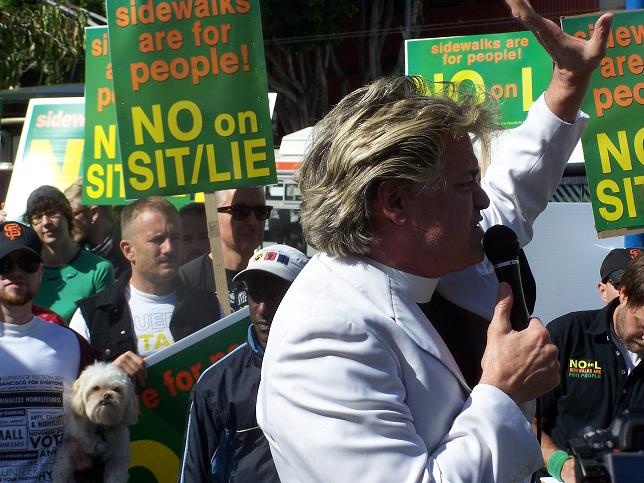
A press release went out yesterday announcing that a group called the Sit Lie Posse had “liberated” six billboards and 60 bus shelters with original artwork in opposition to Proposition L, San Francisco’s proposed sit / lie ordinance. The posters bear three different images, including one featuring a “Gascon-topus,” illustrated with the face of San Francisco Police Chief George Gascon and the body of a gigantic octopus. Gascon is a strong advocate for the ordinance, which would ban sitting and lying down on San Francisco sidewalks.

While members of the posse did not provide a phone number or reveal their true identities, the Guardian did manage to get in touch via email with a spokesperson of the posse, who goes by the name Jim Rawley.

Rawley says he chose his name in honor of the character from John Steinbeck’s The Grapes of Wrath, who manages the utopian Weedpatch camp and treats the impoverished Joad family with dignity and respect. Rawley also reveals the technique the Sit Lie Posse uses to liberate bus-shelter ads, and tells us how long it takes for the crew to put up displays of their artwork throughout the city. A few of our questions and answers appear below.

San Francisco Bay Guardian: Does the Sit Lie Posse have a budget? If so, how much?
Jim Rawley: The Sit Lie Posse is a volunteer group unaffiliated with any electoral campaign. We made our guerrilla ads by hand and paid for our materials out of pocket. It cost us $150 to liberate six billboards and 60 bus shelter ads.

 
SFBG: How long does it take to liberate a billboard? How about a bus shelter ad? Does the posse use wheat-paste?
JR: Our billboards took about 10 minutes and the bus shelters took 2-3 minutes. We accessed the bus shelters using a master key and attached our work with Velcro, the industry standard for bus shelters because of quick, easy insertion. We attached our billboards with wheat-paste. Despite the efforts of Clear Channel and a heavy rainstorm, our bus shelters and billboards are still up.


SFBG: The Sit / Lie Posse has created quite a stir. C.W. Nevius writes in this morning’s column: “Opponents are attempting to make a comparison with the civil rights movement in the South in the ’50s and ’60s. Apparently their view is that an unkempt panhandler camping on the sidewalk equates to the Freedom Riders opposing racial discrimination. Weird.” What would you say to Nevius in response?

 JR: We expected that the Chronicle would try to ridicule, belittle and smear our work, especially since C.W. Nevius and his advocacy columns instigated Prop L. In the 1950s and 60s civil rights workers were maligned by the mainstream press, harassed by the police and subject to physical violence. It takes time for social movements to gain legitimacy in the eyes of the state and the corporate media. In their own words, Chronicle columnist C.W. Nevius and Police Chief George Gascon have said that Prop L enforcement would exclude tourists and center on the homeless. Regardless of your opinion on homelessness, it’s clearly discrimination when the law is based upon a person’s appearance and applies only to certain groups – the poor and people of color. Even more so when the stated intent of the enforcement is to drive certain people out of a neighborhood. This is San Francisco’s kindler, gentler version of Jim Crow segregation.


SFBG: What was the inspiration behind the Gascon-topus?

JR: We came up with the Gascon-topus as a reference to sci-fi movie posters. Prop L will give unchecked power to the police to conduct unconstitutional searches and arrests. In the face of such a monstrous attack on civil liberties, we wanted to respond with wit, humor and satire.


SFBG: Why do you think it’s important to fight against expanded policing in public space?

JR: It’s important to fight additional policing in pubic space to preserve our civil liberties and to save the character of San Francisco. Most San Franciscans don’t want to sacrifice the city’s diversity and rebellious creativity in order to recreate San Francisco as one massive, sanitized shopping mall with all action controlled by the police. Most San Franciscans don’t want undocumented immigrants and day laborers to be deported after a bogus bust for sitting. Most people don’t want to see the poor disqualified from government housing because they committed the crime of sitting. Most people don’t want to be subjected to unconstitutional drug searches after being detained for sitting, nor do people want to see parolees sent back to prison for the crime of sitting. Public space and civil liberties are vital to a healthy democracy. Public space is the only area beyond private property and the marketplace where San Franciscans can come together to exercise civil rights and collectively shape the future of the city. We need to defend that space and extend it against threats from wealthy business interests and their allies in government.

Cash not care

5

sarah@sfbg.com

With the general election just days away, campaign disclosure reports show that downtown interests are spending huge amounts of money to create a more conservative San Francisco Board of Supervisors and to pass Proposition B, Public Defender Jeff Adachi’s effort to make city workers pay more for their pensions and health insurance.

Much of the spending is coming from sources hostile to programs designed to protect tenants in the city, including rent control and limits on the conversion on rental housing units to condominiums. An ideological flip of the board, which currently has a progressive majority, could also have big implications on who becomes the next mayor if Gavin Newsom wins his race for lieutenant governor.

At press time, downtown groups were far outspending their progressive counterparts through a series of independent expenditure committees, most of which are controlled by notorious local campaign attorney Jim Sutton (see “The political puppeteer,” 2/4/04) in support of supervisorial candidates Mark Farrell in District 2, Theresa Sparks in District 6, Scott Wiener in District 8, and Steve Moss in District 10.

Prop. B has also been a big recipient of downtown’s cash, although labor groups have pushed back strongly with their own spending to try to kill the measure, which is their main target in this election.

But the biggest spender in this election appears to be Thomas J. Coates, 56, a major investor in apartments and mobile homes and a demonstrated enemy of rent control. He alarmed progressive groups by giving at least $250,000 to groups that support Farrell, Sparks, Wiener, Moss, and Prop. G, legislation that Sup. Sean Elsbernd placed on the ballot to cut transit operator wages and change Muni work rules.

Although Coates declines to identify with a political party on his voter registration, he donated $2,000 to President George W. Bush in 2004. More significantly, he was the biggest individual donor in California’s November 2008 election, when he contributed $1 million to Prop. 98, which sought to repeal rent control in California and limit the government’s right to acquire private property by eminent domain.

Coates, who is also a yachting enthusiast and sits on San Francisco’s America’s Cup Organizing Committee (ACOC), donated $100,000 on Oct. 20 for Farrell, $45,000 for Sparks, $45,000 for Moss, and $10,000 for Wiener through third-party independent expenditure committees such as the Alliance for Jobs and Sustainable Growth.

The group has already received thousands of dollars in soft money from the San Francisco Police Officer’s Association, the Building Operators and Managers Association, the Golden Gate Restaurant Association, and SEIU-United Healthcare Workers, which supports a high-end hospital and housing complex on Cathedral Hill.

Those downtown groups have spent close to $200,000 on English and Chinese language mailers and robo calls in support of Sparks, Wiener, and Moss in hopes of securing a right-wing shift on the board.

Progressive groups including California Nurses Association, the San Francisco Tenants Union, and the SF Labor Council have tried to fight back in the supervisorial races. While downtown groups spent more than $100,000 promoting Sparks in D6, labor and progressive groups spent $13,000 opposing Sparks and $72,000 supporting progressive D6 candidate Debra Walker.

In D8, progressive groups that include teachers, nurses, and transit riders have outspent the downtown crowd, plunking down $40,000 to oppose Wiener and $90,000 to support progressive candidate Rafael Mandelman. So far, downtown groups have spent about $100,000 to support Wiener.

But in D10, the district with the biggest concentration of low-income families and communities of color, downtown interests spent $52,000 supporting Moss and $5,000 on Lynette Sweet while the Tenants Union was only able to summon $4,000 against Moss. The SF Building and Construction Trades Council spent $4,000 on Malia Cohen.

But that’s small potatoes compared to what downtown’s heavy-hitters are spending. The so-called Coalition for Sensible Government, which got a $100,000 donation from the San Francisco Association of Realtors, has already collectively spent $96,000 in support of Sparks, Wiener, Moss, Sweet, Rebecca Prozan in D8, Prop. G and Prop. L (sit-lie) and to oppose Prop. M (the progressive plan for police foot patrols) and Prop. N (a transfer tax on properties worth more than $5 million).

The Coalition for Responsible Growth, founded by Anthony Guilfoyle, the father of Mayor Gavin Newsom’s ex-wife, Kimberly Guilfoyle (who now works as a Fox News personality), has received $85,000 from the Committee on Jobs, $60,000 from the Realtors, and $35,000 from SF Forward. It has focused on spending in support of Prop. G and producing a voter guide for Plan C, the conservative group that supports Sparks, Wiener, Sweet, and Moss

Coates’ donations raise questions about his preferred slate’s views on tenant and landlord rights. A principal in Jackson Square Properties, which specializes in apartments and mobile homes, Coates is the founding partner of Arroya & Coates, a commercial real estate firm whose clients include Walgreens, Circuit City, and J.P. Morgan Investment Management. In 2008, when he backed Prop. 98, Coates told the San Francisco Chronicle that rent control “doesn’t work.”

Ted Gullicksen, director of the SF Tenants Union (SFTU), which has collectively spent $30,000 opposing Sparks, Wiener, and Moss, is disturbed that Coates spent so much in support of this trio.

“Coates was the main funder of Prop. 98,” Gullicksen explained. “His property is in Southern California. He’s pumping a lot of money into supervisors. And he clearly has an agenda that we fear Moss, Sparks, and Wiener share — which is to make the existence of rent control an issue they will take up in the future if elected to the board.”

That threat got progressive and labor groups to organize an Oct. 26 protest outside Coates’ San Francisco law office, with invitations to the event warning, “Be there or be evicted!”

Sparks, Moss, and Wiener all claim to support rent control, despite their support by someone who seeks to abolish it. “I answered such on my questionnaire to the SFTU, which chose to ignore it,” Sparks told the Guardian via text message. “In addition, I’ve been put out of apartments twice in SF, once due to the Ellis Act. They ignore that fact as well.”

Records show that in May 2009, Moss — who bought a rent-controlled apartment building near Dolores Park in D8 for $1.6 million and he lived there from the end of 2007 to the 2010, when he decided to run for office in D10 — served a “notice to quit or cure” on a tenant who complained about the noise from Moss’ apartment. Ultimately, Moss settled without actually evicting his tenant.

“I read about Coats’ [sic] contribution in Bay Citizen,” Moss wrote in an e-mail to the Guardian. “This donation was made to an independent expenditure committee over which I have no control and almost no knowledge. I have stated throughout the campaign, and directly to the Tenants Union, that I believe current rent control policy should remain unmolested.”

But Moss is with downtown on other key issues. He supports Newsom’s sit-lie legislation and the rabidly anti-tenant Small Property Owners Association, whose endorsement he previously called a “mistake.”

Yet Moss, who sold a condo on Potrero Hill in 2007 for the same price he paid for the entire building in 2001, seems to voice more sympathy for property owners than renters, who make up about two-thirds of city residents. He told us, “Landlords feel that they are responsible for maintaining costly older buildings and that they are not provided with ways to upgrade their units in ways that share costs with tenants.”

Another realm where downtown seems to be trying to flip the Board of Supervisors on a significant agenda item is on health care, particularly the California Pacific Medical Center proposal to build a high-end hospital and housing project on Cathedral Hill in exchange for rebuilding St. Luke’s Hospital in the Mission.

The project has divided local labor unions. UHW supports the project and a slate of candidates that its parent union, Service Employees International Union, is opposing through SEIU Local 1021, which is supporting more progressive candidates. The California Nurses Association also opposes the project and candidates such as Wiener who back it.

“A recent mailer by CNA falsely says that CPMC is closing St. Luke’s and Davies,” CPMC CEO Warren Browner recently complained in a letter to the Board of Supervisors. “We are not. We are committed to building a state-of-the-art, high-quality replacement hospital at St. Luke’s and continuing to upgrade Davies.”

But the CPMC rebuild is contingent on the board approving the Cathedral Hill project. So the CNA mailer focused on what could happen if the city rejects the CPMC project: “We could lose two San Francisco hospitals if Scott Wiener is elected supervisor.”

SEIU-UHW’s alliance with downtown groups and its use of member dues to attack progressive candidates places it at odds with SEIU Local 1021 and the SF Labor Council, which has endorsed Janet Reilly in D2, Walker in D6, Mandelman in D8, and Cohen (first choice) and Chris Jackson (second choice) in D10.

“We’re really disappointed that there are labor organizations that feel they have to team up with Golden Gate Restaurant Association, which is against health care [it challenged the city’s Healthy San Francisco program all the way to the U.S. Supreme Court], and with CPMC, which is working to keep nurses from joining a union,” Labor Council Director Tim Paulson said. “This alliance does not reflect what the San Francisco labor movement is about.”

Paulson said that the Labor Council values “sharing the wealth … So we don’t want Measure B [Jeff Adachi’s pension reform] or K [Newsom’s hotel tax loophole closure, which has a poison pill that would kill Prop. J, the hotel tax increase pushed by labor] or L [Newsom’s sit-lie legislation],” Paulson said.

CPMC’s plan is headed to the board in the next couple months, although Sup. David Campos is proposing that the city create a health services master plan that would determine what city residents actually need. Hospital projects would then be considered based on that health needs assessment, rather than making it simply a land use decision as it is now.

Moss told the Guardian that UHW endorsed him because of his positions on politicians and unions. “I agreed that politicians should get not involved in union politics,” Moss said. “The United Healthcare Workers seem to be a worthy group,” he added. “All they said was that they wanted to make sure that they had access.”

But CNA member Eileen Prendiville, who has been a registered nurse for 33 years, says she was horrified to see UHW members recently oppose Campos’ healthcare legislation. “I was shocked that they were siding with management,” she said.

Prendiville believes UHW is obliged to support CPMC’s Cathedral Hill plan, which is why it is meddling in local politics. In his letter to the board, Browner noted that his company and its parent company, Sutter Health, can’t legally do so directly. “The fact is that CPMC and Sutter Health are 501(c)(3) not-for-profit, nonpartisan organizations, and we neither endorse nor contribute to candidates,” Browner wrote.

“When UHW settled its contract with its members [as part of its fight with the rival National Union of Healthcare Workers], they had to publicly lobby for Cathedral Hill,” Prendiville claimed.

SEIU 1021 member Ed Kinchley, who works in the emergency room at SF General Hospital, is also furious that UHW is pouring money into downtown’s candidates and measures. “UHW isn’t participating in the Labor Council, it’s doing its own thing,” he said.

Kinchley said UHW, which is currently in trusteeship after a power struggle with its former elected leaders, is being controlled by SEIU’s national leaders, not its local membership, which explains why it’s aligned with downtown groups that have long been the enemy of labor.

“Sutter wants a monopoly on private healthcare and people like Rafael Mandelman and Debra Walker have been strong supporters of public healthcare,” Kinchley said. “I want someone who can straight-up say, here’s what’s important for families in San Francisco, especially something as important as healthcare. But it sounds like UHW is teaming up with the Chamber and supporting people who are not progressive.”


Dia de los San Franciscanos

0


caitlin@sfbg.com

ARTS AND CULTURE Rene Yañez, the godfather of San Francisco’s Dia de los Muertos, is showing off the art for his new 3-D altar. The artist is hardly one to adhere to traditions, though he played a large role in creating one of the city’s most distinctive and popular interpretations of another country’s cultural celebrations.

Yañez’s elastic sense of the holiday’s expression mirrors the way his city has interpreted the Mexican holiday. Traditionally, Dia de los Muertos marks the time of year when the boundaries of the dead and living blur. Towns south of the border celebrate the day (which was synced with All Saint’s Day by the Catholic Church to capitalize on the cultural resonance of an indigenous celebration) by decorating the graves of loved ones with favorite treats and trinkets of those who’ve passed on.

But kicking the bucket doesn’t preclude your party pass on Dia de los Muertos. “The whole point of Day of the Dead is that we’re honoring death but mocking it,” says Martha Rodriguez, a Mexico City musician who curates the Dia de los Muertos San Francisco Symphony family concert that celebrates this year’s centennial of the Mexican Revolution.

“Through all the uprisings and death, there’s always space for fun,” Rodriguez says. “That’s kind of how Mexicans survive — we do not stop celebrating.”

Perhaps it’s the mix of spiritual connection, gravity, and levity — not to mention the stylin’ calaveras and brightly-colored floral iconography — that has made the celebration resonate here. The city hosts what is arguably the largest Muertos festivities in the country, featuring altar displays at SOMArts, the Mission Cultural Center for Latino Arts, and Garfield Park, as well as a procession that organizers expect to attract 100,000 participants.

Yañez and son Rio are the curators of the SOMArts’ epic yearly altar installation — an atmospheric production that transforms SOMArts’ drafty main hall into a series of reflective spaces that pay homage to fallen family members, casualties of natural disasters, manmade conflict, and even beloved gatos who have gone to that litter box in the sky.

The elder Yañez’s involvement with SF Dia-ing goes back to the early 1970s when he was artistic director at Mission’s Galeria de la Raza, a time when the neighborhood was absorbing political exiles from political strife in South and Central America. A way to observe the day of remembrance was needed. “We talked about creating a ritual, a ceremonial exhibit,” he says.

At first it was people from the neighborhoods who came to see the altars put together by the de la Raza artists. But eventually, word spread. “The exhibit proved very popular and the schools started coming around,” Yañez remembers.

The altars were a way of talking about Mexican culture and the Galeria started to print lesson plans for teachers. Eventually Yañez organized a procession through the neighborhood, like the ones held in Mexico. The first year, which current procession organizer Juan Pablo tells me was 1978, attracted somewhere between 75 to a few hundred people. But that was going to change.

“It’s the one thing that unites us, the cycle of life and death,” Pablo said in a phone interview. The thousands who attend these days see far more than traditional Mexican spirituality, Pablo said, with Wiccans marching in the parade, the Sisters of Perpetual Indulgence granting indulgences, and tributes being paid to issues worse than old age and mortality. Last year, for example, a walking altar called attention to the 5,000 unsolved assassinations of women in the Mexican border town Juarez.

Any description of SF’s festivities would be remiss if it didn’t mention the influx of Burning Man culture, with its preponderance of elaborately-costumed young people, the stilters, and the skeletons.

They make for a visually stunning event but produce ambivalent cultural connotations. Local blogs have facetiously proclaimed that with the entrenched multiculturalism of SF’s Dia, the holiday celebrations can be more appropriately titled “Day of the Dead Gringos.”

Rio Yañez grew up during this evolution. “The neighborhood’s changed so much, the parade is a reflection of that,” he says. “It’s a way of sharing culture. Even with all the drunk hipsters just having a good time marching, there’s still a good community spirit.”

That’s not to say there isn’t disagreement over how the holiday should be celebrated here. A dispute over who is the source of police complaints about overcrowding and public drunkenness led to a split between Juan Pablo’s collective’s march and the Marigold Project’s altar installations in Garfield Park. “They want to create a party atmosphere, and that’s not what it’s about,” Pablo said. “It’s about honoring the dead.

“The procession is a moving target without any of the hassles of a fixed location,” replies Kevin Mathieu, Marigold Project organizer.

Maybe nothing is ever completely at rest in a San Francisco — even the dead are caught in the winds of our city’s ongoing envisioning of the our culture’s true nature.


Rev. Billy exorcises the demon sit-lie measure

17

This afternoon in the Mission District, a crowd gathered to bear witness to an exorcism. Reverend Billy had come from New York City to banish the demon from SF. That demon was Prop L, an unholy measure to ban people from communing on San Francisco’s sidewalks.
“The only fundamentalism is the absence of fundamentalism!” bellowed the Rev. Bill, a former San Francisco performance artist turned pastor of NYC’s Church of Life After Shopping (which was in town to perform tonight (Mon/26) at the Victoria Theater for its Earth-a-llujah, Earth-a-llujah Revival Tour).

Rev. Billy cited constitutional dicta on behalf of civil rights: that we are all, even those without addresses, equal. The good reverend followed with a defense of the unadulterated and often unpredictable daily experience out there on the streets of San Francisco, apt to shape a human in good and thoughtful ways, that would find itself stifled if city regulations seep onto our sidewalks.

Rev. Billy’s choir ended his sidewalk sermon with a song that repeated, “Speaking freely sets us free,” and whose chorus built to:
“Standing up in public space…
Breaking in to public space…
Shouting out in public space!”

Sup. John Avalos spoke after Rev. Billy, and no sooner had he taken the mic than he accused Police Chief George Gascon of suffering a demon of his own: “hubris.” Avalos referred disapprovingly to Gascon’s previous attempts to tackle drugs and Critical Mass, the city’s monthly bicyclist phenomenon.

In reference to Prop L, Avalos shared that when he came to San Francisco, he knew “three people, had $1,000 in my pocket,” but would have been sleeping on the street if not for a friend’s couch and kindness. He called San Francisco a “sanctuary city,” where people can “find a pathway in life to something better, like I did.”

Gabriel Haaland, a Haight neighborhood resident and labor leader, took the mic and proclaimed that “I am, we are, you are, the riff raff! Because the rent is too damn high.” He questioned whether some have taken to the streets partially because of San Francisco’s high cost of living.

SF resident Selina Gomez Sutton said of Prop L: “a San Francisco without street performers and musicians? Crazy.”
But Prop L is also about something other than civil rights, street-side music, and “cleaning up” Haight Street. It’s also about tolerance.

Tellingly, just a few feet away from, and entirely throughout, Rev. Billy’s sermon, a man sat nearby barking and shouting gruffly at apparently nothing but for what (he must have thought) were good reasons indeed. I was there the entire time, and can say that not one attendee told him to stop. Perhaps they were simply jaded to such conduct — or perhaps it was because they respected his right to exist.

Republican who wants to overturn rent control pumps $200,000 into district elections

25

Thomas J, Coates, a big time investor in apartments and mobile homes, has dropped a total of $225,000 into five independent expenditure committees that are trying to push conservative-friendly candidates and measures over the victory line this fall.

Coates, a 56-year-old Republican (he donated $2,000 to George Bush in the 2004 presidential election) and yacht racing enthusiast, was the biggest single spender in the November 2008 election, when he contributed nearly $1 million to Prop. 98, a statewide measure that sought to repeal rent control in California and limit government’s right to seize private property by eminent domain.

And with only 11 days until the election, Coates has given local Republican war chests an enormous last-minute boost: He plunked $100,000 into Common Sense Voters, a committee in support of Mark Farrell in D2. He plunked $10,000 into the Alliance for Jobs and Sustainable Growth’s committee in support of Scott Wiener in D8. He plunked $45,000 into the Alliance’s committee in support of Theresa Sparks in D6. He dropped $45,000 into the Alliance’s committee in support of Steve Moss in D10. And he dropped another $25,000 into San Franciscans for a Better Muni, a committee in support of Measure G, which attempts to reform Muni by focusing on transit operator wages.

As the Guardian previously reported, this Alliance has received thousands from the SF Police Officer’s Association, the Building Operators and Managers Association, the Golden Gate Restaurant Association, and SEIU-United Healthcare Workers, which supports a mega-hospital on Cathedral Hill.

But Coates’ donation raises questions about his choices’ commitment to rent control. As Coates told the Chronicle in an interview in 2008, “There is a reason why 35 of 50 states expressly prohibit rent control by law – and the reason is it doesn’t work.”

Coates, who is a principal in Jackson Square Properties, which specializes in apartments and mobile homes, is also the founding partner of Arroya & Coates, a commercial real estate brokerage and investment firm whose clients include Walgreens, Circuit City, and J.P. Morgan Investment Management. And as campaign disclosures show, he’s dumped a large part of his money into the same conservative alliance that has already collectively spent almost $170,000 on Moss, Sparks and Wiener.

So far, labor has countered the Republican money by spending $70,000 in support of Debra Walker in D6 and $90,000 on Mandelman in D8, and the SF Tenants Union has spent a total of $20,000 on mailers opposing Moss, Sparks and Wiener. But collectively the downtown money, which is also being funnelled into several other independent expenditure committees, continues to massively outweigh the progressive bucks.

Coates’ phone line continues to register a “busy” signal, making it impossible to leave him a message, but I’d be happy to include his comments here, if and when I talk to him.

But Gullicksen said he was disturbed by Coates’ heavy spending on the supervisors’ races.

“Coates is the main funder of Prop. 98, his property is in Southern California, he’s pumping a lot of money into supervisors and he clearly has an agenda that we fear Moss, Sparks and Wiener share, which is to make the existence of rent control an issue the Board will take up, if those supervisors are elected.”

It will be interesting to see if Moss, Sparks and Wiener are prepared to pledge that they have no intention to attack rent control….so, stay tuned.

Meanwhile, labor is organizing a protest outside Coates office at 500 Washington Street at 5 p.m on Tuesday, Oct. 26.

“Be there or be evicted!” labor warned.


On the margins

3

Sarah@sfbg.com

Franklin is a 20-something computer programmer who shares an apartment with 10 other people around his age, an arrangement that helps him and his housemates come up with $3,500 each month for rent in the Mission, a rapidly gentrifying part of town.

“Everyone is pretty much working, but they are in and out at different times so the house isn’t ever really empty. But there’s usually only three or four of us at a time, ” Franklin told the Guardian, speaking on his cell phone as he rode his bike to work.

But how does an apartment that officially has only one bedroom sleep 10 people? Franklin said there are other rooms in the house — including a dining room and a double parlor that splits into two with sliding doors — and that each of these spaces has a couple sleeping in it. “And there is one person sleeping in a closet and another sleeping in a space atop the bathroom.”

While overcrowding has been a problem in immigrant communities in San Francisco, it’s reaching a new area: young people who have for generations flocked to the city to escape uncomfortable home lives, find a supportive community, and make a new start in life.

Ted Gullicksen, director of the San Francisco Tenants Union, said at least 1,250 housing units annually were lost to condominium and tenancy-in-common conversions in the dot.com and housing bubble years, a loss rate that has slowed only slightly since then.

“Right now, it’s about 1,000 units a year,” he said.

It’s become more common for young people to struggle to pay rent in a town where well-paying jobs are scarce and educational programs have been cut — a triple whammy that means youth with additional challenges are at risk of becoming homeless and getting trapped in vicious cycle of abuse and incarceration.

COMPOUNDING THE PROBLEM

Sherilyn Adams, executive director of Larkin Street Youth Services, which provides housing, medical, social, and educational services to at-risk homeless and runaway youth, says all young people in San Francisco face the same basic challenges.

“And if, in addition, these youth are part of a group like LGBTQ youth, or are youth of color, or immigrant youth, documented or not, then the circumstances and barriers are much more exacerbated,” she said.

Adams said San Francisco has done a lot to add resources for transitional age youth, a group that traditionally has been defined as ages 12 to 24. “But there is still a significant gap in resources, especially for the more disenfranchised groups, because the longer you’ve been on the street, the more complex your issues in terms of substance abuse and mental health.”

Civic leaders, including California Assembly member Tom Ammiano, recently held a rally and candlelight march to raise awareness of the tragic rise in homelessness and suicides among LGBTQ youth. Shortly after, Adams told us, “Youth who came here escaping homophobia in their family or city then face the harsh reality of San Francisco.”

Adams understands that some people see Proposition L, legislation on the November ballot to criminalize sitting or lying on city sidewalks, as a way to address disruptive and aggressive behavior on the streets. “But it becomes part of the larger divide, because youth who come here and are on the street are mostly there because they have no other place. So penalizing them in the absence of services, housing, and education is ineffective at best and really harmful at worst,” Adams said.

Many young people on the brink of homelessness are “somewhat invisible,” and therefore at high risk, she said. “Youth will double, triple up. They will couch surf as a way to be off the streets. And we hear the stories where youth are faced with a Sophie’s choice: Do you sleep on the street, or do you barter with what you have available so as to get shelter? And LGBTQ youth are at particular risk because the more disenfranchised and disconnected you are, the more you have to make impossible choices to survive.”

Jodi Schwartz, executive director at Lyric, an SF nonprofit that focuses on building community and inspiring change in LGBTQ youth, said the group serves 500 youth and reaches out to 800 to 1,000 more each year. “We go into classrooms and talk about hate speech, putting it in the context of racism and other forms of oppression,” she said.

“There’s a misconception that because we live in San Francisco and have a lot more dialogue and interaction with the LGBTQ community, that young people’s experience here is so much better. It may be different, but I wouldn’t say it’s better,” Schwartz said, noting that harassment levels, especially for transgendered youth in local schools, are very high.

HELPING THOSE IN NEED

Young women are another at-risk group, especially if they are pregnant, have kids, or are in the foster or juvenile justice system.

As executive director of the Center for Young Women’s Development in San Francisco’s gritty SoMa district, Marlene Sanchez tries to stabilize at-risk young women, then engage them in policy work so they can advocate for other young people they know.

“We work with young women who are involved in the underground street economies, doing prostitution, drug sales, and selling stolen goods like clothes,” Sanchez said. “We try to reach them on the streets and inside Juvenile Hall, so we take an inside-outside approach.”

Leajay Harper, who coordinates CYWD’s Young Mothers United program, works with young pregnant women inside Juvenile Hall.

“We have all experienced poverty, parents on drugs, and having to take care of younger siblings,” Harper said. “When young moms get incarcerated, they are at risk of having their children taken away at much higher rates. So we started parenting classes that are age and culturally relevant.”

City records show that while only about 12 percent of Juvenile Hall detainees are female, they are twice as likely as their male counterparts to land back in custody for probation violations.

“There are lots of young women with felonies struggling to pay their bills and feed their kids who look out the window and see they can sell drugs. And that often seems like the only option,” Sanchez explained.

City statistics also show that of the overwhelmingly male population at Juvenile Hall, almost half is African American, and that many are inside for what appear to be gang-related offenses.

Easop Winston, a 35-year-old local musician, church pastor, and member of the Visitacion Valley Peacekeepers, regularly visits young men inside Juvenile Hall, where gangs are a topic of discussion every week.

“The same guys that they have been fighting with, they are now incarcerated with,” Winston observed. “So one of the approaches I try to take is rehabilitating how they think about their neighbor. You are killing/fighting with someone who lives one block over. It’s plain genocide”

He credits the juvenile justice system for doing its best, but worries that it fails to rehabilitate youthful offenders with jobs skills, education, and counseling before sending them back into society.

He blames the churches for not doing a better job of making youth feel welcome. “Churches are part of the fabric of our community,” he said. “They need to do more outreach and not have so many rules. They need to accept youth as they are, with their tattoos, piercings, and styles of clothing.”

Winston believes politicians need to do a better job of making sure community-based organizations deliver on their promises to help working class communities of color. At the same time, as he acknowledges, “We can’t cure the world in one day.”

“Over the last five to 10 years, the African American population in SF has shrunk,” he observed. “Everybody is moving to Antioch and Fairfield because people can’t afford to live here. People are losing their jobs. And San Francisco has almost become impossible to live in unless you have a college degree. A lot of what I hear from youth is about economics. They want jobs. They want to be trained.”

PUSHING THEM OUT

Political disputes over the city’s sanctuary city policies on undocumented immigrants — which have left in limbo the question of whether arrested immigrants will get their days in court before being turned over to the federal government for possible deportation — have also been a source of instability for immigrant teens, many of whom are homeless and/or LGBTQ.

Police Commissioner Angela Chan, a staff attorney with the Asian Law Caucus, decried Mayor Gavin Newsom for refusing to implement Sup. David Campos’ due process legislation, which the board approved in November 2009.

“It’s been a little bit upsetting for the many groups that took the democratic process seriously. But these groups are still very committed to these kids,” Chan said. “We are hoping to work with the new U.S. Attorney Melinda Haag to clarify this issue and explain that the top priority of the Obama administration is not to deport undocumented youth.”

Other so-called tough-on-crime initiatives also threaten local at-risk young people. In September, City Attorney Dennis Herrera secured an injunction against 41 alleged gang members in Visitacion Valley, a strategy that progressives fear will accelerate the ongoing displacement of the African American community.

Court documents show that 66 percent of the men named in the injunction are 18 to 25 years old and that many have children in public housing, where lease holders are predominantly women of color.

San Francisco City College Trustee Chris Jackson, 27, is running for the District 10 seat on the Board of Supervisors. Noting that the southeast SF district has some of the highest numbers of poor people and children citywide, Jackson said that youth issues are similar to challenges that other voters face.

“But the context is different,” said Jackson, who previously served on the San Francisco Youth Commission. “Young people care about safe streets because it’s us or our friends who are on them. We care about schools because we are in them and want to go to college. And we are concerned about the future of employment because how do you tell folks to go to school if there are no jobs?”

Jackson notes that in the Bayview-Hunters Point, home to the city’s largest remaining African American community, kids don’t come back if they leave for college. “We see a brain drain. It’s really difficult to retain young people, so it’s important to first make sure that youth’s housing needs are met. And they also need access to careers so that when they graduate, they know there is a job in the city. But right now, youth can’t even find a summer job because of the recession.”

He called for city policies that are based on the needs of current city residents rather than developers’ profits or the desires of well-off outsiders to move here.

“San Francisco is more of an opportunity for Silicon Valley residents than for youth who were born and raised here. And part of the problem is city policies, ineffective programs, and a failure to provide job opportunities for youth,” he said. “Everything for youth has been gutted.”

And those evaporating opportunities are compounded by punitive policies like Prop. L, Jackson said, further alienating young people. “It comes down to how much money you have,” Jackson observes. “If you are rich, you can enjoy the parks, the clubs, the transit. But if you are low-income, especially low-income youth of color, it’s very hard to take advantage of everything the city has to offer.”

Noting that both City College and the San Francisco Unified School District canceled their summer school program, Jackson said, “it doesn’t look like youth are prioritized.”

Jackson was recently at Double Rock (a.k.a. the Alice Griffith Public Housing Project) and he saw four kids under 10 who were at home while their parents were at work. “Why aren’t they in school or in child care? And don’t give me the line that these are hard to serve communities. We have to serve them.”

N’tanya Lee, executive director of Coleman Advocates, agrees that while all young people are struggling in the city, African American children and youth are having one of the worst times.

“We don’t need 5,000 different strategies and initiatives when 90 percent of these kids live in extreme poverty, mostly concentrated in public housing, and you could fit the city’s entire black high school student population into one auditorium,” Lee said.

She wants the city to create a database of these youth and develop specific strategies to help this population before it’s too late.

“No one in city government feels accountable for the outcomes for black children and youth,” she said. “Instead you have one group who are about young people and another who are about economic development — and they have nothing to do with each other. Meanwhile, we’ve lost half of all black families with children in this city in the past 20 years.”

Our 44th Anniversary Issue also includes stories by Rebecca Bowe on ageing out of the foster care system, Caitlin Donohue’s account of the Haight street kids, and Tim Redmond’s editorial on the issues facing our rising generation

How they’re sitting

182

caitlin@sfbg.com

I’ve been hanging out with the Haight Street kids. Over the course of a week or so, I smoked weed, drank malt liquor, witnessed nasty run-ins with police officers — all events that anyone who has walked down the sidewalks of that legendary street would expect. But I also met people who’d give away their last dollar to a friend, people who know a thing or two about community, and people who don’t see sidewalks only as thoroughfares to commerce.

Ironically, though the homeless kids on Haight are the explicit inspiration for Proposition L, the sit-lie measure on the Nov. 2 ballot, their voices have been significantly absent from the vitriolic debate on its merits and faults. Ironic because of all people, it’s these young men and women — and the citizens of San Francisco who interact humanely with them — who could teach us the most about what public space in San Francisco could be.

I didn’t just stand with a notebook, fire questions, and walk away. I took a seat and spent time with the kids, to see for myself whether its true that they’re harassing people, letting their dogs run amok, and generally ruining everyone’s lives as much as sit-lie supporters say they are. That it turned out to be uplifting was an added bonus. I got to see what many don’t on their way to shop for souvenir bongs, retro dresses, and designer skateboards — the reason young people from around the country come to the neighborhood.

It doesn’t have anything to do with fancy Victorians and boutiques, which may explain the disconnect between the street kids and their detractors. They come for the legacy of individuals brave enough to slough off social mores that Haight-Ashbury residents are so ostensibly proud of — not to mention the companionship of others who are comfortable with their rejection of and by society. They come to share stories and pipes and encouragement, and it was cool to watch a streetscape in San Francisco that wasn’t geared solely to commerce.

And while the young people I talked to told me how much they liked to travel, to live free of convention and without ties to the workday world, after a while most acknowledged that they had left behind families who couldn’t or didn’t care for them, home situations that were uncomfortable enough to make life on the streets seem like a better alternative.

Although violent incidents, uncivil behavior, and threatening dogs are well-documented by other news sources, I didn’t see any of that when I was hanging out on Haight. That doesn’t mean that these things don’t exist — but it might suggest that some of the strident supporters of Prop. L are seeing what they want to see.

SPANGING

Steven, who asked us not to use his full name, is 20 and homeless. He grew up in Stockton, became a welder after high school, then decided he “didn’t want the hassle” of staying put for a wage job. His fingernails play host to an ungodly amount of dirt, but his tight blonde curls, pretty golden eyes (“they look like a lion’s!” says one friend in amazement) and mellow, generous demeanor make him a popular hub among his homeless peers.

It doesn’t hurt that he sells weed, small amounts at a time to passing tourists and acquaintances. He silently passes a pipe around to his companions with the slightest provocation. Steven approached me on the street before he knew I was a journalist, a fact that seemed to make little difference to him.

He says he came to the Haight “for the people,” for the area’s reputation of open souls and unconventional artists that originated in the glory days of Janis Joplin and the Grateful Dead. Like most of the kids I talked to, he eschewed the often dangerous shelter scene to sleep in Golden Gate Park or nearby Buena Vista Park despite the police surveillance that could result in spendy fines for park camping.

Although Steven’s worldly possessions fit into the large camping backpack he carries with him 24 hours a day, and even though he’s been living on Haight less than nine months — broken by a jaunt to Eugene, Ore., where he found it “too rainy” to join the town’s expansive street kid community — he doesn’t plan on being homeless forever. It’s just that nothing about this economic climate inspires him to sell his freedom for a paycheck. He plans to go to a four-year college eventually. He sees an education as the only way to get a “real” job. “But until then, why not do this?” he asks. I’m not sure if he’s waiting for my answer.

“This” is sit on Haight Street and “spange,” the term used for “flying a sign” and asking shoppers and neighbors walking by for money, often in a creative way. Of the many crimes street kids are guilty of in the eyes of supporters, spanging is the only one Prop. L would effect.

If Francisco voters approve it, anyone who sits or reclines on the sidewalk (with exceptions for the handicapped and those with permits — but not for the tired, workers on breaks, or people waiting for buses) will be subject to a fine of $50 to $100 for the first offense and $300 to $500, or a maximum of 10 days in jail, for someone found guilty twice within 24 hours of unduly supporting his or her body on the sidewalk between 7 a.m. and 11 p.m. Similar laws can be found up and down the West Coast — although Portland’s was pulled from the books last year after being found unconstitutional because it targeted the homeless.

I ask street kid after street kid why they’ve chosen this lifestyle. Many wouldn’t have it any other way. “Why do people want us off the street?” says Oz, a 21 year old from upstate New York who deals alongside Steven. “Probably because they can’t do this themselves.”

Though I’m skeptical at first, after a while I see why the unconventional group of “travelers” on Haight choose to spend their time spanging. Conversations get struck up with the most unusual people — the old hippie who bought a new Mad Hatter cap for the weekend, the suburban woman who might or might not like to buy some weed (she can’t decide). When a few businesses ask us to move so they can sweep the sidewalk or clear a doorway, the street kids I’m watching relocate with little protest. Many who walk past Steven seemed to find humor in his sign, which that day reads “Are you one paycheck away from having this be your job too?” He says he likes to switch his message daily. “Keep it fresh.”

By hanging out with the spangers, I get to see a Haight Street with human interaction at its core. People walk by, often dropping off surprisingly generous gifts: a ex-Grateful Dead roadie with a massive beard who lives in Fairfax and stopped by the neighborhood for a quick lunch with his daughter parks in front of Steven’s group and approaches them. “You kids hungry? You look like you could use a pizza.”

He emerges a half-hour later with a large cheese pie and drives away after chatting for a few minutes about the old days, to the glee of the group (many of the street kids are Dead Heads). The kids eat their fill, then start handing out the remaining pizza to people walking by, a comic role reversal. “I like to support the community — they get back all the money they get sucked out of them,” Steven tells me.

“NARCOTIC FUELED, ANTISOCIAL THUGS”

The campaign to put a sit-lie ordinance into effect in San Francisco kicked into gear with a Saturday morning stroll. As San Francisco Chronicle columnist C.W. Nevius — who regularly publicizes complaints against the Haight street kid culture — reported Feb. 27, Mayor Gavin Newsom recently relocated to the neighborhood and saw evidence of drug use on the main stretch of Haight where he was walking with his infant daughter. “As God as my witness, there’s a guy on the sidewalk smoking crack,” Newsom reportedly said.

The mayor threw his support behind a sentiment already being voiced by the Haight Ashbury Improvement Association, a resident-merchant alliance in the area. HAIA sees the street kids as disruptive outsiders. “These are not the flower children of the 1960s. It’s narcotic fueled, antisocial thugs who act like a quasi-gang,” Ted Loewenberg, president of the association, was quoted as saying in Business Week.

Adds the Prop L website: ” … the Haight-Ashbury district — once synonymous with peace and love — this corridor is now a hot spot for street bullies, pit bulls, and drug abuse.” It’s a deft cultural lobotomy that dissociates drugs from the Summer of Love, and a devious one that implies that street kids weren’t major players in that social revolution.

As for the bullies, I didn’t see any violence from the street kids in the days and nights I spent out on Haight Street.

I couldn’t get cops to talk to me about it, either. There were two police officers on foot traversing Haight’s main strip and I introduced myself when they stood chatting with a coffee shop owner in the afternoon sunshine and asked them about the sort of neighborhood complaints they regularly received about the street kids.

“No comment,” Cop No. 1 told me. Okay, Cop No. 2, your thoughts? “I don’t speak English.”

To my requests that they share their view of crime on Haight, I could get one response: “It’s complicated.” Later, when I returned to write down their badge numbers, they were standing silently, staring at a lone young man sitting against a wall next to his skateboard. The kid was looking at the ground. Eventually they handcuffed him and put him in a police car while he pleaded meekly about it “only being a little bit of weed — and I was only skateboarding on the sidewalk.”

The most aggression I witnessed from any party took place while I was tapping my feet to a group of traveling bluegrass musicians performing around 10 p.m. on a Thursday. Their cover of Del Shannon’s “Runaway” had inspired an older homeless man to strike up a curiously graceful stomp dance on the sidewalk. He was so drunk and fully immersed in the music that the bottle of Jim Beam in his flailing hand didn’t even register when the police officer approached him and asked, “What do you think you’re doing?”

The musicians began to pack up. “I could have told you this would happen 20 minutes ago,” one tells me, nodding toward the old man. “Don’t say a word or I’ll fucking take you in,” said the cop, who poured out the half-full bottle and wrote a ticket for the older man, who had made a few feeble protests that ended abruptly with the cop’s obscenity.

The officer said he’d received a complaint about the music, a line I heard from each cop I came into contact with on Haight — including one officer who cautioned a family with a toddler to pack up the bracelets they were selling to pay the towing charges on their van. “People don’t like to see people with kids out here, you better move it along,” the cop said.

“I’ve seen aggression because people start shit,” Steven tells me when I ask him about his experience with street violence. A man has just walked by chanting “dirty, dirty” in Steven’s and his friends’ faces. “They don’t like to see people sit on the ground.”

“There are people who come down here just to make themselves look better,” chimes in Oz. “Like ‘ha ha ha, I have air conditioning.’ All kinds of people start shit”

I asked if they knew they were the focus of a massive political debate in San Francisco. “No, what debate?” asked Steven.

“You mean sit-lie?” Oz asks. “It probably has to do with tourism. I don’t see why else they would do that.”

Even the most well-known recent case of Haight Street violence — which was reported June 11 by New York Times reporter Scott James as having “inspired a grass roots movement” that propelled Prop. L, seems to be a question of mutual aggression on the two sides of the street kids issue.

The story goes that a man named Thomas was hosing down the sidewalk in front of his house — a practice that is growing more common in the Haight to make property inhospitable to the homeless. He found himself “surrounded and engaged in a heated confrontation,” as James reports. Thomas reportedly shouted “Do you want a piece of me?” and a scuffle erupted between him and Chad Potter, a 26-year old homeless man, culminating with Potter being arrested and set free the next day. Thomas says Potter and friends continued to harass him after the incident.

James Orr, 24, is busking with his flute when I meet him sitting by a store that sells flowing hippie skirts and bumper stickers that command future tailgaters to “Coexist.” He’s looking to trade his wind instrument for a banjo, which he plays in addition to guitar. A rolling stone, Orr is in town for the Hardly Strictly Bluegrass festival that weekend — he travels the country going to festivals, and even scored a job recently at upstate New York’s Mountain Jam for the event’s blog site, taking photos with a borrowed camera of performances by (ex-member of The Band) Levon Helm and Michael Franti.

Orr’s quite erudite and eager to “say something articulate” about the situation of the street kids and travelers on Haight. He tells me that yeah, he’s seen aggression go down here on occasion. But he resents those situations leading to laws against sitting on the street.

“It’s another example of the few that do mess up casting a bad light on everyone else. Most of us just want to make some money, put a smile on someone’s face.” As a busker, he finds it baffling that people who are against the presence of the homeless would want him to stop plying his trade by making sitting illegal. “You should point out also that it’s how we make money!” he exclaims.

THE PIT BULLS

Snarling ruffians on frayed rope leashes stalking the city streets! As evidenced by the Civil Sidewalks campaign, dogs — specifically pit bulls — are another source of controversy on the pavement. Last December, SFist identified a C.W. Nevius tirade against the breed as example of its ongoing feature “Pit Bull Hate Watch.” The paper has pointed out that the demonized dogs can make great members of society and are often the subject of a media smear campaign.

But for many homeless youth, their dogs aren’t the means of imposing chaos on the gentry. They keep them for the same reasons we do: friendship, protection, love — and during the days I spent on Haight, it was a pleasure to pat the doggies while interviewing their owners. Most were as gentle and laid back as the kids they sprawled next to, a reasonably expected result from the 24 hours a day of socialization with humans that the homeless lifestyle affords.

Smiley is an inveterate street kid unlikely to go indoors anytime soon. “I don’t know how to do anything else,” she tells me. Now in her early 20s with a shock of magenta, purple, and dirty blonde hair and fanciful purple ear plugs that pierce her lobes before spiraling nearly to her shoulders, she’s been traveling since she was 12 — “a Bohemian by blood,” as she puts it. Not only did her parents move their household regularly throughout her childhood, but their heritage is Romani, from the traveling tribes of Eastern Europe.

For Smiley, travel outside the bounds of business trips and weekend vacations is her life’s norm, and Haight Street’s legacy resounds in her nomadic soul. “Most of the people that travelers idolize were here,” she tells me.

Smiley has a year-old behemoth black mutt with droopy eyes. He obliges her as she leans into him holding her spanging sign, which tells the world the pup needs Benadryl for an upcoming van ride to Southern California. “He’s carsick,” she tells me sheepishly. She admits that the dog can limit her mobility on public transportation, but his benefits outweigh his cost. He keeps her warm at night — and, more important for a young woman who is often on her own, he protects her. For a moment breaking out of tough girl mode, she tell me, “oh yeah, I don’t have to worry about anything when he’s around.”

We talk about the perceived threat of dogs on Haight Street. “They want us to leash them, which I guess I understand — but look at that!” A well-dressed woman in her 40s has her Chihuahua off its leash and it has run into the busy street, with her in hot pursuit. “That dog’s out of control,” Smiley smiles.

PISS

Sitting against a mural on a wall where Haight meets Clayton, I watch Piss, an outgoing, gangly guy in his early 20s with a curly blonde mohawk in a growing-out stage. I ask him where he got his unusual moniker. “I like to get drunk and piss on things,” he says.

Well. Originally from Billings, Mont., Piss has been traveling since his mid-teens. “Let’s just say me and my family don’t get along,” he tells me.

His answers to my questions about why he’s on the streets follow a path I see with many of the younger homeless youth: they insist that the lure of the open road was too hard to ignore, but eventually reveal that their parents kicked them out or were unable to care for them at a young age. Many, like Juju, another small-time weed dealer I met, bounced from family member to family member until frictions with them and their significant others left no recourse but the street.

Piss says he’s been to every state in the country, plus Canada and Mexico. With so many years on the road, he is, as they say, letting his freak flag fly. Piss has a blue, vaguely tribal tattoo that curls around his right eye. He’s wearing white tube socks on the dirty pavement. At first glance, he could be crazy — and maybe he is. Whatever his motivation for travel, it’s not to blend in with the locals.

Piss is also actively spanging passersby in a manner that oscillates between off-putting and charming. “You got some money for some crack and ice cream?” he inquires of a passing trio of young women. They shake their head, but before they’re gone completely he continues “I’m just kidding! I don’t like ice cream! Hey miss, you have a nice ass … day!”

Over the course of the hour that I watch him a stand up routine emerges. Beneath the grime, he’s a charismatic kid with an enviable sense of comedic timing.

As he ranges up and down a 20-foot stretch of sidewalk, belly laughs are elicited from a few targets, dollars surfacing here and there. One man carrying an accordion and wearing an expensive-looking pair of leather Chaco sandals donates a handful of strawberries to Piss and to those of us acting as his entourage.

But Piss’ play is a little rough — like a big puppy — and he’s alienating the people who don’t crack up over crack. A couple of people walk away quickly from his petitions shaking their heads over one of the zingers, their suspicions confirmed about those rowdy Haight Street kids.

He’s not doing anything more than what young travelers do all over the world. Thousands of families bid see you later to young adults en route to Prague, Peru, and Perth each year, where they lug their dirty backpacks through the world’s most wondrous towns.

Of course, these kids aren’t sleeping in the public parks of Cuzco — but in countries with plenty of cheap travelers’ hostels, you don’t have to. And though international flights cost more than the van rides and freight train hops that brought in most of the Haight Street kids, backpackers abroad do the same things: take fewer showers and flaunt social norms — not because they want to cause a problem for the natives of the lands they pass through, but because they are young, and discovering themselves for the first time, and can’t see much past that. Piss isn’t being violent, but he has lost the language to deal with “normies” and he’s seen as unpredictable to the not-traveling, not-disenfranchised around him. Which to those who see public space as a place that should be predictable, mean he’s a threat.

The clash between the settled and transient in the Haight is not new. Indeed, it’s what made the neighborhood famous. As far back as the mid-1960s, officials have been simultaneously fighting and publicizing the Haight’s worldwide reputation as a traveler’s meeting place, a place with a culture of loosened societal moorings and enlightenment through free love, drugs, and art.

Businesses claim that the omnipresent homeless drive away paying customers from Haight Street. It a curious claim in an area where the vagrant hippie culture made the place the tourist attraction it is today, and one that is belied by the entry of Whole Foods, which plans to open a branch this year at a lot at Haight and Stanyan vacant since 2006. When contrasted with the Tenderloin — another neighborhood with a visible street community — and its chronic problems attracting a grocery store, the Haight street kids’ effect on local commerce doesn’t seem to be all that grave.

They certainly aren’t making the place any less desirable of a neighborhood to live in for the wealthy. Real estate website Trulia.com puts the median listing price for homes in the Haight-Ashbury neighborhood at $962,264.

The Haight Street kids I spoke could all too easily see what sit-lie would mean for San Francisco. When you control public space, you control who is in public space — and they have no illusions about whether or not they’re included in the perfect world of those who push the measure. If it’s enacted, the subculture that made Haight famous — part of which still survives today in a different form — would be gone, leaving it sterile and safe for the head shops and clothing boutiques, an even less authentic version of the ’60s love fest their patrons come to the street for. One wonders if a scrubbed-clean Haight is even what the residents and business owners who have thrown their lot behind sit-lie truly want, or if they’ve been duped into sit-lie’s efficacy by the same forces that on a national level have convinced us that curtailing civil liberties will lead to freedom for the real Americans. It comes down to this: What do we want Haight Street to be? Do we want to capitalize and benefit from the accepting, messy, wildly creative legacy the 20th century endowed our streets, or do we want a clean, friendly, outdoor mall? The powers of homogenization and gentrification can demonize the little heathens on Haight Street all they want, but they’ve miscalculated if they think that they don’t belong in San Francisco — after all, Haight created them, not the other way around.

Our 44th Anniversary Issue also includes stories by Sarah Phelan on SF’s disadvantaged youth, Rebecca Bowe’s look at ageing out of the foster care system, and Tim Redmond’s editorial on the issues facing our rising generation

Alerts

0

news@sfbg.com

WEDNESDAY, OCT. 20


Oakland candidates forum

The Alameda County Democratic Lawyers Club hosts at forum featuring the candidates for Oakland mayor and Alameda County Superior Court judge. With the Oakland mayor’s race between well-funded favorite Don Perata and progressive challengers Rebecca Kaplan and Jean Quan heating up as it comes into the home stretch, this could be a fun one.

5–7 p.m., $25 for members, $30 for nonmembers

Everett & Jones BBQ Restaurant

126 Broadway, Oakl.

510-836-7563

demlawyers.org/events

THURSDAY, OCT. 21


Save the Dolphins

Earth Island Institute presents “From Flipper to The Cove to Blood Dolphin$: A Conversation with Ric O’Barry,” a plea to save dolphins for being slaughtered in Taiji, Japan. O’Barry, star of the Oscar-winning documentary The Cove and the Animal Planet TV miniseries Blood Dolphin$, will update his campaign with information and video footage from his recent trip to Japan.

7 p.m., $5–$20 sliding scale

The David Brower Center

2150 Allston Way, Berk.

510-859-9100

www.eii.org/events/dolphin

FRIDAY, OCT. 23


Ports blocked for Oscar Grant

The International Longshore and Warehouse Union Local 10 has called for a shutdown of Bay Area ports to call for justice in the case of Oscar Grant, who was fatally shot by BART police officer Johannes Mehserle on an Oakland train platform on New Year’s Day 2009. “Bay Area ports will shut down that day to stand with the black community and others against the scourge of police brutality,” said Jack Heyman, an executive board member for the union. Mehserle was convicted of involuntary manslaughter in July and is scheduled to be sentenced Nov. 5.

All day, free

Ports through the Bay Area

www.ilwu10.org

jackheyman@comcast.net

SUNDAY, OCT. 24


Sunday Streets

The final Sunday Streets car-free event of the season will for the first time travel through the streets of the Tenderloin and Civic Center area. Bicyclists, pedestrians, and skaters travel a route that passes City Hall, Boedekker Park, Tenderloin Recreation Center, and the Tenderloin National Forest in Cohen Alley, off Ellis near Leavenworth, featuring live performances, the Funkytown Roller Disco, and free bike rental and repair stations. This event also coincides with the second annual Tricycle Music Festival, with live music from 11 a.m. to 2 p.m. on the steps of the Main Library.

10 a.m.–3 p.m., free

Civic Center/Tenderloin

sundaystreets@gmail.com

415-344-0489. ext. 2

www.sundaystreetssf.com

MONDAY, OCT. 25


Earth-a-llujah Revival

Reverend Billy and the Church of Life After Shopping Choir returns to San Francisco as part of their Earth-a-llujah, Earth-a-llujah Revival Tour, bringing the environmentalist and anti-consumerist gospel to the Mission District. Fresh off of a run for the mayor of New York City and successful campaign to get Chase Manhattan Bank to disinvest in mountaintop removal coal mining, Rev. Billy (a.k.a. performance artist Billy Talen, who got his start here in SF) and his flock will fill you with the Holy Spirit and exorcise you of your credit cards. Hallelujah!

7 p.m., $12

Victoria Theater

2961 16th St., SF

(415) 863-7576

www.revbilly.com/events/cali-tour

www.brownpapertickets.com/event/133698

Beat patrols: A case study

14

If you want a case study that illustrates why San Francisco needs Proposition M, taken a look at Bernal Heights.

In 2008, two people were killed at the Alemany public housing project, topping off a disturbing increase in street crime. Neighborhood activists responded by working successfully with the captain of the Ingleside Station to a beat cop on Cortland Ave. Crime dropped.

But several weeks ago, Captain Louis Cassanego cut that foot patrol, citing the need to reallocate scarce SFPD manpower to more violent areas.

We couldn’t reach Cassanego, but at an Oct. 6th Police Commission meeting, Chief George Gascon said the beat patrol fell victim to budget problems. He explained that a beat cop on Cortland wasn’t needed anymore because the policy “was set there at a time when there was an increase in robberies… in this community that is no longer there today.”

But comminity activists say that’s precisely the point: “When we got the beat cops, crime went down,” Joseph Smooke, executive director of the Bernal Heights Neighborhood Center, told us. In fact, Smooke said, the foot patrol reduced overall crime in the surrounding neighborhoods as well.

And now, with the foot patrols gone, residents fear that crime will rise again.

Supervisor David Campos, a coauthor of Prop M, told us: “It doesn’t make sense: the community wants more policing, not less. They rightly feel that we’re moving backwards, that something they worked very hard for is being taken away.”

Prop M would hamper future foot patrol cuts by requiring the Chief of Police to prescribe a comprehensive “Foot Beat Patrol Program” for all SFPD stations.

Says community organizer Buck Bagot, who volunteers with the Bernal Height Neighborhood Center, “It’s hard not to think [Prop M] makes sense.”

Prop M could also address what Bagot and Smooke agree is the larger problem: community-police synergy. Besides mandating foot patrols, Prop M would require the Police Commission to “adopt a comprehensive written policy on community policing,” including “a plan for… open communication… among [SFPD] personnel and community members,” with a focus on “neighborhood-specific policing priorities and strategies.”

In recent years Bernal Heights community groups have fallen somewhat out of step with local police. Communication with Ingleside Station has at times been strained. The station’s former captain, David Lazar, started a program in August of 2009 that alloowed merchants and residents to call cell phones that beat cops carried on duty. Cassanego ended that program, too.

Cassanego cut the Cortland Ave beat, he compensated by extending two bike patrol beats into that area. Though Bagot is skeptical that this will be effective, losing personal access to the police irks him most. “At least if we could talk with [the cops], we could work with them…. But if they’re not going to patrol there anymore, and we can’t call them on the cell phones, then we’re kind of floating free.”