Poetry

SF Stories: Michelle Tea

0

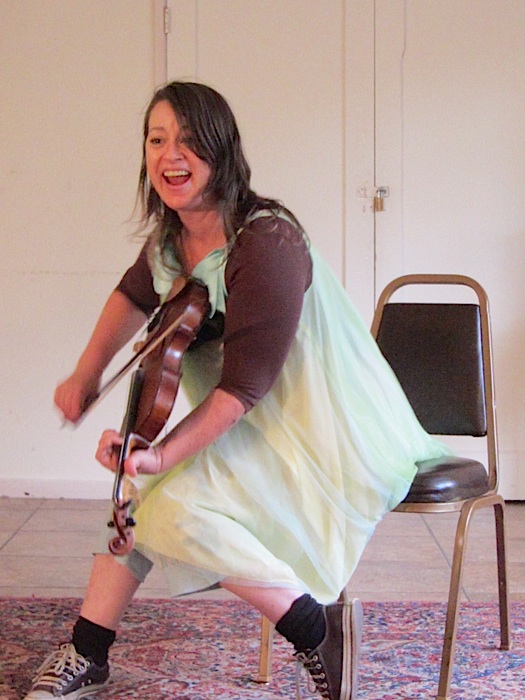
46TH ANNIVERSARY SPECIAL When I was about 21, living with my parents outside Boston, I started making zines. I sent my first one, Bitch Queen, to Maximum Rock ‘n’ Roll, and it wound up getting reviewed in MRR‘s Queer Zine Explosion issue. I hadn’t even known there was a queer zine explosion happening, but my little P.O. box was soon stuffed with zines from zinesters wanting to trade issues, and with enough dollar bills that I could cross the street to the mall and get lunch. It was the first experience I had of being given something for my writing, and, more importantly, finding community with other writers.

Later that year my relationship fizzled and I found myself unexpectedly moving to San Francisco. It felt like I had stepped right into the zines I’d been devouring — not only because the punk-queer scene really embodied the content and aesthetics I’d become obsessed with — torn, cut ‘n’ paste, glue-sticked and Sharpied, riffing on radical feminism, dirty queer sex, anti-racist, anti-sizest and more — but because the people from the actual zines were slamming up against me at the queer clubs I was dancing at!

There was Lynn Breedlove, whose daredevil fucking-shit-up bike messenger adventure story I’d read in Chainsaw. There was Youme, the sweetly, long-haired girl who inked the pervy, graphic novel-zine Get What You Want. There’s Larry Bob from Holy Titclamps, and Matt Wobensmith from Outpunk! I think that woman with the spiral-shaved head in the front row of the poetry reading at the Bearded Lady is Kathy Acker, from the Angry Woman book. Yeah — it is. And I swear I saw those heavily tattooed, psychotically pierced girls over there in a DIY photo spread in some grainy, Xeroxed number.

An obsessive fan my whole life, it took me an awe-filled moment to understand that I had become obsessed with a scene I could actually participate in. Showing up to dance at Junk at The Stud and getting taken home by the girl on the cover of the latest modern-primitive zine was just something that happened when you were living in the center of everything interesting, San Francisco in the 1990s. No more longing for Warhol’s Factory, the heyday of the Mud Club, front row at CBGBs, a room at the Chelsea, London in the 70s, the East Village in the 80s or whatever cultural moment I was upset at time itself for causing me to miss. I had the tremendous feeling of being part of something larger than myself, righteous with activism and wild with sex and art.

I pierced one nipple at Fakir Musafar (wait, the guy from the ReSearch Book???)’s piercing school, where you only had to pay for the jewelry, the piercing, done by a student, was free. Even so, I could only afford a single ring, so I only pierced one nipple, and the ring fell out anyway, while having sex with someone I don’t remember anymore. The San Francisco queer-punk scene in the 90s was adamant in its invitation that anyone could participate. It didn’t matter what you looked like, you were invited to fuck yourself up a little and whammo, you are getting massively laid. Broke? Write about it, steal copies from Kinko’s –look, you’re a publishing magnate! Got a bad attitude? Awesome, you are now mayor of dyketown, go punch someone. Every bit of antisocial behavior punished elsewhere was here politicized and celebrated in the ongoing experiment of how far could everything be pushed. And at it’s heart, the culture was a literary one, with zines its many bibles, its textbooks, its canon.

Michelle Tea is the author of many books, including the 90s classic Valencia and the forthcoming A Mermaid in Chelsea Creek (McSweeney’s). She is the editor of Sister Spit Books, an imprint of City Lights, and the Executive Director of RADAR Productions, which hosts a Polka Dot Cocktail Party with queer studies scholar and curator Jonathan Katz, at a private home, on October 28th. The link: http://www.brownpapertickets.com/event/282115


Alerts

0

THURSDAY 18

Culture as a weapon: poetry and storytelling SOUL School of Unity and Liberation, 1904 Franklin Suite 904, Oakl; www.schoolofunityandliberation.org, RSVP at info@schoolofunityandliberation.org. 6:30pm, $5-25. The second in a three-part series exploring how art and culture can be a form of political resistance. At this workshop, learn from poet, writer, artist and organizer Erika Vivianna Céspedes about writing that helps build movements. RSVP is required, and if you can’t get into this one, try their next event in the series, an activist printmaking workshop on Oct. 25.

Fall of the I-Hotel film screening New Nothing Cinema, 16 Sherman, SF; newnothing.wordpress.com. 8pm, free. A screening of a film depicting the historic struggle between residents and supporters of the International Hotel and the landlords that wanted it razed and turned into a parking lot. After massive neighborhood “revitalization,” the I-Hotel was one of the last remnants of the once-lively Manilatown neighborhood. See how residents fought for it at a screening presenting by Shaping San Francisco, New Nothing Cinema, and the CIIS Anthropology and Social Change Department.

FRIDAY 19

Say goodbye to condoms as evidence Jane Warner Plaza, 401 Castro, SF; www.tinyurl.com/condommarch. 6-8pm, free. As we reported this week, SFPD has decided to temporarily end the controversial practice of using possession of condoms as evidence in prostitution cases. For a three to six month trial period, condoms will not be seized or photographed if a cop thinks someone might be a sex worker. A group that was planning to march in opposition to the practice will now march in celebration of the decision, and to urge the city to make the trial period permanent.

Disobeying with great love Powell Street Bart station, Powell and Market, SF; www.tinyurl.com/disobeylove. 6pm, free. A flash mob meditation in the middle of the Disneyland-like shopping district. What better way to relax amongst the chaos?

SATURDAY 20

Op Trapwire Department of Homeland Security, 560 Golden Gate Ave, #36127, SF. WikiLeaks let loose information about Trapwire, the now-notorious company that uses surveillance and tracking to monitor people’s movements and aggregate them into patterns. It does this with a network of security cameras across the country, government and law enforcement uses its information, and the whole thing may be illegal. Some Occupy types have called for a national day of action against surveillance on Oct. 20, and San Francisco is joining in.

Picket Mi Pueblo market Mi Pueblo Mercado1630 High, Oakl; dignityandresistance@gmail.com. 1-4pm, free. Mi Pueblo Market is a successful and beloved grocery store chain. Workers were upset to learn that the company signed up to participate in E-Verify, a voluntary program that tracks the immigration status of all new hires. Managers say that the decision was made after serious pressure from ICE and the Department of Homeland Security. Workers and community supporters will picket the store in protest of the new policy.

SUNDAY 21

Amy Goodman speaks First congregational church of Oakland, 2501 Harrison, Oakl; www.kpfa.org/events. 7pm, $15 in advance. Amy Goodman co founded Democracy Now! The War and Peace Report in 1996. Since then, she has consistently brought progressive, hard hitting reporting to television screens and radios, authored a few books, and established herself as a distinctive voice in journalism. She’s also a kick ass speaker. Come hear her share her wisdom at a benefit for KPFA radio, where she’ll be speaking on “The Silenced Majority: Stories of Uprisings, Occupations, Resistance, and Hope”

MONDAY 22

Tasers forum Hamilton Recreation Center, 1900 Geary, SF; www.tinyurl.com/taserforums. 5pm, free. The SFPD has called a public forum to discuss the possible introduction of tasers into the police arsenal. Come to share your thoughts on the idea. And if you want to hear more, show up a half hour early for a community-led forum. “This summer, ACLU delivered a report of 532 documented Taser related deaths in the US since 2001, but that has not stopped SF Police Chief Greg Suhr from pushing the fourth attempt to spend several million dollars to equip SFPD with these deadly weapons,” say organizers.

Stage Listings

0

Stage listings are compiled by Guardian staff. Performance times may change; call venues to confirm. Reviewers are Robert Avila, Rita Felciano, and Nicole Gluckstern. Submit items for the listings at listings@sfbg.com. For further information on how to submit items for the listings, see Picks.

THEATER

OPENING

Love in the Time of Zombies Café Royale, 800 Post, SF; sftheaterpub.wordpress.com. Free ($5 donation suggested). Opens Mon/15, 8pm. Runs Mon-Tue, 8pm. Through Oct 30. San Francisco Theater Pub performs Kirk Shimano’s “rom-zom-com.”

The Scotland Company Exit Theatre, 156 Eddy, SF; www.thunderbirdtheatre.com. $15-25. Opens Thu/12, 8pm. Runs Thu-Sat, 8pm; Sun, 3pm. Through Oct 27. Thunderbird Theatre Company performs Jake Rosenberg’s new comedy.

“Strindberg Cycle: The Chamber Plays in Rep” Exit on Taylor, 277 Taylor, SF; www.cuttingball.com. $10-50 (festival pass, $75). Previews Fri/12-Sat/13, 8pm; Sun/14, 5pm (part one); Oct 25, 7:30pm and Oct 26, 8pm (part two); Nov 1, 7:30pm and Nov 2, 8pm (part three). Opens Oct 18, 7:30pm (part one); Oct 27, 8pm (part two); and Nov 3, 8pm (part three). Runs Thu, 7:30pm; Fri-Sat, 8pm (also Sat, 2pm); Sun, 5pm. Through Nov 18. Cutting Ball performs a festival of August Strindberg in three parts: The Ghost Sonata, The Pelican and The Black Glove, and Storm and Burned House.

BAY AREA

An Iliad Berkeley Repertory Theatre, Roda Theatre, 2015 Addison, Berk; www.berkeleyrep.org. $14.50-77. Previews Fri/12-Sat/13 and Tue/16, 8pm; Sun/14, 7pm. Opens Oct 17, 8pm. Runs Tue and Thu-Sat, 8pm (also Sat, 2pm); Wed and Sun, 7pm (also Sun, 2pm). Through Nov 11. Berkeley Rep performs Lisa Peterson and Denis O’Hare’s Homer-inspired tale.

Richard the First: Part One, Part Two, Part Three Berkeley City Club, 2315 Durant, Berk; www.centralworks.org. $14-25. Previews Fri/12, 8pm (part one); Sat/13, 8pm (part two); and Sun/14, 5pm (part three). Opens Oct 18, 8pm (part one); Oct 19, 8pm (part two); and Oct 20, 8pm (part three). Runs Thu-Sat, 8pm; Sun, 5pm (three-part marathon Sundays, Nov 11 and 18, 2, 5, 8pm). Through Nov 18. This Central Works Method Trilogy presents a rotating schedule of three plays by Gary Graves about the king known as “the Lionheart.”

ONGOING

Elect to Laugh Marsh San Francisco, 1062 Valencia, SF; www.themarsh.org. Tue, 8pm. Through Nov 6. $15-50. Veteran political comedian Will Durst emphasizes he’s watching the news and keeping track of the presidential race “so you don’t have to.” No kidding, it sounds like brutal work for anyone other than a professional comedian — for whom alone it must be Willy Wonka’s edible Eden of delicious material. Durst deserves thanks for ingesting this material and converting it into funny, but between the ingesting and out-jesting there’s the risk of turning too palatable what amounts to a deeply offensive excuse for a democratic process, as we once again hurtle and are herded toward another election-year November, with its attendant massive anticlimax and hangover already so close you can touch them. Durst knows his politics and comedy backwards and forwards, and the evolving show, which pops up at the Marsh every Tuesday in the run-up to election night, offers consistent laughs born on his breezy, infectious delivery. One just wishes there were some alternative political universe that also made itself known alongside the deft two-party sportscasting. (Avila)

Family Programming: An Evening of Short Comedic Plays Shelton Theater, 533 Sutter, SF; www.brownpapertickets.com. $20. Thu/11-Sat/13, 8pm. Left Coast Theatre Company performs short plays about gay and alternative families.

The Fifth Element: Live! Dark Room Theater, 2263 Mission, SF; www.darkroomsf.com. Fri-Sat, 8pm. Through Oct 27. Comedic adaptation of the 1997 Luc Besson sci-fi epic.

Foodies! The Musical Shelton Theater, 533 Sutter, SF; www.foodiesthemusical.com. $30-34. Fri-Sat, 8pm (no show Nov 17). Open-ended. AWAT Productions presents Morris Bobrow’s musical comedy revue all about food.

Geezer Marsh San Francisco, 1062 Valencia, SF; www.themarsh.org. $30-100. Sat, 8pm; Sun, 7pm. Through Nov 18. Geoff Hoyle’s popular solo show about aging returns.

Of Thee I Sing Eureka Theatre, 215 Jackson, SF; www.42ndstmoon.org. $25-75. Wed, 7pm; Thu-Fri, 8pm; Sat, 6pm (also Sat/13, 1pm); Sun, 3pm. Through Oct 21. 42nd Street Moon performs George and Ira Gershwin’s classic political satire.

The Play About the Baby Gough Street Playhouse, 1620 Gough, SF; www.custommade.org. $30. Thu/11-Sat/13, 8pm; Sun/14, 7pm. Custom Made Theatre presents Edward Albee’s devilishly funny 1998 play, an intriguing and gleefully idiosyncratic work about the brutality to which innocence is invariably subjected in this world. In a formal and thematic reshuffling of the Albee deck (from which he drew earlier gems like Who’s Afraid of Virginia Woolf? or The American Dream), the play offers two couples: Boy (Shane Rhoades) and Girl (Anya Kazimierski) — two innocents in the blush of first love who have just had a baby — and Man (Richard Aiello) and Woman (Linda Ayres-Frederick), a quippy, slightly sinister pair who intrude on the younger couple for initially undisclosed reasons. As much propositions as people (albeit lively ones), the characters move around a stage backed by a wall-full of assorted chairs (in Sarah Phykitt’s somewhat enigmatic scenic design) addressing each other and the audience by turns, the older ones prone to digressive monologues, the younger to ingenuous rapture, confusion, and finally (as their predicament becomes clear) anguish. The play’s oddball dialogue and intentional repetition demand a lot from a cast, however, and director Brian Katz gets uneven results from his. While Kazimierski offers a sure, buoyant performance as Girl, Rhodes wavers in his delivery, proving only occasionally convincing as Boy. Ayres-Frederickson exudes a nice, saucy, indomitable air as Woman, and Aiello is a pretty good match for her, despite a somewhat stilted start. But the effect overall is a little too erratic to avoid turning the play’s intentional repetitions into a slow-growing tedium. (Avila)

The Real Americans Marsh San Francisco, 1062 Valencia, SF; www.themarsh.org. $25-50. Fri, 8pm; Sat, 8:30pm. Extended through Oct 27. Dan Hoyle’s hit show, inspired by the people and places he encountered during his 100-day road trip across America in 2009, continues.

Roseanne: Live! Rebel, 1760 Market, SF; www.brownpapertickets.com. $25. Wed, 7 and 9pm (no shows Oct 31). Through Nov 14. Lady Bear, Heklina, D’Arcy Drollinger, and more star in this tribute to the long-running sitcom.

Shocktoberfest 13: The Bride of Death Hypnodrome, 575 10th St, SF; www.thrillpeddlers.com. $25-35. Thu-Sat, 8pm. Through Nov 17. Thrillpeddlers’ annual Halloween horror extravaganza features a classic Grand Guignol one-act and two world premiere one-acts, plus a blackout spook show finale.

The Strange Case of Citizen de la Cruz Bindlestiff Studio, 185 Sixth St, SF; www.bindlestiffstudio.org. Thu/11-Sat/13, 8pm. Bindlestiff Studio presents Luis Francia’s political thriller.

Twelfth Night San Francisco Maritime National Historic Park, Hyde Street Pier, 2905 Hyde, SF; www.weplayers.org. $30-80. Sat/13, 5:30pm. After spending the summer on Angel Island with their epic-scale production of The Odyssey, the We Players have scaled back with a lo-key rendition of Shakespeare’s Twelfth Night on Hyde Street Pier. Of course when it comes to the We Players, “scaled-back” still means a two-and-a-half hour long participatory jaunt taking place mainly along the length of the pier and aboard the historic ferryboat, the Eureka, which serves primarily as the residence of the grieving Illyrian Countess, Olivia (Clara Kamunde) around whose favors much of the plot revolves. Highlights of the experience include the opportunity to visit historic Hyde Street Pier, a gypsy-jazzy score directed by Charlie Gurke (who also plays the lovelorn Duke Orsino), and the rascally quartet of the prankish Maria (Caroline Parsons), jocular drunk Toby Belch (Dhira Rauch), clueless doofus Andrew Augecheek (Benjamin Stowe), and wise fool Feste (John Hadden). But as We Players productions go, this one feels less inspired in its staging, and much of the action merely shuffles back and forth on the Eureka without incorporating many of the intriguing nooks and views the Hyde Street Pier offers, despite a promising opening scene involving a beach and a rowboat. Also, uncharacteristically for We, the comic timing seemed to be off the evening I saw it, although both Stowe and Hadden ably conveyed their wit without a flaw. Dress warmly, carry a big flask, and you’ll be fine. (Gluckstern)

The Waiting Period Marsh San Francisco, 1062 Valencia, SF; www.themarsh.org. $15-50. Thu-Fri, 8pm; Sat, 5pm. Extended through Oct 27. Brian Copeland (comedian, TV and radio personality, and creator-performer of the long-running solo play Not a Genuine Black Man) returns to the Marsh with a new solo, this one based on more recent and messier events` in Copeland’s life. The play concerns an episode of severe depression in which he considered suicide, going so far as to purchase a handgun — the title coming from the legally mandatory 10-day period between purchasing and picking up the weapon, which leaves time for reflections and circumstances that ultimately prevent Copeland from pulling the trigger. A grim subject, but Copeland (with co-developer and director David Ford) ensures there’s plenty of humor as well as frank sentiment along the way. The actor peoples the opening scene in the gun store with a comically if somewhat stereotypically rugged representative of the Second Amendment, for instance, as well as an equally familiar “doood” dude at the service counter. Afterward, we follow Copeland, a just barely coping dad, home to the house recently abandoned by his wife, and through the ordinary routines that become unbearable to the clinically depressed. Copeland also recreates interviews he’s made with other survivors of suicidal depression. Telling someone about such things is vital to preventing their worst outcomes, says Copeland, and telling his own story is meant to encourage others. It’s a worthy aim but only a fitfully engaging piece, since as drama it remains thin, standing at perhaps too respectful a distance from the convoluted torment and alienation at its center. (Avila)

BAY AREA

Acid Test: The Many Incarnations of Ram Dass Marsh Berkeley, 2120 Allston, Berk; www.themarsh.org. $15-50. Thu-Fri, 8pm; Sat, 5pm. Through Nov 24. Lynne Kaufman’s new play stars Warren David Keith as the noted spiritual figure.

Assassins Ashby Stage, 1901 Ashby, Berk; www.shotgunplayers.org. $20-30. Wed-Thu, 7pm; Fri-Sat, 8pm; Sun, 5pm. Through Nov 11. Shotgun Players performs the Sondheim musical about John Wilkes Booth, Lee Harvey Oswald, and other famous Presidential killers (and would-be killers).

Hamlet Bruns Amphitheater, 100 California Shakespeare Theater Way, Orinda; www.calshakes.org. $35-71. Wed/10-Thu/11, 7:30pm; Fri/12-Sat/13, 8pm; Sun/14, 4pm. Liesl Tommy directs this season closer for Cal Shakes, a decidedly uneven and overall surprisingly bland production of one of Shakespeare’s most fascinating, affecting, and endlessly rich works. The best part of Tommy’s less-than-inspired hodgepodge production (summed up by the dry and cluttered swimming-pool set, albeit very nicely designed by Clint Ramos) is lead Leroy McClain, whose Hamlet is a vibrantly intelligent and charismatic force most of the time. He gets some fine support from Dan Hiatt as a comically pedantic but still sympathetically paternal Polonius, but there is precious little chemistry with either Ophelia (a nonetheless striking Zainab Jah) or faithless queen mother Gertrude (Julie Eccles). The rest of the cast is rarely more than dutiful. Meanwhile, the staging comes laden with some awkward and/or tired conceits: a small fish tank-like landscape inset into the back wall for an unraveling Ophelia; a gore-covered zombie-esque ghost (a flat Adrian Roberts, who also plays Claudius); or guards sporting submachine guns, which always looks ridiculous. Moreover, the language comes awkwardly modernized in places —substituting “dagger” for “bodkin” in a rather famous soliloquy, for example, seems unnecessary and is definitely distracting. Why not “submachine gun”? (Avila)

The Kipling Hotel: True Misadventures of the Electric Pink ’80s Marsh Berkeley, 2120 Allston, Berk; www.themarsh.org. $20-50. Sat/13, 8:30pm; Sun/14, 7pm. This new autobiographical solo show by Don Reed, writer-performer of the fine and long-running East 14th, is another slice of the artist’s journey from 1970s Oakland ghetto to comedy-circuit respectability — here via a partial debate-scholarship to UCLA. The titular Los Angeles residency hotel was where Reed lived and worked for a time in the 1980s while attending university. It’s also a rich mine of memory and material for this physically protean and charismatic comic actor, who sails through two acts of often hilarious, sometimes touching vignettes loosely structured around his time on the hotel’s young wait staff, which catered to the needs of elderly patrons who might need conversation as much as breakfast. On opening night, the episodic narrative seemed to pass through several endings before settling on one whose tidy moral was delivered with too heavy a hand, but if the piece runs a little long, it’s only the last 20 minutes that noticeably meanders. And even with some awkward bumps along the way, it’s never a dull thing watching Reed work. (Avila)

Sex, Slugs and Accordion Marsh Berkeley, 2120 Allston, Berk; www.themarsh.org. $10. Wed, 8pm. Through Nov 14. Jetty Swart, a.k.a. Jet Black Pearl, stars in this “wild and exotic evening of song.”

33 Variations TheatreWorks at the Mountain View Center for the Performing Arts, 500 Castro, Mtn View; www.theatreworks.org. $23-73. Tue-Wed, 7:30pm; Thu-Sat, 8pm (also Sat, 2pm); Sun, 2 and 7pm. Through Oct 28. TheatreWorks performs Moisés Kaufman’s drama about a contemporary musicologist struggling to solve one of Beethoven’s greatest mysteries, and a connecting story about the composer himself.

Topdog/Underdog Marin Theatre Company, 397 Miller, Mill Valley; www.marintheatre.org. $36-57. Tue and Thu-Sat, 8pm (also Thu/11, 1pm; Oct 20, 2pm); Wed, 7:30pm; Sun, 2 and 7pm. Through Oct 21. Marin Theatre Company performs Suzan-Lori Parks’ Pulitzer Prize winner about a contentious pair of brothers.

The World’s Funniest Bubble Show Marsh Berkeley, 2120 Allston, Berk; www.themarsh.org. $8-50. Sun, 11am; Nov 23-25, 11am. Through Nov 25. Louis “The Amazing Bubble Man” Pearl brings his lighter-than-air show back to the Marsh.

PERFORMANCE/DANCE

“Bi Curious Comedy Night” Deco Lounge, 510 Larkin, SF; www.decosf.com. Sun/14, 8pm. $10. With Nick Leonard, Kate Willet, Nicole Calasich, and more.

“Comedy Bodega” Esta Noche Nightclub, 3079 16th St, SF; www.comedybodega.com. Thu, 8pm. Ongoing. No cover (one drink minumum). This week: the San Francisco Comedy Burrito Festival.

“Gravity (and other large things)” NOHspace, 2840 Mariposa, SF; www.performancelab.org. Wed/10, Fri/12-Sat/13, and Oct 19-20, 8pm; Sun/14 and Oct 21, 4pm. $12-25. Right Brain Performancelab present this evening-length dance-theater piece.

“A New Anthropology of Asian-Black Relations” Garage, 715 Bryant, SF; www.brownpapertickets.com. Wed-Thu, 8pm. $10-20. Mash-up poetry installation, plus performance, by Kevin Simmonds.

Smuin Ballet Palace of Fine Arts Theatre, 3301 Lyon, SF; www.smuinballet.org. Thu/11-Sat/13, 8pm (also Sat/13, 2pm); Sun/14, 2pm. $25-65. The company performs its fall program, including West Coast premiere Cold Virtues.

“The Spooky Cabaret” Stage Werx, 446 Valencia, SF; www.wilywestproductions.com. Wed/10, 7:30pm. $10. ‘Tis the season for this fest of three full-length and five one-act plays with horror themes.

“Theatecture on UN Plaza” Civic Center, UN Plaza, Seventh St at Market, SF; www.ftloose.org. Tue/16, noon-2pm. Free. Outdoor performance of Mary Alice Fry’s Honeycomb Zone as part of the “24 Days of Central Market Arts Festival.”

Shake, rattle, and read

1

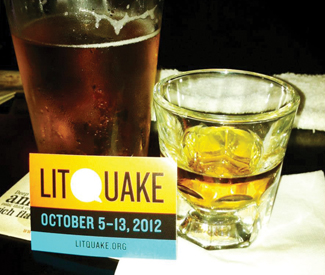
LIT What do you get when you bring together a horde of ravenous bibliophiles in a city that’s known for the possibility of a future catastrophic event? No, not the zombie-nerd apocalypse: Litquake, the largest annual independent literary festival on the West Coast. This year’s nine-day festival runs from Fri/5 through Sat/13, ending with Lit Crawl, the infamous booklovers pub-crawl that words up the Mission. The festival’s venues are as diverse as its writers, ranging from theaters, coffee houses, bars to a barbershop, a bee-keeping supply store, even a parklet. The jam-packed program is expected to bring even more attendees than last year (a whopping 16,581), and features 850 authors in 163 events including hundreds of readings and a multitudinous array of panels and cross-media events.

Originally dubbed Litstock, the festival was conjured up by Jane Ganahl and Jack Boulware at the Edinburgh Castle pub in San Francisco, a watering hole where local authors had been doing readings of their work. Ganahl and Boulware’s idea was simple: get a bunch of writers together to read their work in Golden Gate Park, and see what happens. With the help of Phil Bronstein, then editor of the San Francisco Examiner, they got $300 for a sound system, and on July 16, 1999, Litstock was born. Twenty-five writers read from their work, and to the surprise of Ganahl and Boulware, 300 people came to hear them. In 2002, the festival acquired its new, quintessentially San Francisco moniker, Litquake, and has been growing exponentially — more than 3,650 authors have presented to more than 83,500 people.

(About this year’s installment, Boulware tells the Guardian, “”This year, the festival feels like the programming has more depth than in previous years. We’re including more events at museums, more events outside the city, in particular the Berkeley Ramble, more tributes to noteworthy authors — Lenore Kandel, Woody Guthrie, and Juan Rulfo — and much more diversity in our expanded Lit Crawl schedule. We’re overjoyed to help cement the Bay Area’s rightful place on the national and international literary map.”)

As the story goes, the renaming of the festival in 2002 was partly inspired by an article in USA Today reporting that San Franciscans spend more money on books and alcohol than the residents of any other major city in the nation, according to the Bureau of Labor Statistics. Added to the festival in 2004, Lit Crawl has becoming the living, breathing embodiment of San Francisco’s happy marriage of books and booze — more than 6000 scribes and fans take part in venues in the Mission. San Francisco’s Lit Crawl (this year on Sat/13) has been so successful that there are now Lit Crawls in New York, Austin, Brooklyn and, soon, Seattle.

As neighborhoods go, the Mission is the perfect setting for the event, given its noteworthy independent bookstores and Dave Eggers’s brainchild, 826 Valencia. Like North Beach and the Haight, the city’s former literary hotspots, the Mission has an inherited bohemian spirit (some would call it Beat) that gives life to the idea of literary community.

This year’s Liquake roster of readers is a hefty one, spanning various genres and including such notable participants as Christopher Coake and Daniel Alarcón, both among Granta’s Best of Young American Novelists, along with local legends like US Poet Laureate Robert Hass and poet D.A. Powell. A bound-to-be-popular panel featuring cartoonist Daniel Clowes and Eggers himself will surely to draw a crowd, as the two discuss everything from the creative process to their favorite comics, books, and movies.

And for history buffs, there will be panels on little-known and formerly censored poetry of Beat poet Kandel and a tribute to Jane Austen featuring Karen Joy Fowler, author of bestseller book The Jane Austen Book Club.

It’s a fitting testament to San Francisco’s rich intellectual heritage that, in a city known for its ballooning tech industry (the oft-feared culprit behind literature’s “imminent demise”), San Franciscans’ literary love affair shows no signs of waning. Our lust for books still causes the city to tremble.

LITQUAKE

Fri/5-Sat/13

Various times, venues, and prices, SF.

www.litquake.org


Downtown development

1

LIT/VISUAL ARTS The term “Mission School” was coined in these pages by Glen Helfand in 2002 to describe a loose-knit group of artists based around the Mission District who were then just beginning to break through into international art world success. These artists — including Barry McGee, Margaret Kilgallen, Chris Johanson, Alicia McCarthy, Rigo 23 and others — made use of found materials and shared an informal aesthetic that was influenced as much by the low rent streets of the city around them as a relaxed, collective Bay Area vibe.

A decade later, it seems safe to say that the Mission School was probably the last major art movement of its kind in this country, and itself the end of an era. For over three decades, significant art and music breakthroughs in this country were linked to specific urban neighborhoods (hip-hop to the South Bronx; Warhol’s Factory to downtown Manhattan, riot grrrl to Olympia, Wash.; grunge to Seattle; Fort Thunder in Providence, RI, etc.) Today, with the rise of the importance of MFA programs as a means to enter the art world, and the lack of locality fostered by the internet, the era of geographic specificity as arts incubator has perhaps passed us for good.

Two new books take us back to those freer, more experimental days at the inception of the SoHo and East Village arts scenes of New York in the 1970s and 80s. 112 Greene Street: The Early Years (1970-1974) (Radius Books, 192 pp., $50) is a brief, but invigorating oral history from the early years of what we now know as SoHo. This just-released catalog to last year’s exhibition at Zwirner Gallery in Chelsea brings to life the sense of discovery and improvisation of the nascent neighborhood scene that centered around the legendary pioneering alternative arts space and its north star, the late Gordon Matta-Clark.

In October 1970, when Jeffrey Lew and Matta-Clark opened 112 Greene Street in the storefront of a “rundown former rag picking factory,” the area south of Houston Street was a wasteland of abandoned former textile factories known as Hell’s Hundred Acres. The space, with its lack of heat, and its raw walls, uneven floors, and poor artificial lighting resembled the city then falling apart all around it. The ruins of the city not only influenced the work; sometimes they literally became work.

Alan Saret remembers walking near Canal Street with Matta-Clark one night when a cornice simply fell off a building right in front of them. Saret found some other cornices on the ground nearby and paid the crew of a passing city garbage truck to haul them back to 112 Greene where they became part of a sculpture piece he called Cornices.

Far from the uptown galleries where Manhattan art world power then was consolidated, 112 Greene’s isolation and state of decay fostered a certain kind of “anything goes” artistic freedom and collaborative spirit. For the first opening at 112 Greene, Matta-Clark jackhammered a hole in the basement floor and filled the area with dirt, where he planted a cherry tree that he kept alive all winter with grow lamps. For a later exhibition, George Trakas wanted to do a two-story sculpture, so he simply cut a hole in the floor so his piece could rise up out of the basement into the main floor. The only rule seemed to be that work had to be created on site and could not be made for sale.

Perhaps predictably, with this last rule, the space could barely keep its doors open. Yet, there is a timeless lesson here for those running arts spaces today: the downfall of 112 Greene came ironically only after it finally achieved financial stability. When Lew landed a big NEA grant in 1973, pure art experimentation and spontaneity gradually gave way to formal scheduling and programming guidelines from the funders in DC, who demanded more and more say in the operation of the space. “The excitement that anything could happen waned as paperwork and schedules were enforced,” remembers Lew. The core group of artists slowly drifted away from 112 Greene, just as the original SoHo, too, was beginning to change all around them into the high-end shopping district it is today.

The SoHo model has become a cynical real estate gentrification strategy, as developers create prefab arts — and shopping — neighborhoods in empty warehouse districts across the country from Miami to Portland, Ore. to Brooklyn. But if, say, Bushwick’s art scene feels less like a real place than the shores of a desert island where hundreds of young artists have been randomly washed up by the storms of the global economy, 112 Greene Street reminds us that the first art neighborhoods were formed organically around genuine community. In 1971, Matta-Clark and artist Carol Goodden started an artist-run collective restaurant in SoHo called Food. By all accounts, Food was not some relational aesthetic stunt; it was a well loved and sincere attempt to provide cheap meals, a gathering place, and jobs to artists in the scene.

112 Greene Street ends before Matta-Clark’s untimely death from pancreatic cancer at age 35 in 1978, and before the artist would famously take the work he developed in the ruins of 112 Greene out into the ruins of the city with a practice he dubbed “Anarchitecture.” He took the city as his canvas, transforming raw space by sawing dramatic cuts in the floors and facades of abandoned buildings in the South Bronx and industrial parts of New Jersey. But the charm and dreamy freedom of the era 112 Greene Street depicts comes through in Matta-Clark’s film, Day’s End. In it, Matta-Clark works calmly with a blowtorch, cutting holes in the steel ceiling of an abandoned city pier on the Hudson River (with no apparent fear of getting caught) as the space slowly fills with radiant light.

A decade later, another artist who would die too young, David Wojnarowicz, would also find a wide-open playground in the rotting piers along the river. Wojnarowicz would spend hours at the piers, writing about what he saw there, having sex with strangers, and drawing murals or writing poetry on the crumbling walls. Wojnarowicz delighted in the ruins and saw the piers as a sign that America’s empire was fading away before his eyes. That today we know it was actually only Wojnarowicz’s world that was about to disappear is just one of the many poignant aspects of Cynthia Carr’s beautiful new book, Fire in the Belly: The Life and Times of David Wojnarowicz (Bloomsbury USA, 624 pp., $35), the first comprehensive biography to date of the artist, writer, and activist who died of AIDS at the age of 39 in 1992.

On the run from an abusive father, Wojnarowicz started sleeping with older men for money while living on the streets in his teens. Drawn to other criminals and outlaws, his first published writings were based on interviews he did with street hustlers, travelers, and homeless people he met in skid row waterfront diners and on hitchhiking trips. In the works of Jean Genet, he found a literary moral universe that helped him make sense of his own worldview. One of his earliest surviving works, a collage entitled St. Genet, depicts the French writer wearing a halo in the foreground while in the background, Jesus is tying off to shoot up. While Wojnarowicz would continue to use such blunt religious imagery in his work, the collage resonates in other ways. Carr reports that it was Kathy Acker who first called Wojnarowicz “a saint” when she appeared with him at his final public reading in 1991. The identification of Wojnarowicz’s life and work with the tragic loss of so many daring, outlaw artists to AIDS is so complete that Wojnarowicz has become a patron saint to young queer and activist artists today, his life story surrounded by an aura of myth.

Carr, a former arts reporter for the Village Voice, carefully picks apart myth from fact: Wojnarowicz didn’t actually start selling his body for money at age nine as he often claimed and he also wasn’t a founding member of ACT UP as many people suppose (though he did participate in some ACT UP protests). Yet, the complex and more human Wojnarowicz that Carr leaves us with is no less inspiring a figure — a self-taught artist whose lifelong struggle to make meaningful art out of his own experience, sexuality, and ultimate diagnosis with an incurable disease would almost by chance place him front and center in the story of the AIDS crisis and the great culture wars of the late 1980s and early ’90s.

Carr, a resident of the East Village now for four decades, became friends with Wojnarowicz late in his life, and she refreshingly breaks journalistic “objectivity” to insert her own eyewitness perspective into the narrative at many key junctures. One senses Fire in the Belly is so good precisely because it is a story only Carr could personally tell. Built on years of observation, Fire in the Belly has the ambitious scope and rich detail of a novel, and, more than a biography, is the story of a fabled East Village scene now irrevocably lost.

Wojnarowicz arrived in a gritty East Village where whole blocks had been abandoned to heroin dealers and bricked up tenements. A nihilistic neighborhood arts scene embraced the decay of the streets as an aesthetic, and galleries like Civilian Warfare Studios presented a giddy cocktail of downtown punk and queer culture mixed with the freshly born graffiti and hip-hop scenes of the South Bronx. Carr relates now-famous events like Gracie Mansion’s “Loo Division” show (mounted in the bathroom of her E. Ninth Street walkup), Keith Haring painting on the snow on the street in front of his show at Fun Gallery, and the exploits of the Wrecking Crew — a team including Wojnarowicz and other artists who would binge on acid and stay awake for days, filling galleries with creepy and crazed collaborative installations.

The artists’ isolation would not protect them from the art world for long. Soon, limos were disgorging passengers at openings on the heroin and rat-filled terra incognita east of First Avenue. East Village stalwarts like Jean-Michel Basquiat and Haring became rich and internationally famous, and even Wojnarowicz became a fairly established up-and-coming art star. The rags-to-riches story of the East Village scene might be the same kind of innocent tale of lost Bohemia as that of 112 Greene, were it not for the AIDS crisis shadowing it the whole time. Carr skillfully juxtaposes the narrative of openings and parties with chronological news reports of the then-unknown new disease. Carr describes a party on Fire Island in July 1981: writer Cookie Mueller read a story from the New York Times out loud to the room about a strange, new “gay cancer”. Photographer Nan Goldin, who was present, remembers today, “We all just kind of laughed.”

Carr’s tale picks up suspense after Wojnarowicz himself is diagnosed with AIDS. Over a breathtaking two-year period, Wojanrowicz embarks on an urgent mission to complete every single art project he’d ever hoped to accomplish in the time left to him in life. In the process he almost reluctantly becomes the fiery AIDS activist we remember today. While working on his career retrospective, he also battles the harassment of his landlord who is determined to evict Wojnarowicz and convert his loft in the gentrifying East Village into a cinema multiplex. He struggles to complete his memoir, even as his work becomes the focus of battles over government funding of art. Soon, Republicans denounce the dying man’s work as obscene and anti-Christian on the floors of Congress, and Wojnarowicz becomes a target of conservative Mississippi preacher Reverand Donald Wildmon’s public attacks. Wojnarowicz absorbed these attacks and the era’s stunning homophobia and turned them into what became the most powerful work of his career, the myth of his own life.

Carr’s book stands along with recent work like Sarah Schulman’s Gentrification of The Mind as a corrective to the uncritical nostalgia for the lost New York City of the 1970s and 80s that seems to have flowed like a river from Patti Smith’s 2009 memoir, Just Kids. These works unromantically detail what has been lost and then lovingly describe exactly how painfully it was all lost. Yet, perhaps all is not lost. While arts neighborhoods like the ones described in 112 Greene Street and Fire in the Belly seem like a thing of the past, the towering myths left behind by figures like Matta-Clark and Wojanrowicz still bring young artists against all odds to the rehabbed neighborhoods of San Francisco and New York today. Everytime Sara Thustra serves a meal at an opening at Adobe Books on 16th Street or Homonomixxx shuts down a Wells Fargo bank, we walk, if just for a short time, the streets of our old familiar city.

David Wojnarowicz: Cynthia Carr and Amy Scholder in Conversation
Wed/3, 7:30pm, free
Lecture Hall
San Francisco Art Institute
800 Chestnut, SF
www.sfai.edu/event/CynthiaCarr

On the Om Front: A path with heart

0

I’ve been practicing yoga for 12 years. Over the years, my practice has changed depending on the basic conditions of my life: my age, my health, my schedule, my location, my physical and spiritual interests and needs, my romantic relationships, my relationship with chocolate chip cookies. Each time I’ve come to a point of transition in how I practice, or where I practice, or with whom I practice (and, more recently: how I teach, where I teach, and for whom I teach), I start to question why I’m doing what I am doing and what is the ultimate goal. 

The questioning is uncomfortable—who wants to question a thing they love? 

It feels dirty, disloyal. It creates murk in a stream that once felt swimmingly clear. But I’ve learned that it’s an inevitable part of any path. Whether we like it or not, questions arise—if they didn’t, we wouldn’t have some version of this symbol in every language: “?” Luckily (or unluckily), I come from Jewish heritage, so questioning is in my blood. In Judaism, it’s godly to question. 

So, I’m questioning.

And I’m reading this book right now called A Path With Heart. It’s by Jack Kornfield, one of the founders of Spirit Rock, a Buddhist meditation retreat center up in Marin that runs regular residential silent meditation retreats. (It’s a top local joint that I highly recommend, especially if you’re one of those people who thinks you “could never” sit in silence for a week, which is nearly everyone unless you’ve actually done it and know that you could, in fact, have.) 

Anyway: In the first few pages of his book, Jack gets down to the crux of the matter. He says that no matter what road you’re driving your spiritual chariot down, you’ve got to keep coming back to the question of whether or not your path has heart. To paraphrase, you could be touching your first metatarsal to your crown chakra or chanting Om Namah Shivaya until the cows come home (and if you’re doing that in India, it won’t be very long—the cows are always coming home), but if you’re not practicing from a place of love, there’s no point to it. Or, maybe there’s some point to it … but it’s not the point.

This isn’t just about yoga or meditation. The same is true for anything you do. Take art, for instance. If your art has no heart, it may look or sound pretty, but its cosmic shelf life is going to be shorter than a wink. Good art creates soul grooves. It has a ripple effect. It’s a rechargeable battery that powers up each time it connects with a new source. It needs to be infused with real juice, the kind that comes from that metaphorical, physiological blood pumper that sits just to the right of center—in your chest.

There’s a lot of heart in our city.

I went to see a play last weekend called Dogsbody at Intersection for the Arts by Erik Ehn, a gifted spiritual warrior who has crafted 17 poetic theatrical works on genocide as part of a project called Soulographie to wake us up to the realities of war. (The project is en route to NYC, so if you’re out there November 11-18, get in on it.) I also hit Martin Scott’s Saturday morning yoga class at Union Yoga, for which all proceeds generously go to Headstand.org, an organization that brings yoga to at-risk youth. Both Erik and Martin are heart-ists. 

Here’s a line from Kornfield’s book, which I’ve been reading to my own classes this past week. He’s quoting Carlos Castaneda who’s referring to a teaching by Don Juan: 

“Look at every path closely and deliberately. Try it as many times as you think necessary. Then ask yourself and yourself alone one question …. Does this path have a heart? If it does, the path is good. If it doesn’t, it is of no use.”

Not a bad one to pull out when faced with a moment of evaluation. Here’s to landing in a place where that question has the right answer.

********

Around the Bend 

(some upcoming events with heart)


Sweat and Study: Chants and Invocations for Yoga 

If you love chanting to Ganesh and the other colorful yoga deities, this workshop is the place to be this Sunday. You’ll learn several of the basic yoga mantras and—if you’re already a regular chanter—you’ll learn how to lead them. Sean Feit is a gem. It’s worth the trip to Berkeley.

9/30, 2-5, $20, Yoga Tree Telegraph


Sivananda Poetry Night

The Sivananda center in San Franciso has a new monthly poetry satsang. This week, hear Virginia Barrett (Vidya devi) read poems from her forthcoming  book, I Just Wear My Wings, and bring a short poem (your own or one from a spiritual teacher/writer). Tea and snacks available.

9/28, 7:30 – 9:15 p.m, suggested donation $5-$10, Sivananda Center in SF


Union Yoga’s Donation-Based Vinyasa for Headstand.org

This fun, challenging flow class taught by Martin Scott on Saturday mornings is entirely donation-based, and all of the profits support the non-profit organization Headstand.org, which brings yoga classes to at-risk youth in underserved schools. It fills up (as it should) so register online beforehand.  

Every Saturday, 9am, suggested donation $15, Union Yoga


KFOG Harmony by The Bay

KFOG shows some love to yogis in its Harmony by the Bay concert by offering a special yoga stage. (If you go, please report back on what this actually looked like—I’ve no idea!) Musical acts for the outdoor concert include The Shins, Tegan and Sara, and the holy rapper Matisyahu.

9/29, $40-$75, Shoreline Amphitheatre. More info: www.harmonybythebay.org/2012


Karen Macklin is a yoga teacher and multi-genre writer in San Francisco. She’s been up-dogging her way down the yogic path for over a decade, and is a lifelong lover of the word. To learn more about her teaching schedule and writing life, visit her site at www.karenmacklin.com.

Snap Sounds: Bibi Tanga and the Selenites

0

BIBI TANGA AND THE SELENITES
40 DEGREES OF SUNSHINE
(NAT GEO MUSIC)

From the bright electro-funk pulse of the opening track, “Poet of the Soul,” sunlight infuses Bibi Tanga and the Selenites’ latest album, 40 Degrees of Sunshine. An upbeat melange of esoteric samples, funky bass lines, polyrhythmic percussion, soulful, multi-lingual crooning, and Walt Whitman poetry, the twelve tracks distill the best of an array of influences into a potent brew.

Neither the vibrant Afrobeat-ish “Band a Gui Koua,” sung in Sango, the nouveau jazz inflections of “Attraction,” nor even the unsettling tone poem “Happy Dust Man,” would be out of place on dance floors from Bangui or Boston, despite their refusal to be neatly categorized. To this refusal, Bibi Tanga and crew offer a preemptive explanation, perhaps apology, on “Dark Funk”. “If you find a name for the music we’re doing…just call us.”

Our Weekly Picks: September 19-25

0

WEDNESDAY 9/19

The Birds


As part of a series of ongoing celebrations marking the 100th anniversary of Universal Pictures, Fathom Events and Turner Classic Movies are presenting a special one day only screening of The Birds, Alfred Hitchcock’s classic 1963 horror flick about rampaging flocks of fearsome feathered fiends that invade a sleepy coastal community and wreak havoc on its citizens. Filmed in San Francisco and just to the north in Bodega Bay, the film has been newly restored, and will be preceded by an introduction from TCM host Robert Osborne, along with revealing interviews that he conducted with star Tippi Hedren earlier this year. See website for participating theaters. (Sean McCourt)

2 and 7pm, $10.50–$12.50

Various Bay Area Theaters

www.fathomevents.com

THURSDAY 9/20

Azure Ray


Orenda Fink and Maria Taylor are Alabama natives, childhood friends, and progenitors of dream pop duo Azure Ray. Throughout most of their Azure work, the pair grounded their tracks in vocal harmonization and added in some folksy acoustic guitar and/or piano melodies, such as in 2010’s Drawing Down the Moon. But in the latest LP released this month, As Above So Below, Fink and Taylor immerse their warm vocals in electronic atmospherics, vocal delay effects, and a smattering of bass. Azure have said for As Above that they drew on the minimalist and electronic aspects of artists such as James Blake, Nicholas Jaar and Apparat. As Above’s tight and intricate feel can be partially credited to co-producer and Orenda’s husband, Todd Fink of The Faint. (Kevin Lee)

With Soko, Haroula Rose 8pm, $15 Swedish American Music Hall 2174 Market, SF (415) 431-7578 www.cafedunord.com

FRIDAY 9/21

Eat Real Festival


Sure, the snacks and sips for sale at Eat Real are superlative, but not all of Oakland’s three-day fest dedicated to fresh, local edibles revolves around pure functionality. Take for example, the Thai fruit carving demonstration manned by staff from mobile Bay Area catering outfit House of Siam. You can learn how to turn a watermelon into a rose, petals fading from pink meat to white rind. It’s just one of a passel of tutorials that will be taking place throughout the fest, which will also feature a beer garden of local brews curated by Eat Real neighbor, Linden Street Brewery, live music, and vendors hawking treats, all for under $5. (Caitlin Donohue) Fri/21 1-9pm; Sat/22 10:30am-9pm; 10:30am-5pm Jack London Square, Oakl. www.eatrealfest.com

FRIDAY 9/21

Pacific Pinball Expo


"Free play!" For lifelong pinball wizards in training — and those, like me, who just enjoy playing Addams Family for hours at the local gay bar — there are few better phrases in the English language. To show off its extensive (and quite historically fascinating) collection of games with balls, and to help promote its intended move to the Palace of Fine Arts from Alameda, the great Pacific Pinball Museum is hosting the supposedly largest pinball expo in the world at the Marin Civic Center. 400 games set on free play! X-Men! Ms. Pacman! Vintage Bally games like Starjet! "Woodrails" from the 1950s! Sorry, there will be no splints provided for those who, in their excitement of such flashing and dinging riches, suffer a case of "flipper wrist." (Marke B.)

Through Sun/16, 10am-midnight, $15–$60

Marin Civic Center Exhibition Hall

10 Avenue of the Flags, San Rafael

(510) 205-6959

www.pacificpinball.org

FRIDAY 9/21

Wilco


As recent sold-out performances at the Fox attest, Chicago’s Wilco is an easy sell. Eight albums in with 2011’s The Whole Love, Jeff Tweedy continues to catalog tender hearts at the edge of maddening fights, backgrounded arguably the most expansive band in rock. (While other groups may struggle to create a sound big enough for the Greek, drummer Glenn Kotche could do it on his own.) But the added draw this time are the openers; Friday is a second chance for anyone who missed Cibo Matto’s reunion show at Bimbo’s last year, while Saturday features beloved raconteur Jonathan Richman, with extra of room for him to let loose his signature dance moves. (Ryan Prendiville)

Fri/21 with Cibo Matto; Sat/22 with Jonathan Richman 7:30pm, $49.50 Greek Theatre 2001 Gayley Road, Berk. (510) 548-3010 www.apeconcerts.com

FRIDAY 9/21

Yob


Eugene, Oreg.’s Yob has been producing sprawling doom metal landscapes since 1996, but it’s taken until 2012 for it to get noticed. Though the mainstream press has finally picked up on the band — Spin Magazine placed its sixth album, Atma, in its top 50 records of 2011 — Yob’s masterful songwriting and awesomely sinister energy hasn’t lost any of its edge. Atma is a megalith of slow, chugging riffs and discordant melodies, the shortest song clocking in at seven minutes and 33 seconds. Vocalist (and Krav Maga instructor) Mike Scheidt shrieks and growls over the sludge like a demon that has finally been unleashed. (Haley Zaremba)

With Acid King, Norska

9pm, $12

Brick and Mortar Music Hall

1710 Mission, SF

(415) 800-8782

www.brickandmortarmusic.com

SATURDAY 9/22

California Wines Road Trip


Love a variety of California wines, but don’t have the time to travel all over the state to visit all the wineries? Then head over the "California Wines Road Trip" event, where more than 90 wines from 14 different regions of the state will be available to sample, along with artisanal cheeses and other scrumptious food offerings. The party is part of California Wine Month, which will be hosting other events all throughout the state, so drink up for a good cause — part of the proceeds from the event will go to the Center for Urban Education about Sustainable Agriculture and the California Sustainable Winegrowing Alliance. (McCourt)

2-5pm, $35.

Ferry Building, Grand Hall

One Ferry Building, SF

discovercaliforniawines.com/roadtrip

SATURDAY 9/22

7 Seconds


They say that Reno is so close to hell you can see sparks. It makes sense that this environment would create one of the most enduring hardcore punk bands in music history. 7 Seconds have been active for three decades. In this time span they’ve gone through lineup changes, genre changes, into the straight edge movement and back out of it. Since its inception in 1980, the Marvelli brothers Kevin Seconds and Steve Youth have remained the backbone of the band, tirelessly touring and releasing 15 albums and numerous EPs and compilations. You’ve seen the logo for years, on T-shirts and patched onto jean jackets, but 7 Seconds have endured based on a lot more than great branding. They’re living, breathing, shredding pioneers of American punk. (Zaremba)

With Heartsounds, Bastards of Young, City of Vain

7pm, $12

924 Gilman, Berkeley

(510) 524-8180

www.924gilman.org

SATURDAY 9/22

Cut Hands


Like an enrapturing free-jazz gig, or a moshtastic punk show, Cut Hands’ brand of crushing experimentalism must be seen live to be fully appreciated. The one-man project, commanded by British fringe-artist and Whitehouse bandleader William Bennett, fuses traditional Central African percussion with synthetic drums, laying them atop ambient drones and shrill electronics, with an industrial production sound worthy of Throbbing Gristle at their most unforgiving. Pushing his singular vision to new extremes, Bennett’s forthcoming LP, Black Mamba (the follow-up to his Wire-approved Afro Noise series) is the project’s most relentlessly pulverizing statement to date. Gluttons for avant-punishment shouldn’t pass up the opportunity to experience Bennett’s viscerally draining, yet transcendent, explorations in sound. (Taylor Kaplan)

With Burmese, Bestial Mouths, DJ Crackwhore 9:30pm, $12

Elbo Room 647 Valencia, SF (415) 552-7788 www.elbo.com

MONDAY 9/24

Wyclef Jean


Member of a supernatural hip-hop crew, singer of "Gone ‘Til November" — maybe you even got a bead on his brief, but glorious run at being the president of Haiti, in the face of Sean Penn’s wet-blanket naysaying. But unless you have read his new book Purpose: An Immigrant’s Story (if you have, back pat, the thing was released on Tuesday) you probably did not know that Jean’s pastor father relocated his family into a fire-damaged funeral home in Newark when the sensitive rapper was wee. Face it, many things about this ex-Fugee remain a mystery. Attend tonight’s event and let them be revealed, with insightful prodding by MTV2’s Hip Hop Squares host Peter Rosenberg. (Donohue)

7:30, $25–$30 Palace of Fine Arts 3301 Lyon, SF

(415) 567-6642 www.palaceoffinearts.org

MONDAY 9/24

Serj Tankian


Serj Tankian started writing his third solo album when he read about the mass disappearance of different species of animals around the world. The result is Harakiri, a self-produced record named for the Japanese idea of ritual suicide. As the frontman for System of a Down, Armenian-born Tankian has a long history of activism and influence in the music community, and now he’s taking on the uncomfortable future of environmental (un)sustainability. In response, Tankian has kicked into overdrive, touring with System, publishing his third book of poetry, collaborating with nonprofits, collaborating with other musicians, and releasing a rock opera all within the last year. With this momentum, Tankian may just take over the world. I don’t know about you, but I trust him with it. (Zaremba)

With Viza

8pm, $35

Fillmore

1805 Geary, SF

(415) 346-3000

www.thefillmore.com

TUESDAY 9/25

Django Django


"Spins the phrases together ’til something starts to make sense" is generally a pretty apt description of what frequently parades as "psychedelic" songwriting, a veil of random weirdness that often obscures an underlying mediocrity and lack of musical talent. On its self-titled, Mercury Prize-nominated debut — which includes those lyrics on the track "Hail Bop" — Britain’s Django Django takes a different approach, combining the the straightforward structure of ’60s vocal pop with a nearly cribbed catalog of inward looking psych imagery, layered over surprisingly shiny production that includes influences from tribal rhythms and metronomic, driving electronica. The result is an album that’s paradoxically bold as it is bare. (Prendiville)

With Vinyl Williams 8pm, $15 Independent 628 Divisadero, SF (415) 771-1421 www.theindependentsf.com

The Guardian listings deadline is two weeks prior to our Wednesday publication date. To submit an item for consideration, please include the title of the event, a brief description of the event, date and time, venue name, street address (listing cross streets only isn’t sufficient), city, telephone number readers can call for more information, telephone number for media, and admission costs. Send information to Listings, the Guardian, 225 Bush, 17th Flr., SF, CA 94105; or e-mail (paste press release into e-mail body — no attachments, please) to listings@sfbg.com. Digital photos may be submitted in jpeg format; the image must be at least 240 dpi and four inches by six inches in size. We regret we cannot accept listings over the phone.

Alerts

0

WEDNESDAY 19

Day of action for free Muni passes for youth Balboa BART Station, 401 Geneva Ave, SF; www.peopleorganized.org. 1:30pm, free. POWER has been working for years to get free Muni passes for youth, but the fight is not over. Come help keep the pressure on in a campaign that aims to "shift local, regional, and national mass transit priorities towards the needs of working class communities of color and to bring an analysis of race, class, and gender to bear on transportation planning decisions," starting with free Muni for youth in San Francisco.

Norman Yee happy hour Rio Grande, 1108 Market, SF; www.tinyurl.com/kim4yee. 6pm, free. Connect with some politicians at this happy hour, which District 6 Sup. Jane Kim is throwing for District 7 candidate Norman Yee. Yee is currently on the school board and hopes to represent District 7, which spans from Judah in the north to Lake Merced.

THURSDAY 20

Speak-out and march for Derrick Gaines Arco gas station, 2300 Westborough Blvd., South San Francisco; Derrick Gaines was just 15 years old when he was killed on June 5, 2012 by an officer of the South San Francisco Police Department. Police approached Gaines and a friend, who they say were "looking suspicious." Police say Gaines ran away from them and drew a gun. Family and friends don’t buy it. They will meet at the site of Gaines’ death, the Arco gas station, in a continuing campaign to demand justice.

Icarus 10-year anniversary concert El Rio, 3158 Mission, SF; www.theicarusproject.net. 6pm, $5-25. The Icarus Project is celebrating a decade of redefining mental illness by "navigating the space between brilliance and madness." Learn more about the Bay Area-born group in our story "Still Soaring" (9/12/12). Join them for live music, poetry, and an open mic.

SATURDAY 22

Out from the Wreckage Thrillhouse, 3422 Mission, SF; heatherwreckage.blogspot.com. "The collected, rejected, and recent works of punk artist Heather Wreckage." Her art has fueled revolutionary movements and counterculture at places like the Slingshot Collective, Occupy Oakland, and Hellarity House. Her zine, Dreams of Donuts, is on its 15th edition. Celebrate Wreckage with live music and zine bartering Saturday.

Third annual Castro nude-in Jane Warner Plaza, 17th and Castro, SF; nude-in.blogspot.com. Noon, free. It’s that time again. Come celebrate and defend the right of the Castro’s nude dudes and everyone who likes to be naked in public space. Of recent concern: cops unhappy with the public donning of cock rings. Decorated or not, nude-in organizers say, cocks should be able to fly free. So come support, nude or not- you can even dig up your Guardian butt guard from last year!

Self respect and community defense people’s forum Humanist Hall, 390 27th Street, Oakl; peopleshearing.wordpress.com. 12pm, free. Registration is at noon with events at 1, 3, and 6pm in this all-day forum on self-defense in the face of racial profiling and violence. In the wake of a report from The Malcolm X Grassroots Movement that shows that "every 36 hours a black man, woman, or child is murdered by the police, private security guards, prison guards or vigilantes in the US," this forum will discuss the history and current state of racial profiling and violence and how to launch a movement of people protecting themselves and their communities.

SUNDAY 23

Effective Animal Advocacy 101 371 10th St., SF; www.tinyurl.com/veg101. 1pm, free. Farm Sanctuary works to help animals by spreading the word about going vegetarian or vegan. They launch their Compassionate Communities national tour in San Francisco Sunday. Join them for a vegan lunch and workshop on "Effective Animal Advocacy 101," and be sure to pick up some leaflets explaining the merits of "going veg."

MONDAY 24

Nonprofit workers’ victory party El Rio, 3158 Mission, SF; www.tinyurl.com/seiunonprofit. 6pm, free. San Francisco nonprofit workers, represented by SEIU 1021, won a 2 percent increase in funding and prevented layoffs this year. Celebrate with the SEIU nonprofit division at El Rio, with DJ Carnita of Hard French.

Happy Birthday Occupy

20

Occupy celebrates its one-year anniversary Monday, and many of the groups who have gotten involved over the past year will be going all out. These groups’ goals–  including ending unjust foreclosures,  fighting displacement of queer people and homeless people, and taking back power from banks and the one percent– are a lot to achieve in one year. But they’ve made great stride. They’ll celebrate, and commit to another year of action, on Monday. 

Occupy Bernal, Occupy Noe and Alliance of Californians for Community Empowerment will put the pressure on banks that continue to foreclose on San Franciscans despite widespread evidence of fraud and a city resolution calling for a moratorium on foreclosures. At noon, they will hold a rally highlighting the ways that the foreclosure crisis disproportionately affects seniors, veterans and disabled people- find them at 401 Van Ness. At 3pm they will rally One Market Plaza, the officers of Fortress Investment Group board co-chair Peter Briger, infamous amongst the “foreclosure fighters” for his role in selling off distressed home mortgage debt.  

In the Castro, Community Not Commodity, the coalition that formed around an Occupride march protesting the corporate takeover of the Gay Pride Parade and continues to fight “increased rent, foreclosures and evictions, and the displacement of queer and homeless youth.”  They will meet up at 2pm at 18th and Castro for a speak-out, followed by a march on the banks at 3 and a sit-in protesting sit-lie at Harvey Milk Plaza. 

Also at 2pm, Occupy Oakland is throwing a street party. They’ll converge at Embarcadero and Market at Justin Herman Plaza (renamed Bradley Manning Plaza by the people from Occupy San Francisco, whose encampment stood there for three months last fall.) Organizers advise: stay tuned for Oct. 10, the one-year anniversary of Occupy Oakland. 

But Occupy San Francisco didn’t start at Justin Herman Plaza. It started Sept. 17, 2011 at 555 California, outside the building that houses the Bank of America west coast headquarters along with Goldman Sachs offices. It’s there that everyone will converge at 5pm for a raucous casserole-style march with the Brass Liberation Orchestra, followed by guerilla movie screenings, food to share, and a debt burning: “bring dept papers (BYOD) to burn symbolically,” say organizers.

Can’t wait for tomorrow? Occupy SF hosts a day of poetry and speakers at Justin Herman Plaza today. The Human Be In, the unpermitted music and skillshare festival that brought hundreds to play music, teach workshops, and “transform space” in a dusty spot near Ocean Beach yesterday continues through tonight.  Occupy Bay Area United is also throwing a rally and teach–in focused on corporate greed starting outside 555 California at 7pm. 

Occupy is dead! Long live Occupy!

The Performant: Further

0

You’re either on the bus, or you’re off the bus at Popcorn Anti-Theater’s Fringe Festival revival

As lovers of art, adventure, and reckless shenanigans might recall, the monthly Popcorn Anti-Theater bus shows last rolled about eight years ago, and while plenty of other groups have used buses as vehicles to drive a performance since, none have managed it with the same regularity and broadness of scope.

The aggressively anything-goes vibe of Popcorn events of yore combined theatrics, live music, dance, poetry, gibberish, urban exploration, and plenty of oddience participation into a series of unpredictable occurrences. Since the shows were pulled together by different collaborators each month, it wasn’t always necessarily “good” art (a specious qualifier at best), but it was almost always good fun, so when I hear that Popcorn is making a rare appearance at the San Francisco Fringe Festival, I immediately resolve to check it out.


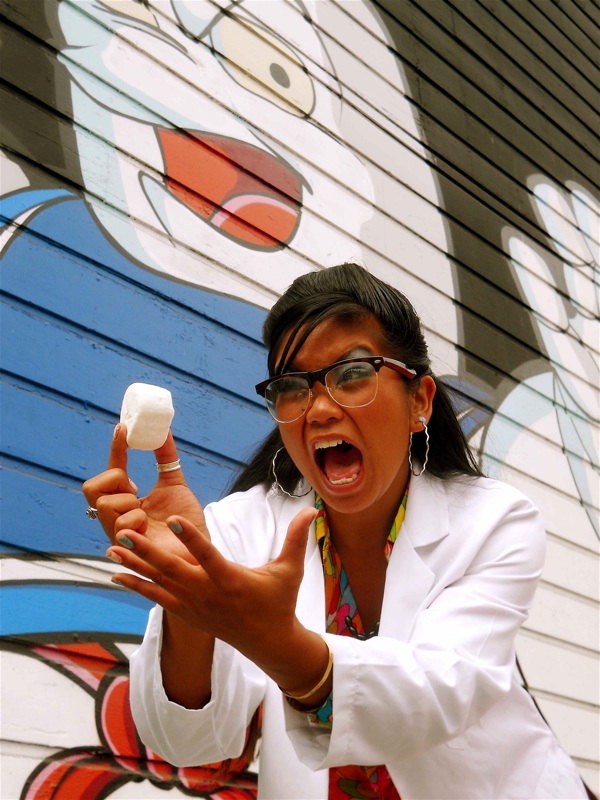
Although the pristine white rent-a-bus is only half full as we pull away from the EXIT Theatre, the morale is high. As we settle into our seats, an attractive young woman in a lab coat, Assistant J (Crystelle Reola) passes out index cards and pens and instructs us to write down our deepest desires as the grey-wigged Professor Murnau (V.N. Von Boom Boom) introduces herself as dead. As the bus noses along, en route to our secret destination, we are treated to video footage of a group of cute kids undergoing a test of their willpower ala the 1972 Stanford Marshmallow Experiment. We also receive marshmallows of our own, which some folks eat immediately, and others save for later.

We wind up on Treasure Island where we encounter the rest of the cast who, according to the script, were mysteriously instructed to show up at a secret location for undisclosed reasons. An unlikely trio, a wealthy businessman, a self-important socialite, and an aging radical, they fuss and squabble, their action framed by a bright string of distant city lights. Gradually they come to realize that they were all part of the original Stanford Marshmallow Experiment, and that the dead professor and the beguiling Assistant J. have brought them back together to “conclude” the experiment. The world, it seems, is divided into “Gobblers” and “Resisters”. The marshmallow still tucked warm in my pocket attests to my abilities in impulse control, but *what does it all mean?*

Written and directed by Patricia Miller, “Sugar High: The Four Marshmallows of the Apocalypse,” heralds Popcorn’s return to the (very) small stage and monthly social calendar. Originator and ringleader Hernan Cortez promises to roll out the bus rides every first Friday of the month, with an emphasis on unconventional performance structure and scenic site-specificity, or what he calls “the diesel-driven processional spirit of adventure.”

“The idea is to be short, sweet, and mobile,” he explains of the hit-and-run style of Popcorn’s “thea-tours”. “Most performance (can be) executed in less than five minutes, seven tops. Basically if you can’t communicate in a short time span, you can’t communicate.” But he emphasizes that almost any artistic discipline can be a part of Popcorn. “If anyone musician, comedian, actor, scientist , cook, burlesque , variety act  has had a hard time finding a stage to perform on, you may find a home here.”

As we pull back up to the EXIT Theatre, left to ponder the concepts communicated to us during our brief sojourn to a parallel universe, I realize I still have my marshmallow and look forward to my reward. Sadly it appears that the reward for not eating my marshmallow early is only the opportunity to eat it late. Fair enough, I suppose. Marshmallows don’t grow on trees. But I’m not entirely sure the experiential portion of the show can be called complete without the possibility to win a second. Maybe next time.

Spiritual bump and grind at Purity Ring

1

The luminous, blinking cocoons that have been rumored to grace the stages of Purity Ring’s live shows — as boasted by the lucky ones who have been able to get tickets to these consistently sold out performances — glowed with aqua-blue precision at Bottom of the Hill on Labor Day.

It was one of those elusive evenings the music gods hand craft. Every member of the crowd seemed to be in on this magical energy, knowing that sonic-satisfaction was promised to each and all by the end of the night. The Potrero Hill venue bustled with unanimous glee as the audience waited anxiously, gratefully, for the Halifax-Montreal-based duo to bring elegant live justice to its prodigious debut album, Shrines.


Composed of Corin Roddick (instrumentals) and Megan James (vocals), Purity Ring mingles the heavy, sensual beats of trap-rap with the lush innocence of dream pop. Like many artists who grew up during the 1990s (Roddick is 21 and James, 24) – and who experienced the spectacular explosion of the Internet as it evolved through the eruption of electronic music – Purity Ring composes with their life’s cumulative soundscape in mind, chopping and screwing what they know best.

But what is it exactly about Purity Ring that makes them so undeniably beautiful, and perfect to listen to at any mood, at any time of the day? What separates them from other recent sensations like Grimes, who also sings with a coy alien voice and futuristic flair?

James, for one, surrenders herself within her own words. She sings not with the glittering, sexual boldness found in many leading female artists, but rather with a strong, poised admission of her self-relinquishment and childlike vulnerability. Her unassuming, calm warbles that soar within the ethereal bass line proclaim the helplessness we all feel when the weight of the universe presses down on our little ribs. James alluringly invites the listener to share in her longing for that defining release found in music, poetry, love, and sex.

Purity Ring has found a way to make electronic music organic. Roddick performed using a light-emitting keyboard sampler made by him from scratch. The lovely aforementioned cocoons lit up at Roddick’s command to the tune of the trembling synths, to match all of our trembling thighs. The two performed wearing garments designed and sewn by James herself.

The flawless combination of un-ostentatious, self-effacing poetry and transparent musicianship brought down the walls of even the most aloof wallflower in the room. A spiritual bump and grind took hold of everyone’s pelvic bones as Purity Ring delivered a night of pure, pristine music, when for once, all made sense in the world.


All photos by Demian Becerra. 

Stage Listings

0

Stage listings are compiled by Guardian staff. Performance times may change; call venues to confirm. Reviewers are Robert Avila, Rita Felciano, and Nicole Gluckstern. Submit items for the listings at listings@sfbg.com. For further information on how to submit items for the listings, see Picks.

THEATER

OPENING

Asteroids: Live! Dark Room Theater, 2263 Mission, SF; (415) 401-7987. $20. Opens Fri/7, 8pm. Runs Fri-Sat, 8pm. Through Sept 29. Interstellar comedy “based very, very loosely on the arcade game.”

Kiss of the Spider Woman Phoenix Theatre, 414 Mason, SF; secondwind.8m.com. $15-35. Opens Fri/7, 8pm. Runs Thu-Sat, 8pm; Sun, 2pm. Through Sept 29. Second Wind presents Manuel Puig’s acclaimed drama about cellmates in a Buenos Aires jail.

Placas Lorraine Hansberry Theater, 450 Post, SF; www.sfiaf.org. $13-35. Opens Thu/6, 8pm. Runs Thu-Sat, 8pm; Sun, 3pm. Through Sept 16. San Francisco International Arts Festival, Central American Resource Center, and the Mission Cultural Center for Latino Arts present Paul S. Flores’ world premiere drama, starring Ric Salinas as a former gang member who tries to mend fences with his family when he gets out of prison.

Port Out, Starboard Home Z Space, 450 Florida, SF; www.foolsfury.org. $12-35. Previews Fri/7-Sat/8, 8pm. Opens Mon/10, 8pm. Runs Thu-Sat and Sept 19, 8pm; Sept 23, 2pm. Through Sept 23. foolsFURY performs the world premiere of Sheila Callaghan’s black comedy.

The Real Americans Marsh Studio Theater, 1062 Valencia, SF; www.themarsh.org. $25-50. Opens Fri/7, 8pm. Runs Fri, 8pm; Sat, 8:30pm. Through Sept 29. Dan Hoyle’s hit show about his trip across America returns.

“San Francisco Fringe Festival” Exit Theatreplex, 156 Eddy, SF; www.sffringe.org. Most shows $10 or less (five-show pass, $40; ten-show pass, $75). Sept 5-16. The 21st annual fest of unconventional, raw theater presents over 200 performances of 42 shows in 12 days.

Strange Travel Suggestions MainStage, Marsh San Francisco, 1062 Valencia, SF; www.themarsh.org. $20-50. Opens Sat/8, 8:30pm. Runs Sat, 8:30pm. Through Sept 29. Author and Ethical Traveler founder Jeff Greenwald (Shopping for Buddhas, Snake Lake) has done his solo show Strange Travel Suggestions dozens if not hundreds of times and still has no idea where it’s going. No wonder he and his audience keep coming back for more. The unknown, an aphrodisiac to the traveler, also makes great catnip for the storyteller. Still, there are consistent elements. There is no need to reinvent the wheel — or the impressive Wheel of Fortune that sits just off center stage, painted with a map of the globe and ringed with symbols abstract and evocative enough to conjure up myriad adventures, peak experiences, and humbling encounters from the vivid grab-bag memory of an accomplished travel writer and inveterate globetrotter. There’s also a real grab bag, just in case, and an oversize tarot card, a sort of visual aid cum talisman sporting a classic image of the Fool, patron saint of the traveler’s heedless leaps of faith. Greenwald’s stories possess a fine sense of humor and a knack for the shrewd detail and telling observation. They also contain a Zen-inflected homespun wisdom no doubt born of leaving home on a regular basis. If slightly self-conscious at times, these tales are always genuine and appealing. In the end, Greenwald’s show, as reliable as it is unpredictable, mimics a genie-from-a-bottle experience: What you get is three spins, three stories, and a lot of unexpected truth. Note: capsule condensed from 2008 feature review of this production. (Avila)

Tripping on the Tipping Point Stagewerx, 446 Valencia, SF; (707) 322-5731. $15-20. Opens Thu/6, 8pm. Runs Thu-Sat, 8pm. Through Sept 29. Human Nature performs a new comedy about global warming.

ONGOING

Henry V Presidio of San Francisco, Main Post Parade Ground Lawn, SF; www.sfshakes.org. Free. Sat-Sun, 2pm. Through Sept 23. The San Francisco Shakespeare Festival celebrates the 30th anniversary of Free Shakespeare in the Park with this history play.

My Fair Lady SF Playhouse, 533 Sutter, SF; www.sfplayhouse.org. $30-70. Tue-Thu, 7pm; Fri-Sat, 8pm (also Sat, 3pm). Through Sept 29. SF Playhouse and artistic director Bill English (who helms) offer a swift, agreeable production of the Alan Jay Lerner and Frederick Loewe musical, based on George Bernard Shaw’s Pygmalion. The iconic class-conscious storyline revolves around a cocky linguist named Higgins (Johnny Moreno) who bets colleague Colonel Pickering (Richard Frederick) he can transform an irritable flower girl, Eliza Doolittle (Monique Hafen), into a “lady” and pass her off in high society. A battle of wills and wits ensues — interlarded with the “tragedy” of Alfred Doolittle (a shrewd and gleaming Charles Dean) and his reluctant upward fall into respectability — and love (at least in the musical version) triumphs. The songs (“Wouldn’t It Be Loverly,” “I Could Have Danced All Night,” “Get Me to the Church on Time,” and the rest) remain evergreen in the cast’s spirited performances, supported by two offstage pianos (brought to life by David Dobrusky and musical director Greg Mason) and nimble choreography from Kimberly Richards. Hafen’s Eliza is especially admirable, projecting in dialogue and song a winning combination of childlike innocence and feminine potency. Moreno’s Higgins is also good, unusually virile yet heady too, a convincingly flawed if charming egotist. And Frederick, who adds a passing hint of homoerotic energy to his portrayal of the devoted Pickering, is gently funny and wholly sympathetic. (Avila)

Rights of Passage New Conservatory Theatre Center, 25 Van Ness, SF; www.nctcsf.org. $25-45. Wed-Sat, 8pm; Sun, 2pm. Through Sept 16. New Conservatory Theatre Center presents the world premiere of Ed Decker and Robert Leone’s multimedia play, inspired by global human rights laws in relation to sexual orientation.

Vital Signs Marsh San Francisco, 1062 Valencia, SF; (415) 282-3055, www.themarsh.org. $15-50. Sun, 7pm. Extended through Sept 16. The Marsh San Francisco presents Alison Whittaker’s behind-the-scenes look at nursing in America.

Twelfth Night San Francisco Maritime National Historic Park, Hyde Street Pier, 2905 Hyde, SF; www.weplayers.org. $30-80. Opens Fri/7, 5:30pm. Runs Fri-Sun, 5:30pm (also Sat-Sun, noon; matinee only Sept 22; no performances Sept 29; evening performances only Oct 6-7). Through Oct 7. We Players board the Balclutha and the Eureka for this jazzy take on Shakespeare’s romance.

The Waiting Period MainStage, Marsh San Francisco, 1062 Valencia, SF; (415) 282-3055, www.themarsh.org. $15-50. Thu-Fri, 8pm; Sat, 5pm. Extended through Sept 29. Brian Copeland (comedian, TV and radio personality, and creator-performer of the long-running solo play Not a Genuine Black Man) returns to the Marsh with a new solo, this one based on more recent and messier events` in Copeland’s life. The play concerns an episode of severe depression in which he considered suicide, going so far as to purchase a handgun — the title coming from the legally mandatory 10-day period between purchasing and picking up the weapon, which leaves time for reflections and circumstances that ultimately prevent Copeland from pulling the trigger. A grim subject, but Copeland (with co-developer and director David Ford) ensures there’s plenty of humor as well as frank sentiment along the way. The actor peoples the opening scene in the gun store with a comically if somewhat stereotypically rugged representative of the Second Amendment, for instance, as well as an equally familiar “doood” dude at the service counter. Afterward, we follow Copeland, a just barely coping dad, home to the house recently abandoned by his wife, and through the ordinary routines that become unbearable to the clinically depressed. Copeland also recreates interviews he’s made with other survivors of suicidal depression. Telling someone about such things is vital to preventing their worst outcomes, says Copeland, and telling his own story is meant to encourage others. It’s a worthy aim but only a fitfully engaging piece, since as drama it remains thin, standing at perhaps too respectful a distance from the convoluted torment and alienation at its center. (Avila)

War Horse Curran Theatre, 445 Geary, SF; www.shnsf.com. $31-300. Wed/5-Sat/8, 8pm (also Wed/5 and Sat/8, 2pm); Sun/9, 2pm. The juggernaut from the National Theatre of Great Britain, via Broadway and the Tony Awards, has pulled into the Curran for its Bay Area bow. The life-sized puppets are indeed all they’re cracked up to be; and the story of a 16-year-old English farm boy (Andrew Veenstra) who searches for his beloved horse through the trenches of the Somme Valley during World War I, while peppered with much elementary humor too, is a good cry for those so inclined. The claim to being an antiwar play is only true to the extent that any war-is-hell backdrop and a plea for tolerance count a melodrama as “antiwar,” but this is not Mother Courage and no serious attempt is made to investigate the subject. Closer to say it’s Lassie Come Home where Lassie is a horse — very ably brought to life by Handspring Puppet Company’s ingenious puppeteers and designers, and amid a transporting and generally riveting mise-en-scène (complete with pointedly stirring live and recorded music). But the simplistic storyline and its obvious, somewhat ham-fisted resolution (adapted by Nick Stafford from Michael Morpurgo’s novel) are too formulaic to be taken that seriously. And at two-and-a-half-hours, it’s a long time coming. A shorter war, the Falklands say, would have done just as well and gotten people out before the ride began to chafe. (Avila)

BAY AREA

Chinglish Berkeley Repertory Theatre, Roda Theatre, 2015 Addison, Berk; www.berkeleyrep.org. $14.50-99. Tue and Thu-Sat, 8pm (also Sat, 2pm; no show Oct 5; no 2pm show Sat/8; additional 2pm shows Thu/6 and Oct 4); Wed and Sun, 7pm (also Sun, 2pm). Through Oct 7. Berkeley Rep presents the West Coast premiere of David Henry Hwang’s Broadway comedy.

The Death of the Novel San Jose Rep, 101 Paseo de San Antonio, San Jose; www.sjrep.com. $23-69. Opens Wed/5, 7:30pm. Check web site for schedule. Through Sept 23. Vincent Kartheiser (a.k.a. Pete Campbell from Mad Men) stars in Jonathan Marc Feldman’s drama about creativity in post-9/11 America at San Jose Rep.

The Elaborate Entrance of Chad Deity Aurora Theatre, 2081 Addison, Berk; (510) 843-4822, www.auroratheatre.org. $32-60. Tue and Sun, 7pm (also Sun, 2pm); Wed-Sat, 8pm. Through Sept 30. Playwright Kristoffer Diaz, a self-professed fan of the aggressively-theatrical spectacle that is professional wrestling, delivers much more than a “wrestling 101” primer for the uninitiated with The Elaborate Entrance of Chad Deity. Beneath the razzle-dazzle of the arena lighting (Kurt Landisman), the gaudy costuming (Maggie Whitaker) and the giant televised image of a hot bikini babe (Elizabeth Cadd, video by Jim Gross) lies the trampled luster of an American Dream. The dreamer, Macedonio “The Mace” Guerra (Tony Sancho), a wiry fall guy for THE Wrestling, wrestles not for money or glory (he is rarely privy to either), but for his love of the strange ballet that occurs in the ring. Guerra’s job is to make his opponents look good, including the pec-flexing, bling-booted Chad Deity (Beethovan Oden), leaving him to wrestle alone with the identity politics of being a marginalized but fully capable warrior battling perennially stacked odds. Willing suspension of disbelief does get stretched pretty thin when the character Vigneshwar Paduar, a smooth-talking hustler chance-met on the basketball courts of Brooklyn, rises to championship levels in record-breaking time as the truly cringe-worthy persona known as “The Fundamentalist,” but Nasser Khan’s skillfully self-possessed performance as Paduar makes it impossible not to root for him all the way. Rod Gnapp as foul-mouthed bossman “EKO” and fight director Dave Maier as a whole squadron of hapless B-list wrestlers round out the excellent cast. (Gluckstern)

The Fisherman’s Wife La Val’s Subterranean, 1834 Euclid, Berk; www.impacttheatre.com. $10-20. Thu-Sat, 8pm. Through Sept 29. The latest from playwright Steve Yockey (Bellwether, Skin) is an exercise in pure pleasure, not least for the devious sea creatures preying lustily and unashamedly on the hapless human flesh of a small coastal town. There, in cracked fairytale fashion, an unsuccessful fisherman named Cooper Minnow (an endearingly nerdy but passionate Maro Guevara) is preparing to set out to sea, leaving at home frustrated wife Vanessa (a wonderfully, volcanically bitchy yet complex Eliza Leoni) and their sinking marriage, when he meets an oddly brazen pair of sexy, sassy bathers in old-fashioned beach attire (the swimmingly synchronized duo of Sarah Coykendall and Roy Landaverde). At more or less the same moment, a devilishly dashing yet prim traveling salesman (poised, nicely offbeat Adrian Anchondo) is offering a clearly aroused Vanessa an erotic woodcut featuring monstrous tentacles groping human victims at a very familiar-looking dock. Will she take the woodcut? Will she ever! And later she’ll defend her husband’s honor and swap places with him too, much to the commercial advantage of the ever-accommodating salesman who — like Yockey’s smart and sure sex farce — has a little something for everyone. Directed with smooth precision by Ben Randle for Berkeley’s Impact Theatre, The Fisherman’s Wife again finds Yockey playing productively with the fine fuzzy line separating human nature from nature at large (as in Large Animal Games, the winning 2009 co-production from Impact and Dad’s Garage). The animals come through for playwright and company once more, with a thoroughly enjoyable comedy whose borrowed maritime mythos has just enough metaphorical pull to lead those so inclined out beyond the shallow waters. (Avila)

Keith Moon/The Real Me TheaterStage at the March Berkeley, 2120 Allston, Berk; www.themarsh.org. $15-50. Sept 13, 20, and 27, 8pm. Mike Berry workshops his new musical, featuring ten classic Who songs performed with a live band.

The Kipling Hotel: True Misadventures of the Electric Pink ’80s Marsh Berkeley, 2120 Allston, Berk; (415) 282-3055, www.themarsh.org. $20-50. Sat, 8:30pm; Sun, 7pm. Extended through Oct 14. This new autobiographical solo show by Don Reed, writer-performer of the fine and long-running East 14th, is another slice of the artist’s journey from 1970s Oakland ghetto to comedy-circuit respectability — here via a partial debate-scholarship to UCLA. The titular Los Angeles residency hotel was where Reed lived and worked for a time in the 1980s while attending university. It’s also a rich mine of memory and material for this physically protean and charismatic comic actor, who sails through two acts of often hilarious, sometimes touching vignettes loosely structured around his time on the hotel’s young wait staff, which catered to the needs of elderly patrons who might need conversation as much as breakfast. On opening night, the episodic narrative seemed to pass through several endings before settling on one whose tidy moral was delivered with too heavy a hand, but if the piece runs a little long, it’s only the last 20 minutes that noticeably meanders. And even with some awkward bumps along the way, it’s never a dull thing watching Reed work. (Avila)

A Midsummer Night’s Dream Forest Meadows Amphitheater, 890 Belle, Dominican University of California, San Rafael; www.marinshakespeare.org. $20-35. Check website for schedule. Through Sept 30. Marin Shakespeare Company performs the Bard’s classic, transported to the shores of Hawaii.

Our Country’s Good Redwood Amphiteatre, Marin Art and Garden Center, 30 Sir Francis Drake, Ross; www.porchlight.net. $15-30. Thu/6-Sat/8, 7:30pm. Porchlight Theatre Company presents an outdoor performance of Timberlake Wertenbaker’s play about Royal Marines and prisoners in an 18th century New South Wales prison colony.

Precious Little Ashby Stage, 1901 Ashby, Berk; www.shotgunplayers.org. $18-25. Wed-Thu, 7pm; Fri-Sat, 8pm (also Sat/8, 3pm); Sun, 5pm. Through Sept 16. Shotgun Players presents Madeleine George’s new play about an expectant mother who studies near-dead languages and befriends a “talking” gorilla.

Time Stands Still TheatreWorks at the Mountain View Center for the Performing Arts, 500 Castro, SF; www.theatreworks.org. $23-73. Tue-Wed, 7:30pm; Thu-Sat, 8pm (also Sat, 2pm); Sun, 2 and 7pm. Through Sept 16. TheatreWorks performs Donald Marguelis’ drama about a couple — one a photojournalist, one a war correspondent — struggling with their recent experiences covering a war.

PERFORMANCE/DANCE

BATS Improv Bayfront Theater, B350 Fort Mason Center, Marina at Laguna, SF; www.improv.org. Thu-Sat, 8pm. $10-25. This week: “An Improv Team Named Desire and Flux Capacitor” (Thu/6); “25th Annual Gala and Fundraiser” (Fri/7); “BATS Improv SF vs. Impro Theatre LA” (Sat/8).

“Comedy Returns to El Rio!” El Rio, 3158 Mission, SF; www.koshercomedy.com. Mon/10, 8pm. $7-20. Stand-up with Diane Amos, Malcolm Grissom, Jill Bourque, Kevin Young, and host Lisa Geduldig.

“Dancing Poetry Festival” Florence Gould Theater, California Palace of the Legion of Honor, Lincoln Park, SF; www.dancingpoetry.com. Sat/8, noon-4pm. $4-15. The 19th annual fest celebrates poetry and dance as a unified art form.

“Elect to Laugh” Studio Theater, Marsh San Francisco, 1062 Valencia, SF; (415) 282-3055, www.themarsh.org. Tue, 8pm. Through Nov 6. $15-50. Veteran political comedian Will Durst emphasizes he’s watching the news and keeping track of the presidential race “so you don’t have to.” No kidding, it sounds like brutal work for anyone other than a professional comedian — for whom alone it must be Willy Wonka’s edible Eden of delicious material. Durst deserves thanks for ingesting this material and converting it into funny, but between the ingesting and out-jesting there’s the risk of turning too palatable what amounts to a deeply offensive excuse for a democratic process, as we once again hurtle and are herded toward another election-year November, with its attendant massive anticlimax and hangover already so close you can touch them. Durst knows his politics and comedy backwards and forwards, and the evolving show, which pops up at the Marsh every Tuesday in the run-up to election night, offers consistent laughs born on his breezy, infectious delivery. One just wishes there were some alternative political universe that also made itself known alongside the deft two-party sportscasting. (Avila)

“A Funny Night for Comedy” Actors Theater of San Francisco, 855 Bush, SF; www.natashamuse.com. Sun/9, 7pm. $10. Natasha Muse and Ryan Cronin host this comedy show, presented in talk-show format, with guests Caitlin Gill, Kaseem Bentley, and Jesse Fernandez.

“Mary Mack Comedy Show” Gallery and Bar 4N5, 863 Mission, SF; www.brownpapertickets.com. Tue/11, 7:30pm. $15. Mandolin-infused folk comedy with Mary Mack.

“A Pinoy Midsummer” Bindlestiff Studio, 185 Sixth St, SF; www.brownpapertickets.com. Thu-Sat, 8pm (also Sat, 2pm). Through Sept 15. $10-20. A re-imagining of Shakespeare with Philippine folklore, shadow puppets, and other Pinoy elements.

“10 Acrobats in an Amazing Leap of Faith” CounterPULSE, 1310 Mission, SF; www.counterpulse.org. Fri/7-Sat/8, 8pm; Sun/9, 2pm. Yuseff El Guindi’s comedy is about a conflicted Muslim family during the month of Ramadan in post-9/11 America.


The Performant: Let ‘em eat cake

2

While the Performant is off hugging trees in Oregon, please enjoy this series of interviews with the curators of three innovative performance spaces

There’s nothing about the Good Shepherd Episcopal Church in North Berkeley that particularly speaks of abstract performance, but that element of the unexpected is possibly what makes it the perfect venue for Karen Penley’s fledgling performance series, Retard. Inhabited by out-of-the-box, outré performers such as Dan Carbone, Edna Barron, Herb Heinz, and Catherine Debon, Retard is a low-key, all-inclusive, no-judgment sort of event where the weird get a chance to shine, and everybody gets to eat cake. After an evening spent nibbling clafoutis and ducking clowns, I caught up with Karen via the magic of the Interwebs to pick her brain about her brave new experimental showcase.

SFBG: What was the original impetus for this showcase? What sets it apart?

Karen Penley: I have an interest in brave unconventional work and I wanted to be able to have room to let that happen instead of having to fit into the structure of poetry and music open mics…. I think the thing that sets Retard apart is a feeling of support for adventurous, innocent work.  I really love raw art, as well as the feeling of people being so immersed in…their artistic work and caring about it so much. It’s this feeling of creating different worlds as well. You can do anything, theater, movement, improvisation, music, or some hybrid of such. Also, it’s kind of homey, easy, non pretentious. I really wanted that. There are special Retards, the evenings called “Crack,” where I curate more carefully and then the other retards are more a jambalaya and are open to people I don’t know their work as well so they can just come and perform and I can get a sense of them.

SFBG:  What is your ultimate vision for these evenings?

KP: Well, ultimately, I would love to have them be ‘Crack’ every Friday, with lots of people coming, and I’d love to rent the church another day a week and have it be ‘Pretard’ which I tried to do for five months, but there wasn’t enough participation and I couldn’t afford it. ‘Pretard’ was a place to work on and develop material just for a warm audience, not a workshop, just a place to try out stuff, and then I wanted to take that work and curate it into cool evenings. But I’d love to connect with people that I admire, all different kinds of performers, and curate great evenings so that it really is a network of daring work.

SFBG: Do you bake your own cake? What do the cake and tea signify for you?

KP: I love cake and I can’t eat a whole one so this gives me an opportunity to bake all those great cakes on the internet that I couldn’t bake just for myself. I always like food to be involved in performing and watching performance. It feels more cozy and fun and more warm-y to have cake and tea for people. 

SFBG: “Retard” sounds intentionally provocative, though you do offer a rather nonconfrontational definition for it on the webpage. What prompted you to use that name, and has anyone had an uncomfortable reaction to it?

KP: I HAVE had some uncomfortable reactions to the name. One girl was labeled in her high school and I really liked her and wanted her to perform, but we had a long email back and forth about it and she just couldn’t condone the use of the word.  My feeling is that using it for my show changes the derogatory feeling associated with that word. I feel like a retard myself, always have. I want to be more retarded; i.e. slow down. In my mind, to be retarded is a good thing. Plus it’s just funny (the name).

Retard

Fridays 7-9pm, $10 sliding scale

1823 Ninth Ave., Berk. (side building next to The Good Shepherd Church)

theretardshow.wordpress.com


Remembering Remy Charlip

3

Remy Charlip was born on January 10, 1929 in Brooklyn, NY. He died on August 14, 2012 in San Francisco. The following windy Sunday afternoon, he was lowered into the bone-dry ground on one of the ridges of Marin’s Mount Tamalpais.  His woven wicker casket had been blanketed with earth, flowers, and farewells. A solitary hawk circled overhead as soft chanting wafted across the valley. He would have loved it.

Remy took with him over 60 years of making poetry in dance, writing, drawing, painting, and theater. When he moved to San Francisco in 1989, he had a major part of his life behind him with untold accolades and honors. He had helped shape the Merce Cunningham Dance Company, the Living Theater, the Paper Bag Players, and the National Theater of the Deaf. For decades he had choreographed, designed, performed, and directed for theater and dance, and he had become a much beloved author of some extraordinarily inventive books for children that respected their individuality and enlarged their imaginations.

He also had created over 100 of what he has become best known for in dance: Air Mail Dances, in which a performer follows a sequence of images but individually realizes the transitions between them. When choreographers die, often their works die with them. Remy’s Air Mail Dances won’t. Perfectionist in everything that he was, he set them up strongly and then he set them free. He gave them a life of their own.

In the Bay Area — though he would have smiled at this label — he quickly became an older statesman for a generation of dancers, much younger, very different from him and each other, such as Krissy Keefer, Anne Bluethenthal, Jules Beckman, and Keith Hennessy. For Oakland Ballet he choreographed a charmer, Ludwig and Lou, an homage to composer and former partner Lou Harrison. He watched over and delighted in the performance of some of his Air Mail Dances by, among others, Joanna Haigood, June Watanabe, and AXIS Dance Company.

As a performer he thrilled us in Meditation — a simple dance of walks, turns, and stretches — to what must be the gooiest of concert pieces from Massenet’s opera, Thais. But perhaps he reached the pinnacle of his performance career in 2001 when in A Moveable Feast, on a commission from the Lesbian and Gay Dance Festival, he was carried, swooped, and sailed across Z Space in the arms of a bevy of nude male dancers. It was his idea of heaven. And to boot, as music he had chosen the “Liebestod” from Wagner’s Tristan und Isolde.

Perhaps most remarkable about Remy was his gentle spirit and sense of wonder. He was deeply living in this world and yet he wasn’t. How was it, we kept wondering, that an artist and a man, of yes, extraordinary accomplishments, but also much pain, rejection and losses, could keep his spirit so buoyant, generous, and uncontaminated? When he received the Guardian’s Lifetime Achievement Goldie in 2001, he said (as he often did), “I feel that my work includes all the elements I practice.” At the core of his being Remy knew exactly who he was. It kept him in the world and out of it.

Rita Felciano is th Bay Guardian’s dance critic.

A week after police crack down, People’s Library still operating in East Oakland

13

The building where activists, some from Occupy Oakland, created a free library and garden August 13 was raided by police that night. But that was Monday, this is Friday– and the Biblioteca Popular Victor Martinez, or People’s Library, is still in full form.

The books and garden have moved from the building, which was built in 1918 in the Spanish Colonial Revival style, to the sidewalk. But it’s still a lively scene. Books are shelved the block in front of the old library’s entrace, and around the corner participants have built gadren beds. In the sidewalk library and garden, children browse books, play chess, dig holes for seeds, water plants, ride bikes and scooters, and casually work on the fence around the building with pliers. 

The building at 1449 Miller was donated to the city of Oakland as part of a grant from Andrew Carnegie, and functioned as a library until 1979. It was one of eight libraries closed by the City Librarian following the passage of Prop 13, according to Harry Hamilton, City of Oakland public information officer. It was subsequently used for the Emiliano Zapata Street Academy, an alternative high school that now operates on 29th street. It was owned by the Oakland Redevelopment Agency, whose members allocated money to it in their 2005 five-year plan, but no redevelopment of the building had begun when redevelopment agencies across California were dissolved last fall. It is now owned by the the Redevelopment Successor Agency housed within the City of Oakland’s Office of Neighborhood Investment, and, for all official purposes, remains vacant.

On Monday morning, activists entered the building, intent to revitalize it themselves. Empty wooden bookshelves covered the walls, and the floor was strewn with trash. A few mattresses indicated that the officially vacant building certainly hasn’t been.

Those building the People’s Library brought in brooms, sponges and trashbags. A few hours later, the place was cleaned up and hundreds of donated books lined the long-empty shelves. Neighbors came in through the open doors, helping to clean, checking out books, and reading to their kids. In the backyard, kids and adults built raised beds and started planting in them.

At 6:30, there was a potluck and a poetry reading. Most families had wandered off by 10pm. At 11:30, about a dozen people remained. That’s when 80 police arrived, blocked off the street for two blocks in all directions, and told them that they had 15 minutes to gather their books and exit the building, or risk arrest.

The creators of the Victor Martinez People’s Library did as they were told. But they didn’t go far. The next morning, they set up the library again, this time on the sidewalk outside the now-boarded up building. The kids and families came back. Police did, too, but they stayed in cars on corners around the building, watching.

Now, it’s been a week, and what organizer Jaime Yassin calls “the only 24-hour library in the US” is still here.

“That was on their agenda, at some point, to do this. What the people are doing now,” said Emji Spero, a poet who heard about the action from people invovled in Monday’s poetry reading. “But instead, they’re spending money on police to come shut it down. Someone said to me, I can see the dollar signs floating off the police cars as they run their engines.”

“This is the social reform that the city is supposed to be doing,” said Khalid Shakur, another Oakland resident who was involved in setting up the library.

On Wednesday Yassin, who had been researching the building’s history, sat down with me on a couch by the library. He explained that the clean sidewalk where the couch now sits was an unofficial garbage dump days earlier, covered in old clothes, drug paraphenalia, and other trash.

Yassin showed me a 2005 report from the Urban Ecology 23rd Avenue Working Group. the plan, a result of focus groups and surveys of people in the neighborhood of the People’s Library, includes a plan to “rehabilitate Miller Library” as a top priority for beneficial development in the neighborhood.

“Renovation, however, will be expensive and require the city’s help,” the report reads. “the city-owned library needs seismic reinforcement, repair to flood damage, asbestos removal and handicap accesibility improvements.”

As I spoke with Yassin, a 10-year-old who had been gardening and playing on the sidewalk scooted up. He handed some scissors, just retrieved from his home a block away, to one of the people making signs to organize the library.

“I never saw nobody use it using it since I got here,” he said when I asked him about the building.

“I liked it when you guys came,” he added to Yassin, smiling, before racing off on his scooter.

Juan Delgadillo, who owns Plaza Automotive, a business across the street from the library, said he plans to borrow some books from the People’s Library. “It’s a very good idea,” said Delgadillo. “I support it.”

The group has been holding nightly potlucks, and is planning to host a community barbecue tomorrow (August 18) at 2pm.

The Performant: Left Coasters

0

Right Brain Performancelab stakes a claim Out West. (Ed Note: While the Performant is off hugging trees in Oregon, please enjoy a series of interviews with the curators of three innovative performance spaces.)

Since 1998, Jennifer Gwirtz and John Baumann of Right Brain Performancelab (performing August 24 and 25) have been haunting black box theatres and dance studios with their quirkily cerebral brand of performance art. After staging a variety show in their Richmond District living room as part of Philip Huang’s International Home Theater Festival, they decided to keep running with the concept—and the Due West Salon was born.


SFBG: What is the main purpose of the Due West Salon?

RBP (Jen): The Due West Salon is our way to produce performances in a realistic and resilient way. Performing in a home, specifically our home, is especially wonderful to me because at its core, performance creates sacred space, especially community space. In the world of DIY theater, home theater is something that makes a lot of sense right now. It feels like part of that movement to come back to the local, to create more resilient communities…it’s all of a piece.

SFBG: Talk a little about the house performances you did in New Zealand. What turned you onto the format in the first place?

RBP (John):
In the late 90s, shortly after RBP was formed, we were introduced to New Zealand theater artist Warwick Broadhead.  Warwick was in the Bay Area with his traveling solo production of Lewis Carroll’s “The Hunting of the Snark”, which he performed entirely out of a suitcase complete with portable, remote controllable lights and music. (He’d) arranged to have a show in someone’s living room in the Oakland hills, for a flat fee, a place to stay, and a light supper.  We were in the audience and were both charmed and blown away by the poetry and economics of his production. We talked with Warwick after the show and began planning our trip to New Zealand, eventually deciding to perform our very first show “Not A Step” in his house in Auckland. The aesthetic of low-fi, DIY traveling theater is a terrific thing for art and for the company’s bottom line, focusing on performance rather than production value, encouraging the audience to engage their
 imaginations, and saving much money and effort.

SFBG: Right Brain Performancelab has a uniquely playful approach in a lot of its work. What inspires that, what does it inspire?

RBP (Jen): John and I have always had a playful relationship, which is where this all started. We love to make each other laugh. Then when we started to draw other performers into what we do, we realized that if it wasn’t going to be fun, or at least enjoyable and satisfying in process, then it wasn’t really worth doing. I’ve also had a deep attraction to these old archetypes of the tragic clown and the bumbling clown sorts of characters, as well as to the practice and imagery of Butoh, which can be a deep and skillful clowning practice on a certain level. At the same time, making work with lots of layers, some of them very dark where all the difficult ideas and impulses live is important to both of us.

(John): Jen and I have a deep connection with playfulness in our relationship, which grew out of our common love for The Muppets, Buster Keaton, Carol Burnett, Lily Tomlin and other performers who are playful. We have found it easier to explore weighty subject matter while deploying rubber chickens and funny hats, and it’s surprising how play can generate truly rewarding discoveries, even when working with and honoring a difficult theory or method.
 
SFBG: When is the next Due West Salon?

RBP:
The Due West Salon will take place on August 24 and 25 at 8pm. The link for tickets is here: duewestsalon-aug24-25-2012.eventbrite.com

SFBG: Anything you’d like to add?

RPL (Jen):
I’d love to see home-theater become a real force for great performance in the next ten years. Small is good. Bigger is not necessarily better.


Appetite: Delicious new cuisine and cocktail reads

0

Fermentation and distillation, hot plats and sugar cones, sweet creams and brokeasses … These eight books were released this spring, and are among the best of what has landed on my desk this year:

TRADITIONAL DISTILLATION: ART AND PASSION
by Huber Germain-Robin

Anyone who knows US craft distilling knows Hubert Germain-Robin, one of the pioneers in the American craft distilling movement. He was making world class, French-style brandies (he is French, after all) since the early ’80s right here in Northern California at Germain-Robin, which he co-founded, an example to generations after him of what true, elegant brandies should be. As he states in the introduction, “When I came to California in 1981, I realized the unbelievable potential of the New World, with such diversity in grape varietals, microclimates, and less demanding restrictions than there are in France.”

He just released his first book, Traditional Distillation, and, as the inside cover states, it’s an ode to the “passion, art and poetry” behind distillation. I’ve seen a few (there’s really not many) technical distillation books that get into still types or cutting the “heads and tails” of a distillation batch. Germain-Robin’s book (the first in a series of books on brandy production) is a thoughtful essay, covering the technical but doing so in an artistic, poetic way. The book boasts an Old World, classic look, delving into the philosophy behind distillation as much as process. A romantic sensibility pervades this book and passion speaks from the pages – there is even poetry and classic art included, doing justice to the reason people like myself (one who rarely had a drink in younger years), fell in love with the artisan craft and history behind distillation. It’s a short, succinct book, but a unique one. Hubert captures the beauty of the craft, giving concrete advice for would-be distillers everywhere, ensuring that his incredible knowledge and legacy is shared with many more.

THE ART OF FERMENTATION by Sandor Ellix Katz

Just released June 12, The Art of Fermentation (with forward by none other than Michael Pollan) is sure to be the gold standard on fermentation. Katz published Wild Fermentation in 2003, at the time dubbed the “fermenting bible” by Newsweek. As the press release states for his new, elegantly understated book, he now has an additional decade of experimentation behind this one. The first book of its kind, it contains recipes, yes, but ultimately is a 400+ page textbook on all things fermentation, its history and processes, and DIY steps in a range of categories from meads, wines and ciders to meat, fish and eggs. There’s plenty of study material for food and drink folk alike, whether an extensive section on sour tonic beverages (from kombucha to kvass) or details on fermenting beans, seeds and nuts. Katz’ book makes me want to start fermenting my own potato beer immediately.

TAKE AWAY by Jean-Francois Mallet

Take Away is a lovely photo book. Released in the US in April (first released in France in 2009), this beauty of a book is a virtual escape around the world, immersing the reader in street foodscapes and dishes from Shanghai to the Ukraine. Be warned: perusing this book is difficult on an empty stomach. And for those of us who thrive on travel and exploring every nook and cranny of a city or region, Mallet’s approachable, street savvy photography also induces travel lust.

CINDY’S SUPPER CLUB: Meals from Around the World to Share with Family and Friends by Cindy Pawlcyn

Cindy Pawlcyn is one of California’s trailblazing chefs, aiding Napa in becoming a dining destination when opening Mustard’s Grill nearly 30 years ago along with subsequent restaurants, like Cindy’s Backstreet Kitchen. She’s written a few cookbooks, but I particularly enjoy her newest, out this May: Cindy’s Supper Club. A book based on favorite international recipes prepared in her supper clubs with friends, the recipes span the globe from Russia and Hungary to Lebanon, Peru, Korea. Cindy’s intros to each selected country and recipe feel comfortable, like a chef chatting about their travels and technique as you sit with them in their kitchen. Though recipes tend toward the heartwarming, soulful kind, many list more than ten ingredients and aren’t exactly simple. But for cooks ready to try something new yet not fussy, adventure lies within these pages, whether Flemish meatloaf in spicy tomato gravy or white gazpacho (made of white bread, milk, almonds, garlic, olive oil, sherry vinegar) with peeled white grapes.

PLATS DU JOUR: the girl and the fig’s Journey Through the Seasons in Wine Country by Sondra Bernstein

Just see if you don’t long to move to Sonoma after spending time with Plats du Jour, a large, photographic book capturing Sonoma’s vibrancy. With a range of recipes from Sondra Bernstein’s beloved girl and the fig duo and Italian restaurant, Estate, the book journeys well beyond recipes. Sectioned by seasons, there’s highlights on wine, cheese, and produce, pairing possibilities, origins of foods, cocktail hour menus, and seasonal menus to recreate at home. Interspersed throughout are drink recipes, such as the perennially popular lavender mojito from girl and the fig http://www.platsdujour.net/#!home/mainPage. Photos and stories of trailblazing Sonoma farmers keep the reader rooted to a sense of place. Though the variety of info might initially seem disparate, it weaves into an inspiring whole urging one to seek out ingredients from their own farmers markets and entertain or cook inspired by the invigorating spirit behind Bernstein’s book and the artisans of Sonoma.

SWEET CREAM AND SUGAR CONES
by Kris Hoogerhyde, Anne Walker, and Dabney Gough

Bi-Rite’s ice cream essentially needs no introduction. For those in San Francisco, it’s already an institution. For foodies nationally, the beloved market’s ice cream has been written up in most national food magazines, among the best ice creameries in the country. Thankfully this spring, founders Anne Walker and Kris Hoogerhyde, along with writer Dabney Gough, have released a book, Sweet Cream and Sugar Cones, sharing many of Bi-Rite’s lauded recipes (yes, their legendary salted caramel ice cream, which spawned dozens of imitations around the nation, is included), and many more besides, including sweets far beyond ice cream, from cookies to pie. The book is grouped in ingredient-themed sections like chocolate, coffee, vanilla, citrus or nuts. I take to the herbs and spices section with recipes like basil or peach leaf ice cream, picante galia melon pops, and my favorite Bi-Rite flavor of recent years, Ricanelas (cinnamon and Snickerdoodles). Having already tried a couple of the recipes, they are easy to follow, and, of course, delicious.

SUNSET EDIBLE GARDEN COOKBOOK

Sunset has cornered DIY gardening and cooking for decades in their magazine and cookbooks, with recipes and step-by-step gardening instructions. Their latest book, Edible Garden Cookbook, just out this spring, is another winner with accessible recipes, growing-harvesting-storage-cooking tips and varietal lists on a wealth of vegetables (from peas to cucumbers), herbs (mint to thyme), and fruits (melons to stone fruit). Creative recipe twists enliven everyday dishes like an icebox salad layered in a casserole dish or kabocha squash filled with Arabic lamb stew.

THE BROKEASS GOURMET COOKBOOK by Gabi Moskowitz
(Review by Andi Berlin)

Chasing the elusive paycheck is a tiresome routine, but at least it’ll taste good with the new BrokeAss Gourmet cookbook from San Franciscan Gabi Moskowitz (not to be confused with Broke-Ass Stuart.) The former kindergarten teacher-turned-caterer-turned-Internet-celebrity founded the website BrokeAss Gourmet after seeing friends laid off from tech jobs and eating junk. Taking a conversational, gal-pal tone, Gabi guides us through the essentials of running an eclectic kitchen – from stocking a full pantry to boosting cheap proteins with flavorful sauces. Recipes like vegetable lasagna with wonton wrappers demonstrate her craftiness. The book is high on kitsch: rather than photographs, illustrations of animals stand beside cheeky anecdotes (“Because bacon really does make everything better.”) Moskowitz paints a vivid Bay Area landscape, adapting several recipes from ethnic joints and buzzy spots like Bakesale Betty. And if she relies too heavily on sriracha sauce, forgive her. When you’ve got to shove off to work early morning after morning, it’s often the call of the rooster that gets you going.

Subscribe to Virgina’s twice-monthly newsletter, The Perfect Spot, www.theperfectspotsf.com

Oh no they didn’t! Hilarious horror stories at Mortified

6

Why is it that I like myself most when looking back on my years as a college freshman, drunkenly spooning peanut butter into my mouth amid the squalor of my dirty kitchen? Why is it that I appreciate a boyfriend most when I see his elementary school photos and realize he used to look like a well-fed lizard in glasses?

I’m going to wager that it isn’t my own affinity for the less-than-socially acceptable and is actually a testament to the fact that humans often love that which is most, well, human. And humanity has the tendency to do some painfully embarrassing stuff.
 
This is the concept that drives Mortified, a collection of short readings and performances of the sometimes brilliant, sometimes artistic, sometimes sad, and always humiliating personal musings its performers created as children and teens. The brainchild of creators and producers Dave Nadelberg and Neil Katcher, Mortified has a constantly changing cast, mainly consisting of adults who have, fortunately, left most of their adolescent angst behind — but still have plenty of stories to tell about it.

The DNA Lounge is surprisingly conducive to theater, with its upper balcony offering unobscured views of the performers. On Aug. 10, the night’s first performance was by Orlando, Fla. native Jessica Wassil, reading from her teenage diaries. There isn’t much to do in Orlando, the edgy-looking brunette explained in her introduction, and thus her 14-year-old self saw no other alternative to the cultural void than to eat Butterfingers by the truckload and obsess over football players who didn’t know she existed.
 
Wassil’s excerpts treaded not-so-lightly on the line between funny and cringe-inducing, with her bellowing laments of insecurity and unrequited love making the audience members guffaw, but also tempting them to crawl under their seats. Her powerhouse opening excerpt, describing what indeed seemed to be the “worst Valentine’s day ever” (eating Snickers for breakfast and then soiling herself at school) had tears of ambiguous varieties streaming from the audience’s eyes.
 
But it’s okay, because now she’s totally cute. And kind of a hipster. And probably pretty awesome, given her confidence to stand alone on a stage and read almost grotesque confessions from her youth.
 
However, Heather Aronson’s accounts of a being an underage metalhead were anything but sad. Her diary entries read more like an epistolary novel addressed to the guitarist of Def Leppard, to whom a young Aronson’s commitment resembled a nun’s devotion to God. Kinda freaky. And such was the collective opinion of Aronson’s classmates in her first year at a new high school.
 
And yet, the admittedly girly but nonetheless badass actions of the head-banging teen were wholly awesome. She backed boys into corners, scored concert tickets, got drunk, made at least one friend, and — as the piece’s climax and finale went — cussed out the haughty girls at her school, kicked in her science classroom’s door, and ends her high school year of hell in appropriately metal fashion.
 
The “Worst Teen Poetry Slam,” for which Mortified creator Dave Nadelberg traveled from Los Angeles to San Francisco, offered some variety in the evening. The first contestant was businesswoman Lisa Ratner, who read adolescent love poetry directed toward one particular (and, it seemed, totally undeserving) young man.

Imagine any lovesick and slightly pathetic tween’s poetry, then add in a strong penchant for metaphors about kings, queens, stardust, and chariots, and you’ve got the general aesthetic of Ratner’s collection. Nadelberg was the night’s second contestant, and eventual winner, thanks to some awkwardly erotic poetry about “world music” just bizarre enough to offer a refreshing reminder that teens aren’t only pitiful … they’re also weird as hell.

“What’s in the bag, Mr. Pips?” began Nadelberg’s ode to bagpipes. He had me at that.
 
Lily Sloane’s confessions of a boy-crazy, coffee-shop working, rock’n’roll loving, and prematurely cynical teen girl were perhaps an unspoken dedication to all those 15-year-old girls who know they’re cool but, goddamn it, why doesn’t anyone else realize it? Covering her insecurities with swearwords yet always admitting to her own faults and adorably neurotic self-awareness, Sloane shared oodles of unwittingly fantastic one liners. (“That little fucker better call me” ended one entry about the boyfriend for whom she incessantly pined.)
 
Her piece, however, was best punctuated by the live performance of her fifth and sixth grade musical stylings, with which she angrily serenaded her parents: “I have to be cute when we have guests/I don’t want to wear my little pink dress.”
 
San Francisco show producers Scott Lifton and Heather Van Atta programmed wisely by choosing to end the night’s series of confessionals with Ezra Horne. His diary of an overweight, closeted Mormon boy read like a Daniel Pinkwater coming-of-age novel, with daily accounts of the number of times he looked at porn (which he coded as “P”) or masturbated (creatively delineated by the letter “M”).
 
He thought he was a fat, lazy, slob. He was jealous of his friends. He made secretly-self hating speeches at church. He knew he would never get into the celestial kingdom. And yet, by the end, there was some hope in Horne’s brash yet somehow whimsical musings. He ended his piece with an epilogue: his eventual coming-out was a well-supported, smooth transition by his family and community. Currently happy and in love, Horne said: “I was always hoping God would fix me. But God can’t fix me because I’m not broken.”
 
And that could be the moral for all the of night’s performers: despite horror-story, silly-stupid childhoods, they’d all moved on nicely.
 
Mortified officially began in 2002, and this is by no means the first Mortified SF installation. Speaking with audience members, it’s evident that every show is different. According to the unnamed gentleman on my right, this show “wasn’t even as funny” as the last.
 
And that may prove my thesis: the concept behind Mortified is brilliant to the point where I’m not quite sure where any Mortified show could go wrong, with its ability to lovingly yet bluntly look at personal and painful topics.
 
The series returns to the DNA Lounge Sept. 14; the group will also make a special performance at the SF Improv Festival Sat/18.

Liver or leave ‘er

0

le.chicken.farmer@gmail.com

CHEAP EATS Kayday came back down to town and for letting her stay in our bottom apartment, she treated Hedgehog and me to Chinese food, and just me to Japanese. The Japanese was at Izakaya Yuzuki, which I can see out my window right now cause it’s just across the street, kitty-corner-wise.

Small plates. Big bucks. Not the kind of place I would ever dare to go to if there weren’t at least a 67 percent chance of someone else picking up the check. In this case there was a 100 percent chance.

I’m not saying that this is a review of Izakaya Yuzuki, but this one dish . . . I never got its name, but it was squid marinated in its own liver and something really very salty.

I love liver, and that includes every kind of liver I have ever had, including squid liver, but the really remarkable thing about this dish was that the squid didn’t go away when you chewed it. It didn’t grind, crush, tear, or otherwise respond to mastication in any of the usual ways. You couldn’t even call it chewy. It just kind of immediately . . . shrunk. It retreated into itself and became a small, condensed blip in my mouth.

My first thought was, it’s alive.

But it wasn’t, of course.

This is a review of Salumeria, where once I shared a prosciutto-on-pretzel sandwich with Stringbean the Person, my beloved quarterback, because really if there’s one person in life a wide receiver needs to eat with, it’s her quarterback. Nothing says “throw me the ball” more than sharing a sandwich and pickle board at an outside table on a sunny Mission day.

She insisted on paying for her sandwich though, dadburn it.

“Throw me the ball,” I said, thrusting her wadded up ten back at her. She wouldn’t take it — maybe because of some quarterbacky code I don’t know about.

But, anyway … yeah: pickles. As in pickled things — maybe some of the same ones that were conspicuously missing from my beans a couple weeks ago in this column. Salumeria delivers. Salumeria comes through, on the pickle front. Okra. Green tomatoes. Beets …. Pickles!

And the sandwich came through too. It was prosciutto on pretzel, and it was dee-fucking-both-licious-and-lightful. I’d never had pretzel bread before. And I’m not sure I ever had that much prosciutto, either, on a sandwich. Fantastic!

The Person had to go to Rainbow Grocery after lunch, she said, to return things. “What are you returning?” I said. She told me she’d accidentally bought an overpriced foodie magazine for $11, and something else overpriced for $11 — I think she said vitamins. “I’m going to return them,” she said, “and buy $22 worth of sausage.”

Seldom in my life have I heard such sound economic theory laid out before me, like pickles on a board. I was touched.

I was moved.

I loved my quarterback right then, and felt proud to be one of only a handful of people in life who gets to catch her balls. I mean, 11 + 11 = 22, forever and always, but when you express this mathematical truth in terms of sausage attainment, it kind of sizzles and pops. Like poetry.

And when I first met Stringbean, bear in mind, she was a skinny vegetarian! Speaking of which, I did feel a little badly for my many skinny vegetarian friends down at Rainbow, because of course they don’t sell sausages. Which gave me an idea.

“Bean, wait right here,” I said, and I ran back into Salumeria to buy her a homemade salami. For (what? whoa!) 10 bucks. Ack! I couldn’t pull the trigger, even though I had a 10-dollar bill I didn’t really want. Which gave me an even better idea.

I ran back outside and handed the 10 to Stringbean. “I bought an overpriced salami for you,” I explained. “But then I returned it for cash to add to your sausage fund. Here.”

She looked at me like I was crazy and would not take the ten.

“Throw me the ball,” I said.

SALUMERIA

Daily 9am-7pm

3000 20th St., SF

(415) 471-2998

AE, D, MC, V

Beer and wine

www.salumeriasf.com


The comeback king

0

arts@sfbg.com

FILM As told in Searching for Sugar Man, the tale of the lost, and increasingly found, artist known as Rodriguez seems to have it all: the mystery and drama of myth, beginning with the singer-songwriter’s stunning 1970 debut, Cold Fact, a neglected folk rock-psychedelic masterwork. (The record never sold in the states, but somehow became a beloved, canonical LP in the closed Petri dish of repression and imminent revolution of South Africa.) The story goes on to parse the cold, hard facts of vanished hopes and unpaid royalties, all too familiar in pop tragedies.

Yet loping into the Sir Francis Drake Hotel in a black suit and teal troubadour’s shirt, guitar slung around his shoulder, the long-haired man in sunglasses known as Sixto Rodriguez by friends and family in his native Detroit seems far from bitter, decades after his hard-to-classify music failed to make an impact on charts then dominated by BJ Thomas and Simon and Garfunkel.

“People who make me mad don’t inspire me — it’s issues. Hate is too strong a passion to waste on someone you don’t like, if you know what I mean,” he mutters, half easygoing ramble and half shy-guy mumble. In the decades since Cold Fact, Rodriguez has channeled the streetwise poetry of his lyrics into a politically active life, attending demonstrations and running for Detroit city council and even mayor at one point, though he’s never won an office.

“Social issues are more interesting to me. I’m about peace and prosperity and the pursuit of happiness — and how about justice?”

His is a curious, complicated conversational mixture of hipster-philosopher whimsy, stream-of-consciousness bohemian spiel, and numbers as hard as cash. The latter inspires the 70-year-old to start to breaking down his appeal in terms of seats sold (5,000 here; 10,000 there), celebrities in the audience (Alec Baldwin was at one recent show), and the money to be had in licensing (the Rolling Stones can charge $100,000 for a song!) — as if he needs to justify his presence with raw data.

Nonetheless, it’s an understandable response. Searching for Sugar Man lays out the ballad of Rodriguez as a rock’n’roll detective story, with two South African music lovers in hot pursuit of the elusive musician — long-rumored to have died onstage by either self-immolation or gunshot, and whose music spoke to a generation of white activists struggling to overturn apartheid.

Opening with the soulful strains of Rodriguez’s unforgettable “Sugar Man” and images of a sunlit drive along the South African coast, the film makes its way to the snowy urban wasteland of the Motor City. Filmmaker Malik Bendjelloul orients himself around the efforts of Stephen “Sugar” Segerman, who wrote the South African CD liner notes for Rodriguez’s second full-length, Coming From Reality (both of Rodriguez’s Sussex albums have since been reissued by Light in the Attic, which is releasing the doc’s soundtrack with Sony Legacy), and music journalist Craig Bartholomew-Strydom, who wrote the story of the search that eventually led Rodriguez’s eldest daughter, Eva, to make contact with Segerman and ultimately Rodriguez’s wildly disconnected fans.

Swedish documentarian Bendjelloul first got wind of Rodriguez’s tale in 2006, from Segerman. “I saw this was an amazing story, but after I heard the album, I thought, what amazing music — it needs an amazing director,” says the filmmaker, sitting across a conference table from Rodriguez. “I didn’t think it would be me. I was nervous that I would screw it up.”

His devotion to the project — which led him to quit his job, pour his savings into the movie, draw his own animation sequences, and resort to filming Super-8-like footage on his iPhone — took him on his own four-year journey.

Rodriguez came to the project in 2008, memorably materializing out of the shadows in Searching for Sugar Man in the window of the house he’s lived in for the last 40 years (and purchased for $100, he swears). He made a living doing demo on construction projects. “I’m from a working class background and that’s what I do,” the musician declares proudly. “I always like to say, ‘Never throw away your work clothes!’ I think it’s good for people to stay active: you can kick a lot more ass if you stay physically fit.”

Of his story’s fairy-tale trajectory, Rodriguez says, “I didn’t believe I was anything in South Africa. In this music business, everybody’s the greatest and latest. Everyone’s a sweetheart. But underneath that, there’s a lot of realism in music. People aren’t as successful as they appear to be. They talk about the wonderful Motown thing, but if you list all the tragedies they had, it wouldn’t be such a pretty picture.”

Still, even one as familiar with the cold facts as Rodriguez can’t deny the power of a great song — and one that he wrote. “This current issue of Esquire magazine has a song of the month: it’s ‘I Wonder,’ a 20-year-old song. The longevity of music amazes me,” he offers laconically, the barest hint of pleasure creeping into his voice. “It can last.” *

SEARCHING FOR SUGAR MAN opens Fri/3 in San Francisco.

RODRIGUEZ

Sept. 29, 9pm, $20

Bimbo’s 365 Club

1025 Columbus, SF

www.bimbos.com