Parks

Dick Meister: Scapegoating Public Empoyees

7

Dick Meister, formerly labor editor of the SF Chronicle and KQED-TV Newsroom, has covered labor, politics and other matters for a half-century.

Let’s pause for a moment to recognize some of our most important, yet most maligned workers. They are teachers and librarians. Police officers and firefighters. Bus drivers, doctors and nurses. Judges, lawyers, gardeners. They’re laborers and other maintenance and construction workers, and many others who provide us vital services.

They are public employees. There are millions of them, who every day do the essential work that keeps our country going.

It is they who keep our streets and highways, our parks and playgrounds safe and clean, who collect our trash. It is they who help educate our children, who provide emergency health care, who convey us to our jobs and back home after our day’s work, who sometimes risk their very lives to protect us from harm.

Yet despite all that – and more – public employees have come under heavy bipartisan attack by politicians who find them easy targets to blame for the budget shortfalls that have beset government at all levels.  Labor costs, after all, make up the bulk of government spending everywhere.

There’s no way around that basic fact. So if we want all those vital services public employees provide – and we do – that’s the price we must pay, and should be happy to pay. Certainly no group of workers has done more for us, none who are more important to our welfare, none more deserving of their wages.

Yet we seriously shortchange many of those workers. And some people, including political leaders who obviously know better, ludicrously cite public employees as a major cause of the economic recession that just won’t go away.

The blame, of course, clearly rests elsewhere. The culprits, as the Portside Labor website noted, include “the super-rich who will continue to enjoy immensely lucrative tax breaks enacted during the Bush administration,” and the Defense Department officials who want “a budget blowing $78 billion over the next year to fund the endless wars in Iraq and Afghanistan and maintain a military machine that spends more than all its rivals combined.”

No, it’s not obscenely wealthy tax-dodging greedheads or the war-happy folks at the so-called Defense Department who’ve caused  record budget deficits. Oh, no. It’s that “greedy public employee who pulls in an outrageous $19,000-a-year pension.” You know, one of those public employees Gov. Mitch Daniels of Indiana actually characterized as members of  “a new privileged class.”

Public employee unions are striking back at such foolishness. For instance, the American Federation of State, County and Municipal Employees is waging a nationwide “Stop the Lies” campaign. Union President Gerald McEntee has been arguing that “hundreds of thousands of public employees, just like private sector employees, have been laid off, and taken pay and benefit cuts – even as Wall Street executives lined their pockets with taxpayer money and took home huge bonuses.”

The union’s retirees, meanwhile, are getting rich on pensions of, indeed, $19,000 a year.

There’s this, too: Government workers generally get less in pay and benefits than workers holding similar jobs in the private sector. As Portside Labor and others have pointed out, public sector workers don’t seem to resent the fact that their pay lags behind pay in private employment, “because most choose public service for other reasons than pay.” That’s obvious, and another reason to quit scapegoating the under-compensated workers who are among our most valuable.

The latest and perhaps best defense of the scapegoated public employees has come from President Harold Schaltberger of International Alliance of Firefighters .

Schaltberger notes the attacks on public employees are “like a tsunami rolling across the country.” He says the attacks have never been greater, more serious or as vicious.”  As he says, “Wall Street’s recklessness, not public employee pensions, caused our nation’s financial collapse. Scapegoating workers won’t solve anything.”

In a full-page newspaper ad, Schaltberger noted that “Firefighters and paramedics are dedicated to the lives of our neighbors. Whether it’s a natural disaster, terrorist attack or another tragedy, we answer the call. We understand that many Americans are hurting because of the recession, but we will not apologize for putting our lives on the line, the dangerous work we do, or the pensions we’ve earned.”

Part of the reason for the strong attacks on public employee unions is that they have become the vanguard of the labor movement. They’ve been growing as unions in private employment have declined. Union membership overall dropped by about 600,000 last year, lowering the percentage of union members in private and public employment combined from just above12 percent to slightly below that figure.  The percentage of public employees belonging to unions also shrunk slightly, but still stood at about 36 percent.

So, more than one-third of the country’s public employees now belong to unions, but only about 7 percent of workers in private employment are unionized.  Which explains why the country’s anti-union forces are concentrating so heavily on public employees, and seeking to enlist broad public support for their anti-unionism by blaming public employees for our serious economic troubles.

Dick Meister, former labor editor of the SF Chronicle and KQED-TV Newsroom, has covered labor and politics for a half-century. Contact him through his website, www.dickmeister.com, which includes more than 250 of his columns.

Artistic boot camp looking for recruits

0

With an average body mass index of 24.8 (measured in 2008), SF rates as the second skinniest city in the United States. Work it out people – all those bikes, parks, and beaches paying off, or at least putting us out ahead in America’s race against obesity. But next to nearly every one of our yoga studios and muscle gyms is an art gallery. It’s fair to say that art appreciation is as ingrained in San Francisco culture as athletic mastery – but where does one go to buff up one’s rock hard appreciation of digital art film and radical myth iconography? Enter Yerba Buena Center for the Arts’ new program, “YBCA: YOU”, currently accepting applications (this means you) for a free program that’ll have you doing heavy lifting of the city’s creative offerings in no time.

Your coach: Laurel Butler, an education and engagement specialist. From March 3 through November 30, Butler will act as an arts-focused personal trainer for up to 100 participants in the YOU program, crunching through a highly personalized, dynamic arts education curriculum. Her trainees will enjoy free admission to all YBCA performances, films, exhibitions and community engagement events, and are encouraged to use the all-access pass as they would a gym membership – minus the on-site showers and grunting, one imagines.

“Ultimately, we want more people having better and deeper experiences with art,” says Joël Tan, YBCA’s director of community engagement. “This pilot is about an actual live human guide connecting with individuals and small groups to experience arts and cultural events that are custom-tailored to their aspirations, desires, and educational goals. Tan invites “anyone looking to build their aesthetic muscles to register, whether they want to learn a few pointers for their next cocktail party or attend all the openings in town and just need the motivation to do it.”

You can register for YOU’s March 3rd orientation by e-mailing lbutler@ybca.org by February 28. See more details about the hows, whys, and wherefores of who is eligible at the website below. And don’t forget about us when you’re the next Taschen, mmkay? 


“YBCA: YOU”

Registration open through Mon/28, 5 p.m.

First orientation: March 3, 6-8 p.m.

Yerba Buena Center for the Arts

701 Mission St, SF

(415) 978-2787

www.ybca.org 


Beige to the bone

0

arts@sfbg.com

FILM What if The 40 Year Old Virgin (2005) got so Parks and Rec‘d at The Office party that he ended up with a killer Hangover (2009)? What then, huh? Just maybe the morning-after baby would be Cedar Rapids — named for the determinedly downtempo, unpretentious Iowa city where the smell of cooked oats hung in the air and students from nearby Iowa City, like yours truly, communed regularly at the local arena to bang head to big boys like Metallica. Sweet. And likewise director Miguel Arteta (2009’s Youth in Revolt) wrings sweet-natured chuckles from his banal, intensely beige wall-to-wall convention center biosphere, spurring such ponderings as, should John C. Reilly snatch comedy’s real-guy MVP tiara away from Seth Rogen (Reilly would never pull a Green Hornet on us, would he)? Is this the every-bro coming-of-ager that last year’s Due Date wanted to be before stumbling on its own smugness?

Consider Tim Lippe (Ed Helms of The Hangover), the polar opposite of George Clooney’s ultracompetent, complacent ax-wielder in Up in the Air (2009). He’s the naive manchild-cum-corporate wannabe who’s never been on a plane, much less partied with the competition. Lippe never quite graduated from Timmyville into adulthood: he’s banging his seventh-grade teacher (Sigourney Weaver) and still working at the small-town insurance company in Brown Valley, Wis., that took him on as a teenaged file clerk when his mother passed.

So when his insurance company’s star employee perishes in an autoerotic asphyxiation accident, it’s up to Lippe to hold onto his firm’s two-star rating — bestowed on upstanding insurance peddlers with good Christian values — and make its case at an annual convention in Cedar Rapids. Life conspires against him, however, and despite his heartfelt belief in insurance as a heroic profession, Lippe immediately gets sucked into the oh-so-distracting drama — in the form of playful playa Joan (Anne Heche); buttoned-up roommate Ronald, whose sole guilty pleasure seems to be The Wire (Isiah Whitlock Jr. of The Wire); and the dangerously subversive "Deanzie" Ziegler (John C. Reilly), whom our naif is warned against as a no-good poacher.

Temptations lie around every PowerPoint and potato skin: be it bribery in the presidential suite, cream sherry debauchery in the atrium pool, crack pipes at sketched-out farm parties, or hot convention sex. As Deanzie warns Lippe’s Candide, "I’ve got tiger scratches all over my back. If you want to survive in this business, you gotta daaance with the tiger." How do you do that? Cue lewd, boozy undulations — a potbelly lightly bouncing in the air-conditioned breeze. "You’ve got to show him a little teat."

Fortunately Arteta shows us plenty of that, equipped with a script by Wisconsin native Phil Johnston, written for Helms — and the latter does not disappoint. If The Hangover‘s "Dr. Douchebag" didn’t win over comedy fans, then his all-in, affectionate portrayal of a man with a child in his eyes might, even while Reilly threatens to steal the show with his troublemaking party/fire-starter, the sad-eyed life of the office who’s loathed by the boss.

He, too, has a place amid Cedar Rapids‘ stalwart brownness, and face it, the ’10s are shaping up to be pretty darn brown. Camel is chic, wood-grain is the freak, tea parties are geek, and the reality of hum-drum office-park Carell culture has come to look kind of sexy from across a crowded recession, after such widespread unemployment. It follows that the blandest towns become the sites of transformation; the smallest victories for the most conventional of conventioneers, the stuff of authentically feel-good comedy. Cedar Rapids may poke fun at the flyover states, but it pledges allegiance to those denizens’ essential decency.

CEDAR RAPIDS opens Fri/11 in San Francisco.

Early indicators

13

Land use politics and the way development decisions are made at City Hall fed San Francisco’s ascendant progressive movement over the last decade. So in the wake of a still-unfolding political realignment, an early key vote is making some preservationists and developer foes nervous.

At the center of that concern is Sup. Jane Kim, who broke with her progressive colleagues Jan. 25 to be the swing vote in the board’s 6-5 approval of attorney Richard Johns to the historian’s seat on the Historic Preservation Commission. Progressives and preservationists opposed the nomination on the grounds that Johns isn’t a historian and that he has close ties to former Mayor Willie Brown, a friend of developers whose longtime chief of staff was Johns’ wife, Eleanor.

And they’re suspicious of Brown’s support – both overt and stealthy – for Kim’s supervisorial campaign (see “Willie Brown and the accusations of machine politics in D6,” 10/16/10, Guardian Politics blog).

Kim didn’t explain her vote at the full board meeting, and her comments at the Rules Committee (which she chairs) and to the Guardian that Johns “was qualified” and she could “see no reason not to support his nomination” irked many of her progressive supporters who consider development the big issue.

Feeding concerns about the potential blunting of historic preservation and other tools used to scrutinize development projects was the Jan. 25 announcement by Sup. Scott Wiener that he is calling for hearings into whether the commission is improperly hindering development and other policy priorities.

“The Historic Preservation Commission — and I supported the creation of the Historic Preservation Commission — has become an increasingly powerful commission reaching into a lot of different areas of policy in the city,” Wiener said during the discussion of Johns’ nomination, citing housing, parks, and libraries as areas the commission has affected. “It’s important to have a diversity of backgrounds and viewpoints on this commission, and if we’re going to have a committee made up exclusively of advocates for historic preservation, only advocates, that is a problem.”

Former board President Aaron Peskin, who led the effort to create the commission through the voter-approved Proposition J in 2008, disputes the allegation that the commission has become too powerful, as well as the claim that Johns is qualified to serve in the historian’s seat, one of six seats on the commission that now requires professional qualifications.

“The facts do not support Sup. Wiener’s allegations,” Peskin told us, noting that the Board of Supervisors and the mayor retain the authority to decide what is and isn’t historically significant. Yet Wiener said that even commission- and staff-level actions affect other city goals. “The conducting of a survey does have legal impact,” Wiener told us.

But Peskin said San Francisco has very few protected buildings compared with other major U.S. cities, something voters sought to change through Prop. J, and Peskin said he was disappointed that Kim didn’t support the law’s dictates. “This is the second time in 2011 when the slim alleged progressive majority has not stayed together,” he said, referring also to the election of David Chiu as board president.

Peskin and others who fight land-use battles say they don’t yet want to jump to the conclusion that developers might have an easier time with this board. “It’s my profound hope is that this is a learning experience,” Peskin said of Kim’s vote.

Veteran land use attorney Sue Hestor noted that neither Kim nor Wiener has a record on land use issues by which to judge them and she didn’t want to make a big deal of their Jan. 25 actions. Yet she said that development is a huge issue in the Tenderloin, SoMa, and Rincon Hill areas that Kim represents, so there are major tests of her progressive values coming soon.

“In District 6, it’s the defining issue because it’s the most explosive district in terms of growth,” Hestor said. “Land use is about who gets to live in the city.”


WHOSE CITY?

While most of the discussion about the Johns nomination focused on his qualifications as a historian — indeed, that was the basis of most of the opposition to his nomination, by both activists and progressive supervisors — there was some telling subtext focused on Hestor’s point that land use is the most fundamental progressive issue.

At the Jan. 20 Rules Committee meeting, Kim even asked Johns about his “vision for affordable housing as it related to preservation.” But the answer she received wasn’t terribly reassuring to those who see the lack of affordable housing for low-income city residents as a serious problem that the city is failing to address (see “Dollars or sense?” 9/29/10).

“San Francisco is made up of lots of different groups of people with lots of different backgrounds,” Johns said at the hearing, noting that it is important to “preserve the culture and the past that have brought us to where we are. But part of that past is the ability to grow.”

In an interview with the Guardian, Johns expanded on the point, sounding a more pro-growth point-of-view than many of his colleagues on the commission are likely to share. “Development and preservation can go hand-in-hand,” Johns said. “Maybe it’s the development that allows what might be a slowly deteriorating building to be fixed up properly.”

As an example, he cited his 20 years of work on preserving the Old Mint Building — his main claim to expertise as a historian — which was ultimately accomplished as part of the development project that included office and commercial development and the Mint Plaza public space.

“People of all income levels have a right to live in San Francisco,” Johns said, adding, “The real need some people would say is the need for middle class housing.” When we noted that it’s often the low-income residents who are ousted when old buildings get modernized, he said, “You have to think about the desirability of people to live in crummy housing.”

Chiu and Kim both downplayed the importance of the Johns vote. “People are trying to read too much into this,” Chiu said, explaining that he opposed the nomination because he simply felt Johns didn’t meet the criteria as a historian. “What was relevant is what city law says.”

Kim told us that it wasn’t until the full board meeting that she learned how her progressive colleagues felt about the matter, and that she didn’t want to change how she voted in committee. “It was not important enough for me to change my vote based on my verbal commitments,” Kim said later.

Yet on the evening of the vote, Kim told the Guardian that she felt “pressure” to support Johns, although she wouldn’t say from whom. “I was put in a bad position on this issue,” she said. Many progressives have speculated that pressure came from Brown, which Kim denies. “We didn’t talk about this, not once,” she said.

But in his Jan. 30 column in the San Francisco Chronicle, Brown crowed about the victory by “my friend Richard Johns” and called Chiu’s opposition to him “a mistake that could haunt him for some time,” saying Chiu has set up Sups. Malia Cohen and Kim “to be the swing votes on every issue where moderates and progressives split.”

Rebecca Bowe contributed to this report.

Working to dance, dancing to live

5

arts@sfbg.com

DANCE When people ask what I do, I tell them I dance. I don’t tell them I work as a receptionist part time, or that I work events in a restaurant. I tell them I dance because, although it’s more glorious-sounding than my odd jobs, it’s also more important. These side jobs exist merely to facilitate the dance. They are expendable; dancing is not. But while dance fuels me physically and emotionally, it fails me financially. For better or worse, there is a whole community of dancers and choreographers in the Bay Area who share this same conundrum to lesser or greater degrees.

So what do Pilates instructors, nannies, dog walkers, waitresses, and personal assistants have in common? They are all jobs with variability in work scheduling, and they are just a handful of the flexible jobs employing Bay Area freelance dancers. Over the past month I’ve interviewed about 20 of my fellow dancers and have been heartened at the abounding courage found in the local dance community to pursue alternate lifestyles to continue dancing.

Daria Kaufman has an MFA in Dance from Mills College. She teaches Gyrotonic, works as a receptionist at a yoga studio, and does administrative work for the Subterranean Art House. “One of the major challenges for dancers and choreographers is money — how to afford classes, rehearsal space, and theater rentals, to name a few,” Kaufman says. “I’ve done a lot of work-study over the years to combat the issue of affording dance classes. Most studios have a work-study program — clean for an hour and a half, get a free class, that sort of thing. Some studios offer a similar deal for renting out rehearsal space.”

Adaptability is necessary. Schedules vary day to day and month to month according to who’s teaching which classes, who’s working on what project, and what jobs will work around those opportunities. Often the most flexible jobs can be found in the food industry. Evening shifts allow dancers and choreographers to take morning classes and rehearse through the day, while variability in shifts provides flexibility when it comes to evening performances.

Angela Mazziotta, a dancer with Cali & Co., works at Squat and Gobble Cafe and Crepery in the Marina. “Although I don’t work enough to be considered full time, I make enough to pay rent, eat, and dance,” Mazziotta says. “There are days that I long to have a ‘big girl’ job for security, insurance, and more financial cushion. The reality is that those full-time jobs don’t offer a lot in terms of flexibility, and the hours of operation coincide with dance classes and rehearsals.”

The downside of the restaurant business is the relentless fatigue it piles on a body. Foundry dancer Joy Prendergast discovered that a café job was too taxing and now primarily teaches dance and baby-sits. Project Thrust choreographer Malinda LaVelle also found the strain to be too much. “I stopped working restaurants because the physical aches and pains of dancing were compounded by the strain of standing on my feet until 2 a.m. and then getting up the next morning and dancing again.” After working five nights a week, LaVell quit the restaurant scene to walk dogs and pursue receptionist work.

Fitness-related instruction jobs are another popular money-making source. Many dancers are certified in Pilates, Gyrotonic, or yoga as a way to subsidize their income. “Teaching’s a great way to make consistent money,” says Gyrotonic instructor Andi Clegg. “I’ve been able to constantly shift my teaching schedule around shows or other dance-related work I am involved in.” SF Conservatory of Dance student Emily Jones finds Pilates adaptable to her lifestyle: “I sometimes wish that I had a job where I could just turn off my brain and go on autopilot. But then I think about all the people I know who have café jobs and how they wish they could do something a little less numbing.”

Perhaps the most obvious way for a dancer to make money is to teach dance. Gretchen Garnett, director and choreographer of Gretchen Garnett and Dancers, taught dance 25 hours a week at three different studios around the Bay Area when she first moved here. Since getting married, she has been able to teach a more reasonable 14 hours a week at two dance studios and dedicate more time to her company. Whitney Stevenson, who moved to SF within the past year to dance, enjoys teaching gymnastics to children because she gets to be active.

Although an active job like teaching classes or working in a restaurant might seem perfect for someone physically inclined, many dancers find it essential to sit down and rest their bodies while working. Gabby Zucker does transcription and reads drafts for author and music critic Jeff Chang. “It may sound silly, but I prefer desk jobs to waiting tables or working retail because I feel it’s important to rest my body when I’m not dancing,” Zucker says.

A more common sedentary line of work for dancers is administration. Maggie Stack works as the administrative assistant for the San Francisco Conservatory of Dance, and for her, the support and promotion of dance goes hand-in-hand with the medium. But for Julia Hollas, dancer and administrator for Dandelion Dance Theater, the realm of arts administration also became a bane. “There is always too much work, not enough funding, and the incredibly good people who stay in the field consistently take on more than they can comfortably handle,” says Hollas, who is currently seeking Pilates certification. “There is something quite noble about that fact, and I will always feel admiration for anyone who works as an administrator in the dance world. But what I was beginning to see in myself was a consistent state of burnout that took away from the inspiration I needed to pursue my art as I wanted.”

There are also those who take on jobs that are out of the ordinary. Darya Chernova moved here from Russia and was amazed by all the dance opportunities and classes available. Luckily, she found a job to facilitate that interest. “I have been working at the farmers market for an apple orchard farm for five years,” Chernova says. “Farmers market work is great but tiring. It can be very physical and socially exhausting. But I love fruit and being outside.”

Kaitlin Parks, who worked as an EMT before the job became too overwhelming, is another example. “Lights, sirens, and the glory of helping fellow humans are great, but the 10-hour shifts and the physical and emotional demands were dipping into my energy and attention for dance,” she says. “I currently dance with Alyce Finwall Dance Theater, the courage group, baby-sit for six different families, teach young children’s dance classes, and teach both EMT skills and CPR.”

When it comes down to it, making a life in dance is often an act of creativity in itself. Rachel Dichter helps organize people’s closets. Tyson Miller works room service at the Mandarin Oriental. Ri Molnar models for art classes, gardens, and assists people with disabilities. Paul Laurey lives in a theater basement with low rent to redirect time and financial resources to dance. While some may respond to his living situation with pity or concern, for him the luxury of pursuing dance outweighs any sacrifice in creature comforts.

Of course, pursuing dance becomes a whole different story when a family is involved. InkBoat dancer Dana Iova-Koga found that having a life in dance took on new meaning with a daughter. “Now that I am a mother, I’ve had to get more intentional with dancing,” Iova-Koga says. “It’s much harder to find the time to do it, and it has to be very planned out. But now, when I get to perform, it feels more essential and I appreciate being there in a whole new way.”

“Until recently, the key to making dance possible in my life was seeking out alternative lifestyles that allowed me to step aside from the money equation for the most part,” she continued. “This was much simpler to do as a single person, before becoming a family. We are still figuring out how we can keep the dance growing and maintain a sense of stability for our daughter.”

Although it’s a difficult balance to maintain, Bay Area dancers are more than up to the challenge of cultivating a life around a physically demanding art form with few monetary payoffs. Though it may demand fortitude, creativity, and a willingness to diverge from a more conventional lifestyle, the personal rewards of a life filled with inspiration and love-filled work are indeed great.

Lee should stop the recycling eviction

3

EDITORIAL Mayor Ed Lee needs to demonstrate, as we noted last week, that he’s making a clean break from the politics and policies of the Newsom administration — and there are things he can do immediately to reassure San Franciscans that he’s going to offer more than another 11 months of a failed administration.

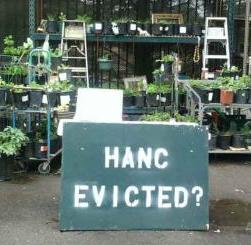
He can start by calling off the eviction of the Haight Ashbury Neighborhood Recycling Center.

The move by Newsom to evict the recycling center, on the edge of Golden Gate Park, was part of his administration’s war on the poor. It made no sense from a financial or environmental perspective. The center, which pays rent to the city, would be replaced by a community garden, which would pay nothing. The center creates green jobs that pay a living wage; all the workers would be laid off under Newsom’s plan. The center also operates a native plant nursery and provides a drop-off recycling site for local businesses.

A community garden makes only limited sense in a shady area that gets fog most of the year.

The only reason Newsom was determined to get rid of the place is that low-income people who collect bottles and cans around the city (an environmentally positive activity, by the way) come by the center to drop them off and pick up a little cash. Some of the wealthier residents of the Haight don’t like poor people wandering through their neighborhood. It’s class warfare, declared by the Newsom administration — and Lee, who got his start as a poverty lawyer, doesn’t have to tolerate it.

Lee should direct the Recreation and Parks Department to cease the eviction proceedings and negotiate a long-term lease for the Frederick Street site.

It seems like a small item in the long list of issues the new mayor will have to deal with — but the HANC recycling center has strong symbolic importance. Ending the eviction and allowing the center to stay would be a sign that Lee intends to be a mayor who is willing to work with the progressives and that he’s not going to try to solve all the city’s problems by blaming, harassing, and criminalizing people who are barely surviving in San Francisco.

The new mayor could take another simple step toward broad credibility by opening up his office — to the public and the press. Under Newsom, Room 200 was an unfriendly place to outsiders, and often the news media were treated as enemies. Lee should start holding regular press conferences — not just stage-managed events designed to showcase one issue, but broad-ranging, open sessions where reporters can ask questions about anything his administration is doing. And he ought to direct his press office to make compliance with the Sunshine Ordinance a priority.

For starters, he could release whatever proposed budget cuts Newsom left behind. It’s hard to believe the former mayor just turned them over to Lee without a list of things that were on the chopping block. The sooner the public sees where the previous administration was going, the sooner we can all determine what, if anything, Lee will do differently.

SF’s new political era

31

news@sfbg.com

You can argue about what the word “progressive” means, and you can argue about the process and the politics that put Ed Lee in the Mayor’s Office. And you can talk forever about which group or faction has how much of a majority on the San Francisco Board of Supervisors, but you have to admit: this city has just undergone a significant political realignment.

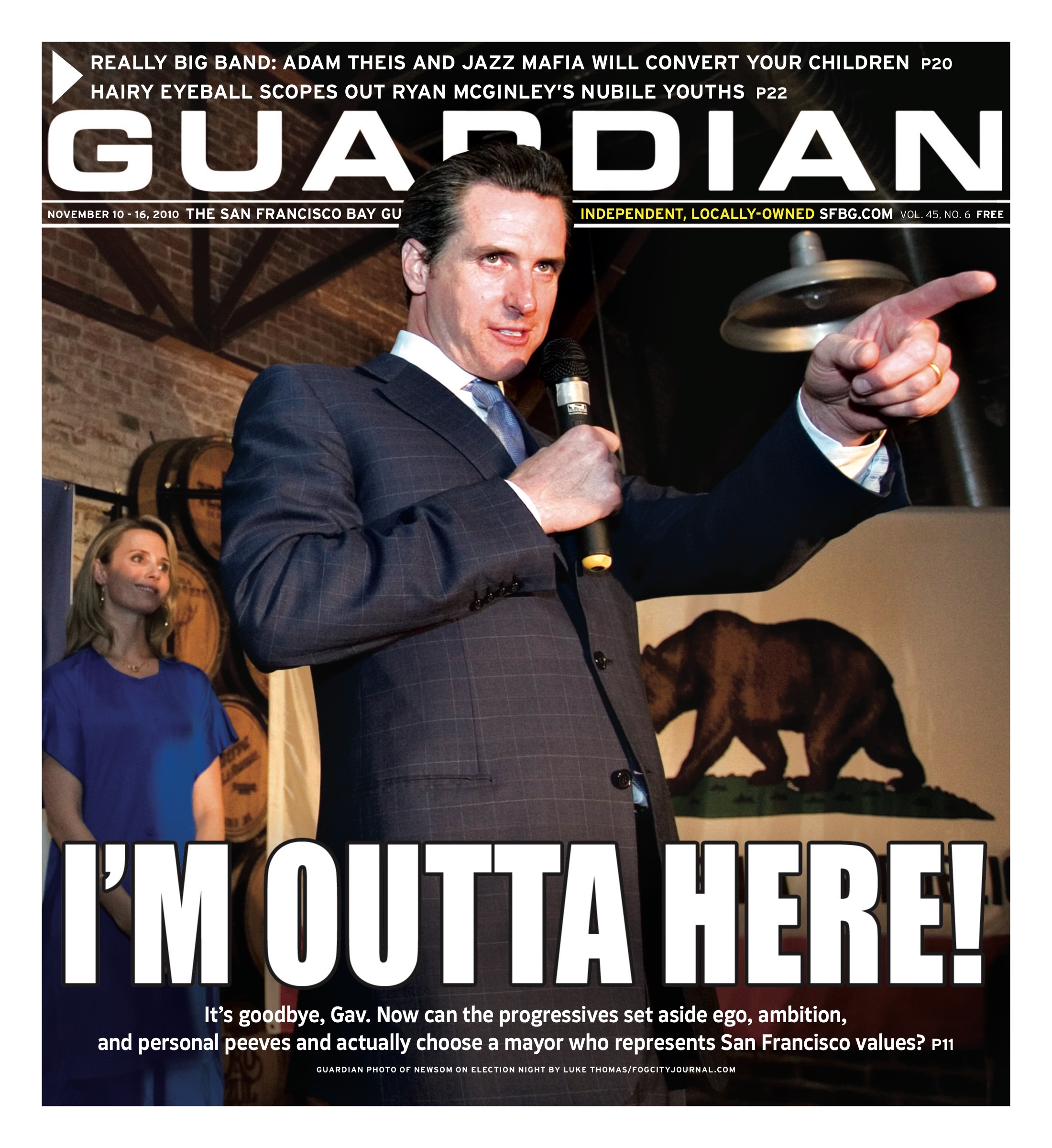
Some of that was inevitable. The last members of the class of 2000, the supervisors who were elected in a rebellion against the sleaze, corruption, and runaway development policies of the Willie Brown administration, have left office. Gavin Newsom, the mayor who was often at war with the board and who encouraged a spirit of rancor and partisanship, is finally off to Sacramento. For the first time since 1978, the supervisors will be working with a mayor they chose themselves.

For much of the past 15 years, progressive politics was as much about stopping bad things — preventing Brown and then Newsom from wrecking the city — as it was about promoting good things. But the “politics of anti,” as San Francisco State political scientist Rich DeLeon describes is, wasn’t a central theme in the November elections, and this generation of supervisors comes into office with a different agenda.

Besides, one of the clear divisions on the board the past seven years was the Newsom allies against the progressives — something that dissipated instantly when Lee took over.

But the realignment goes deeper.

Until recently, the progressives on the board had a working majority — a caucus, so to speak — and they tended to vote together much of the time. The lines on the board were drawn almost entirely by what Newsom disparagingly calls ideology but could more accurately be described as a shared set of political values, a shared urban agenda.

There are still six supervisors who call themselves progressives, but the idea that they’ll stick together was shattered in the battle over a new mayor — and the notion that there’s anything like a progressive caucus died with Board President David Chiu’s election (his majority came in part from the conservative side, with three progressives opposing him) and with Chiu’s new committee assignments, which for the first time in a decade put control of key assignments in the hands of the fiscal conservatives.


A PROGRESSIVE MAJORITY?

The progressive bloc on the board was never monolithic. There were always disagreements and fractures. And, thanks to the Brown Act, the progressives don’t actually meet outside of the formal board sessions. But it was fair and accurate to say that, most of the time, the six members of the board majority functioned almost as a political party, working together on issues and counting on each other for key votes. There was, for example, a dispute two years ago over the board presidency — but in the end, Chiu was elected with exactly six votes, all from the progressive majority that came together in the end.

That all started to fall apart the minute the board was faced with the prospect of choosing a new mayor. For one thing, the progressives couldn’t agree on a strategy — should they look for someone who would seek reelection in November, or try to find an acceptable interim mayor? The rules that barred supervisors from voting for themselves made it more tricky; six votes were not enough to elect any of the existing members. And, not surprisingly, some of the progressives had mayoral ambitions themselves.

When state Assemblymember Tom Ammiano — who would have had six votes easily — took himself out of the running, there was no other obvious progressive candidate. And with no other obvious candidate, and little opportunity for open discussion, the progressives couldn’t come to an agreement.

But by the Jan. 4 board meeting, five of the six had coalesced around Sheriff Mike Hennessey. Chiu, however, was supporting Ed Lee, someone he had known and worked with in the Asian community and whom he considered a progressive candidate. And once it became clear that Lee was headed toward victory, Sup. Eric Mar announced that he, too, would be in Lee’s camp.

A few days later, when the new board convened to choose a president, the progressive solidarity was gone. Sups. David Campos, John Avalos, and Ross Mirkarimi, now the solid left wing of the board, voted for Avalos. Chiu won with the support of Mar, Sup. Jane Kim, and the moderate-to-conservative flank.

Now the Budget Committee — long controlled by a progressive chair and a progressive majority — will be led by Carmen Chu, who is among the most fiscally conservative board members. The Land Use and Development Committee will be chaired by Mar, but two of the three members are from the moderate side. Same goes for Rules, where Sup. Sean Elsbernd, for years the most conservative board member, will work with ideological ally Sup. Mark Farrell on confirming mayoral appointments, redrawing supervisorial districts, and promoting or blocking charter amendments as Kim, the chair, does her best to contain the damage.

You can argue that having independent-minded supervisors who don’t vote as a caucus is a good thing. You can also argue that a fractured left will never win against a united downtown. And both arguments have merit.

But you can’t argue any more that the board has the same sort of progressive majority it’s had for the past 10 years. That’s over. It’s a new — and different — political era.

What happens now? Will the progressives hold enough votes to have an influence on the city budget (and ensure that the deficit solutions include new revenue and not just cuts)? What legislative priorities will the supervisors be pushing in the next year? How will the votes shake out on difficult new proposals (and ongoing issues like community choice aggregation)?

Mayor Lee has pledged to work with the board and will show up for monthly questions. How will he respond to the sorts of progressive legislation — like tenant protections, transit-first policies, immigrant rights measures, and stronger affordable housing standards — that Newsom routinely vetoed?

How will this all play out in a year when the city will also be electing a new mayor?


IDENTITY POLITICS?

When Sups. Chiu, Mar, and Kim broke with their three progressive colleagues to support Chiu for board president — just as Chiu and Mar helped clear the path for Ed Lee to become mayor days earlier — it seemed to many political observers that identity had trumped ideology on the board. There’s some truth to that observation, but it’s too simple an explanation. There’s also the fact that Chiu strongly supported Kim, who is a personal friend and former roommate, in her election, so it’s no surprise she went with him for board president.

And the phrase itself is so laden with baggage and problems that it’s hard to talk about. It has come to signify a wide range of political activity and theorizing founded in the shared experiences of injustice of members of certain social groups. “Rather than organizing solely around belief systems, programmatic manifestoes, or party affiliation, identity political formations typically aim to secure the political freedom of a specific constituency marginalized within its larger context,” says the Stanford Encyclopedia of Philosophy, an ongoing research project by the students and faculty at Stanford University.

Although the notion of identity politics took hold during the social movements of the 1960s and ’70s — when liberation and organizing movements among women and various ethic and other identity groups fed a larger liberal democratic surge that targeted war, economic inequity, social injustice, and other issues — it’s also a political approach that has divided the populace.

“One of the central charges against identity politics by liberals, among others, has been its alleged reliance on notions of sameness to justify political mobilization,” says the Stanford Encyclopedia. “Looking for people who are like you rather than who share your political values as allies runs the risk of sidelining critical political analysis of complex social locations and ghettoizing members of social groups as the only persons capable of making or understanding claims to justice.”

Mar explains that the reality of identity politics and whether it’s a factor in the current politics at City Hall is far more complex.

“With me, David Chiu, and Jane Kim as a block of three progressive Asians — and I still define David Chiu as a progressive though I think some are questioning that — we all come out of what I would call a pro-housing justice, transit-first, and environmental sustainability [mindset],” Mar told us. “But I think because of our ethnic background and experiences, we may have different perspectives at times than other progressives.”

For example, Mar said, many working class families of color need to drive a car so they’ll differ from progressives who want to limit parking spaces to discourage driving. He also has reservations about the proposed congestion pricing fee and how it might affect low-income drivers.\

“I think often when progressive people of color come into office — Jane Kim might be one of the best examples — that sometimes there’s an assumption that her issues are going to be the same as a white progressive or a Latino progressive,” he said. “But I think kind of the different identities that we all have mean that we’re more complex.”

Campos, a Latino immigrant who is openly gay, noted that “as a progressive person of color, I have at times felt that the progressive movement didn’t recognize the importance of identity politics and what it means for me to have another person of color in power.”

But, he added, “I don’t think identity politics alone should guide what happens. A progressive agenda isn’t just about race but class, sexual orientation, and other things. It’s not enough to say that identity politics justifies everything.”

University of San Francisco political science professor Corey Cook told the Guardian that identity has always been a strong factor in San Francisco politics, even if it was overshadowed by the political realignment around progressive ideology that occurred in 2000, mostly as a reaction to an economic agenda based on rapid development and political cronyism.

“I’m not sure that identity wasn’t relevant, but it was swamped by ideology,” Cook told the Guardian. Now, he said, another political realignment seems to be occurring, one that downplays ideology compared to the position it has held for the last 10 years. “I’m not sure that ideology is dead. But the dynamics have definitely changed.”

Cook sees what may be a more important change reflected in Chiu’s decision to put the political moderates in control of key board committees. But he said that shift was probably inevitable given the difficulties of unifying the diverse progressive constituencies.

“It’s hard to hold a progressive coalition together, and it’s amazing that it has lasted this long,” he said.

There’s another kind of identity politics at play as well — that of native San Franciscans, who often express resentment at progressive newcomers talking about what kind of city this is, versus those who see San Francisco as a city of immigrants and ideas, a place being shaped by a wider constituency than the old-timers like to acknowledge.

“I’m honored to join Sups. Elsbernd and Cohen in representing the neighborhoods they grew up in,” Sup. Mark Farrell said during his opening remarks after being sworn in Jan. 8., sobbing when he thanked his parents for their support.

As he continued, he fed the criticism of the notion of ideology-based politics that has been a popular trope with Gavin Newsom and other fiscal conservatives in recent years, telling the crowd he wanted “to turn City Hall into a place based on issues and ideas, not ideology.”

Cohen also placed more importance on her birthright than on her political philosophy, telling stories about entering board chambers through the back door at age 16 when she was part of a youth program created by then-Mayor Frank Jordan, and with former Mayor Dianne Feinstein coming to speak at Cohen’s third-grade class. “I am a San Francisco native, and that is a responsibility I take seriously,” said Cohen, who graduated from the Emerge Program, which grooms women for political office,

“We will have another woman as president of the Board of Supervisors, and we will have a woman as mayor of San Francisco,” she added. And as the sole African American on the board, she also pledged, “I will be working to add more members of the African American community to the elected family of San Francisco.”

But what issues she plans to focus on and what values she’ll represent were unclear in her comments — as they were throughout her campaign, despite the efforts of journalists and activists to discern her political philosophy. In her public comments, her only stated goal was to build bridges between the community and City Hall and let decisions be guided by the people “not political ideologies.”

Oftentimes in recent San Francisco history, identity and ideology have worked in concert, as they did with former Sup. Harvey Milk, who broke barriers as the first openly gay elected official, but who also championed a broad progressive agenda that included tenants rights, protecting civil liberties, and creating more parks and public spaces.

Sup. Scott Wiener, shortly after being sworn into office, acknowledged the legacy of his district, which was once represented by Milk and fellow gay progressive leader Harry Britt, telling the crowd: “I’m keenly aware of the leadership that has come through this district and I have huge shoes to fill.”

Yet Wiener, a moderate, comes from a different ideological camp than Milk and Britt and he echoed the board’s new mantra of collaboration and compromise. “I will always try to find common ground. There is always common ground,” he said.


GETTING THINGS DONE?

Chiu is making a clear effort to break with the past, and has been critical of some progressive leaders. “I think it’s important that we do not have a small group of progressive leaders who are dictating to the rest of the progressive community what is progressive,” he said.

While he didn’t single out former Sup. Chris Daly by name, he does seem to be trying to repudiate Daly’s leadership style. “I think that while the progressive left and the progressive community leaders have had very significant accomplishments over the past 10 years, I do think that there are many times when our oppositional tactics have set us back.”

When Chiu was reelected board president, he told the crowd that “none of us were voted into office to take positions. We were voted into office to get things done.”

Some progressives were not at all happy with that comment. “I thought that was a terrible thing to say,” Avalos told the Guardian, arguing the positions that elected officials take shape the legislation that follows. As an example, he cited the positions that progressive members of Congress took in favor of the public option during the health care reform debate.

Talking about getting things done is “a sanctimonious talking point that fits well with what the Chronicle and big papers want to hear,” Avalos said. He said the Chronicle and other downtown interests are more interested in preserving the status quo and blocking progressive reforms. “It’s what they want to see not get done.”

Campos even challenged the comment publicly during the Jan. 11 board meeting when he said, “It’s important to get things done, but I don’t think getting things done is enough. We have to ask ourselves: what is it that we’re getting done? How is it that we’re getting things done? And for whom is it that we’re doing what we’re doing? Is it for the people, or the downtown corporate interests? I hope it’s not getting things done behind closed doors.”

Chiu said that, for him, getting things done is about expanding the progressive movement and consolidating its recent gains. “I think we all share a political goal. As progressives, we all share a political goal of getting things done and growing mainstream support for our shared progressive principles so that they really become the values of our entire city.”

To do that, he said, progressives are going to need to be more conciliatory and cooperative than they’ve been in the past. “I think it’s easy to slip into a more oppositional way of discussing progressive values, but I’m really pushing to move beyond that.”

The biggest single issue this spring will be the budget — and it’s hard to know exactly where the board president will draw his lines. “I have spoken to Mayor Lee about the need for open, transparent, and community-based budget processes and he’s open to that,” Chiu told us — and that alone would be a huge change. But the key progressive priority for the spring will be finding ways to avoid brutal budget cuts — and that means looking for new revenue.

When asked whether new general revenue will be a part of the budget solution, instead of Newsom’s Republican-style cuts-only approaches, Chiu was cautious. “I am open to considering revenues as part of the overall set of solutions to close the budget deficit,” he said. “I am willing to be one elected here that will try to make that argument.” But with his political clout and connections right now, he can do a lot more than be one person making an argument.

Chiu has always been open to new revenue solutions and even led the way in challenging the cuts-only approach to both the city budget and MTA budget two years in a row, only to back down in the end and cut a deal with Newsom. When asked whether things will be better this year given his closer relationship to Lee, Chiu replied, “I think things are going to be different in the coming months.”

During the board’s Jan. 7 deliberation on Lee, Sup. Eric Mar also said that based on his communications with Lee, Mar believed that the Mayor’s Office is open to supporting new revenue measures. He echoed the point later to us.

In addition to supporting the open, inclusive budget process, Mar called for “a humane budget that protects the safety net and services to the most vulnerable people in San Francisco is kind of the critical, top priority.

“I think it’s going to be difficult working with the different forces in the budget process,” he added. “That’s why I wish it could have been a progressive who was chairing the budget process.”

Mar said progressive activism on the budget process is needed now more than ever. “The Budget Justice Coalition from last year I think has to be reenergized so that so many groups are not competing for their own piece of the pie, but that it’s more of a for-all, share-the-pain budget with as many people communicating from outside as possible, putting the pressure on the mayor and the board to make sure that the critical safety net’s protected.”


CUTS WILL BE CENTER STAGE

But major cuts — and the issue of city employees pay and benefits — will also be center stage.

At the board’s Jan. 11 meeting, before the supervisors voted unanimously to nominate Lee as interim mayor, Sup. Elsbernd signaled that city workers’ retirement and health benefits will once again be at the center of the fight to balance the budget.

Elsbernd noted that in past years he was accused of exaggerating the negative impacts that city employees’ benefits have on the city’s budget. “But rather than being inflated, they were deflated,” Elsbernd said, noting that benefits will soon consume 18.14 percent of payroll and will account for 26 percent in three years.

“Does the budget deficit include this amount?” he asked.

And at the after-party that followed Lee’s swearing-in, Public Defender Jeff Adachi, who caused a furor last fall when he launched the ill-considered Measure B, which sought to reform workers’ benefits packages, told us he is not one to give up lightly.

“We learned a lot from that,” Adachi said. “This is still the huge elephant in City Hall. The city’s pension liability just went up another 1 percent, which is another $30 million”

Chu agreed that worker benefits would be a central part of the budget-balancing debate. “Any conversation about the long-term future of San Francisco’s budget has to look at the reality of where the bulk of our spending is,” she said.

Avalos noted that he plans to talk to labor and community based organizations about ways to increase city revenue. “I’m going to work behind the scene on the budget to make sure the communities are well-spoken for,” Avalos said, later adding, “But it’s hard, given that we need a two-thirds majority to pass stuff on the ballot.”

Last year, Avalos helped put two measures on the ballot to increase revenue: Prop. J, which sought to close loopholes in the city’s current hotel tax and asked visitors to pay a slightly higher hotel tax (about $3 a night) for three years, and Prop. N, the real property transfer tax that slightly increased the tax charged by the city on the sale of property worth more than $5 million.

Prop. N should raise $45 million, Avalos said. “I’ve always had my sights set on raising revenue, but making cuts is inevitable.”


THE IDEOLOGY ARGUMENT

Newsom and his allies loved to use “ideology” as a term of disparagement, a way to paint progressives as crazies driven by some sort of Commie-plot secret agenda. But there’s nothing wrong with ideology; Newsom’s fiscal conservative stance and his vow not to raise taxes were ideologies, too. The moderate positions some of the more centrist board members take stem from a basic ideology. Wiener, for example, told us that he thinks that in tough economic times, local government should do less but do it better. That’s a clear, consistent ideology.

For much of the past decade, the defining characteristic of the progressives on the board has been a loosely shared urban ideology supported by tenants, immigrant-rights groups, queer and labor activists, environmentalists, preservationists, supporters of public power and sunshine and foes of big corporate consolidation and economic power. Diversity and inclusiveness was part of that ideology, but it went beyond any one political interest or identity group.

It was often about fighting — against corruption and big-business hegemony and for economic and social equality. The progressive agenda started from the position that city government under Brown and Newsom had been going in the wrong direction and that substantive change was necessary. And sometimes, up against powerful mayors and their well-heeled backers, being polite and accommodating and seeking common ground didn’t work.

As outgoing Sup. Daly put it at his final meeting: “I’ve seen go-along to get along. If you want to do more than that, if you think there’s a fundamental problem with the way things are in this world, then go-along to get along doesn’t do it.” When Chiu announced that the new progressive politics is one of pragmatism, he was making a break from that ideology. He was signaling a different kind of politics. He has urged us to be optimistic about the new year — but we still don’t know what the new agenda will look like, how it will be defined, or at what point Chiu and his allies will say they’ve compromised and reached out enough and are ready to take a strong, even oppositional, stand. We do know the outcome will affect the lives of a lot of San Franciscans. And when the budget decisions start rolling down the pike, the political lines will be drawn fairly clearly. Because reaching across the aisle and working together sounds great in theory — but in practice, there is nothing even resembling a consensus on the board about how the city’s most serious problems should be resolved. And there are some ugly battles ahead.


Editorial: New Mayor Ed Lee should stop the recycling eviction

8

Mayor Ed Lee needs to demonstrate, as we noted in last week’s editorial, that he’s making a clean break from the politics and policies of the Newsom administration and there are things he can do immediately to reassure San Franciscans that he’s going to offer more than another 11 months of a failed administration.

He can start by calling off the eviction of the Haight Ashbury Neighborhood Recycling Center.

The move by Newsom to evict the recycling center, on the edge of Golden Gate Park, was part of his administration’s war on the poor. It made no sense from a financial or environmental perspective. The center, which pays rent to the city, would be replaced by a community garden, which would pay nothing. The center creates green jobs that pay a living wage; all the workers would be laid off under Newsom’s plan. The center also operates a native plant nursery and provides a drop-off recycling site for local businesses.

A community garden makes only limited sense in a shady area that gets fog most of the year.

The only reason Newsom was determined to get rid of the place is that low-income people who collect bottles and cans around the city (an environmentally positive activity, by the way) come by the center to drop them off and pick up a little cash. Some of the wealthier residents of the Haight don’t like poor people wandering through their neighborhood. It’s class warfare, declared by the Newsom administration and Lee, who got his start as a poverty lawyer, doesn’t have to tolerate it.

Lee should direct the Recreation and Parks Department to cease the eviction proceedings and negotiate a long-term lease for the Frederick Street site.

It seems like a small item in the long list of issues the new mayor will have to deal with but the HANC recycling center has strong symbolic importance. Ending the eviction and allowing the center to stay would be a sign that Lee intends to be a mayor who is willing to work with the progressives and that he’s not going to try to solve all the city’s problems by blaming, harassing, and criminalizing people who are barely surviving in San Francisco.

The new mayor could take another simple step toward broad credibility by opening up his office to the public and the press. Under Newsom, Room 200 was an unfriendly place to outsiders, and often the news media were treated as enemies. Lee should start holding regular press conferences not just stage-managed events designed to showcase one issue, but broad-ranging, open sessions where reporters can ask questions about anything his administration is doing. And he ought to direct his press office to make compliance with the Sunshine Ordinance a priority.

For starters, he could release whatever proposed budget cuts Newsom left behind. It’s hard to believe the former mayor just turned them over to Lee without a list of things that were on the chopping block. The sooner the public sees where the previous administration was going, the sooner we can all determine what, if anything, Lee will do differently.  

Jerry Brown and local government

1

So Jerry Brown wants to go back to the days before Prop. 13. He wants to do what a lot of people say, in retrospect, he should have done in 1978: Leave local government with the responsibility for all those things that property taxes used to fund.


His idea is being framed as a little more gentle than that:


“We’re going to shift funding to the local level, we’re going to make sure there’s enough responsibility and discretion to use the money in the wisest possible ways,” Brown told reporters after the meeting, adding that he does not believe it will be an easy change. “There will be controversies.”


But the reality is simple: the state doesn’t have the money to fund all the things that cities and counties need to do. And Brown would be solving (some of) Sacramento’s problems by adding to the burdens of local government.


He’s crazy like a fox, though, Jerry is. Back in June, 1978, when the voters approved Prop. 13, local officials said the results would be disastrous — schools closing, fire stations shuttered, police departments devastated by layoffs, bus service collapsing … and at first, none of those things happened. That’s because under Gov. Brown, the state was running a huge budget surplus — and Brown shared it with the cities and counties.


Now more than 70 percent of every dollar of state spending goes directly to local government. When people complain about the state’s budget increasing over the past few decades, they need to understand — not only has population expanded and the federal government cut back on programs that the state now has to pay for, but the state has taken on programs that used to be funded by local property taxes.


And Brown wants the cities and counties to take some of that responsibility again. In the process, he might wind up doing what no politician in the state has managed in in 32 years. He might show Californians how bad Prop. 13 really is.


Because unless the state gives local government significant new power to raise taxes (and I’d love to see that happen), the cuts over the next two years will hit particularly hard on the things that people see around them every day: Local government services.


It is, indeed, shock doctrine. And the only way it can possibly work is if local government is given the authority to raise enough money to pay for the services people want, need and expect — and if people start to realized that there’s nobody in Sacramento or Washington to bail them out, and that if they want good schools, safe streets, nice parks, etc. they’re going to have to pay for it.


It’s going to be a fascinating spring.


On the Cheap Listings

0

On the Cheap listings are compiled by Caitlin Donohue. Submit items for the listings at listings@sfbg.com. For further information on how to submit items for the listings, see Picks.

WEDNESDAY 5

Concierto de Reyes Mission Cultural Center for Latino Arts, 2868 Mission, SF; (415) 643-5001, www.missioncultural.org. 2pm, free. The Coro Hispano of San Francisco, a chorus comprised of Spanish-speaking community members, has been celebrating Latin America through song since 1975. Join ’em for their annual kids holiday concert, which will cover turf as varied as renaissance motets and aguinaldos (Christmas folk music) from Peru, Venezuela, Puerto Rico, and more.

Glen Canyon habitat restoration Glen Park Recreation Center, 70 Elk, SF; (415) 337-4705, www.sfrecpark.org. 9am-noon, free. Sure, you’ve made “that” resolution for the millionth time. But how about you snap out of that pudgy pity party and truck out to a little exercise that benefits more than just your waist line? SF parks are in need of TLC if they want to fend off invasive species and you can join in on the action at this morning of weeding, planting, and pruning. Dress to get muddy and active – and indulge in the free snacks provided free of your Christmas cookie guilt.

FRIDAY 7

Jaime Cortez: “Universal Remote” Southern Exposure, 3030 20th St., SF; (415) 863-2141, www.soex.org Through Feb. 19. Opening reception 7-9pm, free. It’s been months, but we still have a big in our hearts the size of a glittery glove. Thankfully, here comes visual artist Jaime Cortez’s solo exhibition, which calls out the tragic, tremendous pop culture whorl that was MJ – and highlights the King of Pop’s fluid moves through race, sexuality, and zombie-human relations.

Oakland Art Murmur Telegraph and 23rd St., Oakl.; www.oaklandartmurmur.com. 6-10 p.m., free. Rediscover what downtown Oakland’s got going on art-wise with this monthly show-and-tell by the neighborhood’s best and brightest art galleries. This week, catch Jennie Ottinger’s book art at Johansson Projects (excerpt from her truncated version of As I Lay Dying: “Holy shit, this family is cursed! Very National Lampoon’s Vacation.“)

SATURDAY 8

Parent-child snow globe class Randall Museum, 199 Museum Way, SF; (415) 554-9600, www.randallmuseum.org. 1-4pm, $6 for children; $10 for parent-child duos. The holidays are over, and yeah it’s still cold and rainy. But take heart! Winter can be time for good cheer even after Santa’s packed up the sleigh and gone north. Make a shakable wonder with your wee one and enjoy the rest of Randall Museum’s “Saturdays are Special” event (10am-4pm), which includes railroad exhibits, live animal feedings, and the rest of the science-y wonders present throughout the rest of this always-free museum.

Vintage Paper Expo Hall of Flowers, Golden Gate Park, Lincoln and Ninth Ave., SF; (328) 883-1702, www.vintagepaperfair.com. 10am-6pm, free. (Also Sun/9, 10am-4pm) Postcards, photos, brochures, stereoviews, and so much more! What’s a stereoview, you ask? Why, nothing less than an antique 3D image – something you can acquaint yourself with at this fair of all things printed and retro. The Vintage Paper Expo’s got over 100 vendors this year, all primed to sell you affordable scraps of history.

Writers With Drinks The Make Out Room, 3225 22nd St., SF; (415) 647-2888, www.writerswithdrinks.com. 7:30-9:30pm, $5-10 sliding scale. Writers? Drink? Well, I guess there’s a first time for everything! This long-standing lit night series pairs local scribes (this month’s are girl group Gogos founder Jane Wiedlin and socio-writer Ethan Watters) with a crowd that’s anything but stiff for readings, skits, and stand-up.

MONDAY 10

Cinema Drafthouse: Machete The Independent, 628 Divisadero, SF; (415) 771-1421, www.theindependentsf.com. 9pm, free. A deliberately silly revenge plot that’s both spot-on vintage homage and semi-serious commentary on America’s ongoing immigration debate gets the Indy’s free movie night treatment. Watch the film with a beer in hand (or two) – and feel free to shout advice to the characters on-screen. You’re in a music venue, for chrissakes.

TUESDAY 11

Pecha Kucha 330 Ritch, 330 Ritch, SF; www.pecha-kucha.org. 7pm, $5 donation suggested. Embarking as we are on month number one of year two-thousand-and-one-one, the theme of this month’s installation of this cross-discipline art night series is, yes, “one.” Not the most specific theme, sure – but that’s the way artists like it, and when you’ve assembled a passel of them from fields as varied as industrial design, animation, and fashion, sometimes it’s best just to step back and watch them unify.

How Brown can save California

4

EDITORIAL There are two things Gov. Jerry Brown has to do to get California back on track, and he needs to start right away. He has to restore at least a degree of public faith in state government — and he has to put a series of tax increases on the June ballot.

The first step ought to be right in the Brown playbook. The public is fed up with the secrecy, lies, machinations, and policy failures of the Schwarzenegger administration, and Brown can start off by telling people the truth. The budget situation is frightening; it can’t all be solved by cuts without destroying the state of California as we know it. But it also requires an understanding that the taxpayers don’t want to see their money wasted.

Brown has done the right thing by offering to cut his own staff by 25 percent and by denouncing the demands of the highest-paid University of California staffers who want even larger pensions. He might also take a look at some of the outmoded, expensive commissions in the state (do we really need a 21-member California Film Commission?) None of these are big money-savers, and none address the budget crisis in any meaningful way. But they’ll show that Brown’s cautious with a buck.

Then he needs to tell the voters that the state does, indeed, have a revenue problem, not just a spending problem. And he should start right away with a blue-ribbon panel of tax experts to look at what reforms ought to go on the June ballot.

It’s crazy to say that solving a $28 billion budget shortfall is easy, but a few basic changes could go a very long way to balancing the books. If the voters approve an oil severance tax (something every other oil-producing state in the nation has), an end to the commercial property loophole in Prop. 13, and the restoration of the vehicle license fee that Arnold Schwarzenegger abolished, the state would be about $10 billion richer. A modest increase in the income tax on the very richest Californians would add a few billion more. And suddenly the problem wouldn’t look so insurmountable.

Brown has an advantage: he’s taking over for a terribly unpopular governor. He will be able to work with a Legislature that now has the ability to pass a budget with a simple majority. And while his victory in November was hardly a landslide, it was substantial enough that he’s got a valid mandate for change.

He and the legislative leaders should adopt a budget that includes the expected revenue from a June tax package — and then offer an alternative budget that doesn’t. Give the voters a clear choice. Do they want to eliminate hundreds of public schools, raise elementary school class sizes to 40, shut down a couple of University of California campuses, shutter the state parks, and let 30,000 prisoners go free? Of do they want the oil companies and the richest Californians to pay a little bit more to keep the state functioning?

Brown can make history this spring. The passage of Prop. 13, during his last term as governor, set off a nationwide tax-cutting frenzy that’s damaged the entire country. By pushing back just a little bit, and demanding a little bit of tax fairness, he can demonstrate that California is still a leader in progressive public policy.

He’ll have to put his political capital, his credibility, and all the money he can raise behind the effort. If he doesn’t, his administration, and the state, will be a total failure.

Editorial: How Brown can save California

0

There are two things Gov. Jerry Brown has to do to get California back on track, and he needs to start right away. He has to restore at least a degree of public faith in state government and he has to put a series of tax increases on the June ballot.

The first step ought to be right in the Brown playbook. The public is fed up with the secrecy, lies, machinations, and policy failures of the Schwarzenegger administration, and Brown can start off by telling people the truth. The budget situation is frightening; it can’t all be solved by cuts without destroying the state of California as we know it. But it also requires an understanding that the taxpayers don’t want to see their money wasted.

Brown has done the right thing by offering to cut his own staff by 25 percent and by denouncing the demands of the highest-paid University of California staffers who want even larger pensions. He might also take a look at some of the outmoded, expensive commissions in the state (do we really need a 21-member California Film Commission?) None of these are big money-savers, and none address the budget crisis in any meaningful way. But they’ll show that Brown’s cautious with a buck.

Then he needs to tell the voters that the state does, indeed, have a revenue problem, not just a spending problem. And he should start right away with a blue-ribbon panel of tax experts to look at what reforms ought to go on the June ballot.

It’s crazy to say that solving a $28 billion budget shortfall is easy, but a few basic changes could go a very long way to balancing the books. If the voters approve an oil severance tax (something every other oil-producing state in the nation has), an end to the commercial property loophole in Prop. 13, and the restoration of the vehicle license fee that Arnold Schwarzenegger abolished, the state would be about $10 billion richer. A modest increase in the income tax on the very richest Californians would add a few billion more. And suddenly the problem wouldn’t look so insurmountable.

Brown has an advantage: he’s taking over for a terribly unpopular governor. He will be able to work with a Legislature that now has the ability to pass a budget with a simple majority. And while his victory in November was hardly a landslide, it was substantial enough that he’s got a valid mandate for change.

He and the legislative leaders should adopt a budget that includes the expected revenue from a June tax package and then offer an alternative budget that doesn’t. Give the voters a clear choice. Do they want to eliminate hundreds of public schools, raise elementary school class sizes to 40, shut down a couple of University of California campuses, shutter the state parks, and let 30,000 prisoners go free? Of do they want the oil companies and the richest Californians to pay a little bit more to keep the state functioning?

Brown can make history this spring. The passage of Prop. 13, during his last term as governor, set off a nationwide tax-cutting frenzy that’s damaged the entire country. By pushing back just a little bit, and demanding a little bit of tax fairness, he can demonstrate that California is still a leader in progressive public policy.

He’ll have to put his political capital, his credibility, and all the money he can raise behind the effort. If he doesn’t, his administration, and the state, will be a total failure.  


Rec & Park trashes HANC Recycling Center

At yesterday’s Recreation & Park Commission meeting on Dec. 2, hundreds of San Francisco residents turned out to urge commissioners not to replace the Haight Ashbury Neighborhood Council (HANC) Recycling Center with a community garden. Their pleas fell on deaf ears.

It didn’t matter that a sunnier spot for a community garden had already been identified in the same area, with funding approved by the commission more than a year ago. It didn’t matter that thousands of people use the recycling center every month, and that the nonprofit bolsters community gardens throughout the city with donations and funding. It didn’t matter that we’re in a recession and there were jobs on the line. It didn’t matter that HANC pays rent to a city department facing a $12.5 million deficit, but the community garden would cost $250,000.

All that mattered in the end was that Rec & Park, and Mayor Gavin Newsom, wanted the HANC recycling center out. They thought removing it might discourage homeless people from sleeping in the park and hanging around the neighborhood. After nearly four hours of listening to residents urge them not to do it, the commissioners yawned and pushed the eject button. They unanimously voted in favor of the community garden. A 90-day eviction notice is expected to go out to HANC today.

The fight over HANC’s eviction has been described as a political battle between progressives and moderates, a showdown between heroes who stand up for public safety versus intimidating thugs and the lefties who enable them, and even a sequel to the sit /lie controversy. I think there’s an 800-pound gorilla sitting in the middle of this fight that no one wants to talk about: Class.

Community gardens are wonderfully empowering. I used to volunteer at one at a public housing complex in North Carolina. It was especially important for people who lived in that low-income community, since they benefited from nutritious produce that also lowered their grocery bills. Under the city’s plan for this new, gated community garden, 30 of the 40 garden plots will go to area residents. Given the affluence of that neighborhood, the garden beds will likely go to people who can afford organic groceries at Whole Foods without breaking into a sweat. For well-to-do San Franciscans, growing produce is not a means of survival — it’s about feeling good, and being green. By itself, there’s nothing wrong with that.

The problem is that it will be installed at the expense of a long-standing community resource that employs 10 people and lightens the load for hundreds of others during a recession, when people are truly struggling to get by. The Rec & Park Commission has essentially decided that this parcel of public space should be taken from a nonprofit that benefits people of all classes, and given to a small number of residents who’ve voiced complaints about “quality-of-life issues.”

In its current function, the HANC Recycling Center is empowering to many different kinds of people. Most aren’t homeless. Tough-as-nails Asian grandmas show up with bags full of cans that they can exchange for some extra spending money. Urban gardeners purchase native plants in hopes of pleasing native insects and birds. People on fixed incomes get a small financial boost by turning in recyclables.

A small number of the HANC Recycling Center patrons do sleep outside. In order to earn small amounts of cash for things like food, many of them have to go digging around in garbage cans, which is gross and humiliating. Why would someone paw through the garbage for hours, battling bees and germs, and then haul smelly bottles uphill in a shopping cart just to make a few bucks? My guess is that it’s to ward off desperation. They make their own work, and they get to eat.

“Some of them may use drugs,” one of the speakers acknowledged last night. “But,” he paused for dramatic effect. “Some of us use drugs, too.”

When sit / lie was under debate, critics wondered where the homeless were supposed to go, if they couldn’t sit on the sidewalks. Often, the reply was that they could go to the parks. But this latest attack on the homeless shows that they aren’t welcome there, either.

This is an opinion piece.

Privatizing the parks

23

I’m not going all crazy on the idea of pretzel stands in Golden Gate Park, or even a lobster-roll place behind the bandshell. I’m kind of against the lease change at Stowe Lake because I hate to see an out-of-town operator take over a local concession (and I like the funky boats, and the popcorn, and the overall 1950s-era quality of the food stand, which — by the way — makes the best soda water anywhere in town, yumm, so extra fizzy and nice ….).


But it’s worth sounding the alarm about the direction that Phil Ginsberg and Mark Buell are taking the Recreation and Park Department. And it’s not just evicting the HANC recycling center.


I realize that the city’s broke, and Rec-park is broke, and if they can’t raise money by selling coffee and lobster rolls they might have to lay off even more recreation directors. I fell the pain. But there’s a dangerous road ahead, and it looks like this:


Once you decide that parks have to pay for themselves, you’ve destroyed the whole notion of public space.


Check out what happened at the Presidio, where a plan by Rep. Nancy Pelosi to tun the park into essentially a private outfit, with the mandate to reach financial self-sufficiency, led to all sorts of problems and set the stage for a debate over privatizing more parks.


This is, of course, part of a larger discussion, but parks are by their very nature supposed to be places that the community — the taxpayers — support and preserve for the good of all. They aren’t supposed to pay for themselves. You’re not supposed to charge admission. Any commercial activity ought to be designed to benefit the users (it’s nice to have a place to buy a bottle of water on a hot day or a snack for your kids) and not to pay the maintenance bills for the facility.


This is what annoys me more than anything else about Gavin Newsom. He talks about vision and sounds like an environmentalist and progressive, but he misses the whole point. You fund public services with tax dollars, not by auctioning them off to the private sector.


At least, you used to.

EDITORIAL: Save the HANC recycling center

11

The foes of the Haight Ashbury Neighborhood Council recycling center — including the mayor and Rec-Park Director Phil Ginsberg, who desperately want to get the low-income riff-raff who sell cans and bottles for a living out of the Haight and Inner Sunset — pulled out all the stops Dec 2, dragging good ol’ Chuck Nevius, who’s always ready to stand up for what isw clean and well-manicured and free of urban grit, into the fight. The Nevius column in the Chron is almost too perfect; he describes the center as “a noisy, ugly industrial plant” that doesn’t belong in Golden Gate Park. Well, the center is technically in the park, I suppose, but it’s not exactly smack amid Speedway Meadow or the Arboretum; it’s way off on the edge, in an area that most people don’t even think of as the park.

But see, here’s the real issue:

It is a magnet for the down and out, some of whom use the can and bottle payout as an ATM for booze and drugs, and even raid the neighborhood bins to fill their carts.

Imagine: A magnet for the “down and out” in the Haight. Imagine: A way for people to make some money without panhandling (which Nevius dislikes) or hassling tourists (which Nevius dislikes) or selling drugs (which Nevius dislikes) or stealing (which all of us dislike). Imagine: A community-run institution that actually creates green jobs for people who might otherwise be homeless (and doing things that Chuck Nevius dislikes).

The real issue is that the mayor never liked HANC (since he lives in the Haight, he ought to stop by a HANC meeting sometime; it’s really not that scary) and doesn’t like the idea of homeless people congregating around the recycling center, and would just as soon get rid of anything that doesn’t fit his vision of a squeaky clean, fully gentrified city.

And it’s not as if Ginsberg wants to restore that corner of the park to native flora; it will be, in his vision, a community gardening center. Nice, but not exactly a natural space. The new center would also attract small crowds — but of a very different demographic. Which, again, is what this is all about.

The HANC recycling center does everything that Gavin Newsom claims to support. It provides green jobs. It offers employment opportunities for people who are on the margins of society, and lets them get back on their feet — without a penny of taxpayer money. It promotes recycling and sound urban ecology.

The private company that collects our garbage and recycling, which is called Recology, doesn’t like the fact that poor people go around and collect cans and bottles from the blue bins on the sidewalk; the stuff is worth money, and the company would rather keep it. But in the end, the material goes to the same place and stays out of the landfills, which ought to be the point. And honestly, isn’t scavenging and recycling cans and bottles a better occupation than agressive panhandling and crime?

The center’s a bargain for San Francisco, and the personal peeves and suburban sensibilities of Newsom, Ginsberg and Nevius shouldn’t shut it down. The Recreation and Parks Commission should direct Ginsberg to back off on eviction proceedings and let the center stay.


Alerts

0

news@sfbg.com

WEDNESDAY, DEC. 1

Local hiring hearing

Sup. John Avalos’ San Francisco Local Hiring Policy for Construction ordinance, which mandates that construction projects that get city money hire more San Franciscans, has its first hearing and vote before the Board of Supervisors Budget and Finance Committee.

Noon, free

City Hall Room 250

1 Dr. Carlton B. Goodlett Place, SF

554-7723


FRIDAY, DEC. 3

Young Workers art auction

Young Workers United, the SF-based advocacy organization behind mandatory paid sick days and other progressive reforms, is hosting an art auction and fundraiser. This event features speakers, dancing, food and drinks, a raffle, and a silent art auction.

7–11 p.m. $10–$25 suggested donation

Mission Cultural Center for Latino Arts

2868 Mission Street

www.youngworkersunited.org


AK Press Holiday Sale

Buy independent books, zines, and anarchist lit to your heart’s content at this holiday sale, which offers books as low as $1 and a discount on everything. Drop into this warehouse, located minutes away from the 19th Street BART Station.

4–10 p.m., free

AK Press Warehouse

674-A 23rd St., Oakl.

510-208-1700


SATURDAY, DEC. 4

SantaCon

How could thousands of Santas be wrong? Come find out how wrong — oh, so very wrong — this annual flashmob bar crawl can be. In the last several years, SantaCon has grown from dozens to hundreds to thousands of people dressed as Santa Claus, sexy elves, and all manner of XXXmas characters (so many that it’s now broken down into several groups that try to converge a few times during the long, sloppy afternoon).

Noon, free

Throughout SF and the East Bay

Check online for meet-up locations

www.sanfranciscosantarchy.wordpress.com

www.santacon.info/San_Francisco-CA


Sea Watch for Endangered Sea Creatures

Come down and search for sea creatures like the humpback whale, stellar sea lion, and southern sea otters while enjoying the views from Fort Funston. This event is part of the Golden Gate National Parks Endangered Species Big Year, which seeks to help save the parks’ endangered species. 9–11 a.m., free RSVP required Fort Funston Observation Deck

Skyline Blvd., SF

415-349-5787


Wavy Gravy and his movie

Wavy Gravy is known as the emcee of the Woodstock festival, a hippie icon, activist, clown, and even a Ben & Jerry’s ice cream flavor. Wavy Gravy and filmmakers have created a documentary of one man’s quest to make the world a better place. Playing in theaters for one week only with a talk from Wavy Gravy and filmmakers on Dec. 4.

2, 4, 6, 8, and 10 p.m.

$8 (before 6 p.m.) $10 (general admission)

Landmark Shattuck Cinemas

2230 Shattuck, Berk.

(510) 464-5980


SUNDAY, DEC. 5


SFBC’s Winterfest

The San Francisco Bicycle Coalition, the city’s biggest grassroots advocacy organization, holds its annual winter fundraiser and membership party. Come bid on bike-related art and merchandise, hear from leaders of the carfree movement, and party down with more than 1,000 of the tightest butts in town.

6-10:30 p.m.

$15 for members, $40 for nonmembers (includes one-year membership)

SOMArts Gallery

934 Brannan, SF

www.sfbike.org/winterfest 

Mail items for Alerts to the Guardian Building, 135 Mississippi St., SF, CA 94107; fax to (415) 437-3658; or e-mail alert@sfbg.com. Please include a contact telephone number. Items must be received at least one week prior to the publication date.


Emergency forum Tues. / 30 on HANC recycling center eviction

8

An emergency community forum will be held tonight, Nov. 30, about the Recreation and Parks Department’s plan to evict the Haight Ashbury Neighborhood Council (HANC) Recycling Center from a parking lot in Golden Gate Park. If Mayor Gavin Newsom and his former chief of staff, Rec & Park General Manager Phil Ginsburg, succeed in their plan to evict the 36-year old recycling center, they’ll kill 10 green jobs, eliminate a rare source of income for poor people, and put an end to a community resource that costs San Francisco taxpayers nothing.

HANC believes the recycling center is being targeted by Newsom’s administration as a form of political payback, since the progressive organization opposed Proposition L, the sit / lie ordinance, which Newsom supported.

Ginsburg wants to evict the recycling center, which pays rent to the city, and replace it with a community gardening center that would cost $250,000. The shaded lot doesn’t seem like an ideal site for growing produce.

A memo issued Nov. 29 from Ginsburg to Rec & Park Commissioners notes that it is legal for the department to move forward with the eviction without commission approval. Apparently, Newsom’s administration intends to send 10 people to the unemployment line and kick a 36-year-old green resource to the curb without any public input, despite receiving 400 postcards from San Francisco residents opposing the eviction. The Rec & Park Commission will take up the issue of the new community garden center at its Thurs., Dec. 2 meeting.

Tonight’s emergency forum, organized by Keep Arboretum Free, is an attempt to open up a space for public dialogue.

A stakeholder meeting took place this afternoon with Ginsburg, District 5 Sup. Ross Mirkarimi, Department of the Environment Director Melanie Nutter, representatives from the San Francisco Police Department, represenatives from the offices of Assembly Member Tom Ammiano and City Attorney Dennis Herrera, HANC, and area residents.

Jim Rhoads of the HANC Recycling Center told the Guardian just after the meeting, “They’re going to evict us by the end of December. That’s their goal. The mayor has it in for us and he wants to get us out before he leaves.”

The recycling center, located at Frederick and Arguello streets, operates a buyback program for recyclable materials as well as a San Francisco native plant nursery. Residents from the Inner Sunset Park Neighbors have voiced complaints about “quality-of-life issues” that they link with some of the center’s patrons. During buyback hours, held from 10 a.m. to 3 p.m., people arrive with shopping carts filled of cans and bottles to exchange for small amounts of cash. Some of them are homeless.

Representatives from HANC, Rec & Park, and the Inner Sunset Park Neighbors have been invited to speak at tonight’s forum. “There are strongly felt opinions on both sides,” a flier for the event notes. “In the interest of a broad discussion, a number of long time local residents organized this forum for a full public airing of the issues prior to the Dec. 2 Commission meeting.”

The forum will be held tonight, Tuesday, Nov. 30, from 7 to 9 p.m. at St. John of God, 5th Avenue at Irving St.

To voice your opinion about Rec & Park’s plan to evict HANC, call Phil Ginsburg at 415-831-2701 or email him at Philip.Ginsburg@sfgov.org.

Editor’s notes

0

Tredmond@sfbg.com

The pollsters like to call it the Santa Claus effect, and we’ve seen it over and over in surveys of California voters in the past few months. I think of it more as some sort of deep political pathology, a schizophrenia combined with delusions that underlies the state’s inability to get anything done.

Here’s what the data shows:

California voters don’t want cuts to higher education; in fact, they want to see more money spent on the University of California system, the California State University system, and local community colleges. They don’t want cuts to K-12 education either. Nor do they want to shut down state parks, release prisoners early, close public hospitals, stop building high-speed rail, reduce state support of local government … or do anything else that would save a significant amount of money.

And they don’t want tax increases.

If you ask people how they think the state should balance the budget, they talk about cutting waste — even though the current Republican governor admits there’s not that much waste left to cut.

I could spend hours talking about how we got here, how decades of corruption and bad governmental priorities soured people so much on the public sector that they don’t believe the state can be trusted to spend their money properly. But part of the issue is that the news media (which love to find a little waste here and there to trumpet) are very bad at presenting the choices.

Nobody in Sacramento’s going to do anything serious about the budget until Jerry Brown takes office; that’s just how it is. So this psycho-financial nightmare is going to fall in his lap — and I wonder sometimes if he ought to force us all to make the choices we want to avoid.

Maybe Brown ought to call a special election in February or March and put two — and exactly two — measures before the voters. Both would balance the state budget. One would do it almost entirely with cuts, and those cuts would be clearly defined: public schools would shut down all over the state. Class size would rise to 40 or more kids. UC would close half its campuses and admit half the number of qualified students it does today. At least 100,000 prisoners would be released as several prison are mothballed. The entire state park system would be shuttered. And that’s just the start. Consumer protection agencies would be abolished, public health devastated — there wouldn’t be a single thing that Californians take for granted that would survive.

Because that’s what a cuts-only, no borrowing budget would look like.

The other proposition would save those services by closing tax loopholes that benefit big business and raising income taxes on the wealthiest people in the state. Brown would have to travel up and down the state and make it clear: these are the choices we face. You can’t solve a $20 billion budget crisis without either tearing the state apart or raising taxes.

No more ducking. No more pretending. No more looking around for Santa Claus. Make the choice, folks: accept new taxes on a small percentage of the population, or give up on the state.

It’s a scary thought, but it may have to come to that.


Green vs. “green”

12

rebeccab@sfbg.com

Years ago, Greg Gaar was a scavenger, wandering the neighborhoods around Twin Peaks picking up bottles and other kinds of recyclable trash. He began working at the Haight Ashbury Neighborhood Council (HANC) Recycling Center in 1982.

During his tenure, a project designed primarily to divert waste from the landfill expanded to include a unique San Francisco native plant nursery. Located on a converted parking lot on Frederick Street near Lincoln Boulevard, the recycling center is a drop-off for recyclable materials, including used veggie oil, and a source for soil and 65 species of potted plants.

Gaar started small. “I took some seeds,” he explained, “and scattered them into a flat. They came up like fur on a dog’s back.” Over the years, he researched the natural history of the area, saved seeds, and cultivated the grounds surrounding the recycling center. HANC also converted a traffic triangle across the street into a thriving garden.

The Recreation and Parks Department, directed by Phil Ginsburg — former chief of staff to Mayor Gavin Newsom — is seriously considering a plan to evict HANC recycling center and replace it with a garden resource center.

While trading one garden center for another might not seem like a big deal, it appears to be an attack on poor people who make their living recycling cans and bottles, a group that organized to oppose Proposition L, the sit-lie ordinance that Newsom supported in this election.

Or as HANC Executive Director Ed Dunn put it: “He’s going to take it from his enemies and give it to his friends.”

The HANC recycling center has leased Rec and Park property since its inception in 1974, and it’s been at its current location for 30 years. HANC does not receive any city funding for the center, and it pays a small amount in rent for use of the parking lot. It processes roughly 160 tons of recycling per month.

Newsom has worked hard to cultivate his reputation as a green mayor and promote green-job creation, but evicting the recycling center would kill 10 green jobs. Many of the employees were formerly homeless and previously earned petty cash gathering cans to exchange at the center’s buyback station. They were hired without any help from San Francisco taxpayers and now they’re earning living wages while diverting waste from the landfill.

But some neighborhood residents are annoyed by the presence of people who arrive at the center with shopping carts filled to the brim with bottles and cans that they can exchange for cash. Buyback hours are held from 10 a.m. to 3 p.m., so during those times, people who haul around bundles of recyclables line up to receive modest rewards for their hours of effort.

HANC, a progressive organization, publicly and vehemently opposed Prop. L, the voter-approved ordinance that bans sitting and lying down on city sidewalks. Newsom enthusiastically endorsed Prop. L.

Dunn believes the recycling center is being targeted due to HANC’s position on that issue. “It’s all about political payback,” says Dunn. Incidentally, Haight voters rejected sit-lie and HANC sees the pending recycling-center eviction as part of the same agenda. “It’s all part of the gentrification that’s enveloping San Francisco,” said Jim Rhoads, who chairs the HANC Recycling Committee.

Once word of the plans got out, letters started pouring into to Newsom’s and Ginsburg’s offices from the Sierra Club, San Francisco Tomorrow, the Senior Action Network, and other organizations. Additionally, the center’s supporters mailed at least 400 postcards opposing the eviction.

Residents have voiced complaints about the shopping-cart recyclers, some of whom are homeless. The Inner Sunset Park Neighbors (ISPN), which is petitioning Rec and Park to evict the recycling center, has a message posted on its website linking the shopping-cart pushers with “quality-of-life issues such as aggressive panhandling, drug use/dealing, and public safety.” ISPN also charges that the recyclers swipe cans and bottles from rolling curbside bins. The neighborhood group had not responded to requests for an interview by press time.

Rhoads believes that if the recycling buyback program is removed, it would only encourage panhandling — after all, people already lacking basic resources would lose a critical source of income. “People will be very desperate,” he said. According to the results of a HANC survey, one in six recyclers regularly turning up at the center to exchange bottles for cash sleeps outside.

The Recreation and Park Commission will discuss the possible HANC eviction at its Dec. 2 meeting. And since the recycling center is on a month-to-month lease, the 36-year-old green resource could soon suffer eviction. There’s likely to be significant resistance, since the HANC Recycling Center has forged partnerships with urban-agriculture projects throughout the city.

It was a fiscal sponsor of the Garden for the Environment and donated several tons of cardboard for mulching at Hayes Valley Farm. The HANC nursery project has distributed plants to urban agriculture projects throughout the city, including school garden plots, urban habitat corridors designed to protect rare species, and the Mission Greenbelt Project, a network of sidewalk gardens in the Mission.

Details on the proposed garden resource center that would be installed in lieu of the HANC Recycling Center are sketchy. An artist’s rendering of the plan, drawn up by the city’s Department of Public Works, envisions an outdoor classroom amphitheatre, raised garden beds, a semi dwarf orchard, and a composting area. However, Guardian inquiries to Rec and Park requesting more specific details about funding and operation went unanswered by press time. 

Bless the beasts and children

0

HAIRY EYEBALL It’s hard not to look at Ryan McGinley’s road-trip photographs — in which his young, often nude, subjects, having ventured far from civilization, run through the woods, climb trees, dance amid a Vulcanic cascade of sparklers, and leap into the void — and not sigh a little. What now separates them from the images he shot for Levi’s current “Go Forth” campaign, seemingly plastered on every other Muni shelter, is frequently a conspicuously displayed pair of jeans.

McGinley has built his reputation on capturing Edenic visions of youth running wild. His pictures are gauzy and nostalgic, shot through with the sexy frisson of their in-the-moment documentation of a way of living that rebukes authority and throws caution to the wind. No one is at work in a McGinley photograph (an irony, perhaps, given the faux-literati, “we are all workers” sloganeering that Levi’s uses elsewhere in the campaign). Rather, people, such as the New York area taggers he started off photographing early in his career, create. Or, as in the road trip pictures, they drop out, escape.

No wonder Levi’s came calling. McGinley’s photographs deliver the promise of youth and all its freedoms in a sexy visual package. When McGinley is at his strongest, though, his pictures also offer up flashes of mystery and unaffected joy. Sometimes, when his subject’s eyes lock with his camera they seem to transmit the promise of a secret to be shared.

The road-trip photographs make up roughly half the images in “Life Adjustment Center,” McGinley’s current exhibit at Ratio 3. However much they dazzle — Tom (Blue, Pink and Orange), a male nude study, gives George Platt Lynes a glowing Technicolor kiss — they are not the true draw. The animals are.

The other half of the show consists of black and white studio portraits of models (again, nude) posing with all sorts of fauna: deer, a domesticated mutt, a peacock, a butterfly, and a coyote. They are the inverse of the road-trip scenes: nature has been brought inside. Both creatures and humans address us with unblinking stillness that, at first glance, gives the impression that the former are stuffed. However, the press notes inform us that the animals are real, which makes a photo like India (Coyote) all the more riveting.

The coyote is draped around India’s shoulders, her hands balancing it in place, in a pose that echoes classic depictions of Christ as shepherd holding aloft his allegorical lamb. The coyote — its tongue hanging out — appears at ease, as does India. Their proximity to each other is nonetheless unsettling (we are left to guess whether or not the scars that criss-cross India’s torso and legs were acquired while posing or before the shoot).

The photograph also makes me think of Josef Beuys’ famous 1974 performance in which he stayed in the René Block Gallery with a wild coyote for eight hours over three days. By the end of the piece, the coyote had become tolerant enough of Beuys to allow the artist to give it a farewell embrace.

In McGinley’s remarkable photographs animals and humans pose together, but there is no hierarchy of prop and subject. In these double portraits McGinley has captured a momentary, and intensely tactile, experience of trust and vulnerability shared between unlike creatures.


OF COWBOYS AND CARNIES

I have one thing to say to fans of 2005’s Brokeback Mountain and Warhol’s Lonesome Cowboys (1968) who haven’t yet seen local animation wunderkind and 2008 Goldie winner Samara Halperin’s epic, stop-motion same-sex cowboy romance Tumbleweed Town (1999). Get thee to YouTube.

A brief plot synopsis is in order. As Todd the Tonka cowboy hitchhikes his way across the Texas desert he navigates a rugged world of plastic masculinity only to find true love in the arms of a two-stepper at a raunchy roadhouse.

Currently in residence this week at Southern Exposure, Halperin has been converting the space’s sizeable gallery into a set for West of the Wonder Wheel, her much-awaited sequel to Tumbleweed Town, which trades wide, open spaces for the enclosed, topsy-turvy world of the carnival.

Halperin’s miniature amusement park, complete with rides and games of skill, was greatly inspired by Coney Island’s recently demolished Astroland Park, one of the subjects of a Halperin-curated series of short films about amusement parks that is shown alongside the film set/sculpture.

The last tiny detail is set to be glued in place this Friday, and to celebrate Halperin is hosting a pre-filming carnival-themed party with live music, games, and, of course, cotton candy.

RYAN MCGINLEY: LIFE ADJUSTMENT CENTER

Through Dec. 11

Ratio 3

1447 Stevenson, SF

(415) 821-3371

www.ratio3.org

SAMARA HALPERIN: WEST OF THE WONDERWHEEL

Through Nov. 15 (carnival reception Fri/12, 7 p.m.–9 p.m.

Southern Exposure

3030 20th St., SF

(415) 863-2141 www.soex.org

Avalos: I have not buckled to anyone’s pressure over local hiring

1

Last week, Sup. John Avalos introduced Local SF legislation to require contractors to meet a local hiring goal of 50 percent. And as the Guardian reported at the time, Avalos’ legislation represents a major departure from the city’s First Source Program, which only requires contractors on publicly subsidized projects to show “good faith” efforts to meet 50 percent goal.  Avalos’ legislation came on the heels of a report from the city’s Office of Economic and Workforce Development that showed only a 20 percent local hire rate in 29 publicly funded projects, despite the existence of First Source.

“My legislation will ensure that San Franciscans have a guaranteed shot to work on the City’s public works projects and that the local dollars invested in public infrastructure be recycled back into San Francisco’s economy and local communities,” Avalos said last week, noting that his legislation was developed over a series of stakeholders meetings with reps from city agencies, the Mayor’s Office, labor and building trades, the environmental community, neighborhood advocates, contractors, local hiring advocates and unemployed workers. And he vowed to keep this roundtable approach going as his legislation moves forward.

So we were surprised to read a Weekly blog post today that claimed that Avalos had allegedly buckled to union pressure and watered down his local hire requirements. Especially since his legislation hasn’t even had its Nov. 8 hearing before the Board’s Land Use and Economic Development Committee…

Reached by phone Avalos clarified that he has not buckled to anyone’s pressure.
“I haven’t backed down on anything,” Avalos said. “And I have not made any amendments to my legislation. I did say when I introduced my legislation that this is a starting point and we’ll see where it ends up. We could pass legislation that wants 50 percent local hiring next year, and it would probably get vetoed and it wouldn’t be realistic. So, we have to phase it in and make sure we are creating a system that is going to push the trades to be more inclusive of local residents.”

Avalos noted that some trades and unions are already doing a good job of hiring San Francisco residents on public works projects, but reiterated that the city’s current policy only requires contractors to present paperwork to show they made a “good faith” effort—and that this approach has fallen far short of the city’s 50 percent local hire goal.

Avalos’ legislation–and his claims about First Source’s shortcomings–are  backed up by two recent studies.

The first report, released by Chinese for Affirmative Action and Brightline Defense Project this August, was titled “The Failure of Good Faith.” It showed that the city’s current policy only “yielded roughly 24 percent on employment opportunities” on public construction projects in San Francisco.

The second report, released by L. Luster & Associates on October 18, was titled “Labor Market Analysis San Francisco Construction Industry.” It confirmed that the construction workforce statewide has been in a “free-fall of job losses for the past four years.”

Noting that the Bay Area has not been as hard hit as other regions in California, the Luster report observed that the tri-county district of San Francisco, San Mateo and Marin counties, which had 45,100 construction jobs in August 2006, “lost nearly one-third of these jobs falling to 31,200 construction jobs by May 2010.”

“In San Francisco, unemployment in the construction sector has had a particularly negative impact on the city’s less educated residents,” the report stated. “For them, construction has provided access to higher paying jobs in a labor market that otherwise might provide them access mainly to positions paying lower end wages. Any local hire effort will be undertaken against the backdrop of this unprecedented construction job loss, and resulting unemployment among the existing San Francisco construction workers.”

One such group of unemployed workers—some of them in a union, others not—could be seen protesting yesterday outside the gates of the construction site on 16th Street in Mission Bay where UCSF has been celebrating the groundbreaking of its new Medical Center, a $1.5 billion project to be funded “through a combination of debt financing, philanthropic gifts and hospital reserves,” according to UC press releases.

But in an email to Joshua Arce of Brightline Defense, UCSF’s Barbara French noted that though UC is “actively working now to evaluate the workforce needs for every trade, for every phase of the project, and intend to make those public in December”, UC has not started construction on the project and won’t until December.
“ We haven’t signed the contract with the general contractor and we don’t yet have our permits,’ French wrote. “ The community may have believed that the celebrations this week truly marked the start of active construction. Not so. These were community celebrations held now in the hopes of getting good weather. “

Meanwhile, Avalos acknowledges that UC is not under the jurisdiction of San Francisco.
“But I know that they are doing a critical amount of building, and investing tax payer dollars there, so therefore the community should have some benefit from that, even though it’s complicated by this being the state’s money, so you could make the argument that all of California’s workers should have access,” Avalos told the Guardian. “But this land use impacts the surrounding community, so it makes sense that we have local hire legislation and access to serious end-use jobs at the hospital, which will include medical and support staff, building and janitorial maintenance and cafeteria related work.”

Avalos noted that the city is building infrastructure all around that project, including parks, Muni and light rail spruce-ups.
“There are huge surrounding investments,” Avalos said.

Either way, here’s hoping that by December, when folks begin to stress about providing for their families over the holiday season, all the workers in the following video clip will be able to put down their bullhorns and pick up decent-paying work, instead. And that this work will last for more than a couple of days.

On the margins

3

Sarah@sfbg.com

Franklin is a 20-something computer programmer who shares an apartment with 10 other people around his age, an arrangement that helps him and his housemates come up with $3,500 each month for rent in the Mission, a rapidly gentrifying part of town.

“Everyone is pretty much working, but they are in and out at different times so the house isn’t ever really empty. But there’s usually only three or four of us at a time, ” Franklin told the Guardian, speaking on his cell phone as he rode his bike to work.

But how does an apartment that officially has only one bedroom sleep 10 people? Franklin said there are other rooms in the house — including a dining room and a double parlor that splits into two with sliding doors — and that each of these spaces has a couple sleeping in it. “And there is one person sleeping in a closet and another sleeping in a space atop the bathroom.”

While overcrowding has been a problem in immigrant communities in San Francisco, it’s reaching a new area: young people who have for generations flocked to the city to escape uncomfortable home lives, find a supportive community, and make a new start in life.

Ted Gullicksen, director of the San Francisco Tenants Union, said at least 1,250 housing units annually were lost to condominium and tenancy-in-common conversions in the dot.com and housing bubble years, a loss rate that has slowed only slightly since then.

“Right now, it’s about 1,000 units a year,” he said.

It’s become more common for young people to struggle to pay rent in a town where well-paying jobs are scarce and educational programs have been cut — a triple whammy that means youth with additional challenges are at risk of becoming homeless and getting trapped in vicious cycle of abuse and incarceration.

COMPOUNDING THE PROBLEM

Sherilyn Adams, executive director of Larkin Street Youth Services, which provides housing, medical, social, and educational services to at-risk homeless and runaway youth, says all young people in San Francisco face the same basic challenges.

“And if, in addition, these youth are part of a group like LGBTQ youth, or are youth of color, or immigrant youth, documented or not, then the circumstances and barriers are much more exacerbated,” she said.

Adams said San Francisco has done a lot to add resources for transitional age youth, a group that traditionally has been defined as ages 12 to 24. “But there is still a significant gap in resources, especially for the more disenfranchised groups, because the longer you’ve been on the street, the more complex your issues in terms of substance abuse and mental health.”

Civic leaders, including California Assembly member Tom Ammiano, recently held a rally and candlelight march to raise awareness of the tragic rise in homelessness and suicides among LGBTQ youth. Shortly after, Adams told us, “Youth who came here escaping homophobia in their family or city then face the harsh reality of San Francisco.”

Adams understands that some people see Proposition L, legislation on the November ballot to criminalize sitting or lying on city sidewalks, as a way to address disruptive and aggressive behavior on the streets. “But it becomes part of the larger divide, because youth who come here and are on the street are mostly there because they have no other place. So penalizing them in the absence of services, housing, and education is ineffective at best and really harmful at worst,” Adams said.

Many young people on the brink of homelessness are “somewhat invisible,” and therefore at high risk, she said. “Youth will double, triple up. They will couch surf as a way to be off the streets. And we hear the stories where youth are faced with a Sophie’s choice: Do you sleep on the street, or do you barter with what you have available so as to get shelter? And LGBTQ youth are at particular risk because the more disenfranchised and disconnected you are, the more you have to make impossible choices to survive.”

Jodi Schwartz, executive director at Lyric, an SF nonprofit that focuses on building community and inspiring change in LGBTQ youth, said the group serves 500 youth and reaches out to 800 to 1,000 more each year. “We go into classrooms and talk about hate speech, putting it in the context of racism and other forms of oppression,” she said.

“There’s a misconception that because we live in San Francisco and have a lot more dialogue and interaction with the LGBTQ community, that young people’s experience here is so much better. It may be different, but I wouldn’t say it’s better,” Schwartz said, noting that harassment levels, especially for transgendered youth in local schools, are very high.

HELPING THOSE IN NEED

Young women are another at-risk group, especially if they are pregnant, have kids, or are in the foster or juvenile justice system.

As executive director of the Center for Young Women’s Development in San Francisco’s gritty SoMa district, Marlene Sanchez tries to stabilize at-risk young women, then engage them in policy work so they can advocate for other young people they know.

“We work with young women who are involved in the underground street economies, doing prostitution, drug sales, and selling stolen goods like clothes,” Sanchez said. “We try to reach them on the streets and inside Juvenile Hall, so we take an inside-outside approach.”

Leajay Harper, who coordinates CYWD’s Young Mothers United program, works with young pregnant women inside Juvenile Hall.

“We have all experienced poverty, parents on drugs, and having to take care of younger siblings,” Harper said. “When young moms get incarcerated, they are at risk of having their children taken away at much higher rates. So we started parenting classes that are age and culturally relevant.”

City records show that while only about 12 percent of Juvenile Hall detainees are female, they are twice as likely as their male counterparts to land back in custody for probation violations.

“There are lots of young women with felonies struggling to pay their bills and feed their kids who look out the window and see they can sell drugs. And that often seems like the only option,” Sanchez explained.

City statistics also show that of the overwhelmingly male population at Juvenile Hall, almost half is African American, and that many are inside for what appear to be gang-related offenses.

Easop Winston, a 35-year-old local musician, church pastor, and member of the Visitacion Valley Peacekeepers, regularly visits young men inside Juvenile Hall, where gangs are a topic of discussion every week.

“The same guys that they have been fighting with, they are now incarcerated with,” Winston observed. “So one of the approaches I try to take is rehabilitating how they think about their neighbor. You are killing/fighting with someone who lives one block over. It’s plain genocide”

He credits the juvenile justice system for doing its best, but worries that it fails to rehabilitate youthful offenders with jobs skills, education, and counseling before sending them back into society.

He blames the churches for not doing a better job of making youth feel welcome. “Churches are part of the fabric of our community,” he said. “They need to do more outreach and not have so many rules. They need to accept youth as they are, with their tattoos, piercings, and styles of clothing.”

Winston believes politicians need to do a better job of making sure community-based organizations deliver on their promises to help working class communities of color. At the same time, as he acknowledges, “We can’t cure the world in one day.”

“Over the last five to 10 years, the African American population in SF has shrunk,” he observed. “Everybody is moving to Antioch and Fairfield because people can’t afford to live here. People are losing their jobs. And San Francisco has almost become impossible to live in unless you have a college degree. A lot of what I hear from youth is about economics. They want jobs. They want to be trained.”

PUSHING THEM OUT

Political disputes over the city’s sanctuary city policies on undocumented immigrants — which have left in limbo the question of whether arrested immigrants will get their days in court before being turned over to the federal government for possible deportation — have also been a source of instability for immigrant teens, many of whom are homeless and/or LGBTQ.

Police Commissioner Angela Chan, a staff attorney with the Asian Law Caucus, decried Mayor Gavin Newsom for refusing to implement Sup. David Campos’ due process legislation, which the board approved in November 2009.

“It’s been a little bit upsetting for the many groups that took the democratic process seriously. But these groups are still very committed to these kids,” Chan said. “We are hoping to work with the new U.S. Attorney Melinda Haag to clarify this issue and explain that the top priority of the Obama administration is not to deport undocumented youth.”

Other so-called tough-on-crime initiatives also threaten local at-risk young people. In September, City Attorney Dennis Herrera secured an injunction against 41 alleged gang members in Visitacion Valley, a strategy that progressives fear will accelerate the ongoing displacement of the African American community.

Court documents show that 66 percent of the men named in the injunction are 18 to 25 years old and that many have children in public housing, where lease holders are predominantly women of color.

San Francisco City College Trustee Chris Jackson, 27, is running for the District 10 seat on the Board of Supervisors. Noting that the southeast SF district has some of the highest numbers of poor people and children citywide, Jackson said that youth issues are similar to challenges that other voters face.

“But the context is different,” said Jackson, who previously served on the San Francisco Youth Commission. “Young people care about safe streets because it’s us or our friends who are on them. We care about schools because we are in them and want to go to college. And we are concerned about the future of employment because how do you tell folks to go to school if there are no jobs?”

Jackson notes that in the Bayview-Hunters Point, home to the city’s largest remaining African American community, kids don’t come back if they leave for college. “We see a brain drain. It’s really difficult to retain young people, so it’s important to first make sure that youth’s housing needs are met. And they also need access to careers so that when they graduate, they know there is a job in the city. But right now, youth can’t even find a summer job because of the recession.”

He called for city policies that are based on the needs of current city residents rather than developers’ profits or the desires of well-off outsiders to move here.

“San Francisco is more of an opportunity for Silicon Valley residents than for youth who were born and raised here. And part of the problem is city policies, ineffective programs, and a failure to provide job opportunities for youth,” he said. “Everything for youth has been gutted.”

And those evaporating opportunities are compounded by punitive policies like Prop. L, Jackson said, further alienating young people. “It comes down to how much money you have,” Jackson observes. “If you are rich, you can enjoy the parks, the clubs, the transit. But if you are low-income, especially low-income youth of color, it’s very hard to take advantage of everything the city has to offer.”

Noting that both City College and the San Francisco Unified School District canceled their summer school program, Jackson said, “it doesn’t look like youth are prioritized.”

Jackson was recently at Double Rock (a.k.a. the Alice Griffith Public Housing Project) and he saw four kids under 10 who were at home while their parents were at work. “Why aren’t they in school or in child care? And don’t give me the line that these are hard to serve communities. We have to serve them.”

N’tanya Lee, executive director of Coleman Advocates, agrees that while all young people are struggling in the city, African American children and youth are having one of the worst times.

“We don’t need 5,000 different strategies and initiatives when 90 percent of these kids live in extreme poverty, mostly concentrated in public housing, and you could fit the city’s entire black high school student population into one auditorium,” Lee said.

She wants the city to create a database of these youth and develop specific strategies to help this population before it’s too late.

“No one in city government feels accountable for the outcomes for black children and youth,” she said. “Instead you have one group who are about young people and another who are about economic development — and they have nothing to do with each other. Meanwhile, we’ve lost half of all black families with children in this city in the past 20 years.”

Our 44th Anniversary Issue also includes stories by Rebecca Bowe on ageing out of the foster care system, Caitlin Donohue’s account of the Haight street kids, and Tim Redmond’s editorial on the issues facing our rising generation

How they’re sitting

182

caitlin@sfbg.com

I’ve been hanging out with the Haight Street kids. Over the course of a week or so, I smoked weed, drank malt liquor, witnessed nasty run-ins with police officers — all events that anyone who has walked down the sidewalks of that legendary street would expect. But I also met people who’d give away their last dollar to a friend, people who know a thing or two about community, and people who don’t see sidewalks only as thoroughfares to commerce.

Ironically, though the homeless kids on Haight are the explicit inspiration for Proposition L, the sit-lie measure on the Nov. 2 ballot, their voices have been significantly absent from the vitriolic debate on its merits and faults. Ironic because of all people, it’s these young men and women — and the citizens of San Francisco who interact humanely with them — who could teach us the most about what public space in San Francisco could be.

I didn’t just stand with a notebook, fire questions, and walk away. I took a seat and spent time with the kids, to see for myself whether its true that they’re harassing people, letting their dogs run amok, and generally ruining everyone’s lives as much as sit-lie supporters say they are. That it turned out to be uplifting was an added bonus. I got to see what many don’t on their way to shop for souvenir bongs, retro dresses, and designer skateboards — the reason young people from around the country come to the neighborhood.

It doesn’t have anything to do with fancy Victorians and boutiques, which may explain the disconnect between the street kids and their detractors. They come for the legacy of individuals brave enough to slough off social mores that Haight-Ashbury residents are so ostensibly proud of — not to mention the companionship of others who are comfortable with their rejection of and by society. They come to share stories and pipes and encouragement, and it was cool to watch a streetscape in San Francisco that wasn’t geared solely to commerce.

And while the young people I talked to told me how much they liked to travel, to live free of convention and without ties to the workday world, after a while most acknowledged that they had left behind families who couldn’t or didn’t care for them, home situations that were uncomfortable enough to make life on the streets seem like a better alternative.

Although violent incidents, uncivil behavior, and threatening dogs are well-documented by other news sources, I didn’t see any of that when I was hanging out on Haight. That doesn’t mean that these things don’t exist — but it might suggest that some of the strident supporters of Prop. L are seeing what they want to see.

SPANGING

Steven, who asked us not to use his full name, is 20 and homeless. He grew up in Stockton, became a welder after high school, then decided he “didn’t want the hassle” of staying put for a wage job. His fingernails play host to an ungodly amount of dirt, but his tight blonde curls, pretty golden eyes (“they look like a lion’s!” says one friend in amazement) and mellow, generous demeanor make him a popular hub among his homeless peers.

It doesn’t hurt that he sells weed, small amounts at a time to passing tourists and acquaintances. He silently passes a pipe around to his companions with the slightest provocation. Steven approached me on the street before he knew I was a journalist, a fact that seemed to make little difference to him.

He says he came to the Haight “for the people,” for the area’s reputation of open souls and unconventional artists that originated in the glory days of Janis Joplin and the Grateful Dead. Like most of the kids I talked to, he eschewed the often dangerous shelter scene to sleep in Golden Gate Park or nearby Buena Vista Park despite the police surveillance that could result in spendy fines for park camping.

Although Steven’s worldly possessions fit into the large camping backpack he carries with him 24 hours a day, and even though he’s been living on Haight less than nine months — broken by a jaunt to Eugene, Ore., where he found it “too rainy” to join the town’s expansive street kid community — he doesn’t plan on being homeless forever. It’s just that nothing about this economic climate inspires him to sell his freedom for a paycheck. He plans to go to a four-year college eventually. He sees an education as the only way to get a “real” job. “But until then, why not do this?” he asks. I’m not sure if he’s waiting for my answer.

“This” is sit on Haight Street and “spange,” the term used for “flying a sign” and asking shoppers and neighbors walking by for money, often in a creative way. Of the many crimes street kids are guilty of in the eyes of supporters, spanging is the only one Prop. L would effect.

If Francisco voters approve it, anyone who sits or reclines on the sidewalk (with exceptions for the handicapped and those with permits — but not for the tired, workers on breaks, or people waiting for buses) will be subject to a fine of $50 to $100 for the first offense and $300 to $500, or a maximum of 10 days in jail, for someone found guilty twice within 24 hours of unduly supporting his or her body on the sidewalk between 7 a.m. and 11 p.m. Similar laws can be found up and down the West Coast — although Portland’s was pulled from the books last year after being found unconstitutional because it targeted the homeless.

I ask street kid after street kid why they’ve chosen this lifestyle. Many wouldn’t have it any other way. “Why do people want us off the street?” says Oz, a 21 year old from upstate New York who deals alongside Steven. “Probably because they can’t do this themselves.”

Though I’m skeptical at first, after a while I see why the unconventional group of “travelers” on Haight choose to spend their time spanging. Conversations get struck up with the most unusual people — the old hippie who bought a new Mad Hatter cap for the weekend, the suburban woman who might or might not like to buy some weed (she can’t decide). When a few businesses ask us to move so they can sweep the sidewalk or clear a doorway, the street kids I’m watching relocate with little protest. Many who walk past Steven seemed to find humor in his sign, which that day reads “Are you one paycheck away from having this be your job too?” He says he likes to switch his message daily. “Keep it fresh.”

By hanging out with the spangers, I get to see a Haight Street with human interaction at its core. People walk by, often dropping off surprisingly generous gifts: a ex-Grateful Dead roadie with a massive beard who lives in Fairfax and stopped by the neighborhood for a quick lunch with his daughter parks in front of Steven’s group and approaches them. “You kids hungry? You look like you could use a pizza.”

He emerges a half-hour later with a large cheese pie and drives away after chatting for a few minutes about the old days, to the glee of the group (many of the street kids are Dead Heads). The kids eat their fill, then start handing out the remaining pizza to people walking by, a comic role reversal. “I like to support the community — they get back all the money they get sucked out of them,” Steven tells me.

“NARCOTIC FUELED, ANTISOCIAL THUGS”

The campaign to put a sit-lie ordinance into effect in San Francisco kicked into gear with a Saturday morning stroll. As San Francisco Chronicle columnist C.W. Nevius — who regularly publicizes complaints against the Haight street kid culture — reported Feb. 27, Mayor Gavin Newsom recently relocated to the neighborhood and saw evidence of drug use on the main stretch of Haight where he was walking with his infant daughter. “As God as my witness, there’s a guy on the sidewalk smoking crack,” Newsom reportedly said.

The mayor threw his support behind a sentiment already being voiced by the Haight Ashbury Improvement Association, a resident-merchant alliance in the area. HAIA sees the street kids as disruptive outsiders. “These are not the flower children of the 1960s. It’s narcotic fueled, antisocial thugs who act like a quasi-gang,” Ted Loewenberg, president of the association, was quoted as saying in Business Week.

Adds the Prop L website: ” … the Haight-Ashbury district — once synonymous with peace and love — this corridor is now a hot spot for street bullies, pit bulls, and drug abuse.” It’s a deft cultural lobotomy that dissociates drugs from the Summer of Love, and a devious one that implies that street kids weren’t major players in that social revolution.

As for the bullies, I didn’t see any violence from the street kids in the days and nights I spent out on Haight Street.

I couldn’t get cops to talk to me about it, either. There were two police officers on foot traversing Haight’s main strip and I introduced myself when they stood chatting with a coffee shop owner in the afternoon sunshine and asked them about the sort of neighborhood complaints they regularly received about the street kids.

“No comment,” Cop No. 1 told me. Okay, Cop No. 2, your thoughts? “I don’t speak English.”

To my requests that they share their view of crime on Haight, I could get one response: “It’s complicated.” Later, when I returned to write down their badge numbers, they were standing silently, staring at a lone young man sitting against a wall next to his skateboard. The kid was looking at the ground. Eventually they handcuffed him and put him in a police car while he pleaded meekly about it “only being a little bit of weed — and I was only skateboarding on the sidewalk.”

The most aggression I witnessed from any party took place while I was tapping my feet to a group of traveling bluegrass musicians performing around 10 p.m. on a Thursday. Their cover of Del Shannon’s “Runaway” had inspired an older homeless man to strike up a curiously graceful stomp dance on the sidewalk. He was so drunk and fully immersed in the music that the bottle of Jim Beam in his flailing hand didn’t even register when the police officer approached him and asked, “What do you think you’re doing?”

The musicians began to pack up. “I could have told you this would happen 20 minutes ago,” one tells me, nodding toward the old man. “Don’t say a word or I’ll fucking take you in,” said the cop, who poured out the half-full bottle and wrote a ticket for the older man, who had made a few feeble protests that ended abruptly with the cop’s obscenity.

The officer said he’d received a complaint about the music, a line I heard from each cop I came into contact with on Haight — including one officer who cautioned a family with a toddler to pack up the bracelets they were selling to pay the towing charges on their van. “People don’t like to see people with kids out here, you better move it along,” the cop said.

“I’ve seen aggression because people start shit,” Steven tells me when I ask him about his experience with street violence. A man has just walked by chanting “dirty, dirty” in Steven’s and his friends’ faces. “They don’t like to see people sit on the ground.”

“There are people who come down here just to make themselves look better,” chimes in Oz. “Like ‘ha ha ha, I have air conditioning.’ All kinds of people start shit”

I asked if they knew they were the focus of a massive political debate in San Francisco. “No, what debate?” asked Steven.

“You mean sit-lie?” Oz asks. “It probably has to do with tourism. I don’t see why else they would do that.”

Even the most well-known recent case of Haight Street violence — which was reported June 11 by New York Times reporter Scott James as having “inspired a grass roots movement” that propelled Prop. L, seems to be a question of mutual aggression on the two sides of the street kids issue.

The story goes that a man named Thomas was hosing down the sidewalk in front of his house — a practice that is growing more common in the Haight to make property inhospitable to the homeless. He found himself “surrounded and engaged in a heated confrontation,” as James reports. Thomas reportedly shouted “Do you want a piece of me?” and a scuffle erupted between him and Chad Potter, a 26-year old homeless man, culminating with Potter being arrested and set free the next day. Thomas says Potter and friends continued to harass him after the incident.

James Orr, 24, is busking with his flute when I meet him sitting by a store that sells flowing hippie skirts and bumper stickers that command future tailgaters to “Coexist.” He’s looking to trade his wind instrument for a banjo, which he plays in addition to guitar. A rolling stone, Orr is in town for the Hardly Strictly Bluegrass festival that weekend — he travels the country going to festivals, and even scored a job recently at upstate New York’s Mountain Jam for the event’s blog site, taking photos with a borrowed camera of performances by (ex-member of The Band) Levon Helm and Michael Franti.

Orr’s quite erudite and eager to “say something articulate” about the situation of the street kids and travelers on Haight. He tells me that yeah, he’s seen aggression go down here on occasion. But he resents those situations leading to laws against sitting on the street.

“It’s another example of the few that do mess up casting a bad light on everyone else. Most of us just want to make some money, put a smile on someone’s face.” As a busker, he finds it baffling that people who are against the presence of the homeless would want him to stop plying his trade by making sitting illegal. “You should point out also that it’s how we make money!” he exclaims.

THE PIT BULLS

Snarling ruffians on frayed rope leashes stalking the city streets! As evidenced by the Civil Sidewalks campaign, dogs — specifically pit bulls — are another source of controversy on the pavement. Last December, SFist identified a C.W. Nevius tirade against the breed as example of its ongoing feature “Pit Bull Hate Watch.” The paper has pointed out that the demonized dogs can make great members of society and are often the subject of a media smear campaign.

But for many homeless youth, their dogs aren’t the means of imposing chaos on the gentry. They keep them for the same reasons we do: friendship, protection, love — and during the days I spent on Haight, it was a pleasure to pat the doggies while interviewing their owners. Most were as gentle and laid back as the kids they sprawled next to, a reasonably expected result from the 24 hours a day of socialization with humans that the homeless lifestyle affords.

Smiley is an inveterate street kid unlikely to go indoors anytime soon. “I don’t know how to do anything else,” she tells me. Now in her early 20s with a shock of magenta, purple, and dirty blonde hair and fanciful purple ear plugs that pierce her lobes before spiraling nearly to her shoulders, she’s been traveling since she was 12 — “a Bohemian by blood,” as she puts it. Not only did her parents move their household regularly throughout her childhood, but their heritage is Romani, from the traveling tribes of Eastern Europe.

For Smiley, travel outside the bounds of business trips and weekend vacations is her life’s norm, and Haight Street’s legacy resounds in her nomadic soul. “Most of the people that travelers idolize were here,” she tells me.

Smiley has a year-old behemoth black mutt with droopy eyes. He obliges her as she leans into him holding her spanging sign, which tells the world the pup needs Benadryl for an upcoming van ride to Southern California. “He’s carsick,” she tells me sheepishly. She admits that the dog can limit her mobility on public transportation, but his benefits outweigh his cost. He keeps her warm at night — and, more important for a young woman who is often on her own, he protects her. For a moment breaking out of tough girl mode, she tell me, “oh yeah, I don’t have to worry about anything when he’s around.”

We talk about the perceived threat of dogs on Haight Street. “They want us to leash them, which I guess I understand — but look at that!” A well-dressed woman in her 40s has her Chihuahua off its leash and it has run into the busy street, with her in hot pursuit. “That dog’s out of control,” Smiley smiles.

PISS

Sitting against a mural on a wall where Haight meets Clayton, I watch Piss, an outgoing, gangly guy in his early 20s with a curly blonde mohawk in a growing-out stage. I ask him where he got his unusual moniker. “I like to get drunk and piss on things,” he says.

Well. Originally from Billings, Mont., Piss has been traveling since his mid-teens. “Let’s just say me and my family don’t get along,” he tells me.

His answers to my questions about why he’s on the streets follow a path I see with many of the younger homeless youth: they insist that the lure of the open road was too hard to ignore, but eventually reveal that their parents kicked them out or were unable to care for them at a young age. Many, like Juju, another small-time weed dealer I met, bounced from family member to family member until frictions with them and their significant others left no recourse but the street.

Piss says he’s been to every state in the country, plus Canada and Mexico. With so many years on the road, he is, as they say, letting his freak flag fly. Piss has a blue, vaguely tribal tattoo that curls around his right eye. He’s wearing white tube socks on the dirty pavement. At first glance, he could be crazy — and maybe he is. Whatever his motivation for travel, it’s not to blend in with the locals.

Piss is also actively spanging passersby in a manner that oscillates between off-putting and charming. “You got some money for some crack and ice cream?” he inquires of a passing trio of young women. They shake their head, but before they’re gone completely he continues “I’m just kidding! I don’t like ice cream! Hey miss, you have a nice ass … day!”

Over the course of the hour that I watch him a stand up routine emerges. Beneath the grime, he’s a charismatic kid with an enviable sense of comedic timing.

As he ranges up and down a 20-foot stretch of sidewalk, belly laughs are elicited from a few targets, dollars surfacing here and there. One man carrying an accordion and wearing an expensive-looking pair of leather Chaco sandals donates a handful of strawberries to Piss and to those of us acting as his entourage.

But Piss’ play is a little rough — like a big puppy — and he’s alienating the people who don’t crack up over crack. A couple of people walk away quickly from his petitions shaking their heads over one of the zingers, their suspicions confirmed about those rowdy Haight Street kids.

He’s not doing anything more than what young travelers do all over the world. Thousands of families bid see you later to young adults en route to Prague, Peru, and Perth each year, where they lug their dirty backpacks through the world’s most wondrous towns.

Of course, these kids aren’t sleeping in the public parks of Cuzco — but in countries with plenty of cheap travelers’ hostels, you don’t have to. And though international flights cost more than the van rides and freight train hops that brought in most of the Haight Street kids, backpackers abroad do the same things: take fewer showers and flaunt social norms — not because they want to cause a problem for the natives of the lands they pass through, but because they are young, and discovering themselves for the first time, and can’t see much past that. Piss isn’t being violent, but he has lost the language to deal with “normies” and he’s seen as unpredictable to the not-traveling, not-disenfranchised around him. Which to those who see public space as a place that should be predictable, mean he’s a threat.

The clash between the settled and transient in the Haight is not new. Indeed, it’s what made the neighborhood famous. As far back as the mid-1960s, officials have been simultaneously fighting and publicizing the Haight’s worldwide reputation as a traveler’s meeting place, a place with a culture of loosened societal moorings and enlightenment through free love, drugs, and art.

Businesses claim that the omnipresent homeless drive away paying customers from Haight Street. It a curious claim in an area where the vagrant hippie culture made the place the tourist attraction it is today, and one that is belied by the entry of Whole Foods, which plans to open a branch this year at a lot at Haight and Stanyan vacant since 2006. When contrasted with the Tenderloin — another neighborhood with a visible street community — and its chronic problems attracting a grocery store, the Haight street kids’ effect on local commerce doesn’t seem to be all that grave.

They certainly aren’t making the place any less desirable of a neighborhood to live in for the wealthy. Real estate website Trulia.com puts the median listing price for homes in the Haight-Ashbury neighborhood at $962,264.

The Haight Street kids I spoke could all too easily see what sit-lie would mean for San Francisco. When you control public space, you control who is in public space — and they have no illusions about whether or not they’re included in the perfect world of those who push the measure. If it’s enacted, the subculture that made Haight famous — part of which still survives today in a different form — would be gone, leaving it sterile and safe for the head shops and clothing boutiques, an even less authentic version of the ’60s love fest their patrons come to the street for. One wonders if a scrubbed-clean Haight is even what the residents and business owners who have thrown their lot behind sit-lie truly want, or if they’ve been duped into sit-lie’s efficacy by the same forces that on a national level have convinced us that curtailing civil liberties will lead to freedom for the real Americans. It comes down to this: What do we want Haight Street to be? Do we want to capitalize and benefit from the accepting, messy, wildly creative legacy the 20th century endowed our streets, or do we want a clean, friendly, outdoor mall? The powers of homogenization and gentrification can demonize the little heathens on Haight Street all they want, but they’ve miscalculated if they think that they don’t belong in San Francisco — after all, Haight created them, not the other way around.

Our 44th Anniversary Issue also includes stories by Sarah Phelan on SF’s disadvantaged youth, Rebecca Bowe’s look at ageing out of the foster care system, and Tim Redmond’s editorial on the issues facing our rising generation