Parks

Stage Listings

0

Stage listings are compiled by Guardian staff. Performance times may change; call venues to confirm. Reviewers are Robert Avila, Rita Felciano, and Nicole Gluckstern. Submit items for the listings at listings@sfbg.com. For further information on how to submit items for the listings, see Picks.

THEATER

OPENING

Any Given Day Magic Theatre, Fort Mason Center, Marina at Laguna, SF; www.magictheatre.org. $20-60. Previews Thurs/29-Sat/31 and April 4-7, 8pm (also April 7, 2:30pm); Sun/1 and April 8, 2:30pm; Tues/3 and April 10, 7pm. Opens April 11, 8pm. Runs Wed-Sat, 8pm (also April 21, 2:30pm); Sun, 2:30pm; Tues, 7pm. Through April 22. Magic Theatre performs Linda McLean’s Glasgow-set play about modern, urban life.

Maple and Vine American Conservatory Theater, 415 Geary, SF; (415) 749-2228, www.act-sf.org. $10-95. Previews Thurs/29-Sat/31 and Tues/3, 8pm (also Sat/31, 2pm). Opens April 4, 8pm. Runs Tues-Sat, 8pm (April 10, show at 7pm); Wed and Sat-Sun, 2pm (no matinees Sun/1 or April 4); April 15, show at 7pm). Through April 22. ACT performs the West Coast premiere of Jordan Harrison’s play about a 21st century couple drawn into a community of people who live as if it’s the 1950s.

ONGOING

*The Aliens SF Playhouse, 533 Sutter, SF; (415) 677-9596, www.sfplayhouse.org. $20-70. Tues-Thurs, 7pm; Fri-Sat, 8pm; Sun, 3pm. Through May 5. On the heels of Aurora Theatre’s production of Body Awareness, SF Playhouse introduces local audiences to another of contemporary American playwright Annie Baker’s acclaimed plays, in a finely tailored West Coast premiere directed by Lila Neugebauer. The Aliens unfolds in the days just around July 4, at slacker pace, in the backyard of a Vermont café (lovingly realized to palpable perfection by scenic designer Bill English), daily haunt of scruffy, post-Beat dropouts and sometime band mates Jasper (a secretly brooding but determined Peter O’Connor) and KJ (a charmingly ingenuous yet mischievous Haynes Thigpen). New employee and high school student Evan (a winningly eager and reticent Brian Miskell) is at first desperate to get the interlopers out of the “staff only” backyard but is just lonely enough to be seduced into friendship and wary idolatry by the older males. What unfolds is a small, sweet and unexpected tale of connection and influence, amid today’s alienated dream-sucking American landscape — same as it ever was, if you ask Charles Bukowski or Henry Miller, both points of reference to Jasper and KJ, who borrow Bukowski’s poem The Aliens for one of their many band names. An appropriate name for the alienated, sure, but part of the charm of these characters is just how easy they are to recognize, or how much we can recognize ourselves in them. Delusions of grandeur reside in every coffee house across this wistful, restless land. It’s not just Jasper and KJ who may be going nowhere. A final gesture to the young and awkward but clearly capable Evan suggests, a little ambiguously to be sure, that there’s promise out there yet for some. But more than that: the transaction makes clear by then that there are no fuck-ups, really; not among people with generous and open hearts — never mind how fucked up the country at large. (Avila)

A Bright Room Called Day Gough Street Playhouse, 1620 Gough, SF; www.custommade.org. $25-32. Thurs-Sat, 8pm; Sun, 7pm. Through April 8. Custom Made Theatre performs Tony Kushner’s drama set in Berlin just before the Nazi takeover.

“Celebration of Women’s History Month:” The Right Thing Thick House, 1695 18th St, SF; www.3girlstheatre.org. $30. Fri/30-Sat/31, 8pm; Sun/1, 4pm. Over one long day of legal mediation, aggrieved former CEO Zell Gardner (a brash but vulnerable Catherine Castellanos) and attorney Manny Diamond (a sharp, loquacious Louis Parnell) square off against Zell’s former Big Pharma pals headed up by vindictive interim CEO David Heller (a coolly cutting Lol Levy) flanked by Zell’s longtime colleague Chris McKnight (a nicely down-to-earth John Flanagan). Zell’s lawyer becomes increasingly ambivalent, however, as Manny discovers his tough, brassy mess of a pill-popping client has been less than forthcoming about the charge of sexual harassment the other side is using to justify her dismissal and the company’s pocketing of the three million Zell expected as compensation — a charge involving Zell’s 19-year-old goddaughter, Sam (Karina Wolfe). Attempting to reconcile the parties and broker a deal is retired judge Leigh Mansfield (Helen Shumaker), but she has her work cut out for her with this crowd. AJ Baker’s new drama — the inaugural production of newcomers 3Girls Theatre — take issues of sexual politics and power in its high-powered setting and cracks them against the everyday familial and social dynamics that are perhaps a casualty of the corporate ethos, but without opening them up to a satisfactory degree. Director Suze M. Allen assembles a generally strong cast (Castellanos is riveting throughout), and some scenes smolder with just the right teeth-baring tension, but pacing is inconsistent and the script’s own wayward drift — together with an odd, unnecessary video backdrop—distract from the concentrated treatment the story demands. (Avila)

Certitude and Joy Bindlestiff Studio, 185 Sixth St, SF; www.brownpapertickets.com. $25-35. Thurs/29-Sun/1, 8pm. In his latest chamber opera, composer Erling Wold (Queer, Mordake) uses his own memories of growing up in an evangelical household, and the harrowing incident in 2005 in which an Oakland mother (played by Talya Patrick) murdered her three children and threw them into the Bay on orders from God, to explore the dark attraction of religious certainty. Surprisingly, while this seems to be among Wold’s most personal works (he even participates intermittently as a character), it is one of his less inspired musically. The score for voices and two pianos (delivered with clarity and finesse by soprano Laura Bohn, baritone Jo Vincent Parks, and pianists Keisuke Nakagoshi and Eva-Marie Zimmerman) is often lovely, but it rarely achieves either the transcendence or dissonance seemingly called for by the libretto. And while the performers (directed by Jim Cave and including actor Robert Ernst and dancers Kerry Mehling and Travis Rowland) deliver the story charmingly, something is lost in the move away from a single narrator. The multiplying of voices may make thematic sense — schizophrenia, religious inspiration, a doubling of stories, and a kind of communal complicity all being operative — but the text is finally divvied up between too many performers and styles of delivery to feel cohesive or even, at times, coherent. Perhaps equally problematic is the overture, which gives away so much that there is little tension or suspense in the story that follows, let alone revelation. (Avila)

*Fool For Love Boxcar Studios, 125A Hyde, SF; www.boxcartheatre.org. $25. Showtimes vary. Through April 14. Another installment of Boxcar Theatre’s epic Sam Shepard repertory project, Fool for Love inaugurates their newest performance space within their Hyde Street Studios location. A depressingly realistic reproduction of a claustrophobic motel room, the tiny jewel-box theatre provides no refuge for the actors, and certainly not for the audience, each trapped beneath the pitiless gaze of the other. And if that too-close-for-comfort intimacy doesn’t get to you, the intentionally difficult subject matter — a “typical” Shepardian foray into alcohol-fueled ranting, violence, incest, and casual cruelty — probably will. Shepard’s strength in monologue shows itself off to meaty effect from May’s (Lauren Doucette) melancholy description of her mother’s love affair with the Old Man (Jeff Garrett) to Eddie’s (Brian Trybom) candid admittance to May’s timid suitor Martin (Geoffrey Nolan) that he and May are not cousins at all but half-siblings who have “fooled around” with each other. In addition to the reliably strong performances from each of the actors, Fool features a notably clever bit of staging involving the Old Man who appears not as a specter wandering the periphery of the stage, but as a recurring figure on the black-and-white television, interrupting the flow of cheesy Westerns with his garrulous trailer park wisdom and an omnipresent Styrofoam cup filled, one suspects, with something stronger than just coffee. (Gluckstern)

*Glengarry Glen Ross Actors Theatre of San Francisco, 855 Bush, SF; (415) 345-1287, www.brownpapertickets.com. $26-40. Wed-Sat, 8pm. Extended through April 28. Actors Theatre of San Francisco and director Keith Phillips offer a sharp, spirited production of the 1984 play by David Mamet in which four real estate agents (Mark Bird, Sean Hallinan, John Krause, and Christian Phillips) jockey and scheme for advantage in their Chicago office in a landscape of insecurity and fierce competition symbolized by the selective doling out of the best leads by manager and company man John (Frank Willey). Clients (like the gullible young husband played by Randy Blair), meanwhile, are just witless marks for the machinations of the predatory salesman, no more meaningfully human than the “muppets” targeted by Greg Smith’s Goldman Sachs. If the scenic design is a little shabby, the strong cast makes that hardly an impediment to a story that feels especially timely in its sharply etched, not to say angry portrait of the ruthless and corrosive business mentality to which egos, livelihoods, and lives — not to mention the culture at large — are enthralled. (Avila)

Hot Greeks Hypnodrome Theatre, 575 10th St, SF; www.brownpapertickets.com. $30-69. Opens Thurs/29, 8pm. Runs Thurs-Sat, 8pm. Through May 5. Thrillpeddlers launch a new version (new cast, songs, costumes, etc.) of the Cockettes classic by Scrumbly Koldewyn and Martin Worman.

It’s All the Rage Studio Theater, Marsh San Francisco, 1062 Valencia, SF; (415) 282-3055, www.themarsh.org. $15-50. Thurs, 8pm; Sat, 8:30pm, Sun, 7pm. Through April 15. Longtime comedian and radio host Marilyn Pittman’s solo play wrestles with the legacy of her parents’ violent deaths in a 1997 murder-suicide initiated by her father. It’s disturbing material that Pittman, a stout middle-aged woman with a gregarious and bounding personality, approaches indirectly via a good deal of humor — including recounting the first time she did her growing-up-lesbian bit before her mother in a DC comedy club. But the pain and confusion trailing her for 13 years is never far behind, whether in accounts of her own battle with anger (and the broken relationships it has left in its wake) or in ominous memories of her too complacent mother or her charming but domineering father, whose controlling behavior extended to casually announcing murderous dreams while policing the boundaries of his marriage against family interference. A fine mimic, Pittman deploys a Southern lilt in playing each parent, on a stage decorated with a hint of their Southwestern furnishings and a framed set of parental photographs. In not exactly knowing where to lay blame for, or find meaning in, such a horrifying act, the play itself mimics in subtler form the emotional tumult left behind. There’s a too brief but eerie scene in which her veteran father makes reference to a murder among fellow soldiers en route to war, but while PTSD is mentioned (including as an unwanted patrimony), the 60-minute narrative crafted by Pittman and director David Ford wisely eschews any pat explanation. If transitions are occasionally awkward and the pace a bit loose, the play leaves one with an uncomfortable sense of the darker aspects of love, mingled with vague concentric histories of trauma and dislocation in a weird, sad tale of destruction and staying power. Note: review from the show’s 2009 run at the Marsh. (Avila)

Julius Caesar Buriel Clay Theater, African American Art and Culture Complex, 762 Fulton, SF; 1-800-838-3006, www.african-americanshakes.org. $10-30. Sat/31, 8pm; Sun/1, 4pm. Ever since there have been politicians there have been political intrigues, making it completely possible to take a play written around 1599 about Roman politicians in 44 BC, and present it as a thoroughly modern coup d’état with very little alteration. In the African-American Shakespeare Company’s compact adaptation of Julius Caesar, ancient Rome becomes a modern African nation, evoked sparingly by crumbling cement, untamed foliage, camouflage uniforms, and crudely menacing machetes. The overblown syntax of Shakespearean English lends itself particularly well to the heavy West African accents utilized by the actors — most successfully by B. Chico Purdiman, as surprisingly sympathetic assassination mastermind Cassius — and the constant upheavals of public opinion and political influence could be ripped right from the headlines of certain restless regions. The small ensemble cast makes the best of their streamlined numbers to create as big a ruckus as possible during crowd scenes, but having them running around the aisles of the Buriel Clay Theater unfortunately dilutes the power of their limited mass. But excellent performances are rendered unto Caesar by Purdiman and David Moore, who plays co-conspirator Brutus, while Frederick Pitts’ Mark Anthony skillfully delivers a eulogy full of slyly self-serving political double-speak worthy of any modern tyrant-in-waiting. (Gluckstern)

*A Lie of the Mind Boxcar Playhouse, 505 Natoma, SF; www.boxcartheatre.org. $25. Showtimes vary. Through April 14. Sam Shepard’s three-act drama is streaked with humor, horror and heartbreak, all of it arising from the most mundane but also extraordinary of things, love and family. That’s Shepard territory, of course, as surely as is the rowdy backwater of the American West where much of the play unfolds. But seeing the exceptionally sharp and powerful production currently up at Boxcar Theatre under direction of Susannah Martin — in the midst of Boxcar’s mostly terrific four-play Shepard fest that includes his better known Pulitzer-winner, Buried Child (1979) — suggests 1985’s Lie may cut deeper than most. It begins in the immediate aftermath of a vicious episode of domestic abuse, from which the married couple of Beth (Megan Trout) and Jake (Joe Estlack) flies apart and back into the ambivalent arms of their mutually dysfunctional families (played wonderfully by Carolyn Doyle, Marissa Keltie, Tim Redmond, Katja Rivera, Josh Schell, and Don Wood). Trout’s brain-damaged Beth is a wrenching figure, not merely for her confusion and vulnerability but more so for the certainty and determination that make their way from her heart through the prison bars of her hampered mind. As Jake, Estlack is doing some of his finest work, convincingly incarnating a veritable beast whose roaring, roiling emotions sound the loneliest and most desolate of souls within. Martin’s intelligent staging — aided by Steve Decker’s beautifully spare wood-plank set, Lucas Krech’s moody lighting, and a choice, eerie sound design by Teddy Hulsker — adds tangible weight and texture to the play’s radiant dialogue and engrossing characters, realized by one of the finest ensemble casts all year. (Avila)

The Real Americans Marsh Studio Theater, 1062 Valencia, SF; (415) 282-3055, www.themarsh.org. $25-50. Fri, 8pm; Sat, 5pm. Extended through April 14. Dan Hoyle revives his hit solo show about small-town America.

The Rita Hayworth of this Generation Shotwell Studios, 3252-A 19th St, SF; www.brownpapertickets.com. $10-15. Fri-Sat, 8pm. Through April 7. Writer and performer Tina D’Elia performs her solo, multi-character play about a queer Latina performer inspired by the legendary Hollywood goddess.

Sam Marlowe and the Mean Streets of San Francisco Stage Werx, 446 Valencia, SF; (415) 412-3989, www.catchynametheatre.org. $20. Thurs-Sat, 8pm. Through April 7. Catchy Name Theatre presents a world premiere noir play by Jim Strope.

Suicide in B Flat Stagewerx, 446 Valencia, SF; suicideinbflat.blogspot.com. $15. Fri-Sat, 11pm. Through April 7. Sam Shepard is all over SF at the moment. Contributing to the four-play repertory program Boxcar Theatre has underway comes this lively if uneven production of a little seen Shepard work, a darkly comical jazz noir, by capable newcomers Do It Live, under direction of Will Hand. Suicide in B Flat (which features live musical underscoring by Grayson Converse) offers parallel stories overlapping on one stage, as two inept homicide detectives (Anthony Agresti and Hand) investigate the death of jazzman Niles, who may have been murdered or may have offed himself — or may be alive and well, since we soon meet Niles (a suitably charismatic and tentative Michael Saarela) heading out of town in a fitful, indecisive attempt at reinventing himself anew. As Niles’s band mates begin showing up for a jam session, the detectives progressively lose their own sense of identity. There’s a grim streak running through this existential who-dunnit, which sometimes comes across more like an existential what-the-fuck? But that too is a legit question in this in-between realm. (Avila)

*True West Boxcar Studios, 125A Hyde, SF; (415) 967-2227, www.boxcartheatre.org. $25. Thurs-Sat, 8pm. Through April 7. The first installment of Boxcar Theatre’s four-play Sam Shepard repertory project, True West ushers in the ambitious run with a bang. This tale of two brothers who gradually assume the role of the other is one of Shepard’s most enduring plays, rich with humorous interludes, veering sharply into dangerous terrain at the drop of a toaster. In time-honored, True West tradition, the lead roles of Austin, the unassuming younger brother, and Lee, his violent older sibling, are being alternated between Nick A. Olivero and Brian Trybom, and in a new twist, the role of the mother is being played by two different actresses as well (Adrienne Krug and Katya Rivera). The evening I saw it, Olivero was playing Austin, a writer banging away at his first screenplay, and Trybom was Lee, a troubled, alcoholic drifter who usurps his brother’s Hollywood shot, and trashes their mother’s home while trying to honor his as yet unwritten “contract”. The chemistry between the two actors was a perfect blend of menace and fraternity, and the extreme wreckage they make of both the set (designed by both actors), and their ever-tenuous relationship, was truly inspired. (Gluckstern)

Waiting for Godot New venue: SF Playhouse Stage Two, 533 Sutter, SF; (415) 336-3522, www.tidestheatre.org. $20-32. Thurs, 7pm; Fri-Sat, 8pm. Extended through April 14. The fuchsia papier-mâché tree and swirling grey-on-white floor pattern (courtesy of scenic designer Richard Colman) lend a psychedelic accent to the famously barren landscape inhabited by Vladimir (Keith Burkland) and Estragon (Jack Halton) in this production of the Samuel Beckett play by newcomers Tides Theatre. The best moments here broadcast the brooding beauty of the avant-garde classic, with its purposely vague but readily familiar world of viciousness, servility, trauma, want, fear, grudging compassion, and the daring, fragile humor that can look it all squarely in the eye. (Avila)

The Waiting Period MainStage, Marsh San Francisco, 1062 Valencia, SF; (415) 282-3055, www.themarsh.org. $15-50. Fri, 8pm; Sat, 5pm. Extended through April 27. Brian Copeland (comedian, TV and radio personality, and creator-performer of the long-running solo play Not a Genuine Black Man) returns to the Marsh with a new solo, this one based on more recent and messier events in Copeland’s life. The play concerns an episode of severe depression in which he considered suicide, going so far as to purchase a handgun — the title coming from the legally mandatory 10-day period between purchasing and picking up the weapon, which leaves time for reflections and circumstances that ultimately prevent Copeland from pulling the trigger. A grim subject, but Copeland (with co-developer and director David Ford) ensures there’s plenty of humor as well as frank sentiment along the way. The actor peoples the opening scene in the gun store with a comically if somewhat stereotypically rugged representative of the Second Amendment, for instance, as well as an equally familiar “doood” dude at the service counter. Afterward, we follow Copeland, a just barely coping dad, home to the house recently abandoned by his wife, and through the ordinary routines that become unbearable to the clinically depressed. Copeland also recreates interviews he’s made with other survivors of suicidal depression. Telling someone about such things is vital to preventing their worst outcomes, says Copeland, and telling his own story is meant to encourage others. It’s a worthy aim but only a fitfully engaging piece, since as drama it remains thin, standing at perhaps too respectful a distance from the convoluted torment and alienation at its center. (Avila)

BAY AREA

Cabaret Larkspur Café Theater (American Legion Hall Post 313), 500 Magnolia, Larkspur; www.brownpapertickets.com. $25-45. Fri-Sat, 8pm; Sun, 7pm (no show April 8). Through April 15. Independent Cabaret Productions and Shakespeare at Stinson move their production of the Kander and Ebb classic from Fort Mason to the North Bay.

The Coast of Utopia: Voyage Ashby Stage, 1901 Ashby, Berk; www.shotgunplayers.org. $20-30. Wed-Thurs, 7pm; Fri-Sat, 8pm; Sun, 5pm. Through April 29. Shotgun Players present Tom Stoppard’s riff on pre-revolutionary Russia.

*The Kipling Hotel: True Misadventures of the Electric Pink ’80s New venue: Marsh Berkeley, 2120 Allston, Berk; (415) 282-3055, www.themarsh.org. $20-50. Sat, 8:30pm; Sun, 7pm. Extended through May 6. This new autobiographical solo show by Don Reed, writer-performer of the fine and long-running East 14th, is another slice of the artist’s journey from 1970s Oakland ghetto to comedy-circuit respectability — here via a partial debate-scholarship to UCLA. The titular Los Angeles residency hotel was where Reed lived and worked for a time in the 1980s while attending university. It’s also a rich mine of memory and material for this physically protean and charismatic comic actor, who sails through two acts of often hilarious, sometimes touching vignettes loosely structured around his time on the hotel’s young wait staff, which catered to the needs of elderly patrons who might need conversation as much as breakfast. On opening night, the episodic narrative seemed to pass through several endings before settling on one whose tidy moral was delivered with too heavy a hand, but if the piece runs a little long, it’s only the last 20 minutes that noticeably meanders. And even with some awkward bumps along the way, it’s never a dull thing watching Reed work. (Avila)

Now Circa Then Lucie Stern Theatre, 1305 Middlefield, Palo Alto; (650) 463-1960, www.theatreworks.org. $19-69. Wed/28, 7:30pm; Thurs/29-Sat/31, 8pm (also Sat/31, 2pm); Sun/1, 2 and 7pm. TheatreWorks performs Carly Mensch’s comedy about a romance that blooms between two historical re-enactors.

The Pirates of Penzance Julia Morgan Center for the Arts, 2640 College, Berk; (510) 845-8542, www.juliamorgan.org. $17-35. Fri/30-Sat/31, 7pm (also Sat/31, 2pm); Sun/1, noon and 5pm. Berkeley Playhouse performs the Gilbert and Sullivan classic, with the setting shifted to a futuristic city.

Red Berkeley Repertory Theatre, Thrust Stage, 2025 Addison, Berk; (510) 647-2949, www.berkeleyrep.org. $14.50-83. Tues and Thurs-Fri, 8pm (also Thurs/29 and April 26, 2pm; no show April 27); Wed, 7pm; Sat-Sun, 2pm (also Sat, 8pm; Sun, 7pm; no matinee Sat/31). Through April 29. Berkeley Rep performs John Logan’s Tony Award-winning play about artist Mark Rothko.

Titus Andronicus La Val’s Subterranean, 1834 Euclid, Berk; www.impacttheatre.com. $10-20. Thurs/29-Sat/31, 8pm. Impact Theatre takes on the Bard’s bloodiest tragedy.

The World’s Funniest Bubble Show Marsh Berkeley, TheaterStage, 2120 Allston, Berk; (415) 826-5750, www.themarsh.org. $8-50. Extended run: Sun/1, 11am. Also May 5-27 (Sat-Sun, 11am); June 3-July 15 (Sun, 11am). Louis “The Amazing Bubble Man” Pearl returns with this kid-friendly, bubble-tastic comedy.

PERFORMANCE/DANCE

“April Fools With Miss Coco Peru: There Comes a Time” Victoria Theater, 2961 16th St, SF; www.ticketfly.com. Sun/1, 7 and 9:30pm. $29.95. (Screening of Girls Will Be Girls, Sun/1, noon, $10). Acclaimed storyteller-monologist Clinton Leupp, a.k.a. Miss Coco Peru, performs his latest solo show, which he describes as “a night of pure fun with Coco.”

“Club Chuckles” Hemlock Tavern, 1131 Polk, SF; www.hemlocktavern.com. Sun/1, 7:30pm. $6. April Fool’s Day comedy with Alex Koll, the exotic magic of Stallion!, and the Ultra Mega Virgins comedy tour.

“The Collection” Exit Stage Left, 156 Eddy, SF; www.brownpapertickets.com. Sun/1 and April 8, 7pm; April 2-7 and 9-13, 8pm. $20-50. Theatrical magician Christian Cagigal debuts his brand-new, top-secret show.

“Computer Face” Garage, 975 Howard, SF; www.brownpapertickets.com. Fri/30-Sat/31, 8pm. $10-20. Kirk Read (How I Learned to Snap) performs his latest solo show.

“Dance Anywhere” Various locations; www.danceanywhere.org. Fri/30, noon. Free. Join the global movement of folks who participate in this annual, public performance piece.

“Elect to Laugh” Studio Theater, Marsh San Francisco, 1062 Valencia, SF; (415) 282-3055, www.themarsh.org. Tues, 8pm. Ongoing through Nov 6. $15-50. Will Durst and friends perform in this weekly political humor show that focuses on the upcoming presidential election.

Jess Curtis/Gravity CounterPULSE, 1310 Mission, SF; www.counterpulse.org. Thurs/29-Sun/1, 8pm. $15-20. Gravity’s performance series, Intercontinental Collaborations, presents Jess Meets Angus, a co-production with Silke Z./resistance created and performed by Jess Curtis and Angus Balbernie.

“Octopus’s Garden” Alcove Theater, 414 Mason, Fifth Flr, SF; www.thealcovetheater.com. Sat, 8pm. Through April 7. $25-35. PianoFight performs Scott Herman’s modern-family drama.

“Pilot 60” ODC Dance Commons, Studio B, 351 Shotwell, SF; www.brownpapertickets.com. Sat/31, 8pm; Sun/1, 7pm. $12. ODC’s 60th (!) Pilot production showcases innovative contemporary work by emerging dance artists.

“The Return of the MF David Deery Show” Jon Good Annex, 401 Alabama, SF; artschoolvets.com/motherfuckindaviddeery. Sat/31, 9pm. $5. David Deery performs music and stand-up.

“The Romaine Event Comedy Show” Make-Out Room, 3225 22nd St, SF; www.pacoromane.com. Wed/28, 7:30pm. $10. Paco Romane’s seventh-anniversary show features headliner Joe Klocek plus other Bay Area comedians, including Joe Tobin, Kaseem Bentley, and more.

“The Secret History of Love” Dance Mission Theater, 3316 24th St, SF; www.brownpapertickets.com. Thurs/29-Sun/1, 8pm (also Sat/31-Sun/1, 4pm). $10-25. Sean Dorsey Dance performs a world premiere performance based on Dorsey’s archival research and interviews with LGBT elders.

“Talks of the Vagina” Women’s Building, 3543 18th St, SF; www.brownpapertickets.com. Fri/30, 7. $20. Proceeds from Yoni Ki Baat’s Vagina Monologues-inspired performance benefit the Women’s Building mural restoration project.


Spring fairs and festivals

1

culture@sfbg.com

MARCH

SF Flower and Garden Show, San Mateo Event Center, 495 S. Delaware, San Mateo. (415) 684-7278, www.sfgardenshow.com. March 21-25, 10am-6pm, $15–$65, free for 16 and under. This year’s theme is “Gardens for a Green Earth,” and features a display garden demonstrating conservation practices and green design. Plant yourself here for thriving leafy greens, food, and fun in the sun.

The Art of Aging Gracefully Resource Fair, Jewish Community Center of San Francisco, 3200 California, SF. (415) 292-1200, www.jccsf.org. March 22, 9:30am-2:45pm, free. Treat yourself kindly with presentations by UCSF Medical Center professionals on healthy living, sample classes, health screenings, massages, giveaways and raffles.

California’s Artisan Cheese Festival, Sheraton Sonoma County, 745 Sherwood, Petaluma. (707) 283-2888, www.artisancheesefestival.com. March 23-25, $20–$135. Finally, a weekend given over to the celebration of cultures: semi-soft, blue, goat, and cave-aged. More than a dozen award-winning cheesemakers will provide hors d’oeuvres and educational seminars.

15th Annual Rhone Rangers Grand Tasting, Fort Mason Festival Pavilion, Buchanan and Marina, SF. (800) 467-0163, www.rhonerangers.org. March 24-25, $45–$185. The largest American Rhone wine event in the country, with over 2,000 attendees tasting 500 of the best Rhones from its 100 US member wineries.

Whiskies of the World Expo, Hornblower Yacht, Pier 3, SF. (408) 225-0446, www.whiskiesoftheworld.com. March 31, 6pm-9pm, $120–$150. The expo attracts over 1400 guests intent on sampling spirits on a yacht and meeting important personages from this fine whiskey world of ours.

Bay Area Anarchist Book Fair, SF County Fair Building’s Hall of Flowers, Golden Gate Park, SF. (415) 431-8355, bayareaanarchistbookfair.wordpress.com. March 31-April 1, free. This political book fair brings together radical booksellers, distributors, independent presses, and political groups from around the world.

Monterey Jazz Festival’s Next Generation Festival Monterey Conference Center, One Portola Plaza, Monterey. (831) 373-3366, www.montereyjazzfestival.org. March 30-April 1, free. 1200 student-musicians from schools located everywhere from California to Japan compete for the chance to perform at the big-daddy Monterey Jazz Festival. Free to the public, come to cheer on the 47 California ensembles who will be playing, or pick an away team favorite.

APRIL

Argentine Tango Festival, San Francisco Airport Marriot Hotel, 1800 Old Bayshore Highway, Burlingame. www.argentinetangousa.com. April 5-8, $157–$357. Grip that rose tightly with your molars — it’s time to take the chance to dance in one of 28 workshops, with a live tango orchestra, and tango DJs. The USA Tango championship is also taking place here.

Salsa Festival, The Westin Market Street, 50 Third St., SF. (415) 974-6400. www.sfsalsafestival.com. April 5-7, $75–$125. Three nights of world-class performances, dancing, competition and workshops with top salsa instructors.

Union Street Spring Celebration and Easter Parade, Union between Gough and Fillmore, SF. (800) 310-6563, April 8, 10am-5pm, parade at 2pm, free. www.sresproductions.com/union_street_easter. A family festival with kids rides and games, a petting zoo, and music.

45th Annual Northern California Cherry Blossom Festival, Japan Center, Post and Buchanan, SF. (415) 567-4573, www.sfjapantown.org. April 14-15 and 21-22, parade April 22, free. Spotlighting the rich heritage and traditional customs of California’s Japanese-Americans. Costumed performers, taiko drums, martial arts, and koto music bring the East out West.

Bay One Acts Festival, Boxcar Theatre, 505 Natoma, SF. www.bayoneacts.org. April 22 — May 12, 2012, $25–$45 at the door or online. Showcasing the best of SF indie theater, with new works by Bay Area playwrights.

Earth Day, Civic Center Plaza, SF. (415) 571-9895, www.earthdaysf.org. April 22, free. A landmark day for the “Greenest City in North America,” featuring an eco-village, organic chef demos, a holistic health zone, and live music.

Wedding and Celebration Show, Parc 55 Wyndham, 55 Cyril Magnin, SF. (925) 594-2969, www.bayareaweddingfairs.com. April 28, 10:00am-5:00pm. Exhibitors in a “Boutique Mall” display every style of product and service a bride may need to help plan his or her wedding.

San Francisco International Beer Festival, Fort Mason Center, Festival Pavilion, SF. www.sfbeerfest.com. April 28, 7pm-10pm, $65. The price of admission gets you a bottomless taster mug for hundreds of craft beers, which you can pair with a side of food from local restaurants.

Pacific Coast Dream Machines Show, Half Moon Bay Airport, 9850 Cabrillo Highway North, Half Moon Bay. www.miramarevents.com/dreammachines. April 28-29, 9am-4pm, $20 for adults, kids under 10 free. The annual celebration of mechanical ingenuity, an outdoor museum featuring 2,000 driving, flying and working machines from the past 200 years.

May:

San Francisco International Arts Festival Various venues. (415) 399-9554, www.sfiaf.org. May 2-20, prices vary. Celebrate the arts, both local and international, at this multimedia extravaganza.

Cinco de Mayo Festival, Dolores Park, Dolores and 19th St, SF. www.sfcincodemayo.com. May 5, 10am-6pm, free. Enjoy live performances by San Francisco Bay Area artists, including mariachis, dancers, salsa ensembles, food and crafts booths. Big party.

A La Carte and Art, Castro St. between Church and Evelyn, Mountain View. May 5-6, 10am-6pm, free. With vendors selling handmade crafts, micro-brewed beers, fresh foods, a farmers market, and even a fun zone for kids, there’s little you won’t find at this all-in-one fun fair.

Young at Art Festival, De Young Museum, 50 Hagiwara Tea Garden Drive, SF. (415) 695-2441. www.youngatartsf.com. May 12-20, regular museum hours, $11. An eight-day celebration of student creativity in visual, literary, media, and performing arts.

Asian Heritage Street Celebration Larkin and McAllister, SF. www.asianfairsf.com. May 19, 11am-6pm, free. Featuring a Muay Thai kickboxing ring, DJs, and the latest in Asian pop culture, as well as great festival food.

Uncorked! San Francisco Wine Festival, Ghirardelli Square, 900 North Point, SF. (415) 775-5500, www.ghirardellisq.com. May 19, 1pm-6pm, $50 for tastings; proceeds benefit Save the Bay. A bit of Napa in the city, with tastings, cooking demonstrations, and a wine 101 class for the philistines among us.

Maker Fair, San Mateo Event Center, San Mateo. www.makerfaire.com. May 19-20, $8–$40. Make Magazine’s annual showcase of all things DIY is a tribute to human craftiness. This is where the making minds meet.

Castroville Artichoke Festival, Castroville. (831) 633-2465 www.artichoke-festival.com. May 19-20, 10am-5pm, $10. Pay homage to the only vegetable with a heart. This fest does just that, with music, parades, and camping.

Bay to Breakers, Begins at the Embarcadero, ends at Ocean Beach, SF. www.zazzlebaytobreakers.com. May 20, 7am-noon, free to watch, $57 to participate. This wacky San Francisco tradition is officially the largest footrace in the world, with a costume contest that awards $1,000 for first place. Just remember, Port-A-Potties are your friends.

Freestone Fermentation Festival Salmon Creek School, 1935 Bohemian Hwy, Sonoma. (707) 479-3557, www.freestonefermentationfestival.com. May 21, Noon-5pm, $12. Answer all the questions you were afraid to ask about kombucha, kefir, sauerkraut, yogurt, and beer. This funky fest is awash in hands-on demonstrations, tastings, and exhibits.

San Francisco Carnaval Harrison and 23rd St., SF. www.sfcarnaval.org. May 26-27, 10am-6pm, free. Parade on May 27, 9:30pm, starting from 24th St. and Bryant. The theme of this year’s showcase of Latin and Caribbean culture is “Spanning Borders: Bridging Cultures”. Fans of sequins, rejoice.

June:

Union Street Eco-Urban Festival Union Street between Gough and Steiner, SF. (800) 310-6563, www.unionstreetfestival.com. June 2-3, 10am-6pm, free. See arts and crafts created with recycled and sustainable materials and eco-friendly exhibits, along with two stages of live entertainment and bistro-style cafes.

Haight Ashbury Street Fair, Haight between Stanyan and Ashbury, SF. www.haightashburystreetfair.org. June Date TBD, 11am-5:30pm, free. Celebrating the cultural history and diversity of one of San Francisco’s most internationally celebrated neighborhoods, the annual street fair features arts and crafts, food booths, three musical stages, and a children’s zone.

San Mateo County Fair, San Mateo County Fairgrounds, 2495 S. Delaware, San Mateo. www.sanmateocountyfair.com. June 9-17, 11am-10pm, $6–$30. Competitive exhibits from farmers, foodies, and even technological developers, deep-fried snacks, games — but most importantly, there will be pig races.

Queer Women of Color Film Festival Yerba Buena Center for the Arts, 701 Mission, SF. (415) 752-0868, www.qwocmap.org. June 8-10 times vary, free. Three days of screenings from up-and-coming filmmakers with unique stories to tell.

Harmony Festival, Sonoma County Fairgrounds, 1350 Bennett Valley, Santa Rosa. www.harmonyfestival.com. Date TBA. One of the Bay Area’s best camping music festivals and a celebration of progressive lifestyle, with its usual strong and eclectic lineup of talent.

North Beach Festival, Washington Square Park, SF. (415) 989-2220, www.northbeachchamber.com. June 16-17, free. This year will feature over 150 art, crafts, and gourmet food booths, three stages, Italian street painting, beverage gardens and the blessing of the animals.

Marin Art Festival, Marin Civic Center, 3501 Civic Center Drive, San Rafael. (415) 388-0151, www.marinartfestival.com. June 16-17, 10am-6pm, $10, kids under 14 free. Over 250 fine artists in the spectacular Marin Civic Center, designed by Frank Lloyd Wright. Enjoy the Great Marin Oyster Feast while you’re there.

Sierra Nevada World Music Festival, Mendocino County Fairgrounds Booneville. (916) 777-5550, www.snwmf.com. June 22-24, $160. A reggae music Mecca, with Jimmy Cliff, Luciano, and Israel Vibration (among others) spreading a message of peace, love, and understanding.

Gay Pride Weekend Civic Center Plaza, SF; Parade starts at Market and Beale. (415) 864-FREE, www.sfpride.org. June 23-24, Parade starts at 10:30am, free. Everyone in San Francisco waits all year for this fierce celebration of diversity, love, and being fabulous.

Summer SAILstice, Encinal Yacht Club, 1251 Pacific Marina, Alameda. 415-412-6961, www.summersailstice.com. June 23-24, 8am-8pm, free. A global holiday celebrating sailing on the weekend closest to the summer solstice, these are the longest sailing days of the year. Celebrate it in the Bay Area with boat building, sailboat rides, sailing seminars and music.

Stern Grove Festival, Stern Grove, 19th Ave. and Sloat, SF. (415) 252-6252, www.sterngrove.org. June 24-August 26, free. This will be the 75th season of this admission-free music, dance, and theater performance series.

July:

4th of July on the Waterfront, Pier 39, Beach and Embarcadero, SF. www.pier39.com 12pm-9pm, free. Fireworks and festivities, live music — in other words fun for the whole, red-white-and-blue family.

High Sierra Music Festival, Plumas-Sierra Fairgrounds, Lee and Mill Creek, Quincy. www.highsierramusic.com. July 5-8, gates open 8am on the 5th, $185 for a four-day pass. Set in the pristine mountain town of Quincy, this year’s fest features Ben Harper, Built To Spill, Papodosio, and more.

Oakland A’s Beer Festival and BBQ Championship, (510) 563-2336, www.oakland.athletics.mlb.com. July 7, 7pm, game tickets $12–$200. A baseball-themed celebration of all that makes a good tailgate party: grilled meat and fermented hops.

Fillmore Street Jazz Festival, Fillmore between Jackson and Eddy, SF. (800) 310-6563, www.fillmorejazzfestival.com. July 7-8, 10am-6pm, free. The largest free jazz festival on the Left Coast, this celebration tends to draw enormous crowds to listen to innovative Latin and fusion performers on multiple stages.

Midsummer Mozart Festival, Herbst Theater, 401 Van Ness, SF (also other venues in the Bay Area). (415) 627-9141, www.midsummermozart.org. July 19-29, $50. A Bay Area institution since 1974, this remains the only music festival in North America dedicated exclusively to Mozart.

Renegade Craft Fair, Fort Mason Center, Buchanan and Marina, SF. (415) 561-4323, www.renegadecraft.com. July 21-22, free. Twee handmade dandies of all kinds will be for sale at this DIY and indie-crafting Mecca. Like Etsy in the flesh!

Connoisseur’s Marketplace, Santa Cruz and El Camino Real, Menlo Park. July 21-22, free. This huge outdoor event expects to see 65,000 people, who will come for the art, live food demos, an antique car show, and booths of every kind.

The San Francisco Shakespeare Festival, locations TBA, SF. (415) 558-0888, www.sfshakes.org. July 23-August 28, free. Shakespeare takes over San Francisco’s public parks in this annual highbrow event. Grab your gang and pack a picnic for fine, cultured fun.

Gilroy Garlic Festival, Christmas Hill Park, Miller and Uvas, Gilroy. (408) 842-1625, www.gilroygarlicfestival.com. July 27-29, $17 per day, children under six free. Known as the “Ultimate Summer Food Fair,” this tasty celebration of the potent bulb lasts all weekend.

27th Annual Berkeley Kite Festival & West Coast Kite Championship, Cesar E. Chavez Park at the Berkeley Marina, Berk. (510) 235-5483, www.highlinekites.com July 28-29, 10am-5pm, free. Fancy, elaborate kite-flying for grown-ups takes center stage at this celebration of aerial grace. Free kite-making and a candy drop for the kiddies, too.

Up Your Alley Fair, Dore between Howard and Folsom, SF. (415) 777-3247, www.folsomstreetfair.org. July 29, 11am-6pm, free with suggested donation of $7. A leather and fetish fair with vendors, dancing, and thousands of people decked out in their kinkiest regalia, this is the local’s version of the fall’s Folsom Street Fair mega-event.

On the Cheap Listings

0

Submit items for the listings at listings@sfbg.com. For further information on how to submit items for the listings, see Picks.

WEDNESDAY 21

“An Ancient Path in a Modern World” Dr. Paul R. Fleischman talks about Vipassana meditation Golden Gate Room, Fort Mason Center, SF. (415) 345-7500, www.mahavana.dhamma.org. 7 p.m., free. When spastically squeezing that stress ball isn’t cutting it for you anymore, it might be time to look for alternative forms of meditation. Join Dr. Paul R. Fleischman, psychiatrist and teacher of Vipassana, in his discussion of channeling an ancient approach to cope with 21st century issues. Breathe in, breathe out.

“Experience Your America” San Francisco Maritime National Historical Park open house General’s Residence, Fort Mason Center, Marina at Buchanan, SF. (415) 561-7049, www.nps.gov/safr. 4:30 p.m.-6:30 p.m., free. We are extremely lucky to live in a city full of parks, lagoons, beaches, and gardens. Meet the folks who work to keep our parks beautiful, and for a chance to ask how we can help too.

THURSDAY 22

The 16th Tournee of Animation series of original animated shorts McBean Theatre, Exploratorium, 3601 Lyon, SF. (415) 561-0360, www.exploratorium.edu. 7:30 p.m., free. This annual touring program went around the world from the 1970s to the late 1980s. The 16th Tournee returns (again) to the local animation community in San Francisco. The night promises 16 animated films from the 1980s, shown in pristine 16mm print.

FRIDAY 23

Wild Ride poetry readings and dancing San Francisco Motorcycle Club, 2194 Folsom, SF. (415) 863-1930, www.sf-mc.org. 7:30 p.m., free. Wild Ride pairs the intense velocity of motorcycles with the serenity of poetry. Writers from San Francisco State and San Bernardino State Universities come together to share their work at the second oldest motorcycle club in the country.

SATURDAY 24

SoMa flea market Tanil Artist Studio, 1108 Howard, SF. (415) 722-7847. 10 a.m.-7 p.m., free. Pop in to this monthly indoor market and get ready to reach your swapmeet nirvana. Local bands and DJs will be whistling some tunes, as backdrop to your life foretold by a psychic. Hopefully the clairvoyant advises to immediately head to the food stand.

Two Cats comic bookstore grand opening Two Cats Comic Book Store, 320 West Portal, SF. (415) 566-8190, www.twocatscomicbookstore.com. 1 p.m.-9 p.m., free. Comic lovers, pick up your weeklies and check out neat collectibles at San Francisco’s newest comic store. The grand opening boast an impressive lineup of creators and artists who will sign new issues and conduct drop-in art classes. The new shop has a knowledgeable staff and additional room reserved for events and yes, gaming.

Retirement Boot Camp Presidio Golf Club, Eight Presidio Terrace, SF. (415) 221-8833, www.presidiogolfclub.com. 8:30 a.m.-2 p.m., free. Whether you like it or not, everyone gets old. Be smart and take some to think about retirement plans so that you can live later with peace of mind. Experts will speak on income planning, how to best protect your assets, and long-term health and wellness issues.

Bonsai repotting party Bonsai Garden at Lake Merritt, 666 Bellevue, Oakl. (510) 763-8409, www.gsbf-bonsai.org. 10 a.m. for bonsai seminar; noon-4 p.m. for repotting, free. For the past two years, professional bonsai artist Ryan Neil has been styling a Rocky Mountain juniper tree, defoliating and pruning the miniature plant with utmost care. This little tree will have its grand debut this weekend with a repotting party, docent tours, and morning seminars on the traditional Japanese art form.

“Devil’s Tango: How I Learned the Fukushima Step by Step” author reading Downstairs Forum, 2550 Dana, Berk. (510) 981-1858, www.cecilepineda.com. 3 p.m., free. Published on the one-year anniversary of the nuclear disaster at Japan’s Fukushima Daiichi, Cecile Pineda’s memoir blends a mix of personal reflection with investigative journalism. The author not only exposes the nuclear catastrophe through daily reportage, but also communicates the utter terror of local inhabitants through deep song (canto hondo) and meditations.

SUNDAY 25

“Death Valley Photographer’s Guide” wildlife photography exhibition Sarber’s Cameras, 1958 Mountain, Oakl. (510) 339-8545, www.dansuzio.com. 1 p.m.-2 p.m., free. The endlessly beautiful geographic terrain of Death Valley makes it difficult when choosing which angle or light to capture the salt-coated valley floor with your camera. Wildlife photographer Dan Suzio will share his photos and talk about his new book, which lays down where and how to catch the valley’s best side.

“War, Sanctions, and Regime Change in the Middle East” teach-in featuring Ramsey Clark Unitarian Universalist Society, 1187 Franklin, SF. (415) 821-6545, www.answercoalition.com. 1 p.m., $5–$20 donation. It’s not much for a celebration, but March 2012 marks the ninth anniversary of the U.S. invasion of Iraq. The panel of activists, such as Ramsey Clark, former U.S. Attorney General, and Dr. Jess Ghannam of Al-Awda Palestine Right of Return Coalition, will share their first-hand knowledge of the conflict in the Middle East during this afternoon teach-in.

MONDAY 26

Conversation with Glee executive producer Dante Di Loreto and performance Jewish Community Center of San Francisco, 3200 California, SF. (415) 292-1200, www.jccsf.com. 7 p.m., $10 for students; $20 general admission. Gleeks, all your fervent questions will now be answered. After enjoying a mash up number from “Cabaret” performed by the Young People’s Teen Musical Theatre Company, flock to the stage to pick at the brain of the guy responsible for bringing musical theater to prime time television.

TUESDAY 27

EcoTuesday sustainable business networking event CompoClay Showroom, 60 Post, SF. (415) 877-4228, www.compoclay.com. 6:30 p.m.-9 p.m., $10 with online registration; $15 at door. EcoTuesday is a networking event that happens on the fourth Tuesday of every month. Mingle with sustainable business leaders and bounce that innovative green ball around.

“Mission Theatres and the Trolleys That Took Us There” historical presentation St. Philip’s Catholic Church, 725 Diamond, (415) 750-9986, www.sanfranciscohistory.org. 7:30 p.m., $5 general admission. It’s hard to believe that at one time, trolleys were not just a tourist-ridden fiasco but a popular means of transportation for locals. Jack Tillmany, S.F. transit and movie theatre historian, will take you down streetcar lines and to the surviving theatres of San Francisco.

The Performant: The mourning after

0

Explorations in the language of the living at SFAI and NOHspace

Long before I moved to San Francisco, there were already certain things I’d learned to associate as being quintessentially San Franciscan via some kind of cross-cultural osmosis: the Castro, the cable-cars, Critical Mass, and George Kuchar.

True, the prolific filmmaker was himself a transplant, but his influence was indelibly stamped on San Francisco’s filmic underground. And unlike some heroes, who live impossibly removed from their admirers, George was accessible to his as a teacher, a neighbor, a legend, and a friend. Six months after his passing, a thoughtfully-curated tribute to his legacy opened at the San Francisco Art Institute — where he  taught absurdly-monikered classes in filmmaking such as “Electro-graphic Sinema” for 40 years. 

Since the hallmark of a successful memorial is to celebrate in the company of the living, a string of heartfelt eulogies and screenings of clips took place in the SFAI lecture hall, presented by friends and family, elders and youth. United thusly in our pleasant memories of the man, we entered the Walter and McBean Galleries, which had been transformed into a monument to the myth — a gleeful hodgepodge of photographs, set dressing, racks of cheap costume pieces, sketchbooks, choose-your-own screenings of the over 200 films in George’s oeuvre, and playful, personal ephemera.

Down the hall, an interactive studio installation encouraged visitors to get dressed up in a costume and “star” in their own straight-to-video blockbuster. A veritable Rosetta Stone on the language and legacy of Kuchar’s no-budget filmmaking, the exhibit runs through April 21, and is free to the public: adoring fans and the unconverted alike.

Part memorial for the dead, and part fundraiser for the living, the nationwide, one-night only performance series Shinsai found San Francisco stage time at both NOHspace and ACT. Directed by Theatre of Yugen apprentice Nick Ishimaru, the NOHspace edition opened with a trilogy of monologues penned by Suzan-Lori Parks that begged the question “where were you on 3/11”? Similarly themed play-lettes followed, including an introspective monologue on grieving by Phillip Kan Gotanda. Mixing dance, classic noh, and a quixotic bit of performance art (Jose Navarrete’s “Found and Lost”) into the evening put a distinctive stamp on the event. 

What most tied the disparate disciplines together were the expressive nuances of the hands, mimicking in certain ways the purported intricacies of the language of fans, secretive yet overt. In the dances of Las Japonesas Flamencas, each finger held its own position, extending the arch of an elbow or the turn of a wrist, a gestural eloquence. In contrast, the extremities of Nick Ishimaru and Meg Theil in a comical excerpt from kabuki drama Vengeful Sword, remained actively poised yet perfectly still as they each portrayed Manno, a wily Madame. The event ended with Heather Law’s graceful Hula ’Auana, hands fluttering like startled birds and 1960’s Go-Go girls, hearkening to an era of popular dance “moves” like the hand jive with the subtle grace of her more refined art: an expressive, whole-body sign language which spoke of life. 

Earthquake relief, one year later: “Shinsai: Theaters for Japan”

0

On March 11, 2011, hot on the heels (so to speak) of a devastating 9.0 earthquake and resultant tsunami, the world’s largest nuclear disaster since Chernobyl made Fukushima, Japan a household name. And just like previous mega-disasters such as the Sumatran tsunami of 2004, and the 2010 quake in Haiti, Japan’s unexpected and devastating crisis drew attention and support from across the globe.

One year later, with an estimated 300,000 people still homeless from the combined natural and unnatural disasters that shook the Fukushima prefecture, it appears that the crisis is far from being over. Inspired by an impromptu fundraising effort spearheaded by New York-based, Japanese-born actor James Yaegashi, a unique memorial will take place Sun/11 in theaters across the United States.

Entitled “Shinsai,” which means “great earthquake,” the structure of the performances is up to the individual participating theatres — a tactic utilized by the roving world premiere of Suzan-Lori Parks’ 365 Plays — the common material a series of exclusive ten-minute shorts penned by some of the greats of both the American and Japanese Theatre Scene: Toshiro Suzue, David Mamet, Edward Albee, Oriza Hirata, Philip Kan Gotanda and Parks, to name but a few.

Two San Francisco playhouses will host their own versions of Shinsai. Theatre of Yugen will present works by Gotanda, Parks, Naomi Iizuka, and others as well as special dance performances by Heather Law and Las Japonesas Flamencas. American Conservatory Theater will host readings of several of the works with a lineup of eight Bay Area actors and seven directors, including Anna Ishida and Evren Odcikin. All proceeds will go to the Japan Playwrights Association, to fund the rebuilding of infrastructure supportive of theatre artists in the affected regions. Developed by Theatre Communications Group, this event has the potential to remind us both of the importance of the arts within any given society, and that of any given society upon the global stage.

Sun/11, 5:30 p.m., $15

Theatre of Yugen, NOHspace
2840 Mariposa Street, SF
(415) 621-0507
www.theatreofyugen.org

Sun/11, 7 p.m., $5

American Conservatory Theater
415 Geary, SF
(415) 749-2228
www.act-sf.org

Families leaving SF: It’s housing costs, stupid

34

City officials continue to wring their hands over why families are leaving the city, and I’m sure there are a number of factors, but I can tell you that from the people I know — families who live in the city or want to live in the city — it’s all about the cost of housing.C

Critics of the SFUSD like to say that families are leaving for better schools, but those families haven’t been paying attention to the tremendous strides the district has made in recent years. Yes, middle schools are still a challenge in some areas, and yes, not all the public schools are great, but overall, most families that make the effort to find a quality school for their kids can do it.

The folks I know who work in the city hate the idea of living in the burbs. Nobody wants to commute across that bridge or through the BART tunnels every day; more important, nobody wants to be on the other side of the Bay from their house and their kids when the Big Earthquake hits. The problem is the money.

You want to keep families in San Francisco? Building housing for multimillionaires isn’t going to do it. If it were up to me, I’d float about a $5 billion revenue bond, buy up all the housing on the private market, put it all in a land trust and resell it — with the provision that the buyers had every right of ownership except the right to sell for a profit. That’s not likely to happen — but the city has to get serious about both building new affordable housing and (even more important) preserving what’s already there.

Yes, a lot of families want to buy a house, but a lot of families would be happy with a decent, affordable place to rent. Particularly if they knew that they wouldn’t be evicted so a richer person can buy or rent the place. What most families want is stability — they want to know where they’re going to live not just this year but when their kids are older. So many renters in this town live in such fear of eviction that it’s a huge incentive to move somewhere else.

You can talk about parks and playgrounds and youth programs, but San Francisco’s never going to be as family-friendly as we’d all like unless we can do something about housing costs and rental stability.


The case for a study of the economic impact of market rate housing

88

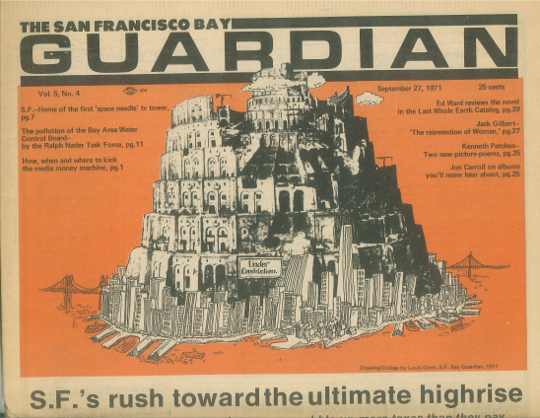
“SF’s rush toward the ultimate highrise” read the headline on the Guardian front page of Sept. 27, 1971. The headline and the graphics by Art Director Louis Dunn illustrated the central point of our bombshell study: that despite the rhapsodies of  the Chamber of Commerce and the big developers, highrise commercial buildings don’t produce gushing revenues and they don’t pay for themselves.In fact, our exclusive study of the downtown highrise district  found that “for every $10 the district yields to the city treasury, the city has to provide $11 in services.

“Put another way: the highrise district contributes $62.9 million, or 25.2% of all locally generated municipal revenue.  But it costs $67.7 million, or 25.2% of all locally financed expenditures (figures from fiscal 1970.

“This means taxpayers subsidize–35 cents or so on the tax rate in fiscal 1970–the construction and maintenance of our civic monuments–the Bank of America building, the Transamerica building, the Hilton Hotel–and soon, another 23 skyscrapers that will be taller and bulkier and more  expensive than ever for residents and taxpayers.”

Project Director Tom Lehner, a San Francisco resident and expert on urban policy from UC-Berkeley’s School of Public Policy, made the crucial point: :”This report overturns once and ffor  all, emphatically and conclusively, the conventional wisdom that downtown skyscrapers somehow provide the municipal treasury with its lifeblood.

“Anyone who thinks for a moment about what’s happening in New York,” Lehner added, “will come to the same conclusion as our study did.  But the air’s been so full of propaganda from the Chamber of Commerce and other downtown interests like the Examiner and Chronicle that it’s difficult to have a clear thought about the subject.”  The economic  fact that taxpayers subsidize highrise development has become gospel and helped provide the ammunition for the slow growth movement on commercial highrises that ultimately won on the Proposition M  initiative in 1986.

Below is the  PDF that shows our study with the Louis Dunn drawings: scroll  through.

http://test.sfbg.com/PDFs/highrise.pdf

Today, the burning issue is the luxury building at 8 Washington and the host of market rate developments already built or in the works and their impact on neighborhoods. And today the city needs a study that can provide the facts on the economic impact of market rate development and how neighborhoods can cope with the impacts in an era of “now new taxes.”

Tony Kelly is the president of the Potrero Hill Boosters and one of the most knowledgeable neighborhood activists on the market rate housing front.  He and the Boosters are dealing with the Mission Bay Landrush and the city’s plan to flood the Eastern Neighborhoods with market rate housing. His take is most instructive on why a study is needed:

‘”During the Eastern Neighborhoods re-zoning in 2008, I saw neighbors who supported development turn into NIMBYs overnight as soon as they realized that building market-rate housing in San Francisco doesn’tpay for itself, or much of anything else.  On Potrero Hill, we spent an entire decade working on neighborhood planning that was supposed to  
give us new parks, new transit lines, and better schools in a part of town that desperately needs all of that.  And then, when the new zoning was finally approved … … we found out that none of those improvements made it over the finish line. 


“The impact fees for the new development won’t even come close to providing the transit, parks, schools or infrastructure that the new residents need, let alone those of us who are already here in a very underserved part of town.  I shouldn’t really have to remind you that the new housing isn’t affordable for City residents.  And the Planning  
Department’s own study from 2008 confirms that when you build market-rate housing, you create a bigger need for affordable housing – more than you are getting in affordable housing fees or inclusionary units.

” So, with every new market rate housing unit, we are falling further behind on everything the City needs to do to support neighborhoods.  And the increased property taxes are all going to the General Fund, to support services elsewhere in the City.  Who in their right minds, in any neighborhood, would sign up for such a deal?

“Now, on this side of town, we are stuck with development plans that are designed to double the populations of district 10 and district 6 in the next 20 years.  In my neighborhood, Potrero Hill, the population will triple. And now we have to figure out how to support this booming population without much help from City Hall.

“The new condominium projects that the Potrero Boosters Neighborhood Association has already seen in the past few months reveal the consequences of the Eastern Neighborhoods rezoning—thousands of condos and apartments (and thousands more residents) coming to the neighborhood, with very few opportunities for children or families, and not much planning from the City for alternatives to automobiles.  

“We cannot have urban density in our part of this City with suburban ways of living and getting around, and yet, that is what we have, now and in the future.  So in the neighborhoods, we have to plan (and takeaction) to create our own infrastructure, and not simply rely on what the City manages to give us.”

Kelly’s arguments against pellmell market rate housing is particularly strong for the city’s new frontier of Mission Bay and the Eastern Neighborhoods, but it applies to every neighborhood and the entire city.  This is why for starters the supervisors need to direct the budget analyst or the city’s economist to do a detailed study to help Tony Kelly and the rest of the neighborhoods deal properly with the onslaught of market rate housing.  b3

Editorial on the case against 8 Washington:
>
http://www.sfbg.com/bruce/2012/03/06/editorial-case-ag

Paperwork snafu delays big condo project

22

The developers of the 8 Washington project, who have already spent a sizable sum of money on legal, lobbying and prep work, have run into another setback: The March 8 hearing on the project’s shadow impacts has been postponed because of a missing public notice.

The hearing notice and the agenda for the joint meeting of the Planning Commission and the Recreation and Parks Commission wasn’t posted on the Rec-Park website, as required by state law, Linda Avery, the Planning Commission secretary, told us.

The joint meeting was set to consider the impact of shadows the project would cast on nearby Sue Bierman Park and to consider allowing increased shading. That approval is necessary before the project can move forward.

The problems with the public notice were brought to light by Zane Gresham, a lawyer with Morrison and Foerster who often represents developers. In a March 5 letter (PDF) to the two commission presidents, Gresham pointed out that the hearing notice describes the lot on Washington Street, where the project will be constructed, but never mentions the location of the park that will be shadowed.

“The notice misleads the public as to what lots would be affected by the proposed action and fails to disclose to the public the subject of the action to be considered,” the letter stated. “Because the instant hearing notice does not meet minimum legal standards, we respectfully request that no action be taken.”

Avery said that letter sparked a review of the entire notice, and city staffers discovered that it wasn’t properly posted. It also apparently fails to describe fully the action that the two commissions would take: they would to amend the acceptable shadow levels for the park, and then vote to apply those amendments to the 8 Washington development. Only the first type of action is mentioned in the paperwork.

It’s not clear who made the mistakes with the notices — but for a project of this magnitude, critics say it’s remarkable that the city and the developers can’t get the little details of posting a notice correct. “This is the gang that couldn’t shoot straight,” former supervisor Aaron Peskin told me.

The other mystery: Who hired Gresham to review the notice? His letter makes no mention of any specific client, and none of the leading public foes of 8 Washington have retained him. He hadn’t returned my calls and emails by press time.

AH, BUT HERE’S THE UPDATE: Chuck Finnie, who works for the lobbying firm BMWL, just called to tell me that Gresham represents Equity Office Properties, which runs the Ferry Building. EOP, a major national real-estate development firm, is unhappy because the 8 Washington project will wipe out a parking lot used by patrons of the Ferry Building’s businesses. “When EOP took on the job of restoring that building, part of the deal was that parking would be available,” Finnie said. “The Port is ignoring that responsibility.”

Gee, this condo enclave gets more and more unpopular by the day.
 

Arting around: Monthly Polk Street art cruise debuts today

0

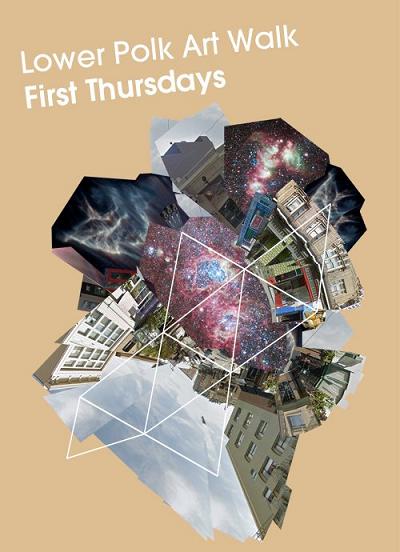
Lower Polk has surged forth as one of the city’s more exciting hubs of gallery art. So it’s no surprise that the neighborhood is expanding its quarterly art walk into a monthly event — the Lower Polk Art Walk, which will take over the sidewalks every first Thursday, starting today. 

The beauty of an art walk is that there is no start point or end point — and there’s plenty of chin-scratching and ah-oohing to be done at galleries up and down Larkin and Polk Streets. So throw away your itinerary and let your feet do the planning for you as you peruse the participating eight galleries. Just make sure to meander into the showing by Larkin Street Youth Services, a collection of works by the young people who are participants in its programs geared towards homeless youth. Here’s three other gallery spaces that’ll be worth a look: 

Art installation in former “Leftovers” furniture store

Pretty much, there it is. Chad Hasegawa and other artists are rumored to be involved in this pop-up art exhibit in an old furniture store, repurposing the Polk Street milieu for the debut of this new monthly art event.  

1300 Polk, SF

“Calamity” a solo show by Mary Iverson at Shooting Gallery 

Iverson’s exhibit includes five large-scale oil paintings and six to ten smaller acrylic on panel works, and feature shipping containers superimposed on sublime landscapes. She critiques the tolls that have been taken on the environment for the sake of private profit by integrating cutouts from environmental magazines and basing much of her paintings off views of national parks. Her signature marks are the measurement lines that she leaves sprawling to the edges of the canvas. 

839 Larkin, SF. www.shootinggallerysf.com

“Young and Free” at 941 Gallery

Sun, surf, boxing kangaroos — sorry, that’s reductive, but you do get the general sense of youth and devil-may-care-ity when you think of Australia. Time to move beyond the stereotypes? Check out what is being created Down Under at this group show, which highlights the work of 13 of Oz’s most talented “urban” (the new term for art traditionally on the street that’s being shown into gallery) creatives. 

941 Geary, SF. (415) 931-2500, www.941geary.com

Lower Polk Art Walk

First Thursdays

Thurs/1 6-10 p.m., free.

Polk and Larkin between Geary and Bush, SF

lowerpolkartwalk.blogspot.com

Nightlife: Fun plus jobs

8

By Supervisor Scott Weiner

OPINION We all know the cultural benefits of nightlife. It’s fun. We get to meet people — friends, lovers, and all the rest. We build community. We hear great music. We dance. We spend time outside on our streets. For LGBT people, we meet other LGBTs and keep our community strong. The list goes on: Without a strong entertainment scene, including bars, clubs, live music venues, arts venues, night-time restaurants, and street fairs, our city would be a less interesting and less diverse place.

But the undisputed cultural importance of nightlife isn’t the whole story. Nightlife is a significant economic contributor to San Francisco. It creates jobs, particularly for working-class and young people. It generates tax revenue that helps fund Muni, health clinics, and parks. It allows creative entrepreneurs to start businesses. It generates tourism. It draws foot traffic into neighborhoods to the benefit of other neighborhood businesses.

This is all pretty intuitive. Yet, as a city, we’ve never actually measured the economic impact of our nightlife scene. One of my first acts a member of the Board of Supervisors was to request the city economist to conduct an economic impact study doing just that.

The study is almost done, and we already have a few preliminary results. Nightlife in San Francisco generates $4.2 billion a year in spending, with $1 billion of that amount coming from bars, clubs, performance venues, and art spaces. Some 48,000 people are employed in nightlife businesses, and these businesses contribute $55 million a year in local taxes. On March 5, we’ll announce the full results of the study at a hearing of the Land Use and Economic Development Committee.

This data will help us make smart public policy around nightlife. In the past, those decisions frequently have been driven by anecdote and over-reaction to isolated events. Trouble near a small number of nightclubs? The city responds by making it difficult for all nightclubs to operate, even those with excellent safety records and despite the dramatic improvement in the Entertainment Commission’s oversight. Or, the city goes even further and proposes requiring all clubs, even small ones, to scan ID cards of everyone who enters. (That proposal, thankfully, was roundly rejected.)

When we make these decisions, we should do so with a full understanding not just of the downsides of nightlife but of the positives, including cultural and economic benefits.

Entertainment is under pressure in San Francisco. There are neighborhoods with significant friction between housing and nightlife. Some of that friction results from a small number of problem venues. Other times, a good venue is jeopardized for simply conducting its business within the limits of San Francisco law — for example, a single neighbor got Slim’s shut down for a few weeks for noise, despite the club’s compliance with our noise ordinance.

We also continue to have bizarre Planning Code restrictions that undermine entertainment, such as the Mission Alcohol Special Use District, which makes it difficult or impossible to start creative new businesses in the Mission if alcohol is involved. This provision almost prevented a new bowling alley from locating at 17th and South Van Ness. Similarly, some are concerned that the Western SoMa Plan, as currently written, will undermine nightlife on 11th Street by surrounding clubs with new housing and by reducing the number of venues.

A thriving nightlife scene is key to our city’s cultural identity and economic future. Now that we have the data on its benefits, we can take a more balanced and thoughtful approach.

Supervisor Scott Wiener represents District 8 on the Board of Supervisors. The March 5 hearing will start with a noon rally on the steps of City Hall followed by the hearing at 1 p.m. in City Hall Room 263.


Conversation on Golden Gate Park concerts continues

11

“I call for this hearing each year,” said District 1 Supervisor Eric Mar. The focus of the hearing was large events in Golden Gate Park, and each year, hundreds of San Franciscans have something to say about it.

At the Land Use Committee meeting Feb. 13, the room was packed with concert industry representatives, local artists, police officers, a couple dozen members of the Carpenters In Action from the United Brotherhood of Carpenters Local 22, and neighbors. Lots and lots of neighbors.

Many of the Richmond and Sunset residents who spoke are furious with the many large concerts that take place in Golden Gate Park throughout the year, including Hardly Strictly Bluegrass, Alice’s Summerthing, Outside Lands, and Power to the Peaceful.

They spoke of unbearable noise, impossible parking, and crime spilling over from the event crowds. One man said that during Outside Lands, his house shakes so much that he feels “trapped inside an acoustic guitar for three days straight.”

The Recreation and Parks Department has implemented several measures addressing these ongoing concerns since the first annual hearing on this topic in 2009. Dana Ketchum and Nick Kinsey represented the department at the hearing, speaking in detail of tightened permitting measures, increased outreach to the community about upcoming events, and a hotline set up so neighbors can call in noise complaints more efficiently during large concerts and performances.

Ketchum said that noise complaints have resulted more than once in Rec and Parks representatives threatening to pull the plug on amplified sound in the park if partiers don’t turn it down. One neighbor called the hotline, “more useless than yesterday’s spit.”

Proponents of the events, too, were passionate.

Local hip hop artist Tom Shimura, aka Lyrics Born spoke on the importance of the events to the San Francisco music scene. Shimura praised how the Outside Lands lineup is 20 percent local artists.

“These festivals launch careers and create Bay Area success stories,” said Shimura.

“I just wanted to say that I’m a big fan,” said Supervisor Mar.

Many supporters cited a recently released San Francisco State University Study, which finds that Outside Lands generates “more than $60 million for the San Francisco economy,” and even claims the festival creates “683 full-time equivalent jobs” in the city.

Some Richmond residents demanded that all the festivals be cancelled, and, barring that, that they be issued the personal cell phone numbers of the Rec and Parks staff.

“It’s clear everyone supports these events,” said Supervisor Mar at the hearing’s conclusion.

“It’s a matter of collaboration.”

NATHANIEL BLUMBERG, 1922-2012

3

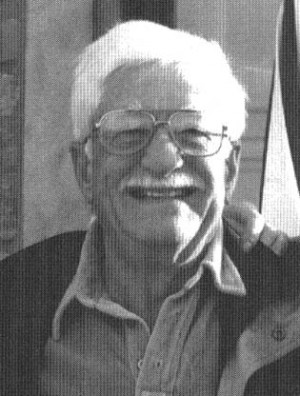
Nathan Blumberg, a great journalist who insisted on meeting deadlines, wrote his own obituary so that he would not miss his final deadline,  on Valentine’s Day, in 2012, when he died of complications from a stroke in Kalispell, Montana. Below is his obit,and his final byline, updated and corrected by Wilbur Wood, his former student and former city editor of the Guardian in the late 1960s.  Wood said that  Nathaniel wrote his own obit to insure that it would be complete and accurate. Nathaniel’s critique of mainstream journalism, and his  vision of independent journalism, were a major influence in the founding of the Guardian and the alternative press.

Nathaniel Blumberg was a World War II combat veteran, Rhodes Scholar, investigative reporter, national press critic, novelist, visiting professor and lecturer at major universities, dean and professor during his 35-year tenure at the University of Montana, and a man devoted to Montana for the last 55 years of his life.

He died February 14, 2012, at the age of 89 in Kalispell, Montana, where he had been hospitalized since a stroke February 8 in his home near Big Fork.     

Born April 8, 1922, in Denver, Colorado, Nathaniel Bernard Blumberg was the eighth and last child of Dr. Abraham Moses and Jeanette Blumberg. His father was a country doctor in Siebert, Colorado, for many years and had moved to Denver with his family to serve as superintendent of a tuberculosis sanitarium.

Nathaniel grew up in the west side of Denver with his four brothers and three sisters in a vibrant home filled with newspapers, magazines, books, music and long discussions of current events at the dinner table. He was graduated from East Denver High School after covering the city’s high school sports for the Rocky Mountain News while a senior.

His education at the University of Colorado was interrupted by the attack on Pearl Harbor and in August, 1942, he enlisted in the Army. After basic training, he was sent to the Army Specialized Training Program in Logan, Utah, and then to Camp Bowie in Texas. He was assigned to the forward observation team of Battery C of the newly formed 666th Field Artillery Battalion, a 155mm howitzer non-divisional unit trained to change mission on short notice. The Triple Sixes entered the war during one of the coldest winters of the century in Belgium against elite German SS troops in the Battle of the Bulge, the largest land battle in the history of the United States Army. The battalion then drove across the Roer river and the Rhine, through the heart of Germany and into occupation in Austria. He earned three battle stars and a Bronze Star in combat. 

Shortly after VE Day in 1945, he published the first history of a unit in World War II, “Charlie of 666,” which he had begun writing when the battalion was formed in 1944. With his poker winnings and combat pay, he published the 32-page booklet in a German print shop and distributed it to members of his battery to send home.

After the war he returned to the University of Colorado, was named editor of the student newspaper and received a bachelor of arts in journalism and a master of arts in history. He was awarded a Rhodes Scholarship for two years of study at Oxford University, where he earned a doctorate in modern history under the tutelage of the internationally known and controversial historian, A.J.P. Taylor. He was a starting guard for Oxford in the first Oxford-Cambridge basketball game ever played in 1949.

Nathaniel was an assistant professor of journalism at the University of Nebraska from 1950 to 1955, when in 1954 the University of Nebraska Press published his “One-Party Press?,” the first significant study of press performance in a presidential election. He went to Michigan State University for a year as an associate professor and in 1956 at the age of 34 he was brought to the Universty of Montana by President Carl McFarland to become dean and professor of the School of Journalism. He served under four presidents and two interim presidents during his 12 years as dean.

He established the annual Dean Stone Night in 1957 to honor the founder and first dean of the School of Journalism, to present awards to outstanding students and to bring a prominent journalist to lecture on the campus, a tradition still followed.

He formed the Department of Radio-Television in 1957 and brought in Phil Hess to put KUFM on air Jan. 31, 1965, six years before National Public Radio was begun in 1971. He has been called on air “the grandfather of Montana Public Radio, a public service of the University of Montana.”

With Mel Ruder of the Hungry Horse News, president of the Montana Newspaper Association, Nathaniel installed the Montana Newspaper Hall of Fame in the School of Journalism in 1958.

Also in 1958, he founded the Montana Journalism Review, the first journalism review in the United States, three years before the Columbia Journalism Review. It is still going.

Shortly after the inauguration of President Kennedy in 1961, the U.S. State Department asked him to serve as an “American Specialist” in Thailand for the summer. Three years later, under President Johnson, he again served in the same capacity for the summer in Trinidad, Guyana, Surinam and Jamaica.

He was elected vice president of the American Association of Schools and Departments of Journalism in 1962, declining to run for president because it meant he would be sponsoring a national journalism competition he and his faculty regarded as unethical. He was elected national chairman of the accreditation committee of the American Council on Education for Journalism in 1967 and national president of Kappa Tau Alpha, the society honoring scholarship in journalism, in 1969.

He was a member of the Rhodes Scholarship state selection committee from 1956 to 1987, including seven years as state secretary. He served six times on the western seven-state Rhodes regional selection committee.

Nathaniel was a staff writer for the Denver Post, associate editor of the Lincoln (Neb.) Star and assistant city editor of the Washington Post. He accepted invitations to serve as a visiting professor at Pennsylvania State University for fall quarter of 1964, Northwestern University’s Medill School of Journalism for the 1966-67 year and the Graduate School of Journalism at the University of California at Berkeley in 1970.

He married Lynne Stout in 1946 and they had three daughters, Janet Leslie, Jenifer Lyn and Josephine Laura. They divorced in 1970 but remained a close family. Their children and grandchildren gathered in Missoula on many occasions and spent long summers on the east shore of Flathead Lake.

Starting a new life in 1970, Nathan took the full name of Nathaniel on his birth certificate. In 1973, he married Barbara Farquhar, a college English professor and a widely published poet, who came to Missoula with her daughter, Nina. Barbara introduced him to Newfoundland dogs and they shared their 34 years together with seven Newfies (and a wolf with a touch of dog in her from the Helena hills). They enjoyed traveling together to beaches and fishing villages in the Canary Islands, Morocco, Spain, Portugal, Nova Scotia, and frequently to Florida, Mexico, Costa Rica, Orcas Island and the central Oregon coast. They balanced these adventures with quiet periods of writing in the cabin they designed and helped build near Big Fork.

In 1980 he established WoodFIREAshes Press to publish books which he hoped to write, edit and design without commercial publishers, editors or agents. He crafted “The Afternoon of March 30, A Contemporary Historical Novel” in l984, which centered on facts never reported by mainstream newspapers or on television about the attempted assassination of President Reagan by John W. Hinckley Jr. It received many warm reviews except for the Missoulian reviewer who didn’t care for the book although he termed the chapter on Hinckley’s trial “riveting.” Bud Guthrie wrote that he had “written a pretty bad novel but a forceful and persuasive book.” Doris Lessing, years before she was awarded the Nobel Prize for Literature, wrote Nathaniel, “I have read ‘The Afternoon of March 30’ with fascination. I really could not put it down, once I had started. If you ever come to London – and why should you, if you live in Montana, which I understand from friends of mine is one of the special places – then do let me know.”    
 
Nathaniel rarely spoke of his part in World War II until 19 survivors of his artillery battery gathered for a reunion in 1992 and urged him to write the uncensored story of their time at war. He returned to Belgium and Germany three times, including a three-day meeting with 32 German veterans of the Ardennes battle. In 2000 he published “Charlie of 666, a Memoir of World War II,” which included his 1945 history and his recollections on the war 55 years later. It was nominated for the 2002 Distinguished Book Award of the Society of Military History.

From 1991 to 1999 he published 20 issues of the “Treasure State Review, A Montana Periodical of Journalism and Justice.” Many of his graduates contributed to the 12-page newsletter. It served as his commentary on that decade of Montana history.

He wrote many articles for magazines, but he was most proud of his coverage of the “March on the Pentagon” in 1967 and his long essay, “Chicago and the Press,” based on his time on the streets and in the parks covering the protesters during the chaotic week of the 1968 Democratic National Convention. He was co-editor with Warren Brier of “A Century of Montana Journalism” and editor of the two-volume “Mansfield Lectures in International Relations.”

He was a demanding teacher with high standards who encouraged his students to live up to the highest principles of the journalism profession, to treat their native language with accuracy and affection, to always be skeptical but never cynical, and to remember that “sacred cows make the best hamburgers.” He was teacher, friend and counselor to hundreds of his students and took great pride in their professional success, their contributions to journalism in Montana and the nation, and their strong sense of public service in their chosen careers. They have written an extraordinary number of books. Scores of his graduates became lifelong friends.

Nathaniel was outspoken and had strong opinions. When he was honored by the Montana Newspaper Association along with Mel Ruder of the Hungry Horse News and Hal Stearns of the Harlowtown Times as the first three Master Editor/Publishers in 1991, he told a cheering audience of weekly journalists that “I am just as proud of the kind of people who don’t like me as I am of the kind of people who love me.” At the 25th anniversary of the Montana Constitutional Convention in Helena in 1997, his critique of the Montana daily press drew the longest standing ovation of the meeting.

His beloved Barbara Ann died of a stroke on the Autumnal Equinox, Sept. 21, 2007, a few days before her 73rd birthday. He also lost his youngest daughter, Josephine Loewen, in a tragic accident on Jan. 7, 2001, at the age of 46.

Survivors include his daughters, Janet Leslie Blumberg of Bothell, Wash., Jenifer Blumberg of Charlo, and stepdaughter Nina Gutierrez and husband Miguel of Ciudad Colon, Costa Rica; grandchildren Caleb Knedlik and wife Janine of Philadelphia, Pa., Asher Loeb of San Francisco, Ariel Diaz and husband Victor of Phoenix, Aram Loeb of Dayton, Ohio, Laramie and Kiam Loewen of Missoula, Adam Loewen of Portland, and Helen, Valerie and Sofia Gutierrez of Ciudad Colon, Costa Rica; numerous nieces and nephews and his first wife, Lynne Blumberg in Missoula.

He spent his last years in his cabin working on a book, including a chapter on “My 30 Years With John W. Hinckley, Jr.” in which he named Neil and Sharon Bush as co-conspirators in the attempt to assassinate President Reagan.

He requested no formal services and that his ashes be scattered with those of Barbara among the trees around their home near Big Fork.

Making history: Joanne Griffith’s ‘Redefining Black Power’ project comes to the Bay

0

“Joanne [Griffith]’s work is centered on one theme: not to offer information as a point of journalistic fact, but to act as a conduit for debate and conversation, especially around issues relating to the African diaspora experience.” So writes Brian Shazor, director of the Pacifica Radio Archives, in the foreward to Griffith’s new book Redefining Black Power: Reflections on the State of Black America (City Lights Books, 206pp, $16.95). Griffith will be presenting her work, part of an interactive project to archive the state of African Americans in the United States in the Bay Area this week — starting tonight (Wed/8) at the Museum of the African Diaspora.

This shouldn’t have to be said, but in these times of reductive news media it does: Obama isn’t the only black voice that needs to be heard, during this Black History Month or any other month. Inspired by the archives of progressive African American voice kept by LA’s Pacifica Radio Archives, Griffith — a leading progressive voice herself, having reported on issues from around the African diaspora for the BBC and NPR — transcribes her interviews with leading thoughtmakers for the book, set up as a series of dialogues. Hear from political prisoner Ramona Africa why Obama is “the new crack,” journalist Linn Washington, Jr. on media matters, green jobs leader Van Jones on hybrid activism. The president is used as a theme of the book, but the interviews use him as a lens to look at issues that range far beyond the White House.

Griffith and the other minds behind Redefining Black Power want these interviews to serve as a jumping off point for other unheard voices. Head over to the book’s website and you’ll find directions on how to add your point of view to those of the better-known activists and professionals already immortalized in the Pacifica archives. You can go to one of Griffith’s upcoming readings (details below) for inspiration. Or better yet, read our recent email interview with her and then do that. 

SFBG: Explain where the interviews in the book came from. How did you become acquainted with the Pacifica Radio Archives. Why are they important for people to hear?

JG: The idea for the Redefining Black Power Project, of which the book is part, was born out of the historic audio held in the Pacifica Radio Archives; a national treasure trove of material charting America’s history from a progressive perspective dating back to 1949. Within the collection are key recordings from the civil rights, black power and black freedom movement, including Rosa Parks, Shirley Chisholm, Jesse Jackson, Malcolm X, James Baldwin, Lorraine Hansberry, Dr. Martin Luther King Jr., Bobby Seale, Elaine Brown, and so many others. But it was one recording of Fannie Lou Hamer addressing the 1964 Democratic National Convention that sparked the idea for Redefining Black Power. The director of the Pacifica Radio Archives, Brian DeShazor, heard the tape and wanted to find a permanent way to preserve and share the voices held in the archives with a wider audience, and what better way than through the written word. Brian approached City Lights Books with the idea, and this book is the result, drawing on the voices of history to link us to the election of Barack Obama, one of the most significant moments in the social and political history of the United States. Through this project, we hope to preserve the voices, opinions and perspectives of African-Americans in this so called ‘Age of Obama’ for historians to digest and explore in years to come. 

How did I get involved? As a complete audio nut, I always make a point of visiting local radio stations wherever I travel in the world. Back in 2007, I was in Los Angeles, called KPFK to arrange a visit and was introduced to the Pacifica Radio Archives. Speaking with Brian DeShazor, we came up with an idea to share the historic collection with a UK audience and I’ve been doing this every Sunday evening on BBC Radio 5 Live in the UK for over four years. Because of this work and the extensive list of people I have interviewed over the years, Brian invited me to do the interviews for the Redefining Black Power project. Through this book, we delve into the role of the activist from different perspectives; the legal system, the media, religion, the economy, green politics and emotional justice. All were recorded between September 2009 and August 2011. To be clear though, this book is not an anthology of black leaders speaking on the Obama presidency. This is simply a taster of opinions on the subject, but everyone is encouraged to participate with their thoughts and opinions at www.redefiningblackpower.com and come out to the many events we’re hosting throughout February, including here in the Bay Area at the Museum of African Diaspora from 7 p.m. on Wednesday Feb 8 and at Marcus Books in Oakland with guest panelists Hodari Davis from Youth Speaks and social justice activist Dereca Blackmon on Thursday Feb 9 from 6.30 p.m.

SFBG: Has there been an interview you’ve conducted in which your subject’s answers have deeply surprised you? 

JG: Every interview had its own surprise; from Ramona Africa describing President Obama as ‘the new crack’ and why she refused to vote, to economist Dr. Julianne Malveaux revealing the financially precarious situations many African Americans find themselves in; from high foreclosure rates and high unemployment to the low levels of accumulated wealth for black women. Very sobering statistics. Michelle Alexander, too, the author of The New Jim Crow: Mass Incarceration in the Age of Colorblindness really shocked me when she said that more African American men are currently incarcerated than were enslaved in 1850. 

However, it was Dr Vincent Harding, the man behind Dr. Martin Luther King Jr’s “Beyond Vietnam” speech that surprised me the most. A true veteran of the civil rights movement, he made the point that the election of President Obama was never the goal of the movement; instead he prefers to call the work “the movement for the expansion and deepening of democracy in America.” Put this way, it made me realize more than ever, that the work we do today is not in isolation, but part of a wider movement, stretching back all the way to slavery. And the work isn’t over. 

SFBG: Your introduction ends with a quote from Kanye and Jay-Z’s Watch the Throne album. What role, if any, does hip-hop play in the book?

JG: Hip-hop doesn’t play a role in this book, other than this quote, but it will feature heavily in the next volume of Redefining Black Power which will focus on the reflections of black entertainers, writers, poets and performers on this moment in US history.  

SFBG: What would be the best way the United States could spend Black History Month?

JG: Black history — regardless of whether it is the United States or the UK where I moved from or anywhere else — should be acknowledged daily; this is the only way for us to keep memories alive and never forget where transformative change, like the election of President Obama, comes from. 

Listening to recordings like those held in the Pacifica Radio Archives with our youth would be a great place to start. I spent a couple of days with a group of students in Detroit, sharing the archive material and getting them to discuss their thoughts on the recordings; Audre Laude, James Baldwin, Muhammad Ali, Nelson Mandela, and others. Every one of them said they wished they had heard these voices before. It gave them a context to their own lives that didn’t exist previously, while encouraging them to never give up; too many people have suffered for them to let less than favorable circumstances stop them now. 

SFBG: Who should read this book? How should it be used?

JG: Use it as a conversation starter to discuss issues in your own community. Parents, use it as a way to engage your children in history. Students, use it as a resource for papers on race and the Obama presidency. Most importantly, everyone, share your thoughts at www.redefiningblackpower.com. This book is not the end of the project; we’re only getting started. 

Joanne Griffith’s Redefining Black Power author readings:

Wed/8 7 p.m., free with $10 museum admission

Museum of the African Diaspora

685 Mission, SF

(415) 358-7252

www.moadsf.org


Thu/9 6:30-8 p.m., free

Marcus Books

3900 Martin Luther King Jr. Way, Oakl.

(510) 652-3244

www.marcusbookstores.com


Coit Tower battle: How do we fund the parks?

59

The emerging battle over whether San Francisco should allow private parties at Coit Tower is really part of a much larger political debate: How do we fund public parks? Is public space something that resources are put into, something that’s paid for by tax money and preserved and made available for everyone — or should part of the role of parks be to generate cash?

The Republicans in Congress, with the help of San Francisco’s own Rep. Nancy Pelosi, came down clearly on the side of self-funding around the Presidio, and it’s been a disaster.

I have friends who work at Rec-Park, and they tell me that at least the new revenue initiatives have prevented layoffs and kept some programs going. Which is true. But it’s the wrong question.

Parks are public commons. They’re not supposed to be private space (yeah, they rent out space for weddings in the park, but that’s a pretty minor deal). The city ought to be funding the parks. The city ought to be raising taxes enough to do it. Yeah, I know — you’re bored. I’m tired of saying it, too.


Sundance Diary, volume five: it’s Mark Duplass’ world, we just live in it

1

In a series of posts, Midnites for Maniacs curator-host and Academy of Art film-history teacher Jesse Hawthorne Ficks reports on the 2012 Sundance Film Festival. Check out his first, second, third, and fourth entries.

Colin Trevorrow’s quasi-romantic quirkfest Safety Not Guaranteed, which won the Waldo Salt Screenwriting Award, also achieved a near-miracle by coaxing smiles out of some of Sundance’s grumpiest audiences. Speaking of wonderfully grumpy, this movie stars Parks and Recreation fave Aubrey Plaza and Jake M. Johnson of The New Girl; their priceless personas are in big-screen effect as their characters hunt down a man who posted a classified ad in search of a time-travel companion.

What makes this film truly work is the sheer sincerity of Mark Duplass (as the would-be time traveller). His performance not only hilariously channels Michael J. Fox in 1985’s Back to the Future, but he genuinely achieves a level of poignancy that perfectly fits the film’s motif of loneliness. Safety Not Guaranteed looks to have the same mainstream crossover appeal that Miguel Arteta tapped into last year with Cedar Rapids.

The busy Duplass was part of two other films at this year’s festival, including Lynn Shelton’s pitch-perfect indie flick Your Sister’s Sister, the follow-up to her genre-defining bromance Humpday (2009). Depressed and confused 30-something Jack (Duplass, who is truly a master of casual awkwardness) heads off to a remote island to figure out where his life is headed. The only trouble: his best friend (a mesmerizing Emily Blunt) also has a lesbian sister (Rosemarie DeWitt) who is already on the island doing her own soul searching. With this contemplative, honest, and hilarious film, Shelton proves herself to be quite a splendid voice for our current generation of progressive pitfallers. Once again, Duplass brings a sensitivity to his modern-male roles that generations to come will still be deconstructing.

Duplass also wrote the screenplay for Black Rock, directed by (and starring) his wife, Katie Aselton (2010’s improvised marriage drama The Freebie). Easily the best entry in this year’s Park City at Midnight category, Black Rock is about three BFFs (Aselton, Kate Bosworth, and Lake Bell) whose weekend reunion on a remote island goes awry when they run into some … threatening situations. This tense, brilliantly revisionist genre flick manages to pave new roads for a genuine, even primal feminism long overdue in the horror genre. Let me be the first to put this on the same level as Neil Marshall’s The Descent (2005).

On Monday: Jesse Hawthorne Ficks takes on Sundance’s Dramatic Competition films. Oh, the drama!

Presidio Trust gets sued — for good reason

14

The Sierra Club and the Presidio Historical Association have filed suit in federal court charging that the Presidio Trust violated environmental laws when it approved a new luxury hotel for the Main Post area.

The suit reflects the essential problem of the semi-private trust: When you force a national park to make enough money to pay its own way, and you stock the governing board with people who think like real-estate developers, then you create the near inevitability of serious problems.

The complaint, filed by lawyers at the Stanford Environmental Law clinic, argues that the construction of a 95,000-square-foot hotel, consisting of 14 buildings, “will degrade the historic, cultural, and aesthetic values and character of the main post, in direct violation of the duty imposed on the Trust by the National Historic Preservation Act.”

The suit also challenges the adequacy of the environmental impact statement the Trust prepared on the proposal.

The whole idea of a luxury hotel in an urban national park is a bit odd — but then, so is the idea of an 850,000-square-foot commercial office building owned by George Lucas’s outfit and built with a $60 million tax break.

That’s what privatization inspires. That’s why the entire foundation of the Presidio Trust and the law that created it are so fundamentally flawed.

In the meantime, we have this fancy hotel, which ought to go the way of the Fisher museum. It’s so clearly inappropriate for the site (which, by the way, is one of the most important historic sites on the west coast) that it’s hard to imagine how it got this far. (No it’s not — the Presidio Trust is a real-estate development outfit, not a national parks outfit. I keep forgetting.)

So now maybe this lawsuit will stop it in its tracks. Maybe at some point Congress will realize that national parks aren’t supposed to pay for themselves (shall we sell naming rights to the Grand Canyon to Disney?) and repeal the Presidio Trust Act. In the meantime, thanks to the folks who are trying to keep the damage under control.

Castro plaza bill passes, 6-5

10

The Board of Supervisors has passed a watered-down version of Supervisor Scott Wiener’s legislation to prevent camping and sleeping in Harvey Milk and Jane Warner plazas, with Supervisor David Chiu  casting the swing vote.

The bill passed 6-5 after an amendment by Chiu that stripped the bill of a provision which would keep shopping carts and other “large wheeled conveyances” from entering either plaza. But initial reactions among opposition activists has been mixed.

“I think it’s fair to say that Supervisor Chiu gave an elegant compromise with his amendment… It’s very polarizing legislation within the LGBT community,” said long-time LGBT activist Gabriel Haaland. Haaland, who added that he would not have voted in favor of the legislation, said many were concerned about the impact it might have on homeless LGBT youth.

Likewise, Bob Offer-Westort, an activist with the Coalition on Homelessness (CoH) who was arrested Friday night after pitching a tent in Jane Warner Plaza, expressed his satisfaction with today‘s decision, saying the supervisors removed the most controversial aspects of the legislation while applying the Parks Code, which imposes less onerous obligations on those subject to citations.

However he tempered this by saying, “it’s still still onerous and bad policy to use the criminal justice system to address homelessness. …I am very glad that supervisors who were concerned about the targeting of homeless youth took a moral stand today.”

Tommi Mecca, an activist with the San Francisco Housing Rights Committee, was training new activists and had not been able to watch the board vote,, but said that he was disappointed that the legislation passed at all.

“My initial reaction is that it’s sad we have to have regulations at all. Especially in Harvey Milk Plaza. Harvey Milk Plaza is a symbol for the LGBT community… it was just a fun, free place,” Mecca said.

“I don’t think it should be illegal to sleep in a public place. If there’s an earthquake, people think it’s fine to sleep on the street. But being homeless is a crisis too. Public space should be public… The reality was that we did not have a sixth vote to kill it.”

Sundance Diary, volume one: the hipster chronicles

0

In a series of posts, Midnites for Maniacs curator-host and Academy of Art film-history teacher Jesse Hawthorne Ficks reports on the 2012 Sundance Film Festival.

This was my 22nd consecutive Sundance Film Festival (which is well over half of my life), and I found myself more excited than ever to pack in as many films as humanly possible in seven days. Thirty-seven programs were achieved, and mind you: the trick is not to fall asleep, which so often happens at press screenings, resulting in many critics hypocritically denouncing whatever film they slept through.

Oddly enough, two of the biggest world premieres of the festival, Lee Toland Krieger’s Celeste and Jesse Forever and Josh Radnor’s Liberal Arts both explore the lives of thirtysomething men named Jesse who “have a lot of potential” but for some reason just aren’t making the most of their lives.

Krieger’s film is about a couple who have decided to get a divorce, yet find themselves spending even more time together than when they were married. Rashida Jones (from Parks and Recreation) and Andy Samberg (can we just talk about how underrated his 2007 film Hot Rod was?) star in an amazing dramatic comedy that allows a difficult subject (“How to break up with a loved one?”) to sneak up on you by the gripping third act. Allusions to Marc Webb’s decade-defining 500 Days of Summer (2009) are well-deserved; I found this film to be an instant classic.

Liberal Arts is Radnor’s follow-up to last year’s Dramatic Audience Award winner, Happythankyoumoreplease; it tells the (terrifyingly) relatable story of a thirtysomething intellectual (Radnor as Jesse) who falls for a plucky young student who is wise beyond her years; she’s played by Elizabeth Olsen, fresh off her astounding performance in last year’s Sundance hit Martha Marcy May Marlene. But this ode to Woody Allen’s Manhattan (1979) has more going for it than just an age-gap relationship dilemma. Not only does Zac Efron pop up as Jesse’s spiritual guru (which garnered major gasps from many audience members), but Richard Jenkins delivers a haunting performance as Jesse’s “second favorite professor” who has finally decided to retire from his tenured position. Radnor achieves a surprising amount of poignancy by way of light-hearted comedy. Woody Allen would no doubt approve.

With two films at the festival, cult actor-directors Tim Heidecker and Eric Wareheim (Tim and Eric Awesome Show, Great Job!) proved that they could tackle both heaven and hell. The comedy duo’s directorial debut, Tim and Eric’s Billion Dollar Movie, brought their purposefully clunky and abstract comedy to the big screen with some very mixed results. Following in the footsteps of such surreal “nonsense” masterpieces as H.C. Potter’s Hellzapoppin’ (1941), Bob Rafelson’s Head (1970), and Tom Green’s Freddy Got Fingered (2001), fans of the show will be treated to many truly disgusting and hilarious sequences along with a ton of cameos, leaving the uninitiated understandably dumbfounded.

However, the 90-minute film did seem to have some trouble translating the chaotic immediacy of Awesome Show‘s 11-minute episodes, leaving many in the midnight premiere wanting desperately to laugh a whole lot more. (Not sure I agree with the film’s “Better than The Lorax” ad campaign, but they get points for inventive advertising.)

But not to fear, Rick Alverson‘s ironically titled The Comedy was the jewel of the festival, or the anti-jewel — it was the most polarizing film of Sundance 2012. It follows a 35-year-old Williamsberg hipster named Swanson (stunningly played by Heidecker) as he antics through his daily quest: attempting to get any reaction from any sort of person. This leads him to say and do some of the most confusing and borderline offensive stuff imaginable.

While this sent many towards the exit doors (and left a fair amount baffled in their seats, whispering “This has got to be the worst film ever made!”), audience members who dared remain were treated to a perceptive, modern-day study of hipster culture that reveals a despicable and terrible truth. You may find yourself relating to Alverson’s perceptive anti-hero in ways comparable to Robert DeNiro in Taxi Driver (1976), Peter Falk in Husbands (1970), and Jack Nicholson in Five Easy Pieces (1970). And since The Comedy was made not necessarily to be enjoyed, it will probably, sadly, take 20 years for people to recognize that there is no finer film to define this generation.

This isn’t to say that there aren’t going to be more films presenting what it is to be modern day man-child — after all, mumblecore movies and hipster cinema emerged as early as 1991 with Richard Linklater’s Slacker. I noticed that many people at Sundance were immediately averting themselves from Destin Daniel Cretton’s I Am Not a Hipster, just because of its title. It’s a curious dilemma that plagues this era (and it relates directly to Alvie Singer’s life philosophy: “I would never want to belong to any club that would have someone like me for a member.” This quote from Woody Allen’s 1977 Annie Hall, itself a Groucho Marx reference, seems to be one of the most difficult hurdles for super-self-aware hipster culture to overcome.)

Cretton’s film focuses on Brook (played by Dominic Bogart), a skinny-jeaned indie rocker who finds himself trapped in a cycle of contempt and cynicism. Suddenly his three sisters arrive (Greek chorus, anyone?), thus beginning a surprisingly genuine exploration of the kind of grumpy guy that most of us thirtysomethings have either been or encountered this past decade. Some very true emotions are earned by the end of this 90 minutes; hopefully audiences will confront their individual issues and start taking that next step towards embracing their own hipster tendencies. Or not.


Up next: Jesse Hawthorne Ficks’ second Sundance Diary, covering even more dramatic competition films, midnight movies, and more. He saw 37 films, people. His diary is epic!

Milk Plaza vote raises public-space issues

1

The supervisors will vote Jan. 31 on new rules for the use of Harvey Milk Plaza and Jane Warner Plaza, rules that could have an impact on the future use of small public parklets. Sup. Scott Wiener introduced the legislation, which has stirred up a lot of opposition — and in the end, the decision will probably come down to how Sup. David Chiu decides to vote. Activists involved in the battle say it’s likely the progressives will oppose the measure, and the supervisors who typically side with the more conservative bloc will support it, and Chiu (and maybe Sup. Malia Cohen) will be the swing votes.


There’s an online petition against the measure; you can sign it here.

Pay to park

62

The San Francisco Municipal Transportation Agency has hailed the success of its SFpark program — which uses high-tech meters and demand-variable pricing to manage on-street parking — noting that expired meter citations are down and meter revenue is up. The resulting 11 percent net increase in revenue  is all going to improve Muni. So transit improves, drivers get more spots and fewer tickets — everybody wins.

[CLARIFICATION (2/1): The new meters had an 11 percent net revenue increase compared to the old meters, but overall net revenues from citations and meters was still down by 3 percent.]

But the SFMTA has run into a hornet’s nest of opposition with its latest proposal to expand SFpark into the Northeast Mission District, Potrero Hill, Dogpatch, and Mission Bay, largely because the plan involves placing meters on streets where parking is now free. And even those who don’t object to paying for parking say the SFMTA has bungled this process.

The problem isn’t just what critics say are arrogance and dubious outreach efforts by agency officials. It may be that the SFMTA pursued too many goals at once, mixing them in ways that muddled the message. Or it may just be that charging for parking will always anger drivers, no matter how it’s proposed.

The agency wants to discourage driving — particularly cruising for parking, hence SFpark’s “Circle Less, Live More” slogan — to speed up Muni and reduce traffic congestion. But that also means charging for street parking so cars won’t just sit in those spaces, and that involves a complicated balancing act in mixed use neighborhoods.

Residents, many employers, and commuters want all-day street parking, preferably free and easy. But most business owners want enough parking turnover so their customers can find a spot. City policies call for prioritizing residents’ needs, and the SFMTA needs money to fund and expand Muni service.

Meeting all of those needs isn’t easy. But over the last couple of months, the SFMTA’s effort to expand its successful and popular SFpark program have managed to turn thousands of residents angrily against that program, the agency, and the proposition that people shouldn’t expect free parking.


COMMUNITY OUTRAGE

Architect John Lum and artist-designer Miranda Caroligne didn’t know each other a couple months ago, but now they’re helping to lead a movement that is uniting neighborhood groups in the Mission, Dogpatch, and Potrero Hill against the parking meter proposals.

“You have an agency that is not listening at all to the community. That’s fascism!” declares Lum. He’s actually an amiable and soft-spoken young guy who employs 10 people at his architecture firm near 17th and Capp streets, but this issue really gets his blood boiling.

And Lum isn’t alone, as the Jan. 13 public meeting before an SFMTA hearing officer showed. Not only did everyone who streamed to the microphone voice opposition to the proposals, but they usually did so in angry and accusatory ways, saying it would destroy businesses, punish the poor, and result in conditions that are simply unworkable and intolerable. And they said the SFMTA simply doesn’t care.

“If you’re a PDR business,” Caroligne said, referring to the Production, Distribution, and Repair businesses whose last bastion is some of the targeted areas, “you’re never going to get people to work at a place that doesn’t have parking…This proposal will push them out.”

There are myriad ways that the plans are flawed, say their critics: Meters were proposed on some residential streets in initial plans, despite SFMTA policies to the contrary; traffic surveys had too small a sampling and weren’t realistic; residential permit districts would be replaced by meters, or meters would be placed where districts might work better; transit service on Potrero Hill is too bad to expect people to use it; live-work spaces were inappropriately treated like retail outlets; and meters near the 22nd Street Caltrain station could actually discourage the use of public transit.

“There’s not that much disagreement, but where there is, it’s really important,” said Tony Kelly, president of the Potrero Boosters Neighborhood Association. “I’m someone who supports parking management, and I’m frustrated that the MTA is so tone deaf with this. We’ve been through a lot of fake public outreach efforts and this is looking like one of those.”

Janet Carpinelli, president of the Dogpatch Neighborhood Association, said her members feel like the SFMTA is ramming this through without regard for the needs or input of that neighborhood.

“The real issue is it’s a very big inconvenience to the businesses and residents in this neighborhood and it’s not really helping anything. It’s just a revenue grab by the MTA,” she said.

Potrero Hill resident Jim Wilkins was so outraged by the proposal to install meters along Pennsylvania Street outside his home that he started an online petition against the proposals that has so far garnered about 1,300 signatures. “We’re forming an organization to resist these proposals,” he told us.

Lum was already a member of the 17th Street Coalition, which formed in 2010 to oppose the renewal of a liquor license at the local Gas’n’Shop, but more recently organized opposition to the meter proposal. It attracted Caroligne, and now they’ve formed a new group, Northeast Mission Neighbors, which held a joint organizing meeting with the Dogpatch and Potrero groups on Jan. 23. They’re all determined to delay and modify the SFMTA’s proposal, which had been scheduled for adoption by the SFMTA Board of Directors Feb. 7.

Lum said the proposed changes are tough to accept: “I don’t think this is about free parking, it’s about living and working in a community with certain things and now those things are changing.”


CHANGE IS HARD

The biggest target of critics’ ire is Jay Primus, who runs the SFpark program for the SFMTA. He maintains that he’s done extensive outreach and gathered community input that has shaped the plans. “These are still proposals and nothing has been approved yet,” he told us.

For example, Wilkins told us his campaign continued even after the meters in front of his house were eliminated from the proposal last month. Primus also noted the proposed meters allow for all-day parking at just 25 cents an hour in most places, so it isn’t really such an inconvenience or financial hardship. And Primus just announced that the Feb. 7 hearing is being pushed back by at least two weeks to heed more community input.

But most of the opposition to the proposals isn’t surprising, and Primus thinks it comes more from the idea of charging for street parking than with the specifics of the proposal.

“Parking is always an emotional and delicate issue in San Francisco, as it is in most cities,” Primus said, citing protests against charging for parking going back to when the first meters were installed in 1947. “This has happened at every block that has gotten meters.”

But now, there are even more benefits and ease of use with modern meters, which motorists can pay with a credit card or even remotely. Variable pricing is also used to ensure more parking based on demand, although it’s being kept at a very low rate in areas where businesses or residents still need all-day parking.

“If people are opposed to paying 25 cents per hour, the lowest rate in the city, then they are opposed to paying for parking,” Primus said. He said it’s a matter of equity among citizens: “There’s nothing equitable about providing parking for free and asking people to pay $4 for a round trip Muni ride.”

That’s a notion that is echoed by others who say it’s time for motorists to start paying their fair share.

“Everybody wants something for nothing. We all want that. Nobody wants to pay for parking, not even me,” Don Shoup, the UCLA professor who wrote the influential book The High Cost of Free Parking, told us. He later added, “That whining you hear is the sound of change.”

At a time when governments are hurting for revenue to provide basic services — among them, maintaining extensive roadway systems for motorists whose taxes don’t come anywhere near covering their societal impacts — he said it just doesn’t make sense to continue subsidizing the storage of automobiles.

“San Francisco has some of the most valuable land on earth. You have expensive housing for people and free parking for cars. It’s not surprising that San Francisco has homeless people and traffic congestion,” Shoup said. “There was never a city that is so liberal about other people’s affairs and so conservative about its own affairs.”

But Shoup did agree with critics that the real goal of managing parking isn’t to discourage driving, although he applauds the SFpark program for using its increased revenue on public transit, which he thinks makes sense from a social justice perspective.

Jason Henderson, a professor of geography at San Francisco State and author of an upcoming book on the politics of parking and mobility, goes even further than Shoup in saying that San Francisco should use its parking policies to discourage driving. But at the very least, Henderson said it is counterproductive to offer free parking.

“The city is giving away valuable real estate with all of this free and underpriced curbside parking at a time when the city’s transportation infrastructure is crumbling and essential city services for parks, after school programs, and libraries are constantly being cut. And here we have thousands of acres of real estate just being given away,” Henderson told us.

“If anything, it needs to be done citywide so that it’s judicious and level, so that merchants won’t say that people won’t come to their neighborhood because they can go to a different neighborhood where there’s free parking.”

Primus said there is a particularly strong need to manage parking around Mission Bay and the North Mission, where much of the city’s growth is occurring.

“In a way, the SFMTA is catching up with the growth of the city. These are some of the last remaining areas that are residential-commercial mixed use areas with no parking management,” Primus said.

Kelly agrees that time has come, but he doesn’t think the SFMTA has helped its case, particularly given the emotions surrounding the issue and the need to maintain public support for improved transit service.

“They’ve been spending all their waking hours in the last couple years pissing people off over parking meters, do you really think people will then support their revenue proposals?” Kelly questioned.

Lum and Caroligne both said the SFMTA should have been willing to make the fundamental argument to people that the days of free parking are coming to an end.

“That’s where a lot of the anger is coming from, you’re doing this for all these reasons that don’t make sense and treating us like children,” Caroligne said, although she also added, “I agree with you that there would still be some outrage, even if the outreach had been better.”

Guardian editorial: Plazas are public space

1

EDITORIAL The attack on public space has been underway for years now in San Francisco. Parks and recreation centers have been turned into pay-to-enter facilities rented out to private organizations. The sit-lie law restricts the use of public sidewalks. Occupy protesters have been evicted from a public plaza. And now, Supervisor Scott Wiener wants to put new restrictions on the mini-parks and plazas that have been a rare bright spot in the battle to reclaim the streets.

Wiener has introduced legislation that would ban camping, cooking, four-wheeled shopping carts, and the sale of merchandise in Harvey Milk Plaza and Jane Warner Plaza, near Market and Castro. He argues that the two parklets — one reclaimed from what had been roadway — are in legal limbo: They aren’t parks, so the city’s park codes don’t apply, and they aren’t sidewalks, so rules like the sit-lie law don’t apply, either.

But there are serious problems with the Wiener legislation. For one thing, it’s clearly directed at homeless people — the ban on shopping carts makes no sense at all except for the fact that a lot of homeless people carry their possessions in those carts. And the ban on camping (which isn’t a problem right now in the two plazas) could be used to prevent an Occupy-style action in the Castro.

The ACLU says there are serious constitutional issues with the bill. In a Jan. 21 letter, ACLU staff attorney Linda Lye notes that the ban on the sale of merchandise without a permit could “burden expressive activity.” And she explains that the shopping cart rules have exceptions for bicycles, strollers, and two-wheeled carts, but “it is wholly unclear why some but not other wheeled conveyances are singled out for prohibition, other than to restrict the activities of an unpopular group.”

A letter signed by 21 members of the Harvey Milk Club, including co-founders Harry Britt and Cleve Jones, Assemblymember Tom Ammiano, and eight past club presidents, points out that “the interests of the LGBT community have always been united with the interests of public space. As a community that is forced—far too often and for far too long—to spend much of our collective lives ‘in the closet,’ the ability to be free in public spaces has been tremendously liberating. Harvey Milk knew that liberation was only possible if we escaped the shadows of anonymity and invisibility. When we restrict these spaces—even when those restrictions are meant, initially, to be applied to another group of people—we damage ourselves.”

The issue goes far beyond the Castro. There are a growing number of small plazas in the city, part of the popular and successful Pavement to Parks Program — and the last thing the city should be doing is putting undue restrictions on their use.

Wiener, to his credit, has been in touch with the ACLU, and amended his original proposal to exempt the sale of newspapers and other printed material. But that doesn’t solve the First Amendment issues — for example, would the sale of T-Shirts with political slogans be banned? Could the city decide which political candidates or causes could get a permit and which couldn’t?

The whole thing seems like a solution in search of a problem. The plazas, like most of the city’s parklets, are for the most part clean and well-maintained community gathering spots that don’t need new rules or restrictions. The supervisors should reject the Wiener legislation.


Plazas are public spaces

3

EDITORIAL The attack on public space has been underway for years now in San Francisco. Parks and recreation centers have been turned into pay-to-enter facilities rented out to private organizations. The sit-lie law restricts the use of public sidewalks. Occupy protesters have been evicted from a public plaza. And now, Supervisor Scott Wiener wants to put new restrictions on the mini-parks and plazas that have been a rare bright spot in the battle to reclaim the streets.

Wiener has introduced legislation that would ban camping, cooking, four-wheeled shopping carts, and the sale of merchandise in Harvey Milk Plaza and Jane Warner Plaza, near Market and Castro. He argues that the two parklets — one reclaimed from what had been roadway — are in legal limbo: They aren’t parks, so the city’s park codes don’t apply, and they aren’t sidewalks, so rules like the sit-lie law don’t apply, either.

But there are serious problems with the Wiener legislation. For one thing, it’s clearly directed at homeless people — the ban on shopping carts makes no sense at all except for the fact that a lot of homeless people carry their possessions in those carts. And the ban on camping (which isn’t a problem right now in the two plazas) could be used to prevent an Occupy-style action in the Castro.

The ACLU says there are serious constitutional issues with the bill. In a Jan. 21 letter, ACLU staff attorney Linda Lye notes that the ban on the sale of merchandise without a permit could “burden expressive activity.” And she explains that the shopping cart rules have exceptions for bicycles, strollers, and two-wheeled carts, but “it is wholly unclear why some but not other wheeled conveyances are singled out for prohibition, other than to restrict the activities of an unpopular group.”

A letter signed by 21 members of the Harvey Milk Club, including co-founders Harry Britt and Cleve Jones, Assemblymember Tom Ammiano, and eight past club presidents, points out that “the interests of the LGBT community have always been united with the interests of public space. As a community that is forced—far too often and for far too long—to spend much of our collective lives ‘in the closet,’ the ability to be free in public spaces has been tremendously liberating. Harvey Milk knew that liberation was only possible if we escaped the shadows of anonymity and invisibility. When we restrict these spaces—even when those restrictions are meant, initially, to be applied to another group of people—we damage ourselves.”

The issue goes far beyond the Castro. There are a growing number of small plazas in the city, part of the popular and successful Pavement to Parks Program — and the last thing the city should be doing is putting undue restrictions on their use.

Wiener, to his credit, has been in touch with the ACLU, and amended his original proposal to exempt the sale of newspapers and other printed material. But that doesn’t solve the First Amendment issues — for example, would the sale of t-shirts with political slogans be banned? Could the city decide which political candidates or causes could get a permit and which couldn’t?

The whole thing seems like a solution in search of a problem. The plazas, like most of the city’s parklets, are for the most part clean and well-maintained community gathering spots that don’t need new rules or restrictions. The supervisors should reject the Wiener legislation.