Oil

Get lit! A handy guide to Saturday night’s LitCrawl

0

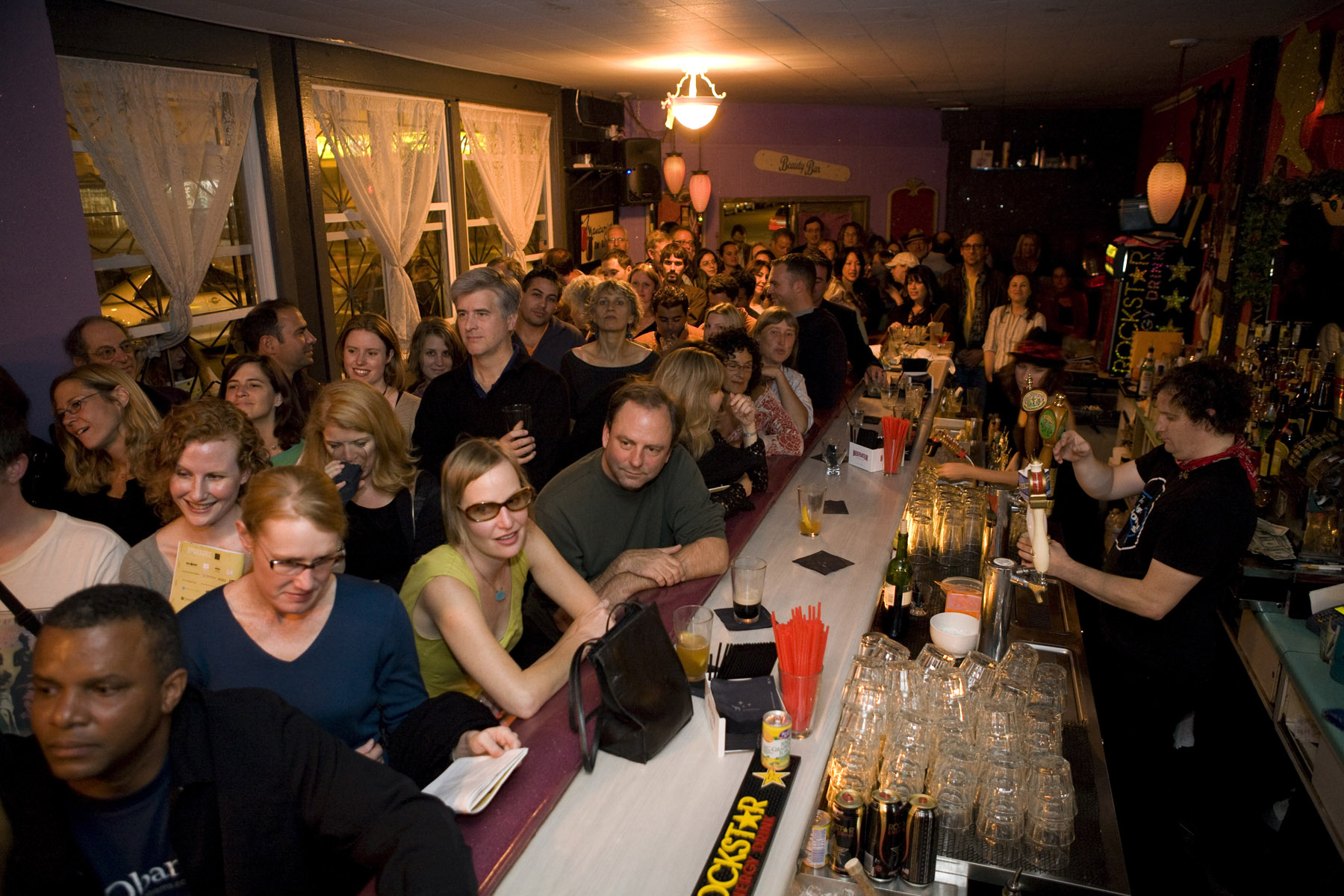
LitQuake has been rough. You’ve been dashing out of work, shoving people away from their cabs to make it to the Chuck Klosterman event and sprinting after buses to catch Karen Russell; you’ve had to make the hard decision between “Kafkaesque” and “Rock Out with your Book Out;” and all the while, you keep thinking Jeffrey Eugenides has just passed you on the street. With LitCrawl coming up Sat/15, things become even more overwhelming and terrific. In the Mission, bars, cafes, and bookstores together host 450 readers in 79 readings, all free and open to the public. One way to navigate the event might be to pick your favorite bar or cafe, find a chair, order a drink and wait for something to happen. Or, you can check these readings out:
 
I Live Here: SF. How We Got Here, Why We Stay
Not a lot of us can say we were born and raised in San Francisco. Most of us fled here from elsewhere for one reason or another: failed relationships, parents kicked you out, a nervous breakdown, a mid-life crisis, you formed an indie-rock band. Maybe you came for LoveFest and simply forgot whom you were. There are a thousand reasons for arriving and a thousand more for staying. In Clarion Alley, writers and non-writers alike including Mark Bittner and M.C. Mars talk about what brought them here and why they haven’t budged. 6 p.m., Clarion Alley, between Mission and Valencia, and 17th and 18th Sts, SF

BARTab’s Blame it on the a a a a a Alcohol: Tall Tales of Inebriated Adventures
Alcohol and writers have always had a vital, if tumultuous relationship. Hemingway said that when you worked in your head day after grueling day, the only viable remedy was whiskey; that “The only time it isn’t good for you is when you write or when you fight. You have to do that cold.” Luckily, a drunken night can become a source of inspiration, if not the next morning, sometime when you’re “cold.” At this reading, writers like Daphne Gottlieb, Jon Ginoli, Brenda Knight, and the editor of BARtab, Joe Provenzano, read about nights of drunken debauchery. 6 p.m., Martuni’s, 4 Valencia, SF
 
Come Cheer the Reaper: Readings from the San Francisco Writers’ Grotto
The San Francisco Writers’ Grotto was founded because, dammit, this writing business can be agonizing, but it’s more manageable when others surround you with whom you can collectively suffer. Convening at the Elbo Room for a night of readings tied around death, you might think that collectively suffering wasn’t working out so well for the Grotto. However, tonight is not a night for morbidity and gloom. Nine writers, including Janis Cooke Newman, Marianna Cherry, Gerard Jones, and Chris Colin read work that looks at death with humor and lightheartedness. 7:15 p.m., Elbo Room, 647 Valencia, SF
 
The Three-Penny Review Presents…
The Three-Penny Review, based out of Berkeley, would naturally host a night of premium writers at LitCrawl. The journal has been hosting the best authors, poets, and critics in its pages since 1980, and it publishes reviews and essays about everything under the sun (their recent issue features 3 great essays about live music). A good way to gauge the journal’s breath is looking at tonight’s lineup at the Summit. Kay Ryan is, of course, the former Poet Laureate of the U.S. and the Pulitzer Prize winner for The Best of It: New and Selected Poems; Walter Murch is a three-time Oscar-winning film and sound editor famous for his work on Apocalypse Now and The English Patient; Louis B. Jones is an author whose most recent novel is Radiance. Others tonight are poet Victoria Chang and the playwright and screenwriter Erik Tarloff. 7:15 p.m., Summit, 760 Valencia, SF
 
Zyzzyva Presents…
If you’ve taken a look at the West Coast writers and artists magazine Zyzzyva lately, you probably noticed some substantial changes: a new design, a full color art spread, an additional 40 pages of content. The changes are credited to the magazine’s first new editor since its founding in 1985, Laura Cogan. At 29, Cogan has breathed new life into the magazine and given it more presence in the community by doing, among other things, events like this one. Contributors to the fall issue of the magazine W.S. Di Piero and Troy Jollimore are joined by Heather Altfeld, and Malena Watrous. 7:15 p.m., Blue Macaw, 2565 Mission, SF
 
From Buddha to Batman
If you’re a fan of comic superheroes and also have a costume you’re dying to wear before Halloween, this event is most certainly for you. Gotham Chopra, co-founder of Liquid Comics and co-author of the comic Bullet Proof Monk, discusses our persistent fascination with muscles, spandex, super powers, and sidekicks. If you’re one of the first 20 to arrive to the event in a superhero costume, you get a free drink, while the best three costumes win signed books. 8:30 p.m., Laszlo Bar, 2526 Mission, SF

McSweeny’s and The Believer Present…
McSweeny’s and The Believer need no introduction. They are of what they are, and everyone knows that, together, the publisher and magazine support the very best writing. This event features a handful of those talent writers and personalities: poets Matthew Zapruder and Tess Taylor, columnist Daniel Handler (known by some as Lemony Snicket), and Anthony Myint and Karen Leibowitz, founders of Mission Street Food, and authors of the book Mission Street Food: Recipes and Ideas from an Improbable Restaurant. 8:30 p.m., Latin American Club, 3286 22nd St., SF

The World Cries Out for Revolution
Some, like the protestors defiantly camping outside the Federal Reserve Building for OccupySF, get their voices heard by taking to the streets. Others, like us at the San Francisco Bay Guardian, stir things up with the written word. You can see this every week in the articles written by our own Steven T. Jones (check out his article on the pot club crackdowns in this week’s issue). At Cafe La Boheme, Jones reads in the spirit of dissent with former Black Panther Richard Brown, as well as Larry Everest, the author of Oil Power & Empire: Iraq and the U.S. Global Agenda.
8:30 p.m., Cafe La Boheme, 3318 24th St., SF

The sight of sound

0

arts@sfbg.com

HAIRY EYEBALL “Home taping is killing music”, declared the 1980s anti-copyright infringement campaign waged by British music industry trade group, the British Phonographic Industry. History has proven BPI’s concerns to have been mis-targeted, with cassettes becoming an increasingly irrelevant medium in the ensuing decades, even as the music industry still struggles to respond to ever-mercurial forms of bootlegging and pirating. The cassette tape, however, has—perhaps unsurprisingly— re-emerged in recent years as both an object of nostalgia and a more exclusive format for more out-there musicians to release their small, home-made batches of black metal, experimental electronica, or noise out into the world for listeners for whom Tumblr is not enough.

Composer and musician Christian Marclay’s visual art often engages with our complicated relationship to outmoded technologies of audio-visual reproduction, particularly vinyl records. The photograms in his current show at Fraenkel Gallery continues this line of inquiry, playfully condensing the cassette tape’s arc from boon to perceived threat to obsolescence to fetish object.

For the gorgeous 2009 photogram “Allover (Dixie Chicks, Nat King Cole and Others),” Marclay exposed photo-sensitized paper to light after he had strewn over it the magnetic innards of cassette tapes and fragments of the broken plastic shells that once contained them that had been coated in a photosensitive solution. The resulting sprawl of tangled white lines on blue brings to mind the splatter canvases of Jackson Pollock or the chalk squiggles of Cy Twombly (associations Marclay’s titular “allover” winks at). In other photograms, such as “Large Cassette Grid No. 9,” also from 2009, Marclay has arranged plastic cassette cases in block-like patterns that cover the entire paper, with each cases’ accumulated wear and tear providing subtle variations.

That cyan-like blue color is what gives Marclay’s chosen process, the cyanotype, its name. Discovered by English scientist Sir John Herschel in 1842, the cyanotype process was historically used to make blueprints. I’d like to imagine that this irony isn’t lost on Marclay. By using an outmoded photographic technology to make visual art out of an outmoded audio technology, Marclay underscores the eventual obsolescence of all reproductive technologies. His cyanotypes aren’t blueprints so much as headstone rubbings.

In “Looking for Love” (2008), a single channel video shown in the gallery’s backroom, Marclay’s stationary camera stays zoomed-in on a well-worn phonographic stylus, as his giant hands roughly skip the needle around record after record searching for any utterance of the word “love.” The film’s exaggerated scale combined with Marclay’s increasingly impatient and roughshod sample hunting can be read as a parody of the audiophile as techno-purist. But the film also speaks to our enduring investment in music—be it the Dixie Chicks, Nat King Cole, or any of the other inaudible “others” that went into the making of Marclay’s cyanotypes—even as our experience of listening to it becomes more and more immaterial.


HOMETOWN GIRL

Fran Herndon was not a name I was familiar with, so I’m glad to now be acquainted with this largely unsung player in San Francisco’s artistic firmament of the 1950s and 1960s (and all around bad-ass) thanks to the eye-opening selection of early oil paintings and mixed-media collages organized by Kevin Killian and Lee Plested currently on view at Altman Siegel.

An Oklahoma native, Herndon moved to San Francisco in 1957 with her husband, the California teacher and writer Jim Herndon, who she met while traveling in France. She quickly fell in with the likes of the Robin Blaser, Jess and his partner Robert Duncan, and Jack Spicer, with whom she formed an intense intellectual and aesthetic bond. Together, they founded the mimeographed poetry and art magazine J, and Herndon created lithographs for poet Spicer’s 1960 master-work The Heads of the Town Up to the Aether. All the while, Herndon continued to produce her own varied body of work that was as much a response to her newfound creative circle of friends and collaborators as it was to the times in which they were making art.

The series of sports themed collages she made in 1962 are especially representative of Herndon’s gift for exploding the hidden currents of emotion contained in her source material—in this case, images clipped from popular magazines such as Sports Illustrated and Life are transformed into near-mythological tableaux of victory and defeat in which race and the volatile racial climate of Civil Rights era-America are front and center (Herndon, who is of Native American heritage, has said “[America] is no place for a brown face”).

In “Collage for Willie Mays” the baseball legend is depicted hitting a homer out of a Grecian colonnade whereas in the decidedly darker and Romare Bearden-esque “King Football” an actual mask has fallen away from the titular ruler, revealing a skull-like visage wrapped in a cloak of newspaper clippings about the 49er’s then-scandalous decision to trade quarterback Y.A. Tittle for Lou Cordilione. The headlines about devastation and death speak to other off-field losses, though.

Other pieces resonate on a more emotional level. The gauche-smudged greyhounds in “Catch Me If You Can” bound past their bucolic counterparts like horses in a Chinese brush painting—all speed and wind—and are as much signs-of-the-times as the more politically overt anti-draft and anti-war collages Herndon made later in the decade.

Certainly, there was no time to wait. So much of Herndon’s art seems to come from an urge to document her “now” with whatever tools she had on hand, a present being lived and produced in the company of so many extraordinary others, from Spicer to Mays. Even her paintings seem to have been worked on only to the point at which their subjects just emerge distinct from their swirled backgrounds of color. Nearly fifty years later, Herndon’s urgency is still palpable.


CHRISTIAN MARCLAY: CYANOTYPES

Through Oct. 29

Fraenkel Gallery

49 Geary, Fourth Floor

(415) 981-2661

www.fraenkelgallery.com


FRAN HERNDON

Through Oct. 29

Altman Siegel Gallery

49 Geary, Fourth Floor

(415) 576-9300

www.altmansiegel.com

Hiding the condoms

3

news@sfbg.com

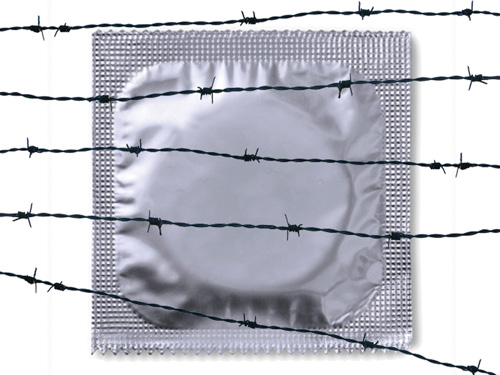
“All Condoms primary location at Customer Service” reads a small sign surrounded by empty shelves that once held condoms, pregnancy tests, and other important sexual health products at the Safeway on Potrero Avenue.

Because of concerns about theft, the condoms now sit among the Nicorette and razors in a row of glass cases near Customer Service, amid the chaos of hurried shoppers headed to and fro. Although Safeway’s recent condom lock-up may have reduced theft, it has also reduced accessibility, and may have deterred customers from buying a product crucial for the prevention of pregnancy and STD’s.

The increased security measures are not contained to the Potrero store, or even San Francisco’s Safeways. “There are a number of products (Oil of Olay for example) that we’ve had to secure under lock and key because of theft,” Susan M. Houghton, Safeway’s Northern California spokesperson tells the Guardian. “It varies by store and city, but yes, condoms were recently added — due to theft.”

Houghton would not go into any further detail about when or why the condoms were locked, but the move has raised concerns by public health advocates.

“We fully understand the position that Safeway is in, but we really would advocate for people having pregnancy tests, condoms — anything that really helps people manage their lives better — to be much more accessible,” Adrienne Verrilli, a spokesperson for Planned Parenthood in San Francisco tells the Guardian. “Accessibility is often key, especially for young people.”

Kyriell Noon, executive director of San Francisco’s STOP AIDS project, says he believes locked cases could deter people from buying condoms, “especially for young people who are shy or could be embarrassed about asking for help…Condoms should be as easy for people to access as any other item available for purchase on the market. When there are barriers between people and condoms, I think many people will shrug and give up. But if they’re easy to access there’s no excuse to not use them.”

STOP AIDS knows the importance of condoms in the prevention of HIV, and distributes free condoms to 90 locations throughout San Francisco.

Safeway representatives and staff members refused to say which Safeways have moved condoms behind glass, but a visit to four San Francisco Safeways found condoms locked in cases at each of them, some even locked behind the Customer Service counter.

At the Safeway at Church and Market streets, we found that there is often a line at Customer Service, which customers must now wait in to purchase condoms. The process of acquiring condoms requires requesting the case be unlocked, making a selection under the watchful eye of an employee, and having the employee remove it from the case and walk it back to Customer Service where it can be purchased. Ten minutes had passed before I was leaving with my $8.99 12-pack of Trojan ENZ.

This challenge could affect teenagers more than adults due to embarrassment, hassle, or the now public process of choosing and purchasing condoms at Safeway. “It puts young people in a very awkward situation,” says Leah LaCroix, president of the San Francisco Youth Commission. LaCroix says she does not believe condoms should be locked up, even if it means a company loses profits.

“I think public safety is more important than that,” she tells the Guardian. LaCroix and the rest of the Youth Commission are currently urging the San Francisco Unified School District, “to reevaluate and come up with a new curriculum for health education,” she said. “I’m sure safe sex will be a component of their new curriculum.”

A 2009 Center for Disease Control survey found that 43.5 percent of high school students did not use a condom during sex, and 85.6 percent did not use birth control pills the last time they had sex, making sex education and birth control availability increasingly vital.

“I’m not sure you can criticize Safeway for protecting their merchandise,” says Beth Brown, manager of San Francisco’s New Generation Health Center. “I think there’s a larger issue of a lack of resources and lack of resourcefulness.”

Brown says she believes the Department of Public Health is responsible for providing these resources. One resource that is available is a service called Family PACT, which provides reproductive health services to low-income residents.

“The state of California pays for young people who need confidential services…and you can get all the birth control you want,” she tells the Guardian. The New Generation Health Center enrolls teenagers and young adults in the service, and gives away free condoms to non-enrolled teenagers as well.

“The state of California is actually a very good place to be if you’re young and sexually active,” says Brown, “because they will pay for it.”

“What’s interesting about that,” Verrilli said of Safeway’s condom lockup, “is that it’s kind of going backwards to where we used to be as opposed to moving forward to where we are.”

Today, with condoms available to purchase for any age, public health clinics in most cities, and sexual education available on the Internet, making birth control readily and publicly accessible seems to be the next logical step. Besides preventing pregnancy, condoms are crucial in preventing the spread of HIV, the virus that causes AIDS.

“I think we should all be in the practice of increasing access to condoms rather than decreasing it,” Noon said. “I don’t know that Safeway’s decision alone would make a huge contribution to the spread of HIV, but they could be setting a precedent that other stores that sell condoms might follow. If it were the case that Walgreen’s and Rite-aid, etcetera, also began to follow this practice, I think we would have a problem.”

SFBG’S CONDOM BUYER’S GUIDE FOR THE YOUNG AND SHY

A wide variety of unlocked condoms are sold at:

Planned Parenthood — 1650 Valencia St. off Mission

Price: 30 cents each, come individually and in strips of 8 or 10.

Plus: offers STD testing and other health services

Walgreens — 200 West Portal at 15th

Price: 12 count $14 and up

Walgreens — 3201 Divisadero at Lombard

Price: 12 count $8.99 and up

Plus: open 24 hours a day

Walgreens — 3400 Cesar Chavez at Mission

Price: 12 count $13.99 and up

Walgreens — 1496 Market at Van Ness

Price: 12 count $15.99 and up

CVS/Pharmacy — 731 Market at 3rd

Price: 12 count $12.99 and up

CVS/Pharmacy — 2025 Van Ness at Jackson

Price: 12 count $12.99 and up

Plus: open until midnight every day

Free condoms are available at:

New Generation Health Center — 625 Potrero at 18th

Plus: offers bags of 20 at a time

STOP AIDS — 2128 15th at Market

Plus: also distributes free condoms to restaurants and stores in the city including:

Marlena’s — 488 Hayes at Octavia

SOMA Health Center — 551 Minna at 6th

Crossroads — 1519 Haight at Ashbury

LBGT Center — 1800 Market at Octavia

Books Inc. — 2275 Market at Noe

(Oona Robertson)

Live Shots: White Hills, Carlton Melton, and Dirty Ghosts

0

What if god – note lowercase emphasis – was a drummer? Assume that this god is the mythical male being you’ve come to know through Renaissance-era oil paintings, clutching lightning bolts, triumphant with lengthy white locks and foreboding upward gazes. What would this particular god do behind a drum kit?
He would hit very, very hard, smashing symbols with abandon, flipping sticks into the air then casually catching them mid-song; all the while his face would convey a knowing smirk, that wild-eyed yet faintly bemused stare toward the sky. You’d have Andy Duvall, former member of Zen Guerilla, current drummer-guitarist for Carlton Melton.

At the Rickshaw Stop last night, Duvall and Carlton Melton (a band, not a dude) — excuse the expression — melted minds. The appreciative crowd of mostly polite late-20-somethings kept spinning around towards each other with wide-eyed, “are you seeing this shit?” glances at their companions. The instrumental four-piece played entire set without a word. Duvall’s drum solos were heavenly.

The San Francisco band was tucked in between two rock and capital Roll acts, which made for an extended night of remarkable music. First up, another local: Dirty Ghosts. After Carlton Melton, the touring act headliners, New York’s White Hills. Now this, my friends, was a good bill.

While Dirty Ghosts looked a bit like the Ramones (half of them at least, in tight leather and jeans) and sounded like punk riffed hard rockers (with a killer rhythm section), White Hills oozed glam — from silver-painted face to see-through bass to sequin-covered blouse — and apparently played so similar to the Entrance Band that one of my show companions legitimately asked, “did they used to have a different name? Was it the Entrance Band?”

The joyously noisy space-rock outfit does have a similar aesthetic and sensibility — the long hair was flowing all night long — but White Hills jumps out of the stoned space rock at points to near metal, with such brutal wailing riffs.  White Hills also had something in common with openers Dirty Ghosts, both boasted a gifted electronics dude, on stage tripping out sounds and twisting knobs on beat machines; only Dirty Ghosts’ dude, who just so happens to be Aesop Rock (extra credit: he’s married to electrifying, swooshed-banged lead singer-guitarist Allyson Baker), also was tasked with handheld percussion (cowbell, shaker).

White Hills, led by an equally appealing duo of hair shakers, guitarist Dave W. and bassist Ego Sensation, sped through gnarly psychedelic rock off H-p1 (Thrill Jockey), and, like Carlton Melton, never really addressed the audience. Quite honestly, they never really needed to: a nice reprieve actually from the “really great to be here, how’s everyone doing? I need a beer” throwaways we hear at nearly every other show.  Just rock incredibly hard and loud and we’ll be satiated.  There’s no want for god-like skills here, that’s just an added bonus; it’s acid-laced frosting on the Day-Glo cake.


All photos by Chris Stevens.

Radish

0

paulr@sfbg.com

DINE On a recent midsummer’s eve, I found myself gazing down the Valencia Street corridor and (with a slight squint of the eye) though: this is just like the Strip! This is like Vegas for hipst — but no. No more H-bombs from me. The question does remain, however, whether a neighborhood can be as utterly transformed as this part of the Mission has been and still remain a neighborhood. One sunny bit of proof that the answer might be yes is the recent opening of Radish, one of those small, slightly-off-the-beaten path, homemade-with-style places that have long made this city such an appealing place to eat.

Just as some of the better restaurants in Las Vegas are off the Strip, so Radish is a few but important steps off the parade route. It occupies a classic corner spot, an L of windows (including transom windows that have been carefully cleaned — not something you see every day), at 19th Street and Lexington. It feels rather far from the madding crowd — Lexington is a lovely, leafy lane — but it is central. There are some impressive oil paintings on the walls, something else you don’t see every day.

The radish as a foodstuff has won mixed reviews down the ages. It is a crucifer and is therefore believed by some to have anti-cancer properties. But Pliny the Elder (the Roman writer and admiral who perished at Pompeii 1932 years ago last month) found the little root to be “vulgar” and a cause of “flatulence and eructation.” Oh dear. Luckily, the menu at Radish doesn’t emphasize radishes. In fact I spotted just one, a lone coin lurking in a side salad amid a swarm of halved pear tomatoes. Maybe it was a stray. Otherwise, the food is a cheerful mélange that moves winningly between all-American and new American — new-all American, if one is permitted to put it that way, with a slight Southern twist — n’all? — since the chef, Adam Hornbeck, grew up in Tennesee.

But someone in the kitchen has been to the north, all the way to Canada, judging by the poutine ($8) we found chalked onto the specials board one evening. Poutine is the dubious but wildly exciting friend your mother always wanted you to stay away from. Radish’s version was a huge plate of French fries doused with gravy (almost a béchamel sauce, it seemed to me) and topped with shreds of crisp bacon and plenty of ripe avocado slices.

“There are 10,000 calories on this plate,” came the complaint from across the table. Yes. And that was not too high a price to pay. If I were a budget-cutter, I might have dealt away the avocado, which brought some pretty color but otherwise was too subtle for such a muscle-y mess of a dish.

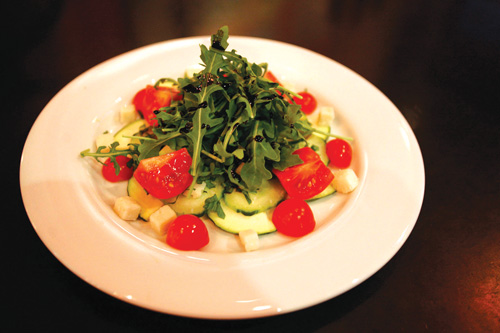
Mac ‘n’ cheese ($4.50) seemed to be nearly as calorie-dense as the poutine, but because it was served in a much more modest portion, in a small crock, it didn’t send the needle on our calorimeter spinning. A nice alternate home for the poutine’s avocado slices, incidentally, would have been the boldly tangy old world salad ($9), a neatly arranged English garden of sliced heirloom and cherry tomatoes, rounds of summer squash, smears of goat cheese, arugula leaves, and a full-throated balsamic vinaigrette that, like a compelling speaker, brought the constituents together and held them rapt.

Hornbeck’s baby back ribs ($14) are really first in show. We found them to be spicy, smoky, and — most important — juicy. It was as if the meat were oozing liquid smoke. It doesn’t matter how tasty your sauce or marinade is if you dry the ribs out when roasting them, and it is awfully easy to dry them out. To find them beautifully cooked and smartly seasoned, as here, was a real treat. The accompanying potato salad was, like its partner (a lone cob of grilled corn), very much a sidekick, but it had been carefully made with big, irregular chunks of new potato and plenty of paprika for color and kick.

A steak sandwich ($13) was served on focaccia, and the flaps of meat were tucked in with strips of orange bell pepper and melted cheddar cheese. The side salad of arugula and spinach turned out to be the home of the fugitive radish coin; finding it was like the culmination of an Easter egg hunt.

One of the desserts deserves a special mention, the shortbread ($6), festooned with strawberry meringue and whipped cream. The shortbread had some of the sublime crispy-spongy quality of a cinnamon bun, and I wondered if it might be some version of brioche. No, we were told, it was a biscuit, the same kind the kitchen uses for its breakfast dishes. This is frugal and prudent — also brilliant, or, as the h-folk sometimes put it, rad. 

RADISH

Dinner: Tues.-Thurs., 5-10 p.m.; Fri.-Sat., 5-11 p.m.; Sun., 5-9 p.m.

Breakfast: Tues.-Fri., 10 a.m.-2 p.m.; Sat.-Sun., 9 a.m.-2 p.m.

Lunch: Tues.-Sun., 11 a.m.-5 p.m.

3465 19th St., SF

(415) 834-5441

www.radishsf.com

Beer and wine

MC/V

Noisy

Wheelchair accessible

Rogue pairings

1

culture@sfbg.com

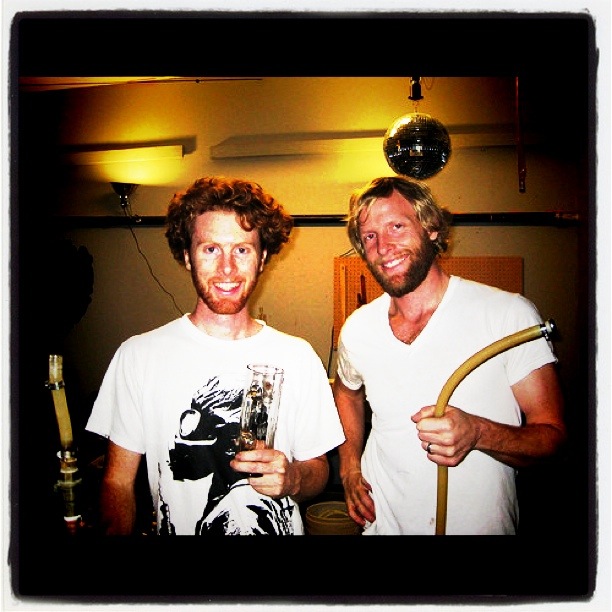
BEER AND WINE The other week, I hit up one of the free, bi-weekly Thursday night tasting parties put on by San Francisco nanobrewery Pacific Brewing Laboratories, located in a small garage on a side street deep in SoMa—and was completely smitten. The adventurous atmosphere and swell-looking crowd were part of that, of course. But the small-batch beers on offer (I quickly downed a gorgeously smooth black IPA), the rogue food vendors (I then dove into a box of Nosh This Bacon Crack chocolate), and the almost-steampunk assemblage of tangled brewing equipment, scuffed kegs, and illustrative blackboards really sealed the deal.

Since they seemed exquisitely attuned to the underground brew-plus-food equation, I asked the guys behind Pac Brew Labs, Patrick M. Horn and Bryan Hermannsson, to tell us a bit about themselves and give us a wee menu of street pairings. Here’s what Patrick came up with for us. (Marke B.)

“Pacific Brewing Laboratory started in a garage as a place for us to experiment with new beer flavors, styles, and brewing techniques. What started out as a place to share new creations with friends grew into a twice-monthly, totally free event with hundreds of our “new” friends and great local street food vendors.

“We brew small, 10-gallon batches which allows for constant beer experimentation. Some of our more exotic beer styles include Hibiscus Saison, Squid Ink Black IPA, Chamomile Ale, Lemongrass IPA, Szechwan Peppercorn Red ale, and wine-soaked oak-aged Brown Ale. We’re always on the lookout for new ingredients and inspirations that will lead us to palate-pleasing creations. For our tastings, we often invite a local food cart to attend, in order to pair our beers against some of the amazing varieties of flavors produced by DIY local food vendors. Below are a few of our favorites, which include beers we enjoy from other local breweries.”

Read about Pac Brew Lab’s upcoming free Thursday Night Beer Nights at www.pacbrewlab.com.


WISE SONS DELI PASTRAMI + PACIFIC BREWING LABORATORIES SQUID INK BLACK IPA

“Leo Beckerman and Evan Bloom of pop-up Wise Sons Deli (Saturdays, 9 a.m.-2 p.m. at Beast and Hare, 1001 Guerrero, SF. www.wisesonsdeli.com) are on a mission from God to bring to us mere mortals the best in Jewish deli. They’ve been serving up their in-house pickles, matzo ball soup, pastries and — most importantly — their weeklong-brined, spice-rubbed, hickory smoked pastrami with home made rye bread to San Francisco and at many of our beer socials since the year 5771. Our Squid Ink is made with darker grains than traditional IPAs and uses West Coast hops to give it a traditional West Coast IPA hop aroma and bitterness. The richness and spices of the pastrami pair perfectly with the citrus-y, hoppy and roasted flavors of the Black IPA. Finish with a house fermented pickle for the perfect sandwich-beer-pickle experience.”


MISSION CHINESE FOOD + TRUMER PILSNER

“Anthony Myint and Danny Bowien have created one of the most creative and community minded pop-up restaurant in the nation with Mission Chinese Food (Thu-Tue, 11:30 a.m.-3 p.m. and 5 p.m.-10:30 p.m., at Lung Shan, 2234 Mission, SF. (415) 863-2800, www.missionchinesefood.com). Their delicious twists on traditional Chinese and Asian cooking include kung pao pastrami, thrice-cooked bacon, tingling lamb noodle soup, salt cod fried rice and cold-poached chicken with chicken hearts. Mission Chinese Food also contributes $0.75 from each entrée to the San Francisco Food Bank. The Trumer (www.trumer-international.com) from Berkeley, with its high carbonation, crisp malt backbone and good hop bitterness, offers a good counterpoint to the exotic flavors and spices of Danny’s cuisine. As the heat and tingling build from chilies and Szechwan peppercorns, a pilsner can really satisfy. (And if you need to douse a flaming palate, the low alcohol content allows for a few brews with minor effect.)”


NOSH THIS CHOCOLATE + 21ST AMENDMENTS MONK’S BLOOD

Beer and chocolate go together like Bert and Ernie or peanut butter, bananas, and Elvis. Kai Kronfield of Nosh This (noshthis.com) makes some of the most creative chocolates in San Francisco. Butter toffee Bacon Crack, salted caramels made with balsamic vinegar, Meyer lemon, or salt & pepper… not to mention the Bacon Bourbon Rocky Road. These chocolates are the perfect balance of sweet, salty, and chocolate-y and pair well with darker, maltier beers. 21st Amendments Monk’s Blood (www.21st-ammendment.com), a dark Belgian ale, fits this bill well. Made with the traditional hops and barley, it also contains figs, vanilla, and cinnamon. It’s a complex beer, in a can, that complements the richness and intricate flavors of Kai’s creations. This combo is a perfect end to an evening, a mid-day snack, or breakfast — whatever, nobody’s judging.


PIZZA HACKER + MOONLIGHT DEATH AND TAXES

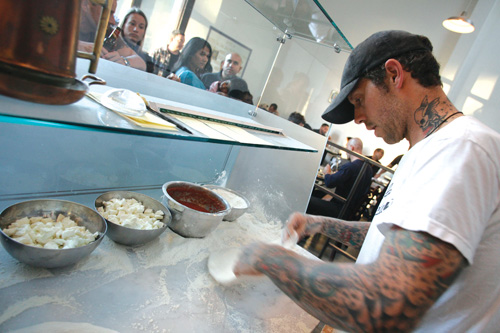
“Pizza and beer is typically a no-brainer pairing, but often most choose an IPA, pale ale, or lager to go with their cheesy slice. Moonlight’s Mooonlight’s Death and Taxes (www.moonlightbrewing.com) is a dark lager — but its roasty, crisp and malty flavors lends itself perfectly to the olive oil and salt-covered crust and smoky essence of the Pizza Hacker’s (www.thepizzahacker.com) pies. Jeff, the nominal Pizza Hacker and self-described “occasional Pazi (Pizza nazi)”, has built a custom-made portable wood fired brick oven called the FrankenWeber. He wheels it up outside bar or brewery, assembles, and bakes fresh pizzas on the sidewalk. His sauce is from organic heirloom tomatoes and he uses a method pioneered by Tartine for kneading the dough. Best tasted with a full bodied, flavorful pint of brew!


MAGIC CURRY KART + ALMANAC SUMMER 2010

Almanac’s Summer 2010 Belgian golden (www.almanacbeer.com) is made with blackberries and aged in red wine oak barrels for 11 months. Brian Kimball of Magic Curry Kart (www.magiccurrykart.com) wheels around two burners and two rice cookers on his bike, and whips up the most incredibly Thai-influenced curries in front of you with amazing precision. The ingredients are fresh and the spices are delicious. Almanac’s golden ale will add a nice fruity finish to the spicy and flavorful red or green curry. With an eight percent alcohol count and naturally carbonated in the bottle, Summer 2010 will refresh your palette after every sip without overpowering it, enabling new tastes in every luscious bite of curry. Cheers!

Original sin

0

arts@sfbg.com

FILM Early this year came the announcement that Brian De Palma was hot to do an English remake of Alain Corneau’s Love Crime, saying “Not since Dressed to Kill have I had a chance to combine eroticism, suspense, mystery, and murder into one spellbinding cinematic experience.” Apparently he thinks his intervening decades’ meh-to-awful “erotic thrillers” Body Double (1984), Raising Cain (1992), Femme Fatale (2002), and Black Dahlia (2006) don’t compare (a good call, that).

The results, should they come to fruition, may well prove a landmark in the annals of lurid guilty-pleasure trash. (Although you could argue it can’t possibly get any guiltier than Femme Fatale already managed.) And who doesn’t want to wish De Palma well in nostalgic salute to 1976’s Carrie, 1973’s Sisters, 1974’s Phantom of the Paradise, 1983’s Scarface, and such? But with the original Love Crime finally making it to local theaters, it’s an opportune moment to be appalled in advance: because there is no way he’s not going to pour the equivalent of greasy massage oil, Hershey’s Syrup, and vermilion stage blood over what is a neat, dry, fully clothed model of a modern Hitchcockian thriller, one more Rear Window (1954) than Psycho (1960).

No doubt in France Love Crime looks pretty mainstream. But here its soon-to be-despoiled virtues of narrative intricacy and restraint are upscale pleasures, an occasion to get just a little dirty at a Landmark, as one can feel both high-minded and devilish reading a Patricia Highsmith novel. Ludivine Sagnier, France’s limpid answer to Chloë Sevigny, plays assistant to high-powered corporate executive Christine (Kristin Scott Thomas). The boss enjoys molding protégée Isabelle to her own image, making them a double team of carefully planned guile unafraid to use sex appeal as a business strategy. But Isabelle is expected to know her place — even when that place robs her of credit for her own ideas — and when she stages a small rebellion, Christine’s revenge is cruelly out of scale, a high-heeled boot brought down to squash an ant. It doesn’t help that Isabelle has by now fallen in love with Philippe (Patrick Mille), who is Christine’s boy toy and may merely be enlivening the other woman’s bed on loan.

Halfway through an act of vengeance occurs that is shocking and satisfying, even if it leaves the remainder of Corneau and Nathalie Carter’s clever screenplay deprived of the very thing that had made it such a sardonic delight so far. The rest is a question of whether that crime (which really doesn’t have much to do with “love”) can be covered up or not, a matter that holds interest but stretches story and performance credibility somewhat. Nonetheless, this is pulp fun of an elegant and intelligent type. With Scott Thomas’ inherent frostiness — which she is actor enough to completely lose on other occasions — ideally employed as the chic superior anyone would eventually want to strangle, Love Crime has no need of the naked writhing across desktops and Playboy “lesbian” frissons very likely to surface as “improvements” in the forthcoming Brian De Palma joint.

Corneau (who died at age 67 last August, just after the film’s premiere) had an interesting, diverse, not-always-distinguished career, some highlights being the 1979 Jim Thompson adaptation Série Noire and 1991’s glacial costume-drama hit Tout les Matins du Monde. No masterpiece, Love Crime closes the book on his career not with a bang but with a crisp, satisfying snap. 

LOVE CRIME opens Fri/9 in Bay Area theaters.


An American blindness

8

After the first jetliner crashed into the Twin Towers on that September 11 morning, a friend of mine and his 11-year old daughter climbed up to the roof of their Manhattan home to look around. Just then the second plane struck, the young girl fell backward, and went blind from shock.

It took more than a year of examinations and therapies before this girl came out of her blindness to look around.

That’s what happened to America itself ten years ago this Sunday on 9/11, though it might be claimed many of us were blinded by privilege and hubris long before. But 9/11 produced a spasm of blind rage, arising from a pre-existing blindness as to the way much of the world sees us. That in turn led to the invasions of Afghanistan, Iraq, Afghanistan again, Pakistan, Yemen, Somalia and, in all, a dozen “shadow wars” according to The New York Times.

Bob Woodward’s crucial book, Obama’s Wars, points out that there were already secret and lethal counterterrorism operations active in more than 60 countries as of 2009. From Pentagon think tanks came a new military doctrine of the “Long War,” a counter-insurgency vision arising from the failed Phoenix program of the Vietnam era, projecting U.S. open combat and secret wars over a span of 50 to 80 years, or 20 future presidential terms. The taxpayer costs of this Long War, also shadowy, would be in the many trillions of dollars — and paid for not from current budgets, but by generations born after the 2000 election of George W. Bush. The deficit spending on the Long War would invisibly force the budgetary crisis now squeezing our states, cities and most Americans.

Besides the future being mortgaged, civil liberties were thought to require a shrinking proper to a state of permanent and secretive war, so the Patriot Act was promulgated. All this happened after 9/11 through Democratic default and denial. Who knows what future might have followed if Al Gore, with a half-million popular vote margin over George Bush, had prevailed in the U.S. Supreme Court instead of losing by the vote of a single justice? In any event, only a single member of Congress, Barbara Lee of Berkeley-Oakland, voted against the war authorization, and only a single senator, Russ Feingold, voted against the Patriot Act.

Were we not blinded by what happened on 9/11? Are we still? Let’s look at the numbers we almost never see.


CASUALTIES OF WAR

As to American casualties, the figure now is beyond twice those who died in New York, Pennsylvania and Washington D.C. on 9/11. The casualties are rarely totaled, but are broken down into three categories by the Pentagon and Congressional Research Service. There is Operation Enduring Freedom, which includes Afghanistan and Pakistan but, in keeping with the Long War definition, also covers Kazakhstan, Kyrgyzstan, Pakistan, Tajikistan, Turkmenistan, and Uzbekistan. Second, there is Operation Iraqi Freedom and its successor Operation New Dawn, the name adopted after September 2010 for the 47,000 US advisers, trainers and counterterrorism units still in Iraq. The scope of these latter operations includes Bahrain, Jordan, Kuwait, Oman, Qatar, Saudi Arabia, Turkey and the United Arab Emirates. These territories include not only Muslim majorities but, according to former Centcom commander Tommy Franks, 68 percent of the world’s proven oil reserves and the passageway for 43 percent of petroleum exports, another American geo-interest which was heavily denied in official explanations.

A combined 6,197 Americans were killed in these wars as of August 16, 2011, in the name of avenging 9/11, a day when 2, 996 Americans died. The total number of American wounded has been 45,338, and rising at a rapid rate. The total number rushed by military Medivac out of these violent zones was 56, 432. That’s a total of 107,996 Americans. And the active-duty military suicide rate for the decade is at a record high of 2, 276, not counting veterans or those who have tried unsuccessfully to take their own lives. In fact, the suicide rate for last year was greater than the American death toll in either Iraq or Afghanistan.

The Pentagon has long played a numbers game with these body counts. In addition to being painfully difficult and extremely complicated to access, there was a time when the Pentagon refused to count as Iraq war casualties any soldier who died from their wounds outside of Iraq’s airspace. Similar controversies have surrounded examples such as soldiers killed in non-combat accidents.

The fog around Iraq or Afghanistan civilian casualties will be seen in the future as one of the great scandals of the era. Briefly, the United States and its allies in Baghdad and Kabul have relied on eyewitness, media or hospital numbers instead of the more common cluster-sampling interview techniques used in conflict zones like the first Gulf War, Kosovo or the Congo. The United Nations has a conflict of interest as a party to the military conflict, and acknowledged in a July 2009 U.N. human rights report footnote that “there is a significant possibility that UNAMA is underreporting civilian casualties.”

In August, even the mainstream media derided a claim by the White House counter-terrorism adviser that there hasn’t been a single “collateral,” or innocent, death during an entire year of CIA drone strikes in Pakistan, a period in which 600 people were killed, all of them alleged “militants.” As an a specific explanation for the blindness, the Los Angeles Times reported April 9 that “Special Forces account for a disproportionate share of civilian casualties caused by western troops, military officials and human rights groups say, though there are no precise figures because many of their missions are deemed secret.”


STICKER SHOCK OF WAR

Among the most bizarre symptoms of the blindness is the tendency of most deficit hawks to become big spenders on Iraq and Afghanistan, at least until lately. The direct costs of the war, which is to say those unfunded costs in each year’s budget, now come to $1.23 trillion, or $444.6 billion for Afghanistan and $791.4 billion for Iraq, according to the National Priorities Project.

But that’s another sleight-of-hand, when one considers the so-called indirect costs like long-term veteran care. Leading economists Joseph Stiglitz and Linda Bilmes recently testified to Congress that their previous estimate of $4 to $6 trillion in ultimate costs was conservative. Nancy Youssef of McClatchy Newspapers in D.C. — in my opinion, the best war reporter of the decade — wrote recently that “it’s almost impossible to pin down just what the United States spends on war.” The president himself expressed “sticker shock,” according to Woodward’s book, when presented cost projections during his internal review of 2009.

The Long War casts a shadow not only over our economy and future budgets but our innocent and unborn children’s future as well. This is no accident, but the result of deliberate lies, obfuscations and scandalous accounting techniques. We are victims of an information warfare strategy waged deliberately by the Pentagon. As Gen. Stanley McChrystal said much too candidly in a February 2010, “This is not a physical war of how many people you kill or how much ground you capture, how many bridges you blow up. This is all in the minds of the participants.” David Kilcullen, once the top counterinsurgency adviser to Gen. David Petraeus, defines “international information operations as part of counterinsurgency.” Quoted in Counterinsurgency in 2010, Kilcullen said this military officer’s goal is to achieve a “unity of perception management measures targeting the increasingly influential spectators’ gallery of the international community.”

This new war of perceptions, relying on naked media manipulation such as the treatment of media commentators as “message amplifiers” but also high-technology information warfare, only highlights the vast importance of the ongoing WikiLeaks whistle-blowing campaign against the global secrecy establishment. Consider just what we have learned about Iraq and Afghanistan because of WikiLeaks: Tens of thousands of civilian casualties in Iraq, never before disclosed; instructions to U.S. troops to not investigate torture when conducted by U.S. allies; the existence of Task Force 373, carrying out night raids in Afghanistan; the CIA’s secret army of 3,000 mercenaries; private parties by DynCorp featuring trafficked boys as entertainment, and an Afghan vice president carrying $52 million in a suitcase.

The efforts of the White House to prosecute Julian Assange and persecute Pfc. Bradley Manning in military prison should be of deep concern to anyone believing in the public’s right to know.

The news that this is not a physical war but mainly one of perceptions will not be received well among American military families or Afghan children, which is why a responsible citizen must rebel first and foremost against The Official Story. That simple act of resistance necessarily leads to study as part of critical practice, which is as essential to the recovery of a democratic self and democratic society. Read, for example, this early martial line of Rudyard Kipling, the poet of the white man’s burden: “When you’re left wounded on Afghanistan’s plains/ And the women come out to cut up what remains/ Just roll to your rifle and blow out your brains/And go to your God like a soldier.” Years later, after Kipling’s beloved son was killed in World War I and his remains never recovered, the poet wrote: “If any question why we died / Tell them because our fathers lied.”


A HOPE FOR PEACE

An important part of the story of the peace movement, and the hope for peace itself, is the process by which hawks come to see their own mistakes. A brilliant history/autobiography in this regard is Dan Ellsberg’s Secrets, about his evolution from defense hawk to historic whistleblower during the Vietnam War. Ellsberg writes movingly about how he was influenced on his journey by meeting contact with young men on their way to prison for draft resistance.

The military occupation of our minds will continue until many more Americans become familiar with the strategies and doctrines in play during the Long War. Not enough Americans in the peace movement are literate about counterinsurgency, counterterrorism and the debates about the “clash of civilizations”, the West versus the Muslim world.

The more we know about the Long War doctrine, the more we understand the need for a long peace movement. The pillars of the peace movement, in my experience and reading, are the networks of local progressives in hundreds of communities across the United States. Most of them are voluntary, citizen volunteers, always and immersed in the crises of the moment, nowadays the economic recession and unemployment.

This peace bloc deserves more. It won’t happen overnight, but gradually we are wearing down the pillars of the war. It’s painfully slow, because the president is threatened by Pentagon officials, private military contractors and an entire Republican Party (except the Ron Paul contingent) who benefit from the politics and economics of the Long War.

But consider the progress, however slow. In February of this year, Rep. Barbara Lee passed a unanimous resolution at the Democratic National Committee calling for a rapid withdrawal from Afghanistan and transfer of funds to job creation. The White House approved of the resolution. Then 205 House members, including a majority of Democrats, voted for a resolution that almost passed, calling for the same rapid withdrawal. Even the AFL-CIO executive board, despite a long history of militarism, adopted a policy opposing Afghanistan. The president himself is quoted in Obama’s Wars as opposing his military advisors, demanding an exit strategy and musing that he “can’t lose the whole Democratic Party.” At every step of the way, it must be emphasized, public opinion in Congressional districts was a key factor in changing establishment behavior.

As for Al Qaeda, there is always the threat of another attack, like those attempted by militants aiming at Detroit during Christmas 2009 or Times Square in May 2010. In the event of another such terrorist assault originating from Pakistan, all bets are off: According to Woodward, the U.S. has a “retribution” plan to bomb 150 separate sites in that country alone there, and no apparent plan for The Day After. Assuming that nightmare doesn’t happen, today’s al Qaeda is not the al Qaeda of a decade ago. Osama bin Laden is dead, its organization is damaged, and its strategy of conspiratorial terrorism has been displaced significantly by the people-power democratic uprisings across the Arab world.

It is clear that shadow wars lie ahead, but not expanding ground wars involving greater numbers of American troops. The emerging argument will be over the question of whether special operations and drone attacks are effective, moral and consistent with the standards of a constitutional democracy. And it is clear that the economic crisis finally is enabling more politicians to question the trillion dollar war spending.

Meanwhile, the 2012 national elections present an historic opportunity to awaken from the blindness inflicted by 9/11.

After more than 50 years of activism, politics and writing, Tom Hayden is a leading voice for ending the wars in Afghanistan, Iraq, and Pakistan and reforming politics through a more participatory democracy.

Refusing to be hotboxed

3

HERBWISE Karen Cue, CEO of this weekend’s International Cannabis and Hemp Expo is taking me to school. “It’s insulting to switch up those terms,” she tells me.

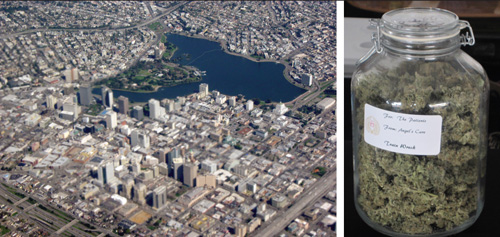
The terms I switched up? I just asked her why it was important to have legal-for-cannabis-consumption “215 areas” at her upcoming event, which will draw a projected 30,000 marijuana patients and cannabis-curious folk, turning a full mile’s worth of streets into an exhibition area in middle of downtown Oakland.

I’m standing by the validity of the question — but apparently I shouldn’t have phrased it “why is it important for people to be able to smoke weed?”

“That’s the terminology for recreational use,” Cue says. The expo is not, she says, about getting blazed and blunted. Medical marijuana users pay $20 million a year to the California state government in what are called taxable donations. That should buy them some civil rights — and many advocates see having places to legally consume cannabis as a big deal. “95 percent” of the people that her expo is marketed to, Cue says, are medical marijuana patients.

The event has been growing larger every year. This is the first year it will be held in downtown Oakland, having outgrown 2010 and 2009’s site, Candlestick Park. Cue calls the expo’s old digs “kind of old, kind of rustic — it’s got its good qualities about it, but we’re looking at advancement.” An Oakland local herself, she saw the possibility of holding the expo in a more accessible location — an outdoors area with a shady park, no less — a way to improve everyone’s enjoyment of the weekend.

And after years of dealing with Candlestick (a state-owned facility), holding the event in the heart of Oaksterdam was a breeze. City government had rejected two cannabis expo event applications in the past, but Cue says the reputation of her group coupled with positive media reviews it has earned made the city’s process relatively easy to work through.

“They did not ask anything of us out of the norm. But it definitely did raise the attention of the Oakland police” — a security concern that she hopes will be unfounded.

But this is no simple smoke-out (which I say in the most medicine-respecting way possible). Cue says the exhibition is also meant as an important learning opportunity about the parts of the marijuana plant you consume — and the parts you wear.

Hemp, as any good stoner should know, was once used by the US military to make uniforms, ropes, and parachutes. The government even released a short movie entitled Hemp For Victory during World War II promoting the material’s importance to the American war machine. Drafts of the Declaration of Independence was written on the stuff, for chrissakes. It’s more durable than cotton, hemp oil is a prime source of essential fatty acids — the list of reasons for its full legalization goes on.

For a crash course in hemp’s utilitarian glory, Cue recommends checking out David (“Doctor”) Bronner’s talk at the expo. Bronner is a member of Canada’s International Hemp Association, a hemp advocacy group that has no equivalent here in the United States. Learnin’ will also be on tap at the expo’s three stages of speakers, at vendor booths, and at Grow Op’s portable marijuana-growing trailer.

Have fun, learn stuff — and don’t call it weed. 

INTERNATIONAL CANNABIS AND HEMP EXPO

Sat/3-Sun/4 noon- 8 p.m., $18-300

Frank Ogawa Plaza, Oakl.

www.intcheevents.com

WEST COAST CANNABIS AND MUSIC FESTIVAL

For even more cannabis celebration, check out next month’s tune-and-toke fest — three days of live music powered by Rock The Bike’s generator bicycles.

Oct. 7-9. Fri., 3-9 p.m.; Sat., 11 a.m.-9 p.m.; Sun., 11 a.m.-7 p.m., $18 one day pass/$45 three day pass

Cow Palace

Daly City

www.westcoastcannabisexpo.com


The real Leland Yee

53

tredmond@sfbg.com

It’s early January 2011, and the Four Seas restaurant at Grant and Clay is packed. Everyone who is anyone in Chinatown is there — and for good reason. In a few days, the Board of Supervisors is expected to appoint the city’s first Asian mayor.

The rally is billed as a statement of support for Ed Lee, the mild-mannered bureaucrat and reluctant mayoral hopeful. But that’s not the entire — or even, perhaps, the central — agenda.

Rose Pak, who describes herself as a consultant to the Chinese Chamber of Commerce but who is more widely known as a Chinatown powerbroker, is the host of the event. She stands in front of the room, takes the microphone, and, in Cantonese, delivers a remarkable political speech.

According to people in the audience, she says, in essence, that the community has come out to celebrate and support Ed Lee — but that’s just the start. She also urges them not just to promote their candidate — but to do everything possible to prevent Leland Yee from becoming mayor.

She continues on for several minutes, lambasting Yee, the state Senator who lived in Chinatown as a child, accusing him of about every possible political sin — and turning the Lee rally into an anti-Yee crusade. And nobody in the crowd seems terribly surprised.

Across Chinatown, from the liberal nonprofits to the conservative Chamber of Commerce, there’s a palpable fear and distrust of the man who for years has been among San Francisco’s most prominent Asian politicians — and who, had Lee not changed his mind and decided to run for a full term this fall, was the odds-on favorite to become the city’s first elected Chinese mayor.

The reasons for that fear are complex and say a lot about the changing politics of Asian San Francisco, the power structure of a city where an old political machine is making a bold bid to recover its lucrative clout — and about the career of Yee himself.

Senator Leland Yee is a political puzzle. He’s a Chinese immigrant who has built a political base almost entirely outside of the traditional Chinatown community. He’s a politician who once represented a deeply conservative district, opposed tenant protections, voted against transgender health benefits and sided with Pacific Gas and Electric Co. on key environmental issues — and now has the support of some of the most progressive organizations in the city. He’s taken large sums of campaign money from some of the worst polluters in California, but gets high marks from the Sierra Club.

His roots are as a fiscal conservative — yet he’s been the only Democrat in Sacramento to reject budget compromises on the grounds that they required too many spending cuts.

He’s grown, changed, and developed his positions over time. Or he’s become an expert at political pandering, telling every group exactly what it wants to hear. He’s the best chance progressives have of keeping the corrupt old political machine out of City Hall — or he’s a chameleon who will be a nightmare for progressive San Francisco.

Or maybe he’s a little bit of all of that.


Leland Yin Yee was born in Taishan, a city in China’s Guangdong province on the South China Sea. The year was 1948; Mao Zedong’s Communist Party of China had taken control of much of the countryside and was moving rapidly to take the major cities. The nationalist army of General Chiang Kai-Shek was falling apart, and Yee’s father, who owned a store, decided it was time for the family to leave.

The Yees made it to Hong Kong, and since Mee G. Yee had previously lived in the United States and served in the U.S. Army during World War II, he was ultimately able to move the family to San Francisco. In 1951, the three-year-old Leland Yee arrived in Chinatown.

For four years, Yee lived with his sister and mother in a one-room apartment with a shared bathroom while his father worked as a sailor in the merchant marine. It was, Yee recalled in a recent interview, a tight, closed, and largely self-sufficient community.

“The movie theater, the shoe store, the barber shop, food — everything you needed you could get in Chinatown,” Yee said. “You never had to leave.”

Of course, after a while, Yee and his mom started to venture out, down Stockton Street to Market, where they’d shop at the Emporium, the venerable department store. “It was like walking into a different country,” he said. “If you didn’t know English, they didn’t have time for you.”

Yee, like a lot of young Chinese immigrants of his era, put much of his time into his studies — in the San Francisco public schools and in a local Chinese school. “My mom spoke a village dialect, and we had to learn Cantonese,” he said. “Every little kid had to go to Chinese school. We hated it.”

When Yee was eight, his parents managed to buy a four-unit building on Dolores Street, and the family moved to the Mission, where he would spend not only the rest of his childhood but much of his early adult life. He graduated from Mission High School, enrolled in City College, studied psychology and after two years won admission to UC Berkeley.

Berkeley in 1968 was a very different world from Chinatown and even the relatively controlled environment he’d experienced at home in the Mission. “You didn’t protest in school. You’d have been sent home, and your mother would kill you,” he said.

At Berekely, all hell was breaking loose, with the antiwar protests, the People’s Park demonstrations, the campaign to create a Third World College (which led to the first Ethnic Studies Department), and a general attitude of mistrust for authority. “I developed a sense of activism,” Yee said. “I realized I could speak out.”

That spirit quickly vanished when Yee lost faith in some of his fellow activists. “People would work with us, then get into positions of power and use that against you,” he recalled. “A lot of my friends said ‘forget it.’ I left the scene.”

Yee once again devoted his energy to school, earning a masters at San Francisco State University and a Ph.D in child psychology from the University of Hawaii. Along the way, he met his wife, Maxine.

With his new degree, the Yees moved back to San Francisco — and back in with his parents at the Dolores property, where he, Maxine and a family that would grow to four kids would live for more than a decade.


Yee worked as a child psychologist for the San Francisco Department of Public Health, starting the city’s first high school mental-health clinic. He went on to become a child psychologist at the Oakland Unified School District, then joined a nonprofit mental health program in San Jose.

In 1986, Yee decided to get active in politics for the first time since college, and ran for the San Francisco School Board. He lost — and that would be the only election he would ever lose. In 1988, he won a seat, and established himself as an advocate for students of color, fighting school closures in minority neighborhoods. He also tried to get the district to modify its harsh disciplinary rules, arguing against mandatory expulsions.

On fiscal issues, though, Yee was a conservative. For his first term, despite the brutal cutbacks of the recession of the late 1980s and early 1990s, he insisted that the district make do with the money it had. His solution to the red ink: Cut waste. Only in 1992, when he was up for re-election, did he acknowledge that the district needed more cash; at that point, he supported a statewide initiative to tax the rich to bring money to the schools.

The sense of fiscal conservatism — of holding the line on taxes, but mandating open and fair contracting procedures and tight financial controls — was a hallmark of much of his political career. When the Guardian endorsed him for re-election to the board in 1992, we wrote that “there’s real value in his continuing vigilance against administrative fat and favoritism in contracts.”

Over the next four years, Yee worked with then-Superintendent Waldemar “Bill” Rojas, a deeply polarizing figure who pushed his own personal theory of “reconstitution” — firing all the staff at low-performing schools — and later was enmeshed in a scandal that led to prison time for a contractor he’d hired. Yee told me he was the only board member to vote against hiring Rojas, but people who were watching the board closely back then say he didn’t always stand up to the superintendent.

He also became what some say was a bit too close with Tim Tronson, a consultant hired by the district as a $1,000-a-day facilities consultant. Tronson wound up getting indicted on 22 counts of grand theft, embezzlement, and conspiracy in a scheme to steal $850,000 from the schools, and was sentenced to four years in state prison.

In 1998, when some school board members wanted to build housing for teachers on property that the district owned in the Sunset, Yee led the opposition — with Tronson’s help. At one meeting at Sunset Elementary School, Yee went so far as to say, according to people present, that “Tim Tronson is my man, and I rely on him for advice.”

Yee acknowledged that he worked closely with Tronson to defeat that housing project. “He was the facilities manager,” Yee explained, “and I said that I trusted his judgment.”


Yee has either a great sense of political timing or exceptional luck. He ran for the Board of Supervisors in 1996, facing one of the weakest fields in modern San Francisco history. He was the only Chinese candidate and one of just two Asians (the other, appointed incumbent Michael Yaki, barely squeaked to re-election). In an at at-large election with the top five winning seats, Yee came in third, with 103,000 votes.

He was never a progressive supervisor. In 2000, the Guardian ranked the good votes of what we referred to as Willie Brown’s Board, and Yee scored only 43 percent. He was against campaign finance reform. He supported the brutal gentrification and community displacement represented by the Bryant Square development. He voted to kill a public-power feasibility study and opposed the Municipal Utility District initiative. He opposed a moratorium on uncontrolled live-work development.

In 2002, Yee was one of only three supervisors to oppose Proposition D, a crucial public-power measure that would have broken up PG&E’s monopoly in the city. He stood with PG&E (and then-Sups. Tony Hall and Gavin Newsom) in opposition to the measure, then signed a pro-PG&E ballot argument packed with PG&E lies.

When I asked him about that stand, Yee at first didn’t recall opposing Prop. D, but then said he “stood with labor” on the issue. In fact, the progressive unions didn’t oppose Prop. D at all; the opposition was led by PG&E’s house union, IBEW Local 1245.

Yee was particularly bad on tenant issues. He not only voted to deny city funding for the Eviction Defense Collaborative, which helped low-income tenants fight evictions; he actually tried to get the city to put up money for a free legal fund to help landlords evict their tenants. He opposed a ballot measure limiting condo conversions. He opposed a measure to limit the ability of landlords to pass improvement costs on to their tenants.

In 2001, Yee voted to uphold a Willie Brown veto of legislation to limit tenancies in common, a backdoor way to get around the city’s condo conversion ordinance. Only Hall and Newsom, then the most conservative supervisors on the board, joined Yee. At one point, he started asking whether the city should consider repealing rent control.

He opposed an affordable housing bond in 2002, joining the big landlord groups in arguing that it would raise property taxes. Every tenant group in town supported the measure, Proposition B; every landlord group opposed it.

I asked Yee about his tenant record, and he told me that he now supports rent control. But he said that he was always on the side of homeowners and small landlords, and that property ownership was central to Chinese culture. “I was responding to the Chinese community and the West Side,” he said.

He wasn’t much of an environmentalist, either — at least not in today’s terms. He was one of the only city officials to support a “Critical Car” rally in 1999, aimed at promoting the rights of vehicle drivers (and by implication, criticizing Critical Mass and the bicycle movement).

His record on LGBT issues was mixed. While he supported a counseling program for queer youth when he was on the school board, he also supported JROTC, angering queer leaders who didn’t want a program in the public schools run by, and used as a recruiting tool for, the military, which at that point open discriminated against gay and lesbian people.


Yee was also one of only two supervisors who voted in 2001 against extending city health benefits to transgender employees.

That was a dramatic moment in local politics. Nine votes were needed to pass the measure, and while eight of the supervisors were in favor, Yee and Hall balked. At one point, Board President Tom Ammiano had to direct the Sheriff’s Office to go roust Sup. Gerardo Sandoval, who was ducking the issue in his office, to provide the crucial ninth vote.

Yee didn’t just vote against the bill. According to one reliable source who was there at the time, Yee spoke to a community meeting out on Ulloa Street in the Sunset and berated his colleagues, quipping that the city should have better things to do than “spend taxpayer money on sex-change operations.”

It was a bit shocking to trans people — Yee had, over the years, befriended some of the most marginalized members of what was already a marginalized community. “There was one person at the rail crying, saying ‘Leland, how could you do this to us,'” Ammiano recalled.

The LGBT community was furious with Yee. “I didn’t speak to him for at least a year,” Gabriel Haaland, one of the city’s most prominent transgender activists, told me.

Yee now says the vote was a mistake — but at the time, he told me, he was under immense pressure. When he voted for the queer youth program, he said, “the elders of the Chinese community ripped me apart. They called my mother’s friends back in the village [where he was born] and said her son was embarrassing the Chinese community.”

That must have been difficult — and he said that “if I had known the pain I had caused, I wouldn’t have voted that way.” But it was hard to miss that pain his vote caused.

On the other hand, people learn from their experiences, attitudes evolve, we all grow up and get smarter, and the way Yee describes it, that’s what happened to him.

In 2006, when he was running for state Senate, Yee met with a group of trans leaders and formally — many now say sincerely — apologized. It was an important gesture that made a lot of his critics feel better about him.

“He didn’t have to do that,” Haaland said. “People change, and he paid for his crime, and that’s genuine enough for me.”

As a former school board member, Yee kept an interest in the schools — but not always a healthy one. At one point, he actually proposed splitting SFUSD into two districts, one on the (poorer) east side of town and one on the (richer) west. “We strongly opposed that,” recalled Margaret Brodkin, who at the time ran Coleman Advocates for Children and Youth. “Eventually he dropped the idea.”

For all the problems, in his time on the Board of Supervisors, Yee developed a reputation for independence from the Brown Machine, which utterly dominated much of city politics in the late 1990s. His weak 43 percent rating on the Guardian scorecard was actually third-best among the supervisors, after Ammiano and the late Sue Bierman.

In 1998, he was one of the leaders in a battle to prevent the owners of Sutro Tower from defying the city’s zoning administrator and placing hundreds of new antennas on Sutro Tower. He, Bierman, and Ammiano were the only supervisors opposing Brown’s crackdown on homeless people in Union Square.

When he ran in the first district elections, in 2000, against two opponents who had Brown’s support and big downtown money, the Guardian endorsed him, noting that while he “can’t be counted on to support worthy legislation … He’s one of only two board members who regularly buck the mayor on the big issues.”

(He never liked district elections, and used to take any opportunity to denounce the system, at times forcing Ammiano to use his position as president to tell Yee to quit dissing the electoral process and get to the point of his speech.)


In 2002, the westside state Assembly district seat opened up, and both Yee and his former school board colleague Dan Kelly ran in the Democratic primary. Yee won, and went on to win the general election with only token opposition.

His legislative record in the Assembly wasn’t terribly distinguished. Yee never chaired a policy committee — although he did win a leadership post as speaker pro tem. And he cast some surprisingly bad votes.

In 2003, for example, then-Assemblymember Mark Leno introduced a bill that would have exempted single-room occupancy hotels from the Ellis Act, which allows landlords to evict tenants for no reason. Yee refused to vote for the bill. Leno was furious — he was one vote short of a majority and Yee’s position would have doomed the bill. At the last minute, a conservative Republican who had grown up in an SRO hotel voted in favor.

When he ran for re-election in 2004, we noted: “What’s Leland Yee doing up in Sacramento? We can’t figure it out — and neither, as far as we can tell, can his colleagues or constituents. He’s introduced almost no significant bills — compared, for example, to Assemblymember Mark Leno’s record, Yee’s is an embarrassment. The only high-profile thing he’s done in the past several years is introduce a bill to urge state and local governments to allow feng shui principles in building codes.”

In 2006, Yee decided to move up to the state Senate, and he won handily, beating a weak opponent (San Mateo County Supervisor and former San Francisco cop Mike Nevin) by almost 2-1. His productivity increased significantly in the upper chamber — and in some ways, he moved to the left. He’s begun to support taxes — particularly, an oil severance tax — and when I’ve questioned him, he somewhat grudgingly admits that Prop. 13 deserves review.

He’s done some awful stuff, like trying to sell off the Cow Palace land to private developers. But he has consistently been one of the best voices in the Legislature on open government, and that’s brought him some national attention.

Yee has been a harsh critic of spending practices and secrecy at the University of California, and when UC Stanislaus refused in 2010 to release the documents that would show how much the school was paying Sarah Palin to speak at a fundraiser, Leland flew into action. He not only blasted the university and introduced legislation to force university foundations to abide by sunshine laws; he worked with two Stanislaus students who had found the contract in a dumpster and made headlines all over the country.

He’s fought for student free speech rights and this year pushed a bill mandating that corporations that get tax breaks for job creation prove that they’ve actually created jobs — or pay the tax money back. He’s also won immense plaudits from youth advocates and criminal justice reformers for his bill that would end life-without-parole sentences for offenders under 18.

Along the way, he compiled a 100 percent voting record from the major labor unions, including the California Nurses Association and SEIU, and with the Sierra Club. All three organizations have endorsed him for mayor.

Yee told me that he thinks he’s become more progressive over the years. “My philosophy has shifted,” he said.

Yet when you talk to his colleagues in Sacramento, including Democrats, they aren’t always happy with him. Yee has a tendency to be a bit of a loner — he’s never chaired a policy committee and in some of the most bitter budget fights, he’s refused to go along with the Democratic majority. Yee insists that he’s taken principled stands, declining to vote for budget bills that include deep service cuts. But the reality in Sacramento is that budget bills have until this year required a two-thirds vote, meaning two or three Republicans have had to accept the deal — and losing a Democratic vote has its cost.

“You have to give up all sorts of things, make terrible compromises, to get even two Republicans,” one legislative insider told me. “When a Democrat goes south, you have to find another Republican, and give up even more.”

In other words: It’s easy to take a principled stand, and make a lot of liberal constituencies happy, when you aren’t really trying to make the state budget work.


I met Rose Pak on a July afternoon at the Chinatown Hilton. She brought along her own loose tea, in a paper package; the waitress, who clearly knew the drill, took it back to the kitchen to brew. Pak and I have not been on the greatest of terms; she’s called the Guardian all kinds of names, and I’ve had my share of critical things to say about her. But on this day, she was polite and even at times charming.

After we got the niceties out of the way (she told me I was unfair to her, and I told her I didn’t like the way she and Willie Brown played politics), we started talking about Yee. And Pak (unlike some people I interviewed for this story) was happy to speak on the record.

She told me Yee had “no moral character.” She told me she couldn’t trust him. She told me a lot of stories and made a lot of allegations that we both knew neither she nor I could ever prove.

Then we got to talking about the politics of Chinatown and Asians in San Francisco, and a lot of the animosity toward Yee became more clear.

For decades, Chinatown and the institutions and people who live and work there have been the political center of the Chinese community. Nonprofits like the Chinatown Community Development Center have trained several generations of community organizers and leaders. The Chinese Chamber of Commerce, the Six Companies, and other business groups have represented the interests of Chinese merchants. And while the various players don’t always get along, there’s a sense of shared political culture.

“In Chinatown,” Gordon Chin, CCDC’s director, likes to say, “it’s all about personal connections.”

There’s a lively infrastructure of community-service programs, some of which get city money. There’s also a sense that any mayor or supervisor who wants to work with the Chinese community needs to at least touch base with the Chinatown establishment.

Yee doesn’t do that. “He doesn’t give a shit about them,” David Looman, a political consultant who has worked with many Chinese candidates over the years, told me.

Yee’s Asian political base is outside of Chinatown; he told me he sees himself representing more of the Chinese population of the Sunset and Richmond and the growing Asian community in Visitacion Valley and Bayview.

Pak is connected closely to Brown, who Yee often clashed with. For Pak, Brown, and their allies, strong connections to City Hall mean lucrative lobbying deals and public attention to the needs of Chinatown businesses. Then there’s the nonprofit sector.

CCDC and other nonprofits do important, sometimes crucial work, building and maintaining affordable housing, taking care of seniors, fighting for workers rights, and protecting the community safety net. Yee, Pak said, “has never shown any interest in our local nonprofits. We all work together here, and he doesn’t seem to care what we do.” Yee told me he has no desire to see funding cut for any critical social services in any part of town. But he has also made no secret of the fact that he questions the current model of delivering city services through a large network of nonprofits, some of which get millions of taxpayer dollars. And the way Pak sees it, all of that — the nonprofits, the business benefits, the contracts — are all at risk. “If Leland Yee is elected mayor,” she told me, “we are all dead.”

I ran into an old San Francisco political figure the other day, a man who has been around since the 1970s, inside and outside of City Hall, who remains an astute observer of the players and the power relationships in the local scene. At the time we talked, he wasn’t supporting any of the mayoral candidates, but he had a thought for me. “This town,” he said, “is being taken over by a syndicate. Willie Brown is the CEO, and Rose Pak is the COO, and it’s all about money and influence.”

That’s not a pleasant thought — I’ve lived through the era of political machine dominance in this town, and it was awful. In the days when Brown ran San Francisco, politics was a tightly controlled operation; only a small number of people managed to get elected to office without the support of the machine. Developers made land-use policy; gentrification and displacement were rampant; corruption at City Hall turned a lot of San Franciscans off, not only to the political process but to the whole notion that government could be a positive force in society.

A few years ago, I thought those days were over — and to a certain extent, district elections will always make machine politics more difficult. But when I see signs of the syndicate popping up — and I see a candidate like Ed Lee, who’s close friends with Brown, leading the Mayor’s Race — it makes me nervous. And for all his obvious flaws, at least Leland Yee isn’t part of that particular operation. If there’s a better reason to vote for him, I don’t know what it is.

YEE HOME PURCHASE RAISES SUSPICIONS

Rose Pak has a question about Leland Yee. “How,” she asked me, “did the guy manage to buy a million-dollar house on a $30,000 City Hall salary?”

Pak isn’t the only one asking — numerous media reports over the years have examined how Yee raised a family of four and bought a house in the Sunset on very little visible income. And while I’m not usually that interested in the personal finances of political candidates, I decided that it was worth a look.

Here’s what I found: Public records show that in July 1999, Yee and his wife, Maxine, purchased a house on 24th Avenue for $875,000 (it’s now assessed at slightly more than $1 million). At the time, Yee was a San Francisco supervisor, earning a little more than $30,000 a year. (The salary of the supervisors was raised dramatically shortly after Yee left the board and went to the state Assembly.) His wife wasn’t working. And his economic interest statements for that period show no other outside earnings. So the disposable, after-tax income of the entire Yee family couldn’t have been much more than $25,000.

That, by any normal standard, shouldn’t have been enough to float a mortgage that, records show, totaled $516,000. In fact, the interest payments alone on that mortgage alone would total $3,600 a month — more than Yee’s gross income.

Documents in the Assessor’s Office show another paper trail, too. In 1989, Jung H. Lee, Yee’s mother, transferred the deed on a four-unit Dolores St. building where the family had been living to Maxine and Leland Yee — for no money. And a few months before the Yees bought the Sunset house, they took out a $320,000 home-equity loan on that property. That was the down payment on the Sunset property.

Still: At that point, the Yees would have been paying off two mortgages, with a total nut of about $5,000 a month — and supporting four kids, in San Francisco. In 2002, Yee’s economic interest statement’s show some modest income from teaching at Lincoln University — but nowhere near enough to pay that level of expenses.

What happened? Yee explains it this way: “For more than 10 years, we were living rent-free in my parents’ property,” he told me I an interview. “We were a close Chinese family, and my parents provided the food and helped pay for the children’s clothing. So we had almost no expenses and we lived very frugally.”

During that period, Yee was working for the San Francisco Department of Public Health, the Oakland Unified School District, and a San Jose nonprofit, earning, he said, between $50,000 and $90,000 a year. If he saved almost all of that money, he would have had more than a half-million dollars in the bank when he bought the Sunset house.

There’s nothing on any of his economic disclosure forms showing any ownership of stocks or other reportable financial interests during that period, so he wasn’t investing the money. In fact, he says, it was, and is, all in simple savings accounts. A bit unusual for that large a sum of money.

How did he get a mortgage? “Back then,” he said, “banks were willing to lend a lot more freely than they do today.”

Starting in 2003, Yee was in the state Assembly, making a higher salary — but still not much in excess of $100,000 a year. After taxes, he was probably taking home about $75,000 — and $60,000 was going to the two mortgages.

How did he do it? “We have been supplementing our income with our savings,” he said. “We don’t take vacations, we are very careful with our money.” And they clearly aren’t desperate for cash — Yee’s daughter occupies two of the four units in the Dolores St. building they own, but the other two units are vacant.

It’s possible. It’s plausible. But I don’t blame people for wondering how he managed to pull it off. (Tim Redmond, with research assistance by Oona Robertson) 


BIG CORPORATIONS HAVE BACKED YEE

Yee became a prodigious fundraiser in Sacramento — and a lot of the money came from big corporations that had business in the Legislature. And while he has perfect scores from the Sierra Club and the big labor unions, he’s taken tens of thousands of dollars from some of the biggest corporations, agribusiness interests, and polluters in the state. And at times, he’s voted their way.

Since 1993, for example, campaign finance records show Yee has taken more than $20,000 from Chevron, ExxonMobil, Valero, Conoco Phillips, and BP. He’s received another $22,450 from the chemical industry (and industry employees). Most of it came from Clorox, Dow Chemical, and Dupont.

And while the Sierra Club may not have considered it a priority, Sen. Mark Leno has worked hard to pass a bill limiting chemical fire retardants in furniture. In 2008, Yee voted against Leno’s AB 706.

That year he also refused to support a bill that would prohibit the use of the chemical diacetyl in workplaces. The industries that opposed AB 514 (including Bayer, Abbott Laboratories, Pfizer, and Johnson & Johnson) have given Yee a total of more than $60,000.

In 2003, Yee voted against a crucial tenant bill, one that would have prevented the owners of single room occupancy hotels from using the Ellis Act to evict tenants. He received a campaign check for $2,500 from the San Francisco Apartment Association the next day. Landlords in general have given Yee close to $40,000.

Then there’s agribusiness. Yee gets a lot of money from the farming industry, despite the fact that there obviously aren’t many farms in his district. Why, for example, would the California Poultry Association, the California Cattlemen’s Association, and the California Farm Bureau give him money? The Poultry Association’s Bill Mattos told us that Yee “has taken a keen interest in California’s poultry industry.”

Yee also took immense flak from the San Francisco Chronicle and other papers over a 2003 vote against a bill to limit emissions from farm vehicles. In an editorial, the paper wrote that he was “doing dirty work for the lobbyists.” In the end, under immense public pressure, he switched positions and voted for the bill. I asked Yee about all that money from all those bad operators, and he told me — as most politicians will — that campaign cash has never influenced any of his votes.

So why do all these groups give him money? “It’s about whether you will sit down and listen,” Yee said. “I will talk to all sides and at least consider the arguments as a thoughtful human being. Then I vote my conscience.” (Tim Redmond, with research by Oona Robertson) 

5 Things: August 25, 2011

0

>>COMIC ZEN We just want to breathe deeply and slow our caffiene mainline (ironically) when we read Paul Madonna’s All Over Coffee comic strip (is it a strip when it’s a single panel? More research is needed here). Shit is peaceful. Perhaps that’s why the Zen Center is tapping Madonna for this talk on creative theory, highlighted by a slideshow of his luminous scenes from our city’s vertiginous hills and boring flat parts.

>>PINTXO US, WE’RE DREAMING Next week, our restaurant reviewer Paul Reidinger writes about Txoco, a newish Basque restaurant in North Beach (RIP the similar Iluna Basque, whose Top Chef contestant chef, Mattin Noblia, now helms Rendezvous Tapas Lounge. We’ll leave the overall verdict to Paul, but we simply adore the pintxos — basically an hors-d’oeuvre-sized version of tapas. We had some stellar pintxos in Basque country earlier this year, and these little bites (technically each individual pintxo should last exactly two bites) whisked us back. Do not miss the boquerones (anchovies in olive oil, this version served with quail egg, manchego cheese, thyme, avocado, and aioli). Three dollars for two bites might cause some to balk, but each of those bites is a meal unto itself.  Basque in the glory!     

Vegan Filipino snaxx going mobile. Photo via No Worries

>>SOME WORRIES Before we even had a chance to visit, Oakland’s vegan Filipino restaurant No Worries is transitioning from a brick-and-mortar space to a food truck. “We’re minimizing our waste and we’re using less resources. We’re also more accessible to the community,” says owner Jay Ar-Pugao in this very positive video. September 1 No Worries goes mobile — which will, come to think about it, probably up our chances of every actually eating its food. [via Vegansaurus]

>>NUT YOUR AVERAGE DIVIS DIVE In an attempt to fashion itself into a one-stop shop, tiny KK Cafe on Divisadero began quietly began serving huge burritos last month. The cafe, owned by neighborhood legends Jack and Margaret Chang, already serves a fairly baffling mix of burgers (huge, juicy, and cheap), Chinese hot plate meals, and croissantwiches. But its most well-known product is the peanut milk, a concoction said to have healing powers. The Changs added beef and chicken burritos to their menu at the request of the rabid customers who stop off daily for another jug of Signs and Wonders peanut milk.

>>NO FUNCTION JUNCTION Oh dear, L.A. friends and fans, it looks like this year’s huge annual outdoor Sunset Junction festival in Silver Lake — featuring bands as varied as Butthole Surfers, Hanson(!), and Ozomatli — has been cancelled. War on Fun alert down south! (Well, it would be one, except corporate giant Live Nation was basically bankrolling the thing, until it wasn’t.) Luckily, some lovely DIY souls are trying to save the day with a guerrilla No Function Junction spur-of-the-moment festival of their own in multiple venues near the same spot. If you’d planned to head to head to Silver Lake this weekend, there’s still plenty to go for. Nothing, however, will be able to equal the drama of this absolutely amazing moment with Deneice Williams at Sunset Junction 2007  — she fell right off the stage, but before the ambulances came, she sang her heart out. Now THAT’s rock ‘n roll.


Vision statement

0

arts@sfbg.com

FALL ARTS You better start doing your stretches and invest in a good pair of walking shoes. There’s as much ground to cover as there is art to see this fall, and if you get to every gallery, studio, and museum on this far-from-comprehensive list your eyes will probably be as sore as your feet. But as any seasoned hiker will tell you, the views are well worth any aches incurred along the way.

Julie Heffernan: Boy Oh Boy II” “Boschian” is an oft-overused adjective in art writing, and Heffernan’s more-is-more paintings, chock-full of twisted allusions to Renaissance art (Bosch included) and all sorts of fantastic razzle-dazzle, will have you scrambling for synonyms. (Sept. 3–Oct. 29, Catharine Clark Gallery; www.cclarkgallery.com)

Pamela Jorden” I’ll leave the question of whether or not painting’s dead up to more qualified coroners, and simply state that the oil-on-linen works of the young, Los Angeles-based Jorden make a powerful case for the continued relevance of gestural abstraction. There are echoes of Richard Diebenkorn or Clyfford Still in Jorden’s fractured cataracts of color (her blues will make you blush), but compositionally her canvases evince an alchemy that’s entirely her own. (Sept. 16-Oct. 15, Romer Young Gallery; www.romeryounggallery.com).

SF Open Studios Artists, they’re just like us! Seriously, though, one of the many pluses of ArtSpan’s annual city-wide event is that it helps demystify and de-romanticize what it means to be a working artist. Get to know the creative types in your neighborhood, see where the magic happens, and maybe help stimulate the local economy (hint, hint). (Oct. 1-18, various venues; www.artspan.org.)

Lionel Bawden: The World of the Surface” The title of Badwen’s American debut is a half-truth. His sculptural works, comprised of hexagonal colored pencils grouped together and shorn, topiary-like, into amorphous shapes, suggest a world far below the surface: caves, fatty tissue, cells. Dive in. (Oct. 1–Nov. 26, Frey Norris Gallery; www.freynorris.com.)

Houdini: Art and Magic” How does a museum escape the confines of the now tired “contemporary artists responding to famous historical figure X” approach to curating? Do like the Contemporary Jewish Museum and put on a show about legendary escape artist Harry Houdini. Come for tributes by Vik Muniz, Jane Hammond, etc. (what, no Matthew Barney?) but stay for a recreation of his famous Water Torture Cell illusion, along with the hundred other bits of Houdiniana. (Oct. 2–Jan. 16., 2012, Contemporary Jewish Museum; www.thecjm.org.)

Ralph Eugene Meatyard” The very banality of Meatyard’s biography — he was a happily married optician in Lexington, Ken. who did photography as a weekend hobby — only makes his singular and startling body of work that much more so: from children creepily posed with dolls and masks to bold experiments with abstraction and “no focus” imagery, Meatyard’s pictures push into territory far more strange and wondrous than the Gothic South. (Oct. 8- Feb. 26, de Young Museum, www.famsf.org.)

“Geoff Oppenheimer” Oppenheimer makes conceptually smart and visually arresting installation and video work that frequently voices the unspoken dynamics behind public performances of controlled discourse, such as press conferences. Be prepared to be discomfited. (Oct. 28–Dec. 11, Ratio 3; www.ratio3.org).

The Air We Breathe” I have some serious reservations about the San Francisco Museum of Modern Art’s decision to organize their first major contemporary group show in a long while around “the cause of marriage equality” (for starters, why not host “Hide/Seek,” the previously censored and now traveling exhibit about same-sex desire and American portraiture currently at the Tacoma Art Museum, instead?). That said, something truly queer, politically risky and aesthetically challenging has gotta happen when you put specially commissioned works by the likes of John Ashbery, Dodie Bellamy, Raymond Pettibon, Ann Hamilton, and Robert Gober (and many others) under one roof, right? For now, consider my tongue held and eyebrow raised. (Nov. 5–Feb. 20, 2012; SFMOMA, www.sfmoma.org.)

Una Pizza Napoletana

0

paulr@sfbg.com

DINE If food is art (probably not, by the way), then Una Pizza Napoletana is probably the closest thing we have to a food-art installation.

This phrase, “art installation,” isn’t exactly euphonious. You install mufflers and software, and (if you’re the new head coach of the 49ers) the West Coast offense. You install a new dishwasher. Art, whatever it may or may not be, deserves a more supple verb.

Picture a white cube with high walls, mostly bare except for white tile wainscoting (rather restroom-y, I thought, but most likely practical). At the center behind the glass podium, a pizza oven of turquoise tiles like a huge Navajo artifact recovered from an archaeological dig. The space, on a nondescript SoMa corner, looks like one of the art galleries you might find in the western reaches of Chelsea, in the part of New York City where the avenues are a little wider, the buildings less tall, and the city feels not quite so breathlessly compacted.

Una Pizza Napoletana’s crowd fits the space: it’s youthful and knowing, ritualistically peering into smart phones, willing to wait for a table at a place that is so plainly and peculiarly happening. Young people don’t want to miss out, it’s their greatest fear.

What they will find missing here is anything other than pizza. That is the menu: pizza in five versions, no substitutions, no polluting table-side condiments like oregano or chili flakes (but salt and pepper, in demure shakers). That is all. No side dishes, soups or salads, no fritti misti, no pastas or roasts. The pizza isn’t sliced for you either; it’s uncut, we might say. Seinfeld had the Soup Nazi (not to mention that lunatic mohel), and we have this.

The maestro of this remarkable production, Antonio Mangieri, can be observed behind the podium manning the oven, wielding his long-handled peel like a medieval knight with a lance. He could be a mime, a figure of soundless kinesis: he stretches, he thrusts, in goes a pie, out comes another, on goes a drizzle of olive oil from his copper urn and a handful of fresh arugula.

It’s hard not to watch his act, because he’s at the very center of things. Also, you’re likely to be quite hungry and wondering if the pizza he’s lifting from the oven might be headed for your table. If it is, you’ll be happy, because the pies, despite their stark lack of trappings are worth waiting for and even suffering (a little) for.

The heart of any pizza is the crust, and UPN’s crusts deserve the ultimate compliment: they could stand on their own, without any toppings at all. They have a slight thickness and focaccia-like sponginess that cuts against current cracker-crust vogue, and they taste quite distinctly of sourdough. It is rare in my experience that pizza crust, even in good pizzerias contributes flavor. Mostly one is attentive to, and grateful for, texture (chewy? crispy?) and the structural question of whether or not the points droop. UPN’s did droop for us a little, but that was probably because we were hacking our way through them haphazardly, so the pieces weren’t symmetric.

Another factor in the droopiness would likely be that the pies are generously laden with toppings. You don’t get a dusting of this and a few gratings of that. These pizzas are loaded. The bianca ($20) for instance, was fitted out with extra-virgin olive oil, garlic, sea salt, at least a dozen thumbs of buffalo mozzarella, and plenty of basil leaves which interestingly accompanied the rest of the pie into the oven rather than being put on after the pie had baked — and were accordingly blistered. Basil’s flavor can withstand rougher handling than that of most other herbs (you can keep pesto made from your summer surplus frozen for months without having it go flat), but I did think that in this case the high heat had diminished the leaves’ fragrant, peppery bite.

The Ilaria pie ($22) by contrast was strewn with fresh arugula leaves, but these were aftermarket add-ons and had not been asked to face a 900-degree Fahrenheit oven. As a result they retained their fresh, nutty flavor, but they also were not well-integrated with the rest of the toppings. Instead they amounted to a mat laid over their accompaniments — a kind of roof to the crust’s floor. Those other toppings included extra-virgin olive oil, sea salt, cherry tomatoes, and smoked mozzarella. I thought the last would be the dominant flavor — smoked anything often asserts itself over other ingredients in the vicinity — but it was mild and muted here.

Service is excellent, and a brief wine list offers several unusual, pizza-friendly Italian bottlings in both red and white by the glass. But I noticed quite a few bottles of Moretti beer on nearby tables, too. If beer matches up with almost any food, then pizza — more than almost any other food — matches up with practically any drink euphoric in nature.

UNA PIZZA NAPOLETANA

Dinner: Wed.-Sat., from 5 p.m.

210 11th St., SF

(415) 861-3444

www.unapizza.com

Beer and wine

MC/V

Noisy

Wheelchair accessible

Environmentalists: America’s Cup not green enough

A preliminary planning document for the America’s Cup doesn’t go far enough to protect San Francisco’s natural environment, a coalition of environmental organizations has said.

The Environmental Council — made up of a group of nonprofits including the Sierra Club, San Francisco Baykeeper, Turtle Island Restoration Network, the Dolphin Swimming and Boating Club, and others closely tracking planning for the America’s Cup — were gearing up to offer feedback to the San Francisco Planning Commission Aug. 11 on a hefty draft environmental impact review (DEIR) of the prestigious yachting event’s impacts on marine life, air quality, and parklands.

The draft EIR “does not go far enough to protect San Francisco’s air, water, and marine life,” said Teri Shore of the Turtle Island Restoration Network. She advocated for requiring vessels to use the cleanest possible fuels and to travel at slow speeds so as not to collide with dolphins, porpoises, seals, sea lions, or whales once outside the Golden Gate.

Ken Coren, Vice President of the Dolphin and Swimming Club, voiced concerns about the effects the race would have on swimming and recreational boating. “The bay would be sealed off — it would only be spectator viewing,” he said. Activities like swimming around Aquatic Park or entering the bay on rowboats “would be prevented if you were going to take the EIR as it stands today at its word.”

Jon Golinger, president of the Telegraph Hill Dwellers, said the report “dramatically underestimates the impact” to individual San Francisco neighborhoods.

http://www.youtube.com/watch?v=BngNbTCUcM8
Jon Golinger speaks at a press conference on the steps of City Hall. Video by Rebecca Bowe

Jennifer Clary, of San Francisco Tomorrow, said the groups’ concerns centered on three key areas: Impacts to the water, such as the potential for oil spills or degraded water quality; impacts that huge crowds would have on surrounding lands, especially in protected areas such as the Presidio; and neighborhood impacts. “You have already busy locations, and they’re going to packing more people in,” she said.

While they raised concerns, the nonprofit representatives also made it clear that they were not opposed to the America’s Cup, and only wanted to see the city strengthen environmental protections during the event. David Anderson, Conservation Committee Chair with the Golden Gate Audubon Society, noted that the world-famous regatta would result in a major economic boon. “Certainly the city can afford some mitigation to make it right,” he said.

Just say no

0

arts@sfbg.com

HAIRY EYEBALL Summertime is supposed to be about taking it easy and soaking up good vibes. This is decidedly not the case with “Negative Space,” Steven Wolf Fine Arts’ current group show that, like an old punk rock mix-tape, delivers one lean, catchy declaration of refusal after another.

This is not to say that “Negative Space” sounds only one note. Each of the 10 featured artists offers a different enough riff on the exhibit’s title (one shared by Matt Borruso’s slim, collage-filled hardcover volume, on display here; itself a nod to the late critic Manny Farber’s classic 1971 collection of film criticism) to avoid turning an organizing principal into too much of a gimmick. There’s also enough well-delivered black humor to prevent this modest collection of deliberately difficult, critically-minded and middle-finger-waving art from becoming either overly self-serious or gratingly puerile.

Nicholas Knight, for one, is more prankster than killjoy. His Permission Slip (2010) is a pad of those very paper indulgences — free for the taking — printed with the artist’s signature (as “witness”), along with a place for the holder to sign into effect the statement, “I have permission.” “Permission to do what, exactly?” is the natural follow-up question, and one which Knight’s ludicrous contract leaves unanswered with a pithy shrug of non-commitment.

Jeffrey Augustan Songco’s Nice Body, Bro! (2011), which features the titular phrase spelled out in white three-dimensional lettering over a background of what look like rainbow-colored paillettes, becomes a sight gag about transubstantiation once one knows, courtesy of the wall card, that the large sequins are, in fact, glitter-covered communion wafers.

More clever is David Robbins’ Fuck Buttons, 1985-87, a tic-tac-toe grid of purple-and-orange hued photographs of 1″ buttons, each adorned with a different usage of the word “fuck.” The piece’s initial giddy rush of profanity gradually runs out of steam as various self-canceling dialogues emerge out of the buttons’ placements next to each other. The resulting imaginary arguments read like obscene variations on the old “who’s on first?” routine (for example, the piece’s middle row, left to right, reads: “Fuck you,” “Don’t fuck with me,” “Fuck me”).

The real stand-outs of the gallery’s front room, however, eschew the Pop-isms of Songco and Robbins. Whitney Lynn’s sculpture Animal Trap (2011), a black plexiglass cube with an open bottom propped up at an angle by a sawed-off tree branch, sits in the middle of the floor, as if lying in wait. The piece takes Minimalist sculpture’s classic forms (the cube) and materials (transparent plastic, wood) and, with its suggestive title and familiar arrangement, freights them with unexpected emotion and an implied narrative that has a decidedly unhappy ending.

Animal Trap faces down James Hayward’s Automatic Black Painting #9 (1975), perhaps the purest, if also the most traditional, interpretation of the exhibit’s title. Unlike Ad Reinhardt’s black paintings from the previous decade, which reveal embedded grids and distinct shades upon prolonged viewing, Hayward’s darkness harbors no hidden designs. In fact, the point of his early monochromatic canvases, such as this one, was to erase his hand entirely by laboriously building up thin layers of pigment to avoid any traces of brushstroke. The resulting 36 x 36 inch oil slick is all that remains of Hayward’s slow, cumulative self-exorcism.

In the gallery’s rear “lounge” area hang Christine Wong Yap’s meticulous, cartoon-like ink drawings on gridded vellum, illustrating various quotes from positive psychological studies on topics such as learned optimism and creativity as applied to the lives of artists. Despite the occasional glint of a glitter pen or iridescent foil rainbow, these selections from the series Positive Signs (2011) come off as more humorously pessimistic when presented together than they did when they originally appeared on the San Francisco Museum of Modern Art’s Open Space blog earlier this year as weekly posts.

Wong Yap’s charts and diagrams, to some degree, metabolize the very clinical discourses about happiness and creativity that they also satirize, making for a strange cocktail of uppers and downers when viewed alongside the lithographs of posters and texts by Guy Debord and the Situationist International — earlier and more pointedly political examples of what would later be called culture jamming — that hang opposite.

It is easy to imagine, say, Wong Yap depicting “live without dead time,” an old Situationist slogan that was scrawled by May ’68 protestors on the same Paris streets that Debord had previously cut apart and re-mapped for dreamers and drifters in his famous chart Guide Psychogeographique de Paris (1957, also hanging), as another nugget of motivational wisdom. The Spectacle for the win, folks?

Then again, maybe I’m just being pessimistic, an attitude which “Negative Space” doesn’t so much as inundate you with, like the noxious signature scent that wafts out of Abercrombie and Fitch stores, but rather involuntarily triggers, as when a stranger begins to violently cough on a crowded bus. You find yourself shrinking away, but the impulse to cough, too, is irrepressible.

“NEGATIVE SPACE”

Through Aug. 27

Steven Wolf Fine Arts

2747 19th Street, Ste. A, SF

(415) 293-3677

www.stevenwolffinearts.com

Rep Clock

0

Cameraman: The Life and Work of Jack Cardiff opens Fri/29 at the Balboa.

Schedules are for Wed/27–Tues/2 except where noted. Director and year are given when available. Double features are marked with a •. All times are p.m. unless otherwise specified.

BALBOA 3620 Balboa, SF; www.balboamovies.com. $7.50-20. Make Believe (Tweel, 2011), Wed-Thurs, call for times. Cameraman: The Life and Work of Jack Cardiff (McCall, 2010), July 29-Aug 4, call for times. “From Britain with Love:” Toast (Clarkson, 2011), Fri, 9; Sun, 2; Tues, 7; A Boy Called Dad (Percival, 2009), Sat, 7 and Tues, 4:30; Africa United (Gardner-Paterson, 2010), Fri, 4:30 and Mon, 2; In Our Name (Welsh, 2010), Fri, 2 and Sun, 9; Neds (Mullan, 2010), Sat, 9 and Tues, 2; Third Star (Dalton, 2010), Sun, 7 and Mon, 4:30. The Red Shoes (Powell and Pressburger, 1948), Sat, 4:30; Mon, 9.

CASTRO 429 Castro, SF; (415) 621-6120, www.castrotheatre.com. $7.50-13. San Francisco Jewish Film Festival, Wed-Thurs. Check www.sfjff.org for complete schedule and ticket info. “Legendary Composer Max Steiner (1888-1971):” •Mildred Pierce (Curtiz, 1945), Fri, 3, 7, and The Letter (Wyler, 1940), Fri, 5, 9:05; •Casablanca (Curtiz, 1942), Sat, 2:30, 7, and Treasure of the Sierra Madre (Huston, 1948), Sat, 4:30, 8:55; •Gone With the Wind (Fleming, 1939), Sun, 2, 7; •Now, Voyager (Rapper, 1942), Mon, 2:40, 7, and Dark Victory (Goulding, 1939), Mon, 4:55, 9:10; •White Heat (Walsh, 1949), Tues, 2:50, 7, and Angels With Dirty Faces (Curtiz, 1938), Tues, 5, 9:05.

CHRISTOPHER B. SMITH RAFAEL FILM CENTER 1118 Fourth St, San Rafael; (415) 454-1222, www.cafilm.org. $10.25. Buck (Meehl, 2011), call for dates and times. Page One (Rossi, 2011), call for dates and times. Road to Nowhere (Hellman, 2010), call for dates and times. The Tree of Life (Malick, 2011), call for dates and times. The Trip (Winterbottom, 2010), call for dates and times. The Names of Love (Leclerc, 2010), July 29-Aug 4, call for times. Finding Joe (Solomon, 2011), Sun, 7.

EXPLORATORIUM McBean Theatre, 3601 Lyon, SF; www.exploratorium.edu. Free. “Marker XC: Three Times Thirty:” •The Sixth Side of the Pentagon (Marker and Reichenbach, 1967), The Embassy (Marker, 1973), and Be Seeing You (Marret and Marker, 1968), Thurs, 7:30.

“FILM NIGHT IN THE PARK” This week: Creek Park, 451 Sir Francis Drake, San Anselmo; (415) 272-2756, www.filmnight.org. Donations accepted. Dirty Dancing (Ardolino, 1987), Fri, 8; Casablanca (Curtiz, 1942), Sat, 8.

FOUR STAR 2200 Clement, SF; www.lntsf.com. $10. “Asian Movie Madness” •Lady Chatterley in Tokyo (Fujii, 1977), and Mariko, Thurs, call for times.

PACIFIC FILM ARCHIVE 2575 Bancroft, Berk; (510) 642-5249, www.bampfa.berkeley.edu. $5.50-9.50. “Bernardo Bertolucci: In Search of Mystery:” The Path of Oil (1967), Wed, 7; Tragedy of a Ridiculous Man (1981), Fri, 7; The Last Emperor (1987), Sun, 7. “Hands Up: Essential Skolimowski:” Walkover (1966), Thurs, 7; Barrier (1966), Sun, 5. “Going South: American Noir in Mexico:” Touch of Evil (Welles, 1958), Fri, 9:15. “Japanese Divas:” Throne of Blood (Kurosawa, 1957), Sat, 6:30; The Face of Another (Teshigahara, 1966), Sat, 8:35.

ROXIE 3117 and 3125 16th St, SF; (415) 863-1087, www.roxie.com. $5-9.75. Cockfighter (Hellman, 1974), Wed, 9:20. Happy (Belic, 2011), Wed-Thurs, 7, 8:45. Road to Nowhere (Hellman, 2011), Thurs, 7, 9:20. Two-Lane Blacktop (Hellman, 1971), Wed, 7. World on a Wire (Fassbinder, 1973), July 29-Aug 4, 7 (also Sat-Sun, noon; part one only, Thurs/28, 4:30; part two only, Fri/29, 4:30). VORTEX ROOM 1082 Howard, SF; www.myspace.com/thevortexroom. $5 donation. “The United States of Vortex:” •Linda Lovelace for President (1975), Thurs, 9, and Joe (1970), Thurs, 11.

Best of the Bay 2011: BEST COUCH-BOUND — BUT COMMUNITY-MINDED — STONER’S DREAM COME TRUE

0

While a marijuana home delivery business may sound like nothing more than a couch-bound stoner’s dream come true, the Green Cross actually offers a valuable service to many of the city’s neediest residents who are less mobile as a result of illness, disability, or age. And this is no slapdash selection, either. Brick-and-mortar dispensaries can’t beat its impressive array of hard-to-find THC-infused specialty items like olive oil and agave nectar. Plus it boasts vegan, gluten-free, and nut-free goodies, all made in-house. So toke it all in — a portion of the proceeds are reinvested in the community, supporting social service agencies like the SF AIDS Foundation and the YMCA.

(415) 648-4420, www.thegreencross.org

Best of the Bay 2011: BEST FOREST GUARDIANS

0

In February, Chevron was found guilty of causing massive oil contamination in the Amazon and ordered to pay $9 billion — a landmark victory that took 17 years of litigation, brought by thousands of indigenous Ecuadorians affected by cancer and birth defects. Amazon Watch helped them win. The nonprofit supported their struggle through media work, speaking tours, and letter-writing campaigns — and it’s not stopping until Chevron cuts the check. During the oil giant’s recent shareholders conference, Amazon Watch partnered with the Rainforest Action Network to send three courageous souls rappelling off the Richmond Bridge with a banner bearing the message “Chevron Guilty: Clean Up the Amazon!”

221 Pine, Suite 400, SF. (415) 487-9600, amazonwatch.org

Best of the Bay 2011 Editors Picks: Shopping

0

Best of the Bay 2011 Editors Picks

Shopping


BEST VINYL FLIPPERS

Tweekin Records in the Lower Haight was one of the centers of Bay Area dance music culture for the better part of two decades. But besides the basic insanity of operating a specialty record store in these e-times, the Tweekin brand had gotten a bit ragged over the years. So it was a charge for vinyl lovers when Manny Alferez and crew stepped up for a reinvigoration, unveiling Black Pancake Records. Pretty much the same concept reigns: great funk, soul, house, techno, jazz, and even (gasp!) rock records, plus a friendly staff with some primo recommendations. Perhaps best of all, there are a couple of those rarest of beasts — listening stations. Yep, you can put the actual circular whatsit on the doohickey that spins around and hear it make the music, little Johnny. All without clickety-clicking on the wee mouse-thingy.

593 Haight, SF. (415) 626-6995, www.blackpancakerecords.com


BEST EVERYDAY KAN DO

Peruse the labels of say, a kitty-shaped exfoliating washcloth or exquisitely lacquered bento box at Ichiban Kan, and you’re likely to see a Good Housekeeping seal of approval-style label trumpeting that the item won a design award in Japan. At times it seems like everything wins a design award in Japan, then the realization sets in that no other country seems to have dedicated itself so fervently to assuring that the everyday things of life — from paper clips to cooking utensils — be attractive, eminently functional, durable, and well-designed. When we want to load up on the best of the quotidian (we’re particular fans of the rolls of plastic wrap for $1), we come here.

Various locations, www.ichibankanusa.com


BEST GEEKDOM: THE GATHERING

It’s a constant nerd alert — not that that’s a bad thing — at Cards and Comics Central, a Richmond District shop where employees know the difference between vine whips and seed bombs and can explain why destroy effects don’t harm a cattank. Kids into Yu-Gi-Oh, Pokémon, or Magic will be overwhelmed by the shop’s vast selection. Parents will be overwhelmed at the price tag — you can spend more than $100 on a single card, though assorted decks (available for under $10) might keep the average young collector sated. Check out the back room for the real action — pale adults playing Magic with an intensity you won’t find at most Vegas poker tables.

5424 Geary, SF. (415) 668-3544, www.candccentral.com


BEST REFILL, NOT LANDFILL

What does it take to win a gazillion green business awards? It certainly starts with a great concept, a seriously vetted supply chain, and a commitment to spreading the eco-word. It also helps to have a pleasing storefront in Noe Valley, cute and eager staff, luscious products, and bulk-store prices without the forklifts and doublewide shopping carts. Green 11, launched by married couple Marco Pietschmann and Bettina Limaco and inspired by a Rachel Carson observation (“For the first time in history, every human being is being subjected to contact with dangerous chemicals, from the moment of conception to death.”), offers soaps, cleaning supplies, pet food, shampoo, conditioners, and lotions, all ready for your refillable, affordable use. Bring your own containers or put for up a starter container at the store.

3980 24th St., SF. (415) 425-5195. www.shopgreen11.com


BEST FAIR FEATHERS

You think your head hurts from the plumage parade that alit on Dolo Park this year? Think of the feather-farm roosters and other avian amigos that have lost their lives to appease the current mania for quill jewelry and hair extensions. Happily, two gentle crafters have taken the torture out of the trend: Erykah Prentice and Martha Hudson started their accessories label Divine Dandelions for peace, not plucking. The two create their cascading earrings and fanciful headdresses from foraged feathers, selling them from a sweet little gazebo at festivals up and down the West Coast. If you find yourself Bay-bound during next month’s Gaia Festival (up in the hills of Laytonville), you can always check out their Kahlil Gibran-quoting website for custom-made creations.

www.divinedandelions.com


BEST MEMORY TRANSFERENCE

Are your childhood camcorder memories gathering worrisome mildew by the minute? Entrust your VHS-ed precious moments to the Mission’s Video Transfer Center run by Jennifer Miko, a 2008 graduate of the L. Jeffrey Selznick School of Film Preservation and a collaborator with the Image Permanence Institute. Miko, along with husband Buck Bito, boasts some of the best equipment in the biz — including a fancy-pants transfer system for 8mm and Super-8 that the center says is California’s first and only. For a small fee, the team will inspect, repair, and transfer your film memories to a digital format that will last forever … or at least until we figure out brain-to-brain info-beaming.

395 South Van Ness, SF. (415) 558-8815, www.videotransfercenter.com


BEST BUGS BUNNY B-BOY FLASHBACKS

Mission vintage stores tend to cater to your typical high-waisted jean-clad, chain-smoking-in-front-of-Four-Barrel kind of girl. (We love her!) But New Jack City is a breath of fresh hype air. This “throwback goods” outpost at 15th and Guerrero streets specializes in sports gear and B-boy stylings straight from your favorite scene in Houseparty 2. Vintage Giants jackets, old school stripes, Bugs Bunny tees of various ages, priceless Afro-centric relics, and breezy caps repping teams or just plain reppin’ … . Actual 1980s and ’90s B-boys (and newer admirers) will feel they never left their Cold Crush Brothers and KRS-One cassettes in their cousin’s janky hoopty’s deck once they step inside.

299 Guerrero, SF. (415) 624-3751, newjackcitysf.blogspot.com


BEST REASON TO NOT GET OUT OF BED

You know those girls who flounce down 24th Street, vintage pastel print sundresses fluttering over their kicky cork wedge sandals, carrying a perfect sexy grandma purse? We know their style secret. Oakland’s Field Day Wearables’ bedding dresses are handmade by a crunchy-awesome label that wants to take the disposable out of fashion. They’ve got pockets and detachable straps that double as a matchy-match headband, and you can find them in patterns from striped to pansied to Batman (yes, they’re made from actual sheets). Score ’em at myriad brick-and-mortar distributing boutiques — or even better, by trying them on over your jeans at one of the craft fairs and street walks where FDW sets up a pretty post.

Available at various Bay Area locations. www.fielddaywearables.com


BEST SMALL WORLDS AFTER ALL

Apparently all the people who came of age in the late 1960s and early ’70s are either dead or too busy filling out Social Security forms to notice that at least one of their cherished craft projects is making a comeback. (No, not candle-splattered Mateus wine bottles or macramé hanging plant slings.) We’re talking about terrariums, the terrestrial equivalent of a ship in a bottle. So what if many G4-era terrarium enthusiasts call them “terraniums”? Their variation on vivarium nomenclature does nothing to diminish the charm of these glassed-in mini-worlds. And particularly high on the charm assessment scale are the creations of the good women of Studio Choo, part of Prairie Collective, whose arrangements of tiny ferns, succulents, and other floral inspire full minutes of unbroken, smart phone-free contemplation.

Available at Prairie Collective 262 Divisadero. (415) 701-8701, www.studiochoo.com, www.prairiecollective.com


BEST BET FOR BAROQUE BEAUTY

You’ve redecorated your living room, but still something is missing. Could it be? Yes it is — a fuchsia-toned chaise lounge. Do not despair, for we have your marching orders: SF Antiques and Design Mall. The 13-year-old Bayview behemoth is something akin to an indoor flea market, and is home to 200 experts in the art of antique, all of whom have booths filled to the brim with fanciful paperweights, glittering heaps of costume jewelry, and ever-so-whimsical seating options. Seriously, if your interior design is hankering for a touch of the over-embellished, a whiff of kitsch, or perhaps a splash of hanging basket chair, you will find it here.

701 Bayshore, SF. (415) 656-3530, www.sfantique.com


BEST FASHION SHRINE

Natural wooden tables, colorful blankets spread here and there, a goat’s head staring placidly down on wonder-covered shelves — Hayes Valley’s Reliquary could be a gaucho explorer’s treasure room. And — minus the gaucho part — that’s pretty much what boutique owner Leah Bershad has created it to be. Bershad stocks the year-old space with crafts and vintage finds from all around the country, plus Europe and — in the case of some elaborate bead-and-quilt satchels stacked near the counter — Afghanistan. The store’s racks of secondhand embroidered dresses and its smattering of designer wear like high-waisted Court denim mean that, as far as fashion church goes, Reliquary lives up to its name: a container for sacred relics.

537 Octavia, SF. (415) 431-4000, reliquarysf.tumblr.com


BEST PLACE TO BUY 300 PAIRS OF PANTS, 250 TELEPHONES, OR 7,651 RUBBER GASKETS

If you’ve ever spent an afternoon wistfully clicking your way through the Craigslist “free” section — pondering all you could do with an extra this or that — you’ve sampled a certain seductive sweet taste. Beware: the California Materials Exchange is crack to Craigslist’s cocaine. It’s eBay on steroids, Urban Ore for colossi. A state-sponsored recycling program, CalMAX facilitates the transfer of bulk, odd, and industrially useful products for wholesale and discount rates, and sometimes for free. So, looking for extra cubicles? How ’bout a free 1000-gallon asphalt-emulsion tank? Or 7,500 pounds of apparel, including 300 women’s black twill pants missing only the waist button? That’ll cost you a paltry 10 grand, but for someone with a plan — and a lot of storage — it could be just the thing.

www.calrecycle.ca.gov/CalMAX


BEST SHOP FOR THE SOCIALLY CONSCIOUS STITCH

A sobering fact: your clothes were probably made in a sweatshop (sorry). Most of our industrially produced togs — you are probably aware — are made by people making far from decent wages, working with toxic, health-shattering dyes. Small wonder then that local fiber movements are beginning to stitch. Visit Oakland yarn shop A Verb For Keeping Warm to be indoctrinated. Owner Kristine Vejar sells an in-house line of local fibers and natural dyes, and stocks other brands as well. Plus she gives classes on the skills you need to clothe yourself sustainably and hosts free sewing nights to develop community among people who purl — responsibly.

6328 San Pablo, Oakl. (510) 595-8372, www.averbforkeepingwarm.com


BEST WAY TO SIGN UP

Beautify the street and bolster your curb appeal in classic style with some legit hand-lettering from New Bohemia Signs. Using traditional enamels and gold leaf, New Bohemia practices its old-school art with pride — snazzing up placards with over-the-top fonts, providing elegant window signage for boutiques and restaurants, crafting appetizing menu boards, even revamping your Victorian with a gilded transom. Founder Damon Styer and crew have also branched out into the gallery scene: a recent art show at Guerrero Gallery featured work by present and past New Bohemia staff. The vintage feel, handmade aesthetic, and design-addict cache — New Bohemia’s products have even been salivated over in The New York Times — seem a perfect sign of our local, small-batch, skill-appreciative times.

281 Ninth St., SF. (415) 864-7057, www.newbohemiasigns.com


BEST PROTOTYPES (PRIMATE OR OTHERWISE)

The website of the Foam Monkeys concept modeling studio has an “awards” section that admits, “While we can’t honestly recall Foam Monkeys ever actually being mentioned for an award, the company has certainly been a part of many award-winning product development teams.” But we’re giving the company itself a real, bona fide Best of the Bay to boast about. Why? Because! Here you can not only construct a polyurethane primate, but also all sorts of useful stuff — like prototypes for everything from MacBooks to microchips. Sure, the company is geared toward creating serious conceptual models for industrial design and product development, but that doesn’t make the idea of an accessible foam-based 3-D modeling studio any less awesome.

32 Shotwell, SF. (415) 552-5577, www.foammonkeys.com


BEST SONIC SAFARI

Deep in the thick of the taquerias, bodegas, butcher shops , and joyerias of 24th Street dwells this exotic little shopping outpost for fearless cultural adventurers. Explorist International captain Chris Dixon (known on assorted music bills as Phengren Oswald) lets his collector come out to play here, sharing new and used recordings of global party riddims, heady jazz, weird old folk and country blues, and various unclassifiables — as well as art books, micro-run zines, and McSweeney’s volumes. The record bins are where the real action is, though: Moondog vinyl canoodles with Sperm Walls rarities, and Charlie Nothing crashes with the Indonesian prog and funk of Those Shocking, Shaking Days. Would we like to snag that vinyl copy of Luk Thung: Classic and Obscure 78s from the Thai Countryside? Yes, Dr. Livingstone, we would indeed.

3174 24th St., SF. (415) 400-5850, www.exploristinternational.com


BEST CHEAP PLACE TO SCORE A CUP AND A CONRAD

Literature and coffee: such sweet, sweet dependencies. Enable both on the cheap at Reader’s Café . Inconspicuous to those on a casual Fort Mason stroll, this used book treasure trove on the bay is infinite and grand once found. With $20, it’s possible to take home a few written works (some only $1!) and still have change for indulging in a custom-brewed cup of Blue Bottle. Reader’s is a production of the San Francisco Friends of the Library, so not only does each purchase soothe the DTs, it’s for a good cause.

Building C, Room 165, Fort Mason Center, SF. (415) 771-1076, www.readerscafe.org


BEST PARTNER IN PREUSED PURCHASE

In a perfect world, each visit to the Apartment would be a leisurely half-day treasure hunt. The Mission District store is packed with vintage furnishings, boxes of old family photos and 1960s magazines, even a $1 tray for affordable finds. No plywood or cheap IKEA stuff here — everything on offer is well maintained and crafted. Of course, that quality comes with some heft, but if you’ve fallen in love with a cedar armoire when you were supposed to be on the hunt for a throw rug, the Apartment will pay for its delivery: $65 plus $10 for every flight of stairs it must ascend to your door. So accommodating!

3469 18th St., SF. (415) 255-1100


BEST ANTI-GOLIATH GAME FACE

After a five-year effort by chain-wary neighborhood activists to keep it off the grand hippie boulevard, megachain Whole Foods opened at Haight and Stanyan streets early this year. It furthered the neighborhood’s fitful transmogrification into Fancy Town (or Ashbury Valley, the ‘hood’s new NoPa-like real estate agency-created moniker), but Haight Street Market is rising to this market-share challenge. With shifts starting before the crack of dawn, the 30-year-old family-owned shop has stepped it up, adding a high-quality butcher counter, a deli, the least pricey and most diverse beer selection in the Upper Haight, and a buffed-up coffee selection. If only all small businesses could up their game in the face of corporate claims.

1530 Haight, SF. (415) 255-0644, www.haightstreetmarket.com


BEST LEATHER-SCENTED TIME WARP

Stepping into cobbler Suzanne George’s shop is like entering a hide-covered time warp. George crafts her clodhoppers in much the same way that shoes were made several hundred years ago. She works the leather by hand, stitching the pieces with thread and hammering it all together with actual nails. Not only are the shoes custom-made to fit every tootsie they encase, they are also unique pieces of art, nearly too lovely to take tramping on the dirty pavement. George shares her high-quality, low-technology workshop with Peter, a shoemaker originally from Italy who used to make sandals for Mother Teresa. Together they make some damn fine throwback sling-backs.

1787 Church, SF. (415) 775-1775, www.suzannegeorgeshoes.com


BEST COUCH-BOUND — BUT COMMUNITY-MINDED — STONER’S DREAM COME TRUE

While a marijuana home delivery business may sound like nothing more than a couch-bound stoner’s dream come true, the Green Cross actually offers a valuable service to many of the city’s neediest residents who are less mobile as a result of illness, disability, or age. And this is no slapdash selection, either. Brick-and-mortar dispensaries can’t beat its impressive array of hard-to-find THC-infused specialty items like olive oil and agave nectar. Plus it boasts vegan, gluten-free, and nut-free goodies, all made in-house. So toke it all in — a portion of the proceeds are reinvested in the community, supporting social service agencies like the SF AIDS Foundation and the YMCA.

(415) 648-4420, www.thegreencross.org


BEST GOAL-GETTERS

Toby and Libby Rappolt hardly leave the balls behind when they exit their 20-year business, Sunset Soccer Supply, for the day. The Rappolts are players, coaches, and fans too. If they’re not holding up the counter at their shop, chatting with regulars about the most recent match or the best way to teach a kid to dribble or selling a team-sized box of scrimmage vests, there’s a good chance they’re out supporting the SF soccer community. The business is especially into rooting for women’s teams: it was present at the Civic Center showing of the World Cup final, it sponsors tournaments, and it has even invited players to in-store signings.

3401 Irving, SF. (415) 753-2666, www.sunsetsoccer.com


BEST PLACE TO PUT A CORD ON IT

Where to trundle if you want to wear that pretty pierced stone you found on your first anniversary hike up Mount Diablo? The Bead Store has a vast assortment of necklace-ready cords, and the Castro shop’s friendly staff can point you toward a nice clasp, or even tie a slip-knot for you if you’re not fancy. It’s the city’s smallest and oldest bead store — it has been in the same spot since 1964 — and stocks centuries-old beads and rare stones you won’t find anywhere else, as well as the standard tools you need to take your diamonds from the rough.

417 Castro, SF. (415) 861-7332, www.thebeadstoresf.com


BEST RING OF SUCCESS

Jewelry — it can be scary! We don’t mean the fun ornamental kind of jewelry, like Celtic nipple rings or jade idol earrings or purple pentagram pendants (although those can be scary too). No, we’re referring to real jewelry — like the fancy traditional kind you’d better get right or Bridezilla/o is gonna ‘splode and slap you silly with a rolled-up copy of Country Weddings magazine. How will you know how to score the perfect engagement ring, or wedding band, or anniversary bracelet, or birthday watch? Don’t fret. The enormously helpful and nice folks of Just Bands will help you with everything, from sizing and color to design and polish. Their showroom in the labyrinthine San Francisco Gift Center sparkles not just with diamonds and silver, but with the smiles of satisfied lovers whose romance wasn’t tarnished by stressful transactions.

888 Brannan, Suite 151, SF. (415) 626-2318


BEST THROUGH THE RABBIT HOLE

The N-Judah thunders by it dozens of times a day, but because it’s tucked well back in a garden courtyard, you’d never know this spirited, magickal little “multitraditional world mysticism” shop existed. Unless you capital-K Know. Look into your third eye: do you Know? Randy, the genial owner of the Sword and the Rose — a man who is part Keith Richards, part Baba Yaga — definitely Knows. And he’ll graciously tell you, spinning tales of about gods and goddesses from esoteric cultures past and present, or reading your tarot cards in a cozy nook warmed by an amber fire, or selling you his house-produced incense, or offering lessons in spellcraft, all while bestowing friendly (if a bit confusing to the uninitiated) guidance to more transcendent realms. First stop: Cole and Carl streets. Next stop: the Divine.

85 Carl, SF. (415) 681-5434


BEST BARREL FULL OF MONKEY SUITS

Let’s face it, if you’re a happenin’ gentleman or a trouser-trusting lady in this fancy-pants city, you’re going to need to bust out the occasional tuxedo. But who wants to spend a few hundred bucks on a new tux? Screw that noise, get over to Held Over, and check out the selection of $20 used tux shirts and wide variety of full monkey suits — from the 1970s-style mariachi look to something a bit more classic. Hell, why don’t you mix-and-match it up? They’ve already got you in a suit, so you might as well have some fun with it.

1542 Haight, SF. (415) 864-0818


BEST GRAND POOBAH OF THE PAST

A visit to the cavernous Potrero Hill digs of Big Daddy’s Antiques ushers you into a wondrous, uncannily postmodern version of the past. There’s definitely a little vintage-meets-steampunk aesthetic going on — Big Daddy grand poobah Shane Brown and his magic elves have collected enough old-school film lights, globes, wooden angel wings, horse-drawn buggies, large animal heads, giant pillars, and studio cameras with bellows to kit out the dreams of antique queens and cyber-fanboys alike. (Tech guys, please get your decor here.) And the large collection of Depression-era Americana like shoe shop signs and flag bunting adds to the pleasantly discombobulating Twilight Zone feel. Don’t worry though; the amiable Big Daddy’s staff will guide you though it all.

1550 17th St., SF. (415) 621-6800, www.bdantiques.com


BEST SHOT OF PANACHE

We just have one question for you, Revolver: can we move in? We would fit so well in your charming, roomy, homey, comfy store-and-gallery. On warm summer days, we could don one of your light summer frocks and Illesteva sunglasses, like contemporary post-ironic preppies but not that heavy; seal in our dewy look with one of your delicious moisturizers; and have coffee while pondering the art on display in your back room. Evenings, we could venture out in a pair of Tretorn rubber boots or suede Volta high tops and Creep khaki chinos, then settle in for the night on one of your durable cotton Japanese Workers pillow covers. In short, Revolver, we like everything about your small, beautifully curated store. Just one more thing: Is that a pistol in your pocket, or are you glad to see us?

136 Fillmore, SF. (415) 578-3363, www.revolversf.com


BEST HOLGA ROLLS

You know what’s tired? Using your iPhone to take a picture of yourself in the mirror for your Google+ profile. You know what’s not tired? Using a low-fi medium format 120 film Chinese toy camera from the 1980s to snap that same pic. Sure, you could just download Hipstamatic, but the hardcore among us prefer to use the delightful original mechanism — an actual Holga camera — which, thanks to a mini-craze in the past few years, has become readily available in the U.S. But you’ll need the right roll of film, and the awesome Photoworks is here to provide. Photoworks stocks hard-to-find film from all over the world, offers excellent print production services, and will even stretch your Holga hotness on a canvas to hang in your hallway.

2077-A Market, SF. (415) 626-6800, www.photoworkssf.com


BEST NATURE NOOKIE NAPSACKS

Backpacks, tents, and BPA-free utensils designed with an eye for classic retro outdoors-y accouterments (think 1980s L.L. Bean and 1970s RV campers), Mission District-based camping company Alite Designs‘ gear is innovative, body conscious, and oh-so-considerate of our decadent ways. Take for example its Sexy Hotness sleeping bag — at first glance, just a pretty sack for camp-crashing, but unzip the center fastener and it becomes a thermo-Snuggie with built-in feet, its center zipper freeing your nether regions for trips to the john or even a little nature nookie. Plus, the bags connect endlessly, so if you roll deep ‘n’ dirty, your camp orgies will be well served.

2505 Mariposa, SF. (415) 626-1526, www.alitedesigns.com

Best of the Bay 2011: BEST PLACE TO YUCA IT UP

0

Yuca — sounds like yucky, often looks and tastes like same. Turquoise-splashed Puerto Rican restaurant Parada 22 in the Upper Haight turns that yuca to yum. Rarely eaten here, yuca is the deliciously inescapable side dish for the bulk of the entrees, the centerpiece of the vegetarian platter, and the base of the yucca, avocado and garlic soup. Even as a standalone side, mashed and marinated in onion, olive oil, garlic, and spices, it shines. Parada 22’s savory way with the cassava root (as it’s known in much of the USA) complements home-style island favorites like tender, oregano-suffused pernil asado pork and a piquant pollo encebollado (chicken smothered in onions). For real starch maniacs, order a side with the truly scrumptious mofongo, mashed plantains with shrimp criolla.

1805 Haight, SF. (415) 750-1111. www.parada22.com

Couscous with Al Qaeda part 2

0

TRUE TRAVEL TALES: This is part two of Marke B.’s culinary journey through the Arab Spring. You can read part one — spicy! — here.

Before we left Tunis, the lovely people and open vibe of which which we’d rapidly fallen in love with, we ate at a mind-blowing West African lunch off a small street near the African Development Agency building, El Khalifa. Heaping plates of sauce-covered, deeply flavored attiéké poulet brasse (a creamy, manioc-based specialty of Côte d’Ivoire) and choucouya de poulet au cancancan, smothered with onions over berberé-spiked rice, were served cafeteria-style to a bustling room of suits talking international affairs in a head-swimming number of languages.

All the development-speak in the air got us scheming about how to bring more tourists back to this great city, with its intense cosmopolitan air, historical riches, and perfectly enchanting old city section — although we’d already witnessed one option in play: activist tourism

In the medina (old city) of Tunis

Fortunately or unfortunately, our hotel (the majestic, insanely reasonable Grand Hôtel de France, go stay there) had played host to a coterie of trendy-anarchisty Western student-types, perpetual cigarette smoke wreathing their immaculately styled dreadlocks. They had come, like us, to see the after-effects of the revolution and make contact with some of the people behind it. But they also wanted a piece of the action, joining demonstrations and breathlessly relating tales of being chased by police — before heading out for a day at the beach. Part of a loose organization called the Knowledge Liberation Front, they had gathered from all parts of Europe, hoping to formulate new models of resistance to the austerity measures sweeping the Union. (The fact that there were so many Italians there, raging against Berlusconi, was kind of encouraging.) They were cute! If, of course, deadly serious. Whatever Tunisian group that had facilitated their “revolution experience” certainly had a great thing started in terms of possible revenue streams.  

But now we were on our way south via Tunisia’s main railroad line, hoping to reach the Grand Erg Oriental, a rippling sea of sand in the Sahara that looks like the pictures in your head when you hear “Sahara.” From there, our ultimate destination would be El Ghriba on the island of Djerba, the oldest synagogue in North Africa, and its huge annual Lag B’Omer festival, which draws tens of thousands of Jews from around the world in a celebrated pilgrimage.   

The third-century Roman-style amphitheater at El Djem 

On the way, we stopped in El Djem, a neat little town that just so happens to contain a humungous, remarkably intact Roman coliseum-like amphitheatre, a 35,000-seat wonder built in the 3rd century (with ancient graffiti carved into its stone!), which we had practically to ourselves. It also has a well-designed museum of ravishing mosaics, including some depicting the martyrdom-by-wild-beasts that the amphitheatre (actually more like a killing factory, really) showcased. Innumerable christians and animals – including now-extinct species of elephants, tigers, even giraffes — were sacrificed horribly for the crowd’s entertainment.

We had the most extraordinary lunch. At Cafe Le Bonheur, a traditional central Tunisian feast with several salads and a main course of tender rabbit stewed in saffron, served in casual French style by a hip young waiter for cheap. Score! Some balmy afternoon time in cafes over cafe filter (coffee served in a glass) confirmed that El Djem is one of those magical little places you could sink into for a while.

The only other tourists in El Djem belonged to a random British family. Hang in there, Tunisia!

Then it was on to Gabes at the end of the train line, an unremarkable oil town (with attendant pollution — but also plentiful alcohol and solid business-traveler restaurants), where we planned to rent a car and drive to the desert. As soon as we got to Gabes, though, we saw our plans would be interrupted. The barbed-wire around the city square was not an encouraging sign. We were now officially in the south, where the revolution had started and which, with its large and impoverished Berber population, had always been restive. 

Now that the Libyan revolution had begun, and tens of thousands of refugees were flooding into Tunisia (which, wonderfully, had welcomed them with open arms, providing housing and resources), the situation had grown more complicated. According to the press and the government, some of the Libyans were bringing weapons into the country with them — weapons stashes had been found in nearby caves. And, alas, on the route to the Grand Erg from Gabes, an Al Qaeda plot had been foiled, with more evidence of Al Qaeda presence being found in the region. (Both Tunisia and Morocco had remained almost Al Qaeda-free until recently, this was all sad news, although it still seemed divorced from the citizen’s everyday reality. Tunisians, especially, seemed casually or privately religious on the whole.)

We realized that it might not be the best thing to drive through the desert countryside, already a tricky operation, without a guide. So we switched plans and headed to tourist center Douz, where once busloads of tourists unloaded to ride camels and 4x4s into the scrubby surroundings, but which was now slowly but valiantly weathering the almost complete lack of tourist traffic since the revolution.

Livestock market at Douz

(First, it’s kind of gross that thousands of package tours cancelled now that there was no dictator, although people on package tours seem like the most vulnerable to feelings of uncertainty. Secondly, it was pretty inspiring to see people who were slowly slipping into poverty due to lack of income hold their heads up because they had won freedom — and remain positive that once things had settled down, people would come back. We heard that again and again.)   

So, swallowing my environmental eeks, we chartered a 4×4 to drive us over the dunes (after we had passed any cryptobiotic hotspots) to the hot springs oasis of Ksar Ghilane in the Grand Erg Oriental sand sea, which I probably don’t need to mention was aaaaah-mazing.

We rode camels named Caramel and Ghaniya (“pretty girl”) through a halcyon sunset into a full moon. And then it rained! In the freakin’ Sahara! Awesome.

We were, as usual, the only tourists there (and devoured delectable chicken tagine in an empty, cavernous mess hall right out of The Shining: camel-riding makes you ravenous!). As we were as well at our next stop, mountainous Matmata, the famous “trogolodyte” Sand People/ Mos Eisley Cantina town from Star Wars. I think that’s right — don’t kill me Star Wars nerds. There things, however, took another unexpectedly sinister turn.

Matmata is one of the biggest tourist draws in Southern Tunisia, thanks to the whole Skywalker connection. We rode in bumpily aboard a louage, the shared minivan taxis that are the main means of transport in these remote regions. But as we approached we saw smoke — and a tour bus, the only one of that week we later heard, rapidly retreating. As we entered the town center, the smoke grew overwhelming. A large group of men were burning tires in front of the government outpost. We were told that a govenment official was supposed to arrive from the capital that morning with news of a jobs program, but he never materialized. Out here the unemployment rate is around 70-80 percent, so this was a big deal (even though driving away the few tourists seemed like a bad idea.)

In the morning, after the tire fire

We managed to stay the night in one of the sunken, white-washed, fantasy-come-true underground trogolodyte dwellings, mingle with the locals, and stuff ourselves with kousksi bil djaj (chicken couscous), shakshouka (eggs poached with tomatoes, peppers, and tumeric) and makrouth — sweet, date-filled pastries native to the city of Kairoun.

The next morning, though, protesters had blocked the highway and were burning more tires. 

With no means of transportation, we started hiking the 12 kilometers to the next biggest city — luckily the day was overcast, this was still the Sahara after all! A nice man in a truck with government plates stopped to give us a ride, but as we rounded a large curve we hit another roadblock. A gang of young men from a nearby mountain town were standing ominously behind rocks piled on the road, makeshift weapons of former highway signs in their hands. As we slowly approached, they silently surrounded the truck.

“Uh oh,” I telegraphed to Hunky Beau, “I’ve seen this movie, and it doesn’t end well.” And then, “Well, at least a couple of them are hot.”

The guy giving us a ride backed slowly out and we retreated while he made a few calls. We went back to Matmata, our hearts sinking because the situation was getting heavier there as well. We waited a couple of stomach-wrenching hours on a bend outside of town, wondering what to do, at least enjoying the clifftop views. Lo and behold, our guardian angel in the truck returned with two hardcore, seasoned military men aboard (one of them a thick-faced number who looked like he saw a lot of torture under the old regime — and he wasn’t on the receiving end). We quickly squeezed in. As soon as we got back to the roadblock, the army dudes leapt out of the truck and charged the gang, bellowing and waving their arms.

“That’s the way to do it,” I thought, watching through laced fingers. “Barge the fuck right in.” There was a scuffle, one of the kids tried to grab an officer’s gun, weapons were hectically raised, but the kids eventually backed off after getting to vent a bit, and we charged through. Government escort? I’d never been so happy to have one. And all to help two complete strangers make it to their next vacation stop. Tunisia, I love ya.

But yeah, frustration out there is growing. When we eventually made it back to Douz, we had one of the best meals of my life. Finally, we found a great bowl of Ojja, the egg stew cooked with merguez sausages, served by the wonderful women who run Restaurant Chez Magic —  it really was a house of sausage stew magic!

Ojja at last. Crappy iPhone photo by Marke B.

Final destination: Djerba island, the legendary “Land of the Lotus Eaters.” Probably beautiful in its normal, sunny, sparkling blue Mediterranean state. Racked by magnificent storms when we were there. No Tunisian martinis at the beach for me.

No problem, though — there was plenty to enjoy, including one of Tunisia’s most bewitching specialties: brik. I know that there was a lot of other stuff involved, but if ol’ Odysseus and his Greek crew had trouble leaving this isle behind on their quest to return home, I’m pretty sure brik was involved.

Brik at Bric

Imagine, if you will, a thin-skinned pastry, stuffed with mashed potatoes, tuna, capers, parsley, olives, chopped onion, and harissa folded into a triangle and lightly deep-fried. But wait! Before the pastry is folded, and egg is gently broken into it, so that when your fork pierces the pastry skin, the yolk gently breaks and oozes out like a swoosh of golden flavor. I am sorry my vegan friends! Magnificent, and the place to get them is called Bric Belgacem in Houmt Souk, the capital, on January 14, 2011 Street (named after the date of the dictator Ben Ali stepped down). Gaaah, I want one.    

We had come to Djerba, like supposedly tens of thousands of other pilgrims, for the huge annual Lag B’Omer festival at the ancient synagogue of El Ghriba, in one of Northern Africa’s last remaining Jewish communities. Yep, on this small island, Jew and Muslim live side by side in peace — we’d unfortunately seen a dismaying share of anti-Semitism (not just anti-Israelism) on our journey in the form of graffiti, alas. We felt bouyant to be a part of this giant celebration.

And sure, in 2002 Al Qaeda had tried to blow up El Ghriba, which holds possibly the world’s oldest Torah (paraded through the streets during the festival). A truck bomb had killed 21. But that was long enough ago not to frighten people away, right?

El Ghriba synagogue

Not really. Spooked by the revolution and the turmoil just a few kilometers away in Libya (a flood of Libyan refugees was engulfing the island: there were more Libyan license plates than Tunisian ones), so many tourists had cancelled their pilgrimage that the celebration itself was cancelled. And boy, was it cancelled. When we showed up at the ornately-decorated, marvelously Moorish-style synagogue, there were just five old men praying, a father-daughter pair from Kansas (who had just crossed dangerous Southern Algeria for the heck of it) and the effervescent Zoey, a middle-aged Englishwoman who was receiving text messages from God. Let’s let her finish out this account:

“I woke up one day at my home in Norwich one day and I heard God telling me to drive to Israel.” She looked me in the eyes, completely calmly. “So I loaded up my camper and began to drive, trusting him to provide — and he has, oh how has. I made it to Libya and I asked God how was I going to get in. And you know what? He opened the borders for me, just opened them right up so I could drive through. As I was driving toward the border post, the rebels captured it, peacefully, and in the confusion I just drove. I met the rebels and slept in the mountains with them, until it was time to go. I drove on to Benghazi” — she was in a station wagon towing a trailer with a Jesus fish on the bumper — “where God taught me to accept my fear of being bombed, as bombs rained down all around me. I can tell you that was something.

“Checkpoint after checkpoint opened up before me. Sometimes they would search my car, but I had a Koran, and when they saw I had the Word of God with me they let me through. Once when danger approached, I received a text to avoid a certain area. Then finally, I was stopped and they ransacked my trailer. They tried to ransack me as well, but God put a stop to that! I was blindfolded and sent to a prison in Tripoli for a week. They ended up deporting me, and so I’m waiting here at the border until God tells me to try again. Really, you just need to trust sometimes. I can see that you’ll be hearing from him today, just by coming here.

“Sometimes,” she continued, “we have to do whatever crazy thing our heart tells us we should do, and call it belief.”

And with that, she went to drop a harboiled egg in an ancient well, which is the tradition at such occasions.


The energy of Arab Spring uprisings soon spread to Spain, although with a very different effect: you can read my report here.