obama

Perspective on the ‘bitter’ campaigns

0

By Bruce B. Brugmann

I liked the perspective of Bob Herbert in his April l5 Op Ed column in the New York Times.

Senator Obama, he wrote, ” has spent his campaign trying to dodge the race issue, which in America is trying to dodge the wind. So when he fielded the question in San Francisco, he didn’t say: ‘A lot of folks are not with me because I’m black–but I’m trying to make my case and bring as many around as I can.’

“Instead, he fell back on a tortured response that was demonstrably incorrect…In his San Francisco comments, Senator Obama fouled up when he linked frustration and bitterness over economic hard times with America’s
romance with guns and embrace of religion. But, please, let’s get a grip. What we ought to be worked up about is the racism that still prevents some people from giving a candidate a fair chance because of skin color.”

Herbert also made a key point: “this toxic issue is at the core of the Clinton camp’s relentless effort to persuade superdelegates that Senator Obama ‘can’t win’ the White House. It’s the only weapon left in the Clintons’ depleted armory.”

The race is over. Obama has won. And I will never feel the same about the Clintons.

Click here to read Bob Herbert’s NY Times article Some Perspective on ‘Bitter’.

Newsom’s wind shifts Obamaward?

0

This morning I attended the grand opening ceremony of the pretty incredible-looking Hotel Essex, an 84-unit rehab completed by Community Housing Partnership and Mercy Housing that now houses 84 formerly homeless people in their own apartments (complete with kitchenettes!), with on-site counselling, recovery, and job-training services available. (Full disclosure: My bf works for CHP and helped put this all together.)

essex.jpg

The Essex was rehabbed with $22+ million dollars of city, state, and federal grants and loans — $1.1 million of which was federal, and very grudgingly contributed by an eviscerated HUD at the behest of Nancy Pelosi, who apparently can actually get some things done. Good for her!

This is the first homeless housing project completed under Mayor Gavin Newsom’s administration (stuff takes time, folks) and naturally Newsie was there himself to make some remarks. I must say, despite his odious record on homelessness, Gavin was actually quite gracious to all involved and even acknowledged that he had been on the wrong side of many of the disagreements he’d with the progenitors of the project. But, of course, he’s charming like that.

And then came a very weird moment. With cautious enunciation and in the wake the whole Obama-elitism-San Francisco-oh my! panic, Newsom, a supposedly staunch Hillary supporter, said:

“We’re turning this problem around — or, as Barack Obama says: We’re turning the page, bringing real change — on homelessness.”

Hmm. Quoting Obama, really? Right now? Either this was a very misguided attempt to pull a Hillary and tar Obama with any reference to scandal possible — keeping the smear ball in play, as it were — or perhaps Mr. Newsom knows something we don’t about the way the superdelegate winds are blowing, and is waving around a little penance. Either way, many confused looks were shot across the room.

Back to the actual issue at hand: Darryl, one of the Essex’s residents, who unfortunately spoke last, well after Newsom had slipped out the back, was the most eloquent speaker, talking about how the Essex was giving him and others a chance at real community and about the power of a little faith and empowerment to help change lives.

C.W. Nevius was not present.

ABC’s Debate Debacle

1

By Bruce B. Brugmann

Alas, I didn’t see the debate last night. Jean and I were hosting a small birthday party for our granddaughter, Bonnie Brenda Brugmann (B3 to me and her friends) at the Gold Mirror restaurant in West Portal. But here is the account of the debate that i like best, from Fairness & Accuracy in Reporting (FAIR.) More to come on this trivia-overwhelms-policy theme, B3

Trivia and biased questions dominate Democrats’ debate
4/17/08

The ABC-sponsored Democratic debate in Philadelphia on April 16 emphasized trivial matters of little concern to voters, while the actual policy questions were often based on misleading right-wing spin.

During the first half of the debate, ABC moderators George Stephanopoulos and Charles Gibson avoided any mention of policy issues. As the Los Angeles Times noted (4/17/08), “With the moderators and Clinton raising assorted questions about Obama’s past for the first half of the debate, issues received relatively short shrift. Not until 50 minutes in was a policy issue– Iraq–asked about by the moderators.”

McCain called his wife a what?

0

Got an interesting letter from writer Paul Loeb today. It’s an open missive to Hillary Clinton outlining why she should remember that John McCain is the real enemy, not Barack Obama. It includes a little snipped I had somehow missed: A new book on McCain reports that he once lashed out at his wife during a campaign event and called her a “cunt.”

What a swell guy. CHeck it out:

A-gain

0

› andrea@altsexcolumn.com

Dear Andrea:

I have a friend who claims to be asexual. Although women (and occasionally men) have expressed romantic interest in him, he never seems to want to pursue a physical relationship — or any kind of intimate relationship at all. He says he’s quite happy, but I’m confused. Doesn’t everyone have some level of sexual desire? Or is there really an asexual community out there which is happy to be untouched? What do you know about this?

Love,

A OK?

Dear A OK?:

Oh, lots. I wrote about asexuality a few years ago following a big cover story about it in New Scientist [11/03/04], in the course of which I discovered that the movement’s Web master and spokesperson, David Jay, is not only local but went to my alma mater with a close friend of mine and therefore is practically family. So I know everything about it!

OK, I don’t know everything — but I can answer questions. Most people, barring those rarities like the This American Life interviewee I call "The Man with No Testosterone," may have "some level" of sexual desire flickering away in there somewhere. But if that flame is sufficiently dim or sufficiently unappealing to the flickeree, he or she may chose to ignore it altogether. Some, though, have searched their psyches and failed to detect even the faintest flicker of interest, and they may feel fine about that. It seems to me that the most reasonable reaction to people who feel fine is to feel fine back at them. Still, asexuality remains somewhat of a hard sell.

For whatever reason, many people — sexual people — find it hard to accept the idea that nobody is under any obligation either to feel desire or to act on it. Most of us are accustomed both to wanting sex and to wanting to want sex. (Desire disorders are the new erectile dysfunction — expect to see, say, Michelle Obama starring in a commercial for a breakthrough treatment in a few years.) How can people have no desire to feel desire? Aren’t they broken? Don’t they want to be fixed? Shouldn’t they want to be fixed? If you take these sane, rational adults at their word, that word is no.

As I was procrastinating answering your question a friend mentioned she knew an asexual woman who’d been interviewed about it on TV, which led me to this YouTube clip where you can see many of the asexuality movement’s big names (well, it’s a small pond, but these are the people who are most frequently interviewed and featured on Web sites and the like) telling their stories and proudly proclaiming their lack of interest in getting in your pants. (I can’t remember the chant I made up for them the last time I wrote about this: "We’re A / We’re OK / Now just go away," maybe?) I can’t promise that this clip or any of the others available online is any better than any other 4.5 minutes given a serious but potentially salacious subject on a typical TV magazine show. After the interviews the reporter turns to the camera and dutifully chirps, "Of course, some experts doubt even the existence of asexuality!" Of course they do! There are experts who will appear on these shows to doubt the existence of air if it gets them on TV. And then there’s the odious sexologist Joy Davidson, who offers this take while wearing an awful lot of lipstick:

Presenter: Can labeling oneself asexual become a self-fulfilling prophecy?

Davidson: You might as well label yourself not curious, unadventurous, narrow-minded, blind to possibilities…. That’s what happens when you label yourself as … sexually neutered.

Well, they didn’t label themselves that way, lady. You did. Davidson’s insistence that people who don’t want to have sex must be in some way damaged reminds me, irritatingly, of another well-known sex therapist I heard claiming that Viagra and friends cause as much damage to a relationship as they repair, and that if you really want to overcome erectile dysfunction you have to see a therapist. But Davidson is meaner.

So, yes, your friend is probably telling the truth, and yes, there is such a community of "out" asexuals, albeit largely online (but there’s no shame in that — all hail the Internet’s awesome community-building powers!). The one thing you’re wrong about is the supposition that such people eschew intimacy of any sort. There are folks like that, of course, but we’d do better to call them "hermits." Asexuals have intense friendships and even romantic relationships. They identify, in many cases, as straight or gay, although it’s hard not to imagine an asexual lesbian, for instance, as someone who’s particularly interested in not having sex with women. You could get a little woozy thinking that way.

I do have to admit wondering whether asexuals like David Jay could be having as much "fun" as they routinely claim to have. "We’re having too much fun to have sex!" How much fun does anyone have, really, who isn’t, say, a professional skateboarder or a four-year-old? Who has the time?

Love,

Andrea

For an older column on this subject, see www.altsexcolumn.com/index.php?article=373

Andrea is home with the kids and going stir-crazy. Write her a letter! Ask her a question! Send her your tedious e-mail forwards! On second thought, don’t do that. Just ask her a question.

Pregnant men

0

› annalee@techsploitation.com

TECHSPLOITATION Thomas Beattie is actually not the first man to get pregnant. Almost a decade ago, a San Francisco transgendered man named Matt Rice got pregnant and had a cute son. Several years after that, I met another pregnant transman in San Francisco. He was telling his story, with his wife, at a feminist open mic. So why is Beattie getting all the credit, and why now?

Beattie is the first pregnant man most people will ever meet. He’s the guy in People magazine right now looking preggers and hunky, and the guy who was on The Oprah Winfrey Show last week. And it makes sense that he’s the first wonder of tranny obstetrics medical science to hit the spotlight. He’s a nice, small-town Oregon boy, married for five years to a nice, small-town lady, and his full beard and muscles make it quite obvious that he’s a dude. In other words: he’s not a freak from a freaky city like San Francisco. He is, as they say in the mainstream media, relatable.

And he’s playing his poster boy role perfectly. On Oprah, you could tell he was a friendly, shy person (albeit with a black belt in karate). Visibly nervous, obviously proud as hell of his wife and soon-to-be-born daughter, he didn’t try to make a political statement or lecture anybody about gender binaries being stupid. He had a hard time explaining why he had become a man, too. Often when Oprah asked pointed questions he would shrug and say, "It’s hard to explain." Exactly like a dude to be sort of inarticulate about his own dudeness. So another part of his appeal to the mainstream media is that he fits gender stereotypes.

Plus, he’s the guy every woman wants to marry. Not only is he cute and happy to build things around the house, he’s willing to have your baby for you too. As Beattie’s wife said to Oprah with a grin, "What woman wouldn’t want her husband to get pregnant?"

So we know the answers to the "Why Beattie?" part. Every new minority needs a friendly, relatable poster child: lesbians have Ellen, and I suppose you could say mixed-race people have Barack Obama. The real question is: why now? Or even: can it happen now?

In some ways, those are the same questions people are asking about a possible Obama presidency. Can the majority of people in the United States accept a mixed-race guy in a role previously reserved for white dudes? To return to the issue of Beattie, can the majority accept a man taking on a role (pregnant dad) they’d never contemplated before, except when watching a bad Arnold Schwarzenegger sci-fi comedy called Junior?

I think they can, but not for the same reasons they might accept Obama. Beattie is not a political creation like Obama — he’s the creation of medical technology, pure and simple. Hormones and surgery made him male. Artificial insemination made him pregnant. There would have been no way to accept Beattie 10 years ago because he literally could not have existed. But contemporary medical technology has given us a chance.

Considering Beattie in that context — as the release version of a new kind of biotech-enabled man — makes it clear why this is happening now.

Of course, social changes have a lot to do with his emergence into the public spotlight. Gender roles are shifting, and it’s often hard to say what it means anymore to be a "real man" or a "real woman." The vast majority of people may have a common-sense definition of masculine and feminine, but even those definitions have changed a lot over the past 50 years.

So maybe medical technology is just now catching up with cultural shifts, or maybe cultural shifts are pushing us to use technologies we’ve had for a while in new gender-blurring ways. All I know is that biotechnology is making theories of gender fluidity concrete, making ideas into flesh. And we’re seeing a pattern that always emerges when we’re right on the edge of accepting a big social change. First, the ideas turn into something real that people can touch — or, in the case of Beattie, talk to. And then comes the next phase. Whatever that may be.

Annalee Newitz (annalee@techsploitation.com) is a surly media nerd who has been a trannychaser since the second grade.

A less perfect union

0

› jesse@sfbg.com

By nearly every measure, the Service Employees International Union has become a juggernaut. As the rest of organized labor has seen its share of the American workforce continue to dwindle, SEIU has brought in some 800,000 new dues-paying members in recent years. With the Democratic Party taking over Congress in 2006, the 1.9 million-member organization, rich with campaign funds, wields enormous political clout, and it will only become more formidable if Hillary Clinton or Barack Obama wins the White House in November.

But all is not well inside the labor giant. Andy Stern, the union’s president, has pushed hard for merging and consolidating local chapters into larger operations — and many SEIU members, especially here on the West Coast, say that’s turning the union into a top-down autocracy in which Stern loyalists wield undue influence and meddling officials from Washington, DC squelch dissent.

And now, the Guardian has learned, Stern operatives are using their money and organizing clout in a hard-hitting campaign — not to force an employer to the table or to toss out an anti-union politician, but to discredit another labor leader.

The campaign is part of a bruising power struggle between Stern and dissident local leader Sal Rosselli, who runs the Oakland-based SEIU affiliate United Health Care Workers West. In the past few months, union insiders say, SEIU officials, including a senior assistant to Stern, set up what one leader called a "skunk team" to undermine Rosselli’s efforts at winning key union delegate elections. At one point, the team — which involved a political consulting firm linked to big downtown businesses — discussed an opposition research file compiled on Rosselli by a health-care giant his union was fighting

And leading up to the delegate elections last month, SEIU staffers worked to promote Stern-supporting candidates, possibly in violation of union rules, while actively discouraging other union employees from campaigning. That’s led to a formal complaint alleging improper involvement by Stern’s staff in a local union election.

EMERGING TENSIONS


In 2005, Thomas Dewar went to work as a press secretary at Local 790, formerly SEIU’s biggest San Francisco outlet, which represented approximately 30,000 workers, most of them public employees. Local 790 was among the most politically progressive union shops in the country, supporting left-leaning candidates for office and progressive causes like public power. In early 2007, Andy Stern initiated a merger of 790 with nine other regional locals. The move was part of a larger consolidation in the state that saw the number of California union affiliates reduced by nearly half.

The new Northern California superlocal was dubbed 1021, as in "10 to one." Local 1021 has continued 790’s liberal activism. But right after the merger was finalized, Dewar and other sources told the Guardian, the atmosphere around the union changed for the worse.

"A lot of members had anxiety," Dewar recounted. Most troubling, he said, was the insertion of Stern appointees into leadership positions, including current president Damita Davis-Howard. "Members were upset. They saw co-workers whom they had elected unilaterally removed by a guy in DC and replaced by his handpicked appointments."

Ed Kinchley, a Local 1021 member who was appointed by Stern to the local’s executive board after the consolidation, shared Dewar’s memory of the tensions. "You had 10 different locals with 10 different ways of doing things. It’s difficult to merge all of that. A lot of people who had been elected to leadership positions were removed."

Dewar told us he struggled to adjust to his new working environment. But after his initial misgivings, he said he devoted himself to backing Stern’s vision for the combined local: "We were told over and over that change is hard. So I decided to give it an honest shot." Dewar said he worked to get good press for 1021 and to build Davis-Howard’s profile.

But early this year, tensions between Rosselli and Stern flared — and according to Dewar, top staffers at 1021 began to focus more and more of their attention on the feud.

"They were freaking out about Sal," he said.

Enraged at what he considered International meddling in the affairs of his Oakland-based local, United Healthcare Workers West, Rosselli resigned from SEIU’s executive committee in early February. He also began championing a "Platform for Change" to be voted on at the upcoming SEIU convention in June. Among other things, the Rosselli-backed slate of reforms would give local union outlets more say in proposed mergers and collective bargaining agreements. The platform, if approved, would also scrap the current delegate system for electing International officials and replace it with a one-member, one-vote structure.

According to Dewar’s account and to evidence obtained by the Guardian, top SEIU officials have been working overtime to counter Rosselli — even pushing the boundaries of the union’s own rules and colluding with political consultants who have often opposed organized labor.

‘THE ANTI-CHRIST’


In early March, Dewar said that in early March, Josie Mooney, a former Local 790 president who is now a top assistant to Stern, approached him about joining what she characterized as a "skunk team that Andy and I are putting together." Dewar recalls Mooney telling him that the purpose of the team was to counter Rosselli’s increasing popularity with the rank and file, and to sink Rosselli’s platform for the convention.

Dewar told us that Mooney asked him to join the skunk team during a brunch meeting at the Fog City Diner in early March. An e-mail exchange he shared with us shows that he and Mooney discussed having brunch at the diner on March 1.

Mooney did not return numerous calls for comment and, through an SEIU spokesperson, she declined to speak for this article. But Dewar told us Mooney promised him at the brunch that his assistance in her efforts would win him positive attention from Stern. The team, she reportedly told him, was directly authorized by Stern and "that resources would not be a problem."

Dewar said he vacillated about joining the team, torn about aiding what he considered to be an internal union smear squad. "In 1021, we’re conditioned to think that Sal Rosselli is the anti-Christ," Dewar told us. "But even still, he was still a part of the same union." A March 4 e-mail from Mooney’s SEIU e-mail account to Dewar shows her urging Dewar to make up his mind: "You have to give me your commitment. I am (as we speak) selling you at the highest levels. Don’t blow that :)."

Dewar eventually agreed to join Mooney, Tom DeBruin — an elected vice president of SEIU International — and someone Dewar said Mooney referred to as the team’s "silent partner" for a dinner meeting.

E-mails from Mooney and other attendees show that the meeting took place March 10 at Oliveto Restaurant in Oakland.

Mooney’s "silent partner" turned out to be Mark Mosher, of the enormously successful San Francisco consulting firm, Barnes, Mosher, Whitehurst, Lauter, and Partners (BMWL). John Whitehurst, another of the firm’s partners, also attended the dinner.

BMWL has worked for the SEIU since 2001. But its client roster also included Sutter Health and the Committee on Jobs. Both organizations have less-than-stellar reputations among organized labor. Nurses at 10 Bay Area Sutter hospitals recently walked off the job for a 10-day strike. The Committee on Jobs is one of the largest lobbying organizations for downtown San Francisco business interests and has fought against numerous union causes. Mosher told the Guardian by phone that, as of November of last year, the Committee is no longer a BMWL client.

THE ROSSELLI FILE


Dewar claims Sal Rosselli was the central topic of conversation at the dinner. At one point, he says, the participants discussed an "oppo research" file on Rosselli compiled by Sutter Health. The hospital giant has clashed repeatedly with Rosselli and apparently had sought to dig up dirt on him.

Whitehurst worked for Sutter in the 1990s. His efforts for the hospital chain during a ballot campaign in 1997 earned him a place on the California Labor Federation’s "do not patronize" list.

Mosher confirmed by phone that Rosselli’s file at Sutter did in fact come up at Oliveto that evening. But he said Dewar "baited" him and Whitehurst into discussing it. Furthermore, he said, Whitehurst reported that Rosselli’s file was "clean."

In fact, a March 12, 2008 e-mail from Dewar to Mosher suggests that the team focus on Rosselli’s "hypocrisy" and states, "Have we approached anyone at Sutter re: dirt on Sal? Have we been able to peek into their oppo file?"

Later that day Mosher replied, "John Whitehurst read Sutter’s whole oppo file on Sal in 1997." In a follow-up message, Mosher writes that the file "really supports the idea that he’s not motivated by money."

DeBruin did not return calls for comment. Kami Lloyd, communications coordinator for Sutter, disputed whether the oppo file even existed: "To my knowledge," she told us, "no such file exists at Sutter Health."

Reached for comment, Rosselli reacted angrily to news of the alleged "skunk team" and the fact that a research file on him, compiled by a corporation perceived to be anti-union, was being discussed among SEIU officials. "It’s shocking. It’s treasonous. For Andy Stern to be using our members’ dues money to finance [a smear] campaign against his own members in United Healthcare Workers, it’s fundamentally anti-union."

Mosher defended his firm’s involvement with SEIU. He told us that he and Whitehurst were "not brought on board to do negative things against Sal Rosselli." Instead, he said their mission has been to help tout the union’s accomplishments as it prepares to hold its convention from June 1-4 in Puerto Rico.

SEIU spokesman Andy McDonald echoed Mosher’s description of the firm’s duties. Both Mosher and McDonald brought up the fact that Whitehurst has also worked for Rosselli’s UHW union.

UHW’s Paul Kumar confirmed that Whitehurst is currently "on our payroll" to assist in a dispute against Sutter Health — the very company Whitehurst worked for in the 1990s and the same source that provided him with access to Rosselli’s research file. "These guys [BMWL] claim they are trying to reinvent themselves," Kumar said. "But to be on our payroll and to engage directly in executing a dirty tricks program … is about the most blatant violation of professional ethics I can imagine."

Whitehurst did not return calls for comment.

Dewar claimed he urged Mooney and the other attendees of the March 10 dinner to consider "appropriating" Rosselli’s democratic reforms. "The members would all wildly support it. And that way, if the International co-opted Rosselli’s ideas, then [the internal conflict] really would be about this clash of personalities, Rosselli versus Stern, instead of ideas." According to Dewar, Mosher and Whitehurst were receptive to the proposal to co-opt Rosselli’s initiatives, but that "Josie nixed it."

When we asked Mosher if he remembered this exchange from the meeting, he said his memory was "hazy" and that "a lot was being discussed that night."

Although Dewar was, by his own account, an active participant in the skunk team, he says he started to have second thoughts. The dinner at Oliveto, Dewar said, and the discussion of Sutter’s file on Rosselli, "made me want to take a shower … the cynicism I was exposed to was toxic."

One week later, he sent Mooney an e-mail informing her that, "Today’s my last day at SEIU … the circular firing squads that are now forming in the local and in SEIU nationally have left me jaded, stressed out, and depressed."

SEIU’s McDonald denied that the skunk team exists, or ever existed. He added that "the meeting [at Oliveto] was about talking about how [Mosher] could help SEIU communicate our message … within the context of the misinformation campaign being spread by Sal Rosselli and UHW’s leaders."

OUTSIDE INFLUENCE


The rancor between Rosselli and Stern has reached a boiling point in recent weeks. In compiling this story, we had to wade through reams of documents and endure long expatiations from officials and press flaks about the sins of the other side. Both factions have constructed slick, professional-looking Web sites to question the probity of their rivals, and both have coined kitschy names for their respective policy initiatives. The SEIU has countered Rosselli’s "Platform for Change" with what union leaders call a "Justice for All" platform.

But the internecine struggle may have driven Josie Mooney and other high-level SEIU staffers to do much more than vent about Rosselli or seek dirt on him from political consultants. E-mails obtained by the Guardian suggest that she and other SEIU officials worked to influence an important local delegate election last month — possibly in violation of union rules — and, some union members now allege, in violation of federal law.

Delegates selected in the election will attend the union’s international convention in June and will decide between the Rosselli’s "Change" and Stern’s "Justice" platforms. The outcome of that vote, and others like it, will shape the mammoth labor organization’s future for years to come. And the e-mails appear to show a concerted effort by Mooney and Stern loyalists to ensure that Rosselli’s dissidents don’t stack the convention and push through their set of reforms.

Referring to themselves in the e-mails as the "Salsa Team," SEIU staffers discussed strategy and coordinated campaign activity for the delegate election with high-ranking union officials like Mooney and Damita Davis-Howard, the president of Local 1021, the e-mails show. In a formal complaint, some members charge that these activities violated Local 1021’s Election Rules and Procedures — specifically Rule 18, which states that "while in the performance of their duties, union staff shall remain uninvolved and neutral in relation to candidate endorsements and all election activities."

While Rule 18 does not specifically spell out when union staff can advocate for candidates, other than proscribing such activities "while in performance of their duties," the e-mails in our possession are date- and time-stamped, and at least one was sent during normal business hours. Furthermore, the Guardian has obtained an internal memo from Local 1021 official (and apparent Salsa Team member) Patti Tamura in which she warned union staffers that the phrase "’performance of their duties’ goes beyond [Monday through Friday] and 9-5p."

One Local 1021 official who asked not to be identified told us that Tamura’s memo appeared to be a clear message that staff should stay completely out of the election. "They made it perfectly clear to the lower staff that your employment doesn’t stop [after hours]; you’re still staff. That means you don’t get involved. But now it turns out they themselves were doing it. That’s a double standard … it’s certainly not right."

The messages between Salsa Team members show them actively working to recruit potential delegates sympathetic to Stern’s platform and to aid Davis-Howard in her bid to represent the union at the June convention. One missive, dated Feb. 18, which appears to come from the personal e-mail account of Local 1021 employee Jano Oscherwitz and was sent to what appear to be the personal accounts of Tamura and Mooney, requests that a "message for Damita" be drafted.

A forwarded e-mail from that same day, from Oscherwitz to what appear to be personal e-mail accounts for Tamura, fellow 1021 staffer Gilda Valdez, and "Damita" includes a "Draft Message" with bulleted talking points, apparently for Davis-Howard to use as she "Collect[s] Signatures on Commitment Cards."

"Commitment cards" refers to pledges from union members to support certain delegates.

The e-mails go beyond merely aiding Davis-Howard and other Stern-backed candidates. They also include detailed strategy for opposing Rosselli and countering his message. A March 5 Salsa Team message includes an attached document with several talking points critical of the dissident leader. In the body of the e-mail, SEIU staffer Gilda Valdez advises Davis-Howard, Mooney, 1021 Chief of Staff Marion Steeg, and others to "Memorize the points in talking to folks." Valdez goes on to say in the e-mail that she "will be calling … about your assignments."

Reached for comment, Davis-Howard confirmed that the AOL e-mail account listed as "Damita" was hers. But she claimed no knowledge of the Salsa Team or the messages sent to her. "If you’re saying those e-mails went to my home computer, who knows if I ever even got them?"

Davis-Howard bristled at the suggestion that the Salsa Team’s activities violated union rules. "Are you trying to tell me that I can never campaign? Does it [Rule 18] say that I have to be neutral and uninvolved 24 hours a day?"

Calls to Mooney, Oscherwitz, Valdez, and Tamura were not returned. Through an SEIU spokesman, Mooney declined to comment.

A BAD AFTERTASTE


On April 4, three days after the Guardian first reported on the Salsa Team e-mails on our Web site, Sanchez and several other 1021 officials filed a formal complaint with the union’s election committee. In the complaint, they accuse Davis-Howard and the other team members of vioutf8g Rules 10 and 18 of the union’s election codes. Rule 10 forbids "the use of union and employer funds … to support any candidate."

Local 1021 executive board member and Stern appointee Ed Kinchley authored part of the complaint. According to the text, which was obtained by the Guardian, Kinchley wrote, "While telling other staff that they may be fired for any intervention in this election, Ms. Davis-Howard and the others involved secretly did exactly what they told other staff they were forbidden from doing."

The complaint was signed by 16 Local 1021 officials, including numerous members of the local’s executive board. It called on the election committee to remove Davis-Howard "from the elected Delegate list" and to bar Salsa Team members from attending the convention in June.

The issue also has landed in federal court, where UHW was expected to file against Stern and other SEIU officials, alleging interference in delegate elections.

More cynical sources both inside and outside SEIU told us they believe the Rosselli-Stern feud boils down to one thing: power — either holding onto or expanding it. But labor scholar and former Local 790 member Paul Johnston had a more nuanced perspective.

Johnston, who taught at Yale and, until recently, worked for the Monterey Bay Labor Council, told us he admired both leaders and the work each has done on behalf of the larger union. Calling the current strife "a huge can of worms," he added, "These are questions of principle and there are good ideas on both sides."

Stern’s push to increase the union’s bargaining and political clout through more consolidation, Johnston went on, "has some very positive aspects to it…. In the old days, many of these kind of mergers were done for purely political power. The mergers being conducted today [at Stern’s direction] are primarily strategic, though. But there are some power issues that inevitably arise." On the other hand, he said, Rosselli’s UHW, "is a dynamic organizing union that has [its] own issues."

Editor’s Notes

0

› tredmond@sfbg.com

Everybody knows the Democratic Party’s superdelegate problem: if Barack Obama wins the popular vote, as he probably will, and wins the highest number of elected delegates, as he almost certainly will, and the party leaders turn to Hillary Clinton instead, there will be a revolution in the rank and file that could damage the party for years to come.

But in San Francisco, that happens all the time.

The local Democratic Party is run by the Democratic County Central Committee, and 24 of the members are elected, democratically. But every Democrat who holds an elected office representing San Francisco, and every Democratic nominee for office, automatically gets a seat on the committee, too — so you’ve got another eight or so (it varies) people on the panel who are the local equivalent of superdelegates. US Sen. Dianne Feinstein is on the county committee. So is Board of Equalization member Betty Yee and state senator Leland Yee. House Speaker Nancy Pelosi has a seat. Rep. Tom Lantos was on the committee until he died; his replacement, almost certainly Jackie Speier, will take over his slot this week.

Of course, none of those high-powered types ever show up for committee meetings. They send proxies, either trusted advisors or staffers from their local offices. And often — all too often — those superdelegate proxies are the deciding votes on local issues.

See, the committee may not be the highest profile office in the land, but it has a fair amount of local clout. The central committee decides what position the Democratic Party takes on local issues — and that means both influence and money. The party endorsement on ballot measures can be influential, particularly when it comes with a place on the official party slate card.

These days the committee has a majority of elected progressives. But it’s not an overwhelming majority — since half the seats are apportioned by Assembly districts, half the grassroots members are from the west side of town and tend to be more moderate. And not all of the eastsiders are progressives.

So on key endorsements this year — for San Francisco supervisor, for example — the majority of the elected delegates will probably vote for the progressives. But a minority will support the slate backed by Mayor Gavin Newsom — and the superdelegates will mostly go along.

So the Newsom slate at the very least will block the progressives from getting the endorsements. In fact, for a progressive candidate or ballot measure to get the party nod in a contested race requires an almost impossible majority of the elected members.

It can be infuriating.

Supervisors Chris Daly and Aaron Peskin, who often don’t get along, are working together to get a solid progressive slate elected to the DCCC this June. It’s a good idea, and there’s a good chance many of the 24 slate members will win. But the will of the voters won’t matter if the superdelegates can still weigh in and screw up any real reform.

I suppose it’s possible to change to rules to kick the superdelegates off the committee, but that would be a brutal battle. And there’s a much easier solution:

The committee needs to eliminate proxy votes.

Feinstein can’t use a proxy to vote on the Senate floor. Pelosi can’t send a proxy to vote in the House of Representatives. Proxies aren’t allowed in the state Legislature. Why should the DCCC be any different?

If Dianne Feinstein really cares about Gavin Newsom’s slate of supervisorial candidates this fall, then she can show up at the committee meeting and vote. Otherwise the grassroots, elected delegates get to decide. Seems fair to me.

Barack Obama-sistible

0

Another crazy day in the presidential election.
Another crazy Obama video.

Can Obama help us, Bolivia, and the world?

0

I went to Bolivia partly for political and journalistic reasons. President Evo Morales seemed to me an exciting and romantic figure, a source of great hope for Bolivia and the rest of South America.

He came to power as part of a progressive trend that has swept the continent in recent years, fueled by a popular backlash against the imperialism and neoliberal economic policies of the United States, a country that has arrogantly and inappropriately been meddling in Latin American affairs since the Monroe Doctrine.

My grandson looks like Barack Obama

0

OPINION He really does. I was sitting and reading (that’s what I do most of the time) and I came across a picture supplied by Obama’s half-sister (who is half-Indonesian) of their mom and Barack at around two years of age. I was struck by the similarities between young Barack (taken some 44 years ago) and my grandson, Wesley, who is two and multi-racial — the new zeitgeist.

Kamala Harris is multiracial. Elaine Santore is multiracial. So is my granddaughter, Tandiwe. And Tiger Woods. And Derek Jeter. It shouldn’t be a big deal anymore.

But it is.

I want my multiracial grandkids to spend the next eight years of their development thinking that having a black President of the United States is the most natural thing in the world. I want my white grandson to think the same thing. I want America to think it too.

Obama’s mom reminds me so much of my own daughter. Barack’s mom joined United Nations efforts. My daughter joined the Peace Corps. Neither ever worked anything but a life of service to America and the needy people of the world (my daughter went from Peace Corps to America Corps and then back to Peace Corps.

I thought these things as I hung out on my balcony (OK, it’s a Tenderloin fire escape) and watched the St. Patrick’s Day parade go under my perch. The first ranks had the cops and an Asian woman at the head. The black cops walking with her seemed normal now, because my grandkids are black and Irish. I read a book once that said that 25 percent of American black folks have American Indian blood in them.

In other words, we’re a multiracial society and should stop listening to the reactionary voices like Hillary Clinton and her supporters who think that any person of color who has a top job or candidacy is there due to some racial quota.

"I’ve been to the jungles and the lowlands beneath / where tigers question jaguars about their teeth. / Never forget the moral that I trace. / This world is a dangerous place."

Bertolt Brecht

One thing that most of the people of the third world agree upon is that you can’t trust white men. That can be something of a hindrance when you’re trying to negotiate something. That’s why Colin Powell and Kofi Annan get much better receptions in the world’s capitals. Imagine going from sending the likes of Dick Cheney to talk to the Iraqis to having Barack Obama represent you.

I’m not trying to be trite here, but let’s face it — most of the world is a lot more likely to have someone in their family who looks like Barack Obama than are most Americans. That counts for a lot.

So let’s be sensible and elect a president who looks like my grandson. It works for me.

h. Brown

h. Brown is a 62 year-old keeper of sfbulldog.com, an eclectic site featuring a half-dozen City Hall denizens. h is a former sailor, firefighter, teacher, nightclub owner, and a hard-living satirical muckraker. He also writes the Court Jester column for fogcityjournal.com, where an earlier version of this column appeared.

SXSW: This ain’t another fear and loathing praisesong

0

earl_greyhound.jpg
The race is on: Earl Greyhound made an appearance at the Afro-Punk/Matrix showcase at SXSW.

By Kandia Crazy Horse

In the wake of my man John Edwards’s withdrawal from the current presidential race and subsequent taking up the torch for our fair music editor’s fellow Punahou alumnus Obama as Negro First, I officially became old. So I lacked sufficient energy and brain cells to take on SXSW 2008 – but, music ‘ho that I am, I did it anyway.

Clearly, Barack Obama’s sustained ascent as the most dissected American presidential candidate has by now confirmed his superfly rock-star status, crowding and overshadowing the field pursued by artists with recent/forthcoming new releases such as Jack White of the Raconteurs, the brers of Gnarls Barkley, Union Jack black singing cowboy Lightspeed Champion, and Saul Williams, a.k.a., Niggy Tardust – the latter two made the South By scene all around hip Austin (and Gnarls appeared via tacked-up Odd Couple lampoons, courtesy of Atlantic). I hesitated to fly down into Bush Country, considering the volatile political climate at present and the specter of terrorism making every airport visit unpleasant at best.

And, too, I had personal reservations: at the last three South By festivals, my life has fallen apart by degrees: in 2006, with the diagnosis of my late Mother’s pancreatic cancer and decision to divorce being the absolute worst. Still, I was invited to speak about press and, whether SXSW has completely devolved into “hipster spring break with bands” in recent years, the festival retains the possibility to offer exposure to unheard-of music and/or reconnect with rarely seen friends from the Left Coast and abroad.

WEDNESDAY, MARCH 12

Rising before cockcrow at 3 a.m., I saddled up in bespoke hat, denim and black leather to hit a too-early flight out of NY LaGuardia and made it to Austin’s Bergstrom already dazed and confused via Houston connection from George Bush Airport. After a swift check-in at the Hilton Garden Inn downtown where I happened to run into my panel mate, Nick Baily of Shorefire Media, and we concurred that we were in the dark about how to express ourselves (one of last year’s highlights was meeting O.G. Expressor Charles Wright), it was off to run the Convention Center gauntlet in pursuit of festival badges, assorted data, schwag and making it to the panelists’ green room on time. No surreys nor press satoris available. So Nick and I jes’ winged it (wung it?) before a surprisingly full room, and tried our best to respond to the artists trailing in our wake all the way back to the hotel.

Obama’s moment

0

Okay, I didn’t hear the speech live. And I didn’t have a chance until tonight to watch the clip and read the entire text..

But wow. I must say, I agree with the NY Times — its was a a profile in courage. Obama broke through a huge barrier — he actually talked about race in an intelligent way and gave white Americans a reason to understand that he shares their pain, but that he expects them to share his. Yes, it was historic.

I don’t know if it’s over now; I was just watching the idiots on the O’Reilly factor talk about how the polls in Pennsylvania are favoring Hillary Clinton and that one of the great moments in political oratory of our generation might actually cost Obama votes. Still, for the superdelegates, this will be tough to ignore.

And I think that femlaw at kos is right: This was Obama’s swift-boat test, and he did far better than John Kerry could dream of in showing how he will deal with vicious attacks from the GOP.

God, it would be nice to have a president who can demand that Americans rise to their best instincts. I don’t agree with Obama on everything, and I’m the world’s worst cynic when it comes to national politics, but tonight I’m thinking that his candidacy is truly something special. He got me.

Ammiano: Obama’s minister defrocked!

0

Today’s Ammianoliner:

Obama’s minister-to-be defrocked. It’s a shame. It’s such a pretty frock.

A whole new meaning to cross-dressing. Think about it.

(From the home answering machine of Sup. Tom Ammiano on Wednesday, March 19, 2008.
The good news is that Ammiano is back, after complaining about his answering machine and threatening to take a hiatus from the celebrated Ammianoliner. The better news is that his voice is much clearer and the Ammianoliner comes through in good form. Keep going, Tom, there is too much rich material out there for you to miss.)
B3

Alone again, or

0

› a&eletters@sfbg.com

In memoriam: Ike Turner, Buddy Miles, Teo Macero, and Arthur Lee

"Music won’t have no race, only space…." — an eternal lyric sung by that titanic philosopher Marvin Gaye, echoing many other dusky voices, from that of pioneer Afronaut Estevanico the Black, whose exploits across the sixteenth century, proto–American West supersede words, to the United Kingdom’s newest alt-country composer Lightspeed Champion. This sensibility is at the core of the Afro-Baroque aesthetic currently being revived as Arthurian legend — King Arthur Lee, that is. From punk-haired black girls in East New York City digging his hybrid soul on the subway through their iPods, to the foremost articulators of the genre’s lush, neoclassical Afropean clash — his Los Angelean heir Stew and the Houston-born boy-king Devonte Hynes, aka Lightspeed Champion — the Arthurly is wrecked no mo’. And it’s way past prime time for the original Love man to be honored on the black-hand side.

PASSING PHASES AND STAGES


The lure of fair Europa held sway over Arthur Lee’s next-gen singer-songwriter from Crenshaw-Adams in South Central Los Angeles: Stew. No more "California Dreamin’" or uneasy rock for this brer who eschewed his colored cloister for liberation abroad. Only Stew’s Negro Problem followed him to Western Europe and then to Gotham, where he’s brought it to the Great White Way in the format of Passing Strange (2007). What makes this choreo-poem Afro-Baroque is that at this play’s core it’s a conjure of sacrifice — lush and hybridized sonic bleeding for those Negro chillun who are nominally free but not weightless enough to swing a ride on ancient Kemet’s Ark of a Million Years.

Akin to Lightspeed Champion, Stew is the product of a God-fearing background and is prone to vanguard aesthetic allusions in parallel to his younger counterpart’s preoccupations with a blend of meditation, country, gospel, punk, Rocky Horror, French minimalist composer Alain Goraguer, and my friend Galt MacDermot’s Afro-fusionist musical score for Hair. The elder art-punk Stew can go head-to-head with the Afro-punk whippersnapper over Arthurly’s thorny crown, and nothing goes over so well during Passing Strange as the first act sequence when two costars, Daniel Breaker’s Youth and Eisa Davis’s Mother, enact their tense separation in homage to European avant-garde cinema.

Yass y’all, Passing Strange, which was incubated at the Berkeley Repertory Theater and Sundance Institute, is a bona fide masterpiece, yet not without flaw. On the structural tip, even with the move from downtown to midtown requiring a tightening up of the boho flow, the second "abroad" act still lacks a satisfying resolution and includes less of Stew’s meta-Pentecostal exhortations and fourth wall–smashing. And some aspects of the play are problematic, mostly on the score of gender politricks. On Broadway, Davis’s embodiment of her Mother role seems whittled down somehow — but I ain’t gon’ get into the thick of what goes on between black men and they mamas. Then there’s the grumbling from my historian sibling and others about the play’s valorizing of the second act’s European muses above the sacred black feminine. The title is derived from Shakespeare’s Othello, and after almost two decades of experience observing America’s black rock scene, it has struck me repeatedly the degree to which many black male rockers feel they can only truly rock by acquiring a baby mama who resembles Joni Mitchell circa 1970 or, nowadays, Feist. This, even when these black Atlantic boys believe Monika Danneman murdered their beloved Saint Jimi!

Still, Stew’s genius doesn’t make me want to put the hoodoo on him or Passing Strange. Rather, when he exhorts freedom from the podium with Arthur’s Little Red Book, Stew makes me wanna holler in Little Richard’s whoo-hoo! and reach back to my Baptist pastor granddaddy’s church in Georgia for my pious MLK Jr. hand fan with the wavy popsicle stick handle.

To wit: I have seen Passing Strange several times since being taken to see it for my birthday last spring at the Public Theatre (Mayday! Mayday!). While I applaud its leap to Broadway as a lifelong supporter of black difference and arts, my obsession with it is purely personal. Aside from Stevie Wonder at a distance, whose mother died a month before mine in 2006, no one feels my pain nor comes as close to articuutf8g the loss as Stew’s play. A mid-Atlantic chile from the opposite coast, I, like Stew, come from a restrictive Christian background — A.M.E. partisans on the maternal side and preaching as virtual family biniss on the paternal — that would condemn and cast me out for my atheism. Like me at an Allmans concert, Passing Strange is a spook in the Broadway buttermilk, probing the deep history of rock ‘n’ roll incubation and conservatism in the black church.

Although Stew’s a decade older than I, I also spent my youth in the ’70s plotting how to dance my way out of the constrictions of the black bourgeoisie horrorshow. And I loved punk and other subcultural provocations for the anarchic possibilities they presented in terms of society and style. Above all, I, too, long mistook songs for love — until now, when I’m in the grips of a hurt that music ultimately cannot heal. But while I appreciate my education abroad, I differ from Stew on the Europa-as-Utopia tip. Nothing breeds contempt like familiarity.

MR. MIDDLE PASSAGE


Stew’s alter-ego, Youth, comments that, "America can’t deal with freaky Negroes!" So there’s always been black in the Union Jack, leastways when it comes to rock ‘n’ roll — from Brian Jones’s ace boon Jimi Hendrix through to today’s new eccentric Lightspeed Champion. The UK has been perennially more hospitable to creative Africans who would be free, despite Ruth Owen of Mama Shamone’s faintly damning radio doc of last year, which took the pulse of the black rock orbit on both sides of the Atlantic.

Lightspeed Champion reminds me less of this ‘n’ that name-checked Britpopper than Modesto’s recently retired armchair critic of freeway flight and exurban strip-mall anomie: Granddaddy’s Jason Lytle. Perhaps this cracked Americana element stole into the proceedings since Hynes recorded his solo debut in Omaha amongst the cabal of Bright Eyes’ Saddle Creek-dippers, but it seems such wry "from inside the scene looking out" songs as "Everyone I Know Is Listening to Crunk" suggest the subjectivity of a disaffected young man looking for a room of his own far from the urban, madding crowd of druggies, chavs, and black authenticity dealers that surround its narrator. Like Lytle’s renovation of country and western — with an emphasis on restoring the western part of the early twentieth century modern genre from the perspective of what happens when America’s run out of room for expansion — Lightspeed Champion’s brand of high lonesome is borne out of England’s dreaming during the insular nation’s nightmarish era of being "overrun" by immigrants, urban blight, and various forms of terrorism.

It is rather fascinating that Texas-born Hynes should have escaped parochial black American life due to his itinerant parents’ lifestyle only to seek out Omaha-as-omphalos for requisite head space to craft his new opus, Falling Off the Lavender Bridge (Domino). Why? Precisely because it’s his attaining maturity in England that permitted Hynes to become the swooning, anxious, vulnerable almost to the point of fey version of black manhood that pervades his finely wrought songs. His brand of Afro iconoclasm — which got him signed as a Test Icicle at 19 and now gets him fêted for sepia twang in his early 20s — would have encountered far more roadblocks on American shores where young black males are required to be consistently hard and never punks (catch the final season of The Wire). Plus ça change, eh, Josephine et Jimmy? Of course, Hynes’s will-to-flight was telegraphed from childhood when he penned a comic about a superhero from Planet Voltarz whose power derived from wielding mathematical equations. The superhero’s moniker? Lightspeed Champion, whose power in maturity will likely rest on "touring until I die."

When he performed at that East Village hip cloister Mercury Lounge before a small fawning audience sporting about — a record — six Negroes, the fur-helmeted Champion in David Ruffin’s black glasses, a self-willed superhero and Urkel-in-Little Richard’s hairpiece, seemed to be signaling that the secret power propelling him out of the dystopic urban milieu he described was not merely blowing up in America but striving to refine a hyperliterate and well-enunciated language to get his Romantic apologias across. And don’t let the widescreen alt-country symphony "Galaxy of the Lost" fool you — our Devonte’s still black enough for ya, with his disc being inspired by a lot of hip-hop and by closing his debut with an ode to his Mama: "No Surprise (For Wendela)." If Falling Off the Lavender Bridge does the biniss projected, this postmodern Professor Longhair is on his way. Watch his space.

Despite the decades of separation, Stew and his fellow black Atlantic jumper Lightspeed Champion are both still seeking newer sonic horizons, even as that campaigning purveyor of "Them Changes," B-rack Obama, is traveling electric miles to paint the White House black.

Ribbons and signs

0

› sarah@sfbg.com

The hardest thing I’ve ever done was take my son to the airport the day he deployed to Iraq.

We set off at dawn, the hour that most dates with the Army begin, exhausted after a sleepless night in which my son packed his gear, put on his military fatigues and assumed what my daughter calls his "soldier’s face," an expressionless, unnaturally calm look.

The sun rose, Led Zeppelin began to sing, Dancing days are here again / As the summer evenings grow / I got my flower / I got my power / I got my woman who knows on my car radio — and I began to wonder how I could be helping my son in joining Bush’s surge.

Isn’t this kind of dysfunctional? I thought, wondering if my son’s militaristic tendencies were the universe’s way of jokingly paying me back for a lifetime of peacenik activities.

I know he says he wants to go, but he is young and innocent and doesn’t know what he is getting into, I thought, glancing at my son, who had always shown an interest in war since he was a small child, and was already looking like some kind of psycho-killer, thanks to a pair of black-rimmed, ballistic glasses he insisted on wearing on the plane.

And now he was reminiscing about the time he almost melted a machine gun barrel.

"I let off 300 rounds out of a machine gun without a break," he explained, his newly shaved head as fuzzy as a chick. "By the time I was done, the barrel was glowing orange and red at the tip. They were blanks, but they still create that much heat."

For a moment I wanted to turn and drive in the opposite direction. But I knew that there was nothing I could do to stop my son from going on his mission, the modern day version of the medieval knight’s quest.

It wasn’t until after we’d hugged and he’d disappeared into airport security that I broke down and cried.

When I got home, I took out the yellow ribbon magnet I got at the Camp Roberts PX store. I bought it last summer, when I attended the California National Guard farewell ceremony. And now I wrote on it, in black marker, "Til they all come home."

Then I stuck the magnet on my car, between the "Prune the Shrub" and the "Yes to Coexistence, No to Violence" bumper stickers. I’d finally come out as a military mom.

A few weeks later, I was filling up my car, when the guy behind me at the gas station commented on my bumper sticker collection.

"Don’t you think that sometimes there has to be violence for there to be coexistence?" said this guy, who looked younger than me, but older than my son.

"Last weekend 14 US soldiers were killed by roadside bombs," I said, my voice suddenly on the edge of tears. "What good does that do anybody?"

"Nobody," the guy agreed, evidently attuned to my distress. "What’s your son’s name? I’ll pray for him."

PRECIOUS TREASURE


These days, I pray for my son all the time, and all the people who are in Iraq, too. I pray in elevators and bathrooms and coffee stores. I pray when I’m driving across the Bay Bridge toward San Francisco and the towers on the bridge’s western span loom like archangels.

"Protect him, protect them all," I say to the towers, the angels, and anyone else who might be listening.

Until my son enlisted, I had no idea of the daily nightmare that military families endure. The pain they feel when they read the paper or see the news and hear that some soldiers have been killed, and wonder if folks in uniform will show up at the door with bad news.

And until I went to the National Guard’s farewell ceremony last summer, I had no idea what the 800 guardsmen, who were deploying with my son, were like. Then I saw them marching in formation toward me across a dusty parade field under the anxious gaze of their families. A shiver went up my spine.

They were so young, these soldiers — boys, most of them, just like my son. And they were so representative of the racial demographics of California, so many colors and ethnicities gathered there that day. And most of them didn’t seem to be rolling in money.

But they were precious treasure in the eyes of their wives and children, siblings and parents, who all would really rather not see them leave. And they continue to be a mighty rare resource in these days of no military draft, a body of soldiers who should be only be deployed when all other avenues have been exhausted.

Most of us are disconnected from these soldiers, their families and this war. We see images of burning tanks, charred buildings, and stunned Iraqis on the television. But there is no smell of burning flesh. No fear that the person walking toward us is a bomb, about to go off.

And without the draft, most Americans aren’t worrying that Iraq will devour their children. It’s a dangerous disconnect that could allow this war to drag on for decades — its burden to fall on the backs of the same soldiers and their families, over and over again.

Watching these young men prepare to deploy, I felt sick, remembering that when Bush first tried to make his case for the invasion, I naively believed this war could be averted. All it would take, so I thought, was people listing the many reasons why a preemptive invasion was illegal and how it would have long-term counterproductive repercussions for Iraq.

I also remembered how I began to grow desperate in December 2002, when Bush continued to talk about assassination, regime change, and first-strike nuclear attacks, despite the fact that inspectors found no evidence that Saddam had weapons of mass destruction and despite the fact that millions were marching against an invasion.

I helped organize and participate in a naked peace sign on a beach in Santa Cruz County, along with my friend and fellow peacenik Jane Sullivan.

I know that getting naked to stop the invasion sounds terribly lame in retrospect. As Jay Leno joked at the time, "Good idea. Wrong president." But it wasn’t likely to trigger any nuclear build-ups, either.

At the time, my son was 16 and wasn’t talking about joining the military. That happened in his first year at college. It was January 2006, and I was hopeful that since the war was becoming increasingly unpopular, the Democrats would be able to take control of Congress and force Bush to bring the troops home, before my son could be deployed.

My son’s recruiters apparently had no such illusions

"Run away, boy! They’ll send you to Iraq!" they said, when my son showed up to enlist.

"I couldn’t expect you to understand," he said, the day he broke the news of his enlistment, adding that he believed his ensuing experience would be "like a crucible."

Crucible is certainly an accurate metaphor describing my odyssey as a newborn military mom. As I wrote in my diary in Spring 2007, when my son got his deployment orders and came home on leave for a week, "Since last week, I have learned the difference between the cavalry, the field artillery and the infantry. I have helped my son draw up a living will and power of attorney documents. We have had conversations about death, maiming, and vegetative conditions."

We also had plenty of sweet and funny times, the way people do when they don’t know how much time they have left together. Like the day we took a road trip to Mount Tam. We laughed ourselves silly when the person in the passenger seat of the car ahead of us turned out to be a giant poodle. After we climbed to the top of the mountain and looked out at stunning views of the Bay and ocean, my son said, "If everyone could go into space and see the planet Earth from a distance, they’d probably become very spiritual."

Then he skipped down the path with a hop and jump, like a leprechaun on vacation.

The next morning we delivered him to the National Guard Armory in Walnut Creek (at dawn, of course,) so he could hurry up and wait until he and his fellow soldiers were bussed away to Paso Robles for three months of predeployment training.

The streets were deserted, except for a TV crew filming families like ours saying goodbye. This was the biggest deployment of the local Guard in a long time, and it was making prime time news. I didn’t feel much like talking, and afterwards, my daughter and I caught BART to San Francisco. The first stop was Lafayette. When we looked out the window, we saw a hillside covered with white crosses, one for each US soldier who has died in Iraq, so far.

It was May 9, 2007. The sign said 3,367.

"Unspeakable pain, grief, and discombobulation," was all I wrote in my diary that night.

THE PAIN GOES ON


By June 5, 2007, I noted that the number of US casualties had risen to 3,495.

Today, it’s creeping toward 4,000 soldiers, and no one even knows for sure how many thousands of Iraqis have been killed, maimed, or displaced by this war.

During the months my son has been gone, I have reached out to the other military moms and wives I know in the Bay Area. To them, I offer my profound thanks. They alone understand what it’s like to go weeks without hearing anything, then learn nothing of what is going on when you do get to speak with your soldier by phone.

When I told Kim Mack, whose 23-year-old son Bobby just returned from a yearlong tour in Iraq, that my son hopes to be home by the end of April, she said, "People don’t understand what it does to the family. I know what you are going through."

Mack is executive director for Sacramento for Obama and supports his candidacy in large part because she believes he’s the only Democratic front runner who is serious about withdrawing combat troops from Iraq as soon as possible.

Cindy Sheehan, whose son Casey died in Iraq on April 4, 2004, observes that none of the presidential front-runners are talking about a complete troop withdrawal.

"I cannot bring my son back to life, but your story is what keeps me motivated to get the troops out of Iraq and start the reconciliation process with the people of Iraq," Sheehan said.

So, here I sit, tortured by unspeakable worries as the fifth anniversary of the invasion approaches. Does the trail mix in my son’s care packages soothe his nerves or fuel random acts of violence? Will he and his buddies get the care they need when they come home? Will we be out of Iraq by 2009? When will the Iraqis get their country back?

I don’t know, but I’ll keep pushing until I have answers, and all the troops are home, and the black marker pen is completely worn off from my yellow ribbon magnet.

A deadly Clinton legacy

0

OPINION In her autobiography Living History (Simon and Schuster, 2003), Sen. Hillary Clinton portrays herself as an advocate for children, a defender of women and human rights. In fact, the Clintons have a long history of sacrificing the rights — and even the lives — of children for political expediency. It is time to set the record straight.

On Sept. 6, 2006, a Senate bill — a simple amendment to ban the use of cluster bombs in civilian areas — presented Sen. Clinton with a timely opportunity to protect the lives of children throughout the world.

The cluster bomb is one of the most hated and heinous weapons of modern warfare, and its primary victims are children.

Sen. Barack Obama voted for the amendment to ban cluster bombs. Clinton, however, voted with the Republicans to kill the humanitarian bill.

It’s hard to believe that Clinton was unaware of the humanitarian crisis when she voted to continue the use of cluster bombs in cities and populated areas. A United Nations weapons commission called cluster bombs "weapons of indiscriminate effect." For years the international press reported the horrific consequences of cluster bombs on civilians. On April 10, 2003, for example, Asia Times described the carnage in Baghdad hospitals: "The absolute majority of patients are women and children, victims of shrapnel, and most of all, fragments of cluster bombs."

Even after wars subside, after treaties are signed, and after belligerents return home, cluster bombs wreak havoc on civilian life. Up to 20 percent of the bomblets fail to detonate on impact, only to become landmines that later detonate on playgrounds and farmlands.

Children are drawn to cluster bomb canisters, the deadly duds that look like beer cans or toys before they explode.

Because Clinton is now taking credit for accomplishments during the White House years, when she was a partner in power, we should also look closely at Bill Clinton administration’s policy regarding landmines. The United States is the leading manufacturer of landmines. For families across the rest of the globe, landmines are buried terror. More than 100 million mines are deployed in more than 60 countries worldwide — 9 million in Angola, 10 million in Cambodia. About 20,000 M14 antipersonnel mines are buried in the mountain areas of Yong-do, South Korea. According to UN estimates, 26,000 people, mostly civilians in developing countries, are killed or mutilated by landmines every year.

The worldwide movement to ban landmines burgeoned during the Clinton years. In Dec. 1997, 137 nations more than two-thirds of the world’s countries — signed the Ottawa treaty, an agreement to ban the use, production, stockpiling, and transfer of antipersonnel landmines. How did President Clinton respond?

Clinton flat-out refused to become party to the Ottawa convention. As he put it, "I could not sign in good conscience the treaty banning landmines."

In "good conscience"?!

Landmines are not good for children, Hillary.

Paul Rockwell

Paul Rockwell (rockyspad@hotmail.com) is a national columnist living in the Bay Area.

Migden sues the FPPC

0

› jesse@sfbg.com

Barack Obama and Hillary Clinton aren’t the only Democrats beating each other up this campaign season. The race for California’s third senate district has turned into a nasty three-way donnybrook, with incumbent Carole Migden fighting for her political life against San Francisco Assemblymember Mark Leno and former North Bay Assemblymember Joe Nation.

Now, to save her campaign from possible financial ruin, Migden has taken on yet another adversary: state campaign finance regulators.

On March 3, in a stunning move, Migden filed a lawsuit in federal court against the Fair Political Practices Commission, challenging its decision to strip her of nearly $1 million in campaign funds. A hearing is scheduled for April 1.

If Migden loses, it could leave her with very little money to spend in the heat of an expensive primary battle — a situation that might seriously hurt her chances for reelection.

"This lawsuit is very unusual," government scholar and former FPPC general counsel Bob Stern told the Guardian. "I can’t remember the last time a legislator sued the FPPC. Usually it’s the other way around."

Last October, after several months of investigation, the FPPC barred Migden from accessing $997,340.28 in her reelection accounts. She had transferred the cash to her current campaign from an account dating back to her days in the State Assembly. California’s "surplus funds" law, which Migden’s suit seeks to overturn, says public officials running for a new office must move old campaign funds into new accounts before they leave their original office. Migden did not move the money until October 2006, four years after she left the assembly.

After it was filed in the federal court for the Eastern District of California, the senator’s lawsuit provoked an angry response from the commission’s chair, Ross Johnson. In a statement, he said Migden was attempting to "bully" and "distract" the FPPC. Johnson, who pledged to "enforce the law," also asserted that Migden had already spent "nearly $400,000" from her assembly campaign. That could mean big trouble for the senator: by law, she might be liable for up to three times that amount in penalties, as well as additional fines. In recent weeks, FPPC commissioners have met several times in closed session to discuss an unnamed matter that many observers guessed was her case.

Last week, the commissioners met in secret again — and after they adjourned, they disclosed that they were in fact consulting with their attorneys about Migden. Given their actions both before and after the senator filed her suit, the buzz around Sacramento was that it was only a matter of time before the regulators started formal proceedings against her.

By beating them to the punch and challenging the law in the federal system, Migden may be trying to head off disaster. Polls show her currently running third behind Nation and Leno. In such a tight race, a large fine would cripple her campaign. And even if the FPPC didn’t choose to fine her, she still desperately needs the cash that they forbade her from spending — not just for the election, but also for a slough of legal expenses she’s racked up defending herself against regulators. As the text of her lawsuit states, her lost assembly funds, "could well make the difference in the June primary election."

Migden’s lawyer, James Harrison, called her campaign’s failure to properly transfer the money from her assembly accounts "a technical glitch" caused by a volunteer staffer. Why the senator would trust a volunteer to make sure such a huge sum of money was moved legally from one account to another has people in and around the capital scratching their heads.

"It’s mind-boggling to me," Stern said. "This is an awful lot of money to entrust to a volunteer. How long has she been in the Legislature?"

Migden told us by phone that at the end of 2006, after she was fined nearly $100,000 for other violations by the FPPC, she initiated a "top-to-bottom audit" of her finances. During the audit, she said, "We discovered that we had problems that exceeded the [abilities] of volunteer staff, so we brought in experts." Migden herself is now listed as the treasurer of her reelection campaign committee as well as her legal defense fund. But these staffing changes, she said, came after the assembly money had been transferred.

Whether or not the faulty funds transfer was caused by an innocent mistake, Migden is taking huge political as well as legal risks by challenging state law in federal court. Her lawsuit cites a controversial 1976 Supreme Court case, Buckley v. Valeo, which holds that the First Amendment’s right to free speech protects political campaign expenditures. That decision has been used by many — mostly conservative — opponents of campaign finance reform. In other words, Migden, a liberal lawmaker in one of the most liberal districts in the state, finds herself arguing from a conservative viewpoint against a key campaign finance law. Moreover, Migden publicly supported a 2000 ballot initiative, Proposition 34, which reaffirmed the surplus funds statute — the very law she now says is unconstitutional.

Reached by phone, her opponent Leno pounced on Migden’s apparent flip-flop on the law she is now challenging. "She never suggested that the [surplus funds] law was unconstitutional prior to breaking it. I wasn’t aware that as citizens or lawmakers, we got to pick and choose which laws we follow."

Migden would not address the matter of Proposition 34 with us. "The funds ought to be available to communicate with voters," she argued. "It’s a constitutional protection … whatever we did was lawful, we believe, and therefore we’re asking for a court decision."

For Stern, Migden’s gambit shows that she has nothing left to lose anymore. "It’s obvious that she needs this money desperately because [the lawsuit is] not good press…. She’s probably not going to win [in court], but there’s so much at stake, I can understand why she’s doing it."

Half a decade of war

0

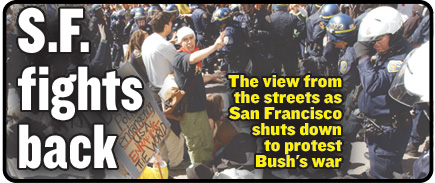
EDITORIAL Five years ago, the antiwar movement shut down San Francisco. It was a moment in history, one of those times that those of us who were there will never forget. No cars on Market Street. No cars on Mission Street. No business as usual anywhere downtown. Just a powerful statement that the city was not going to pretend that invading Iraq was an acceptable move.

And yet, for five years, the war has gone on. Sometime this spring, it’s likely the total number of American soldiers killed in the pointless military adventure will pass 4,000. And that’s just a fraction of the carnage: according to iraqbodycount.org, more than 89,000 civilians have died since the George W. Bush administration launched the invasion in March 2003.

There will be any number of newspaper stories, special reports and anniversary programs in the next few weeks, but of all the facts and statistics they’ll cite about the war, one ought to be at the top:

The antiwar movement was right.

Everything that the activists in the streets (and the very few newspapers that supported them, like this one) said at the time would prove to be absolutely true. As Steven T. Jones notes on page 14, there were no weapons of mass destruction. There was no link between Saddam Hussein and al-Qaeda. Iraq had nothing to do with Sept. 11. United States troops were not welcomed as liberators. There is no functioning Iraqi democracy. The situation in the Middle East is more unstable now than it was five years ago. Nothing has come of this war except disaster, death, and a bill to the American people that could reach $3 trillion.

In fact, Bush’s war is one of the main reasons that the economy is such a mess today — and that’s something the Democratic presidential candidates need to be talking about.

There has been nowhere near enough debate over the cost of the war. Bush has managed to fund the entire effort through supplemental appropriations, without once presenting a full budget to Congress. And the Democrats, fearing political criticism if they cut funding to troops who are in harm’s way, have gone along with every single spending request.

That’s been a huge factor in the nation’s mounting budget deficits and rapidly growing debt. And unlike deficit spending that funds social and infrastructure priorities, the red ink has done little to create jobs or improve the economy. It’s well known that military spending does less to help economic growth and recovery than any other type of government program. Put another way: If the $3 trillion that will go to the Iraq war were put into any other public venture, it would have tremendous positive consequences for society. It could, for example, preserve Social Security for another entire generation without new taxes or benefit cuts.

But those sorts of choices haven’t been presented to the public, because the war has been sold as a painless effort that requires no national sacrifice. And the bills won’t all come due until this president is gone and his successor has to deal with a deep recession, a horrible budget mess, growing unemployment, and a legacy of international distrust.

The good news is that the antiwar activism has forced both presidential candidates to pledge to bring the troops home — and Barack Obama could be the first president in years to be elected in large part on the basis of a strong grassroots peace movement. But the next president won’t stop the war without continued, constant pressure. It’s easy to think of the antiwar movement as a failure and to get discouraged — but this is not time to let down. If a Democrat wins the White House, visible and organized activism will be more important than ever. And this time, it might actually change American politics.

Resistance is futile — or is it?

0

It was a time without precedent in American history. The commander-in-chief voiced his intention to take the country to war — a voluntary, preemptive war with no clear catalyst, no faraway invasion or Pearl Harbor or sinking of the Maine and millions of people shouted their opposition. With plenty of time to avert war, the protesters warned the invasion would be a costly disaster.

They were right. And it didn’t matter.

The war in Iraq was a test of our democratic ideals. It was a test that this country failed, a failure that has been felt by the people of the United States, Iraq, and elsewhere for the last five years. For many, the refusal of the US government to heed the demands of its citizens left them disillusioned and disempowered.

But others say it sparked a political change that woke up an apathetic citizenry, pulled the Democratic Party back to the left, and may have averted war with Iran.

It’s certainly arguable that the presidential campaign of Barack Obama owes its energy and success in part to the antiwar movement — and if Obama wins, he will be the first president in a long time who took office thanks to the support of a strong grassroots progressive movement.

Nowhere was the clash of people power and government will more acute than on the streets of San Francisco, where a series of massive marches, some drawing nearly 100,000 people, filled the streets prior to the invasion of Iraq on March 19, 2003. The onset of war led protesters to effectively shut down the city, resulting in about 2,300 arrests and millions of dollars in costs to the city.

President George W. Bush dismissed the protests, of course, but he wasn’t the only one. Political leaders such as Rep. Nancy Pelosi, then-Mayor Willie Brown and soon-to-be Mayor Gavin Newsom (who didn’t attend any of the marches, unlike progressives on the Board of Supervisors) condemned the peace movement for hurting an innocent city. But with the “battle for San Francisco” making international news, the protesters were more concerned with the global audience.

A month earlier, on the weekend of Feb. 15 and 16, there were coordinated protests against the impending war in about 800 cities around the world, drawing around 10 million people. The peace march in Rome included about 3 million people, earning a listing in the Guinness Book of World Records as the largest anti-war rally in history. People have never made such a loud and clear statement against an incipient war.

Beyond the numbers, the antiwar movement was also right. On every major issue and prediction, the messages from the street proved correct while those from the White House were wrong. The US wasn’t welcomed as liberators. There were no weapons of mass destruction. Iraq after the invasion isn’t a stable democracy or shining beacon to anyone but the new generation of jihadis Bush created.

We can blame a hard-headed president, ineffectual opposition party, failure of the national media, or the national climate of fear following Sept. 11. But rather than refighting that lost battle, now is the time to gain perspective on the events of five years ago and determine what it means for democracy and the post-Bush national agenda.


TO THE STREETS

There were two main umbrella groups organizing protests before the war: Direct Action to Stop the War (DASW) and International ANSWER (Act Now to Stop War and End Racism). ANSWER has remained active and DASW has recently been reconstituted for the fifth anniversary of the war, using direct action in San Francisco as well as other urban centers and outposts like Chevron’s refinery in Richmond, which has reportedly been processing Iraqi oil.

“With the fifth anniversary coming up, we’re going back to direct action on the streets,” said Henry Norr of DASW. “But I don’t have any illusions that it’s going to be like it was five years ago.”

The maddening march to an ill-advised war created a political dynamic in which a broad cross-section of Americans was willing to hit the streets.

“We had a wonderfully diverse group of people, from soccer moms to anarchists,” said Mary Bull, who cofounded DASW, a collective of various affinity groups and concerned individuals formed in October of 2002 as Bush started beating the drums of war.

It was a group fiercely determined to prevent the war — and really believed that was possible. In fact, Bull recalls how she and other members of the group burst out crying at one meeting when a key activist said the war was going to happen.

Richard Becker, who cofounded ANSWER and serves as its West Coast coordinator, said that in the summer of 2002, “we came to the conclusion that [the war] was going to happen.” The group called its first big protest for Sept. 15, 2002, and another one two weeks later. But the movement really exploded on Oct. 26 when almost 100,000 people took to Market Street, much of it a spontaneous popular uprising.

“We were overwhelmed,” Becker said. “We were in a perpetual state of mobilization to keep up with what was going on. But then it didn’t stop the war.”

Did he think they could?

“I think a lot of people thought maybe it was possible to stop it. And we thought maybe it was possible to stop it,” Becker said.

The high point, according to Becker and Norr, was Feb. 17, 2003, when the New York Times ran a front page analysis piece entitled “A new power in the streets” that claimed “the huge anti-war demonstrations around the world this weekend are reminders that there may still be two superpowers on the planet: the United States and world public opinion.” But then Colin Powell went to the United Nations to argue for the invasion, and the Democrats in Congress did nothing, and it became clear war was coming.

Norr stayed out there protesting, being arrested several times and even shot in the leg by Oakland police with a rubber bullet during a protest at the Oakland docks. And he thinks some good came from the experience.

“The lesson for people is the political and economic elites are committed to preserving and extending empire. And they basically say as much in their own writing,” Norr said. “Wars are not anomalies.”

Despite being a frustrating and depressing exercise, most saw benefits to the failed movement. “People got an incredible education about how the system really worked,” Becker said. “Building a movement is mostly about a series of setbacks.”

Medea Benjamin, cofounder of both Global Exchange and CodePink and fixture of the anti-establishment peace movement for years, was upbeat about the protests. “We did our job as citizens. We did what we were supposed to do: organize, get people to take action, get people onto the streets,” she said. “We did everything we could think of.

“What you take from it is we don’t have a very well-developed democracy because the people spoke and the government didn’t listen.”

25war2_Lars1.jpg The ever-evolving “Democracy Wall” on Valencia Street, March 2003, helped stir up debate (Photo by Lars Howlett)


FACING ARREST

The collective action of five years ago starts with a series of personal stories — tens of thousands of them — so let me briefly begin with mine.

My arrival in San Francisco was closely tied to the march to war. I was living in Sacramento and working as the news editor of the Sacramento News & Review when Bush began his saber rattling against Saddam Hussein, but by the end of 2002 I had a falling out with my boss and found myself jobless.

Like most Northern Californians who opposed the war, I came to San Francisco on Jan. 18 to make my voice heard and experienced a bit of serendipity on my way to Justin Herman Plaza: while reading the Guardian on Muni, I saw their advertisement for a city editor, a job that was ideal for me at a paper I’ve always loved. Needless to say, it was a great day, empowering and full of possibilities.

Less than two months later I was on the job, and on the second week of that job I was back on the turbulent streets of San Francisco, part of a Guardian team covering the eruption of this city on the first full day of war. When I stepped off the cable car just after 7 a.m., people were streaming up Market Street and I joined them.

When a large group stopped at the intersection of Market and Beale, I stopped too, taking notes and bearing witness to this historic, exciting event. I had a press pass issued by the California Highway Patrol that allowed me to cross police lines, so when police in riot gear surrounded us and threatened arrest, I held my ground with 100 or so protesters.

After interviewing about a dozen people about why they were there and that they hoped to accomplish (see “On the bus: Journalists, lawyers, four-year-olds — the cops were ready to bust anyone Thursday morning“), I was arrested with the others and taken to a makeshift jail and processing center at Pier 27 (no charges were filed in my case, and charges against all of the 2,300 people arrested here in those first few days of the war were later dropped).

I recently tracked down a few of the people who appeared in my article, including Daphne and Ross Miller, who were at the center of the most interesting drama to play out during our standoff with the police. She’s a family practice physician, he’s an architect, and they live in Diamond Heights with their two children, Emet, who is almost 9, and Arlen, 12, who was away on vacation when the war began.

“We were genuinely shocked that the war started,” Ross told me. “We were at some of the earlier protests and really thought there was no way [Bush] could do it.”

They woke up March 20, 2003, to news that the war had begun and immediately walked to the BART station with Emet and rode to the Embarcadero station, not really planning for the day ahead but just knowing that they had to make themselves heard.

“We were pissed as hell. I don’t think I’ve ever been so angry in my life,” Daphne said.

They quickly came up with a plan. “We basically decided that if anyone was going to be arrested, it was going to be Ross and I’d stay with Emet. But it didn’t end up that way and I ended up in the arrest circle.”

Daphne had their house keys and threw them over the police line to Ross at one point. A photographer in the circle had gotten shots of a man named Roman Fliegel being roughed up by police as they pulled him off his bicycle, which was towing a trailer with a sound system, and decided to throw his backpack with camera gear out as well. When Ross — who had four-year-old Emet on his shoulders — caught it and refused police orders to give it to them, police grabbed Emet and roughly arrested Ross, leaving a gash on his forehead.

“Rage surged through the crowd, and it seemed as if things might get ugly, but the police kept a tight lid on the situation, using their clubs to shove back protesters who had moved forward,” I wrote at the time.

Emet was delivered into the circle with Daphne as the arrests continued, many quite rough. “At that point, as a mom, I had to exercise the most restraint ever,” said Daphne, who was angry about the situation but fearful about what she was exposing her son to. “Please, don’t let any violence happen here,” she pleaded with the crowd. Eventually, commanders on the scene let the mother and child go.

“The officer who let me go said that if he saw me again out there, he would call Child Protective Services on me,” Daphne said. But two days later, still brimming with outrage at her country’s actions, she ditched a downtown medical conference to rejoin the street protests, this time solo.

The couple say they’ve lost friendships over the war and have become more engaged with politics, coming to believe that Bush and the neocons are malevolent figures who knew how badly the war would go and did it anyway to establish a large, permanent military base in Iraq.

“Since that day, we’ve been far more active,” Ross said. “We realized you can’t just trust the system. You have to push.”

But that determination was mixed with feelings of disempowerment and depression. They attended some of the protests that following year, but the couple — like most people — just stopped going at some point because they seemed so futile.

“There was a horrible sense of resignation and a genuine depression that followed,” Ross told me.

The nadir was when Bush was reelected and they considered leaving the country. But then, Ross said, “we decided we’re not just going to run away and we’re not going to accept this.” Looking back, even with the scare over Emet, they express no regrets.

“It was the right thing to do because it was the wrong war to have. I’d do it again and again and again if I had to,” Ross said

They’re guardedly hopeful that Barack Obama could begin to turn things around if he’s elected. “I think the right president can at least start to dismantle this,” Daphne said. “I think thousands of people marching in the streets is something he would listen to.”

25war3_Charles1.jpg A die-in on the streets of San Francisco in March 2007 marked the fourth anniversary of the invasion (Photo by Charles Russo)


WITNESS TO HISTORY

Covering the peace movement in those early days was a heady experience, like reporting on a revolutionary uprising or working in a foreign country where the people are organized and active enough to be able to shut down society and brave enough to risk bodily injury for their beliefs.

I was at the founding meeting of CodePink — which became the most effective group at personally confronting the warmongers and keeping the war in the public eye — one evening at Muddy Waters in the Mission District shortly after the war started.

Looking back, Benjamin rattled off a long list of the alliances the group built — with labor, churches, businesses, and a wide array of social movements — and creative actions intended to build and demonstrate popular support for ending the war.

“We’ve done so many things and what did we get? We got a surge,” she said. “It shows the crisis in our democracy, the crisis of the two-party system, the crisis of a dysfunctional opposition party.”

Yet she said the peace movement has been remarkably successful in convincing the public that the war was a mistake and that it’s time for the troops to come home, even if the Democrats have been slow to respond to that shift.

“The progress we’ve made is turning around public opinion and that’s going to play a big role in the upcoming elections,” she said. For Norr, the role of the news media is a particular sore spot. He was a technology reporter for the San Francisco Chronicle who called in sick on the first full day of war and was arrested on Market Street with his wife and daughter, resulting in suspension by editor Phil Bronstein for his actions.

I wrote several stories on the issue, which culminated in Norr being fired and Bronstein unilaterally banning Chron employees from peace protests. I even borrowed CodePink’s guerilla tactics when Bronstein repeatedly refused to return my calls or address why he had singled out antiwar protesters for uniquely punitive treatment. I confronted him during a speech he gave at the Commonwealth Club (see “Lies and half-truths,” 5/7/03). That was the tenor of the times: we were all tired of being lied to and we decided to push back.

Norr was particularly frustrated with his own paper’s reporting of the war and started sending articles by the foreign press to his paper’s news desk, trying to wake his colleagues up to the pro-war propaganda being passed off as journalism in this country.

He was also disappointed with the country and with the Chronicle — both the management and his fellow reporters, who did little to support him — but the experience caused him to return to his roots as a progressive activist.

“The war and losing the job and everything brought an abrupt end to my consumerist phase and dumped me back into the world of being an activist,” said Norr, who serves on the KPFA 94.1 FM local station board and has made three recent trips to the Palestinian territories while working with the International Solidarity Movement.

Benjamin said Americans shouldn’t expect the next president to end the war — not without lots of pressure from a renewed and vocal peace movement. “This is the time to set the stage for the post-Bush agenda,” Benjamin said. “Don’t put your hopes in Barack Obama in getting us out of Iraq. Put your hopes in the people.”

25war4_Lane1.jpg A rally and nonviolent direct action at the Richmond refinery targeted Chevron on March 15 (Photo by Lane Hartwell)


THE AFTERMATH

The San Francisco Police Department, which spent more than $2 million on overtime costs responding to peace protests between March 15 and April 16, 2003, generally behaved with restraint and professionalism, but there were several exceptions.

The most costly and disturbing incident came when Officer Anthony Nelson began aggressively swinging his long riot baton at protesters, badly shattering the arm of peaceful protester Linda K. Vaccarezza, who suffered a permanent disability in her career as a court reporter.

Nelson’s incident report falsely stated that Vaccarezza had threatened him with a sign attached to a solid pole, but video of the incident later clearly showed there was no pole and that she was retreating when he teed off on her (see “The home front,” 05/19/04).

Vaccarezza received an $835,000 settlement from the city in November of 2004. On Oct. 5, 2005, two and a half years after the incident, SFPD fired Nelson for lying about what happened that day, and the City Attorney’s Office has been successfully fighting Nelson’s appeals in court ever since, putting in more than $100,000 in attorney time and costs into the Nelson and Vaccarezza cases.

The other significant ongoing litigation from the antiwar protests involved Mary Bull, who was arrested during an early protest for pouring fake blood in front of the entrance to Chevron’s San Francisco office before being allegedly strip searched and left naked in her San Francisco Jail cell for 36 hours.

Ironically, Bull was among those who brought a successful class action lawsuit against Sacramento County after she and others protesting a logging plan were strip searched, setting a precedent and led most counties to reform their strip-search policies. She used her share of the $15 million judgment to buy an organic permaculture farm in Sebastopol.

Her San Francisco case, in which Bull won a multimillion-dollar judgment, is still under appeal and now in mediation. Bull said the protests five years ago did make a difference, something she tells those who fret about its apparent failure. “I tell them to look at what issues the candidates are talking about now and I thank them for protesting then.”

“Even though we had millions throughout the world, we were sort of blocked, but now we’re regaining that momentum,” Melodie Barclay, a massage therapist who was also arrested with me on the first day of the war, told me recently. “We can’t judge it by the fact that we didn’t get the momentum we wanted.”

Norr started his antiwar activism working with Students for a Democratic Society in Boston, protesting the Vietnam War, which he said shares many similarities with the current situation, for good or for ill. He said that people tend to forget that while the protests then were huge and helped end the war, the movement did wane after Nixon ended the draft and substituted massive aerial bombardment for boots on the ground.

“The protests dropped off considerably,” he said. “A lot of the things that drove people to take risks in the late ’60s had faded by the early ’70s.”

He thinks the current administration learned a lesson from those days: it’s easier to maintain a war effort if the average citizen isn’t affected.

But there are other factors as well keeping a lid on the antiwar outrage.

“The culture has changed too. Young people are oversaddled with debt. People in schools seem to be docile. The culture as a whole seems to be more individualist and consumerist,” Norr said.

Yet some young people have woken up and many of them are funneling their energies into a peace group that was formed in the summer of 2005: World Can’t Wait, as in: the world can’t wait for the end of Bush’s second term before we change our direction and leadership.

“We don’t just want them gone, we need to repudiate their program,” said Giovanni Jackson, a 26-year-old WCW student organizer. “If we’re going to change anything, we need the youth.”

Jackson was at WCW’s founding convention in New York City, which came just as New Orleans was being flooded and then essentially abandoned by the federal government.

“When [Kerry] lost, people felt demoralized and World Can’t Wait kind of stepped into that situation,” Jackson said. “There was a lot of demoralization in the antiwar movement at that time.”

The group organized protests and student walkouts on Nov. 2, 2005.

“Everyone has their moments of doubt,” he said, “but I’m motivated by the crimes we see everyday.”


THE LESSONS

One of the biggest barriers to galvanizing people and turning the fifth anniversary of the war into something that might make a difference is the presidential election, which is diverting the energy of many potential protesters — and at the same time, offering some hope that a new president may lead to peace.

After all, every single one of the Democratic presidential candidates has promised to withdraw troops from Iraq, with varying timelines and numbers of US personnel left behind. And with enough encouragement, they might be willing to help change the status quo.

Many of the activists who volunteered their time and money to help move the Obama campaign into its front-runner position came out of the antiwar movement, and Obama’s strong stand against the war has been a key factor in his popularity.

Becker and some other activists don’t have much faith that a change in presidents will change the course in Iraq, although he agrees that much of the energy now surrounding Barack Obama derives directly from the antiwar movement.

“There’s been a huge upsurge of hope for Obama and that he might bring about the kind of change we need,” Bull said, adding that she doesn’t share that hope, believing the only path to peace is to pressure Obama and other leaders to commit to more progressive positions.

Norr said, “On one level, people have illusions about the power of peaceful protests. People believe in democracy, as well they should. We feel like the rulers should be paying attention to public opinion.

“It’s a remarkable story how broadly and quickly the American people have turned against the war. Public opinion was certainly ahead of the Democrats.”

And people will only grow more disenchanted with Iraq and its multitude of costs. “The people here are paying for this war, and everyday we have new stories about health clinics being shut down,” Becker said.

Becker was amazed last March as massive demonstrations for immigrant rights seemed to explode out of nowhere. “We think there will be more things like that,” he said.

Because after five years of organizing communities to resist the military-industrial complex’s plans, Becker thinks there’s been some visible progress.

“There isn’t a town or hamlet in the US that doesn’t have activism going on, but you wouldn’t know it from the corporate media,” Becker said. “It’s a mistake for people to feel discouraged.”


Obama throwback T tosses me back to my high school years

0

hoodiespunahoutee.bmp

OK, true confessions: I attended Punahou school in Honolulu, Hawaii – and I hated it. But seriously, Barack Obama is doing more than blowing my mind with his performance as a candidate – I’m also having to rethink my dreaded junior high and high school years at this elite prep institution that essentially catered to the islands’ missionary/colonist spawn and the wealthy. Yeah, yeah, yeah, Obama – and even I – also went there, and our families certainly weren’t soaking in it. (And boy, was I reminded of that all the time by my parents.) Still, can that miserable time actually be considered remotely…cool? Truly, this Neighborhoodies’ ringer T-shirt – oozing nostalgia for a Punahou I’m still ambivalent about – is weirdest fashion item I’ve ever lusted after.

Clinton, Obama and affirmative action

0

Does anyone really believe that Geraldine Ferraro was speaking only for herself, and not for the Clinton campaign, when she went after Barack Obama? Because I don’t.

I’ve been watching how the Clintons work for years. They do what it takes – sometimes, whatever it takes – to win. That doesn’t mean Hillary would be a terrible president, and if she wins the nomination, I will happily and proudly vote for her. I like her health-care plan better than Obama’s, and I think having someone in the White House who is tough and fierce and knows how to fight in the streets with the worst of the political hacks is not entirely a bad thing.

But let’s be honest here: This was carefully, and brilliantly, orchestrated.

Ferraro is a veteran politician, and she knows how presidential campaigns work. She knows that you don’t make comments about something as sensitive as race without checking with headquarters. She’d be a fool – and she isn’t a fool – to just blurt that out.

Think about what she did from a political perspective. The key battle now is Pennsylvania, a state with a mixed demographic. Obama will win Philadelphia, with its large African-American population and sizable numbers of students and liberal white people. But there are plenty of more conservative, suburban and working-class areas – and in some of those places, there are no doubt people who are unhappy about affirmative action.

And that’s who Ferrero’s comments were aimed at – the angry white people who want to blame their problems on black people.

Her message was pretty simple, when you get right down to it: Obama got an unfair advantage over a white person (Clinton) because he’s black. She may not have said it in so many words, but in the areas where the Clinton polling shows she can exploit that sort of fear and resentment, people will get the point right away.

Naturally, Clinton could never say anything like that (any more than Obama could say that his opponent was a “monster” who would do anything to win). But both candidates wanted that message out, and in both cases, sophisticated surrogates put it out, then fell on the sword and resigned for the team.

I know this sounds incredibly cynical, but this is how the game is played at this level.

Freedom of Information: More sunshine — easily and at no cost

0

› news@sfbg.com

Imagine sitting at home — or in your office, or in your favorite café — and listening in on what are now secret, backroom policy discussions and decisions in the San Francisco mayor’s office. Imagine having access to an immediate transcript of the talks. Imagine being able to read internal e-mail discussions among city staffers about issues that affect you — without ever filing a public records request. In fact, imagine never having to file another written request for public documents; imagine just going to a city Web site, entering a search term, and finding all of the records yourself.

Imagine filing a complaint with a city agency and tracking the issue, minute by minute, as it works its way through the system.

Imagine listening on your cell phone to any policy body as it meets in city hall.

All of this is possible, today. Much of it is not only consistent with but actually required by local law. And it won’t cost the city more than a modest amount of money.

Transparency is a common buzzword during this presidential campaign; the Barack Obama campaign has even issued a white paper describing policy and technological ways to embrace it. He’s talking about live Internet feeds of meetings about significant issues involving executive branch appointees as well as for those of regulatory departments (a program that would go far beyond what you see on C-SPAN).

So there’s no reason San Francisco can’t take the lead in using technology — generally simple, off the shelf, existing technology — to dramatically increase sunshine at City Hall and public participation in local government.

Proposition G, the city’s 1999 sunshine law, mandates that San Francisco use "all technological and economical means to ensure efficient, convenient and low cost access to public information on the Internet." Here are five easy ways to do that:

1. Fully adopt the voyeur concept for city meetings. This is the idea that the public should be able to observe and engage in government decision making — all government decision making.

All policy meetings in City Hall should at the very least be broadcast as audio on the Web and available via phone teleconference. In other words, the meetings should be streamed online, and that stream should be accessible by calling a free conference line. This is already standard practice in the business world and is working well for many investors in public companies that disclose financial information in compliance with Securities and Exchange Commission rules. It can be done for little or no cost with services like blogtalkradio.com, skype.com, freeconferencecalls.com, and webex.com.

Today only a limited number of public meetings are broadcast, mostly because the only outlet is SFG-TV and resources are limited. But audio streaming is a no-brainer — there’s no need for a staffer to control cameras, the microphones are already set up, and these days just about every room has a speakerphone.

Currently, the SFG-TV video coverage isn’t posted on the city’s Web site, sfgov.org, until two or three days after a meeting. That’s too long; the audio should be made immediately available online. And the Internet URL and dial-in options should be listed on the meeting agenda so that news media and citizen bloggers can instantly refer back to the URL with timecodes to point out specifics, and include them in their stories and blog postings.

With streaming, you can follow along in real time when you are stuck at home taking care of a sick relative, or at the office listening with headphones, or you are disabled and can’t cross town to attend in person.

The city already has a great contract for real time captioning — the text you see at the bottom of the screen for video. It’s not 100 percent accurate, but it’s pretty decent. That could be expanded to cover streaming audio, and the text could be computer translated (or translated by bilingual typists) into other common languages. The advantage of media integrated with RTC is that specialized search engines like blikx.com and everyzing.com can be used to find relevant phrases and begin playback directly at that spot. And transcriptions can be posted online in real time (somewhat like live blogging!) so that if you are late for a meeting you can quickly scan what has already transpired, and by the end of the meeting you will effectively have a draft of minutes. That saves a lot of staff time and provides an immeasurably more useful historic record.

Today, video recordings of city meetings can’t be downloaded — the only way to review it or post a clip to YouTube is to order a $10 DVD, which arrives a week after you send a check (and no, they don’t take PayPal). And while many other city meetings make audio recordings, you have to pay $1 for an audio tape and pick it up during business hours or pay more for postage. They all should be available as free podcasts.

The SFG-TV video shows more than just the speakers and officials; there are other angles, and they ought to be available too. It’s important to know who attended the meeting but never said anything, who greeted whom, and even who ignored whom.

2. Let the public do the broadcasting. All City Hall meeting rooms should provide wi-fi (and electrical outlets), and the system ought to have enough speed to allow bloggers or activists to upload high-quality video broadcasts of meetings that SFG-TV can’t afford to cover. It can be done using existing services like Justin.tv, Upstream.tv, and live.yahoo.com. This would also allow live blogging — and let people preparing to testify on an issue have access to the Web to do research on the spot. If the room had a projector and a screen, people who were unable to attend the meeting could still comment, either through video or just by posting text messages that the decision makers could read.

The audio broadcasting of meetings should be expanded to include all meetings between the mayor (or supervisors) and city staff. The law already requires public access to so-called passive meetings — those between the mayor or department heads and outside parties that influence city policy.

3. Make public most city emails and other documents as soon as they are produced.

San Francisco city employees produce thousands of records a day — e-mails, memos, reports, etc. — and the vast majority of them are and should be public record. But many are deleted and others never see the light of day. When a member of the public asks for all the records on a topic, just finding those documents can be a sizable task.

But it’s technologically simply to solve that problem: every time a city employee produces a document, the computer system should automatically send a back-up copy to a public web server. That way nothing would get lost or erased, and anyone looking for public information could simply go to that site and search for it him or herself.

For e-mails sent by city staff, one way might be to CC (carbon copy) an online message board (for example Google or Yahoo groups, which would be available at no cost to the city). Other approaches for instant messages, text messages and voicemails could be adopted as well. The Palo Alto City Council is already doing something like this for a narrow collection of e-mails (although not in real time).

We all know there are some city communications that must remain private or be redacted — for example Attorney Client discussions or human-resource conversations regarding personnel. But there are simply ways to make sure those stay confidential: one approach might simply have the user tick a flag or answer a Yes/No Possible Redaction popup when the message is sent. Certain employees — like the people who handle sensitive employee health records and certain litigators in the city attorney’s office — could have software that defaults to a confidential server.

The added advantage, of course, is that the computers could also make a record of the title and date of every confidential document — and that information could be made public. If a dispute arose over whether the city was improperly withholding records, the public would at least know that certain documents existed.

All city files could be stored on network drives (not on local drives) with one location for default public files that would not allow overwriting or deletions and would be mirrored to a Web server and another drive for the few that may require redaction first.

4. Save all the old records. After a very embarrassing lawsuit that is threatening the Missouri governor’s job, that state in January adopted an email retention system that preserves all email for at least seven years (based on federal requirements for financial records). And e-mail/instant message/text/fax retention systems are standard practice now in the financial industry (Morgan Stanley lost a $1.45 billion judgment because the company failed to preserve e-mail).

In fact, we all know storage continues to get cheaper and smaller — so San Francisco should abolish any retention timeframes for electronic records and keep them all into the foreseeable future. The world-famous Internet Archive is right here in the Presidio: I suspect that group would love to archive all the city information, and keep it online, free and forever.

When paper documents are part of the public record, they should be scanned and converted to text and posted within two days. This would include discussions between staff and individual members of policy bodies and the creation of the draft agenda and supporting materials as they are obtained.

All these methods would significantly reduce the number of public records requests to the city staff and thus save the city money.

5. Make calendars public — and keep communications public. Mayor Gavin Newsom won’t provide detailed daily calendars — even after the fact, when there is no possible security reason for keeping his workday itinerary secret. All top officials should post their calendars on the web so the public can track what they are doing.

The city needs to adopt a global policy that city business should be performed on city devices (computers, email accounts, phones) whenever possible — and when city employees or officials use their own computers or hand-held communications tools, those should be forwarded immediately to the city system and made public.

San Francisco has one of the best local Sunshine laws in the country — and at a time when activists at every level are looking for ways to use technology to expand public access, the city should be in the forefront. All it takes is some political will.

———————————————————-

Here are some more ways that the city could use technology to improve public access:

1. Use a program like govtrack.us to follow legislative changes.

2. Explore ways to bring nonprofits that perform traditional government services under sunshine laws.

3. Significantly improve the city’s Crimestats system (more real-time allow alerts for crimes near you) – google mashup et al. See http://chicago.everyblock.com/crime/

4. Embrace e-rulemaking technology – similar to federal rulemaking use technology to get ideas online and generate more participation for those who can’t show up in a meeting.

5. Require the Police Department to issue press credentials to bloggers.

6. Fund a few open-government lawsuits to expand the boundaries on access to public records (the law provides for attorney’s fees if the suit is successful).

7. Require city agencies to post the method for obtaining public records online. Require posting of all negative determinations on home pages.

8. At budget time, mandate that each agency provide statistics as determined by SOTF on sunshine responsiveness.

9. Require an assessment of sunshine compliance as a mandatory item for all Financial/Management audits.

10. Televise SOTF and Ethics Commission formal hearings.

11. Require active Ethics investigative files to be open.

12. Embrace fully the much-improved but incomplete example of posting online all interactions as part of large contract negotiations – as was partially done with TechConnect.

13. Host accounts payable/receivables online with the scanned images of invoices paid.

———————————————————

>

Progressive power play for the DCCC

0

sfdemo_logo2.gif
The word from the San Francisco Elections Office is that all hell has broken loose as the city’s top progressive political leaders file to run for the Democratic County Central Committee in a bold and surprising move to seize control of the political body from moderates like Mayor Gavin Newsom, Rep. Nancy Pelosi, and U.S. Sen. Dianne Feinstein. And the word is that Team Newsom was caught flat-footed, able to get only a couple administration loyalists — Mike Farrah and Catherine Dodd — to file before today’s 5 p.m. deadline.

But the lineup on the left is a who’s who list of top progressives: supervisors Chris Daly, Jake McGoldrick and Aaron Peskin, Public Defender Jeff Adachi, school board members Eric Mar and Kim-Shree Maufis, likely supervisorial candidates Debra Walker and Eric Quesada, mayoral runner-up Quintin Mecke, and McGoldrick’s son Jamie. If elected, they would join incumbent progressives such as Robert Haaland, Michael Goldstein, and Rafael Mandelman.

“I think what you’ll see is a more progressive central committee,” said Bill Barnes, chief of staff for Assembly member Fiona Ma and a progressive member of the DCCC who is also running for reelection.
Control of the DCCC would allow local progressives, most of whom have endorsed Barack Obama for president, to take advantage of the opportunity to push a more innovative political agenda and try to pressure the party to move to the left.

They are also likely to use a coordinated campaign this year to present progressive policy options to San Franciscans just as Newsom is working to sell a Lennar-sponsored development proposal on the June ballot and using a power grab on city committees to try to take control of the public agenda.