Oakland

Alerts

0

alert@sfbg.com


WEDNESDAY 2

Occupy Oakland General Strike

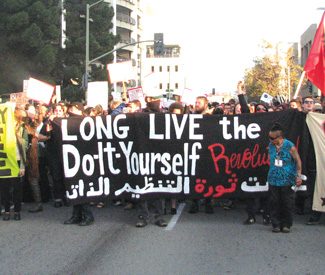
In response to last week’s police crackdown, Occupy Oakland called for a general strike on Nov. 2, urging workers and students to shut the city down and join the movement. Convene with neighbors, community members .and affinity groups to take part at a moment when “the whole world is watching Oakland.” Banks and corporations that don’t close will be marched on. The Strike Coordinating Council will begin meeting every Wednesday at 5pm in Oscar Grant Plaza before the daily General Assembly at 7pm. All participants are welcome.

All Day, free

Oscar Grant Plaza

14th & Broadway, Oakland

www.occupyoakland.org


THURSDAY 3

Transgender Film Festival

This year at the 10th Annual Transgender Film Festival, watch the captivating collection on defiance, bullying, romance, relationships, sex, and so much more. International filmmakers journeyed from across the globe. Be sure to buy your tickets before they sell out, which it is expected to.

8-10 p.m., $12-15

CounterPULSE

1310 Mission, SF

Contact Eric Garcia: intern@freshmeatproductions.org

www.sftff.org


FRIDAY 4

Sacred Sites Peacewalk

The Berkeley Fellowship of Unitarian Universalists Social Justice Committee will provide overnight shelter space for participants in Sacred Sites Peacewalk for a Nuclear Free World. All are welcome for a potluck dinner, speak out and discussion featuring a Buddhist teacher and peace activist. The walk began Oct. 22 at Diablo Canyon and ends Nov. 6 at Glen Cove, Vallejo.

6-9 p.m.

Berkeley Fellowship of Unitarian Universalists’ Hall

1924 Cedar, Berkeley

(510) 841-4824

www.bfuu.org


SATURDAY 5

Occupy Wells Fargo

The marginalized in the 99 percent are fed up with austerity, especially these 67 Suenos, a collective of undocumented youth and allies that refuse to be passive about violence in the Bay Area community. Stand in solidarity against banks who aggressively invest and profit off anti-immigrant laws like Arizona’s AB 1070. Come and join in planning preparations.

10 am- 1 p.m., free

Contact: 67suenos@gmail

Oscar Grant Plaza/Downtown Wells Fargo 1 block away

14th St. and Broadway, Oakl.


Marxism Conference

From Athens to Cairo to San Francisco, capitalism has proven its instability and people are fighting back. With the Occupy Wall Street phenomenon, it’s the perfect time to further understand the Marxist philosophy on exploitation and how the working class can liberate the oppressed. Featured speakers include Alan Maass, editor of Social Worker newspaper and Keeanga Yamahtta Taylor, editorial board member of International Socialist Review.

10 am- 6 p.m., free

UC Berkeley

Rooms 220 Wheeler and 126 Barrows

Telegraph and Bancroft, Berk

iso@norcalsocialism.org

www.norcalsocialism.org


Mail items for Alerts to the Guardian Building, 135 Mississippi St., SF, CA 94107; fax to (415) 437-3658; or e-mail alert@sfbg.com. Please include a contact telephone number. Items must be received at least one week prior to the publication date.

Guardian editorial: Leave the occupiers alone!

2


As the world watches, San Francisco and Oakland should set the standard by supporting  Occupy San Francisco and Occupy Oakland and supporting  their goals and peaceful tactics.  B3

 With all of the police raids and arguments over messages and demands and tactics, it’s easy to forget that the Occupy Wall Street movement has a clear political point — and it’s right.

The movement is about the devastating and unsustainable direction of the American economy, about the fact that a tiny elite controls much of the nation’s wealth, that virtually all of the income growth over the past 20 years has gone to the very top, about the collapse of the middle class and the rise of economic inequality that would have been unthinkable a generation ago. Those are the central issues facing the United States, the state of California and the cities of San Francisco and Oakland today — and instead of trying to crack down on the protests, city officials ought to be endorsing the occupy movement and talking about cracking down on the financial institutions and the wealthy.

A few things worth noting:

1. The protesters are almost entirely nonviolent. Although there have been a few isolated incidents in Oakland and SF, the overwhelming majority of the thousands of people at Justin Herman Plaza and Frank Ogawa Plaza are actively promoting and insisting on nonviolence. This is not a crowd that is a threat to anyone.

2. There’s a precedent for long-term political protest camps in San Francisco. The AIDS Vigil remained at U.N. Plaza — with tents, tarps, and cooking gear — for ten years, from 1985 to 1995.

3. The city of San Francisco’s citations — reported without question in the daily newspapers — about health and sanitation problems are way overblown. The OccupySF protesters are making extraordinary efforts to keep the place clean. When the city failed to live up to its promise to provide portable toilets, the protesters ordered (and paid for) their own. As state Sen. Leland Yee (not known as a crazy radical) noted after a visit Oct. 26: “While hundreds gathered, there was not one incident of violence. If the interim mayor thinks there are health issues, I certainly didn’t see them.” We visited Oct 31, and the place was clean and peaceful.

4. The cat-and-mouse game with the San Francisco police is the equivalent of psychological warfare; protesters have to be on edge at all times for fear of a crackdown that may or may not come.

5. Mayor Jean Quan made a bad mistake sending in the cops to roust Occupy Oakland. Nothing good at all can come of any further police eviction action.

Frankly, we don’t see why the protesters — who are well-behaved, represent no threat to anyone, and are doing a huge civic and national service by bringing attention to an issue that the powers that be in Washington, Sacramento and (sadly) San Francisco have largely ignored — can’t stay where they are. If there are health issues, let the Department of Public Health work with the occupiers. If there’s a problem with a portable kitchen, let the Fire Department show the protesters how to run it safely and legally (there are portable cooking devices at every street fair, in dozens of food trucks and in probably 100 other places around town).

The people at OccupySF and Occupy Oakland have done an amazing job of building a safe, respectful and inclusive community. They are the political heroes of 2011. If there’s anyplace in America where the movement ought to be allowed to grow and thrive, it’s here in the Bay Area.


Superviors and labor leaders challenge Lee’s OccupySF stance

41

Mayor Ed Lee has put the city and its police force on a collision course with not only OccupySF, but also several members of the Board of Supervisors and top labor leaders who support the movement and want the city to allow its encampment to continue.

They spoke at a special hearing of the City Operations and Neighborhood Services Committee that was convened by Chair John Avalos this morning, supporting a resolution that Avalos created to allow OccupySF to have tents and other infrastructure that Lee opposes. The resolution – which is co-sponsored by Sups. Eric Mar, David Campos, and Jane Kim – was approved by the committee and is set to be considered by the full Board of Supervisors tomorrow (Tues/1).

“It is something I am wholeheartedly supporting because it is an expression of great frustration and concern about the economic system,” Avalos said. “We need to speak with a greater voice about changing our economic system so it works for the many and not just the few,” Avalos said, explaining why he is “wholeheartedly supporting” the OccupySF movement.

But Avalos said he’s been frustrated that Lee and the police have raided the camp twice and are threatening more, something that Avalos has been trying to mediate since the first raid on Oct. 5. He also said the city should learn from Oakland that using the police force to stop the movement only makes it stronger.

“If we were to try to stop it from happening, it would just encourage more people to take part in it,” he said, noting that more midnight raids are dangerous for both police and protesters. “We have to figure out as a city how we’re going to facilitate, encourage, and accommodate this movement.”

But instead, Avalos said Lee’s stand against allowing tents or an kind of encampment, while claiming to support the message OccupySF, has created a tense standoff. “I’ve seen very mixed messages come out of this administration,” Avalos said, adding that nobody believes police statements that the massing of SFPD cops in riot gear on Oct. 26 was only a training exercise.

Mar said OccupySF deserves tremendous credit for holding the space and being responsive to the health and safety concerns raised by city officials. “I’ve seen a transformation in the movement in the last three weeks that is truly impressive,” Mar said. “I’ve also seen, during the General Assemblies, an incredible exercise in democracy.”

He also disputed accusations that the camps are dirty and that the movement is unfocused. “Don’t believe the hype from the mainstream media but look at the messages coming out of this movement,” said Mar, who was wearing a “We are the 99 percent” sticker.

“We should allow OccupySF to do what they’re doing,” Campos said. “It’s good for San Francisco.”

Campos also called out Lee and Oakland Mayor Jean Quan for ordering violent raids on the peaceful encampment, disputing the idea that “somehow it’s okay for us to spend the limited resources we have on these kinds of police actions…I hope we don’t have Mayors Quan and Lee wasting resources that could be better spent elsewhere.”

During the public comment portion of the hearing, each of the more than two dozen speakers supported the resolution.

“What this resolution does is it calls on the other supervisors and the mayor to decide how they want to deal with OccupySF,” said Gus Feldman of SEIU Local 1021.

Representatives of several labor unions and the San Francisco Labor Council that have voted to endorse OccupySF spoke at the hearing, include Ken Tray with United Educators of San Francisco, who gave a rousing speech in support of the movement.

“The times have changed and the political landscape has shifted,” Tray said, ticking off a long list of reasons for supporting the movement, from San Francisco’s long tradition of advocating for progressive change to the fact that “the schoolchildren of San Francisco are being denied resources because the 1 percent refuse to pay their fair share.”

Frank Martin del Campo of the SF Labor Council displayed the bruises on his arm inflicted by police during the raid on the Occupy Oakland, saying “this was an attempt to criminalize dissent…It represents the politicization of the police.”

Labor Council Executive Director Tim Paulson said, “I just want to be clear that we are the 99 percent….We want Occupy San Francisco to be there 24/7.” He and others say the Occupy movement is highlighting deep economic inequities that the labor movement has long been raising as well. “OccupySF has called the question on really important issues we’ve been struggling with for years,” said Gabriel Haaland of SEIU Local 1021

“Here is a peaceful protest being answered with violence,” said Pilar Schiavo of California Nurses Association, which has been supporting the occupations. This is an important political struggle, she said, and “It’s time for the mayor to decide what side he’s on.”

Many speakers focused their criticism on Lee, such as Brad Newsham, who said, “Any official who would send in the riot police to deal with this camp does not deserve to be mayor of San Francisco.” He said the city should set an example for the country by formally allowing the encampment to continue, and he turned to the young protesters in the room and said, “Hold your ground and we’ll try to get your back.”

Sean Semans, an active member of OccupySF since the beginning, thanked Avalos and the other progressive supervisors for “saving us when nobody would,” and he expressed frustration with the Mayor’s Office.

“The mayor still doesn’t recognize us, he won’t come down and see the work we’re doing,” Semans said. “We can do all kinds of work when we’re not fighting to protect our First Amendment rights.”

He was part of an OccupySF delegation that met with Lee last week, and Semans said the mayor offered to help get the protesters rooms in SRO hotels or meals from local soup kitchens, showing that he has a fundamental misunderstanding about what this occupation is about.

As Semans said, “It shows what we’re dealing with here.”

CHP menaces the Halloween Critical Mass ride

14

The California Highway Patrol seems to be on high alert and itching to fight the people in the street, at least if a bizarre incident at last night’s Critical Mass is any indication. And that’s a scary prospect in the Bay Area, where the ongoing standoffs between police and the Occupy movements in San Francisco and Oakland are potential powder kegs that require cool heads on both sides.
Critical Mass was rolling through the warm streets of San Francisco, as it’s been doing on the last Friday of the month for 19 years, and it was a glorious night. The weather was nicer than it’s been in years for the Halloween ride and most of the large crowd wore costumes, many of them playing off Occupy Wall Street themes, from zombie bankers to the Glass Seagull (a reference to the gutted banking regulation Glass-Steagall Act).
Best of all, the San Francisco Police Department seemed to be standing down and allowing the ride to self-regulate, which it did with a minimum of conflicts with drivers. The mood was buoyant and many riders said it was the best Critical Mass they’d been on in a long time.
Then suddenly, as the ride headed up Market Street toward the Castro, crossing Octavia Boulevard, about a dozen CHP officers on motorcycle rapidly descended on the ride, aggressively cutting the dense ride in half to clear Octavia. Some used their motorcycles to push the cyclists back and tensions flared.
Angry words were exchanged back-and-forth between the cyclists and cops, some of whom seemed to be itching for a fight. One in particular pursued the cyclists up Market Street, playing the provocative tough guy or using his motorcycle to try to corral and menace the ride, long after the standoff had ended with enough green lights for the ride to get past Octavia and his fellow officers left.
This battle over public space and freedom of assembly isn’t going away anytime soon. There are resentments building and there will be bad apples on both sides of the barricades in the days and weeks to come. That’s one reason why Mayor Ed Lee is playing a dangerous game by threatening to raid OccupySF at any moment, and why the SFPD’s approach to this ride was far better than the CHP’s.
Just stand down and let the people police themselves.

Potrero Hill History Night: a special occasion for a special neighborhood

3

Scroll down for Potrero Hill History Night photos

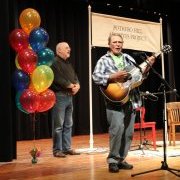
And so Country Joe McDonald ambled on to the stage Saturday night at the International Studies Academy on Potrero Hill and told an full auditorium full of history night groupies  that since he was playing in a school he would open with a spelling lesson.

“Give me an F,” he roared,  and the audience roared back with an F.

“Give me a U, give me a C, give me a K,” and the audience roared back again and again  with knowledge of the lyrics of the anti-war song “I Feel Like I’m Fixing To Die” that Country Joe made famous during the Vietnam war and has been singing as his trademark song ever since.

He would pause and the audience would continue on with the words. Country Joe was in top form, the audience loved him, and it was a stunning beginning to the 12th annual Potrero Hill History Night.  And the fact that Occupy SF and Occupy Oakland were fixing to explode sooner or later in nearby neighborhoods  only gave some timely poignancy to the occasion.

But Country Joe wasn’t at History NIght to perform as a singer or political activist. He explained that he was there as a turnaround artist to interview Joel Selvin, the veteran San Francisco Chronicle pop culture reviewer and author of “Smart Ass,” a collection of 40 years of Selvin’s music journalism. Significantly, Selvin also happens to be a longtime Potrero Hill resident. The latter phrase is the key, because the point of History Night is to focus on the rich history and colorful personalities of Potrero Hill and put them together into a lively program. In this segment, Joe the performer interviewed Joel the reviewer/reporter who had been writing about Joe for years.

The two made a splendid team and it turned out that Joel was as good onstage in this format as Country Joe. It was good fun, instructive at times, particularly with the stories about Bill Graham’s antics and angry outbursts and how each dealt with him. The audience had fun trying to figure out through questions just how rock n’ roll and Country Joe from Berkeley connected to the hill. Well, one answer was that Jann Wenner, the founder of Rolling Stone magazine, claimed three different addresses on Rhode Island Street.

The program this year was the best ever. A barbecue outside the building serviced by a platoon of History Night  groupies on a warm and wondrous Potrero Hill evening. And a program featuring a formal presentation of a chunk of goat hoofprints embedded in concrete, an interview with the woman who tended the goats decades ago, a surprise appearance by the lady who found and preserved the hoofprints for years, and a starring role by Phillip DeAndrade of Goat Hill Pizza who was given the goat hill hoofprints as a surprise gift because he once had goats in the back of his Goat Hill pizza parlor and because, well, he’s Phil DeAndrade.

DeAndrade is a Potrero Hill version of the Scarlett Pimpernel (he’s here, he’s there, he’s everywhere). For this evening, he was doing triple duty as the worthy receiver of goat hoofprints in concrete, as master of ceremonies, and as the Hot Interviewer of the Colorful Potrero Hill Veteran, the key finale of every history night event.

DeAndrade was specially eloquent in explaining the importance of history night. It is, he said, a special event (nobody else in town has one) that showcases Potrero Hill.as a special place and its people as special people who live in a special neighborhood with a special culture and a special history and such institutions as the Neighborhood House built in the 1920s  with Julia Morgan as the architect.

The goat hoofprints in cement  made his special point. The artifact dates from 1925 or so and was found and preserved by Rose Marie Ostler, a Potrero Hill native. She kept the hoofprints for years and then decided they should go to DeAndrade of Goat Hill for his historic connection with goats.  She presented them at the ceremony, with help from Dr. Frank Gilson, a local chiropractor wearing a Halloween type goat hill mask.

This year’s Potrero Hill veteran was Josephine Firpo Alioto, who was born on Potrero Hill 90 years ago, and now lives in San Jose.  She married Frank Alioto, son of Police Capt Calogero and Vincenza Alioto.  The Alioto family moved to 755 Carolina St. around 1930, just around the corner from Josephine’s house. There were no houses on the cornerin those days,  so they had a clear view of one another’s houses. Josephine and Frank were friends for 80 years and married for 65 and a half years.  They were married at nearby St. Theresa’s Church.  With expert coaching from DeAndrade, she was most articulate and provided the details of life and times of growing up on the hill in the 1920s and 1930s.

Perhaps the most “newsworthy” comment came when she took the audience by surprise when she mentioned that her cousin, Luis  Firpo, known as the Raging Bull of the Pampas in Argentina, knocked Jack Dempsey out of the ring in a  championship fight. (My google check showed she was right. Firpo did knock Dempsey out of the ring in the  famous 1923 heavyweight championship fight at the Polo Grounds in New York City and Dempsey’s head hit a reporter’s typewriter. But Dempsey got back in the ring on a contested long count and won the fight in the third round in what many think is the greatest fight of all time. It was Dempsey’s last successful defense of his title. The fight is on UTube and googleable under Firpo.)

As is the history night custom, there were lots of Firpos and Aliotos in the audience to help fill in Josephine Alioto’s story and answer questions from the audience and provide the evidence of a very special neighborhood.

All in all, it was a most memorable event and all to the credit of Peter Linenthal, the founder and impresario of Potrero Hill History Night. His event even got a nice writeup in Leah Garchik’s Chronicle column. UCSF at Mission Bay was the sponsor of the event and the Parkside, Chat’s Coffee, and Bottom of the Hill donated to the barbecue.  Linenthal  is also the curator of the Potrero Hill Archives project, assisted by Abigail Johnston. The two co-authored an excellent book on Potrero Hill.  For more on the archives project, go to potreroarchives.com.  You may find out more about Potrero Hill than you need to know.

I think Linenthal has done what every impresario dreams of doing:  making his event so special and so memorable that it will live on and on.  B3

history night 2

Rose Marie Ostler formally  presents the goat hoofprints in cement to Goat Hill Phi.

history night 4

The audience of History Night groupies.

history night 5

Selvin expands, Country Joe listen.

history night 6

Josephine and Phil,  a dynamic duo, 

history night 7

Josephine and Phil, getting ready for prime time.

history night 8

The Apollo  jazz group in concert at History Night.

history night 9

A student from the International Studies Academy selling tickets for the barbecue.  The money goes to the ISA student travel program.


Mayor Lee still moving toward showdown with OccupySF

22

Mayor Ed Lee continues to insist that OccupySF break down its encampment in Justin Herman Plaza and threaten to send in riot police if that doesn’t happen, even as this week’s violent police raid on Occupy Oakland has sparked international outrage, condemnation, and solidarity with other occupations.

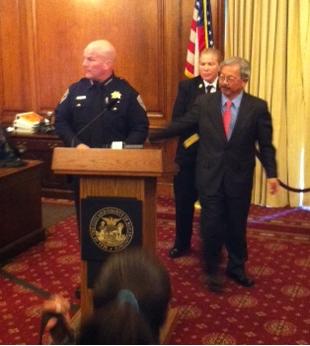
Reporters packed into the Mayor’s Office for a photo op with a good samaritan who recently helped rescue an injured truck driver, clearly waiting for the chance to interview Lee and Police Chief Greg Suhr about last night’s aborted police raid on the OccupySF encampment, asking repeated questions seeking to clarify Lee’s confusing political doublespeak before his communication staff shuffled him out of he room after about 10 minutes.

“I, like all of you, were watching in somewhat of very big deep concern as I saw things unveiled in Oakland, certainly in constant communication with not only our chief of police, Chief Suhr, but also all of our departments to say that’s not what we want to happen in San Francisco,” Lee began. “We’re trying to enforce all the laws here, and of course it’s public health stuff that we’re emphasizing. We need to make sure our public spaces are clean and healthy, and to protect their First Amendment rights. But we didn’t want to get into a situation where we’re just busting heads because then it’s all lost.”

Yet neither Lee nor Suhr could articulate why they think Oakland’s raid turned so violent or how to guard against a similar fate here in San Francisco, particularly because they reiterated their position that the encampment must go and held open the possibility that another police raid – there have been two so far, the second more violent than the first, and the camp has only grown in size since then – could come at any moment.

They also offered shifting explanations for last night’s massing of SFPD troops in riot gear in buses on Treasure Island, which protesters believe was turned back only because of the huge presence in the camp, which included five members of the Board of Supervisors and various labor leaders, a group that Lee says he would be meeting with shortly after the event (“We’re seeing if they’d like to propose some additional solutions,” Lee said).

When asked about plans for yesterday’s raid, Suhr initially said it was simply a normal Wednesday evening training exercise. “There were that many police amassed last Wednesday, there will be that many police amassed next Wednesday. Wednesday is a standard training day for the Police Department,” Suhr said.

But when reporters expressed skepticism – many aware of the busloads of police in riot gear massing on Treasure Island, the last minute changes in police staffing schedules, and the notices of possible police activity sent to businesses around Justin Herman Plaza – Suhr said police were preparing to either assist in Oakland or deal with trouble from OccupySF.

“Out of deference for what was going on in Oakland, we felt that the more pressing need was whether we needed to assist Oakland and/or whether that situation was going to come to us,” Suhr said. “I didn’t say it was a training exercise, we took advantage of the presence on what was training day and to train to what we may have to do down the line.”

Lee also raised the concern that violent agitators might come to San Francisco: “They had to get ready for what they saw in downtown Oakland. They had to get ready for hundreds of people coming to San Francisco, either walking over the bridge or coming through the BART system. So they were trying to get ready for that particular activity because we didn’t know what was going to happen. We saw a lot of anger and a lot of frustration by people who wanted to come over to San Francisco and we didn’t know what their intention was.”

But reporters noted that Lee ordered OccupySF to take down its encampment two weeks ago, that he told reporters this week that they must do so “within days,” and that Suhr circulated a memo in the camp yesterday entitled “You are Subject to Arrest” if they didn’t heed city codes regarding overnight camping. Given all that, we again asked if there was any intention to go into the camp last night?

“That was not our intention, but I’ve always asked the chief to be ready. I’ve been insistent that we have to be ready to enforce our laws so he’s been under that instruction for quite some time. But the tactical decisions are the chief’s responsibilities,” Lee said.

Yet later in the press conference, after Lee had left the room, Suhr made it clear that the decision about if and when to stage another raid on OccupySF is the mayor’s. “Make no mistake about it, Mayor Lee is in charge of this situation,” Suhr said.

In fact, when we asked Suhr about this constant threat of a violent police raid in the middle of the night hanging over the protesters – which is a wearying distraction from the main economic justice purpose at best, and at worst what some protesters told us was akin to psychological warfare – Suhr said that even he didn’t know when a raid might come.

“There’s nobody more anxious that I am because I don’t know when the raid is coming either, so I can attest to the fact that it makes me anxious. We are working painstakingly and patiently to make sure that area is safe and sanitary,” Suhr said.

But while Lee insists that dialogue and compromise could still avert another crackdown, he refuses to accept that occupation is a tactic that protesters aren’t likely to abandon anytime soon. So Lee’s insistence that the camp be broken down seems to be putting the city and OccupySF on a collision course that most members of the Board of Supervisors – including those sponsoring resolution urging the city to allow overnight camping – fear could be a disastrous stain on the city.

“Our message to OccupySF is we’re still wanting you to comply,” Lee said. “That’s been the consistent message we’ve been sending clearly these last couple weeks…We’re trying to ensure that [the ban on] overnight camping is still enforced, but also respecting their rights to protest.”

I and other reporters tried to push Lee on the potentially harmful standoff he was creating, and he tried to make it sound as if the OccupySF movement could avoid another police crackdown, something he said depends on protesters submitting to his demands.

“It’s optimistic on our part that we would get some sensible minds who want to help us find a way to clean up the area, because that ultimately what we want to do,” he said.

But for all his statements of support for the Occupy Wall Street movement and stated desire to avoid the violent confrontation in Oakland, he refuses to allow tents on the site.

“There’s a fine line between occupying public space within your First Amendment rights and sleeping overnight and causing health conditions that we’ve been very concerned about. So we’re going to take it step by step,” Lee said. When asked about whether tents would still be allowed if the camp was clean and otherwise compliant, he said, “We’re still saying no tents.”

So then when and how will you be enforcing that, reporters kept asking.

“Let’s see what can voluntarily be done through the dialogue that trying to establish. We’ve given them a lot of notices. I want to be sure that if we have to do things to enforce our laws, that we’re quite justified and that everybody knows,” Lee said.

Yet that was the same stance that Oakland Mayor Jean Quan took, and it’s one that she is reportedly backtracking on in the wake of the violence and international condemnation. And Lee couldn’t explain how a crackdown might go differently in San Francisco, particularly none that OccupySF has grown larger and more empowered by defying Lee’s edict for so long.

“Everyone agrees that we don’t want to Oakland situation to happen here,” Lee said, at which point Press Secretary Christine Falvey said he would take only two more questions.

“We’re putting a responsible burden on the occupiers to work with us so we can avoid situations like Oakland,” Lee said. “They have to take responsibilities for what they’ve done.”

“Frankly, it sounds like you’ve said nothing, and I think some other reporters are feeling the same way,” KCBS reporter Barbara Taylor, the senior journalist stationed at City Hall, said with a tone of exasperation. “So can you just outline, when you say to do the right thing, what is the right thing? Do you expect them to voluntarily take down the tents, clean up the camp, only be there within certain hours?”

“Yes. The right thing for them to begin showing responsibility,” Lee responded.

“But what does that mean?” Taylor persisted.

Lee said they need to clean up the camp, saying that “cleanliness has been our number one concern….They have to show signs that they’re willing to work with us.” But the protesters have been diligent about regularly cleaning the camp, and they have complied with other city requests such as no open flames. And when the city refused to make porta-potties available at night, supporters of the camp rented four of their own after the city and its daily newspapers complained about public urination and defecation.

“I’ve said all along that public safety is our number one concern,” Lee said.

Fire Chief Joanne Hayes-White reinforced Lee’s point, complaining about open flames, car batteries, and generally “unhealthy and unsafe conditions.” When we noted that the protesters have already addressed and abated many of these issues in recent days, she admitted that she hasn’t been to the site recently, but said, “The tarps and the tents are not something we’re going to tolerate.”

Suhr made it clear that police action would be done in support of other city departments who ordered hazards to be abated. As for when and how officers would do so: “If we believe we could go into the camp safely, if we think we can go in and support the agencies that will be doing the cleanup, without having to go past a measured response, we would do that,” Suhr said. “That opportunity did not present itself last night.”

And so the standoff continues.

Guardian editorial: Let OccupySF and Oakland stay

5

With all of the police raids and arguments over messages and demands and tactics, it’s easy to forget that the Occupy Wall Street movement has a clear political point — and it’s right.The movement is about the devastating and unsustainable direction of the American economy, about the fact that a tiny elite controls much of the nation’s wealth, that virtually all of the income growth over the past 20 years has gone to the very top, about the collapse of the middle class and the rise of economic inequality that would have been unthinkable a generation ago. Those are the central issues facing the United States, the state of California and the cities of San Francisco and Oakland today — and instead of trying to crack down on the protests, city officials ought to be endorsing the occupy movement and talking about cracking down on the financial institutions and the wealthy.

A few things worth noting:

1. The protesters are almost entirely nonviolent. Although there have been a few isolated incidents in Oakland and SF, the overwhelming majority of the thousands of people at Justin Herman Plaza and Frank Ogawa Plaza are actively promoting and insisting on nonviolence. This is not a crowd that is a threat to anyone.

2. The city of San Francisco’s citations — reported without question in the daily newspapers — about health and sanitation problems are way overblown. The OccupySF protesters are making extraordinary efforts to keep the place clean. When the city failed to live up to its promise to provide portable toilets, the protesters ordered (and paid for) their own. As state Sen. Leland Yee (not known as a crazy radical) noted after a visit Oct. 26: “While hundreds gathered, there was not one incident of violence. If the interim mayor thinks there are health issues, I certainly didn’t see them.”

3. The SF Mayor’s Office and the police have made no serious effort to work with or negotiate with the protesters. Even the five supervisors who arrived Oct. 26 (and good for them) when there were rumors of a police action, had no idea what the cops were up to — and Police Chief Greg Suhr wasn’t responding to their phone calls. It’s the equivalent of psychological warfare; protesters have to be on edge at all times for fear of a crackdown that may or may not come.

4. Mayor Jean Quan made a bad mistake sending in the cops to roust Occupy Oakland. Nothing good at all can come of any further police eviction action.

Frankly, we don’t see why the protesters — who are well-behaved, represent no threat to anyone, and are doing a huge civic and national service by bringing attention to an issue that the powers that be in Washington, Sacramento and (sadly) San Francisco have largely ignored — can’t stay where they are. If there are health issues, let the Department of Public Health work with the occupiers. If there’s a problem with a portable kitchen, let the Fire Department show the protesters how to run it safely and legally (there are portable cooking devices at every street fair, in dozens of food trucks and in probably 100 other places around town).

The people at OccupySF and Occupy Oakland have done an amazing job of building a safe, respectful and inclusive community. They are the political heros of 2011. If there’s anyplace in America where the movement ought to be allowed to grow and thrive, it’s here in the Bay Area.

Guardian editorial: Let OccupySF and Oakland stay

18

With all of the police raids and arguments over messages and demands and tactics, it’s easy to forget that the Occupy Wall Street movement has a clear political point — and it’s right.

The movement is about the devastating and unsustainable direction of the American economy, about the fact that a tiny elite controls much of the nation’s wealth, that virtually all of the income growth over the past 20 years has gone to the very top, about the collapse of the middle class and the rise of economic inequality that would have been unthinkable a generation ago. Those are the central issues facing the United States, the state of California and the cities of San Francisco and Oakland today — and instead of trying to crack down on the protests, city officials ought to be endorsing the occupy movement and talking about cracking down on the financial institutions and the wealthy.

A few things worth noting:

1. The protesters are almost entirely nonviolent. Although there have been a few isolated incidents in Oakland and SF, the overwhelming majority of the thousands of people at Justin Herman Plaza and Frank Ogawa Plaza are actively promoting and insisting on nonviolence. This is not a crowd that is a threat to anyone.

2. The city of San Francisco’s citations — reported without question in the daily newspapers — about health and sanitation problems are way overblown. The OccupySF protesters are making extraordinary efforts to keep the place clean. When the city failed to live up to its promise to provide portable toilets, the protesters ordered (and paid for) their own. As state Sen. Leland Yee (not known as a crazy radical) noted after a visit Oct. 26: “While hundreds gathered, there was not one incident of violence. If the interim mayor thinks there are health issues, I certainly didn’t see them.”

3. The SF Mayor’s Office and the police have made no serious effort to work with or negotiate with the protesters. Even the five supervisors who arrived Oct. 26 (and good for them) when there were rumors of a police action, had no idea what the cops were up to — and Police Chief Greg Suhr wasn’t responding to their phone calls. It’s the equivalent of psychological warfare; protesters have to be on edge at all times for fear of a crackdown that may or may not come.

4. Mayor Jean Quan made a bad mistake sending in the cops to roust Occupy Oakland. Nothing good at all can come of any further police eviction action.

Frankly, we don’t see why the protesters — who are well-behaved, represent no threat to anyone, and are doing a huge civic and national service by bringing attention to an issue that the powers that be in Washington, Sacramento and (sadly) San Francisco have largely ignored — can’t stay where they are. If there are health issues, let the Department of Public Health work with the occupiers. If there’s a problem with a portable kitchen, let the Fire Department show the protesters how to run it safely and legally (there are portable cooking devices at every street fair, in dozens of food trucks and in probably 100 other places around town).

The people at OccupySF and Occupy Oakland have done an amazing job of building a safe, respectful and inclusive community. They are the political heros of 2011. If there’s anyplace in America where the movement ought to be allowed to grow and thrive, it’s here in the Bay Area.
 

Quan’s legal advisor: “Which side are we on?”

The scene in Oakland was calm and peaceful around 9 p.m. last night as some 2,000 occupiers met in the amphitheater outside Oakland City Hall at Frank Ogawa Plaza. In sharp contrast with the war zone-like scene the previous evening, police did not mobilize to try and put a stop to the massive and highly organized general assembly meeting. Protesters have vowed to reconvene at 14th and Broadway at 6 p.m. every single day to continue organizing using a consenus process.

The night before, police in riot formations threatened “serious injury” if protesters did not disperse and assailed them with projectiles and blasts of teargas. But spirits were high as a fence blocking Frank Ogawa Plaza came down and the occupiers regrouped in the square, which they’d renamed Oscar Grant Plaza.

According to some news reports, Oakland Mayor Jean Quan had a change of heart. “Clearly, a decision was made last night not to involve the police,” Attorney Dan Siegel, a legal advisor to Quan, told the Guardian.

“My sense of things is that the city as a whole made a conclusion that it did not want to have another confrontation with Occupy Oakland.” Siegel said that when he was at City Hall in the early evening Oct. 26, before the General Assembly got underway, he was challenged by protesters who were angered by police actions the night before. “I said I didn’t agree with the decision of the police to break up the encampment,” he explained.

“I thought the police overreacted and committed actions of improper violence.”

In the heat of the confrontation, he even said he would think about resigning as Quan’s legal advisor.

But Siegel added that he hoped Quan was coming around. “I’ve been trying to convince her and others that there’s a different paradigm at issue here,” he said.

Instead of focusing on inconveniences and city ordinances about camping overnight in public parks, he said, Oakland could be taking the perspective that “we are really in a situation of crisis in the United States … and the Occupy movement is a response to that. It is very likely to be a longstanding movement.”

He added that problems could be mitigated without involving police or using force. “As a city and as individuals, which side are we on?” Siegel said.

The Guardian sent messages to Quan’s office a short time ago to find out what the mayor’s intentions are regarding Occupy Oakland, whether instances of police violence are being investigated, and whether the city planned to meet with Occupy Oakland organizers. We haven’t yet heard back.

How about Scott Olsen Plaza?

14

Occupy Oakland changed the name of Frank Ogawa Plaza; it’s time for OccupySF to do the same.

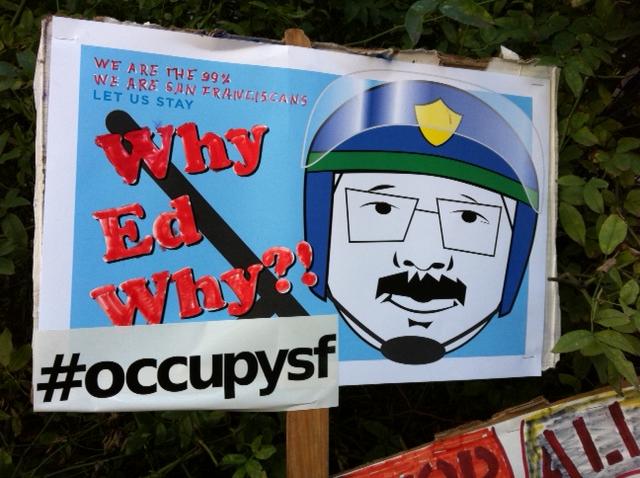
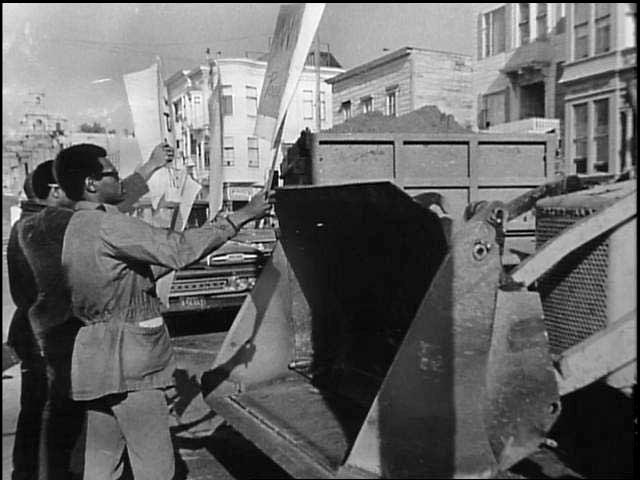
The place where the protesters are gathered is named for Justin Herman, the notorious director of San Francisco’s Redevelopment Agency in the terrible days of the 1950s and 1960s, when “redevelopment” meant removing black people from the Western Addition and removing poor people, particularly Filipinos, from South of Market and later the International Hotel. Herman once famously said that the SOMA land where he wanted to build hotels was “too valuable to permit poor people to park on it.”

In the 1960s, the battle against redevelopment was one of the defining political struggles in San Francisco, bringing Asians, African Americans, white progressives, young community organizers, affordable housing and tenant activists, poverty and civil rights lawyers … just about the whole spectrum of the city’s left. It’s been the subject of books and movies. The people who fought Justin Herman are part of a long political thread in San Francisco — as is OccupySF today.

I’ve always thought it was an abomination to have a downtown plaza named after a guy who did so much to destroy San Francisco. Maybe from now on we should all call it Scott Olsen Plaza.

How OccupySF thwarted a police raid

9

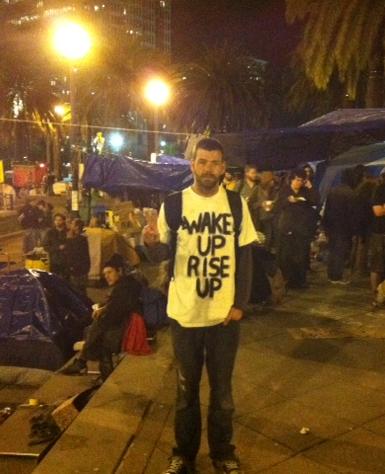
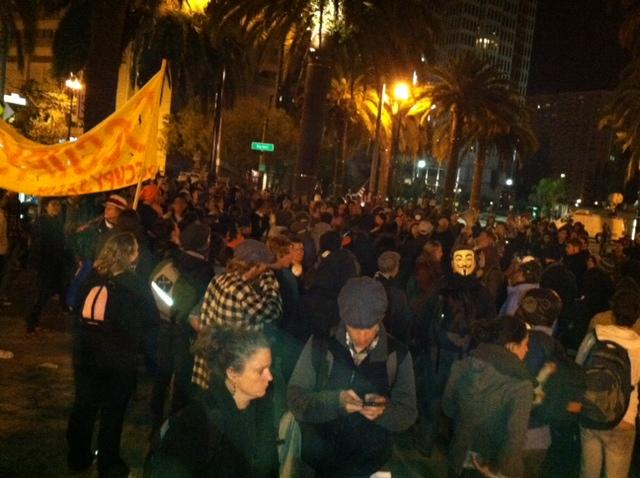
More than 1,000 people amassed at the OccupySF camp last night based on word that police would be raiding the camp. At 4:30 am, there were still 500 gathered in Justin Herman Plaza when OccupySF organizer Ryan Andreola finally announced: “We just got a report from an official police statement that the raid has been called off because there were not enough police for the number of people here,” as the crowd erupted in applause.

It was the end of what was for many protesters a long — and remarkably successful — day. Word began circulating of possible police altercation at 6 a.m. October 26, when police passed through the encampment handing out notices titled “You are subject to arrest,” which claimed that the protest was in violation of several city and state laws and had become a public health hazard.

On Oct 19, city officials had communicated to OccupySF that they would provide portable toilets, but a week later had not followed through; to deal immediately with public health concerns, protesters acquired them on their own.

Around 8:00, having received various tips and seen a document warning nearby businesses of police activity that night, OccupySF put out a call for supporters, saying police raid was confirmed. Justin Herman Plaza officially closes at 10 p.m., so protesters mobilized to be ready for an attack then.
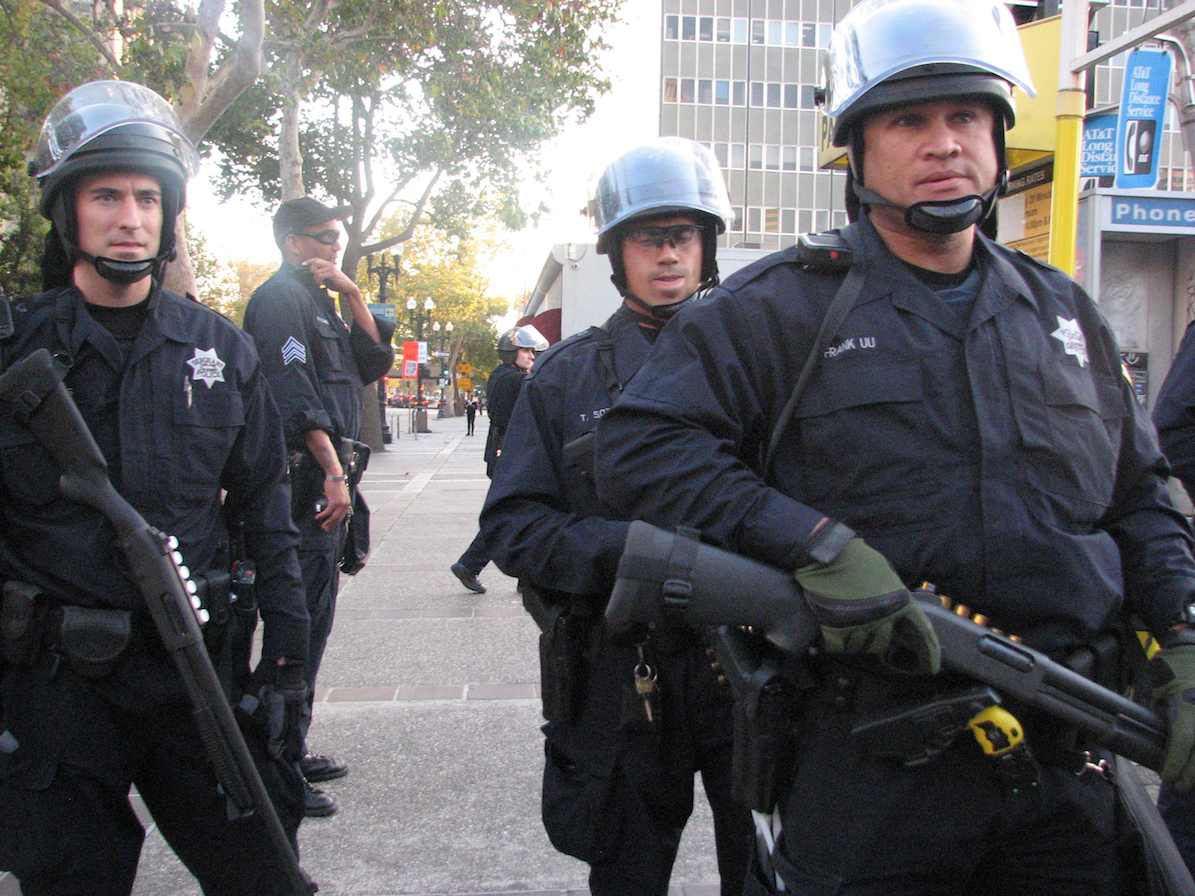
At 9:00, hundreds of people were at the encampment and were meeting about tactics in case the raid occurred. For the next several hours, as hundreds more continued to pour into camp, supporters practiced formations to defend the camp and separate those who were willing to risk arrest from those who weren’t.

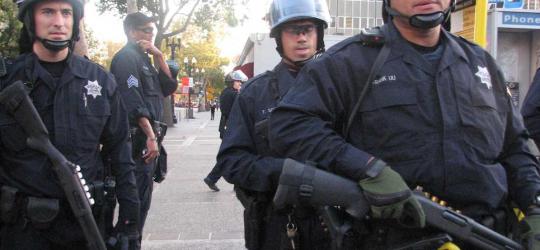
At 9:30, photos began circulating social media of scores of police in riot gear waiting with six muni buses near the police operations building in Potrero Hill. Many feared that they were gearing up to descend on Justin Herman Plaza.

Different groups, including a group of clergy, SF Labor Council representatives, a meditation circle and groups practicing blockade formations met throughout the camp. Drum circles continuously pounded, and the Brass Liberation Orchestra jammed throughout the night.

Nurses and medic volunteers distributed materials to protect from and relieve the effects of tear gas, and National Lawyers Guild volunteers scoured the camp making sure protesters had their legal hotline phone number. Talk of the violence and mass arrests at Occupy Oakland that had happened the past few days permeated the group.

The BART stations closest to the OccupySF and Oakland camps were closed last night due to “civil disturbance,” but many supporters still crossed the Bay to swell the OccupySF ranks.

At 10:00, between 500 and 600 people had gathered at the camp. Protesters danced to the constant music and chanted political cries to the beat: “This system has got to die, hella hella occupy!”

Others waited in defense formation around the camp. After spotting Supervisor John Avalos, many began imploring him to sit down in the ranks, which he did.

As the night went on, sightings of police with buses continued. Some protesters joked, “the police are on the way, but they’re taking Muni so it will be a few hours.”

At 12:40, though much of the camp’s kitchen supplies and food had been moved offsite, protesters continued to serve free food. A young man serving up salad and bread gestured to several cases of food, saying “this has all been donated within the last hour.”

At 1 a.m., the group had reached its peak numbers. All sides of Justin Herman Plaza were blocked by masses of people, who also spilled out into the street on Steuart and Market, attracting virtually all passers-by into the crowd. Organizers urged supporters to stay prepared, but as one woman emphasized on a bullhorn “Remember, 99 percent means we are all individuals. It’s your choice how you respond.”

At 1:30, an impromptu speak-out began as protesters, amplified by the Peoples Mic, explained who they were and why they were there that night. Ten minutes later the group decided to allow a makeshift press conference, giving a formal space for five city officials present to speak.

Supervisors John Avalos, Jane Kim, David Campos, David Chiu and Eric Mar, along with state Senator Leland Yee, professed their support for OccupySF and commitment to protecting it from raids. The group was met with mixed responses. Many cheered their support, and one woman said, “I’m from Oakland and I wish Oakland supervisors had done what San Francisco supervisors have done tonight.” Others were less receptive, crying “I don’t trust you!” and “remember, these are the same supervisors that helped pass sit-lie!”

After the politicians finished speaking at 2:00, many supporters left the camp. One man declared, “I’m glad they came, but they do not represent us.”
About 30 minutes later, new reports were coming in that police were massing at Treasure Island. Protesters surveyed their drastically reduced numbers, and voted on what new formations to practice. As the group discussed, drummers punctuated each point, keeping energy high.

Protesters organized new strategies, but by 3:38 there was still no sign of cops. Representatives of labor organizations began a spontaneous rally, speaking to why they supported OccupySF. Mentions of Occupy Oakland’s vote to call for a general strike on Wednesday November 2 circulated, and one labor rep recalled the 1934 general strike.

At 4 a.m., hundreds were still awake and prepared in the camp. Said protester Robert Duddy, “I’m tired. I stayed up last night until 5:30 after getting the notice that we might be evicted. I think they’re trying to wait us out and have our numbers dwindle.” Duddy added that he did not expect the police to show up that night.

Won-Yin Tang wasn’t convinced. “I won’t feel [that we’ve won] until 7 a.m. when they’re not waiting in riot gear anymore. We have to stay focused. When everyone leaves, that’s when they’ll come.”

At 4:30, the long-awaited announcement of victory came. The crowd cheered, and many headed to nearby Muni stations, now open for the morning. Said protester Sam Miller, waiting exhausted in Embarcadero Station, “Tonight was a great triumph of the human sprit. It was the middle class showing we can’t be beaten down anymore. We’re not the zombies that they think we are.”

Protester Sean Semans also celebrated. Said Semans, “We won tonight. Now we just have to sure, if we need to, we can do the same thing tomorrow.”
Staying up until 5 a.m. on weeknights is no easy call to action. But it seems thousands throughout the Bay Area are willing to step up to the plate.

Big victory for OccupySF, Occupy Oakland reconvenes after crackdown (VIDEO)

36

(UPDATED/CORRECTED AT 11:30 AM)The Occupy movements in San Francisco and Oakland reportedly scored big victories last night, with huge numbers of people overcoming police crackdowns and the shutdown of public transit stations, turning back city efforts to clear the OccupySF encampment and voting in the General Assembly in Oakland to call a general strike for Nov. 2.

We’ll have a full reports later today. Occupy Oakland protesters showed up outside a cordoned-off Frank Ogawa Plaza to figure out how to respond to the previous day’s aggressive police raid, which made national news and left Iraq War veteran Scott Olsen in the hospital with a fractured skull after apparently being hit by a tear gas canister or some other projectile fired by police.

In San Francisco, Mayor Ed Lee and the SFPD threatened to shut down the OccupySF encampment over alleged public health problems – which the movement tried to address by bringing in their own porta-potties because the city refused to provide them at night – but the camp swelled with supporters. Among them were mayoral candidates John Avalos, Leland Yee, Jeff Adachi, and David Chiu, as well as Sups. Jane Kim, Eric Mar, and David Campos.

Video by Rebecca Bowe

They spoke to the crowd around 2 a.m., expressing their support and saying that neither police nor Lee had responded to requests for information about the city’s intentions. Other notables on the scene included writer Rebecca Solnit, SF Democratic Party Chair Aaron Peskin, Shawn San Liu of the Chinese Progressive Association, and local labor leaders Tim Paulson, Gabriel Haaland, and Mike Casey. Spirits were high, and protesters were ready to link arms and form a human blockade in the event that police showed up.

SF police reportedly massed nearby in the early morning hours, preparing to clear Justin Herman Plaza, and there were rumors that hundreds more were on the way. BART stations in the area were shut down to prevent more arrivals, while police in Oakland also reportedly stopped protesters there who tried to cross the bay to support OccupySF. But the raid was then reportedly called off because police were outnumbered and possibly to avoid a repeat of the violence and mass arrests that have plagued Oakland since the decision to clear the encampment there, and protesters sent out jubilant messages of victory.

Check back later for video and eyewitness details of what went down, from the the Guardian’s Rebecca Bowe (who contributed to this report) and Yael Chanoff, as well as information on what comes next. Or follow the Oakland live stream here or San Francisco live stream here.

Unknown Mortal Orchestra returns to the Bay, digs Dolores Park

0

No one could have predicted what was about to happen when Ruban Nielson uploaded a single  track – the fuzzy, undeniably catchy “Ffunny Ffriends” – to Bandcamp in late 2010.  A mere 24 hours later, Pitchfork had seized upon “Ffunny Ffriends,” posted the song on its site, and bloggers were going nuts for the new project, Unknown Mortal Orchestra.

When Nielson recorded the track that launched a thousand blog posts, he’d essentially given up any serious pursuit of a musical career. The New Zealand native had resigned to a job as an illustrator in his adopted home of Portland, Ore., after ending a lengthy stint as guitarist in the semi-successful noise rock outfit the Mint Chicks.

Despite its mysterious lack of identity, live gig offers for Unknown Mortal Orchestra started pouring in. Neilson recruited veteran Portland producer Jacob Portrait to play bass, enlisted wunderkind Julian Ehrlich on drums, then took his pet project on the road. The band ran out of money during the early stages of touring, so Nielson succumbed to relentless courting by Fat Possum and handed his recordings over to the label. With its clear psychedelic influences, glimpses of early Motown soul, and tripped out basement beats, Unknown Mortal Orchestra’s self-titled debut is one of the most entrancing albums of 2011.

When I speak with Nielson, he’s laid out on a friend’s couch, throttled to exhaustion by the rigorous performing schedule of CMJ. “I just need to sleep for, like, four days,” he says. Though he clearly needs it, sleeping for four days is beyond the bounds of possibility for Nielson. Unknown Mortal Orchestra is embarking on yet another national tour, this time bringing up-and-coming shout-pop duo Gauntlet Hair along for the ride. Unknown Mortal Orchestra has already hit up a bunch of local venues this year, and will return next week to play at the Rickshaw Stop on Nov. 3. “San Francisco is maybe our favorite place to play,” says Nielson. “We always go to Dolores Park for some reason and buy drugs and stuff. It seems kind of cheesy, [but] we always end up taking acid.”

Amidst the acid trips and endless touring itinerary, Nielson’s been steadily developing material for his next album. “I just write things down in the notepad on my phone and hum things into the recorder,” he says. The severely fatigued Nielson perks up a little when he tells me the writing of the album is almost complete.

He’s just purchased a house in Milwaukie  (a suburb of Portland), and is setting up a recording studio in the basement. Much of Unknown Mortal Orchestra’s debut was recorded in a similar location. “I didn’t have my own basement,” Nielson explains. “Some friends of mine went on tour and I would borrow their basement.”

“It’s just a nice place to get away from people,” he says. “I feel like I work better by myself.” With his crackly, witchy voice and a talent for arranging weirdly addicting instrumentals, a shadowy underground recording lair seems all too appropriate.

UNKNOWN MORTAL ORCHESTRA
With Gauntlet Hair and Popscene DJs
Nov. 3, 9 p.m., $12-14
Rickshaw Stop
155 Fell, SF
(415) 861-2011
www.rickshawstop.com

With Gauntlet Hair
Nov. 7, 9 p.m., $8-10
The New Parish
579 18th St., Oakland
(510) 444-7474
www.thenewparish.com

Check it: “Ffunny Ffriends”
http://www.youtube.com/watch?v=c-36lCKovBg

Occupy camps don’t create social ills, they showcase them

14

By Anna Lacey

OPINION When I entered the public square off Broadway and 14th on Oct. 17 — the site of the Occupy Oakland camp that police violently broke up this week — I immediately felt dazed by the atmosphere. But rather than seeing the squalor that has been highlighted by city officials and the media, I saw it as a place of real possibilities, particularly from my perspective as a social worker

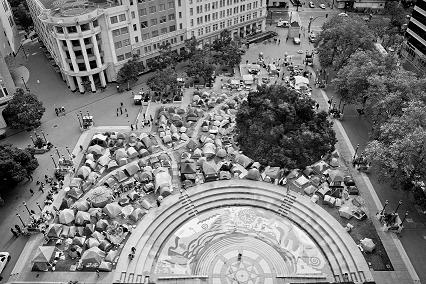
Surrounded by tall buildings, the square is in the heart of downtown Oakland. It felt like I was in a commune of sorts. Walking through the rows of tents, I found myself amidst a sea of commotion; there were children of different ethnicities playing, a crowd was listening to some guy on a microphone talking about political freedom, a marching band was performing, and lines of people were dishing out and receiving free food. The energy in the air was almost tangible.

The police raided the square Monday night, October 24th, arguing that the occupiers were dangerous or directionless substance abusers. They had also been complaining about a rat infestation and other problems and about the camp being a magnet for homeless people. But when I visited the camp several times before it was raided, there were two important points that struck me about what has really been happening in Oakland’s occupation.

First: The occupation did not create new social problems. Instead, the movement has been making existing problems visible. Oakland is a city with an overwhelming crime problem and serious financial woes, a city known by many as “Oaksterdam” because of its many marijuana dispensaries as well as the presence of weed smokers on the streets. It’s a city with rats, gangs, unemployment, and school closures. Existing social problems have become more visible because people have congregated together, largely because they were sick of suffering from social ills in silence and isolation.

It should also be pointed out that the homeless population was in the square before the occupation. Yet only now are they able to receive free healthcare, learn about available social services, and enjoy respite from police harassment. The police were not allowed in the square for two weeks, and participants in the movement voiced extreme pride of the “liberated space.” As one organizer put it, “Here in Oakland we have a history that makes us unable to dialogue with the police. Occupy Oakland is unique due to the legacy of the Oscar Grant movement; we know the police are not on our side.”

It does seem quite clear that, instead of trying to resolve the problems being brought to light in the square, the police would prefer the protesters remain isolated from each other, so as not to bring attention to existing social problems. I suppose a gang of police in riot gear followed by the terrorizing and arrests of almost 100 peaceful organizers is easier, thanks to our flawed governmental system, than responding to the social issues put forth by the public.

Second: The occupation was never a party zone. Quite the opposite, for two weeks the participants functioned as an organized political and social union. By day, various presenters lectured the crowds on such things as the rights and responsibilities of political beings. One evening, several youth spoke of their hopes and dreams, saying things like, “I want to be the future of America, but I can’t if there’s no money to fund my school.”

Dusk would mark the start of the nightly General Assembly, a sort of lengthy debate giving all the opportunity to make propositions to influence the movement. The assembly would last until after midnight, and a 90 percent majority of votes was needed to pass any given proposition. One evening, the General Assembly closed with everyone chanting, “This isn’t Burning Man,” implying the seriousness of the movement and the need to leave the party in the desert.

At the same time, the square was far from utopian. There were a couple of fights, which were deescalated quickly. Another key issue remains how to manage the movement’s ethos of equality while still moving in a unified direction. However, as one organizer put it, “Our power is in the lack of a leader, and our diversity is a blessing. The media doesn’t know how to control the masses.” There are discussions of new occupations to bring attention not only to the recent jailing of many protestors but also to school closures, police brutality, prison hunger strikes, foreclosures, and other social and political injustices.

Obviously, the Occupy Oakland that I experienced was very different than what the media and police accounts would have you believe. I wish I could tell you to come and judge for your self, but unfortunately there is no longer any one identified place to congregate. Instead, following Monday night’s raid and Tuesday’s squirmishes, many involved in the movement have been scattered out on the streets, forced to defend themselves from the police without the sanctuary of a peaceful and supportive liberated space.

Snow Park, along Lake Merritt, originally an extension of the original camp, is currently one meeting place for those involved in the movement. While I think the police’s senseless and heartless behavior has, at least for the time being, destroyed much of the beauty taking place in Occupy Oakland, I still urge you to lend your support. As one occupier told me, “Be a part of the process. It’s not perfect. Then again, if it was so easy, it wouldn’t be worth it.”

Anna Lacey is MSW trainee and therapist with La Clínica de la Raza who lives in Oakland and is working on her master’s in social work at UC Berkeley

Boo ya!

0

culture@sfbg.com

Hell’s bells, our very own high unholy day approaches — and the fact that Halloween’s on a Monday this year means an entire weekend of insane. Oh, why not just make it a whole week. Surely you have a week’s worth of slutty Rick Perry toupee costumes in your closet? Tape ’em on crooked and check out some of the eee-vil events below, from fiendishly family friendly to naughtily “adult.”

WEDNESDAY 26

“Death in Parallel” fundraiser and preview Mission Cultural Center, 2868 Mission, SF. (415)821-1155, www.missionculturalcenter.org. 6:30 p.m.–9:30 p.m., $50. Get your dead on a little early at this sneak preview of the epicenter of SF’s Dia de los Muertos celebration.

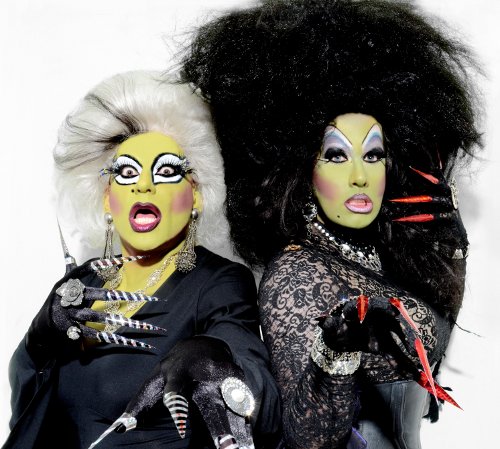
Dream Queens Revue: Halloween Spooktacular Show Aunt Charlie’s Lounge, 133 Turk, SF. www.dreamqueensrevue.com. 9:45 p.m., free. The dreamy weekly drag show goes ghoulish with SF’s sole goth queen, Sophilya Leggz.

THURSDAY 27

“Ann Magnuson plays David Bowie and Jobriath, or, the Rock Star as Witch Doctor, Myth Maker, and Ritual Sacrifice San Francisco Museum of Modern Art, 151 Third St., SF. (415) 357-4000, www.sfmoma.org. 6 p.m.-9:45 p.m., free with museum admission. Fierce hero of the 1980s New York performance underground (and familiar face as sitcom television sidekick-boss-neighbor), Magnuson returns to her fabulous roots in this piece that include incorporate “dreams, Jung, human sacrifice, Aztec shamanism, and all things dark, bloody, and beautiful.” And it’s a costume party! In the SF MoMA! Creativity abounds.

“Halloween! The Ballad of Michele Myers” CounterPULSE, 1310 Mission, SF. www.counterpulse.org. 8 p.m., also Fri/28-Sun/30, $20. Gear up for a drag-studded slasher musical taking cues from “Heathers” and “The Facts of Life,” starring the perfectly horrific Raya Light. She’s a-scary!

Naked Girls Reading: Neil Gaiman Center for Sex and Culture, 1349 Mission, SF. www.sexandculture.org. 8 p.m., $15. Costumes and masks are encouraged at this semi-participatory, all-but-traditional reading of Sandman creator Gaiman’s darker work.

TheaterPop SF: SuperNatural, Red Poppy Arthouse, 2698 Folsom, SF. www.redpoppyarthouse.org. 7 p.m., $10. Local performers skip the tacky underchin flashlights and dry ice for carefully composed, intricate explorations of the macabre.

“Unmasked! The 2011 GLBT Historical Society Gala” Green Room, San Francisco War Memorial, 401 Van Ness, SF. www.unmaskedgala.org. 6 p.m.-9 p..m., $60/$100. A star-studded affair featuring fabulous (of course) entertainment, yummy food, and some of the most revered names in the queer community, including Phyllis Lyon, Jose Sarria, and Armistead Maupin.

Zombie Nightlife with Peaches Christ California Academy of Sciences, 55 Music Concourse Dr., Golden Gate Park, SF. www.calacademy.org. 6 p.m.-10 p.m., $12. The undead are by no means unfashionable — get a zombie makeover, dance with similarly festering folks, sample the latest zombie video games, and listen to a presentation by the Zombie Research Society at the ever-popular, always good-looking weekly Nightlife event at the Cal Academy of Sciences. With Peaches Christ as hostess, it’s a zombie no-brainer.

FRIDAY 28

The Big Nasty: 10th Anniversary Party with Too $hort Mezzanine, 444 Jesse, SF. www.mezzaninesf.com. 8 p.m., $30. A $1000 best costume prize is sure to put the kibosh on those perennially popular nurse get-ups. As if legendary Bay legend Boo $hort, er, Too $hort weren’t enough of an incentive to ditch tired costumes and go as your favorite classic rapper.

Haunted Hoedown, Bottom of the Hill, 1233 17th St., SF. www.bottomofthehill.com, 9 p.m., $10. Rin Tin Tiger and Please Do Not Fight headline the second annual hoedown at this live rock showcase; expect a barn-burner.

Jason Webley’s Halloween Spectacular Slim’s, 333 11th St., SF. www.slims-sf.com. 9 p.m., $14. After once faking his own death at a Halloween show and then disappearing for six months, accordionist Webley’s full-band show this year promises excitement, to say the least.

Night of the Living Shred Club Six, 66 Sixth St., SF. www.clubsix1.com. 9 p.m.-4a.m., $10. This hip-hop and electro throwdown is one where we’ll let the WTF press release speak for itself: “four rooms, five bands, five of the Bay’s best DJs including The Whooligan and Richie Panic, a Paradise Wheels half-pipe and best skate trick contest” — all catered by Mission Chinese Food and Bar Crudo and hosted by two of our favorite people ever, Kelly Kate Warren and Parker Day.

“Rhythm of the 90s” Ultimate Halloween Party Café Cocomo, 650 Indiana, SF. www.fivestarunited.com. 9 p.m.-2 a.m., $45. Break out the Clueless costume and the ketchup bottle; Café Cocomo’s massive dance floor has plenty of room to turn back the clock. Macarena, anyone?

Salem 103 Harriet, SF. www.1015.com, 10 p.m., free. The biggest and scariest name in the witch house dance music movement swoops in from Michigan for a free show, with Tearist, Pfang, Gummybear, Dials and Whitch providing gallows support.

Scaregrove, Stern Grove, 2750 19th Ave., SF. www.sfrecpark.org. 4 p.m.-9 p.m., $8. ‘Tis the season for bouncy castles — bring the kids out for hayrides, carnival activities, a haunted house, and (fingers crossed) funnel cake at the park.

Speakeasy’s Monsters of Rock Halloween Festival Speakeasy Ales and Lagers, 1195 Evans, SF. www.goodbeer.com. 4 p.m.-9 p.m., free. Parties centered upon the theme of good beer never really get old — especially when there are food trucks, live music, and heady costumes.

Sugar Skull Decorating Workshop Autumn Express, 2071 Mission, SF. www.autumnexpress.com. 5 p.m.–6 p.m., $20. Sugar skulls are provided (so you can keep licking away at last year’s) at artist Michele Simon’s decorative exploration of the Dia de los Muertos tradition.

Third Annual Zombie Prom Verdi Club, 2424 Mariposa, SF. www.zombiepromsf.com. 9 p.m., $20. Costume contest, coffin photo booth, live music, and a scary thought: the dancers on the floor tonight may have been doing that move for hundreds of years. Hey, our prom was kind of like night of the living dead, too.

SATURDAY 29

BiBi SF: Queer Middle East Masquerade 4 Shine, 1337 Mission, SF. www.bibisf.org, 9 p.m., $10. The charitable and extremely sultry BiBi SF throws a great party that combines Arabic, Persian, Pan-African, and Latin sounds with hip-shaking belly dancers, lovely drag performances, and an unbelievably hot crowd. All are welcome to this fourth installment of marvelous masquerading.

Club 1994 Halloween Special Vessel, 85 Campton Pl., SF. www.vesselsf.com. 9 p.m.-3 a.m., $18.50 advance.  Sexy electro glamour throwdown for Halloween, anyone? The gorgeous crew behind Blow Up is resurrecting its super-popular, Nintendo-rrific tribute to the pop sounds of the early ’90s (oh yes boy bands and TERL classics!) for a Halloween dress ’em up. With Stretch Armstrong, Jeffrey Paradise, and Vin Sol. The awesome Ava Berlin hosts.  

Circus Center’s Haunted House Circus Center, 755 Frederick, SF. www.circuscenter.org. Tours from 6-7 p.m., show at 7:30. Putting your body in the hands of a practicing student is sometimes not the best idea (see: haircuts, dental exams), but the Circus Center’s students have thrown together an extensive haunted house sure to turn your stomach in only the best way.

Dark Room does Halloween Hot Spot, 1414 Market, SF. 10 p.m., $5. “It’s like Debbie Does Dallas for freaks!” Quoth the undead hosts of this cute monthly queer goth and industrial party at a the little-known but awesome Hot Spot club on Market. Throw on your sheet and twirl. 

Ghost Ship IV: The Afterlife Treasure Island. www.spacecowboys.org. 9 p.m.-4 a.m., $50 tickets (extremely limited) on site. A massive, Halloween-themed arm of Burning Man, Ghost Ship mashes together DJs, art cars, food trucks, a stroboscopic zoetrope, and thousands of people.

GO BOO! Deco Lounge, 510 Larkin, SF. www.decosf.com, 9 p.m.-late, $5. If you want to experience some really sexy underground disco energy with a fantastically diverse crowd, the monthly Go Bang! Party is one of your best bets — this Halloween edition brings in DJ Glenn Rivera and Mattski to join residents Sergio and Steve Fabus of the storied Trocadero Disco. Pop on a costume and hustle on down.

Halloween Freakout with Planet Booty Café du Nord, 2170 Market, SF. www.planetbooty.org. 9 p.m., $12. It’s hard to imagine a more extreme Planet Booty, but this would be the night for it: swap your standard neon unitard for a black velvet version.

Halloween Masquerade with Zach Deputy The Independent, 628 Divisidero, SF. www.theindependentsf.com. 8:30 p.m., $20. Deputy’s “gospel-ninja-soul” provides the soundtrack to an unorthodox masquerade, followed by a free (with ticketstub) Boom Boom Room afterparty.

Halloween 2011: A Red Carpet Runway Massacre Jones, 620 Jones, SF., www.juanitamore.com. 9 p.m., $35. “I prefer the glamour to the gore on Halloween,” quoth ever-poised (even while double-fisting shots) drag ruler Juanita More. Join her at recently opened rooftop bar Jones for dancing and fashionable fun with Djs Delachaux and Sparber, club Some Things hilarious Project Runtover amateur design contest, treats from farm:table and Gimme Shoes, and More, More, More.

“Hallowscreen” cartoon screening Walt Disney Family Museum, 104 Montgomery, Presidio, SF. www.waltdisney.org 11 a.m., 1 p.m., 3 p.m., 4 p.m., 5 p.m. Also Sun/30, Mon/31. $7 adults, $5 children. Catch “Hell’s Bells” and other early, strange Disney shorts that show Walt’s more uncanny side. If you haven’t been to the excellent museum yet, here’s a great occasion.

Horror Costume Party, SUB-Mission, 2183 Mission, SF. www.sf-submission.com. 9 p.m., $4 in costume. Get your gore on with Meat Hook and the Vital Organs; after an earsplitting set, zombiewalk down the street for a taco at Cancun.

Foreverland Halloween Ball Bimbos 365 Club, 1025 Columbus, SF. www.bimbos365club.com. 9 p.m., $22. The Thriller dance is only the beginning at this costume-intensive, 14-piece tribute to M.J. himself.

Jack O’Lantern Jamboree Children’s Fairyland, Oakl. www.fairyland.org. 10 a.m. — 5 p.m., also Sun/30. $10. From juggling and puppets to rides and parades, Oakland’s Fairyland puts on a gentle All Hallow’s weekend.

Lights Down Low Halloween SOM Bar, 2925 16th St., SF. www.som-bar.com. 9:30 p.m., $10 advance. One of the city’s finest, wildest parties brings in bass music star Pearson Sound a.k.a. Ramadanman with DJ Christian Martin, Manaré, Sleazemore, and Eli Glad.

Mansion Madness: Official Playboy Halloween 2011 Mist Ultra Club, 316 11th St., SF. 9 p.m., $40-$80 Find your haunted honey bunny among the bodacious playmate hostesses at this hoppin’ Slayboy event.

Monster Bash on the U.S.S. Hornet 707 W. Hornet, Pier 3, Alameda. www.uss-hornet.org. 7:30 p.m., $25. What better place to celebrate spooks than among the 300 ghosts haunting the crannies of Alameda’s ancient aircraft carrier?

Spooktacular Japantown Halloween Party and Trick-or-Treat Japantown Peace Plaza, Post at Buchanan, SF. www.sfjapantown.org. 12 p.m.–4 p.m., free. Uni-nigiri and candy corn: the perfect combination. Trick-or-treat in the light of day through the Japan Center Malls.

32nd Annual Spiral Dance, Kezar Pavilion, 755 Stanyan, SF. www.reclaimingspiraldance.org. 7:30 p.m., $10–$20 (sliding scale). The witches of San Francisco gather for a huge participatory dance honoring those who have passed.’

Trannyshack Presents: Halloween: A Party DNA Lounge, 375 11th, SF. www.dnalounge.com. 11 p.m., $25. Anything but the traditional drag, the 5th incarnation of Peaches Christ and Heklina’s annual costumed throwdown features a fantastically horrific secret (and “big!”) guest judge. Oh, and the usual genius-creative bevy of outré drag performers, including Fauxnique, Becky Motorlodge, Toxic Waist, and Exhibit Q.

Wild Side West Costume Contest and Party Wild Side West, 424 Cortland, SF. 8 p.m., free. Try not to get your t.p. body cast caught on a shrub in the Bernal hotspot’s beer garden.

Wicked Gay! Halloween Bash Lexington Club, 3464 19th St., SF. www.lexingtonclub.com. 9 p.m., free. The happily hectic Mission dyke bar holds a costume party and contest with live beats.

SUNDAY 30

All Hallow’s Eve DNA Lounge, 375 11th St., SF. www.dnalounge.com. 9 p.m.-afterhours, $13, 18+. Great goth and industrial music parties Meat and Death Guild form an unholy alliance with the gorily titillating Hubba Hubba revue burlesque dancers for what’s sure to be a night to dismember. DJs Decay, devon, Joe Radio, Netik, and more tear you apart on the dance floor

Ceremony Halloween Tea, City Nights, 715 Harrison, SF. www.industrysf.com. 5 p.m.-midnight, $40. The name sounds genteel; the shirtless gay dancing to Freemasons and others will likely be raucous.

Fruitvale Dia de los Muertos Festival Fruitvale Village, Oakl. www.unitycouncil.org. 10 a.m.-5 p.m., free. Oakland’s Day of the Dead festival, falling a bit before SF’s, features dancers, gloriously fragrant food, huge crowds, and, of course, compelling tributes to loved ones who have passed.

Halloween Family Dance Class, ODC Dance Commons, 351 Shotwell, SF. www.odcdance.org. 1 p.m-2 p.m., $5/person, $20/family. Britt Van Hees allows kids and folks who’ve already mastered the Sprinkler to add the Thriller dance to their repertoire.

The Holy Crow Holy Cow, 1535 Folsom, SF., www.honeysoundsystem.com. 8 p.m.-2 a.m., $5. Quaffingly queer electronic music collective Honey Soundsystem throw one of the best weekly parties in the city — the Halloween edition of Honey Sunday should be a total scream, queen. 

Midnight Monster Mayhem, Rockit Room, 406 Clement, SF. www.rock-it-room.com. 9 p.m., $10 before 11 p.m. The live hip-hop dance party (costumed, of course) may well be the perfect nightcap to pumpkin pork stew at nearby Burma Superstar.

PETNATION 5 Public Works, 161 Erie, SF. www.publicsf.com. 9 p.m., $5 before 10 p.m., $10 after. Dance to Fido’s memory — Public Works honors deceased pets with soul-shaking beats, a DDLM art exhibit and a commemorative altar (plus, proceeds go to OccupySF).

MONDAY 31

Classical at the Freight Freight and Salvage Coffeehouse, 2020 Addison, Berk. www.freightandsalvage.org. 6:30 p.m., $10.50 for adults, under 12 free. The Bellavente Wind Quintet breathes chilling strains to a kid’s costume parade and candy-filled celebration.

Halloween at El Rio El Rio, 3158 Mission, SF. www.elriosf.com. 8 p.m., $7. Two Ohioans under the stage name “Mr. Gnome” take over the inclusive, ever-popular dive for Halloween.

Teatro ZinZombie, Teatro ZinZanni, Pier 29, SF. www.love.zinzanni.org. 6 p.m.-11 p.m., tickets start at $117. Tonight might be the one to finally catch SF’s cabaret mainstay, which for a few precious hours transforms into a zombie-laden spectacle.

Viennetta Discotheque: Halloween! UndergroundSF, 424 Haight, SF. 10 p.m., free. One of SF’s cutest underground queer Monday weekly parties will claws you to reel in horror at the frightful fantasticity of its drag denizens. Your body hits the floor with DJ Stanley Frank, Alexis Blair Penny, and Jason Kendig on the decks.


 

24 hours of occupation

1

rebeccab@sfbg.com

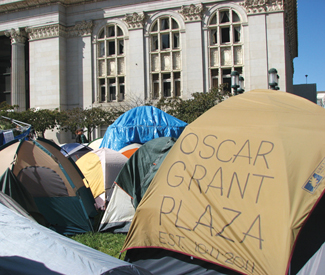
No sooner had I arrived at downtown Oakland’s Frank H. Ogawa Plaza — christened Oscar Grant Plaza by the activists who have established the Occupy Oakland encampment there –than the police showed up.

It was Oct. 18, and the ever-evolving occupation had been going strong for eight days. Oakland City Hall served as a backdrop for the bustling tent village, and the plaza steps were adorned with banners. “Welcome to Oscar Grant Plaza,” one proclaimed. “This is an occupation. We have not asked for permission. We do not allow the police. You are entering a LIBERATED SPACE.”

By press time, a standoff between Oakland police and the 300 to 400 occupiers hadn’t yet occurred, though a clash seemed imminent. City government had declared the autonomous village illegal and issued several eviction notices, citing health and safety concerns, while occupiers had made clear their intentions to stay put.

Around 5 p.m. on Oct. 18, two cops appeared at the camp. They weren’t in uniform, but black polo shirts emblazoned with the words “Tactical Negotiator.” Protesters immediately surrounded them, a customary response to police presence since the encampment was raised. The police said they’d come to “facilitate” a march scheduled to depart from the camp — but the protesters demurred. Occupy Oakland’s General Assembly had not consented to this, they replied.

The impasse didn’t last long, because a group of about 50 tore into the intersection and headed up Broadway. The radical queer march had commenced. “We’re here! We’re queer!” They chanted. “Tax the banks and eat the rich!” Many donned fabulous costumes, and one skinny person clad in form-fitting leopard print carried a sign showing a unicorn bursting from a cage, with the words, “It’s time to break free.”

As the march passed Wells Fargo and Chase, a dozen police vehicles trailed slowly behind, occasionally sounding sirens. Apparently, this was what they’d meant by “facilitating.”

Despite the cat-and-mouse with the cops, the nonviolent demonstration concluded without incident. Protesters returned, flushed and energized, to home base — Occupy Oakland, a vortex of radical defiance against the ills of capitalism that had materialized Oct. 10 and showed no signs of fading. Intrigued, I decided to spend 24 hours there documenting it.


ORGANIZED OPPOSITION

The camp encompassed a lively blend of projects that seemed to have materialized organically. There was a kitchen serving free food, a first aid tent, a media tent where one could power a laptop by bicycle, a free school named for police shooting victim Raheim Brown, an informational booth with stacks of radical literature, a container garden, portable toilets, an arts and crafts space, and a kids’ area. Committees had been set up to tackle safety, sanitation, finances, events, and other duties, replete with color-coded armbands. Regular workshops, political discussions, teach-ins, lectures from notable speakers, and live music performances had all been arranged. Taking it all in, a woman with long gray hair exclaimed, “The ’60s were never this organized!”

Occupy Oakland’s experimental community mushroomed up as part of the wave of encampments established in solidarity with Occupy Wall Street, part of a nationwide movement that has captured the public’s imagination and reinvigorated the left.

“We are reclaiming public space to use as a forum for the people to come together, meet one another, listen to each other, and build power for ourselves,” read a statement on the Occupy Oakland website. “[It] is more than just a speak-out or a camp out. The purpose of our gathering here is to plan actions, to mobilize real resistance, to defend ourselves from the economic and physical war that is being waged against our communities.”

The camp supported a wild and unlikely mix of people united in their disenchantment with the status quo — young and old, black and white, housed and homeless, queer and straight, credentialed and uneducated, vegan and omnivorous — and within this developing space, societal barriers seemed to be falling away.

“It’s an occupation that transcends what it was initially about,” reflected a protester named Miguel. “It’s feeding homeless people, and it’s giving people a place to sleep.”

Protesters didn’t rally around demands. “From my understanding, this is a movement of autonomy, and liberation from … the politics of representation, and the economics of capitalism,” said Bryan R., an organizer who helped plan the occupation. “To engage in dialogue with the power by means of demand is to acknowledge their power over us.”

All decisions were made by consensus in a General Assembly. The occupation had passed resolutions stating that it didn’t back any political parties, supported the Pelican Bay prisoners’ hunger strike, and was in solidarity with striking students and workers.

Rodrick Long, a 21-year-old Oakland native who’d been camped at the occupation for two days when I met him, said he felt he was participating in a piece of Oakland’s history.

“As far as Oakland goes, I just think we need more unity,” he said. “There’s a lot of gang violence, and a lot of poverty. A lot of people don’t show enough that they care about Oakland. But it’s a lot of people here. I didn’t expect this many people to come.”


MANAGING CONFLICT

Occupy Oakland seemed both serious and playful as it journeyed each day toward fomenting the revolution, or maybe just keeping the camp together, depending on who you asked. A tense General Assembly meeting was reportedly held after the city issued the first eviction notice on Oct. 20, and occupiers vowed to hold their ground. But the somber moment broke up when someone kept randomly shouting “Michael Jackson!” — prompting someone to blast the song “Smooth Criminal” over a loudspeaker, sparking an impromptu dance party before everyone got down to business again.

The occupiers were sculpting a self-governed, non-hierarchical mini society in the heart of Oakland as an affront to Wall Street bankers and capitalism itself — a complicated endeavor, to be sure. This was, after all, a mix of perfect strangers, some with mental-health issues (who’d been failed by the very system the occupation was opposing, several people pointed out to me), striving to coexist in a densely populated public park. Illegally.

There were ups and downs. Mainstream newspapers were running headlines about the occupation’s rat problems, television reporters had gotten into tiffs with protesters, and in the hours before I arrived, a man who went by Kali was forced out for starting arguments that eventually came to blows.

The outside world seemed separate from the occupation, though its presence was acutely felt. News vans were parked along the perimeter at all hours of the day, and a live stream sent raw footage directly to the Internet, making the surreal scene feel a bit like a fishbowl.

As night fell, around 150 people congregated in the plaza’s amphitheater for the evening’s General Assembly, which opened with general announcements. Ellen spoke about organizing actions against foreclosures. Jonathan urged a transition from mega-banks to credit unions. Someone proposed expanding the first aid tent into a free clinic that would operate out of an onsite RV. But just as a woman began describing the struggle of revolutionary youth in Uganda, shouts rang out from somewhere in the thicket of tents. Kali was back. Members of the “safer spaces” committee made a beeline toward him to try and deescalate the conflict, while others milled about in alarm and confusion.

Despite mediators’ efforts, Kali went on a rampage, triggering an emergency meeting to determine how best to handle this kind of aggression. Once he departed, however, the encampment’s emotional rollercoaster seemed to wind down.

“It’s up to us to figure out creatively how to maintain the health of this camp,” organizer Louise Michel told me later. “It’s really important for people here to figure out how to problem solve … Everyone has the commitment.”


LOOKING FOR REASONS

Dialogues had been started to address safety issues — but the city of Oakland was highlighting reports of assaults and sexual harassment as reasons the encampment would not be allowed to stay.

Security volunteers were regularly stationed around the plaza perimeter. Tim Simons began his shift around midnight, pacing the sidewalk and gazing out at the deserted downtown Oakland street while maintaining constant communication with his security crew via walkie-talkie.

“It’s been the most intense mixture of people coming together that I’ve ever seen,” reflected Simons, who’d watched the occupation grow since the beginning. “They’re camping here because they want this to become a revolutionary political force. The significant question is: How do we project outward from here? Is this going to become more than just a camp?”

He stressed its significance as a takeover of public space, saying it integrated all manner of people whose lives had been impacted by failed economic policies. Simons also acknowledged the anti-police attitude shared by many occupiers. “In Oakland, it’s really hard to play this game that the police are on our side,” he said. “There’s no real illusion here about what role the cops play.”

That sentiment wasn’t shared by everyone, though. “We’re trying to practice a nonviolent response toward police,” Mindy Stone, who was staying in a tent at the Occupy Oakland overflow camp at Snow Park, told me. “We want to try to make them feel like they are the 99 percent.”

It had been an eventful night. I drifted off to sleep in a borrowed tent, as the banter of people sitting and smoking on park benches floated in.

The next morning was sunny and warm, and the mood of the camp was buoyant. Kitchen volunteers busily prepared food, joking together as they listened to music. Donations flowed in daily from Arizmendi bakery, farmers’ markets, and other generous supporters.

In the arts and crafts area, people were painting a banner to urge people to withdraw their money from major banks by Nov. 5, Guy Fawkes Day. A redhead in a flowing silken outfit wound his way through camp with a garbage bag, asking people if they had pocket trash. A self-defense workshop was in swing, its participants partnered up, giggling, as they practiced holds and blocks.


INCUBATING IDEAS

Dallas Holland was tending wheatgrass, bok choy, herbs, and other edibles in a container garden. “I’ve been overwhelmed with the way the community has come together … It’s amazing to watch this transform into a Mecca of ideas,” she said. “People are having meetings and thinking of ways to perpetuate the movement.” An Alabama native, Holland graduated from college in 2006 and had been unemployed for a year.

Allen Adams, a 37-year-old Oakland native, told me he’d been sleeping outside regularly since before the occupation. “I quadruple up on the shirts. It gets to you,” he said.

He’d had little luck finding work, though he was constantly searching online. With him was Brandy, his well-loved, four-month old pit bull.

“I’ve been struggling all my life,” Adams said. “My dad did, my mom did, my grandmother did. And for what? To have no money.” But he said he was amazed and inspired by the occupation. “I like the fact that people can get together and discuss issues. How can we implement programs to do what California has failed to do? It’s a big task. We’re just working toward betterment. Lasting changes, not just temporary shit.”

Michel echoed these goals. “It’s really bold, and it’s really complex, but no one’s ever lived what we’re trying to do,” she said. “People feel a lot of ownership over what we have here. There’s a sense here of people having each other’s back. Politically, it’s huge.”

During my last hour at Occupy Oakland, David Hilliard, a founding member of the Black Panthers, delivered a speech, driving home the point that the occupation should be organized and focused.

“You’re here, which is a wonderful thing,” Hilliard told the occupiers. “Now we need to have some very basic programs dealing with desires and needs here in Oakland. It can’t be abstract. I can assure you, in a very short time, they’re going to run you out of here. Put something on paper that can help you address the basic desires — otherwise, you’re not going to last long. Get some concrete demands.” *

Parking it

0

CHEAP EATS So they have that classic car show every year in Alameda. It’s a pretty big deal, and Park Street is closed to traffic. The classic cars park in the parking spots, and the people walk down the middle of the road and look at them, and into them, and under the hood.

My own personal interest in classic cars would best be described as D) Nonexistent. But Boink and his dad like to go. They have a whole tradition around it, which ends in pizza. They look at the cars, they eat the pizza. It’s a boy thing. I wouldn’t know.

Except that this particular Saturday I didn’t have any football or soccer or even necessarily baseball to play. And there was an apartment to look at on Park Street, in Alameda. (This was a couple weeks ago, back when Hedgehog and me were still relatively homeless.) So, OK, so, we went.

Hedgehog looked at the apartment without me. We had by this time begun to start to feel almost a little bit paranoid about the fact that no one seemed to want to sublet to us. Not in Berkeley, not in Oakland, not in San Francisco. The day before, we had looked at a shithole in the Tenderloin and, out of desperation, loved it!

But the guy decided to rent to someone else, for no real reason.

“Why?” I asked him on the phone. We had seen the place first. Our credit is perfect. We are clean, upstanding, even accomplished citizens.

“I don’t know,” he said, after a long pause. “No real reason.”

“Oh,” I said. “OK.” Because what else can you say?

This much we knew: it couldn’t possibly be because we are a gay couple, this being San Francisco. So, we decided, it must be me. To wit, that I am too witty. That I am intimidatingly charming, classy-looking, and well-spoked. Technically, I decided this. But Hedgehog agreed to go see the next place by herself. And that was in Alameda. On Park Street. During the car show.

While she was scoping the place out I wandered aimlessly, people watched, car watched, and just generally sat down on a manhole cover. I was hoping to see Boink and his dad, and/or Popeye the Sailor Girl and her mom. I hadn’t seen any of them all since early summer, so was quite unreasonably excited about the possibility of seeing them.

But mostly I saw legs.

Which made me hungry. Then Hedgehog came back and said the apartment was ours for the taking.

Well, hers. But: no tub, no natural light, no me (technically), and it smelled like dude.

“Let’s eat,” I said, standing up.

And then, as if by some sort of cartoon magic, there was Popeye the Sailor Girl, holding her mom’s hand, the both of them looking about as cute as some buttons. What’s more, they were hungry too!

Then Boink and Dad came by, and they were looking cute too, but not hungry, not like us’ns. They just wanted cars and pizza.

Popeye the Sailor Girl and her mom being both gluten free, their favorite restaurant is Burma Superstar. Hedgehog loves Burmese food.

Ergo: our decision was easy. It’s the same place as the one in the city, on Clement Street, only no lines! Not even at exactly lunch time on a beautiful special-event weekend.

I had me some mint chickeny thingy without mint and Hedgehog had duck garlic noodles without hardly any garlic. But to illustrate what a super restaurant Burma Superstar is, both dishes were still good.

And we had the chicken coconut noodle soup, which was especially tasty, of course. It’s kind of like the Thai classic Tom Ka Gai, only eggs instead of mushrooms, which is trading up in my book. Oh, and noodles — which I always thought Tom Ka Gai should have, anyway.

It was so nice to catch up with Popeye the Sailor Girl, and to play Steal Mommy’s Purse with her while her mom was in the restroom.

A delightful time.

A new favorite old favorite restaurant.

And I don’t know about the classic car show but, hey, I like Alameda.

BURMA SUPERSTAR

Lunch: Tue.-Sat. 11 a.m.-3 p.m., Sun. 11:30 a.m.-3 p.m.; Dinner: Tue.-Thu., Sun. 5-9:30 p.m., Fri.-Sat. 5-10 p.m.

1345 Park, Alameda

(510) 522-6200

AE/D/MC/V

Beer & Wine

Playlist

0

FUTURE ISLANDS

ON THE WATER

(THRILL JOCKEY)

Recorded at a quiet waterfront house in North Carolina, the third studio release from Baltimore, Md.’s Future Islands showcases a slower, more refined side of the synth-pop trio. In a sense, it’s a departure from the raw emotional frenzy of last year’s In Evening Air. However On The Water is perhaps its most frighteningly moving release to date. With a powerful, bone-chilling voice, Samuel T. Herring narrates an emotional pilgrimage over lush synth and bass arrangements augmented by cello, violin, and marimba. “The Great Fire” is a haunting duet featuring Wye Oak’s Jenn Wasner. “Balance” is sunny, romantic, and totally infectious. True to Future Islands form, On The Water will pull at your heartstrings and leave you begging for more. (Frances Capell)


TOM WAITS

BAD AS ME

(ANTI-)

Bad As Me (Anti-) opens with the horn blaring “Chicago,” a tough track that chugs forward like a hell-bound locomotive, letting you know straightaway that Tom Waits can still take you by surprise. On “Talking at the Same Time” he’s stretching his voice to a new range. On “Satisfied” he’s growling. On the raving mad “Hell Broke Luce” he’s mocking war with claps, distorted guitars, “Lefts!” and “Rights!” and one shocking couplet after another. Elsewhere, Waits is the old tender dreamer, like on the jazzy “Kiss Me,” for instance. But it’s the concluding “New Year’s Eve” that Waits is at his finest — a simple, touching narrative with a Spanish air. Though not as encyclopedic as Orphans, of course, Bad As Me lives up to all the rowdiness and romance you expect from Waits. (James H. Miller)


THE FIELD

LOOPING STATE OF MIND

(KOMPAKT)

The Field has mastered the craft of using minimal techno’s precise intensity as a launching pad for satisfying waves of spaced out and hypnotic sounds. With Looping State Of Mind it continues to demonstrate how repetition used right can bring you to an ecstatic state of mind. Miniature melodies stretched out in ways that make you want to float as much as they make you want to dance. With slight tension and no clear cut release, it’s a record that keeps you in its groove, while also introducing new found moments of dreamy and slowed down come down after taking you so high. This is what getting lost in an elegant trance sounds like. (Irwin Swirnoff)


SURFER BLOOD

TAROT CLASSICS

(KANINE)

Tarot Classics begins in familiar territory for West Palm Beach, Fla., indie rockers Surfer Blood. “I’m Not Ready” recalls the vocal power-hooks and catchy melodic guitar of 2010’s reverb-soaked debut Astro Coast. “Miranda” and “Voyager Reprise” maintain its retro seaside vibe while showcasing tighter, more ambitious instrumentation. With synthesizers, layered vocals, and jungle-bird samples, “Drinking Problem” finds this quartet venturing into previously uncharted waters. Though it’s a bit more restrained, JP Pitts’ distinctive voice remains boyish, sweet, and slightly morose on Tarot Classics. The four song EP also comes with a distorted, bass-heavy remix by Oakland based one-man project Speculator. Tarot Classics is a brief and tantalizing glimpse into the bright future of Surfer Blood. (Capell)