Nightlife

Live Shots: LGBT Community Center celebrates 11 colorful years

0

Photos by Bowerbird Photography

Last Saturday, the disco ball sparkled from above, while below on the dance floor, party-goers glittered in gold. There was much to celebrate, with the SF LGBT Community Center‘s annual gala “Soiree” celebrating 11 years of sercing the community — and even more to drink, with bottomless bottles of champagne. There were also plenty of sights to drink in, including a few bottomless pairs of pants!

Of course, it was partying with a cause: tickets and auction items went to benefit the Center and their programs. With same-sex marriage equality rights in the balance this week at the U.S. Supreme Court, the Center made it clear that the LGBT community can always depend on them, regardless the outcome. District Supervisors David Campos and Scott Weiner also were in attendance and voiced their commitment to the Center.

Tita Aida worked the stage, introducing one great drag act after the other, including performances by Honey Mahogany, Ambrosia Salad, Miss Rahni, and Alotta Boutte. The theme was Studio 11, explaining why Salvador Dali watched haughtily from the VIP section, as boys in golden spanky pants made their rounds turning eyes. It was a night to remember, or at least a night to try to remember (after all that booze!). Congratulations to the LGBT Center for another year of amazing work and for throwing another wonderful gay-la.


Mr. Marina steals our hearts

7

I couldn’t get a goddamn one of my friends to go with me to the triumphant return of the Mr. Marina pageant, held for the first time this year at that mecca of San Francisco nightlife Ruby Skye. Fools! Luckily, one of them did volunteer their preppy friend Johnny, who picked me up in a Beamer, bought my drinks for the night, wore a seersucker blazer, and after the pageantry was done brought me to an after-party at Ottimista Enoteca where multiple Mr. Marina runners-up were in attendance.

It was basically the perfect evening and my favorite contestant won the damn thing. As he said in our exclusive dressing room interview shortly before recieving his trophy and ceremonial Mr. Marina sash, “you gotta come hang out with guys like us.”

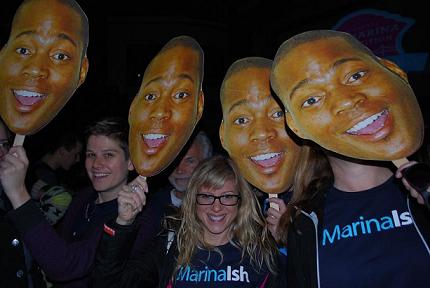
These girls were awesome. They were really hot, were wearing customized Mr. Marina tees, and as far as I’m concerned, were the most memorable part of Jason De La Del Grande’s stab at the throne. 

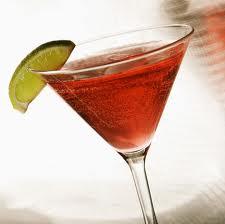
Here’s Johnny, with our drinks from the open bar during the first hour doors were open at Ruby Skye. He’s launching his campaign for Mr. Marina 2014 and I think he’s an early frontrunner for the honor. By the way, those are the “94123” house cocktails made from Sprite and Skyy Infusions Moscato Grape, which as the Daily News will tell you, was inspired by the newfound popularity of moscato wines in the “urban community.”

But only one candidate had people carrying around cut-outs of their face on a stick and that was Ishmail “Ish” Simpson, who pretty much had already won the competition based on the viral video of him making Jay-Z SOMETHIGN. Simpson played football for Stanford, was the only person of color in the whole pageant, and is frankly adorable. Trigger warning: the following clip contains denigrating statements made towards the Mission.


Just some crowd style shots. That’s madras, for the Philistines among you. 

This is NOT a cravat, Johnny told me. It is an ascot. It’s wearer is Baldwin Cunningham, who started what is basically a dating website between people who want to be sponsored and companies like Pabst Blue Ribbon who want to sponsor people. Get you some. 

Did I mention Mr. Marina is all about fighting cancer? The pageant raised $91,000 for the Leukemia and Lymphoma Society, to be donated through a little booster club named Slap Cancer, a moniker that embodies the charming side of the Marina. The gentleman above is wearing a tuxedo Speedo for the swimwear segment of the evening, which was by far the best segment of the evening. 

In the photo above, Alex Schmitt betrays his brutal hotness with the worst talent segment I’d seen up to that point (having watched the rest of the competition, I have now seen much worse.) Mr. Marina expert Andrew Dalton’s sum-up of the contest has many of these other lowlights in his reportage on the evening. Check out Dalton’s missive on last year’s competition for a historical perspective on the event. 

Thank goodness for Ish. His performance of “99 Problems (But an Ish Ain’t One)” was not as good as his video, but as you can see from the dollar bills littering the stage at his feet, who cares. 

More talent segment atrocities. I was pleased, however, that this particular number rescued my perfect record of never going to a San Francisco pageant that did not include a drag queen. 

Shortly after I shot this, the blow-up dolls were made out with, cruelly flung away into the audience and “Ice, Ice Baby” began to play. Obviously.

After that I was so terrified Johnny and I fled to the dressing room, where I got to hear from these two gentleman about how they had bought the exact same pair of white slim-cut H&M jeans to sport in the evening’s final challenge: the impromptu question/Marinawear segment. 

Ish’s blazer apparently made my camera freak out but how goddamn adorable is he? I took this opportunity to sit down with him for a pre-victory one-on-one. He’s really good at interviews, and I found out he moved to the Marina four years ago and now works in tech in the South Bay. In an abridged version:

SFBG Why did you want to be Mr. Marina?

Ishmail Simpson I remember last year I was like, what are you people talking about? And then everyone started telling me I should run. I had all these friends be like ‘Ish, you should do it.’ I had no reason to say no — I mean if I said no that would have been lazy.

SFBG I never really get down to the Marina

IS You gotta come down! Hang with guys like us. (smiles. Swoon.)

SFBG What do you like about the Marina?

IS Number one, the people. We all like the same stuff. All the guys like sports. And the women!

SFBG Would you ever live in a different San Francisco neighborhood?

IS Of course I would. Do I want to? No.

SFBG I asked the people who are carrying your face around on sticks why you should win and they mentioned something about purple pants.

IS (laughs) I always wear colored pants! I probably have pants in a dozen colors. Purple, white, salmon. They must just be remembering the purple.

When Ish was subsequently asked, in his impromptu question spotlight, to finish the sentence “I know I’m in the Marina when…,” he responded: “I know I’m in the Marina when I hear ‘Ish!’ ‘Hey look everybody it’s Ish!” I doubt anyone in the audience doubted the sincerity of that statement. Fate = sealed.

These are all things that Mr. Marina wins but I guess for simplicity’s sake it leaves out:

Complimentary bottomless mimosas at Bin 38 Sunday Brunch for the year of his reign

A pair of Chubbies shorts for every season

Reservations for the back patio at Lightening Tavern with a $250 bar tab

An afterparty at HiFi with a $300 bar tab

$100 to Tacolicious, $100 to Brixton and $100 to Mas Sake

A Mr. Marina drink (shot + beer) of his choice on the menu at Brick Yard

12 months worth of Argoz argyle socks

$250 credit for Ski Tickets from Liftopia

$100 to Ace Wasabi + a round of sake bombs

Basically, when you win Mr. Marina, life becomes worth living. 

When Ish was sashed up (sorry no photos, my camera was hopped up on testosterone and moscato vodka by evening’s end), he thanked “every single man and woman who lives in the 94123,” and shook the judges’ hands. Yes, Mr. Marina 2012, the earnest woman from the Leukemia and Lymphoma Society, the former Dallas Cowboys cheerleader, and Ms California 2004 (fourth runner-up, please note, to Ms USA 2004.)


Afterwards, spirits were high. #MrMarina neon tanktops were donned, the photobooth got a workout, cancer was slapped.

I’ll leave you with this. ‘Til next year, Mr. Marina. I raise my Skyy moscato-and-Sprite to you. 

On the Cheap listings

0

Submit items for the listings at listings@sfbg.com. For further information on how to submit items for the listings, see Picks.

WEDNESDAY 20

1960’s Go-Go Groove Make-out Room, 3225 22nd St., SF. www.1960sgo-go.com. 7pm, free. Bust out those white go-go boots and learn some standard ’60s dance moves like the twist, jerk, pony, watusi, hully gully — even the tighten up! If you’re in need of some liquid courage before you shake it, head over to the Make-out Room at 6pm for some sweet happy hour deals.

THURSDAY 21

“Bold Local NightLife” California Academy of Sciences, 55 Music Concourse, SF. www.calacademy.org. 6-10pm, $12. Art and science converge as the Bold Italic website takes over this week’s Nightlife at the Academy of Sciences. Meet the local merchants, designers, artists, and producers from the ‘hoods we know and love. Folks from Misdirections Magic Shop, bakery co-op Arizmendi, wine delivery service Rewinery, and more will all have tables alongside the alligators, jellyfish, and penguins.

“Growing Pains, The Business of Cannabis in San Francisco” San Francisco Planning and Urban Research Association, 654 Mission, second floor, SF. www.visityerbabuena.org/events 6:30-7:30pm, free. RSVP suggested. SF Appeal editor Eve Batey and writers Heather Donahue and Chris Roberts will explore the state of marijuana in SF, and possible impacts of proposed cannabis legislative reforms. If you have a specific topic or question you would like addressed, email growingpains@sfappeal.com before tonight’s talk.

FRIDAY 22

“Dance Anywhere” Various locations throughout the Bay Area. www.danceanywhere.org. Noon, free. Why wait until tonight to get your groove on? In this global event — offshoots are taking place in major cities around the globe — participants are encouraged to stop whatever they’re doing when the clock strikes 12, and bust a move. Performances by professional dancers will take place at the SFMOMA, City Hall, and Yerba Buena Center.

“PhotographsPlus” Dogpatch Café and Art Gallery, 2295 Third St., SF. www.dogpatchcafe.com. Through May 10. Opening reception 6-8pm, free. This exhibit features local artist Shawn Ray Harris includes three distinct series of works created over the last 15 years. Endowed with a whimsical charm, Harris’ work offers a look into urban landscapes and the creatures that inhabit them.

“Game On” 1AM Gallery, 1000 Howard, SF. www.1amsf.com. Through April 20. Opening reception: 6:30-9:30pm, free. We need not remind you that nerds are the new cool kids. Instead, we’ll let the new show at street art-centric 1AM Gallery lend more evidence to prove the point. Its new group show highlights videogame characters rendered in vinyl doll and canvas by graf artists like Vogue TDK, Estria, and Mike “Bam” Tyau.

SATURDAY 23

Easter egg hunt for dogs Golden Gate Park, Marx Meadow, SF. www.waghotels.com. Noon-2pm, $15. Purchase tickets online. Help your pup sniff out some of the 2,000-plus plastic eggs containing treats and prizes at dog and cat resort, Wag Hotel’s fourth annual fundraiser benefiting local animal rescue organizations. Attendees will also enjoy complimentary hor d’oeuvres and beverages, have a chance to see how their doggie bud feels about the Easter Bunny.

Art Explosion spring open studio Art Explosion Studios, 2425 17th St., SF. www.artexplosionstudios.com. 7-11pm, free. Also Sun/24, noon-5pm. One of San Francisco’s largest art collectives will be holding its 13th annual spring open studio this weekend. Check out work from over 140 artist, painters, photographers, fashion designers, jewelers, and textile designers from around the city.

SUNDAY 24

Backyard Foraging book signing Omnivore Books, 3885A Cesar Chavez, SF. www.omnivorebooks.com. 3-4pm, free. You don’t need to trek into the forest to forage edible plants. Ideal for first-time foragers, Backyard Foraging: 65 Familiar Plants You Didn’t Know You Could Eat by Ellen Zachos features 70 edible weeds, flowers, mushrooms, and ornamental plants typically found in urban or suburban neighborhoods. Head over to Omnivore Books today to meet Zachos, listen to her speak about her book, and get a signed copy.

SF Mixtape Society exchange The Make-Out Room, 3225 22nd St., SF. www.sfmixtapesociety.com. 4-6pm, free. The San Francisco Mixtape Society is dedicated to the art of making and exchanging music mixes. Attendees are invited to assemble a mix according to the theme (this month is “anchors and sails”) in cassette, CD, or USB form. Come ready for newness: a magically random raffle will send you home with someone else’s mix at the end of the night. Record yours in cassette form and score yourself a free drink.

MONDAY 25

Izzies Awards Ceremony Z Space, 450 Florida, SF. www.zspace.org. 6-8pm, free. The Oscars may be over but award season has not come to a close just yet. The 27th Annual Izzies awards will take place tonight, honoring outstanding achievements in dance across the Bay Area. Hosting the ceremony is AileyCamp director David McCauley, and CounterPULSE executive and artistic director Jessica Robinson. After the ceremony, mingle with some dance big shots over dessert and coffee.

TUESDAY 26

French cinema class Alliance Française, 1345 Bush, SF. alliance-francaise-sf.weebly.com. 6:45pm, $5. To help non-French speakers discover French cinema, the Alliance Française of San Francisco is offering this weekly Tuesday night class, which includes a French film screening followed by a discussion. The class will take place in the Alliance Française’s intimate theatre where free wine, refreshments, popcorn (and English subtitles) will be provided.

“Remnants of San Francisco: Pieces of the Bygone City” St. Philip’s Catholic Church, 725 Diamond, SF. www.sanfranciscohistory.org. 7:30pm, $5. San Francisco’s architecture is decorative, meticulous, and often begs the question of passers-by: “what is the story here?” Get that tale tonight as historian Christopher Pollock will present before and after photos of significant architecture around the city, explaining the buildings’ significance and why they were built the way they were.


Should bars be open until 4 am?

44

State Sen. Mark Leno is introducing a bill that would allow (not require, allow) cities to designate areas where bars could stay open and serve alcohol until 4 am. It’s not going to lead to a rampage of all-night drinking — the bill calls for a three-stage approval system that would allow public input at every step. But it might allow a handful of clubs in the city to stay open later — something that works just fine in a lot of other places, including most of New York State.

I grew up in a small town north of New York City (it was called North Tarrytown then, Sleepy Hollow now) and all the bars were open until 4. No big deal; even the hard-core people usually left well before that.

Then I went to college in Middletown, Connecticut, where people think it’s still 18th Century Puritan New England and all bars have to close at 1 am. At about 12:30, everyone would hear last call, chug as much as they could, and spill out onto the streets, and the cops never had an easy time of it.

That’s why, when Seattle considered this, the police department was all in favor.

But already, there’s opposition, some of it from people who just think everyone should drink less — and some of it from Bruce Lee Livingston at Alcohol Justice, whoi usually spends his time trying to tax drinks to pay for the costs of treating alcohol problems.

I didn’t get why Livingston was fighting this, so I called him up — and after we talked about whether the later hours at a small number of clubs in a few parts of the city will lead to more drinking and more problems (he thinks so, citing this; I disagree), he started talking about how dense San Francisco has become and how late-night clubs could harm residents who live near them. “San Francisco is becoming a daytime city,” he said. Sunday Streets, hiking, healthy lifestyles … all of those things conflict for Livingston with the notion of late-night drinking. Between 2 am and 4 am, he said, people “are trying to get some rest.”

Which is an argument against having active nightlife in an area where there are also residences, a major battle for years in San Francisco. But I have to say: The clubs in Soma moved into that area long before there was much of any residential use, and the condos came later — and I’m sorry, but when you move into a place next to a nightclub, you can’t expect silence at night.

I think with all of the tech workers who work unusual and long hours, this is becoming MORE of a late-night town. I hope so. We’ll see.


Ay, muchacha

1

marke@sfbg.com

SUPER EGO Can’t talk long, chicas grandes, I’m winging off to Oaxaca to dance with some gorgeous muxes, hike up lost pyramids, dive into cauldrons of darkest mole, and wooze along to the ethereal, chromatic-marimba sounds of son istmeño, one of my favorite musics in the world. (If I don’t come back, give my turquoise witchy retro-’70s thrift store jewelry to Juanita More, to distribute to wee drag newbies in need as she sees fit. And somebody play an accordion by the light of the equinox moon, because.)

Did you know that Oaxaca has one of the largest concentrations of pipe organs in the world? I did not. It’s a meta-calliope! In any case, I’ll need you to represent hard at the following parties, since I Mexican’t. See y’all in Abril.

DEEP EAST

The deep house domination of the East Bay continues with this new weekly, put on by some of pretty damned good DJs: Mo Corleone, Indy Niles, Alixr, and Nackt. Mo tells me they’re meaning to attract “house enthusiasts looking for something fresh (and maybe a little bit raw).” I’m so down.

Thursdays, 9:30pm, free. Lounge 3411, 3411 MacArthur, Oakl. www.lounge3411.com

THREE-NIGHT ELECTRONIC EXTRAVAGANZA

Maybe there could be a better name for this thingie, but if you’re bonkers for that poppy yet sensual tech house sound that’s dominated the past four years and helped form an accessible corrective to corporate EDM — well, your head’s about to explode. Kindly remove your fedora! Rebel Rave Thu/14 (not really a rave) with Art Department and Damian Lazarus, Detroit’s Seth Troxler Fri/15 with Cosmic Kids, and Israeli cutie Guy Gerber Sat/16 with Cassian. ‘Nuff said.

Thu/14-Sat/16, various prices, 9pm-late. Public Works, 161 Erie, SF. www.publicsf.com

AFROLICIOUS

Our favorite weekly Latin soul and Afro funk party, headed by those too-cute McGuire brothers, just released a zazzy album of live music, which is awesome. Check out the full band to celebrate, well, life and everything. You must dance to the beat of the drums.

Fri/15, 8pm, $15. Great American Music Hall, 859 O’Farrell, SF. www.gamh.com

BACK TO LIFE :: BACK TO REALITY

Vogue for life! The original dance form (not so much the Madonnified version) is back in full swing — here’s the second vogue ball this month. This time around there won’t be much shade, as our local representatives of the mighty House of Aviance (plus NYC’s fearsome Icon Mother Juan Aviance) present this showcase ball. Open to all newbies and welcoming of everyone, it should be a real hoot. Check out the link for the competition categories and bring it like a legend. With DJs Gehno Sanchez, Sergio, and Steve Fabus — and appearances by Vigure and Tone, Manuel Torres Extravaganza, many more.

Fri/15, 8pm, $10. Abada, 3221 22nd St., SF. www.theAdance.com/ball

GREG WILSON

One of the absolute greats of DJing returns from the UK to bring his pitch-perfect electro funk and old-school soul, seasoned for three+ decades, to the lovely Monarch’s tables. Maybe this time the club’s lighting system won’t project an error screen onto him for half his incredible set? That was neat for a minute, then weird.

Fri/15, 9pm-3am, $10–<\d>$20. Monarch, 101 Sixth St., SF. www.monarchsf.com

“HOOCH, HARLOTS, AND HISTORY: VICE IN SAN FRANCISCO”

I can tell by the title that this gathering was simply made for you. Super-cool old-timey event with complimentary native drinks pisco punch and 21st Amendment beer, plus “tales of dubious moonshine, dirty roadhouses, and nefarious characters” told by scene players like Broke-Ass Stuart and Woody LaBounty. Live music, rare film footage, and a gaggle of real characters for sure.

Thu/14, 6:30-9:30pm, $10. Old Mint, 88 Fifth St., SF. flipsidesfvice.eventbrite.com

THE QUEEN IS DEAD: THE SMITHS VS. SUEDE

The name says it all for this installment of the stylish yet dour monthly Morrisseypalooza. And with both Suede and Johnny Marr pimping new albums, it’ll be a twee bloodbath. They will play “Suedehead”? They must play “Suedehead.”

Sat/16, 9pm, $5–<\d>$8. Milk, 840 Haight, SF. thesmithsvssuede.eventbrite.com

Supervisors approve Western SoMa Plan, rejecting expanded office development

145

The Board of Supervisors today approved the Western South of Market Community Plan, the first step to ending a development moratorium that has been in place since the citizen-based planning process that developed the plan began in 2005, but not before some supervisors made a last-ditch effort to allow more office development and nightlife.

“I have real concerns over the plan,” Sup. Scott Wiener said as the plan came before the full board for the first time, continuing an effort to modify the plan that he began a few weeks ago when it was before the Land Use and Economic Development Committee.

While some of Wiener’s colleagues echoed his concerns and those raised by the business and entertainment communities, most decided to defer to the area’s Sup. Jane Kim and the Western SoMa Task Force that developed the plan. It was approved on a 10-1 vote, with Wiener in dissent. It will guide development and set land use rules for the Western SoMa area after being approved on second reading by the board next week.

Wiener led the critique of the plan’s restrictions on office development in most of the plan area, particularly around the transit hub of 4th and King streets, concerns that were echoed by Sups. London Breed and Malia Cohen, likely indicating that the business community has been lobbying supervisors on the issue.

But Kim said she is concerned about the area’s artists, nonprofits, and light industrial businesses – dubbed Production Distribution and Repair (PDR) in the city planning code – being squeezed out if the area is opened up to more office development.

“Office space is hot right now and it’s pushing out PDR uses,” Kim said. “Zoning is an importance tool, otherwise everything will turn into offices in South of Market.”

Wiener, Breed, and other supervisors also sounded their support for the entertainment community that has lobbied for changes in the plan, winning greater protections for nightlife at earlier hearings – including a ban on residential development on the raucous 300 block of 11th Street and persuading owners of “the purple building” to switch from residential to office – pushing for removal of more of the plan’s restrictions on attaining limited live music permits.

“I also have some real concerns with how the plan treats nightlife and entertainment,” Wiener said, while Breed said, “As a big supporter of the arts, I’m concerned there are limited live performances in the plan.”

Kim noted that the plan tried to strike a balance in the conflict between nightlife and housing, and she said that expanding the ability business in areas zoned Regional Commercial District (RCD) shouldn’t be done in just in a part of town where there conflicts have often been difficult to resolve.

“If you’re going to permit it in the RCD areas, it should be citywide rather than just in Western SoMa,” Kim said, noting that she’s open to futher discussions after the plan is approved.

Sup. David Campos and other supervisors urged their colleagues not to tinker with the compromises and hard-won balance in the plan. “I’m not 100 percent happy with every aspect of the plan, but I do think some deference should be given to the district supervisor,” Campos said.

Wiener agreed that deference to the desires of district supervisors is an important consideration, “but there are times when this board does not vote the same as their supervisors,” citing as an example the board’s approval of the controversial 8 Washington luxury condo project over the objections of Board President David Chiu.

Afterward, Terrence Alan of the California Music and Culture Association, which had lobbied for expanded protections of nightlife, told us, “Entertainment as a whole fared well.” But he said that they would continue pushing for greater citywide nightlife protections, including supporting Wiener’s proposal to expand the limited live music permits to include DJs.

Trip history

0

SUPER EGO As Maria von Trapp sang at the climax of The Sound of Music, “Whenever the goddess closes a rave cave, somewhere she reopens a gay leather biker bar.”

That sad closure is upon us, as the wonderful 222 Hyde (www.222hyde.com), the city’s thumping bass-ment in the Tenderloin, wings into history. Owner EO emailed me a couple Saturdays ago to tell me he was closing the precious, risk-taking little venue due to pressure from the ABC state liquor board over a license technicality and uncertainty about cooperation from the 222 building’s new owners. In short: sucks.

But EO’s off to pursue his musical destiny — he killed it playing live at Robotspeak at Saturday’s Lower Haight Art Walk — as one half of upcoming analogue electronic duos Moniker (with Kenneth Scott) and Polk and Hyde (with Jonah Sharp). And you can say farewell to the lovely space, rumbly Turbo Sound system, twinkly LED dance floor ceiling, and gorgeous staff this week: a special guest superstar (cough DJ Fark Marina cough) is supposed to drop by Thu/7, the As You Like It crew brings in Dutch techno wiz San Proper on Fri/8 (9pm-2am, $20) and 222 hosts a huge closing blowout on Sat/9 (10pm-late) full of surprise guests, gushing tears, and yummy pizza. The space itself has an amazing history — as the “Three Deuces” from the 1940s-’60s, it played hst to jazz greats and wild gals. Whatever it becomes now, 222 will live 444 ever in our raving hearts.

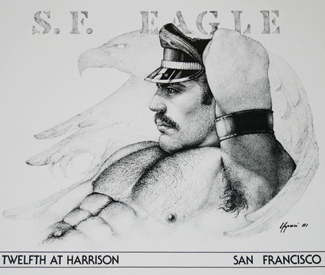
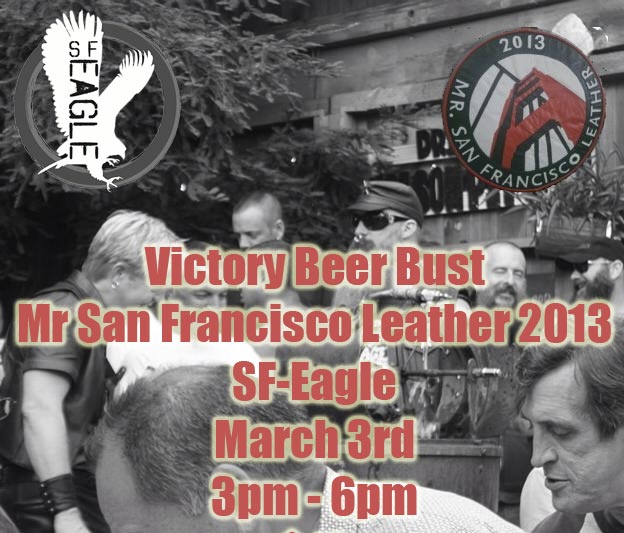
Throwing open its gay SoMa leather biker bar sash, however, is legendary rock ‘n roll watering hole SF Eagle (www.sf-eagle.com), reopened after a final passing grade on inspections last weekend, just in time for a Sunday beer bust of epic proportions — and 45-minute-wait lines — celebrating the victory of our new Mr. SF Leather, Andy Cross. (The true crown, I heard, went to anyone who made it through the four-hour Mr. SF Leather competition.)

I latched on my Nasty Pig kneepads and checked out the space (and the returned staff!) on Saturday night, and happily found myself there all Sunday as well. New owners Alex and Mike, inheriting the gutted space once slated for a pizza restaurant, have really opened it up by exposing the vaulted ceiling of the interior, pushing the main bar against the wall, and removing the trees from the patio (sad face). Everything is painted semi-gloss black — it looks like a beerhall designed by Anselm Kiefer. Although the mirrored bar is a wee bit ultralounge and there is as of yet no crusty, comfy decor, that good ol’ Eagle spirit is alive and well-drink drunk.

The beer bust was roiling delightfully with grateful scruffs and old school fetishists. Indie kids will rejoice at the return of Thursday Night Live on Thu/7 (8pm, $7, www.tinyurl.com/thursnightlive) with bands Beard Summit, the Galloping Sea, and Reliic, hosted by the Eagle’s ace music programmer Doug Hilsinger. (The space’s new layout is perfect for live music, and more regular parties will pop up soon, I’m sure). The Eagle reopened on the final weekend of fabulously festive Hayes drag dive Marlena’s, set to become another concept bar eesh, and the tail end of Soma’s fetish-friendly Kok Bar, also closing very soon. It’s a bittersweet trade-off for sure. Meet me at the Eagle’s patio trough and we’ll commiserate.


STACEY HOTWAXX HALE

I am freaking the funk out that Detroit’s own Godmother of House is going to vibe up the Housepitality weekly’s dancefloor — along with Chicago legends Gene Hunt and CJ Larsen? Try to pry me away!

Wed/6, 9pm, $5 before 11 p.m., $10 after. F8, 1192 Folsom, SF. www.housepitalitysf.com


DJ PIERRE

Following the Godmother of House comes the Godfather of Acid, one of the ones who started it all, Chicago Afro-Acid pioneer Pierre, whose sets are blissful rollercoasters to another, darker side.

Fri/8, 8pm-3am, $15. 1192 Folsom, SF. djpierre.eventbrite.com


DELHI 2 DUBLIN

Kick off your weeklong St. Patty’s Day binge the bhangra way, as great monthly Non Stop Bhangra brings in this beloved five-piece live band, a true multiculti mashup that meshes the Celtic with the Indian. Somehow, it works splendidly.

Sat/9, 9pm, $15. Public Works, 161 Erie, SF. www.publicsf.com


PARIS IS BURNING

“Shoot and arrow and it goes real high, well good for you.” SF’s Mistress of the Gay Night Peaches Christ and formidable NYC queen Patrice Royale host a screening of the all-the-rage-again 1990 doc and a vogue ball to die for. It’ll be an ex-travaganza.

Sat/9, 8pm, $22. Castro Theatre, 429 Castro, SF. www.peacheschrist.com


On the Cheap listings

0

Submit items at listings@sfbg.com. For further information on how to submit items for listings, see Picks

WEDNESDAY 6

RayKo’s sixth annual plastic camera show RayKo Photo Center, 428 Third St., SF. www.raykophoto.com. Through April 22. Opening reception: 6-8pm, free. You’d never these cameras’ non-pro status by the breathtaking images they are capable of creating. Highlighted in this year’s RayKo show is LA-based artist Thomas Alleman, who began using a Holga camera in 2001 to document the aftermath of 9/11. His dreamy, dramatic prints perfectly pinpoint the dysfunctional beauty of these toy cameras.

“Beyond THC: Cannabidiol and the future of medical marijuana” Commonwealth Club of California, 595 Market, SF. www.commonwealthclub.org. 5:30pm, $12 members, $7 students, $20 nonmembers. Martin A. Lee, author of Smoke Signals — which focuses on the social history of cannabis — will be speaking about the benefits of cannabidiol (CBD), a non-psychoactive component of marijuana that lacks the “high” effect of THC and contains key medicinal benefits. Lee will discuss how the medical marijuana industry has responded to the discovery of CBD and sign copies of his book afterward.

THURSDAY 7

Robot NightLife California Academy of Sciences, 55 Music Concourse, SF. www.calacademy.org. 6-10pm, $12. This beloved weekly museum soiree delves into sci-fi this evening with a focus on robots. Managing director of Silicon Valley Robotics will speak to the local innovation and commercialization of robots and Academy curator Gary Williams will show off footage of deep-sea corals from Pillar Point Harbor. A robotic performance by art group Survival Research Labs and exceptional designs by robot design studio BeatBots are also on tonight’s schedule.

“Art Star” Otis Lounge, 25 Maiden Lane, SF. www.otissf.com. 10pm-2am, free. If you’re looking to submerge yourself into the city’s art community, head over to Otis Lounge to meet and network with artsy individuals at this monthly first Thursday event. Whether you make, buy, sell, or just love art, all creatives are welcome.

Community dinner St. Cyprian’s Episcopal Church, 2097 Turk, SF. www.saintcyprianssf.org. 7pm, free. Hungry, cash-strapped health nuts listen up. This free dinner created from USF’s garden and local farmers markets is open to everyone and anyone interested. The event lacks any motivation beyond a heartfelt effort to bring the community together through wholesome food.

Writerscorps Live with Tamim Ansary Contemporary Jewish Museum, 736 Mission, SF. www.sfartscommission.org. 6:30-7:30pm, free. Award-winning youth writing program WritersCorps has partnered with the CJM for a multi-generational live reading. Author Tamim Ansary will read from his memoir West of Kabul, East of New York, based on his family’s immigration from Afghanistan to San Francisco. The reading will also showcase WritersCorps teaching artist Minna Dubin and students from Downtown High School, Aptos Middle School, Mission High School, and more.

First Thursday with OM Cocktails Hang Street Gallery, 567 Sutter, SF. www.hangart.com. 6-8pm, free. Organic mixology — premixed in the bottle? Will wonders never cease. Check out this brand’s coconut-lychee cocktails and more at Hang Street’s First Thursday reception.

FRIDAY 8

East Bay Bike Party, location TBA. 7:30, free. eastbaybikeparty.wordpress.com. It’s time to go green, literally. The theme of this month’s East Bay group rideout is the favored color of enviro-fans and Kermit the Frog alike. Whether you want to channel your inner leprechaun or bike around as giant pot leaf, the possibilities are endless. If you’re a Bike Party virgin make sure to also look over the code of conduct to help keep the event as community-friendly as possible.

SATURDAY 9

White Walls gallery 10th anniversary show White Walls, 886 Geary, SF. www.whitewallssf.com. Through April 6. Opening reception 7-11pm, free. Town’s best-known “urban art” gallery hosts this retrospective of a decade of boundary-breaking work within its wall (kind of — the gallery recently moved to a larger space on Geary Street). Check out works from Shepard Fairey, ROA, Apex, Ferris Plock, and of the best who have plied works there.

“Doctors on Board” Oakland Marriott City Center, 1001 Broadway, Oakl. www.pmfmd.com/doctors-on-board. 6am-6:30pm, free to students. Application required. The Physicians Medical Forum is hosting a day of workshops and skills training session helping African American students to attend medical school and residency programs. Prominent physicians will provide information about medical school preparation, medical specialties, and life as a physician.

“Quilt San Francisco” Concourse Exhibition Center, 635 Eighth St., SF. www.sfquiltersguild.org Also Sun/10. 10am-4pm, $10 for two-day pass. This two-day exhibit, organized by the San Francisco Quilters Guild, vividly showcases the revitalization of the traditional art form. 400 quilts and special exhibits will shown the many artistic dimensions of wearable art and modern stitching. There will also be a children’s corner, where kids can get marching orders for a treasure hunt that will lead them to special quilts in the show.

Irish-American children’s hour of music, song and dance San Francisco Public Library, Fisher Children’s Center, 100 Larkin, SF. 11am, free. www.sfpl.org. Crossroads, an annual Irish-American festival timing to open up St. Patrick’s Day season, invites the kiddos to learn traditional Irish dance taught by instructors from the Brosnan School of Irish Dance.

Fourth annual World Naked Bike Ride Meet at Justin Herman Plaza, Market and Embarcadero, SF. www.worldnakedbikeride.org. 11am-4pm, free. Protest global dependency on oil and find out what its like to pedal through Fisherman’s Wharf in the buff. All are welcome to take part — even clothed riders — but those in the buff earn extra badass points, given the uncertain status of the ride under the city’s new anti-public nudity ordinance.

“Permutation Unfolding” Root Division, 3175 17th St., SF. www.rootdivision.org. Opening reception 7-10pm, free. Bring the kids to the opening of this group exhibition exploring the biomorphic formations that can spring from the artistic process (we’re not sure what that means either.) There will be an all-ages creativity station, a perfect place to craft while Markus Hawkins spins an auditory web in an 8pm performance.

SUNDAY 10

Exploratorium’s On the Move Fest Mission District location: Buena Vista Horace Mann School, 3351 23rd St., SF. 11am-4pm, free; Bayview location: Bayview Opera House Ruth Williams Memorial Theatre, 4705 Third St., SF. 11am-4pm; Embarcadero location: Pier 15, 11am-10pm. www.exploratorium.edu. All locations offer free admission. Everyone’s favorite on-hiatus science museum is sending 10 trucks tricked out with the kind of wacky, hands-on exhibits its know for to the Mission, Bayview, and the Embarcadero for a day of science, music, and food. In both Bayview and the Mission, enjoy itinerant filmmaking, projects that encourage attendees to sport costumes and act out a special script which will then be chopped, screwed, and shown to the public.

TUESDAY 12

“Stars of Stand-up Comedy” Neck of the Woods, 406 Clement, SF. www.dannydechi.com. 8pm, $10. Comedian and pencil musician (exactly what that means we are not quite sure, please report back if you go) Danny Delchi is hosting tonight’s show. Long-time Niners field announcer Bob Sarlatte and the quirky Mr. Mystic will be performing alongside a number of other top Bay Area comedians.

Persian New Year Festival Persian Center, 2029 Durant, Berk. www.anotherbullwinkelshow.com. What better way to welcome spring than to jump over a bonfire? Head over to the Persian Center to take part in this ritual that has been passed down since Zoroastrian times. Accompanying the fiery activity will be Persian food, music, and dancing.

Burning leather, dark marketplace

0

This Saturday, there is a mindblowing dark electro underground happening called PSYCHIC DIMENSIONS. Profligate is one of the many artists scheduled to appear. Slightly NSFW.

“Listen to the water drops, a little bit of microdot …”

0

Longtime acid crunk pusher an-ten-nae has a hit on his hands with super-trippy “Raindrops on Roses,” featuring the appropriately named Alice D. on vocals. Here’s the rabbit-hole sparkle-pony rave-to-grave video. 


Wiener’s dance mix: more DJs mixed with fines for “bad actors”

7

DJs could proliferate in San Francisco’s bars, restaurants, coffee shops, and plazas under legislation that Sup. Scott Wiener introduced today to include DJs under the city’s limited live music permits, but the legislation also includes new enforcement powers to crackdown on underground parties and other unpermitted events.

Limited live music permits – which are far cheaper and easier to obtain than the city’s full-blown Place of Entertainment permits ($385 compared to around $2,000 for the POE permits) – were created in 2011 by legislation sponsored by then-Sup. Ross Mirkarimi, allowing amplified performances until a 10pm curfew. But DJs were left out, despite their prevalence in San Francisco, something Wiener is now trying to correct.

“Entertainment and nightlife are an essential part of San Francisco’s cultural and economic vibrancy,” Wiener said today in a press release announcing the proposal. “This legislation fosters live entertainment while also heightening our ability to monitor and regulate bad actors.”

It’s that last part that doesn’t sit well with everyone, particularly given San Francisco’s pervasive culture of throwing underground parties, which are key fundraising tools for grassroots efforts such as Burning Man camps but which are the targets of periodic crackdowns by the SFPD and other agencies. It seems that when it comes to nightlife, we always have to take some medicine whenever City Hall offers a spoonful of sugar.

The legislation would give the Entertainment Commission the authority to levy $100 fines to those involved with unpermitted parties, either in established clubs or underground warehouses, whereas now the commission only has the authority to punish those who have permits for violating them.

“Punishing a DJ playing at a party in which the promoter didn’t get the proper permits (perhaps unbeknownst to the DJ), would be unfair and inappropriate, in my opinion,” was how DJ/Promoter Syd Gris from Opel Productions and Opulent Temple reacted to the legislation.

But Entertainment Commission Executive Director Jocelyn Kane told us she doesn’t expect to fine an DJs. While she asked Wiener for those enforcement powers, they are simply a way of encouraging promoters and business owners to get permits. “We’re not into punishment, we’re into compliance,” she said, adding that this is simply seeking authority to do administratively what the SFPD and California Alcoholic Beverage Control Administration can now to criminally and civilly.

Tom Temprano, president of the Harvey Milk LGBT Democratic Club and a DJ/promoter at the popular Hard French parties, told us “where I really want clarification is on the new enforcement powers for the commission,” although he agreed with Kane that the commission generally works cooperatively with the nightlife community, far more than either the SFPD or ABC.

“All in all, it’s a really good step in the right direction,” Temprano said of the Wiener legislation. “It seems really positive. As a DJ, allowing DJs to be used for limited live performances is just common sense.”

Kane said the legislation will allow music to flourish in the city, from outdoor plazas to small venues, many of which have used DJs illegally. “We’ll be able to legalize that and bring them into the fold,” she said. “There always have been places that use a DJ like a jukebox.”

In addition to the relatively cheap application cost compared to POE permits, limited live music perhaps are quick and easy to obtain and don’t necessarily require city inspections paid for by the applicant.

In his press release, Wiener praised the importance of nightlife to the city economy and cited a city study he commissioned last year which found that nightlife has a $4.2 billion impact on San Francisco, employing 48,000 people and furnishing the City with $55 million in tax revenue annually.

“We need to encourage a flourishing nightlife that not only marks San Francisco as a cultural capital, but also creates jobs and brings in revenue for essential City services,” Wiener said. “These amendments are part of that broader strategy.”

Western SoMa Plan changed to lessen development impacts to nightlife and Muni

14

The Western SoMa Community Plan had its first hearing before the Board of Supervisors Land Use and Economic Development Committee today, with dozens of speakers praising the eight-year citizen-based planning effort that developed it but with much of the testimony criticizing the plan’s emphasis on facilitating housing development to the exclusion of other goals.

As we’ve reported, the nightlife community has in recent months been pushing for changes to the plan that would better protect nightclubs from complaints and pressure from nearby residents, particularly along 11th Street. Area Sup. Jane Kim has supported that effort and those concerns were echoed by Sup. Scott Wiener, the committee chair and a strong nightlife advocate.

“I have had significant concerns about this plan…and I’m hoping we can address them over the course of this hearing,” Wiener said.

Wiener also opened another front of attack on the plan by noting that it doesn’t adequately pay for the impact that thousands of new housing units would have on Muni and other aspects of the transportation system. In particular, he criticized a policy in the plan that would let 13 large properties get increased density in exchange for higher affordable housing fees that would be offset by lower transit and other impact fees paid to the city.

“What are we doing to make sure our transportation system keeps pace?” Wiener asked of Planning Department staff, later asking again, “Where would we get the money to improve transit for these increased residents?” Wiener didn’t get back any answers that seemed to satisfy him, so he asked for a more detailed report when the plan returns next week for a second hearing. That concern was echoed by the third committee member, Board President David Chiu, who said, “Building housing without money for transit will lead to long-term problems.”

The concern seemed to revive a losing fight that Wiener led in December over expanding who pays the city’s Transit Impact Development Fee, which pitted transportation advocates against affordable housing activists. Fernando Marti of the Council of Community Housing Organizing rued the revival of that conflict. “We’ve been here before, pitting [transportation against affordable housing needs] as if it were a zero sum game,” Marti told the committee, noting the importance of policies to balance out market rate housing and calling it a “plan for stability in a neighborhood facing large-scale gentrification.”

Marti’s COCHO colleague Peter Cohen, who was closely involved with the plan’s creation, also urged the committee not to tweak the housing policies or the revenues it creates for affordable housing. “This is a major upzoning,” Cohen said. “In 20 years, perhaps all the market rate stock [of housing in the plan area] will be gentrified.”

But the issue raised most often during more than two hours of public testimony involved nightlife and the need to strike a better balance between housing development and entertainment, much of the input stirred up by the California Music and Culture Association, a industry-backed trade group that formed largely in response to crackdowns on clubs in SoMa.

“It’s often said San Francisco can plan more for fun, and this is a great opportunity to do that,” said Guy Carson, a CMAC founder who owns Cafe du Nord. Longtime nightlife advocate Terrence Alan took part in the Western SoMa Task Force for four years before resigning in frustration, and he told the committee, “We are bringing up issues we felt marginalized in bringing up earlier.”

But several people involved with the task force, as well as speakers representing development interests, urged supervisors to pass the place without significant modifications. “There are dozens or hundreds of compromises in this plan,” Cohen said, urging supervisors not to upset that careful balance.

Task Force Chair Jim Meko – whose leadership was widely praised in the testimony – detailed the extensive outreach and detailed work that went into the plan, and offered a simple plea to the committee: “Please pass this plan so we can get on with our lives.”

The committee unanimously voted to support the change made to the plan by the Planning Commission to ban new residential development on the raucous 300-block of 11th Street, but to reverse the commission’s decision to grandfather in one final 24-home residential project on that block, in the so-called “purple building” at 340 11th Street. A number of other small changes to the plan were also unanimously approved.

But Kim objected to Wiener’s motion to eliminate the plan provision that would reduce the transit and open space fees and raise the affordable housing fees that developers of those 13 large parcels would pay. “I don’t think it’s good policy to reduce transit impact fees when we’re increasing population,” Wiener said.

“This has gone through an extensive community process,” Kim countered, adding that, “I hate that we’re always having this discussion about transit versus affordable housing.”

But Chiu sided with Wiener and the amendment was approved on a 2-1 vote with Kim in dissent. Yet Chiu held open the possibility of changing his mind next week when the plan returns to committee for a final vote – the delay prompted by the other revisions in the plan – when Planning staff will provide more information on the fee structure and its impacts.

If the committee gives final approval to the plan next Monday, it could be before the full board for approval the next day.

Nite Trax: 222 Hyde is closing :(

11

Oh jeez, sad news this morning from EO, owner of great, actually-underground rave cave 222 Hyde. Due to a change in ownership of the nightlub’s building, and some continued trouble with the ABC state liquor and license patrol, 222 will be closing March 9.

There’s gonna be a huge closing party that night of course! (Stay tuned for details.)

This marks the loss of one of the most truly open-eared venues to come along in a while, a space that had room – well, a little room, at least, that basement dancefloor got packed! — for ambitious electronic experiment as well as balls out crowd pleasers, but always on the cutting edge. The staff is pretty great, too — and the space itself is a historic nightlife landmark. I don’t want to make any grand statements about the blandification of SF nightlife, you’ve heard it all before, but 222’s size insured that lesser-known acts, or ones not so familiar in the US, could perform to a vibing dancefloor, rather than risk the cost of larger venues. (And I regret not making it to some of the recent parties like Wednesday’s “What?!” party and the appearance by Skooz. Next time!)

EO will continue on with his ear-grabbing electronic music production — I wish him and his staff well and thank you for the music! Let’s make sure the next few weeks and the closing party are real blowouts. EO’s message to me after the jump:


Hi Marke,

I have some news regarding 222 Hyde.

Sadly, we are closing our doors. Our last event will be March 9, a farewell party with djs and acts who have been staples at 222 over the years. Lineup to follow, but so far Jeno, Atish, Sleazemore, Polk & Hyde (live), and more to come. The final week we are open will be one for the books, starting with the final Tutu Tuesday March 5, As You Like It w/San Proper March 8, and the closing party March 9.

A few things factored into what is leading us to close. Problems with the ABC (Alcoholic Beverage Control) over a technicality concerning a condition on the license being one of them. Also, the building that houses 222 is also changing hands in a couple months, and the new owners would not be sympathetic to the club or it’s operations. We were lucky to have a great landlord for years and his departure signaled the last sign that it was time to move on.

222 will be remembered as a unique and special place in the SF club landscape, and we know it will be missed. It will live on in everyone’s memory, and there is something to be said for ending on a high note.

Personally, I will have even more time to devote to my first passion, that being producing and performing electronic music on my own, as well as with my collaborators Kenneth Scott (Moniker) and Jonah Sharp (Polk & Hyde). There are a string of upcoming releases on deck and I look forward to having more time to focus on music.

We would love to see everyone at any and all of the last events at the club!

eo

Supervisors consider Western SoMa Plan, lots of new condos, and “the purple building”

129

The fate of the “purple building” – which has become caught up in the clash between nightlife and residential interests on the clubgoer-saturated 300-block of 11th Street – remains undecided as the Western SoMa Community Plan heads into its first hearing before the Board of Supervisors Land Use and Economic Development Committee on Monday.

As we reported in this week’s paper, a unique citizen-based task force has spent the last eight years developing the plan, which will allow thousands of units of new housing – most of it along Folsom Street – to move forward once the plan gets final approval from the board. But the California Music & Culture Association and other nightlife advocates successfully amended the plan to ban new housing on that 11th Street block as the Planning Commission approved it in December.

Yet the commission also decided to grandfather in a 24-home project at 340 11th Street, the so-called purple building, which nightlife advocates say would put those new residents on a collision course with Slim’s, DNA Lounge, and other big nightclubs on that busy block. As we went to press, both sides and District 6 Sup. Jane Kim were all hopeful that a compromise was imminent, likely involving switching from residential to office.

But with just days to go before that hearing, building owner Tony Lo still hasn’t decided whether to make the change or fight it out in front of the supervisors. His architect John Goldman – whose residential design for the site was placed on hold by the city since shortly after he submitted it in 2005 – had hoped to hear by now but he’s still waiting for Lo to make the call.

“Based on my analysis, it looks feasible to change to offices if you want to do it, and I mean feasible financially and architecturally and planning-wise,” Goldman today told the Guardian, referring to what he told Lo.

Meanwhile, Western SoMa Task Force Chair Jim Meko – who has not been supportive of tweaking the plan after all the work he oversaw – yesterday sent out an email blast to stakeholders and supporters urging them to attend Monday’s hearing and show support for the plan.

“You don’t often get a chance to participate in making decisions about your own neighborhood from start to finish. Some special interest groups are expected to come out of the woodwork to take pot shots at the Plan so the hundreds of participants in this process need to make their voices heard. Your testimony at the hearing next week will make all the difference,” Meko wrote.

The hearing starts at 10am in board chambers in City Hall. This item might have been heard later in the day considering the agenda opens with a continuation of the controversial condo lottery bypass legislation, on which Board President David Chiu and others have been trying to forge a compromise between tenant advocates and homeowner groups. But committee Chair Scott Wiener just told us that item “will be continued. No compromise yet.”

Party Radar: Mutant Beat Dance, Safeword, Matmos, Harvey, Frankie Knuckles

0

In my weirder ’90s paisley dreams, all clubs in Montreal look like this. In my weirder 2013 Tumblr dreams all clubs in New York look like this. But I will CERTAINLY take all clubs in the here-and-now looking like the SF quintet of fantasticality that follows. N’est-ce pas?

MUTANT BEAT DANCE

A 100% hardware (no computers!) performance from Chicago duo Traxx and Beau Wanzer — a wiggy bit of electronic body music to blow your mind for sure.With awesome melodic-acid guru magic Touch.

Fri/22, 10pm-4am, $15. Monarch, 101 Sixth St., SF. www.monarchsf.com

FRANKIE KNUCKLES

He is the Godfather of House. I will be throwing down like a clown. That is all.

Sat/23, $10-$20. Mighty, 119 Utah, SF. www.mighty119.com


SAFEWORD

Our hometown techno team is blowing up on a global scale — the dreamy duo of Clint Stewart and Marc Smith, getting bigger every second, will be pumping up the awesome, bass-oriented Spilt Milk party (seriously, the Spilt Milk vibe is casual Cali fun and the music is goood), brought to us by the Mother Records crew. With the great Kimmy le Funk.  RSVP here for free entry!

Sat/23, 9pm, $5. Milk Bar, 1840 Haight, SF. www.milksf.com


DJ HARVEY

The quintessential British exile mystical disco-punk pioneer, who basically showed the current wave DJs how to play whatever they want as long as it sounds good and groovy, will do us right once again. Down the rabbit hole! he’ll be joined by one of my favorite intelligent bass-house purveyors, Falty DL.   

https://www.youtube.com/watch?v=UOdSJFrLSX8

Sat/23, 9:30am-3:30am, $10-$15. Public Works, 161 Erie, SF. www.publicsf.com


MATMOS

Latest album The Marriage of True Minds from the beloved, former SF-dwelling duo is based on telepathy — they projected the concept for the album into the minds of certain participants and wove their responses into the results. It’s surprisingly upbeat and danceable! And it’ll be a great opportunity to encounter some of the bay’s best experimental electronic minds as Matmos plays live.

Sun/24, 8pm-12:30am, $10. Public Works, 161 Erie, SF. www.publicsf.com

Which Noise Pop show is right for you?

0

It’s all about choice, people. Noise Pop is a well-oiled festival machine at this point — now in its 21st year — cranking out dozens of concerts, nightlife happenings, film screenings, culture club events, photography showings, and all that good stuff we’ve come to expect from the homegrown indie fest. But given all those choices for the week of Feb. 26 through March 3, restless souls such as myself always tend to feel a bit well, overwhelmed.

Do I see headliner Toro Y Moi at one of his Independent showcases, or DIIV at Brick and Mortar Music Hall? (Shouldn’t matter much to most; those are all super sold out by now.) Do I squeeze in a Noise Pop Happy Hour after work, before the cozy Sonny and the Sunsets Bottom of the Hill concert or Kim Gordon’s new project, Body/Head at the Rickshaw Stop? How much is too much booze for one week? I can’t answer them all for you (if you want to see a sold-out show, buy a fest badge), but I can help with those pesky last-minute questions that boil down to which show to choose over another, equally appealing event.

The infographic flowchart for this appeared in this week’s issue (pg. 20 of the Feb. 20 Guardian), but for these purposes, I’ll hook you up with a video for each:

Interested in live music? Are you a “members of” type of fan? Do you prefer distorted guitar?
Answer: Kim Gordon’s newest venture, Body/Head. Body/Head is the newest post-Sonic Youth project for Gordon, who teams up with free-noise guitarist Bill Nace to create noisy experimental mindfucks such as single “The Eyes, The Mouth.”
https://www.youtube.com/watch?v=cQ4axZa5ZFo
With Horsebladder, Burmese, Noel Von Harmonson
Feb. 26, 8pm, $17
Rickshaw Stop
155 Fell, SF
www.rickshawstop.com

Are you a “members of” type of fan? Do you prefer analog synth?
Answer: Jason Lytle of Grandaddy. The Modesto-born Grandaddy frontperson and singer-songwriter most recently released heart-tugging solo work, Dept. of Disappearance (ANTI-, 2012).
https://www.youtube.com/watch?v=M0yMQCcU6NY
With Jenny-O, Will Sprott, Michael Stasis
Feb. 26, 7pm, $14
Brick and Mortar Music Hall
1710 Mission, SF
www.brickandmortarmusic.com

Do you like to keep it local? Do you only go to shows if they are free?
Answer: Noise Pop Happy Hour with Golden Void, Wild Moth. San Francisco psych band Golden Void and local post-punk act Wild Moth (check out 2012 EP Mourning Glow, on Asian Man Records) are both acts to know now.
https://www.youtube.com/watch?v=yJC3u_COifo
With DSTVV
March 1, 5pm, free
Bender’s
806 Van Ness, SF
www.bendersbar.com

Do you like to keep it local? Are you willing to spend a nominal sum on live music?
Answer: Sonny and the Sunsets. By now, the band, led by prolific artist-musician Sonny Smith, is a go-to classic for quality SF garage-pop. And yet, last year’s Longtime Companion (Polyvinyl) pumped up the twang.
https://www.youtube.com/watch?v=rbctzd9kW1A
With Magic Trick, Cool Ghouls, Dune Rats
March 2, 8pm, $12
Bottom of the Hill
1233 17th St., SF
www.bottomofthehill.com

Can you get into some ’90s slow jams?
Answer: XXYYXX. Woozy XXYYXX is the creation of 18-year-old Orlando, Florida producer, Marcel Everett, whose beat-driven Relief in Abstract albums, have gotten props from the likes of Kardashian baby momma/Kanye West and the like. Our very own DJ Dials brings the wunderkind West.
http://www.youtube.com/watch?v=lG5aSZBAuPs
With DJ Dials, Teebs, Nanosaur
Feb. 28, 9pm, $25
DNA Lounge
375 11th St., SF
www.dnalounge.com

Extra credit:
There will be a feature story on Noise Pop 21 headliner Toro Y Moi in next week’s issue (Feb. 27). He’s playing two sold out shows at the Independent (March 1 and 2). 
http://www.youtube.com/watch?v=O0_ardwzTrA

And if you’re able to attend any of the other ticket-less shows, there’s also this great one:
Post-punk Beach Fossils side project DIIV, recent On the Rise act Wax Idols, Sisu (fronted by Sandy of Dum Dum Girls), and Lenz.
http://www.youtube.com/watch?v=L702zw6Ilqs
March 2, 8pm, $15 (sold out)
Brick and Mortar Music Hall
1710 Mission, SF
www.brickandmortarmusic.com

Nite Trax: DJ Sprinkles lays it out

32

The phenomenal house DJ and experimental musicmaker on mainstream visibility, transgender globalism, Bay Area queer culture, and the “shopping mall diversity” of the current dance music scene.

Techno has always had room for theorists and intellectuals, from Derrick May to the Mille Plateaux label roster, and social activists, like Moodymann and Underground Resistance. Most of that discourse usually takes place musically, however, with concepts emerging from the vinyl itself. The celebrated DJ Sprinkles, a.k.a. Terre Thaemlitz, the American head of Japan-based label Comatonse, tops all that by making intellectually grounded music glimmering with poetic touches and expounding in interviews and writing on such heady, heated topics as essentialism, gender idenitity, surveillance, and authenticity. She leads workshops, goes on speaking engagements, and isn’t afraid to let loose in interviews. (For example — see below — rather than “born this way” platitudes, she considers her queer identity “beat this way.”) 

It’s a beautiful thing, especially in the rare context of controversial truth and radical opinion pouring from the mouth and keyboard of an outspoken transgender major player on the stubbornly homogenous global house-techno DJ scene. Of course, it all comes down to the music — we’ll get a treat when Sprinkles (who chose the name because he wanted something that sounded “totally pussy” in opposition to macho DJ culture, to buck the testosteronal scene) performs Sun/24 at Honey Soundsystem — and Sprinkles certainly has the goods. He’s released umpteen pieces in an astoundng breadth of genres under multiple pseudonyms over the past 20 years. Masterpiece deep house album “Midtown 120 Blues” siezed the top of several best of 2009 charts and was, typically, followed by Soulnessless, a 30-hour “mp3 album” of music and video. Because why the hell not?

I got a chance to exchange emails with Sprinkles before her appearance here. It’ll be an interesting return to the Bay Area, where she lived for several years before decamping to Japan. Here’s all she had to say.    

http://www.youtube.com/watch?v=UY79cyv8pH8

SFBG It’s been 13 years since you lived in Oakland, is that correct? Can you tell me why you decided to leave and what it was like to live here then, with regards to the music, political, and queer scene?

DJ SPRINKLES Yes, it’s been a long time. I used to live across the street from a hotel where the Unabomber once stayed. Honestly, I can’t say I miss California. I never really connected with any queer or transgendered communities in SF or Oakland. Whenever I tried, they seemed immersed in West Coast spiritualism and zodiac bullshit, which I found completely alienating. Most of the transgendered people I met there were prone to metaphysics — by which I mean they were ideologically (and economically and medically) invested in defining their transgenderism in relation to a perceived split between their “physical bodies” and their “true inner selves.” I’m an anti-essentialist, non-op, materialist, anti-spiritualist… so that clearly wasn’t a match with my own transgendered identity.

There was also a weird conservatism in SF’s queer scenes that I associated with the fact a lot of people in SF had been raised in conservative Midwestern towns, so they were in SF to “live the life.” I felt there was a lot of unacknowledged parody and role play going on — people trying to overcome a life of repression and closets by wrapping themselves in rainbow flag culture. Yet, when going to buy groceries or such, I still found myself being harassed as a “fag” on the street like in any other town in the US. I felt my four years there was all quite standard. I don’t really think of the Bay Area as a “special place” for being queer and transgendered.

US identity politics have a particularly inextricable link to the concept of the ghetto — not only as a place of economic strife and forced communal ostracization from a “white middle-class mainstream,” but also as a self-invested “safe space” for non-mainstream social movements. This is part of migrant culture. For example, after my grandparents passed through Ellis Island, they immediately moved to a place where people spoke the same language as their homeland, etc. The Castro, New York’s West Village, Little Italy, China Town… these are all migrant-based communities formed by people seeking safety in numbers in the face of not being welcome elsewhere — these two dynamics of “safety” and “alienation” are inseparable to most US identity politics. So these communal zones all display the problems and contradictions of cultural identification that plague mainstream US culture as an “immigrant nation” that is simultaneously “anti-immigrant” – because the “immigrant” is a brutal reminder that there are no “real Americans” beyond Native Americans, which the majority are not. And of course, the fact that recent generations of immigrants are primarily people of color does not jibe with conventional black/white US race discourse, which continues to be largely devoid of other browns, as well as the concept of the person of color as a willing immigrant (as opposed to the descendant of a slave). This history and context is peculiar to the US social landscape, and it creates a lot of weird identity essentialisms and hostilities around gender, sexuality, race, ethnicity, class…

Not to say other countries don’t have their own fucked up ways of causing and dealing with social problems, but moving to Japan and realizing that pretty much the entirety of Western identity politics did not function here was a big life experience. It was like leaving the Earth’s gravitational pull — it didn’t mean gravity no longer existed, but almost everything I had internalized and believed I understood about my relationship to gravity was no longer helpful in understanding the dynamics of dominations at work in this other context. I wasn’t freed of gravity, but lost in weightlessness. I had to learn to feel weight in a completely different way. This is why so many of my projects dealing with my own immigration and cultural issues consistently invoke the rather limited and problematic US language of black/white race relations. It is a critical gesture intended to highlight the limitations of my having been raised amidst that US language and social conditioning, yet now living within a non-US context with few tools to work with.

Because music’s value is so often tied to an essentialist concept of racial authenticity, it becomes difficult and risky to ask an audience to question their relationships to the very value systems through which they likely purchased the album – but that is also why I choose to work with audio. Not because of its possibilities, but its all-too-clear limitations. Since I am unable to believe in the authenticity or purity of identities of any kind, when I invoke “identifiable” sounds (a “queer” sound, a “black” sound, etc.) I am doing so to question the social relationships around their construction, proliferation, and distribution. The moment we become lazy about our use of those “identifiable” sounds — the minute we take it for granted that the essentialist associations they have come to carry are unquestionable and real reflections of material social experiences — everything becomes one-dimensional and shallow. This is why almost all music is one-dimensional and shallow! [Laughs.] For example, if I can beat a dead horse, my problem with Madonna’s “Vogue” is not that it was “inauthentic,” but that its terms of discourse misrepresented its relationship to vogueing by actively erasing the very contexts of Latina and African-American transgendered culture that inspired it (via lyrics about “It makes no difference if you’re black or white, a boy or a girl”… it TOTALLY made a difference, and THAT SOCIAL REALITY is where any real discussion on vogueing BEGINS.). So I’m interested in these other directions of audio discourse that cannot even occur if one is preoccupied with conflated essentializations of identity and sound. There is never a true point of origin for anything. It’s all referential and contextual. In my opinion, there is no point in discussions focussing on identifying the source of a sound or style — that is a hopelessly futile exercise, although it is the dominant exercise! It’s a distraction from the real discussions needing to be held, and those are discussions on relations of domination.

As a DJ in the late ’80s and early ’90s, there were a lot of drag queens asking me to play Madonna’s “Vogue” when it first came out. I refused, but I could understand their requests. We all have very complicit and complex relationships to dominations, and a perverse desire to celebrate our visibility within the dominant mainstream, no matter how unfamiliar or distorted that reflection may be… often because we are conditioned to feel so unhappy with what we see in the mirror to begin with. Mainstream visibility is like getting approval of the Father. It’s a mental and abusive process. It is also totally standard. So I get it… But there is also that which remains unrepresented and invisible to most. That which existed, and may have already been lost, but did so without seeking approval of the Father. And again, this is generally not a freed or liberated space, but a space of intense hatred for the Father. These are difficult things to speak of and represent, because any act of representation has the potential to be a violation of the cultural site it wishes to speak of. So to speak of them requires obfuscating or complicating the usual functions of language – not through vague poetry, but unexpected flashes of clarity coming from unexpected vectors.

http://www.youtube.com/watch?v=R2iKF_11WbY

SFBG You left during the first Internet boom I believe, and now SF is in the middle of a second one (although a bit different than the first —  the first wave seemed to have much more geeks and freaks in it, while this one seems much more regimented and Ivy League, even while many longtime residents are still feeling the results of “global recession”). When was the last time you were back here? And what are some of your recent thoughts on how house music is being affected by economic circumstances?

DJ SPRINKLES I was only back once about 10 years ago, visiting friends for a few days. When I moved away at the end of 2000, internet and web development had already undergone a rigid formalization. Years earlier, a web designer did a bit of everything. By 2000, developers were already split into specific teams focussing on interface, coding, page flow, etc… all processes were specialized, departmentalized, corporatized. I hadn’t heard about the “second internet boom” there, but the way you describe it doesn’t surprise me since it would surely be an extension of that regimentation that took place in the first boom.

And in a way, the same can be said of this “second boom” (third?) around house music. In the same way almost all websites have taken on the same continuity and feel, so has electronic dance music. You buy an album, and all the tracks sound similar — as opposed to the old days when an electronic dance track like Donna Summer’s “I Feel Love” was tacked on to the end of an otherwise standard soul-band album that didn’t sonically match it at all. Today’s music consumer experience is much more streamlined and organized, which affects how people produce an album as well. Younger generations — 20-somethings — grew up amidst this homogenization, so I am fairly sure they do not feel what I am speaking of… although they may recognize it as a historical process.

I try to play with discontinuity and mixing things up, like in my K-S.H.E album, “Routes not Roots,” which had monologues and ambient tracks interspersed between house cuts. But I once made the mistake of reading people’s blog comments, and they really seemed upset about this kind of thing. “Way to ruin the mix,” or “Why the fuck didn’t you put that monologue at the end of the album?” They have no patience for non-homogeneity. The same goes for my Comatonse Recordings website itself — people seem utterly confused and helpless. If one doesn’t do everything completely standard and at the same level, people get disoriented. It’s a kind of cultural compression going on, similar to audio compression, where everything has to be “punched up” to the same intensity or people feel lost. What the fuck is so wrong with being lost? Why would you expect — let alone insist — your interactions with non-mainstream media to be completely mainstream in process?

http://www.youtube.com/watch?v=B8iF7JQiz50

SFBG I’ve been hanging out recently with the new, young generation of ACT-UP activists who are transcending mere ’90s revival and undertaking a lot of energizing political discourse and action. Were you involved in the queer activist movement back then — or now? Would you characterize your musical project as a form of activism, especially in its more intellectual and challenging aspects?

DJ SPRINKLES That’s nice to hear. Although you use the term “action,” I assume the real interesting stuff has little to do with demos and “direct actions,” and more to do with communal education initiatives, etc.? My direct action days were mostly during the late ’80s and early ’90s, while living in New York. Most of those activities were in conjunction with various caucuses in ACT-UP, and WHAM! (Women’s Health Action & Mobilization).

I do consider my audio and other projects “political” — in theme, and also in their attempts to (dis)engage with standard industry practices. But clearly this is something different than direct action “activism” or community outreach, because my main social engagements are with people working for labels, distributors, music festivals, museums, and other culture industries. Maybe “culture jamming” is a better way to put this kind of political activity. Personally, I found myself distanced from direct action groups because the terms of identification they cultivated out of strategic necessity so often folded back into essentialisms that excluded me on a personal level. So I was always advocating for the recognition and acceptance of something other than myself (like the way “born this way” ideologies take over discussions of LGBT rights… I consider myself more “beat this way,” my queer identity being primarily informed by material ostracism and harassment than by some mythological self-actualization and pride). That, combined with the mid-’90s move away from direct action toward CBO’s (Community Based Organizations) — largely because the tactics of direct action had been so thoroughly coopted by mainstream media – was pretty much the end of my serious direct action involvements. Over the years, enunciating this process has become the core political act of my projects and activities. I do not do this to discourage people from forms of direct action, but as a simultaneous form of critical analysis that hopefully contributes in other ways to our various attempts to react to dominations.

SFBG Do you feel that, as the means of production and distribution have been more and more democratized in the past decade, house and techno music-making and DJing have been living up to their potential as a form of resistance to mainstream capitalism and culture, or do you feel they’ve become more homogenized and/or annexed by neoliberal, bourgeois culture?

DJ SPRINKLES I do not believe the means of production and distribution have become more democratized. I take issue with the way people always confuse “commercial accessibility” with “democratization.” The breadth and variation of today’s music production strategies is no more than a shopping mall diversity. We are all working with similar software on similar platforms. Mac, Windows, Unix… Banana Republic, Abercrombie & Fitch, The Gap… Having said that, if these musics had a potential, I believe it was lost back in the ’90s when anti-sampling legislation (mostly focusing on hip-hop) laid the groundwork for today’s electronic music. It basically reinvigorated house with “musicianship,” “authorship,” and all that crap which used to play far less of a role in this genre’s early days. And the younger generation – basically, today’s 20-somethings who grew up after the whole sampling debates — really don’t seem to understand how record label legal departments work.

So they list up all the samples they recognize in a track in the comment fields of music websites, which is putting the producers they wish to support at risk. There is no sense of how we can cultivate — let alone protect — “underground” media and information in this online era. Everything is about “sharing,” when in fact we need to be developing a parallel discourse around meaningful information distribution patterns, including strategically withholding information from the web. The cliché idea of making “everything accessible for everyone” is not only naîve, but negates the social and cultural specificities that give certain forms of media their alternative values, in particular collage and sampling. Anyone who has used a random image taken from a Google image search on their blog page, and then gotten an email from Getty Images’ legal department asking for back royalties, knows what I’m talking about. Treating subcultural musics as though they are meant for “everyone” — whether this is being done by fans, or the labels and online distributors themselves — is the biggest sign of people not understanding the media they are dealing with. And since all of that is SOP these days, it’s pretty much a sign that the sample-based genres of house is dead. Is talking about house’s political potential in 2013 really all that different than the trend of talking about the radical politics of ’60s rock during the ’80s?

http://www.youtube.com/watch?v=v4M3-t9lw7o

SFBG I feel like, with parties like Honey Soundsystem, there is a huge resurgence of interest in an underground queer dance music culture — a kind of new underground opposed to corporate or low-quality dance music (yet still taking place in corporate spaces). Is this phenomenon occurring in Japan as well? Do you feel there are specific possibilities with this, not just in terms of opportunity for queer DJs to travel but of transformation of queer discourse and politically actualizing a new generation?

DJ SPRINKLES Hey, low-quality is where it’s at. It’s what it’s all about. What was Chicago house if not low quality? It’s important to place value within the “low” in order to counter conventional associations between the terms “good,” “high quality” and “upper class.” I’m not talking about celebrating kitsch, or that kind of petit-bourgeois trivialization of the “low.” I’m talking about finding other values in the “low” that cannot find expression within a language developed to express everything in terms of “low vs. high.” This is ultimately about the identification of other values amidst class struggle.

I don’t think house resonates as a queer medium anymore. Those days are over. Today it is primarily a white, heterosexual, European phenomenon. That was the case early on. I mean, how many Americans became aware of house music in the ’80s by buying Chicago house sold back to us on UK compilations? The US has always treated its own history of electronic music like utter shit… The US is such a fucking rock’n’roll shithole. So I think for people to appreciate house music’s queer roots, and to actively invest in those themes today, requires people becoming deliberate and explicit about those interests. But whether that deliberate action would focus on “queer visibility” or not is another issue. It doesn’t have to focus on “visibility” — especially since visibility has become such an oppressive aspect of dominant LGBT movements. Explicitness can also be about closets. Not only the usual closets born of heterosexism, but less considered closets around sexuality and gender that have been formed by the actions of the “born this way” LGBT mainstream. Well, that’s the direction I try to take it… reflecting on, and constructing, queer and transgendered histories that are as skeptical of Pride[TM] as they are angry about violence. And I do believe, globally speaking, queer and transgendered experiences are much more informed by violence than pride. So this should be reflected in how and where we make noise. In my opinion, music that functions in completely standard ways – socially and economically – does not have much potential for reflecting queer or transgendered contexts in politically precise, helpful or meaningful ways. You end up with essentialist, humanist shit like Lady Gaga’s, “Born This Way.” She is not somebody I would consider an ally.

You know, American media is so fixated on the idea that sexuality and gender must either be biologically predetermined, or a personal choice. The “it’s not a choice” argument is a common theme in television shows, etc. Both of these options revolve around a fiction of free will. Like, if it’s not a choice, then the only other possibility must be some supra-social, biological reason that cannot be questioned. Both of these conclusions preserve the status quo brutality of how culture forces gender and sexual binaries upon us. The thought that our absence of choice might be rooted in social tyrannies – not biological predispositions – remains unthinkable. The mainstream has it half right when they say, “it’s not a choice,” but it’s a half-truth that has been twisted into a decoy from the real issues at hand – the inescapability of the hetero/homo and female/male paradigms. We are given no other choices through which to understand our genders and sexualities. Sexuality is far greater than two or three. The same goes for gender — and yes, I’m speaking biologically, human bodies are way more diverse than A or B. To argue that the reason you deserve rights under a humanist democratic system is because of genetics is a retreat into feudalist logic. It’s the same as an aristocrat arguing that their rights and privileges were deserved because of their family blood-line and DNA. “Born this way” is antithetical to any democratic argument for rights rooted in a social capacity for understanding and transformation. It is astounding that the majority of people cannot comprehend that any “born this way” argument is a complete obliteration of their social agency. “I can’t help it, so give me the same rights as you…” Fuck that. We shouldn’t be asking to participate in the rights and privileges of those who have oppressed us. We should be trying to divest those groups of privileges. That is the best way to help ourselves and minimize the violence we enact on others.

Humanist legislative practices are still rooted in feudal ideologies, and I am convinced the long-term repercussions of this is a cultural entrenchment that makes any democratic project (including US-brand democracy, socialism or communism) an impossibility. We can already see how the post-Cold War world is retreating into clan-based, privatized, anti-state organization structures. Capitalism is increasingly liberated of democratic agendas because — surprise! — capitalism works better with slavery. Capitalism is not about the distribution of wealth, and everyone’s equal chance to partake in a petit-bourgois lifestyle. It is about the isolation of wealth. There is no doubt in my mind that today’s moral insistence that all people must work at whatever job society throws them, and the accompanying presumption that all lower-class unemployed people are “lazy” (which is perpetuated by many lower-class peoples themselves), is an argument for slavery: forced labor in return for base subsistence at best. How is that not the reality of poverty under globalized capitalism?

…and that’s why I hate Lady Gaga. [Laughs.]

http://www.youtube.com/watch?v=y-JtoRxqK8s

SFBG You have some fascinatingly poetic thoughts about the intersection of transgender issues and immigration, the idea of “living as a ghost” in politicized and police-monitored spaces. Do you have any current thoughts on how globalization continues to affect transgender issues?

DJ SPRINKLES I think the fact that the world’s two largest economies around gender transitioning are in Thailand and Iran, yet the aesthetics of those economies follow largely western models of beauty and body, says a lot about how globalization affects transgendered issues. Thailand’s dominant transgendered culture revolves around the “Ladyboy” — a very essentialist transgendered model that is rooted in heterosexism and the cultural/ideological necessity for some men to “unbecome-man” in order for “straight men” to have sex with other men. Western transgendered discourses love to fetishize the “Ladyboy” as some kind of locally celebrated and accepted third-world transgendered native other, but this is patent orientalism. It refuses to envision how the strict regimentation of social codes for those transgendered people can be oppressive, or how the mythical “transgendered native’s special place at the edge of the village, possibly as a shaman” is a form of segregation. People also never address how such cultures are invariably patriarchies, and their models for transgenderism almost exclusively revolve around the MTF paradigm. And far as I know, Thailand has still not lifted their government prohibition on homosexual government employees, which is relatively new legislation passed just a few years back. This is all part of that context of transgendered production.

Meanwhile, Iran is a country where Islamic law prohibits homosexuality by fatwah. Since the ’70s, gender transitioning has been promoted as a way for men who have sex with men to avoid the death penalty, although many transitioned people still face the possibility of being murdered by their families or local communities. The cost of their procedures is partially subsidized by the Iranian government itself. While some Westerners have attempted to portray that as “progressive,” clearly it is the opposite. Many post-op transsexuals find themselves ghettoized, unemployed and cut off from the family structures that play such important roles in Iran’s social structure.

In both Thailand and Iran one can see how the global growth of gender-transitioning economies is connected to heterosexism and homophobia — something current Western gender analyses attempt to separate from gender transitioning through clear ideological divisions between gender and sexuality. While I believe these divisions between gender and sexuality are important and do have social value in the West, it is clear that the West is not the world. And the West has surely not overcome its heterosexism and homophobia, either. I believe it is more than coincidence that the global proliferation of gender transitioning technologies is happening parallel to medical industries’ attempts to divest of their previously blatant attempts to cure homosexuality, due to such methods falling out of cultural favor in the West and elsewhere. I also believe it is more than coincidence that today’s inescapable “born this way” arguments serve and justify today’s medical agendas so well.

For sure, my stance on medical transitioning has always been that I support peoples’ abilities to transform their bodies as they see necessary. Considering how few options for gender identification are offered to us, I can understand how a person can become no longer able to live within one’s body as it has been defined and shaped by social gender constraints. But, for obvious reasons, I am unable to believe those medical systems which propagated today’s gender binary are capable or willing to offer us a way out of our gender crises. Those industries move us further and further away from cultural environments that enable transgendered people to build medically unmediated relationships to our bodies. I just can’t accept that the medical industry’s methods for mediating our suffering are the only way. It really angers me… particularly since so many transgendered people are impoverished and without health care…

Hmm, you’re probably getting an idea as to why I am never invited to perform my more thematic projects in the US — just to DJ some house and go back home to Japan. [Laughs.]

SFBG Speaking of essentialism, ha: Any food or restaurants you miss from living here?

DJ SPRINKLES Mexican food…! It’s shockingly absent in Japan… and when you do find some, you generally wish you hadn’t. But what a weak note upon which to end this interview. [Laughs.]

Party Radar: Terracotta Warriors come out to plaaa-aay

0

I’ve dreamt of traveling to Xi’an, China and witnessing the ancient army of buried terracotta warriors practically my whole life. The uncanny legions frozen in fired clay, each individual’s features uniquely fashioned, were discovered underground in 1974, a kinda creepy burial accompaniment of the first emperor Qin Shihuang (259-210 BCE), in a tomb complex the size of a city.    

Now, some of those mesmerising warriors are coming to me, via the Asian Art Museum‘s “China’s Terracotta Warriors: The First Emperor’s Legacy” where a selection of life-size figures and related objects will be exhibited Feb 22-May 27.

So of course it’s time to party, electro ’80s cult B-movie style!

In an inspired touch, the everyone-should-be-there opening party on Thu/21 will feature Cheryl, a surrealist disco performance quartet — think retro-future aerobics meets electro Warriors — from New York, as well as DJs Pink Lightning (Stay Gold), Nick, and Bay favorite Hokobo kicking out gritty jams. And, in fact, that staple of ’80s sci-fi playlist movie musts, Warriors, is providing the theme. Although with Cheryl, you never know where that theme is gonna go. Somewhere cosmically Warrior-y, I’m sure.

(I’ll be there of course, but I’m also gonna get to Xi’an someday — the food is supposed to be bonkers good.)

Thu/21, 7-11pm, $15 advance, $18 door. Asian Art Museum, 200 Larkin, SF. www.asianart.org/ party


PS The Asian Art Museum has been doing these cute promotional spots from famous San Franciscans, looking for a lost terracotta warrior: