Newspapers

This Week’s Picks

0

WEDNESDAY (3rd)


FILM

SF Ocean Film Festival

The City by the Bay has a long history of film festivals. But it wasn’t until 2004 that one concentrated on this area’s oceanographic connections. Hosting more than 50 films, the San Francisco Ocean Film Festival has documentaries on marine life and environmental science, surfing videos, experimental and animated productions, and more. Crowd favorites include a program dedicated to sharks and a chance to meet the filmmakers who work among the denizens of the deep at an Aquarium of the Bay fundraiser. (Sean McCourt)

Various times (Sun/7), $8–$12

(filmmakers reception, $60; festival and VIP passes, $85–$175)

Theatre 39 and Aquarium of the Bay

Embarcadero and Beach, SF.

(415) 561-6251

www.oceanfilmfest.org

DANCE

Shantala Shivalingappa

Rarely seen in the Bay Area, Kuchipudi is one of the great classical Indian dance forms. Taking its name from the village in which it was “born” in the 15th century, it’s related to Bharatanatyam but is more theatrical, using fast and often airborne footwork. Shantala Shivalingappa is a Madras-born, Paris-raised dancer who has worked with Maurice Bejart, Peter Brook, and Pina Bausch. Her piece Gamakaone definition of which refers to Indian music’s shimmering quality — is a solo that Shivalingappa developed with her four musicians. One hopes it includes a part in which the Kuchipudi dancer performs on the rims of a brass plate. (Rita Felciano)

8 p.m, $27–$39

Herbst Theatre

401 Van Ness, SF

(415) 392-2545

www.performances.org

MUSIC

Doug Carn and Black Jazz Reunion

In the early 1970s, pianist Gene Russell founded Black Jazz Records in Oakland. Branching away from traditional jazz, the label was inspired by African-American political and spiritual movements taking place at the time. One of its most successful acts was pianist and composer Doug Carn. Better known as half of the duo Doug and Jeane Carn, he has sold more records than Dave Brubeck and Ramsey Lewis. Introduced to music at a young age by his mother and an uncle, Carn has studied piano, alto sax, and also oboe. His adaptations of Coltrane’s classic “A Love Supreme” and Horace Silver’s “Peace” are creative and lyrical. (Lilan Kane)

8 and 10 p.m, $10–$18

Yoshi’s

510 Embarcadero West, Oakl.

(510) 238-9200

www.yoshis.com

THURSDAY (4th)


DANCE/PERFORMANCE

Luxury Items

Monique Jenkinson, a.k.a. Fauxnique, is a master of lipsync. But I’m excited to hear what she has to say in her new show. In between the bravura dynamic dance moments of Faux Real, Jenkinson made her past into present-time conversation with the audience, and did so with offhand ease. This time, she’s digging into cultural obsessions. I’ve heard that Luxury Items includes a eulogy for newspapers — from the perspective of a hoarder. (Johnny Ray Huston)

8 p.m. (through Feb 21), $10–$20

CounterPULSE

1310 Mission, SF

(415) 863-9834

www.odcdance.org

TALK/LECTURE

“After Dark: Sexplorations — Exploring Nature’s Reproductive Strategies “

Throw the word sex in front of any event title and folks will flock. So maybe the people at the Exploratorium are on to something with the latest installment of its “After Dark” lecture series. For one night, anyone old enough to legally down a good old glass of hooch can learn why Viagra only works for men, whether it’s possible to orgasm with just your thoughts, and how sex toys do their magic. Think of it as the sex ed class you always wanted to take but never did. Mary Roach, author of Bonk, will be on hand to pass on some expertise. (Elise-Marie Brown)

6 p.m., $15 (free for members)

McBean Theater

Exploratorium

3601 Lyon, SF

(415) 561-0363

www.exploratorium.edu

FILM

Sacred Places

Let those critics who would universalize their disillusionment (however well-founded) into “death of cinema” bromides see Jean-Marie Téno’s marvelous essay-film Sacred Places. A few minutes observing Nanema Boubacar’s neighborhood cine-club, located in a poor district of Ouagadougou, and they might let up. Like Agnès Varda, Téno prefers pondering large questions on the move. Here, he reexamines the founding principles of African cinema in a split-portrait of Boubacar, a struggling entrepreneur (in Burkina Faso, too, it’s more difficult to procure African titles than the latest Hollywood blockbuster), and Jules Cesar Bamouni, a djembe maker who draws the same links between filmmaking and the griot tradition that were so important to Ousmane Sembène. (Max Goldberg)

7 p.m., $9.50

Pacific Film Archive

2575 Bancroft, Berk.

(510) 642-1412

www.bampfa.berkeley.edu

FILM

Movie Night at SFO

Like most people in the Bay Area, I’ve only gone to San Francisco International Airport to pick someone up or fly away (usually to a warmer destination). Basically I go there to handle business, maybe grab a bite, and leave. But now this aviation destination is giving a reason to visit sans luggage — free movie nights.Tonight SFO screens The Legend of Pancho Barnes and the Happy Bottom Riding Club. The 2009 documentary delves into the work of Florence “Pancho” Barnes, Hollywood’s first female stunt pilot. Writer-producer Nick Spark and director Amanda Pope will be on hand. (Brown)

6 p.m., free

SFO Aviation Museum

SFO, International Terminal, Level 3

(650) 821-9911

www.flysfo.com/web/page/orphan/movie

DANCE

Ronald K. Brown/Evidence

Nick Cave is back. Sort of. If you missed Ronald K. Brown’s response to Cave’s mysterious masked figures last year, here is another opportunity. The work, now called Journey, opens this remarkable dancer’s return engagement. Brown’s work thrives on an underground stream of spirituality. He started his Evidence company at 19, and his voice and his polyglot dance vocabulary have only become more personal and burnished. Brown is very much a 21st century artist. New on this program will be the all-male 2008 Two-Year Old Gentlemen, which explores the relationships that men develop with each other. The gorgeous 1999 piece Grace has a good chance to become Evidence’s Revelations. (Felciano)

8 p.m. (through Sat/6), $30

Novellus Theater

Yerba Buena Center for the Arts

701 Mission, SF

(415) 392-2545

www.ybca.org

THEATER

Fabrik: The Legend of M. Rabinowitz

Jim Henson made a mark with his lighthearted use of puppets, or should I say Muppets. But Wakka Wakka Productions, a visual theater company from New York City, is a far cry from Kermit the Frog. Instead of presenting mirthful sketches, this nonprofit uses hand-and-rod puppets to unfold dark tales of valor and resilience. Inspired by Yiddish and Nordic folktales, Fabrik tells the story of Moritz Rabinowitz, a Polish Jew who publicly voiced his opposition to anti-Semitism during the rise of Nazi Germany. (Brown)

8 p.m. (through Sun/28), $20–$34 (pay-what-you-can Thurs/4)

The Jewish Theatre San Francisco

470 Florida, SF

(415) 292-1233

www.tjt-sf.org

FRIDAY (5th)


EVENT

San Francisco Beer Week

The Bay Area is a treasure trove of microbreweries and their thirsty followers — a perfect combination for San Francisco Beer Week, which, despite its city-centric name, hosts events throughout the greater Bay Area, including a variety of tastings, food pairings, meet-and-greets with brewers, and live entertainment. The festival kicks off with an opening gala at Yerba Buena Center for the Arts. Over the next 10 days, breweries including 21st Amendment, Beach Chalet, Speakeasy, Seabright, Santa Cruz Mountain, Anchor, and Thirsty Bear share their best suds. (McCourt)

5–9 p.m. opening gala, $55–$65

Various locations (through Feb. 14), prices vary

www.sfbeerweek.org

EVENT

Wonderland: A Tim Burton Ball

If only I could live in Tim Burton’s world, with misfit heroes and a Danny Elfman soundtrack. I’d cast Winona Ryder as my best friend, Helena Bonham-Carter as my kooky artistic mentor, and Johnny Depp as … well, you know. I’d be darkly beautiful and I’d dance beneath ice sculpture snow. Too bad movies aren’t reality. Nonetheless, Brian Gardner — founder of Swing Goth and lover of all things modern and macabre — is doing his best to close that gap. This week he hosts an ambitious event dedicated to Burton, just in time for the media blitz that’s about to have everyone saying Alice rather than Avatar. (Molly Freedenberg)

9:30 p.m. $15–$20 ($5 extra for pre-event dance class at 7:30 p.m.)

DNA Lounge

375 11th St, SF.

(415) 626-1409

www.dnalounge.com

MUSIC

Irma Thomas and the Professionals

Do you know what it means to be the Soul Queen of New Orleans? Big Easy native Irma Thomas has been pouring her heart into the soul circuit for the past five decades. She celebrates this half-century anniversary with the Rounder Records release The Soul Queen of New Orleans: 50th Anniversary Celebration. People love and know Thomas for tunes, but she also opened her own club, Lion’s Den, in the 1980s. She headlined frequently there until Hurricane Katrina brought disaster. In 2007, Thomas’s After The Rain (Rounder/UMGD) brought her first Grammy. (Kane)

8 and 10 p.m. (also Sat 2/6), $30

Yoshi’s

1330 Fillmore, SF

(415) 655-5600

www.yoshis.com

VISUAL ART

“Article X”

The starting point for the artworks in this show is not the X, but the X’s center: that crucial yet vapid intersection where form meets function. It is here that photographer David Trautrimas and sculptural artist Kristina Lewis originate with the ordinary: household kitchen appliances and high heels, respectively. Lewis’ reassembled high heel sculptures, which hint at sculptural artist Brian Jungen’s series of Nike Air Jordans-turned-aboriginal masks, tease and fray the ends of X. (Spencer Young)

5–8 p.m. (continues through March 20), free

Johansson Projects

2300 Telegraph, Oakl.

(510) 444-9140

www.johanssonprojects.net

SATURDAY (6th)


MUSIC

Dawes

In recording his group Dawes’ debut album North Hills (Ato Records/Red), Taylor Goldsmith said that he wanted the inherent quality of the instruments to come across. Perhaps the greatest instrument Dawes has is Goldsmith’s voice, which is infused with a soulful timbre. Influenced by Otis Redding and James Brown, Dawes produces a warm country rock that incorporates tight drumming from Goldsmith’s younger brother Griffin. The sound feels initially familiar, and carries a hint of early 1970s Creedence. But with personal lyrics and a lush mix of instrumentation, Dawes manages to pull in the listener. Which is good for everyone. (Adam Lesser)

With Cory Chisel and Wandering Sons, Jason Boesel

9 p.m., $12

Rickshaw Stop

155 Fell, SF

(415) 861-2011

www.rickshawstop.com

MUSIC

Broun Fellinis play Zeppelin

Broun Fellinis has been bending genres, defying categorization, and blazing artistic trails since their foundation in 1991. Deeply embedded within the creative landscape of our fair city, this righteous jazz trio is known for conjuring acoustic spaces that transcend genre. My question is, what will it do with Led Zeppelin? When you match Zeppelin’s brand of distinctive debauchery in the musical realm with the imaginative hands of Professor Boris Karnaz, Black Edgar Kenyatta, and Kirk the Redeemer, the result can only be good, maybe great, if not historic. What? You don’t like cool stuff? Sure you do. You should go. (D. Scot Miller)

10 p.m., $10

Coda Jazz Supper Club

1710 Mission St, SF

(415) 551-CODA

www.codalive.com

MONDAY (8th)


MUSIC/EVENT

Marcus Books’ 50th Anniversary Fundraiser

Literacy is a gift most take for granted. It allows you read about this event right now. You can help other people learn how to read by attending this fundraiser, a music and literature showcase that benefits Marcus Books’ Scholar Book Club nonprofit literacy program. The evening’s host, spoken word artist Scorpio Blues, has been featured on BET, on HBO’s Def Poetry, and is also the CEO of Hot Water Cornbread, a spoken word and entertainment management company in Oakland. Her group the Hot Water Cornbread All Star Poets performs as well. (Kane)

With Blayze, Pop Lyfe, HWCB Poets

8 p.m., $15–$20

Yoshi’s

1330 Fillmore at Eddy, SF

(415) 655-5600

www.marcusbookstores.com

www.yoshis.com

MUSIC

St. Vincent

St. Vincent’s Jane-of-all-trades Annie Clark cut her teeth playing with the Polyphonic Spree and Sufjan Stevens, so there is no doubt she has the experience to deliver a live show worthy of her sophomore album Actor (4AD). Tender and tough, Clark may appear to draw from the singer-songwriter well, but dashes of menace and complexity separate her intricate pop songs from run-of-the-mill balladry. Considering Actor was written and recorded by Clark using GarageBand, here’s your chance to enjoy the lush tunes with a full ensemble. (Peter Galvin)

With Wildbirds and Peacedrums

8 p.m., (doors: 7 p.m.), $20

Great American Music Hall

859 O’Farrell, SF

(415) 885-0750

www.gamh.com

The Guardian listings deadline is two weeks prior to our Wednesday publication date. To submit an item for consideration, please include the title of the event, a brief description of the event, date and time, venue name, street address (listing cross streets only isn’t sufficient), city, telephone number readers can call for more information, telephone number for media, and admission costs. Send information to Listings, the Guardian Building, 135 Mississippi St., SF, CA 94107; fax to (415) 487-2506; or e-mail (paste press release into e-mail body — no text attachments, please) to listings@sfbg.com. We cannot guarantee the return of photos, but enclosing an SASE helps. Digital photos may be submitted in jpeg format; the image must be at least 240 dpi and four inches by six inches in size. We regret we cannot accept listings over the phone.

The Richmond

0

On the list of life’s most perplexing questions, Where can I find a quiet restaurant? is rising fast. Increasingly I find myself presented with — even beseeched by — this inquiry, and increasingly I fumble. It’s not that there aren’t any, but their numbers seem to be dwindling, like those of book-readers or subscribers to newspapers. So when I find one, I am elated — quietly, of course.

The Richmond isn’t exactly new — it opened about five years ago, in an inner Richmond District space long occupied by Jakarta — but it opened with such media fireworks that I put off going there. Then tempus fugit, as tempus has a way of doing, and suddenly it is years later. Noise has increased throughout the restaurant kingdom. And, glory be, the Richmond turns out to be one of those wonderful neighborhood restaurants where it is actually possible to have a conversation with the other people at your table without having to shout and wave your arms or (in the extremely rare opposite case) fear that you are disrupting a funereal hush.

The restaurant’s singular layout certainly conduces to this balance. As in Jakarta days, the lateral storefront space divides into a warren of nooks, many of which are now cloaked by wine-colored curtains. It’s like being inside a voting-booth factory, with interesting peeps and murmurs leaking from tables behind half-drawn curtains. The tone is relaxed but not sloppy; the walls are painted a neutral beige, and few of the tables are far from a window. Not surprisingly, the clientele is a little older than that of, say, Namu down the street. I had the sense of being in the faculty club of some small but august urban institution.

Chef John Owyang’s food, it must be said, is better by a country mile than that of any faculty club I’ve ever been to. Owyang’s pedigree includes a stint at Elisabeth Daniel, the Daniel Patterson venture in the Financial District that was, in its short life, one of the toniest and most innovative (and expensive) restaurants in the city. Owyang appears to have taken a sense of culinary style away from that experience while paring away the Upper East Side preciousness. You can get a five-course tasting menu (matched with wine, if you like) at the Richmond, but you can also get a cheeseburger.

For me, the difference between good and great so often turns on grace notes and little touches, like fine, almost invisible brush strokes on a painting. Even the best neighborhood restaurants don’t typically offer amuses-bouches, but the Richmond does. It might be something as simple as mulled apple cider topped with a bit of whipped cream and served in demitasses — a clever hint that the little, clove-steeped sip isn’t just a play on a traditional winter favorite but also on the Italian drink macchiato, a shot of espresso finished with a dollop of foamed milk.

Owyang’s kitchen is clever but doesn’t wallow in cleverness. The basic style is elegant Californian, with a rich variety of flavors, colors, and textures and tasteful presentations that don’t become precious. In an age of feature creep, in food as in software, restaurants aren’t immune, and the temptation to embellish and embroider dishes is great. But Owyang understands the value of restraint, or counter-creep; his wonderfully earthy pumpkin-celery root soup ($7) was subtly enhanced by the crunch of candied pumpkin seeds and a few pipings of crème fraïche over the surface, and that was all. And enough.

A scallion flatbread “sloppy joe” ($7.95) turned out to be basically a small pizza, made sloppy by crumblings of Italian sausage and augmented by a bit of whipped goat cheese and some watercress. A plate of seared Pacific cod ($18.95) mounted the flesh — as dense, moist, and white as wet snow — on a bed of sautéed squid, slivers of red cabbage, and steamed broccoli florets. Not too much, not too little. Markedly richer was the so-called chicken and ravioli ($17.95), flaps of chicken scaloppine waltzing with chicken-mousseline-filled ravioli in a broad bowl of glossy black truffle sauce, with some leaves of baby spinach added for color and penance.

If you’d like a pause before your dessert arrives, you’ll appreciate the chocolate-peanut butter torte ($7.50), which takes a soufflé-like 15 minutes to prepare and turns out to be our old friend, the molten chocolate cake, except the lava is peanut butter. A conversation piece.

THE RICHMOND

Dinner: Mon.–Sat., 5:30–10 p.m.

615 Balboa, SF

(415) 379-8988

www.therichmondsf.com

Beer and wine

AE/DC/DS/MC/V

Comfortable noise level

Wheelchair accessible

Judge Rejects VVM Ploy To Avoid Collection

0

Federal Judge Rejects Village Voice Ploy To Avoid Collection Of Judgment

A United States District Judge has rejected the attempts of Village Voice Media LLC and Village Voice Media Holdings LLC to avoid a state court proceeding where they may be added to the $21 million judgment in favor of the Bay Guardian Company against the Village Voice chain’s holding company, New Times Media LLC.

The Bay Guardian Company won its judgment after a lengthy jury trial examined claims of predatory pricing against the San Francisco alternative news weekly, by one of the Village Voice chain newspapers, the SF Weekly.

On Wednesday, Federal judge Jeffrey S. White rejected the claims of the two Village Voice companies that the matter should be heard in federal court. The Bay Guardian had previously moved to add the two Village Voice companies to the judgment in state court.

Judge White also rejected a jurisdictional challenge by the two Village Voice companies.

In past weeks, the San Francisco Superior Court has allowed the Bay Guardian to seize and auction off two of the SF Weekly’s trucks, impound revenues that the SF Weekly was receiving from its subtenants, and place a lien on the 16 operating entities of the Village Voice chain that publish alternative news weeklys nationwide.

A hearing on the Bay Guardian’s original motion to add the two Village Voice companies to the judgment is expected soon.

The latest on collecting the SF Weekly’s debt

0

By Tim Redmond

The Bay Guardian has moved a step closer to enforcing a $21 million judgment against SF Weekly and its parent company.

A California judge ruled Jan 4th that the Guardian may tie up the assets of the Village Voice Media chain. Commissioner Paul Slavit granted the Bay Guardian’s motion for an order charging the interests of the various Village Voice newspapers with liens.

The lien affects 16 companies nationwide, including the LA Weekly, Minneapolis City Pages, Denver Westword, Kansas City Pitch, Miami New Times, New Times Broward-Palm Beach, Phoenix New Times, Riverfront Times, Ruxton Group, Seattle Weekly, Lancero Associates, Dallas Observer, Houston Press, OC Weekly and the flagship publication The Village Voice.

The ruling creates additional opportunities for the Bay Guardian to collect the money. Attorneys for the Bay Guardian will next be exploring the possible sale of one or more of the Village Voice chain’s newspapers, the appointment of a receiver to take control of the companies, and the possibility of placing the Village Voice chain into an involuntary bankruptcy proceeding.

“We are very pleased with the order and will press on aggressively to collect the money owed us as a result of the SF Weekly’s illegal below-cost sales campaign aimed at putting us out of business,” said Bruce B. Brugmann, editor and co-publisher of the San Francisco Bay Guardian.

The judgment stems from a 2008 verdict in a Guardian lawsuit charging SF Weekly and its owner with selling ads below cost in an effort to harm a locally owned competitor. After a six-week trial, a San Francisco jury awarded the Guardian $6.3 million, which Judge Marla Miller increased to $15.6 million. With attorney’s fees and accrued interest, the judgment is now worth close to $21 million.

The Weekly and VVM have appealed — and in most cases, collection efforts would be delayed until after the appeal. But most defendants post an appeal bond — in essence, a guarantee that the judgment will be paid after the appeals are exhausted. VVM hasn’t done that — and instead has sought ways to avoid payment.

The Guardian previously seized SF Weekly’s vehicles and the rent that its subtenants pay.

Part of the evidence introduced before Commissioner Slavit was a chart that shows the structure of Village Voice Media. You can view it here (PDF).

Best of the Bay 2008

0

“Best of the Bay? I’m anxiously awaiting the results, as our fair city appears to be on the decline. Please help rekindle my love for SF!” wrote Seamus of Sunnyside when we asked Guardian readers to tell us about their own bests of the Bay. OK, Seamus, here goes …

Welcome to the San Francisco Bay Guardian‘s Best of the Bay 2008! This is our 34th annual celebration of the people, places, and things that make living here awesome with a capital “yay,” a megastellar shout-out to everything Baylicious — from Best Vietnamese Sandwich to Best Quirky Specialty Store, to Best Burlesque Troupe and beyond.

As we worked on this year’s issue, we couldn’t help but notice a few things. Change is in the air. A major election is right around the corner. Freedom is on everyone’s lips — and people are making their voices heard. We’re finally having that malevolent weed in the Oval Office removed! Seriously, it was totally messing up our lawn. Gross.

In honor of this spirit of liberty and choice, we chose as our theme “A Celebration of Bay Area Independence.” Not just independents — all local businesses honored here are independently owned and operated. But also independence, as in get out there and vote. Speak out! It’s not too late to do something about the global situation, and the individuals and organizations you’ll read about inside are doing their best to turn this mess around and make the world a little lovelier.

We’ve also changed up a few things ourselves, like adding a bunch of new categories in our readers poll and placing your choices above the Editors Picks in each section for easier reference. Thanks to the more than 7,000 of you who voted in our Best of the Bay readers poll this year, there were several stunning upsets — change is in the air indeed! Due to popular demand, we’ve published the top two runners-up in the hotly contested Food and Drink, Shopping, and Nightlife and Entertainment categories online at www.bestofthebay.com. We wish everyone could win. We’re mushy like that.

More change: we asked you to tell us in your own words about what you love most about the Bay — and received a sparkling tsunami of responses. We’ve printed some of our favorites throughout. Our Editors Picks (Best Cerebral Workout, Best Floating Lap Dance, Best Monumental Urinal, etc.) attempt to shine a little light into the brilliant corners of the Bay experience. And as for Seamus’ fear of the Bay’s decline, well, we can only say that we found way too much evidence of mind-blowing vitality to include here.

In 1974 Esquire magazine asked us for ideas for its Best of the USA issue, and the Guardian responded by publishing the original Best of the Bay. Made by the people of the Bay Area for the people of the Bay Area, its our annual chance to celebrate the people and places that make this city great. We were the first weekly paper to print a regular “best of” issue. Thirty-four years on — and 42 years after we opened our doors — we’re still going strong.

Editing this year’s installment was something no one could possibly do alone. I had the extreme privilege of working with the frabjous Guardian staff and an amazing smorgasbord of local talent to get 2008’s Best of the Bay out the conceptual door.

I shower grateful smooches on them all, especially my right-hand cheese puff Molly Freedenberg, creative wizard Mirissa Neff, amazing illustrator Caitlin Kuhwald, our steadfast advertisers, and the ever-supportive Hunky Beau, my own personal Best of the Bay.

But most of all we thank you, dear reader, for pouring your unique pluck and zing into this great community, for keeping the doors of hope open, and for never giving up the fight. Peace.

BEST OF THE BAY STAFF

BEST OF THE BAY EDITOR

Marke B.

CREATIVE DIRECTOR

Mirissa Neff

ASSISTANT EDITOR

Molly Freedenberg

ASSOCIATE ART DIRECTOR

Ben Hopfer

LOCAL HEROES EDITOR

Tim Redmond

CONTRIBUTING DESIGNER

Jake Balakoohi

COVER AND ILLUSTRATIONS

Caitlin Kuhwald

CONTRIBUTING WRITERS

Jon Beckhardt, Bruce B. Brugmann, Kimberly Chun, Paula Connelly, Duncan Scott Davidson, Sam Devine, Cheryl Eddy, Deborah Giattina, Marcia Gagliardi, Nicole Gluckstern, Johnny Ray Huston, Chris Jasmin, Steven T. Jones, Justin Juul, Laurie Koh, Ella Lawrence, Erik Morse, Scott Owen, Sarah Phelan, Tim Redmond, Paul Reidinger, Julie Ross Godar, G.W. Schulz, Stephen Torres, Amanda Witherell


CONTRIBUTING PHOTOGRAPHERS

Brandon Joseph Baker, Samantha Berg, Pat Mazzera, Rory McNamara, Neil Motteram, Arlene Romana, Charles Russo

SENIOR COPY EDITOR

Diane Sussman

COPY EDITORS

Laura Neil, Lynn Rapaport, M.P. Klier

INTERNS

Dona Bridges, Vanessa Carr, Candice Chan, Philip Eil, Colleen McCaffery, Marianne Moore, Ailene Sankur

CELEBRATE WITH US!

The Guardian‘s annual Best of the Bay party is legendary — and this one’s gonna be a doozy. Jello Biafra MCs! 1015 Folsom hosts! It’s free! Shmooze with all the winners. Dig performances by Ahmad Raashan, Hot Tub, and many more. Plus a “Freedom to Undress” burlesque extravaganza. Thursday, Aug. 7, 8 p.m., 1015 Folsom, SF. www.sfbg.com/bobparty *

ABOUT THE ILLUSTRATOR

All illustrations in this issue were hand-painted by Oakland artist Caitlin Kuhwald, who honed her skill for depicting everyday people with humor and sweetness while earning her BA in illustration at California College of the Arts and her MFA at the Pennsylvania Academy of Fine Arts. She now teaches illustration at CCA and has published her work in a number of newspapers and magazines, including Rolling Stone, Spin, and Nylon. See more of Kuhwald’s paintings, drawings, and illustrations at www.caitlinkuhwald.com

We seize SF Weekly’s rent check

0

By Tim Redmond

Our efforts to collect on the $21 million that SF Weekly and its parent company owe us continue. Here’s the latest — the SF Superior Court ruled that we can seize the rent that the SF Weekly’s subtenant pays to the paper.

Creditor Wins Collections Rights Action Against Village Voice Chain

San Francisco (12/23) — The San Francisco Bay Guardian Company on Tuesday was granted its motion to intercept the income of the SF Weekly, one of the newspapers in the Village Voice Media chain.

The Bay Guardian is pursuing the collection of its nearly $21 million judgment against the SF Weekly and New Times Media LLC, the holding company for the Village Voice chain.

The Village Voice chain is financed by a consortium of banks led by Bank of Montreal, which has exposure of over $80 million in loans to the chain according to a declaration filed in the case by BMO managing director Thomas McGraw on 12/17/09.

In a court hearing on Monday, an attorney for the Village Voice chain, Randall Farrimond, pleaded for the court not to enter the order assigning part of the SF Weekly’s income to the Bay Guardian. “If this motion is granted, the bank will declare a default,” Farrimond told the court, and concluded, “If the Bay Guardian thinks there are more assets than those pledged to Bank of Montreal, they are mistaken.”

The Bay Guardian is exploring the possibility of placing the Village Voice chain into an involuntary bankruptcy, but has also made a formal demand on Bank of Montreal to marshal the assets of the Village Voice chain as required by California law.

“Our fight is not with Bank of Montreal at this point,” said collection attorney Jay Adkisson, who successfully argued the motion on behalf of the Bay Guardian. “We’d be perfectly happy if Bank of Montreal was repaid every cent that it loaned to the Village Voice chain plus interest, and leave us to proceed against the rest.”

Several court hearings scheduled for January have the potential to substantially advance the Bay Guardian’s collection efforts, which have gained momentum in recent weeks. In November, the Bay Guardian successfully auctioned off vehicles belonging to the SF Weekly.

The judgment was entered after a jury found that several of the Village Voice companies engaged in predatory pricing against the smaller, locally-owned Bay Guardian. Shortly after the jury verdict, the court also entered an injunction against the guilty Village Voice companies to prohibit any future predatory pricing activities against the Bay Guardian.

The Bay Guardian has alleged that the Village Voice chain has continued its predatory pricing campaign even in violation of the injunction.

Under California law, post-judgment interest accrues at 10% per annum, which is more than $4,900 per day. The Village Voice chain will also be responsible for the substantial fees of the Bay Guardian’s attorneys which were incurred in collection efforts.

IPI: Three Killed in Pakistan Press Club Bombing

5

The International Press Institute is a global network of editors, media executives and leading journalists. They are dedicated to the furtherance and safeguarding of press freedom, the protection of freedom of opinion and expression, the promotion of the free flow of news and information, and the improvement of the practices of journalism.

Three Killed in Pakistan Press Club Bombing

Pakistan IPI Member Warns: Media Now a ‘Central Target’

VIENNA, 22 Dec. 2009 – At least three people were killed on Tuesday in Peshawar in northwestern Pakistan when a suicide bomber detonated explosives outside the city’s Press Club, according to media reports.

Two policemen and a passer-by were killed, Reuters reported. At least 17 people were wounded.

Peshawar, the capital of North West Frontier Province, has been wracked by violence since the Pakistani armed forces began an offensive against Pakistani Taliban militants in October.

“It was a suicide attack. The bomber wanted to get into the Press Club and, when our police guard stopped him, he blew himself up,” city police chief Liaqat Ali Khan told Reuters – which noted that Peshawar reporters had said militants had threatened journalists since the beginning of the offensive against the Pakistani Taliban.

Pakistan is one of the most dangerous places in the world for journalists. According to IPI’s Death Watch, seven journalists have already been murdered there this year.

Owais Ali, an IPI member, and Secretary-General of the Pakistan Press Foundation, told the IPI Secretariat: “Things are getting from bad to worse. There was a time when the press was collateral damage in covering the war on terror. Now it seems the press has become a central target for terrorists.”

He added: “This is another blow for press freedom in Pakistan. It’s high time the government moved beyond issuing routine condemnations for attacks on journalists and moved to providing security for journalists.”

Ali said that many newspapers didn’t have the money to provide proper security at their entrances, and warned that in the absence of concrete measures to bolster media security after Tuesday’s attack some journalists might choose self-censorship rather than remain exposed to the wrath of the militants.

IPI Director David Dadge said: “Pakistan is already one of the most dangerous countries in the world for journalists out in the field. The fact that journalists are now being attacked in the traditional haven of a press club is another tragic blow for freedom of the media in Pakistan. Journalists must never be targeted because they will not
follow a political or ideological line and I call on the authorities to do everything to ensure that the perpetrators are brought swiftly to justice.”

San Francisco Panorama hits the streets

17

By Steven T. Jones
lilachris.jpg
Chris Cook and Lila LaHood of the San Francisco Public Press hawk copies of San Francisco Panorama in front of the Chronicle Building.

There’s a new newspaper in San Francisco – at least for today. San Francisco Panorama is being hawked on street corners around the city for $5 (get ‘em quick because they go up to the list price of $16 after today), perhaps the thickest, best-designed, and most creatively written (or at least the one penned by the most notable writers who aren’t usually journalists) newspaper ever.

The one-time product was produced by McSweeney’s, the literary magazine and publishing house operated out of 826 Valencia by author Dave Eggers, in partnership with the San Francisco Public Press and with financial support from Spot.us, which allows citizens to directly fund good journalism. The San Francisco Chronicle also helped with promotion and distribution.

The cover story on Bay Bridge cost-overruns, written by new journalist Patricia Decker and old pro Robert Porterfield, was overseen by the Public Press – a non-profit news outlet that aims to produce a non-commercial daily newspaper – and its project director Michael Stoll (full disclosure: I serve on the Public Press Steering Committee).

Eggers originally conceived the Panorama project as a way to demonstrate what a vital and attractive medium newspapers continue to be. Or as Stoll told me this afternoon, “If you give people a news product that breaks the formula they’re used to seeing, you’re going to capture their imaginations.”

Editor’s Notes

0

The people aren’t that weird in Oregon. They drink the same coffee we do, and the same beer, and they’re just as surprised as we are that a team from the land of Beavers and Ducks will be playing in the Rose Bowl. It rains a lot, so they don’t worry about water the way we do — in some places, you can actually take a shower with an old-fashioned spigot that pours an unconstrained and luxurious flow that would be illegal in most of California — but generally speaking, it’s not like an alien territory.
But the Oregon government took a radically different approach to the state’s budget problems over the summer. The governor and the Legislature passed measures to raise taxes on households with incomes of more than $260,000 a year and corporations with profits of more than $10 million. The bills also cut taxes on unemployment benefits. The deal would bring in $737 million and avoid deep cuts in essential public services.
Of course, some things don’t stop at state lines: antitax activists have forced a referendum on the new taxes, and in January, in a vote-by-mail ballot, Oregonians will decide whether to reject the tax plan. The newspapers are full of discussions on the impact, and the message is clear: Scrap the taxes and teachers will face layoffs, schools will face serious problems, and other public services will suffer.
I was up visiting over Thanksgiving, and I asked a friend what he thought would happen. He was pretty confident that the taxes would be retained: “I don’t know anyone who makes more than $260,000 a year.”
Of course, they don’t have a two-thirds majority requirement to raise taxes — and while Republicans all over have become little more than obstructionist troglodytes, Oregon Republicans haven’t all signed the “no-new-taxes” pledge required of every GOP legislator in California.
Even so, you have to wonder: Why can’t we do that here?
The answer, I think, is that we can — not necessarily on a statewide level (where anything progressive seems almost impossible today) but right here at home in San Francisco.
A poll commissioned by SEIU Local 1021, which came out while I was away, showed that a majority of San Francisco voters would support a broad range of new taxes, from a five-cent-a-drink tax on alcoholic beverages to a $10 a car tax on motor vehicles to an increase in the hotel tax. The poll didn’t ask about a tax on incomes of more than $260,000, but I bet the results would be about the same.
So what’s headed for the June ballot? Well, at this point all I hear is that the mayor wants to fund the expansion of Moscone Center with $140 million in revenue bonds — and might want to designate a hike in the hotel tax to pay for it. That’s a great way to set priorities — the health care system is in total collapse, Muni lines are getting shut down … and we’re going to use new tax revenue for a convention center expansion.
This comes just after the mayor announced he wasn’t going to spend the money to save critical public health services. Perhaps he’ll find some spiritual guidance on his trip to India.

Time for serious budget reform

0

EDITORIAL Rahm Emanuel, President Obama’s chief of staff, likes to say that politicians should never let a crisis go to waste — but that’s what happened in San Francisco last summer, when the mayor and the supervisors approved a budget deal that didn’t involve any real structural reform, didn’t solve any long-term problems, and didn’t even last six months.

Now there’s a new crisis, one that, if anything, is worse. Cutting almost a half-billion dollars from the city budget last year was absolutely brutal. But cutting another half-billion, which is what the controller is now talking about, seems almost inconceivable.

It’s time to quit with the patches, quit with the one-time solutions and fee hikes. And with the mayor missing in action, the supervisors simply have to take the lead here and begin working on major systemic changes that shift the way the city is financed and the way money is spent.

The biggest problem with last summer’s deal was the lack of any serious attempt at bringing in new revenue. Newsom and his advisors all said that tax hikes weren’t looking good in the polls and probably wouldn’t get voter approval, but election results around the Bay suggest otherwise: In city after city, voters approved new taxes to fund essential public services.

And Newsom never gave the revenue side of the equation a fighting chance. He never made any personal effort to lobby the three supervisors he had appointed to the board, who were all reluctant to put emergency tax measures on the ballot. He just let the idea die.

And now the city is paying the price. Everyone with any sense knew last summer that the recession wasn’t going to magically end in time to make this budget work. It was clear that property tax and sales tax revenue would drop even further — and that the only way to avoid brutal midyear cuts was to look for new sources of money. Now the mayor and the board have to slice close to $50 million to keep the red ink at bay, and next year’s deficit is pegged at 10 times that much.

The other glaring problem with the mayor’s budget approach is that it sought to cut only from the front lines. But the highest-paid workers, the folks who make way more than $100,000 a year, the management ranks that have become very well staffed in recent years, were largely untouched. And frankly, there are a lot of people in that category who don’t do much of anything that’s essential to the functioning of the city.

During the dot-com boom, when Willie Brown was mayor and the city was awash in cash, the ranks of the politically appointed managers grew dramatically. Some of those folks are still around. Newsom has added his own. And the structure of management and organization in this city has never been a model of efficiency. So if the mayor wants another round of deep cuts — 20 percent from every department — he should start with a management audit of some of the biggest departments and take a hard look at exactly what all those senior employees do all day — and whether their work might be less important than, say, nurse aides who take care of the sick elderly.

As a simple show of good faith, Newsom shouldn’t replace Nate Ballard, the press secretary, or Kevin Ryan, his criminal justice advisor. There are still four other people in the mayor’s press office, more than any mayor in modern history has ever needed. And the city already has a police chief, police commission, district attorney, and sheriff. Why the mayor needs his own criminal justice office is a mystery to us.

There are other policy issues that need to be examined. The current budget shortfall memo from the city controller notes that some departments are already over budget — the Sheriff’s Office, for example, needs an additional $2.7 million dollars. The public defender and the courts need and additional $4.9 million. Why? Well, one reason is the new police chief’s crackdown on drug sales in the Tenderloin — which is packing the jails. "We’re defiantly looking at a lot of new drug cases," Sheriff Mike Hennessey, who has had to open three new housing units to fit all the prisoners, told us. The crackdown may be good public policy (or not) — but there was never any discussion of how much it would cost. And the mayor and the chief never asked the supervisors to authorize adequate spending for it.

So as a matter of policy, the mayor apparently thinks it’s worth $7 million to arrest drug dealers — but not worth $7 million to keep public-health workers who save lives every day on the job. That’s a policy decision that was made arbitrarily — and that kind of discussion needs to happen on a dozen or more fronts.

The mayor told his department heads Nov. 19 to expect 20 percent cuts — and to prepare for as much as 30 percent. But that’s not going to happen across the board. Unless the police stop arresting people, for example, the sheriff won’t be able to cut 20 percent of his budget without letting prisoners go. The mayor won’t take the political heat for cutting that much from cops and fire. So the burden will fall on public health, Muni, human services, recreation and parks, and other smaller departments. And the level of cuts will render those agencies unable to provide basic services.

So let’s be honest: there is simply no way to close a deficit this large without new taxes. That’s just reality, and anyone who denies it is refusing to face facts. San Francisco can’t survive with basic services — like police, fire, and public health — intact on the amount of money the controller projects the city will collect in the next year.

Newsom will be guilty of destroying the entire social service infrastructure in this city if he refuses to push tax hikes. And he’ll be damaging the local economy if he does it piecemeal.

We’ve been clamoring for years for an overhaul of the city’s tax structure, and now there’s a hurricane-force fiscal storm forcing the issue. If Newsom doesn’t announce plans to hold open, public discussions and draft a new tax policy for the city (and we doubt that will happen) then the supervisors must act, now. Board President David Chiu already had a broad-based committee work on tax reform. Now the board needs to begin drafting comprehensive legislation to change the way the city collects money — with the aim of putting a measure on the ballot as early as possible next year.

The goal should be not only to bring in another $250 million (at least) in new revenue, but to shift the tax burden away from small businesses and the poor and middle class and onto the wealthy. A big first step: get rid of the flat business tax and replace it with a progressive gross receipts tax that charges the biggest companies a higher percentage. Other cities have found numerous other ways to raise money — such parcel taxes, which aren’t quite as fair as ad valorem property taxes, but at least tax property owners, who in general are a wealthier class. A properly written utility users tax would hit big companies that use (and sometimes waste) a lot of power. And of course, a tax on income earned in the city — which would cover commuters who use city services but don’t pay city taxes — is among the most progressive ways to bring in new money.

Meanwhile, let’s remember: fee hikes (for Muni rides, for use of city pools and playing fields etc.) are just hidden taxes — on the poor and middle class.

State law makes it hard to raise taxes; any measure would have to go to the voters. But a major tax-reform overhaul that doesn’t just raise a few taxes on a targeted group but makes the entire system more fair for everyone, ought to be a ballot-box winner — particularly if the mayor is willing to raise money and lead the battle to pass it.


In a Nov. 18 interview with Hank Plante, the KCBS political editor, a testy and impatient Newsom ducked specific questions about how he was going to solve the budget shortfall. After saying that he doesn’t read the newspapers (which, frankly, is either a lie or utterly shameful for a big-city mayor, and leaves him looking as ill-informed as former President Ronald Reagan) he simply said the deficit would be "a lot of work."

That’s an understatement — and Newsom needs to do more than sit in his office and whine about the media. He needs to be out in public, addressing the budget crisis — and he needs to let reporters and residents and business people and the supervisors ask questions and get straight answers.

It’s fine to say that at this point, nobody knows how to solve the problem. It’s not okay to say: trust me, I’ll get back to you on that. This is a citywide crisis, and it’s essential that the public feels involved.

This is the biggest crisis since Gavin Newsom took office. It’s time he started acting like it.

Editor’s Notes

0

Tredmond@sfbg.com

So the mayor of San Francisco says he doesn’t read the newspapers, which may be why he expressed so much surprise at the size of next year’s budget deficit. The rest of us — the ones who, you know, bother to check out publications that hire reporters to inform us about current events — pretty much knew that the recession wasn’t over, that city tax revenues were going to be below projections, and that next year would be a repeat of this year.

He also seems almost cavalier about it, telling reporters that this isn’t a crisis, that he simply has to work hard and come up with a solution. And if the past is any indication, his solution will be to cut Muni, public health, social services, and recreation and parks, lay off thousands more frontline workers (damaging the local economy even further), and complain that we aren’t getting more help from Sacramento and Washington.

It’s as if I’m reading Cat’s Cradle again: round and round and round we spin, with feet of lead and wings of tin. Wasn’t Einstein the one who said the definition of insanity is doing the same thing over and over again and expecting the result will be different?

The budget Newsom presented to the board in June, and the somewhat different one the board approved in July, didn’t solve the city’s budget crisis. Firing all the remaining recreation directors and laying off more health care workers and shutting down bus lines (while raising fares) and depending on condo-conversion fees — a one-time source of income — to prop us up won’t work either.

I remember listening to John Garamendi, then lieutenant governor, talking outside a University of California Board of Regents meeting at the Mission Bay campus a few months ago. He was complaining about budget cuts and insisting he wouldn’t vote to eliminate programs and raise fees. "How," I asked him, "do you recommend we balance the budget?" His answer: "California is a rich state and can afford public education."

That’s a little shy of suggesting a hike in the income tax rate for the very wealthy or an oil-severance tax, but it was the right point. Folks: San Francisco is a rich city. By millennial standards, it’s one of the richest cities ever, in one of the richest civilizations ever. We can afford public health and public parks and public transportation.

It costs money to run a city like San Francisco. Lots of money. The problems we face are immense — from moving more than 1 million people a day around town without making the streets impassible and contributing to global warming, to saving the lives of people who have been lost, to the state and federal safety nets, to preventing teenagers from shooting each other to death with automatic weapons, and the list goes on. And if you get rid of the patronage jobs and the embarrassing waste and then explain to people what we have to pay for and who’s going to be paying most of the tab — and you make sure that the ones paying the most can most afford it — then I think you can get even tax-weary voters behind you.

But you can’t solve a half-billion dollar budget problem — on top of last year’s half-billion dollar budget problem — without a clear vision of what this city needs, and how to pay for it. And that’s what’s missing in the mayor’s office.

Instead, Newsom blames the press for screwing up his campaign for governor and says there’s nothing really to worry about; the budget will get fixed, somehow, one of these days, and nobody who matters will have to suffer that much.

Round and round and round we spin. I think I’m going to be sick.

Newsom’s back — and so is the budget axe

2

By Tim Redmond

The mayor is speaking to the press again. Oh goodie.

First, Hank Plante of KCBS TV gets a sit-down interview that’s stunning in its lack of substance. Newsom gets all pissy and defensive about his trip to Hawaii, says he doesn’t read the newspapers and complains about inaccurate reporting without ever saying what’s inaccurate. (I like Brock’ suggestion at sfist:

Why couldn’t Newsom tell CBS 5’s Hank Plante, “Yeah, I took off to Hawaii. And what, hooker? Somebody hold my earrings.”

Then when Plante finally starts asking about the budget deficit, the mayor totally ducks and won’t say anything except that it’s going to be a lot of work to resolve.

Then the mayor’s office kicks the press out of a department head briefing on the budget and follows it up with some brief public remarks that show:

1. Newsom would much rather downplay this and say it’s no big deal, and

2. There’s no serious talk about raising new revenues (except from selling off the city’s rental housing stock and creating lots of new condominiums) and

3. Every department is being asked to cut 20 percent and prepare for as much as 30 percent cuts — but that’s going to mean really, really ugly decisions that Newsom can’t possibly make. For example, the Sheriff can only cut 20 percent by letting people out of jail — many of them the same people who Newsom’s new police chief, George Gascon, just put in jail with his much-lauded Tenderloin busts. Then the Tenderloin crackdown will become a joke, because nobody arrested will actually do any jail time, because the city can’t afford to lock them up. Oh, and there won’t be enough cops to arrest them, anyway — unless Newsom has Gascon pull cops out of other, richer neighborhoods to patrol the Loin, which may be a fine idea but will create such political backlash among Newsom’s allies that he won’t dare do it.

And closing fire stations seems to be political poison, so the mayor won’t want to do that.

Which means public health and human services and rec-park will have to cut way more than 30 percent to save police and fire, which means we won’t really have much of a public health, human services or rec-park system any more.

4. The mayor is doing nothing to prepare the public to face the fact of life — we’re going to need significant tax increases, or we’re going to see the devastation of the public service sector in this city.

Welcome back, Gavin.

Oh, and by the way: The last chief executive I remember saying that he didn’t read the newspapers was Ronald Reagan. Great role model. Either Newsom is lying (which I suspect; I can’t believe the mayor of San Francisco actually avoids reading the daily newspaper) or the guy is more out of touch, arrogant and clueless than even I am willing to believe.

The Examiner’s swipe at Jerry Brown

3

By Tim Redmond

Newspapers that subscribe to wire services like AP have the right to condense, edit, and pretty much use the material any way they want. The results can be telling.

Witness the AP story that ran today on Jerry Brown’s campaign for governor.

You can read what appears to be the full, unedtied version here.

Then there’s the version that ran in the print edition of the Examiner. You can find that by going here and paging through to p. 17.

I got an interesting email from h. brown on the two stories. His analysis:

What was cut:

“Obama [won] the biggest margin of victory in a
California presidential election since at least
WW II.”

Praise for Brown:

“opening government for women and minorities”

“Democratic party becoming increasingly diverse”

[The original story] said that Brown is: “famously independent”

The Examiner editors changed it to:

“famously erratic personality and propensity
for outlandish statements”

Again: Nothing out of the ordinary here at all, editors do this stuff every day. But it’s an interesting window into how media bias shows up in the most subtle little ways.

Newspapers and civic pride stand or fall together

13

By Steven T. Jones
harpers.jpg
In his cover essay for this month’s Harper’s Magazine, “Final Edition: Twilight of the American newspaper ,” writer Richard Rodriguez (an editor at New American Media here in SF) describes the demise of newspapers as a byproduct of our declining sense of a common civic purpose and sense of place.

And by “our,” I and he mean San Francisco, because his essay focuses almost entirely on the San Francisco Chronicle, which was reportedly losing $1 million a day until its multiple waves of layoffs and recently was dropped by a quarter of its readers.

“If the San Francisco Chronicle is near death – and why else would the editors celebrate its 144th anniversary? and why else would the editors devote a week to feature articles on fog? – it is because San Francisco’s sense of itself is perishing,” he wrote.

He makes a good point. The Bay Guardian has long labored to help San Francisco define itself as a city of immigrants and outsiders brought together by shared progressive values and the proud desire to create a unique culture in this strange, dysfunctional country. I’m always amazed to hear “only in San Francisco” get used as an epithet, even by people who live here, for I can think of no higher praise.

Mexico report: The electricity meltdown

0

By John Ross

MEXICO CITY — Monday morning, Oct. 12, broke broodingly over Mexico City. The headlines on a score of newspapers hanging from Vicente Ramirez’s kiosk were universal loas for Calderon’s heroic seizure of Luz y Fuerza del Centro. As usual, La Jornada, the capital’s left daily, was the exception. Political columnist Julio Hernandez noted that on the eve of the centennial of the Revolution of 1910-1919, Mexico stood at a decisive moment: if Calderon was allowed to validate the takeover of the company and destroy the SME, the left’s goose was cooked.

Around the counter at the Café La Blanca, sullen faces were buried in their newspapers. Isidro Zuniga talked about putting 34 years in at a box factory before being shown the door – “I gave them my youth for a handful of pinche lentils. This is how the bosses fuck us. Chinga su Madre Senor President! We will stand with the SME…”

Benito Ruiz, the driver at the hotel where I’ve lived for 25 years, was steaming. Calderon was like the dictator Porfirio Diaz who was dumped by the Revolution, like the president Gustavo Diaz Ordaz who had ordered the massacre of hundreds of students on the eve of the Olympics in 1968. “Watch your back, Senor John,” he warned, “these bastards will stop at nothing…”

Others had less sympathy for the workers. Don Juanito Lopez, a tailor here in the old quarter, was dismissive of Luz y Fuerza which he thought rotten to the core with corruption. When you complained about your light bill or wanted to get something fixed, employees demanded a “stimulus” bribe. Sky-high electric bills have driven a wedge between Luz y Fuerza workers and the general public.

I walked over to the neighborhood Luz y Fuerza office on Carranza Street. It was locked up tight but the Mexican flag was still flapping from the roof. Handwritten signs (“Listen up people! The SME is fighting for you!”) were taped to the dusty windows. A young woman who said she was the daughter of an electricista, handed me a leaflet that explained what Calderon had done “is called fascism just like under Hitler and Mussolini and Pinochet and Diaz Ordaz.”

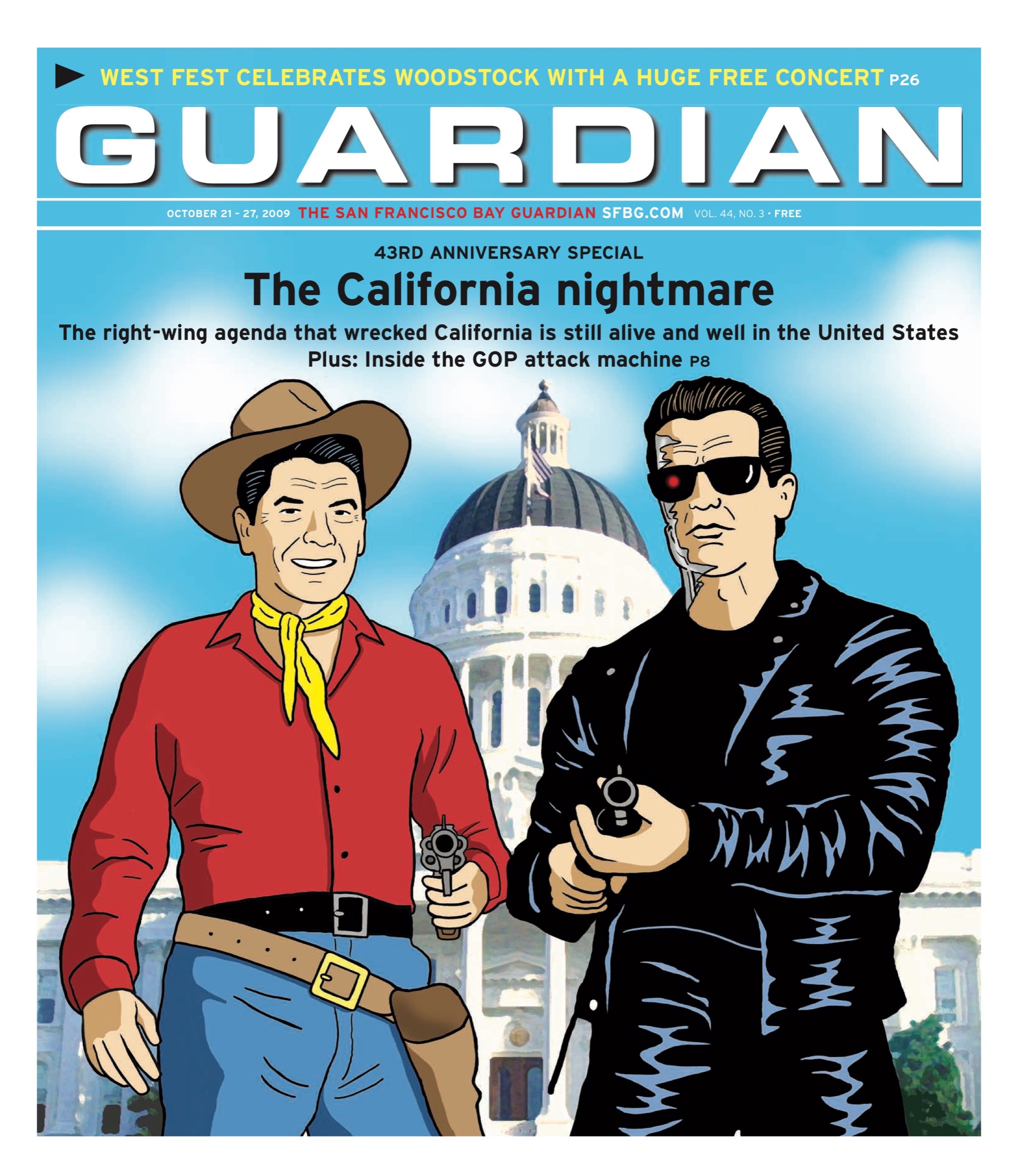
The lesson of California

0

news@sfbg.com

Much of the right-wing agenda that has thrown this nation into economic chaos can be traced back to what was once called the Golden State.

The tax revolts that started here under Gov. Ronald Reagan and continued to sweep the country and the world under President Reagan never abated. Indeed, they have only been strengthened by the big business power that created and benefited from them.

But now that California is showing signs of being the country’s first failed state — caught in fiscal freefall and mired in political gridlock as a generation’s worth of neglected problems surge to the surface — this state has become a cautionary tale for that anti-government ideology.

Trends in America tend to start out west, and the economic and political disaster that California has become contains critical lessons for the rest of the country.

Lewis Uhler — president and founder of the National Tax Limitation Committee — speaks candidly and proudly of his key early role in helping build a conservative movement to limit the size of government and do battle with those who want the public sector to actively promote social and economic justice.

Uhler, a UC Berkeley Boalt Hall School of Law graduate who did legal work for conservative causes in the 1960s, was tapped by then-Gov. Reagan in 1970 to be the director of the Office of Economic Opportunity, a federally-funded legal assistance program created as part of President Lyndon Johnson’s war on poverty.

While that may seem like a strange role for an avowed conservative and former member of the John Birch Society, Uhler says Reagan basically brought him in to wreck the program and fight the feds. “I was asked to put my money where my mouth was for my conservative philosophy,” Uhler told the Guardian. “OEO was set up to ensure conflict and confrontation … The mission of legal services was to change public policy through lawsuits they decided to file. I thought it was a corruption of the legal system.”

At the time, public-interest law and liberal economic and social policies were on the rise in California and spreading to the rest of the nation. So the Reaganites fought back.

Rather than helping poor plaintiffs file environmental, consumer protection, equal rights, or other types of lawsuits designed to level the playing field with powerful interests, Uhler blocked lawsuits brought by attorneys he calls “ambulance-chasers” and gutted the program. “Ultimately,” he said, “we vetoed funding for California Rural Legal Assistance.”

And for his efforts, Uhler was rewarded with a cabinet-level position: assistance secretary of the Health and Welfare Agency. Again, his role wasn’t to make the agency more effective, but to make it less effective in a realm where he believes government was too big and too active.

“The problem was uncontrolled state and local spending,” Uhler said. “Intuitively, everyone who gathered around Reagan shared the same philosophy that government doesn’t really contribute anything to economic growth.”

In 1972, Reagan gave Uhler the opportunity to work more directly on the mission of cutting taxes and shrinking the size of government, naming him chair of the Governor’s Tax Reduction Task Force. It was, in many ways, the beginning of the vast right-wing conspiracy.

“I asked to be given the chance to go across the country and find the best free market minds in the country to develop these policies,” Uhler said, explaining that he wanted to borrow the liberal strategy of giving an academic veneer to their ideas, as presidents Kennedy and Johnson had done in the realm of foreign policy. “Our side had never really done that.”

Uhler’s first stop was the University of Chicago School of Economics, where he met with noted free market economists Milton Friedman, James Buchanan, and George Stigler, who were brought into the cause.

Today’s vast network of conservative think tanks didn’t exist at that time, so Uhler tapped conservative thinkers from the American Enterprise Institute and the Hoover Institute at Stanford University, as well as other conservative economists such as Peter Drucker from Claremont McKenna College.

“There were 35 people who helped us design the first effort at a constitutional initiative in California to limit year-over-year growth of the state’s general fund,” Uhler said. “All of us as free market enthusiasts and economists all shared the belief that government beyond a certain level eats the seed corn of the nation and doesn’t produce anything.”

While voters narrowly rejected their group’s first effort to cap government growth — Proposition 1 on the November 1973 ballot — the ground had been prepared and the seeds had been sown for the tax revolts that would sweep the country in the late 1970s, with many of the campaigns coordinated by Uhler and the organization he formed for that purpose in 1975, the National Tax Limitation Committee, and a rapidly growing network of similar, interconnected organizations.

As Uhler worked with Reagan to weaken California’s government from within, his fellow travelers were developing national and international strategies to create aggressive, coordinated, well-funded campaigns to attack government and spread the free market dogma.

In August 1971, Lewis Powell — a conservative corporate attorney who President Richard Nixon had just nominated to the U.S. Supreme Court (where he served from 1972-87) — wrote a confidential memorandum to the leadership of the U.S. Chamber of Commerce titled “Attack on the American Free Enterprise System.”

He sounded the alarm that the ascendant environmental and consumer movements were going to destroy capitalism in the country unless corporate America aggressively fought back in a coordinated fashion, which he spelled out in great detail.

He called for all major corporations to develop aggressive legal and public relations strategies for fighting the left, creation of a network of think tanks and media outlets to push the conservative message, manipulation of the legal system, and sponsorship of university programs to study conservative ideas and incubate future leaders — which all came to pass in the coming decades.

“American business [is] ‘plainly in trouble’; the response to the wide range of critics has been ineffective and has included appeasement: the time has come — indeed, it is long overdue — for the wisdom, ingenuity, and resources of American business to be marshaled against those who would destroy it,” Powell wrote.

Part of that strategy involved having the federal government promote and popularize free market economic theories being developed by Friedman and his colleagues at the University of Chicago, a movement that is well-documented by journalist Naomi Klein in her book The Shock Doctrine: The Rise of Disaster Capitalism.

In 1971, Friedman and his colleagues began working with rich conservatives in Chile who were allied with Gen. Augusto Pinochet, who in turn were conspiring with the CIA to overthrow and assassinate the democratically elected, leftist President Salvador Allende, which they successfully did on Sept. 11, 1973.

Friedman’s economic theories called for a radical restructuring of society — slashing taxes and social spending; removing most regulation and trade restrictions; crushing labor unions; promoting economic growth at any cost — and Pinochet executed the strategy in brutal fashion, ordering the death of at least 3,200 of his political opponents, including the car-bomb assassination of economist Orlando Letelier in Washington, D.C., in 1976.

Friedman and Pinochet consulted openly and shared a basic disdain for social programs and progressive taxation. “The major error, in my opinion,” Friedman wrote in a letter to Pinochet in 1975, referring to the government antipoverty programs Pinochet dismantled, was “to believe that it is possible to do good with other people’s money.”

The model Pinochet and Friedman developed in Chile would eventually go global — promoted by its top cheerleaders, Reagan and British Prime Minister Margaret Thatcher — and be implemented (with disastrous results for most citizens but creating huge profits for wealthy individuals and corporations) in Indonesia, Bolivia, Argentina, Peru, Russia, Poland, South Africa, Japan, and elsewhere.

But with the corporate media and conservative opinion-shapers focused mostly on economic growth — ignoring persistent poverty and the brutal tactics used to suppress the popular movements that tried to resist Friedman’s “economic shock therapy” — Friedman had become a sort of free-market prophet by the time he died in 2006.

“In the torrent of words written in eulogy to Milton Friedman, the role of shocks and crises to advance his worldview received barely a mention,” Klein wrote. “Instead, the economist’s passing provided an occasion for a retelling of the official story of how his brand of radical capitalism became government orthodoxy in almost every corner of the globe.”

California’s fiscal shackles have been in place since 1978, when Proposition 13 and subsequent measures capped property taxes and required an undemocratic two-thirds vote to either raise taxes or pass the annual budget.

A Republican landlord lobbyist named Howard Jarvis charged onto the field that Reagan, Uhler, and their team had prepared and took advantage of a gaping hole in political leadership to set off a movement that would cripple the United States of America.

There was some logic to it then. Times were good in California in the 1970s, good enough that people were flocking to the state by the millions. That was driving up property values — and thus property taxes.

Jarvis bought his home for $8,000 in 1946; 30 years later, it was assessed at $80,000. In fact, inflation was running at close to 10 percent a year in California. Homeowners were getting huge tax hikes each year, and tenants were getting huge rent hikes at a time when state government had a budget surplus.

Homeowners saw millions of dollars sitting in the coffers in Sacramento while they couldn’t pay their tax bills. Yet nobody in the Legislature or governor’s office came up with a solution.

So when Jarvis showed up with petitions to roll back property taxes and prevent future increases, he found a broad base of support. Even tenants went along — Jarvis and his gang promised that property-tax cuts would be passed on to tenants and would mean the end of the escautf8g rent hikes.

Jarvis collected signatures for a radical measure that essentially blocked all property tax increases and allowed new assessment only when a parcel sold. It was, in the end, a huge tax giveaway to major corporations. Since commercial property turned over far less often than residential property (and since commercial sales could be hidden as stock transfers), big businesses wound up paying far less of the state’s tax burden. Corporations used to pay about two-thirds of the state’s property taxes, and individuals one-third; now that is reversed.

It didn’t help tenants, either. Few of the landlords who saw the benefits of Prop. 13 passed the money along to their renters. Most just kept it. San Francisco activist Calvin Welch likes to say that Howard Jarvis was “the father of rent control.”

The campaign against Prop. 13 warned of the dangers of cutting local government; police and fire chiefs appeared in ads opposing it. But the No on 13 folks never talked about the huge windfall big corporations would get from the measure, or the huge disparities in wealth that would be created by defunding government and dereguutf8g corporations.

If the goal was to skew the concentration of wealth in the state, it worked brilliantly. According to the California Budget Project (CBP) of the Franchise Tax Board, recent data taken before the current economic recession illustrates an ever-widening chasm between the wealthiest taxpayer and the working-class person.

The total adjusted personal income for Californians rose by nearly $64 billion in 2006-07 — with approximately three-quarters of that increase going to the top fifth of wealthiest taxpayers, and 30 percent going to the top 1 percent. That left only $19 billion for everyone else.

“The average taxpayer in the top 1 percent experienced a $128,261 increase in AGI [adjusted gross income] between 2006 and 2007, which was more than three times the total AGI of the average middle-income taxpayer in 2007 ($36,115),” stated the June 2009 report.

This continues a long-term trend in which the wealthy continue to leave the average income-earner behind in a trail of dollar-sign dust. From 1995 to 2007, income gains for that top 1 percent come to a whopping 117.3 percent increase — nearly 13 times more than the gains of the middle-income taxpayer.

The nation’s income gap has reached a “level higher than any other since 1917,” according to a paper by University of California, Berkeley economic professor Emmanuel Saez. According to Saez’s analysis of census data, there’s been a steady increase in the income gap since the 1970s, rising 20 percent over the years.

Yet even today, the defenders of Prop. 13 continue to sound the same consistent themes. “Those who are directly involved in government are a militant special interest,” Howard Jarvis Taxpayer Association executive director Kris Vosburgh told us. “They don’t like anything that limits their revenue stream.”

While that last statement could be applied equally to corporations or other private sector enterprises, as Vosburgh reluctantly admitted when asked, he continues to imply malevolence to those who defend government. He said the state’s current fiscal collapse can only be solved by slashing government expenditures.

“It is not valid to be talking about revenue-side solutions,” he said. “Our position is the state has enough money to accomplish its goals.”

People have never liked paying taxes, but the antitax movement is about far more than just that basic individual desire to hold onto our money.

The attacks were well planned, carefully targeted, and part of a much larger effort aimed at maintaining corporate and conservative power, undermining the New Deal, reducing taxes on the rich, and radically reducing the size and scope of the public sector.

As Powell called for, corporations have aggressively challenged, in legal courts and those of public opinion, every significant progressive advance — from San Francisco’s attempt at universal health care to California’s tentative first steps to address global warming.

With a level of discipline unheard of on the left, conservative opinion-shapers pound their talking points and enforce party unity through mechanisms like the “no new taxes” pledge that every Republican in the California Legislature has signed and heeded, under the very real threat of recall.

Opposition to taxes is now so deeply embedded into the psyche of the California electorate, and such a core tenet of today’s Republican Party, that elected officials who tout fiscal responsibility allowed the state’s debts to go unpaid (destroying its credit rating in the process) and its education and transportation systems to be decimated rather considering new revenues.

Gov. Arnold Schwarzenegger’s spokesperson Aaron McLear told us, “He believes we ought to live within our means and pay for only the programs we can afford.”

That simple talking point gets repeated no matter how the question is asked, or when we point out that it means we’re being forced to live within historic lows this year. But they claim the people support them.

“We had tax increases on the May ballot and they were rejected by a 2-1 margin. We should listen to the will of the voters,” McLear said.

Never mind that this regressive, dishonest package of temporary tax hikes was opposed by the Guardian and a variety of pro-tax progressive groups. McLear wouldn’t even admit that point or respond to it honestly.

And he’s certainly right that most polls show a majority of Californians don’t want new taxes. But these polls also show that people want continued government services, more investment in our neglected state infrastructure, and a whole bunch of other contradictory things.

That’s why newspapers and analysts around the world are looking at California, the world’s eighth largest economy, and wondering (as the Guardian of London headline asked Oct. 4): “Will California become America’s first failed state?”

In many ways, it already is. The question now is whether we’ll try to learn from and correct our mistakes. Ryan Riddle contributed to this report. ———–

THE CONSERVATIVE RELIGION

When I asked Lewis Uhler, one of the architects of the Reagan revolution, what Americans believed in these days — where the people he likes to talk about who hate the government (but are also admittedly disillusioned with Wall Street) turn — he answered simply: religion.

It should come as no surprise that many religious fundamentalists tend to side with the free market conservatives — both ideologies require a leap of faith and ignoring certain troubling facts, such as increasing disparities of wealth, natural resource depletion, and global warming.

Their arguments mostly make sense — until these inconvenient truths come up.

Certainly, turning over more public resources to free market capitalists, cutting taxes, and slashing government regulation will spur private sector economic growth, just as advocates claim.

But that growth has a cost. The wealth won’t be shared by everyone. Indeed, poverty has persisted even through even the economic boom of the 1990s — but almost everyone will be affected by underfunded road, education, public safety, and other essential systems.

As the conservative movement has successfully limited taxes and cut regulation over the last 40 years, working class wages have stagnated as the rich have gotten richer. Many of the world’s oil reserves have peaked and gone into decline, and rapidly increasing carbon emissions have collected in the atmosphere and caused global warming.

So how do conservatives respond to these realities as they argue for the continued dismantling of government, which is the only entity with the scope and incentive to deal with these problems? They simply deny them.

Uhler decried the “pseudoscience of climate change” as hindering economic progress and claimed that there’s actually been a global cooling trend in the last 10 years. (Actually the last 10 years have been some of the hottest on record, causing glaciers around the world to melt, according to data and observations from a consensus of the world’s climate scientists, including NASA, the Union of Concerned Scientists, and the United Nations Climate Change Conference.)

It’s the same story with the consolidation of wealth, which hurts the free market fantasy that letting the super-wealthy keep more money will eventually trickle down to benefit us all. Uhler simply denied the growing disparity of wealth, saying the “movement between quintiles is significant.”

He was talking about people’s ability to go from poor to rich with a little hard work and initiative, the core idea of free market conservatives. But data from the U.S. Census Bureau and many other entities indicate that median wages have been stagnant for decades (which wouldn’t be true if there was lots of upward mobility) and that most of the wealth created in the U.S. over the last 40 years has pooled with the top 1 percent.

In fact, when it comes to measuring social impacts, Uhler has simply one metric: “Governments at all levels are twice the size they should be to maximize economic growth.” (Steven T. Jones)


Fighting for juvenile justice

0

sarah@sfbg.com

Sup. David Campos’ proposal to amend San Francisco’s sanctuary policy so that the city guarantees due process to juvenile immigrants heads for a full vote of the board next week with the support of a veto-proof majority of supervisors.

Board President David Chiu and Sups. John Avalos, Chris Daly, Bevan Dufty, Eric Mar, Sophie Maxwell, and Ross Mirkarimi have signed on as cosponsors of the amendment, which also has the support of a broad coalition of civil and immigrants’ rights organizations.

But with the mayor opposed to the bill and the daily newspapers agitating against reform, it’s important to remember what’s really at stake here.

As a team of civil rights experts notes, the Campos bill "will ensure that families are not torn apart because a youth is mistakenly referred for deportation and will encourage cooperation between law enforcement and immigrant communities by reestablishing a relationship based on trust, therefore increasing public safety."

Campos, who came to this country as an undocumented youth from Guatemala and represents San Francisco’s heavily immigrant Mission District, says his proposal is a balanced solution to the draconian policy Newsom ordered last summer, without public input, the day after the mayor launched his 2010 gubernatorial bid.

When Campos introduced his amendment this summer, after months of public conversations with law enforcement agencies and the immigrant community, Newsom responded by leaking a confidential legal memo that outlined possible challenges to the proposal.

Angered but undaunted, a group of civil rights organizations responded by issuing their own brief explaining why Campos’ proposal is legally tenable and defensible.

As Angie Junck of the Immigrant Legal Resources Center, Robert Rubin of the Lawyer’s Committee for Civil Rights, Julia Mass of the American Civil Liberties Union of Northern California, professor Bill Ong Hing of UC Davis Law School, and Angela Chan of the Asian Law Caucus explained, Campos’ proposal "will allow immigrant youths to have their day in court and be heard by an impartial judge, ensuring due process is upheld for all of San Francisco’s youth."

They argue that Campos’ legislation seeks to "lessen the risk that the city will be liable for racial profiling, unlawful detention, and mistaken referrals of U.S. citizens and lawful immigrants for deportation while bringing the city’s juvenile probation practices into compliance with state confidentiality laws for youth."

And as they point out, Campos’ proposal won’t prevent youths who have been found by a court to have committed a felony from being referred to ICE.

"The sanctuary ordinance has stood strong for 20 years, and the proposed amendment strengthens the ordinance by taking steps to bring the city’s practices more into compliance with state juvenile justice law," the brief states. "The legislation is a measured step in the right direction that will help restore accountability and fairness in the city’s treatment of immigrant youth."

Or as Campos put it: "It’s something we drafted very carefully in close consultation with the City Attorney’s Office."

ARRESTED OR CONVICTED?


Campos’ amendment seeks to shift the point at which immigrant kids get referred to ICE agents for possible deportation. Newsom’s policy allows the police to refer kids to ICE the moment they’re arrested. That means someone who turns out to be innocent and was arrested in error can still be deported. Campos wants the cops to wait until the felony charge is upheld in juvenile court.

Since July 2008, when Newsom ordered the city’s current policy shift, 160 youths have been referred to ICE, increasing the risk they will be sent to detention facilities across the country, far from their families, without access to immigration legal services, based on accusations and racial profiling.

Abigail Trillin, staff attorney with the Legal Services for Children, told us that the Newsom policy makes San Francisco bedfellows with Texas and Orange County.

"A bunch of our kids go to Yolo County and Oregon, a lot to Los Angeles, others to Miami, Virginia, and Indiana, and some have already been deported," Trillin said.

Trillin noted that Newsom’s policy is destroying families by allowing innocent kids to be reported for deportation without the basic right to due process — often for minor offenses. She has already seen youth who are documented or innocent erroneously referred to ICE by juvenile probation officers, who often lack expertise in immigration law.

She also fears this miscarriage of justice could result in abuse and even death — especially if kids try to return to their homes and families by crossing the border, which has became increasingly militarized and perilous in the aftermath of the Bush administration’s decision to spend billions to build a fence along the border.

Last week, the battle for juvenile justice took a fresh twist locally when Newsom’s newly appointed Police Chief George Gascón said he hoped for a compromise involving third party review by the District Attorney’s Office.

"I fully understand the concerns Campos brings to the table," Gascón said, referring to his previous job as chief of police in Mesa, Ariz., where he saw the anti-immigrant excesses of Maricopa County sheriff Joe Arpaio.

"I have the benefit of seeing the other side, where you have police agencies aggressively engaged in immigration enforcement, where people that were frankly not engaged in any criminal activity other than that of being here without authority, are being deported," Gascón said. He noted that being here without papers often is not a crime; it’s just an administrative violation.

"I’ve seen very young people, people that basically came to this country when they were three or four years old and are staying clean and going to school, get stopped for a traffic violation at age 17 or 18, and now all of a sudden they’re getting deported to a country where they have no roots," he said.

But the chief remains convinced that the criminal justice system needs to be able to use all legally available tools to deal with violent criminal juveniles.

"I’m not saying the district attorney needs to make the reporting. The triggering event could be the determination to file the case," Gascón said. "Frankly, I wish I’d been here a year earlier to deal with this issue," he added, noting that federal immigration hearings are "a kangaroo court."

"It’s not a beyond-reasonable-doubt standard for people to get deported," he said.

"The other side of the coin is that this would be putting people in situations where they could be federally indicted for violations of law. And you also have problems at state," he continued, noting that two federal grand juries are currently reviewing the behavior of the Juvenile Probation Department.

DUE PROCESS


Campos, a lawyer, appreciates that the new police chief is "genuinely trying to see if there is something he can do to resolve the situation. I believe if he had been in place where this discussion was going on a year ago, the mayor would have received better advice."

"The chief’s comments reflect that what is happening here is pretty extreme," Campos added. "I recognize that changing the reporting process to a third party would definitely be better than what we have now, where the final decision rests with a police officer. But while it’s better, it’s not sufficient. Due process necessarily entails giving people their day in court, and letting a judge decide what actually happens."

Sup. Chiu, a former prosecutor, also said he appreciates Gascón’s resolution attempt. "But the point of our system is that once you are arrested and charged, there are due process rights so you can respond to those charges."

Sup. Dufty, a mayoral candidate, said he expects that when the board passes laws, those laws will be implemented by Newsom. "As CEO of San Francisco, he has to comply with all legislation, including local laws the legislative body passes that he may not like," Dufty said.

"My mother was born in Czechoslovakia and was stateless when I was a boy," he added. "She had to register every year as an alien, so this is very visceral for me. If we are to be a sanctuary city, it’s because everyone has due process. It’s denying people’s humanity and dignity and creating a two-tiered system for justice."

But mayoral spokesperson Nathan Ballard continued to assert that Newsom’s current policy is balanced. "While he remains open to argument, the mayor believes the current policy strikes the right balance between protecting public safety and safeguarding the rights of accused criminals," Ballard, who had not replied to the Guardian‘s questions as of press time, told the Examiner last week.

But Trillin says she can’t stand to hear Ballard falsely claim, one more time, that the city is going to shield criminals. "Ballard keeps repeating a completely false position, because Newsom’s actual position is morally indefensible," Trillin said. "You can’t have the mayor publicly say that young people don’t deserve due process, so you have to make up stuff like this instead."

The Monster

0

El Monstruo: Dread & Redemption In Mexico City is a perverse love letter to the most contaminated, crime-ridden, corrupt and conflictive urban stain on the western side of the planet, where I have been touched to live for the past quarter of a century. My life is now hopelessly entangled with the life of this monster of a megalopolis.

El Monstruo was indeed a monstrous book to write. The slagheap of materials that I sucked up — hundreds of volumes of history, slagheaps of newspapers, mountains of personal recollections — fill my threadbare room at the Hotel Isabel in the old quarter of this city from floor to ceiling. The narrative I have assembled spans 50,000,000 years give or take a few minutes, dating from the Paleocene to last spring’s Swine Flu panic with significant stops for the doomed Aztec empire, the war of liberation from Spain, the Mexican revolution of 1910-1919, the student massacres of the ’60s, the Great 1985 earthquake, and the erratic governance of the electoral left for the past 12 years.

It is a long story.

The Mexican Revolution was in many ways a war against Mexico City, a capital for which the rest of the country was named and from which all power continues to radiate. The great revolutionary leaders Emiliano Zapata and Pancho Villa viewed Mexico City as a Sodom & Gomorrah that had to be destroyed if the country was to be redeemed and they did their best to do so. The excerpt that follows speaks to the Monstruo on the eve of the downfall of dictator Porfirio Diaz and the inception of the first great revolution of the landless in the Americas.

WHAT THE LAND WAS LIKE

Back home in Morelos, Emiliano Zapata was elected village leader, entrusted to recover Anenecuilco’s lost lands, granted to the Indians by the Crown in the 17th century. The sugar planters, many of whom were foreigners, had gobbled up the Nahuas’ land and water without remorse.

“Land and Water” was in fact the slogan of Madero ally Vicente Leyva’s campaign for governor of Morelos in 1909 against Díaz’s gallo (rooster), Pablo Escandón, the scion of an immensely wealthy criollo family that had first struck it rich in real estate during Juárez’s Reform, and also a sugar planter who rarely bothered to visit the tiny state. Zapata aligned Anenecuilco’s fortunes with Leyva and Madero. Escandón won by a landslide of course, without ever having to leave El Monstruo. To Zapata, Escandón WAS El Monstruo.

By 1910, 2 percent of all Mexicans owned all the land—save for 70 million hectares held by foreigners with family names like Rockefeller and Hearst and Morgan. One hundred percent of the good farming land in Morelos was occupied by 17 haciendas operated by absentee patrones (bosses). The haciendas sucked up all the groundwater, leaving villages like Anenecuilco dry as a bone. The unequal distribution of water continues a century hence. Wealthy Chilangos have overrun Morelos with their golf courses and palatial second homes, leaving the villages just as thirsty as they were in 1910.

Years ago, I rented a large house in Olintepec, a colonia that shares ejido land (communal farmland) with Anenecuilco, and was able to see how the land must have looked to Zapata when he rode through these fields. I walked out through the tall sugar cane along the irrigation canals to the Caudillo’s humble adobe home, now a museum, on a back street in Anenecuilco, and each young horseman barreling down the country lanes could have been the Caudillo all over again.

But an hour and fifty-five minutes later, when I stepped down off a bus in the belly of the Monstruo, the urban hurly-burly swirling all around me, I always got a whiff of the profound culture shock Emiliano Zapata must have suffered when he was forced to visit this city he so detested.

MADERO’S REVOLUTION

Francisco Madero’s call for the revolution to commence November 20, 1910, stirred sparse response. Up in Puebla, Díaz’s agents murdered Madero’s lieutenant, the revolutionary shoemaker Aquiles Serdán, and his family, two nights before the festivities were slated to kick in. In Morelos, Zapata and the peasant army he had assembled bided their time, waiting to see who would make the first move first.

Mexicans are never on time. Finally, in January, Doroteo Arango AKA Francisco “Pancho” Villa, a popular Chihuahua desperado of Hobsbawmian proportions, and his ruthless cohort Pascual Orozco, declared themselves in revolt and were immediately joined by the Maderista governor of Coahuila, Venustiano Carranza and his “Constitutionalist” Army. Díaz’s Federales were beaten back at Ciudad Guerrero, Mal Paso, and Casas Grandes. Villa laid siege to Ciudad Juárez on the border, the vital railhead that linked Mexico City to the United States and was the lifeblood of the country’s commercial transactions.

By February 1911, with the synchronicity that sometimes made the Mexican Revolution work, the Zapatistas had advanced to Xochimilco. Workers in the heart of the city suffering from what the Porfirian rag El Imparcial tagged ”huelga-manía” or strike fever, declared seven major strikes that paralyzed the Monstruo in 1910–1911. Demonstrators were emboldened enough to assemble in the Zócalo and shout “Death to the Dictator!” beneath Don Porfirio’s balcony by spring. Others menaced his mansion on Cadena Street in the Centro Histórico and were repelled by the gendarmes.

Pablo Escandón fled Mexico for Europe, kvetching to the press that Mexico had fallen into “niggerdom.” Don Porfirio’s class of people was stunned by this threat to their carefree lives and comforts. Indeed, the leisure class had not changed all that much from when the criollos and Gachupines cowered inside the city as Hidalgo’s Indiada advanced on El Monstruo.

After three and a half decades in power, the Dictator remained a figure of adoration in the mansions of La Condesa. For the university students, largely the sons of the ruling class, Don Porfi was the epitome of modernity. To them, Villa and Orozco and Carranza were the Barbarians of the North, Zapata the Attila of the South, and they cast the Dictator as the savior of civilization as they knew it.

But the old man was 81, and it hurt just to keep a stiff upper lip. The medals weighed heavily on his chest. He knew in his heart of hearts what his adorers could not admit—the jig was really up. Ciudad Juárez was days away, even via the modern rail system he had built, and the army’s mobility to supply his troops was restricted. Don Porfiriopochtli, as political cartoonists were drawing him now, had, like the Aztecs, expanded his empire to a point where he could no longer defend it.

In May, the Dictator sent his vice president, Francisco León de la Barra, to the north to negotiate an easy exit to his 34 years on the throne of Mocuhtezuma, and on May 24, 1911, having brokered an agreement with Madero that León de la Barra would remain as provisional president for the next six months, the old man set sail from Puerto, México, for Paris, France, aboard the German steamer Ypringa with this famous caution: “The wild beasts have been loosed. Let us see who will cage them now.”

Wild celebrations broke out in Mexico City as if to underscore the old man’s dictum—15,000 workers invaded the Chamber of Deputies and marched on the National Palace, where the Dictator’s police opened fire, wounding scores. The offices of the Porfirian mouthpiece El Imparcial were set afire. By July, the Monstruo was shut down by a general strike. The wrath of the Mexicans had indeed been loosed, and Madero’s intentions to cage it up again would dictate the next phase of Mexico’s cannibal revolution.

THE GODS ARE SKEPTICAL

After a discreet pause to make sure the old man was really gone, Francisco Madero started off on the long train ride from Ciudad Juárez to Mexico City in early June. There were many treacheries up ahead and he had plenty of time to consider his options as the train lurched from state to state. As he passed through Zacatecas and Aguascalientes, jubilant mobs overran the train depots waving Mexican flags and shouting “¡Vivas!” until they were hoarse and Madero’s train long out of sight.

The presumptive president of Mexico arrived in the capital at Buenavista terminal, the great northern station, on the morning of June 9, and the tumult was overwhelming. Kandell compares it to Juárez’s return to rekindle the republic. I stare at the news photographs. People are excited, even exhilarated. They push and jostle for a view of the little Lenin look-alike. But some are more reserved. They stand back from the jubilant throng. They have come more out of curiosity than conviction. Their faces seem to ask, what next?

From Buenavista, Madero rode through the city in a Dupont motorcar, the sidewalks bursting with well-wishers and flag wavers. Many residents of the metropolis were relieved not so much because of the hope the little man brought with him as for the fact that this change of power had taken place with a minimum of damage to themselves and their city.

When Madero entered the old city for the final jog to the National Palace, he mounted a white horse. In the Palacio, he met with León de la Barra and they reaffirmed their bargain—Porfirio’s stooge would govern for the next six months while Madero campaigned for presidential elections set for November 2. The two emerged on the president’s balcony and “¡Vivas!” erupted from the joyous mob that filled the Zócalo below.

But the old Gods of Tenochtitlán were skeptical about Francisco Madero’s grasp on the presidency. At 6:00 that afternoon they rendered their verdict, upstaging his triumphal arrival in the capital with a deadly earthquake that surged out of the Pacific Ocean along the Jalisco coast and wrought havoc throughout that western state, killing 400 in Zapopan and setting off the Volcano of Colima before smashing into the north of Mexico City and leveling Santa María de la Ribera and San Cosme. There were no Richter scales in those days to measure the quake, but an uncounted number of lives were lost in the capital—perhaps hundreds, reported El Imparcial, which published three extras that day but paid scant attention to Madero’s arrival, burying the story beneath the fold.

Hear Ross read from El Monstruo and sign copies Nov. 18 at Modern Times, 888 Valencia, 7:30 p.m.

The local list of censored stories

2

539-cover.web.jpg
By Guardian News Staff
Every year, when the Guardian covers the release of Project Censored’s list of underreported news story, we also try to list a few local stories that didn’t get the coverage they deserve. For 2009, they include:

Gavin Newsom’s no-new-taxes budget
When Gov. Arnold Schwarzenegger and the Republicans in Sacramento insisted that they wouldn’t raise taxes to address the budget deficit, it was big news — and plenty of San Francisco officials were critical. When Mayor Gavin Newsom took the exact same stance — no new taxes — the news media largely ignored the story and let him off the hook.

What happened to the tax measures?
Last winter, there were big fights over putting revenue measures on the fall ballot. Progressives dug in and fought through a mayoral veto. Commissions were convened. Polls were taken. Promises were made. And then the election deadline simply passed and it was as if the whole thing never happened.

The demise of newspapers
The San Francisco Chronicle has done a few, weak stories about its own extensive layoffs, and other news outlets have discussed the paper’s shaky finances. And the news industry fretted about MediaNews gobbling up most Bay Area newspapers. But there’s been little deep analysis or attention to the end game: What would San Francisco be like with no daily newspaper? Is that where this city is headed? Who will speak truth to power?

Censored!

0

news@sfbg.com

Peter Phillips, director of Project Censored for 13 years, says he’s finished with reform. It’s impossible, he said in a recent interview, to try to get major news media outlets to deliver relevant news stories that serve to strengthen democracy.

"I really think we’re beyond reforming corporate media," said Phillips, a professor of sociology at Sonoma State University and director of Project Censored. "We’re not going to break up these huge conglomerates. We’re just going to make them irrelevant."

Every year since 1976, Project Censored has spotlighted the 25 most significant news stories that were largely ignored or misrepresented by the mainstream press. Now the group is expanding its mission — to promote alternative news sources. But it continues to report the biggest national and international stories that the major media ignored.

The term "censored" doesn’t mean some government agent stood over newsrooms with a rubber stamp and forbid the publication of the news, or even that the information was completely out of the public eye. The stories Project Censored highlights may have run in one or two news outlets, but didn’t get the type of attention they deserved.

The project staff begins by sifting through hundreds of stories nominated by individuals at Sonoma State, where the project is based, as well as 30 affiliated universities all over the country.

Articles are verified, fact-checked, and selected by a team of students, faculty, and evaluators from the wider community, then sent to a panel of national judges to be ranked. The end product is a book, co-edited this year by Phillips and associate director Mickey Huff, that summarizes the top stories, provides in-depth media analysis, and includes resources for readers who are hungry for more substantive reporting.

Project Censored doesn’t just expose gaping holes in the news brought to you by the likes of Fox, CNN, or USA Today — it also shines a light on less prominent but more incisive alternative-media sources serving up in-depth investigations and watchdog reports.

Phillips is stepping down this year as director of Project Censored and turning his attention to a new endeavor called Media Freedom International. The organization will tap academic affiliates from around the world to verify the content put out by independent news outlets as a way to facilitate trust in these lesser-known sources. "The biggest question I got asked for 13 years was, who do you trust?" he explained. "So we’ve really made an effort in the last three years to try to address that question, in a very open way, in a very honest way, and say, these are [the sources] who we can trust."

Benjamin Frymer, a sociology professor at Sonoma State who is stepping into the role of Project Censored director, says he believes the time is ripe for this kind of push. "The actual amount of time people spend reading online is increasing," Frymer pointed out. "It’s not as if people are just cynically rejecting media — they’re reaching out for alternative sources. Project Censored wants to get involved in making those sources visible."

The Project Censored book this year uses the term "truth emergency."

"We call it an emergency because it’s a democratic emergency," Huff asserted. In this media climate, "we’re awash in a sea of information," he said. "But we have a paucity of understanding about what the truth is."

The top 25 Project Censored stories of 2008-09 highlight the same theme that Phillips and Huff say has triggered the downslide of mainstream media: the overwhelming influence of powerful, profit-driven interests. The No. 1 story details the financial sector’s hefty campaign contributions to key members of Congress leading up to the financial crisis, which coincided with a weakening of federal banking regulations. Another story points out that in even in the financial tumult following the economic downturn, special interests spent more money on Washington lobbyists than ever before.

Here’s this year’s list.

1. CONGRESS SELLS OUT TO WALL STREET


The total tab for the Wall Street bailout, including money spent and promised by the U.S. government, works out to an estimated $42,000 for every man, woman, and child, according to American Casino, a documentary about sub prime lending and the financial meltdown. The predatory lending free-for-all, the emergency pumping of taxpayer dollars to prop up mega banks, and the lavish bonuses handed out to Wall Street executives in the aftermath are all issues that have dominated news headlines.

But another twist in the story received scant attention from the mainstream news media: the unsettling combination of lax oversight from national politicians with high-dollar campaign contributions from financial players.

"The worldwide economic meltdown and the bailout that followed were together a kind of revolution, a coup d’état," Matt Taibbi wrote in "The Big Takeover," a March 2009 Rolling Stone article. "They cemented and formalized a political trend that has been snowballing for decades: the gradual takeover of the government by a small class of connected insiders who used money to control elections, buy influence, and systematically weaken financial regulations."

In the 10-year period beginning in 1998, the financial sector spent $1.7 billion on federal campaign contributions, and another $3.4 billion on lobbyists. Since 2001, eight of the most troubled firms have donated $64.2 million to congressional candidates, presidential candidates, and the Republican and Democratic parties.

Wall Street’s spending spree on political contributions coincided with a weakening of federal banking regulations, which in turn created a recipe for the astronomical financial disaster that sent the global economy reeling.

Sources: "Lax Oversight? Maybe $64 Million to DC Pols Explains It," Greg Gordon, Truthout.org and McClatchey Newspapers, October 2, 2008; "Congressmen Hear from TARP Recipients Who Funded Their Campaigns," Lindsay Renick Mayer, Capitol Eye, February 10, 2009; "The Big Takeover," Matt Taibbi, Rolling Stone, March 2009.

2. DE FACTO SEGREGATION DEEPENING IN PUBLIC EDUCATION


Latinos and African Americans attend more segregated public schools today than they have for four decades, Professor Gary Orfield notes in "Reviving the Goal of an Integrated Society: A 21st Century Challenge," a study conducted by UCLA’s Civil Rights Project. Orfield’s report used federal data to highlight deepening segregation in public education by race and poverty.

About 44 percent of students in the nation’s public school system are people of color, and this group will soon make up the majority of the population in the U.S. Yet this racial diversity often isn’t reflected from school to school. Instead, two out of every five African American and Latino youths attend schools Orfield characterizes as "intensely segregated," composed of 90 percent to 100 percent people of color.

For Latinos, the trend reflects growing residential segregation. For African Americans, the study attributes a significant part of the reversal to ending desegregation plans in public schools nationwide. Schools segregated by race and poverty tend to have much higher dropout rates, more teacher turnover, and greater exposure to crime and gangs, placing students at a major disadvantage in society. The most severe segregation is in Western states, including California.

Fifty-five years after the Supreme Court’s Brown vs. Board of Education ruling, Orfield wrote, "Segregation is fast spreading into large sectors of suburbia, and there is little or no assistance for communities wishing to resist the pressures of resegregation and ghetto creation in order to build successfully integrated schools and neighborhoods."

Source: "Reviving the Goal of an Integrated Society: A 21st Century Challenge," Gary Orfield, The Civil Rights Project, UCLA, January 2009

3. SOMALI PIRATES: THE UNTOLD STORY


Somali pirates off the Horn of Africa were like gold for mainstream news outlets this past year. Stories describing surprise attacks on shipping vessels, daring rescues, and cadres of ragtag bandits extracting multimillion dollar ransoms were all over the airwaves and front pages.

But even as the pirates’ exploits around the Gulf of Aden captured the world’s attention, little ink was devoted to factors that made the Somalis desperate enough to resort to piracy in the first place: the dumping of nuclear waste and rampant over-fishing their coastal waters.

In the early 1990s, when Somalia’s government collapsed, foreign interests began swooping into unguarded coastal waters to trawl for food — and venturing into unprotected Somali territories to cheaply dispose of nuclear waste. Those activities continued with impunity for years. The ramifications of toxic dumping hit full force with the 2005 tsunami, when leaking barrels were washed ashore, sickening hundreds and causing birth defects in newborn infants. Meanwhile, the uncontrolled fishing harvests damaged the economic livelihoods of Somali fishermen and eroded the country’s supply of a primary food source. That’s when the piracy began.

"Did we expect starving Somalians to stand passively on their beaches, paddling in our nuclear waste, and watch us snatch their fish to eat in restaurants in London and Paris and Rome?" asked journalist Johann Hari in a Huffington Post article. "We didn’t act on those crimes — but when some of the fishermen responded by disrupting the transit-corridor for 20 percent of the world’s oil supply, we begin to shriek about ‘evil.’"

Sources: "Toxic waste behind Somali piracy," Najad Abdullahi, Al Jazeera English, Oct. 11, 2008; "You are being lied to about pirates," Johann Hari, The Huffington Post, Jan. 4, 2009; "The Two Piracies in Somalia: Why the World Ignores the Other," Mohamed Abshir Waldo, WardheerNews, Jan. 8, 2009

4. NORTH CAROLINA’S NUCLEAR NIGHTMARE


The Shearon Harris nuclear plant in North Carolina’s Wake County isn’t just a power-generating station. The Progress Energy plant, located in a backwoods area, bears the distinction of housing the largest radioactive-waste storage pools in the country. Spent fuel rods from two other nuclear plants are transported there by rail, then stored beneath circuutf8g cold water to prevent the radioactive waste from heating.

The hidden danger, according to investigative reporter Jeffery St. Clair, is the looming threat of a pool fire. Citing a study by Brookhaven National Laboratory, St. Clair highlighted in Counterpunch the catastrophe that could ensue if a pool were to ignite. A possible 140,000 people could wind up with cancer. Contamination could stretch for thousands of square miles. And damages could reach an estimated $500 billion.

"Spent fuel recently discharged from a reactor could heat up relatively rapidly and catch fire," Robert Alvarez, a former Department of Energy advisor and Senior Scholar at the Institute for Policy Studies noted in a study about safety issues surrounding nuclear waste pools. "The fire could well spread to older fuel. The long-term contamination consequences of such an event could be significantly worse than Chernobyl."

Shearon Harris’ track record is pocked with problems requiring temporary shutdowns of the plant and malfunctions of the facility’s emergency-warning system.

When a study was sent to the Nuclear Regulatory Commission highlighting the safety risks and recommending technological fixes to address the problem, St. Clair noted, a pro-nuclear commissioner successfully persuaded the agency to dismiss the concerns.

Source: "Pools of Fire," Jeffrey St. Clair, CounterPunch, Aug. 9, 2008

5. U.S. FAILS TO PROTECT CONSUMERS AGAINST TOXICS


Two years ago, the European Union enacted a bold new environmental policy requiring close scrutiny and restriction of toxic chemicals used in everyday products. Invisible perils such as lead in lipstick, endocrine disruptors in baby toys, and mercury in electronics can threaten human health. The European legislation aimed to gradually phase out these toxic materials and replace them with safer alternatives.

The story that has gone unreported by mainstream American news media is how this game-changing legislation might affect the U.S., where chemical corporations use lobbying muscle to ensure comparatively lax oversight of toxic substances. As global markets shift to favor safer consumer products, the U.S. Environmental Protection Agency is lagging in its own scrutiny of insidious chemicals.

As investigative journalist Mark Schapiro pointed out in Exposed: The Toxic Chemistry of Everyday Products and What’s at Stake for American Power, the EPA’s tendency to behave as if it were beholden to big business could backfire in this case, placing U.S. companies at a competitive disadvantage because products manufactured here will be regarded with increasing distrust.

Economics aside, the implications of loose restrictions on toxic products are chilling: just one-third of the 267 chemicals on the EU’s watch list have ever been tested by the EPA, and only two are regulated under federal law. Meanwhile, researchers at UC Berkeley estimate that 42 billion pounds of chemicals enter American commerce daily, and only a fraction have undergone risk assessments. When it comes to meeting the safer, more stringent EU standard, the stakes are high — with consequences including economic impacts as well as public health.

Sources: "European Chemical Clampdown Reaches Across Atlantic," David Biello, Scientific American, Sept. 30, 2008; "How Europe’s New Chemical Rules Affect U.S.," Environmental Defense Fund, Sept. 30, 2008; "U.S. Lags Behind Europe in Reguutf8g Toxicity of Everyday Products," Mark Schapiro, Democracy Now! Feb. 24, 2009

6. AS ECONOMY SHRINKS, D.C. LOBBYING GROWS


In 2008, as the economy tumbled and unemployment soared, Washington lobbyists working for special interests were paid $3.2 billion — more than any other year on record. According to the Center for Responsive Politics, special interests spent a collective $32,523 per legislator, per day, for every day Congress was in session.

One event that triggered the lobbying boom, according to CRP director Sheila Krumholz, was the federal bailout — with the federal government ensuring that the lobbyists got a piece of the pie. Ironically, some of the first in line were the same players who helped precipitate the nation’s sharp economic downturn by engaging in high-risk, speculative lending practices.

"Even though some financial, insurance and real estate interests pulled back last year, they still managed to spend more than $450 million as a sector to lobby policymakers," Krumholz noted. "That can buy a lot of influence, and it’s a fraction of what the financial sector is reaping in return through the government’s bailout program."

The list of highest-ranking spenders on Washington lobbying reads like a roster of some of the most powerful interests nationwide. Topping the list was the health sector, which spent $478.5 million lobbying Congress last year. A close runner-up was the finance, insurance, and real-estate sector, spending $453.5 million. Pharmaceutical companies plunked down $230 million; electric utilities spent $156.7 million; and oil and gas companies paid lobbyists $133.2 million.

Source: "Washington Lobbying Grew to $3.2 Billion Last Year, Despite Economy," Center for Responsive Politics, Open Secrets.org

7. OBAMA’S CONTROVERSIAL DEFENSE APPOINTEES


President Barack Obama’s appointments to the Department of Defense have raised serious questions among critics who’ve studied their track records. Although the news media haven’t paid much attention, the defense appointees bring to the administration controversial histories and conflicts of interest due to close ties to defense contractors.

Obama’s decision to retain Robert Gates, Secretary of Defense under President George W. Bush, marks the first time in history that a president has opted to keep a defense secretary of an outgoing opposing party in power.

Gates, a former CIA director, has faced criticism for allegedly spinning intelligence reports for political means. In Failure of Intelligence: The Decline and Fall of the CIA, author and former CIA analyst Melvin Goodman described him as "the chief action officer for the Reagan administration’s drive to tailor intelligence reporting to White House political desires." Gates also came under scrutiny for questions surrounding whether he misled Congress during the Iran-contra scandal in the mid-1980s, and was accused of withholding information from intelligence committees when the U.S. provided military aid to Saddam Hussein during the Iran-Iraq war.

Critics are also uneasy about the appointment of Deputy Defense Secretary William Lynn, who formerly served as a senior vice president at defense giant Raytheon Company and was a registered lobbyist for Raytheon until July 2008. Lynn, who previously served as Pentagon comptroller under the Clinton administration, came under fire during his confirmation hearing for "questionable accounting practices." The Defense Department failed multiple audits under Lynn’s leadership because it was unable to properly account for $3.4 trillion in financial transactions made over the course of several years.

Sources: "The Danger of Keeping Robert Gates," Robert Parry, ConsortiumNews.com, Nov. 13, 2008; "Obama’s Defense Department Appointees- The $3.4 Trillion Question," Andrew Hughes, Global Research, Feb. 13, 2009; "Obama Nominee Admiral Dennis Blair Aided perpetrators of 1999 church Killings in East Timor," Allan Nairn, Democracy Now! Jan. 7, 2009; "Ties to Chevron, Boeing Raise Concern on Possible NSA Pick," Roxana Tiron, The Hill, Nov. 24, 2008


8. BIG BUSINESS CHEATS THE IRS


The Cayman Islands and Bermuda are magnets for Bank of America, Citigroup, American International Group, and 11 other financial giants that were the beneficiaries of the federal government’s 2008 Wall Street bailout. It’s not the balmy weather that inspires some of America’s wealthiest companies to open operations in the Caribbean archipelago: the offshore oases provide safe harbors to stash cash out of the reach of Uncle Sam.

According to a 2008 report by the Government Accountability Office, which was largely ignored by the news media, 83 of the top publicly-held U.S. companies, including some receiving substantial portions of federal bailout dollars, have operations in tax havens that allow them to avoid paying their fair share to the Internal Revenue Service. The report also spotlighted the activities of Union Bank of Switzerland (UBS), which has helped wealthy Americans to use tax schemes to cheat the IRS out of billions.

In December 2008, banking giant Goldman Sachs reported its first quarterly loss, and promptly followed up with a statement that its tax rate would drop from 34.1 percent to 1 percent, citing "changes in geographic earnings mix" as the reason. The difference: instead of paying $6 billion in total worldwide taxes as it did in 2007, Goldman Sachs would pay a total of $14 million in 2008. In the same year, it received $10 billion and debt guarantees from the U.S. government.

"The problem is larger than Goldman Sachs," U.S. Representative Lloyd Doggett, a Texas Democrat who serves on the tax-writing House Ways and Means Committee, told Bloomberg News. "With the right hand out begging for bailout money, the left is hiding it offshore."

Sources: "Goldman Sachs’s Tax Rate Drops to 1 percent or $14 Million," Christine Harper, Bloomberg News, Dec. 16, 2008; "Gimme Shelter: Tax Evasion and the Obama Administration," Thomas B. Edsall, The Huffington Post, Feb. 23, 2009

9. U.S. CONNECTED TO WHITE PHOSPHOROUS STRIKES IN GAZA


In mid-January, as part of a military campaign, the Israeli Defense Forces fired several shells that hit the headquarters of a United Nations relief agency in Gaza City, destroying provisions for basic aid like food and medicine.

The shells contained white phosphorous (referred to as "Willy Pete" in military slang), a smoke-producing, spontaneously flammable agent designed to obscure battle territory that also can ignite buildings or cause grotesque burns if it touches the skin.

The attack on the relief-agency headquarters is just one example of a civilian structure that researchers discovered had been hit during the January air strikes. In the aftermath of the attacks, Human Rights Watch volunteers found spent white phosphorous shells on city streets, apartment roofs, residential courtyards, and at a U.N. school in Gaza.

Human Rights Watch says the IDF’s use of white phosphorous violated international law, which prohibits deliberate, indiscriminate, or disproportionate attacks that result in civilian casualties. After gathering evidence such as spent shells, the organization issued a report condemning the repeated firing of white phosphorus shells over densely populated areas of Gaza as a war crime. Amnesty International, another human rights organization, followed suit by calling upon the United States to suspend military aid to Israel — but to no avail.

The U.S. was a primary source of funding and weaponry for Israel’s military campaign. Washington provided F-16 fighter planes, Apache helicopters, tactical missiles, and a wide array of munitions, including white phosphorus.

Sources: "White Phosphorus Use Evidence of War Crimes Report: Rain of Fire: Israel’s Unlawful Use of White Phosphorus in Gaza," Fred Abrahams, Human Rights Watch, March 25, 2009; "Suspend Military Aid to Israel, Amnesty Urges Obama after Detailing U.S. Weapons Used in Gaza," Rory McCarthy, Guardian/U.K., Feb. 23, 2009; "U.S. Weaponry Facilitates Killings in Gaza," Thalif Deen, Inter Press Service, Jan. 8, 2009; "U.S. military resupplying Israel with ammunition through Greece," Saed Bannoura, International Middle East Media Center News, Jan. 8, 2009.

10. ECUADOR SAYS IT WON’T PAY ILLEGITIMATE DEBT


When President Rafael Correa announced that Ecuador would default on its foreign debt last December, he didn’t say it was because the Latin American country was unable to pay. Rather, he framed it as a moral stand: "As president, I couldn’t allow us to keep paying a debt that was obviously immoral and illegitimate," Correa told an international news agency. The news was mainly reported in financial publications, and the stories tended to quote harsh critics who characterized Correa as an extreme leftist with ties to Venezuelan President Hugo Chavez.

But there’s much more to the story. The announcement came in the wake of an exhaustive audit of Ecuador’s debt, conducted under Correa’s direction by a newly created debt audit commission. The unprecedented audit documented hundreds of allegations of irregularity and illegality in the decades of debt collection from international lenders. Although Ecuador had made payments exceeding the value of the principal since the time it initially took out loans in the 1970s, its foreign debt had nonetheless swelled to levels three times as high due to extraordinarily high interest rates. With a huge percentage of the country’s financial resources devoted to paying the debt, little was left over to combat poverty in Ecuador.

Correa’s move to stand up against foreign lenders did not go unnoticed by other impoverished, debt-ridden nations, and the decision could set a precedent for developing countries struggling to get out from under massive debt obligation to first-world lenders.

Ecuador eventually agreed to a restructuring of its debt at about 35 cents on the dollar. Nonetheless, the move served to expose deficiencies in the World Bank system, which provides little recourse for countries to resolve disputes over potentially illegitimate debt.

Sources: "As Crisis Mounts, Ecuador Declares Foreign Debt Illegitimate and Illegal," Daniel Denvir, Alternet, November 26, 2008; "Invalid Loans to Ecuador: Who Owes Who," Committee for the Integral Audit of Public Credit, Utube, Fall 2008; "Ecuador’s Debt Default," Neil Watkins and Sarah Anders, Foreign Policy in Focus, Dec. 15, 2008

——–

OTHER STORIES IN THE TOP 25

11. Private Corporations Profit from the Occupation of Palestine

12. Mysterious Death of Mike Connell—Karl Rove’s Election Thief

13. Katrina’s Hidden Race War

14. Congress Invested in Defense Contracts

15. World Bank’s Carbon Trade Fiasco

16. US Repression of Haiti Continues

17. The ICC Facilitates US Covert War in Sudan

18. Ecuador’s Constitutional Rights of Nature

19. Bank Bailout Recipients Spent to Defeat Labor

20. Secret Control of the Presidential Debates

21. Recession Causes States to Cut Welfare

22. Obama’s Trilateral Commission Team

23. Activists Slam World Water Forum as a Corporate-Driven Fraud

24. Dollar Glut Finances US Military Expansion

25. Fast Track Oil Exploitation in Western Amazon

Read them all at www.projectcensored.org

How an online newspaper can succeed

0

EDITORIAL Dave Iverson, host of KQED’s Friday Forum show, introduced the Sept. 25 program with a pretty obvious comment: "Conversations about the future of journalism, and newspapers in particular, are rarely optimistic affairs." He went on to describe the new effort by Warren Hellman, KQED, and the UC Berkeley journalism school to create a new media outlet in San Francisco (a story that broke first in the Guardian‘s politics blog).

The guests, including Neil Henry, dean of the j-school; Carl Hall, the former San Francisco Chronicle reporter; and Jeff Clarke, president of KQED; talked in vague platitudes about the big new plans — and then spent much of the time defending and lauding the Chronicle, which one guest called "a great paper."

But that’s not how the callers saw it — and not how much of the Bay Area perceives San Francisco’s major daily newspaper. And therein is a critical lesson for the new journalistic effort.

For the record: we would hate to see the San Francisco Chronicle fail. A daily newspaper plays a crucial role in urban life, politics, and society. No number of part-time bloggers and citizen journalists will ever be able to perform the watchdog role of a fully-staffed newspaper.

And we welcome the new effort by Hellman and his crew. With the dramatic decline in the Chron‘s fortunes, there’s less and less coverage of crucial news in the city, and an aggressive new outlet could be very good news for San Francisco.

But the people who manage the new venture need to understand that the problems the Chronicle faces are not entirely due to the economy and changes in the newspaper business. Frankly, the Chron has consistently spurned, ignored, trivialized, and sought to discredit the entire progressive movement and a wide range of progressive issues. It’s been a conservative newspaper in one of the nation’s most liberal cities. It’s been a cautious publication, wary of serious challenges to the city’s power structure. There’s not a single liberal or progressive columnist at the paper. Opinion writers like C.W. Nevius seem to disdain everything about San Francisco and urban life in general. The political coverage tends to treat the left as something to be mocked. There’s no real labor reporting any more, no aggressive consumer reporting, little pursuit of big structural corruption issues.

It’s little wonder then that a significant percentage of San Franciscans (in particular, younger people) see no reason whatsoever to pick up the San Francisco Chronicle. And KQED (which gets big donations from some of the city’s biggest corporations and the social and political elite) is hardly the voice of young, progressive San Francisco. (Pacific Gas and Electric Co., for example, is one of the greatest corporate criminals in San Francisco history — and also a major KQED donor.)

As one local media observer told us, this new Web-based publication "can’t just be about getting the old band back together for another tour."

If a new online city newspaper is going to succeed, it’s going to have to take San Francisco — with all its diverse communities — seriously. It’s going to have to be willing to offend the big-business power structure. It’s going to need a strong, independent, editorial voice that includes, rather than marginalizes, the progressive point of view. And it’s going to have to attract writers who are interested in communicating to a generation that has abandoned the Chron.

That means Hellman and the gang have to hire a respected editor — and vow not to interfere if the stories and editorials don’t support the agendas of the members of the nonprofit board.

The nonprofit model is tricky for newspapers: foundations and big donors have their own interests, and they often want the organizations they bestow their largesse upon to behave in ways that are antithetical to good journalism. If this new group can make it work (and produce a locally- operated product — unlike the Chron, which is owned by Hearst Corporation in New York) we’re all for it. But a new model of journalism in San Francisco will require more than a new publishing technology. That’s going to be the hardest part.

Editorial: How an SF online newspaper can succeed

3

No number of part-time bloggers and citizen journalists will ever be able to perform the watchdog role of a fully-staffed newspaper.But the new web-based publication “can’t just be about getting the old band together for another tour.”

EDITORIAL Dave Iverson, host of KQED’s Friday Forum show, introduced the Sept. 25 program with a pretty obvious comment: "Conversations about the future of journalism, and newspapers in particular, are rarely optimistic affairs." He went on to describe the new effort by Warren Hellman, KQED, and the UC Berkeley journalism school to create a new media outlet in San Francisco (a story that broke first in the Guardian‘s politics blog).

The guests, including Neil Henry, dean of the j-school; Carl Hall, the former San Francisco Chronicle reporter; and Jeff Clarke, president of KQED; talked in vague platitudes about the big new plans — and then spent much of the time defending and lauding the Chronicle, which one guest called "a great paper."

Mainstream journalists defensive about start-up

2

By Steven T. Jones

Reactions by many mainstream media journalists to the formation of the Bay Area News Project – a nonprofit news operation supported by KQED, the UC Berkeley School of Journalism, California Newspaper Guild, financier Warren Hellman, and possibly The New York Times – have been hostile, petty, dismissive, self-serving, and misleading.

It’s no wonder the public has turned away from big newspapers and is clamoring for media reform. Rather than focusing on the public benefits of more journalism, mainstream media journalists seem to have adopted the media consolidation mindset of their corporate masters.

A central theme of the criticism has been wariness of competition. The SF Appeal today reports on a memo to San Francisco Chronicle staff written by Metro Editor Audrey Cooper in which she vows “to smash whomever is naive enough to poke their noses in our market.”

Friday’s Chronicle story on the news, which was buried back in the business section and written by James Temple, frets, “some believe it could also threaten the remaining local news industry.” That trope was also sounded in an East Bay Express blog post by Robert Gammon (formerly of the Oakland Tribune, which is part of the anti-competitive MediaNews empire) entitled “UC Berkeley Threatens Bay Area Journalism.”

Yet there’s a rather obvious central flaw to their arguments: the nonprofit project won’t be competing for advertising revenue, so it won’t force “Bay Area news organizations to make further cuts to stay competitive,” as Gammon claims. Journalists competing to do better and better work is the kind of healthy competition that benefits everyone and shouldn’t cost anyone their jobs.

Another wake-up call

0

By Steven T. Jones
were-screwed.jpg
The New York Post — or the Yes Men’s version of it — finally levels with the people about capitalism and climate change.

A few days after I wrote here about my hopes that the upcoming film “Capitalism: A Love Story” would prompt a national discussion about our doomed economic system, The Yes Men have provided another wake-up call, creating a fake New York Post website and newspapers warning of the climate change disaster we’re headed for if we don’t quickly change our wasteful, overly consumptive ways.

That stunt — a hallmark of this creative duo — precedes the Oct. 7 release of their new film, “Yes Men Save the World.” Combined with Michael Moore’s Oct. 2 release of “Capitalism,” we have an excellent opportunity for an important discussion, if only mainstream media obstacles like Post owner Rupert Murdoch would recognize economic and environmental realities. But we at the Guardian plan to facilitate the discussion over the coming weeks so stay tuned.