Newspapers

Everyone hates PG&E

5

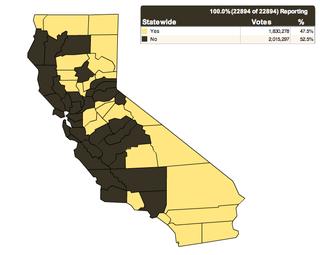
Well, maybe not everyone, but the results from last night’s election are fascinating. A $50 million campaign, with the opposition struggling to come up with $100,000 — and PG&E still lost. Calitics has a fun comparison that makes one of the key points: The company lost most heavily in its own service areas. People who have to deal with PG&E — and its high rates, poor service, blackouts, botched smart-meter program and financial greed — voted strongly against allowing the company to further entrench its monopoly power. In essence, PG&E lost at home.


A couple of other interesting factors: The results show, I think, that whatever you say about the decline of newspapers, their endorsements still matter. Every major newspaper in the state opposed Prop. 16, and that clearly had an impact. The No on 16 campaign didn’t have the money for any media buys; the press coverage and strong anti-PG&E endorsements had to carry the message.


TURN, Ross Mirkarmi, Mark Leno, Tom Ammiano and consultant Gail Kaufman deserve credit for raising what little money they could and leveraging it into a stunning statewide victory. Considering that the turnout skewed heavily Republican, the defeat of Prop. 16 will go down as one of the great progressive victories in California history.


The local numbers were astounding: In San Francisco, Prop. 16 went down 2-1, with 67 percent of the voters rejecting PG&E’s ploy. That’s the strongest mandate for public power I’ve ever seen. Same for the rest of the Bay Area: Alameda County, 64 percent No. San Mateo County, 60 percent No. Marin County, 61 percent No. Mayor Gavin Newsom ought to take a look at the map on the Secretary of State’s website; it shows that the voters he needs to get elected lieutenant governor have rejected PG&E and want a public-power option.


The collapse of PG&E’s attempt to buy democracy in California gives San Francisco some breathing room on its community choice aggregation contract, which is excellent news. The supervisors can now take some time to go over the details — and prepare for the next major battle, the marketing campaign to education local residents about the value of community-controlled green energy.


PG&E is clearly on the run — CEO Peter Darbee has driven the company to a point where it has no friends left. Could be a great era for public power efforts.

The hidden zinger in Prop. 14

11


By Richard Winger

OPINION Proposition 14, a June 8 ballot measure, would mandate that all candidates for Congress and state office appear on the same June ballot, and that all voters use that ballot. Only the two candidates who got the highest vote totals could run in November. Even write-ins would be banned in November for Congress and state offices.

Prop. 14 also has a hidden zinger in it that would remove the Peace and Freedom and Libertarian parties from the ballot. But so far only one daily newspaper has mentioned it — the San Francisco Chronicle, in a March 11 story by Wyatt Buchanan. The state ballot pamphlet says nothing about this particularly nasty detail of Prop. 14.

California has six recognized political parties: Democratic, Republican, American Independent, Green, Libertarian, and Peace and Freedom. The parties remain ballot-qualified either by polling 2 percent of the vote for any statewide race in a midterm year (all parties get a free ride in presidential years) or by maintaining registration equal to 1 percent of the last gubernatorial vote.

In practice, it’s far easier for the smaller parties to meet the first test. The Peace and Freedom Party has 58,000 registered members, and the Libertarian Party has 85,000 registered members. But these parties always meet the 2 percent vote test. Minor parties typically draw far more votes than they have registered members.

The problem is that Prop. 14 eliminates, in practice, the 2 percent vote test. Under Prop. 14, no party officially has any nominees for any office except president and vice-president. And since minor party candidates almost never place first or second in the June primary, minor party members would never be able to run for statewide office in November. And, the catch is that only the November vote counts for meeting the 2 percent vote test.

Prop. 14 also says that members of unqualified parties will not be permitted to list their party label on the June ballot.

The real irony is that the big newspapers of California know about this problem with Prop. 14 but refuse to mention it. That’s ironic because back in 1981, when Democrats in the Legislature wanted to toughen the ballot-access requirements, the big newspapers of California denounced that bill with full fury. Forty of California’s biggest newspapers, TV stations, and radio stations editorialized against that measure.

This year the Los Angeles Times (which led the charge for minor-party access in 1981) refused to mention that Prop. 14 has the same characteristic as that bill, only worse. The Times has rejected at least 10 op-eds submitted by various individuals in the last year that mentioned this problem. None of the Los Angeles Times stories about Prop. 14 have mentioned it. None of the political columnists for that newspaper have mentioned it.

Prop. 14 is supported by the Chamber of Commerce, the for-profit health insurance companies, the for-profit hospitals, and various multimillionaires, and the Yes on 14 campaign has a huge war chest. Why won’t the L.A. Times even mention this flaw in the measure? Who are the big dailies afraid of offending?

Richard Winger is the editor of Ballot Access News.


Another new model for newspaper ownership

0

Well, maybe it’s not entirely, new, but I haven’t seen it around here. The Point Reyes Light, a legend in West Marin, was just sold to a community-based group that’s almost, sortof a nonprofit. It’s actually called a “low-profit limited liability company” (not a bad name for most newspapers these days), and it’s going to be operated as a community trust, of sorts. Mark Dowie, the well-known investigative reporter, is involved, so that’s good news. And apparently, things weren’t working out with the previous owner.


Among the donors: Warren Hellman, who’s also involved in the (entirely) nonprofit Bay Citizen.

Receiver appointed to investigate assets of SF Weekly and parent chain

0

 The California Superior Court has appointed a receiver to investigate the finances of SF Weekly’s parent company and develop a plan to pay the Bay Guardian the $22 million that the chain owes as a result of our predatory pricing lawsuit. 


 On May 25, Commissioner Everett A. Hewlett, Jr., entered an order appointing professional receiver David Summers to investigate the assets of New Times Media LLC and its subsidiary, SF Weekly LP.


New Times Media LLC is the holding company for the nationwide Village Voice chain of alternative weekly newspapers.


Summers has been ordered to develop a plan for the disposition of the company’s assets so the Bay Guardian can get paid.


“This is a very significant step forward in our collection efforts,” said Bruce B. Brugmann, Bay Guardian editor and publisher.


After a six-week trial in 2008, a San Francisco jury found that the Weekly and New Times had intentionally sold ads below cost in an effort to damage the independently owned local competitor.


The jury awarded the Bay Guardian $6.39 million, and Judge Marla Miller trebled part of the damages and added on attorney’s fees. With interest accruing at 10 percent a year, the judgment is now more than $22 million.


New Times and SF Weekly Have appealed the judgment. The California Court of Appeal has set oral argument for 9 a.m. June 11.


Earlier this year, a lending syndicate lad by Bank of Montreal declared the Village Voice chain to be in default of their $77 million loan arrangements. Bank of Montreal claims to be daily sweeping the moneys earned by the Village Voice chain into a special account so as to protect the lenders’ interests.


The banks in the syndicate that are holding the VVM debt (as of March, 2009) are Bank of Montreal, U.S. Bank, Wells Fargo, WestLB AG, Rabobank, BNP Paribas, and Brown Brothers Harrimann.


The Bay Guardian has already seized two of SF Weekly’s vehicles and the rent that the paper’s subtenants pay. The California Superior Court has previously ordered half the SF Weekly’s advertising revenues diverted into an independent bank account, and placed a lien on New Times’ interests in its subsidiaries to protect the Bay Guardian’s interests.


Andy Van De Voorde, spokesperson for VVM, didn’t respond to an email requesting comment. 

Consumer Watchdog launches air strike against Prop. 17

0

For decades, respected consumer advocate Harvey Rosenfield has been battling Mercury Insurance and other corporations that have sought to undermine Proposition 103, the landmark car insurance regulatory measure that he wrote and California voters approved in 1988. But he’s never felt the need to advertise on television, until now.

Today in San Francisco, Rosenfield and the organization he founded, Consumer Watchdog, unveiled a 15-second commercial urging voters to reject Proposition 17, an effort by Mercury Insurance to overturn part of Prop. 103 to allow big surcharges on new drivers or those who have let their coverage lapse for even one day.

Mercury has spent more than $10 million and counting to blanket the media with its messaging, while Rosenfield has scraped together just $250,000 for a one-week Bay Area ad buy.

“We’ve never done this before, but given that Mercury Insurance is carpet bombing the airwaves with 30-second lies all over the state, we thought we’d do the equivalent of David’s slingshot,” Rosenfield told the Guardian.

Most newspapers, consumer groups, and other public interest entities have come out strongly against both Prop. 17 and Prop. 16, an effort by Pacific Gas & Electric to consolidate its monopoly and stop local governments from doing clean energy projects. But these two corporations are expected to spend about $35 million to fool Californians into voting against their interests and to increase corporate profits.

For more, read “Buying Power,” our recent investigation into these companies and their deceptive tactics.

Color forms

0

arts@sfbg.com

VISUAL ART It’s not immediately apparent walking around Catharine Clark Gallery’s four white, well-manicured rooms, but the space’s three current shows — by two white men and one Asian woman, from diverse locales — share some attributes. Visually, they go by the name Red No. 40, Yellow No. 6, and Blue No. 2; and conceptually, by the terms artifice and appropriation. Together they make for pleasant artificial coloring and sweetening for the eye and brain. Yet as conscious consumers know, that shit leaves traces of guilt, and worse, carcinogens.

Yes, the metaphor is slight and out of context, but so is the entirety of the work at hand. This is intentional, as both solo exhibits — Charles Gute’s "The Corrections" and John Slepian’s "the phenomenology of painting" — and the walk-in-closet-sized-room containing Stephanie Syjuco’s "Beg/Borrow/Steal" function via recontextualization.

For Slepian, whose exhibit sits at the back of the gallery as well as a semi-hidden curtained room in the front, this involves pulling from the dustbins of modernism to reframe staid paintings as video projections that pop, puff, and pivot. One such piece draws from Josef Albers’ Interaction of Color series and puts those famous static colored squares into action to irritating sounds not unlike those found in Fisher-Price toys. This lazy analogy is actually quite apt since the entirety of "the phenomenology of painting" looks and sounds cheap. The projections, while pretty, look like 20-second looped .mpegs you might expect to find in a Introduction to Flash tutorial. And the sounds, well, the young woman working the gallery’s front desk said they weren’t driving her sane. These qualities are surely intentional, as Slepian used the words "silly" and "playful" more than a few times to describe his work during a walk-through discussion on April 10. But the cool tech component doesn’t wow beyond the room’s exit.

In the adjacent room, despite being tucked awkwardly along the gallery’s hallway, Stephanie Syjuco’s works do work. Presented as an introduction, as opposed to a proper solo exhibition (Catharine Clark Gallery promises that early next year), the small survey "Beg/Borrow/Steal" packs a polemical punch. These pieces use their cheapness — sweatshop-aesthetic woven fabrics, rasterized jpgs, blocked and blobbed-out text and pics — for inventive political provocation.

Compared to Slepian’s position of playfulness, Syjuco’s work is disturbingly heavy, physically and conceptually. One of the room’s safety hazards — the other being the "black market goods" buried in black rock and lined precariously along a shelf — is a thick stack of newspapers titled Towards a New Theory of Color Reading (El Dia, Houston, Forward Times, Manila Headline). It illustrates its point through nonillustration: blocking out and color-coding all the content in Houston’s local ethnic newspapers, Syjuco cogently politicizes ad, editorial, and pictorial space via swaths of gaudy red, yellow, and blue.

Charles Gute’s "The Corrections" resides near the gallery’s entrance, and somewhere between Slepian and Syjuco on the heavy-to-playful scale. An art publication proofreader by day and artist by night, Gute wondered what would happen if he were to blur these two roles. The result: copyediting marks derived from, but in lieu of, an original art text context. In other words, circles and squiggles as art in and of themselves.

On paper, Gute’s pieces look swell. The cute and clean abstract shapes might make little to no sense, but they at least appear perceptive. In concept, they balloon — questions surface regarding what is and isn’t art, especially when extracted from within an art industry context, as alienated labor is made visible much to the embarrassment of the original authorial content. The proofs, like those blocks found on Syjuco’s newspapers, politicize the source material, making those sweet, colored marks difficult to ignore. *

CHARLES GUTE: "THE CORRECTIONS"

JOHN SLEPIAN: "THE PHENOMENOLOGY OF COLOR PAINTING"

STEPHANIE SYJUCO: "BEG/BORROW/STEAL"

Through May 15, free

Catharine Clark Gallery

150 Minna, SF

(415) 399-1439

www.cclarkgallery.com

The crime-lab mess: Who knew?

2

It’s no secret that the San Francisco crime lab is a godawful mess; in fact, we first pointed out problems in the lab back in 2001. Nobody took it seriously, and things continued to deteriorate.


Now the Examiner is pointing fingers at District Attorney Kamala Harris, saying her office had word that things weren’t exactly hunkey-dorey at the testing facility long before the current mess emerged. And if, indeed, a senior deputy in the D.A.’s office knew that the crime lab was bungling cases, Harris should have been informed, and she should have gone to the police chief and demanded to know what was going on; after all, lots and lots of her cases are now going south because of screw-ups in the lab.


But let me add another element to this, one that the daily newspapers haven’t put much focus on:


Where the hell was the chief of police, the assistant chief in charge of the crime lab, the crime lab director — all the top SFPD brass — whose job it was to monitor the lab and ensure its quality — while a truly nasty, messy situation was developing? Now, much of this pre-dates Chief George Gascon, and the guy he brought in from L.A., Assistant Chief Jeff Godown, who’s now trying to patch things up. But if the D.A.’s office knew there were problems, and a deputy D.A. was able to point to one lab employee who was allegedly calling in sick just to screw up lab operations, it’s almost inconceivable that nobody at the Police Department had a clue what was going on.


Godown appeared April 19 at the Board of Supervisors Public Safety Committee, and Sup. Ross Mirkarimi grilled him about how the situation was allowed to get so bad. Godown’s answer: “We’re still trying to piece together who knew what at the crime lab. Did the commanding officer know? Did the command staff at the Hall of Justice know?”


Good questions, because either somebody knew — and didn’t report it — or nobody knew anything, in which case you wonder why the SFPD is allowed to run a crime lab in the first place.

The danger of Props. 16 and 17

2

The problem here is not just two awful laws – it’s the idea that a single company, with loads of cash, can utterly subvert the basic premise of Democracy

EDITORIAL The California Democratic Party voted at its statewide convention April 17 to oppose Propositions 16 and 17. The San Francisco Chronicle — no friend of public power and consumer rights — endorsed strongly against both measures April 18. In fact, most major newspapers and civic groups have come out against what amounts to the most blatant attempt in California history by a pair of big corporations to buy favorable legislation at the ballot box.


And for Pacific Gas and Electric Co. and Mercury Insurance, none of that matters much.

This campaign is all about money — big gobs of money — and PG&E and Mercury have it and their opponents, so far, don’t. And if that doesn’t change in the next few weeks — if Democratic Party leaders, starting with Speaker of the House Nancy Pelosi and Sens. Dianne Feinstein and Barbara Boxer — don’t immediately start making the defeat of these two measures a priority, California will send a signal to every big corporate interest in the world that its laws and policies are for sale.

Prop. 16 is being sold — in slick TV ads and mailers so deceptive they can only be called intentional lies — as giving the voters the right to have a say before local government gets into the business of selling electricity. The proposition, one PG&E flyer notes, “is our best protection against government spending your money to get into a business they [sic] know nothing about.”

Actually, government knows a lot about the electricity business. All over California, public power agencies offer better service and lower rates than the private utilities. Nationwide, residents of more than 2,000 communities have public power — and few want to give it up and return to buying electricity from private utilities.

But that’s not the point. Prop. 16 exists entirely because PG&E wanted to stop competition. The company is spending at least $35 million of its money to pass a law that would require a two-thirds vote (a nearly insurmountable obstacle) before any local agency can offer or expand local electricity service. The Chronicle, which has always opposed public power in San Francisco, argues that “Californians should be skeptical of any local government’s claim that it can deliver cheaper and cleaner power than an established utility. But they should be at least as wary when that monopoly utility wants to deprive them of that choice.”

Prop. 17 is another blatant single-interest measure, sponsored and underwritten entirely by one giant insurance company, to change the way car insurance is regulated in California. It would, among other things, allow insurers to raise rates for people who don’t already have coverage. Give up your car for a year (because you lost your job and couldn’t afford it, or decided that you could commute just as well by bicycle, or for any other reason) and the next time you buy insurance, your rates could soar — even if your driving record was clean.

The problem here is not just two awful laws — it’s the idea that a single company, with loads of cash, can utterly subvert not only the intent of California’s initiative law but the basic premise of Democracy. PG&E and Mercury were unable to get the state Legislature to do what they wanted, so they hired campaign consultants, paid millions for people to gather signatures on petitions, put the self-serving measures on the ballot, and are now flooding airwaves and mailboxes with well-crafted, effective lies. If they succeed, what’s going to stop every other sleazy big-money interest from doing the same?

Well, right now, nothing.

It’s absolutely critical, both for the issues of public power and consumer rights and for the fundamental notion that you can’t simply buy a new law, that Props. 16 and 17 are defeated. But we’re not seeing a lot of evidence that any of the most influential people in California are taking this seriously.

State Sen. Mark Leno has done tremendous work in getting the state party to oppose Prop. 16. Assembly Member Tom Ammiano has been working nonstop in Sacramento to try to get some money into the No on 16 coffers. San Francisco Sup. Ross Mirkarimi has led the statewide organizing efforts. And San Francisco City Attorney Dennis Herrera joined a lawsuit to invalidate the law.

But in all the speeches and public statements that Pelosi, Boxer, Attorney General Jerry Brown, Lt. Gov. candidates Janice Hahn and Gavin Newsom, party chair John Burton, and others delivered at the state party convention, there was nary a mention of the fundamental importance of voting no on 16 and 17. None of the people who are capable of raising millions of dollars, the sort of money needed to defeat these measures, is making much of an effort to do it.

Props. 16 and 17 can be defeated. All it takes is a massive campaign to educate voters in a low turnout election about what these two measures actually are. But if the state’s political leaders allow these two measures to pass, California in 2010 will go down in history as the most corrupt and ungovernable state in America. And it’s very close to happening.


The danger of Props. 16 and 17

0

EDITORIAL The California Democratic Party voted at its statewide convention April 17 to oppose Propositions 16 and 17. The San Francisco Chronicle — no friend of public power and consumer rights — endorsed strongly against both measures April 18. In fact, most major newspapers and civic groups have come out against what amounts to the most blatant attempt in California history by a pair of big corporations to buy favorable legislation at the ballot box.

And for Pacific Gas and Electric Co. and Mercury Insurance, none of that matters much.

This campaign is all about money — big gobs of money — and PG&E and Mercury have it and their opponents, so far, don’t. And if that doesn’t change in the next few weeks — if Democratic Party leaders, starting with Speaker of the House Nancy Pelosi and Sens. Dianne Feinstein and Barbara Boxer — don’t immediately start making the defeat of these two measures a priority, California will send a signal to every big corporate interest in the world that its laws and policies are for sale.

Prop. 16 is being sold — in slick TV ads and mailers so deceptive they can only be called intentional lies — as giving the voters the right to have a say before local government gets into the business of selling electricity. The proposition, one PG&E flyer notes, "is our best protection against government spending your money to get into a business they [sic] know nothing about."

Actually, government knows a lot about the electricity business. All over California, public power agencies offer better service and lower rates than the private utilities. Nationwide, residents of more than 2,000 communities have public power — and few want to give it up and return to buying electricity from private utilities.

But that’s not the point. Prop. 16 exists entirely because PG&E wanted to stop competition. The company is spending at least $35 million of its money to pass a law that would require a two-thirds vote (a nearly insurmountable obstacle) before any local agency can offer or expand local electricity service. The Chronicle, which has always opposed public power in San Francisco, argues that "Californians should be skeptical of any local government’s claim that it can deliver cheaper and cleaner power than an established utility. But they should be at least as wary when that monopoly utility wants to deprive them of that choice."

Prop. 17 is another blatant single-interest measure, sponsored and underwritten entirely by one giant insurance company, to change the way car insurance is regulated in California. It would, among other things, allow insurers to raise rates for people who don’t already have coverage. Give up your car for a year (because you lost your job and couldn’t afford it, or decided that you could commute just as well by bicycle, or for any other reason) and the next time you buy insurance, your rates could soar — even if your driving record was clean.

The problem here is not just two awful laws — it’s the idea that a single company, with loads of cash, can utterly subvert not only the intent of California’s initiative law but the basic premise of Democracy. PG&E and Mercury were unable to get the state Legislature to do what they wanted, so they hired campaign consultants, paid millions for people to gather signatures on petitions, put the self-serving measures on the ballot, and are now flooding airwaves and mailboxes with well-crafted, effective lies. If they succeed, what’s going to stop every other sleazy big-money interest from doing the same?

Well, right now, nothing.

It’s absolutely critical, both for the issues of public power and consumer rights and for the fundamental notion that you can’t simply buy a new law, that Props. 16 and 17 are defeated. But we’re not seeing a lot of evidence that any of the most influential people in California are taking this seriously.

State Sen. Mark Leno has done tremendous work in getting the state party to oppose Prop. 16. Assembly Member Tom Ammiano has been working nonstop in Sacramento to try to get some money into the No on 16 coffers. San Francisco Sup. Ross Mirkarimi has led the statewide organizing efforts. And San Francisco City Attorney Dennis Herrera joined a lawsuit to invalidate the law.

But in all the speeches and public statements that Pelosi, Boxer, Attorney General Jerry Brown, Lt. Gov. candidates Janice Hahn and Gavin Newsom, party chair John Burton, and others delivered at the state party convention, there was nary a mention of the fundamental importance of voting no on 16 and 17. None of the people who are capable of raising millions of dollars, the sort of money needed to defeat these measures, is making much of an effort to do it.

Props. 16 and 17 can be defeated. All it takes is a massive campaign to educate voters in a low turnout election about what these two measures actually are. But if the state’s political leaders allow these two measures to pass, California in 2010 will go down in history as the most corrupt and ungovernable state in America. And it’s very close to happening.

Examiner and PRI target Greenlining Institute

5

We chronicled the right-wing campaign to destroy ACORN – which promoted voting rights and economic justice for low-income Americans — as well as the crazy right-wing editorials in the San Francisco Examiner. And this week, we saw them join forces to go after another effective progressive organization: the Berkeley-based Greenlining Institute.

The Examiner newspapers here and in Washington D.C. today concluded a five-part series of industry-sponsored opinion pieces masquerading as journalism attacking Greenlining, ACORN, and the finally 1977 Community Reinvestment Act, claiming that their encouragement of banks to lend money in poor areas amounts to a criminal shakedown of corporations and one that caused the financial crisis.

The series was produced by a partnership that included San Francisco-based Pacific Research Institute (a right-wing think tank funded by big corporations and conservative foundations), its CalWatchdog propaganda project, and the Examiner, which is owned and operated by Denver-based billionaire businessman Philip Anschutz, whose foundation also helps fund PRI.

While it might be tempting to dismiss such a blatant effort by corporate-funded patsies to discredit an effective progressive foe, using the pages of marginalized newspaper that denies global warming. But considering what these same reactionary forces did to ACORN using evidence that was just as flimsy, it’s important that the people push back.

Greenlining Institute Executive Director Orson Aguilar raised that same concern when we contacted him: “This is pretty weak journalism, but the underlying issue is serious. They’re using us to attack the Community Reinvestment Act and the whole idea that huge Wall Street financial institutions have some responsibility to the communities they serve. We may be the scapegoat du jour, but the real aim is to blame low-income communities for a financial crisis that was caused by inadequate regulation and greed. We have no intention of backing down.”

I couldn’t have said it better myself.

A good, stubborn Irishman

0

He was one of the last of the old-line labor leaders who once had great influence in many cities. He was Irish-Catholic, of course, a resident of the city’s principal working class district, and from one of the blue-collar trades.

 His name was Joseph Michael O’Sullivan. He had been president of the San Francisco Building and Construction Trades Council and for four decades head of its main carpenters union local.
 
Those who would truly understand the history of San Francisco and in  particular the key role organized labor has played in the city’s development, as in that of so many other cities, must pay attention to the memory of Joe O’Sullivan.

 He was a very good man. He also was a very stubborn man. I remember, for instance, that time in 1976 when he insisted on going to jail.

 O’Sullivan and three other construction union officials had been sentenced to jail for having led a strike by municipal craftsmen — who, as public employees, supposedly did not have the legal right to strike. O’Sullivan — then aged 74 and ailing — didn’t have to go to jail, since union lawyers were certain they could overturn the sentences, as they ultimately did.

The other union officials were content to have the lawyers handle the matter through court appeals, but O’Sullivan refused to be “a damned labor bureaucrat.” He preferred to be a labor activist, and so turned himself over to the San Francisco County sheriff for a five-day stay behind bars.

 O’Sullivan thought that was a small price to pay for the badly needed opportunity it would give the city’s unions to bounce back from the severe beating they had suffered in the craftsmen’s strike. Surely, he thought, the unions would mount a major campaign to protest the jailing of one of their best known and most respected leaders over one of the most fundamental of labor rights.

 That would draw maximum attention to the injustice of a court ruling which had denied that fundamental right to thousands of working people. It would show that the unions still were capable of the militancy that had earned San Francisco a reputation as one of the country’s premier “union towns.”

And it would be an ideal way for the unions to seek the support essential to restoring their former influence — the support of public employees and others in the heavily non-union white collar occupations that had come to dominate the city’s economy and that of so many other cities as unionized blue collar occupations once did.

 But the unions allowed Joe O’Sullivan to enter jail, and to leave jail, quietly and alone.  There were no protest rallies. no demonstrations, no marches, no angry speeches, no picketing, no sympathy strikes, none of the militant actions that had marked labor’s rise to economic, political and social prominence.
 There was only grumbling, among most of the city’s other labor leaders, that O’Sullivan was “grandstanding” in trying to get them top rely on more than just largely unpublicized courtroom arguments.

 But the arguments won the unions very little. About all they got was a narrow court ruling that, although indeed overturning the decision which had ordered the strike leaders to jail, did so on purely technical grounds. The ruling did not upset the previous finding that city employees could not legally strike.

Union strategists argue to this day whether activist tactics would have countered that anti-unionism of the 1970s, as they argue whether such tactics would be the best way to counter the anti-unionism that has plagued the labor movement of San Francisco and other cities ever since.
 
Such questions rarely even occurred to O’Sullivan. Activism was virtually the only tactic he knew. He learned it very early in life, as an 11-year-old telegraph messenger working with the Irish Republican Army in 1913, against the British forces occupying his native village of Tralle, County Kerry.

 Young O’Sullivan, entrusted by the British authorities to deliver messages to the occupying British troops, showed the messages first to local IRA leaders — despite the leaders’ warnings “that if I was caught, it would be the finish for me.”
 
 So why did he do it? “The messages were very important, they wanted them, and I felt that whatever I could do for Ireland … well, I would do it.”
 
 O’Sullivan left the messenger’s job to work with his father, a master carpenter and secretary of the carpenters union in Tralle, but continued his IRA activities.
 
“Whenever they were going to ambush a British lorry,” he recalled, “the IRA had to know when it was leaving to come out in the country. So I would put out a gas lamp, then another boy a mile away would see that and he would put out another one.  That would be the signal. The IRA would did a trench in the road and the lorry would fall into it. Our guys would call on them to surrender. We’d take the rifles and ammunition, and their shoes, and then make them walk back into town. . .
 “We never went to kill them — though people were killed, that was for sure . . . But there was more caskets going back to England than were being lowered in the ground in Ireland.”

 O’Sullivan’s IRA activities ended abruptly one night when two British soldiers burst into the cottage where he lived and dragged him away at gun point after O’Sullivan’s mother, certain he was to be killed, “started throwing holy water on me.”  Once outside the cottage, O’Sullivan knocked away the rifle of one of the soldiers and ran. Although wounded by the other soldier, he escaped, eventually making his way to the United States.

 O’Sullivan arrived in San Francisco in 1925, seeking work through the carpenters union local he eventually would head. At the time, the local was leading a major strike aimed at forcing contractors to bargain with construction unions on pay and working conditions.  Contractors had brought in more than 1,000 non-union strikebreakers from Southern California to replace the strikers, and they became the striking union’s main targets.

 “We formed ‘wrecking crews’ — ‘thugs,’ they used to call us in the newspapers — and got $1.50 a day from the union to get into a job, roust the scabs, break their tools,” O’Sullivan remembered. “When we shut a job down, nobody worked — they got out fast. We just used our hands, but we worked the scabs over good …. Maybe it was the right thing to do, maybe it was wrong — but that’s the way it got done.”

 At one point, O’Sullivan and the six other members of his “wrecking crew” were arrested for the murder of a strikebreaker. They were held three weeks, until two other men confessed to the killing.

 The construction unions lost the strike after a year of fierce struggle and O’Sullivan, blacklisted by employers, had to move to the  city of Vallejo across San Francisco Bay to find work. But he later returned to San Francisco and, in 1935, was elected to head Carpenters Local No. 22.  O’Sullivan held that job until 1977, helping lead carpenters and other building tradesmen in the struggles that finally won them the right to effective union representation.

 The relatively high pay and benefits and decent working conditions of the tradesmen today are taken for granted. But the workers wouldn’t have them if it wasn’t for their unions, which had to fight hard to get employers to grant even the simplest amenities.  O’Sullivan’s nephew James vividly recalled his uncle’s great pride in getting “fresh water and toilets on the job for the carpenters and a pension plan to take care of them when they grew old.”

O’Sullivan was stubborn to the end. He left union office only because of the adoption, over the strong objections of O’Sullivan and many of his local’s members, of an amendment to the carpenters’ national constitution that prohibited anyone over 70 — O’Sullivan included — from seeking union office.

But he was no grim advocate, despite his stubbornness, dedication and determination. I recall watching him turn on his considerable Gaelic charm in Israel, where he had gone with a delegation of touring labor leaders in 1973. The most important day of the tour was March 17, when the leaders were to confer with David Ben-Gurion.

As the senior member of the delegation, O’Sullivan greeted the legendary former prime minister, who stood before the visitors with an air of immense and almost forbidding dignity.  Joseph Michael O’Sullivan, looking and sounding only as someone who had been baptized in Ireland with such a name could look and sound, quickly broke the ice.

 “Mr. Ben-Gurion,” he said, “let me be the first to wish you a happy St. Patrick’s Day.”

Dick Meister, formerly labor editor of the SF Chronicle and KQED-TV Newsroom, has covered labor and politics fror a half-century. Contact him through his website, www.dickmeister.com, which includes more than 250 of his recent columns.

Us and the Weekly: It wasn’t personal

4

I really liked The Stranger’s article a couple of weeks ago about our battle with SF Weekly and it’s corporate parent, Village Voice Media. Eli Sanders is a good reporter, and he got most of it right.


But he did the same thing that a lot of people covering this legal battle have done, and it’s starting to get annoying. Everyone seems to want to play this as a battle of egos between Guardian Editor and Publisher Bruce Brugmann and VVM Executive Editor Mike Lacey. It’s as if we filed suit against them — and endured years of litigation and now collection efforts — just out of spite. It’s as if we were willing to go through all this just because Bruce didn’t like Mike Lacey.


Here’s Sanders’ spin:


These two men have hated each other for decades, but with increasing venom since 1995, when Lacey showed up in San Francisco in cowboy boots to announce that he and his partners had just purchased the tiny SF Weekly and planned to make a huge success of it.


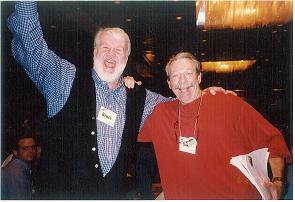
The thing is, Bruce and Mike haven’t hated each other for decades. They weren’t terribly close, but they got along fine — and sometimes, they were political allies. In 1997, three years AFTER Lacey’s company bought our competitor, SF Weekly, the two joined forces at an Association of Alternative Newsweeklies convention in Montreal to help push a bylaws measure that kept daily newspapers out of our trade association. And as the picture above shows, they were almost, sorta, kinda pals. At least for a few minutes.


The last thing we wanted to do was sue these guys. It wasn’t personal; we had no choice. Sure, the Guardian and VVM have very different approaches to journalism and politics, but we’d have been happy to compete with them — the way newspapers with different viewpoints should, on a level playing field. And for all the rhetoric on all sides, the legal animosity only started when the Weekly actively tried to put us out of business by selling ads below cost.


I dunno; the VVM people have been awfully rude to me of late, and I guess they like this mano-a-mano shit, but the reality is: We sued to stop illegal conduct that was threatening our business. That’s the real story.


Hank Plante’s exit interview

2

Hank Plante ends a three-decade run as a political journalist with tonight’s (March 24) broadcast of the CBS 5 Eyewitness News, where he has worked since 1986 after starting his career with newspapers in Washington DC. So we took the occasion to talk politics with him, learning that his loyalties lie downtown.

Plante agreed that politics has become ugly these days. “It’s just so much more acrimonious, that’s one thing that’s changed. The other is just the money that’s involved,” Plante told us, marveling at Meg Whitman’s plans to spend $40 million of her own money to run for governor and the $1 million per day that corporations spent lobbying against the health reform bill signed by President Obama.

But the changes haven’t gotten Plante down, as they have many political junkies, who decry the crippling of government’s ability to combat corporate power and address real social and economic problems. “I’ve never become a cynic, and I think that’s one thing that sets me apart from many political journalists,” he said, adding, “I still think politicians can make a difference.”

Yet like many political journalists, when I ask who his favorite politicians have been, he rates them based on whether they’ve made good stories, not whether they good for the people. For journalists, bad is often good, whether it be natural disasters or disgraceful politicians.

“Arnold is a great story. Willie Brown was a great story. Gray Davis was a dull story until he got recalled, then he was a good story,” Plante said.

What about Mayor Gavin Newsom, who has often given Plante exclusive access (including Newsom’s first extended interview after his 2007 sex scandal), but who has also angrily walked out in the middle of an interview with Plante. 

“Personally, I like the mayor. But I have to ask him tough questions, so he can be mercurial. Right now, he’s running for office again, so he’s charming,” Plante said.

In fact, for a journalist, Plante makes clear his preference for Newsom over the progressive majority on the Board of Supervisors, joking, “If I had a month to live, I’d spend it with the Board of Supervisors because it would seem like five years.”

Plante also said that he opposes district elections — which he said have prevented the emergence of big-stature political figures like Dianne Feinstein and Quintin Kopp — and Plante said he doesn’t see the value of district elections in counteracting the political power of downtown corporations. “I’m a capitalist and I have no problem with people making money,” he said.

Yet Plante acknowledges the divide between downtown and progressives is San Francisco’s dominant political dynamic, noting, “You see how afraid downtown is of the Board of Supervisors appointing the new mayor.”

While Plante said he believes in the importance of politics, he does decry how political science and public relations have been manipulated in recent years.

“They’re taken a page out of the Karl Rove playbook to talk over the journalists right at the public,” Plante said, noting how many politicians no longer feel the need to be accessible to journalists or honestly and directly answer their questions. “They really want to control the message, so the accessibility is diminished.”

Nonetheless, Plante said he regularly emphasizes the importance of political engagement: “In a place like the Bay Area, where people are inundated with lots of information sources, you have to keep saying it over and over again.” 

Plante, 63, is retiring and moving to his home in Palm Springs with his partner, Roger. Among the many awards and accolades he earned during his career are several Emmys and a prestigious Peabody Award. His station sent out a press release praising Plante, including this comment by anchor Dana King: “There is an entire population of politicians breathing a sigh of relief at the news of Hank’s retirement. Hank was the consummate professional, never combative but he did his homework and asked tough, pointed questions. Politicians, love him or hate him, respected and answered them, every single time. Our newsroom will suffer a huge intellectual void when he leaves.”

If we’re going to be whores, let’s at least get paid

2

The San Francisco City Planning Commission will be voting March 18th on a proposal to build luxury condos next to the Transamerica building. The developers are two out-of-town outfits that support Republican candidates. And therein lies an interesting tale.


Back in 1984, when dinosaurs roamed the Earth and newspapers made a lot of money and Dianne Feinstein was mayor, San Francisco was host to the Democratic National Convention, which nominated a guy named Walter Mondale (talk about dinosaurs) to run against Ronald Reagan for president. Running the convention, and all the parties and galas, cost a fair amount of cash, and Feinstein hit up all the big civic donor types to chip in.


One of the people atop her list was Walter Shorenstein, the local real-estate tycoon who was a huge donor to Democratic Party candidates (Bill Clinton used to stay at Shorenstein’s house when he was in town). Shorenstein was also trying to get permits to build some new highrises — and some of his buildings were so grossly out of proportion that even Feinstein’s Planning Commission, which loved all things big and highrise, was balking a little.


So Walter calls the mayor and says this: Don’t you dare ask me to donate to your Democratic Convention if your planners are going to jerk me around on my permits. And Feinstein, of course, made sure the Planning Commission backed down and Shorenstein got exactly what he wanted.


We did a big story, and even the Chronicle, which wasn’t big on criticizing Feinstein or Shorenstein, wrote about it, and there was all manner of outrage — as there should have been. It was terribly unseemly, and made the city look bad, and made Feinstein look like she could be pushed around by developers ….


And for all that, at least the special favors were going to a local guy who was donating money to Democrats and to the city’s convention efforts. Hideous as it was, as least San Francisco (and Feinstein, and Mondale) were getting something out of it.


Fast forward to today — when Gavin Newsom’s Planning Commission is considering an awful, out-of-scale project that even architecture magazines don’t like. And who benefits from the special favors? Not a local guy helping out with a local project, but an offshore corporation and a developer from L.A. who is on Meg Whitman’s Finance Committee.


I mean, if we’re going to be whores here in Democratic San Francisco, shouldn’t we at least get paid for it? 


Herrera stands up to PG&E

Yesterday, at the California Public Utilities Commission, PG&E executives raised some eyebrows with their presentation about Proposition 16, the ballot initiative designed to make it difficult for municipalities to enter the electricity business. CPUC President Michael Peevey expressed his skepticism about a measure that would require only a simple majority vote to set up a two-thirds majority system.

Today, PG&E might suddenly have bigger problems on its hands than scolding remarks from the CPUC and the Legislature, thousands of pissed off SmartMeters customers, the threat of competition from municipalities, and a slew of editorials from newspapers throughout the state chiding the utility giant for trying to amend the state’s constitution for its own financial gain.

San Francisco City Attorney Dennis Herrera is leading a lawsuit to strike Proposition 16 from the June ballot. The complaint calls Prop 16 “wholly false and misleading” and said the company “profoundly misled the citizens who were induced to sign the petition.”

“We’re not seeking to fix it, we’re seeking to nix it,” Herrera’s press secretary Matt Dorsey explained.

The lawsuit was filed jointly by the San Francisco Local Agency Formation Commission, the City and County of San Francisco, the Sacramento Municipal Utility District, the City of Moreno Valley, the City of Redding, the California Municipal Utilities Association, the San Joaquin Valley Power Authority, the Modesto Irrigation District, and the Merced Irrigation District.

A hearing date has been set for May 4 in Sacramento Superior Court, according to Dorsey.

Newsom’s plan means service cuts

15

The San Francisco Controller’s Office says that Mayor Newsom’s plan to lay off 15,000 city employees then hire most of them back at a reduced workweek will save $110 million. The Examiner quotes the mayor:


“The 37½-hour idea was a way of equalizing,” Newsom said in an interview Tuesday. “I would have to go to every single labor union, open contracts that are closed and engage with those open contracts in collective bargaining for each and every local.
“Every labor union is in this together. We aren’t going to pick and choose. That being said, they are coming back Thursday with a set of alternatives, and I will keep an open mind.”


Actually, it’s not exactly equalizing — no police officers or firefighters will get what amounts to 6.25 percent pay cuts. But here’s the more important issue:


The mayor — and, to a great extent, the newspapers — present this as a simple way of saving money; sure, the workers take a little hit in their pay, but jobs are preserved. What nobody’s saying is that this will amount to more very significant service cuts.


Take 15,000 employees and cut 2.5 hours from each of their workweeks. That’s 37,500 hours of work a week, or the equivalent of 937 full-time jobs. So one of two things are going to happen: Either city employees are going to be working 40 hours for 37.5 hours pay — that is, taking a direct pay cut, which is what I think Newsom really wants — or the city’s going to lose the equivalent of 937 workers.


If you assume that it’s unfair to ask people to work 40 hours for 37.5 hours pay (and if you assume, as I do, that the unions won’t stand for that), we’re going to be talking about service cuts — work that doesn’t get done. And where will those cuts happen? Guess what — it’s the usual places.


Public health takes the biggest hit, with $35.5 million in “savings” (actually, cuts) over the next 14 months. Human Services gets $10 million cut, and Muni about $8 million.


That means longer lines and sicker people at SF General, and more broken buses with no mechanics to fix them, which means slower Muni service … you get the picture.


I’m not saying that we don’t need cuts, and you could argue that it’s more fair to cut everyone’s pay a little than to eliminate 937 jobs altogether. But let’s be honest about this — it’s not just “salary savings.” It’s service cuts. On top of last year’s service cuts, on top of the previous year’s service cuts … and it’s being done without any real overall plan for what services we need to provide and what takes priority.


And of course, it’s being done with no discussion at all of raising new revenue.  

SF Weekly owes us half its ad revenue

6


The San Francisco Superior Court ruled March 9th that SF Weekly must begin making payments on the Bay Guardian judgment by turning over half of the revenues it receives from advertising sales.


Commissioner Everett A. Hewlett, Jr., entered an Assignment Order that requires the SF Weekly and all of its advertisers to immediately begin remitting advertising revenues to the Bay Guardian. The Assignment Order also requires SF Weekly’s credit card processing company to remit 100% of the credit card payments directly to Bay Guardian rather than to SF Weekly.


The Assignment Order is effective immediately. Additionally, SF Weekly has until Wednesday to turn over to the Bay Guardian a list of all its advertisers and the amounts that they currently owe to SF Weekly.


At a hearing on February 11, attorneys for SF Weekly opposed the assignment by arguing that if the court were to enter the Bay Guardian’s proposed Assignment Order, it might cause the Bank of Montreal to declare a default on a $80 million loan balance that SF Weekly and its parent company have guaranteed. Bank of Montreal is the primary lender on a $120 million credit line available to the Village Voice chain. SF Weekly has repeatedly attempted to use the Bank of Montreal loan as a shield to defeat Bay Guardian, however, the Court has repeatedly rejected that argument.


“We consider this to be a very significant step towards the collection of our judgment,” said the Bay Guardian’s Bruce Brugmann. “The Village Voice folks first claimed that we would never collect anything, then they claimed that we would never collect more than a few thousand dollars, but the amount that we will now be collecting is certainly very significant.”


Since the Village Voice chain has refused to post an appellate bond which would guarantee payment if the judgment is upheld on appeal, the Bay Guardian has continued to actively pursue the collection of the amount due as permitted by law where no bond has been posted.  Extraordinary attempts by the Village Voice chain to avoid the judgment, including filing a  lawsuit in Delaware that sought to stop all California collection proceedings, have  been unsuccessful in blocking the Bay Guardian’s collection efforts.


In recent weeks, the Bay Guardian has succeeded in collection efforts that involved auctioning off two of the SF Weekly’s vans, seizing monthly income that the SF Weekly was receiving from its subtenants, and placing a lien on the approximately 14 newspapers owned by New Times Media LLC nationwide.  Additional collection proceedings will be heard by various courts during the next couple of months unless the judgment of more than $20 million is paid.


Informing the public

1

news@sfbg.com

Information is power. But too often, those with political power guard public documents and information from the journalists, activists, lawyers, and others who seek it on the people’s behalf. So every year, we at the Guardian honor those who fight for a freer and more open society by highlighting the annual winners of the James Madison Freedom of Information Awards, which are given by the Northern California chapter of the Society of Professional Journalists.

This year’s winners are:

Beverly Kees Educator Award

Rachele Kanigel

Rachele Kanigel, an associate professor of journalism and advisor to Golden Gate Xpress publications at San Francisco State University, has been highly involved in student press rights work on a national level. She wrote The Student Newspaper Survival Guide (Blackwell Publishing, 2006), a book designed to empower budding campus reporters. A champion of the free speech rights of her students, Kanigel has gone to bat on several occasions on behalf of student journalists whose work was challenged by interests that didn’t believe students should be afforded the same protections as professional reporters. Kanigel sees part of her job as educating the world about the importance of student journalists and standing up for their rights. “A lot of people won’t talk to student journalists, but they’re doing some really important work,” she said. “A lot of what we have to do is to assure the student journalists and tell the world outside that these are journalists.” The educator award is named in honor of Beverly Kees, who was the SPJ NorCal chapter president at the time of her death in 2004.

Norwin S. Yoffie Career Achievement Award

Mark Fricker

Mary Fricker is the kind of investigative reporter many of us would like to be.

She started out in the 1980s investigating complaints of irregularities at her local savings and loan when she was reporting for the old Russian River News community paper. Her dogged research and hard-hitting stories produced the first major investigation into the toxic problems of financial deregulation in S&Ls. Her work won numerous awards, including the Gerald Loeb Award given out by UCLA and the prestigious George Polk Award, and ultimately led to the book, Inside Job: The Looting of America’s Savings and Loan. The book won Best Book of the Year award from the Investigative Reporters and Editors association.

Fricker did business reporting and major investigative work for 20 years with the Santa Rosa Press Democrat. She retired and joined the Chauncey Bailey Project as a volunteer investigative reporter, researcher, Web site maestro, and general good spirit. Her work included several key investigations that determined that the Oakland Police Department was virtually alone in not taping interviews with suspects in investigations. Her stories changed that practice. She is a most worthy recipient of the Norwin S.<0x2009>Yoffie award, which honors the memory of the former publisher of the Marin Independent Journal, a founder of the SPJ/FOI committee, and a splendid warrior in the cause of Freedom of Information.

Professional Journalist

G.W. Schulz

G.W. Schulz was busy when we got him on the phone. “I’m sending out about eight or nine new freedom of information requests a day,” he said. “I fired off a few to the governor of Texas this morning.”

The relentless reporter is working on the Center for Investigative Reporting’s program exposing homeland security spending. It hasn’t been easy. Since the federal government began making big grants to local agencies for supposed antiterrorism and civil emergency equipment and programs, following the money has required unusual persistence. Homeland Security officials don’t even know where their grants are going, so Schulz has been forced to dig deeper.

“I think this is the biggest open government campaign I’ll ever do in my career,” he said. “We’re juggling dozens of requests, state by state. And it’s breathtaking what some people will ignore in their own public records laws.”

He’s found widespread abuse. “These agencies are getting all this expensive equipment and they don’t even maintain it or train their staff how to use it,” he said. CIR is not only doing its own stories, it’s working with local papers that don’t have the resources to do this kind of work. “Lots of great stories in the pipeline,” he said before signing off to get back to the battle. “I’m really excited.”

Legal Counsel

Ann Brick/ACLU

On the heels of a now-infamous Supreme Court ruling on so-called First Amendment rights for corporate political speech, SPJ is honoring an individual who has made a career devoted to protecting real, individual free speech rights for almost 20 years. Ann Brick, staff attorney for the Northern California chapter of the American Civil Liberties Union, has litigated in defense of privacy rights, free speech, government accountability, and student rights in cases ranging from book burning to Internet speech to illegal government wiretapping. “I can’t tell you how much of an honor it is to have worked with the ACLU,” she says, adding, “I can’t think of another award I’d rather get than this one — an award from journalists.” But the public’s gratitude goes to Brick, whose years of service are a shining example of speaking truth to power.

Computer Assisted Reporting

Phillip Reese

Phillip Reese of The Sacramento Bee is being honored for his unrelenting pursuit of public records and for producing interactive databases. Reese was the architect of the Bee‘s data center, providing readers readily accessible information about legislative voting records, neighborhood election results, state employee salaries, and other important information. At one point, the city of Sacramento demanded several thousand dollars in exchange for employee salary data. Reese gathered the city’s IT workers and a city attorney for a meeting, where he argued that organizing records in an analyzable format would insure the system wasn’t being abused, so they chose to provide the records for free. The online databases provide public access to records that are often disorganized and cryptic. “Sometimes these databases go well with a story, and sometimes they can stand on the Internet alone. People can view them in a way that is important to themselves,” Reese said.

Public Official

Leland Yee

State Sen. Leland Yee (D-San Francisco) has been an open government advocate since his days on the San Francisco Board of Supervisors, and one of his favorite targets is the administration of the University of California. He has fought to protect UC students from administrators who want to curtail their free-speech right and to get documents from university officials.

In 2008, he authored and passed SB 1696, which blocked the university from hiding audit information behind a private contractor. UCSF was refusing to release the information in an audit the school paid a private contractor to conduct. “I read about this in the newspaper and I was just scratching my head. How can public officials do this stuff?” Yee said. He had to overcome resistance from university officials and public agencies arguing that the state shouldn’t be sticking its nose into their business. “But it’s public money, and they’re public entities, and the people have a right to know where that money is going.”

Computer Assisted Reporting

Thomas Peele and Daniel Willis

This duo with the Bay Area News Group, which includes 15 daily and 14 community newspapers around the Bay Area, performed monumental multitasking when they decided to crunch the salaries of more than 194,000 public employees from 97 government agencies into a database. Honored with the Computer Assisted Reporting Award, the duo provided the public with a database that translated a gargantuan amount of records into understandable information. They had to submit dozens of California Public Records Act requests to access the records of salaries that account for more than $1.8 billion in taxpayer money. “It is important that the public know how its money is spent. This data base, built rather painstakingly one public records act request at a time by Danny Willis and myself as a public service, goes a long way in helping people follow the money,” Peele said.

Nonprofit

Californians Aware: The Center for Public Forum Rights

California’s sunshine laws, including the Brown Act open meeting law and California Public Records Act, aren’t bad. Unfortunately, they are routinely flouted by public officials, often making it necessary to go to court to enforce them. That’s why we need groups like CalAware, and individuals like its president, Rick McKee, and its counsel, longtime media attorney Terry Francke. Last year, while defending an Orange County school board member’s free speech rights and trying to restore a censored public meeting transcript, CalAware not only found itself losing the case on an anti-SLAPP (strategic lawsuit against public participation) motion, but being ordered to pay more than $80,000 in school district legal fees. “It’s never been easy, but that was going to be the end of private enforcement of the Brown Act,” Francke said. Luckily, Sen. Leland Yee intervened with legislation that prevents awarding attorney fees in such sunshine cases, leaving CalAware bruised but unbowed. “We’ve become active in court like never before.”

News Media

SF Public Press/McSweeney’s

Last year, when author Dave Eggers and his McSweeney’s magazine staff decided to put out a single newspaper issue (because “it’s a form we love,” Eggers told us), they filled San Francisco Panorama with the unusual mix of writers, topics, and graphics one might expect from a literary enterprise. But they wanted a hard-hitting investigation on the cover, so they turned to the nonprofit SF Public Press and reporters Robert Porterfield and Patricia Decker. Together, they worked full-time for four months to gather information on cost overruns on the Bay Bridge rebuild, fighting for public records and information from obscure agencies and an intransigent CalTrans. “We’re still dealing with this. I’ve been trying to secure documents for a follow-up and I keep getting the runaround,” said Decker, a new journalist with a master’s degree in engineering, a nice complement to Porterfield, an award-winning old pro. “He’s a great mentor, just such a fount of knowledge.”

Professional Journalist

Sean Webby

San Jose Mercury News reporter Sean Webby won for a series spotlighting the San Jose Police Department’s use of force and how difficult it is for the public or the press to track.

The department and the San Jose City Council refused to release use-of-force reports, so Webby obtained them through public court files. He zeroed in on incidents that involved “resisting arrest” charges, and even uncovered a cell phone video in which officers Tasered and battered suspects who did not appear to be resisting.

Webby has won numerous awards in the past, but says he is particularly proud of this one. “Freedom of information is basically our mission statement, our bible, our motto,” he said. “We feel like the less resistance the average person has to getting information, the better the system works.”

Webby said that despite causing some tension between his paper and the San Jose Police Department, the project was well worth it. “We are never going to back off the hard questions. It’s our job as a watchdog organization.”

Public Service

Rita Williams

KTVU’s Rita Williams is being honored for her tireless efforts to establish a media room in the San Francisco Federal Building that provides broadcasters the same access to interviews as print reporters.

Television and radio equipment was banned from the federal pressroom following 9/11, but Williams solicited support from television stations, security agencies, the courts, and the National Bar Association. After a six-year push, they were able to restore access.

Williams and her supporters converted a storage unit in the federal building into a full-blown media center, which was well-used during the Proposition 8 trial. “I only did two days of the trials, but every time I walked into the room, I would just be swarmed with camera folks saying thank you, thank you, thank you,” she said. “I’m getting close to retirement and I was in the first wave of women in broadcasting, and I’m proud that almost 40 years later, I can leave this legacy.”

Citizen

Melissa Nix

With her Betty Page looks, dogged sense of justice, and journalistic training, Melissa Nix became a charismatic and relentless force in the quest to find out how her ex-boyfriend Hugues de la Plaza really died in 2007. Nix began her efforts after the San Francisco medical examiner declared it was unable to determine how de la Plaza died and the San Francisco Police Department seemed to be leaning toward categorizing the case as a suicide. Using personal knowledge of de la Plaza and experience as a reporter with The Sacramento Bee, Nix got the French police involved, who ruled the death a homicide, and unearthed the existence of an independent medical examiner report that concluded that de la Plaza was murdered.

Editorial/Commentary

Daniel Borenstein

Contra Costa Times reporter Daniel Borenstein wasn’t out to deprive public worker retirees of yachting, country club golf, and rum-y cocktails at tropical resorts. The columnist was only trying to figure out how, for example, the chief of the Moraga-Orinda Fire District turned a $185,000 salary into a $241,000 annual pension. Borenstein’s effort to unearth and make public, in easily readable spreadsheets, the records of all Contra Costa County public employee pensioners led the Contra Costa Times to a court victory stipulating just that: all records would be released promptly on request without allowing retirees time to go to court to block access. The effects have been noticeable: “I get scores of e-mails most weeks in reaction to the columns I’m writing on pensions, [and] public officials are much more sensitive to the issue,” Borenstein says. It is a precedent that has carried into the Modesto Bee‘s similar pension-disclosure efforts in Stanislaus County.

Student Name Withheld After a photojournalism student at San Francisco State University snapped photographs at the scene of a fatal shooting in Bayview-Hunters Point, police skipped the usual process of using a subpoena to seek evidence, and went straight into his home with a search warrant to seize this student’s work. But with the help of his attorney, the student quashed the warrant, arguing California’s shield law prevents law enforcement from compelling journalists to disclose unpublished information. He won, and the case served to demonstrate that the shield law should apply to nontraditional journalists.

The student is being recognized because he resisted the warrant rather than caving into the demands of law enforcement. Invoking the shield law in such cases prevents reporters from being perceived as extensions of law enforcement by the communities they report on, enabling a free exchange of information. The student remained anonymous in the aftermath of the shooting because he feared for his life. Based on his ongoing concerns, NorCal SPJ and the Guardian have agreed to honor his wish to have his name withheld.

Obits for sale

0

Dick Meister, former labor editor of the SF Chronicle and KQED-TV Newsroom, has covered labor and politics for a half-century. Contact him through his website, www.dickmeister.com, which includes more than 250 of his recent columns.

Like most daily newspapers these days, the San Francisco Chronicle is hustling to increase declining profit margins.  But let me offer some advice to my former employer: Quit gouging grieving readers as part of your profit chasing. I mean those who pay the Chronicle for running their loved ones’ death notices on the paper’s obituary pages.

Sure, the paper’s not making anywhere near as much as it once did from other classified ads, but don’t try to make up for it by outrageously exploiting the saddened friends and families of the recently deceased.

The basic price for death notices is $16 per printed line per day – $112 per column inch (about seven lines of type).  Those 1×1½ inch photos that sit atop many obits cost about $135 more. If you also want the obit on the Chronicle’s website, that will be another $25, please. And if you want the obit to run for a longer period, for say a week, that can get quite pricey – as much as  $784 per inch.

On a typical day this week, 40 notices ran on the Chronicle’s three pages of paid obits, 21 with photos. They ranged from two to 14 inches each and cost from about $225 to about $1570 to run for that one day. That’s right – $1570, plus the $135 charge for those with photos.

Like all papers, the Chronicle also runs unpaid news obituaries of particularly prominent people that are researched and written by the newspaper’s staffers or by an outside news agency that serves the paper. The paid obits are usually written by members of the deceased’s family or by employees of the mortuary that’s involved.

So, it’s like this: If you’re well known, it probably won’t cost your family or friends a dime to notify the public and remind people of your life story. But if you’re just plain folks, it’ll cost family or friends – and probably cost them dearly.  But at least your story will be told by friendly observers, eager to stress the good over the bad, eager to give you a proper send-off – if they can afford the Chronicle’s price for doing so.

Dick Meister, former labor editor of the SF Chronicle and KQED-TV Newsroom, has covered labor and politics for a half-century. Contact him through his website, www.dickmeister.com, which includes more than 250 of his recent columns.

Memorial for Charles Lee Smith (1925-2010), passionate pamphleteer

1

Memorial services for Charles Lee Smith, a classic liberal activist whose hero was Tom Paine and whose passion was pamphleteering, will be held at 3 p.m. on Friday, Feb. 12, at the Friends Meeting House, Walnut and Vine, in Berkeley. He died at his Berkeley home on Jan. 7 at 84.

His wife Anne said that Charlie, as we all called him, fell in December and never fully recovered. She brought him home under hospice care on Jan. 5 and she and his two sons Greg and Jay were with him his last three days.

Charlie first contacted me in the early days of the Guardian in the late l960s. I soon realized that he was my kind of liberal, always working tirelessly, cheerfully, and quietly to make things better for people and their communities. He was a remarkable man with a remarkable range of interests and causes that he pursued his entire life.

He campaigned endlessly for causes ranging from the successful fight to stop Pacific Gas and Electric Co. from building a nuclear power plant on Bodega Bay to integrating the Berkeley schools to third brake lights for cars to one-way tolls on bridges to disaster preparedness to traffic safety and circles to public power and keep tabs on PG@E and big business shenanigans.


When he first began sending tips our way, he was working with, among many others, UC Berkeley Professor Paul Taylor with his battles with the agribusiness interests. He was helping UC Berkeley professor Joe Neilands on his public power campaigns. I remember a key public power meeting that Joe and Charlie put together in a Berkeley restaurant. It brought together the sturdy public power advocates of that era. Charlie did much of the staff work and was seated at the speaker’s table next to the sign that read, Public Power Users Association.

I credit that event and its assemblage of public power activists as inspiring the Guardian to make public power and kicking PG@E out of City Halls a major crusade that continues to this day. Charlie and Joe rounded up, among others, then CPUC commissioner Bill Bennett, consumer writer Jennifer Cross, William Domhoff, the UC Santa Cruz political science professor who was the main speaker, and Peter Petrakis, a student of Neilands’ in biochemistry who researched and wrote the Guardian’s early pioneering stories on the PG@E/Raker Act scandal. (See Guardian stories and editorials since l969.) The room was also full of veteran public power warriors from PG@E battles in Berkeley, San Francisco, and around the bay.

Charlie was a lifelong volunteer for the Quakers and pamphleteered on many of their projects.

My favorite story was how he was helping Dr. Ben Yellen, a feisty liberal pamphleteer in Brawley. Yellen and Charlie were political and pamphleteering soulmates, but Charlie was operating in liberal Berkeley and Yellen was in very conservative Imperial County.

Yellen was blasting away at the absentee land owners who were cheating migrant laborers on health care, on high private power costs of city dwellers, and the misuse of government water subsidies. And so he had trouble getting his leaflets printed in Brawley. He would send leaflets up to Charlie and Charlie would get them duplicated and then send the copies back to Yellen. Yellen would distribute them, mimeographed material on legal-sized yellow construction paper, under windshield wipers during the early morning hours and into open car windows on hot afternoons.

Charlie relished promoting Yellen as a classic in the world of pamphleteering and loved to talk about how Yellen followed up his pamphleteering with several pro per lawsuits, an appearance on CBS’ 60 Minutes television show, and a case that went to the U.S. Supreme Court.

Charlie liked to talk about his triple play of information distribution. He pamphleteered on street corners, prepared more than 50 bibliographies of undiscussed issues (including the best bibliography ever done on San Francisco’s Raker Act Scandal), and circulated his personal essays and cut and pasted newspaper articles. Almost every day, he would take the newspapers from the sidewalk near his house and put them on the front porches of his neighbors. He got some exercise, since his house was on a Berkeley hill, and he endeared himself to his neighbors. He was given the title of “Mayor of San Mateo Road.”

Charlie pamphleteered on more than l50 “undiscussed subjects,” as he called them, in Berkeley, Oakland and San Francisco. He sometimes went out to Palo Alto, Santa Rosa, and Napa, with occasional excursions to Boston and London. His subjects were practical and straightforward but breathtaking in their range: humanizing bureaucracy, employee suggestions, penal reform, illiteracy, migant labor, water, energy, land reform, ombudsmen, coop issues, library use, land value taxation, transportation, disaster recovery planning. He handed out KPFA folios and an occasional Bay Guardian.

He often combined pamphleteering with doing bibliographies to spread the word about the undiscussed subjects.  On the first Earth Day in l970 at California State University, Hayward, Charlie spoke about the evils of automoblies. Then he distributed his bibliography of the Automobile Bureaucracy. In recognizable Charliese, he produced a blizzard of numbered citations on a summary of his speech so the audience could read further on his issues.

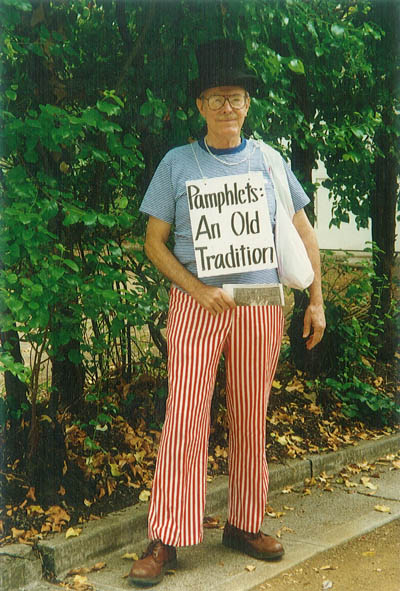
He considered pamphleteering as a noble form of communication that “went on during the colonial Period for a l00 years before the revolution and the arrival of Tom Paine in l775,” as he put it in his own pamphlet, “Pamphleteering: an old tradition.” He wrote that his main contribution “is the novel use of sandwich boards to screen out the disinterested while reaching the already-interested and open-minded persons with leaflets on the street, but not invading anyone’s privacy.”

Sometimes, Charlie had news close to home.

He said that giving out pamphlets to one or two people at a time was like holding a meeting with those persons and thus it was possible to have a “meeting” with several hundred people nearly anywhere within reasonable limits. He concluded that pamphleteering was “basic to building support for worthwhile projects” and claimes that it “may even be more effective than other forms of expensive communication.”

Charlie knew how to work the streets, but he also knew how to work inside the bowels of the bureaucracy. He worked for the California Division of Highways (now Caltrans) from l953 to 1987, mostly in an Oak Street office in San Francisco. I admit when Charlie talked to me about fighting bureaucracy, as he often did, I had trouble understanding how he was going about it. But Charlie had his ways.

Executive Editor Tim Redmond recalls that Charlie worked for Caltrans back in the days when the very thought there might be transportation modes other than highways was heresy.

He was an advocate of bicycles, carpools and public transit and Redmond thought that, when he first met Charlie in l984, “he must be like the monks in the middle ages, huddled in a corner trying to preserve knowledge. Nobody else at Caltrans wanted to talk about getting cars off the roads. Nobody wanted to shift spending priorities. Nobody wanted to point out that highrise development in San Francisco was causing traffic problems all over the Bay Area–and that the answer was slower development, not more highways.

“But Charlie said all those things. He told me where the secrets of Caltrans were hidden, what those dense environmental impact reports really showed, and how the agency was failing the public. I had a special card in my old l980s Rolodex labeled ‘Caltrans: Inside Source.’ The number went directly to Smith’s desk.” Charlie usually carpooled from Berkeley to his San Francisco office.

Charlie wrote a leaflet about the “Work Improvement Program” that then Gov. Pat Brown instituted in l960. It was, he wrote, a “novel program to get all state employees to submit ideas to improve their work.” Charlie labeled it “corrupt” and laid out the damning evidence. No appeal procedure. No protection for the employee making suggestions that the supervisor or organization didn’t want to use. No requirement for giving the employee credit for the idea or for following up the idea.

Charlie noted that he was a generalist with lots of ideas, read lots of publications, and was “sensitive to the problems that bother people.” He noted that there were l,500 employees in his Caltrans district who submitted 236 suggestions. Charlie submitted 35 of them.  But, he noted wryly, “my supervisor, Charles Nordfelt, did not respond at all to any of my suggestions.” And then, to make neatly make his point, Charlie listed a few of his suggestions, all of them practical and useful.

Many were adopted without Charlie ever getting credit. Others were adopted decades later. For example, he pushed the then-heretical idea of collecting tolls on a one-way basis only, instead of collecting them two ways. He noted that the tolls are now  being collected on the wrong side of the bridge. They should, he argued,  be collected coming from  the San Francisco side, where the few lanes of the bridge open up to many lanes. This would reduce or eliminate congestion. .

He listed other suggestions that showed his firm and creative grasp of the useful idea. Putting the third stop light on vehicles (which was finally put into effect in 1985). Numbering interchanges. Installing flashing red and yellow lights at different rates. (He  explained that his wife’s grandfather was color blind and drove through a flashing red light when she was with him.) Getting vehicle owners to have reflective white strips on the front bumpers of their cars, helping police spot stolen vehicles. Some of his suggestions are still percolating deep in the bureaucracies and may yet go into effect.

Charlie never got the hang of the internet but he covered more territory and reached more people in his personal face-to-face way than anybody ever did on the internet.

Charlie was born on a homestead farm eight miles from Weldona, Colorado. He attended a one-room school house and then moved on to a middle and high school in Ft. Morgan, Colorado. He got “ink in his blood,” as he liked to say, by working on the school paper called the Megaphone and then as a printer’s devil at the weekly Morgan Herald.

He was drafted into the army in l943 and served as an infantryman with the 343rd regiment, 86th Infantry Division. He was severely sounded in 1945 in the Ruhr Pocket battle near Cologne, Germany, the last major battle of the war. He suffered leg and hip injuries and had a l6 inch gouge  out of his right hip that cut within a quarter inch of the bone. He spent six months in the hospital. He was recommended for sergeant but he refused the promotion and ended the war as a private first class.

After his recovery, Charlie came to the Bay Area and took his undergraduate work at Napa Community College and San Francisco State, then did graduate work in sociology at the University of Washington, and in city and regional planning at the University of California-Berkeley.

In 1949, Charlie joined the American Friends Service Committee and became a lifelong volunteer, working on a host of projects. He did everything from helping with a clothing drive in Napa to being part of the crew that built the original Neighborhood House in Richmond.

Charlie met Anne Read in l954, a college student in Oregon, when she was on an AFSC summer project in Berkeley. Charlie visited the project, spotted Anne, and double dated with her. When she returned to Oregon State for her senior year, Charlie wrote her every single day. The two were married the following summer in June of l955.

Charlie is survived by Anne, two sons Greg and Jay, daughter-in-laws Karen Vartarian and Andrea Paulos, and granddaughter Mabel.

The family asks that, in lieu of flowers, please send a donation in Charlie’s name to the American Friends Service Committee, 65 9th St., San Francisco, Calif. 94l03.

I asked Anne why Charlie, the inveterate communicator, had not taken to the internet. Charlie, she replied, was a print guy and simply could not understand the internet. “He never ever used email,” she said. “He still thought he had to go to a library to make up a bibliography. I think Charlie was so sure that making a bibliography meant a lot of hard work, he couldn’t possibly do it on the internet.”

Well, Charlie, you may have missed the internet but you covered more territory and reached more people in your direct personal way with good ideas than anybody ever did on the internet.

Here are some of Charlie’s favorite pamphlets:
Governor Pat Brown’s Work Improvement Program
Pamphleteering: An Old Tradition
Short Statement on Plamphleteering

Trash Lit: Things are weird around ‘Mariposa’

0

Editor’s note: Guardian Executive Editor Tim Redmond has a bad 30-year addiction to mystery/crime/thriller books. He’s decided that he may as well put this terrible habit to productive use by writing about these sometimes awful, sometimes entertaining and — on rare occasion — significant works of mass-market literature. Read his last installment here

mariposa.jpg

Mariposa
By Greg Bear
(Vanguard Press, 340 pages, $25.95)

By Tim Redmond

Good science fiction has a moral, of sorts. Frank Herbert wrote about the scary power of a charismatic leader. Robert Heinlein gave us the fun of free love and the lie of religion. William Gibson outlined the weird dangers of a digital society. My favorite sci-fi movie ever, RoboCop (1987), was all about the perils of privatizing public services.

Mariposa is part science fiction and part action thriller, and the mix works. I liked this book a lot – it’s got creepy tech advances — digital storage devices that dissolve in your blood; tattoos that allow you to exchange information by skin-to-skin contact; monitoring chips that follow your every move; roller bots; a new drug that makes you a near-legendary fighter and totally fucks up your brain – as well as a message that’s eerily relevant.

Mariposa‘s opening is bizarre. The first chapter seduces you in a way that reminds me of Neuromancer. It’s the second decade of the 21st century. Oil prices have collapsed, destabilizing much of the Middle East. The United States is $30 trillion in debt and the president has had to accept IMF-style international receivership. “And it’s all our fault,” one character notes. “We do hate paying taxes, and we do love our government services.”

And the news media? “The dwindling national press – those journalists who still worked for networks or newspapers or the five prime news sites and could afford to travel rather than just sit in front of a screen and suck coffee and pontificate on what others saw and wrote – was as worn out and discouraged as the rest of the nation.”

Most of Texas is no longer under effective federal control. The FBI is in the process of being dismantled.The real, emerging power in the nation, and perhaps soon the world, is the head of a giant private security company that got rich off military contracts. In fact, he’s trying to prove how powerful he is by orchestrating the death sentence of a 15-year-old kid who has the misfortune to be the son of a federal agent.

Into this nightmare step a handful of still-loyal FBI operatives working directly for the dying president, who has been shot with a bullet laced with deadly engineered proteins. They’re trying to rescue a deep cover agent planted in the Talos Corporation — someone who is trying to sneak the explosive data in the company’s files out of a tightly controlled compound. They’re also out to save the 15-year-old’s life before the Texas corrections system, which pretty much reports to Talos, gets to stick him with a lethal injection.

Syntobe proteins that turn Coca Cola syrup into bombs. Desert car chase with hellfire missiles in drone planes. Robot snakes retrieving blood laced with digital downloads. Slightly lame FBI sex. Wicked drug-addled martial arts fighting. A hero who fights off powerful sedatives to take out six guys with a pole ax. I have to say: This one goes down as one of the best action books of the last year.