Newsom

Sunshine and shadows

2

tredmond@sfbg.com

It was, the San Francisco Chronicle proclaimed, the end of the world for development in the city, or at least something close to that. A ballot measure, sponsored by Sup. David Chiu, restricting new buildings from casting shadows on city parks “could imperil major development projects,” a Jan. 28 article by John Cote said. “Everything from a new wing at the San Francisco Museum of Modern Art to the expansion of the Moscone Center and creation of a new downtown core around a rebuilt Transbay Terminal could be affected.”

A lot of that is wildly exaggerated. The Chiu ordinance, which has since been pulled from the ballot pending a city study of the issue, would hardly have halted all development — or even all high-rises — in San Francisco. It wouldn’t have gutted the Transbay Terminal plan (although it might have forced planners to reduce the height of a tower that would soar 400 feet above the tallest building in San Francisco). In fact, the real story is how Chiu has managed — for now — to stop a backroom attempt by developers to undermine a 25-year-old environmental law. We found some fascinating evidence of how Mayor Gavin Newsom has been working with the San Francisco Chamber of Commerce to undermine Chui’s efforts — using broad threats to try to get his way.

Chiu’s legislation sought to clear up a couple of loopholes in a landmark 1984 law, which passed on the ballot as Proposition K. The measure, authored by then-Sup. Bill Maher, essentially barred any new construction that would cast a significant shadow on a city park.

In 1989, the final implementation guidelines were approved, and they’ve stopped literally hundreds of proposed projects from casting dark shadows on public open space.

But in the past year, city planners have been meeting with lawyers for big developers and looking for a way to change the rules. Citing new technology that better measures the curve of the earth and complex algorithms that calculate sunlight, the Planning Department has since proposed revising the Prop. K guidelines — in a way that would allow taller buildings and more shadows without getting the approval of voters or supervisors.

Chiu told us he’s been trying for months to find out exactly what the proposed guidelines would do — how many new buildings, at what heights, would be able to shadow which parks. “I was unable to get any answers,” he said.

The measure he drafted would have barred any new guidelines that allowed more shadows — and would have required the Board of Supervisors to sign off any changes. It would still allow the city to make case-by-case exemptions for projects that cast minor shadows but are otherwise deserving of approval — affordable housing developments, for example.

But downtown went nuts — and Newsom joined the fray.

The crux of the opposition came from the Chamber — and is outlined in an e-mail from Chamber Vice President Rob Black to members of the Chamber board.

“The mayor was very direct and clear about the need to defeat the measure,” the e-mail, which we obtained, states. “The mayor was also very clear that he was in no mood for deal-making on the issue and that he would look very unfavorably on any developer or anyone else who tries to cut a deal with David Chiu on the issue. He literally said, you will be on your own for the next two years if you go there.”

Black confirmed that the e-mail was in fact his — but said the version we’d obtained “has been edited. Some words were changed and other omitted.” He refused to say what the changes were, saying that the e-mail was meant to be a confidential communication to his board. However, he confirmed that the basic message and descriptions of a meeting with Newsom were accurate.

Tony Winnicker, Newsom’s press secretary, confirmed that Newsom had been directly involved in trying to scuttle the ordinance — and didn’t deny the mayor had made those threats.

“The mayor made clear the importance of asking the supervisor to withdraw the measure,” Winnicker wrote in an e-mail to us. “The mayor was clear that backroom deal-making should not be tolerated on the issue.”

Chiu was somewhat aghast at the mayor’s statements. “The context for all this is that the developers and their lawyers were trying to change the rules,” he said.

Aaron Peskin, the former supervisor and longtime North Beach neighborhood activist, told us that the “hysteria around this is factually untrue. This isn’t about stopping development — it’s about making sure development doesn’t have an adverse impact on the city’s common space.”

So now Chiu has agreed to hold off — but only if the key stakeholders (not just developers) have some input into how planning devises new shadow rules. And he’s ready to go back to the ballot in November if the developers try to play games again.

That makes sense, Gabriel Metcalf, executive director of the San Francisco Planning and Urban Research Association, told us. “There should be a heavy burden of proof on the people who want new rules,” he said. “And there should be a heavy burden of proof for anyone who wants a ballot measure.”

In other words, Prop. K — as it is, as it’s stood all these years — is working pretty well. And if the developers hadn’t tried to sneak in some big changes, none of this would have happened in the first place.

The “jobs” shell game

0

Written with Nima Maghame

news@sfbg.com

While many San Francisco city officials have been trying to figure out how to close a projected budget deficit of more than $520 million, Mayor Gavin Newsom has spent the last month trying to make that spending gap even larger by aggressively pushing a variety of business tax cuts that economists say will do little to improve the local economy and could actually make it worse.

Newsom first proposed his so-called “local economic stimulus package” a year ago during his ill-fated run for governor, just as President Barack Obama was pushing his own economic stimulus plan. But unlike the federal government’s $787 billion plan, about a third of which involved tax cuts demanded by conservatives, Newsom proposed to cut local business taxes while also deeply slashing local government spending and laying off hundreds of city workers.

Most economists say that’s a terrible idea. In fact, a report issued at the time by Moody’s Investor Services made it clear that every dollar of direct government spending adds about $1.60 into the economy (or $1.73 if it’s on food stamps, the most stimulative spending government can make), whereas business tax cuts add only about $1 to the economy for every dollar spent.

We clashed with the Mayor’s Office at the time on our Politics blog (see “Mayor Newsom doesn’t understand economics,” 2/13/09), with Newsom’s spokesperson telling us the mayor was relying on the input of City Economist Ted Egan. But when we interviewed Egan about the issue, he agreed that it’s a bad idea to slash government spending to pay for tax cuts.

“We were in no way saying you should cut taxes to stimulate the economy, particularly if it means reducing government spending,” Egan told us then. And when we asked directly whether it’s better for San Francisco’s economy for the city to directly spend a dollar on payroll or to give that dollar away in a private sector tax break, he told us, “The consensus among economists is that most of the time government spending stimulates the economy more.”

The Board of Supervisors basically ignored Newsom’s proposal. But he revived it last month, expanding the proposals with even more private sector subsidies and making them the centerpiece of his Jan. 13 State of the City speech, publicly pushing it since then with a series of public events at businesses located in the city.

And this time — with the local economy still slow, projected city budget deficits bigger than ever, and little serious talk about how the city can bring in more money — it appears the proposals will be the subject of a series of hearings before Board of Supervisors’ committees in the coming weeks.

Newsom’s tax cut proposals include a proposal to waive the 1.5 percent payroll tax (the city’s main business tax) for all new hires; extend and expand the payroll tax exemption for biotech companies (see “Biotech’s bonanza,” p. 12); give small businesses tax credits for their spending on health plans; and allow developers to pass one-third of their affordable housing in-lieu fees onto future homeowners.

Newsom and his Press Secretary Tony Winnicker have spoken euphorically about the proposals, saying they’re desperately needed to spur the local economy. “We believe that enacting these tax incentives, particularly the payroll tax credit for new hires, is one of the single biggest things we can do for economic growth,” Winnicker said.

Despite repeated questions about the economists’ concerns over financing tax cuts with government spending cuts, we couldn’t get them to address the tradeoff directly. “The mayor will support critical public services,” was all Winnicker would say about the deep cuts that Newsom is expected to announce in his June 1 budget.

Sup. John Avalos, who chairs the Board of Supervisors Budget and Finance Committee, expressed more skepticism about the mayor’s proposals. “Do tax breaks have the intended effect of stimulating the economy? As we underfund government services, are we getting a net gain or are we getting something taken away? For the very small businesses in my district, it’s going to be trickle-down economics. It’s very unrelated and unmeasurable in benefit,” he told us.

David Noyola, board aide to President David Chiu, said his boss is supporting the biotech tax credit but reserving judgment on the rest. “It’s going to be a cost-benefit analysis,” Noyola said. “When we’re talking about jobs, we’re talking about public and private sector jobs, always.”

While Egan’s economic analysis predicts tax cuts will encourage some economic growth, even he is circumspect about the good it will do, particularly without finding a way to avoid deep cuts in city spending. “The truth of the matter is that our stimulus efforts are small because the city has relatively small power to affect the local economy,” Egan told us.

That’s the consensus economic opinion. Huge federal spending can help a national economy a little bit, but local economies are just different animals that local governments are largely powerless to really alter, particularly through tax cuts.

“I agree with Egan: city government has little power over the local economy,” Mike Potepan, an urban development economist at San Francisco State University, told the Guardian.

Both economists agree that tying tax cuts to job creation or development stimulus is better than general tax cuts, but that neither is good if it means laying off more city workers.

“Research shows that by cutting taxes you have more business activity where studies show it is likely to effect employment,” Potepan said. “On the other side, you have to think about revenue. Cities are going to have to balance their budgets, which could mean a cut in services.”

Author Greg LeRoy expresses a more critical perspective in his book The Great American Jobs Scam: Corporate Tax Dodging and the Myth of Job Creation (1995, Berrett-Koehler), amassing evidence from economic studies and CEO surveys that corporate tax breaks, even those tied to new job creation, have almost no effect on private companies’ decisions about where to locate and whether to hire.

“How can companies get away with this? Because the system is rigged. Corporations have it down to a science. They have learned how to chant ‘jobs, jobs, jobs’ to win huge corporate tax breaks — and still do whatever they wanted all along,” LeRoy writes. “That’s the Great American Jobs Scam: an intentionally constructed system that enables corporations to exact huge taxpayer subsidies by promising quality jobs — and lets them fail to deliver. The other benefit often promised — higher tax revenues — often proves false as well.”

While proposing to forgo collecting millions of dollars in payroll taxes (the Controller’s Office is still working on a projected total for the tax cut package), the Mayor’s Office also wants to spur development of new housing with a proposal that would delay collection of needed affordable housing money by more than a decade.

After hearing mostly from a large crowd of desperate developers and construction workers during a Jan. 21 hearing on the proposal, the Planning Commission approved the package on a 4-3 vote, with the mayor’s appointees in agreement and the board’s appointees in dissent. It will be considered by the Board of Supervisors Land Use Committee sometime after Feb. 12.

The most controversial part of the fee reform package involves reducing the fee developers pay to support affordable housing by 33 percent, then charging a 1 percent transfer tax to subsequent buyers of those homes. Egan estimates developers would save almost $20,000 per housing unit, and that it would take an average of 16 years for the city to recover that money. But for high-rise luxury condos, the city would eventually recover about $27,000 per unit.

“It’s a classic make-an-investment-now-to-get-more-later strategy,” Michael Yarne, who crafted the policy for the Mayor’s Office of Economic and Workforce Development at Newsom’s direction, told the Guardian.

“If it makes it feasible for projects to be started, then it is worth passing,” Tim Colen, a representative of San Francisco Housing Action, said at the Planning Commission hearing, expressing hope that it will help create desperately needed construction jobs and new market rate housing.

But affordable housing advocates and some progressives criticize the policy as completely backward, saying that affordable housing development is desperately needed now, during these tough economic times, rather than a policy that encourages more market rate housing and bails out bad investments made at the height of the real estate bubble.

“What the city needs to do is directly build affordable housing, for which there is a demand,” affordable housing activist Calvin Welch told us. “The problem is that the banks don’t want to lend these guys money because they know nobody can afford to buy houses at the prices that these guys are demanding.”

Debra Walker, who is running for supervisor from District 6 and voted against the proposal when it came before the Building Inspection Commission (the sole vote on a commission dominated by mayoral appointees), agrees.

“The whole argument is that it stimulates development, but it doesn’t,” Walker said, arguing that the incremental gains (about 25 housing units per year, Egan estimates) will be offset by delayed affordable housing construction. “There would be more economic stimulus by using the fee to build more affordable housing.”

Instead, it simply shifts resources to favored entities: from home owners to developers, in the case of the affordable housing fees, or in the case of the tax credits, from the public to the private sector. But Newsom’s office just doesn’t see it that way.

“The Guardian believes in protecting public sector employees over private sector employees,” was how Winnicker formulated our understanding of what the economists are saying. “Most people don’t work for the city, and if we can support private sector jobs, that adds to sales tax revenues and benefits the economy. Despite a short-term impact of the tax credit, that’s a benefit.”

Adam Lesser contributed to this report


Biotech’s bonanza

0

By Adam Lesser

news@sfbg.com

It’s difficult to measure the value a biotechnology company receives from locating in San Francisco. Most measures are qualitative: scientists talk about synergy with other biotech companies in the area, the intellectual community that thrives at the University of California-San Francisco, and support offered at the California Institute for Quantitative Biosciences (QB3).

But the quantitative costs are easier to calculate, beginning with rents that often are two to three times higher than in the East Bay or South Bay. Add San Francisco’s 1.5 percent payroll tax, and companies can begin to attach a dollar figure to the premium of being in San Francisco.

To incentivize biotech companies to locate in San Francisco, Mayor Gavin Newsom is asking the Board of Supervisors to extend the six-year-old Biotech Payroll Tax Exemption. The exemption allows any new biotech company to get a full 7.5 years without paying local business taxes as long as it files for the exemption by Dec. 31, 2014.

At a time when San Francisco city officials are struggling to close a budget deficit of more than $500 million — for which Newsom hasn’t offered any significant revenue proposals to help bridge the gap — some are questioning why the city should continue giving millions of dollars in tax breaks to the thriving biotech industry.

The core question of whether the payroll tax credit has worked in bringing more biotech companies to San Francisco is complex. While Newsom boasted of attracting 54 new biotech companies in the last five years during his Jan. 13 State of the City address, analysis of the credit by Ted Egan, the city’s chief economist, indicated that only eight companies had applied for the credit by the end of 2008.

The thriving research environment at UCSF-Mission Bay and the establishment of the state taxpayer-funded California Institute for Regenerative Medicine have played significant roles in creating a favorable environment for young biotech companies. The last five years also have seen broad growth in biotech as scientific discoveries have accelerated. Would biotech companies have come to San Francisco regardless of the payroll tax exemption?

The city’s Office of Economic Analysis looked at the question of how effective the payroll tax exclusion actually has been in spurring biotech growth. Because the size of the incentive — an exemption from paying a 1.5 percent tax on its total payroll — is relatively small, Egan felt that there could not be a conclusive link between the exemption and biotech growth. But he did feel there was some benefit, writing in his analysis that “in fact, the primary worth of the incentive may lie in its marketing value and how it signals to the industry that San Francisco is a credible location for biotechnology.”

Between 2004 and 2008, the biotech tax credit cost the city $1.2 million. If costs stay on pace with 2008, the existing Biotechnology Tax Exclusion will cost at least an additional $2 million. There are no cost estimates yet on extending the credit to give all biotech companies the full 7.5 years of payroll tax exclusion.

The extension faces opposition. Sup. John Avalos, chair of the Board of Supervisors Budget and Finance Committee, has expressed concern about the effectiveness of tax credits.

“I’m not sure the city is going to be able to show a direct connection between taxes and the growth of the biotech industry. The verdict is still out for me,” Avalos told the Guardian. “We’ve created the whole infrastructure for the industry around Mission Bay. That could have a lot to do with companies coming to San Francisco.” The city donated a portion of the land the UCSF-Mission Bay campus was built on.

Allopartis Biotechnologies is a small biotech startup in QB3 at UCSF-Mission Bay that has received venture capital funding. It saved $3,670 in 2009 by qualifying for the payroll exclusion. Allopartis has six employees and focuses on developing technologies to convert biomass into sustainable fuels.

“You pay a premium to be in the city, and it’s worth it,” said Robert Blazej, cofounder of Allopartis. “We’d like to stay close to this nexus of innovation and collaborators. But it’s going to be challenging with the cost of square footage.”

Interviews with other growing San Francisco businesses showed that their biggest concern was the cost and availability of commercial real estate. Zynga, a social gaming company in Potrero Hill, plans to add 800 jobs over the next two years. Newsom has asked for an additional waiver on payroll taxes for all new hires over the next two years, regardless of industry.

“We considered moving out of San Francisco for a couple reasons. One is the availability of commercial real estate. The other is the payroll tax,” said Chief Financial Officer Mark Vranesh. “The large blocks of space we would be looking for are hard to find.”

But as the city tries to plug gaps in dwindling city services, concerns are mounting about how much the city can give away to companies under the premise that tax credits create new jobs. In the debate about the biotech tax credit, objections have been raised about the fundamental fairness of giving a tax break to one industry while others still pay their share. Similar next generation industries with large up-front research and development costs such as solar energy or fiberoptic Internet do not receive payroll tax waivers.

Economists such as the Tax Foundation’s Patrick Fleenor are quick to point out that there are no political advantages to taxing everyone equally. “The problem is a political one. If you tax everyone the same, there aren’t politicians creating little fiefdoms. There aren’t ribbon-cutting ceremonies,” he said.

Avalos has equated judging the effectiveness of tax credits at creating jobs to looking into a crystal ball. But the price tag of each tax credit is borne in the present as the city contemplates laying off hundreds of city workers.

Adding to the political infighting have been public complaints by Sup. Michela Alioto-Pier that Newsom is trying to take credit for the biotech payroll exclusion, which she originally proposed and helped legislate in 2004. She requested an extension for the biotech tax credit in November. Her office has defended the bill. “We’re creating a hub so that other biotech companies can come to San Francisco,” said Bill Barnes, Alioto-Pier’s legislative aide. “When she was courting biotech, she was hearing that the payroll tax was an impediment.”

But other cities charge local business taxes comparable to San Francisco’s payroll tax. And if there was ever an industry that has been heaped with support from the public sector, it is biotech.

Proposition 71 passed with 59 percent voter support in 2004 and established the CIRM, which provides grants and loans for stem cell research. Stem cell research is an area within biotech that has seen significant political support, particularly since the time of the Bush administration, when federal funding for embryonic stem cell research was heavily restricted.

But appearing to be doing something about the economy remains politically important, even if the actual benefits are somewhat dubious.

“It’s a big political game that the mayor is playing. He wants to paint progressives as anti-jobs, which is ridiculous, and paint himself as the mayor for jobs,” Avalos told us. “We would be cannibalizing government services for the private sector.”

Newsom has been vague about whether he accepts that tradeoff or even understands its implications to city coffers and the local economy. Newsom Press Secretary Tony Winnicker recently told us, “He thinks it’s good policy to spur private sector job growth.”

Later, he added: “While not every company has taken advantage of it, we feel extending it sends the right message,”

Editor’s Notes

0

tredmond@sfbg.com

Progressives don’t have to be afraid of economic development, don’t have to be afraid of promoting business and creating private-sector employment. And we don’t have to be terrified of a mayor who wants to label anyone who opposes Reagan-era economic policies as anti-jobs.

The thing is, San Francisco needs to promote the biggest engine of new employment — small business — and needs to encourage entrepreneurship and innovation. But there’s enough good economic science out there, enough evidence of what works and what doesn’t, that we don’t have to be stupid.

The most obvious example of that is tax cuts. We talk about the mayor’s tax plans this week — and what’s most remarkable is the consensus among economists, even the city’s own economist, that what Newsom is proposing won’t work.

If cutting specific taxes for certain businesses — say, waiving the 1.5 percent payroll tax for biotech — would actually lead local companies to hire hundreds of new people, it might be worth the budget pain. But that’s not going to happen. If allowing developers to pay their affordable housing fees years down the road would put thousands of construction workers back on the job, you could make the case for it — but nobody with any sense really thinks that’s likely.

What do we know would create employment opportunities? Well, a giant affordable housing bond, hundreds of millions in city money going to build new apartments, would generate construction jobs. But what most small businesses really need, what would really encourage hiring, is credit. If San Francisco took the money it’s going to expend (and tax cuts are an expense; let’s be honest) and put all of it into a revolving microloan fund for community businesses, we’d get a lot more jobs. In fact, almost any way that San Francisco spends that money on direct services would create more jobs than these tax cuts.

That’s not politics or ideology or anything else. It’s just reality.

Why Newsom drives me nuts

2

This is the kind of thing that drive me nuts about the Newsom administration.


A few days ago, SF Appeal ran an item on a speech Newsom gave about condo conversions. The mayor wants to let more people turn rental units and tenancy-in-common units into condominiums; that, Newsom argues, will bring more revenue into the city treasury (those conversion permits are expensive).


But there’s a reason why the city limits to 200 the number of units that can be converted in any one year. Turning a rental unit into a condo reduces the number of rentals available, and turning a rent-controlled unit into a condo (or into a TIC and then a condo) cuts into the affordable housing stock.


And a majority of the supervisors, who recognize the impact the mayor’s plan would have on tenants (by making it easier to take rental units off the market), are dubious.


Okay, that’s a difference of opinion. You don’t have to make it personal. And yet, at his press conference, the mayor insisted that


“Half of the members of the board have been beneficiaries of condo conversions, and yet they deny it to other people.”


As the Appeal pointed out, that’s simply untrue.


A majority of Board members own their homes, according to a check of property records: mayoral allies Michela Alioto-Pier, Sean Elsbernd and Carmen Chu all enjoy the benefits of owning and equity, as do Sophie Maxwell and progressive Budget chairman John Avalos.


Eric Mar and David Chiu rent, according to a City Hall source. Chris Daly lives in a condo, but “my condo has always been a condo,” according to the supervisor (and according to the Assessor-Recorder’s Office, Daly at least bought his condo as a condo and not a tenancy-in-common or conversion).


By all accounts, progressive Ross Mirkarimi is on the condominium-conversion waitlist (an older news report says Ross owns a TIC and is on the conversion list; we’ll check in with him to confirm, he is at this moment still in committee). Mirkarimi and Bevan Dufty would be the two Board members conflicted-out of any votes on condo-conversions; Dufty went from a condo to a TIC after his daughter was born.


“And nobody was evicted,” the Bev told us today.


Okay, as I see it only one supervisor is even in a position to benefit from the condo conversion law. So I asked Tony Winnicker, the mayor’s press secretary, whether Newsom had been misquoted. Apparently not. So why did ne make an innacurate statement that insulted half the members of the board?


Winnicker:


His comments came in the context of the polarized politics of San Francisco which pit tenants vs homeowners to the benefit of no one. He was speaking that many Boardmembers enjoy the benefits of homeownership and that opposing the condo conversion proposal denies those benefits to others who are already living in TICs and displacing no one through condo conversion.


But there’s a big distinction between what Winnicker is talking about and what Newsom actually said. It’s entirely possible to be a homeowner in this city without evicting anyone and without taking a rental unit off the market. That’s what most of the homeowning board members have done.


As for TICs “displacing no one,” that’s wrong, too. The number one cause of no-fault evictions in this city is the use of the Ellis Act to clear the tenants out of a building to create a TIC. The only thing holding the TIC epidemic in check is the fact that the TIC ownership model is complex and a bit tricky. The minute you can convert those TICs into condos, you open the floodgates for a lot more of them — and that means a lot more evictions.


Newsom can make the case for condo conversions just fine without making factually inaccurate statements that insult the supervisors. Instead he pulls this shit. And then he complains about the supervisors not wanting to work with him


Drives me nuts.


Newsom’s perplexing attack on San Francisco’s economy

4

There’s a crazy disconnect in City Hall these days over how to help the local economy. Mayor Gavin Newsom has spent much of the last month focusing on “jobs” and “local economic stimulus,” proposing to give a few million dollars in tax breaks to local companies while refusing to discuss new tax measures to help close the city’s $522 million budget deficit.

As we explain in detail in tomorrow’s Guardian, economists just don’t think the tax cuts will help the economy much at all – particularly if the city is reducing its spending and payroll to do so — but even some progressive supervisors are playing along to appease the anxious business community. For example, Board of Supervisors President David Chiu supports an extension of the biotech tax, denying city coffers the benefit of efforts by the city and UCSF to become an important hub for the industry.

Then, in today’s Chronicle, Newsom floats the idea of unilaterally shortening the workweek for city employees in order to save $50 million in payroll costs, firing 10,000 workers and then rehiring most of them to do so. But let’s be clear about this: that means removing $50 million from San Francisco’s economy, or even more once you figure in the multiplier effect that would more than double that loss.

As much as Newsom and his Chamber of Commerce allies love to bash government, the city is one of San Francisco’s largest employers, a clean industry with good-paying jobs. And it just makes no sense why they prefer to inflict mass layoffs on that employer – not to mention the reduced city services that will hurt even private sector productivity — rather than increase taxes on large corporations that ship their profits out of the city and therefore offer minimal benefits to this city’s economy.   


Gavin for Lite Guv?

1

Willie Brown thinks it’s a good idea. And you can tell Newsom wants to consider it, since he knows there’s nothing else obvious for him to do once his term as mayor is up — and there are going to be a lot of options not too far down the road. Sen. Dianne Feinstein isn’t getting any younger, and at some point she’ll retire. If Jerry Brown doesn’t get elected governor, the Democrats will be looking for someone very different in four years. But once a politician like Newsom is out of office and out of the spotlight, he’ll have a hard time coming back.

So he could sit up there in the Lite Gov’s office, doing what John Garamendi did — taking on issues like cuts to the University of California (the Lt. Gov. sits on the Board of Regents) and making speeches about reform, and maybe he could get out in front of this constitutional convention stuff, and keep his name in the news, without having to make a single difficult or unpleasant decision that he can be blamed for later.

You know he wants to do it ….

But there’s this problem, and for Newsom, it’s very real.

As people close to the mayor have told me repeatedly, the money people who helped put the mayor in office — and who would have to be around to help him run for any other office — are not at all pleased with the prospect of Newsom leaving San Francisco a year early. See, that would give the district-elected supervisors the chance to fill the mayor’s job for the last year of Newsom’s term, and the person they appointed would be able to run as an incumbent.

And while it’s not clear who could get six votes (David Chiu? David Campos? Ross Mirkarimi? Aaron Peskin?) it’s pretty clear that the new mayor would not be an ally of Newsom’s pals.

Sure, when he was running for governor, it seemed fine — having their guy in charge of the state was worth the loss of the San Francisco mayor’s office. But for a relatively powerless job? I think they’d crucify him.

The attack on district elections begins

2

I knew it was coming. After ten years of district-elected supervisors promoting progressive policies (minimum wage and sick day laws, universal health care, tenant protections, public power, development limits, affordable housing etc.) downtown has finally figured out how to launch a counter-attack. It was announced this morning in the pages of the Chronicle

I knew it was coming. After ten years of district-elected supervisors promoting progressive policies (minimum wage and sick day laws, universal health care, tenant protections, public power, development limits, affordable housing etc.) downtown has finally figured out how to launch a counter-attack. It was announced this morning in the pages of the Chronicle

The idea is to replace some of the district supes with at-large representatives – say, four of the 11. That Chamber of Commerce is doing a poll on the issue. Expect a November ballot initiative.

C.W. Nevius chimed in, too, arguing in favor of the “hybrid” (sounds so much like an eco-friendly car) system.

The line is going to be this: District supervisors don’t pay attention to citywide issues.

“People like the idea of being able to talk to a district supervisor about neighborhood problems, but also feel that they want someone they can go to with broader, citywide concerns,” said Steve Falk, president and CEO of the San Francisco Chamber of Commerce.

Or as Nevius puts it:

The truth is that San Francisco has more supervisors than any county in California. Is it too much to ask that a few of them have the entire city’s best interest in mind?

Let’s consider for a moment what this is really about.

For starters, get rid of the nonsense about a “citywide perspective.” Even Nevius didn’t try to push that too hard when I emailed him with the facts, to wit: Over the past ten years, district-elected supervisors have devoted themselves to a long string of exceptional citywide reform measures and have been guilty of very little district pandering.

Consider a few examples:

Healthy San Francisco
The Rainy-Day Fund
Reforming the makeup of the Planning Commission, Police Commission and Board of Appeals
Restricting the use of plastic bags
Minimum wage and sick day laws
A citywide infrastructure plan and bond program
Community choice aggregation and green energy
Campaign finance reform
Sanctuary city protecting for immigrants

The list goes on and on.

You may agree or disagree with what this board has done, but nobody can honestly say that the district supervisors have ignored citywide issues or that they don’t have a citywide persoective. No: This has nothing to do with citywide issues vs. district issues. It’s entirely about policy – about the fact that district supervisors are more progressive. About the fact that downtown can’t possibly get a majority under a district system – because with those small districts that Nevius complains about, big money can’t carry the day.

In a district system, grassroots organizing – the stuff that labor and nonprofits and progressive groups are good at – is more important than raising money. So district supes are accountable to a different constituency.

I watched an at-large board for almost 20 years, and it was, by and large, a collection of sold-out hacks who did exactly what the mayor and the downtown donors said. It was really pathetic.

The polls have consistently shown that people like have district supes, so now there’s this “hybrid” effort.

Here’s what it means:

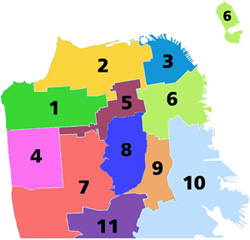
Right now, there are three districts that will generally elect a more conservative representative – D 2 (Michela Alioto-Pier) D- 4 (Carmen Chu) and D-7 (Sean Elsbernd). Districts 8, 10, 11 and 1 are swing districts, and the rest are going to go generally progressive.

So the odds are under this system that the left-leaning constituencies will have at least six votes, and in good times, as many as eight.

Now take four of those votes away, pretty much forever. Set it up so that four supervisors, elected citywide, will be guaranteed downtown call-up votes. Then add in one or two more from the more conservative districts, and you’ve got a majority.

That, my friends, is exactly what this is about, and any effort to frame it as anything else is just spin.

I asked Nevius what the hell he was doing buying the bogus argument that we need citywide perspective – since the district board has already demonstrated that, consistently. Here’s his response:

First, I’d envision the city-wide supes as made to order swing votes. When a district supervisor had a good idea, let’s say Healthy San Francisco, it might not be an issue of critical interest for a district supervisor. But it would be right in the wheelhouse for a city-wide official, who is looking for broad stroke issues to back. And, although you didn’t advance the idea, I’d reject the notion that whomever it was that was elected city-wide would be incredibly conservative and obstructionist. The most moderate politician we’ve elected in this city is Gavin Newsom. Although the Guardian doesn’t agree with him much of the time, he’s still advanced some very progressive ideas. Everyone jumps on the Chris Daly example as why district elections are a problem, but I think we can look beyond that. I think he’s been an aberration. District supes like David Campos and David Chiu have proved they can compromise and govern so I think that’s a good thing. I would never advocate that we get rid of representation in the neighborhoods. But c’mon, 11 little districts in a very small city? As Jim Stearns said, some of the districts are no more than a mile square. Combining some of them would still let residents have someone they could call to get the potholes fixed, but also spread out the areas.

Okay, I didn’t say citywide supes would be conservative. Sean Elsbernd is (relatively) conservative. He’s also independent of any big-money interest and does what he thinks is right. He doesn’t need half a million dollars to get elected in his district.

What I say is that citywide supes would be in hock to big money. I’ve seen it, lived with it. Suffered from it.

And guess what: Healthy San Francisco didn’t need any citywide supes; it passed just fine with the district board.

So what this is about is money and political control, and it’s about the political direction the city is going and who’s going to set that direction. Let’s get that straight and be honest about, and then we can have this discussion.

Who wants to be a biotech tax idiot?

0

By Tim Redmond

So Sup. Michela Alioto-Pier wants credit for the really dumb idea of extending the payroll tax waiver for biotech companies.

I guess she’d rather look like an idiot than let Newsom grab that dubious spotlight. Because as I pointed out in a column this week, the biotech tax break won’t create a single private-sector job in San Francisco, not one — and because it will reduce the city’s revenue, it will lead to more service cuts, which means more public sector jobs lost.

So the net impact of this plan is fewer jobs in the city. You want to be the one whose name is on that, Michela? Go for it.

Recalling Sophie Maxwell

0

Written with Adrian Castañeda

maxwell.jpg
Does it make sense to try and recall termed-out D. 10 Sup. Sophie Maxwell?


A group of District 10 residents has turned in 8,008 signatures in an effort to recall Sup. Sophie Maxwell. Election department staff says that 7,529 signatures must be verified for the recall attempt to go forward.

‘We think it’s going to be a little tight,” said an election department worker, who preferred to remain anonymous.

Department of Elections staff have 30 days to count and verify the submitted signatures, but they predict the process could be completed as early as Thursday afternoon (Feb. 4) or Friday morning (Feb. 5).

Meanwhile, Maxwell is termed-out in January 2011–a mere 11 months away. And 15 candidates have already filed to enter the D. 10 race this fall, with a dozen others variously threatening to throw their hats in the ring.

But if the recall effort gets the green light and is placed on the June 8 ballot, and if Maxwell actually gets recalled as a result of that vote, Mayor Gavin Newsom would then get to appoint his choice of successor to her seat. And if that successor happens to be one of the candidates vying for Maxwell’s seat, wouldn’t that person have an enviable edge come the November election?

Bayview activist Daniel Landry insists the recall effort would be effective. 
“We’re sending a message to anyone who wants to be a supervisor of D-10, you must recognize the will of the voters,” Landry said.

D 10 candidate Ed Donaldson warns that any supervisor that does not understand the complexity of the city’s largest district can expect a similar backlash. He says the recall effort is evidence of District 10’s diversity.
“There is no one homogenous voice in the community,” Donaldson said.
He says that the current grass-roots organizing that brought about the recall effort is a result of changing political structure in the area, but is not yet on par with the other districts in town.
“We still allow our politics to be controlled from downtown,” Donaldson observed.

D 10 candidate Espanola Jackson warns that if Newsom appoints someone, that person had better listen to the wishes of the community, or else they will face a similar fate to Maxwell.

“What the mayor needs to understand is that if we can get the signatures in two weeks to recall Sophie, we can get them on whoever he appoints as well,” Jackson said.

But D 10 candidate Eric Smith worries that the recall effort will backfire. He cites a recent community meeting in the Bayview on the Department of Park and Recreation’s budget, as an example of why folks are turning to this seemingly desperate strategy.

“People were emotional, angry and desperate, because they feel no one listens to them,” Smith said. “That’s part of the problem here; they would rather have a supervisor go down swinging for them, rather than watch one seemingly side with Lennar, PG&E and the Mayor on issues contrary to their interests. At the DCCC [Democratic County Central Committee] last week, everyone except Chris Daly voted against the recall in support of Sophie.”

Smith added that Daly’s vote, “likely had more to do with his belief that this was a waste of time and had no chance of actually succeeding, but you’ll have to ask him.”

Daly, for his part, says he doesn’t believe the recall effort will qualify.

“Jake McGoldrick introduced an item in committee when he was a supervisor that the Board then passed that doubles the numbers of signatures required for a recall to qualify,” Daly said, noting that under the old recall rules the current effort would likely have succeeded in getting onto the ballot.

“And I don’t think the DCCC’s resolution against the recall effort was accurate,” Daly added. “It was long on the fact that Sophie isn’t guilty of malfeasance, but the truth is that a recall is a tool of democracy that is available and can be applied in cases where a representative is not being responsible to the needs of their district. So, while I’m not supportive of recalling Sophie, it would be patronizing for me to say that thousands of D. 10 residents don’t know what they are doing. The Democratic Party (with a capital D) is working against democracy (with a small d) in a patronizing way in a district that has a disproportionately high number of low-income folks and people of color. There is a significant level of disgruntlement, if that is a word, in District 10, and its residents have lodged a pretty real and significant complaint.”

Aaron Peskin, who chairs the DCCC’s executive board and is the former President of the San Francisco Board of Supervisors, also predicts that the effort to recall Maxwell is probably headed nowhere.

“There’s no way they got the numbers,” Peskin said. “You’re lucky if 50 percent of that shit runs.”

Peskin proffers three reasons why recalling Maxwell is against the community’s own interests.
“First, recalls are an instrument to be used when a representative has committed malfeasance, and not because you disagree with the political positions of a person who has been duly elected three times,” Peskin said. “Second, this elected official is in her last eleven months in office. So, it’s a huge waste of time and money. And third, for those not satisfied with their current supervisor, any representative that the mayor might nominate would be far, far worse.”

Smith also worries that the recall effort is akin to the community shooting itself in the foot.

“If Sophie gets recalled, (and that is a very big if), the Mayor will insert someone and we may be right back where we started from, or worse. That’s the terrible irony and one of the biggest problems in District 10. Folks are so mad, they’re willing to do whatever it takes to make them feel they have a voice in the outcome, even if it’s potentially worse. The same thing happened with the Navy and the Restoration Advisory Board. Some of the same folks who were frustrated by the process, tried to send a signal to the Navy that they weren’t being heard and for all their well- intentioned efforts, got the RAB dissolved. I truly feel for them, it’s absolutely heartbreaking, but at times, they can be their own worst enemy.”

To Smith’s mind, a recall has the potential for exacerbating the very problems the effort is purported to be about.

“This isn’t about malfeasance, or not showing up for work,” Smith observed. “It’s about being heard, respected and listened to. I don’t think any other Supervisor has ever had the challenges that Sophie has had to face here; the Bayview, the Hunters Point Shipyard’s toxic super-fund site, the homicide rate, unemployment, poor public transportation, dwindling services and community resources have made D10 one of the City’s largest melting pots of discontent. It’s just one of the reasons I’m running. The health, welfare, quality of life issues and the environment are the things I put above everything else out here, particularly above special interests and big money.”

“We will soon know how valid those signatures are; I can tell you that the many of the folks behind it feel very confident about it,” Smith continued. “But Sophie still has a lot friends in D10 who will not vote her out, so even if this makes the ballot, there is no guarantee it will carry. There are many, many folks who still love and support Sophie, so the folks who signed the recall petition will have to overcome the balance of the 37,000 D.10 voters who may not want to see her go and have a vested interest in seeing a fair electoral process in November, untainted by a Mayoral appointee, an appointee that would have implied advantage over any of the candidates in November.”

Smith has asked many folks why they are launching a recall when Maxwell only has 10 months left on the job.

“For them, it’s about making a statement; they want everyone to know that ‘They’re mad as hell and not going to take it anymore,’” Smith said. “They also want to send a signal to the D10 candidates that this is what you will face if you don’t listen to them. D10 is not for the squeamish, those easily intimidated or the faint of heart.”

On a side note, Smith observed that “we will need the world to come out to defeat Proposition 16″, the PG&E ballot measure in June. “And, depending on the turn out, many of the folks needed to come out for that, may also play a role as it relates to Sophie’s recall.”

Asked what she thought of the effort to recall her, Maxwell characterized it as “strange” and “destabilizing.”

‘It seems to me that this effort is destabilizing the community,” Maxwell said. “When you undercut the leadership, you destabilize a community in transition. At a time when these folks could have something to say about the future, they are looking at the past. It’s about backward thinking. It’s about not having the best interests of the community. It’s about egos. Because if this is for the community, then why not bring something to the table that’s about bringing some direction to the district?”

One of the last straws, in the minds of some recall signature gatherers, was Maxwell’s 2009 vote against a resolution that would have advised the Navy to restore its community-based Restoration Advisory Board. This board, which was established in 1994, had consistent access to the many technical and environmental documents surrounding the proposed clean-up of the heavily polluted Hunters Point Shipyard.

The RAB, whose primary fucntion was to share information on investigations and clean-ups at the shipyard, was also able to vote on the Navy’s proposed solutions and to request more information and/or speakers and experts so its members could educate themselves on related public health and safety issues. But early last year, the Navy announced that it was dissolving the RAB, citing dysfunctional behavior and off-topic discussions that were getting in the way of the RAB’s intended purpose.

The move to dissolve the RAB came just as the Navy was poised to take a series of important decisions on some of the most polluted and radiologically-impacted parcels on the shipyard. And many in the community saw the timing of the RAB’s dissolution as evidence that the Navy was going to ignore their wish to have these parcels dug out and hauled away, and not capped (a wish shared by the 87 percent of voters who supported Prop. P in 2000.)

But despite the outcry that followed the RAB’s 2009 dissolution, Maxwell voted to tell the Navy to either restore the RAB or find other ways to involve the community–thereby giving the Navy the choice, some felt, to ignore the community’s desire to reinstate the RAB.

And last night, the Navy, along with a flotilla of police and special agents, showed up at the Bayview YMCA to share its plan to reformulate the Navy’s original Community Involvement Plan—a plan that angered many meeting goers ( the majority of which were former RAB members,) since it didn’t appear to aim at reinstating the RAB. But to give the Navy credit, once it became clear that meeting attendees were underwhelmed by its plan, Navy officials scrapped their original agenda and allowed the community to speak instead about their wounds from the past and their hopes for the future. It remains to be seen where the Navy will go next, but those interested in tracking these developments can visit the Navy’s website for updates.

Maxwell for her part defended her vote–and pointed the finger at the Navy.

“The Navy has an obligation to get out its plans to the public,” Maxwell said. “People are getting information in many ways, these days, not just by coming to meetings. The Navy has just got another $92 million towards the shipyard clean up, but does anyone know what this means? It means that instead of taking years to clean up groundwater at the shipyard, we can spend that money on it, now. And if folks knew what capping really means, maybe they wouldn’t be against it. Mission Bay is capped. Schlage Lock will be. And all of them are brown fields.”

Maxwell worries that democracy is not currently being well served within her district, but not by her.
“There are folks who are trying to block real information from getting out, and if only your view can get out, that’s not democracy,” Maxwell said.

But so far, she’s not willing to publicly support anyone in the November D. 10 race.
“I’m waiting for people to have a better understanding of what this community is, what the common thread running through it is, and how to use rank choice voting,” she said.

And despite the current recall effort—and the insults regularly hurled her way with a voracity and meanness not generally seen in other supervisorial districts, Maxwell said she has truly enjoyed serving as D. 10 supervisor.

“When people say that it’s an honor to serve as an elected official, I really know what they mean, because I really feel that. Democracy is challenging, it’s messy and it’s invigorating. I think a lot of what’s going on in my district is about people using people. But what has changed for these folks? Their lives have gotten worse, not better. And they are going after me, because I am not part of their group. I have tried to stay focused on the issues.”


 

On pension reform, a way forward

0

EDITORIAL Sup. Sean Elsbernd is taking on one of the most complicated and politically tricky issues in San Francisco — reforming the pension fund and health care system for retired city employees. He’s right that the system needs reform — but his measure has some serious drawbacks and needs some significant amendments.

The problems facing the system are so confusing, and the legal and financial aspects so arcane, that it’s hard for anyone to grasp the full situation. But we can sum it up pretty simply:

San Francisco’s pension fund is in far better shape than pension funds in many cities and is a long way from any financial crisis. But over the next few years, thanks to weak stock market performance, the city’s cash obligation — the amount of general fund money that must be paid into the retirement system — is going to rise quickly into the hundreds of millions of dollars.

The retiree health care system is in a lot more trouble — with the rising cost of care, the city will be on the hook for a serious amount of money over the next decade or two. And since the obvious answer — a single-payer system that would cut costs immensely — isn’t anywhere on the immediate political horizon, the San Francisco supervisors need to address the problem.

Elsbernd’s proposed fix is also complicated; the main legislation runs 61 pages. But in essence, he wants to make sure all city employees pay directly into the system; raise the amounts new employees, cops, and firefighters contribute; and set up a rainy-day fund to divert excess pension revenue in good years into a trust that could fund health care pension obligations in down years. He’s also going after a scam common in the police and fire departments where people about to retire get sudden promotions and big salary bumps for a few months, then collect pensions based on the higher pay scale.

The first part is — and should be — almost certainly dead. Members of the Service Employees International Union local 1021 agreed several years ago as part of contract negotiations to give up a pay hike; in exchange, the city agreed to take over the workers’ obligation to pay into the pension fund. Changing that, and outlawing any similar deals in the future, is unacceptable to labor and could drag down the whole proposal.

It’s also tricky to raise pension contributions for “new employees” since Mayor Gavin Newsom has been firing people then rehiring them at lower pay rates. Do those people lose their pension seniority? That has to be fixed.

But given the sweet deal cops and firefighters have, it’s entirely appropriate to ask them to contribute more to retirement. And while some city employees actually get and deserve raises in their final year of work (and the language in Elsbernd’s bill doesn’t address this and needs work), pension spiking is a problem that tends to give extra cash to people who are on the higher end of the pay scale at the expense of lower-paid workers.

And the heart of his proposal — to set up a trust fund for excess money in good years — deserves serious consideration. Yes, it’s a set-aside, and yes, there are legal complications. But the cost of doing nothing is too high to ignore.

Elsbernd should have done this differently — he should have met in advance with all the stakeholders and sought to hammer out a compromise. Even so, there’s a lot for progressives to work with here. If Elsbernd is willing to engage with labor and the board majority, and the progressive supervisors are willing to acknowledge the problem and look for amendments that make this bill acceptable, there’s a way for the city to come out ahead.

Sup. David Campos has moved to “split the file” — that is, to turn the Elsbernd bill into two identical measures. The move gives the progressives a chance to make amendments even if Elsbernd doesn’t want to go along, and could wind up giving the supervisors a choice between two competing measures. We’d prefer that Elsbernd work with his colleagues on a measure everyone can back. But in the end, the best option is a charter amendment that fixes the problems Elsbernd has identified — without being unfair to city employees.

And if Elsbernd and the progressives can come to a deal, there’s a lesson here for the mayor: if you try to work with your opponents, you can actually get things done.

Editor’s Notes

0

The mayor of San Francisco is mad that the Board of Supervisors won’t even schedule a hearing on his proposals to stimulate business and job creation in San Francisco. He ought to be happy. If this loopy plan ever gets to the point of open, full discussion, Gavin Newsom will wind up with a real political embarrassment.

Let’s analyze, for example, the suggestion that the city waive payroll taxes for biotech companies. That’s supposed to make those companies more likely to hire new people. After all, any economist knows that taxing something discourages people from doing it, so taxing a payroll ought to make companies less likely to hire. And getting rid of that tax ought to create jobs.

Well, since one of the things I do is help run a small business in San Francisco, let me explain how it actually works.

Say you’re a biotech company that wants to hire a new entry-level worker at a modest $35,000 a year. Can you afford it? Let’s cost it out.

There’s the salary, of course. Then there’s the 7.5 percent you’re paying in federal Social Security tax. That’s $2,626 more. And since you’re in San Francisco, you’re paying for health insurance; that’s probably between $2,000 and $4,000 a year, depending on the plan, but let’s peg it at the city’s minimum mandate, which is $1.09 an hour, or $2,267.

So now your $35,000 worker costs $39,893. Then there’s unemployment and disability insurance and workers’ compensation. The person’s going to need a desk and a chair, or a lab bench and a stool (and they have to be ergonomically correct), and probably a computer, a phone line, and software. And you’re going to have to spend some money on training. You’re going to offer a couple weeks of paid vacation, right? And you have to give sick days. So you have to account for the money you’re spending to cover your new worker when he or she isn’t working. If it all pencils out at less than $42,000, you’re doing well.

Oh, wait, I forgot — there’s the damn city payroll tax. That job-killing factor that could make the difference between hiring and not hiring. Better account for that; it could be a deal breaker.

Are you holding your breath? Ready for the ax to fall? Here you go: the payroll tax on your new hire is a whopping $525 a year. About $10 a week. You probably spent more on the help wanted ads.

So let’s be honest — the payroll tax may sound awful (and actually, I think a gross receipts tax would be more fair, for a lot of reasons). But suspending it won’t create a single new job. It’s too small a factor to count as more than decimal dust in anyone’s hiring decisions.

Here’s what suspending the payroll tax for biotech companies will do: reduce city revenue, almost certainly by enough to force more program cuts, and that means more job cuts for city workers. So you gain no private sector jobs — zero — and you lose public sector jobs. How, exactly, is that encouraging employment growth?

Quit complaining, Mr. Mayor — the last thing your proposals need is real public scrutiny.

DEIR in the headlights

0

GREEN CITY Public comments on the city’s draft environmental impact report (DEIR) for Lennar Corp.’s massive redevelopment proposal on Candlestick Point and the Hunters Points Shipyard includes complaints that the comment period was too short (see “The Candlestick Farce,” 12/23/09), concerns that the city violated state requirements to notify the Ohlone Tribe, and frustration that the city’s preferred plan represents the most significant and substantial impacts of any of the five scenarios analyzed in the DEIR.

These and many other concerns about the impacts of the 10,500-home project will need to be addressed in the final EIR, which Mayor Gavin Newsom and other project proponents expect to be completed by June.

Some object that the city is considering an early transfer of the shipyard and would undertake activities that are currently the Navy’s responsibility (see “Eliminating Dissent,” 06/17/09), saying the final EIR should prominently reference Proposition P, which voters approved in 2000, establishing community acceptance criteria for the cleanup.

Saul Bloom, executive director of Arc Ecology, submitted his organization’s comments “under protest for the inadequate extension of the public comment period, which we believe unfairly penalizes the public review of the draft EIR.”

Land use attorney Sue Hestor called the public comment submission schedule “abusive” in comments submitted for POWER (People Organized to Win Employment Rights). “The schedule is being driven by an insane desire to have the final EIR certified and all local approvals done by June,” Hestor said.

Ohlone chairperson Ann Marie Sayers and Neil MacClean of the Ohlone Profiles Project wondered why the Planning Department did not contact anyone on the city’s list of official Ohlone representatives. “We want the SF Planning Department to follow Senate Bill 18, which requires them to include Ohlone people in the planning process,” MacClean said, noting that there are at least four Ohlone villages within the proposed development area.

Jaime Michaels, coastal program analyst for the San Francisco Bay Conservation and Development Commission, expressed concerns about the DEIR’s proposal to make a 23.5 acre reduction in existing state park boundaries (see “Can I buy your park?” 08/12/09).

Project proponents, Michaels said, “would need to demonstrate that the decreased area would not compromise or reduce its value as a park/beach facility.” Michaels also worries about the impact of adding a minimum of 1.7 acres of fill in the bay to accommodate a bridge at Yosemite Slough, a plan she described as “a significant amount of coverage, particularly for a facility where the large majority of its coverage is needed to serve vehicles accessing the new stadium only 12 days a year.”

Michaels expressed concerns that the project’s plans to address sea level rise would negatively affect bay views and public access to the shoreline.

The project includes a 9.6-mile trail and a variety of other public amenities directly adjacent to the shoreline. Proposed building structures located away from the immediate shoreline would accommodate a 36-inch sea level rise by 2075, and the DEIR promises to employ adaptive management strategies along the perimeter beyond 2050.

“Unfortunately, partly due to illegibility and the scale of the drawings, it is difficult to assess precisely how these adaptations would appear,” Michaels observed. “However, it can be assumed that over time levees would need to be raised and likely widened at the base, thereby partly or entirely obstructing the public’s view of the bay from inland areas, encroaching on and reducing the area devoted for public use and impacting the overall public access experience.”

Arc Ecology discussed the DEIR’s failure to provide a comprehensive sustainability plan, address adjacent development projects, justify a 49ers stadium on the shipyard, or evaluate the potential for the development of port-related heavy industrial activities.

“The city is determined to get this project passed right now, and the developer is afraid that if someone else comes along as mayor and District 10 supervisor, they may not be as sympathetic,” Bloom said. “But the project — as outlined in the DEIR and the city’s way of approaching the deal — is against the interests of San Francisco.”

Muni’s driving people off the bus

0

By Tim Redmond

If I owned a bicycle shop in San Francisco, I’d be putting a big poster in my window right now saying something like:

$840 a year to ride Muni? Save your cash — buy a bike!

Seriously — you can get a decent new bicycle for $350, a good used one for half of that. Which means if you switch from riding Muni to riding your bike, you pay for your new ride in about six months. And after that, you save $70 a month (the proposed new price for a fast pass that lets you ride express buses).

And If I owned a parking lot on the edge of downtown, I’d be sticking fliers on utility poles near Muni bus stops saying:


$70 a month for a Fast Pass? Why wait for the bus? We have monthly parking at that price!

Which pretty much sums up the problem with Muni’s plans to continue raising fares.

At a certain point — and if we’re not there yet, we’re getting damn close — the alternatives to Muni become more cost-effective, and people stop riding the bus. Fewer riders means less fare revenue, which means the deficit gets worse, and the downward death spiral of our public transit system continues.

You can’t keep raising the price of a product or service forever without losing customers — unless you have a near-total monopoly, like oil cartels and Microsoft. And while Muni is the only bus game in town, it’s not the only way to get around a 49-square mile city. Bicycling has costs — you have to buy a bike, you have to exert energy to ride it, you might get wet in the rain, and the hills are a bitch. Cars have costs, too — but if, like many San Franciscans, you already own a car, then the cost of driving it to work depends largely on the cost of parking. Even walking has a cost — particularly time, since walking is a slow way to get to work.

But when the service provided by Muni declines (the buses are dirtier and come less frequently) and the price goes up, then the relative cost of the alternatives declines, too.

I’m a big fan of Muni; I think our system is still way better than anything you’ll find in most California cities. But when you can park downtown for about the same as it costs to buy a fast pass, something’s very wrong.

If the Newsom Administration is serious about saving Muni, the mayor has to look at the competition. I’m all for people buying bicycles — it’s healthy, and so is walking, and the locally owned independent bike shops in the city need the business. But nobody wants more drivers downtown — and the obvious solution is to raise the price of parking. Not just meters; raise the tax on parking lots. Impose a surtax on monthly parking. Put that money in to Muni — and keep the fares down.

Newsom and O’Reilly celebrate conservatism

0

By Steven T. Jones

Anyone who still thinks that Mayor Gavin Newsom is a liberal who has been unfairly maligned by the Bay Guardian and other wild-eyed San Francisco lefties should watch his appearance on Bill O’Reilly’s Fox News show last night, in which Newsom praises O’Reilly (a right-wing reactionary if there ever was one) as a political moderate, correctly calls himself an economic conservative, and said he watches O’Reilly’s show every night and agrees with much of what he hears.

While Newsom meekly disagrees with O’Reilly’s ridiculous main premise that the situation in Sacramento and San Francisco proves that “liberal governance just don’t work,” he spends far more time agreeing with O’Reilly than challenging any of O’Reilly’s ludicrous and inaccurate assertions.

For example, O’Reilly blames California’s fiscal mess on liberals (actually, the main problem is our Republican governor and a two-thirds budget vote threshold that has let conservatives hold the state hostage) and casts San Francisco as increasingly overrun with homeless people and pot clubs (both of which have declined, leaving SF with just 22 licensed and well-regulated cannabis dispensaries).

Instead of defending traditional Democratic Party values (those that existed before Bill Clinton and others allowed them to be coopted by big corporations and anti-government crusaders) and his party’s current leaders, Newsom bends over backward to highlight his no-new-taxes stance and says, “We operate in a fiscally conservative manner.”

As the Chronicle reports today, San Francisco is facing a $522 million and growing budget deficit, which Newsom is only trying to increase with his proposed tax cuts and embrace of Reaganomics, while steadfastly refusing to work with others on finding new revenue sources. This is a recipe for disaster, but at least Newsom is sure to be invited back on his buddy Bill’s show, where he they can together celebrate the crash of civil society as we know it.

How bad does Muni have to get

1

By Tim Redmond

Before Gavin Newsom is willing to consider extending parking meter hours to make drivers pay their fair share?

The budget picture is increasingly bleak, and Muni’s talking about some very unpleasant cuts that may wind up to be ineffective; if buses are slower, dirtier and cost more, then fewer people will ride, and Muni will collect less fare money.

So how bad does it have to get? Does the system have to reach total collapse before Newsom is willing to take a little political risk and raise some money from people who drive downtown and park their cars?

Scraping bottom

0

The job of scrubbing down a city bus after it’s gone out of service is no picnic. At a Jan. 20 Budget and Finance Committee hearing called by Sup. Chris Daly to discuss health and safety impacts related to Municipal Transportation Agency layoffs, supervisors took a virtual tour of a Muni bus that was trashed on multiple levels: tagged inside and out, soiled with vomit, and strewn with garbage. Among the roughly 100 Muni workers who will lose their jobs to midyear budget cuts are 10 “car cleaners” — those unsung heroes who scrub away late into the night, tackling the residue left behind by the Sharpie-wielding, litterbug masses.

“We do send out all of our vehicles clean,” MTA spokesperson Judson True told the Budget and Finance Committee members at the hearing. “We do not send out any of our vehicles with any health issues … and we will not.” Despite his assurances, members of the Board of Supervisors and some Muni staffers voiced fears that with fewer and more overworked car cleaners, the overall experience of riding public transit could suffer.

It’s just one small example of on-the-ground impacts of painful budget cuts inflicted to solve a steep shortfall affecting the city’s transit agency. The fiscal woes aren’t unique to Muni. In coming months, San Francisco city departments across the board will have to contend with revenue shortfalls and find ways to continue providing services with diminished resources.

But with layoffs and other proposals such as raising fares, reducing service, and charging more for discount passes on the table, many are raising objections — including several members of the MTA Board of Directors, a body that is wholly appointed by Mayor Gavin Newsom. In a rare show of defiance at a Jan. 19 MTA Board meeting, several directors even resuscitated the idea of extending parking-meter hours and raising meter fees to generate new transit revenue, an idea Newsom previously rejected.

$49 MILLION IN THE RED

Muni has lost $180 million in state funding over the last three years due to “the nightmare in Sacramento,” as True put it, and no one seems to believe the fiscal crisis can be resolved without some degree of pain.

At the Jan. 19 MTA Board meeting, transit agency Chief Financial Officer Sonali Bose outlined the dismal financial picture, explaining that Muni has been hit hard by declining parking and taxi fees and impacts to the city’s general fund, leaving it about $49 million in the hole for the current budget cycle. After the layoffs, Muni will still face a $17 million problem. To solve it, suggestions include jacking up the historic F Line trolley fare from $3 to $5, charging $30 for discount monthly passes for seniors and passengers with disabilities, and reducing service.

Even against the gloomy fiscal backdrop, the prospect of eliminating jobs to make up for the losses drew serious concerns from MTA directors. “Once somebody’s gone, they’re gone,” Director Shirley Breyer Black noted. “I think moving forward with cuts in these classifications will send us into deeper fiscal crisis.”

All the affected workers — most of them frontline employees — are slated to lose their jobs by May 1, and around one-third of them were dismissed Jan. 22.

Muni Executive Director and CEO Nathaniel Ford emphasized that the decision to cut jobs was not made lightly. But at a Budget and Finance Committee meeting the following day, progressive members of the Board of Supervisors expressed alarm after hearing union members sound off about how the cuts disproportionately affect lower-paid classifications. The majority of layoffs target members of Service Employees International Union Local 1021, San Francisco’s largest labor union, which represents frontline workers across city departments.

“I understand that there are no good decisions,” Daly told the Guardian, adding that a certain group of workers seem to bearing the brunt of the cuts. “What progressive supervisors are calling for is for the budget to be handled more evenly,” he said.

A single Municipal Executives’ Association (MEA) employee — an MTA manager earning between $105,950 and $135,200 per year — was let go during this latest round of about 100 Muni layoffs, according to an agency memo. In the past year, MTA reduced its upper-level management team from 108 to 96 employees. In contrast, 33 members of SEIU Local 1021 — the majority frontline workers earning between $45,656 and $64,272 a year — will be affected by the cuts.

“Unfortunately, when MTA discovered that they had a budget problem, they didn’t bring all parties to the table,” SEIU Organizer Leah Berlanga testified at the Budget and Finance Committee hearing. “The way we got invited was via pink slips. That’s the only time they will talk to people who do direct services.”

When asked whether Muni had assessed mid- and upper-management level jobs to even the scales, True responded that a few mid-level managers were included in the latest round of cuts. One reason the layoffs seem disproportionate, he added, is that there are so many more frontline workers than others. “The budget picture has affected the entire agency,” he said. “No one is happy about these decisions.”

But SEIU Local 1021 characterized the layoffs as misguided, and attempted to identify waste and mismanagement within the agency in a packet of alternative cost-saving measures it submitted to MTA. At the top of the list was the suggestion that the agency eliminate 35 retired Muni employees, who are allowed to work up to 960 hours per year and earn wages in addition to their pensions. And according to the union, there are 21 temporary workers in the agency who’ve exceeded a two-year limit for short-term employment. SEIU recommended that those temps be dismissed too.

SEIU also criticized the decision to lay off 24 parking control officers (PCOs) — uniformed workers who have the unenviable job of issuing parking citations to bring in revenue for the city. “To me, if you do the simple math, it doesn’t make any sense. They make most of the money for the MTA,” said a PCO who testified at the hearing.

According to SEIU’s calculations, eliminating 24 employees who dole out parking tickets could result in a $7.2 million loss for the city in parking revenue. But True said MTA disagrees with this figure, and pointed to an internal memo showing how revenue from parking citations dropped in recent years even as more PCOs were hired. Nonetheless, at the urging of SEIU, the MTA Board agreed to postpone those 24 layoffs until February to buy time to study the impact. For other positions, negotiations between MTA and the union are ongoing. The details on still more layoffs, which will affect transit operators, is yet to come.

Sup. David Campos is asking for a management audit to see if Muni is spending its money efficiently. “I think we should look at best practices and how we’re operating before we finalize any cuts,” he said.

THE PARKING POLITICS

During a round of MTA budget talks last fall, the idea of extending city parking meter hours and raising meter fees was floated as a means of recouping losses — but Newsom balked at the idea, saying higher parking fees could harm small businesses. Now MTA Director Bruce Oka has revived — and endorsed — the concept.

“I can hold my nose and vote on anything, but I refuse to vote on something when I believe we have not looked under a rock for every source of funding,” Oka said at the meeting. “We have to extend the parking meter hours — we have to find dollars. If Room 200 [i.e. Newsom] doesn’t want that to happen, well then … he’s got to come up with a way to do what we need to do. If he’s not going to raise parking meters or extend parking meter time, he’s got to come up with some money.”

Tom Radulovich, executive director of nonprofit Livable City and one of the individuals who helped to create MTA in 1999, summed up Oka’s comments with a note of surprise: “He really called out the mayor,” he said. “I haven’t seen MTA Board members do that — they usually cover for him.”

Radulovich — who is also on the BART Board — says targeting motorists for more revenue instead of transit riders would be more equitable, sustainable, and in keeping with the city’s Transit First goals in the long run. Proposition A, passed November 2007, established “a strong mandate to reduce transportation-related greenhouse gas emissions,” he pointed out. But, he noted, with layoffs that could affect the qualify of service and possibly deter people from riding, “We don’t see how MTA is going to get to those voter-mandated transit goals.” *

MUNI MEETINGS

PUBLIC MEETINGS ON SFMTA BUDGET

Saturday, Feb. 6, 10 a.m. to noon

Tuesday, Feb. 9, 6 p.m. to 8 p.m.

Saturday, Feb. 20, 10 a.m. to noon

One South Van Ness Ave. at Market Street, 2nd Floor Atrium

SFMTA BOARD MEETINGS

Friday, Jan. 29, 10 a.m.; discussion of FY10 options, including Muni service reductions

Tuesday, Feb. 16, 11 a.m.; public hearing on proposed FY10 budget actions

Tuesday, Mar. 2, 2 p.m.; public hearing and possible board approval of FY10 budget actions

Location: City Hall, 1 Dr. Carlton B. Goodlett Place, Room 400

OMG those Prop. 8 backers are looney

0

By Tim Redmond

And if you didn’t already know that, check this out. There’s more in the trial transcripts (pd):

And you say:
15 “The San Francisco city government is under
16 the rule of homosexuals.”
17 Do you see that?
18 A. Yes.
19 Q. Did you believe that, sir?
20 A. Yes, I believed that.
21 Q. Who are the homosexuals that San Francisco is under the
22 rule of?
23 A. Uhm, at that time, supervisor Tom Ammiano was a supervisor
24 there.
25 Q. And there was also a mayor, right?

1 A. Yes.
2 Q. The mayor was a homosexual, was he, according to you?
3 A. I don’t think so.
4 Q. You don’t think so? No, I don’t think so either

,

And

Well, let’s see, as we go through this, how you use words.
25 You go on to say that:

1 “After legalizing same-sex marriages they
2 want to legalize prostitution.”
3 Do you see that?
4 A. Yes.
5 Q. Did you think the people who were opposing Proposition 8
6 wanted to legalize prostitution?
7 A. Uhm, that was a Proposition K at that time, on the
8 San Francisco ballot. And I saw several homosexual
9 politicians, they supported that. So I draw from that — from
10 their support that they want to legalize prostitution.
11 Q. But that didn’t have anything to do with Proposition 8;
12 did it, sir?
13 A. No.
14 Q. No, it didn’t.

And

Now, the second paragraph refers to Mayor Newsom. Do
8 you see that?
9 A. Yes.
10 Q. It says:
11 “The mayor says homosexuals are minorities
12 and should not be discriminated against.”
13 Do you see that?
14 A. Yes.
15 Q. Now, you would agree that homosexuals are a minority,
16 correct?
17 A. I — I don’t believe they are minorities.
18 Q. You don’t believe they are the minority?
19 A. I am a minority.
20 Q. You are a minority.
21 What percentage of the population do you think are
22 homosexuals?
23 A. My understanding of minority is —
24 Q. What percentage of the population —
25 A. — based on skin color.

1 Q. What percentage of the population is homosexual?
2 A. I — what I read is, about from 2 to 4 percent.
3 Q. 2 to 4 percent?
4 A. Right.
5 Q. Is that a minority, sir?
6 A. In terms of their sexual practice, it is.

I don’t even know what to say.

Who will fight corporate America?

0

By Steven T. Jones
corpflag.jpg
This morning’s U.S. Supreme Court landmark decision overturning a 103-year-old law limiting corporate spending on elections is a huge setback for the people’s ability to counter the power of Wall Street and multi-national corporations, a development exacerbated by signals that the Democratic Party is retreating from even its nominally left-of-center initiatives in the wake of Tuesday’s loss of its Massachusetts seat in the U.S. Senate.

If this morning’s front page San Francisco Chronicle story is to be believed, Democratic congressional leaders are essentially abandoning health care reform and climate change legislation, shifting instead to focus on “creating jobs and cutting the enormous federal deficit.”

And if Mayor Gavin Newsom’s recent initiatives here are any indication, job creation is synonymous with corporate tax breaks, while deficit reduction probably means the elimination of even more government jobs, further enabling private sector excesses. Yes, the political climate in this country is turning as bleak and stormy as the California weather this week.

But at least downpours provide needed water. With progressive institutions from the anti-war movement to minor political parties at their weakest point in many years, it’s unclear who will unite and lead a public that is growing increasingly frustrated with this country’s political dysfunction and uneven economic recovery (that is, corporations are recovering but most people aren’t).

There are a few faint glimmers of hope. The Chron reports on an alliance between UC students and administrators to push for a reversal of deep cuts to education spending. And spending by labor unions was also unshackled by today’s court decision, which could be helpful if that movement wasn’t in such disarray right now and was willing and able to help lead a broad people’s movement.

But the question facing the country right now is this: who can effectively fight corporate America, and who is willing to do so?

Meet Gavin Newsom: whine clerk

0

Text by Sarah Phelan

newsomd.jpg
Sorry, Maureen, but you omitted more than a few details of the real trials of Mayor Gavin Newsom…

I’m usually a fan of Maureen Dowd’s finely pointed writing, but her interview with Mayor Gavin Newsom in today’s New York Times left me with the sinking feeling that she was writing with an uncharacteristically unsharpened pencil.

Yes, it was funny when Dowd wrote, “It’s easy to picture the lithe and charming Newsom–with the well-cut suits, the electric Telsa, the beautiful blonde wife and baby–advising a Pacific Heights couple on a cabernet with aromas of eucalyptus and mint.”

But beyond that delightful dig, Dowd kept her pencil on an unusually tight leash.

Maybe that’s because Dowd doesn’t know the ins and outs of San Francisco politics and was fooled into misrepresenting Newsom’s whining as the rueful ruminations of a man so very far ahead of his time.

But it’s hard to believe that the indomitable Dowd doesn’t know that Newsom’s political career has been short circuited for a million reasons above and beyond gay marriage.

Maybe the fact that Newsom slept with his campaign manager’s wife isn’t perceived as a deal breaker in circles where everyone always seems to be betraying every one else.

But how about Newsom’s failure to show backbone when then Sup. (and now State Assemblymember) Tom Ammiano was trying to launch San Francisco’s trailblazing health care program–yes, the same one that President Obama has recently and widely praised, and for which Newsom has been happy to take all the credit?

Instead of showing leadership on Healthy San Francisco, Newsom stood back and let Ammiano do the heavy lifting, in face of the threat of legal opposition from the Golden Gate Restaurant Association. Newsom’s cowardice on that issue seems entirely understandable, given that, as Dowd points out, “Before he got into politics, after all, he started a boutique wine shop in Napa Valley that blossomed into a multimillion-dollar business.” (Heaven forbid that the former owner of a wine boutique would be seen leading the charge to ensure that the restaurant industry helps employees go see a doctor instead of sneezing into the endive soup and eucalyptus-scented cabernet that the Pacific Heights mafia has come to enjoy.)

But Dowd doesn’t make that, or any other, connection.

Instead, she lets Newsom stick his not-so-subtle knives into Obama’s back on same-sex marriage, without pointing out that after Newsom rushed into gay marriage, he failed to launch a much needed statewide campaign to reach out, across the aisle of intolerance, and help defeat the Prop. 8 party poopers.

The final insult in Dowd’s puff piece is when she lets the current mayor of San Francisco get away unchallenged with his bogus claim that, “we’ve always fought for the rights of minorities and against the whims of majorities.” Try telling that to the immigrants whose families have been ripped apart because gubernatorial candidate Newsom failed to support giving undocumented kids their day in court, before reporting them to the feds for deportation.

But Dowd does at least gives us a preview of what to expect when we stumble unwittingly into a wine store, somewhere in the backwaters of Napa, and overhear the clerk complaining that no one really understood him, back when he was mayor of San Francisco. Meet Gavin Newsom: whine clerk.

Stop the Transamerica condo high-rise!

0

The San Francisco Planning Commission and Recreation and Park Commission will hold a special joint meeting Jan. 21 to decide whether to allow the owner of the Transamerica Building to construct a 400-foot condo tower next door that would violate so many elements of the city’s Planning Code and rational planning policy that it’s almost impossible to list them all.

The building, which would contain 248 luxury housing units — something the city doesn’t need — would cast shadows on two city parks, make downtown traffic and air quality much worse (thanks to a four-level underground parking garage), and require special spot zoning to double the allowable height from 200 feet to 400 feet.

There is no conceivable policy reason to approve this abomination. Even so, Mayor Newsom’s Planning Department is pushing it, and four of the seven planning commissioners are Newsom appointees. If the mayor’s staff and appointees allow this project to go forward, it will be a lasting legacy of shame for his administration.

Aegon Corp. wants to build housing next to its landmark property, and nothing in the Planning Code discourages that. In fact, city planners are pushing for more housing downtown, close to workplaces. In theory, that should cut down on transportation needs and car use. And of course, just about everyone in town believes that San Francisco needs more housing.

In practice, the program hasn’t worked out. The new housing units built in downtown San Francisco have been purchased to a large extent by commuters who travel to Silicon Valley, by retirees who aren’t working anyway, by wealthy people who want a pied-à-terre in San Francisco and by real-estate speculators looking for a quick buck.

The high-end condos haven’t done anything to relieve pressure on the housing market and don’t meet the city’s urgent need for more housing for middle-class and low-income families. If anything, the luxury condo market downtown is overbuilt right now.

Still, if Aegon wanted to build a 200-foot tower within existing zoning parameters, the company could probably get away with it.

But that’s now what’s on the table. The 555 Washington St. building would be double the allowable height — and would violate Proposition K, the 1984 law that bars the construction of towers casting shadows on public parks. City planners acknowledge that both Sue Bierman Plaza and Maritime Park would lose sunshine if the high-rise is built.

In exchange, the developer has offered to give the city a new park. But that proposal is a scam, too. There’s already open space on the site — Redwood Park. That’s considered private property, to be used by Transamerica Building residents — but it exists only because the city mandated it in 1971 as part of the trade-off for constructing the Pyramid, which violated city height and bulk rules at the time.

The new park would include an additional 4,000 square feet, but also requires that the city sell Aegon part of a city street, Mark Twain Alley. Aegon will then use the air rights above that street to increase the bulk of the building, and construct a parking garage below.

So the city gives up public property to gain a slight addition to a park that the city forced the developer to construct in the first place — and in exchange lets the developer block the sun on two existing parks. This is considered a fair tradeoff?

In the wake of the construction of the Pyramid, the city adopted zoning rules that drove high-rises south of Market Street and imposed straight height limits on the edge of Chinatown and North Beach. The 555 Washington project would be a major, precedent-setting step backward.

And what’s the endgame here? What does the city get for bestowing a developer with a huge basket of favors? An unattractive building that will offer housing for a small number of very rich people.

The Planning Commission and Rec-Park Commission must both sign off on any proposal that casts shadows on a park. And while planning staffers have come up with some remarkably convoluted arguments (there weren’t good computer programs in 1984, and now we can track the sun better so it’s okay to rewrite the rules to allow more shade), the sunlight issue alone ought to derail this building. But there’s so much wrong with the proposal that any one of half-dozen issues should be enough to ensure that it never gets beyond the drawing board.

Thursday’s vote will be a test for Newsom and his commissioners. If they allow 555 Washington to proceed, it will be a sign that city planning is entirely in the hands of private developers and that any sense of reason has been lost in the process.

The mighty uke

0

MUSIC The ukulele has gone viral, again, via YouTube phenomena like the adorable Uke Kid and virtuoso Jake Shimabukuro, who both perform interpretations of “While My Guitar Gently Weeps” — originally by George Harrison, himself a professed uke-aholic.

The history of the ukulele is choppy. It has passed through waves of cultural significance and kitsch popularity. Its origins are commonly misremembered — it first appeared in Portugal as a small Madeiran guitar. Brought by Portuguese cane workers to Hawaii in the 19th century, it was given its new name of “ukulele,” which translates to “jumping flea.” King Kalakaua, a major proponent of the Hawaiian cultural renaissance, fell for the instrument and incorporated it into performances at royal gatherings.

The ukulele floated from Honolulu to the Bay for the 1915 Panama Pacific International Exposition, where “the Hawaiian Pavilion” launched the first continental fad for Hawaiian songs and the uke. The Bay Area soon became an international gateway for the ukulele.

Today’s vibrant ukulele scene continues this legacy. The current crop of Bay-based ukulele players have little connection to the instrument’s Hawaiian history and utilize the uke for a wide spectrum of musical genres: the Corner Laughers play bouncy indie power pop; Tippy Canoe incorporates early country music, ’30s jazz and ’60s pop; Ash Reiter accents her jazz-infused indie folk with the ukulele; Uni and Her Ukelele takes ideas from burlesque dancers, comedians, light rock and soul; and in a haphazard YouTube video made by Sandy Kim, ubiquitous garage rocker Ty Segall plays a ditty on the uke.

“As soon as I picked up the uke, I started writing a song,” explains vocalist-ukester Emily Ritz of HoneyComb. “Its size was perfect, and I liked the challenge of making a uke sound dirty, dark, and dangerous.” Influenced by everyone from Billie Holiday to Joanna Newsom, Ritz turns the ukulele into something mysterious and haunting.

Some Bay Area ukesters emerge from the kitsch appeal that the goofy-ginger TV personality Arthur Godfrey left in his wake. Godfrey learned to play the ukulele from a Hawaiian shipmate while he was in the Navy, and when he went on television to promote the new plastic ukuleles, more than 9 million ukuleles were sold, in the second great-wave of ukulele popularity.

Camp taste has an allure, and Uni and Her Ukelele — deliberately spelled the British way, according to Uni, because “I just like how the ‘e’ and ‘l’ loop together in cursive” — mine that appeal by including mermaids, rainbows, and unicorns as subject matter. “While I was learning the basic chords on the ukulele, I found it easier to write more quirky songs,” Uni explains via e-mail from New Zealand. “Fun is a good place to start.”

Post Godfrey, the ukulele’s second wave ended with the annoying falsetto voice of Tiny Tim. Baby boomers threw their plastic strummers into their closets, associating the instrument with all things cheesy. Many guitar distributors ceased making ukuleles during the 1990s, but a third resurgence began in the early aughts, due in part to two significant events: Paul McCartney played the instrument at a tribute concert after George Harrison’s passing, and Israel “Iz” Kamakawiwoole’s “Somewhere Over the Rainbow” and “What a Wonderful World” medley became familiar through countless radio-plays, movies, commercials, and weddings. Now even the iPhone has an application that mimics and teaches ukulele chords.

Introductions to the ukulele are often random rather than contrived, much like the ebb-and-flow history of the instrument. Ash Reiter, who fronts a band of the same name, got a uke as a gift from a friend in high school. She later acquired her own, only to have it stolen at a performance with fellow ukesters. She stopped playing, but eventually inherited another one from her grandfather. “It’s one that he got while he was stationed in Hawaii for a while,” Reiter says. “It’s just one of the few things that we shared, and I remember he used to sing a lot of dirty songs that he learned in the war on it, like ‘One-Eyed Dick.’ Then when he was in the nursing home, I would play the ukulele for him.”

Like all good things, the ukulele comes in different shapes and sizes: there are traditional pear-shaped ukes; pineapple-shaped ukuleles that produce a mellower sound; DIY ukuleles made from cigar boxes and plastic lollipop knobs. Godfrey designed the first baritone ukulele, and then there is the “banjulele” popularized by Englishmen George Formby during the ’30s and ’40s. Formby is also an inspiration for Karla Kane, vocalist and ukulele-player of the Corner Laughers, who describes its sound as “twangy” and explains that she found her 1930s banjulele at an antiques fair in San Rafael.

Berkeley-based ukulele artisan Peter Hurney specially designed Tippy Canoe, a.k.a. Michele Kappel-Stone, a ukulele. “At the time I was playing a ukulele that was all black, and he came up to me and said, ‘You need an ukulele that matches your personality,'<0x2009>” explains Kappel-Stone. The two collaborated and chose imagery from a 1913 Bauhaus poster, which circles the ukulele’s sound hole.

Musically, each of these Bay Area musicians advance the uke in different ways. “We put the ukulele on almost every track on the new album,” explains Kane of the Corner Laughers. “But a lot of people don’t even recognize it because we put a lot of cool effects on it. I have an electric ukulele, so I put it through an amplifier, and a space-echo box, and distortion.”

Uni and her Ukelele write songs on the uke, whereas Ash Reiter uses the ukulele only occasionally, often as an accent or a layer within the song. Outside the Bay Area, the instrument has been used by everyone from Kate Bush to Elvis Costello to tUnE-yArDs in recent years. As Tippy Canoe says, “I love that it is such a universal instrument. Anyone can pick it up and play it.” In the Bay Area, and beyond, an increasing number of bands are doing exactly that.

HONEYCOMB

With Annie Bacon and her Oshen, the Spindles

Wed/20, 9 p.m., $7

Elbo Room

647 Valencia St., SF

www.elbo.com

THE CORNER LAUGHERS

With Photons

Sat/23, 7:30, $7

The Make-Out Room

3225 22nd Street

www.makeoutroom.com

ASH REITER

Feb. 17, 8 p.m., $10

Rickshaw Stop

155 Fell St., SF

www.rickshawstop.com

TIPPY CANOE, MIKIE LEE PRASAD

With Anna Ash

March 4, 9:30 p.m. $6

Hemlock Tavern

1131 Polk St., SF

www.hemlocktavern.com

Editor’s Notes

0

I was in the Haight the other day, and saw something that would have made Police Chief George Gascón and Chronicle columnist C.W. Nevius apoplectic. A group of young people, mostly men, were sitting right in the middle of the sidewalk. The scofflaws weren’t blocking my path since I was on Haight and they were a ways up Ashbury. But if I had wanted to walk in that direction, they would have been in the way. Which means they were already breaking the law, and if I’d complained and a cop had come along, they probably would have stood up and walked away. I can’t imagine they would have been arrested. In fact, if a beat officer had been walking Haight Street, they wouldn’t have been sitting there in the first place.

Gascón and Nevius are beating the drums for a “sit-lie” law, which would make it a crime to sit or lie on a public sidewalk. Since young thugs hassling residents, tourists, and shoppers in the Haight have become a problem, the sit-lie thing has legs; it could become this year’s version of Care Not Cash, the utterly bogus but politically catchy slogan that put Gavin Newsom in the Mayor’s Office.

There’s a populist anger about the poor behavior of a relatively small number of losers who are making life difficult for the generally upscale residents of the Haight, and progressives can’t ignore it. Frustration over decades of failed homeless policies made Newsom’s tough-love measure attractive. Explaining that it would never work, that it wasn’t a rational policy response, didn’t get the left anywhere.

That’s what we’re dealing with here. I can tell you, after watching Haight Street and its various generations of problems for more than 25 years, that a sit-lie law won’t solve anything. I can tell you that as soon as an officer approaches the troublemakers sitting on the street, they’ll do what any sane small-time crook would do: they’ll stand up. Then they’ll walk a few blocks away. If it keeps up, they’ll stop sitting down altogether. You can threaten, bully, and hassle people just as easily from a standing position.

And if they do get arrested, they’ll be released quickly (the city’s overcrowded jails, packed to the gills with the folks Gascón has rounded up in his Tenderloin sweeps, has no room for people charged with a minor crime like sitting on the sidewalk). Then they’ll be back.

I can tell you that the cost of arresting, charging, prosecuting, defending, and incarcerating these jerks would be way higher than the cost of having two cops walk up and down Haight Street all day, in uniform — a move that would absolutely solve the problem.

But this isn’t about rationality — it’s about emotion. Gascón has done a brilliant job, with the help of the Chron, of framing this as hard-headed law enforcement against the liberal supervisors.

Sup. Ross Mirkarimi, no fan of street crime, wants a hearing on the issue, to get some rational facts on the table. That’s a good start — but we need an alternative proposal. How about a test: try having two cops walk the beat every day for three months, a visible community policing presence on Haight Street. If that doesn’t work, we can always try something else.

Editorial: Stop the Transamerica condo high-rise!

0

What’s the endgame here? What does the city get for bestowing a developer with a huge basket of favors?
If Newsom and his planning commissioners alllow 555 Washington to proceed, it will signal that city planning is entirely in the hands of private developers

Editorial: The San Francisco Planning Commission and Recreation and Park Commission will hold a special joint meeting Jan. 21 to decide whether to allow the owner of the Transamerica Building to construct a 400-foot condo tower next door that would violate so many elements of the city’s Planning Code and rational planning policy that it’s almost impossible to list them all.

The building, which would contain 248 luxury housing units — something the city doesn’t need — would cast shadows on two city parks, make downtown traffic and air quality much worse (thanks to a four-level underground parking garage), and require special spot zoning to double the allowable height from 200 feet to 400 feet.