News

Bling and the kingdom

1

arts@sfbg.com

HAIRY EYEBALL “Why curate an exhibition focused on a single country in an age of disappearing boundaries?” is one of the questions posed by the curatorial text at the start of “The Matter Within: New Contemporary Art from India,” Yerba Buena Center for the Arts’ survey of recent photography, sculpture, and video from the subcontinent.

One obvious answer is, “Why not?” The recent historic record gives plenty of reason enough. Despite all those “disappearing boundaries” and the wider circulation of art and ideas and artists around the globe, there is the fact that, perhaps with the exception of Chinese art, comprehensive displays of contemporary art from non-Western countries are proportionally much rarer in major Western institutions, especially those in the US.

There is also the issue of timeliness. Although India’s transformation into a leading global economic player is not news, the impact that growth has had on the arts and the art market still is. An Artinfo.com headline asked only last week, “Is India Becoming the World’s Hub for Internet Art Commerce?” (with the related article on the blue chip, Internet-based art fair, India Art Collective, making a persuasive case for “yes”).

But the most compelling reasons for The Matter Within are offered by the art itself. Alternately playful and reflective, packing visual pop and demanding of deeper consideration, the exhibit’s pieces are as densely-packed with ideas, portraits, and questions about what and who comprises as complex an entity as “India,” and also what India’s future might look like when reflected in its past and present, as YBCA’s galleries are chock-a-block with things to look at.

This breadth is both “The Matter Within”‘s greatest curatorial strength and the source of some of its practical weak spots, particular in regards to how it is installed. There is simply more art here than YBCA can comfortably accommodate, as well as intriguing omissions (why no paintings?). Different series by the same artist are spread across the space’s two main galleries, something not explicitly stated in the wall didactics, which often address both bodies of work but are positioned alongside only one of them.

This is all the more frustrating since not everything in the show necessarily deserves inclusion. Sunil Gupta’s photo-story Sun City, which recasts the heterosexual relationship at the center of Chris Marker’s 1962 science fiction film La Jetee as a trans-national homosexual one played out against the backdrop of AIDS rather than nuclear annihilation, is a moving engagement with both the film it references and the shifting valences of minoritarian sexuality and desirability across borders.

His large-scale, multi-portrait narratives focusing on gender-ambiguous couples in the next room over, however, is less compelling and lacks the directness with which Tejal Shah documents the female masculinity of her transsexual and transgender subjects in the photo series and digital slide show, “I Am.” Shah’s portraits would’ve made for a smart counterpoint to Pushpamala N.’s “Native Types” series — in which the photographer appears as various Indian female archetypes culled from art history, pop culture, and religion— that instead are hung across from Nikhil Chopra’s equally costume and prop-heavy, yet less conceptually tight, photos and video in the show’s entry gallery.

Similarly, Rina Banerjee’s Frankensteinian sculptures of colonial-era antiquities and costly animal remnants, although rich with historical allusion, simply look busy compared to Siddartha Karawall’s giant send-up of a horse and rider statue Hangover Man, made from wax-covered T-shirts that had originally been donated to poor communities in India by an American charity but got re-routed to the open market. The rider in question is the former Maharaja after whom Karwall’s art school was named, who now appears as a Don Quixote-like wraith representative of the gulf between Western goodwill and the Indian “ground truth” of need and impoverishment it is supposedly addressing.

A different sort of disconnect haunts the Asian Art Museum’s “Maharaja: The Splendor of India’s Royal Courts,” the other major exhibit in town currently devoted to India. Maharaja means “great king” or “high king” in Sanskrit, a status expressed in the breathtaking level of sumptuousness and luxury of the material items through which Indian rulers displayed their power.

Light on historical context and heavy on the baubles, Maharaja offers up a seemingly endless parade of such items: extravagantly embroidered textiles, magnificent ceremonial accouterments, and enough serious bling to outshine the borrowed sparkles of any contemporary red carpet. The effect is strangely flattening. Monarchy is the golden goose that produces marvelous things rather than a larger institution, the spoils of which only tell one part of a more complex and usually bloody story.

Thus, what Maharaja leaves largely unaddressed are questions of power and history, as well as the politics of display. For example, what was the cost in human labor (and perhaps lives) to spin and weave the silk necessary to make the stunning 18th Century bridal gown in the second gallery? Or to mine the diamonds, rubies, and emeralds that emblazon so many of the items displayed?

The fact that the majority of the artifacts come from London’s Victoria and Albert Museum –an official co-presenter of the exhibit— speaks more to the legacy of British colonial rule than the brief gloss the Raj and its aftermath receive in the show’s third gallery, which crams in most of Maharaja’s history lessons. And judging from the case of various Cartier commissions from the 1920s and ’30s, and the gorgeous modern furniture commissioned by Yeshwant Rao Holkar II (a jazz age jetsetter and friend of Man Ray’s who is the exhibit’s breakout star), India’s deposed royals did pretty well for themselves, even as the times changed around them.

But then again, that the already powerful would continue being high rollers is not really news. As Mel Brooks pointed out long ago, it’s good to be the king.

THE MATTER WITHIN: NEW CONTEMPORARY OF INDIA

Through January 15

Yerba Buena Center for the Arts

701 Mission, SF.

(415) 978-2787

www.ybca.org

MAHARAJA: THE SPLENDOR OF INDIA’S ROYAL COURTS

Through April 8

Asian Art Museum

200 Larkin, SF.

(415) 581-3500

www.asianart.org


Blue Hawaii

0

arts@sfbg.com

FILM Alexander Payne turned 50 this year, and surely ranks somewhere on the list of American directors (and scenarists) whose efforts are counted on as a reliable plus. Yet he’s only been at it for 15 years, making just five features — a decent number, until you realize it’s been seven years since the last one. By contrast, since 2004 Woody Allen has made eight features, a couple his best in some time. Still, not one of those is as good as Sideways.

Like all Payne’s films save 1996 debut Citizen Ruth, The Descendants is an adaptation, this time from Kaui Hart Hemmings’ excellent 2007 novel. It’s the kind of book whose story scale is ideal for a movie — nothing important need be cut — even if its very literary pleasures of tone, style, and voice might resist translation.

Matt King (George Clooney) is a Honolulu lawyer burdened by various things, mostly a) being a haole (i.e. white) person nonetheless descended from Hawaiian royalty, rich in real estate most natives figure his kind stole from them; and b) being father to two children by a wife who’s been in a coma since a boating accident three weeks ago. Already having a hard time transitioning from workaholic to hands-on dad, Matt soon finds out this new role is permanent, like it or not — spouse Elizabeth (Patricia Hastie, just briefly seen animate) will not wake up, and her living will requires life support end should such a circumstance arise.

The Descendants covers the few days in which Matt has to share this news with Elizabeth’s loved ones, mostly notably Shailene Woodley and Amara Miller as disparately rebellious teen and 10-year-old daughters. (Also notable, for less poignant reasons, is Robert Forster as the wife’s obnoxious, bullying, blindsided father.)

Meanwhile, there is the inconvenient and pressing business of 25,000 inherited Kauai acres — a last great chunk of unsullied “paradise” — which most of the extended King clan want sold to a big developer for a cool half billion bucks. Matt’s reluctant status as primary trustee makes him appear like the very definition of haole greed, even if his family’s roots go back here 150 years.

Last, there’s the unpleasant discovery that the glam, sporty, demanding wife he’d increasingly seemed “not enough” for had indeed been looking elsewhere and found it, in a casting surprise I’ll leave unspoiled.

The novel’s sly, self-deprecating wit is posited as Matt’s own. Reading it, Paul Rudd seemed a perfect choice. When has George Clooney suggested insecurity enough to play a man afraid he’s too small in character for a larger-than-life spouse? But dressed here in oversized shorts and Hawaiian shirts, the usually suave performer looks shrunken and paunchy, like any middling h.s. athlete turned desk jockey; his hooded eyes convey the stung joke’s-on-me viewpoint of someone who figures acknowledging depression would be an undeserved indulgence. Clooney has only fairly recently become as much an actor as a movie star. He’ll probably never have great range. But if this is his Oscar turn, we could all do a lot worse. (Such as Leonardo DiCaprio’s J. Edger Hoover, the showy-miscasting antithesis to nuanced understatement.)

Payne’s film can’t translate all the book’s rueful hilarity, fit in much marital backstory, or quite get across the evolving weirdness of Miller’s Scottie — though the young actors are fine, not least Nick Krause as Sid, the boorish yet useful teenaged tool Woodley’s Alex insists on bringing along as an ally.

These are small quibbles, anyway. The Descendants is hardly The Tree of Life — yay — but its reined-in observations of odd yet relatable adult and family lives are all the more satisfying for lack of grandiose ambition. There are moments here when Payne’s restraint itself is a thing of beauty, like a discreet late cut to some landscape shots where shameless tearduct-milking would normally go. The oil-and-water seriocomedy of a well-intentioned recent movies like 50/50 reveals how tricky this director’s customary feat really is, of making the serious and the comic blend together seamlessly.

THE DESCENDANTS opens Fri/18 in San Francisco.

Her way

4

arts@sfbg.com

DANCE Early in the 20th century, Ezra Pound declared “the artist is the antenna of the race.” True or false? Do artists have the ability to predict the future, or are they stuck in the present?

Krissy Keefer, artistic director of Dance Brigade and Dance Mission Theater, tends to side with Pound. While she wouldn’t go as far as writer-performer Guillermo Gómez-Peña, who considers the artist a shaman, she does think that “there is something about the artistic process that opens your brain to see into the future, to see things happening before they actually happen.”

This weekend Keefer and her troupe are celebrating the 35th anniversary of Dance Brigade and its antecedents the Wallflower Order. The performances, all with free admission, include a retrospective of works spanning the last three decades, plus the 2009 Great Liberation Upon Hearing, based on the Tibetan Book of the Dead; Keefer created the work after losing two close friends within the same year.

Women taking charge of their own fate may not be news today, but in 1975, Wallflower’s five female warriors were pioneers. The turmoil of the post-Vietnam era and the rise of feminism had created a climate in which audiences hungered for dance that spoke to their lives. Many of them were women. The company was made up of contentious women, strong dancers, committed activists. They were not about to be stopped, much like their “grandmothers” Isadora Duncan and Martha Graham or, in terms of politics, the characters in 1964 Chinese ballet The Red Detachment of Women.

Most remarkably, Keefer’s commitment to make art addressing issues that matter has not waned — she’s as ready as ever to mount the barricades and make her voice heard through art. In retrospect, it is surprising how much of her past work was highly prescient.

She recently called my attention to my reservations about her having drenched one section of the 2002 Cave Women in images of extreme destruction and war. (At the time, the bloodiness seemed over the top). Almost immediately, all hell broke loose in Afghanistan and the Middle East. Revolutionary Nutcracker Sweetie, a huge success from 1987-1997, features one-percenters the McGreed family, an abused undocumented servant in Clara, and a homeless Sugar Plum Fairy. Issues that were under the radar at the time have become headlines.

Appearing in Nutcracker — with an excellent, Tchaikovsky-based score by jazz composer Mary Watson — were then-little-known artists like Axis Dance Company and aerial dance pioneer Terry Sendgraff; Keith Hennessy played the McGreed’s renegade son.

For all her predilection for “making art that includes themes of social responsibility and dealing with real situations with real people,” Keefer is also very much a creature of the theater. The work has to stand on its artistic feet, perhaps not surprising for a woman who trained as dancer at age six — long before she knew what she wanted to dance about.

The 2005 Dry/Ice, a look at the effects of global warming, for instance, was a commission from the San Francisco International Arts Festival. Now who else, except someone who besotted by the stage, would lug a cast-iron bathtub, weighing over 300 pounds, into Theater Artaud for two performances? “I just wanted to do something about the environment,” she recalls. (Al Gore’s An Inconvenient Truth came out the next year.)

In the 2004 Spell, a collaboration with Hennessy, Keefer became a raging goddess-witch figure doing an exorcism for peace and economic justice. It was a power performance that, given the lives many people have today, probably would play well in the suburbs.

Keefer also takes her social activism outside the theater. In 2000, when she felt that the criteria for acceptance to the San Francisco Ballet School were unjustifiable — based on the experiences of her daughter, eight years old at the time — she complained loud and clear. It started discussions about the female dancer’s body at the time when academics had barely touched the subject. In 2006, she was so furious about the country’s priorities that she ran for Congress. Of course, she knew that she wouldn’t win — but she wanted to take a stand. Even her parents encouraged her to do so. “I can’t believe that I ran against Nancy Pelosi when she was poised to become Speaker of the House,” she laughs today.

Meditation has helped Keefer step away from anger, what she called her “habitual response” to injustice. The resolve was shaken, however, this past summer, when — coming back from a successful East Coast and Caribbean tour with Liberation — all the costumes (transported via Greyhound, the only shipping the company could afford) were stolen. “What can you do?” she shrugs. This Mother Courage of dance will just put her shoulder to the wheel a little harder. 


“FROM WALLFLOWER ORDER TO DANCE BRIGADE: A 35-YEAR RETROSPECTIVE CELEBRATION”

Fri/18-Sat/19, 8 p.m.; Sun/20, 2 p.m., free

Novellus Theater

Yerba Buena Center for the Arts

700 Howard, SF www.dancebrigade.org


“MORE THAN THE SUM OF ITS PARTS:” LOCAL ARTS LUMINARIES TOAST DANCE BRIGADE


DANCE From Brady Street to Dance Mission and beyond, Krissy [Keefer] has been one of the true champions of our dance community, in no small part due to her own artistry. The spirit of her work is visually and musically rich, fundamentally diverse, and deeply committed to social relevance — attributes she’s manifested on so many levels in a long and vital career. Rob Bailis, Former Artistic Director, ODC Theater

In the dance ecology of the Bay Area, Dance Brigade, and especially Krissy Keefer, play such vital role. I can’t think of anyone else as fierce about what she believes in, what she cares about, and how she creates work to reflect those beliefs. In many ways she is our conscience when we might waver in the face of budget cuts and the endless struggle to get money to do work. Because she is so strong about this herself, I really count on her to keep us honest around our vision and our integrity of purpose. Kenneth J. Foster, Executive Director, Yerba Buena Center for the Arts

Krissy Keefer’s life energy is totally invested in professional, community-based, inclusive, and affordable feminist art. She has consistently supported women artists for over 30 years. It is no easy task to maintain an artistic vision and a financially secure organization, and to be able to deal with the high volume of traffic that is required to run a studio anywhere, much less in the most expensive city in the U.S. That piece of real estate at 24th and Mission has always been a port in the storm for the dance community. Mary Alice Fry, Artistic Director, Footloose Dance Company and Shotwell Studios

What makes Dance Brigade’s work special and important is how they take on the big issues facing the world and then find a way to make us laugh. Krissy Keefer is the Jon Stewart of the dance world! Krissy’s perspective, passion and tenacity are testament to the company’s longevity; that a Dance Brigade show dealing with war, greed, or even addressing violence towards women, can be entertaining is powerful. Krissy, in her wonderfully brash and focused manner, has the ability to remind us that we are citizen-dancers, that we need to participate, and that big messages, abstract dance and the hope for social change can happily co-exist on stage. Wayne Hazzard, Executive Director, Dancers’ Group

Dance Brigade’s legacy in the Bay Area is huge. By not allowing their company to become mainstream, they paved the way for alternate companies to see that there is a place at the table for work that is not shiny, slick and influenced by institutional homogenization. Dance Brigade has demonstrated by example that contemporary dance can be messy, political, and uncomfortable. By blurring the lines between politics and art, a whole new generation of politicized artists have been given permission to emerge and that has infused Bay Area dance with a lot of new ideas and energy. Joe Landini, Director, The Garage

Krissy and the Dance Brigade have been at the forefront of bringing political concerns into the theater. They have paved the way, both artistically and practically, for dozens of politically engaged artists who may or may not identify with their work. To me, Dance Mission is a physical embodiment of the importance of the Dance Brigade’s values of democracy. It’s not easy to separate the artistic and the community legacy of Dance Brigade’s work; it’s the combination that makes them so powerful. Jessica Robinson Love, Executive and Artistic Director, CounterPULSE

When Dance Brigade emerged in San Francisco in the mid-’80s as an outgrowth of the nearly-mythical Wallflower Order, they brought together a number of tendencies that were already percolating in the dance community: using dancers of widely varying body types, introducing world music (sometimes performed by the dancers), spoken word, and text narrative, circus and vaudeville tricks and, always, no-holds-barred political content. Dance Brigade inspired other companies to be braver through their example of what might be called gonzo feminist dance. Krissy and her dancers and collaborators took these disparate influences and turned them into powerhouse performances where the whole was more than the sum of its parts. Kary Schulman, Director, Grants for the Arts. (Compiled by Rita Felciano)

Uh oh … feds raid pot clubs in Seattle

10

The feds have launched a coordinated series of raids on medical marijuana dispensaries in the Pacific Northwest. The Stranger in Seattle has extensive coverage:

Federal agents and local law enforcement are executing a volley of raids on medical-marijuana disperses throughout Western Washington this afternoon, according to several sources, who say some of the proprietors are being handcuffed and taken away in squad cars. Thus far, we’ve received reports of busts in Olympia, Lacey, Tacoma, Puyallup, and Seattle.

The Cannabis Defense Coalition has posted a tally of 14 dispensaries raided today.

The raids are leaving patients empty handed and it’s not clear what comes next or whether any of the Western Washington clubs will survive.

This is very bad news, and you have to wonder:

The feds have threatened pot clubs across California and shut down at least two in San Francisco. They’re trying to shut down a lot more in the Seattle area. At least 14 mayors have been on a conference call to coordinate strategy against the Occupy movement. Are the feds involved in that, too?

Is November the month that governments across the country, working together, are going to strike back at medical pot and Occupy? What possible reason could the Obama administration have to do that, one year before an election that he won’t win without the support of the people who are getting arrested, evicted, abused and forced to lose their medical suppliers?

What the fuck is going on?


Localized Appreesh: The Spyrals

0

Localized Appreesh is our weekly thank-you column to the musicians that make the Bay. Each week a band/music-maker with a show, album release, or general good news is highlighted and spotlit. To be considered, contact emilysavage@sfbg.com.

You remember using spirographs as a child — drawing endless, satisfying colorful curves with your extensive color pencil collection? You could probably bust that out again and give the Spyral’s Sunflower Microphone seven-inch single (released today, a precursor to the upcoming 2012 album) a spin. The wave-like reverb of garage guitar meets a lower 13th Floor Elevators-y howl here, a surfy psychedelic dream. Check out Side A on the Spyrals’ Bandcamp page.

Also, give a listen to the San Francisco psych-pop trio’s output from earlier this year Clouds, equally mind rolling, equally appropriate for an afternoon spent lazily spinning creative circles. And then, even further back, there’s the entrancing song “Soul,” from 2009, and its captivating video, laced with surf and war imagery (see the vid below).

To celebrate the release of Sunflower Microphone this week, the Spyrals play Hemlock Tavern on Thursday.

Year and location of origin:
2009, San Francisco
Band name origin: Time being a never ending spiral. We’re trying to capture a time, good or bad, and share it with the people.
Band motto: It’s gotta groove.
Description of sound in 10 words or less: Best shit you heard in a long while.
Instrumentation: Guitar, vox, bass, drums
Most recent release: Single comes out November 15. Album out early 2012.
Best part about life as a Bay Area band: There’s no shortage of people doing interesting stuff.
Worst part about life as a Bay Area band: There’s no shortage of people doing crap.
First record/cassette tape/or CD ever purchased: Digital Underground Sex Packets.
Most recent record/cassette tape/CD/or Mp3 purchased/borrowed from the Web: Downloaded the Gories I Know You Be Houserockin the other day.
Favorite local eatery and dish: That’s a tough one. Probably Los Compadres. It’s a family owned Taqueria in South City, near where we rehearse. Damn good carnitas.

The Spyrals
With Michael Beach, Hypatia Lake
Thurs/17, 9 p.m.,$6
Hemlock Tavern
1131 Polk, SF
(415) 923-0923
www.hemlocktavern.com

Vintage Spyrals video:
http://www.youtube.com/watch?v=QNXvaKymGz0

Live Shots: The Guardian’s 45th Anniversary Happy Hour

4

On Thursday November 3rd the Guardian family descended upon Buck Tavern to toast 45 years of “Printing the News and Raising Hell.” The cadre included current and former staffers, as well as SF politicos and friends of the Guardian from over the years. While Chris Daly and his staff kept busy slinging stiff drinks and setting out yummy snacks, the Guardian family was aglow in celebrating four and half decades of representing San Francisco values. Hip Hip Hooray! 

[Photos by Ariel Soto-Suver] 

Maximum Consumption: the Turntable Kitchen interview

0

I’d venture a guess that no one in this town knows the frosting tipped appeal of hand-mixing music and food more than the couple behind Turntable Kitchen. What started one year ago as a simple (yet highly aesthetically pleasing) website mashing up recipes and records, has grown into a celebrated multi-headed creative output machine, with food+music news, event sponsoring, giveaways, and the newly added physical pairings boxes – on top of the drool-inducing/stunning posts.

Last week I caught up with the duo to find out, among other queries, what ingredient you simply must have on hand – and the records every collection should include:

San Francisco Bay Guardian: For people who have never heard of Turntable Kitchen, can you give a brief rundown on how the concept came together?
Matthew Hickey: Turntable Kitchen is a website combining food and music. We do that by pairing recipes Kasey creates in the kitchen with some of my favorite albums. I try to find albums that share the same characteristics as her recipes, pairing them together the way a sommelier would pair wine with food. The idea to start the site was Kasey’s, but we were pairing food and music in our own foggy Inner Sunset apartment long before we launched the site. I’ve always been obsessive about music and Kasey loves to cook. Part of our evening ritual involved her explaining the recipe we were going to make and me then hitting my record collection to find an album to compliment our meal.
SFBG: What is it about food and music that goes so well together?
MH: For us, a good meal is about more than just consuming food. It is about creating an experience that pleases all of your senses. We believe that the soundtrack to that meal is a hugely important element of that experience. In fact, a recent study published in the British Journal of Psychology demonstrated that when people consume wine while listening to music they perceived the wine to share the same characteristics as the music. The result is something that Kasey and I instinctively felt to be true whether drinking wine or enjoying a good meal.
SFBG: How did you come up with the Pairings Box idea?
MH: We liked the idea of sending goodies to our readers in the mail, but we weren’t sure what form that would take. Whatever we did, we wanted it to stay true to the theme of our site. Speaking to the music specific elements: they just made sense for me. I love vinyl records and have an ever-growing record collection. With the ease of digital distribution, though, some of my favorite new music isn’t yet available on vinyl. So the singles we release feature music that I wanted for my collection, but which didn’t already exist on vinyl. I’ve been making mixtapes for my friends for as long as I can remember, so the digital mixtape we include gives me yet another opportunity to share music I love with our supporters.
Kasey Fleisher: I have always thought that a big barrier to cooking for many people is having a pantry. A lot of times, a recipe calls for a lot of expensive and/or hard to find ingredients and when you don’t cook often, it’s hard to think, “why not give this a try?” The concept of giving people three recipes and one to two premium dried ingredients gives them that nudge to experiment (and a reason to invite a few friends over to share the experience.). As for the sustainability of the Pairings Box, we think there’s still room to expand, but no matter what, we want to keep it limited. So far, we’ve sold out of every month’s box.
SFBG: What’s in the November pairings box and when does it go out? Is it sold out yet?
MH: The November Pairings Box had a harvest theme. We featured three new, original recipes; a hand-numbered, limited-edition (250 copies) 7″ vinyl single featuring Evenings (a.k.a. Virginia-based Nathan Broaddus); an exclusive digital mixtape; and our premium ingredient for the month was a French Grey Sea Salt and French Lavender blend.And, yes, we’re all sold out.
SFBG: December pairings box orders can start coming in Nov. 15, correct?
MH: Yes, we’ll start accepting new subscriptions for the December Pairings Box on November 15. We have a sign-up form on the site where you can enter your email and we’ll drop you an email to notify you of when we’re ready to start taking payments.
KF: We’ll have additional boxes available for the holidays.
SFBG: On the site, what have been the most popular pairing(s) so far?
KF: Some of the most (recent) popular pairings have been our Multi-Grain Pumpkin Donuts, paired with St. Vincent and Creamy White Grits with Chanterelle Mushrooms paired with Iron & Wine.
SFBG: What are your own personal favorite pairing(s)?
MH: One of my recent favorite pairings has been Kasey’s Fig, Mint and Honey Galette, paired with Brazilian artist Jorge Ben.
KF: One of my favorite pairings was our Wild Mushroom and Crescenza Pizza, paired with Revolving Birds. Matt loves mushrooms and pizza, and we’re both really into good
cheese…I could totally see myself cozied up on rainy day making this pizza and listening to Revolving Birds…what could be better?
SFBG: What’s the most important ingredient to keep in your cupboard?
KF: That is a tough question! But I’d probably have to say salt.
SFBG: What’s the most important album to keep in your record collection?
MH: That is a tough one. If you are going to listen to it by yourself then you’d want your favorite album – whatever that may be. If you want versatile music that sounds great and
can be played on any occasion, I highly recommend owning a few Motown records. I don’t think I’ve ever met anyone – young or old – who hates The Four Tops, The Jackson 5, The Supremes, Al Green, etc.
SFBG: You both have day jobs, correct? How feasible is it for you to cook together every night?
MH: Yes, we both have day jobs that can be relatively time consuming. Nonetheless, I’d say we normally find time to cook together at least five days a week or more. No matter how tough my day was at work, when I come home and start a record, open a bottle of wine and start cooking in the kitchen with Kasey, I feel great.
KF: I agree…Even though I like my day job, there’s nothing more that I love than making something with my hands after sitting in front of a computer. It’s a nice break until I
have to get back on the computer to work and/or blog/edit pictures, etc.
SFBG: On an off cooking night, what’s your favorite restaurant in the Bay Area?
MH: I have many favorite restaurants, but a few favorites are: Koo, NOPA, and Aziza.
KF: I would add Outerlands, Delfina Pizzeria, Lavash, and Contigo to this list.
SFBG: What are your future goals for Turntable Kitchen?
KF: Our goal is to continue producing great content, expand the food and music experiences that we’re offering offline, and grow our audience organically. In our opinion, food and music are some of the best things in life, and we think we’re making the two more fun and accessible to a broader range of people.
 

Ross Mirkarimi is (cautiously) optimistic (VIDEO)

Spirits were high at Sup. Ross Mirkarimi’s election night party at Carnelian by the Bay Nov. 8, as polling numbers seemed to be trending in his favor in the race for San Francisco sheriff. Around 10:30 p.m., supporters were flooding into the main lounge, a spacious venue with low lighting and huge windows overlooking the Bay Bridge. Plastic deputy sheriff stars were being passed around as party favors.

“We’re winning,” Mirkarimi said as he greeted a supporter who had just walked through the door.

Cheers arose when a television news broadcast projected onto a big screen displayed Mirkarimi’s 10-point lead, and the candidate decided it was time to make an announcement. He thanked the people who worked on his campaign, but stressed that it wasn’t over yet. We captured the moment on film:

http://www.youtube.com/watch?v=OZP1MAjRRpA
Video by Rebecca Bowe

GOLDIES 2011

0

Although the Goldies have been around for 23 years, the question arises with annual predictability: Goldies? What are the Goldies? The name is shorthand for the Guardian Outstanding Local Discovery awards — and it represents the Guardian’s annual celebration of local musicians, filmmakers, dancers, choreographers, and theater and visual artists (plus, this year, a film programmer and a poet) who have affixed their unique stamps on the Bay Area’s diverse, ever-changing arts scene.

Goldies winners produce work that stands out for being exciting, provocative, influential, inspiring, and even awe-inspiring. In 2011, with depressing financial news crowding the headlines and mind-numbing product churning from the mainstream entertainment maw, it is particularly crucial to honor and encourage those who’ve stayed true to their creative pursuits — be they makers of crush-worthy bubblegum punk rock, outrageously hilarious performance art, nimble and athletic dance routines, or symbolically-charged high heels carved from ice.

The 2011 Goldie winners were selected by a group of Guardian editors and contributors, including Emily Savage, Robert Avila, Garrett Caples, Rita Felciano, Nicole Gluckstern, Max Goldberg, and Matt Sussman. Thanks to all who participated, and thanks to you for reading the Guardian and supporting Bay Area arts. Most importantly, thanks to all Goldies winners past and present. They are people who, as writer Caples remarks of 2011 Lifetime Achievement winner David Meltzer, “make San Francisco great.” (Cheryl Eddy)

>>DANCE: SAN FRANCISCO HIP HOP DANCEFEST

>>THEATER: PHILIP HUANG

>>MUSIC: RELIGIOUS GIRLS

>>DANCE: KATIE FAULKNER

>>VISUAL ART: ANA TERESA FERNANDEZ

>>FILM: PAUL CLIPSON

>>MUSIC: DIRTY CUPCAKES

>>VISUAL ART: TAMMY RAE CARLAND

>>LIFETIME ACHIEVEMENT: INGRID EGGERS

>>LIFETIME ACHIEVEMENT: DAVID MELTZER

GOLDIES 2011: Paul Clipson

0

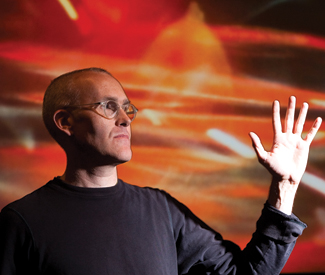
GOLDIES Whether we’re talking about his verging live projections or crystalline short films, Paul Clipson makes things happen onscreen. His exploratory form of lyricism is composed for Super 8 film. That for is critical, since Clipson shoots with a well-practiced intuition for what shows up as gold in Super 8 (an increasingly rare form of presentiment). While taking great advantage of the small-gauge camera’s pencil-like responsiveness to movement, Clipson works from a keen appreciation for the interrelation between fine-grained detail and expansive volumes. In the words of Gaston Bachelard, a writer Clipson admires, “Sometimes the transactions between small and large multiply, have repercussions.” Clipson’s intensive approach in both shooting and projecting his work definitely angles towards a repercussive cinema.

Compound Eyes, a series of short subjects created with musician Jefre Cantu-Ledesma during a recent residency at the San Francisco Exploratorium, puts a fine point on the phenomenological tuning of Clipson’s art. The images envision insect life in a manner unlike traditional nature documentaries, with Clipson’s suggestible camera swallowed in an unfamiliar network of spatial relations and glistening surfaces. Urban architectures emerge in juxtaposition, freshly uncertain in the face of our new sense of scale and environmental experience. Clipson tells me about chasing “the startling fact of the insect’s existence” one recent sunny afternoon. “To understand the animal,” he says, “you have to understand how it understands space — which we can’t do. What’s important to me than is sensitizing the view and creating an awareness of how the space is traversed.”

Discovery is primary to Clipson’s work, not only in his cinematographic concentration of visual phenomena, but also in his oblique tangents upon highly specific shards of film history, and especially in his approach to live performance. The shows place Clipson’s footage in dynamic relation to music performed by artists equally concerned with dynamics of time and space (many of them record for Cantu-Ledesma’s Root Strata label). For the audience, it means a good shot at a heightened state of being.

In all iterations, Clipson’s images are delighted by the ephemerality of that which passes before the camera (“I like the idea that [the insects] leave very quickly and that it’s this continual chase rather than something conditioned”). At the same time, the films realize a remarkable persistence of vision. Clipson’s open channeling of inspiration makes his films as instructive as they are beautiful; it also delivers the good news that there’s more to come.

There’s good news in Ohio

0

The terrible anti-union measure in Ohio — which was being watched nationwide — has gone down in flames. So that’s a good omen.

Occupy Yolkland

0

le.chicken.farmer@gmail.com

CHEAP EATS While everyone else in Oakland was occupying Oakland, Hedgehog and me took a vote and decided unanimously to occupy Montclair Village. Oscar Ogawa Plaza didn’t scare us, head-wound-wise; it was just that, from the sound of it, we didn’t think there’d be room to play catch.

Whereas Montclair Playground has a whole empty ball field, and a pond with a fountain, and birdies. And the Montclair Egg Shop is only just a block away.

It feels and sounds like its own little town, but Montclair Village is still technically Oakland, after all. So, OK, we occupied it. If anyone interviewed us, we would say that our protest was peaceful — so peaceful it didn’t even include any signs or slogans. Just mitts. Our demands were simple: a catch, and some yummy egg dishes. (I had wanted to hit her grounders, too, but we couldn’t reach a consensus, so the bat stayed in the car.)

While we warmed up our arms, we talked about what we always talk about: Bloomsburg, Pennsylvania, where Hedgehog was borned and breaded. Like New Orleans — where she was, of course, fried — Bloomsburg has a bad habit of getting underwater up to its kitchen cabinets, and this fall’s flood, as reported in this very column, was its very worst one ever.

Another worst-ever thing about Bloomsburg, turns out, is its daily paper, the Press-Enterprise, whose sophisticated online version consists of unsearchable, unshareable PDFs of the paper paper, and (get this) you have to pay to see them!

Actual quote, from that paper’s publisher to a Poynter reporter: “If it’s important to people, they can go out and pick up a newspaper.”

As a result of such forward thinking, for a time the most extensive “national” news coverage of Hedgehog’s home town’s historic calamity could be found (gasp) in Cheap Eats! Because we was there, and I was personally and catastrophically affected: The fair was cancelled, and with it my first taste of what Hedgehog calls “real” chicken and waffles.

She and a handful of news hungry ex-Blooms, realizing their beloved hometown’s story was in absurdly incapable hands (i.e. mine, and the Press-Enterprise’s) accidentally started their own on-line rag, the Bloomsburg Daily, which has ever since been scooping the living daylights out of Mr. If-It’s-Important-To-People-They-Can-Go-Out-And-Pick-Up-A-Newspaper — live-streaming public meetings, posting original and professional quality videos, reporting on both sides of the great flood wall debate, and just generally kicking ass.

Problem: It’s Bloomsburg. Fucking. PA. I get tired of hearing about it, frankly, and now maybe you can relate.

I mean, I would like for my girlfriend to occupy Oakland with me, so long as we’re here.

“Hey,” I say, whenever enough gets to be, in a word, enough. “Let’s live where we live.”

We live down the hill, closer to the Dimond District, in Glenview, but I have always been fascinated by Montclair Village the same way Brisbane grabs me in San Francisco. I guess I’m a fan of anomalousness over quintessentiality.

Speaking of which, my old friend and favorite country song singer Hambone, she’s who told me about the Egg Shop. She lives in West Oakland but cleans house up in Montclair. “The Egg Shop!” she said.

So I invited her to occupy the Montclair Egg Shop with us one morning. She showed up fashionably late, and even more fashionably sporting the most farmerly overalls I ever seen on a cleaning woman. Driving a red pickup truck, to boot. Which is to say, our Hambone is the real deal, exactly.

And she was exactly right about the Egg Shop: excellent, and odd! A model BART train scooting back and forth along a track behind the counter. A real motorcycle in a Plexiglas case upstairs amidst a collection of antique rolltop desks, homemade apricot jam centerpiecing each table, and ham and cheese potato pancakes with cilantro and tomatoes. They were more like fancy hash browns than what Hedgehog would call “real” potato pancakes. But what the hell? I love hashbrowns! And eggs . . . 

MONTCLAIR EGG SHOP

Lunch: Mon.-Sat. 11 a.m.-3 p.m. Dinner: Sun.-Thu. 4:30-9:30 p.m.; Fri.-Sat. 4:30-10 p.m.

6126 Medau Place, Oakl.

(510) 339-9554

AE/MC/V

Beer & wine


Rat trap

0

news@sfbg.com

The contents of the ubiquitous bright yellow packages of a common household product are making some local activists go green. Residents are roiling against rats in Berkeley, Marin is trying to attract owls to eat them, and San Francisco is busy persuading stores to stop selling some of the most popular rat baits even before the federal government pulls the plug on pellet-type rodent poisons.

A battle is brewing between the $1 billion pesticide industry that makes D-Con and other common pellet-form rat and mouse poisons and the Environmental Protection Agency, which said June 4 it would either cancel and ban them or, depending on what they contain, require them to be sold with a childproof device.

Several of the makers of the rodenticides have gone to court to fight the proposal, which was supposed to go into effect by now. And four of the companies — Woodstream, Inc., Liphatech, Inc., Reckitt Benckiser, and Spectrum Group — won’t commit to stop making the products during the appeal process. In a press release, Reckitt said its anti-rat pellets are safe and "lawful for sale" unless a court orders otherwise. After the ban announcement, Alan Pryor, Liphatech’s sales director, called the EPA "an agency run wild."

In January, the EPA sued Reckitt in an attempt to instigate misbranding proceedings against the firm’s pellet products instead of canceling them, which could take courts a year or two to decide. But a district court ruled in favor of the company, calling the agency’s bid to speed things up via misbranding "arbitrary, capricious, an abuse of discretion and contrary to law."

The stakes are enormous. Rodent pellet products are strong sellers at hardware stores. Rodent prevention "is an issue throughout the year," says Paulino Tamayo, pest control buyer for San Francisco’s Cliff’s Variety. "Customers are constantly inquiring about it."

One reason: up to 4,000 children under the age of five are reportedly bitten by rats, which carry more than 70 known diseases, in large cities in the U.S. per year, according to the Centers for Disease Control & Prevention. It’s not just children who are seeing the rats.

On Sept. 20, disgusted subway workers demonstrated at New York’s Jamaica Central Terminal, where rats were reported multiplying and even infiltrating train cars. Claiming cutbacks by the MTA were contributing to increased trash and waving a banner reading "New Yorkers Deserve A Rat-Free Subway," members of Transport Workers Union Local 100 persuaded thousands of riders to sign a web petition. The New York Daily News reported the MTA is eliminating 254 cleaning jobs.

Steve Owens, assistant administrator for EPA’s Office of Chemical Safety & Pollution Prevention, said the EPA issued the change to "keep our children and pets safe from these poisons." Every year, the American Association of Poison Control Centers receives 12,000-15,000 reports of kids under the age of six being exposed to rodent bait.

Some analysts think the unreported exposure rate could be 10 times as high; the EPA estimates it’s four times as much. A 2006 EPA study found that of 68,005 children under six exposed to rodenticides, 18,084 had to be treated at a health care facility.

And according to the ASPCA’s National Animal Poison Control Center, tens of thousands of pets, livestock, and wildlife are being poisoned by rodenticides per year. "It’s common," says Dr. Camille DeClementi, senior director of the NAPCC. "Dogs frequently get into bait."

The EPA wants to ban 20 products with brodifacoum, which is in D-Con, and three other chemicals (bromadiolone, difethialone, and difenacoum) for use in residences. But pesticides with the chemicals could still be used by exterminators and farm owners. On Sept. 7, the agency said it would meet Nov. 29 to consider "scientific conclusions" supporting its decision; it’s accepting comments through Nov. 15.

One looming question: will the ban work? Some mom and pop shop owners are so desperate for sales in the recession that they’ve turned to offering dirt-cheap but illegal rat poisons, often from China. On Sept. 19, 12 people were arrested in New York City’s Chinatown for selling brodifacoum and sodium fluoroacetate-laced products which, because they look like cookies, could attract children, Manhattan District Attorney Cyrus Vance said at a news conference. The U.S. has forbidden use of sodium fluoroacetate against rats since 1972.

And while commending the EPA "for trying to reduce the risk of poisoning," DeClementi says that although the new regulations would stop most cats from being poisoned, many dogs will simply chew open the poison-strewn blocks, called "bait stations," that will be required if the regulations take effect. "Dogs," she says, "explore the world with their mouths. The same thing that makes the bait attractive to rodents will make it attractive to dogs. Dogs will seek the stations out."

Worse yet, DeClementi, a veterinarian who’s been with the ASPCA since 1999, predicts that the ban will produce an unintended consequence: if they lose in court, pest control companies will switch to selling a class of other, even more deadly poisons known as "first generation" rodenticides.

And their two most likely choices, believes DeClementi, will be bromethalin, a neurotoxin which causes paralysis or seizures that are almost impossible to treat, and cholecalciferol, a form of vitamin D which, in high doses, induces kidney failure that requires lengthy and expensive treatment.

"I wonder if sterlizing rodents would work better?" she asks. "But would eating rats on birth control also kill birds of prey?"

For now, she favors products that catch rodents "in a little house," such as rat zappers, and telling bird lovers to "keep their bird seed in containers instead of bags."

Others favor more natural approaches. After rats seeking warm places to nest caused a reported $5,000–<\d>$7,000 in damage to vehicles by chewing their carpets and other parts in the garage of the Marin County Civic Center, the county, in cooperation with the Hungry Owl Project, spent less than $1,000 to put up six barn owl boxes adjacent to the San Rafael building September 10. Each owl family can consume up to 5,000 of the voracious vermin per year.

Meanwhile, not everyone is waiting for the EPA’s rules to go into effect. Retailers around the USA are starting to withdraw rat pellet bait products.

Now that the EPA has published its rule change, stores in New York must, under state law, take the rat bait products off their shelves. And after the discovery of four dead Cooper’s hawks, three of which tested positive for rodenticide poisoning, activists in California say they will press for the enactment of a similar law.

"I’m outraged at the makers of these rodenticides for not caring about people or the welfare of animals," says Lisa Owens Viani, who founded Raptors Are The Solution (RATS) this summer after a Cooper’s hawk was found dead on a sidewalk off Berkeley’s Bancroft Street, four years after three other Cooper’s hawks died in her Berkeley neighborhood. Tests by the University of California at Davis showed the sidewalk hawk had ingested the rodenticides brodifacoum and diphacinone; two of the other birds tested positive for brodifacoum.

"The companies that are fighting (the EPA) are some of the same ones that make rodent traps," she says. "They will still have plenty of other products to sell."

Owens Viani, who led a jam-packed organizing meeting of RATS August 26, says part of her motivation to act is "a personal thing. I have lots of animals. My vet told me he’s seen lots of dogs, cats, and horses that have been poisoned by rats."

"A little girl was devastated to come across the young juvenile hawk that had bled to death on the sidewalk," she says.

"At first, I went door to door and passed out fliers, asking if anyone else was finding dead birds, for a five block radius," remembers Owens Viani. She discovered that although most bird books say Cooper’s hawks eat other birds, a local photographer had shot images of them also feeding rats to their young.

RATS plans to urge hardware and chain stores in the San Francisco Bay Area to immediately stop selling the products named by the EPA. "We want to push them along," says Owens Viani. "People are really concerned about this problem. They are tired of relying on poisons."

Meanwhile, on Sept. 9, San Francisco sent letters to about 140 hardware stores, big box stores, and garden centers, asking them to voluntarily "pledge to stop ordering" the affected products by Sept. 15. Signed by Melanie Nutter, director of the city’s Department of Environment, the letter included a list of "alternative rat and mouse baits" that meet the EPA’s standards.

"The EPA is being hamstrung" by the court battle, says Chris Geiger, San Francisco’s green purchasing manager. "The products in question are highly toxic. We think we owe it to the people of San Francisco to let them know about this situation and to encourage them not to sell or buy this stuff."

"The good thing is that there are other things people will buy instead," adds Geiger.

It isn’t the first time San Francisco’s been involved in the rodenticides controversy. In 2007, it virtually banned the use of rodenticides on city-owned properties, except for sewers, "where," says Geiger, "there’s nothing else we know of that can be used" to kill rats.

Sensing a potentially explosive issue that could pit environmentalists against people with health concerns about rats, Geiger says the city is trying to work with store owners in order to avoid trouble. "We want to help vendors not have people picketing outside their hardware outlets," he says. In coming weeks, San Francisco plans to hold community meetings to deal with consumer concerns about rodenticides.

So far, more than 15 stores have complied with the request. Among them: Sloat Garden Centers’ entire chain, including its stores in San Francisco, Mill Valley, San Rafael, Kentfield, Novato, and Danville; Papenhausen Hardware, in West Portal; and Cliff’s Variety, in the Castro.

Says Cliff’s Tamayo: "We’re selling out what little we have left of the old products and have already restocked our shelves with new items." At first, Tamayo considered slashing prices to lure worried customers back to the store. "I thought I might have to put them on sale," he says. But after getting only four complaints, Cliff’s is, at least for now, staying the course.

As for Owens Viani, she says it’s also now time to push the state to do what San Francisco is doing but on steroids, by having the Golden State order harmful rodenticide products removed from stores. "We want California to pass a law, so we are going to approach a legislator to get a bill going," says Viani, who lives in the flatlands of Berkeley, which is a prime breeding area for rats.

For information about the next meeting of RATS or to help the group succeed, please go to www.hungryowl.org/kboib or contact Owens Viani at lowensvi@sbcglobal.net.

Film Listings

0

Film listings are edited by Cheryl Eddy. Reviewers are Kimberly Chun, Max Goldberg, Dennis Harvey, Lynn Rapoport, and Matt Sussman. For rep house showtimes, see Rep Clock.

OPENING

*Bedazzled and The Car After several weeks of delivering some fairly purgatorial cinematic meditations on Mephistopheles, the Vortex Room’s final demonic double bill is da bomb. First up is mother of all cult comedies Bedazzled (1967), in which Goon Show regulars Peter Cook and Dudley Moore ramped up their anticipation of Monty Python-esque absurd sketch-humor outrages by positing themselves as wily Devil and major chump in a not-so-swinging contemporary London. Moore’s besotted (with the divine Eleanor Bron) Wimpy Burger employee gets seven wishes for true happiness in exchange for his soul, but each fantasy granted — ranging from animation to killer pop-star satire to nuns on trampolines — somehow comes with a fly in its ointment. Too ahead of its time for popular success (despite an elongated cameo by reigning sexpot Raquel Welch as Lillian Lust), Bedazzled is now a bit dated, but still bloody marvelous. One doubts that compound adjective was ever applied to The Car (1977), which came out a decade later and sort of managed to couple 1975’s Jaws and 1976’s The Omen (albeit without achieving anywhere near their success). A killer car — a black Continental Mark III, to be precise — trolls around the Southwest edging bicyclists off cliffs, mowing down pedestrians, even attacking potty-mouthed schoolteachers inside their homes. (This last scene alone is definitely worth the price of admission.) What’s more, there appears to be no driver, suggesting this vehicle is fueled by pure evil. James Brolin at his hairiest is the local sheriff whose guns alone can’t save the town. Unquestionably silly, The Car nonetheless remains the Rolls Royce of supernaturally-possessed-automotive-transportation movies. Vortex Room. (Harvey)

*El Bulli: Cooking in Progress Oh to be a fly on the wall of El Bulli — back in 2008 and 2009, when director Gereon Wetzel turned his lens on the Spanish landmark, it was considered the best restaurant in the world. This elegantly wrought documentary, covering a year at the culinary destination (now closed), allows you to do just that. Wetzel opens on chef-owner Ferran Adrià shutting down his remarkable eatery for the winter and then drifting in and out of his staff’s Barcelona lab as they develop dishes for the forthcoming season. Head chef Oriol Castro and other trusted staffers treat ingredients with the detached methodicalness of scientists — a champignon mushroom, say, might be liquefied from its fried, raw, sous-vide-cooked states — and the mindful intuition of artists, taking notes on both MacBooks and paper, accompanied by drawings and much photo-snapping. Fortunately the respectful Wetzel doesn’t shy away from depicting the humdrum mechanics of running a restaurant, as Adrià is perpetually interrupted by his phone, must wrangle with fishmongers reluctant to disclose “secret” seasonal schedules, and slowly goes through the process of creating an oil cocktail and conceptualizing a ravioli whose pasta disappears when it hits the tongue, tasting everything as he goes. Energized by an alternately snappy and meditative percussive score, this look into the most influential avant-garde restaurant in the world is a lot like the concluding photographs of the many menu items we glimpse at their inception — a memorable, sublimely rendered document that leaves you hungry for more. (1:48) Embarcadero. (Chun)

Le Havre Aki Kaurismäki’s second French-language film (following 1992’s La Vie de Boheme) offers commentary on modern immigration issues wrapped in the gauze of a feel good fairy tale and cozy French provincialism a la Marcel Pagnol. Worried about the health of his hospitalized wife (Kaurismäki regular Kati Outinen), veteran layabout and sometime shoe shiner Marcel (Andre Wilms) gets some welcome distraction in coming to the aid of Idrissa (Blondin Miguel), a young African illegally trying to make way to his mother in London while eluding the gendarmes. Marcel’s whole neighborhood of port-town busybodies and industrious émigrés eventually join in the cause, turning Le Havre into a sort of old-folks caper comedy with an incongruously sunny take on a rising European multiculturalism in which there are no real racist xenophobes, just grumps deserving comeuppance. Incongruous because Kaurismäki is, of course, the king of sardonically funny Finnish miserabilism — and while it’s charmed many on the festival circuit, this combination of his usual poker-faced style and feel-good storytelling formula may strike others as an oil-and-water mismatch. (1:43) Clay, Smith Rafael. (Harvey)

Immortals Tarsem Singh (2006’s The Fall) directs Mickey Rourke and Stephen Dorff in this CG-laden mythology adventure. (1:50) Presidio.

*Into the Abyss: A Tale of Death, a Tale of Life How remarkable is it that, some 50-plus features along, filmmaker Werner Herzog would become the closest thing to a cinema’s conscience? This time the abyss is much closer to home than the Amazon rainforest or the Kuwaiti oil fields — it lies in the heart of Rick Perry country. What begins as an examination of capital punishment, introduced with an interview with Reverend Richard Lopez, who has accompanied Texas death row inmates to their end, becomes a seeming labyrinth of human tragedy. Coming into focus is the execution of Michael Perry, convicted as a teenager of the murder of a Conroe, Tex., woman, her son, and his friend — all for sake of a red Camaro. Herzog obtains an insightful interview with the inmate, just days before his execution, as well as his cohort Jason Burkett, police, an executioner, and the victims’ family members, in this haunting examination of crime, punishment, and a small town in Texas where so many appear to have gone wrong. So wrong that one might see Into the Abyss as more related to 1977’s Stroszek and its critical albeit compassionate take on American life, than Herzog’s last tone poem about the mysterious artists of 2010’s Cave of Forgotten Dreams (and it’s also obviously directly connected to next year’s TV documentary, Death Row). The layered tragedies and the strata of destroyed lives stays with you, as do the documentary’s difficult questions, Herzog’s gentle humanity as an interviewer, and the fascinating characters that don’t quite fit into a more traditional narrative — the Conroe bystander once stabbed with a screwdriver who learned to read in prison, and the dreamy woman impregnated by a killer whose entire doomed family appears to be incarcerated. (1:46) Embarcadero. (Chun)

J. Edgar The usual polished, sober understatement of Clint Eastwood’s directing style and the highlights-compiling CliffsNotes nature of Dustin Lance Black’s screenplay turn out to be interestingly wrong choices for this biopic about one of the last American century’s most divisive figures. Interesting in that they’re perhaps among the very few who would now dare viewing the late, longtime FBI chief with so much admiration tempered by awareness of his faults — rather than the other way around. After all, Hoover (played by Leonardo DiCaprio) strengthened his bureau in ways that, yes, often protected citizens and state, but at what cost? The D.C. native eventually took to frequently “bending” the law, witch-hunting dubious national enemies (he thought the Civil Rights movement our worst threat since the bomb-planting Bolshevik anarchists of half a century earlier), blackmailing personal ones, weakening individual rights against surveillance, hoarding power (he resented the White House’s superior authority), lying publicly, and doing just about anything to heighten his own fame. A movie that internalized and communicated his rising paranoid megalomania (ironically Hoover died during the presidency of Nixon, his equal in that regard) might have stood some chance of making us understand this contradiction-riddled cipher. But J. Edgar is doggedly neutral, almost colorless (literally so, in near-monochrome visual presentation), its weird appreciation of the subject’s perfectionism and stick-to-it-iveness shutting out almost any penetrating insight. (Plus there’s Eastwood’s own by-now-de rigueur soundtrack of quasi-jazz noodling to make what is vivid here seem more dull and polite.) The love that dare not speak its name — or, evidently, risk more than a rare peck on the cheek — between Hoover and right-hand-man/life companion Clyde Tolson (Armie Hammer, very good if poorly served by his old-age makeup) becomes both the most compelling and borderline-silly thing here, fueled by a nervous discretion that seems equal parts Black’s interest and Eastwood’s discomfort. While you might think the directors polar opposites in many ways, the movie J. Edgar ultimately recalls most is Oliver Stone’s 1995 Nixon: both ambitiously, rather sympathetically grapple with still-warm dead gorgons and lose, filmmaker and lead performance alike laboring admirably to intelligent yet curiously stilted effect. (2:17) Marina. (Harvey)

Jack and Jill Adam Sandler plays a dude who has a Thanksgiving from hell thanks to his twin sister (played by an in-drag Adam Sandler). Somehow Al Pacino is also involved. (runtime not available) Presidio.

*Melancholia Lars von Trier is a filmmaker so fond of courting controversy it’s like he does it in spite of himself — his rambling comments about Hitler (“I’m a Nazi”) were enough to get him banned from the Cannes Film Festival earlier this year, where Melancholia had its debut (and star Kirsten Dunst won Best Actress). Oops. Maybe after the (here’s that word again) controversy that accompanied 2009’s Antichrist, von Trier felt like he needed a shocking context for his more mellow latest. Pity that, for Melancholia is one of his strongest, most thoughtful works to date. Split into two parts, the film follows first the opulent, disastrous, never-ending wedding reception of Justine (Dunst) and Michael (Alexander Skarsgard), held at a lavish estate owned by John (Kiefer Sutherland), the tweedy husband of Justine’s sister, Claire (Charlotte Gainsbourg). Amid the turmoil of arguments (John Hurt and Charlotte Rampling as Justine and Claire’s divorced parents), pushy guests (Stellan Skarsgard as Justine’s boss), livid wedding planner (Udo Kier, amazing), and hurt feelings (Michael is the least-wanted groom since Kris Humphries), it’s clear that something is wrong with Justine beyond just marital jitters. The film’s second half begins an unspecified amount of time later, as Claire talks her severely depressed, near-catatonic sister into moving into John’s mansion. As Justine mopes, it’s revealed that a small planet, Melancholia — glimpsed in Melancholia‘s Wagner-scored opening overture — is set to pass perilously close to Earth. John, an amateur astronomer, is thrilled; Claire, fearful for her young son’s future and goaded into high anxiety by internet doomsayers, is convinced the planets will collide, no matter what John says. Since Justine (apparently von Trier’s stand-in for himself) is convinced that the world’s an irredeemably evil place, she takes the news with a shrug. Von Trier’s vision of the apocalypse is somber and surprisingly poetic; Dunst and Gainsbourg do outstanding work as polar-opposite sisters whose very different reactions to impending disaster are equally extreme. (2:15) Embarcadero. (Eddy)

Octubre This downtempo drama directed by Daniel and Diego Vega follows Clemente (Bruno Odar), a stone-faced moneylender living in a shabby apartment in Lima, Peru. Clemente’s days couldn’t be more bleak. When he’s not dealing with clients over his kitchen table — appraising watches and jewelry, handing out or collecting cash — he’s eating egg sandwiches and paying cold visits to prostitutes. When one of them leaves a baby girl in his apartment, Clemente goes on a search for the mother. Meanwhile, he enlists a client, Sofía (Gabriela Velásquez), as a live-in nanny for the baby. Both Sofía and the baby add some life and color to Clemente’s apartment and ultimately, his reclusive existence. Octubre is a slow rolling and muted film that’s interested in detail. Most of the time, you’re searching Clemente’s stony face (Odar’s acting is superb and unbroken), hoping he might betray a thought or even better, a feeling — he does. (1:23) SFFS New People Cinema. (James H. Miller)

ONGOING

Anonymous Hark, what bosom through yonder bodice heaves? If you like your Shakespearean capers OTT and chock-full of fleshy drama, political intrigue, and groundling sensation, then Anonymous will enthrall (and if the lurid storyline doesn’t hold, the acting should). Writer John Orloff spins his story off one popular theory of Shakespeare authorship — that Edward de Vere, the 17th Earl of Oxford, was the true pen behind the works attributed to William Shakespeare of Stratford-upon-Avon. Our modern-day narrator (Derek Jacobi) foregrounds the fictitious nature of the proceedings, pulling back the curtain on Ben Jonson (Sebastian Armesto) staging his unruly comedies for the mob, much to the amusement of a mysterious aging dandy of a visitor: the Earl of Oxford (Rhys Ifans). Hungry for the glory that has always slipped through his pretty fingers, the Earl yearns to have his works staged for audiences beyond those in court, where Queen Elizabeth I (Vanessa Redgrave as the elder regent, daughter Joely Richardson as the lusty young royal) dotes on them, and out of the reach of his puritan father-in-law Robert Cecil (David Thewlis), Elizabeth’s close advisor, and he devises a plan for Jonson to stage them under his own name. But much more is triggered by the productions, uncovering secret trysts, hunchback stratagems, and more royal bastards than you can shake a scepter at. Director Roland Emmerich invests the production with the requisite high drama — and camp — to match the material, as well as pleasing layers of grime and toxic-looking Elizabethan makeup for both the ladies and the dudes who look like ladies (the crowd-surfing, however, strikes the off-key grunge-era note). And if the inherent elitism of the tale — could only a nobleman have written those remarkable plays and sonnets? — offends, fortunately the cast members are more than mere players. Ifans invests his decadent Earl with the jaded gaze and smudgy guyliner of a fading rock star, and Redgrave plays her Elizabeth like a deranged, gulled grotesque. (2:10) 1000 Van Ness, SF Center, Sundance Kabuki. (Chun)

*Drive Such a lovely way to Drive, drunk on the sensual depths of a lush, saturated jewel tone palette and a dreamlike, almost luxurious pacing that gives off the steamy hothouse pop romanticism of ’80s-era Michael Mann and David Lynch — with the bracing, impactful flecks of threat and ultraviolence that might accompany a car chase, a moody noir, or both, as filtered through a first-wave music video. Drive comes dressed in the klassic komforts — from the Steve McQueen-esque stances and perfectly cut jackets of Ryan Gosling as the Driver Who Shall Remain Nameless to the foreboding lingering in the shadows and the wittily static, statuesque strippers that decorate the background. Gosling’s Driver is in line with Mann’s other upstanding working men who hew to an old-school moral code and are excellent at what they do, regardless of what side of the law they’re working: he likes to keep it clear and simple — his services as a wheelman boil down to five minutes, in and out — but matters get messy when he falls for sweet-faced neighbor Irene (Carey Mulligan), who lives down the hall with her small son, and her ex-con husband (Oscar Isaac) is dragged back into the game. Populated by pungent side players like Albert Brooks, Bryan Cranston, Ron Perlman, and Christina Hendricks, and scattered with readily embeddable moments like a life-changing elevator kiss that goes bloodily wrong-right, Drive turns into a real coming-out affair for both Danish director Nicolas Winding Refn (2008’s Bronson), who rises above any crisis of influence or confluence of genre to pick up the po-mo baton that Lynch left behind, and 2011’s MVP Ryan Gosling, who gets to flex his leading-man muscles in a truly cinematic role, an anti-hero and under-the-hood psychopath looking for the real hero within. (1:40) Bridge, SF Center. (Chun)

50/50 This is nothing but a mainstream rom-com-dramedy wrapped in indie sheep’s clothes. When Adam (Joseph Gordon-Levitt) learns he has cancer, he undergoes the requisite denial, anger, bargaining, depression, and acceptance like a formality. Aided by his bird-brained but lovable best friend Kyle (Seth Rogan), lovable klutz of a counselor Katherine (Anna Kendrick), and panicky mother (Anjelica Huston), Adam gets a new lease on life. This comes in the form of one-night-stands, furious revelations in parked cars, and a prescribed dose of wacky tobaccy. If 50/50 all sounds like the setup for a pseudo-insightful, kooky feel-goodery, it is. The film doesn’t have the brains or spleen to get down to the bone of cancer. Instead, director Jonathan Levine (2008’s The Wackness) and screenwriter Will Reiser favor highfalutin’ monologues, wooden characters, and a Hollywood ending (with just the right amount of ambiguity). Still, Gordon-Levitt is the most gorgeous cancer patient you will ever see, bald head and all. (1:40) Bridge, Four Star, 1000 Van Ness, SF Center, Sundance Kabuki. (Ryan Lattanzio)

Footloose Another unnecessary remake joins the queue at the box office, aiming for the pockets of ’80s-era nostalgics and fans of dance movies and naked opportunism. A recap for those (if there are those) who never saw the 1984 original: city boy Ren McCormack moves to a Middle American speck-on-the-map called Bomont and riles the town’s inhabitants with his rock ‘n’ roll ways — rock ‘n’ roll, and the lewd acts of physicality it inspires, i.e., dancing, having been criminalized by the town council to preserve the souls and bodies of Bomont’s young people. Ren falls for wayward preacher’s daughter Ariel Moore — whose father has sponsored this oversolicitous piece of legislation — and vows to fight city hall on the civil rights issue of a senior prom. Ren McCormack 2.0 is one Kenny Wormald (prepped for the gig by his tenure in the straight-to-cable dance-movie sequel Center Stage: Turn It Up), who forgoes the ass-grabbing blue jeans that Kevin Bacon once angry-danced through a flour mill in. Otherwise, the 2011 version, directed and cowritten by Craig Brewer (2005’s Hustle & Flow), regurgitates much of the original, hoping to leverage classic lines, familiar scenes, and that Dance Your Ass Off T-shirt of Ariel’s. It doesn’t work. Ren and Ariel (Dancing with the Stars‘ Julianne Hough) are blandly unsympathetic and have the chemistry of two wet paper towels, the adult supporting cast should have known better, and the entire film comes off as a tired, tuneless echo. (1:53) Four Star. (Rapoport)

*Gainsbourg: The Man Who Loved Women Those hungry for more of the real Serge Gainsbourg — after being tantalized and teased by Joann Sfar’s whimsical comic book-inspired feature — will want to catch this documentary by Pascal Forneri for many of the details that didn’t fit or were skimmed over, here, in the very words and image of the songwriter and the many iconic women in his life. Much of the chanson master’s photographic or video history seems to be here — from his blunt-force on-camera proposition of Whitney Houston to multiple, insightful interviews with the love of his life, Jane Birkin, as well as the many women who won his heart for just a little while, such as Brigitte Bardot, Juliette Gréco, Françoise Hardy, and Vanessa Paradis. Gainsbourg may be marred by its somewhat choppy, mystifying structure, at times chronological, at times organized according to creative periods, but overriding all are the actual footage and photographs loosely, louchely assembled and collaged by Forneri; delightful pre-music-videos Scopitones of everyone from France Gall to Anna Karina; and the gemlike, oh-so-quotable interviews with the mercurial, admirably honest musical genius and eternally subversive provocateur. Quibble as you might with the short shrift given his later career—in addition to major ’70s LPs like Histoire de Melody Nelson and L’Homme à tête de chou (Cabbage-Head Man) — this is a must-see for fans both casual and seriously seduced. (1:45) Roxie. (Chun)

The Ides of March Battling it out in the Ohio primaries are two leading Democratic presidential candidates. Filling the role of idealistic upstart new to the national stage — even his poster looks like you-know-who’s Hope one — is Governor Mike Morris (George Clooney), who’s running neck-and-neck in the polls with his rival thanks to veteran campaign manager (Philip Seymour Hoffman) and ambitious young press secretary Steven (Ryan Gosling). The latter is so tipped for success that he’s wooed to switch teams by a rival politico’s campaign chief (Paul Giamatti). While he declines, even meeting with a representative from the opposing camp is a dangerous move for Steven, who’s already juggling complex loyalties to various folk including New York Times reporter Ida (Marisa Tomei) and campaign intern Molly (Evan Rachel Wood), who happens to be the daughter of the Democratic National Party chairman. Adapted from Beau Willimon’s acclaimed play Farragut North, Clooney’s fourth directorial feature is assured, expertly played, and full of sharp insider dialogue. (Willimon worked on Howard Dean’s 2004 run for the White House.) It’s all thoroughly engaging — yet what evolves into a thriller of sorts involving blackmail and revenge ultimately seems rather beside the point, as it turns upon an old-school personal morals quandary rather than diving seriously into the corporate, religious, and other special interests that really determine (or at least spin) the issues in today’s political landscape. Though stuffed with up-to-the-moment references, Ides already feels curiously dated. (1:51) Marina, 1000 Van Ness, Sundance Kabuki. (Harvey)

In Time Justin Timberlake moves from romantic comedy to social commentary to play Will Salas, a young man from the ghetto living one day at a time. Many 12-steppers may make this claim, but Salas literally is, because in his world, time actually is money and people pay, say, four minutes for a cup of coffee, a couple hours for a bus ride home from work, and years to travel into a time zone where people don’t run from place to place to stay ahead of death. In writer-director Andrew Niccol’s latest piece of speculative cinema, humans are born with a digitized timepiece installed in their forearm and a default sell-by date of 25 years, with one to grow on — though most end up selling theirs off fairly quickly while struggling to pay rent and put food on the table. Time zones have replaced area codes in defining social stature and signaling material wealth, alongside those pesky devices that give the phrase “internal clock” an ominous literality. Niccol also wrote and directed Gattaca (1997) and wrote The Truman Show (1998), two other films in which technological advances have facilitated a merciless, menacing brand of social engineering. In all three, what is most alarming is the through line between a dystopian society and our own, and what is most hopeful is the embattled protagonist’s promises that we don’t have to go down that road. Amanda Seyfried proves convincible as a bored heiress to eons, her father (Vincent Kartheiser) less amenable to Robin Hood-style time banditry. (1:55) 1000 Van Ness, SF Center. (Rapoport)

Johnny English Reborn (1:41) Four Star.

*Like Crazy Jacob (Anton Yelchin) and Anna (Felicity Jones) meet near the end of college; after a magical date, they’re ferociously hooked on each other. Trouble is, she’s in Los Angeles on a soon-to-expire student visa — and when she impulsively overstays, then jets home to London for a visit months later, her re-entry to America is stopped cold at LAX. (True love’s no match for homeland security.) An on-and-off long-distance romance ensues, and becomes increasingly strained, even as their respective careers (he makes furniture, she’s a magazine staffer) flourish. Director and co-writer Drake Doremus (2010’s Douchebag) achieves a rare midpoint between gritty mumblecore and shiny Hollywood romance; the characters feel very real and the script ably captures the frustration that settles in when idealized fantasies give way to the messy workings of everyday life. There are some contrivances here — Anna’s love-token gift from Jacob, a bracelet engraved “Patience,” breaks when she’s with another guy — but for the most part, Like Crazy offers an honest portrait of heartbreak. (1:29) SF Center. (Eddy)

*Love Crime Early this year came the announcement that Brian De Palma was hot to do an English remake of Alain Corneau’s Love Crime. The results, should they come to fruition, may well prove a landmark in the annals of lurid guilty-pleasure trash. But with the original Love Crime finally making it to local theaters, it’s an opportune moment to be appalled in advance about what sleazy things could potentially be done to this neat, dry, fully clothed model of a modern Hitchcockian thriller. No doubt in France Love Crime looks pretty mainstream. But here its soon-to be-despoiled virtues of narrative intricacy and restraint are upscale pleasures. Ludivine Sagnier plays assistant to high-powered corporate executive Christine (Kristin Scott Thomas). The boss enjoys molding protégée Isabelle to her own image, making them a double team of carefully planned guile unafraid to use sex appeal as a business strategy. But Isabelle is expected to know her place — even when that place robs her of credit for her own ideas — and when she stages a small rebellion, Christine’s revenge is cruelly out of scale, a high-heeled boot brought down to squash an ant. Halfway through an act of vengeance occurs that is shocking and satisfying, even if it leaves the remainder of Corneau and Nathalie Carter’s clever screenplay deprived of the very thing that had made it such a sardonic delight so far. Though it’s no masterpiece, Love Crime closes the book on his Corneau’s career Corneau (he died at age 67 last August) not with a bang but with a crisp, satisfying snap. (1:46) Lumiere. (Harvey)

*Margin Call Think of Margin Call as a Mamet-like, fictitious insider jab at the financial crisis, a novelistic rejoinder to Oscar-winning doc Inside Job (2010). First-time feature director and writer J.C. Chandor shows a deft hand with complex, writerly material, creating a darting dance of smart dialogue and well-etched characters as he sidesteps the hazards of overtheatricality, a.k.a. the crushing, overbearing proscenium. The film opens on a familiar Great Recession scene: lay-off day at an investment bank, marked by HR functionaries calling workers one by one into fishbowl conference rooms. The first victim is the most critical — Eric Dale (Stanley Tucci), a risk-management staffer who has stumbled on an investment miscalculation that could potentially trigger a Wall Street collapse. On his way out, he passes a drive with his findings to one of his young protégés, Peter (Zachary Quinto), setting off a flash storm over the next 24 hours that will entangle his boss Sam (Kevin Spacey), who’s agonizing over his dying dog while putting up a go-big-or-go-home front; cynical trading manager Will (Paul Bettany); and the firm’s intimidating head (Jeremy Irons), who gets to utter the lines, “Explain to me as you would to a child. Or a Golden Retriever.” Such top-notch players get to really flex their skills here, equipped with Chandor’s spot-on script, which manages to convey the big issues, infuse the numbers with drama and the money managers with humanity, and never talk down to the audience. (1:45) Sundance Kabuki. (Chun)

*Martha Marcy May Marlene If Winter’s Bone star Jennifer Lawrence was the breakout ingénue of 2010, look for Martha Marcy May Marlene‘s Elizabeth Olsen to take the 2011 title. Both films are backwoodsy and harrowing and offer juicy roles for their leading starlets — not to mention a pair of sinister supporting roles for the great John Harkes. Here, he’s a Manson-y figure who retains disturbing control over Olsen’s character even after the multi-monikered girl flees his back-to-the-land cult. Writer-director Sean Durkin goes for unflashy realism and mounds on the dread as the hollow-eyed Martha attempts to resume normal life, to the initial delight of her estranged, guilt-ridden older sister (Sarah Paulson). Soon, however, it becomes clear that Things Are Not Ok. You’d be forgiven for pooh-poohing Olsen from the get-go; lavish Sundance buzz and the fact that she’s Mary-Kate and Ashley’s sis have already landed her mountains of pre-release publicity. But her performance is unforgettable, and absolutely fearless. (1:41) Sundance Kabuki. (Eddy)

Midnight in Paris Owen Wilson plays Gil, a self-confessed “Hollywood hack” visiting the City of Light with his conservative future in-laws and crassly materialistic fiancée Inez (Rachel McAdams). A romantic obviously at odds with their selfish pragmatism (somehow he hasn’t realized that yet), he’s in love with Paris and particularly its fabled artistic past. Walking back to his hotel alone one night, he’s beckoned into an antique vehicle and finds himself transported to the 1920s, at every turn meeting the Fitzgeralds, Gertrude Stein (Kathy Bates), Dali (Adrien Brody), etc. He also meets Adriana (Marion Cotillard), a woman alluring enough to be fought over by Hemingway (Corey Stoll) and Picasso (Marcial di Fonzo Bo) — though she fancies aspiring literary novelist Gil. Woody Allen’s latest is a pleasant trifle, no more, no less. Its toying with a form of magical escapism from the dreary present recalls The Purple Rose of Cairo (1985), albeit without that film’s greater structural ingeniousness and considerable heart. None of the actors are at their best, though Cotillard is indeed beguiling and Wilson dithers charmingly as usual. Still — it’s pleasant. (1:34) Opera Plaza. (Harvey)

Moneyball As fun as it is to watch Brad Pitt listen to the radio, work out, hang out with his cute kid, and drive down I-80 over and over again, it doesn’t quite translate into compelling cinema for the casual baseball fan. A wholesale buy-in to the cult of personality — be it A’s manager Billy Beane or the actor who plays him — is at the center of Moneyball‘s issues. Beane (Pitt) is facing the sad, inevitable fate of having to replace his star players, Jason Giambi and Johnny Damon, once they command the cash from the more-moneyed teams. He’s gotta think outside of the corporate box, and he finds a few key answers in Peter Brand (a.k.a. Paul DePodesta, played by Jonah Hill), who’s working with the sabermetric ideas of Bill James: scout the undervalued players that get on base to work against better-funded big-hitters. Similarly, against popular thought, Moneyball works best when director Bennett Miller (2005’s Capote) strays from the slightly flattening sunniness of its lead actor and plunges into the number crunching — attempting to visualize the abstract and tapping into the David Fincher network, as it were (in a related note, Aaron Sorkin co-wrote Moneyball‘s screenplay) — though the funny anti-chemistry between Pitt and Hill is at times capable of pulling Moneyball out of its slump. (2:13) Marina, 1000 Van Ness, Sundance Kabuki. (Chun)

Oranges and Sunshine At the center of this saga of lives ripped apart by church and state is Margaret Humphreys, the Englishwoman who uncovered the scandalous mass deportation of children from England to Australia. In one of her most rewarding roles since The Proposition (2005), her last foray to Oz, Watson portrays the English social worker who in the ’80s learns of multiple cases of now-adult orphans in Australia who don’t know their real name or even age but remember that they once lived in the UK. She starts to explore the past of victims such as Jack (Hugo Weaving) and Len (David Wenham) and tries to reunite them with their families, including mothers who were told their youngsters were adopted into real families. In the course of her work, and at the expense of her own family life, Humphreys discovers the horrors that befell many young deportees — as child slave-laborers — and the corruption that extends its fingers into government and the Catholic church. In his first feature film, director Jim Loach, son of crusading cinematic force Ken Loach, turns over each stone with care and compassion, finding the perfect filter through which to tell this well-modulated story in Watson, whose Humphreys faces harassment and post-traumatic stress disorder in her quest to heal the children who were lured overseas in the hope that they would ride horses to school and pick oranges off a tree for breakfast. (1:45) Opera Plaza. (Chun)

*Paranormal Activity 3 A prequel to a prequel, this third installment in the faux-home-movie horror series is as good as one could reasonably hope for: considerably better than 2010’s part two, even if inevitably it can’t replicate the relatively fresh impact of the 2007 original. After a brief introductory sequence we’re in 1988, with the grown-up sisters of the first two films now children (Chloe Csengery, Jessica Tyler Brown) living with a recently separated mom (Lauren Bitter) and her nice new boyfriend (Christopher Smith). His wedding-video business provides the excuse for many a surveillance cam to be set up in their home once things start going bump in the night (and sometimes day). Which indeed they do, pretty quickly. Brown’s little Kristi has an invisible friend called Toby she says is “real,” though of course everyone else trusts he’s a normal, harmless imaginary pal. Needless to say, they are wrong. Written by Christopher Landon (Paranormal Activity 2, 2007’s Disturbia) and directed by the guys (Henry Joost, Ariel Schulman) who made interesting nonfiction feature Catfish (2010), this quickly made follow-up does a good job piling on more scares without getting shameless or ludicrous about it, extends the series’ mythology in ways that easily pave way toward future chapters, and maintains the found-footage illusion well enough. (Excellent child performances and creepy camcorder “pans” atop an oscillating fan motor prove a great help; try to forget that video quality just wasn’t this good in ’88.) Not great, but thoroughly decent, and worth seeing in a theater — this remains one chiller concept whose effectiveness can only be diminished to the point of near-uselessness on the small screen. (1:24) 1000 Van Ness. (Harvey)

*Point Blank Not for nothing did Hollywood remake French filmmaker Fred Cavaye’s last film, Anything for Her (2008) as The Next Three Days (2010) — Cavaye’s latest, tauter-than-taut thriller almost screams out for a similar rework, with its Bourne-like handheld camera work, high-impact immediacy, and noirish narrative economy. Point Blank — not to be confused with the 1967 Lee Marvin vehicle —kicks off with a literal slam: a mystery man (Roschdy Zem) crashing into a metal barrier, on the run from two menacing figures until he is cornered and then taken out of the action by fate. His mind mainly on the welfare of his very pregnant wife Nadia (Elena Anaya), nursing assistant Samuel (Gilles Lellouche) has the bad luck to stumble on a faux doctor attempting to make sure that the injured man never rises from his hospital bed. As police wrangle over whose case this exactly is — the murder of an industrialist seems to have expanded the powers of the stony-faced, monolithic Commandant Werner (Gerard Lanvin) — Samuel gets sucked into the mystery man’s lot, a conspiracy that allows them to trust no one, and seemingly impossibly odds against getting out of the mess alive. Cavaye never quite stops applying the pressure in this clever, unrelenting cat-and-mouse and mouse-and-his-spouse game, topping it with a nerve-jangling search through a messily chaotic police station. (1:24) Opera Plaza. (Chun)

Puss in Boots (1:45) 1000 Van Ness, Presidio.

Real Steel Everybody knows what this movie about rocking, socking robots should have been called. Had the producers secured the rights to the name, we’d all be sitting down to Over The Top II: Child Endangerment. Absentee father Charlie Kenton (Hugh Jackman) and his much-too-young son Max (Dakota Goyo) haul their remote-controlled pugilists in a big old truck from one underground competition to the next. Along the way Charlie learns what it means to be a loving father while still routinely managing to leave cherubic Max alone in scenarios of astonishing peril. Seriously, there are displays of parental neglect in this movie that strain credulity well beyond any of its Rock ‘Em Sock ‘Em elements. Fortunately the filmmakers had the good sense to make those elements awesome. The robots look great and the ring action can be surprisingly stirring in spite of the paper-thin human story it depends on. And as adept as the script proves to be at skirting the question of robot sentience, we’re no less compelled to root for our scrappy contender. Recommended if you love finely wrought spectacle but hate strong characterization and children. (2:07) 1000 Van Ness. (Jason Shamai)

Revenge of the Electric Car The timing is right for Chris Paine to make a follow-up to his 2006 Who Killed the Electric Car?, a celebrity-studded doc examining the much-mourned downfall of GM’s EV1 — with gas prices so high and oil politics so distressing, even drivers who don’t consider themselves radical environmentalists are interested in going electric, as choices aplenty flood the marketplace. The aptly-titled Revenge of the Electric Car makes nice with GM’s Bob Lutz as he readies the release of the Chevy Volt. It also profiles Silicon Valley’s own electric car startup, Tesla; tracks Nissan’s top gun Carlos Ghosn as he pushes the Nissan Leaf into production; and even digs up an off-the-grid mechanical wizard known as “Gadget,” who makes his living converting regular autos (if a Porsche is “regular”) into vehicles with plug-in power. The film makes it clear that for most of these folks, business comes first — sure, it’s great to be green, but you have to make green, too — and there’s some tension when the crash of 2008 threatens the auto industry’s enthusiasm for planet-friendly innovations. But there’s far more optimism here than Paine’s first Electric Car film, not to mention a refreshing lack of Mel Gibson. (1:30) Lumiere. (Eddy)

The Rum Diary Hunter S. Thompson’s writing has been adapted twice before into feature form. Truly execrable Where the Buffalo Roam (1980) suggested his style was unfilmable, but Terry Gilliam’s Fear and Loathing in Las Vegas (1998) duly captured a “gonzo” mindset filtered through quantities of drugs and alcohol that might kill the ordinary mortal — a hallucinatory excess whose unpleasant effectiveness was underlined by the loathing Fear won in most quarters. Now between those two extremes there’s the curiously mild third point of this Johnny Depp pet project, translating an early, autobiographical novel unpublished until late in the author’s life. Failed fiction writer Paul Kemp (Johnny Depp) thinks things are looking up when he’s hired to an English-language San Juan newspaper circa 1960 — though it turns out he was the only applicant. A gruff editor (Richard Jenkins), genially reckless photographer flatmate (Michael Rispoli) and trainwreck vision of his future self (Giovanni Ribisi) introduce him to the thanklessness of writing puff pieces for the gringo community of tourists and robber barons. One of the latter (Aaron Eckhart as Sanderson) introduces him to the spoils to be had exploiting this tax-shelter island “paradise” without sharing one cent with its angrily cast-aside, impoverished natives. Sanderson also introduces Kemp to blonde wild child Chenault (Amber Heard), who’s just the stock Girl here. Presumably hired for his Withnail & I (1987) cred, Bruce Robinson brings little of that 1987’s cult classic’s subversive cheek to his first writing-directing assignment in two decades. Handsomely illustrating without inhabiting its era, toying with matters of narrative and thematic import (American colonialism, Kemp-slash-Thompson finding his writing “voice,” etc.) that never develop, this slack quasi-caper comedy ambles nowhere in particular pleasantly enough. But the point, let alone the rage and outrageousness one expects from Thompson, is missing. On the plus side, there’s some succulent dialogue, as when Ribisi asks Depp for an amateur STD evaluation: “Is it clap?” “A standing ovation.” (2:00) Four Star, 1000 Van Ness, Sundance Kabuki. (Harvey)

The Skin I Live In I’d like to think that Pedro Almodóvar is too far along in his frequently-celebrated career to be having a midlife crisis, but all the classic signs are on display in his flashy, disjointed new thriller. Still mourning the death of his burn victim wife and removed from his psychologically disturbed daughter, brilliant-but-ethically compromised plastic surgeon Robert (played with smoldering creepiness by former Almodóvar heartthrob Antonio Banderas) throws himself into developing a new injury-resistant form of prosthetic skin, testing it on his mysterious live-in guinea pig, Vera (the gorgeous Elena Anaya, whose every curve is on view thanks to an après-ski-ready body suit). Eventually, all hell breaks loose, as does Vera, whose back story, as we find out, owes equally to 1960’s Eyes Without a Face and perhaps one of the Saw films. And that’s not even the half of it — to fully recount every sharp turn, digression and MacGuffin thrown at us would take the entirety of this review. That’s not news for Almodóvar, though. Much like Rainer Werner Fassbinder before him, Almodóvar’s métier is melodrama, as refracted through a gay cinephile’s recuperative affections. His strength as a filmmaker is to keep us emotionally tethered to the story he’s telling, amidst all the allusions, sex changes and plot twists torn straight from a telenovela. The real shame of The Skin I Live In is that so much happens that you don’t actually have time to care much about any of it. Although its many surfaces are beautiful to behold (thanks largely to cinematographer José Luis Alcaine), The Skin I Live In ultimately lacks a key muscle: a heart. (1:57) Embarcadero, Sundance Kabuki. (Sussman)

*Sutro’s: The Palace at Land’s End Filmmaker Tom Wyrsch (2008’s Watch Horror Films, Keep America Strong and 2009’s Remembering Playland) explores the unique and fascinating history behind San Francisco’s Sutro Baths in his latest project, an enjoyable documentary that covers the stories behind Adolph Sutro, the construction of his swimming pools, and the amazingly diverse, and somewhat strange collection of other attractions that entertained generations of locals that came to Land’s End for amusement. Told through interviews with local historians and residents, the narrative is illustrated with a host of rarely-seen historic photographs, archival film footage, contemporary video, and images of old documents, advertisements and newspapers. The film should appeal not only to older viewers who fondly remember going to Sutro’s as children, and sadly recall it burning down in 1966, but also younger audiences who have wandered through the ruins below the Cliff House and wondered what once stood there. (1:24) Balboa. (Sean McCourt)

Tower Heist The mildest of mysteries drift around the edges of Tower Heist — like, how plausible is Ben Stiller as the blue-collar manager of a tony uptown NYC residence? How is that Eddie Murphy’s face has grown smoother and more seamless with age? And how much heavy lifting goes into an audience member’s suspension of disbelief concerning a certain key theft, dangling umpteen floors above Thanksgiving parade, in the finale? Yet those questions might not to deter those eager to escape into this determinedly undemanding, faintly entertaining Robin Hood-style comedy-thriller. Josh Kovacs (Stiller) is the wildly competent manager of an upscale residence — toadying smoothly and making life run perfectly for his entitled employers — till Bernie Madoff-like penthouse dweller Arthur Shaw (Alan Alda) is arrested for big-time financial fraud, catching the pension fund of Josh’s staffers in his vortex. After a showy standoff gets the upstanding Josh fired, he assembles a crew of ex-employees Enrique (Michael Peña) and Charlie (Casey Affleck), maid Odessa (Gabourey Sidibe), and foreclosed former resident Mr. Fitzhugh (Matthew Broderick), as well as childhood friend, neighbor, and thief Slide (Murphy). Murphy gets to slink effortlessly through supposed comeback role — is he vital here? Not really. Nevertheless, a few twists and a good-hearted feel for the working-class 99 percent who got screwed by the financial sector make this likely the most likable movie Brett Ratner has made since 2006’s X-Men: The Last Stand — provided you can get over those dangles over the yawning gaps in logic. (1:45) Balboa, 1000 Van Ness, Presidio. (Chun)

A Very Harold and Kumar 3D Christmas Delivery of a mystery package to the crash pad Kumar (Kal Penn) no longer shares with now-married, successfully yuppiefied Harold (John Cho) forces the former to visit the latter in suburbia after a couple years’ bromantic lapse. Unfortunately Kumar’s unreconstructed stonerdom once again wreaks havoc with Harold’s well-laid plans, necessitating another serpentine quest, this time aimed toward an all-important replacement Xmas tree but continually waylaid by random stuff. Which this time includes pot (of course), an unidentified hallucinogen, ecstasy, a baby accidentally dosed on all the aforementioned, claymation, Ukrainian mobsters, several penises in peril, a “Wafflebot,” and a Radio City Music Hall-type stage holiday musical extravaganza starring who else but Neil Patrick Harris. Only in it for ten minutes or so, NPH manages to make his iffy material seem golden. But despite all CGI wrapping and self-aware 3D gratuitousness, this third Harold and Kumar adventure is by far the weakest. While the prior installments were hit/miss but anarchic, occasionally subversive, and always good-natured, Christmas substitutes actual race jokes for jokes about racism, amongst numerous errors on the side of simple crassness. There are some laughs, but you know creators Jon Hurwitz and Hayden Schlossberg are losing interest when the majority of their gags would work as well for Adam Sandler. Cho and Penn remain very likeable; this time, however, their movie isn’t. (1:30) 1000 Van Ness. (Harvey)

*Weekend In post-World War II Britain, the “Angry Young Man” school excited international interest even as it triggered alarm and disdain from various native bastions of cultural conservatism. Alan Sillitoe’s Saturday Night and Sunday Morning (1958) discomfited many by depicting a young factory grunt who frequently wakes in a married woman’s bed, chases other available tail, lies as naturally as he breathes, and calls neighborhood busybodies “bitches and whores.” Today British movies (at least the ones that get exported) are still more or less divided by a sort of class system. There’s the Masterpiece Theatre school of costumed romance and intrigue on one hand, the pint-mouthed rebel yellers practicing gritty realism on another. Except contemporary examples of the latter now allow that Angry Young Men might be something else beyond the radar once tuned to cocky, white male antiheroes. The “something else” is gay in Weekend, which was shot in some of the same Nottingham locations where Albert Finney kicked against the pricks in the 1960 film version of Saturday Night. The landscape has changed, but is still nondescript; the boozy clubs still loud but with different bad music. It’s at one such that bearded, late-20s Russell (Tom Cullen) wakes up next morning with a hangover next to no married lady but rather Glen (Chris New). It would be unfair to reveal more of Weekend‘s plot, what little there is. Suffice it to say these two lads get to know each other over less than 48 hours, during which it emerges that Russell isn’t really “out,” while Glen is with a vengeance — though the matter of who is more emotionally mature or well adjusted isn’t so simple. Writer-director Andrew Haigh made one prior feature, a semi-interesting, perhaps semi-staged portrait of a male hustler called Greek Pete (2009). It didn’t really prepare one for Weekend, which is the kind of yakkety, bumps and-all romantic brief encounter movies (or any other media) so rarely render this fresh, natural, and un-stagy. (1:36) Lumiere. (Harvey)

The Woman on the Sixth Floor There is a particular strain of populist European comedy in which stuffy northerners are loosened up by liberating exposure to those sensual, passionate, loud, all-embracing simple folk from the sunny south. The line between multicultural inclusion and condescension is a thin one these movies not infrequently cross. Set in 1960, Philippe Le Guay’s film has a bourgeoisie Paris couple hiring a new maid in the person of attractive young Maria (Natalia Verbeke). She joins a large group of Spanish women toiling for snobbish French gentry in the same building. Her presence has a leavening effect on investment counselor employer Jean-Louis (Fabrice Luchini), to the point where he actually troubles to improve the poorly housed maids’ lot. (Hitherto no one has cared that their shared toilet is broken.) But he also takes an inappropriate and (initially) unwanted romantic interest in this woman, lending a creepy edge to what’s intended as a feel-good romp. (For the record, Verbeke is about a quarter-century younger than Luchini — a difference one can’t imagine the film would ignore so completely if the genders were reversed.) Le Guay’s screenplay trades in easy stereotypes — the Spanish “help” are all big-hearted lovers of life, the Gallic upper-crusters (including Sandrine Kiberlain as J-L’s shallow, insecure wife) emotionally constipated, xenophobic boors — predictable conflicts and pat resolutions. As formulaic crowd-pleasers go, it could be worse. But don’t be fooled — if this were in English, there’d be no fawning mainstream reviews. In fact, it has been in English, more or less. And that ugly moment in cinematic history was called Spanglish (2004). (1:44) Opera Plaza. (Harvey)


Helping the 99 percent — with less

2

OPINION La Raza Centro Legal, an organization central to the empowerment of San Francisco’s low-wage immigrant workers, finds common cause with the Occupy movement during a time when our programs combining legal services and worker organizing are in jeopardy. Our hour of need falls within a window of tough times, but heightened political awareness, and we are calling out to the community to join us in solidarity as members of the 99 percent.

La Raza’s resonance with Occupy shows on a bilingual sign printed for the movement. Under a day laborer’s face, the sign reads, “We are the 99 percent. I’m blamed for the economic crisis, but what about the Wall Street banks?” Immigrants pay more in taxes than they use in government services, generate revenue exceeding the services they receive, subsidize the Social Security system, and provide labor that supports entire industries.

Contrary to the red herring propaganda generated by the 1 percent, the scapegoated low-wage immigrant worker is not the cause of the financial crisis in the United States. Occupy has resuscitated public discourse with the plain facts of shocking economic inequity and the corruption of our democracy. Immigration debate can now rise to the surface after nearly drowning in the lies that spawned the recent legal abominations in Arizona, Alabama, and Georgia.

In the current political and economic climate, immigrant rights organizations face an intractable three-pronged challenge: dangerous policies born of anti-immigrant zeal, a crushing economic crisis that disproportionately impacts low-income communities of color, and dwindling funds from the government and foundations that used to support our work. The Obama administration’s Orwellian-named “Secure Communities” deportation program creates an unprecedented stream of profits for privately contracted immigration detention facilities rife with human rights abuses. At the same time, employers take advantage of job scarcity to exploit low-wage immigrant workers. On the same days that our advocacy and services are needed more than ever, we’ve receive news that a grant that we depend on will not be renewed in the coming year.

Just like so many other members of the 99 percent, La Raza Centro Legal is in financial crisis. If the organization cannot find immediate support, some of La Raza’s programs that help so many people in the immigrant community could die. If La Raza is diminished, who will reunite a family unjustly torn apart, or take an employer to task for ripping off a day laborer so that the worker can feed his children? Who will organize the community so that, through La Raza’s Day Labor Program and Women’s Collective, low-wage immigrant workers can find their voice and build their own innate capacity for leadership in their community?

We aren’t giving up. Because the Occupy movement has pushed into public consciousness the well-established but long-ignored truth of how the status quo is hurting us all, it offers incredible hope. An October 20 community meeting kicked off a new fundraising drive for La Raza. San Franciscans and the city must join us in solidarity to help us find ways to support community nonprofits in declining economies and increasing civil rights abuses — which is when they are needed most.

Kate Hegé and Kate Deeny work in the Workers’ Rights Program at La Raza Centro Legal. For more information about how to help, contact Genevie Gallegos, Executive Director of La Raza Centro Legal at Genevie@lrcl.org.

Editor’s notes

0

tredmond@sfbg.com

I really can’t get that upset about the broken bank windows in Oakland. This is minor stuff, a tiny part of what has been largely a peaceful Occupy movement. The windows have been replaced, the banks and their insurance companies have paid for it, the Occupy people helped clean up … whatever.

The problem was that the folks who went a bit Seattle ’99 on Oakland weren’t thinking too clearly — or else they didn’t care about the differences between then and now, and here and there, and why property destruction in downtown Oakland in the fall of 2011 is a bad strategic idea.

There are always folks at a big Bay Area demonstration who want to cause some mayhem. It happened during the protests against the Iraq War, and it happened during the Oscar Grant protests, and I figured it would happen when thousands of people convenened in the East Bay for what was dubbed a general strike. Sometimes it’s spontaneous anger (see: Oscar Grant), and it’s hard to argue with; sometimes it’s sparked by police riots and violence, and while it’s hard to blame protesters for fighting back.

I’m not here to attack the black bloc or denounce anarchists or get into the whole battle over whether property destruction counts as violence. Been there, done that, got the circle-A t-shirt. I just want the Occupy movement, in Oakland and San Francisco and the rest of the country, to continue to grow and develop and become an agent of real change in a way that we haven’t seen in decades. The potential is there; this could really happen.

And that requires not just debate and discussion and theory and action; it requires political strategy.

I’m not talking about turning the refreshingly leaderless and nonhierarchical, consensus-based structure into something more traditional. I’m talking about the protesters considering the way their actions are portrayed in the news media, their ability to build crucial alliances — and frankly, their willingness to be good neighbors.

Folks: You now live in downtown Oakland and downtown San Francisco. You’ve turned empty public spaces into lively, exciting communities. That’s a positive thing.

There are other people who share downtown Oakland, and some of them are evil corporations but some are small local businesses who are hurting, just like the rest of the 99 percent. So make alliances, shop local, and don’t trash the place. That’s just smart politics.

The Guardian–and the historic elections of 1966 and 2011

2

(Written on election day before the polls closed. Scroll down for our editorial positions of 1966 and 2011)

In the second edition of the Guardian, dated Nov. 7, 1966, we published our first set of editorial endorsements that were to become a trademark of our form of alternative journalism.  (Our 1966 editorial in pdf form.)

We strongly endorsed then Gov. Pat Brown, going for his third term as a progressive governor, over Ronald Reagan, making his first run at elective office as the voice of the new Republican conservatism, in what we called “our historic election.” In reading the editorial over on the eve of our current “historic election,” it was remarkably prescient.

“For the repudiation of Brown and the election of Reagan,” we noted gloomily,  “would mean that a generation of progressive legislation—in medicare, in education, in welfare, in conservation, in water resources, in bringing to account the dreadful problems of growth, population, and sprawl—would be in grave jeopardy.

“It isn’t difficult to imagine, for example, what will happen to the conservation movement at the hands of a man who talks loudly about selling off ‘unused park land.’ It is this sort of statement that shows Reagan’s naivete, his total lack of qualification for any responsible government job and his complete misunderstanding of what is happening in our state.”

We pointed out that Brown had continued the progressive policies of Govs.Warren and Knight but that this forward movement would end abruptly with Reagan as governor. Well, alas, we were right. Reaganomics was born and the Guardian and everybody else have ever since been fighting the doctrine of tax cuts, deregulation, privatization, and the economics of greed is good and greed is legal.

The result can be seen in today’s election in San Francisco and other California cities and counties.

The mayoral regimes of Brown, Newsom and Ed Lee have carried on the key elements of Reaganomics: endless budget cuts and a bushelbasket of  higher fees, no new revenue initiatives, no moves to tax the Warren Hellmans and the Gordon Gettys on the same basis as the middle class, no moves to tax the big realtors and banks and big downtown companies on the same basis as small businesses, maintaining and facilitating the galloping inequalities of income, keeping the corrupting PG&E/Raker scandal intact at City Hall and thus allowing PG&E to operate as an illegal private utility in San Francisco. On and on.

 The sad thing is that if Lee wins and the tide of sleaze keeps rising in his office, and the progressives lose even more power, things are likely  to get much worse and fast. If Avalos or Herrera win, things are likely to get better but slowly if at all. If Mirkarimi wins, he will make an excellent sheriff in the Mike Hennessey tradition and will immediately be a candidate in waiting to run for mayor as a progressive sheriff and keep PG&E and the Chamber of Commerce gang on edge. (Our position as  outlined by Executive Editor Tim Redmond in “The bad old days” in   our 45th anniversary issue of Oct. 19, 2011.) 

 In any event, the Guardian will be here to “print the news and raise hell for good causes,” to update our masthead motto of 45 years. B3


Localized Appreesh: TurbonegrA

0

Localized Appreesh is our weekly thank-you column to the musicians that make the Bay. Each week a band/music-maker with a show, album release, or general good news is highlighted and spotlit. To be considered, contact emilysavage@sfbg.com.

There’s a sizable difference between a cover band and a tribute band. TurbonegrA is a thrashing, slashing, spit-in-your-eye tribute to legendary Norwegian punk band Turbonegro.

I first learned of the original, Turbonegro, not through its death-rock music, but on a huge patch neatly stitched to the back of a jacket with these words: Turbojugend.  Turbojugend would be the Turbonegro Army, not dissimilar to the Kiss Army, but a whole lot sleazier. To find there’s an all-female testimonial to that kind of debauchery in our very own city of San Francisco, it’s a devilsend. Plus, with the originators currently without SF show dates, TurbonegrA is your only chance to catch the guitar-shredding theatrical doom live, for now at least.

The ladies in leather play next at Bottom of the Hill will fellow band-fans, Ancient Mariners (Iron Maiden tribute) and Beer Drinkers & Hell Raisers (ultimate ZZ Top worshipers). Should be a fist-pumping night.

Year and location: 2007, San Francisco
Band name origin: Female version of Turbonegro
Band Motto: ( Ich bin geil)
Description: An all-girl tribute to the infamous boys of Oslo.
Instrumentation: Hanky Panky – Amanda Guilbeaux ( lead vocals), Eurogirl – Shelley Cardiff ( lead guitar), Commander Col Pot – Katie Colpitts ( guitar and vocals), Happy Jom – Millie Clip ( bass), Ms. C’ass – Cassie Jalilie ( drums).
Most recent release: Shetox – 2011 and we also have a full length on Wolverine records in Germany titled – L’ass Cobras.
Best part about life as a Bay Area band: Fleet week
Worst part about life as a Bay Area band: Fleet week
First record purchased: I actually bought 12 records at once for only a penny!
Most recent record purchased: Uncommen Men from Mars ( France) – we had the honor of playing with them on our recent European tour. Locally we have to say we are big fans of Death Valley High.
Favorite local eatery : Esperpento. It’s cheap and fast – like us!

TurbonegrA
With Ancient Mariners, Beer Drinkers & Hell Raisers
Weds/9, 9 p.m., $10
Bottom of the Hill
1233 17th St, SF
www.bottomofthehill.com

A rendition of “Self Destructo Bust” performed, coincidentally, at Bottom of the Hill
http://www.youtube.com/watch?v=YaJQk3d4-8I

The Hangover: Nov. 3-5

0

Jounce with us, if you will, through the Guardian staff’s frenzied weekend. Here’s our live reviews, hot raging, random sightings.

**I’m a firm believer in the idea that whenever Atlanta’s Mastodon comes to town, you must go. The last three times I saw the band, however, resulted in nearly identical experiences (with setlists culled largely from 2009 release Crack the Skye; the tour had a special visual component in the form of a trippy video synced to each song). Granted, Mastodon is one of the best live acts today, or in any era, I dare say — no fucking around, no stage banter, just solid rocking from opening notes to “Thank you, good night!” — but the same show three times did get a little tiresome. (That’s what you get for being obsessed.) Fortunately, the band’s set Thurs/3 at the Warfield was an outstanding mix of new songs (from brand-new disc The Hunter, an album stuffed with meaty rockers well-suited for live performance), plus songs from, yes, Skye, but also Remission, Blood Mountain, and personal favorite Leviathan (“Blood and Thunder” was the encore). Portland, Ore. openers Red Fang have their own cult following, very well-deserved. Come back soon and headline, Red Fang! (Cheryl Eddy)

**It’s not every day that you recieve a commendation from the State Senate for hosting a happy hour, but then you don’t work for an alt weekly that’s turning 45 years old all that often either. The Guardian’s 45th anniversary happy hour went off at the Buck Tavern last Thursday, to the tune of $1 Bud Lights (blame Executive Editor Tim Redmond’s atrocious taste in beverages), copious political cameos (including aforementioned appearance by State Senator Mark Leno and a big plaque), and tons of giveaway vibrators courtesy of Good Vibes. The end of the night was a little fuzzy, but I do recall a lot of female Baby Boomers stoked on their new sex toys and some delinquent reporters smoking weed in the beaded curtain room towards the back. Uncalled for. (Caitlin Donohue)

**I had to be pretty stoked on Das Racist to brave the armpit of San Francisco known as Ruby Skye – where the drinks are as overpriced as the staff is hostile – on Friday night. Despite the poor choice of venue, I had a pretty awesome time. In his signature skinny jeans, opener Danny Brown made groupies swoon with some debaucherous selections from his mixtape XXX. Das Racist’s set featured a ridiculous number of cameos, the best of  which was a swagger-drenched re-work of Dr. Dre’s “Xplosive” by Boots Riley of The Coup. A close second was scraggly-haired newcomer Lakutis, who dropped his absurdly catchy track, “Lakutis In The Haus,” and re-appeared for a verse on “Rapping 2 U.” Das Racist’s Himanshu Suri (a.k.a. Heems) strutted the stage playing air guitar and flashing rock star devil horns at the crowd. Though he did a stage dive early on, Victor Vazquez (a.k.a. Kool AD) seemed a little too relaxed. He messed with his phone and remained seated for the majority of the set. I don’t really blame him, though, as the sound issues at Ruby Skye were unrelenting. The sub-par sound accommodations didn’t stop fans from going bonkers over favorites like “Power” and “Michael Jackson.” Check out a full review with photos in Noise Blog later this week. (Frances Capell)

**We all know the story: Some dude records an album in a basement, garners considerable Internet attention, tries to perform live, and totally blows it. Fortunately for the audience at the Rickshaw Stop on Thursday night, Unknown Mortal Orchestra is a bold exception to this emerging parable in modern music. The hazy, cracked psych-pop tunes dreamed up by Unknown Mortal Orchestra’s progenitor Ruban Nielson blossomed and came to life with help from bandmates Jacob Portrait and Julien Ehrlich. See full review here. (Frances Capell) 

**There’s no real way of knowing how much crossover there was between the fans of Dresden Dolls singer-solo artist Amanda Palmer and fiction writer-poet Neil Gaiman before the two married last year. Now though? Well, it would have been amazingly helpful if the seating arrangement at the Palace of Fine Arts Friday night had been his and hers to properly delineate whose fans wear more Victorian-styled coats, Sherlock Holmes hats, video game references, tucked in long-sleeves t-shirts with jeans, early ’90s Jean-Claude Van Damme haircuts, and black. But since that didn’t happen, it was up to the audience to stake their own claims. “We’ve been Amanda fans for quite a while,” one man told the people sitting in front of him, arm draped over his companion. “We’ve been with her longer than he has.” (Ryan Prendiville)

**Despite the awesome spectacle (high kicks, guitar humping) and the resumes (Sleater-Kinney, Helium, the Minders) Wild Flag‘s music stands on its own. The indie rock foursome (don’t call it a supergroup) from Portland, Oreg. and Washington D.C. ripped the Great American Music Hall to shreds on Saturday night, likely Friday night too but I wasn’t there. Jumping on stage without a word and whipping through the first three songs of the set (all off the self-titled debut), the band set the bar high early; the energy between vocalist-guitarist Mary Timony and vocalist-guitarist Carrie Brownstein was instantly electric. The two snaked around one another, in classic sex-soaked rock god movements. Janet Weiss’ complex drumming remained a blissful flurry of pummeling hits. Organist Rebecca Cole added cool retro garage charm. This is a pack of insanely talented musicians, and the crowd fed off their every lick. It was a packed, attentive, ecstatic house.  See the full review here.  

**J-pop and the Ramones; a combination you might not hear anywhere else besides a Shonen Knife show. On Friday night, the Osaka-bred trio of pop punk rockers received audience cheers as we collectively spotted them through the window behind the stage at Bottom of the Hill, making their way down the stairs outside and into the venue. The band played crowd favorites off 2010’s Free Time, including first track “Perfect Freedom” and “Rock Society” off 2006’s Genki Shock. They covered “Redd Kross,” which is Yamano’s favorite band (not the Ramones?). They also highly recommended the burgers at Bottom of the Hill (which: really?) though Shannon Shaw, during the Shannon and the Clams set did mention that on their joint seven-day tour, she’d learned that Shonen Knife “really likes burgers, especially from Wendy’s.” (Emily Savage) 

**The skies opened up just like the forecast said on Saturday, just in time to soak 2011’s last few hours of Hard French at El Rio. The good news: no one was electrocuted (way to weather-protect your 45s, DJs Carnita and Brown Amy) and the party kept going straight on into Sly and the Family Stone’s 1968 hit “Everyday People”. And like, c’mon, as if anyone ever exited the dancefloor of the two-year-old queer soul party dry? (Caitlin Donohue)

Dick Meister: Searching for Joe

2


By Dick Meister

Dick Meister, former labor editor of the SF Chronicle and KQED-TV Newsroom, has covered labor and politics for more than a half-century. Contact him through his website, www.dickmeister,com, which includes more than 300 of his columns.

San Francisco’s unions have been looking for another Joe Alioto ever since he left the mayor’s office in 1976 after eight years of being one of the best political friends organized labor ever had – anywhere.

Unions certainly have no chance of finding such a staunch supporter among the candidates for mayor in Tuesday’s election – not even in former Supervisor Michela Alioto-Pier, Alioto’s granddaughter. She reflects the conservative views of her former supervisorial district, which encompasses the upscale Pacific Heights and Marina neighborhoods.

Some of the other candidates claim to be labor-friendly, and some actually are. But none have gained anything approaching the all-out, almost unprecedented support that unions gave Alioto. Not surprisingly, unions have in turn been promised only relatively little post-election support by Tuesday’s candidates.

Alioto’s rewards to labor were based in part on the fact that, as he declared, “the controlling and decisive factor in my election was the support of organized labor.”

His administrations, he said, were “first of all sympathetic to labor.”

Alioto appointed union representatives to all of the city’s boards and commissions, some of which previously had little or no union representation, and helped unions in major strikes against recalcitrant employers, often stepping in to convince the employers to settle.

Probably the greatest benefits to union members came from the downtown building boom that Alioto launched, creating thousands of construction jobs.

So, with no Alioto-like union supporter in this year’s mayoral race, who are unions supporting? And how is labor likely to influence the outcome as well as the votes for ballot propositions, particularly Props C and D that involve the pensions and health care of public employees that have come to preoccupy municipal and state governments everywhere?

It seems clear that labor’s influence on the election outcome will turn out to be relatively slight, certainly considerably less than in Alioto’s time – less, in fact than in just about any other city election since the 1930s, when San Francisco was celebrated as one of the country’s premier “union towns.”

But no more. It’s sometimes hard to believe that San Francisco was ever a union town in the same league as New York, Chicago and Detroit.

The general public hardly hears from the city’s once vibrant and highly influential Labor Council and its leaders these days. Individual unions such as the Service Employees, Longshore and Warehouse Union, Nurses Association and Unite-Here, the hotel workers union, still have considerable clout, as do a few others. But that’s about it.

It’s partly the fault of the news media, but their scant coverage of organized labor reflects the failure of unions to take the leading position in politics as in economics that they once had, and must have if they are to prosper.

Unions are staging something of a comeback with the growth of public employee unions, which now dominate organized labor in numbers and influence – though locally unions probably do not yet have enough influence to play the role that once put them in a position to help elect politicians who considered them indispensable.

Public Defender and mayoral candidate Jeff Adachi and his conservative backers are trying hard to seriously weaken the growing strength of San Francisco’s public employee unions and their members, mainly through Proposition D. The apparent frontrunner in the mayor’s race, acting Mayor Ed Lee, is no particular friend of labor, either. Neither was Lee’s predecessor, Gavin Newsom.

Labor wasn’t helped by last year’s elections that gave the Board of Supervisors a strong minority of members on the political right who are at best indifferent to unions. Only five of the 11 supervisors can be legitimately considered pro-labor progressives.

It would help labor greatly to have a strong pro-union mayor, but none of the major candidates would play that role. The Labor Council endorsed Dennis Herrera and Leland Yee. The Building and Construction Trades Council went with Alioto-Pier and Yee.

But what about me? Glad you asked. I say it should be Herrera, who’s an excellent city attorney, has a broad base of supporters and, as a Hispanic, would give that underrepresented minority an important voice in City Hall. All the major candidates for sheriff and district attorney have solid credentials, and I’m sure any of them would do a good job.

Can’t see any reason not to vote for Prop A, a much needed school bond measure, and Prop B that would authorize bonds to pay for needed road and street repair. A big no on the foolish Prop E that would allow the Board of Supervisors to undo measures previously approved by voters.

No on F, another foolish and unnecessary measure. But Prop. G’s a good one. It raises the sales tax by half a percent to finance public safety programs and services to children and seniors.

Prop H is bad news. It would take away parental choice of schools and force students to attend only their neighborhood schools. Since many neighborhoods are still segregated by race or along socio-economic lines, it also would re-segregate schools citywide.

The main event includes, of course, Props C and D, and we should reject both measures. Don’t be confused by those who say, “I can’t vote no on C, because if D gets more votes, Adachi will win.” That ain’t necessarily so, for if neither measure gets at least 50 percent+one of the votes, then both would be defeated.

Make no mistake: Both propositions would be extremely harmful, because both would needlessly increase the financial burden of city employees by limiting the pensions of many new employees, while at the same time requiring them to make higher contributions to city pension funds. Both measures would also require some current employees to contribute more, although Prop D’s rates are somewhat higher, especially for higher income employees. Both C and D would also limit cost-of-living raises for current retirees.

Ever since voters in 2004 approved a badly needed reform of the City Health Service System that oversees the health care of employees and retirees, their elected representatives have had a genuine voice, with four members on the service’s seven-member governing board. The other three have been City Hall appointees.

Prop C would reverse the numbers, substituting another City Hall appointee for one of the elected members and otherwise limiting the voice of the elected members. Sponsors of Prop C would have you believe that the proposition is a “consensus” measure agreed to by all parties. But don’t you believe it.

Retirees, who make up a large part of those in the Health Service System, were not allowed to be part of the consensus negotiations, presided over by acting Mayor Lee.

It’s certain Joe Alioto would never have allowed that to happen.

Dick Meister, former labor editor of the SF Chronicle and KQED-TV Newsroom, has covered labor and politics for more than a half-century. Contact him through his website, www.dickmeister,com, which includes more than 300 of his columns.

Far from heaven: Sam Brower takes aim at the FLDS church in “Prophet’s Prey”

2

If you read Jon Krakauer’s 2003 book Under the Banner of Heaven, and followed the trial of Warren Jeffs — notorious leader of the Fundamentalist Church of Christ of Latter-Day Saints, now in jail for life for sexual assault (after a stint on the FBI’s 10 Most Wanted List) — you’ll dig Sam Brower’s Prophet’s Prey (Bloomsbury, 336 pgs., $27).

Brower’s book, subtitled My Seven-Year Investigation into Warren Jeffs and the Fundamentalist Church of Latter-Day Saints, is the thrilling and disturbing tale of the private investigator’s relentless crusade for justice — not just in the Jeffs case, but against high-ranking FLDS members across Texas, Utah, Arizona, and beyond. The sect, which is completely removed from mainstream Mormonism, is best-known for its polygamist beliefs, often pairing underage brides with elderly church leaders (Jeffs is estimated to have over 50 wives, including the two, ages 12 and 15, that he was convicted of assaulting). They’re extremely well-funded, with leaders who live in mansions even as the rank-and-file go hungry. They also don’t care much for outsiders.

In Brower’s estimation, the FLDS church is “an organized crime syndicate that specializes in child abuse” — after reading his book (with a preface by Krakauer), you’ll tend to agree. He’ll be reading in Berkeley Tues/15; I caught up with him by phone at his home in snowy Cedar City, Utah, just over an hour’s drive from FLDS stronghold Short Creek, an isolated community straddling the Utah-Arizona border.

San Francisco Bay Guardian: I was just watching the recent clip of you on Dr. Phil, opposite former FLDS spokesperson Willie Jessop [an antagonistic figure in Prophet’s Prey]. That must have been an interesting experience.

Sam Brower: It was. It was weird, first of all, being there with Willie, who’s been on the opposite side of things throughout this whole ordeal. And then, Willie showed his true colors — he can’t answer a question and lies at the drop of a hat.

SFBG: He was in the news a couple of weeks ago, when the story broke about one of Warren Jeffs’ wives escaping from the church compound. I think you were quoted in the article, actually.

SB: Yeah, could be. One of Warren Jeffs’ wives took off, which is a very rare occurrence. This is the second one — the first one, I wrote about in the book; her name was Janetta — so it’s kind of a weird thing that they would actually let one of his wives get out of their grip, you know. And then just recently I heard that she has gone back to him. She’s with her family now, and so she’s back in the FLDS from what I understand. I was just waiting for that to happen. I know that they can’t afford to have one of Warrens wives out and talking, and that they’ll stop at nothing to try and get her back.

SFBG: You talk about this in the book a bit, but why is it so hard for them to escape?

SB: Number one, it’s not like they’re brainwashed. A lot of people use the term brainwashed, but it’s much, much deeper than that. They’re indoctrinated. It’s a cultural thing, and they really have no understanding of any other parts of the world. Their entire existence revolves around their life with the prophet. Many of them don’t have birth certificates. They don’t have drivers’ licenses. They’re with “caretakers,” they’re called — so there’ll be a group of wives and children that are being watched over by their caretakers.

In fact, it would be hard to trace wives, because they have no credit. They’re like non-entities. So it’s easier to trace their caretakers, the guys that are watching them. So they’re being watched constantly. They’re being shuttled around from place of refuge to place of refuge, and so, you know, they just don’t have a life or a world outside the relationship with Warren Jeffs and the church. So for [the wife who recently escaped] to get away is highly unusual, and my understanding was that she was in her stocking feet. She literally ran away.

SFBG: Do you think she had her own children that she left behind?

SB: I don’t know if she does or not. Some of his wives have not had children, mostly because there’s just so many wives. By the same token, some very young wives do have children, too. And I know that part of their existence is a very deviant existence, it’s a very deviant life — some of the things that came out in Warren’s trial regarding, basically, ritualistic orgies with his wives, in which he would say, “We all have to participate.” It was something that, before they became involved with Warren, was completely foreign to them. And it has to rock them a little bit to go from absolutely no sex education, no idea what it’s even about, to such a bizarre world.

SFBG: Warren Jeffs is serving a life sentence. Is he still in charge of the church?

SB: He’s running the show from prison as much as he can. While he was in jail, he had more access, because he was spending tens of thousands of dollars a month on calls from the jail. Now that he’s in prison he’s more restricted, but he still gets a 15-minute phone call every day, and he has two hours’ worth of visits on Saturday and on Sunday. And there are people who are called to visit him for those two hours on each day, and take down his revelations and notes and orders to the people.

So he’s still running the show, not as freely as had been in the past, but he still is, and he has his brother, Lyle Jeffs, who is now the prophet’s mouthpiece — the man who’s running the show on the ground, who is just as bad as Warren. Some people say he’s worse. And he also has his places of refuge all around the country in Colorado, South Dakota, and Texas, and different compounds. He has little kind of clones of himself there who also run those operations as well.

It’s a little bit of both: he’s still overseeing everything. He still has his input in everything. But he’s gotten rid of anybody within his crime syndicate that has any kind of moral compass, and instilled people who are blindly obedient and will do whatever he tells them to do.

SFBG: In the book, the first case that draws you into the FLDS world illustrates that obedience: a family nearly loses their home after the father is kicked out of the church, seemingly on a whim, and nobody outside of his immediate family questions the decision. How come nobody rebels?

SB: That’s the hardest thing for us, people on the outside, to wrap our minds around. And I think that’s what really grabbed me when I first started working on it, when I saw [the recently excommunicated man] Ross Chatwin holding up a copy of [history book] The Rise and Fall of the Third Reich [in a newspaper photo]. I read that book when I was a kid, and in my mind I was thinking, “Good grief, when I was a kid and read that book, I couldn’t understand what would make this whole country do whatever this madman told them to do!” And that’s what Ross Chatwin was saying.

And sure enough, I go down to [Short Creek], and good grief, there’s 10, 15 thousand people that’ll do anything that this guy tells ’em. He tells them to leave their home, their family, kids, and go repent from a distance, and they do it, and the wives go to another man. It’s nuts, crazy. It took me a long time to kind of get a feel for it. I still struggle with it. It goes back again to this deep-seated cultural thing, where blind obedience gets you stature within the culture. The more you can demonstrate this obedience, the more you demonstrate your faith, and the higher up on the pedestal you are.

It’s to the point where, this is an example, a mother who’s a nurse has a daughter who is hemorrhaging. The daughter was married off at 14 to some old lecher, and she’s hemorrhaging and about ready to die, and the mother won’t take her daughter to the hospital because Warren Jeffs told her not to, because they might be able to trace her to the “priesthood,” quote-unquote, and it may result in charges. It may lead them to the prophet. And she doesn’t do it. She’s willing to let her daughter die to prove her obedience and her faith. It illustrates how there are no boundaries there.

I’ve thought many times that, had not there been a handful of people that went after Warren Jeffs and tried to expose these things, how would it have ended? In fact I still worry about that. Would it have been another Waco, or another Jonestown? Right now there are edicts coming down that are out in Short Creek that there can be no more sex, period. Not even for procreation. They can’t watch TV, listen to the radio, read books, magazines, newspapers. Get on the internet. Nothing. They have no hope in their lives, no joy. It makes me wonder, how’s this all going to end? Is going to be, just a vision, some kind of huge manifestation of their faith that ends in some other tragedy? What’s going to happen?

SFBG: If their leader is in jail and they’re all behaving the same way, is there any hope for the future?

SB: I wish I knew. The way it appears now is that it’s just getting worse. Lyle Jeffs is a real mental case himself, and he’s the one who’s running the show now. I have a client, actually a half brother of Lyle and Warren, who wants to have his children. They’re his children. He has legal custody of them. But Lyle has taken them and is hiding the children from him. So we’re having to go to court, and jump through all these hoops to try and get this guy’s children back. And for some reason Lyle just doesn’t want him to have these children. Because he’s received some revelation saying that he shouldn’t have his own children.
I see it just continuing to get worse and worse. It’s anybody’s guess, really.

SFBG: You mentioned earlier that the church is like a “crime syndicate” — is that sort of the go-to argument to convince people who wonder about freedom of religion in this case?

SB: The freedom of religion thing is the FLDS’s wild card. You know, they try and go around and say that people are going after them because they’re an unpopular religion, and they practice polygamy, or whatever. But the fact is, they have turned into a crime syndicate that specialized in child abuse. And everything they do is in support of their illegal activities. They marry little girls off as young as 12 years old. They groom them from the ages of eight, nine, even younger, to become “heavenly comfort wives.”

You know, you can can believe whatever you want, as part of your religious doctrine or theology. If you want to believe that it’s OK to sacrifice virgins and throw them in a volcano, that’s fine. But when you start acting on those beliefs — when you start breaking the law — then it’s not OK anymore. And that’s what they’ve done. They’ve regressed to the point where, anything they do, anything that’s in violation of the law is, to them, within their rights to do that. That’s part of their free exercise of religion. And that’s not true. That’s not what the constitution says. It’s not OK to break the law just because you think it’s part of your religion. You can believe it if you want, but you can’t act on it.

SFBG: In the book, you discuss your own faith as a member of the mainstream Mormon church. I know the two aren’t connected, but is the FLDS church a topic of interest for mainstream Mormons? What’s been their reaction to the book?

SB: I think mainstream Mormons have been very interested in it. It’s one of the few times they’re able to read about it and find out what’s going on without being blamed for it. In fact, I just did a signing in Salt Lake City that was attended by a lot of mainstream church members.

SFBG: It sounds like you’re still very involved in FLDS cases, even now that Warren Jeffs is in prison. What are you up to now, and — as seen in the book — are you still a target for the church?

SB: Yeah, I’m still not on their Christmas list. I still have clients that are FLDS or former FLDS, and am still involved in it, and I guess I will be for as long as they’re still abusing children. It’s been a roller coaster ride and of course they do everything they can to try and get me out of the way, but it hasn’t worked in eight years. I feel sometimes like [the third] Godfather movie, where Michael Corleone says, “Just when I think I’m out, they pull me back in.” I have those moments every once in awhile, but I think I’m probably going to be in it for awhile.

When Warren’s trial happened, it was a good feeling in Texas. Life plus 20. But it was kind of bittersweet at the same time. Because then I leave, and I’ve got another client who’s still struggling to get his kids back. Lyle Jeffs is still doing the same things out in Short Creek. And part of me is going, “Yeah, we’ve come a long way. Things are happening.” But also, it’s still going on, too.

Sam Brower

Tues/15, 7 p.m., free

Books Inc.

1760 Fourth St., Berk.

(510) 525-7777

www.booksinc.net/Berkeley