News

You got torched

0

Reporting by SFBG intern Emma Rae Lierley and SFBG reporter Sarah Phelan

Amid a backdrop of increased bloodshed in Tibet, and an early morning March 20 arson attack on the Chinese Consulate in San Francisco, Tibetan supporters gathered last Thursday outside City Hall for a candlelight vigil to protest San Francisco’s April 9 Olympic torch relay.

Inside City Hall, Mayor Gavin Newsom spoke to a semi-circle of news cameras, claiming that hosting the torch brings “pride” to many in the city, including San Francisco’s Chinese community, and stressing that the torch should be seen as a symbol of unity, both for the city and the world.

But during the Olympic Torch’s April 9 relay through San Francisco—its only North American touchdown as it travels from Greece to Beijing—the torch will be run along San Francisco’s waterfront, not through the narrow streets of the city’s Chinatown. And that Tibetan critics of China’s continuing human rights abuses would like to stamp out the torch’s relay through San Francisco entirely, claiming China has stained the flame’s original symbolism

“We, the Tibetans in San Francisco, see the torch as a tainted torch, a Chinese torch tainted in Tibetan blood,” said Tsering Gyurmey, an organizer of the March 20 vigil and an activist with SF TeamTibet, a collection of local organizations.

“The people of San Francisco don’t want the torch,” Gyurmey added. “It’s against the values of the city, against human rights and democracy. This torch comes from the communist Chinese government, where Tibetan people are being killed on their own land.”

A few hours earlier, Gyurmey was one of over a hundred speakers at a Board of Supervisors committee meeting, as Sups. Carmen Chu and Sean Elsbernd, Newsom’s closet allies on the Board, helped strike down a resolution, authored by Sup. Chris Daly, that took a critical stance of China and the Olympic torch.

Public comment lasted over two hours on the item, and was largely in favor of the resolution introduced by Supervisor Chris Daly. Calling for a solemn acceptance of the torch, the resolution asked for the city to receive it with “alarm and protest.”

Supervisor Daly also decried the city’s consideration of “free speech zones,” or special areas where anti-Chinese demonstrations would be limited to during the torch run.

“When our administration was asked to set up these zones, they should have said no,” Daly said during the meeting. “We can not be told to compromise our democracy as we ask others to expand theirs.”

Daly has pledged to try and reinsert his criticisms, when the resolution comes before the full Board on April 2, the week before the Olympic Torch relay is scheduled.

Meanwhile, China has lashed out at US House Speaker Nancy Pelosi, calling her a “defender of arsonists, looters and killers” according to international news reports, after she visited the Dalai Lama and criticized Chinese oppression in Tibet.

“If freedom-loving people throughout the world do not speak out against China’s oppression in Tibet, we have lost our moral authority to speak on behalf of human rights anywhere in the world,” said Pelosi. who came out punching when evidence of China’s pre-Olympic crackdown on religious leaders, journalists and lawyers first emerged.

“The Olympic Games in Beijing this summer should provide an opportunity for more free expression, not less,” Pelosi said. MArch 12.

But now US Senator Dianne Feinstein is weighing in on the side of caution, telling the Board of Supervisors not to use the Olympic torch relay to condemn China, claiming that doing so, will make it harder to resolve the Tibet issue.

As for San Francisco’s plan to try to contain protesters in “free speech zones” – located at the start and end of the torch run – Feinstein reportedly doesn’t have a problem with it. That’s the way she handled demonstrations at Democratic National Convention in San Francisco back in 1984 when she was mayor.

Blown coverage

0

Most major media outlets are cautious about the war in Iraq these days. Other than times like, say, the fifth anniversary, they don’t cover the war every day, and when they do, they usually provide some sense of the war’s enormous costs, as well as its unpopularity both here and abroad.

But that wasn’t always the case. When George W. Bush beat the drums of war five years ago, most news organizations did little to question the president’s rhetoric. Some even played an active role in selling his case to the public.

“Although some raised doubts, none of the major newspapers were completely against the war,” Greg Mitchell, editor of Editor and Publisher magazine, told the Guardian. According to a 2003 survey by Mitchell’s publication, about 24 percent of newspapers questioned Bush’s arguments prior to the invasion, while the rest supported or were impartial to them.

“Very few disagreed with Bush’s language when he used terms like axis of evil and evildoers,” said David Domke, associate professor of communication at the University of Washington. Domke analyzed 320 editorial pages of the country’s top 10 newspapers between Sept. 11 and the beginning of the Iraq War. He found very little scrutiny or questioning of the administration’s case.

Another 2003 study, this one published in the Newspaper Research Journal, examined coverage by The New York Times and Washington Post between Sept. 11 and Oct. 7, 2001. The study concluded that most editorials in the influential papers simply reiterated White House opinions. This passive acceptance of administration spin did not just influence public opinion, the Journal argued. It also set the tone for news coverage across the country.

Broadcast media mimicked the pro-war bent of the country’s major newspapers. “Overwhelmingly, the expert sources [on television] were pro-war, even [on] PBS,” said Isabel Macdonald, communications director of Fairness and Accuracy in Reporting (FAIR).

In the weeks following Colin Powell’s presentation to the United Nations, FAIR found that 75 percent of the 393 sources who appeared on ABC, CBS, NBC, and PBS nightly news were current or former military officials. Only one speaker, Sen. Edward Kennedy (D-Mass.) denounced the invasion.

Since the invasion five years ago, the public’s approval of the Iraq War has gone from about 70 percent to 35 percent. Recent editorials reflect this drastic shift. A July 2007 study by Politico.com found that newspaper opinion pieces are now much more critical of the war. The New York Times called for a troop withdrawal on July 8, 2007. The Fort Worth Star-Telegram, which twice endorsed Bush, called for a withdrawal several months before the Times. Another traditionally conservative daily, the Dallas Morning News, also asked for troop reductions.

Once the war started going badly, “a lot of military elite jumped ship,” Robert McChesney of the media reform organization Free Press told the Guardian. “Reporters have changed their stance because their sources have given them a different point of view.”

The alternative press, on the other hand, was consistently against the war from the start, and alternative weeklies provided some of the most significant coverage of the antiwar movement. The Guardian editorialized against the war, did cover stories against the war and pushed the agenda on a regular basis – and we weren’t alone.

We emailed editors of papers belonging to the Association of Alternative Newsweeklies to get a sense of how many were out in front against the invasion, and the results were impressive. All over the country, in big cities and small towns, alt-weeklies were filling the role that the daily papers and TV stations didn’t.

Among the papers that published articles critical of Bush’s war plans and that reported favorably on the protests: Tucson Weekly. Athens (Ohio) News. Boulder Weekly. Long Island Press. North Coast Journal. Monterey Coast Weekly. Random Lengths (San Pedro). Memphis Flyer. Boston Phoenix. ArtVoice (Buffalo). Rochester City Newspaper. Colorado Springs Independent.

“We came out against it immediately,” wrote Bradley Zeve, publisher of the Coast Weekly. “And we sent a report to Iraq.”

Said Robbie Woliver, editor in chief of Long Island Press: “We were on this from the start and even had some amazing ongoing coverage by a reporter who was non-embedded. Back then that was pretty rare.”

Paemla White at Boulder Weekly noted that her paper “wrote a mondo article covering every single antiwar event in the week prior to shock and awe in an effort to prove conclusively that there was opposition.”

Ken Neill, publisher of the Memphis Flyer, reminded us that his paper was “ahem, outspoken in our editorials and in coverage of marches, etc.” That’s something of an understatement – Neill and his publication were among the most vociferous opponents of the war in the country.

In fact, most of the alts were writing about the war well ahead of the invasion: “Don’t forget that we gave the anti-war perspective BEFORE the war started,” said James Allen, publisher of Random Lengths.

The Village Voice and the L.A. Weekly both had strong antiwar articles in 2003. But they’re now part of the same chain that owns the SF Weekly, and the chain (now called Village Voice Media) doesn’t allow editorials in its publications. In fact, the Weekly made fun of the antiwar protesters (including the Guardian staff).

But overall, if you wanted to find out the other side of the war story, the alternative weeklies were offering it.

Ammiano: Obama’s minister defrocked!

0

Today’s Ammianoliner:

Obama’s minister-to-be defrocked. It’s a shame. It’s such a pretty frock.

A whole new meaning to cross-dressing. Think about it.

(From the home answering machine of Sup. Tom Ammiano on Wednesday, March 19, 2008.
The good news is that Ammiano is back, after complaining about his answering machine and threatening to take a hiatus from the celebrated Ammianoliner. The better news is that his voice is much clearer and the Ammianoliner comes through in good form. Keep going, Tom, there is too much rich material out there for you to miss.)
B3

Ribbons and signs

0

› sarah@sfbg.com

The hardest thing I’ve ever done was take my son to the airport the day he deployed to Iraq.

We set off at dawn, the hour that most dates with the Army begin, exhausted after a sleepless night in which my son packed his gear, put on his military fatigues and assumed what my daughter calls his "soldier’s face," an expressionless, unnaturally calm look.

The sun rose, Led Zeppelin began to sing, Dancing days are here again / As the summer evenings grow / I got my flower / I got my power / I got my woman who knows on my car radio — and I began to wonder how I could be helping my son in joining Bush’s surge.

Isn’t this kind of dysfunctional? I thought, wondering if my son’s militaristic tendencies were the universe’s way of jokingly paying me back for a lifetime of peacenik activities.

I know he says he wants to go, but he is young and innocent and doesn’t know what he is getting into, I thought, glancing at my son, who had always shown an interest in war since he was a small child, and was already looking like some kind of psycho-killer, thanks to a pair of black-rimmed, ballistic glasses he insisted on wearing on the plane.

And now he was reminiscing about the time he almost melted a machine gun barrel.

"I let off 300 rounds out of a machine gun without a break," he explained, his newly shaved head as fuzzy as a chick. "By the time I was done, the barrel was glowing orange and red at the tip. They were blanks, but they still create that much heat."

For a moment I wanted to turn and drive in the opposite direction. But I knew that there was nothing I could do to stop my son from going on his mission, the modern day version of the medieval knight’s quest.

It wasn’t until after we’d hugged and he’d disappeared into airport security that I broke down and cried.

When I got home, I took out the yellow ribbon magnet I got at the Camp Roberts PX store. I bought it last summer, when I attended the California National Guard farewell ceremony. And now I wrote on it, in black marker, "Til they all come home."

Then I stuck the magnet on my car, between the "Prune the Shrub" and the "Yes to Coexistence, No to Violence" bumper stickers. I’d finally come out as a military mom.

A few weeks later, I was filling up my car, when the guy behind me at the gas station commented on my bumper sticker collection.

"Don’t you think that sometimes there has to be violence for there to be coexistence?" said this guy, who looked younger than me, but older than my son.

"Last weekend 14 US soldiers were killed by roadside bombs," I said, my voice suddenly on the edge of tears. "What good does that do anybody?"

"Nobody," the guy agreed, evidently attuned to my distress. "What’s your son’s name? I’ll pray for him."

PRECIOUS TREASURE


These days, I pray for my son all the time, and all the people who are in Iraq, too. I pray in elevators and bathrooms and coffee stores. I pray when I’m driving across the Bay Bridge toward San Francisco and the towers on the bridge’s western span loom like archangels.

"Protect him, protect them all," I say to the towers, the angels, and anyone else who might be listening.

Until my son enlisted, I had no idea of the daily nightmare that military families endure. The pain they feel when they read the paper or see the news and hear that some soldiers have been killed, and wonder if folks in uniform will show up at the door with bad news.

And until I went to the National Guard’s farewell ceremony last summer, I had no idea what the 800 guardsmen, who were deploying with my son, were like. Then I saw them marching in formation toward me across a dusty parade field under the anxious gaze of their families. A shiver went up my spine.

They were so young, these soldiers — boys, most of them, just like my son. And they were so representative of the racial demographics of California, so many colors and ethnicities gathered there that day. And most of them didn’t seem to be rolling in money.

But they were precious treasure in the eyes of their wives and children, siblings and parents, who all would really rather not see them leave. And they continue to be a mighty rare resource in these days of no military draft, a body of soldiers who should be only be deployed when all other avenues have been exhausted.

Most of us are disconnected from these soldiers, their families and this war. We see images of burning tanks, charred buildings, and stunned Iraqis on the television. But there is no smell of burning flesh. No fear that the person walking toward us is a bomb, about to go off.

And without the draft, most Americans aren’t worrying that Iraq will devour their children. It’s a dangerous disconnect that could allow this war to drag on for decades — its burden to fall on the backs of the same soldiers and their families, over and over again.

Watching these young men prepare to deploy, I felt sick, remembering that when Bush first tried to make his case for the invasion, I naively believed this war could be averted. All it would take, so I thought, was people listing the many reasons why a preemptive invasion was illegal and how it would have long-term counterproductive repercussions for Iraq.

I also remembered how I began to grow desperate in December 2002, when Bush continued to talk about assassination, regime change, and first-strike nuclear attacks, despite the fact that inspectors found no evidence that Saddam had weapons of mass destruction and despite the fact that millions were marching against an invasion.

I helped organize and participate in a naked peace sign on a beach in Santa Cruz County, along with my friend and fellow peacenik Jane Sullivan.

I know that getting naked to stop the invasion sounds terribly lame in retrospect. As Jay Leno joked at the time, "Good idea. Wrong president." But it wasn’t likely to trigger any nuclear build-ups, either.

At the time, my son was 16 and wasn’t talking about joining the military. That happened in his first year at college. It was January 2006, and I was hopeful that since the war was becoming increasingly unpopular, the Democrats would be able to take control of Congress and force Bush to bring the troops home, before my son could be deployed.

My son’s recruiters apparently had no such illusions

"Run away, boy! They’ll send you to Iraq!" they said, when my son showed up to enlist.

"I couldn’t expect you to understand," he said, the day he broke the news of his enlistment, adding that he believed his ensuing experience would be "like a crucible."

Crucible is certainly an accurate metaphor describing my odyssey as a newborn military mom. As I wrote in my diary in Spring 2007, when my son got his deployment orders and came home on leave for a week, "Since last week, I have learned the difference between the cavalry, the field artillery and the infantry. I have helped my son draw up a living will and power of attorney documents. We have had conversations about death, maiming, and vegetative conditions."

We also had plenty of sweet and funny times, the way people do when they don’t know how much time they have left together. Like the day we took a road trip to Mount Tam. We laughed ourselves silly when the person in the passenger seat of the car ahead of us turned out to be a giant poodle. After we climbed to the top of the mountain and looked out at stunning views of the Bay and ocean, my son said, "If everyone could go into space and see the planet Earth from a distance, they’d probably become very spiritual."

Then he skipped down the path with a hop and jump, like a leprechaun on vacation.

The next morning we delivered him to the National Guard Armory in Walnut Creek (at dawn, of course,) so he could hurry up and wait until he and his fellow soldiers were bussed away to Paso Robles for three months of predeployment training.

The streets were deserted, except for a TV crew filming families like ours saying goodbye. This was the biggest deployment of the local Guard in a long time, and it was making prime time news. I didn’t feel much like talking, and afterwards, my daughter and I caught BART to San Francisco. The first stop was Lafayette. When we looked out the window, we saw a hillside covered with white crosses, one for each US soldier who has died in Iraq, so far.

It was May 9, 2007. The sign said 3,367.

"Unspeakable pain, grief, and discombobulation," was all I wrote in my diary that night.

THE PAIN GOES ON


By June 5, 2007, I noted that the number of US casualties had risen to 3,495.

Today, it’s creeping toward 4,000 soldiers, and no one even knows for sure how many thousands of Iraqis have been killed, maimed, or displaced by this war.

During the months my son has been gone, I have reached out to the other military moms and wives I know in the Bay Area. To them, I offer my profound thanks. They alone understand what it’s like to go weeks without hearing anything, then learn nothing of what is going on when you do get to speak with your soldier by phone.

When I told Kim Mack, whose 23-year-old son Bobby just returned from a yearlong tour in Iraq, that my son hopes to be home by the end of April, she said, "People don’t understand what it does to the family. I know what you are going through."

Mack is executive director for Sacramento for Obama and supports his candidacy in large part because she believes he’s the only Democratic front runner who is serious about withdrawing combat troops from Iraq as soon as possible.

Cindy Sheehan, whose son Casey died in Iraq on April 4, 2004, observes that none of the presidential front-runners are talking about a complete troop withdrawal.

"I cannot bring my son back to life, but your story is what keeps me motivated to get the troops out of Iraq and start the reconciliation process with the people of Iraq," Sheehan said.

So, here I sit, tortured by unspeakable worries as the fifth anniversary of the invasion approaches. Does the trail mix in my son’s care packages soothe his nerves or fuel random acts of violence? Will he and his buddies get the care they need when they come home? Will we be out of Iraq by 2009? When will the Iraqis get their country back?

I don’t know, but I’ll keep pushing until I have answers, and all the troops are home, and the black marker pen is completely worn off from my yellow ribbon magnet.

Hooker science

0

TECHSPLOITATION The outrage over former New York governor Eliot Spitzer hiring an A-list hooker makes me feel like throwing a gigantic, crippling pile of superheavy biology and economics books at everyone in the United States and possibly the world. Are we still so Victorian in our thinking that we think it’s bad for somebody to pay large amounts of money for a few hours of skin-time with a professional? Have we not learned enough at this point about psychology and neuroscience to understand that a roll in the sheets is just a fun, chemical fizz for our brains and that it means nothing about ethics and morality?

The sad fact is that we have learned all that stuff, and yet most people still believe paying money for sex is the equivalent of killing babies on the moral report card. And yet nobody bothers to ask why, or to investigate past the sensational headlines. As far as I’m concerned, the one unethical thing Spitzer did was to hire a sex worker after prosecuting several prostitution rings. That’s hypocritical of him, and undermines my faith in him as a politician.

But let’s say Spitzer hadn’t prosecuted so-called sex crimes before, and all he was doing was hiring a lady for some sex. Here is what I don’t get: why is this bad? On the scale of things politicians can do – from sending huge numbers of young people to be killed in other countries to cutting programs aimed at helping foster kids get lunch money – hiring a sex worker is peanuts. It’s a personal choice! It’s not like Spitzer was issuing a statewide policy of mandatory hookers for everybody.

What really boggles the mind is the way so-called liberal media like National Public Radio and the New York Times have been attacking Spitzer’s morals as much as the conservative Fox News types have. In some cases, they’ve attacked him more. The reasons given are always the same: sex work is abusive to women (male prostitutes don’t exist?), and being paid for sex is inherently degrading.

Let’s look inside one of those heavy economics books that I just beat you with and examine these assumptions for a minute, OK? Every possible kind of human act has been commodified and turned into a job under capitalism. That means people are legally paid to clean up one another’s poop, paid to wash one another’s naked bodies, paid to fry food all day, paid to work in toxic mines, paid to clean toilets, paid to wash and dress dead naked bodies, and paid to clean the brains off walls in crime scenes. My point is, you can earn money doing every possible degrading or disgusting thing on earth.

And yet, most people don’t think it’s immoral to wipe somebody else’s bum or to fry food all day, even though both jobs could truthfully be described as inherently degrading. They say, "Gee that’s a tough job." And then they pay the people who do those jobs minimum wage.

The sex worker Spitzer visited, on the other hand, was paid handsomely for her tough job. The New York Times, in its mission to invade this woman’s privacy (though in what one must suppose is a nonexploitative way), reported that she was a midrange worker at her agency who pulled in between $1000–$2000 per job. She wasn’t working for minimum wage; she wasn’t forced to inhale toxic fumes that would destroy her chances of having a nonmutant baby. She was being paid a middle-class salary to have sex. Sure, it might be an icky job, in the same way cleaning up barf in a hospital can be icky. But was she being economically exploited? Probably a hell of a lot less than the janitor in the hospital mopping up vomit cleaning up after you.

Sure, there are hookers who are exploited and who have miserable lives. There are people who are exploited and miserable in a lot of jobs. But the misery is circumstantial: not all hookers are exploited, just as not all hospital workers are exploited. It’s basic labor economics, people.

Audacia Ray, former sex worker and editor of the sex worker magazine $pread, has pointed out that the public doesn’t even seem to understand what exploitation really means. The woman who did sex work for Spitzer has had her picture and personal history splattered all over the media in an incredibly insulting way. Nobody seems to realize she’s being degraded far more now than she ever was when Spitzer was her client. And she’s not getting any retirement savings out of it, either.

Annalee Newitz (annalee@techsploitation.com) is a surly media nerd who
once hired a prostitute for a few hundred bucks and had a pretty good time.

Discounts that do good

0

› news@sfbg.com

GREEN CITY Coupon books don’t tend to be of much use to green-minded consumers or businesses. They’re usually just chock full of special offers from fast food restaurants and wasteful chain stores. That’s why former credit auditors Anne Fisher Vollen and Sheryl Cohen started the Green Zebra Savings Guide. They wanted to use the good old-fashioned clip-outs to draw customers to, and educate them about, environmentally conscious companies.

"It is our hope that discounts will give Green Zebra users incentive to try out a new green alternative to a traditional product or service," Vollen told the Guardian. "Then if it lives up to their expectations, [we hope] they will continue to patronize that business even without the discount."

First published in San Francisco in 2007, Green Zebra promotes bargains for enterprises such as green retailers, bike shops, and independent bookstores. It also offers useful educational tips on topics such as greening your home, purchasing eco-friendly beauty products, and creating a zero-waste lunch. To make it into the book, companies have to meet two of the following criteria: they must offer a discount on a green product or service, run their business in a sustainable manner, be locally owned, and/or contribute significantly to the community.

This past year, Vollen and Cohen expanded the guide to include separate editions for Marin County and the peninsula. Helping people buy from Bay Area businesses rather than larger chains is a critical aspect of Green Zebra’s mission. By promoting independent, locally owned firms, Vollen said, "We are not only strengthening the local economy but also helping preserve the uniqueness of San Francisco, rather then contributing to the strip-mallization that has become so rampant in the US."

Vollen understands that living in modern day America makes it hard, if not impossible, to reform everything about our lives. But she hopes Green Zebra will encourage people to start with small steps, inspired by issues they’re passionate about. The mother of two and MBA graduate told us her own personal passion of late has been finding ways to eliminate water bottle waste. "Less than 10 percent of bottles get recycled, and it’s a petroleum product," she said.

The guide’s mode of production also embodies the spirit of doing what we can to minimize our impact on the planet. Each edition, Vollen said, is printed on "100 percent recycled fiber, 98 percent postconsumer waste paper, processed chlorine-free." In addition, Green Zebra offsets its carbon emissions by helping to fund a methane digester at a family farm. The digester not only takes climate-warming methane out of the atmosphere, it turns the gases into renewable electricity. Another way Vollen and Cohen hope to lead by example is by donating roughly 50 percent of the guide’s proceeds to charity. A portion of this year’s profits went to the San Francisco Green Schoolyard Alliance, an organization that teaches children eco-friendly gardening, architecture, and design skills.

Most Green Zebra sales are through public and private school fundraisers, but copies of the guide are available for purchase online at www.thegreenzebra.org.

Half a decade of war

0

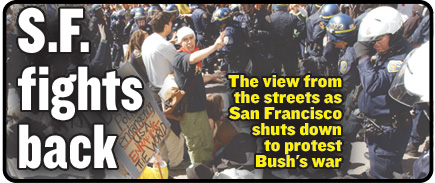
EDITORIAL Five years ago, the antiwar movement shut down San Francisco. It was a moment in history, one of those times that those of us who were there will never forget. No cars on Market Street. No cars on Mission Street. No business as usual anywhere downtown. Just a powerful statement that the city was not going to pretend that invading Iraq was an acceptable move.

And yet, for five years, the war has gone on. Sometime this spring, it’s likely the total number of American soldiers killed in the pointless military adventure will pass 4,000. And that’s just a fraction of the carnage: according to iraqbodycount.org, more than 89,000 civilians have died since the George W. Bush administration launched the invasion in March 2003.

There will be any number of newspaper stories, special reports and anniversary programs in the next few weeks, but of all the facts and statistics they’ll cite about the war, one ought to be at the top:

The antiwar movement was right.

Everything that the activists in the streets (and the very few newspapers that supported them, like this one) said at the time would prove to be absolutely true. As Steven T. Jones notes on page 14, there were no weapons of mass destruction. There was no link between Saddam Hussein and al-Qaeda. Iraq had nothing to do with Sept. 11. United States troops were not welcomed as liberators. There is no functioning Iraqi democracy. The situation in the Middle East is more unstable now than it was five years ago. Nothing has come of this war except disaster, death, and a bill to the American people that could reach $3 trillion.

In fact, Bush’s war is one of the main reasons that the economy is such a mess today — and that’s something the Democratic presidential candidates need to be talking about.

There has been nowhere near enough debate over the cost of the war. Bush has managed to fund the entire effort through supplemental appropriations, without once presenting a full budget to Congress. And the Democrats, fearing political criticism if they cut funding to troops who are in harm’s way, have gone along with every single spending request.

That’s been a huge factor in the nation’s mounting budget deficits and rapidly growing debt. And unlike deficit spending that funds social and infrastructure priorities, the red ink has done little to create jobs or improve the economy. It’s well known that military spending does less to help economic growth and recovery than any other type of government program. Put another way: If the $3 trillion that will go to the Iraq war were put into any other public venture, it would have tremendous positive consequences for society. It could, for example, preserve Social Security for another entire generation without new taxes or benefit cuts.

But those sorts of choices haven’t been presented to the public, because the war has been sold as a painless effort that requires no national sacrifice. And the bills won’t all come due until this president is gone and his successor has to deal with a deep recession, a horrible budget mess, growing unemployment, and a legacy of international distrust.

The good news is that the antiwar activism has forced both presidential candidates to pledge to bring the troops home — and Barack Obama could be the first president in years to be elected in large part on the basis of a strong grassroots peace movement. But the next president won’t stop the war without continued, constant pressure. It’s easy to think of the antiwar movement as a failure and to get discouraged — but this is not time to let down. If a Democrat wins the White House, visible and organized activism will be more important than ever. And this time, it might actually change American politics.

Resistance is futile — or is it?

0

It was a time without precedent in American history. The commander-in-chief voiced his intention to take the country to war — a voluntary, preemptive war with no clear catalyst, no faraway invasion or Pearl Harbor or sinking of the Maine and millions of people shouted their opposition. With plenty of time to avert war, the protesters warned the invasion would be a costly disaster.

They were right. And it didn’t matter.

The war in Iraq was a test of our democratic ideals. It was a test that this country failed, a failure that has been felt by the people of the United States, Iraq, and elsewhere for the last five years. For many, the refusal of the US government to heed the demands of its citizens left them disillusioned and disempowered.

But others say it sparked a political change that woke up an apathetic citizenry, pulled the Democratic Party back to the left, and may have averted war with Iran.

It’s certainly arguable that the presidential campaign of Barack Obama owes its energy and success in part to the antiwar movement — and if Obama wins, he will be the first president in a long time who took office thanks to the support of a strong grassroots progressive movement.

Nowhere was the clash of people power and government will more acute than on the streets of San Francisco, where a series of massive marches, some drawing nearly 100,000 people, filled the streets prior to the invasion of Iraq on March 19, 2003. The onset of war led protesters to effectively shut down the city, resulting in about 2,300 arrests and millions of dollars in costs to the city.

President George W. Bush dismissed the protests, of course, but he wasn’t the only one. Political leaders such as Rep. Nancy Pelosi, then-Mayor Willie Brown and soon-to-be Mayor Gavin Newsom (who didn’t attend any of the marches, unlike progressives on the Board of Supervisors) condemned the peace movement for hurting an innocent city. But with the “battle for San Francisco” making international news, the protesters were more concerned with the global audience.

A month earlier, on the weekend of Feb. 15 and 16, there were coordinated protests against the impending war in about 800 cities around the world, drawing around 10 million people. The peace march in Rome included about 3 million people, earning a listing in the Guinness Book of World Records as the largest anti-war rally in history. People have never made such a loud and clear statement against an incipient war.

Beyond the numbers, the antiwar movement was also right. On every major issue and prediction, the messages from the street proved correct while those from the White House were wrong. The US wasn’t welcomed as liberators. There were no weapons of mass destruction. Iraq after the invasion isn’t a stable democracy or shining beacon to anyone but the new generation of jihadis Bush created.

We can blame a hard-headed president, ineffectual opposition party, failure of the national media, or the national climate of fear following Sept. 11. But rather than refighting that lost battle, now is the time to gain perspective on the events of five years ago and determine what it means for democracy and the post-Bush national agenda.


TO THE STREETS

There were two main umbrella groups organizing protests before the war: Direct Action to Stop the War (DASW) and International ANSWER (Act Now to Stop War and End Racism). ANSWER has remained active and DASW has recently been reconstituted for the fifth anniversary of the war, using direct action in San Francisco as well as other urban centers and outposts like Chevron’s refinery in Richmond, which has reportedly been processing Iraqi oil.

“With the fifth anniversary coming up, we’re going back to direct action on the streets,” said Henry Norr of DASW. “But I don’t have any illusions that it’s going to be like it was five years ago.”

The maddening march to an ill-advised war created a political dynamic in which a broad cross-section of Americans was willing to hit the streets.

“We had a wonderfully diverse group of people, from soccer moms to anarchists,” said Mary Bull, who cofounded DASW, a collective of various affinity groups and concerned individuals formed in October of 2002 as Bush started beating the drums of war.

It was a group fiercely determined to prevent the war — and really believed that was possible. In fact, Bull recalls how she and other members of the group burst out crying at one meeting when a key activist said the war was going to happen.

Richard Becker, who cofounded ANSWER and serves as its West Coast coordinator, said that in the summer of 2002, “we came to the conclusion that [the war] was going to happen.” The group called its first big protest for Sept. 15, 2002, and another one two weeks later. But the movement really exploded on Oct. 26 when almost 100,000 people took to Market Street, much of it a spontaneous popular uprising.

“We were overwhelmed,” Becker said. “We were in a perpetual state of mobilization to keep up with what was going on. But then it didn’t stop the war.”

Did he think they could?

“I think a lot of people thought maybe it was possible to stop it. And we thought maybe it was possible to stop it,” Becker said.

The high point, according to Becker and Norr, was Feb. 17, 2003, when the New York Times ran a front page analysis piece entitled “A new power in the streets” that claimed “the huge anti-war demonstrations around the world this weekend are reminders that there may still be two superpowers on the planet: the United States and world public opinion.” But then Colin Powell went to the United Nations to argue for the invasion, and the Democrats in Congress did nothing, and it became clear war was coming.

Norr stayed out there protesting, being arrested several times and even shot in the leg by Oakland police with a rubber bullet during a protest at the Oakland docks. And he thinks some good came from the experience.

“The lesson for people is the political and economic elites are committed to preserving and extending empire. And they basically say as much in their own writing,” Norr said. “Wars are not anomalies.”

Despite being a frustrating and depressing exercise, most saw benefits to the failed movement. “People got an incredible education about how the system really worked,” Becker said. “Building a movement is mostly about a series of setbacks.”

Medea Benjamin, cofounder of both Global Exchange and CodePink and fixture of the anti-establishment peace movement for years, was upbeat about the protests. “We did our job as citizens. We did what we were supposed to do: organize, get people to take action, get people onto the streets,” she said. “We did everything we could think of.

“What you take from it is we don’t have a very well-developed democracy because the people spoke and the government didn’t listen.”

25war2_Lars1.jpg The ever-evolving “Democracy Wall” on Valencia Street, March 2003, helped stir up debate (Photo by Lars Howlett)


FACING ARREST

The collective action of five years ago starts with a series of personal stories — tens of thousands of them — so let me briefly begin with mine.

My arrival in San Francisco was closely tied to the march to war. I was living in Sacramento and working as the news editor of the Sacramento News & Review when Bush began his saber rattling against Saddam Hussein, but by the end of 2002 I had a falling out with my boss and found myself jobless.

Like most Northern Californians who opposed the war, I came to San Francisco on Jan. 18 to make my voice heard and experienced a bit of serendipity on my way to Justin Herman Plaza: while reading the Guardian on Muni, I saw their advertisement for a city editor, a job that was ideal for me at a paper I’ve always loved. Needless to say, it was a great day, empowering and full of possibilities.

Less than two months later I was on the job, and on the second week of that job I was back on the turbulent streets of San Francisco, part of a Guardian team covering the eruption of this city on the first full day of war. When I stepped off the cable car just after 7 a.m., people were streaming up Market Street and I joined them.

When a large group stopped at the intersection of Market and Beale, I stopped too, taking notes and bearing witness to this historic, exciting event. I had a press pass issued by the California Highway Patrol that allowed me to cross police lines, so when police in riot gear surrounded us and threatened arrest, I held my ground with 100 or so protesters.

After interviewing about a dozen people about why they were there and that they hoped to accomplish (see “On the bus: Journalists, lawyers, four-year-olds — the cops were ready to bust anyone Thursday morning“), I was arrested with the others and taken to a makeshift jail and processing center at Pier 27 (no charges were filed in my case, and charges against all of the 2,300 people arrested here in those first few days of the war were later dropped).

I recently tracked down a few of the people who appeared in my article, including Daphne and Ross Miller, who were at the center of the most interesting drama to play out during our standoff with the police. She’s a family practice physician, he’s an architect, and they live in Diamond Heights with their two children, Emet, who is almost 9, and Arlen, 12, who was away on vacation when the war began.

“We were genuinely shocked that the war started,” Ross told me. “We were at some of the earlier protests and really thought there was no way [Bush] could do it.”

They woke up March 20, 2003, to news that the war had begun and immediately walked to the BART station with Emet and rode to the Embarcadero station, not really planning for the day ahead but just knowing that they had to make themselves heard.

“We were pissed as hell. I don’t think I’ve ever been so angry in my life,” Daphne said.

They quickly came up with a plan. “We basically decided that if anyone was going to be arrested, it was going to be Ross and I’d stay with Emet. But it didn’t end up that way and I ended up in the arrest circle.”

Daphne had their house keys and threw them over the police line to Ross at one point. A photographer in the circle had gotten shots of a man named Roman Fliegel being roughed up by police as they pulled him off his bicycle, which was towing a trailer with a sound system, and decided to throw his backpack with camera gear out as well. When Ross — who had four-year-old Emet on his shoulders — caught it and refused police orders to give it to them, police grabbed Emet and roughly arrested Ross, leaving a gash on his forehead.

“Rage surged through the crowd, and it seemed as if things might get ugly, but the police kept a tight lid on the situation, using their clubs to shove back protesters who had moved forward,” I wrote at the time.

Emet was delivered into the circle with Daphne as the arrests continued, many quite rough. “At that point, as a mom, I had to exercise the most restraint ever,” said Daphne, who was angry about the situation but fearful about what she was exposing her son to. “Please, don’t let any violence happen here,” she pleaded with the crowd. Eventually, commanders on the scene let the mother and child go.

“The officer who let me go said that if he saw me again out there, he would call Child Protective Services on me,” Daphne said. But two days later, still brimming with outrage at her country’s actions, she ditched a downtown medical conference to rejoin the street protests, this time solo.

The couple say they’ve lost friendships over the war and have become more engaged with politics, coming to believe that Bush and the neocons are malevolent figures who knew how badly the war would go and did it anyway to establish a large, permanent military base in Iraq.

“Since that day, we’ve been far more active,” Ross said. “We realized you can’t just trust the system. You have to push.”

But that determination was mixed with feelings of disempowerment and depression. They attended some of the protests that following year, but the couple — like most people — just stopped going at some point because they seemed so futile.

“There was a horrible sense of resignation and a genuine depression that followed,” Ross told me.

The nadir was when Bush was reelected and they considered leaving the country. But then, Ross said, “we decided we’re not just going to run away and we’re not going to accept this.” Looking back, even with the scare over Emet, they express no regrets.

“It was the right thing to do because it was the wrong war to have. I’d do it again and again and again if I had to,” Ross said

They’re guardedly hopeful that Barack Obama could begin to turn things around if he’s elected. “I think the right president can at least start to dismantle this,” Daphne said. “I think thousands of people marching in the streets is something he would listen to.”

25war3_Charles1.jpg A die-in on the streets of San Francisco in March 2007 marked the fourth anniversary of the invasion (Photo by Charles Russo)


WITNESS TO HISTORY

Covering the peace movement in those early days was a heady experience, like reporting on a revolutionary uprising or working in a foreign country where the people are organized and active enough to be able to shut down society and brave enough to risk bodily injury for their beliefs.

I was at the founding meeting of CodePink — which became the most effective group at personally confronting the warmongers and keeping the war in the public eye — one evening at Muddy Waters in the Mission District shortly after the war started.

Looking back, Benjamin rattled off a long list of the alliances the group built — with labor, churches, businesses, and a wide array of social movements — and creative actions intended to build and demonstrate popular support for ending the war.

“We’ve done so many things and what did we get? We got a surge,” she said. “It shows the crisis in our democracy, the crisis of the two-party system, the crisis of a dysfunctional opposition party.”

Yet she said the peace movement has been remarkably successful in convincing the public that the war was a mistake and that it’s time for the troops to come home, even if the Democrats have been slow to respond to that shift.

“The progress we’ve made is turning around public opinion and that’s going to play a big role in the upcoming elections,” she said. For Norr, the role of the news media is a particular sore spot. He was a technology reporter for the San Francisco Chronicle who called in sick on the first full day of war and was arrested on Market Street with his wife and daughter, resulting in suspension by editor Phil Bronstein for his actions.

I wrote several stories on the issue, which culminated in Norr being fired and Bronstein unilaterally banning Chron employees from peace protests. I even borrowed CodePink’s guerilla tactics when Bronstein repeatedly refused to return my calls or address why he had singled out antiwar protesters for uniquely punitive treatment. I confronted him during a speech he gave at the Commonwealth Club (see “Lies and half-truths,” 5/7/03). That was the tenor of the times: we were all tired of being lied to and we decided to push back.

Norr was particularly frustrated with his own paper’s reporting of the war and started sending articles by the foreign press to his paper’s news desk, trying to wake his colleagues up to the pro-war propaganda being passed off as journalism in this country.

He was also disappointed with the country and with the Chronicle — both the management and his fellow reporters, who did little to support him — but the experience caused him to return to his roots as a progressive activist.

“The war and losing the job and everything brought an abrupt end to my consumerist phase and dumped me back into the world of being an activist,” said Norr, who serves on the KPFA 94.1 FM local station board and has made three recent trips to the Palestinian territories while working with the International Solidarity Movement.

Benjamin said Americans shouldn’t expect the next president to end the war — not without lots of pressure from a renewed and vocal peace movement. “This is the time to set the stage for the post-Bush agenda,” Benjamin said. “Don’t put your hopes in Barack Obama in getting us out of Iraq. Put your hopes in the people.”

25war4_Lane1.jpg A rally and nonviolent direct action at the Richmond refinery targeted Chevron on March 15 (Photo by Lane Hartwell)


THE AFTERMATH

The San Francisco Police Department, which spent more than $2 million on overtime costs responding to peace protests between March 15 and April 16, 2003, generally behaved with restraint and professionalism, but there were several exceptions.

The most costly and disturbing incident came when Officer Anthony Nelson began aggressively swinging his long riot baton at protesters, badly shattering the arm of peaceful protester Linda K. Vaccarezza, who suffered a permanent disability in her career as a court reporter.

Nelson’s incident report falsely stated that Vaccarezza had threatened him with a sign attached to a solid pole, but video of the incident later clearly showed there was no pole and that she was retreating when he teed off on her (see “The home front,” 05/19/04).

Vaccarezza received an $835,000 settlement from the city in November of 2004. On Oct. 5, 2005, two and a half years after the incident, SFPD fired Nelson for lying about what happened that day, and the City Attorney’s Office has been successfully fighting Nelson’s appeals in court ever since, putting in more than $100,000 in attorney time and costs into the Nelson and Vaccarezza cases.

The other significant ongoing litigation from the antiwar protests involved Mary Bull, who was arrested during an early protest for pouring fake blood in front of the entrance to Chevron’s San Francisco office before being allegedly strip searched and left naked in her San Francisco Jail cell for 36 hours.

Ironically, Bull was among those who brought a successful class action lawsuit against Sacramento County after she and others protesting a logging plan were strip searched, setting a precedent and led most counties to reform their strip-search policies. She used her share of the $15 million judgment to buy an organic permaculture farm in Sebastopol.

Her San Francisco case, in which Bull won a multimillion-dollar judgment, is still under appeal and now in mediation. Bull said the protests five years ago did make a difference, something she tells those who fret about its apparent failure. “I tell them to look at what issues the candidates are talking about now and I thank them for protesting then.”

“Even though we had millions throughout the world, we were sort of blocked, but now we’re regaining that momentum,” Melodie Barclay, a massage therapist who was also arrested with me on the first day of the war, told me recently. “We can’t judge it by the fact that we didn’t get the momentum we wanted.”

Norr started his antiwar activism working with Students for a Democratic Society in Boston, protesting the Vietnam War, which he said shares many similarities with the current situation, for good or for ill. He said that people tend to forget that while the protests then were huge and helped end the war, the movement did wane after Nixon ended the draft and substituted massive aerial bombardment for boots on the ground.

“The protests dropped off considerably,” he said. “A lot of the things that drove people to take risks in the late ’60s had faded by the early ’70s.”

He thinks the current administration learned a lesson from those days: it’s easier to maintain a war effort if the average citizen isn’t affected.

But there are other factors as well keeping a lid on the antiwar outrage.

“The culture has changed too. Young people are oversaddled with debt. People in schools seem to be docile. The culture as a whole seems to be more individualist and consumerist,” Norr said.

Yet some young people have woken up and many of them are funneling their energies into a peace group that was formed in the summer of 2005: World Can’t Wait, as in: the world can’t wait for the end of Bush’s second term before we change our direction and leadership.

“We don’t just want them gone, we need to repudiate their program,” said Giovanni Jackson, a 26-year-old WCW student organizer. “If we’re going to change anything, we need the youth.”

Jackson was at WCW’s founding convention in New York City, which came just as New Orleans was being flooded and then essentially abandoned by the federal government.

“When [Kerry] lost, people felt demoralized and World Can’t Wait kind of stepped into that situation,” Jackson said. “There was a lot of demoralization in the antiwar movement at that time.”

The group organized protests and student walkouts on Nov. 2, 2005.

“Everyone has their moments of doubt,” he said, “but I’m motivated by the crimes we see everyday.”


THE LESSONS

One of the biggest barriers to galvanizing people and turning the fifth anniversary of the war into something that might make a difference is the presidential election, which is diverting the energy of many potential protesters — and at the same time, offering some hope that a new president may lead to peace.

After all, every single one of the Democratic presidential candidates has promised to withdraw troops from Iraq, with varying timelines and numbers of US personnel left behind. And with enough encouragement, they might be willing to help change the status quo.

Many of the activists who volunteered their time and money to help move the Obama campaign into its front-runner position came out of the antiwar movement, and Obama’s strong stand against the war has been a key factor in his popularity.

Becker and some other activists don’t have much faith that a change in presidents will change the course in Iraq, although he agrees that much of the energy now surrounding Barack Obama derives directly from the antiwar movement.

“There’s been a huge upsurge of hope for Obama and that he might bring about the kind of change we need,” Bull said, adding that she doesn’t share that hope, believing the only path to peace is to pressure Obama and other leaders to commit to more progressive positions.

Norr said, “On one level, people have illusions about the power of peaceful protests. People believe in democracy, as well they should. We feel like the rulers should be paying attention to public opinion.

“It’s a remarkable story how broadly and quickly the American people have turned against the war. Public opinion was certainly ahead of the Democrats.”

And people will only grow more disenchanted with Iraq and its multitude of costs. “The people here are paying for this war, and everyday we have new stories about health clinics being shut down,” Becker said.

Becker was amazed last March as massive demonstrations for immigrant rights seemed to explode out of nowhere. “We think there will be more things like that,” he said.

Because after five years of organizing communities to resist the military-industrial complex’s plans, Becker thinks there’s been some visible progress.

“There isn’t a town or hamlet in the US that doesn’t have activism going on, but you wouldn’t know it from the corporate media,” Becker said. “It’s a mistake for people to feel discouraged.”


Ammiano gets no respect

0

Supervisor Tom Ammiano has been all over the news recently and has a couple of major accomplishments, including a restaurant-nutrition requirement and legislation that sets standards for care in homeless shelters.

And yet he’s still getting a beating from the Chronicle, which seems to think that something as basic as asking chain restaurants like McDonalds to tell you how unhealthy their food is could somehow harm the city’s business climate.

The restaurant disclosure bill got a lot of press, but the homeless shelter standards was more of a political challenge – Ammiano had to get the mayor, who has been reluctant to admit that any part of his homeless program is a failure, to sign on to the program.

The conditions in the shelters are, and for a long time have been, deplorable. So this may actually make the lives of a lot of human beings a lot better.

And of course, Newsom made a bit point the other day of talking about how he was going to use the city’s rainy day fund to bail out the city’s schools – without ever mentioning the Ammiano was the one who wrote that bill (without any help from then-Sup. Gavin Newsom.)

Ammiano’s going to leave the Board of Supes next year with one of the longest and most distinguished legislative records in memory. He deserves a little more respect.

SXSW: Touch down! Plans, schplans…

0

cas sml.jpg
Won’t you listen to Cassettes Won’t Listen.

“Punk rock – we don’t have that category in this country.” Oh, the quotables already emanating from Austin, Texas – albeit from a boomer-rock-oriented radio commentator interviewing aging Aussie punk vets.

SXSW, here we go again. The plane was packed on the way from Denver to Austin. Baggage claim was filled with checked guitars and black-garbed hollow-eyed scenesters. Todd P already had a Juicebox show going at 2 a.m. at his party central, Ms. Bea’s. And rumors are already swirling – has Dolly Parton cancelled? Is it possible to squirm into the already-closed-guestlist Playboy afterhours party Thursday night? Where is Perez Hilton having his ssseeecccret soiree (with Robyn no doubt working her rework of Snoop Dogg’s “Sex Eruption”)? Rachel Ray is having a party – huh?! You can spend more time planning your sked than actually seeing music, but the one-man band sounds of Cassettes Won’t Listen drew me into the Austin Convention Center’s dark, semi-depressing, school-caf-like Daystage.

Most disturbing news: so many longtimers aren’t making it this year due to industry cutbacks. Most disturbing stuff in the fest bag o’ fliers: an Armed Forces Entertainment card with a little green toy soldier attached (“Plug in your weapon, turn up the power and fire away. Your limo is a Humvee and your ride is a Blackhawk”). War is so cute – and glamorous! And a card announcing a casting call for Blue Man (I guess the blue face paint fits any ole one – except maybe women?).

What’s up tonight? Free Yr Radio is throwing a bash with Simian Mobile Disco, Yeasayer (all the buzz here, natch), and Times New Viking (Ohio-ans do it so good) at La Zona Rosa, a black rock showcase with Lightspeed Champion courtesy of Vice, a Kills show at the Fader Fort, an Emusic showcase, White Williams at the Gorilla vs Bear party. Also drool-worthy is the Terrorbird/Forcefield PR party with Yacht, Raveonettes, Why?, These New Puritans, the Blow, Radar Bros., Bowerbirds, and the return of the Mae Shi. Kimya Dawson will likely be at the Keep Austin Good event at San Hotel’s parking lot, and Dan Deacon and Deer Tick are making some very late-night noise – shhhh! – at one o’ UT Austin’s quads at, oh, 2 a.m. And most of those events aren’t even official.

Beautiful losers

0

Great movies stay with you in the oddest ways. In the days after I first saw Gus Van Sant’s Paranoid Park, I was preternaturally attuned to the sound of skateboards dragging the street outside my bedroom window—the slow tug of concrete, the bumping waves of wheels. This ambient strain surrounds Paranoid Park‘s cherubic point of focus: Alex (Gabe Nevins), a sleepy-eyed skater waiting out his parents’ divorce in a Portland, Ore., suburb. He occupies most of the film’s exquisitely composed frames, though he’s more a figure etched in light than a proper protagonist.

Figure-eight narrations and slow-moving Steadicam tracks have underpinned Van Sant’s last couple of films (2003’s Elephant, 2005’s Last Days), though they’re more artfully embedded in Paranoid Park‘s fragrant sprawl, not least because of the visual equivalencies provided by the film’s skateboarding footage. Blake Nelson’s airless young-adult novel presents Alex’s story as an extended confessional letter. Van Sant dissembles chronology and inflects the narration with associative freedom.

Most immediately, Van Sant folds Nelson’s plot to delay the central trauma, which first enters our vision peripherally through a detective’s investigation and a local news report. With that said, narrowing the effect of this organizing principle is a little like trying to get a fix on Phil Spector’s reverb or Gerhard Richter’s gray — Van Sant’s placid puzzling is a textural aesthetic before it’s a device. Where Nelson’s moral tale is a streamlined account, Van Sant’s adaptation aims for something more transparent and sublime. His Alex is at once layered and laid bare.

This channeling begins with a slow-creeping tracking shot as Alex is interviewed by a detective. What begins as a conversation eventually lands as a full-frame portrait of the adolescent, the detective’s words ("What’s your parental situation?") left hanging in the air, irrelevant. As Nevins garbles his lines, the boundary between the nonprofessional actor and his character becomes palpably blurred. Does Van Sant’s MySpace casting call automatically qualify as tawdriness? Not when Paranoid Park maintains its enigmatic distance. Indeed, Van Sant renders the film’s MacBook surfaces — the subdued luminescence, boxy 4:3 aspect ratio, and soundtrack shuffle from Elliot Smith to the Juliet of the Spirits score all evoke a MacBook — as something unique and refined.

Like so many high school boys, Alex is essentially passive (see the film’s hilarious sex scene, with talky girlfriend Jennifer’s blond wisps dissolving Alex’s face like something from Maya Deren’s 1943 Meshes of the Afternoon). Van Sant captures this state via formal permeability, rigorously designing Paranoid Park‘s memory machine as a head trip. Strips of slow motion, a narrow-depth-of-field, ping-ponging sound, a mumbled voice-over — all these elements serve to cover the largely amateur cast but also to project Alex’s environmental interiority. This tendency reaches a swollen apex during a posttraumatic shower. The camera again draws in, and Christopher Doyle’s typically luscious lensing isolates every droplet; the lighting darkens, and the blistering sheets of water-noise are overlaid with thick forest sounds as Alex drops his head, revealing the bathroom wallpaper’s bird motif.

There’s no buried logic to Paranoid Park, and even though it’s shaped as much like a jigsaw as Donnie Darko (2001) and Rian Johnson’s underappreciated Brick (2005), it doesn’t invite solutions. Whether or not Alex’s withholding aura is read as a symbolic closeting, Van Sant’s direction is some kind of sorcery, especially in those B-roll streams of easy riders through which the film’s story expands to encompass all breathless teenage riots. Paranoid Park ends with these images after cutting from Alex asleep in biology class, dreaming of flying. He never touches the ground, always hovering between idyll and responsibility, the dream and his place in it. (Max Goldberg)

PARANOID PARK

Opens March 21 at Bay Area theaters
www.myspace.com/gusvansant

The users are revolting

0

› annalee@techsploitation.com

TECHSPLOITATION One of the social traditions that’s carried over quite nicely from communities in the real world to communities online is revolution. You’ve got many kinds of revolt taking place online in places where people gather, from tiny forums devoted to sewing, to massive Web sites like Digg.com devoted to sharing news stories.

And while they may be virtual, the protests that break out in these digital communities have much in common with the ones that raise a ruckus in front of government buildings: they range from the deadly serious to the theatrically symbolic.

How can a bunch of people doing something on a Web site really be as disruptive or revolutionary as those carrying signs, yelling, and storming the gates of power in the real world? By way of an answer, let’s consider three kinds of social protest that have taken place in the vast Digg community.

According to Internet analysis firm ComScore, Digg has 6 million visitors per month who come to read news stories rounded up from all over the Web. About half of those visitors log in as users to vote on which stories are the most important: the one with the most votes are deemed "popular," and make it to Digg’s front page to be seen by millions. A smaller number of people on Digg — about 10 percent — choose to become submitters of stories, searching the Web for interesting things and posting them to be voted on — in categories that range from politics to health. Digg’s developers use a secret-sauce algorithm to determine at what point a story has received enough votes to make it popular and worthy of front-page placement.

You can imagine that a community like this one, devoted to the idea of democratically generated news and controlled by a secret algorithm, might be prone to controversy. And it is.

Two years ago, I was involved in what I would consider one type of user revolt on Digg. It was a prank that I pulled off with the help of an anonymous group called User/Submitter. The group’s goal was to reveal how easy Digg makes it for corrupt people to buy votes and get free publicity on Digg’s front page. My goal was to see if U/S really could get something on the front page by bribing Digg users with my cash. So I created a really dumb blog, paid a couple hundred dollars to U/S, and discovered that you could indeed buy your way to the front page. Think of it as an anarchist prank designed to show flaws in the so-called democracy of the system.

But there have also been massive grassroots protests on Digg, one of which I wrote about in a column more than a year ago. Thousands of Digg users posted a secret code, called the Advanced Access Content System key, that could be used as part of a scheme to unlock the encryption on high definition DVDs. The goal was to protest the fact that HD DVDs could only be played in "authorized" players chosen by Hollywood studios. So it forced people interested in HD to replace their DVD players with new devices. It was a consumer protest, essentially, and a very popular one. Hollywood companies sent Digg cease-and-desists requesting that they take down the AACS key whenever it was posted, but too many users had posted it. There was no way to stop the grassroots protest. Digg’s founders gave up, told the community to post the AACS key to their hearts’ content, and swore they would fight the studios to the end if they got sued (no suit ever materialized).

Another kind of protest that’s occurred on Digg came just last month, and it was a small-scale rebellion among the people who submit stories and are therefore Digg’s de facto editors. After Digg developers changed the site’s algorithm so that it was harder to make stories popular, a group of Digg submitters sent a letter to Digg’s founders saying they would stop using the site if the algorithm wasn’t fixed. You could compare this protest to publishing an editorial in a newspaper — it reflected grassroots sentiment but was written by a small minority of high-profile individuals. Though the company didn’t change its algorithm, this protest did result in the creation of town hall meetings where users could ask questions of Digg developers and air their grievances.

Each of these kinds of protests has its correlates in the real world: the symbolic prank, the grassroots protest, and the angry editorial. So forgive me if I laugh at people who say the Internet doesn’t foster community. Not only is there a community there, but it’s full of revolutionaries who fight for freedom of expression.

Annalee Newitz (annalee@techsploitation.com) is a surly media nerd who wants a revolution.

What the verdict meant

0

>>Read more at www.sfbg.com/lawsuit

› tredmond@sfbg.com

The press coverage was impressive: The San Francisco Chronicle put the story on page one. KTVU-TV made it the third item on its 10 O’Clock News. Editor and Publisher, the newspaper trade journal, picked it up, as did Forbes magazine. The San Francisco Daily used a front-page bold banner headline: "Jury punishes chain."

And indeed, as anyone who follows the local news media is aware by now, a San Francisco jury March 5th ruled that the SF Weekly and its corporate parent, Village Voice Media, illegally sold ads below cost in an effort to harm the Guardian. The jurors awarded $6.3 million in damages, and since the law allows as least part of that award to be trebled, the Weekly and VVM could be liable for as much as $15.6 million.

VVM already announced it will appeal, which means it’s unlikely the Guardian will see any cash award for several years as the case works its way through the legal system. But in the meantime, we will be asking Judge Marla Miller to issue an injunction barring any further below-cost sales.

Under state law, interest on the judgment will accrue at 10 percent a year. That means the Weekly and VVM will be paying $4,000 a day in interest for as long as they seek to dispute and appeal the jury decision.

The verdict alone sends a powerful message that goes beyond the newspaper industry. California’s Unfair Practices Act, a Progressive-era measure, forbids a big chain with deep pockets from coming into town and using predatory pricing to run a locally-owned, independent operation out of business. A San Francisco jury has confirmed that the law can be a powerful weapon against the consolidation of news media — and the chain-store assault on local merchants.

Not surprisingly, VVM’s principals have said they are going to try to invalidate the law in the courts. In a written statement posted to the SF Weekly Web site, the chain says it doesn’t think the law ought to apply to competitive markets.

Of course, the entire point of our lawsuit was that the Weekly and VVM wanted to end competition — that the chain was trying to harm its only direct competitor in the San Francisco marketplace. And that’s precisely what the law was written to prevent.

As James R. McCall, a law professor at Hastings, wrote in a 1997 article for the Pacific Law Journal, "the commercial practice of knowingly selling below cost with the intent to injure competitors or injury competition has long been considered unlawful by American courts and state legislatures."

The trial produced reams of evidence and extensive testimony on the business practices of both papers, and provided some remarkable insights into how the nation’s largest alternative newspaper chain operates. Some highlights:

VVM, which has built highly profitable papers in many national markets, fared very differently here. The chain bought two papers that were profitable concerns — the SF Weekly in 1995 and the East Bay Express in 2001 — and turned them both into huge money losers. Over the past 12 years, the company lost some $25 million in the Bay Area, and has pumped $13 million from corporate headquarters into propping up the Weekly.

Financial data presented in court showed that in markets where the chain faces no direct competition from a strong alternative paper, VVM is practically printing money. Profits in Denver and Phoenix were sky-high, sending some $40 million back to corporate headquarters over about 10 years. But in places where a strong competitor challenged the VVM paper — San Francisco and Cleveland being the two most notable examples — the chain was losing money or its profits were much thinner.

The folks in Phoenix were obsessed with going after the Guardian. The record is littered with e-mails between VVM headquarters and the SF office discussing ways to get ads out of the locally owned paper. The Weekly publishers had to send a regular "Guardian report" back to Phoenix to show how the two papers stacked up. Weekly publishers admitted that they might have offered special bonuses to sales reps who took ads away from the Guardian.

In fact, three witnesses testified that on the day he bought the Weekly in 1995, Mike Lacey, one of the chain’s two principals, threw a copy of the Guardian on the floor and vowed to put us out of business.

The jurors found that sort of behavior strong evidence of predatory intent. One panel member, Kerstin Sjoquist, a local business owner and graduate student, said in an interview that "it felt overly predatory on the part of the Weekly" and that "the predatory intent trickled down from the top."

You could see that same intent by the way the Weekly covered the trial. None of the local reporters at the paper were in the courtroom; instead, the chain brought in one of its top editorial executives, Andy Van De Voorde, from Denver to write about the case every day. And the blog posts he authored were about as personally vicious as anything I’ve seen in a long, long time.

Van De Voorde portrayed this entirely as an attempt by Guardian publisher Bruce Brugmann to shake down the Weekly and VVM for money. (And he never reported on the fact that the evidence clearly showed Bruce and his wife, Jean Dibble, had never taken big profits out of the paper and had instead reinvested money to improve the Guardian.) From the start, Van De Voorde called the suit silly and stupid and tried to make the case that the Guardian had no evidence at all to prove predatory pricing.

As the case wore on, he started to change his tune: by the last few days, he was tacitly acknowledging that there was a chance the Weekly would lose, and he started attacking the law itself. In the end, he told me he "wasn’t surprised" by the verdict — although for weeks his blog posts had taken the position that the Guardian couldn’t possibly win.

The Weekly‘s lawyers essentially argued that their own client was unable to handle pressure from the Internet and unable to adapt to a changing marketplace. Expert after expert on the VVM payroll testified that both the Guardian and the Weekly had seen revenues drop because of outside market forces in San Francisco that apparently were completely beyond the coping ability of a national chain that was making money hand over fist in the rest of the country. In his closing arguments, H. Sinclair Kerr, the Weekly‘s lead attorney, insisted that the market for alternative newsweekly advertising had shrunk and that both papers were, in essence, failing.

That contrasted dramatically with testimony from the only expert witness for either side who had actually run a weekly newspaper. Bill Johnson, publisher of the Palo Alto Weekly, testified that the Internet was not destroying alternative papers and that it was entirely possible to make money in the Bay Area, even during a tough economy. He pointed out that, unlike daily newspapers that rely increasingly on wire-service stories, alt-weeklies offer unique content that can’t be found anywhere else. And the people who are looking for those stories make up a lucrative market for advertisers.

His conclusion, after attending much of the trial and viewing much of the economic evidence: the reason the Guardian was losing revenue was that the Weekly had systematically depressed the price of display ads in the alternative weekly marketplace. And the chain paper was able to do that because of its deep pockets.

Numerous witnesses agreed that the Weekly could have raised its rates and made a profit. But that would have made it possible for the Guardian to compete for those clients — and VVM wanted the market to itself.

In the end, the jury got the message: the Guardian has been hurting badly all these years not because of any external factor but because a rich competitor was selling below cost.
That, Johnson testified, was exactly how predatory chains operate. "It happens," he said, "all the time."

The Guardian was (well) represented by Ralph Alldredge, Rich Hill and E. Craig Moody

Freedom of Information: Virtual meeting

0

› news@sfbg.com

Forget smoke-filled rooms and paper shredders — today’s government officials can elude public scrutiny from the comfort of their own e-mail accounts, conducting virtual meetings to do the public’s business.

To curb such activity, provisions in both the Brown Act (the state law governing open meetings) and the San Francisco Sunshine Ordinance have been interpreted as prohibiting the use of electronic communication between members of policy bodies. But not everyone has been heeding the rules, particularly in this hyperconnected age.

The TechConnect Task Force, a now disbanded advisory body charged by Mayor Gavin Newsom with creating a plan to bridge the city’s digital divide with free wireless Internet service, frequently used an e-mail listserv to conduct its business.

"Since these things were publicly posted right away, I should think there would be a transparency that advocates would like," said Emy Tseng, a member of the task force. "It was useful in the way e-mails and listservs are useful to anyone."

However, many contend the task force was engaging in activities prohibited under the city’s Sunshine Ordinance, even if the intent was to provide greater public access to the group’s work. Tseng, who claims to have never been informed by the City Attorney’s Office that the group might have been in violation of Sunshine laws, expressed the frustrations of many throughout the city who must comply with open-meeting policies.

"If you don’t use e-mail in this day and age, what can you do?" she asked. The answer, according to state and local laws, is to conduct public business in a public meeting, with the agenda posted in advance and where anyone can attend.

State and city public-disclosure laws apply to all "policy bodies," which can include nearly every government-sanctioned board, commission, or task force. Some members of these bodies have been suspected of vioutf8g open-meeting and public-disclosure laws through the use of online communication.

Seriatim meetings are presumably the most common illegal activity occurring under both open-information laws, although they are the hardest to detect. A seriatim meeting occurs when one member of a policy body privately contacts another, who then contacts another, in a chain of communication that eventually constitutes a quorum of the group.

An e-mail that is forwarded along to enough individuals, or a round of mass e-mails, would constitute a seriatim meeting, according to attorneys who spoke with the Guardian. While e-mail forwarding is a common practice for any office worker, some are just an unassuming click away from breaking the law.

"I would absolutely make it clear that anybody subject to the Brown Act or Sunshine [should] not communicate through e-mail," said Thomas Burke, a San Francisco-based attorney who specializes in media and Internet law and has represented the Guardian. "This could go on for years because people are not in the loop."

The Brown Act, passed in 1953 by the California Legislature, expressly bans a legislative body from using "technological devices" in order to communicate about topics relevant to the work of that body.

"The Brown Act itself forbids the majority of ‘technological devices’ — which is essentially anything you could imagine," said Terry Francke, director of Californians Aware, who also drafted amendments to the act in the early ’90s. Under the Brown Act, a committee member can be slapped with a misdemeanor for the intent to withhold information from the public or conduct prohibited meetings.

Many of the same issues are also addressed in the San Francisco Sunshine Ordinance, filling in more restrictions and open information requirements. Ironically, the TechConnect Task Force was charged with creating universal access to online discussions like theirs, although few legal experts think even that would nullify the requirement for open, public meetings in a physical – rather than virtual – setting.

According to a report released by the San Francisco TechConnect Task Force, 32 percent of Americans do not have access to the Internet. In San Francisco, certain populations are even worse off compared to national averages — for instance, women and the elderly.

"You have to consider if people are going to have equal access to meetings," Burke told the Guardian. "There is still a digital divide. As a public entity they have to be sensitive to this."

Recently, members of the city’s Peak Oil Task Force inquired with the City Attorney’s office about using Yahoo! Groups or a blog to increase efficiency on the all volunteer committee. Attorneys advised the group to stay away from Internet communication, as it can easily lead to prohibited seriatim meetings. Jeanne Rosenmeier, who is the chairperson of the task force, now spends more committee time trying to determine alternative ways to engage the public.

"It is certainly something that should be rewritten, to deal with modern technology so it corresponds with today’s reality," Rosenmeier told the Guardian. "If we have a public e-mail listserv that anyone can sign on to, that seems transparent; or if we have a blog, that’s pretty transparent."

In other cities that do not have sunshine ordinances, teleconferencing may be used legally under the Brown Act to conduct meetings. In Los Angeles, for instance, some boards and commissions teleconference when members would need to drive a few hours just to meet. There is some speculation that the language of the Brown Act could be augmented under this provision to allow for online communication, but there are no major groups pursuing the amendment.

In 2001, former California Attorney General Bill Lockyer wrote an opinion declaring the use of e-mail between policy-body members as an infraction of the Brown Act, even if the e-mails were made publicly available. "Members of the public who do not have Internet access would be unable to monitor the deliberations as they occur," the opinion states. "All debate concerning an agenda item could well be over before members of the public could [participate]."

According to the Sunshine Ordinance Task Force, there have been no complaints filed concerning prohibited online meetings, however there have been public information disclosures of private e-mail messages over the years. Recently, a group of deputy city attorneys were required to turn over an e-mail correspondence when a member of the public filed a complaint.

While Peter Scheer, director of the California First Amendment Coalition, understands the frustration of government officials who must abide by the cumbersome laws, he thinks the tradeoff is well worth it.

"The whole rest of society uses the power of e-mail and the only business that can’t use it is government, because they’re subject to the Brown Act," Scheer told the Guardian. "But we made the tradeoff already in efficiency versus accountability, to force all meetings and information to be open to the press and public."

>

Freedom of Information: The leaks go on

0

news@sfbg.com

In what may be the last act of a quickly unfolding drama, Swiss banking giant Julius Baer has dropped its lawsuit against Wikileaks, an anonymous whistle-blower Web site, and Dynadot LLC, the site’s registrar. Baer’s attorneys had sought to shut down Wikileaks through a permanent injunction for hosting potentially damaging material about the bank’s activities in the Grand Cayman Islands.

The bank’s decision last week follows its legal defeat Feb. 29 in which San Francisco federal court judge Jeffrey S. White withdrew his ruling to halt the US version of the Web site Wikileaks.org — and to also stop information from the site from being transferred to another server.

White weighed arguments from both sides and said his withdrawal of the order against Wikileaks still raises serious issues about the extent of jurisdiction any US court has over the Internet. He essentially agreed that prior restraint of the site was unconstitutional, and that it could create a "chilling effect" on future free speech cases. He bowed to arguments from defense attorneys and said his prior order raises questions regarding "possible infringement of protections afforded to the public by the First Amendment."

The anonymous forces of Wikileaks seemed to have braced for the legal blow. Within hours of the Feb. 15 takedown order by White, those in the know could access the site by entering the IP address, which is run on a server in Sweden and on other servers around the world.

While no official Wikileaks defendant ever materialized because its operators remain a secret, the preliminary injunction order set off a firestorm of criticism from free speech advocates. One after another, lawyers from the ACLU’s San Francisco chapter, Public Citizen in Washington D.C., and nearly a dozen civil rights organizations rushed to intervene and defend the site.

Shutting down the site is akin to "locking the doors of The New York Times," said Julie Turner, an attorney who represented Wikileaks in prelitigation matters.

"I think this was a textbook example of what not to do," said media law attorney Thomas Burke of the bank’s efforts to seek a prior restraint. "This just completely backfired and garnered international attention."

The documents posted on Wikileaks have been used as the basis for major news stories on subjects such as the treatment of inmates at Guantanamo Bay, the US military’s rules of engagement in Iraq, and corruption by Kenya’s former president. And instead of concealing documents, the case has drawn a maelstrom of attention to the bank’s alleged dealings, and it raises big questions about freedom of speech on the Internet.

In their filing, Julius Baer attorneys said they still reserve the right to consider filing suit in the same court or elsewhere and are considering the company’s legal options. The bank’s spokesperson, Jenna Agins, declined a Guardian request for comments.

Founded in 2006 by Chinese dissidents, journalists, and tech gurus, Wikileaks hosts 1.2 million leaked documents that aim to expose government and corporate wrongdoing. Anonymous site creators say they’re developing an uncensorable system for "untraceable mass document leaking and analysis" and are ready to fight any legal attack.

Wikileaks may have evaded its censors this time, but the latest case portends the vulnerability of such sites and those involved in them. Julius Baer’s attorneys admitted to the judge they had a hard time tracking down a Wikileaks representative. So they went after Daniel Matthews, a Stanford grad student. According to the bank’s court filing, the bank’s attorneys found his name on a Facebook page listing him as an "officer" of Wikileaks and summoned him to court. Joshua Koltun, his pro bono attorney, rushed to file a brief to defend Matthews.

"It was an extremely aggressive move because they were basically grabbing at straws," said Koltun, who appeared without his client in court. "They said he would face liability for a very tenuous connection or be confronted with disobeying the court order."

The bank’s attorneys claimed that Wikileaks had disclosed confidential or forged information about its clients and said there was nothing newsworthy about it. In this way, they are attempting to pit freedom of speech against personal privacy rights.

"Wikileaks has actively solicited the theft of private information," said William Briggs, one of the lawyers for the bank. "They are no longer shielded by the First Amendment."

But freedom of speech laws trump privacy rights in this case, argues Matt Zimmerman, senior staff attorney for the Electronic Frontier Foundation, which filed an amicus brief opposing the judge’s injunction against Wikileaks. "The information was already out there and the bank wanted to force everyone who had a copy of it to pull it down."

Perhaps the more salient point going forward, Zimmerman says, is that consumers are more wary of what Internet provider or domain registrar they choose and to make sure those companies protect free speech rights.

In their suit, Julius Baer’s attorneys sued Wikileak’s domain registrar, Dynadot LLC in San Mateo, for hosting the site. The small start-up agreed in a Feb.14 court stipulation to all of the bank’s demands to disable the site and prevent its transfer to another server, in exchange for getting the case against them dismissed.

"This is part of the reason why Congress has passed laws to get the intermediary out of the way," Baer said. "Dynadot was never liable for the information its user posted. It’s unfortunate that they apparently didn’t know the law well enough and decided to fold."

Dynadot lawyer Garret Murai denied that his client had agreed to all of the bank’s terms. "The court’s order to remove the domain name settings is not something we wanted to do," he said. "We did not agree to that."

David Ardia, an Internet law expert at Harvard, says even in the US, which has long established First Amendment protections, the threat of lawsuits against Web sites such as Wikileaks still lingers.

The power of an individual judge to bring down a Web site still remains, he says, but not if sites can function on international servers outside US jurisdiction.

Most online bulletins or blog posts allow people to post comments and remain anonymous, but not to the point where governments can’t find out who they are. What makes Wikileaks formidable, some say, is its software’s ability to cover the tracks of its users.

Peter Scheer, executive director of the California First Amendment Coalition, says time will tell whether the Wikileaks site can prove its mission to covertly leak information and should never have been silenced in the first place.

"As we as a society become increasingly dependent on the Internet as a source of information, the vulnerability of the Web site to that kind of action is something to fear," he said. "So when it happens, it’s important to draw maximum attention to it, to go into court with all guns blazing."

From the stand, White conceded the problem with pursuing a case against an anonymous entity such as Wikileaks, which has no official representation and whose chief players remain invisible.

Then he questioned the effectiveness of trying to control leaked documents, even if those responsible had somehow violated personal privacy rights: "When this genie gets out of the bottle, it’s out in the world."

>

Freedom of Information: More sunshine — easily and at no cost

0

› news@sfbg.com

Imagine sitting at home — or in your office, or in your favorite café — and listening in on what are now secret, backroom policy discussions and decisions in the San Francisco mayor’s office. Imagine having access to an immediate transcript of the talks. Imagine being able to read internal e-mail discussions among city staffers about issues that affect you — without ever filing a public records request. In fact, imagine never having to file another written request for public documents; imagine just going to a city Web site, entering a search term, and finding all of the records yourself.

Imagine filing a complaint with a city agency and tracking the issue, minute by minute, as it works its way through the system.

Imagine listening on your cell phone to any policy body as it meets in city hall.

All of this is possible, today. Much of it is not only consistent with but actually required by local law. And it won’t cost the city more than a modest amount of money.

Transparency is a common buzzword during this presidential campaign; the Barack Obama campaign has even issued a white paper describing policy and technological ways to embrace it. He’s talking about live Internet feeds of meetings about significant issues involving executive branch appointees as well as for those of regulatory departments (a program that would go far beyond what you see on C-SPAN).

So there’s no reason San Francisco can’t take the lead in using technology — generally simple, off the shelf, existing technology — to dramatically increase sunshine at City Hall and public participation in local government.

Proposition G, the city’s 1999 sunshine law, mandates that San Francisco use "all technological and economical means to ensure efficient, convenient and low cost access to public information on the Internet." Here are five easy ways to do that:

1. Fully adopt the voyeur concept for city meetings. This is the idea that the public should be able to observe and engage in government decision making — all government decision making.

All policy meetings in City Hall should at the very least be broadcast as audio on the Web and available via phone teleconference. In other words, the meetings should be streamed online, and that stream should be accessible by calling a free conference line. This is already standard practice in the business world and is working well for many investors in public companies that disclose financial information in compliance with Securities and Exchange Commission rules. It can be done for little or no cost with services like blogtalkradio.com, skype.com, freeconferencecalls.com, and webex.com.

Today only a limited number of public meetings are broadcast, mostly because the only outlet is SFG-TV and resources are limited. But audio streaming is a no-brainer — there’s no need for a staffer to control cameras, the microphones are already set up, and these days just about every room has a speakerphone.

Currently, the SFG-TV video coverage isn’t posted on the city’s Web site, sfgov.org, until two or three days after a meeting. That’s too long; the audio should be made immediately available online. And the Internet URL and dial-in options should be listed on the meeting agenda so that news media and citizen bloggers can instantly refer back to the URL with timecodes to point out specifics, and include them in their stories and blog postings.

With streaming, you can follow along in real time when you are stuck at home taking care of a sick relative, or at the office listening with headphones, or you are disabled and can’t cross town to attend in person.

The city already has a great contract for real time captioning — the text you see at the bottom of the screen for video. It’s not 100 percent accurate, but it’s pretty decent. That could be expanded to cover streaming audio, and the text could be computer translated (or translated by bilingual typists) into other common languages. The advantage of media integrated with RTC is that specialized search engines like blikx.com and everyzing.com can be used to find relevant phrases and begin playback directly at that spot. And transcriptions can be posted online in real time (somewhat like live blogging!) so that if you are late for a meeting you can quickly scan what has already transpired, and by the end of the meeting you will effectively have a draft of minutes. That saves a lot of staff time and provides an immeasurably more useful historic record.

Today, video recordings of city meetings can’t be downloaded — the only way to review it or post a clip to YouTube is to order a $10 DVD, which arrives a week after you send a check (and no, they don’t take PayPal). And while many other city meetings make audio recordings, you have to pay $1 for an audio tape and pick it up during business hours or pay more for postage. They all should be available as free podcasts.

The SFG-TV video shows more than just the speakers and officials; there are other angles, and they ought to be available too. It’s important to know who attended the meeting but never said anything, who greeted whom, and even who ignored whom.

2. Let the public do the broadcasting. All City Hall meeting rooms should provide wi-fi (and electrical outlets), and the system ought to have enough speed to allow bloggers or activists to upload high-quality video broadcasts of meetings that SFG-TV can’t afford to cover. It can be done using existing services like Justin.tv, Upstream.tv, and live.yahoo.com. This would also allow live blogging — and let people preparing to testify on an issue have access to the Web to do research on the spot. If the room had a projector and a screen, people who were unable to attend the meeting could still comment, either through video or just by posting text messages that the decision makers could read.

The audio broadcasting of meetings should be expanded to include all meetings between the mayor (or supervisors) and city staff. The law already requires public access to so-called passive meetings — those between the mayor or department heads and outside parties that influence city policy.

3. Make public most city emails and other documents as soon as they are produced.

San Francisco city employees produce thousands of records a day — e-mails, memos, reports, etc. — and the vast majority of them are and should be public record. But many are deleted and others never see the light of day. When a member of the public asks for all the records on a topic, just finding those documents can be a sizable task.

But it’s technologically simply to solve that problem: every time a city employee produces a document, the computer system should automatically send a back-up copy to a public web server. That way nothing would get lost or erased, and anyone looking for public information could simply go to that site and search for it him or herself.

For e-mails sent by city staff, one way might be to CC (carbon copy) an online message board (for example Google or Yahoo groups, which would be available at no cost to the city). Other approaches for instant messages, text messages and voicemails could be adopted as well. The Palo Alto City Council is already doing something like this for a narrow collection of e-mails (although not in real time).

We all know there are some city communications that must remain private or be redacted — for example Attorney Client discussions or human-resource conversations regarding personnel. But there are simply ways to make sure those stay confidential: one approach might simply have the user tick a flag or answer a Yes/No Possible Redaction popup when the message is sent. Certain employees — like the people who handle sensitive employee health records and certain litigators in the city attorney’s office — could have software that defaults to a confidential server.

The added advantage, of course, is that the computers could also make a record of the title and date of every confidential document — and that information could be made public. If a dispute arose over whether the city was improperly withholding records, the public would at least know that certain documents existed.

All city files could be stored on network drives (not on local drives) with one location for default public files that would not allow overwriting or deletions and would be mirrored to a Web server and another drive for the few that may require redaction first.

4. Save all the old records. After a very embarrassing lawsuit that is threatening the Missouri governor’s job, that state in January adopted an email retention system that preserves all email for at least seven years (based on federal requirements for financial records). And e-mail/instant message/text/fax retention systems are standard practice now in the financial industry (Morgan Stanley lost a $1.45 billion judgment because the company failed to preserve e-mail).

In fact, we all know storage continues to get cheaper and smaller — so San Francisco should abolish any retention timeframes for electronic records and keep them all into the foreseeable future. The world-famous Internet Archive is right here in the Presidio: I suspect that group would love to archive all the city information, and keep it online, free and forever.

When paper documents are part of the public record, they should be scanned and converted to text and posted within two days. This would include discussions between staff and individual members of policy bodies and the creation of the draft agenda and supporting materials as they are obtained.

All these methods would significantly reduce the number of public records requests to the city staff and thus save the city money.

5. Make calendars public — and keep communications public. Mayor Gavin Newsom won’t provide detailed daily calendars — even after the fact, when there is no possible security reason for keeping his workday itinerary secret. All top officials should post their calendars on the web so the public can track what they are doing.

The city needs to adopt a global policy that city business should be performed on city devices (computers, email accounts, phones) whenever possible — and when city employees or officials use their own computers or hand-held communications tools, those should be forwarded immediately to the city system and made public.

San Francisco has one of the best local Sunshine laws in the country — and at a time when activists at every level are looking for ways to use technology to expand public access, the city should be in the forefront. All it takes is some political will.

———————————————————-

Here are some more ways that the city could use technology to improve public access:

1. Use a program like govtrack.us to follow legislative changes.

2. Explore ways to bring nonprofits that perform traditional government services under sunshine laws.

3. Significantly improve the city’s Crimestats system (more real-time allow alerts for crimes near you) – google mashup et al. See http://chicago.everyblock.com/crime/

4. Embrace e-rulemaking technology – similar to federal rulemaking use technology to get ideas online and generate more participation for those who can’t show up in a meeting.

5. Require the Police Department to issue press credentials to bloggers.

6. Fund a few open-government lawsuits to expand the boundaries on access to public records (the law provides for attorney’s fees if the suit is successful).

7. Require city agencies to post the method for obtaining public records online. Require posting of all negative determinations on home pages.

8. At budget time, mandate that each agency provide statistics as determined by SOTF on sunshine responsiveness.

9. Require an assessment of sunshine compliance as a mandatory item for all Financial/Management audits.

10. Televise SOTF and Ethics Commission formal hearings.

11. Require active Ethics investigative files to be open.

12. Embrace fully the much-improved but incomplete example of posting online all interactions as part of large contract negotiations – as was partially done with TechConnect.

13. Host accounts payable/receivables online with the scanned images of invoices paid.

———————————————————

>

Freedom of Information: Sunshine experiment in Palo Alto

0

The Palo Alto City Council is conducting a unique experiment in its efforts to comply with the Ralph M. Brown Act, which requires government bodies to conduct business in a public way.

Palo Alto now posts e-mails from council members on the city’s Web site (www.cityofpaloalto.org/council), providing easy access to all with Internet capabilities. The e-mails were first posted online following a 2003 settlement of a Brown Act lawsuit against the city of Palo Alto by two local newspapers — Palo Alto Weekly and The San Jose Mercury News.

Eight private e-mails were in question, disclosing the votes of a closed city council session, and while the city never admitted guilt in vioutf8g the Brown Act, language in the settlement established the practice of posting council e-mails on the Web site and making them available in council agenda packets prior to meetings.

Peter Scheer, executive director of the California First Amendment Coalition, questions the merits of the system.

"Some people would look at this and think it is a giant and serial violation of the Brown Act — but I wouldn’t necessarily say that," Scheer told the Guardian, noting that the prohibition on serial meetings bans such an approach. But he said that this is an interesting experiment, as long as council members don’t deliberate by e-mail. But assistant city manager Emily Harrison told us the messages avoid Brown Act violations by sticking to basic questions about agenda items, which the public can scrutinize.

The city of San Francisco has no such system in place, and e-mails to and from the Board of Supervisors is available only through direct request. Frank Darby, the city’s Sunshine Ordinance Task Force administrator, said that the city had never looked into putting one in place.

"We are not required to post e-mails [under the Sunshine Ordinance]," Darby said. However, he added, the city "constantly monitors" itself to ensure that it is in accordance with the Sunshine law. "There may be some people who disagree and feel that maybe we should put every e-mail online — but currently the Sunshine Ordinance does not require that e-mails be made available online."

Freedom of Information: A citizen’s guide to fighting secret government

0

San Francisco has the best local sunshine law in the country — and there are still problems getting access to information. Even though the digital age in which we live affords government agencies with myriad ways to give citizens more access to public documents, there is too often little official will to create transparency. And often, bureaucrats are downright hostile to public scrutiny. But help is out there. This guide to local and national organizations offers a wide range of resources for journalists, citizen activists, and hell-raisers who want to track their tax money and hold their government accountable.

LOCAL ORGANIZATIONS


The California First Amendment Coalition is an independent, nonpartisan, nonprofit organization whose mission is to "promote and defend the people’s right to know" by improving compliance with state and federal access laws. CFAC’s Web site contains an archive of articles dealing with FOI issues, the texts of state FOI laws, and other useful resources. 534 Fourth St., Suite B, San Raphael, CA 94901. (415) 460-5060, cfac@cfac.org, www.cfac.org.

The California Newspaper Publishers Association is the umbrella organization to which most newspapers in the state belong, so it has an acute interest in open government. Its FOI Watch newsletter (also available online) includes a clearinghouse of sunshine news from around the state. 708 Tenth St., Sacramento, CA 95814. (916) 288-6015, tom@cnpa.com (general counsel Thomas Newton), www.cnpa.com.

Californians Aware, run by former CFAC general counsel Terry Francke, helps activists and organizations get access to public meetings and records and offers resources on the Web for citizens, public officials, journalists, and attorneys. 2218 Homewood Way, Carmichael, CA 95608. (916) 487-7000, info@calaware.org, www.calaware.org.

The Center for Investigative Reporting sponsors workshops on investigative techniques for journalists and university students. The center’s Web-based magazine provides FOI information, tips for journalists, and updates on past CIR investigations. 2927 Newbury St., Suite A, Berkeley, CA 94703. (510) 809-3160, center@cironline.org, www.muckraker.org.

The DataCenter provides on-call research, consultation, and referrals to justice organizations regarding FOI issues. It also offers research and action training. Services are free or on a sliding scale, depending on one’s ability to pay. 1904 Franklin St., Suite 900, Oakland, CA 94612. (510) 835-4692, ext. 376, www.datacenter.org.

The Electronic Frontier Foundation, an online First Amendment organization, works to uphold digital free speech, empower the online public, and protect privacy on the Internet. It provides stories and alerts on its Web site, with daily updates. Effector, an e-mail newsletter, is available through the site. 454 Shotwell St., S.F., CA 94110. (415) 436-9333, information@eff.org, www.eff.org.

The First Amendment Project is a public interest law firm that provides legal representation, educational programs, and low-cost or free advice for journalists, public interest organizations, and individual citizens with public records and FOI-related issues. In a joint publication effort with the Society of Professional Journalists, the project offers three free pocket guides, on the Brown Act, California’s Open Meeting Law, and accessing court records. The Web page has information on using the California Public Records Act as well as on getting court records. 1736 Franklin St., 9th floor, Oakland, CA 94612. (510) 208-7744, fap@thefirstamendment.org, www.thefirstamendment.org.

Media Alliance is a nonprofit media center that offers classes on journalism skills, including how to find and use public records. 1904 Franklin St., Suite 500 Oakland, CA 94612. (510) 832-9000, information@media-alliance.org, www.media-alliance.org.

The Society of Professional Journalists, Northern California Chapter, FOI Committee fights for open access to information and educates members of the public on FOI issues. The group provides a subscription e-mail list for journalists and others involved in FOI and First Amendment issues in California as well as putting on the James Madison FOI Awards. 222 Sutter St, 6th Floor, San Francisco, CA 94108 (415) 321-1700, www.spj.org/norcal.

NATIONAL ORGANIZATIONS


The Brechner Center for Freedom of Information conducts research and educates the public in mass-media law and the First Amendment, including public access to government meetings and records and litigation information. University of Florida, College of Journalism and Communications, 3208 Weimer Hall, P.O. Box 118400, Gainesville, FL 32611-8400. (352) 392-2273, www.jou.ufl.edu/brechner.

The Center for National Security Studies works with concerned citizens and groups to expose secret government policies and offers free assistance to those seeking records under the Freedom of Information Act. It also coordinates related litigation. 1120 19th St. NW, 8th floor, Washington, D.C. 20036. (202) 721-5650, cnss@cnss.org, www.cnss.org.

The FOIA Blog, created by an FOIA Washington attorney, has an updated list of documents currently being released by several government agencies infoprivacylaw@yahoo.com, www.thefoiablog.typepad.com.

The Freedom of Information Center of the University of Missouri School of Journalism has a collection of more than one million articles and documents about access to information at the local, state, and federal levels. The center works to ensure compliance with sunshine laws around the country. Its Web site contains links, updates, and tips on FOI inquiries. A free e-mail newsletter provides information on developments in FOI access and issues; you can sign up by contacting umcjourfoi@missouri.edu. University of Missouri, 133 Neff Annex, Columbia, MO 65211. (573) 882-5736, daviscn@missouri.edu, www.missouri.edu/~foiwww.

GovernmentDocs allows people to browse and search thousands of pages acquired through the FOIA and sunshine laws. Registered users can review and comment on documents. www.governmentdocs.org

GovTrack provides information on the U.S. Congress. It compiles information on federal legislation, voting records, and other congressional date and simplifies the language for ordinary citizens. It also indexes all bills, as well as changes to them, in Congress and all roll call votes www.govtrack.us.

Investigative Reporters and Editors provides educational services for investigative reporters and editors. The group’s Web site offers FOI-related resource guides, a database of FOI stories, tips for using the Freedom of Information Act, and a database of previous FOI requests. University of Missouri School of Journalism, 138 Neff Annex, Columbia, MO 65211. (573) 882-2042, www.ire.org

The National Freedom of Information Coalition is composed of First Amendment organizations dealing with FOI issues. It provides resources for the media, government officials, lawyers, and citizens who want access to public information. The coalition also offers seminars and workshops to media professionals, attorneys, academics, students, and the public on FOI issues and helps nurture start-up FOI groups and Internet sites. Its Web site offers links to relevant legislation and organizations state by state, as well as an Internet mailing list, FOI-L. 133 Neff Annex, Columbia, MO 65211. (573) 882-5736, cdavis@nfoic.org, www.nfoic.org.

OMB Watch is a member of the Public Access Working Group, a coalition of organizations promoting greater access to government information. OMB Watch offers an online newsletter, OMB Watcher, available on its Web site or by e-mail, which typically includes articles on FOI issues. To subscribe to the weekly e-mail version, e-mail join-ombwatcher@lyris.ombwatch.org. 1742 Connecticut NW, Washington, D.C. 20009. (202) 234-8494, www.ombwatch.org.

The Project on Government Secrecy is an advocacy and public education project of the Federation of American Scientists. The project has an extensive archive and provides regular news updates through its Web site and e-mail newsletter, Secrecy News. 1725 DeSales Street NW, 6th floor, Washington, D.C. 20036. (202) 454-4691, www.fas.org/sgp/index.htm.

Project Vote Smart provides information on local, state, and national candidates, including voting records, issue positions, campaign contributions, phone numbers, and mailing addresses. The database is accessible by calling the toll-free hotline at 1-888-VOTE-SMART. 1 Common Ground, Phillipsburg, MT 59858. (406) 859-8683 comments@vote-smart.org, www.vote-smart.org.

The Radio-Television News Directors Association is the world’s largest professional organization devoted to electronic journalism. It lobbies for cameras in courtrooms and strong FOI laws and provides coverage of FOI issues on its Web site. 1600 K St. NW, Suite 700, Washington, D.C. 20006. (202) 659-6510, www.rtnda.org.

The Reporters Committee for Freedom of the Press operates the 24-hour FOI Service Center at 1-800-336-4243 to answer emergency questions from journalists and others with open-records problems. 1101 Wilson Blvd., Suite 1101, Arlington, VA 22209. (703) 807-2100, rcfp@rcfp.org, www.rcfp.org.

The Society of Professional Journalists advocates for open access to information and educates members of the public on FOI issues. The society’s Web site has an FOI section with extensive links to resources and information, including a list of FOI advocacy organizations. 3909 N. Meridian St., Indianapolis, IN 46208. (317) 927-8000, questions@spj.org, www.spj.org.

State Sunshine and Open Records shares information, guidance and advice on developments and news about open records at the state and local level. They also have an extensive list of links to other sunshine blogs. www.openrecords.wordpress.com.

The Student Press Law Center works with the Reporters Committee for Freedom of the Press to cover FOI and other First Amendment issues reutf8g to high school and college journalists. It offers free advice, lawyer referrals, and analysis. 1101 Wilson Blvd., Suite 1100, Arlington, VA 22209. (703) 807-1904, admin@splc.org, www.splc.org.

The Sunlight Foundation develops a database to ensure transparency in government and fiscal accountability. They digitize new info and provide access to existing information. 1818 N Street NW, Suite 410, Washington, D.C. 20036, (202) 742-1520. www.sunlightfoundation.com.

WikiFOIA helps people understand the FOI Act on a state and federal level by providing a how-to-guide about open records requests, as well information on how to make that request. www.wikifoia.pbwiki.com.

INTERNATIONAL ORGANIZATIONS AND RESOURCES


The Guardian Web site has extensive information and links concerning international press-freedom issues. For details on journalists under fire, including frontline dispatches and reports from the battle to keep the world safe for journalists, go to www.sfbg.com/journalists/. For updates, dispatches, and links to national and international FOI groups, go to www.sfbg.com/FOI.

The UK FOI Blog provides a glimpse into how FOI issues are dealt with across the pond by listing news and developments on FOI in Great Britain. www.foia.blogspot.com.

Local government resources

The Government Information Center, on the fifth floor of the San Francisco Public Library’s Main Branch, stocks public documents published by the city. These include annual reports for committees and departments, minutes and agendas of official meetings, environmental impact reports, and city audits, ordinances, and resolutions. San Francisco Public Library, 100 Larkin St., S.F., CA 94102. (415) 557-4500, www.sfpl.org.

The Oakland Public Ethics Commission responds to complaints and holds hearings on possible violations of the city’s Sunshine Ordinance. Records, tapes of the commission’s meetings, agendas, and minutes can be picked up at the commission’s office. 1 Frank Ogawa Plaza, 4th floor, Oakland, CA 94612. (510) 238-3593, ethicscommission@oaklandnet.com, www.oaklandnet.com/government/public_ethics/webpage.html.

The Office of Information and Privacy, U.S. Department of Justice, provides online versions of frequently requested records, opinions, policy statements, and guides to the Freedom of Information Act. The guides include detailed instructions for filing FOIA requests, average response times for different governmental offices, and a wealth of other useful information. The text of the FOIA is available on the office’s Web site. 1425 New York Ave., Suite 11050, Washington, D.C. 20530. (202) 514-3642, www.usdoj.gov/oip/oip.html.

Public Access to Court Electronic Records is an online database of court records and decisions. Web access is 8¢ a page, and requires registration through the Web at www.pacer.psc.uscourts.gov. P.O. Box 780549, San Antonio, TX 78278. 1-800-676-6856, pacer@psc.uscourts.gov.

The San Francisco Ethics Commission monitors and enforces the Sunshine Ordinance and the city’s governmental-ethics, campaign-finance, and lobbyist-reporting laws. Individuals can file complaints regarding violations of the Sunshine Ordinance. The commission meets the second Monday of each month at 5:30 p.m. in City Hall, Room 408. 25 Van Ness, Suite 220, S.F., CA 94102. (415) 252-3100, ethics.commission@sfgov.org, www.sfgov.org/site/ethics_index.asp.

The San Francisco Law Library is open to the public, though only government officials, state bar members, and judges can check out items. Main reference library: Mon.-Fri., 8:30 a.m.-5 p.m., Veterans War Memorial Building, 401 Van Ness, Room 400, S.F. (415) 554-6821. Courthouse reference room: Mon.-Fri., 8:30 a.m.-4:30 p.m., 400 McAllister, Room 512, S.F. (415) 551-3647. Financial District branch: Mon.-Thurs., 9 a.m.-9 p.m.; Fri.-Sat., 9 a.m.-5 p.m.; Sun., noon-4 p.m., 685 Market St., Suite 420, S.F. (415) 882-9310, www.ci.sf.ca.us/site/sfll_index.asp.

The Sunshine Ordinance Task Force oversees compliance with San Francisco’s sunshine law by investigating complaints from individuals who believe city officials have withheld records or conducted meetings in violation of the law. The task force meets the fourth Tuesday of each month at 4 p.m. City Hall, 1 Dr. Carlton B. Goodlett Place, Room 244 (meetings held in Room 408), S.F. For complaint forms and other information call (415) 554-7724 or go to http://www.sfgov.org/site/sunshine_index.asp

PUBLICATIONS


The California First Amendment Coalition publishes the California Journalist’s Legal Notebook, a handy guide to the legal issues surrounding telephone interviews, press passes, gags on sources, and other journalism-related topics ($36.25, $30.88 for CFAC members, shipping included). Also by CFAC is The New Brown Act: How the Open Meeting Law Has Been Revised ($12.75, $7.39 for CFAC members, shipping included). (415) 460-5060.

The Oakland Public Ethics Commission publishes a free brochure, How to Notice a Public Meeting under the Oakland Sunshine Ordinance and the Brown Act, useful for making sure a public meeting follows the requirements of the Brown Act. (510) 238-3593, (510) 238-6620, ethicscommission@Oaklandnet.com, www.oaklandnet.com/government/public_ethics/webpage.html.

Access to Courts and Court Records in California, Open Meeting Laws in California, and The California Public Records Act are free, convenient, quick-reference guides published by the Society of Professional Journalists, Northern California Chapter, and the First Amendment Project. (510) 208-7744, www.thefirstamendment.org/freepress.html.

The ACLU Freedom of Information Project publishes Using the Freedom of Information Act: A Step-by-Step Guide (#4002, $3) and Your Right to Government Information (#1190, $5.95), which covers a broader range of topics, including how to get into public meetings. Both publications can be ordered online through the ACLU’s e-store or by phone. ACLU Publications, P.O. Box 4713, Trenton, NJ 08650-4713. 1-800-775-2258, www.aclu.org.

The Government Printing Office publishes The Freedom of Information Act Guide and Privacy Act Overview ($63), a 986-page guide to the FOIA produced by the Justice Department. It can be ordered by phone at 1-866-512-1800 or online at bookstore.gpo.gov. The Citizen’s Guide is available in its entirety online at www.fas.org/sgp/foia/citizen.html.

The Freedom of Information Clearinghouse Guidebook is a free brochure about making FOIA requests and appealing agency decisions. It’s available online through the Freedom of Information Clearinghouse. www.citizen.org/litigation/free_info/index.cfm.

Paper Trails: A Guide to Public Records in California ($12.89), written by Stephen Levine and Barbara Newcombe, is published by the Center for Investigative Reporting and supported by the California Newspaper Publishers Association. It can be ordered from the CIR. An abridged, online version is coming soon. 2927 Newbury St., Suite A, Berkeley,, CA 94703. (510) 809-3160, www.centerforinvestigativereporting.org/

The fourth edition of the Investigative Reporters’ Handbook ($61, $51 for Investigative Reporters and Editors members), by Steve Weinberg, Brant Houston, and Len Bruzzese, is a comprehensive and accessible guide for novice and experienced journalists that shows how to locate and use more than 500 sources of public information. (573) 882-3364, www.ire.org/store/books.

The Reporters Committee for Freedom of the Press supplies a wealth of publications on public access and other First Amendment topics. How to Use the Federal FOI Act ($5) is a handbook on FOI rights, with instructions for appealing if your request is denied, and includes sample letters. The First Amendment Handbook ($7.50) is a journalist’s pocket guide to FOI issues. Two guides — Judicial Records: A Guide to Access ($3) and Access to Electronic Records ($5) — analyze state laws and decisions regarding access to legal records and government electronic data. Tapping Officials’ Secrets is a set of guides to state public records and open-meeting laws ($10 a state). The News Media and the Law is a quarterly magazine that includes updates on legislation pertinent to FOI ($30 a year for four issues). Some of these publications are available in their entirety online; all can be ordered online. 1-800-336-4243, www.rcfp.org.

The second edition of Law of the Student Press ($18) is a vital handbook for student newspapers. It’s extensively annotated but avoids legalese and tries to bring the law to life for students and educators. The Student Press Law Center also publishes Covering Campus Crime, Third Edition ($2) and the Student Press Law Center Report ($15 for three issues a year). (703) 807-1904, www.splc.org.

Citizen Muckraking: How to Investigate and Right Wrongs in Your Community ($9) offers advice on writing press releases, conducting interviews, and using the FOIA. The book, a collaborative effort by the Center for Public Integrity, is available through Common Courage Press. 1-800-497-3207, www.commoncouragepress.com

>

Freedom of Information: 2007 James Madison Award winners

0

Click here for details on the First Amendment Awards Dinner.

Norwin S. Yoffie Career Achievement Award

DAN NOYES (COFOUNDER, CENTER FOR INVESTIGATIVE JOURNALISM)


If journalists were the subjects of trading cards like baseball players, the Dan Noyes rookie card would be just as impressive as a 2008 career highlights card. Think Reggie Jackson: a long, impressive career, spanning multiple organizations and a propensity to come out swinging big at the end of a hard-fought battle.

Over a career spanning 30 years, Noyes has pursued serious investigations, some lasting as long as a year, into everything from questionable Liberian timber imports to illicit gun trafficking from United States suppliers to the Nuestra family gang. Journalism first interested Noyes during the crucial investigative reporting that sparked Watergate scandal in the early 1970s.

In 1977 Noyes cofounded the Berkeley-based Center for Investigative Reporting (CIR), an independent news organization which produces in-depth stories and documentaries for all major news outlets. In 1979, reporting for the ABC News program 20/20, CIR broke a story on a swindling United Nations charity organization and its connections to international drug trafficking.

More recently, Noyes has done a series of print and broadcast pieces concerning gang violence in California and its effect on the lives of those surrounding the lifestyle. Noyes still holds an executive position at the CIR and continues to contribute to the world of investigative journalism.

Beverly Kees Educator Award

CLIFF MAYOTTE


Cliff Mayotte sees his Advanced Acting Class at Lick-Wilmerding High School as one that merges students’ "consciousness and awareness as young adults with their skills and energies as performance artists."

The subtitle of the course is "Theatre as Civic Dialogue," and the eight students enrolled during the 2007 spring semester used all their abilities to pull off a notable show.

After an introduction to Documentary Theatre — a form he described as "oral history turned into performance" — the group selected a topic that was important to them, giving birth to the "Censorship Project."

The students interviewed their peers, teachers, and administrators to gather perspectives on the ways in which expression and opinion can be muted or altered, both voluntarily and involuntarily. They reached out to organizations such as Project Censored, the First Amendment Project, and the Ella Baker Center for Human Rights. They transcribed interviews and studied subjects in order to capture statements, word patterns, and mannerisms of interviewees, then shaped the themes into a 60-minute performance.

Professional Journalists

WILL DEBOARD


"Being a high school sports guy, I don’t get to do this very often," the Modesto Bee‘s Will DeBoard said of his first major foray into investigative reporting. He had gotten a tip that the California Interscholastic Federation was investigating recruiting violations by the football program at Franklin High School in Stockton, which competed with schools in his area. DeBoard asked the school and CIF about recruiting violations, but the football coach flatly denied the allegations and the CIF wasn’t much more helpful.

So DeBoard decided to make formal requests for public records with the help of business reporter Joanne Sbranti, and after fighting through some initial denials, he obtained hundreds of pages of investigatory documents from CIF showing how the school was recruiting players from American Samoa. "It really was a treasure trove of great stuff. We got two weeks’ worth of stories out of these documents," DeBoard said. "It really showed us that what the school was telling us just wasn’t true."

The documents detailed the recruiting scheme and gave DeBoard tons of leads for follow-up stories, including the address of "a home owned by the coach where there were all these gigantic Samoan linemen living there." DeBoard called the effort an "adrenaline rush" better than that caused by the best game he’s covered and a high point of his journalism career.

THOMAS PEELE


Contra Costa Times investigative reporter Thomas Peele has a long history of battling for public records access on behalf of both reporters and private citizens. Peele, who helps with projects for all the newspapers under the Bay Area News Group-East Bay ownership, helped ensure the recovery of thousands of e-mails from the Oakland mayoral tenure of Jerry Brown when he left office to become the state’s attorney general in 2006. Peele also helped conduct a statewide audit of Public Records Act compliance by law enforcement agencies with the nonprofit Californians Aware, which revealed glaring inconsistencies in how police across the state make information about their activity available to the public. And he’s been a major figure in helping the Chauncey Bailey Project pry out new information about Bailey’s murder last year and it’s connection to Your Black Muslim Bakery. He began his career in 1983 at a small weekly in Bridgehampton, N.Y., and moved from there in 1988 to the Ocean County Observer in New Jersey before joining the CCT in 2000.

ROLAND DE WOLK


KTVU-TV producer Roland De Wolk is leading the investigative team of photographer Tony Hedrick and video editor Ron Acker in a quest to get the names of drivers who regularly use FasTrak lanes but don’t pay anything. But to date, says De Volk, the Metropolitan Transportation Commission has been blocking his team’s quest.

De Wolk told the Guardian that his team filed a California Public Records request when the MTC wouldn’t provide information on the amount of money it was losing thanks to drivers who don’t pay tolls when they use FasTrak lanes.

"We asked MTC for specific numbers last summer and got little information. That makes a reporter’s antennae quiver," said De Wolk.

But when he and his team asked for the numbers of people obstructing their plates, the MTC started acting squirrelly, De Wolk said.

"Finally, after six to eight weeks of asking we got an answer: a photo of a car whose plate was blank," fumed De Wolk, whose team continues to push for the names of the 10 most frequent FasTrak violators.

Broadcast News Outlet

KGO-TV


When KGO-TV reporter Dan Noyes and producer Steve Fyffe asked Muni to turn over records of public complaints against its drivers, they were ready for some bureaucratic foot dragging. But they never expected the yearlong grudge match that followed. First, the union representing Muni drivers sued to keep the records sealed. Then Muni’s parent department, the Municipal Transportation Agency, made a backroom deal with the union and released a blizzard of confusing and heavily redacted paperwork that would have made the Pentagon blush.

"It was essentially a big document dump," Fyffe told us. "There was no way to tell one form from another or which driver was which."

Noyes and Fyffe convinced their bosses at KGO-TV to file a lawsuit for full access to the records. The station prevailed, after which Noyes and Fyffe received over 1,200 pages of public complaints about 25 drivers. Recently, the station went back to court after Muni refused to release surveillance tapes of the drivers. As in the previous case, the judge ruled that the public had a right to the materials and forced the transit agency to hand the tapes over.

Fyffe said he sees KGO’s legal successes as small victories in a much larger fight. "I hope in the future that this case will make Muni and other city departments more [responsive] to records requests … these kinds of incremental victories hopefully lead, little by little, to a more open government."

Print News Outlet

SACRAMENTO BEE


The Sacramento Bee operates in a city run by top-tier politicians and their spinmeisters, so the editors and reporters there have placed increasingly high value on using documents to support their stories.

"We’ve always used public records here. Being in a state capital, we’re a little more aware of the necessarily of that," managing editor Joyce Terhaar said. "You just need to be able to tell a story about what’s really happening."

Yet she said that in recent years, the Bee has made a concerted effort to hire public-records experts and to have them share their knowledge with the paper’s staff through regular workshops. And last year, those efforts paid off with a string of big, impactful investigative stories.

Among them was Andy Furillo’s look at how much the state was spending to fight inmate care lawsuits, Andrew McIntosh’s exposé on the lack of oversight for paramedics and emergency medical technicians, and stories by John Hill and Kevin Yamamura on misconduct by the state’s Board of Chiropractic Examiners.

In selecting the Bee, Society of Professional Journalists judges recognized these individual efforts as well as the Bee‘s "institutional support of reporters and their use of public records for numerous stories."

Community Media

THE BERKELEY DAILY PLANET


One of the only ways to uncover corporate wrongdoing is to dig through court records, and it’s the job of the press to report what it discovers, said Becky O’Malley, executive editor for the Berkeley Daily Planet. She was convinced that a prior court order violated the public’s constitutional rights to see court documents, so the small daily newspaper sued and won in a California appeals court last year, making public 15,000 pages of records from a class-action suit filed against Wal-Mart in 2001.

The documents included allegations that the company had denied rest breaks to its workers and deleted hours from paychecks. In the Planet‘s freedom of information suit, the appeals court judges agreed with the paper’s attorneys that the case could set a dangerous precedent where the public would have to prove its right to access court records. "It’s becoming more of a trend for judges to grant permanent seals on court records," said O’Malley. That’s unfortunate, she added, since "the only way the public finds out about bad things going on in society is through court records."

Special Citation Award

CHAUNCEY BAILEY PROJECT


After Oakland journalist Chauncey Bailey was murdered last August, a large group of Bay Area media organizations formed a rare coalition to investigate his death and the activities of Your Black Muslim Bakery, a long-time East Bay institution believed by police to be involved in the killing. Since then, the group has produced several stories complete with audio, video, and photo presentations, the most recent of which is a series by retired Santa Rosa Press-Democrat reporter Mary Fricker detailing the sexual assault allegations made by young women once in the custody of Yusuf Bey Sr., founder of the bakery. Fricker received help from independent radio journalist Bob Butler, investigative reporter A.C. Thompson, and MediaNews staff writers Cecily Burt, Thomas Peele and Josh Richman. Other stories have reported allegations of real estate fraud against bakery associates, explored potential coconspirators in Bailey’s death, and examined the bakery’s ties to several prominent politicians. More about the project — the first of its kind since a group of journalists investigated the murder of Don Bolles more than 30 years ago in Arizona — can be found at chaunceybaileyproject.org, or at www.sfbg.com/news/chaunceybailey.

Public Official

MARK LENO


It was a staff member, Kathryn Dresslar, who told Assemblymember Mark Leno how horrible state agencies had become at complying with the California Public Records Act. Dresslar served on the board of Californians Aware, a group that advocates for open government, and she described to her boss how a 1986 audit by the organization had given every one of the 33 agencies in California government a failing grade.

Ryan McKee, then a high-school student and the son of CalAware board president Rich McKee, had visited each agency and asked for a few simple things. He wanted to see each agency’s guidelines for public access, and he requested some basic information, including the salary of the agency director. Agency after agency refused to follow the law.

So Leno introduced legislation that would have mandated that every agency post its access guidelines on the Web — and included stiff fines for agencies that violated the Public Records Act. "It put some teeth into the law," Leno told us. "And I got 120 of 120 members of the state Legislature to vote for it.

That wasn’t enough for Gov. Arnold Schwarzenegger, who vetoed the bill, saying it wasn’t needed. The governor insisted that he had already ordered state agencies to fix the problem.

"It was a great eye-opener for me, and showed me the resistance this administration has to allowing public access to state government," Leno said. "Without that access the public is at a great disadvantage."

Library

UC BERKELEY’S BANCROFT LIBRARY LOYALTY OATH PROJECT


It might be hard to believe, but in 1949 the University of California Regents, a bastion of higher education, rode the wave of anticommunist fervor and McCarthyism, forcing all UC employees to take a loyalty oath. The Board of Regents adopted the rule that UC administrators pushed forth: denounce communism and swear loyalty to the state, or face losing your job.

As could be expected, people resisted and 31 faculty, workers, and student employees lost their jobs. They appealed the case to the California Supreme Court and eventually were reinstated in 1952, but the controversy cast a pall over the UC’s reputation and divided campuses. With the help of a grant from UC President Emeritus David Gardner, archivists from UC Berkeley’s Bancroft Library and other researchers painstakingly compiled 3500 pages of text, many audio statements, and photos from four UC collections.

The online collection, which went live in December 2007, serves as primary source material for students and researchers who want to understand how UC administrators got embroiled in and came to terms with the McCarthy-era tensions that rocked the country.

Legal Counsel

RACHEL MATTEO-BOEHM


Electronic data is the new frontier for public-records law, and Rachel Matteo-Boehm, a lawyer with Holme, Roberts and Owen, last year won a key case preserving the public’s right to access to what some public agencies have tried to claim was proprietary data.

The county of Santa Clara produced a digital map showing property lines, assessors parcels and other key real-estate data, and that became the basis for a geographic information system tool. The GIS would allow users to plot everything from property taxes to street repairs, public investment, political party registration, school test scores and other trends. But Santa Clara wasn’t giving it out to the public: The database cost more than $100,000, which meant only big businesses could use it.

Boehm went to court on behalf of the California First Amendment Coalition to argue that the data was public, and must be made available without high charges. "As information begins to be collected in electronic form, and governments choose to put information in sophisticated electronic formats, you can run into real public-access problems," Boehn told us.

Boehm convinced a Santa Clara Superior Court judge that the data was indeed covered under the California Public Records Act. Now Santa Clara must make the map available to the public — and other counties with similar data, seeing the results of the suit, are following that rule.

The decision was a key one, Boehm said: "One day we’re going to wake up and all there will be is electronic records," she noted. And if governments can apply different rules to those documents, "you can kiss the Public Records Act goodbye."

Whistleblower

DAN COOKE


When Dan Cooke shared details of an alleged sewage spill on Alcatraz Island with the Guardian, the health of the national park — where he’d been working as an historical interpreter for over a decade — was foremost on his mind. But he lost his job after the story was published — apparently for taking a proactive role in noting details of the spill in the island’s log book and speaking candidly to the press about what he’d seen. Wanting nothing more than a return to his job leading educational tours of the island, he filed an administrative claim with the US Department of Labor against the Golden Gate National Park Conservancy and the National Park Service. And he called the Guardian. We reported his firing. The next time Cooke called, it was to happily report he was back on the job.

Citizen

SUPERBOLD (BERKELEYANS ORGANIZED FOR LIBRARY DEFENSE)


SuperBOLD has accomplished something entirely different from what it set out to do. Originally, the small group of devoted Berkeley public library users organized to oppose the installation of RFID tags in books. "In the process of going to library board of trustees meetings, we discovered they were vioutf8g the Brown Act," said Gene Bernardi, who heads SuperBOLD’s steering committee with Jane Welford, Jim Fisher, and Peter Warfield. They found, among other things, that certain documents were only made available to trustees and a lottery system was employed in selecting speakers during public comment. They took their complaints to the Berkeley city attorney and joined up with the First Amendment Project, which threatened a lawsuit. Things have changed, though it’s still not perfect — city council meetings only allow 10 speakers and the library trustees still play the lottery for public comment, but marginal improvements portend better days.

"Now you can speak more than once," said Bernardi. "Now you can speak on consent calendar and agenda items. So there are more opportunities to speak … if the Mayor [Tom Bates] remembers to call public comment."

Electronic Access

CARL MALAMUD, PUBLIC.RESOURCE.ORG


For years, web pioneer Carl Malamud has sought ways to use the Internet to connect average citizens with their government. His new Web site public.resource.org helps that cause by excavating buried public domain information and posting it online. Though still in its early stages, the site already allows users to tap into hard-to-find records from places like the Smithsonian, Congress, and the federal courts system.

Even though most government records are part of the public domain, fishing them out from the bureaucratic depths can be a daunting and expensive task, even for someone like Malamud. During a lecture at UC Berkeley last year, he related his recent difficulties in acquiring a simple database from the Library of Congress. Instead of turning over the materials, officials at the Library cited dubious copyright protections and presented Malamud with a bill for over $85,000 — all for access to supposedly public information.

Thanks to Malamud’s Web site, that database and millions of other documents are now available with the click of a mouse. Ultimately, Malamud hopes public.resource.org will help bring about an age of "Internet governance," in which every last byte of public data winds up online for all to see, free of charge.

THE SOCIETY OF PROFESSIONAL JOURNALISTS
NORTHERN CALIFORNIA CHAPTER presents the 23RD ANNUAL JAMES MADISON FREEDOM OF INFORMATION AWARDS DINNER

MARCH 18, 2008
NEW DELHI RESTAURANT
160 ELLIS STREET
SAN FRANCISCO
No-host bar @ 5:30 p.m.
Dinner/Awards @ 6:30 p.m.

TICKETS:
$50 SPJ members & students
$70 General public
For more information, contact David Greene (dgreene@thefirstamendment.org)

>

Sunshine in the digital age

0

EDITORIAL The California Public Records Act needs an update. So does the state’s Brown Act, which mandates open meetings of government bodies, and the San Francisco Sunshine Ordinance. These are the landmark laws that keep government from operating in secret — but all were written long before the explosion of information technology profoundly changed the way city, state, and local agencies compile, sort, process, present, and preserve information.

And now, with agencies at every level trying to use information technology to hide data from the public and courts struggling with laws that didn’t anticipate the modern era, open-government advocates need to be working on every level to protect and expand access.

As we point out in this issue, technology can be used to spy, to hide, and to obfuscate — but it can also be used to make the operations and processes of the public sector far more open and accessible. Properly used, today’s information technology can vastly improve the way governments work — and it’s neither difficult nor expensive to make that happen.

The state Legislature, the San Francisco Board of Supervisors, and the Sunshine Task Force should be looking at ways to make sure that computers don’t increase secrecy — and to take advantage of the opportunities modern technology offers.

The Brown Act, passed in 1954, forbids public agencies from meeting in secret, except in very limited circumstances. The San Francisco Sunshine Ordinance goes further. The laws have been interpreted to mean that the members of a board or commission can’t use e-mail to discuss pending business; that would amount to a closed-door meeting. That same interpretation ought to apply to members participating in discussions on, say, a Yahoo! news group. Deliberations on a policy matter would be taking place outside of public view.

But what if the public was invited? What if a virtual discussion took place before or between traditional meetings — and any member of the public could log in from anywhere (work, home, the public library, terminals in City Hall) and watch? What if people — who are now allowed only a minute or two to comment in public meetings — were able to post longer, more detailed comments that policymakers would see during online discussions? What if the entire record of that meeting were instantly available on the Web, in a searchable form?

Would that be an increase in public access? What about the large number of people who still don’t have computers or Web access — would they be left out?

That’s just one of the questions sunshine advocates are talking about. Legislators need to be addressing the issues, too.

As Kimo Crossman reports on page 14, increasing public access doesn’t have to be difficult or expensive — in fact, there are ways to save the city money. One obvious idea: almost every document that’s produced by a city employee, including e-mail, is already considered a public record. Why not simply program the computers to make an instant copy of everything and post it to a public Web site? That way someone looking for memos from, say, the Public Utilities Commission addressing solar energy could simply search that site with those key words and come up with all of the records quickly.

That would save time for journalists and citizen watchdogs who now have to request those records from the agency — and it would save money for the city. If the documents were all searchable for anyone, there would be no need to spend time and money responding to public-records requests.

It wouldn’t be hard at all to add a "possibly confidential" key to records, preventing documents that really should remain secret from going into the public file. And the computers could automatically generate a list of the documents being withheld, so the public could find out what records are remaining out of view.

Over time, old paper records could be scanned and put on the site, too. And with electronic storage so cheap these days, there’s no reason why all public records can’t be preserved in an accessible form and location.

The County of Santa Clara a few years back began putting together a valuable data trove that included all of the county’s real estate and property ownership records. That allowed for the creation of a geographic information system that could be used to track property sales, taxes, crime rates, building permit applications, and much more. A wonderful public service — except that the county didn’t offer it to the public. The data was for sale, for more than $100,000 a license.

It took a lawsuit by the California First Amendment Coalition to force the county to back off and make the data public. But that’s just an example of a trend that’s cropping up all over the country: governments are developing ways to make more use of information — and then are trying to copyright it, sell it, and make money.

The problem with that, as attorney Rachel Matteo-Boehm, who handled the CFAC case, points out, is that it segregates access to information by wealth. The rich get the tools of technology to understand and use public data; the poor don’t.

It’s a dangerous trend and the Legislature should address it right away. Information created by public agencies using public data should be public — no excuses, no exceptions. And if the software that makes it easy to process that information is created by the public sector (or under contract to the public sector) the public needs free access to it.

The Legislature also needs to shoot down a series of attempts by the secrecy lobbyists to cut off access to new types of data. A bill now before the Assembly, AB 1978 by Assemblymember Jose Solorio (D-Anaheim), would exempt certain types of information from the Public Records Act. The bill appears to be aimed at overturning the Santa Clara decision but could also address an issue that has come up in San Francisco: that of so-called metadata in public documents.

Metadata is embedded information that may be in a file that doesn’t appear when the file is printed out. The City Attorney’s Office has been arguing that metadata isn’t public. That’s nonsense — it’s part of a public document, created at public expense by public employees. The Legislature needs to reject this bill — and instead pass a law that would specifically require agencies to release any internal data that’s created as part of a public record.

The San Francisco Sunshine Task Force is in the process of updating and improving the city’s landmark law, and it should seek to incorporate some of the suggestions above.

The Task Force also needs to be sure that the amendments to the law give that oversight body the teeth it needs to enforce public-access requirements. Far too often, city officials simply ignore task force findings, and, as Sarah Phelan reports on page 17, the Ethics Commission and the district attorney rarely follow up with sanctions.

For starters, the task force should have the right to subpoena documents and witnesses (without first asking the supervisors for approval — a cumbersome process). The panel should have its own full-time legal counsel. It should also have increased enforcement power: while giving the task force the right to levy fines and sanctions is politically tricky, a provision that allows the task force to order the release of documents — backed up with the full support of the City Attorney’s Office — ought to be part of the final package.

Moth Flap Heightens

0

More big news on the Light Brown Apple Moth front:

California Certified Organic Farmers, one of the nation’’s oldest and largest third-party organic certifying agencies, has revoked its support of aerial spraying of organically approved pheromones.

CCOF took this decision due to what its Board of Directors describe as “potential human health and environmental concerns.”

adultLBAMoth.jpg

Instead, CCOF will support diversified ground integrated pest management approaches toward LBAM and is urging the California Department of Food and Agriculture to “pursue a diverse and precautionary approach”.

CCOF’s decision comes hard on the heels of a report that claims the moth threat has been overstated

Maybe CCOF’s withdrawal of support and Dr. Harder’s report will open up the door on the wider policy discussion here: namely, what are truly sustainable policies and practices in a steadily shrinking global economy?

To find out more about the California Department of Food and Agriculture’s spraying plans and the opposition to them, head for Marin on Thursday March 13, where Sen. Carole Midgen joins forces with Senate Environmental Safety Committee chair Sen. Joe Simitian (D-Santa Cruz) for a hearing on the state’s LBAM plans.

The March 13 hearing takes place at the Marin County Civic Center, 3501 Civic Center Drive, Room 330, San Rafael from 1-3 PM. It will feature state officials who support the spraying alongside scientists who oppose it, and include an opportunity for the public to comment.

To see CCOF’s Board of Directors full statement, keep reading::

Moth Protest Rally and Hearing

0

Opposition to the aerial spraying of Light Brown Apple Moth pheromones continues to grow.

adultLBAMoth.jpg

Hard on the heels of a report that claims the moth threat has been overstated comes the news that Sen. Carole Migden will be heading up a protest rally Monday, March 10 in Sacramento, as well as a hearing March 13 in Marin, about state plans to aerially spray the Bay Area with Light Brown Apple Moth pheromones.

The March 10 rally begins at 11 am, on east side of the Capitol, lawn area, adjacent to fishpond (Area 22).

The rally features Sen. Carole Migden, Assemblymember Jared Huffman (D-San Rafael), Paul Schramski of Pesticide Watch, Emily Levy of the California Alliance to Stop the Spray, John Russo of stopthespray.org and Albany mayor Robert Lieber. Plus a bunch of community activists bearing signs that protest government plans to spray urban area without first proving that the spray is both safe and effective.
adultLBAMoth.jpg

And on Thursday, March 13, Midgen joins forces with Senate Environmental Safety Committee chair Sen. Joe Simitian (D-Santa Cruz) at a oversight hearing in Marin to analyze the state’s LBAM plans.

The March 13 hearing takes place at the Marin County Civic Center, 3501 Civic Center Drive, Room 330, San Rafael from 1-3 PM. It will feature state officials who support the spraying alongside scientists who oppose it, and include an opportunity for the public to comment.
adultLBAMoth.jpg

Live ‘n’ kicking at the Raveonettes

0

Raveonettes sml.bmp

The Raveonettes
Independent, March 5

By Chris DeMento

Minimalism is a science too often associated with badly played and poorly written rock ‘n’ roll. That inane, barely listenable mush can become noise art in the burning hearts of burrito-munching garage enthusiasts. You know, of course, that burrito means “Hey, you in the little donkey costume.”

Thankfully, the Raveonettes‘ brand of minimalism is by no means a consumptive joke, but the enchilada proper, drowning in truth: three great good chords; a sweetly sexed, girl-on-boy approach to harmonizing whose average results in unfailingly lusty melodies; a trusty, persistently quaternary time signature; and, to my surprise, nary a kickdrum. Sune Wagner, Sharin Foo, and a would-be Taiko drummer – standing in a sleeveless T behind a tom and a snare – created a steady stream of sleepy homage to the early days of rock on Wednesday night. Lingering perhaps a bit too long on their old stuff, they eventually got around to new cuts like “You Want the Candy” and even a Stereolab cover, “French Disko,” to boot. New, old, or other, the music they play comes deadeningly [sic], unmistakably alive in its solemnity.

Their 4’s, 8’s, and 16’s are layered to taste and well loved by the San Franciscans who packed the house, one of whom couldn’t restrain his zealous “Welcome to San Francisco!” between the first and second numbers of what was to be a compact, though nonetheless decorous set. A quiet “thank you” was returned by the 6-foot, superduper-Cholula-hot Foo, who proceeded to slay the same three chords over and over to the indolently unanimous enjoyment of the audience. They even played a song in 6 (or was it 3?) towards the end of the set: good news for fans who’d like to see them expand their horizons just a bit.

Questioning Matt

0

Matt Gonzalez consulted few of his colleagues in San Francisco’s progressive political community before announcing Feb. 28 at the National Press Club in Washington, DC, that he’ll be Ralph Nader’s running mate on another quixotic run for president.

That’s fairly typical for Gonzalez, who has tended to keep mostly his own counsel for all of his big political decisions: switching from Democrat to Green in 2000; successfully running for president of the San Francisco Board of Supervisors in 2002; jumping into the mayor’s race at the last minute the next year; abruptly deciding not to run for reelection to his supervisorial seat in 2004; and — last year — deciding against another run for mayor while being coy about his intentions until the very end.

But if he had polled those closest to him politically, Gonzalez would have learned what a difficult and divisive task he’s undertaken (something he probably knew already given what a polarizing figure Nader has become). Not one significant political official or media outlet in San Francisco has voiced support for his candidacy, and some have criticized its potential to pull support away from the Democratic Party nominee and give Republican John McCain a shot at the White House.

In fact, most of his ideological allies are enthusiastically backing the candidacy of Barack Obama, who Gonzalez targeted with an acerbic editorial titled “The Obama Craze: Count Me Out” on the local BeyondChron Web site on the eve of his announcement (while not telling BeyondChron staffers of his impending announcement, to their mild irritation).

It’s telling that all of the top Green Party leaders in San Francisco — including Sup. Ross Mirkarimi, school board president and supervisorial candidate Mark Sanchez, and Jane Kim, who got the most votes in the last school board election after Gonzalez encouraged her to run — have endorsed Barack Obama.

Mirkarimi, who ran Nader’s Northern California presidential effort in 2000 and ran Gonzalez’s 2003 mayoral campaign, has had nothing but polite words for Gonzalez in public, but he reaffirmed in a conversation with the Guardian that his support for Obama didn’t waver with news of the Nader-Gonzalez ticket.

Mirkarimi has a significant African American constituency in the Western Addition and has worked hard to build ties to those voters. He’s also got a good head for political reality — and it’s hard to blame him if he thinks that the Nader-Gonzalez effort is going nowhere and will simply cause further tensions between Greens and progressive Democrats.

Sup. Chris Daly is strongly supporting Obama and said the decision of his former colleague to run didn’t even present him with a dilemma: “It’s unfortunately not a hard one — or fortunately, depending on how you look at it.”

Daly doesn’t think the Nader-Gonzalez will have much impact on the presidential race or the issues it’s pushing. “The movement for Obama is so significant that it eclipses everything else,” Daly told us. “This is a once-in-a-lifetime opportunity to change how politics happens in this country.”

While few San Francisco progressives argue that Obama’s policy positions are perfect, Daly doesn’t agree with Gonzalez’s critique of Obama’s bad votes and statements. “I don’t understand the argument that you should only back a candidate that you agree with all the time,” Daly said. “If that was the case, I would only ever vote for myself.”

On the national level, Gonzalez told us that he was running to challenge the two-party hold on power and to help focus Nader’s campaign on issues like ballot access for independent candidates. “If I’m his running mate, then we’ll be talking about electoral reform,” he said.

On a local level, the Gonzalez move will have a complicated impact. It will, in some ways, damage his ability to play a significant role in San Francisco politics in the future. That’s in part because Gonzalez has taken himself out of the position of a leader in the local progressive movement.

San Francisco progressives don’t like lone actors: the thousands of activists in many different camps don’t always agree, but they like their representatives to be, well, representative. That means when housing activists — one of Daly’s key constituencies — need someone to carry a major piece of legislation for them, they expect Daly to be there.

Sup. Tom Ammiano hasn’t come up with his landmark bills on health care, public power, and other issues all by himself; he’s been part of a coalition that has worked at the grassroots level to support the work he’s doing in City Hall.

Daly sought to find a mayoral candidate last year through a progressive convention. That seemed a bit unorthodox to the big-time political consultants who like to see their candidates self-selected and anointed by powerful donors, but it was very much a San Francisco thing. This is a city of neighborhoods, coalitions, and interest groups that try to hold their elected officials accountable.

Obama’s politics are far from perfect, and Nader and Gonzalez have very legitimate criticisms of the Democratic candidates and important proposals for electoral reform. But right now the grassroots action in San Francisco and elsewhere in the country the movement-building excitement — is with Barack Obama. The activists who made the Gonzalez mayoral effort possible are now working on the Obama campaign.

In fact, Daly has repeatedly voiced hope that an Obama victory could help empower the progressive movement in San Francisco and give it more leverage against moderates like Mayor Gavin Newsom who support Hillary Clinton (see “Who Wants Change?” 1/30/08).

Daly said the Gonzalez decision complicates that narrative a little. “I don’t think it’s undercut,” Daly said, “but I think it’s confused a bit.”