New York Times

Quick Lit: April 7-April 13

0

Literary readings, book tours, and talks this week

Wednesday, April 7

How to Defeat Your Own Clone
Hear authors Terry Johnson and Kyle Kurpinsky deliver educational and entertaining advice on how to survive the not too distant bioengineered future at this reading of their recent book, How to Defeat Your Own Clone And Other Tips for Surviving the Biotech Revolution.
7:30 p.m., free
Booksmith
1644 Haight, SF
(415) 863-8688


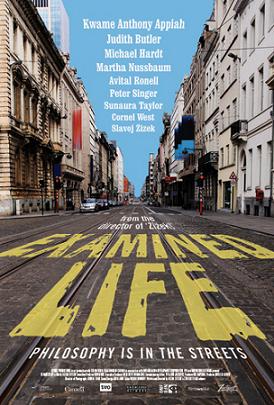
The Racial Discourses of Life Philosophy: Négritude, Vitalism, and Modernity
Attend this reading and discussion on this new book by author Donna V. Jones, where she revisits narratives on life produced in the early twentieth century and shows how Bergson, Nietzsche, and the poets Léopold Senghor and Aimé Césaire fashioned the concept of life into a central aesthetic and metaphysical category while also implicating it in discourses on race and nation.
5:30 p.m., free
University Press Books
2430 Bancroft, Berk.
(510) 548-0585

Spiritual Life of Bay Area Tribes
Attend this lecture on the spiritual life of Bay Area native tribes by Richie Richards of Lakota descent, who is a Native American specialist dedicated to bringing Native American studies to elementary schools.
7:30 p.m., free
Northbrae Community Church
941 The Alameda, Berk.
(510) 526-3805

Thursday, April 8

Manwha For Girls
Join authors Trina Robbins, Mike Madrid, and curator Andrew Farago as they discuss the role of girls and women in comics and female comics artists in conjunction with the current exhibit, “Korean Comics: A society through small frames,” in the Jewett Gallery open through June 13.
6 p.m., free
San Francisco Main Library
Lower level, Latino/Hispanic community meeting room
100 Larkin, SF
(415) 557-4400

 
Mystery Panel
Check out this mystery panel featuring Shirley Tallman, author of Scandal on Rincon Hill, and Ronald Tierney, author of Death in Pacific Heights.
7 p.m., free
Books Inc. Laurel Village
3515 California, SF
(415) 221-3666


“Why there are words”

Hear a diverse group of award winning authors read selections from their work that fall under the theme “crazy.” Featured writers to include Ethan Watters, Tom Barbash, Wendy Tokunaga, Allison Landa, Ryan Sloan, and Aggie Zivaljevic.
7 p.m., $5
Studio 333
333A Caledonia, Sausalito
(415) 331-8272

Saturday, April 10

Amy Goodman
Investigative journalist Amy Goodman says, “The role of reporters is to go where the silence is and say something,” and she does exactly that. Goodman is known for her dedication to looking beyond mainstream media news to expose human rights violations and political injustice. Hear her discuss her views and recent book, Breaking the Sound Barrier.
5:30 p.m., $20
Commonwealth Club
595 Market, 2nd floor, SF
(415) 597-6700

Diet for a Hot Planet
Author Anna Lappe believes that if we are serious about addressing climate change, we have to talk about food. Hear more about this theory at a reading of her new book, Diet for a Hot Planet: the climate crisis at the end of your fork and what you can do about it. Sponsored by the Center for Urban Education about Sustainable Agriculture (CUSA).
11 a.m.; $10, proceeds to benefit the Small Planet Fund
Port Commission Hearing Room
Ferry Building
101 Embarcadero, SF
(415) 291-3276 ext. 106

Kings of Poetry
Attend this spoken word poetry event featuring African American poets from throughout the Bay Area. Open mic to follow.
2 p.m., free
San Francisco Main Library
3rd floor, African American Center
100 Larkin, SF
(415) 557-4400

Pearl of China
Hear Anchee Min discuss her latest novel about Nobel Prize winning author Pearl S. Buck, a writer that Min was forced to denounce during the Cultural Revolution in China. Part of the Asian Art Museum’s current exhibit celebrating Shanghai, through Sept. 5.
2:30 p.m., free
Chinatown Branch Library
1135 Powell, SF
(415) 355-2888

Sunday, April 11

Phillip Schultz
Hear Pulitzer Prize winning poet Philip Schultz read and discuss selections from his recent book of poetry, The God of Loneliness, at this celebration of the third anniversary of Writers Studio Workshops in San Francisco.
3 p.m., free
Space Gallery
1141 Polk, SF
(415) 377-3325

Judith Tannenbaum
Hear Judith Tannenbaum discuss her new book of poetry, By Heart: Poetry, prison, and two lives, about her relationship with poet Spoon Jackson, an inmate in the California prison system serving life without parole, as she examines injustices in our prison system.
4 p.m., free
Booksmith
1644 Haight, SF
(415) 863-8688

Monday, April 12

Mark Danner
Hear journalist and author Mark Danner discuss his new book, Stripping Bare the Body, written from and about the world’s war zones, with New York Times Op-Ed columnist Frank Rich.
8 p.m., $20
(415) 392-4400
www.cityboxoffice.com

Get Lit!
Bring your own literary contributions or those of your favorite authors to share at this candle lit, wine bar literary salon.
7 p.m., free
1550 Hyde Café and Wine Bar
1550 Hyde, SF
(415) 775-1550

Legend of a Suicide
Hear author David Vann discuss his new collection of five short stories and one novella that center around the story of an Alaskan father’s suicide.
7 p.m., free
Books Inc. Berkeley
1760 4th St., Berk.
(510) 525-7777

No Rich, No Poor!
Join Charles Andrews in this discussion based on his new book about whether capitalism can be repaired or if it needs to be replaced and what a potential new “program of common prosperity” could look like.
7 p.m., free
Modern Times Bookstore
888 Valencia, SF
(415) 282-9246
www.mtbs.com

Wordcatcher
Take a tour into the obscure territory of word origins in Phil Cousineau’s new book, Wordcatcher: An odyssey into the world of weird and wonderful words.
7:30 p.m., free
Booksmith
1644 Haight, SF
(415) 863-8688

Tuesday, April 13

The Collected Poetry of Dahlia Ravikovitch
Hear translators Chana Bloch and Chana Kronfeld discuss the poetry of Israel’s leading female poet Dahlia Ravikovitch and the newly released collection of her verse, Hovering at a Low Altitude: The collected poetry of Dahlia Ravikovitch. Ravikovitch’s innovative and political poetry provides an inspiring window into the writer’s tortured life as an activist in Israel.
12:30 p.m., free
111 Minna Gallery
111 Minna, SF
(415) 974-1719

“Andy Warhol: Good for the Jews?”
Hear author and performer Josh Kornbluth discuss his process in creating his one-man show, Andy Warhol: Good for the Jews?, in response to Warhol’s 1980 series of paintings of prominent Jewish historical figures.
7:30 p.m., free
Jewish Community Library
1835 Ellis, SF
(415) 567-3327, ext. 704

Catholic Church equates bad press with the Holocaust

2

On the anniversary of the day when Jesus Christ was supposedly crucified, the Catholic Church has ratcheted up its counterattack on the journalists and victims’ advocates who have the gall to be concerned about the church covering up an epidemic of pedophilia by priests, taking its feelings of persecution to a ridiculous extreme.

The New York Times reports that during the Good Friday services at the Vatican, with Pope Benedict sitting in attendance, Rev. Raniero Cantalamessa equated negative news articles about the still-unfolding pedophilia scandal with the history of persecution suffered by the Jews, saying, “They know from experience what it means to be victims of collective violence and also because of this they are quick to recognize the recurring symptoms.”

Are you fucking kidding me?!?! Did he really equate valid criticism of a very real church scandal to the Holocaust, in which more than 6 million Jews were killed by a Nazi regime that was playing footsies with the Catholic Church at the time? Shameless, utterly shameless.

The pope’s supporters are truly horrible

12

I’m glad I’m not the only one who noticed the astonishing ad that ran in The New York Times defending the pope. Maureen Dowd picked it up in a nicely savage column that suggests the holy father undergo an inquisition. I agree that medieval practices are about what’s needed for the Vicar of Christ — but his supporters are even worse. Here’s Bill Donohue, president of the Catholic League, who bought space on the Times oped page to spill a screed of mind-boggling ignorance and hate:


The Times continues to editorialize about the “pedophilia crisis,” when all along it’s been a homosexual crisis. Eighty percent of the victims of priestly sexual abuse are male and most of them are post-pubescent. While homosexuality does not cause predatory behavior, and most gay priests are not molesters, most of the molesters have been gay.


Yes, this guy, who leads a major Catholic organization, is really arguing in public that the problem isn’t that abusive priests were protected by the church; it’s that there are (gasp) homosexuals in the priesthood.


This isn’t an April Fool’s joke. The guy really wrote that. It really ran in a major American newspaper in 2010. And unless I missed something, not one leading voice in the Catholic Church — not one bishop, or cardinal, or Vatican official, or even an intellectual leader in the Church — has stepped forward to publicly criticize Donohue.


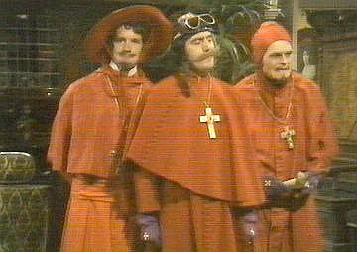
Let’s bring back the Spanish Inquisition.

Levada takes on the Times

7

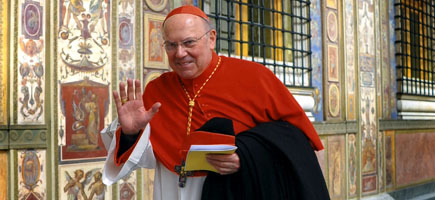
Cardinal William Levada, former archbishop of San Francisco Catholic Archdiocese of San Francisco, has penned a caustic response to recent New York Times articles and editorials that were critical of how the church and Pope Benedict XVI have handled sexual abuse cases involving priests over the years, calling the coverage “deficient by any reasonable standards of fairness that Americans have every right and expectation to find in their major media reporting.”

This bold, Spiro Agnew-like counterattack on the press during a time of mounting evidence of a covered-up pedophilia epidemic in the church is all the more notable given that Levada is the Prefect of the Congregation for the Doctrine of the Faith, an office then-Cardinal Ratzinger held before becoming Pope Benedict XVI, helping to place that office in charge of all reports of pedophiliac priests, a move that critics have charged was made to shield the church from criticism.

“I ask the Times to reconsider its attack mode about Pope Benedict XVI and give the world a more balanced view of a leader it can and should count on,” Levada writes, giving a far more charitable view of the current pope than the general public is feeling right now.

Rather than these defensive counterattacks on the Times’ solid journalism and analysis, Levada should realize that this tactic is precisely the attitude that has people concerned about the church, which has yet to fully atone for its many sins, including those committed by the Pope.

Back home in San Francisco, the church continues to stiff the city for millions of dollars in real estate transfer taxes involving the deed transfers of hundreds of properties under Levada’s leadership, a strange move that many critics have speculated was done to shield church assets from the claims of sexual abuse victims.

To me, this seems deficient by any reasonable standards of morality and openness that Americans have every right and expectation to find in their major religious institutions, particularly one that aspires to leadership that we can and should count on.

Film listings

0

Film listings are edited by Cheryl Eddy. Reviewers are Kimberly Chun, Michelle Devereaux, Max Goldberg, Dennis Harvey, Johnny Ray Huston, Erik Morse, Louis Peitzman, Lynn Rapoport, Ben Richardson, and Matt Sussman. The film intern is Peter Galvin. For rep house showtimes, see Rep Clock. For first-run showtimes, see Movie Guide.

OPENING

Chloe See "Moore and Less." (1:36) Elmwood, SF Center, Sundance Kabuki.

Greenberg Roger Greenberg (Ben Stiller) is 40, and you might think he’s going through a midlife crisis — if he hadn’t been in pretty much this same crisis for 15 years or more. Still very edgy and fragile after a nervous breakdown-sparked institutional stay, he’s holing up at the comfortable Hollywood home of a big-deal brother while the latter and family are on vacation in Vietnam. (The implication being that Roger is most welcome here when no one else actually has to endure his prickly, high maintenance company.) While in residence he reconnects with old friends including the ex-girlfriend (Jennifer Jason Leigh) he dumped yet never quite got over — though clearly she did — and the ex-bandmate (Rhys Ifans) he burned by wrecking their one shot at a major-label deal. He also gets involved, kinda-sorta, with big bro’s personal assistant Florence (mumblecore regular Greta Gerwig), whose passivity and low self-esteem make her the rare person who might consider a relationship with someone this impossible. Like all Noah Baumbach films, especially the slightly overrated Squid and the Whale (2005) and vastly underrated Margot at the Wedding (2007), his latest pivots around a pathologically self-absorbed and insensitive protagonist who exasperates anyone unlucky or blind enough to fall into his or her orbit. Working from a story co-conceived by spouse Leigh, Baumbach’s script sports his usual sharp dialogue, penetrating individual scenes, and narrative surprises. But it also gets stuck in dislikable Roger’s rut, finding conflict easily but stubbornly resisting even the smallest useful change. For all its amusing and uncomfortable moments, Greenberg emerges a dual character slice with no real point. Neither Roger or Beth reward long scrutiny (least of all as a hapless potential couple), while the few screen minutes Ifans and Leigh get make you wish their roles had hijacked the focus instead. (1:40) Piedmont, Shattuck. (Harvey)

Hot Tub Time Machine At last, Crispin Glover returns to his time-travel movie roots! (1:55) California.

How to Train Your Dragon Yet another 3D cartoon for the kiddies. At least this one is about Vikings. (1:38)

*The Sun It may have taken five years for Alexander Sokurov’s The Sun (2005) to reach local theaters, but then the Russian master’s contemplation of Emperor Hirohito’s last days as Godhead is decidedly out of time. Painterly and slow like all Sokurov’s work, the film specifically follows his estranged reconstructions of Hitler’s retreat with Eva Braun (1999’s Moloch) and Lenin’s demise (2000’s Taurus). In August 1945, Hirohito broke with tradition by making a direct appeal to the Japanese people to end military operations; soon thereafter he renounced his divine rights. The Sun‘s elliptical narration intuits the emperor’s paled existence, and Issey Ogata’s lead performance, centering on a fish-out-of-water puckering of the lips, amply conveys the shuttered hours of a man who, in experience if not in fact, is not quite human. The muted use of available light and a disquieting sound design (faraway air-raid sirens yield to the barest brush of a finger) eschew historiography’s harsh glare, instead returning primal scenes of power to a dreamlike state of unknowing. Sokurov’s most hallucinatory effects are reserved for ashen views of firebombed Tokyo which float free from perspective or clear boundary; a brief fantasy in which fish-like warplanes spew apocalyptic destruction suggests the emperor’s childlike imagination and set the stage for his historical date with General MacArthur, realized by Sokurov less as a diplomatic breakthrough than a leaden twilight. (1:50) Shattuck. (Goldberg)

Waking Sleeping Beauty Hollywood history is full of epic rivalries, juicy scandals, multi-million-dollar mistakes, and triumphant comebacks. Sometimes, all of the above and more can be contained within a single studio, or even a single studio division, or even a single studio division during a finite number of years, as illustrated by this insidery peek at Disney’s animation division. The doc gives a bit of background, but focuses its attentions on 1984-1994, a ten-year span that saw the floundering department struggle through post-Walt, identity-crisis blues before blossoming into a rejuvenated powerhouse. Waking Sleeping Beauty director Don Hahn was a producer on the Oscar-nominated Beauty and the Beast (1991), so he’s uniquely positioned to tell the story as it unfolded, using home movies and countless interviews. High points include a glimpse of late composer Howard Ashman introducing his demo for the iconic Little Mermaid (1989) tune "Under the Sea" (it was Ashman’s idea to give the crab character a Jamaican accent), and plenty of dish on the legendary Jeffrey Katzenberg-Michael Eisner feud. (1:26) Embarcadero. (Eddy)

ONGOING

Ajami You may recognize the title of Yaron Shoni and Scandar Copti’s debut collaboration as one of five films nominated for a 2010 Academy Award in the Foreign Category. Though it didn’t bring home the grand prize, Ajami remains a complex and affecting story about desperation and its consequences in a religiously-mixed town in Israel. As we follow the lives of four of Ajami’s residents the narrative shifts perspective almost maddeningly, switching characters seemingly at the height of each story’s action. But once all of the stories fully intersect, the final product has the distinction of feeling both meticulously calculated and completely natural. I was most impressed to learn that Shani and Copti prepared their actors with improvised role-playing rather than scripts. By withholding what was going to happen in a scene before shooting, we are treated to looks of surprise and emotion on actor’s faces that never feel unnatural. Attaining such a level of realism may be Ajami‘s crowning achievement; it can’t have been easy to make a foreign world feel so familiar. (2:00) Shattuck. (Galvin)

Alice in Wonderland Tim Burton’s take on the classic children’s tale met my mediocre expectations exactly, given its months of pre-release hype (in the film world, fashion magazines, and even Sephora, for the love of brightly-colored eyeshadows). Most folks over a certain age will already know the story, and much of the dialogue, before the lights go down and the 3-D glasses go on; it’s up to Burton and his all-star cast (including numerous big-name actors providing voices for animated characters) to make the tale seem newly enthralling. The visuals are nearly as striking as the CG, with Helena Bonham Carter’s big-headed Red Queen a particularly marvelous human-computer creation. But Wonderland suffers from the style-over-substance dilemma that’s plagued Burton before; all that spooky-pretty whimsy can’t disguise the film’s fairly tepid script. Teenage Alice (Mia Wasikowska) displaying girl-power tendencies is a nice, if not surprising, touch, but Johnny Depp’s grating take on the Mad Hatter will please only those who were able to stomach his interpretation of Willy Wonka. (1:48) Castro, Empire, 1000 Van Ness, SF Center, Sundance Kabuki. (Eddy)

*The Art of the Steal How do you put a price on something that’s literally priceless? The Art of the Steal takes an absorbing look at the Barnes Collection, a privately-amassed array of Post-Impressionist paintings (including 181 Renoirs) worth billions — and the many people and corporate interests who schemed to control it. Founder Albert C. Barnes was an singular character who took pride in his outsider status; he housed his art in a specially-constructed gallery far from downtown Philadelphia’s museum scene, and he emphasized education and art appreciation first and foremost. But he had no heirs, and after his death in 1951, opportunists began circling his massive collection; the slippery political and legal dealings that have unfolded since then are nearly as jaw-dropping as Barnes’ prize paintings. Philly documentarian Don Argott has a doozy of a subject here, and his skillful, even suspenseful film does it justice. (1:41) Smith Rafael. (Eddy)

The Blind Side When the New York Times Magazine published Michael Lewis’ article "The Ballad of Big Mike" — which he expanded into the 2006 book The Blind Side: Evolution of a Game — nobody could have predicated the cultural windfall it would spawn. Lewis told the incredible story of Michael Oher — a 6’4, 350-pound 16-year-old, who grew up functionally parentless, splitting time between friends’ couches and the streets of one of Memphis’ poorest neighborhoods. As a sophomore with a 0.4 GPA, Oher serendipitously hitched a ride with a friend’s father to a ritzy private school across town and embarked on an unbelievable journey that led him into a upper-class, white family; the Dean’s List at Ole Miss; and, finally, the NFL. The film itself effectively focuses on Oher’s indomitable spirit and big heart, and the fearless devotion of Leigh Anne Tuohy, the matriarch of the family who adopted him (masterfully played by Sandra Bullock). While the movie will delight and touch moviegoers, its greatest success is that it will likely spur its viewers on to read Lewis’ brilliant book. (2:06) Oaks. (Daniel Alvarez)

Brooklyn’s Finest "Really? I mean, really?" asked the moviegoer beside me as the final freeze-frame of Brooklyn’s Finest slapped our eyeballs. Yes, that’s the sound of letdown, despite the fact that Brooklyn’s Finest initially resembled a promisingly gritty juggling act in the mode of The Wire and Cop Land (1997), Taxi Driver (1976) and Training Day (2001). Bitter irony flows from the title — and from the lives, loves, bad habits, pressure-cooker stress, and unavoidable moral dilemmas of three would-be everyday cops, all occupying several different rungs on a food chain where right and wrong have an unpleasant way of switching sides. Eddie (Richard Gere) is the veteran officer just biding his time till he gets his pension, all while comforting himself with the meager sensuous attentions of hooker Chantel (Shannon Kane). Sal (Ethan Hawke) is the bad detective, stealing from the dealers to fund a dream home for his growing family with Angela (Lili Taylor). Tango (Don Cheadle) is the undercover detective who has cultivated friendships with dealers like Caz (Wesley Snipes) and sacrificed his marriage for a long-promised promotion from his lieutenant (Will Patton) and his superior (Ellen Barkin, in likely the most misogynist portrayal of a lady with a badge to date). You spend most of Brooklyn’s Finest waiting for these cops to collide in the most unfortunate, messiest way possible, but instead the denouement leaves will leave one wondering about unresolved threads and feeling vaguely unsatisfied. In any case, director Antoine Fuqua and company seem to pride themselves on their tough-minded if at times cartoonish take on law enforcement, with Hawke in particular turning in a memorably OTT and anguished performance. (2:13) 1000 Van Ness. (Chun)

The Bounty Hunter There’s a real feeling of impotence in reviewing a movie whose ad was pasted on the side of the bus you took to the screening. This thing is determined to be seen, and that’s a true shame. Those who heed the call of the ubiquitous marketing campaign will have to sit through a dull parade of contrivances concerning a bounty hunter (Gerard Butler) whose latest catch is his court-skipping ex-wife (Jennifer Aniston). She’s a hotshot city journalist who’s forced to continue her investigation of a police cover-up while handcuffed to a car door and bickering with her old flame. The trajectory of the plot is obvious enough, but there’s so little chemistry between the two actors that the inevitable reconciliation practically constitutes a twist ending. Aniston saw fit not to whine her way through this role, which is something, but nothing nearly as complimentary can be said about Butler. He emotes in lurches, with the presence of a guy who’s not sure acting is the right direction for his life but still really wants to give it a go. If "This. Is. Sparta!" weren’t burned into my brain I would swear the man had never been in front of a camera before. (1:50) 1000 Van Ness, SF Center, Sundance Kabuki. (Jason Shamai)

The Crazies Disease and anti-government paranoia dovetail in this competent yet overwhelmingly non-essential remake of one of George A. Romero’s second-tier spook shows. In a small Iowa hamlet overseen by a benevolent sheriff (Timothy Olyphant) and his pregnant wife (Radha Mitchell), who’s also the town doctor, a few odd incidents snowball into all-out chaos when a mysterious, unmarked plane crashes into the local water supply. Before long, the few residents who aren’t acting like homicidal maniacs are rounded up by an uber-aggressive military invasion. Though our heroes convey frantic panic as they try to figure out what the hell is going on, The Crazies never achieves full terror mode. It’s certainly watchable, and even enjoyable at times. But memorable? Not in the slightest. (1:41) 1000 Van Ness. (Eddy)

Crazy Heart "Oh, I love Jeff Bridges!" is the usual response when his name comes up every few years for Best Actor consideration, usually via some underdog movie no one saw, and the realization occurs that he’s never won an Oscar. The oversight is painful because it could be argued that no leading American actor has been more versatile, consistently good, and true to that elusive concept "artistic integrity" than Bridges over the last 40 years. It’s rumored Crazy Heart was slotted for cable or DVD premiere, then thrust into late-year theater release in hopes of attracting Best Actor momentum within a crowded field. Lucky for us, this performance shouldn’t be overlooked. Bridges plays "Bad" Blake, a veteran country star reduced to playing bars with local pickup bands. His slide from grace hasn’t been helped by lingering tastes for smoke and drink, let alone five defunct marriages. He meets Jean (Maggie Gyllenhaal), freelance journalist, fan, and single mother. They spark; though burnt by prior relationships, she’s reluctant to take seriously a famous drunk twice her age. Can Bad handle even this much responsibility? Meanwhile, he gets his "comeback" break in the semi-humiliating form of opening for Tommy Sweet (Colin Farrell) — a contemporary country superstar who was once Bad’s backup boy. Tommy offers a belated shot at commercial redemption; Jean offers redemption of the strictly personal kind. There’s nothing too surprising about the ways in which Crazy Heart both follows and finesses formula. You’ve seen this preordained road from wreckage to redemption before. But actor turned first-time director Scott Cooper’s screenplay honors the flies in the windshield inherited from Thomas Cobb’s novel — as does Bridges, needless to say. (1:51) Piedmont, 1000 Van Ness, Shattuck, Sundance Kabuki. (Harvey)

Diary of a Wimpy Kid Spoiler alert: nothing happens in Diary of a Wimpy Kid. That was OK when it was just a book—author Jeff Kinney’s illustrated novel works due in large part to his whimsical drawings and tongue-in-cheek humor. It’s a kids’ book, but it’s fun for adults, too. The same can’t be said for the film adaptation: Diary of a Wimpy Kid sticks close to its source material without the creativity necessary to make it work on the big screen. As in the book, Greg Heffley (Zachary Gordon) navigates the treacherous terrain of middle school, struggling to cope with an awkward best friend, a brutal older brother, and parents who just don’t understand. All the actors turn in solid performances — Gordon is a particularly good find. But there’s so little here to work with. The best that can be said about Diary of a Wimpy Kid is that it’s cute and mostly harmless: a pleasant diversion for young’uns, and a tolerable bore for the parents they drag along. (2:00) 1000 Van Ness. (Peitzman)

*An Education The pursuit of knowledge — both carnal and cultural — are at the tender core of this end-of-innocence valentine by Danish filmmaker Lone Scherfig (who first made her well-tempered voice heard with her 2000 Dogme entry, Italian for Beginners), based on journalist Lynn Barber’s memoir. Screenwriter Nick Hornby breaks further with his Peter Pan protagonists with this adaptation: no man-boy mopers or misfits here. Rather, 16-year-old schoolgirl Jenny (Carey Mulligan) is a good girl and ace student. It’s 1961, and England is only starting to stir from its somber, all-too-sober post-war slumber. The carefully cloistered Jenny is on track for Oxford, though swinging London and its high-style freedoms beckon just around the corner. Ushering in those freedoms — a new, more class-free world disorder — is the charming David (Peter Sarsgaard), stopping to give Jenny and her cello a ride in the rain and soon proffering concerts and late-night suppers in the city. He’s a sweet-faced, feline outsider: cultured, Jewish, and given to playing fast and loose in the margins of society. David can see Jenny for the gem she is and appreciate her innocence with the knowing pleasure of a decadent playing all the angles. The stakes are believably high, thanks to An Education‘s careful attention to time and place and its gently glamored performances. Scherfig revels in the smart, easy-on-eye curb appeal of David and his friends while giving a nod to the college-educated empowerment Jenny risks by skipping class to jet to Paris. And Mulligan lends it all credence by letting all those seduced, abandoned, conflicted, rebellious feelings flicker unbridled across her face. (1:35) Oaks, Smith Rafael. (Chun)

*The Ghost Writer Roman Polanski’s never-ending legal woes have inspired endless debates on the interwebs and elsewhere; they also can’t help but add subtext to the 76-year-old’s new film, which is chock full o’ anti-American vibes anyway. It’s also a pretty nifty political thriller about a disgraced former British Prime Minister (Pierce Brosnan) who’s hanging out in his Martha’s Vineyard mansion with his whip-smart, bitter wife (Olivia Williams) and Joan Holloway-as-ice-queen assistant (Kim Cattrall), plus an eager young biographer (Ewan McGregor) recently hired to ghost-write his memoirs. But as the writer quickly discovers, the politician’s past contains the kinds of secrets that cause strange cars with tinted windows to appear in one’s rearview mirror when driving along deserted country roads. Polanski’s long been an expert when it comes to escalating tension onscreen; he’s also so good at adding offbeat moments that only seem tossed-off (as when the PM’s groundskeeper attempts to rake leaves amid relentless sea breezes) and making the utmost of his top-notch actors (Tom Wilkinson and Eli Wallach have small, memorable roles). Though I found The Ghost Writer‘s ZOMG! third-act revelation to be a bit corny, I still didn’t think it detracted from the finely crafted film that led up to it. (1:49) California, Piedmont, Sundance Kabuki. (Eddy)

*The Girl With the Dragon Tattoo By the time the first of Stieg Larsson’s so-called "Millennium" books had been published anywhere, the series already had an unhappy ending: he died (in 2004). The following year, The Girl With the Dragon Tattoo became a Swedish, then eventually international sensation, its sequels following suit. The books are addicting, to say the least; despite their essential crime-mystery-thriller nature, they don’t require putting your ear for writing of some literary value on sleep mode. Now the first of three adaptive features shot back-to-back has reached U.S. screens. (Sorry to say, yes, a Hollywood remake is already in the works — but let’s hope that’s years away.) Even at two-and-a-half hours, this Girl With the Dragon Tattoo by necessity must do some major truncating to pack in the essentials of a very long, very plotty novel. Still, all but the nitpickingest fans will be fairly satisfied, while virgins will have the benefit of not knowing what’s going to happen and getting scared accordingly. Soon facing jail after losing a libel suit brought against him by a shady corporate tycoon, leftie journalist Mikael Blomkvist (Michael Nyqvist) gets a curious private offer to probe the disappearance 40 years earlier of a teenage girl. This entangles him with an eccentric wealthy family and their many closet skeletons (including Nazi sympathies) — as well as dragon-tattooed Lisbeth Salander (Noomi Rapace), androgynous loner, 24-year-old court ward, investigative researcher, and skillful hacker. Director Niels Arden Oplev and his scenarists do a workmanlike job — one more organizational than interpretive, a faithful transcription without much style or personality all its own. Nonetheless, Larsson’s narrative engine kicks in early and hauls you right along to the depot. (2:32) Albany. (Harvey)

Green Zone Titled for the heavily-guarded headquarters of international occupation in Baghdad, Green Zone reunites director Paul "Shaky-Cam" Greengrass with star Matt Damon, the two having previously collaborated on the last two Bourne films. Instead of a super-soldier, this time around Damon just plays a supremely insubordinate one as he attempts to uncover the reason why his military unit can’t find any of Saddam’s WMDs. With the aid of the CIA, a Wall Street Journal reporter and a friendly Iraqi, Damon goes rogue in order to suss out the source of the misinformation. The Iraq War action is decent if scarce, but an overindulgence in (you guessed it) shaky-cam and political jargon cannot hide the fact that Green Zone‘s plot is simplistic and probably light on actual facts. Damon makes a fine cowboy-cum-hero, but the effectiveness of the mix of patriotism and Pentagon paranoia will vary based on your penchant for such things. Still, Green Zone moves fast enough that it remains worth a matinee for conspiracy thriller aficionados. (1:55) Empire, 1000 Van Ness, Sundance Kabuki. (Galvin)

The Hurt Locker When the leader of a close-knit U.S. Army Explosive Ordnance Disposal squad is killed in action, his subordinates have barely recovered from the shock when they’re introduced to his replacement. In contrast to his predecessor, Sgt. James (Jeremy Renner) is no standard-procedure-following team player, but a cocky adrenaline junkie who puts himself and others at risk making gonzo gut-instinct decisions in the face of live bombs and insurgent gunfire. This is particularly galling to next-in-command Sanborn (Anthony Mackie). An apolitical war-in-Iraq movie that’s won considerable praise for accuracy so far from vets (scenarist Mark Boal was "embedded" with an EOD unit there for several 2004 weeks), Kathryn Bigelow’s film is arguably you-are-there purist to a fault. While we eventually get to know in the principals, The Hurt Locker is so dominated by its seven lengthy squad-mission setpieces that there’s almost no time or attention left for building character development or a narrative arc. The result is often viscerally intense, yet less impactful than it would have been if we were more emotionally invested. Assured as her technique remains, don’t expect familiar stylistic dazzle from action cult figure Bigelow (1987’s Near Dark, 1989’s Blue Steel, 1991’s Point Break) — this vidcam-era war movie very much hews to the favored current genre approach of pseudo-documentary grainy handheld shaky-cam imagery. (2:11) Shattuck. (Harvey)

*The Last Station Most of the buzz around The Last Station has focused on Helen Mirren, who takes the lead as the Countess Sofya, wife of Leo Tolstoy (Christopher Plummer). Mirren is indeed impressive — when is she not? — but there’s more to the film than Sofya’s Oscar-worthy outbursts. The Last Station follows Valentin Bulgakov (James McAvoy), hired as Tolstoy’s personal secretary at the end of the writer’s life. Valentin struggles to reconcile his faith in the anarchist Christian Tolstoyan movement with his sympathy for Sofya and his budding feelings for fellow Tolstoyan Masha (Kerry Condon). For the first hour, The Last Station is charming and very funny. Once Tolstoy and Sofya’s relationship reaches its most volatile, however, the tone shifts toward the serious — a trend that continues as Tolstoy falls ill. After all the lighthearted levity, it’s a bit jarring, but the solid script and accomplished cast pull The Last Station together. Paul Giamatti is especially good as Vladimir Chertkov, who battles against Sofya for control of Tolstoy’s will. You’ll never feel guiltier for putting off War and Peace. (1:52) Albany. (Peitzman)

*The Most Dangerous Man in America: Daniel Ellsberg and the Pentagon Papers For many, Daniel Ellsberg is a hero — a savior of American First Amendment rights and one of the most outspoken opponents of the Vietnam war. But as this documentary (recently nominated for an Academy Award) shows, it’s never an an easy decision to take on the U.S. government. Ellsberg himself narrates the film and details his sleepless nights leading up to the leak of the Pentagon Papers — the top secret government study on the Vietnam war — to the public. Though there are few new developments in understanding the particulars of the war or the impact the release of the Papers had on ending the conflict, the film allows audiences to experience the famous case from Ellsberg’s point of view, adding a fresh and poignantly human element to the events; it’s a political documentary that plays more like a character drama. Whether you were there when it happened or new to the story, there is something to be appreciated from this tale of a man who fell out of love with his country and decided to do something about it. (1:34) Shattuck, Smith Rafael. (Galvin)

*Mother You can guarantee that a movie titled Mother is not gonna be a love fest, ever. And through the lens of The Host (2006) director-writer Bong Joon-ho, motherly love becomes downright monstrous — though altogether human. Much credit goes to the wonderful lead actress Kim Hye-ja as the titular materfamilias, who’s frantically self-sacrificing, insanely tenacious, quaintly charming, wolfishly fearsome, and wildly guilt-ridden, by turns. On the surface, she’s a sweetly innocuous herbalist and closet acupuncturist — happily, and a wee bit too tightly, tethered to her beloved son Yoon Do-joon (Won Bin). He’s a slow-witted, forgetful, and easily confused mop-top who flies into deadly rages when taunted or called a "’tard." When Do-joon is quickly arrested and charged with the murder of schoolgirl Moon Ah-jung (Mun-hee Na), Mom snaps into action with a panic-stricken, primal ferocity and goes in search of the killer to free her boy. But there’s more to Do-joon, his studly pal Jin-tae (Ku Jin), and Moon Ah-jung than meets the eye, and Mother discovers just how much she’s defined, and twisted, herself in relation to her son. Bong gives this potentially flat and cliched noirish material genuine lyricism, embedding his anti-heroine in a rural South Korean landscape like a penitent wandering in an existential desert, gently echoing filmmakers such as Ingmar Bergman and Abbas Kiarostami and beautifully transcending genre. (2:09) Shattuck. (Chun)

Our Family Wedding America Ferrera and Lance Gross play a couple of lovebirds who must jump through some serious family hoops before they get married in the mostly serviceable Our Family Wedding. What begins as a dual Guess Who’s Coming to Dinner, with the differences in each family’s traditions forcing complications and compromises, soon loses sight of its matrimonial plot as the focus steers towards a childish rivalry between the fathers. While it’s being marketed as a goofy comedy, the final product seeks a relatively sentimental tone, which makes the few slapstick moments — like a goat trying to rape Academy Award-winning actor Forest Whitaker — seem pretty inappropriate. Still, for some audiences the well-tread plot will act as comfort food: they fight, they make up, and it all ends in a big wedding where we watch the characters dance for damn near ten minutes. (1:41) 1000 Van Ness. (Galvin)

*A Prophet Filmmaker Jacques Audiard has described his new film, A Prophet, as "the anti-Scarface." Yet much like Scarface (1983), A Prophet bottles the heady euphoria that chases the empowerment of the powerless and the rise of the long-shot loner on the margins. In its almost-Dickensian attention to detail, devotion to its own narrative complexity, and passion for cinematic poetry, A Prophet rises above the ordinary and, through the prism of genre, finds its own power. The supremely opportunistic, pragmatically Machiavellian intellectual and spiritual education of a felon is the chief concern of here. Played by Tahar Rahim with guileless, open-faced charisma, Malik is half-Arab and half-Corsican — and distrusted or despised by both camps in the pen. When he lands in jail for his six-year sentence, he’s 19, illiterate, friendless, and vulnerable. His deal with the devil — and means of survival — arrives with Reyeb (Hichem Yacoubi), temporarily locked up before his testifies against the mob. Corsican boss Cesar Luciani (Niels Arestrup) wants him dead, and Malik is tagged to penetrate Reyeb’s cell with a blade hidden in mouth. After Malik’s gory rebirth, it turns out that the teenager’s a seer in more ways than one. From his low-dog position, he can eyeball the connections linking the drugs entering the prison to those circulating outside, as well as the machinations intertwining the Arab and Corsican syndicates. It’s no shock that when Cesar finds his power eroding and arranges prison leaves for his multilingual crossover star that Malik serves not only his Corsican master, but also his own interests, and begins to build a drug empire rivaling his teacher’s. Throughout his pupil’s progress, Audiard demonstrates a way with Henri Cartier-Bresson’s decisive moment, and when Malik finally breaks with his Falstaffian patriarch, it makes your heart skip a beat in a move akin to the title of the director’s last film. This Eurozone/Obama-age prophet is all about the profit — but he’s imbued with grace, even while gaming for ill-gotten gain. (2:29) Shattuck, Smith Rafael. (Chun)

Remember Me Ominously set in New York City during the summer of 2001, Remember Me, starring Robert Pattinson (of the Twilight series) and Emilie de Ravin (of TV’s Lost), pretty much answers the question of whether it’s still too soon to make the events of September 11 the subject of a date movie. Or rather, not the subject so much as the specter waiting just off-camera for its walk-on while brooding 21-year-old Tyler Hawkins (Pattinson) quotes Gandhi, gets into brawls, gets drunk, writes letters to his dead brother, and otherwise channels despondency and rage into various salubrious outlets. One of these is romancing (under circumstances severely testing the viewer’s credulity) de Ravin’s Ally Craig, grappling somewhat more constructively with her own familial tragedy. Ally is the sort of self-possessed, strong-willed young woman whose instincts, shortly after she’s been backhanded by her drunk father (Chris Cooper), tell her to placate and have sex with her drunk boyfriend when he comes home enraged after battling his own father (Pierce Brosnan). She is there to teach Tyler, through quirky habits like eating dessert first, what director Allen Coulter (2006’s Hollywoodland) wishes to teach us: that time is short and one must fill one’s life with meaningful actions — like throwing a fire extinguisher through a window to convince a classroom of tweens to stop bullying one’s little sister. The film is seeded with allusions to an impending catastrophe that feels less integrated than exploited. And it’s uncomfortable seeing the fall of the towers used to make the ground shake under a sweet, fairly depthless depiction of love and grief. (2:08) Empire, 1000 Van Ness, Sundance Kabuki. (Rapoport)

Repo Men If you are considering going to see Repo Men you’ll need to go ahead and turn off your brain first — the guy who wrote it sure did. The script is jam-packed with contrivances and tonal inconsistencies, which is a shame because the plot had potential. In a near future when mechanical replacement organs are a reality, Jude Law plays Remy, an ex-soldier hired by the Union to find recipients that cannot afford their bills and repossess their artificial organs to return to the manufacturer. After a freak accident, Remy needs a replacement organ himself and when he can’t pay, the Union sends his childhood friend and ex-partner Jake (Forest Whitaker) to retrieve it. Repo Men is at its best when it embraces its cartoonishness, when the film is so stupid that it transcends the hodge-podge story and glows with goofy grotesque action. If you can, stick around ’til the climax that includes an Old Boy (2003) homage (rip-off) and one of the more laugh-out-loud ridiculous endings I’ve seen in a long time. But high-art, this ain’t. (1:53) 1000 Van Ness, Shattuck, Sundance Kabuki. (Galvin)

The Runaways In Floria Sigismondi’s tale of the rise and fall of a 1970s all-girl band, LA producer Kim Fowley (Michael Shannon) proclaims that the Runaways are going to save rock and roll. It’s hard to gauge the sincerity of this pronouncement, but you can certainly hear, in songs like "Cherry Bomb" and "Queens of Noise," how the band must have brightened a landscape overrun by kings of prog rock. Unfortunately, a handful of teenagers micromanaged by a sleazy, abusive nutcase proved not quite up to the task, though the band did launch the careers of metal guitarist Lita Ford (Scout Taylor-Compton) and, more famously, Joan Jett (Kristen Stewart). Sigismondi’s film entertainingly sketches the Runaways’ beginnings in glam rock fandom and gradual attainment of their own rabid fan base. We get Currie lip-synching Bowie to catcalls at the high school assembly, Jett composing "Cherry Bomb" with Fowley, glamtastic hair-and-wardrobe eye candy, pills-and-Stooges-fueled intra-band fooling around, and five teenage girls sent off sans chaperone on an international tour with substantial quantities of hard drugs in their carry-on luggage. What follows is less pretty: a capsule version of the band’s disintegration after the departure of bottoming-out 16-year-old lead singer Cherie Currie (Dakota Fanning). In a film darkened by Currie’s trajectory, Jett’s subsequent success is a feel-good coda, but it’s awkwardly attached and emblematizes one of The Runaways‘ main problems. When the band begins to fall apart, the film doesn’t know which way to turn and ends up telling no one’s story well. (1:42) 1000 Van Ness, SF Center. (Rapoport)

She’s Out of My League From the co-writers of the abysmal Sex Drive (2008), She’s Out of My League could be another 90-minute assemblage of gross-out humor, dick jokes, and unabashed homophobia. As it turns out, the latest offering from Sean Anders and John Morris is legitimately funny — far better than the trailer (and that half-assed title) would have you believe. The adorkable Jay Baruchel stars as Kirk, a hapless loser who finds himself dating bonafide hottie Molly (Alice Eve). Once you get past the film’s silly conceit — Kirk’s only "movie ugly," and personality goes a long way — you’re left with a surprisingly charming comedy. The characters are amusing and the wit is sharp. Not to mention the fact that She’s Out of My League offers a downright heartfelt message. There’s a sincerity here that feels genuine instead of just tacked-on: yeah, yeah, it’s about what’s inside that counts, but there’s more to it than that. Ignore the dreadful "jizz in my pants" scene, and the movie’s almost an old-fashioned romcom. (1:44) 1000 Van Ness, SF Center. (Peitzman)

Shutter Island Director Martin Scorsese and muse du jour Leonardo DiCaprio draw from oft-filmed novelist Dennis Lehane (2003’s Mystic River, 2007’s Gone Baby Gone) for this B-movie thriller that, sadly, offers few thrills. DiCaprio’s a 1950s U.S. marshal summoned to a misty island that houses a hospital for the criminally insane, overseen by a doctor (Ben Kingsley) who believes in humane, if experimental, therapy techniques. From the get-go we suspect something’s not right with the G-man’s own mind; as he investigates the case of a missing patient, he experiences frequent flashbacks to his World War II service (during which he helped liberate a concentration camp), and has recurring visions of his spooky dead wife (Michelle Williams). Whether or not you fall for Shutter Island‘s twisty game depends on the gullibility of your own mind. Despite high-quality performances and an effective, if overwrought, tone of certain doom, Shutter Island stumbles into a third act that exposes its inherently flawed and frustrating storytelling structure. If only David Lynch had directed Shutter Island — it could’ve been a classic of mindfuckery run amok. Instead, Scorsese’s psychological drama is sapped of any mystery whatsoever by its stubbornly literal conclusion. (2:18) California, 1000 Van Ness, Sundance Kabuki. (Eddy)

Film listings

0

Film listings are edited by Cheryl Eddy. Reviewers are Kimberly Chun, Michelle Devereaux, Max Goldberg, Dennis Harvey, Johnny Ray Huston, Erik Morse, Louis Peitzman, Lynn Rapoport, Ben Richardson, and Matt Sussman. The film intern is Peter Galvin. For rep house showtimes, see Rep Clock. For first-run showtimes, see Movie Guide.

SF INTERNATIONAL ASIAN AMERICAN FILM FESTIVAL

The 28th San Francisco International Asian American Film Festival runs through Sun/21 at the Sundance Kabuki, 1881 Post, SF; Viz Cinema, 1746 Post, SF; Clay, 2261 Fillmore, SF; Pacific Film Archive, 2575 Bancroft, Berk; and Camera 12 Cinemas, 201 South Second St, San Jose. Tickets (most shows $12) available at www.asianamericanmedia.org. All times pm.

WED/17

PFA Agrarian Utopia 7. Mundane History 9:20.

Sundance Kabuki "Classic Filipino American Shorts" (shorts program) 4:15. God is D_ad 4:30. "FutureStates" (shorts program) 6:45. Wo Ai Ni Mommy 7. You Have Been Weighed and Found Wanting 9:15. Aoki 9:30.

Viz "Memory Vessels and Phantom Traces" (shorts program) 4:45. Ninoy Aquin and the Rise of People Power 7. Dear Doctor 9:15.

THURS/18

PFA Hana, Dul, Sed… 7. Bayan Ko: My Own Country 9.

Sundance Kabuki Mundane History 5. "Wandering, Wondering" (shorts program) 5. "Blueprints for a Generation" (shorts program) 5. Au Revoir Taipei 7. "FutureStates" (shorts program) 7:15.

Viz "Sweet Dreams and Beautiful Nightmare" (shorts program) 5. Tehran Without Borders 7:30.

FRI/19

Camera Au Revoir Taipei 7.

PFA What We Talk About When We… 7. The Forbidden Door 9:10.

SAT/20

Camera Dear Doctor noon. "3rd I South Asian International Shorts" (shorts program) 2:45. Aoki 3. The People I’ve Slept With 4:45. A Village Called Versailles 5:30. Make Yourself at Home 7:15. Like You Know it All 7:45. Prince of Tears 9:15.

PFA Manila in the Claws of Neon 6. About Elly 8:30.

SUN/21

Camera "Wandering, Wondering" (shorts program) noon. Talentime 2. State of Aloha 2:15. Cooking With Stella 4:30. Fog 4:45. In the Matter of Cha Jung Hee 6:45. The Forbidden Door 7. The Message 9.

OPENING

The Bounty Hunter Gerard Butler and Jennifer Aniston play a formerly married couple who … zzzzz. Huh? Oh, whatever. (1:50)

Diary of a Wimpy Kid The agonies of middle school come to life in this kid-friendly comedy. (2:00)

The Girl on the Train André Téchiné’s beautifully photographed, ripped-from-the-headlines film explores the events that led a young Parisian girl to lie about being the victim of an anti-semitic attack. Téchiné’s dramatization fails as an account of the incident, but the film manages to evoke a powerfully mysterious tone due largely to two stellar performances, by Émilie Dequenne as the 20-something Jeanne and Catherine Deneuve as her persistent mother. Much of the running time follows Jeanne’s experiences before the fabrication, as she falls for (and moves in with) a young wrestler named Franck, before a tragic event causes Jeanne to invent the famous lie. An arty exploration into the psychology of victimization that happens to be anchored by a real-life event, The Girl on the Train may disappoint those looking for easy answers but is undeniable as a showcase for some outstanding acting. (1:42) Embarcadero, Shattuck. (Galvin)

*The Girl With the Dragon Tattoo See "Life After Death." (2:32) Albany, Embarcadero.

Mother Bong Joon-ho’s latest is a crime drama about a mentally challenged murder suspect and his formidable mother. See review at www.sfbg.com. (2:09) Clay, Shattuck.

*Neil Young Trunk Show As loose as Jonathan Demme’s prior Neil doc Heart of Gold (2006) was tidy, with a taste for rave-ups where that film emphasized the mellower country-rock side, this neck-deep wade into Young’s four-decade-plus songbook is pretty dang nirvanic. Shot at the Tower Theater in Upper Darby, PA —exactly the kind of funky old midsized venue you’d want to see him at — it’s assembled via camera and editorial choices as seemingly random yet astute as Young’s grab bag of tunes. The latter range from historic hits ("Cinnamon Girl," "Harvest," "Cowgirl in the Sand") to more recent compositions ("The Believer," "No Hidden Path") and some real obscurities from the bottom of that trunk, including a few acoustic heartbreakers. Even shown out of concert order — there’s never any sense just where we are in the audience’s evening — they meld seamlessly, the epic half-hour oceanics of "Path" just as well as something small and plaintive like "Sad Movies." Never in better voice (qualify that as you will) at age 65, surrounded by an assured band of five plus scattered oddball props and one live canvas painter, Young is the eye of this particular hurricane — even if "Like a Hurricane" is the one performance that feels a tad uninspired. If you’re a fan, this will be pretty close to sheer ecstasy. If not … well, frankly, I have absolutely no idea whether
you’ll be converted, mildly entertained, or bored to death. (1:22) Lumiere, Shattuck. (Harvey)

Repo Men Nope, not a sequel to the 1984 cult classic. Jude Law and Forest Whitaker will, however, relieve you of your futuristic mechanical organs if you can’t pay for them post-transplant. (1:53) Shattuck.

The Runaways In Floria Sigismondi’s tale of the rise and fall of a 1970s all-girl band, LA producer Kim Fowley (Michael Shannon) proclaims that the Runaways are going to save rock and roll. It’s hard to gauge the sincerity of this pronouncement, but you can certainly hear, in songs like "Cherry Bomb" and "Queens of Noise," how the band must have brightened a landscape overrun by kings of prog rock. Unfortunately, a handful of teenagers micromanaged by a sleazy, abusive nutcase proved not quite up to the task, though the band did launch the careers of metal guitarist Lita Ford (Scout Taylor-Compton) and, more famously, Joan Jett (Kristen Stewart). Sigismondi’s film entertainingly sketches the Runaways’ beginnings in glam rock fandom and gradual attainment of their own rabid fan base. We get Currie lip-synching Bowie to catcalls at the high school assembly, Jett composing "Cherry Bomb" with Fowley, glamtastic hair-and-wardrobe eye candy, pills-and-Stooges-fueled intra-band fooling around, and five teenage girls sent off sans chaperone on an international tour with substantial quantities of hard drugs in their carry-on luggage. What follows is less pretty: a capsule version of the band’s disintegration after the departure of bottoming-out 16-year-old lead singer Cherie Currie (Dakota Fanning). In a film darkened by Currie’s trajectory, Jett’s subsequent success is a feel-good coda, but it’s awkwardly attached and emblematizes one of The Runaways‘ main problems. When the band begins to fall apart, the film doesn’t know which way to turn and ends up telling no one’s story well. (1:42) Bridge. (Rapoport)

ONGOING

Ajami You may recognize the title of Yaron Shoni and Scandar Copti’s debut collaboration as one of five films nominated for a 2010 Academy Award in the Foreign Category. Though it didn’t bring home the grand prize, Ajami remains a complex and affecting story about desperation and its consequences in a religiously-mixed town in Israel. As we follow the lives of four of Ajami’s residents the narrative shifts perspective almost maddeningly, switching characters seemingly at the height of each story’s action. But once all of the stories fully intersect, the final product has the distinction of feeling both meticulously calculated and completely natural. I was most impressed to learn that Shani and Copti prepared their actors with improvised role-playing rather than scripts. By withholding what was going to happen in a scene before shooting, we are treated to looks of surprise and emotion on actor’s faces that never feel unnatural. Attaining such a level of realism may be Ajami‘s crowning achievement; it can’t have been easy to make a foreign world feel so familiar. (2:00) Embarcadero, Shattuck. (Galvin)

Alice in Wonderland Tim Burton’s take on the classic children’s tale met my mediocre expectations exactly, given its months of pre-release hype (in the film world, fashion magazines, and even Sephora, for the love of brightly-colored eyeshadows). Most folks over a certain age will already know the story, and much of the dialogue, before the lights go down and the 3-D glasses go on; it’s up to Burton and his all-star cast (including numerous big-name actors providing voices for animated characters) to make the tale seem newly enthralling. The visuals are nearly as striking as the CG, with Helena Bonham Carter’s big-headed Red Queen a particularly marvelous human-computer creation. But Wonderland suffers from the style-over-substance dilemma that’s plagued Burton before; all that spooky-pretty whimsy can’t disguise the film’s fairly tepid script. Teenage Alice (Mia Wasikowska) displaying girl-power tendencies is a nice, if not surprising, touch, but Johnny Depp’s grating take on the Mad Hatter will please only those who were able to stomach his interpretation of Willy Wonka. (1:48) Castro, Cerrito, Empire, 1000 Van Ness, SF Center, Sundance Kabuki. (Eddy)

*The Art of the Steal How do you put a price on something that’s literally priceless? The Art of the Steal takes an absorbing look at the Barnes Collection, a privately-amassed array of Post-Impressionist paintings (including 181 Renoirs) worth billions — and the many people and corporate interests who schemed to control it. Founder Albert C. Barnes was an singular character who took pride in his outsider status; he housed his art in a specially-constructed gallery far from downtown Philadelphia’s museum scene, and he emphasized education and art appreciation first and foremost. But he had no heirs, and after his death in 1951, opportunists began circling his massive collection; the slippery political and legal dealings that have unfolded since then are nearly as jaw-dropping as Barnes’ prize paintings. Philly documentarian Don Argott has a doozy of a subject here, and his skillful, even suspenseful film does it justice. (1:41) Elmwood, Opera Plaza, Smith Rafael. (Eddy)

Avatar James Cameron’s Avatar takes place on planet Pandora, where human capitalists are prospecting for precious unobtainium, hampered only by the toxic atmosphere and a profusion of unfriendly wildlife, including the Na’vi, a nine-foot tall race of poorly disguised cliches. When Jake Sully (Sam Worthington), a paraplegic ex-marine, arrives on the planet, he is recruited into the "Avatar" program, which enables him to cybernetically link with a part-human, part-Na’vi body and go traipsing through Pandora’s psychedelic underbrush. Initially designed for botanical research, these avatars become the only means of diplomatic contact with the bright-blue natives, who live smack on top of all the bling. The special effects are revolutionary, but the story that ensues blends hollow "noble savage" dreck with events borrowed from Dances With Wolves (1990) and FernGully: The Last Rainforest (1992). When Sully falls in love with a Na’vi princess and undergoes a spirit journey so he can be inducted into the tribe and fight the evil miners, all I could think of was Kevin Bacon getting his belly sliced in The Air Up There (1994). (2:42) 1000 Van Ness. (Richardson)

The Blind Side When the New York Times Magazine published Michael Lewis’ article "The Ballad of Big Mike" — which he expanded into the 2006 book The Blind Side: Evolution of a Game — nobody could have predicated the cultural windfall it would spawn. Lewis told the incredible story of Michael Oher — a 6’4, 350-pound 16-year-old, who grew up functionally parentless, splitting time between friends’ couches and the streets of one of Memphis’ poorest neighborhoods. As a sophomore with a 0.4 GPA, Oher serendipitously hitched a ride with a friend’s father to a ritzy private school across town and embarked on an unbelievable journey that led him into a upper-class, white family; the Dean’s List at Ole Miss; and, finally, the NFL. The film itself effectively focuses on Oher’s indomitable spirit and big heart, and the fearless devotion of Leigh Anne Tuohy, the matriarch of the family who adopted him (masterfully played by Sandra Bullock). While the movie will delight and touch moviegoers, its greatest success is that it will likely spur its viewers on to read Lewis’ brilliant book. (2:06) Elmwood, Oaks. (Daniel Alvarez)

Brooklyn’s Finest "Really? I mean, really?" asked the moviegoer beside me as the final freeze-frame of Brooklyn’s Finest slapped our eyeballs. Yes, that’s the sound of letdown, despite the fact that Brooklyn’s Finest initially resembled a promisingly gritty juggling act in the mode of The Wire and Cop Land (1997), Taxi Driver (1976) and Training Day (2001). Bitter irony flows from the title — and from the lives, loves, bad habits, pressure-cooker stress, and unavoidable moral dilemmas of three would-be everyday cops, all occupying several different rungs on a food chain where right and wrong have an unpleasant way of switching sides. Eddie (Richard Gere) is the veteran officer just biding his time till he gets his pension, all while comforting himself with the meager sensuous attentions of hooker Chantel (Shannon Kane). Sal (Ethan Hawke) is the bad detective, stealing from the dealers to fund a dream home for his growing family with Angela (Lili Taylor). Tango (Don Cheadle) is the undercover detective who has cultivated friendships with dealers like Caz (Wesley Snipes) and sacrificed his marriage for a long-promised promotion from his lieutenant (Will Patton) and his superior (Ellen Barkin, in likely the most misogynist portrayal of a lady with a badge to date). You spend most of Brooklyn’s Finest waiting for these cops to collide in the most unfortunate, messiest way possible, but instead the denouement leaves will leave one wondering about unresolved threads and feeling vaguely unsatisfied. In any case, director Antoine Fuqua and company seem to pride themselves on their tough-minded if at times cartoonish take on law enforcement, with Hawke in particular turning in a memorably OTT and anguished performance. (2:13) 1000 Van Ness, Shattuck. (Chun)

The Crazies Disease and anti-government paranoia dovetail in this competent yet overwhelmingly non-essential remake of one of George A. Romero’s second-tier spook shows. In a small Iowa hamlet overseen by a benevolent sheriff (Timothy Olyphant) and his pregnant wife (Radha Mitchell), who’s also the town doctor, a few odd incidents snowball into all-out chaos when a mysterious, unmarked plane crashes into the local water supply. Before long, the few residents who aren’t acting like homicidal maniacs are rounded up by an uber-aggressive military invasion. Though our heroes convey frantic panic as they try to figure out what the hell is going on, The Crazies never achieves full terror mode. It’s certainly watchable, and even enjoyable at times. But memorable? Not in the slightest. (1:41) 1000 Van Ness. (Eddy)

Crazy Heart "Oh, I love Jeff Bridges!" is the usual response when his name comes up every few years for Best Actor consideration, usually via some underdog movie no one saw, and the realization occurs that he’s never won an Oscar. The oversight is painful because it could be argued that no leading American actor has been more versatile, consistently good, and true to that elusive concept "artistic integrity" than Bridges over the last 40 years. It’s rumored Crazy Heart was slotted for cable or DVD premiere, then thrust into late-year theater release in hopes of attracting Best Actor momentum within a crowded field. Lucky for us, this performance shouldn’t be overlooked. Bridges plays "Bad" Blake, a veteran country star reduced to playing bars with local pickup bands. His slide from grace hasn’t been helped by lingering tastes for smoke and drink, let alone five defunct marriages. He meets Jean (Maggie Gyllenhaal), freelance journalist, fan, and single mother. They spark; though burnt by prior relationships, she’s reluctant to take seriously a famous drunk twice her age. Can Bad handle even this much responsibility? Meanwhile, he gets his "comeback" break in the semi-humiliating form of opening for Tommy Sweet (Colin Farrell) — a contemporary country superstar who was once Bad’s backup boy. Tommy offers a belated shot at commercial redemption; Jean offers redemption of the strictly personal kind. There’s nothing too surprising about the ways in which Crazy Heart both follows and finesses formula. You’ve seen this preordained road from wreckage to redemption before. But actor turned first-time director Scott Cooper’s screenplay honors the flies in the windshield inherited from Thomas Cobb’s novel — as does Bridges, needless to say. (1:51) Lumiere, Piedmont, 1000 Van Ness, Shattuck, Sundance Kabuki. (Harvey)

*An Education The pursuit of knowledge — both carnal and cultural — are at the tender core of this end-of-innocence valentine by Danish filmmaker Lone Scherfig (who first made her well-tempered voice heard with her 2000 Dogme entry, Italian for Beginners), based on journalist Lynn Barber’s memoir. Screenwriter Nick Hornby breaks further with his Peter Pan protagonists with this adaptation: no man-boy mopers or misfits here. Rather, 16-year-old schoolgirl Jenny (Carey Mulligan) is a good girl and ace student. It’s 1961, and England is only starting to stir from its somber, all-too-sober post-war slumber. The carefully cloistered Jenny is on track for Oxford, though swinging London and its high-style freedoms beckon just around the corner. Ushering in those freedoms — a new, more class-free world disorder — is the charming David (Peter Sarsgaard), stopping to give Jenny and her cello a ride in the rain and soon proffering concerts and late-night suppers in the city. He’s a sweet-faced, feline outsider: cultured, Jewish, and given to playing fast and loose in the margins of society. David can see Jenny for the gem she is and appreciate her innocence with the knowing pleasure of a decadent playing all the angles. The stakes are believably high, thanks to An Education‘s careful attention to time and place and its gently glamored performances. Scherfig revels in the smart, easy-on-eye curb appeal of David and his friends while giving a nod to the college-educated empowerment Jenny risks by skipping class to jet to Paris. And Mulligan lends it all credence by letting all those seduced, abandoned, conflicted, rebellious feelings flicker unbridled across her face. (1:35) Oaks, Smith Rafael. (Chun)

*The Ghost Writer Roman Polanski’s never-ending legal woes have inspired endless debates on the interwebs and elsewhere; they also can’t help but add subtext to the 76-year-old’s new film, which is chock full o’ anti-American vibes anyway. It’s also a pretty nifty political thriller about a disgraced former British Prime Minister (Pierce Brosnan) who’s hanging out in his Martha’s Vineyard mansion with his whip-smart, bitter wife (Olivia Williams) and Joan Holloway-as-ice-queen assistant (Kim Cattrall), plus an eager young biographer (Ewan McGregor) recently hired to ghost-write his memoirs. But as the writer quickly discovers, the politician’s past contains the kinds of secrets that cause strange cars with tinted windows to appear in one’s rearview mirror when driving along deserted country roads. Polanski’s long been an expert when it comes to escalating tension onscreen; he’s also so good at adding offbeat moments that only seem tossed-off (as when the PM’s groundskeeper attempts to rake leaves amid relentless sea breezes) and making the utmost of his top-notch actors (Tom Wilkinson and Eli Wallach have small, memorable roles). Though I found The Ghost Writer‘s ZOMG! third-act revelation to be a bit corny, I still didn’t think it detracted from the finely crafted film that led up to it. (1:49) California, Embarcadero, Piedmont, Sundance Kabuki. (Eddy)

Green Zone Titled for the heavily-guarded headquarters of international occupation in Baghdad, Green Zone reunites director Paul "Shaky-Cam" Greengrass with star Matt Damon, the two having previously collaborated on the last two Bourne films. Instead of a super-soldier, this time around Damon just plays a supremely insubordinate one as he attempts to uncover the reason why his military unit can’t find any of Saddam’s WMDs. With the aid of the CIA, a Wall Street Journal reporter and a friendly Iraqi, Damon goes rogue in order to suss out the source of the misinformation. The Iraq War action is decent if scarce, but an overindulgence in (you guessed it) shaky-cam and political jargon cannot hide the fact that Green Zone‘s plot is simplistic and probably light on actual facts. Damon makes a fine cowboy-cum-hero, but the effectiveness of the mix of patriotism and Pentagon paranoia will vary based on your penchant for such things. Still, Green Zone moves fast enough that it remains worth a matinee for conspiracy thriller aficionados. (1:55) California, Empire, 1000 Van Ness, Piedmont, Sundance Kabuki. (Galvin)

The Hurt Locker When the leader of a close-knit U.S. Army Explosive Ordnance Disposal squad is killed in action, his subordinates have barely recovered from the shock when they’re introduced to his replacement. In contrast to his predecessor, Sgt. James (Jeremy Renner) is no standard-procedure-following team player, but a cocky adrenaline junkie who puts himself and others at risk making gonzo gut-instinct decisions in the face of live bombs and insurgent gunfire. This is particularly galling to next-in-command Sanborn (Anthony Mackie). An apolitical war-in-Iraq movie that’s won considerable praise for accuracy so far from vets (scenarist Mark Boal was "embedded" with an EOD unit there for several 2004 weeks), Kathryn Bigelow’s film is arguably you-are-there purist to a fault. While we eventually get to know in the principals, The Hurt Locker is so dominated by its seven lengthy squad-mission setpieces that there’s almost no time or attention left for building character development or a narrative arc. The result is often viscerally intense, yet less impactful than it would have been if we were more emotionally invested. Assured as her technique remains, don’t expect familiar stylistic dazzle from action cult figure Bigelow (1987’s Near Dark, 1989’s Blue Steel, 1991’s Point Break) — this vidcam-era war movie very much hews to the favored current genre approach of pseudo-documentary grainy handheld shaky-cam imagery. (2:11) Cerrito, Opera Plaza, Shattuck. (Harvey)

*The Last Station Most of the buzz around The Last Station has focused on Helen Mirren, who takes the lead as the Countess Sofya, wife of Leo Tolstoy (Christopher Plummer). Mirren is indeed impressive — when is she not? — but there’s more to the film than Sofya’s Oscar-worthy outbursts. The Last Station follows Valentin Bulgakov (James McAvoy), hired as Tolstoy’s personal secretary at the end of the writer’s life. Valentin struggles to reconcile his faith in the anarchist Christian Tolstoyan movement with his sympathy for Sofya and his budding feelings for fellow Tolstoyan Masha (Kerry Condon). For the first hour, The Last Station is charming and very funny. Once Tolstoy and Sofya’s relationship reaches its most volatile, however, the tone shifts toward the serious — a trend that continues as Tolstoy falls ill. After all the lighthearted levity, it’s a bit jarring, but the solid script and accomplished cast pull The Last Station together. Paul Giamatti is especially good as Vladimir Chertkov, who battles against Sofya for control of Tolstoy’s will. You’ll never feel guiltier for putting off War and Peace. (1:52) Albany, Opera Plaza. (Peitzman)

*The Most Dangerous Man in America: Daniel Ellsberg and the Pentagon Papers For many, Daniel Ellsberg is a hero — a savior of American First Amendment rights and one of the most outspoken opponents of the Vietnam war. But as this documentary (recently nominated for an Academy Award) shows, it’s never an an easy decision to take on the U.S. government. Ellsberg himself narrates the film and details his sleepless nights leading up to the leak of the Pentagon Papers — the top secret government study on the Vietnam war — to the public. Though there are few new developments in understanding the particulars of the war or the impact the release of the Papers had on ending the conflict, the film allows audiences to experience the famous case from Ellsberg’s point of view, adding a fresh and poignantly human element to the events; it’s a political documentary that plays more like a character drama. Whether you were there when it happened or new to the story, there is something to be appreciated from this tale of a man who fell out of love with his country and decided to do something about it. (1:34) Shattuck, Smith Rafael. (Galvin)

*North Face You’ll never think of outerwear the same way again — and in fact you might be reaching for your fleece and shivering through the more harrowing climbing scenes of this riveting historical adventure based on a true tale. Even those who consider themselves less than avid fans of outdoor survival drama will find their eyes frozen, if you will, on the screen when it comes to this retelling/re-envisioning of this story, legendary among mountaineers, of climbers, urged on by Nazi propaganda, to tackle the last "Alpine problem." At issue: the unclimbed north face of Switzerland’s Eiger, a highly dangerous and unpredictable zone aptly nicknamed "Murder Wall." Two working-class friends, Toni Kurz (Benno Fürmann of 2008’s Jerichow) and Andi Hinterstoisser (Florian Lukas) — here portrayed as climbing fiends driven to reach summits rather than fight for the Nazis — take the challenge. There to document their achievement, or certain death, is childhood friend and Kurz’s onetime sweetheart Luise (Johanna Wokalek, memorable in 2008’s The Baader Meinhof Complex), eager to make her name as a photojournalist while fending off the advances of an editor (Ulrich Tukur) seeking to craft a narrative that positions the contestants as model Aryans. But the climb — and the Eiger, looming like a mythical ogre — is the main attraction here. Filmmaker Philipp Stölzl brings home the sheer heart-pumping exhilaration and terror associated with the sport — and this specific, legendarily tragic climb — by shooting in the mountains with his actors and crew, and the result goes a way in redeeming an adventure long-tainted by its fascist associations. (2:01) Smith Rafael. (Chun)

Our Family Wedding America Ferrera and Lance Gross play a couple of lovebirds who must jump through some serious family hoops before they get married in the mostly serviceable Our Family Wedding. What begins as a dual Guess Who’s Coming to Dinner, with the differences in each family’s traditions forcing complications and compromises, soon loses sight of its matrimonial plot as the focus steers towards a childish rivalry between the fathers. While it’s being marketed as a goofy comedy, the final product seeks a relatively sentimental tone, which makes the few slapstick moments — like a goat trying to rape Academy Award-winning actor Forest Whitaker — seem pretty inappropriate. Still, for some audiences the well-tread plot will act as comfort food: they fight, they make up, and it all ends in a big wedding where we watch the characters dance for damn near ten minutes. (1:41) 1000 Van Ness. (Galvin)

*Percy Jackson and the Olympians: The Lightning Thief It would be easy to dismiss Percy Jackson and the Olympians: The Lightning Thief as an unabashed Harry Potter knock-off. Trio of kids with magic powers goes on a quest to save the world in a Chris Columbus adaptation of a popular young adult series — sound familiar? But The Lightning Thief is sharp, witty, and a far cry from Columbus’ joyless adaptation of Harry Potter and the Sorcerer’s Stone (2001). Logan Lerman stars as Percy Jackson, the illegitimate son of Poseidon and Catherine Keener. Once he learns his true identity at Camp Half-Blood, he sets off on a quest with his protector, a satyr named Grover, and potential love interest Annabeth, daughter of Athena. Along the way, they bump into gods and monsters from Greek mythology — with a twist. Think Percy using his iPhone to fight Medusa (Uma Thurman), or a land of the Lotus-Eaters disguised as a Lady Gaga-blasting casino. A worthy successor to Harry Potter? Too soon to say, but The Lightning Thief is at least a well-made diversion. (1:59) 1000 Van Ness. (Peitzman)

*A Prophet Filmmaker Jacques Audiard has described his new film, A Prophet, as "the anti-Scarface." Yet much like Scarface (1983), A Prophet bottles the heady euphoria that chases the empowerment of the powerless and the rise of the long-shot loner on the margins. In its almost-Dickensian attention to detail, devotion to its own narrative complexity, and passion for cinematic poetry, A Prophet rises above the ordinary and, through the prism of genre, finds its own power. The supremely opportunistic, pragmatically Machiavellian intellectual and spiritual education of a felon is the chief concern of here. Played by Tahar Rahim with guileless, open-faced charisma, Malik is half-Arab and half-Corsican — and distrusted or despised by both camps in the pen. When he lands in jail for his six-year sentence, he’s 19, illiterate, friendless, and vulnerable. His deal with the devil — and means of survival — arrives with Reyeb (Hichem Yacoubi), temporarily locked up before his testifies against the mob. Corsican boss Cesar Luciani (Niels Arestrup) wants him dead, and Malik is tagged to penetrate Reyeb’s cell with a blade hidden in mouth. After Malik’s gory rebirth, it turns out that the teenager’s a seer in more ways than one. From his low-dog position, he can eyeball the connections linking the drugs entering the prison to those circulating outside, as well as the machinations intertwining the Arab and Corsican syndicates. It’s no shock that when Cesar finds his power eroding and arranges prison leaves for his multilingual crossover star that Malik serves not only his Corsican master, but also his own interests, and begins to build a drug empire rivaling his teacher’s. Throughout his pupil’s progress, Audiard demonstrates a way with Henri Cartier-Bresson’s decisive moment, and when Malik finally breaks with his Falstaffian patriarch, it makes your heart skip a beat in a move akin to the title of the director’s last film. This Eurozone/Obama-age prophet is all about the profit — but he’s imbued with grace, even while gaming for ill-gotten gain. (2:29) Embarcadero, Shattuck, Smith Rafael. (Chun)

Remember Me Ominously set in New York City during the summer of 2001, Remember Me, starring Robert Pattinson (of the Twilight series) and Emilie de Ravin (of TV’s Lost), pretty much answers the question of whether it’s still too soon to make the events of September 11 the subject of a date movie. Or rather, not the subject so much as the specter waiting just off-camera for its walk-on while brooding 21-year-old Tyler Hawkins (Pattinson) quotes Gandhi, gets into brawls, gets drunk, writes letters to his dead brother, and otherwise channels despondency and rage into various salubrious outlets. One of these is romancing (under circumstances severely testing the viewer’s credulity) de Ravin’s Ally Craig, grappling somewhat more constructively with her own familial tragedy. Ally is the sort of self-possessed, strong-willed young woman whose instincts, shortly after she’s been backhanded by her drunk father (Chris Cooper), tell her to placate and have sex with her drunk boyfriend when he comes home enraged after battling his own father (Pierce Brosnan). She is there to teach Tyler, through quirky habits like eating dessert first, what director Allen Coulter (2006’s Hollywoodland) wishes to teach us: that time is short and one must fill one’s life with meaningful actions — like throwing a fire extinguisher through a window to convince a classroom of tweens to stop bullying one’s little sister. The film is seeded with allusions to an impending catastrophe that feels less integrated than exploited. And it’s uncomfortable seeing the fall of the towers used to make the ground shake under a sweet, fairly depthless depiction of love and grief. (2:08) Empire, 1000 Van Ness, Sundance Kabuki. (Rapoport)

She’s Out of My League From the co-writers of the abysmal Sex Drive (2008), She’s Out of My League could be another 90-minute assemblage of gross-out humor, dick jokes, and unabashed homophobia. As it turns out, the latest offering from Sean Anders and John Morris is legitimately funny — far better than the trailer (and that half-assed title) would have you believe. The adorkable Jay Baruchel stars as Kirk, a hapless loser who finds himself dating bonafide hottie Molly (Alice Eve). Once you get past the film’s silly conceit — Kirk’s only "movie ugly," and personality goes a long way — you’re left with a surprisingly charming comedy. The characters are amusing and the wit is sharp. Not to mention the fact that She’s Out of My League offers a downright heartfelt message. There’s a sincerity here that feels genuine instead of just tacked-on: yeah, yeah, it’s about what’s inside that counts, but there’s more to it than that. Ignore the dreadful "jizz in my pants" scene, and the movie’s almost an old-fashioned romcom. (1:44) Elmwood, Oaks, 1000 Van Ness, SF Center. (Peitzman)

Shutter Island Director Martin Scorsese and muse du jour Leonardo DiCaprio draw from oft-filmed novelist Dennis Lehane (2003’s Mystic River, 2007’s Gone Baby Gone) for this B-movie thriller that, sadly, offers few thrills. DiCaprio’s a 1950s U.S. marshal summoned to a misty island that houses a hospital for the criminally insane, overseen by a doctor (Ben Kingsley) who believes in humane, if experimental, therapy techniques. From the get-go we suspect something’s not right with the G-man’s own mind; as he investigates the case of a missing patient, he experiences frequent flashbacks to his World War II service (during which he helped liberate a concentration camp), and has recurring visions of his spooky dead wife (Michelle Williams). Whether or not you fall for Shutter Island‘s twisty game depends on the gullibility of your own mind. Despite high-quality performances and an effective, if overwrought, tone of certain doom, Shutter Island stumbles into a third act that exposes its inherently flawed and frustrating storytelling structure. If only David Lynch had directed Shutter Island — it could’ve been a classic of mindfuckery run amok. Instead, Scorsese’s psychological drama is sapped of any mystery whatsoever by its stubbornly literal conclusion. (2:18) California, 1000 Van Ness, Sundance Kabuki. (Eddy)

A Single Man In this adaptation of Christopher Isherwood’s 1964 novel, Colin Firth plays George, a middle-aged gay expat Brit and college professor in 1962 Los Angeles. Months after the accidental death of Jim (Matthew Goode), his lover for 16 years, George still feels worse than bereft; simply waking each morning is agony. So on this particular day he has decided to end it all, first going through a series of meticulous preparations and discreet leave-takings that include teaching one last class and having supper with the onetime paramour (Julianne Moore) turned best friend who’s still stuck on him. The main problem with fashion designer turned film director Tom Ford’s first feature is that he directs it like a fashion designer, fussing over surface style and irrelevant detail in a story whose tight focus on one hard, real-world thing — grief — cries for simplicity. Not pretentious overpackaging, which encompasses the way his camera slavers over the excessively pretty likes of Nicholas Hoult as a student and Jon Kortajarena as a hustler, as if they were models selling product rather than characters, or even actors. (In fact Kortajarena is a male supermodel; the shocker is that Hoult is not, though Hugh Grant’s erstwhile About a Boy co-star is so preening here you’d never guess.) Eventually Ford stops showing off so much, and A Single Man is effective to the precise degree it lets good work by Goode, Moore and especially the reliably excellent Firth unfold without too much of his terribly artistic interference. (1:39) 1000 Van Ness, Opera Plaza. (Harvey)

*Sweetgrass Recorded between 2001-03 by Lucien Castaing-Taylor and Ilisa Barbash, Sweetgrass immerses us in sheep farming before taking off after a pair of latter-day cowboys on a 150-mile drive through Montana’s Absaroka-Beartooth range — a journey with deep historical roots and no practical future. As its rugged scenery beggars (but ultimately unseats) projections of the pastoral, so too do its mild sheep trigger myriad symbolic associations. Sweetgrass is finally about the relationship between farmhands and their flocks, and in this, it is notably unsentimental. During long takes of shearing and birthing, the correspondent displays of violence and tenderness, much of it erotic and seemingly reflexive, speaks to the human-animal encounter Berger eulogized in 1977. The lonesome cowboys whisper sweet nothings to the dogs and hurl fantastically mismatched streams of curses at the sheep (the absence of women being the common link). Through it all, Castaing-Taylor’s camera is an embodied presence, and hard work at that. Compared with Planet Earth‘s impossible views and spectacular displacements, Sweetgrass has its feet planted on the ground. (1:41) Lumiere, Shattuck. (Goldberg)

REP PICKS

The Female Bunch Al Adamson was the Ed Wood Jr. of the late 60s and 1970s, albeit a version without any delusions of grandeur — in it for the money, he knew his ultra-cheap films were crap. This one, titled to cash in on The Wild Bunch and made the same year (though there were no distribution takers until 1971, two years later), is closer to an unacknowledged, soporific remake of Herschell Gordon Lewis’ great ’68 She-Devils on Wheels, with the deadly dames on horseback rather than motorcycles. When Sandy (Nesa Renet) is dumped by her faithless Vegas lounge singer boyfriend — and no wonder, since she behaves like a Velcro doormat — her showgirl friend Libby (peroxide-blonde perennial Adamson star and subsequent spouse Regina Carroll) recommends she join a "club" of women on a secret ranch. They smuggle drugs, have soft-core orgies (with Mexican men and each other), abuse the local "wetbacks," and enforce a strict "no men" rule on ranch property whose violation can lead to the poor sod getting branded, dragged to death, or worse. One such unfortunate is Russ Tamblyn, who sure fell hard and fast from being third-billed in Best Picture winner West Side Story just eight years prior; another is pathetic ranch hand Lon Chaney, Jr. in one of his last roles, seeming even more pathetic than called for because he was undergoing debilitating cancer treatments at the time. The "she-devil" here is serious man-hater Grace, whose thespian Jennifer Bishop also appeared in such greats as 1970’s Bigfoot (as one of the pretty girls it keeps chained in its cave), 1974’s Impulse (imperiled by William Shatner), 1969’s The Maltese Bippy, and two Hee Haw episodes. The Female Bunch was advertised with slogans including "Hot Pants — and a Fast Draw! They Treat Their Horses Better Than Their Men!" It was partially shot at the Spahn Ranch, also home at the time to Charlie Manson and company. This grade-Z opus is preceded at the Vortex Room by the very big-budget Candy (1968), an abysmal stab at Terry Southern’s porn satire whose all-star cast included everyone from Brando and Burton to Ringo Starr, Sugar Ray Robinson, John Huston, and Anita Pallenberg. Thurs/18, 9 p.m., $5, Vortex Room, 1082 Howard, SF; www.myspace.com/thevortexroom. (Harvey)

Film listings

0

Film listings are edited by Cheryl Eddy. Reviewers are Kimberly Chun, Michelle Devereaux, Max Goldberg, Dennis Harvey, Johnny Ray Huston, Erik Morse, Louis Peitzman, Lynn Rapoport, Ben Richardson, and Matt Sussman. The film intern is Peter Galvin. For rep house showtimes, see Rep Clock. For first-run showtimes, see Movie Guide.

SF INTERNATIONAL ASIAN AMERICAN FILM FESTIVAL

The 28th San Francisco International Asian American Film Festival runs March 11-21 at the Castro, 429 Castro, SF; Sundance Kabuki, 1881 Post, SF; Viz Cinema, 1746 Post, SF; Clay, 2261 Fillmore, SF; Pacific Film Archive, 2575 Bancroft, Berk; and Camera 12 Cinemas, 201 South Second St, San Jose. Tickets (most shows $12) available at www.asianamericanmedia.org. All times pm.

THURS/11

Castro Today’s Special 7.

FRI/12

Clay In the Manner of Cha Jung Hee 6:45. Raspberry Magic 9. The Forbidden Door 11:59.

Pacific Film Archive Independencia 7. The Message 8:40.

Sundance Kabuki Agrarian Utopia 3:45. Talentime 4:30. City of Life and Death 6:30. Fog 7. "Scene/Unseen" (shorts program) 9:15. "Sweet Dreams and Beautiful Nightmares" (shorts program) 9:30.

SAT/13

Clay China Sings! 1:30. "An Afternoon with Aasif Madvi" (on-stage interview) 4. Dear Lemon Lima 6:15. Prince of Tears 8:45.

Pacific Film Archive In the Matter of Cha Jung Hee 3:30. Like You Know it All 5:30. City of Life and Death 8.

Sundance Kabuki "3rd I South Asian International Shorts" (shorts program) noon. State of Aloha 1. A Village Called Versailles 2:15. Insiang 3:15. Ninoy Aquino and the Rise of People Power 4:30. God is D-ad 6. A Moment in Time 7. Agrarian Utopia 8:30. "Wandering, Wondering" (shorts program) 9:15.

Viz "Up Close and Personal with the Asian American Film Industry" (workshop) 1. Aoki 3:30. "Classic Filipino American Shorts" (shorts program) 6. Make Yourself at Home 8:30.

SUN/14

Castro The Housemaid noon. The Message 2:45. The People I’ve Slept With 6. Love Aaj Kal 9.

Clay What We Talk About When We… 1. Lt. Watanda and conversation with director Freida Lee Mock 3:15. Cooking with Stella 6. Like You Know It All 8:45.

Pacific Film Archive Lessons of the Blood 3. Dear Doctor 5:30. Prince of Darkness 8.

Sundance Kabuki "Blueprints for a Generation" (shorts program) 1. Manilatown is in the Heart 2. Wo Ai Ni Mommy 3:30. Independencia 4:30. Take Me Anywhere 6. Tehran Without Permission 6:30. Mundane History 8:15. Talentime 8:30.

Viz Hold the Sun 1:15. The Mountain Thief 6. Seven Intellectuals in a Bamboo Forest: Part 4 8:15.

MON/15

Sundance Kabuki Take Me Anywhere 4. Raspberry Magic 4:30. "Memory Vessels and Phantom Traces" (shorts program) 6:45. Manilatown is in the Heart 7. About Elly 9. Dear Lemon Lima 9:15.

Viz Fog 4:30. Hold the Sun 6:45. Seven Intellectuals in a Bamboo Forest: Part 5 9.

TUES/16

Pacific Film Archive Tehran Without Permission 7. The People I’ve Slept With 8:45.

Sundance Kabuki "Scene/Unseen" (shorts program) 4:15. A Moment in Time 5. State of Aloha 6:45. Lessons of the Blood 7. The Mountain Theif 9. Hana, Dul, Sed… 9:30.

Viz Make Yourself at Home 4:15. The Bonesetter’s Daughter (work-in-progress) 6:40. A Village Called Versailles 9.

OPENING

Ajami You may recognize the title of Yaron Shoni and Scandar Copti’s debut collaboration as one of five films nominated for a 2010 Academy Award in the Foreign Category. Though it didn’t bring home the grand prize, Ajami remains a complex and affecting story about desperation and its consequences in a religiously-mixed town in Israel. As we follow the lives of four of Ajami’s residents the narrative shifts perspective almost maddeningly, switching characters seemingly at the height of each story’s action. But once all of the stories fully intersect, the final product has the distinction of feeling both meticulously calculated and completely natural. I was most impressed to learn that Shani and Copti prepared their actors with improvised role-playing rather than scripts. By withholding what was going to happen in a scene before shooting, we are treated to looks of surprise and emotion on actor’s faces that never feel unnatural. Attaining such a level of realism may be Ajami‘s crowning achievement; it can’t have been easy to make a foreign world feel so familiar. (2:00) Embarcadero. (Galvin)

*The Art of the Steal How do you put a price on something that’s literally priceless? The Art of the Steal takes an absorbing look at the Barnes Collection, a privately-amassed array of Post-Impressionist paintings (including 181 Renoirs) worth billions — and the many people and corporate interests who schemed to control it. Founder Albert C. Barnes was an singular character who took pride in his outsider status; he housed his art in a specially-constructed gallery far from downtown Philadelphia’s museum scene, and he emphasized education and art appreciation first and foremost. But he had no heirs, and after his death in 1951, opportunists began circling his massive collection; the slippery political and legal dealings that have unfolded since then are nearly as jaw-dropping as Barnes’ prize paintings. Philly documentarian Don Argott has a doozy of a subject here, and his skillful, even suspenseful film does it justice. (1:41) Embarcadero, Shattuck, Smith Rafael. (Eddy)

*The Good Guy Romantic comedies often have very simple premises predicated on familiarity — you know why you go to see them, and they make sure to deliver. Much of the early goings of The Good Guy feel clichéd, but as it turns out, that’s kind of the point. Tommy (Scott Porter), a charming Wall Street investment banker, has been dating Beth (Alexis Bledel), and they’re taking things slow and sweet. When he loses one of his top sellers to another firm, Tommy decides to be a nice guy and give bumbling temp Daniel (Bryan Greenberg) a chance to shine; he also takes the time to teach him how to dress and pick up girls. But when Daniel decides to use his newfound skills on Beth &ldots; well, you see the triangle coming a mile away. How it all unfolds, however, proves far less obvious. In his writing-directing debut, Julio Depietro delivers what is very much a writer’s film, an experiment in form and expectation. Attempts to capture the culture of a Wall Street investment firm fare less well, but as a skewing of movie archetypes and presumptions, The Good Guy is surprisingly satisfying. It won’t change the rom-com game, but it’s something a little different in a genre that could use a kick in the pants. (1:31) Opera Plaza. (Galvin)

Green Zone Nope, it’s not a new Jason Bourne movie, but it is an action thriller directed by Paul Greengrass and starring Matt Damon. (1:55) California, Piedmont.

Our Family Wedding This multi-culti comedy boasts an all-star cast, including Forest Whitaker, America Ferrara, Regina King, Taye Diggs, and Carlos Mencia. (1:41) tk.

Remember Me Robert Pattinson attempts to prove his range beyond suckin’ blood. (2:08) tk.

She’s Out of My League Tale as old as time: beauty and the geek. (1:44) Oaks.

*Sweetgrass See "Wild Yonder." (1:41) Lumiere, Shattuck.

ONGOING

*"Academy Award-Nominated Short Films: Animated" Just because it’s animation doesn’t mean it’s just for kids. Like the live-action Oscar-nominated shorts, this year’s animated selections have got range, from the traditionally child-friendly to downright vulgar. Skewing heavily towards CG fare, the shorts vary from a Looney Tunes-style chase for an elderly woman’s soul (The Lady and the Reaper) to the Wallace and Gromit BBC special, A Matter of Loaf and Death. Most entertaining by far is Logorama, an action-packed tale set in a world populated by familiar trademarked logos. Any film that casts the Michelin man as a garbage-mouthed cop on the case of a renegade Ronald McDonald deserves to win all the awards in the universe. (1:35) Shattuck. (Galvin)

*"Academy Award-Nominated Short Films: Live Action" Aren’t you tired of wondering what all the fuss is about when the Academy awards their Oscar for Best Short? In an effort to give audiences a chance to play along, Shorts International is screening these less-seen works together. Though one or two of the five nominated films threaten to adhere to the Academy’s penchant for either heartbreaking or heartwarming, the majority are surprisingly oddball picks. Perhaps most odd of all is Denmark/U.S. submission The New Tenants. Feeling a tad forced but no less funny for it, Tenants draws on celebrities like Vincent D’Onofrio and comedian Kevin Corrigan to bring life to this surreal adaptation by Anders Thomas Jensen (2006’s After the Wedding). My pick would be Sweden’s gloriously goofy Instead of Abracadabra, which stars a stay-at-home slacker as he puts on a magic show for his father’s birthday. Obviously, some selections are going to be better than others, but hey, they’re shorts. If you don’t like one, just wait 10 minutes and you’ll find yourself somewhere completely different. (1:35) Shattuck. (Galvin)

Alice in Wonderland Tim Burton’s take on the classic children’s tale met my mediocre expectations exactly, given its months of pre-release hype (in the film world, fashion magazines, and even Sephora, for the love of brightly-colored eyeshadows). Most folks over a certain age will already know the story, and much of the dialogue, before the lights go down and the 3-D glasses go on; it’s up to Burton and his all-star cast (including numerous big-name actors providing voices for animated characters) to make the tale seem newly enthralling. The visuals are nearly as striking as the CG, with Helena Bonham Carter’s big-headed Red Queen a particularly marvelous human-computer creation. But Wonderland suffers from the style-over-substance dilemma that’s plagued Burton before; all that spooky-pretty whimsy can’t disguise the film’s fairly tepid script. Teenage Alice (Mia Wasikowska) displaying girl-power tendencies is a nice, if not surprising, touch, but Johnny Depp’s grating take on the Mad Hatter will please only those who were able to stomach his interpretation of Willy Wonka. (1:48) Castro, Empire, 1000 Van Ness, SF Center, Sundance Kabuki. (Eddy)

Avatar James Cameron’s Avatar takes place on planet Pandora, where human capitalists are prospecting for precious unobtainium, hampered only by the toxic atmosphere and a profusion of unfriendly wildlife, including the Na’vi, a nine-foot tall race of poorly disguised cliches. When Jake Sully (Sam Worthington), a paraplegic ex-marine, arrives on the planet, he is recruited into the "Avatar" program, which enables him to cybernetically link with a part-human, part-Na’vi body and go traipsing through Pandora’s psychedelic underbrush. Initially designed for botanical research, these avatars become the only means of diplomatic contact with the bright-blue natives, who live smack on top of all the bling. The special effects are revolutionary, but the story that ensues blends hollow "noble savage" dreck with events borrowed from Dances With Wolves (1990) and FernGully: The Last Rainforest (1992). When Sully falls in love with a Na’vi princess and undergoes a spirit journey so he can be inducted into the tribe and fight the evil miners, all I could think of was Kevin Bacon getting his belly sliced in The Air Up There (1994). (2:42) 1000 Van Ness, Sundance Kabuki. (Richardson)

The Blind Side When the New York Times Magazine published Michael Lewis’ article "The Ballad of Big Mike" — which he expanded into the 2006 book The Blind Side: Evolution of a Game — nobody could have predicated the cultural windfall it would spawn. Lewis told the incredible story of Michael Oher — a 6’4, 350-pound 16-year-old, who grew up functionally parentless, splitting time between friends’ couches and the streets of one of Memphis’ poorest neighborhoods. As a sophomore with a 0.4 GPA, Oher serendipitously hitched a ride with a friend’s father to a ritzy private school across town and embarked on an unbelievable journey that led him into a upper-class, white family; the Dean’s List at Ole Miss; and, finally, the NFL. The film itself effectively focuses on Oher’s indomitable spirit and big heart, and the fearless devotion of Leigh Anne Tuohy, the matriarch of the family who adopted him (masterfully played by Sandra Bullock). While the movie will delight and touch moviegoers, its greatest success is that it will likely spur its viewers on to read Lewis’ brilliant book. (2:06) Oaks. (Daniel Alvarez)

Brooklyn’s Finest "Really? I mean, really?" asked the moviegoer beside me as the final freeze-frame of Brooklyn’s Finest slapped our eyeballs. Yes, that’s the sound of letdown, despite the fact that Brooklyn’s Finest initially resembled a promisingly gritty juggling act in the mode of The Wire and Cop Land (1997), Taxi Driver (1976) and Training Day (2001). Bitter irony flows from the title — and from the lives, loves, bad habits, pressure-cooker stress, and unavoidable moral dilemmas of three would-be everyday cops, all occupying several different rungs on a food chain where right and wrong have an unpleasant way of switching sides. Eddie (Richard Gere) is the veteran officer just biding his time till he gets his pension, all while comforting himself with the meager sensuous attentions of hooker Chantel (Shannon Kane). Sal (Ethan Hawke) is the bad detective, stealing from the dealers to fund a dream home for his growing family with Angela (Lili Taylor). Tango (Don Cheadle) is the undercover detective who has cultivated friendships with dealers like Caz (Wesley Snipes) and sacrificed his marriage for a long-promised promotion from his lieutenant (Will Patton) and his superior (Ellen Barkin, in likely the most misogynist portrayal of a lady with a badge to date). You spend most of Brooklyn’s Finest waiting for these cops to collide in the most unfortunate, messiest way possible, but instead the denouement leaves will leave one wondering about unresolved threads and feeling vaguely unsatisfied. In any case, director Antoine Fuqua and company seem to pride themselves on their tough-minded if at times cartoonish take on law enforcement, with Hawke in particular turning in a memorably OTT and anguished performance. (2:13) 1000 Van Ness, Shattuck. (Chun)

Cop Out I think there was a plot to Cop Out — something involving a stolen baseball card and a drug ring and Jimmy (Bruce Willis) trying to pay for his daughter’s wedding. Frankly, it’s irrelevant. Kevin Smith’s take on the buddy cop genre, which partners Willis with Tracy Morgan, is more a string of dick jokes and toilet humor than anything else. Not that there’s anything wrong with that. Sometimes it’s nice to sit back and turn off your brain, as Morgan’s Paul describes his bowel movements or when hapless thief Dave (Seann William Scott) begins imitating everything our heroes say. At the same time, Cop Out is easily forgettable: Smith directed the film, but writing duties went to the Cullen Brothers of TV’s Las Vegas. All judgments about that series aside, the script lacks Smith’s trademark blend of heart and vulgarity. Even Mallrats (1995) had a beginning, a middle, and a satisfying end. Without Smith as auteur, Cop Out is worth a few laughs but destined for the bargain bin. (1:50) 1000 Van Ness. (Peitzman)

The Crazies Disease and anti-government paranoia dovetail in this competent yet overwhelmingly non-essential remake of one of George A. Romero’s second-tier spook shows. In a small Iowa hamlet overseen by a benevolent sheriff (Timothy Olyphant) and his pregnant wife (Radha Mitchell), who’s also the town doctor, a few odd incidents snowball into all-out chaos when a mysterious, unmarked plane crashes into the local water supply. Before long, the few residents who aren’t acting like homicidal maniacs are rounded up by an uber-aggressive military invasion. Though our heroes convey frantic panic as they try to figure out what the hell is going on, The Crazies never achieves full terror mode. It’s certainly watchable, and even enjoyable at times. But memorable? Not in the slightest. (1:41) 1000 Van Ness. (Eddy)

Crazy Heart "Oh, I love Jeff Bridges!" is the usual response when his name comes up every few years for Best Actor consideration, usually via some underdog movie no one saw, and the realization occurs that he’s never won an Oscar. The oversight is painful because it could be argued that no leading American actor has been more versatile, consistently good, and true to that elusive concept "artistic integrity" than Bridges over the last 40 years. It’s rumored Crazy Heart was slotted for cable or DVD premiere, then thrust into late-year theater release in hopes of attracting Best Actor momentum within a crowded field. Lucky for us, this performance shouldn’t be overlooked. Bridges plays "Bad" Blake, a veteran country star reduced to playing bars with local pickup bands. His slide from grace hasn’t been helped by lingering tastes for smoke and drink, let alone five defunct marriages. He meets Jean (Maggie Gyllenhaal), freelance journalist, fan, and single mother. They spark; though burnt by prior relationships, she’s reluctant to take seriously a famous drunk twice her age. Can Bad handle even this much responsibility? Meanwhile, he gets his "comeback" break in the semi-humiliating form of opening for Tommy Sweet (Colin Farrell) — a contemporary country superstar who was once Bad’s backup boy. Tommy offers a belated shot at commercial redemption; Jean offers redemption of the strictly personal kind. There’s nothing too surprising about the ways in which Crazy Heart both follows and finesses formula. You’ve seen this preordained road from wreckage to redemption before. But actor turned first-time director Scott Cooper’s screenplay honors the flies in the windshield inherited from Thomas Cobb’s novel — as does Bridges, needless to say. (1:51) Embarcadero, Empire, Piedmont, 1000 Van Ness, Shattuck, Sundance Kabuki. (Harvey)

*An Education The pursuit of knowledge — both carnal and cultural — are at the tender core of this end-of-innocence valentine by Danish filmmaker Lone Scherfig (who first made her well-tempered voice heard with her 2000 Dogme entry, Italian for Beginners), based on journalist Lynn Barber’s memoir. Screenwriter Nick Hornby breaks further with his Peter Pan protagonists with this adaptation: no man-boy mopers or misfits here. Rather, 16-year-old schoolgirl Jenny (Carey Mulligan) is a good girl and ace student. It’s 1961, and England is only starting to stir from its somber, all-too-sober post-war slumber. The carefully cloistered Jenny is on track for Oxford, though swinging London and its high-style freedoms beckon just around the corner. Ushering in those freedoms — a new, more class-free world disorder — is the charming David (Peter Sarsgaard), stopping to give Jenny and her cello a ride in the rain and soon proffering concerts and late-night suppers in the city. He’s a sweet-faced, feline outsider: cultured, Jewish, and given to playing fast and loose in the margins of society. David can see Jenny for the gem she is and appreciate her innocence with the knowing pleasure of a decadent playing all the angles. The stakes are believably high, thanks to An Education‘s careful attention to time and place and its gently glamored performances. Scherfig revels in the smart, easy-on-eye curb appeal of David and his friends while giving a nod to the college-educated empowerment Jenny risks by skipping class to jet to Paris. And Mulligan lends it all credence by letting all those seduced, abandoned, conflicted, rebellious feelings flicker unbridled across her face. (1:35) SF Center, Shattuck, Smith Rafael. (Chun)

Formosa Betrayed The turbulent modern history of Taiwan is certainly deserving of increased international attention, but writer-producer Will Tao’s strategy of structuring Formosa Betrayed as a political thriller is too often at odds with imparting facts and information. Set in the early 80s, the film thrusts viewers into an unraveling government conspiracy that has FBI agent Jake Kelly (James Van Der Beek) trailing the suspected murderers of a Chicago professor to Taipei. Initially, selling Dawson’s Creek alum Van Der Beek as an FBI agent seems a strange choice, but undoubtedly his name will fill seats, and Formosa Betrayed is shooting for maximum awareness. There are some scenes of real tension, but just when you are beginning to get wrapped up in the inherent drama of conspiracy and murder, the suspense is interrupted by a long-winded bout of soapboxing. Formosa Betrayed might enlighten some audiences about Taiwan’s controversial history, but it too often does so at the expense of its own watchability. You start to wonder why Tao didn’t just make a documentary. (1:43) SF Center. (Galvin)

*The Ghost Writer Roman Polanski’s never-ending legal woes have inspired endless debates on the interwebs and elsewhere; they also can’t help but add subtext to the 76-year-old’s new film, which is chock full o’ anti-American vibes anyway. It’s also a pretty nifty political thriller about a disgraced former British Prime Minister (Pierce Brosnan) who’s hanging out in his Martha’s Vineyard mansion with his whip-smart, bitter wife (Olivia Williams) and Joan Holloway-as-ice-queen assistant (Kim Cattrall), plus an eager young biographer (Ewan McGregor) recently hired to ghost-write his memoirs. But as the writer quickly discovers, the politician’s past contains the kinds of secrets that cause strange cars with tinted windows to appear in one’s rearview mirror when driving along deserted country roads. Polanski’s long been an expert when it comes to escalating tension onscreen; he’s also so good at adding offbeat moments that only seem tossed-off (as when the PM’s groundskeeper attempts to rake leaves amid relentless sea breezes) and making the utmost of his top-notch actors (Tom Wilkinson and Eli Wallach have small, memorable roles). Though I found The Ghost Writer‘s ZOMG! third-act revelation to be a bit corny, I still didn’t think it detracted from the finely crafted film that led up to it. (1:49) California, Embarcadero, Piedmont, Sundance Kabuki. (Eddy)

The Hurt Locker When the leader of a close-knit U.S. Army Explosive Ordnance Disposal squad is killed in action, his subordinates have barely recovered from the shock when they’re introduced to his replacement. In contrast to his predecessor, Sgt. James (Jeremy Renner) is no standard-procedure-following team player, but a cocky adrenaline junkie who puts himself and others at risk making gonzo gut-instinct decisions in the face of live bombs and insurgent gunfire. This is particularly galling to next-in-command Sanborn (Anthony Mackie). An apolitical war-in-Iraq movie that’s won considerable praise for accuracy so far from vets (scenarist Mark Boal was "embedded" with an EOD unit there for several 2004 weeks), Kathryn Bigelow’s film is arguably you-are-there purist to a fault. While we eventually get to know in the principals, The Hurt Locker is so dominated by its seven lengthy squad-mission setpieces that there’s almost no time or attention left for building character development or a narrative arc. The result is often viscerally intense, yet less impactful than it would have been if we were more emotionally invested. Assured as her technique remains, don’t expect familiar stylistic dazzle from action cult figure Bigelow (1987’s Near Dark, 1989’s Blue Steel, 1991’s Point Break) — this vidcam-era war movie very much hews to the favored current genre approach of pseudo-documentary grainy handheld shaky-cam imagery. (2:11) Opera Plaza, Shattuck. (Harvey)

*The Last Station Most of the buzz around The Last Station has focused on Helen Mirren, who takes the lead as the Countess Sofya, wife of Leo Tolstoy (Christopher Plummer). Mirren is indeed impressive — when is she not? — but there’s more to the film than Sofya’s Oscar-worthy outbursts. The Last Station follows Valentin Bulgakov (James McAvoy), hired as Tolstoy’s personal secretary at the end of the writer’s life. Valentin struggles to reconcile his faith in the anarchist Christian Tolstoyan movement with his sympathy for Sofya and his budding feelings for fellow Tolstoyan Masha (Kerry Condon). For the first hour, The Last Station is charming and very funny. Once Tolstoy and Sofya’s relationship reaches its most volatile, however, the tone shifts toward the serious — a trend that continues as Tolstoy falls ill. After all the lighthearted levity, it’s a bit jarring, but the solid script and accomplished cast pull The Last Station together. Paul Giamatti is especially good as Vladimir Chertkov, who battles against Sofya for control of Tolstoy’s will. You’ll never feel guiltier for putting off War and Peace. (1:52) Albany, Empire, Sundance Kabuki. (Peitzman)

*Leonard Cohen: Live at the Isle of Wight 1970 The dawn of the Me Decade saw the largest-ever music festival to that date —albeit one that was such a logistical, fiscal and hygenic disaster that it basically killed the development of similar events for years. This was the height of "music should be free" sentiments in the counterculture, with the result that many among the estimated six to eight hundred thousand attendees who overwhelmed this small U.K. island showed up without tickets, refused to pay, and protested in ways that included tearing down barrier walls and setting fires. It was a bummer, man. But after five days of starry acts often jeered by an antsy crowd — including everyone from Joni, Hendrix, Dylan, Sly Stone, the Who and the Doors to such odd bedfellows as Miles Davis, Tiny Tim, Voices of East Harlem, Supertramp, and Gilberto Gil — Canadian troubador Cohen appeared at 4 a.m. on a Monday to offer balm. Like director Murray Lerner’s 1995 Message to Love, about the festival as a whole, this footage has been shelved for decades, but it bounces right back from the dead — albeit soothingly. Cohen seems blissed out, pupils like black marbles, his between-song musings are as poetical as those fascinating lyrics, and his voice is suppler than the rasp it would soon become. Kris Kristofferson, Judy Collins, Joan Baez, and bandmate Bob Johnson offer reflections 40 years later. But the main attraction is obviously Cohen, who is magnetic even if an hour of (almost) nothing but ballads reveals how stylistically monotone his songwriting could be. (1:04) Roxie. (Harvey)

*The Most Dangerous Man in America: Daniel Ellsberg and the Pentagon Papers For many, Daniel Ellsberg is a hero — a savior of American First Amendment rights and one of the most outspoken opponents of the Vietnam war. But as this documentary (recently nominated for an Academy Award) shows, it’s never an an easy decision to take on the U.S. government. Ellsberg himself narrates the film and details his sleepless nights leading up to the leak of the Pentagon Papers — the top secret government study on the Vietnam war — to the public. Though there are few new developments in understanding the particulars of the war or the impact the release of the Papers had on ending the conflict, the film allows audiences to experience the famous case from Ellsberg’s point of view, adding a fresh and poignantly human element to the events; it’s a political documentary that plays more like a character drama. Whether you were there when it happened or new to the story, there is something to be appreciated from this tale of a man who fell out of love with his country and decided to do something about it. (1:34) Lumiere, Shattuck, Smith Rafael. (Galvin)

*North Face You’ll never think of outerwear the same way again — and in fact you might be reaching for your fleece and shivering through the more harrowing climbing scenes of this riveting historical adventure based on a true tale. Even those who consider themselves less than avid fans of outdoor survival drama will find their eyes frozen, if you will, on the screen when it comes to this retelling/re-envisioning of this story, legendary among mountaineers, of climbers, urged on by Nazi propaganda, to tackle the last "Alpine problem." At issue: the unclimbed north face of Switzerland’s Eiger, a highly dangerous and unpredictable zone aptly nicknamed "Murder Wall." Two working-class friends, Toni Kurz (Benno Fürmann of 2008’s Jerichow) and Andi Hinterstoisser (Florian Lukas) — here portrayed as climbing fiends driven to reach summits rather than fight for the Nazis — take the challenge. There to document their achievement, or certain death, is childhood friend and Kurz’s onetime sweetheart Luise (Johanna Wokalek, memorable in 2008’s The Baader Meinhof Complex), eager to make her name as a photojournalist while fending off the advances of an editor (Ulrich Tukur) seeking to craft a narrative that positions the contestants as model Aryans. But the climb — and the Eiger, looming like a mythical ogre — is the main attraction here. Filmmaker Philipp Stölzl brings home the sheer heart-pumping exhilaration and terror associated with the sport — and this specific, legendarily tragic climb — by shooting in the mountains with his actors and crew, and the result goes a way in redeeming an adventure long-tainted by its fascist associations. (2:01) Smith Rafael. (Chun)

*Percy Jackson and the Olympians: The Lightning Thief It would be easy to dismiss Percy Jackson and the Olympians: The Lightning Thief as an unabashed Harry Potter knock-off. Trio of kids with magic powers goes on a quest to save the world in a Chris Columbus adaptation of a popular young adult series — sound familiar? But The Lightning Thief is sharp, witty, and a far cry from Columbus’ joyless adaptation of Harry Potter and the Sorcerer’s Stone (2001). Logan Lerman stars as Percy Jackson, the illegitimate son of Poseidon and Catherine Keener. Once he learns his true identity at Camp Half-Blood, he sets off on a quest with his protector, a satyr named Grover, and potential love interest Annabeth, daughter of Athena. Along the way, they bump into gods and monsters from Greek mythology — with a twist. Think Percy using his iPhone to fight Medusa (Uma Thurman), or a land of the Lotus-Eaters disguised as a Lady Gaga-blasting casino. A worthy successor to Harry Potter? Too soon to say, but The Lightning Thief is at least a well-made diversion. (1:59) 1000 Van Ness. (Peitzman)

*Precious: Based on the Novel Push By Sapphire This gut-wrenching, little-engine-that-could of a film shows the struggles of Precious, an overweight, illiterate 16-year-old girl from Harlem. Newcomer Gabourey Sidibe is so believably vigilant that her performance alone could bring together the art-house viewers as well as take the Oscars by storm. But people need to actually go and experience this film. While Precious did win Sundance’s Grand Jury and Audience Award awards this year, there is a sad possibility that filmgoers will follow the current trend of "discussing" films that they’ve actually never seen. The daring casting choices of comedian Mo’Nique (as Precious’ all-too-realistically abusive mother) and Mariah Carey (brilliantly understated as an undaunted and dedicated social counselor) are attempts to attract a wider audience, but cynics can hurdle just about anything these days. What’s most significant about this Dancer in the Dark-esque chronicle is how Damien Paul’s screenplay and director Lee Daniels have taken their time to confront the most difficult moments in Precious’ story –- and if that sounds heavy-handed, so be it. Stop blahging for a moment and let this movie move you. (1:49) Roxie, Shattuck. (Jesse Hawthorne Ficks)

*Prodigal Sons Some of the best documentaries in recent years have been hijacked by their subject — or even by another subject the filmmaker wasn’t planning on. Prodigal Sons was supposed to be Kimberly Reed’s story about a high-school quarterback, basketball captain, class president, and valedictorian born to a family of Montana farmers, returning for a reunion 20 years later — albeit as a fully transitioned male-to-female transgender person attending with her female lover. That would have made for an interesting movie. What makes Sons a fascinating one is that Reed finds the camera focus stolen almost right away by a crisis in progress. Its name is Marc, adopted "problem child" of the McKerrow family (Kimberly changed her surname post-op). It’s not so much that Marc grabs the spotlight out of a jealous need for attention, though that may be a factor. It’s that he’s still trapped in a sibling relationship that for her ceased to exist — at least in its original form — decades ago. Running a gamut from harrowing to miraculous, the remarkable Prodigal Sons grows stranger than fiction when abandoned-at-birth Marc discovers something jaw-dropping about his ancestry. Suffice it to say, this results in a trip to Croatia and biological link to some of Hollywood’s starriest legends. If Kimberly’s story is about repression forcing a mentally healthy transformation, Marc wrests us away from that inspirational self-portrait. He renders Sons a challenging, head-on glimpse of mental illness with no easy answers in sight. (1:26) Lumiere, Shattuck. (Harvey)

*A Prophet Filmmaker Jacques Audiard has described his new film, A Prophet, as "the anti-Scarface." Yet much like Scarface (1983), A Prophet bottles the heady euphoria that chases the empowerment of the powerless and the rise of the long-shot loner on the margins. In its almost-Dickensian attention to detail, devotion to its own narrative complexity, and passion for cinematic poetry, A Prophet rises above the ordinary and, through the prism of genre, finds its own power. The supremely opportunistic, pragmatically Machiavellian intellectual and spiritual education of a felon is the chief concern of here. Played by Tahar Rahim with guileless, open-faced charisma, Malik is half-Arab and half-Corsican — and distrusted or despised by both camps in the pen. When he lands in jail for his six-year sentence, he’s 19, illiterate, friendless, and vulnerable. His deal with the devil — and means of survival — arrives with Reyeb (Hichem Yacoubi), temporarily locked up before his testifies against the mob. Corsican boss Cesar Luciani (Niels Arestrup) wants him dead, and Malik is tagged to penetrate Reyeb’s cell with a blade hidden in mouth. After Malik’s gory rebirth, it turns out that the teenager’s a seer in more ways than one. From his low-dog position, he can eyeball the connections linking the drugs entering the prison to those circulating outside, as well as the machinations intertwining the Arab and Corsican syndicates. It’s no shock that when Cesar finds his power eroding and arranges prison leaves for his multilingual crossover star that Malik serves not only his Corsican master, but also his own interests, and begins to build a drug empire rivaling his teacher’s. Throughout his pupil’s progress, Audiard demonstrates a way with Henri Cartier-Bresson’s decisive moment, and when Malik finally breaks with his Falstaffian patriarch, it makes your heart skip a beat in a move akin to the title of the director’s last film. This Eurozone/Obama-age prophet is all about the profit — but he’s imbued with grace, even while gaming for ill-gotten gain. (2:29) Embarcadero, Shattuck, Smith Rafael. (Chun)

Shutter Island Director Martin Scorsese and muse du jour Leonardo DiCaprio draw from oft-filmed novelist Dennis Lehane (2003’s Mystic River, 2007’s Gone Baby Gone) for this B-movie thriller that, sadly, offers few thrills. DiCaprio’s a 1950s U.S. marshal summoned to a misty island that houses a hospital for the criminally insane, overseen by a doctor (Ben Kingsley) who believes in humane, if experimental, therapy techniques. From the get-go we suspect something’s not right with the G-man’s own mind; as he investigates the case of a missing patient, he experiences frequent flashbacks to his World War II service (during which he helped liberate a concentration camp), and has recurring visions of his spooky dead wife (Michelle Williams). Whether or not you fall for Shutter Island‘s twisty game depends on the gullibility of your own mind. Despite high-quality performances and an effective, if overwrought, tone of certain doom, Shutter Island stumbles into a third act that exposes its inherently flawed and frustrating storytelling structure. If only David Lynch had directed Shutter Island — it could’ve been a classic of mindfuckery run amok. Instead, Scorsese’s psychological drama is sapped of any mystery whatsoever by its stubbornly literal conclusion. (2:18) California, 1000 Van Ness, Sundance Kabuki. (Eddy)

A Single Man In this adaptation of Christopher Isherwood’s 1964 novel, Colin Firth plays George, a middle-aged gay expat Brit and college professor in 1962 Los Angeles. Months after the accidental death of Jim (Matthew Goode), his lover for 16 years, George still feels worse than bereft; simply waking each morning is agony. So on this particular day he has decided to end it all, first going through a series of meticulous preparations and discreet leave-takings that include teaching one last class and having supper with the onetime paramour (Julianne Moore) turned best friend who’s still stuck on him. The main problem with fashion designer turned film director Tom Ford’s first feature is that he directs it like a fashion designer, fussing over surface style and irrelevant detail in a story whose tight focus on one hard, real-world thing — grief — cries for simplicity. Not pretentious overpackaging, which encompasses the way his camera slavers over the excessively pretty likes of Nicholas Hoult as a student and Jon Kortajarena as a hustler, as if they were models selling product rather than characters, or even actors. (In fact Kortajarena is a male supermodel; the shocker is that Hoult is not, though Hugh Grant’s erstwhile About a Boy co-star is so preening here you’d never guess.) Eventually Ford stops showing off so much, and A Single Man is effective to the precise degree it lets good work by Goode, Moore and especially the reliably excellent Firth unfold without too much of his terribly artistic interference. (1:39) Bridge, 1000 Van Ness, Shattuck. (Harvey)

Up in the Air After all the soldiers’ stories and the cannibalism canards of late, Up in the Air‘s focus on a corporate ax-man — an everyday everyman sniper in full-throttle downsizing mode — is more than timely; it’s downright eerie. But George Clooney does his best to inject likeable, if not quite soulful, humanity into Ryan Bingham, an all-pro mileage collector who prides himself in laying off employees en masse with as few tears, tantrums, and murder-suicide rages as possible. This terminator’s smooth ride from airport terminal to terminal is interrupted not only by a possible soul mate, fellow smoothie and corporate traveler Alex (Vera Farmiga), but a young tech-savvy upstart, Natalie (Anna Kendrick), who threatens to take the process to new reductionist lows (layoff via Web cam) and downsize Ryan along the way. With Up in the Air, director Jason Reitman, who oversaw Thank You for Smoking (2005) as well as Juno (2007), is threatening to become the bard of office parks, Casual Fridays, khaki-clad happy hours, and fly-over zones. But Up in the Air is no Death of a Salesman, and despite some memorable moments that capture the pain of downsizing and the flatness of real life, instances of snappily screwball dialogue, and some more than solid performances by all (and in particular, Kendrick), he never manages to quite sell us on the existence of Ryan’s soul. (1:49) Oaks, 1000 Van Ness, SF Center, Sundance Kabuki. (Chun)

Valentine’s Day Genre moviemaking loves it a gimmick — and nothing gets more greeting-card gimmicky or sell-by-date corny than the technique of linking holidays and those mandatory date nights out. You’re shocked that nobody thought of this chick flick notion sooner. Valentine’s Day is no My Bloody Valentine (1981, 2009) — it aspires to an older, more yupscale lady’s choice-crowd than the screaming teens that are ordinarily sought out by horror flicks. And its A-list-studded cast — including Oscar winners Julia Roberts, Jamie Foxx, and Kathy Bates as well as seemingly half of That ’70s Show‘s players — is a cut above TV tween starlets’ coming-out slasher slumber parties. It partly succeeds: bringing Valentine’s haters into the game as well as lovers is a smart ploy (although who believes that the chic-cheekbones-and-fulsome-lips crew of Jessica Biel and Jennifer Garner would be dateless on V-Day?), and the first half is obviously structured around the punchlines that punctuate each scene — a winning if contrived device. Juggling multiple storylines with such a whopping cast lends an It’s a Mad Mad Mad Mad World (1963) quality to the Jessica- and Taylor-heavy shenanigans. And some tales get a wee bit more weight than others (the charisma-laden scenes with Bradley Cooper and Roberts cry out for added screentime), creating a strangely lopsided effect that adds unwanted tedium to an affair that should be as here-today-gone-tomorrow as a Whitman’s Sampler. (1:57) 1000 Van Ness, Sundance Kabuki. (Chun)

*The White Ribbon In Michael Haneke’s The White Ribbon, his first German-language film in ten years, violence descends on a small northern German village mired in an atmosphere of feudalism and protestant repression. When, over the course of a year, a spate of unaccountable tragedies strikes almost every prominent figure as well as a powerless family of tenant farmers, the village becomes a crucible for aspersion and unease. Meanwhile, a gang of preternaturally calm village children, led by the eerily intense daughter of the authoritarian pastor, keep appearing coincidentally near the sites of the mysterious crimes, lending this Teutonic morality play an unsettling Children of the Corn undertone. Only the schoolteacher, perhaps by virtue of his outsider status, seems capable of discerning the truth, but his low rank on the social pecking order prevent his suspicions from being made public. A protracted examination on the nature of evil — and the troubling moral absolutism from which it stems. (2:24) Opera Plaza. (Nicole Gluckstern)

The Wolfman Remember 2000’s Hollow Man, an update of 1933’s The Invisible Man so over-the-top that it could only have been brought to you by a post-Starship Troopers (1997) Paul Verhoeven? Fear not, Lon Chaney, Jr. fanclub members — The Wolfman sticks fairly true to its 1941 predecessor, setting its tale of a reluctant lycanthrope in Victorian England, where there are plenty of gypsies, foggy moors, silver bullets, angry villagers, and the like. Benicia Del Toro plays Lawrence Talbot, who’s given an American childhood backstory to explain his out-of-place stateside accent (and a Mediterranean-looking mother to make up for the fact that he’s supposed to be the son of Anthony Hopkins). Soon after returning to his estranged father’s crumbling manor, Lawrence is chomped by a you-know-what. Next full moon, Lawrence realizes what he’s become; murderous rampages and much angst ensue. (He’s kind of like the Incredible Hulk, except much hairier). Director Joe Johnston (a tech whiz who worked on the original Star Wars movies, and helmed 2001’s Jurassic Park III), doesn’t offer much innovation on the werewolf legend (or any scares, for that matter). But the effects, including transformation scenes and claw-tastic gore, are predictably top-notch. (2:05) 1000 Van Ness, SF Center. (Eddy)

The Yellow Handkerchief The Yellow Handkerchief is one of those quiet, character-driven dramas that get mistaken for subtle classics. It’s not bad, just bland. In fact, there’s something pleasant about the way the film’s three unlikely friends forge a lasting bond, but the movie as a whole is never quite that cohesive. William Hurt stars as Brett Hanson, an ex-con with a dark past. (The Yellow Handkerchief tries to make this mysterious by way of vague flashbacks, but the audience gets there faster than the film does.) His inadvertent sidekicks are the troubled Martine (Kristen Stewart) and the awkward Gordy (Eddie Redmayne). The talented cast, rounded out by Maria Bello as the wife Brett left behind, does solid work with the material, but no one really stands out enough to elevate The Yellow Handkerchief to greatness. Redmayne is perhaps the most impressive, ditching his British accent to play a character so quirky, he’s almost Rain Man. But after taking a step back, the big picture is muddled. People are fascinating, but what does it all mean? (1:36) Shattuck, Sundance Kabuki. (Peitzman)

REP PICKS

*"Ben Russell: Let Each One Go Where He May" See "Wild Yonder." San Francisco Cinematheque.<\!s>

Film listings

0

Film listings are edited by Cheryl Eddy. Reviewers are Kimberly Chun, Michelle Devereaux, Max Goldberg, Dennis Harvey, Johnny Ray Huston, Erik Morse, Louis Peitzman, Lynn Rapoport, Ben Richardson, and Matt Sussman. The film intern is Peter Galvin. For rep house showtimes, see Rep Clock. For first-run showtimes, see Movie Guide.

OPENING

Alice in Wonderland Tim Burton and Johnny Depp go down the 3D rabbit hole. (1:48)

Brooklyn’s Finest "Really? I mean, really?" asked the moviegoer beside me as the final freeze-frame of Brooklyn’s Finest slapped our eyeballs. Yes, that’s the sound of letdown, despite the fact that Brooklyn’s Finest initially resembled a promisingly gritty juggling act in the mode of The Wire and Cop Land (1997), Taxi Driver (1976) and Training Day (2001). Bitter irony flows from the title — and from the lives, loves, bad habits, pressure-cooker stress, and unavoidable moral dilemmas of three would-be everyday cops, all occupying several different rungs on a food chain where right and wrong have an unpleasant way of switching sides. Eddie (Richard Gere) is the veteran officer just biding his time till he gets his pension, all while comforting himself with the meager sensuous attentions of hooker Chantel (Shannon Kane). Sal (Ethan Hawke) is the bad detective, stealing from the dealers to fund a dream home for his growing family with Angela (Lili Taylor). Tango (Don Cheadle) is the undercover detective who has cultivated friendships with dealers like Caz (Wesley Snipes) and sacrificed his marriage for a long-promised promotion from his lieutenant (Will Patton) and his superior (Ellen Barkin, in likely the most misogynist portrayal of a lady with a badge to date). You spend most of Brooklyn’s Finest waiting for these cops to collide in the most unfortunate, messiest way possible, but instead the denouement leaves will leave one wondering about unresolved threads and feeling vaguely unsatisfied. In any case, director Antoine Fuqua and company seem to pride themselves on their tough-minded if at times cartoonish take on law enforcement, with Hawke in particular turning in a memorably OTT and anguished performance. (2:13) Shattuck. (Chun)

*Prodigal Sons See "My Son, My Son." (1:26) Lumiere, Shattuck.

*A Prophet See "Education of a Felon." (2:29) Embarcadero, Shattuck.

The Yellow Handkerchief The Yellow Handkerchief is one of those quiet, character-driven dramas that get mistaken for subtle classics. It’s not bad, just bland. In fact, there’s something pleasant about the way the film’s three unlikely friends forge a lasting bond, but the movie as a whole is never quite that cohesive. William Hurt stars as Brett Hanson, an ex-con with a dark past. (The Yellow Handkerchief tries to make this mysterious by way of vague flashbacks, but the audience gets there faster than the film does.) His inadvertent sidekicks are the troubled Martine (Kristen Stewart) and the awkward Gordy (Eddie Redmayne). The talented cast, rounded out by Maria Bello as the wife Brett left behind, does solid work with the material, but no one really stands out enough to elevate The Yellow Handkerchief to greatness. Redmayne is perhaps the most impressive, ditching his British accent to play a character so quirky, he’s almost Rain Man. But after taking a step back, the big picture is muddled. People are fascinating, but what does it all mean? (1:36) Albany. (Peitzman)

ONGOING

*"Academy Award-Nominated Short Films: Animated" Just because it’s animation doesn’t mean it’s just for kids. Like the live-action Oscar-nominated shorts, this year’s animated selections have got range, from the traditionally child-friendly to downright vulgar. Skewing heavily towards CG fare, the shorts vary from a Looney Tunes-style chase for an elderly woman’s soul (The Lady and the Reaper) to the Wallace and Gromit BBC special, A Matter of Loaf and Death. Most entertaining by far is Logorama, an action-packed tale set in a world populated by familiar trademarked logos. Any film that casts the Michelin man as a garbage-mouthed cop on the case of a renegade Ronald McDonald deserves to win all the awards in the universe. (1:35) Opera Plaza, Shattuck. (Galvin)

*"Academy Award-Nominated Short Films: Live Action" Aren’t you tired of wondering what all the fuss is about when the Academy awards their Oscar for Best Short? In an effort to give audiences a chance to play along, Shorts International is screening these less-seen works together. Though one or two of the five nominated films threaten to adhere to the Academy’s penchant for either heartbreaking or heartwarming, the majority are surprisingly oddball picks. Perhaps most odd of all is Denmark/U.S. submission The New Tenants. Feeling a tad forced but no less funny for it, Tenants draws on celebrities like Vincent D’Onofrio and comedian Kevin Corrigan to bring life to this surreal adaptation by Anders Thomas Jensen (2006’s After the Wedding). My pick would be Sweden’s gloriously goofy Instead of Abracadabra, which stars a stay-at-home slacker as he puts on a magic show for his father’s birthday. Obviously, some selections are going to be better than others, but hey, they’re shorts. If you don’t like one, just wait 10 minutes and you’ll find yourself somewhere completely different. (1:35) Opera Plaza, Shattuck. (Galvin)

Avatar James Cameron’s Avatar takes place on planet Pandora, where human capitalists are prospecting for precious unobtainium, hampered only by the toxic atmosphere and a profusion of unfriendly wildlife, including the Na’vi, a nine-foot tall race of poorly disguised cliches. When Jake Sully (Sam Worthington), a paraplegic ex-marine, arrives on the planet, he is recruited into the "Avatar" program, which enables him to cybernetically link with a part-human, part-Na’vi body and go traipsing through Pandora’s psychedelic underbrush. Initially designed for botanical research, these avatars become the only means of diplomatic contact with the bright-blue natives, who live smack on top of all the bling. The special effects are revolutionary, but the story that ensues blends hollow "noble savage" dreck with events borrowed from Dances With Wolves (1990) and FernGully: The Last Rainforest (1992). When Sully falls in love with a Na’vi princess and undergoes a spirit journey so he can be inducted into the tribe and fight the evil miners, all I could think of was Kevin Bacon getting his belly sliced in The Air Up There (1994). (2:42) 1000 Van Ness, Sundance Kabuki. (Richardson)

The Blind Side When the New York Times Magazine published Michael Lewis’ article "The Ballad of Big Mike" — which he expanded into the 2006 book The Blind Side: Evolution of a Game — nobody could have predicated the cultural windfall it would spawn. Lewis told the incredible story of Michael Oher — a 6’4, 350-pound 16-year-old, who grew up functionally parentless, splitting time between friends’ couches and the streets of one of Memphis’ poorest neighborhoods. As a sophomore with a 0.4 GPA, Oher serendipitously hitched a ride with a friend’s father to a ritzy private school across town and embarked on an unbelievable journey that led him into a upper-class, white family; the Dean’s List at Ole Miss; and, finally, the NFL. The film itself effectively focuses on Oher’s indomitable spirit and big heart, and the fearless devotion of Leigh Anne Tuohy, the matriarch of the family who adopted him (masterfully played by Sandra Bullock). While the movie will delight and touch moviegoers, its greatest success is that it will likely spur its viewers on to read Lewis’ brilliant book. (2:06) Oaks. (Daniel Alvarez)

Broken Embraces Pedro Almodóvar has always dabbled in the Hitchcockian tropes of uxoricide, betrayal, and double-identity, but with Broken Embraces he has attained a polyglot, if slightly mimicking, fluency with the language of Hollywood noir. A story within a story and a movie within a movie, Embraces begins in the present day with middle-aged Catalan Harry Caine (Lluís Homar), a blind screenwriter who takes time between his successful writing career to seduce and bed young women sympathetic to his disability. "Everything’s already happened to me," he explains to his manager, Judit (Blanca Portillo). "All that’s left is to enjoy life." But this life of empty pleasures is brought to a sudden halt when local business magnate Ernesto Martel (José Luis Gómez) has died; soon after, Ernesto Jr. (Rubén Ochandiano), who has renamed himself Ray X, visits Caine with an unusual request. The action retreats 14 years when Caine was a young (and visually abled) director named Mateo Blanco; he encounters a breathtaking femme fatale, Lena (Penelope Cruz) — an actress-turned-prostitute named Severine, turned secretary-turned-trophy wife of Ernesto Martel — when she appears to audition for his latest movie. If all of the narrative intricacies and multiplicitous identities in Broken Embraces appear a bit intimidating at first glance, it is because this is the cinema of Almodóvar taken to a kind of generic extreme. As with all of the director’s post-’00 films, which are often referred to as Almodóvar’s "mature" pictures, there is a microscopic attention to narrative development combined with a frenzied sub-plotting of nearly soap-operatic proportions. But, in Embraces, formalism attains such prominence that one might speculate the director is simply going through the motions. The effect is a purposely loquacious and overly-dramatized performance that pleasures itself as much by setting up the plot as unraveling it. (2:08) Opera Plaza, Smith Rafael. (Morse)

Cop Out I think there was a plot to Cop Out — something involving a stolen baseball card and a drug ring and Jimmy (Bruce Willis) trying to pay for his daughter’s wedding. Frankly, it’s irrelevant. Kevin Smith’s take on the buddy cop genre, which partners Willis with Tracy Morgan, is more a string of dick jokes and toilet humor than anything else. Not that there’s anything wrong with that. Sometimes it’s nice to sit back and turn off your brain, as Morgan’s Paul describes his bowel movements or when hapless thief Dave (Seann William Scott) begins imitating everything our heroes say. At the same time, Cop Out is easily forgettable: Smith directed the film, but writing duties went to the Cullen Brothers of TV’s Las Vegas. All judgments about that series aside, the script lacks Smith’s trademark blend of heart and vulgarity. Even Mallrats (1995) had a beginning, a middle, and a satisfying end. Without Smith as auteur, Cop Out is worth a few laughs but destined for the bargain bin. (1:50) Oaks, 1000 Van Ness. (Peitzman)

The Crazies Disease and anti-government paranoia dovetail in this competent yet overwhelmingly non-essential remake of one of George A. Romero’s second-tier spook shows. In a small Iowa hamlet overseen by a benevolent sheriff (Timothy Olyphant) and his pregnant wife (Radha Mitchell), who’s also the town doctor, a few odd incidents snowball into all-out chaos when a mysterious, unmarked plane crashes into the local water supply. Before long, the few residents who aren’t acting like homicidal maniacs are rounded up by an uber-aggressive military invasion. Though our heroes convey frantic panic as they try to figure out what the hell is going on, The Crazies never achieves full terror mode. It’s certainly watchable, and even enjoyable at times. But memorable? Not in the slightest. (1:41) 1000 Van Ness. (Eddy)

Crazy Heart "Oh, I love Jeff Bridges!" is the usual response when his name comes up every few years for Best Actor consideration, usually via some underdog movie no one saw, and the realization occurs that he’s never won an Oscar. The oversight is painful because it could be argued that no leading American actor has been more versatile, consistently good, and true to that elusive concept "artistic integrity" than Bridges over the last 40 years. It’s rumored Crazy Heart was slotted for cable or DVD premiere, then thrust into late-year theater release in hopes of attracting Best Actor momentum within a crowded field. Lucky for us, this performance shouldn’t be overlooked. Bridges plays "Bad" Blake, a veteran country star reduced to playing bars with local pickup bands. His slide from grace hasn’t been helped by lingering tastes for smoke and drink, let alone five defunct marriages. He meets Jean (Maggie Gyllenhaal), freelance journalist, fan, and single mother. They spark; though burnt by prior relationships, she’s reluctant to take seriously a famous drunk twice her age. Can Bad handle even this much responsibility? Meanwhile, he gets his "comeback" break in the semi-humiliating form of opening for Tommy Sweet (Colin Farrell) — a contemporary country superstar who was once Bad’s backup boy. Tommy offers a belated shot at commercial redemption; Jean offers redemption of the strictly personal kind. There’s nothing too surprising about the ways in which Crazy Heart both follows and finesses formula. You’ve seen this preordained road from wreckage to redemption before. But actor turned first-time director Scott Cooper’s screenplay honors the flies in the windshield inherited from Thomas Cobb’s novel — as does Bridges, needless to say. (1:51) California, Embarcadero, Empire, Piedmont, Presidio, 1000 Van Ness, Sundance Kabuki. (Harvey)

Dear John As long as you know what you’re getting yourself into, Dear John is a solid effort. Not extraordinary by any means, it’s your standard Nicholas Sparks book-turned-film: boy meets girl — drama, angst, and untimely death ensue. Here, Channing Tatum stars at the titular John, a soldier on leave who falls in love with the seemingly perfect Savannah (Amanda Seyfried). Both actors are likable enough that their romance is charming, if not always believable. And Dear John‘s plot turns, while not quite surprising, are at least dynamic enough to keep the audience engaged. But at the end of the day, this is still a Nicholas Sparks movie — even with the accomplished Lasse Hallström taking over directorial responsibilities. There are still plenty of eye-roll moments and, more often than not, Dear John employs the most predictable tearjerking techniques. By the time you realize why the film is set in 2001, it’s September 11. Sad? Surely. Cheap? You betcha. (1:48) 1000 Van Ness, SF Center. (Peitzman)

Edge of Darkness (1:57) SF Center.

*An Education The pursuit of knowledge — both carnal and cultural — are at the tender core of this end-of-innocence valentine by Danish filmmaker Lone Scherfig (who first made her well-tempered voice heard with her 2000 Dogme entry, Italian for Beginners), based on journalist Lynn Barber’s memoir. Screenwriter Nick Hornby breaks further with his Peter Pan protagonists with this adaptation: no man-boy mopers or misfits here. Rather, 16-year-old schoolgirl Jenny (Carey Mulligan) is a good girl and ace student. It’s 1961, and England is only starting to stir from its somber, all-too-sober post-war slumber. The carefully cloistered Jenny is on track for Oxford, though swinging London and its high-style freedoms beckon just around the corner. Ushering in those freedoms — a new, more class-free world disorder — is the charming David (Peter Sarsgaard), stopping to give Jenny and her cello a ride in the rain and soon proffering concerts and late-night suppers in the city. He’s a sweet-faced, feline outsider: cultured, Jewish, and given to playing fast and loose in the margins of society. David can see Jenny for the gem she is and appreciate her innocence with the knowing pleasure of a decadent playing all the angles. The stakes are believably high, thanks to An Education‘s careful attention to time and place and its gently glamored performances. Scherfig revels in the smart, easy-on-eye curb appeal of David and his friends while giving a nod to the college-educated empowerment Jenny risks by skipping class to jet to Paris. And Mulligan lends it all credence by letting all those seduced, abandoned, conflicted, rebellious feelings flicker unbridled across her face. (1:35) Opera Plaza, Presidio, SF Center, Shattuck, Smith Rafael. (Chun)

*Fish Tank There’s been a string of movies lately pondering what Britney once called the not-a-girl, not-yet-a-woman syndrome, including 2009’s An Education and Precious: Based on the Novel Push By Sapphire. Enter Fish Tank, the gritty new drama from British filmmaker Andrea Arnold. Her films (including 2006’s Red Road) are heartbreaking, but in an unforced way that never feels manipulative; her characters, often portrayed by nonactors, feel completely organic. Fish Tank‘s 15-year-old heroine, Mia (played by first-time actor Katie Jarvis), lives with her party-gal single mom and tweenage sister in a public-housing high-rise; all three enjoy drinking, swearing, and shouting. But Mia has a secret passion: hip-hop dancing, which she practices with track-suited determination. When mom’s foxy new boyfriend, Connor (Michael Fassbender, from 2008’s Hunger) encourages her talent, it’s initially unclear what Connor’s intentions are. Is he trying to be a cool father figure, or something far more inappropriate? Without giving away too much, it’s hard to fear too much for a girl who headbutts a teenage rival within the film’s first few minutes — though it soon becomes apparent Mia’s hard façade masks a vulnerable core. Her desire to make human connections causes her to drop her guard when she needs it the most. In a movie about coming of age, a young girl’s bumpy emotional journey is expected turf. But Fish Tank earns its poignant moments honestly — most coming courtesy of Jarvis, who has soulfullness to spare. Whether she’s acting out in tough-girl mode or revealing a glimpse of her fragile inner life, Arnold’s camera relays it all, with unglossy matter-of-factness. (2:02) Smith Rafael. (Eddy)

Formosa Betrayed The turbulent modern history of Taiwan is certainly deserving of increased international attention, but writer-producer Will Tao’s strategy of structuring Formosa Betrayed as a political thriller is too often at odds with imparting facts and information. Set in the early 80s, the film thrusts viewers into an unraveling government conspiracy that has FBI agent Jake Kelly (James Van Der Beek) trailing the suspected murderers of a Chicago professor to Taipei. Initially, selling Dawson’s Creek alum Van Der Beek as an FBI agent seems a strange choice, but undoubtedly his name will fill seats, and Formosa Betrayed is shooting for maximum awareness. There are some scenes of real tension, but just when you are beginning to get wrapped up in the inherent drama of conspiracy and murder, the suspense is interrupted by a long-winded bout of soapboxing. Formosa Betrayed might enlighten some audiences about Taiwan’s controversial history, but it too often does so at the expense of its own watchability. You start to wonder why Tao didn’t just make a documentary. (1:43) SF Center, Shattuck. (Galvin)

From Paris with Love Every so often, I walk out of a film feeling like I’ve been repeatedly buffeted by blows to the face. Transformers 2: Revenge of the Fallen (2009) had this effect, and it is now joined by From Paris With Love, a movie so aggressively stupid that the mistaken assumption that it was adapted from a video game could be construed as an insult to video games. John Travolta shows up chrome-domed as Charlie Wax, a loose-cannon CIA operative with a lot of transparently screenwritten machismo and an endless appetite for violence. He is joined by Jonathan Rhys Meyers, sporting a risible American accent, and the two embark on a frantic journey across the French capital that is almost as racist as it is misogynistic. I could fill an entire issue of this newspaper eviscerating this movie —suffice to say, don’t see it. (1:35) SF Center. (Richardson)

*The Ghost Writer Roman Polanski’s never-ending legal woes have inspired endless debates on the interwebs and elsewhere; they also can’t help but add subtext to the 76-year-old’s new film, which is chock full o’ anti-American vibes anyway. It’s also a pretty nifty political thriller about a disgraced former British Prime Minister (Pierce Brosnan) who’s hanging out in his Martha’s Vineyard mansion with his whip-smart, bitter wife (Olivia Williams) and Joan Holloway-as-ice-queen assistant (Kim Cattrall), plus an eager young biographer (Ewan McGregor) recently hired to ghost-write his memoirs. But as the writer quickly discovers, the politician’s past contains the kinds of secrets that cause strange cars with tinted windows to appear in one’s rearview mirror when driving along deserted country roads. Polanski’s long been an expert when it comes to escalating tension onscreen; he’s also so good at adding offbeat moments that only seem tossed-off (as when the PM’s groundskeeper attempts to rake leaves amid relentless sea breezes) and making the utmost of his top-notch actors (Tom Wilkinson and Eli Wallach have small, memorable roles). Though I found The Ghost Writer‘s ZOMG! third-act revelation to be a bit corny, I still didn’t think it detracted from the finely crafted film that led up to it. (1:49) California, Embarcadero, Sundance Kabuki. (Eddy)

The Hurt Locker When the leader of a close-knit U.S. Army Explosive Ordnance Disposal squad is killed in action, his subordinates have barely recovered from the shock when they’re introduced to his replacement. In contrast to his predecessor, Sgt. James (Jeremy Renner) is no standard-procedure-following team player, but a cocky adrenaline junkie who puts himself and others at risk making gonzo gut-instinct decisions in the face of live bombs and insurgent gunfire. This is particularly galling to next-in-command Sanborn (Anthony Mackie). An apolitical war-in-Iraq movie that’s won considerable praise for accuracy so far from vets (scenarist Mark Boal was "embedded" with an EOD unit there for several 2004 weeks), Kathryn Bigelow’s film is arguably you-are-there purist to a fault. While we eventually get to know in the principals, The Hurt Locker is so dominated by its seven lengthy squad-mission setpieces that there’s almost no time or attention left for building character development or a narrative arc. The result is often viscerally intense, yet less impactful than it would have been if we were more emotionally invested. Assured as her technique remains, don’t expect familiar stylistic dazzle from action cult figure Bigelow (1987’s Near Dark, 1989’s Blue Steel, 1991’s Point Break) — this vidcam-era war movie very much hews to the favored current genre approach of pseudo-documentary grainy handheld shaky-cam imagery. (2:11) Opera Plaza, Shattuck. (Harvey)

Invictus Elected President of South Africa in 1995 — just five years after his release from nearly three decades’ imprisonment — Nelson Mandela (Morgan Freeman) perceives a chance to forward his message of reconciliation and forgiveness by throwing support behind the low-ranked national rugby team. Trouble is, the Springboks are currently low-ranked, with the World Cup a very faint hope just one year away. Not to mention the fact that despite having one black member, they represent the all-too-recent Apartheid past for the country’s non-white majority. Based on John Carlin’s nonfiction tome, this latest Oscar bait by the indefatigable Clint Eastwood sports his usual plusses and minuses: An impressive scale, solid performances (Matt Damon co-stars as the team’s Afrikaaner captain), deft handling of subplots, and solid craftsmanship on the one hand. A certain dull literal-minded earnestness, lack of style and excitement on the other. Anthony Peckham’s screenplay hits the requisite inspirational notes (sometimes pretty bluntly), but even in the attenuated finals match, Eastwood’s direction is steady as she goes — no peaks, no valleys, no faults but not much inspiration, either. It doesn’t help that Kyle Eastwood and Michael Stevens contribute a score that’s as rousing as a warm milk bath. This is an entertaining history lesson, but it should have been an exhilarating one. (2:14) Oaks. (Harvey)

*The Last Station Most of the buzz around The Last Station has focused on Helen Mirren, who takes the lead as the Countess Sofya, wife of Leo Tolstoy (Christopher Plummer). Mirren is indeed impressive — when is she not? — but there’s more to the film than Sofya’s Oscar-worthy outbursts. The Last Station follows Valentin Bulgakov (James McAvoy), hired as Tolstoy’s personal secretary at the end of the writer’s life. Valentin struggles to reconcile his faith in the anarchist Christian Tolstoyan movement with his sympathy for Sofya and his budding feelings for fellow Tolstoyan Masha (Kerry Condon). For the first hour, The Last Station is charming and very funny. Once Tolstoy and Sofya’s relationship reaches its most volatile, however, the tone shifts toward the serious — a trend that continues as Tolstoy falls ill. After all the lighthearted levity, it’s a bit jarring, but the solid script and accomplished cast pull The Last Station together. Paul Giamatti is especially good as Vladimir Chertkov, who battles against Sofya for control of Tolstoy’s will. You’ll never feel guiltier for putting off War and Peace. (1:52) Albany, Embarcadero, Empire, Piedmont, Sundance Kabuki. (Peitzman)

*Leonard Cohen: Live at the Isle of Wight 1970 The dawn of the Me Decade saw the largest-ever music festival to that date —albeit one that was such a logistical, fiscal and hygenic disaster that it basically killed the development of similar events for years. This was the height of "music should be free" sentiments in the counterculture, with the result that many among the estimated six to eight hundred thousand attendees who overwhelmed this small U.K. island showed up without tickets, refused to pay, and protested in ways that included tearing down barrier walls and setting fires. It was a bummer, man. But after five days of starry acts often jeered by an antsy crowd — including everyone from Joni, Hendrix, Dylan, Sly Stone, the Who and the Doors to such odd bedfellows as Miles Davis, Tiny Tim, Voices of East Harlem, Supertramp, and Gilberto Gil — Canadian troubador Cohen appeared at 4 a.m. on a Monday to offer balm. Like director Murray Lerner’s 1995 Message to Love, about the festival as a whole, this footage has been shelved for decades, but it bounces right back from the dead — albeit soothingly. Cohen seems blissed out, pupils like black marbles, his between-song musings are as poetical as those fascinating lyrics, and his voice is suppler than the rasp it would soon become. Kris Kristofferson, Judy Collins, Joan Baez, and bandmate Bob Johnson offer reflections 40 years later. But the main attraction is obviously Cohen, who is magnetic even if an hour of (almost) nothing but ballads reveals how stylistically monotone his songwriting could be. (1:04) Roxie. (Harvey)

*The Most Dangerous Man in America: Daniel Ellsberg and the Pentagon Papers For many, Daniel Ellsberg is a hero — a savior of American First Amendment rights and one of the most outspoken opponents of the Vietnam war. But as this documentary (recently nominated for an Academy Award) shows, it’s never an an easy decision to take on the U.S. government. Ellsberg himself narrates the film and details his sleepless nights leading up to the leak of the Pentagon Papers — the top secret government study on the Vietnam war — to the public. Though there are few new developments in understanding the particulars of the war or the impact the release of the Papers had on ending the conflict, the film allows audiences to experience the famous case from Ellsberg’s point of view, adding a fresh and poignantly human element to the events; it’s a political documentary that plays more like a character drama. Whether you were there when it happened or new to the story, there is something to be appreciated from this tale of a man who fell out of love with his country and decided to do something about it. (1:34) Bridge, Shattuck. (Galvin)

*North Face You’ll never think of outerwear the same way again — and in fact you might be reaching for your fleece and shivering through the more harrowing climbing scenes of this riveting historical adventure based on a true tale. Even those who consider themselves less than avid fans of outdoor survival drama will find their eyes frozen, if you will, on the screen when it comes to this retelling/re-envisioning of this story, legendary among mountaineers, of climbers, urged on by Nazi propaganda, to tackle the last "Alpine problem." At issue: the unclimbed north face of Switzerland’s Eiger, a highly dangerous and unpredictable zone aptly nicknamed "Murder Wall." Two working-class friends, Toni Kurz (Benno Fürmann of 2008’s Jerichow) and Andi Hinterstoisser (Florian Lukas) — here portrayed as climbing fiends driven to reach summits rather than fight for the Nazis — take the challenge. There to document their achievement, or certain death, is childhood friend and Kurz’s onetime sweetheart Luise (Johanna Wokalek, memorable in 2008’s The Baader Meinhof Complex), eager to make her name as a photojournalist while fending off the advances of an editor (Ulrich Tukur) seeking to craft a narrative that positions the contestants as model Aryans. But the climb — and the Eiger, looming like a mythical ogre — is the main attraction here. Filmmaker Philipp Stölzl brings home the sheer heart-pumping exhilaration and terror associated with the sport — and this specific, legendarily tragic climb — by shooting in the mountains with his actors and crew, and the result goes a way in redeeming an adventure long-tainted by its fascist associations. (2:01) Lumiere, Shattuck, Smith Rafael. (Chun)

*Percy Jackson and the Olympians: The Lightning Thief It would be easy to dismiss Percy Jackson and the Olympians: The Lightning Thief as an unabashed Harry Potter knock-off. Trio of kids with magic powers goes on a quest to save the world in a Chris Columbus adaptation of a popular young adult series — sound familiar? But The Lightning Thief is sharp, witty, and a far cry from Columbus’ joyless adaptation of Harry Potter and the Sorcerer’s Stone (2001). Logan Lerman stars as Percy Jackson, the illegitimate son of Poseidon and Catherine Keener. Once he learns his true identity at Camp Half-Blood, he sets off on a quest with his protector, a satyr named Grover, and potential love interest Annabeth, daughter of Athena. Along the way, they bump into gods and monsters from Greek mythology — with a twist. Think Percy using his iPhone to fight Medusa (Uma Thurman), or a land of the Lotus-Eaters disguised as a Lady Gaga-blasting casino. A worthy successor to Harry Potter? Too soon to say, but The Lightning Thief is at least a well-made diversion. (1:59) 1000 Van Ness. (Peitzman)

*Precious: Based on the Novel Push By Sapphire This gut-wrenching, little-engine-that-could of a film shows the struggles of Precious, an overweight, illiterate 16-year-old girl from Harlem. Newcomer Gabourey Sidibe is so believably vigilant that her performance alone could bring together the art-house viewers as well as take the Oscars by storm. But people need to actually go and experience this film. While Precious did win Sundance’s Grand Jury and Audience Award awards this year, there is a sad possibility that filmgoers will follow the current trend of "discussing" films that they’ve actually never seen. The daring casting choices of comedian Mo’Nique (as Precious’ all-too-realistically abusive mother) and Mariah Carey (brilliantly understated as an undaunted and dedicated social counselor) are attempts to attract a wider audience, but cynics can hurdle just about anything these days. What’s most significant about this Dancer in the Dark-esque chronicle is how Damien Paul’s screenplay and director Lee Daniels have taken their time to confront the most difficult moments in Precious’ story –- and if that sounds heavy-handed, so be it. Stop blahging for a moment and let this movie move you. (1:49) Presidio, Roxie, Shattuck. (Jesse Hawthorne Ficks)

*"Red Riding Trilogy" There’s a "wolf" of sorts and several unfortunate little girls, but no fairy tale whimsy whatsoever in this trilogy of features originally made for U.K. broadcast. Based on David Pearce’s literary mystery quartet (the second volume goes unadapted here), it’s a complicated dive into conspiracy, cover-up, and murder in England’s North Country. Directed by Julian Jarrold (2008’s Brideshead Revisited), first installment Red Riding: 1974 centers on ambitious young journalist Eddie (Andrew Garfield), who at first sees a string of abducted, then grotesquely mutilated children as a career-making opportunity. The deeper in he gets, though, the more troubling are the case’s murky connections to police and private-sector corruption. 1980, directed by James Marsh (2008’s Man on Wire), finds a new protagonist in Hunter (Paddy Considine). Now local fears are focused on the "Yorkshire Ripper" a savage (real-life) killer of at least 13 women between 1975 and 1981 whose so-far hapless police investigation Hunter has been assigned to audit. Finally, 1983 (directed by Anand Tucker of 2005’s Shopgirl) divides its attention between Yorkshire chief detective Jobson (David Morrissey) and low-rent lawyer Piggot (Mark Addy). After the first copycat child slaying in years occurs, both become convinced a mentally challenged man (Daniel Mays) was framed for the original murders. The nearly six hours this serpentine tale takes can’t help but impress as a weighty experience (at least on your posterior), and it’s duly won some sky-high critical acclaim ("better than the Godfather trilogy", etc.) Certainly Red Riding is rich in period detail, fine characterizations, and bleak atmospherics. But the cumulative satisfaction expected of a true epic is broken up by the sole ongoing characters being supporting ones — heroes who eventually "know too much" don’t survive long. In each segment (Marsh’s Super-16-shot one being most stylistically distinctive), women deployed as romantic interests seem largely superfluous. The whole fussy, cipherous narrative points toward a heart of jet-black darkness its climactic revelations are at once too banal and implausible to deliver. So, worthwhile? Yes, if you’ve got the time to spare. A hype-justifying masterpiece? No. (1974, 1:45; 1980, 1:36; 1983, 1:44) Lumiere. (Harvey)

Shutter Island Director Martin Scorsese and muse du jour Leonardo DiCaprio draw from oft-filmed novelist Dennis Lehane (2003’s Mystic River, 2007’s Gone Baby Gone) for this B-movie thriller that, sadly, offers few thrills. DiCaprio’s a 1950s U.S. marshal summoned to a misty island that houses a hospital for the criminally insane, overseen by a doctor (Ben Kingsley) who believes in humane, if experimental, therapy techniques. From the get-go we suspect something’s not right with the G-man’s own mind; as he investigates the case of a missing patient, he experiences frequent flashbacks to his World War II service (during which he helped liberate a concentration camp), and has recurring visions of his spooky dead wife (Michelle Williams). Whether or not you fall for Shutter Island‘s twisty game depends on the gullibility of your own mind. Despite high-quality performances and an effective, if overwrought, tone of certain doom, Shutter Island stumbles into a third act that exposes its inherently flawed and frustrating storytelling structure. If only David Lynch had directed Shutter Island — it could’ve been a classic of mindfuckery run amok. Instead, Scorsese’s psychological drama is sapped of any mystery whatsoever by its stubbornly literal conclusion. (2:18) California, Four Star, 1000 Van Ness, Presidio. (Eddy)

A Single Man In this adaptation of Christopher Isherwood’s 1964 novel, Colin Firth plays George, a middle-aged gay expat Brit and college professor in 1962 Los Angeles. Months after the accidental death of Jim (Matthew Goode), his lover for 16 years, George still feels worse than bereft; simply waking each morning is agony. So on this particular day he has decided to end it all, first going through a series of meticulous preparations and discreet leave-takings that include teaching one last class and having supper with the onetime paramour (Julianne Moore) turned best friend who’s still stuck on him. The main problem with fashion designer turned film director Tom Ford’s first feature is that he directs it like a fashion designer, fussing over surface style and irrelevant detail in a story whose tight focus on one hard, real-world thing — grief — cries for simplicity. Not pretentious overpackaging, which encompasses the way his camera slavers over the excessively pretty likes of Nicholas Hoult as a student and Jon Kortajarena as a hustler, as if they were models selling product rather than characters, or even actors. (In fact Kortajarena is a male supermodel; the shocker is that Hoult is not, though Hugh Grant’s erstwhile About a Boy co-star is so preening here you’d never guess.) Eventually Ford stops showing off so much, and A Single Man is effective to the precise degree it lets good work by Goode, Moore and especially the reliably excellent Firth unfold without too much of his terribly artistic interference. (1:39) Embarcadero, 1000 Van Ness, Piedmont, Shattuck. (Harvey)

*Terribly Happy The Coen Brothers’ Blood Simple (1984) is the obvious corollary for this coolly humorous Danish import, though director/co-writer Henrik Ruben Genz’s firmly dampened-down thriller of sorts is also touched by David Lynch’s parochial surrealism and Aki Kaurismäki’s backwater puckishness. Happy isn’t quite the word for handsome, seemingly upstanding cop Jakob (Robert Hansen), reassigned from the big city of Copenhagen to a tiny village in South Jutland. There he slowly learns that the insular and self-sufficient locals are accustomed to fixing problems on their own and that cows, trucks, and other troubles have a way of conveniently disappearing into the bog. When buxom blonde Ingerlise (Lene Maria Christensen) whispers to him that her husband Jørgen (Kim Bodnia) beats her, Jakob begins to find his moral ground slipping away from him — while his own dark secrets turn out to be not so secret after all. More of a winkingly paranoid, black-hearted comedy about the quicksand nature of provincial community and small-town complicity than a genuine murder mystery, Terribly Happy wears its inspirations on its sleeve, but that doesn’t stop this attractively-shot production from amusing from start to finish, never tarrying too long to make a point that it gets mired in the bog that swallows all else. (1:42) Opera Plaza. (Chun)

Up in the Air After all the soldiers’ stories and the cannibalism canards of late, Up in the Air‘s focus on a corporate ax-man — an everyday everyman sniper in full-throttle downsizing mode — is more than timely; it’s downright eerie. But George Clooney does his best to inject likeable, if not quite soulful, humanity into Ryan Bingham, an all-pro mileage collector who prides himself in laying off employees en masse with as few tears, tantrums, and murder-suicide rages as possible. This terminator’s smooth ride from airport terminal to terminal is interrupted not only by a possible soul mate, fellow smoothie and corporate traveler Alex (Vera Farmiga), but a young tech-savvy upstart, Natalie (Anna Kendrick), who threatens to take the process to new reductionist lows (layoff via Web cam) and downsize Ryan along the way. With Up in the Air, director Jason Reitman, who oversaw Thank You for Smoking (2005) as well as Juno (2007), is threatening to become the bard of office parks, Casual Fridays, khaki-clad happy hours, and fly-over zones. But Up in the Air is no Death of a Salesman, and despite some memorable moments that capture the pain of downsizing and the flatness of real life, instances of snappily screwball dialogue, and some more than solid performances by all (and in particular, Kendrick), he never manages to quite sell us on the existence of Ryan’s soul. (1:49) 1000 Van Ness, Piedmont, SF Center, Shattuck, Sundance Kabuki. (Chun)

Valentine’s Day Genre moviemaking loves it a gimmick — and nothing gets more greeting-card gimmicky or sell-by-date corny than the technique of linking holidays and those mandatory date nights out. You’re shocked that nobody thought of this chick flick notion sooner. Valentine’s Day is no My Bloody Valentine (1981, 2009) — it aspires to an older, more yupscale lady’s choice-crowd than the screaming teens that are ordinarily sought out by horror flicks. And its A-list-studded cast — including Oscar winners Julia Roberts, Jamie Foxx, and Kathy Bates as well as seemingly half of That ’70s Show‘s players — is a cut above TV tween starlets’ coming-out slasher slumber parties. It partly succeeds: bringing Valentine’s haters into the game as well as lovers is a smart ploy (although who believes that the chic-cheekbones-and-fulsome-lips crew of Jessica Biel and Jennifer Garner would be dateless on V-Day?), and the first half is obviously structured around the punchlines that punctuate each scene — a winning if contrived device. Juggling multiple storylines with such a whopping cast lends an It’s a Mad Mad Mad Mad World (1963) quality to the Jessica- and Taylor-heavy shenanigans. And some tales get a wee bit more weight than others (the charisma-laden scenes with Bradley Cooper and Roberts cry out for added screentime), creating a strangely lopsided effect that adds unwanted tedium to an affair that should be as here-today-gone-tomorrow as a Whitman’s Sampler. (1:57) Empire, 1000 Van Ness, Shattuck, Sundance Kabuki. (Chun)

*The White Ribbon In Michael Haneke’s The White Ribbon, his first German-language film in ten years, violence descends on a small northern German village mired in an atmosphere of feudalism and protestant repression. When, over the course of a year, a spate of unaccountable tragedies strikes almost every prominent figure as well as a powerless family of tenant farmers, the village becomes a crucible for aspersion and unease. Meanwhile, a gang of preternaturally calm village children, led by the eerily intense daughter of the authoritarian pastor, keep appearing coincidentally near the sites of the mysterious crimes, lending this Teutonic morality play an unsettling Children of the Corn undertone. Only the schoolteacher, perhaps by virtue of his outsider status, seems capable of discerning the truth, but his low rank on the social pecking order prevent his suspicions from being made public. A protracted examination on the nature of evil — and the troubling moral absolutism from which it stems. (2:24) Clay, Shattuck. (Nicole Gluckstern)

The Wolfman Remember 2000’s Hollow Man, an update of 1933’s The Invisible Man so over-the-top that it could only have been brought to you by a post-Starship Troopers (1997) Paul Verhoeven? Fear not, Lon Chaney, Jr. fanclub members — The Wolfman sticks fairly true to its 1941 predecessor, setting its tale of a reluctant lycanthrope in Victorian England, where there are plenty of gypsies, foggy moors, silver bullets, angry villagers, and the like. Benicia Del Toro plays Lawrence Talbot, who’s given an American childhood backstory to explain his out-of-place stateside accent (and a Mediterranean-looking mother to make up for the fact that he’s supposed to be the son of Anthony Hopkins). Soon after returning to his estranged father’s crumbling manor, Lawrence is chomped by a you-know-what. Next full moon, Lawrence realizes what he’s become; murderous rampages and much angst ensue. (He’s kind of like the Incredible Hulk, except much hairier). Director Joe Johnston (a tech whiz who worked on the original Star Wars movies, and helmed 2001’s Jurassic Park III), doesn’t offer much innovation on the werewolf legend (or any scares, for that matter). But the effects, including transformation scenes and claw-tastic gore, are predictably top-notch. (2:05) 1000 Van Ness, SF Center, Sundance Kabuki. (Eddy)

REP PICKS

*The Hellcats The problem with most old biker movies is that there’s waaaaay too much aimless hog riding occasionally interrupted by repetitious fist and/or chain-fighting. This obscure 1967 entry, however, gets its priorities right: the characters are pretty seldom on the road, for that would leach precious time away from the hilarious quasi-hipster dialogue, fascinating personalities (with names like "Six Pack," "Heinie" and "Zombie"), and complex intrigue. Ross Hagen and Dee Duffy play the military-officer brother and fianceé, respectively, of a freshly assassinated police detective. To investigate they go undercover as the new biker couple in town, infiltrating the Hellcats’ clubhouse where booze, acid ("You ran into a bad cube, man!"), drug-running, and chick-swapping are the usual entertainment. These are hippie bikers, though they talk like Hollywood "beatniks" circa 1959 — which is to say, like no one who ever actually lived. They call each other Mamma, Daddy, and Baby a lot, and it’s presumably this familial spirit that leads both motorcycle gang and undercover pigs to finally join forces in defeating the real bad guys, some big-league mobster types. You know this movie is going to rock from the start, as blobular psychedelic paintings background opening credits to the sound of the lamest Farfisa organ-driven theme song ever. This was the first narrative feature by director Robert F. Slatzer, who for years claimed he was married to Marilyn Monroe for three days in 1952 (and subsequently milked two books out of that tall tale). His second (and last) was the even more ludicrous 1970 Bigfoot, in which bikers rescue pretty girls kidnapped and kept chained in a cave by horny sasquatches. A past Mystery Science Theater fave that requires no snarky commentary to entertain, Hellcats is presented as a double-feature with a better-known wanton-youth nugget, 1964’s Kitten With a Whip, starring a very naughty Ann-Margret. Thurs/4, 9 p.m., $5, Vortex Room, 1082 Howard, SF; www.myspace.com/thevortexroom. (Harvey)

Film listings

0

Film listings are edited by Cheryl Eddy. Reviewers are Kimberly Chun, Michelle Devereaux, Max Goldberg, Dennis Harvey, Johnny Ray Huston, Erik Morse, Louis Peitzman, Lynn Rapoport, Ben Richardson, and Matt Sussman. The film intern is Peter Galvin. For rep house showtimes, see Rep Clock. For first-run showtimes, see Movie Guide.

OPENING

Cop Out Kevin Smith directs Tracy Morgan and Bruce Willis in this buddy-cop comedy. (1:50) Oaks.

The Crazies Remake alert! This time, it’s a revisiting of George A. Romero’s 1973 cult flick about a town whose residents suddenly start going insane. (1:41)

Formosa Betrayed The turbulent modern history of Taiwan is certainly deserving of increased international attention, but writer-producer Will Tao’s strategy of structuring Formosa Betrayed as a political thriller is too often at odds with imparting facts and information. Set in the early 80s, the film thrusts viewers into an unraveling government conspiracy that has FBI agent Jake Kelly (James Van Der Beek) trailing the suspected murderers of a Chicago professor to Taipei. Initially, selling Dawson’s Creek alum Van Der Beek as an FBI agent seems a strange choice, but undoubtedly his name will fill seats, and Formosa Betrayed is shooting for maximum awareness. There are some scenes of real tension, but just when you are beginning to get wrapped up in the inherent drama of conspiracy and murder, the suspense is interrupted by a long-winded bout of soapboxing. Formosa Betrayed might enlighten some audiences about Taiwan’s controversial history, but it too often does so at the expense of its own watchability. You start to wonder why Tao didn’t just make a documentary. (1:43) Shattuck. (Galvin)

*"German Gems" Berlin and Beyond film festival founder Ingrid Eggers programmed this slate of 2009 German-language releases, which range in content and tone from a quirky documentary of a female-helmed, around-the-world adventure by automobile in 1927, Miss Stimmes, to the not-quite-dark-nor-funny enough "noir comedy" about extortion, cannibalism, and revenge, The Bone Man. But it’s the two featured dramas that will likely garner the most attention: Being Mr. Kotschie, by Norbert Baumgarten, and Vision, by Margarethe von Trotta. As Jürgen Kotschie wearily anticipates his fiftieth birthday, his rather bland, suburban life begins to fracture almost imperceptibly; imperceptibly, at least, to others. But from Kotschie’s point of view, the tenuous line between reality and dreams begins to blur, and he becomes increasingly alienated from his uneventful existence. A fevered, hallucinogenic road-trip to an equally uneventful village in search of an old flame ensues, and, somewhat remarkably for a modern German film, he learns to gratefully accept the simple pleasure of being alive. Being Mr. Kotschie offers a dose of existential-crisis-lite, neurotically embodied by a thoroughly likeable lead (Stefan Kurt), whose minor resemblance to Basil Fawlty adds a sense of physical playfulness to the role. In Vision, the remarkable life of Hildegard von Bingen is given the biopic treatment by von Trotta with mixed results. On the one hand, the subject matter of a multi-talented, visionary "renaissance woman" who lived 300 years before the Renaissance even began, is truly compelling. But von Trotta can’t help but throw a little Sapphic mystery into the mix, and the powerful bond between Hildegard (Barbara Sukowa) and the spirited Richardis (Hannah Herzsprung) plays out like a not entirely convincing hot-for-teacher melodrama. Fortunately, Sukowa plays the headstrong Hildegard with just the right amount of compassion and self-importance, and Heino Ferch is rock-solid as her confidante, scribe, and confessor, Brother Volmar. Castro. (Nicole Gluckstern)

The Ghost Writer Embattled filmmaker Roman Polanski’s latest is a thriller starring Ewan McGregor, Pierce Brosnan, and Olivia Williams. (1:49) Embarcadero.

*"Red Riding Trilogy" There’s a "wolf" of sorts and several unfortunate little girls, but no fairy tale whimsy whatsoever in this trilogy of features originally made for U.K. broadcast. Based on David Pearce’s literary mystery quartet (the second volume goes unadapted here), it’s a complicated dive into conspiracy, cover-up, and murder in England’s North Country. Directed by Julian Jarrold (2008’s Brideshead Revisited), first installment Red Riding: 1974 centers on ambitious young journalist Eddie (Andrew Garfield), who at first sees a string of abducted, then grotesquely mutilated children as a career-making opportunity. The deeper in he gets, though, the more troubling are the case’s murky connections to police and private-sector corruption. 1980, directed by James Marsh (2008’s Man on Wire), finds a new protagonist in Hunter (Paddy Considine). Now local fears are focused on the "Yorkshire Ripper" a savage (real-life) killer of at least 13 women between 1975 and 1981 whose so-far hapless police investigation Hunter has been assigned to audit. Finally, 1983 (directed by Anand Tucker of 2005’s Shopgirl) divides its attention between Yorkshire chief detective Jobson (David Morrissey) and low-rent lawyer Piggot (Mark Addy). After the first copycat child slaying in years occurs, both become convinced a mentally challenged man (Daniel Mays) was framed for the original murders. The nearly six hours this serpentine tale takes can’t help but impress as a weighty experience (at least on your posterior), and it’s duly won some sky-high critical acclaim ("better than the Godfather trilogy", etc.) Certainly Red Riding is rich in period detail, fine characterizations, and bleak atmospherics. But the cumulative satisfaction expected of a true epic is broken up by the sole ongoing characters being supporting ones — heroes who eventually "know too much" don’t survive long. In each segment (Marsh’s Super-16-shot one being most stylistically distinctive), women deployed as romantic interests seem largely superfluous. The whole fussy, cipherous narrative points toward a heart of jet-black darkness its climactic revelations are at once too banal and implausible to deliver. So, worthwhile? Yes, if you’ve got the time to spare. A hype-justifying masterpiece? No. (1974, 1:45; 1980, 1:36; 1983, 1:44) Lumiere, Shattuck. (Harvey)

ONGOING

*"Academy Award-Nominated Short Films: Animated" Just because it’s animation doesn’t mean it’s just for kids. Like the live-action Oscar-nominated shorts, this year’s animated selections have got range, from the traditionally child-friendly to downright vulgar. Skewing heavily towards CG fare, the shorts vary from a Looney Tunes-style chase for an elderly woman’s soul (The Lady and the Reaper) to the Wallace and Gromit BBC special, A Matter of Loaf and Death. Most entertaining by far is Logorama, an action-packed tale set in a world populated by familiar trademarked logos. Any film that casts the Michelin man as a garbage-mouthed cop on the case of a renegade Ronald McDonald deserves to win all the awards in the universe. (1:35) Lumiere, Opera Plaza, Shattuck. (Galvin)

*"Academy Award-Nominated Short Films: Live Action" Aren’t you tired of wondering what all the fuss is about when the Academy awards their Oscar for Best Short? In an effort to give audiences a chance to play along, Shorts International is screening these less-seen works together. Though one or two of the five nominated films threaten to adhere to the Academy’s penchant for either heartbreaking or heartwarming, the majority are surprisingly oddball picks. Perhaps most odd of all is Denmark/U.S. submission The New Tenants. Feeling a tad forced but no less funny for it, Tenants draws on celebrities like Vincent D’Onofrio and comedian Kevin Corrigan to bring life to this surreal adaptation by Anders Thomas Jensen (2006’s After the Wedding). My pick would be Sweden’s gloriously goofy Instead of Abracadabra, which stars a stay-at-home slacker as he puts on a magic show for his father’s birthday. Obviously, some selections are going to be better than others, but hey, they’re shorts. If you don’t like one, just wait 10 minutes and you’ll find yourself somewhere completely different. (1:35) Lumiere, Opera Plaza, Shattuck. (Galvin)

Avatar James Cameron’s Avatar takes place on planet Pandora, where human capitalists are prospecting for precious unobtainium, hampered only by the toxic atmosphere and a profusion of unfriendly wildlife, including the Na’vi, a nine-foot tall race of poorly disguised cliches. When Jake Sully (Sam Worthington), a paraplegic ex-marine, arrives on the planet, he is recruited into the "Avatar" program, which enables him to cybernetically link with a part-human, part-Na’vi body and go traipsing through Pandora’s psychedelic underbrush. Initially designed for botanical research, these avatars become the only means of diplomatic contact with the bright-blue natives, who live smack on top of all the bling. The special effects are revolutionary, but the story that ensues blends hollow "noble savage" dreck with events borrowed from Dances With Wolves (1990) and FernGully: The Last Rainforest (1992). When Sully falls in love with a Na’vi princess and undergoes a spirit journey so he can be inducted into the tribe and fight the evil miners, all I could think of was Kevin Bacon getting his belly sliced in The Air Up There (1994). (2:42) 1000 Van Ness, Sundance Kabuki. (Richardson)

The Blind Side When the New York Times Magazine published Michael Lewis’ article "The Ballad of Big Mike" — which he expanded into the 2006 book The Blind Side: Evolution of a Game — nobody could have predicated the cultural windfall it would spawn. Lewis told the incredible story of Michael Oher — a 6’4, 350-pound 16-year-old, who grew up functionally parentless, splitting time between friends’ couches and the streets of one of Memphis’ poorest neighborhoods. As a sophomore with a 0.4 GPA, Oher serendipitously hitched a ride with a friend’s father to a ritzy private school across town and embarked on an unbelievable journey that led him into a upper-class, white family; the Dean’s List at Ole Miss; and, finally, the NFL. The film itself effectively focuses on Oher’s indomitable spirit and big heart, and the fearless devotion of Leigh Anne Tuohy, the matriarch of the family who adopted him (masterfully played by Sandra Bullock). While the movie will delight and touch moviegoers, its greatest success is that it will likely spur its viewers on to read Lewis’ brilliant book. (2:06) Marina, Oaks. (Daniel Alvarez)

The Book of Eli The Book of Eli isn’t likely to win many prizes, but it could eventually be up for a lifetime achievement award in the "most sentimental movie to ever feature multiple decapitations by machete" category. Denzel Washington plays the titular hero, displaying scant charisma as a post-apocalyptic drifter with a beatific personality and talent for dismemberment. Eli squares off against an evil but urbane kleptocrat named Carnegie (Gary Oldman phoning in a familiar "loathsome reptile" performance). Convinced that possession of Eli’s book will place humanity’s few survivors in his thrall, Carnegie will do anything to get it, even pimping out the daughter (Mila Kunis, utterly unconvincing) of his blind girlfriend (Jennifer Beals, who should stick to playing people who can see). The two slumming lead actors chase each other down the highway, pausing for some spiritual hogwash and an exchange of gunfire before limping towards an execrable twist ending. At least there’s a Tom Waits cameo. (1:58) 1000 Van Ness. (Richardson)

Broken Embraces Pedro Almodóvar has always dabbled in the Hitchcockian tropes of uxoricide, betrayal, and double-identity, but with Broken Embraces he has attained a polyglot, if slightly mimicking, fluency with the language of Hollywood noir. A story within a story and a movie within a movie, Embraces begins in the present day with middle-aged Catalan Harry Caine (Lluís Homar), a blind screenwriter who takes time between his successful writing career to seduce and bed young women sympathetic to his disability. "Everything’s already happened to me," he explains to his manager, Judit (Blanca Portillo). "All that’s left is to enjoy life." But this life of empty pleasures is brought to a sudden halt when local business magnate Ernesto Martel (José Luis Gómez) has died; soon after, Ernesto Jr. (Rubén Ochandiano), who has renamed himself Ray X, visits Caine with an unusual request. The action retreats 14 years when Caine was a young (and visually abled) director named Mateo Blanco; he encounters a breathtaking femme fatale, Lena (Penelope Cruz) — an actress-turned-prostitute named Severine, turned secretary-turned-trophy wife of Ernesto Martel — when she appears to audition for his latest movie. If all of the narrative intricacies and multiplicitous identities in Broken Embraces appear a bit intimidating at first glance, it is because this is the cinema of Almodóvar taken to a kind of generic extreme. As with all of the director’s post-’00 films, which are often referred to as Almodóvar’s "mature" pictures, there is a microscopic attention to narrative development combined with a frenzied sub-plotting of nearly soap-operatic proportions. But, in Embraces, formalism attains such prominence that one might speculate the director is simply going through the motions. The effect is a purposely loquacious and overly-dramatized performance that pleasures itself as much by setting up the plot as unraveling it. (2:08) Shattuck, Smith Rafael. (Morse)

Crazy Heart "Oh, I love Jeff Bridges!" is the usual response when his name comes up every few years for Best Actor consideration, usually via some underdog movie no one saw, and the realization occurs that he’s never won an Oscar. The oversight is painful because it could be argued that no leading American actor has been more versatile, consistently good, and true to that elusive concept "artistic integrity" than Bridges over the last 40 years. It’s rumored Crazy Heart was slotted for cable or DVD premiere, then thrust into late-year theater release in hopes of attracting Best Actor momentum within a crowded field. Lucky for us, this performance shouldn’t be overlooked. Bridges plays "Bad" Blake, a veteran country star reduced to playing bars with local pickup bands. His slide from grace hasn’t been helped by lingering tastes for smoke and drink, let alone five defunct marriages. He meets Jean (Maggie Gyllenhaal), freelance journalist, fan, and single mother. They spark; though burnt by prior relationships, she’s reluctant to take seriously a famous drunk twice her age. Can Bad handle even this much responsibility? Meanwhile, he gets his "comeback" break in the semi-humiliating form of opening for Tommy Sweet (Colin Farrell) — a contemporary country superstar who was once Bad’s backup boy. Tommy offers a belated shot at commercial redemption; Jean offers redemption of the strictly personal kind. There’s nothing too surprising about the ways in which Crazy Heart both follows and finesses formula. You’ve seen this preordained road from wreckage to redemption before. But actor turned first-time director Scott Cooper’s screenplay honors the flies in the windshield inherited from Thomas Cobb’s novel — as does Bridges, needless to say. (1:51) California, Embarcadero, Empire, Piedmont, Presidio, 1000 Van Ness, Sundance Kabuki. (Harvey)

Dear John As long as you know what you’re getting yourself into, Dear John is a solid effort. Not extraordinary by any means, it’s your standard Nicholas Sparks book-turned-film: boy meets girl — drama, angst, and untimely death ensue. Here, Channing Tatum stars at the titular John, a soldier on leave who falls in love with the seemingly perfect Savannah (Amanda Seyfried). Both actors are likable enough that their romance is charming, if not always believable. And Dear John‘s plot turns, while not quite surprising, are at least dynamic enough to keep the audience engaged. But at the end of the day, this is still a Nicholas Sparks movie — even with the accomplished Lasse Hallström taking over directorial responsibilities. There are still plenty of eye-roll moments and, more often than not, Dear John employs the most predictable tearjerking techniques. By the time you realize why the film is set in 2001, it’s September 11. Sad? Surely. Cheap? You betcha. (1:48) 1000 Van Ness, SF Center. (Peitzman)

Edge of Darkness (1:57) 1000 Van Ness, SF Center.

*An Education The pursuit of knowledge — both carnal and cultural — are at the tender core of this end-of-innocence valentine by Danish filmmaker Lone Scherfig (who first made her well-tempered voice heard with her 2000 Dogme entry, Italian for Beginners), based on journalist Lynn Barber’s memoir. Screenwriter Nick Hornby breaks further with his Peter Pan protagonists with this adaptation: no man-boy mopers or misfits here. Rather, 16-year-old schoolgirl Jenny (Carey Mulligan) is a good girl and ace student. It’s 1961, and England is only starting to stir from its somber, all-too-sober post-war slumber. The carefully cloistered Jenny is on track for Oxford, though swinging London and its high-style freedoms beckon just around the corner. Ushering in those freedoms — a new, more class-free world disorder — is the charming David (Peter Sarsgaard), stopping to give Jenny and her cello a ride in the rain and soon proffering concerts and late-night suppers in the city. He’s a sweet-faced, feline outsider: cultured, Jewish, and given to playing fast and loose in the margins of society. David can see Jenny for the gem she is and appreciate her innocence with the knowing pleasure of a decadent playing all the angles. The stakes are believably high, thanks to An Education‘s careful attention to time and place and its gently glamored performances. Scherfig revels in the smart, easy-on-eye curb appeal of David and his friends while giving a nod to the college-educated empowerment Jenny risks by skipping class to jet to Paris. And Mulligan lends it all credence by letting all those seduced, abandoned, conflicted, rebellious feelings flicker unbridled across her face. (1:35) Opera Plaza, Presidio, Shattuck, Smith Rafael. (Chun)

*Fish Tank There’s been a string of movies lately pondering what Britney once called the not-a-girl, not-yet-a-woman syndrome, including 2009’s An Education and Precious: Based on the Novel Push By Sapphire. Enter Fish Tank, the gritty new drama from British filmmaker Andrea Arnold. Her films (including 2006’s Red Road) are heartbreaking, but in an unforced way that never feels manipulative; her characters, often portrayed by nonactors, feel completely organic. Fish Tank‘s 15-year-old heroine, Mia (played by first-time actor Katie Jarvis), lives with her party-gal single mom and tweenage sister in a public-housing high-rise; all three enjoy drinking, swearing, and shouting. But Mia has a secret passion: hip-hop dancing, which she practices with track-suited determination. When mom’s foxy new boyfriend, Connor (Michael Fassbender, from 2008’s Hunger) encourages her talent, it’s initially unclear what Connor’s intentions are. Is he trying to be a cool father figure, or something far more inappropriate? Without giving away too much, it’s hard to fear too much for a girl who headbutts a teenage rival within the film’s first few minutes — though it soon becomes apparent Mia’s hard façade masks a vulnerable core. Her desire to make human connections causes her to drop her guard when she needs it the most. In a movie about coming of age, a young girl’s bumpy emotional journey is expected turf. But Fish Tank earns its poignant moments honestly — most coming courtesy of Jarvis, who has soulfullness to spare. Whether she’s acting out in tough-girl mode or revealing a glimpse of her fragile inner life, Arnold’s camera relays it all, with unglossy matter-of-factness. (2:02) Smith Rafael. (Eddy)

From Paris with Love Every so often, I walk out of a film feeling like I’ve been repeatedly buffeted by blows to the face. Transformers 2: Revenge of the Fallen (2009) had this effect, and it is now joined by From Paris With Love, a movie so aggressively stupid that the mistaken assumption that it was adapted from a video game could be construed as an insult to video games. John Travolta shows up chrome-domed as Charlie Wax, a loose-cannon CIA operative with a lot of transparently screenwritten machismo and an endless appetite for violence. He is joined by Jonathan Rhys Meyers, sporting a risible American accent, and the two embark on a frantic journey across the French capital that is almost as racist as it is misogynistic. I could fill an entire issue of this newspaper eviscerating this movie —suffice to say, don’t see it. (1:35) 1000 Van Ness, SF Center. (Richardson)

The Hurt Locker When the leader of a close-knit U.S. Army Explosive Ordnance Disposal squad is killed in action, his subordinates have barely recovered from the shock when they’re introduced to his replacement. In contrast to his predecessor, Sgt. James (Jeremy Renner) is no standard-procedure-following team player, but a cocky adrenaline junkie who puts himself and others at risk making gonzo gut-instinct decisions in the face of live bombs and insurgent gunfire. This is particularly galling to next-in-command Sanborn (Anthony Mackie). An apolitical war-in-Iraq movie that’s won considerable praise for accuracy so far from vets (scenarist Mark Boal was "embedded" with an EOD unit there for several 2004 weeks), Kathryn Bigelow’s film is arguably you-are-there purist to a fault. While we eventually get to know in the principals, The Hurt Locker is so dominated by its seven lengthy squad-mission setpieces that there’s almost no time or attention left for building character development or a narrative arc. The result is often viscerally intense, yet less impactful than it would have been if we were more emotionally invested. Assured as her technique remains, don’t expect familiar stylistic dazzle from action cult figure Bigelow (1987’s Near Dark, 1989’s Blue Steel, 1991’s Point Break) — this vidcam-era war movie very much hews to the favored current genre approach of pseudo-documentary grainy handheld shaky-cam imagery. (2:11) Opera Plaza, Shattuck. (Harvey)

*The Imaginarium of Doctor Parnassus From the title to the plot to the execution, The Imaginarium of Doctor Parnassus is the kind of movie you’re told not to see sober. This is a film in which Tom Waits plays the Devil, in which characters’ faces change repeatedly, in which Austin Powers‘ Verne Troyer makes his triumphant big-screen return. The story is your basic battle between good and evil, with Doctor Parnassus (Christopher Plummer) struggling to save souls from Mr. Nick (Waits) in order to protect his daughter Valentina (Lily Cole). Meanwhile, Valentina is wooed by the mysterious Tony, played by Heath Ledger in his final film role — along with Johnny Depp, Jude Law, and Colin Farrell. There are plenty of big important themes to be analyzed here, but it’s honestly more fun to simply get lost in Doctor Parnassus’ Imaginarium. Director and co-writer Terry Gilliam has created a world and a mythology that probably takes more than one viewing to fully comprehend. Might as well let yourself get distracted by all the shiny colors instead. (2:02) Shattuck. (Peitzman)

Invictus Elected President of South Africa in 1995 — just five years after his release from nearly three decades’ imprisonment — Nelson Mandela (Morgan Freeman) perceives a chance to forward his message of reconciliation and forgiveness by throwing support behind the low-ranked national rugby team. Trouble is, the Springboks are currently low-ranked, with the World Cup a very faint hope just one year away. Not to mention the fact that despite having one black member, they represent the all-too-recent Apartheid past for the country’s non-white majority. Based on John Carlin’s nonfiction tome, this latest Oscar bait by the indefatigable Clint Eastwood sports his usual plusses and minuses: An impressive scale, solid performances (Matt Damon co-stars as the team’s Afrikaaner captain), deft handling of subplots, and solid craftsmanship on the one hand. A certain dull literal-minded earnestness, lack of style and excitement on the other. Anthony Peckham’s screenplay hits the requisite inspirational notes (sometimes pretty bluntly), but even in the attenuated finals match, Eastwood’s direction is steady as she goes — no peaks, no valleys, no faults but not much inspiration, either. It doesn’t help that Kyle Eastwood and Michael Stevens contribute a score that’s as rousing as a warm milk bath. This is an entertaining history lesson, but it should have been an exhilarating one. (2:14) Oaks. (Harvey)

*The Last Station Most of the buzz around The Last Station has focused on Helen Mirren, who takes the lead as the Countess Sofya, wife of Leo Tolstoy (Christopher Plummer). Mirren is indeed impressive — when is she not? — but there’s more to the film than Sofya’s Oscar-worthy outbursts. The Last Station follows Valentin Bulgakov (James McAvoy), hired as Tolstoy’s personal secretary at the end of the writer’s life. Valentin struggles to reconcile his faith in the anarchist Christian Tolstoyan movement with his sympathy for Sofya and his budding feelings for fellow Tolstoyan Masha (Kerry Condon). For the first hour, The Last Station is charming and very funny. Once Tolstoy and Sofya’s relationship reaches its most volatile, however, the tone shifts toward the serious — a trend that continues as Tolstoy falls ill. After all the lighthearted levity, it’s a bit jarring, but the solid script and accomplished cast pull The Last Station together. Paul Giamatti is especially good as Vladimir Chertkov, who battles against Sofya for control of Tolstoy’s will. You’ll never feel guiltier for putting off War and Peace. (1:52) Albany, Embarcadero, Piedmont, Sundance Kabuki. (Peitzman)

*Leonard Cohen: Live at the Isle of Wight 1970 The dawn of the Me Decade saw the largest-ever music festival to that date —albeit one that was such a logistical, fiscal and hygenic disaster that it basically killed the development of similar events for years. This was the height of "music should be free" sentiments in the counterculture, with the result that many among the estimated six to eight hundred thousand attendees who overwhelmed this small U.K. island showed up without tickets, refused to pay, and protested in ways that included tearing down barrier walls and setting fires. It was a bummer, man. But after five days of starry acts often jeered by an antsy crowd — including everyone from Joni, Hendrix, Dylan, Sly Stone, the Who and the Doors to such odd bedfellows as Miles Davis, Tiny Tim, Voices of East Harlem, Supertramp, and Gilberto Gil — Canadian troubador Cohen appeared at 4 a.m. on a Monday to offer balm. Like director Murray Lerner’s 1995 Message to Love, about the festival as a whole, this footage has been shelved for decades, but it bounces right back from the dead — albeit soothingly. Cohen seems blissed out, pupils like black marbles, his between-song musings are as poetical as those fascinating lyrics, and his voice is suppler than the rasp it would soon become. Kris Kristofferson, Judy Collins, Joan Baez, and bandmate Bob Johnson offer reflections 40 years later. But the main attraction is obviously Cohen, who is magnetic even if an hour of (almost) nothing but ballads reveals how stylistically monotone his songwriting could be. (1:04) Roxie. (Harvey)

*The Most Dangerous Man in America: Daniel Ellsberg and the Pentagon Papers For many, Daniel Ellsberg is a hero — a savior of American First Amendment rights and one of the most outspoken opponents of the Vietnam war. But as this documentary (recently nominated for an Academy Award) shows, it’s never an an easy decision to take on the U.S. government. Ellsberg himself narrates the film and details his sleepless nights leading up to the leak of the Pentagon Papers — the top secret government study on the Vietnam war — to the public. Though there are few new developments in understanding the particulars of the war or the impact the release of the Papers had on ending the conflict, the film allows audiences to experience the famous case from Ellsberg’s point of view, adding a fresh and poignantly human element to the events; it’s a political documentary that plays more like a character drama. Whether you were there when it happened or new to the story, there is something to be appreciated from this tale of a man who fell out of love with his country and decided to do something about it. (1:34) Embarcadero, Shattuck. (Galvin)

My Son, My Son, What Have Ye Done "David Lynch presents a Werner Herzog film" — there’s a phrase guaranteed to titillate a certain percentage of the filmgoing public. Anyone still reeling from last year’s The Bad Lieutenant: Port of Call New Orleans may not be ready for My Son, My Son, What Have Ye Done, a less accessible tale imprinted with trademark quirks from both its producer and director. Loosely based on a true case of matricide in San Diego, My Son begins as Brad McCullum (Michael Shannon of 2008’s Revolutionary Road) has just used a sword to slay his mother (Grace Zabriskie). As police, led by Detective Hank Havenhurt (Willem Dafoe), gather ’round Mark’s pink, flamingo-festooned home — where he’s barricaded himself, apparently with hostages — the tale of a son’s bizarre downfall is pieced together via flashbacks courtesy of his fiancée, Ingrid (Chloë Sevigny), and ascot-wearing theater director Lee (Udo Kier). The whole thing, as Brad might say, is a "cosmic melodrama" imbued with just enough surreal and off-putting stylistic choices to alienate general audiences. Ernst Reijseger’s score is haunting, often to the point of distraction. A tuxedo-wearing little person appears, maybe as a shout-out to Lynch fans. A dinner scene involving Jell-O is capped by a frozen tableau, actors motionless even as the dessert jiggles. Ostriches, only slightly more integrated into the plot than Bad Lieutenant‘s iguanas, stalk across the screen. Herzog, ever the outsider auteur, may win no new fans with My Son. One senses he’s just fine with that. (1:31) Castro. (Eddy)

*North Face You’ll never think of outerwear the same way again — and in fact you might be reaching for your fleece and shivering through the more harrowing climbing scenes of this riveting historical adventure based on a true tale. Even those who consider themselves less than avid fans of outdoor survival drama will find their eyes frozen, if you will, on the screen when it comes to this retelling/re-envisioning of this story, legendary among mountaineers, of climbers, urged on by Nazi propaganda, to tackle the last "Alpine problem." At issue: the unclimbed north face of Switzerland’s Eiger, a highly dangerous and unpredictable zone aptly nicknamed "Murder Wall." Two working-class friends, Toni Kurz (Benno Fürmann of 2008’s Jerichow) and Andi Hinterstoisser (Florian Lukas) — here portrayed as climbing fiends driven to reach summits rather than fight for the Nazis — take the challenge. There to document their achievement, or certain death, is childhood friend and Kurz’s onetime sweetheart Luise (Johanna Wokalek, memorable in 2008’s The Baader Meinhof Complex), eager to make her name as a photojournalist while fending off the advances of an editor (Ulrich Tukur) seeking to craft a narrative that positions the contestants as model Aryans. But the climb — and the Eiger, looming like a mythical ogre — is the main attraction here. Filmmaker Philipp Stölzl brings home the sheer heart-pumping exhilaration and terror associated with the sport — and this specific, legendarily tragic climb — by shooting in the mountains with his actors and crew, and the result goes a way in redeeming an adventure long-tainted by its fascist associations. (2:01) Bridge, Shattuck, Smith Rafael. (Chun)

*Percy Jackson and the Olympians: The Lightning Thief It would be easy to dismiss Percy Jackson and the Olympians: The Lightning Thief as an unabashed Harry Potter knock-off. Trio of kids with magic powers goes on a quest to save the world in a Chris Columbus adaptation of a popular young adult series — sound familiar? But The Lightning Thief is sharp, witty, and a far cry from Columbus’ joyless adaptation of Harry Potter and the Sorcerer’s Stone (2001). Logan Lerman stars as Percy Jackson, the illegitimate son of Poseidon and Catherine Keener. Once he learns his true identity at Camp Half-Blood, he sets off on a quest with his protector, a satyr named Grover, and potential love interest Annabeth, daughter of Athena. Along the way, they bump into gods and monsters from Greek mythology — with a twist. Think Percy using his iPhone to fight Medusa (Uma Thurman), or a land of the Lotus-Eaters disguised as a Lady Gaga-blasting casino. A worthy successor to Harry Potter? Too soon to say, but The Lightning Thief is at least a well-made diversion. (1:59) 1000 Van Ness. (Peitzman)

*Precious: Based on the Novel Push By Sapphire This gut-wrenching, little-engine-that-could of a film shows the struggles of Precious, an overweight, illiterate 16-year-old girl from Harlem. Newcomer Gabourey Sidibe is so believably vigilant that her performance alone could bring together the art-house viewers as well as take the Oscars by storm. But people need to actually go and experience this film. While Precious did win Sundance’s Grand Jury and Audience Award awards this year, there is a sad possibility that filmgoers will follow the current trend of "discussing" films that they’ve actually never seen. The daring casting choices of comedian Mo’Nique (as Precious’ all-too-realistically abusive mother) and Mariah Carey (brilliantly understated as an undaunted and dedicated social counselor) are attempts to attract a wider audience, but cynics can hurdle just about anything these days. What’s most significant about this Dancer in the Dark-esque chronicle is how Damien Paul’s screenplay and director Lee Daniels have taken their time to confront the most difficult moments in Precious’ story –- and if that sounds heavy-handed, so be it. Stop blahging for a moment and let this movie move you. (1:49) Presidio, Roxie, Shattuck. (Jesse Hawthorne Ficks)

*Sherlock Holmes There is some perfunctory ass-kicking in director Guy Ritchie’s big-ticket adaptation of the venerable franchise, but old-school Holmes fans will be pleased to learn that the fisticuffs soon give way to a more traditional detective adventure. For all his foibles, Ritchie is well-versed in the art of free-wheeling, entertaining, London-based crime capers. And though Sir Arthur Conan Doyle’s legendary characters have been freshened up for a contemporary audience, the film has a comfortingly traditional feel to it. The director is lucky to have an actor as talented as Robert Downey Jr. in the title role, and the pair make good use of the American’s talents to create a Holmes resplendent in diffident, pipe-smoking, idiosyncratic glory. Though the film takes liberal creative license with the literary character’s offhand reference to martial prowess, it’s all very English, very Victorian (flying bowler hats, walking sticks, and bare-knuckle boxing), and more or less grounded in the century or so of lore that has sprung up around the world’s greatest detective. Jude Law’s John Watson is a more charismatic character this time around, defying the franchise’s tradition, and the byzantine dynamics of the pair’s close friendship are perfectly calibrated. The script, by Michael Robert Johnson, Anthony Peckham, and Simon Kinberg, suffers a little by borrowing from other Victorian crime fictions better left untouched, but they get the title character’s inimitable "science of deduction" down pat, and the plot is rife with twists, turns, and inscrutable skullduggery. (2:20) SF Center. (Richardson)

Shutter Island Director Martin Scorsese and muse du jour Leonardo DiCaprio draw from oft-filmed novelist Dennis Lehane (2003’s Mystic River, 2007’s Gone Baby Gone) for this B-movie thriller that, sadly, offers few thrills. DiCaprio’s a 1950s U.S. marshal summoned to a misty island that houses a hospital for the criminally insane, overseen by a doctor (Ben Kingsley) who believes in humane, if experimental, therapy techniques. From the get-go we suspect something’s not right with the G-man’s own mind; as he investigates the case of a missing patient, he experiences frequent flashbacks to his World War II service (during which he helped liberate a concentration camp), and has recurring visions of his spooky dead wife (Michelle Williams). Whether or not you fall for Shutter Island‘s twisty game depends on the gullibility of your own mind. Despite high-quality performances and an effective, if overwrought, tone of certain doom, Shutter Island stumbles into a third act that exposes its inherently flawed and frustrating storytelling structure. If only David Lynch had directed Shutter Island — it could’ve been a classic of mindfuckery run amok. Instead, Scorsese’s psychological drama is sapped of any mystery whatsoever by its stubbornly literal conclusion. (2:18) California, Four Star, 1000 Van Ness, Presidio, Sundance Kabuki. (Eddy)

A Single Man In this adaptation of Christopher Isherwood’s 1964 novel, Colin Firth plays George, a middle-aged gay expat Brit and college professor in 1962 Los Angeles. Months after the accidental death of Jim (Matthew Goode), his lover for 16 years, George still feels worse than bereft; simply waking each morning is agony. So on this particular day he has decided to end it all, first going through a series of meticulous preparations and discreet leave-takings that include teaching one last class and having supper with the onetime paramour (Julianne Moore) turned best friend who’s still stuck on him. The main problem with fashion designer turned film director Tom Ford’s first feature is that he directs it like a fashion designer, fussing over surface style and irrelevant detail in a story whose tight focus on one hard, real-world thing — grief — cries for simplicity. Not pretentious overpackaging, which encompasses the way his camera slavers over the excessively pretty likes of Nicholas Hoult as a student and Jon Kortajarena as a hustler, as if they were models selling product rather than characters, or even actors. (In fact Kortajarena is a male supermodel; the shocker is that Hoult is not, though Hugh Grant’s erstwhile About a Boy co-star is so preening here you’d never guess.) Eventually Ford stops showing off so much, and A Single Man is effective to the precise degree it lets good work by Goode, Moore and especially the reliably excellent Firth unfold without too much of his terribly artistic interference. (1:39) Embarcadero, 1000 Van Ness, Piedmont, Shattuck. (Harvey)

*Terribly Happy The Coen Brothers’ Blood Simple (1984) is the obvious corollary for this coolly humorous Danish import, though director/co-writer Henrik Ruben Genz’s firmly dampened-down thriller of sorts is also touched by David Lynch’s parochial surrealism and Aki Kaurismäki’s backwater puckishness. Happy isn’t quite the word for handsome, seemingly upstanding cop Jakob (Robert Hansen), reassigned from the big city of Copenhagen to a tiny village in South Jutland. There he slowly learns that the insular and self-sufficient locals are accustomed to fixing problems on their own and that cows, trucks, and other troubles have a way of conveniently disappearing into the bog. When buxom blonde Ingerlise (Lene Maria Christensen) whispers to him that her husband Jørgen (Kim Bodnia) beats her, Jakob begins to find his moral ground slipping away from him — while his own dark secrets turn out to be not so secret after all. More of a winkingly paranoid, black-hearted comedy about the quicksand nature of provincial community and small-town complicity than a genuine murder mystery, Terribly Happy wears its inspirations on its sleeve, but that doesn’t stop this attractively-shot production from amusing from start to finish, never tarrying too long to make a point that it gets mired in the bog that swallows all else. (1:42) Opera Plaza. (Chun)

Up in the Air After all the soldiers’ stories and the cannibalism canards of late, Up in the Air‘s focus on a corporate ax-man — an everyday everyman sniper in full-throttle downsizing mode — is more than timely; it’s downright eerie. But George Clooney does his best to inject likeable, if not quite soulful, humanity into Ryan Bingham, an all-pro mileage collector who prides himself in laying off employees en masse with as few tears, tantrums, and murder-suicide rages as possible. This terminator’s smooth ride from airport terminal to terminal is interrupted not only by a possible soul mate, fellow smoothie and corporate traveler Alex (Vera Farmiga), but a young tech-savvy upstart, Natalie (Anna Kendrick), who threatens to take the process to new reductionist lows (layoff via Web cam) and downsize Ryan along the way. With Up in the Air, director Jason Reitman, who oversaw Thank You for Smoking (2005) as well as Juno (2007), is threatening to become the bard of office parks, Casual Fridays, khaki-clad happy hours, and fly-over zones. But Up in the Air is no Death of a Salesman, and despite some memorable moments that capture the pain of downsizing and the flatness of real life, instances of snappily screwball dialogue, and some more than solid performances by all (and in particular, Kendrick), he never manages to quite sell us on the existence of Ryan’s soul. (1:49) Marina, 1000 Van Ness, Piedmont, SF Center, Shattuck, Sundance Kabuki. (Chun)

Valentine’s Day Genre moviemaking loves it a gimmick — and nothing gets more greeting-card gimmicky or sell-by-date corny than the technique of linking holidays and those mandatory date nights out. You’re shocked that nobody thought of this chick flick notion sooner. Valentine’s Day is no My Bloody Valentine (1981, 2009) — it aspires to an older, more yupscale lady’s choice-crowd than the screaming teens that are ordinarily sought out by horror flicks. And its A-list-studded cast — including Oscar winners Julia Roberts, Jamie Foxx, and Kathy Bates as well as seemingly half of That ’70s Show‘s players — is a cut above TV tween starlets’ coming-out slasher slumber parties. It partly succeeds: bringing Valentine’s haters into the game as well as lovers is a smart ploy (although who believes that the chic-cheekbones-and-fulsome-lips crew of Jessica Biel and Jennifer Garner would be dateless on V-Day?), and the first half is obviously structured around the punchlines that punctuate each scene — a winning if contrived device. Juggling multiple storylines with such a whopping cast lends an It’s a Mad Mad Mad Mad World (1963) quality to the Jessica- and Taylor-heavy shenanigans. And some tales get a wee bit more weight than others (the charisma-laden scenes with Bradley Cooper and Roberts cry out for added screentime), creating a strangely lopsided effect that adds unwanted tedium to an affair that should be as here-today-gone-tomorrow as a Whitman’s Sampler. (1:57) Empire, Marina, 1000 Van Ness, SF Center, Shattuck. (Chun)

*The White Ribbon In Michael Haneke’s The White Ribbon, his first German-language film in ten years, violence descends on a small northern German village mired in an atmosphere of feudalism and protestant repression. When, over the course of a year, a spate of unaccountable tragedies strikes almost every prominent figure as well as a powerless family of tenant farmers, the village becomes a crucible for aspersion and unease. Meanwhile, a gang of preternaturally calm village children, led by the eerily intense daughter of the authoritarian pastor, keep appearing coincidentally near the sites of the mysterious crimes, lending this Teutonic morality play an unsettling Children of the Corn undertone. Only the schoolteacher, perhaps by virtue of his outsider status, seems capable of discerning the truth, but his low rank on the social pecking order prevent his suspicions from being made public. A protracted examination on the nature of evil — and the troubling moral absolutism from which it stems. (2:24) Albany, Clay. (Nicole Gluckstern)

The Wolfman Remember 2000’s Hollow Man, an update of 1933’s The Invisible Man so over-the-top that it could only have been brought to you by a post-Starship Troopers (1997) Paul Verhoeven? Fear not, Lon Chaney, Jr. fanclub members — The Wolfman sticks fairly true to its 1941 predecessor, setting its tale of a reluctant lycanthrope in Victorian England, where there are plenty of gypsies, foggy moors, silver bullets, angry villagers, and the like. Benicia Del Toro plays Lawrence Talbot, who’s given an American childhood backstory to explain his out-of-place stateside accent (and a Mediterranean-looking mother to make up for the fact that he’s supposed to be the son of Anthony Hopkins). Soon after returning to his estranged father’s crumbling manor, Lawrence is chomped by a you-know-what. Next full moon, Lawrence realizes what he’s become; murderous rampages and much angst ensue. (He’s kind of like the Incredible Hulk, except much hairier). Director Joe Johnston (a tech whiz who worked on the original Star Wars movies, and helmed 2001’s Jurassic Park III), doesn’t offer much innovation on the werewolf legend (or any scares, for that matter). But the effects, including transformation scenes and claw-tastic gore, are predictably top-notch. (2:05) Empire, 1000 Van Ness, SF Center, Sundance Kabuki. (Eddy)

REP PICKS

*"Darkest Americana and Elsewhere: Films, Video, and Words of James Benning" See "Siteseeing." McBean Theater, Presentation Theater, Yerba Buena Center for the Arts.

*To My Great Chagrin: The Unbelievable Story of Brother Theodore See "tk feature." (1:10) Yerba Buena Center for the Arts.

A look back at the 2010 Sundance Film Festival (part two)

0

For part one of Jesse’s Sundance report, click here.

Rounding out the mumblecore minions was Cyrus from the genre-defining Duplass Brothers. Even while having name actors (John C. Reilly, Marisa Tomei, Catherine Keener, and Jonah Hill) as well as a seven million dollar budget to play around with (by comparison, their first film, 2005’s The Puffy Chair, cost $15,000), the siblings have not lost one iota of their charm or sincere humor. And most importantly, these characters and situations (no matter how complicated things get) are explored with depth and honesty. Jonah Hill is still the Jonah Hill from Judd Apatow films, but here he’s finally been allowed to explore his creepy-sad side, enabling a viewer to truly relate to his character, a son who’s a little too overprotective of his single mom. During what was one of Sundance’s greatest 9 a.m. Q&As, the hung-over directors and cast laughed about how they have no clue how to market this film. My suggestion: don’t miss Cyrus, sure to be one of the funniest, and most unexpectedly poignant, films of 2010. Derek Cianfrance’s Blue Valentine features a John Cassavetes-esque relationship that places a couple in the defining moments of their six-year marriage, including flashbacks to their initial meeting. The near-bipolar fluctuations that occur during fights are perfectly captured in this entirely improvised accomplishment. In a New York Times article about the film, star Ryan Gosling said, “It was really important to [Cianfrance] that we build an archive of home video of actual memories, and that we not really discuss or rehearse the scenes. We had fighting days where we just fought all day, and then we’d have to go have family fun day, and just pretend like we hadn’t been fighting all day, trying to have a good time.” Brooklyn folk-rockers Grizzly Bear provide a pitch-perfect soundtrack to the film. Make all efforts to experience Gosling and co-star Michelle Williams at the top of their games, allowed the freedom to dig down deep. Just be prepared for the experience to pull some serious hurt from your heart.

Debra Granik’s Winter Bone is a jaw-dropping study of backwoods meth-makers in the Ozark Mountains (between Southern Missouri and Northern Arkansas). The film has the feel of the Dardenne Brothers (2005’s L’enfant): a young girl attempts to locate her missing father, while her (literally) extended family seem to be hiding something much darker than their meth labs. Genuinely gripping, Winter Bone offered more suspense than I’ve felt in years. I didn’t want this film to end. No wonder it won the Grand Jury Prize and screenwriting award (with co-writer Anne Rosellini), furthering the trend of female filmmakers being recognized for their work (see also: Kathryn Bigelow). The film is an astounding way to kick off a new decade of American independant cinema.

Nothing can prepare you for the ADD insanity of Daddy Longlegs, directed by another team of brothers, fraternal twins Benny and Josh Safdie. This hyper clusterfuck contains an array of randoms, from Abel Ferrara to the children of Sonic Youth guitarist Lee Ranaldo. The film follows a NYC father who’s taking care of his kids for two weeks. Ronnie Bronstein (who directed the equally obsessive and uncomfortable 2007 triumph Frownland) encapsulates everything that our contemporary psychotic and distracted nervous systems are experiencing these days. I can’t think of a more disturbing film that also made me laugh so hard. 

When I heard Juan Carlos Valdivia’s Southern District being compared to the work of Argentinian master Lucretia Martel (2008’s The Headless Woman), I rearranged my entire schedule to see it — most thankfully, as it turned out to be the best film of Sundance 2010. This quiet study of an upper-class Bolivian family and their day-to-day interactions with their butler is captured gorgeously by a hypnotic rotating camera. While making some audience members dizzy (indeed, the film is not for everyone; walkouts ensued), Valdivia and cameraman Paul de Lumen’s brilliance allows the viewer to feel as if they are actually living in the house, feeling the minutes and hours slip by. How they were able to construct such complex camerawork, working within a house filled with so many reflective surfaces, combined with all of the actors improvising, is beyond comprehension. Winner of Sundance’s awards for excellence in world cinema for dramatic directing and screenwriting, Southern District may well be this year’s minimalist cinematic treasure..

And, for good measure, some honorable mentions (and misses):

Spencer Susser’s Hesher was one of the festival’s most-anticipated films. Joseph Gordon-Levitt delivers a performance so memorable that it may kick start a whole new generation of headbangers. His surprisingly crass dialogue sent many older audiences heading for the snowy outdoors, while that only made things all the more intriguing for those who stayed. The film does have some awkward shifts in tone from one scene to the next; at times, Hesher feels like it’s caught in between a pissed-off teenager and the baffled parent who’s trying to teach him a lesson.

Diane Bell’s Obselidia won not only Sundance’s award for best cinematography (for lensman Zak Mulligan), but also the Alfred P. Sloan award, which goes to films that focus on themes of science or technology. Previous awards have gone to Werner Herzog’s Grizzly Man (2005) and Shane Carruth’s Primer (2004). The film explores our ever-changing realtionship with “stuff.” As we throw out perfectly good items for whatever the newest model or invention is, what will happen to these old things that not only are still working but may even be better in quality and usefulness, like LPs, rotary phones, VHS videos, pens and paper? Ironically the film is shot using a Red Camera system which brings a level of High Definition so striking that you may have already thrown away your Canon GL-2 miniDV cameras and Sony HDCAMs to get one. This quirk-fest poses wonderful questions on the turn of a new decade, but unfortunately, the film slips into that dreaded, curmudgeony-elitist blabber (“Kids today just don’t understand Robert Bresson!”) that often comes from older generations who cling to ye olden times — as if their “walking uphill both ways” methods are somehow better than anything new.   

Adam Green’s low-budget Frozen hypnotized midnight audiences. The horror film strands three snowboarders on a ski lift and forces the audience to watch them die slowly. The truly screamworthy surprises balance out the awkward mistakes of discontinuity, including some irregular frozen-face ice (and the the lack of seeing the characters’ breath throughout the film). In any case, Green has proven he can freak an audience out. Can’t wait to see what comes next from him.
And lastly, Danny Perez’s hourlong music video for psych-folksters Animal Collective, Oddsac, felt like an amalgamation of images that play behind the band while they play live. As it happens, Perez is the tour manager for Black Dice and has gone on tour as the image designer for Animal Collective’s tours.

Stay tuned for Jesse Hawthorne Ficks’ take on Sundance 2010’s documentaries, coming soon!

Philosophy, get hip: “The Examined Life” comes to the Herbst

0

In new documentary The Examined Life, eight of the most famous minds in contemporary philosophy — Cornel West, Avital Ronell, Peter Singer, Kwame Anthony Appiah, Martha Nussbaum, Michael Hardt, Judith Butler, and Slavoj Zizek — seem almost unintimidating. Detached from the props of intellectual life and presented in public setting away from rapt crowds, miked podiums, and the protective custody of academia, these philosophers appear comfortingly average, for entire milliseconds. For instance, on a sunny afternoon, post-structuralist scholar Judith Butler could almost be any other leather-jacketed San Francisco Missionite with a cool haircut ambling down Clarion Alley, perhaps en route to Thrift Town for some more leather jackets. That is, until she begins to discuss, in a slow and deliberate manner with eyes fixed intently into the middle distance, the body’s morphologies as experienced by the subject. Cover blown.

Examined Life director Astra Taylor will be appearing — along with philosopher Judith Butler and activist-artist Sunaura Taylor (who appears with Butler during the segment filmed in Clarion Alley) — at a screening of her film at the Herbst Theater on Thu/25, at 7:30 PM. The three women will participate in a discussion and Q&A session following the screening.


In the last few years, Astra Taylor has become known for her documentaries about philosophy. Previously, she directed the film Zizek!. I hold Zizek! partly responsible for introducing American hipsters to the Slovenian Lacanian-Marxist with saliva glands as hyperactive as his intellect who so rapidly became for youngish creativeish urbanites a sort of Mitteleuropean Moses to Marx’s Abraham.

As a documentary filmmaker, Taylor is no neutral observer; she openly reveres her subjects. Though it has been criticized (A. O. Scott of the New York Times said the film was “too glamorized by its brainy stars to engage them critically”), Taylor’s reverence is fine by me. These eight philosophers are inspiring people who make it their business to think their way through some of life’s most difficult questions. Furthermore, I prefer to keep my philosophers on a pedestal, even when they’re rambling about jazz in the back of someone’s Volvo (ahem, Cornel West).

http://www.youtube.com/watch?v=1zwmum5_ofU

To be fair, Cornel West could talk about his favorite lunch foods and I would find it interesting. ‘Cerebrities’ opining about anything, literally anything, makes for entertainment. In this film, the entertainment value is heightened by some particularly bathetic physical settings. Taylor aims to represent her philosophers outside of the stereotypical realm of academe, and she attempts this by filming them in public places that are both neutral to the philosophers’ private lives and exist outside outside the structured environment of the workplace. In The Examined Life, Appiah is interviewed while waiting around at the Toronto airport. Hardt is filmed rowing a wooden boat, with some difficultly, on a lake in Central Park that is congested with loud, unseemly geese. And, not to be outdone, Zizek requested his segment be filmed at the dump.

But, funny public settings notwithstanding, there is a discernible soapbox in each section of The Examined Life, one all eight philosophers in the film are given time to use carte blanche. Each thinker is provided an open forum to deliver decontextualized soliloquies as if at an imaginary podium in front of some metaphysical audience, and the camera eyes this dotingly. Pretentious? Yes, but forgivably so. With their contributions to their disciplines, these eight thinkers have the right to believe they have important things to say. Watching them, I am inspired to think more critically and rigorously, perhaps from a contact high off the glaring epistemological glow.

In the middle of all this talking, the philosophers do experience occasional challenges in presenting their ideas in a way that make sense to listeners. This is to be expected; even if you limit the scope of the discussion, it is impossible to unpack an ‘examined life’ in the time it takes to watch a movie. I commend these philosophers for trying at all. I also commend them for managing to not be dull, even when in their labyrinthine monologues they’ve lost me completely.

For those interested, I encourage you to attend the screening at the Herbst Theater. If philosophy is the enormous pharmacy we raid to cure ourselves of an unexamined existence, and if an actual philosophy class would be akin to the smallpox vaccine, then The Examined Life is the equivalent a mild herbal supplement. While this film won’t heal anyone of a painfully unexamined existence, a dose of it has its benefits. Think of it as a gateway drug. A documentary may proffer only a minute, highly mediated glimpse into how a philosopher thinks, but it does have the power to ask an non-philosophizing audience to think more philosophically.

Herbst Theater
Thu/25, 7:30PM, $25
401 Van Ness, SF.
(415) 621-6600
www.cityboxoffice.com

Film Listings

0

Film listings are edited by Cheryl Eddy. Reviewers are Kimberly Chun, Michelle Devereaux, Max Goldberg, Dennis Harvey, Johnny Ray Huston, Erik Morse, Louis Peitzman, Lynn Rapoport, Ben Richardson, and Matt Sussman. The film intern is Peter Galvin. For rep house showtimes, see Rep Clock. For first-run showtimes, see Movie Guide. Due to the Presidents’ Day holiday, theater information was incomplete at presstime.

SF INDIEFEST

The 12th San Francisco Independent Film Festival runs through Thurs/18 at the Roxie, 3117 16th St, SF. For tickets (most shows $11), visit www.sfindie.com. All times pm.

WED/17

Down Terrace 7:15. No One Knows About Persian Cats 7:15. Godspeed 9:30. At the Foot of a Tree 9:30.

THURS/18

Art of the Steal 7:15. TBA 7:15. Harmony and Me 9:30. TBA 9:30.

OPENING

*”Academy Award-Nominated Short Films: Animated” Just because it’s animation doesn’t mean it’s just for kids. Like the live-action Oscar-nominated shorts, this year’s animated selections have got range, from the traditionally child-friendly to downright vulgar. Skewing heavily towards CG fare, the shorts vary from a Looney Tunes-style chase for an elderly woman’s soul (The Lady and the Reaper) to the Wallace and Gromit BBC special, A Matter of Loaf and Death. Most entertaining by far is Logorama, an action-packed tale set in a world populated by familiar trademarked logos. Any film that casts the Michelin man as a garbage-mouthed cop on the case of a renegade Ronald McDonald deserves to win all the awards in the universe. (1:35) (Galvin)

*”Academy Award-Nominated Short Films: Live Action” Aren’t you tired of wondering what all the fuss is about when the Academy awards their Oscar for Best Short? In an effort to give audiences a chance to play along, Shorts International is screening these less-seen works together. Though one or two of the five nominated films threaten to adhere to the Academy’s penchant for either heartbreaking or heartwarming, the majority are surprisingly oddball picks. Perhaps most odd of all is Denmark/U.S. submission The New Tenants. Feeling a tad forced but no less funny for it, Tenants draws on celebrities like Vincent D’Onofrio and comedian Kevin Corrigan to bring life to this surreal adaptation by Anders Thomas Jensen (2006’s After the Wedding). My pick would be Sweden’s gloriously goofy Instead of Abracadabra, which stars a stay-at-home slacker as he puts on a magic show for his father’s birthday. Obviously, some selections are going to be better than others, but hey, they’re shorts. If you don’t like one, just wait 10 minutes and you’ll find yourself somewhere completely different. (1:35) (Galvin)

Happy Tears Director Mitchell Litchenstein’s second film attempts to take on the family drama in the similarly warped fashion that his 2007 debut Teeth skewed the horror genre. Unfortunately, his thoroughly offbeat humor continues to be as much of a liability as a asset, and in this case the genre isn’t nearly as forgiving of clumsiness. Parker Posey and Demi Moore star as dissimilar sisters tasked with caring for their father (Rip Torn), who copes with dementia. Posey turns in an animated performance that will gain her as many fans as it alienates, and Moore is surprisingly pleasant as a level-headed hippie. As the sisters interrogate a flighty nurse (Ellen Barkin) who may or may not be a crackhead, clean up after their incontinent father, and dig for treasure in the backyard, the restless plot creates a murky mix of flat humor, heavy drama and conventional whimsy. A subplot involving Posey’s fiance dealing with the legacy of his famous father’s art feels tangential, but may provide the most autobiographical moments in the film. The title Happy Tears is borrowed from the record-selling 1964 painting and Lichtenstein is indeed the son of legendary pop-art painter Roy Lichtenstein. Perhaps these moments function as catharsis for the director, but until he learns to better manage his impulses, his films will continue to be more awkward than funny. (1:36) (Galvin)

*Leonard Cohen: Live at the Isle of Wight 1970 The dawn of the Me Decade saw the largest-ever music festival to that date —albeit one that was such a logistical, fiscal and hygenic disaster that it basically killed the development of similar events for years. This was the height of “music should be free” sentiments in the counterculture, with the result that many among the estimated six to eight hundred thousand attendees who overwhelmed this small U.K. island showed up without tickets, refused to pay, and protested in ways that included tearing down barrier walls and setting fires. It was a bummer, man. But after five days of starry acts often jeered by an antsy crowd — including everyone from Joni, Hendrix, Dylan, Sly Stone, the Who and the Doors to such odd bedfellows as Miles Davis, Tiny Tim, Voices of East Harlem, Supertramp, and Gilberto Gil — Canadian troubador Cohen appeared at 4 a.m. on a Monday to offer balm. Like director Murray Lerner’s 1995 Message to Love, about the festival as a whole, this footage has been shelved for decades, but it bounces right back from the dead — albeit soothingly. Cohen seems blissed out, pupils like black marbles, his between-song musings are as poetical as those fascinating lyrics, and his voice is suppler than the rasp it would soon become. Kris Kristofferson, Judy Collins, Joan Baez, and bandmate Bob Johnson offer reflections 40 years later. But the main attraction is obviously Cohen, who is magnetic even if an hour of (almost) nothing but ballads reveals how stylistically monotone his songwriting could be. (1:04) Roxie. (Harvey)

*The Most Dangerous Man in America: Daniel Ellsberg and the Pentagon

Papers For many, Daniel Ellsberg is a hero — a savior of American First Amendment rights and one of the most outspoken opponents of the Vietnam war. But as this documentary (recently nominated for an Academy Award) shows, it’s never an an easy decision to take on the U.S. government. Ellsberg himself narrates the film and details his sleepless nights leading up to the leak of the Pentagon Papers — the top secret government study on the Vietnam war — to the public. Though there are few new developments in understanding the particulars of the war or the impact the release of the Papers had on ending the conflict, the film allows audiences to experience the famous case from Ellsberg’s point of view, adding a fresh and poignantly human element to the events; it’s a political documentary that plays more like a character drama. Whether you were there when it happened or new to the story, there is something to be appreciated from this tale of a man who fell out of love with his country and decided to do something about it. (1:34) (Galvin)

My Son, My Son, What Have Ye Done See “Ain’t No Iguana.” (1:31) Castro.

*North Face You’ll never think of outerwear the same way again — and in fact you might be reaching for your fleece and shivering through the more harrowing climbing scenes of this riveting historical adventure based on a true tale. Even those who consider themselves less than avid fans of outdoor survival drama will find their eyes frozen, if you will, on the screen when it comes to this retelling/re-envisioning of this story, legendary among mountaineers, of climbers, urged on by Nazi propaganda, to tackle the last “Alpine problem.” At issue: the unclimbed north face of Switzerland’s Eiger, a highly dangerous and unpredictable zone aptly nicknamed “Murder Wall.” Two working-class friends, Toni Kurz (Benno Fürmann of 2008’s Jerichow) and Andi Hinterstoisser (Florian Lukas) — here portrayed as climbing fiends driven to reach summits rather than fight for the Nazis — take the challenge. There to document their achievement, or certain death, is childhood friend and Kurz’s onetime sweetheart Luise (Johanna Wokalek, memorable in 2008’s The Baader Meinhof Complex), eager to make her name as a photojournalist while fending off the advances of an editor (Ulrich Tukur) seeking to craft a narrative that positions the contestants as model Aryans. But the climb — and the Eiger, looming like a mythical ogre — is the main attraction here. Filmmaker Philipp Stölzl brings home the sheer heart-pumping exhilaration and terror associated with the sport — and this specific, legendarily tragic climb — by shooting in the mountains with his actors and crew, and the result goes a way in redeeming an adventure long-tainted by its fascist associations. (2:01) Smith Rafael. (Chun)

Shutter Island Martin Scorsese directs Leonardo DiCaprio in this adaptation of the Dennis Lehane novel, a mystery set at an isolated 1950s insane asylum. (2:18)

ONGOING

Avatar James Cameron’s Avatar takes place on planet Pandora, where human capitalists are prospecting for precious unobtainium, hampered only by the toxic atmosphere and a profusion of unfriendly wildlife, including the Na’vi, a nine-foot tall race of poorly disguised cliches. When Jake Sully (Sam Worthington), a paraplegic ex-marine, arrives on the planet, he is recruited into the “Avatar” program, which enables him to cybernetically link with a part-human, part-Na’vi body and go traipsing through Pandora’s psychedelic underbrush. Initially designed for botanical research, these avatars become the only means of diplomatic contact with the bright-blue natives, who live smack on top of all the bling. The special effects are revolutionary, but the story that ensues blends hollow “noble savage” dreck with events borrowed from Dances With Wolves (1990) and FernGully: The Last Rainforest (1992). When Sully falls in love with a Na’vi princess and undergoes a spirit journey so he can be inducted into the tribe and fight the evil miners, all I could think of was Kevin Bacon getting his belly sliced in The Air Up There (1994). (2:42) (Richardson)

The Blind Side When the New York Times Magazine published Michael Lewis’ article “The Ballad of Big Mike” — which he expanded into the 2006 book The Blind Side: Evolution of a Game — nobody could have predicated the cultural windfall it would spawn. Lewis told the incredible story of Michael Oher — a 6’4, 350-pound 16-year-old, who grew up functionally parentless, splitting time between friends’ couches and the streets of one of Memphis’ poorest neighborhoods. As a sophomore with a 0.4 GPA, Oher serendipitously hitched a ride with a friend’s father to a ritzy private school across town and embarked on an unbelievable journey that led him into a upper-class, white family; the Dean’s List at Ole Miss; and, finally, the NFL. The film itself effectively focuses on Oher’s indomitable spirit and big heart, and the fearless devotion of Leigh Anne Tuohy, the matriarch of the family who adopted him (masterfully played by Sandra Bullock). While the movie will delight and touch moviegoers, its greatest success is that it will likely spur its viewers on to read Lewis’ brilliant book. (2:06) (Daniel Alvarez)

The Book of Eli The Book of Eli isn’t likely to win many prizes, but it could eventually be up for a lifetime achievement award in the “most sentimental movie to ever feature multiple decapitations by machete” category. Denzel Washington plays the titular hero, displaying scant charisma as a post-apocalyptic drifter with a beatific personality and talent for dismemberment. Eli squares off against an evil but urbane kleptocrat named Carnegie (Gary Oldman phoning in a familiar “loathsome reptile” performance). Convinced that possession of Eli’s book will place humanity’s few survivors in his thrall, Carnegie will do anything to get it, even pimping out the daughter (Mila Kunis, utterly unconvincing) of his blind girlfriend (Jennifer Beals, who should stick to playing people who can see). The two slumming lead actors chase each other down the highway, pausing for some spiritual hogwash and an exchange of gunfire before limping towards an execrable twist ending. At least there’s a Tom Waits cameo. (1:58) (Richardson)

Broken Embraces Pedro Almodóvar has always dabbled in the Hitchcockian tropes of uxoricide, betrayal, and double-identity, but with Broken Embraces he has attained a polyglot, if slightly mimicking, fluency with the language of Hollywood noir. A story within a story and a movie within a movie, Embraces begins in the present day with middle-aged Catalan Harry Caine (Lluís Homar), a blind screenwriter who takes time between his successful writing career to seduce and bed young women sympathetic to his disability. “Everything’s already happened to me,” he explains to his manager, Judit (Blanca Portillo). “All that’s left is to enjoy life.” But this life of empty pleasures is brought to a sudden halt when local business magnate Ernesto Martel (José Luis Gómez) has died; soon after, Ernesto Jr. (Rubén Ochandiano), who has renamed himself Ray X, visits Caine with an unusual request. The action retreats 14 years when Caine was a young (and visually abled) director named Mateo Blanco; he encounters a breathtaking femme fatale, Lena (Penelope Cruz) — an actress-turned-prostitute named Severine, turned secretary-turned-trophy wife of Ernesto Martel — when she appears to audition for his latest movie. If all of the narrative intricacies and multiplicitous identities in Broken Embraces appear a bit intimidating at first glance, it is because this is the cinema of Almodóvar taken to a kind of generic extreme. As with all of the director’s post-’00 films, which are often referred to as Almodóvar’s “mature” pictures, there is a microscopic attention to narrative development combined with a frenzied sub-plotting of nearly soap-operatic proportions. But, in Embraces, formalism attains such prominence that one might speculate the director is simply going through the motions. The effect is a purposely loquacious and overly-dramatized performance that pleasures itself as much by setting up the plot as unraveling it. (2:08) Smith Rafael. (Morse)

Crazy Heart “Oh, I love Jeff Bridges!” is the usual response when his name comes up every few years for Best Actor consideration, usually via some underdog movie no one saw, and the realization occurs that he’s never won an Oscar. The oversight is painful because it could be argued that no leading American actor has been more versatile, consistently good, and true to that elusive concept “artistic integrity” than Bridges over the last 40 years. It’s rumored Crazy Heart was slotted for cable or DVD premiere, then thrust into late-year theater release in hopes of attracting Best Actor momentum within a crowded field. Lucky for us, this performance shouldn’t be overlooked. Bridges plays “Bad” Blake, a veteran country star reduced to playing bars with local pickup bands. His slide from grace hasn’t been helped by lingering tastes for smoke and drink, let alone five defunct marriages. He meets Jean (Maggie Gyllenhaal), freelance journalist, fan, and single mother. They spark; though burnt by prior relationships, she’s reluctant to take seriously a famous drunk twice her age. Can Bad handle even this much responsibility? Meanwhile, he gets his “comeback” break in the semi-humiliating form of opening for Tommy Sweet (Colin Farrell) — a contemporary country superstar who was once Bad’s backup boy. Tommy offers a belated shot at commercial redemption; Jean offers redemption of the strictly personal kind. There’s nothing too surprising about the ways in which Crazy Heart both follows and finesses formula. You’ve seen this preordained road from wreckage to redemption before. But actor turned first-time director Scott Cooper’s screenplay honors the flies in the windshield inherited from Thomas Cobb’s novel — as does Bridges, needless to say. (1:51) (Harvey)

Creation Critically drubbed in its high-profile slot as the 2009 Toronto International Film Festival’s opening-night film, this handsome costume drama isn’t all that bad — but neither is it very good. Offscreen married couple Paul Bettany and Jennifer Connelly play Mr. and Mrs. Darwin in the mid-1850s, just as he’s about to incite a still-active public firestorm with The Origin of the Species. Charles is hardly in any shape to face such controversy, as the death of favorite daughter Annie (Martha West) has had a grave impact on both his psychological and physical health. That event has only strengthened wife Emma’s Christian faith, while destroying his own. Also arguing against the evolutionary tract’s publication is their close friend Reverend Innes (Jeremy Northam); contrarily urging Darwin to go ahead and “kill God” are fellow scientitific enthusiasts played by Toby Jones and Benedict Cumberbatch. Director Jon Amiel lends considerable visual panache, but Creation ultimately misses the rare chance to meaningfully scrutinize rationalism vs. religious belief perhaps the industrial era’s most importantly divisive issue — in favor of conventional dramatic dwelling on grief over a child’s loss. The appealing Bettany is somewhat straitjacketed by a character that verges on being a sickly bore, while Connolly is, as usual, a humorless one. (1:58) (Harvey)

Dear John As long as you know what you’re getting yourself into, Dear John is a solid effort. Not extraordinary by any means, it’s your standard Nicholas Sparks book-turned-film: boy meets girl — drama, angst, and untimely death ensue. Here, Channing Tatum stars at the titular John, a soldier on leave who falls in love with the seemingly perfect Savannah (Amanda Seyfried). Both actors are likable enough that their romance is charming, if not always believable. And Dear John‘s plot turns, while not quite surprising, are at least dynamic enough to keep the audience engaged. But at the end of the day, this is still a Nicholas Sparks movie — even with the accomplished Lasse Hallström taking over directorial responsibilities. There are still plenty of eye-roll moments and, more often than not, Dear John employs the most predictable tearjerking techniques. By the time you realize why the film is set in 2001, it’s September 11. Sad? Surely. Cheap? You betcha. (1:48) (Peitzman)

District 13: Ultimatum Often cited by the uninformed as a wellspring of all that is artsy and pretentious about film, France is also home to some quality action movies. District 13: Ultimatum is the second in a series of breezy, adrenalized crime capers about a Parisian housing project and the politicians that secretly crave its destruction, and it succeeds as a satisfying reprise of the original’s inventive stunt-work and good-natured self-mockery. Cyril Raffaeli (a sort of Frenchified Bruce Willis) returns as Captain Damien Tomasso, a principled super-cop whose friendship with hunky petty criminal Leito (David Belle) carries over from the first film. Belle is widely acknowledged as the inventor of parkour, the French martial art of death-defying urban gymnastics, and an avalanche of clever fight choreography ensues as the pair karate kick their way toward the bottom of the conspiracy and a showdown with the forces of evil: an American conglomerate called “Harriburton.” (1:41) (Richardson)

Edge of Darkness (1:57)

*An Education The pursuit of knowledge — both carnal and cultural — are at the tender core of this end-of-innocence valentine by Danish filmmaker Lone Scherfig (who first made her well-tempered voice heard with her 2000 Dogme entry, Italian for Beginners), based on journalist Lynn Barber’s memoir. Screenwriter Nick Hornby breaks further with his Peter Pan protagonists with this adaptation: no man-boy mopers or misfits here. Rather, 16-year-old schoolgirl Jenny (Carey Mulligan) is a good girl and ace student. It’s 1961, and England is only starting to stir from its somber, all-too-sober post-war slumber. The carefully cloistered Jenny is on track for Oxford, though swinging London and its high-style freedoms beckon just around the corner. Ushering in those freedoms — a new, more class-free world disorder — is the charming David (Peter Sarsgaard), stopping to give Jenny and her cello a ride in the rain and soon proffering concerts and late-night suppers in the city. He’s a sweet-faced, feline outsider: cultured, Jewish, and given to playing fast and loose in the margins of society. David can see Jenny for the gem she is and appreciate her innocence with the knowing pleasure of a decadent playing all the angles. The stakes are believably high, thanks to An Education‘s careful attention to time and place and its gently glamored performances. Scherfig revels in the smart, easy-on-eye curb appeal of David and his friends while giving a nod to the college-educated empowerment Jenny risks by skipping class to jet to Paris. And Mulligan lends it all credence by letting all those seduced, abandoned, conflicted, rebellious feelings flicker unbridled across her face. (1:35) Smith Rafael. (Chun)

*Fantastic Mr. Fox A lot of people have been busting filmmaker Wes Anderson’s proverbial chops lately, lambasting him for recent cinematic self-indulgences hewing dangerously close to self-parody (and in the case of 2007’s Darjeeling Limited, I’m one of them). Maybe he’s been listening. Either way, his new animated film, Fantastic Mr. Fox, should keep the naysayer wolves at bay for a while — it’s nothing short of a rollicking, deadpan-hilarious case study in artistic renewal. A kind of man-imal inversion of Anderson’s other heist movie, his debut feature Bottle Rocket (1996), his latest revels in ramshackle spontaneity and childlike charm without sacrificing his adult preoccupations. Based on Roald Dahl’s beloved 1970 book, Mr. Fox captures the essence of the source material but is still full of Anderson trademarks: meticulously staged mise en scène, bisected dollhouse-like sets, eccentric dysfunctional families coming to grips with their talent and success (or lack thereof).(1:27) (Devereaux)

*Fish Tank There’s been a string of movies lately pondering what Britney once called the not-a-girl, not-yet-a-woman syndrome, including 2009’s An Education and Precious: Based on the Novel Push By Sapphire. Enter Fish Tank, the gritty new drama from British filmmaker Andrea Arnold. Her films (including 2006’s Red Road) are heartbreaking, but in an unforced way that never feels manipulative; her characters, often portrayed by nonactors, feel completely organic. Fish Tank‘s 15-year-old heroine, Mia (played by first-time actor Katie Jarvis), lives with her party-gal single mom and tweenage sister in a public-housing high-rise; all three enjoy drinking, swearing, and shouting. But Mia has a secret passion: hip-hop dancing, which she practices with track-suited determination. When mom’s foxy new boyfriend, Connor (Michael Fassbender, from 2008’s Hunger) encourages her talent, it’s initially unclear what Connor’s intentions are. Is he trying to be a cool father figure, or something far more inappropriate? Without giving away too much, it’s hard to fear too much for a girl who headbutts a teenage rival within the film’s first few minutes — though it soon becomes apparent Mia’s hard façade masks a vulnerable core. Her desire to make human connections causes her to drop her guard when she needs it the most. In a movie about coming of age, a young girl’s bumpy emotional journey is expected turf. But Fish Tank earns its poignant moments honestly — most coming courtesy of Jarvis, who has soulfullness to spare. Whether she’s acting out in tough-girl mode or revealing a glimpse of her fragile inner life, Arnold’s camera relays it all, with unglossy matter-of-factness. (2:02) Smith Rafael. (Eddy)

44 Inch Chest You couldn’t ask for a much better cast than the one 44 Inch Chest offers. The film’s a veritable who’s who of veteran British actors: Tom Wilkinson, Ray Winstone, John Hurt, Ian McShane. The story’s a bit less exceptional, though kudos to director Malcolm Venville and co-writers Louis Mellis and David Scinto for subverting expectations. While the movie’s poster suggests a gritty crime thriller, 44 Inch Chest is actually a somewhat subtle character drama. Winstone stars as Colin, a man devastated after his wife Liz (Joanna Whalley) leaves him for a younger man. His mobster friends encourage him to kidnap her new squeeze, nicknamed Loverboy (Melvil Poupaud), as revenge. But don’t expect any Tarantino-esque torture scenes: 44 Inch Chest spends most of its time revealing what’s going on in Colin’s head while he struggles to make sense of his friends’ conflicting philosophies. Hurt’s Old Man Peanut is the obvious standout, but McShane should also be commended for playing a character who is suave and confident, despite being a gay man named Meredith. (1:34) (Peitzman)

From Paris with Love Every so often, I walk out of a film feeling like I’ve been repeatedly buffeted by blows to the face. Transformers 2: Revenge of the Fallen (2009) had this effect, and it is now joined by From Paris With Love, a movie so aggressively stupid that the mistaken assumption that it was adapted from a video game could be construed as an insult to video games. John Travolta shows up chrome-domed as Charlie Wax, a loose-cannon CIA operative with a lot of transparently screenwritten machismo and an endless appetite for violence. He is joined by Jonathan Rhys Meyers, sporting a risible American accent, and the two embark on a frantic journey across the French capital that is almost as racist as it is misogynistic. I could fill an entire issue of this newspaper eviscerating this movie —suffice to say, don’t see it. (1:35) (Richardson)

The Hurt Locker When the leader of a close-knit U.S. Army Explosive Ordnance Disposal squad is killed in action, his subordinates have barely recovered from the shock when they’re introduced to his replacement. In contrast to his predecessor, Sgt. James (Jeremy Renner) is no standard-procedure-following team player, but a cocky adrenaline junkie who puts himself and others at risk making gonzo gut-instinct decisions in the face of live bombs and insurgent gunfire. This is particularly galling to next-in-command Sanborn (Anthony Mackie). An apolitical war-in-Iraq movie that’s won considerable praise for accuracy so far from vets (scenarist Mark Boal was “embedded” with an EOD unit there for several 2004 weeks), Kathryn Bigelow’s film is arguably you-are-there purist to a fault. While we eventually get to know in the principals, The Hurt Locker is so dominated by its seven lengthy squad-mission setpieces that there’s almost no time or attention left for building character development or a narrative arc. The result is often viscerally intense, yet less impactful than it would have been if we were more emotionally invested. Assured as her technique remains, don’t expect familiar stylistic dazzle from action cult figure Bigelow (1987’s Near Dark, 1989’s Blue Steel, 1991’s Point Break) — this vidcam-era war movie very much hews to the favored current genre approach of pseudo-documentary grainy handheld shaky-cam imagery. (2:11) (Harvey)

*The Imaginarium of Doctor Parnassus From the title to the plot to the execution, The Imaginarium of Doctor Parnassus is the kind of movie you’re told not to see sober. This is a film in which Tom Waits plays the Devil, in which characters’ faces change repeatedly, in which Austin Powers‘ Verne Troyer makes his triumphant big-screen return. The story is your basic battle between good and evil, with Doctor Parnassus (Christopher Plummer) struggling to save souls from Mr. Nick (Waits) in order to protect his daughter Valentina (Lily Cole). Meanwhile, Valentina is wooed by the mysterious Tony, played by Heath Ledger in his final film role — along with Johnny Depp, Jude Law, and Colin Farrell. There are plenty of big important themes to be analyzed here, but it’s honestly more fun to simply get lost in Doctor Parnassus’ Imaginarium. Director and co-writer Terry Gilliam has created a world and a mythology that probably takes more than one viewing to fully comprehend. Might as well let yourself get distracted by all the shiny colors instead. (2:02) (Peitzman)

Invictus Elected President of South Africa in 1995 — just five years after his release from nearly three decades’ imprisonment — Nelson Mandela (Morgan Freeman) perceives a chance to forward his message of reconciliation and forgiveness by throwing support behind the low-ranked national rugby team. Trouble is, the Springboks are currently low-ranked, with the World Cup a very faint hope just one year away. Not to mention the fact that despite having one black member, they represent the all-too-recent Apartheid past for the country’s non-white majority. Based on John Carlin’s nonfiction tome, this latest Oscar bait by the indefatigable Clint Eastwood sports his usual plusses and minuses: An impressive scale, solid performances (Matt Damon co-stars as the team’s Afrikaaner captain), deft handling of subplots, and solid craftsmanship on the one hand. A certain dull literal-minded earnestness, lack of style and excitement on the other. Anthony Peckham’s screenplay hits the requisite inspirational notes (sometimes pretty bluntly), but even in the attenuated finals match, Eastwood’s direction is steady as she goes — no peaks, no valleys, no faults but not much inspiration, either. It doesn’t help that Kyle Eastwood and Michael Stevens contribute a score that’s as rousing as a warm milk bath. This is an entertaining history lesson, but it should have been an exhilarating one. (2:14) (Harvey)

It’s Complicated Allow me to spoil one line in It’s Complicated, because I believe it sums up — better than I ever could — everything right and wrong with this movie: “I prefer a lot of semen.” Bet you never thought you’d hear Meryl Streep say that. The thrill of movies like It’s Complicated (see also: Nancy Meyer’s 2003 senior romance Something’s Gotta Give) is in seeing actors of a certain age get down and dirty. There is something fascinating (and for audiences of that same age, encouraging) about watching Alec Baldwin inadvertently flash a webcam or Streep and Steve Martin making croissants while stoned. Once the novelty wears off, however, It’s Complicated is a fairly run-of-the-mill romcom. Sure, the story’s a bit more unusual: 10 years after their divorce, Jane (Streep) and Jake (Baldwin) begin having an affair. But the execution is full of the same clichés you’ve come to expect from the genre, including plenty of slapstick, miscommunication, and raunchy humor. It’s delightful to see such talented actors in a film together. Less delightful when they’re shotgunning weed and saying “oh em gee.” (2:00) (Peitzman)

*The Last Station Most of the buzz around The Last Station has focused on Helen Mirren, who takes the lead as the Countess Sofya, wife of Leo Tolstoy (Christopher Plummer). Mirren is indeed impressive — when is she not? — but there’s more to the film than Sofya’s Oscar-worthy outbursts. The Last Station follows Valentin Bulgakov (James McAvoy), hired as Tolstoy’s personal secretary at the end of the writer’s life. Valentin struggles to reconcile his faith in the anarchist Christian Tolstoyan movement with his sympathy for Sofya and his budding feelings for fellow Tolstoyan Masha (Kerry Condon). For the first hour, The Last Station is charming and very funny. Once Tolstoy and Sofya’s relationship reaches its most volatile, however, the tone shifts toward the serious — a trend that continues as Tolstoy falls ill. After all the lighthearted levity, it’s a bit jarring, but the solid script and accomplished cast pull The Last Station together. Paul Giamatti is especially good as Vladimir Chertkov, who battles against Sofya for control of Tolstoy’s will. You’ll never feel guiltier for putting off War and Peace. (1:52) (Peitzman)

Legion (1:40)

The Lovely Bones There comes a point when the boy with every toy should have some taken away, in order to improve focusing skills. Ergo, it seemed like a good idea when Peter Jackson became attached to The Lovely Bones. A (relatively) “small” story mixing real-world emotions with the otherworldly à la 1994’s Heavenly Creatures? Perfect. His taste for the grotesque would surely toughen up the hugely popular novel’s more gelatinous aspects. But no: these Bones heighten every mush-headed weakness in the book, sprinkling CGI sugar on top. Alice Sebold’s tale of a 1970s suburban teenager murdered by a neighbor is one of those occasional books that becomes a sensation by wrapping real-world horror (i.e. the brutal, unsolved loss of a child) in the warm gingerbread odor of spiritual comfort food. Susie Salmon (Saoirse Ronan of 2007’s Atonement) narrates from a soft-focus wish-fulfillment afterlife in which she can watch (and occasionally be seen by) those left behind. Bones is sentimentally exploitative in an ingenious way: it uses the protagonist’s violent victimization to stir a vague New Age narcissism in the reader. Susie is, yes, an “ordinary” girl, but she (and we) are of course so loved and special that all heavenly rules must be suspended just for her. Ultimately, divine justice is wrought upon her killer (Stanley Tucci, whose appropriately creepy scenes are the film’s best) — but why didn’t it intervene in time to save his prior victims? Guess they weren’t special enough. This is specious material — powerful in outline, woozy in specifics — that needed a grounding touch. But Jackson directs as if his inspirations were the worst of coproducer Steven Spielberg (i.e., those mawkish last reels) and Baz Luhrmann (in empty kitsch pictorialism). Seriously, after a while I was surprised no unicorns jumped o’er rainbows. (2:15) (Harvey)

Me and Orson Welles It’s 1937, and New York City, like the rest of the nation, presumably remains in the grip of the Great Depression. That trifling historical detail, however, is upstaged in Richard Linklater’s Me and Orson Welles (adapted from the novel by Robert Kaplow) by the doings at the newly founded Mercury Theatre. There, in the equally tight grip of actor, director, and company cofounder Orson Welles — who makes more pointed use of the historical present, of Italian fascism — a groundbreaking production of Shakespeare’s Julius Caesar hovers on the brink of premiere and possible disaster. Luckily for swaggering young aspirant Richard (High School Musical series star Zac Efron), Welles (Christian McKay), already infamously tyrannical at 22, is not a man to shrink from firing an actor a week before opening night and replacing him with a 17-year-old kid from New Jersey. Finding himself working in perilous proximity to the master, his unharnessed ego, and his winsome, dishearteningly pragmatic assistant, Sonja (Claire Danes), our callow hero is destined, predictably, to be handed some valuable life experience. McKay makes a credible, enjoyable Welles, presented as the kind of engaging sociopath who handles people like props and hails ambulances like taxicabs. Efron projects a shallow interior life, an instinct for survival, and the charm of someone who has had charming lines written for him. Still, he and Welles and the rest are all in service to the play, and so is the film, which offers an absorbing account of the company’s final days of rehearsal. (1:54) (Rapoport)

Nine Though it has a terrific concept — translating Fellini’s 1963 autobiographical fantasia 8 1/2 into musical terms — this Broadway entity owed its success to celebrity, not artistry. The 1982 edition starred Raul Julia and a host of stage-famed glamazons; the 2003 revival featured Antonio Banderas and ditto. Why did Rob Marshall choose it to follow up his celebrated-if-overrated film of 2002’s Chicago (overlooking his underwhelming 2005 Memoirs of a Geisha)? Perhaps because it provided even greater opportunity for lingerie-clad post-Fosse gyrations, starry casting, and production numbers framed as mind’s-eye fantasies just like his Chicago. (Today’s audiences purportedly don’t like characters simply bursting into song — though doesn’t the High School Musical series disprove that?) Daniel Day-Lewis plays Guido, an internationally famed, scandalous Italian film director who in 1965 is commencing production on his latest fantastical epic. But with crew and financiers breathing down his neck, he’s creatively blocked — haunted by prior successes, recent flops, and a gallery of past and present muses. They include Marion Cotillard (long-suffering wife), Penélope Cruz (mercurial mistress), Nicole Kidman (his usual star), Judi Dench (costume designer-mother figure), Sophia Loren (his actual mamma), Fergie (his first putana), and Kate Hudson (a Vogue reporter). All can sing, pretty much, though Nine‘s trouble has always been Maury Weston’s generic songs. This is splashy entertainment, intelligently conceived (not least by Michael Tolkin and the late Anthony Minghella’s screenplay, which heightens the structural complexity of Arthur Kopit’s original book) and staged. But despite taking place almost entirely in its protagonist’s head, psychological depth is strictly two-dimensional. One longs for the suggestive intellectual nuance Marcello Mastroianni originally brought to Fellini’s non-singing Guido — something Nine doesn’t permit the estimable Day-Lewis. (2:00) (Harvey)

*Percy Jackson and the Olympians: The Lightning Thief It would be easy to dismiss Percy Jackson and the Olympians: The Lightning Thief as an unabashed Harry Potter knock-off. Trio of kids with magic powers goes on a quest to save the world in a Chris Columbus adaptation of a popular young adult series — sound familiar? But The Lightning Thief is sharp, witty, and a far cry from Columbus’ joyless adaptation of Harry Potter and the Sorcerer’s Stone (2001). Logan Lerman stars as Percy Jackson, the illegitimate son of Poseidon and Catherine Keener. Once he learns his true identity at Camp Half-Blood, he sets off on a quest with his protector, a satyr named Grover, and potential love interest Annabeth, daughter of Athena. Along the way, they bump into gods and monsters from Greek mythology — with a twist. Think Percy using his iPhone to fight Medusa (Uma Thurman), or a land of the Lotus-Eaters disguised as a Lady Gaga-blasting casino. A worthy successor to Harry Potter? Too soon to say, but The Lightning Thief is at least a well-made diversion. (1:59) (Peitzman)

*Precious: Based on the Novel Push By Sapphire This gut-wrenching, little-engine-that-could of a film shows the struggles of Precious, an overweight, illiterate 16-year-old girl from Harlem. Newcomer Gabourey Sidibe is so believably vigilant that her performance alone could bring together the art-house viewers as well as take the Oscars by storm. But people need to actually go and experience this film. While Precious did win Sundance’s Grand Jury and Audience Award awards this year, there is a sad possibility that filmgoers will follow the current trend of “discussing” films that they’ve actually never seen. The daring casting choices of comedian Mo’Nique (as Precious’ all-too-realistically abusive mother) and Mariah Carey (brilliantly understated as an undaunted and dedicated social counselor) are attempts to attract a wider audience, but cynics can hurdle just about anything these days. What’s most significant about this Dancer in the Dark-esque chronicle is how Damien Paul’s screenplay and director Lee Daniels have taken their time to confront the most difficult moments in Precious’ story –- and if that sounds heavy-handed, so be it. Stop blahging for a moment and let this movie move you. (1:49) (Jesse Hawthorne Ficks)

*Saint John of Las Vegas Saint John of Las Vegas gives Steve Buscemi-philes a good long, yummy drink of our nerd overlord. His goofy Mr. Pink anti-cool has weathered nicely into a finely wrinkled facsimile of those nicotine-stained, pompadoured and comb-overed casino codgers you can find dug in on Vegas’ Fremont Street. Here, his John’s a gambler fed up with the long odds and late nights, running from a vaguely sketchy past, so he has decided to consciously choose the straight path. Read: a solid cubicle job at an auto insurance company. After summoning the courage to make a play for a raise (and sexy coworker Jill, played by Sarah Silverman), John is enlisted by his tough little man of a boss (Peter Dinklage) to become a fraud inspector. He’s placed under the tutelage of Virgil (Romany Malco of Weeds) — this is, after all, very, very loosely based a certain Divine Comedy. Off our would-be pals go on John’s tryout case, Virgil aloof and knowing and John empathizing with the many quirky characters they encounter. When their journey ends, you can’t help but be disappointed because you really don’t want this sweet-natured first film by director-writer and onetime Silicon Valley hotshot Hue Rhodes to end. It’s such a treat to watch Buscemi work, pulling the spooky-tooth tics and rattled nerves out of his bag of mannerisms. And it’s fitting that he has arrived here, because from its star to its bit players, Saint John offers a gentle Hail Mary to the usually less-than-visible guys and gals in the cameos. (1:25) (Chun)

*A Serious Man You don’t have to be Jewish to like A Serious Man — or to identify with beleaguered physics professor Larry Gopnik (the grandly aggrieved Michael Stuhlbarg), the well-meaning nebbishly center unable to hold onto a world quickly falling apart and looking for spiritual answers. It’s a coming of age for father and son, spurred by the small loss of a radio and a 20-dollar bill. Larry’s about-to-be-bar-mitzvahed son is listening to Jefferson Airplane instead of his Hebrew school teachers and beginning to chafe against authority. His daughter has commandeered the family bathroom for epic hair-washing sessions. His wife is leaving him for a silkily presumptuous family friend and has exiled Larry to the Jolly Roger Motel. His failure-to-launch brother is a closeted mathematical genius and has set up housekeeping on his couch. Larry’s chances of tenure could be spoiled by either an anonymous poison-pen writer or a disgruntled student intent on bribing him into a passing grade. One gun-toting neighbor vaguely menaces the borders of his property; the other sultry nude sunbather tempts with “new freedoms” and high times. What’s a mild-mannered prof to do, except envy Schrodinger’s Cat and approach three rungs of rabbis in his quest for answers to life’s most befuddling proofs? Reaching for a heightened, touched-by-advertising style that recalls Mad Men in look and Barton Fink (1991) in narrative — and stooping for the subtle jokes as well as the ones branded “wide load” — the Coen Brothers seem to be turning over, examining, and flirting with personally meaningful, serious narrative, though their Looney Tunes sense of humor can’t help but throw a surrealistic wrench into the works. (1:45) (Chun)

*Sherlock Holmes There is some perfunctory ass-kicking in director Guy Ritchie’s big-ticket adaptation of the venerable franchise, but old-school Holmes fans will be pleased to learn that the fisticuffs soon give way to a more traditional detective adventure. For all his foibles, Ritchie is well-versed in the art of free-wheeling, entertaining, London-based crime capers. And though Sir Arthur Conan Doyle’s legendary characters have been freshened up for a contemporary audience, the film has a comfortingly traditional feel to it. The director is lucky to have an actor as talented as Robert Downey Jr. in the title role, and the pair make good use of the American’s talents to create a Holmes resplendent in diffident, pipe-smoking, idiosyncratic glory. Though the film takes liberal creative license with the literary character’s offhand reference to martial prowess, it’s all very English, very Victorian (flying bowler hats, walking sticks, and bare-knuckle boxing), and more or less grounded in the century or so of lore that has sprung up around the world’s greatest detective. Jude Law’s John Watson is a more charismatic character this time around, defying the franchise’s tradition, and the byzantine dynamics of the pair’s close friendship are perfectly calibrated. The script, by Michael Robert Johnson, Anthony Peckham, and Simon Kinberg, suffers a little by borrowing from other Victorian crime fictions better left untouched, but they get the title character’s inimitable “science of deduction” down pat, and the plot is rife with twists, turns, and inscrutable skullduggery. (2:20) (Richardson)

A Single Man In this adaptation of Christopher Isherwood’s 1964 novel, Colin Firth plays George, a middle-aged gay expat Brit and college professor in 1962 Los Angeles. Months after the accidental death of Jim (Matthew Goode), his lover for 16 years, George still feels worse than bereft; simply waking each morning is agony. So on this particular day he has decided to end it all, first going through a series of meticulous preparations and discreet leave-takings that include teaching one last class and having supper with the onetime paramour (Julianne Moore) turned best friend who’s still stuck on him. The main problem with fashion designer turned film director Tom Ford’s first feature is that he directs it like a fashion designer, fussing over surface style and irrelevant detail in a story whose tight focus on one hard, real-world thing–grief–cries for simplicity. Not pretentious overpackaging, which encompasses the way his camera slavers over the excessively pretty likes of Nicholas Hoult as a student and Jon Kortajarena as a hustler, as if they were models selling product rather than characters, or even actors. (In fact Kortajarena is a male supermodel; the shocker is that Hoult is not, though Hugh Grant’s erstwhile About a Boy co-star is so preening here you’d never guess.) Eventually Ford stops showing off so much, and A Single Man is effective to the precise degree it lets good work by Goode, Moore and especially the reliably excellent Firth unfold without too much of his terribly artistic interference. (1:39) (Harvey)

*Terribly Happy The Coen Brothers’ Blood Simple (1984) is the obvious corollary for this coolly humorous Danish import, though director/co-writer Henrik Ruben Genz’s firmly dampened-down thriller of sorts is also touched by David Lynch’s parochial surrealism and Aki Kaurismäki’s backwater puckishness. Happy isn’t quite the word for handsome, seemingly upstanding cop Jakob (Robert Hansen), reassigned from the big city of Copenhagen to a tiny village in South Jutland. There he slowly learns that the insular and self-sufficient locals are accustomed to fixing problems on their own and that cows, trucks, and other troubles have a way of conveniently disappearing into the bog. When buxom blonde Ingerlise (Lene Maria Christensen) whispers to him that her husband Jørgen (Kim Bodnia) beats her, Jakob begins to find his moral ground slipping away from him — while his own dark secrets turn out to be not so secret after all. More of a winkingly paranoid, black-hearted comedy about the quicksand nature of provincial community and small-town complicity than a genuine murder mystery, Terribly Happy wears its inspirations on its sleeve, but that doesn’t stop this attractively-shot production from amusing from start to finish, never tarrying too long to make a point that it gets mired in the bog that swallows all else. (1:42) (Chun)

Up in the Air After all the soldiers’ stories and the cannibalism canards of late, Up in the Air‘s focus on a corporate ax-man — an everyday everyman sniper in full-throttle downsizing mode — is more than timely; it’s downright eerie. But George Clooney does his best to inject likeable, if not quite soulful, humanity into Ryan Bingham, an all-pro mileage collector who prides himself in laying off employees en masse with as few tears, tantrums, and murder-suicide rages as possible. This terminator’s smooth ride from airport terminal to terminal is interrupted not only by a possible soul mate, fellow smoothie and corporate traveler Alex (Vera Farmiga), but a young tech-savvy upstart, Natalie (Anna Kendrick), who threatens to take the process to new reductionist lows (layoff via Web cam) and downsize Ryan along the way. With Up in the Air, director Jason Reitman, who oversaw Thank You for Smoking (2005) as well as Juno (2007), is threatening to become the bard of office parks, Casual Fridays, khaki-clad happy hours, and fly-over zones. But Up in the Air is no Death of a Salesman, and despite some memorable moments that capture the pain of downsizing and the flatness of real life, instances of snappily screwball dialogue, and some more than solid performances by all (and in particular, Kendrick), he never manages to quite sell us on the existence of Ryan’s soul. (1:49) (Chun)

Valentine’s Day Genre moviemaking loves it a gimmick — and nothing gets more greeting-card gimmicky or sell-by-date corny than the technique of linking holidays and those mandatory date nights out. You’re shocked that nobody thought of this chick flick notion sooner. Valentine’s Day is no My Bloody Valentine (1981, 2009) — it aspires to an older, more yupscale lady’s choice-crowd than the screaming teens that are ordinarily sought out by horror flicks. And its A-list-studded cast — including Oscar winners Julia Roberts, Jamie Foxx, and Kathy Bates as well as seemingly half of That ’70s Show‘s players — is a cut above TV tween starlets’ coming-out slasher slumber parties. It partly succeeds: bringing Valentine’s haters into the game as well as lovers is a smart ploy (although who believes that the chic-cheekbones-and-fulsome-lips crew of Jessica Biel and Jennifer Garner would be dateless on V-Day?), and the first half is obviously structured around the punchlines that punctuate each scene — a winning if contrived device. Juggling multiple storylines with such a whopping cast lends an It’s a Mad Mad Mad Mad World (1963) quality to the Jessica- and Taylor-heavy shenanigans. And some tales get a wee bit more weight than others (the charisma-laden scenes with Bradley Cooper and Roberts cry out for added screentime), creating a strangely lopsided effect that adds unwanted tedium to an affair that should be as here-today-gone-tomorrow as a Whitman’s Sampler. (1:57) (Chun)

When in Rome From the esteemed director of Ghost Rider (2007) and Daredevil (2003) comes a romantic comedy about a New York workaholic (Kristen Bell) who drunkenly takes magic coins from a fountain of love while on a trip to Rome. She soon finds herself pursued by a gaggle of goons keen on winning her affection, incited by the ancient Roman magic. With a supporting cast that includes Danny DeVito, Will Arnett, and That Guy From Napoleon Dynamite, there’s way too much going on for anyone to get a decent amount of screen time to strut their stuff. The budding relationship between Bell and charming sports reporter Nick (Josh Duhamel) is largely predictable fluff but pleasant enough for those of you who like that sort of thing. However, if you’re looking for a romantic pre-Valentine’s Day date movie, be warned that When in Rome is generally more interested in slapstick than sweetness. (1:31) (Galvin)

*The White Ribbon In Michael Haneke’s The White Ribbon, his first German-language film in ten years, violence descends on a small northern German village mired in an atmosphere of feudalism and protestant repression. When, over the course of a year, a spate of unaccountable tragedies strikes almost every prominent figure as well as a powerless family of tenant farmers, the village becomes a crucible for aspersion and unease. Meanwhile, a gang of preternaturally calm village children, led by the eerily intense daughter of the authoritarian pastor, keep appearing coincidentally near the sites of the mysterious crimes, lending this Teutonic morality play an unsettling Children of the Corn undertone. Only the schoolteacher, perhaps by virtue of his outsider status, seems capable of discerning the truth, but his low rank on the social pecking order prevent his suspicions from being made public. A protracted examination on the nature of evil — and the troubling moral absolutism from which it stems. (2:24) (Nicole Gluckstern)

The Wolfman Remember 2000’s Hollow Man, an update of 1933’s The Invisible Man so over-the-top that it could only have been brought to you by a post-Starship Troopers (1997) Paul Verhoeven? Fear not, Lon Chaney, Jr. fanclub members — The Wolfman sticks fairly true to its 1941 predecessor, setting its tale of a reluctant lycanthrope in Victorian England, where there are plenty of gypsies, foggy moors, silver bullets, angry villagers, and the like. Benicia Del Toro plays Lawrence Talbot, who’s given an American childhood backstory to explain his out-of-place stateside accent (and a Mediterranean-looking mother to make up for the fact that he’s supposed to be the son of Anthony Hopkins). Soon after returning to his estranged father’s crumbling manor, Lawrence is chomped by a you-know-what. Next full moon, Lawrence realizes what he’s become; murderous rampages and much angst ensue. (He’s kind of like the Incredible Hulk, except much hairier). Director Joe Johnston (a tech whiz who worked on the original Star Wars movies, and helmed 2001’s Jurassic Park III), doesn’t offer much innovation on the werewolf legend (or any scares, for that matter). But the effects, including transformation scenes and claw-tastic gore, are predictably top-notch. (2:05) (Eddy)

The Young Victoria Those who envision the Victorian Age as one of restraint and repression will likely be surprised by The Young Victoria, which places a vibrant Emily Blunt in the title role. Her Queen Victoria is headstrong and romantic — driven not only by her desire to stand tall against the men who would control her, but also by her love for the dashing Prince Albert (Rupert Friend). To be honest, the story itself is nothing spectacular, even for those who have imagined a different portrait of the queen. But The Young Victoria is still a spectacle to behold: the opulent palaces, the stunning gowns, and the flawless Blunt going regal. Her performance is rich and nuanced — and her chemistry with Prince Albert makes the film. No, it doesn’t leave quite the impression that 1998’s Elizabeth did, but it’s a memorable costume drama and romance, worthy of at least a moderate reign in theaters. (1:40) (Peitzman)

Youth in Revolt At first glance, Youth in Revolt‘s tragically misunderstood teenage protagonist Nick Twisp is typical of actor Michael Cera’s repertoire of lovesick, dryly funny, impossibly sensitive and meek characters, although his particularly miserable family life does ratchet up the pathos. The Sinatra-worshipping Nick spends his time being shuttled between his bitter, oversexed divorced parents (Jean Smart and Steve Buscemi), who generally view him as an afterthought. When Nick meets Sheeni Saunders (newcomer Portia Doubleday), a Francophile femme fatale in training, she instructs him to “be bad.” Desperately in lust, he readily complies, developing a malevolent, supremely confident alter ego, François Dillinger. With his bad teenage moustache, crisp white yachting ensemble, and slow-burn swagger, François conjures notions of a pubescent Patricia Highsmith villain crossed with a dose of James Spader circa Pretty in Pink. While the film itself is tonally wobbly (whimsical Juno-esque animated sequences don’t really mesh with a guy surreptitiously drugging his girlfriend), Cera’s startlingly self-assured, deadpan-funny performance saves it from devolving into smarmy camp. In an added bonus, his split-personality character plays like an ironic commentary on Cera’s career so far — imagine Arrested Development‘s George-Michael Bluth setting fire to a large swath of downtown Berkeley instead of the family banana stand. (1:30) (Devereaux)

REP PICKS

*”For the Love of It: Seventh Annual Festival of Amateur Filmmaking” See “Playtime.” Pacific Film Archive.

La Maison de Himiko The second of two Isshin Inudou films screening at Viz Cinema, this 2005 entry is more assured and professional than previous offering Josee, the Tiger, and the Fish (2003). It carries similar trademarks — being prone to wandering and dilly-dallying — but at least it’s willing to make bold statements. A struggling receptionist follows the promise of money to a part-time position in a gay nursing home, forcing a confrontation with her estranged father who founded it. The characters that inhabit the home are exceedingly colorful, each with his own air of mystery, and none more than the head caretaker, played skillfully by Jô Odagiri. At once affecting and obvious, celebratory and critical, La Maison de Himiko plays a hard game and hits more than it misses. Moments of quirky comedy are reminiscent of the work or Katsuhito Ishii (2004’s The Taste of Tea) and Inudou’s past experience as a director of Japanese commercials has a pleasant effect on the crisp cinematography. (2:11) Viz Cinema. (Galvin)


Film Listings

0

Film listings are edited by Cheryl Eddy. Reviewers are Kimberly Chun, Michelle Devereaux, Max Goldberg, Dennis Harvey, Johnny Ray Huston, Erik Morse, Louis Peitzman, Lynn Rapoport, Ben Richardson, and Matt Sussman. The film intern is Peter Galvin. For rep house showtimes, see Rep Clock. For first-run showtimes, see Movie Guide.

SF INDIEFEST

The 12th San Francisco Independent Film Festival runs through Feb. 18 at the Roxie, 3117 16th St, SF. For tickets (most shows $11), visit www.sfindie.com. All times pm.

WED/10

City Island 7:15. Oh My God! It’s Harrod Blank! 7:15. Limbo Lounge 9:30. "Games of Telephone" (shorts program) 9:30.

THURS/11

Blood of Rebirth 7:15. West of Pluto 7:15. My Movie Girl 9:30. "None of the Above" (shorts program) 9:30.

FRI/12

Double Take 7:15. High on Hope 7:15. Down Terrace 9:30. Last Son 9:30.

SAT/13

"Access Denied" (shorts program) 2:45. Last Son 2:45. No One Knows About Persian Cats 5. René 5. Harmony and Me 7:15. Zooey and Adam 7:15. Easier With Practice 9:30. Godspeed 9:30.

SUN/14

Art of the Steal 2:45. Double Take 2:45. "An Animated World" (shorts program) 5. TBA 5. Corner Store 7:15. TBA 7:15. At the Foot of a Tree 9:30. TBA 9:30.

MON/15

"An Animated World" (shorts program) 7:15. Easier with Practice 7:15. "Access Denied" (shorts program) 9:30. High on Hope 9:30.

TUES/16

René 7:15. TBA 7:15. Zooey and Adam 9:30. Corner Store 9:30.

OPENING

Percy Jackson and the Olympians: The Lightning Thief Chris Columbus directs this adaptation of the popular children’s fantasy novel. (1:59) Elmwood.

*Saint John of Las Vegas See "Even Steven." (1:25) Embarcadero, California.

*Terribly Happy The Coen Brothers’ Blood Simple (1984) is the obvious corollary for this coolly humorous Danish import, though director/co-writer Henrik Ruben Genz’s firmly dampened-down thriller of sorts is also touched by David Lynch’s parochial surrealism and Aki Kaurismäki’s backwater puckishness. Happy isn’t quite the word for handsome, seemingly upstanding cop Jakob (Robert Hansen), reassigned from the big city of Copenhagen to a tiny village in South Jutland. There he slowly learns that the insular and self-sufficient locals are accustomed to fixing problems on their own and that cows, trucks, and other troubles have a way of conveniently disappearing into the bog. When buxom blonde Ingerlise (Lene Maria Christensen) whispers to him that her husband Jørgen (Kim Bodnia) beats her, Jakob begins to find his moral ground slipping away from him — while his own dark secrets turn out to be not so secret after all. More of a winkingly paranoid, black-hearted comedy about the quicksand nature of provincial community and small-town complicity than a genuine murder mystery, Terribly Happy wears its inspirations on its sleeve, but that doesn’t stop this attractively-shot production from amusing from start to finish, never tarrying too long to make a point that it gets mired in the bog that swallows all else. (1:42) Lumiere, Shattuck. (Chun)

Valentine’s Day Romantic comedy or horror flick? (1:57) Cerrito, Shattuck, Sundance Kabuki.

The Wolfman Benicio Del Toro stars as the hairy antihero. (2:05) Sundance Kabuki.

ONGOING

Avatar James Cameron’s Avatar takes place on planet Pandora, where human capitalists are prospecting for precious unobtainium, hampered only by the toxic atmosphere and a profusion of unfriendly wildlife, including the Na’vi, a nine-foot tall race of poorly disguised cliches. When Jake Sully (Sam Worthington), a paraplegic ex-marine, arrives on the planet, he is recruited into the "Avatar" program, which enables him to cybernetically link with a part-human, part-Na’vi body and go traipsing through Pandora’s psychedelic underbrush. Initially designed for botanical research, these avatars become the only means of diplomatic contact with the bright-blue natives, who live smack on top of all the bling. The special effects are revolutionary, but the story that ensues blends hollow "noble savage" dreck with events borrowed from Dances With Wolves (1990) and FernGully: The Last Rainforest (1992). When Sully falls in love with a Na’vi princess and undergoes a spirit journey so he can be inducted into the tribe and fight the evil miners, all I could think of was Kevin Bacon getting his belly sliced in The Air Up There (1994). (2:42) 1000 Van Ness, Sundance Kabuki. (Richardson)

The Blind Side When the New York Times Magazine published Michael Lewis’ article "The Ballad of Big Mike" — which he expanded into the 2006 book The Blind Side: Evolution of a Game —nobody could have predicated the cultural windfall it would spawn. Lewis told the incredible story of Michael Oher — a 6’4, 350-pound 16-year-old, who grew up functionally parentless, splitting time between friends’ couches and the streets of one of Memphis’ poorest neighborhoods. As a sophomore with a 0.4 GPA, Oher serendipitously hitched a ride with a friend’s father to a ritzy private school across town and embarked on an unbelievable journey that led him into a upper-class, white family; the Dean’s List at Ole Miss; and, finally, the NFL. The film itself effectively focuses on Oher’s indomitable spirit and big heart, and the fearless devotion of Leigh Anne Tuohy, the matriarch of the family who adopted him (masterfully played by Sandra Bullock). While the movie will delight and touch moviegoers, its greatest success is that it will likely spur its viewers on to read Lewis’ brilliant book. (2:06) Elmwood, Oaks. (Daniel Alvarez)

The Book of Eli The Book of Eli isn’t likely to win many prizes, but it could eventually be up for a lifetime achievement award in the "most sentimental movie to ever feature multiple decapitations by machete" category. Denzel Washington plays the titular hero, displaying scant charisma as a post-apocalyptic drifter with a beatific personality and talent for dismemberment. Eli squares off against an evil but urbane kleptocrat named Carnegie (Gary Oldman phoning in a familiar "loathsome reptile" performance). Convinced that possession of Eli’s book will place humanity’s few survivors in his thrall, Carnegie will do anything to get it, even pimping out the daughter (Mila Kunis, utterly unconvincing) of his blind girlfriend (Jennifer Beals, who should stick to playing people who can see). The two slumming lead actors chase each other down the highway, pausing for some spiritual hogwash and an exchange of gunfire before limping towards an execrable twist ending. At least there’s a Tom Waits cameo. (1:58) 1000 Van Ness. (Richardson)

Broken Embraces Pedro Almodóvar has always dabbled in the Hitchcockian tropes of uxoricide, betrayal, and double-identity, but with Broken Embraces he has attained a polyglot, if slightly mimicking, fluency with the language of Hollywood noir. A story within a story and a movie within a movie, Embraces begins in the present day with middle-aged Catalan Harry Caine (Lluís Homar), a blind screenwriter who takes time between his successful writing career to seduce and bed young women sympathetic to his disability. "Everything’s already happened to me," he explains to his manager, Judit (Blanca Portillo). "All that’s left is to enjoy life." But this life of empty pleasures is brought to a sudden halt when local business magnate Ernesto Martel (José Luis Gómez) has died; soon after, Ernesto Jr. (Rubén Ochandiano), who has renamed himself Ray X, visits Caine with an unusual request. The action retreats 14 years when Caine was a young (and visually abled) director named Mateo Blanco; he encounters a breathtaking femme fatale, Lena (Penelope Cruz) — an actress-turned-prostitute named Severine, turned secretary-turned-trophy wife of Ernesto Martel — when she appears to audition for his latest movie. If all of the narrative intricacies and multiplicitous identities in Broken Embraces appear a bit intimidating at first glance, it is because this is the cinema of Almodóvar taken to a kind of generic extreme. As with all of the director’s post-’00 films, which are often referred to as Almodóvar’s "mature" pictures, there is a microscopic attention to narrative development combined with a frenzied sub-plotting of nearly soap-operatic proportions. But, in Embraces, formalism attains such prominence that one might speculate the director is simply going through the motions. The effect is a purposely loquacious and overly-dramatized performance that pleasures itself as much by setting up the plot as unraveling it. (2:08) Clay, Smith Rafael. (Morse)

Crazy Heart "Oh, I love Jeff Bridges!" is the usual response when his name comes up every few years for Best Actor consideration, usually via some underdog movie no one saw, and the realization occurs that he’s never won an Oscar. The oversight is painful because it could be argued that no leading American actor has been more versatile, consistently good, and true to that elusive concept "artistic integrity" than Bridges over the last 40 years. It’s rumored Crazy Heart was slotted for cable or DVD premiere, then thrust into late-year theater release in hopes of attracting Best Actor momentum within a crowded field. Lucky for us, this performance shouldn’t be overlooked. Bridges plays "Bad" Blake, a veteran country star reduced to playing bars with local pickup bands. His slide from grace hasn’t been helped by lingering tastes for smoke and drink, let alone five defunct marriages. He meets Jean (Maggie Gyllenhaal), freelance journalist, fan, and single mother. They spark; though burnt by prior relationships, she’s reluctant to take seriously a famous drunk twice her age. Can Bad handle even this much responsibility? Meanwhile, he gets his "comeback" break in the semi-humiliating form of opening for Tommy Sweet (Colin Farrell) — a contemporary country superstar who was once Bad’s backup boy. Tommy offers a belated shot at commercial redemption; Jean offers redemption of the strictly personal kind. There’s nothing too surprising about the ways in which Crazy Heart both follows and finesses formula. You’ve seen this preordained road from wreckage to redemption before. But actor turned first-time director Scott Cooper’s screenplay honors the flies in the windshield inherited from Thomas Cobb’s novel — as does Bridges, needless to say. (1:51) California, Embarcadero, Empire, 1000 Van Ness, Piedmont, Sundance Kabuki. (Harvey)

Creation Critically drubbed in its high-profile slot as the 2009 Toronto International Film Festival’s opening-night film, this handsome costume drama isn’t all that bad — but neither is it very good. Offscreen married couple Paul Bettany and Jennifer Connelly play Mr. and Mrs. Darwin in the mid-1850s, just as he’s about to incite a still-active public firestorm with The Origin of the Species. Charles is hardly in any shape to face such controversy, as the death of favorite daughter Annie (Martha West) has had a grave impact on both his psychological and physical health. That event has only strengthened wife Emma’s Christian faith, while destroying his own. Also arguing against the evolutionary tract’s publication is their close friend Reverend Innes (Jeremy Northam); contrarily urging Darwin to go ahead and "kill God" are fellow scientitific enthusiasts played by Toby Jones and Benedict Cumberbatch. Director Jon Amiel lends considerable visual panache, but Creation ultimately misses the rare chance to meaningfully scrutinize rationalism vs. religious belief perhaps the industrial era’s most importantly divisive issue — in favor of conventional dramatic dwelling on grief over a child’s loss. The appealing Bettany is somewhat straitjacketed by a character that verges on being a sickly bore, while Connolly is, as usual, a humorless one. (1:58) Opera Plaza. (Harvey)

Dear John As long as you know what you’re getting yourself into, Dear John is a solid effort. Not extraordinary by any means, it’s your standard Nicholas Sparks book-turned-film: boy meets girl — drama, angst, and untimely death ensue. Here, Channing Tatum stars at the titular John, a soldier on leave who falls in love with the seemingly perfect Savannah (Amanda Seyfried). Both actors are likable enough that their romance is charming, if not always believable. And Dear John‘s plot turns, while not quite surprising, are at least dynamic enough to keep the audience engaged. But at the end of the day, this is still a Nicholas Sparks movie — even with the accomplished Lasse Hallström taking over directorial responsibilities. There are still plenty of eye-roll moments and, more often than not, Dear John employs the most predictable tearjerking techniques. By the time you realize why the film is set in 2001, it’s September 11. Sad? Surely. Cheap? You betcha. (1:48) 1000 Van Ness, Shattuck, Sundance Kabuki. (Peitzman)

District 13: Ultimatum Often cited by the uninformed as a wellspring of all that is artsy and pretentious about film, France is also home to some quality action movies. District 13: Ultimatum is the second in a series of breezy, adrenalized crime capers about a Parisian housing project and the politicians that secretly crave its destruction, and it succeeds as a satisfying reprise of the original’s inventive stunt-work and good-natured self-mockery. Cyril Raffaeli (a sort of Frenchified Bruce Willis) returns as Captain Damien Tomasso, a principled super-cop whose friendship with hunky petty criminal Leito (David Belle) carries over from the first film. Belle is widely acknowledged as the inventor of parkour, the French martial art of death-defying urban gymnastics, and an avalanche of clever fight choreography ensues as the pair karate kick their way toward the bottom of the conspiracy and a showdown with the forces of evil: an American conglomerate called "Harriburton." (1:41) Lumiere. (Richardson)

Edge of Darkness (1:57) Empire, 1000 Van Ness, SF Center.

*An Education The pursuit of knowledge — both carnal and cultural — are at the tender core of this end-of-innocence valentine by Danish filmmaker Lone Scherfig (who first made her well-tempered voice heard with her 2000 Dogme entry, Italian for Beginners), based on journalist Lynn Barber’s memoir. Screenwriter Nick Hornby breaks further with his Peter Pan protagonists with this adaptation: no man-boy mopers or misfits here. Rather, 16-year-old schoolgirl Jenny (Carey Mulligan) is a good girl and ace student. It’s 1961, and England is only starting to stir from its somber, all-too-sober post-war slumber. The carefully cloistered Jenny is on track for Oxford, though swinging London and its high-style freedoms beckon just around the corner. Ushering in those freedoms — a new, more class-free world disorder — is the charming David (Peter Sarsgaard), stopping to give Jenny and her cello a ride in the rain and soon proffering concerts and late-night suppers in the city. He’s a sweet-faced, feline outsider: cultured, Jewish, and given to playing fast and loose in the margins of society. David can see Jenny for the gem she is and appreciate her innocence with the knowing pleasure of a decadent playing all the angles. The stakes are believably high, thanks to An Education‘s careful attention to time and place and its gently glamored performances. Scherfig revels in the smart, easy-on-eye curb appeal of David and his friends while giving a nod to the college-educated empowerment Jenny risks by skipping class to jet to Paris. And Mulligan lends it all credence by letting all those seduced, abandoned, conflicted, rebellious feelings flicker unbridled across her face. (1:35) Bridge, Shattuck, Smith Rafael. (Chun)

*Fantastic Mr. Fox A lot of people have been busting filmmaker Wes Anderson’s proverbial chops lately, lambasting him for recent cinematic self-indulgences hewing dangerously close to self-parody (and in the case of 2007’s Darjeeling Limited, I’m one of them). Maybe he’s been listening. Either way, his new animated film, Fantastic Mr. Fox, should keep the naysayer wolves at bay for a while — it’s nothing short of a rollicking, deadpan-hilarious case study in artistic renewal. A kind of man-imal inversion of Anderson’s other heist movie, his debut feature Bottle Rocket (1996), his latest revels in ramshackle spontaneity and childlike charm without sacrificing his adult preoccupations. Based on Roald Dahl’s beloved 1970 book, Mr. Fox captures the essence of the source material but is still full of Anderson trademarks: meticulously staged mise en scène, bisected dollhouse-like sets, eccentric dysfunctional families coming to grips with their talent and success (or lack thereof).(1:27) Elmwood, SF Center. (Devereaux)

*Fish Tank There’s been a string of movies lately pondering what Britney once called the not-a-girl, not-yet-a-woman syndrome, including 2009’s An Education and Precious: Based on the Novel Push By Sapphire. Enter Fish Tank, the gritty new drama from British filmmaker Andrea Arnold. Her films (including 2006’s Red Road) are heartbreaking, but in an unforced way that never feels manipulative; her characters, often portrayed by nonactors, feel completely organic. Fish Tank‘s 15-year-old heroine, Mia (played by first-time actor Katie Jarvis), lives with her party-gal single mom and tweenage sister in a public-housing high-rise; all three enjoy drinking, swearing, and shouting. But Mia has a secret passion: hip-hop dancing, which she practices with track-suited determination. When mom’s foxy new boyfriend, Connor (Michael Fassbender, from 2008’s Hunger) encourages her talent, it’s initially unclear what Connor’s intentions are. Is he trying to be a cool father figure, or something far more inappropriate? Without giving away too much, it’s hard to fear too much for a girl who headbutts a teenage rival within the film’s first few minutes — though it soon becomes apparent Mia’s hard façade masks a vulnerable core. Her desire to make human connections causes her to drop her guard when she needs it the most. In a movie about coming of age, a young girl’s bumpy emotional journey is expected turf. But Fish Tank earns its poignant moments honestly — most coming courtesy of Jarvis, who has soulfullness to spare. Whether she’s acting out in tough-girl mode or revealing a glimpse of her fragile inner life, Arnold’s camera relays it all, with unglossy matter-of-factness. (2:02) Lumiere, Smith Rafael. (Eddy)

44 Inch Chest You couldn’t ask for a much better cast than the one 44 Inch Chest offers. The film’s a veritable who’s who of veteran British actors: Tom Wilkinson, Ray Winstone, John Hurt, Ian McShane. The story’s a bit less exceptional, though kudos to director Malcolm Venville and co-writers Louis Mellis and David Scinto for subverting expectations. While the movie’s poster suggests a gritty crime thriller, 44 Inch Chest is actually a somewhat subtle character drama. Winstone stars as Colin, a man devastated after his wife Liz (Joanna Whalley) leaves him for a younger man. His mobster friends encourage him to kidnap her new squeeze, nicknamed Loverboy (Melvil Poupaud), as revenge. But don’t expect any Tarantino-esque torture scenes: 44 Inch Chest spends most of its time revealing what’s going on in Colin’s head while he struggles to make sense of his friends’ conflicting philosophies. Hurt’s Old Man Peanut is the obvious standout, but McShane should also be commended for playing a character who is suave and confident, despite being a gay man named Meredith. (1:34) Lumiere. (Peitzman)

From Paris with Love Every so often, I walk out of a film feeling like I’ve been repeatedly buffeted by blows to the face. Transformers 2: Revenge of the Fallen (2009) had this effect, and it is now joined by From Paris With Love, a movie so aggressively stupid that the mistaken assumption that it was adapted from a video game could be construed as an insult to video games. John Travolta shows up chrome-domed as Charlie Wax, a loose-cannon CIA operative with a lot of transparently screenwritten machismo and an endless appetite for violence. He is joined by Jonathan Rhys Meyers, sporting a risible American accent, and the two embark on a frantic journey across the French capital that is almost as racist as it is misogynistic. I could fill an entire issue of this newspaper eviscerating this movie —suffice to say, don’t see it. (1:35) 1000 Van Ness. (Richardson)

The Hurt Locker When the leader of a close-knit U.S. Army Explosive Ordnance Disposal squad is killed in action, his subordinates have barely recovered from the shock when they’re introduced to his replacement. In contrast to his predecessor, Sgt. James (Jeremy Renner) is no standard-procedure-following team player, but a cocky adrenaline junkie who puts himself and others at risk making gonzo gut-instinct decisions in the face of live bombs and insurgent gunfire. This is particularly galling to next-in-command Sanborn (Anthony Mackie). An apolitical war-in-Iraq movie that’s won considerable praise for accuracy so far from vets (scenarist Mark Boal was "embedded" with an EOD unit there for several 2004 weeks), Kathryn Bigelow’s film is arguably you-are-there purist to a fault. While we eventually get to know in the principals, The Hurt Locker is so dominated by its seven lengthy squad-mission setpieces that there’s almost no time or attention left for building character development or a narrative arc. The result is often viscerally intense, yet less impactful than it would have been if we were more emotionally invested. Assured as her technique remains, don’t expect familiar stylistic dazzle from action cult figure Bigelow (1987’s Near Dark, 1989’s Blue Steel, 1991’s Point Break) — this vidcam-era war movie very much hews to the favored current genre approach of pseudo-documentary grainy handheld shaky-cam imagery. (2:11) Opera Plaza, Shattuck.. (Harvey)

*The Imaginarium of Doctor Parnassus From the title to the plot to the execution, The Imaginarium of Doctor Parnassus is the kind of movie you’re told not to see sober. This is a film in which Tom Waits plays the Devil, in which characters’ faces change repeatedly, in which Austin Powers‘ Verne Troyer makes his triumphant big-screen return. The story is your basic battle between good and evil, with Doctor Parnassus (Christopher Plummer) struggling to save souls from Mr. Nick (Waits) in order to protect his daughter Valentina (Lily Cole). Meanwhile, Valentina is wooed by the mysterious Tony, played by Heath Ledger in his final film role — along with Johnny Depp, Jude Law, and Colin Farrell. There are plenty of big important themes to be analyzed here, but it’s honestly more fun to simply get lost in Doctor Parnassus’ Imaginarium. Director and co-writer Terry Gilliam has created a world and a mythology that probably takes more than one viewing to fully comprehend. Might as well let yourself get distracted by all the shiny colors instead. (2:02) Shattuck, Sundance Kabuki. (Peitzman)

Invictus Elected President of South Africa in 1995 — just five years after his release from nearly three decades’ imprisonment — Nelson Mandela (Morgan Freeman) perceives a chance to forward his message of reconciliation and forgiveness by throwing support behind the low-ranked national rugby team. Trouble is, the Springboks are currently low-ranked, with the World Cup a very faint hope just one year away. Not to mention the fact that despite having one black member, they represent the all-too-recent Apartheid past for the country’s non-white majority. Based on John Carlin’s nonfiction tome, this latest Oscar bait by the indefatigable Clint Eastwood sports his usual plusses and minuses: An impressive scale, solid performances (Matt Damon co-stars as the team’s Afrikaaner captain), deft handling of subplots, and solid craftsmanship on the one hand. A certain dull literal-minded earnestness, lack of style and excitement on the other. Anthony Peckham’s screenplay hits the requisite inspirational notes (sometimes pretty bluntly), but even in the attenuated finals match, Eastwood’s direction is steady as she goes — no peaks, no valleys, no faults but not much inspiration, either. It doesn’t help that Kyle Eastwood and Michael Stevens contribute a score that’s as rousing as a warm milk bath. This is an entertaining history lesson, but it should have been an exhilarating one. (2:14) Oaks, SF Center. (Harvey)

It’s Complicated Allow me to spoil one line in It’s Complicated, because I believe it sums up — better than I ever could — everything right and wrong with this movie: "I prefer a lot of semen." Bet you never thought you’d hear Meryl Streep say that. The thrill of movies like It’s Complicated (see also: Nancy Meyer’s 2003 senior romance Something’s Gotta Give) is in seeing actors of a certain age get down and dirty. There is something fascinating (and for audiences of that same age, encouraging) about watching Alec Baldwin inadvertently flash a webcam or Streep and Steve Martin making croissants while stoned. Once the novelty wears off, however, It’s Complicated is a fairly run-of-the-mill romcom. Sure, the story’s a bit more unusual: 10 years after their divorce, Jane (Streep) and Jake (Baldwin) begin having an affair. But the execution is full of the same clichés you’ve come to expect from the genre, including plenty of slapstick, miscommunication, and raunchy humor. It’s delightful to see such talented actors in a film together. Less delightful when they’re shotgunning weed and saying "oh em gee." (2:00) Empire, Sundance Kabuki. (Peitzman)

*The Last Station Most of the buzz around The Last Station has focused on Helen Mirren, who takes the lead as the Countess Sofya, wife of Leo Tolstoy (Christopher Plummer). Mirren is indeed impressive — when is she not? — but there’s more to the film than Sofya’s Oscar-worthy outbursts. The Last Station follows Valentin Bulgakov (James McAvoy), hired as Tolstoy’s personal secretary at the end of the writer’s life. Valentin struggles to reconcile his faith in the anarchist Christian Tolstoyan movement with his sympathy for Sofya and his budding feelings for fellow Tolstoyan Masha (Kerry Condon). For the first hour, The Last Station is charming and very funny. Once Tolstoy and Sofya’s relationship reaches its most volatile, however, the tone shifts toward the serious — a trend that continues as Tolstoy falls ill. After all the lighthearted levity, it’s a bit jarring, but the solid script and accomplished cast pull The Last Station together. Paul Giamatti is especially good as Vladimir Chertkov, who battles against Sofya for control of Tolstoy’s will. You’ll never feel guiltier for putting off War and Peace. (1:52) Albany, Embarcadero. (Peitzman)

Legion (1:40) 1000 Van Ness.

The Lovely Bones There comes a point when the boy with every toy should have some taken away, in order to improve focusing skills. Ergo, it seemed like a good idea when Peter Jackson became attached to The Lovely Bones. A (relatively) "small" story mixing real-world emotions with the otherworldly à la 1994’s Heavenly Creatures? Perfect. His taste for the grotesque would surely toughen up the hugely popular novel’s more gelatinous aspects. But no: these Bones heighten every mush-headed weakness in the book, sprinkling CGI sugar on top. Alice Sebold’s tale of a 1970s suburban teenager murdered by a neighbor is one of those occasional books that becomes a sensation by wrapping real-world horror (i.e. the brutal, unsolved loss of a child) in the warm gingerbread odor of spiritual comfort food. Susie Salmon (Saoirse Ronan of 2007’s Atonement) narrates from a soft-focus wish-fulfillment afterlife in which she can watch (and occasionally be seen by) those left behind. Bones is sentimentally exploitative in an ingenious way: it uses the protagonist’s violent victimization to stir a vague New Age narcissism in the reader. Susie is, yes, an "ordinary" girl, but she (and we) are of course so loved and special that all heavenly rules must be suspended just for her. Ultimately, divine justice is wrought upon her killer (Stanley Tucci, whose appropriately creepy scenes are the film’s best) — but why didn’t it intervene in time to save his prior victims? Guess they weren’t special enough. This is specious material — powerful in outline, woozy in specifics — that needed a grounding touch. But Jackson directs as if his inspirations were the worst of coproducer Steven Spielberg (i.e., those mawkish last reels) and Baz Luhrmann (in empty kitsch pictorialism). Seriously, after a while I was surprised no unicorns jumped o’er rainbows. (2:15) 1000 Van Ness. (Harvey)

Me and Orson Welles It’s 1937, and New York City, like the rest of the nation, presumably remains in the grip of the Great Depression. That trifling historical detail, however, is upstaged in Richard Linklater’s Me and Orson Welles (adapted from the novel by Robert Kaplow) by the doings at the newly founded Mercury Theatre. There, in the equally tight grip of actor, director, and company cofounder Orson Welles — who makes more pointed use of the historical present, of Italian fascism — a groundbreaking production of Shakespeare’s Julius Caesar hovers on the brink of premiere and possible disaster. Luckily for swaggering young aspirant Richard (High School Musical series star Zac Efron), Welles (Christian McKay), already infamously tyrannical at 22, is not a man to shrink from firing an actor a week before opening night and replacing him with a 17-year-old kid from New Jersey. Finding himself working in perilous proximity to the master, his unharnessed ego, and his winsome, dishearteningly pragmatic assistant, Sonja (Claire Danes), our callow hero is destined, predictably, to be handed some valuable life experience. McKay makes a credible, enjoyable Welles, presented as the kind of engaging sociopath who handles people like props and hails ambulances like taxicabs. Efron projects a shallow interior life, an instinct for survival, and the charm of someone who has had charming lines written for him. Still, he and Welles and the rest are all in service to the play, and so is the film, which offers an absorbing account of the company’s final days of rehearsal. (1:54) Opera Plaza. (Rapoport)

Nine Though it has a terrific concept — translating Fellini’s 1963 autobiographical fantasia 8 1/2 into musical terms — this Broadway entity owed its success to celebrity, not artistry. The 1982 edition starred Raul Julia and a host of stage-famed glamazons; the 2003 revival featured Antonio Banderas and ditto. Why did Rob Marshall choose it to follow up his celebrated-if-overrated film of 2002’s Chicago (overlooking his underwhelming 2005 Memoirs of a Geisha)? Perhaps because it provided even greater opportunity for lingerie-clad post-Fosse gyrations, starry casting, and production numbers framed as mind’s-eye fantasies just like his Chicago. (Today’s audiences purportedly don’t like characters simply bursting
into song — though doesn’t the High School Musical series disprove that?) Daniel Day-Lewis plays Guido, an internationally famed, scandalous Italian film director who in 1965 is commencing production on his latest fantastical epic. But with crew and financiers breathing down his neck, he’s creatively blocked — haunted by prior successes, recent flops, and a gallery of past and present muses. They include Marion Cotillard (long-suffering wife), Penélope Cruz (mercurial mistress), Nicole Kidman (his usual star), Judi Dench (costume designer-mother figure), Sophia Loren (his actual mamma), Fergie (his first putana), and Kate Hudson (a Vogue reporter). All can sing, pretty much, though Nine‘s trouble has always been Maury
Weston’s generic songs. This is splashy entertainment, intelligently conceived (not least by Michael Tolkin and the late Anthony Minghella’s screenplay, which heightens the structural complexity of Arthur Kopit’s original book) and staged. But despite taking place almost entirely in its protagonist’s head, psychological depth is strictly two-dimensional. One longs for the suggestive intellectual nuance Marcello Mastroianni originally brought to Fellini’s non-singing Guido — something Nine doesn’t permit the estimable Day-Lewis. (2:00) Opera Plaza. (Harvey)

*Precious: Based on the Novel Push By Sapphire This gut-wrenching, little-engine-that-could of a film shows the struggles of Precious, an overweight, illiterate 16-year-old girl from Harlem. Newcomer Gabourey Sidibe is so believably vigilant that her performance alone could bring together the art-house viewers as well as take the Oscars by storm. But people need to actually go and experience this film. While Precious did win Sundance’s Grand Jury and Audience Award awards this year, there is a sad possibility that filmgoers will follow the current trend of "discussing" films that they’ve actually never seen. The daring casting choices of comedian Mo’Nique (as Precious’ all-too-realistically abusive mother) and Mariah Carey (brilliantly understated as an undaunted and dedicated social counselor) are attempts to attract a wider audience, but cynics can hurdle just about anything these days. What’s most significant about this Dancer in the Dark-esque chronicle is how Damien Paul’s screenplay and director Lee Daniels have taken their time to confront the most difficult moments in Precious’ story –- and if that sounds heavy-handed, so be it. Stop blahging for a moment and let this movie move you. (1:49) Cerrito, Shattuck. (Jesse Hawthorne Ficks)

*A Serious Man You don’t have to be Jewish to like A Serious Man — or to identify with beleaguered physics professor Larry Gopnik (the grandly aggrieved Michael Stuhlbarg), the well-meaning nebbishly center unable to hold onto a world quickly falling apart and looking for spiritual answers. It’s a coming of age for father and son, spurred by the small loss of a radio and a 20-dollar bill. Larry’s about-to-be-bar-mitzvahed son is listening to Jefferson Airplane instead of his Hebrew school teachers and beginning to chafe against authority. His daughter has commandeered the family bathroom for epic hair-washing sessions. His wife is leaving him for a silkily presumptuous family friend and has exiled Larry to the Jolly Roger Motel. His failure-to-launch brother is a closeted mathematical genius and has set up housekeeping on his couch. Larry’s chances of tenure could be spoiled by either an anonymous poison-pen writer or a disgruntled student intent on bribing him into a passing grade. One gun-toting neighbor vaguely menaces the borders of his property; the other sultry nude sunbather tempts with "new freedoms" and high times. What’s a mild-mannered prof to do, except envy Schrodinger’s Cat and approach three rungs of rabbis in his quest for answers to life’s most befuddling proofs? Reaching for a heightened, touched-by-advertising style that recalls Mad Men in look and Barton Fink (1991) in narrative — and stooping for the subtle jokes as well as the ones branded "wide load" — the Coen Brothers seem to be turning over, examining, and flirting with personally meaningful, serious narrative, though their Looney Tunes sense of humor can’t help but throw a surrealistic wrench into the works. (1:45) Oaks, Opera Plaza. (Chun)

*Sherlock Holmes There is some perfunctory ass-kicking in director Guy Ritchie’s big-ticket adaptation of the venerable franchise, but old-school Holmes fans will be pleased to learn that the fisticuffs soon give way to a more traditional detective adventure. For all his foibles, Ritchie is well-versed in the art of free-wheeling, entertaining, London-based crime capers. And though Sir Arthur Conan Doyle’s legendary characters have been freshened up for a contemporary audience, the film has a comfortingly traditional feel to it. The director is lucky to have an actor as talented as Robert Downey Jr. in the title role, and the pair make good use of the American’s talents to create a Holmes resplendent in diffident, pipe-smoking, idiosyncratic glory. Though the film takes liberal creative license with the literary character’s offhand reference to martial prowess, it’s all very English, very Victorian (flying bowler hats, walking sticks, and bare-knuckle boxing), and more or less grounded in the century or so of lore that has sprung up around the world’s greatest detective. Jude Law’s John Watson is a more charismatic character this time around, defying the franchise’s tradition, and the byzantine dynamics of the pair’s close friendship are perfectly calibrated. The script, by Michael Robert Johnson, Anthony Peckham, and Simon Kinberg, suffers a little by borrowing from other Victorian crime fictions better left untouched, but they get the title character’s inimitable "science of deduction" down pat, and the plot is rife with twists, turns, and inscrutable skullduggery. (2:20) 1000 Van Ness, SF Center, Shattuck. (Richardson)

A Single Man In this adaptation of Christopher Isherwood’s 1964 novel, Colin Firth plays George, a middle-aged gay expat Brit and college professor in 1962 Los Angeles. Months after the accidental death of Jim (Matthew Goode), his lover for 16 years, George still feels worse than bereft; simply waking each morning is agony. So on this particular day he has decided to end it all, first going through a series of meticulous preparations and discreet leave-takings that include teaching one last class and having supper with the onetime paramour (Julianne Moore) turned best friend who’s still stuck on him. The main problem with fashion designer turned film director Tom Ford’s first feature is that he directs it like a fashion designer, fussing over surface style and irrelevant detail in a story whose tight focus on one hard, real-world thing–grief–cries for simplicity. Not pretentious overpackaging, which encompasses the way his camera slavers over the excessively pretty likes of Nicholas Hoult as a student and Jon Kortajarena as a hustler, as if they were models selling product rather than characters, or even actors. (In fact Kortajarena is a male supermodel; the shocker is that Hoult is not, though Hugh Grant’s erstwhile About a Boy co-star is so preening here you’d never guess.) Eventually Ford stops showing off so much, and A Single Man is effective to the precise degree it lets good work by Goode, Moore and especially the reliably excellent Firth unfold without too much of his terribly artistic interference. (1:39) Embarcadero, 1000 Van Ness, Piedmont, Shattuck. (Harvey)

Up in the Air After all the soldiers’ stories and the cannibalism canards of late, Up in the Air‘s focus on a corporate ax-man — an everyday everyman sniper in full-throttle downsizing mode — is more than timely; it’s downright eerie. But George Clooney does his best to inject likeable, if not quite soulful, humanity into Ryan Bingham, an all-pro mileage collector who prides himself in laying off employees en masse with as few tears, tantrums, and murder-suicide rages as possible. This terminator’s smooth ride from airport terminal to terminal is interrupted not only by a possible soul mate, fellow smoothie and corporate traveler Alex (Vera Farmiga), but a young tech-savvy upstart, Natalie (Anna Kendrick), who threatens to take the process to new reductionist lows (layoff via Web cam) and downsize Ryan along the way. With Up in the Air, director Jason Reitman, who oversaw Thank You for Smoking (2005) as well as Juno (2007), is threatening to become the bard of office parks, Casual Fridays, khaki-clad happy hours, and fly-over zones. But Up in the Air is no Death of a Salesman, and despite some memorable moments that capture the pain of downsizing and the flatness of real life, instances of snappily screwball dialogue, and some more than solid performances by all (and in particular, Kendrick), he never manages to quite sell us on the existence of Ryan’s soul. (1:49) California, Cerrito, 1000 Van Ness, Piedmont, SF Center, Sundance Kabuki. (Chun)

When in Rome From the esteemed director of Ghost Rider (2007) and Daredevil (2003) comes a romantic comedy about a New York workaholic (Kristen Bell) who drunkenly takes magic coins from a fountain of love while on a trip to Rome. She soon finds herself pursued by a gaggle of goons keen on winning her affection, incited by the ancient Roman magic. With a supporting cast that includes Danny DeVito, Will Arnett, and That Guy From Napoleon Dynamite, there’s way too much going on for anyone to get a decent amount of screen time to strut their stuff. The budding relationship between Bell and charming sports reporter Nick (Josh Duhamel) is largely predictable fluff but pleasant enough for those of you who like that sort of thing. However, if you’re looking for a romantic pre-Valentine’s Day date movie, be warned that When in Rome is generally more interested in slapstick than sweetness. (1:31) 1000 Van Ness. (Galvin)

*The White Ribbon In Michael Haneke’s The White Ribbon, his first German-language film in ten years, violence descends on a small northern German village mired in an atmosphere of feudalism and protestant repression. When, over the course of a year, a spate of unaccountable tragedies strikes almost every prominent figure as well as a powerless family of tenant farmers, the village becomes a crucible for aspersion and unease. Meanwhile, a gang of preternaturally calm village children, led by the eerily intense daughter of the authoritarian pastor, keep appearing coincidentally near the sites of the mysterious crimes, lending this Teutonic morality play an unsettling Children of the Corn undertone. Only the schoolteacher, perhaps by virtue of his outsider status, seems capable of discerning the truth, but his low rank on the social pecking order prevent his suspicions from being made public. A protracted examination on the nature of evil — and the troubling moral absolutism from which it stems. (2:24) Albany, Embarcadero. (Nicole Gluckstern)

The Young Victoria Those who envision the Victorian Age as one of restraint and repression will likely be surprised by The Young Victoria, which places a vibrant Emily Blunt in the title role. Her Queen Victoria is headstrong and romantic — driven not only by her desire to stand tall against the men who would control her, but also by her love for the dashing Prince Albert (Rupert Friend). To be honest, the story itself is nothing spectacular, even for those who have imagined a different portrait of the queen. But The Young Victoria is still a spectacle to behold: the opulent palaces, the stunning gowns, and the flawless Blunt going regal. Her performance is rich and nuanced — and her chemistry with Prince Albert makes the film. No, it doesn’t leave quite the impression that 1998’s Elizabeth did, but it’s a memorable costume drama and romance, worthy of at least a moderate reign in theaters. (1:40) Oaks. (Peitzman)

Youth in Revolt At first glance, Youth in Revolt‘s tragically misunderstood teenage protagonist Nick Twisp is typical of actor Michael Cera’s repertoire of lovesick, dryly funny, impossibly sensitive and meek characters, although his particularly miserable family life does ratchet up the pathos. The Sinatra-worshipping Nick spends his time being shuttled between his bitter, oversexed divorced parents (Jean Smart and Steve Buscemi), who generally view him as an afterthought. When Nick meets Sheeni Saunders (newcomer Portia Doubleday), a Francophile femme fatale in training, she instructs him to "be bad." Desperately in lust, he readily complies, developing a malevolent, supremely confident alter ego, François Dillinger. With his bad teenage moustache, crisp white yachting ensemble, and slow-burn swagger, François conjures notions of a pubescent Patricia Highsmith villain crossed with a dose of James Spader circa Pretty in Pink. While the film itself is tonally wobbly (whimsical Juno-esque animated sequences don’t really mesh with a guy surreptitiously drugging his girlfriend), Cera’s startlingly self-assured, deadpan-funny performance saves it from devolving into smarmy camp. In an added bonus, his split-personality character plays like an ironic commentary on Cera’s career so far — imagine Arrested Development‘s George-Michael Bluth setting fire to a large swath of downtown Berkeley instead of the family banana stand. (1:30) 1000 Van Ness. (Devereaux)

REP PICKS

Josee, The Tiger and The Fish A breakout hit in Japan, Isshin Inudou’s 2003 indie romance begins as a typically mannered Japanese melodrama, but proceeds to flirt with something deeper beneath the surface. Tsuneo is an average Osakan college student, chasing girls and working part-time at a mahjong parlor, until he stumbles upon Josee, a young girl with cerebral palsy. As Tsuneo begins to spend more time with Josee, it becomes unclear whether he is falling in love with her or merely cultivating another conquest. While toeing the line between giddy romance and darker drama can cause certain emotional scenes to ring false, it also delivers moments of brilliance that elevate an otherwise muddled storyline. Less affecting and exhaustive than Korea’s Oasis (2002), also a cerebral palsy love story, Josee feels comparatively slight. Though he often suggests a deeper meaning, Inudou never outright makes a statement. Whether such open-endedness is enough for you will be a matter of personal taste. (1:56) Viz Cinema. (Galvin)

Film Listings

0

Film listings are edited by Cheryl Eddy. Reviewers are Kimberly Chun, Michelle Devereaux, Max Goldberg, Dennis Harvey, Johnny Ray Huston, Erik Morse, Louis Peitzman, Lynn Rapoport, Ben Richardson, and Matt Sussman. The film intern is Peter Galvin. For rep house showtimes, see Rep Clock. For first-run showtimes, see Movie Guide.

SF INDIEFEST

The 12th San Francisco Independent Film Festival runs Feb. 4-18 at the Roxie, 3117 16th St, SF. For tickets (most shows $11), visit www.sfindie.com. For commentary, see “Hollywouldn’t” and “Double Vision.” All times pm.

THURS/4

Wah Do Dem 7:15, 9:30.

FRI/5

Limbo Lounge 7:15. Less Adolescent 7:15. Rosencrantz and Guildenstern Are Undead 9:30. Beyond the Pole 9:30.

SAT/6

“Games of Telephone” (shorts program) 2:45. Less Adolescent 2:45. West of Pluto 5. “The End is Not the End” (shorts program) 5. City Island 7:15. A + D 7:15. My Movie Girl 9:30. Lilli and Secure Space 9:30.

SUN/7

“Life NorCal-Style” (shorts program) 2:45. Beyond the Pole 2:45. “None of the Above” (shorts program) 5. Bonecrusher 5. Oh My God! It’s Harrod Blank! 7:15. “You’re Not the Only, Lonely” (shorts program) 7:15. The Blood of Rebirth 9:30. Point Traverse 9:30.

MON/8

“You’re Not the Only, Lonely” (shorts program) 7:15. Bonecrusher 7:15. Point Traverse 9:30. “Life NorCal-Style” (shorts program) 9:30.

TUES/9

Rosencrantz and Guildenstern Are Undead 7:15. Lilli and Secure Space 7:15. A + D 9:30. “The End is Not the End” (shorts program) 9:30.

OPENING

Dear John As long as you know what you’re getting yourself into, Dear John is a solid effort. Not extraordinary by any means, it’s your standard Nicholas Sparks book-turned-film: boy meets girl — drama, angst, and untimely death ensue. Here, Channing Tatum stars at the titular John, a soldier on leave who falls in love with the seemingly perfect Savannah (Amanda Seyfried). Both actors are likable enough that their romance is charming, if not always believable. And Dear John‘s plot turns, while not quite surprising, are at least dynamic enough to keep the audience engaged. But at the end of the day, this is still a Nicholas Sparks movie — even with the accomplished Lasse Hallström taking over directorial responsibilities. There are still plenty of eye-roll moments and, more often than not, Dear John employs the most predictable tearjerking techniques. By the time you realize why the film is set in 2001, it’s September 11. Sad? Surely. Cheap? You betcha. (1:48) Presidio, Shattuck. (Peitzman)

District 13: Ultimatum The sequel to 2004’s French action hit District 13 promises even more insane fights and high-flying stunts. (1:41) Lumiere, Shattuck.

44 Inch Chest You couldn’t ask for a much better cast than the one 44 Inch Chest offers. The film’s a veritable who’s who of veteran British actors: Tom Wilkinson, Ray Winstone, John Hurt, Ian McShane. The story’s a bit less exceptional, though kudos to director Malcolm Venville and co-writers Louis Mellis and David Scinto for subverting expectations. While the movie’s poster suggests a gritty crime thriller, 44 Inch Chest is actually a somewhat subtle character drama. Winstone stars as Colin, a man devastated after his wife Liz (Joanna Whalley) leaves him for a younger man. His mobster friends encourage him to kidnap her new squeeze, nicknamed Loverboy (Melvil Poupaud), as revenge. But don’t expect any Tarantino-esque torture scenes: 44 Inch Chest spends most of its time revealing what’s going on in Colin’s head while he struggles to make sense of his friends’ conflicting philosophies. Hurt’s Old Man Peanut is the obvious standout, but McShane should also be commended for playing a character who is suave and confident, despite being a gay man named Meredith. (1:34) Lumiere, Shattuck. (Peitzman)

From Paris with Love John Travolta and Jonathan Rhys-Meyers star as secret agents in this Luc Besson-produced thriller. (1:35)

*The Last Station Most of the buzz around The Last Station has focused on Helen Mirren, who takes the lead as the Countess Sofya, wife of Leo Tolstoy (Christopher Plummer). Mirren is indeed impressive — when is she not? — but there’s more to the film than Sofya’s Oscar-worthy outbursts. The Last Station follows Valentin Bulgakov (James McAvoy), hired as Tolstoy’s personal secretary at the end of the writer’s life. Valentin struggles to reconcile his faith in the anarchist Christian Tolstoyan movement with his sympathy for Sofya and his budding feelings for fellow Tolstoyan Masha (Kerry Condon). For the first hour, The Last Station is charming and very funny. Once Tolstoy and Sofya’s relationship reaches its most volatile, however, the tone shifts toward the serious — a trend that continues as Tolstoy falls ill. After all the lighthearted levity, it’s a bit jarring, but the solid script and accomplished cast pull The Last Station together. Paul Giamatti is especially good as Vladimir Chertkov, who battles against Sofya for control of Tolstoy’s will. You’ll never feel guiltier for putting off War and Peace. (1:52) Albany, Embarcadero. (Peitzman)

ONGOING

Avatar James Cameron’s Avatar takes place on planet Pandora, where human capitalists are prospecting for precious unobtainium, hampered only by the toxic atmosphere and a profusion of unfriendly wildlife, including the Na’vi, a nine-foot tall race of poorly disguised cliches. When Jake Sully (Sam Worthington), a paraplegic ex-marine, arrives on the planet, he is recruited into the “Avatar” program, which enables him to cybernetically link with a part-human, part-Na’vi body and go traipsing through Pandora’s psychedelic underbrush. Initially designed for botanical research, these avatars become the only means of diplomatic contact with the bright-blue natives, who live smack on top of all the bling. The special effects are revolutionary, but the story that ensues blends hollow “noble savage” dreck with events borrowed from Dances With Wolves (1990) and FernGully: The Last Rainforest (1992). When Sully falls in love with a Na’vi princess and undergoes a spirit journey so he can be inducted into the tribe and fight the evil miners, all I could think of was Kevin Bacon getting his belly sliced in The Air Up There (1994). (2:42) 1000 Van Ness, Sundance Kabuki. (Richardson)

The Blind Side When the New York Times Magazine published Michael Lewis’ article “The Ballad of Big Mike” — which he expanded into the 2006 book The Blind Side: Evolution of a Game —nobody could have predicated the cultural windfall it would spawn. Lewis told the incredible story of Michael Oher — a 6’4, 350-pound 16-year-old, who grew up functionally parentless, splitting time between friends’ couches and the streets of one of Memphis’ poorest neighborhoods. As a sophomore with a 0.4 GPA, Oher serendipitously hitched a ride with a friend’s father to a ritzy private school across town and embarked on an unbelievable journey that led him into a upper-class, white family; the Dean’s List at Ole Miss; and, finally, the NFL. The film itself effectively focuses on Oher’s indomitable spirit and big heart, and the fearless devotion of Leigh Anne Tuohy, the matriarch of the family who adopted him (masterfully played by Sandra Bullock). While the movie will delight and touch moviegoers, its greatest success is that it will likely spur its viewers on to read Lewis’ brilliant book. (2:06) Four Star, Marina, Oaks. (Daniel Alvarez)

The Book of Eli The Book of Eli isn’t likely to win many prizes, but it could eventually be up for a lifetime achievement award in the “most sentimental movie to ever feature multiple decapitations by machete” category. Denzel Washington plays the titular hero, displaying scant charisma as a post-apocalyptic drifter with a beatific personality and talent for dismemberment. Eli squares off against an evil but urbane kleptocrat named Carnegie (Gary Oldman phoning in a familiar “loathsome reptile” performance). Convinced that possession of Eli’s book will place humanity’s few survivors in his thrall, Carnegie will do anything to get it, even pimping out the daughter (Mila Kunis, utterly unconvincing) of his blind girlfriend (Jennifer Beals, who should stick to playing people who can see). The two slumming lead actors chase each other down the highway, pausing for some spiritual hogwash and an exchange of gunfire before limping towards an execrable twist ending. At least there’s a Tom Waits cameo. (1:58) Empire, 1000 Van Ness, Sundance Kabuki. (Richardson)

Broken Embraces Pedro Almodóvar has always dabbled in the Hitchcockian tropes of uxoricide, betrayal, and double-identity, but with Broken Embraces he has attained a polyglot, if slightly mimicking, fluency with the language of Hollywood noir. A story within a story and a movie within a movie, Embraces begins in the present day with middle-aged Catalan Harry Caine (Lluís Homar), a blind screenwriter who takes time between his successful writing career to seduce and bed young women sympathetic to his disability. “Everything’s already happened to me,” he explains to his manager, Judit (Blanca Portillo). “All that’s left is to enjoy life.” But this life of empty pleasures is brought to a sudden halt when local business magnate Ernesto Martel (José Luis Gómez) has died; soon after, Ernesto Jr. (Rubén Ochandiano), who has renamed himself Ray X, visits Caine with an unusual request. The action retreats 14 years when Caine was a young (and visually abled) director named Mateo Blanco; he encounters a breathtaking femme fatale, Lena (Penelope Cruz) — an actress-turned-prostitute named Severine, turned secretary-turned-trophy wife of Ernesto Martel — when she appears to audition for his latest movie. If all of the narrative intricacies and multiplicitous identities in Broken Embraces appear a bit intimidating at first glance, it is because this is the cinema of Almodóvar taken to a kind of generic extreme. As with all of the director’s post-’00 films, which are often referred to as Almodóvar’s “mature” pictures, there is a microscopic attention to narrative development combined with a frenzied sub-plotting of nearly soap-operatic proportions. But, in Embraces, formalism attains such prominence that one might speculate the director is simply going through the motions. The effect is a purposely loquacious and overly-dramatized performance that pleasures itself as much by setting up the plot as unraveling it. (2:08) Clay, Shattuck, Smith Rafael. (Morse)

Crazy Heart “Oh, I love Jeff Bridges!” is the usual response when his name comes up every few years for Best Actor consideration, usually via some underdog movie no one saw, and the realization occurs that he’s never won an Oscar. The oversight is painful because it could be argued that no leading American actor has been more versatile, consistently good, and true to that elusive concept “artistic integrity” than Bridges over the last 40 years. It’s rumored Crazy Heart was slotted for cable or DVD premiere, then thrust into late-year theater release in hopes of attracting Best Actor momentum within a crowded field. Lucky for us, this performance shouldn’t be overlooked. Bridges plays “Bad” Blake, a veteran country star reduced to playing bars with local pickup bands. His slide from grace hasn’t been helped by lingering tastes for smoke and drink, let alone five defunct marriages. He meets Jean (Maggie Gyllenhaal), freelance journalist, fan, and single mother. They spark; though burnt by prior relationships, she’s reluctant to take seriously a famous drunk twice her age. Can Bad handle even this much responsibility? Meanwhile, he gets his “comeback” break in the semi-humiliating form of opening for Tommy Sweet (Colin Farrell) — a contemporary country superstar who was once Bad’s backup boy. Tommy offers a belated shot at commercial redemption; Jean offers redemption of the strictly personal kind. There’s nothing too surprising about the ways in which Crazy Heart both follows and finesses formula. You’ve seen this preordained road from wreckage to redemption before. But actor turned first-time director Scott Cooper’s screenplay honors the flies in the windshield inherited from Thomas Cobb’s novel — as does Bridges, needless to say. (1:51) California, Embarcadero, Piedmont, Sundance Kabuki. (Harvey)

Creation Critically drubbed in its high-profile slot as the 2009 Toronto International Film Festival’s opening-night film, this handsome costume drama isn’t all that bad — but neither is it very good. Offscreen married couple Paul Bettany and Jennifer Connelly play Mr. and Mrs. Darwin in the mid-1850s, just as he’s about to incite a still-active public firestorm with The Origin of the Species. Charles is hardly in any shape to face such controversy, as the death of favorite daughter Annie (Martha West) has had a grave impact on both his psychological and physical health. That event has only strengthened wife Emma’s Christian faith, while destroying his own. Also arguing against the evolutionary tract’s publication is their close friend Reverend Innes (Jeremy Northam); contrarily urging Darwin to go ahead and “kill God” are fellow scientitific enthusiasts played by Toby Jones and Benedict Cumberbatch. Director Jon Amiel lends considerable visual panache, but Creation ultimately misses the rare chance to meaningfully scrutinize rationalism vs. religious belief perhaps the industrial era’s most importantly divisive issue — in favor of conventional dramatic dwelling on grief over a child’s loss. The appealing Bettany is somewhat straitjacketed by a character that verges on being a sickly bore, while Connolly is, as usual, a humorless one. (1:58) Embarcadero, Shattuck. (Harvey)

Edge of Darkness (1:57) California, Empire, Marina, 1000 Van Ness, SF Center.

*An Education The pursuit of knowledge — both carnal and cultural — are at the tender core of this end-of-innocence valentine by Danish filmmaker Lone Scherfig (who first made her well-tempered voice heard with her 2000 Dogme entry, Italian for Beginners), based on journalist Lynn Barber’s memoir. Screenwriter Nick Hornby breaks further with his Peter Pan protagonists with this adaptation: no man-boy mopers or misfits here. Rather, 16-year-old schoolgirl Jenny (Carey Mulligan) is a good girl and ace student. It’s 1961, and England is only starting to stir from its somber, all-too-sober post-war slumber. The carefully cloistered Jenny is on track for Oxford, though swinging London and its high-style freedoms beckon just around the corner. Ushering in those freedoms — a new, more class-free world disorder — is the charming David (Peter Sarsgaard), stopping to give Jenny and her cello a ride in the rain and soon proffering concerts and late-night suppers in the city. He’s a sweet-faced, feline outsider: cultured, Jewish, and given to playing fast and loose in the margins of society. David can see Jenny for the gem she is and appreciate her innocence with the knowing pleasure of a decadent playing all the angles. The stakes are believably high, thanks to An Education‘s careful attention to time and place and its gently glamored performances. Scherfig revels in the smart, easy-on-eye curb appeal of David and his friends while giving a nod to the college-educated empowerment Jenny risks by skipping class to jet to Paris. And Mulligan lends it all credence by letting all those seduced, abandoned, conflicted, rebellious feelings flicker unbridled across her face. (1:35) Bridge, Shattuck, Smith Rafael. (Chun)

Extraordinary Measures It’s probably to early to name the worst movie of 2010, but Extraordinary Measures is surely the first serious contender. This would-be inspirational semi-true story focuses on John Crowley (a puffy Brendan Fraser), who employs Dr. Robert Stonehill (Harrison Ford) to find a cure for his ailing children. The script is flat from start to finish, reducing this potentially powerful tearjerker to Lifetime Movie of the Week. The acting is just as misguided, which given the talent of the performers likely speaks to Tom Vaughan’s directorial choices. While Fraser blubbers endlessly, Ford spends the entire film yelling. The only difference between Extraordinary Measures and Ford’s other missteps is that here he’s shouting on behalf of someone else’s kids. It’s hard to say how this film got made: it doesn’t even look all that appealing on paper. There may have been potential at some point, but the finished product is downright unendurable — even with its heart in the right place. (1:52) 1000 Van Ness, SF Center. (Peitzman)

*Fantastic Mr. Fox A lot of people have been busting filmmaker Wes Anderson’s proverbial chops lately, lambasting him for recent cinematic self-indulgences hewing dangerously close to self-parody (and in the case of 2007’s Darjeeling Limited, I’m one of them). Maybe he’s been listening. Either way, his new animated film, Fantastic Mr. Fox, should keep the naysayer wolves at bay for a while — it’s nothing short of a rollicking, deadpan-hilarious case study in artistic renewal. A kind of man-imal inversion of Anderson’s other heist movie, his debut feature Bottle Rocket (1996), his latest revels in ramshackle spontaneity and childlike charm without sacrificing his adult preoccupations. Based on Roald Dahl’s beloved 1970 book, Mr. Fox captures the essence of the source material but is still full of Anderson trademarks: meticulously staged mise en scène, bisected dollhouse-like sets, eccentric dysfunctional families coming to grips with their talent and success (or lack thereof).(1:27) SF Center. (Devereaux)

*Fish Tank There’s been a string of movies lately pondering what Britney once called the not-a-girl, not-yet-a-woman syndrome, including 2009’s An Education and Precious: Based on the Novel Push By Sapphire. Enter Fish Tank, the gritty new drama from British filmmaker Andrea Arnold. Her films (including 2006’s Red Road) are heartbreaking, but in an unforced way that never feels manipulative; her characters, often portrayed by nonactors, feel completely organic. Fish Tank‘s 15-year-old heroine, Mia (played by first-time actor Katie Jarvis), lives with her party-gal single mom and tweenage sister in a public-housing high-rise; all three enjoy drinking, swearing, and shouting. But Mia has a secret passion: hip-hop dancing, which she practices with track-suited determination. When mom’s foxy new boyfriend, Connor (Michael Fassbender, from 2008’s Hunger) encourages her talent, it’s initially unclear what Connor’s intentions are. Is he trying to be a cool father figure, or something far more inappropriate? Without giving away too much, it’s hard to fear too much for a girl who headbutts a teenage rival within the film’s first few minutes — though it soon becomes apparent Mia’s hard façade masks a vulnerable core. Her desire to make human connections causes her to drop her guard when she needs it the most. In a movie about coming of age, a young girl’s bumpy emotional journey is expected turf. But Fish Tank earns its poignant moments honestly — most coming courtesy of Jarvis, who has soulfullness to spare. Whether she’s acting out in tough-girl mode or revealing a glimpse of her fragile inner life, Arnold’s camera relays it all, with unglossy matter-of-factness. (2:02) Lumiere, Shattuck, Smith Rafael. (Eddy)

The Hurt Locker When the leader of a close-knit U.S. Army Explosive Ordnance Disposal squad is killed in action, his subordinates have barely recovered from the shock when they’re introduced to his replacement. In contrast to his predecessor, Sgt. James (Jeremy Renner) is no standard-procedure-following team player, but a cocky adrenaline junkie who puts himself and others at risk making gonzo gut-instinct decisions in the face of live bombs and insurgent gunfire. This is particularly galling to next-in-command Sanborn (Anthony Mackie). An apolitical war-in-Iraq movie that’s won considerable praise for accuracy so far from vets (scenarist Mark Boal was “embedded” with an EOD unit there for several 2004 weeks), Kathryn Bigelow’s film is arguably you-are-there purist to a fault. While we eventually get to know in the principals, The Hurt Locker is so dominated by its seven lengthy squad-mission setpieces that there’s almost no time or attention left for building character development or a narrative arc. The result is often viscerally intense, yet less impactful than it would have been if we were more emotionally invested. Assured as her technique remains, don’t expect familiar stylistic dazzle from action cult figure Bigelow (1987’s Near Dark, 1989’s Blue Steel, 1991’s Point Break) — this vidcam-era war movie very much hews to the favored current genre approach of pseudo-documentary grainy handheld shaky-cam imagery. (2:11) Shattuck.. (Harvey)

*The Imaginarium of Doctor Parnassus From the title to the plot to the execution, The Imaginarium of Doctor Parnassus is the kind of movie you’re told not to see sober. This is a film in which Tom Waits plays the Devil, in which characters’ faces change repeatedly, in which Austin Powers‘ Verne Troyer makes his triumphant big-screen return. The story is your basic battle between good and evil, with Doctor Parnassus (Christopher Plummer) struggling to save souls from Mr. Nick (Waits) in order to protect his daughter Valentina (Lily Cole). Meanwhile, Valentina is wooed by the mysterious Tony, played by Heath Ledger in his final film role — along with Johnny Depp, Jude Law, and Colin Farrell. There are plenty of big important themes to be analyzed here, but it’s honestly more fun to simply get lost in Doctor Parnassus’ Imaginarium. Director and co-writer Terry Gilliam has created a world and a mythology that probably takes more than one viewing to fully comprehend. Might as well let yourself get distracted by all the shiny colors instead. (2:02) Shattuck, Sundance Kabuki. (Peitzman)

Inglourious Basterds With Inglourious Basterds Quentin Tarantino pulls off something that seemed not only impossible, but undesirable, and surely unnecessary: making yet another of his in-jokey movies about other movies, albeit one that also happens to be kinda about the Holocaust — or at least Jews getting their own back on the Nazis during World War II — and (the kicker) is not inherently repulsive. As Rube Goldbergian achievements go, this is up there. Nonetheless, Basterds is more fun, with less guilt, than it has any right to be. The “basterds” are Tennessee moonshiner Pvt. Brad Pitt’s unit of Jewish soldiers committed to infuriating Der Fuhrer by literally scalping all the uniformed Nazis they can bag. Meanwhile a survivor (Mélanie Laurent) of one of insidious SS “Jew Hunter” Christoph Waltz’s raids, now passing as racially “pure” and operating a Paris cinema (imagine the cineaste name-dropping possibilities!) finds her venue hosting a Third Reich hoedown that provides an opportunity to nuke Hitler, Himmler, Goebbels, and Goering in one swoop. Tactically, Tarantino’s movies have always been about the ventriloquizing of that yadadada-yadadada whose self-consciousness is bearable because the cleverness is actual; brief eruptions of lasciviously enjoyed violence aside, Basterds too almost entirely consists of lengthy dialogues or near-monologues in which characters pitch and receive tasty palaver amid lethal danger. Still, even if he’s practically writing theatre now, Tarantino does understand the language of cinema. There isn’t a pin-sharp edit, actor’s raised eyebrow, artful design excess, or musical incongruity here that isn’t just the business. (2:30) Oaks. (Harvey)

Invictus Elected President of South Africa in 1995 — just five years after his release from nearly three decades’ imprisonment — Nelson Mandela (Morgan Freeman) perceives a chance to forward his message of reconciliation and forgiveness by throwing support behind the low-ranked national rugby team. Trouble is, the Springboks are currently low-ranked, with the World Cup a very faint hope just one year away. Not to mention the fact that despite having one black member, they represent the all-too-recent Apartheid past for the country’s non-white majority. Based on John Carlin’s nonfiction tome, this latest Oscar bait by the indefatigable Clint Eastwood sports his usual plusses and minuses: An impressive scale, solid performances (Matt Damon co-stars as the team’s Afrikaaner captain), deft handling of subplots, and solid craftsmanship on the one hand. A certain dull literal-minded earnestness, lack of style and excitement on the other. Anthony Peckham’s screenplay hits the requisite inspirational notes (sometimes pretty bluntly), but even in the attenuated finals match, Eastwood’s direction is steady as she goes — no peaks, no valleys, no faults but not much inspiration, either. It doesn’t help that Kyle Eastwood and Michael Stevens contribute a score that’s as rousing as a warm milk bath. This is an entertaining history lesson, but it should have been an exhilarating one. (2:14) Oaks, SF Center. (Harvey)

It’s Complicated Allow me to spoil one line in It’s Complicated, because I believe it sums up — better than I ever could — everything right and wrong with this movie: “I prefer a lot of semen.” Bet you never thought you’d hear Meryl Streep say that. The thrill of movies like It’s Complicated (see also: Nancy Meyer’s 2003 senior romance Something’s Gotta Give) is in seeing actors of a certain age get down and dirty. There is something fascinating (and for audiences of that same age, encouraging) about watching Alec Baldwin inadvertently flash a webcam or Streep and Steve Martin making croissants while stoned. Once the novelty wears off, however, It’s Complicated is a fairly run-of-the-mill romcom. Sure, the story’s a bit more unusual: 10 years after their divorce, Jane (Streep) and Jake (Baldwin) begin having an affair. But the execution is full of the same clichés you’ve come to expect from the genre, including plenty of slapstick, miscommunication, and raunchy humor. It’s delightful to see such talented actors in a film together. Less delightful when they’re shotgunning weed and saying “oh em gee.” (2:00) Castro, Empire, Four Star, Presidio, Sundance Kabuki. (Peitzman)

Legion (1:40) 1000 Van Ness.

The Lovely Bones There comes a point when the boy with every toy should have some taken away, in order to improve focusing skills. Ergo, it seemed like a good idea when Peter Jackson became attached to The Lovely Bones. A (relatively) “small” story mixing real-world emotions with the otherworldly à la 1994’s Heavenly Creatures? Perfect. His taste for the grotesque would surely toughen up the hugely popular novel’s more gelatinous aspects. But no: these Bones heighten every mush-headed weakness in the book, sprinkling CGI sugar on top. Alice Sebold’s tale of a 1970s suburban teenager murdered by a neighbor is one of those occasional books that becomes a sensation by wrapping real-world horror (i.e. the brutal, unsolved loss of a child) in the warm gingerbread odor of spiritual comfort food. Susie Salmon (Saoirse Ronan of 2007’s Atonement) narrates from a soft-focus wish-fulfillment afterlife in which she can watch (and occasionally be seen by) those left behind. Bones is sentimentally exploitative in an ingenious way: it uses the protagonist’s violent victimization to stir a vague New Age narcissism in the reader. Susie is, yes, an “ordinary” girl, but she (and we) are of course so loved and special that all heavenly rules must be suspended just for her. Ultimately, divine justice is wrought upon her killer (Stanley Tucci, whose appropriately creepy scenes are the film’s best) — but why didn’t it intervene in time to save his prior victims? Guess they weren’t special enough. This is specious material — powerful in outline, woozy in specifics — that needed a grounding touch. But Jackson directs as if his inspirations were the worst of coproducer Steven Spielberg (i.e., those mawkish last reels) and Baz Luhrmann (in empty kitsch pictorialism). Seriously, after a while I was surprised no unicorns jumped o’er rainbows. (2:15) 1000 Van Ness, Sundance Kabuki. (Harvey)

Misconceptions This indie comedy starts out shrilly, relying overmuch on easy stereotyping of both born-agains and guppies. Small-town Georgia evangelicals Miranda (A.J. Cook) and Parker (David Sutcliffe) maintain a facade of nuclear-family-values perfection. But she’s desperate for a child and he seems strangely evasive of the act which usually leads to one. She experiences an epiphany watching a TV program in which Boston gay couple Terry (Orlando Jones) and Sandy (David Moscow) express their own so-far-frustrated desire to raise a child. She abruptly decides it’s God’s will for her to play surrogate to the sperm-donating duo, even though their status as “godless atheistic Sodomites” would seem to contract her beliefs in a pretty big way. Annoyingly broad at first, the film’s decent performances, good heart, and a few effective plot developments eventually make a pleasing impression. (1:35) Roxie. (Harvey)

Nine Though it has a terrific concept — translating Fellini’s 1963 autobiographical fantasia 8 1/2 into musical terms — this Broadway entity owed its success to celebrity, not artistry. The 1982 edition starred Raul Julia and a host of stage-famed glamazons; the 2003 revival featured Antonio Banderas and ditto. Why did Rob Marshall choose it to follow up his celebrated-if-overrated film of 2002’s Chicago (overlooking his underwhelming 2005 Memoirs of a Geisha)? Perhaps because it provided even greater opportunity for lingerie-clad post-Fosse gyrations, starry casting, and production numbers framed as mind’s-eye fantasies just like his Chicago. (Today’s audiences purportedly don’t like characters simply bursting

into song — though doesn’t the High School Musical series disprove that?) Daniel Day-Lewis plays Guido, an internationally famed, scandalous Italian film director who in 1965 is commencing production on his latest fantastical epic. But with crew and financiers breathing down his neck, he’s creatively blocked — haunted by prior successes, recent flops, and a gallery of past and present muses. They include Marion Cotillard (long-suffering wife), Penélope Cruz (mercurial mistress), Nicole Kidman (his usual star), Judi Dench (costume designer-mother figure), Sophia Loren (his actual mamma), Fergie (his first putana), and Kate Hudson (a Vogue reporter). All can sing, pretty much, though Nine‘s trouble has always been Maury

Weston’s generic songs. This is splashy entertainment, intelligently conceived (not least by Michael Tolkin and the late Anthony Minghella’s screenplay, which heightens the structural complexity of Arthur Kopit’s original book) and staged. But despite taking place almost entirely in its protagonist’s head, psychological depth is strictly two-dimensional. One longs for the suggestive intellectual nuance Marcello Mastroianni originally brought to Fellini’s non-singing Guido — something Nine doesn’t permit the estimable Day-Lewis. (2:00) Oaks. (Harvey)

*Precious: Based on the Novel Push By Sapphire This gut-wrenching, little-engine-that-could of a film shows the struggles of Precious, an overweight, illiterate 16-year-old girl from Harlem. Newcomer Gabourey Sidibe is so believably vigilant that her performance alone could bring together the art-house viewers as well as take the Oscars by storm. But people need to actually go and experience this film. While Precious did win Sundance’s Grand Jury and Audience Award awards this year, there is a sad possibility that filmgoers will follow the current trend of “discussing” films that they’ve actually never seen. The daring casting choices of comedian Mo’Nique (as Precious’ all-too-realistically abusive mother) and Mariah Carey (brilliantly understated as an undaunted and dedicated social counselor) are attempts to attract a wider audience, but cynics can hurdle just about anything these days. What’s most significant about this Dancer in the Dark-esque chronicle is how Damien Paul’s screenplay and director Lee Daniels have taken their time to confront the most difficult moments in Precious’ story –- and if that sounds heavy-handed, so be it. Stop blahging for a moment and let this movie move you. (1:49) Four Star, Shattuck. (Jesse Hawthorne Ficks)

*Sherlock Holmes There is some perfunctory ass-kicking in director Guy Ritchie’s big-ticket adaptation of the venerable franchise, but old-school Holmes fans will be pleased to learn that the fisticuffs soon give way to a more traditional detective adventure. For all his foibles, Ritchie is well-versed in the art of free-wheeling, entertaining, London-based crime capers. And though Sir Arthur Conan Doyle’s legendary characters have been freshened up for a contemporary audience, the film has a comfortingly traditional feel to it. The director is lucky to have an actor as talented as Robert Downey Jr. in the title role, and the pair make good use of the American’s talents to create a Holmes resplendent in diffident, pipe-smoking, idiosyncratic glory. Though the film takes liberal creative license with the literary character’s offhand reference to martial prowess, it’s all very English, very Victorian (flying bowler hats, walking sticks, and bare-knuckle boxing), and more or less grounded in the century or so of lore that has sprung up around the world’s greatest detective. Jude Law’s John Watson is a more charismatic character this time around, defying the franchise’s tradition, and the byzantine dynamics of the pair’s close friendship are perfectly calibrated. The script, by Michael Robert Johnson, Anthony Peckham, and Simon Kinberg, suffers a little by borrowing from other Victorian crime fictions better left untouched, but they get the title character’s inimitable “science of deduction” down pat, and the plot is rife with twists, turns, and inscrutable skullduggery. (2:20) 1000 Van Ness, SF Center, Shattuck, Sundance Kabuki. (Richardson)

A Single Man In this adaptation of Christopher Isherwood’s 1964 novel, Colin Firth plays George, a middle-aged gay expat Brit and college professor in 1962 Los Angeles. Months after the accidental death of Jim (Matthew Goode), his lover for 16 years, George still feels worse than bereft; simply waking each morning is agony. So on this particular day he has decided to end it all, first going through a series of meticulous preparations and discreet leave-takings that include teaching one last class and having supper with the onetime paramour (Julianne Moore) turned best friend who’s still stuck on him. The main problem with fashion designer turned film director Tom Ford’s first feature is that he directs it like a fashion designer, fussing over surface style and irrelevant detail in a story whose tight focus on one hard, real-world thing–grief–cries for simplicity. Not pretentious overpackaging, which encompasses the way his camera slavers over the excessively pretty likes of Nicholas Hoult as a student and Jon Kortajarena as a hustler, as if they were models selling product rather than characters, or even actors. (In fact Kortajarena is a male supermodel; the shocker is that Hoult is not, though Hugh Grant’s erstwhile About a Boy co-star is so preening here you’d never guess.) Eventually Ford stops showing off so much, and A Single Man is effective to the precise degree it lets good work by Goode, Moore and especially the reliably excellent Firth unfold without too much of his terribly artistic interference. (1:39) Embarcadero, 1000 Van Ness, Piedmont, Presidio, Shattuck. (Harvey)

The Spy Next Door (1:32) 1000 Van Ness.

Tooth Fairy (1:41) 1000 Van Ness, SF Center.

*Trimpin: The Sound of Invention The titular German-raised composer/inventor, who goes by just his last name, is a Seattle-based innovator whose mixings of avant-garde art and hands-on technology re-awaken a sense of the marvelous in both pricey concert and family museum-goers. He emigrated because he “couldn’t believe what high junk you had here.” Since then (1979) he’s made rusty old machine parts and other detritus into original instruments and spectacular sculptural installations (which also play music in a combination of digital/acoustic design). The through-line to Peter Esmonde’s documentary is Trimpin’s collaboration with the Kronos Quartet on a multimedia performance that stretches even those veteran avant-gardists’ ability to roll with idiosyncratic minds. Like the treasured Rivers and Tides (2001) about equally unclassifiable artist Andy Goldsworthy, this lovely documentary manages to capture the intoxicating excitement and originality of an artist whose work by any rights should/could be best appreciated live. (1:19) Smith Rafael. (Harvey)

*A Town Called Panic A Town Called Panic is that rare movie for everybody — or at least those old enough to read subtitles and not too wrong-headedly “grown-up” to snub a cartoon. It’s a feature expansion of a Belgian “puppetoon” series originating in a film-school project in 1991; a decade later, fellow graduates Stéphane Aubier and Vincent Patar decided to turn it into a series of five-minute shorts that wound up on TV networks worldwide. The titular town is an idyllic patch of cartoon countryside whose primary stop-motion residents are a couple of households on adjacent hills. On one abides tantrum-prone Farmer Stephen, his wife Jeanine, and their livestock. The other houses our real protagonists, Cheval (a.k.a. Horse), Indian, and Cowboy. All look like the kinds of not-so-high-action figures kids possessed in the first half of the 20th century, before TV commercials made the toy market explode. Of course they’re animate, albeit in the most endearingly klutzy fashion imaginable — though A Town Called Panic the movie is, like 1999’s South Park: Bigger, Longer and Uncut, a significant visual upgrade from the broadcast version that nonetheless retains the air of cheerful crudity on which the concept’s charm largely rests. (1:15) Smith Rafael. (Harvey)

Up in the Air After all the soldiers’ stories and the cannibalism canards of late, Up in the Air‘s focus on a corporate ax-man — an everyday everyman sniper in full-throttle downsizing mode — is more than timely; it’s downright eerie. But George Clooney does his best to inject likeable, if not quite soulful, humanity into Ryan Bingham, an all-pro mileage collector who prides himself in laying off employees en masse with as few tears, tantrums, and murder-suicide rages as possible. This terminator’s smooth ride from airport terminal to terminal is interrupted not only by a possible soul mate, fellow smoothie and corporate traveler Alex (Vera Farmiga), but a young tech-savvy upstart, Natalie (Anna Kendrick), who threatens to take the process to new reductionist lows (layoff via Web cam) and downsize Ryan along the way. With Up in the Air, director Jason Reitman, who oversaw Thank You for Smoking (2005) as well as Juno (2007), is threatening to become the bard of office parks, Casual Fridays, khaki-clad happy hours, and fly-over zones. But Up in the Air is no Death of a Salesman, and despite some memorable moments that capture the pain of downsizing and the flatness of real life, instances of snappily screwball dialogue, and some more than solid performances by all (and in particular, Kendrick), he never manages to quite sell us on the existence of Ryan’s soul. (1:49) California, Four Star, 1000 Van Ness, Piedmont, Presidio, SF Center, Sundance Kabuki. (Chun)

Watercolors Picked-on, arty gayboy Danny (Tye Olson), who comes complete with fag-hag friend, finds his domestic horizons suddenly changed when mom’s AA-met new boyfriend introduces her own teen son. Rebellious, broody Carter (Kyle Clare) proves willing to indulge Danny’s ill-hidden desires to a surprising degree, but not be his friend at school, as he’s a champion swimmer already at odds with his homophobic teammates. The sensitive lad’s formative crush on dreamboat jock is pretty hoary gay-cinema stuff, and writer-director David Oliveras’ feature recycles all the expected clichés without any originality, irony, or lightness of touch. Despite Greg Louganis and Karen Black in support roles, plus a few unintentional laughs, Watercolors is too ponderous even to be so-bad-it’s-good. (1:54) Roxie. (Harvey)

When in Rome From the esteemed director of Ghost Rider (2007) and Daredevil (2003) comes a romantic comedy about a New York workaholic (Kristen Bell) who drunkenly takes magic coins from a fountain of love while on a trip to Rome. She soon finds herself pursued by a gaggle of goons keen on winning her affection, incited by the ancient Roman magic. With a supporting cast that includes Danny DeVito, Will Arnett, and That Guy From Napoleon Dynamite, there’s way too much going on for anyone to get a decent amount of screen time to strut their stuff. The budding relationship between Bell and charming sports reporter Nick (Josh Duhamel) is largely predictable fluff but pleasant enough for those of you who like that sort of thing. However, if you’re looking for a romantic pre-Valentine’s Day date movie, be warned that When in Rome is generally more interested in slapstick than sweetness. (1:31) 1000 Van Ness, Shattuck. (Galvin)

*The White Ribbon In Michael Haneke’s The White Ribbon, his first German-language film in ten years, violence descends on a small northern German village mired in an atmosphere of feudalism and protestant repression. When, over the course of a year, a spate of unaccountable tragedies strikes almost every prominent figure as well as a powerless family of tenant farmers, the village becomes a crucible for aspersion and unease. Meanwhile, a gang of preternaturally calm village children, led by the eerily intense daughter of the authoritarian pastor, keep appearing coincidentally near the sites of the mysterious crimes, lending this Teutonic morality play an unsettling Children of the Corn undertone. Only the schoolteacher, perhaps by virtue of his outsider status, seems capable of discerning the truth, but his low rank on the social pecking order prevent his suspicions from being made public. A protracted examination on the nature of evil — and the troubling moral absolutism from which it stems. (2:24) Albany, Embarcadero. (Nicole Gluckstern)

The Young Victoria Those who envision the Victorian Age as one of restraint and repression will likely be surprised by The Young Victoria, which places a vibrant Emily Blunt in the title role. Her Queen Victoria is headstrong and romantic — driven not only by her desire to stand tall against the men who would control her, but also by her love for the dashing Prince Albert (Rupert Friend). To be honest, the story itself is nothing spectacular, even for those who have imagined a different portrait of the queen. But The Young Victoria is still a spectacle to behold: the opulent palaces, the stunning gowns, and the flawless Blunt going regal. Her performance is rich and nuanced — and her chemistry with Prince Albert makes the film. No, it doesn’t leave quite the impression that 1998’s Elizabeth did, but it’s a memorable costume drama and romance, worthy of at least a moderate reign in theaters. (1:40) Shattuck. (Peitzman)

Youth in Revolt At first glance, Youth in Revolt‘s tragically misunderstood teenage protagonist Nick Twisp is typical of actor Michael Cera’s repertoire of lovesick, dryly funny, impossibly sensitive and meek characters, although his particularly miserable family life does ratchet up the pathos. The Sinatra-worshipping Nick spends his time being shuttled between his bitter, oversexed divorced parents (Jean Smart and Steve Buscemi), who generally view him as an afterthought. When Nick meets Sheeni Saunders (newcomer Portia Doubleday), a Francophile femme fatale in training, she instructs him to “be bad.” Desperately in lust, he readily complies, developing a malevolent, supremely confident alter ego, François Dillinger. With his bad teenage moustache, crisp white yachting ensemble, and slow-burn swagger, François conjures notions of a pubescent Patricia Highsmith villain crossed with a dose of James Spader circa Pretty in Pink. While the film itself is tonally wobbly (whimsical Juno-esque animated sequences don’t really mesh with a guy surreptitiously drugging his girlfriend), Cera’s startlingly self-assured, deadpan-funny performance saves it from devolving into smarmy camp. In an added bonus, his split-personality character plays like an ironic commentary on Cera’s career so far — imagine Arrested Development‘s George-Michael Bluth setting fire to a large swath of downtown Berkeley instead of the family banana stand. (1:30) 1000 Van Ness, SF Center. (Devereaux)

Big Brother Obama

0

The Federal Bureau of Investigation illegally collected thousands of telephone records between 2002 and 2006, a Jan. 20 Justice Department report revealed. Senate Judiciary Committee Chairman Patrick Leahy (D-Vt.) publicly scolded FBI Director Robert Mueller for the transgression, but the practice of secretly spying on Americans’ international communications has become standard practice, even under the new presidential administration.

In late 2005, The New York Times exposed how the George W. Bush administration authorized the National Security Agency (NSA) to spy on Americans’ e-mails and phone calls without then-required court orders. The scoop prompted retired AT&T technician Mark Klein to reveal the existence of a NSA-controlled secret room at a San Francisco AT&T facility, providing undisputed proof of this public-private spy operation and the extensive amount of personal data that is collected.

Not only was no one held accountable, but the Democrat-controlled Congress legalized the operation after the fact by passing the Foreign Intelligence Surveillance Amendments Act (FISA Amendments Act) in 2008. Klein responded last year with the self-published book Wiring Up the Big Brother Machine … And Fighting It to narrate his version of the civil liberties and privacy battle.

The creeping intrusion on Americans’ privacy continues unabated under the Obama administration, according to government watchdog groups and media pundits. “Things have changed slightly — for the worse,” said Rebecca Jeschke from the Electronic Frontier Foundation (EFF).

Barack Obama, while still a Senator, hinted what his later inclination might be when he voted for the FISA Amendments Act, arguing that it was needed to foil terrorist plots (after having previously stated his intention to oppose the bill). Now that the legislation is law, his administration is using the same rationale as its predecessor to fend off attempts to repeal it, namely that it is crucial to national security.

Yet the EFF and the American Civil Liberties Union (ACLU) deem the practice and the legislation that authorized it to be unconstitutional. They’re challenging it in courts but having a difficult time in light of executive branch opposition and national security claims.

The 1978 Foreign Intelligence Surveillance Act (FISA) was originally crafted to constrain and oversee the government’s spying activities on Americans after the Nixon administration abused its power to eavesdrop on Vietnam War protesters and political adversaries.

FISA required officials to obtain from a judge individual warrants with specific named individuals or specific phone numbers before it wiretapped phone calls or read e-mails in the U.S. Outside the borders, spying remained unrestricted. The FISA Amendments Act subtly blurs those lines and leaves loopholes whereby the government can intercept U.S. residents’ communications without having to notify the FISA court.

Under the new protocols, the FISA court can authorize NSA to conduct surveillance on U.S. soil as long as the target isn’t American and is “reasonably believed” to be located abroad, no matter who the interlocutor may be, foreigner or American. When information is incidentally collected on American citizens, “minimization procedures” are designed to prevent the unnecessary retention or dissemination of such information.

“Now under the new law, the FISA court is looking at bulk surveillance under which the government doesn’t specify who it’s going to wiretap, which phone numbers it’s going to monitor, or which e-mail addresses it’s going to surveil. All the government has to say to the court is that the targets of its surveillance are overseas. Once the government has said that, the court just checks a box and grants permission. So insofar as Americans engage in international communications, this is a law that gives the government carte blanche to monitor those communications,” explained ACLU National Security Project Director Jameel Jaffer.

Civil liberties advocates say this unchecked eavesdropping power violates the Fourth Amendment, which protects against unreasonable searches and seizures. Yet the Obama administration is “aggressively defending the FISA Amendments Act,” Jaffer said. It is arguing that the courts don’t even have a role in evaluating the constitutionality of the government’s surveillance activities.

A brief filed by the Justice Department in January 2009 maintains that the FAA “strikes a reasonable balance between the critical intelligence it serves and the privacy interests of Americans it indirectly affects,” and that “plaintiffs’ arguments from the start have rested on speculation and surmise.” In short: trust in the government’s good faith for not abusing its power.

Another worrisome aspect of the FISA Amendments Act is the immunity from liability it retroactively granted to telecommunications carriers that assisted the government in carrying out its warrantless wiretapping program before Congress consented to it.

In January 2006, Klein gave EFF critical engineering documents proving that AT&T, his former employer, let NSA access its 611 Folsom St. office building to tap into its Internet data flow to duplicate it and send it to a secret room the agency controlled. That included e-mails, Web browsing, voice-over Internet Protocol (VoIP) phone calls, pictures, and streaming video, be they international or domestic.

Thanks to this installation, anything transmitted on the AT&T network was swept by the NSA. And there were clues that the San Francisco secret room was just one in a series set up all over the country. In his book, available on Amazon, Klein gives an account of his personal protest and involvement in the case spearheaded by EFF against AT&T.

Klein tells how he figured out what the San Francisco room was about, how he struggled to get the story out, and how he tried in vain to inform Congress. But following approval of the FISA Amendments Act, the lawsuit was dismissed in June 2009, along with 32 other similar cases brought by customers against their telecommunications service providers.

“The surveillance system now approved by Congress provides the physical apparatus for the government to collect and store a huge database on virtually the entire population, available for data mining whenever the government wants to target its political opponents at any given moment — all in the hands of an unrestrained executive power. It is the infrastructure for a police state,” he wrote. According to his sources, the equipment is still in place. Security even has been beefed up at the Folsom Street building where he used to work: the entrance to the entire floor where the diversion device is inserted is now restricted.

EFF is appealing the dismissal of the AT&T lawsuit, arguing that the communications companies’ amnesty is unconstitutional in that it grants to the president broad discretion to block the courts from considering the core constitutional privacy claims of millions of Americans. Officials with the Justice Department told us they wouldn’t comment because of the ongoing litigation.

In the meantime, the current judicial and legal gridlock is barring the public from reviewing what took place under the Bush administration and what is going on right now. Can our communications channels be trusted? Klein says he won’t be appeased unless the equipment is torn out.

When selling local grub is outlawed, only outlaws will sell local grub

0

By Caitlin Donohue

One can only wonder how long an idea this good is going to remain underground. Or on good terms with the health department, who actually stopped by during the last Underground Farmer’s Market to inspect the homegrown goodness going down, leaving amiably with some chiding words of how they could make it a little more “legal” next time.

underground farmers market 1 0110.jpg
Poster design by Philip Clark

But that’s kind of the point of the UFM- that the produce and other foodie goods on offer are outlawed. That’s because they’re made in home kitchens by folks that can’t afford the fees involved in renting out a commercially-certified space to cook, but still want to offer up their wild mushrooms, sarsaparilla and sauerkraut to the neighbors. The party/market squashes vendors, bands and informational workshops on topics from soap making to the husbandry of urban chickens all into a little house on Capp. It’s a concept that’s really resonating as the locavore movement runs afoul of the budget concerns of even the most well-intentioned eaters.

Last month the first underground market was a smash hit, neatly selling out of all food concerned until desperate late comers were filing back orders with their favorite “criminal” food seller. Check out the market’s appropriately underground url below for a list of the eatables that will be on offer. And get there early this Thursday. Or bank on the fact that the five-oh don’t read the New York Times.

This week’s event will feature the “outsider folk” tunes of Beatbeat Whisper, over 25 food entrepreneurs and even a wild boar to eat on. A concept so good it’s criminal! Oh, wait…

Underground Farmers’ Market
Thurs/28 5 – 11 p.m., free
199 Capp, SF
http://us1.campaign-archive.com/?u=5bb29e249d33f56d1f219edeb&id=87e42e23cb

Meet Gavin Newsom: whine clerk

0

Text by Sarah Phelan

newsomd.jpg
Sorry, Maureen, but you omitted more than a few details of the real trials of Mayor Gavin Newsom…

I’m usually a fan of Maureen Dowd’s finely pointed writing, but her interview with Mayor Gavin Newsom in today’s New York Times left me with the sinking feeling that she was writing with an uncharacteristically unsharpened pencil.

Yes, it was funny when Dowd wrote, “It’s easy to picture the lithe and charming Newsom–with the well-cut suits, the electric Telsa, the beautiful blonde wife and baby–advising a Pacific Heights couple on a cabernet with aromas of eucalyptus and mint.”

But beyond that delightful dig, Dowd kept her pencil on an unusually tight leash.

Maybe that’s because Dowd doesn’t know the ins and outs of San Francisco politics and was fooled into misrepresenting Newsom’s whining as the rueful ruminations of a man so very far ahead of his time.

But it’s hard to believe that the indomitable Dowd doesn’t know that Newsom’s political career has been short circuited for a million reasons above and beyond gay marriage.

Maybe the fact that Newsom slept with his campaign manager’s wife isn’t perceived as a deal breaker in circles where everyone always seems to be betraying every one else.

But how about Newsom’s failure to show backbone when then Sup. (and now State Assemblymember) Tom Ammiano was trying to launch San Francisco’s trailblazing health care program–yes, the same one that President Obama has recently and widely praised, and for which Newsom has been happy to take all the credit?

Instead of showing leadership on Healthy San Francisco, Newsom stood back and let Ammiano do the heavy lifting, in face of the threat of legal opposition from the Golden Gate Restaurant Association. Newsom’s cowardice on that issue seems entirely understandable, given that, as Dowd points out, “Before he got into politics, after all, he started a boutique wine shop in Napa Valley that blossomed into a multimillion-dollar business.” (Heaven forbid that the former owner of a wine boutique would be seen leading the charge to ensure that the restaurant industry helps employees go see a doctor instead of sneezing into the endive soup and eucalyptus-scented cabernet that the Pacific Heights mafia has come to enjoy.)

But Dowd doesn’t make that, or any other, connection.

Instead, she lets Newsom stick his not-so-subtle knives into Obama’s back on same-sex marriage, without pointing out that after Newsom rushed into gay marriage, he failed to launch a much needed statewide campaign to reach out, across the aisle of intolerance, and help defeat the Prop. 8 party poopers.

The final insult in Dowd’s puff piece is when she lets the current mayor of San Francisco get away unchallenged with his bogus claim that, “we’ve always fought for the rights of minorities and against the whims of majorities.” Try telling that to the immigrants whose families have been ripped apart because gubernatorial candidate Newsom failed to support giving undocumented kids their day in court, before reporting them to the feds for deportation.

But Dowd does at least gives us a preview of what to expect when we stumble unwittingly into a wine store, somewhere in the backwaters of Napa, and overhear the clerk complaining that no one really understood him, back when he was mayor of San Francisco. Meet Gavin Newsom: whine clerk.

Clouds and mirrors

1

Carl Fisher turned a mosquito-plagued, malarial sandbar into Miami Beach, “The Sun and Fun Capital of The World,” in less than a decade — dredging up sea bottom to build the island paradise, an all-American Las Vegas-by-the- Sea, where Frank Sinatra and Jackie Gleason partied and Richard Nixon received two Republican nominations for president. Art Deco hotels lined the beach, bold as Cadillacs, defiant in the path of hurricanes, their confident Modern lines projecting postwar American power. Morris Lapidus, the architect of the Fontainebleau Hotel, understood that the skin-deep city Fisher conjured out of neon and sunshine was a stage for the leisure fantasies of the ruling class. When his iconic Collins Avenue hotel opened in 1954, Lapidus said he wanted to design a place “where when (people) walk in, they do feel ‘This is what I’ve dreamed of, this is what we saw in the movies.'”

For many years in Miami, that movie was Scarface, as Colombian drug lords shot it out in mall parking lots. A shiny new downtown skyline of banks and condos emerged during a recession economy from the laundered proceeds of drug smuggling. Today the cocaine cowboys have all died, or done their time and moved on. Their descendents are selling art.

Art Basel came to Miami Beach in 2002, and the rise of Miami as an international art world capital neatly coincided with the glory days of the housing bubble. According to Peter Zalewski of Condovulture.com, around 23,000 new condo units were built in and around downtown Miami during the Art Basel era — twice the amount built in the 40 previous years. The success of the international art exhibition has inspired a fever dream among city leaders, in which Miami’s skyline and neighborhoods are radically transformed by art world-related real estate development.

Cesar Pelli’s $461 million, 570,000-square-foot Carnival Center for the Performing Arts opened in 2006 in a moribund section of downtown known for its proximity to the faded 1970s-era mall, the Omni. That same year, the Miami Art Museum (MAM) hired as its new director Terence Riley, the former curator for architecture and design at the New York Museum of Modern Art. Heralded in his new city as “the Robert Moses of the new Miami millennium,” Riley initiated the development of Museum Park. This 29-acre complex would be home to new buildings for the Miami Art Museum and the Miami Museum of Science and Planetarium. It was to be built on the site of Miami’s last public waterfront park, Bicentennial Park, long a sort-of autonomous zone for Miami’s homeless residents. While the new MAM is not scheduled for completion until 2013, by 2007, a 50-floor, 200-unit luxury condo development, 10 Museum Park, had already been finished across the street.

Art Basel Miami Beach brings an estimated 40,000 people to Miami each year to look at art, party, and more important, look at celebrities as they look at art and party. The art fair, once dubbed “the planet’s highest concentration of wealth and talent,” generates an estimated $500 million in art sales each year. Yet while Miami leaders seek to present to the world Basel’s image of wealth and glamour, the iconic image of South Florida today has abruptly become the newly built and entirely empty condo development. Zalewski estimates that 40% of the condo units built since 2003 remain unsold. Florida’s foreclosure rate is the second-highest in the nation, and for the first time since World War II, people are leaving Florida faster than they are arriving. Just months before this year’s Art Basel Miami Beach, a New York Times cover story told of the lone occupant in a towering Broward County condo that had gone entirely into foreclosure. As the fair approached, I wondered: can art really save a city like Miami? Or is its reliance on art world money part of the city’s collapse?

ATLANTIS CITY

At this year’s Art Basel, the glitz was, of course, played down, what with the global economic collapse and Art Basel’s main corporate sponsor, top Swiss bank UBS, now the subject of an FBI probe on charges of helping billionaire clients evade taxes. In the weeks before the opening of the fair, it was announced that the legendary UBS free caviar tent would not be open this year. One could not help but notice that the ice sculptures on the beach itself, hallmarks of the recent boom, were gone, already as fabled as the lost city of Atlantis.

Still, the epic “Arts and Power” issue of Miami magazine hit the stands on time, luxurious full-color spreads on oversize glossy pages. Press from all over the world wrote a month’s worth of previews leading up to the event, and on the day of the VIP vernissage, TV news reporters from all continents were there to dutifully record the arrivals of billionaires, celebrities, and fashion models at the Miami Beach Convention Center. As Art Basel Miami Beach 2009 opened, the floor of the convention center was eerily quiet, with hardly a sound except a hushed, determined whisper a bit like paper money being rubbed together. It seemed to me like everyone was doing her or his part, as if the whole art fair was a sort of performance art piece demonstrating the vigor of the free market in dark times.

This murmur ceased completely, and the air filled with the muted clicking of camera shutters, as Sylvester Stallone passed me on the convention floor. Stallone, too, was stoic, his expression hidden by dark sunglasses at mid-day. He stopped next to me and began to talk to TV news cameras about his own paintings on display, presented by the gallery Gmurzynska. Close-up and in person, clumps of the actor’s face, now just inches from mine, seemed to lay inert and dead like the unfortunate globs of oil paint he had arranged on his own canvasses. Pieces of puffy cheek hung limp and jowly under taut eyebrow skin, Botox and facelifts fighting age for control. For a paparazzi flashbulb moment, I thought I saw in Rambo’s sagging face a metaphor for the doomed efforts to prop up a whole failing way of life.

The Miami Beach Convention Center’s 500,000 square feet had been blocked out into booths and concourses that comprised a pseudo-city of art. As a city, it most resembled some parts of the new Manhattan — crowded yet curiously hollowed out and lifeless, under relentless surveillance, full of nostalgia for its former, more vital self. Groundbreaking art that once had the power to shock, move, or startle — Rauschenberg’s collages, Richard Prince’s Marlboro men, Barbara Krueger’s text block barrages — were presented here as high-priced real estate. In the city of art, time stood still; Matisse, de Kooning, and Duchamp had all retired to the same street. A sailor portrayed in a 2009 life-size portrait by David Hockney seemed to gaze wistfully across the hall toward a 1981 silk-screened print of a dollar sign by Andy Warhol. The life-size portraits by Kehinde Wiley felt just like the city in summer, how the radio of every passing car seems to be blasting the same song. A print of a photo of Warhol and Basquiat together in SoHo stood catty-corner to a 1985 Warhol paining of the text, “Someone Wants To Buy Your Apartment Building.”

I wondered if this city of art offered clues as to the kind of city that developers imagined Miami might become.

ART MAUL

Across Biscayne Bay, away from Miami Beach in the city of Miami, the fever dream of art was turning a down-and-out neighborhood in the poorest city in America into an outdoor art mall. Fifteen satellite art fairs and 60 galleries staged simultaneous exhibitions in Miami during the week of Art Basel Miami Beach. Virtually all this art was crammed into about 80 square blocks north of downtown Miami, bisected by North Miami Avenue. The area included Miami’s African American ghetto, Overtown, the warehouse district of the low rent Puerto Rican neighborhood, Wynwood, and the resurgent Miami Design District up to its shifting borders with Little Haiti.

Walking up North Miami Avenue and Northwest Second Avenue the night before the exhibitions began, I could see the usually moribund main drags transforming before my eyes. Warehouses vacant the other 50 weeks of the year were hastily being turned into galleries or party spaces. Solely for Art Basel week, the Lower East Side hipster bar Max Fish had built an exact replica of its Ludlow Street digs in an Overtown storefront. In Wynwood, the paint still appeared wet on a fresh layer of murals and graffiti running up and down the streets.

The modern-day Carl Fisher most perhaps most responsible for dredging this new art world Miami up from the bottom of the sea is Craig Robins. “I transformed the image of my city from Scarface into Art Deco,” is how Robins put it when I talked to him in the Design District offices of his development firm, Dacra. Widely considered to be the person who brought Art Basel to Miami Beach, Robins is, at a youthful 46, the man who perhaps more than anyone embodies the values and tastes of a new Miami where art and real estate have become as inseparable as fun and sun. Robins takes art seriously — he is a major collector of artists like John Baldessari, Elizabeth Peyton, Rirkrit Tiravanija, and Richard Tuttle — and he made his name and fortune by restoring the derelict Art Deco motels on his native Miami Beach during the early 1990s into the international high-end tourist destination now known as South Beach. Today Robins is one of the principal owners of the warehouses in the Miami Design District and Wynwood.

With his casual dress, shaved head, and stylish Euro glasses, Robins could easily fit in as one of the German tourists who flock to the discos on the South Beach that he developed. His offices offer a rotating display of the works of art in his collection. Around the time of Art Basel, his staff had installed many works by the SoCal conceptual artist John Baldessari, in honor of Baldessari’s upcoming career retrospective at the Tate Gallery in London. Robins was friendly and projected a relaxed cool; when I’d met him on the convention center floor and asked for an interview, he gave me an affectionate shoulder squeeze and said, “Call my assistant and we’ll hang, OK?” A few days later, he grinned somewhat impishly when I sat down said, “I notice you sat in the Martin Bas chair,” as if it was a Rorschach test. Honestly, it was the only piece of furniture in the design collector’s office that looked dependably functional.

Not surprisingly, Robins was adept at explaining the art theory behind his development projects, and the ways Dacra is bringing art, design, and real estate together “to make Miami a brand name.” He said he learned from the successful preservation of historic buildings in his South Beach projects that consumers were starting to reject the cookie-cutter commodities of the mall and “starting to value unique experiences” made from “a combination of permanent and temporary things.” On the streets of the Design District and Wynwood, Robins sought to bring together restaurants, fashion showrooms, and high-end retail stores, surrounded by parties, international art shows, and public art. “This gives a richness to the experience of Miami,” Robins said. “That is the content that Miami is evolving toward right now.” I thought of Lapidus, the Godfather of Art Deco, and his quote about the Fontainebleau: In Wynwood, Robins wanted to turn not just a hotel lobby but an entire neighborhood into a place where visitors feel they have entered a movie.

Robins grew more excited as he discussed his vision. “With my work at Dacra, I build communities,” he told me. “When we brought Art Basel here, Miami immediately became recognized as a world-class city.”

Others are skeptical. “Miami will always be an attractive place for people to visit in December, but you can’t graft culture onto a city,” says Alan Farago of the widely read blog Eye On Miami. “It’s a mistaken belief that art can be a totem or a symbol of a great city without there being any substance. Miami will continue to be a pretender because there is no investment in local culture beyond building massive edifices like the Performing Arts Center.”

Indeed, the center — now renamed the Adrienne Arsht Performing Arts Center, in honor of a wealthy benefactor — has become perhaps another in a long line of tragicomic failed improvements for the area. Bunker-like, it has been likened by some architecture critics to an upside-down Jacuzzi. Though 20 years in the making and long heralded by boosters as a building that would instantly make Miami a “world-class city,” the center has operated at a deficit and suffered from poor attendance since its opening. The future of Museum Park suddenly turned cloudy a month before the opening of this year’s Art Basel, when Miami Art Museum director Terrence Riley unexpectedly resigned days after unveiling the architects Herzog and de Meuron’s final model for the new buildings. Riley sited a desire to return to private practice as an architect, but online speculation had it that he already knew cash-strapped Miami would ultimately be unable to raise the money to build the museum.

Farago wonders what would change if the city did have the money. “In Miami on one hand, we have public school teachers using their own salaries to buy art supplies for their students,” he says. “Then we have these one-off art events and a performing arts center that brings us road shows of Rent, Annie, and 101 Dalmatians.”

When I asked Robins what lasting benefits Art Basel provided to the community, he cited a roster of new restaurants opened by star chefs and fashion showrooms. “It encourages people to come down here year-round,” he said. It was clear that Robins was discussing amenities designed for tourists, or for a speculative community of future residents who might be enticed to come to Miami.

I suggested that there were actually two different communities in Wynwood with potentially opposing interests. I told Robins I’d attended a community meeting held by the activist groups Power University and the Miami Workers Center. There, Wynwood residents discussed how their rents had doubled, how the city continued to neglect the facilities at Roberto Clemente Park, and how the increased presence of police escorting the art patrons to the new galleries had made them feel like they didn’t belong in their own neighborhood.

Robins, who had been very loose and calm during the first 45 minutes of our talk, became visibly upset. He launched into a sustained rant. “Well, look, active communities are a good thing,” he said, shaking his head. “But just because a community is active doesn’t mean it is rational. You go and sit in these meetings and half the people are nuts. Half are just there because they are miserable people and they have some soapbox to go and rant about all these things that they think they have some entitlement to attack government about when they never do anything themselves for anyone. I find that 20 percent of these people are totally irrational, mean-spirited people who would never agree with anyone about anything good.”

“What kind of people do you mean?” I asked.

“People who feel disenfranchised! They’re very angry. They have psychological problems and they want a forum to vent. I’m not implying we should stifle democracy — I’m a big believer in it! I’m saying these people should not be taken seriously by enlightened people!”

Robins rose to look at a clock on his desk. Not surprisingly, our time was up. I politely excused myself to the restroom. When I returned it was like no tantrum had ever happened. Robins’ impish grin even returned as I asked him to pose for a photo in front of one of his Baldessari prints. I had him stand in front of Cigar Smoke to Match Clouds That are Different (By Sight/ First Version), a 1972-3 triptych of photos. As the artist looks into a mirror at clouds over his shoulder in the sky, he blows out a mouthful of twisting cigar smoke, trying to match their elusive shape in the air.

GIMME DANGER

Out on the streets of Wynwood, it was still mostly quiet, expectant, but the scene at David Lynch’s art opening gave one a sense of what the coming weekend would be like. Lynch was presenting photos from a book of staged stills he is releasing with a CD of music by Danger Mouse. Hundreds of hipsters, mostly locals, guzzled free booze and gawked when new Miami resident Iggy Pop showed up, shirtless as usual, in a Miami Vice-style blue blazer. As I watched the Godfather of Punk pose for pictures with his arm around Danger Mouse, I thought of the city of art, the Jackson Pollacks and Donald Judds together at last, on the convention center floor. I had the eerie feeling that the Internet had come to life.

I left the opening and walked at random through the streets of Wynwood at 2:00 a.m. While looking at murals and thinking about the changes Art Basel had wrought, I unexpectedly came upon a small street party of people I knew. The side street intersection was lit up like a stage with an enormous floodlight. Street artist SWOON stood high on a scissor lift, painting a mural on a warehouse wall, while below a couple of kids dressed like old tramps wrestled with a big, brown stuffed bear.

The bear split open, and thousands of tiny white particles of stuffing poured out into a warm Miami breeze, swirling high into the air and reflecting the glow from the floodlight. I ran to join the kids, who were now playing and laughing in the sudden snowstorm. A guy I recognized from Brooklyn rode by on a tall bike. Bay Area artist Monica Canilao went careening by on a scooter with no helmet. A cop drove by and smiled and waved. Guys from Overtown with cornrows and gold teeth were laying out a spread of huge chicken legs on a flaming grill. Some punk kids from Brooklyn sat on the curb, drinking beer. A girl in the group laid her head on a boy’s shoulder as they all watched SWOON work.

For a second, I flashed back to the Stallone scene earlier in the day, back on the convention floor. Here, in this intersection, I had found something living and breathing. This could be the real city of art. But I also knew the SWOON mural was commissioned by Jeffrey Deitch. I stood and watched the painting and the dancing and laughing and eating in the fake December snowstorm and contemplated what the city would be like if we all had the free time, resources, and permission to take to the streets and transform the city any way we pleased. Was this a window to a different world where anything might be possible?

Or was it just art?

The second half of this essay will run in the Jan. 27 Guardian. *


FAIR: The 2009 P.U.-Litzer Awards

0

FAIR, the national media watch group, has been offering well-documented criticism of media bias and censorship since 1986.

The 2009 P.U.-Litzer Awards

For 17 years our colleagues Jeff Cohen and Norman Solomon have worked with FAIR to present the P.U.-Litzers, a year-end review of some of the stinkiest examples of corporate media malfeasance, spin and just plain outrageousness.

Starting this year, FAIR has the somewhat dubious honor of reviewing the nominees and selecting the winners. It’s a dirty job, but someone has to do it. So, without further ado, we present the 2009 P.U.-Litzers.

–The Remembering Reagan Award
WINNER: Joe Klein, Time

Time columnist Joe Klein (12/3/09), not altogether impressed by Obama’s announcement of a troop escalation in Afghanistan, wrote that a president “must lead the charge–passionately and, yes, with a touch of anger.”

He described the better way to do this:

Ronald Reagan would have done it differently. He would have told a story. It might not have been a true story, but it would have had resonance. He might have found, or created, a grieving spouse–a young investment banker whose wife had died in the World Trade Center–who enlisted immediately after the attacks…and then gave his life, heroically, defending a school for girls in Kandahar. Reagan would have inspired tears, outrage, passion, a rush to recruiting centers across the nation.

Ah, Reagan–now there was a president who could inspire people to fight and die based on lies.

–The Cheney 2012 Award
WINNER: Jon Meacham, Newsweek

Newsweek editor Jon Meacham declared (12/7/09) that Dick Cheney running for president in 2012 would be “good for the Republicans and good for the country.” He explained that “Cheney is a man of conviction, has a record on which he can be judged, and whatever the result, there could be no ambiguity about the will of the people…. A campaign would also give us an occasion that history denied us in 2008: an opportunity to adjudicate the George W. Bush years in a direct way.”

While the 2008 election might have seemed a sufficient judgment of the Bush years, it’s worth pointing out that at beginning of the year (1/19/09), Meacham was adamantly opposed to re-hashing Cheney’s record, calling it “the rough equivalent of pornography–briefly engaging, perhaps, but utterly predictable and finally repetitive.” The difference? That was in response to the idea that Cheney should be held accountable for lawbreaking. Apparently a few months later, the same record is grounds for a White House run.

–The Them Not Us Award
WINNER: Martin Fackler, New York Times

The New York Times (11/21/09) describes the severe problems with Japan’s elite media–a horror show where “reporters from major news media outlets are stationed inside government offices and enjoy close, constant access to officials. The system has long been criticized as antidemocratic by both foreign and Japanese analysts, who charge that it has produced a relatively spineless press that feels more accountable to its official sources than to the public. In their apparent reluctance to criticize the government, the critics say, the news media fail to serve as an effective check on authority.”

The mind reels.

–The Thin-Skinned Pundits Award
WINNER: Dana Milbank, Washington Post

Washington Post reporters Dana Milbank and Chris Cilizza got into trouble when, in an episode of their “Mouthpiece Theater” web video series, they suggested brands of beer that would be appropriate for various politicians. What would Hillary Clinton drink? Apparently something called “Mad Bitch.” The video, unsurprisingly, was roundly criticized, and was pulled from the Post site. So what lesson was learned? Milbank complained (8/6/09) that “it’s a brutal world out there in the blogosphere…. I’m often surprised by the ferocity out there, but I probably shouldn’t be.”

Yes, the problem with calling someone a “bitch” is the “ferocity” of your critics.

–The Sheer O’Reillyness Award
WINNER: Bill O’Reilly, Fox News Channel–TWICE!

1) Asked by a Canadian viewer, “Has anyone noticed that life expectancy in Canada under our health system is higher than the USA?,” Fox’s O’Reilly (7/27/09) responded: “Well, that’s to be expected, Peter, because we have 10 times as many people as you do. That translates to 10 times as many accidents, crimes, down the line.”

2) Drumming up fear of Democrats’ tax plans: “Nancy Pelosi and her far-left crew want to raise the top federal tax rate to 45 percent. That’s not capitalism. That’s Fidel Castro stuff, confiscating wages that people honestly earn.”

Perhaps Castro was president of the United States in 1982-86, when the top rate was 50 percent. Or maybe all of the 1970s, when it was 70 percent. Or from 1950-63, when it was 91 percent.

–The Less Talk, More Bombs Award
WINNER: David Broder, Washington Post

Post columnist Broder expressed the conventional wisdom on Barack Obama’s deliberations on the Afghanistan War, writing under the headline “Enough Afghan Debate” (11/15/09):

It is evident from the length of this deliberative process and from the flood of leaks that have emerged from Kabul and Washington that the perfect course of action does not exist. Given that reality, the urgent necessity is to make a decision–whether or not it is right.

–The Racism Is Dead Award
WINNER: Richard Cohen, Washington Post

Post columnist Richard Cohen wrote (5/5/09): “The justification for affirmative action gets weaker and weaker. Maybe once it was possible to argue that some innocent people had to suffer in the name of progress, but a glance at the White House strongly suggests that things have changed. For most Americans, race has become supremely irrelevant. Everyone knows this. Every poll shows this.”

For the record, “every poll” does not actually show this; the vast majority of Americans continues to recognize that racism is still a problem. Cohen went on to write months later–still presumably living in his racism-free world–that he did not believe Iran’s claims about its nuclear program, because “these Persians lie like a rug.”

–The When in Doubt, Talk to the Boss Award
WINNER: Matt Lauer, NBC News

Today show host Lauer announced a special guest on April 15: “If you really want to know how the economy is affecting the average American, he’s the guy to talk to.” Who was Lauer talking about? Wal-Mart CEO Mike Duke. The ensuing interview touched on the Employee Free Choice Act, which Lauer noted was supported by many unions but opposed by some large corporations–leading him to ask Duke, “What’s the truth?” Yes, look for “the truth” about a proposed pro-labor bill from the new CEO of an adamantly anti-labor corporation.

–The Socialist Menace Award
WINNER: Michael Freedman, Newsweek

Newsweek’s “We Are All Socialists Now” cover (2/16/09) certainly turned heads, but one of the stories inside explained in more detail the real threat. As senior editor Michael Freedman asked: “Have you noticed that Barack Obama sounds more like the president of France every day?”

The real problem, though, is what that’s going to do to us Americans, says Freedman: “If job numbers continue to look dismal, or get even worse, an ever-greater number of people will start looking to the government for support…. It’s very easy to imagine a chorus of former American individualists demanding cushy French-style pensions and free British-style healthcare if their private stock funds fail to recover and unemployment inches upward toward 10 percent and remains there.”

Pensions and healthcare for all–this is worse than we thought!

–The Iraq All Over Again Award
WINNER: Too Many to Name

After the invasion of Iraq, countless journalists who had treated allegations about Iraq’s weapons of mass destruction as facts were embarrassed when there were no such weapons to be found. So you’d think they’d be more careful about thinly sourced claims that Iran is seeking nuclear weapons. But in 2009, many journalists are still willing to treat such allegations as facts.

-NBC’s Chris Matthews (10/4/09): “As if Afghanistan were not enough, now there’s Iran’s move to get nuclear weapons.”

-NBC’s David Gregory (10/4/09). “Iran–will talks push that country to give up its nuclear weapons program?”

-Fox News Channel’s Bill O’Reilly (9/25/09): “All hell breaking loose as a new nuclear weapons facility is discovered in Iran, proving the mullahs have been lying for years…. Iran’s nuclear weapons program has now reached critical mass. And worldwide conflict is very possible. Friday, President Obama, British Prime Minister Brown and French President Sarkozy revealed a secret nuclear weapons facility located inside Iran.”

Some even went further, turning allegations of a nuclear weapons program into the discovery of actual nuclear weapons:

-ABC’s Good Morning America host Bill Weir (9/26/09): “President Obama and a united front of world leaders charge Iran with secretly building nuclear weapons.”

–The Talking Like a Terrorist Award
WINNER: Thomas Friedman, New York Times

In a January 14 column, New York Times superstar pundit Tom Friedman explained Israel’s war on Lebanon as an attempt to “educate” the enemy by killing civilians: The Israeli strategy was to “inflict substantial property damage and collateral casualties on Lebanon at large. It was not pretty, but it was logical.” Friedman added, “The only long-term source of deterrence was to exact enough pain on the civilians–the families and employers of the militants–to restrain Hezbollah in the future.” That strategy of targeting civilians to advance a political agenda is usually known as terrorism; Osama bin Laden couldn’t have explained it much better.

–The It Only Bothers Us Now Award
WINNER: Wall Street Journal editorial page

When Barack Obama only called on journalists from a list during a press conference, the Wall Street Journal did not like the new protocol (2/12/09):”We doubt that President Bush, who was notorious for being parsimonious with follow-ups, would have gotten away with prescreening his interlocutors.”

Actually, Bush was famous for calling only on reporters on an approved list; as he joked at a press conference on the eve of the Iraq War (3/6/03), “This is scripted.”

–The No Comment Award
WINNERS: MSNBC’s Mika Brzezinski and Rush Limbaugh

When asked by Politico (10/16/09) to name her favorite guest, MSNBC host Mika Brzezinski named arch-conservative Pat Buchanan “because he says what we are all thinking.”

Rush Limbaugh on Obama (Fox News Channel, 1/21/09): “We are being told that we have to hope he succeeds, that we have to bend over, grab the ankles…because his father was black.”

Film listings

0

Film listings are edited by Cheryl Eddy. Reviewers are Kimberly Chun, Michelle Devereaux, Max Goldberg, Dennis Harvey, Johnny Ray Huston, Louis Peitzman, Lynn Rapoport, Ben Richardson, Matt Sussman, and Laura Swanbeck. The film intern is Fernando F. Croce. For rep house showtimes, see Rep Clock. For first-run showtimes, see Movie Guide.

OPENING

Avatar Special effects master and woeful screenplay-penner James Cameron returns, for better and worse. (2:42)

Broken Embraces Pedro Almodóvar has always dabbled in the Hitchcockian tropes of uxoricide, betrayal, and double-identity, but with Broken Embraces he has attained a polyglot, if slightly mimicking, fluency with the language of Hollywood noir. A story within a story and a movie within a movie, Embraces begins in the present day with middle-aged Catalan Harry Caine (Lluís Homar), a blind screenwriter who takes time between his successful writing career to seduce and bed young women sympathetic to his disability. "Everything’s already happened to me," he explains to his manager, Judit (Blanca Portillo). "All that’s left is to enjoy life." But this life of empty pleasures is brought to a sudden halt when local business magnate Ernesto Martel (José Luis Gómez) has died; soon after, Ernesto Jr. (Rubén Ochandiano), who has renamed himself Ray X, visits Caine with an unusual request. The action retreats 14 years when Caine was a young (and visually abled) director named Mateo Blanco; he encounters a breathtaking femme fatale, Lena (Penelope Cruz) — an actress-turned-prostitute named Severine, turned secretary-turned-trophy wife of Ernesto Martel — when she appears to audition for his latest movie. If all of the narrative intricacies and multiplicitous identities in Broken Embraces appear a bit intimidating at first glance, it is because this is the cinema of Almodóvar taken to a kind of generic extreme. As with all of the director’s post-’00 films, which are often referred to as Almodóvar’s "mature" pictures, there is a microscopic attention to narrative development combined with a frenzied sub-plotting of nearly soap-operatic proportions. But, in Embraces, formalism attains such prominence that one might speculate the director is simply going through the motions. The effect is a purposely loquacious and overly-dramatized performance that pleasures itself as much by setting up the plot as unraveling it. For the complete version of this review, visit www.sfbg.com. (2:08) Clay. (Erik Morse)

Did You Hear About the Morgans? A married couple (Hugh Grant and Sarah Jessica Parker) move from Manhattan to a small town after witnessing a murder. (1:48)

In Search of Beethoven After the success of his In Search of Mozart, director Phil Grabsky applies his truth-seeking documentary template to Ludwig van Beethoven, a composer so genius he continued creating (and to a lesser extent, performing) even as he succumbed to deafness. Still photos, paintings, interviews with historians and musicologists, and visits to actual Beethoven haunts, along with dramatic readings of the maestro’s letters (by actor David Dawson) and stern narration (by actor Juliet Stevenson, who also loaned her pipes to Mozart), flesh out this biographical portrait. But its most stirring moments come courtesy of its musical performances (by seasoned professionals) of Moonlight Sonata and other notable works. As the doc proves, there’s no better insight into Beethoven’s tumultuous, sometimes tortured life than the notes he left behind. (2:18) Roxie. (Eddy)

*35 Shots of Rum Claire Denis’s portrait in domesticity is so patiently timed and achingly photographed (by her longtime cinematographer Agnès Godard) that your own life routines are liable to seem freshly poetic in its afterglow. We begin with familiar images of transitory longing: trains switching tracks, keeping time. A man smokes a cigarette at dusk, its embers warming his dark skin. He is Lionel (Alex Descas), a Metro operator who lives simply in a boxy apartment building in the outer rings of Paris. He returns home from work with a rice cooker for his twentysomething daughter, Josephine (Mati Diop), though Denis allows their relationship to remain unclear for a while (she is remarkably free when it comes to exposition). Coincidentally, serious Jo has bought herself a cooker on the same day. There’s a whole untold story about the rice cooker, but Denis is content watching them appreciatively spoon out the first batch in their pajamas. The attention to generations, meals, the trains and the small comic gestures (a well-timed fart, an awry romantic moment in the Seine) all suggest Ozu, but the elliptical rhythms and sensual apprehension of bodies is pure Denis. She once did a documentary about a choreographer (2005’s Towards Mathilde), and she approaches everyday life as a kind of dance. Lionel and Jo’s relationship is unlike almost any other father-daughter dynamic in recent movie memory — nonverbal, but clearly loving. If the other characters are kept at arm’s length, that’s because Lionel and Jo keep their safe haven so closely guarded. Things begin to unspool, as they must, in a memorable restaurant dance sequence that makes exquisite use of the Commodores’ 1985 platter, "Nightshift." (1:39) (Goldberg)

The Young Victoria Those who envision the Victorian Age as one of restraint and repression will likely be surprised by The Young Victoria, which places a vibrant Emily Blunt in the title role. Her Queen Victoria is headstrong and romantic — driven not only by her desire to stand tall against the men who would control her, but also by her love for the dashing Prince Albert (Rupert Friend). To be honest, the story itself is nothing spectacular, even for those who have imagined a different portrait of the queen. But The Young Victoria is still a spectacle to behold: the opulent palaces, the stunning gowns, and the flawless Blunt going regal. Her performance is rich and nuanced — and her chemistry with Prince Albert makes the film. No, it doesn’t leave quite the impression that 1998’s Elizabeth did, but it’s a memorable costume drama and romance, worthy of at least a moderate reign in theaters. (1:40) Embarcadero. (Peitzman)

ONGOING

Armored (1:28) 1000 Van Ness.

The Blind Side When the New York Times Magazine published Michael Lewis’ article "The Ballad of Big Mike" — which he expanded into the 2006 book The Blind Side: Evolution of a Game —nobody could have predicated the cultural windfall it would spawn. Lewis told the incredible story of Michael Oher — a 6’4, 350-pound 16-year-old, who grew up functionally parentless, splitting time between friends’ couches and the streets of one of Memphis’ poorest neighborhoods. As a sophomore with a 0.4 GPA, Oher serendipitously hitched a ride with a friend’s father to a ritzy private school across town and embarked on an unbelievable journey that led him into a upper-class, white family; the Dean’s List at Ole Miss; and, finally, the NFL. The film itself effectively focuses on Oher’s indomitable spirit and big heart, and the fearless devotion of Leigh Anne Tuohy, the matriarch of the family who adopted him (masterfully played by Sandra Bullock). While the movie will delight and touch moviegoers, its greatest success is that it will likely spur its viewers on to read Lewis’ brilliant book. (2:06) 1000 Van Ness. (Daniel Alvarez)

Brothers There’s nothing particularly original about Brothers — first, because it’s based on a Danish film of the same name, and second, because sibling rivalry is one of the oldest stories in the book. The story is fairly straightforward: good brother (Tobey Maguire) goes AWOL in Afghanistan, bad brother (Jake Gyllenhaal) comforts his sister-in law (Natalie Portman), attraction develops, but then — and here’s where things get awkward — good brother comes home. Throughout much of Brothers, the script is surprisingly restrained, holding the film back from Movie of the Week territory. Those moments of subtlety are the movie’s strongest, but by the end they’ve given way to giant, maudlin explosions of angst, which aren’t nearly as impressive. Still, the acting is consistently strong. Maguire is especially good as Captain Sam Cahill in a performance that runs the gamut from doting father to terrifyingly unbalanced. It’s unfortunate that the quiet scenes, in which all the actors excel, are overshadowed by the big, plate-smashing ones. (1:50) 1000 Van Ness, Sundance Kabuki. (Peitzman)

Christmas with Walt Disney Specially made for the Presidio’s recently opened Walt Disney Family Museum, this nearly hour-long compilation of vintage Yuletide-themed moments from throughout the studio’s history (up to Walt’s 1966 death) is more interesting than you might expect. The engine is eldest daughter Diane Disney Miller’s narrating reminiscences, often accompanied by excerpts from an apparently voluminous library of high-quality home movies. Otherwise, the clips are drawn from a mix of short and full-length animations, live-action features (like 1960’s Swiss Family Robinson), TV shows Wonderful World of Disney and Mickey Mouse Club, plus public events like Disneyland’s annual Christmas Parade and Disney’s orchestration of the 1960 Winter Olympics’ pageantry. If anything, this documentary is a little too rushed –- it certainly could have idled a little longer with some of the less familiar cartoon material. But especially for those who who grew up with Disney product only in its post-founder era, it will be striking to realize what a large figure Walt himself once cut in American culture, not just as a brand but as an on-screen personality. The film screens Nov 27-Jan 2; for additional information, visit http://disney.go.com/disneyatoz/familymuseum/index.html. (:59) Walt Disney Family Museum. (Harvey)

Disney’s A Christmas Carol (1:36) 1000 Van Ness.

*An Education The pursuit of knowledge — both carnal and cultural — are at the tender core of this end-of-innocence valentine by Danish filmmaker Lone Scherfig (who first made her well-tempered voice heard with her 2000 Dogme entry, Italian for Beginners), based on journalist Lynn Barber’s memoir. Screenwriter Nick Hornby breaks further with his Peter Pan protagonists with this adaptation: no man-boy mopers or misfits here. Rather, 16-year-old schoolgirl Jenny (Carey Mulligan) is a good girl and ace student. It’s 1961, and England is only starting to stir from its somber, all-too-sober post-war slumber. The carefully cloistered Jenny is on track for Oxford, though swinging London and its high-style freedoms beckon just around the corner. Ushering in those freedoms — a new, more class-free world disorder — is the charming David (Peter Sarsgaard), stopping to give Jenny and her cello a ride in the rain and soon proffering concerts and late-night suppers in the city. He’s a sweet-faced, feline outsider: cultured, Jewish, and given to playing fast and loose in the margins of society. David can see Jenny for the gem she is and appreciate her innocence with the knowing pleasure of a decadent playing all the angles. The stakes are believably high, thanks to An Education‘s careful attention to time and place and its gently glamored performances. Scherfig revels in the smart, easy-on-eye curb appeal of David and his friends while giving a nod to the college-educated empowerment Jenny risks by skipping class to jet to Paris. And Mulligan lends it all credence by letting all those seduced, abandoned, conflicted, rebellious feelings flicker unbridled across her face. (1:35) (Chun)

Everybody’s Fine Robert De Niro works somewhere between serious De Niro and funny De Niro in this portrait of a family in muffled crisis, a remake of the 1991 Italian film Stanno Tutti Bene. The American version tracks the comings and goings of Frank (De Niro), a recently widowed retiree who fills his solitary hours working in the garden and talking to strangers about his children, who’ve flung themselves across the country in pursuit of various dreams and now send home overpolished reports of their achievements. Disappointed by his offspring’s collective failure to show up for a family get-together, he embarks on a cross-country odyssey to connect with each in turn. Writer-director Kirk Jones (1998’s Waking Ned Devine) effectively underscores Frank’s loneliness with shots of him steering his cart through empty grocery stores, interacting only with the occasional stock clerk, and De Niro projects a sense of drifting disconnection with poignant restraint. But Jones also litters the film with a string of uninspired, autopilot comic moments, and manifold shots of telephone wires as Frank’s children (Kate Beckinsale, Drew Barrymore, and Sam Rockwell) whisper across the miles behind their father’s back — his former vocation, manufacturing the telephone wires’ plastic coating, funded his kids’ more-ambitious aims — feel like glancing blows to the head. A vaguely miraculous third-act exposition of everything they’ve been withholding to protect both him and themselves is handled with equal subtlety and the help of gratingly precocious child actors. (1:35) 1000 Van Ness. (Rapoport)

*Fantastic Mr. Fox A lot of people have been busting filmmaker Wes Anderson’s proverbial chops lately, lambasting him for recent cinematic self-indulgences hewing dangerously close to self-parody (and in the case of 2007’s Darjeeling Limited, I’m one of them). Maybe he’s been listening. Either way, his new animated film, Fantastic Mr. Fox, should keep the naysayer wolves at bay for a while — it’s nothing short of a rollicking, deadpan-hilarious case study in artistic renewal. A kind of man-imal inversion of Anderson’s other heist movie, his debut feature Bottle Rocket (1996), his latest revels in ramshackle spontaneity and childlike charm without sacrificing his adult preoccupations. Based on Roald Dahl’s beloved 1970 book, Mr. Fox captures the essence of the source material but is still full of Anderson trademarks: meticulously staged mise en scène, bisected dollhouse-like sets, eccentric dysfunctional families coming to grips with their talent and success (or lack thereof).(1:27) Empire, 1000 Van Ness, SF Center, Sundance Kabuki. (Devereaux)

Invictus Elected President of South Africa in 1995 — just five years after his release from nearly three decades’ imprisonment — Nelson Mandela (Morgan Freeman) perceives a chance to forward his message of reconciliation and forgiveness by throwing support behind the low-ranked national rugby team. Trouble is, the Springboks are currently low-ranked, with the World Cup a very faint hope just one year away. Not to mention the fact that despite having one black member, they represent the all-too-recent Apartheid past for the country’s non-white majority. Based on John Carlin’s nonfiction tome, this latest Oscar bait by the indefatigable Clint Eastwood sports his usual plusses and minuses: An impressive scale, solid performances (Matt Damon co-stars as the team’s Afrikaaner captain), deft handling of subplots, and solid craftsmanship on the one hand. A certain dull literal-minded earnestness, lack of style and excitement on the other. Anthony Peckham’s screenplay hits the requisite inspirational notes (sometimes pretty bluntly), but even in the attenuated finals match, Eastwood’s direction is steady as she goes — no peaks, no valleys, no faults but not much inspiration, either. It doesn’t help that Kyle Eastwood and Michael Stevens contribute a score that’s as rousing as a warm milk bath. This is an entertaining history lesson, but it should have been an exhilarating one. (2:14) 1000 Van Ness, SF Center, Sundance Kabuki. (Harvey)

Me and Orson Welles It’s 1937, and New York City, like the rest of the nation, presumably remains in the grip of the Great Depression. That trifling historical detail, however, is upstaged in Richard Linklater’s Me and Orson Welles (adapted from the novel by Robert Kaplow) by the doings at the newly founded Mercury Theatre. There, in the equally tight grip of actor, director, and company cofounder Orson Welles — who makes more pointed use of the historical present, of Italian fascism — a groundbreaking production of Shakespeare’s Julius Caesar hovers on the brink of premiere and possible disaster. Luckily for swaggering young aspirant Richard (High School Musical series star Zac Efron), Welles (Christian McKay), already infamously tyrannical at 22, is not a man to shrink from firing an actor a week before opening night and replacing him with a 17-year-old kid from New Jersey. Finding himself working in perilous proximity to the master, his unharnessed ego, and his winsome, dishearteningly pragmatic assistant, Sonja (Claire Danes), our callow hero is destined, predictably, to be handed some valuable life experience. McKay makes a credible, enjoyable Welles, presented as the kind of engaging sociopath who handles people like props and hails ambulances like taxicabs. Efron projects a shallow interior life, an instinct for survival, and the charm of someone who has had charming lines written for him. Still, he and Welles and the rest are all in service to the play, and so is the film, which offers an absorbing account of the company’s final days of rehearsal. (1:54) Shattuck. (Rapoport)

Ninja Assassin Let’s face it: it’d be nigh impossible to live up to a title as awesome as Ninja Assassin –- and this second flick from V for Vendetta (2005) director James McTeigue doesn’t quite do it. Anyone who’s seen a martial arts movie will find the tale of hero Raizo overly familiar: a student (played by the single-named Rain) breaks violently with his teacher; revenge on both sides ensues. That the art form in question is contemporary ninja-ing adds a certain amount of interest, though after a killer ninja vs. yakuza opening scene (by far the film’s best), and a flashback or two of ninja vs. political targets, the rest of the flick is concerned mostly with either ninja vs. ninja or ninja vs. military guys. (As ninjas come "from the shadows," most of these battles are presented in action-masking darkness.) There’s also an American forensic researcher (Noemie Harris) who starts poking around the ninja underground, a subplot that further saps the fun out of a movie that already takes itself way too seriously. (1:33) 1000 Van Ness. (Eddy)

Pirate Radio I wanted to like Pirate Radio, a.k.a., The Boat That Rocked –- really, I did. The raging, stormy sounds of the British Invasion –- sex, drugs, rock ‘n’ roll, and all that rot. Pirate radio outlaw sexiness, writ large, influential, and mind-blowingly popular. This shaggy-dog of a comedy about the boat-bound, rollicking Radio Rock is based loosely on the history of Radio Caroline, which blasted transgressive rock ‘n’ roll (back when it was still subversive) and got around stuffy BBC dominance by broadcasting from a ship off British waters. Alas, despite the music and the attempts by filmmaker Richard Curtis to inject life, laughs, and girls into the mix (by way of increasingly absurd scenes of imagined listeners creaming themselves over Radio Rock’s programming), Pirate Radio will be a major disappointment for smart music fans in search of period accuracy (are we in the mid- or late ’60s or early or mid-’70s –- tough to tell judging from the time-traveling getups on the DJs, played by Philip Seymour Hoffman and Rhys Darby, among others?) and lame writing that fails to rise above the paint-by-the-numbers narrative buttressing, irksome literalness (yes, a betrayal by a lass named Marianne is followed by "So Long, Marianne"), and easy sexist jabs at all those slutty birds. Still, there’s a reason why so many artists –- from Leonard Cohen to the Stones –- have lent their songs to this shaky project, and though it never quite gets its sea legs, Pirate Radio has its heart in the right place –- it just lost its brains somewhere along the way down to its crotch. (2:00) 1000 Van Ness. (Chun)

Planet 51 (1:31) 1000 Van Ness.

*Precious: Based on the Novel Push By Sapphire This gut-wrenching, little-engine-that-could of a film shows the struggles of Precious, an overweight, illiterate 16-year-old girl from Harlem. Newcomer Gabourey Sidibe is so believably vigilant (she was only 15 at the time of filming) that her performance alone could bring together the art-house viewers as well as take the Oscars by storm. But people need to actually go and experience this film. While Precious did win Sundance’s Grand Jury and Audience Award awards this year, there is a sad possibility that filmgoers will follow the current trend of "discussing" films that they’ve actually never seen. The daring casting choices of comedian Mo’Nique (as Precious’ all-too-realistically abusive mother) and Mariah Carey (brilliantly understated as an undaunted and dedicated social counselor) are attempts to attract a wider audience, but cynics can hurdle just about anything these days. What’s most significant about this Dancer in the Dark-esque chronicle is how Damien Paul’s screenplay and director Lee Daniels have taken their time to confront the most difficult moments in Precious’ story –- and if that sounds heavy-handed, so be it. Stop blahging for a moment and let this movie move you. (1:49) SF Center, Sundance Kabuki. (Jesse Hawthorne Ficks)

*The Princess and the Frog Expectations run high for The Princess and the Frog: it’s the first Disney film to feature an African American princess, the first 2D Disney cartoon since the regrettable Home on the Range (2004), and the latest entry from the writing-directing team responsible for The Little Mermaid (1989) and Aladdin (1992). Here’s the real surprise — The Princess and the Frog not only meets those expectations, it exceeds them. After years of disappointment, many of us have given up hope on another classic entry into the Disney 2D animation canon. And yet, The Princess and the Frog is up there with the greats, full of catchy songs, gorgeous animation, and memorable characters. Set in New Orleans, the story is a take off on the Frog Prince fairy tale. Here, the voodoo-cursed Prince Naveen kisses waitress Tiana instead — transferring his froggy plight to her as well. A fun twist, and a positive message: wishing is great, but it takes hard work to make your dreams come true. For those of us raised on classic Disney, The Princess and the Frog is almost too good to believe. (1:37) 1000 Van Ness. (Peitzman)

*The Private Lives of Pippa Lee Rebecca Miller’s latest is that seldom-produced thing, the female midlife crisis movie. Daughter to playwright Arthur Miller, a titan of Big Theme manly guilts, her projects are indie-scaled, about troubled domestic minutae, with whimsical twists of fate that methodical realist Arthur would never have countenanced. She’s been consistently interesting since 1995’s striking Angela — first among many narratives from the viewpoint of a child struggling in the shadow of an overwhelming and/or unstable parent. In Private Lives, Pippa (Robin Wright Penn) has her own monstrous parental past. Like many people hailing from chaos, Pippa has turned self-conscious model citizen. In drifting early adulthood, she glommed onto the first man who respected her mind — or did he just recognize a rudderless, much younger woman susceptible to flattery? Ever since she’s been ideal consort to newly retired publisher Herb (Alan Arkin), as well as doting mother to their variably grateful children. Barely 40 and living in an old folks’ village, Pippa is starting to think her life a tad ridiculous. Such nagging but inchoate doubt is underlined by the return of a widow neighbor’s shaggy, somewhat surly son (Keanu Reeves) to Chez Mom after his latest failure at adulthood. Opposites attract, though it’s more complicated than that. Miller’s cluttered canvas also makes room for teensy-to-major characters played by Shirley Knight, Blake Lively, Robin Weigert, Julianne Moore, and Monica Bellucci. As is her wont, she piles on both invigorating insights and a few too many whiplash narrative left turns. But The Private Lives of Pippa Lee has charm and idiosyncrasy to spare. (1:40) Smith Rafael. (Harvey)

A Single Man In this adaptation of Christopher Isherwood’s 1964 novel, Colin Firth plays George, a middle-aged gay expat Brit and college professor in 1962 Los Angeles. Months after the accidental death of Jim (Matthew Goode), his lover for 16 years, George still feels worse than bereft; simply waking each morning is agony. So on this particular day he has decided to end it all, first going through a series of meticulous preparations and discreet leave-takings that include teaching one last class and having supper with the onetime paramour (Julianne Moore) turned best friend who’s still stuck on him. The main problem with fashion designer turned film director Tom Ford’s first feature is that he directs it like a fashion designer, fussing over surface style and irrelevant detail in a story whose tight focus on one hard, real-world thing–grief–cries for simplicity. Not pretentious overpackaging, which encompasses the way his camera slavers over the excessively pretty likes of Nicholas Hoult as a student and Jon Kortajarena as a hustler, as if they were models selling product rather than characters, or even actors. (In fact Kortajarena is a male supermodel; the shocker is that Hoult is not, though Hugh Grant’s erstwhile About a Boy co-star is so preening here you’d never guess.) Eventually Ford stops showing off so much, and A Single Man is effective to the precise degree it lets good work by Goode, Moore and especially the reliably excellent Firth unfold without too much of his terribly artistic interference. (1:39) Sundance Kabuki. (Harvey)

2012 I don’t need to give you reasons to see this movie. You don’t care about the clumsy, hastily dished-out pseudo scientific hoo-ha that explains this whole mess. You don’t care about John Cusack or Woody Harrelson or whoever else signed on for this embarrassing notch in their IMDB entry. You don’t care about Mayan mysteries, how hard it is for single dads, and that Danny Glover and Chiwetel Ejiofor jointly stand in for Obama (always so on the zeitgeist, that Roland Emmerich). You already know what you’re in store for: the most jaw-dropping depictions of humankind’s near-complete destruction that director Emmerich –- who has a flair for such things –- has ever come up with. All the time, creative energy, and money James Cameron has spent perfecting the CGI pores of his characters in Avatar is so much hokum compared to what Emmerich and his Spartan army of computer animators dish out: the U.S.S. John F. Kennedy emerging through a cloud of toxic dust like some Mary Celeste of the military-industrial complex, born aloft on a massive tidal wave that pulverizes the White House; the dome of St. Paul’s flattening the opium-doped masses like a steamroller; Hawaii returned to its original volcanic state; and oodles more scenes in which we are allowed to register terror, but not horror, at the gorgeous destruction that is unfurled before us as the world ends (again) but no one really dies. Get this man a bigger budget. (2:40) 1000 Van Ness. (Sussman)

The Twilight Saga: New Moon Oh my God, you guys, it’s that time of the year: another Twilight chapter hits theaters. New Moon reunites useless cipher Bella (Kristen Steward) and Edward (Robert Pattinson), everyone’s favorite sparkly creature of darkness. Because this is a teen wangstfest, the course of true love is kind of bumpy. This time around, there’s a heavy Romeo and Juliet subplot and some interference from perpetually shirtless werewolf Jacob (Taylor Lautner). Chances are you know this already, as you’ve either devoured Stephenie Meyer’s book series or you were one of the record-breaking numbers in attendance for the film’s opening weekend. And for those non-Twilight fanatics — is there any reason to see New Moon? Yes and no. Like the 2008’s Twilight, New Moon is reasonably entertaining, with plenty of underage sexual tension, supernatural slugfests, and laughable line readings. But there’s something off this time around: New Moon is fun but flat. For diehard fans, it’s another excuse to shriek at the screen. For anyone else, it’s a soulless diversion. (2:10) Empire, 1000 Van Ness, SF Center, Sundance Kabuki. (Peitzman)

Up in the Air After all the soldiers’ stories and the cannibalism canards of late, Up in the Air‘s focus on a corporate ax-man — an everyday everyman sniper in full-throttle downsizing mode — is more than timely; it’s downright eerie. But George Clooney does his best to inject likeable, if not quite soulful, humanity into Ryan Bingham, an all-pro mileage collector who prides himself in laying off employees en masse with as few tears, tantrums, and murder-suicide rages as possible. This terminator’s smooth ride from airport terminal to terminal is interrupted not only by a possible soul mate, fellow smoothie and corporate traveler Alex (Vera Farmiga), but a young tech-savvy upstart, Natalie (Anna Kendrick), who threatens to take the process to new reductionist lows (layoff via Web cam) and downsize Ryan along the way. With Up in the Air, director Jason Reitman, who oversaw Thank You for Smoking (2005) as well as Juno (2007), is threatening to become the bard of office parks, Casual Fridays, khaki-clad happy hours, and fly-over zones. But Up in the Air is no Death of a Salesman, and despite some memorable moments that capture the pain of downsizing and the flatness of real life, instances of snappily screwball dialogue, and some more than solid performances by all (and in particular, Kendrick), he never manages to quite sell us on the existence of Ryan’s soul. (1:49) SF Center. (Chun)

Sprinting toward Babylon

0

VISUAL ART I remember the first time I heard about Conrad Ruiz. I was standing by the fire on the patio of the Eagle, a spot that for me is a site of great tidings. A pair of talented San Francisco artists told me with enthusiasm about this young painter whose large-scale works depicted things like a man riding the nose of a killer whale as it burst forth from a pool, or a coach getting a golden shower of Gatorade from his triumphant team. According to their accounts, Ruiz magnified and entwined the absurdity and ecstasy of his subject matter. I had some cathartic laughs just imagining his paintings.

109-cover2.jpg
Detail from Overload. Challenger explosion not pictured.

When I first “saw” Ruiz’s art, online, it exceeded my expectations. In particular, I was blown away by Overload [2009], which among other things deserves consideration as the best piece of “Barack Obama art” to date. Panoramic and vibrant even when shrunk 25 times in size, Ruiz’s watercolor works on paper and canvas once again incited a convulsive reaction. I laughed my ass off upon seeing works such as New Fall Lineup [2009] for the first time. But the longer I looked, the more caught up in wonder I became about their myriad tiny details and teeming — at times disturbing subtextual currents.

What goes on in Ruiz’s imagination? On the eve of his first solo show, at San Francisco’s Silverman Gallery, I caught up with him as he navigated the social conflagration of Art Basel Miami, the megafair where at least one magazine tipped him as the leader of a “new generation of art stars.” Whatever one makes of that claim, Ruiz — who is also plotting some collective artistic efforts with friends — is the splashiest crest of an exciting new wave of young California painters.

SFBG How are you doing?
Conrad Ruiz I’m alright. I’m just sitting on South Beach. I wanted to find a place to gather my thoughts, and I’m watching this guy tan himself. I can’t believe he’s doing that. He’s got these great stomach muscles. [Curator and Berkeley Art Museum director] Larry Rinder and I were talking about doing sit-ups before we came here, but we both just got busy — we never did it.

Miami’s fun. I kind of wish I could take my shirt off everywhere, but I feel a little bit squishy.

SFBG It seems like your art would look good in Miami.
CR The colors are finding a home here. There are a lot of bright red and yellow bikinis around. This couple nearby are either arguing or also tanning themselves. They just sit and look at the sun, kinda like lizards.

SFBG What do you think of the Tiger Woods news frenzy right now? I wondered about your take on him. In a way, I thought he might not fit along with some of the athletic figures you depict, because golf isn’t so much about dynamism.
CR But you always hear comedians say, “Just leave it to a black American to dominate another sport.” Chris Rock essentially says, “Wait till we get on ice skates, man, we’re going to take over hockey.”

Tiger Woods has been developed into this brand, aligned with Nike. It’s a very intelligent campaign. It’s not Obama, but he’s been this person who can do no wrong. That’s the personality that has developed through whoever is handling his marketing. It’s more than his being an excellent golfer, he’s also been displayed as this great human. We don’t know that much about him, and then something like [the car accident and ensuing scandal] happens. It’s all we get, and it’s kind of sketchy, and it happened to fall on this awesome Thanksgiving weekend. I thought, “All must be right in the world if the only thing we have to talk about is Tiger Woods getting hit with a golf club by his wife.” If that’s what actually happened.

SFBG People are already Photoshopping and digitally animating visions of that.
CR That’s my job — to look up all that stuff.

109-cover1.jpg

SFBG Does 1970s cinema have any place in your mind’s eye? The Jaws [1975] shark in your painting Rough Riders [2008] and the disaster film or Towering Inferno-like [1974] quality of works like New Fall Lineup made me wonder. I could see that I might be wrong about the latter, since a flaming, exploding skyscraper has other obvious connotations.
CR My work really started with that time period and in painting advertising from that era. The colors were a lot more primary. When I was painting those advertisements, the work was more sarcastic. That beginning body of work was about developing this snarky character that evolved into what I’m making now.

It is about going back and catching some of the ridiculousness of what was so popular at one time. When you watch a disaster film now, you know the history of those celebrities. It’s hard for me to relate to that period of time, but it’s easy for me to relate to early 1990s movies like the Naked Gun franchise — O.J. Simpson was in those — and the Terminator flicks. Those are ridiculous and fun. I like them, and of course [lowers voice], that’s my Governor.

Everyone says “I hate that guy,” but even though I think [Schwarzenegger]’s doing a terrible job, I don’t want my politicians to be these people I don’t know — I’d rather have them be these celebrities I hate. If I’m going to hate who’s in office, I’d rather have it be Sylvester Stallone or somebody.

SFBG When you make work that has a contemporary element, there’s always a danger of it becoming instantly dated. But I think some of your work is both timely and ahead of its time. Overload, for example, just becomes more and more evocative.

The NASA element of the piece, with the Challenger exploding, is taking on new facets as Obama is increasingly identified with the military and space program. I saw a show at Altman Siegel Gallery by Matt Keegan earlier this year that utilized a New York Times front page photo of Obama boarding Air Force One for the first time. That’s a more direct example of what I’m talking about. Six months ago, that image had a different connotation.
CR I was really hoping Obama would get elected, because I started Overload before the election.

SFBG I have to ask about the Challenger’s presence in Overload. I was talking with the artist Colter Jacobsen recently about the fact that I’d like to put together a show of Challenger-related art. Within the art world, there are at least a dozen or so people who have incorporated the Challenger one way or another into work. That’s not even counting how it has manifested as band and album names and jokes in popular culture.
CR For me, it would be great to ask the artist about the original idea behind making a Challenger painting. Everyone has a different a point of view about what’s going on. I always feel like I’m casting with my paintings. There are these scenarios that have never happened, and since I get to decide what’s happening, I also decide who is the star —whether it’s someone from a B movie, an unsung celebrity, a friend who I’m giving a big break, or someone from a blockbuster, like Eddie Murphy and David Alan Grier.

109-cover3.jpg

Overload is a blockbuster sort of painting. I cast that [Challenger] explosion because I thought it was a very unique, amazing explosion. Once I began painting it, people began talking about its relevance, because it says something different when Obama is flying towards it, possibly causing it or stopping it.

To be very honest, I didn’t initially know it was the Challenger exploding. My Mom told me. She’s a teacher, so to her it was a terrible thing, and she asked me to really consider what I was doing. I told her, “That’s perfect.” Because to me the painting is about Obama coming to the rescue and shitting these energy projections — either he’s going to stop the war, or he causing some trouble of his own.

A few paintings later [in New Fall Lineup] I painted the Twin Towers exploding for a similar reason. I was casting this unique explosion and trying to create a different scenario with it.

SFBG I don’t often self-identify in generational terms, but when I was talking about the Challenger explosion with Colter [Jacobsen], he was saying that he had referred to it while teaching a class, and that it wasn’t even a memory for many students. Whereas for he and I, there was the teacher element, and also the fact that everyone was watching the Challenger at school that day. So as a disastrous event, it was similar to 9/11 in that the day just stopped.
CR The Challenger explosion has a lot to do with failed promise, doesn’t it? There was tremendous hope about what was about to happen, and it all fell apart in one second.

There’s an element of comedy that I’ve kind of borrowed from Richard Pryor. As I watch his stuff, it’s more like performance art. What he talked about wasn’t funny at all, it was actually horrible. He was an interesting character in that he talked about things that were definitely not right, but did so in a way that everyone would be laughing. Comedy is a way of passing serious information without being worried about the consequences. That makes it kind of a new territory. Dave Chappelle was able to say some unique and terrible things in this fun format.

SFBG It’s interesting that you bring up Chappelle, because after he hit his sort of Challenger moment on the pop culture stage and went away, Block Party [a.k.a. Dave Chappelle’s Block Party, 2006] came out.
CR That’s a beautiful movie.

SFBG It was released during the final stretch of all the jockeying for Academy Awards in Hollywood. All these talking heads were going on about which movies were important, and I remember thinking that Block Party was more important or vital and connected to the world than any of them.
CR/strong> His stuff is always about pointing out differences, and bringing together ideas of social class hierarchy. In a roundabout way, that’s what he did [in em>Block Party]. He brought together a lot of high-end artists and gave a free show. It was about giving to the people or the neighborhood. The idea of a barbecue, a barbecue block party, also has an ethnic connotation to it.

SFBG There is a lot of athletic imagery in your art, and I don’t want to reduce it to masculinity or sexuality, but I do want to ask about being drawn to those kinds of visuals, or wanting to render them.

Veronica De Jesus does some sports-oriented work that’s quite different from yours, but also has a terrific sense of humor. Sports are quite iconic — moments like an Olympic runner tumbling or Zidane’s headbutt become part of the collective consciousness. But beyond that, there’s an ecstatic, colorful, lively quality to your sports imagery.
CR Sports have always been a part of my life. My mom and dad were very athletic at one time, and they encouraged my brother and me to take part in sports. The alternative was for us to be on our own, and they knew we had a lot of Latino friends, so of course I was just going to get into trouble. So I was enrolled in soccer and taekwando. I was a sprinter in high school, and I was on the football team.

[The paintings] are a culmination of all the things you’re talking about. The outfits these athletes wear are designed to be eye-catching, with these primary colors. The Denver Broncos have that awesome dark blue with orange …

SFBG I love that combo. I just put together a sports cinema program with a film curator at Yerba Buena Center for the Arts, and when I’d introduce a movie from the 1970s, I’d always mention the athletic fashions.
CR Everything is designed to be the most freaking amazing thing possible, because these people are performing acts that no one else can do — they’re leaping through the air catching a ball thrown from very far away while wearing purple and yellow. The performance and exertion is incredible, and at the same time, what can make it even greater is being in a stadium where everyone is screaming their lungs out at the same time. Whether it’s an epic win or colossal failure, it’s still that climax. The climax doesn’t mean that it’s good — it’s a peak of performance.

When I’d meet with advisors at CCA [California College of the Arts], we’d really break it down, and they could easily talk me out of making my work. When you get down to it, what I’m doing is a little ineffective, and what would be more effective, to really get my idea across, would be to just play soccer with a group. I’d be performing, I’d be creating these intimate male relationships. I could actually be slapping some guy’s butt instead of painting around it. Joining a soccer team would be more efficient.

SFBG Maybe you and Luke [Butler, a fellow Silverman Gallery artist whose work engages with masculinity] should join a soccer team.
CR [Laughs] Yeah.

SFBG There is some commonality between your work, and also some major differences.
CR I think it’s because I’m the boy and Luke is the dashing man. I’m looking to be a man and trying to figure out what a man is, while Luke is a dashing man looking sideways.

CONRAD RUIZ: COLD, HARD AND WET
Fri/11 through Jan. 30, 2010
Silverman Gallery
804 Sutter, SF
(415) 255-9508
www.silverman-gallery.com

Film listings

0

Film listings are edited by Cheryl Eddy. Reviewers are Kimberly Chun, Michelle Devereaux, Max Goldberg, Dennis Harvey, Johnny Ray Huston, Louis Peitzman, Lynn Rapoport, Ben Richardson, Matt Sussman, and Laura Swanbeck. The film intern is Fernando F. Croce. For rep house showtimes, see Rep Clock. For first-run showtimes, see Movie Guide.

OPENING

Invictus Elected President of South Africa in 1995 — just five years after his release from nearly three decades’ imprisonment — Nelson Mandela (Morgan Freeman) perceives a chance to forward his message of reconciliation and forgiveness by throwing support behind the low-ranked national rugby team. Trouble is, the Springboks are currently low-ranked, with the World Cup a very faint hope just one year away. Not to mention the fact that despite having one black member, they represent the all-too-recent Apartheid past for the country’s non-white majority. Based on John Carlin’s nonfiction tome, this latest Oscar bait by the indefatigable Clint Eastwood sports his usual plusses and minuses: An impressive scale, solid performances (Matt Damon co-stars as the team’s Afrikaaner captain), deft handling of subplots, and solid craftsmanship on the one hand. A certain dull literal-minded earnestness, lack of style and excitement on the other. Anthony Peckham’s screenplay hits the requisite inspirational notes (sometimes pretty bluntly), but even in the attenuated finals match, Eastwood’s direction is steady as she goes — no peaks, no valleys, no faults but not much inspiration, either. It doesn’t help that Kyle Eastwood and Michael Stevens contribute a score that’s as rousing as a warm milk bath. This is an entertaining history lesson, but it should have been an exhilarating one. (2:14) Sundance Kabuki. (Harvey)

Me and Orson Welles See “Citizen Welles.” (1:54)

*The Princess and the Frog Expectations run high for The Princess and the Frog: it’s the first Disney film to feature an African American princess, the first 2D Disney cartoon since the regrettable Home on the Range (2004), and the latest entry from the writing-directing team responsible for The Little Mermaid (1989) and Aladdin (1992). Here’s the real surprise — The Princess and the Frog not only meets those expectations, it exceeds them. After years of disappointment, many of us have given up hope on another classic entry into the Disney 2D animation canon. And yet, The Princess and the Frog is up there with the greats, full of catchy songs, gorgeous animation, and memorable characters. Set in New Orleans, the story is a take off on the Frog Prince fairy tale. Here, the voodoo-cursed Prince Naveen kisses waitress Tiana instead — transferring his froggy plight to her as well. A fun twist, and a positive message: wishing is great, but it takes hard work to make your dreams come true. For those of us raised on classic Disney, The Princess and the Frog is almost too good to believe. (1:37) Shattuck. (Peitzman)

*The Private Lives of Pippa Lee See “Life Out of Balance.” (1:40) Albany, Bridge, Smith Rafael.

A Single Man Tom Ford directs Colin Firth and Julianne Moore in this 1960s-set tale of a man mourning the death of his longtime partner. (1:39) Sundance Kabuki.

Uncertainty A knocked-up girl (Lynn Collins) and a guy with a coin in his pocket (Joseph Gordon-Levitt) stand on the Brooklyn Bridge, circle the issue, flip the coin, then bolt in opposite directions. The coin was clearly purchased in some dusty, mysterious Chinatown magic shop from a loopy-seeming octogenarian codger, because at each end of the bridge, the pair reunite for two 24-hour bouts of the title’s psychological state that unspool side by side in time but diverge in mood and pace and genre: on the Brooklyn side, we get a slow-paced family drama; in Manhattan, a pulse-raising action-thriller. In other words, a monument, a monumental decision, and a premise spun out of such pure and visible artifice that it seems unlikely to translate into absorbing filmmaking. It does, though, somehow, in the hands of writer-directors Scott McGehee and David Siegel (2005’s Bee Season, 2001’s The Deep End), who adroitly move Uncertainty’s central characters through familial scenes weighted down by quiet grief, strife, love, and worry and through the more heightened anxiety of chase and gunplay and ceaseless surveillance. While the framework remains a distracting fact, something constructed while we watched and then imposed on us, the film, heavily improvised, is carefully edited to guide us without tripping between the two threads of story. And in each — in what is becoming a pleasurable habit — we watch Gordon-Levitt bring texture and depth to the smallest moments in a conversation or scene. (1:45) Roxie. (Rapoport)

ONGOING

Armored (1:28) 1000 Van Ness, Shattuck.

*Bad Lieutenant: Port of Call New Orleans Consider that ridiculous title. Though its poster and imdb entry eliminate the initial article, it appears onscreen as The Bad Lieutenant: Port of Call New Orleans. That’s the bad lieutenant, not to be confused with Abel Ferrara’s 1992 Bad Lieutenant. The bad lieutenant has a name: Terence McDonagh, and he’s a police officer of similarly wobbly moral fiber. McDonagh’s tale — inspired by Ferrara and scripted by William Finkelstein, but perhaps more important, filmed by Werner Herzog and interpreted by Nicolas Cage — opens with a snake slithering through a post-Hurricane Katrina flood. A prisoner has been forgotten in a basement jail. McDonagh and fellow cop Stevie Pruit (Val Kilmer) taunt the man, taking bets on how long it’ll take him to drown in the rising waters. An act of cruelty seems all but certain until McDonagh, who’s quickly been established as a righteous asshole, suddenly dives in for the rescue. Unpredictability, and quite a bit of instability, reigns thereafter. Every scene holds the possibility of careening to heights both campy and terrifying, and Cage proves an inspired casting choice. At this point in his career, he has nothing to lose, and his take on Lt. McDonagh is as haywire as it gets. McDonagh snorts coke before reporting to a crime scene; he threatens the elderly; he hauls his star teenage witness along when he confronts a john who’s mistreated his prostitute girlfriend (Eva Mendes); he cackles like a maniac; he lurches around like a hunchback on crack. Not knowing what McDonagh will do next is as entertaining as knowing it’ll likely be completely insane. (2:01) Shattuck, Smith Rafael. (Eddy)

The Blind Side When the New York Times Magazine published Michael Lewis’ article “The Ballad of Big Mike” — which he expanded into the 2006 book The Blind Side: Evolution of a Game —nobody could have predicated the cultural windfall it would spawn. Lewis told the incredible story of Michael Oher — a 6’4, 350-pound 16-year-old, who grew up functionally parentless, splitting time between friends’ couches and the streets of one of Memphis’ poorest neighborhoods. As a sophomore with a 0.4 GPA, Oher serendipitously hitched a ride with a friend’s father to a ritzy private school across town and embarked on an unbelievable journey that led him into a upper-class, white family; the Dean’s List at Ole Miss; and, finally, the NFL. The film itself effectively focuses on Oher’s indomitable spirit and big heart, and the fearless devotion of Leigh Anne Tuohy, the matriarch of the family who adopted him (masterfully played by Sandra Bullock). While the movie will delight and touch moviegoers, its greatest success is that it will likely spur its viewers on to read Lewis’ brilliant book. (2:06) 1000 Van Ness, Sundance Kabuki. (Daniel Alvarez)

Brothers There’s nothing particularly original about Brothers — first, because it’s based on a Danish film of the same name, and second, because sibling rivalry is one of the oldest stories in the book. The story is fairly straightforward: good brother (Tobey Maguire) goes AWOL in Afghanistan, bad brother (Jake Gyllenhaal) comforts his sister-in law (Natalie Portman), attraction develops, but then — and here’s where things get awkward — good brother comes home. Throughout much of Brothers, the script is surprisingly restrained, holding the film back from Movie of the Week territory. Those moments of subtlety are the movie’s strongest, but by the end they’ve given way to giant, maudlin explosions of angst, which aren’t nearly as impressive. Still, the acting is consistently strong. Maguire is especially good as Captain Sam Cahill in a performance that runs the gamut from doting father to terrifyingly unbalanced. It’s unfortunate that the quiet scenes, in which all the actors excel, are overshadowed by the big, plate-smashing ones. (1:50) 1000 Van Ness, Shattuck, Sundance Kabuki. (Peitzman)

*Capitalism: A Love Story Gun control. The Bush administration. Healthcare. Over the past decade, Michael Moore has tackled some of the most contentious issues with his trademark blend of humor and liberal rage. In Capitalism: A Love Story, he sets his sights on an even grander subject. Where to begin when you’re talking about an economic system that has defined this nation? Predictably, Moore’s focus is on all those times capitalism has failed. By this point, his tactics are familiar, but he still has a few tricks up his sleeve. As with Sicko (2007), Moore proves he can restrain himself — he gets plenty of screen time, but he spends more time than ever behind the camera. This isn’t about Moore; it’s about the United States. When he steps out of the limelight, he’s ultimately more effective, crafting a film that’s bipartisan in nature, not just in name. No, he’s not likely to please all, but for every Glenn Beck, there’s a sane moderate wondering where all the money has gone. (2:07) Roxie. (Peitzman)

Christmas with Walt Disney Specially made for the Presidio’s recently opened Walt Disney Family Museum, this nearly hour-long compilation of vintage Yuletide-themed moments from throughout the studio’s history (up to Walt’s 1966 death) is more interesting than you might expect. The engine is eldest daughter Diane Disney Miller’s narrating reminiscences, often accompanied by excerpts from an apparently voluminous library of high-quality home movies. Otherwise, the clips are drawn from a mix of short and full-length animations, live-action features (like 1960’s Swiss Family Robinson), TV shows Wonderful World of Disney and Mickey Mouse Club, plus public events like Disneyland’s annual Christmas Parade and Disney’s orchestration of the 1960 Winter Olympics’ pageantry. If anything, this documentary is a little too rushed –- it certainly could have idled a little longer with some of the less familiar cartoon material. But especially for those who who grew up with Disney product only in its post-founder era, it will be striking to realize what a large figure Walt himself once cut in American culture, not just as a brand but as an on-screen personality. The film screens Nov 27-Jan 2; for additional information, visit http://disney.go.com/disneyatoz/familymuseum/index.html. (:59) Walt Disney Family Museum. (Harvey)

*Collapse Michael Ruppert is a onetime LAPD narcotics detective and Republican whose radicalization started with the discovery (and exposure) of CIA drug trafficking operations in the late 70s. More recently he’s been known as an author agitator focusing on political coverups of many types, his ideas getting him branded as a factually unreliable conspiracy theorist by some (including some left voices like Norman Solomon) and a prophet by others (particularly himself). This documentary by Chris Smith (American Movie) gives him 82 minutes to weave together various concepts — about peak oil, bailouts, the stock market, archaic governmental systems, the end of local food-production sustainability, et al. — toward a frightening vision of near-future apocalypse. It’s “the greatest preventable holocaust in the history of planet Earth, our own suicide,” as tapped-out resources and fragile national infrastructures trigger a collapse in global industrialized civilization. This will force “the greatest age in human evolution that’s ever taken place,” necessitating entirely new (or perhaps very old, pre-industrial) community models for our species’ survival. Ruppert is passionate, earnest and rather brilliant. He also comes off at times as sad, angry, and eccentric, bridling whenever Smith raises questions about his methodologies. Essentially a lecture with some clever illustrative materials inserted (notably vintage educational cartoons), Collapse is, as alarmist screeds go, pretty dang alarming. It’s certainly food for thought, and would make a great viewing addendum to concurrent post-apocalyptic fiction The Road. (1:22) Shattuck. (Harvey)

La Danse: The Paris Opera Ballet (2:38) Smith Rafael.

Disney’s A Christmas Carol (1:36) 1000 Van Ness.

*An Education The pursuit of knowledge — both carnal and cultural — are at the tender core of this end-of-innocence valentine by Danish filmmaker Lone Scherfig (who first made her well-tempered voice heard with her 2000 Dogme entry, Italian for Beginners), based on journalist Lynn Barber’s memoir. Screenwriter Nick Hornby breaks further with his Peter Pan protagonists with this adaptation: no man-boy mopers or misfits here. Rather, 16-year-old schoolgirl Jenny (Carey Mulligan) is a good girl and ace student. It’s 1961, and England is only starting to stir from its somber, all-too-sober post-war slumber. The carefully cloistered Jenny is on track for Oxford, though swinging London and its high-style freedoms beckon just around the corner. Ushering in those freedoms — a new, more class-free world disorder — is the charming David (Peter Sarsgaard), stopping to give Jenny and her cello a ride in the rain and soon proffering concerts and late-night suppers in the city. He’s a sweet-faced, feline outsider: cultured, Jewish, and given to playing fast and loose in the margins of society. David can see Jenny for the gem she is and appreciate her innocence with the knowing pleasure of a decadent playing all the angles. The stakes are believably high, thanks to An Education’s careful attention to time and place and its gently glamored performances. Scherfig revels in the smart, easy-on-eye curb appeal of David and his friends while giving a nod to the college-educated empowerment Jenny risks by skipping class to jet to Paris. And Mulligan lends it all credence by letting all those seduced, abandoned, conflicted, rebellious feelings flicker unbridled across her face. (1:35) Albany, Piedmont. (Chun)

The End of Poverty? (1:46) Four Star.

Everybody’s Fine Robert De Niro works somewhere between serious De Niro and funny De Niro in this portrait of a family in muffled crisis, a remake of the 1991 Italian film Stanno Tutti Bene. The American version tracks the comings and goings of Frank (De Niro), a recently widowed retiree who fills his solitary hours working in the garden and talking to strangers about his children, who’ve flung themselves across the country in pursuit of various dreams and now send home overpolished reports of their achievements. Disappointed by his offspring’s collective failure to show up for a family get-together, he embarks on a cross-country odyssey to connect with each in turn. Writer-director Kirk Jones (1998’s Waking Ned Devine) effectively underscores Frank’s loneliness with shots of him steering his cart through empty grocery stores, interacting only with the occasional stock clerk, and De Niro projects a sense of drifting disconnection with poignant restraint. But Jones also litters the film with a string of uninspired, autopilot comic moments, and manifold shots of telephone wires as Frank’s children (Kate Beckinsale, Drew Barrymore, and Sam Rockwell) whisper across the miles behind their father’s back — his former vocation, manufacturing the telephone wires’ plastic coating, funded his kids’ more-ambitious aims — feel like glancing blows to the head. A vaguely miraculous third-act exposition of everything they’ve been withholding to protect both him and themselves is handled with equal subtlety and the help of gratingly precocious child actors. (1:35) 1000 Van Ness. (Rapoport)

*Everything Strange and New In Frazer Bradshaw’s Everything Strange and New, Wayne (Jerry McDaniel), wears overalls too large and a look of pained, dazed acquiescence. It’s as if not just his clothes but his life were given to the wrong person — and there’s a no-exchange policy. He loves wife Reneé (the writer Beth Lisick) and their kids. But those two unplanned pregnancies mean she’s got to stay home; daycare would cost more than she’d earn. So every day Wayne returns from his dead-end construction job to the home whose mortgage holds them hostage; and every time Reneé can be heard screaming at their not-yet-school-age boys, at the end of her tether. Sometimes he silently just turns around to commiserate over beer with buddies likewise married with children, but doing no better. Wayne’s voiceover narration endlessly ponders how things got this way — more or less as they should be, yet subtly wrong. He might be willing (or at least able) to let go of the idea of happiness. But Reneé’s inarticulate fury at her stifling domestication keeps striking at any nearby punching bag, himself (especially) included. Something’s got to change. But can it? Veteran local experimentalist and cinematographer Bradshaw’s first feature, which he also wrote, never stoops to narrative cliché. Or to stylistic ones, either — there’s a spectral poetry to the way he photographs the Oakland flats. (1:24) Roxie. (Harvey)

*Fantastic Mr. Fox A lot of people have been busting filmmaker Wes Anderson’s proverbial chops lately, lambasting him for recent cinematic self-indulgences hewing dangerously close to self-parody (and in the case of 2007’s Darjeeling Limited, I’m one of them). Maybe he’s been listening. Either way, his new animated film, Fantastic Mr. Fox, should keep the naysayer wolves at bay for a while — it’s nothing short of a rollicking, deadpan-hilarious case study in artistic renewal. A kind of man-imal inversion of Anderson’s other heist movie, his debut feature Bottle Rocket (1996), his latest revels in ramshackle spontaneity and childlike charm without sacrificing his adult preoccupations. Based on Roald Dahl’s beloved 1970 book, Mr. Fox captures the essence of the source material but is still full of Anderson trademarks: meticulously staged mise en scène, bisected dollhouse-like sets, eccentric dysfunctional families coming to grips with their talent and success (or lack thereof).(1:27) Empire, 1000 Van Ness, SF Center, Sundance Kabuki. (Devereaux)

The Maid In an upper-middle class subdivision of Santiago, 40-year-old maid Raquel (Catalina Saavedra), perpetually stony and indignant, operates a rigorous dawn-to-dusk routine for the Valdez family. Although Raquel rarely behaves as an intimate of her longtime hosts, she remains convinced that love, not labor, bonds them. (Whether the family shares Raquel’s feelings of devotion is highly dubious.) When a rotating cast of interlopers is hired to assist her, she stoops to machinations most vile to scare them away — until the arrival of Lucy (Mariana Loyola), whose unpredictable influence over Raquel sets the narrative of The Maid on a very different psychological trajectory, from moody chamber piece to eccentric slice-of-life. If writer-director Sebastián Silva’s film taunts the viewer with the possibility of a horrific climax, either as a result of its titular counterpart — Jean Genet’s 1946 stage drama The Maids, about two servants’ homicidal revenge — or from the unnerving “mugshot” of Saavedra on the movie poster, it is neither self-destructive nor Grand Guignol. Rather, it it is much more prosaic in execution. Sergio Armstrong’s fidgety hand-held camera captures Raquel’s claustrophobic routine as it accentuates her Sisyphean conundrum: although she completely rules the inner workings of the house, she remains forever a guest. But her character’s motivations often evoke as much confusion as wonder. In the absence of some much needed exposition, The Maid’s heavy-handed silences, plaintive gazes, and inexplicable eruptions of laughter feel oddly sterile, and a contrived preciousness begins to creep over the film like an effluvial whitewash. Its abundance makes you aware there is a shabbiness hiding beneath the dramatic facade — the various stains and holes of an unrealized third act. (1:35) Shattuck. (Erik Morse)

The Men Who Stare at Goats No! The Men Who Stare at Goats was such an awesome book (by British journalist Jon Ronson) and the movie boasts such a terrific cast (George Clooney, Kevin Spacey, Jeff Bridges, Ewan McGregor). How in the hell did it turn out to be such a lame, unfunny movie? Clooney gives it his all as Lyn Cassady, a retired “supersolider” who peers through his third eye and realizes the naïve reporter (McGregor) he meets in Kuwait is destined to accompany him on a cross-Iraq journey of self-discovery; said journey is filled with flashbacks to the reporter’s failed marriage (irrelevant) and Cassady’s training with a hippie military leader (Bridges) hellbent on integrating New Age thinking into combat situations. Had I the psychic powers of a supersoldier, I’d use some kind of mind-control technique to convince everyone within my brain-wave radius to skip this movie at all costs. Since I’m merely human, I’ll just say this: seriously, read the book instead. (1:28) Shattuck. (Eddy)

*The Messenger Ben Foster cut his teeth playing unhinged villains in Alpha Dog (2006) and 3:10 to Yuma (2007), but he cements his reputation as a promising young actor with a moving, sympathetic performance in director Oren Moverman’s The Messenger. Moverman (who also co-authored the script) is a four-year veteran of the Israeli army, and he draws on his military experience to create an intermittently harrowing portrayal of two soldiers assigned to the U.S. Army’s Casualty Notification Service. Will Montgomery (Foster) is still recovering from the physical and psychological trauma of combat when he is paired with Tony Stone (Woody Harrelson), a by-the-book Captain whose gruff demeanor and good-old-boy gallows humor belie the complicated soul inside. Gut-wrenching encounters with the families of dead soldiers combine with stark, honest scenes that capture two men trying to come to grips with the mundane horrors of their world, and Samantha Morton completes a trio of fine acting turns as a serene Army widow. (1:45) Shattuck, Smith Rafael. (Richardson)

Ninja Assassin Let’s face it: it’d be nigh impossible to live up to a title as awesome as Ninja Assassin –- and this second flick from V for Vendetta (2005) director James McTeigue doesn’t quite do it. Anyone who’s seen a martial arts movie will find the tale of hero Raizo overly familiar: a student (played by the single-named Rain) breaks violently with his teacher; revenge on both sides ensues. That the art form in question is contemporary ninja-ing adds a certain amount of interest, though after a killer ninja vs. yakuza opening scene (by far the film’s best), and a flashback or two of ninja vs. political targets, the rest of the flick is concerned mostly with either ninja vs. ninja or ninja vs. military guys. (As ninjas come “from the shadows,” most of these battles are presented in action-masking darkness.) There’s also an American forensic researcher (Noemie Harris) who starts poking around the ninja underground, a subplot that further saps the fun out of a movie that already takes itself way too seriously. (1:33) 1000 Van Ness, Shattuck. (Eddy)

Old Dogs John Travolta and Robin Williams play lifelong friends, business partners, and happily child-free bachelors whose lives change when the latter is forced to care for the 7-year-old twins (Conner Rayburn, Ella Bleu Travolta) he didn’t know he’d sired. You know what this will be like going in, and that’s what you get: a predictable mix of the broadly comedic and maudlin, with a screenplay that feels half-baked by committee, and direction (by Walt Becker, who’s also responsible for 2007’s Wild Hogs) that tries to compensate via frantic over-editing of setpieces that end before they’ve gotten started. The coasting stars seem to be enjoying themselves, but the momentary cheering effect made by each subsidiary familiar face –- including Seth Green, Bernie Mac, Matt Dillon, Ann-Margret, Amy Sedaris, Dax Shepard, Justin Long, and Luis Guzman, some in unbilled cameos –- sours as you realize almost none of them will get anything worthwhile to do. (1:28) 1000 Van Ness. (Harvey)

Pirate Radio I wanted to like Pirate Radio, a.k.a., The Boat That Rocked –- really, I did. The raging, stormy sounds of the British Invasion –- sex, drugs, rock ‘n’ roll, and all that rot. Pirate radio outlaw sexiness, writ large, influential, and mind-blowingly popular. This shaggy-dog of a comedy about the boat-bound, rollicking Radio Rock is based loosely on the history of Radio Caroline, which blasted transgressive rock ‘n’ roll (back when it was still subversive) and got around stuffy BBC dominance by broadcasting from a ship off British waters. Alas, despite the music and the attempts by filmmaker Richard Curtis to inject life, laughs, and girls into the mix (by way of increasingly absurd scenes of imagined listeners creaming themselves over Radio Rock’s programming), Pirate Radio will be a major disappointment for smart music fans in search of period accuracy (are we in the mid- or late ’60s or early or mid-’70s –- tough to tell judging from the time-traveling getups on the DJs, played by Philip Seymour Hoffman and Rhys Darby, among others?) and lame writing that fails to rise above the paint-by-the-numbers narrative buttressing, irksome literalness (yes, a betrayal by a lass named Marianne is followed by “So Long, Marianne”), and easy sexist jabs at all those slutty birds. Still, there’s a reason why so many artists –- from Leonard Cohen to the Stones –- have lent their songs to this shaky project, and though it never quite gets its sea legs, Pirate Radio has its heart in the right place –- it just lost its brains somewhere along the way down to its crotch. (2:00) Oaks, Piedmont, 1000 Van Ness. (Chun)

Planet 51 (1:31) Oaks, 1000 Van Ness.

*Precious: Based on the Novel Push By Sapphire This gut-wrenching, little-engine-that-could of a film shows the struggles of Precious, an overweight, illiterate 16-year-old girl from Harlem. Newcomer Gabourey Sidibe is so believably vigilant (she was only 15 at the time of filming) that her performance alone could bring together the art-house viewers as well as take the Oscars by storm. But people need to actually go and experience this film. While Precious did win Sundance’s Grand Jury and Audience Award awards this year, there is a sad possibility that filmgoers will follow the current trend of “discussing” films that they’ve actually never seen. The daring casting choices of comedian Mo’Nique (as Precious’ all-too-realistically abusive mother) and Mariah Carey (brilliantly understated as an undaunted and dedicated social counselor) are attempts to attract a wider audience, but cynics can hurdle just about anything these days. What’s most significant about this Dancer in the Dark-esque chronicle is how Damien Paul’s screenplay and director Lee Daniels have taken their time to confront the most difficult moments in Precious’ story –- and if that sounds heavy-handed, so be it. Stop blahging for a moment and let this movie move you. (1:49) SF Center, Shattuck, Sundance Kabuki. (Jesse Hawthorne Ficks)

Red Cliff All Chinese directors must try their hands at a historical epic of the swords and (arrow) shafts variety, and who can blame them: the spectacle, the combat, the sheer scale of carnage. With Red Cliff, John Woo appears to top the more operatic Chen Kaige and a more camp Zhang Yimou in the especially latter department. The body count in this lavishly CGI-appointed (by the Bay Area’s Orphanage), good-looking war film is on the high end of the Commando/Rambo scale. The endless, intricately choreographed battle scenes are the primary allure of this slash-’em-up, whittled-down version of the Chinese blockbuster, which was released in Asia as a four-hour two-parter. Yet despite some notably handsome cinematography that rivals that of the Lord of the Rings trilogy in its painterliness, seething performances by players like Tony Leung and Fengyi Zhang, and recognizable Woo leitmotifs (a male bonding-attraction that’s particularly pronounced during Leung and Takeshi Kaneshiro’s zither shred-fests, fluttering doves, a climactic Mexican standoff, the added jeopardy of a baby amid the battle), the labyrinthian complexity of the story and its multitude of characters threaten to lose the Western viewer –- or anyone less than familiar with Chinese history –- before strenuous pleasures of Woo’s action machine kick in. The completely OTT finale will either have you rolling your eyes its absurdity or laughing aloud at its contrived showmanship. Despite Woo’s lip service to the virtues of peace and harmony, is there really any other way, apart from the warrior’s, in his world? (2:28) Shattuck. (Chun)

The Road After an apocalypse of unspecified origin, the U.S. –- and presumably the world –- is depleted of wildlife and agriculture. Social structures have collapsed. All that’s left is a grim survivalism in which father (Viggo Mortensen) and son (whimpery Kodi Smit-McPhee) try to find food sources and avoid fellow humans, since most of the latter are now cannibals. Flashbacks reveal their past with the wife and mother (Charlize Theron) who couldn’t bear soldiering on in this ruined future. Scenarist Joe Penhall (a playwright) and director John Hillcoat (2005’s The Proposition) have adapted Cormac McCarthy’s novel with painstaking fidelity. Their Road is slow, bleak, grungy and occasionally brutal. All qualities in synch with the source material –- but something is lacking. One can appreciate Hillcoat and company’s efforts without feeling the deep empathy, let alone terror, that should charge this story of extreme faith and sacrifice. The film just sits there –- chastening yet flat, impact unamplified by familiar faces (Robert Duvall, Guy Pearce, Molly Parker) road-grimed past recognition. (1:53) California, Piedmont. (Harvey)

*A Serious Man You don’t have to be Jewish to like A Serious Man — or to identify with beleaguered physics professor Larry Gopnik (the grandly aggrieved Michael Stuhlbarg), the well-meaning nebbishly center unable to hold onto a world quickly falling apart and looking for spiritual answers. It’s a coming of age for father and son, spurred by the small loss of a radio and a 20-dollar bill. Larry’s about-to-be-bar-mitzvahed son is listening to Jefferson Airplane instead of his Hebrew school teachers and beginning to chafe against authority. His daughter has commandeered the family bathroom for epic hair-washing sessions. His wife is leaving him for a silkily presumptuous family friend and has exiled Larry to the Jolly Roger Motel. His failure-to-launch brother is a closeted mathematical genius and has set up housekeeping on his couch. Larry’s chances of tenure could be spoiled by either an anonymous poison-pen writer or a disgruntled student intent on bribing him into a passing grade. One gun-toting neighbor vaguely menaces the borders of his property; the other sultry nude sunbather tempts with “new freedoms” and high times. What’s a mild-mannered prof to do, except envy Schrodinger’s Cat and approach three rungs of rabbis in his quest for answers to life’s most befuddling proofs? Reaching for a heightened, touched-by-advertising style that recalls Mad Men in look and Barton Fink (1991) in narrative — and stooping for the subtle jokes as well as the ones branded “wide load” — the Coen Brothers seem to be turning over, examining, and flirting with personally meaningful, serious narrative, though their Looney Tunes sense of humor can’t help but throw a surrealistic wrench into the works. (1:45) California, Piedmont. (Chun)

2012 I don’t need to give you reasons to see this movie. You don’t care about the clumsy, hastily dished-out pseudo scientific hoo-ha that explains this whole mess. You don’t care about John Cusack or Woody Harrelson or whoever else signed on for this embarrassing notch in their IMDB entry. You don’t care about Mayan mysteries, how hard it is for single dads, and that Danny Glover and Chiwetel Ejiofor jointly stand in for Obama (always so on the zeitgeist, that Roland Emmerich). You already know what you’re in store for: the most jaw-dropping depictions of humankind’s near-complete destruction that director Emmerich –- who has a flair for such things –- has ever come up with. All the time, creative energy, and money James Cameron has spent perfecting the CGI pores of his characters in Avatar is so much hokum compared to what Emmerich and his Spartan army of computer animators dish out: the U.S.S. John F. Kennedy emerging through a cloud of toxic dust like some Mary Celeste of the military-industrial complex, born aloft on a massive tidal wave that pulverizes the White House; the dome of St. Paul’s flattening the opium-doped masses like a steamroller; Hawaii returned to its original volcanic state; and oodles more scenes in which we are allowed to register terror, but not horror, at the gorgeous destruction that is unfurled before us as the world ends (again) but no one really dies. Get this man a bigger budget. (2:40) Empire, California, 1000 Van Ness. (Sussman)

The Twilight Saga: New Moon Oh my God, you guys, it’s that time of the year: another Twilight chapter hits theaters. New Moon reunites useless cipher Bella (Kristen Steward) and Edward (Robert Pattinson), everyone’s favorite sparkly creature of darkness. Because this is a teen wangstfest, the course of true love is kind of bumpy. This time around, there’s a heavy Romeo and Juliet subplot and some interference from perpetually shirtless werewolf Jacob (Taylor Lautner). Chances are you know this already, as you’ve either devoured Stephenie Meyer’s book series or you were one of the record-breaking numbers in attendance for the film’s opening weekend. And for those non-Twilight fanatics — is there any reason to see New Moon? Yes and no. Like the 2008’s Twilight, New Moon is reasonably entertaining, with plenty of underage sexual tension, supernatural slugfests, and laughable line readings. But there’s something off this time around: New Moon is fun but flat. For diehard fans, it’s another excuse to shriek at the screen. For anyone else, it’s a soulless diversion. (2:10) Empire, 1000 Van Ness, SF Center, Sundance Kabuki. (Peitzman)

Up in the Air After all the soldiers’ stories and the cannibalism canards of late, Up in the Air’s focus on a corporate ax-man — an everyday everyman sniper in full-throttle downsizing mode — is more than timely; it’s downright eerie. But George Clooney does his best to inject likeable, if not quite soulful, humanity into Ryan Bingham, an all-pro mileage collector who prides himself in laying off employees en masse with as few tears, tantrums, and murder-suicide rages as possible. This terminator’s smooth ride from airport terminal to terminal is interrupted not only by a possible soul mate, fellow smoothie and corporate traveler Alex (Vera Farmiga), but a young tech-savvy upstart, Natalie (Anna Kendrick), who threatens to take the process to new reductionist lows (layoff via Web cam) and downsize Ryan along the way. With Up in the Air, director Jason Reitman, who oversaw Thank You for Smoking (2005) as well as Juno (2007), is threatening to become the bard of office parks, Casual Fridays, khaki-clad happy hours, and fly-over zones. But Up in the Air is no Death of a Salesman, and despite some memorable moments that capture the pain of downsizing and the flatness of real life, instances of snappily screwball dialogue, and some more than solid performances by all (and in particular, Kendrick), he never manages to quite sell us on the existence of Ryan’s soul. (1:49) SF Center. (Chun)

*William Kunstler: Disturbing the Universe A middle-class suburban lawyer radicalized by the Civil Rights era, Kunstler became a hero of the left for his fiery defenses of the draft-card-burning Catonsville Nine, the Black Panthers, the Chicago Twelve, and the Attica prisoners rioting for improved conditions, and Native American protestors at Wounded Knee in 1973. But after these “glory days,” Kunstler’s judgment seemed to cloud while his thirst for “judicial theatre” and the media spotlight. Later clients included terrorists, organized-crime figures, a cop-killing drug dealer, and a suspect in the notorious Central Park “wilding” gang rape of a female jogger –- unpopular causes, to say the least. “Dad’s clients gave us nightmares. He told us that everyone deserves a lawyer, but sometimes we didn’t understand why that lawyer had to be our father” says Emily Kunstler, who along with sister Sarah directed this engrossing documentary about their late father. Growing up under the shadow of this larger-than-life “self-hating Jew” and “hypocrite” –- as he was called by those frequently picketing their house –- wasn’t easy. Confronting this sometimes bewildering behemoth in the family, Disturbing the Universe considers his legacy to be a brave crusader’s one overall –- even if the superhero in question occasionally made all Gotham City and beyond cringe at his latest antics. (1:30) Roxie. (Harvey)