New York Times

San Francisco activists denounce WikiLeaks crackdown

3

A small group of protesters gathered outside the British Consulate in San Francisco’s financial district Dec. 16 to speak out against the recent crackdown on WikiLeaks founder Julian Assange, who is out on bail after being imprisoned for nine days by British authorities.

Assange, whose organization recently created an international stir with the release of secret diplomatic cables, could be extradited to Sweden to be tried on sex crimes charges following a hearing in January.

According to a recent New York Times article, U.S. government officials are trying to build a case against Assange for conspiracy. In the wake of the leak, Sen. Joe Lieberman was calling for the New York Times to be investigated for espionage for publishing information provided by WikiLeaks, and last week, a Fox news pundit even said he thought Assange should be assasinated.

Among the small crowd that gathered before twilight were representatives from Veterans for Peace, Courage to Resist, and the Electronic Frontier Foundation.

Rainey Reitman, an activist with the Electronic Frontier Foundation — a legal firm and nonprofit that defended WikiLeaks against a 2008 lawsuit from Swiss bank Julius Baer — called the recent backlash a threat to Internet freedom and freedom of speech.

“Let me be clear. Here in the United States of America, WikiLeaks has a fundamental right to publish truthful political information. And equally important, Internet users have a fundamental right to read that information and voice their opinions about it. We live in a society that values freedom of expression and shuns censorship. Unfortunately, those values are only as strong as the will to support them — a will that seems to be dwindling now in an alarming way,” Reitman said.

Reitman said the case touched on broader issues. “This isn’t just about WikiLeaks. It never was. It’s about the future of the Internet and the future of free speech.”

Among several other speakers, Reitman was joined by Jeff Patterson of Courage to Resist, which has mounted a support campaign for U.S. Army Private Bradley Manning. Manning has been accused of acting as WikiLeaks’ source for 250,000 secret government documents and classified military footage, which has now been made available to the general public.

Patterson noted that the Bradley Manning Support Network had raised $100,000 for Manning’s legal defense. Although many activists have sent letters of support to Manning, who is being held in solitary confinement in a prison outside of Washington, D.C., “the military is rejecting letters pretty much arbitrarily,” Patterson claimed.

To read more about the WikiLeaks saga, check out the blog of the Electronic Frontier Foundation.

Thank you later

0

arts@sfbg.com

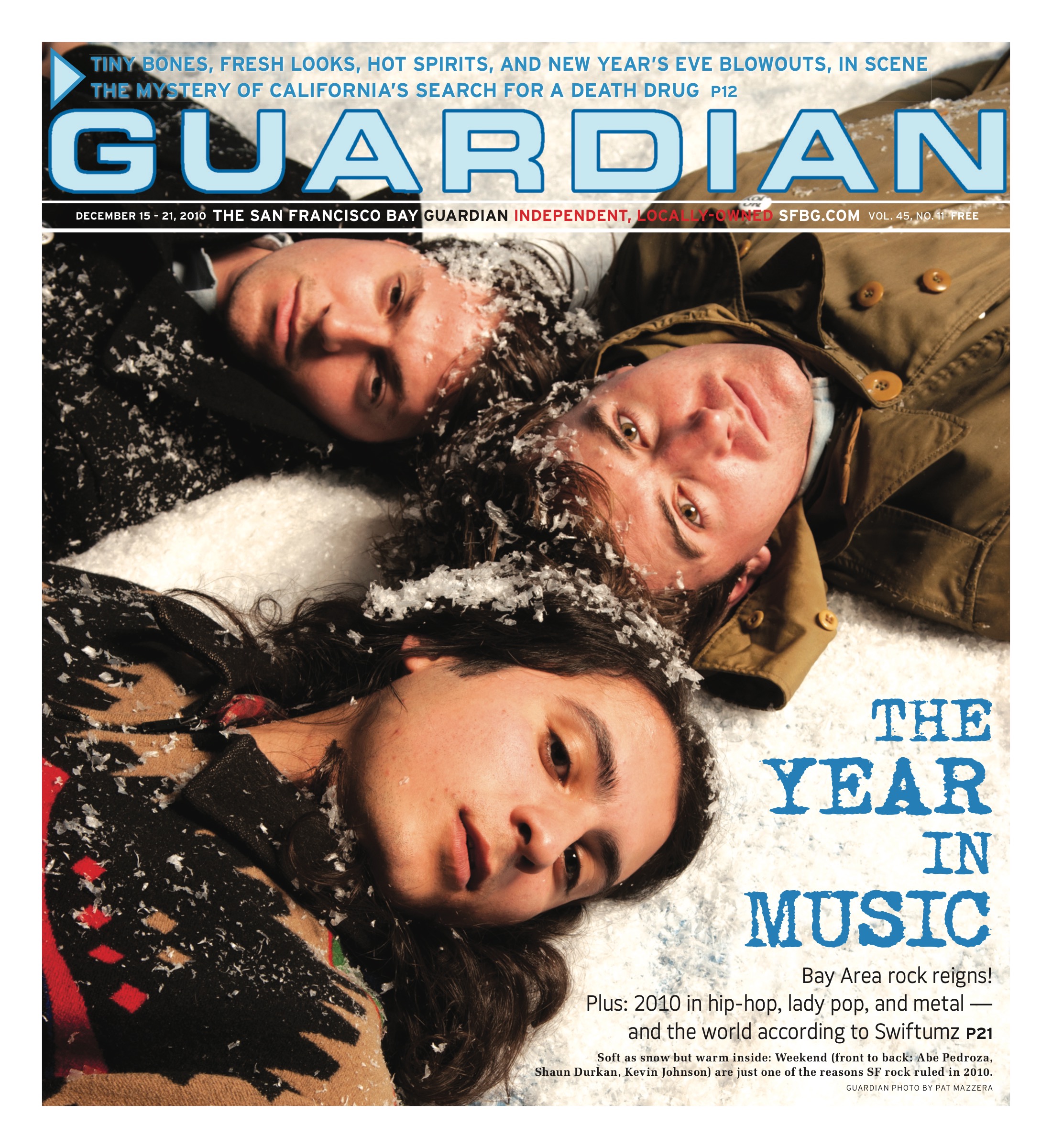
YEAR IN MUSIC The past year brought dozens of excellent albums, and hip-hop sounds topped the list. This wasn’t inevitable. Please recall 2009, when critics cited precious little rap in their favorites, save for Raekwon’s Only Built 4 Cuban Linx … Part 2 and Mos Def’s The Ecstatic. But in 2010, both rockists and heads reserved space for Kanye West’s My Beautiful Dark Twisted Fantasy, Big Boi’s Sir Lucious Left Foot: Son of Chico Dusty, the Roots’ How I Got Over, Drake’s Thank Me Later, and Flying Lotus’ Cosmogramma. And let’s not forget minor but important recordings such as Curren$y’s Pilot Talk and Yelawolf’s Trunk Muzik 0-60.

This winning slate confirmed that major label-backed rap is undergoing a renaissance. Nearly every artist made an impact by keeping their eye on the mainstream, from security guard-turned-bad actor Rick Ross recruiting Erykah Badu and Cee-Lo Green for his Teflon Don, to Bun B allowing Canadian teen idol Drake to call himself an “honorary member of UGK” on the former’s Trill O.G. Some complained that these rappers focused too much on claiming the hearts of soccer mama grizzlies and teens raised on Bratz dolls. But after years of boorish thugs peddling D-boy anthems and R&B gimmicks, this new pop sensibility sounded refreshing. (The sole exception may be Ludacris, who found success with Battle of the Sexes by offering a slick and familiar mix of strip club anthems and babymaker suites.)

B.o.B’s The Adventures of Bobby Ray was the most extreme product of these pop mirages. The Atlanta rapper scored two No. 1 hits (“Nothin’ but You” and “Airplanes”), but divided critics and fans by recruiting emo-rock burnout Rivers Cuomo and Hot Topic heroine Hayley Williams for his collection of gooey ballads. At its best, The Adventures of Bobby Ray had a charming innocence; at worst, it sounded like pandering. But at least it offered well-written tunes. In contrast, Nicki Minaj’s grating Pink Friday mashed bad 1980s John Hughes-approved synth-pop and soaring Rihanna choruses into a barely coherent mess. It proved that despite Nicki’s talent for ear-catching stunts, from her star turn as the bisexual chick who’ll do you and your man on Usher’s “Lil’ Freak” to her cipher-destroying rhymes on Kanye West’s “Monster” and Ludacris’ “My Chick Bad,” she was still a disappointingly underdeveloped songwriter.

Lost in the intense debate over the rap major domo was the demise of Definitive Jux. Once the mighty inheritor to the Fondle ‘Em tradition of B-boy nonconformity, and the source of key early-2000s works by Cannibal Ox, Aesop Rock, and Mr. Lif, it sagged under the weight of subpar and underpromoted releases before label head El-P mercifully pulled the plug last February. The news lit up the Internet for a day or two and then was seemingly forgotten. When Noz from cocaineblunts.com asked Yelawolf if he was “heartbroken” over Definitive Jux’s demise, the Alabama rapper answered: “I didn’t even know it ended. Well … I’m not heartbroken about it.” How ironic that Yelawolf was once a lyrical-minded backpacker too, before switching to gritty tales of deep South meth dealers.

There were other disturbing signs that Definitive Jux’s indie-rap scene was no longer ground zero for fledging MCs, from conscious rap advocates Little Brother breaking up, to Minneapolis freestyle ace Michael “Eyedea” Larsen dying at the tragically young age of 28. “Underground rap is dead,” noted Sean Fennessey in a Pitchfork essay hyping Los Angeles collective Odd Future. “In its stead, a different brand of homespun rappers have taken hold. Consider Lil B and Soulja Boy, who have been prolifically working the Web … to achieve their own kind of teenage heroism.”

Underground rap is not dead. It thrives with Bay Area imprints such as Interdependent Media (Truthlive’s Patience) and national players such as Duck Down Records (Skyzoo & Illmind’s Live from the Tape Deck) and Alpha Pup Records (Nocando’s Jimmy The Lock). Some of these labels subsist on scattershot independent distribution. Others recruit majors to achieve wider market penetration, including Stones Throw and EMI Label Services (Guilty Simpson’s OJ Simpson and Aloe Blacc’s retro-soul gem Good Things), and Decon and E1 Music (Black Milk’s Album of the Year). And who can blame them? These days, labels need all the help they can get. However, the principal philosophy of economic and artistic independence as an end unto itself has been forgotten.

In Robin D.G. Kelley’s 2002 book Freedom Dreams, a rapturous appreciation of 20th century black intellectualism, he writes, “Unfortunately, too often our standards for evaluating social movements pivot around whether or not they ‘succeeded’ in realizing their visions rather than on the merits or power of the visions themselves. … And yet it is precisely these alternative visions and dreams that inspire new generations.” Kelley could have referred to the many critics that marked Little Brother as hopelessly elitist for insisting that hip-hop should address more than the spoils of drug wars; dismissed the late Eyedea, Sage Francis, and others as silly white boys for addressing suburban middle-class concerns; and buried Definitive Jux as a repository of uncool, impossibly dense super-scientific lyricism.

By many measures, the indie-rap scene has been a failure. Unlike the network of homespun labels built by punks in the 1980s, the indie-rap scene didn’t create a thriving community without considerable financing from youth-targeting corporations, lifestyle brands, and advertising firms. And perhaps its denizens wrongly castigated dirty South rappers as ignorant, claimed that mainstream superstars like Jay-Z and Diddy were sell-outs, and turned the underground movement into a kind of purity test — all past conflicts that continue to bedevil it today. Yet these dreamers courageously imagined hip-hop culture as not only a way to entertain people and make money, but as a transformative experience that can help instill positive growth and change lives. They built a culture that holds key lessons for future rap generations.

The blog-rap generation doesn’t hold any illusions of being alternative, unless it’s manufacturing limp blasphemy like Odd Future’s use of Nazi imagery. (As Anti-Defamation League spokesman Abraham Foxman told The New York Times in a story on the Holocaust documentary Shoah, “To most kids growing up today, Hitler could be Genghis Khan.”) They’ll use any trope to be successful, from falsely claiming that they’re coke barons to bragging about their limited-edition sneaker collection and how much weed they smoke. There’s a gleeful egalitarianism in their digital miscellany. The beats bang but are same-y and indistinct, and the voices are barely distinguishable. As Wiz Khalifa simply said on his breakout single, “Black & Yellow”: “You can do it big.”

Some critics separated wheat from chaff with technical criteria such as internal rhyme schemes and double-time flow, as if MCs were ice skaters or guitar wankers. But the best artists simply illuminated their money hunger by any means necessary, effortlessly adding interesting twists to tired rap clichés. When Drake crooned on Thank Me Later, “I want this shit forever, man,” he evoked a poor man’s Nat King Cole. And when Curren$y ranted, “A gee is what I am, a jet is what I be” like a Southern Popeye on Pilot Talk II, he was insistent enough that you almost believed him.

And then there was Kanye West and My Beautiful Dark Twisted Fantasy. He created a spectacle out of an hour-long justification for his obnoxiousness, invited the genre’s biggest stars to support his meanderings on chauvinism and virility (or “my black balls”) and, most provocatively, continued a public call-and-response with Gil Scott-Heron. The conversation began with West’s sampling of Scott-Heron’s melancholy “Home Is Where the Hatred Is” for his 2005 album Graduation. Then Scott-Heron replied by using West’s “Flashing Lights” melody for “On Coming from a Broken Home,” the bittersweet coming-of age tale from Scott-Heron’s valiant yet muddled comeback, I’m New Here.

West ended Fantasy by sampling a large section from Scott-Heron’s 1970 spoken-word performance “Comment #1,” and retitling it “Who Will Survive in America?” The poem originally captured the COINTELPRO era and the U.S. government’s eradication of black radicals, but West seemed to use it for a different point. Perhaps he’s saying that fame serves as a protective armor against systemic racism and how “at the airport they check all through my bag and tell me that it’s random.” Or maybe he’s making a wry comment on celebrity culture as the only way to survive in America. Fantasy‘s cryptic epilogue perfectly summarized this year’s rap dreamers, lost in the pop Matrix.

John Lennon, whirled peas, and the British art of tea making

2

Yoko Ono’s op-ed tribute to John Lennon in the New York Times today got me tearing up, as I remembered that horrible day, thirty years ago, when I heard that Lennon had been assassinated. I was in my early twenties and still living in England at the time, working in an inner-city school in Birmingham, and I remember feeling that his murder marked the death of my own generation’s innocence.

But as Ono points out in her sweet and funny tribute, Lennon’s untimely demise did not result in him being erased from the collective consciousness.
“People are not questioning if he is here or not,” Ono writes. “They just love him and are keeping him alive with love.”

Ono begins her tribute by revealing that Lennon was the tea maker in their relationship, a role he apparently assumed by dint of his being British.
“Yoko, Yoko, you’re supposed to first put the tea bags in, and then the hot water,” Lennon advised Ono, only to admit later that he had been doing it all wrong.
“I was talking to Aunt Mimi this afternoon and she says you are supposed to put the hot water in first. Then the tea bag,” Lennon said, a revelation that made them both crack up.

Ono’s account reminded me of my father, who was the official tea maker in my family and died overnight of a brain hemorrhage, 33 Christmases ago. A veteran of World War 11 who sailed on a miner sweeper with the Royal Navy, Daddy polished his shoes and made the tea each morning, before walking to the station at a brisk clip to catch the train to London, where he worked as an advertising executive, one of Britain’s original “mad men.”

I remember his morning tea-making ritual, because I was required to skip and do press-ups before breakfast, as part of Daddy’s training of his daughters as up and coming young tennis players. (My older sister was the real athlete, a tom boy who grew up playing rugby, I was the overweight book worm, and we both got forced to play tennis, a sport we became proficient in, but ditched at the end of high school, sick of the endless competition and parental pressure.)

I knew each morning that it was time to grab my skipping rope, when I’d hear the tea kettle whistling. According to Daddy, the proper way to make tea began with heating the water to an extended boil, then pouring it into empty tea cups and tea pot so as to warm them. Next, Daddy would place the water back on the burner to boil again, and spoon tea leaves (one spoon per person, plus one for the pot) into the warmed, but now emptied of water, pot.

Next, Daddy would pour boiling water over the tea leaves, cover the pot with a tea cozy (a little woollen hat with holes for the pot’s spout and handle) and let it stand for three minutes for a weak cuppa, longer for a stronger brew. Then he’d empty water from the warming tea cups, pour in the tea, and add milk and sugar. His method made a great cup of cha—and Daddy would often torment us by standing there and drinking it, in gutsy lip-smacking sips, in between telling us that we needed to skip faster and do an extra twenty push-ups, and perhaps some sit-ups, if he thought we were slacking.

I didn’t always appreciate my father while he was alive, but I loved him. And I still miss him to this day and I’m thankful for the things he taught me, including tea making. The same goes for Lennon. I didn’t always like everything he did, but I loved his music and what he stood for and I still miss him to this day, and I’m thankful for the message he brought to the world. Even though, according to Ono, he didn’t really know how to make tea.

The prop. 8 hearing

2

Watching the hearing was a couple of hours well spent; it’s not often that you get to see an actual live oral argument before a federal appeals court. And it’s not often that you get to see three judges, not all of them liberals by any stretch, take apart the fundamental claims of the anti-gay-marriage folks.


There’s a nice live-blog and analysis here.


One of the most interesting elements in this case is the possibility that the legality of same-sex marriage in California may hinge on whether a deputy clerk in Imperial County has the right to represent the people of California in a legal appeal. See, the governor and the attorney general usually defend state laws when they’re challenged in court, but in this case, both Arnold Schwarzenegger and Jerry Brown declined. In essence, they both said they thought Judge Vaugh Walker’s decision overturning Prop. 8 was just fine.


So the supporters of Prop. 8 have to make the case they have legal “standing” to appeal — and the judges seemed more than a little dubious about that. The political group that backed Prop. 8 was in trouble from the start, and couldn’t really demonstrate what legal authority it had to handle the appeal. The deputy clerk from Imperial County, which has a population of 166,000, argued through her lawyer that she would have to sign marriage certificates, and that Prop. 8 directly affects her job. That didn’t get very far, either. And if the appeals court tosses the case on the standing issue, nothing else matters. Walker’s ruling is affirmed and same-sex marriage is legal in California.


Then to the meat of the case. Judge Hawkins instantly asked Charles Cooper, attorney for the Prop. 8 proponents, if the voters of the state of California could legally amend the state Constitution to re-segregate the public schools. Cooper: No. The point was pretty clear: The voters have the right to amend the Constitution, but not in a way that violates fundamental rights.


Cooper went on with what rapidly devolved into lunacy, eg: “When a relationship between a man and a woman becomes sexual, society has a profound interest.” In other words, a man and a woman have sex; they might conceive a child, who might be born “out of wedlock” and raised by a single parent, which would be a bad thing. Judge Reinhardt: That’s a good argument for prohibiting divorce — but isn’t really on point here.


Theodore Olson, representing the plaintiffs, pretty much knocked it out of the park in his first few minutes, noting that California has effectively engineered discrimination into the Constitution by eliminating a right that the U.S. Supreme Court has said repeatedly (14 times, according to Olson) is fundamental. He pointed out that in Lawrence v. Texas, which overturned the sodomy laws, the U.S. Supremes determined that sexual conduct between consenting adults of any gender is protected. So how, he asked, can you take away marriage rights because of a Constitutionally protected activity?


Since the Prop. 8-ers have argued that same-sex marriage would force children to have “a premature interest in sexual activity,” Olson suggested that the court would have to “ban comic books, video games and conversations with other children.”


The judges, as is typical, interrupted all the lawyers to ask questions — until Theresa Stewart stood up, representing the San Francisco City Attorney’s Office. She was sharp, quick on her feet, perfectly prepared — and for most of her short presentation, the judges simply listened. Her point: When it comes to children, family law in California treats same-sex couples and opposite-sex couples precisely and exactly the same; why should marriage be any different?


In the end, what I saw was three judges struggling not with the outcome of the case — Walker’s decision seems likely to be upheld — but with how broad they want the final decision to be. Based on the questioning at the end, it seemed as if they’d rather uphold Walker’s ruling without making a sweeping statement that gay marriage is Constitutionally protected and must be the law of the land everywhere in the United States.


But unless they try to duck the real issues and rule only on standing, that’s going to be a stretch. Any honest, logical ruling can only come to one conclusion — that treating lesbians and gay men differently than straight people violates the Equal Protection provisions of the U.S. Constitution. And if the Supreme Court agrees, it will be the end of gay marriage bans, the end of Don’t Ask, Don’t Tell and the beginning of a new era in America.


UPDATE (thanks to Nichole Dial for research);


Lots of news media coverage on the some good, some lame. The Prop. 8 Trial Tracker website had some of the best breaking stuff. The Mercury News did a live blog by Howard Mintz that was full of details. SF Weekly covered the more amusing accounts such as the crowd outside the court room.  The Bay Citizen also had a live blog and analysis.


Brian at Calitics had one of the best quick analyses and the Chron’s Bob Egelko came out with a really fast story that touches on the major themes of the case.


The AP postings on the Huffington Post covered the highlights as well as an overview of the background of prop 8. The New York Times used the same article, then later added a short, fairly superficial piece by Jesse McKinley  (what, the Times had no live blogger on this?)


Amazing data: How taxes used to be

3

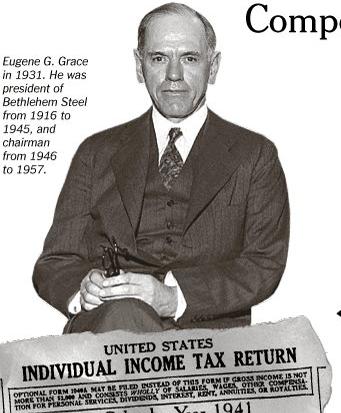
The New York Times has a truly amazing graphic presentation of how the rich used to pay taxes. Check out the image here. The data comes from old IRS filings, made public through the National Archives. They show, for example, that in 1941 — PRIOR to the WWII tax hikes — Eugene Grace, the president of Betehem Steel and one of the highest paid Americans, earned $522,637 (the equivalent of about $7.5 million today), had an adjusted gross income of $336,953 — and paid 66 percent of it, or $114,902, in federal income taxes. Thomas Watson, the president of IBM, paid 69 percent of his AGI in taxes.


Back then, the top marginal tax rate was 81 percent.


And guess what? Those folks were still very rich, still worked hard, still built big companies and created the most poweful economy in the world.


In fact, I could argue that it was precisely BECAUSE OF those high marginal rates that America grew so prosperous in what are now seen as the good old days.

Editor’s notes

2

Tredmond@sfbg.com

The New York Times, the old established voice of the liberal media elite, ran a piece on Sunday looking for answers to the nation’s persistent economic crisis. Reporter David Segal interviewed prominent economists on the left and right — the likes of John H. Cochrane at the University of Chicago, James K. Galbraith at the University of Texas, even Gar Alperowitz at the University of Maryland, who’s kind of (God help us) a socialist.

The right-wingers talked about the need to cut government, the left-wingers talked about community co-ops and green technology, and all sides agreed that the situation was dire and would probably get worse. But nobody even mentioned wealth inequality.

It’s kind of mind-boggling. It’s as if the entire subject is off the table, taboo, something that doesn’t get discussed in the company of polite economists. And that’s just crazy.

Look: the 400 richest Americans today have combined assets of about $1.5 trillion. Raise that number to 5,000 and you can about double the total wealth. This is a very rich country; our prospects aren’t bleak at all. With a bit of enlightened public policy, we could profoundly improve the economic situation in just a few months.

I have no PhD. I barely escaped Wesleyan University with an economics degree in 1980, squeaking out a D in my last class by promising the (very conservative) professor that if he failed me, I’d be back next year. But it doesn’t take econometric wizardry to add up the figures. They go like this: A one-time 20 percent wealth tax on the 5,000 richest Americans — including many people who have pledged to give away half their wealth anyway — would generate about $600 billion. Nobody would miss any meals; no families would lose their homes, or even their second or third homes, or their personal jets. Expand the pool a little and you could easily reach $1 trillion.

With that money, you could immediately create 7 million jobs (at an average of $50,000 a year) and fund them for three years. That would cut the unemployment rate in half. What would those people do? Plenty. They could rebuild the country’s roads and highways and bridges, and build high-speed rail systems, and work in health care clinics, and teach art and music and writing, and clean up environmental messes … there’s loads of work in this country. And even with a modest estimate of the economic multiplier, those 7 million public sector jobs would create another 3 million private sector jobs, and all of a sudden, the country’s booming again. And a lot of those people who were hired by the government could now transition to private business. (And those very rich people would do well in the boom, as they always do, and might even make most of their money back.)

Raise taxes on the top 5 percent of the nation’s wage earners and corporations and you would generate enough money to keep the program going until the private economy could pick up the slack. Then eliminate the Social Security tax on the first $25,000 of income and expand it to cover all income up to $250,000 and suddenly — a huge incentive for small businesses to hire new workers and a stable retirement system for the next two generations.

It’s not that hard. It’s not a socialist revolution. Nobody really gets hurt, and a lot of people benefit. I mean, it seems to me that it ought to be part of the discussion. Maybe that’s why I was such a lousy economics student.


Ragazza

0

paulr@sfbg.com

DINE Ragazza is the younger sorella of Sharon Ardiana’s Gialina in Glen Park and, as is so often the case with siblings, the two restaurants do and do not resemble each other. Much of the differences are traceable to the respective neighborhoods. Glen Park (where we find Gialina) has in recent years become an annex of city’s baby belt, whose big, shiny buckle is just over the hill in Noe Valley. Kids like pizza, and Gialina has fine pizza, along with a selection of pastas, a roast or two, and a selection of contorni. Eating at Gialina is a little like waiting to check in for a flight on Southwest Airlines: the environment is lively, lighthearted, and swarming with small children. (Shouldn’t shrieking children be flown on their own airline, perhaps Screaming Babies Airways, with a big screaming baby head painted on the tail of every plane. But if they want to eat at Gialina, okay.)

Ragazza, by contrast, brings haute pizza culture to a vortex of the Haights (lower and upper) and NoPa that so far shows few signs of turning into kiddieland. The restaurant opened recently in a space that’s worn quite a few masks over the past decade; 10 years ago, it was a bistro called Metro Café, then became a fine Nepalese restaurant called Metro Kathmandu, reverted briefly to Metro Café, and now this.

There is nothing distinctive about the mid-block, storefront setting. The glowing red paint scheme of the Kathmandu era has been dialed back to milder earth tones. Otherwise, the look of the restaurant is little different. (In this aesthetic continuity, too, Ragazza differs from its older sibling, whose neglected space was heavily made over before its opening in early 2007.)

Ragazza’s menu is somewhat less pizza-pie-centric than Gialina’s. The new place offers a number of antipasti choices and small plates, along with several roasted items. (Gialina offers one antipasto and one roast.) You could make do very nicely here without having a pizza at all. But the bulk of the clientele seems to understand Ragazza to be a pizzeria at heart, and so the pies emerge from the kitchen in a steady stream, with at least one seeming to turn up on virtually every table. It’s like watching a quarterback spread the ball around to eight different receivers.

Although Ragazza doesn’t offer Gialina’s fabled chili-bomb pizza, the aptly named atomica, it does have a spicy pie of its own, the moto, fired with Calabrian chilis. (These have an aromatic fume all their own and haven’t really been given their due.) The amatriciana pizza ($16), festooned with a sunny-side-up egg, also offered a noticeable nasal kick. And even the pies that aren’t armed with chili heat tend to be bracingly fragrant — a potato version ($15), for instance, topped with red onion and gorgonzola cheese and liberally laced with thyme. No hint of starch overload here, despite the potentially smothering presence of the spud.

Herbal perfumes, along with chili heat, are a recurrent theme. We were particularly aware of the oregano breath wafting from a crock of corona beans ($6) simmered with oven-roasted tomatoes. Oregano is the quintessential pizza smell, but I’d never come across corona beans before and, from their pale chubbiness, would have guessed them to be cannellini or flageolet. They’d been cooked just right and still offered nominal tooth resistance before yielding an interior creaminess.

Purely creamy, on the other hand, was the soft polenta ($9). Polenta can be bland, and it is sometimes enlivened by sautéed mushrooms and gorgonzola — and given Ragazza’s obvious gusto for big flavors, I wouldn’t have been surprised to find those players here. Instead the boost came from a medallion of tomato mascarpone cream, freighted with basil and set atop the polenta like a rosette.

The real test of any restaurant’s food is whether it can hold your attention even if, say, Mark Zuckerberg is sitting at the next table, making moony eyes with a comely ragazza. Was that really Mark Zuckerberg at the next table, an actual person as opposed to the character in the movie The Social Network and the subject of far too much quacking in the key of same from The New York Times’ waddling line of op-ed ducks? We weren’t sure. Zuckerberg is said to live in the wilds of the Peninsula, sleeping on a mattress on the floor of some faceless apartment, just as Jerry Brown did during his first go-round as governor. Yet there he was — maybe — in Ragazza, having come for the girl and stayed for the (pizza) pie. He didn’t friend us, alas, alack. *


RAGAZZA

Dinner: Sun.–Thurs., 5–10 p.m.;

Fri.–Sat., 5–10:30 p.m.

311 Divisadero, SF

(415) 255-1133

www.ragazzasf.com

Beer and wine

AE/MC/V

Noisy

Wheelchair accesssible

50 cute-as-heck gifts for $10 and under

3

Our official metaphor for holiday shopping this season is just going to have to be Tron. Not just because Tron: Legacy opens Dec. 17 or because some of us are forever stuck in totally awesome adolescent ’80s video game world. We also must zip across the alien landscape of holiday commercialism, snatching up neon-fantasy presents (and possibly exploding). Go! Go! Go!

Or, you know, use this guide and pick up some killer giftos all in one easy trip. We scoured the city for cool items ringing in at 10 ducats and under. Yes, you can still wear an electric blue bodysuit. (Marke B.)


JESUS FLASHLIGHT, $4.99

Tutti Frutti

With the exception of millions of Jews, Buddhists, Muslims, Hindis, and Zoroastrians, Jesus is lighting up the world these days. And what better way for your Xian friends to keep His light flowing than this Jesus flashlight. Pair it with a Jesus pen; we’re pretty sure this is the pen Jesus would have used.

718 Irving, Inner Sunset, SF. (415) 661-8504


DYNA GRO PLANT FOOD, $5.95

Plant’It Earth

Since Prop. 19 flopped at the polls, it’s back to dealer-only cell phones and GIY smokes. Give your dealer or favorite organic grower this perfect 7-9-5 blend of plant food and help nourish the next crop (you’ll be paying for it anyway). Plant’It Earth also has grow lights, soil, and other no-Prop. 19 essentials.

661 Divisadero, Panhandle, SF. (415) 626-5082, wwwplantitearth.com


SQUEAKY TOY SQUIRREL, $3.99

The Animal House Pet Mercantile

As the movie “Up” taught us, if dogs could talk, their conversation would go something like this: “Squirrel!” Give Bowser this plush toy Squirrel!, which will last way longer than a real Squirrel! and not stink up your house. Animal House also has cat toys, but your cat won’t give a shit.

157 Fillmore, Lower Haight, SF. (415) 552-0233, www.theanimalhouse.com


“MEDITATING” SIGN, $7

San Francisco Zen Center Bookstore

Tired of hearing your beloved shriek “Shut the #$%@* up, I’m meditating!” when you inadvertently stumble onto your deck at 6:30 a.m.? End it with this calligraphy sign, which can be hung from a doorknob or from the back of your beloved’s neck. Back it up with a book on Zen.

300 Page, Hayes Valley, SF. (415) 863-3136, www.sfzc.org


HOT DOG TOTE, $4.99

Arch Art Supplies

The sandwich rectangle, the pizza triangle, the hamburger round — all are inadequate for toting le hot dog. End the long-standing and justifiable frustration of your frankfurtin’ friends with this washable, reusable, hot dog-specific tote. Pick up the chips bag to go with it, or maybe some drafting or graphics supplies.

99 Missouri, Potrero Hill, SF. (415) 433-2724, www.archsupplies.com


BRANCH 3-WAY SPLITTER, $10

Zinc Details

‘Tis the season for sharing — but only if you want to and only if you have the technology. To make others share with you, give your BFF (or No. 1 frenemy) this 3-way music splitter and put an end to the nasty talk about how 3-ways don’t work. Zinc Details has plenty of other nifty stuff that can be done as a two-way or one-way.

1905 Fillmore, Pacific Heights, SF. (415) 776-2100, www.zincdetails.com


FROMAGE BLANC, $4.50

Cowgirl Creamery

So “some of your best friends are Jews” and you feel bad because you know Santa won’t go there. Make amends for years of no Santa with this fromage blanc, which is way better than regular cream cheese and not from Philly. Add a tub of hand-clabbered cottage cheese for their blintzes, kugels, and whatever else it is Jews eat.

1 Ferry Building, #17, Embarcadero, SF. (415) 362-9354, www.cowgirlcreamery.com


“STUBBY” HAMMER, $4.99

Cole Hardware

We believe that, like hemlines in other realms, a mini or micro version of the Utilikilt is due out any day now. And when that happens, utilidudes will need scaled-down, “stubby” versions of their tools to make it all work (and boy do these tools work). Cole Hardware also has stubby pliers and wrenches.

956 Cole, Cole Valley, SF. (415) 753-2653, wwwcolehardware.com


FELT FLOWERS, $7

Samsara

Why buy blooms destined for the dustbin for your loved ones when you can score them these long-lasting buds? Samsara’s small sales floor is packed with small treasures imported from the Far East. Pick up a colorful woven headband or Indian lotus wooden stamp for the yogi on your list.

2035 Union, Marina, SF. (415) 563-5485


BOBINO CABLE BUDDY, $3.99

Under One Roof

Many a hook-up mood has been ruined waiting for the hookee to disentangle three feet of earphone wire from a fly or brassiere. Stop the madness with the Cable Buddy, which keeps cords neatly wrapped and out of the way. And get few extra for those cords you know you’ll get ensnared in at the hook’s house.

518 Castro, Castro District, SF. (415) 503-2300, www.underoneroof.org


ECO-BAG, $1.75

Ichiban Kan

It’s not a competition, but your my-eco-bag-is-more-eco-than-your-ego-bag pals will love this Japanese-made eco bag. The bag comes in six different patterns, all groovy enough to go with all their hemp outfits. Ichiban Kan also has bento boxes, lunch bags, and knit panda hats.

22 Peace Plaza #540, Japantown, SF. (415) 409-0472, www.ichibankanusa.com


SPORK, $4

Flight 001

Your peripatetic pals can’t help it if they find themselves casting off plastic utensils everywhere they go. Detox them with the Spork, a durable, washable spoon-fork-knife in one. The brightly-colored utensil is guaranteed to make fellow travelers say “go Spork yourself” to disposables. Flight 001 also has clocks, bags, and bagatelle for the traveler.

525 Hayes, Hayes Valley, SF. (415) 487-1001, www.flight101.com


NOE VALLEY APIARIES, $7.95

The Green Arcade

Give your honey bun some fresh-baked honey buns made with honey from Noe Valley Apiaries. Better yet, give your honey bun the whole jar and she can drink it herself. The limited-edition honey is unfiltered and antibiotic-free. Or get a book on beekeeping while you’re at this perfectly curated, eco-centric store so you can give your honey bun her own hive someday.

1680 Market, Hayes Valley, SF. (415) 431-6800, www.thegreenarcade.com


CERAMIC ROSE, $5

Xapno

Put an end to the chronic “Yes, I loved the roses you gave me last week but now they’re DEAD” statements with this ceramic rose. Baked by a local ceramics artist and available with or without a stem, the roses come in lovely shades of pink, ivory, peach, and lavender. Xapno can also set you up with a vase or ribbon to set it off.

678 Haight, Lower Haight, SF. (415) 863-8199, www.xapno.com


GLASS STRAW, $9

GlassDharma

The glamour girls and boys who won’t drink coffee or red wine with you anymore because it stains their teeth need to get back to reality with one of these glass straws. (Buh-bye, BriteSmile.) Ensure that they bring it with them to your next drinking game by getting them bamboo carrying case as well.

Online only. (707) 964-9350, www.glassdharma.com/straws


CLASSIC SOUL AND R&B MIX CDS, $10

Rooky Ricardo’s Records

Diehard record collectors love to dig through crates of dust-covered vinyl searching for elusive, long-out-of-print song 45s. Rooky Ricardo’s is perfect for them (cool old singles for around $3!) — and for those of us who just want to hear some awesome music without the stiff back and neck (or record player). A sweet selection of classic soul, pop, and R&B mix CDs culled from Rooky’s collection will get your sweet ones humming.

448 Haight St., Lower Haight, SF. (415) 864-7526, www.rookyricardos.com


TOPOGRAPHIC TRAIL MAPS, $8–$9.50

Sports Basement

This holiday season, tell your loved ones to take a hike. A handy trail map of southern Marin ($9.50) combined with the 76 Marin Headlands bus can easily help them rediscover the glorious nature beckoning just outside the Golden Gate. Also at Sports Basement: Nalgene PBA-free water bottles start at $8.50.

1590 Bryant St., SoMa, SF. (415) 575-3000;

610 Old Mason St., Presidio, SF. (800) 869-6670, www.sportsbasement.com


SWEETIE PIE PRESS BUTTONS PACK, $6 FOR 3

Rare Device

Who doesn’t love buttons? No one. They’re a quick, easy way to customize your backpack, hat, coat, scarf, whatever. And even when they’re designed by artists, they’re still cheap. Sweetie Pie buttons are produced as series by designers using security envelopes, reclaimed silk-screened posters, and other recycled materials. There’s a ton of individuality in each pack, so grab more than one.

1845 Market St., Hayes Valley, SF. (415) 863-3969, www.raredevice.net


ICE CREAM GIFT CERTIFICATE, $5

Three Twins Organic Ice Cream

Give a special gift of sweet, sweet empty(ish) calories. Using only organic ingredients, Three Twins scoops up incredible flavors like milk and honey, lemon cookie, chocolate peanutbutter cookie, or the exotic Dad’s Cardamom. With a $5 certificate, your giftee can choose between two teensy ice cream cones or a pint to munch on at home while watching 30 Rock on Hulu.

254 Fillmore St. Lower Haight, SF. (415) 487-8946, www.threetwinsicecream.com


THE WALKING DEAD COMIC, $2.99

Al’s Comics

Do you have a friend literally salivating and moaning for next week’s The Walking Dead episode on AMC? Satisfy their zombie craving with an issue of the original comic book series (now at issue #78). And since comic books are Hollywood’s favorite source material for summer blockbusters these days, Al’s Comics is probably going to have 2013’s summer action blockbuster of the year… right now!

1803 Market St., Hayes Valley, SF. (415) 861-1220, www.alscomicssf.com


FAKE MUSTACHE, $9.95

Costumes on Haight

If there’s one thing everyone should own, it’s a mustache. It might just be the most useful gift you could ever give. Who knows when your recipients may need to change identities quickly, appear as an authority figure, or even just get really really handsome instantly. Costumes on Haight provides ‘staches for any need or hair color. Spirit gum’s an extra $2, but you’ll earn that back quickly at 10 cents per ride.

735 Haight St, Lower Haight, SF. (415) 621-1356. www.costumesonhaight.com


LONELY PLANET PHRASEBOOK $8.99

Get Lost Books

Your perennially-traveling friend always seems to have the most fabulous stories to recount. But the on-the-ground truth is probably a lot less romantic, with miscommunications, bad directions, and an unintentional slur or two. Swing by Get Lost Books for a handy Lonely Planet phrasebook they can take with them when they do. No more ignorant American oopsies for them (and possibly a lot more sex).

1825 Market St., Hayes Valley, SF. (415) 437-0529. www.getlostbooks.com


ZING! LAUNCHING SPOON, $5 and SOUPER! SPOON ACTION FIGURE, $10

New People

Naughty uncle gifts alert: New People’s got the goods for meal avoidance — a spoon that doubles as a superhero and another that spring-launches broccoli. Hand off to the nearest tyke, then duck (the wrath of the li’l ones’ parents). Tokyo pop culture mall New People is an amazing one-stop source for quirky, beautiful lifestyle accessories like dope headphones and separated toe socks.

1746 Post, Japantown, SF. (415) 525-8600, www.newpeopleworld.com


MINI BURRO PIÑATA, $7.99

SF Party

This party donkey’s cool to get behind — the recipient will be stoked by his party-pumping bustability. (Hint: stuff with mini bottles.) SF Party’s got what you need for instacheer — peep the local store’s decorations and holiday flair for ways to trick everyone into thinking you’re festive.

939 Post, Tenderloin, SF. (415) 931-9393, www.sfparty.com


IGNITE ME MASSAGE CANDLE, $10

Good Vibrations

You already know that Good Vibes is the top spot for fun, sexy, and horizon-expanding gifts for your sweetie (or prospective sweetie). These two ounces of scented soy wax set the mood for a little post-mistletoe vida loca. Just light the candle and it melts into massage oil.

Various locations, SF. www.goodvibes.com


HOT CHOCOLATE SET, $10

Sweetdish

Looking for a wintertime wonder amid Sweetdish’s happy racks of rare and delicious candies? Try their hot chocolate sets, packaged here in San Francisco: Taza drinkable chocolate disks and a Japanese ceramic mug and spoon are included in this power punch for the holiday sweet tooth. While you’re there, pick up some locally made Poco Dolce chocolate — the burnt toffee ($6.50 per pack) is to die for.

2144 Chesnut, Marina, SF. (415) 563-2144, www.thesweetdish.com


TRAVEL-SIZE BUTCH BODY SPRAY, $8

This one’s fun for sending a pleasant mixed message: “They want me to butch it up when I’m on the go, but with a body spray?” Forunately, one sniff of this enticingly spicy scent will ax all doubts, and the travel-spritzing will begin in earnest. (Also available: floral Femme and tangy Original scents.) Local-centric beauty product makers Nancy Boy provides line after line of scrumptious freshness.

347 Hayes, Hayes Valley, SF. (415) 552-3802, www.nancyboy.com


LASER MONEY DEVICE, $7

Misdirections Magic Shop

When your teenager wants to expand his trick repertoire beyond lighting farts, it’s time for a magic laser money device. With practice, your teenager can create money out of nothing, just like the Fed! It’s also the perfect comeback to “You can stop washing the dishes when you start making money.” Misdirections has other magic galore.

1236 Ninth Ave., Inner Sunset, SF. (415) 566-2190, www.misdirections.com


PERSONALIZED INITIAL STICKERS, $5

Toss

Toss designs its own classy prep looks, which will hit the spot for any beachy babes within striking distance of your gift list. But if the pretty handbags and frothy dresses are too spendy, cop the store’s style with embroidered stickers that’ll customize any existing satchels your bronzed beauty swings over their shoulder.

2185 Chestnut, Marina, SF. (415) 440-8677, www.tossdesigns.com


ORIGAMI FAST FOOD SET, $3.95

Paper Tree

Fold-your-own hamburger, shake, and fries for … what, your vegetarian sister? Meat-loving Uncle Mark? Paper Tree’s aisles of origami kits — paper and laughably cryptic Japanese instructions included — range from make-your-own meals to puppy dogs and finger puppets, and make a fantastic offering for any of your friends who dream of creating their own world.

1743 Buchanan, Japantown, SF. (415) 921-1700, www.paper-tree.com


HAMBURGER KITCHEN TIMER, $8

Park Life

Too bad hamburgers don’t go in the oven, ’cause that would be the funniest thing ever with this plump, juicy-looking thing! (The joke might work with Hanukkah sufanganiyot, too.) Park Life’s a neato outpost of cleverly designed artifacts and nom-nom art, with something for everyone, but mostly really cool everyones.

220 Clement, Richmond, SF. (415) 386-7275, www.parklifestore.com


SOURCE ZINE, $3

Needles & Pens

Locally published advice on fermenting, planting, and all kinds of other stuff makes a swell gift for your favorite urbanite interested in sustainably downsizing for 2011. Needles & Pens stocks indie clothes and jewelery designs, as well as racks of zines from fresh local artists and doodlers.

3253 16th St., Mission, SF. (415) 255-1534, www.needles-pens.com


EYE-MELTING WALL CALENDAR, $3

Little Otsu

Calendars can be so … quantifying. Leave it to craft wonderland Little Otsu to make date-finding creative again. Pick up this cheaply had bit of creativity designed by Ron Regé Jr., for the nonlinear thinker on your list, or browse the racks of Otsu’s recycled material stationary and precious T-shirt designs.

849 Valencia, Mission, SF. (415) 255-7900, www.littleotsu.com


CANTAINER BICYCLE CUP HOLDER, $10

Gravel and Gold

Because nothing goes better than bikes and bevvies — they’ll cruise into golden, road soda (we mean coffee, of course!) glory with an American-made bike cup holder masterpiece from this beautiful, sunny Mission store, whose shelves of hip handmade treasures take the crass consumerism straight out of your holiday shopping.

3266 19th St., Mission, SF. (415) 552-0112, www.gravelandgold.com


PISTACHIO BAKLAVA, $7.95

Sumiramis Middle Eastern Imports

Score flaky, made-in-the-Bay filo dough holiday meal or gathering treats at this fantastical, low-key grocery store, which stocks all things Mediterranean from hookahs to halvah. Your lucky guests will wonder where you got it. (Make like you had to go further than 26th Street and Mission.)

2990 Mission, Mission, SF. (415) 824-6555


DE LA ROSA CANDY, $3.69

Casa Guadalupe

These crumbly peanut marzipan gems are a recognizable staple of Latino bodegas, but the red rose on their 30-pack carton wouldn’t look out of place alongside brightly wrapped presents under a Hanukkah bush.

2999 Mission, Mission, SF. (415) 824-2043


RHINESTONE INITIAL EARRINGS, $10

Good Fellows

Reward those who’ve been nice through 2010 with this customizable bling — they can wear their sparkly identities on their lobes! Because you know you have a friend who will be more impressed if you tell them you got their present from a head shop. And Good Fellows has a dispensary in the back if your giftee’s on the very, very good list.

473 Haight, Lower Haight, SF. (415) 255-1323


YUMMYPOCKETS PB&J ITEM HOLDER, $9.50

Therapy

Stuff the mouth of their wallet — money tastes good again with this disturbingly realistic peanut butter and jelly sandwich billfold. Therapy’s got the goods when it comes to gifts for the young fashionista on your list — another great choice is their faux-Guate coin purses ($10), decorated with colorful embroidered patterns that call up your trip last year to Lake Antigua.

Various location, SF. www.shopattherapy.com


THE SNOWY DAY, $6.99

Lola of North Beach

Lit love for the soon-to-be-bundled little one. The illustrations in this new board edition are as stunning as they were when Caldecott winner Ezra Jack Keats published the original book in 1962. Lola’s is a great gift stop for chic families — Mom and Dad included — on your list.

1415 Grant, North Beach, SF. (415) 781-1817, www.lolaofnorthbeach.com


HOMEMADE SPINACH PASTA, $2.95 PER POUND

Molinari Deli

Step around the display arrays of Italian fruitcakes and brightly-wrapped candies up to this old school neighborhood joint’s deli case. You can buy the hostess with the mostest a peck of that finest green — a skein of house-made spinach noodles. Maybe she’ll even invite you back for a holiday-themed pasta feed.

373 Columbus, North Beach, SF. (415) 421-2337


TRAVELS WITH GINSBERG: A POSTCARD BOOK, $9.95

City Lights Books

Ginsberg in Benares, Ginsberg in Venice, Ferlinghetti in SF — this book of postcards is the perfect bon voyage present for your favorite wanderlustful loved one. Include a card urging that one of the notes makes it back to you when the L.O. has a spare moment. City Lights, as well all know, has the best and brightest in O.G. Beat lit as well as today’s hottest book titles.

261 Columbus, North Beach, SF. (415) 362-8193, www.citylights.com


CHOPSTICK KIDS CHOPSTICK HELPER, $10

Aldea Niños

Get ’em going on noodle bowls young with these playful pinchers. Soon enough, your tyke will be ready to slurp udon with the best of them. Aldea’s newly opened children store stocks all the finest in sustainably made baby products. For another cheap, fun gift, try the wooden fish castanets, whose clacking teeth with make a flamenco fiend of any toddler.

1017 Valencia, Mission, SF. (415) 874-9520, www.aldeababy.com


SUCCULENT CANDLES, $6

Current

Oof — they couldn’t even keep last year’s astrophytum kicking? Lower the ante and reignite the light with this cacti candle. Current also stocks natural beauty products and small vases made to be tied up in a beautifully wrapped, color coordinating gift box. Indeed, many of its offerings already are, perfect for the gift-and-go.

911 Valencia, Mission, SF. (415) 648-2015


MR. LACY SHOELACES, $2.50

Shoe Biz

Sure, your buddy’s got style — but are their Technicolor kicks looking technically mussed and scuffed? You can brighten the load for any sneaker kid with these ties, which sit alongside Shoe Biz’s fantastic selection of boots and slippers and are available in a lacy rainbow of shades.

Various location, SF. www.shoebizsf.com


CHARDONNAY ANCHOVY STUFFED OLIVES, $6.95

We Olive

Does it get more posh than Chardonnay anchovy-stuffed Californian olives? No. And they taste good too! We Olive’s racks of California olive products, from tapenade to lip balm, will tickle the palate of any gourmand on your list. Plus, the store has samples that will sate you for hours. Squirt a dab of their transcendent olive oils on a bread cube and get shopping.

2379 Chestnut, Marina, SF. (415) 673-3669, www.weolive.com


ALBUM COVER NOTEBOOKS, $9.95

Green Apple Books

Giving new meaning to the words “liner notes,” these repurposed record sleeves have been transformed into the keepers of your giftee’s nascent raps and lovelorn lyrics. Green Apple has three floors of books and an annex of every stripe and flavor, so plan on getting lost for a few days — and emerging with an armful of amazing finds for everyone on your gift list.

506 Clement, Richmond, SF. (415) 387-2272, www.greenapplebooks.com


FOUR-INCH SUCCULENTS, $7

Succulence

Haworthia, aeonium, echeveria, oh my! Snag one of these flower-producing enduring plants from this cacti shop — it even stocks two-inchers for the true budget gifty. Succulence also sells unique pots and frames, so your loved one’s new plant buddy will be looking dapper indeed.

402 Cortland, Bernal Heights, SF. (415) 282-2212


MAGIC WAND $6

Fiddlesticks

Yes, this is really just a smallish wooden star at the end of a thinnish wooden rod. We will not argue! But the star comes in such pretty colors, and the simple wooden-toyness of it conjures up childhood loveliness. Plus, hello — instantly anyone becomes a fairy princess or Harry Potter! Cool tyke hotspot Fiddlesticks has an array of neat matching outfits and other magical doo-dads.

508 Hayes, Hayes Valley, SF. (415) 565-0508, www.shopfiddlesticks.com


CHOCOLATE BAR WITH POPPING ROCKS

Oh, Christopher Elbow, chocolatier to the stars! Your gem-colored, bite-sized, often Bucky Dome-shaped chocolates tend toward adventurous flavors like Venezuelan spice, rosemary caramel, and spiced pear. But you keep it real with our favorite quick trip back to childhood: the Christopher Elbow chocolate bar No. 6. A thick slab of dark chocolate bursting with popping candy rocks? Chocolate plus fun equals win.

401 Hayes, Hayes Valley, SF. (415) 355-1105, www.elbowchocolates.com


OWL-SHAPED MUG, $8.99

Kamei Housewares and Restaurant Supply

Who-who can’t resist a cup of joe from a lovable owl? Kamei’s got what you need in terms of high class, unique kitchenware on the cheap. It also has out-of-the-kitchen objects — check by the front door for a stack of beautiful paper parasols for the promenading perambulator on your list.

525-547 Clement, Richmond, SF. (415) 666-3699


FELT MUSHROOM, $6 AND $8

Lotus Bleu

Let’s spend the holidays shrooming! For your most cherished permagrinner (or possibly Smurf) come these beauties, small and large, in orange, gray, brown, and blue combinations. Made of sustainable wool by a couple in Nepal, these squishy caps fit perfectly in your hand — and also fit right in with Lotus Bleu’s dazzlingly patterned, natural fabric goods aesthetic.

325 Hayes, Hayes Valley, SF. (415) 861-2700, www.lotusbleudesign.com


TAKENOTSUYU YUKI HONOKA “SILENT SNOW” SAKE, $8

True Sake

True Sake was recently anointed by The New York Times as a true original, a gem of a space specializing in nothing but sakes. Seriously, dozens of gorgeous bottles and wildly diverse flavors await you here. Our pick is this super-cute, super-fresh, super-smooth sake. Wine is so passé — put a little bow on one of these beauties and come off sophisticated.

560 Hayes, Hayes Valley, SF. (415) 355-9555, www.truesake.com

Film Listings

0

Film listings are edited by Cheryl Eddy. Reviewers are Kimberly Chun, Michelle Devereaux, Peter Galvin, Max Goldberg, Dennis Harvey, Johnny Ray Huston, Louis Peitzman, Lynn Rapoport, Ben Richardson, and Matt Sussman. The film intern is Ryan Prendiville. For rep house showtimes, see Rep Clock. For first-run showtimes, see Movie Guide at www.sfbg.com. For complete film listings, see www.sfbg.com.

OPENING

The Blue Tower Smita Bhide’s debut film, The Blue Tower, part of the 3rd I South Asian International Film Fest, begins with Mohan (Abhin Galeya) in the sort of loveless marriage that has become a standard cliché. It’s unnecessary to give any reason why the relationship is failing; as a viewer I accept it just as easily as I realize that with the introduction of Judy (Alice O’Connell), a young white nurse working for Mohan’s overbearing Auntie, Mohan will have an affair. However, this predictable fare, like a straight version of My Beautiful Laundrette (1985), takes a dark turn about halfway through, as every character and plot point emerges as more nefarious and twisted than originally imagined, and Mohan finds himself in a situation full of Lynchian perversion and Kafkaesque disorientation. The boldness and speed at which developments occur shifts the deadpan, suburban drama into a black-humored, grotesque ride — the sort you half want to stop, and you half want to see where it’s going. (1:25) Castro. (Prendiville)

*Brutal Beauty: Tales of the Rose City Rollers Focusing on Portland-based league Rose City Rollers, Chip Mabry’s Brutal Beauty offers some insights into the recent roller derby revival. The documentary follows the league travel team’s attempt to make it to Nationals over the course of the 2009 season. Ultimately though, the narrative really isn’t all that exciting (spoiler alert: they don’t make it very far). The real heart of the movie lies in the backgrounds and interviews of the tatted-up, foul-mouthed, dyed-haired derby girls from teams like the Break Neck Betties and Guns ‘N’ Rollers. Their personalities and stories of how derby helped shatter their ideas of self-expression and traditional gender norms helps keep the majority of the film’s 80-minute running time interesting, even when the action is not. (1:20) Red Vic. (Landon Moblad)

Butte, America: The Saga of a Hard Rock Mining Town This documentary follows the life and death of a great American mining town, following Butte, Montana’s rise as a mining town through to its inevitable environmental collapse. Once home to one of the world’s largest (and most dangerous) copper mines, Butte saw an influx of immigrants drawn to “the richest hill on earth.” Its story is definitely rich in terms of subject matter, particularly with the town’s role in the labor struggle; it could easily be the background for great early 20th century stories (as is the case with Atlantic City in HBO’s current Boardwalk Empire). But Butte, America is decidedly not cinematic, despite the voice-over narration by Gabriel Byrne, and is better suited to PBS than the big screen. (1:06) Victoria. (Prendiville)

Carlos Carlos, Olivier Assayas’s biopic of Ilich Ramírez Sánchez, a.k.a. Carlos the Jackal, begins with a warning, that while the film is the subject of historical and journalistic research, “relations with other characters have been fictionalized.” In other words: there be contradictions ahead. But I suppose that’s the least you can expect when you’re watching a 330 minute theatrical miniseries that gives the rock ‘n’ roll biopic treatment to a terrorist who, under an alias, professes “the pleasure of doing one’s duty in silence.” Much of this is intentional, questioning the convictions of extremists. One particularly well-shot scene involves Carlos (Édgar Ramírez) sexually dominating a cell member, only moments after she admits to being a German feminist. After about four hours, though, the intellectual irony begins to feel more like a filmmaker attempting to cover his bases. Carlos is an idealist, but also a sellout. An egalitarian revolutionary, but also a sexist bigot. (And so vain.) Still, the film, full of actors speaking a bevy of languages and propelled by a international punk rock soundtrack, manages to be engaging. Keep in mind, though, that the miniseries was originally aired in three parts, and viewing Carlos in one sitting should be left to the cinemasochists. (5:30) Sundance Kabuki. (Prendiville)

Due Date Robert Downey Jr. and Zach Galifianakis star in this Todd Phillips-directed road trip movie. (1:35) Four Star, Presidio, Shattuck, Sundance Kabuki.

*Fair Game Doug Liman’s film effectively dramatizes yet another disgraceful chapter from the last Presidential administration: how CIA agent Valerie Plame (Naomi Watts), who’d headed the Joint Task Force on Iraq investigating whether Saddam Hussein had WMDs, was identified by name in the Washington Post as a covert agent — thus ending her intelligence career and placing many of her subordinates and sources around the world in danger. This info was leaked to the press, it turned out, by highest-level White House officials as “punishment” for the New York Times editorial former ambassador Joe Wilson (Sean Penn) — Plame’s husband — wrote condemning their insistence on those WMDs to justify the Iraq invasion by then already well in progress. (The CIA task force had also found zero evidence of mass-destruction weapons, but Bush and co. chose to come up with their own bogus “facts” to sway US public opinion.) Purportedly, Karl Rove clucked to CNN’s Chris Matthews that Wilson’s awkwardly-timed dose of sobering truth rendered his spouse “fair game” for exposure. Unfortunately opening here several days after it might theoretically have done some election-day good — not that many Republican voters would likely be queuing up — Fair Game may be a familiar story to many. But its gist and details remain quite enough to make the blood boil. While the political aspects are expertly handled in thriller terms, the personal ones are a tad less successful. That’s partly because we never quite glimpse what brought these two very busy, business-first people together; but largely, alas, because so many of Wilson’s diatribes come off all too much as things that might be said by Sean Penn, Rabble-Rouser and Humanitarian. This is perhaps a case of casting so perfect it becomes a distracting fault. (1:46) Embarcadero, Sundance Kabuki. (Harvey)

For Colored Girls Sprinkling many tears and Janet Jackson’s blue steel throughout his high-camp, muy melodramatic adaptation of Ntzoke Shange’s For Colored Girls Who Have Considered Suicide When the Rainbow Is Enuf, Tyler Perry deserves at least an E for effort in attempting to bring Shange’s choreopoem masterpiece to the screen. The result is a free-floating, somewhat tortured contemporary collection of vignettes centered on a clutch of African American women residing in an Harlem apartment building — a structure that remotely evokes an early Wong Kar-Wai omnibus like Days of Being Wild (1991), sans the narrative ambiguity and sublime cinematography — with its “colored girls,” each representing a hue in Shange’s rainbow, occasionally pouring out the poet’s original verse. Crystal (Kimberly Elise) appears to have it the hardest, burdened with an abusive baby daddy (Michael Ealy), a veteran dealing with Post Traumatic Stress Disorder. Dance teacher Yasmine (Anika Noni Rose) is the beacon of positivity who finds her trust horribly betrayed. Tangie (Thandie Newton) is the saucy slut, baby sister Nyla (Tessa Thompson) is the good girl with a secret, and their mother Alice (Whoopi Goldberg) is the building’s extremely annoying holy roller. Overseeing all is the apartments’ de facto matriarch Gilda (Phylicia Rashad), safe sex activist Juanita (Loretta Devine), and social worker Kelly (Kerry Washington). Oh, yes, and there’s Miss Jackson, who plays the leather-tough, magazine-editing devil wearing Prada, and spends most of her time looking wrecked about possibly ruining her makeup with an actual facial expression. Yes, they will survive, hey, hey, and though Perry may not have been the best moviemaker to adapt Shange’s groundbreaking work, a few of his players, particularly Newton and Elise, rise above the rainbow with wrenching, scene-stealing performances. (2:00) (Chun)

Honest Man: The Life of R. Budd Dwyer Everyone of a certain age or with morbid curiosities has heard of R. Budd Dwyer, thanks to the very public way he died — by committing suicide at a televised-live press conference. The 1987 footage, of a portly middle-aged man with anguish in his eyes and a finger on the trigger, has been recycled in a number of contexts; thanks to the internet, it’s now freely viewable for shock value more than anything else (the incident created a controversy as to how much should be shown during news replays — when Dwyer takes out the gun? When he sticks it in his mouth?) Along the way, who Dwyer was, and why he shot himself, have kind of been lost by the general public. However, as director James Dirschberger discovers, the Pennsylvania politician’s widow, children, colleagues, and even the man whose testimony lead to a conviction in Dwyer’s corruption trial have never forgotten him. Honest Man suggests that Dwyer was actually innocent, but decided in despair to end his life before he’d been removed from office, thus allowing his family to collect full benefits. The full story will probably never be known, but Honest Man‘s attempts to show the man behind the gruesome film clip are sincere, if couched in the understanding that he’ll always be first associated with his infamous, well-documented death. (1:16) Red Vic. (Eddy)

*Megamind Be careful what you wish for, especially if you’re a blue meanie with a Conehead noggin and a knack for mispronunciation and mayhem. Holding up hilariously against such animated efforts as The Incredibles (2004) and Monsters, Inc. (2001), Megamind uses that nugget of wisdom as its narrative springboard and takes off where most superhero-vs.-supervillain yarns end: the feud between baddie Megamind (voiced by Will Farrell) and goody-two-shoes Metro Man (Brad Pitt) goes waaay back, to the ankle-biter years. They’ve battled so often over intrepid girl reporter Roxanne Ritchi (Tina Fay) that she’s beyond bored by every nefarious torture device and disco crocodile the Blue Man throws at her. When Mega finally, unexpectedly vanquishes his foe, he finds himself with a bad case of the blues. With the help of his loyal Minion (David Cross), he decides to change the game and create his own worthy opponent, who just happens to be Roxanne’s schlubby cameraman (Jonah Hill). Chortles ensue, thanks to the sarcastic sass emanating from the Will and Tina show, although the 3-D effects seem beside the point. The resemblance to this year’s Despicable Me is more than a little passing, from the bad guy on the moral turnaround to the adorable underlings, but Megamind‘s smart satire of comic hero conventions, its voice actor’s right-on riffs, and the rock and pop licks on the soundtrack make it the nice and nasty winner. (1:36) Presidio, Sundance Kabuki. (Chun)

*Monsters After a NASA space pod bearing samples of extraterrestrial life crashes in northern Mexico, a large swath of the now massively walled-off U.S. border area becomes an “Infected Zone,” with frequent unpleasant contact between humans and giant octopus-like creatures. Photographer Andrew (Scoot McNairy) is reluctantly charged with delivering his publisher’s daughter Sam (Whitney Able) to safety. Unfortunately, things do not go as planned. The duo find themselves making a dangerous journey northward straight through the Zone, right at the start of an annual “migration season” that always makes the critters especially ornery. Just as 2009’s District 9 commented obliquely on Apartheid, Gareth Edwards’ feature similarly riffs on our own illegal-alien debate. But there’s no need to look for deep meanings here. Taken as a slow build (sometimes a little too slow) toward the inevitable perils, Monsters is a successfully low-key, lower-budget spin on aspects of The War of the Worlds, Cloverfield (2008), The Mist (2007), etc. Those looking for lots of graphic horror-fantasy content may be frustrated, but on its own terms the film is creepy and credible enough. (1:33) California, Lumiere. (Harvey)

*36 Quai des Orfèvres It’s taken six years for this major French policier to get a proper U.S. release, which is a little strange considering its genre appeal and lack of conflict with an English-language remake (Martin Campbell, director of 2006’s Casino Royal, might make one within the next couple years). Leaving for another post, Paris’ Chief of Police (Andre Dussolier) wants to wrap things up tidily before he goes, and that means nailing the violent gang that’s been robbing armored trucks and killing their guards. Though he’d prefer his post be inherited by the honorable Leo Vrinks (Daniel Auteil) rather than the latter’s ex-friend, shamelessly ambitious and underhanded Denis Klein (Gerard Depardieu), internal politics necessitate he give it to whichever man and his team end this crime spree. When a con (Roschdy Zem) gives Vrinks a tip — albeit under seriously compromising, blackmail-ready circumstances — it seems the murderous gang will be caught under his supervision. Drunk and raging with envy, Klein pulls a stunt that has catastrophic consequences. Yet a chance windfall allows him to turn things to his advantage, and greatly against Vrinks. To a point the story is very loosely inspired by events that actually occurred in the mid-1980s, when director-writer Olivier Marchal was a Parisian cop. His script (penned in collaboration with three others) is intricate and dramatic, with some startling twists of fate; the casting, which includes a number of other leading French actors, is impeccable. 36 has been called a Gallic Heat — though it lacks the visually and thematically epic, larger-than-life qualities Michael Mann provided that film. Which leaves it a very good story competently executed, but not the great movie it could have been. (1:51) Roxie. (Harvey)

Tibet in Song It’s often a bad sign when directors are subjects in their own documentaries. With Tibet in Song, Ngawang Choephel has good cause to disprove this theory. In 1995, he returned to Tibet for the first time since fleeing with his mother as a child. An ethnomusicologist and Fulbright scholar, he wanted to record traditional Tibetan music. Instead he was arrested, lost half his footage, and charged with spying, eventually serving six years in jail. Tibet in Song is the completion of his original project, and although the director does give due attention to the circumstances of his own story, it’s always within the larger context of the music, as a culture is being held captive by Chinese pop and propaganda. As Choephel argues that the traditional Tibetan music has been manipulated to change the country’s identity generation by generation, we don’t just hear the music, but understand what it means. (1:26) Lumiere, Shattuck. (Prendiville)

ONGOING

Cairo Time (1:29) Opera Plaza.

Conviction (1:47) Empire, Piedmont, SF Center.

*Easy A (1:30) Shattuck.

Enter the Void (2:17) Lumiere.

*The Girl Who Kicked the Hornet’s Nest If you enjoyed the first two films in the Millennium trilogy — 2009’sThe Girl With the Dragon Tattoo and The Girl Who Played With Fire — there’s a good chance you’ll also like The Girl Who Kicked the Hornet’s Nest. Based on the final book in Stieg Larsson’s series, the film begins shortly after the violent events at the conclusion of the second movie. There are brief flashes of what happened — the cinematic equivalent of TV’s “previously on&ldots;” — but it’s likely an indecipherable jumble to Girl first-timers. Hornet’s Nest presents the trial of Lisbeth Salander (Noomi Rapace), the much-abused, much-misunderstood, entirely kick-ass protagonist of the series. With the help of journalist Mikael Blomkvist (Michael Nyqvist) and his sister Annika (Annika Hallin) as her lawyer, Lisbeth finally gets her day in court. The conspiracy that drives the story is somewhat convoluted, and while it all comes together in the end, Hornet’s Nest isn’t an easy film to digest. Still, it’s a well-made and satisfying conclusion to the trilogy — as long as you caught the beginning and middle, too. (2:28) Bridge, Embarcadero, Piedmont, Shattuck, Smith Rafael. (Peitzman)

Hereafter (2:09) Empire, Marina, 1000 Van Ness, SF Center, Shattuck, Sundance Kabuki.

Inside Job (2:00) Embarcadero, Shattuck, Sundance Kabuki.

It’s Kind of a Funny Story (1:51) 1000 Van Ness, Shattuck.

*Jackass 3D (1:30) 1000 Van Ness.

*The Kids Are All Right (1:47) Red Vic.

*Leaving Few beauties — French, English, French-English, or otherwise — have managed the transformation Kristin Scott Thomas has, in using her considerable beauty to convey unfathomable hunger. In this romantic thriller with a touch of Madame Bovary and more than a dab of noir, Scott Thomas is Suzanne, the efficient if somewhat taken-for-granted wife of a doctor (Yvan Attal, director of 2001’s My Wife Is an Actress and Charlotte Gainsbourg’s partner), whose marriage resembles a business arrangement more than a love match. The couple enlist Catalan ex-con Ivan (Sergi Lopez) to build an office for her budding physical therapy practice, and after a minor car accident, Ivan falls into Suzanne’s care, and as she grows to care more deeply about him, an affair begins. Director Catherine Corsini’s tough-eyed look at what follows — concerning the economics of marriage and the price of one woman’s individuation and passionate choices — calls to mind women’s melodramas of the ’40s and ’50s, though Corsini renders her oft-told tale of awakening with considerably less heavy-handedness and minimal condescension. That approach and Scott Thomas’ performance — the movie almost turns on the motionless, slowly evolving look in Suzanne’s eyes when she realizes what she must do — makes Leaving a departure from your average coming-of-liberation romance. (1:30) Albany, Clay. (Chun)

Let Me In (1:55) Four Star.

Life as We Know It (1:52) 1000 Van Ness.

*Mademoiselle Chambon (1:41) Opera Plaza.

My Dog Tulip (1:22) Smith Rafael.

Never Let Me Go (1:43) Four Star, Lumiere.

*Nowhere Boy (1:37) Opera Plaza, Shattuck.

Paranormal Activity 2 (1:45) California, 1000 Van Ness.

Red (1:51) 1000 Van Ness, SF Center, Sundance Kabuki.

Saw 3D (1:31) 1000 Van Ness.

*Secretariat (1:56) 1000 Van Ness, SF Center.

*The Social Network (2:00) Empire, Marina, 1000 Van Ness, Sundance Kabuki.

Stone (1:45) Opera Plaza.

The Town (2:10) 1000 Van Ness, Presidio, SF Center, Shattuck.

*Waiting for “Superman” (1:51) Piedmont, SF Center, Shattuck.

Wall Street: Money Never Sleeps (2:13) Presidio.

You Will Meet a Tall Dark Stranger (1:38) Albany, Opera Plaza, Presidio.

How they’re sitting

182

caitlin@sfbg.com

I’ve been hanging out with the Haight Street kids. Over the course of a week or so, I smoked weed, drank malt liquor, witnessed nasty run-ins with police officers — all events that anyone who has walked down the sidewalks of that legendary street would expect. But I also met people who’d give away their last dollar to a friend, people who know a thing or two about community, and people who don’t see sidewalks only as thoroughfares to commerce.

Ironically, though the homeless kids on Haight are the explicit inspiration for Proposition L, the sit-lie measure on the Nov. 2 ballot, their voices have been significantly absent from the vitriolic debate on its merits and faults. Ironic because of all people, it’s these young men and women — and the citizens of San Francisco who interact humanely with them — who could teach us the most about what public space in San Francisco could be.

I didn’t just stand with a notebook, fire questions, and walk away. I took a seat and spent time with the kids, to see for myself whether its true that they’re harassing people, letting their dogs run amok, and generally ruining everyone’s lives as much as sit-lie supporters say they are. That it turned out to be uplifting was an added bonus. I got to see what many don’t on their way to shop for souvenir bongs, retro dresses, and designer skateboards — the reason young people from around the country come to the neighborhood.

It doesn’t have anything to do with fancy Victorians and boutiques, which may explain the disconnect between the street kids and their detractors. They come for the legacy of individuals brave enough to slough off social mores that Haight-Ashbury residents are so ostensibly proud of — not to mention the companionship of others who are comfortable with their rejection of and by society. They come to share stories and pipes and encouragement, and it was cool to watch a streetscape in San Francisco that wasn’t geared solely to commerce.

And while the young people I talked to told me how much they liked to travel, to live free of convention and without ties to the workday world, after a while most acknowledged that they had left behind families who couldn’t or didn’t care for them, home situations that were uncomfortable enough to make life on the streets seem like a better alternative.

Although violent incidents, uncivil behavior, and threatening dogs are well-documented by other news sources, I didn’t see any of that when I was hanging out on Haight. That doesn’t mean that these things don’t exist — but it might suggest that some of the strident supporters of Prop. L are seeing what they want to see.

SPANGING

Steven, who asked us not to use his full name, is 20 and homeless. He grew up in Stockton, became a welder after high school, then decided he “didn’t want the hassle” of staying put for a wage job. His fingernails play host to an ungodly amount of dirt, but his tight blonde curls, pretty golden eyes (“they look like a lion’s!” says one friend in amazement) and mellow, generous demeanor make him a popular hub among his homeless peers.

It doesn’t hurt that he sells weed, small amounts at a time to passing tourists and acquaintances. He silently passes a pipe around to his companions with the slightest provocation. Steven approached me on the street before he knew I was a journalist, a fact that seemed to make little difference to him.

He says he came to the Haight “for the people,” for the area’s reputation of open souls and unconventional artists that originated in the glory days of Janis Joplin and the Grateful Dead. Like most of the kids I talked to, he eschewed the often dangerous shelter scene to sleep in Golden Gate Park or nearby Buena Vista Park despite the police surveillance that could result in spendy fines for park camping.

Although Steven’s worldly possessions fit into the large camping backpack he carries with him 24 hours a day, and even though he’s been living on Haight less than nine months — broken by a jaunt to Eugene, Ore., where he found it “too rainy” to join the town’s expansive street kid community — he doesn’t plan on being homeless forever. It’s just that nothing about this economic climate inspires him to sell his freedom for a paycheck. He plans to go to a four-year college eventually. He sees an education as the only way to get a “real” job. “But until then, why not do this?” he asks. I’m not sure if he’s waiting for my answer.

“This” is sit on Haight Street and “spange,” the term used for “flying a sign” and asking shoppers and neighbors walking by for money, often in a creative way. Of the many crimes street kids are guilty of in the eyes of supporters, spanging is the only one Prop. L would effect.

If Francisco voters approve it, anyone who sits or reclines on the sidewalk (with exceptions for the handicapped and those with permits — but not for the tired, workers on breaks, or people waiting for buses) will be subject to a fine of $50 to $100 for the first offense and $300 to $500, or a maximum of 10 days in jail, for someone found guilty twice within 24 hours of unduly supporting his or her body on the sidewalk between 7 a.m. and 11 p.m. Similar laws can be found up and down the West Coast — although Portland’s was pulled from the books last year after being found unconstitutional because it targeted the homeless.

I ask street kid after street kid why they’ve chosen this lifestyle. Many wouldn’t have it any other way. “Why do people want us off the street?” says Oz, a 21 year old from upstate New York who deals alongside Steven. “Probably because they can’t do this themselves.”

Though I’m skeptical at first, after a while I see why the unconventional group of “travelers” on Haight choose to spend their time spanging. Conversations get struck up with the most unusual people — the old hippie who bought a new Mad Hatter cap for the weekend, the suburban woman who might or might not like to buy some weed (she can’t decide). When a few businesses ask us to move so they can sweep the sidewalk or clear a doorway, the street kids I’m watching relocate with little protest. Many who walk past Steven seemed to find humor in his sign, which that day reads “Are you one paycheck away from having this be your job too?” He says he likes to switch his message daily. “Keep it fresh.”

By hanging out with the spangers, I get to see a Haight Street with human interaction at its core. People walk by, often dropping off surprisingly generous gifts: a ex-Grateful Dead roadie with a massive beard who lives in Fairfax and stopped by the neighborhood for a quick lunch with his daughter parks in front of Steven’s group and approaches them. “You kids hungry? You look like you could use a pizza.”

He emerges a half-hour later with a large cheese pie and drives away after chatting for a few minutes about the old days, to the glee of the group (many of the street kids are Dead Heads). The kids eat their fill, then start handing out the remaining pizza to people walking by, a comic role reversal. “I like to support the community — they get back all the money they get sucked out of them,” Steven tells me.

“NARCOTIC FUELED, ANTISOCIAL THUGS”

The campaign to put a sit-lie ordinance into effect in San Francisco kicked into gear with a Saturday morning stroll. As San Francisco Chronicle columnist C.W. Nevius — who regularly publicizes complaints against the Haight street kid culture — reported Feb. 27, Mayor Gavin Newsom recently relocated to the neighborhood and saw evidence of drug use on the main stretch of Haight where he was walking with his infant daughter. “As God as my witness, there’s a guy on the sidewalk smoking crack,” Newsom reportedly said.

The mayor threw his support behind a sentiment already being voiced by the Haight Ashbury Improvement Association, a resident-merchant alliance in the area. HAIA sees the street kids as disruptive outsiders. “These are not the flower children of the 1960s. It’s narcotic fueled, antisocial thugs who act like a quasi-gang,” Ted Loewenberg, president of the association, was quoted as saying in Business Week.

Adds the Prop L website: ” … the Haight-Ashbury district — once synonymous with peace and love — this corridor is now a hot spot for street bullies, pit bulls, and drug abuse.” It’s a deft cultural lobotomy that dissociates drugs from the Summer of Love, and a devious one that implies that street kids weren’t major players in that social revolution.

As for the bullies, I didn’t see any violence from the street kids in the days and nights I spent out on Haight Street.

I couldn’t get cops to talk to me about it, either. There were two police officers on foot traversing Haight’s main strip and I introduced myself when they stood chatting with a coffee shop owner in the afternoon sunshine and asked them about the sort of neighborhood complaints they regularly received about the street kids.

“No comment,” Cop No. 1 told me. Okay, Cop No. 2, your thoughts? “I don’t speak English.”

To my requests that they share their view of crime on Haight, I could get one response: “It’s complicated.” Later, when I returned to write down their badge numbers, they were standing silently, staring at a lone young man sitting against a wall next to his skateboard. The kid was looking at the ground. Eventually they handcuffed him and put him in a police car while he pleaded meekly about it “only being a little bit of weed — and I was only skateboarding on the sidewalk.”

The most aggression I witnessed from any party took place while I was tapping my feet to a group of traveling bluegrass musicians performing around 10 p.m. on a Thursday. Their cover of Del Shannon’s “Runaway” had inspired an older homeless man to strike up a curiously graceful stomp dance on the sidewalk. He was so drunk and fully immersed in the music that the bottle of Jim Beam in his flailing hand didn’t even register when the police officer approached him and asked, “What do you think you’re doing?”

The musicians began to pack up. “I could have told you this would happen 20 minutes ago,” one tells me, nodding toward the old man. “Don’t say a word or I’ll fucking take you in,” said the cop, who poured out the half-full bottle and wrote a ticket for the older man, who had made a few feeble protests that ended abruptly with the cop’s obscenity.

The officer said he’d received a complaint about the music, a line I heard from each cop I came into contact with on Haight — including one officer who cautioned a family with a toddler to pack up the bracelets they were selling to pay the towing charges on their van. “People don’t like to see people with kids out here, you better move it along,” the cop said.

“I’ve seen aggression because people start shit,” Steven tells me when I ask him about his experience with street violence. A man has just walked by chanting “dirty, dirty” in Steven’s and his friends’ faces. “They don’t like to see people sit on the ground.”

“There are people who come down here just to make themselves look better,” chimes in Oz. “Like ‘ha ha ha, I have air conditioning.’ All kinds of people start shit”

I asked if they knew they were the focus of a massive political debate in San Francisco. “No, what debate?” asked Steven.

“You mean sit-lie?” Oz asks. “It probably has to do with tourism. I don’t see why else they would do that.”

Even the most well-known recent case of Haight Street violence — which was reported June 11 by New York Times reporter Scott James as having “inspired a grass roots movement” that propelled Prop. L, seems to be a question of mutual aggression on the two sides of the street kids issue.

The story goes that a man named Thomas was hosing down the sidewalk in front of his house — a practice that is growing more common in the Haight to make property inhospitable to the homeless. He found himself “surrounded and engaged in a heated confrontation,” as James reports. Thomas reportedly shouted “Do you want a piece of me?” and a scuffle erupted between him and Chad Potter, a 26-year old homeless man, culminating with Potter being arrested and set free the next day. Thomas says Potter and friends continued to harass him after the incident.

James Orr, 24, is busking with his flute when I meet him sitting by a store that sells flowing hippie skirts and bumper stickers that command future tailgaters to “Coexist.” He’s looking to trade his wind instrument for a banjo, which he plays in addition to guitar. A rolling stone, Orr is in town for the Hardly Strictly Bluegrass festival that weekend — he travels the country going to festivals, and even scored a job recently at upstate New York’s Mountain Jam for the event’s blog site, taking photos with a borrowed camera of performances by (ex-member of The Band) Levon Helm and Michael Franti.

Orr’s quite erudite and eager to “say something articulate” about the situation of the street kids and travelers on Haight. He tells me that yeah, he’s seen aggression go down here on occasion. But he resents those situations leading to laws against sitting on the street.

“It’s another example of the few that do mess up casting a bad light on everyone else. Most of us just want to make some money, put a smile on someone’s face.” As a busker, he finds it baffling that people who are against the presence of the homeless would want him to stop plying his trade by making sitting illegal. “You should point out also that it’s how we make money!” he exclaims.

THE PIT BULLS

Snarling ruffians on frayed rope leashes stalking the city streets! As evidenced by the Civil Sidewalks campaign, dogs — specifically pit bulls — are another source of controversy on the pavement. Last December, SFist identified a C.W. Nevius tirade against the breed as example of its ongoing feature “Pit Bull Hate Watch.” The paper has pointed out that the demonized dogs can make great members of society and are often the subject of a media smear campaign.

But for many homeless youth, their dogs aren’t the means of imposing chaos on the gentry. They keep them for the same reasons we do: friendship, protection, love — and during the days I spent on Haight, it was a pleasure to pat the doggies while interviewing their owners. Most were as gentle and laid back as the kids they sprawled next to, a reasonably expected result from the 24 hours a day of socialization with humans that the homeless lifestyle affords.

Smiley is an inveterate street kid unlikely to go indoors anytime soon. “I don’t know how to do anything else,” she tells me. Now in her early 20s with a shock of magenta, purple, and dirty blonde hair and fanciful purple ear plugs that pierce her lobes before spiraling nearly to her shoulders, she’s been traveling since she was 12 — “a Bohemian by blood,” as she puts it. Not only did her parents move their household regularly throughout her childhood, but their heritage is Romani, from the traveling tribes of Eastern Europe.

For Smiley, travel outside the bounds of business trips and weekend vacations is her life’s norm, and Haight Street’s legacy resounds in her nomadic soul. “Most of the people that travelers idolize were here,” she tells me.

Smiley has a year-old behemoth black mutt with droopy eyes. He obliges her as she leans into him holding her spanging sign, which tells the world the pup needs Benadryl for an upcoming van ride to Southern California. “He’s carsick,” she tells me sheepishly. She admits that the dog can limit her mobility on public transportation, but his benefits outweigh his cost. He keeps her warm at night — and, more important for a young woman who is often on her own, he protects her. For a moment breaking out of tough girl mode, she tell me, “oh yeah, I don’t have to worry about anything when he’s around.”

We talk about the perceived threat of dogs on Haight Street. “They want us to leash them, which I guess I understand — but look at that!” A well-dressed woman in her 40s has her Chihuahua off its leash and it has run into the busy street, with her in hot pursuit. “That dog’s out of control,” Smiley smiles.

PISS

Sitting against a mural on a wall where Haight meets Clayton, I watch Piss, an outgoing, gangly guy in his early 20s with a curly blonde mohawk in a growing-out stage. I ask him where he got his unusual moniker. “I like to get drunk and piss on things,” he says.

Well. Originally from Billings, Mont., Piss has been traveling since his mid-teens. “Let’s just say me and my family don’t get along,” he tells me.

His answers to my questions about why he’s on the streets follow a path I see with many of the younger homeless youth: they insist that the lure of the open road was too hard to ignore, but eventually reveal that their parents kicked them out or were unable to care for them at a young age. Many, like Juju, another small-time weed dealer I met, bounced from family member to family member until frictions with them and their significant others left no recourse but the street.

Piss says he’s been to every state in the country, plus Canada and Mexico. With so many years on the road, he is, as they say, letting his freak flag fly. Piss has a blue, vaguely tribal tattoo that curls around his right eye. He’s wearing white tube socks on the dirty pavement. At first glance, he could be crazy — and maybe he is. Whatever his motivation for travel, it’s not to blend in with the locals.

Piss is also actively spanging passersby in a manner that oscillates between off-putting and charming. “You got some money for some crack and ice cream?” he inquires of a passing trio of young women. They shake their head, but before they’re gone completely he continues “I’m just kidding! I don’t like ice cream! Hey miss, you have a nice ass … day!”

Over the course of the hour that I watch him a stand up routine emerges. Beneath the grime, he’s a charismatic kid with an enviable sense of comedic timing.

As he ranges up and down a 20-foot stretch of sidewalk, belly laughs are elicited from a few targets, dollars surfacing here and there. One man carrying an accordion and wearing an expensive-looking pair of leather Chaco sandals donates a handful of strawberries to Piss and to those of us acting as his entourage.

But Piss’ play is a little rough — like a big puppy — and he’s alienating the people who don’t crack up over crack. A couple of people walk away quickly from his petitions shaking their heads over one of the zingers, their suspicions confirmed about those rowdy Haight Street kids.

He’s not doing anything more than what young travelers do all over the world. Thousands of families bid see you later to young adults en route to Prague, Peru, and Perth each year, where they lug their dirty backpacks through the world’s most wondrous towns.

Of course, these kids aren’t sleeping in the public parks of Cuzco — but in countries with plenty of cheap travelers’ hostels, you don’t have to. And though international flights cost more than the van rides and freight train hops that brought in most of the Haight Street kids, backpackers abroad do the same things: take fewer showers and flaunt social norms — not because they want to cause a problem for the natives of the lands they pass through, but because they are young, and discovering themselves for the first time, and can’t see much past that. Piss isn’t being violent, but he has lost the language to deal with “normies” and he’s seen as unpredictable to the not-traveling, not-disenfranchised around him. Which to those who see public space as a place that should be predictable, mean he’s a threat.

The clash between the settled and transient in the Haight is not new. Indeed, it’s what made the neighborhood famous. As far back as the mid-1960s, officials have been simultaneously fighting and publicizing the Haight’s worldwide reputation as a traveler’s meeting place, a place with a culture of loosened societal moorings and enlightenment through free love, drugs, and art.

Businesses claim that the omnipresent homeless drive away paying customers from Haight Street. It a curious claim in an area where the vagrant hippie culture made the place the tourist attraction it is today, and one that is belied by the entry of Whole Foods, which plans to open a branch this year at a lot at Haight and Stanyan vacant since 2006. When contrasted with the Tenderloin — another neighborhood with a visible street community — and its chronic problems attracting a grocery store, the Haight street kids’ effect on local commerce doesn’t seem to be all that grave.

They certainly aren’t making the place any less desirable of a neighborhood to live in for the wealthy. Real estate website Trulia.com puts the median listing price for homes in the Haight-Ashbury neighborhood at $962,264.

The Haight Street kids I spoke could all too easily see what sit-lie would mean for San Francisco. When you control public space, you control who is in public space — and they have no illusions about whether or not they’re included in the perfect world of those who push the measure. If it’s enacted, the subculture that made Haight famous — part of which still survives today in a different form — would be gone, leaving it sterile and safe for the head shops and clothing boutiques, an even less authentic version of the ’60s love fest their patrons come to the street for. One wonders if a scrubbed-clean Haight is even what the residents and business owners who have thrown their lot behind sit-lie truly want, or if they’ve been duped into sit-lie’s efficacy by the same forces that on a national level have convinced us that curtailing civil liberties will lead to freedom for the real Americans. It comes down to this: What do we want Haight Street to be? Do we want to capitalize and benefit from the accepting, messy, wildly creative legacy the 20th century endowed our streets, or do we want a clean, friendly, outdoor mall? The powers of homogenization and gentrification can demonize the little heathens on Haight Street all they want, but they’ve miscalculated if they think that they don’t belong in San Francisco — after all, Haight created them, not the other way around.

Our 44th Anniversary Issue also includes stories by Sarah Phelan on SF’s disadvantaged youth, Rebecca Bowe’s look at ageing out of the foster care system, and Tim Redmond’s editorial on the issues facing our rising generation

On the edge

0

rebeccab@sfbg.com

It’s a strange and daunting time for anyone just starting out, but youth who age out of foster care are up against particularly harsh challenges.

In July, the national unemployment rate for 16- to 24-year-olds reached a staggering 51 percent, according to the Bureau of Labor Statistics. A recent article in The New York Times Magazine described how, in the face of a bleak job market, 20-somethings today are far more likely than those in past generations to go back to school, travel, volunteer, or complete unpaid internships — extending a phase of impermanence and financial dependency for years beyond what used to be considered the norm. Studies show that nearly half of youth between ages 18 and 25 move back home with their parents at least once.

But young people aging out of the foster care system typically have to face this world of churning uncertainty without the benefit of a safety net. Many post-foster care youth don’t have the luxury of “failing to launch,” embarking on an early career path without pay, or landing back home if nothing else pans out. Foster youth lose their support base at 18, when the state ceases to be their legal guardian. For these young people, who are often the least equipped to achieve financial self-sufficiency, becoming emancipated as a legal adult is no cause for celebration; rather, it’s a source of anxiety.

Most foster youth lack the skills, connections, and resources they would need to transition to independence at age 18 — a prospect that would be difficult even for youth with greater access to resources and no major family history problems. Studies measuring the outcomes for this population paint a grim picture: many wind up homeless, incarcerated, or at risk of losing children of their own by the time they reach their early 20s.

There’s a growing awareness that many of the approximately 5,000 youth who age out of foster care in California every year are slipping through the cracks. Local and state programs have been initiated to improve their chances of achieving independence, but efforts on both fronts have run up against obstacles.

In Sacramento, Assembly Bill 12 — which extends key services for foster youth to age 21 — was signed into law several weeks ago, but the intentions behind it were undermined when Gov. Arnold Schwarzenegger issued a line-item veto of $80 million in funding for child welfare programs. In San Francisco, a housing facility designed for youth at risk of homelessness seems to hold promise as an effective model, yet it has encountered resistance from local neighborhood organizations.

The plight of these young people is both a measure of our compassion and potentially a harbinger of larger societal problems to come.

HIGH STAKES

Kirsten Johnson-Bell is an emancipated youth who turned 18 in January. She has six siblings still in foster care in the East Bay, and she says she has been in more than 20 foster care placements since 2007.

Johnson-Bell told the Guardian that she has housing assistance that will last for 18 months — but she’s already beginning to wonder what will happen after that. “Where am I supposed to go?” Johnson-Bell wondered. If the experience of her peers who’ve exited the system is any indication, her concern is well founded.

Nationwide, nearly 40 percent of post-foster-care youth have been homeless at some point by the time they turn 24, according to survey results released by the University of Chicago and Partners for Our Children at the University of Washington. Just 6 percent had completed college degrees by that age, and only 48 percent were working — mostly in low-wage jobs. More than half of the young men had been convicted of crimes, and roughly three-quarters of the young women had received government benefits to meet basic needs. Teen pregnancy is statistically higher among young women exiting foster care.

Most youth in foster care aren’t housed continuously with a single caregiver, but bounce from place to place, making it tough to form long-lasting relationships. “It’s a fairly rare experience that youth stay in one home, and that means moving schools and moving friends,” notes Rachel Antrobus, executive director of Transitional Age Youth San Francisco (TAY SF), a city-funded nonprofit. Many foster kids take medication for behavioral problems, and it’s common for them to experience emotional upheaval.

“It’s practically inevitable that they’re going to have long-term emotional impacts,” Antrobus said, noting many bear the long-term scars of abuse, neglect, or forced separation from their families for some other reason. “It’s a much longer road, and they have to do it with deeper wounds. Even the kids that are the most together … will likely experience some really dark places in their 20s.”

In San Francisco, there are 1,400 young people in the foster care system, and all but about 500 are in placements outside the city. Lynette Davis, who turned 18 this year, moved from San Francisco to Oakland when she first entered foster care in the eighth grade. Davis acknowledges that she was one of the lucky ones. Rather than move in with a stranger, she went to live with her godmother and remained there until her 18th birthday.

Davis is now living with her boyfriend and his family in Oakland — and the household was in the process of moving when the Guardian spoke with her. Her godmother offered to continue housing her after she turned 18, Davis noted. “But she’s got her own kids. I felt like I should be able to go off and do my own thing.” The requirement in either housing situation is that she must work, go to school, or both, Davis said. She’s attending classes at Oakland’s Merritt College. In the meantime, she’s mired in the frustrating exercise of applying for job after job.

“It’s been pretty ridiculous,” Davis said of her fruitless job hunt. “Sometimes it makes me want to stop and give up. But as long as you’ve got people around you who care about you, it’s okay.”

Many foster kids who didn’t have the support network that Davis did are up against alarmingly high stakes as they age out. “Some people are mothers and they have to pay rent and are looking for more than two jobs,” she said. Asked what she thought were the greatest challenges facing foster youth in San Francisco, she mentioned poverty, gangs, and a lack of job opportunities.

“To be successful, you have to be financially stable,” she said. “With some youth, that’s hard. They don’t have jobs, or they can’t get jobs. They want to find an easy way out.” That’s when they become more susceptible to gangs or drugs, she said. Davis says she was a “rebellious youth” at a younger age, but now she’s focused on her goal of obtaining a degree in psychology so that one day she can go into counseling. When she became a member of California Youth Connections, which aids youth with transitional support, she met other foster youth and realized she could really have an impact.

HELP OR HARM?

The difference between ages 18 and 21 can be critical, so foster youth advocates throughout the state cheered Sept. 30 when AB12, California’s Fostering Connections to Success Act, was signed into law. It allows California to make use of federal matching funds to provide transitional support for qualifying foster youth until age 21. It also authorizes the state to take advantage of a federal subsidy for an existing guardianship program for relatives of foster youth who want to become caregivers. Many foster youth advocates have thrown support behind the kin caregiver model — it can be less traumatic for youth to move in with a grandparent than being suddenly dropped into a strange place.

A major sponsor of A 12 was the John Burton Foundation for Children Without Homes, and policy director Amy Lemley hailed its passage as “the biggest child-welfare improvement in 20 years.” Studies show that youth who receive support beyond 18 are 200 percent more likely to be working toward completion of a high school diploma, 65 percent less likely to have been arrested, and 54 percent less likely to have been incarcerated than those who exit with no support. The benefits could also generate savings by reducing the number of people in prison, on welfare, or in need of publicly funded health and human services. The law will be implemented in 2012.

The law also will provide new housing options. The federal government will chip in to cover more placements in the Transitional Housing Program Plus — nearly axed during the last budget cycle — which offers supervised transitional housing for emancipated youth. Youth may also receive a rent subsidy that could apply in a dorm, a shared-living situation, or another arrangement that fits the youth’s needs. This flexibility is a positive change, Lemley noted. “We’re not telling young people ‘it’s our way or the highway,'<0x2009>” she said.

“If a state like California can do this in the context of its current fiscal deficit, it sends a strong signal to other states,” Lemley said. However, an unexpected line-item veto put a damper on the landmark achievement. Schwarzenegger dealt a blow to the child-welfare system by cutting $80 million in funding for programs the California Legislature had restored, which actually amounts to more like $133 million due to the loss of federal matching funds.

“It’s really just a schizophrenic policy on the governor’s part,” Lemley said. “We were hoping he would have a legacy of the foster care governor, but now it doesn’t seem as if he will have that legacy at all.”

While the deep budget cut isn’t aimed at AB12 directly, Lemley said, it erodes funding for child-welfare workers and forces counties to make painful funding cuts. The overarching effect is that abuse and neglect may go undetected more often, and youth in the system will have fewer available resources once they’re placed.

ANOTHER CHANCE

Of all the challenges facing foster youth who age out of the system, housing is among the most critical, particularly in San Francisco. A partnership between the city, Larkin Street Youth Services, and nonprofit developer Community Housing Partnership (CHP) aims to address this by providing a space for transitional-age youth who wouldn’t otherwise be able to afford housing in the city. Located at the King Edward II Inn near Cow Hollow and the Marina district, the facility would house 24 young people, ages 18 to 24, who are at risk of homelessness.

“By definition, that includes youth aging out of foster care,” explains David Schnur of CHP. The nonprofits are working in tandem with the city’s Human Services Agency and Mayor’s Office of Housing.

Youth housed at Edward II would have access to physical and mental health care, substance abuse and HIV-related services, education and job training, coaching in basic life skills such as budgeting and personal hygiene, and case management, Schnur said. They would be required to contribute a portion of their income, whatever the amount, toward rent.

However, an organized force of opposition has already surfaced from the surrounding community, which comprises one of San Francisco’s wealthiest neighborhoods. “I think people are just nervous about what it means to have a building of this type in the neighborhood,” Schnur noted. To assuage neighborhood concerns, the nonprofits have set up a project advisory committee in hopes of talking it out and bringing everyone on board.

Patricia Vaughey, with the Marina-Cow Hollow Neighbors, is actively opposed to the project but insists that it isn’t out of NIMBY (Not In My Backyard) concerns. “We are not NIMBYs,” she told the Guardian. “We want to find a location that’s suitable. We want to make sure those kids are safe.” She said that criminal activity in the neighborhood made the inn a poor choice. Yet advocates insist that for the youth, the program could mean the difference between a lifetime of hardship and a chance to get their lives on track at a crucial age. “The safety net for these young people is so thin,” Lemley noted. “You might have one person, you might have another. But then the winds of change blow and suddenly the bloom falls off the rose.”

Our 44th Anniversary Issue also includes stories by Sarah Phelan on SF’s disadvantaged youth, Caitlin Donohue’s account of the Haight street kids, and Tim Redmond’s editorial on the issues facing our rising generation

OFA opens SF office, hosts debate watch party

12


President Obama’s political operation, Organizing For America, is opening its first San Francisco office today (Tues/12), just in time to hold a watch party for this evening’s final California gubernatorial debate between Jerry Brown and Meg Whitman. So stop by 1406 Valencia at 6:30 for the debate, or stop by at 4 pm to watch Obama greet the crowd via video hookup.

Emily Dulcan, OFA’s California communications director, said the office will be focused on get-out-the-vote efforts for the Nov. 2 election, including phone banking and precinct walking for races that include Brown for Governor, U.S. Sen. Barbara Boxer’s reelection effort, Congressional races, and even some local measures.

“A lot of our volunteers hover between local races and the big races,” said Dulcan, who said she was starting to feel good about the chances of Democrats doing well at the polls. “People are really starting to see what’s at stake in this election. We can go back to the failed policies of the Republicans and President George W. Bush, or we can move forward under President Obama.”

While history and many pundits predict the Democrats will lose seats in Congress this fall – mostly because of the stubbornly bad economy and the fact that the party in power usually loses ground in the midterm elections – recent computer modeling by the New York Times showed there’s an almost unprecedented amount of uncertainty in forecasting how this election will really go. And that it could largely depend on which party can get out the vote in a fairly lackluster election season.

I hope Greg Mankiw stops working

6

The eminent and distinguished N. Gregory Mankiw, a professor of economics at Harvard and former White House aide (under GW Bush) presented one of the most convoluted and misleading antitax arguments in the history of the dismal science Oct. 10. His New York Times piece argues that the effective tax rate on his marginal income is 90 percent, and because of that, if the Bush tax cuts on the rich expire, he isn’t likely to write any more articles.


That’s yet another wonderful reason to raise his taxes. The less of this crap the world has to deal with the better.


Kevin Drum has a nice takedown in Mojo, but the biggest problem with Mankiw isn’t that he compounds his tax liability over 30 years to make things look worse. It’s that he starts his article with the assumption that he should pay zero taxes — and so should corporations — and there should be no estate tax (which it’s highly unlikely Mankiw will have to pay anyway).


Yes: The difference between paying zero taxes and paying 39.5 percent is significant. The money the profressor would earn 30 years from now on a $1,000 investment if there were no corporate taxes would indeed be higher. But there would also be no streets for him to drive on, no police and fire departments to protect his house, no unemployment benefits to keep the people who aren’t as fortunate as him from breaking down his door to get food for their kids, no social security, no medical care for indigent sick people, no federal funding for the scientific research he and his colleagues do at Harvard … in other words, not much of a country. I don’t think even Mankiw wants to live there.


So what’s the difference in his life if his taxes go up — as proposed — from 35 percent to 39.6 percent? Well, on the $1,000 article, he’d pay an extra $46 in taxes. Big fucking whoop. He probably spends more than that on lunch at the Harvard Club. Even if he invested that $46 for 30 years — AND there were no corporate taxes, AND he got 8 percent a year in the stock market (which remained stable despite the massive social upheaval caused by a society with inadequate tax revenue to provide basic public services), we’re talking $462.88. That’s less than he’d get by putting $4 a year — yes, four dollars a year — into the same account.


In other words, he’d have to be pretty fucking stupid to decide not to write a $1,000 article entirely on the basis of a modest increase in taxes on someone with his level of income.


On the other hand, he clearly is pretty fucking stupid. Or else he’s smart and he’s intentionally skewing the facts to protect his own economic interest. Either way, the world will be a better place if he doesn’t write any more articles.  So let’s raise his taxes.

Quick Lit: Oct. 1-Oct. 5

0

Literary readings, book tours, and talks this week

Litquake is back from Oct. 1-9 with more than 550 authors and events. Find out how to catch some this week after the jump.

Friday, Oct. 1

Litquake 2010 kickoff
Grab you litquake program and enjoy music by “Diva Deluxe” Suzy Williams and Brad Kay as they perform songs based on the work of well-known authors Kurt Vonnegut, Raymond Chandler, and more. You can also sip cocktails while browsing the gallery’s latest exhibit “Everyday,” showcasing new works by California tattoo artists. Litquake programming through Oct. 9.
5 p.m., free
111 Minna Gallery
111 Minna, SF
www.litquake.org

Saturday, Oct. 2

Off the Richter Scale
From poetry to comics to dad lit, this Litquake opening weekend event will feature literary tweeters, bloggers, illustrators, mystery writers, fathers, poets, historians, and more.
Noon – 4 p.m., free
Variety Preview Room Theatre
582 Market, SF
www.litquake.org

 
Watershed Environmental Poetry Festival
Enjoy a stellar line-up of poets and environmental writers including Brenda Hillman, Robert Haas, Allison Hawthorne Deming, Al Young, David Meltzer, Camille T. Dungy, and more. Also featuring a poem installation by Arthur Okamura, live music, environmental updates and information, and more.
Noon-4:30 p.m., free
Civic Center Park
Martin Luther King, Jr. at Center, Berk.
www.poetryflash.org

Sunday, Oct. 3

Barely Published Authors
Readings by up-and-coming masters of prose from the Bay Area including Jeremy Hatch, Mimi Lok, Caitlin Myer, Andre Perry, Paul Spinrad, Ian Tuttle, Alia Volz, and Olga Zilberbourg. Emceed by Ransom Stephens.
7 p.m., free
Make-Out Room
3225 22nd St., SF
www.litquake.org

“CLA All-Stars: 25 Years of San Jose’s Center for Literary Arts”
Join best-selling authors Maxine Hong Kingston (The Woman Warrior, Tripmaster Monkey), Mary Roach (Packing for Mars, Stiff, Spook, Bonk), Daniel Alarcon (Lost City Radio), and Andrew Sean Greer (The Story of a Marriage) as they read from their latest works. This program was developed in collaboration with the San Jose Center for Literary Arts and Litquake.
6:30 p.m., $10
The California Historical Society Museum
678 Mission, SF
(415) 357-1848

Ein Zweigabend: A Zweig Evening
Enjoy this literary and musical eveing dedicated to the works and memory of Austrian writer Stefan Zweig, featuring violinist Gregory Sykes, pianist Ian Scarfe, and vocalist Patrick Marks playing some of Zweig’s favorite music. Wine, champagne, and hors d’oeuvres.
7 p.m., $20 suggested donation
Green Arcade
1680 Market, SF
(415) 431-6800

North Beach Literary Tour
Learn more about the literary tradition of North Beach, from the Gold Rush, to the Beats, and into the modern era. The one mile tour concludes at Focus Gallery on 1534 Grant with readings by political satirists, socially savvy novelists, outlaw poets, and cultural historians Phil Bronstein, Will Durst, Ben Fong-Torres, Alan Kaufman, Ellen Sussman, and Jody Weiner.
5:30 p.m., free
Meet at The Beat Museum
540 Broadway, SF
www.litquake.org

Off the Richter Scale, Day Two
Day Two of Off the Richter Scale features panel discussions on alternative publishing and literature in translation and readings by Hedgebrook Alums and writers on California and San Francisco.
Noon – 4 p.m., free
Variety Preview Room Theatre
582 Market, SF
www.litquake.org

Monday, Oct. 4

Final Flight
Join author Peter Stekel for a reading and discussion of his new book, Final Flight: The Mystery of a WWII Plane Crash and the Frozen Airmen in the High Sierra.
6 p.m., free
University Press Books
2430 Bancroft, Berk.
(510) 548-0585


Tao Lin

Tao Lin takes his trademark minimalism in a different direction as he ponders the meaning of illicit sex for a generation with no rules in his new book, Richard Yates, named after the real-life writer. In Richard Yates, Lin narrates a tale about a young man dealing with the consequences of an affair with an underage, self-destructive girl.
7:30 p.m., free
The Booksmith
1644 Haight, SF
(415) 863-8688

“Original Shorts: Bottom’s Up”
Join this year’s esteemed scribblers as they reveal their original takes on the theme “Bottoms Up,” with Dodie Bellamy, Elizabeth Bernstein, Joshua Braff, Anne Finger, Shanthi Sekaran, Namwali Serpell, and James Warner.
7 p.m., free
Heart Wine Bar
1270 Valencia, SF
www.litquake.org

“Words and Waves”
A night of surf lit with Krista Comer and Elizabeth Pepin, Doug Dorst, Daniel Duane, Thomas Farber, Steven Kotler, emcee Mark Massara, Michael Scott Moore, Matt Warshaw, and Jaimal Yogis.
6:30 p.m., $5-$10 donation entitles you to order of the happy hour menu all night
Park Chalet
1000 Great Hwy, SF
www.litquake.org


Tuesday, Oct. 5


“Dave Cooper Gets Bent”

Award-winning cartoonist and illustrator Dave Cooper will sign his new book, Bent, and discuss his career in comics.
7 p.m., $5
Cartoon Art Museum
655 Mission, SF
www.cartoonart.org

I Live in the Future and Here’s How It Works
Hear New York Times technology writer Nick Bilton explain why social networks, the openness of the Internet, and all the handy new gadgets are becoming the foundation for “anchoring communities” that tame information overload and help us to determine what is important at this reading of his new book, I Live in the Future and Here’s How It Works: Why Your World, Work, and Brain are Being Creatively Disrupted. Part of Litquake.
7:30 p.m., free
The Booksmith
1644 Haight, SF
www.booksmith.com

“Tales of Hollywood Hell”
Litquake and Porchlight Storytelling collaborate for a special one-night show of true stories from inside the world’s entertainment machine. Book options, screenplays, adaptations, celebrity, and just plain Hollywood weirdness, explained without notes or memorization, featuring Exene Cervenka, Michael Tolkin, Martin Cruz Smith, Kristen Tracy, Jack Boulware, Joyce Maynard, and Jill Soloway. Hosted by Porchlight’s Arline Klatte and Beth Lisick.
8 p.m., $15
Herbst Theater
401 Van Ness, SF
www.litquake.org

“Virtual Reality: The Effect of Fiction on Your Mind”
Attend this Litquake panel discussion that looks into the readers’ interaction with the characters they meet in works of fiction, whether or not it’s healthy to visit imaginary worlds, and how well the authors themselves know their own characters. Featuring Robert Burton, M.D., former Chief of Neurology, Mt. Zion-UCSF Hospital, Elaine Petrocelli, President of Book Passage, Michelle Richmond, author of The Year of Fog and No One You Know, Blakey Vermeule, Ph.D., Associate Professor of English, Stanford University, and Mark Vonnegut, M.D., pediatrician, memoirist, and son of the late Kurt Vonnegut.
6:30 p.m., $12
Mechanic’s Institute
57 Post, SF
(415) 393-0100

Getting our rocks off: a historical perspective

4

San Francisco is waiting for its Boogie Nights. Unbeknownst to Hollywood, our fair berg was the infant creche of hardcore pornography, spawning a subculture of porn theaters that thrived despite police harassment and political pressure.

We were number one! Luckily, a few brave men are resurrecting our porn golden age money shot – read on for a first look at documentary The Smut Capital of America and an interview with the director himself, Michael Stabile.


Smut Capital is by no means Stabile’s first porn rodeo. The co-editor of Gay Porn Blog, he and Smut Capital editor-cinematographer Ben Leon are both mainstays in the SF gay porn scene. The two were researching their upcoming doc on the life of gay smut powerhouse Falcon Studios founder Chuck Holmes when Stabile came across a New York Times article that inspired the title of their new project, which is a work in progress for which the team is fundraising in order to release the finished film in 2011.

“Until then I’d always thought of it as an industry that emerged from LA, but San Francisco was actually the city that birthed the porno theater. It was the beginning of the sexual revolution, and in a lot of ways these directors were documenting this newly found freedoms.” Stabile attributes the renaissance to hippie women “with really no hangups,” a progressive zeitgeist that had seized the city in the late sixties and early seventies, and film processing studios that were willing to develop sexually explicit material. By the era’s zenith in 1972, there were porno film theaters in neighborhoods across the city.

Not that everyone was down to get all that action on screen. Dianne Feinstein, first in her post as the city’s first female president of the Board of Supervisors and then as SF’s first female mayor, led a crusade focused on cleaning up the Tenderloin, which incidentally included sweeping the neighborhood free of its supply of adult movie houses. What ensued was an orchestrated harassment policy that different porn theaters dealt with in different ways.

Established theaters, Stabile says, actually benefited from the police and media persecution. “They’d come in with cameras, it’d be on the five o clock news and it would be great for them,” he says. “Advertising was very limited at the Chronicle. Feinstein would come in with her troops and would detail everything that was going on. Suddenly there was a way to talk about it, so people would flood into the theaters.” The Mitchell Brothers grew so adept at playing the cat and mouse game, he says, that they would post Feinstein’s office number on their marquee under the words “call for a good time.”

But not everyone prospered. Smaller theaters that depended on a few workers to operate, like Alex DeRenzy’s Screening Room, suffered when police would take key staffers on pointeless joyrides around town before booking them on charges of vice crime. Eventually factors like these, and more importantly the advent of video porn in the 1980s pulled the adult film business down to Los Angeles.

The move shifted the purpose of sex films away from their original role in the Sexual Revolution. Says Stabile “People were doing it here because they enjoyed it, because they wanted their own sexualities represented. It’s not like that in LA for the most part, where even a lot of the gay studios are owned by straight men looking to turn a profit.”

But don’t worry, the party’s not over. One of Stabile’s main goals with the film is not just to highlight good sex gone by, but that which cums and goes even today. When asked whether SF is still a presence in the world of porn, he had no equivocation. “Its one of the great untold stories in the local media – San Francisco has a huge porn presence. Raging Stallion, Falcon, Hot House – seven of the top ten gay porn studios are located up here, there’s Kink.com, porn writers like Violet Blue,” he says.

It appears that the tech savvy and sexual freedom that led to our capital crowning are still alive and well on these city streets. Phew! Now you may now go back to your regularly scheduled local porn browsing.

Editor’s Notes

6

› tredmond@sfbg.com

Jane Reilly, a candidate for supervisor in District Two, came in to talk to us last week, and before we got around to interrogating her about tax policy, she told us a bit about her background. And while she was describing all of her (considerable) qualifications for the job, she noted that she’s done a lot of good work in the community and is "passionate about volunteerism."

Reilly’s a nice person, and (like a lot of wealthy people) she means well, so I didn’t get all Marxist on her and say that volunteerism is a bourgeois concept. And I know, poor people volunteer too, and it’s a wonderful thing that so many people do so much for so many, thousands of points of light and all that. It’s great, I really mean it.

But I’m also getting fucking sick of volunteerism and charity.

Because it’s not only an incomplete solution to our worst social problems — it also diverts attention from the full solutions.

Warren Buffett, the multibillionaire, is getting a lot of press attention and lavish praise for his pledge to give half of his fortune to charity. He’s got Larry Ellison and David Rockefeller and Ted Turner and a bunch of others to join him. How grand.

Meanwhile, most of these people have been paying a fraction of the tax burden that falls on the middle class (what’s left of it) and getting more and more wealthy from Reagan-, Bush-, Clinton-, and Bush II–era tax breaks.

The richest 5,000 Americans now own more than the poorest 160 million, combined. Millions are out of work while the nation’s infrastructure crumbles. The connection between those problems is clear and direct: since 1980, the U.S. government has stopped trying to redistribute the wealth of the superrich in ways that create jobs and economic opportunities for everyone else.

No amount of charity will change that (especially since "charity" includes gifts to extrawealthy institutions like Harvard University and the Getty Museum). No amount of volunteerism will lift huge masses out of poverty. There’s only one institution that can do that — government — and one effective way to make it work: progressive and redistributive taxation.

My new hero is a woman named Jill Heavenrich, of Milwaukee, Wisconsin. The New York Times published a letter from her on Sept. 20, which reads:


I’m 81. I don’t have to worry about losing my home. I know I’ll never go hungry.

I can help my grandchildren go to college. I can give to causes I believe in.

Why am I not being taxed more? Why was I told to go out and shop after 9/11? Why wasn’t I asked to help pay for two wars in which brave young men and women are dying? The question remains for me: ‘It’s my country. I love it. Where is my responsibility to help the only way I can with my taxes?’


That’s not charity. That’s reality.