Nature

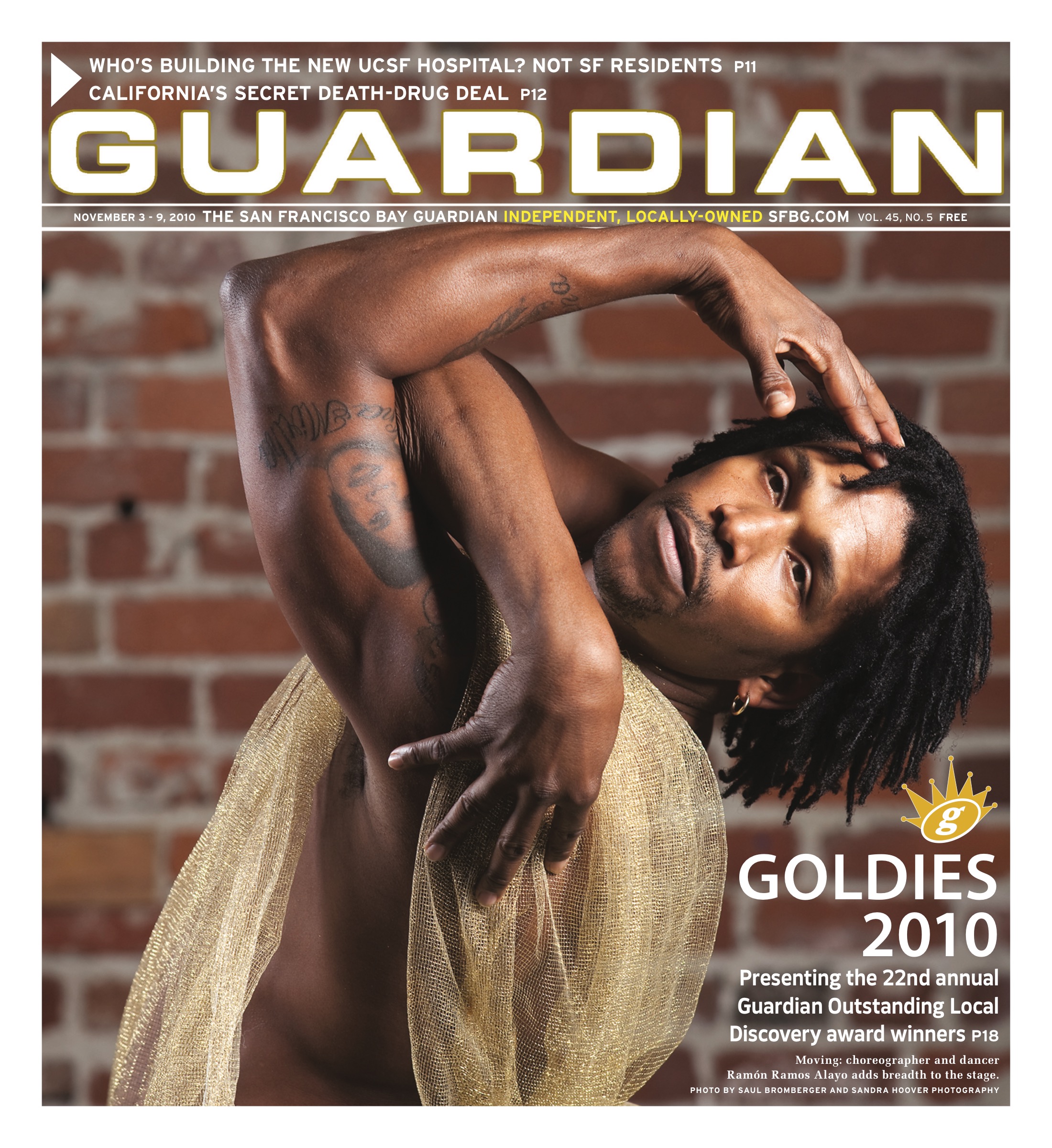
GOLDIES 2010: Ramón Ramos Alayo

1

Whoever coined the phrase “jack of all trades, master of none” didn’t foresee an artist like Ramón Ramos Alayo, who is a stunning dancer, a socially committed choreographer, a passionate advocate of Afro-Caribbean culture, scholar of Yoruba spirituality, and an inspiring teacher of modern dance and salsa.

With his tall, powerfully built frame, Ramos Alayo is a mesmerizing presence whether he dances the West African Warrior God Ogun, the Tibetan Lord of Death, the son in La Madre — his tribute to family — or a prisoner trying to shed his shackles. Most recently he assumed Bob Hope’s mantle — unusual even for an open-minded artist like him — by spending a month entertaining American troupes stationed in Europe. “It was a good experience,” the Cuban-born dancer explains. “It was needed. These people have no entertainment. All they do is walk around with guns all day.”

Ramos Alayo regularly returns to Cuba. Next year he’ll go to choreograph and, even more important, to take classes. “The training in Cuba is very strict. There is no choice — you have to go to class,” he says. At 11, he began studying modern and folklórico. He still remembers that unless you met established standards, you couldn’t move to the next level. That kind of discipline paid off. Locally, he has danced with ensembles and choreographers as diverse as Robert Moses’ Kin, Zaccho Dance Theater, Sara Shelton Mann, and Krissy Keefer.

Ramos Alayo has two other passions: choreography and spreading the word about Caribbean culture.

For his Alayo Dance Company, he uses song, music, visuals, and narration to create theatrically potent works that include Afro-Cuban, modern, folkloric, and popular dance styles. Structurally these pieces can be rough, but they have an intoxicating quality — and often a no-holds-barred political perspective — that can prove irresistible. “Mixing things the way he does comes to him by nature and training,” Deborah Valoma, textile artist and costume designer for some of the choreography, explains. “The results are vibrantly alive pieces, approached from an unusually broad set of disciplines.”

After Rain looks at destruction and regeneration from an individual and social perspective. Blood and Sugar traces the passage of slavery through history and geography. A Piece of White Cloth metaphorically explores the movement of culture from Africa via Cuba to the Bay Area. These are big-themed endeavors, but Ramos Alayo also embraces athletic intimacy in works such as Wrong Way and last year’s Grace Notes. Still, Keefer, who first met Ramos Alayo when she took over Dance Mission Theater in 1999, appreciates him above all as a storyteller. “There are so few choreographers in modern dance who create narratives,” she explains.

The Cuba Caribe Festival, which Ramos Alayo founded in 2003, has become a mini ethnic dance festival, showcasing groups from the Cuban diaspora on the first weekend and Ramos Alayo’s ensemble on the second. The festival is always a rollicking, joyous affair. If sometimes there is a friendly rivalry between ensembles, it’s all in good spirit.

In the past, most of Cuba Caribe’s participating groups have been grounded in folklórico traditions. Lately, however, reflecting both the changes taking place within that community and Ramos Alayo’s personal interests, modern dance groups like Paco Gomes and Dancers and Liberation Dance Theater have made successful appearances. Master classes, workshops, and lectures augment the offerings.

Just how successfully Ramos Alayo will be in helping the Caribbean diaspora deepen its roots in the Bay Area remains to be seen. He has two daughters. “One of them is a dancer, the other a soccer player.”

www.alayodance.org; www.cubacaribe.org

>>MORE GOLDIES 2010

Another Monkey

6

paulr@sfbg.com

DINE The restaurant formerly known as Conduit was so strikingly designed inside that when, earlier this year, it morphed into a Thai spot, another of those with “monkey” in the name — Another Monkey — I winced, and only in part because the word “monkey” makes me think of ol’ Dubya, now in exile in the Dallas suburb of Elba. The indecorous neon beer sign glowing in the front window seemed to be a particularly glum portent. It said: come in and slam a few! And eat pad Thai with your fingers while you watch ESPN.

As fate would have it, Another Monkey does offer pad Thai, and the flat-panel television mounted over the bar probably does show ESPN on occasion, but otherwise, the ruin I inferred from the infernal neon sign is nowhere to be seen. The restaurant’s high-style interior is intact, while the food is electrifying. The only physical change I noticed in the space was the screening-off of what had been an exhibition kitchen at the rear of the dining room; the counter and stools are still there, but the view now consists of a long eyeful of frosted glass instead of a tableau of busy chefs.

Conduit had been, in its brief heyday, a scene reminiscent of the early days of Foreign Cinema — limousines double-parked on the street and swarms of hipster-geeks in various shades of black jamming the doorway — so Another Monkey’s more relaxed state is easier to live with. When a place becomes over-popular, everything is put at risk, from the quality of the food and service to the ambience itself. Another Monkey shows no signs of becoming a Conduit-style scene, but it is distinctive and gracious enough to draw a steady crowd. It has a neighborly feel, yet for those farther afield it’s worth seeking out, both for its distinctive setting and the sharpness of its cooking.

Chef Aom Phanthong’s menu is, like a bar stool (!), sturdily balanced on three legs: familiar standards, innovative dishes, and items for hard-core (or, in menu-speak, “experienced”) connoisseurs of Thai cuisine. In this last category we find the dip-relishes, whose odors and flavors are “very strong,” according to the menu card’s minatory phrasing. Suspicious people might flee in the direction of the pad Thai, or the excellent fish cakes ($7.50 for four) with an enlivening sweet-sour sauce on the side, along with threads of red and green cabbage.

In the alternative, they might turn toward the mix-and-match department. You can get tom yum shrimp ($9.95), served in little heaps atop crisped triangles of flour tortilla. The menu calls this “nacho style,” and it was quite good, though the frying left the tortillas with an oily aroma, and why flour tortillas instead of the tastier (and healthier, not to mention more authentic) kind made from masa?

The appeal of duck has long eluded me. Like goose, it resembles (for me) slightly gamier, richer chicken — the chicken, interestingly, being native to Southeast Asia. So subbing duck for chicken in a red curry ($15) wasn’t a complete Californication, and maybe, in its exponential richness (rich meat amplified by rich sauce) it wasn’t California at all. The portion size turned out to be just right, though, and with a pineapple slice for a subfloor and some fresh basil over the top, the dish’s richness remained under control.

Richness also briefly threatened the northern Thai hung le curry of pork belly ($13), mostly because of the nature of the meat. Our exquisitely polite server asked if we would be comfortable with “visible fat.” As an American, I have lived most of my life amid visible fat, so this prospect did not deter. And the dish itself turned out to be marvelous, a kind of gingery stew served in a handsome little pot, the meat stringy but tender and a scattering of fresh peanuts for textural counterpoint.

Another Monkey maintains an extensive wine list, which on the one hand is a reassuring line of continuity from Conduit and on the other is paradoxical. Thailand is not wine country, and Thai cuisine (like Indian and Mexican cuisine, to name two other large examples) didn’t evolve with wine. But wine geeks must love a challenge, because the carefully bound list is presented with almost biblical reverence. Beer is still preferable, in my view, but not the almost undrinkably bitter Duvel, the only Belgian beer I’ve ever had that I didn’t like. That’s not the beer proclaimed by the window sign, by the way.

ANOTHER MONKEY

Dinner: Sun.–Thurs., 5–10 p.m.

Lunch: Mon.–Fri., 11:30 a.m.–2:30 p.m.

280 Valencia, SF

(415) 241-0288

www.anothermonkeythai.com

Full bar

MC/V

Some noise, but not bad

Wheelchair accessible

A Celtic violinist Jimi Hendrix?

0

“Can you tell me why they call you the Jimi Hendrix of the violin?” I’m chatting with Eileen Ivers, Bronx-born one-time house blue electric violinist for Riverdance. One must admit, it seems like a curious moniker. Over the phone, Ivers dissolves in laughter. 

“I wish I could,” she finally continues. “One wonderful gentleman from some paper put that. I’d love to think that in some way — he had such a love of blues and roots — I don’t know, I won’t even go there, but I feel so connected to the instrument.” Oh, plus she integrates into her concerts (one of which will be rocking Freight and Salvage Thu/4) liberal doses of jams, electric violin, wah-wah pedal, and, dare we say, soul? “I love to put that to an audience to open their minds — this instrument can rock out as well.” The pieces are beginning to come together…

Perhaps I’m fixating on the comparison because at first glance, there is very little to tie together the lives of Hendrix and Ivers, who was born to immigrant parents used to the hardship and poverty in their birthland of County Mayo, Ireland. “There’s no Gaelic word for immigration — just for exit,” Ivers tells me. “It shows culturally they never wanted to leave, but they had to in the mass exodus.” She talks like an Irish person, falling into discussions of my Gaelic name as those of her (our) ethnic persuasion are wont to do and converses with a hint of that sing-song lilt that is the mark of the Emerald Isle. 

Eileen Ivers and Immigrant Soul, sans Photoshop butchering. Photo by Luke Ratray

Ivers learned her craft through a man in the New York neighborhood she grew up who delighted in teaching the young people in the area how to play the tunes of their cultural legacy. Love of the instrument buoyed her through years at Iona College spent studying mathematics and into a career that’s seen her play with Celtic legends The Chieftains, the international touring company of Riverdance, over 40 symphonic orchestras, and on soundtracks for films like Gangs of New York (2002).

It was through the multitudinous nature of the city’s music scene that the influences audible in her new tracks like “Paddy in Zululand” came to the fore. That tune in particular features an Irish melody plucked out by Iver’s violin which emerges from a background of upbeat African percussion – testament to the connections that Ivers sees between the divergent cultures’ musical forms. 

Which isn’t a particularly unique thing in and of itself – the Bay Area’s Markus James performs similar transmutations with African string music and Americana blues (vocalist Tommy McDonnell of Ivers’ touring band, Immigrant Soul, was a member of the original Blues Brothers band with Dan Akroyd and John Goodman). What may be unique is the bubbling sense of happiness that is exuded from Ivers when she imparts her art upon a listening crowd – or jaded local journalist, who she gracefully includes in her comments regarding the musical resonance she finds in these cross-continent musical similarities. “It’s in our heart — you hear these grooves and it feels right,” she says.

Lost in the music, you might say. Just like Jimi, right?

Eileen Ivers and Immigrant Soul

Thu/4 8 p.m., $23.50-$22.50

Freight & Salvage

2020 Addison, SF

(510) 644-2020

www.thefreight.org


Different walls

0

arts@sfbg.com

Palestinian perspectives are in. You know it when a major filmmaker like Julian Schnabel makes a big-budget film like Miral, based on the book by Palestinian journalist Rula Jebreal (which recently screened at the Mill Valley Film Festival in advance of a general release next year).

In many ways, though, it’s the rest of the country that’s catching up to places like the Bay Area, where Palestinian voices have long been a part of the cultural landscape. The Arab Film Festival, for instance, which just closed its 14th season, once again featured several films from and about Palestine. And this year the San Francisco International Film Festival gave us a look at Port of Memory, the latest work from Kamal Aljafari, one of the most interesting and sophisticated filmmakers to come from Palestine since Elia Suleiman.

In theater, San Francisco’s Golden Thread Productions just gave a staged reading of biographical work from youth in embattled Gaza called The Gaza Monologues. For years, Golden Thread has produced works incorporating the Palestinian perspective amid a mass culture overwhelmingly slanted toward the more powerful side in a basically colonial project. And currently Campo Santo and Intersection for the Arts bring the diasporic repercussions of Palestinian dispossession center stage in Habibi, a new play from a new Palestinian American theatrical voice, Sharif Abu-Hambeh.

Habibi makes its debut as the second offering in a trio of world premieres at Intersection by first-time playwrights (the first having been Chinaka Hodge’sMirrors in Every Corner). Directed by Omar Matwally, Abu-Hambeh’s play weaves together two distinct storylines that attempt to capture the inter-generational confusion and displacement experienced by assimilating Palestinian immigrants in the Bay Area. That confusion can regrettably transfer to the play itself, whose intentional deployment of ambiguity ends up, at least to some extent, being merely fuzzy rather than thought-provoking. But the ideas here are at times intriguingly subtle and the effort a promising one. Moreover, Matwally and Campo Santo give the play a strong production with various charms along the way.

At the center of this double helix of a narrative is young Palestinian American Tariq (a coolly vital and engaging Aleph Ayin). Tariq shares a small Mission District apartment and even — talk about family overload — a single bed with his loving but paternalistic father, Mohammed (a stern, sympathetic Paul Santiago). The deliberate and routine-loving Mohammed — who unlike his Americanized son speaks in accented English — is a museum guard with a strong work ethic that he’s trying, unsuccessfully, to instill in his slacker offspring. Tariq, for his part, has just happily shed his menial job at a local café and is in no hurry to find a new one. His absent mother (Nora El Samahy) apparently left them some time before, though she reappears at one point in his imagination.

This father and son dynamic, familial and almost too familiar, comes intercut with a public talk by a high-class museum curator (a sharp and funny El Samahy, dressed by costume designer Courtney Flores in esteem-grabbing Manhattan chic and sporting a very respectable English accent), who leads us through a slide lecture on the great art heists of the last century. Her talk, avid but meandering, is interrupted by simultaneously exasperating and guilt-producing phone calls from her terminally ill father, and a consequent tendency to wander into ruminations farther afield — summoned for us in pictures of dispossession that float by on the screen behind her (in video projections designed by Aubrey Millen).

Maybe these wayward ruminations aren’t so far afield after all, we come to suspect, as her theme of cultural theft warms up to its own complexities and encourages us to consider the nature of cultural transmission, loss, and hybridization in the life-and-death circumstances of exiled populations. This idea deepens as Tariq’s raucous and rebellious spirit extends to breaking into the curator’s monologue, and even smashing the fourth wall to confront us, her audience. Tariq also has a unique tendency to narrate his own actions, a self-conscious conceit that can be productive at times, especially of humor, and works as an indirect aside to the audience.

By the end, the two narratives come even closer together through a rash act of Tariq’s father that trades disastrously on the concept of family heirlooms, or the physical symbols of patrimony and place. The climax arrives too hastily, and its potential impact is muted. At the same time, the play’s departure from the more universal, shopworn gestures of “melting pot” tales verges on something rare and coruscating.

HABIBI

Thurs.–Sun., 8 p.m.; through Nov. 7; $15–$25

Intersection for the Arts

446 Valencia, SF

(415) 626-2787 

www.theintersection.org


Seeing spots

0

arts@sfbg.com

Jancar Jones Gallery might be no larger than most gallery kitchens, but New York City-based artist Bill Jenkins has created the illusion of more space within it through very simple means. For his solo show “Lids and Dots,” he irregularly spray painted black polka dots across the gallery’s white walls, evoking Yayoi Kusama’s spot-covered installations from the 1960s as well as Keith Haring’s doodled-over interiors from two decades later.

The dots, especially when gazed at from the corner of one’s eye, make the gallery’s tiny dimensions seem more malleable. They curve corners rather than cut them, and their irregular placement suggests protrusion or indentation where there is actually only flatness.

This play off the given shape of a space is taken up in the exhibit’s other titular component. Made from papier-mâché, sometimes studded with debris and small objects from his studio, Jenkins’ coral-like “lids” sit atop a variety of everyday domestic vessels: a filing tray, a small plastic waste basket, a bowl — that have themselves been placed on white plinths.

The juxtaposition of Jenkins’ handmade components with the mass-produced products they only haphazardly cover is funny and strange. But the absurd pairings also raise the more serious question — echoed in Jenkins’ transformation of the exhibition space itself — of what happens when functionality is no longer a self-apparent quality of a thing but becomes something to be discovered in-process or, perhaps, to discard altogether.

THAR SHE BLOWS

Narwhals are the sort of animals that seem too strange to actually exist yet are that much more fantastic because they do. The same could be said of Seth Koen’s wonderfully suggestive wood sculptures at Gregory Lind, currently on display in a show that takes its inspiration from the small Artic whale, and its singular spiraling horn (actually a tooth).

Koen carves and planes his pale maple and basswood pieces into smooth planks with soft, curved edges that typically bend 90 degrees at a certain point. Their placement on the walls or floor, along with their titles, suggest various marine mammals, or the sort of tools that ancient fisherman would use to hunt those very same creatures.

With its two dowel-like appendages poking from what resembles the joined back and seat of a chair turned upside-down, Tusk sketches a walrus with but the simplest lines. So, too, does Selkie, with its upturned spire, evoke the titular shape-shifting seal of Celtic lore, as well as the horned creature from which the exhibit takes its name and creates a strange new adjective: “Narwhellian.”

It is a fanciful variation on “Orwellian,” as well as a repudiation of that word’s sinister connotations of control and manipulation. Koen’s sculptures, whose simple shapes are at once unspecific and particularly evocative, welcome a freedom of interpretation. Almost toy-like, they invite play.

I WANT CANDY

If you don’t get your candy fix this Halloween weekend, be sure to browse the rainbow-colored confections at Scott Richards Contemporary Art when the group show “Sweet Tooth” opens Nov. 4.

Your eyes will probably hurt as much as your teeth after taking in so many glossy, photo-realistic depictions of sugar, as well as its cheaper, government subsidized imitations. There are paintings of candy drops, a cocktail umbrella-topped mountain of sorbet, a truly dubious Jell-O mold, and a package of colorfully iced cookies (Daniel Douke’s Invasion) that resembles an edible version of one of Warhol’s Flowers silkscreens. The effect is one of brightly hued and cutely packaged obscenity.

There’s even some old fashioned, Easy-Bake sexism courtesy of pop pin-up artist Mel Ramos, whose Reese’s Rose features a busty brunette emerging from a Reese’s candy bar wrapper, à la Botticelli’s The Birth of Venus. Katy Perry should hit him up for her next album cover.

Wayne Thiebaud’s 1970 gouache painting Study for Gumball Machine is remarkable for its vivid two-dimensionality, reducing the spherical nature of its subject to colors and mostly straight lines. Dimension is drawn in, but Thiebaud’s line and color combinations create an aura around the gumball machine rather than convey its seeming tactile immediacy.

Thiebaud’s study lacks the glossy shellac that drips across the other works in “Sweet Tooth.” It is a useful reminder that we can’t always get what we want. 

BILL JENKINS: LIDS AND DOTS

Through Nov. 13

Jancar Jones Gallery

965 Mission, Suite 120, SF

(415) 281-3770

www.jancarjones.com

SETH KOEN: NARWHELLIAN

Through Dec. 11

Gregory Lind Gallery

49 Geary, Fourth Floor, SF

(415) 296-9661

www.gregorylindgallery.com

SWEET TOOTH

Nov. 4–Dec. 31

Scott Richards Contemporary Art

251 Post, Suite 425, SF

(415) 788-5588

www.srcart.com


Dia de los San Franciscanos

0


caitlin@sfbg.com

ARTS AND CULTURE Rene Yañez, the godfather of San Francisco’s Dia de los Muertos, is showing off the art for his new 3-D altar. The artist is hardly one to adhere to traditions, though he played a large role in creating one of the city’s most distinctive and popular interpretations of another country’s cultural celebrations.

Yañez’s elastic sense of the holiday’s expression mirrors the way his city has interpreted the Mexican holiday. Traditionally, Dia de los Muertos marks the time of year when the boundaries of the dead and living blur. Towns south of the border celebrate the day (which was synced with All Saint’s Day by the Catholic Church to capitalize on the cultural resonance of an indigenous celebration) by decorating the graves of loved ones with favorite treats and trinkets of those who’ve passed on.

But kicking the bucket doesn’t preclude your party pass on Dia de los Muertos. “The whole point of Day of the Dead is that we’re honoring death but mocking it,” says Martha Rodriguez, a Mexico City musician who curates the Dia de los Muertos San Francisco Symphony family concert that celebrates this year’s centennial of the Mexican Revolution.

“Through all the uprisings and death, there’s always space for fun,” Rodriguez says. “That’s kind of how Mexicans survive — we do not stop celebrating.”

Perhaps it’s the mix of spiritual connection, gravity, and levity — not to mention the stylin’ calaveras and brightly-colored floral iconography — that has made the celebration resonate here. The city hosts what is arguably the largest Muertos festivities in the country, featuring altar displays at SOMArts, the Mission Cultural Center for Latino Arts, and Garfield Park, as well as a procession that organizers expect to attract 100,000 participants.

Yañez and son Rio are the curators of the SOMArts’ epic yearly altar installation — an atmospheric production that transforms SOMArts’ drafty main hall into a series of reflective spaces that pay homage to fallen family members, casualties of natural disasters, manmade conflict, and even beloved gatos who have gone to that litter box in the sky.

The elder Yañez’s involvement with SF Dia-ing goes back to the early 1970s when he was artistic director at Mission’s Galeria de la Raza, a time when the neighborhood was absorbing political exiles from political strife in South and Central America. A way to observe the day of remembrance was needed. “We talked about creating a ritual, a ceremonial exhibit,” he says.

At first it was people from the neighborhoods who came to see the altars put together by the de la Raza artists. But eventually, word spread. “The exhibit proved very popular and the schools started coming around,” Yañez remembers.

The altars were a way of talking about Mexican culture and the Galeria started to print lesson plans for teachers. Eventually Yañez organized a procession through the neighborhood, like the ones held in Mexico. The first year, which current procession organizer Juan Pablo tells me was 1978, attracted somewhere between 75 to a few hundred people. But that was going to change.

“It’s the one thing that unites us, the cycle of life and death,” Pablo said in a phone interview. The thousands who attend these days see far more than traditional Mexican spirituality, Pablo said, with Wiccans marching in the parade, the Sisters of Perpetual Indulgence granting indulgences, and tributes being paid to issues worse than old age and mortality. Last year, for example, a walking altar called attention to the 5,000 unsolved assassinations of women in the Mexican border town Juarez.

Any description of SF’s festivities would be remiss if it didn’t mention the influx of Burning Man culture, with its preponderance of elaborately-costumed young people, the stilters, and the skeletons.

They make for a visually stunning event but produce ambivalent cultural connotations. Local blogs have facetiously proclaimed that with the entrenched multiculturalism of SF’s Dia, the holiday celebrations can be more appropriately titled “Day of the Dead Gringos.”

Rio Yañez grew up during this evolution. “The neighborhood’s changed so much, the parade is a reflection of that,” he says. “It’s a way of sharing culture. Even with all the drunk hipsters just having a good time marching, there’s still a good community spirit.”

That’s not to say there isn’t disagreement over how the holiday should be celebrated here. A dispute over who is the source of police complaints about overcrowding and public drunkenness led to a split between Juan Pablo’s collective’s march and the Marigold Project’s altar installations in Garfield Park. “They want to create a party atmosphere, and that’s not what it’s about,” Pablo said. “It’s about honoring the dead.

“The procession is a moving target without any of the hassles of a fixed location,” replies Kevin Mathieu, Marigold Project organizer.

Maybe nothing is ever completely at rest in a San Francisco — even the dead are caught in the winds of our city’s ongoing envisioning of the our culture’s true nature.


Our Weekly Picks: October 20-26

0

THURSDAY 21

THEATER

“The Laramie Residency”

Just when you thought it was safe to come out of the closet, a chilling spike in suicide rates among gay teenagers who have been bullied or harassed has reemerged as national news. Which makes this rare double-header of The Laramie Project and its sequel, The Laramie Project: Ten Years Later, Epilogue uncannily apropos. Written in response to the notorious murder of Matthew Shepard, a young gay man in small-town Wyoming, both plays were created from hundreds of interviews with the inhabitants of Laramie. The results offer a detailed examination of how violence affects not only the perpetrators victims, but an entire community. “The Laramie Residency” also includes a special Thursday dialogue between director and coauthor Moisés Kaufman and Tony Taccone of the Berkeley Rep. (Nicole Gluckstern)

Thurs/21, 7 p.m.; Fri/22–Sat/23, 8 p.m., $10–$55

Jewish Community Center of San Francisco

3200 California, SF

(415) 292-1233

www.jccsf.org

FILM/PERFORMANCE

All About Evil: The Peaches Christ Experience in 4-D”

Horror fans are well familiar with the tag line for Wes Craven’s 1972 Last House on the Left: “To avoid fainting, keep repeating ‘It’s only a movie … It’s only a movie…'” Well, it wouldn’t be Halloween in San Francisco without Peaches Christ, whose alter ego, the less-flashy but no less fabulous filmmaker Joshua Grannell, brings his All About Evil to life at the very Mission District theater where it was shot. The film and its accompanying pre-show performance have been out roaming the U.S. and the U.K. for the past several months; expect the hometown gig to be extra-specially spooky, with musical and multimedia numbers by Peaches and Evil cast members. And since the Victoria plays an important supporting role in the film, expect interactive surprises galore. Only a movie? Don’t be so sure! (Cheryl Eddy)

Through Sun/24

8 p.m., $20

Victoria Theater

2961 16th St, SF

www.peacheschrist.com

MUSIC

Joshua Bell with the San Francisco Symphony

An average street performer isn’t always average. In 2007, the acclaimed violinist Joshua Bell participated in an experiment in which he played for 45 minutes as an anonymous busker in the D.C. Metro. The few who bothered to pause in their morning bustle and pull out their headphones realized they were in the presence of greatness. Renowned worldwide, virtuoso Bell joins the San Francisco Symphony in Bruch’s Violin Concerto No. 1. Conducted by James Conlon, the evening also includes Wagner’s Prelude to Act I of Die Meistersinger von Nürnberg, as well as Dvorák’s In Nature’s Realm and the overtures to Carnival and Othello. (Emmaly Wiederholt)

Thurs.–Sat., 8 p.m.; Sun, 2 p.m., $15–$150

Davies Symphony Hall

201 Van Ness, SF

www.sfsymphony.org

MUSIC

Steve Lawler

You can either love or hate seminal Ibiza club Space, and there’s been plenty of room to do both in its 20-year history. But just when you throw up your hands in a bad way at all the astringent trance, tipsy Brits, and noodling minimal, boom!, a DJ comes along who can drag you back to the dance floor. Rightly respected Brit Steve Lawler, known as the “King of Space,” scored that tiara by leapfrogging styles and keeping his sets limber. There’s some fluttering bass, chunky old-school breakdowns, and searing tech in his bag as well as, gasp, snippets of wistful melody. Lawler especially rocks the hard-driving, samba-esque Spanish-Berlin sound that’s become Ibiza’s best recent export. (Marke B.)

9:30 p.m., $10–>$20

Vessel

85 Campton Place, SF

(415) 433-8585

www.vesselsf.com

DANCE

Kunst-Stoff and LEVYdance

Dancers are famous for their kinesthetic memory. Without activating the brain, their muscles recall whole dances — or at least fragments. Show them a step or two and the rest follows. But dancers also seem to be able to dig even deeper, into something akin to an ancestral memory. It may take personal affinity but also a lot of hard research to unearth the kind of treasure trove that then can be used creatively. Two temperamentally different choreographers, Yannis Adoniou, of Greek descent, and Ben Levy, from a Jewish-Persian family, have done the excavations. Adoniou’s Rebetiko, commissioned by CounterPULSE’s Performing Diaspora Program, and Levy’s Our Body Remembers should make for an intriguing evening of might be called “kinetic history.” (Rita Felciano)

Through Oct. 30

Thurs.–Sat. and Sun/24, 8 p.m., $18

ODC Theater

3153 17th St., SF

(415) 863-9834

www.odctheater.org

FRIDAY 22

MUSIC

Stone Foxes

Let’s talk foxes, shall we? The native gray one is uncommon in San Francisco. The exotic red species, however, is a regular interloper of the Presidio. The Stone Foxes, four young dudes who play mean blues, are more like the former: genuine, rare, and always a treat to see in the wild. Sometimes you don’t want indie or nu-gaze or psych-doom-metal — you simply need real rock ‘n’ roll. Their sophomore album Bears and Bulls was released this past July, and though not as raw as their killer debut, it exudes a new and natural confidence. This is their official vinyl release show, so bring extra cash. (Kat Renz)

With Soft White Sixties and Real Nasty

10 p.m., $12

Bottom of the Hill

1233 17th St., SF

(415) 621-4455

www.bottomofthehill.com DANCE

Paco Gomes and Dancers

In his choreography, Brazilian-born Paco Gomes speaks with a powerfully articulated and mature voice. His dances beautifully integrate modern and Afro-Brazilian influences; as a company director he gathers around him — and trains — multi-ethnic dancers who seem to thrive under his tutelage. Now, with guest choreographers Jorge Silva and J. Pazmino, Gomes is presenting Amor O, an evening of works old and new that circles around love: of self, of friends, and also as remembered and lived within families. In addition, the program includes an excerpt of a new work in progress planned for an upcoming international tour. It examines love within another “family,” the Orixas, from the Yoruba religion. Perhaps it’s a consolation that in the world of the gods, not everything went smoothly either. (Felciano)

Through Sat/23

8 p.m., $15

Garage

975 Howard, SF

(415) 518-1517

www.975howard.com

MUSIC

Karl Blau

Eclectic K Records artist Karl Blau throws a wrench into the indie/folk scene with a chameleon-like ability to work within multiple genres. Ignoring the usual expectations of singer-songwriter stereotypes, Blau is known to inject everything from hip-hop and electronic influences to world and reggae music into his solo albums. He’s also worked with some notable names in Phil Elvrum (The Microphones, Mount Eerie) and Laura Veirs. Blau can currently be found playing bass for droney doom-metal band, Earth. It’ll be interesting to see how he melds all these elements together in a live setting. (Landon Moblad)

With Dina Maccabee and Birds and Batteries

7 p.m., free ($5 donation suggested)

Viracocha

998 Valencia, SF

(415) 374-7048

www.viracochasf.com

MUSIC

Lyrics Born

If it was any other rapper describing his newest album as “more synth-oriented” and “dealing with a lot of issues that are more mature than the last few albums, from abandonment to betrayal to incredible joy,” I’d say watch out for a lawsuit from one Mr. West. But since half of Latryx (with Lateef the Truthspeaker) and cofounder of Quannum Records, Lyrics Born is known for bringing his own brand of substance to the scene while pushing the genre forward. His new material, which features emerging artists Trackademicks, Francis and the Lights, and Sam Sparro, will be on display at this release party. (Ryan Prendiville)

With Chali 2na and the House of Vibe and Rakaa

9 p.m., $25

Independent

628 Divisadero, SF

(415) 771-1421

www.theindependentsf.com

SATURDAY 23

MUSIC

Triptykon

After almost 30 years in the arena, Tom G. Warrior has earned his status as heavy metal royalty. The Swiss singer and guitarist formed Hellhammer in 1982 and went on to found Celtic Frost two years later. Both bands contributed immeasurably to the development of extreme metal, and their influence reverberates throughout the genre today. Having parted ways with Celtic Frost in 2008, Warrior formed Triptykon, planning to pick up where Monotheist (Celtic Frost’s 2006 LP) left off. The new band’s music combines slabs of doomy guitar, razor-wire black metal, and Warrior’s paint-peeling vocals, breaking down genre boundaries in pursuit of heaviness. Come out and play. (Ben Richardson)

With 1349 and Yakuza

9 p.m., $23

Slim’s

333 11th St, SF

(415) 255-0333

www.slims-sf.com

EVENT

“SF DocFest Roller Disco Costume Party”

Have you ever stared longingly at the roller skaters in Golden Gate Park? Always wanted to join in but too embarrassed by your lack of boogie? Still hung up over the accident you had at a fifth grade skate party? Well, get over it. The Roller Disco Costume Party offers a simple solution: anonymity. As part of DocFest, admission is free with a ticket stub or just $5 if you strap on your best costume (which could potentially double as padding in case of collision.) (Prendiville)

8 p.m., free–$10

CELLSpace

2050 Bryant, SF

www.sfindie.com

MUSIC

Taj Mahal, Toumani Diabaté, Vieux Farka Touré

Tonight the Paramount plays host to a blues exploration featuring American bluesman Taj Mahal, Malian kora player Toumani Diabaté, and Malian guitarist Vieux Farka Touré. To trace the roots of the blues immediately leads to Africa, and in particular to Mali, and each of these three frontmen represents a different facet of that exploration. Mahal has spent decades reinterpreting the blues through far-flung musical traditions from the Caribbean and Hawaii to Europe and Latin America; Diabaté brings to the fore the centuries old West African tradition of the kora; and Touré, the torch-bearing son of the late Ali Farka Touré, represents a more recent cross-pollination of traditional Malian sounds with American blues and rock. While each of the three musicians is a monster in his own right, together they represent a veritable blues trifecta. (Mirissa Neff)

8 p.m., $25–$75

Paramount Theatre

2025 Broadway, Oakl.

(510) 465-6400

EVENT

“B.Y.O.Q.: Bring Your Own Queer”

Gurla-Q, you better bring it: a cavalcade of queer artists, musicians, and performers is avalanching Golden Gate Park for a full day of heady debauchery. Vinyl soul from the Hard French party DJs, homo-futurist sounds from Honey Soundsystem, Las Bomberas de la Bahia’s Afro-Puerto Rican percussion and dance, local indie faves Excuses for Skipping, fashion shows, a candygram booth, art displays, and so much more to turn you hot pink with multitasking. Plus, special guest John Cameron Mitchell giving you Hedwig fierceness. The annual B.Y.O.Q. has been a sweet, sweet success, conjuring up the activist days of yore while introducing some amazing new talent. Don’t wrap your internal pansy up in a plain brown bag, let her shine and shine. (Marke B.)

Noon–6 p.m., free

Golden Gate Park Music Concourse, SF

www.byoq.org

SUNDAY 24

MUSIC

Reigning Sound

Reigning Sound burst out of the gates in 2002 with the garage-punk classic, Time Bomb High School. Since then, the Tennessee-based group — performing as part of the ninth Budget Rock festival — has continued to refine its brand of country, soul, and classic R&B touches by way of organ-filled, distorted guitar-driven rock ‘n’ roll, most recently on 2009s Love & Curses. The band also recently backed up original Shangri-la member Mary Weiss on her 2007 comeback album, further evidence of the range its capable of. As far as modern garage rock goes, Reigning Sound is as classy and fun a group that you’re likely to find. (Moblad)

With Flakes, Ty Segall, and Touch-Me-Nots

9 p.m., $15

Bottom of the Hill

1233 17th St, SF

(415) 621-4455

www.bottomofthehill.com 

The Guardian listings deadline is two weeks prior to our Wednesday publication date. To submit an item for consideration, please include the title of the event, a brief description of the event, date and time, venue name, street address (listing cross streets only isn’t sufficient), city, telephone number readers can call for more information, telephone number for media, and admission costs. Send information to Listings, the Guardian Building, 135 Mississippi St., SF, CA 94107; fax to (415) 487-2506; or e-mail (paste press release into e-mail body — no text attachments, please) to listings@sfbg.com. We cannot guarantee the return of photos, but enclosing an SASE helps. Digital photos may be submitted in jpeg format; the image must be at least 240 dpi and four inches by six inches in size. We regret we cannot accept listings over the phone.

(All Night Long)

0

arts@sfbg.com

MUSIC Of course they want to listen to T.Rex into the night. I’ve done it myself many times, and I’m sure plenty of you have devoted late-night marathons to Marc Bolan’s musical mysticism. His lyrics, and his ridiculously long album titles from the early days of Tyrannosaurus Rex, always had a flair for weird wordplay, leaving the listener equally captivated and confused by lush, descriptive imagery. Bolan and his Tolkien-named percussionist Steve Peregrine Took started out playing the part of an enchanted underground acoustic duo, catering to fried-out hippies and London’s latter-day mods at the notorious Middle Earth Club. But I have a feeling that when San Francisco’s own Burnt Ones pledge “Gonna Listen To T. Rex (All Night Long),” they’re referring to Bolan’s full-blown boogie period during the heyday of T. Rex-tasy. The song’s opening guitar lick sears every bit as much as the one in “Buick Mackane,” but of course it’s not nearly as recognizable.

This isn’t to say Burt Ones don’t borrow from Bolan’s early days of drone-zone bliss. “Burnt to Lose” closes the A-side of their debut album Black Teeth & Golden Tongues (Roaring Colonel Records) on a slow note. The track is full of chant-like vocals and finger-symbol sounds that a yoga instructor might use to commence a class. The tune hints at the atmospheric qualities of “The Children of Rarn” off the 1970 album T. Rex, where Bolan had by then calculated an abbreviated name for his band and added a full rhythm section, including new drummer Mickey Finn.

“Sunset Hill” is every bit as upbeat and fuzz-tone driven as its Visconti-produced predecessor, “Metal Guru” from 1972’s critically acclaimed Slider, and “Bury Me in Smoke” is straight out of the ’70s with its use of ooh-la-la backing vocals. Let’s face it, lead singer Mark Tester sometimes sets out to duplicate Bolan’s trademark warbled and often shaky vocal technique. But while the four-piece psych outfit, who found their way to the Bay Area by way of Indianapolis, has a glam-rock shtick that would make Gary Glitter proud, Burnt Ones also draw from other sources of inspiration.

“Bring You All My Love” gives a nod to the girl groups of the early ’60s and is reminiscent of the Shangri-Las’ 1964 hit “The Leader of the Pack”, where an echoed “down, down” response vocal is employed. Though “Famous Shakes” song should not be confused with a Wall of Sound production, the influence of Phil Spector and his layers of instrumentation is clear. Lyrically, the group revisits the nonsensical chorus of the Crystals’ “Da Doo Ron Ron”, and even explores territory commonly conquered by soul troopers, most notably Wilson Pickett’s “Land of A Thousand Dances”, where a catalog of past dance crazes (i.e. the mashed potato, the twist, and the alligator) are shouted out in remembrance and paid tribute.

Simple in design, the packaging of Black Teeth & Golden Tongues is consistent with Burnt Ones’ sound, in that it dips into the past while incorporating contemporary art. The pastel-colored cover is adorned with a cartoon of a cracked skull drawn by William Keihn, who some may recognize as the artist from Thee Oh Sees’ album covers. On the back side we’re reminded of two iconic Stones’ albums, Exile on Main Street and Some Girls, which perhaps coincidentally sandwiched the glam era, with release dates of 1972 and 1978. “Spins” even has a bluesy Keith Richards riff.

As much as Burnt Ones rely on the past, it’s easy to forget that this band is pretty much new and likely aims to be part of the pantheon of Bay Area lo-fi, psych, and garage rockers. The group’s contemporaries include Hunx and His Punx, who updates the tried and true androgyny and gender-bending nature of glam by updating it to serve his own homoerotic needs. Burnt Ones’ “Soft City” is a well-produced number that displays a kinship with Hunx’s teased vocals as it confronts topics such as saved souls and the cold outdoors. 

BURNT ONES

With Pierced Arrows, Bare Wires

Fri/22, 8:30 p.m., $12 (all ages)

Rickshaw Stop

155 Fell, SF

(415) 861-2011

www.rickshawstop.com

Summer in the fall

0

arts@sfbg.com

MUSIC As I sit sipping some morning coffee, Elizabeth Morris of Allo Darlin’ is wrapping up an unseasonably sunny London afternoon. “I don’t know what’s happening, but it’s really warm weather,” she says over the phone. “The last week was really cold and miserable, and then the last two days have been absolutely beautiful.”

It seems fitting to be discussing Allo Darlin’s self-titled album with Morris on a day when the sun won’t be denied. You’d be hard-pressed to find a more perfect “summer” album released in October. Full of shimmery electric guitar, tambourine shakes, and bass lines that would sound at home on lost Motown cuts, the group’s music oozes charm, occupying some sort of space between Belle & Sebastian and a modern, garage-y spin on the Shangri-Las. Out at the forefront of it all is Morris with her ukulele and enchanting vocals.

Originally born and raised in Australia, Morris moved to London five years ago, shortly after finishing school in Brisbane, hoping to do something with the songs she’d begun writing. In Brisbane, Morris doubted her talents and ability to fit in, but London’s music scene proved to be a much more fertile ground for her. “Brisbane at the time was really grunge-y, noise rock, avant-garde kinda stuff — which is cool, but I felt really out of place and would never have felt confident playing little pop songs,” she explains. “I’d definitely written a bunch of songs, but I thought they were all pretty much rubbish. I didn’t feel like I’d written anything good until I moved to London.”

Once settled in London, Morris fronted the Darlings, a group made up of coworkers from the TV and film sound production facility she worked at. After that group dissolved, she began playing solo before winding up with a backing band made up of friends of friends, brothers of friends, and members of some of her favorite local bands. It all came together with a little help from the Boss.

“I was asked to do a Bruce Springsteen song for this tribute compilation and I knew Paul (Rains, Allo Darlin’ guitarist-keyboardist) was really into him. So I asked if he wanted to do this song with me, and that’s kinda how I got started playing with these guys. So we were brought together by Springsteen,” Morris says with a laugh.

In the interview, Morris talks excitedly about some of her musical loves: Jonathan Richman, Steve Martin’s banjo playing, the Go-Betweens, old reggae. She and her bandmates share an affection for Yo La Tengo and their parents’ old Beach Boys’ records. Her earnest and enthusiastic admiration mirrors the tone of her lyrics, which play a major role in making Allo Darlin’ fun. One minute she’s combining lines about love and chili, the next she’s breaking into a verse from Weezer’s “El Scorcho” or singing what’s gotta be the first pop song ever written about Ingmar Bergman’s Wild Strawberries (1957). Her lyrical style is clever and unique — by turns romantic, silly, pensive, or yearning.

“I kind of always write from emotion or feeling rather than anything else. I never really sit and write things in a notebook or compose words,” Morris says. “I’ve tried to write story-songs or songs about characters, but it just never really works. I’m not very poetic, I guess. I’m better at seeing things how they are, trying to put them into words with a nice melody and seeing what happens.”

Allo Darlin’s upcoming tour marks the group’s third trip to the U.S., but it’s their first time in California. Despite the impersonal nature of a phone conversation, Morris’ excitement is palpable. She’s even picking up some American slang. “All the bookers say ‘psyched’ — like ‘We’re psyched that you’re coming.’ It’s really cute,” she says, laughing.

“So yeah, we’re psyched to be doing the West Coast.”

ALLO DARLIN’

with Eux Autres, Terry Malts

Wed/27, 8 p.m.; $10

Rickshaw Stop

155 Fell, SF

(415) 861-2011

www.rickshawstop.com

Wall Street hold ’em

0

arts@sfbg.com

FILM Inside Job is director Charles Ferguson’s second investigative documentary after his 2007 analysis of the Iraq War, No End in Sight, but it feels more like the follow-up to Alex Gibney’s Enron: The Smartest Guys in the Room (2005). Keeping with the law of sequels, more shit blows up the second time around. As with No End in Sight, Ferguson adeptly packages a broad overview of complex events in two hours, respecting the audience’s intelligence while making sure to explain securities exchanges, derivatives, and leveraging laws in clear English (doubly important when so many Wall Street executives hide behind the intricacy of markets).

The revolving door between banks, government, and academia is the key to Inside Job‘s account of financial deregulation. At times borrowing heist-film conventions (it is called Inside Job, after all), Ferguson keeps the primary players in view throughout his history so that the eventual meltdown seems anything but an accident. Even apparent detours prove narrowly targeted. The subject of Wall Street’s venal appetites for drugs and prostitutes, for instance, is introduced first as farce and second as potential traction for broader criminal investigations. Presumably a junior partner might give up valuable information so as not to be made into another Eliot Spitzer, who, incidentally, comes off quite well in Inside Man.

While the fat cats only show up thanks to the CSPAN archive, several free market economists do sit for interviews with Ferguson. They probably regret doing so now — he reserves special scorn for the academic class of boosters. Frederic Mishkin is a typical case. Formerly a member of the Board of Governors at the Federal Reserve, he quickly becomes a muttering mess under Ferguson’s questioning. Mishkin quit the Treasury in August 2008, at the height of the crisis, to return to Columbia University to finish more pressing work: a textbook. In 2006, Mishkin coauthored a rosy report on Iceland’s doomed markets, pocketing a nice commission from the country’s Chamber of Commerce. Mysteriously, the title of the report changed from “Financial Stability in Iceland” to “Financial Instability in Iceland” on Mishkin’s CV — confronted with the discrepancy, he croaks something about a typo.

Ferguson’s relentless focus on the insiders isn’t foolproof. Tarring Ben Bernanke, Henry Paulson, and Timothy Geithner as “made” guys, for example, isn’t a substitute for evaluating their varied performances over the last two years. Inside Job makes it seem that the entire crisis was caused by the financial sector’s bad behavior, and this too is reductive. To take just one example, China figures into the film only as laborers losing their jobs due to market volatility — part of the story, certainly, but so is that government’s devaluation of its currency.

Furthermore, Ferguson does not come to terms with the politicized nature of the economic fallout. In Inside Job, there are only two kinds of people: those who get it and those who refuse to. The political reality is considerably more contentious. Americans on the right and left may well share disgust at the bailouts, but they’re drawing very different conclusions from the government’s cash infusions. Ferguson builds something of a false consensus between his talking heads, never asking them, for example, whether they think Fannie Mae or Countrywide was a bigger boogeyman (politically, the answer says a lot). In this regard, a general assessment in a recent article by Paul Krugman and Robin Wells holds for Inside Job: “Books on the Great Recession are still pouring off the presses … but they don’t offer much guidance on the most pressing problem at hand, which is how to deal with the continuing consequences of the last [bubble].” 

INSIDE JOB opens Fri/22 in Bay Area theaters.

Rep clock

0

Schedules are for Wed/20–Tues/26 except where noted. Director and year are given when available. Double and triple features are marked with a •. All times are p.m. unless otherwise specified.

ARTISTS’ TELEVISION ACCESS 992 Valencia, SF; www.atasite.org. $6-10. “Fifth ATA Film and Video Festival: Human Nature,” Thurs, 8; “Lo-Fi Future,” Fri, 8. “PXL This 19,” toy camera film festival, Sat, 8:30. For related events visit www.laughtears.com/PXL-THIS-19.html. “ATA and Alternative Tentactles Present:” •The Widower (1999) and Terminal City Richochet (1990), DVD and CD release double feature, Sun, 7.

CASTRO 429 Castro, SF; (415) 621-6120, www.castrotheatre.com. $7.50-10. I Am Love (Guadagnino, 2009), Wed, 2, 4:30, 7, 9:20. The Kids Are All Right (Cholodenko, 2010), Thurs, 2:30, 4:45, 7, 9:10. “15th Berlin and Beyond Film Festival,” Oct 22-28. Visit www.berlinbeyond.com for complete schedule and tickets ($10-11.50).

CHRISTOPHER B. SMITH RAFAEL FILM CENTER 1118 Fourth St, San Rafael; (415) 454-1222, www.cafilm.org. $6.50-10.25. 36 (Marchal, 2005), Wed-Thurs, 6:30, 9. Inside Job (Ferguson, 2010), Oct 22-28, call for times. My Dog Tulip (Fierlinger and Fierlinger, 2009), Oct 22-28, call for times.

HUMANIST HALL 390 27th St, Oakl; www.humanisthall.org. $5. The Whale Warrior: Pirate for the Sea (Colby, 2009), Wed, 7:30.

MECHANICS’ INSTITUTE 57 Post, SF; (415) 393-0100 (reservations required). $10. “CinemaLit: Apocalypse Noir:” Dead of Night (Cavalcanti, Crichton, Dearden, and Hamer, 1945), Fri, 6.

PACIFIC FILM ARCHIVE 2575 Bancroft, Berk; (510) 642-5249, www.bampfa.berkeley.edu. $5.50-9.50. “Radical Light: Alternative Film and Video in the San Francisco Bay Area:” “1969-79,” Wed, 7:30. “Elegant Perversions: The Cinema of João César Monteiro:” Come and Go (2003), Thurs, 7; The Hips of J.W. (1997), Sun, 7. “Days of Glory: Revisiting Italian Neorealism:” The Bicycle Thief (De Sica, 1948), Fri, 7 and Sat, 6:30; Bitter Rice (De Santis, 1949), Fri, 9. “Shakespeare on Screen:” King Lear (Kozintsev, 1970), Sat, 8:30; Antony and Cleopatra (Heston, 1972), Sun, 4.

RED VIC 1727 Haight, SF; (415) 668-3994. $6-10. Stingray Sam (McAbee, 2009), Wed, 2, 7:15, 9:15. Winter’s Bone (Granik, 2010), Thurs-Sat, 7:15, 9:25 (also Sat, 2). The Girl Who Played With Fire (Alfredson, 2010), Sun, 2, 5, 8 and Mon-Tues, 7:30.

ROXIE 3117 and 3125 16th St, SF; (415) 863-1087, www.roxie.com. $5-9.75. “SF DocFest,” through Oct 28. Program information at www.sfindie.com.

SAN FRANCISCO MUSEUM OF MODERN ART 151 Third St, SF; www.sfmoma.org. $5. “San Francisco Cinematheque Presents:” “Private Lives: Beth Custer Ensemble and the Films of Alexander Hammid,” Thurs, 7; My Grandmother (Mikaberidze, 1929), with the Beth Custer Ensemble, Thurs, 9.

VICTORIA THEATER 2961 16th St, SF; www.peacheschrist.com. $20. “The Peaches Christ Experience in 4D:” All About Evil (Grannell, 2010), Thurs-Sun, 8. With the Midnight Mass Players.

VIZ CINEMA New People, 1746 Post, SF; www.vizcinema.com. $10. “Ozu and His Muse: Setsuko Hara,” Late Spring (1949), Wed, 4:30; Early Summer (1954), Wed, 7:15 and Thurs, 4:30; Tokyo Twilight (1947), Thurs, 7:15. “Taiwan Film Days:” Monga (Doze, 2010), Fri, 6:15 and 9:40; Let’s Fall In Love (Wu, 2009), Sat, 1:30 and Sun, 4:10; Seven Days in Heaven (Liu and Wang, 2009), Sat, 4 and Sun, 9:10; Hear Me (Cheng, 2009), Sat, 6:40; Tears (Chen, 2009), Sat, 9:30 ansd Sun, 6:40; No Puedo Vivir Sin Ti (Dai, 2009), Sun, 2.

YERBA BUENA CENTER FOR THE ARTS 701 Mission, SF; (415) 978-2787, www.ybca.org. $6-8. “Sing! The Music of Sesame Street,” Thurs, 7:30; Sun, 2. “San Francisco Jewish Film Festival Presents: Tough Guys: Images of Jewish Gangsters in Film:” Straight is the Way (Sloane, 1934), Sun, 2.

Get angry and make ’em do it!

9

After crashing the country’s economy and turning the world against us, Republicans are clawing their way back into power by stoking voter anger at political and economic systems that are stacked against the common citizen, a tactic that progressives need to adopt if we ever hope to move our agenda forward.

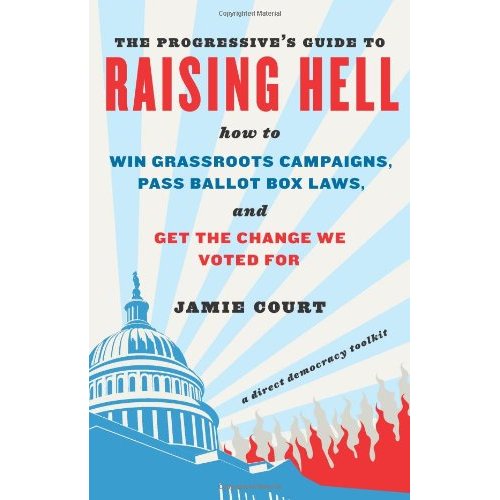
“Anger, not hope, is the fuel of political and economic change,” Jamie Court, head of Consumer Watchdog, writes in his new book, The Progressive’s Guide to Raising Hell: How to win grassroots campaigns, pass ballot box laws, and get the change we voted for (Chelsea Green Publishing, 2010).

Court writes that progressives are rightfully disappointed and disillusioned that after helping to elect President Barack Obama, he and Congressional Democrats turned around and gave Wall Street, the military-industrial complex, and the health insurance companies everything they wanted, with Obama even caving in on requiring all Americans to purchase health insurance, something he opposed as a candidate.


Yet Court said politicians never do the right thing and push progressive political change unless they’re forced to do so. He opened the book with a scene in which President Franklin Delano Roosevelt met with progressive political leaders, listened to their proposals, and then told them, “I agree. I am all for your plan. Now make me do it.”

It’s a concept that the conservative Tea Party movement understands well, and even though they may be crazy and wrongheaded in their utterly unsustainable and destabilizing policy agenda, they have effectively used anger as a political tool, and as a result, the NY Times reports they are poised to wield a disproportionate amount of political power after this election.

It’s the same story on the local level, where the only real anger in this election cycle is coming from those mad at public employee unions and their pension deals, and vagrants who sit uncivilly on sidewalks. These people will keep pushing for what they expect, but many progressives act as if it’s enough to prevent truly heinous Republicans like Meg Whitman from taking power, rather than trying to push Jerry Brown or Board of Supervisors’ progressives from day one to start empowering people over corporations.

“After the vote, power vacuums fill with familiar values, if not faces. Promises give way to fiscal realities, hope succumbs to pragmatism, and ambition concedes to inertia. The old tricks of interest group – confuse, diffuse, scare – prevail over the better angels of American nature,” Court writes, relaying a familiar electoral pattern.

Yet in this election, when the best outcome seems to be simply dodging a bullet, is there any hope for progressive political change? Isn’t the system just too broken? I asked Court these questions when he stopped by the Guardian office for a chat recently, and he retains a belief that with the right kind of tactics and agenda, progressives can still seize the political initiative and power.

http://www.youtube.com/watch?v=J3RD0YObHok

“I wrote it to reengage progressives because they are so despondent,” Court told me. “It’s about how to use anger and focus anger…Politicians don’t answer polite mobs, they only answer angry mobs and the Tea Party is the only angry mob in the room.”

Progressive have understandable doubts about the responsiveness of the current political system, but Court said, “I know if we don’t try to make it work, we’re never going to get there.”

And his book lays out the path to get there, step by step, based on some of the legislative and political successes that Consumer Watchdog and other progressives have had in recent years, such as rejecting the well-funded corporate con jobs in Propositions 16 and 17 earlier this year. Yet it involves an approach based on principle and not parties, and with being relentless in pursuing the kind of world we need.

“If you want to fight corporate power, you have to fight Democrats and Republicans,” Court said.

Specifically, Court is calling for progressives to push a California ballot measure that would establish a public health care option here, the very thing that Obama and the Democrats failed to include in their health reform package, and which will dash any hopes of it working if the people are forced to rely on unregulated insurance company products.

“The biggest thing is mandatory health insurance, which is a ticking time bomb,” Court said, one set to go off in 2014 when that aspect of Obama’s health care reform kicks in.

Corporate and political power working together seem to be a force too strong to overcome, but as Court writes, “Public opinion is the most powerful force in the world. While it can be muted, distracted, and co-opted, it cannot be controlled, except by the public.”

Tick tock

0

arts@sfbg.com

HAIRY EYEBALL In a characteristically poetic passage within 1980’s Camera Lucida, Roland Barthes describes early cameras, given their cabinet-like appearance and precise mechanical innards, as “clocks for seeing.” I couldn’t shake the phrase while taking in Will Rogan’s “Stay Home,” an ambiguous smile of a solo show composed of photographs and three-dimensional photographic collages at Altman Siegel.

Taking the measure of time is very much on Rogan’s mind, as it was on Barthes’ some 40 years ago. A photograph is but an imperfect means of forestalling time’s onward march: it offers the present a momentary record of an instant long gone. So too has photography, at least in the nondigital form that Barthes was writing about, become an index of a past medium, and in our current age of Photoshop, an object for nostalgic longing (see the Hipstamatic iPhone app).

Rogan skirts this sand trap even though his practice deliberately engages with 1970s printed matter and evokes a range of photographers from that decade and later, most notably Lee Friedlander and Daido Moriyama’s social landscapes, and to a lesser extent, Sherrie Levine’s appropriations. The three small sculptural collages of cropped images affixed to painted wood pieces with beeswax even look as if they are from another time. Indeed, it’s easy to get distracted by Rogan’s mode of address (“hey guys, here are some cool books I found at a yard sale, and look what I came upon while walking to the corner store”), by his work’s muted cleverness and calculated arrangement of happenstance, that it can be easy to overlook the substance of what he’s saying.

Viewing the Past As it Happens takes its title from a passage in a picture book on astronomy that is itself the subject of the photograph. The book lies open; a picture of a galaxy on the right page. A description on the adjacent page details that what we are looking at, that what astronomers gaze at through their telescopes night after night, is in fact millions of years old. Of course, this also functions as a gloss (as does the photograph’s title) on the act of taking a picture: in that moment when we look into the viewfinder, our fingers poised to capture what we see before us, we are in a sense seeing what will become the past.

Two other photographs of educational books, The Elusive Nature of Time and Man Versus Clock: The Unequal Struggle, drive the point home that the photographer’s relationship to time is a Sisyphean one, even as the lifted bathos of their titles sends up the self-seriousness inherent to such postulating. Rogan seems to say, “Don’t freak out, too much,” while simultaneously holding up evidence to the contrary. The detritus that catches Rogan’s eye in other pictures — reflective glass shards, a gutter-lodged beer can, a taped-together window, an abandoned sneaker — are corollaries to the amazing sign on the paper shredding business captured in Shredder that reads, “DOCUMENT DESTRUCTION — While You Watch,” in light of which “document” starts to read more as a verb than a noun.

With Busts, a series of six magazine pages (covers perhaps?) that have been altered so that only the ghostly white silhouettes of unknown seated subjects remain, Rogan moves from documenting destruction to participating in it. It’s hard to tell whether or not the outlines are formed from erasing a prior image or painting over unrelated text, some of which is visible underneath the white. Regardless, the message is still clear: time is on no one’s side.


THAT JOKE ISN’T FUNNY ANYMORE

Time will certainly not be on the side of Hugh Brown, who demonstrates in his solo show “Allegedly” at Robert Koch that no amount of skilled workmanship or flawless execution can make up for a paucity of ideas. Indeed, he has but one, and truly, it is more a gimmick than a concept: to remake iconic works of art in his own image.

And how does the artist picture himself? As a chainsaw-wielding bad boy, cutting through the canon and art world pretensions with the power phallus of choice for exploitation filmmakers and ice sculptors. Brown’s smash and grab tour through art history includes Diane Arbus (here, the child clenched in rage holds a toy saw instead of a grenade), John Baldessari, Henri Matisse, Barbara Kruger (“I saw therefore I am”), and Roy Lichtenstein, among many others.

Granted, Brown’s art is well made and it exhibits a careful attention to the material details of the work it parodies. A “Bruce Nauman” is actually done in neon (surprise, it’s a chainsaw). Each work is also credited to the original artist, a parenthetical “allegedly” following their name, as if the dubiousness of what we we’re looking at weren’t apparent already.

Appropriation is by no means a new game, and many of the artists hijacked by Brown made poaching and quotation central to their own practices. But the art in “Allegedly” lacks any real critical force. It says nothing about the works being pillaged and everything about Brown’s estimation of himself. The show is apiece with those postcards that put sunglasses on the Mona Lisa or banana hammocks on Michelangelo’s David.

How Brown has managed to convince gallerists otherwise is a mystery that “Allegedly” leaves unsolved. *

WILL ROGAN: STAY HOME

Through No. 6

Altman Siegel Gallery S/F

49 Geary, Fourth floor, SF

(415) 576-9300

www.altmansiegel.com

HUGH BROWN: ALLEGEDLY

Through Oct. 30

Robert Koch Gallery

49 Geary, SF

(415) 421-0122

www.kochgallery.com


Scroll of sound

0

arts@sfbg.com

MUSIC One of the singular ironies among the speedy online dissemination of sounds has to be the rediscovery of so many 1960s- and ’70s-era women singer-songwriters who came, sang, and seemingly disappeared in the wake of Joni, Judy, and Joan. Singular among Judee Sill, Vashti Bunyan, Karen Dalton, and those other ladies of the canyon is Linda Perhacs, the maker of Parallelograms, an achingly beautiful ode to nature and an all-too-brief testament to one young woman’s life, first released on Kapp in 1970 and most recently re-released in 2008 by Sunbeam.

From the start, psychedelic and folk-rock aficionados have been swept away by Parallelograms‘ opener "Chimacum Rain," as Perhacs’ overdubbed harmonies pour down like a sweet shower in the Olympic Peninsula while she tenderly pieces out, "I’m spacing out, I’m seeing/ Silences between leaves." But the title track is the heart of the album. A child of both Joni Mitchell and Free Design, with its jazzy washes of atonal color, circling Celtic guitar figure, and exploratory electronic effects, "Parallelograms" is a genuinely haunting masterpiece of experimental psychedelia — a future-folk madrigal that has inspired artists as disparate as Daft Punk (which used her "If You Were My Man" demo in 2007’s Electroma) and Devendra Banhart (who sang with Perhacs on "Freely," from 2007’s Smokey Rolls Down Thunder Canyon).

It’s a recording informed by the natural world of Perhacs, born Linda Jean Arnold in Southern California, raised among the the redwoods of Mill Valley, and relocated once more to Topanga Canyon as a young dental hygienist. By day, she’d work on the teeth of the famous and talented in Beverly Hills, and on the weekend, she and her husband, artist Les Perhacs, would venture into the "very raw wilderness" of Big Sur, Mendocino, and Alaska, she tells me today from LA, where she continues to apply her healing powers to celebrated smiles. "I’d walk the beaches in Baja, California, or the Sea of Cortez, Canada or the Pacific Northwest. I’d spend a lot of time alone walking — that’s when I started to write songs. It just seemed to come naturally in the middle of such beauty. I was just describing what I was seeing."

That vision — and its sonic incarnation — was recognized by Oscar-winning film composer Leonard Rosenman, a patient who had studied with Arnold Schoenberg and befriended Perhacs. Once he heard her rough demo and saw her "scroll" — her sketchlike notation for the song "Parallelograms," which she saw as a "moving sound sound-sculpture" — Rosenman decided he had to record her. "He said, ‘I could live a lifetime and only come up with two ideas this good,’" recalls Perhacs. The composer gave Universal Records a demo of two of her more conventional songs, secured funding, and assembled such ace players as guitarist Steve Cohn and percussionists Shelley Mann and Milt Holland to play on the LP, telling Perhacs, "If you see the executives from Universal walking in with suits, switch to another song because they’ll never understand this piece." In Perhacs’ words, "He supported me, but let the creativity of a young person come through."

Perhacs’ rare vision continues to shine through, though she never tried to replicate Parallelograms‘ many-layered vocals and effects live until recently. In fact, her forthcoming San Francisco Art Institute concert of new material — and a few songs from the 1970 classic, she promises — is only her third public performance. Rather, after making her powerful, influential sole disc, life — and spirit — called Perhacs, who passionately holds forth on theosophist Annie Besant’s thought forms (which find a place in Perhacs’ SFIAF concert), Paramahansa Yogananda, and Sister Josefa Mendez’s unabridged The Way of Divine Love.

"I’m a trained nurse," explains the songwriter, who remembers making music at age 5. "I know this stuff isn’t good for people. I know I lost a bunch of close friends in the ’70s. "Paper Mountain Man" — we lost him at 33. He was being a space pilot with his mind, and we lost him. I knew the dangers, and I knew from working on entertainment personalities in Beverly Hills. I didn’t want that world. I knew it would have an effect on an unformed personality. My sense of caution told me, ‘Do not go on the road and try to live that kind of life.’ My sense of inner balance told me, ‘Keep your balance.’"

The lack of label promotion and the first pressing of Parallelograms, badly remixed for AM radio, discouraged Perhacs from pursuing music further, until a 2003 visit by Wild Places’ Michael Piper, who first reissued the album on CD using the original LP. Shortly before his visit, Perhacs had almost died of pneumonia, but she soon discovered that her album had found a second life, too: "I was really weak when this guy got a hold of me and said, ‘The Internet has sent the album all over the world. I just felt guilty that you didn’t know what was going on.’" Perhacs had hung on to her own masters as well as demos she made after Parallelograms, and with Piper’s help, the original mix and never-before-heard songs like "If You Were My Man" were finally released. A vinyl version of Parallelograms as it was meant to be heard is due soon on Mexican Summer.

And Perhacs is making new music, inspired and supported by such friends and fans as We Are the World’s Aaron Robinson and Robbie Williamson, and Julia Holter, who performed with her not long ago at Red Cat in LA — a new community akin to her long-ago Topanga Canyon creative milieu. "When we had a budget it went really quickly and was very organized," she says sweetly today. "We all have straight gigs, as you call them, so it’s hard to get us all together to rehearse or record." Nevertheless, she adds, "I felt very comfortable with what I stayed with, which was spiritual pursuit. Going on the road did not feel right to me, but at this stage of my life, I don’t feel vulnerable — you could put me in the middle of a million people and I would feel solid with the choices I made."

LINDA PERHACS
With Julia Holter and CLoudS
Sat/9, 7 p.m., $17
San Francisco Art Institute Lecture Hall
800 Chestnut, SF
www.human-ear.
org

NSFR(estaurant): My dinner with Dixie

0

All photos by Benjy Feen

I had a blind date with Dixie De La Tour, but I wasn’t nervous. If all else failed, at least she would bring stories to tell. And how – De La Tour is the founder and emcee of Bawdy Storytelling, a randy live series with two events next week (Wed/6 and Sat/9) that will bring writers, comedians, and normal folk-like to the stage to share corset-busting sexcapades with an audience of vicarious pervs.

“I don’t know how this got to be my life,” says Dixie, now installed across the restaurant table from me behind a glass of sweet tea, wearing a dashing fedora and magnetic waves of dyed red hair. Her blue eyes have the intent gaze in them that you can see on people that know how to hold the attention of the room. “I don’t have a degree in it like every other pervert in this town.”

It is true that De La Tour seems to have lucked out on the manner in which she makes her money. By day, she scouts scammers at Fling.com, a national dating site for casual hookups. Perhaps she’s a natural fraud-finder – the woman’s spent a life facilitating honest, fun sexual encounters. She’s also a contributor at She Loves Sex, a collection of blogs about all things sexual related to women, told in a knowledgeable women’s voice. For the site, De La Tour recently interviewed Rebecca, a soccer mom from Florida who has started a successful chain of swinger’s parties in between PTA meetings and classes towards her master’s in public relations. 

Bawdy Storytelling, started four years ago, runs through a different theme each month. Adderall Diaries writer Stephen Elliott and that webmaster savior of the perpetually broke gadabout, Johnny Funcheap will be spinning yarns at next week’s Litquake edition of Bawdy (Wed/6), which actually is not themed at all, but rather a collection of the all-star lineup’s “best true stories.”

Maybe she’s got no degree, but Dixie does have a history in the psychology of human sexual relations. Over her rum cake — and to the passing interest of our server — De La Tour tells me that she got the party started at the first Kinky Salon XXX edition. Well c’mon Dixie, story time. She obliges. 

Dixie De La Tour fires up the Bawdy crowd

Having transplanted from the Blue Ridge Mountains of Virginia and an unsatisfying heterosexual monogamous relationship with a bookie, De La Tour was in her element in late ’90s San Francisco. “You know that girl whose always down for the sex party? People would call me up and I’d be like, I’m there!” She became the doorperson for the original Kinky Salon parties at Mission Control, back in the days when the get-togethers were more “salon” and less “kinky” – there hadn’t been sex, at least as acknowledged by the party planners, for the first few Kinkys.

But one month, founders Polly and Scott decided to change the nature of their get-together. De La Tour recalls a woman arriving at the party who told her “I’m from New Hampshire and this is my first San Francisco sex party!” Well, by the time De La Tour had gotten off her shift and into the mix at Kinky, there was talking, there was certainly drinking, but at least explictly, no sex. 

“There was a bullhorn by the stage,” she remembers, fully in the swing of her tale. 

It is at this time that I should explain that Dixie has explained that she is herself, “not that big of an exhibitionist.” De La Tour is a facilitator, the person at the swinger’s party who loves nothing more to make introductions and get the fucking going… for others. That’s what she likes.

So back to the bullhorn. Having made the most of her time off door duty, she is a bit inebriated at this point. She takes the bullhorn and, having installed herself on stage in front of the party, booms to New Hampshire woman “Connecticut! Go have sex with that guy!” — or some such thing (having told me she is “much more interesting after two beers,” I am obliging her and my notes are a bit sparse from this point in the evening). She remembers them immediately going to have sex, although others from the night remember it differently. Good storytelling is all about the broad strokes.

But regardless, the rest is undisputed. Dixie soldiers on with the bullhorn, roaming about the club until she actually does encounter a couple copulating in the Pink Room and begins to shout very, very dirty things into the bullhorn at them. “Say my name, say you like my big dick” she shouts (“really, things that were not making very much sense,” she tells me, looking through that deadly scope of hindsight). Suddenly, couples rush into the Pink Room, and Dixie has officially started the orgy. Er, party. 

Later, she runs into the original fuckers in another room utilizing a fucking machine. She is stripped of her bullhorn, installed on said machine, and is chagrined (remember, not a big exhibitionist) when the tables are turned and the woman from this couple begins to yell her name into the bullhorn. “Yeah, you like my big dick, Dixie?” Partygoers rush into the room to see the performance, and aid in her enjoyment of machine. She is eventually brought to climax when a woman Eskimo kisses her. 

This is told with a smile, and by the end of it, we notice our server is frozen in her rounds of filling water glasses. “What on earth are you two talking about?” she says, giggling. But this is San Francisco, and as she is clearly intrigued, Dixie hands her a card that has all the Bawdy Storytelling events inscribed on its back. 

After our (professionally inclined) date, I feel as though I have met someone very special, someone who has the cojones to nurture a community that often stays behind closed doors. De La Tour tells me you can learn a lot from hearing a person talk for ten minutes, perhaps more than you can learn having a good time with them at a swinger’s party. 

And the connection is contagious. De La Tour started Bawdy Storytelling as a “coffee klatch for pervs,” where people would gather about the table and talk about how last night’s Kinky Salon went for them. Soon others wanted to sit in on the talks around the table, which led to Bawdy’s current public incarnation. And then everyone wanted to share a story, which led to Bawdy’s set program of four to six speakers a night, “so that people could see there was a set lineup and they weren’t on it,” De La Tour tells me. “Somebody’s always walking up to me and saying hey I got one for you!” This last line enunciated with a pointed finger and an intensification of that blue-eyed stare.

How nice to get sexuality out into the open. How nice to find meaning and simpatico in our sex. How nice to be Dixie De La Tour.


Bawdy Storytelling Graphic Confessions

Wed/6 8 p.m., $10

The Blue Macaw

2565 Mission, SF

www.bawdystorytelling.com

www.litquake.org


Lit Crawl: Bawdy in the Alley

Sat/9 8:30-9:30 p.m., free

Clarion Alley between 17th and 18th St., SF

www.bawdystorytelling.com

www.litquake.org


Flagging in the Park: the whirl story

0

“This is the gayest thing I’ve ever done in my life!” laughed my friend Ricky Strawberry as he twirled around and around, unfurling lengths of tie-dyed cloth to Hi-NRG dance tracks from a live DJ in the sunshine. If you know Ricky Strawberry, that’s pretty damn sparkly pink unicorn in a rainbow thong bathing under a Splenda waterfall gay. In fact, it was the gayest thing anyone in my pinko posse had ever done, as well, and we had a ball. It was gay, it was amazing, it was gaymazing, and you should do it too.

It? Flagging in the Park, the summertime monthly gathering of fluttering human butterflies in the AIDS Memorial Grove in Golden Gate Park. I wrote about it in this week’s Super Ego nightlife column — and it happens for the final time this year on Sat/2, 1 p.m.- 4p.m. 

Flagging — or flag dancing, wherein the dancer whirls around waving psychedelic-patterned, weighted pieces of fabric — has been around for several decades. I remember the first time I saw it was in the ’80s at a giant outdoor picnic in Detroit organized by Metra magazine, but it really took hold inside gay clubs during the ’90s, when circuit parties were on the rise. (Flag dancing of a non-gay-specific kind, using actual flags with poles, is an ancient art still practiced especially in Italy and New Orleans — and in Midwestern marching bands.) The exact gay origins are fuzzy — men dancing with giant fans at disco clubs were a common sight, and you will see lots of flaggers at the disco-celebrating Remember the Party event next weekend, for instance, which acts as a reunion for patrons of the classic Trocadero Transfer venue in the ’70s and ’80s.

Like many alternaqueers of my generation, flagging was a turnoff in the ’90s — it was too associated with annoyingly relentless circuit music, mainstream gym culture, and bad drugs in my mind. But that was a long time ago, and like a lot of things from that time, a rediscovery after old conflicts have died out puts things into a totally different perspective. (You don’t see much flagging in mainstream gay clubs these days, and the music at Flagging in the Park is a bit more fun and interesting than I thought it would be. For the October installment, the DJ is Steve Sherwood.) I was able to appreciate the art in a different context, and without prejudice. Flagging in the Park is a beautiful event, full of rich historical meaning. It welcomes everyone — there are also large contingents of hula-hoopers, poi-twirlers, and other talents — and has taken on a more spiritual aspect.

http://www.youtube.com/watch?v=Me3rZ99ArbU

When I went in August (I had heard about it for months, and was encouraged to finally attend by my friend Steven Satyricon’s lovely writeup over at The Juice Box site) I was lucky enough to see the organizer, Xavier Caylor, be sainted by the Sisters of Perpetual Indulgence for his community work. And Flagging in the Park (FITP) really does bring in a bunch of donations for community organizations, as well as provide community healing. “Without grief, you can’t have joy,” said Xavier, referencing the spirits around us in the AIDS Grove. Xavier took over FITP 10 years ago, and he teaches a flagging class at Gold’s Gym in the Castro every Wednesday, 6 p.m.-8 p.m. He’s also several thousand degrees of hotness, yowza. I wanted to know more about how he got involved, and some of the spiritual aspects of the art. His story is below — and you should drift on by this Saturday afternoon to see for yourself. Xavier provides plenty of free flags to borrow, and flagging really is a bit of good exercise, I discovered. 

XAVIER CAYLOR: “I picked up my first set of flags from a friend of a friend at a party on Will Rogers Beach in 1997. I was hooked and we proceeded to flag everywhere we could: at home, in clubs and circuit parties. I heard about FITP from a fellow that I met at a circuit party in Palm Springs; he told me of a community of good friends that met during the summer months at a park in SF. I managed to contact someone and planned a weekend getaway from So. Cal. to attend in July of 1998.

“In 1998 the recently dedicated National AIDS Memorial Grove was young, the flaggers met in the then newly planted fern grove and gravel circle on the far West side. Twenty people gathered on what was a truly magical day for me; I was amazed with the variety of people, flags, and energy there – like a kid in a candy store. I not only left my heart in San Francisco but gave it freely to a tie-dye artist that became the catalyst for me moving here in just three short months. For the next few years he and I co-produced the event, popularity soon crowded us out of the circle and into the meadow. I have been producing the event since 2001 less two years that a friend took it and moved it to Dolores Park. Originally the events were planned a few days in advance around a sunny weather forecast. In 2002 this changed, acquiring permits and making these outreach events for charity brought a whole new dimension to our gatherings.

“What does the event mean to me? It was and is a magical space where love was born and flourishes, where flaggers can come out of the clubs and into nature. Held in a place that was built out of grief, mourning, and reflection by something that devastated our community and for a few hours we pour color, love, celebration, and heritage carefully back while raising consciousness by giving back. It is the place that our tribes come together to socialize, bond, and strengthen community. It is also a place that people walking through the park can happen upon a surreal event, take it in for a minute, and leave having had the opportunity to try something new or just stop and take in the music and visuals before moving along to where ever it is they are going. I usually plan 3 or 4 FITPs per year between May and October — the last one was supposed to be the final one this year, but we had such a great crowd and great vibe that we decided to have one more.

http://www.youtube.com/watch?v=fd3pX-Ys1wI

“If you’ve picked up flags you’ve most likely been asked by someone to show them how to do “it.” I’ve been showing friends since day one, taught at workshops in SF, NY, SD, and Dallas. I’ve been involved with group and solo performances, led people in tie-dye, and given away hundreds of flags while traveling to parties in Brazil, Australia, Thailand, Spain and the UK ,not to mention many cities around the US.

“About my class at Gold’s Gym: When I moved to San Francisco Club Universe, 177 Townsend, on Sundays was known as Pleasuredome and was a venue with a huge stage that flaggers flocked to weekly to play and share their art. It was a beacon to flag dancers on the West coast and beyond, introducing a steady stream of club goers weekly to the glowing fabric twirling in the U.V. flooded stage. It’s close in 2002 was a blow to the dance and flag communities. In 2007 I approached the management at Gold’s and asked if I could hold a weekly space for flaggers to come and practice – I was envisioning a free space that I would hold for a year with the purpose of re-energizing my tribe and reviving that weekly space. Troy at Gold’s Gym enthusiastically offered me a position and added the class to their Group X fitness program – I’ve been teaching Wednesday nights since. It is a place that people that have never flagged can come and learn – I have flags for use and set up black lights to make them come to life. The community comes to practice, play and socialize. I support new and old flaggers at the gym and outside of the gym by leading tie-dye classes/open studios so people can make their own flags. Weekly pre class discussions are opportunities to share history, personal stories and current events. Other flow toys (like poi and fans) show up from time to time and I support them if and when I can.

http://www.youtube.com/watch?v=GC4qFjeSTvg

“The group of guys that started FITP in 1996 shared a common experience, they had all gone to a week long experience in consciousness building in San Diego called the Miracle of Love which used active meditation techniques developed by Osho Rajneesh. Those flaggers came together in 1998 to bring those techniques to the gay community through a weekend seminar that is still going strong called the ‘Men’s Inner Journey.’ It was through delving deep into the techniques of active meditation that I realized what a spiritual event flagging is. Though people don’t usually make the connection between flagging and meditation, there is a point when the body and mind are so engaged that in the exuberance of the dance the mind is set free to a place of stillness. I believe that meditation something lacking in our lives and something we need to recharge our spirit and connect with our soul.

“Flagging is a visually appealing dance that has lived primarily in the gay community for the past 40 years. It touches on spirituality by being an alternative form of meditation palatable for people on the go. I am proud to be one of the many that keeps this art form flourishing by holding the space to pass it to the next generation of artists. www.flaggercentral.com is a great resource for our community.”

Our Weekly Picks: September 29-October 5, 2010

0

WEDNESDAY 29

MUSIC

Kylesa

The devil went down to Georgia, and sprinkled enough hoodoo in the water to cultivate quite a metal scene. But it ain’t just Mastodon and Baroness splitting ears in the town squares. Kylesa — you know, the band with the two drummers, the badass chick guitarist-vocalist (she’s one of two guitarists and one of three vocalists), and the coolest cover art in the biz — is about to drop its fifth full-length, Spiral Shadow. The title of lead track “Tired Climb” belies the album’s fierce riffs and heavy energy. But let’s stop pretending you weren’t going to this show anyway — local mighties High on Fire headlining the glorious Great American? With the added bonus of two ironclad openers? Can’t miss, hesher. (Cheryl Eddy)

With High On Fire and Torche

8 p.m., $20

Great American Music Hall

859 O’Farrell, SF

1-888-233-0449

www.gamhtickets.com


THURSDAY 30

DANCE

Mark Morris Dance Company

Just because his company has become a perennial audience favorite doesn’t mean we should ignore Mark Morris. After all, the acclaim is justified: there’s nobody else who — after 30 years of working — can still surprise and delight (and sometimes disappoint) us the way Morris can. This time he is bringing three West Coast premieres. If the buzz wafting in from the East Coast is any indication, the new Socrates set to Satie’s oratorio “Socrate” (piano and voice) should be outstanding. It will be performed with the stark Behemoth — Morris’ only no-music piece — and Looky, his bemused take on pretentious museum-going in which the inmates take over the show. (Rita Felciano)

Thurs/30–Sat/2, 8 p.m.;

Sun/3, 3 p.m., $34–$72

Zellerbach Hall

Bancroft at Telegraph, UC Berkeley, Berk.

(510) 642-9988

www.calperformances.org


DANCE

Lizz Roman and Dancers

San Francisco’s Gingerbread Danzhaus is the only venue in the city to provide dance studio space to professional companies while also serving as a nightclub in the after-hours. This weekend it will also be the seat of Lizz Roman and Dancers new site-specific work This Dance This Place, which aims to bring the architecture of Danzhaus to life through an interactive dance performance challenging viewers to really see the nooks and crannies of the space. With a live sound score, collaborative lighting and costume design, and dancers streaming from every danceable doorway, crevice, and ledge, this performance is sure to provoke thought on where and how dance is presented. (Emmaly Weiderholt)

Through Oct. 9

Thurs.–Sat., 8 p.m., $20

Danzhaus

1275 Connecticut, SF

www.lizzromananddancers.com


FRIDAY 1

DANCE

Nina Haft and Company

A few years ago, visitors to Zaccho Dance Theatre’s third-story performance space could look down onto San Francisco’s last working farm. The Bayside venue seems uniquely appropriate for Nina Haft’s site-specific Debris/Flows. Collaborating with German-born, Italian-trained Claudia Borna, the two women transformed this former warehouse space into a natural environment for 12 dancers to explore both outer and inner landscapes. In addition to watching the performance, audiences can contribute to Zaccho’s environment by planting seeds and eating food from local gardens. The dozen dancers will help you navigate the labyrinth. (Felciano)

Fri/1–Sat/2, 8 p.m. (also Sat/2, 6 p.m.);

Sun/3, 6 p.m., $12–>$18

Zaccho Dance Theatre

1777 Yosemite, Suite 330, SF

(510) 325-5646

www.brownpapertickets.com


MUSIC

Drums

A lot of the Drums’ music mines the sounds of the 1950s, smooshing it up with the more saccharine output of the Smiths and New Order, but there’s a lull halfway through the New York City band’s debut album where its intentions really become clear. A slower song than the rest of the album, “Down By The Water” mimics the believable earnestness of ’50s crooners completely without pretension. The Drums have been accused of lacking individualism, which is a fairly valid criticism considering you could drop some of their more upbeat tracks into a Smiths album and no one would bat an eye. But in latching onto eras where simplicity was something to be celebrated, the band succeeds by being sincere when tongue in cheek would have been way “cooler.” (Peter Galvin)

With the Young Friends

9 p.m., $15

Independent

628 Divisadero, SF

(415) 771-1421

www.theindependentsf.com


DANCE

SMUIN BALLET

Although the Smuin Ballet may be considered a relatively small ballet company, there’s nothing small about the renowned choreographers and kick-ass dancers Smuin attracts. Founded by Michael Smuin in 1994 and now under the artistic direction of Celia Fushille, the company presents classical ballet with a contemporary edge. It kicks off its 2010-11 home season with a fall program that includes the world premiere of Oh, Inverted World — set to the indie rock band the Shins and choreographed by the illustrious Trey McIntyre — as well as Michael Smuin’s twangy Bluegrass/Slyde and his more lyrical Brahms-Haydn Variations. (Katie Gaydos)

Through Oct. 9

8 p.m. (no show Mon/4);

Additional shows Sat/2–Sun/3, 2 p.m.), $20–$62

Palace of Fine Arts Theater

3301 Lyon, SF

(415) 978-2787

www.smuinballet.org


SATURDAY 2

FILM

The Incredible Shrinking Man

Ever get the feeling you’re being dwarfed by what’s going on around you in life? Well, that’s exactly what happens to the main character in the 1957 Jack Arnold sci-fi classic The Incredible Shrinking Man, in which a freak accident causes him to get smaller and smaller with every passing day. Featuring a host of inventive special effects and memorable scenes (among them his epic battle with a house spider), the movie screens tonight as part of the San Francisco Film Society’s annual “Film In The Fog” event. Let’s hope nature cooperates and offers up a little bit of a spooky mist to make for a cool and creepy early Halloween celebration. (Sean McCourt)

5 p.m. picnic, 7 p.m. film, free

Presidio, Moraga at Arguello, SF

www.sffs.org


MUSIC

The Sword

Austin, Texas, retro-metallers the Sword are in space. This summer, new album Warp Riders saw them rocket into full-fledged concept album territory, weaving a epic saga of interplanetary travel and mystical sci-fi warriors on a loom composed of Orange amplifiers. As fall descends, they’re taking the tunes and tales on the road, and their SF date marks the second stop on a grueling national run. Fans will be eager to bask in a bevy of new songs performed live, and the band’s adroit playing on the new record bodes extremely well for the experience. Prepare for blast-off! (Ben Richardson)

With Karma to Burn and Mount Carmel

8:30 p.m., $20

Regency Ballroom

1290 Sutter, SF

1-800-745-3000

www.theregencyballroom.com


FILM

American Splendor

Who is Cleveland’s most beloved figure? A few months ago the answer may have seemed obvious: superhuman baller LeBron James. At least until he got on the ESPN grandstand and announced he was going to Miami. Four days later Harvey Pekar died, and it put everything in perspective. A cranky file clerk who wrote wonderfully mundane comics about life’s pedestrian absurdities for more than 30 years, Pekar was an unlikely fit for the limelight (with legendary Letterman appearances to prove it). Fame found him nonetheless, culminating in this 2003 biopic featuring not only a suitable portrayal by the continually wincing Paul Giamatti, but also the inimitable figure himself. A fine entry into a persistent legacy. (Ryan Prendiville)

8:30 p.m., $5.50–$9.50

Pacific Film Archive

2575 Bancroft, Berk.

(510) 642-5249

www.bampfa.berkeley.edu


SUNDAY 3

EVENT

Estria Invitational Graffiti Battle

Graffiti’s outgrown furtive leaps over cyclone fencing and dark alley deployment. These days street art is a community builder, the old pros from the 1980s golden age having become teachers and respected figures in the art world. But that doesn’t mean it’s gotten stuffy. Case in point: Bay Area graff legend Estria Miyashiro’s free annual spray-off in the park. Names that are no strangers to the city’s bus stops, brick walls, and freight trains will be present to participate in and judge live painting: Nate1, Crayone TWS, and 2009’s champ Vogue TDK among them. Mix in stencil workshops, a youth sketchbook competition, and artist signings, and you’ve got a multi-generational homage to the art of aerosol. (Caitlin Donohue)

11 a.m.–5 p.m., free

DeFremery Park

1651 Adeline, Oakl.

(510) 895-5700

www.estriabattle.com


MONDAY 4

MUSIC

Guitar Wolf

In the future, anthropologists will study Guitar Wolf to calculate the speed of pop culture. The musical equivalent of Engrish, the trio channels Ramones-era punk rock (leather and all) to create Japanese “jet rock ‘n’ roll,” a louder, noisier, and enjoyably unintelligible hybrid. Tonight the band ends its first U.S. tour in five years, also the first since the death of bassist Billy. “However, it is not, not necessary to worry,” lead singer Seiji says on the band’s website. “New bassist player U.G.! U.G. is terrible! It is jet terrible! It fight! It fight rock! I will show Guitar Wolf is reborn to you!” (Prendiville)

With Hans Condor, Midnite Snaxxx, and DJ Classic Bar Music

9 p.m., $15

Bottom of the Hill

1233 17th St., SF

(415) 621-4455

www.bottomofthehill.com


TUESDAY 5

MUSIC

Guided By Voices

Ringleader Robert Pollard is rounding up the rest of indie rock giants Guided By Voices for a one-time reunion tour to commemorate Matador Records’ 21st anniversary. And this isn’t some half-ass reunion, either. This is the GBV lineup of the mid-1990s that spawned much-beloved albums such as Bee Thousand and Alien Lanes. Pollard’s been just as prolific on his own as he was before the group’s breakup in 2004, but there is just no comparing his solo work to GBV’s catalog. Don’t miss your chance to see one of the most influential indie rock bands of the past 20 years one last time. (Landon Moblad)

With Times New Viking

8 p.m., $24

Warfield

982 Market, SF

(415) 345-0900

www.thewarfieldtheatre.com 


The Guardian listings deadline is two weeks prior to our Wednesday publication date. To submit an item for consideration, please include the title of the event, a brief description of the event, date and time, venue name, street address (listing cross streets only isn’t sufficient), city, telephone number readers can call for more information, telephone number for media, and admission costs. Send information to Listings, the Guardian Building, 135 Mississippi St., SF, CA 94107; fax to (415) 487-2506; or e-mail (paste press release into e-mail body — no text attachments, please) to listings@sfbg.com. We cannot guarantee the return of photos, but enclosing an SASE helps. Digital photos may be submitted in jpeg format; the image must be at least 240 dpi and four inches by six inches in size. We regret we cannot accept listings over the phone.

High on arrival

0

arts@sfbg.com

MUSIC If hip-hop is jazz, then Curren$y can be described as a traditionalist. His debut album, Pilot Talk (DD172/Def Jam), is pure braggadocio, with rhymes about fancy cars and free-flowing liquor and free-loving women. The music, lovingly produced and arranged by Ski Beatz, sounds like an update of Dr. Dre’s The Chronic, all the way down to the New York session musicians recruited to crank out mellow grooves. It’s as if Curren$y has reinterpreted the Sugar Hill Gang’s “Rapper’s Delight” for the new millennium.

In the world of jazz, the traditionalists famously waged war against the free jazz nuts who wanted to strip the form of tonality, and then against the fusionists who sought to infect it with slovenly rock and roll. With help from Dixieland revivalists and Ken Burns’s Jazz documentary, they succeeded. In contrast, rap nerds have always viewed avant-garde experimentation with suspicion at best, and complete ignorance at worst. The furthest we’ll go, it seems, is the high-tech funk of Big Boi’s Sir Lucious Left Foot: Son of Chico Dusty, or Madlib’s Medicine Show of gutbucket blues and crusty soul-jazz loops.

If fitted with John Coltrane’s sheets of sound or Ornette Coleman’s harmolodics, Pilot Talk would be a strangely awesome experience. As is, it’s soothing yet enlightening, like an animated chop session after smoking a joint or two with a friend. Curren$y clearly made it on blunted terms: the album artwork depicts a lone airplane flying over a landscape of lush green marijuana foliage.

So Pilot Talk is like weed talk, with several narratives hidden underneath the stoner blather. On “Example,” Curren$y claims “reimbursement for paid dues,” then states, “I am an example of what can happen when you quit being afraid to gamble.” On “Seat Change,” he mocks a girl who wants to “ride with a G,” concluding that “somewhere along the line she fucked up and realized she lost her seat.” His lines are pimp slick but thankfully shorn of delusion. When he flips a bevy of yeyo metaphors for “Audio Dope,” he clearly does it in service of the concept, not to build a farcical image of himself as a drug kingpin. The image is of a neighborhood (or, more accurately, Internet) baller.

Curren$y’s persistence comes from years spent toiling for various rap crews, hip-hop’s version of the mailroom. As a young scrapper from New Orleans’s Uptown neighborhood, he rolled with C-Murder’s TRU family before C-Murder infamously caught a life bid for murder, then transferred to Master P’s No Limit label. Then he landed at Lil Wayne’s fledgling Young Money Entertainment, dropping burner verses for Weezy’s The Carter II and Dedication mixtapes, before landing under the aegis of reformed hip-hop mandarin Damon Dash, whose DD172 label released Pilot Talk in July. It’s ironic that since Curren$y’s departure, Weezy has decided to transform Young Money into an overpublicized pop star boot camp for teen idols like Nicki Minaj and Drake. Then again, the fact that even Curren$y sounds alternative when posited against mainstream rap’s scions demonstrates how rigid the culture has truly become.

However, Curren$y also benefits from marketing, albeit of a viral nature. Pilot Talk boasts the cream of the blog rap crop, including Mikey Rocks from the Cool Kids, Big K.R.I.T., and Jay Electronica (who sharply compares Flavor Flav’s signature bow tie to the Nation of Islam’s attire). Even much-beloved weed rapper Devin the Dude drops a verse for “Chilled Coughphee.” A writer friend of mine, Christopher Weingarten, remarked to me that when Devin the Dude jumps in with sly wit like “I can fuck a bum up quick / But that’s some tenth grade shit,” it only underscores Curren$y’s relative lack of vocal presence.

Other critics have theorized that Pilot Talk‘s artistic triumph is largely due to Ski Beatz’s memorable accompaniment. An NY vet whose catalog ranges from membership in early-’90s woulda-beens Original Flavor to credits on Jay-Z’s 1996 classic Reasonable Doubt and Camp Lo’s “Luchini AKA (This Is It),” Ski Beatz initially produced Pilot Talk‘s tracks himself and then hired talented unknowns like bassist Brady Watt to transform them into instrumental gems. True, any rapper would sound incredible against the majestic sunshine funk of “Address.” But give Curren$y credit for lodging its hook in your brain — “Still nothing changed but the address.”

CURREN$Y

With C-Plus and NPire Da Great, J-Billion and P-Funk, DJ ANT-1

Wed/29, 9 p.m., $16–$20

330 Ritch

330 Ritch, SF

(415) 541-9574

www.330ritch.com


Practiced distance

0

arts@sfbg.com

FILM The first time I met Paul Clipson, we quickly discovered that we shared an intense regard for Nicholas Ray’s On Dangerous Ground (1952). I had just seen material that would become Clipson’s short film Union at a San Francisco Cinematheque screening a few days prior and found that its psychically charged shift from rural to urban spaces reminded me of the Ray movie (specifically, a single dissolve as Robert Ryan’s character drives back into the city). Union belongs to a different species of cinema, of course. It’s shot on Super 8 and 16mm, wordless, with a narrative situation (a girl running) refracted as pure kinesis. As became apparent talking with Clipson, however, his deep knowledge of film history is attuned to texture rather than taxonomy. The second time I watched Union, I realized that On Dangerous Ground was just a convenient name for the deeper, more elusive sense of recognition it stirred in me.

Since that first meeting, I have seen Clipson project films on a billowing screen under the stars; in the squat confines of the Café Du Nord for the On Land music festival, where his work expanded several performances; and on the sides of a dome structure atop Yerba Buena Center for the Arts. There have been more traditional screenings as well, though Clipson’s eclectic live projections are drawing attention — he’s fresh back from a brief European tour and will be featured in New York’s Views from the Avant-Garde this weekend. Before then, he’ll present a ranging survey of his recent efforts at SFMOMA, where he works as head projectionist.

The shifting context of live collaborations and crystallized short subjects is crucial to understanding Clipson’s work, and so "The Elements" will feature both: a suite of finished films sandwiched between projections with frequent collaborator Jefre Cantu-Ledesma and an ensemble, Portraits. An open frame of performance is a crucial catalyst for the searching lyricism of Clipson’s cinematography. He shoots frequently, building long reels to run with the music. Clipson refers to these unrehearsed dives as his research.

The camera style is at once impressionistic in its technique and boldly graphic in its compositions, haunted by familiar visual forms that, loosed from conventional perspective, are revealed to carry unexpected resonances and rhythms. What do we see? A million suns, made multiple by the surface of water and the curve of the camera lens; neon signs; flitting vertical obstructions; telephone wires; vegetation; intimate, handheld disclosures of vast distances; architectural surfaces. As with Joris Ivens’ early shorts, Clipson’s films register the city in its minor variations. Within the frame, a storm of vision emerges of superimpositions, dissolves, rack focus, zooms, and the interlacing of color and black-and-white stocks. It often seems that the objects he films are bringing the camera into focus and not the other way around.

When I ask about this, Clipson says, "I’ve found that the pulpy intensity of the Super 8 film decides the subject matter in a way. It’s like the film is in your brain telling you to shoot this or that — you can just imagine the luster." The intuitive nature of his in-camera montage meshes well with the aural landscapes of the live performances; a floating minimalism prevails. As a former member of Tarantel and co-steward of the Root Strata label, Cantu-Ledesme has been Clipson’s primary point of entry to this musical world. Speaking over the phone, he notes their easy camaraderie: "Once Paul is in the moment of filming, he’s just really responding to what is happening on the other side of the lens … and at least when I’m playing by myself, I try to have that same attitude."

In concert, the physical waves of sound and Clipson’s disembodied images are rich soil for a trance. It’s only in the concentrated shorts, however, that one finds the full extension of Clipson’s lyricism. The elliptical Sphinx on the Seine (2008) is still my favorite. Only eight minutes long, its shots seem to trace a voyage. We see the golden gleam of the sun as reflected by criss-crossing railways and snaking waterways, the shadow-world of a sidewalk, a phantasmal vision of Mount Fuji. Each of these lucid views slides away just as it ripens. Clipson’s collation of different cities is formally embedded in his composited images, which here appear as the fragile clues of some unknown existence. Like Sans Soleil (1983) and Mr. Arkadin (1955), two similarly itinerant films, Sphinx on the Seine evokes a tantalizing sense of placelessness.

One afternoon, both of us a little scatterbrained from a long week, Clipson and I get hung up on CinemaScope. He expresses admiration for the anamorphic framings of Ben Rivers’ I Know Where I’m Going (2009), and then draws a zigzag of appreciation between George Cukor’s 1954 A Star is Born ("The first 20 minutes"), Vincent Minnelli’s 1958 Some Came Running ("When you see it in the theater, it’s so much darker than on a television. You see shadows under people’s eyes"), and Otto Preminger’s general mastery of the form ("To me, those aren’t even compositions; they’re movements of thought"). It strikes me again and again that Clipson’s acute observations regarding film aesthetics are very much part of his creative force — yet his filmmaking doesn’t feel overcooked. Ben Rivers’ films work in a similar way: betraying a cinephile’s intimate knowledge of the medium, but out in the world all the same.

"Sometimes a few seconds of a film can live with you your whole life," Clipson tells me later that same afternoon, locating one such epiphany in the opening of Orson Welles’ Macbeth (1948): "There are all these dissolves going through the witches’ cauldron. You see a smoke circle, a storm cloud, what maybe is the surface of clouds from above, the cauldron and hands … I could just make films entirely inspired by that for 10 years because it’s so intangible, with such a beautiful, dense logic of images that resists immediate understanding." Indeed, it sounds like a Paul Clipson film.

"PAUL CLIPSON PRESENTS THE ELEMENTS"

Thurs/30, 7 p.m., $5

San Francisco Museum of Modern Art

151 Third St., SF

(415) 357-4000

www.sfmoma.org

The test of the Tenderloin

16

caitlin@sfbg.com

This is a story about love and money. Or a story about love, money, and location. — Rebecca Solnit, Hollow City (Verso 2000)

It’s a sunny day in the most maligned neighborhood in San Francisco. I’m walking down a busy sidewalk with an excited Randy Shaw, long-time housing advocate. He’s giving me a tour of his Tenderloin.

“There’s history everywhere you look here,” he notes as we rush about the dingy blocks of one of the city’s most densely populated, economically bereft communities. In a half-untucked navy button-down and square-frame glasses, Shaw reels off evidence of this legacy faster than I can write it down and still maintain our walking pace.

To our left, Hyde Street Studios, where the Grateful Dead recorded its 1970 album American Beauty. Across the street, a ramshackle building that once housed Guido Caccienti’s Black Hawk nightclub, where the sounds of jam-fests by the likes of Billie Holiday and John Coltrane would echo out onto the streets during its heyday in the 1950s. Throughout its history, the Tenderloin has been renowned for its nightlife: music, theater, sex work — and the social space that occurs between them.

Shaw came to the Tenderloin 30 years ago as a young law student and founded and built the Tenderloin Housing Clinic, a nonprofit agency that is now one of the largest property owners in the neighborhood and employs more than 250 full-time workers. Shaw has spent the last few decades fighting to improve conditions in the single-room occupancy hotels, or SROs, once notorious for malfunctioning heating systems and mail rooms that would dump the letters for their hundreds of low-income residents into a pile on the floor rather than fit them into personal lock boxes (which now line the walls of THC’s lobbies).

But that activism isn’t the reason for this tour. No, today Shaw is showing me why tourism can work in the Tenderloin. The heavy iron gate of an SRO is quickly buzzed open as the doorman recognizes him. Inside, working-class seniors mill about aided by walkers — this particular property is an old folks’ home — but over our heads, affixed to a majestically high ceiling, looms a triple-tiered glass and metal chandelier, evidence of the area’s architecturally important past.

“When I show people this,” Shaw smiles at my amazement at this bling in a nonprofit apartment building, “they’re amazed at the quality of the housing.” Further down the road, we peep in at a vividly Moorish geometric vaulted ceiling and a lobby that once housed a boxing gym where Miles Davis and Muhammad Ali liked to spar. Both are now home to the inner city’s poorest residents.

Of course, it’s not just tours that we’re talking when it comes to Shaw’s plans for the future. Shaw has acquired a 6,400-square-foot storefront in the Cadillac Hotel on the corner of Eddy and Leavenworth streets, where he plans to open the Uptown Tenderloin Museum in 2012. He says it will showcase the hood’s historical legacy as well as house a nighttime music venue in the basement. The increased foot traffic, he says, will do good things for public safety (a problem that has been identified as a high priority by the resident-run Tenderloin Neighborhood Association) and bring business to the neighborhood’s impressive collection of small ethnic restaurants.

An increased focus on the Tenderloin’s heritage and public image, Shaw says, will translate to more jobs and a better quality of life for the people who live here. “My goal is to have this be the first area in an American city where low income people have a high quality of life,” he says.

If Shaw is correct, it will indeed be a first. Many cities have attempted to transform low income areas with arts districts — and the end result has typically been the displacement of the poorer residents. Coalition on Homelessness director Jennifer Friedenbach described the process: “Gentrification follows a very specific path. First come police sweeps, then the arts, then the displacement. That’s the path that we’re seeing. Hopefully we’ll be able to avoid the displacement part,” she says.

It’d be great if the Tenderloin took the road less traveled — but will it?

Shaw’s best-case scenario seems unlikely, according to Chester Hartman, a renowned urban planning scholar and author of the numerous studies of San Francisco history and the activist handbook Displacement: How to Fight It (National Housing Law Project 1982). Hartman doubts the Tenderloin will remain a housing option for the city’s poor, given its central location and market trends. “The question is, what proportion will move and what will stay?” he said in a phone interview.

Earlier this summer, the National Endowment of the Arts awarded the SF Arts Commission $250,000 toward an arts-based “revitalization of the mid-Market neighborhood.” The area, which is adjacent to the Tenderloin, is considered by many to be the more outwardly visible face of the TL. In truth, the two neighborhoods share many of the same issues and public characteristics, including high density living and prominent issues with drugs.

Amy Cohen, Mayor Gavin Newsom’s director of neighborhood business development, said the Newsom administration is using the money “to implement arts programming that would have an immediate impact on the street. These activities would then build momentum for the longer-term projects.” At this point, plans for that “immediate impact” have started with the installation of lights on Market Street between Sixth and Eighth streets. Two other projects are also in effect: a city-sponsored weekly arts market on United Nations Plaza and an al fresco public concert series.

It’s hard to distinguish these moves from a general trend toward rebranding the image of the Tenderloin. These streets have already seen Newsom announce a historic preservation initiative that put $15,000 worth of commemorative plaques on buildings; it was also announced they would be added to the National Register of Historic Places, a move that allows property owners deep tax cuts for building renovations.

Cohen said her office has spent time trying to attract a supermarket (something the neighborhood, although flush with corner stores, currently lacks), but efforts seem to be faltering. “Grocery store operators and other retailers perceive that the area is unsafe and have expressed concerns about the safety of their employees and customers,” Cohen said. “The arts strategy makes sense because it builds on the assets that are there. Cultivating the performing and visual arts uses that are already succeeding will ultimately enhance the neighborhood’s ability to attract restaurants, retail, and needed services like grocery stores.”

These days, many of the small businesses in the area have window signs hyping “Uptown Tenderloin: Walk, Dine, Enjoy” over graphics of jazzy, people-free high-rises. Looking skyward, one observes the recent deployment of tidy street banners funded by the North of Market/Tenderloin Community Benefit District that pay homage to the number of untouched historic buildings in the neighborhood. The banners read “409 historic buildings in 33 blocks. Yeah, we’re proud.”

Figuring out who benefits from these new bells and whistles can seem baffling at times. Even the museum plan, which Shaw says will draw inspiration in part from New York’s Tenement Museum, has drawn criticism. A July San Francisco Magazine blog post was subtitled “An indecent proposal that puzzled even the San Francisco Visitors Bureau” and likened Shaw’s attempts to the “reality tourism movement” that takes travelers through gang zones in L.A. and poverty-stricken townships in South Africa.

This seems to be a misconstruction of what he’s attempting. “You know what no one ever calls out? The Mission mural tours, the Chinatown tours,” Shaw says.

And Shaw scoffs when I bring up that PR bane of the urban renewer: gentrification. He takes me through a brief rundown of the strict zoning laws in the Tenderloin, adding that many people don’t believe that poor people have the right to live in a high-quality neighborhood: “I haven’t been down here for 30 years to create a neighborhood no one wants to live in.”

Indeed, thanks to the efforts of Shaw and others, it would be hard for even the most determined developers to get rid of the SRO housing in the Tenderloin.

In the 1980s, community activists struggled to change the zoning designation of the neighborhood, which lacked even a name on many city maps. The area was zoned for high-rise buildings and was being encroached on by the more expensive building projects of tourist-filled Union Square, Civic Center, and the wealthier Nob Hill neighborhood. Their success came in the form of 1990s Residential Hotel Anti-Conversion Ordinance, which placed strict limits on landlords flipping their SROs into more expensive housing.

Hartman remains unconvinced of the efficacy of the protective measures activists have won in years past; indeed, even SRO rental prices have soared. According to the Central City SRO Collaborative, in the decade after the Anti-Conversion Ordinance, rental prices increased by 150 percent, not only pricing residents out of the Tenderloin but out of the city. “Where do they move?” Hartman asked. “It’s probably the last bastion of low-income housing in the city. That changes the class composition of the city.”

“The neighborhood has been changing slowly but steadily,” says District Six Sup. Chris Daly when reached by e-mail for comment on the Tenderloin’s future. He writes that rents in the neighborhood have been consistently rising and that several condo development proposals have crossed his desk. Daly has been involved in negotiating “community benefits” and quotas for low income housing in past mid-Market housing projects, but has been disappointed by subsequent affordable housing levels in projects like Trinity Plaza on the corner of Sixth and Market streets. In terms of the Tenderloin, he said, “it is untrue to say that the neighborhood is immune from gentrifying forces. It is shielded, but not immune.”

But some see the influx of art-based attention to the area as a possible boon to residents. Debra Walker, a San Franciscan artist who is running for the District 6 supervisor post, said she believes arts can be used “organically to resolve some of the chronic problems in the Tenderloin, street safety being the primary one in my mind.”

Though most of her fellow candidates expressed similar views when contacted for this story, western SoMa neighborhood activist Jim Meko said he thinks artists in the area are being used to line the pockets of the real estate industry. “The idea of creating an arts district is an amenity that the real estate dealers want to see because it makes the neighborhood less scary for their upper class audience” he says.

The area clearly has a rich legacy of nightlife, arts, and theater. The Warfield is here, as is American Conservatory Theater, the Orpheum, and the Golden Gate. So is the unofficial center of SF’s “off-off Broadway district,” which includes Cutting Ball Theater and Exit Theater. The Exit has been located in the TL since its first performance in 1983, held in the lobby of the Cadillac Hotel, and sponsors the neighborhood’s yearly Fringe Festival. There are art galleries and soup kitchens, youth and age, and more shouted greetings on the streets than you’ll hear anywhere else in the city.

No one is more aware of this diversity of character than Machiko Saito, program director of Roaddawgz, a TL creative drop-in center and resource referral service for homeless youth. I met Saito in the Roaddawgz studio, which occupies a basement below Hospitality House, a homeless community center that also houses a drop-in self-help center, an employment program, men’s shelter and art studio for adults in transition.

Despite its being empty in the morning before the open hours that bring waves of youth to its stacks of paints and silk-screens, Roaddawgz is in a glorious state of bohemian dishevelment that implies a well-loved space. It could be a messy group studio if not for the load-bearing post in the center of the room covered with flyers for homelessness resource centers and a “missing” poster signed “your Mom loves you.”

We talk about how important it is that the kids Saito works with have a place like this, a spot where they can create “when all you want to do is your art and if you can’t you’ll die.” A career artist herself, she cuts a dramatic figure in black, safety pins, and deep red lipstick painted into a striking cupid’s bow. Her long fingernails tap the cluttered desk in front of her as she tells me stories from the high-risk lives that Roaddawgz youth come to escape: eviction, cop harassment, theft, rape.

The conversation moves to some of the recent developments in the area. Saito and I recently attended an arts advisory meeting convened by the Tenderloin Economic Development Corporation’s executive director, Elvin Padilla, who has received praise from many of the TL types I spoke with regarding his efforts to connect different factions of the community. Attendees ranged from a polished representative from ACT, which is considering building another theater, for students, in a space on Market and Mason streets, to heralded neighborhood newbies Grey Area Foundation, to Saito and longtime community art hub Luggage Store’s cofounder Darryl Smith. Talk centered on sweeping projects that could develop a more cohesive “identity” for the neighborhood.

I ask Saito how it felt for her to be involved with a group whose vision of the neighborhood might be focused on slightly different happenings than what she lives through Roaddawgz. She says she’s been to gatherings in the past where negative things about the Tenderloin were highlighted. Of Padilla’s arts advisory meeting, she says, “I think that one of the reasons I wanted to go was that it’s important [for attendees] to remember that there’s a community out there. Things can get really complicated. It’s hard to come up with decisions that affect everyone positively. If we’re going to say, ‘The homeless are bad; the drug addicts are bad; the business owners that don’t beautify their storefronts…” She trails off for a moment. “I don’t want to lose the heart of the Tenderloin.”

In yet another Tenderloin basement — this one housing the North of Market-Tenderloin CBD, an organization that is known for its work employing ex-addicts and adults in transition — Rick Darnell has created the Tenderloin Art Lending Library. The library accepts donated works from painters and makes them available for use by Tenderloin residents, many of whom have recently moved into their SRO housing and are in need of a homey touch.

Darnell is rightfully ecstatic at the inclusive nature of his library, but has been hurt over its reception at an arts advisory meeting he attended to publicize its creation. “Someone whispered under their breath ‘I would never lend anything to anyone in the Tenderloin,’ ” he tells me. The exclusion that Saito and Darnell sometimes feel highlights the reality that the definition of the Tenderloin might well vary, even among those who are set on making it “a better place.” The arts community appears to suffer from fractures that appear along the lines of where people live, their organizational affiliation, their housing status, and how they think art should play a role in community building.

Sammy Soun is one Tenderloin resident who would welcome an increased focus on art in the Tenderloin. Soun was born in a Thailand refugee camp to Cambodian parents fleeing the civil wars in their country. He grew up in the Tenderloin, where his family lived packed into small studios and apartments.

But he was part of a community, with plenty of support, and lives in the neighborhood to this day, as do one of his four siblings and his daughter. Soun paints, does graffiti, draws — he’s considering transferring from City College to the San Francisco Art Institute. He has worked at the Tenderloin Boys and Girls Club for nine years, giving back to the kids he says “are the future. They’re going to be the ones that promote this place or keep it going — if they want to.” His sister, cousins, and uncles still live in the neighborhood. You might say he has a vested interest in the area’s future.

He finds the incoming resources for the Tenderloin arts scene to be a mixed bag. Soun has never been to the Luggage Store, although it’s one of the longtime community art hubs in the area. He can’t relate to the kinds of art done at the neighborhood’s recent digital arts center, Grey Area Foundation for the Arts, though he says the space has contacted him and friends to visit. His disconnect from the arts scene implies that future arts projects need to work harder on their community outreach — or even better, planning — with artists who call the Tenderloin home.

But Soun loves the new Mona Caron mural the CBD sponsored on the corner of Jones Street and Golden Gate Avenue. Well-known for her panoramic bike path mural behind the Church Street Safeway, Caron painted “Windows into the Tenderloin” after dozens of interviews and tours of the neighborhood with community members. Its “before and after” panels are a dummies’ guide for anyone seeking input on ways to strengthen the Tenderloin community — though the “after” does show structural changes like roads converted into greenways and roof gardens sending tendrils down the sides of buildings, the focal point is the visibility of families. Where children were ushered through empty parking lots single-file in the “before” section, the second panel shows families strolling, children running, a space that belongs to them.

Our interview is probably the first time somebody has asked Soun where he thinks arts funding in the Tenderloin should go. “For projects by the kids in the community,he said.

Truth be told, more art of any kind can only make the Tenderloin a better place — but if you’re trying to improve quality life, focus needs to be on plans that positively affect residents of all ages — art can be a vital part of that, but it should be one part of a plan that ensures rent control, safe conditions, and access to services. After all, if you’re going to rebrand the Tenderloin, you might want to look at the painting on the wall.

On the Cheap listings

0

On the Cheap listings are compiled by Paula Connelly. Submit items for the listings at listings@sfbg.com.

FRIDAY 1

Litquake 2010 kickoff 111 Minna Gallery, 111 Minna, SF; www.litquake.org. 5pm, free. Grab you litquake program and enjoy music by "Diva Deluxe" Suzy Williams and Brad Kay as they perform songs based on the work of well-known authors Kurt Vonnegut, Raymond Chandler, and more. You can also sip cocktails while browsing the gallery’s latest exhibit "Everyday," showcasing new works by California tattoo artists. Litquake programming through Oct. 9.

SATURDAY 2

Arab Cultural Festival Union Square, Geary at Powell, SF; www.arabculturalcenter.org. Noon-6pm, $6 suggested donation. Celebrate Arab heritage as Union Square is transformed into a traditional open market place with live music performances including Moroccan gnawa music, Arabic classical, and popular music, Arabic food, entertainment, folkloric dance performances, live fairytale performances, and more.

Community Healing Garden Huntington Square Park, Sacramento at Taylor, SF; (415) 552-1105. 11am-3pm, free. Pack a picnic and bring your friends and family to this healing focused afternoon of dance, live music, onsite art-making, bodywork, children’s activities, and health resources.

MAPP Begin at Red Poppy Art House, 2698 Folsom, SF; (415) 826-2402. 7pm-Midnight, free. Every two months, the Mission Arts and Performance Project gives space and voice to the multiplicity of perspectives and experiences of our urban art community by transforming garages, cafes, studios, gardens, and street corners into makeshift venues artistic display and performance. Get your "MAPP" from the Red Poppy Art House and wander around the mission for some art, music, poetry, dance, and film.

World Veg Festival San Francisco County Fair Building, 9th Ave. at Lincoln, SF; (415) 273-5481. Sat.-Sun. 10am-6pm, $7 suggested donation. Spend the weekend with you fellow vegetarians and healthy food enthusiasts taking in informative lectures about the vegetarian movement, creative vegan cooking demos, veggie speed dating, an eco fashion show, entertainment, and vendors offering international cuisine and animal friendly merchandise. A vegan dinner, cooked or raw, will be available at 6:45pm for $20.

BAY AREA

Watershed Environmental Poetry Festival Civic Center Park, Martin Luther King, Jr. at Center, Berk.; www.poetryflash.org. Noon-4:30pm, free. Enjoy a stellar line-up of poets and environmental writers including Brenda Hillman, Robert Haas, Allison Hawthorne Deming, Al Young, David Meltzer, Camille T. Dungy, and more. Also featuring a poem installation by Arthur Okamura, live music, environmental updates and information, and more.

SUNDAY 3

Castro Street Fair Castro at Market, SF; www.castrostreetfair.org. 11am-6pm, free. The theme of this year’s street fair is "get your freak on" and attendees are encouraged to bring a little of their inner freak to enjoy this daytime costume party featuring live music and drag performances, Bay Area DJs, a country western dance pavilion, carnival performers, local artists, vendors, and craftspeople, and much more.

North Beach Literary Tour Meet at The Beat Museum, 540 Broadway, SF; www.litquake.org. 5:30pm, free. Learn more about the literary tradition of North Beach, from the Gold Rush, to the Beats, and into the modern era. The one mile tour concludes at Focus Gallery on 1534 Grant with readings by political satirists, socially savvy novelists, outlaw poets, and cultural historians Phil Bronstein, Will Durst, Ben Fong-Torres, Alan Kaufman, Ellen Sussman, and Jody Weiner.

BAY AREA

Nature of Art Stream Trail, Redwood Regional Park, 7867 Redwood, Oakl.; www.artinnaturefestival.com. Noon-4pm, free. Move through several site-specific interactive installations with ongoing performances organized by Shamavesha, an international multidisciplinary performing arts collective, and directed by Italian composer and artistic director Laura Inserra. and to both watch, listen, and/or participate. Events include storytelling, watching artists create work, dance, music, martial arts, circus, theater, and children’s activities.

MONDAY 4

Tao Lin The Booksmith, 1644 Haight, SF; (415) 863-8688. 7:30pm, free. Tao Lin takes his trademark minimalism in a different direction as he ponders the meaning of illicit sex for a generation with no rules in his new book, Richard Yates, named after the real-life writer. In Richard Yates, Lin narrates a tale about a young man dealing with the consequences of an affair with an underage, self-destructive girl.

TUESDAY 5

Feast of Words SOMArts Cultural Center, 934 Brannan, SF; www.litquake.org. 7pm; $10, or free with potluck dish. Part potluck, part inspiration, and part quick-write for foodies and writers, this literary potluck with the theme "healing" offers a chance to participate in the three sentence throw down, share a theme-based work of eight minutes or less, join in the open mic, or just sit back and enjoy the show. Featured guests are author Darren De Leon and the SF Food Adventure Club.

A hardly strictly kind of guy

0

It is not everyday that a San Francisco Bay Guardian culture writer finds herself going for an interview in the Financial District. Something about the fumes of avarice making poor atmosphere for the creative process. But high above the Starbucks and town cars is the banjo-packed office of a rich man who puts on the best free bluegrass festival of the year. And so, for Warren Hellman and his Hardly Strictly Bluegrass (Fri/1-Sun/3), I braved the world of name tags and extravagant corner offices.

Much has been written on the avuncular nature of Hellman. He is an ex-president of Lehmann Brothers, and as chairman of Hellman and Friedman and founding partner of his own venture capital firm, falls just shy of Forbes’ 400 Richest Americans list. He’s a born and bred adherent to a downtown-centric vision of the city, but counts among his buddies union activists and some of the city’s well-known liberal muckrakers. 

But I guess Hellman just likes what he likes. And after I’ve breached the security check-in that takes place in his megalithic office building’s lobby, traveled up to Hellman and Friedman’s well-appointed offices, chit-chatted with his amiable receptionist, and been installed in his office to wait for the man’s arrival from a meeting next door, I realize that central to this category is bluegrass music. His corner office is comfortably packed with stacks of banjos and guitars, a signed CD from Emmylou Harris that wishes him a happy birthday, a metal sculpture that wears aviator sunglasses and a white cowboy hat, thank you plaques from the Berkeley music venue Freight and Salvage, where Hellman is a keystone donor and acted as chairman for the club’s fundraising campaign in years past. It’s impossible to avoid the music in the room, indeed the music is the room

Hellman arrives shortly, limping slightly, but enthused at the prospect of our interview. I tell him it’s great to meet you, Mr. Hellman, an honorific he doesn’t cotton to – Warren it is. He’s wearing a long sleeve denim button down – a look he favors, judging from photos of him taken at different shows and events.

It comes as a shock to the system in this day and age, to meet a billionaire with progressive friends (or, in my case, a billionaire at all), an older man with tattoos who likes to talk glowingly of his trips to Burning Man ensconced in his skyscraper office above the downtown grid. “There’s no fights there!” he tells me of the desert art festival. “Sure, there’s lots of pot, but there’s no violence.” Warren perhaps falls into the eccentric rich guy archetype, but the philosophy inherent in his personal pastimes at times seep here and thre into his politics, at least sporadically. He’s the kind of guy that will endorse the installation of a massive underground parking lot in Golden Gate Park, yet still support closing down the streets that access said lot so that Sundays amongst the trees and museums can be car-free affairs.

So first for the obvious question: why bluegrass, Warren? “People like to ask these ethereal questions,” the man muses in response. I realize quickly that Hellman pulls few punches, answering questions quickly before detouring into favorite stories that more or less illustrate his point. He’s a good talker. “Why do you like bluegrass – why do you like smoked salmon?” 

Fair enough, but why choose to spend your birthday putting on three days of music for the riff-raff (besides the obvious PR bonanza it affords the businessman)? With this query, the billionaire’s eyes alight with a thoroughly unmonetized joy. “It’s the single most fulfilling thing – this is as close to heaven as I’m gonna get,” Hellman says. “To be able to give something that’s really fun to a lot a people that seem to have the same love it as I do… it’s just really fulfilling. And if I could hang out with anyone in my life, it would not be the president of Lehmann Brothers and Goldman Sachs.” 

Hardly Strictly seems to be at its a place that allows Hellman to mingle with people outside the financial business. He’s endowed the festival to continue at least 15 years after he dies. “I’d like it to go on more or less forever,” he says. His desire for meetings of minds across ideological, professional, and personal differences is evident even in the way he conducts our interview — which he treats as though he is meeting a friend for the first time. 

Hellman’s typical routine for this weekend? “You could say what are the peaks of ecstasy,” he chuckles. He worries all week leading up to the event about the weather – this weekend’s sweaty days have perhaps precluded this part — attends the Friday morning MC Hammer (yes, Hammer’s a regular performer at the event) concert for middle schoolers, and then zips around from stage to stage in his golf cart throughout Saturday and Sunday, reaping praise by the untold hundreds of thousands that come to the park to check out the six stages of tunes provided by Hellman each year. 

Oh, and there’s the matter of his band’s performance as well. Hellman plays banjo and sings for the Wronglers, who will be taking the stage at Hardly Strictly at 11 a.m. on Sun/3. They debuted at the festival, and now play gigs all over the country. His travels with the band bring him to bluegrass events year round – when he’s not racing horses, another hobby – and into contact with some great potential acts for Hardly Strictly.

One such group, Hardly Strictly newcomers the Ebony Hillbillies, an all African-American outfit from Jamaica Queens, are Hellman’s personal don’t-miss pick for this weekend. He’s also looking forward to perennial favorites Jimmie Dale Gilmore and Emmylou Harris.

Our time is up, and Hellman’s assistant enters the room to tell him that his next appointment is waiting in the lobby, which doesn’t seem to enthuse him in quite the same fashion that our interview did. Or maybe he’s just good at pretending.

“Oh crap. Well, that was the most fun I’m going to have all day,” he says. Hellman exhorts me to set up another appointment with assistant to talk (“I barely got to find out anything about you!”) and insists on playing me a song about Hardly Strictly that was sent to him by a woman impelled to compose it by her therapist but finally it is time for me to vamoose. We sit convivially, tapping our feet to the beat, Warren every so often blurting out “You have to listen to this part!” Soon, he escorts me to my journey back away from the skyscrapers of the Financial District and returns to his tightly regimented meeting schedule. Moments after our parting, I catch a flat on my bike and am forced to hail a cab to bring me to a neighborhood endowed with such pedestrian things as a bike store. It’s less infuriating than it would have been sans Hellman meet up — I’m still satisfied by our morning time brush between two worlds. 


Hardly Strictly Bluegrass

Fri/1 10:30 a.m.-12 p.m., 2 p.m.-7 p.m.; Sat/2 and Sun/3 11 a.m.- 7 p.m.

Speedway Meadows

Golden Gate Park, SF

www.strictlybluegrass.com


Lynette Sweet’s finances: Curiouser and curiouser

4

By this time it’s old news that Lynette Sweet, current BART Board Budget Committee chair and District 10 supervisorial candidate, has some issues with the Internal Revenue Service. She owed the IRS taxes going back to the year 2000, and the consequent lien on her property exceeded $20,000 in 2007.

Sweet says she never knew about the lien and thought she’d paid the taxes.

We’re still trying to figure out exactly how this happened — and the trail gets more and more convoluted.

We first called Sweet early in September, after we read about her tax troubles in the Chronicle. When we asked Sweet how she could have been unaware that the IRS was after her, Sweet told us that she’d been working with the tax firm JK Harris. She and Harris reached a deal to pay the IRS $14,500. She told us she bought a cashier’s check at Wells Fargo and mailed it in. But for some reason, she made the check out to herself, not the U.S. Treasury — so the IRS couldn’t cash it.

Normally, when you owe the IRS money, they let you know. But in this case, Sweet says she heard nothing from the feds.

When the Guardian pressed her, Sweet blamed JK Harris for not having forwarded her any of the mail in question. “I gave them power of attorney,” she said. “They had all the communications from the IRS.”

But we reached the the tax firm recently, and the folks there beg to differ. Gina Anton, Director of Corporate Communications at JK Harris, told the Guardian that any mail the IRS sent, it sent to Sweet. JK Harris’s role in Sweet’s tax kerfuffle appears modest — she hired the firm to merely act as intermediary between herself and the IRS.

Said Anton: “Our role was to obtain documents from both her and the IRS to determine what amount she could afford and what the IRS would consider an acceptable amount.”

JK Harris did not cut any checks, or inspect any checks after Sweet had cut them, Anton told us. Just the opposite: whatever documents the firm had prepared for Sweet, they sent to her for approval before forwarding them to the IRS.

Furthermore, said Anton, JK Harris was trying to reach Sweet for two years, after Sweet sent the IRS the dubious cashier’s check that she had hoped would diffuse her tax problem. Sweet finally returned JK Harris’s calls when she found out the IRS could not cash the check.

It’s all pretty odd for someone who’s worked in the banking industy for 22 years.

Questions surrounding Sweet’s finances reach beyond troubles with the taxman. She told us recently that she has worked at two companies that she never listed on her economic interest statements.

In her discloure forms, viewable at the BART Board website, she lists no sources of income after 2004, when she reported that she was employed by BayCAT (Bayview Hunters Point Center for Arts and Technology). However, in a very short and heated interview Sept. 10, Sweet told the Guardian that after she had worked at BayCAT, she had also worked at the African American Interest Free Loan Association and Trans Bay Cable.

In fact, she said she had worked at Trans Bay Cable, which is building an electricity line from Pittsburg to San Francisco,  until May of this year, when she left the company to run for office.

Which raises the question: If she was working all those years, why do her economic interest statements show no sources of income at all from 2004-2009?

The Guardian has attempted many times over the past week to contact Sweet to follow up on that question, but she’s stopped returning our calls or responding to our emails. (She’s also refused to come talk to us for an endorsement interview.)

Here are the questions her campaign has decided not to answer:

1.) What were Sweet’s periods of employment with the African American Interest Free Loan Association and Trans Bay Cable? Did she receive any income for this work? Whether yes or no, would she like to comment on the nature of that work?

2) What was the source of the tax that Sweet owed the IRS? Was this a tax on income? If so, then for income from work with which companies?

3) Why did Sweet elect to pay what she owed the IRS by means of a cashier’s check? (Why not a personal check?)

We’re also wondering why she didn’t list any income on her disclosure forms or why she made the check out to herself.

If she gets back to us, we’ll let you know.