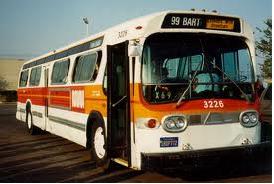
MUNI

Bless the beasts and children

0

HAIRY EYEBALL It’s hard not to look at Ryan McGinley’s road-trip photographs — in which his young, often nude, subjects, having ventured far from civilization, run through the woods, climb trees, dance amid a Vulcanic cascade of sparklers, and leap into the void — and not sigh a little. What now separates them from the images he shot for Levi’s current “Go Forth” campaign, seemingly plastered on every other Muni shelter, is frequently a conspicuously displayed pair of jeans.

McGinley has built his reputation on capturing Edenic visions of youth running wild. His pictures are gauzy and nostalgic, shot through with the sexy frisson of their in-the-moment documentation of a way of living that rebukes authority and throws caution to the wind. No one is at work in a McGinley photograph (an irony, perhaps, given the faux-literati, “we are all workers” sloganeering that Levi’s uses elsewhere in the campaign). Rather, people, such as the New York area taggers he started off photographing early in his career, create. Or, as in the road trip pictures, they drop out, escape.

No wonder Levi’s came calling. McGinley’s photographs deliver the promise of youth and all its freedoms in a sexy visual package. When McGinley is at his strongest, though, his pictures also offer up flashes of mystery and unaffected joy. Sometimes, when his subject’s eyes lock with his camera they seem to transmit the promise of a secret to be shared.

The road-trip photographs make up roughly half the images in “Life Adjustment Center,” McGinley’s current exhibit at Ratio 3. However much they dazzle — Tom (Blue, Pink and Orange), a male nude study, gives George Platt Lynes a glowing Technicolor kiss — they are not the true draw. The animals are.

The other half of the show consists of black and white studio portraits of models (again, nude) posing with all sorts of fauna: deer, a domesticated mutt, a peacock, a butterfly, and a coyote. They are the inverse of the road-trip scenes: nature has been brought inside. Both creatures and humans address us with unblinking stillness that, at first glance, gives the impression that the former are stuffed. However, the press notes inform us that the animals are real, which makes a photo like India (Coyote) all the more riveting.

The coyote is draped around India’s shoulders, her hands balancing it in place, in a pose that echoes classic depictions of Christ as shepherd holding aloft his allegorical lamb. The coyote — its tongue hanging out — appears at ease, as does India. Their proximity to each other is nonetheless unsettling (we are left to guess whether or not the scars that criss-cross India’s torso and legs were acquired while posing or before the shoot).

The photograph also makes me think of Josef Beuys’ famous 1974 performance in which he stayed in the René Block Gallery with a wild coyote for eight hours over three days. By the end of the piece, the coyote had become tolerant enough of Beuys to allow the artist to give it a farewell embrace.

In McGinley’s remarkable photographs animals and humans pose together, but there is no hierarchy of prop and subject. In these double portraits McGinley has captured a momentary, and intensely tactile, experience of trust and vulnerability shared between unlike creatures.


OF COWBOYS AND CARNIES

I have one thing to say to fans of 2005’s Brokeback Mountain and Warhol’s Lonesome Cowboys (1968) who haven’t yet seen local animation wunderkind and 2008 Goldie winner Samara Halperin’s epic, stop-motion same-sex cowboy romance Tumbleweed Town (1999). Get thee to YouTube.

A brief plot synopsis is in order. As Todd the Tonka cowboy hitchhikes his way across the Texas desert he navigates a rugged world of plastic masculinity only to find true love in the arms of a two-stepper at a raunchy roadhouse.

Currently in residence this week at Southern Exposure, Halperin has been converting the space’s sizeable gallery into a set for West of the Wonder Wheel, her much-awaited sequel to Tumbleweed Town, which trades wide, open spaces for the enclosed, topsy-turvy world of the carnival.

Halperin’s miniature amusement park, complete with rides and games of skill, was greatly inspired by Coney Island’s recently demolished Astroland Park, one of the subjects of a Halperin-curated series of short films about amusement parks that is shown alongside the film set/sculpture.

The last tiny detail is set to be glued in place this Friday, and to celebrate Halperin is hosting a pre-filming carnival-themed party with live music, games, and, of course, cotton candy.

RYAN MCGINLEY: LIFE ADJUSTMENT CENTER

Through Dec. 11

Ratio 3

1447 Stevenson, SF

(415) 821-3371

www.ratio3.org

SAMARA HALPERIN: WEST OF THE WONDERWHEEL

Through Nov. 15 (carnival reception Fri/12, 7 p.m.–9 p.m.

Southern Exposure

3030 20th St., SF

(415) 863-2141 www.soex.org

Dodging bullets

14

steve@sfbg.com

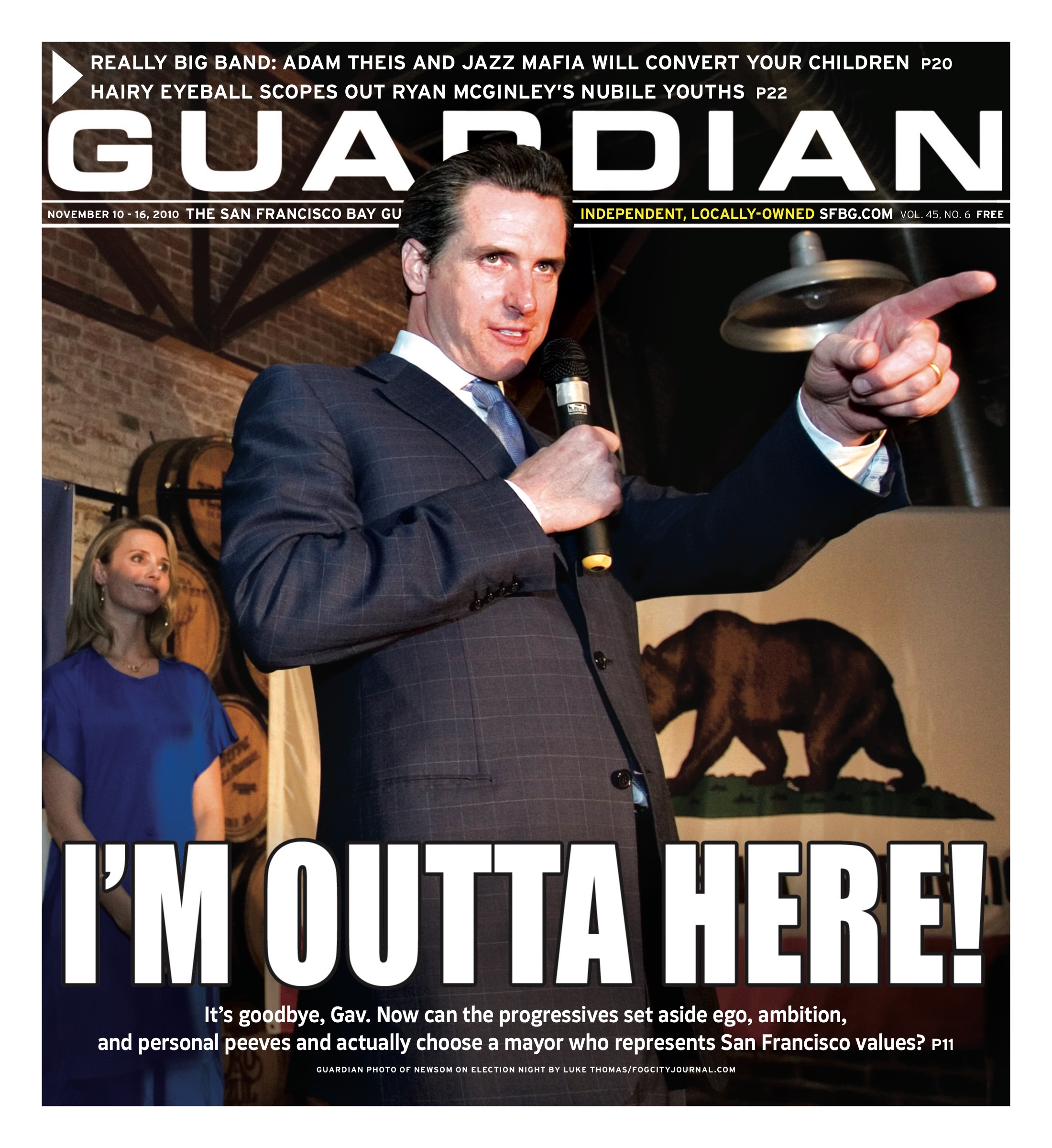
Progressives in San Francisco dodged a few bullets on election night, which was the highest hope that many held in a campaign season dominated by conservative money and messaging. The Board of Supervisors retained a progressive majority, Prop B’s attack on public employees went down, the wealthy will pay more property transfer taxes, and — perhaps the best news of all — Gavin Newsom is leaving for Sacramento a year before his mayoral term ends.

But economically conservative and downtown-backed campaigns and candidates scored the most election-night victories in San Francisco, killing a temporary hotel tax hike pushed hard by labor and several progressive-sponsored ballot measures, and winning approval for the divisive sit-lie ordinance and Prop. G, removing Muni driver pay guarantees, which had the widest margin of the night: 65-35 percent.

“Ultimately, downtown did well,” progressive political consultant Jim Stearns told us on election night, noting how aggressive spending by downtown business and real estate interests ended a string of progressive victories in the last several election cycles. He cited the likely election of Scott Wiener in District 8 and the strong challenge in District 2 by Mark Farrell to perceived frontrunner Janet Reilly, who had progressive and mainstream endorsements.

A preliminary Guardian analysis of reported spending by independent expenditure committees shows that groups affiliated with downtown or supporting more conservative candidates spent about $922,435, the biggest contributions coming from conservative businessman Thomas Coates and the San Francisco Board of Realtors, compared to $635,203 by more progressive organizations, mostly the San Francisco Democratic Party and San Francisco Labor Council.

That spending piggy-backed on national campaigns that were also skewed heavily to conservative and corporate-funded groups and messaging that demonized government and public employee unions, playing on people’s economic insecurities during a stubborn recession and jobless recovery.

Stearns said voters are having a hard time in this economy “and they don’t like to see the government spending.” He said national polls consistently show that people are more scared of “big government” than they are “big corporations,” even if San Francisco progressives tend to hold the opposite view.

And even that narrow defeat came after an almost unprecedented opposition campaign that included every elected official in San Francisco except the measure’s sponsor, Public Defender Jeff Adachi, and both the labor movement and many moderate groups.

“The campaign on this was extraordinary and caught fire at the end,” Alex Clemens, founder of Barbary Coast Consulting, said at SPUR’s Nov. 4 election wrap-up event. In particular, the message about how much Prop B would increase the health care costs on median-income city employees seemed to resonate with voters.

“We are really happy that Prop. B is going down because it was such a misguided measure. It was not well thought through,” Labor Council President Tim Paulson told the Guardian at the election night party labor threw with the San Francisco Democratic Party at Great American Music Hall. “San Francisco voters are the smartest in America.”

Paulson was also happy to see those voters approve taxing the transfer of properties worth more than $5 million, “because San Franciscans know that everyone has to pay their fair share.”

In the Board of Supervisors races, it was basically a status quo election that shouldn’t alter the body’s current politics dynamics much. Sup. Bevan Dufty will be replaced with fellow moderate Scott Wiener in D8 and Sup. Chris Daly by progressive Jane Kim in D6. The outcome of races to replace ideological wobbler Sup. Sophie Maxwell in D10 and conservative Michela Alioto-Pier in D2 may not be conclusively known for at least a few more days (maybe longer if the close races devolve into lawsuits), but neither is a seat that would diminish the board’s progressive majority.

Progressives could have made a gain if Rafael Mandelman had won in D8, but he was seven points behind Wiener on election night and even more after the initial ranked choice tally was run on Nov. 5. And in D6, fears that downtown-backed candidate Theresa Sparks might sneak past dueling progressive candidates Jane Kim and Debra Walker never materialized as Sparks finished far behind the lefty pair.

Consultant David Latterman, who worked for Sparks, told us on election night that he was surprised to see that Kim was the choice of 32 percent of early absentee voters “because we targeted those voters.” By comparison, Walker was at 20 percent and Sparks was at 21 percent in the initial returns, which tend to be more conservative. By the end of the night, Kim had 31.3 percent, Walker 27.7 percent, and Sparks just 16.5 percent.

“If she did that well with absentees, it seems like it was Jane’s race to win. If they choose Jane, they wanted Jane. It’s just that simple,” Latterman told us on election night.

At her election night party, Kim credited her apparent victory to a strong campaign that she said fielded 400 volunteers on Election Day, most wearing the bright red T-shirts that read “See Jane Run” on the back. “I feel good,” Kim told the Guardian. “What I’m really happy about is we ran a really good campaign.”

In the end, Kim’s campaign was put over the top by the second-place votes of Sparks’ supporters, with 769 votes going to Kim and 572 to Walker in the first preliminary run of ranked-choice voter tabulations. But despite the bad blood that developed between progressives in the Kim and Walker campaigns, Board President David Chiu, an early Kim supporter, sounded a conciliatory note, telling the Guardian on election night, “Given where Debra and Jane are, I’m glad that we’re going to keep this a progressive seat.”

Election 2010: Labor and progressives dodge a bullet

22

Bucking a national conservative, anti-government political trend, San Franciscans stayed with some fairly progressive politics on election night, rejecting a measure to demonize public employees (Prop. B), giving progressive John Rizzo far more votes than his City College of San Francisco board rivals, and taking far more liberal positions in state ballot measures and candidates than California voters, who were already far to the left of national voters.
“We are really happy that Prop. B is going down because it was such a misguided measure. It was not well thought through,” San Francisco Labor Council President Tim Paulson told the Guardian at the party labor threw with the San Francisco Democratic Party at Great American Music Hall. “San Francisco voters are the smartest in America.”
Paulson was also happy to see those voters approve Prop. N, taxing the transfer of properties worth more than $5 million, “because San Franciscans know that everyone has to pay their fair share.”
Another labor priority, Prop. J, the temporary hotel tax increase, lost by a narrow margin after Mayor Gavin Newsom and his downtown allies opposed it, and the online travel company spent millions of dollars to bury Prop. K – a Newsom-created rival measure that would have closed a loophole that lets the company avoid paying the hotel tax.
Rizzo said he was happy to far outpoll Lawrence Wong and Anita Grier as the three incumbents ran uncontested for their City College board seats, which should put him in a leadership position in the troubled district. “There is a tradition at City College that the highest vote getter gets the presidency, so I’m pretty happy,” Rizzo told us on election night.
There were some conservative victories in San Francisco, including approval of Prop. L, which criminalizes sitting or lying on sidewalks, and Prop. G, which will reduce Muni operator wages and change work rules after getting the approval of about 63 percent of voters.
“Ultimately, downtown did well,” progressive political consultant Jim Stearns said, noting how aggressive spending by downtown business and real estate interests ended a string of progressive victories in the last several election cycles, including the likely election of Scott Wiener in D8 and the strong challenge in D2 by Mark Farrell to perceived frontrunner Janet Reilly, who had progressive endorsements.
Stearns said national polls have shown that people are more afraid of big government than big corporations, whereas progressives tend to hold the opposite view. “That national atmosphere definitely had an impact on even races locally,” Stearns said.
But in San Francisco, the progressives retain a strong position in the political debates to come.

Election 2010: The Prozan party

0

Amid a packed bar of Giants fans and political supporters, Rebecca Prozan was greeted with fervent clapping and shouts. Whether or not she wins tonight, her supporters and fans still believe strongly in her and her campaign. Her supporters even sported paper hats with Prozan’s face.


“My base and my supporters is the people I’ve met on Muni or worked with at the mayor’s office, or at the dog park.” She said, excitedly shaking hands, posing for pictures and greeting the crowd.


Her supporters were upbeat about the election results based on her politics and ideals.” It’s easy to read the paper and have thoughts but harder to take action,” Asit Panwala, one of the election canvassers said. “I see her willingness to help people and how she engages with the public.”


Locals for hire

2

sarah@sfbg.com

It’s no secret that San Francisco’s construction industry is going through hard times, a situation that translates into lost opportunities for working class San Franciscans. But that bad situation is being made worse by contractors on local projects hiring workers from outside the city.

Recent studies reveal that under the city’s First Source program, which requires contractors to make “good faith efforts” to reach the goal of hiring 50 percent of their workers from within the city, San Francisco has failed to meet its goals on publicly funded projects.

Sup. John Avalos has introduced legislation that seeks to address this shortfall by requiring contractors to meet the city’s hiring goals or face fines. But some union leaders whose members don’t live in San Francisco are grumbling that the proposal is not workable.

Local unemployed workers are expressing support for the Avalos legislation, as they step up efforts to get UC San Francisco to commit to local hiring plans at its $1.5 billon Mission Bay hospital construction site, which lies a Muni T-Third ride away from some of the city’s most economically distressed neighborhoods.

And now everyone is anxiously wondering where Mayor Gavin Newsom will land on the legislation and on UCSF’s hiring goals in what may be his last weeks as chief executive of San Francisco.

As of press time, Newsom was running neck-to-neck with Abel Maldonaldo in the lieutenant governor’s race, leaving voters uncertain whether Newsom will be mayor in January or second-in-command statewide — a promotion that would land him a seat on the UC Board of Regents but shift his primary allegiance from the City and County of San Francisco to the entire state of California.

When Avalos stood outside City Hall last month and announced his proposal to mandate local hiring on publicly-funded construction projects, he was joined by Sups. Sophie Maxwell and David Campos, Board President David Chiu, community advocates, construction contractors, neighborhood leaders, and union members.

“My legislation will ensure that San Franciscans have a guaranteed shot to work on the city’s public works projects and that the local dollars invested in public infrastructure will be recycled back into San Francisco’s economy and local communities,” Avalos said.

Avalos’ legislation came in the wake of two reports confirming that local construction workers were having a hard time getting work. A report that Chinese Affirmative Action and Brightline Defense released in August estimated that only 24 percent of workers on publicly funded sites are local residents.

And a report released by L. Luster and Associates in mid-October, at the behest of the Redevelopment Agency and Office of Economic and Workforce Development, found that only 20 percent of workers hired at 29 publicly funded construction projects in the past year were local residents.

Avalos’ legislation would mandate assessment of liquidated damages against contractors and subcontractors who fail to meet minimum local hiring requirements and establish monitoring, enforcement, and administrative procedures in support of this policy. It would phase in these requirements over three years, starting at 30 percent the first year.

Avalos noted that his legislation was developed through a series of meetings with city agencies, the Mayor’s Office, labor and building trade unions, the environmental community, neighborhood advocates, contractors, local hiring advocates, and unemployed workers. And he vowed to keep the roundtable approach.

Patrick Mulligan, financial secretary of Carpenters Local 22, told the Guardian that his union, whose members are specific to San Francisco, generally supports local hiring. “But there are some general concerns with the legislation,” said Mulligan, who has lived his whole life in San Francisco and got his first job through a local hiring program. “We have standing contractual agreements with contractors, so whatever legislation gets passed, it will have to be meshed with the existing situation. If these were boom times, people might see it differently. But it’s hard times at the union hall.”

Mulligan also lamented the lack of process for the community to vet whether UC has a local hiring plan at construction projects that impact their neighborhood. “But contractors want the best workforce they can get. And in lean times, they can afford to be more selective and don’t necessarily want to include training time on the job,” he said. “But we feel that it’s inappropriate for contractors to bring their entire crew from outside of town.”

Michael Theriault, secretary-treasurer of the San Francisco Building and Construction Trades Council, told the Guardian that Avalos’ legislation was unworkable because construction workers cannot afford housing in San Francisco and too few qualified workers live in the city.

“We take workers from San Francisco into our apprenticeship program constantly, but they get to a certain point in their careers and find that the city builds well on the low-end and the high-end, but doesn’t build workforce housing. So they end up in Antioch, Vallejo, Fairfield, and Modesto, and commute back in,” Theriault said. “That problem has not been addressed by the city, and it’s at the root of why local hiring programs aren’t working.”

Newsom spokesperson Tony Winnicker said the mayor “supports stronger local hire requirements” even as he expressed concerns with Avalos’ proposal. “We’ll continue to work with the supervisors, the building trade unions and the community on legislation that achieves both realistic and legally enforceable local job guarantees for city projects,” he said.

Winnicker noted that the city already supports local hiring through CityBuild and the San Francisco Public Utilities Commission. “But we believe we can do better,” he added.

Avalos, whose legislation is scheduled for a Nov. 8 hearing of the board’s Land Use and Economic Development Committee, said he sees his proposal as a starting point. “We’ll see where it ends up,” Avalos told the Guardian. “We could pass legislation that wants 50 percent local hiring next year, and it would probably get vetoed and it wouldn’t be realistic. So we have to phase it in and make sure we are creating a system that is going to push the trades to be more inclusive of local residents.”

Meanwhile, unemployed workers — some in unions, others not — continue to protest the lack of a local hire plan at UCSF’s $1.5 billion Mission Bay hospital project, which is funded through debt financing, philanthropic gifts, and university reserves.

“We want to make sure folks get trained and everything that’s necessary, so there is no dispute,” Aboriginal Blacks United member Alex Prince said at an Oct. 27 protest at the Mission Bay site. The protest came one month after Newsom wrote to UCSF Chancellor Susan Desmond-Hellmann noting that the hospital was breaking ground “just as continuing high unemployment rates were devastating the city’s most distressed communities,including neighborhoods impacted by the Mission Bay expansion.”

“There are estimates that up to 40 percent of the members of our local construction trade unions are currently out-of-work,” Newsom wrote. “It would be helpful if you could share the commitments that UCSF has made on the issue of local hiring, particularly around employing residents of San Francisco’s most distressed communities in southeast San Francisco, and the results of those efforts to date.” Winnicker said UCSF has not yet responded.

Barbara French, UCSF’s vice chancellor for university relations, told the Guardian that UCSF is working to evaluate hiring needs for phase of the project, talking to the unions, and intends to make its findings public in December.

“We have had a voluntary local hiring policy since 1993,” French said, confirming that in the past 17 years, the university has reached a 12 percent local hire rate on average. “Sometimes it was 7 percent, sometimes it was 24 percent … Our [goal] is to reach a number that is beyond what we reached before but which is realistic.”

Recently French told community-based organizations that UCSF hadn’t signed a contract with the contractor at its Mission Bay hospital project, didn’t have the permits yet, and that the recent community celebrations didn’t mark the start of active construction at the site.

French said general hiring at Mission Bay will begin in December. “We don’t get any city funds at this site, so our commitment is voluntary. But we feel very strongly that we have to reach out,” she said.

Avalos acknowledged that UC is not under San Francisco’s jurisdiction and can’t be compelled to do more local hiring. “But we know that they are doing a critical amount of building and investing taxpayer dollars, and that this land use impacts the surrounding community. So it makes sense that we have local hire legislation and access to serious end-use jobs at the hospital.”

Avalos: I have not buckled to anyone’s pressure over local hiring

1

Last week, Sup. John Avalos introduced Local SF legislation to require contractors to meet a local hiring goal of 50 percent. And as the Guardian reported at the time, Avalos’ legislation represents a major departure from the city’s First Source Program, which only requires contractors on publicly subsidized projects to show “good faith” efforts to meet 50 percent goal.  Avalos’ legislation came on the heels of a report from the city’s Office of Economic and Workforce Development that showed only a 20 percent local hire rate in 29 publicly funded projects, despite the existence of First Source.

“My legislation will ensure that San Franciscans have a guaranteed shot to work on the City’s public works projects and that the local dollars invested in public infrastructure be recycled back into San Francisco’s economy and local communities,” Avalos said last week, noting that his legislation was developed over a series of stakeholders meetings with reps from city agencies, the Mayor’s Office, labor and building trades, the environmental community, neighborhood advocates, contractors, local hiring advocates and unemployed workers. And he vowed to keep this roundtable approach going as his legislation moves forward.

So we were surprised to read a Weekly blog post today that claimed that Avalos had allegedly buckled to union pressure and watered down his local hire requirements. Especially since his legislation hasn’t even had its Nov. 8 hearing before the Board’s Land Use and Economic Development Committee…

Reached by phone Avalos clarified that he has not buckled to anyone’s pressure.
“I haven’t backed down on anything,” Avalos said. “And I have not made any amendments to my legislation. I did say when I introduced my legislation that this is a starting point and we’ll see where it ends up. We could pass legislation that wants 50 percent local hiring next year, and it would probably get vetoed and it wouldn’t be realistic. So, we have to phase it in and make sure we are creating a system that is going to push the trades to be more inclusive of local residents.”

Avalos noted that some trades and unions are already doing a good job of hiring San Francisco residents on public works projects, but reiterated that the city’s current policy only requires contractors to present paperwork to show they made a “good faith” effort—and that this approach has fallen far short of the city’s 50 percent local hire goal.

Avalos’ legislation–and his claims about First Source’s shortcomings–are  backed up by two recent studies.

The first report, released by Chinese for Affirmative Action and Brightline Defense Project this August, was titled “The Failure of Good Faith.” It showed that the city’s current policy only “yielded roughly 24 percent on employment opportunities” on public construction projects in San Francisco.

The second report, released by L. Luster & Associates on October 18, was titled “Labor Market Analysis San Francisco Construction Industry.” It confirmed that the construction workforce statewide has been in a “free-fall of job losses for the past four years.”

Noting that the Bay Area has not been as hard hit as other regions in California, the Luster report observed that the tri-county district of San Francisco, San Mateo and Marin counties, which had 45,100 construction jobs in August 2006, “lost nearly one-third of these jobs falling to 31,200 construction jobs by May 2010.”

“In San Francisco, unemployment in the construction sector has had a particularly negative impact on the city’s less educated residents,” the report stated. “For them, construction has provided access to higher paying jobs in a labor market that otherwise might provide them access mainly to positions paying lower end wages. Any local hire effort will be undertaken against the backdrop of this unprecedented construction job loss, and resulting unemployment among the existing San Francisco construction workers.”

One such group of unemployed workers—some of them in a union, others not—could be seen protesting yesterday outside the gates of the construction site on 16th Street in Mission Bay where UCSF has been celebrating the groundbreaking of its new Medical Center, a $1.5 billion project to be funded “through a combination of debt financing, philanthropic gifts and hospital reserves,” according to UC press releases.

But in an email to Joshua Arce of Brightline Defense, UCSF’s Barbara French noted that though UC is “actively working now to evaluate the workforce needs for every trade, for every phase of the project, and intend to make those public in December”, UC has not started construction on the project and won’t until December.
“ We haven’t signed the contract with the general contractor and we don’t yet have our permits,’ French wrote. “ The community may have believed that the celebrations this week truly marked the start of active construction. Not so. These were community celebrations held now in the hopes of getting good weather. “

Meanwhile, Avalos acknowledges that UC is not under the jurisdiction of San Francisco.
“But I know that they are doing a critical amount of building, and investing tax payer dollars there, so therefore the community should have some benefit from that, even though it’s complicated by this being the state’s money, so you could make the argument that all of California’s workers should have access,” Avalos told the Guardian. “But this land use impacts the surrounding community, so it makes sense that we have local hire legislation and access to serious end-use jobs at the hospital, which will include medical and support staff, building and janitorial maintenance and cafeteria related work.”

Avalos noted that the city is building infrastructure all around that project, including parks, Muni and light rail spruce-ups.
“There are huge surrounding investments,” Avalos said.

Either way, here’s hoping that by December, when folks begin to stress about providing for their families over the holiday season, all the workers in the following video clip will be able to put down their bullhorns and pick up decent-paying work, instead. And that this work will last for more than a couple of days.

Stage

0


Stage listings are compiled by Guardian staff. Performance times may change; call venues to confirm. Reviewers are Robert Avila, Rita Felciano, and Nicole Gluckstern. Submit items for the listings at listings@sfbg.com. For further information on how to submit items for the listings, see Picks. For complete listings, see www.sfbg.com.


OPENING

Equus Boxcar Theatre Playhouse, 505 Natoma; 776-1747, www.boxcartheatre.org. $10-25. Opens Wed/27, 8pm. Runs Wed-Sat, 8pm. Through Nov 20. Boxcar Theatre kicks off its fifth season with Peter Shaffer’s drama, directed by Erin Gilley.

Failure to Communicate The Garage, 975 Howard; (800) 838-3006, www.brownpapertickets.com. Call for prices. Opens Fri/29, 8pm. Runs Fri-Sat 8pm; Sun, 2pm. Through Nov 14. Perfomers Under Stress opens its sixth season with the world premiere of a physical theater piece by Valerie Fachman.

The Unexpected Man EXIT Theatre, 156 Eddy; (800) 838-3006, www.brownpapertickets.com. $18-25. Opens Fri/29. Runs Fri-Sat, 8pm; Sun, 3pm. Through Nov 14. Spare Stage revives Yasmina Reza’s ironic comedy, starring Ken Ruta.

BAY AREA

Becoming Britney Center REPortory Company, Knight Stage 3 Theatre, 1601 Civic Drive, Walnut Creek; (925) 943-SHOW, www.centerREP.org. $25. Previews Thurs/28-Fri/29, 8:15pm. Opens Sat/30, 8:15pm. Runs Thurs-Sat, 8:15pm; Sun, 2:15pm. Through Nov 14.Center REPortory Company presents an original musical about a naïve pop star, written by Molly Bell and Daya Curley.

Palomino Aurora Theatre, 2081 Addison, Berk; (510) 843-4822, www.auroratheatre.org. $10-55. Previews Fri/29-Sat/30 and Nov 3, 8pm; Sun/31, 2pm; Tues/2, 7pm. Opens Nov 4, 8pm. Runs Wed-Sat, 8pm; Sun, 2 and 7pm; Tues, 7pm. Through Dec 5. David Cale brings his new solo play about a gigolo to Aurora Theatre for its Bay Area premiere.

Pirates of Penzance Novato Theatre Company Playhouse, 484 Ignacio, Novato; 883-4498, www.novatotheatercompany.org. $12-22. Opens Thurs/28, 8pm. Runs Thurs-Sat, 8pm; Sun, 3pm. Through Nov 21. Novato Theatre Company revives the popular Gilbert and Sullivan swashbuckling tale.

ONGOING

Christian Cagigal’s Obscura: A Magic Show EXIT Cafe, 156 Eddy; (800) 838-3006, www.brownpapertickets.com. $15-25. Thurs-Sat, 8pm. Through Dec 18. Magician Christian Cagigal presents a mix of magic, fairy tales, and dark fables.

Dracula’s School for Vampires Young Performers Theatre, Fort Mason Center, Bldg C, Third Floor, Room 300; 346-5550, www.ypt.org. $7-10. Sat, 1 pm; Sun, 1 and 3:30pm. Through Nov 14. Young Performers Theatre presents a Dracula comedy by Dr. Leonard Wolf.

Equus Boxcar Theatre Playhouse, 505 Natoma; 776-1747, www.boxcartheatre.org. $10-25. Opens Wed/27, 8pm. Runs Wed-Sat, 8pm. Through Nov 20. Boxcar Theatre kicks off its fifth season with Peter Shaffer’s drama, directed by Erin Gilley.

Futurestyle ’79 Off-Market Theater, Studio 250, 965 Mission; (800) 838-3006, www.brownpapertickets.com. $15-20. Wed, 8pm. Through Wed/27. A fully improvised episodic comedy played against the backdrop of SF in 1979.

Glory Days Boxcar Studios, 125 Hyde; www.jericaproductions.com. $30. Fri-Sat, 8pm; Sun, 2pm (no performance Sun/31). Through Nov 7. Jerica Prodcutions and the Royal Underground Theatre company present Nick Blaemire’s and James Gardiner’s one-act musical.

Habibi Intersection for the Arts, 446 Valencia; 626-2787, www.theintersection.org. $15-25. Thurs-Sun, 8pm. Through Nov 7. Intersection for the Arts and Campo Santo present the world premiere of a play by Sharif Abu-Hamdeh.

*Hamlet Alcatraz Island; 547-0189, www.weplayers.org. By donation. Sat-Sun, times vary. Through Nov 21. Outside of an actual castle, it would hard to say what could serve as a more appropriate stand-in for Kronborg castle of Helsingør—also known as Elsinore—than the isolated fortress of Alcatraz Island, where WE Players are presenting Hamlet in all its tragic majesty. As audience members tramp along

stony paths and through prison corridors from one scene to the next, the brooding tension the site alone creates is palpable, and the very walls impart a sense of character, as opposed to window-dressing. Deftly leaping around rubble and rock, a hardy troupe of thespians and musicians execute the three-hour

production with neat precision, guiding the audience to parts of the island and prison edifice that aren’t usually part of the standard Alcatraz tour package. Incorporating movement, mime, live music, and carefully-engineered use of space, the Players turn Alcatraz into Denmark, as their physical bodies meld into Alcatraz. Casting actress Andrus Nichols as the discontent prince of Denmark is an incongruity that works, her passions’ sharp as her swordplay, the close-knit family unit of Laertes, Ophelia, and Polonius are emphatically human (Benjamin Stowe, Misti Boettiger, Jack Halton), and Scott D. Phillips plays the

appropriately militaristic and ego-driven Claudius with a cold steel edge. (Gluckstern)

Hedda Gabler Phoenix Theatre, suite 601, 414 Mason; (800) 838-3006, www.offbroadwaywest.org. $35.

The action unfolds in the parlor of the newly married Tesmans, young mediocre academic George (Adam Simpson) and town beauty Hedda, née Gabler (a crisp, tightly wound and nicely understated Cecilia Palmtag), a woman of exceptional intelligence, ambition and pride—to call her fiery wouldn’t be bad either, especially since she’s so fond of shooting off her late father’s pistols. Frustrated by her paltry new life, Hedda seeks news of an old flame, Eilert Lovborg (Paul Baird), via the admiring and vaguely lecherous Judge Brack (Peter Abraham) and a timid acquaintance from school days, Thea (Joceyln Stringer). The semi-wild but brilliant Lovborg has published a new book that imperils George’s chances for a professorship. Less interested in securing George’s career than controlling Lovborg’s destiny, Hedda soon manipulates events around her with bold determination and tragic consequences. Passionate, violent and psychologically complex, Henrik Ibsen’s titular heroine is at turns sympathetic and disturbing, an independent soul trapped in and warped by a society that allows her too little scope—a modern predicament that has inspired many modern and postmodern adaptations. Off Broadway West’s straight-ahead production of the late-19th-century drama, helmed by artistic director Richard Harder, remains faithful to the period setting. This includes Bert van Aalsburg’s respectable scenic design and Sylvia Kratins impressive costumes, as well as the old if fine translation by William Archer, who first introduced Ibsen to the English-speaking world. Unfortunately, the quaint diction is not handled with equal grace across an uneven cast. Palmtag’s solid, at times admirable performance in the lead, however, goes a good way toward grounding an otherwise patchy production. (Avila)

Last Days of Judas Iscariot Gough Street Playhouse, 1620 Gough; (510) 207-5774, www.CustomMade.org. $10-30. Thurs-Sat, 8pm. Through Sat/30. Custom Made Theatre Company presents the 2005 play by New York’s Stephen Adly Guirgis (Our Lady of 121st StreetJesus Hopped the A Train), which places purgatorial Judas (Kristoffer Alberto Barrera) on trial to determine his deserved fate for dropping a dime on Jesus and all that jazz. Flamboyant, sycophantic and horny prosecutor El-Fayoumy (Ben Ortega) and defense attorney Loretta (Amelia Avila) call between them a series of brow-raising witnesses—including Mother Teresa (Brandy Leggett), Sigmund Freud (Catz Forsman), and Satan (Richard Wenzel)—as Judas (seated on the upper tier of Sarah Phykitt’s suitably imposing split-level set) stares stoically in relative silence or appears in a series of childhood flashbacks. Characteristically funny and streetwise, as well as versed in the Catholic rigmarole as filtered through a NYC-boroughs sensibility, Guirgis’s play is also unusually tedious in its jokey, poky unfolding since—offering not much more than a cipher in the largely mute Iscariot—the proceedings lack a strong sense of dramatic stakes. It feels more like a revue than a play, or like an unnecessarily long-winded excuse for the final, well-turned concluding monologue by a heretofore marginal character (a speech delivered with admirable understatement by director Brian Katz). (Avila)

Law and Order: San Francisco Unit: The Musical! EXIT Theater, 156 Eddy; (800) 838-3006, www.brownpapertickets.com. $10. Mon, 8pm. Through Nov 15. Funny But Mean comedy troupe extends its newest show at a new venue.

Mary Stuart The Ashby Stage, 1901 Ashby, Berk; (510) 841-6500, www.shotgunplayers.org. $15-30. Thurs-Sat, 8pm; Sun, 5pm. (also Wed/27, Nov 3; 7pm). Through Nov 7. Shotgun Players presents Friedrich Schiller’s historical drama, directed by Mark Jackson.

*Pearls Over Shanghai Thrillpeddlers’ Hypnodrome, 575 10th St; (8008) 838-3006, www.brownpapertickets.com. $30-69. Sat, 8pm. Through Dec 19. Thrillpeddlers’ acclaimed production of the Cockettes musical continues its successful run.

Proof Exit Stage Left Theatre, 156 Eddy; www.belljartheatre.com. $20. Fri-Sat, 8pm. Through Sat/30. Bell Jar Theatre presents David Auburn’s award-winning play.

*The Real Americans The Marsh MainStage, 1062 Valencia; (800) 838-3006; www.themarsh.org. $20-50. Wed-Fri, 8pm; Sun, 5pm. Through Nov 6. The fifth extension of Dan Hoyle’s acclaimed show, directed by Charlie Varon.

*SHIToberfest Off-Market Theaters, 965 Mission; (800) 838-3006, www.brownpapertickets.com. $20. Fri-Sat, 8pm. Through Sat/30. This special October run of PianoFight’s bowel-loosening comedy series, the S.H.I.T. Show (for acronym fans, that’s the Stop Hating Imagination Time Show), revolves dizzyingly around the subject of beer, Germans and, perhaps less explicably, flatulent dolphins, among much else in the wide open seas of poor taste. Is it hilarious? It is. And you don’t even need to smuggle in a forty to make it so, though it certainly doesn’t hurt. Fine comic acting throughout a charismatic cast (including writer-director-producers Alex Boyd, Zach Cahn, Jed Goldstein, Ray Hobbs, Devin McNulty, Evan Winchester and Duncan Wold, with help from Nicole Hammersla, Gabrielle Patacsil, Rob Ready, Derricka Smith, Andy Strong, Jacque Vavroch and Dan Williams) combines here with generally solid to exceptional sketch work, video and song. Add in a permeating spirit of revelry, debauchery and irreverence and the evening becomes a diversion of the first order, culminating in an utterly sacrilicious sketch about a bunch of toasted beer-brewing monks treated to a papal visit—one of the best venial sins for your buck. When it comes to Octoberfesting this year, “Bavaria” is just S.H.I.T.–faced for Bay Area. (Avila)

Shocktoberfest!! 2010: Kiss of Blood Hypnodrome Theatre, 575 10th; (800) 838-3006, www.brownpapertickets.com. $25-35. Thurs-Fri, 8pm (Thurs/28-Sun/31 include performances of The Forsaken Laboratory by the Brazilian Grand Guignol group Vigor Mortis). Through Nov 19. Thrillpeddlers’ seasonal slice of eyeball is comprised of three playlets variously splattered with platelets, all directed by Russell Blackwood and bridged by a rousing burst of bawdy song from the full cast. Rob Keefe’s Lips of the Damned (after La Veuve by Eugene Heros and Leon Abric) takes place in a rat-infested museum of atrocities just before the fumigating starts, as an adulterous couple—comprised of a kinky married lady (a vivacious Kara Emry) and a naïve hunk from the loading dock (Daniel Bakken)—get their kicks around the guillotine display, and their comeuppance from the jilted proprietor (Flynn DeMarco). Keefe’s delightfully off-the-wall if also somewhat off-kilter Empress of Colma posits three druggy queens in grandma’s basement, where they practice and primp for their chance at drag greatness, and where newly crowned Crystal (a gloriously beaming Blackwood) lords it over resentful and suspicious first-runner-up Patty Himst (Eric Tyson Wertz) and obliviously cheerful, non-sequiturial Sunny (Birdie-Bob Watt). When fag hag Marcie (Emry) arrives with a little sodium pentothal snatched from dental school, the truth will out every tiny closeted secret, and at least one big hairy one. Kiss of Blood, the 1929 Grand Guignol classic, wraps things up with botched brain surgery and a nicely mysterious tale of a haunted and agonized man (Wertz) desperate to have Paris’s preeminent surgeon (DeMarco) cut off the seemingly normal finger driving him into paroxysms of pain and panic. Well-acted in the preposterously melodramatic style of the gory genre, the play (among one or two other things) comes off in a most satisfying fashion. (Avila)

Sunset Limited SF Playhouse, 533 Sutter; 677-9596, www.sfplayhouse.org. $40-50. Tues-Wed, 7pm; Thurs-Fri, 8pm; Sat, 3 and 8pm. Through Nov 6. This 2006 play by Cormac McCarthy exhibits some of the best and worst of the celebrated author, but significantly more of the latter. It sets an aging white academic and failed suicide (Charles Dean) in a room with his rescuer and would-be savior, a poor black social worker (Carl Lumbly), who has just snatched him from a railway platform ahead of a tête-à-tête with a train called the Sunset Limited. Both characters remain nameless, emphasizing the abstract pseudo-Socratic dimensions attendant on the dialogue-driven realism here (staged with a knowing wink in director Bill English’s scenic design, a partially walled wood-framed shack with see-through slits between the thin horizontal planking). The black man is a born-again Christian and ex-con convinced Jesus has just given him a major assignment. His dogmatic certainty is matched by the white man’s nihilism and despair. “I believe in the primacy of the intellect,” the miserable prof tells his host, who’s locked the door on his self-destructive guest in an effort to buy time to change his mind. Leaving aside the historically clichéd, problematic and baggage-heavy dynamic of a poor black American devoted to the welfare of a rich white one, neither man moves from his respective position one inch (at least until perhaps and partially at the very end), which constrains the dramatic development. Moreover, both sides argue feebly, mainly by gainsaying whatever it is the other one says, making this not a great intellectual debate either. SF Playhouse’s production sets two fine actors at this heavy-handed twofer, but little can be done to redeem so static and arid an exercise. (Avila)

Susie Butler Sings the Sarah Vaughan Songbook Exit Theater Cafe, 156 Eddy; (510) 860-0997, www.brownpapertickets.com. $15-20. Sat, 8:30pm. Through Nov 20. Local actress and singer Susie Butler takes on the Sassy songbook.

Zombie Town Stage Werx Theatre, 533 Sutter; www.stagewerx.org. (800) 838-3006, www.brownpapertickets.com. $24. Thurs-Sat, 8pm (also Sun/31, 5pm). Through Sun/31. Catharsis Theatre Collective presents a documentary play about zombie attacks in Texas.

BAY AREA

*Compulsion Berkeley Repertory Theatre, Thrust Stage, 2025 Addison; (510) 647-2949, www.berkeleyrep.org. $29-85. Dates and times vary. Through Sun/31. Director Oscar Eustis of New York’s Public Theater marks a Bay Area return with an imaginatively layered staging of Rinne Groff’s stimulating new play. Compulsion locates the momentous yet dauntingly complex cultural-political outcomes of the Holocaust in the career of a provocative Jewish American character, Sid Silver, driven by real horror, sometimes-specious paranoia, and unbounded ego in his battle for control over the staging of Anne Frank’s Diary. A commandingly intense and fascinatingly nuanced Mandy Patinkin plays the brash, litigious Silver, based on real-life writer Meyer Levin, a best-selling author who obsessively pursued rights to stage his own version of Anne Frank’s story. The forces competing for ownership of, and identification with, Anne Frank and her hugely influential diary extend far beyond her father Otto, Silver, or the diary’s publishers at Doubleday (represented here by a smooth Matte Osian in a variety of parts; and a vital Hannah Cabell, who doubles as Silver’s increasingly alarmed and alienated French wife). But the power of Groff’s play lies in grounding the deeply convoluted and compromised history of that text and, by extension, the memory and meanings of the Holocaust itself, in a small set of forceful characters—augmented by astute use of marionettes (designed by Matt Acheson) and the words of Anne Frank herself (partially projected in Jeff Sugg’s impressive video design). The productive dramatic tension doesn’t let up, even after the seeming grace of the last-line, which relieves Silver of worldly burdens but leaves us brooding on their shifting meanings and ends. (Avila)

Dracula Center REPertory Company, 1601 Civic, Walnut Creek; (925) 943-SHOW, www.centerrep.org. $36-42. Wed, 7:30pm; Thurs-Sat, 8pm; Sun, 2:30pm (also Nov 20, 8pm). Through Nov 20. Eugene Brancoveanu stars as the Count in a production directed by Michael Butler.

*East 14th: True Tales of a Reluctant Player Marsh Berkeley, 2120 Allston, Berk; www.themarsh.org. $20-50. Dates and times vary. Through Nov 21. Don Reed’s solo play, making its Oakland debut after an acclaimed New York run, is truly a welcome homecoming twice over. (Avila)

*The Great Game: Afghanistan Roda Theatre, 201 Addison, Berk; (510) 647-2949, www.berkeleyrep.org. $17-73. Call for times. Through Nov 7. Berkeley Rep presents the West Coast premiere of a three-part show about Afghanistan.

*Loveland The Marsh Berkeley, 2120 Allston Way; (800) 838-3006, www.brownpapertickets.com. $20-50. Fri, 7pm; Sat, 5pm. Through Nov 13. Ann Randolph’s acclaimed one-woman comic show about grief returns for its sixth sold-out extension.

Superior Donuts TheatreWorks at the Mountain View Center for the Performing Arts, 500 Castro; (650) 463-1960, www.theatreworks.org. $19-67. Tues-Wed, 7:30pm; Thurs-Fri, 8pm; Sat, 2 and 8pm; Sun, 2 and 7pm. Through Sun/31. This latest from Tracy Letts (August: Osage CountyKiller Joe) starts out as a delicious treat but a hollowness in the center of it all leaves one less than fully unsatisfied. Director Leslie Martinson’s cast shines, however, as the action unfolds in crisp, engaging scenes set in the titular run-down donut shop in Chicago’s slowly gentrifying Uptown neighborhood. Owner-operator Arthur Przybyszewski (Howard Swain) is an aging baby boomer and second-generation Polish immigrant who fled to Canada to avoid the Vietnam draft and returned years later to take over his parents shop, alienated and hesitant, though well liked by his regulars. At least most: As the play opens his shop has been vandalized. Two beat cops are on the scene, James (Michael J. Asberry) and Randy (Julia Brothers), the latter eventually displaying a visible crush on an oblivious, then discombobulated Arthur. When an impressive young African American man named Franco (Lance Gardner) comes in and charms his way into a job, Arthur gradually finds himself drawn out of his shell and faced with the challenge of valuing another human being more than his own hide—a challenge underscored by Arthur’s several monologues, in which his personal history comes to the fore. The play feels pat and a little lazy-sentimental in the end, but there’s no denying the entertainment afforded here, especially by the magnetic pairing of leads Swain and Gardner. (Avila)

Winter’s Tale Live Oak Theatre, 1301 Shattuck, Berk; (510) 649-5999, www.aeofberkeley.org. $12-15. Fri-Sat, 8pm (also Sun/31, Nov 7, and Nov 14, 2pm; Nov 18, 8pm). Through Nov 20. Actor’s Ensemble of Berkeley presents the rarely-performed Shakespeare play.

PERFORMANCE/DANCE

“Beloved: A Requiem for Our Dead” CELLspace, 2050 Bryant; (510) 207-6101. $10-20. Fri/29, 8pm. Mangos With Chili presents a night of conjuring, memory, mourning and celebration.

“The ChatRoulette Halloween Show” Makeout Room, 3225 22nd St; www.chatrouletteshow.com. $12-15. Sat/30, 7:30pm. The Illuminated Theater presents a special Halloween edition of its show.

Alicia Dattner Off-Market Theater, 965 Mission; (917) 363-9646, www.aliciadattner.com. $20. Fri/29, 8pm.

“Fright Nights at the Wharf” Castagnola’s, 286 Jefferson; (800) 838-3006, www.brownpapertickets.com. $10. Fri/29-Sat/30, 8pm. An evening of stand-up comedy by the water.

“Ghost Stories and other Horrors!” Jellyfish Gallery, 1286 Folsom; www.firesidestorytelling.com. $5. Wed/27, 8pm. Fireside Storytelling presents an evening of ghoulish tales.

“Kaleidoscope Cabaret” Brava Theater, 2781 24th St; (800) 838-3006, www.brownpapertickets.com. $20-25. Sat/30, 8pm. An evening of drag, burlesque, song, and aerial art by performers of color.

“Karaghiozis Saves the Economy” Hallidie Plaza, Market and 5th; 648-446, www.shadowlight.org. Free. Sun/31, 7pm. A Greek shadow theatre performance by Leonidas Kassapides.

“Make Drag, Not War!” Dance Mission Theater, 3316 24th St; www.dancemission.com. $15-20. Sun/31, 8pm. A drag show and dance party hosted by Artist Malcolm Drake.

“MUNI Diaries Live!” Makeout Room, 3225 22nd St; 647-2888, www.munidiaries.com. $5. Fri/29, 7:30pm. An evening of MUNI stories.

“Road trip to Pluto” 4 Star Theatre, 2200 Clement; (800) 838-3006, www.brownpapertickets.com. $9.99-12. Thurs/28, 8:30pm. Bitter Show reprises its contribution to the SF Fringe Fest.

“Romane Event Comedy Show: Super Special Election and Halloween Edition” Makeout Room, 3225 22nd St; 647-2888, www.pacoromane.com. Wed/27, 7:30pm. Paco Romane’s guests include Will Durst, Casey Ley, Grant Lyon, and Pamela Ames.

Devendra Sharma CounterPULSE, 1310 Mission; www.counterpulse.org. $14-24. Thurs/28-Sat/30, 8pm; Sun/31, 2pm. CounterPULSe’s “Performing Diaspora” program presents a contemporary take on Nautanki theater by Sharma.

“Stories From a Haunted Forest” Presidio’s Log Cabin, 1299 Story; www.bindlestiffstudio.org. Free. Sat/30, 7pm. Bindlestiff Studio presents a one-night-only phantasmic experience.

“Teatro Zinzombie!” Pier 29 at Battery; 438-2668, www.love.zinzanni.org. 117-167. Sun/31, 5:15pm. TeatroZinzanni is haunted for one night.

Trailer Park Boys Palace Fine Arts Theatre, 3601 Lyon; 567-6642, www.ticketmaster.com. $45-58. Thurs/28, 7:30pm. The fabled boys appear live in concert.

“Twilight Vixen Revue” SOMArts, 934 Brannan; (800) 838-3006, www.brownpapertickets.com. $12. A special Halloween edition.

“Upper Cut” The Dark Room, 2263 Mission; www.darkroomsf.com. $10. Thurs/28, 8pm. A weekly improve and sketch comedy open mic.

BAY AREA

Hubbard Street Dance Chicago Zellerbach Hall, UC Berkeley campus, Berk; (510) 642-9988, www.calperformances.org. $31-68. Fri/29-Sat/30, 8pm. The acclaimed dance company performs some West Coast premieres.

“Persephone’s Boots” Codornices Park, Berk; www.raggedwing.org. Free. Wed/27-Sun/31, 5:30pm. Ragged Wing Ensemble presents the world premiere of a performance created by Anna Schneiderman and the ensemble.


Cash not care

5

sarah@sfbg.com

With the general election just days away, campaign disclosure reports show that downtown interests are spending huge amounts of money to create a more conservative San Francisco Board of Supervisors and to pass Proposition B, Public Defender Jeff Adachi’s effort to make city workers pay more for their pensions and health insurance.

Much of the spending is coming from sources hostile to programs designed to protect tenants in the city, including rent control and limits on the conversion on rental housing units to condominiums. An ideological flip of the board, which currently has a progressive majority, could also have big implications on who becomes the next mayor if Gavin Newsom wins his race for lieutenant governor.

At press time, downtown groups were far outspending their progressive counterparts through a series of independent expenditure committees, most of which are controlled by notorious local campaign attorney Jim Sutton (see “The political puppeteer,” 2/4/04) in support of supervisorial candidates Mark Farrell in District 2, Theresa Sparks in District 6, Scott Wiener in District 8, and Steve Moss in District 10.

Prop. B has also been a big recipient of downtown’s cash, although labor groups have pushed back strongly with their own spending to try to kill the measure, which is their main target in this election.

But the biggest spender in this election appears to be Thomas J. Coates, 56, a major investor in apartments and mobile homes and a demonstrated enemy of rent control. He alarmed progressive groups by giving at least $250,000 to groups that support Farrell, Sparks, Wiener, Moss, and Prop. G, legislation that Sup. Sean Elsbernd placed on the ballot to cut transit operator wages and change Muni work rules.

Although Coates declines to identify with a political party on his voter registration, he donated $2,000 to President George W. Bush in 2004. More significantly, he was the biggest individual donor in California’s November 2008 election, when he contributed $1 million to Prop. 98, which sought to repeal rent control in California and limit the government’s right to acquire private property by eminent domain.

Coates, who is also a yachting enthusiast and sits on San Francisco’s America’s Cup Organizing Committee (ACOC), donated $100,000 on Oct. 20 for Farrell, $45,000 for Sparks, $45,000 for Moss, and $10,000 for Wiener through third-party independent expenditure committees such as the Alliance for Jobs and Sustainable Growth.

The group has already received thousands of dollars in soft money from the San Francisco Police Officer’s Association, the Building Operators and Managers Association, the Golden Gate Restaurant Association, and SEIU-United Healthcare Workers, which supports a high-end hospital and housing complex on Cathedral Hill.

Those downtown groups have spent close to $200,000 on English and Chinese language mailers and robo calls in support of Sparks, Wiener, and Moss in hopes of securing a right-wing shift on the board.

Progressive groups including California Nurses Association, the San Francisco Tenants Union, and the SF Labor Council have tried to fight back in the supervisorial races. While downtown groups spent more than $100,000 promoting Sparks in D6, labor and progressive groups spent $13,000 opposing Sparks and $72,000 supporting progressive D6 candidate Debra Walker.

In D8, progressive groups that include teachers, nurses, and transit riders have outspent the downtown crowd, plunking down $40,000 to oppose Wiener and $90,000 to support progressive candidate Rafael Mandelman. So far, downtown groups have spent about $100,000 to support Wiener.

But in D10, the district with the biggest concentration of low-income families and communities of color, downtown interests spent $52,000 supporting Moss and $5,000 on Lynette Sweet while the Tenants Union was only able to summon $4,000 against Moss. The SF Building and Construction Trades Council spent $4,000 on Malia Cohen.

But that’s small potatoes compared to what downtown’s heavy-hitters are spending. The so-called Coalition for Sensible Government, which got a $100,000 donation from the San Francisco Association of Realtors, has already collectively spent $96,000 in support of Sparks, Wiener, Moss, Sweet, Rebecca Prozan in D8, Prop. G and Prop. L (sit-lie) and to oppose Prop. M (the progressive plan for police foot patrols) and Prop. N (a transfer tax on properties worth more than $5 million).

The Coalition for Responsible Growth, founded by Anthony Guilfoyle, the father of Mayor Gavin Newsom’s ex-wife, Kimberly Guilfoyle (who now works as a Fox News personality), has received $85,000 from the Committee on Jobs, $60,000 from the Realtors, and $35,000 from SF Forward. It has focused on spending in support of Prop. G and producing a voter guide for Plan C, the conservative group that supports Sparks, Wiener, Sweet, and Moss

Coates’ donations raise questions about his preferred slate’s views on tenant and landlord rights. A principal in Jackson Square Properties, which specializes in apartments and mobile homes, Coates is the founding partner of Arroya & Coates, a commercial real estate firm whose clients include Walgreens, Circuit City, and J.P. Morgan Investment Management. In 2008, when he backed Prop. 98, Coates told the San Francisco Chronicle that rent control “doesn’t work.”

Ted Gullicksen, director of the SF Tenants Union (SFTU), which has collectively spent $30,000 opposing Sparks, Wiener, and Moss, is disturbed that Coates spent so much in support of this trio.

“Coates was the main funder of Prop. 98,” Gullicksen explained. “His property is in Southern California. He’s pumping a lot of money into supervisors. And he clearly has an agenda that we fear Moss, Sparks, and Wiener share — which is to make the existence of rent control an issue they will take up in the future if elected to the board.”

That threat got progressive and labor groups to organize an Oct. 26 protest outside Coates’ San Francisco law office, with invitations to the event warning, “Be there or be evicted!”

Sparks, Moss, and Wiener all claim to support rent control, despite their support by someone who seeks to abolish it. “I answered such on my questionnaire to the SFTU, which chose to ignore it,” Sparks told the Guardian via text message. “In addition, I’ve been put out of apartments twice in SF, once due to the Ellis Act. They ignore that fact as well.”

Records show that in May 2009, Moss — who bought a rent-controlled apartment building near Dolores Park in D8 for $1.6 million and he lived there from the end of 2007 to the 2010, when he decided to run for office in D10 — served a “notice to quit or cure” on a tenant who complained about the noise from Moss’ apartment. Ultimately, Moss settled without actually evicting his tenant.

“I read about Coats’ [sic] contribution in Bay Citizen,” Moss wrote in an e-mail to the Guardian. “This donation was made to an independent expenditure committee over which I have no control and almost no knowledge. I have stated throughout the campaign, and directly to the Tenants Union, that I believe current rent control policy should remain unmolested.”

But Moss is with downtown on other key issues. He supports Newsom’s sit-lie legislation and the rabidly anti-tenant Small Property Owners Association, whose endorsement he previously called a “mistake.”

Yet Moss, who sold a condo on Potrero Hill in 2007 for the same price he paid for the entire building in 2001, seems to voice more sympathy for property owners than renters, who make up about two-thirds of city residents. He told us, “Landlords feel that they are responsible for maintaining costly older buildings and that they are not provided with ways to upgrade their units in ways that share costs with tenants.”

Another realm where downtown seems to be trying to flip the Board of Supervisors on a significant agenda item is on health care, particularly the California Pacific Medical Center proposal to build a high-end hospital and housing project on Cathedral Hill in exchange for rebuilding St. Luke’s Hospital in the Mission.

The project has divided local labor unions. UHW supports the project and a slate of candidates that its parent union, Service Employees International Union, is opposing through SEIU Local 1021, which is supporting more progressive candidates. The California Nurses Association also opposes the project and candidates such as Wiener who back it.

“A recent mailer by CNA falsely says that CPMC is closing St. Luke’s and Davies,” CPMC CEO Warren Browner recently complained in a letter to the Board of Supervisors. “We are not. We are committed to building a state-of-the-art, high-quality replacement hospital at St. Luke’s and continuing to upgrade Davies.”

But the CPMC rebuild is contingent on the board approving the Cathedral Hill project. So the CNA mailer focused on what could happen if the city rejects the CPMC project: “We could lose two San Francisco hospitals if Scott Wiener is elected supervisor.”

SEIU-UHW’s alliance with downtown groups and its use of member dues to attack progressive candidates places it at odds with SEIU Local 1021 and the SF Labor Council, which has endorsed Janet Reilly in D2, Walker in D6, Mandelman in D8, and Cohen (first choice) and Chris Jackson (second choice) in D10.

“We’re really disappointed that there are labor organizations that feel they have to team up with Golden Gate Restaurant Association, which is against health care [it challenged the city’s Healthy San Francisco program all the way to the U.S. Supreme Court], and with CPMC, which is working to keep nurses from joining a union,” Labor Council Director Tim Paulson said. “This alliance does not reflect what the San Francisco labor movement is about.”

Paulson said that the Labor Council values “sharing the wealth … So we don’t want Measure B [Jeff Adachi’s pension reform] or K [Newsom’s hotel tax loophole closure, which has a poison pill that would kill Prop. J, the hotel tax increase pushed by labor] or L [Newsom’s sit-lie legislation],” Paulson said.

CPMC’s plan is headed to the board in the next couple months, although Sup. David Campos is proposing that the city create a health services master plan that would determine what city residents actually need. Hospital projects would then be considered based on that health needs assessment, rather than making it simply a land use decision as it is now.

Moss told the Guardian that UHW endorsed him because of his positions on politicians and unions. “I agreed that politicians should get not involved in union politics,” Moss said. “The United Healthcare Workers seem to be a worthy group,” he added. “All they said was that they wanted to make sure that they had access.”

But CNA member Eileen Prendiville, who has been a registered nurse for 33 years, says she was horrified to see UHW members recently oppose Campos’ healthcare legislation. “I was shocked that they were siding with management,” she said.

Prendiville believes UHW is obliged to support CPMC’s Cathedral Hill plan, which is why it is meddling in local politics. In his letter to the board, Browner noted that his company and its parent company, Sutter Health, can’t legally do so directly. “The fact is that CPMC and Sutter Health are 501(c)(3) not-for-profit, nonpartisan organizations, and we neither endorse nor contribute to candidates,” Browner wrote.

“When UHW settled its contract with its members [as part of its fight with the rival National Union of Healthcare Workers], they had to publicly lobby for Cathedral Hill,” Prendiville claimed.

SEIU 1021 member Ed Kinchley, who works in the emergency room at SF General Hospital, is also furious that UHW is pouring money into downtown’s candidates and measures. “UHW isn’t participating in the Labor Council, it’s doing its own thing,” he said.

Kinchley said UHW, which is currently in trusteeship after a power struggle with its former elected leaders, is being controlled by SEIU’s national leaders, not its local membership, which explains why it’s aligned with downtown groups that have long been the enemy of labor.

“Sutter wants a monopoly on private healthcare and people like Rafael Mandelman and Debra Walker have been strong supporters of public healthcare,” Kinchley said. “I want someone who can straight-up say, here’s what’s important for families in San Francisco, especially something as important as healthcare. But it sounds like UHW is teaming up with the Chamber and supporting people who are not progressive.”


Republican who wants to overturn rent control pumps $200,000 into district elections

25

Thomas J, Coates, a big time investor in apartments and mobile homes, has dropped a total of $225,000 into five independent expenditure committees that are trying to push conservative-friendly candidates and measures over the victory line this fall.

Coates, a 56-year-old Republican (he donated $2,000 to George Bush in the 2004 presidential election) and yacht racing enthusiast, was the biggest single spender in the November 2008 election, when he contributed nearly $1 million to Prop. 98, a statewide measure that sought to repeal rent control in California and limit government’s right to seize private property by eminent domain.

And with only 11 days until the election, Coates has given local Republican war chests an enormous last-minute boost: He plunked $100,000 into Common Sense Voters, a committee in support of Mark Farrell in D2. He plunked $10,000 into the Alliance for Jobs and Sustainable Growth’s committee in support of Scott Wiener in D8. He plunked $45,000 into the Alliance’s committee in support of Theresa Sparks in D6. He dropped $45,000 into the Alliance’s committee in support of Steve Moss in D10. And he dropped another $25,000 into San Franciscans for a Better Muni, a committee in support of Measure G, which attempts to reform Muni by focusing on transit operator wages.

As the Guardian previously reported, this Alliance has received thousands from the SF Police Officer’s Association, the Building Operators and Managers Association, the Golden Gate Restaurant Association, and SEIU-United Healthcare Workers, which supports a mega-hospital on Cathedral Hill.

But Coates’ donation raises questions about his choices’ commitment to rent control. As Coates told the Chronicle in an interview in 2008, “There is a reason why 35 of 50 states expressly prohibit rent control by law – and the reason is it doesn’t work.”

Coates, who is a principal in Jackson Square Properties, which specializes in apartments and mobile homes, is also the founding partner of Arroya & Coates, a commercial real estate brokerage and investment firm whose clients include Walgreens, Circuit City, and J.P. Morgan Investment Management. And as campaign disclosures show, he’s dumped a large part of his money into the same conservative alliance that has already collectively spent almost $170,000 on Moss, Sparks and Wiener.

So far, labor has countered the Republican money by spending $70,000 in support of Debra Walker in D6 and $90,000 on Mandelman in D8, and the SF Tenants Union has spent a total of $20,000 on mailers opposing Moss, Sparks and Wiener. But collectively the downtown money, which is also being funnelled into several other independent expenditure committees, continues to massively outweigh the progressive bucks.

Coates’ phone line continues to register a “busy” signal, making it impossible to leave him a message, but I’d be happy to include his comments here, if and when I talk to him.

But Gullicksen said he was disturbed by Coates’ heavy spending on the supervisors’ races.

“Coates is the main funder of Prop. 98, his property is in Southern California, he’s pumping a lot of money into supervisors and he clearly has an agenda that we fear Moss, Sparks and Wiener share, which is to make the existence of rent control an issue the Board will take up, if those supervisors are elected.”

It will be interesting to see if Moss, Sparks and Wiener are prepared to pledge that they have no intention to attack rent control….so, stay tuned.

Meanwhile, labor is organizing a protest outside Coates office at 500 Washington Street at 5 p.m on Tuesday, Oct. 26.

“Be there or be evicted!” labor warned.


The Performant: The accidental tourist

0

Intrepid travelers always get a bit of a bee in their bonnet when you mistake them for tourists, but tourism doesn’t have to be a dirty word. All it really means is the act of traveling for recreational purposes and as such, can be applied to even the smallest of pleasurable jaunts. Saturday morning, I went on a tour—replete with guides, maps, wristbands, a short jaunt by MUNI train, and a chaos (as opposed to a gaggle or a horde) of dancers. Yes, it was the 7th annual San Francisco Trolley Dances, and this year’s chosen line was the N-Judah.

There’s nothing affected about the workaday N, the busiest line of the Metro system, and you wouldn’t normally find a whole embarrassment (as opposed to a herd or a murder) of art-loving tourists hanging out on it, but there we were. Chatty, consolidated, in motion: heading chummily from Duboce Park to Golden Gate.

At the Harvey Milk Recreational Arts Center, the pink and blue garments of the celestially-clad Sunset Recreation Center Chinese Folk Dance Group, the cotton-candyesque pouffs of pink afro wigs worn by the Joe Goode Performance Group, and the shiny red bullseye of a large round suitcase passed around by the performers of Christine Bonansea’s 2 x 3 project, all caught the eye, while the dexterity of the dancers further held the attention.

After hopping the N-Judah and trundling en masse to 9’th and Irving, our tour guide, Mike, promised us some wildlife—and there she was, behind the display window of Osso and Co, a lady (Phaedra Ana Jones) dressed like a leopard, dancing fluidly with an acrylic “crystal” ball.

Arriving at the Botanical Garden, we trooped through the gate to watch pieces choreographed by Sara Shelton Mann, and Japanese folk dance troupe, Ensohza Minyoshu. But the pièce de résistance was Epiphany Production’s contribution “Sonic Dance Theatre”, whose grand yet playful vision took over an entire meadow with Hank Williams songs and gospel lullabies, taffeta skirts, masked wildlife, a didgeridoo, a bride, a ballerina, and an make-believe picnic.

If you’re traveling for work but your work is a pleasure, does that make you a tourist? I wish I’d thought to ask Lynda Barry that when I chatted her up at APE after her spirited presentation of her brand-new Drawn and Quarterly book: Picture This, The Near-sighted Monkey Book. Comics scribes are often fairly introverted individuals (go figure) and their presentations can be rather stilted affairs, but Barry is a natural bon vivant, and her anecdote about trying to pick up cute guys at the Uffizi Gallery in Florence by weeping in front of Botticelli’s Birth of Venus had us in stitches.

The Near-Sighted Monkey Book (sub-subtitle: Learn How to Art) is a guide to creating visual art—a sequel of sorts to What It Is (Drawn and Quarterly, 2008) which was about writing. If all goes well, maybe in the future we can expect a third book on public speaking, because on that particular subject, Barry has plenty to teach.


Our Weekly Picks: October 13-19

0

WEDNESDAY 13

MUSIC

Vader

Vader’s history stretches back almost 30 years. Borrowing Darth’s moniker might not have been the world’s most original idea, but they were likely among the first to have done it. The Polish death metal stalwarts formed in 1983 in Olstzyn, deep behind the Iron Curtain. Successful demo recordings got them hooked with Earache Records, and the band has been pillaging the world’s stages ever since. Guitarist-singer Piotr Wiwczarek is the only original member left in the fold, but the band’s anthemic music is as potent as ever, mixing impossibly thick blast beats with heavy slabs of neoclassical melody. Their upcoming album Return to the Morbid Reich is a nod to the 1990 demo that made their name; this tour, they’re inviting you along for the ride. (Ben Richardson)

With Immolation, Abigail Williams, Lecherous Nocturne, and Pathology

6:30 p.m., $22

DNA Lounge

375 11th St., SF

(415) 626-1409

www.dnalounge.com


THURSDAY 14

DANCE

Lines Ballet

The story of Scheherazade and her 1,001 nights of tales to postpone her beheading by the Persian king has intrigued and captivated audiences for ages. Choreographer Alonzo King’s dance adaptation Scheherazade delves beyond the story to explore themes ranging from the symbolism of abused women to the transformative power imbued in the tales. The company of chiseled titans dance alongside tabla master Zakir Hussain’s score, which incorporates traditional Persian instrumentation into the original classical composition by Rimsky-Korsakov. The piece premiered in Monaco last December; San Franciscans can now experience King’s artistic rendering of Scheherazade’s classic tale for themselves. (Emmaly Wiederholt)

Through Oct. 24

Thurs/14, 7 p.m.; Fri.–Sat., 8 p.m.;

Sun., 5 p.m.; Oct. 20–21, 7:30 p.m., $25–$75

Yerba Buena Center for the Arts

Novellus Theater

700 Howard, SF

(415) 978-2787

www.linesballet.org


FILM

“Jim Henson and Friends: Inside the Sesame Street Vault”

Consider the Muppet. Made of foam and googly eyes, set atop spindly legs under a mop of primary-color hair, these brave figures have become our children’s teachers on a level unparalleled in the world of infotainment. We’re talking street, of course — Sesame Street, which since its 1969 debut has won 97 Emmy awards, more than any other show. Yerba Buena Center for the Art is running a series of Sesame clip collections, and today’s viewing pays homage to the contributions of the show’s early creative team, with a special furry hug to creator Jim Henson, and little-seen guest appearances from the show’s early days. (Caitlin Donohue)

7:30 p.m. (also Sat/16, 2 p.m.), $6–$8

Yerba Buena Center for the Arts

701 Mission, SF

(415) 978-2787

www.ybca.org


DANCE

“CounterPULSE’s Performing Diaspora: Sri Susilowati”

Stripping world dance of its trappings is quite the rage these days. But few have done it so radically as Indonesian classical dancer did Sri Susilowati at last year’s Performing Diaspora festival. Yet this was the same artist who, only a few months before at the Ethnic Dance Festival, had performed an exquisite, contemporary Javanese mourning dance. Now she is back, having been invited to expand on her 2009 piece. Susilowati may look one of those ethereal dance creatures whose bodies are so stylized that it’s difficult to think of them having earthly passions. Yet they do. Hint on Susilowati: food. Another Indonesian dancer, Prumsodun Ok, opens the show for her. (Rita Felciano)

Thurs/14–Sat/16, 8 p.m.; Sun/17, 3 p.m., $24

CounterPULSE

1310 Mission St./SF

(415) 626-2060

www.brownpapertickets.com


MUSIC

Fresh and Onlys and Kelley Stoltz

San Francisco-based artists the Fresh and Onlys and Kelley Stoltz will both have new albums on hand at this double CD release blowout. The new Fresh and Onlys disc, Play It Strange, showcases the band’s garage-rocky spin on 1960s pop, and was recorded for the first time outside of a DIY studio setup with Comets on Fire producer Tim Green. Stoltz releases his newest batch of throwbacks to the Beatles’ and Beach Boys’ style of sunny pop with To Dreamers. This is a perfect night to come out and support local music. (Landon Moblad)

With Carletta Sue Kay

9:30 p.m., $12

Café Du Nord

2170 Market, SF

(415) 861-5016

www.cafedunord.com


FRIDAY 15

DANCE

Dandelion Dancetheater

Known for its loud, provocative works merging dance, drama, and music, Dandelion Dancetheater turns its attention to motherhood in MamaLOVE: Seeds of Winter. The seven-women cast explores mom-related themes by diffusing fairy tales, myths, and lullabies to discover the context and relevance of the cultural archetypes and stereotypes surrounding motherhood. Each evening brings a rotating roster of guest mama-choreographers: Mary Carbonara, Tammy Cheney, Laura Elaine Ellis, Suzanne Gallo, Dana Lawton, Laura Renaud-Wilson, and Chingchi Yu. Directed by Kimiko Guthrie, the show promises to be haunting, hilarious, and not to be missed as the mom-artists address the complexities of love, loss, connection, and independence. (Wiederholt)

Though Oct. 24

Fri-Sat, 8 p.m.; Sun, 7 p.m. (also Oct. 24, 3 p.m.), $12-15

Shawl Anderson Dance Center

2704 Alcatraz, Berk.

(510) 654-5921

www.dandeliondancetheater.org


SATURDAY 16

MUSIC

Longplayer San Francisco: 1,000 Years in Three Simultaneous Acts”

As a founding member of legendary rabble-rousers the Pogues, Jem Finer helped the band deconstruct traditional Irish music and create a new musical creature out of its varied influences. Taking this willingness to experiment with different sounds and ideas and bringing it to another level, Finer composed Longplayer, a piece designed to last 1,000 years and played on instruments such as Tibetan bowl gongs. Today’s special performance will be a 1,000-minute excerpt performed by 18 musicians on a custom-built, 60-foot-wide circular “instrument” — so slow down and take some time to absorb some art that goes against today’s faster-is-better mentality. (Sean McCourt)

7 a.m.–11:40 p.m., $25–$28

Yerba Buena Center For The Arts Forum

701 Mission, SF

(415) 978-2787

www.ybca.org


EVENT

“ODC Theater’s JumpstART”

Several years and millions of bucks in the making, ODC is at last ready to unveil its new state-of-the-art “cultural campus” in the Mission in a celebratory free day of “dance, theater, performance, and community.” With more than 20 performers and organizations participating, there will be something for everybody — yes, even clogging — at this one-of-a-kind public offering. A glance at the roster includes such names as Scott Wells and Dancers, Robert Moses’ Kin, Killing My Lobster, Youth Speaks, and of course ODC/Dance, all curated by ODC Theater director Rob Bailis in collaboration with the likes of choreographer Joe Goode, world music expert Lilly Kharrazi, and playwright-director Mark Jackson. (Robert Avila)

Noon–11 p.m., free (tickets available one hour prior to each performance)

ODC Theater

3153 17th St, SF

(415) 863-9834

www.odcdance.org


DANCE

Trolley Dances

I still wish they’d call them Street Car Dances instead of Trolley Dances, because that’s what they are, but the name is a registered trademark and has its origins in San Diego (where they actually have trolleys). However, there is nothing else I would change on these annual easy-rider events. They are pure fun, and curator Kim Epifano always comes up with an intriguing lineup of entertainers. This year you’ll see, among others, dancers from Joe Goode Performance Group, Sara Shelton Mann, Ensohza Minyoshu (traditional Japanese folk music and dance), and Sunset Chinese Folk Dance Group. And do look out for a special treat on Ninth Ave for our animal friends, courtesy of brilliant maskmaker Mike Stasiuk. Boarding takes place at Duboce Park. (Felciano)

Through Sun/17

11 a.m. (runs every 45 minutes until 2:45 p.m.), free with Muni fare ($2)

Duboce at Scott, SF

(415) 226-1139

www.epiphanydance.org


EVENT

ArtSpan Open Studios

Do you ever want to stroll into other people’s homes simply from sweet curiosity? Perhaps you covet thy neighbor’s art, or maybe just appreciate light and shadow and like talking with the peeps who represent it? Do all three at the largest and oldest open studios event in the country. The self-guided art tour is ongoing through October, but this weekend doors will open in the artsy northern and eastern neighborhoods. From the nude drawings of Derriere Guard (ahem, Beavis) to the ultraviolet photos of South African succulents, it’s the best opportunity to get to know your local artists. And maybe take home a derriere or two. (Kat Renz)

Through Oct. 31

Sat.–Sun., 11 a.m.–-6 p.m., free

Bayview, Excelsior, Financial District, North Beach, Potrero, Russian Hill, SoMa,Tenderloin

(415) 861-9838

www.artspan.org


SUNDAY 17

MUSIC

BATUSIS

Featuring two of the founding architects of punk rock — guitarists Sylvain Sylvain from the New York Dolls and Cheetah Chrome from the Dead Boys — Batusis already has its street cred and headliner status firmly in place. Taking its name from the groovy dance that Adam West performed in the campy 1960s Batman TV show, the band came together and released a new self-titled EP earlier this year that’s steeped in the sounds that earned these six string slingers their place in the punk pantheon in the first place. This dynamic duo may not be so young anymore, but they’re sure as hell just as loud and snotty. (McCourt)

With Re-Volts

8 p.m., $12–$15

Thee Parkside

1600 17th St., SF

(415) 252-1330

www.theeparkside.com


MONDAY 18

MUSIC

David Bazan

Previously known for fronting the popular indie-rock project Pedro the Lion, David Bazan has returned to working under his own name. His most recent solo album, Curse Your Branches, covers some religious-themed lyrical ground that fans should be familiar with by now, like the tales of sinners losing their way and Bazan grappling with his own faith. But it also presents itself in a much more upbeat, poppier setting than we’re used to, often at odds with the reflective and sometimes dark themes of the songs. Moody, country-tinged Baltimore duo Wye Oak opens. (Moblad)

8 p.m., $15

Independent

628 Divisadero, SF

(415) 771-1421

www.theindependentsf.com 


The Guardian listings deadline is two weeks prior to our Wednesday publication date. To submit an item for consideration, please include the title of the event, a brief description of the event, date and time, venue name, street address (listing cross streets only isn’t sufficient), city, telephone number readers can call for more information, telephone number for media, and admission costs. Send information to Listings, the Guardian Building, 135 Mississippi St., SF, CA 94107; fax to (415) 487-2506; or e-mail (paste press release into e-mail body — no text attachments, please) to listings@sfbg.com. We cannot guarantee the return of photos, but enclosing an SASE helps. Digital photos may be submitted in jpeg format; the image must be at least 240 dpi and four inches by six inches in size. We regret we cannot accept listings over the phone.


Downtown massively outspends progressives

17

With only three weeks until the election, downtown interests are massively outspending progressive groups.(Conservative estimates suggest a 5:1 ratio, based on an analysis of campaign finance disclosures at the Ethics Commission.) And these downtown interests have plenty in reserve, as cash is funneled into a bunch of improbably-named political action committees that hope to influence the outcome of district elections and local measures on the fall ballot.

The Alliance for Jobs and Sustainable Growth, which is backed by the Chamber of Commerce, the SF Police Officers Association, and United Health Care Workers, recently got an infusion of cash from the conservative-minded Building Owners and Managers Association and Golden Gate Restaurant Association. And the alliance is already spending gobs of money in support of Theresa Sparks in D6, Scott Wiener in D8 and Steve Moss in D10.

The Coalition for Sensible Government, which recently received a $100,000 injection of cash from the SF Association of Realtors, is spending in support of Sparks in D6, Wiener and Rebecca Prozan in D8, and Lynette Sweet and Moss in D10. The coalition is also spending in support of Proposition G (transit operator wages) and Prop. L (Newsom’s sit-lie legislation)  and in opposition to Prop. M (community policing/ foot patrols) and Prop N (property transfer tax).

And a PAC consisting of the Coalition for Responsible Growth, Plan C, San Franciscans for a Better Muni, SF Forward (sponsored by the SF Chamber of Commerce and SPUR) received $85,000 from the Committee on Jobs, $60,000 from the SF Association of Realtors, and $35,000 from SF Forward.

This PAC, which has already spent $466,000 this year, recently plunked down $1,000 to produce a voter guide for Plan C–a group that focuses on condo conversions and is endorsing Sparks in D6, Wiener in D8, and Sweet (as its first ranked choice) and Moss (as its second ranked choice) in D10.

It isn’t surprising that downtown PACs have deep pockets and almost identical slates. But it is a bit of a shocker that their slates are apparently almost identical to the Small Business Advocates, a group that has somewhat differing values and only a couple hundred members.

Reached by phone, SBA director Scott Hauge said the group has a couple hundred members–and claimed that SBA’s Board supports Sparks in D6, Moss in D10, and supports Measures G, K, L and opposes Measures J, M & N.

Hauge acknowledged that these positions are identical to those of downtown interests.
“We have been working with large companies,” Hauge said, claiming that small and big business’ interests are “the same” in this particular election cycle.

To date, neither the Chamber’s Steve Falk nor UHW’s Leon Chow have replied to the Guardian’s calls about the genesis of their so-called Alliance for Jobs and Sustainable Growth (Chow posted a comment on our politics blog and that is really not the same as a live conversation.)

But Tim Paulson, executive director of the San Francisco Labor Council wasn’t afraid to go on record in opposition to the Alliance and its 2010 slate.

“We’re really disappointed that there are labor organizations that feel they have to team up with Golden Gate Restaurant Association, which is against healthcare, and with CPMC [California Pacific Medical Center], which is working to keep nurses from joining a union,” Paulson said. “This alliance does not reflect what the San Francisco labor movement is about.”

A door hanger that the Labor Council distributed in conjunction with the SF Democratic Party confirms that both organizations support Debra Walker in D6 and Rafael Mandelman in D8. But while the Dem Party supports DeWitt Lacy, Malia Cohen and Eric Smith (in that order) in D10, the Labor Council only supports Cohen and Chris Jackson (in that order) in D10.

But despite their differing D10 candidate slate, both these progressive groups support Measures J, M and N, and oppose Measures B, K and L.

“When we see the Hotel Council stoop to attack Mike Casey, one of the greatest labor leaders in SF history, for fighting hotels who want to take away healthcare and diminish the retirement benefits for workers who make $25K to $30K a year, that’s really disturbing,” Paulson said, referring to a recent op-ed in the SF Examiner that was written by Patricia Breslin, executive director of the Hotel Council.

“And any union that makes an alignment with groups that don’t share the values of the San Francisco Labor Council, that’s really disturbing to me and the Labor Council,” Paulson said.

Noting that downtown is spending buckets of money on the election, Paulson observed that the Labor Council’s values are about “sharing the wealth.”

“So we don’t want Measure B [Jeff Adachi’s pension reform] or K (Newsom’s hotel tax) or L (Newsom’s sit-lie legislation),” Paulson concluded. “And we have three solid weeks to do this.”

On the cheap listings

0

On the Cheap listings are compiled by Paula Connelly. Submit items for the listings at listings@sfbg.com.

WEDNESDAY 13

“How to Cook Like a Scientist” Bazaar Café, 5927 California, SF; (415) 831-5620. 7pm, free. Meet Jeff Potter, author of Cooking for Geeks, who combines cooking with Mythbusters to create a food-as-science, cooking experience for those who like to know how things work.

THURSDAY 14

Sparring with Beatnik Ghosts Beat Museum, 540 Broadway, SF; (415) 399-9626. 7pm, free. This ongoing multimedia poetry series returns to the Beat Museum with host Daniel Yaryan and featuring readings by David Meltzer, San Francisco Poet & Beat Icon, Ellyn Maybe & Her Band, Steve Arntson, Jerry Ferraz, Martin Hickle, Richard Loranger, Whitman McGowan, Ginger Murray, Julie Rogers, Margery Snyder, and Chris Vannoy.

FRIDAY 15

Mark I. Chester Benefit Mark I. Chester Studio, 1229 Folsom, SF; (415) 621-6294. 7pm; free, donations encouraged. Celebrate Mark I. Chester’s 60th birthday while helping to raise funds for a new book. View Chester’s current exhibit, “Doing Time on Folsom St: a 30 year retrospective of fine art gay radical sex photography” and enjoy readings and performances by Carol Queen, Tom Orr, Seth Eisen and Jesse Hewitt and more. Sponsored by the Center for Sex and Culture.

“Writing Our Word, Speaking Our Minds, Telling Out Stories” San Francisco Main Library, Latino/Hispanic Community Meeting Room, 100 Larkin, SF; (415) 557-4400. 6pm, free. Featuring readings by and about lesbians with disabilities with Elana Dykewomon, Barbara Ruth, Teya Schaffer, Dominika Bednarska, and the Mothertongue Feminist Theater Collective.

SATURDAY 16

“The Classics” 1:AM Gallery, 1000 Howard, SF; (415) 861-5089. 5:30pm, free. Attend the closing reception for this exhibit, curated by Nate1, that brings together original vintage work from the artists that put San Francisco on the graffiti map and defined Bay Area graffiti style. Guest speaker Spie will give an informative tour of the exhibit on Bay Area graffiti.

Halloween Bazaar Modern Eden Gallery, 403 Francisco, SF; (415) 420-2898. 7pm, free. End your day of touring open studios in North Beach, as part of SF Open Studios’ weekend two, at this spooky-themed trunk show featuring wares by local artists JuJu by Sarah, Marya Zoya Taxidermy Courture, Blackbird Bazaar, Squid Rose designs, and more plus pumpkin carving and painting, music, drinks, and treats. Costumes encouraged.

Potrero Hill Festival 20th street between Missouri and Wisconsin, SF; www.potrerofestival.com. 11am-4pm, free. Soak up the best of Potrero Hill at this street fair with a view featuring local merchants and residents selling their wares, arts, and crafts, two stages with live music, food from Potrero Hill restaurateurs, information booths, and kids activities including a bouncy house, petting zoo, pony rides, and performances.

Taste of Fillmore Fillmore between Post and Jackson, SF; www.tasteoffillmore.com. 1pm-6pm; free admission, $20 for wrist band. Buy a wrist band and enjoy food and wine tastings at boutiques and restaurants, or just walk around and check out some live jazz, walk through home décor scenes installed on the sidewalks, watch cooking demonstrations, fashion shows, and more.

Trolley Dances Meet at the Harvey Milk Center for Recreational Arts at Duboce Park, Scott at Duboce, SF; www.epiphanydance.org. 11am-2:45pm, tours leave every 45 min.; free with MUNI fare. Get out of the theater and into the streets with traveling performances by Epiphany Productions SDT, Joe Goode Performance Group, Sara Shelton Mann, and more as they take you from Duboce Park to the SF Botanical Garden in Golden Gate Park for several unique performance locations.

“The Wild Kitchen” Omnivore Books on Food, 3885a Cesar Chavez, SF; (415) 282-4712. 3pm, free. Hear authors Connie Green and Sara P. Scott discuss their book, The Wild Kitchen: Seasonal Foraged Foods and Recipes, and the increasing popularity of wild delicacies. Green sells her gathered goods across the country to Napa Valley’s finest chefs, so before you buy that expensive meal, consider the free buffet that is California.

Writers with Drinks Make Out Room, 3225 22nd St., SF; (415) 647-2888. 7:30pm, $5-$10 sliding scale. This installment of the monthly spoken word variety show features Marcia Clark, Ken Scholes, Jamie Freveletti, Stephen O’Connor, Kirya Traber and Daniel Allen Cox. Proceeds to benefit the Center for Sex and Culture.

Yerba Buena Fair Yerba Buena Gardens, Mission between 3rd and 4th St., SF; (415) 644-0728. 11am-3pm, free. Celebrate the Yerba Buena neighborhood at the fair featuring live music, dancing, acrobats, neighborhood food vendors, street food vendors, art and history walks, prizes and giveaways, kids activities, and more.

SUNDAY 17

Capsule Hayes Valley Park, Octavia at Hayes, SF; www.capsulesf.com. 11am-6pm, free. Enjoy this fashion design open air market and community party where you can browse locally made clothing, upcycled jewelry and accessories, steampunk-inspired wear, graphic tees, kids clothes, and designer housewares while listening to live music by members of the Jazz Mafia, Brent Bishop and the Part Poopers, and more.

Fiesta on the Hill Cortland between Bocana and Folsom, SF; (415) 206-2140. 10am-6pm, free. Join your friends and neighbors for the 22nd annual Fiesta to benefit the Bernal Heights Neighborhood center, an organization that works to maintain the ethnic, cultural, and economic diversity of Bernal Heights. This alcohol free family event to feature a petting zoo, pony rides, a pumpkin patch, non-profit booths, live music, food vendors and more.


Endorsements 2010: San Francisco ballot measures

26

PROP. AA

VEHICLE REGISTRATION FEE

YES

Proposition AA would add $10 to the existing annual fee for vehicles registered in San Francisco, which would bring in about $5 million a year in desperately needed funds for public transit and other environmentally friendly modes of transportation. Proceeds would help to fund new bike infrastructure, pedestrian crosswalks, and transit reliability projects. Some would also be spent on street repairs — with top priority given to streets with bikeways and public transit routes. Unless Muni and bike infrastructure improves, it’s hard to persuade drivers to leave their cars at home and choose greener ways of getting around. Prop. AA is in line with the city’s transit-first goals, and it will be a step toward reducing traffic congestion and helping public transit. Vote yes.


PROP. A

EARTHQUAKE RETROFIT BOND

YES

This $46.15 million general obligation bond to support seismic upgrades for wood-framed buildings is an important means of protecting San Franciscans in an earthquake and preserving affordable housing. A 2009 report by the Department of Building Inspection found that 151 buildings that received government affordable housing support — 8,247 units in all — could be destroyed in the next big earthquake.

Unfortunately, most of these buildings are break-even ventures for their owners, who have no incentive to put the money into needed seismic upgrades. This measure would fund those improvements with grants and deferred loans, which would accrue interest but would only need to be paid back if the owner makes a profit or tries to convert the building to another use, providing further guarantees that the housing will remain affordable even after an owner’s obligation to the state or federal governments ends. Vote yes on Prop. A.


PROP. B

CITY RETIREMENT AND HEALTH PLANS

NO, NO, NO

Back when the great national health care reform debate was raging, the Guardian advocated for a single-payer system, which would have cut out health insurance companies altogether. What we got instead was a bill that requires everyone to buy health insurance. Now endlessly rising health insurance costs pose a problem for the city — in years of financial stress, it must make ever-larger payments to cover public employees’ health benefits. The blame for this dysfunctional system should be pinned on health insurance companies, not public employees. After all, the industry spent millions lobbying federal lawmakers to preserve a system in which they are solidly guaranteed to make millions off the backs of taxpayers.

But Prop. B, introduced by Public Defender Jeff Adachi, asks public employees to bear the brunt of these ballooning costs. It would also require them to contribute up to 10 percent of their pay to fund retirement benefits. One of the most compelling arguments against Prop. B was articulated by Assemblymember Tom Ammiano in a recent Guardian editorial: “A single mother will be forced to pay up to $5,600 per year for her child’s health care — in addition to the $8,154 she already pays.” That cost would be the same whether the employee earns $40,000 or $100,000 annually — and that’s just unfair. Prop. B would deal the greatest blow to the people who have the least. But there’s a broader consequence, too — take this kind of money out of the pockets of working people and you’ve done just the opposite of stimulating the economy.

Adachi wrote and circulated his measure without negotiating with city employee unions or seeking a solution that would be less harsh and regressive. We’re all for reviewing the city’s pension and health care costs. But making the lowest-paid city workers take the same hit as the overpaid managers is no answer. Vote no on B.


PROP. C

MAYOR APPEARANCES AT BOARD

YES

If you feel like you’ve seen this measure before, that’s because you have — an advisory measure asking the mayor to show up once a month and answer questions at the Board of Supervisors passed overwhelmingly in 2006. But Mayor Gavin Newsom ignored it, and a tougher measure failed the next year after Newsom raised $250,000 to defeat it.

Now the problem is worse than ever. In a year in which back room negotiations and underhanded political tactics marred the city budget approval process and other legislative initiatives, progressive supervisors are again trying to get Newsom and future mayors to engage in a political dialogue, in public, to determine what’s best for the city. This is precisely how the people’s business should be done, in an open and transparent way that respects the role that these two branches of government are supposed to play in running the city. Besides, won’t it be fun to watch? Vote yes.


PROP. D

NONCITIZEN VOTING IN SCHOOL BOARD ELECTIONS

YES

Sponsored by Board President David Chiu and Sups. David Campos, Eric Mar, John Avalos, Ross Mirkarimi, Sophie Maxwell, Chris Daly, and Bevan Dufty, this charter amendment would extend the right to vote in local school board elections to San Francisco residents who are parents, guardians, and caregivers of children who attend school in San Francisco, regardless of whether these residents are U.S. citizens.

One-third of San Francisco residents are foreign-born. Parental involvement has been determined as a critical factor in children’s education — and this measure only applies to elections for the Board of Education. Vote yes.


PROP. E

ELECTION DAY VOTER REGISTRATION

YES

In an era of growing political apathy and cynicism, anything that draws more people into the electoral process is a good thing. So this common sense measure by Sup. Ross Mirkarimi to remove one more barrier to participation in elections is a positive step.

Current state law requires eligible voters to register at least 15 days before an election. Prop. E would allow any city resident to simply show up at a polling place on Election Day, register to vote, and participate in a municipal election. Eight other states currently offer same-day voter registration. Vote yes.


PROP. F

HEALTH SERVICE BOARD ELECTIONS

NO

Sup. Sean Elsbernd, who sponsored this measure, says it will save the city money be consolidating elections for the board that oversees the city employee health care fund. But it won’t save much — $30,000 a year, at most — and the unions that represent the people who are served by this board say risks turning board elections into more expensive and complex political contests. Vote no.


PROP. G

TRANSIT OPERATOR WAGES

NO

We understand the motivations behind this measure — Muni drivers are the only city employees who don’t have to engage in collective bargaining for wages and work rules. Instead, the City Charter guarantees them the second-highest salary level of all comparable transit systems in the nation. Although that’s not an unreasonable salary level given that Muni is perhaps the country’s most challenging transit system and San Francisco has one of the highest cost of living price tags in the country, no city workers should have their salaries set this way.

We also agree that many of Muni’s work rules need to be changed and that removal of the salary guarantees would give the city more leverage to make those changes. We even agree that Transport Workers Union Local 250 hasn’t done itself any favors and should have been a better partner in this year’s difficult city budget process.

But we oppose Prop. G, which inappropriately seeks to blame Muni’s problems on its drivers and would set a new standard for collective bargaining that could hurt workers and perhaps make Muni more dangerous to pedestrians and others.

Like all city employees, Muni drivers are banned from going on strike. In exchange, the city agrees to binding arbitration if contract talks reach an impasse. But this measure adds a factor that exists in no other city union contract: the arbitrator would have to consider whether a proposed contract could negatively affect service.

While that might seem benign or even appropriate, the reality is that everything from driver rest breaks to assisting those with disabilities to the expectations of how fast drivers can complete a route all potentially affect service, forcing the arbitrator into positions of agreeing with city officials who have been choosing the politically expedient path of trying to squeeze more out of Muni without trying to give it the resources it needs to operate safely, efficiently, and reliably.

Earlier this year, progressive supervisors tried to craft an omnibus Muni reform measure that removed driver pay guarantees from the charter while also trying to get it more money and make critical changes in how the system is governed, an effort the TWU supported but that the supervisors ultimately abandoned. That’s the kind of balanced approach the system needs and it ought to be revived. In the meantime, vote no on G.


PROP. H

LOCAL ELECTED OFFICIALS ON POLITICAL PARTY COMMITTEES

NO

This one’s a pure political vengeance act by Mayor Newsom, who is unhappy that the local Democratic Party is controlled by progressives who oppose his initiatives. The measure would bar elected officials in San Francisco from serving on the Democratic or Republican County Central Committee. It’s almost certainly unconstitutional — the parties get to decide their own membership rules — and has no rationale at all except the mayor’s personal sour grapes. Vote no.


PROP. I

SATURDAY VOTING

YES

Okay, we’re suspicious of Prop I. The sponsor is Alex Tourke, a political consultant whose client list isn’t exactly a roster of progressive San Francisco. And it’s a little funky — it calls for an experiment in opening the polls the Saturday before the next mayoral election, with the costs covered by private donations. And the idea of private interests paying for an election strikes us as bad policy.

But at its base, the idea is sound. Tuesday voting is a very old idea that makes no sense in the modern age. We’d much rather see Election Day held at a time when most people aren’t working. In fact, we’d rather see the polls open for a week, not just one day. And this is a one-time test to see if weekend voting might increase turnout. Vote yes.

PROP. J

HOTEL TAX CLARIFICATION AND TEMPORARY INCREASE

YES

There are two competing hotel taxes on the November ballot: Prop. J and Prop K. Prop. K contains a poison pill: if both measures pass, whichever gets the most votes take effect. Both J and K try to address legal insufficiencies in San Francisco’s existing hotel tax, but Prop. J also asks visitors to pay a slightly higher tax — about $3 a night (the cost of a latte) — for the next three years.

Currently the way hotel taxes are assessed allows some online customers to avoid part of the tax. When a customer books a hotel room through an online booking service like Expedia or Orbitz, the hotel tax is only assessed on the amount that a hotel receives, not the amount that the website charges the customer. In other words, if a website sells a room to an online customer for $150 a night, but only $120 of that goes to the hotel, the customer is charged hotel tax on the lower amount. If Prop. J passes, the customer will have to pay a hotel tax on the full amount paid to the online booking service. The measure would also eliminate a loophole that allows airlines to book rooms for flight crews without paying any tax. Those changes are expected to generate at least $12 million a year. The $3 increase in the hotel tax will generate another $26 million.

The Chamber of Commerce and Convention and Visitors Bureau say the measure could hurt tourism — but it’s hard to imagine how somebody will decide not to visit San Francisco because of a $3 a night fee. Vote yes.


PROP. K

HOTEL TAX CLARIFICATION

NO

Put on the ballot by Mayor Newson at the behest of large hotel corporations, Prop. K also seeks to close loopholes in the hotel tax. But Prop. K doesn’t include a tax increase, meaning that it will contribute millions less to the city’s General Fund at a time when San Francisco is having trouble balancing its budget, leading to ongoing cuts in city staff and services.

Prop. K’s a direct attempt to undermine Prop. J. Vote no.


PROP. L

SITTING OR LYING ON SIDEWALKS

NO, NO, NO

What kind of a city is San Francisco? If proponents of Prop. L, the Civil Sidewalks Ordinance, were to be believed, it’s a city where nothing is done when uncivil people harass pedestrians, drink on the sidewalk, or pee in public. Even though Prop. L purports to address this kind of behavior, all it really does is outlaw sitting or lying on public sidewalks.

We think San Francisco is the kind of city that is smart enough to reject this dumb idea. The Prop. L proponents like to say it’s about public safety, but there is nothing inherently unsafe about sitting or lying down on the sidewalk. Street poets sit at their typewriters to sell sonnets to tourists. The tamale lady sometimes sits while selling her tasty Mexican treats. Day laborers sit when they get tired of standing around waiting for work. Many people who live on the streets lie down to sleep beside their shopping carts. If Prop. L passes, there is nothing to guarantee that buskers, day laborers, homeless people, partygoers, people with bad knees, or anyone else would not be harassed by police for the simple act of sitting.

But even if there are people squatting on the sidewalk harassing passersby, how is this law going to change that? All they have to do is stand up — which would still be legal. If they persist, and the police arrest them, the city will be on the hook for millions of dollars in costs for prosecution, defense, and incarceration.

The notion that the ordinance would only be used against troublemakers is problematic too, since a law that is selectively enforced could open the door to legal headaches. Prop. L is misguided, draconian, unnecessary, and the wrong direction for San Francisco. Vote no.


PROP. M

COMMUNITY POLICING AND FOOT PATROLS

YES

Prop. M offers an enlightened alternative to Prop. L. Introduced by Sup. Ross Mirkarimi, it would require the chief of police to establish a comprehensive beat patrol program, with cops on the beat, to deal with the safety and civility issues Prop. L seeks to address. It would also direct the Police Commission to adopt a written community policing policy, involving police interactions with the community, focusing police resources on high crime areas, and encouraging citizen involvement in combating crime. Prop. M also has a poison pill: if the voters adopt both M and L and M gets more votes, then the law against sitting or lying down on the sidewalk would not take effect. So a yes vote for Prop. M is kind of like another no vote against Prop. L. Vote yes.


PROP. N

REAL PROPERTY TRANSFER TAX

YES

With the city facing a massive structural budget deficit, it’s hard to argue against a measure that would bring in an average of $36 million without hurting anyone except the buyers and sellers of very high-end property — that is, big corporations and exceptionally wealthy individuals. Prop. N would slightly increase the tax charged by the city on the sale of property worth more than $5 million. Vote yes.


>>BACK TO ENDORSEMENTS 2010

Endorsements 2010: San Francisco candidates

53

SUPERVISOR, DISTRICT 2


JANET REILLY


Frankly, we were a little surprised by the Janet Reilly who came in to give us her pitch as a District 2 supervisorial candidate. The last time we met with her, she was a strong progressive running for state Assembly as an advocate of single-payer health care. She was challenging Fiona Ma from the left, and easily won our endorsement.


Now she’s become a fiscal conservative — somewhat more in synch with her district, perhaps, but not an encouraging sign. Reilly seems to realize that there’s a $500 million budget deficit looming, but she won’t support any of the tax measures on the ballot. She’s against the hotel tax. She’s against the real estate transfer tax on high-end properties. She’s against the local car tax. She opposed Sup. David Chiu’s business tax plan that would have shifted the burden from small to larger businesses (even though it was clear from our interview that she didn’t understand it).


She talked about merging some of the nonprofits that get city money, about consolidating departments, and better management — solutions that might stem a tiny fraction of the red ink. But she wouldn’t even admit that the limited tax burden on the very rich was part of San Francisco’s budget problem.


Her main proposal for creating jobs is more tax credits for biotech, life sciences, and digital media and more public-private partnerships.


It’s too bad, because Reilly’s smart, and she’s far, far better than Mark Farrell, the candidate that the current incumbent, Michela Alioto-Pier, is backing. We wish she’d be realistic about the fiscal nightmare she would inherit as a supervisor.


On the positive side, she’s a strong supporter of public power and she has good connections to the progressive community. Unlike Alioto-Pier, she’d be accessible, open-minded, and willing to work with the progressive majority on the board. That would be a dramatic change, so we’ll give her the nod.


We were also impressed with Abraham Simmons, a federal prosecutor who has spent time researching city finance on the Civil Grand Jury. But he supports sit-lie, Prop. B and Prop. S, and opposes most new tax proposals and needs more political seasoning.


DISTRICT 4


NO ENDORSEMENT


We’ve always wanted to like Carmen Chu. She’s friendly, personable, intelligent, and well-spoken. But on the issues, she’s just awful. Indeed, we can’t think of a single significant vote on which she’s been anything but a call-up loyalist for Mayor Newsom. She even opposed the public power measure, Prop. H, that had the support of just about everyone in town except hardcore PG&E allies.


She’s running unopposed, and will be reelected. But we can’t endorse her.


DISTRICT 6


1. DEBRA WALKER


2. JANE KIM


3. GLENDON “ANNA CONDA” HYDE


CORRECTION: In our original version of this endorsement, we said that Jim Meko supports the sit-lie ordinance. That was an error, and it’s corrected below.


A year ago, this race was artist and activist Debra Walker’s to lose. Most of the progressive community was united behind her candidacy; she’d been working on district issues for a couple of decades, fighting the loft developers during the dot-com boom years and serving on the Building Inspection Commission. Then School Board member Jane Kim decided to enter the race, leaving the left divided, splitting resources that might have gone to other critical district races — and potentially helping to put the most pro-business downtown candidate, Theresa Sparks, in a better position to win.


Now we’ve got something of a mess — a fragmented and sometimes needlessly divisive progressive base in a district that’s key to holding progressive control of the board. And while neither of the two top progressive candidates is actively pursuing a credible ranked-choice voting strategy (Kim has, unbelievably, endorsed James Keys instead of Walker, and Walker has declined to endorse anyone else), we’re setting aside our concern over Kim’s ill-advised move and suggesting a strategy that is most likely to keep the seat Chris Daly has held for the past 10 years from falling to downtown control.


Walker is far and away our first choice. She understands land use and housing — the clear central issues in the district — and has well thought-out positions and proposals. She says that the current system of inclusionary housing — pressing market-rate developers to include a few units of below-market-rate housing with their high-end condos — simply doesn’t work. She supports an immediate affordable housing bond act and a long-term real estate transfer tax high enough to fund a steady supply of housing for the city’s workforce. She told us the city ought to be looking at planning issues from the perspective of what San Francisco needs, not what developers want to build. She’s in favor of progressive taxes and a push for local hiring. We’re happy to give her our first-place ranking.


Jane Kim has been a great SF School Board member and has always been part of the progressive community. But she only moved into District 6 a year and a half ago — about when she started talking about running for supervisor (and she told us in her endorsement interview that “D6 is a district you can run in without having lived there a long time.”) She still hasn’t been able to explain why she parachuted in to challenge an experienced progressive leader she has no substantive policy disagreements with.


That said, on the issues, Kim is consistently good. She is in favor of indexing affordable housing to market-rate housing and halting new condo development if the mix gets out of line. She’s for an affordable housing bond. She supports all the tax measures on this ballot. She’s a little softer on congestion pricing and extending parking-meter hours, but she’s open to the ideas. She supports police foot patrols not just as a law-enforcement strategy, but to encourage small businesses. She’d be a fine vote on the board. And while we’re sympathetic to the Walker supporters who would prefer that we not give Kim the credibility and exposure of an endorsement, the reality is that she’s one of two leading progressives and would be better on the board than the remaining candidates.


Hyde, a dynamic young drag queen performer, isn’t going to win. But he’s offered some great ideas and injected some fun and energy into the race. Hyde talks about creating safe injection sites for IV drug users to reduce the risk of overdoses and the spread of disease. He points out that a lot of young people age out of the foster-care system and wind up on the streets, and he’s for continuum housing that would let these young people transition to jobs or higher education. He talks about starting a co-op grocery in the Tenderloin. He proposes bus-only lanes throughout the district and wants to charge large vehicles a fee to come into the city. He’s a big advocate of nightlife and the arts. He lacks experience and needs more political seasoning, but we’re giving him the third-place nod to encourage his future involvement.


Progressives are concerned about Theresa Sparks, a transgender activist and former business executive who now runs the city’s Human Rights Commission. She did a (mostly) good job on the Police Commission. She’s experienced in city government and has good financial sense. But she’s just too conservative for what remains a very progressive district. Sparks isn’t a big fan of seeking new revenue for the city telling us that “I disagree that we’ve made all the cuts that we can” — even after four years of brutal, bloody, all-cuts budgets. She doesn’t support the hotel tax and said she couldn’t support Sup. David Chiu’s progressive business tax because it would lead to “replacing private sector jobs with public sector jobs” — even though the city’s own economic analysis shows that’s just not true. She supports Newsom’s sit-lie law.


Sparks is the candidate of the mayor and downtown, and would substantially shift the balance of power on the board. She’s also going to have huge amounts of money behind her. It’s important she be defeated.


Jim Meko, a longtime neighborhood and community activist, has good credentials and some solid ideas. He was a key player in the western SoMa planning project and helped come up with a truly progressive land-use program for the neighborhood. But he supports Prop. B and is awfully cranky about local bars and nightlife.


James Keys, who has the support of Sup. Chris Daly and was an intern in Daly’s office, has some intriguing (if not terribly practical) ideas, like combining the Sheriff’s Department and the Police Department and making Muni free). But in his interview, he demonstrated a lack of understanding of the issues facing the district and the city.


So we’re going with a ranked-choice strategy: Walker first, Kim second, Hyde third. And we hope Kim’s supporters ignore their candidate’s endorsement of Keys, put Walker as their second choice, and ensure that they don’t help elect Sparks.


DISTRICT 8


RAFAEL MANDELMAN


This is by far the clearest and most obvious choice on the local ballot. And it’s a critical one, a chance for progressives to reclaim the seat that once belonged to Harvey Milk and Harry Britt.


Mandelman, a former president of the Milk Club, is running as more than a queer candidate. He’s a supporter of tenants rights, immigrants’ rights, and economic and social justice. He also told us he believes “local government matters” — and that there are a lot of problems San Francisco can (and has to) solve on its own, without simply ducking and blaming Sacramento and Washington.


Mandelman argues that the public sector has been starved for years and needs more money. He agrees that there’s still a fair amount of bloat in the city budget — particularly management positions — but that even after cleaning out the waste, the city will still be far short of the money it needs to continue providing pubic services. He’s calling for a top-to-bottom review of how the city gets revenue, with the idea of creating a more progressive tax structure.


He’s an opponent of sit-lie and a supporter of the sanctuary city ordinance. He supports tenants rights and eviction protection. He’s had considerable experience (as a member of the Building Inspection Commission and Board of Appeals and as a lawyer who advises local government agencies) and would make an excellent supervisor.


Neither of the other two contenders make our endorsement cut. Rebecca Prozan is a deputy city attorney who told us she would be able to bring the warring factions on the board together. She has some interesting ideas — she’d like to see the city take over foreclosed properties and turn them into housing for teachers, cops, and firefighters — and she’s opposed to sit-lie. But she’s weak on tenant issues (she told us there’s nothing anyone can do to stop the conversion of rental housing into tenancies-in-common), doesn’t seem to grasp the need for substantial new revenues to prevent service cuts, and doesn’t support splitting the appointments to key commissions between the mayor and the supervisors.


Scott Wiener, a deputy city attorney, is a personable guy who always takes our phone calls and is honest and responsive. He’s done a lot of good work in the district. But he’s on the wrong side of many issues, and on some things would be to the right of the incumbent, Sup. Bevan Dufty.


He doesn’t support public power (which Dufty does). He says that a lot of the city’s budget problems can’t be solved until the state gets its own house in order (“we can’t tax our way out of this”) and favors a budget balanced largely by further cuts. In direct contrast to Mandelman, Wiener said San Franciscans “need to lower our expectations for government.” He wants broad-based reductions in almost all city agencies except Muni, “core” public health services, and public safety. He doesn’t support any further restrictions on condo conversions or TICs. And he has the support of the Small Property Owners Association — perhaps the most virulently anti-tenant and anti-rent control group in town.


This district once gave rise to queer political leaders who saw themselves and their struggles as part of a larger progressive movement. That’s drifted away of late — and with Mandelman, there’s a chance to bring it back.


DISTRICT 10


1. TONY KELLY


2. DEWITT LACY


3. CHRIS JACKSON


District 10 is the epicenter of new development in San Francisco, the place where city planners want to site as many as 40,000 new housing units, most of them high-end condos, at a cost of thousands of blue-collar jobs. The developers are salivating at the land-rush opportunities here — and the next supervisor not only needs to be an expert in land-use and development politics, but someone with the background and experience to thwart the bad ideas and direct and encourage the good ones.


There’s no shortage of candidates — 22 people are on the ballot, and at least half a dozen are serious contenders. Two — Steve Moss and Lynette Sweet — are very bad news. And one of the key priorities for progressives is defeating the big-money effort that downtown, the police, and the forces behind the Van Ness Avenue megahospital proposal are dumping into the district to elect Moss.


Our first choice is Tony Kelly, who operates Thick Description Theater and who for more than a decade has been directly involved in all the major neighborhood issues. He has a deep understanding of what the district is facing: 4,100 of the 5,300 acres in D10 have been rezoned or put under the Redevelopment Agency in the past 10 years. Planners envision as many as 100,000 new residents in the next 10 years. And the fees paid by developers will not even begin to cover the cost of the infrastructure and services needed to handle that growth.


And Kelly has solutions: The public sector will have to play a huge role in affordable housing and infrastructure, and that money should come from higher development fees — and from places like the University of California, which has a huge operation in the district and pays no property taxes. Kelly wants to set up a trigger so that if goals for affordable housing aren’t met by a set date, the market-rate development stops. He supports the revenue measures on the ballot but thinks we should go further. He opposes the pension-reform measure, Prop. B, but notes that 75 percent of the city’s pension problems come from police, fire, and management employees. He wants the supervisors to take over the Redevelopment Agency. He’s calling for a major expansion of open space and parkland in the district. And he thinks the city should direct some of the $3 billion in short-term accounts (now all with the Bank of America) to local credit unions or new municipal bank that could invest in affordable housing and small business. He’s a perfect fit for the job.


DeWitt Lacy is a civil-rights lawyer and a relative newcomer to neighborhood politics. He speaks passionately about the need for D10 to get its fair share of the city’s services and about a commitment to working-class people.


Lacy is calling for an immediate pilot program with police foot patrols in the high-crime areas of the district. He’s for increasing the requirements for developers to build affordable housing and wants to cut the payroll tax for local businesses that hire district residents.


Lacy’s vision for the future includes development that has mixed-use commuter hubs with shopping and grocery stores as well as housing. He supports the tax measures on the ballot and would be willing to extend parking meter hours — but not parking fines, which he calls an undue burden on low-income people.


He’s an outspoken foe of sit-lie and of gang injunctions, and with his background handling police abuse lawsuits, he would have a clear understanding of how to approach better law-enforcement without intimidating the community. He lacks Kelly’s history, experience, and knowledge in neighborhood issues, but he’s eminently qualified and would make a fine supervisor.


Chris Jackson, who worked at the San Francisco Labor Council and serves on the Community College Board, is our third choice. While it’s a bit unfortunate that Jackson is running for higher office only two years after getting elected to the college board, he’s got a track record and good positions on the issues. He talks of making sure that blue-collar jobs don’t get pushed out by housing, and suggested that the shipyard be used for ship repair. He wants to see the city mandate that landlords rent to people with Section 8 housing vouchers. He supports the tax measures on the ballot, but also argues that the city has 60 percent more managers than it had in 2000 and wants to bring that number down. He thinks the supervisors should take over Redevelopment, which should become “just a financing agency for affordable housing.” He wants to relocate the stinky sewage treatment plant near Third Street and Evans Avenue onto one of the piers and use the area for a transit hub. He’s still relatively unseasoned, but he has a bright political future.


Eric Smith, a biodiesel activist, is an impressive candidate too. But while his environmental credentials are good, he lacks the breadth of knowledge that our top three choices offer. But we’re glad he’s in the race and hope he stays active in community politics.


Malia Cohen has raised a lot of money and (to our astonishment) was endorsed No. 2 by the Democratic Party, but she’s by no means a progressive, particularly on tenant issues — she told us that limiting condo conversions is an infringement of property rights. And she’s way too vague on other issues.


Moss is the candidate of the big developers and the landlords, and the Chamber of Commerce is dumping tens of thousands of dollars into getting him elected. He’s got some good environmental and energy ideas — he argues that all major new developments should have their own energy distribution systems — but on the major issues, he’s either on the wrong side or (more often) can’t seem to take a stand. He said he is “still mulling over” his stand on sit-lie. He supports Sanctuary City in theory, but not the actual measure Sup. David Campos was pushing to make the policy work. He’s not sure if he likes gang injunctions or not. He only moved back to the district when he decided to run for supervisor. He’s way too conservative for the district and would be terrible on the board.


Lynette Sweet, a BART Board member, has tax problems (and problems explaining them) and wouldn’t even come to our office for an endorsement interview. The last thing D10 needs is a supervisor who’s not accountable and unwilling to talk to constituents and the press.


So we’re going with Kelly, Lacy, and Jackson as the best hope to keep D10 from becoming a district represented by a downtown landlord candidate.


SAN FRANCISCO BOARD OF EDUCATION


MARGARET BRODKIN


KIM-SHREE MAUFAS


HYDRA MENDOZA


Three seats are up on the School Board, and three people will get elected. And it’s a contested race, and in situations like that, we always try to endorse a full slate.


This fall, it was, to put it mildly, a challenge.


It’s disturbing that we don’t have three strong progressive candidates with experience and qualifications to oversee the San Francisco Unified School District. But it seems to be increasingly difficult to find people who want to — and can afford to — devote the time to what’s really a 40-hour-a-week position that pays $500 a month. The part-time school board is an anachronism, a creature of a very different economic and social era. With the future of the next generation of San Franciscans at stake, it’s time to make the School Board a full-time job and pay the members a decent salary so that more parents and progressive education advocates can get involved in one of the most important political jobs in the city.


That said, we’ve chosen the best of the available candidates. It’s a mixed group, made up of people who don’t support each other and aren’t part of anyone’s slate. But on balance, they offer the best choices for the job.


This is not a time when the board needs radical change. Under Superintendent Carlos Garcia, the local public schools are making huge strides. Test scores are up, enrollment is increasing, and San Francisco is, by any rational measure, the best big-city public school district in California. We give considerable credit for that to the progressives on the board who got rid of the irascible, secretive, and hostile former Superintendent Arlene Ackerman and replaced her with Garcia. He’s brought stability and improvement to the district, and is implementing a long-term plan to bring all the schools up to the highest levels and go after the stubborn achievement gap.


Yet any superintendent and any public agency needs effective oversight. One of the problems with the district under Ackerman was the blind support she got from school board members who hired her; it was almost as if her allies on the board were unable to see the damage she was doing and unable to hold her accountable.


Our choices reflect the need for stability — and independence. We are under no illusions — none of our candidates are perfect. But as a group, we believe they can work to preserve what the district is doing right and improve on policies that aren’t working.


Kim-Shree Maufas has been a staunch progressive on the board. She got into a little trouble last year when the San Francisco Chronicle reported that she’d been using a school district credit card for personal expenses. That’s not a great move, but she never actually took public money since she paid back the district. Maufas said she thought she could use the card as long as she reimbursed the district for her own expenses; the rules are now clear and she’s had no problems since. We don’t consider this a significant enough failure in judgment to prevent her from continuing to do what she’s been doing: serving as an advocate on the board for low-income kids and teachers.


Maufas is a big supporter of restorative justice and is working for ways to reduce suspensions and expulsions. She wants to make sure advanced placement and honors classes are open to anyone who can handle the coursework. She supports the new school assignment process (as do all the major candidates), although she acknowledges that there are some potential problems. She told us she thinks the district should go back to the voters for a parcel tax to supplement existing funding for the schools.


Margaret Brodkin is a lightening rod. In fact, much of the discussion around this election seems to focus on Brodkin. Since she entered the race, she’s eclipsed all the other issues, and there’s been a nasty whisper campaign designed to keep her off the board.


We’ve had our issues with Brodkin. When she worked for Mayor Newsom, she was part of a project that brought private nonprofits into city recreation centers to provide services — at a time when unionized public employees of the Recreation and Parks Department were losing their jobs. It struck us as a clear privatization effort by the Newsom administration, and it raised a flag that’s going to become increasingly important in the school district: there’s a coming clash between people who think private nonprofits can provide more services to the schools and union leaders who fear that low-paid nonprofit workers will wind up doing jobs now performed by unionized district staff. And Brodkin’s role in the Newsom administration — and her background in the nonprofit world — is certainly ground for some concern.


But Brodkin is also by far the most qualified person to run for San Francisco school board in years, maybe decades. She’s a political legend in the city, the person who is most responsible for making issues of children and youth a centerpiece of the progressive agenda. In her years as director of Coleman Advocates for Children and Youth, she tirelessly worked to make sure children weren’t overlooked in the budget process and was one of the authors of the initiative that created the Children’s Fund. She’s run a nonprofit, run a city department, and is now working on education issues.


She’s a feisty person who can be brusque and isn’t always conciliatory — but those characteristics aren’t always bad. Sup. Chris Daly used his anger and passion to push for social justice on the Board of Supervisors and, despite some drawbacks, he’s been an effective public official.


And Brodkin is full of good ideas. She talks about framing what a 21st century education looks like, about creating community schools, about aligning after-school and summer programs with the academic curriculum. She wants the next school bond act to include a central kitchen, so local kids can get locally produced meals (the current lunch fare is shipped in frozen from out of state).


Brodkin needs to remember that there’s a difference between being a bare-knuckles advocate and a member of a functioning school board. But given her skills, experience, and lifetime in progressive causes, we’re willing to give her a chance.


We also struggled over endorsing Hydra Mendoza. She works for Mayor Newsom as an education advisor — and that’s an out-front conflict of interest. She’s a fan of Obama’s Education Secretary, Arne Duncan, whose policies are regressive and dangerous.


On the other hand, she cares deeply about kids and public education. She’s not a big supporter of charter schools (“I’ve yet to see a charter school that offers anything we can’t do ourselves,” she told us) and while she was on the wrong side of a lot of issues (like JROTC) early in her tenure, over the past two years she’s been a good School Board member.


There are several other candidates worth mentioning. Bill Barnes, an aide to Michela Alioto-Pier, is a good guy, a decent progressive — but has no experience in or direct connection to the public schools. Natasha Hoehn is in the education nonprofit world and speaks with all the jargon of the educrat, but her proposals and her stands on issues are vague. Emily Murase is a strong parent advocate with some good ideas, but she struck us as a bit too conservative (particularly on JROTC and charter schools.) Jamie Wolfe teaches at a private school but lacks any real constituency or experience in local politics and the education community.


So given a weak field with limited alternatives, we’re going with Maufas, Brodkin and Mendoza.


SAN FRANCISCO COMMUNITY COLLEGE BOARD


JOHN RIZZO


The San Francisco Community College District has been a mess for years, and it’s only now starting to get back on track. That’s the result of the election of a few progressive reformers — Milton Marks, Chris Jackson, and John Rizzo, who now have enough clout on the seven-member board to drag along a fourth vote when they need it.


But the litany of disasters they’ve had to clean up is almost endless. A chancellor (who other incumbent board members supported until the end) is now under indictment. Public money that was supposed to go to the district wound up in a political campaign. An out-of-control semiprivate college foundation has been hiding its finances from the public. The college shifted bond money earmarked for an arts center into a gigantic, expensive gym with a pool that the college can’t even pay to operate, so it’s leased out to a private high school across the street.


And the tragedy is that all three incumbents — two of whom should have stepped down years ago — are running unopposed.


With all the attention on the School Board and district elections, not one progressive — in fact, not one candidate of any sort — has stepped forward to challenge Anita Grier and Lawrence Wong. So they’ll get another term, and the reformers will have to continue to struggle.


We’re endorsing only Rizzo, a Sierra Club staffer who has been in the lead in the reform bloc. He needs to end up as the top vote-getter, which would put him in position to be the board president. Rizzo has worked to get the district’s finances and foundation under control and he richly deserves reelection.


BART BOARD OF DIRECTORS, DISTRICT 8


BERT HILL


It’s about time somebody mounted a serious challenge to James Fang, the only elected Republican in San Francisco and a member of one of the most dysfunctional public agencies in California. The BART Board is a mess, spending a fortune on lines that are hardly ever used and unable to work effectively with other transit agencies or control a police force that has a history of brutality and senseless killing.


Fang supports the suburban extensions and Oakland Airport connector, which make no fiscal or transportation sense. He’s ignored problems with the BART Police for 20 years. It’s time for him to leave office.


Bert Hill is a strong challenger. A professional cost-management executive, he understands that BART is operating on an old paradigm of carrying people from the suburbs into the city. “Before we go on building any more extensions,” he told us, “we should take care of San Francisco.” He wants the agency to work closely with Muni and agrees there’s a need for a BART sunshine policy to make the notoriously secretive agency more open to public scrutiny. We strongly endorse him.


ASSESSOR-RECORDER


PHIL TING


San Francisco needs an aggressive assessor who looks for every last penny that big corporations are trying to duck paying — but this is also a job that presents an opportunity for challenging the current property tax laws. Phil Ting’s doing pretty well with the first part — and unlike past assessors, is actually stepping up to the plate on the second. He’s been pushing a statewide coalition to reform Prop. 13 — and while it’s an uphill battle, it’s good to see a tax assessor taking it on. Ting has little opposition and will be reelected easily.


PUBLIC DEFENDER


JEFF ADACHI


Adachi’s done a great job of running the office that represents indigent criminal defendants. He’s been outspoken on criminal justice issues. Until this year, he was often mentioned as a potential progressive candidate for mayor.


That’s over now. Because Adachi decided (for reasons we still can’t comprehend) to join the national attack on public employees and put Prop. B on the ballot, he’s lost any hope of getting support for higher office from the left. And since the moderate and conservative forces will never be comfortable with a public defender moving up in the political world, Adachi’s not going anywhere anytime soon.


Which is fine. He’s doing well at his day job. We wish he’d stuck to it and not taken on a divisive, expensive, and ill-conceived crusade to cut health care benefits for city employees.


SAN FRANCISCO SUPERIOR COURT


SEAT 15


MICHAEL NAVA


To hear some of the brahmins of the local bench and bar tell it, the stakes in this election are immense — the independence of the judiciary hangs in the balance. If a sitting judge who is considered eminently qualified for the job and has committed no ethical or legal breaches can be challenged by an outsider who is seeking more diversity on the bench, it will open the floodgates to partisan hacks taking on good judges — and force judicial candidates to raise money from lawyers and special interests, thus undermining the credibility of the judiciary.


We are well aware of the problems of judicial elections around the country. In some states, big corporations that want to influence judges raise and spend vast sums on trial and appellate court races — and typically get their way. In Iowa, three judges who were willing to stand on principle and Constitutional law and declare same-sex marriage legal are facing what amounts to a well-funded recall effort. California is not immune — in more conservative counties, liberal judges face getting knocked off the bench by law-and-order types.


It’s a serious issue. It’s worth a series of hearings in the state Legislature, and it might be worth Constitutional change. Maybe trial-court elections should be eliminated. Maybe all judicial elections should have public campaign financing. But right now, it’s an elected office — at least in theory.


In practice, the vast majority of the judicial slots in California are filled by appointment. Judges serve for four-year terms but tend to retire or step down in midterm, allowing the governor to fill the vacancy. Unless someone files specifically to challenge an incumbent, typically appointed judge, that race never even appears on the ballot.


The electoral process is messy and political, and raising money is unseemly for a judicial officer. But the appointment process is hardly pure, either — and governors in California have, over the past 30 years, appointed the vast majority of the judges from the ranks of big corporate law firms and district attorney’s offices.


There are, of course, exceptions, and Gov. Arnold Schwarzenegger has been better than his predecessor, Democrat Gray Davis. But overall, public interest lawyers, public defenders, and people with small community practices (and, of course, people who have no political strings to pull in Sacramento) have been frustrated. And it’s no surprise that some have sought to run against incumbents.


That’s what’s happening here. Michael Nava, a gay Latino who has been working as a research attorney for California Supreme Court Justice Carlos Moreno, was going to run for a rare open seat this year, but the field quickly got crowded. So Nava challenged Richard Ulmer, a corporate lawyer appointed by Schwarzenegger who has been on the bench a little more than a year.


We will stipulate, as the lawyers say: Ulmer has done nothing wrong. From all accounts, he’s a fine judge (and before taking the bench, he did some stellar pro bono work fighting for reforms in the juvenile detention system). So there are two questions here: Should Nava have even filed to run against Ulmer? And since he did, who is the better candidate?


It’s important to understand this isn’t a case of special interests and that big money wanting to oust a judge because of his politics or rulings. Nava isn’t backed by any wealthy interest. There’s no clear parallel to the situations in other areas and other states where the judiciary is being compromised by electoral politics. Nava had every right to run — and has mounted an honest campaign that discusses the need for diversity on the bench.


Ulmer’s supporters note — correctly — that the San Francisco courts have more ethnic and gender diversity than any county in the state. And we’re not going to try to come to a conclusion here about how much diversity is enough.


But we will say that life experience matters, and judges bring to the bench what they’ve lived. Nava, who is the grandson of Mexican immigrants and the first person in his family to go to college, may have a different perspective on how low-income people of color are treated in the courts than a former Republican who spent his professional career in big law firms.


We were impressed by Nava’s background and knowledge — and by his interest in opening up the courts. He supports cameras in the courtrooms and allowing reporters to record court proceedings. He told us the meetings judges hold on court administration should be open to the public.


We’re willing to discuss whether judicial elections make sense. Meanwhile, judges who don’t like the idea of challenges should encourage their colleagues not to retire in midterm. If all the judges left at the end of a four-year term, there would be plenty of open seats and fewer challenges. But for now, there’s nothing in this particular election that makes us fear for the independence of the courts. Vote for Nava.


>>BACK TO ENDORSEMENTS 2010

The pummeling of SF Labor

18

Click to read sidebar, Brown or Whitman? No contest

With five supervisorial seats open and only one incumbent running, the Labor Council has had a tough time picking the right pro-labor candidates. The easy choices were incumbent Carmen Chu in District 4, with no opposition, and Raphael Mandelman, an exceptionally promising newcomer in District 8. But Janet Reilly in District 2 opposes the Labor Council’s revenue measures. In District 6, where long-time activist Deborah Walker has been endorsed, and in District 8, where Malia Cohen and Chris Jackson are #1 and #2, there are a multitude of candidates, many of them labor friendly.

It’s not an easy year.

Prop. B on San Francisco’s November election ballot confronts the city’s working people and their unions with an unprecedented challenge. The measure, sponsored by Public Defender Jeff Adachi, would severely weaken public employee unions and undoubtedly lead to other serious attacks on workers and unions in private as well as public employment nationwide.

The proposition is by no means the only dangerously anti-labor measure on the ballot, but it ‘s the worst from labor’s point of view, as it very well should be. It’s a prime example of the public-employee bashing that’s become a favorite theme in election campaigns everywhere and, if passed, would set a clear national precedent.

Actually, Prop. B might better be described as a pummeling rather than bashing – and one coming, furthermore, just a few months after city employees took a voluntary $250 million pay cut. Prop. B would steeply raise the employees’ contributions to their pensions unilaterally and prohibit bargaining on the issue in the future as well.

It would arbitrarily lower city contributions to the employees’ health plans, especially dependent care. What employees pay for health care coverage for children and other dependents would be as much as doubled.

The steep rise in the employees’ share of their health care coverage could quite possibly force families to drop city coverage and try to get cheaper coverage on their own. That, of course, is a primary goal of the corporate anti-labor forces and others who seek to balance the budgets of public entities on the backs of their employees.

So what if workers can’t afford to take the kids to the doctor.  Cutting taxes and balancing budgets is a lot more important. Besides, there’s always the emergency room and charity.

But wait! There are yet more major Prop. B flaws. For example: If city health care coverage is changed by increasing the premiums paid by employees, as the proposition requires, the city Health Service system (HSS) would have to forfeit new $23 million-a-year federal grants intended to reduce premiums for employees and retirees covered by the HSS. The system includes, not just city employees, but also school and community college district and SF court system employees and retirees.

There’s even more, much more than enough to energize labor’s troops. They are angry. Very angry. Unions citywide have at least temporarily set aside their sometimes considerable differences and feuding over tactics, jurisdictions and other matters. They’ve come together tightly along with a substantial number of labor’s Democratic Party allies to oppose Prop. B.

And watch out for Prop. G. It’s another favorite of the anti-union, anti-public employee crowd, led in this case by Sean Elsbernd, a very politically ambitious member of the SF Board of Supervisors.

Elsbernd and friends claim their intent is to “fix the Muni,” one of the nation’s most complex transit systems. The Municipal Railway, overseen by the Metropolitan Transit Authority (MTA), is indeed badly in need of fixing. But the principal blame for that does not rest with Muni’s bus and streetcar operators – most of them people of color – as proponents of Prop. G claim. Most of the blame rests with Muni’s overpaid managers, headed by $336,000-a-year executive director and CEO Nathaniel Ford.

As President Irwin Lum of the Muni operator’s union said in a Guardian interview,  “Muni needs to be changed from the top to the bottom.” He sees Muni’s problem as mainly a lack of resources and the political will to pursue them.  Muni officials might also avoid lots of problems if they’d deign to consult regularly with community groups and their leaders on their transit needs.

The public rightly complains of buses not arriving on time, of being passed up while waiting at bus stops, of grumpy drivers and of other certainly legitimate matters.  Naturally, they blame the drivers. But drivers do not make schedules. Under pressure to keep to the schedules made by others, they sometimes speed by waiting passengers. Sometimes they’re slowed by heavy traffic, sometimes by problems with faulty, broken-down down buses or slowed by having to deal with violent passengers. Sometimes, managers making out the schedules don’t properly anticipate such probable delays.

Oh, yes, those grumpy drivers.

Wouldn’t you be grumpy if you had to work a full shift without going to the bathroom? If you had to listen to loud complaints from unruly passengers who sometimes got rough with you and each other?  If you had to weave through heavy traffic for hours at a time? If you had to time your work to unrealistic schedules you had nothing to do with making?

It’s not the drivers who are in charge of replacing badly worn buses and streetcar tracks and equipment, not the drivers who are in charge of negotiating with Muni suppliers for a reduction in ever-escalating fuel prices and other costs. In short, it’s not the drivers who run Muni – though Muni, of course, could not run without them.

So, what do Elsbernd and his anti-labor cohorts want to do to the Muni’s invaluable workers? Here’s the deal:

The City Charter now requires that Muni operators be paid at least as much as the average salary of operators at the two highest paying similar transit systems in the country.  And if benefits granted Muni operators are worth less than those of operators at similar transit systems, the difference is paid to the operators from a trust fund established for that purpose.

Under Prop. G, operators’ pay and benefits would be set by bargaining between union and MTA representatives. If they couldn’t agree, the dispute would be submitted to an arbitrator, whose decision would be binding.

The arbitrator would be required to consider the possible impact of disputed proposals on Muni fares and services. But though all other city unions are also subject to arbitration, there’s no requirement that the arbitrator consider how their proposals would affect the services provided by the union’s members – an unusual requirement that’s virtually unheard of elsewhere.

Prop. G backers presumably see the proposition as a step toward their goal of being able to set, change or eliminate Muni work rules without bothering to consult workers or their unions. They are, you might say, “unilateralists.”

 Taking on Muni operators is only part of Supervisor Elsbernd’s anti-labor romp. He’s also sponsoring Prop.  F, a deceptively simple charter amendment that would seriously impact the 105,000 members of the Health Service System. It’s a stealth proposition, difficult to understand and explain, and thus often brushed aside as a minor ballot measure of no particular consequence.

But Prop. F is capable of doing major long-term damage to HSS members by weakening their position in negotiating with powerful health insurers such as Blue Shield on the size of the premiums HSS members have to pay for coverage and the benefits they receive.

All politicians stretch the truth. It’s part of their game. You needn’t look further than Elsbernd for evidence of that.  He actually claims he put Prop. F on the ballot strictly to save the Health Service System money by eliminating two of the four elections in which HSS members vote for representatives on the HSS Board. This seemingly small change would eliminate the overlapping terms that provide the continuity essential to successful negotiations with health insurers.

The savings would average a mere $30,000 a year, and would not even be available until 2016. Nor is there a guarantee that any of the money would go to the HSS. $30,000? What’s the real motive here?

As for the rest of San Francisco’s ballot measures and candidates, union supporters could hardly do better than to follow the recommendations of the AFL-CIO’s local Labor Council, which almost invariably backs the propositions most likely to be labor-friendly and opposes those that are not. This time, the Labor Council is saying “no” to those decidedly unfriendly Propositions B, G and F.

And don’t forget Props. J, K and N. Hotel workers and others are supporting Prop. J, which is meant to stop the travel industry practice of using online hotel booking to avoid paying SF’s hotel tax. Prop. J also would increase the city’s hotel tax for the first time in 14 years in order to raise some most welcome revenue for the city’s general fund.

However, Prop. K – introduced by Mayor Newsom – could stand in the way. Since Prop. K makes no change in the hotel tax rate, apparently it’s intended to confuse and distract the voters so they won’t approve Prop. J.

The other major revenue measure strongly supported by labor – Proposition N – would increase the city’s transfer tax rate on the sale of property worth more than $5 million from 1.5 percent now to a range of 2 to 2 ½ percent for a property worth $10 million or more. This would also generate millions for the city’s general fund.

Rarely has so much been at stake for San Francisco’s working people and their unions.

Dick Meister, former Labor Editor of the SF Chronicle and KQED-TV, has covered labor and politics for a half-century, Contact him through his website, www.dickmeister.com, which includes more than 250 of his columns.

Endorsement interviews: James Keys

10

James Keys, a former legislative intern in Sup. Chris Daly’s office now running for supervisor in D6, is making economic and social justice the centerpiece of his campaign. He talks, for example, about using city resources to make sure that SRO residents have a chance to move on to more traditional apartments. “We have a lot of housing in the pipeline,” he told us. “But I’m not sure if people are really moving in.”

Keys wants to see the city figure out some want to take over empty apartment buildings to use for housing for SRO residents. “Entities ought to be moving people through SROs and out,” he noted.

He’s a fan of community policing (“there are no cops on the beat in the neighborhood”) and wants to put unemployed people to work doing graffiti removal and cleaning the streets.

He also taked about offering free Muni service (although he had a little trouble explaining how the city would pay for that) and wants to combine the Sheriff’s Office and the Police Department.

You can listen to our interview here:

keyes by endorsements2010

Endorsement interviews: Elsbernd on Muni reform

3

Sup. Sean Elsbernd came by to talk to us about Prop. G, his ballot initiative to change Muni workers’ pay, and threw in a pitch for Prop. F, a fairly minor change in the way the Health Service Board is elected.


His central argument on Prop. G: Muni workers are the only city employees with a salary guarantee in the City Charter. The law says the drivers have to be paid at the level of the second-highest-paying comparable urban transit district. It’s not that they make too much money, Elsbernd says; it that the Charter requirement puts the city in a bad place during contract negotiations and gives Muni management “zero leverage to make any changes in the egregious work rules.”


Interestingly, the drivers don’t seem to oppose the idea of taking their salaries out of the Charter and negotiating like other city employees. They’re upset about another provision of the Elsbernd measure — a binding arbitration rule. The city has binding arbitration for all labor negotiations, but under Prop. G, if the Muni unions and the city are at an impasse over work rules, the burden of proof would be on the union to demonstrate that its proposals won’t impact service.


“Fixing this,” Elsbernd says, “is central to fixing Muni.”


You can listen to the interview here.

elsbernd by endorsements2010


The District 8 dilemma

13

tredmond@sfbg.com

Gabriel Haaland, a longtime queer labor activist, was talking to a friend from District 8 the other day, chatting about the race for a supervisor to fill the shoes of Harvey Milk, Harry Britt, Mark Leno, and Bevan Dufty. “She told me that she didn’t know who to vote for,” Haaland said, “because she didn’t know who the progressive was in the race.”

For supporters of Rafael Mandelman, that’s a serious challenge. “The polls are very consistent,” Haaland said. “Most of the voters in D-8 would prefer a progressive over a moderate, and when they know who the progressive is, they support that candidate.”

But oddly enough, although District 8 — the Castro, Noe Valley, and parts of the Mission — is one of the most politically active parts of the city, where voter turnout is consistently high, the supervisorial race is getting only limited media attention. The neighborhood and queer papers are doing a good job of covering the race, but for the rest of the media, it’s as if nothing’s happening. And that’s left voters confused about what ought to be a very clear choice.

The San Francisco Chronicle featured the District 6 race on the front page Sept. 19, with a long story about how demographic changes in the South of Market area would affect the successor to Sup. Chris Daly. District 10, with the mad political scrum of 22 candidates, no clear front runner and endorsements all over the map, has received considerable media attention.

Yet D–8 — which offers by far the most striking distinctions between candidates and the sharpest divisions over issues — has been flying under the radar.

Three major candidates are in the race, two gay men and a lesbian. All of them, for what it’s worth, are lawyers. Rafael Mandelman, who works for a firm that advises cities and counties, has the support of the vast majority of progressive leaders and organizations. Rebecca Prozan, a deputy district attorney, and Scott Wiener, a deputy city attorney, are very much on the moderate-centrist (some would say, by San Francisco standards, conservative) side of the political spectrum.

“As Barbara Boxer has said in her ads, the choice is clear,” Aaron Peskin, chair of the local Democratic Party and a Mandelman backer, told us. “Not to exaggerate, but this is like Boxer v. Carly Fiornia, and Rafael is our Boxer.”

Yet by almost all accounts, Wiener is ahead in the race.


ON THE ISSUES

The San Francisco Board of Supervisors has been roughly divided in the past decade between the progressive camp and moderate camp. And while those labels are hard to define (the Chronicle won’t even use the term “progressive,” preferring “ultraliberal”), most observers have a basic grip on the differences.

The moderates, who tend to support Mayor Gavin Newsom, are social liberals but fiscal conservatives. They talk about the city surviving budget red ink without major tax increases. They talk about controlling government spending and increasing public safety. The progressives generally see local government as underfunded after four years of brutal cuts and support the idea of raising new revenue to fill the gap. They support tenants over landlords, seek stronger protections for affordable housing, support Sanctuary City, and oppose sit-lie.

Certainly with Wiener and Mandelman, it’s abundantly clear where the candidates fall. The two agree on some things (they both oppose Prop. B, the pension-reform measure that would reduce health care payments for the children of city employees) and they both support nightlife. But overall, they take very different political stands.

Wiener told us, for example, that the city’s structural budget problems won’t be solved without cuts. “We’re not going to able to tax our way out of this,” he said in an endorsement interview. “We have to lower our expectations for government.”

Other than Muni, public safety, and core public health services, cuts “will have to be across the board,” he said. “What are the things we really can’t do without?”

Wiener supports the sit-lie proposal, saying that he doesn’t think the local police have the tools they need to get poorly behaving people off the streets. He doesn’t support Sup. Ross Mirkarimi’s measure mandating foot patrols because, he told us, he doesn’t think the supervisors should micromanage the Police Department.

Sup. Bevan Dufty, who currently holds the D–8 seat, has voted with the progressives occasionally — but almost never on tenant issues. And Wiener, who has the support of the rabidly anti-tenant Small Property Owners of San Francisco, is likely to follow that approach. Although he told us he supports rent control (which just about everyone in local politics agrees on at this point), he’s not a fan of additional protections against evictions and condo conversions. “I’m not prepared to go beyond what we have now” on eviction protections, he said. He supported Newsom’s plan to allow people to buy their way out of the waiting list and lottery for condo conversions.

And when it comes to public power, he’s to the right of the incumbent: Dufty has said repeatedly that he supports the city taking over Pacific Gas and Electric Co.’s infrastructure and putting the city in control of a full-scale public power system. Wiener says he supports community choice aggregation (CCA), but not full-scale public power.

Mandelman is a big supporter of local government and says, without hesitation, that the city needs more revenue. “The public sector is dramatically underfunded,” he told us in a recent interview. “There’s great wealth in the city and it needs to be tapped to preserve public services.” Mandelman said he’s not “tax happy,” but told us that the structure of how the city raises revenue is a mess. He supports a top-to-bottom review of the city’s revenue base with the goal of making taxation more progressive — and bringing in enough money to fund crucial services.

Mandelman is a foe of sit-lie, which he sees as punitive and ineffective. He opposes gang injunctions and supports Sanctuary City. And he’s a strong advocate for tenants, supporting stronger eviction protections and limits on condo conversions that take away affordable rental stock.

“You have to look at the candidates and ask what their priorities are,” he said. “Are the displacement of long-time residents critically important or something that’s not on the top of the list? Do you believe we need to rebuild the safety net? Or is queer politics all about property values?”

Prozan told us that she’s the one who can “bring the two sides together” and said that, like Dufty, she is “right up the middle.” She supports the hotel tax and the vehicle license fee and opposes sit-lie, but also thinks gang injunctions are a useful tool for law enforcement. She doesn’t see any reason to split appointments between the mayor and the supervisors for the board that oversees Muni or the Redevelopment Agency. She doesn’t think the city can or should do anything more about the conversion of rental property to tenancies in common, but supports the idea of taking over foreclosed properties to create housing for teachers, cops, and firefighters. So it’s safe to say the Prozan would probably be similar to the incumbent — with the progressives on a few things, against them on others.


UNDER THE RADAR?

Wiener and Mandelman agree on two basic points: there are stark differences between the candidates — and the city’s major media outlets aren’t paying enough attention. That’s probably because the relatively tame politics doesn’t compare to the sort of wild excitement you see in Districts 6 and 10.

“There’s less chaos than some of the other districts,” Wiener said. “The three major candidates are all hard-working, respected people who have all lived in the district a while.”

He also agreed that he and Mandelman have “very different visions” for the district and the city, and that there are sharp contrasts and divisions between the two candidates.

Prozan also argued that the political differences on issues aren’t going to be the only — or even the deciding — factor for many voters. “I think they’re looking for who’s got the courage and independence to do what’s right,” she told us.

But Mandelman told us there’s a crucial story here that needs to be told: “It’s a definitional fight about what the queer community is about in 2010. As goes D–8, so goes San Francisco.”

Alerts

0

alert@sfbg.com

WEDNESDAY, SEPT. 22

District 10 candidate forum


With all the candidates running for supervisor in District 10, it’s difficult to decide whom to vote for in the upcoming election. Hear from candidates for D10 supe at this forum hosted by the League of Women Voters, Potrero Hill Association of Merchants and Businesses, Potrero Boosters, Dogpatch Neighborhood Association, and UCSF.

6 p.m., free

Genentech Auditorium

UCSF Mission Bay

1675 Owens, SF

www.lwvsf.org

Inside Pakistan and Palestine


Listen to viewpoints from humanitarian workers who have spent time in Pakistan or Palestine at this benefit featuring authors Sadia Ashraf and Ethan Casey, Comprehensive Disaster Response Services (CDRS) Executive Director Todd Shea, and grassroots human rights organizer Kathy Sheetz. Proceeds benefit SHINE/CDRS, who provide medical supplies, food, water, and volunteers in Pakistan’s flood-affected areas.

7:15 p.m., $5–$10 sliding scale

Starr King Room

First Unitarian Universalist Church and Center

1187 Franklin, SF

(415) 355-0300

SATURDAY, SEPT. 25

California Coastal Cleanup Day


Lend a hand to help clean up our beaches and shorelines and raise awareness about the importance of coastal environmental stewardship at one of the 800 clean-up site locations. Make Cleanup Day greener by taking public transportation and bringing a bucket or reusable bag, lightweight gardening gloves, and a reusable water bottle.

9 a.m.–noon, free

Various locations, contact for details

1-800-COAST-4U

www.coast4u.org

Reset San Francisco


Learn more about the new online community, Reset San Francisco, which aims to bring San Franciscans together to share ideas and solutions on ways to make the city work better for everyone. Find out how you can weigh in on the budget crisis, Muni reform, public schools, taxes, and more of the issues that contribute to the quality of life in the city.

10 a.m., free

Dianne Feinstein Elementary School

2550 25th Ave., SF

www.resetsanfrancisco.org

Tenderloin Community Health and Safety Fair


Find out about community resources in the Tenderloin at this family fair featuring live music, free health care for teens, free dental screenings for children, flu shots, mental health screenings, parent support and domestic violence services, information about the new Safe Passage program, tenant and immigration rights, legal services, and more. Interpreters available in Chinese, Vietnamese, Spanish, Thai, Arabic, Lao, and Russian.

11 a.m.–3 p.m., free

Tenderloin’s Children’s Playground

570 Ellis, SF

(415) 592-2714

SUNDAY, SEPT. 26

Lymewalk


Wear lime green, bring signs, balloons, and pets and join in this walk around Civic Center to help raise awareness for Lyme disease and funds for the California Lyme Disease Association (CALDA). Following the walk, attend a slideshow and discussion on the spread of Lyme disease by ticks and how to protect yourself and your pet.

1 p.m., free

Meet at Larkin at Fulton in front of Main Library, SF

www.lymedisease.org
Mail items for Alerts to the Guardian Building, 135 Mississippi St., SF, CA 94107; fax to (415) 437-3658; or e-mail alert@sfbg.com. Please include a contact telephone number. Items must be received at least one week prior to the publication date.

Texas hotels more progressive than San Francisco’s?

5

Prop. J would increase San Francisco’s hotel tax of 14 percent – which is lower than such big cities as Seattle, Chicago, and New York — by 2 percent. Opponents of the measure, such as District 8 supervisorial candidate Scott Wiener, say they are concerned that San Francisco would have the highest such tax in the country and that tourism could suffer as a result.

Yet in the city that actually has the highest hotel tax, San Antonio, Texas – where the 16.75 percent rate would still be higher than San Francisco’s even if Prop. J passes – representatives of the hotels have been among the bigger supporters of the tax, unlike in San Francisco where hotels are leading the campaign to defeat Prop. J with help of Mayor Gavin Newsom.

Dee Dee Poteete, the director of communications at the San Antonio Convention and Visitors Bureau, told the Guardian there are more than 25 million people that visit that city each year, a number that held steady even after the tax was put in place in 1999. The tax rate was reauthorized two years ago, with the hotels in support.

“Our city provides a very full and rich vacation or meeting experience that is an extremely good investment for [visitors],” Poteete said when asked about how tourism in San Antonio is affected by the tax, revenue from which is currently used to help support and promote tourism. And like San Antonio, San Francisco is a rich destination with a large tourism industry. Supporters of the tax believe the tax will also help keep San Francisco attractive to tourists.

“Money will go back into the general fund, but tourists use the same city services such as Muni and the parks so the money is also going back to them,” Gabriel Haaland with SEIU Local 1021, which helped gathered signatures to qualify the measure for the ballot, told us. “City services have been so dramatically cut that it would undermine the tourism industry if the city degraded and that’s what would deter tourists more than the $3 a night [that the measure would add to the average hotel bill].”

San Francisco Controller Ben Rosenfield has estimated that the revenue generated by the tax would be $38 million annually.

The Other kind of SF comedy makes a comeback

0

“The stage used to be right here.” Bob Ayres, founding partner of the classic Haight-Ashbury stand up comedy club, The Other Café, is sitting in his old yuckster stomping grounds, now a neighborhood crepery. He’s gesturing to the corner of the restaurant, roughly where we’re sitting, and where his small stage used to host everyone from Robin Williams to Jerry Seinfeld. Now in its place it’s just me and Bob and a guy eating a sandwich two tables down. Could a desire for resurrection be driving Ayres’ Other Café reunion show this weekend (Sat/25)?

Ayres, fresh back from living in Nevada City (“I missed my peeps”) is now rocking an impressive Jew ‘fro and a distinctive pendant under a partially unbuttoned shirt.  Over a bottle of mineral water and a cup of coffee we chat about just what San Francisco misses about the scene at The Other, which he opened with partner Steve Zamek in 1977. It was initially a place for bluegrass shows as well as the comedy it eventually chose to specialize in. 

Located in a neighborhood known for its progressive values – “the Haight was ground zero for that,” Ayres tells me — the club gained a reputation for comedians that avoided berating their audience and using swear words or “take my wife” jokes as a cheap crutch for laughs. Eschewing liquor sales and smoking inside the club doors (perhaps the first venue in California to do so), the team cultivated an environment that was less a meat market, bar-like ambience, and more a place where people came to hear consistently good jokes. 

A generation of comedians with sitcoms built around their act would come up from L.A. to play the cafe, agents sent up their big name clients to practice their material for the Tonight Show in front of an audience that could appreciate clean jokes. When the club first opened, the glut of comedy now available on cable was merely a glimmer in the distance, long before the 1990 merger of the Ha! Channel and Comedy Central that brought stand up into living rooms from San Francisco to San Antonio. Clubs like these were where comedy lovers came to see everyone who was new and hot. “It became the hottest thing around for three to four years,” says Ayres.

A young Jay Leno holds the mic to his chin at the Other, circa 1980

With an official crowd capacity of 49, the Other would regularly squeeze in 180 comedy fans for local favorites like Dana Carvey, who pioneered his “Church Lady” character right where I’m sipping my cup of soy milk and medium roast. “Our doorman was always on the lookout for the fire marshall,” Ayres tells me. So you could squeeze everyone out the back door real quick if he came? “We didn’t have a back door. That was another problem,” he laughs.

A community of sorts formed around the Other, whose staff was dedicated to promoting unique, non-repetitive shows that they themselves would watch. Some employees were more passionate about punchlines than others – Paula Poundstone washed dishes in the Other Café’s kitchen before she made the leap to the stage, knowing the neighborhood well enough to even time comments about the perennially empty 10 p.m. #37 Corbett Muni bus, which would thunder past the club each evening when the headliner was onstage. 

One such night, Poundstone stopped her set, strode out the door and boarded the bus, leaving club staff to cover the mid-set interruption. Slightly uncomfortable for those left behind, yes, but indicative of a place where comedians felt comfortable experimenting with their act. “That was a time when it was more funny to tell the story later,” Ayres tells me. That said, he relished those moments when the stars would go off script into moments of improv. “That’s usually when they were the best.”

I ask him what makes good comedy, and he answers with a story about his “hero,” Steve Martin. Before shows, Ayres says, Martin would stuff baloney into his shoes “so if he didn’t get laughs he could always think of the baloney.” The point being that if you can make yourself laugh, you stand a good chance of making your audience laugh as well. “I think that plays out in every part of life,” Ayres counsels me.

So what does he miss most about the days of fire code violations and impromptu sets? “Knowing there’s a great comedian in your club that night, and inviting all your friends and family. After you see a good comedy show you are happy.” Ayres remembers standing at the front door on Cole and Carl after such a night’s performance, watching smiling faces leave the club. “Then you’re high. You’re, like, doing something good for the people.”

But when I ask Ayres what young comedians he recommends for a night on the town like the ones he’s reminiscing about, he demurs to name a single one, telling me that he’s not well enough acquainted with the scene today. Look for that coyness to change: Ayres is setting up young comedian showcases in Boston, Chicago, and New York over the next year. He says he’ll be checking out possible acts for upcoming shows he’ll be putting together in the Bay Area. 

“It’s clear to me that we have a following: an older crowd who wants a more focused, comfortable setting,” he tells me with an air of a man who knows that he knows what he knows. Look to his reunion show this weekend, then, not just for a look at once was, but possibly what will be for San Francisco comedy.

The Other Café reunion show

Sat/25 7:30 p.m., $70

Palace of Fine Arts

3601 Lyon, SF

(415) 563-6504

www.theothercafe.com


Ednorsement interviews: Bus drivers on Prop. G

3

Advocates for Muni drivers came to the Guardian this week to make the case for voters to reject Proposition G, which would remove their pay guarantees from the city charter, and to argue that the union has been unfairly demonized by Mayor Gavin Newsom, Sup. Sean Elsbernd and other city officials in an effort to deflect blame for problems with the troubled transit system.


The group included top Transport Workers Union Local 250A officials Irwin Lum and Rafael Cabrera, Bob Planthold with Senior Action Network, and Frank Lara with More Public Transit Coalition (which was spearheaded by the ANSWER Coalition). “Muni is broken and needs drastic change. It needs to be changed from the top to the bottom,” Lum began.


Yet he said targeting Muni drivers, most of whom are people of color doing a difficult job in one of the country’s most complex systems, doesn’t solve a problem that goes far beyond work rules and salaries. The problem lies with lack of resources and the political will to pursue them, they said, which is why the union supported proposals to reform the Municipal Transportation Authority governing structure and pursue significant revenue options, which were discussed but ultimately abandoned by the Board of Supervisors earlier this year.


“Too many people at City Hall are looking to cover their political rear ends,”said Planthold, who advocates for the rights of those with disabilities and has studied transit systems around the country.


Newsom has repeatedly singled out TWU as the one public employee union that didn’t agree to givebacks to help close the city’s budget deficit, and even some progressives have told the Guardian that the union hasn’t done itself any favors with its intransigent stance. But Lum said union leaders were prepared try to sell their members on a deal that included forgoing raises and accepting unpaid furlough days but that Newsom was too quick to leak news of the deal to the media for political reasons, causing TWU members to dig in and reject the deal before that education process could begin.


While the city and MTA may save $10 million through the measure, they said that was small change compared to the system’s real needs, which they estimated to be around $125 million, much of which could be brought in by creating transit assessment districts to charge big employers whose workers rely on Muni.


Click below to read the complete interview.


TWU by endorsements2010


Golden age remix: Bay graff gets its props

0

Nate1’s business card is totally dope. It’s front depicts a Kry-lon paint can, the brand most used  for graffiti in the days he was coming up as a street writer in 1980s San Francisco. “Back then we used to have to make art with automotive paint,” he tells me at 1AM gallery, where his new show on the golden age of Bay tagging, “The Classics” opens today (Fri/10). “We’re talking about paint to paint red wagons and doors,” he remembers, smiling like a man that didn’t mind too much.

The card is striking because it evokes the sentiment behind this artist and the show he’s thrown up. “The Classics” is about those icons of SF’s early days on the graffiti scene, back before anyone with a few bucks could buy specialized Mammoth paint from 1AM’s retail section, cans specially designed for low pressure artistic liberty – but it’s also about where that art form stands today. 

1AM owner Anna says that before he came up with the inkling for this particular showing, Nate1 would bring around scrapbooks to street art openings, forcing heads to remember the days when. Finally, they hit upon the idea to base a show on these old masterpieces. On the gallery’s walls are seldom-seen photographs of the “Psycho City” wall in SoMa, the only place where young taggers could work on their art in public, in peace from police presence and neighborhood complaint. UB40’s ubiquitous-at-the-time scrawl is present, as is shots of trains painted by King 157, and Rigel’s game-changing robot piece. 

But the show’s no time capsule. What Nate1 wanted to do was pull these works into the present, juxtapose San Francisco relatively (to New York’s) unsung heroes with the realities of today. The artists are adults now, grown community members – Nate1, an original member of the graf crew Masterpiece Creators, has two kids, teaches graffiti art history at 1AM, and owns a clothing company – but they’ve still got skills. Most of the pieces at his show are not classics at all, but mature artists’ reimaginings of the culturally mega works they sprayed onto the sides of buildings and MUNI buses when they were in their teens. The show’s a celebration of where the art form’s been, but also how far it’s come.

“This show was put together by a writer, for a writer.” Nate1 is now addressing a crowd who has assembled the night for a sneak peek tour through the artwork that through months of searching and finding, he has deemed “The Classics.” In the audience are no small amount of writers from the ’80s scene: Rise is here, and Mike Bam. They’re among the artists Nate1 called on to create new pieces for the show. Throughout his tour, they pick up on Nate1’s more obscure points and chime in with clarifications, added bits of information.

“So dope!” Nate1 gets stoked on an original piece at his show “The Classics”

Some of the artists on display, like Rigel with his robot, re-imagined classic works from days of old and put them on canvass to grand affect. Others expanded on long dormant skills with new technology. Nate1 stops in front of a piece by Vogue entitled “Teenage Love.” It’s a painted closeup of Kry-lon cans, the glint of the metal popping in the bright, happy colors of everybody’s youth. “He did that with spray paint,” Nate1 announces to the assembled crowd, staggering backwards as if blown away by the technical mastery involved in this act. “Jesus!”

Still others made pieces of art that reflect the change in their lives, in everybody’s lives since those days of fat laces and “bus hopping” (which Nate1, in his best art history professor’s voice helpfully defines as when a graf artist boards a bus solo or en masse and “you take a tool of your choice to mark the surface”). Rise is called to the front when the corner that houses his work is introduced. A father himself, he has struggled with the “spiritual blackout” of alcoholism, only to finally see the light in a world with strange issues that dwarf running from the cops and fingers covered in aerosol paint. His intricate painting “Heaven Only Knows” shows a rising figure in Masonic imagery, surrounded by social ills, the seven deadly sins inscribed on paint cans, labyrinthine, interlocking words describing the scene, all of it framed by his son’s small hands on a video game controller. He talks about seeing names of military consultants in the credits of his offspring’s game manuals, explaining to his sons that though the games are fun to play, they’re still a tool of social conditioning. “Something that frustrates me is the condition of how things are going,” says Rise, a self-identified conspiracy theory enthusiast.

What may draw street art aficionados to “The Classics” is the promise of a look at the old school “OGs,” as Nate1 puts it. And that’s here: James Prigoff’s vast compendium of snapshots from 1980s taggers and their art has been selectively drawn from by Nate1. There’s a classic framed photo that shows a group of kids falling out the windows of a bus, adrenaline pumping in the aftermath of a writer’s party at the Mission Cultural Center for Latino Arts in honor of the first San Francisco book of street art. The shots serve as a tangible reminder of a time that wasn’t captured in graff mags, not endlessly cataloged on the Internet.

But what one walks away from “The Classics” with is the postmodern riffing images created for the show. It’s the fact that our local street art scene has become a school worthy of imitation, analysis, and homage that impresses. ’80s street artists – those night-crawling, fence-jumping, anti-social social crusaders, have finally and fully been embraced into the world of “art.” And they’ve got the business cards to prove it.


“The Classics”

Through Oct. 16

1AM gallery

1000 Howard, SF

(415) 861-5089

www.1amsf.com