Movies

Film Listings

0

Film listings are edited by Cheryl Eddy. Reviewers are Kimberly Chun, Michelle Devereaux, Max Goldberg, Dennis Harvey, Johnny Ray Huston, Erik Morse, Louis Peitzman, Lynn Rapoport, Ben Richardson, and Matt Sussman. For rep house showtimes, see Rep Clock. For first-run showtimes, see Movie Guide.

OPENING

*Big River Man Some people are just larger than life. Martin Strel is 53-year-old overweight, alcoholic, endurance swimmer from Slovenia who has made it his calling to swim the world’s longest rivers. Borut Strel, his son and primary publicist, might say his father does it to increase awareness about pollution or, in the Amazon’s case, deforestation, but we quickly see that there is a deeper compulsion that goes into Martin’s swims. Big River Man chronicles Martin’s descent down the Amazon river, from Peru to Brazil, as he scoffs at piranhas and alligators, all while drinking two bottles of wine a day. Martin is definitely a funny guy and he helps make Big River Man a funny film, but most impressive is the subtle shift from quirky human interest documentary to Heart of Darkness-style thriller when too many days in the sun cause Martin to lose his grip on reality. (1:34) Roxie. (Peter Galvin)

*The Father of My Children Grégoire Canvel (Louis-Do de Lencquesaing) is a perpetual motion machine: a Paris-based veteran film producer of complicated multinational whose every waking moment is spent pleading, finessing, reassuring, and generally putting out fires of the artistic, logistic, or financial kind. But lately the strain has begun to surpass even his Herculean coping abilities. Debtors are closing in; funding might collapse for a brilliant but uncommercial director’s already half-finished latest. After surviving any number of prior crises, Gregoire’s whole production company might finally dissolve into a puddle of red ink and lawsuits. He barely has time to enjoy his perfect family, with Italian wife Sylvia (Chiara Caselli) and three young daughters happily ensconced in a charming country house. Something’s got to give — and when it does, writer-director Mia Hansen-Love’s drama (very loosely based on the life of a late European film producer) drastically shifts its focus midway. Her film’s first half is so arresting — with its whirlwind glimpse at a job so few of us know much about, yet which couldn’t be more important in keeping cinema afloat — that the second half inevitably seems less interesting by comparison. Still, for about 55 minutes The Father of My Children offers something you haven’t quite seen before, an experience well worthwhile even if the subsequent 55 are less memorable. (1:50) Embarcadero. (Harvey)

*Looking for Eric Eric Bishop (Steve Everts) is a single dad, frustrated at his inability to bond with his teenage sons and heartbroken over his failed marriage to Lily (Stephanie Bishop), the woman he walked out on 20 years ago but never managed to get over. Just when things are looking dire, Eric is delivered in surprising, magical fashion by hallucinatory visitations from Eric Cantona, his favorite soccer player, a philosophical Frenchman who was as renowned for his inscrutable press conferences as he was for his scintillating goals. Cantona plays himself, and passes pensive joints with Bishop as they slowly piece his shattered life back together. American viewers might be have trouble deciphering the intricacies of soccer culture or the molasses-thick Mancunian accents, but at its heart the movie (by Brit director Ken Loach) is an amusing, tautly crafted fable of middle-aged alienation giving way to hope and gumption. (1:57) Opera Plaza, Smith Rafael. (Richardson)

Prince of Persia: The Sands of Time Jake Gyllenhaal stars as the titular hero this video game adaptation. (2:10) California, Presidio.

Sex and the City 2 Oh my god, (more) shoes. (2:24) Castro, Cerrito, Marina, Presidio, Shattuck.

Survival of the Dead See Trash. (1:30) Lumiere, Shattuck.

ONGOING

Alice in Wonderland Tim Burton’s take on the classic children’s tale met my mediocre expectations exactly, given its months of pre-release hype (in the film world, fashion magazines, and even Sephora, for the love of brightly-colored eye shadows). Most folks over a certain age will already know the story, and much of the dialogue, before the lights go down and the 3-D glasses go on; it’s up to Burton and his all-star cast (including numerous big-name actors providing voices for animated characters) to make the tale seem newly enthralling. The visuals are nearly as striking as the CG, with Helena Bonham Carter’s big-headed Red Queen a particularly marvelous human-computer creation. But Wonderland suffers from the style-over-substance dilemma that’s plagued Burton before; all that spooky-pretty whimsy can’t disguise the film’s fairly tepid script. Teenage Alice (Mia Wasikowska) displaying girl-power tendencies is a nice, if not surprising, touch, but Johnny Depp’s grating take on the Mad Hatter will please only those who were able to stomach his interpretation of Willy Wonka. (1:48) SF Center. (Eddy)

*Babies Thomas Balmes’ camera records the first year in the lives of four infants in vastly different circumstances. They’re respectively born to hip young couple in Tokyo’s high-tech clutter; familiar moderately alterna-types (the father is director Frazer Bradshaw of last year’s excellent indie drama Everything Strange and New) in SF’s Mission District; a yurt-dwelling family isolated in the vast Mongolian tundra; and a Namibian village so maternally focused that adult menfolk seem to have been banished. Yes, on one level this is the cutest li’l documentary you ever saw. But if you were planning to avoid thinking that is all (or most) of what Babies would be like, you will miss out big time. Void of explanatory titles, voice-over narration, or subtitle translations, this is a purely observatory piece that reveals just how fascinating the business of being a baby is. There’s very little predictable pooping, wailing, or coddling. Instead, Balmes’ wonderful eye captures absorbing moments of sussing things out, decision-making, and skill learning. While the First World tykes firstborns both — are hauled off to (way) pre-school classes, the much less day planned Third Worlders have more complex, unmediated dealings with community. Those range from fending off devilish older siblings to Mongol Bayarjargal’s startlingly casual consorting with large furry livestock. (Imagine the horror of parents you know were their baby found surrounded by massive cows — a situation that here causes no concern whatsoever for adults, children, or bovines.) So accustomed to the camera that it doesn’t influence their behavior, the subjects here are viewed with an intimacy that continually surprises. Babies is getting a wider-than-usual release for a documentary, one cannily timed to coincide with Mother’s Day. But don’t be fooled: this movie is actually very cool. (1:19) Albany, Empire, 1000 Van Ness, Piedmont, Smith Rafael, Sundance Kabuki. (Harvey)

*City Island The Rizzo family of City Island, N.Y. — a tiny atoll associated historically with fishing and jurisdictionally with the Bronx — have reached a state where their primary interactions consist of sniping, yelling, and storming out of rooms. These storm clouds operate as cover for the secrets they’re all busy keeping from one another. Correctional officer Vince (Andy Garcia) pretends he’s got frequent poker nights so he can skulk off to his true shameful indulgence: a Manhattan acting class. Perpetually fuming spouse Joyce (Julianna Margulies) assumes he’s having an affair. Daughter Vivian (Dominik García-Lorido) has dropped out of school to work at a strip joint, while the world class-sarcasms of teenager Vinnie (Ezra Miller) deflect attention from his own hidden life as an aspiring chubby chaser. All this (plus everyone’s sneaky cigarette habit) is nothing, however, compared to Vince’s really big secret: he conceived and abandoned a “love child” before marrying, and said guilty issue has just turned up as a 24-year-old car thief on his cell block. Writer-director Raymond De Felitta made a couple other features in the last 15 years, none widely seen; if this latest is typical, we need more of him, more often. Perfectly cast, City Island is farcical without being cartoonish, howl-inducing without lowering your brain-cell count. It’s arguably a better, less self-conscious slice of dysfunctional family absurdism than Little Miss Sunshine (2006) — complete with an Alan Arkin more inspired in his one big scene here than in all of that film’s Oscar-winning performance. (1:40) Lumiere, Shattuck. (Harvey)

The City of Your Final Destination In James Ivory’s latest literary adaptation, Omar (Omar Metwally), an Iranian American graduate student of Latin American literature, precipitously descends on a rural estate in Paraguay, hoping to petition the relatives of deceased writer Jules Gund for authorization to write his biography. Numbering among the somewhat complicated ménage are Gund’s widow, Caroline (Laura Linney), his mistress, Arden (Charlotte Gainsbourg), their child, Portia (Ambar Mallman), the author’s brother, Adam (Anthony Hopkins), and Adam’s lover, Pete (Hiroyuki Sanada), a household that the film depicts as caught in a sedative isolation obstructing any progress or flourishing or change. But where Gund’s violent suicide has failed to produce a cataclysmic shift, the somewhat hapless Omar manages to interrupt their idle routines and mobilize them, stirring up sentiment and ambition. The notion of redirected fate is telegraphed by the title, but what the film does best is show the calm before the storm (really more of a heavy downpour) — and showcase the fineness of Hopkins’s and Linney’s dramatic abilities. In the final act, we see the characters being moved about rather than moved, and the sound of screeching brakes applied as the film reaches its conclusion undoes much of the subtlety invested in their performances. (1:58) Embarcadero, Shattuck. (Rapoport)

Clash of the Titans The minds behind Clash of the Titans decided their movie should be 3D at the last possible moment before release. Consequently, the 3D is pretty janky. I don’t know what the rest of the film’s excuse is. Clash of the Titans retreads the 1981 cult classic with reasonable faithfulness, though Ray Harryhausen’s stop-motion effects have been (of course) replaced with CG renderings of all the expected monsters, magic, gods, etc. Liam Neeson and Ralph Fiennes — as other reviews have pointed out: Schindler’s List (1993) reunion! — glow and glower as Zeus and Hades, while Sam Worthington (2009’s Avatar) once again fills the role of bland hero, this time as a snooze-worthy Perseus. You might have fun in the moment with Clash of the Titans, but it’s hardly memorable, and certainly nowhere near epic. (1:58) SF Center. (Eddy)

*Dirty Hands The 1990s-ish iconoclastic, workaholic breed of Asian hipster is obsessively worked by David Choe in Dirty Hands. Exhaustively documenting the Los Angeles-born artist for eight years as he matures before our eyes, director Harry Kim charts the growth spurts: from mischievous tot to shoplifter and graf artist to porn illustrator to street-art superstar to spiritual penitent after a stint in a Tokyo jail. The filmmaker doesn’t seem to know quite when to stop, but then neither does his subject: an obviously intelligent, playful talent who specializes in compulsively analyzing himself and pushing himself to the limits of the law, his work, and his own (r)evolution as a human being. So driven in his pursuit of edge-skating experiences that he comes off as less hipster than haunted, Choe and his Bukowskian tendencies, Vice aesthetics, and “deep” thoughts rivet long after the bodily fluids and sensory overload murals congeal. (1:33) Roxie. (Chun)

*Exit Through the Gift Shop Exit Through the Gift Shop is not a film about the elusive graffiti-cum-conceptual artist and merry prankster known as Banksy, even though he takes up a good chunk of this sly and by-no-means impartial documentary and is listed as its director. Rather, as he informs us — voice electronically altered, face hidden in shadow — in the film’s opening minutes, the film’s real subject is one Thierry Guetta, a French expat living in LA whose hangdog eyes, squat stature, and propensity for mutton chops and polyester could pass him off as Ron Jeremy’s long lost twin. Unlike Jeremy, Guetta is not blessed with any prodigious natural talent to propel him to stardom, save for a compulsion to videotape every waking minute of his life (roughly 80 percent of the footage in Exit is Guetta’s) and a knack for being in the right place at the right time. When Guetta is introduced by his tagger cousin to a pre-Obamatized Shepard Fairey in 2007, he realizes his true calling: to make a documentary about the street art scene that was then only starting to get mainstream attention. Enter Banksy, who, at first, is Guetta’s ultimate quarry. Eventually, the two become chummy, with Guetta acting as lookout and documenter for the artist just as the art market starts clambering for its piece of, “the Scarlet Pimpernel of street art,” as one headline dubs him. When, at about three quarters of the way in, Guetta, following Banksy’s casual suggestion, drops his camcorder and tries his hand at making street art, Exit becomes a very different beast. Guetta’s flashy debut as Mr. Brainwash is as obscenely successful as his “art” is terribly unimaginative — much to the chagrin of his former documentary subjects. But Guetta is no Eve Harrington and Banksy, who has the last laugh here, gives him plenty of rope with which to truss himself. Is Mr. Brainwash really the ridiculous and inevitable terminus of street art’s runaway mainstream success (which, it must be said, Banksy has handsomely profited from)? That question begs another: with friends like Banksy, who needs enemies? (1:27) Embarcadero, Shattuck, Sundance Kabuki. (Sussman)

*The Ghost Writer Roman Polanski’s never-ending legal woes have inspired endless debates on the interwebs and elsewhere; they also can’t help but add subtext to the 76-year-old’s new film, which is chock full o’ anti-American vibes anyway. It’s also a pretty nifty political thriller about a disgraced former British Prime Minister (Pierce Brosnan) who’s hanging out in his Martha’s Vineyard mansion with his whip-smart, bitter wife (Olivia Williams) and Joan Holloway-as-ice-queen assistant (Kim Cattrall), plus an eager young biographer (Ewan McGregor) recently hired to ghost-write his memoirs. But as the writer quickly discovers, the politician’s past contains the kinds of secrets that cause strange cars with tinted windows to appear in one’s rearview mirror when driving along deserted country roads. Polanski’s long been an expert when it comes to escalating tension onscreen; he’s also so good at adding offbeat moments that only seem tossed-off (as when the PM’s groundskeeper attempts to rake leaves amid relentless sea breezes) and making the utmost of his top-notch actors (Tom Wilkinson and Eli Wallach have small, memorable roles). Though I found The Ghost Writer‘s ZOMG! third-act revelation to be a bit corny, I still didn’t think it detracted from the finely crafted film that led up to it. (1:49) Elmwood, Opera Plaza. (Eddy)

*The Girl With the Dragon Tattoo By the time the first of Stieg Larsson’s so-called “Millennium” books had been published anywhere, the series already had an unhappy ending: he died (in 2004). The following year, The Girl With the Dragon Tattoo became a Swedish, then eventually international sensation, its sequels following suit. The books are addicting, to say the least; despite their essential crime-mystery-thriller nature, they don’t require putting your ear for writing of some literary value on sleep mode. Now the first of three adaptive features shot back-to-back has reached U.S. screens. (Sorry to say, yes, a Hollywood remake is already in the works — but let’s hope that’s years away.) Even at two-and-a-half hours, this Girl With the Dragon Tattoo by necessity must do some major truncating to pack in the essentials of a very long, very plotty novel. Still, all but the nitpickingest fans will be fairly satisfied, while virgins will have the benefit of not knowing what’s going to happen and getting scared accordingly. Soon facing jail after losing a libel suit brought against him by a shady corporate tycoon, leftie journalist Mikael Blomkvist (Michael Nyqvist) gets a curious private offer to probe the disappearance 40 years earlier of a teenage girl. This entangles him with an eccentric wealthy family and their many closet skeletons (including Nazi sympathies) — as well as dragon-tattooed Lisbeth Salander (Noomi Rapace), androgynous loner, 24-year-old court ward, investigative researcher, and skillful hacker. Director Niels Arden Oplev and his scenarists do a workmanlike job — one more organizational than interpretive, a faithful transcription without much style or personality all its own. Nonetheless, Larsson’s narrative engine kicks in early and hauls you right along to the depot. (2:32) Bridge, Piedmont, Shattuck, Smith Rafael. (Harvey)

Harry Brown Shades of Dirty Harry (1971) for the tea cozy and tweed set: elegantly rendered and very nicely played, Harry Brown might be the dark, late-in-the-day elder brother to 1971’s Get Carter, in the hands of eponymous lead Michael Caine. He’s a pensioner mourning the passing of his beloved wife, his mysterious life as a Marine stationed in Northern Ireland firmly behind him. Then his chess-playing pal Leonard (David Bradley) is terrorized and killed by the unsavory gang of heroin dealing hoodlums who lurk near their projects in a tunnel walkway like gun-toting, foul-mouthed, sociopathic trolls. Harry Brown is, er, forced to forsake a vow of peace and go commando on the culprits’ asses, triggering some moments of ultraviolence that are unsettling in their whole-hearted embrace of vigilante justice. Like predecessors similarly fixated on vengeance in their respective urban hells, a la Hardcore (1979) and Taxi Driver (1976) (Harry Brown echoes key moments in the latter, in particular — see, for instance, its keenly tense, eerily humorous gun shopping scene), Harry Brown is essentially an arch-conservative film, if good looking and even likable with Caine meting out the punishment. The overall denouement just might make some seniors feel very, very good about the coiled potential for hurt embedded in their aging frames. (1:42) Embarcadero, Sundance Kabuki. (Chun)

How to Train Your Dragon (1:38) 1000 Van Ness.

The Human Centipede (First Sequence) Director Tom Six had a vision, a glorious dream of surgically connecting three human beings via their gastro-intestinal systems, or as Kevin Smith would say — “ass to mouth.” When two girlfriends on a road trip across Europe get a flat tire, they stumble upon the home of a mad doctor (Dieter Laser) with a similar dream, who drugs them and ties them up in his basement laboratory. The Human Centipede is an entry into the torture porn arena, but it feels especially icky because you just know that the girls have zero chance of escaping the “100 percent medically accurate!” surgery. Once hooked up, there’s nowhere for the film to go and two out of three actors can’t talk because they are sewn to someone else’s anus. Still, as one-note as The Human Centipede is, I think we’d do well to encourage more films to be as batshit insane as this one. (1:30) Lumiere. (Galvin)

*Iron Man 2 Tony Stark (Robert Downey Jr.) returns, just as rich and self-involved as before, though his ego his inflated to unimaginable heights due to his superheroic fame. Pretty much, he’s put the whole “with great power comes great responsibility” thing on the back burner, exasperating everyone from Girl Friday Pepper Potts (Gwyneth Paltrow); to BFF military man Rhodey (Don Cheadle, replacing the first installment’s Terrence Howard); to certain mysterious Marvels played by Samuel L. Jackson and Scarlett Johansson; to a doofus-y rival defense contractor (Sam Rockwell); to a sanctimonius Senator (Garry Shandling). Frankly, the fact that a vengeful Russian scientist (Mickey Rourke) is plotting Tony’s imminent death is a secondary threat here — for much of the film, Tony’s biggest enemy is himself. Fortunately, this is conveyed with enjoyable action (props to director Jon Favreau, who also has a small role), a witty script (actor Justin Theroux — who knew? He also co-wrote 2008’s Tropic Thunder, by the way), and gusto-going performances by everyone, from Downey on down. Stay for the whole credits or miss out on the geek-gasm. (2:05) California, Castro, Empire, Four Star, Marina, 1000 Van Ness, Presidio, Sundance Kabuki. (Eddy)

Just Wright (1:51) 1000 Van Ness.

*Kick-Ass Based on a comic book series by Mark Millar, whose work was also the model for 2008’s Wanted, Kick Ass is a similarly over-the-top action flick that plays up its absurdity to even greater comedic effect. High school nerd Dave (Aaron Johnson) decides to become the world’s first real superhero. Donning a green wetsuit he bought on the internet and mustering some unlikely courage, he takes to the streets to avenge wrongdoing. Unsurprisingly, Dave is immediately beaten almost to death because he’s just a kid who has no idea what he’s doing, but Kick-Ass‘ greatest achievement is knowing exactly how to subvert audience expectations. Scenes that marry the film’s innocent story with enormously exaggerated violence enhance the otherwise Superbad-lite high-school comedy unfolding around them, and a parallel plot-line involving Nicolas Cage instructing his 12-year-old daughter to commit grievous murders will probably end up being the most gratifying aspect of the film. Though too much set-up and spinning gears mars the middle act, it’s hard to fault the film for competently setting up one of the most crowd-pleasing endings in recent memory. (1:58) 1000 Van Ness. (Galvin)

Kites As randomly exuberant, shamelessly cheesy, and as garishly OTT as an amalgam of Bollywood song-and-dance flash and ’80s Hollywood blockbuster can get, Kites is a lovable mutt through and through — ready for its stateside close-up with by way of a forthcoming Brett Ratner English-language “remix” treatment. But first the two-hour original: J (Hrithik Roshan) is a poor but studly, V-chested dance teacher who hits the jackpot in Vegas with Gina (Kangna), his besotted student and the daughter of a powerful and deadly casino owner. Their dance competition number — jumpily cut like a hybrid of Dancing With the Stars, Saturday Night Fever (1977), and Fame (1980) — lands J in the bosom of Gina’s family, where he meets her sadistic bro, Tony (Nick Brown), and his fiancée, Natasha (Barbara Mori), an illegal immigrant from Mexico. But J and Natasha have met briefly before, when she hired him to marry her for a green card. How can a connected, killer family possibly get in the way of true love — between two leads who resemble a youthful, performance-enhanced, manically happily Nicolas Cage and Megan Fox? Smoothly integrating the dance numbers into the predictable narrative, Kites has polished off any possible edge from its high-energy Bollywood riff on the movies of Michael Bay and Ridley Scott, but that doesn’t mean you can tear your eyes from the screen, or stop the music. (1:30) SF Center. (Chun)

Letters to Juliet If you can stomach the inevitable Barbara Cartland/Harlequin-romance-style clichés — and believe that Amanda Seyfried as a New Yorker fact-checker — then Letters to Juliet might be the ideal Tuscan-sunlit valentine for you. Seyfried’s Sophie is on a pre-honeymoon trip to Verona with her preoccupied chef-restaurateur intended, Victor (Gael Garcia Bernal), who’s more interested in sampling cheese and purchasing vino than taking in the romantic attractions of Verona with his fiancée. Luckily she finds the perfect diversion for a wannabe scribe: a small clutch of diehard romantics enlisted by the city of Verona to answer the letters to Juliet posted by lovelorn ladies. They’re Juliet’s secretaries — never mind that Juliet never managed to maintain a successful or long-term relationship herself. When Sophie finds a lost, unanswered letter from the ’50s, she sets off sequence of unlikely events, as the letter’s English writer, Claire (Vanessa Redgrave), returns to Verona with her grandson Charlie (Christopher Egan), in search of her missed-connection, Lorenzo. Alas, Lorenzo’s long gone, and the fact-checker decides to help the warm-hearted, hopeful Claire find her lost lover. Unfortunately Sophie’s chemistry with both her matches isn’t as powerful as Redgrave’s with real-life husband Franco Nero — after all he was Lancelot to her Guenevere in 1967’s Camelot and the father of her son. Still, Redgrave’s power as an actress — and her relationship with Nero — adds a resonance that takes this otherwise by-the-numbers romance to another level. (1:46) Elmwood, 1000 Van Ness, Piedmont, SF Center, Sundance Kabuki. (Chun)

MacGruber Mudflaps, moptops, box-office flippity-flops, such is the sad transition Saturday Night Live skits make to the big screen. Handicapped as such MacGruber also has a very specific demographic in mind: the Gen-Xers who popularized the use of MacGyver as a verb and harbor a picture-tube-deep ironic affection for the lousy ’80s TV action shows of their youth. Does anyone younger — or older — than that population get MacGruber‘s interest in Howard Stern-style transgressive humor, its “Cunth”/dick/poop/butt jokes, and its shameful identification with badly dated hair styles? That said, MacGruber isn’t half bad if one keeps expectations nice ‘n’ low, much like its hero’s brow, and one enjoys a comic antihero who uses his buds as human shields and can’t MacGyver a weapon out of a tennis ball and rubber-band to save his life. Laughs can be had — as long as your bad Gen-X self is still in touch with your inner 13-year-old. MacGruber won’t make the Bay Area-born-and-bred Will Forte a superstar, but at least it gives Kristen Wiig fans another, if somewhat inexplicable, chance to glimpse their heroine in action, with little to do — someone get this smart, likable actress into a Nicole Holofcener comedy ASAP. (1:39) 1000 Van Ness, SF Center. (Chun)

*Mid-August Lunch Gianni Di Gregorio’s loose, engaging comedy is about an aging bachelor still living with his ancient mum in their Rome flat. When his landlord offers to forgive some debts in return for briefly taking in his own elderly ma, Gianni (played by the director himself) soon finds himself in cat-herding charge of no less than five old ladies who delight in one another’s company while running him ragged. Gomorrah (2008) screenwriter Di Gregorio used nonprofessionals to play those parts in this semi improvised miniature, which is as light and flavorful as a first course of prosciutto and mozzarella. It’s a solid addition to the canon of palate-pleasing culinary flicks such as Big Night (1996) and Babette’s Feast (1987), as opposed to the repulsive ones like Super Size Me (2004) or Monty Python’s The Meaning of Life (1983). (1:15) Opera Plaza. (Harvey)

La Mission A veteran S.F. vato turned responsible — if still muy macho — widower, father, and Muni driver, fortysomething Che (Benjamin Bratt) isn’t the type for mushy displays of sentiment. But it’s clear his pride and joy is son Jess (Jeremy Ray Valdez), a straight-A high school grad bound for UCLA. That filial bond, however, sustains some serious damage when Che discovers Jes has a secret life — with a boyfriend, in the Castro, just a few blocks away from their Mission walkup but might as well be light-years away as far as old-school dad is concerned. This Bratt family project (Benjamin’s brother Peter writes-directs, his wife Talisa Soto Bratt has a supporting role) has a bit of a predictable TV-movie feel, but its warm heart is very much in the right place. (1:57) Opera Plaza, Shattuck. (Harvey)

Mother and Child Adoption advocates who railed against Orphan (2009) should turn their sights on Mother and Child, a ridiculous melodrama with a thoroughly vile message. I’d wager writer-director Rodrigo García didn’t set out to make an anti-adoption film: this is a movie about the relationship between mothers and daughters. But the undertones are impossible to miss. Annette Bening plays Karen, a miserable woman consumed by regret for putting her daughter up for adoption 37 years ago. That biological daughter is Elizabeth (Naomi Watts), who — despite having been adopted at birth — speaks dismissively of her “adoptive” parents as though they were never really hers. She’s cold and manipulative, sleeping with her boss and married neighbor because she can. Mother and Child offers no real explanation for why these women are so unpleasant, so we’re forced to conclude it’s the four decades-old adoption. Despite a stellar cast, which also includes Kerry Washington, Samuel L. Jackson, and S. Epatha Merkerson, the film’s misguided politics are too distracting to ignore. (2:06) Sundance Kabuki. (Peitzman)

*OSS 117: Lost in Rio The Cold War heated up a public appetite for spy adventures well before James Bond became a pop phenomenon. In fact, Ian Fleming hadn’t yet created 007 in 1949, when Jean Bruce commenced writing novels about Hubert Bonisseur de La Bath, a.k.a. Agent OSS 117. This French superspy was ready-made to join the ranks of umpteen 007 wannabes, appearing in somewhere between six and 11 films (it’s unclear whether all involved de La Bath, or were just Bruce-based) through 1970, played by at least four actors. The series remained well-known enough to get a new life in 2006 when director Michel Hazanavicius and top French comedy star Jean Dujardin sought to spoof 1960s espionage flicks a la Austin Powers: International Man of Mystery (1997). That was a big hit, so now we’ve got a sequel. OSS 117: Lost in Rio isn’t as fresh or funny as the preceding Cairo, Nest of Spies. But it’s still a whole lot fresher and funnier than Austin Powers Nos. two (1999) and three (2002). Dujardin’s de La Bath is the very model of jet-set masculinity, twisting the night away at a ski chalet with umpteen soon-to-be-machine gunned “Oriental” lovelies in the opening sequence. Of course such pleasure pursuits take place strictly between car chases, shootouts, and karate fights. Agreeably silly, Lost in Rio doesn’t go for Hollywood-style slapstick and gross out yuks. Instead, its biggest laughs are usually droll throwaways, as when 117 explains a shocking sudden costume change with the unlikely declaration “I sew,” or during an LSD-dosed hippie orgy proves quite willing to go with the flow — even when that involves another guy’s groovy finger breaching security up the pride of French intelligence’s derriere. (1:37) Lumiere, Smith Rafael. (Harvey)

*Please Give Manhattan couple Kate (Catherine Keener) and Alex (Oliver Platt) are the proprietors of an up-market vintage furniture store — they troll the apartments of the recently deceased, redistributing the contents at an astonishing markup — and they’ve purchased the entire apartment of their elderly next-door neighbor (Ann Guilbert). As they wait for her to expire so they can knock down a wall, they try not to loom in anticipation in front of her granddaughters, the softly melancholic Rebecca (Rebecca Hall) and the brittle pragmatist Mary (Amanda Peet). Filmmaker Nicole Holofcener has entered this territory before, examining the interpersonal pressures that a sizable income gap can exert in 2006’s Friends with Money. Here she turns to the pangs and blunderings of the liberal existence burdened with the discomforts of being comfortable and the desire to do some good in the world. The film capably explores the unexamined impulses of liberal guilt, though the conclusion it reaches is unsatisfying. Like Holofcener’s other work, Please Give is constructed from the episodic material of mundane, intimate encounters between characters whose complexity forces us to take them seriously, whether or not we like them. Here, though, it offers these private connections as the best one can hope for, a sort of domestic grace accrued by doing right, authentically, instinctively, by the people in your immediate orbit, leaving the larger world to muddle along on its axis as best it can. (1:30) Clay, SF Center, Shattuck. (Rapoport)

Princess Kaiulani Well-meaning and controversial (the independent’s first title, Barbarian Princess, and the tragic events it depicts has distressed some native Hawaiians) in its own inoffensive way, Princess Kaiulani is unfortunately overshadowed by star Q’orianka Kilcher’s first film, 2005’s The New World, in which she portrayed Pocahontas. The Hawaii-raised Kilcher appears to be getting typecast as a tragic, romanticized native royal. Still, if you can get past director Marc Forby’s weak attempts to match New World director Terrence Malick’s searingly poetic montages and the clunky History Channel-by-the-numbers screenplay, you might give a little credit to the makers for bringing to the screen the tale of Hawaii’s last intelligent, beautiful, and accomplished princess — a young woman determined to fight an overthrow of the Hawaiian monarchy and battle its annexation against the white land owners and descendents of missionaries who tried to block the voting rights of native Hawaiians. Kilcher possesses some of the noble charisma claimed by the real Kaiulani, but the obligatory romance superimposed on the narrative and the neglect of some of genuinely promising threads, such as Kaiulani’s friendship with Robert Louis Stevenson, make Princess Kaiulani feel as faux as those who pretended to Hawaii’s rule. (2:10) Elmwood, Embarcadero. (Chun)

Robin Hood Like it or not, we live in the age of the origin story. Ridley Scott’s Robin Hood introduces us to the outlaw while he’s still in France, wending his way back to Albion in the service of King Richard III. The Lionheart soon takes an arrow in the neck in order to demonstrate the film’s historical bona fides, and yeoman archer Robin Longstride (Russell Crowe) — surrounded by a nascent band of merry men — accidentally embroils himself in a conspiracy to wrest control of England. The complications of this intrigue hie Robin to Nottingham, where he is thrown together with Maid Marion (Cate Blanchett), a plucky rural aristocrat who likes getting her hands dirty almost as much as she likes a bit of smoldering Crowe seduction. A lot of hollow medieval verisimilitude ensues, along with a good bit of slow-mo swordplay, but the cumulative effect is tepid and rote. (2:20) Cerrito, Empire, 1000 Van Ness, Sundance Kabuki. (Richardson)

The Secret in Their Eyes (2:07) Albany, Embarcadero.

Shrek Forever After 3D It’s easy to give Dreamworks a hard time for pumping out a fourth sequel to a film that never really needed a sequel in the first place. But Shrek Forever After isn’t all that bad — it’s mostly just irrelevant. The film does begin on an interesting note, with Shrek discovering the consequences of settling down with a wife and kids: serious ennui. It’s refreshing to see a fairy tale in which “happily ever after” is revealed to be rather mundane. But soon there are wacky magical hijinks that spawn an alternate universe, a cheap way to inject new life into tired old characters. (You like Puss in Boots? Well, he’s fat now.) Luckily, the voice actors are still game and the animation remains top-notch. The 3D effects are well used for once, fleshing out Shrek’s world rather than providing an unnecessary distraction. The end result is a mildly entertaining addition to the franchise, but like the alternate universe in which Shrek finds himself stranded, there’s no real reason it should exist. (1:33) Four Star, 1000 Van Ness, Presidio, Sundance Kabuki. (Peitzman)

Touching Home Hometown boys (Logan and Noah Miller) make good in this based-on-a-true-story tale of identical twins who must divide their time at home between training for major league baseball and looking after their alcoholic father. The brothers, who also wrote and directed the film, aim for David Gordon Green by way of Marin, but fall short of mastering that director’s knack for natural dialogue. Ed Harris is, unsurprisingly, compelling as the alcoholic father, but the actors in the film who are not named Ed Harris tend to contribute to the script’s distracting histrionics. Touching Home has some amazing NorCal cinematography, and I could see how family audiences might enjoy its “feel bad, then feel good” style of melodrama. But while it’s awkward to say that someone’s real-life experiences come off as trite, there are moments here that feel as clichéd as a Lifetime movie. (1:48) Smith Rafael. (Galvin)

Depravity’s rainbow

0

VIDEO What is Trash Humpers? Is it filmmaker Harmony Korine’s rage against his experiences making 2007’s Mister Lonely? Despite being characteristically bizarre, with tales of celebrity impersonators and flying nuns, Mister Lonely was Korine’s most technically polished (i.e., expensive-looking) film to date. By contrast, Trash Humpers, shot on the quick and mega-cheap, literally looks like “an old VHS tape that was in some attick [sic] or buried in some ditch,” per the film’s charmingly lo-fi press kit.

There’s also Trash Humpers’ rather, uh, subversive content. Basically, it’s 78 minutes of shenanigans, starring a trio of ne’er-do-wells who are either wearing elderly-burn-victim masks or are actually supposed to be elderly burn victims. (Nimbleness during some basketball scenes suggests the former, but who knows?) The creepy crew and their pals cavort through an unidentified Nashville, smashing TVs, slipping razor blades into apples, guzzling booze, spanking hookers, setting off firecrackers, cracking racist and/or homophobic jokes, eating pancakes doused in dish soap, and humping trash cans. Lots of trash cans. Primitive video technology (the film was edited on two VCRs) makes everything look even worse, if that’s even possible.

Now, if you or I submitted Trash Humpers, the programmers at the Toronto International Film Festival would chuckle condescendingly and fling it into the nearest (humpable) trash bin. But you have to consider the source: Salon recently dubbed Korine “the most hated man in art-house cinema,” which if true is probably the director’s most cherished triumph. Indie film fans are familiar with his bio (wrote 1995’s Kids, directed 1997’s Gummo) and prickly reputation. He’s also an extremely intelligent guy. He obviously knows that Trash Humpers is going to baffle, amuse, bore, and outrage audiences; he also knows that you’re secretly writing him off as a hipster who makes deliberately crummy art.

So, what is Trash Humpers? I refer you to an interview I did with Korine when Mister Lonely made its way into theaters: “I always wanted to make movies that consisted entirely of moments. I always felt like, in movies, they waste so much time getting to the good part and resolving after the good part. I was just like, why can’t you make movies that consist only of good parts? I like to make things the way I want to experience them. I create an image because no one is giving it to me.” And no one can take it away. 

TRASH HUMPERS

June 3–5, 7:30 p.m.; June 6, 2 p.m., $6–$8

Yerba Buena Center for the Arts

701 Mission, SF

(415) 978-2787, www.ybca.org

Sparkle motion

0

arts@sfbg.com

FILM The wind blowing through the California Palace of the Legion of Honor courtyard would chill ordinary mortals to the bone on this Monday morning in early May. The museum is locked tight but the organ music that keeps wafting through its majestic outdoor columns seems oddly appropriate to the cavorting of two very slender, bare-chested young males and the object of their teasing attention, a spectacularly adorned ballerina. San Francisco Ballet dancers Jaime Garcia Castilla and Martyn Garside, and Trannyshack favorite Matthew Simmons, a.k.a. Peggy L’Eggs, apparently don’t mind a bit of physical hardship in the service of dance. They are the stars of Paul Festa’s new film, The Glitter Emergency.

Commissioned by ODC Theater, Glitter is the centerpiece of Festa’s full-length theater work, The Violin Show which will premiere in fall 2011. Right now on this gray day, the trio — with SFB dancer Myles Thatcher acting as choreographer — is dancing to music that only Festa hears.

He has had the score, Tchaikovsky’s Violin Concerto in D Major, inside his head every since he first heard it as a teenager. Planning a career as a concert violinist, he started to play it at 15. “It’s music I always thought should be a ballet,” he explains in a phone interview from his home in San Francisco. To his ears it sounded like leftovers of some ballet music. Considering that the Concerto was written in 1878, one year after Swan Lake, that is not a surprise.

Growing up gay in the 1980s when there was a “huge closet door” in the way of role models, Festa was always latching on to historical figures who might have been or were rumored to be gay. So the Tchaikovsky concerto was a natural match. He remembers the first movement, in particular as “so extremely joyous, so over the top, so excessively pushing boundaries” that to him it overflowed into camp.

Drawing on his experience performing at the Trannyshack, he decided to perform at least part of the score in drag, pretending to lip-synch the music while actually playing it live. He tried it a few times but it didn’t work. For one thing, Festa remembers, “it’s very difficult to act and play the violin at the same time.” But he also found that, though he could make fun of something that he also deeply loves — an essential ingredient to contemporary drag — he himself could not physically embody that experience. “What I needed,” he explained, “was a drag queen.”

He found her in Peggy L’Eggs; a few years ago, he had accompanied her in a one-legged, roller-skating rendition of Fokine’s Dying Swan. She became Peg-Leg Ballerina, Glitter‘s Cinderella who desperately wants to become a dancer but whose dream seems unrealizable because of a substantial physical handicap. Two evil stepsisters (Rumi Missabu of the Cockettes and Eric Glaser) hold the poor thing captive until the arrival of superhero Stringendo (Festa on live violin) and his two pixie assistants.

It’s not by chance that Festa went into the world of ballet for this parable about hope and transformation. Ballet has long resonated in queer culture, probably in part because of its presentation of an “unnatural,” aestheticized, and idealized body — female and male. In many ways ballet is an absurd art. It shouldn’t be possible. Additionally, it embraces giving pleasure as an end in itself. In some eyes, this makes the art intellectually suspect, unlike modern dance, for instance, which supposedly deals with weightier, more substantial issues regarding the human condition. But for those outside accepted norms of being, ballet can be welcoming.

Since he is comfortable in both worlds, Festa structured his 20-minute ballet film as “a mashup between silent film and music video.” Growing up in San Francisco, he remembers every Friday night going to the Avenue Theater for its double bills of silent movies with live accompaniment. Interestingly, he thinks that silent film may be making something of a comeback, in part because of the work of Lady Gaga.

Though Glitter shimmers with rhinestones, confetti, and silliness, like a lot of ballets, its heartbeat is steady and strong. “Do not turn away from the magic inside you,” exhorts one of the film’s copiously strewn-about subtitles to which our Cinderella responds with the longest batting eyelashes ever seen on a would-be princess. It’s a lesson she will apply when she finally meets her “better” self (SFB dancer Sylvie Volosov).

It’s also a lesson Festa himself had to learn. And he too had a mentor. While still at Juilliard, focusing on becoming a concert violinist, he developed a hand ailment that stopped a budding performance career in music. At the same time, he entered a 15-year long friendship with one of his professors, Albert Fuller, a pioneer in advocating the use of original instruments, who also taught performance practice at Juilliard.

“He and I used to sit at his bar for hours late into the night and listen to music and he would narrate his theater of the imagination.” A Schubert quartet would become a dramatic opera, a Poulenc organ concerto a horror film, and an old washerwoman would dance to Bach. But Fuller also taught him how to live his life. “He had a mantra that he kept repeating: ‘fantasy comes before fact.’ ” It may take a wise old professor or an outrageously silver-clad violinist in seven-inch platform shoes to turn dreams into reality, but as Festa’s Glitter attempts to show, it can be done. And we can laugh all the way through the journey.

Glitter will be shown with Festa’s homage to Fuller, Apparition of the Eternal Church (full disclosure: I have family members who appear in Apparition), a film inspired by Olivier Messiaen’s music.

THE GLITTER EMERGENCY AND APPARITION OF THE ETERNAL CHURCH

Thurs/27, 8 p.m., $10

Supperclub

657 Harrison, SF

www.theglitteremergency.com


Gay outta Hunters Point

0

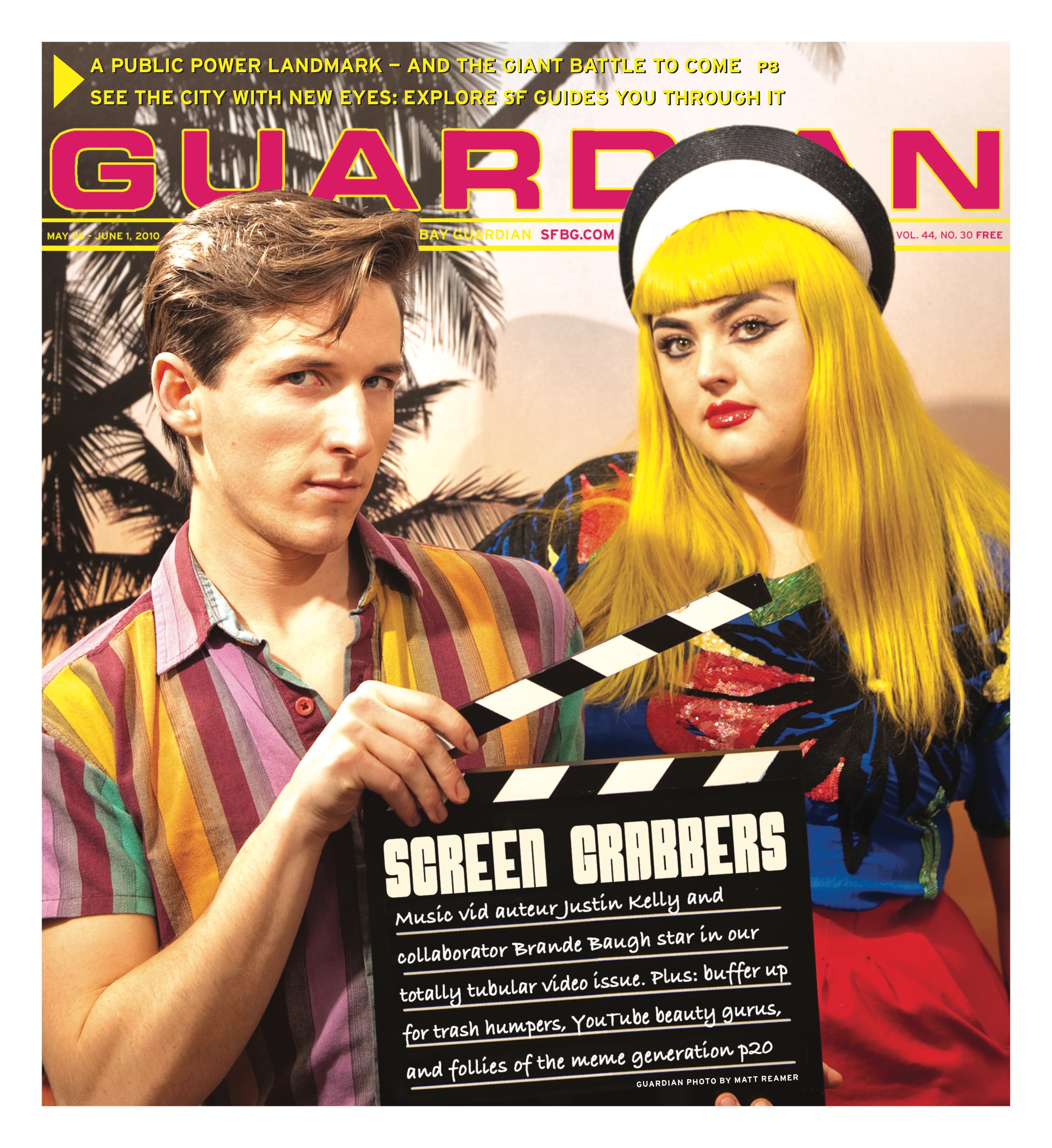
Maybe now that Apichatpong “Joe” Weerasethakul has won the Palme d’Or at Cannes, the art film world can be forgiven, but many of my favorite movies of the past few years have been made for Vimeo or YouTube more than for DVD rental, let alone the big screen. I’m thinking of Damon Packard’s SpaceDisco One, and most of all, I’m talking about music videos shot right here in San Francisco: Skye Thorstenson’s fantasia for Myles Cooper’s “Gonna Find Boyfriends Today,” and Justin Kelly’s numerous videos for Hunx and His Punx. Where else are you going to find a world of arcane rituals, giant boomboxes, bigger phones, and mustard-and-syrup food orgies, populated by a cast of personalities that might make John Waters pine for his youth and Andy Warhol rise from the grave?

On a sunny Saturday, Kelly picks me up in his 1980 Mercedes and — amid talk of rabid crowds stripping Hunx naked at show in Paris — drives me to his shared warehouse at the very point of Hunters Point. His look is a less corn fed All the Right Moves-era Tom Cruise. When we reach the place where the magic happens, there’s a basketball net in the main room, along with an assortment of six-foot fluorescent pointy plastic plant life. Kelly’s friend and longtime collaborator Brande Baugh mixes up some Campari and orange juice, enthusing about Campari ads in Europe featuring “slutty full-on animals with big tits wearing bikinis.” It’s time to talk movies.

Kelly and Baugh have been friends since they were 14. They could have walked right off the pages off Francesca Lia Block’s great SoCal young adult novel Weetzie Bat. “We were geniuses in our own mind,” says Baugh. “I’d dress like a drag queen every day at school. I had no eyebrows — I’d draw them on. Our history started because we both had these crazy urges. We’d go to the mall and take pictures of each other being dead on the floor.”

“Brande would go to punk shows,” says Kelly, “and I was just looking for any event where I could dress up and be expressive, from Rocky Horror to raves. She took me to my first gay pride [parade].” Moving away from home at 18, Kelly checked out the fringes of movieland, playing a nerd with acne in Ghost World (2001) and working as a set PA on Almost Famous (2000). He lived on Hollywood Boulevard, then he and Baugh each got their own studios at a place called Sunshine City Apartments. “On Hollywood Boulevard, we’d have these weird Elvis impersonators around us,” Baugh remembers. “It was fun to poke fun of that and rehearse our camp.”

But San Francisco is where Kelly and Baugh have made their creative home. Back in 2005, when I profiled Kelly’s early music video efforts, he’d made less than a handful of clips, but already had a very precisely honed vision, formed from close scrutiny of — and enthusiasm for — ’80s-era MTV in particular. In the past few years, this vision, combined with the music of talented friends such as Alexis Penney and Seth Bogart of Hunx and His Punx, has flowered into something uniquely energetic, hot, and vividly colorful. Kelly’s videos are stylish yet lively. The clip for Hunx and His Punx’ “Cruising,” for example, is an almost DePalma- or Hitchcock- or Ophuls-type feat of tracking shot trickery, a faux-one shot 360-degree dance through a variety of horny and sweaty tableaux that revives William Friedkin’s Cruising (1980) in a celebratory rather than bloodthirsty way.

Lensed by frequent director of photography David Kavanaugh, Kelly’s recent video for Harlem’s “Gay Human Bones” is another step forward, with a superb central performance by Baugh, who stares down the camera with silent movie star hypnotism, and a memorable bespectacled cameo by Scout Festa, one of the stars of Cary Cronenwett’s sailor epic Maggots and Men (2009). (“We call her ‘One Take Festa,'” Baugh says.) Here, the attention to detail that Kelly brings to movement and editing (an area where Baugh often chimes in) takes on a ritualistic aura. Both “Gay Human Bones” and “Cruising” possess choreographic grace.

This doesn’t mean Kelly is veering away from direct imagery. His clip for Nick Weiss’s RIP NRG remix of Hunx and His Punx’ “Dontcha Want Me Back” discovers new vivid hues while reveling in the tastiness and grodiness of food. An upcoming clip for Alexis’ home run of a debut single “Lonely Sea” (produced by Weiss) captures the formidable Penney in full-on Janet Jackson or Madonna-level diva mode, storming into the ocean. Except in this case the setting was a freezing Ocean Beach, where Penney had to yell to himself that he was “Alexis, Queen of Sex!” in between freezing-cold and even hail-ridden shots. “He was shaking so hard,” Kelly says. “I freaked out and thought, ‘Oh my god, he’s going to die and I’m going to jail!'”

While music video is where Kelly has been thriving, the feature film world is where he’s been learning, from his early Hollywood and Indiewood experiences on through to a gig as editorial assistant on Gus Van Sant’s Milk (2008). This summer, he’s traveling to Oregon to work on a feature by director M. Blash that stars Chloë Sevigny and Jena Malone. He’s also continuing to work on his feature film debut as director, after shorts such as Front (2007), a cryptic slice of queer youth which starred Daeg Faerch before Rob Zombie cast him as the young Michael Meyers in his 2007 remake of Halloween. As for that project, mum’s the word right now, but know one thing: a lot of people in this town will be talking about it.

www.denofhearts.com

Our Weekly Picks: May 19-25, 2010

0

WEDNESDAY 19

MUSIC


Francis and the Lights

Although they’ve garnered attention from shout-outs by Kanye and Drake, New York City’s Francis and the Lights have enough style to speak for themselves. Singer Francis Farewell Starlite sounds a lotta bit like Phil Collins, and the ’80s groove that often accompanies him only adds to the double-take. If Starlite’s Trek convention name didn’t scare you off, you’ll discover he has some kick-ass dance moves and a synth keyboard with all black keys, because “the difference between black and white keys is that there is no difference.” If you can make it early for Teen Inc., you’ll get more 1980s funk, spin-cycled with a tad of Ariel Pink and a pinch of Prefab Sprout. (Peter Galvin)

8:00 p.m., $13

Great American Music Hall

859 O’Farrell, SF

(315) 885 0750

www.gamh.com

THURSDAY 20

MUSIC


Roky Erickson

From his time as leader of psychedelic pioneers The 13th Floor Elevators through his varied and excellent solo work, Roky Erickson has continued to write and perform some of the most original and imaginative music in any subgenre of rock ‘n’ roll. A testament to his outstanding talent and resilience is that Erickson has done so while surviving decades of drug abuse and mental illness, a hellish journey that has fortunately ended with his inspiring recovery and recent return to the music world. Last month saw the release of True Love Cast Out All Evil, his first new album in 15 years, an incredibly poignant collection of songs that document his struggles but ultimately give the sense of hope and promise for a fruitful future. (Sean McCourt)

With Okkervil River

8 p.m., $29.50

The Fillmore

1805 Geary, SF

(415) 371-5500

www.thefillmore.com

DANCE


Sara Shelton Mann and David Szlasa

Newcomers to the Bay Area take the presence of Sara Shelton Mann for granted. They shouldn’t. Though she has been making groundbreaking work — theatrically and philosophically — for 30 years, she yet has to run out of steam, curiosity, or the willingness to push herself to the edge of whatever she happens to be investigating. Yet there is always that same nagging question: how do we live with each other in a world that is anything but perfect and tries to shape us without our consent? Not that her work gives answers — but it’s the journey and questions that count, right? She and media artist David Szlasa are joined by some of San Francisco’s finest: Yannis Adoniou, Hana Erdman, Patrick Ferreri, Kira Kirsche, Justin Morrison, and Kristin Osler. (Rita Felciano)

8 p.m. (through Sat/22), $25–$30

Novellus Theater

Yerba Buena Center for the Arts

700 Howard, SF

(415) 978-ARTS

www.ybca.org

LIT


An Evening with Chuck Palahniuk

It is rumored that at one reading of his short story “Guts,” Chuck Palahniuk caused 40 audience members to faint from evocative prose involving intestines and a swimming pool pump. Yeah, gotcha. Palahniuk appears to be on course to offend our every sensibility (besides our apparent appreciation for the “transgressive novel” — Wikipedia, what does that even mean?), and his next target is the general squeamishness caused by L.A. name-dropping, courtesy of his latest release, Tell-All. The master of encyclopedic minutiae and literary gauche comes through this week to talk about what’s on his mind — be sure to bring a bag and wear a helmet if you have a weak stomach. (Caitlin Donohue)

7 p.m., $36

Swedish American Music Hall

2174 Market, SF

(415) 861-5016

www.cafedunord.com

MUSIC


Keepaway

I love the guys of Keepaway as friends, so full disclosure and all that. But seriously: this is upper deck exercise music. It will remind you of your happiest birthday party or your comfiest drug trip—either way, there are lots of brightly colored bouncy balls and all the time in the world. Keepaway’s spring-loaded EP Baby Style is already scorching the usual hype channels, though most of the praise is of the glum “Animal Collective-meets-whatever” kind. Forget it, and go watch a band swing for the fences. (Max Goldberg)

With Geographer

9 p.m., $10

Popscene

330 Ritch, SF

(415) 541-9574

www.popscene-sf.com

FRIDAY 21

DANCE


Readymade Dance Theater Company: The Body Artist

The Body Artist, Albuquerque’s Readymade Dance Theater Company’s latest theater piece, was inspired by Don DeLillo’s novel of the same name. Strictly speaking, it was Laurie Anderson’s taped reading that convinced Romanian-born choreographer Zsolt Palcza that he wanted to choreograph the work. Its story revolves around a young woman who, after her husband’s suicide, returns to their home and finds an unexpected visitor who knows a lot more about her than she can easily digest. Palcza brings a strong literary bent to much of his work, having previously choreographed both Dracula and Woyzeck. Body Artist is the group’s first San Francisco engagement. (Felciano)

8 p.m. (also Sat/22), $10-15

CounterPULSE

1310 Mission, SF

(800) 838-3006

www.counterpulse.org

MUSIC


Nokie Edwards

Getting his start playing back-up with Buck Owens when the country star lived in Tacoma, Wash., Nokie Edwards went on to join the Ventures as bassist in 1960 but quickly made the switch to lead guitar based on his musical virtuosity. Over the years since, he has lent his formidable talents to the many tracks that propelled the group to being the most successful instrumental outfit in history, including “Walk, Don’t Run” and “Hawaii Five-O.” Having been enshrined in the Rock and Roll Hall of Fame in 2008, Edwards and his band mates helped influence generations of surf bands, instrumental groups, and guitarists of all stripes and styles. (McCourt)

With Venturesmania, Deke Dickerson and the Ecco-Phonics, Pollo Del Mar, and the Mini Skirt Mob

8 p.m., $15

Rickshaw Stop

155 Fell, SF

(415) 861-2011

www.rickshawstop.com

SATURDAY 22

EVENT


Maker Faire

Step right up folks, this is the year’s preeminent get-together for makers of things. Yes, it’s just that specific. Forget the endless service industry feedback loop we’re stuck in — Maker Faire is all about taking the initiative to create the world around us. The Faire is home to everything from Burner flights of fancy via steel I-beam and bungee cord to robots, rockets, quilts, and felt creations. But the offerings that get my crafty cravings a-ragin’ are educational. After all, where else can one get primers on beekeeping, repurposing a computer hard drive, juggling, fermenting veggies, and building your own rotational casting machine in a single event? Unheard of, even in this hands-on hamlet. (Donohue)

10 a.m.-8 p.m. (also Sun/23, 10 a.m.–6 p.m.), $25

San Mateo County Event Center

1346 Saratoga, San Mateo

www.makerfaire.com

EVENT/FOOD


Uncorked! Wine Festival

There’s something about wine. Maybe it’s the process of growing, crushing, fermenting, and aging the grapes. Or maybe it’s that a bottle can go as low as $2 and as high as $2,000. You can cook with it, be classy and drink from a box, or just enjoy a glass with a platter of brie and crackers. At the fifth annual Uncorked! Wine Festival, you can learn how to properly pair the finest pastas and meats with the correct types of wines and even find out how to detect if an opened bottle of wine has gone bad. Tastings will be offered, of course, for an extra fee. (Elise-Marie Brown)

1–6 p.m., free

Ghirardelli Square

North Point and Larkin, SF

(415) 775-5500

www.ghirardellisq.com

ART


“Painted Ladies”

Too many perfectly capable odes have been penned to the Victorian homes that dignify our streets. So I won’t waste words on how they make us all cooler by their very presence — but you know what I mean, right? Fabric8 gallery sure does. Owner Olivia Ongpin has assembled a homage to the Painted Ladies for her newest opening. Works focus on the femininity and architecture around us, including the Lower Haight fairy tales of Ursula Young, Nome Edonna’s water-infused dreamscapes, and the heavy-lidded queens that grace the canvasses of Telopa. (Donohue)

7–10 p.m., free

fabric8 gallery

3318 22nd St., SF

(415) 647-5888

www.fabric8.blogspot.com

MUSIC


Dead Prez 10 Year Anniversary Show

Laid on a foundation of political and societal confrontation, Dead Prez is celebrated as one of the most militant hip-hop duos. It has been 10 years since their debut album, and they are taking the stage at the Rockit Room for a live performance with special guests Ras Ceylon, Sellassie, and Unity. Since Let’s Get Free in 2000, they’ve released albums and mixtapes and infiltrated the media through music in movies and on TV, most notably the opening theme for each episode of Chapelle’s Show. On Mother’s Day, they released a remix of B.o.B.’s track “Nothin On You” retitled “The Beauty Within.” Two years ago, they recorded their only live album here in SF, and now they’re back. (Lilan Kane)

9 p.m., $20

Rockit Room

406 Clement, SF

(415) 387-6343

www.rock-it-room.com

SUNDAY 23

MUSIC


Caribou

Canadian electronic artist Caribou tinkers with beats and sounds with a surgeon-like precision, which makes sense given that he is a doctor. Well, not that kind of doctor. I can barely do long division anymore, but the man behind Caribou, Dan Snaith, has a PhD in math and surely this superpower informs his work as a composer. His newest album, Swim, is a shimmering grab bag of danceable rhythms and soft vocals that channel pop music as much as house or disco, all performed with live instruments. (Galvin)

With Toro y Moi

8:00 p.m. (also Mon/24), $17

The Independent

628 Divisadero, SF

(415) 771-1421

www.theindependentsf.com

EVENT/MUSIC


The Golden Gate Park Band Concert: Armenian-American Day

The possibilities at Golden Gate Park are always endless. It’s the perfect place to have a picnic, go to a museum, or just lay in the sun and listen to the drums. Plus, there is always some sort of free concert going on. The Music Concourse is hosting installments of free shows throughout the summer. This week they celebrate the dance and music traditions of Armenian culture. (Brown)

1 p.m., free

Music Concourse, Golden Gate Park

55 Hagiwara Tea Garden Drive, SF

(415) 831-5500

www.goldengateparkband.org

MONDAY 24

EVENT/FUNDRAISER


Lunch with James Franco

What do the 826 Valencia tutoring center and James Franco have in common? Apparently more than you think. The Oscar-nominated actor has done videos and written essays for McSweeney’s and is now helping to raise money for the eight-year-old tutoring center. For $150, you can get a three-course lunch, view short films by the actor, and ask questions. You’ll also hear from novelist and screenwriter Dave Eggers, staff members of 826 Valencia, and public school teachers. (Brown)

12 p.m., $150

St. Regis Hotel

125 Third St., SF

(415) 284-4000

www.stregis.com

TUESDAY 25

MUSIC


Nas, Damian Marley

Things that taste better together: bacon and eggs, french fries and ketchup, rap and reggae. Realizing the success of their Grammy-winning collaboration “Road to Zion,” criminally-ill MC Nas and the youngest son of Bob Marley, Damian, reunite for a whole album that is equal parts street tough and island beauty. Proceeds from Distant Relatives go to charities in Africa. Although the primary sentiments of the album are hope and inspiration, don’t think for a minute that these beastly songs would be out of place in any club in SF or any dancehall in Kingston. More important, the album opens the door to more musical crossover collabs — nü-metal and country? We can dream...(Galvin)

With Nneka

8:00 p.m., $39.50

The Fox Theatre

1807 Telegraph, Oakl.

1-800-745-3000

www.thefoxoakland.com The Guardian listings deadline is two weeks prior to our Wednesday publication date. To submit an item for consideration, please include the title of the event, a brief description of the event, date and time, venue name, street address (listing cross streets only isn’t sufficient), city, telephone number readers can call for more information, telephone number for media, and admission costs. Send information to Listings, the Guardian Building, 135 Mississippi St., SF, CA 94107; fax to (415) 487-2506; or e-mail (paste press release into e-mail body — no text attachments, please) to listings@sfbg.com. We cannot guarantee the return of photos, but enclosing an SASE helps. Digital photos may be submitted in jpeg format; the image must be at least 240 dpi and four inches by six inches in size. We regret we cannot accept listings over the phone.

A hologlyphic story

2

arts@sfbg.com

FILM/VISUAL ART The first time I witnessed Walter Funk’s Hologlyphics, I’d spiraled up the whimsical stairs of Jaina Bee’s Granny’s Empire of Art, parted curtains and slipped inside the otherwise dark, slanted-roof attic. A circle floated in the center of the room that slowly morphed into a rhombus, then a rectangle. It was three-dimensional, but not real. Along with its movement, sound spread from keyboards and motion-sensor instruments and bounced off the walls.

Remember when R2-D2 projected Princess Leia’s message “Help me, Obi-Wan Kenobi. You’re my only hope”? What was once just an idea imagined by George Lucas is now Walter Funk’s Hologlyphics — although the images are abstract and more like Leia’s famous coiled buns. Unlike the 3-D technology Avatar is hyping, Hologlyphics requires no glasses and presents a 90-degree view of the object, allowing a viewer to walk around the image and see it from multiple perspectives.

Funk developed a system for live auto-stereoscopic movies along with music and created a family of real-time spatial image synthesis and processing algorithms that he has coined Hologlyphics. The system takes information from keyboards, controllers, motion sensors, and acoustic instruments and projects a 3-D image that interacts with the sound it is simultaneously producing. “So as something gets bigger and smaller, something might get louder or softer or lower or higher in pitch,” Funk explains as we talk over a café americano (him) and black coffee (me) at the Marsh Café. “The sound and the visual are considered one thing. For every visual, there’s an associated sound, just like in the real world.”

Funk has been pursuing holography ever since he went to the now defunct Museum of Holography in New York in the 1980s. In 1987, he ordered his first holography kit and played with graphics on the now-ancient Apple IIe. But he kept running into walls and was frustrated by monetary and technological constraints. He considered abandoning his work. Then, in the early 1990s while doing research in old technical journals, he discovered Homer Tilton’s display system and got in touch with Tilton.

“He [Tilton] was really open to the idea of doing art with his parallactiscope system, even though it wasn’t what he did,” Funk explains. “He actually put together some early hardware for me. Here I was, this freaky artist in California. And he didn’t necessarily share my same visual aesthetic, but just liked the idea that people wanted to do other stuff with his display.” By 1994, with the aide of Tilton, Funk had put together his first prototype.

Currently the display projects green, morphing, 3-D shapes. But Funk has big dreams for the future — although there are still the same two limitations: money and technology. In an ideal future, the system would be “larger, full color, and photo-realistic.” If the system was larger, multiple people could view it at a time — just like Avatar. But for now, Hologlyphics works best as a one-person-at-a-time experience. “Everything I’m doing is pretty much abstract, which is good, since I’m doing a lot of abstract music,” Funk says. “At the same time, I’d like people to incorporate real-world imagery with it.”

Funk has an optimistic view of the latest 3-D craze. “There are some negative aspects because some studios are just going make things 3-D to make money. But there’s a whole new world of storytelling going on. Done right, it can be amazing and even evolve into a different art form beyond film.”

With Funk’s system, viewers witness multiple perspectives while moving, just like the hologlyph, thus integrating it fluidly into the real world. “This is a cheesy example, but everyone knows it,” he says, with more energy than a mere cafe americano can provide. “Imagine Clint Eastwood when he says, ‘Go ahead, make my day.’ What if you were watching that movie for the first time, and right at that scene you’re looking at the back of his head because you can — that takes away a lot of effect and power from the filmmaker. It’s not a bad thing or a good thing. It’s just a different art form.”

Hologlyphics illustrates the potential for enhanced viewing experiences and new ways to tell stories. “The thought of it is very common, but the existence of it is not,” he says. “I think once this stuff does exist, there’s no putting it back. It’s like Pandora’s box — people are gonna love it.”

WALTER FUNK’S HOLOGLYPHICS

Maker Faire

Sat/22, 10 a.m.–8 p.m.; Sun/23, 10 a.m.–6 p.m.; free–$25

San Mateo County Event Center

346 Saratoga Drive, San Mateo (650) 574-3247

www.hologlyphics.com


Shoot ’em up

0

FILM Some people truly love movies, and love making movies, yet a legitimate question arises: for the greater good, should they be stopped? Or at least drastically slowed down?

That worry rumbles just under the surface of Clay Westervelt’s documentary Popatopolis, and the entire oeuvre of the filmmaker it’s about. Jim Wynorski is a onetime Roger Corman protégé who started making his own low-budget movies in the late 1980s, riding out the direct-to-video wave with a mix of sequels nobody was waiting for (1989’s Return of the Swamp Thing, 1994’s Ghoulies IV), the inevitable “erotic thrillers,” miscellaneous action trash, unintentionally funny horror flicks, unintentionally unfunny comedies, and so forth.

Somewhere around the millennium’s turn he started alternating between even cheaper cable softcore cheese (several Bare Wench Project flicks, 2009’s The Devil Wears Nada) and comparatively lavish exercises in genre clock-punching (2005’s Komodo vs. Cobra, 2004’s Sea Ghost). The latter were usually made under pseudonyms — because even the SyFy Channel knows the words “Jim Wynorski” raise a red flag that might send fussy viewers straight to bed with a book.

Popatopolis chronicles the creation of 2005’s The Witches of Breastwick, whose writer-director agreed to make it in just three days as an “experiment” — to the dismay of a cast and crew already fed up by incredible shrinking production schedules. One says Wynorski’s “problem is he keeps saying yes to everybody. If you keep lowering the bar of how quickly and cheaply you can make a film, it’s just not fun anymore.”

Wynorski typically gives actors one take to realize his vision — not that he actually explains what it is. By all accounts a dear man off-set, on the job he throws tantrums, cuts any corner — but does complete a million shots per day. Still, is being this prolific a virtue to anyone besides his financiers? Corman wistfully opines, “Jim is a better director than he thinks he is.” Wynorski counters, “I’m not Picasso. I’m more like the guy who paints Elvis on velvet.”

Well, not Elvis so much as black-light poster babes — the surgically enhanced bombshells he favors, some of them moonlighting hardcore “models.” The ones who aren’t lament the demise of real B movies like those Wynorski used to make, which featured quasi-stellar legitimate thespians like Antonio Sabato Jr., Ice-T, Shannon Tweed, two lesser Baldwins, and both Coreys. Even those folk wouldn’t do a Breastwick. Yet that shoestring epic makes enough cable deals to achieve the kind of profit margin mainstream Hollywood only dreams about.

Its sequel (plus five more features) were in the can before 2005 was out. “He’s like a machine that can only do one thing in the world,” a colleague observes. Popatopolis captures some golden moments you wouldn’t get in any ordinary making-of, as when a new actress says “Whoever wrote this script doesn’t like women very much,” and old-hand actress Julie K. Smith shrugs, “Jim Wynorski wrote it. A couple rum and Cokes, and the anger comes out.” Westervelt will be on hand to answer questions at the Oddball screening and to introduce Wynorski’s 1986 killer-robot epic Chopping Mall. 

POPATOPOLIS WITH CHOPPING MALL

Fri/21, 8 p.m., $10

Oddball Films

275 Capp, SF

(415) 558-8117

info@oddballfilm.com (RSVP required)


Garcon!

0

paulr@sfbg.com

DINE When Garçon! succeeded Alma about four years ago, I thought: well, there goes the neighborhood. Alma had been a rather special place, a temple of nuevo Latino cooking, and it had a witty name that meant “soul” in Spanish while slyly referring to the owner-chef, Johnny Alamilla. “Garçon,” by contrast, is a word of near-abuse that gets shouted at servers in French restaurants in dumb movies — or, occasionally, in real life, at real servers by dumb people.

The word “garçon” should probably have an exclamation point appended to it as a matter of routine, and — huzzah! (or voilà?) — the signage at Garçon! includes the exclamation point! In the restaurant’s early days, the signage was dismal, a sharp falling-off from Alma’s, and I took this to be a bad sign: just cheap-looking banners rippling in the breeze, as if they were having a Labor Day clearance sale on washers and dryers.

The improved signage suggests that Garçon! has settled into its rather choice location. There is a certain amount of history to live up to. In addition to (and before) Alma, the nicely windowed corner space at the corner of 22nd and Valencia streets was home to the Rooster, which was interesting in a slightly odd way.

Garçon! isn’t odd, but it is a good, solid French restaurant in a neighborhood that has just about every other kind of restaurant other than. So maybe it’s a little eccentric after all, or maybe just unexpected. Certainly it’s good-looking; the Iberian-grotto look of Alma has been swept away in favor of metropolitan polish; Garçon! might be one of the most Parisian-looking restaurants in the city, with its vintage Dubonnet posters and individual lamps on each table (each fitted with a CFL, for greeniac cred). Their glow warms the dark wood of the tables.

Chef Arthur Wall’s food is of the hearty school. This is not a restaurant you will leave hungry. If you have any doubts about getting your fair share, you might be interested in the prix-fixe, $32 for three courses, which is a little high to provide true economy of scale but does ensure that you get three courses. It brought me, one evening, a substantial coq au vin, a dish I don’t see offered that much any more although, like its close relation boeuf bourguignon, is one of the staples of French country cooking. At Garçon! the coq turned out to be a whole leg (thigh plus drumstick) braised in red wine with bacon, carrots, and pearl onions — a fairly wintry dish to be offering in mild springtime, I thought, but the meat was tender and juicy, and a wonderfully thick sauce had gathered at the bottom of the earthenware crock.

The pork chop ($23) didn’t appear on the prix-fixe menu — maybe because it wouldn’t fit. It was a massive fist of meat, nicely cooked to a hint of rareness and laid atop a bed of symmetrically diced potatoes. A bit less overwhelming in scale, and more stylish, was duck-leg confit ($19 — not a bad price), stylishly presented with a potato mousseline, braised baby leeks, and sections of mandarin orange. Only the duck fiend would have had this after having had duck-liver paté ($9), a creamy, mild square like a thick slice of white cheese, along with toast points, arugula, apple slices, and a red wine syrup that could have passed for some kind of berry coulis.

As a Francophile, it does slightly grieve me to say that French handling of the hamburger can sometimes leave something to be desired. At Garçon! you can have your burger ($12) decorated with a slice of cheese ($2) of your choice — brie, say, to go with the brioche bun for what I thought of as the Frenchburger. The meat turned out to be okay if overcooked (I asked for medium-rare, got well-done), and the bun was fine if a bit puffy. But the cheese! Mon dieu! Brie does not belong on a cheeseburger; it resists melting and acquires an unappealing mustiness from the heat. The fries were decent but could have been more crisp and golden. If you need a rinse aid, you might be interested in the burger and beer ($15).

The dessert menu includes a glimpse of the sublime: a chocolate ganache tart ($9) accompanied by sour cherries, mint, and a puff of whipped cream that one time was made with goat cheese and another with plain sweet cream. The accompaniments are nice, but the tart, with its flaky-crisp pastry crust and voluptuous chocolate filling — like a cross between pudding and fudge — can stand on its own. I’m tempted to add an exclamation point but won’t. 

GARÇON!

Dinner: Tues.–Thurs., Sun. 5–10:30 p.m.; Fri.–Sat., 5:30–11 p.m.

1101 Valencia, SF

(415) 401-8959

www.garconsf.com

Full bar

AE/DC/MC/V

Somewhat noisy

Wheelchair accessible

OMFG, Meg Whitman’s a smut dealer!

1

Or so Steve Poizner says, in a battle of the airwaves that’s getting completely insane.


In a new ad, Poiz charges that Whitman, as CEO of EBay, allowed (oh no!) dirty movies to be sold on EBay. You can buy other dirty things there, too, like a Voodoo Hot Sex Life Improvement Love Spell (bidding starts at $9.99). And it’s all Meg’s fault!


The problem with this approach is that I suspect a lot of Republicans may also shop on EBay, and some of them may want their own copy of the official Naughty and Bawdy Songs of England CD — or maybe something even a little naughtier. And they may not be that upset that ol’ Meg allowed them an easy and discreet way to buy the things that the GOP kinks in the closet wouldn’t want to be seen picking up at the mall. (That kind of thing gets around.)


Now Meg will have to respond with something even more harsh about Poizner. What fun.


Director Travis Mathews makes gay porn intimate, cuddly, relatable

1

Travis Mathews is quickly making a name for himself in the San Francisco film scene. A short film culled from his In Their Room series earned him top honors at the Good Vibrations’ Independent Erotic Film Festival last year. Now he’s working on I Want Your Love, a full-length scripted feature. Although Mathews has only completed one demo scene, the project is already generating online buzz. I spoke to Mathews about his inspiration for I Want Your Love and how the short scene fits into the bigger picture.


San Francisco Bay Guardian: The last time I interviewed you, we were talking about In Their Room. What brings you back to erotic film?
Travis Mathews: I have always liked to see people be really candid, honest, raw, intimate, vulnerable. And I think there’s a lot of different ways that you can show that and reveal that in movies, and one of the ways you can do it is through sex. But strangely, I think that’s what’s missing in a lot of porn, is that all of those things that I just mentioned are missing from porn. Instead, it’s just the very carnal “money shot” where it seems often divorced from feeling, from interpersonal relationships, and then all those other things I mentioned, like intimacy, vulnerability, honesty. I consume porn like most people do, and I myself feel disconnected from it, and I don’t really feel engaged with it and I don’t expect much from it. And I hear a lot of other people complaining or echoing similar thoughts. It just seems crazy to me that there aren’t more depictions of real people—whatever real people means—but not chiseled, “I go to the gym four hours a day, six days a week” people, having sex in a believable scenario that doesn’t seem stagey or ridiculous.

Jesse in I Want Your Love

SFBG: The scenario you present in this scene from I Want Your Love is definitely relatable—two friends who haven’t had sex with each other but are thinking about giving it a try. It’s something that many gay men have experienced. What brought you to that scene?
TM: It’s a scene that’s been stretched for the demo for a feature that I wrote. So it’s one of among a lot of other things going on, a lot of scenes and a lot of other mini-dramas. It goes back to the original thing I told you: I want to write stuff and I want to show stuff that people can respond to that feels honest to them, even if they don’t totally relate to it. Like, maybe someone hasn’t had that same experience, but it is an experience that a lot of gay men have had. I think a lot of people can make that leap, that like, “I get that. I think that’s probably something that really happens.” I’m not interested in creating big dramas that overshadow the intimacy and the more nuanced stuff.
 

SFBG: One thing I really liked about the scene is how natural it felt. Was everything there scripted or was there improvisation as well?
TM: That was all scripted. The only thing that was improvised is when they’re having sex—there’s lines when they have sex that are scripted, but the only thing that’s improvised is, there’s a moment when they’re having sex when Jesse says, “Oh, this feels so good. Oh, I like it so much.” And then he checks in with Brenden, and says, “Are you OK? Do you want more?” And Brenden says, “Yeah.” Like, really soft, and I like that a lot. But everything else was scripted. So I gave them the script for the scene and they basically memorized it, and they knew about it, and we had talked about it. During our first rehearsal, it was more of a workshop. I told them from the beginning, “I’m not so married to this script that we can’t deviate from it. I want you guys to bring parts of your real self to it, and I also want you to give me feedback on whether this feels like something you or your character would say.” So we massaged it together as a team and it was definitely at that point a collaborative effort. It was very democratic at that point. Me, Jesse, and Brenden, and my DP/producer Keith sat together and went through the script and tried out lines that I had written to see how they worked.

Jesse from “In Their Room”

SFBG: It’s impressive to me that it’s scripted, because it does feel so real. You don’t really get the sense that they’re acting.
TM: That was at the top of my list of things that I really wanted to keep an eye on, is bad acting. I feel like there’s a lot of other things that you can massage or you can hide or you can choose not to include and insert something else. But if you’ve got bad acting, it’s really hard to recover from that, I think. Because as a viewer, when I see something that’s poorly acted, I lose interest and I just don’t believe it. And I feel disengaged from it, which goes back to the problem of so much porn that tries to be cinema or tries to be like a regular movie.

SFBG: So let’s talk about casting. I know you worked with Jesse on In Their Room, but how did you decide on these guys?
TM: The first time I met Jesse was when I basically knocked on his door and went to shoot him for In Their Room. And then, we had a mutual friend in common, and then we had other friends in common, and we became friends. And I also really liked the way Jesse looked on the camera. Not necessarily physically—although I think that he’s really a sexy, handsome guy—but how the camera would catch his eye, or I would be able to catch him doing something really small that seemed to say a lot more. He’s really good at just leaning into really quiet moments that we all engage with when we’re by ourselves. He’s a performance artist, so I think that’s part of it. I also think that there’s a comfort level that goes along with that. He does it in a way that’s so natural. He knew from the beginning—we talked very little about, with In Their Room, what my intention was, but he knew what I was getting very quickly. And with his own work, he deals with issues of masculinity and things like that, so it’s not like what I’m doing is divorced from the stuff he’s doing. So he got it right away, and that was really refreshing. So I knew I wanted to work with him again, and I was starting to write this feature toward the middle of last summer, and I definitely knew that I wanted him in it in some capacity. When we went forward to do the demo, I told him about the project, I told him I wanted him in it as this character, and he was enthusiastic about it and wanted to be involved.

So then it was a process of finding the person who was going to play opposite to him. We had a casting call on Butt Magazine’s blog, and I put the word out there among boys in San Francisco. We probably had less than a dozen serious contenders, and we auditioned a bunch of people. Brenden was actually the first person that we auditioned. I had seen Brenden out and told him I was interested in having him audition again, and he did. He and Jesse have really, really good chemistry together. They can be playful and sexy together, and that was key for me. A lot of these other guys would have been great, I’m sure, some of them, but it needed to feel like—because they were supposed to be old friends or best friends—it needed to feel like they were comfortable inhabiting each other’s space, and that it was a familiar thing for them to be doing that. So that’s what I was looking for. If it felt like these were two people who had just met each other yesterday, and now they’re pretending to be close friends, it wouldn’t have worked.

SFBG: So the movie extends past these two friends, then. Can you talk a little about what’s going on in the full feature?
TM: What’s potentially confusing, I think, to people is that, you don’t have any sense in just watching the demo, you don’t have any real sense of what this whole feature is about. Or I think people think they do. But the basic log line for it is, Jesse’s character has been living in San Francisco for a decade, and for reasons I’m going to leave a little bit vague, there’s money issues and he has to leave the city. He can’t afford to live here anymore, and he’s moving back to the Midwest to live with his dad. So it’s kind of an opposite Tales of the City story where he’s not coming bright-eyed and bushy-tailed into this Emerald City where everything’s new and he’s going to experience everything for the first time. It’s like he’s done it and the thing that he’s grappling with is how much he’s failed this experiment of moving to San Francisco, or how much the city’s failed him. And the movie takes place in the last 24 hours before he leaves San Francisco. There’s a party that happens the night before he leaves, so there’s all these opportunities for these friends that are interconnected and then with himself to have a lot of quiet moments and reflection and introspection and things about what it’s been like living here, and what it means to be leaving it. There’s also a lot of opportunities for playfulness and sexy times.

SFBG: There’s a thin line between “porn” and “erotic film,” if there is one. I wanted to ask you about your reaction to the term “porn,” and also some of the more recent variations, like “hipster porn” and “mumblecore,” which are kind of contentious.
TM: Honestly, I’m kind of entertained in hearing different people label it different things, and I’ve decided—before I even released this—to not get engaged with debates or arguments or getting in a place where I’m being defensive about what it is. I feel like, I’m going to hopefully get to make the movie that I want to make, and there’s going to be sex in it, and yes, it’s going to be produced by a porn company. If people want to stop there and just label it porn, they’re going to do that. I can’t control how people are going to respond to it, so I’ve kind of let go of that. Some of these terms, I think are funny. Like, “hipster porn,” I know that that has a—what did you say, “contentious”?

SBFG: Just because a lot of people immediately reject the term “hipster.”
TM: Sure. Yet at the same time, I think if you’re somebody who’s well-tuned with the word “hipster” and you heard “hipster porn,” I think your interest would be peaked and you would be like, “What is that? I want to see that.” Although, you know, you might have a knee-jerk reaction and be like, “Ugh, hipster porn.” So I don’t think it’s as simple as it being a pejorative thing. And “mumblecore,” I love Funny Ha Ha (2003). I think it’s amazing, and I actually think “mumblecore” is a funny term. I like it. I know the guys that are sort of spearheading that whole scene kind of hate that they’re reduced to that. I like the intention of mumblecore movies. I think that they’re often really poorly executed, but I think Humpday (2009) was a good movie. I think the dialog was fantastic and it seemed real. And I also think that about Funny Ha Ha. But I mean, you go further: sort of the grandfather of mumblecore movies is Cassavetes. He would shoot things in this cinema verite style and get people to bring their real selves to their performances.

SFBG: You said in another interview that you’d like I Want Your Love to feel very San Francisco, and I was hoping you could elaborate. Why is that important to you?
TM: I come from the country, Ohio—I’m a country boy from Ohio. I don’t mean that I’m a country bumpkin, but I still feel wide-eyed and really grateful for the fact that I live in San Francisco, and that I’m able to survive here. The city has its problems, but I love living here. For a long time now, I’ve wanted to do something that was, in some ways, a tribute to the city without being cheeseball or so obvious but more nuanced. But then, I also felt that there’s a particular brand—there’s a regional gay in San Francisco. I wanted to document the people that I know in San Francisco in a way that felt authentic to me. Not in a way to be like, “Look at us, we’re so cool!” But in a way to show these guys—and there will be women in the feature, too—in the most candid way that I can show. The more I do the In Their Room stuff, or after having done that, I realized how much the guys I shot for the most part and the spaces that they inhabit just ooze San Francisco, without me trying to do that. So that was part of the momentum as I was writing the feature. I was realizing that without really doing a lot of work or without really trying to do this explicitly, I was going to be able to showcase San Francisco in a very nuanced kind of way.

You can view the demo scene from I Want Your Love free of charge at Naked Sword. Perhaps needless to say, it’s NSFW. For more information about Travis Mathews, check out his Web site.

Whistling in the dark: Noir returns to the Roxie

1

It’s hard to guess what fictive icons of popular culture will endure and which will evaporate from the collective memory. In the 1940s, probably few would have imagined kiddie heroes Batman or Superman retaining marquee value into the next century. Bigger bets would no doubt have been placed on the Shadow, the Saint, and the Whistler, long-running radio men of mystery with uncanny (but not exactly supernatural, or super-heroic) abilities to witness the moral misdeeds of mortal men, not to mention their inevitable comeuppance.

In fact, the S-men usually doled out that payback themselves. Even more evanescent than his compatriots, the Whistler was less hands-on, more a Greek chorus sardonically telling the tale of each episode’s protagonists, gloating over the impending arrival of their just desserts. He was never a participant — was even a He, or an otherworldly It? He was, simply, a gimmicked-up omniscient narrator, the storyteller’s own voice turned into a character slash-framing device.

As a result the Whistler probably didn’t seem natural movie material — what can you do with a character that isn’t seen and doesn’t interact with others? Yet the 13-year series’ popularity was such that Columbia Pictures took the plunge anyway. The result was eight films made between 1944 and 1948, six showing during the two weeks of “I Still Wake Up Dreaming!,” Elliot Lavine’s latest noir revival extravaganza at the Roxie — in restored 35mm prints struck for the occasion, yet. (The Whistlers will also play Berkeley’s Pacific Film Archive May 29-June 5.)

These “B” programmers were economical in budget and length. But on both levels they got a lot out of a little: benefiting fully from Columbia’s production gloss despite their humble status (destined for the lower half of double bills), often packing an almost epic narrative arc and tonal gamut into about 65 minutes. They weren’t great movies, but they were great examples of the solid craft and pulp entertainment value “golden era” Hollywood managed even (or even especially) when just churnin’ them out.

Each opens with a silhouette in trench coat and fedora floating along sidewalks and alley walls, uncredited actor Otto Forrest’s voice intoning “I am the Whistler … I know many strange tales, hidden in the hearts of men and women who have stepped into the shadows.” He then guides our attention to this particular case’s subject, who’s either planning something terrible or oblivious to the terrible something about to befall them.

If these central protagonists seemed oddly alike, that was because they were all played by one actor. Richard Dix was a big star of the 1920s and early 30s who was by then in his 50s, and looked it. He could credibly sport a tuxedo, bum’s rags, or murderous glare. Yet by and large he struck a placid, almost disinterested attitude throughout the series, despite his characters’ wildly varied circumstances. These included playing men who lose their identity (an amnesiac in 1945’s Power of the Whistler) or steal the wrong one (1944’s Mark of the Whistler); a terminally ill tycoon who marries a gold digger (1945’s Voice of the Whistler); or a gold digger sniffing inheritance dough (1946’s Secret of the Whistler, 1946’s The Mysterious Intruder).

The basic plot elements were interchangeable. But the particulars (often penned  by pulp masters like Cornell Woolrich) were complex — so many hitherto lawful characters turning homicidally venal on a dime — the support casts colorful, and execution snappy or moody as needed. (Directing four entries was William Castle, who’d turn to more garish thrills as the showman behind such gimmick-driven horror potboilers as 1964’s Strait-Jacket and 1965’s I Saw What You Did.)

There are a lot of other rarities in the Roxie fortnight, highlights including the entirely SF-shot 1949 cheapie Treasure of the Monte Cristo and Phil Karlson’s excellent 1953 99 River Street. Particularly fascinating are late entries showing in studio archive prints: 1958’s flop-sweaty NYC-set Cop Hater; 1963’s crazily cast (Mort Sahl! Sammy Davis Jr.! Pre-Bewitched Elizabeth Montgomery!), quite nasty mafioso meller Johnny Cool; and 1959’s The Fearmakers. The latter’s finger-waggling about “packaged politicians,” “well-heeled lobbyists,” and “phony front groups” muddying D.C. democracy played Red-scary then, but sure sound prescient in our post-Cold War now.
 
“I Still Wake Up Dreaming: Noir is Dead!/Long Live Noir!”
May 14-27, $5-9.75
Roxie, 3117 16th St, SF
(415) 863-1087, www.roxie.com 

Time travel

0

arts@sfbg.com

LIT Sometimes when I’m bored walking around Union Square, I wonder how many of the well-heeled white guys heading toward the Financial District are really criminal types who should be followed. Say, maybe some higher-up at Wells Fargo or Citigroup who helped rip off thousands through subprime loans before getting a nice slice of that sweet Wall Street bailout money.

When I’m feeling that way, I’m under the influence of a seminal 20th century writer who spent his most productive years in San Francisco. Here’s a passage that sends me there:

She walked on down Post Street to Kearny, stopping, stopping every now and then to look — or to pretend to look — in store windows; while I ambled along sometimes beside her, sometimes, almost by her side, and sometimes in front.

She was trying to check the people around her, trying to determine whether she was being followed or not. But here, in the busy part of town, that gave me no cause for worry. On a less crowded street it might have been different, though not necessarily so.

There are four rules for shadowing: Keep behind your subject as much as possible; never try to hide from him; act in a natural manner no matter what happens; and never meet his eye. Obey them, and, except in unusual circumstances, shadowing is the easiest thing that a sleuth has to do.

The narrator so hep to the ways of the tail is Dashiell Hammett’s “Continental Op,” an operative for the fictional Continental Detective Agency, whose adventures in print include some of Hammett’s finest San Francisco tales.

Don Herron’s walking tour of landmarks associated with Hammett’s time in San Francisco is well worth making for anyone curious about the history of the author of The Maltese Falcon and The Thin Man, who helped create hardboiled crime fiction and was one its greatest practitioners. At three to four hours of often hilly trekking, it’s a bit of a commitment, but at $10, it’s an affordable way to engage in the next best thing to time travel.

Herron, author of books about pulp actioneer Robert Howard and noir craftsman Charles Willeford, has been informally conducting the tour for three decades. It started in 1977 as part of a “free college” known as Communiversity. The Dashiell Hammett Tour: Thirtieth Anniversary Guidebook (2009), which updates earlier versions, is a nifty package that belongs on the shelf of any self-respecting San Francisco denizen with a passion for our city’s often twisted past. It’s a lively combination of biographical material about Hammett, assorted related trivia that never seems trivial, and Herron’s memories from 30 years of accompanying a broad spectrum of writers, fans, and eccentrics through the former stomping grounds of Hammett and his fictional creations.

The tour starts near the former site of the San Francisco Library Main Branch, now the Asian Art Museum. In an era of economic collapse papered over with massive subsidies to the same financial entities that brought us to collapse in the first place, lessons from earlier belt-tightening eras are useful. Hence it’s only appropriate to tip our fedoras to the memory of an autodidact left-winger who never finished high school but, by devoting years to reading in public libraries, got a better education than most who did. Though Hammett was making good money from writing crime fiction by the late 1920s, when he lived at 620 Eddy St. in the early 1920s, he couldn’t afford books and the library was a lifeline. The 1923 photo on page 66 of the guidebook, of what Heron calls “Hammett’s Reading Room” in the old main library branch at 200 Larkin St., is a beaut.

When Hammett and his family lived at 620 Eddy, their landlady was a bootlegger. Hammett’s wife later recalled cops rousting people in front of their window to the street. As Herron notes, today’s prohibition on hard drugs is about as effective at deterring users as the earlier one on alcohol, and equally effective at creating endless business opportunities for motivated entrepreneurs. If you’re not legally blind and are paying any attention at all, it’s likely you may see one or two such enterprising businesspeople on the streets of the Hammett tour. It’s also a safe bet they might bear a resemblance to the Continental Op’s self-description: “My face doesn’t scare children, but it’s a more or less truthful witness to a life that hasn’t been overburdened with refinement and gentility.”

The 1920s in San Francisco were wild, wide-open years full of fast living and dodgy characters. The late venerable columnist Herb Caen wrote of the period: “The Hall of Justice was dirty and reeked of evil. The City Hall, the D.A., and the cops ran the town as though they owned it, and they did … You could play roulette in the Marina, shoot craps on O’Farrell, play poker on Mason, and get rolled at 4 a.m. in a bar on Eddy.”

Hammett toiled on his used Underwood typewriter late into the night, creating characters and stories based on what he’d seen in that milieu. During World War I, he contracted both Spanish influenza and tuberculosis. When his TB got so bad that it was hazardous to the health of his wife and baby to maintain a family abode, he moved out and lived in a succession of apartments, including one up the hill from Eddy Street at 891 Post St., at the corner of Hyde. In a corner apartment on the fourth floor of that building, Hammett pounded out his first three novels. If you’re lucky, on Herron’s tour you’ll be buzzed in and get to see where Hammett typed, ate, drank, and smoked furiously — and sometimes pulled down the Murphy bed to sleep. The apartment of The Maltese Falcon‘s tough detective Sam Spade was based on the snug little dwelling.

The current occupant is Bill Arney, an architect and Hammett fan. When he showed the tour I was on around the small one-bedroom unit, I noticed a great compilation of “crime jazz,” soundtrack music from black and white crime movies and TV shows, on top of a pile of CDs. Appropriate, since Arney serves as announcer for the Noir City film festival local mover and shaker Eddie Muller puts on at the Castro Theatre every January.

Hammett left a permanent mark on San Francisco. Specifically, on the block-long street that used to be called Monroe, which runs south off Pine in the block between Powell and Stockton. From what is now called Dashiell Hammett Street, walk east on Bush and on the right, at Burritt Street, just before the Stockton tunnel overpass, ponder the plaque that reads: ON APPROXIMATELY THIS SPOT/MILES ARCHER,/PARTNER OF SAM SPADE,/WAS DONE IN BY/BRIGID O’SHAUGHNESSY.

We are lucky to be in a city that commemorates one of its most accomplished past local residents with a plaque honoring a killing that was a product of that writer’s imagination. *

MORE ON SFBG.COM: Johnny Ray Huston’s illustrated look at the Vertigo tour


Stage listings

0

Stage listings are compiled by Guardian staff. Performance times may change; call venues to confirm. Reviewers are Robert Avila, Rita Felciano, and Nicole Gluckstern. Submit items for the listings at listings@sfbg.com.

THEATER

OPENING

Giant Bones Exit Theatre, 156 Eddy; (650) 728-8098, www.brownpapertickets.com. $15-50. Thurs-Sat, 8pm. Through June 19. Fantasy author Peter S. Beagle (The Last Unicorn)  penned the source material for Stuart Bousel’s world-premiere play.

BAY AREA

In the Wake Berkeley Repertory Theatre, Roda Theatre, 2015 Addison, Berk; (510) 647-2949, www.berkeleyrep.org. $13.50-71. Previews Fri/14-Sat/15 and Tues/18, 8pm; Sun/16, 7pm. Opens May 19, 8pm. Runs Tues and Thurs-Sat, 8pm (also Thurs and Sat, 2pm; no matinees May 20, 29, June 3, 12, or 17; no show June 25); Wed and Sun, 7pm (also Sun, 2pm). Through June 27. Berkeley Rep and Center Theatre Group perform Lisa Kron and Leigh Silverman’s drama about a woman on the verge of a nervous breakdown after she begins to question her faith in country, relationships, and herself.

ONGOING

An Apology for the Course and Outcome of Certain Events Delivered by Doctor John Faustus on This His Final Evening Garage, 975 Howard; 585-1221, http://pustheatre.com. $15. Thurs-Sat, 8pm. Through May 22. This new, relatively short play with the long title, presented by Performers Under Stress, struts and frets a wearying hour upon the stage as actor Scott Baker’s haughty and high-strung Faust, knowing he is bound for hell at the end of the evening, pleads his case before the audience, shadowed all the while by a speechless but expressive Mephistopheles (played with sly showmanship and moody animal intelligence by Valerie Fachman). The case at hand revolves around a masterwork of nonsense over which Faust (its composer) and the devil compete: a set of journals filled entirely with hatch marks. Why exactly is difficult to understand for more than one reason, not the least being the tedium of the monologue itself, which is only temporarily relieved by the arrival of some cheap canned beer. Free brew aside, there’s little merit in playwright Mickle Maher’s self-conscious rambling, which more than anything chases its own tale — running in semantic circles without progressing anywhere or landing a bite. (Avila)

Andy Warhol: Good For the Jews? Jewish Theatre, 470 Florida; 292-1233, www.tjt-sf.org. $15-45. Thurs-Sat, 8pm; Sun, 2 and 7pm. Through June 20. Renowned monologist Josh Kornbluth is ready to admit his niche is a narrow one: he talks about himself, and more than that, he talks about his relationship to his beloved late father, the larger-than-life old-guard communist of Kornbluth’s breakthrough Red Diaper Baby. So it will not be surprising that in his current (and still evolving) work, created with director David Dower, the performer-playwright’s attempt to “enter” Warhol’s controversial ten portraits of famous 20th-century Jews (neatly illuminated at the back of the stage) stirs up memories of his father, along with a close family friend — an erudite bachelor and closeted homosexual who impressed the boyhood Josh with bedtime stories culled from his dissertation. The scenes in which Kornbluth recreates these childhood memories are among the show’s most effective, although throughout the narrative Kornbluth, never more confident in his capacities, remains a knowing charmer. But the story’s central conceit, concerning his ambivalence over presenting a showing of “Warhol’s Jews” at San Francisco’s Contemporary Jewish Museum, feels somehow artificial. It’s almost a stylized rendition of the secular-Jewish moral quandary and neurotic obsession driving Kornbluth works of the past — or in other words, all surface, not unlike the work of another shock-haired artist, but less meaningfully so. (Avila)

The Diary of Anne Frank Next Stage, 1620 Gough; 1-800-838-3006, www.custommade.org. $10-28. Thurs/13-Sat/14 8pm; Sun/15, 7pm. Custom Made performs Wendy Kesselman’s modern take on the classic. Eat, Pray, Laugh! Off-Market Theaters, 965 Mission; www.brownpapertickets.com. $20. Wed, 8pm. Through May 26. Off-Market Theaters presents stand up comic and solo artist Alicia Dattner in her award-winning solo show.

Echo’s Reach Brava Theater Center, 2781 24th St; 665-2275, www.citycircus.org. $14-35. Fri-Sat, 8pm (also Sat, 4pm); Sun, 4pm. Through May 30. City Circus premieres an urban fairytale by Tim Barsky.

Fishing Shotwell Studios, 3252 19th St; www.fishingtheplay.com. $25. Fri-Sat, 8pm. Through May 29. David Duman’s new play satirizes foodie culture.

Geezer Marsh MainStage, 1062 Valencia; 1-800-838-3006, www.themarsh.org. $20-50. Fri, 8pm; Sat, 8:30pm; Sun, 7pm (Sun/9 show at 8pm). Through May 23. Geoff Hoyle presents a workshop performance of his new solo show about aging.

*Hot Greeks Hypnodrome Theatre, 575 Tenth St; 1-800-838-3006, www.thrillpeddlers.com. $30-69. Thurs, 8pm; Sun, 7pm. Through June 27. See review at www.sfbg.com.

*Pearls Over Shanghai Hypnodrome, 575 Tenth St.; 1-800-838-3006, www.thrillpeddlers.com. $30-69. Fri-Sat, 8pm. Through June 26. Starting July 10, runs Sat, 8pm and Sun, 7pm. Through August 1. Thrillpeddlers presents this revival of the legendary Cockettes’ 1970 musical extravaganza.

Peter Pan Threesixty Theater, Ferry Park (on Embarcadero across from the Ferry Bldg); www.peterpantheshow.com. $30-125. Tues and Thurs, 7pm; Fri-Sat, 7:30pm (also Sat, 2pm); Wed, 2pm; Sun, 1 and 5pm. Through August 29. JM Barrie’s tale is performed in a specially-built 360-degree CGI theater.

The Real Americans The Marsh, 1062 Valencia; 826-5750, www.themarsh.org. $18-50. Wed-Thurs and May 28, 8pm; Sat, 5pm; Sun, 3pm. Through May 30. Starting July 8, runs Thurs-Fri, 8pm; Sat, 5pm; Sun, 3pm, through Aug 8. The Marsh presents the world premiere of Dan Hoyle’s new solo show.

*Round and Round the Garden American Conservatory Theater, 415 Geary; 749-2228, www.act-sf.org. $10-82. Tues-Sat, 8pm (also Wed and Sat, 2pm); Sun, 2pm. Through May 23. American Conservatory Theater offers a canny and contagious production of Alan Ayckbourn’s 1973 sex farce, one of the gems in the British playwright’s well-loved trilogy, “The Norman Conquests,” which variously lands on the same group of related characters — centered on the loveable and lovelorn reprobate Norman (a charmingly unstrung Manoel Felciano) — during the course of a single weekend spent in giddy, desperate, troubled infidelities. “Round and Round the Garden” takes place behind the ivy-covered walls of the house where the weekend unfolds, in the titular garden, as Tom (Dan Hiatt) and Annie (Delia MacDougall) meet in uncomfortable tension and bland civility, soon followed by Norman, Annie’s brother and Norman’s brother-in-law Reg (Anthony Fusco), Reg’s wife Sarah (Marcia Pizzo), and Norman’s own far-from-clueless wife Ruth (René Augesen). Stirring up these convoluted relationships is Norman’s fervent desire to seduce one or better yet both of his sisters-in-law, but plot details are really secondary to the chaotic spirit of the dance, not to mention the wonderful ensemble work underway. Director John Rando and a razor-sharp cast deliver a very entertaining evening effortlessly evoking the wandering, convention-flouting — but also still awkwardly conventional — 1970s, as seemingly sophisticated characters prowl (in some cases on all fours) amid the verdant Viagra of scenic designer Ralph Funicello’s magnificent backyard habitat. (Avila)

Sandy Hackett’s Rat Pack Show Marines’ Memorial Theater, 609 Sutter; 771-6900. $30-89. Thurs-Sat, 8pm (also Sat, 2pm); Sun, 2pm. Through May 23. Starting May 28, runs Fri-Sat, 8pm (also Sat, 2pm); Sun, 2pm. Through June 27. From somewhere before the Beatles and after Broadway “Beatlemania” comes this big band cigarettes-and-high-ball nightclub act, recreating the storied Vegas stage shenanigans of iconic actor-crooners Frank Sinatra (David DeCosta), Dean Martin (Tony Basile), and Sammy Davis Jr. (Doug Starks), and sidekick comedian Joey Bishop (Sandy Hackett). The excuse, if one were needed, is that god (voiced in mealy nasal slang by Buddy Hackett, appropriately enough) has deemed a Rat Pack encore of supreme importance to the continued unfurling of his inscrutable plan, and thus unto us a floorshow is given. The band is all-pro and the songs sound great — DeCosta’s singing as Sinatra is uncanny, but all do very presentable renditions of signature songs and standards. Meanwhile, a lot of mincing about the stage and the drink cart meets with more mixed success, and I don’t just mean scotch and soda. The Rat Pack is pre-PC, of course, but the off-color humor, while no doubt historically sound, can be dully moronic — and the time-warp didn’t prevent someone in opening night’s audience from laying into Hackett’s opening monologue for a glib reference to suicide. Though talk about killing: thanks to the heckler, the actor — son to Buddy and the show’s co-producer (alongside chanteuse Lisa Dawn Miller, who sings a cameo as Frank’s “One Love”) — got more life out of that joke over the rest of the evening than any other bit. (Avila)

Speed the Plow Royce Gallery, 2910 Mariposa; 1-866-811-4111, www.speedtheplowsf.com. $28. Thurs-Sat, 8pm. Through June 19. Expression Productions performs David Mamet’s black comedy.

Tartuffe Studio 205 at Off-Market Theater, 965 Mission; 377-5882, http://generationtheatre.com. $20-25. Fri/14-Sat/15, 8pm; Sun/16, 3pm. Generation Theatre performs a new English translation of Molière’s classic, in Alexandrine verse.

Tell It Slant Southside Theater, Fort Mason Center, Bldg D, Marina at Laguna; www.tixbayarea.com. $20-40. Fri/14-Sat/15, 8pm; Sun/16, 2pm. BootStrap Foundation presents Sharmon J. Hilfinger and Joan McMillen’s musical about Emily Dickinson.

Very Warm for May Eureka Theatre, 215 Jackson; 255-8207. $38-44. Wed, 7pm; Thurs-Fri, 8pm; Sat, 6pm; Sun, 3pm. Through May 24. 42nd Street Moon kicks off their Jerome Kern Celebration with this Oscar Hammerstein II script that features Kern’s final Broadway score.

What Mama Said About Down There Our Little Theater, 287 Ellis; 820-3250, www.theatrebayarea.org. $15-25. Thurs-Sun, 8pm. Through July 30. Writer-performer-activist Sia Amma presents this largely political, a bit clinical, inherently sexual, and utterly unforgettable performance piece.

BAY AREA

Girlfriend Berkeley Repertory Theatre, Thrust Stage, 2025 Addison, Berk; (510) 647-2949, www.berkeleyrep.org. $27-71. Wed/12, 7pm; Thurs/13-Sat/15, 8pm (also Sat/15, 2pm); Sun/16, 2 and 7pm. If you like Matthew Sweet’s songs you’ll probably like the spirited renditions in this new boy-meets-boy musical, which borrows its title from Sweet’s famous 1991 album. The songs, backed by a solid band in a recessed fake-wood-paneled den at the back of the stage, underscore the fraught but exhilarating emotional bond between two Nebraska teens at the end of their high school careers and the cusp of an anxious, ambiguous independence. The performances and chemistry generated by actors Ryder Bach and Jason Hite under Les Waters’ sharp direction are marvelous, delivering perfectly the inherent honesty and feeling in Todd Almond’s book, while Joe Goode’s beautifully understated choreography adds a fresh, youthful insouciance to the staging. But the story is a small one, not just a small town story, and its short, predictable arc makes for a slackness not altogether compensated for by the evocative tension between the lovers. (Avila)

Oliver! Julia Morgan Center for the Arts, 2640 College, Berk; www.berkeleyplayhouse.org. $24-33. Fri/14, 7:30pm; Sat/15, 2 and 7pm; Sun/16, 1 and 6pm. Berkeley Playhouse performs the Dickens-based musical.

Terroristka Berkeley City Club, 2315 Durant, Berk; (415) 891-7235, www.brownpapertickets.com. $12-20. Thurs/13-Sat/15, 8pm; Sun/16, 5pm. Threshold: Theatre on the Verge performs Rebecca Bella’s drama, based on the true story of a Chechen woman trained as a suicide bomber.

Twelfth Night La Val’s Subterranean, 1834 Euclid, Berk; www.impacttheatre.com. $10-20. Thurs-Sat, 8pm. Through June 12. You’ve got to hand it to Impact Theatre: they make reimagining Shakespeare look so darned easy. To set a crass comedy about class, obsession, and mistaken identity at “Illyria Studios” in the heart of tawdry Tinseltown seems like such an obvious take, you wonder why it took someone so long to get around to doing it. True, the execution is not as vivacious as last year’s A Midsummer Night’s Dream; there’s a lot of static standing around, particularly in the thus-rendered anti-climactic final act, and maybe a touch too much reliance on the karaoke machine prop (which is featured at its best during a stirring rendition of “Alone” courtesy of Cindy Im as Feste). But overall, the enthusiastic cast and timeless humor win the night. Especially strong comic performances are delivered by Valerie Weak and Jai Sahai as the troublesome twosome Toby Belch and Andrew Aguecheek while Seth Thygesen as Orsino maintains his now-familiar, yet thoroughly believable persona of oblivious yet jocular playboy. But it is Maria Giere as the cross-dressing, love-smitten Viola who displays the most range — from her ballsy attempts to fully inhabit her disguise as the page Cesario to her cringing attempts to have her beloved Orsino see through it. (Gluckstern)

What Just Happened? Cabaret at the Marsh Berkeley, 2120 Allston, Berk; 1-800-838-3006, www.themarsh.org. $20-50. Fri, 9pm; Sat, 8pm. Through May 27. Nina Wise’s show, an improvised work based on personal and political recent events, extends and re-opens at a new venue.

The World’s Funniest Bubble Show Marsh Berkeley, 2120 Allston, Berk; (415) 826-5750, www.themarsh.org. $10-50. Sun, 11am. Through June 27. The Amazing Bubble Man, a.k.a. Louis Pearl, performs his family-friendly show.

PERFORMANCE/DANCE

“Dis-Oriented” Mission Cultural Center, 2868 Mission; www.brownpapertickets.com. Fri, 8pm. $15-20. A trio of Asian American women (Zahra Noorbakhsh, Collenn “Coke” Nakamoto, and Thao P. Nguyen) performs solo works.

“Raw and Uncut Choreography Showcase” Garage, 975 Howard, SF; 518-1517, www.975howard.com. Tues, 8pm. $10-20. With guest choreographer Josh Beamish, plus locals Christine Cali, Andi Clegg, Shaunna Vella, and more.

*Smuin Ballet Yerba Buena Center for the Arts, 700 Howard; 978-ARTS, www.smuinballet.org. Fri-Sat, and May 11-14, 8pm (also Sat, 2pm); Sun, 2pm (also Sun/9, 7pm). Through May 16. $18-56. Smuin is gone, but under the leadership of Celia Fushille, the company has not yet strayed very far from his heritage. The rep is still heavy on the fast and the fun; audiences and dancers alike enjoy it. Fushille’s big addition — and it’s a good one — is Jiry Kylian’s Petite Mort, a marvelous piece of fluff with rolling hoop skirts and twirling foils, set to sublime Mozart. Since the name “little death” also refers to the result of what people do in private, you can read your own metaphor into it. Chinese-American Ma Cong’s French Twist is a hilarious dancing machine run at top speed. Tough to do, well done. Smuin’s Songs of Mahler opens a program that is balanced, fresh, and easy on the eyes. (Felciano)

“Super Hero Movies and Recycled Grooves” de Young Museum’s Koret Auditorium, 50 Hagiwara Tea Garden Dr, Golden Gate Park; 750-3600, www.stagewrite.org. Fri, 6:30pm; May 21, 11am. Free. Fifth graders (from Starr King Elementary) penned the plays, inspired by de Young artwork; professional actors (from StageWrite) perform them.


Our 2010 Small Business Awards

culture@sfbg.com

The mallification of America continues apace, with faceless conglomerates training new generations of shoppers to look for the cheapest deals at bland big box outlets, regardless of what “cheap” might actually mean in terms of pollution, transportation, labor, and the local economy. (For starters, out of every $100 dollars spent at a big box, only $43 remains in the local economy, compared to $68 if you buy local.) But in San Francisco at least, the little guys keep on swinging, maintaining unique shops and service companies with a vibrant local feel and contributing to the patchwork of optimism, individuality, and community effort that make the city great. Each year, we honor several of them for sticking to their guns and pursuing their visions.


WOMEN IN BUSINESS AWARD

DEENA DAVENPORT, GLAMA-RAMA SALON

“The higher the hair, the closer to God,” a wise Southern drag queen once said. Here in San Francisco, one of our own heavenly salons, Glama-Rama, is about to get a whole lot more divine, expanding from its homey kitsch digs in SoMa to a new 2500 square foot space on Valencia Corridor, creating 16 new jobs. The driving force behind that expansion is owner Deena Davenport, who combined her hairdressing talent, natural business acumen, and deep connection to the local arts scene into a formula for sheer success when she opened Glama-Rama 11 years ago.

“My dream was not to have a business, but a community space,” Davenport told me. “I wanted a place for all my gifted friends to express themselves. Not just our excellent stylists, but artists, designers, musicians, event producers — we all came together to make this happen. I think that’s the key to our success. We work with all kinds of styles and we don’t price ourselves out of the nonprofit sector. That allows a great mix of clientele, and an element of comfort for everyone.”

Davenport, a creative blur, plans to kickstart a Valencia Corridor merchants association once she gets settled in, and dreams of a future in politics. (She currently hosts a show on Pirate Cat Radio and appears onstage in local productions.) “I’m fortunate to have always had great friends and great landlords — and to be in a business the Internet can’t compete with,” she says.

“By the way, the new space will be two shades of cream with gold accents,” Davenport adds, ever the stylish professional. “We’re taking off our Doc Martens and putting on some heels.” (Marke B.)

GLAMA-RAMA

304 Valencia, SF

415-861-4526

www.glamarama.com


GOLDEN SURVIVOR AWARD

CAFÉ DU NORD

It’s no secret that nightlife in San Francisco has taken a big hit lately. A combination of economic woes and persistent crackdowns by the Department of Alcoholic Beverage Control and local police, a.k.a. the War on Fun, has taken its toll — even on 100-year-old live-venue mainstays like Café Du Nord.

“It’s been tough for us and for everyone out there,” says Guy Carson, who took over the space with Kerry LaBelle in 2003. “They don’t call it ‘hard times’ for nothing. But we love what we do, and we know how to run a quality business. I’ve been promoting live shows since I was nine years old, so you know it’s what I love. You have to be willing to weather the storms.”

The intimate basement space retains its speakeasy vibe and velvet-curtained, cabaret-like setting, while playing host to mighty big names and burgeoning local upstarts. As a “venue with a menu” that serves food and puts on all ages and 18+ shows, Café Du Nord has been specifically targeted by the city and ABC for what Carson calls “differing interpretations of the law.” He looks forward to the upcoming launch of the new California Music and Culture Association, which will bring together several local venues and nightlife activists to fight the tide of local nightlife repression. “When we all work together, we can return the city’s nightlife to its former glory,” Carson says. (Marke B.)

CAFÉ DU NORD

3174 Market, SF

(415) 861-5016

www.cafedunord.com


GOOD NEIGHBOR AWARD

OPPORTUNITY FUND

Eric Weaver put his first nonprofit loan package together in 1995. His small startup, called Opportunity Fund, helped brothers who wanted to expand their pet shop borrow $17,000 for aquariums and fish. The deal worked out well; the pet store prospered, the money got repaid, and Opportunity Fund was on its way to becoming one of the most successful microlending outfits in California.

Weaver, a Stanford MBA and the fund’s CEO, now oversees a staff of 35 that makes loans to small businesses, most of them minority owned, that might have trouble getting financing from a traditional bank. And the nonprofit continues to grow by helping entrepreneurs in the Bay Area get the financing they need to create jobs and build community businesses. “We just made our 1,000th loan,” he told me. “We’re on target to make 200 loans this year, more than ever.”

Unlike most banks, Opportunity Fund sees its clients almost as partners. The staff takes time to help borrowers work up a successful business plan and learn how to manage their finances. “We do one-on-one business counseling with almost all of our clients,” Weaver said.

The group also helps finance affordable housing developments and offers individual development accounts (IDAs)— special savings accounts that come with financial training and grants — for everything from education to home purchases to putting aside the cash it now takes to become a U.S. citizen.

A recent study showed that Opportunity Fund has created or retained 1,200 in the Bay Area. “With a median loan size of $7,000, and a focus on making loans to people who have historically been underserved by banks, Opportunity Fund has been a particularly valuable resource for women, minority, and low-income entrepreneurs,” Weaver noted. He added that 73 percent of Opportunity Fund borrowers are members of an ethnic minority, and 90 percent of borrowers have incomes at or below 80 percent of area median income.

Imagine a traditional bank making a statement like that. (Tim Redmond)

OPPORTUNITY FUND

785 Market Street, Suite 1700, SF

408-297-0204

opportuityfund.org


CHAIN ALTERNATIVE AWARD

NORTHERN CALIFORNIA INDEPENDENT BOOKSELLERS ASSOCIATION

Independent booksellers are a wonder. Up against giant chains like Wal-Mart, facing technological changes like Kindle and online behemoths like Amazon.com (which doesn’t even have to pay state sales taxes), it’s hard to believe they can even survive. Yet they do — in fact, the Northern California Independent Booksellers Association keeps growing.

“The mainstream press wants to write about bookstores closing,” Calvin Crosby, NCIBA’s vice president, told me. “But actually, stores are opening. We have two new members this year.”

The booksellers group keeps the small, community-based stores in the public eye, with promotions, events like the annual NCIBA awards (see page 28) and political lobbying (NCIBA is a big supporter of a bill by Assembly Member Nancy Skinner, D-Berkeley, that would force Amazon to pay sales tax).

One of the group’s biggest tasks is education — reminding the public that local bookstores serve a critical function. “I was at a book-signing recently with a major author, and a bunch of people showed up with books they bought on Amazon and they wanted to trade them for signed copies,” Crosby, who is community relations director at Books Inc., recalled. “I had to explain to all of them that Amazon doesn’t pay taxes and hurts the locals.”

And with 300 bookseller members, NCIBA is helping preserve the notion that buying a book from someone who actually cares about books is an idea whose time will never pass. (Redmond)

NCIBA

1007 General Kennedy, SF.

415-561-7686

www.nciba.com


SMALL BUSINESS ADVOCATE AWARD

KEITH GOLDSTEIN

“Money spent in a small business — far, far more of it stays here in the neighborhood than with a chain store,” says Keith Goldstein, president of the Potrero Hill Association of Merchants and Businesses. A Potrero Hill resident since 1974, and owner of Everest Waterproofing and Restoration, Inc., Goldstein has spent the last six years with the merchant’s association promoting a sense of community in the inclined blocks of Potrero.

He’s overseen the growth of the Potrero Hill Festival from what he calls “a small affair” to a yearly event that’s “great for residents and businesses,” and also serves on the Eastern Neighborhood Advisory Committee, where he works on issues, like new transit plans, that affect local businesses.

Somehow he has found the time to start SEEDS (www.nepalseeds.org), a group that provides infrastructure and health support to underserved Tibetan villages, and is involved in Food Runners (www.foodrunners.org), an organization that links homeless shelters to food sources.

The superlative community member incorporates the ‘buy local’ mentality into every aspect of his life, even placing the administration of the health care plan for his 50 employees into the hands of a fellow Potrero Hill Merchant’s Association member. “It’s all richly rewarding,” Goldstein says of his hands-on role in his neighborhood’s economic viability. “I like to walk around the hill and be able to chat with my neighbors about quality of life issues.” (Caitlin Donohue)

KEITH GOLDSTEIN

Potrero Hill Association of Merchants and Businesses

1459 18th St., SF.

(415) 341-8949

www.potrerohill.biz


EMPLOYEE-OWNED BUSINESS AWARD

RED VIC MOVIE HOUSE

“Once it got going, it was like a perpetual-motion machine. And I have to say, I think it was the collective nature of the thing that’s kept the Red Vic going this long,” says Jack Rix, long time worker and cofounder of the Red Vic Movie House, which celebrates its 30th anniversary this year.

The Red Vic’s employees put a lot into the neighborhood theater’s showings of unique and classic flicks. Each worker-owner does a little of everything, from sweeping the lobby floor to washing dishes. “We’re all utility players here, this is very much a labor of love,” Rix says. Launched in 1980 by community organizers, the theater’s focus has not only been on providing great movies but doing it sustainably, installing solar paneling on the roof and eschewing paper products. “Back then I don’t think the phrase ‘green’ existed,” Rix recalls. “We were trying to be ‘green’ and we didn’t even know it!”

The Red Vic’s workers aren’t the only ones with a certain affection for the theater’s bench seating, environmentally friendly ceramic coffee mugs, and wooden popcorn bowls. Rix says some Upper Haight residents will wait for blockbusters to make their way out of “corporate” movie cinemas to the Red Vic’s second-run screen. “We’re very much a community theater,” he says proudly. (Donohue)

RED VIC MOVIE HOUSE

1727 Haight, SF

(415) 668-3994

www.redvicmoviehouse.com


CHAIN ALTERNATIVE AWARD

OTHER AVENUES

Nestled in a part of the city best known for its tiny pastel homes and bracing sea breezes, Ocean Beach’s Other Avenues is everything you could desire in a neighborhood grocery store: Warm atmosphere, vast swaths of bulk food bins, and a well-edited health food selection, including vitamins, medicines, and cheery shelves of produce. Plus health insurance for all its knowledgeable employees.

Trader who? No need for big box stores near Other Avenues, which has earned a loyal clientele in the 36 years since it first opened its doors. “Since we’re a co-op, I like to think of us as a giant organism,” says Other Avenues worker Ryan Bieber. “Occasionally we lose parts and regrow them. A lot of customers have been coming here for 10, 20 years.” Their loyalty might be in response to Other Avenues’ commitment to keeping its beachside clientele healthy and well. “The aim is to make sure that people have access to things like this,” says Bieber.

Asked what he thinks would happen if one of the chain grocery behemoths encroaches on the shop’s territory, Bieber is unconcerned. “I think people will come here regardless. [We] have been doing this forever and we take pretty good care of ourselves. I think our customers really respond to that. We wouldn’t want a world where there was only Whole Foods — that’d be too boring!” (Donohue)

OTHER AVENUES

3930 Judah, SF

(415) 661-7475

www.otheravenues.coop


ARTHUR JACKSON DIVERSITY IN SMALL BUSINESS AWARD

RAYMOND OW-YANG

Raymond Ow-Yang tends to downplay the impact he’s had on the North Beach-Chinatown artistic landscape. The owner of New Sun Hong Kong restaurant, Ow-Yang put up the funds to have the iconic Jazz Mural painted on the Columbus and Broadway walls of his Chinese restaurant. The artist Bill Weber approached him in 1988 — securing an approximately $70,000 aesthetic gift to the community that Ow-Yang has never sought public recognition for.

“Back then you’re young, you have no brain. I thought, this is nice — it’s something you do because you feel like it,” Ow-Yang recalls dismissively.

“Nice”is an understatement. The mural, which depicts famous San Francisco figures and scenes, has become one of the neighborhood’s visual joys, stopping tourists in their photo-snapping tracks. The gift reflects Ow-Yang’s commitment to the streets he grew up on

He immigrated to Chinatown from Canton in 1962, at age 13. A lifelong entrepreneur, Ow-Yang owned a photo studio, a floral shop, and a restaurant in Oakland’s Chinatown (the original Sun Hong Kong) before opening at 606 Broadway in 1989. The restaurant is open until 3 a.m. every day — a timetable residents can appreciate for more reasons than just Ow-Yang’s post-bar won ton soup. “Before, people were afraid to walk through this area,” says the businessman. “Now there’s a lot more foot traffic — the city even put up traffic lights. With the bright lights [from New Sun Hong Kong], it’s a lot safer in this area.” (Donohue)

RAYMOND OW-YANG

New Sun Hong Kong

606 Broadway, SF

(415) 956-3338


Event Listings

0

Event Listings are compiled by Paula Connelly. Submit items for the listings at listings@sfbg.com.

WEDNESDAY 5

California Nights: Cinco de Mayo California Historical Society and Museum, 678 Mission, SF; (415) 357-1848. 6pm, free. Celebrate Mexico’s victory over invading French troops in 1862 and the continuous changes and developments in Latino communities throughout California since that time. Featuring complimentary Cinco de Mayo refreshments, DJ music, and admission to the museum’s Think California exhibit.

BAY AREA

Arctic Images David Brower Center, 2150 Allston, Berk.; (510) 550-6700. 6pm; free, RSVP at www.earthjustice.org/arctic. See the beauty of the Arctic along with the impending threats to this iconic region at this photo presentation with acclaimed wildlife photographer Florian Schulz.

THURSDAY 6

Fair Trade Wine Night Participating bars around the city, SF; www.fairtradewinenight.com. 7pm, free admission. Drink wine that tastes good and does good, where $1 from every glass you order will go to TransFair USA, a non profit dedicated to ensuring fair wages, safe working conditions, education for workers’ kids, and health care access for all workers.

Letters from the Other Side ATA, 992 Valencia, SF; (415) 821-6545. 7:30 p.m., $6 suggested donation. Watch this film that documents the realities of immigration and the families left behind through video letters carried across the U.S.-Mexico border, putting a human context onto the immigration debate. Sponsored by the A.N.S.W.E.R. Coalition.

FRIDAY 7

BAY AREA

Oakland Art Murmur Centered around 23rd St. and Telegraph, Oak.; oaklandartmurmur.com. 7pm, free. Wander between 19 Oakland galleries enjoying local art, free wine and snacks, occasional outdoor movies and other surprises. Participating galleries include Front Gallery, Mercury 20, Chandra Cerrito, Rock Paper Scissors Collective, and more. For a full list of participating galleries and for a map visit, oaklandartmurmur.com/map.

SATURDAY 8

Aorta Magazine Million Fishes Arts Collective, 2501 Bryant, SF; www.aortamagazine.com. 8pm, $5-10 sliding scale. Enjoy radical readings of poetry and prose, visuals, live music, and a dance party with DJ Puppet at the release party for the new issue of Aorta Magazine, Cardiac Unrest. Aorta is a self-produced, collectively-created publication that features emerging and established female, queer and transgender artists.

Art, Om, and Fortune Cookies Meet at sculpture on Patricia’s Green, Octavia at Hayes, SF; www.sfbike.org. 11am, $5 donation. Join local artists Erin Augustine and Colleen Mauer for a biking tour of the best outdoor sculptures in SF, followed by a mini-tour of the Golden Gate Fortune Cookie Factory and some light yoga. Bring a sketch book, camera, and thermos of tea.

Bacon Camp Chez Poulet, 3359 Cesar Chavez, SF; baconcamp.org. Noon, free. Share and learn about bacon in an event filled with discussions, demos and participant interaction centered around the uniting theme…bacon. Everyone is encouraged to participate by presenting food, art, demonstrations, judging contests, or volunteering.

Family Art Workshop The Imagine Bus Project, 342 9th St., SF; (415) 252-9125. 1pm, free. Explore an art exhibition from students who participate in the Imagine Bus Project’s after school programs, join in an art workshop led by Marcela Florez, and help create a short illustrated story about "The River of Things I Dream About," that will be included with the exhibit for its duration.

Meet the Animals Randall Museum, 199 Museum Way, SF; (415) 554-9600. 11am, free. Meet a variety of interesting creatures, from rodents to reptiles to birds of prey, that the Randall Museum provides a home to because they can no longer survive in the wild, and learn about California’s diverse and disappearing wildlife. This event is happening every Saturday in May.

BAY AREA

Pagan Festival Martin Luther King Jr. Civic Center Park, Berk.; thepaganalliance.org. 10am, free. Noon parade through Berkeley. Enjoy a procession, interfaith ritual, traditional dance, music, poetry, crafts, authors circle, vendors, food, altars, and more. This year’s theme is "Spiral of Life," which focuses on the turning of the wheel through the seasons and the stages of our lives.

Sweet and Savory Festival Jack London Square, 20th St. at Webster, Oak.; www.sweetshoppefests.com. Sat. 11am-10pm, Sun. 11am -6pm; $12. Celebrate all that is sweet at this two-day confectionary festival featuring goodies from SF Bay Area pastry chefs, confectioners, cupcake fairies, local restaurants, cheese makers, and more including a Champagne Bubble Bar.

SUNDAY 9

How Weird Street Faire Centered at Howard and 2nd St, 37° 47′ 12.4? N x 122° 23′ 53.7? W
San Francisco, Earth; howweird.org. Noon – 8pm; $10 suggested donation, $5 in costume. Enjoy ten blocks of art and celebration, and ten stages of music playing electronica, downtempo, dubstep, breaks, drum and bass, and more. Also featuring performances, colorful costumes, vendors, food and drinks, and a chance to take part in the setting of a new world record at 7:40pm, when all the stages broadcast a special peace song and revelers are invited to join in on the World’s Largest Bollywood Dance.

Walk the Tenderloin Meet at Powell, Eddy, and Market Streets, SF; www.sfcityguides.org. 9am, free. Explore the Tenderloin that evolved from an isolated rural village to it’s crucial role in the start of the California movie industry. Learn about famous madams, see where Billie Holiday was busted for opium, and discover the neighborhood poker clubs.

MONDAY 10

"Leaders at the Lab" Margaret Jenkins Dance Lab, Suite 200, 301 8th St., SF; (415) 861-3940. 7pm, free. Choreographers, dancers, dance-makers, and enthusiast are invited to take part in an intimate conversation with choreographer Simone Forti, where she will discuss the innovative career choices she made in order to flourish in the ever-changing climate of dance-making.

Welcome to Elm Street (and Crystal Lake): Part Eight

0

In honor(?) of the new A Nightmare on Elm Street, we’re recapping all of the Elms so far. Find more on the Pixel Vision blog.

The stage was set for Freddy vs. Jason (2003) long before Freddy’s glove made a cameo at the end of Jason Goes to Hell: The Final Friday (1993) — yet another in a long line of misleadingly-titled films promising the last stand of the boogeyman in question (lest ye forget, Jason X came out in 2001). Who didn’t want to see the wisecracking scourge of Springwood go glove-to-machete with Camp Crystal Lake’s burly maniac? Truly, it would be a grudge match for the ages, with two of the most franchise-able movie monsters (combined total in 2003: 17 films) poised to lure both long-standing loyalists and new blood into the theaters. (And even if the entire film was simply a canny marketing tactic, it worked — Freddy vs. Jason was a huge hit, earning $82 million in the United States alone.)

It goes without saying that all viewers must choose a side. And I don’t mean choosing the side of the generic teen actors (Monica Keena, Jason Ritter, Destiny’s Child-er Kelly Rowland)  — after all, it’s only fun when the bodies start dropping, so that ain’t even an option. I remember attending the Freddy vs. Jason press screening and being outraged that the promotional giveaway item was a paper Jason mask. Hold the (tongue-twisting) phone! No glove bedecked with cardboard razors? No disposable fedora? Clearly, favoritism was being displayed! UNFAIR TO FREDDY!

Um, anyway. Nearly 10 years later, I still have that paper hockey mask, but I hadn’t re-watched the movie since its release. Looking at it again last night, I remembered why: it’s just sort of blah. A huge amount of exposition — wherein we learn that the powers of Freddy (Robert Englund) have been nullified because Springwood grown-ups have taken drastic steps to make all the wee ones forget about him, and if nobody remembers him, they can’t fear him, and if they don’t fear him, he has no strength to sweeten anyone’s sleepytime, etc. etc. — leads to Freddy rousing his fellow hell-dweller, Jason (Ken Kirzinger), from whatever stasis the superhuman killing machine happens to be in this year. (For the record, I kinda liked Jason X. Jason in outer space was such an awesome idea, I didn’t really mind that the movie was so insanely formulaic otherwise.)

Anyway, Jason rises, again, lumbers over to Elm Street, and starts taking out the local under-18 population. Word gets out, thanks to some indiscreet cops and a couple of kids who’ve been institutionalized and medicated for the sole purpose of silencing the Ballad of Freddy Krueger. Oops. There are slicings, dicings, a rave in a corn field (wait — a rave? With glow sticks? In 2003? I hope this is a sign of the sense of humor that enabled director Ronny Yu to helm 1998’s Bride of Chucky), and all manner of bloodshed; at a certain point, Freddy gets pissed at Jason (“That hockey puck!”) for killing wide-awake kids he was hoping to slaughter in their dreams. Important lesson, everyone: it’s hard to reason with a voiceless, soulless, heavily armed killing machine.

SO. One thing leads to another, and Jason gets tranquilized. Freddy goes into his dream, and pretends to be Jason’s nagging-from-the-grave mother, kind of a Mrs. Bates in a turtleneck. Despite all efforts, Jason won’t die, of course. (Is it possible Freddy never saw a Friday movie? That’s Jason’s magic power! He is evil immortal! Like, duh!) The kids intervene by driving Jason’s snoozing body to Camp Crystal Lake. (All this time it was terrifyingly close to Springwood — who knew?)

Elm Street dweller Lori (Keena, whose character’s name may or may not be a reference to Laurie Strode from the Halloween movies) has the bright idea of bringing Freddy into the real world, which is exactly what happened in Freddy’s Dead (1991) and probably a few other Nightmares as well, but at this point, I’m having trouble keeping track. Pretty much, it’s breasty Lori’s only contribution to the film, even though she’s positioned as a Nancy Thompson-style last girl standing. Oh, how times have changed … and gotten worse.

Anyway, at last, Freddy and Jason have it out on the shores of Crystal Lake. There is fire, there are explosions, there’s a beheading, and if you really want to know, neither guy wins. There’s no winner! Haha, sucker! Argh. But, I suppose, the end result was convincing enough to pave the way for another clash of horror titans, Alien vs. Predator (2004), which in turn brought us Aliens vs. Predator: Requiem (2007), which in turn probably helped this summer’s Predators get made, and Predators looks awesome, so I’m not complaining. However, the success of Freddy vs. Jason also no doubt inspired last year’s Friday the 13th remake, which was utter shit (in 3-D), and the brand-new A Nightmare on Elm Street, which opens tomorrow, featuring Jackie Earle Haley instead of Robert Englund in the striped-sweater hot seat. How will Freddy fare? Stay tuned for Louis Peitzman’s review!

Welcome to Elm Street: Part Seven

0

Before Wes Craven got meta with Scream (1996), he tried his self-referential hand at the Nightmare on Elm Street series. The result was New Nightmare (1994), which reunited Heather Langenkamp and Robert Englund as … Heather Langenkamp and Robert Englund. Also playing themselves: actor John Saxon, writer-director Wes Craven, producer Robert Shaye, and Freddy Krueger. Yep, that’s how he’s credited.

Where was there to go after the dreadful Freddy’s Dead (1991)? Not because of the title’s finality — see also: the so-called Final Chapter (1984) of Friday the 13th — but rather its inescapable shittyness. Part six offered more comedy than horror, with lazy deaths, bad acting, and weak puns — even by Freddy standards. But New Nightmare was a reinvention in the truest sense. It’s a film that, while far from perfect, was well ahead of its time. In fact, Craven pitched it as the plot for part three, but the studio decided against it.

That’s probably for the best. New Nightmare works well when it’s referencing its predecessors: that’s kind of the whole point. Part three would have been too soon — that film could have been clever, but it wouldn’t be full of the Easter eggs that make New Nightmare such a treat for longtime fans. And, yes, I’ve been rewatching these movies for the past week and am, in general, above-average geeky: this film works for me in a way it might not work for others. But I think that’s OK. Scream is broader (and better) because it appeals to fans of all ‘80s horror — New Nightmare is just for Freddy Krueger devotees.


Here are 20 references that I picked up on. Some were certainly intentional. Others are the product of my overactive imagination.

1.    The first few shots show the creation of Freddy’s new animatronic glove. A Nightmare on Elm Street (1984) begins with Freddy fashioning his glove.
2.    At the talk show where Robert Englund surprises Heather in full Freddy regalia, he taunts the audience with, “You are all my children now,” a line from Freddy’s Revenge (1985).
3.    Heather’s son Dylan (Miko Hughes) repeats “Never sleep again” and other lines from the rhyme first heard in part one and chanted in all Nightmare films.
4.    Robert Shaye jokes, “I guess evil never dies, right?” One of the taglines to part four, The Dream Master (1988), was “Pure evil never really dies.”
5.    Heather’s husband Chase (David Newsom) crashes his car when he falls asleep and gets attacked by Freddy. Dan (Danny Hassel) died similarly in part five, The Dream Child (1989).
6.    Just as Freddy made Dan’s corpse speak to Alice (Lisa Wilcox), he has Chase talk to Heather when she falls into his coffin.
7.    Heather and Dylan’s conversation about God recalls Tina (Amanda Wyss) pleading for God in part one. Freddy’s response? “This is God.”
8.    Dylan invites Heather to join him in his dreams. Bringing people into dreams was the power Kristen (Patricia Arquette/Tuesday Knight) displayed in Dream Warriors and Dream Master.
9.    When Heather calls Robert, he’s painting freaky Freddy art. Kristen couldn’t stop drawing Nancy’s house (and Freddy) in part three.
10.    To replicate Freddy’s glove, Dylan tapes knives to his fingers. In the first Nightmare, the glove is referred to as his “fingerknives.”
11.    The phone receiver turns into Freddy’s mouth and tongue, as it did in part one.
12.    Freddy needs to cross over into our world by getting past Heather, the gatekeeper. There was plenty of talk about gates and gatekeepers in Dream Master, but to be honest, I wasn’t paying much attention to the plot by that point.
13.    Heather wakes from a nightmare with a grey streak in her hair, just like Nancy in part one.
14.    A nurse tells Heather she’ll need a pass to get into the hospital’s restricted area, to which Heather replies, “Screw your pass.” This is another line from part one.
15.    Heather reminds Dylan, “Whatever you do, don’t fall asleep.” She said the same thing to Glen (Johnny Depp) as Nancy in the first Nightmare.
16.    An invisible Freddy lifts Julie (Tracy Middendorf) into the air, then drags her up the wall and onto the ceiling. This is almost exactly how Tina died in part one.
17.    Dylan’s a sleepwalker, which is bad news in these movies. In Dream Warriors, Phillip (Bradley Gregg) suffered from the same problem.
18.    Heather tells John Saxon that Fred Krueger killed Chase. By part two, Krueger was known as “Freddy,” so this is likely an allusion to part one. Of course, that’s underscored by the TV playing a similar scene from the first movie.
19.    The references get even more overt when Heather and John take on their original roles as Nancy and Lt. Thompson, down to wearing the same clothes they had on at the end of the first Nightmare.
20.    While trying to rescue Dylan from Freddy, Heather gets caught climbing the stairs, which turn into goop. This also happened in part one.

Be still, my nerdy heart. I have to admit that New Nightmare isn’t quite as good as it could have been. Freddy’s new makeup, which is supposed to be scarier, pales in comparison to his earlier incarnations. In fact, all of the scenes involving Freddy are somewhat lacking: this is really Heather Langenkamp’s movie. Still, without this film, there would be no Scream. And without Scream — well, I don’t even want to think about that.

Welcome to Elm Street: Part Six

0

In honor(?) of the new A Nightmare on Elm Street, we’re recapping all of the Elms so far. Find more on the Pixel Vision blog.

By 1991, when the optimistically-titled Freddy’s Dead: The Final Nightmare rolled around, the Elm Street series was still making money, but delivering few scares. Not like the series’ beloved hero cared, really — Freddy Krueger was as popular as ever. Just look at the opening credits of Freddy’s Dead, which equate Krueger and Nietzsche as quotable icons (“Welcome to prime time, bitch!” remains a phrase of note among philosophers, I’m sure.)

The only Nightmare film directed by a woman (Rachel Talalay, who made her directing debut; she later made 1995’s Tank Girl and has since helmed a shit-ton of TV shows), and the only to utilize 3-D (more on that later), Freddy’s Dead is set ten years in the future (so, 2001?) Freddy has slaughtered every kid in Springwood; the adults who remain are bonkers. The sole survivor is a height-phobic teen (Shon Greenblatt) we only ever know as John Doe; the film’s opening sequence pays homage to both The Twilight Zone and The Wizard of Oz (1939) as John ejects from a freaky airplane ride into a house spinning through a wind storm. Do I really have to tell you Freddy sails by on a broom stick? “I’ll get you, my pretty — and your little soul, too!”

John lives, but barely — battered and with no memory, he’s picked up by cops in Depressed Americatown, USA, and taken to a run-down shelter for troubled teens staffed by Maggie (Lisa Zane — yes, Billy’s sister!) and Doc (the Yaphet Kotto). In short order, we’re introduced to a ragtag crew of Dream Warriors 2.0: dope-smoking video game addict Spencer (future movie and TV semi-star Breckin Meyer); tough bitch Tracy (Lezlie Deane); and hearing aid-wearing Carlos (Ricky Dean Logan). In keeping with a series theme that’s especially pronounced here, all three have abusive parents.

The fact that John Doe has violent, vivid nightmares is intriguing to both Doc — who specializes in “dream therapy” — and Maggie, who suffers her own disturbing dreams. When it becomes apparent that Maggie and John are having variations on the same dream (though Maggie’s play out more like flashbacks, or sinister home movies), she hustles him into the youth center’s comically beat-up van for a visit to Springwood. Hey, maybe it’ll jog his memory — or hers.

OF COURSE, the three reckless youths with obviously identifiable weaknesses happen to stow along for the ride. Bad move. Springwood proves to be empty, save for a few insane adults (including Roseanne and Tom Arnold, at the height of their tabloid fame). While Maggie and John search for clues to their dark pasts, Spencer, Tracy, and Carlos explore an abandoned house — on Elm Street. Freddy appears and immediately begins fucking with all involved: for example, the deaf kid gets a Freddy-style hearing aid that makes everything painfully loud, and is then subjected to the sound of Freddy gleefully scratching his claws along a chalkboard. Needless to say, Carlos’ head explodes; needless to add, Freddy’s kiss-off is “Nice hearin’ from ya!”

Spencer’s death is far more humorous, and is probably the best example of how un-terrifying Freddy has become by now. As the stoner dozes, a busted TV comes to life. Johnny Depp does a rememberin’-my-roots cameo in a fake TV commercial, which is interrupted by Freddy. “Hey Spence — let’s trip out!” Droopy-eyed Spence grins as Iron Butterfly plays and psychedelic waves suck him into the set. Suddenly, he’s a character in a video game, being pounded first by his domineering father (“Be like me!”) and then Freddy himself, who’s also manning the joystick in some alternate reality to this alternate reality. As Maggie and Tracy watch in horror (and, presumably, the audience howls in delight), Spence sleepwalks all over the house, punching walls and bouncing into the ceiling. “Great graphics,” gamer Freddy murmurs in approval.

Anyway. Spence dies, and a sleeping John Doe can’t be roused to prevent his own untimely end (it involves a parachute and a bed of nails). Earlier, he and Maggie had learned from Springwood’s orphanage that Freddy Krueger’d had a kid, current whereabouts unknown. John had thought he was Krueger Jr., safe from Freddy’s wrath. But no! His last words, to Maggie: “It’s not a boy!”

So, Maggie the nightmare-having doctor realizes what we’ve known all along: Freddy Krueger is her father! ZOMG! Freddy’s Dead takes the opportunity to sketch in a backstory for our favorite child killer: he’s seen pulverizing a hamster as his eight-year-old classmates chant “Son of a hundred maniacs!”; he’s seen enjoying a beating from his stepfather (the Alice Cooper); he’s seen, through Maggie’s eyes, murdering his wife after she discovers a secret room in their Springwood house (contents: gloves, weird things in jars, cookies). Young Maggie, or Katherine, or whatever her birth name was, was sent to the orphanage soon after, giving Freddy further motivation to kill every kid in town. Or something. Apparently he was a devoted father.

Meanwhile, back at the shelter, Doc immediately understands the situation, unlike every other authority figure in the series EVER: “He’s fucking with the line between dreams and reality!” Seems Freddy is also trying to get Maggie to bring him more victims, allowing for this crowd-pleasing exchange:  “But this isn’t Springwood!” “Every town [dramatic pause] has an Elm Street!”

It is soon decided that Maggie, being Freddy’s spawn, is the only one who can enter his thoughts, get ahold of him in dreamville, and bring him into the real world, where he can be killed the fuck dead. “You’ll use these,” Doc says, pulling out a pair of 3-D glasses. While it might’ve been easier for the filmmakers to just insert a title card reading “PUT ON THE GLASSES NOW Y’ALL,” I suppose this was a somewhat more subtle way to issue the same orders.

Anyway, there’s an extended tussle in shoddy 3-D. Freddy finally dies (Maggie spears him with his own glove, for maximum irony). The end credits, which offer a memorializing highlight reel of Freddy’s greatest kills, unspool over what has to be Iggy Pop’s least-popular song of all time, “Why Was I Born? (Freddy’s Dead).” And horror fans finally know the answer to the question that’d gripped their dreams for nearly a decade: how do you kill Freddy Krueger? You could believe the movie’s harebrained plot. Or you could believe the evidence presented by the movie itself: kill the monster by transforming him into a campy, cackling, comedian.

Don’t worry — there are two more Freddy movies, plus the new flick, to go on our series. Grab a cup of coffee, kids!

http://www.youtube.com/watch?v=YmdityGT-R8&feature=related

Welcome to Elm Street: Part Five

0

In honor(?) of the new A Nightmare on Elm Street, we’re recapping all of the Elms so far. Find more on the Pixel Vision blog.

Here’s some friendly advice — don’t be friends with Alice. She’s a nice girl and all, but she’s kind of a getting-stabbed-to-death magnet. It’s like Greta says in Nightmare on Elm Street 5: The Dream Child (1989): “The bottom line, Alice, if anyone’s trying to hurt you, supernatural or not, they’re going to have to go through us first.” Yeah, that’s not really a problem for Freddy Krueger, who’s all too happy about dispatching Alice’s friends and lovers. Souls make him strong! Hey, remember when he was just trying to get revenge? In the words of President Barack Obama, “This shit’s getting way too complicated for me.”

Part five of the Nightmare on Elm Street series isn’t all that well-regarded, but I actually like it far more than part four. Lisa Wilcox’s Alice breaks Carol Clover’s “Final Girl” model: she has sex, she gets naked, and she survives — twice! In The Dream Child, she’s transformed from the meek and mousy victim in Nightmare on Elm Street 4: The Dream Master (1988) to a kick-ass mama bear. That’s right, she’s with child. The plot is really silly, though it doesn’t matter. As Cheryl pointed out, by this point in the series we’re mostly watching for the nightmares. And the ones here are great.

Let me break it down, nightmare-by-nightmare.

“Hey, Danny, better not dream and drive!” Even though he’s all charged up and knows better, Dan (Danny Hassel), a holdover from part four, falls asleep on his way to meet Alice. He hears his mom call him an “ungrateful, unmanageable dickweed” on the radio. Don’t worry, she also calls Alice a “bimbo-slut-whore.” The car turns into Freddy, Dan loses all control, and he flies through the windshield. But wait, there’s more! Dan only thinks he’s survived — a stolen motorcycle also takes on some frightening Freddy features. Dan gets a hot fuel injection (less sexy than it sounds) and finally crashes in a fiery heap outside of the diner where Alice works. Tragic.

“Bon appétit, bitch.” Greta (Erika Anderson) may not get a death sequence as extended as Dan’s, but holy crap is it gross. In the real world, her mom is forcing her to attend a dinner party where lecherous older men ogle Greta’s model figure. You know, a day after her friend dies in a terrible accident. When Greta dozes off, she encounters Chef Freddy, who traps her in her chair and shovels unfathomable amounts of food into her mouth. Soon she’s got the chipmunk cheeks from hell — the most disturbing visual since Freddy’s sleepwalking puppet in Dream Warriors. And then Alice sees Greta in her fridge, which is bound to kill her appetite for at least a few days. Long story short: Greta chokes to death and no one even tries to intervene.

“You’re not crazy.” Well, duh, Yvonne (Kelly Jo Minter). Is everyone in these movies willfully dense? Yes, they’re slasher flicks. I’m just saying it would be nice if for once, the Final Girl’s friends believed her right away. But I digress. Diving boards are scary enough as it is, but Yvonne almost gets destroyed by one when she falls asleep in the pool. Of course, she doesn’t actually die. Instead, Yvonne gets pulled into Alice’s dream, which turns out to be a stroke of good luck. Wading in a nasty tank for a while is a whole lot better than what the rest of Alice’s friends face. Though I’m guessing Yvonne feels pretty awkward about the whole “not trusting her bestie” thing.

“Faster than a bastard maniac, more powerful than a loco-madman, it’s Super Freddy!” Not gonna lie, I totally have a crush on dweeby comic artist Mark (Joe Seely). He also has The Dream Child’s best nightmare, because it’s by far the most absurd — and because I’m pretty sure it was inspired by A-Ha’s “Take On Me” video. Mark is pulled into his comic, and at first, he’s sort of OK with it. In the comic, Mark can become the Phantom Prowler, a dark and deadly vigilante who says things like, “Time to die, you scar-faced, limp-dick!” But movie monsters are just as resilient as superheroes. Even after getting shot repeatedly, Freddy is still able to overtake Mark, slashing the crap out of him. Well, a two-dimensional paper version of Mark. And not a single papercut joke. Color me impressed.

There’s other great stuff here. I love all the unnerving flashbacks to Freddy’s conception: something about the combination of an innocent nun and 100 horny maniacs freaks me out more than Krueger himself. We also get Alice’s creepy offspring Jacob (Whitby Hertford) — no offense to the actor, but he’s just … weird-looking. Oh, and Alice travels inside her own womb, where Freddy is hanging out on her uterine wall. As one does. Part five may not be as good as parts one through three, but it’s way more tolerable than Freddy’s Dead (1991), which Cheryl will be slogging through next.

Oyaji

0

paulr@sfbg.com

DINE Life does serve up the occasional delicious paradox, such as getting one’s first glimpse of the new iPad while sitting at a sushi bar in the outer Richmond. The iPad is elegant, yes, a jewel of a device whose colorful icons zip across the screen at the swipe of a finger, like images glimpsed through the windows of an accelerating train. But it is also the latest in a series of increasingly powerful devices that mediate our relations with the rest of the world. You do touch the iPad, true, to make it work, but mostly you stare at it, as if it’s a television.

The sushi bar, by contrast, is an unmediated encounter between customer and chef. No machines get in the way, not even servers, unless you order a beer or sake. There is no swiping unless and until you pay by credit card. The sushi bar in this sense resembles a New York deli: people at a counter full of food, looking and pointing at the food, the chef nodding and preparing the food and handing it back, maybe even watching in approval as it gets eaten. Directness.

This revelation — if that’s what it is — came to me recently at five-year-old Oyaji, a Zagat-rated Japanese restaurant at the edge of Lincoln Park. (The name means, more or less, “daddy,” in the Sean Connery sense.) The iPad was enthralling and magical, but I was more enthralled by the sight of our young sushi chef at his labors, expertly forming his rolls and hand rolls, wielding his sharp ceramic knives and handing us the results. Gleaming gizmo wizardry at one elbow, and spicy tuna at the other. Give me … well, it would be greedy to say both, especially since I don’t want an iPad.

Oyaji is good-looking in an unassuming way. Its most striking design features are the L-shaped bar, fashioned from blond wood and glass, at the rear of the storefront dining room and, overhead, a grid of beams laid out to form large squares, like upside-down seed beds. The lighting is low and moody, the crowds tending toward young and lively. I did notice one evening that most of the people sitting at the tables toward the front appeared to be occidental, while those at the bar were all Asian — at least until the iPad hipsters showed up.

The food is pretty conventional, mostly excellent, with a few blips. We thought very highly of goma-ae ($4), a boiled (but served cold) spinach, which had a faint sweetness and a bit of crunch from a gratin-like topping of crushed white sesame seeds. We thought nearly as highly of the wakame ($4), or seaweed salad. Less impressive were the sliced tomatoes with mayo ($3.50) — but then it was probably stupid on our part to order tomatoes in early spring — and the avocado roll ($3.50), which was dry.

Also a bit dry was the so-called Christy roll ($6), chunks of grilled albacore in a rice casing. I love albacore and prefer it to the more exalted sorts of tuna, perhaps because it’s more likely to be taken locally. But it does seem to be less fatty, and that reduces the margin of error when cooking it. The dryness issue recurred in the Hawaii roll ($5.50), though it was muted, if not mooted, by the presence of spicy mayonnaise. The spicy hamachi roll ($6.50), virtually the same dish, except with yellowtail instead of tuna and no clever name, was better.

Yellowtail also evidently helped lift the Crunchy Wedding ($7), one of those near-blockbuster assemblages that here included (in addition to the fish) avocado slices and tempura batter, again for a quasi-gratin effect. Similarly loaded was the Stirling ($7), with crab, avocado, fish roe, and crunchy protrusions of tempura shrimp. And for sheer elegance, it would be tough to top the spicy scallop hand roll ($7), a papery, dark-green cone filled with rice and scallops turned in spicy mayo, for a nice contrast between sweet brininess and creamy bite.

You’d have a hard time eating a handroll while dealing with your new iPad. The iPadders to my left seemed to have come to that conclusion; they had little discourse with our handsome young sushi chef and seemed to prefer the small plates of cooked food that were prepared somewhere out of sight in the rear (behind a battlement of beer boxes) and rushed out by acrobatic servers carrying one atop each upturned hand, as in the movies. A plate of meatballs flew past; I was tempted to swipe one but didn’t.

OYAJI

Dinner: Tues.–Thurs., 5:30 — 10:30 p.m.;

Fri.–Sat., 5:30–midnight; Sun., 5:30–10 p.m.

3123 Clement, SF

(415) 379-3604

www.oyajirestaurant.com

Beer and sake

AE/MC/V

Noisy

Wheelchair accessible


Welcome to Elm Street: Part Four

0

In honor(?) of the new A Nightmare on Elm Street, we’re recapping all of the Elms so far. Find more on the Pixel Vision blog.

In the immortal words of the Fat Boys: are you ready for Freddy?

Well, duh. By 1988’s A Nightmare on Elm Street 4: The Dream Master, everyone and their (human-faced) dog was ready for Freddy, whose status as a grinning, quotable pop culture icon would only be enhanced by his latest film. The Dream Master is the first of the Nightmare movies to basically do away with any semblance of a plot; instead, the film exists to provide variously surreal, outlandish, and repulsive nightmare sequences that inevitably end in the death of whatever character is chiefly involved.
And that ain’t such a bad thing. Though the behind the scenes credits are sorta impressive, actually — Renny Harlin, who’d go on to make Die Hard 2 (1990), Cliffhanger (1993), and Deep Blue Sea (1999), directed; Brian Helgeland, who shared a screenwriting Oscar with Curtis Hanson for 1997’s L.A. Confidential, and was later nominated for adapting 2003’s Mystic River, is among its co-writers — this movie is utterly ridiculous anytime Freddy’s not the center of attention.

Thankfully, that’s not often. As Louis described in his post on Nightmare 3, the remaining Elm Street kids/Dream Warriors — now more or less integrated into Springwood’s normal high school population —  are the first to go, and they go fast. But wait, you say! Didn’t Freddy get buried in consecrated ground, etc. etc., at the end of Dream Warriors? Yeah, but no matter: before Kincaid (Ken Sagoes) dies, he dreams his dog, Jason (zing!), turns demonic and pees a fiery stream into Freddy’s junkyard grave. Naturally, Freddy comes back to “life,” except he was already dead, or undead, or something, to begin with, wasn’t he? “You shouldn’t have buried me. I’m not dead!” Whatever, he’s back.

Before you can sing a slo-mo jump rope rhyme, Kincaid gets gloved, and ever-horny Joey (Rodney Eastman) drowns in his waterbed. Kristen (now played by Tuesday Knight, who’s no Patricia Arquette) meets a fiery end, but not before courteously extending Freddy’s nightmare-entering capabilities beyond the Elm Street circle: she pulls innocent, mousy Alice (Lisa Wilcox) into her fatal dream. (Freddy’s response: “How sweet! Fresh meat!”) Logically, of course, this means Freddy can now terrorize Alice and all of her friends, including her kung fu-fighting brother, Rick (Andras Jones); asthmatic nerd Sheila (Toy Newkirk); bug-phobic workout-aholic Debbie (Brooke Theiss); and letter-jacketed love interest Dan (Danny Hassel).

The death scenes benefit from what appears to be a bigger special-effects budget than previous films, with Debbie’s transformation into a giant cockroach remaining my personal favorite. There’s also a nice bit where Alice gets pulled into a movie screen, and an attempt at near-artsyness when a scene repeats multiple times to slow Alice and Dan from saving one of their imperiled, snoozing friends. I’m also a huge fan of the scene where Freddy visits Alice’s workplace, the Crave Inn (zing!) diner. Seems Freddy, in a particularly sassy mood, has ordered himself a pizza. A pizza covered in heads! Screaming heads! Freddy spears a head-meatball with one of his claws and excitedly smacks his lips: “My faaaaavorite!” The chewing sounds are amazing.

Later, Alice turns Perseus and “kills” Freddy by showing him his reflection in a piece of stained glass (but not before Freddy reminds us that “I. Am. Eternal!”) And since Freddy has now become not just a slaughterer-of-the-sleeping, but a taker-of-souls (when and how did that happen, exactly?), his captives sail to freedom past Alice in a wash of white light, as if Zelda Rubenstein was showing them the way. Yeah, that’s the end of him, for sure! Er … one more thing about Dream Master is its determined-to-be “hip” soundtrack, with Sinead O’ Conner, Dramarama, Blondie, and other artists contributing tunes. But you can’t go wrong with the Fat Boys.

Welcome to Elm Street: Part Three

0

In honor(?) of the new A Nightmare on Elm Street, we’re recapping all of the Elms so far. Find more on the Pixel Vision blog.

“Live together, die alone.” I stole that line from Lost, but it sums up A Nightmare on Elm Street 3: Dream Warriors (1987) all too well. The remaining Elm Street kids — you know, the ones whose parents enacted mob justice on Fred Krueger — find themselves locked in a psych ward. They’re not really crazy: they’re just having bad dreams. But these teens are (mostly) smarter than their predecessors, and they refuse to go down without a fight. The “dream warriors” pick up on two important facts: there’s safety in numbers, and you can do awesome shit when you’re dreaming. I believe The Simpsons’ Ralph Wiggum said it best: “Sleep! That’s where I’m a Viking.”
No Vikings in this bunch, sadly, but these kids do have pretty nifty powers and thus a fighting chance against Freddy. In case you’re planning on assembling your own team of dream warriors — and honestly, it’s not a bad idea — I thought I’d break down the pros and cons of part three’s heroes. Yes, most of them end up dead and those that don’t (spoiler alert) are offed in part four. But hey, it’s good to know what skills to look for and what faults to avoid when you’re trying to save your ass.

Presenting the dream warriors, in the order in which they bite it.

Phillip (Bradley Gregg)
Pros: Bitchin’ ‘80s hair.
Cons: Sleepwalker. First to die, with the most disturbing death scene by far. He really doesn’t have a lot going for him.

Jennifer (Penelope Sudrow)
Pros: Has a (somewhat painful) system for staying awake. Burning oneself with cigarettes shows serious motivation.
Cons: Smoker. Thinks she’s going to be an actress — yeah, she’s one of those. And, of course, the second to die. “Welcome to prime time, bitch.”

Taryn (Jennifer Rubin)
Pros: Stands her ground. That means not putting out for skeezy orderlies. Gets the best line of the movie: “In my dreams, I’m beautiful. And bad.” Switchblades.
Cons: Attitude. Really needs to comb that hair. Pesky heroin addiction, which Freddy exploits with terrifying fingerneedles.

Will (Ira Heiden)
Pros: Nerdy charm. In his dreams, he can walk — not to mention be the Wizard Master. That’s right, he can blow up evil wheelchairs with green lightning (in the name of Lowrek, Prince of Elves).
Cons: Even as a wizard master, he’s still just a dweeb. And eventually, a dead one.

Nancy Thompson (Heather Langenkamp)
Pros: She’s been here before. Check out that grey streak: it screams “survivor.” Prescription for Hypnocil. Won’t take getting killed lying down.
Cons: Lots of baggage. Dead friends, dead boyfriend, dead mom — rewatch the first Nightmare on Elm Street if you need a refresher. Kind of naïve, inevitably. You really thought ghost dad was legit?

Kristen (Patricia Arquette)
Pros: Good at art. Marvel at her popsicle stick recreation of Nancy’s house! Does flips. Can bring people into her dreams.
Cons: Can bring people into her dreams. Hey, that’s a bad thing when you’re trying to avoid getting murdered. Poor common sense. All the Freddy fan-art is asking for it, don’t you think?

Kincaid (Ken Sagoes)
Pros: Tells it like it is, which means more great lines: “Let’s go kick the motherfucker’s ass all over dream land!” “Yo, Freddy! Where you hidin’ at, you burnt-face pussy?” Also, dreams give him super strength!
Cons: Gets thrown in the quiet room a lot, so you know he’s bad news. Nasty habit of antagonizing Freddy Krueger.

Joey (Rodney Eastman)
Pros: Knows to wake up his friends when necessary. Dream scream can break mirrors and banish the boogeyman.
Cons: But mostly quiet. Too quiet. Ball of teenage hormones, which inspires him to follow the hot nurse from hell and get himself comatose.

Dr. Neil Gordon (Craig Wasson)
Pros: The only doctor who actually believes that his patients are being killed by Freddy Krueger. Master hypnotist. Sees dead people — or dead nuns, at least.
Cons: Not a teenager. Might we say he’s getting too old for this shit? Can’t even fight a skeleton.

So there you have it. Now you can — I’m so sorry for this — pick your own dream team. And if you’d like to recruit me as a dream warrior, you should know that I’ve seen countless horror movies and know how to survive relatively unscathed. On the other hand, I’m pee-my-pants frightened of Freddy, so let’s call it a draw.

Welcome to Elm Street: Part Two

2

In honor(?) of the new A Nightmare on Elm Street, we’re recapping all of the Elms so far. Find more on the Pixel Vision blog.

A Nightmare on Elm Street, Part 2: Freddy’s Revenge (1985) is probably the most reviled of all the Nightmare movies. Which is silly, because it’s awesome. OK, there are serious continuity problems and an utter lack of interior logic. You could skip right to part three without missing a beat — in fact, maybe you should. Freddy’s Revenge works better outside the context of the series. You have to appreciate this movie for what it is: a campy, homoerotic comedy. Dark comedy, but still.

Nancy (Heather Langenkamp) has been replaced by adorkable dweeb Jesse (Mark Patton). Freddy (Robert Englund) doesn’t want to kill Jesse; he wants to—wait for it — get inside him. And if you’re wondering how this Freddy relates to the original, don’t bother. Part 2’s Freddy seems to be able to torment people who are awake. He doesn’t murder teens on his own: he has to work through Jesse’s body. Or something. Screw the plot — the fun of Freddy’s Revenge is noting all the queer subtext.

Here’s my list of the 14 gayest things in this movie.

1.    Jesse’s uber-femme scream is way more piercing than Nancy’s. Now, I don’t want to make assumptions. I’m sure lots of straight boys scream like that. But in context, it’s suspect.

2.    Jesse is terrible at sports. Again, not trying to play into stereotypes. Well, no more than the movie is.

3.    Grady (Robert Rusler) queers things further when he pulls down Jesse’s pants. Then the boys start wrestling. Coach Schneider (Marshall Bell) offers the only appropriate response: “Assume the position.”

4.    To borrow a line from Buffy, “the subtext is rapidly becoming text.” “Guy gets his rocks off like this,” Grady says. “Hangs out at queer S&M joints downtown. He likes pretty boys like you.” Smile, Jesse. Grady thinks you’re pretty.

5.    Diagram of an ass on the chalkboard. Giant snake rubbing against Jesse’s face. Paging Dr. Freud!

6.    Jesse’s dance routine evokes painful memories for gay men everywhere who recall similar embarrassments. Relatedly, I love his Lady Gaga glasses.

7.    “Schneider’s always got a stick up his ass.” Cough.

8.    Look, I’m not saying sleepwalking isn’t real. I’m just saying sleepwalking into the aforementioned gay S&M club is a little hard to swallow. No pun intended.

9.    Coach Schneider’s death scene is where things get really interesting: he’s tied up, stripped, and ravaged in the shower. Need I mention the towel repeatedly slapping his ass? Or the fact that the showerheads are obviously penises?

10.    Jesse’s beard/love interest Lisa (Kim Myers) insists that she wants to help him. I think she means “cure” him, but we all know that never works.

11.    Once Jesse does try to hetero it up by making out with Lisa, he finds himself rudely interrupted. See, Freddy’s tongue is in his mouth.

12.    Where does he run? To (shirtless) Grady’s room, of course. This leads to the film’s most surreal exchange yet: “Something is trying to get inside my body.” “Yeah, and she’s female and she’s waiting for you in the cabana. And you want to sleep with me.”

13.    It doesn’t stop there. “He’s inside me,” Jesse whines. “I’m scared.” Just relax. “He’s inside me and he wants to take me again!” That Freddy — he’s insatiable!

14.    Fast-forward to Lisa’s intervention. “I love you, Jesse,” she says. Then she has the audacity to kiss Freddy, and you better believe he freaks. (Ew, girls.)

So in the end, Lisa’s love destroys the evil (read: queer) Freddy. A sadly homophobic twist to this otherwise gay romp. How would I have ended Freddy’s Revenge? Krueger realizes he’s just a metaphor for repressed sexuality and scampers off to part three, where he can be legitimately scary again. Meanwhile, Jesse and Grady ride off into the sunset, and any further bodily penetration is completely consensual.

Welcome to Elm Street: Part One

0

In honor(?) of the new A Nightmare on Elm Street, we’re recapping all of the Elms so far. Find more on the Pixel Vision blog.

It’s with a certain sense of outrage, but not surprise, that horror fans greet the remake of 1984’s A Nightmare on Elm Street. Truly, nothing is sacred anymore. (I mean, Michael Bay’s do-over-ator already had its way with that holiest of holys, 1974’s The Texas Chainsaw Massacre, in 2003.) I can only guess that Freddy Krueger is frikkin’ pissed off right now. (Jackie Earle Haley may be an Oscar nominee, and, OK, a pretty cool actor — but Robert Englund’s the only rightful Krueger in my book.) Pretty much the only thing you can do right now is pull that A Nightmare on Elm Street box set off the shelf and start watching ‘em all. (There are seven, plus 2003’s Freddy vs. Jason, which of course you purchased separately.) Get to it!

Alternatively, you can simply follow Guardian movie geek Louis Peitzman and myself as we recap each film in the week leading up to the new A Nightmare on Elm Street’s release Fri/30. Since I have a little bit of a Freddy obsession (just part of my collection pictured here), I’ll be getting the ball rolling, with a post by Louis on A Nightmare on Elm Street 2: Freddy’s Revenge (1985) to follow later today. Whatever you do, don’t fall asleep! (Or be surprised by spoilers, because these movies are like two decades old, people.)

The sporadically inaccurate but nonetheless helpful (and gloriously illustrated) volume The Nightmare Never Ends: The Official History of Freddy Krueger and the Nightmare on Elm Street Films, by William Schoell and James Spencer, is dedicated to “Jason and Michael — because they’ll always be second best.” And indeed, when Freddy Krueger was introduced to the world, audiences were already familiar with Misters Voorhees and Myers. (Hell, Friday the 13th was already up to part four, the hilariously misnomered The Final Chapter, by 1984.) But Freddy had something neither of those dudes had: a voice. He actually spoke to his victims! With a sense of humor to boot! (Though by mid-series he was communicating mostly in bad rhymes and even worse puns. But I digress.)

Legend states that Nightmare writer-director Wes Craven named his most famous character after a junior high rival (no word if the real Freddy ever realized his influence on movie-monster history). The last name came from Krug, the evil prison escapee from Craven’s first film, 1972’s Last House on the Left. Nightmare’s opening credits, which depict Krueger fashioning his trademark glove, feature the immortal words “introducing Johnny Depp;” they also present Englund as “Fred” Krueger. In later films, Englund would get above-title billing. But in 1984, nobody knew who Freddy was, or that they and everyone they knew would probably dress up as him for Halloween at least once. Certainly young Nancy Thompson (Heather Langenkamp), who lives in the white house with the red door on Elm Street in Springwood, Ohio, has never heard of him. But her bitterly divorced parents (Ronee Blakley, loopy star of 1975’s Nashville, plays her drunk mom; cult actor John Saxon plays her cop dad) know a little something about a child killer named Krueger. Seems they executed mob justice on his sweater-clad ass some years before. So why are Nancy and her friends (including Depp as her boyfriend, cut-off sweatshirt-clad Glen) meeting the allegedly dead Freddy in their dreams?

Freddy seeks revenge, of course, and little did those murderin’ parents know their quarry had supernatural powers: when the kids die in their dreams, they die in real life. Even though the parents know all about Krueger, they act like they don’t believe their bratty, rebellious teenagers. (With that rakish fedora, how could they even pretend to forget such a character?) This is a recurring theme in the Nightmare films: parents just don’t understand. Sometimes, they’ll even put bars on your bedroom window to “protect” you after they tuck you into bed, not realizing that growing up is hard, man. Especially when there’s a creepy creep chasing you with fingerknives through your dreams.

Nancy’s the wisest character here (evidenced in part by the gray streak that suddenly appears in her voluminous ‘80s coif after a harrowing Freddy encounter). Not only does she start mainlining caffeine to stay awake, she obtains a militia handbook (“I’m into survival!”) and begins plotting her naps with battlefield-worthy precision (with plenty of booby traps in place). Meanwhile, since Nancy actually doesn’t save anyone except herself, Craven’s behind-the-scenes team does wonders with special effects. Glen being sucked into, and bloodily vomited out of, his own bed is particularly memorable.

The film’s ending is the worst thing here. According to The Nightmare Never Ends, Craven and producer Robert Shaye disagreed on how to wrap up the story, with Craven believing it should end after Nancy defeats Freddy by taking back the power she’s unknowingly given him. Bam! End of Freddy. Shaye wanted more of a “Gotcha!”, which every other slasher movie in the history of the world has, and will always have. Guess who won? Eight — no, now nine movies later — we’re still expecting Freddy to come back.