Film listings are edited by Cheryl Eddy. Reviewers are Kimberly Chun, Michelle Devereaux, Peter Galvin, Max Goldberg, Dennis Harvey, Johnny Ray Huston, Louis Peitzman, Lynn Rapoport, Ben Richardson, and Matt Sussman. The film intern is Ryan Prendiville. For rep house showtimes, see Rep Clock. For first-run showtimes, see Movie Guide.
OPENING
Client 9: The Rise and Fall of Eliot Spitzer Was Eliot Spitzer’s very public disgrace the result of his own hubris or a loose conspiracy of business interests and conservative politicians aligned against him? Documentary filmmaker Alex Gibney (2007’s Taxi to the Dark Side) gives credence to both explanations in Client 9, though his sane interest in revisiting the case stems from knowing what happened next: Spitzer left office in March 2008, months before the economy shattered. As New York’s hard-charging Attorney General, Spitzer made his reputation prosecuting white-collar crime in lieu of meaningful regulatory action at the federal level. This earned him several powerful enemies (among them former AIG CEO Hank Greenberg and billionaire Ken Langone) as well as the general scorn of Wall Street (we see footage of the market floor breaking out into cheers when Spitzer announces his resignation). Gibney scores exclusive sit-downs with the former governor as well as his regular “escort” (not pseudo-celebrity Ashley Dupré), and the multiple cameras on Spitzer (as well as the attendant “rise and fall” structure of a born fighter) makes me think the prolific filmmaker thought Client 9 might be his Tyson (2008). But alas, Spitzer merely appears diplomatic, expressing contrition and leaving the raised eyebrows to an indistinguishable slew of talking heads. And while Gibney seems to be saying that most of the tabloid sensationalism was a distraction from more serious problems, Client 9 is constantly distracted by the same material. The many titillated screen shots of the “Emperor’s Club” website are indicative of the film’s unfortunate ratio of chaff to wheat. (1:57) Opera Plaza. (Goldberg)
*Genius Within: The Inner Life of Glenn Gould The Canadian piano virtuoso acquired a cult of personality granted very few 20th century classical musicians. His onstage manner was as strikingly idiosyncratic as his technique: the former marked by his sitting very low to the keyboard, often absentmindedly humming or singing along with the composition played; the latter by an exceptional clarity and control much influenced by a teacher’s formative training in “finger tapping” discipline, though also vulnerable to criticism in the realm of interpretive validity. (That debate commenced with his very first recording, the astonishingly popular 1955 Bach Goldberg Variations.) Offstage, his perceived eccentricities ranged from curious clothing to hypochondria, from the unreliable (frequently canceling gigs or whole tours) to the inaccessible (he retired from concert performance at age 32 in 1964, turning to the recording studio as better suited to his control-freakdom). He was a loner so demanding of his few trusted friends, lovers, and collaborators that one of the latter sighs in retrospect, “It was a whole career, being Glenn’s friend.” His ideas about health maintenance being bizarre to say the least, he died just after turning 50, the premature demise only enhancing his allure as artist and enigma. This documentary by fellow Canucks Michele Hozer and Peter Raymont is fascinating whether or not you’re already acquainted with Gould, or even a classical music enthusiast. A lot of the subject’s contemporaries are still around to reminisce about him, but most compelling here is the copious footage of him in performance, or as a surprisingly witty and relaxed interviewee. It doesn’t hurt that, while not quite so conventionally handsome, he holds the camera as magnetically as Chet Baker in 1988’s Let’s Get Lost. (1:46) Opera Plaza, Shattuck. (Harvey)
Harry Potter and the Deathly Hallows — Part 1 As enjoyable as the Harry Potter films are for fans, they never really hold their own. And that’s OK. They’re not Oscar bait the way the Lord of the Rings movies were, but they’re competent adaptations of a much beloved book series. While Harry Potter and the Deathly Hallows — Part 1 may not be a perfect film, it’s a solid translation of the source material, sure to appease the loyal readers who still can’t quite cope with the fact that the saga is nearly over. I count myself among them, and I’ll admit that it’s difficult to look at any Harry Potter movie with a critical eye. But even for an outsider, part one of Harry’s final chapter is likely to entertain, with plenty of action and a streamlined pace that helps the film move faster than past entries in the series. For devotees, the effect is greater, and the emotional wallop Deathly Hallows packs should not be underestimated. (2:26) Marina. (Peitzman)
*Kings of Pastry Between doubly unnecessary reality TV shows Ace of Cakes and Cake Boss, I thought I had just as but much fluff and frosting shoved down my throat as I could tolerate. Enter Kings of Pastry, a documentary from D.A. Pennebaker and Chris Hegedus. Style-wise, the filmmakers are far removed from grating Food Network build-up, and to a degree their characteristic, subdued restraint is suiting to the subject of a very French, very serious competition, the Un des Meilleurs Ouvriers de France, or “MOF.” A competition unparalleled in the US, for the chefs involved it’s basically the World Series of Baking, with three days of nonstop puffery and sugar spinning, to the death. Okay, not to the death, but when a contestant’s towering sculpture of glass candy comes tumbling down like a Jenga set, you get the feeling that one person’s trifle is another’s tragedy. Let’s just say it’s no piece of cake. (1:24) Balboa, Elmwood. (Prendiville)
The Next Three Days From writer-director Paul Haggis and star Russell Crowe comes a drama many will avoid simply because those two names are involved. (2:02) Shattuck.
*”Psycho Geography” This Other Cinema program at Artists’ Television Access explores landscapes whose present tense is dominated by absence — the shadowy recollection of a past full of promises long since abandoned. Matt McCormick’s new Future So Bright meditates upon locations that are now detritus left behind by conquest and development of the American West — Gold Rush ghost towns, WWII military outposts, Route 66 roadside attractions, defunct farms, etc. Naomi Uman’s hour-long Ukranian Time Capsule captures the tiny village she moved to in 2006 to “get a glimpse” of her great-grandparents’ lives over a century ago. Still based around agriculture, brick-making, and vodka, things haven’t changed much — unless being even more threadbare-desperate counts. Ira and Lynne Sachs’ Last Address is a short cinematic poem silently viewing the erstwhile NYC abodes of AIDS-felled artists including Keith Haring, Robert Mapplethorpe, Jack Smith, and Charles Ludlam. Marcy Saude’s This Kind of Town similarly casts a lyrical eye on the ramshackle yet resilient present of 150-year-old onetime mining boomtown Ward, Colorado. Appearing in person are Rich Bott (of Animal Farm) and Bryan Boyce, respectively premiering Hard Feelings and Valencia Gardens — the former exploring “Southern California’s pharmaceutical landscape,” the latter the bulldozing of the Mission’s late housing project. Artists’ Television Access. (Harvey)
*Today’s Special This food comedy, written by and starring the Daily Show‘s Aasif Mandvi, is not an original recipe. It opens with an appetite-igniting cooking montage à la Eat Drink Man Woman (1994) and follows The Big Night (1996) structure. Samir (Mandvi) is a sous chef in a modern NYC restaurant, laboring under the dickish Dean Winters and next to the patently unnattractive Kevin Corrigan. He’s never made Indian food, despite his parents’ owning a struggling restaurant called Tandoori Palace. What is Samir to do when he gets turned down for a promotion, because his cooking is soulless? Things pick up in the film with the arrival of Mary Poppins in the form of worldly taxi driver and master chef, Akbar (Naseeruddin Shah). The course of this voyage of personal and cultural discovery is obvious, but the humor is as genuine as the performances, with the ingredients just needing a bit of time to come together. (1:39) Albany, Bridge, Smith Rafael. (Prendiville)
*Waste Land English documentarian Lucy Walker accompanied internationally successful artist Vik Muniz back to his native Brazil, where he settled in for a long-term project benefiting poor favela dwellers living the life he narrowly escaped. His object is to photograph workers who collect recyclable materials from the Jardim Gramacho — largest garbage dump in the world, located on the outskirts of Rio — and turn their portraits into massive mixed-media works. Their scaled-down reproductions will eventually fetch tens of thousands on Christie’s high-end auction block in London. The gap between subsistence-scrabbling in a landfill and the world of high-end art dealers, collectors, and institutions is a dizzying one. It might easily have made Waste Land a depressing measure of globalization’s un-equalizing impact. Yet Muniz’s impoverished subjects have an amazingly positive attitude despite all adversity, and their benefactor (who himself runs an emotional gamut from merely happy to giddy) really does improve their lot, as well as that of their community in general. Adding to this upbeat document’s appeal is an original score by Moby. (1:38) Lumiere, Shattuck. (Harvey)
ONGOING
Carlos Carlos, Olivier Assayas’s biopic of Ilich Ramírez Sánchez, a.k.a. Carlos the Jackal, begins with a warning, that while the film is the subject of historical and journalistic research, “relations with other characters have been fictionalized.” In other words: there be contradictions ahead. But I suppose that’s the least you can expect when you’re watching a 330 minute theatrical miniseries that gives the rock ‘n’ roll biopic treatment to a terrorist who, under an alias, professes “the pleasure of doing one’s duty in silence.” Much of this is intentional, questioning the convictions of extremists. One particularly well-shot scene involves Carlos (Édgar Ramírez) sexually dominating a cell member, only moments after she admits to being a German feminist. After about four hours, though, the intellectual irony begins to feel more like a filmmaker attempting to cover his bases. Carlos is an idealist, but also a sellout. An egalitarian revolutionary, but also a sexist bigot. (And so vain.) Still, the film, full of actors speaking a bevy of languages and propelled by a international punk rock soundtrack, manages to be engaging. Keep in mind, though, that the miniseries was originally aired in three parts, and viewing Carlos in one sitting should be left to the cinemasochists. (5:30) Roxie. (Prendiville)
Conviction A cross between 2001’s Legally Blonde and 1999’s The Hurricane, Conviction tells the real-life story of Betty Anne Waters, a high school dropout who spent 20 years trying to overturn her brother’s life sentence for murder. As this is clearly a film designated for Oscar season, Hilary Swank plays Betty, delivering another performance that is easy to appreciate, yet hard to enjoy. To her heavy gravity, Sam Rockwell brings a little levity as her brother Kenneth, once again playing a guy you can’t help but like, even if there’s no reason. If Conviction does anything perfectly, it’s casting, almost to a comedic degree, particularly with Clea DuVall and a scenery-devouring Juliette Lewis as Kenneth’s trashy exes. Otherwise, the story fails to convey an appropriate sense of struggle and time, as two decades behind books and bars pass onscreen all too easily. (1:47) Four Star, SF Center. (Prendiville)
Due Date One delayed appearance for a baby’s birth does not a Hangover (2009) make. After all, even the most commited baby daddy isn’t totally required to be at the blessed event, unlike a wedding ceremony. So even two films into what seems like a trilogy of bromancey men’s coming-of-age terror, director Todd Phillips already seems to working a tired old bone. Slick LA architect Peter (Robert Downey Jr.) has a self-satisfied mean streak that doesn’t seem to be abating with the birth of his first child halfway across the country, or his run-ins with budding thespian Ethan (Zach Galifianakis) — the two collide cute in the airport on their way to the so-called Best Coast. One no-fly list leads to another, and Peter is reluctantly hightailing it by rental car with the uncoolest dude in school. Oh dear: Roadtrip for Schmucks, anyone? Due Date proves that, yes, contrary to what I once believed, there is such a thing as too much Galifianakis, in perpetual shtick mode here. And even though the weathered, well-textured Downey can build character with a single well-placed, black-hearted glare, he’s saddled with such a sorry misanthropic creep here that the audience is hard-pressed to care. (1:35) Empire, 1000 Van Ness, Presidio, SF Center, Shattuck, Sundance Kabuki. (Chun)
*Fair Game Doug Liman’s film effectively dramatizes yet another disgraceful chapter from the last Presidential administration: how CIA agent Valerie Plame (Naomi Watts), who’d headed the Joint Task Force on Iraq investigating whether Saddam Hussein had WMDs, was identified by name in the Washington Post as a covert agent — thus ending her intelligence career and placing many of her subordinates and sources around the world in danger. This info was leaked to the press, it turned out, by highest-level White House officials as “punishment” for the New York Times editorial former ambassador Joe Wilson (Sean Penn) — Plame’s husband — wrote condemning their insistence on those WMDs to justify the Iraq invasion by then already well in progress. (The CIA task force had also found zero evidence of mass-destruction weapons, but Bush and co. chose to come up with their own bogus “facts” to sway US public opinion.) Purportedly, Karl Rove clucked to CNN’s Chris Matthews that Wilson’s awkwardly-timed dose of sobering truth rendered his spouse “fair game” for exposure. Unfortunately opening here several days after it might theoretically have done some election-day good — not that many Republican voters would likely be queuing up — Fair Game may be a familiar story to many. But its gist and details remain quite enough to make the blood boil. While the political aspects are expertly handled in thriller terms, the personal ones are a tad less successful. That’s partly because we never quite glimpse what brought these two very busy, business-first people together; but largely, alas, because so many of Wilson’s diatribes come off all too much as things that might be said by Sean Penn, Rabble-Rouser and Humanitarian. This is perhaps a case of casting so perfect it becomes a distracting fault. (1:46) California, Embarcadero, Piedmont, Sundance Kabuki. (Harvey)
For Colored Girls Sprinkling many tears and Janet Jackson’s blue steel throughout his high-camp, muy melodramatic adaptation of Ntzoke Shange’s For Colored Girls Who Have Considered Suicide When the Rainbow Is Enuf, Tyler Perry deserves at least an E for effort in attempting to bring Shange’s choreopoem masterpiece to the screen. The result is a free-floating, somewhat tortured contemporary collection of vignettes centered on a clutch of African American women residing in an Harlem apartment building — a structure that remotely evokes an early Wong Kar-Wai omnibus like Days of Being Wild (1991), sans the narrative ambiguity and sublime cinematography — with its “colored girls,” each representing a hue in Shange’s rainbow, occasionally pouring out the poet’s original verse. Crystal (Kimberly Elise) appears to have it the hardest, burdened with an abusive baby daddy (Michael Ealy), a veteran dealing with Post Traumatic Stress Disorder. Dance teacher Yasmine (Anika Noni Rose) is the beacon of positivity who finds her trust horribly betrayed. Tangie (Thandie Newton) is the saucy slut, baby sister Nyla (Tessa Thompson) is the good girl with a secret, and their mother Alice (Whoopi Goldberg) is the building’s extremely annoying holy roller. Overseeing all is the apartments’ de facto matriarch Gilda (Phylicia Rashad), safe sex activist Juanita (Loretta Devine), and social worker Kelly (Kerry Washington). Oh, yes, and there’s Miss Jackson, who plays the leather-tough, magazine-editing devil wearing Prada, and spends most of her time looking wrecked about possibly ruining her makeup with an actual facial expression. Yes, they will survive, hey, hey, and though Perry may not have been the best moviemaker to adapt Shange’s groundbreaking work, a few of his players, particularly Newton and Elise, rise above the rainbow with wrenching, scene-stealing performances. (2:00) 1000 Van Ness. (Chun)
*Four Lions If you think terrorism is no laughing matter you might resist English director-cowriter Chris Morris’ first film, which does make it pretty damn funny — it being the fanaticism, doggerel, and dim-bulbdom that can create suicide bombers, not the suicide bombing (or other murderous acts) themselves. Yes, people get hurt here, but within the Three Stooges tradition of folks who can’t stop boinking themselves or one another with mallets, or in this case (somewhat) more sophisticated weaponry. The protagonists here are working-class Sheffield Muslims, two of whom (Kayvan Novak, Riz Ahmed) just spectacularly flunked out of terrorist training camp in Pakistan. The others include a recent convert to Islam (Nigel Lindsay) who seems to be in it solely to lend his all-purpose rage an excusing “cause,” and a guy (Adeel Akhtar) training crows to deliver bombs — well, he’s trying. Their goal: getting blown to smithereens (hopefully taking as many infidels with them as possible) during the London Marathon. So … what’s their jihad? Let’s just say zeal outstrips cogency of moral mission, let alone competency at becoming a public threat, amongst these arbitrarily Koran-misquoting bozos. Four Lions manages to mix the credible and farcical, satirizing holy-terrorism without insulting religion (or culture, or ethnicity) itself. Despite very deft performances, script and direction remain hit ‘n’ miss to a point — but at that point, encompassing the long marathon-centered climax, it all turns freakin’ hilarious. (1:42) Lumiere. (Harvey)
*The Girl Who Kicked the Hornet’s Nest If you enjoyed the first two films in the Millennium trilogy — 2009’sThe Girl With the Dragon Tattoo and The Girl Who Played With Fire — there’s a good chance you’ll also like The Girl Who Kicked the Hornet’s Nest. Based on the final book in Stieg Larsson’s series, the film begins shortly after the violent events at the conclusion of the second movie. There are brief flashes of what happened — the cinematic equivalent of TV’s “previously on&ldots;” — but it’s likely an indecipherable jumble to Girl first-timers. Hornet’s Nest presents the trial of Lisbeth Salander (Noomi Rapace), the much-abused, much-misunderstood, entirely kick-ass protagonist of the series. With the help of journalist Mikael Blomkvist (Michael Nyqvist) and his sister Annika (Annika Hallin) as her lawyer, Lisbeth finally gets her day in court. The conspiracy that drives the story is somewhat convoluted, and while it all comes together in the end, Hornet’s Nest isn’t an easy film to digest. Still, it’s a well-made and satisfying conclusion to the trilogy — as long as you caught the beginning and middle, too. (2:28) Albany, Clay, Piedmont, Smith Rafael. (Peitzman)
Hereafter Clint Eastwood’s latest directorial effort starts out with an unusually flashy (for him) but effective setpiece: Parisian TV journalist Marie (Cécile De France) is at the end of a beach resort vacation with producer/lover Didier (Thierry Neuvic) when a tsunami hits, turning the market street on which she’s shopping into a rapids of rushing water and crushing debris. Meanwhile, two inseparable young London twins (Frankie and George McLaren), already coping with social service workers who want to take them from their junkie mother (Lyndsey Marshal), get duly separated in a less anticipated, cruel-hand-of-fate manner. And in San Francisco, loner George (Matt Damon) struggles to forget his “curse” — since a childhood near-death incident he’s been able to communicate with the dead — while an insensitive brother (Jay Mohr) insists this “gift” is a surefire moneymaker. What our main protagonists have in common is an unwanted ability, or desperate need, to glimpse the “hereafter.” It takes a very long time for Peter Morgan’s script to orchestrate their inevitable, accidental (or is it…??) paths-crossing. You might conjecture that at age 80, Eastwood felt ready to deal with the subject of mortality in a gentler, more mystical fashion than before. Perhaps Morgan wanted a break from his excellent usual docudrama terrain (2009’s The Damned United, 2008’s Frost/Nixon, 2006’s The Queen) by doing something purely, even fancifully fictive. But nothing in the film’s execution (after that startling beginning) indicates the very literal-minded Eastwood feels comfortable with or even interested in this story’s supernatural gist — was he mostly attracted by the opportunity to shoot in three swell cities? While just possibly the screenplay might have worked in other hands (Peter Weir? Werner Herzog?), here it marches listlessly toward increasing implausibility and boredom. The performers do what they can, although in the case of the child actors that’s very little indeed, while Bryce Dallas Howard overacts horribly in a support role. As composer, Eastwood does what he does — which means blanketing this DOA dud, which so badly needs tension and atmosphere, in the kind of cocktail-lounge noodling best suited for waiting rooms and pre-operative sedation. (2:09) Empire, 1000 Van Ness, SF Center, Shattuck, Sundance Kabuki. (Harvey)
Inside Job Inside Job is director Charles Ferguson’s second investigative documentary after his 2007 analysis of the Iraq War, No End in Sight, but it feels more like the follow-up to Alex Gibney’s Enron: The Smartest Guys in the Room (2005). Keeping with the law of sequels, more shit blows up the second time around. As with No End in Sight, Ferguson adeptly packages a broad overview of complex events in two hours, respecting the audience’s intelligence while making sure to explain securities exchanges, derivatives, and leveraging laws in clear English (doubly important when so many Wall Street executives hide behind the intricacy of markets). The revolving door between banks, government, and academia is the key to Inside Job‘s account of financial deregulation. At times borrowing heist-film conventions (it is called Inside Job, after all), Ferguson keeps the primary players in view throughout his history so that the eventual meltdown seems anything but an accident. The filmmaker’s relentless focus on the insiders isn’t foolproof; tarring Ben Bernanke, Henry Paulson, and Timothy Geithner as “made” guys, for example, isn’t a substitute for evaluating their varied performances over the last two years. Inside Job makes it seem that the entire crisis was caused by the financial sector’s bad behavior, and this too is reductive. Furthermore, Ferguson does not come to terms with the politicized nature of the economic fallout. In Inside Job, there are only two kinds of people: those who get it and those who refuse to. The political reality is considerably more contentious. (2:00) Embarcadero, Shattuck, Smith Rafael, Sundance Kabuki. (Goldberg)
It’s Kind of a Funny Story Largely self-inflicted scholastic pressures having manifested themselves in an array of symptoms from “stress vomiting” to suicidal ideations, depressive Brooklyn teen Craig (Keir Gilchrist) rides his bicycle to a local hospital and announces he needs help. Expecting to be fussed over a bit and given some nice tranquilizing pill, he’s dismayed instead when the no-nonsense intake psychiatrist (Viola Davis) tells him it’s her obligation to commit him for a minimum five days’ observation. Worse, the facility’s youth psych ward is being renovated, so he’s tossed in with the crazy adults. Other residents are led by comely but self-cutting fellow teen Noelle (Emma Roberts) and mentoring yet self-sabotaging Bobby (Zach Galifianakis). Based on Ned Vizzini’s semi-autobiographical novel, Funny Story is well acted (even or especially by the atypically subdued Galifianakis), its mixed humor and poignancy nicely negotiated by Anna Boden and Ryan Fleck in their third feature. But compared to the duo’s prior Half Nelson (2006) and Sugar (2008), this seems conventional and a little soft — hewing dangerously close to that sentimentally twee notion (popularized in 1966’s King of Hearts, 1975’s One Flew Over the Cuckoo’s Nest, et al.) that we’re all “crazy” and lunatics are really the wisest fools of all. Heartwarming life lessons get learned, needless to say. The cuteness climaxes with an “Under Pressure” music video fantasy that belongs in an episode of Glee — not, perhaps, in a movie that begins with a 15-year-old seriously considering jumping from a bridge. (1:51) Shattuck. (Harvey)
*Jackass 3D How to capture the magic of Jackass: The Movie (2002), after 2006’s Jackass Number Two‘s bitter yuks, desperate striving for kicks, and pained grimaces? So much of Jackass has to do with body abuse: it hybridizes skate vids’ physical derring-do, backyard wrestling’s amateur one-upmanship, and the absurd lengths machismo will take boys to. What to do when the body crumbles and the imagination flags? Jackass 3D finds the remedy in the faux-excitement of 3-D, while thankfully jettisoning much of the sour, been-there tone and desperate striving of Two. Bless Johnny Knoxville and company for lampooning the 3-D medium with all the nose-thumbing gusto they can muster: tossing bowlfuls of dildos at the camera, blowing crap up until the shards rain down like Avatar (2009) jungle spew, and shooting each other with fluorescent-bright paint balls in a rainbow-hued opening that recalls ’70s kindergarten-colored memories and the gay pride flag. The ass in Jackass is foregrounded, big-time, in 3D. The perpetual shit stream — including Steve O’s bungee bounce in an overflowing port-o-potty and the human volcano that spews diarrhea — as well as stunts like Lamborghini dental surgery and the quaffing of writer Preston Lacy’s sweat will drive folks who used to frequent the carnival freak show to the cineplex, not the micro-cameos by aiders and abettors like co-producer Spike Jonze (his 2009 Where the Wild Things Are doesn’t seem so far afield from this Dickhouse production), Corin Tucker spouse Lance Bangs (who vomits on his own camera), the Margera parentals, and Rip Taylor. The inclusion of Taylor, though, tells you exactly where the boys are coming from, laughing at their own OTT antics and scattering debris like confetti along the way. (1:30) 1000 Van Ness. (Chun)
*Leaving Few beauties — French, English, French-English, or otherwise — have managed the transformation Kristin Scott Thomas has, in using her considerable beauty to convey unfathomable hunger. In this romantic thriller with a touch of Madame Bovary and more than a dab of noir, Scott Thomas is Suzanne, the efficient if somewhat taken-for-granted wife of a doctor (Yvan Attal, director of 2001’s My Wife Is an Actress and Charlotte Gainsbourg’s partner), whose marriage resembles a business arrangement more than a love match. The couple enlist Catalan ex-con Ivan (Sergi Lopez) to build an office for her budding physical therapy practice, and after a minor car accident, Ivan falls into Suzanne’s care, and as she grows to care more deeply about him, an affair begins. Director Catherine Corsini’s tough-eyed look at what follows — concerning the economics of marriage and the price of one woman’s individuation and passionate choices — calls to mind women’s melodramas of the ’40s and ’50s, though Corsini renders her oft-told tale of awakening with considerably less heavy-handedness and minimal condescension. That approach and Scott Thomas’ performance — the movie almost turns on the motionless, slowly evolving look in Suzanne’s eyes when she realizes what she must do — makes Leaving a departure from your average coming-of-liberation romance. (1:30) Opera Plaza, Shattuck, Smith Rafael. (Chun)
*Mademoiselle Chambon Stéphane Brizé’s new Mademoiselle Chambon is a movie whose protagonists lunge toward each other — even though they shouldn’t, for their own sakes and everyone else’s. Grave-voiced, craggy-faced Jean (Vincent Lindon) is a construction-site laborer; Anne Marie (Aure Atika) his assembly-line worker wife; Jeremy (Arthur Le Hourerou) the eight-year-old offspring who’s already better educated than either of them. One day Anne Marie suffers a temporarily disabling factory accident, leaving Jean to pick up Jeremy from school. There, Jean first encounters Jeremy’s teacher, Véronique Chambon (Sandrine Kiberlain). She has the willowy body of a veteran ballet dancer and a naturally refined air — at least by his limited experiential standards. There’s an immediate if unadmitted spark between them, yet Mademoiselle Chambon doesn’t get cheap about it. None of these people are more than ordinary, kinda-attractive. As temptations and related tensions unravel their stability, Brize allows his characters to slip grip gracefully. No one behaves well, but they do behave credibly. Mademoiselle Chambon sees rational folk with well-organized lives stubbornly resisting a mutual pull whose logical outcome will surely suck for all concerned. It’s a fine, measured drama presented with typical Gallic insouciance — tenderly discreet even when conventional art and commerce shout for something more crudely dramatic. (1:41) Opera Plaza. (Harvey)
*Megamind Be careful what you wish for, especially if you’re a blue meanie with a Conehead noggin and a knack for mispronunciation and mayhem. Holding up hilariously against such animated efforts as The Incredibles (2004) and Monsters, Inc. (2001), Megamind uses that nugget of wisdom as its narrative springboard and takes off where most superhero-vs.-supervillain yarns end: the feud between baddie Megamind (voiced by Will Farrell) and goody-two-shoes Metro Man (Brad Pitt) goes waaay back, to the ankle-biter years. They’ve battled so often over intrepid girl reporter Roxanne Ritchi (Tina Fay) that she’s beyond bored by every nefarious torture device and disco crocodile the Blue Man throws at her. When Mega finally, unexpectedly vanquishes his foe, he finds himself with a bad case of the blues. With the help of his loyal Minion (David Cross), he decides to change the game and create his own worthy opponent, who just happens to be Roxanne’s schlubby cameraman (Jonah Hill). Chortles ensue, thanks to the sarcastic sass emanating from the Will and Tina show, although the 3-D effects seem beside the point. The resemblance to this year’s Despicable Me is more than a little passing, from the bad guy on the moral turnaround to the adorable underlings, but Megamind‘s smart satire of comic hero conventions, its voice actor’s right-on riffs, and the rock and pop licks on the soundtrack make it the nice and nasty winner. (1:36) 1000 Van Ness, Presidio, Sundance Kabuki. (Chun)
Morning Glory Unless you’ve never seen a romantic comedy before, there’s not much in Morning Glory that will surprise you. It’s about exactly what you’d expect —but that doesn’t actually make it any less charming. Morning Glory rests on the appeal of its leads: Rachel McAdams as our heroine Becky, Diane Keaton as the self-obsessed Colleen Peck, and Harrison Ford as crotchety newscaster Mike Pomeroy. All three of these actors, despite their talents, have made bad movies. But Morning Glory succeeds despite itself — the formulaic script, the shoehorned romance, and the predictable twists are all secondary to the undeniable chemistry between the actors. Will Becky be able to rejuvenate the morning show she’s executive producing? Will Colleen learn to be a team player? Will Mike drop the ego and show America his tender, frittata-loving heart? You know the answers already, but that doesn’t mean you won’t smile broadly when all the pieces fall into place. (1:47) Marina, 1000 Van Ness, Shattuck. (Peitzman)
127 Hours After the large-scale, Oscar-draped triumph of 2008’s Slumdog Millionaire, 127 Hours might seem starkly minimalist — if director Danny Boyle weren’t allergic to such terms. Based on Aron Ralston’s memoir Between a Rock and a Hard Place, it’s a tale defined by tight quarters, minimal “action,” and maximum peril: man gets pinned by rock in the middle of nowhere, must somehow free himself or die. More precisely, in 2003 experienced trekker Ralston biked and hiked into Utah’s Blue John Canyon, falling into a crevasse when a boulder gave way under his feet. He landed unharmed … save a right arm pinioned by a rock too securely wedged, solid, and heavy to budge. He’d told no one where he’d gone for the weekend; dehydration death was far more likely than being found. For those few who haven’t heard how he escaped this predicament, suffice it to say the solution was uniquely unpleasant enough to make the national news (and launch a motivational-speaking career). Opinions vary about the book. It’s well written, an undeniably amazing story, but some folks just don’t like him. Still, subject and interpreter match up better than one might expect, mostly because there are lengthy periods when the film simply has to let James Franco, as Ralston, command our full attention. This actor, who has reached the verge of major stardom as a chameleon rather than a personality, has no trouble making Ralston’s plight sympathetic, alarming, poignant, and funny by turns. His protagonist is good-natured, self-deprecating, not tangibly deep but incredibly resourceful. Probably just like the real-life Ralston, only a tad more appealing, less legend-in-his-own-mind — a typical movie cheat to be grateful for here. (1:30) Embarcadero, California, Sundance Kabuki. (Harvey)
Paranormal Activity 2 Taking a cue from the Paranormal Activity 2 audience member who called “Bullshit!” before the final credits rolled at a recent screening, I’m haunted by the many way the filmmakers (Tod Williams directs with original writer-director Oren Peli relegated to co-producer role) could have taken Paranormal to another level, while maintaining some of the original’s DIY 21st-century-video-folk-art charm and resourcefully low-budge creepiness. How about kicking off with a good body hurl at the camera — or two or six? Or turning up the horror the in the sequel’s haunted McMansion, beyond misbehaving cabinetry — I do know that if I have to look at that kitchen island one more time I’ll have to hurt the wall-to-wall beige carpeting. Or have the demonically possessed (yes, you have to see the first installment for part two to make a lick of sense) do something genuinely, messily nasty, or having something truly dreadful happen to the innocents, namely the baby and dog? After all Night of the Living Dead (1968) and The Beyond (1981) provided the blueprint for Oedipal and pet owner horror several decades ago — but then that says something about the quickie cash-in quality of Paranormal 2, which mistakes the original’s minimal action and special-effects de-emphasis for banal shots of interiors and poor pacing. The writing never quite rises beyond the level of basic-cable scares — or threatens to add much to the source material. Yep, you still have the blinkered man, willfully ignoring the red flags of intuition; the women who hesitate to go there; the mediums or brujas who offer dire warnings; and the demonic force who shall remain nameless that likes to take a bite out of human ass. This time the prize is the first male born into the family of Katie (Katie Featherston) and Kristi (Sprague Grayden) in, er, quite a while — don’t bother the movie makers with the details. And considering how annoyingly clueless most men are in Paranormal‘s world, I’d say we’re better off letting the kid go. (1:45) 1000 Van Ness. (Chun)
Red Boomers — and rapidly aging Gen-Xers — rejoice: you’re still a force to be reckoned with, even as the hairline recedes and the paunch descends. The sleeker Hollywood companion to Michael Caine’s recent turn as a killer pensioner “Dirty Harry” in 2009’s Harry Brown, Red (based on a graphic novel by Warren Ellis and Cully Hamner) turns the world of black ops, convert assassinations, and the government-approved killers that make it all happen — and happen to survive long enough to retire into humdrum civilian life — into the stuff of action comedy. Frank Moses (Bruce Willis) isn’t quite ready to go quietly into the good night: he’s restless, bored, and lonely enough to strike up a telephone flirtation with Sarah, the woman charged with issuing his pension checks. Luckily she’s Mary-Louise Parker, applying the wide-eyed and game yet sarcastic and knowing qualities she brings to Weeds to the current “situation”: an assassination plot against Frank via the archetypal “Company” man (Karl Urban). The thrown-together couple is swiftly tracked from city to city while Frank rounds up the old gang, namely the very charismatic and watchable Morgan Freeman, John Malkovich, and Helen Mirren. Half the fun here, evident in the TV teasers, is watching Mirren quickly switch from Martha Stewart-like flower arranging to the steely application of machine gun fire, in a full-tilt formalwear. Consider Red the action-dappled, lightly entertaining wish fulfillment of so many oldsters, who have found themselves still toiling for a paycheck at time when they hoped to retire, frustrated and feeling betrayed by the so-called system and wishing they could also take it out on the proper baddies with seriously effective firepower. (1:51) 1000 Van Ness, SF Center. (Chun)
*Secretariat In this biopic of one of the most-celebrated horses in U.S. history, Denver housewife and mother of four Penny Chenery (Diane Lane) returns to the Kentucky horse-breeding farm where she grew up, drawn to the project of reviving the ailing business. She pins her hopes on an unborn foal of questionable marketability, who she comes to believe is destined for greatness. Secretariat — or Big Red, as he’s known to his friends — is raised in the light of this belief by a small, reverent circle including his trainer (John Malkovich), his jockey (professional rider Otto Thorwarth), his groom (True Blood‘s Nelsan Ellis), and the farm’s longtime secretary (Margo Martindale), and he goes on to attain the status of a national folk hero. Director Randall Wallace has crafted an appropriately epic tale — and heavily salted the film with messages about unswerving faith and determination and hope and glory, mostly delivered in ringing, overwrought tones by Lane (which undercuts the pleasure of seeing her character quietly pursue a larger setting than the domestic scene she inhabits at Secretariat‘s outset). But somehow it’s harder to poke fun when the hero of the story is a horse, especially one of such majestic stature and jaw-dropping prowess. Each time Secretariat goes surging around the oval, in one of the film’s white-knuckle race sequences, the clichés fly and then fall away like dirt on the track. (1:56) 1000 Van Ness. (Rapoport)
Skyline (1:40) 1000 Van Ness, SF Center.
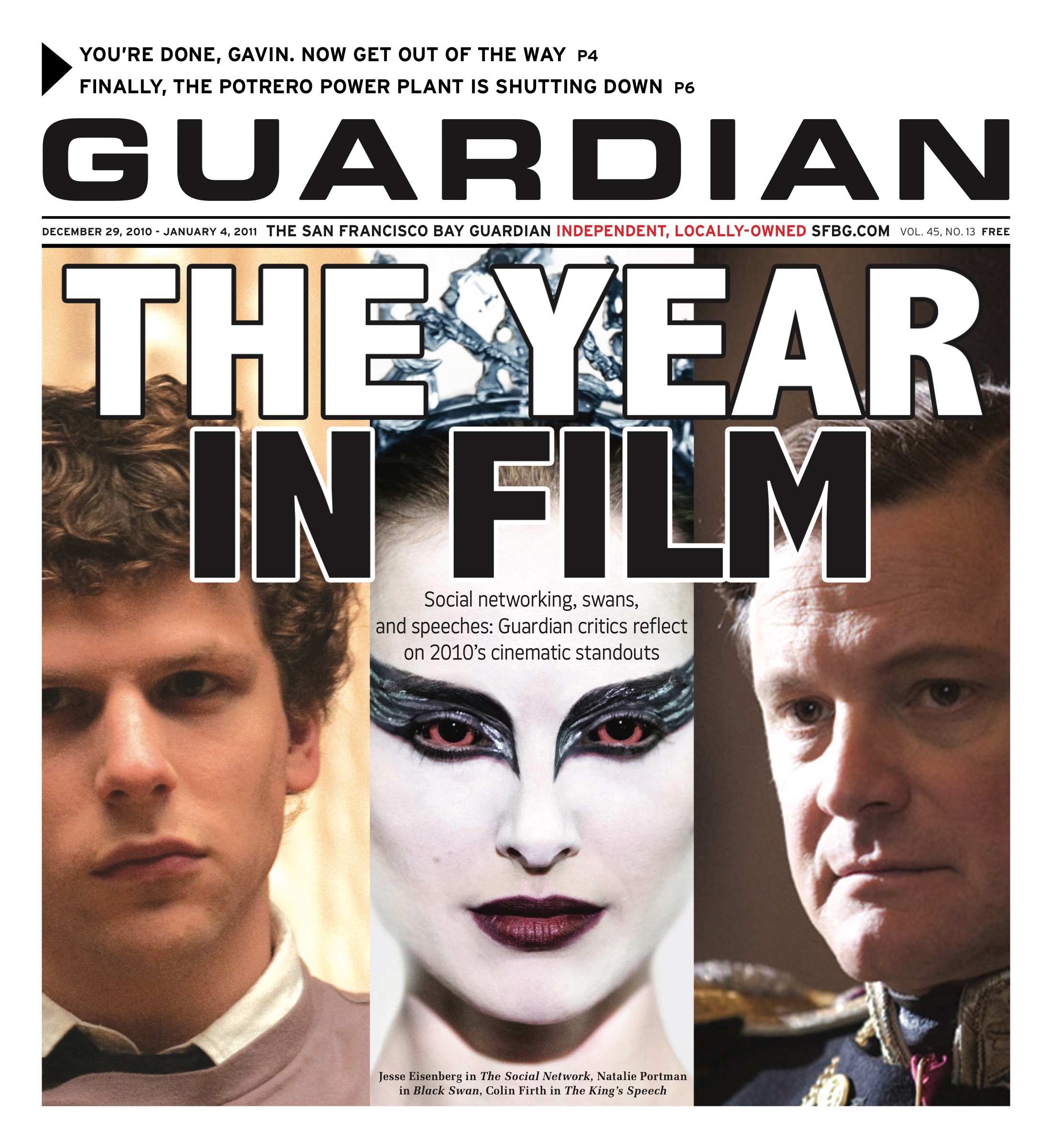
*The Social Network David Fincher’s The Social Network is a gripping and entertaining account of how Facebook came to take over the known social-networking universe. In this version of events — scripted by Aaron Sorkin and based on Ben Mezrich’s book The Accidental Billionaires, in turn based substantially on interviews with FB cofounder Eduardo Saverin, with input from Mark Zuckerberg icily absent — a girlfriend’s dumping of Zuckerberg (Jesse Eisenberg) on a crisp evening in 2003 is the impetus in his headlong quest for a “big idea.” The film is structured around the conference-room depositions for two separate lawsuits, brought against Zuckerberg by Saverin (Andrew Garfield) and by fellow Harvard entrepreneurs Tyler and Cameron Winklevoss (Armie Hammer) and Divya Narendra (Max Minghella) for crimes involving intellectual property and vast scads of retributive money. Unless Zuckerberg decides to post it on Facebook (which he probably shouldn’t, given the nondisclosure vows that capped off the first round of lawsuits), we’ll never know what truly motivated him and how badly he screwed over his friends and fellow students. But Fincher and Sorkin have crafted a compelling, absorbing, and occasionally poignant tale of how it could have happened. (2:00) 1000 Van Ness, Presidio, Sundance Kabuki. (Rapoport)
*Strange Powers: Stephin Merritt and the Magnetic Fields The release of the 1999 collection 69 Love Songs put the Magnetic Fields and Stephin Merritt, the group’s prickly mastermind, into the spotlight for the first time. Since then, the group has willingly slinked back into the arms of its devoted fan base while continuing to write some of the prettiest, cleverest, and most timeless-sounding pop songs around. Typically known as a bit of a recluse, Merritt allowed full access to the filmmakers, who captured over ten years of live footage, recording sessions, and personal interviews. Pulling back the curtain in this case isn’t a bad thing at all, as the group’s overall charm is balanced out with Merritt’s mysterious ambiguity intact. Some of the best moments — Merritt playing with his Chihuahua, casually arguing with his band mates, musing on the differences between Los Angeles and New York gay bars — find beauty in the mundane; just like the songs themselves. (1:22) Roxie. (Landon Moblad)
The Town While not quite on par with The Departed (2006) or Gone Baby Gone (2007), The Town is a solid entry into the Boston crime drama genre. Ben Affleck directs — it’s his second full-length feature after Gone Baby Gone — and stars as Doug MacRay, a lifelong bank robber who wants out of the family business. His desire to change is further complicated when he falls for Claire (Rebecca Hall), the woman he and his gang took hostage during their latest robbery. The Town doesn’t offer much in the way of surprises: if you’re familiar with the genre, you know what to expect. But it’s sleek and well-paced, with a script that at least raises some thought-provoking questions. The film also boasts a universally accomplished cast. Affleck, Hall, and Academy Award nominee Jeremy Renner are predictably good, but the two standouts are actors better known for their television work: Mad Men‘s Jon Hamm as an FBI agent and Gossip Girl‘s Blake Lively (yes, really) as a drug-addled single mom. (2:10) 1000 Van Ness, Presidio, SF Center. (Peitzman)
Unstoppable After a dunderheaded train-yard worker essentially flicks the “hellbent” switch on an unmanned train loaded with hazardous materials, it’s up to odd-couple operators Denzel Washington (old; cranky; in endearing subplot, his daughters work at Hooters) and Chris Pine (young; cocky; in weirdly off-putting subplot, his wife has a restraining order against him) to chase down that loco-motive and prove the movie’s title wrong. The film mostly darts between the interior of a train car, for Washington-Pine bickering; railroad mission control, where a miscast Rosario Dawson literally phones in her performance; TV news reports, lazily illustrating the train’s flight through rural Pennsylvania; and various low angles relative to the speeding train, so sinister it’s bright red and numbered 777 (which is, like, almost 666!) Veteran action director Tony Scott does what he can with the based-on-true-events storyline, but Unstoppable is so deadly serious and predictable it just gets boring after awhile. At least the runaway vehicle in 1994’s similar Speed had a villain to enjoy; here, there’s just an angry choo-choo. Miss you, Dennis Hopper. (1:38) 1000 Van Ness, Sundance Kabuki. (Eddy)
*Vision: From the Life of Hildegard von Bingen Born almost a 1,000 years ago and long regarded a feminist groundbreaker, Hildegard von Bingen was a composer, scientist, healer, writer, visionary, and game-changer in her humanist view of faith. A Benedictine nun who became the noted female spiritual leader when there were none, she built her own convent, and attracted the attention of the Pope with her waking visions, images she would interpret as dispatches from God. The feminist director of such classics of German new wave moviemaking as The Lost Honor of Katharina Blum (1975), Marianne and Juliane (1981), and Rosa Luxemburg (1986), Margarethe von Trotta is still focused on revolutionary women, albeit, with Vision, one who finds a way to work nonviolently, within the system. The challenge here is to bring the potentially stolid and static life of a medieval mystic to the screen — there are few concrete historical details about everyday life within a convent. But aided by Barbara Sukowa — the fiery radical center of both Marianne and Juliane and Rosa Luxemburg — von Trotta manages to give Hildegard human dimensions: the abbess is far from modest and retiring when, for instance, she needs to navigate the byzantine politics of the church or when her most devoted acolyte Richardis (Hannah Herzsprung) is wrenched away. Ornamented by Hildregarde’s compelling compositions and careful never to stray into kitsch, Vision only occasionally lapses into the flatness of a standard biopic — Hildegard (and Sukowa) are too fascinating, and von Trotta has been too long absent from moviemaking. (1:51) Lumiere, Shattuck, Smith Rafael. (Chun)
*Waiting for “Superman” As was the case with Davis Guggenheim’s An Inconvenient Truth, his latest documentary has an active internet campaign: pledge to see Waiting for “Superman.” The films seem like apples and oranges at first glance — Truth warned about the extinction of our species, the end of life as we know it, while “Superman” takes on the public education system. But the picture Guggenheim paints in the latter is a bleak one: our schools are failing America’s youth. In clear, relatable words, he reveals the causes of this national epidemic lack of funding, misguided unions, no accountability. Like Truth, “Superman” is a smart and inspiring call to arms. Guggenheim’s wisest choice was following a group of young schoolchildren who want nothing more than to get a good education. Their struggle provides a necessary contrast to the bureaucracy. In showing the problem’s human face, the film offers further proof — as if we needed more—that something must be done to fix a broken system. For supplemental interview, visit www.sfbg.com/pixel_vision. (1:51) Four Star, Piedmont, Shattuck. (Peitzman)
You Will Meet a Tall Dark Stranger Woody Allen’s latest, once again set in tony London, has all the moving parts for a satisfying farce of self-sabotage, but the writer-director never gets past touching up his character sketches — which are far from interesting in themselves. There is Helena (Gemma Jones), elderly and recently divorced; she wants something stronger than tea and a psychic to rescue her from reality. Her daughter Sally (Naomi Watts) either wants a child or her boss, Greg (Antonio Banderas). She gets migraines and has an eye for art, and that’s about all. Meanwhile, hubby Roy (Josh Brolin) eyes the available young body across the way from his study (Freida Pinto) when he’s not grousing about his fledgling career as a novelist. Helena’s ex Alfie (Anthony Hopkins) is off in his own corner of the movie, taking up with a dopey prostitute (Lucy Punch) who, unlike his wife, is not old. There are sparks of life when these fine actors are allowed to play off one another — Jones and Brolin, in particular, work up a nicely caustic repartee — but a chirpy narrator belies the wobbly narrative construct. And unlike 2008’s Vicky Christina Barcelona, the ethnically marked objects of desire don’t get any good lines. Banderas as an art dealer is paint-by-numbers fantasy, while Pinto’s Dia is embarrassingly elaborated: always in red, a musicology PhD student who wants to be someone’s muse, she responds favorably to Roy’s slovenly flirtations, and, the kicker, has a father who translates Eastern European authors. Jones’ spiritualist is the only one who gets a Hollywood ending, and while I suppose that’s meant ironically, there’s plenty of soft-headedness to go around. (1:38) Shattuck. (Goldberg)