Media

Poor turnout

0

news@sfbg.com

The Guinness World Record for the largest mobilization of human beings was recently broken when 173 million people demanded that their governments eradicate extreme poverty around the world. But U.S. media barely noted the call and San Francisco’s event had low attendance, suggesting an uphill struggle for the cause in the world’s richest nation.

Millions gathered at more than 3,000 Stand Up, Take Action events in 120 countries Oct. 16-18 in an attempt to put pressure on governments to achieve the United Nations Millennium Development Goals, but less than 30 people gathered on the steps of San Francisco City Hall to support the movement.

Sup. John Avalos was one of the speakers at the event, organized by a coalition of local activist groups and student volunteers. Admitting that he was "expecting it to be a little bigger," Avalos said the event was just the start of what needed to be a much larger movement by the American people.

"There is a strange phenomenon occurring at the moment. It’s as if people are a little bit asleep about the need to be active," Avalos told the Guardian. "Because we have an administration they view as being more supportive of human rights and economic and social justice, people are being lulled into thinking things will just get better."

Standing just a short walk away from the birth place of the United Nations, Avalos bought attention in his speech to the rich history San Francisco has in mobilizing social change. "We do the best to live up to it, but we have a long way to go. Around the world this is the time to uproot poverty — we try to provide a safety net, but it could be stronger."

The Stand Up, Take Action, End Poverty Now! campaign is in its fourth year and is organized by the UN Millennium Campaign in an attempt to raise awareness of the Millennium Development Goals (MDGs), a series of benchmarks designed to eradicate global poverty.

At the United Nations Millennium Development Summit in 2000, 189 world leaders promised to "end poverty by 2015." The eight goals include eliminating extreme poverty and hunger, achieving universal primary education, and combating HIV/AIDS, malaria, and other diseases.

Rep. Barbara Lee (D-Oakland) has authored or coauthored every major piece of legislation dealing with global HIV/AIDS issues since she was elected to Congress. She told the Guardian that MDGs must be placed in context with poverty in America. "Sometimes people argue that we must look after our own first, but my position is that if you look at the eight Millennium goals, they all apply to our own country too," Lee said. "Look at the plight of people who are disproportionately affected by HIV/AIDS in our country — especially in African American and Latino communities.

"With the economic downturn, poverty rates in America are soaring, putting more people into circumstances the MDGs focus on outside of America," she continued. "I think it really is important to make those connections."

Lee compared the foreclosure crisis and lack of regulation in the financial markets over the last eight to 10 years to the "wild West" and calls America’s 47 million uninsured a "moral disgrace."

"It is about priorities and political will, and this will be determined by the voices of people saying it must be done," she said. "People have to push for these changes and remember that it didn’t just stop with the election. We have to raise awareness while at the same time working on changing policy. Otherwise we can get stuck debating issues and not doing the work that has to be done to change these very deplorable conditions."

Sup. David Campos was the only other supervisor to speak at the Civic Center event. He said he is committed to the fight against global poverty and wants to see the government represent the values San Francisco was founded on.

"We need to shed light and bring attention to one of the largest issues facing the world today — severe poverty," Campos said. "I really believe that as a city, as a state, and as a country, we not only need to make sure we push the U.S. to follow the lead of other countries, but actually become a leader in making these Millennium goals a reality."

After the event, Campos told the Guardian: "It doesn’t surprise me that more people didn’t show up to the event. But part of the task is to spread the word. San Francisco has been a leader in a number of these issues in the past, and I think we should play a key role in this one."

Campos said that one solution might be to put forward a resolution before the Board of Supervisors to support MDGs and have the city take a formal position on it.

"It is definitely something we are talking about to demonstrate San Francisco’s commitment to the issue," he said. "A lot of people don’t know about the goals, or the fact that the U.S. hasn’t really made them a priority. We need to spread the word and let people know this kind of a movement is only going to be a success if people take it upon themselves to play a leadership role."

Brian Webster, a volunteer who organized the SF event, drew attention to the large number of supporters for the MDGs in California. More than 250,000 people have signed up for the One Campaign, a global NGO that partnered with the U.N. Millennium Campaign in the events.

"For campaigners, it is now a matter of trying to join together and identify vast strategies to communicate what needs to be done," Webster said. "We will continue to educate communities, politicians, and civic leaders in what can be done this month, in the next six months, and ultimately, in the next six years."

While the Bush administration rarely mentioned MDGs while in office, many activists believe President Barack Obama’s public recognition of the goals at a recent U.N. summit demonstrates a change in American policy.

"In other countries, there has been more education and awareness about the goals. But here in America, it is almost like we are starting eight years late," said Anita Sharma, the North American director for the U.N. Millennium Campaign. "President Obama has said that the MDGs are American goals and has even talked about his plans for achieving them."

Also, despite the low numbers at the San Francisco event, Sharma says more than 190,000 people from North America participated in last weekend’s campaign, an increase of more than 70,000 from last year’s attempt.

"It’s not like Americans don’t care about global poverty — in fact we give more in charitable contributions than any other country in the world," she said. "It just takes quite a lot to get Americans into the streets and mobilized. There needs to be more education out there, that’s all."

Ananya Roy, a UC Berkeley professor of city and regional planning and education director of the Blum Center for Developing Economies, says she doesn’t think MDGs can be achieved worldwide by 2015. Even so, she stressed the important role they played in the framework of development.

Speaking at UC Berkeley’s Stand Up and Take Action Event, she said: "The goals are important because they are seen as a new global social contract that makes issues of poverty and inequality quite urgent. They also come with measurements and targets, which is meant to create accountability."

Roy placed particular emphasis on the eighth goal: building a global partnership for development. She noted that that increased awareness can change the ways the U.S. and European governments operate in terms of aid and trade.

"This multilateral contract requires more than simply the action and leadership of the U.S. and Western Europe," she said. "We need to think about poverty and inequality that is immediately around us, understand how we are involved in the production of depravity, and then we must act in solidarity.

"We need to be thinking about poverty as it exits here in the U.S. and not just as an abstract problem that belongs to someplace else," she added. "It is also our problem."

According to a 2009 U.N. report, progress toward achieving the MDGs has been slow in some cases and certain achievements have been reversed by the economic downturn. The report estimates that there will be 55 million to 90 million more people living in extreme poverty than anticipated before the crisis.

For Chandler Smith, media coordinator for the One Campaign — which campaigns for better development policies and more effective aid and trade reform — the Guinness certification marks progress toward achieving the MDGs. "That this year is breaking another world record speaks to the power of people to organize around the world, shows that we are a global community, and that there is a sustainability in the movement," he said.

"As for the North American aspect, we are always trying to educate people more about these issues. Our results show that a lot of our work has been done — but that we also have more work to do."

Lovecraft, baby!

0

More on SFBG

>>New doc explores H.P. Lovecraft’s lasting influence — and Cthulhu slippers!

>Neo-goth and retro and contempo horror music pulse forth

arts@sfbg.com

Lovecraft is a resonating wave. He’s rock and roll.

— Neil Gaiman, "Concerning Dreams and Nightmares," The Dream Cycle of H.P. Lovecraft: Dreams of Terror and Death

LIT/MUSIC Howard Phillips Lovecraft (1890-1937) attributes most of his fiction’s cosmology to the apocryphal Necronomicon, an ageless sort of anti-Bible that describes a universe of unfathomable strangeness superimposed over our own. Not content with obscurity, this alternate reality tends to extend its clammy tendrils into our collective line of vision, yielding all sorts of therapy-necessitating results. Of course, the Necronomicon‘s legend overshadows its reality. Yet in the kind of self-reflexive twist the famously anti-modern writer would have probably hated, the tome’s enduring mystique acts as a summation of his own work’s post-pulp shelf life.

Lovecraft never got a chance to see it happen, but the spawn of his fevered imagination has been consistently reproduced in all sorts of geek media, from role-playing games to plush dolls. Some of the most interesting representations of the reclusive author’s output, however, come from the realm of loud-ass rock music, another modern contrivance Lovecraft would have almost certainly despised.

The first instance of Lovecraft’s legacy infiltrating rock music seems to be with the late-1960s psychedelic folk outfit known as, appropriately enough, H.P. Lovecraft. This group took after the sense of fantastic spaciousness conveyed in its namesake’s oeuvre, meandering in dreamy walls of sound that circumvent any buried unease without actually going anywhere. "At the Mountains of Madness" from 1968’s H.P. Lovecraft II (Phillips) spends five or so minutes layering organ arpeggios, vocal harmonies, and a collage of period echo effects into one of the better musical approximations of a lava lamp — a languid sonic pattern that’s fun to lose yourself in for a while, before you realize the shifting plasma is never going to do anything crazier than its mannered glass walls will allow. It was a promising start, but the essential menace of these unexplored worlds seemed to intimidate the band, like the intrusive pang of fear that could send even the most cosmic of folk-rock trips spiraling into twisted Syd Barrett territory. It would take a group with a special predilection to the macabre to help steer Lovecraft-rock towards reaching its full potential.

By the early ’70s, H.P. Lovecraft and its like were devoured by the cyclopean (to borrow H.P.’s favorite adjective) Black Sabbath, whose Black Sabbath (Warner Brothers, 1970) pays homage to the neurotic master with the typically sinister power-groove of "Beyond the Wall of Sleep." In what should come as no surprise to anybody familiar with the Birmingham, England four-piece’s career arc, the doom gods immediately honed in on the potential psychedelic allegory of Lovecraft’s work. While the "deadly petals with strange powers" are the focal point of Ozzy’s lyrics, Geezer Butler’s snakelike bass line adds a decidedly mysterious undercurrent to the track, like some implicit ghoulishness is being mercifully withheld from the listener. (Sabbath acolyte Sleep would pick up where its primary influence left off. "From Beyond," from 1992’s Sleep’s Holy Mountain [Earache] eschews Butler’s measured playing, allowing Al Cisneros’s bass tone to swell to neutron star proportions. Likewise, lyrical allusions to "planetoids soaked in rays of electric light" and the approaching "stoner caravan from deep space" have an affinity with the author’s sprawling, pulp-lyricism rather than his feel for claustrophobic menace, the norm for most other Lovecraft-inspired songs.)

Metallica puts this strategic withholding to use in Ride the Lightning‘s (Megaforce, 1984) "The Call of Ktulu," a sprawling, misspelled instrumental tribute to Lovecraft’s beloved cephalopod-head. With its hypnotically creeping guitar theme, the album’s epic closer mirrors the arch of the typical Lovecraft narrator’s psyche — a curious unease that gradually swells to a crescendo of madness — while doing justice to the cadence of Lovecraft’s baroque language. The absence of vocals is part of why the track is so effective. By stripping away the inevitably sub-Lovecraft lyrics, Metallica allows the listener to be absorbed by the brooding tone rather than any deficient attempts at reproducing content.

Like Black Sabbath and Metallica before them, countless heavy metal acts past and present have been fascinated by the worlds and creatures described in H.P. Lovecraft’s labyrinth of fiction — Morbid Angel’s prized shredder Trey Azagthoth even modifies one of the more formidable creature’s monikers for his stage name (and in another parallel, gives death metal some of its most batshit-dissonant solos.) But one notable band of Lovecraft acolytes comes from the seemingly incongruous world of British punk.

The iconoclastic (read: fucking weird) Rudimentary Peni and their 1988 LP Cacophony (Himalayan) eschew the subtlety of some of their peers in the Lovecraftian rock canon and go straight for the brainstem. While others withhold (to varying degrees of effectiveness), Rudimentary Peni overload. As a concept album, Cacophony is as much about Lovecraft’s psyche as it is his literary creations. Nick Blinko uses the senseless feedback of his guitar amp, coupled with schizophrenic, mumbled vocals, to create a supremely ugly conflation of fiction, biography, and amateur psychopathological diagnosis.

A far cry from the static kaleidoscope of sound employed by canon forefathers H.P. Lovecraft, Rudimentary Peni’s use of layered tones and effects spirals inward with single-minded intensity. Standout songs like "The Horror in the Museum" and "Zenophobia" tenuously adhere to the sing-along, pogo-conducive structure traditionally associated with British punk. Yet closer listening reveals these barely stable hooks to be composed of a vast latticework — not unlike the album’s disturbingly detailed, fractal-like cover art — of dissonant string-bends, amplifier squeaks, disjointed basslines, and a persistent, barely intelligible whisper that seems to work itself into the fiber of the guitar tone.

The result is a funhouse doppelganger of the multilayered production of the group’s unlikely 1960s ancestor. Cacophony appears to be about crafting some kind of stable impression of the man, but the Peni make a point of never letting the components fully fit together. Instead, we are left with a virtual echo chamber of Lovecraft’s imagination, wherein the scraps and fragments of his writings and real-life neuroses intermingle and inform each other without ever coalescing. In spite of the band’s unmerciful approach, there’s a feeling of being denied the full effect of some unspeakable horror. But this horror is strictly cerebral, a glimpse at the madness that looms over Lovecraft’s work like one of his own reasonless "Other Gods." Happy Halloween, big guy! Eeyagh!

Jon Stewart: From here to net neutrality

0

Josh Silver and the good people at the Free Press media reform group sent me a snapshot from Jon Stewart’s Daily Show (l0/26/09) that skewered the politicians who fought net neutrality for the big media conglomerates.
A masterful job and worth a dozen mainstream editorials, which of course were not and will not be written on the subject. B3

The Daily Show With Jon Stewart Mon – Thurs 11p / 10c
From Here to Neutrality
www.thedailyshow.com
Daily Show
Full Episodes
Political Humor Health Care Crisis

Arnold to SF: Fuck You

201

By Tim Redmond

It was hardly a bill of cosmic import, but Assemblymember Tom Ammiano’s AB 1176 would have helped the Port of San Francisco with some financing issues. It’s the kind of bill that legislators offer on behalf of their cities all the time — and generally, they are non-controversial. This one was the same — no substantive opposition, it passed both houses easily — and normally, the governor would sign it with little fanfare.

But no: Arnold Schwarzenegger vetoed the bill — and sent Ammiano and the legislators a remarkable veto letter. The letter says nothing about the substance of the bill; in fact, the language is really convoluted and it’s hard to figure out what the gov is really saying.

Here’s the official message:

1027arnold.jpg

But wait — there’s a real message, an actual missive from the Gov to Tom, embedded in this text. And it’s not hard to find — in fact, it’s hard to believe it could have been a coincidence.

Read down the letters on the left side of the message

1027fu.jpg

Well, maybe Arnold is still mad at being told to “kiss my gay ass”, but this is a rather puerile way for the governor of California to be spending his time.

Let’s not forget — there was a substantive bill here that would have helped San Francisco. So the gov is not just telling the entire Legislature Fuck You, he’s also saying it to the city and county of SF.

What an asshole. No wonder it’s hard to get anything done in Sacramento; the gov’s office is full of frat boys spending hours (and it would have taken hours to get this exactly right) making stupid little-boy jokes.

(His press office hasn’t returned my call seeking comment on this; I’ll let you know if they do.)

More on SFBG:

>>The lesson of California: The Golden State that invented the tax revolt is failing, but the conservative movement presses on

>>Attack of the right-wing nuts: The manipulations and media machine behind the assault on progressive ideas

Guardian graphic by Ben Hopfer

The old Gov. Moonbeam shit

1

Okay, I’ve got a lot of problems with Jerry Brown. He was an awful mayor of Oakland, sided with the developers and the cops, and seemed to lose almost all of his progressive insticts. He’s against raising taxes on the rich. He won’t even support marijuana decriminalization.

There are good reasons to criticize the guy, and I’m right there at the front of the line.

But I fear that’s not what the press is going to do over the next year. It’s way too much fun to dredge up the old Gov. Moonbeam shit

Check out Carla Marinucci today:

now’s a good time to re-introduce you to author Jerry Brown, whose ’90s book “Dialogues” also contains a few memorable quotes that may end up in some 2010 gubernatorial campaign ads …. For Brown fans, the material illustrates the intellectual curiousity and independence that they say set him apart in the current pack of pols. For conservatives, it’s more proof he’s still that ultra-liberal, wacky “Moonbeam” character.

(btw, ultra-liberal is the Chron’s disparaging term for progressive. Although C.W. Nevius seems to like “militantly liberal.”)

So here are some of the examples of questions Brown asked in his interviews that the Chron thinks are utterly wacky:

*To author and philosopher Noam Chomsky:

*”How would you compare the propaganda system in the so-called free world to an authoritarian system? What are the differences?”

Umm, Chomsky is a brilliant linguist, an expert on the use of words. That’s a perfectly legit question to ask him. And it’s based on what anyone who follows the news media knows very well — that a lot of what is presented as unbiased news is actually slanted to promote a point of view. Why is that strange or wacky?

OR:

*To Judi Bari, late “Earth First!” enviromental activist:

*”None of us is an isolated monad with this bundle of private property rights outside the fabric of these larger obligations. So I very much believe that it’s time to take another step in the evolution of capitalism. Right now, I don’t think the federal government can make that happen…it can’t even operate what it owns, so that’s not the answer. But we’re on a track of real destruction socially and ecologically and we have to understand that as clearly as we can in order to come up with a better set of rules.”

*To Wolfgang Sachs, author and enviromental researcher:

*”As you observe modernizing projects in the world today that are operated by multinational corporations without much interference from national governments, do you see fascistic elements there? There are certainly enormous changes imposed without the consent of the governed.”

Again: Brown’s points are pretty basic, pretty clear — and almost indisputably correct.

The Sacramento Bee has had fun with some of Brown’s old lefty stuff on KPFA, but again, I have to ask: What did he say that was wrong?

He called capital punishment “state murder” and said U.S. Sens. Dianne Feinstein and Barbara Boxer, both Democrats, had “sold out” U.S. truck drivers by letting their Mexican counterparts drive uninspected vehicles into the United States.

In one of the most controversial excerpts, Brown called the prison system a racket that pumped profits out of the poor’s misfortunes and into the pockets of prison guards.

“The big lockup is about drugs,” Brown stated in an excerpt from late 1995. “Here’s the real scam. The drug war is one of the games to get more convictions and prisoners. There’s a lot of chemicals out there and when certain ones are made illegal, they become a huge profit opportunity and bring violence, crime and more people to imprison.”

Again: What, exactly, is wrong with anything he said? It’s all perfectly true.

More from the Bee:

Garry South, a top strategist for Democratic gubernatorial candidate Gavin Newsom, said the KPFA (94.1 FM) broadcasts would make Brown vulnerable if he reaches the general election.

Brown opened an exploratory committee for a gubernatorial run last month but has not officially announced his candidacy.

“California Democrats need to ponder very seriously the prospect of putting up a candidate for governor who comes with reams of radio-show rantings and ravings like Brown,” South wrote in an e-mail.

Rantings and ravings? Does Newsom support the death penalty? NAFTA? The drug war? If he does, that’s a bigger problem than Brown’s off-the-cuff radio remarks.

Mayor to ignore San Francisco’s wishes

7

Text and images by Sarah Phelan

camposduftymirkpost15.jpg
Sups. David Campos, Ross Mirkarimi and Bevan Dufty shortly after they joined Board President David Chiu and Sups. John Avalos, Eric Mar, Sophie Maxwell and Chris Daly in amending the city’s sanctuary policy. Dufty has said that Mayor Newsom threatened not to endorse Dufty’s bid for mayor, if he supported the amendment.

Yesterday’s celebration of the Board’s veto-proof amendment of the sanctuary ordinance felt similar to the joy that surrounded the city’s decision to start marrying same-sex couples. Only this time, instead of leading the civil rights charge, Mayor Gavin Newsom appears to be opposing it, citing fears that the city could be sued.

Following the supervisors’ vote, supporters of the Campos amendment poured out of the Board Chambers, chanting “Yes we can,” in Spanish and English, and into the second-floor rotunda, joined by Sup. David Campos.

CAmposu15.jpg
Campos and immigration attorney Francisco Ugarte celebrate the Board’s historic Oct. 20 vote.

But even as Campos talked to the crowd about the importance of fighting for civil rights and against the slippery slope of a two-tiered system of justice, mayoral spokesperson Nathan Ballard appeared to be belittling the work of Campos and numerous civil and immigration rights experts, while vowing to ignore the Board’s amendment.

“The Campos bill isn’t worth the paper it’s written on—it’s unenforceable and he knows that,” Ballard told the Chron.
‘We are not going to put our law enforcement officers in legal jeopardy just because the Board of Supervisors wants to make a statement.”

na15.jpg
Ana Perez the director of CARECEN SF, shares her thoughts on the Board’s vote with the media.

But can Newsom selectively ignore laws that have been passed by a veto-proof majority of the Board, and have been vetted as being legally tenable by the City Attorney?

“I don’t know,” Campos told the Guardian. ” I’m still trying to figure out whether the mayor can do that. We’re going into uncharted legal territory.”

rotunda15.jpg
A crowd of supporters, including civil rights experts, immigration attorneys and community leaders, gathered in the rotunda to celebrate, even as the Mayor’s Office announced it intends to ignore the Board’s sanctuary amendment.

Attack of the right-wing nuts

0

news@sfbg.com

In April 2006, with the approval ratings of President George W. Bush plummeting, his senior political advisor, Karl Rove, began discussing a plan to turn things around.

His strategy: attack progressive organizations that were registering low-income people to vote and helping them fight corporate power — and claim it was about voter fraud.

The main White House target, newly released records show, was the Association of Community Organizations for Reform Now (ACORN). By the end of 2006, Rove would oversee the removal of eight U.S. attorneys, including two who refused to press bogus charges against ACORN in New Mexico and Missouri, and a third under similar suspicions in Washington state.

ACORN made a convenient target for Rove and his gang — and the well-orchestrated attacks on that group, which have exploded into the headlines this year, provide a compelling case study in how the right wing operates in this country.

Although it was the GOP that removed tens of thousands of likely Democratic voters from the rolls in the 2000 and 2004, the Republicans and their allies were able to make the issue of voter fraud all about ACORN, using a handful of isolated problems to undercut an organization focused on giving a voice to poor people.

Founded in Little Rock, Ark. at the end of the 1960s, ACORN has grown into the nation’s top community-organizer group, thanks to success in improving poor people’s housing, wages, and educational access. By the eve of the 2008 presidential election, ACORN had helped register more than 1.3 million voters — mostly young, low-income minorities — in 21 states, including the battleground states of Florida, Pennsylvania, Michigan, and Ohio.

As The Nation put it, these successes made ACORN “something of a right-wing bogeyman.”

And while the recent furor over a conservative videographer secretly taping ACORN employees saying dumb things has somehow become one of the big political stories of the year, the major media have mostly ignored how this attack is part of a larger conservative strategy.

In August, hundreds of pages of e-mails and transcripts related to the 2006 U.S. attorney-firing scandal were released to the press and public — but few news outlets mentioned that Rove was focused on attacking ACORN’s voter registration efforts, even though ACORN and voter fraud are repeatedly mentioned in these documents.

“This is about a campaign that goes back a decade to big business and that people who don’t like what ACORN does and is effective at — namely, helping groups to organize and put pressure on banks around sub[prime] mortgage loans to stop racial discrimination,” Peter Dreier, a professor of politics at Occidental College, told us.

It wasn’t really about voter fraud. As former U.S. Attorney David Iglesias, a Republican from New Mexico, recently stated on The Rachel Maddow Show: “They were looking at numbers [and] didn’t like the demographic tidal wave that was coming their way so they wanted to engage the machinery of the Justice Department to stop that wave.”

After two years of investigating ACORN and other supposed perpetrators of left-wing voter fraud, Igelias said, “I couldn’t find one case I could prosecute.”

But for the right-wing attack machine, it didn’t matter — the damage was done.


THEIR MASTERS’ VOICE

White House communications strategist Anita Dunn created a stir in mid-October when she told CNN host Howie Kurtz that Fox News “is really more of a wing of the Republican Party. … Let’s not pretend they’re a news network like everybody else is.”

It didn’t take long for Fox commentator Glenn Beck to retaliate. In a series of broadcasts, he attacked Dunn, compared the Obama administration to a communist dictatorship, and likened the criticism to the Holocaust. “Ask yourself this question,” Beck said during a radio segment, vaguely addressing people he called “good journalists” at other mainstream news networks. “When they’re done with Fox, and you decide to speak out on something — it’s the old ‘first they came for the Jews, and I wasn’t Jewish.'” Beck concluded the segment by warning his audience, “this is how a dictatorship always starts.”

Beck’s comment may strike San Francisco progressives as outrageous, but given the rhetoric routinely issuing from the right-wing megaphone, it’s also 100 percent predictable.

But when Dunn called Fox News Channel an arm of the GOP, she was dead on. Consider the history of its chairman and CEO, Roger Ailes, who ran Richard Nixon’s 1968 presidential campaign and later those of presidents Ronald Reagan and George H.W. Bush, guiding them all to victory through his brilliant and successful media campaign strategies.

“Roger Ailes is a newsman with a profound disdain for newsmen,” according to a New York magazine profile. “Fox News is being promoted as an anti-network, a news channel designed to appeal to the people … who don’t trust [the others].” Portrayed in the story as a “self-described paranoid,” Ailes reportedly resigned from an earlier position as head of CNBC after questions were raised about his desire to use his position as a weapon against his enemies.

Fox News is an outgrowth of its parent company, Rupert Murdoch’s News Corporation. A look at the board of directors of this multinational giant yields some startling insight into who controls the “fair and balanced” news network. Ailes himself has a seat at the table — but not every board member has a background in media.

News Corp. board member Viet Dinh, for example, is an attorney who came to the United States as a boy from Vietnam. In a 2002 interview with the Los Angeles Times, Dinh, who then served as an assistant attorney general at the Department of Justice, recalled an exchange he had with then-Attorney General John Ashcroft in the wake of the Sept. 11 attacks. “He told me: ‘The art of leadership is the redefinition of the possible. I want you to be the think tank to help me redefine the possible for the Department of Justice.'”

Dinh successfully redefined “the possible” by acting as a primary author of the USA PATRIOT Act, quickly propelling himself to prominence as a darling of conservatives and an enemy of civil liberties watchdog groups. A law professor at Georgetown University, Dinh is also founder and chief of Bancroft Associates PLLC, a consulting firm that specializes in helping Fortune 500 companies “navigate the federal and state criminal or civil investigations, congressional investigations, and complex litigation,” according to the firm’s Web site. It also specializes in public relations.

Another board member is José Maria Aznar, former prime minister of Spain. Aznar was born into a politically active, conservative family in Spain in 1953, and both his father and grandfather held government jobs under Gen. Francisco Franco, the fascist dictator. Aznar was handpicked by Manuel Fraga, a minister under Franco, to succeed him in leading Spain’s center-right People’s Party (Partido Popular), according to an article in the U.K.’s The Independent.

Aznar now serves as president of the Foundation for Social Studies and Analysis, a right-wing think tank based in Spain that, according to its Web site, works closely with the CATO Institute, the Heritage Foundation, and other conservative U.S. think tanks.

Occupying other seats at News Corp.’s board table is an assortment of professors, attorneys, public-relations experts, and businessmen with their fingers in a variety of banks and multinational corporations. Among the more familiar names are Phillip Morris, Ford Motor Co., Hewlett Packard, Goldman Sachs, HSBC North America, and JP Morgan Chase. Lesser known are the investment banking firms that have stakes in the petroleum industry, utilities, mining companies, and real estate.

While the connections between corporate interests and the country’s leading conservative propagandist are extensive and obvious, there’s a stark contrast between the message delivered by Fox News and the interests of its parent company.

Fox News plays up the theme of patriotism and reinforces the idea that there is a distinction between “real Americans” and outsiders. But Fox’s board is made up of members whose lives and economic interests are scattered across the globe, but have one common thread: they all control extraordinary sums of concentrated wealth.


PROPAGANDA AND EMOTIONS

While Dunn called Fox News Channel an arm of the Republican Party, others have gone so far as to label its content pure propaganda — and incredibly effective propaganda at that.

“This is very, very sophisticated propaganda,” says Bryant Welch, a clinical psychologist, author, and expert on political manipulation. “I don’t think progressives really get it that it’s a technique being used all the time.”

Welch said when he began working as a Washington, D.C., lobbyist on behalf of the American Psychological Association years ago, he started observing the tricky political maneuverings at play in the nation’s capital through the eyes of a psychotherapist who had spent some 30,000 hours helping patients confront their deep-seated hang-ups.

To his surprise, Welch found that some of the most successful right-wing political operatives also seemed to have an understanding of psychology — although they use the knowledge very differently. “A lot of it is psychological manipulation,” Welch asserts.

George Lakoff, a professor of linguistics at UC Berkeley and author of Don’t Think of an Elephant: Know Your Values and Frame the Debate, offered a similar analysis. He said Republicans approach issues as a marketing challenge. “They’ve learned from the cognitive scientists. Even if they don’t understand the science, they know how to do marketing.”

Welch, who is also an attorney and Huffington Post blogger, provides an analysis of how the right wing gets its message across in his book, State of Confusion: Political Manipulation and the Assault on the American Mind. He argues that public relations professionals, right-wing commentators, and others in the business of shaping public opinion are skilled at tapping into widespread feelings of anxiety and uncertainty.

“In this world, things are confusing,” he explains. “You’ve got to be constantly adapting and assimiutf8g new information. When times get confusing, people have a hard time forming a sense of what’s real.”

Right-wing television and radio personalities like Sean Hannity, Glenn Beck, or Rush Limbaugh prey on this widespread uncertainty, Welch argues, by providing viewers and listeners with an absolute version of reality that is easily grasped, neatly divided into right and wrong, and spelled out in very certain terms.

“The thing that Bill O’Reilly and Sean Hannity do is, they sound very powerful, certain, and aggressive,” Welch told us. “[Viewers] identify with that strength. They draw a sense of security from someone who has certainty about what is real.”

Viewers who find that their anxiety subsides when they tune in are hard-pressed to go back and reexamine their views later on, Welch said, because they’re satisfied with the answers they’ve been given. And in right-wing messaging, those answers consistently cast government as the enemy.

On Fox and AM radio, the use of repetition helps drive home an idea until it becomes a conviction in the mind of a listener. Television reinforces those key phrases with patriotic color schemes. The whole package is designed to transform an audience’s sense of bewilderment over a complex world into trust in spokespeople helping them make sense of it.

The right-wing commentators’ success lies partly in their ability to harness core human emotions such as paranoia or envy, Welch said. He pointed to the health care debate as an example, noting how Fox News has repeatedly played up the false concept of “death panels” to create fear.

To counter this tactic, Lakoff suggests that the left would do well to learn how to frame things in moral terms instead of playing defense against right-wing spin masters.

President Obama’s problem, Lakoff said, is that he is still trying to unify the country. “More power to him, but I don’t believe it’s possible,” Lakoff said. “Republican presidential candidate Sen. John McCain got 47 percent of the vote, bad as he was, and given how terrible a campaign he ran, and given that Obama ran a perfect campaign. So Obama’s election was not a landslide, even though he had one of the best campaign organizations and one of the best framed campaigns ever.” Obama doesn’t play the same manipulative games, Lakoff noted. “Obama believes that if you just tell the truth, it’ll be OK, and every day have a truth squad to find the conservative lies,” Lakoff said. “What he didn’t understand was that by focusing on the conservative lies, he was in fact helping the conservative cause. It’s like Richard Nixon saying, ‘I’m not a crook.'” That why Lakoff says it’s so important for Obama, and for the progressive movement in general, to define the moral imperative behind empowering the people and their government to create a better world, then aggressively push a campaign to do so. “It’s the ‘this is the right thing to do’ approach,” Lakoff explained. “And once it’s been framed that way, then you can say what’s false or true. But you should never go on the defensive first. As soon as you go point by point, you are on the defensive.”

The lesson of California

0

news@sfbg.com

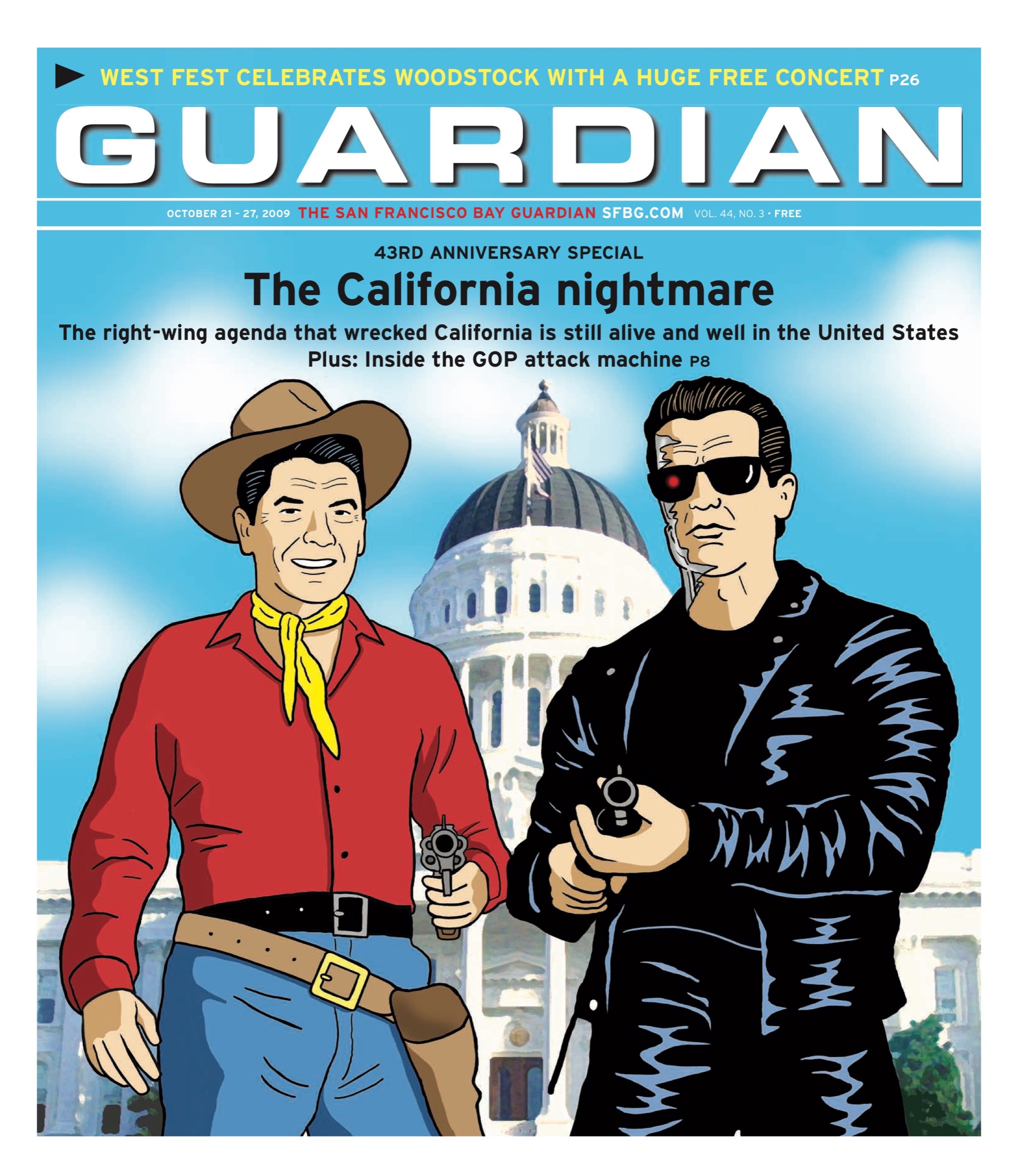
Much of the right-wing agenda that has thrown this nation into economic chaos can be traced back to what was once called the Golden State.

The tax revolts that started here under Gov. Ronald Reagan and continued to sweep the country and the world under President Reagan never abated. Indeed, they have only been strengthened by the big business power that created and benefited from them.

But now that California is showing signs of being the country’s first failed state — caught in fiscal freefall and mired in political gridlock as a generation’s worth of neglected problems surge to the surface — this state has become a cautionary tale for that anti-government ideology.

Trends in America tend to start out west, and the economic and political disaster that California has become contains critical lessons for the rest of the country.

Lewis Uhler — president and founder of the National Tax Limitation Committee — speaks candidly and proudly of his key early role in helping build a conservative movement to limit the size of government and do battle with those who want the public sector to actively promote social and economic justice.

Uhler, a UC Berkeley Boalt Hall School of Law graduate who did legal work for conservative causes in the 1960s, was tapped by then-Gov. Reagan in 1970 to be the director of the Office of Economic Opportunity, a federally-funded legal assistance program created as part of President Lyndon Johnson’s war on poverty.

While that may seem like a strange role for an avowed conservative and former member of the John Birch Society, Uhler says Reagan basically brought him in to wreck the program and fight the feds. “I was asked to put my money where my mouth was for my conservative philosophy,” Uhler told the Guardian. “OEO was set up to ensure conflict and confrontation … The mission of legal services was to change public policy through lawsuits they decided to file. I thought it was a corruption of the legal system.”

At the time, public-interest law and liberal economic and social policies were on the rise in California and spreading to the rest of the nation. So the Reaganites fought back.

Rather than helping poor plaintiffs file environmental, consumer protection, equal rights, or other types of lawsuits designed to level the playing field with powerful interests, Uhler blocked lawsuits brought by attorneys he calls “ambulance-chasers” and gutted the program. “Ultimately,” he said, “we vetoed funding for California Rural Legal Assistance.”

And for his efforts, Uhler was rewarded with a cabinet-level position: assistance secretary of the Health and Welfare Agency. Again, his role wasn’t to make the agency more effective, but to make it less effective in a realm where he believes government was too big and too active.

“The problem was uncontrolled state and local spending,” Uhler said. “Intuitively, everyone who gathered around Reagan shared the same philosophy that government doesn’t really contribute anything to economic growth.”

In 1972, Reagan gave Uhler the opportunity to work more directly on the mission of cutting taxes and shrinking the size of government, naming him chair of the Governor’s Tax Reduction Task Force. It was, in many ways, the beginning of the vast right-wing conspiracy.

“I asked to be given the chance to go across the country and find the best free market minds in the country to develop these policies,” Uhler said, explaining that he wanted to borrow the liberal strategy of giving an academic veneer to their ideas, as presidents Kennedy and Johnson had done in the realm of foreign policy. “Our side had never really done that.”

Uhler’s first stop was the University of Chicago School of Economics, where he met with noted free market economists Milton Friedman, James Buchanan, and George Stigler, who were brought into the cause.

Today’s vast network of conservative think tanks didn’t exist at that time, so Uhler tapped conservative thinkers from the American Enterprise Institute and the Hoover Institute at Stanford University, as well as other conservative economists such as Peter Drucker from Claremont McKenna College.

“There were 35 people who helped us design the first effort at a constitutional initiative in California to limit year-over-year growth of the state’s general fund,” Uhler said. “All of us as free market enthusiasts and economists all shared the belief that government beyond a certain level eats the seed corn of the nation and doesn’t produce anything.”

While voters narrowly rejected their group’s first effort to cap government growth — Proposition 1 on the November 1973 ballot — the ground had been prepared and the seeds had been sown for the tax revolts that would sweep the country in the late 1970s, with many of the campaigns coordinated by Uhler and the organization he formed for that purpose in 1975, the National Tax Limitation Committee, and a rapidly growing network of similar, interconnected organizations.

As Uhler worked with Reagan to weaken California’s government from within, his fellow travelers were developing national and international strategies to create aggressive, coordinated, well-funded campaigns to attack government and spread the free market dogma.

In August 1971, Lewis Powell — a conservative corporate attorney who President Richard Nixon had just nominated to the U.S. Supreme Court (where he served from 1972-87) — wrote a confidential memorandum to the leadership of the U.S. Chamber of Commerce titled “Attack on the American Free Enterprise System.”

He sounded the alarm that the ascendant environmental and consumer movements were going to destroy capitalism in the country unless corporate America aggressively fought back in a coordinated fashion, which he spelled out in great detail.

He called for all major corporations to develop aggressive legal and public relations strategies for fighting the left, creation of a network of think tanks and media outlets to push the conservative message, manipulation of the legal system, and sponsorship of university programs to study conservative ideas and incubate future leaders — which all came to pass in the coming decades.

“American business [is] ‘plainly in trouble’; the response to the wide range of critics has been ineffective and has included appeasement: the time has come — indeed, it is long overdue — for the wisdom, ingenuity, and resources of American business to be marshaled against those who would destroy it,” Powell wrote.

Part of that strategy involved having the federal government promote and popularize free market economic theories being developed by Friedman and his colleagues at the University of Chicago, a movement that is well-documented by journalist Naomi Klein in her book The Shock Doctrine: The Rise of Disaster Capitalism.

In 1971, Friedman and his colleagues began working with rich conservatives in Chile who were allied with Gen. Augusto Pinochet, who in turn were conspiring with the CIA to overthrow and assassinate the democratically elected, leftist President Salvador Allende, which they successfully did on Sept. 11, 1973.

Friedman’s economic theories called for a radical restructuring of society — slashing taxes and social spending; removing most regulation and trade restrictions; crushing labor unions; promoting economic growth at any cost — and Pinochet executed the strategy in brutal fashion, ordering the death of at least 3,200 of his political opponents, including the car-bomb assassination of economist Orlando Letelier in Washington, D.C., in 1976.

Friedman and Pinochet consulted openly and shared a basic disdain for social programs and progressive taxation. “The major error, in my opinion,” Friedman wrote in a letter to Pinochet in 1975, referring to the government antipoverty programs Pinochet dismantled, was “to believe that it is possible to do good with other people’s money.”

The model Pinochet and Friedman developed in Chile would eventually go global — promoted by its top cheerleaders, Reagan and British Prime Minister Margaret Thatcher — and be implemented (with disastrous results for most citizens but creating huge profits for wealthy individuals and corporations) in Indonesia, Bolivia, Argentina, Peru, Russia, Poland, South Africa, Japan, and elsewhere.

But with the corporate media and conservative opinion-shapers focused mostly on economic growth — ignoring persistent poverty and the brutal tactics used to suppress the popular movements that tried to resist Friedman’s “economic shock therapy” — Friedman had become a sort of free-market prophet by the time he died in 2006.

“In the torrent of words written in eulogy to Milton Friedman, the role of shocks and crises to advance his worldview received barely a mention,” Klein wrote. “Instead, the economist’s passing provided an occasion for a retelling of the official story of how his brand of radical capitalism became government orthodoxy in almost every corner of the globe.”

California’s fiscal shackles have been in place since 1978, when Proposition 13 and subsequent measures capped property taxes and required an undemocratic two-thirds vote to either raise taxes or pass the annual budget.

A Republican landlord lobbyist named Howard Jarvis charged onto the field that Reagan, Uhler, and their team had prepared and took advantage of a gaping hole in political leadership to set off a movement that would cripple the United States of America.

There was some logic to it then. Times were good in California in the 1970s, good enough that people were flocking to the state by the millions. That was driving up property values — and thus property taxes.

Jarvis bought his home for $8,000 in 1946; 30 years later, it was assessed at $80,000. In fact, inflation was running at close to 10 percent a year in California. Homeowners were getting huge tax hikes each year, and tenants were getting huge rent hikes at a time when state government had a budget surplus.

Homeowners saw millions of dollars sitting in the coffers in Sacramento while they couldn’t pay their tax bills. Yet nobody in the Legislature or governor’s office came up with a solution.

So when Jarvis showed up with petitions to roll back property taxes and prevent future increases, he found a broad base of support. Even tenants went along — Jarvis and his gang promised that property-tax cuts would be passed on to tenants and would mean the end of the escautf8g rent hikes.

Jarvis collected signatures for a radical measure that essentially blocked all property tax increases and allowed new assessment only when a parcel sold. It was, in the end, a huge tax giveaway to major corporations. Since commercial property turned over far less often than residential property (and since commercial sales could be hidden as stock transfers), big businesses wound up paying far less of the state’s tax burden. Corporations used to pay about two-thirds of the state’s property taxes, and individuals one-third; now that is reversed.

It didn’t help tenants, either. Few of the landlords who saw the benefits of Prop. 13 passed the money along to their renters. Most just kept it. San Francisco activist Calvin Welch likes to say that Howard Jarvis was “the father of rent control.”

The campaign against Prop. 13 warned of the dangers of cutting local government; police and fire chiefs appeared in ads opposing it. But the No on 13 folks never talked about the huge windfall big corporations would get from the measure, or the huge disparities in wealth that would be created by defunding government and dereguutf8g corporations.

If the goal was to skew the concentration of wealth in the state, it worked brilliantly. According to the California Budget Project (CBP) of the Franchise Tax Board, recent data taken before the current economic recession illustrates an ever-widening chasm between the wealthiest taxpayer and the working-class person.

The total adjusted personal income for Californians rose by nearly $64 billion in 2006-07 — with approximately three-quarters of that increase going to the top fifth of wealthiest taxpayers, and 30 percent going to the top 1 percent. That left only $19 billion for everyone else.

“The average taxpayer in the top 1 percent experienced a $128,261 increase in AGI [adjusted gross income] between 2006 and 2007, which was more than three times the total AGI of the average middle-income taxpayer in 2007 ($36,115),” stated the June 2009 report.

This continues a long-term trend in which the wealthy continue to leave the average income-earner behind in a trail of dollar-sign dust. From 1995 to 2007, income gains for that top 1 percent come to a whopping 117.3 percent increase — nearly 13 times more than the gains of the middle-income taxpayer.

The nation’s income gap has reached a “level higher than any other since 1917,” according to a paper by University of California, Berkeley economic professor Emmanuel Saez. According to Saez’s analysis of census data, there’s been a steady increase in the income gap since the 1970s, rising 20 percent over the years.

Yet even today, the defenders of Prop. 13 continue to sound the same consistent themes. “Those who are directly involved in government are a militant special interest,” Howard Jarvis Taxpayer Association executive director Kris Vosburgh told us. “They don’t like anything that limits their revenue stream.”

While that last statement could be applied equally to corporations or other private sector enterprises, as Vosburgh reluctantly admitted when asked, he continues to imply malevolence to those who defend government. He said the state’s current fiscal collapse can only be solved by slashing government expenditures.

“It is not valid to be talking about revenue-side solutions,” he said. “Our position is the state has enough money to accomplish its goals.”

People have never liked paying taxes, but the antitax movement is about far more than just that basic individual desire to hold onto our money.

The attacks were well planned, carefully targeted, and part of a much larger effort aimed at maintaining corporate and conservative power, undermining the New Deal, reducing taxes on the rich, and radically reducing the size and scope of the public sector.

As Powell called for, corporations have aggressively challenged, in legal courts and those of public opinion, every significant progressive advance — from San Francisco’s attempt at universal health care to California’s tentative first steps to address global warming.

With a level of discipline unheard of on the left, conservative opinion-shapers pound their talking points and enforce party unity through mechanisms like the “no new taxes” pledge that every Republican in the California Legislature has signed and heeded, under the very real threat of recall.

Opposition to taxes is now so deeply embedded into the psyche of the California electorate, and such a core tenet of today’s Republican Party, that elected officials who tout fiscal responsibility allowed the state’s debts to go unpaid (destroying its credit rating in the process) and its education and transportation systems to be decimated rather considering new revenues.

Gov. Arnold Schwarzenegger’s spokesperson Aaron McLear told us, “He believes we ought to live within our means and pay for only the programs we can afford.”

That simple talking point gets repeated no matter how the question is asked, or when we point out that it means we’re being forced to live within historic lows this year. But they claim the people support them.

“We had tax increases on the May ballot and they were rejected by a 2-1 margin. We should listen to the will of the voters,” McLear said.

Never mind that this regressive, dishonest package of temporary tax hikes was opposed by the Guardian and a variety of pro-tax progressive groups. McLear wouldn’t even admit that point or respond to it honestly.

And he’s certainly right that most polls show a majority of Californians don’t want new taxes. But these polls also show that people want continued government services, more investment in our neglected state infrastructure, and a whole bunch of other contradictory things.

That’s why newspapers and analysts around the world are looking at California, the world’s eighth largest economy, and wondering (as the Guardian of London headline asked Oct. 4): “Will California become America’s first failed state?”

In many ways, it already is. The question now is whether we’ll try to learn from and correct our mistakes. Ryan Riddle contributed to this report. ———–

THE CONSERVATIVE RELIGION

When I asked Lewis Uhler, one of the architects of the Reagan revolution, what Americans believed in these days — where the people he likes to talk about who hate the government (but are also admittedly disillusioned with Wall Street) turn — he answered simply: religion.

It should come as no surprise that many religious fundamentalists tend to side with the free market conservatives — both ideologies require a leap of faith and ignoring certain troubling facts, such as increasing disparities of wealth, natural resource depletion, and global warming.

Their arguments mostly make sense — until these inconvenient truths come up.

Certainly, turning over more public resources to free market capitalists, cutting taxes, and slashing government regulation will spur private sector economic growth, just as advocates claim.

But that growth has a cost. The wealth won’t be shared by everyone. Indeed, poverty has persisted even through even the economic boom of the 1990s — but almost everyone will be affected by underfunded road, education, public safety, and other essential systems.

As the conservative movement has successfully limited taxes and cut regulation over the last 40 years, working class wages have stagnated as the rich have gotten richer. Many of the world’s oil reserves have peaked and gone into decline, and rapidly increasing carbon emissions have collected in the atmosphere and caused global warming.

So how do conservatives respond to these realities as they argue for the continued dismantling of government, which is the only entity with the scope and incentive to deal with these problems? They simply deny them.

Uhler decried the “pseudoscience of climate change” as hindering economic progress and claimed that there’s actually been a global cooling trend in the last 10 years. (Actually the last 10 years have been some of the hottest on record, causing glaciers around the world to melt, according to data and observations from a consensus of the world’s climate scientists, including NASA, the Union of Concerned Scientists, and the United Nations Climate Change Conference.)

It’s the same story with the consolidation of wealth, which hurts the free market fantasy that letting the super-wealthy keep more money will eventually trickle down to benefit us all. Uhler simply denied the growing disparity of wealth, saying the “movement between quintiles is significant.”

He was talking about people’s ability to go from poor to rich with a little hard work and initiative, the core idea of free market conservatives. But data from the U.S. Census Bureau and many other entities indicate that median wages have been stagnant for decades (which wouldn’t be true if there was lots of upward mobility) and that most of the wealth created in the U.S. over the last 40 years has pooled with the top 1 percent.

In fact, when it comes to measuring social impacts, Uhler has simply one metric: “Governments at all levels are twice the size they should be to maximize economic growth.” (Steven T. Jones)


Film listings

0

Film listings are edited by Cheryl Eddy. Reviewers are Kimberly Chun, Michelle Devereaux, Max Goldberg, Dennis Harvey, Johnny Ray Huston, Louis Peitzman, Lynn Rapoport, Ben Richardson, Matt Sussman, and Laura Swanbeck. The film intern is Fernando F. Croce. For rep house showtimes, see Rep Clock. For first-run showtimes, see Movie Guide.

SF DOCFEST

The eighth annual San Francisco Documentary Film Festival runs through Oct 29 at the Roxie, 3117 16th St, SF. Tickets ($11) are available by visiting www.sfindie.com. For commentary, see "Is the Truth Out There?" All times p.m.

WED/21

"Bay Area Shorts: The People and Places of the SF Experience" (shorts program) 7. Shooting Robert King 7. Cat Ladies 9:15. Houston We Have a Problem 9:15.

THURS/22

Dust and Illusion 7. What’s the Matter With Kansas? 7. The Entrepreneur 9:15. Homegrown 9:15.

FRI/23

Johnny Cash at Folsom Prison 7. Mine 7. October Country 9:15. Speaking in Code 9:15.

SAT/24

Johnny Cash at Folsom Prison 2:30. Nursery University 2:30. Apology of an Economic Hitman 4:45. Youth Knows No Pain 4:45. Marina of the Zabbaleen 7. Trimpin: The Sound of Invention 7. The Philosopher Kings 9:15. Proceed and Be Bold! 9:15.

SUN/25

Pop Star on Ice 2:30. "Worldwide Shorts: Snapshots of Life in Five Different Countries" (shorts program) 2:30. Junior 4:45. Only When I Dance 4:45. The Great Contemporary Art Bubble 7. Rabbit Fever 7. American Artifact 9:15. Cropsey 9:15.

MON/26

Vampiro: Angel, Devil, Hero 7. "Worldwide Shorts" 7. Proceed and Be Bold! 9:15. Youth Knows No Pain 9:15.

TUES/27

Junior 7. "Worldwide Shorts" 7. Marina of the Zabbaleen 9:15. Mine 9:15.

OPENING

Amelia Mira Nair directs Hilary Swank in this Amelia Earhart biopic. (1:51) Albany, Piedmont, Sundance Kabuki.

Antichrist See "Lars Loves Lars." (1:49) Embarcadero.

Astro Boy The popular manga and Japanese television series finally gets an animated film, featuring voice work by Freddie Highmore, Nicolas Cage, Kristen Bell, and others. (1:34) Presidio, Shattuck.

*Big Fan The Wrestler screenwriter Robert Siegel continues to trawl tri-state working class blues for his directorial debut, Big Fan, a darkened fairy tale of sports mania and the male ego. Sandpaper rough comic Patton Oswalt is Paul Aufiero, a thirtysomething New York Giants nut who lives with his mother and scripts huffy raps for his nightly 1AM "Paul from Staten Island" call to the local sports radio station. Siegel locates a revealing stage for anxious performances of masculinity in the motor-mouthed rituals of sports talk radio. Big Fan is at its best when Aufiero is locked in dubious battle with abstract foes like "Philadelphia Phil," but the film starts to slow down as soon as our anti-hero and his lone pal Sal (Kevin Corrigan) spot Giants QB Quantrell Bishop (Jonathan Hamm) at a Staten Island gas station. They tail him to a strip club in New York City, where Bishop gives Aufiero a bruising upon discovering he’s been followed, thus compromising the Giants’ playoff chances. What a tangled web we weave and all that. It’s telling of Siegel’s limited talents that the best part of the fateful trip into Manhattan is Oswalt’s grimace when faced with a nine buck Budweiser. We’re so hungry for any kind of regionalism in mainstream filmmaking that even Big Fan‘s cheapest shots (all its women characters, for instance) don’t overpower the pleasure of Oswalt’s marshy profanities and the provincial jabber of New York vs. Philadelphia and Staten Island vs. Manhattan. (1:35) Lumiere, Shattuck. (Goldberg)

Cirque du Freak: The Vampire’s Assistant Time to officially declare a vampire overload. (1:48) Shattuck.

*The Damned United Like last year’s Frost/Nixon, The Damned United features a lush 70’s backdrop, a screenplay by Peter Morgan, and a commanding performance by Michael Sheen as an ambitious egotist. A promising young actor, Sheen puts on the sharp tongue and charismatic monomania of real-life British soccer coach Brian Clough like a familiar garment, blustering his way through a fictionalized account of Clough’s unsuccessful 44-day stint as manager of Leeds United. Though the details of high-stakes professional "football" will likely be lost on American viewers, the tale of a talented, flawed sports hero spiraling deeper into obsession needs no trans-Atlantic translation, and the film is an engrossing portrait of a captivating, quotable character. (1:38) Embarcadero. (Richardson)

*Good Hair Spurred by his little daughter’s plaintive query ("Daddy, how come I don’t have good hair?"), Chris Rock gets his Michael Moore freak on and sets out to uncover the racial and cultural implications of African-American hairstyling. Visiting beauty salons, talking to specialists, and interviewing celebrities ranging from Maya Angelou to Ice-T, the comic wisecracks his way into some pretty trenchant insights about how black women’s coiffures can often reflect Caucasian-set definitions of beauty. (Leave it to Rev. Al Sharpton to voice it ingeniously: "You comb your oppression every morning!") Rock makes an affable guide in Jeff Stilson’s breezy documentary, which posits the hair industry as a global affair where relaxers work as "nap-antidotes" and locks sacrificially shorn in India end up as pricey weaves in Beverly Hills. Maybe startled by his more disquieting discoveries, Rock shifts the focus to flamboyant, crowd-pleasing shenanigans at the Bronner Bros. International Hair Show. Despite such softball detours, it’s a genial and revealing tour. (1:35) Lumiere. (Croce)

Motherhood Introducing this film at the Mill Valley Festival recently, director Katherine Dieckmann — of 2000’s awkward A Good Baby and ingratiating 2006 Diggers, on whose screenplays she did and didn’t contribute, respectively — said she made it because she’d never seen a movie reflecting modern motherhood "as it really is." So why does this slick indie seriocomedy feel like a baby-burpup of things we’ve seen a million times before? Perhaps because its beleaguered heroine (Uma Thurman, straining for stringy-haired, sweaty "realism") is the same comically frazzled, faux-deglamorized, supposedly endearing quirky girl sitcoms have served up for decades. She’s got a brash single-mom pal (Minnie Driver, suddenly doing Catherine Zeta-Jones), a semi-negligent husband (Anthony Edwards), aching authorial aspirations (currently expressed via an unconvincingly delightful motherhood blog), and two very young children. Taking place over a single day’s contrived mummy stressouts, Motherhood self-sabotages at nearly every turn. It renders the seldom unappealing Thurman a tiresome ditz whose potential extra-parental fulfillment arrives stupidly deus-ex-machina. No less plastic than Baby Boom (1987), this movie suffocates her, while that one at least gave Diane Keaton room to rise above condescending material. (1:30) (Harvey)

The Nightmare Before Christmas 3D The Tim Burton-produced tale returns in 3D form. (1:16) Castro, Grand Lake.

Ong Bak 2: The Beginning Important: though it does star the original’s Tony Jaa, this is not a sequel to 2003 Thai hit Ong-bak, about a pious martial-arts master who journeys to the big city to retrieve the stolen head of his village’s sacred Buddha. Rather, Ong Bak 2 travels back in time so that lethally limber star Jaa (who also directs) can portray a young man adopted by bandits after his noble parents are slaughtered by a corrupt general. Along the way, he learns multiple fighting styles; bones are crunched, elephants are charmed, and emo flashbacks abound. The cool thing about Ong-bak was that it showcased Jaa’s unique Thai fighting style in an urban environment — his country-bumpkin character took down mobs of petty hoods and smugglers, and he faced an array of ridiculous foes in underground pit fights (for righteous reasons, natch). Ong Bak 2‘s historic setting feels a tad generic, even if it does provide an excuse for a crocodile-wrestling scene. Also, the tragic storyline calls for the kind of acting depth Jaa simply doesn’t have. Though he glowers with conviction, his fists and feet are the most charismatic things about him. (1:55) Lumiere, Shattuck. (Eddy)

Saw VI If this keeps up, ol’ Jigsaw will soon have as many movies as Godzilla. (1:30)

The Vanished Empire Pink Floyd records may become contraband once behind the Iron Curtain, but coming-of-age clichés remain the same in Karen Shakhnazarov’s seriocomic tale of adolescent ecstasies and agonies in 1973 Moscow. Lenin’s words are taught in school, though 18-year-old Sergey (Alexander Lyapin) is more interested in chasing girls, scoring pot, and savoring such illicit pop pleasures as jeans and rock music. Cool Kostya (Ivan Kupreyenko) and geeky Stepan (Yegor Baranovsky) are his contrasting cohorts, forming a trio of pubescent anxiety whose rites of passage are complicated by the arrival of Sergey’s girlfriend, Lyuda (Lidiya Milyuzina). The empire of the title is an ideological one, crumbled by a pleasure-seeking new generation who sell their grandfathers’ Marxist tomes in order to pay for Mick Jagger’s latest hit. Despite its evocative sense of time and place, however, the film’s teen nostalgia remains frustratingly amorphous, squandering the chance to find the youthful pulse of the nation’s transitory upheavals. (1:45) Sundance Kabuki. (Croce)

ONGOING

*Bright Star Is beauty truth; truth, beauty? John Keats, the poet famed for such works as "Ode on a Grecian Urn," and Jane Campion, the filmmaker intent on encapsuutf8g the last romance of the archetypal Romantic, would have undoubtedly bonded over a love of sensual details — and the way a certain vellum-like light can transport its viewer into elevated reverie. In truth, Campion doesn’t quite achieve the level of Keats’ verse with this somber glimpse at the tubercular writer and his final love, neighbor Fanny Brawne. But she does bottle some of their pale beauty. Less-educated than the already respected young scribe, Brawne nonetheless may have been his equal in imagination as a seamstress, judging from the petal-bonneted, ruffled-collar ensembles Campion outfits her in. As portrayed by the soulful-eyed Abbie Cornish, the otherwise-enigmatic, plucky Brawne is the singularly bright blossom ready to be wrapped in a poet’s adoration, worthy of rhapsody by Ben Whishaw’s shaggily, shabbily puppy-dog Keats, who snatches the preternaturally serene focus of a fine mind cut short by illness, with the gravitational pull of a serious indie-rock hottie. The two are drawn to each other like the butterflies flittering in Brawne’s bedroom/farm, one of the most memorable scenes in the dark yet sweetly glimmering Bright Star. Bathing her scenes in lengthy silence, shot through with far-from-flowery dialogue, Campion is at odds with this love story, so unlike her joyful 1990 ode to author Janet Frame, An Angel at My Table (Kerry Fox appears here, too, as Fanny’s mother): the filmmaker refuses to overplay it, sidestepping Austenian sprightliness. Instead she embraces the dark differences, the negative inevitability, of this death-steeped coupling, welcoming the odd glance at the era’s intellectual life, the interplay of light and shadow. (1:59) Empire, Four Star, Opera Plaza, Piedmont. (Chun)

*Capitalism: A Love Story Gun control. The Bush administration. Healthcare. Over the past decade, Michael Moore has tackled some of the most contentious issues with his trademark blend of humor and liberal rage. In Capitalism: A Love Story, he sets his sights on an even grander subject. Where to begin when you’re talking about an economic system that has defined this nation? Predictably, Moore’s focus is on all those times capitalism has failed. By this point, his tactics are familiar, but he still has a few tricks up his sleeve. As with Sicko (2007), Moore proves he can restrain himself — he gets plenty of screen time, but he spends more time than ever behind the camera. This isn’t about Moore; it’s about the United States. When he steps out of the limelight, he’s ultimately more effective, crafting a film that’s bipartisan in nature, not just in name. No, he’s not likely to please all, but for every Glenn Beck, there’s a sane moderate wondering where all the money has gone. (2:07) California, Empire, Grand Lake, 1000 Van Ness, Presidio, SF Center. (Peitzman)

Cloudy With a Chance of Meatballs (1:21) Oaks, 1000 Van Ness.

Coco Before Chanel Like her designs, Gabrielle "Coco" Chanel was elegant, très chic, and utterly original. Director Anne Fontaine’s French biopic traces Coco (Audrey Tautou) from her childhood as a struggling orphan to one of the most influential designers of the 20th century. You’ll be disappointed if you expect a fashionista’s up close and personal look at the House of Chanel, as Fontaine keeps her story firmly rooted in Coco’s past, including her destructive relationship with French playboy Etienne Balsar (Benoît Poelvoorde) and her ill-fated love affair with dashing Englishman Arthur "Boy" Capel (Alessandro Nivola). The film functions best in scenes that display Coco’s imagination and aesthetic magnetism, like when she dances with Capel in her now famous "little black dress" amidst a sea of stiff, white meringues. Tautou imparts a quiet courage and quick wit as the trailblazing designer, and Nivola is unmistakably charming and compassionate as Boy. Nevertheless, Fontaine rushes the ending and never truly seizes the opportunity to explore how Coco’s personal life seeped into her timeless designs that were, in the end, an extension of herself. (1:50) Albany, SF Center, Sundance Kabuki. (Swanbeck)

Couples Retreat You could call Couples Retreat a romantic comedy, but that would imply that it was romantic and funny instead of an insipid, overlong waste of time. This story of a group of married friends trying to bond with their spouses in an exotic island locale is a failure on every level. Romantic? The titular couples — four total — represent eight of the most obnoxious characters in recent memory. Sure, you’re rooting for them to work out their issues, but that’s only because awful people deserve one another. (And in a scene with an almost-shark attack, you’re rooting for the shark.) Funny? The jokes are, at best, juvenile (boners are silly!) and, at worse, offensive (sexism and homophobia once more reign supreme). There is an impressive array of talent here: Vince Vaugh, Jason Bateman, Kristen Bell, Jean Reno, etc. Alas, there’s no excusing the script, which puts these otherwise solid actors into exceedingly unlikable roles. Even the gorgeous island scenery — Couples Retreat was filmed on location in Bora-Bora — can’t make up for this waterlogged mess. (1:47) Marina, 1000 Van Ness, SF Center, Shattuck. (Peitzman)

*District 9 As allegories go, District 9 is not all that subtle. This is a sci-fi action flick that’s really all about racial intolerance — and to drive the point home, they went and set it in South Africa. Here’s the set-up: 20 years ago, an alien ship arrived and got stuck, hovering above the Earth. Faster than you can say "apartheid," the alien refugees were confined to a camp — the titular District 9 — where they have remained in slum-level conditions. As science fiction, it’s creative; as a metaphor, it’s effective. What’s most surprising about District 9 is the way everything comes together. This is a big, bloody summer blockbuster with feelings: for every viscera-filled splatter, there’s a moment of poignant social commentary, and nothing ever feels forced or overdone. Writer-director Neill Blomkamp has found the perfect balance and created a film that doesn’t have to compromise. District 9 is a profoundly distressing look at the human condition. It’s also one hell of a good time. (1:52) Castro. (Peitzman)

*An Education The pursuit of knowledge — both carnal and cultural — are at the tender core of this end-of-innocence valentine by Danish filmmaker Lone Scherfig (who first made her well-tempered voice heard with her 2000 Dogme entry, Italian for Beginners), based on journalist Lynn Barber’s memoir. Screenwriter Nick Hornby breaks further with his Peter Pan protagonists with this adaptation: no man-boy mopers or misfits here. Rather, 16-year-old schoolgirl Jenny (Carey Mulligan) is a good girl and ace student. It’s 1961, and England is only starting to stir from its somber, all-too-sober post-war slumber. The carefully cloistered Jenny is on track for Oxford, though swinging London and its high-style freedoms beckon just around the corner. Ushering in those freedoms — a new, more class-free world disorder — is the charming David (Peter Sarsgaard), stopping to give Jenny and her cello a ride in the rain and soon proffering concerts and late-night suppers in the city. He’s a sweet-faced, feline outsider: cultured, Jewish, and given to playing fast and loose in the margins of society. David can see Jenny for the gem she is and appreciate her innocence with the knowing pleasure of a decadent playing all the angles. The stakes are believably high, thanks to An Education‘s careful attention to time and place and its gently glamored performances. Scherfig revels in the smart, easy-on-eye curb appeal of David and his friends while giving a nod to the college-educated empowerment Jenny risks by skipping class to jet to Paris. And Mulligan lends it all credence by letting all those seduced, abandoned, conflicted, rebellious feelings flicker unbridled across her face. (1:35) Albany, Embarcadero, Empire, Sundance Kabuki. (Chun)

The Horse Boy Rupert Isaacson and Kristin Neff are a Texas couple struggling to raise their five-year-old autistic son Rowan. When they discover that the boy’s tantrums are soothed by contact with horses, they set out on a journey to Mongolia, where horseback riding is the preferred mode of traveling across the steppe and sacred shamans hold the promise of healing. Michael Orion Scott’s documentary is many things — lecture on autism, home video collage, family therapy session, and exotic travelogue. Above all, unfortunately, it’s a star vehicle for Isaacson, whose affecting concern for his son is constantly eclipsed by his screen-hogging concern for his own paternal image (more than once he declares that he’s a better father thanks to Rowan’s condition). The contradiction brings to mind doomed activist Timothy Treadwell in Grizzly Man (2005), and indeed the film could have used some of Werner Herzog’s inquisitive touch, if only to question the artistic merits of showing your son going "poopie." Twice. (1:33) Opera Plaza, Shattuck. (Croce)

*In the Loop A typically fumbling remark by U.K. Minister of International Development Simon Foster (Tom Hollander) ignites a media firestorm, since it seems to suggest war is imminent even though Brit and U.S. governments are downplaying the likelihood of the Iraq invasion they’re simultaneously preparing for. Suddenly cast as an important arbiter of global affairs — a role he’s perhaps less suited for than playing the Easter Bunny — Simon becomes one chess piece in a cutthroat game whose participants on both sides of the Atlantic include his own subordinates, the prime minister’s rageaholic communications chief, major Pentagon and State Department honchos, crazy constituents, and more. Writer-director Armando Iannucci’s frenetic comedy of behind-the-scenes backstabbing and its direct influence on the highest-level diplomatic and military policies is scabrously funny in the best tradition of English television, which is (naturally) just where its creators hail from. (1:49) Opera Plaza. (Harvey)

Inglourious Basterds With Inglourious Basterds Quentin Tarantino pulls off something that seemed not only impossible, but undesirable, and surely unnecessary: making yet another of his in-jokey movies about other movies, albeit one that also happens to be kinda about the Holocaust — or at least Jews getting their own back on the Nazis during World War II — and (the kicker) is not inherently repulsive. As Rube Goldbergian achievements go, this is up there. Nonetheless, Basterds is more fun, with less guilt, than it has any right to be. The "basterds" are Tennessee moonshiner Pvt. Brad Pitt’s unit of Jewish soldiers committed to infuriating Der Fuhrer by literally scalping all the uniformed Nazis they can bag. Meanwhile a survivor (Mélanie Laurent) of one of insidious SS "Jew Hunter" Christoph Waltz’s raids, now passing as racially "pure" and operating a Paris cinema (imagine the cineaste name-dropping possibilities!) finds her venue hosting a Third Reich hoedown that provides an opportunity to nuke Hitler, Himmler, Goebbels, and Goering in one swoop. Tactically, Tarantino’s movies have always been about the ventriloquizing of that yadadada-yadadada whose self-consciousness is bearable because the cleverness is actual; brief eruptions of lasciviously enjoyed violence aside, Basterds too almost entirely consists of lengthy dialogues or near-monologues in which characters pitch and receive tasty palaver amid lethal danger. Still, even if he’s practically writing theatre now, Tarantino does understand the language of cinema. There isn’t a pin-sharp edit, actor’s raised eyebrow, artful design excess, or musical incongruity here that isn’t just the business. (2:30) Oaks, 1000 Van Ness, SF Center. (Harvey)

*The Informant! The best satire makes you uncomfortable, but nothing will make you squirm in your seat like a true story that feels like satire. Director Steven Soderbergh introduces the exploits of real-life agribusiness whistleblower Mark Whitacre with whimsical fonts and campy music — just enough to get the audience’s guard down. As the pitch-perfect Matt Damon — laden with 30 extra pounds and a fright-wig toupee — gee-whizzes his way through an increasingly complicated role, Soderbergh doles out subtle doses of torturous reality, peeling back the curtain to reveal a different, unexpected curtain behind it. Informant!’s tale of board-room malfeasance is filled with mis-directing cameos, jokes, and devices, and its ingenious, layered narrative will provoke both anti-capitalist outrage and a more chimerical feeling of satisfied frustration. Above all, it’s disquietingly great. (1:48) Oaks, Opera Plaza, 1000 Van Ness, SF Center. (Richardson)

The Invention of Lying Great concept. Great cast. All The Invention of Lying needed was a great script editor and it might have reached classic comedy territory. As it stands, it’s dragged down to mediocrity by a weak third act. This is the story of a world where no one can lie — and we’re not just talking about big lies either. The Invention of Lying presents a vision of no sarcasm, no white lies, no — gasp —creative fiction. All that changes when Mark Bellison (Ricky Gervais) realizes he can bend the truth. And because no one else can, everything Mark makes up becomes fact to the rubes around him. If you guessed that hilarity ensues, you’re right on the money! Watching Mark use his powers for evil (robbing the bank! seducing women!) makes for a very funny first hour. Then things take a turn for the heavy when Mark becomes a prophet by letting slip his vision of the afterlife. Faster than you can say "Jesus beard," he’s rocking a God complex and the audience is longing for the simpler laughs, like Jennifer Garner admitting to some pre-date masturbation. (1:40) 1000 Van Ness, Piedmont, Shattuck. (Peitzman)

Law Abiding Citizen "Spike Lee’s Inside Man (2006) as re-imagined by the Saw franchise folks" apparently sounded like a sweet pitch to someone, because here we are, stuck with Jamie Foxx and Gerard Butler playing bloody and increasingly ludicrous cat-and-mouse games. Foxx stars as a slick Philadelphia prosecutor whose deal-cutting careerist ways go easy on the scummy criminals responsible for murdering the wife and daughter of a local inventor (Butler). Cut to a decade later, and the doleful widower has become a vengeful mastermind with a yen for Hannibal Lecter-like skills, gruesome contraptions, and lines like "Lessons not learned in blood are soon forgotten." Butler metes out punishment to his family’s killers as well as to the bureocratic minions who let them off the hook. But the talk of moral consequences is less a critique of a faulty judicial system than mere white noise, vainly used by director F. Gary Gray and writer Kurt Wimmer in hopes of classing up a grinding exploitation drama. (1:48) 1000 Van Ness, Presidio. (Croce)

My One and Only (1:48) Opera Plaza.

New York, I Love You A dreamy mash note to the city that never sleeps, New York, I Love You is the latest installment in a series of omnibus odes to world metropolises and the denizens that live and love within the city limits. Less successful than the Paris, je t’aime (2006) anthology — which roped in such disparate international directors as Gus Van Sant and Wes Craven, Alfonso Cuaron and Olivier Assayas — New York welcomes a more minor-key host of directors to the project with enjoyable if light-weight results. Surely any bite of the Big Apple would be considerably sexier. Bradley Cooper and Drea de Matteo tease out a one-night stand with legs, and Ethan Hawke and Maggie Q generate a wee bit of verbal fire over street-side cigs, yet there’s surprisingly little heat in this take on a few of the 8 million stories in the archetypal naked city. Most memorable are the strangest couplings, such as that of Natalie Portman, a Hasidic bride who flirtatiously haggles with Irrfan Khan, a Jain diamond merchant, in a tale directed by Mira Nair. Despite the pleasure of witnessing Julie Christie, Eli Wallach, and Cloris Leachman in action, many of these pieces — written by the late Anthony Minghella, Israel Horovitz, and Portman, among others — feel a mite too slight to nail down the attention of all but the most desperate romantics. (1:43) Bridge, Shattuck. (Chun)

*Paranormal Activity In this ostensible found-footage exercise, Katie (Katie Featherson) and Micah (Micah Sloat) are a young San Diego couple whose first home together has a problem: someone, or something, is making things go bump in the night. In fact, Katie has sporadically suffered these disturbances since childhood, when an amorphous, not-at-reassuring entity would appear at the foot of her bed. Skeptical technophile Micah’s solution is to record everything on his primo new video camera, including a setup to shoot their bedroom while they sleep — surveillance footage sequences that grow steadily more terrifying as incidents grow more and more invasive. Like 1999’s The Blair Witch Project, Oren Peli’s no-budget first feature may underwhelm mainstream genre fans who only like their horror slick and slasher-gory. But everybody else should appreciate how convincingly the film’s very ordinary, at times annoying protagonists (you’ll eventually want to throttle Micah, whose efforts are clearly making things worse) fall prey to a hostile presence that manifests itself in increments no less alarming for being (at first) very small. When this hits DVD, you’ll get to see the original, more low-key ending (the film has also been tightened up since its festival debut two years ago). But don’t wait — Paranormal‘s subtler effects will be lost on the small screen. Not to mention that it’s a great collective screaming-audience experience. (1:39) Metreon, 1000 Van Ness, Presidio, Sundance Kabuki. (Harvey)

*Paris Cédric Klapisch’s latest offers a series of interconnected stories with Paris as the backdrop, designed — if you’ll pardon the cliché — as a love letter to the city. On the surface, the plot of Paris sounds an awful lot like Paris, je t’aime (2006). But while the latter was composed entirely of vignettes, Paris has an actual, overarching plot. Perhaps that’s why it’s so much more effective. Juliette Binoche stars as Élise, whose brother Pierre (Romain Duris) is in dire need of a heart transplant. A dancer by trade, Pierre is also a world-class people watcher, and it’s his fascination with those around him that serves as Paris‘ wraparound device. He sees snippets of these people’s lives, but we get the full picture — or at least, something close to it. The strength of Paris is in the depth of its characters: every one we meet is more complex than you’d guess at first glance. The more they play off one another, the more we understand. Of course, the siblings remain at the film’s heart: sympathetic but not pitiable, moving but not maudlin. Both Binoche and Duris turn in strong performances, aided by a supporting cast of French actors who impress in even the smallest of roles. (2:04) Embarcadero, Shattuck. (Peitzman)

The Providence Effect Located in Chicago’s gang-infested West side, the illustrious Providence St. Mel School rises above its surroundings like a flower in a swamp. Or at least it does in Rollin Binzer’s documentary, where analysis of the institution’s great achievements at times edges into a virtual pamphlet for enrollment. Focusing mainly on affable school president Paul J. Adams III, a veteran of the civil rights movement whose "impossible dream" made Providence possible, the film chronicles the daily activities of teachers and students vying for success in the face of poverty and crime. Given the school’s notoriously unwholesome environment, it’s a bit disappointing that the film chooses to exclusively follow the trajectory of model pupils, trading grittier tales of struggle in favor of a smoother ride of feel-god buzzwords and uplifting anecdotes. The documentary isn’t free of scholarly platitudes straight out of Goodbye, Mr. Chips (1939), but, in times when teachers get as much respect as Rodney Dangerfield, its celebration of the importance of education is valuable. (1:32) Opera Plaza, Shattuck. (Croce)

*The September Issue The Lioness D’Wintour, the Devil Who Wears Prada, or the High Priestess of Condé Nasty — it doesn’t matter what you choose to call Vogue editor-in-chief Anna Wintour. If you’re in the fashion industry, you will call her — or at least be amused by the power she wields as the overseer of style’s luxury bible, then 700-plus pages strong for its legendary September fall fashion issue back in the heady days of ’07, pre-Great Recession. But you don’t have to be a publishing insider to be fascinated by director R.J. Cutler’s frisky, sharp-eyed look at the making of fashion’s fave editorial doorstop. Wintour’s laser-gazed facade is humanized, as Cutler opens with footage of a sparkling-eyed editor breaking down fashion’s fluffy reputation. He then follows her as she assumes the warrior pose in, say, the studio of Yves St. Laurent, where she has designer Stefano Pilati fluttering over his morose color choices, and in the offices of the magazine, where she slices, dices, and kills photo shoots like a sartorial samurai. Many of the other characters at Vogue (like OTT columnist André Leon Talley) are given mere cameos, but Wintour finds a worthy adversary-compatriot in creative director Grace Coddington, another Englishwoman and ex-model — the red-tressed, pale-as-a-wraith Pre-Raphaelite dreamer to Wintour’s well-armored knight. The two keep each other honest and craftily ingenious, and both the magazine and this doc benefit. (1:28) Presidio. (Chun)

*A Serious Man You don’t have to be Jewish to like A Serious Man — or to identify with beleaguered physics professor Larry Gopnik (the grandly aggrieved Michael Stuhlbarg), the well-meaning nebbishly center unable to hold onto a world quickly falling apart and looking for spiritual answers. It’s a coming of age for father and son, spurred by the small loss of a radio and a 20-dollar bill. Larry’s about-to-be-bar-mitzvahed son is listening to Jefferson Airplane instead of his Hebrew school teachers and beginning to chafe against authority. His daughter has commandeered the family bathroom for epic hair-washing sessions. His wife is leaving him for a silkily presumptuous family friend and has exiled Larry to the Jolly Roger Motel. His failure-to-launch brother is a closeted mathematical genius and has set up housekeeping on his couch. Larry’s chances of tenure could be spoiled by either an anonymous poison-pen writer or a disgruntled student intent on bribing him into a passing grade. One gun-toting neighbor vaguely menaces the borders of his property; the other sultry nude sunbather tempts with "new freedoms" and high times. What’s a mild-mannered prof to do, except envy Schrodinger’s Cat and approach three rungs of rabbis in his quest for answers to life’s most befuddling proofs? Reaching for a heightened, touched-by-advertising style that recalls Mad Men in look and Barton Fink (1991) in narrative — and stooping for the subtle jokes as well as the ones branded "wide load" — the Coen Brothers seem to be turning over, examining, and flirting with personally meaningful, serious narrative, though their Looney Tunes sense of humor can’t help but throw a surrealistic wrench into the works. (1:45) California, Embarcadero, Piedmont, Sundance Kabuki. (Chun)

The Stepfather (1:41) 1000 Van Ness.

Toy Story and Toy Story 2 1000 Van Ness, SF Center.

Where the Wild Things Are From the richly delineated illustrations and sparse text of Maurice Sendak’s 1963 children’s book, director Spike Jonze and cowriter (with Jones) Dave Eggers have constructed a full-length film about the passions, travails, and interior/exterior wanderings of Sendak’s energetic young antihero, Max. Equally prone to feats of world-building and fits of overpowering, destructive rage, Max (Max Records) stampedes off into the night during one of the latter and journeys to the island where the Wild Things (voiced by James Gandolfini, Catherine O’Hara, Forest Whitaker, Chris Cooper, Lauren Ambrose, Paul Dano, and Michael Berry Jr.) live — and bicker and tantrum and give in to existential despair and no longer all sleep together in a big pile. The place has possibilities, though, and Max, once crowned king, tries his best to realize them. What its inhabitants need, however, is not so much a visionary king as a good family therapist — these are some gripey, defensive, passive-aggressive Wild Things, and Max, aged somewhere around 10, can’t fix their interpersonal problems. Jonze and Eggers do well at depicting Max’s temporary kingdom, its forests and deserts, its creatures and their half-finished creations from a past golden era, as well as subtly reminding us now and again that all of this — the island, the arguments, the sadness — is streaming from the mind of a fierce, wildly imaginative young child with familial troubles of his own, equally beyond his power to resolve. They’ve also invested the film with a slow, grim depressive mood that can make for unsettling viewing, particularly when pondering the Maxes in the audience, digesting an oft-disheartening tale about family conflict and relationship repair. (1:48) Four Star, Grand Lake, Marina, 1000 Van Ness, Sundance Kabuki. (Rapoport)

Whip It What’s a girl to do? Stuck in small town hell, Bliss Cavendar (Ellen Page), the gawky teen heroine of Drew Barrymore’s directorial debut, Whip It, faces a pressing dilemma — conform to the standards of stifling beauty pageantry to appease her mother or rebel and enter the rough-and tumble world of roller derby. Shockingly enough, Bliss chooses to escape to Austin and join the Hurl Scouts, a rowdy band of misfits led by the maternal Maggie Mayhem (Kristin Wiig) and the accident-prone Smashley Simpson (Barrymore). Making a bid for grrrl empowerment, Bliss dawns a pair of skates, assumes the moniker Babe Ruthless, and is suddenly throwing her weight around not only in the rink, but also in school where she’s bullied. Painfully predictable, the action comes to a head when, lo and behold, the dates for the Bluebonnet Pageant and the roller derby championship coincide. At times funny and charming with understated performances by Page and Alia Shawcat as Bliss’ best friend, Whip It can’t overcome its paper-thin characters, plot contrivances, and requisite scenery chewing by Jimmy Fallon as a cheesy announcer and Juliette Lewis as a cutthroat competitor. (1:51) 1000 Van Ness, SF Center. (Swanbeck)

*Zombieland First things first: it’s clever, but it ain’t no Shaun of the Dead (2004). That said, Zombieland is an outstanding zombie comedy, largely thanks to Woody Harrelson’s performance as Tallahassee, a tough guy whose passion for offing the undead is rivaled only by his raging Twinkie jones. Set in a world where zombies have already taken over (the beginning stages of the outbreak are glimpsed only in flashback), Zombieland presents the creatures as yet another annoyance for Columbus (Jesse Eisenberg, who’s nearly finished morphing into Michael Cera), a onetime antisocial shut-in who has survived only by sticking to a strict set of rules (the "double tap," or always shooting each zombie twice, etc.) This odd couple meets a sister team (Emma Stone, Abigail Breslin), who eventually lay off their grifting ways so that Columbus can have a love interest (in Stone) and Tallahassee, still smarting from losing a loved one to zombies, can soften up a scoch by schooling the erstwhile Little Miss Sunshine in target practice. Sure, it’s a little heavy on the nerd-boy voiceover, but Zombieland has just enough goofiness and gushing guts to counteract all them brrraiiinss. (1:23) 1000 Van Ness, Shattuck, Sundance Kabuki. (Eddy)

REP PICKS

*Sorry, Thanks Though part of San Francisco Film Society’s week-long "Cinema by the Bay" program and featuring plenty of choice views of the Mission district, Dia Sokol’s feature debut is really set in the mythical land of Mumblecoria, where conversations are only half heard and fuzzy twentysomethings looking for self-discovery make up most of the population. We meet Kira (Kenya Miles) and Max (Wiley Wiggins) in the awkward aftermath of a one-night stand, hoping to not run into each other as they go their separate paths. Naturally, the opposite happens and the two develop a tentatively flirtatious relationship, complicated by Kira’s recent romantic woes and Max’s sweet-natured girlfriend (Ia Hernandez). Brimming with alternately whimsical and irritating mumblecore staples (complete with an appearance by mumble-auteur Andrew Bujalski as Max’s crabby pal), Sorry, Thanks is a modest but often affecting deadpan comedy that, due to Sokol’s deft sense of crisscrossing emotions and winning performances by Miles and Wiggins (who still has the softness he showed in 1993’s Dazed and Confused), ends up more "thanks" than "sorry." (1:33) Clay. (Croce)

A tale of two hoaxes

1

by Rebecca Bowe

YesMen.jpg

Bonner & Ass 2.jpg

Politico has reported that the Yes Men, a left-leaning activist group that has created public-relations messes for big business before, fooled Reuters, CNBC, and the Washington Post this morning by issuing a fake press release from the U.S. Chamber of Commerce declaring that it had withdrawn its opposition to the climate-change bill.

This is from the fake press release:

“We believe that strong climate legislation is the best way to ensure American innovation, create jobs, and make sure the U.S. and the world are on track to reduce global carbon emissions, and to provide for the needs of the American business community for generations to come,” said the spokesman, Hingo Sembra.

“The new position is an about-face on climate policy for the Chamber, which previously lobbied against government action. The shift comes after the defection of several prominent members of the Chamber, including PG&E, Apple, PNM Resources, and Exelon.

Here’s the reaction from a Chamber of Commerce spokesman (as reported by Fox News) after the COC figured out they’d gotten punked:

“Public relations hoaxes undermine the genuine effort to find solutions on the challenge of climate change,” spokesman Thomas Collamore said. “These irresponsible tactics are a foolish distraction from the serious effort by our nation to reduce greenhouse gases.”

The Yes Men are self-styled pranksters, their media stunts are immediately recognized for being the bold political statements that they are, and they serve to amplify public pressure on crucial issues such as human rights or global warming. Although the Yes Men may have temporarily posed as Chamber of Commerce press contacts, it’s worth noting that there’s a huge difference between that media stunt and the AstroTurf hoax that PR firm Bonner & Associates evidently thought it could get away with this past summer.

The PR firm, which was tapped by the American Coalition for Clean Coal Energy (ACCCE), sent forged letters opposing the climate bill purporting to be from the National Association for the Advancement of Colored People (NAACP) and other minority groups. Bonner & Associates is now under Congressional investigation for the fake letters.

A popular term for this PR tactic is AstroTurfing: Creating the illusion of a grassroots campaign driven by ordinary people when in fact the campaign is a targeted attack powered by millions of dollars to advance a business agenda. And according to an article in the National Journal, AstroTurfing is on the rise.

According to a quote from a Congressional aide that appeared in that story:

“I think what we’ve seen, especially this summer with the energy and health care debates, is that AstroTurf has become much more widespread than I think we’ve ever seen it before … The American public is honestly confused about what is real and what is not.”

So while the Yes Men’s “foolish distraction” may have been successful in focusing attention on how big business is trying to block efforts to address climate change, don’t forget that they aren’t the only ones pulling a fast one — and the tricksters on the business side are trying to avoid the attention of the media, rather than attract it. By the way, there’s a movie coming out soon called The Yes Men Fix the World. It opens Oct. 30 in the Bay Area.

Fair: Limbaugh’s long record of racist remarks

0

fair.gif

Limbaugh defenders ignore his record of racist and race-bating remarks over a long period of time
10/16/09

In the wake of Rush Limbaugh being booted from a group of investors bidding to buy the St. Louis Rams football team, a minor media tempest has been stirred by conservative commentators who charge that Limbaugh has been falsely accused of making racist remarks.

Central to their charge are two quotes allegedly made by Limbaugh–in which the radio host supposedly praised slavery and Martin Luther King assassin James Earl Ray–that cannot be documented and may be bogus. Many of the commentators claim that the case against Limbaugh is based on little more than the two dubious quotes.

Gil Scott-Heron today

1

By Michael Krimper

I tried to curb my anticipation for Gil Scott-Heron’s performance at the recently made-over Regency Ballroom (10/2/200). But how could I? I wanted him to amaze, to enrapture with his musical poetics, and most secretly, to redeem my nebulous view of a ‘70s-era politicized soulfulness unrivaled by today’s musicianship. It’s an idealistic and surely ridiculous image we children of the ‘80s have cultivated of the decade before ours. But it’s one so ingrained and endlessly cited that we can’t seem to shake free of it.

While Los Angeles revival funk band Orgone grooved (peep their solid cover of “Funky Nassau”), singer Fanny Franklin expressed equal excitement about bearing witness to the legend. And when Scott-Heron finally stepped onto stage, strutting choppily to the microphone, the audience erupted in wailing applause and shouts. He looked older and moved with certain difficulty, his body appearing thin underneath his loose-fitting clothes. His face was angular and gaunt, with patches of gray hair pouring from the sides of his hat and from his chin. A lady sitting in front of me asked incredulously if that old man indeed was Gil. I nodded with certainty but really had no idea. After all, he’s hardly recognizable compared to his younger self clad with the iconic Afro and psychedelic garb.

gil1.jpg
Gil Scott-Heron. Photo from allaboutjazz.com

gil2.jpg
Gil Scott-Heron in the ’70s.

Today, it’s a rare occurrence to see Gil Scott-Heron. He has been in and out of prison for the past decade on drug and parole transgression charges. Scott-Heron perhaps indirectly addressed rumors about his well-being when he told the crowd at Regency that a media frenzy on the Internet continues to concoct all sorts of chimeras about his life.

Is the truth out there?

0

cheryl@sfbg.com

FILM Habitual attendees of documentary films in San Francisco might be surprised to see so many familiar titles in this year’s SF DocFest lineup. At least one (American Artifact: The Rise of American Rock Poster Art, which played the Red Vic a few months back) is skippable. Others — like I Need That Record: The Death (or Possible Survival) of the Independent Record Store, Johnny Cash at Folsom Prison, Off and Running, and especially Johnny Weir portrait Pop Star on Ice — make welcome returns. But the standout film is brand-new to these parts, and since it’s the closing-night film, it screens only once. Fans of true crime, urban legends, twisted suburbia, and serial killers won’t want to miss Cropsey.

For kids growing up on Staten Island — including codirectors Barbara Brancaccio and Joshua Zeman — "Cropsey" was the name given to the faceless boogeyman who lurked in the woods, slaking his bloodthirsty urges with disobedient children. (The name spread into popular culture with 1981 summer-camp slasher The Burning, featuring a bad guy named "Cropsy.") Sure, logic dictates that boogeymen aren’t real, but kids of Staten Island might’ve had trouble believing that. First of all, the husk of Willowbrook State School, subject of an infamous 1972 TV expose by a young Geraldo Rivera, loomed nearby; it closed in 1987, years after the horrible conditions within were exposed. Then, that same year, a 12-year-old girl with Down syndrome disappeared, and was found dead a month later. Suddenly, the Cropsey legend no longer felt like fiction.

A multilayered doc that’s clearly the product of a genuinely curious filmmaking team, Cropsey digs into Staten Island’s history to explore the community’s reaction to the tragedy, and to the man eventually charged for it: Andre Rand. Rand’s wild-eyed, drooling perp walk was enough to convince the general public, police, and media (the New York Daily News called him the "Hannibal Lecter of Staten Island") of his guilt. And he was a shady character, a former Willowbrook employee who’d taken to camping out among its abandoned buildings. He also had a history of sexual crimes against children. But, as Brancaccio and Zeman discover, there was no evidence, beyond unreliable eyewitnesses, that tied him to the girl’s disappearance. As Cropsey unfolds in true crime-drama style, fact and folklore become increasingly tangled; the viewer is openly encouraged to consider every angle with equal gravity.

Just as disturbing, but in a marginally less sinister and more overtly entertaining way, is the Johnny Knoxville-produced The Wild and Wonderful Whites of West Virginia. Fans of Jesco "Dancing Outlaw" White, take note: Wild follows White’s entire family, all as quotable and lawbreaking as he is, for a year, chronicling births, deaths, jail ins and outs, pill-popping, pill-snorting, public drunkenness, gunplay, DIY tattooing, and questionable parenting (and grandparenting). Fortunately it’s not completely exploitative, though the above description may suggest otherwise.

SF DOCFEST

Oct 16–29, $11

Roxie, 3117 16th St., SF

www.sfindie.com

Collective growth

0

arts@sfbg.com

MUSIC Last December, Anticon celebrated its 10th anniversary with a concert at the Knitting Factory in New York. It was an emotional reunion. Many fans flew from around the world to see a hip-hop collective that hadn’t performed together since a 2002 concert at Slim’s in San Francisco. Peter Agoston, the event’s promoter, says it took a year to pull it together.

This was a far cry from 1999, when most of the original Anticon seven (along with more than a few couch-surfers) lived communally in an East Oakland warehouse. Tim "Sole" Holland, Adam "Dose One" Drucker, Yoni "WHY?" Wolf, Brendon "Alias" Whitney, Jeffrey "Jel" Logan, David "Odd Nosdam" Madson and James Brandon "the Pedestrian" Best sought to revolutionize hip-hop, injecting the art form with absurdist humor and beatnik poetry. Every month, they held court at Rico’s Loft in San Francisco, performing college radio hits like "It’s Them" and "Rainmen" as throngs of Bay Area backpackers shouted along. Doseone, Anticon’s madcap poet, says, "We were crew, posse, label, brotherhood, and boys-club."

A decade later, Anticon has become a brand and a myth. Baillie Parker, who faithfully attended those Rico’s Loft showcases, became an eighth member, label manager, and co-owner in 2001. Slowly (and sometimes painfully), he steered the label toward solvency, streamlining the collective’s unpredictable adventures into a small business. Then he ceded day-to-day responsibilities to his former intern Shaun Koplow, a student at UC Berkeley. After Koplow graduated, he moved back to his native Los Angeles, and now runs the label there.

Today, Anticon Records is surprisingly durable and stylistically varied. Recent albums include melancholy rock (Anathallo’s Canopy Glow, 2008), wintry indietronica (Son Lux’s At War With Walls and Mazes, 2008) and punchy, synthesized instrumental beats (Tobacco’s Fucked Up Friends, 2008).

Meanwhile, the collective that founded the label has splintered and scattered across the country. Some remained in the Bay Area (Dose One, Jel, Odd Nosdam, and Parker) while others moved elsewhere (Sole in Denver, Colorado; Alias in Portland, Maine; and the Pedestrian in Los Angeles; Yoni Wolf is currently "homeless" while he embarks on a months-long tour). They still own the label and make major decisions together. However, each pursues his individual career. Some collaborate, others do not.

What does it all mean? It doesn’t take a Rashomon-like investigation to figure it out. "We all send each other friendly [e-mail] messages every few months, but we’re not like this cult. And I think that’s good," says Sole. "When we tried to be a cult, we realized that none of us made very good cult members."

ORIGINS OF AN ICON

Anticon’s symbol is an ant, designed by Aaron Horkey of Burlesque Design. Ant-icon. The name comes from the Pedestrian, a Los Angeles native, and Sole, who grew up in Portland, Maine. The two met in 1992 on a Prodigy message board for cassette trading. Both were avid tape collectors, the lingua franca for music dispersion before the Napster era. They bonded over a love for the Los Angeles scene, where Freestyle Fellowship and the Shapeshifters pioneered speed-rapping and obtuse, free-associative rhymes; early Midwest battle-rap crews like Atmosphere and 1200 Hobos; and obscure Canadian groups like the Sebutones.

Anticon coalesced around a series of fortuitous happenings. Alias and Sole met when both lived in Portland; there was the 1997 Scribble Jam, famous in rap circles for its battle between Dose One and a pre-Slim Shady Eminem; Doseone’s frenzied networking skills brought him in touch with Jel, and then Sole; and Dose One made fast friends with WHY? and Odd Nosdam when he lived in Cincinnati in the late 1990s.

After Sole and the Pedestrian came up with the Anticon concept in 1998, Sole moved to Oakland to work for Listen.com. The rest of the crew eventually followed him there. "I was making $50,000 a year during the dot-com rush," he says. "I didn’t have any expenses, so I just put all the money into starting the label."

Anticon’s first release, 1999’s Music for the Advanced Hip Hop Listener EP was an invitation and a challenge, with Alias’ "Divine Disappointment," which imagines an argument between father and son, and "Holy Shit," a posse track marked by precociously off-kilter rap flows. A compilation, Music for the Advancement of Hip-Hop, followed later that year. "For me, it was about representing these underground aesthetic movements," says the Pedestrian.

But the only song anyone remembers from those records was Sole’s missive "Dear Elpee." On the surface, it was a battle record directed at El Producto, the incredibly talented rapper/producer whose group Company Flow recorded the 1997 opus Funcrusher Plus. El-P memorably coined the term "independent as fuck" to distance himself from mainstream rap, then lost in the throes of Puff Daddy’s hyper-commercial "jiggy" era. But Sole saw hypocrisy in East Coast tastemakers such as Rawkus Records, which distributed Company Flow’s records. He felt they excluded anyone who didn’t live in New York City, and was disgusted at how they extolled "independent" virtues while launching sophisticated marketing campaigns to promote themselves.

"Dear Elpee" wasn’t just a dis against a popular rapper, it was a distillation of Anticon’s scrappy, outsider stance. "Underground hip-hop is a mentality. It’s not supposed to be commercial. You’re supposed to spit an 80-bar verse and people are going to love it," says Sole. "I felt like [hip-hop] needed a little chin check."

On his subsequent two solo albums, 1999’s Bottle of Humans and 2001’s Selling Live Water, Sole honed his sarcastic and brutally honest persona. He criticized himself and attacked his unnamed enemies, exposing thoughts of paranoia and depression. With songs like the brilliantly melancholy title track, he sowed the seeds of what would later become known as "emo rap."

Meanwhile, Jel and Odd Nosdam (along with other producers such as Alias and DJ Mayonnaise) drew from a wide breadth of influences, from orchestral rock like Radiohead and Flying Saucer Attack to electronic acts like Boards of Canada. They made tracks using rudimentary equipment, including 4-track and 8-track recorders and SP-1200 sampling keyboards, resulting in songs that expounded a murky and intimate low-fi aesthetic.

Anticon’s recordings were imbued with a childlike playfulness. In 1998, Sole, Doseone, and Alias collaborated with Minneapolis rapper Slug [from Rhymesayers group Atmosphere] under the name Deep Puddle Dynamics. Alias explains the concept: "[The group name is] in reference to puddles … because of how they form, you sometimes can’t tell how deep they are until you stand in them or observe them really closely."

Deep Puddle Dynamics’ 1999 album, The Taste of Rain … Why Kneel (a title inspired by Jack Kerouac’s poem "Some Western Haiku"), mixed wide-eyed abstraction with introspective thoughts. On the yearning "June 26, 1998," they trade lines until their voices became a kind of Greek chorus. "What is the meaning of life?" they chant. "Fortune, health, knowledge, success / Woman, man, trust, progress / Culture, faith, healing, destiny / Endurance, family, science, society."

"It was so inspiring to be around those cats and see how they operate," says Alias of those recording sessions. His shy New England demeanor contrasted sharply with Doseone and Sole’s bravado. "It’s weird to go back and listen to it now. … It shows its age, and it shows its awkwardness."

However, Anticon’s precocious search for deeper truths through hip-hop, a genre often maligned for its lack of intellectual discourse, endeared them to listeners around the world. The collective helped spark a cottage industry of aspiring rappers, a sensibility built around tweaked flows and five-minute soliloquies, and nourished a brief, exhilarating moment of hip-hop experimentalism in the early 2000s.

Alias says, "I’ve been at shows and had kids come up and tell me how much my music has meant to them. They’ll tell me stories like when their father passed away, all they did was listen to ‘Watching Water’ [from The Other Side of the Looking Glass, 2002] for a week. Then they’ll show me that they have these Anticon-related tattoos or something. It’s crazy. It makes me feel embarrassed."

OFFBEAT STREET

If Sole is the blustery visionary who led Anticon into war, then Doseone is the eccentric who personifies its unfettered creativity. His catalog, issued via several record labels, ranges from the bleak tone poems of Circle, his 2000 album with producer Boom Bip; to Subtle, a band formed with Jel and keyboardist Dax Pierson. Over the course of three albums (including 2008’s Exiting Arm), Subtle molded rap, electronics, rock, jazz-fusion and whatever else they could find into a searing and dense whirlwind of word and sound.

"We were artists’ artists without a doubt. Still are," says Doseone. "It was DIY … and you could hear the flaws, the sensitivities, the trying-something-new, even when it was over the top or egregious."

Doseone’s strangely disembodied, half-sung raps epitomized Anticon’s greatness as an offbeat take on hip-hop culture. It should have made a bigger impact on the rap industry, and there are several reasons why it didn’t. First, Sole’s battle with the iconic El-P, whose music was just as experimental and groundbreaking as anything Anticon made, turned many people against him. And yes, Anticon was undoubtedly too weird for a generation raised on 2Pac and Jay-Z.

Most damaging were assumptions that Anticon was full of rich, ego-driven art-school snobs who made hip-hop for white people.

Those accusations struck Jel as funny. The Midwest native has been devoted to hip-hop for most of his life, and his placid, straightforward demeanor results from a staunchly lower-middle-class background. "All the shit that came out of nowhere about us not paying dues all comes from the racism that was involved," he says.

The Pedestrian admits that part of the problem was attitude. "When we were doing that whole pretentious ‘Music for the Advancement of Hip-Hop’ shit, for me it was about representing these underground aesthetic movements," he says. "I didn’t imagine we would look as white as we did. It really surprised the shit out of me. And in retrospect, we should have done things differently.

"In those early years, the crowd was pretty fucking white," he continued. "I know there was definitely a consciousness about it — we were thinking about it. But we were fucking kids. We didn’t know how to deal with these really difficult situations."

By the summer of 2002, when Anticon held a series of come-to-Jesus meetings to determine the label’s future, all of its members realized they weren’t a hive-mind group of crazy MCs à la Wu-Tang Clan (with Sole as the RZA), but eight very different people. Wolf, whose esoteric music masks a highly disciplined songwriting approach, felt those aspirations were "unrealistic." "There was almost a utopian idea about record-making, that it could almost be a socialist affair," he says.

As Anticon evolved from a movement into a traditional company, it meandered creatively and financially. Some released material that paled in comparison to past efforts (Sole’s Live from Rome, 2005). New signings, such as indie-pop multi-instrumentalist Dosh (self-titled, 2003) struggled to gain recognition for music that had nothing to do with hip-hop. Eventually, though, Anticon Records learned how to promote releases by its onetime collective as well as its growing indie-rock and electronic roster.

"The way it’s perceived by artists, particularly rock artists, I think they see it as a natural progression," says Sole of Anticon Records’ development. "All the outside-of-hip-hop-world friends we’ve made over the years see it as a natural evolution because what we’ve done has always been pretty melodic and rock and musical anyway."

Some of the onetime "cult" members who felt overshadowed during those early years forged individual identities. Alias, who always felt "awkward" when he rapped, moved back to Maine with his wife and focused on production instead. His efforts yielded 2007’s Brooklyn/Oaklyn, an evocative collaboration with Brooklyn singer Rona "Tarsier" Rapadas.

After a somewhat uneven solo debut (2003’s Oaklandazulasylum), Wolf formed a trio under his old WHY? moniker. Their next two albums (Elephant Eyelash, 2005; Alopecia, 2008) impressively blended Wolf’s prior talent for harmonies, loquacious wordplay, and poetic imagery with the band’s newly-minted melodic rock arrangements. By scoring rapturous national press, he epitomized Anticon Records’ new status as a fast-rising independent label.

WHY? just released its fourth album, Eskimo Snow, which consists of unused material from the Alopecia sessions. Wolf still does a fair amount of rapping, or rhyming in rhythm, even if the results can no longer be classified as strictly hip-hop. "I’ve incorporated it into my pantheon of musical styles," he says, adding that "the next record could be a disco record, for all I know."

BRAND OF OUTSIDERS


Anticon hasn’t abandoned hip-hop. Doseone and Jel just released their third album as the cryptically-named Themselves; their 2000 debut was notable for producing the indie-rap classic "It’s Them." With CrownsDown, Doseone returns to the arena he once flourished in. "There’s purity to the construction and presentation of this record that is derived from Guru and Premier," Doseone says, referring to the classic rap duo Gang Starr.

This year has also brought Chicago duo Serengeti & Polyphonic’s Terradactyl; and Bike for Three!, a collaboration between Buck 65 (formerly of Sebutones) and Belgian electronic musician Greetings from Tuskan. The difference between now and 10 years ago is that these albums aren’t the latest missives from Anticon the collective. They just enhance the label’s reputation for honest, lyrically-driven, complex music.

Amid all this activity, Anticon’s original theorists seem like the odd men out. Back in the day, the Pedestrian was the crew’s sardonic (and sometimes arrogant) prankster, sending out eloquent and confrontational press releases inspired by Dadaism and Situational Ethics. By 2002, however, the former high-school dropout went back to school, enrolling in Laney College. He transferred to UC Berkeley, earned a degree in literature, then enrolled at the University of Southern California, where he’s working on a PhD in ethnic studies.

"There was once an aesthetic collective. And now we’re a record label whose brand name has some lingering connection to that aesthetic," says the Pedestrian, who still treats hip-hop as a hobby and elaborate game theory. "But what we decide to put out and the music we all make is infused with those early years of collaboration. Those were important, foundational years for all of us."

Sole lives in Denver with his wife, and works as an IT technician for Denver Open Media, a public-access station. "It’s not my label anymore. I’m just one voice in it, and I try to contribute as meaningfully as I can to it," he says, adding that he wishes Anticon had a traditional rap profile. So for his new album, Plastique, he decided to work with Fake Four Inc., home to underground artists like Awol One and Mikah 9 (from Freestyle Fellowship).

With Plastique, he focuses on a wide-ranging critique of political injustice, capitalism, and Western hegemony, fed by radical works like Kurt Vonnegut’s Slaughterhouse Five and Guy Debord’s Society of the Spectacle. Sometimes, Sole fits the American lone wolf profile, railing about the world’s troubles.
"Do I wish it was still a crew? Yeah. I miss that. To me, that’s what it’s all about," he says. "But when you’re married, you don’t want to be hanging out all the time. You want to be home, making a stew and watching Heroes."

WHY?
With Mount Eerie, Au, Serengetti and Polyphonic
Sat/17, 9 p.m. (doors 8 p.m.), $16
Great American Music Hall
859 O’Farrell, SF
(415) 885-0750
www.gamh.com

SOLE
With Astronautalis, Sahib
Sat/17, 10 p.m. (doors 9 p.m.), $10-12
Uptown Nightclub
1928 Telegraph, Oakl
(510) 451-8100
www.uptownnightclub.com

Music listings

0

Music listings are compiled by Paula Connelly and Cheryl Eddy. Since club life is unpredictable, it’s a good idea to call ahead to confirm bookings and hours. Prices are listed when provided to us. Submit items at listings@sfbg.com.

WEDNESDAY 14

ROCK/BLUES/HIP-HOP

Lane Coker and Big Delta, Papa’s Garage Boom Boom Room. 9:30pm, $5.

Shawn Colvin Yoshi’s San Francisco. 8pm, $30.

Great Lake Swimmers, Wooden Birds, Laura Gibson Great American Music Hall. 9pm, $16.

Lickets, Marianne Dissard, Andrew Collberg Hemlock Tavern. 9pm, $7.

New Fangled Wasteland, Guns for San Sebastian, Fred Torphy Café du Nord. 9:30pm, $10.

Parents, Boy in the Bubble, Cannons and Clouds Red Devil Lounge. 8pm, $8.

Planet Loop Madrone Art Bar. 9pm, free.

Pogues, Chris Shiflett and the Cheaters Regency Ballroom. 8pm, $58-70.

Reduced to Ruin, Band of Annuals, Anaura Hotel Utah. 9pm, $6.

Ash Reiter, Michael Musika, TaughtMe El Rio. 8pm, $5.

Sid Morris Blues Band Rasselas Jazz. 8pm, free.

Tan Sister Radio, Lloyd’s Garage, Wonderland PD, Pine Away Rock-It Room. 8:30pm, $6.

Thee Vicars, Shannon and the Clams, Larry and the Angriest Generation, Sonic Chicken 4 Elbo Room. 9pm, $7.

These Arms Are Snakes, DD/MM/YYYY, Glaciers Bottom of the Hill. 9pm, $12.

Earl Thomas unplugged Biscuits and Blues. 8pm, $16.

JAZZ/NEW MUSIC

"B3 Wednesdays" Coda. 9pm, $7. With Pete Levin.

Ben Marcato and the Mondo Combo Top of the Mark. 7:30pm, $10.

Karen Segal Trio Yoshi’s San Francisco. 10pm, $14.

"Meridian Music: Composers in Performance" Meridian Gallery, 535 Powell, SF; (415) 398-7229. 7:30pm, $10. With Doctor Bob.

New Rite Spot All-Stars Rite Spot, 2099 Folsom, SF; (415) 552-6066. 9pm.

Tin Cup Serenade Le Colonial, 20 Cosmo Place, SF; (415) 931-3600. 7pm, free.

FOLK/WORLD/COUNTRY

Freddy Clarke Peña Pachamama, 1630 Powell, SF; (415) 646-0018. 8pm, $12.

Gaucho, Michael Abraham Jazz Session Amnesia. 8pm, free.

Seth Augustus Band Climate Theater, 285 Ninth St., SF; (415) 704-3260. 8pm, $7-15.

Zej Plough and Stars. 9pm, free.

DANCE CLUBS

Booty Call Q-Bar, 456 Castro; www.bootycallwednesdays.com. 9pm. Juanita Moore hosts this dance party, featuring DJ Robot Hustle.

Hands Down! Bar on Church. 9pm, free. With DJs Claksaarb, Mykill, and guests spinning indie, electro, house, and bangers.

Jam Wednesday Infusion Lounge. 10pm, free. DJ Slick Dee.

Open Mic Night 330 Ritch. 9pm, $7.

Qoöl 111 Minna Gallery. 5-10pm, $5. Pan-techno lounge with DJs Spesh, Gil, Hyper D, and Jondi.

RedWine Social Dalva. 9pm-2am, free. DJ TophOne and guests spin outernational funk and get drunk.

Respect Wednesdays End Up. 10pm, $5. Rotating DJs Daddy Rolo, Young Fyah, Irie Dole, I-Vier, Sake One, Serg, and more spinning reggae, dancehall, roots, lovers rock, and mash ups.

Synchronize Il Pirata, 2007 16th St.; (415) 626-2626. 10pm, free. Psychedelic dance music with DJs Helios, Gatto Matto, Psy Lotus, Intergalactoid, and guests.

THURSDAY 15

ROCK/BLUES/HIP-HOP

Cirque Noir Boom Boom Room. 9:30pm, $10.

David Bromberg Big Band, Angel Band Great American Music Hall. 8pm, $40.

Family Curse, Gort, Hot Daxx, Tellurian Sleeves Annie’s Social Club. 8pm, $7.

Jail, Mojomatics, Pipsqueak, Sonic Chicken 4 Hemlock Tavern. 9pm, $7.

KMFDM, Angelspit, Legion Within Regency Ballroom. 8pm, $30.

Mae, Locksley, Deas Vail Bottom of the Hill. 8pm, $14.

Moby, Kelly Scarr Warfield. 8pm, $34.

Mofo Party Band Biscuits and Blues. 8pm, $15.

Mother Hips Café du Nord. 9pm, $25.

Paper Raincoat, Adam Levy, Derek Evans Hotel Utahl. 9pm, $10.

Pretty Lights, DJ Rootz, DJ Morale Independent. 9pm, $22.

"Rumpus Music and Comedy Night" Rickshaw Stop. 8pm, $10. With John Wesley Harding, Jason Finazzo, Terra Naomi, Nato Green, and more.

Say Anything, Eisley, Moneen, Moving Mountains Slim’s. 7:30pm, $20.

Schlong, Get Rad, Street Justice Eagle Tavern. 9:30pm, $6.

67 Satellite El Rio. 6pm, free.

Glenn Tilbrook, Marianne Keith Red Devil Lounge. 8pm, $15.

Varukers, Doomsday Hour, Dopecharge, Deface Thee Parkside. 9pm, $10.

BAY AREA

English Beat, Damon and the Heathens Uptown. 9pm, $20.

Gogol Bordello, Apostle of Hustle Fox Theater. 8pm, $32.50.

JAZZ/NEW MUSIC

Margie Baker Shanghai 1930. 7pm, free.

Eric Kurtzrock Trio Ana Mandara, Ghirardelli Square, 891 Beach, SF; (415) 771-6800. 7:30pm, free.

Laurent Fourgo Le Colonial, 20 Cosmo Place, SF; (415) 931-3600. 7:30pm, free.

Patrick Greene Coda. 9pm, $7.

Marlina Teich Trio Brickhouse, 426 Brannan, SF; (415) 820-1595. 7-10pm, free.

Miguel Zenon’s "Esta Plena" Yoshi’s San Francisco. 10:30pm, $12.

Stompy Jones Top of the Mark. 7:30pm, $10.

Trombone Trio Rite Spot, 2099 Folsom, SF; (415) 552-6066. 9pm.

FOLK/WORLD/COUNTRY

Flamenco Thursdays Peña Pachamama, 1630 Powell, SF; (415) 646-0018. 8pm, 9:30pm; $12.

Gema y Pavel Brava Theater, 2781 24th St., SF; (415) 641-7657. 7:30pm, $25. A benefit concert for Instituto Familiar de la Raza.

Jeannie and Chuck’s Country Roundup Atlas Café. 8pm, free.

Kularts undercover Bayanihan Community Center, 1010 Mission, SF; (415) 348-8042. 8pm, $10. A benefit for the survivors of Typhoon Ondoy in the Philippines turning Filipino love for cover tunes into aid.

Red Mountain, Stellamara with Dan Cantrell Amnesia. 9:30pm, $7.

Round Mountain, Stellamara Amnesia. 9pm, $7.

String Chamber Ensemble, Classical Revolution Amnesia. 6pm, free.

Tipsy House Plough and Stars. 9pm, free.

DANCE CLUBS

Afrolicious Elbo Room. 9:30pm, $5-6. DJs Pleasuremaker, Señor Oz, J Elrod, and B Lee spin Afrobeat, Tropicália, electro, samba, and funk.

Caribbean Connection Little Baobab, 3388 19th St; 643-3558. 10pm, $3. DJ Stevie B and guests spin reggae, soca, zouk, reggaetón, and more.

Club Jammies Edinburgh Castle. 10pm, free. DJs EBERrad and White Mice spinning reggae, punk, dub, and post punk.

Drop the Pressure Underground SF. 6-10pm, free. Electro, house, and datafunk highlight this weekly happy hour.

Funky Rewind Skylark. 9pm, free. DJ Kung Fu Chris, MAKossa, and rotating guest DJs spin heavy funk breaks, early hip-hop, boogie, and classic Jamaican riddims.

Gurp Out Club Six. 9pm, $10.With DJs Fresh Coast All-Stars, Luke Sick, Bo-Strangles, and more spinning hip hop.

Heat Icon Ultra Lounge. 10pm, free. Hip-hop, R&B, reggae, and soul.

Kick It Bar on Church. 9pm. Hip-hop with DJ Jorge Terez.

Koko Puffs Koko Cocktails, 1060 Geary; 885-4788. 10pm, free. Dubby roots reggae and Jamaican funk from rotating DJs.

Meat DNA Lounge. 9:30pm, $2-5. Industrial treats and BBQ meats with DJs BaconMonkey, Netik, and Lexor.

Mestiza Bollywood Café, 3376 19th St., SF; (415) 970-0362. 10pm, free. Showcasing progressive Latin and global beats with DJ Juan Data.

Popscene 330 Rich. 10pm, $10. Rotating DJs spinning indie, Britpop, electro, new wave, and post-punk.

Represent Icon Lounge. 10pm, $5. With Resident DJ Ren the Vinyl Archaeologist and guest.

Rock Candy Stud. 9pm-2am, $5. Luscious Lucy Lipps hosts this electro-punk-pop party with music by ReXick.

Solid Club Six. 9pm, $5. With DJs Mpenzi, Polo Mo’qz, Shortkut, and more spinning roots, reggae, and dancehall.

Toppa Top Thursdays Club Six. 9pm, $5. Jah Warrior, Jah Yzer, I-Vier, and Irie Dole spin the reggae jams for your maximum irie-ness.

FRIDAY 16

ROCK/BLUES/HIP-HOP

Bog Savages Maggie McGarry’s, 1533 Grant, SF; (415) 399-9020. 9pm, free.

*Butthole Surfers, Melvins Regency Ballroom. 9pm, $30.

David Bromberg Big Band, Angel Band Great American Music Hall. 8pm, $40.

Delgado Brothers Biscuits and Blues. 8 and 10pm, $20.

Devil’s Own, Porkchop Express, Hang Jones Hotel Utah. 9pm, $8.

Floater, Flamingo Gunfight Red Devil Lounge. 8pm, $10.

Intelligence, Hank IV, Mayyors, Bronze, DJ Crackwhore Elbo Room. 9pm, $10.

Nellie McKay and the Aristocrats Yoshi’s San Francisco. 8 and 10pm, $22.

Music Lovers, Minks Make-Out Room. 7pm, $7.

Next, Scranton, Ol’ Cheeky Bastards, Psycho Kitty Pissed Off Pete’s, 4528 Mission, SF; (415) 584-5122. 9pm, free.

Phenomenauts, Go Jimmy Go, Struts, Horror-X DNA Lounge. 8:30pm, $14.

Queers, Secretions, Go-Going-Gone Girls Bottom of the Hill. 9pm, $12.

Quick and Easy Boys Grant and Green. 9pm.

Ronkat’s Katdelic Boom Boom Room. 10pm, $12.

"Scott Alcoholocaust’s Birthday Party" Annie’s Social Club. 9:30pm, $7. With Everything Must Go, Fucking Wrath, Sabertooth Zombie, and Trust Nothing.

Sky Larkin, Peggy Sue and the Pirates, EFFT Hemlock Tavern. 9:30pm, $9.

Three Hour Tour El Rio. 9pm, free.

Wax Tailor, Abstract Rude Slim’s. 9pm, $16.

BAY AREA

Ani DiFranco Zellerback Auditorium, UC Berkeley, Berk; www.livenation.com. 8pm, $35.

Nomeansno, Triclops!, Disastroid Uptown. 9pm, $13.

Snow Patrol, Plain White T’s Fox Theater. 8pm, $35.

JAZZ/NEW MUSIC

Audium 9 1616 Bush, SF; (415) 771-1616. 8:30pm, $15.

Black Market Jazz Orchestra Top of the Mark. 9pm, $10.

Terrence Brewer Shanghai 1930. 7:30pm, free.

"Cultural Encounters: Friday Nights at the deYoung presents Jazz at Intersection" Wilsey Court, de Young Museum, 50 Hagiwara Tea Garden Dr, SF; www.deyoungmuseum.org. 6:30pm, free. With Howard Wiley and the Angola Project.

Eric Kurtzrock Trio Ana Mandara, Ghirardelli Square, 891 Beach, SF; (415) 771-6800. 8pm, free.

Lucid Lovers Rex Hotel, 562 Sutter, SF; (415) 433-4434. 6-8pm.

Robby Marshall Group Union Room (at Biscuits and Blues). 9pm, $5.

Soul Delights Rite Spot, 2099 Folsom, SF; (415) 552-6066. 9pm.

Valerie Troutt and the Fear of a Fat Planet Crew Red Poppy Art House. 8pm, $12-20.

BAY AREA

"Binary Series #7: Intersections Between Cities and Media" CNMAT, 1750 Arch, Berk; (415) 871-9992. 8pm, $12. "Trio Fibonacci: Quebecois Compositions" with the music of Laurie Radford and Serge Provost, Hideo Kawamoto and Damon Waitkus, and video by Agnes Szelag.

FOLK/WORLD/COUNTRY

Bluegrass Bonanza Plough and Stars. 9pm, $7.

Brass Menazeri, Fishtank Ensemble, DJ Zeljko Café du Nord. 9:30pm, $15.

Cuban Nights Peña Pachamama, 1630 Powell, SF; (415) 646-0018. 8:30pm, $15. With Fito Reinoso.

Neal Morgan, Dominant Legs, Lemonade Amnesia. 9pm, $8.

Theresa Perez, Amy Epstein, Melanie Kurdian Dolores Park Café. 7:30pm, free.

Rob Reich and Craig Ventresco 7pm, free.

Sila Coda. 10pm, $10.

Tippy Canoe ArtZone Gallery, 461 Valencia, SF; (415) 441-8680. 10pm; open to holders of Doc Fest tickets or ticket stubs only, free. Opening night party for SF Doc Film Fest.

DANCE CLUBS

Activate! Lookout, 3600 16th St; (415) 431-0306. 9pm, $3. Face your demigods and demons at this Red Bull-fueled party.

Arrhythmia Club Six. 9pm, $10. With DJs Tony Hewitt, Wally Callerio, and more spinning house.

Bar on Church 9pm. Rotating DJs Zax, Zhaldee, and Nuxx.

Blow Up Rickshaw Stop. 10pm, $15. With DJs Jeffrey Paradise and Richie Panic spinning dance music.

Deep Fried Butter, 354 11th St., SF; (415) 863-5964. DJs jaybee, David Justin, and Dean Manning spinning indie, dance rock, electronica, funk, hip hop, and more.

Exhale, Fridays Project One Gallery, 251 Rhode Island; (415) 465-2129. 5pm, $5. Happy hour with art, fine food, and music with Vin Sol, King Most, DJ Centipede, and Shane King.

510’s Finest Presents: King Thee Parkside. 10pm, $4. This new party promises "hoochie dance jamz."

Gay Asian Paradise Club Eight, 1151 Folsom, SF; www.eightsf.com. 9pm, $8. Featuring two dance floors playing dance and hip hop, smoking patio, and 2 for 1 drinks before 10pm.

Glamour Gravity, 3251 Scott, SF; (415) 776-1928. 9pm. A networking party for the fashion industry.

Jump Off Club Six. 9pm, $10. Pure house music all night long.

Look Out Weekend Bambuddha Lounge. 4pm, free. Drink specials, food menu and resident DJs White Girl Lust, Swayzee, Philie Ocean, and more.

Loose Stud. 10pm-3am, $5. DJs Domino and Six spin electro and indie, with vintage porn visual projections to get you in the mood.

M4M Fridays Underground SF. 10pm-2am. Joshua J and Frankie Sharp host this man-tastic party.

Punk Rock and Shlock Karaoke Annie’s Social Club. 9pm-2am, $5. Eileen and Jody bring you songs from multiple genres to butcher: punk, new wave, alternative, classic rock, and more.

SATURDAY 17

ROCK/BLUES/HIP-HOP

Astra, Orchid, Children of Time Annie’s Social Club. 9pm, $10.

Brother Ali, Evidence, Toki Wright, BK-One Slim’s. 9pm, $15.

Down Down Down, Common Men, Dandelion War, Con of Man Retox Lounge. 9pm, $5.

*"Frank El Rio and Scott Alcoholocaust’s Joint Birthday Party" El Rio. 10pm, $8. With Ludicra, King City, and Futur Skullz.

Goodbye Nautilus, Chop, My First Earthquake Hemlock Tavern. 9:30pm, $6.

*Jesus Lizard, Killdozer Fillmore. 9pm, $25.

MC Trachiotomy Hemlock Tavern. 6pm, $5.

Eric McFadden and friends, Shakewell Boom Boom Room. 9:30pm, $12.

Nellie McKay and the Aristocrats Yoshi’s San Francisco. 8 and 10pm, $22.

Nerf Herder, Goodbye Gadget, Lone Angels Bottom of the Hill. 10pm, $12.

A Place to Bury Strangers, These Are Powers, All the Saints, Geographer Independent. 9pm, $14.

Pop Rocks Red Devil Lounge. 9pm, $10.

Ras Kass, Xienhow, Sincere, Bossasaurus, Team Razor Fang, Nerd Nate Rock-It Room. 9pm, $10.

"Sansei Live" San Francisco Presidio Officer’s Club, 50 Moraga, Presidio, SF; (415) 931-2294. 6pm, $75. With Lyrics Born, ScoJourners, and Kaz-Well. Benefits Kimochi, Inc., who help Bay Area seniors live independently.

EC Scott Biscuits and Blues. 8 and 10pm, $20.

"Treasure Island Music Festival" Treasure Island; www.treasureislandfestival.com. Noon, $65. With MGMT, MSTRKRFT, Girl Talk, Brazilian Girls, Streets, Passion Pit, and more.

Why?, Mount Eerie, Au, Serengetti and Polyphonic Great American Music Hall. 9pm, $16.

BAY AREA

"Monsters of Folk" Fox Theater. 8pm, $39.50-45.50. With Conor Oberst, Jim James, M. Ward, and Mike Mogis.

Sole, Astronautalis Uptown. 9pm, $12.

JAZZ/NEW MUSIC

Audium 9 1616 Bush, SF; (415) 771-1616. 8:30pm, $15.

Dead Kenny Gs Coda. 10pm, $15.

Eric Kurtzrock Trio Ana Mandara, Ghirardelli Square, 891 Beach, SF; (415) 771-6800. 8pm, free.

Jessica Johnson Shanghai 1930. 7:30pm, free.

Robby Marshall Group Union Room (at Biscuits and Blues). 9pm, $5.

Ricardo Scales Top of the Mark. 9pm, $10.

BAY AREA

Wayne Shorter Quartet Zellerbach Hall, UC Berkeley, Berk; (510) 642-9988, www.calperformances.org. 8pm, $28-52.

FOLK/WORLD/COUNTRY

Carnaval Del Sur Peña Pachamama, 1630 Powell, SF; (415) 646-0018. 8pm, $15. Live Flamenco music and dance.

Knotty Pine String Band Plough and Stars. 9pm, $7.

Robbie O’Connell Balclutha ship, Hyde Street Pier, Fisherman’s Wharf, SF; (415) 561-6662. 8pm, $14.

Octomutt, Grooming the Crow Rite Spot, 2099 Folsom, SF; (415) 552-6066. 9pm.

Okay-Hole Amnesia. 10pm, $6.

Jerry Santos Palace of Fine Arts Theater, Bay and Lyon, SF; (415) 392-4400. 8pm, $35-40. Hawaiian musician and composer joined by award-winning dance troupe Na Lei Hulu | Ka Wekiu.

Tango No. 9 Red Poppy Art House. 8pm, $12-20.

DANCE CLUBS

Bar on Church 9pm. Rotating DJs Foxxee, Joseph Lee, Zhaldee, Mark Andrus, and Niuxx.

Cock Fight Underground SF. 9pm, $6. Locker room antics galore with electro-spinning DJ Earworm and hostess Felicia Fellatio.

Covenant, Ejector, DJ Kyron 5 DNA Lounge. 9pm, $18. Also with Death Guild DJs Decay, Melting Girl, and Joe Radio.

Fire Corner Koko Cocktails, 1060 Geary; 885-4788. 9:30pm, free. Rare and outrageous ska, rocksteady, and reggae vinyl with Revival Sound System and guests.

HYP Club Eight, 1151 Folsom, SF; www.eightsf.com. 10pm, free. Gay and lesbian hip hop party, featuring DJs spinning the newest in the top 40s hip hop and hyphy.

Non Stop Bhangra Rickshaw Stop. 9pm, $20. Celebrate the dance and music of Punjab.

PURE Entertainment Butterfly Lounge, 1370 Embarcadero, SF; www.partywithpure.com. DJs Ken and Genesis Kim spinning hip hop and top 40s at this PURE launch party.

Saturday Night Live Fat City, 314 11th St; selfmade2c@yahoo.com. 10:30pm.

Saturday Night Soul Party Elbo Room. 10pm-2am, $5. DJs Lucky, Paul Paul, and Phengren Oswald spin butt-shakin’ ’60s soul on 45.

Spirit Fingers Sessions 330 Ritch. 9pm, free. With DJ Morse Code and live guest performances.

TekAndHaus Anu, 43 6th St., SF; (415) 543-3505. 10pm, $5. DJs dCoy, Javalight and Zenith spinning tech-house.

TOPR Club Six. 9pm, $10. With DJs 2 Fresh, Beset, Quest, Rec League, and more spinning hip hop.

SUNDAY 18

ROCK/BLUES/HIP-HOP

All That Remains, Lacuna Coil, Maylene and the Sons of Disaster, Taking Dawn Regency Ballroom. 7pm, $22.

Adrian Belew Slim’s. 8pm, $25.

Brothers Goldman Boom Boom Room. 9:30pm, free.

Lumerians, Grass Widow Hemlock Tavern. 9pm, $10.

Nellie McKay and the Aristocrats Yoshi’s San Francisco. 2 and 7pm, $5-22.

Messerchups Red Devil Lounge. 8pm, $20.

La Roux, DJ Omar Great American Music Hall. 8pm, $15.

Straylight Run, Anarbor, Camera Can’t Lie Rickshaw Stop. 7pm, $12.

"Treasure Island Music Festival" Treasure Island; www.treasureislandfestival.com. Noon, $65. With Flaming Lips, Decemberists, Beirut, Grizzly Bear, Yo La Tengo, Walken, Bob Mould, and more.

JAZZ/NEW MUSIC

Dead Kenny Gs Coda. 9pm, $12.

Dozie Rrazz Room, Hotel Nikko, 222 Mason, SF; 1-866-468-3399. 7pm, $30.

Rob Modica and friends Simple Pleasures, 3434 Balboa, SF; (415) 387-4022. 3pm, free.

Pete Yellin’s Quartet Noe Valley Ministry, 1021 Sanchez, SF; www.noevalleyministry.org/jazzvespers. 5pm, free.

Wood Brothers Yoshi’s San Francisco. 9:30pm, $15.

FOLK/WORLD/COUNTRY

Marla Fibish, Erin Shrader, Richard Mandel and friends Plough and Stars. 9pm, $5.

Fiesta Andina! Peña Pachamama, 1630 Powell, SF; (415) 646-0018. 7pm, $10. With Eddy Navia and Sukay.

Tony Furtado and friends, Mia Dyson Swedish American Hall (upstairs from Café du Nord). 7:30pm, $15.

Jerry Santos Palace of Fine Arts Theater, Bay and Lyon, SF; (415) 392-4400. 2pm, $35-40. Hawaiian musician and composer joined by award-winning dance troupe Na Lei Hulu | Ka Wekiu.

Underskore Orchestra, Japonized Elephants Amnesia. 9pm, $7-10.

DANCE CLUBS

Catholic Paradise Lounge. 10pm, $3. Celebrate the release of this Patrick Cowley album.

DiscoFunk Mashups Cat Club. 10pm, free. House and 70’s music.

Dub Mission Elbo Room. 9pm, $6. Dub, roots, and classic dancehall with DJ Sep, J Boogie, and Irie Dole.

5 O’Clock Jive Inside Live Art Gallery, 151 Potrero, SF; (415) 305-8242. 5pm, $5. A weekly swing dance party.

Gloss Sundays Trigger, 2344 Market, SF; (415) 551-CLUB. 7pm. With DJ Hawthorne spinning house, funk, soul, retro, and disco.

Honey Soundsystem Paradise Lounge. 8pm-2am. "Dance floor for dancers – sound system for lovers." Got that?

Jock! Lookout, 3600 16th; 431-0306. 3pm, $2. This high-energy party raises money for LGBT sports teams.

Kick It Bar on Church. 9pm. Hip-hop with DJ Zax.

Religion Bar on Church. 3pm. With DJ Nikita.

Stag AsiaSF. 6pm, $5. Gay bachelor parties are the target demo of this weekly erotic tea dance.

MONDAY 19

ROCK/BLUES/HIP-HOP

Beach House, Papercuts, DJ Andy Cabic Bottom of the Hill. 9pm, $14.

Duct Tape Date, My Addiction El Rio. 9pm, $8.

Dysrhythmia, Grayceon, Say Bok Gwai, DJ Rob Metal Thee Parkside. 8pm, $8.

Owl City, Scenic Aesthetic, Brooke Waggoner Slim’s. 7:30pm, $13.

Phantom Kicks, Ventid Hemlock Tavern. 7pm, $5.

Casey Prestwood and the Burning Angels, Hang Jones, Mississipi Riders Elbo Room. 9pm, $5.

*Jay Reatard, Nobunny, Hunx and His Punx, Box Elders, Digital Leather Great American Music Hall. 8pm, $18.

*"w00tstock" Swedish American Hall. 7:30pm, $22. With Paul and Storm, Wil Wheaton, and Mythbusters’ Adam Savage.

JAZZ/NEW MUSIC

Beth Custer Ensemble feat. Chris Grady Yoshi’s San Francisco. 8pm, $14.

Michael Burns Rite Spot, 2099 Folsom, SF; (415) 552-6066. 8pm.

"Jazz at the Rrazz" Rrazz Room, Hotel Nikko, 222 Mason, SF; 1-866-468-3399. 8pm, $25. With the Mike Greensill Trio and Gary Foster.

Lavay Smith Trio Enrico’s, 504 Broadway, SF; www.enricossf.com. 7pm, free.

FOLK/WORLD/COUNTRY

Homespun Rowdy Amnesia. 8:30pm, free.

DANCE CLUBS

Black Gold Koko Cocktails, 1060 Geary; 885-4788. 10pm-2am, free. Senator Soul spins Detroit soul, Motown, New Orleans R&B, and more — all on 45!

Death Guild DNA Lounge. 9:30pm, $3-5. Goth and industrial with Decay, Joe Radio, and Melting Girl.

Going Steady Dalva. 10pm, free. DJs Amy and Troy spinning 60’s girl groups, soul, garage, and more.

King of Beats Tunnel Top. 10pm. DJs J-Roca and Kool Karlo spinning reggae, electro, boogie, funk, 90’s hip hop, and more.

Manic Mondays Bar on Church. 9pm. Drink 80-cent cosmos with Djs Mark Andrus and Dangerous Dan.

Monster Show Underground SF. 10pm, $5. Cookie Dough and DJ MC2 make Mondays worth dancing about, with a killer drag show at 11pm.

Network Mondays Azul Lounge, One Tillman Pl; www.inhousetalent.com. 9pm, $5. Hip-hop, R&B, and spoken word open mic, plus featured performers.

Spliff Sessions Tunnel Top. 10pm, free. DJs MAKossa, Kung Fu Chris, and C. Moore spin funk, soul, reggae, hip-hop, and psychedelia on vinyl.

TUESDAY 20

ROCK/BLUES/HIP-HOP

Boca do Rio, Valerie Orth, Ben Benkert Elbo Room. 8:30pm, $7.

Brandi Carlile Fillmore. 8pm, $26.

Ghostface Killah, Souls of Mischief, Fashawn, Strong Arm Steady, Deep Rooted Slim’s. 9pm, $26.

Nathan James Biscuits and Blues. 8pm, $15.

Nodzzz, Thomas Function, Yusseff Jerusalem Hemlock Tavern. 9pm, $7.

Carrie Rodriguez Hotel Utah.8pm, $10.

Strike Anywhere, Polar Bear Club, Crime in Stereo, Ruiner Bottom of the Hill. 8pm, $12.

Those Darlins’, Choir of Young Believers, Grates Rickshaw Stop. 8pm, $10.

Patrick Watson, Threes and Nines Great American Music Hall. 9pm, $15.

"w00tstock" Swedish American Hall. 7:30pm, $22. With Paul and Storm, Wil Wheaton, and Mythbusters’ Adam Savage.

Hawksley Workman Café du Nord. 8:30pm, $15.

BAY AREA

Koffin Kats, Jim Rowdy Show, Tater Famine Uptown. 9pm, $10.

Stone Temple Pilots Fox Theater. 8pm, $52.50.

JAZZ/NEW MUSIC

Dave Parker Quintet Rasselas Jazz. 8pm.

Equinox Trio Rite Spot, 2099 Folsom, SF; (415) 552-6066. 9pm.

"An Evening with Peter Sellars and Earplay" Forest Hill Clubhouse, 381 Magellan, SF; www.earplay.org. 6pm, $100.

"Jazz Mafia Tuesdays" Coda. 9pm, $7. With Shotgun Wedding Quintet.

MO Jazz Simple Pleasures, 3434 Balboa, SF; (415) 387-4022. 8pm, free.

Ricardo Scales Top of the Mark. 6:30pm, $5.

Spanish Harlem Orchestra Yoshi’s San Francisco. 8 and 10pm, $16-24.

FOLK/WORLD/COUNTRY

Slow Session Plough and Stars. 9pm, free.

Tippy Canoe, Mikie Lee Prasad Revolution Café, 3248 22nd St, SF; (415) 642-0474. 8:30pm, free.

DANCE CLUBS

Cuntry Monkey Annie’s Social Club. 9pm, free. Drunken Monkey goes country with bluegrass, honky tonk, rockabilly, and more.

DJ Ism Boom Boom Room. 9:30pm, free.

Drunken Monkey Annie’s Social Club. 9pm-2am, free. Rock ‘n’ roll for inebriated primates like you.

Eclectic Company Skylark, 9pm, free. DJs Tones and Jaybee spin old school hip hop, bass, dub, glitch, and electro.

La Escuelita Pisco Lounge, 1817 Market, SF; (415) 874-9951. 7pm, free. DJ Juan Data spinning gay-friendly, Latino sing-alongs but no salsa or reggaeton.

Rock Out Karaoke! Amnesia. 7:30pm. With Glenny Kravitz.

Share the Love Trigger, 2344 Market, SF; (415) 551-CLUB. 5pm, free. With DJ Pam Hubbuck spinning house.

Stump the Wizard Argus Lounge. 9pm, free. Music and interactive DJ games with DJs What’s His Fuck and Wizard.

Womanizer Bar on Church. 9pm. With DJ Nuxx.


Film listings

0

Film listings are edited by Cheryl Eddy. Reviewers are Kimberly Chun, Michelle Devereaux, Max Goldberg, Dennis Harvey, Johnny Ray Huston, Louis Peitzman, Lynn Rapoport, Ben Richardson, Matt Sussman, and Laura Swanbeck. The film intern is Fernando F. Croce. For rep house showtimes, see Rep Clock. For first-run showtimes, see Movie Guide.

SF DOCFEST

The eighth annual San Francisco Documentary Film Festival runs Oct 16-29 at the Roxie, 3117 16th St, SF. Tickets ($11) are available by visiting www.sfindie.com. For commentary, see "Is the Truth Out There?" All times p.m.

FRI/16

The Entrepreneur 7. Shooting Robert King 7. Drums Inside Your Chest 9:15. Houston We Have a Problem 9:15.

SAT/17

Drums Inside Your Chest 2:30. Waiting for Hockney 2:30. Between the Folds 4:45. Finding Face 4:45. HomeGrown 7. The Wild and Wonderful Whites of West Virginia 7. Dust and Illusions 9:15. The Earth Is Young 9:15.

SUN/18

"Bay Area Shorts" (shorts program) 2:30. We Said, No Crying 2:30. Another Planet 4:45. I Need That Record: The Death (or Possible Survival) of the Independent Record Store 4:45. Cat Ladies 7. Off and Running 7. Vampiro 9:15. What’s the Matter with Kansas? 9:15.

MON/19

Between the Folds 7. We Said, No Crying 7. October Country 9:15. Waiting for Hockney 9:15.

TUES/20

The Earth Is Young 7. I Need That Record: The Death (or Possible Survival) of the Independent Record Store 7. Another Planet 9:15. The Wild and Wonderful Whites of West Virginia 9:15.

MILL VALLEY FILM FESTIVAL

The 32nd Mill Valley Film Festival runs through Sun/18 at the Century Cinema, 41 Tamal Vista, Corte Madera; CinéArts@Sequoia, 25 Throckmorton, Mill Valley; 142 Throckmorton Theatre, 142 Throckmorton, Mill Valley; and Smith Rafael Film Center, 1118 Fourth St, San Rafael. Tickets (most shows $12.50) available by calling 1-877-874-MVFF or visiting www.mvff.org. All times p.m. unless otherwise noted.

WED/14

Rafael The Horse Boy 4:30. "5@5: America Is Not the World" (shorts program) 5. "Spotlight on Jason Reitman:" Up in the Air 6:30. White Wedding 7. Linoleum 7:15. Tapped 9. The Eclipse 9:15. Up in the Air 9:40.

Sequoia The Swimsuit Issue 4:15. "5@5: Oscillate Wildly" (shorts program) 5. Trimpin: The Sound of Invention 6:30. Surrogate 7. Elevator 8:45. Hellsinki 9.

Throck "Insight: The Cassel Touch" (interview and discussion) 8.

THURS/15

Rafael The Girl on the Train 4. Reach for Me 4:30. "5@5: The More You Ignore Me, the Closer I Get" (shorts program) 5. Icons Among Us: jazz in the present tense 6:30. Meredith Monk: Inner Voice 6:45. "Tribute to Woody Harrelson:" The Messenger 7. Hipsters 9. Barking Water 9:15.

Sequoia "5@5: Sister I’m a Poet" (shorts program) 5. Jim Thorpe: The World’s Greatest Athlete 5:15. Apron Strings 6:45. The Missing Person 7:30. This Is the Husband I Want! 9. Winnebago Man 9:30.

Throck Storm 7.

FRI/16

Rafael Sweet Rush 4. "5@5: The Edges Are No Longer Parallel" (shorts program) 5. Stalin Thought of You 6. "Tribute to Anna Karina:" Victoria 6:30. Zombie Girl: The Movie 7. Jermal 8:15. Trimpin: The Sound of Invention 9. Red Cliff 9:30.

Sequoia Shylock 4. Shameless 5. Tenderloin 6:45. A Thousand Suns and Mustang: Journey of Transformation 7. One Crazy Ride 8:45. Happy Tears 9:15.

Throck Troupers: 50 Years of the San Francisco Mime Troupe 7:30.

SAT/17

Rafael [Blank.] 11am. A Thousand Suns and Mustang: Journey of Transformation noon. Ricky Rapper 1. The Girl on the Train 1:45. Hellsinki 2. Oh My God 3. The Strength of Water 4:15. Awakening from Sorrow 4:45. The Missing Person 5:30. The Most Dangerous Man in America: Daniel Ellsberg 6:45. The Swimsuit Issue 6:45. Surrogate 7:45. Tenderloin 9. Hipsters 9:15.

Sequoia The Letter for the King 10:30am. Eat the Sun noon. White Wedding 1:30. Miracle in a Box: A Piano Reborn 2:30. Dark and Stormy Night 3:45. Mine 5. A Year Ago in Winter 6:15. Reach for Me 7:15. "Hi De Ho Show" (shorts and music) 9:15. Winnebago Man 9:45.

Throck "New Movie Labs: Distribution of Specialty Film" (seminar) 12:30. Project Happiness 3. "5@5: The Edges Are No Longer Parallel" (shorts program) 5. "Cinemasports" (shorts program of films made in one day) 7:30.

SUN/18

Rafael Stella and the Star of the Orient noon. This Is the Husband I Want! noon. Mine 12:30. Apron Strings 2:30. Soundtrack for a Revolution 2:45. One Crazy Ride 3. Project Happiness 5. The Young Victoria 5:15. Race to Nowhere 5:45. Skin 7:30. Bomber 7:45.

Sequoia The Ten Lives of Titanic the Cat 12:30. Meredith Monk: Inner Voice 1. Oh My God 2:30. The Most Dangerous Man in America: Daniel Ellsberg 3:15. Looking for Eric 5:15. The Strength of Water 5:45.

Throck "New Movies Lab: Active Cinema" 12:30. "A Sweeter Music: Live Concert with Sarah Cahill and John Sanborn" 3:30.

OPENING

Birdwatchers War-painted natives don bows and arrows and watch from the Amazon riverbank as a boat of tourists passes by. Away from white eyes, they slip back into their modern clothes and are paid by the tour guide for a job well done. Had it sustained the evocative wryness of its opening scene throughout its running time, Marco Bechi’s film would have been more than a frequently striking culture-clash tract. As it is, there’s much to admire in this Brazil-set account of a disbanded Guarani-Kaiowà tribe struggling to hang on to their expiring heritage, from its clear-eyed view of the lingering human toll of colonialism to its uncondescending portrait of indigenous mysticism. Unfortunately, Bechi’s penchant for underlined contrasts and clumsy staging often threaten to sabotage his evocative mix of ethnography, satire, and social critique. While far from being as complacent as the titular sightseers, in the end the film is similarly content to merely skim over an ongoing cultural genocide. (1:40) Sundance Kabuki. (Croce)

*An Education See "Culture Class." (1:35) Albany, Embarcadero.

The Horse Boy Rupert Isaacson and Kristin Neff are a Texas couple struggling to raise their five-year-old autistic son Rowan. When they discover that the boy’s tantrums are soothed by contact with horses, they set out on a journey to Mongolia, where horseback riding is the preferred mode of traveling across the steppe and sacred shamans hold the promise of healing. Michael Orion Scott’s documentary is many things — lecture on autism, home video collage, family therapy session, and exotic travelogue. Above all, unfortunately, it’s a star vehicle for Isaacson, whose affecting concern for his son is constantly eclipsed by his screen-hogging concern for his own paternal image (more than once he declares that he’s a better father thanks to Rowan’s condition). The contradiction brings to mind doomed activist Timothy Treadwell in Grizzly Man (2005), and indeed the film could have used some of Werner Herzog’s inquisitive touch, if only to question the artistic merits of showing your son going "poopie." Twice. (1:33) Embarcadero, Shattuck. (Croce)

Law Abiding Citizen "Spike Lee’s Inside Man (2006) as re-imagined by the Saw franchise folks" apparently sounded like a sweet pitch to someone, because here we are, stuck with Jamie Foxx and Gerard Butler playing bloody and increasingly ludicrous cat-and-mouse games. Foxx stars as a slick Philadelphia prosecutor whose deal-cutting careerist ways go easy on the scummy criminals responsible for murdering the wife and daughter of a local inventor (Butler). Cut to a decade later, and the doleful widower has become a vengeful mastermind with a yen for Hannibal Lecter-like skills, gruesome contraptions, and lines like "Lessons not learned in blood are soon forgotten." Butler metes out punishment to his family’s killers as well as to the bureocratic minions who let them off the hook. But the talk of moral consequences is less a critique of a faulty judicial system than mere white noise, vainly used by director F. Gary Gray and writer Kurt Wimmer in hopes of classing up a grinding exploitation drama. (1:48) Presidio. (Croce)

*More Than a Game In the late 1990s, armed with a camera and a certain amount of tenacity, Kristopher Belman set out to capture the glory that was regularly manifesting itself on a certain Akron, Ohio basketball court. The main reason: a future superstar named LeBron James. But James’ remarkable teenage career (at least until the age of 18, when the St. Vincent-St. Mary High School grad became the number one NBA draft pick) wasn’t completely a solo act; his core group of friends, the team’s starting line-up, was so tight they were called "the Fab Five." Despite Belman’s determination to equally divide the spotlight, James was clearly a star then as he is now, slam-dunking on hapless opponents even as he grappled with his burgeoning celebrity status. I’ll never tire of the tale of how James raised eyebrows when he started driving a brand-new Hummer — only to quash whispers of misconduct when it was revealed that his mother, Gloria, was able to secure a loan for the gift based solely on the understanding (shared by all) that her son’s skills would make him a zillionaire before his next birthday. (1:45) (Eddy)

New York, I Love You A variety of filmmakers (including Fatih Akin, Shekhar Kapur, Mira Nair, and Brett Ratner) directed segments of this stateside answer to 2006’s Paris, je t’aime. (1:43) Bridge, Shattuck.

The Providence Effect Located in Chicago’s gang-infested West side, the illustrious Providence St. Mel School rises above its surroundings like a flower in a swamp. Or at least it does in Rollin Binzer’s documentary, where analysis of the institution’s great achievements at times edges into a virtual pamphlet for enrollment. Focusing mainly on affable school president Paul J. Adams III, a veteran of the civil rights movement whose "impossible dream" made Providence possible, the film chronicles the daily activities of teachers and students vying for success in the face of poverty and crime. Given the school’s notoriously unwholesome environment, it’s a bit disappointing that the film chooses to exclusively follow the trajectory of model pupils, trading grittier tales of struggle in favor of a smoother ride of feel-god buzzwords and uplifting anecdotes. The documentary isn’t free of scholarly platitudes straight out of Goodbye, Mr. Chips (1939), but, in times when teachers get as much respect as Rodney Dangerfield, its celebration of the importance of education is valuable. (1:32) Lumiere, Shattuck. (Croce)

The Stepfather Dylan Walsh: as scary as Terry O’Quinn? Discuss. (1:41)

Where the Wild Things Are Spike Jonze directs a live-action version of Maurice Sendak’s classic children’s tale. (1:48) Four Star, Grand Lake, Marina.

ONGOING

*Bright Star Is beauty truth; truth, beauty? John Keats, the poet famed for such works as "Ode on a Grecian Urn," and Jane Campion, the filmmaker intent on encapsuutf8g the last romance of the archetypal Romantic, would have undoubtedly bonded over a love of sensual details — and the way a certain vellum-like light can transport its viewer into elevated reverie. In truth, Campion doesn’t quite achieve the level of Keats’ verse with this somber glimpse at the tubercular writer and his final love, neighbor Fanny Brawne. But she does bottle some of their pale beauty. Less-educated than the already respected young scribe, Brawne nonetheless may have been his equal in imagination as a seamstress, judging from the petal-bonneted, ruffled-collar ensembles Campion outfits her in. As portrayed by the soulful-eyed Abbie Cornish, the otherwise-enigmatic, plucky Brawne is the singularly bright blossom ready to be wrapped in a poet’s adoration, worthy of rhapsody by Ben Whishaw’s shaggily, shabbily puppy-dog Keats, who snatches the preternaturally serene focus of a fine mind cut short by illness, with the gravitational pull of a serious indie-rock hottie. The two are drawn to each other like the butterflies flittering in Brawne’s bedroom/farm, one of the most memorable scenes in the dark yet sweetly glimmering Bright Star. Bathing her scenes in lengthy silence, shot through with far-from-flowery dialogue, Campion is at odds with this love story, so unlike her joyful 1990 ode to author Janet Frame, An Angel at My Table (Kerry Fox appears here, too, as Fanny’s mother): the filmmaker refuses to overplay it, sidestepping Austenian sprightliness. Instead she embraces the dark differences, the negative inevitability, of this death-steeped coupling, welcoming the odd glance at the era’s intellectual life, the interplay of light and shadow. (1:59) Empire, Piedmont, Presidio, Sundance Kabuki. (Chun)

*Capitalism: A Love Story Gun control. The Bush administration. Healthcare. Over the past decade, Michael Moore has tackled some of the most contentious issues with his trademark blend of humor and liberal rage. In Capitalism: A Love Story, he sets his sights on an even grander subject. Where to begin when you’re talking about an economic system that has defined this nation? Predictably, Moore’s focus is on all those times capitalism has failed. By this point, his tactics are familiar, but he still has a few tricks up his sleeve. As with Sicko (2007), Moore proves he can restrain himself — he gets plenty of screen time, but he spends more time than ever behind the camera. This isn’t about Moore; it’s about the United States. When he steps out of the limelight, he’s ultimately more effective, crafting a film that’s bipartisan in nature, not just in name. No, he’s not likely to please all, but for every Glenn Beck, there’s a sane moderate wondering where all the money has gone. (2:07) California, Empire, Grand Lake, 1000 Van Ness, Presidio, SF Center, Sundance Kabuki. (Peitzman)

Cloudy With a Chance of Meatballs (1:21) Oaks, 1000 Van Ness.

Coco Before Chanel Like her designs, Gabrielle "Coco" Chanel was elegant, très chic, and utterly original. Director Anne Fontaine’s French biopic traces Coco (Audrey Tautou) from her childhood as a struggling orphan to one of the most influential designers of the 20th century. You’ll be disappointed if you expect a fashionista’s up close and personal look at the House of Chanel, as Fontaine keeps her story firmly rooted in Coco’s past, including her destructive relationship with French playboy Etienne Balsar (Benoît Poelvoorde) and her ill-fated love affair with dashing Englishman Arthur "Boy" Capel (Alessandro Nivola). The film functions best in scenes that display Coco’s imagination and aesthetic magnetism, like when she dances with Capel in her now famous "little black dress" amidst a sea of stiff, white meringues. Tautou imparts a quiet courage and quick wit as the trailblazing designer, and Nivola is unmistakably charming and compassionate as Boy. Nevertheless, Fontaine rushes the ending and never truly seizes the opportunity to explore how Coco’s personal life seeped into her timeless designs that were, in the end, an extension of herself. (1:50) Albany, SF Center. (Swanbeck)

Couples Retreat You could call Couples Retreat a romantic comedy, but that would imply that it was romantic and funny instead of an insipid, overlong waste of time. This story of a group of married friends trying to bond with their spouses in an exotic island locale is a failure on every level. Romantic? The titular couples — four total — represent eight of the most obnoxious characters in recent memory. Sure, you’re rooting for them to work out their issues, but that’s only because awful people deserve one another. (And in a scene with an almost-shark attack, you’re rooting for the shark.) Funny? The jokes are, at best, juvenile (boners are silly!) and, at worse, offensive (sexism and homophobia once more reign supreme). There is an impressive array of talent here: Vince Vaugh, Jason Bateman, Kristen Bell, Jean Reno, etc. Alas, there’s no excusing the script, which puts these otherwise solid actors into exceedingly unlikable roles. Even the gorgeous island scenery — Couples Retreat was filmed on location in Bora-Bora — can’t make up for this waterlogged mess. (1:47) Grand Lake, Marina, 1000 Van Ness, SF Center, Shattuck. (Peitzman)

*District 9 As allegories go, District 9 is not all that subtle. This is a sci-fi action flick that’s really all about racial intolerance — and to drive the point home, they went and set it in South Africa. Here’s the set-up: 20 years ago, an alien ship arrived and got stuck, hovering above the Earth. Faster than you can say "apartheid," the alien refugees were confined to a camp — the titular District 9 — where they have remained in slum-level conditions. As science fiction, it’s creative; as a metaphor, it’s effective. What’s most surprising about District 9 is the way everything comes together. This is a big, bloody summer blockbuster with feelings: for every viscera-filled splatter, there’s a moment of poignant social commentary, and nothing ever feels forced or overdone. Writer-director Neill Blomkamp has found the perfect balance and created a film that doesn’t have to compromise. District 9 is a profoundly distressing look at the human condition. It’s also one hell of a good time. (1:52) Four Star. (Peitzman)

Eating Out 3: All You Can Eat A third entry in the low-budget gay franchise that goes mano-a-mano for crassness with mainstream teen sex comedies, this latest ages past even collegiate youth. That’s doubtless due to the expired jeune-fille status of series fave Rebekah Kochan, whose character Tiffani is a bitchy, potty-mouthed, horndoggie drag queen improbably inhabiting the person of an actual heterosexual born-female. Who operates a nail shop in West Hollywood, yet. That she bears no resemblance to credible real-world womanhood doesn’t entirely erase the line-snapping panache of Kochan herself, a gifted comedienne. If only she had better material to work with. After a truly horrific opening reel — duly tasteless but so, so unfunny — director Glenn Gaylord (is that really his name?) and scenarist Phillip J. Bartell’s sequel mercifully goes from rancid to semisweet. There’s little surprise in the Tiffani-assisted pursuit of slightly nelly dreamboat Zack (Chris Salvatore) by pseudo-nerdy, equally bodyfat-deprived new kid in town Casey (Daniel Skelton). But there is a pretty amusing climax involving a three-way (theoretically four) recalling the original’s hilarious phone-sex-coaching highlight. (1:23) Roxie. (Harvey)

Fame Note to filmmakers: throwing a bunch of talented young people together does not a good film make. And that’s putting it mildly. Fame is an overstuffed mess, a waste of teenage performers, veteran actors, and, of course, the audience’s time. Conceptually, it’s sound: it makes sense to update the 1980 classic for a new, post-High School Musical generation. But High School Musical this ain’t. Say what you will about the Disney franchise — but those films have (at the very least) some semblance of cohesion and catchy tunes. Fame is music video erratic, with characters who pop up, do a little dance, then disappear for a while. The idea that we should remember them is absurd — that we should care about their plights even stranger. It doesn’t help that said plights are leftovers from every other teen song-and-dance movie ever: unsupportive parents, tough-love teachers, doomed romance. "Fame" may mean living forever, but I give this movie two weeks. (1:45) 1000 Van Ness. (Peitzman)

(500) Days of Summer There’s a warning at the tender, bruised heart of (500) Days of Summer, kind of like an alarm on a clock-radio set to MOPEROCK-FM, going off somewhere in another room. Tom (Joseph Gordon-Levitt), a student of architecture turned architect of sappy greeting card messages, opts to press snooze and remain in the dream world of "I’m the guy who can make this lovely girl believe in love." The agnostic in question is a luminous, whimsical creature named Summer (Zooey eschanel), who’s sharp enough to flirtatiously refer to Tom as "Young Werther" but soft enough to seem capable of reshaping into a true believer. Her semi-mysterious actions throughout (500) Days raise the following question, though: is a mutual affinity for Morrissey and Magritte sufficient predetermining evidence of what is and is not meant to be? Over the course of an impressionistic film that flips back and forth and back again through the title’s 500 days, mimicking the darting, perilous maneuvers of ungovernable memory, first-time feature director Marc Webb and screenwriters Scott Neustadter and Michael H. Weber answer this and related questions in a circuitous fashion, while gently querying our tendency to edit and manufacture perceptions. (1:36) Shattuck. (Rapoport)

*In the Loop A typically fumbling remark by U.K. Minister of International Development Simon Foster (Tom Hollander) ignites a media firestorm, since it seems to suggest war is imminent even though Brit and U.S. governments are downplaying the likelihood of the Iraq invasion they’re simultaneously preparing for. Suddenly cast as an important arbiter of global affairs — a role he’s perhaps less suited for than playing the Easter Bunny — Simon becomes one chess piece in a cutthroat game whose participants on both sides of the Atlantic include his own subordinates, the prime minister’s rageaholic communications chief, major Pentagon and State Department honchos, crazy constituents, and more. Writer-director Armando Iannucci’s frenetic comedy of behind-the-scenes backstabbing and its direct influence on the highest-level diplomatic and military policies is scabrously funny in the best tradition of English television, which is (naturally) just where its creators hail from. (1:49) Shattuck. (Harvey)

Inglourious Basterds With Inglourious Basterds Quentin Tarantino pulls off something that seemed not only impossible, but undesirable, and surely unnecessary: making yet another of his in-jokey movies about other movies, albeit one that also happens to be kinda about the Holocaust — or at least Jews getting their own back on the Nazis during World War II — and (the kicker) is not inherently repulsive. As Rube Goldbergian achievements go, this is up there. Nonetheless, Basterds is more fun, with less guilt, than it has any right to be. The "basterds" are Tennessee moonshiner Pvt. Brad Pitt’s unit of Jewish soldiers committed to infuriating Der Fuhrer by literally scalping all the uniformed Nazis they can bag. Meanwhile a survivor (Mélanie Laurent) of one of insidious SS "Jew Hunter" Christoph Waltz’s raids, now passing as racially "pure" and operating a Paris cinema (imagine the cineaste name-dropping possibilities!) finds her venue hosting a Third Reich hoedown that provides an opportunity to nuke Hitler, Himmler, Goebbels, and Goering in one swoop. Tactically, Tarantino’s movies have always been about the ventriloquizing of that yadadada-yadadada whose self-consciousness is bearable because the cleverness is actual; brief eruptions of lasciviously enjoyed violence aside, Basterds too almost entirely consists of lengthy dialogues or near-monologues in which characters pitch and receive tasty palaver amid lethal danger. Still, even if he’s practically writing theatre now, Tarantino does understand the language of cinema. There isn’t a pin-sharp edit, actor’s raised eyebrow, artful design excess, or musical incongruity here that isn’t just the business. (2:30) 1000 Van Ness, SF Center, Shattuck. (Harvey)

*The Informant! The best satire makes you uncomfortable, but nothing will make you squirm in your seat like a true story that feels like satire. Director Steven Soderbergh introduces the exploits of real-life agribusiness whistleblower Mark Whitacre with whimsical fonts and campy music — just enough to get the audience’s guard down. As the pitch-perfect Matt Damon — laden with 30 extra pounds and a fright-wig toupee — gee-whizzes his way through an increasingly complicated role, Soderbergh doles out subtle doses of torturous reality, peeling back the curtain to reveal a different, unexpected curtain behind it. Informant!’s tale of board-room malfeasance is filled with mis-directing cameos, jokes, and devices, and its ingenious, layered narrative will provoke both anti-capitalist outrage and a more chimerical feeling of satisfied frustration. Above all, it’s disquietingly great. (1:48) Empire, Four Star, Oaks, 1000 Van Ness, SF Center. (Richardson)

The Invention of Lying Great concept. Great cast. All The Invention of Lying needed was a great script editor and it might have reached classic comedy territory. As it stands, it’s dragged down to mediocrity by a weak third act. This is the story of a world where no one can lie — and we’re not just talking about big lies either. The Invention of Lying presents a vision of no sarcasm, no white lies, no — gasp —creative fiction. All that changes when Mark Bellison (Ricky Gervais) realizes he can bend the truth. And because no one else can, everything Mark makes up becomes fact to the rubes around him. If you guessed that hilarity ensues, you’re right on the money! Watching Mark use his powers for evil (robbing the bank! seducing women!) makes for a very funny first hour. Then things take a turn for the heavy when Mark becomes a prophet by letting slip his vision of the afterlife. Faster than you can say "Jesus beard," he’s rocking a God complex and the audience is longing for the simpler laughs, like Jennifer Garner admitting to some pre-date masturbation. (1:40) 1000 Van Ness, Piedmont, Shattuck. (Peitzman)

Julie and Julia As Julie Powell, disillusioned secretary by day and culinary novice by night, Amy Adams stars as a woman who decides to cook and blog her way through 524 of Julia Child’s recipes in 365 days. Nora Ephron oscillates between Julie’s drab existence in modern-day New York and the exciting life of culinary icon and expatriate, Julia Child (Meryl Streep), in 1950s Paris. As Julia gains confidence in the kitchen by besting all the men at the Cordon Bleu, Julie follows suit, despite strains on both her marriage and job. While Streep’s Julia borders on caricature at first, her performance eventually becomes more nuanced as the character’s insecurities about cooking, infertility, and getting published slowly emerge. Although a feast for the eyes and a rare portrait of a female over 40, Ephron’s cinematic concoction leaves you longing for less Julie with her predictable empowerment storyline and more of Julia and Streep’s exuberance and infectious joie de vivre. (2:03) Oaks, Sundance Kabuki. (Swanbeck)

*9 American animation rarely gets as dark and dystopian as the PG-13-rated 9, the first feature by Shane Acker, who dreamed up the original short. The end of the world has arrived, the cities are wastelands of rubble, and the machines — robots that once functioned as the War of the Worlds-like weapons of an evil dictator — have triumphed. Humans have been eradicated — or maybe not. Some other, more vulnerable, sock-puppet-like machines, concocted with a combination of alchemy and engineering, have been created to counter their scary toaster brethren, like 9 (voiced by Elijah Wood), who stumbles off his worktable like a miniature Pinocchio, a so-called stitch-punk. He’s big-eyed, bumbling, and vulnerable in his soft knitted skin and deprived of his guiding Geppetto. But he quickly encounters 2 (Martin Landau), who helps him jump start his nerves and fine-tune his voice box before a nasty, spidery ‘bot snatches his new friend up, as well a mysterious object 9 found at his creator’s lab. Too much knowledge in this ugly new world is something to be feared, as he learns from the other surviving models. The crotchety would-be leader 1 (Christopher Plummer), the one-eyed timid 5 (John C. Reilly), and the brave 7 (Jennifer Connelly) have very mixed feelings about stirring up more trouble. Who can blame them? People — and machines and even little dolls with the spark of life in their innocent, round eyes — die. Still, 9 manages to sidestep easy consolation and simple answers — delivering the always instructive lesson that argument and dialogue is just as vital and human as blowing stuff up real good — while offering heroic, relatively complicated thrills. And yes, our heros do get to run for their little AI-enhanced lives from a massive fireball. (1:19) SF Center. (Chun)

*Paranormal Activity In this ostensible found-footage exercise, Katie (Katie Featherson) and Micah (Micah Sloat) are a young San Diego couple whose first home together has a problem: someone, or something, is making things go bump in the night. In fact, Katie has sporadically suffered these disturbances since childhood, when an amorphous, not-at-reassuring entity would appear at the foot of her bed. Skeptical technophile Micah’s solution is to record everything on his primo new video camera, including a setup to shoot their bedroom while they sleep — surveillance footage sequences that grow steadily more terrifying as incidents grow more and more invasive. Like 1999’s The Blair Witch Project, Oren Peli’s no-budget first feature may underwhelm mainstream genre fans who only like their horror slick and slasher-gory. But everybody else should appreciate how convincingly the film’s very ordinary, at times annoying protagonists (you’ll eventually want to throttle Micah, whose efforts are clearly making things worse) fall prey to a hostile presence that manifests itself in increments no less alarming for being (at first) very small. When this hits DVD, you’ll get to see the original, more low-key ending (the film has also been tightened up since its festival debut two years ago). But don’t wait — Paranormal‘s subtler effects will be lost on the small screen. Not to mention that it’s a great collective screaming-audience experience. (1:39) Metreon. (Harvey)

*Paris Cédric Klapisch’s latest offers a series of interconnected stories with Paris as the backdrop, designed — if you’ll pardon the cliché — as a love letter to the city. On the surface, the plot of Paris sounds an awful lot like Paris, je t’aime (2006). But while the latter was composed entirely of vignettes, Paris has an actual, overarching plot. Perhaps that’s why it’s so much more effective. Juliette Binoche stars as Élise, whose brother Pierre (Romain Duris) is in dire need of a heart transplant. A dancer by trade, Pierre is also a world-class people watcher, and it’s his fascination with those around him that serves as Paris‘ wraparound device. He sees snippets of these people’s lives, but we get the full picture — or at least, something close to it. The strength of Paris is in the depth of its characters: every one we meet is more complex than you’d guess at first glance. The more they play off one another, the more we understand. Of course, the siblings remain at the film’s heart: sympathetic but not pitiable, moving but not maudlin. Both Binoche and Duris turn in strong performances, aided by a supporting cast of French actors who impress in even the smallest of roles. (2:04) Shattuck. (Peitzman)

*The September Issue The Lioness D’Wintour, the Devil Who Wears Prada, or the High Priestess of Condé Nasty — it doesn’t matter what you choose to call Vogue editor-in-chief Anna Wintour. If you’re in the fashion industry, you will call her — or at least be amused by the power she wields as the overseer of style’s luxury bible, then 700-plus pages strong for its legendary September fall fashion issue back in the heady days of ’07, pre-Great Recession. But you don’t have to be a publishing insider to be fascinated by director R.J. Cutler’s frisky, sharp-eyed look at the making of fashion’s fave editorial doorstop. Wintour’s laser-gazed facade is humanized, as Cutler opens with footage of a sparkling-eyed editor breaking down fashion’s fluffy reputation. He then follows her as she assumes the warrior pose in, say, the studio of Yves St. Laurent, where she has designer Stefano Pilati fluttering over his morose color choices, and in the offices of the magazine, where she slices, dices, and kills photo shoots like a sartorial samurai. Many of the other characters at Vogue (like OTT columnist André Leon Talley) are given mere cameos, but Wintour finds a worthy adversary-compatriot in creative director Grace Coddington, another Englishwoman and ex-model — the red-tressed, pale-as-a-wraith Pre-Raphaelite dreamer to Wintour’s well-armored knight. The two keep each other honest and craftily ingenious, and both the magazine and this doc benefit. (1:28) Presidio, Shattuck, Sundance Kabuki. (Chun)

*A Serious Man You don’t have to be Jewish to like A Serious Man — or to identify with beleaguered physics professor Larry Gopnik (the grandly aggrieved Michael Stuhlbarg), the well-meaning nebbishly center unable to hold onto a world quickly falling apart and looking for spiritual answers. It’s a coming of age for father and son, spurred by the small loss of a radio and a 20-dollar bill. Larry’s about-to-be-bar-mitzvahed son is listening to Jefferson Airplane instead of his Hebrew school teachers and beginning to chafe against authority. His daughter has commandeered the family bathroom for epic hair-washing sessions. His wife is leaving him for a silkily presumptuous family friend and has exiled Larry to the Jolly Roger Motel. His failure-to-launch brother is a closeted mathematical genius and has set up housekeeping on his couch. Larry’s chances of tenure could be spoiled by either an anonymous poison-pen writer or a disgruntled student intent on bribing him into a passing grade. One gun-toting neighbor vaguely menaces the borders of his property; the other sultry nude sunbather tempts with "new freedoms" and high times. What’s a mild-mannered prof to do, except envy Schrodinger’s Cat and approach three rungs of rabbis in his quest for answers to life’s most befuddling proofs? Reaching for a heightened, touched-by-advertising style that recalls Mad Men in look and Barton Fink (1991) in narrative — and stooping for the subtle jokes as well as the ones branded "wide load" — the Coen Brothers seem to be turning over, examining, and flirting with personally meaningful, serious narrative, though their Looney Tunes sense of humor can’t help but throw a surrealistic wrench into the works. (1:45) California, Piedmont. (Chun)

*Still Walking Hirokazu Kore-eda’s 1998 After Life stepped into a bureaucratic beyond. His 2001 Distance probed the aftermath of a religious cult’s mass suicide. Likewise loosely inspired by fact, Nobody Knows (2004) charted the survival of an abandoning mother’s practically feral children in a Tokyo apartment. 2006’s Hana was a splashy samurai story — albeit one atypically resistant to conventional action. Despite their shared character nuance, these prior features don’t quite prepare one for the very ordinary milieu and domestic dramatics of Still Walking. Kore-eda’s latest recalls no less than Ozu in its seemingly casual yet meticulous dissection of a broken family still awkwardly bound — if just for one last visit — by the onerous traditions and institution of "family" itself. There’s no conceptually hooky lure here. Yet Walking is arguably both Kore-eda’s finest hour so far, and as emotionally rich a movie experience as 2009 has yet afforded. One day every summer the entire Yokohama clan assembles to commemorate an eldest son’s accidental death 15 years earlier. This duty calls, even if art restorer Ryota (Hiroshi Abe) chafes at retired M.D. dad’s (Yoshio Harada) obvious disappointment over his career choice, at the insensitivity of his chatterbox mum (Kiri Kirin), and at being eternally compared to a retroactively sainted sibling. Not subject to such evaluative harshness, simply because she’s a girl, is many-foibled sole Yokohama daughter Chinami (Nobody Knows‘ oblivious, helium-voiced mum You). Small crises, subtle tensions, the routines of food preparation, and other minutae ghost-drive a narrative whose warm, familiar, pained, touching, and sometimes hilarious progress seldom leaves the small-town parental home interior — yet never feels claustrophobic in the least. (1:54) Roxie. (Harvey)

Surrogates In a world where cops don’t even leave the house to eat doughnuts, Bruce Willis plays a police detective wrestling with life’s big questions while wearing a very disconcerting blond wig. For example, does it count as living if you’re holed up in your room in the dark 24/7 wearing a VR helmet while a younger, svelter, pore-free, kind of creepy-looking version of yourself handles — with the help of a motherboard — the daily tasks of walking, talking, working, and playing? James Cromwell reprises his I, Robot (2004) I-may-have-created-a-monster role (in this case, a society in which human "operators" live vicariously through so-called surrogates from the safe, hygienic confines of their homes). Willis, with and sans wig, and with the help of his partner (Radha Mitchell), attempts to track down the unfriendly individual who’s running around town frying the circuits of surrogates and operators alike. (While he’s at it, perhaps he could also answer this question: how is it that all these people lying in the dark twitching their eyeballs haven’t turned into bed-sore-ridden piles of atrophied-muscle mush?) Director Jonathan Mostow (2003’s Terminator 3) takes viewers through the twists and turns at cynically high velocity, hoping we won’t notice the unsatisfying story line or when things stop making very much sense. (1:44) 1000 Van Ness. (Rapoport)

Toy Story and Toy Story 2 Castro, Grand Lake, 1000 Van Ness, SF Center, Sundance Kabuki.

*We Live in Public Documentarian Ondi Timoner (2004’s DiG!) turns her camera on a longtime acquaintance, internet pioneer Josh Harris, as talented and maddening a subject as DiG! trainwreck Anton Newcombe. From the internet’s infancy, Harris exhibited a creative and forward-thinking outlook that seized upon the medium’s ability to allow people to interact virtually (via chat rooms) and also to broadcast themselves (via one of the internet’s first "television" stations). Though he had an off-putting personality — which sometimes manifested itself in his clown character, "Luvvy" (drawn from the TV-obsessed Harris’ love for Gilligan’s Island) — he racked up $80 million. Some of those new-media bucks went into his art project, "Quiet," an underground bunker stuffed full of eccentrics who allowed themselves to be filmed 24/7. Later, he and his girlfriend moved into a Big Brother-style apartment that was outfitted with dozens of cameras; unsurprisingly, the relationship crumbled under such constant surveillance. His path since then has been just as bizarre, though decidedly more low-tech (and far less well-funded). Though I’m not entirely sold on Timoner’s thesis that Harris’ experiments predicted the current social-networking obsession, her latest film is fascinating, and crafted with footage that only someone who was watching events unfurl first-hand could have captured. (1:30) Roxie. (Eddy)

The Wedding Song Continuing the examination of Muslim-Jewish tensions and female sexuality that she started in La Petit Jerusalem (2005), writer-director Karin Albou’s sophomore feature places the already volatile elements in the literally explosive terrain of World War II. Set in Tunis in 1942, it charts the relationship between Nour (Olympe Borval), a young Arab woman engaged to her handsome cousin, and Myriam (Lizzie Brocheré), the outspoken Jew she’s known since childhood. Bombs rain down from the sky and toxic Nazi propaganda fills the air, but to Albou the most trenchant conflict lies between the two heroines, who bond over their place in an oppressive society while secretly pining for each other’s lives and loves. Jettisoning much of the didacticism that weighted down her previous film, Albou surveys the mores, rituals, and connections informing the thorny politics of female identity with an assured eye worthy of veteran feminist filmmaker Margarethe von Trotta (1986’s Rosa Luxemburg). (1:40) Sundance Kabuki. (Croce)

Whip It What’s a girl to do? Stuck in small town hell, Bliss Cavendar (Ellen Page), the gawky teen heroine of Drew Barrymore’s directorial debut, Whip It, faces a pressing dilemma — conform to the standards of stifling beauty pageantry to appease her mother or rebel and enter the rough-and tumble world of roller derby. Shockingly enough, Bliss chooses to escape to Austin and join the Hurl Scouts, a rowdy band of misfits led by the maternal Maggie Mayhem (Kristin Wiig) and the accident-prone Smashley Simpson (Barrymore). Making a bid for grrrl empowerment, Bliss dawns a pair of skates, assumes the moniker Babe Ruthless, and is suddenly throwing her weight around not only in the rink, but also in school where she’s bullied. Painfully predictable, the action comes to a head when, lo and behold, the dates for the Bluebonnet Pageant and the roller derby championship coincide. At times funny and charming with understated performances by Page and Alia Shawcat as Bliss’ best friend, Whip It can’t overcome its paper-thin characters, plot contrivances, and requisite scenery chewing by Jimmy Fallon as a cheesy announcer and Juliette Lewis as a cutthroat competitor. (1:51) 1000 Van Ness, SF Center, Sundance Kabuki. (Swanbeck)

*Zombieland First things first: it’s clever, but it ain’t no Shaun of the Dead (2004). That said, Zombieland is an outstanding zombie comedy, largely thanks to Woody Harrelson’s performance as Tallahassee, a tough guy whose passion for offing the undead is rivaled only by his raging Twinkie jones. Set in a world where zombies have already taken over (the beginning stages of the outbreak are glimpsed only in flashback), Zombieland presents the creatures as yet another annoyance for Columbus (Jesse Eisenberg, who’s nearly finished morphing into Michael Cera), a onetime antisocial shut-in who has survived only by sticking to a strict set of rules (the "double tap," or always shooting each zombie twice, etc.) This odd couple meets a sister team (Emma Stone, Abigail Breslin), who eventually lay off their grifting ways so that Columbus can have a love interest (in Stone) and Tallahassee, still smarting from losing a loved one to zombies, can soften up a scoch by schooling the erstwhile Little Miss Sunshine in target practice. Sure, it’s a little heavy on the nerd-boy voiceover, but Zombieland has just enough goofiness and gushing guts to counteract all them brrraiiinss. (1:23) 1000 Van Ness, Shattuck, Sundance Kabuki. (Eddy)

REP PICKS

*"Robert Beavers: My Hand Outstretched to the Winged Distance and Sightless Measure" See "Camera Lucida." Pacific Film Archive.

A stunning gag order

28

By Tim Redmond

The Guardian of London just received a stunning gag order forbidding the paper from reporting on a Parliamentary debate.

Check this out:

Today’s published Commons order papers contain a question to be answered by a minister later this week. The Guardian is prevented from identifying the MP who has asked the question, what the question is, which minister might answer it, or where the question is to be found.

The Guardian is also forbidden from telling its readers why the paper is prevented – for the first time in memory – from reporting parliament. Legal obstacles, which cannot be identified, involve proceedings, which cannot be mentioned, on behalf of a client who must remain secret.

Whoa. The thing is, with today’s social networking and fast-moving media, I suspect somebody’s going to leak and post the info pretty quickly anyway. And I don’t think the UK authorities can prevent web sites in other countries from publishing it.

The outcome will be interesting not just for UK media law, but for the (lack of) success of gag orders in general. At least, I hope so.

Events listings

0

Events listings are compiled by Paula Connelly. Submit items for the listings at listings@sfbg.com.

WEDNESDAY 7

Dead-ication Booksmith, 1644 Haight, SF; (415) 863-8688. 7:30pm, free. Join well-known author Ben Fong-Torres as he presents his new book, The Grateful Dead Scrapbook: The Long, Strange Trip in Stories, Photos, and Memorabilia. The book is a collection of never-before published photos, flyers, fan letters, and other ephemera, accompanied by Fong-Torres’ personal experience of the San Francisco music scene at that time, as a writer for Rolling Stone magazine.

FRIDAY 9

HPV: The Silent Killer Commonwealth Club, 2nd floor, 595 Market, SF; (415) 869-5930. Noon, $15. Hear from health care professionals about the future of HPV prevention and treatment and the controversy surrounding the current vaccine.

Litquake Various venues across Bay Area; www.litquake.org. Oct. 9-17, $0-30. Join in on this inclusive celebration of San Francisco’s unique contemporary literary scene by attending lectures, readings, workshops, panel discussions, and, best of all, parties. Attend the Porchlight Storytelling Series, where authors take the stage to tell true takes of punk rock excess (Mon/12). See Amy Tan be roasted by her peers including, Dave Eggers, Andrew Sean Greer, and Armistead Maupin at the Barbary Coast Award ceremony (Wed/14). Witness a Literary Death Match where writers compete for bragging rights (Thurs/15).

Litquake’s Book Ball Herbst Theater, Green Room, 401 Van Ness, SF; www.litquake.org. 8pm; $19.99, includes one drink and snacks. Kick off this years litquake at a Black, White, and Read harlequin ball where attendees don masks inspired by their favorite books or writers. Live music, dancing, and plenty of authors guaranteed.

SATURDAY 10

Chinese-American Art Chinese Culture Center of San Francisco, 3rd floor, 750 Kearny, SF; (415) 986-1822, ext. 21. 1pm, free. Attend this lecture by Stanford University Professor Gordon H. Chang on Chinese-American art followed by a guided tour of the current exhibition Chromatic Constructions: Contemporary Fiber Art by Dora Hsiung.

Hip Hop Chess Federation John O’Connell High School, 2355 Folsom, SF; www.bayareachess.com. 9am-6pm, free. This all day youth empowerment program includes a chess tournament, music, chess lessons, graffiti art battles, martial arts, and more to promote unity, strategy, and non-violence. Hip hop celebrity guests include Rakaa Iriscience, Ray Luv, Traxamillion, Casual, Conscious Daughters, and more. All ages welcome.

Morbid Curiosity Borderland Books, 866 Valencia, SF; (415) 824-8203. 3pm, free. Celebrate the release of a new book drawn from the pages of Morbid Curiosity magazine called, Morbid Curiosity Cures the Blues: True Stories of the Unsavory, Unwise, Unorthodox, and Unusual, with readings by Simon Wood crashes his car, Katrina James drinks blood, A.M. Muffaz endures an exorcism, and more.

Open Studios Various studios around neighborhoods Bernal Heights, Castro, Duboce, Eureka Valley, Glen Park, Mission, Noe Valley, and Portola. Sat-Sun 11am-6pm.

Writing about Art The Lab, 2948 16th St., SF; (415) 864-8855. 3pm, $5-10 sliding scale. Attend the first installment of a three part series, Critical Sources: Writing about Art in the Bay Area, featuring speakers Glen Helfand, Tirza True Latimer, Matt Sussman, and David Cunningham.

Yoga Tree Anniversary Yoga Tree Castro Studio, 97 Collingwood, SF; (415) 701-YOGA. 7pm, free. As a thank you to the community in honor of Yoga Tree’s ten year anniversary, owners Tim and Tara are offering a night of free yoga, Kirtan, dance, entertainment, and goodies.

BAY AREA

Indigenous Peoples Day Berkeley Farmers’ Market, Center at Martin Luther King, Jr., Berk.; (510) 595-5520. 10am, free. Celebrate Indigenous Peoples Day with a Pow Wow and Indian Market featuring Native American dancing, drumming, and singing, and a Native American crafts sale. The farmers’ market will also be holding a free fall fruit tasting with a whole range of Fall varieties you can find at the Berkeley Farmers’ Market.

SUNDAY 11

Arab Cultural Festival County Fair Building, Golden Gate Park, 9th Ave. at Lincoln, SF; (415) 664-2200. Noon, $6. Celebrate the contributions of the Arab-American community to San Francisco at this day-long showcase of the art, entertainment, food and traditions of Arab and Arab-American people that have contributed to the Bay Area’s cultural landscape.

Japanese Confinement in North America National Japanese American Historical Society, 1684 Post, SF; (415) 921-5007. Hear Greg Robinson read and discuss his book, A Tragedy of Democracy: Japanese Confinement in North America, which analyses the confinement of 120,000 people of Japanese descent in the United States during World War II.

Philosophy Talk Marsh Theater, 1062 Valencia, SF; (415) 826-5750. Noon, $20. Be part of a live studio audience at this recording of Philosophy Talk, a public radio show hosted by two Stanford philosophy professors and broadcast locally on KALW 91.7 and nationally on other public radio stations. The show’s topics will be "The Minds of Babies" with guest Alison Gopnick and "Nihilism and Meaning" with guest Hubert Dreyfus.

WhiskyWeek Seminars Elixir, 3200 16th St., (415) 552-1633. From Sun/11-Thrus/15, various times; $35 per seminar, www.elixirSF.com to sign up. In honor of WhiskeyWeek, learn about five different approaches to whiskey making from experts from whiskey makers around the world, like Glenmorangie, St. George, Yamazaki, and more.

BAY AREA

Radical Love Long Haul Infoshop, 3124 Shattuck, Berk.; (510) 540-0751. 7pm, $10-15 sliding scale. Attend this workshop and discussion with Wendy-O Matik on how to re-invent your relationships outside the dominant social paradigm, focusing on love and intimacy, not sex. The components at the heart of this non-judgmental workshop are feminism, social activism, and revolution.

MONDAY 12

Meet the Programmers Mezzanine, 444 Jessie, SF; (415) 625-8880. 7pm, $8. Attend this SFFS Film Arts forum starting with a preview of the Film Society’s fall festival lineup, followed by a panel discussion featuring programmers from various San Francisco film festivals, followed by peer-to-peer screenings, review, and feedback on works in progress, leading into an open networking forum.

TUESDAY 13

Jew Tube Congregation Sherith Israel, 2266 California, SF; (415) 346-1720. 7pm; $48, for five part series. Every Tuesday for 5 weeks David Perlstein will show two episodes that demonstrate the evolution of Jewish identity and issues throughout the past 60 years of television situation comedies at this series titled, Jew Tube: TV Sitcoms’ Jewish Family Portraits.

On Print Journalism Herbst Theater, 401 Van Ness, SF; (415) 392-4400. 8pm, $20. Hear Jill Abramson, Managing Editor, The New York Times, and Jane Mayer, Staff Writer, The New Yorker, discuss the current state of print journalism, the impact of the shift toward a more digital world, and the future of print media.

Film listings

0

Film listings are edited by Cheryl Eddy. Reviewers are Kimberly Chun, Michelle Devereaux, Max Goldberg, Dennis Harvey, Johnny Ray Huston, Louis Peitzman, Lynn Rapoport, Ben Richardson, Matt Sussman, and Laura Swanbeck. The film intern is Fernando F. Croce. For rep house showtimes, see Rep Clock. For first-run showtimes, see Movie Guide.

MILL VALLEY FILM FESTIVAL

The 32nd Mill Valley Film Festival runs October 8-18 at the Century Cinema, 41 Tamal Vista, Corte Madera; CinéArts@Sequoia, 25 Throckmorton, Mill Valley; 142 Throckmorton Theatre, 142 Throckmorton, Mill Valley; and Smith Rafael Film Center, 1118 Fourth St, San Rafael. Tickets (most shows $12.50) available by calling 1-877-874-MVFF or visiting www.mvff.org. For commentary, see article at www.sfbg.com. All times p.m. unless otherwise noted.

THURS/8

Sequoia The Boys Are Back 7 and 7:15. The Road 9:40.

Smith Rafael Precious: Based on the Novel Push By Sapphire 7.

FRI/9

Sequoia An Education 6:30. Saint Misbehavin’: The Wavy Gravy Movie 6:45. The Bass Player: A Song for Dad 9. Ricky 9:15.

Smith Rafael Aching Hearts 6. Bomber 6:30. "Spotlight on Clive Owen: Croupier" 7. Eat the Sun 8:30. Original 8:45.

SAT/10

Sequoia Ricky Rapper 1:30. Breath Made Visible 2. Race to Nowhere 3:30. Awakening from Sorrow 4:30. Here and There 6. Soundtrack for a Revolution 7. Fish Tank 8:30. Guy and Madeline on a Park Bench 9:30.

Smith Rafael The Ten Lives of Titanic the Cat 1. Stalin Thought of You 1:15. Miracle in a Box: A Piano Reborn 3. Four of a Kind 3:30. Aching Hearts 3:45. "Tribute to Uma Thurman: Motherhood" 6. Original 6:15. Passengers 6:30. Superstar 8:30. Imbued 9. Dark and Stormy Night 9:15.

Throck Zombie Girl: The Movie 1. Concert for a Revolution 9:30.

SUN/11

Sequoia Stella and the Star of the Orient 10:30am. Homegrown 1. Jim Thorpe, the World’s Greatest Athlete 1:15. Ricky 3:30. Icons Among Us: jazz in the present tense 4. Tapped 6. Motherhood 6:30. The Maid 8:15. Sorry, Thanks 9.

Smith Rafael The Letter for the King 12:30. Shylock 1:15. "New Movies Lab: Girl Geeks" 1. "Insight: Henry Selick and the Art of Coraline" 3:15. Guy and Madeline on a Park Bench 3:30. The Red Machine 3:45. Elevator 5:30. The Private Lives of Pippa Lee 5:45. Room and a Half 6. The Bass Player: A Song for Dad 7:30. The Eclipse 8:15. Imbued 9.

Throck "Children’s FilmFest Party" 12:30. "Live Show: Jazz Icons Among Us" 8.

MON/12

Sequoia "5@5: America is Not the World" (shorts program) 5. Barking Water 6. Storm 6:45. The Private Lives of Pippa Lee 7. Four of a Kind 8. Sparrow 9:30.

Smith Rafael Room and a Half 4. The Red Machine 4:30. "5@5: Oscillate Wildly" (shorts program) 5. Breath Made Visible 6:45. Linoleum 7. Jermal 7:15. A Year Ago in Winter 9. Here and There 9:15. Sorry, Thanks 9:30.

TUES/13

Cinema Youth in Revolt 7.

Sequoia "5@5: The More You Ignore Me, the Closer I Get" (shorts program) 5. The Horse Boy 6:30. Skin 6:45. Fish Tank 9. Passengers 9:15.

Smith Rafael "5@5: Sister I’m a Poet" 5. Pierrot le fou 6. HomeGrown 6:45. Saint Misbehavin’: The Wavy Gravy Movie 7. Shameless 8:45. Superstar 9. The Maid 9:15.

OPENING

The Boys Are Back "Inspired by a true story," as its poster trumpets, The Boys Are Back is truly all about inspiration. It hopes to propel its parenting-age demographic to be their better selves, wooing them with elusive shots of adorable, floppy-haired youngsters whooping it up — or at least to make them feel good about their own attempts at child-rearing. Director Scott Hicks (1996’s Shine) positively luxuriates in Australia’s countryside — its rippling, golden waves of grass, dazzling vistas of ocean — in way that seems to simulate the honey-hued memories of an adult looking back fondly on his or her own childhood. But alas, despite some lyrical cinematography, The Boys Are Back doesn’t rise far beyond its heart-tugging TV movie material. Clive Owen is a sports writer who finds his life torn asunder when his wife dies of cancer: like a true sportsman, he’s game to the task of learning to care, solo, for the scrumptiously shaggy 7-year-old Arthur (Nicholas McAnulty) as best he can — all is permissible in his household except swearing and do whatever dad says. And when his guarded older son Harry (George MacKay) jets in from boarding school in England, it’s as if The Dangerous Book for Boys has come to cinematic fruition, with a few mildly tough lessons to boot. Owen does his best to transfigure that scary, albeit sexy, rage lurking behind blue eyes into the stuff of parental panic, but for half the audience at least, that can’t save this feel-gooder designed for women about a man among boys. The gender breakdown at my screening could be encapsulated by the woman quietly sobbing at the start and the man gently snoring through two-thirds. (1:45) California, Embarcadero. (Chun)

Chelsea on the Rocks Abel Ferrara’s first documentary should be a sure thing: a storied New York extremist contemplates the place where others before him went to push the edge in a kind of ritualized bohemia. The Chelsea Hotel is a long poem of death at an early age, with a registry that includes Dylan Thomas’s chasers, Harry Smith’s debts, Warhol’s superstars, Leonard Cohen and Janis Joplin in a room, and Sid and Nancy at the end. One doesn’t expect a straight-laced historical record from the prowling Ferrara; what disappoints about Chelsea on the Rocks isn’t the film’s loose, marinating narration, but rather Ferrara’s refusal to pursue any conversational threads past a convivial but stultifying, "No fucking way." One wants more of the longtime residents’ molasses-slow anecdotes and further investigation of their own private Xanadus. The film is a fount of New York conversation, but it’s also teeming with irritating "wish you were here" postcards from a bygone underground. The question isn’t one of self-regard — the Chelsea wouldn’t exist without it — so much as editing. Milos Foreman’s Cheshire grin is fun, but do we really need to watch him network with Julian Schnabel’s daughter? At the heart of Chelsea on the Rocks is a fairly conventional underdog story: longtime manager and patron Stanley Bard has been cut out by a new board looking to cash in on the Chelsea’s legend, leaving the "real" bohemians in the lurch. But then, pace Ethan Hawke, hasn’t this hipster haunted house been cannibalizing its own past all along? (1:28) Lumiere, Shattuck. (Goldberg)

Couples Retreat Vince Vaughn heads up an ensemble cast in this comedy about four couples who unwittingly vacation at a resort for couples who need relationship therapy. (1:47) Grand Lake, Marina.

Eating Out 3: All You Can Eat A third entry in the low-budget gay franchise that goes mano-a-mano for crassness with mainstream teen sex comedies, this latest ages past even collegiate youth. That’s doubtless due to the expired jeune-fille status of series fave Rebekah Kochan, whose character Tiffani is a bitchy, potty-mouthed, horndoggie drag queen improbably inhabiting the person of an actual heterosexual born-female. Who operates a nail shop in West Hollywood, yet. That she bears no resemblance to credible real-world womanhood doesn’t entirely erase the line-snapping panache of Kochan herself, a gifted comedienne. If only she had better material to work with. After a truly horrific opening reel — duly tasteless but so, so unfunny — director Glenn Gaylord (is that really his name?) and scenarist Phillip J. Bartell’s sequel mercifully goes from rancid to semisweet. There’s little surprise in the Tiffani-assisted pursuit of slightly nelly dreamboat Zack (Chris Salvatore) by pseudo-nerdy, equally bodyfat-deprived new kid in town Casey (Daniel Skelton). But there is a pretty amusing climax involving a three-way (theoretically four) recalling the original’s hilarious phone-sex-coaching highlight. (1:23) Roxie. (Harvey)

*Paranormal Activity In this ostensible found-footage exercise, Katie (Katie Featherson) and Micah (Micah Sloat) are a young San Diego couple whose first home together has a problem: someone, or something, is making things go bump in the night. In fact, Katie has sporadically suffered these disturbances since childhood, when an amorphous, not-at-reassuring entity would appear at the foot of her bed. Skeptical technophile Micah’s solution is to record everything on his primo new video camera, including a setup to shoot their bedroom while they sleep — surveillance footage sequences that grow steadily more terrifying as incidents grow more and more invasive. Like 1999’s The Blair Witch Project, Oren Peli’s no-budget first feature may underwhelm mainstream genre fans who only like their horror slick and slasher-gory. But everybody else should appreciate how convincingly the film’s very ordinary, at times annoying protagonists (you’ll eventually want to throttle Micah, whose efforts are clearly making things worse) fall prey to a hostile presence that manifests itself in increments no less alarming for being (at first) very small. When this hits DVD, you’ll get to see the original, more low-key ending (the film has also been tightened up since its festival debut two years ago). But don’t wait — Paranormal‘s subtler effects will be lost on the small screen. Not to mention that it’s a great collective screaming-audience experience. (1:39) Metreon. (Harvey)

*A Serious Man You don’t have to be Jewish to like A Serious Man — or to identify with beleaguered physics professor Larry Gopnik (the grandly aggrieved Michael Stuhlbarg), the well-meaning nebbishly center unable to hold onto a world quickly falling apart and looking for spiritual answers. It’s a coming of age for father and son, spurred by the small loss of a radio and a 20-dollar bill. Larry’s about-to-be-bar-mitzvahed son is listening to Jefferson Airplane instead of his Hebrew school teachers and beginning to chafe against authority. His daughter has commandeered the family bathroom for epic hair-washing sessions. His wife is leaving him for a silkily presumptuous family friend and has exiled Larry to the Jolly Roger Motel. His failure-to-launch brother is a closeted mathematical genius and has set up housekeeping on his couch. Larry’s chances of tenure could be spoiled by either an anonymous poison-pen writer or a disgruntled student intent on bribing him into a passing grade. One gun-toting neighbor vaguely menaces the borders of his property; the other sultry nude sunbather tempts with "new freedoms" and high times. What’s a mild-mannered prof to do, except envy Schrodinger’s Cat and approach three rungs of rabbis in his quest for answers to life’s most befuddling proofs? Reaching for a heightened, touched-by-advertising style that recalls Mad Men in look and Barton Fink (1991) in narrative — and stooping for the subtle jokes as well as the ones branded "wide load" — the Coen Brothers seem to be turning over, examining, and flirting with personally meaningful, serious narrative, though their Looney Tunes sense of humor can’t help but throw a surrealistic wrench into the works. (1:45) Embarcadero. (Chun)

The Wedding Song Continuing the examination of Muslim-Jewish tensions and female sexuality that she started in La Petit Jerusalem (2005), writer-director Karin Albou’s sophomore feature places the already volatile elements in the literally explosive terrain of World War II. Set in Tunis in 1942, it charts the relationship between Nour (Olympe Borval), a young Arab woman engaged to her handsome cousin, and Myriam (Lizzie Brocheré), the outspoken Jew she’s known since childhood. Bombs rain down from the sky and toxic Nazi propaganda fills the air, but to Albou the most trenchant conflict lies between the two heroines, who bond over their place in an oppressive society while secretly pining for each other’s lives and loves. Jettisoning much of the didacticism that weighted down her previous film, Albou surveys the mores, rituals, and connections informing the thorny politics of female identity with an assured eye worthy of veteran feminist filmmaker Margarethe von Trotta (1986’s Rosa Luxemburg). (1:40) Smith Rafael. (Croce)

ONGOING

Amreeka Dreaming of freedom and white picket fences in the US, West Bank transplants Muna (Nisreen Faour) and son Fadi (Melkar Muallem) instead get racist slurs and White Castle. Despite being overqualified with previous experience as a banker, Muna must work at the restaurant chain to make ends meet while Fadi struggles with bigotry and culture shock in school. Set in the days following September 11, Amreeka (the Arabic word for "America") details the backlash against innocent, unsuspecting minorities who many labeled as terrorists. Cherien Dabis’ feature film debut is smart and enticing (a sign outside White Castle meant to spell "Support Our Troops" drops the "tr" to display a clever preternatural clairvoyance) and creates a lively debate on immigration and discrimination. Ending with a symbolic dance between two nationalities, Dabis recognizes that while people may be bombarded with empty promises of freedom and hope on the Internet, the real American Dream doesn’t exist online but, instead, in small pockets of the community where a Palestinian and a Polish Jew can dance side by side. (1:37) Opera Plaza. (Swanbeck)

*The Baader Meinhof Complex "The Baader Meinhof gang? Those spoiled, hipster terrorists?" That was the response of one knowledgeable pop watcher when I told her about The Baader Meinhof Complex, the new feature from Uli Edel (1989’s Last Exit to Brooklyn). The violence-prone West German anarchist group, otherwise known as the Red Army Faction (RAF), still inspires both venomous spew and starry-eyed fascinatio; Edel’s sober, clear-eyed view of the youthful and sexy yet arrogant and murderous, gun-toting radicals at the center of Baader-Meinhof’s mythology — a complex construct, indeed — manages to do justice to the core of their sprawling chronology, while never overstating their narrative’s obvious post-9/11 relevance. The director’s far from sympathetic when it comes to these self-absorbed, smug rebels, yet he’s not immune to their cocky, idealistic charms. Cool-headed yet fully capable of thrilling to his subjects’ eye-popping audacity, the filmmaker does an admirable job of contextualizing the group within the global student and activist movements and bringing the viewer, authentically, to the still timely question: how does one best (i.e., morally) respond to terrorism? (2:24) Opera Plaza. (Chun)

*Bright Star Is beauty truth; truth, beauty? John Keats, the poet famed for such works as "Ode on a Grecian Urn," and Jane Campion, the filmmaker intent on encapsuutf8g the last romance of the archetypal Romantic, would have undoubtedly bonded over a love of sensual details — and the way a certain vellum-like light can transport its viewer into elevated reverie. In truth, Campion doesn’t quite achieve the level of Keats’ verse with this somber glimpse at the tubercular writer and his final love, neighbor Fanny Brawne. But she does bottle some of their pale beauty. Less-educated than the already respected young scribe, Brawne nonetheless may have been his equal in imagination as a seamstress, judging from the petal-bonneted, ruffled-collar ensembles Campion outfits her in. As portrayed by the soulful-eyed Abbie Cornish, the otherwise-enigmatic, plucky Brawne is the singularly bright blossom ready to be wrapped in a poet’s adoration, worthy of rhapsody by Ben Whishaw’s shaggily, shabbily puppy-dog Keats, who snatches the preternaturally serene focus of a fine mind cut short by illness, with the gravitational pull of a serious indie-rock hottie. The two are drawn to each other like the butterflies flittering in Brawne’s bedroom/farm, one of the most memorable scenes in the dark yet sweetly glimmering Bright Star. Bathing her scenes in lengthy silence, shot through with far-from-flowery dialogue, Campion is at odds with this love story, so unlike her joyful 1990 ode to author Janet Frame, An Angel at My Table (Kerry Fox appears here, too, as Fanny’s mother): the filmmaker refuses to overplay it, sidestepping Austenian sprightliness. Instead she embraces the dark differences, the negative inevitability, of this death-steeped coupling, welcoming the odd glance at the era’s intellectual life, the interplay of light and shadow. (1:59) Marina, Piedmont, Sundance Kabuki. (Chun)

*Capitalism: A Love Story Gun control. The Bush administration. Healthcare. Over the past decade, Michael Moore has tackled some of the most contentious issues with his trademark blend of humor and liberal rage. In Capitalism: A Love Story, he sets his sights on an even grander subject. Where to begin when you’re talking about an economic system that has defined this nation? Predictably, Moore’s focus is on all those times capitalism has failed. By this point, his tactics are familiar, but he still has a few tricks up his sleeve. As with Sicko (2007), Moore proves he can restrain himself — he gets plenty of screen time, but he spends more time than ever behind the camera. This isn’t about Moore; it’s about the United States. When he steps out of the limelight, he’s ultimately more effective, crafting a film that’s bipartisan in nature, not just in name. No, he’s not likely to please all, but for every Glenn Beck, there’s a sane moderate wondering where all the money has gone. (2:07) California, Empire, Grand Lake, Marina, 1000 Van Ness, SF Center, Sundance Kabuki. (Peitzman)

Cloudy With a Chance of Meatballs (1:21) Grand Lake, 1000 Van Ness.

Coco Before Chanel Like her designs, Gabrielle "Coco" Chanel was elegant, très chic, and utterly original. Director Anne Fontaine’s French biopic traces Coco (Audrey Tautou) from her childhood as a struggling orphan to one of the most influential designers of the 20th century. You’ll be disappointed if you expect a fashionista’s up close and personal look at the House of Chanel, as Fontaine keeps her story firmly rooted in Coco’s past, including her destructive relationship with French playboy Etienne Balsar (Benoît Poelvoorde) and her ill-fated love affair with dashing Englishman Arthur "Boy" Capel (Alessandro Nivola). The film functions best in scenes that display Coco’s imagination and aesthetic magnetism, like when she dances with Capel in her now famous "little black dress" amidst a sea of stiff, white meringues. Tautou imparts a quiet courage and quick wit as the trailblazing designer, and Nivola is unmistakably charming and compassionate as Boy. Nevertheless, Fontaine rushes the ending and never truly seizes the opportunity to explore how Coco’s personal life seeped into her timeless designs that were, in the end, an extension of herself. (1:50) Albany, Clay, SF Center. (Swanbeck)

*District 9 As allegories go, District 9 is not all that subtle. This is a sci-fi action flick that’s really all about racial intolerance — and to drive the point home, they went and set it in South Africa. Here’s the set-up: 20 years ago, an alien ship arrived and got stuck, hovering above the Earth. Faster than you can say "apartheid," the alien refugees were confined to a camp — the titular District 9 — where they have remained in slum-level conditions. As science fiction, it’s creative; as a metaphor, it’s effective. What’s most surprising about District 9 is the way everything comes together. This is a big, bloody summer blockbuster with feelings: for every viscera-filled splatter, there’s a moment of poignant social commentary, and nothing ever feels forced or overdone. Writer-director Neill Blomkamp has found the perfect balance and created a film that doesn’t have to compromise. District 9 is a profoundly distressing look at the human condition. It’s also one hell of a good time. (1:52) Four Star, 1000 Van Ness, Sundance Kabuki. (Peitzman)

Fame Note to filmmakers: throwing a bunch of talented young people together does not a good film make. And that’s putting it mildly. Fame is an overstuffed mess, a waste of teenage performers, veteran actors, and, of course, the audience’s time. Conceptually, it’s sound: it makes sense to update the 1980 classic for a new, post-High School Musical generation. But High School Musical this ain’t. Say what you will about the Disney franchise — but those films have (at the very least) some semblance of cohesion and catchy tunes. Fame is music video erratic, with characters who pop up, do a little dance, then disappear for a while. The idea that we should remember them is absurd — that we should care about their plights even stranger. It doesn’t help that said plights are leftovers from every other teen song-and-dance movie ever: unsupportive parents, tough-love teachers, doomed romance. "Fame" may mean living forever, but I give this movie two weeks. (1:45) 1000 Van Ness. (Peitzman)

(500) Days of Summer There’s a warning at the tender, bruised heart of (500) Days of Summer, kind of like an alarm on a clock-radio set to MOPEROCK-FM, going off somewhere in another room. Tom (Joseph Gordon-Levitt), a student of architecture turned architect of sappy greeting card messages, opts to press snooze and remain in the dream world of "I’m the guy who can make this lovely girl believe in love." The agnostic in question is a luminous, whimsical creature named Summer (Zooey eschanel), who’s sharp enough to flirtatiously refer to Tom as "Young Werther" but soft enough to seem capable of reshaping into a true believer. Her semi-mysterious actions throughout (500) Days raise the following question, though: is a mutual affinity for Morrissey and Magritte sufficient predetermining evidence of what is and is not meant to be? Over the course of an impressionistic film that flips back and forth and back again through the title’s 500 days, mimicking the darting, perilous maneuvers of ungovernable memory, first-time feature director Marc Webb and screenwriters Scott Neustadter and Michael H. Weber answer this and related questions in a circuitous fashion, while gently querying our tendency to edit and manufacture perceptions. (1:36) Shattuck. (Rapoport)

*Five Minutes of Heaven Most bad guys were good guys once — it’s a process, not a natal condition. It’s unpleasant but valuable work to imagine exactly how fanaticism can create a sense of righteousness in violence. Who really knows what we’re be capable of after a few weeks, months, years of deprivation or indoctrination? It took Patty Hearst just 71 days to become machine-gun-wielding Tania. Who can blame her if she chose a life of John Waters cameos and never discussed the matter afterward? Alistair, the character played by Liam Neeson in Five Minutes of Heaven, deals with his terroristic youth in precisely the opposite fashion — it’s become both penitentiary cause and ruination of his life. At age 17, he assassinated a young Catholic local to prove mettle within a midsize Irish city’s pro-England, Protestant guerrilla sect. He served 12 years for that crime. But in mind’s eye he keeps seeing his young self committing murder — as witnessed by the victim’s little brother, Joe. Directed by Oliver Hirschbiegel, German director of 2004’s Downfall, Five Minutes of Heaven — the ecstatic timespan James Nesbitt’s flop-sweating adult Joe figures he’d experience upon killing Alistair — is divided into three acts. The first is a vivid, gritty flashback. The second finds our anxious protagonists preparing for a "reconciliation" TV show taping that doesn’t go as planned. Finally the two men face each other in an off-camera meeting that vents Joe’s pent-up lifetime of rage. Heaven has been labeled too theatrical, with its emphasis on two actors and a great deal of dialogue. But there’s nothing stagy in the skillful way both rivet attention. This very good movie asks a very human question: how do you live with yourself after experiencing the harm fanaticism can wreak, as perp or surviving victim? (1:30) Opera Plaza, Smith Rafael. (Harvey)

*Food, Inc. Providing a broader survey of topics already covered in prior documentaries like 2004’s Super Size Me and 2007’s King Corn, Robert Kenner’s feature taps the expertise of authors Eric Schlosser (Fast Food Nation), Michael Pollan (The Omnivore’s Dilemma), and others to explore how agribusiness’ trend toward "faster, fatter, bigger, cheaper" is bad news for your health, and that of the planet. Corporations have monopolized factory farming, slaughterhouses, and processing plants — and made themselves largely immune from regulatory agencies while creating more risks of food poisoning and diabetes through the use of food engineering, antibiotics, pesticides, and even ammonia. Lobbyists, in-pocket legislators (Clarence Thomas is just one of the many policy-setters still loyal to their behemoth ex-employer Monsanto), immigrant worker exploitation, grotesque livestock conditions, and much more figure among the appetite-suppressing news spread here. This informative, entertaining documentary with slick graphics ends on an upbeat note, stressing that your own consumer choices remain the most powerful tool for changing this juggernaut of bad culinary capitalism. (1:34) Roxie. (Harvey)

*In the Loop A typically fumbling remark by U.K. Minister of International Development Simon Foster (Tom Hollander) ignites a media firestorm, since it seems to suggest war is imminent even though Brit and U.S. governments are downplaying the likelihood of the Iraq invasion they’re simultaneously preparing for. Suddenly cast as an important arbiter of global affairs — a role he’s perhaps less suited for than playing the Easter Bunny — Simon becomes one chess piece in a cutthroat game whose participants on both sides of the Atlantic include his own subordinates, the prime minister’s rageaholic communications chief, major Pentagon and State Department honchos, crazy constituents, and more. Writer-director Armando Iannucci’s frenetic comedy of behind-the-scenes backstabbing and its direct influence on the highest-level diplomatic and military policies is scabrously funny in the best tradition of English television, which is (naturally) just where its creators hail from. (1:49) Lumiere, Shattuck. (Harvey)

Inglourious Basterds With Inglourious Basterds Quentin Tarantino pulls off something that seemed not only impossible, but undesirable, and surely unnecessary: making yet another of his in-jokey movies about other movies, albeit one that also happens to be kinda about the Holocaust — or at least Jews getting their own back on the Nazis during World War II — and (the kicker) is not inherently repulsive. As Rube Goldbergian achievements go, this is up there. Nonetheless, Basterds is more fun, with less guilt, than it has any right to be. The "basterds" are Tennessee moonshiner Pvt. Brad Pitt’s unit of Jewish soldiers committed to infuriating Der Fuhrer by literally scalping all the uniformed Nazis they can bag. Meanwhile a survivor (Mélanie Laurent) of one of insidious SS "Jew Hunter" Christoph Waltz’s raids, now passing as racially "pure" and operating a Paris cinema (imagine the cineaste name-dropping possibilities!) finds her venue hosting a Third Reich hoedown that provides an opportunity to nuke Hitler, Himmler, Goebbels, and Goering in one swoop. Tactically, Tarantino’s movies have always been about the ventriloquizing of that yadadada-yadadada whose self-consciousness is bearable because the cleverness is actual; brief eruptions of lasciviously enjoyed violence aside, Basterds too almost entirely consists of lengthy dialogues or near-monologues in which characters pitch and receive tasty palaver amid lethal danger. Still, even if he’s practically writing theatre now, Tarantino does understand the language of cinema. There isn’t a pin-sharp edit, actor’s raised eyebrow, artful design excess, or musical incongruity here that isn’t just the business. (2:30) Lumiere, 1000 Van Ness, SF Center, Shattuck. (Harvey)

*The Informant! The best satire makes you uncomfortable, but nothing will make you squirm in your seat like a true story that feels like satire. Director Steven Soderbergh introduces the exploits of real-life agribusiness whistleblower Mark Whitacre with whimsical fonts and campy music — just enough to get the audience’s guard down. As the pitch-perfect Matt Damon — laden with 30 extra pounds and a fright-wig toupee — gee-whizzes his way through an increasingly complicated role, Soderbergh doles out subtle doses of torturous reality, peeling back the curtain to reveal a different, unexpected curtain behind it. Informant!’s tale of board-room malfeasance is filled with mis-directing cameos, jokes, and devices, and its ingenious, layered narrative will provoke both anti-capitalist outrage and a more chimerical feeling of satisfied frustration. Above all, it’s disquietingly great. (1:48) Bridge, Empire, Four Star, Marina, Oaks, 1000 Van Ness, SF Center. (Richardson)

The Invention of Lying Great concept. Great cast. All The Invention of Lying needed was a great script editor and it might have reached classic comedy territory. As it stands, it’s dragged down to mediocrity by a weak third act. This is the story of a world where no one can lie — and we’re not just talking about big lies either. The Invention of Lying presents a vision of no sarcasm, no white lies, no — gasp —creative fiction. All that changes when Mark Bellison (Ricky Gervais) realizes he can bend the truth. And because no one else can, everything Mark makes up becomes fact to the rubes around him. If you guessed that hilarity ensues, you’re right on the money! Watching Mark use his powers for evil (robbing the bank! seducing women!) makes for a very funny first hour. Then things take a turn for the heavy when Mark becomes a prophet by letting slip his vision of the afterlife. Faster than you can say "Jesus beard," he’s rocking a God complex and the audience is longing for the simpler laughs, like Jennifer Garner admitting to some pre-date masturbation. (1:40) 1000 Van Ness, Piedmont, Shattuck. (Peitzman)

Irene in Time With a scheduled limited release following Father’s Day, Irene in Time no doubt hoped to capitalize on its father/daughter sob stories of altruism and abandonment alike. Set in modern-day L.A., the film opens with Irene, a neurotic, self-absorbed singer, listening eagerly to recollections of her late father, a compulsive gambler and philanderer whom she nonetheless idealizes. Plagued by "daddy issues," Irene believes that her father’s inconsistent presence has left her unable to form a mature and lasting relationship. When not strung along by a procession of two-timing suitors, she is scaring them away with her manic bravado. Additionally, her fundamental need to recapture her father in the form of a lover (can you say "Electra complex"?) comes across as creepy and borderline incestuous. This self-indulgent endeavor of epic proportions finally descends into soap-opera kitsch when a family secret surfaces (explaining Irene’s pipes but not her grating personality) and sinks further still with a slow-mo musical montage using old footage of Irene and her father frolicking in the surf. (1:35) Opera Plaza. (Swanbeck)

Julie and Julia As Julie Powell, disillusioned secretary by day and culinary novice by night, Amy Adams stars as a woman who decides to cook and blog her way through 524 of Julia Child’s recipes in 365 days. Nora Ephron oscillates between Julie’s drab existence in modern-day New York and the exciting life of culinary icon and expatriate, Julia Child (Meryl Streep), in 1950s Paris. As Julia gains confidence in the kitchen by besting all the men at the Cordon Bleu, Julie follows suit, despite strains on both her marriage and job. While Streep’s Julia borders on caricature at first, her performance eventually becomes more nuanced as the character’s insecurities about cooking, infertility, and getting published slowly emerge. Although a feast for the eyes and a rare portrait of a female over 40, Ephron’s cinematic concoction leaves you longing for less Julie with her predictable empowerment storyline and more of Julia and Streep’s exuberance and infectious joie de vivre. (2:03) Oaks, Piedmont. (Swanbeck)

My One and Only (1:48) Opera Plaza, Shattuck.

*9 American animation rarely gets as dark and dystopian as the PG-13-rated 9, the first feature by Shane Acker, who dreamed up the original short. The end of the world has arrived, the cities are wastelands of rubble, and the machines — robots that once functioned as the War of the Worlds-like weapons of an evil dictator — have triumphed. Humans have been eradicated — or maybe not. Some other, more vulnerable, sock-puppet-like machines, concocted with a combination of alchemy and engineering, have been created to counter their scary toaster brethren, like 9 (voiced by Elijah Wood), who stumbles off his worktable like a miniature Pinocchio, a so-called stitch-punk. He’s big-eyed, bumbling, and vulnerable in his soft knitted skin and deprived of his guiding Geppetto. But he quickly encounters 2 (Martin Landau), who helps him jump start his nerves and fine-tune his voice box before a nasty, spidery ‘bot snatches his new friend up, as well a mysterious object 9 found at his creator’s lab. Too much knowledge in this ugly new world is something to be feared, as he learns from the other surviving models. The crotchety would-be leader 1 (Christopher Plummer), the one-eyed timid 5 (John C. Reilly), and the brave 7 (Jennifer Connelly) have very mixed feelings about stirring up more trouble. Who can blame them? People — and machines and even little dolls with the spark of life in their innocent, round eyes — die. Still, 9 manages to sidestep easy consolation and simple answers — delivering the always instructive lesson that argument and dialogue is just as vital and human as blowing stuff up real good — while offering heroic, relatively complicated thrills. And yes, our heros do get to run for their little AI-enhanced lives from a massive fireball. (1:19) Four Star, 1000 Van Ness, SF Center. (Chun)

*Oblivion We go to documentaries to learn about the lives of others, but rarely are we put in touch with the patience, sensitivity, and grit required of listening. Heddy Honigmann’s films privilege the social aspect of these encounters and are the emotionally richer for it — I’d bet her hard-earned humanism would appeal to a wide cross-section of audiences if given the chance, but her documentaries remain woefully under-distributed. Oblivion is her first set in Lima since 1992’s Metal and Melancholy, still my favorite film of hers. Honigmann, who was born in Lima to Holocaust survivors but left the city to study and work in Europe, made that first film to clarify the everyday reality of Peru’s economic ruin. In Oblivion, Honigmann reverses angle, following children and adolescents as they flip cartwheels for stopped traffic, the crosswalk their stage. She also zeroes in on the more established service class, from a stunned shoeshine boy up to a dexterous master of the pisco sour. Slowly, we realize Honigmann’s interviews are an exercise in political geography: she talks to people in the near proximity of the presidential palace, the long shadow of Peru’s ignominious political history framing their discreet stories. Oblivion exhibits both class consciousness and formal virtuosity in its coterminous realizations of an Altman-numbered array of characters. As ever, Honigmann’s ability to transform the normally airless interview format into a cohesive band of intimate encounters is simply stunning. History consigned them to oblivion, but as Honigmann adroitly shows by periodic cut-aways to past presidential inaugurations, personal memory often outlasts the official record. (1:33) Sundance Kabuki. (Goldberg)

Pandorum (1:48) 1000 Van Ness.

*Paris Cédric Klapisch’s latest offers a series of interconnected stories with Paris as the backdrop, designed — if you’ll pardon the cliché — as a love letter to the city. On the surface, the plot of Paris sounds an awful lot like Paris, je t’aime (2006). But while the latter was composed entirely of vignettes, Paris has an actual, overarching plot. Perhaps that’s why it’s so much more effective. Juliette Binoche stars as Élise, whose brother Pierre (Romain Duris) is in dire need of a heart transplant. A dancer by trade, Pierre is also a world-class people watcher, and it’s his fascination with those around him that serves as Paris‘ wraparound device. He sees snippets of these people’s lives, but we get the full picture — or at least, something close to it. The strength of Paris is in the depth of its characters: every one we meet is more complex than you’d guess at first glance. The more they play off one another, the more we understand. Of course, the siblings remain at the film’s heart: sympathetic but not pitiable, moving but not maudlin. Both Binoche and Duris turn in strong performances, aided by a supporting cast of French actors who impress in even the smallest of roles. (2:04) Albany, Embarcadero. (Peitzman)

*Passing Strange: The Movie Spike Lee should do more concert films. His records of theatrical events like the all-star stand-up gathering in The Original Kings of Comedy (2000) or Roger Guenveur Smith’s one-man show in A Huey P. Newton Story (2001) are not without the director’s trademark stylistic bombast, yet they show how, when serving the material, Lee’s overheated camera tricks become rollicking rather than overbearing. So it goes with this kinetic filmed performance of the Tony-winning Broadway rock musical, shot during its last two nights at New York’s Belasco Theater. Starting slow but building to a cheering frenzy, the show takes its timbre from the rich rumble of writer-composer-narrator Stew (nee Mark Stewart), who regales the audience with an autobiographical tale of restless youth (energetically embodied by Daniel Breaker), clinging motherhood (Eisa Davis), and burgeoning artistic identity. Performed and directed with celebratory vigor, this is Lee’s most purely enjoyable work in nearly a decade. (2:15) Shattuck. (Croce)

*The September Issue The Lioness D’Wintour, the Devil Who Wears Prada, or the High Priestess of Condé Nasty — it doesn’t matter what you choose to call Vogue editor-in-chief Anna Wintour. If you’re in the fashion industry, you will call her — or at least be amused by the power she wields as the overseer of style’s luxury bible, then 700-plus pages strong for its legendary September fall fashion issue back in the heady days of ’07, pre-Great Recession. But you don’t have to be a publishing insider to be fascinated by director R.J. Cutler’s frisky, sharp-eyed look at the making of fashion’s fave editorial doorstop. Wintour’s laser-gazed facade is humanized, as Cutler opens with footage of a sparkling-eyed editor breaking down fashion’s fluffy reputation. He then follows her as she assumes the warrior pose in, say, the studio of Yves St. Laurent, where she has designer Stefano Pilati fluttering over his morose color choices, and in the offices of the magazine, where she slices, dices, and kills photo shoots like a sartorial samurai. Many of the other characters at Vogue (like OTT columnist André Leon Talley) are given mere cameos, but Wintour finds a worthy adversary-compatriot in creative director Grace Coddington, another Englishwoman and ex-model — the red-tressed, pale-as-a-wraith Pre-Raphaelite dreamer to Wintour’s well-armored knight. The two keep each other honest and craftily ingenious, and both the magazine and this doc benefit. (1:28) Presidio, Shattuck, Sundance Kabuki. (Chun)

*Still Walking Hirokazu Kore-eda’s 1998 After Life stepped into a bureaucratic beyond. His 2001 Distance probed the aftermath of a religious cult’s mass suicide. Likewise loosely inspired by fact, Nobody Knows (2004) charted the survival of an abandoning mother’s practically feral children in a Tokyo apartment. 2006’s Hana was a splashy samurai story — albeit one atypically resistant to conventional action. Despite their shared character nuance, these prior features don’t quite prepare one for the very ordinary milieu and domestic dramatics of Still Walking. Kore-eda’s latest recalls no less than Ozu in its seemingly casual yet meticulous dissection of a broken family still awkwardly bound — if just for one last visit — by the onerous traditions and institution of "family" itself. There’s no conceptually hooky lure here. Yet Walking is arguably both Kore-eda’s finest hour so far, and as emotionally rich a movie experience as 2009 has yet afforded. One day every summer the entire Yokohama clan assembles to commemorate an eldest son’s accidental death 15 years earlier. This duty calls, even if art restorer Ryota (Hiroshi Abe) chafes at retired M.D. dad’s (Yoshio Harada) obvious disappointment over his career choice, at the insensitivity of his chatterbox mum (Kiri Kirin), and at being eternally compared to a retroactively sainted sibling. Not subject to such evaluative harshness, simply because she’s a girl, is many-foibled sole Yokohama daughter Chinami (Nobody Knows‘ oblivious, helium-voiced mum You). Small crises, subtle tensions, the routines of food preparation, and other minutae ghost-drive a narrative whose warm, familiar, pained, touching, and sometimes hilarious progress seldom leaves the small-town parental home interior — yet never feels claustrophobic in the least. (1:54) Roxie. (Harvey)

Surrogates In a world where cops don’t even leave the house to eat doughnuts, Bruce Willis plays a police detective wrestling with life’s big questions while wearing a very disconcerting blond wig. For example, does it count as living if you’re holed up in your room in the dark 24/7 wearing a VR helmet while a younger, svelter, pore-free, kind of creepy-looking version of yourself handles — with the help of a motherboard — the daily tasks of walking, talking, working, and playing? James Cromwell reprises his I, Robot (2004) I-may-have-created-a-monster role (in this case, a society in which human "operators" live vicariously through so-called surrogates from the safe, hygienic confines of their homes). Willis, with and sans wig, and with the help of his partner (Radha Mitchell), attempts to track down the unfriendly individual who’s running around town frying the circuits of surrogates and operators alike. (While he’s at it, perhaps he could also answer this question: how is it that all these people lying in the dark twitching their eyeballs haven’t turned into bed-sore-ridden piles of atrophied-muscle mush?) Director Jonathan Mostow (2003’s Terminator 3) takes viewers through the twists and turns at cynically high velocity, hoping we won’t notice the unsatisfying story line or when things stop making very much sense. (1:44) Empire, 1000 Van Ness, Sundance Kabuki. (Rapoport)

Toy Story and Toy Story 2 Castro, Grand Lake, 1000 Van Ness, SF Center, Sundance Kabuki.

*We Live in Public Documentarian Ondi Timoner (2004’s DiG!) turns her camera on a longtime acquaintance, internet pioneer Josh Harris, as talented and maddening a subject as DiG! trainwreck Anton Newcombe. From the internet’s infancy, Harris exhibited a creative and forward-thinking outlook that seized upon the medium’s ability to allow people to interact virtually (via chat rooms) and also to broadcast themselves (via one of the internet’s first "television" stations). Though he had an off-putting personality — which sometimes manifested itself in his clown character, "Luvvy" (drawn from the TV-obsessed Harris’ love for Gilligan’s Island) — he racked up $80 million. Some of those new-media bucks went into his art project, "Quiet," an underground bunker stuffed full of eccentrics who allowed themselves to be filmed 24/7. Later, he and his girlfriend moved into a Big Brother-style apartment that was outfitted with dozens of cameras; unsurprisingly, the relationship crumbled under such constant surveillance. His path since then has been just as bizarre, though decidedly more low-tech (and far less well-funded). Though I’m not entirely sold on Timoner’s thesis that Harris’ experiments predicted the current social-networking obsession, her latest film is fascinating, and crafted with footage that only someone who was watching events unfurl first-hand could have captured. (1:30) Roxie. (Eddy)

Whip It What’s a girl to do? Stuck in small town hell, Bliss Cavendar (Ellen Page), the gawky teen heroine of Drew Barrymore’s directorial debut, Whip It, faces a pressing dilemma — conform to the standards of stifling beauty pageantry to appease her mother or rebel and enter the rough-and tumble world of roller derby. Shockingly enough, Bliss chooses to escape to Austin and join the Hurl Scouts, a rowdy band of misfits led by the maternal Maggie Mayhem (Kristin Wiig) and the accident-prone Smashley Simpson (Barrymore). Making a bid for grrrl empowerment, Bliss dawns a pair of skates, assumes the moniker Babe Ruthless, and is suddenly throwing her weight around not only in the rink, but also in school where she’s bullied. Painfully predictable, the action comes to a head when, lo and behold, the dates for the Bluebonnet Pageant and the roller derby championship coincide. At times funny and charming with understated performances by Page and Alia Shawcat as Bliss’ best friend, Whip It can’t overcome its paper-thin characters, plot contrivances, and requisite scenery chewing by Jimmy Fallon as a cheesy announcer and Juliette Lewis as a cutthroat competitor. (1:51) 1000 Van Ness, Presidio, SF Center, Sundance Kabuki. (Swanbeck)

A Woman in Berlin As titles go, A Woman in Berlin is rather vague. A clearer option, to borrow from a popular children’s books series, would be A Series of Unfortunate Events. Based on a true story published anonymously by, well, a woman in Berlin, the film recounts the tribulations faced by German women at the end of World War II. As the Russian army occupies Berlin, these ladies must defend themselves against rape and domination while they await their husbands’ return. It’s a dark chapter in history—and a frequently forgotten one at that. But though A Woman in Berlin may be an important film, it’s not a good one. Without the cinematic flair required to handle a story of this magnitude, writer-director Max Färberböck turns the movie into something monotonous and draining. The characters are morally ambiguous but not interesting; the plot is depressing but tedious. I’m reminded of a quote from The History Boys (2006), another film that touches on (albeit briefly) the atrocities of the second world war: "How do I define history? It’s just one fuckin’ thing after another." (2:11) Four Star. (Peitzman)

*Zombieland First things first: it’s clever, but it ain’t no Shaun of the Dead (2004). That said, Zombieland is an outstanding zombie comedy, largely thanks to Woody Harrelson’s performance as Tallahassee, a tough guy whose passion for offing the undead is rivaled only by his raging Twinkie jones. Set in a world where zombies have already taken over (the beginning stages of the outbreak are glimpsed only in flashback), Zombieland presents the creatures as yet another annoyance for Columbus (Jesse Eisenberg, who’s nearly finished morphing into Michael Cera), a onetime antisocial shut-in who has survived only by sticking to a strict set of rules (the "double tap," or always shooting each zombie twice, etc.) This odd couple meets a sister team (Emma Stone, Abigail Breslin), who eventually lay off their grifting ways so that Columbus can have a love interest (in Stone) and Tallahassee, still smarting from losing a loved one to zombies, can soften up a scoch by schooling the erstwhile Little Miss Sunshine in target practice. Sure, it’s a little heavy on the nerd-boy voiceover, but Zombieland has just enough goofiness and gushing guts to counteract all them brrraiiinss. (1:23) 1000 Van Ness, Shattuck, Sundance Kabuki. (Eddy)

REP PICKS

*"Pink Cinema Revolution: The Radical Films of Koji Wakamatsu" See article at www.sfbg.com. Yerba Buena Center for the Arts.

The plight of the insured

0

OPINION How many horror stories will it take before Congress decides to act on the most ignored problem in the present healthcare debate, denials for people with insurance?

In September, San Francisco’s KPIX-TV reported the story of Rosalinda Miran-Ramirez of Daly City, who woke up one April morning with her left breast bleeding and her shirt soaked in blood.

She was rushed by her husband to the emergency room at nearby Seton Medical Center, where doctors found a tumor. Fortunately the biopsy was benign. Less benign was Miran-Ramirez’ insurer, Blue Shield which initially approved her emergency room claim, then denied it, demanding she pay the full charges, $2,791 under the dubious assertion she "reasonably should have known that an emergency did not exist."

After reporter Anna Werner called Blue Shield, the company decided to pay. Big of them.

We’ve seen this act before. In 2007, Cigna denied a liver transplant, recommended by her medical team, to 17-year-old Nataline Sarkisyan of Northridge. After national protests organized by Nataline’s family, community, and the California Nurses Association/National Nurses Organizing Committee, Cigna relented — a week too late, and tragically Nataline died.

In a recent interview with New America Media, Cigna’s then-communications director, Wendell Potter, now an insurance critic, noted that "this is not an isolated case. People need to realize that there is a corporate executive who often stands between a patient and his or her doctor. That’s the reality."

Why? It pays. Insurance companies make money by selling policies they never intend to make payments on.

In August, researchers with the California Nurses Association and National Nurses Organizing Committee uncovered previously hidden data on the California Department of Managed Care Web site revealing that six of California’s biggest insurers have denied on average nearly one-fourth of all claims every year since 2002. For the first six months of 2009, PacifiCare rejected 40 percent of claims, Cigna 33 percent.

Predictably, the insurers went ballistic, issuing a stream of denials about their denials. It’s all paperwork, or merely battles with doctors and hospitals, they insisted. These denials don’t mean people are being denied care.

But, they are, every day. The insurers claim the procedure is "investigational" or "experimental" or the policy did not cover that procedure, or the patient had neglected to disclose some prior health problem.

Even if many of the denials the insurers themselves reported to the state are just "paperwork," they are a reminder that 30 cents of every private insurance healthcare dollar is wasted, much of it on warehouses of bean counters looking for reasons to deny claims.

Fortunately, California Attorney General Jerry Brown is now investigating the denial scandal.

But Congress and the Obama administration remain appallingly silent. Too timid to propose the most comprehensive reform — single payer — that would actually lift the hands of the insurers off our necks. Too timid to crack down on insurance company price gouging or denials of care.

Deborah Burger, RN is co-president of the California Nurses Association/National Nurses Organizing Committee.

Meister: The endless censoring of labor

2


Dick Meister runs down some important labor stories that the mainstream press has ignored and in effect censored

By Dick Meister

(Dick Meister, formerly labor editor of the SF Chronicle and KQED-TV Newsroom, has covered labor, politics and other matters for a half-century.)

Did you know about the Bush administration’s rotten treatment of the air traffic controllers whose work is essential to air safety? That controllers were forced to work long, fatiguing shifts with little time to rest? That many quit because of that? Were you aware of the great potential for serious accidents that posed?

Did you know that President Obama’s appointees to the Federal Aviation Agency stepped in to rescind the onerous conditions imposed by Bush’s FAA appointees and end the controllers’ long struggle for decent treatment?

Well, you wouldn’t know about those vital developments if you relied solely on mainstream media. The Bay Guardian ran my column on the subject, but to most mainstream outlets, certainly including all Bay Area outlets, it was just another labor story to be ignored another labor story to be in effect censored.

New York Times: Censoring Project Censored

2

“After 34 years, will the New York Times cover the Project Censored annual release?

By Bruce B. Brugmann

Peter Phillips, the director of Project Censored at Sonoma State University, sent me this key question with his annual Censored package:

“After 34 years, will the New York Times cover the Project Censored annual release?”

Phillips was referring to the fact that the Times has never written a word about the project, even though it is now a widely respected package, is carried by the Guardian and many alternative papers, and produces a book of censored stories each year.

Moreover, the Santa Rosa Press Democrat, which is owned by the Times, didn’t run a story this year even though the project and Sonoma State are in the PD’s circulation area. When the PD did run a story in previous years, it was a nasty whack job.

The “censoring” of Project Censored by the Times, which declares itself the world’s best newspaper, has always fascinated me. And so I set out two years ago to see if I could get an explanation from the Times and its sister paper. I asked Carl Jensen, the founder of the project, and Phillips if they had ever gotten an explanation from the Times why why the paper “censored” Project Censored. They said they never got an explanation.
So I went to work on my own and emailed the package several times to the editors at the Times and the PD.
No reply from either the Times of the PD. Nothing. They were even “censoring” the messenger who was asking the questions.

I noted in Sunday’s New York Times (10/4/09) that the new public editor, Clark Hoyt, was dealing with a tricky subject for the Times, namely that it was missing some juicy stories. Hoyt mentioned the Acorn story
and said that “the story caught fire on Fox News from conservative blogs, but the Times was slow to respond.”
He wrote that Bill Keller, the executive editor of the Times, and Jill Abramson, the managing editor for news,
said they would assign an editor (B3: unnamed, alas) to “monitor opinion media from now on and to briefs them frequently.”

Clark added that “it seems self-evident to me that the Times needs to be aware of the buzz out there–whether it’s about politics and public policy or fashion. The hard part is is deciding what merits coverage. When the Times misses or is slow on a story that is boiling elsewhere…it lets it’s readers down.”

Well, Project Censored each year for 34 years has produced a list of major stories that the Times and the mainstream media have missed or under-reported. Why doesn’t that merit coverage? Why can’t the Times explain why it “censored” the censored story? To me, the fact that the Times won’t run the story or explain why dramatizes the point of the project in 96 point Tempo Bold.

In any event, I’m going to email the story to the Times and its sister paper near Sonoma State and see if I can get an explanation this time around. I’ll keep you posted. Stay alert. B3

Click here to read Guardian reporter Rebecca Bowe’s story, Project Censored: The top 10 stories not brought to you by mainstream news media in 2008 and 2009.

Click here to learn more about Project Censored.

Click here to read the 2007 blog, Censoring the Censored Project: Will the NY Times, Santa Rosa Press Democrat, and the mainstream media censor this year’s Project Censored story?

The local list of censored stories

2

539-cover.web.jpg
By Guardian News Staff
Every year, when the Guardian covers the release of Project Censored’s list of underreported news story, we also try to list a few local stories that didn’t get the coverage they deserve. For 2009, they include:

Gavin Newsom’s no-new-taxes budget
When Gov. Arnold Schwarzenegger and the Republicans in Sacramento insisted that they wouldn’t raise taxes to address the budget deficit, it was big news — and plenty of San Francisco officials were critical. When Mayor Gavin Newsom took the exact same stance — no new taxes — the news media largely ignored the story and let him off the hook.

What happened to the tax measures?
Last winter, there were big fights over putting revenue measures on the fall ballot. Progressives dug in and fought through a mayoral veto. Commissions were convened. Polls were taken. Promises were made. And then the election deadline simply passed and it was as if the whole thing never happened.

The demise of newspapers
The San Francisco Chronicle has done a few, weak stories about its own extensive layoffs, and other news outlets have discussed the paper’s shaky finances. And the news industry fretted about MediaNews gobbling up most Bay Area newspapers. But there’s been little deep analysis or attention to the end game: What would San Francisco be like with no daily newspaper? Is that where this city is headed? Who will speak truth to power?