Media

Events Listings

0

Events listings are compiled by Paula Connelly. Submit items for the listings at listings@sfbg.com. For further information on how to submit items for the listings, see Weekly Picks.

WEDNESDAY 18

"Ancient Book of Hip" Space Gallery, 1141 Polk, SF; (415) 377-3325. 7pm, $10 includes book. A release party for D.W. Lichtenberg’s new book of poetry, a case study about girls, sex, cigarettes, thick-framed glasses, and everything that is the world of hip.

Dining by Design Galleria at the San Francisco Design Center, 101 Henry Adams, SF; (415) 597-4650. 6pm, $100. View three-dimensional dining installations and meet the designers at this preview party to Thursday night’s fine dining gala featuring cocktails, wine, and hors d’oeuvres from the city’s top restaurants.

"Meet the Future" California Academy of Sciences, 55 Music Concourse, Golden Gate Park, SF; (415) 379-8000. 7pm, $15. Attend this Scientific American roundtable debate with people working on world-changing ideas to address pressing issues, such as global health, robotics and artificial intelligence, energy, and environment. Moderated by Scientific American magazine editor Michael Moyer.

Mole to Die For Mission Cultural Center for Latino Arts, 2868 Mission, SF; (415) 643-2775. 7pm, $7. Attend this mole tasting and contest where chef’s judge the mole of professional cooks and the people judge homemade moles of from the community. Cash prizes for all winners. Mole for everyone.

THURSDAY 19

Denialism Commonwealth Club, 2nd floor, 595 Market, SF; (415) 597-6705. 5:30pm, $15. Hear staff writer for the New Yorker Michael Specter talk about his new book Denialism, about how irrational thinking hinders scientific progress, harms the planet, and threatens our lives.

InsideStorytime Iran Café Royale, 800 Post, SF; (415) 505-0869. 6:30pm, $3-10 sliding scale. Hear readings from Iranian-American authors Shahrnush Parsipur, Anita Amirrezvani, Mahbod Seraji, Persis Karim, and others with MC Dorinda Vassigh.

Open Source Embroidery Museum of Craft and Folk Art, 51 Yerba Buena, SF; (415) 227-4888. 7pm, free. Michele Pred discusses her mobile phone interactive art piece. Pred’s piece is a part of the Open Source Embroidery exhibition, which presents artworks that use embroidery and code as a tool for participatory production and distribution.

Isabella Rossellini Herbst Theater, 401 Van Ness, SF; (415) 392-4400. 8pm, $20-25. See the legendary actress, model, and director Isabella Rossellini in conversation with Roy Eisenhardt featuring film clips and a reading from her recent book, Green Porno.

SlideSlam Gallery 291, 5th floor, 291 Geary, SF; (415) 291-9001. 7pm, free. Attend this monthly event that provides aspiring and professional photographers the chance present their work to Fotovision members, a professional from a photo agency, and the general public.

BAY AREA

Sustainability Summit and Green Gathering David Brower Center, 2150 Allston Way, Berk; www.ecologycenter.org. 4pm, $35. Start your evening by attending the Sustainability Summit, a series of brief presentations on a range of Berkeley-centric sustainability projects, followed by the Green Gathering dinner and mingling, featuring keynote speaker Robert Reich.

FRIDAY 20

Art in Storefronts Triple Base, 3041 24th St., SF; www.sfartscommission.org/storefronts . 7pm, free. Attend the opening reception for the Mission District addition to the Art in Storefronts program, where local artists create original installations in vacant storefronts throughout the city. Mission installations will appear along 24th St. between Mission and Potrero.

Bead and Design Show Hotel Whitcomb, 1231 Market, SF; (530) 274-1123. Fri. Noon-8pm, Sat. 10am-6pm, Sun. 10am-5pm; $10 for all three days. Join artists, artisans, and merchants who specialize in handmade beads, ethnographic art, artisan supplies, and more at this design show featuring over 40 workshops where you can make your own jewelry.

MESS Oddball Film and Video, 275 Capp, SF; (415) 558-8117 to RSVP. 8:30pm, $10. As a part of the Media Ecology Soul Salon (MESS), where modern thinkers address the metaphysics of their callings and the nitty-gritty of their crafts, Gerry Fialka interviews writer, teacher, and performer Erik Davis.

Up from Underground D-Structure, 520 Haight, SF; (415) 252-8601. 8pm, $5 suggested donation. Attend this fundraiser to support Roots and Branches, a youth-led community-building collective in Oakland featuring performances by Baybe Champ, Bumpitythump, DJ Basta, and more.

SATURDAY 21

5 Treasures The Family, 545 Powell, SF; (415) 565-0545 x16. 6pm cocktail party, 7pm event; $125 cocktail party, $30 event. Celebrate the innovation of five San Franciscans who have contributed to the fields of printing, bookbinding, book design, creative writing, and publishing at this event . Honorees are Bob Aufuldish, Eleanore Edwards Ramsey, Brenda Hillman, Mary Risala Laird, and Dave Eggers.

SF Bike Expo Cow Palace, 2600 Geneva, SF; www.sfbikeexpo.com. 10am, $10. Calling all bike lovers, check out this all-things-bike expo featuring a bike style fashion show, indoor cross race, dirt jump competition, BMX stunt show, swap, and more.

THREAD Festival Pavilion, Fort Mason, SF; threadshow.com. Sat.-Sun. 11am-6pm, $10. Get some holiday shopping done early at this indie fashion, art, and music event featuring cocktails, a clothing swap, clothing donations, eco designers, and more.

TUESDAY 24

Le Chill du Nord Café du Nord, 2174 Market, SF; (415) 861-5016. 7pm, $15. Hang out in the historic Victorian venue at this fundraiser for SF WAR, RAINN, and Free the Slaves featuring downtempo live music performances, art, and fashion.


What’s hate got to do with it?

0

arts@sfbg.com

FILM Like so many recent it’s-true-if-we-say-so slogans, "A Republican is a Democrat who’s been mugged" is smugly, fundamentally misguided on more levels than can be addressed here, suggesting that only conservatives have the horse sense to grasp that it’s a big, scary world out there. Interpreted another way, however, this catchphrase contains a grain of truth: the sense of victimization can be blindsiding. When you begin to perceive all criticism as persecutorial, you might forget it’s possible to be wrong.

That’s the worry driving Yoav Shamir’s Defamation, which opens Friday following a stormy reception at July’s San Francisco Jewish Film Festival. The documentarian (2003’s Checkpoint) says that as an Israeli Jew he’s never actually experienced anti-Semitism. So he sets out to explore that prejudice’s status quo — or so he claims, somewhat disingenuously. Because Defamation‘s real agenda is positing anti-Semitism as a distorted, exploited, propagandic bludgeon used to taint any critique of Israeli government policies or the foreign lobbies supporting them.

This is a theory bound to inflame angry emotions, not least the "self-hating Jew" accusation. It must be said that Shamir lays himself at risk — à la Michael Moore — of selectively gathering only evidence that supports his agenda. Anti-Semitism certainly does exist today, in many different forms, around the world. But the only folks Shamir finds to spout negative stereotypes are some African American Crown Heights youths — whose complaints about their insular neighbors seem reasonable enough until they cite Nazi best seller The Protocols of the Elders of Zion as an important ethnic expose — and his own granny. (Bizarrely, she opines that Jews are indeed money-hoarding shirkers of "real" work — albeit only foreign Jews, not industrious Israelis like herself.)

Yet if Defamation‘s deliberate omissions and occasional snarky tone hamper its case, Shamir nonetheless makes legitimately troubling points. He views Israeli media as obsessing over any incidents of global anti-Semitism (and ignoring decreases) much as the U.S. media endlessly dwells on certain lurid crime stories — because their public loves to feel indignant.

More than 30,000 Israeli high schoolers now go on field trips each year to European Holocaust sites. But their experience is heavily stage-managed, with Secret Service guards ensuring they have no contact with locals — in Poland a group is kept sequestered in their hotel because (they’re told) this "relatively hostile country" is rife with neo-Nazis.

No wonder when two girls briefly try to bridge the language barrier with some old men in a park, they instantly assume they’re being insulted. (They are not, as the exchange’s subtitled translation reveals.) This thrilling experience of actual, or at least assumed, anti-Semitism reinforces what one student calls "what makes us special: that no one can stand us, but that we are proud of it."

"Everyone knows the Jews are hated. We are raised that way," another proclaims.

Getting ample cooperation (now regretted) from its Manhattan H.Q.’s staff, Shamir suggests the Anti-Defamation League also inflates anti-Semitism’s modern-day realities to exert political muscle, and to dismiss any criticism of Israel as simple Jew-hating "in disguise." When a British academic at an ADL conference rather mildly asserts anti-Semitism and anti-Zionism can indeed be separated — is it racist to think the West Bank settlements and occupation of Palestinian lands unjust? — he’s denounced as an outrageous provocateur.

The most controversial interviewee is Norman Finklestein, whose book The Holocaust Industry got him pilloried as a Holocaust denier (untrue) and quite likely cost him his teaching position. The son of Shoah survivors, he thinks "the Nazi Holocaust is now the main ideological weapon for launching wars of aggression" and that "pathological narcissism" desensitizes many American Jews to other people’s sufferings. (One U.S. rabbi here theorizes that the sense of ongoing historical persecution has replaced religious observance as many Jews’ primarily source of ethnic-cultural identification.)

Finklestein can be persuasively reasonable. To Defamation‘s credit, however, it doesn’t yell "Cut!" when he whips himself into a crank-case frenzy that masochistically self-destructs his credibility. Absolute righteousness ain’t pretty, anywhere on the political spectrum.

DEFAMATION opens Fri/20 at the Roxie.

Media res

0

arts@sfbg.com

VISUAL ART/LIT Teresa Hak Kyung Cha isn’t the most famous female representative of conceptual art and the marriage between text and film. But this visual artist and prose lyricist — born in 1951, killed in 1982 — found new zones between film language and the written word. Her body of work, now a hallmark for lesser-known Asian and feminist artists, roughly spans from 1972 to 1981. Cha consciously employs the fragmentation and displacement of text on a page, the flap of an envelope, or carefully selected superimposed images in film, as in the unfinished circa-1980 White Dust From Mongolia.

In White Dust, a young Korean woman experiences physical, cultural, and psychological alienation in China when she is forced to leave Korea during the Japanese occupation. Cha’s purposeful isolation of language and deployment of linguistic breakdowns is instrumental in showing the cultural and geographical dislocation experienced by the film’s main character. In a project proposal, Cha writes that this harrowing experience causes the film’s young woman to "lose all memory and her capacity for speech." The question of whether White Dust‘s female subject can be likened to the artist herself has generated speculation by art historians and museum curators alike.

White Dust superimposes images of Korean women milling through a market and the face of a girl trying to remember. Was Cha creating a story about herself within American society? In 1980’s "Surplus Novel," one of Cha’s lyric poems within Exilee/Temps Morts: Selected Works (University of California Press, 288 pages, $24.95), the author recounts the personal experience of being called a "Yoko Ono," a fraction of one moment within a lifetime of painful cultural estrangement.

On the page, in medias res, are Cha’s deliberately fragmented words evocative of mistaken identity and the splintering of self? In her journals, she notes that she is primarily interested in "how words and meanings are constructed in the language system itself, by function or usage and how transformation is brought about through manipulation, processes such as changing syntax, isolation, removing from context, repetition, and reduction to minimal units."

Cha the conceptual literary artist was interested in showing and interpreting cultural detachment through her art, fueled by examples from the breathing wound of daily life. Even with a grant, Cha never completed White Dust. She was forced off Seoul’s streets due to political unrest in Korea following the October 1979 assassination of President Park Chung Hee. Three years later, she was murdered in New York City by a serial rapist working as a security guard.

The meanings and appearances of words are to the fore as one walks the rounds of "Theresa Hak Kyung Cha: Earth," a Berkeley Art Museum exhibition curated by Constance M. Lewallen, who also edited Exilee/Temps Morts: Selected Works. Words in French, Korean, and English are interspersed with the white space of blank pages that yield no answers. The French word feuilee — which can translate to leaves of a page or literally to "leaf"— is typed in different positions on several sheets of white paper. This gesture may embody the physical movement of falling leaves in autumn, or the structure of Cha’s writing.

Viewers must forge their own interpretations of Cha’s elliptical and occasionally whimsical texts, which sometimes read like song lyrics or chants. Cha’s words lean one toward a growing belief that it is our literary license to break her words down into our own meanings — to shift our attention from the storyteller to the story told. Perhaps then the reality of her murder in the SoHo district’s Puck Building might not be such a slap in the face.

Tethered by her untimely death, the caliber of Cha’s contribution to the art world remains a puzzle. Yet the aesthetic pulse of the day orders one to ignore the conceptual fray. Cha is a thoroughly detail-oriented literary and visual artist. Her methodical work doesn’t entertain or dazzle. It is open-ended in a way that requires its audience to supply part of the vision.

THERESA HAK KYUNG CHA: EARTH

Through Dec. 20, $5–$8 (free for UC students and children)

Berkeley Art Museum

2626 Bancroft, Berk.

(510) 642-0808

www.bampfa.org

Another rat leaves Newsom’s ship

3

By Steven T. Jones
ryan.jpg
Controversial crime czar Kevin Ryan has resigned from Mayor Gavin Newsom’s administration, the Examiner is reporting, the second high-profile defection in as many days.

While this could be a sign of a sinking political ship, both departures are big improvements from a progressive perspective. Ryan, a Republican who was forced from his US Attorney’s post for incompetence, has pulled Newsom in a conservative direction on issues ranging from medical marijuana policy to municipal ID cards to public surveillance.

Most recently, Ryan advised the mayor to adopt a harshly nativist policy change to the city’s sanctuary city policy, with Newsom refusing to enforce a newly adopted city law requiring due process to play out before city officials turn juveniles over to federal immigration authorities – a stance Newsom took with no public input and after refusing to meet with immigrant families or activists.

The Newsom Administration now appears to be in full meltdown mode, with Newsom acting bizarrely and refusing to hold announced public events or answer media inquiries. But as I wrote yesterday upon the resignation of press secretary Nathan Ballard, this could be an opportunity for Newsom to reinvent himself and engage with city constituencies that he has scorned, if only he had the will to do so.

1989: The Velvet Revolution, rewound

2

By Marke B.


Sametová revoluce – předchozí demonstrace 1988-1989, záběry jednotlivců — scenes from demonstrations in Prague, 1988-1989

I spent many hours of my life standing in those crowds, in Warsaw, Budapest, Berlin, and Prague; their behavior was both inspiring and mysterious. What had moved these individual men and women to come out on the streets, especially in the early days, when it was not self-evidently safe to do so? What swayed them as a crowd? Who, in Prague, was the first to take a key ring out of his or her pocket, hold the keys aloft, and shake them—an action that, copied by 300,000 people, produced the most amazing sound, like massed Chinese bells?

So writes European historian Timothy Garton Ash in “1989!” — part one of his wonderfully cogent reckoning of the history of the so-called end of the cold war published in the New York Review of Books this month. (Part two, “Velvet Revolution: The Prospects,” to be published next month, just became available online.) It’s the 20th anniversary of those immense events, including the fall of the Berlin Wall, so it’s time to size up what happened and how we think of it all, I guess.

Garton Ash takes a long and involved look at how scholars have weighed the events of 1988-1989 — and 1980-1981 in Poland — from the theory that a bankrupt East Germany had no choice but to dissolve itself, as it had become too much in debt to the West, to the hilariously ludicrous notion that Reagan tore down the Berlin Wall himself, brick by brick, shirtless, in jodhpurs and suspenders, the Brill Creme streaming in manly rivulets down his unvacillating brow. Of course, new archival information is becoming available all the time, revealing shocking new things. (In one stunning instance we’re reminded that Dick Cheney was a troglodyte long before Iraq. As President George H.W. Bush’s Defense Secretary he advised that all of Glasnost, then politically melting an entire continent of policies, “may be a temporary aberration in the behavior of our foremost adversary.” He needs enemies to live.)

In any case, Garton Ash’s major recommendation is that historians approach the “fall of communism” less from the top down, digging through acreages of bureaucratic documents, and more from the bottom up — a sort of historical revitalization of crowd psychology, paying closer attention to the participation of the people within the churning movement toward democracy itself. (I wonder what he thinks of this.) So I searched around and found the video above, which really does drive home the huge cajones and audacity of hope, not to mention the sheer higglety-piggletyness, among those Velvet Revolutionaries.

(I was in Berlin in the summer of 1988 — and was almost jailed on the Eastern side for importing homosexual pornography, i.e. a Damron Gay Europe travel guide with a picture of a tacky guy with a Speedo on the cover, until they realized I was under 18 and would have too many legal problems — and it really seemed like East Germans were roiling with angst that summer, maybe more than usual. At least, they weren’t the stony-faced apolitical drones that I’d been led to believe by the American media. Hindsight, of course, is 20/20 — something Garton Ash’s essays handily take on. Really, my main observation was probably that East German dudes were way hotter than the West German ones, who were undergoing some sort of ghastly hippie fashion revival at the time.)

One more money quote from “1989!”:

The end of communism in Europe brought the most paradoxical realization of a communist dream. Poland in 1980–1981 saw a workers’ revolution—but it was against a so-called workers’ state. Communists dreamed of proletarian internationalism spreading revolution from country to country; in 1989–1991, revolution did finally spread from country to country, with the effect of dismantling communism.

The Examiner’s swipe at Jerry Brown

3

By Tim Redmond

Newspapers that subscribe to wire services like AP have the right to condense, edit, and pretty much use the material any way they want. The results can be telling.

Witness the AP story that ran today on Jerry Brown’s campaign for governor.

You can read what appears to be the full, unedtied version here.

Then there’s the version that ran in the print edition of the Examiner. You can find that by going here and paging through to p. 17.

I got an interesting email from h. brown on the two stories. His analysis:

What was cut:

“Obama [won] the biggest margin of victory in a
California presidential election since at least
WW II.”

Praise for Brown:

“opening government for women and minorities”

“Democratic party becoming increasingly diverse”

[The original story] said that Brown is: “famously independent”

The Examiner editors changed it to:

“famously erratic personality and propensity
for outlandish statements”

Again: Nothing out of the ordinary here at all, editors do this stuff every day. But it’s an interesting window into how media bias shows up in the most subtle little ways.

This is it

0

arts@sfbg.com

VISUAL ART In its opening week, the posthumous Michael Jackson film This Is It topped the international box office. It’s a testament to the enduring ardor of his fans. But one day in the not-so-distant future, the film will likely be core material in a media studies program. Perhaps even a Michael Jackson studies program.

In 2005, Candice Breitz, a Berlin-based, South African-born artist whose works of photography and video installation address the psychosocial power of pop, created King (A Portrait of Michael Jackson). Breitz’s multimedia project efficiently makes the case that the musician and his fans are engaged in a deeply complicated relationship, one with an infectious soundtrack. King is direct — 16 Jackson fans, videotaped singing and dancing to the entire Thriller album, are presented together in the gallery on plasma screens. The result is a dynamic image of the entertainer in which he never appears.

The similarly structured 2006 work Working Class Hero (A Portrait of John Lennon) is one of two celebrity-appropriating Breitz works currently on view at SFMOMA. Like a good pop song, it seduces with a hook and takes a complicated foothold in your consciousness. The second piece, 2005’s Mother, isolates scenery-chewing performances by six major Hollywood actresses: Faye Dunaway, Diane Keaton, Shirley MacLaine, Julia Roberts, Susan Sarandon, and Meryl Streep.

"I’m turned on by the potential for the work of art to articulate complex ideas and simultaneously engage a broader audience which might not be as invested in the discourse of contemporary art," the highly articulate Breitz explains in a recent conversation. She offers what she terms "the South Park model," suggesting the subversive cartoon is something you can simply be entertained by or write a PhD dissertation on.

Breitz’s projects frequently manage to have it both ways. The Lennon piece beckons with the sound of familiar songs. But encountering 25 video monitors, each one slightly enlarging a passionate fan, is involvingly witty — and frightening, due to the intensity of the performances. These are people who clearly take the music to heart and have made it their own. Being able to look at them so closely in a gallery is an uncomfortably intimate experience — an effect perhaps achieved by the fact that each participant is recorded alone.

"I’m interested in the ping pong, that they’re there both as individuals who have their own subtle or radically different ways of interpreting their challenge, but also as members of what Benedict Anderson refers to as an ‘imagined community,’" Breitz says. "They don’t know each other, but by virtue of their shared interests they belong to an abstract community." This explanation concisely identifies a key component of the media-dependent condition of modern life.

The scenarios in Breitz’s works have been complicated by the popularity of American Idol and YouTube. Breitz views them with characteristic criticality. "In as much as I am flirting with those formats, there are certain elements of those programs I don’t care to embrace," she admits. "One is the way in which participants are humiliated and stripped of dignity."

The Breitz exhibition recalls Phil Collins’ crowd-pleasing 2005 dünya dinlemiyor, a chapter of his Smiths karaoke video project that SFMOMA presented in 2006. Collins’ piece also accesses powerful pop bonds, allowing one to see young Turkish fans deliver versions of Morrissey’s lyrics in flawless English. Coincidentally enough, Collins made a project (2005’s the return of the rea / gercegin geri donusu) about people who felt damaged and exploited by their participation in British reality TV shows. While one might imagine a rivalry between the artists, Breitz acknowledges an appreciation and dialogue.

"Who did it first?" she asks. "I find it fascinating when different people do something similar at the same time. I find it affirming — there’s a relevance [when] other people are thinking about the same things."

Mutual thoughts seem to have been entertained by the screenwriters of Kramer vs. Kramer (1979) and Mommie Dearest (1981), which are among the vintage film sources for Breitz’s Mother. The piece essentially constructs new meanings from elements such as Faye Dunaway’s over-the-top performance as Joan Crawford and Shirley MacLaine’s fictitious Debbie Reynolds portrayal in Postcards from the Edge (1990). In the process, it spotlights the ways in which we embrace and consume maternal archetypes.

"There’s a tug of war for meaning going on, and at the end of the rope there are all of those existing meanings and identifications and desires already invested in that material," Breitz says. "And then there’s me — I’m doing my best to bring a new translation or angle."

She manages the feat, not least because her perspectives on her material and equipment are so spot-on. "I think of those plasma displays as vitrines," she says of the screens in her works. "They’re like glass boxes in the natural history sense. Almost immediately, what you put into them is something of the past — they’re less objects of our present than documents that refer back to something which was." Like the first time we heard that favorite Michael Jackson song.

ON VIEW: CANDICE BREITZ

Through Dec. 20., $9–$15 (free for kids and on first Tues.; half-price Thurs. evenings)

San Francisco Museum of Modern Art

151 Third St., SF

(415) 357-4000

www.sfmoma.org

Our weekly picks

0

WEDNESDAY 11th

MUSIC

Supersuckers


Ripping up stages on the road for more than 20 years now, the Supersuckers continue to bring their high-octane blend of unadulterated rock ‘n’ roll to fans around the globe. Starting out in Tucson, Eddie Spaghetti and co. made their way to the Pacific Northwest in 1989, and thrived in the burgeoning Seattle scene, but never quite sounded like their local contemporaries. The broad range of American musical influences that make up the band’s sonic DNA have spawned a country album, collaborations with people such as Willie Nelson, and an overall appreciation for honest music made for real people. That fiercely independent attitude led the band to start its own label, Mid-Fi, on which it has been releasing material since 2001, including the latest, last year’s raucous Get It Together. (Sean McCourt)

With Last Vegas and Cockpit

8 p.m., $16

Slim’s

333 11th St., SF

(415) 255-0333

www.slimstickets.com

THURSDAY 12th

MUSIC

Andy Caldwell


If you grew up in the 1990s, then you may remember dancing to mellifluous old-school house jams like "Superfunkidiculous," by Santa Cruz-born, San Francisco-turned-Los Angeles resident Andy Caldwell. A globally-renowned DJ and remixer of futuristic and experimental beats, the multifaceted Caldwell spun with late R&B legend James Brown and also happens to be a classically-trained trumpeter and pianist. His latest, Obsession (on his own Uno Recordings), offers what his Web site dubs "electro club thumpers" and draws on yet another Caldwell talent — pop songwriting. (Jana Hsu)

10 p.m., $20

Vessel

85 Campton Place, SF

(415) 433-8585

www.vesselsf.com

DANCE

DV8 Physical Theatre


When the British DV8 Physical Theatre made its San Francisco debut in 1997 with Enter Achilles, an angry and visceral examination of the idea of manhood and masculinity during the AIDS pandemic, the company was still relatively unknown. Audiences here were stunned by the raw, abrasive quality with which these guys threw themselves across barroom furniture and each other. Now the company is back with its 2008 To Be Straight With You, in which choreographer Lloyd Newson tackles religion, tolerance, and homosexuality. Integral to Straight are interviews with people who agreed — sometimes reluctantly — to speak on those topics. Many of DV8’s works have been reinterpreted for the camera. This engagement offers an opportunity to see some of them, including Saturday’s free screening of 2004’s The Cost of Living, starring legless dancer David Tool at 7 p.m.(Rita Felciano)

Through Nov. 14

8 p.m., $39

Yerba Buena Center for the Arts

701 Mission, SF

(415) 978-2787

www.ybca.org

MUSIC

Frank Fairfield


Frank Fairfield calls Los Angeles home, but his sound is strictly Appalachia: the valleys where British ballads were reborn in the craggy, high, lonesome lyricism of American country blues. The story of Fairfield’s being discovered busking at a Hollywood farmers market sounds like a Robert Altman plot, but then 20something’s mesmerizing apprenticeship of old ballads is something more than a PR pitch. Fairfield’s reedy voice returns familiar tunes to restless wandering. The warbly fiddle and dusky banjo inscribe the album in 78rpm shadows, but for all the cracks, Fairfield’s arrangements bear the emotive precision of a true disciple. (Max Goldberg)

With Devine’s Washboard Band

8 p.m., free

Adobe Books

3166 16th St., SF

(415) 864-3936,

www.adobebooksbackroomgallery.blogspot.com

VISUAL ART

"Jigsawmentallama"


There are many ways to divide and read this curious title. JIG-SAW-MENTAL-LAMA is the obvious one, but does this suggest a mindful Tibetan monk who saw a jig? Or, shifting the "S" and "L," the mouth of a llama jigs in aw(e)? Perhaps I’m way off and this complicated mashup actually refers to a picture puzzle of tall men and Japanese female sea divers in search of shiny pearls. However you cut it up, the title of this group exhibition and weekly film and video screening series — involving 18 locally and internationally acclaimed artists — foreshadows endless entertainment. (Spencer Young)

Through Dec. 19

Opening tonight, 7 p.m.

Gallery hours Thurs.–Sat., noon–6 p.m. and by appointment)

David Cunningham Projects

1928 Folsom, SF

(415) 341-1538

www.davidcunninghamprojects.com

FRIDAY 13th

MUSIC

Raekwon


Fourteen years after Raekwon crowned himself the king of gangsta grit with the classic Only Built 4 Cuban Linx … (Loud Records), he returns to the sonic kitchen with the long-awaited sequel, Only Built 4 Cuban Linx … Pt. II (H2O/EMI Records). Part myth, part manifesto, Pt. II continues the coke-addled narrative found on the first album. With RZA and Busta Rhymes serving as executive producers, the tracks spin kung fu soul radio and pounding instrumentation, creating an aesthetic that is vintage Wu-Tang but also prescient. After a decade of lackluster hip-hop releases, Rae’s Mafioso style has returned to change the game with a pack of veterans: Ghostface, Masta Killa, and Method Man all show up on the record. Ghostface even tops his own solo album, Wizard of Poetry (Def Jam), on songs like "Penitentiary" and "Cold Outside" — an open wound of a track dealing with love and death in a world where two-year-olds get strangled in the street. Lyrically genius, Only Built 4 Cuban Linx … Pt. II carries its promise of greatness all the way to the end. (Lorian Long)

9 p.m., $25–$30

Independent

628 Divisadero, SF

(415) 771-1422

www.independentsf.com

MUSIC

Fuck Buttons


This British dirty electro drone duo have cleaned up real proper with their latest release, Tarot Sport (ATPR). By distilling the grating vocals and grinding, blitzkrieg gradients of their previous album (Street Horrrsing, on ATPR) for the ethereal and quixotic, Tarot Sport sounds more like Moby’s Play (V2/BMG Records) and less like Throbbing Gristle meets Kraftwerk. It’s actually somewhere in between, lost in the mist of glitter tank tops, autobahns, and leather dungeons. That being said, this is the only show I can imagine neon wand-twirling, pacifier-sucking, pogo-jumping, shoegazing, and head-banging all happily coalescing into one full house at Bottom of the Hill. (Young)

With Growing and Chen Santa Maria

10 p.m., $10

Bottom of the Hill

1233 17th St., SF

(415) 621-4455

www.bottomofthehill.com

SATURDAY 14th

MUSIC

Mountain Goats


Before the new Mountain Goats album dropped, John Darnielle wrote on his Web site that the new album consisted of "12 hard lessons the Bible taught me, kind of." Indeed, The Life of the World to Come (4AD) does consist of 12 Bible verses that trigger Darnielle’s memory of Midwestern skies before rainfall, glances between lovers, dying family members, and old houses creaking beneath the weight of one’s hesitation to enter. Not one to suffer without hope, Darnielle comes close to finding salvation with King James’ heavy hand. In "Isaiah 45:23" he sings "And I won’t get better, but someday I’ll be free / ‘cuz I am not this body that imprisons me." In Chapter 45, God appoints Cyrus as the restorer of Jerusalem. In Darnielle’s verse, he calls for an existence without bodies. "1 John 14:16" sounds like a Jon Brion score from Eternal Sunshine of the Spotless Mind (2004). Darnielle considers his own "counselor" in that verse, as a source of love despite the beasts that too often surround him. (Long)

With Final Fantasy

9 p.m., $25

Fillmore

1805 Geary, SF

(415) 346-6000

www.ticketmaster.com

SUNDAY 15th

FILM

Erased James Franco


With roles including James Dean and Harvey Milk’s boyfriend, Scott Smith, it’s clear why James Franco is hovering around gay icon status. Is it any surprise, then, that he’ll be appearing in person at the Castro Theatre? Maybe not, but it’s still exciting. True Franco fans can catch a double-dose of the eclectic actor, who will also be introducing episodes of Freaks and Geeks at SFMOMA earlier in the day. Sure, you’ve seen them 80 times already, but can you ever really have too much Daniel Desario? The Castro event is equally intriguing: Franco appears alongside artist Carter and SFMOMA associate curator Frank Smigiel for a screening of Erased James Franco. The film presents Franco stripped to the status of art object as he discusses his past performances. One word of caution: "stripped" is merely a euphemism. For actual James Franco nudity, you’ll have to use your imagination. (Louis Peitzman)

3 p.m., $10

San Francisco Museum of Modern Art

151 Third St., SF

www.sfmoma.org

8 p.m., $10

Castro Theatre

429 Castro St, SF

www.ticketweb.com

MUSIC

Young Widows


Young Widows are redemptive heroes for a once-burgeoning post-hardcore scene. Seemingly everyone’s friend, they have unleashed a veritable tidal wave of split 7-inches in recent years, along with two full-lengths of their own. Alloying plutonium-heavy guitar tones with squalling, unpredictable lead-work, the trio produce a distinctive brand of sleazy, noisy hardcore, with anthemic gang-vocals and the occasional rusty hook layered on top. The band’s Louisville, Ky., roots grant them membership in a growing class of talented, idiosyncratic Southern headbangers. (Ben Richardson)

With Russian Circles and Helms Alee

9 p.m., $13

Bottom of the Hill

1233 17th St, SF

(415) 621-4455

www.bottomofthehill.com

EVENT

SkirtChaser 5K


Ladies and gentlemen, start your engines! The SkirtChaser 5K is a race with a twist: women runners get a three-minute head start on the menfolk, who must then sprint to catch up to the pack (athletic skirts are optional, but encouraged — pick one up along with your registration fees). Part of a series of races held nationwide (the Bay Area version benefits Chances for Children), SkirtChaser offers a grand prize of $500 to the first finisher (male or female), and additional bonus goodies, like free sunglasses to the first couple who cross the line together. There’s also a post-dash fashion show and live entertainment segment, complete with dating games. (Hsu)

2 p.m. (women’s start); 2:03 p.m. (men’s start), $35–$85

Golden Gate Park, Music Pavilion,

36th Ave. at Fulton, SF

www.skirtchaser5k.com

The Guardian listings deadline is two weeks prior to our Wednesday publication date. To submit an item for consideration, please include the title of the event, a brief description of the event, date and time, venue name, street address (listing cross streets only isn’t sufficient), city, telephone number readers can call for more information, telephone number for media, and admission costs. Send information to Listings, the Guardian Building, 135 Mississippi St., SF, CA 94107; fax to (415) 487-2506; or e-mail (paste press release into e-mail body — no text attachments, please) to listings@sfbg.com. We cannot guarantee the return of photos, but enclosing an SASE helps. Digital photos may be submitted in jpeg format; the image must be at least 240 dpi and four inches by six inches in size. We regret we cannot accept listings over the phone.

Freedom Archives celebrates 10 years of keeping progressive history alive

0

By Melanie Ruiz
free1.jpg
“Preserve the past – illuminate the present – shape the future.” That’s the battle cry of the Freedom Archives, an extensive and inspiring media archive of progressive politics and culture located in the Mission District. This Wednesday, Nov. 11, the Freedom Archives is throwing a 10-year anniversary party at 330 Ritch to honor the imaginative volunteers and interns who have worked so hard to build the archives and keep this important history alive.

There’s plenty for FA and the community at large to celebrate. FA director Claude Marks has been acting guardian of the many important voices comprising its collection, including exclusive material from political prisoners, the gay and lesbian rights movement, and Native American struggles. It’s recognized as one of the best sources anywhere for material on the history of California’s prison system and La Raza.

Finding unfiltered history is, well, like finding a fallacy-free argument from Bill O’Reilly. At FA, you can find Maya Angelou reciting poetry at an Angela Davis benefit, interviews with Dolores Huerta, and coverage of May Day in 1970. Its simple Mission digs are filled with awe-inspiring artifacts of our history. The shelves are stacked with videos, cassettes, and reel-to-reels comprising a treasure trove of speeches, interviews, rallies, poetry, music, and community events.

What’s up with the Ramos red herring?

3

Text by Sarah Phelan

My editor Tim Redmond just asked why just every story about the city’s sanctuary ordinance seems to start with Ramos?

It’s a good question, especially since the Campos legislation would ensure that folks like Ramos would be deported, “not once, but twice,” as Campos puts it.

So why does the Ramos red herring keep popping up? Maybe it’s because anti-immigrant groups keep mentioning Ramos in an effort to keep the media focused on “security” issues, and not on “child welfare” arguments.

Most arguments around juvenile immigrant policy issues typically split into these two camps–the security camp and the child welfare camp– as noted in a 2009 Congressional Research Services report on juvenile immigrants by Chad C. Haddal.

In his 28-page report, Haddal observes that the debate over policy questions regarding unaccompanied alien children, or UAC, (as the federal government describes juvenile immigrants who appear to be here without family) “has polarized in recent years between two camps: child welfare advocates and immigration security advocates.”

As Haddal observes, tthe child welfare group “has for decades advocated a more refugee-oriented policy toward UAC, arguing that the UAC are largely victims of trafficking, abuse and economic circumstances. Security advocates, by contrast, advocate a more restrictive policy of deportation and repatriation, charging that unauthorized immigration is associated with increased community violence and illicit activities such as gang memberships. The UAC policy question is how to provide for the security of the United States while simultaneously safeguarding the rights and safe treatment of unaccompanied alien children.”

What’s interesting about Haddal’s analysis is that it poses the question of why the “child welfare” side of the argument fell by the wayside in San Francisco, under Mayor Gavin Newsom’s leadership.

Could it be because the mayor’s criminal justice department was dominated by Republican leaders who had Newsom’s ear last summer, just as he was making his doomed entry into the gubernatorial race? And that now that Newsom has let himself be backed into a policy corner, he doesn’t seem to be able to acknowledge the child welfare argument, let alone debate it with Campos in a public arena?

Comcast-NBC: Too Big to Merge

0

freepresshead.jpg

Amazing!

In less than a week, we have changed the media’s view on the Comcast-NBC merger. At first, the Associated Press, New York Times, Reuters, NPR and CNN said that the deal was as good as done. Now, thanks to our relentless push, they’re saying it faces a tough battle ahead as Washington responds to the public outcry.

Even the free-market fundamentalists on the Wall Street Journal’s editorial board are calling us “consumer-protection alarmists” for so effectively gumming up the process!

The tides are shifting, thanks to the tens of thousands of people who joined our call to action below. But we can’t ease off the public pressure until this deal is stopped. A Comcast-NBC monolith would control as much as 20 percent of the communications landscape in the United States. That’s just too big.

Please follow this link to support our call to action.

Thanks for all that you do,

Josh
Free Press Action Fund

Too Big to Merge

Cable and Internet giant Comcast has just announced that it’s merging with NBC Universal to form one of the most powerful media companies in the world.

Washington and Wall Street are already saying this mega-merger is a done deal. If we don’t act now to stop it, we’ll have even more corporate control of our media, higher prices and fewer choices — online and on TV.

It’s a marriage made in hell, and we need a citizens’ uprising to stop the merger.

Join the Uprising Against the Mega-Merger

Help us get 100,000 people to tell President Obama to make good on his campaign pledge to act “against the excessive concentration of [media] power in the hands of any one corporation, interest or small group.” It’s time for the president to keep his promise.

FAIR: The press fails the midterms

0

fair-header.jpg

Failing the Midterms: Press overplays election results

Republican candidates won gubernatorial races in New Jersey and Virginia on Tuesday; meanwhile, Democratic candidates won two special elections for the U.S. House of Representatives in New York and California. But it was very clear which set of elections corporate media wanted to portray as sending an important message about national politics–that voters were discontented with the White House and wanted Democrats to move to the right.

“By seizing gubernatorial seats in Virginia and New Jersey, Republicans on Tuesday dispelled any notion of President Obama’s electoral invincibility,” declared the Los Angeles Times (11/4/09)–as if Obama had previously been confused with Superman. On NPR, Mara Liasson reported (11/4/09): “There’s already a feisty argument going on about what the election results tell us, but there’s no argument about the score. The Democrats got a slap in the face. The Republicans a much-needed victory.”

OMG — Gav loves the press!

3

By Tim Redmond

Okay, I promise this is my last post on Gavin Newsom today, unless he resigns or something.

By ya gotta love this comment, by a smug and smiling Nathan Ballard, about Newsom’s attitude toward the media; “The mayor loves to talk to the media,” Ballard proclaims. “Just not today,” noted Channel 7’s Teresa Garcia.

“Maybe later,” Ballard says, slinking away.

Newspapers and civic pride stand or fall together

13

By Steven T. Jones
harpers.jpg
In his cover essay for this month’s Harper’s Magazine, “Final Edition: Twilight of the American newspaper ,” writer Richard Rodriguez (an editor at New American Media here in SF) describes the demise of newspapers as a byproduct of our declining sense of a common civic purpose and sense of place.

And by “our,” I and he mean San Francisco, because his essay focuses almost entirely on the San Francisco Chronicle, which was reportedly losing $1 million a day until its multiple waves of layoffs and recently was dropped by a quarter of its readers.

“If the San Francisco Chronicle is near death – and why else would the editors celebrate its 144th anniversary? and why else would the editors devote a week to feature articles on fog? – it is because San Francisco’s sense of itself is perishing,” he wrote.

He makes a good point. The Bay Guardian has long labored to help San Francisco define itself as a city of immigrants and outsiders brought together by shared progressive values and the proud desire to create a unique culture in this strange, dysfunctional country. I’m always amazed to hear “only in San Francisco” get used as an epithet, even by people who live here, for I can think of no higher praise.

Ty Segall

0

arts@sfbg.com

"Anything can really fly in a song with me," says garage-rock savant Ty Segall. Fast cars, and ugly attitudes pasted on pretty ladies, anyone? "But I don’t like writing songs with the words girl or baby in them. It’s rock ‘n’ roll, but the bad part of rock ‘n’ roll is it’s been done too much."

Don’t get Segall wrong. He may have recently graduated from the University of San Francisco with a degree in media studies, but he’s still an avid student of an ear-popping sound. He bashes out the jams, smashes through complacency, and carries a big guitar. "There are too many love songs out there," he continues, "though there are great ones. And I’ve written songs with girl and baby in them, but I was a lot younger."

The Laguna Beach-bred Segall harks back to the time when rock ‘n’ roll was a very young man’s — not graying boomer’s — game. At the tender age of 22, the prolific musicmaker has already established a beachhead in the underground as a go-to, go-anywhere, ultra-prolific talent, whether he’s playing with SoCal’s Epsilons or his fellow Orange County pals in the SF-based Traditional Fools, going solo as a manic one-man band on vocals, guitar, and kick drum, or pinch-hitting in the Mothballs, the Fresh and Onlys, or Sic Alps.

It’s been a bustling year for Segall, speaking from his SF home on a cool, sunny autumnal weekday. In line with this spring’s collegiate graduation, he also graduated from the comforts of a band to sailing solo with his first self-titled full-length on Thee Oh Sees honcho John Dwyer’s Castle Face imprint, released late last year. The gooey, reverb-happy, echo-rific document of his one-man-band approach kept one ear on old-school garage grandpappies like the Standells and another on kindred spirits and contemporaries such as the Black Lips.

Snapping at its heels came this summer’s second solo LP, Lemons (Goner), a blast from Segall’s past consisting of old and new tunes he tracked in his bedroom, songs that cried out for a full band treatment. Wringing rockin’ poetry out of the very state of speechlessness ("Can’t Talk"), Segall synthesizes the blunt-force melodicism of Sic Alps ("Cents"), filtering it through a sensibility fostered on the skate vid soundtracks and classic pop songwriting.

www.myspace.com/tysegall

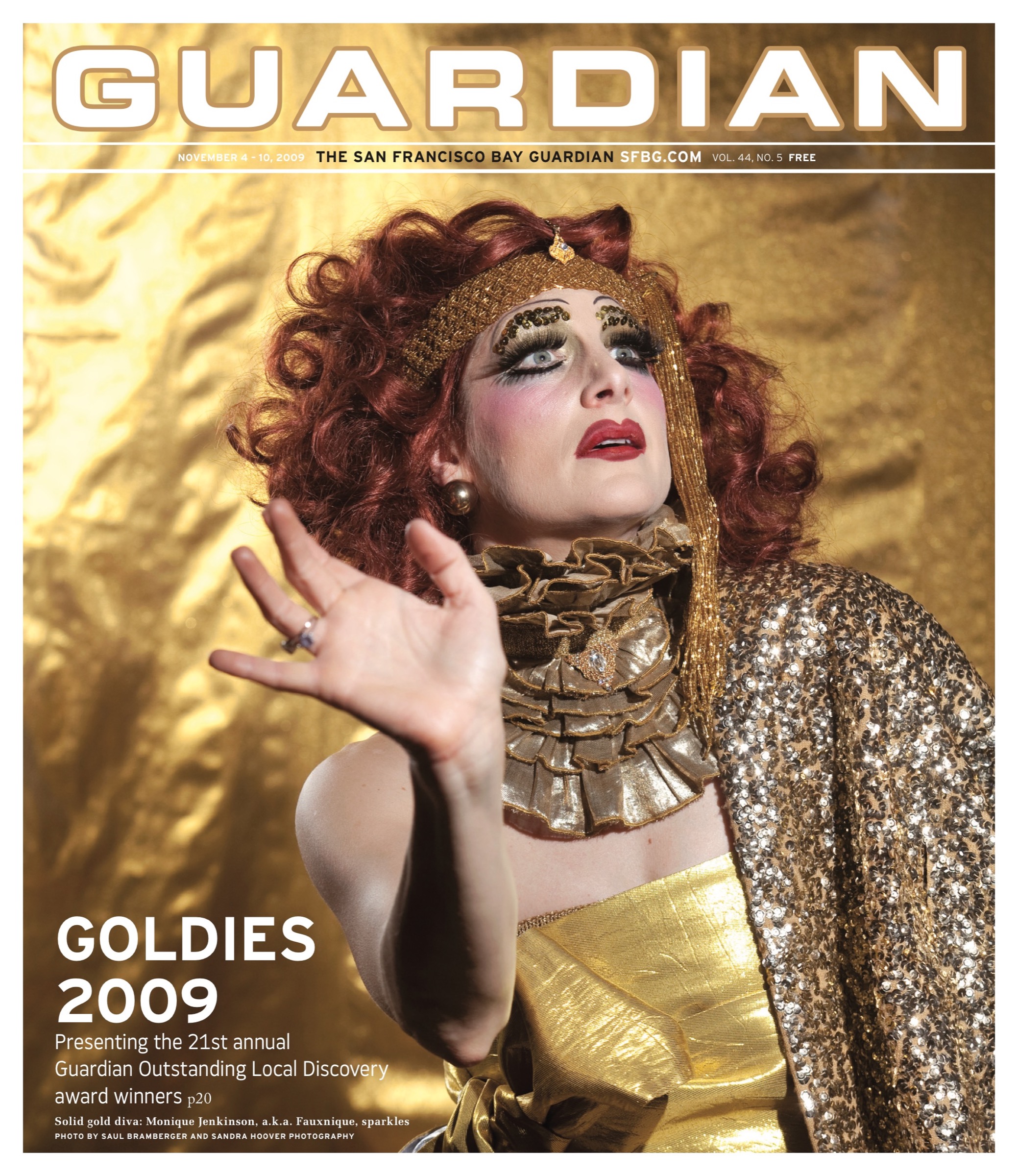
>>GOLDIES 2009: The 21st Guardian Outstanding Local Discovery awards, honoring the Bay’s best in arts

Return to Cougar Town

0

andrea@mail.altsexcolumn.com

Dear Readers:

I was going to write more this week about body size, body image, and sex, but I’m stupid sick, so here’s an older one ["Cougar Den," 10/22/08] about age instead. It’s all connected anyway. Don’t get the flu.

Love,

Andrea

Dear Andrea:

Fourteen years ago, when I was 26, I met my husband, who was then 58. We’ve stayed together through thick and thin and we love each other enormously. It has pained me over the past decade to realize that, even when the woman in question has her own accomplishments and is not a "bimbo," and even when the man in question is appealing and interesting (not a Donald Trump or a philandering cad) — still the nasty stereotypes abound. British comedian Graham Norton, for instance, refers to Catherine Zeta-Jones as "that gold-digging Welsh whore."

I find that otherwise thoughtful women I meet, acting on a mixture of feminism, anger, and what I infer to be unacknowledged personal pain or fear, seem too willing to continue such stereotypes, and I hesitate to open up to women I would otherwise think of as potential friends. I have hoped that as increasingly empowered women realize that they can date younger men if they choose, the rage over the double-standard and fear of abandonment and dwindling romantic options will begin to fade.

Then SNL comes along with, among other bits that belittle older women, their despicable new "Cougar Den" skit, mocking sexually-active older women as ridiculous and disgusting. Fuck you SNL!

These mean-spirited portrayals are destructive. I’ve attempted to convey this message through other venues and have been ignored. I remember a few years ago you wrote that the only regrettable mixed union between adults is "the always unfortunate nice person/asshole combo" — so maybe you’ll see my point and print this.

Love,

Love My Older Spouse

Dear Love:

Ha, that’s a pretty good line. Thanks for remembering it.

I hadn’t even thought about SNL in years until the recent gratifying return of Tina Fey, but now that you mention it (you didn’t), I have conceived a visceral loathing for Sarah Palin so intense that I couldn’t even watch the debate for fear of feeling too sick to cook dinner. And yet I’ve still managed to be offended, feministically-speaking, by some of the endless harping on her supposed babe-itude. Can we not leave her legs (slender and therefore officially babe-ly) and Secretary of State Clinton’s, which have been judged unacceptably stumpy, and everyone else’s out of the equation and judge the candidates on their merits? Gov. Palin, for instance, doesn’t have any. We win!

As for cougars, I have puzzled over the sudden emergence of the stereotype and the unquestioned assumption that the women it is applied to deserve ridicule. After a spate of popular-media articles in the 1990s about older women and their younger men, I suppose some degree of backlash was inevitable. Still, I, like you, am nonplussed by the degree of venom spit at any woman of a certain age who dares not only to date above her age-determined station but to do anything for fun at all beyond book-club, knitting, and golf.

Don’t you think, though, that the reaction of some older women to a young one seen with a man old enough to be the first woman’s first husband is understandable? We can claim the right to date younger men all we like, but who’s to say most younger men will be interested? And there are still legions of old coots advertising for "fit, slender" young things in the personals. There is still a media-driven double standard keeping George Clooney in the "sexy lead" seat while Glenn Close and Cybil Shepherd have to play doughty moms and, yes, cougars. Even the accolades heaped on the glorious Helen Mirren in recent years have a faint aspect of the freak show about them: "Step up and see the 60-something woman who is still sexually attractive!" These forces are still powerful enough to make your fond wish for a time when older women will inevitably gaze upon your union with one of their own with bland approval still a bit of a pipe dream. As long as older women with a sex drive and indeed any juice at all left in them are laughed and pointed at, some will still look at a young woman who scoops up one of the few available men in their bracket as whatever the opposite of a cougar might be. Minx. Bitch. Gold-digging (Welsh) whore. Sad, and frustrating, but human.

Incidentally, I was curious about the origin of "cougar" in this context and found an article dating it to the founding in 1999 of Cougardate, an online dating site. A book, Cougar: A Guide for Older Women Dating Younger Men, by Valerie Gibson, came along in 2001. As you can see, these were guides for women, so the term, even with its "rapacious animal" connotations, wasn’t even meant pejoratively. The nastiness accrued to it gradually, it seems, and inevitably. If it’s about women actually wanting sex, that’s gonna happen.

OK, Now I’m mad too.

Love,

Andrea

See Andrea’s other column at carnalnation.com.

Marching on Chevron

0

news@sfbg.com

GREEN CITY Although the 250-seat Roxie Theater auditorium was filled to capacity for the Nov. 1 screening of the controversial film “The Yes Men Fix the World,” the real action took place on the city’s streets when audience members took the film’s anticorporate message directly to an oil giant’s door.

Activists from Global Exchange co-organized the San Francisco film premiere to protest alleged human rights abuses and environmental devastation by Chevron Corporation, California’s largest corporation and the fifth largest in the world. The theatrical protest followed the film and ran from 16th Street to a Chevron station at Market and Castro streets.

Antonia Juhasz, director of Global Exchange’s Chevron Program, introduced the film, riling up the crowd when she said, “After viewing this film, we will be so inspired we won’t know what to do with ourselves. But we need to take this energy and direct it toward affecting change.”

The film chronicles the exploits of “Yes Men” Andy Bichlbaum and Mike Bonanno, following the pair as they perform various publicity stunts in an attempt to illustrate the greed and corruption of the free-market system and draw attention to their progressive causes.

Currently being sued by the U.S. Chamber of Commerce for recently staging a fake press conference on global warming, the duo have been called world-renowned troublemakers because of antics like announcing live on BBC that the Dow Chemical Company would finally clean up the site of the Bhopal, India, gas leak and compensate the victims.

Although the film does not directly reference Chevron, it aspires to hold corporations accountable for impacts to the communities they operate in. Juhasz said that although Chevron spends billions of dollars on advertising campaigns, it operates with blatant disregard for the environment.

Chevron spends less than 3 percent of its expenditures on alternative energy, operates a coal company, and is among the world’s largest corporate contributors to global warming, she said.

“We want to link communities in the struggle against this corporation, demanding policy changes and building pressure where Chevron operates,” Juhasz said. “By targeting one company, the whole industry is affected and eventually energy policies can be changed.”

The procession was led by protestors dressed as Chevron officials, cleaners, and absurd imaginary products. “Today we are demonstrating what Chevron is actually doing,” said Rae Abileah, grassroots coordinator for CodePink, the antiwar group that participated in the event. “We are just showing what a mockery this all is and that we can rise up as people to transform our world.”

As “I Will Survive” blared from speakers, the procession had a party-like atmosphere that attracted bystanders. Larry Bogad, an associate professor at UC Davis, came up with the concept and told us that “by using surprise, humor, imagination, and protest to engage people, we can stimulate thought and draw a deeper and wider attention to the issue.”

For David Solnit, organizer with the Mobilization for Climate Justice, the unusual nature of the event was exactly what made it so effective. “We are taking a popular film that deals with corporate power and trying to break down the barrier between consuming media and taking action,” he said.

Bichlbaum, one of the film’s stars, attended the protest and spoke about the importance of the grassroots movement. “If I can do it, anyone can … You need your feet and a bunch of friends. That is much more important than a business card.”

Juhasz said the destination for the procession was a symbolic choice. “This is an independently-owned Chevron station. The target is not the station, but a theatrical event to draw attention to the issue in the spirit of theater and fun.”

Although he didn’t attend the event, the station’s owner, David Sahagun, told the Guardian: “Employees told me that the crowd was well behaved and did a good job making their point.” As former president of the San Francisco Small Business Network, he stressed the struggles of locally-owned businesses in the face of large corporations and said he was “trying to be a community partner”

Chevron officials did not return calls seeking comment.

Am I illegal mama?

0

OPINION "Am I illegal mama?" My mixed-race, Mexican, Chinese, Puerto Rican, and Irish six-year-old son gazed up at me with the largest of puppy eyes after we watched a corporate media television report on Mayor Gavin Newsom’s rejection of the legislation by David Campos that would give due process to migrant youth caught up in the criminal in-justice system.

After recovering from my sorrow at my son’s logical interpretation of our criminalizing, dehumanizing society, I went on to explain that as far as I was concerned no human is illegal — or an alien, for that matter. I told him that the whole concept of "illegal people" is rooted in our society’s attempt to create more products for the ever-hungry prison-industrial-complex by criminalizing poor youth of color, migrant workers, and houseless adults and elders in poverty for the sole act of being poor, seeking work not having housing, and so on. (Yes, I do talk to my son with truth and candor about such things because that is how my African-Boricua-Taina mama raised me.)

His discovery, albeit terrible, did not shock me. Rather, it was the final nudge I needed to release a public statement from all the multiracial, multicultural, multilingual mamas, grandmothers, aunties, uncles, fathers, and grandfathers I write with, make art with, co-mama with, co-teach with, and am in relationships with at POOR Magazine/Prensa POBRE. We are people who believe that not only is no human being illegal, but that all these borders are false constructs of imperialism. We believe in the rights of children, if you believe that all children, and all people, deserve basic due process rights — which is all the sanctuary legislation by Sup. David Campos grants.

So Mayor Newsom, why reject this modest legislation? Have you become so blinded by your desire to be tough on crime that you don’t even recognize the voices and desires of your voting public in San Francisco, who overwhelmingly organized and spoke in favor of this?

But you can’t blame Newsom alone. Corporate media and corporate government fuels this notion of illegality in relation to human beings and has so ingrained the terms "illegal" and "alien" as ways of describing human beings that many people use these words without direct malice or intent to harm. So, like most insidious racially unjust policies and practices in American culture, these terms and notions roll along, gaining steam and power.

In an attempt to address this ongoing disinformation campaign about migration and immigrants, POOR Magazine launched the Voces de Inmigrantes en Resistencia Project to ensure that the silenced voices of immigrants in poverty are not only heard but are redefined as journalists, poets, media producers, and scholars.

After our talk, my son looked up at me and said, "Mama, I have an idea — if all us people, kids, and adults in the world all stand together holding hands, then they won’t be able to separate us or hurt any of us." Then he stopped and very slowly and carefully added, "Or crim-in-alize us." *

Tiny a.k.a. Lisa Gray-Garcia is the coeditor, cofounder and co-madre of POOR Magazine. She is also the author of Criminal of Poverty: Growing Up Homeless in America, published by City Lights.

Editorial: The next Gavin Newsom

0

EDITORIAL It’s possible that Mayor Gavin Newsom took a long look at himself, his life, and his future last week and decided that politics — intense, 24/7/365 politics — wasn’t what he wanted right now. It’s possible (as Randy Shaw noted in Beyondchron.org) that Newsom "now joins longtime adversary Chris Daly in putting family relationships ahead of one’s political career." It’s possible that he never really wanted a future in electoral politics and was driven to run for governor less by personal ambition than by the desire of his advisors to see him in a higher political role.

In that case, Newsom has a responsibility to do the best job he can over the final two years of his term as mayor, then step away and find something else to do with his life.

But since it’s also possible — even likely — that Newsom still hopes to have a political career, and that his decision to drop out of the governor’s race was as much about his failure to gain any traction as it was about his family obligations, it’s worth talking about why his campaign failed and what he can and should do next.

For starters, Newsom never expected to beat Attorney General Jerry Brown in the big-donor fundraising battle. He was hoping to put together a grassroots operation, to mobilize the Obama constituency, and build a war chest with tens of thousands of small donors organized through social media and technology. And that kind of effort could have worked — Brown has name recognition and money, but not much else. It’s hard to imagine large masses of young activists donating time and energy to his primary campaign.

The problem was, those legions of California activists weren’t terribly excited about Newsom either. And there are good reasons for that — reasons Newsom needs to understand if he wants to run for statewide elected office in the future.

If the real Gavin Newsom had been anything like the campaign picture his handlers tried to present, he would have been a serious candidate. Newsom the candidate was a leader who brought San Franciscans together to get things accomplished. He was a progressive thinker who created universal health care and an effective budget process with a rainy day fund that prevented teacher layoffs. He was bold enough to challenge federal and state law on same-sex marriage and demand equality for all.

But Newsom the mayor was actually a snippy politician who refused to work with the Board of Supervisors and would never engage his opponents. He was great at press releases but short on accomplishments — universal health care and the rainy day fund were projects put together by Tom Ammiano, one of the supervisors the mayor disdained, who is now a state Assembly member. He refused to take a lead role fighting Pacific Gas and Electric Co. to promote clean energy and public power. And for all his success in moving same-sex marriage forward, he never once managed to bring that kind of progressive energy or policy-making to economic issues. His budget this year was the same as Republican Gov. Arnold Schwarzenegger’s budget — cuts and fees only. No new taxes.

As a result, the progressives and independent voters in his own town didn’t support his campaign — and without the environmentalists, labor, tenants, and progressive elected officials from San Francisco behind him, there was no way he could generate an honest grassroots movement in a Democratic primary.

Now he’s back from the campaign trail — and he has two years to pick up on the lessons of his ignominious political collapse. If he wants any kind of a political future, he needs to change. First, he needs to start engaging and working with the supervisors — even the ones who disagree with him. (Showing up for "question time" would be a huge step). He needs to take the city’s structural budget deficit seriously and present plans for progressive taxes to help close it. He needs to show he can take on big powerful local interests — PG&E, for example — by opposing the utility’s anti-public power initiative and putting his political capital on the line to support community choice aggregation.

Newsom the imperial mayor has, we hope, been a bit humbled. Let’s see if he comes out of this chapter as an embittered, angry (and ultimately unsuccessful) mayor committed to punishing his enemies — or a serious city leader who can live up to his own hype.

The man who drove the Chronicle nuts

2


Stephen Barnett, prominent UC-Berkeley law professor and noted First Amendment and antitrust scholar and activist, 1935-2009

barnett.jpg
Photo by Jim Block

By Bruce B. Brugmann

(Special note: read Barnett’s scathing indictment of Examiner/Chronicle/JOA news coverage in the San Francisco Bay Guardian (9/31/1970)

Steve Barnett would have been highly amused with the way the Associated Press and the San Francisco Chronicle handled the obituary of his death on Oct. 13 of cardiac arrest. He was 73.

The AP and the Chronicle ran respectful obituaries of his illustrious career as a UC Berkeley law professor, prominent First Amendment advocate, critic of the California Supreme Court, a director of the California First Amendment Coalition, and widely published legal scholar on media, antitrust, and First Amendment law.

The Chronicle even tossed in a couple of paragraphs pointing out that Barnett was “a frequent commentator on the Newspaper Preservation Act, the 1970 federal law that allowed papers in the same market to cut costs by merging some of their operations.”

Prison report: The corruption factor

20

By Just A Guy

Editors note: Just A Guy is an inmate in a California state prison. His reports appear twice a week.

I believe it to be an imperative that opposing views should be a part of any dialogue. This is especially true in the comments section of my blog. While we, as inmates, are given a very limited voice, we (or I) should not preclude people who believe differently from being a part of the discussions. Were I to do that, I would be just like the mainstream media, the majority of politicians, and a seeming majority of law enforcement that only reports one side of the story — which is almost always assumed by a largely vapid public to be true.

It is alarming, though, that when someone with an opposing view posts his or her comments, they mostly seem to degrade into name calling and derision. Case in point would be bobjacboson, who commented about my blog a few weeks ago and accused me of being psychotic.

When I read comments such as bob’s, I can’t help but wonder if the commenters even read the post before making their thoughts known to the public.

I believe I opened that blog stating that I could not be explicit for fear of retaliation, but bob railed one me for not being explicit. Sigh.

Please read before you comment, bob, then think. But I’m going to give you an example of what I was talking about.

The gov’s f-bomb explodes

10

By Tim Redmond

Wow, even the San Francisco Chronicle is critical of Gov. Schwarzenegger’s elementary-school-level prank. (My ten-year old son saw the letter on my desk yesterday and read it and said: “Is that guy really the governor of California?”)

It’s been fun watching the national news media go gaga over this, in part because nobody wants to use the word “fuck.” Here’s the New York Times:

The message can be seen only by a careful reading of the printed version of the veto statement. By taking the first letter of each line, beginning with the third line, two words emerge: The first is obscene; the second is “you.”

The Times also had trouble with Ammiano telling the guv to “kiss my gay ass.” That came out like this:

Mr. Ammiano, who is gay and was upset over cuts to state-financed AIDS programs, shouted at the governor, calling him a liar. Mr. Ammiano also apparently shouted another — more vulgar — insult.

Most of the news coverage, though, has missed one of the key points — this was a bill that would have helped San Francisco finance port repairs. It was uncontroversial, he no opposition, and would have cost the state nothing. So the Guv not only made an ass of himself; he hurt the city of San Francisco in the process.

Naomi Klein on The Shock Doctrine, California style

0

By Rebecca Bowe

Naomi Klein showed a portion of this film clip during her lecture at UC Berkeley last night. In it, Arnold talks about how Milton Friedman changed his life.

Speaking at the University of California at Berkeley yesterday evening, award-winning journalist and author Naomi Klein lamented the sweeping budgetary cuts to education, women’s shelters, and a host of critical social services that have rocked California in recent months.

“When these cuts are imposed, it’s constantly portrayed in the media as if it’s an unfortunate and painful necessity,” she said. On the contrary, she argued, the gutting of the public sector in California is no coincidence.

Klein pointed to an overarching conservative agenda that touts free-market capitalism and limited government, and resists raising revenues with tax increases. (We referenced Klein’s book, The Shock Doctrine: The Rise of Disaster Capitalism, in our cover story last week. So it’s also not a coincidence that our cover package, “The California Nightmare,” touched on many of the same themes.)

Klein showed a brief film clip that included footage of California Gov. Arnold Schwarzenegger praising the ideas of conservative free-market economist Milton Friedman. “What you always have to remember in this discussion is that your governor is a hardcore ideologue,” Klein said after showing a clip in which Schwarzenegger is seen gushing, “Dr. Friedman changed my life!”

“These pet Republican policies have been lying around,” Klein said. “These ideas are still incompatible with democracy, still deeply unpopular.” Nonetheless, they’re being rolled out in uncertain times and unstable places, according to Klein, while masquerading as emergency measures.

Anti-doofus agenda

0

arts@sfbg.com

LIT/MUSIC With influences ranging from the Cuban Revolution and Malcolm X to musical orishas such as Ornette Coleman, John Coltrane, Thelonius Monk, and Sun Ra, Amiri Baraka is renowned as the founder of the Black Arts Movement in Harlem in the 1960s that became, though short-lived, the virtual blueprint for a new American theater aesthetic. The movement and his published work — such as 1963’s signature study on African American music Blues People and the same year’s play Dutchman — practically seeded "the cultural corollary to black nationalism" of that revolutionary American milieu.

Baraka lives in Newark, N.J., with his wife and author Amina Baraka; they have five children and head the word-music ensemble Blue Ark: The Word Ship and co-direct Kimako’s Blues People, an art space housed in their theater basement for some 15 years. I spoke with him on the eve of an upcoming visit.

SFBG What brings you to the Bay Area this time around?

AMIRI BARAKA We’re doing two sets at Yoshi’s with Howard Wiley. Those are the kinds of musical things we have a nice time doing. I hope to bring the poetry and music to Oakland, San Francisco, and Los Angeles. And I’m giving a talk at the library.

SFBG What will you be discussing?

AB Obama and his first 10 months, based on an essay I wrote a few months ago called "We’re Already in the Future." I support Obama and I think that the people who supported him initially should keep supporting him because they are forgetting the huge difficulty he faces. This society, they don’t want any kind of change. They do not want him, first of all. Only 43 percent of the white people even voted for him, and a lot those people resent the fact that white America is now mulatto. That election proved that it’s not white America, it’s multinational America, so they’ve set up this roadblock to almost anything he does.

Anytime you can, you see how doofus Americans are, to oppose their own quality of life improvement, their own health care. They’d rather mope along with little health care or none simply because the corporations have convinced them it’s bad for them — it shows you that we have a real education gap in America. Not to mention the racism, which is behind a lot of it, big time.

The people who support Obama need to stand together to fight the right wing. It’s the right wing that is the enemy. Those huge corporations including those mouthpieces they have. The media is just absurd, with [Sean] Hannity, [Bill] O’Reilly, [Glenn] Beck, Rush Limbaugh. These guys are just too much. If they’re not racist, there is no such thing as racism.

SFBG I know that you spent some time in SF. What are your impressions of our city?

AB I was a visiting professor at San Francisco State for about three or four months, that was the extent of my residency. I like San Francisco. I’m drawn to the vibe there. The last time I was in San Francisco, I was reading at Ferlinghetti’s bookstore [City Lights]. Most of my stuff is in Oakland, but whenever I’m in Oakland, I stop by San Francisco.

Seems to me that San Francisco is very expensive, like New York. I live in Newark, N.J., which is 12 miles outside of New York City — it’s got that Oakland-San Francisco relationship. When you’re dealing with New York, you have that high-rent district all the way around. San Francisco is a beautiful city, but going there and being there are two different things.

SFBG Happy birthday. I know you just turned 75. Any wisdom to impart from three-quarters of a century?

AB I’ve been 75 for about five days. I can say that you really need to take care of yourself. That’s the cliché: "If I knew I was going be this old, I would have taken better care of myself," but it’s some better wisdom than what you hear generally.

SFBG You coined the term "Afrosurreal Expressionism." Can you share your definition?

AB If you know the African tales or even African writers and African cultures, then you know they understand the concept of having relationships reversed, which exposes new concepts and dimensions. They understood the power of the conscious and unconscious mind to change the dimensions of the world. The various forces of nature that people developed, that people saw as gods, these elemental forces: the wind, the water, the sun, the moon. They understood how human beings interrelate to those forces. Henry Dumas’ work dealt with these changing dimensions, and people who do strange things in realistic situations. It was Surrealism that changed the relationship to things. Dumas influenced Toni Morrison, who was his editor at Random House. He was a strong writer and he went out of here in a tragic way, being murdered by the police. His stories and poems are Afrosurreal, with African psychology imposing these dimensions on reality.

SFBG What is the role of the artist in the current climate, and what are the tools we can use to bring about social change?

AB The way things work: cause and effect, action and reaction. The ’60s and the ’70s were a period of intense struggle. The Black Arts Movement and the antiimperialist movement laid the foundation to get Obama elected. But then you get a reaction, and it has been quite evident. Imperialist commerce has taken over the arts. Once we were struggling to get black movies made — now we see what kinds of movies are being made by black people, and they are very backward. Act, react. We have to struggle anew to do something about these backwards elements.

Black people have 27 cities: we need 27 theaters, 27 galleries, 27 periodicals. We need to have poets, rappers, painters, actors struggling to raise the consciousness of the people. That is the role of the artist. Black people still live in these ghettos and these ‘hoods. There may be more of a black middle-class, but they often are the ones helping to keep us duped and bamboozled. This is a struggle that has to be. This is reality — like they say, "Keep it real." This is a struggle that has to be.

AMIRI BARAKA WITH THE HOWARD WILEY TRIO

Nov. 9, 8 p.m., $16–$20

Yoshi’s San Francisco

1330 Fillmore, SF

www.yoshis.com