Media

How California exports water

0

By Patrick Porgans

In 2009, the last year of the so-called great California drought, a strange thing happened: Sacramento Valley growers produced a near record amount of rice, and down south, the Metropolitan Water District of Southern California (Met), the largest urban water supplier in the nation, experienced record-breaking water sales. All this despite repeated mainstream media accounts in 2009 of an economy-wrecking dust bowl water shortage.

According to the U.S. Department of Agriculture, the California rice harvest in 2009 was up 9 percent from the previous year and approached the record crop of 2004.

Rice consumes a great deal of water for its dollar value and produces little net income. According to a report by the University of California, Davis, the minimum amount of water required to grow a crop of rice is about 42 inches per acre. Unavoidable losses can add to this amount — so that the amount of water consumed (or evaporated) can be as much as 100 inches per acre, depending on the soil. That appears to be enough water to drown the tallest person on earth.

The California Rice Commission, a trade group representing 2,500 rice farmers, estimates that rice uses 2.2 million acre-feet of irrigation water yearly, about 2.6 percent of the state’s total water supply. According to records obtained from Met, that’s equal to the annual average water it supplied to all of its 19 million customers.

UC Davis data from 2008 show that California exported 52 percent of its rice production, much of it to Japan. For every pound of rice exported, about 250 gallons of embedded water used in growing and processing that rice leaves along with it, according to “Water Footprints of Nations,” a 2004 UNESCO study. (The report spawned the Web site www.waterfootprint.com.)

The rice harvest should be of great consolation to the chairman of the California State Water Resources Control Board, Charles Hoppin, who is also a rice grower, vice-chairman of the Rice Growers Cooperative, and immediate past chairman of the California Rice Industry Association. Chairman Hoppin, in a March 2010 speech in Yuma, Ariz., complained that the regulatory community, including much of his staff, doesn’t know or understand the issues facing agriculture and “doesn’t give a rat’s ass.”

According to the Environmental Working Group, rice subsidies in California totaled $2.4 billion from 1995-2009. In that period, the single largest recipient of subsidies was the Farmers’ Rice Cooperative of Sacramento, California, totaling more than $146 million.

Farm recipients of USDA subsidies in California totaled $9.1 billion from 1995-2009.According to EWG, “Washington paid out a quarter of a trillion dollars in federal farm subsidies between 1995 and 2009. But to characterize the programs as either a big government bailout or another form of welfare would be manifestly unfair — to bailouts and welfare.” Then there’s hay — another water-gulping product that’s getting exported, with much of it going to Japan.

Writer Melinda Burns, in a June 10, 2009 story on Miller-McCune.com, notes: “In the Imperial Valley of California, a region drier than part of the Sahara Desert, farmers have found a lucrative market abroad for a crop they grow with Colorado River water: They export bales of hay to land-poor Japan. Since the mid-1980s, this arid border region of California has been supplying hay and feed for Japan’s dairy cows and black-haired cattle, the kind that get daily massages, are fed beer, and produce the most tender Kobe beef.”

She quotes Patrick Woodall, research director at Food and Water Watch, an international consumer advocacy group with headquarters in Washington, D.C.: “There is a kind of insanity about this,” Woodall said. “Exporting water in the form of crops is giving water away from thirsty communities and infringing on their ability to deal with water scarcity.”

Our Weekly Picks: November 17-23, 2010

0

WEDNESDAY 17

MUSIC

Watain

Half the fun of black metal is trying to figure out how serious a particular band is about its evilness. Evaluate: album covers; the amount of makeup and sinister props deployed during live shows; song lyrics; official band bios. I wish I’d written the phrase “Watain crawled out from Satan’s cunt in 1998,” but I can’t take credit for that, or for “out of the infernal depths their voices do not cry to the Heavens.” Fortunately, Watain (actually from Sweden) backs up all the unholy-terror promises by playing top-shelf black metal (fourth album, Lawless Darkness, came out earlier this year). Extremists won’t want to miss what’s sure to be a delightful night of headbanging with the Beast. (Cheryl Eddy)

With Goatwhore, Black Anvil, Necrite, and Pale Chalice

7:30 p.m., $20

DNA Lounge

373 11th St, SF

(415) 626-1409

www.dnalounge.com


DANCE

Josh Klipp and Jenni Bregman

AIRspace and RAW (Resident Artist Workshop) present a split bill featuring artists Josh Klipp and Jenni Bregman. Klipp, a local vocalist and choreographer, is a jazz singer in his work Chet & Ella: music and dance celebrating the voices of Chet Baker and Ella FitzgeraldThe piece also incorporates performances by Freeplay Dance Crew, Sarah Bush Dance Project, Funk4Soul, and Dylan Martin. Jenni Bregman’s contemporary dance work Intimate City takes a look at crowded urban spaces and the subsequent intimate transactions that can transpire between people. Bregman offers a glimpse at how friends and strangers alike share their minds, hearts, and personal space in the close quarters of urbanity. (Emmaly Wiederholt)

Wed/17–Thurs/18, 8 p.m., $10–$20

Garage

975 Howard, SF

www.975howard.com


THURSDAY 18

MUSIC

Bear Hands

Your album’s out. The blogosphere is blowing up around you. You’re opening for scene bands like Passion Pit, MGMT, and the XX. Feels good, but you’ve got to keep a cool head. Sure, they dig your sound, which gets compared to Modest Mouse and Berkeley’s WHY?; Spin magazine calls your band “a pitch-perfect pairing of post-punk and indie rock.” But they said that about the last band from New York City. Remember what really matters: the Justin Timberlake shout-out. He’s “fallen in love” with your “choppy but dreamy indie-rock stylings.” Oh, his paid blogger wrote that? That’s still really close. (Ryan Prendiville)

With LoveLikeFire and Safe

8 p.m., $12

Rickshaw Stop

155 Fell, SF

(415) 861-2011

www.rickshawstop.com


THEATER

Caligari

Don’t fret, little thanatophile — Halloween’s not officially over until at least Thanksgiving. And to prove it, HurlyBurly Productions premiers its original adaptation Caligari in a nontraditional venue that simply begs the curious to attend: the playspace above leather apparel shop Mr. S. (“Lots of rigging,” I’m told happily, by the design team.) Exploring the minds of a murderous duo through the perspective of a pair of endangered lovers, Caligari promises shadowplay, Expressionist theatrics, fetish gear, and the subtle dissolution of the fourth wall. With the enigmatic Fennel Skellyman as Cesare, and HurlyBurly’s own Rik Lopes as the titular lead. (Nicole Gluckstern)

Thurs/18–Sat/20;

also Dec 2–3, 9–10, 8 p.m., $10–$30

Studio 385

385A Eighth St., SF

www.jointhehurlyburly.org


THEATER

The Success of Failure (Or, the Failure of Success)

Having earlier this year caught Cynthia Hopkins’ The Truth: A Tragedy at New York’s Soho Rep, I wouldn’t want to miss anything this playful, vaguely pixie-ish singer-songwriter-musician-performer is ever up to again. That includes her pomo rock band, Gloria Deluxe, and definitely the pure and intoxicatingly sure theater she creates in her deceptively homespun, hyper-talented fashion. The theater is on display this weekend in her “live sc-fi movie,” The Success of Failure (Or, the Failure of Success), a beguiling theater-music-dance rumination on the happy-horrific astronomical catastrophes responsible for our fragile existence. Wear your gravity boots: her curiosity is contagious, her instincts unflappable, and her oddball, doll-like, sweetly deranged persona simply magnetic. (Robert Avila)

Thurs/18–Sat/20, 8 p.m., $25

Yerba Buena Center for the Arts

Novellus Theatre, 700 Howard, SF

(415) 978-2787

www.ybca.org


FRIDAY 19

MUSIC

Miniature Tigers

The Brooklyn by way of Phoenix indie-rock group Miniature Tigers seem to revel in the darkly skewed, shadowy corners of the pop world. That its new album Fortress (fantastically produced by the Morning Benders’ Chris Chu) was inspired by a band viewing of Stanley Kubrick’s The Shining (1980) and includes song titles like “Mansion of Misery” and “Dark Tower” says nothing to describe the catchy, fun, and warped Beatles-esque pop it contains. This is what you might get if Animal Collective had its way with The White Album. (Landon Moblad)

With Freelance Whales

8:30 p.m., $12–$15

Rickshaw Stop

155 Fell, SF

(415) 861-2011

www.rickshawstop.com


MUSIC

Every Time I Die

Between the timing of their rise to prominence and their dubious moniker, the five rabble-rousers in Every Time I Die have often been unfairly ghettoized. But while many assume the band plays generic, early-aughts screamo, the music instead takes the form of squalling, infectious hardcore, with singer Keith Buckley — boasting one of the most unpredictable, expressive voices in the genre — caterwauling over top. The sheer weightiness of the instrumentation is what gives him such free reign, and guitarists Andrew Williams and Jordan Buckley seem to be chiseling their riffs out of quarried stone. Head out to Oakland tonight, and this band’ll lob those rock rocks your way. (Ben Richardson)

With Trap Them and Howl

8 p.m., $13

Oakland Metro

630 Third St., Oakl.

(510) 763-1146

www.oaklandmetro.org


THEATER

Coraline

First a best-selling book, then an Oscar-nominated stop-motion film, and now a musical, Coraline is the story of a restless girl whose curiosity gets the better of her. Title character Coraline discovers a secret door that takes her into the perfect world of the ever-loving and kindly Other Mother and Father. However she soon finds that perhaps the Other world isn’t so perfect after all. Adapted from Neil Gaiman’s children’s book, with music and lyrics by Stephin Merritt of the Magnetic Fields and book by David Greenspan, madness and mayhem transpire as Coraline navigates the path between the deceptive Other world and her own. (Wiederholt)

Through Jan. 15 (check website for schedule)

Opens tonight, 8 p.m., $30–$50

SF Playhouse

533 Sutter, SF

(415) 677-9596

www.sfplayhouse.org


MUSIC

Clutch

Clutch has long built a reputation on its unique music, which blends hardcore, metal, blues, and funk to create an inimitable mix. This ability to combine multiple genres enables the band to attract a diverse array of fans, which in turn has resulted in some truly head-scratching touring partners. This trip through SF, the Germantown, Md., quartet will be sharing the stage with neoclassical shred-metallers Children of Bodom, plus Black Label Society, a knuckle-dragging biker metal outfit fronted by former Ozzy Osbourne guitarist Zakk Wylde (né Jeffrey Phillip Wielandt). Despite the stylistic confusion this will entail, come early for a set full of hard-grooving Southern Gothic weirdness, courtesy of the hardest-working hardcore-funk-blues band in show business. (Richardson)

With Black Label Society, Children of Bodom, and 2 Cents

7:30 p.m., $42

Warfield

982 Market, SF

1-800-745-3000

www.thewarfieldtheatre.com


DANCE

Ballet Afsaneh

If you think that globalization is a 21st century invention, talk to the people living along the Silk Road — that land and cultural bridge between the Mediterranean and China — that has been traveled for well over 2,000 years. Afghanistan, Turkey, Iran, Kazakhstan, and Azerbaijan among others, are in the news all the time, mostly for the wrong reasons. The Ballet Afsaneh Art and Culture Society has made it its mission to preserve and reinterpret the music and dance from this multiethnic part of the world. With Encounters: New Moon on the Silk Road, a project in the making for more than a year, Antonia Minnecola, Sharlya Sawyer, Moses Sedler, and their dancers and musicians invite audiences to take in the delicious rhythms and flowing gestures of that still-mysterious region between East and West. (Rita Felciano)

Sat/20, 8 p.m.; Sun/21, 3 p.m., $21–$25

Cowell Theater

Fort Mason Center, Marina at Laguna, SF

(415) 345-7575

www.dancesilkroad.org


SUNDAY 21

MUSIC

Gwar

Sexcuse me! You remember Gwar, right? You know, the guys who dressed up in outrageous costumes, er, I mean those deranged aliens who came to our planet in the mid-1980s and released records like Scumdogs of the Universe and This Toilet Earth? Well, the space gang is back in all its unholy glory with a new album, The Bloody Pit of Horror (Metal Blade), celebrating the band’s 25th anniversary. Propelled by the first sleazy single, “Zombies, March!” Oderus Urungus and his cohorts have returned in fine beastly form, ready to spread their love — by which of course I mean spray audiences with all manner of fake blood, bodily fluids, and God knows what else! (Sean McCourt)

With Casualties, Infernaeon, and Mobile Death Camp

7:30 p.m., $25

Regency Ballroom

1290 Sutter, SF

1-800-745-3000

www.theregencyballroom.com


MONDAY 22

MUSIC

Booker T.

One of the legendary organ players in music history, Booker T. Jones and his Hammond B-3 are touring to support his first solo album in over two decades. Jones led Stax Records house band Booker T. and the MGs throughout the 1960s and cowrote the still-cool-after-50-years classic “Green Onions.” His newest Grammy-winning album, Potato Hole, features backup work from the Drive-By Truckers and Neil Young, and includes a cover of Outkast’s “Hey Ya” for good measure. (Moblad)

8 and 10 p.m., $20–$30

Yoshi’s San Francisco

1330 Fillmore, SF

(415) 655-5600

www.yoshis.com


The Guardian listings deadline is two weeks prior to our Wednesday publication date. To submit an item for consideration, please include the title of the event, a brief description of the event, date and time, venue name, street address (listing cross streets only isn’t sufficient), city, telephone number readers can call for more information, telephone number for media, and admission costs. Send information to Listings, the Guardian Building, 135 Mississippi St., SF, CA 94107; fax to (415) 487-2506; or e-mail (paste press release into e-mail body — no text attachments, please) to listings@sfbg.com. We cannot guarantee the return of photos, but enclosing an SASE helps. Digital photos may be submitted in jpeg format; the image must be at least 240 dpi and four inches by six inches in size. We regret we cannot accept listings over the phone.

Only a miracle can save Steve Li now

41

Supporters of Shing Ma “Steve” Li, a 20-year-old nursing student, gathered outside the offices of Sen. Barbara Boxer today to urge her to sponsor a private bill in a last ditch effort to halt Li’s deportation to Peru, which is scheduled to take place Monday, November 15—two months after ICE (Immigration and Customs Enforcement) agents arrested Li in San Francisco.

“While we do not introduce private bills, our staff is happy to meet with Mr. Li’s family and his attorneys to discuss his case,” Boxer spokesperson Zachary Coile emailed the Guardian, as protesters delivered stack of letters to Boxer’s office, asking that she intervene in Li’s case.

Unlike Sen. Dianne Feinstein who has sponsored private bills in the past, Boxer has no record of intervening in this way. But advocates were hopeful that now that she has survived the November 2010 election, Boxer will pull off a miracle before Monday.

This afternoon, Li’s attorney Sin Yen Ling texted the Guardian that her request for deferred action had been denied, meaning that Li will be on a plane to Peru on Monday, baring some last minute miracle.

“Our office has been in touch with ICE and is exploring the options,” Gil Duran, media spokesperson for Sen. Dianne Feinstein told the Guardian, half an hour after Li’s request for deferred action was denied.

And Boxer spokesperson Zachary Coile said the senator’s staff met with Li’s mother, his attorney, his City College professor and others, this afternoon.

“While we do not introduce private bills, our staff was happy to meet with Steve Li’s family and his attorney to discuss his case,” Coile stated. “We reiterated Senator Boxer’s strong support for the DREAM Act, which would provide a path to citizenship for tens of thousands of undocumented students who go to college or serve in the military. Senator Boxer will keep working in the Senate until it becomes law.”

And tonight, Drew Hammill, press secretary to Speaker Nancy Pelosi emailed the following statement to the Guardian:

“Speaker Pelosi believes that Steve Li’s case is a textbook example of the pressing need for comprehensive immigration reform and passage of the DREAM Act. Speaker Pelosi is working with other Members to recommend that ICE grant deferred action in this case.”

Boxer, Feinstein and Pelosi, who have both been strong supporters of the DREAM Act, have vowed to keep working until it is passed.

Earlier this fall, on Sept. 14—the day before ICE arrested Li– Senate Majority Leader Harry Reid announced plans to add the DREAM Act as an amendment to the Department of Defense authorization bill.

But that effort was blocked by Senate Republicans. And after the bloodbath that congressional Democrats endured this November, it’s unclear if the DREAM Act has a prayer, though Nancy Pelosi vowed to move it forward during Congress’ upcoming lame-duck session, and it has continued to attract bi-partisan support since it was first introduced in 2001 by Senators Richard Durbin (D-Il) and Richard Lugar (R-IN).

At today’s protest, Li’s legal counsel, Sin Yen Ling, decried the federal government’s decision to deport her client.

“A 20-year-old City College student is not a threat to our national security,” Ling said. “We need to bring Steve Li home as soon as possible.”

According to Ling, Li has not seen his mother Maria, who divorced Li’s dad for years and lives with Li in San Francisco, since his Sept. 15 arrest, when  ICE picked up Li and his mother in Ingleside on Sept. 15 and placed them in separate cars. The car carrying Li then picked up Li’s  father in the Richmond, and all three family members were processed at ICE’s Sansome Street office in downtown San Francisco, before being transferred to Sacramento County Jail. But Li was then involuntarily transferred to an ICE detention facility in Arizona. Meanwhile, Li’s parents were released from detention when ICE determined that China does not want them back because they left China seeking political asylum. But they are now required to wear cumbersome electronic monitoring anklets, because they are deemed a flight risk, and are not allowed to leave San Francisco.

As a result, Li’s parents have been unable to visit their son in Arizona. And should he be deported to Peru, it’s not clear if they will be permitted to follow. And should if they decide to travel to Peru, they will not be allowed to reenter the U.S. for at least ten years, further complicating a complex situation.

At today’s rally, Li’s mother Maria spoke in public for the first time,  breaking down into tears, as she begged Sen. Boxer and the U.S. government to help.

“He has no money, no clean clothes, how will he get by?” she asked, referring to ICE’s plan to put her son on a plane to Lima, Peru, where he reportedly knows no one.  “Sen. Boxer, will you just watch and pretend you didn’t see anything? Today, when you see all of us standing here begging you, will you respond to us? I hope you can understand it from a mother’s perspective and meet with me to discuss how we can help Steve.”

Ling said Li’s mother decided to speak because of the direness of her son’s situation, even though she was wearing a federally-mandated monitoring anklet.
“She felt it was now or never,” Ling said.

Li’s teacher Sang Chi also spoke, praising Li as a model student and a prime example of the kind of person that should be eligible for the DREAM Act. And then the Rev. Norman Fang led Li’s supporters in a prayer.

‘We ask that a miracle take place and that Steve’s mom and San Francisco can be happy again, that the heart and soul of what is morally right can overcome regulations,” Fang said, noting that 100 years, his family members were detained at Angel Island “for no other reason than they were Chinese. ‘There is only one border in our world—the one that separates Heaven and Earth.”

Li’s attorney Sin Yen Ling clarified that she doesn’t believe that ICE singled Li out.
“He’s just been swept up as part of a larger program,” Ling said, noting that actions that split families apart and target folks who came to this country as undocumented children have inspired a movement of DREAMers—folks who support the DREAM Act.

Every year, about 65,000 U.S. raised students, who would qualify for the DREAM Act’s proposed benefits, graduate from high school, according to the National Immigration Law Center (NILC).

“These include honor roll students, star athletes, talented artists, homecoming queens, and aspiring teachers, doctors and U.S. soldiers,” states a NILC press release. “They are young people who have lived in the U.S. for most of their lives and desire only to call this country their home. Even though they were brought to the U.S. years ago as children, they face unique barriers to higher education, are unable to work legally in the U.S. and often live in constant fear of detection by immigration authorities.”

Asked how ICE caught up with Li, who does not have a criminal record, Ling pointed to modern technology
“In this day and age, you can track anyone down,” Ling said.” And it’s a priority for ICE to identify people with final deportation orders,” she continued. Ling was referring to the fact that Li’s parents were denied their request for political asylum from China and issued a removal order, unbeknownst to their son Steve, who was born in Peru, came to the U.S. when he was 12 and was 14, when his parents’ asylum request was denied.

But Ling did not blame President Barack Obama, who promised to bring millions of undocumented residents out of the shadows, when he was running for president in 2008.
“It’s tough to criticize the president when he had five different priorities coming into office, including healthcare. His administration probably miscalculated how long it would take to pass healthcare. And part of the problem is partisan politics around immigration.”

Ling estimates that there are two million young people currently in the U.S. who would benefit from the passage of the DREAM Act, but blamed partisan politics for why the legislation failed to pass by only 3 votes in the Senate in September.

Sup. David Campos showed up at the rally and told Li’s supporters that the Board of Supervisors unanimously approved a resolution Nov. 9 calling for ICE to defer Li’s deportation.

“The Board is not always on the same page, but on this issue we were unanimous,” Campos said. “We get it, we understand the tragedy that this deportation would result in. And we remain hopeful that something will happen. There are millions of young people in the same predicament, and the solution is not deportation. The solution is passing comprehensive immigration reform. Until then, we need an intervention.”

Meanwhile, somewhere in Arizona, Steve Li sits in a jail cell, hoping, praying and dreaming…

KPFA’s Morning Show purged

43

KPFA has always been part radical-left radio station and part radical-left soap opera. It’s a collection of talented shit disturbers supervised at times by wildly incompetent managers who report to a highly political elected board that is so packed with agendas it’s hard to imagine how anything ever gets done.


Every time KPFA and its parent Pacifica Foundation have money problems — and like most progressive organizations, money problems are a fact of life — there are layoff talks and discussions of cutbacks that lead to protests, counterprotests, and full-blown rehtorical wars.


And yet, every morning, I tune my radio to the Morning Show, and somehow, what comes over the airwaves is solid progressive journalism. Hosts Brian Edwards-Tiekert and Aimee Allison, with  the support of news director Aileen Alfandary, always put on a good show (full dislosure: I’ve been a guest on it a few times).


So I was startled Nov. 10th to hear a show piped in from Los Angeles — and to learn that the entire Morning Show crew, including both Edwards-Tiekert and Allison, had been summarily fired.


The way Pacifica Executive Director Arlene Englehardt has described it, the move was made entirely for budgetary reasons. No question: KPFA’s budget is in the red, and that station had to borrow money to make payroll recently. And since the KPFA staff is unionized, layoffs are supposed to be made by seniority, which Englehardt also said tied her hands.
But actually, Edwards-Tiekert has more seniority than other people who weren’t alid off — and I have to say, this looks a lot more like a programming decision than a simple layoff.


It’s also a kind of crazy move: KPFA lives on listener support, and the Morning Show is the most lucrative program on the station when it comes to pledge drives. KPFA listeners want local content; in fact, since the Morning Show staff was laid off, listenership has plummetted. Figures I’ve obtained on web listenership (which is easy to track, and at KPFA ultimately tends to be similar to the overall listenership tends) show that the peak audience dropped more than 60 percent after the station started piping in outside content.


I can’t get Englehardt on the phone (possibly because of the Veterans Day holiday) but she made her case on KQED’s Forum Nov. 10th. You have to listen to this show; it’s only half an hour. Elglehardt is on with Larry Bensky, a former KPFA staffer, Polk Award winner, and one of the most respected progressive media voices in the country. And frankly, Bensky tears her arguments apart (in his brilliant, logical way) pointing out the insanity and inconsistency of what she’s done here.
 
I guess they’re going to try to do a new Morning Show, but I don’t know who is going to host it; according to Edwards-Tiekert, the unionized staff have agreed not to take each other’s jobs. And it’s hard to find people with the kind of experience and skill it takes to do something as complicated as hosting the Morning Show on KPFA.


I’ve tried in the past year to stay out of the drama at KPFA — I’m a KPFA member, a longtime supporter and a fan of what the station does, and I don’t think contant media scrutiny and leftist harping about every single cut and personnel decision in tough financial times does any good for the progressive cause. But this one seems to be a big mistake, and I don’t see how Englehardt is going to fix it.


You can listen to the last Morning Show talking about all of this and read the staff’s comments, and the details of how this went down, at the KPFA staff blog here.


D10 nail biting continues, but Cohen remains in lead

10

When the city’s Department of Elections ran its second preliminary round of ranked choice voting scores Nov. 9, neither of the leading D10 contenders was in attendance. Malia Cohen, who was sick last week, was still under the weather, according to her campaign manager Megan Hamilton. And Tony Kelly was at home “reading the Bible and eating chocolate,” as he jokingly told the Guardian earlier that afternoon. All of which was hardly surprising since the stress of the unrevolved races in D10 (and D2) is beginning to fray the nerves of even the most hardened elections veterans.

But Marlene Tran, who ended up in third place after yesterday’s RCV count, was waiting outside the Elections office, which is located in the basement of City Hall. And she openly talked about the stress of waiting for the ranked choice results, the failure of English-speaking media to cover issues that concern non-English speaking residents, the unexpected attacks she endured on Chinese radio, and her hope that all the D10 candidates will work together to make the district and its various communities and neighborhoods a better place to live, regardless of who wins.

“I’ve been trying to take care of all my mail and petting my cat, who is extremely demanding,” Tran told the Guardian, when asked how she was dealing with a waiting game that has had campaign managers and members of the media descending daily on the Elections Department at 4 p.m. to get updated results.

Finally, Elections Department director John Arntz emerged and sat on a table outside the Department of Elections office as he gave his daily update.

“We did a big push over the weekend to get 95 percent of the cards processed,” Arntz said, noting that 10,000-11,000 vote-by-mails remain to be counted citywide. He also noted that of the 1,275 provisional ballots from D10, 1,044 have been accepted, and another 231 have been challenged.

“We’ll have a tally sheet tomorrow with reasons why the provisionals were challenged,” Arntz added, observing that one reason provisionals get challenged is when it turns out that folks who voted provisionally aren’t actually registered to vote in San Francisco.

“I think it will be next week until we get to all the provisional ballots,” Arntz continued.“But it’s not like I am trying to prolong anything. I’m guesstimating that all the vote-by-mail ballots will be counted by Friday. So, we may do another ranked choice count on Friday.”

Arntz clarified that the 75 ballots that were found floating in the Palace of Fine Arts pond in the Marina district originated from a polling station in D11—and therefore will not impact the as yet unresolved supervisoral races in D10 and D2, where Janet Reilly leads Mark Farrell in raw first choice votes, but has been slipping into second place when the ranked choice votes are calculated.

“The bag is sealed, but the ballots are damp,” Arntz said of the missing D11 ballots.

After Arntz was done with his daily dose of explaining, the ever outspoken Sharen Hewitt, executive director of the C.L.A.E.R. project, warned of the importance of  counting every provisional vote.
‘If anyone touches my granddaughter vote, they’ll be a tsunami,” Hewitt warned, referring to the fact that her 18-year-old granddaughter Tiara voted provisionally this year.  “And it seems that a disproportionate numbers of challenged provisionals seem to be coming from Bayview Hunters Point.”

Afterwards, as the running dogs of the media rushed off to file stories, Tran lingered long enough to tell the Guardian how she was attacked on afternoon programs on Chinese radio after she announced that Tony Kelly was her second choice in the race (with her first choice being herself, natch.)

“I was called a traitor, I was told I was too old to run, that I can hardly walk around, that I didn’t do anything for the community in 20 years,” Tran recalled. “It was very humiliating.”

But she believes the attacks may have backfired.
“The radio programs in the evening addressed the question of whether Tran deserved to be a traitor—and everyone was very supportive of me,” Tran said. “And everybody who heard about these attacks was very angry, so maybe they worked harder to support me.”

Tran says she didn’t hire a political consultant to manage her campaign, but still found herself ahead of most of the other 21 candidates in this hotly contested race.

“I did a lot of stuff with volunteers, and for the first few months I did everything myself, including the design and layout of my fliers,” Tran confided, showing me a tri-lingual flier which includes translations from Chinese media outlets Sing Tao, which called her the “Guardian Angel of Immigrants.”

Tran, who was born in Hong Kong, and came to the United States when she was 19, says she is grateful that she got to live and work in such a beautiful city, and that many first-time voters got invigorated and decided to participate in the election because she was running.

“Whoever gets elected, I’ll support that person, because this is about D10 and San Francisco,” Tran said. ‘but many voters are now wondering if ranked choice is the best thing, because of the endless wait.”

She also ruminated on what she describes as the “chasm of a communication problem between the ethnic and Western press” and how that worked for and against her in past elections.
“When I ran for DCCC in 1998, I felt like a grain of sand in the Sahara,” Tran said, recalling how folks were surprised when she won that race. “And this time, my results are pretty healthy in the D10 race, and people are also surprised.”

Many of the absentee ballots that have been counted in recent days originated in Viz Valley, giving Tran a boost that takes her to second-place once ranked choices get reassigned, and helps Cohen vault over Lynette Sweet and into first place. But as they say, it ain’t over ’til the fat lady sings, so stay tuned…

Our Weekly Picks: November 10-16, 2010

0

WEDNESDAY 10

EVENT

“Goldies After Party”

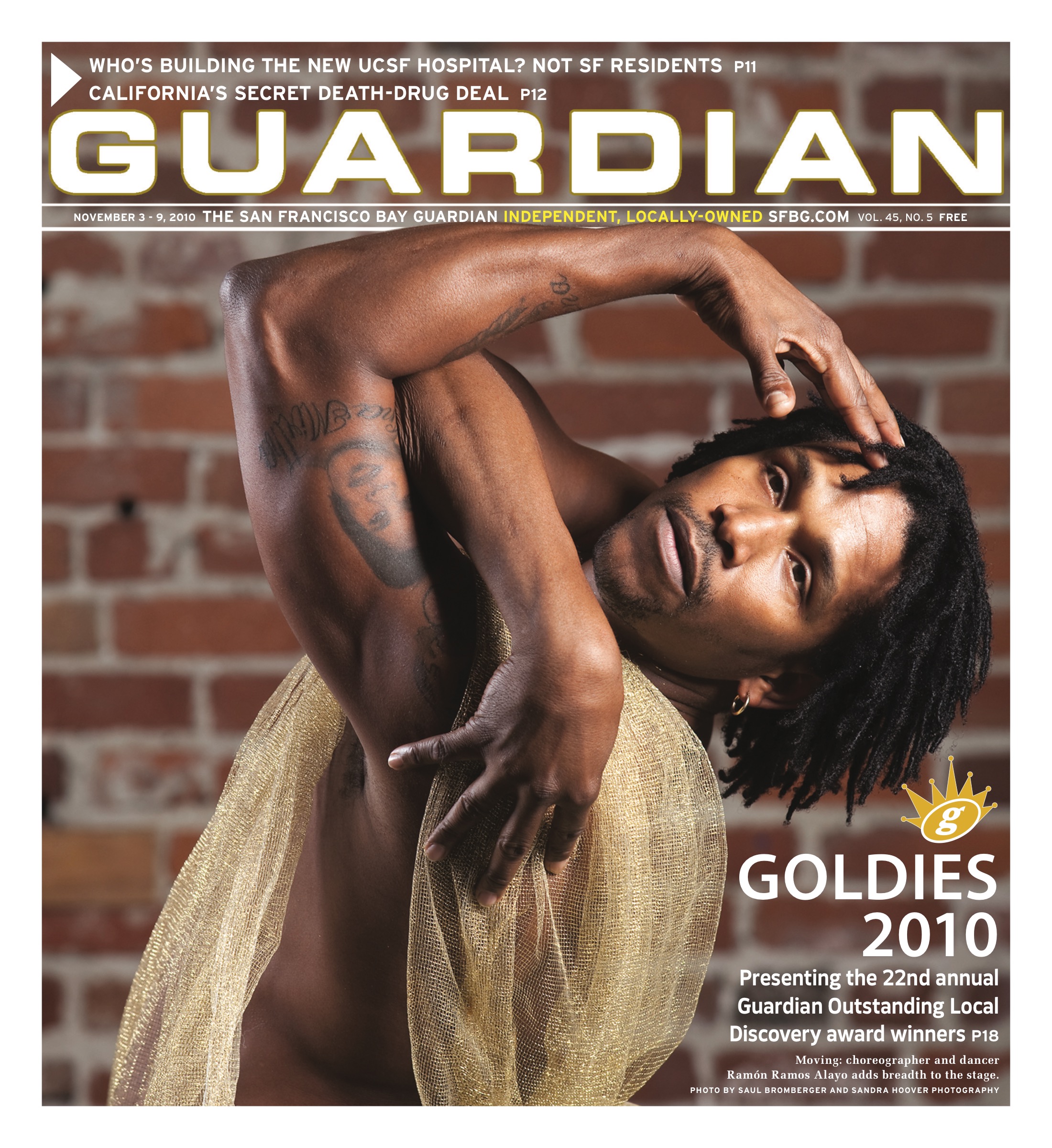
You dog-eared the pages of last week’s Guardian, reading about the Guardian Outstanding Local Discovery award winners. Tonight, head to 111 Minna to congratulate the artists in person — and to rock out at the free, open-to-the-public after party. Taking the stage: Oakland “slop-pop” rockers Bare Wires, SF popsters Brilliant Colors, dark post-punker Soft Moon (a.k.a. Luis Vasquez), pop sensation Myles Cooper (of “Gonna Find Boyfriends Today” fame) with club sensation Alexis Penney, and DJs Naoki Onodera and Primo Pitino. Don’t miss what’s sure to be a mother lode (yep, shameless gold joke) of a party! (Cheryl Eddy)

9 p.m., free

111 Minna Gallery

111 Minna, SF

www.sfbg.com/2010/11/03/goldies-2010


THEATER

Or,

Aphra Behn was a woman ahead of her time. A 17th century spy and the first professional female playwright, Aphra Behn is the topic of Liz Duffy Adams’ new play Or, at Magic Theatre. Full of sensationalism, sex, art, politics, and laughs, this comedy hosts a variety of eccentric characters including double agent William Scot, actress Nell Gwynne, and even King Charles II himself. Adams received the fifth Lillian Hellman Award for Playwrighting for Or, at the 2010 Lilly Awards; the play promises a dose of English history and a chance to chuckle the night away. (Emmaly Wiederholt)

Through Dec. 5

Wed.–Sat., 8 p.m. (also Sat, 2:30 p.m.);

Sun, 2:30 p.m.; Tues, 7 p.m., $45–$60

Magic Theatre

Fort Mason Center, Building D, Third Floor, SF

(415) 441-8822

www.magictheatre.org


THURSDAY 11

DANCE

Ampey!

In 2008, Adia Tamar Whitaker took a trip to Africa, where she encountered ampey, a Ghanian children’s dance for which you need to be on your toes in more ways than one. It became the inspiration for Ampey!, in which she explores complexities surrounding identity, family, and home. For Whitaker, that “return” trip had been become a voyage of discovery — though not in the way she anticipated. Presented as a work in progress last year, one could sense Ampey!’s artistic potential; it already included a powerful percussive “sitting dance.” Perhaps the best aspect of the two-year Performing Diaspora Project is its offer to artists like Whitaker to keep working on what needs to be done. (Rita Felciano)

Through Nov. 21

Thurs/11–Sun/14 and Nov. 18–20, 8 p.m.;

Nov. 21, 3 p.m., $19–$24

Counterpulse

1310 Mission, SF

1-800-838-3006

www.counterpulse.org


MUSIC

Ghostface Killah

No one has your back like Iron Man. Pretty Toney was the original link that brought the whole Wu-Tang together. Always willing to lend a devastatingly together verse to just about anybody’s single (MSTRKRFT, Prefuse 73, DANGERDOOM, etc), Starky still has found time to release classic after classic album. On his latest, Ghostdini: Wizard of Poetry in Emerald City, the Wallabee Kingpin went the extra mile, dispensing priceless relationship advice via a series of YouTube videos. Isn’t it about time you gave Ghostface Killah a little something back in return? (Ryan Prendiville)

With Sheek Louch and Music by Frank Dukes

9 p.m. $22

Slim’s

333 11th St., SF

(415) 255-0333

www.slims-sf.com


MUSIC

Masaki Batoh

Incorporating elements of Krautrock, folk, free jazz, and all manner of indigenous instrumentation, enigmatic Japanese psych collective Ghost are the heirs to such earlier cosmic emissaries as fellow countrymen the Taj Mahal Travelers. Founder and core player Masaki Batoh takes a similarly eclectic approach in his non-Ghost releases, whether turning out a chugging acoustic cover of Can’s “Yoo Doo Right” or mournful dirges, as on his recent collaborative albums with Espers’ Helena Espvall. Tonight’s rare solo set, with Batoh alternating between guitar and banjo and a table full of electronics, should prove no different. (Matt Sussman)

With Young Elders

10 p.m., $10

Vortex Room

1082 Howard, SF

www.myspace.com/thevortexroom

Also Fri/12

With Sic Alps

10 p.m., $5

Ghost Town Gallery

2519 San Pablo, Oakl.

www.myspace.com/ghosttowngallery


DANCE

Sankai Juku

Butoh is perhaps one of the most enigmatic dance forms. Emerging in the late 1950s in opposition to the Westernization of Japan, butoh often explores the more grotesque side of human nature. Unlike other dance forms with a syllabus of movements, butoh may be completely conceptual, hyper-slow, playful, scary, or none of the above. It defies definition. Audiences can begin to wrap their minds around butoh as Sankai Juku, the legendary Japanese butoh company, tours to San Francisco to present Hibiki: Resonance from Far Away, a piece said to plumb poetic beauty. Meditative and hypnotic in its simplicity, this award-winning work is a signature of butoh. (Wiederholt)

Thurs/11–Sat/13, 8 p.m.;

Sun/14, 2 p.m., $35–$60

Yerba Buena Center for the Arts

Novellus Theater

700 Howard, SF

(415) 978-2787

www.ybca.org


FRIDAY 12

MUSIC

Lindstrøm

Known to much prefer holing up in the studio in his home base of Oslo, Norway, than performing live, this is a rare opportunity to catch a set from one of the more interesting electronic music producers around. Lindstrøm first made a name for himself as a remix artist, reworking tracks from the likes of LCD Soundsystem, Roxy Music, Franz Ferdinand, and the Boredoms. His solo albums are full of frosty disco beats, heavy synthesizers, classic funk influences and enough of an adventurous streak to appeal to more than just the dance floor crowd. (Landon Moblad)

With Marbeya and Publicist

9 p.m., $15

Mezzanine

444 Jessie, SF

(415) 625-8880

www.mezzaninesf.com


DANCE

“Manifestival: Like Oil and Water: From Gaza to the Gulf”

Lots of Bay Area artists know that the world is a village, all politics are local, and that it’s probably not a good idea to ignore an problem until it burns your face. Socially committed dance is a large part of what we see on our stages. Artists are the antennas of the race and following them is fun as well as instructive. This year’s Manifestival theme of “Like Oil and Water: From Gaza to the Gulf” should provide more than enough inspiration for the two different programs. Onstage the first weekend are Jessica Damon, Jose Navarrete, Michael Velez, Nicole Klaymoon, Sri Susilowati, Naked Empire Buffoon, Stella Adelman, and Youth Speaks. (Felciano)

Through Nov. 20

Fri.–Sat., 8 p.m., $22

Dance Mission Theater

3316 24th St. SF

(415) 273-4633

www.brownpapertickets.com


VISUAL ART

“A Journeyman’s Papers”

Rare is the gallery show at which the owner of said gallery steps out from the wings and shows his or her own work. Risks! No one wants to be seen as the next megalomaniac Thomas Kincaid, drunkenly careening into the heavily curtained schlock-nests of Midwestern housewives, right? No fear of that kind of showboating here. Rob Delamater, co-owner of dapper cognoscenti-magnet Lost Art Salon, creates voluptuously genteel, generous-spirited pieces that fit right in with his gallery’s excellent collection of rare vintage modern works. Block-printed portraits of the wanton Bloomsbury group, evocative and crepuscular figure studies, and, perhaps most intriguing, softly primitive compositions evoking the California coastline painted on vintage book covers are the gorgeous, midcentury-type whistle stops on Delamater’s artistic journey. Doff your fedora, shed your silk shift, and have a lovely look. (Marke B.)

Through Jan. 31, 2011

5:30–8:30 p.m., free

Lost Art Salon

245 S. Van Ness, Suite 203, SF

(415) 861-1530

www.lostartsalon.com


SATURDAY 13

MUSIC

Dãm-Funk

George Clinton and Parliament Funkadelic are going to be at Yoshi’s next week. That’s cool. But instead of waiting to enjoy what’s sure to be a great reminiscing on where funk’s been, why not check where it’s going? Dãm-Funk (pronounced “Dame Funk”) lays down a DJ set at Som Bar. A DIY DJ, producer, and recording artist, Dãm-Funk uses the same playbook as Ariel Pink, digging deep into genres and musical styles that were left by the wayside to create distinct sounds. While I can’t guarantee that he’ll break out the Animal Collective (so many records to choose from), word is that he’ll bust out the keytar. (Prendiville)

With King Most, Jacob Pena, and Freddy Anzures

9 p.m., $10

Som.

2925 16th St., SF

www.som-bar.com


EVENT

“Frogs in the Fog”

Wow, I just found the frikkin’ treasure trove! Not even my ecology-expert friends knew that the San Francisco Naturalist Society has the most kickass events calendar (www.sfns.org/events) — one that’s updated daily, to (hiking) boot. Probably the coolest-sounding upcoming event is led by “Mr. Science,” a.k.a. Chris Giorni, founder of Tree Frog Treks, and starts with checking out his extensive stash of amphibians and reptiles. After bonding with uncharacteristic mini-fauna, grab a slice of pizza to sustain your explorer spirit onward toward the hidden ponds, sacred groves, and endless discoveries of western Golden Gate Park. While the Treks’ mission is to make science fun for the kiddos, this adventure is open to all. (Kat Renz)

4 p.m.–6:15 p.m., $15–$50 (sliding scale)

Tree Frog Treks’ Frog Hall

2114 Hayes, SF

(415) 564-4107

www.baynature.org


SUNDAY 14

MUSIC

Nile

Specializing in impossibly fast blast beats and meticulously researched Egyptological lyrics, Nile has carved out a niche as one of the scene’s most revered death metal acts. The South Carolina quartet hews closely to the genre’s traditions, playing intricate, epic compositions that lean heavily on tremolo picking and sheer speed. Replicating such extreme chops live is no mean feat, but previous appearances by the band have been flawless and incendiary, particularly when they launch into epic closer “Unas Slayer of the Gods.” Whether you’re there for the tales of bloodthirsty pharaohs or just excited to bask in the copious beats-per-minute, Nile will take no prisoners. (Ben Richardson)

With Ex Deo, Psycroptic, Keep of Kalessin

7:30 p.m., $30

Slim’s

333 11th St., SF

(415) 255-0333

www.slims-sf.com


MONDAY 15

MUSIC

Thermals

For punk-tinged indie rockers Thermals, consistency is the name of the game. Never straying too far from its bare-bones, guitar, bass, and drums format, the Portland, Ore.-based band has now released five albums of punchy Buzzcocks-esque rock ‘n’ roll. Its newest, Personal Life, was produced by Death Cab for Cutie’s Chris Walla and includes a nice mix of slower, more drawn-out tracks and infectious, pound-on-your-steering-wheel bursts of adrenaline, such as lead single “I Don’t Believe You.” (Moblad)

With Night Marchers and White Fang

8 p.m., $16

Independent

628 Divisadero, SF

(415) 771-1421

www.theindependentsf.com 


The Guardian listings deadline is two weeks prior to our Wednesday publication date. To submit an item for consideration, please include the title of the event, a brief description of the event, date and time, venue name, street address (listing cross streets only isn’t sufficient), city, telephone number readers can call for more information, telephone number for media, and admission costs. Send information to Listings, the Guardian Building, 135 Mississippi St., SF, CA 94107; fax to (415) 487-2506; or e-mail (paste press release into e-mail body — no text attachments, please) to listings@sfbg.com. We cannot guarantee the return of photos, but enclosing an SASE helps. Digital photos may be submitted in jpeg format; the image must be at least 240 dpi and four inches by six inches in size. We regret we cannot accept listings over the phone.

On the Cheap Listings

0

Events listings are compiled by Caitlin Donohue. Submit items for the listings at listings@sfbg.com. For further information on how to submit items for the listings, see Weekly Picks.

WEDNESDAY 10

Holiday Ice Rink in Union Square Union Square, SF. Sun-Thu 10am-10pm. Fri and Sat 10am-11:30pm. Runs through January 17. $4.50 for kids and $9 for adults before 6pm; $5 for kids, $9.50 for adults after. It’s time to glide into the holidays (or bruise your bottom) as this annual tradition opens for all comers on two blades. E may not have snow, but we’ll sure as heck have Celine Dion belting through the speakers at young couples.

How to Do Physics Experiments at Home Bazaar Café, 5927 California, SF. (415) 831-5620, www.julianagallin.com/howto. 7pm, free. Learn how to melt glass in your microwave, make your own speaker, speed up time (or at least your watch) – Maker Faire favorite Zeke Crossover of Physics Circus teaches you some snazzy physics tricks at the invaluable monthly How To series at Bazaar cafe.


THURSDAY 11

SF Etsy Team Show Shawna Stoney, 390 Kansas, SF. (415) 863-9700, www.shawnastoney.com. Noon-6pm, free. Kickstart your holiday shopping (or just pick up some ideas for the future) as Esty.com’s San Franciscan craftspeople band together to present an “Everything Handmade Show.” Cute and ingenious goodies galore – all locally made and often one-of-a-kind.

BAY AREA

Censored 2011 Revolution Books, 2425 Channing Way, Berk. (510) 848-1196, www.revolutionbooks.org. 7pm, free. From “Capitalist Forces Reaking Havoc in Africa” and “Internet Privacy and Personal Access at Risk” to “Global Plans to Replace the Dollar” and “US Funds and Supports the Taliban,” Project Censored has exposed the major stories reported about least in the mainstream media – in one handy annual compendium. Censored 2011 coauthors Mickey Huff and Peter Phillips discuss 20 of the big stories you might have missed, and how they affect us all.


FRIDAY 12

Big Things Grand Opening Kitsch gallery, 3265 17th St., SF; www.bigbigbigthings.com. 6pm, free. Big Things, a new local website dedicated to art, fashion, design, travel, people, “and other inspirational things” is launching, officially, with this giant shindig. Featuring drawings, paintings, video, sculpture and installations by a bevy of artists, music by kids from the the SF Rock Project and DJs April Knows Best and Ben Bracken. Plus, colorful objects to take home!


SATURDAY 13

“A Community Writing Itself” Book Launch Meridian Gallery, 535 Powell, SF. (415) 398-7229, www.acommunitywritingitself.com. 7:30pm, $10 (no one turned away for lack of funds). Local author and poet Sarah Rosenthal has compiled a book of her many fruitful and titillating conversations with Bay Area vanguard writers and experimentalists. This launch party will include poetry readings and Q&As with Truong Tranm Juliana Spahr, Stephen Ratcliffe, and Elizabeth Robinson.

“The Nutrition Perscription” Institute on Aging, 3600 Geary, SF; (415) 273-5481, www.sfvs.org. 8pm, free. The San Francisco Vegetarian Society invites Dr. Donald Forrester to speak about diet and its relationship to the major degenerative diseases plaguing Americans today. (Hint: drop that French fry!) Dr. Forrester has a background in both family practice medicine and chemical engineering, and has more than 30 years experience in the field.

Writers with Drinks Make-Out Room, 3225 22nd St., SF. www.makeoutroom.com; www.writerswithdrinks.com. 7:30pm-9:30pm, $5-$10 sliding scale. This monthly literary hoot continues to augment the heady with the fizzy. This time around, Richard Kadrey, Debbie Stoller, Deb Campo, Larry-Bob Roberts, and Indigo Moor take the stage and freshen your wordy cocktail.


MONDAY 15

Long Now: Rachel Sussman presents “The World’s Oldest Living Organisms” Cowell Theater, Fort Mason Center, Pier 2, SF; www.longnow.org; www.fortmason.org. 7 p.m., $10. long Now, the organizazion dedicated to slower living, presents a lecture and showing of Rachel Sussman’s photographs of some of the world’s longest-living beings, including 400,000-year-old Siberian bacteria.

TUESDAY 16

Mommy’s Playdate Good Vibrations Polk Gallery, 1620 Polk, SF; (415) 345-0400, www.goodvibessexymama.com. 7pm-9pm, free. Attend this afterhours mixer with like-minded moms who want to learn how to put some spice back into their sex lives. Enjoy a “Mommi-tini,” learn tips from Good Vibes sexologist Dr. Carol Queen, meet mommy writer Billee Sharp, quick-witted author of Fix It, Make It, Grow It, Bake It: The D.I.Y. Guide to the Good Life.

The designer as performer

0

MUSIC/VISUAL ART It’s late at night, and I’m sitting at my laptop transcribing an interview with visual designer Adam Guzman, when I notice the graphics on my screen, twitching along dully to the sound of our recorded conversation. A fuchsia tube made out of small crosses rises up against a black background, something between a digitized sand worm and a Slinky, and opens its yellow maw in a pointless sort of way that’s familiar to anyone who uses Windows Media Player. All I can think of is how much Guzman must hate these visualizations.

Guzman, you see, is one-half of Fair Enough, a design partnership with Julia Tsao. In the last year they’ve been working in creating concert visuals for musicians. But these aren’t your typical, canned images projected near the stage; stock footage and trippy clip art looped or automated to roughly coincide with the beat. “We wanted to do the opposite,” Guzman says during our phone interview. “We both hated that. You go to a concert and someone is playing, and the visuals have nothing to do with what [the sound] on stage. They’re just found clips of stuff. This doesn’t make sense, and I was sort of tired of that. We wanted to make simple things that were synced to [the music] and do it in a different way.”

The Fair Enough project started when Guzman was studying at Art Center College of Design in Pasadena. Through Tsao, Guzman was introduced to Jason Chung, who records and performs under the name Nosaj Thing. “I actually lived with him for a little bit,” Guzman says. “He got to talking, and he was really into doing a synchronized show inspired by [shows by the Japanese rock innovator] Cornelius. At the same time, I was starting my thesis and I was really into doing projects with music and sound experiments. It just made sense to do a project with him, and it turned into this thing that consumed me for a year.”

A great deal of Guzman’s process for the project is documented on his thesis blog, aleome.tumblr.com. But it began the way it does usually for him, with exploration. “When I started, I didn’t really know what direction it was going to go in,” he says. “I started drawing and shooting video, trying to edit it together, playing with MIDI controllers and stuff like that. I tried programming too, but wasn’t really into that. Julie had been gone, and when she came back, everything just sort of clicked and we decided to do something really simple. You know, embrace our constraints. Because I’m not a pro at animation or programming or anything. Neither is she. We just wanted to use that as a design tool.”

The final product is a stunning presentation, blanketing Nosaj Thing, his DJ booth, and the music under a series of graphic banners. Whereas typical concert visuals bombard your corneas with collages of disparate elements, each image of Fair Enough’s presentation is simplified down to an aesthetic essence. The displays range from organic suggestions with flowing blobs and swarming fireflies to geometric patterns shuttering crosses and a succession of colors. But each stands out on its own.

“We modeled the show after Jason’s set,” Guzman explains. “It made sense, because for his songs there’s pieces, and he calls them up when he’s performing. A bassline, or a synth, the drums, parts of the song. We thought it would be cool to do the same thing with the visuals and have parts of songs that we could call up as well. I was into the idea of the designer as performer, and what that [might] mean. I developed what the show is today from that. It’s the same. We have two MIDI controllers, and for each song there will be anything from three to seven clips that go with different parts, and we’re mixing and calling them up live.”

Guzman goes back repeatedly to the idea of the designer as performer. It was the subject of his thesis, Sound and Vision. Interested in musical artists who have pushed visual performances to the forefront — Daft Punk, Kanye West, U2, and especially the Talking Heads and Jonathan Demme’s 1984 concert film Stop Making Sense — he initiated the project as a way of exploring how sound influences visuals and how visuals create music. As David Byrne puts it: “Music is physical. The body understands it before the mind.” What Guzman and Tsao have created is a musical appeal to the sense of sight.

For Nosaj Thing’s November tour, they’re essentially members of the band, rehearsing, traveling on the bus with the other acts — Toro y Moi (who they also designed visuals for) and Jogger — and performing live at the shows.

Did Guzman see this happening when he was studying design? “I always knew I wanted to do something like this,” he says. “I didn’t envision this, though. I’m really excited about what’s happening.”

If Guzman wanted to explore the relationship between design as performance, he has done so — by becoming a performer. *

NOSAJ THING

With Toro Y Moi and Jogger

Fri/12, 9 p.m., $15–$18

Rickshaw Stop

155 Fell, SF

www.rickshawstop.com

www.fair–enough.com

How to fight the GOP

0

OPINION Now what?

Now we need to build a grassroots progressive movement — wide, deep, and strong enough to fight the right and challenge the corporate center of the Democratic Party.

The stakes are too high and crises too extreme to accept “moderate” accommodation to unending war, regressive taxation, massive unemployment, routine foreclosures, and environmental destruction.

A common formula to avoid is what the Rev. Martin Luther King Jr. called “the paralysis of analysis.” Profuse theory + scant practice = immobilization.

It’s not enough to denounce what’s wrong or to share visionary blueprints. Day in and out, we’ve got to organize for effective and drastic social change, in all walks of life and with a vast array of activism.

Yes, electioneering is just one kind of vital political activity. But government power is extremely important. By now we should have learned too much to succumb to the despairing claim that elections aren’t worth the bother.

Such a claim is false. For instance, consider the many hundreds of on-the-ground volunteers who rejected the paralysis of analysis by walking precincts and making phone calls to help reelect progressive Rep. Raul Grijalva (D-Arizona). Grijalva won a tight race in the state’s southwestern district and will return to Congress next year — much to the disappointment of the corporate flacks and xenophobes who tried to defeat him because of his strong stance against the state’s new racial-profiling immigration law.

The mass-media echo chamber now insists that Republicans have triumphed because President Obama was guilty of overreach. But since its first days, the administration has undermined itself — and the country — with tragic under-reach.

It’s all about priorities. The Obama presidency has given low priority to reducing unemployment, stopping home foreclosures, or following through with lofty pledges to make sure that Main Street recovers along with Wall Street.

Far from constraining the power of the Republican Party, the administration’s approach has fundamentally empowered it. The ostensibly shrewd political strategists in the White House have provided explosive fuel for right-wing “populism” while doing their best to tamp down progressive populism. Tweaks aside, the Obama presidency has aligned itself with the status quo — a formula for further social disintegration and political catastrophe.

The election of 2010 is now grim history. It’s time for progressives to go back to the grassroots and organize with renewed, deepened commitment to changing the direction of this country. If we believe that state power is crucial — and if we believe in government of, by, and for the people — it’s not too soon to begin planning and working for change that can make progressive victories possible in future elections. 

Norman Solomon is co-chair of the Healthcare Not Warfare campaign, launched by Progressive Democrats of America. His books include War Made Easy: How Presidents and Pundits Keep Spinning Us To Death.

Prison for killer cop

0

rebeccab@sfbg.com

On Nov. 5, former BART Police officer Johannes Mehserle was sentenced to two years in state prison for fatally shooting Oscar Grant, a 22-year-old African American rider, on the Fruitvale train platform on New Year’s Day 2009.

Mehserle, who is white, was convicted of involuntary manslaughter in July in an incident that has become charged with racial undertones. He received credit for 292 days served in jail so far, which will considerably reduce his time in prison. It was the lightest prison sentence he could have received for the crime.

Grant supporters gathered in Frank Ogawa Plaza in downtown Oakland to express anger and sorrow upon hearing news of the sentence. “I’m not shocked,” said Cat Brooks, who helped organize an afternoon rally for the Coalition for Justice for Oscar Grant. “But I’m disgusted and distraught. It seems like the justice system didn’t work.”

After the rally came to a close and night fell, protesters spilled into the streets and marched toward the Fruitvale BART Station, the scene of the crime. But after a dozen car windows were smashed along the way, police officers in riot gear corralled the group into a residential neighborhood. Police then placed 152 protesters under mass arrest, mostly on charges of unlawful assembly. Roughly two-thirds of those arrested were Oakland residents, according to the Oakland Police Department, while others were from Berkeley, San Francisco, Hayward, and other local cities.


COMMUNITY RESPONDS

A stage outside Oakland City Hall was transformed into a venue for personal expression in the wake of the sentencing. Community members lined up to air their frustrations and resolve to keep fighting. They piled flowers onto a shrine that had been created with a picture of Grant’s face. Some painted pictures, while others gave spoken word or hip-hop performances. Several told stories of loved ones who’d died in police shootings.

Cephus Johnson, Grant’s uncle, was at the Los Angeles courtroom where Mehserle was sentenced, but shared some thoughts with the Guardian beforehand. Asked what he’d thought when the verdict had been announced, Johnson said, “My first thought was that we’re witnessing the criminal justice system failing to work as it should have worked.” If the sentence fell short of the 14-year maximum, he said, “it will be another slap in the face, signifying that black and brown men are worthless.”

East Bay labor organizer Charles Dubois was among those attending the Nov. 5 rally. “Every black parent, every brown parent, lives with this nightmare of their children being killed by some cops because they thought they had a gun,” Dubois said in an interview with the Guardian. “It’s been happening since I was a kid. It’s been happening then and it’s happening now, and it’s going to keep happening until we do something.”

California Assemblymember Tom Ammiano (D-SF) also weighed in during a phone call with the Guardian. “This verdict is outrageous,” he said. “It’s Dan White all over again.”


JUDGE DROPS GUN ENHANCEMENT

Judge Robert Perry sided with arguments presented by Mehserle’s defense attorney, Michael Rains, when he levied a reduced punishment. Mehserle could have served up to 14 years prison for involuntary manslaughter committed while wielding a gun, but Perry tossed out the firearm enhancement.

“No reasonable trier of fact could have concluded that Mehserle intentionally fired his gun,” the judge was quoted in media reports as saying. But that appears to be what the jury found, as the prosecution argued in a presentencing memorandum.

“The evidence was presented regarding the use of the gun, and in discussing the use of the gun in the jury room, somehow or another the jury decided he had used the gun illegally,” criminal defense attorney and National Lawyers Guild observer Walter Riley told the Guardian. “One has to believe the jury expected him to have exposure to a greater amount of jail time because of that.”

Perry said he believed Mehserle suffered a “muscle memory accident” that led him to draw and fire his service weapon instead of his Taser, a cornerstone of the defense’s case.

Rains wrote to the court prior to sentencing that jurors should never have been allowed to apply the firearm enhancement to an involuntary manslaughter conviction “because in this case, there is no logical way to square a verdict of involuntary manslaughter and a finding that Mehserle intended to use his gun.”

Prosecutor David Stein of the Alameda County District Attorney’s Office countered that the jury’s conviction showed they believed Mehserle intended to shoot, but not to kill, Grant. Yet Perry agreed with the defense, conceding he had mistakenly permitted the jury to enhance Mehserle’s sentence.

Riley said he sympathized with frustrations over the gun enhancement getting dismissed. “The use of guns is too prevalent in circumstances where law enforcement comes in contact with young black people,” he said. “Our society — our civil society, our judicial authority, and our communities — have to hold government and law enforcement officers to a higher level of accountability in their interactions with citizens. When people with guns shoot an inordinate number of people of one group, it’s worth tremendous scrutiny.”


ANOTHER NIGHT IN JAIL

Twice before, activists took to the streets in furious protest over this case. In January 2009, things escalated to the point where cars were set ablaze. In July 2010, a street rally gave way to rioting and looting. So on Nov. 5, many downtown Oakland storeowners boarded up and closed business early in anticipation of a third wave of vandalism.

Yet the turnout was smaller than the previous events. And while there were reports of smashed car windshields and other instances of vandalism along the circuitous path of the march, there was far less property destruction.

The community affair outside Oakland City Hall ended around 6 p.m., when the permit expired. Soon after, activists spilled into the intersection of 14th and Broadway streets, then began advancing down 14th Street chanting “No Justice! No Peace!” and “The whole system is guilty!” The march turned right onto Madison Street, then left onto 10th Street.

A police helicopter with a spotlight kept pace overhead while it progressed, and when protesters reached Laney College, police officers in riot gear blocked them in. So protesters cut through a park and wandered in a pack until they reached the intersection of East 18th Street and Sixth Avenue in a residential neighborhood. Once again, police surrounded the protesters. This time, the crowd was trapped.

Rachel Jackson, an activist who was barricaded in, began sounding off. “We were going to Fruitvale,” she explained. “We wanted to go to the scene of the crime. All night the police have been trying to suppress our free speech.” When a nearby TV news reporter asked her about windows that had been busted along the march, she was incensed. “We will not equate glass with Oscar Grant’s life!” she responded. “If we have to come out ourselves and board up windows, we’ll do that. But what we are concerned with right now is murder.”

Reporters were allowed to exit the confined area, but if anyone else had been inclined to leave peacefully, they were unable to. Police issued a call on a megaphone telling activists, “You are all under arrest. Do not resist arrest.” By the time the mass arrest was underway, public information officer Jeff Thomason told a group of reporters that there were more police officers on the scene than protesters.

“When the rocks were being thrown, it was declared an unlawful assembly,” Thomason explained. He said a dispersal order had been issued simultaneously. Yet it would have been impossible for the trapped crowd to comply with such an order.

Meanwhile, a resident of the Oakland neighborhood who had come outside when the commotion began told the Guardian that she sympathized with the protesters. “The only thing I don’t condone is the vandalism,” said Dyshia Harvey, who surveyed the scene from behind a fence with her six-year-old son.

Harvey had been anticipating word of Mehserle’s sentencing. “I was upset. I was frustrated, angry, and hurt” by the outcome, she said. But she wasn’t surprised. “I already knew we weren’t going to get no justice,” she said. “For taking a life, 14 years isn’t enough. It makes you feel like there’s no justice in the justice system.”


NOT OVER YET

Alameda County District Attorney Nancy O’Malley has not stated whether her office will appeal Perry’s ruling. Rains told reporters in L.A. that he would appeal Mehserle’s involuntary manslaughter conviction.

Meanwhile, the Civil Rights Division of the U.S. Department of Justice released a statement indicating that a federal investigation is in the works. “The Justice Department and the U.S. Attorney’s Office for the Northern District of California have been closely monitoring the local prosecution of this case,” a USDOJ prepared statement notes. “Now that the state prosecution has concluded and consistent with department policy, we will thoroughly review the prosecution and its underlying investigation to determine whether further action is appropriate.”

BART settled a civil lawsuit filed on behalf of Grant’s daughter in January that is likely to total $5.1 million, according to civil rights attorney John Burris’ website. Two other lawsuits, one on behalf of Grant’s mother and one on behalf of five other men on the Fruitvale station platform that night, have been consolidated into a single trial that will begin in May 2011, Burris told the Guardian.

Meanwhile, Grant’s death marked just one of three police shootings that occurred Jan. 1, 2009 — the other two cases also sparked allegations of civil-rights violations, since both victims were African American men. Adolph Grimes, 22, was fatally shot 14 times, including 12 times in the back, by a group of New Orleans police officers, who erroneously believed he was a suspect who’d fled the scene of a shooting.

The same night, Robert Tolan, 23 — the son of a Major League Baseball player — was shot and seriously injured outside his home in an upscale Houston suburb by a police officer who mistakenly believed Tolan had stolen the vehicle he was driving. Sgt. Jeffrey Cotton, the white officer who shot him, was ultimately acquitted.


CREATIVE OUTLET

Not everyone in Oakland reacted to Mehserle’s sentence by charging through the streets. The Oscar Grant Foundation, which facilitated live art performances at Frank Ogawa Plaza Nov. 5, is calling for youth groups, Bay Area schools, and adults to participate in an art and poetry showcase inspired by Grant. Information can be found online at IamOscarGrant.org. The foundation is advertising a $1,000 grand prize. Three artists from the Trust Your Struggle Collective didn’t wait to join a contest, however, and spent the afternoon of Nov. 5 adorning plywood covering the Youth Radio building windows at 17th Street and Telegraph Avenue, a few blocks from Frank Ogawa Plaza.

The mural displayed a prominent image of Grant holding his daughter, Tatiana, who was four years old when Grant was killed. The pair are flanked by the names and figures of more than 20 people killed by police.

“We asked the youth inside what they wanted to see,” Miguel Perez, an artist with the Trust Your Struggle Collective, told the Guardian as he looked over the mural. “They said they wanted to see the names of people killed by police nationwide, not just in the Bay Area. The list is so huge, it’s hard to pick out specific names.”

Perez said Trust Your Struggle is a group of artists and educators with social-justice backgrounds who create art as activism. “Being a person of color, I’ve had racist stuff said to me by the police,” Perez said. “It seems like it’s slowly been changing for the past hundreds of years, but it’s still not enough — enough being fairness.” *

Editor’s Notes

0

tredmond@sfbg.com

Way back in 1986, Tom Hsieh Sr., an architect and one of the most conservative members of the Board of Supervisors, called his colleague Harry Britt — by all accounts the most liberal supervisor — and asked for a meeting. The way both men described it to me at the time, Britt was a little mystified; why would someone who was on the opposite end of the political spectrum want to be pals?

Well, it turned out that Hsieh had a message for his colleague. "Someday," Hsieh told Britt, "the gays and the Asians will be running this town, and we might as well get along."

It’s taken a while, but Hsieh (whose son is a moderate-to-conservative political consultant and activist) was prophetic. One of the little-noticed facts about this supervisorial election is that the majority of the members of the next Board of Supervisors will be either Asian or gay. And the odds are pretty good that the person in the Mayor’s Office in 2012 will be Asian (David Chiu, Leland Yee, Phil Ting) or gay (Tom Ammiano, David Campos, Mark Leno).

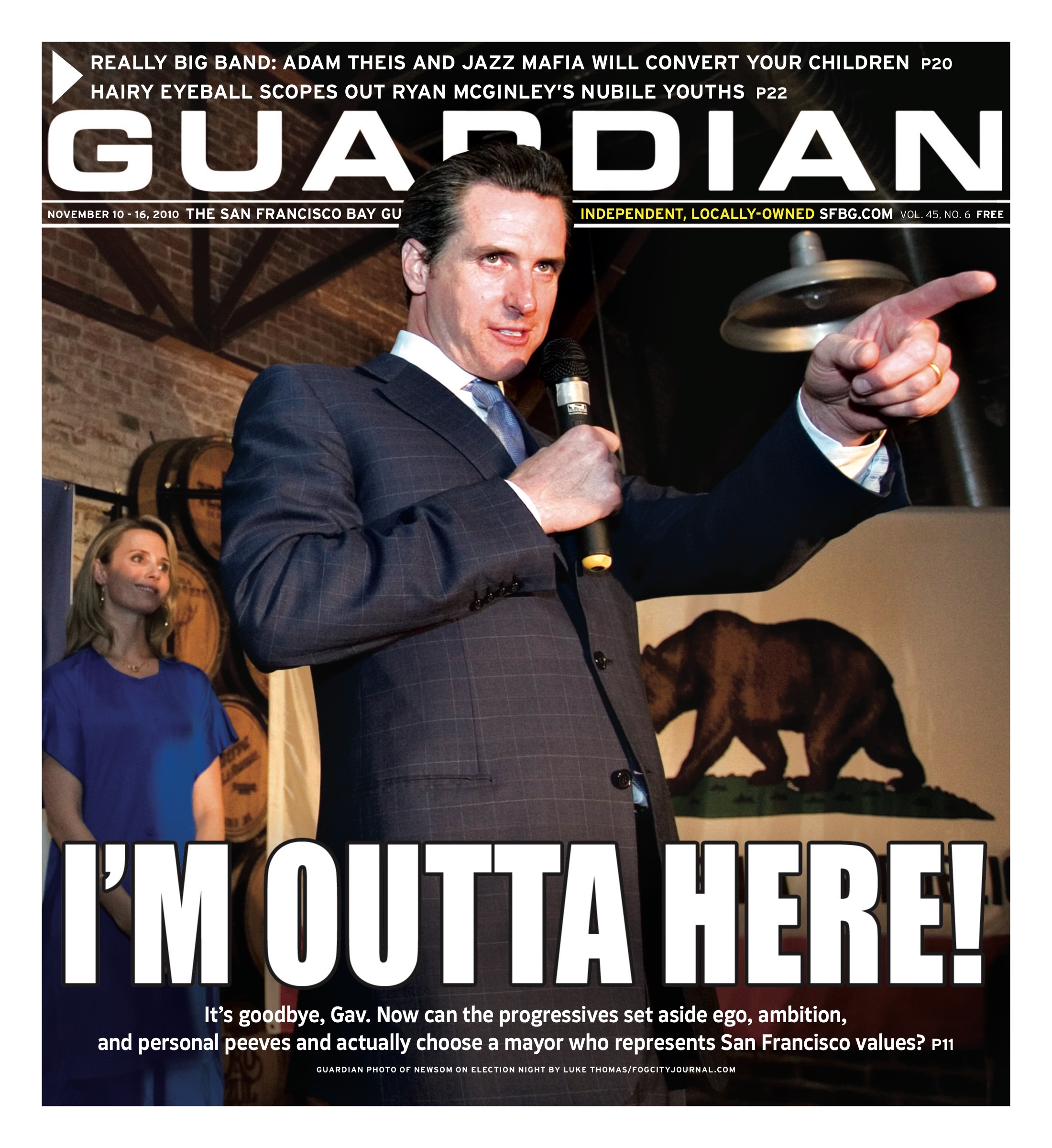
I mention that bit of interesting history as a sort of a prelude to the fascinating historic challenge facing progressives in San Francisco today. At a time when the rest of the country seems to be drifting (at least for the moment) to the right, San Francisco has a chance to go to the left. There hasn’t been a mayor the progressives supported in this town in at least 20 years (and that’s if you count Art Agnos, which is a bit of a stretch). With Gavin Newsom (will he be San Francisco’s last straight white mayor?) leaving early in his term, the supervisors could profoundly change the direction of the city.

And they could also duck, punt, or make a terrible mistake.

If the board wants to appoint someone who’s going to promote a progressive agenda, that person not only needs to be able to get six votes in January, but hold on to the seat until November — when the competition will be intense. And any progressive mayor will be vilified by the local daily papers, mocked by the national media, and held to an almost impossible standard by his or her constituents.

You wonder why anyone would want the job.

But taking on that insane challenge is also about history, and about proving that this city is (still) different. And the person in the job is going to need a whole lot of help and support. I have to believe that we’re up to it.

Alerts

0

alert@sfbg.com

WEDNESDAY, NOV. 10


Protest a Mexican dam

Help keep a village in Mexico from being flooded. Come to the Mexican Consulate to protest construction of the El Zapotillo Dam, which would submerge the town of Temacapulín, Jalisco, and provide water to a neighboring state that already loses 40 percent of its water supply in transmission. Join families of Temacapulín in a musical and peaceful protest to stop the dam.

12 p.m.–1p.m., free

Mexican Consulate

532 Folsom, SF

www.internationalrivers.org/node/5908

THURSDAY, NOV. 11


SF Public Press party

Join the nonprofit SF Public Press for drinks and appetizers, pick up a free copy of its latest newspaper, and meet the people who pull it all together.

5:30 p.m., $20 general admission

The Mechanics’ Institute

57 Post, SF

www.sfpublicpress.org


Watch The Big One

Michael Moore’s hilarious cross-country road movie plumbs the depths of corporate America, asking the question: at a time when corporations are posting record profits, why are so many Americans still in danger of losing their jobs? Moore embarks on a one-man campaign to persuade Fortune 500 companies to reconsider their downsizing decisions.

7:30 p.m., $5 donation

Humanity Hall, 390

27th St., Oakl.

www.humanisthall.net/wp/2010/10/17/film-the-big-one-2/


Rally Against KPFA’s cuts

Union workers at America’s first listener-sponsored radio station, KPFA 94.1 FM, have mobilized to oppose imminent cuts to KPFA staffing by their parent organization, the Pacifica Foundation. The Morning Show, Against the Grain, Hard Knock Radio, and KPFA Evening News all appear slated for severe program changes and/or decimating cuts.

4:30–6:30a.m., free

1925-29 Martin Luther King Jr. Way, Berk.

www.kpfaworker.org

SATURDAY, NOV. 13


Indybay’s 10th Anniversary Celebration

Indybay, a hub for independent progressive news and activism, has been thriving for a decade, along with SF Bay Area and Santa Cruz Independent Media Centers and other projects. To celebrate and honor its many contributors, come hear form a diverse lineup of speakers from across Northern California discussing independent media’s role in social and environmental justice movements.

12 p.m., $10 donation

Continental Club

1658 12th St., Oakl.

www.indybay.org/newsitems/2010/09/11/18658427.php

SUNDAY, NOV. 14


Cultivating a Legacy of Hope

Be a part of the Filipino/American Coalition for Environmental Solidarity (FACES) first-ever community celebration, marking 10 years of building environmental justice and solidarity between the U.S. and the Philippines. Event features a palengke (market) of sustainable crafts, live performances from spoken word poet Aimee Suzara, Diwa Kulintang Ensemble, and guitarist Theresa Calpotura, along with delicious Filipino foods and more.

2–4:30 p.m., free

Bayanihan Community Center

1010 Mission St., SF

www.facessolidarity.org 2

Mail items for Alerts to the Guardian Building, 135 Mississippi St., SF, CA 94107; fax to (415) 255-8762; or e-mail alerts@sfbg.com. Please include a contact telephone number. Items must be received at least one week prior to the publication date.

GOLDIES 2010 LIFETIME ACHIEVEMENT: Rick and Megan Prelinger

0

“Juxtaposition,” “serendipity,” “appropriation,” and “collaboration” are all words that come up frequently when you talk to Rick and Megan Prelinger about the Prelinger Library.

Tucked above a SoMa carpet store, the space (“a free offering, an installation, a workshop, and an extension of our living room,” according to the handout given to visitors) is stuffed floor-to-ceiling with books, maps, magazines, and other ephemera. It is a place where artists, students, teachers, architects, T-shirt makers — basically anyone with a curious, creative mind — can seek information and inspiration. Visitors are encouraged to photograph, copy, and scan materials for future use in their own projects.

“This is a completely unconventional library,” Rick says. “It’s much more a place where serendipity rules.”

A certain magic comes courtesy of the library’s unconventional shelving system, designed by Megan to maximize what she calls “browsing-based discoveries.” It’s based on a continuum of ideas and interests, not Dewey Decimals. In a section dedicated to the American South, for example, a dusty government tome about Georgia’s river system might nestle next to a paperback copy of Deliverance.

“[Library visitors] tend to start going where they think they’re headed,” Megan said. “Then they find something they’d never seen before, and they just go in a different direction. They come out going, “Wow! I thought I was looking for this, but I found this.'<0x2009>”

Opened to the public in June 2004, the Prelinger is tailored to its current location. Though the fit is snug, Prelingers have no plans to upsize. “The collection is composed in such a way that there’s a relationship between the aisles,” Rick explains.

But the collection is anything but static. In addition to what they call the “user-based chaos” that arises when visitors remove and replace books on the shelves, the Prelingers are constantly adding to, and editing, their highly selective inventory. Subjects range from transportation and land-use to media studies and political history (they joke that the stacks harbor “98 percent bad ideas”). “[The library is] specific to what we’re interested in,” Rick says. “But we’re interested in a lot of things.”

The Prelinger also boasts an online component composed of thousands of digital books that may be downloaded for free. Though this represents only a fraction of the physical collection, it’s a useful tool for those who can’t visit the library in person. As it is, the place has limited hours, and both Prelingers support it with other endeavors.

Megan is also a historian, a wild-bird rehabilitator, and an author; her 2010 release, Another Science Fiction: Advertising the Space Race 1957-62 (Blast Books), is a gorgeous, hefty volume that culls and contextualizes imagery from magazines like Missiles and Rockets, bound editions of which can be admired in the library. Rick is widely known for the Prelinger Archives, a groundbreaking moving image archive he founded in 1983. It eventually grew to include more than 60,000 works — all originally made by amateurs or earmarked for industrial, educational, and advertising use. Much of it was acquired by the Library of Congress in 2002 and 2003 (some 2,500 titles are also available online). The archive inspired Rick’s 2004 collage film, Panorama Ephemera, as well as his popular “Lost Landscapes” presentations, which meld lively discussions about history with found footage.

Along those lines, the Prelingers have a new-old passion: home movies. “Megan and I now run a really fast-growing and exciting home movie collection,” Rick says. “Home movies — that’s the only cinema that matters for me. Each one is unique. We think we understand home movies, but they’re shallow and deep at the same time.”

Rick’s latest film (“slowly in the works”) will be based on this burgeoning collection. “One of the things that we say we’re trying to do — it’s a little grandiose, but it’s actually true — is putting together a complete ethnographic portrait of 20th century North America through home movies,” Rick says. Looking at what they’ve accomplished so far, it’s not hard to conclude that if anyone can pull off such a feat, it’ll be the Prelingers.

www.archive.org/details/prelinger; www.prelingerlibrary.org

>>MORE GOLDIES 2010

GOLDIES 2010 LIFETIME ACHIEVEMENT: Marc Huestis

0

“What a swimmer is Dracula’s daughter!,” exclaims John “the Cool Ghoul” Zacherle, as “Dinner With Drac” blares from the speakers in Marc Huestis’ Redstone Labor Temple office. ‘Tis the season for Huestis’ tribute to Poltergeist‘s Jobeth Williams, and the activist, filmmaker, and camp impresario is in the final stretches of preparing for the big night.

What hasn’t Marc Huestis done? As a youngster, he arrived in San Francisco from Long Island, New York, unafraid to recite poetry while sporting a pompadour that would make any Elvis impersonator feel size envy. Soon you could see him singing in drag or writhing around on stage in a dirty diaper in Angels of Light productions. But from the very beginning, film was at the heart of Huestis’s life. His father was an editor who worked on the ’60s teen music TV show Hullabaloo, while his mother was a showgirl. “I have a little bit of both in me,” he jokes, and it’s the truth — a Marc Huestis extravaganza involves informed editing and explosive creative freedom.

One of Huestis’ first notable celebrations was the San Francisco Gay Film Festival, now known as the Frameline fest, which he and his non-biological twin-of-sorts Daniel Nicoletta (born just three days apart from him) began with other like minds in 1976. “It was fun, a bunch of kooky hippie kids who wanted to get their movies shown,” he remembers. “There was no pretense, and the group of us were able to get together to do it. It’s great to see what it has evolved into, and feel a bit like a patron saint. Some people will always hate you, but at this age” — Huestis is 55 — “you get to the point where some people respect you. And you respect yourself.”

In 1982, after making some short films, Huestis wrote and directed Whatever Happened to Susan Jane?, his distinctly San Francisco answer to the kinds of antic comedies John Waters was making on the East Coast. In recent years, the movie has found a new audience amongst music lovers devoted to San Francisco’s new wave heyday — one of its strongest aspects is its documentation of wild performances from Tuxedo Moon and other groups of the day. “It was a great combination of gay culture and punk culture,” Huestis says of the era. “There’s a kindness to it, and it was very smart.”

Huestis’s next feature-length movie, 1993’s Sex Is… is very much a film of its time. A direct look at and discussion of the experience of gay sex and intimacy amid the AIDS crisis, it was also a do-it-yourself, many-year labor of love, with DIY aesthetics one common thread throughout Huestis’s creative life. “It’s very heartfelt,” he says of the film. “It was an important film when it came out because no one was talking about sex, and if they were, it was really hypocritically. The high point of my life was to be at the Berlin Film Festival for the world premiere, and then several days later, be at the awards presentation with Billy Wilder sitting nearby. For me, having HIV, and not thinking I was going to live, that moment was a gift.”

One year later, Huestis moved into his office in the Labor Temple, a treasure trove of film memorabilia where the walls are lined with autographed photos, and VHS tapes, DVDs, VCRs and DVD players are stacked on top of each other — in a well-organized fashion. The site is his base for the celebrity events that he puts on at the Castro Theatre, theatrical and cinematic programs that have blazed a trail for another generation of movie mayhem purveyors such as Jesse Hawthorne Ficks and this year’s Goldie winner Joshua Grannell, a.k.a. Peaches Christ.

Old media surrounds us as we talk, but there is little doubt that Huestis, experienced at putting together political and community fundraisers, is always focused on the present and future as well. “I love new media,” he says. “I could not do what I do if I didn’t have knowledge. I design the posters, I do the clip reels, I get the music together, I do the PR. I would sell the popcorn if I could. I love it. I never get tired of movies.”

It’s fitting, then, that Huestis gets to call one of this country’s oldest and most beautiful movie palaces, the Castro Theatre, home. “One of the first shows I put on there was when the Republicans took control of Congress, so everything comes around,” he says. “The best thing is seeing someone go there for the first time. To me it’s like the town barn, but it’s an amazing, beautiful place.”

If star power can me measured in size, some of the players that Huestis has brought to the Castro over the years — Debbie Reynolds, Jane Russell, Tony Curtis, Piper Laurie, Patty Duke — rival the size of the fabled venue. He’s also given eccentric talents such as Sylvia Miles and Karen Black the type of spotlight they deserve. In the end, it’s about gratitude, on his part, on behalf of the audience, and hopefully, from the subjects of his tributes. Huestis’ night for Tony Curtis resulted in him being hired by the actor to create a clip retrospective that ultimately wound up being shown at Curtis’s funeral. “I had a great fondness for and connection with him,” he says. “I love it when they’re thankful, because no one shows gratitude, the world is so entitled. After the [Castro] show, he [Curtis] held my hand really hard, looked me straight in the eyes, and said, ‘Thank you.'”

Thank you, Marc Huestis.

www.myspace.com/marchuestispro  www.youtube.com/user/hostesshue

>>MORE GOLDIES 2010

GOLDIES 2010: Amanda Curreri

0

Five minutes into talking with Amanda Curreri over a slice and coffee at Mission Pie, I’ve agreed to take part in a piece she’s working on as part of Shadowshop, the in-gallery artists’ marketplace Stephanie Syjuco is organizing for SFMOMA’s upcoming survey of work made in the past decade.

“It’s called Afghanistan Insert,” Curreri explains, speaking in the measured fashion of someone who carefully considers her words. “I’m trying to insert Afghanistan into SFMOMA and into San Francisco’s art community.”

Curreri’s commitment to getting the local arts scene to engage with what has become commonly dubbed by the mainstream news media as “the forgotten war” is not just politically motivated. It’s also personal. Her husband has been working in Afghanistan for the past five months as a security contractor, during which he has sent her snapshots of local graffiti. They are documents of his ground truth.

Curreri plans on physically inserting herself and her husband’s images into Shadowshop, much in the same way she holds one of his pictures in the portrait accompanying this feature. Indeed, the photo, this profile, Curreri’s new status within the local arts community as a Goldie winner, and the conversations this increased attention might encourage will all become part of the discourse surrounding Insert Afghanistan and contributing to its impact.

All this is consonant with Curreri’s view of herself as more of an instigator than an artist. “I’m trying to make art that crosses out of the art world,” she says, echoing Joseph Beuys’ notion of social sculpture. Her projects thrive on participation, using the exhibition space as a kind of social laboratory in which she arranges shared cultural touchstones and institutions — campfire songs, the judicial process, family recipes — as prompts for personal reflection and shared conversation on the “big subjects” that undergird them: history, politics, memory, and in the case of Afghanistan Insert, their intersection within a seemingly endless and fruitless foreign occupation thousands of miles away.

Engaging with Curreri’s art often entails an extended encounter with the artist herself (given how unexpectedly my interview at Mission Pie has turned out, the reverse seems true as well). The last conversation I had with Curreri was this past July, when she videotaped my extemporaneous responses to her off-camera questioning about the topic of last words. My interview was to be incorporated into her concurrent exhibit “Occupy the Empty,” for which she transformed Ping Pong Gallery via hand-sculpted “props” into a courtroom in which various associates, friends, and strangers, such as myself, volunteered their time and testimony.

As with Insert Afghanistan, the inspiration for “Occupy the Empty” was also personal: after participating in a court hearing concerning her late father, Curreri found out it had been held in the same Massachusetts courthouse in which Italian-American anarchists Sacco and Vanzetti were sentenced to death in the early 20th century. Curreri, also of Italian-American descent, saw the coincidence as a chance to connect to that history and, in the process, build a community around a larger discussion of remembrance. Curreri recalls one participant for whom the show served an almost therapeutic function.

“I want to create art that has an interpersonal function, in real-time,” she says. “I want my work to set a specific frame around our inherent connectivity.” 

www.amandacurreri.com

>>MORE GOLDIES 2010

Calls for justice

0

rebeccab@sfbg.com

Since the fatal shooting of Oscar Grant III on New Year’s Day in 2009, a photograph of the 22-year-old African American man from Hayward has become iconic. The picture shows Grant’s smiling face, and the black ski cap and a hooded sweatshirt he was wearing the day it was taken.

It has been copied onto posters and displayed like wallpaper in downtown Oakland cafes and along city blocks, manipulated with different hues and accents to produce scores of flyers, banners, hip-hop album jackets, T-shirts, and even masks. An expansive mural in Oakland displays Grant’s image on a larger-than-life scale, framed with roses.

The ubiquitous pictures of Grant, the victim of a shooting by police, are a constant reminder that his life was taken suddenly when BART cop Johannes Mehserle shot him in the back on the Fruitvale train platform. At the time, Grant was unarmed and physically restrained, having been arrested following reports of a fight.

Cell phone camera footage of the shooting went viral, and the case drew national attention. The defense argued that it was all a tragic accident, saying Mehserle had mistakenly drawn his firearm when he meant to draw his Taser.

Mehserle was convicted of involuntary manslaughter and his sentencing is expected Nov. 5. With all the attention surrounding the case, this final determination has taken on the proportions of a moment of truth.

Mehserle could be sent to prison for as long as 14 years, or merely be placed on probation. For many Grant supporters, it’s a question of whether the justice system will incarcerate a police officer for killing a young person of color, after so many other youths have been slain in police shootings that never went to trial. For Mehserle’s supporters, the outcome will signify something else entirely.


RIVAL NARRATIVES

Mehserle, a white Napa native in his late 20s who resigned from BART after the shooting, was tried on a murder charge. But a jury in Los Angeles (where the trial was moved because of the publicity here) found him guilty of involuntary manslaughter on July 8. Protesters, decrying the verdict as too lenient, converged in downtown Oakland for a street rally directly afterward that later gave way to bursts of rioting and looting.

The grassroots community leaders who urged supporters into the streets aren’t the only people now mobilizing around the sentencing. In the months following the verdict, the law enforcement community rallied in support of Mehserle, whose conviction for on-duty police conduct stood out as a rarity.

The former cop’s supporters have set up websites, hosted vigils, and arranged media interviews for Mehserle and his allies. A website called Justice4Johannes.com decries his conviction, denouncing the justice system as biased against police. “Do not let our officers fall victim to a spineless system,” the website urges, “who would rather protect criminals than protect our law enforcement officers who daily put their lives on the line for you!”

As the date of the sentencing approaches, each side has demonstrated that they are as active as ever. When the Giants played in AT&T Park in October, Mehserle’s father, Todd, made an appearance in McCovey Cove on a stately sailboat with “Free Johannes Mehserle” banners ruffling on its tall masts. But a smaller wooden ketch with activist Jared Aldrich at the helm, hoisted banners that read “Justice for Oscar Grant” and, on another occasion, “Jail Killer Cops.”

On Oct. 23, the International Longshore and Warehouse Union (ILWU) Local 10 shut down Bay Area ports, using a stop-work day to hold a rally at the Port of Oakland calling for the maximum sentence for Mehserle.

“The litany of police killings of innocent young black and Latino men has evoked a public outcry in California,” Jack Heyman, a co-organizer of the rally, wrote in an article in CounterPunch. “Yet when it comes to killer cops, especially around election time, with both the Democratic and Republican parties espousing law and order, the mainstream media either expunges or whitewashes the issue.”

Heyman told the Guardian that he had visited Oakland high school classes to speak about the issue and found that in some classes, every single student raised a hand when asked if they knew the name Oscar Grant. “They happen to be sensitive to the issue of police brutality,” he noted. “A number of them had had problems with police.”


PRISON OR PROBATION?

On Oct. 26, opposing briefs on the sentencing were filed in Los Angeles County Superior Court. Defense Attorney Michael Rains submitted a 126-page memo urging the judge to drop the gun-enhancement charge and place Mehserle on probation, which would keep him out of prison. Meanwhile, prosecutors with the Alameda County District Attorney filed a 20-page memo indicating that Mehserle should be sent to prison, but stopped short of advocating for the maximum sentence.

Rains’ motion goes into great detail, quoting from letters sent to the court in Mehserle’s defense, in which the former transit officer is said to be “a gentle giant.” It even goes so far as to suggest that Mehserle’s infant son (born New Year’s Day, 2009) could suffer psychological difficulties later in life if he is separated from his father.

Grant, too, was a father — his daughter, Tatiana, is six — but the prosecution’s motion doesn’t mention how she may be psychologically affected later in life by her loss. Grant supporters sent some 2,000 letters to the judge, according to a posting on civil rights attorney John Burris’ website, but none were referenced in the briefing.

The DA argues that Mehserle intentionally shot Grant, implying that the Taser argument was a fabrication. In the moments following the shooting, the document notes, Mehserle told his fellow officer that he thought Grant was going for a gun. “If the sentence in this case is to serve any purpose whatsoever,” it notes, “it must serve as punishment.”


INSIDE THE POLICE LOBBY

The Peace Officers Research Association of California (PORAC) covered the cost of Mehserle’s defense. The 85,000-member, politically powerful police organization maintains a legal defense fund for officers facing legal troubles.

Technically, Mehserle wasn’t entitled to the financial assistance. According to PORAC’s website, an officer who voluntarily resigns may be ineligible for benefits, and Mehserle quit shortly after the shooting. Still, PORAC stepped up and put itself on the hook for millions in legal fees to ensure he had the best possible defense. PORAC was a driver behind the Peace Officers’ Bill of Rights, which established a unique set of protections for law enforcement officers under investigation for misconduct.

PORAC president Ron Cottingham acknowledged that its decision to fund Mehserle’s defense was discretionary, but declined to say more. It’s possible that PORAC was interested in preventing Mehserle’s trial from setting a precedent for other cases involving officers who use deadly force against unarmed suspects.

PORAC also played a role in the BART civilian oversight structure that was ultimately approved by the California Legislature. The transit agency’s lack of civilian oversight became a flashpoint in the wake of the shooting, prompting Assemblymember Tom Ammiano to draft legislation that would have created an Office of Citizen Complaints (OCC) for BART patterned after the system in place in San Francisco. PORAC fought it and the effort was stymied.

“PORAC … will actively oppose your bill as it is written,” Jesse Sekhon, president of the BART Police Officers’ Association, wrote in a letter to Ammiano’s office. “They also said that they will have every law enforcement agency in the state oppose the bill.” Ammiano’s bill would have prevented police officers from serving in oversight roles and would have granted more power to the OCC.

The bill that went forward instead, Assembly Bill 1586, was crafted by BART, supported by PORAC, and introduced by Assemblymember Sandre Swanson (D-Oakland). Under this system, the oversight process begins with a police auditor selected by the BART Board of Directors, and a citizen board — which may include police officers.

According to Lynette Sweet, a member of the BART Board who spoke about the bill during a community meeting in Oakland in August 2009, PORAC opposed Ammiano’s bill because it would have allowed the state to direct municipalities throughout California to create civilian-oversight offices. “PORAC doesn’t want to see that happen. So we’ve now become the lesser of two evils for them,” she said.

On Oct. 29, BART held a dedication ceremony for the new police auditor office and honored Swanson for bringing the legislation forward. The transit agency has initiated a search to fill the civilian-oversight positions. But the rifts in the community over this shooting are far from healed.

On one side, a politically powerful and financially robust police lobby is actively influencing civilian-oversight legislation and spending top dollar trying to keep Mehserle out of prison. On the other, a grassroots community movement furious about police brutality against black and Latino youth is gaining momentum.

Only Judge Robert Perry knows what his own personal interpretation of justice is, and he alone will determine if or for how long Mehserle will spend time behind bars. If he is spared from prison, the community will be outraged. If he is incarcerated, Mehserle supporters will be outraged. But regardless of the decision, Mehserle’s life will go on.

Editor’s Notes

1

tredmond@sfbg.com

Here’s what really scares me about Republicans in Washington: they don’t want the economy to get better.

I’m not just saying that they’re wrong on the issues, or that their prescriptions — tax cuts for the rich, fewer regulations for big business, privatization of health care and Social Security — will only make things worse. I’m saying that, right now, in November 2010, the GOP leaders want continued high unemployment. They want Americans to suffer. They want conditions to get worse and worse — because all they really care about right now is defeating Barack Obama in 2012. And they know and I know and everyone else knows that if the economy improves, he’ll be a two-term president.

I’m not the only one who sees this open conspiracy. Former Secretary of Labor Robert Reich has been Twittering about it, and bloggers have been floating it out, but the mainstream news media doesn’t’ seem to want to take the risk of saying what’s right in front of everyone’s face: Republicans are lying, outright. They’ve campaigned on the promise that their ideas and agenda will put America back to work — but they know that’s not true. What the agenda is going to be is obstruction.

The Democrats have never done that, at least not in recent history. Oh, they fought W. on all sorts of policy issues, but they never tried to make sure that the country collapsed. That’s a big difference between the two parties, and it comes down to a basic question: How many people are you willing to hurt, how much suffering are you willing to promote, just to get back in power??

I’ve been talking to a lot of political activists, elected officials, and outside agitators of late about the next president of the Board of Supervisors (with all that implies) and I keep hearing the same name: David Campos.

Campos has been one of the great success stories of the class of 2008, an effective legislator who can work with just about everyone. He’s a solid progressive, but with a gentle personality — someone who sticks to his principles but doesn’t pick personal fights. I don’t know how he puts together six votes, but he might surprise us.

I’m writing this the day before the election and it comes out the day after, by which time Jerry brown will be the governor-elect, Barbara Boxer will have won another Senate term, and the Giants will be holding their World Series victory parade. You read it here last.

SF Weekly tries the Supreme Court

0

SF Weekly and its chain parent have asked the state Supreme Court to review the precedent-setting victory for small business in our predatory pricing suit. The appeal’s a longshot — the high court only takes a small fraction of the cases presented to it. But the appeal shows that Village Voice Media is still trying to overturn the state’s Unfair Practices Act. I’ve posted our reply brief here; it demonstrates very clearly how the big newspaper chain is trying to twist the law to allow big outfits to crush independent businesses.


The Supreme Court is expected to decide whether to take the case by Nov. 29, but can give itself anothrt 60-day extension.


The Sit Lie Posse can “liberate” a billboard in 10 minutes

A press release went out yesterday announcing that a group called the Sit Lie Posse had “liberated” six billboards and 60 bus shelters with original artwork in opposition to Proposition L, San Francisco’s proposed sit / lie ordinance. The posters bear three different images, including one featuring a “Gascon-topus,” illustrated with the face of San Francisco Police Chief George Gascon and the body of a gigantic octopus. Gascon is a strong advocate for the ordinance, which would ban sitting and lying down on San Francisco sidewalks.

While members of the posse did not provide a phone number or reveal their true identities, the Guardian did manage to get in touch via email with a spokesperson of the posse, who goes by the name Jim Rawley.

Rawley says he chose his name in honor of the character from John Steinbeck’s The Grapes of Wrath, who manages the utopian Weedpatch camp and treats the impoverished Joad family with dignity and respect. Rawley also reveals the technique the Sit Lie Posse uses to liberate bus-shelter ads, and tells us how long it takes for the crew to put up displays of their artwork throughout the city. A few of our questions and answers appear below.

San Francisco Bay Guardian: Does the Sit Lie Posse have a budget? If so, how much?
Jim Rawley: The Sit Lie Posse is a volunteer group unaffiliated with any electoral campaign. We made our guerrilla ads by hand and paid for our materials out of pocket. It cost us $150 to liberate six billboards and 60 bus shelter ads.

 
SFBG: How long does it take to liberate a billboard? How about a bus shelter ad? Does the posse use wheat-paste?
JR: Our billboards took about 10 minutes and the bus shelters took 2-3 minutes. We accessed the bus shelters using a master key and attached our work with Velcro, the industry standard for bus shelters because of quick, easy insertion. We attached our billboards with wheat-paste. Despite the efforts of Clear Channel and a heavy rainstorm, our bus shelters and billboards are still up.


SFBG: The Sit / Lie Posse has created quite a stir. C.W. Nevius writes in this morning’s column: “Opponents are attempting to make a comparison with the civil rights movement in the South in the ’50s and ’60s. Apparently their view is that an unkempt panhandler camping on the sidewalk equates to the Freedom Riders opposing racial discrimination. Weird.” What would you say to Nevius in response?

 JR: We expected that the Chronicle would try to ridicule, belittle and smear our work, especially since C.W. Nevius and his advocacy columns instigated Prop L. In the 1950s and 60s civil rights workers were maligned by the mainstream press, harassed by the police and subject to physical violence. It takes time for social movements to gain legitimacy in the eyes of the state and the corporate media. In their own words, Chronicle columnist C.W. Nevius and Police Chief George Gascon have said that Prop L enforcement would exclude tourists and center on the homeless. Regardless of your opinion on homelessness, it’s clearly discrimination when the law is based upon a person’s appearance and applies only to certain groups – the poor and people of color. Even more so when the stated intent of the enforcement is to drive certain people out of a neighborhood. This is San Francisco’s kindler, gentler version of Jim Crow segregation.


SFBG: What was the inspiration behind the Gascon-topus?

JR: We came up with the Gascon-topus as a reference to sci-fi movie posters. Prop L will give unchecked power to the police to conduct unconstitutional searches and arrests. In the face of such a monstrous attack on civil liberties, we wanted to respond with wit, humor and satire.


SFBG: Why do you think it’s important to fight against expanded policing in public space?

JR: It’s important to fight additional policing in pubic space to preserve our civil liberties and to save the character of San Francisco. Most San Franciscans don’t want to sacrifice the city’s diversity and rebellious creativity in order to recreate San Francisco as one massive, sanitized shopping mall with all action controlled by the police. Most San Franciscans don’t want undocumented immigrants and day laborers to be deported after a bogus bust for sitting. Most people don’t want to see the poor disqualified from government housing because they committed the crime of sitting. Most people don’t want to be subjected to unconstitutional drug searches after being detained for sitting, nor do people want to see parolees sent back to prison for the crime of sitting. Public space and civil liberties are vital to a healthy democracy. Public space is the only area beyond private property and the marketplace where San Franciscans can come together to exercise civil rights and collectively shape the future of the city. We need to defend that space and extend it against threats from wealthy business interests and their allies in government.

CINEMA BY THE BAY

0

The San Francisco Film Society’s Cinema by the Bay festival celebrates the passion, innovation and diversity of Bay Area filmmaking, featuring new work produced in or about the San Francisco Bay Area that demonstrates the incredible depth and breadth of America’s film and media frontier.

The 2010 edition of Cinema by the Bay opens with Chris Brown’s darkly comic feature Fanny, Annie & Danny; dynamic films including Alejandro Adams’ suspenseful thriller Babnik, Emiko Omori’s affectionate and personal documentary Ed Hardy Tattoo the World, and shorts programs Baywatch! and The Stanford Scene screen throughout the weekend. SF360 Presents Essential SF concludes the festival in celebration of Bay Area veteran visionaries and the launch of the newly designed SF360.org.

For tickets and full program information, visit sffs.org.

Friday-Saturday, November 5-6th @The Roxie Theater, 3117 16th Street, San Francisco; Sunday, November 7th @ Southern Exposure, 3030 20th Street, San Francisco; Monday, November 8th @ The Lab, 2948 16th Street, San Francisco
 
WIN tickets to attend this event by sending an e-mail to promos@sfbg.com with your full name and the subject line “Cinema by the Bay” by midnight on Wednesday, 11/3.

Playlist

0

E.M.A.K.

A Synthetic History of E.M.A.K. 1982-88

(Universal Sound)

This banana-yellow retrospective comp devoted to a small collective-group of electronic musicians in Cologne, Germany offers a number of John Carpenter-like pleasures. E.M.A.K. member Kurt Mill provides two of the best. The vaguely sinister bass line, otherworldly organ, and synth stabs of “Bote des Herbstes” would fit in perfectly alongside tracks from Carpenter’s soundtrack for Christine (1983), and “Filmmusik” has a dancefloor as well as cinematic appeal. A fun document of a time when sampling was being invented and Commodore 64s were making music.


THE FRESH & ONLYS

Play It Strange

(In the Red)

A half-dozen or so listens in, this is shaping up to be the best album by SF’s Fresh & Onlys to date, thanks in part to its widescreen production (the album was recorded by Tim Green). With its Duane Eddy twang, ghost harmonies, propulsive rhythms, and dovetail lyric about bickering between dying forms of media, “Waterfall” is as terrific as it is catchy. I kinda wish the group would slow down the tempo from time to time for more variety, particularly because they seem more than capable of pulling off a big ballad. But not many groups can evoke both Morrissey and late-period Damned while sounding like themselves, and “I’m All Shook Up” offers exactly the kind of irresistible classic rock ‘n’ roll its title promises.


NICK GARRIE

The Nightmare of J B Stanislaus

(Cherry Red/Rev-Ola)

In 1970, when The Nightmare of J B Stanislas was released, Nick Garrie was young, blond, and beautiful. But one need only look to Scott Walker at the time to see that pop idol looks and ambitious melancholic talent didn’t necessarily equate to record sales. Garrie’s debut album isn’t as dramatically symphonic as Walker’s solo efforts of the time, but it features beautifully lush orchestration. His purple lyrical style — which bears some similarity to Donovan’s — and gentle choir-schooled voice meet up with strings to best effect on the plaintive “Can I Stay With You?,” a love song to a girl in his French lit class.


SMALL BLACK

New Chain

(Jagjaguwar)

Last summer I saw Small Black play after Pictureplane and before Washed Out on a chillwave triple bill of sorts that was disappointing in terms of how the sound translated to a live context. At the time, Small Black came off as the closest to an actual band, calling New Order to mind in terms of sound if not songwriting caliber. A year or so later, with a chillwave backlash in effect, Small Black’s debut album arrives amid a blogosphere’s worth of dodgy enthusiasm about the latest microgenre du jour: drag (or haunted house, or witch house). You can hear some trendy witch house elements in the production of New Chain, especially the album’s variety of woozy and wheezy speedball sounds, but Small Black is far more musical and melodic than the wretched hype-magnet Salem, and fond of vintage hi-NRG touches. A little pretty goes a long way, and at least “Search Party” and “Photojournalist” have incandescent moments.


T. REX

The Slider

(Fat Possum)

Kudos to Fat Possum for reissuing this hard-to-find 1972 T. Rex all-time great, which moves from high point to high point as quickly as Marc Bolan’s lyrics find new nicknamed characters to describe. Every once in a while — say, on “Baseball Ricochet” — Bolan’s playful language is a bit too nonsensical for its own good, but glam gems such as “Telegram Sam” and “Metal Guru” are matched by most of the album tracks. One peculiarity — how much the riff of “Chariot Choogle” resembles Led Zeppelin’s “Whole Lotta Love,” recorded two year earlier.


VARIOUS ARTISTS

Califia: The Songs of Lee Hazlewood

(Ace)

There are all kinds of treats and discoveries to be made within this grab-bag of Lee Hazlewood obscurities. Who else could write a song called “The Girl On Death Row,” not to mention deliver it with the authority of a winking Johnny Cash? (Turns out the song was for an American International Picture that went and changed its title.) Califia also includes some squalling girl-pop by Hazelwood’s early flame Suzi Jane Hokom and his later muse Ann-Margret, and a number of guitar-themed gems penned for his buddy Duane Eddy. It all closes with a song in German by the formerly “Little” Peggy March.


WEEKEND

Sports

(Slumberland)

To hear how extraordinary Weekend can be, check out “Age Class,” a rock song of instant classic status because of its furious guitar, ghost rider breakdown, and Shaun Durkan’s vocal, which builds to a crescendo that grasps extremes of love and death from the repeated line “There’s something in our blood.” Sportsis an always-promising and sometimes powerful debut album, with a peculiar track sequence — its first half is erratic and largely opaque, but it hits stride with “Age Class” and the songs that follow. The Bay Area group’s antecedents range from Joy Division to Ride to the Wedding Present but they’re already on their own path. I’m excited to hear where they go next.


Picks

0


WEDNESDAY 27

THEATER

West Side Story

West Side Story is back. Directed by Arthur Laurents, author of the original 1957 script, this rendition of the classic Romeo and Juliet story via 1950s New York City brings fresh life to the rivaling Jets and Sharks and Tony and Maria’s forbidden love. Musical favorites in Leonard Bernstein and Stephen Sondheim’s legendary score include “Tonight,” “America,” “Maria,” “I Feel Pretty,” and “Somewhere.” Jerome Robbins’ spirited dynamic choreography is as much a part of the magic as the story and music. See why West Side Story has captivated audiences for decades when its tour hits San Francisco. (Emmaly Wiederholt)

Through Nov. 28

Showtimes vary, $30–$99

Orpheum Theater

1192 Market, SF

1-888-SHN-1799

www.shnsf.com


THURSDAY 28

FILM

“Witches!”

This year’s Halloween-y new releases, Paranormal Activity 2 and Saw 3D (the seventh entry in that undying series), may not be enough to satisfy your need for horror. Luckily, SFMOMA administers a double dose, starting with 1973’s Season of the Witch, an early George Romero film, about a housewife who becomes enmeshed in witchcraft. The must-see, though, is 1977’s Suspiria, in which an American ballet student travels to Germany to attend a new school where sinister goings-on are as common as pointe shoes. Directed by Dario Argento, the film is a Technicolor nightmare and an essential addition to the season. Read on for more Halloween movie revivals, including an additional Suspiria screening. (Ryan Prendiville)

7 p.m., $5 (free with museum admission)

Phyllis Wattis Theater

San Francisco Museum of Modern Art

151 Third St., SF

(415) 357-4000

www.sfmoma.org

FILM

“French Cinema Now”

A week before presenting a run of Olivier Assayas’ 330-minute cine-event, Carlos, the San Francisco Film Society hosts its annual sampling of Gallic small wonders. “French Cinema Now” welcomes a few familiar faces (Isabelle Huppert in Copacabana, Catherine Deneuve in Hidden Diary, one of Guillaume Depardieu’s last performances in A Real Life), along with auteur turns from Bertrand Tavernier (The Princess of Montpensier) and Alain Cavalier (Irène). Closing night brings Certified Copy, in which Abbas Kiarostami, like Hou Hsiao-hsien before him, calls upon Juliette Binoche for his French twist. If early reviews are any indication, the Iranian filmmaker remains intimately concerned with epistemology in spite of the change in scenery. (Max Goldberg)

Through Nov. 3

Showtimes vary, $12.50

Embarcadero Center Cinema

One Embarcadero Center, Promenade Level, SF

www.sffs.org

DANCE

“Performing Diaspora: Devendra Sharma”

During last year’s Performing Diaspora, Devendra Sharma’s Mission Suhani proved to be a major hit. Inspired by the tradition of arranged marriages dowries, it put a light-hearted twist on what has become a controversial though deeply embedded cultural practice. Mission charmed with the wit of its dramatization of this tale about greed, betrayal, and sweet revenge. It is performed by Nautanki Theater, a company of amateurs and professionals residing in Fresno. Nautanki is a North Indian folkloric style, half musical theater, half dance that has migrated to the Central Valley and, clearly, seems to be thriving within the local Indian community. (Rita Felciano)

Thurs/28–Sat/30, 8 p.m.; Sun/31, 3 p.m.,

$19–$24

CounterPULSE, SF

1310 Mission, SF

1-800-838-3006

www.counterpulse.org


FRIDAY 29

MUSIC

Ray Parker Jr.

With an instantly recognizable tune and shout along opportunities galore (“Who ya gonna call?”), the “Ghostbusters” theme song likely brings back a flood of fun memories for anybody who grew up in the 1980s or is a fan of the hit movie and much-played music video. Written and performed by Ray Parker Jr., the tune has had a life of its own ever since it was unleashed on audiences more than 25 years ago. Spirits should be high at tonight’s concert as Parker is sure to resurrect his biggest hit, just in time for Halloween. Bustin’ makes me feel good! (Sean McCourt)

8 p.m., $59

Claremont Hotel, Club, and Spa

41 Tunnel Road, Berk.

(510) 843–3000

www.claremont-hotel.com

MUSIC

Acid King

I’m usually not a huge fan of weddings, but imagine this mythical union: L7 and Sleep joined in holy heavy matrimony, spitting out a bell-bottomed babe with a book titled Say You Love Satan in hand. Overlay this with indigo, fog, fuzz, a killer Hawkwind cover (the first song ever, it is said, to feature the word “parallelogram”), and dreamy female vocals dripping with distortion and demonic dew and doom. D-d-duhhh! This show is a no-brainer: formed back in 1993, Acid King is seminal SF stoner metal. Catch this rare local appearance on the heels of their Australian tour. C’mon, don’t be a plain ol’ square, be movin’ like a parallelogram. (Kat Renz)

With Thrones and Christian Mistress

9:30 p.m., $10

Hemlock Tavern

1131 Polk, SF

(415) 923-0923

www.hemlocktavern.com

THEATER

Failure 2 Communicate

Jaime has a traumatic brain injury limiting his impulse control. Loomis is autistic and particularly sensitive to touch. How they and other students navigate the high school environment is the premise of Valeria Fachman’s new play Failure 2 Communicate. At a high school for students with severe behavior disorders, emotional disturbances, and learning disabilities, teachers develop strong relationships with difficult students, eventually empowering the students to change their lives. This world premiere from Performers Under Stress — a local physical theater company committed to exploring challenging content — ultimately addresses disability and how we cope. (Wiederholt)

Through Nov. 14

Fri.–Sat., 8 p.m.; Sun, 2 p.m., $20

Garage Theater

975 Howard, SF

www.pustheatre.com

DANCE

Hubbard Street Dance Chicago

Why Hubbard Street Dance Chicago? First, fabulous performances; second, it’s a modern dance company that is not a one-choreographer deal; third, it boasts an international repertory we might never see otherwise (they were the first Twyla Tharp entrusted pieces to after she disbanded her own troupe). Further proof of reason No. 3: Spanish choreographer Nacho Duato just disbanded his own ensemble; Hubbard is bringing his baroque music box piece Arcangelo. When Dance Theater of the Netherlands visited last, it had been 22 years. Now Hubbard is bringing a Jirí Kylián work, 27’52”. What’s more, Hubbard promotes from within. The Bay Are premieres of Deep Down Dos and Blanco are the creations of Company dancer and choreographer in residence Alejandro Cerrudo.(Felciano)

Through Sat/30

8 p.m., $32–$68

Zellerbach Hall

Bancroft at Telegraph, UC Berkeley, Berk.

(510) 642-9988

www.calperformances.org

COMEDY

“SF Sketchfest Presents: The Return of Tony Clifton”

When was the last time you saw a real zombie? Rumor has it that Tony Clifton is Andy Kaufman returned from the dead. (Hey, Jesus did it.) Just make sure you don’t mention the late comedian to Clifton; he’s notoriously touchy about the subject. In any case, Clifton is touring with his “Katrina Kiss-My-Ass Orchestra” as community service after being charged with disorderly conduct in New Orleans. Not only do proceeds benefit Comic Relief, but at each show one lucky ticket holder “will get to spend one night at Dennis Hof’s Moonlight Bunny with Mr. Clifton paying for the hooker of the winner’s choice.” Whoever he is, he’s still classy. (Prendiville)

Through Sat/30

8 p.m., $30.50

Cobb’s Comedy Club

915 Columbus, SF

(415) 928-4320

www.cobbscomedyclub.com


SATURDAY 30

FILM/EVENT

Poltergeist

Everyone remembers Carol Anne (“They’re heeeere!”) and Tangina (“This house is clean!”), but Poltergeist diehards know the heart of the 1982 horror classic is JoBeth Williams’ Diane Freeling, the kind of mother who’d crawl up a rope into purgatory to save her youngest child. (She also smokes weed and has a pretty awesome swimming-pool scene alongside several grinning corpses.) Clear your building-houses-over-graveyards-schedule; this Mark Huestis-produced event features an onstage interview with Williams, plus an array of entertainments, from a Carol Anne look-alike contest to a Poltergeist-inspired (creepy clowns? Creepier trees? Maggot-y steaks? Dead parakeets?) fashion show. (Cheryl Eddy)

7:30 p.m. (also noon, with Williams Q&A; 9 p.m., film only), $6–$30

Castro Theatre

429 Castro, SF

(415) 621-6120

www.castrotheatre.com

FILM

“Eli Roth’s Midnight Movie Marathon”

Programmed by horror filmmaker Eli “Bear Jew” Roth, this SF Indiefest event offers nearly 24 hours of Halloween delights. Though drop-ins are welcome, this event is clearly structured to cater to true fiends who’ll sit tight for the whole dirty dozen, with dinner and breakfast breaks thoughtfully sprinkled throughout. Your descent into weak-kneed terror begins at noon with John Carpenter’s 1982 The Thing (highlight: blood-testing scene), and continues, in order, with Lucio Fulci’s 1979 Zombie (zombie vs. shark underwater fight); 1988’s The Vanishing (Dutch version, not Nancy Travis-starring remake); 1982’s Pieces (chainsaw-sploitation); 1973’s The Wicker Man (Nic Cage-free original); 1976 Spanish chiller Who Can Kill a Child?; in-a-row essentials Eraserhead (1977), Suspiria(1977), Cannibal Holocaust (1980), and The Evil Dead (1981); Miike Takashi’s delightfully violent Audition (1999); and 1973 giallo Torso. Brain-scrambling awesomeness. (Eddy)

Noon, free (donations to benefit CellSpace appreciated)

CellSpace

2050 Bryant, SF

www.sfindie.com


SUNDAY 31

“Matinees for Maniacs”

If you’re not too hung over from all the booze, hard drugs, or candy corn you gobbled down the night before, come check out this double-dip of spooky Disney classics on Halloween afternoon. First up is Something Wicked This Way Comes (1983), the Ray Bradbury-based tale of a demonic circus ringleader. (Haven’t thought about it for years, but in hindsight, it maaaaay just have something to do with my irrational fear of the circus.) Next up is Escape to Witch Mountain(1975). Unfortunately, or actually, perhaps very fortunately, this original version doesn’t star Dwayne “The Rock” Johnson or include a song by Miley Cyrus like the 2009 reboot does. (Landon Moblad)

2:30 p.m., $11

Castro Theatre

429 Castro

(415) 621-6120

www.thecastrotheatre.com


TUESDAY 2

MUSIC

Gary Numan

Gaining some initial recognition as the singer and leader of Tubeway Army with their single “Down In The Park,” Gary Numan’s success exploded with the release of his 1979 solo record The Pleasure Prinicipal, which featured the hit single “Cars.” Inspiring untold New Wave, industrial, and goth bands with his sound and look over the ensuing years, Numan has been enjoying a resurgence of late, and has found himself on stage with groups such as Nine Inch Nails as a special guest. Tonight he’ll be performing his debut album in its entirety; expect it to be delivered with an extra dose of seasoned edginess when this icon hits the stage. (McCourt)

8 p.m., $27.50

Fillmore

1805 Geary, SF

(415) 346-6000

www.thefillmore.com 

The Guardian listings deadline is two weeks prior to our Wednesday publication date. To submit an item for consideration, please include the title of the event, a brief description of the event, date and time, venue name, street address (listing cross streets only isn’t sufficient), city, telephone number readers can call for more information, telephone number for media, and admission costs. Send information to Listings, the Guardian Building, 135 Mississippi St., SF, CA 94107; fax to (415) 487-2506; or e-mail (paste press release into e-mail body — no text attachments, please) to listings@sfbg.com. We cannot guarantee the return of photos, but enclosing an SASE helps. Digital photos may be submitted in jpeg format; the image must be at least 240 dpi and four inches by six inches in size. We regret we cannot accept listings over the phone.


PG&E fast and loose on repairs, tight-lipped on info

0

It was clear at several times during the Oct. 19 Senate committee hearing that Pacific Gas & Electric Co. had done a poor job of communicating with those affected by the pipeline explosion that brought catastrophe to San Bruno, a practice that is in keeping with its longstanding pattern of secrecy.

Kathy DeRenzi, a survivor who testified at the hearing, noted that she had written several letters to PG&E since the event, addressed to Vice President of Gas Operations Kirk Johnson. “I haven’t heard back from anyone,” she said. DeRenzi also noted that she has been in close contact with many affected residents since the blaze, and very few had received notification that the hearing would be held. “There would’ve been a lot more people here” had they known, she said.

San Bruno Mayor Jim Ruane also complained of the utility’s lack of communication. In the weeks following the blaze, he said, the company started a repurchasing program for residents whose homes had been damaged — but never mentioned it to city officials. “The city was never informed,” Ruane said. “It’s kind of a mixed message when we find out from the media about this program.”

Weeks earlier, the company continued to hide crucial information about its top 100 priority repairs until intense public pressure forced it to release the list. A recent article in the San Francisco Chronicle noted that two key PG&E employees who were on duty the night of the explosion declined to be interviewed by federal investigators about the pressure spike in the gas pipeline, saying they were “too traumatized” to talk.

PG&E also ignores the inquiries of certain media outlets. When a Guardian reporter attempted to approach Johnson to ask a question, media relations representative Joe Molica stood in the way and insisted that Johnson didn’t have time to talk. Asked for contact information so that an interview could be set up later, Molica appeared to search for a business card but came up empty-handed.

He then refused outright to provide his phone number or e-mail address. Asked why a media relations representative could not share his e-mail address with a reporter, Molica scoffed. “Because it will end up on some blog,” he snapped.