Media

50 years in exile

0

arts@sfbg.com

VISUAL ART In 1988, Jeff Koons unveiled Michael Jackson and Bubbles, three ceramic sculptures of the pop icon and his pet chimpanzee. Koons’ sculptures, syncing his kitsch with Jackson’s gaudy tastes, were the conclusion of a series titled “Banality.”

In “Universal Remote,” Bay Area artist Jaime Cortez reintroduces Michael Jackson as an art subject. But Cortez is after something other than Koons’ surface banality. His exhibition’s variety of media — including a globular sculptural centerpiece that’s a counterpoint to Michael Jackson and Bubbles — form a mythic narrative. By turns revelatory and enigmatic, “Universal Remote”‘s look at history and human nature (to employ two Jackson keywords) is akin to Adam Curtis’ recent documentary It Felt Like a Kiss, which uses Phil Spector’s music to score the insidious maneuverings of the 1960s. If, as Cortez notes, the U.S. tends to sanitize the violence and viciousness of fairy tales, that clean-up work is trumped by a return-of-the-repressed within pop culture. I recently visited Cortez at Southern Exposure as he assembled the show, which includes a Jan. 29 program of readings and performances.

SFBG When did you decide to tell a Michael Jackson story?

JAIME CORTEZ It started a year ago. I was struck by how much Michael Jackson’s music was a part of my personal history. I’m at just the right age so that by the time I could be conscious of pop music, he was there. I realized that he did something that hardly anyone had done — he’d been a part of my life for decades. I started thinking about him more, and became fascinated with the aftermath of his death.

SFBG The degree of public scrutiny he received was akin to passing through the looking glass — you could say that he passed through the looking glass more often and intensely than anyone.

JC That’s a beautiful way of putting it. He was a creature of media. It was completely symbiotic — media tapped him, and he tapped media. My friend Ignacio [Valero] compares him to the frog put into boiling water that enjoys the heat until it’s too late.

He was consumed by this obsession with his own stardom. It’s almost as if he was making his face into a graphic brand. Everything was being flattened out: hot red lips, extremely pale face, shiny black eyebrows and hair.

SFBG His nose is central to your photo-collages. To me, it has fatal connotations. He marred or restricted a part of his body that is central to breathing and respiration.

JC I would look closely at photos of him and try to see him. There’s such a haze of media static and lies and mythologizing around him that it’s hard to get a bead on him. I feel that he was either in a deep state of constant denial, or a liar. He was constantly giving contradictory statements.

It actually made my eyes tear up when I took a good look at his face, his nose in particular — it was beyond repair. He had all the money in the world to change his face, but something went terribly wrong, and he was deformed.

SFBG Your show has many different forms: drawings, rotating scrolls, photo-collage, and sculpture. Why did you create more than one series of works?

JC There are theories about the five steps in the grieving process, and I was thinking about the different ways people deal with the passing of a person. The drawings of the animals represent a clean mourning. Michael Jackson was surrounded by so many parasitic people — those dependent on him for their financial well-being and sense of fabulousness — that his pets might have been the only place where he could get real love, besides maybe children. The pets are a stand-in for everyone’s grief.

The [show’s] lamps relate to the process of mythologizing from the record companies and the media — after a while, you couldn’t tell if the National Enquirer was more reliable than People or Newsweek. And then on top it all was his self-mythologizing. He alternated between extreme humility and grandiose egotism. The unadulterated rotating lamps that you buy for children’s rooms present a little story, one that illuminates a child’s space. I felt they were the proper form for exploring a very adult fairy tale about Faustian tradeoffs.

SFBG How did the text accompanying the lamps come about?

JC I was having dinner with Gary [Gregerson] and Jill Reiter, and Gary joked, “Michael Jackson was a castrato.” When he said that, I had this Tetris moment where all the blocks fell into place. When I began studying the castrati, it really got interesting. The most famous of them were basically rock stars. Women would faint or go gaga when they saw them. Women wanted to have sex with them. They looked different from other people because they developed differently from being castrated. And they had these gifts — the best of them had the lung power of a grown man coupled with a high, boyish or womanly voice.

SFBG How did you create the elaborate encasement that is the show’s centerpiece?

JC It’s built from a bunch of vases attached to each other with industrial adhesive. The statue is polymer modeling compound with wires for an Afro. The bubble on top is an acrylic globe I ordered from a street lamp company. On one hand, it makes him look like a specimen under a bell jar. Overall, it has a feeling of grandiosity and loneliness.

SFBG The mirror at the base adds another dimension.

JC Yes, it make the sense of space ambiguous. But most of all, I wanted to make something that looked precarious. For me, the piece is a visual analog for all the unbelievable machinery behind making a kid into a star. There’s an amazing amount of publicity and technology and image management, in addition to training and performing — this amazing apparatus, all of it built around a little 70-pound kid.

JAIME CORTEZ: UNIVERSAL REMOTE

Through Feb. 19, free

Southern Exposure

3030 20th St., SF

(415) 863-2141
www.soex.org

Michael Mina

24

paulr@sfbg.com

DINE When Michael Mina closed his eponymous restaurant in Union Square last year, I did not mourn. I had visited the place early in its run, toward the end of the summer of 2004, and felt as if I’d been seated inside a giant pillowcase, with awkward ergonomics and over fussy food — good food, of course, but expensive and show-offy. The desire — I might say the lust — of human beings to leave their mark on the world, whether by making rivers run backward or carving radishes into rose blooms, is a constant, for better or worse, and one notes its manifestations with wary neutrality. But as a philosophical matter I subscribe to the Alice Waters school of letting foods speak in their own voices instead of turning them into chefly statements, and in this sense a certain sort of high-style cooking poses issues for me.

In October, Michael Mina reopened in the old Aqua space, and a circle was closed, since Mina had been Aqua’s chef for a decade, through the 1990s and into the new millennium. How, I wondered, did they actually move the restaurant? Did they pack it into moving vans and speed off in the middle of the night, the way the Baltimore Colts did in 1984? However the move was accomplished, it was well worth making. The new space, while vault-like, is softened by curvature of the spine; it’s also quiet enough for comfortable conversation even when full. The ergonomics are much improved.

And the food? Well, Mina still likes his flights, his arrays of one- or two-bite treats, but the general tone of things is more muscular — an amuse-bouche of beluga-lentil soup, say, served in a demitasse with a small square of grilled-cheese sandwich on the side — and at times even rustic, as with the baskets of grilled levain to be spread with ricotta cheese enhanced by honey and pepper.

The smaller courses are mostly wondrous. A platter of hors d’oeuvres ($16/person) was a blitzkrieg of sensory experience, including a sublime crab fritter nested in a lettuce cup, a small filet of cured ocean trout propped on a mini-blini, a sensuous round of blood-red steak tartare, and (tasting mainly of fat), a foie gras “pb&j” with a buckwheat cake and huckleberry preserves.

The spell did weaken some with the main courses; a “five seas” tasting of Japanese fish ($42) could have been an appetizer plate, as could a duo of crispy fish ($39). A frenched rack of Prather Ranch lamb ($39), on the other hand, offered real ooomph, although views were divided about the niçoise-style fregola pasta, mixed with shreds of lamb osso buco served in an elegant little pot on the side — too rustic and not part of the greater whole? Maybe, but I liked it anyway.


Although the eagle-eyed will note that Michael Mina’s prices are top-tier, I hesitate to describe the restaurant as a haven for the rich, if only because an experience there is actually available to people whose incomes don’t reach past the payroll-tax cap. I have no issue with the rich per se — they, like the poor, will be with us always — but I feel no special urge to worship them or their achievements. I leave that task to them, since they seem to be well-equipped for it.

It is a writer’s job to afflict the comfortable and complacent, and so a few weeks ago I noted the absurdity of Senate Republicans’ waging all-out legislative war to extend the so-called Bush tax cuts on adjusted incomes over $250,000 when doing so requires us to borrow yet more money from foreign creditors, chief among them China. This brief noting of the obvious occasioned a hail of furious, invective-laden email — “cheesy,” “socialist” — hurled by web trolls from as far afield as Cape Cod.

I recognize such outbursts of right-wing media thugs because I’ve seen them before. In October 2008, when I dared to mention other obvious absurdities — Sarah Palin, our antediluvian Cuba policy — abuse also poured in from afar and I was even denounced by noted high school graduate James Taranto in the politics blog he writes for The Wall Street Journal. The wing nuts of the right perceive, I guess, that tax cuts for the rich — following bail-outs for reckless Wall Streeters — are politically touchy in a time when the federal deficit has become an aneurysm. They believe that media intimidation, even of small fry like me, is always worth a try. And plainly they believe that the next presidential campaign is already on. There, I agree with them. *

MICHAEL MINA

Dinner: Sun.–Thurs., 5:30–10 p.m.; Fri.–Sat., 5:30–10:30 p.m.

Lunch: Mon.–Fri., 11:30 a.m.–2:30 p.m.

252 California, SF

(415) 397-9222

www.michaelmina.net

Full bar

AE/DS/MC/V

Comfortable noise level

Wheelchair accessible


Elsbernd defends Lee (but ducks the Tapas)

4

Well, Sean didn’t stop by for tapas at Que Syrah last night, but he did take the time to send me a long letter answering my questions about why he “mysteriously”  nominated CAO Ed Lee for interim mayor in Tuesday’s Board of Supervisors meeting.

I appreciate the letter and it’s to Sean’s credit that this is his modus operandi with the Guardian (and others) in answering questions, even pesky ones.

I am printing his letter in full below and offering him the opportunity to continue this illuminating conversation since his letter raises even more questions about his nomination of Lee.

For example, the Bay Citizen section of today’s New York Times, on the morning of the followup supervisors’ meeting this afternoon, laid out a detailed story by Gerry Shih  of how former Mayor Willie Brown, Rose Pak, a powerful Chinatown political operative, and Mayor Newsom orchestrated the Lee nomination to keep the mayor’s office safe for PG&E, the downtown gang, and Willie/Pak’s clients and allies.

The headline: “Behind-the-Scenes Power Politics: The Making of a Mayor,” with  pictures of Newsom, Willie, and Pak. The motivation for the orchestration, according to the story, was that on Sunday afternoon “Word had  trickled out that the main contenders for the job were Sheriff Michael Hennessey, former Mayor Art Agnos and former board chairman Aaron Peskin” and the three were “deemed too liberal” by Pak, Brown and Newsom.

Then, the story said that over the next 48 hours, Pak, Brown and the Newsom administration “engaged in an extraordinary political power play, forging a consensus” on the board, “outflanking the board’s progressive wing” and persuading Lee at the last moment  shortly before he boarded  a plane to  Taiwan to agree “to become San Francisco’s first Asian-American mayor, even though he had told officials for months that he had no interest in the job.”

The story noted that Pak was “in a boastful mood the next day, several hours before she planned to have celebratory drinks with Brown at the Chinese Hilton,” (Willie, last time I checked, was on an annual PG&E retainer of $200,000 plus.) The story ended with a telling quote from Pak: “Now you know why they say I play politics like a blood sport.”

So the new questions I have for Sean (and other supervisors who voted for Lee) is what did they know and when did they know it? Or were they even informed about the deal and how it came down? Is this the West Portal supervisor’s idea of how to choose a mayor?

P.S. Sean and his fellow Lee supporters may not think it’s important for the Guardian (or other media or citizens) to be able to ask questions of Lee or other candidates  before making him mayor.

Well, I think  it’s important and I have some basic questions: What is Lee’s position on rent control? On progressive taxation to help solve the crushing budget crisis? On rubberstamping Newsom/Pak/Brown policies as mayor? And on community choice aggregation and public power and kicking PG&E out of the mayor’s office?  The last question on PG&E  is critical, because this is the key litmus test in political San Francisco.  Any politician, elected or appointed or emerging,  who supports PG&E and opposes public power/CCA is not to be trusted.  Did anybody get to ask Lee any of these questions or any others? Let’s lay out the questions and Lee’s answers before making him the reluctant mayor.

Here’s Elsbernds letter to me:

Bruce,

Good to hear from you.  As always, I enjoy the conversation, particularly
with those District 7 constituents who so often and consistently advocate
positions contrary to the vast majority of residents in District 7 (e.g.
the Guardian’s endorsement against Proposition G, which received over 70%
of the vote in District 7), but every now and then, present a fresh
perspective worth analysis.


I believe Ed Lee will make an outstanding Interim Mayor. You asked me the
following questions to justify this.  Let me give it my best shot.

Why did I nominate Ed Lee for Interim Mayor when he was out of town?  His
presence was immaterial to me.  I had the opportunity to discuss his
interest in the position with him prior to the vote, and I have worked with
him for nearly 10 years, and know where he stands on various positions.  I
did not need him in the room on Tuesday evening to answer questions as I
had done my homework before showing up to class.


Why did I nominate Ed Lee when he was not publicly “out there” or “in
public discussion” as a candidate or even known by the Supervisors to be a
legitimate candidate?  Whether or not Ed Lee’s name was known to you, your
readers, or other Supervisors, is not a fact to which I can speak.  After
all, I do not fit any one of those 3 criteria.  Ed was always a candidate
to me, and, most importantly, the qualities of an Interim Mayor were “in
public discussion.”  These qualities, which I heard from residents in
district 7 and throughout the City, were that the individual be someone not
wanting to run for re-election, someone, who had a demonstrated ability to
appeal to all cross sections of the political spectrum, someone who knows
the City (both how it functions as a government as well as its many
neighborhoods), and, someone with demonstrated experience in a variety of
areas of public policy.


Why did I nominate Ed Lee when he has not publicly stated his views on any
of the major issues coming before the Mayor?  Yes, it’s true he has not
filled out a Bay Guardian questionnaire, or been grilled by your editorial
Board.  However, an astute observer of Ed’s career can decipher well his
positions.  Moreover, Ed was most recently confirmed unanimously to serve
as CAO of the City and County, for the second time.  During that
confirmation process, I had the opportunity, as did every other member of
the Board and the public to present issues to Ed for his analysis.  The
tough issues facing the Mayor, are the same tough issues facing the CAO,
the Supervisors, and everyone else charged with the duty of serving the
public.


Why did I nominate Ed Lee when he was not available for questioning by the
Board when the discussion and vote came down?  Yes, Ed was not present.
However, as I stated earlier, Ed had always been available to talk prior to
his departure.  I was able to ask my questions before he left.


Why did I nominate Ed Lee when he is not as qualified for this tough post
in these tough times as the other public candidates?  Well, this question
implies a bit of a comparison to the other candidates.  I respect the other
candidates too much to say anything negative about them.  Simply put, I
believe Ed is the lone candidate with the sufficient breadth, most
relevant, and most timely experience across City government, and the one
who had the greatest ability to bring all sides of the political spectrum
together.


Why did I nominate Ed Lee when he was obviously part of a backroom deal
orchestrated by Mayor Newsom and his downtown allies?  I love questions
based on evidence and fact.  This question, however, is merely a question
based on your opinion.  I disagree with that opinion.  Ed Lee was elected
Interim Mayor because he is the most qualified candidate.


Finally, thanks for the invitation to Que Syrah this evening.
Unfortunately, as a working parent, my weeknight evenings do not belong to
me – they belong to my son.  I’ll be with him tonight.  I hope you’re still
able to enjoy yourself without me.


All the best,
Sean


P.S.  It’s the “Village Grill,” not the “Village Inn .”  Perhaps you need
to get out on West Portal a bit more and learn the name of the
establishments along the street.


City Hall’s mad political swirl

1

It was common knowledge around City Hall that Chinatown power broker Rose Pak and former Mayor Willie Brown were lurking behind the sudden emergence of Ed Lee as the pick for interim mayor, but Bay Citizen reporter Gerry Shih does an excellent job showing how it actually went down in a story that appeared in today’s New York Times.

Pak is also expected to orchestrate a big show of Chinese-American power during this afternoon’s Board of Supervisors meeting, and progressive supervisors tell the Guardian that they have been personally lobbied by Pak to get behind Lee. Some supervisors hold out the hope that Michael Hennessey might still have a shot, or that Ed Harrington might be put back in play, but I wouldn’t bet on it. Lee seems like he’ll be the guy, at least with this board.

In addition, the rumor mill is buzzing that David Chiu will declare his candidacy for mayor in the coming weeks, although other sources indicate he hasn’t made a final decision yet. And given that the new board still has to confirm the current board’s selection, don’t be too surprised if someone makes a play to name Chiu as interim mayor, but that’s a longshot.

Following right on the heels of today’s interim mayor vote will be tomorrow’s swearing in of the new board and vote on president, which Chiu would like to hold onto. But after crossing his progressive colleagues on Tuesday to support Lee over Hennessey, most progressives are expected to push for Sup. John Avalos, while fiscal conservative Sup. Sean Elsbernd is also expected to make a bid for the presidency. None appear to have six votes yet.

Despite media reports about the board’s “progressive majority,” the current political dynamics don’t really give any faction a majority, with identity politics holding heavier sway than ideology right now. So the only prediction that political watchers can make right now is that it’s going to be interesting.

Chris Daly’s Final Say

18

As part of my effort to compile a list of most roastable moments of Sup. Chris Daly‘s decade-long career at City Hall, I asked the termed-out D6 supervisor if he would sit down for an exit interview. And shortly before Christmas, when there was still hope the Board would select a progressive interim mayor, and Daly had not yet vowed to politically haunt Board President David Chiu with shouts of, “It’s on like Donkey Kong” , we arranged to meet me at the Buck Tavern on Market Street, which Daly, who now holds the liquor license, is threatening to rename “Daly’s Dive.”

As it happens, the lion’s share of our conversation ended up taking place by cell, since Daly got stuck in late afternoon commuter traffic, as he drove to San Francisco from Fairfield, where his wife and children have lived since April 2009, making him a fitting symbol of the East-Bay-and-beyond migration pattern of couples who live in San Francisco, until they have more than one kid.

Except not all couples with two small kids get to move into one of two foreclosed properties that the in-laws bought with $545,000 cash in spring 2009. At the time, Daly’s critics accused him making such a mess of governing the city that he had decided against raising his own family here. Daly predictably disagreed. “There are few people who think about the future of San Francisco and the health of the city more than me,” Daly told reporters, explaining that his wife wanted family support raising their children, so she had moved to the same cul-de-sac as her parents, as Daly continued to live in a condo in San Francisco with roommates and to see his family on weekends.

Anyways, on the dark and stormy night that I interviewed Daly in mid-December, he acknowledged that he was going to be in for one helluva roast at the Independent on Jan. 5. in the worst possible sense of the tradition.
“Will there be controversial subjects, things that on the face of it, are not very nice? Yes,” Daly said.

And then he claimed he had agreed to this ordeal, because, under the roast’s traditional format , he would get to go last—and thus would get to have the last word.
“Why would I want to end my City Hall career like this? Because I get to go last, and can really say what’s on my mind,” Daly said. “Unless the D.J. wants to say something as he’s spinning.”

Daly’s comment suggests that folks who attend his roast at the Independent will witness a historically vicious verbal drubbing on all sides, since no one has ever accused Daly of holding back from saying what was on his mind. Even if it has led to seemingly counterproductive “We are shocked, SHOCKED!” responses. Like the time Sup. Michela Alioto Pier introduced an ultimately doomed etiquette ordinance, after Daly swore at a constituent during a City Hall meeting, in 2004.

Daly said at the time that he comes from a background as a housing-rights organizer on the streets of Philadelphia and San Francisco, where confrontation was an effective political tool. But he also claimed that he had learned an important lesson.
“In the future it’s going to be better for me personally and politically to focus my energy positively on the people I care about instead of negatively on the people I think are doing them harm,” Daly reportedly said.

Fast forward six years, and Daly is unrepentant about his record of fighting for low-income people, while openly defying City Hall’s unwritten rules of etiquette.
“Etiquette always seemed a little silly, something for the ‘other’ San Francisco, for the prim and the proper and that’s not what I am concerned about,” Daly said. “I’m aware of the turn-the-other-check philosophy, and, if I were religious, I’d be out of the Old Testament. I’d be, if someone pokes you in the eye, I’d poke back.”

Daly says he stopped caring about etiquette towards the end of his first year in office. “When those in power use that power to put down those who are less advantaged, when I see that, I respond quickly and with as much force as I can to prevent them from doing that kind of thing again,” he said. “ If you want to attack homeless people for political advantage, I’m going to attack you right back. That’s not ‘proper,’ but I think it’s just.”

Daly says he also soon realized tthat the truth wasn’t the driver.
“I already knew that money, power and significant forces would be pushing back against me but then I discovered that the actual truth wasn’t what played out there in the world of spin. It’s like when the Examiner’s Josh Sabatini asked me how I want to be remembered, and I said, “Not as the caricature the Examiner created of me.”

Daly, who moved to San Francisco in 1993 to work on homeless and affordable housing issues, was at the heart of the movement around Ammiano’s 1999 write-in campaign for mayor, and part of the progressive sweep onto the Board, in 2000.

“For me, it’s never been about being a ‘good’ vote. I breathe leftist progressive politics,” Daly said. “Where I can make more of a mark is in terms of setting the stage for those votes and holding the line in districts that are not progressive. I’m very proud of my attempts to hold the line on issues, but the work doesn’t make any friends.”

Daly noted that after he made comments about Newsom’s alleged cocaine use during the 2007 Mayor’s race, downtown interests threw everything they had left at him.
‘They got a lot of hits in, but no total blows,” he opines. “Last time I checked, I saved the city $150 million on the Americas Cup deal that they were going to ram rod through.”

And so, as he prepares to begin life as a bar owner, don’t expect Daly to pass up opportunities to launch verbal attacks, if he believes they are warranted, political consequences be damned.

“People want to have the power without any of the negativity they associate with all the shit we have to deal with to build this power,” Daly added. “So, it’s all, Daly and [former Board President Aaron] Peskin took control of the Democratic Party at midnight. Well, how did you want us to take over? “

Daly claims if you take away “negatives” attributed to him, you take away his wins. “People call me a lot of things, but I’m not a loser, I win a lot” Daly added, noting that Democrats being nice to Republicans has led to losses in D.C., not gains. “So, yes, I’ve got a lot of negatives, and they’ve clearly been made into a target, but if I can take the hits, and help people I care about, I’m happy to do it. That’s what I’ve done for ten years.”

Daly says he’s become “pretty desensitized to criticism,” even as he admits to being a sensitive person, deep inside. “I don’t think I’d have quite the visceral response to poverty and oppression, if I wasn’t sensitive,” he said. “I care deeply about people’s struggles. That’s why I’m here, but I also have a pretty solid critique of capitalism and I know how to follow the money, so when I get criticized by some downtown mouthpiece, I know what time it is.”

Daly says he started the Daly Blog several years ago, to push back against what he felt was unfair treatment in the media. And he says he endorsed outgoing mayor Newsom for Lt. Governor, despite their long and antagonistic history, so progressives could have a shot at installing a mayor in Room 200.

“My money now is on the selection of the mayor going to the new Board, and Avalos getting it in the 13th round of voting,” Daly said.

Daly made that prediction three weeks before the progressives on the Board seem poised to hand the keys to R.200 to City Administrator Ed Lee—thereby eliciting Daly’s ballistic “Donkey Kong” outburst.

With the outgoing Board set to meet Friday to make a selection, here’s another Daly roastable moment, this time from Peskin, related to the fall-out that ensued after Daly made two appointments to the SFPUC, while serving as acting mayor for one day, while then Mayor Willie Brown was out of the country, on a trip to Tibet.

“When Mayor Willie Brown left office, Charlotte Schultz had an unveiling ceremony of Brown’s picture. Newsom, who by then was mayor, was presiding. And Charlotte had a beautiful easel with a golden drape over it. When she pulled back the curtain there was a picture of Daly, who was listed as “41st and a half” mayor presiding from 9 a.m. to 2 p.m. on October 22,” Peskin recalled, noting that under Daly’s picture there was another curtain that contained Brown’s actual portrait.”

And while Daly’s controversial statements and outbursts always make headlines, there is no denying that he helped make the progressive agenda, including establishing mandatory paid sick days, universal healthcare, and forcing developers to contribute in affordable housing or services for poor, an integral part of city policy.
 “The Chronicle used him as the poster child to try and dissuade anyone from supporting a progressive agenda,” former Sup. Jake McGoldrick observed. “He was used to smear any of our good ideas. And Chris never seemed to understand that some of us needed to be a little more sensitive, since we needed to get re-elected and didn’t represent districts that were as progressive as his. Personal attacks make the whole situation smell bad.”

Sup. John Avalos, who served as Daly’s legislative aide until he was elected as D11 supervisor, acknowledged that a lot of folks have accused Daly of doing irreparable harm to the progressive movement and being a gift to Newsom and the moderates at City Hall.
“People try and make hay out of it,” he said. “But his antics have probably hurt him more than anyone,” Avalos added, noting that he ran in 2008 as Daly’s former legislative aide.
‘And it didn’t hurt me, and I made no bones about where I came from.”

And then there’s the fact Daly defeated the Chamber ’s Rob Black in the 2006 election. “We don’t do enough to have better relationships between ourselves,” Avalos added , reflecting on the divided progressive movement. “It’s more than just one person.”
 
Peskin for his part acknowledges that Daly will be missed on the Board.
 “He sucked the oxygen out of the room and made it all super lefty and caustic, and it certainly did not allow a better conversation to evolve,” Peskin said. “But it’s still going to be a pretty profound loss.”

Our Weekly Picks: January 5-11, 2011

0

THURSDAY 6

THEATER

Strange Travel Suggestions

Jeff Greenwald’s life is a trip, and he’s happy to take you along for the ride. The Oakland-based travel writer has made a name for himself slaking an unquenchable wanderlust in lively, enlightening books like Shopping for Buddhas and, most recently, Snake Lake, a memoir of one year (1990) that saw a poignant collision between Nepalese revolution and personal upheaval. But many who know the writer don’t know the performer. A natural storyteller, Greenwald returns this week to the Marsh with his improvised, low-key but engrossing Strange Travel Suggestions. Making use of an idiosyncratic “wheel of fortune,” the journey changes each night, relying like all good wanderings on the collective mood and dumb chance. (Robert Avila)

Through Jan. 22

Thurs.–Fri., 8 p.m.; Sat., 5 p.m., $20–$50

Marsh Berkeley Cabaret

2120 Allston, Berk.

1-800-838-3006

www.themarsh.org


MUSIC

Blaqk Audio

Alas, I lost the thread and completely missed the moment when emo reached its New Romantic period. Which is sad, because right around 2007, I really could have used a sharp-shirted, electro-emo stomper from Blaqk Audio called “Semiotic Love.” I think at that point in my mope-rock attention, I was too busy gawking at footage of the punks vs. emos riots breaking out across Mexico. (According to one punky hater, emos “are stupid, they cry about stupid things.”) Too bad those rowdy Mexican kids didn’t know about Blaqk Audio, a side project of Davey Havoc and Jade Puget of Ukiah stalwarts AFI, which fluffs a punk pedigree and emo self-longing into synthy, baroque, slightly dark power pop. Think Depeche Confessional or maybe My Chemical Numan — or just be pulled into Blaqk Audio’s chilly, wriggling embrace at weekly club Popscene. (Marke B.)

With DJs Aaron Axelson and Nako

9 p.m., $18

Rickshaw Stop

155 Fell, SF

www.popscene-sf.com


MUSIC

George Winston

Grammy-award winning pianist George Winston is known in the music world for a wide variety of his projects, ranging from his own outstanding original material to his reworkings of Vince Guaraldi’s beloved Peanuts compositions, as well as reinterpreting music from the Doors. During his 30 years and counting music career, Winston has long worked with various food banks and service organizations throughout the country when he tours — he donates 100 percent of his merchandise sales to the organizations he works with at each show. Tonight benefits the Berkeley Food Bank, so prepare for an evening of good music for a good cause. (Sean McCourt)

8 p.m., $39.50

Freight and Salvage Coffeehouse

2020 Addison, Berk.

(510) 644-2020

www.thefreight.org


FRIDAY 7

MUSIC

Velvet Teen

This month sees the release of the Velvet Teen’s first new material since 2006, an EP titled No Star. That’s a big gap in the band’s discography, particularly for a group that released three albums and a handful of EPs between 2000 and 2006. But tragedy takes priority in life, and while fans of the Santa Rosa indie rockers certainly have been eager for new sounds, there’s also a sense that things take time, particularly after the loss of original drummer Logan Whitehurst in 2006. Tonight’s show, the CD release, is a chance to see what the Velvet Teen has made of the intervening years. (Ryan Prendiville)

With Silian Rail and Low-five

10 p.m., $12

Bottom of the Hill

1233 17th St., SF

(415) 621-4455

www.bottomofthehill.com


SATURDAY 8

MUSIC

“Bowie and Elvis Birthday Bash”

Used to be, you’d have to choose which rock superstar to celebrate come Jan. 8. Would you meticulously apply glittery makeup and sway to “Life on Mars?” or slick your hair into a pompadour and pound a peanut-butter-and-banana concoction to the beat of “Suspicious Minds”? This year, head to the Edinburgh Castle’s “Bowie and Elvis Birthday Bash,” offering equal time to each rock titan on their shared birthday (Ziggy’s 64th, and what would’ve been the King’s 76th). Shindog and Skip spin tunes “from Hound Dog to Diamond Dog,” poet Alan Black pays tribute, and there’ll be a costume contest in the image of each legend. If you already own a sparkly jumpsuit, a two-in-one homage is certainly possible. (Cheryl Eddy)

9 p.m.–2 a.m., $5

Edinburgh Castle Pub

950 Geary, SF

www.castlenews.com


MUSIC

Optimo

There was no single club whose aesthetic ruled world dance floor sensibilities in 2010 (this may be a good thing). No Berghain, no Misshapes, no Hollertronix, no Body & Soul, no Fabric, no Space — and unfortunately no Optimo (Espacio), the wee Glasgow joint that helped birth one of the most thrilling recent trends in DJ styling, the “never know what you’re gonna get, but it’ll be amaaazing” thing. Optimo shut down in April, and the San Francisco scene mourned the loss of a sister spirit. Honey Soundsystem even mounted an elaborate wake on the same night Optimo closed. Fortunately, Optimo’s wildly diverse musical policy lives on. DJ JD Twitch founded the club with JG Wilkes — Twitch will hopefully beat through the snow to bring his club’s still-thriving vibe to 222 Hyde, along with unexpected sonic goodies from Midnight Star and Chicks on Speed to Gui Boratto and beyond. (Marke B.)

9:30 p.m., $5–$10

222 Hyde, SF

www.222hyde.com


FILM

“Hitchcock”

Rear Window   (1954), Vertigo   (1958), Psycho   (1960) — not only have you seen ’em multiple times, you can recite all the dialogue and catch yourself miming along with the shower scene. It’s likely even Alfred Hitchcock diehards haven’t gotten around to watching all of the prolific director’s 60-something works. But thanks to the Castro Theatre, you can skip a random TV viewing and catch some of Hitch’s lesser-known but no less compelling films on the big, glorious screen (as he’d no doubt rather prefer). Highlights include The Lady Vanishes (1938), Rope (1948), The Trouble With Harry (1955), and The Wrong Man (1956), though there’s not a bad double-feature during the six-day event. (Eddy)

Jan. 8–13, $7.50–$10

Castro Theatre

429 Castro, SF

(415) 621-6120

www.castrotheatre.com


EVENT

Oshogatsu Matsuri Festival

Traditions central to the Japanese New Year: the pounding of boiled sticky rice into mochi, Beethoven’s Ninth Symphony, and well-meaning gaijin galuts asking everybody where the Chinese dragon is. Unversed in the dawn of the new year in the Land of the Rising Sun? This Japantown community center is holding a day to honor the Year of the Rabbit’s arrival, which Japan celebrates in tune with the Gregorian calendar along with the Western world. Bring the kiddos for art activities and make yourself comfortable for demonstrations of mochitsuki (the aforementioned rice preparation), kendo sword-fighting, and odori, the dance to welcome the dead. (Caitlin Donohue)

11 a.m.–3 p.m., free

Japanese Cultural and Community Center of Northern California

1840 Sutter, SF

(415) 567-5505

www.jcccnc.org


MUSIC

Los Lobos

Had he not died in a helicopter crash after leaving a 1991 Huey Lewis concert, legendary San Francisco rock promoter Bill Graham would have turned 80 today — local music fans can celebrate his birthday at tonight’s concert, featuring Los Lobos and Jackie Greene, all benefiting the Bill Graham Memorial Foundation. Run by a group that includes members of Graham’s family and other community leaders, the foundation strives to raise money for a variety of social and charitable causes. Raise your glass to Wolfgang (a childhood nickname for Graham, born Wolodia Grajonca) at this fitting tribute — remember, the reason Graham was at the concert that fateful night was to plan a benefit show to help victims of the 1991 Oakland firestorm. (McCourt)

9 p.m., $50

Fillmore

1805 Geary, SF

(415) 346-6000

www.thefillmore.com


MUSIC

Talib Kweli

What does it mean to be a “conscious” rapper? That label has been applied to Talib Kweli ever since he emerged on the musical scene in the mid-1990s, particularly for Black Star, a 1998 collaboration with fellow Brooklyn artist Mos Def and DJ Hi-Tek. Beyond charity work, it means being able to get past the divisive beefing that plagues hip-hop. That ability has kept Kweli busy with guest appearances between albums, on tracks with the Roots, Little Brother, UGK, Gucci Mane, and beyond. His new album, Gutter Rainbows, is out Jan. 25. (Prendiville)

With Be Brown, Skins and Needles, My-G and Rose, and Lowriderz

10 p.m., $25

Public Works

161 Erie, SF

www.publicsf.com


SUNDAY 9

MUSIC

Willie Nelson

“Outlaw” is a term that tends to be thrown around a little bit too liberally these days, particularly when it comes to discussing musicians. But one man who undoubtedly deserves that title is Willie Nelson, whose five-decades-and-counting career as a singer, songwriter, poet, author, and social activist has been forged entirely on his own terms. Known for his own recording hits, his partnerships with artists such as Johnny Cash, his slew of songwriting successes (notably the classic tune “Crazy” as made famous by Patsy Cline), and more recently his newsmaking, weed-related tour bus arrests, the 77-year-old icon continues to prove that he is a musical and social force to be reckoned with. (McCourt)

Through Jan 12

9 p.m., $55

Fillmore

1805 Geary, SF

(415) 346-6000

www.thefillmore.com


MONDAY 10

EVENT

BCS National Championship Game

The University of Oregon Duck is a champ. Omnivorous, excellent paddler, wearer of fetching sailor shirts — a gentleman and a scholar, truly. Except when he’s beating up the University of Houston’s Cougar (as seen in a popular YouTube clip), but that happened all the way back in 2007! This year, his football Ducks ended the regular season undefeated to face the Auburn Tigers in the national championships. Though we may not have the benefit of a fine Oregon drizzle to fully appreciate the Duck’s waddle, there is a lovely vantage point from which to watch the mayhem: the Independent, where the game will be played on its pull-down movie screen and microbrews will flow like the mighty Willamette. (Donohue)

5:30 p.m., free

Independent

628 Divisadero, SF

(415) 771-4421

www.theindependentsf.com


The Guardian listings deadline is two weeks prior to our Wednesday publication date. To submit an item for consideration, please include the title of the event, a brief description of the event, date and time, venue name, street address (listing cross streets only isn’t sufficient), city, telephone number readers can call for more information, telephone number for media, and admission costs. Send information to Listings, the Guardian Building, 135 Mississippi St., SF, CA 94107; fax to (415) 487-2506; or e-mail (paste press release into e-mail body — no text attachments, please) to listings@sfbg.com. Digital photos may be submitted in jpeg format; the image must be at least 240 dpi and four inches by six inches in size. We regret we cannot accept listings over the phone.

Don’t forget the Motor City

0

arts@sfbg.com

FILM/CULTURE There is the Detroit of mythology, and then there is the reality — half-abandoned, yet rife with some greater potential — beneath the myths. Local archivist Rick Prelinger sets his sights on both in Lost Landscapes of Detroit, an assemblage of private and commercially-produced films spanning from the peak of the Model T to the era of the gas guzzler. As arranged by Prelinger, Lost Landscapes is a provocative counterpoint to the urban portraiture of his Lost Landscapes of San Francisco series. Gazing from both sides of the automobile window, it reveals Hollywood’s relationship with the Motor City during the golden age of the movie theater, and the potential and the limits of other obsolescent industries: film and print media. Immersed in a mammoth project involving home movies (he says he’s “only” watched 1,200 of the ones he’s assembled for it), Prelinger recently discussed Lost Landscapes of Detroit, on the eve of its first West Coast screening.

SFBG One thing I like about your Lost Landscapes programs is their dynamic and open-ended shifts between industrial and home movies, black-and-white and color, silence and sound.

RICK PRELINGER These are assemblies, but also quickie films. I like the form. One thing I’m interested in is elevating unedited material — raw footage — to the same level that something dramatized or contrived might enjoy.

I like to think of home movies as homemade crafts, and you establish that through difference. When you show something industrial, with all the weird tropes we all now know — even if we didn’t grow up with them, we see them on The Simpsons — it’s a way of building a stronger sense of what is particular to home movies.

SFBG How did Lost Landscapes of Detroit come about?

RP I started traveling to Detroit in 1982 to talk to retirees from production companies there, the biggest of which was Jam Handy. Jam Handy Organization made something like 7,000 motion pictures and tens of thousands of film strips, and no one knows this. They used to say — and it might be apocryphal — that more film was exposed in Detroit than in New York and Hollywood combined. Detroit was within 400 miles of most of the industrial production and most of the population of America. It was a strategic place.

In ’82, Detroit was already stressing, there was a recession. For the first time, I saw fast food outlets and banks and suburban malls that were derelict — now we’ve gotten kind of used to that. I loved the city. I must have gone back 20 times since.

SFBG What was the response like when you screened Lost Landscapes of Detroit in Detroit?

RP We set out 150 chairs, and when it was time for the show, there were 425 people. It was an amazing audience — racially mixed, union people, people from Ann Arbor, people who had moved to Oakland and Macomb County, people coming for the white flight nostalgia thing.

Afterward, there was almost an hour of discussion. One comment that was so great came from the woman who runs the Black Theater program at Wayne State [University]. She said it was a perfect blend of nostalgia and provocation.

I’ve always been really anti-nostalgic, but you have to acknowledge that nostalgia is a major subjective and social force. It’s deeply wired. To inflect that with the idea of provocation worked for me. I don’t want [to put together] another America apocalypse movie. Detroit really isn’t about all that — there’s still 300 or 400,000 people in the city who are going to work 9-to-5.

The other thing about Lost Landscapes of Detroit is that there’s nothing about Hudson’s in the film. Everybody goes on in a senile way about Hudson’s and how wonderful it was — let’s get over it, you know? We have two things we have to get over if we’re going to move forward, May ’68 and Hudson’s.

SFBG Lost Landscapes contains a film about a newspaper coverage of an antiwar protest that is interesting because it doesn’t look to quote the protest figures who are usually lionized, and because it foregrounds another 20th-century industry in trouble: newspapers and print media. Same with the movie of the Detroit News’ June Brown talking with an ex-daily News reader who does her hair. It’s an off-the-cuff but perfectly precise discussion of racial bias in journalism.

RP It’s kind of like looking to the periphery for the inside truth. I’ve always found that to be true, and it relates to the kind of film I collect and the material I foreground. There it is, in some industrial film — intelligent, critical city residents demanding a certain level of media accountability.

SFBG There’s a show-not-tell tactic to your placement of archival footage. Lost Landscapes begins with a black-and-white industrial newsreel trumpeting that “any picture of America without automobiles is hopelessly out of date.” It ends with a silent color home movie in which the city’s name is spelled out in greenery.

RP I hate the course that recent documentaries have taken, in which they have characters undergoing crises that are resolved in Act 3. It’s like Mad Libs. Dramatically, most documentaries today are almost identical.

I’ve been working on a long-form film about travel, mobility, and tourism in America, largely comprised of home movie footage. It’s based on the idea that there’s nothing more attractive and seductive and fascinating than traveling, especially by car. We’ve come to see it not just as an entitlement, but as a right. But how can we think about this in a period where you can’t afford gas at $4 a gallon, or there may not be any fuel anymore? It’s thinking toward a time when mobility isn’t a given.

LOST LANDSCAPES OF DETROIT

Jan.12, 7:30 p.m., free

CounterPULSE

1310 Mission, SF

(800) 838-3006

www.counterpulse.org

Joining the journey

0

news@sfbg.com

Malcolm X once said “Tomorrow is for those who prepare for it today.” And today, Malcolm Shabazz, the eldest grandson of Malcolm X, says he is trying to carry on the storied legacy of the radical advocate for African American civil rights and leading voice for the Nation of Islam.

Shabazz, 26, was recently in San Francisco discussing that legacy, as well as his own spiritual and personal journeys, which included making the pilgrimage to Mecca for the hajj in November, a requirement for Muslims that his grandfather also undertook in 1964, the year before he was assassinated.

It was the latest chapter in a long and complicated story. At the age of 12, Shabazz started a fire in his Yonkers home that left his grandmother (Malcolm X’s wife, Betty) with burns over 80 percent of her body, which led to her death a few days later. Shabazz has spent more of his adolescence and adulthood in prisons and other institutions than in the real world.

After serving four years in juvenile correctional facilities for arson and manslaughter charges for the fire, Shabazz pleaded guilty to attempted robbery in 2002. He served three and a half years in prison for that crime and then went back to prison months after his release for punching a hole in a store window.

Although he is often portrayed in media accounts as disturbed, Shabazz seemed calm and reflective during a two-hour interview with the Guardian. A soft-spoken man with few but well-chosen words, Shabazz is not unafraid to speak his mind about the state of the country and his grandfather’s legacy.

“If you want to know anything, then go back to the source,” he told us, which is what we did, reviewing his long, twisted journey to Mecca.

As the oldest male heir to Malcolm X, Shabazz was born into a fascinating family. Media accounts have documented him as a troubled young man, shuttled back and forth among family members. Like his grandfather, he spent time on the streets and in jail. Like his grandfather, it was behind bars that he finally regained his faith and found himself fully immersed in Islam. Shabazz explains that while he was born into Islam, he finally began to fee its presence in his life during his most recent incarceration period. While quarantined in Attica Correctional Facility in New York, Shabazz explained that he “didn’t have any hygiene supplies, I didn’t have any reading materials.”

But it was during his time in Attica that he met another prisoner — half Mexican, half Iranian — who identified himself as a Shia Muslim. “He asked me ‘Are you in a lie? Or are you a real Muslim?’ ” Shabazz recalled. He answered that he was a real Muslim. “He gave me reading materials to read in my cell.”

According to Shabazz, this was the man who discussed and poured over religious texts with him during their time together, and the one who inspired him to convert from the Sunni sect to Shia.

“I was raised a Sunni, everyone in my family was Sunni,” he said. There is much antagonism between the two sects, so his conversion caused a backlash akin to when his grandfather left the Nation of Islam in 1964 and declared himself a Sunni, which let to his assassination the following year.

When word spread of Shabazz’s conversion, various Sunni leaders and community members expressed their discomfort with what he had done. He explained that many people wrote to him asking him, “How could you become a Shia?”

After his release, Shabazz decided to move to Syria to study at an Islamic institute and then spent the following eight months teaching English to children. “I came home from prison [and] I wanted to get away for a little while,” he explained.

After arriving back from Syria in April, Shabazz went to Miami and worked on his memoirs, which he said are due to come out this May. The book discusses Shabazz’s life and tribulations, noting that “there are misconceptions that I would like to clear up.”

Once he returned to the United States, Shabazz decided to follow his grandfather’s footsteps and make the pilgrimage to Mecca, where, he said “the air felt different.” But he also explained how the people he saw on the pilgrimage seemed less willing to impose their rules on Americans.

“It seems like they have more fear [of] Americans than they do for Allah,” he said. “If they know you’re American, I don’t know what it is, but they leave you alone.”

Shabazz said he had the experience of a lifetime and proved his intense vigor for the Islamic faith. He circled the Kaa’ba, and despite swollen feet and a bad case of the flu, carried on his pilgrimage like a true believer. “I never saw this many people at one place at one time. It was much more of a struggle than I had anticipated,” he said. “But everything was earned.”

Decades before, his grandfather Malcolm X made his mark on American culture, taking a radical approach to demanding equal rights. When asked if his grandfather would admire President Barack Obama if he were alive today, Shabazz replied, “Definitely not. To me, Obama is no different than [George W.] Bush.”

He said that democracy in this country is a sham, an illusion effectively perpetuated by the ruling elite. “The U.S. is a land of smoke and mirrors, and they’re the best at doing what they do,” he said. “My grandfather? Hah. He wouldn’t have supported any of those dudes.”

Although Shabazz doesn’t particularly admire Obama so far, he does hope that the election of the first African-American president will “boost the esteem of the young black youth.” And he said that the messages of Malcolm X are more important today than ever.

“My grandfather once stated that there are only two types of power that are respected within the United States of America — economic power and political power — and he went on to explain how social power derives from these two. Unfortunately, the majority of the people [today] are economically illiterate and politically naive. They believe most of what they see on television and read in the papers. I say believe half of what you see, and none of what you hear.”

For his own personal politics, Shabazz said change begins with education and unity. “[Education] could be done through music, spoken word poetry, art, preaching from the pulpit, or putting in physical work right in the trenches,” Shabazz said.

In terms of unity, he cited the European Union, explaining that it is an organization “where nations that don’t necessarily like each other [but] have at least enough common sense to come together for a cause, to achieve a common goal, or to stand up against a common enemy. When it’s time to put niggers in check, they know how to come together.”

Almost 10 years after the 9/11 attacks, Shabazz sees growing potential for Islam to exert an influence in the U.S. “After 9/11, a lot of people did not know too much [about Islam]. But they started to investigate and learn more.”

Although many people’s first reaction was to turn away from the religion of jihad, Shabazz feels that many people also felt the need to educate themselves on the matter — and found that there is much more to Islam than the mainstream media portrays. And for a young man who has already led a turbulent life, Shabazz is seeking something basic from his newfound faith: “I want a peace of mind.”

Out with the old

6

On the chilly morning of Dec. 21, a crowd of prominent local and state figures huddled in an industrial parking lot overlooking the brick smokestack of the Potrero power plant, which has been in operation for more than 40 years. It was the winter solstice, the morning after a lunar eclipse, and an historic environmental moment for San Francisco.

A longstanding battle to shut down the aging, polluting power plant was finally coming to an end, and it would be effectively shuttered as the calendar flipped to the new year. Although the past decade had been marked by political infighting and a relentless push to persuade the California Independent System Operator (CAISO) to shut it down sooner, the tone that day was buoyant as people made the rounds, embracing one another and offering congratulations and thanks.

Among those who lined up before the media were Mayor Gavin Newsom, who will be sworn in as lieutenant governor in early 2011; Sup. Sophie Maxwell, whose 10 years on the Board of Supervisors is coming to a close; City Attorney Dennis Herrera, who’s thrown his hat into the mayoral race; and San Francisco Public Utilities Commission General Manager Ed Harrington, whose name has been floated as a contender for interim mayor.

Each of these local politicians played a role in the contentious battle to close the plant, and each candidly admitted that shouting matches on the subject had erupted over the years. Yet they all expressed thanks to one another and to community members in the Potrero Hill, Dogpatch, and Bayview/Hunters Point neighborhoods, where residents were most directly affected by the noxious air pollution generated by the plant.

“They say it takes a village to raise a child. Well, it takes a state and a city to close this power plant,” said Maxwell, whose District 10 includes the neighborhoods affected by the power plant. “I started working on these plants when I took office, and now the plants are leaving with me.” Maxwell was credited with displaying dogged persistence and playing an instrumental role in pushing for the shutdown the plant.

“There were a lot of phone calls, there were a lot of arguments, there were a lot of disputes. But the fact of the matter is that everybody was focused on the same goal — and that was getting this plant shut down,” said Herrera, who has also been a key player in the decade-long fight to shut down the plant.

Newsom sounded a similar note. “I want to compliment everybody for their steadfastness and their devotion to this process,” the mayor said. “We didn’t always necessarily agree.”

Joshua Arce, who worked with community members to shut down the plant as part of his work with the Brightline Defense Project, was clearly pleased by the announcement. “It’s a fantastic day. We’re at last going to see the billowing smokestack come down, and for good,” Arce said.

The shutdown finally came to pass because the CalISO, which regulates the state power grid, was willing to accept new energy system upgrades as sufficiently reliable. For years, despite the community’s insistence that the plant was having an unacceptable impact on public health and disproportionately affected low-income communities of color, CalISO refused to terminate a contract requiring the plant to stay in operation for grid-reliability purposes.

However, new pieces to the city’s energy puzzle were recently fitted into place. The Trans Bay Cable, a 53-mile submarine power line that can transmit 400 megawatts of electricity from a Pittsburg generating station to San Francisco, became fully operational Nov. 23, months behind schedule. Meanwhile, a Pacific Gas & Electric Co. re-cabling project deemed important to San Francisco’s electricity reliability was completed Dec. 5.

“This plant has been part of the reliable supply for San Francisco … for a long time. And more recently, it actually provided the security for San Francisco should anything happen outside of San Francisco,” Yakout Mansour, president and CEO of the CalISO said during the shutdown ceremony. “But the time is here to replace the plant with an alternative to make the city more secure and reliable with much less polluting options.”

The CalISO issued a letter to the plant owner, which recently merged with another company and changed its name from Mirant to GenOn, stating that the must-run agreement would be terminated effective Jan. 1. The date of the final termination is Feb. 28, pending approval from the Federal Energy Regulatory Commission (FERC).

Now the major question is what will become of the power plant site, a vast strip of industrial real estate wedged between Illinois Street and the waterfront. “Many ideas have been thrown out there. People have come to us and said everything from office and industrial and research and development, to wind turbines,” noted Sam Lauter, a local spokesperson for GenOn. Lauter noted that community meetings would be held soon to discuss the future site use.

The site was previously owned by PG&E, and the utility is responsible for cleaning up lingering toxic residue including lampblack, a byproduct of coal processing, left behind when PG&E sold the site. Because of the pollution, residential units cannot legally be constructed on the site, even after cleanup.

There is one unfortunate consequence to shuttering the plant. According to plant manager Mike Montany, five or six of the 28 employees of the plant will lose their jobs. The rest will either retire or go to work at a new facility, he said.

While San Francisco will be poised to ring in the new year with improved air quality thanks to the elimination of its last polluting energy facility, residents of the area where the city’s power will now be sourced from won’t be so lucky. They are faced with the construction of two new power plants. The undersea Trans Bay Cable will run from the PG&E’s substation in San Francisco — a humming network of cables and transformers located beside the power plant that will stay put after the shutdown — to a generating station in Pittsburg, located in the delta near the confluence of the Sacramento and San Joaquin rivers.

GenOn owns the Pittsburg power plant, and it recently held a groundbreaking ceremony for a new power plant in neighboring Antioch, called Marsh Landing. At the same time, the California Public Utilities Commission (CPUC) recently gave the green light for another new power plant in that area. The $1.5 billion PG&E facility would be located in Oakley, which borders Antioch. It won commission approval Dec. 16, despite an earlier decision rejecting the proposal.

The plans for new power plants were approved just after the conclusion of an important United Nations convention on Climate Change in Cancún, Mexico, and amid news reports highlighting scientists’ conclusion that polar bears have a shot at survival only if serious efforts are taken to reduce greenhouse gas emissions. While the cheerful ceremony to shut down the Potrero power plant was a satisfying conclusion to a long battle, there’s a long road yet ahead in the overarching struggle against climate change.

Our Weekly Picks: December 29, 2010-January 4, 2011

0

WEDNESDAY 29

STAGE

John Oliver

Emmy-award winning writer and comedian John Oliver has lent a familiar Dickens-esque face to American TVs since he began his role as the senior British correspondent on Comedy Central’s The Daily Show in 2006. In addition to a large body of satirical news work overseas that you don’t care about, he is a regular on NBC’s Community and had a role in 2008’s The Love Guru, which was not his fault. To this day, and as a credit to his commitment to dry humor, he insists on telling every joke with a funny English accent. (Ryan Prendiville)

Wed/29-Thurs/30 and Sat/1, 8 p.m. (also Sat/1, 10:15 p.m.);

Fri/31, 7 and 9:45 p.m., $35.50–$60.50

Cobb’s Comedy Club

915 Columbus, SF

(415) 928-4320

www.cobbscomedyclub.com


THURSDAY 30

MUSIC

San Francisco Chamber Orchestra

Bottoms Up! is a series of free concerts around the Bay Area featuring 17-year-old internationally renowned cellist Nathan Chan. Chan made his debut at the age of three conducting the San Jose Chamber Orchestra. Although he has grown a bit since then, his prodigious musical ability remains intact. Chan joins bassist Michel Taddei and the rest of the San Francisco Chamber Orchestra in selections by Mozart, Jon Deak, and Tchaikovsky. Advanced reservations are strongly recommended. (Emmaly Wiederholt)

Through Jan. 3

Tonight, 5:30 p.m., free (check website for complete schedule)

Intercontinental Hotel

888 Howard, SF

www.sfchamberorchestra.org


MUSIC

Primus

What could be better than catching one of the two upcoming Primus shows to close out your 2010? How about seeing a run through of the classic 1991 album, Sailing the Seas of Cheese? The album, which first introduced a mainstream audience to Les Claypool’s bizarrely innovative bass playing and the band’s self-described brand of “psychedelic polka,” will be performed front-to-back. And just to add to the nostalgia, Jay Lane, one of the band’s original drummers, will be joining in for the first time since 1989. The novelty of the “band playing its classic album” craze might be wearing off a tad, but it’s tough to argue with this one. (Landon Moblad)

With the Residents

Thurs/30–Fri/31, 8 p.m., $42.50

Fox Theater

1807 Telegraph, Oakl.

(510) 302-2277

www.thefoxoakland.com


MUSIC

MarchFourth Marching Band

We here at the Guardian are collecting predictions for wonderful (only wonderful) things that will occur in 2011. Let me kick off the convo with an easy lay-up: the continued resurgence of vaudevillian entertainment. The thrift store baroque aesthetic of SF’s circus-burlesque-klezmer whorl has also been fermenting in darkly fantastic corners about the country — and happily, the hobohemians love to tour! MarchFourth Marching Band is one of the O.G.s of this scene, having burst onto (and off of) Portland, Ore., stages in their full be-stilted, brass band flag-twirling fury back in 2003. Let them blast you into your end of the year orbit with 360 degrees of their wily, high-stepping ways. (Caitlin Donohue)

With Bodice Rippers and DJ Shawna

9 p.m., $17

Independent

628 Divisadero, SF

(415) 771-1421

www.theindependentsf.com


FRIDAY 31

PERFORMANCE

BATS Imrov’s New Year’s Eve Special

Both a school and a professional company, BATS Improv is the most awarded, largest, and longest-running improvisational theater group in Northern California. Join BATS this New Year’s Eve to usher in 2011 with a hilarious comedy improv show followed by an after-party complete with tasty snacks and a beer-wine-champagne bar. One complimentary beverage comes with admission. The cast, which includes John Remak, Kasey Klemm, Kimberly MacLean, Rafe Chase, Regina Saisi, and Tim Orr, will perform a variety of scenes and songs inspired by (and possibly even including) members of the audience. What better way to begin 2011 than with laughter and good cheer? (Wiederholt)

Fri/31, 8 p.m., $40

Bayfront Theater

Fort Mason Center, Marina at Laguna, SF

(415) 474-6776

www.improv.org


EVENT

Vampire Tour of San Francisco

You’ll probably wake up with marks all over your neck anyway — you might as well have a good excuse for how they got there. Before 2011’s first fling vacuum-sucks your neck into the new year, head over to what is possibly the only event in SF that doesn’t increase ticket prices by 200 percent just because it’s the 31st: Mina Harker’s vampire tour. A self-proclaimed convert by none other than Count Dracula himself back in 1897, Harker now flits about Nob Hill sharing facts from our city’s long involvement with enterprising ghouls of her ilk. A fangtastic early evening plan, particularly if you like biters. (Donohue)

8–10 p.m., $15–$20

Departs from corner of California and Taylor, SF

(650) 279-1840

www.sfvampiretour.com


MUSIC

Chris Isaak

Contemporary crooner Chris Isaak really needs no introduction to Bay Area music fans — the longtime San Francisco resident has been performing his retro-rockabilly tinged tunes for more than 25 years now, scoring a multitude of hit singles along the way. It’s only fitting that he come back home to help ring in the New Year here with a gig that promises to be one hell of a party. There should be enough up tempo rockers like “Gone Ridin'” to keep the guys happy and plenty of hauntingly beautiful love ballads sure to make the ladies swoon — “Wicked Game” ought to do nicely as the soundtrack for that first tender New Year’s kiss. (Sean McCourt)

9 p.m., $99

Fillmore

1805 Geary, SF

(415) 346-6000

www.livenation.com


PERFORMANCE

“The Marga Gomez New Year’s Eve Spectacular”

Not for nothing is Marga Gomez known as “San Francisco’s queer queen of New Year’s Eve.” For the past seven years, she’s performed at Theatre Rhinoceros’ popular Dec. 31 extravaganza. But the whip-smart, no-holds-barred comedian and playwright has announced that this’ll be her final NYE gig; Gomez fans, temper this bittersweet revelation with the knowledge that she’ll be sure to go out with a mega-bang. The bill is rounded out by transsexual comedian Natasha Muse, Pirate Cat Radio Morning Show host Casey Ley, and Theatre Rhino’s own John Fisher as host with DJ OJ. Plus: balloon drop at midnight! (Cheryl Eddy)

7 and 9 p.m., $30–$35

Victoria Theatre

2961 16th St, SF

1-800-838-3006

www.therhino.org


FILM

The Phantom of the Opera

As any Hollywood history buff knows, both of Lon “Man of 1,000 Faces” Chaney’s parents were deaf. Having honed his pantomime skills since birth, Chaney’s success as a silent movie star should’ve surprised nobody (except that one sourpuss studio executive who, according to Wikipedia, told Chaney “You’ll never be worth more than $100 a week.”) One of the actor’s greatest triumphs, as the title role in 1925’s The Phantom of the Opera, is this year’s pick for Grace Cathedral’s annual New Year’s Eve silent movie. Go earlier if you have party plans, or for maximum spookiness, attend the later show, which lets out just before midnight. Musician Dorothy Papadakos accompanies both showings on the cathedral’s Aeolian-Skinner organ, itself almost as old as the Phantom film. (Eddy)

7 and 10 p.m., $10–$20

Grace Cathedral

1100 California, SF

(415) 392-4400

www.cityboxoffice.com


MUSIC

Slackers

New York City’s Slackers got unfairly lumped in with all of the punk-tinged, third-wave ska groups that blew up briefly in the mid-1990s. Look closer and you’ll see a band whose musical maturity (if not its lyrics) has always seemed a little classier and less concerned with current trends. And whether touching on rocksteady, soul, dub, reggae or old-fashioned rock and roll, Slackers shows always keep up-tempo, danceable rhythms and a party vibe throughout. Speaking of which — rumor has it the band throws a hell of a New Year’s Eve bash. (Moblad)

With Boss 501 and Lord Loves a Working Man

9 p.m., $35

Great American Music Hall

859 O’Farrell, SF

(415) 885-0750

www.gamh.com


SATURDAY 1

MUSIC

Breakfast of Champions

Saint Patrick’s Day, Halloween, New Year’s Eve: As my uncle Greg and pretty much any alcoholic will tell you, these are generally considered amateur hour when it comes to the drinking. This block party, the first thrown by the Space Cowboy DJ collective, provides an opportunity to celebrate New Year’s Eve, even if you skip out on the countdown, hoping to not have drunk bro vomit on your shoes as soon as the ball drops. Again. Or, it’s the opportunity to just roll straight through the night and keep dancing into next year. Conveniently, it starts when it’s legal to sell booze again. (Prendiville)

6 a.m., $25

Mighty

119 Utah, SF

(415) 762-0151

www.breakfast-of-champions.eventbrite.com


MUSIC

Pinback

Pinback is a great example of a band finding its own niche and mastering it. Since 1998, Rob Crow and Armistead Burwell Smith IV have made perfectly precise indie-rock albums, full of snaky bass lines and subtle time signature shifts. The songs can often sound so intricately crafted that they seem mechanical. But luckily, the pair are both gifted in the art of finding strong melodic hooks, counteracting the machine-like production with adequate amounts of human touch and catchy choruses. In a live setting, Pinback is expanded to a five-piece, with collaborators from its albums filling in the empty gaps. (Moblad)

With JP Inc.

10 p.m., $20

Bottom of the Hill

1233 17th Street, SF

(415) 621-4455

www.bottomofthehill.com

SUNDAY

JANUARY 2


Edgar Winter

One of two albino brothers. A child prodigy and multi-instrumentalist known to go from keys to saxophone to drums to synths and beyond in a single song. Among hits like “Free Ride,” had a No. 1 with face-melting, synthesizer-pioneering instrumental track “Frankenstein.” A Scientologist, he recorded Mission Earth, an album based on directions from L. Ron Hubbard. Still active into his 60s, Winter frequently tours with Ringo Starr, likely his favorite Beatle. If I had made up Edgar Winter, would you believe me? (Prendiville)

7 p.m., $38

Yoshi’s San Francisco

1330 Fillmore St., SF

(415) 655-5600

www.yoshis.com 


The Guardian listings deadline is two weeks prior to our Wednesday publication date. To submit an item for consideration, please include the title of the event, a brief description of the event, date and time, venue name, street address (listing cross streets only isn’t sufficient), city, telephone number readers can call for more information, telephone number for media, and admission costs. Send information to Listings, the Guardian Building, 135 Mississippi St., SF, CA 94107; fax to (415) 487-2506; or e-mail (paste press release into e-mail body — no text attachments, please) to listings@sfbg.com. Digital photos may be submitted in jpeg format; the image must be at least 240 dpi and four inches by six inches in size. We regret we cannot accept listings over the phone.

Rate irate

0

arts@sfbg.com

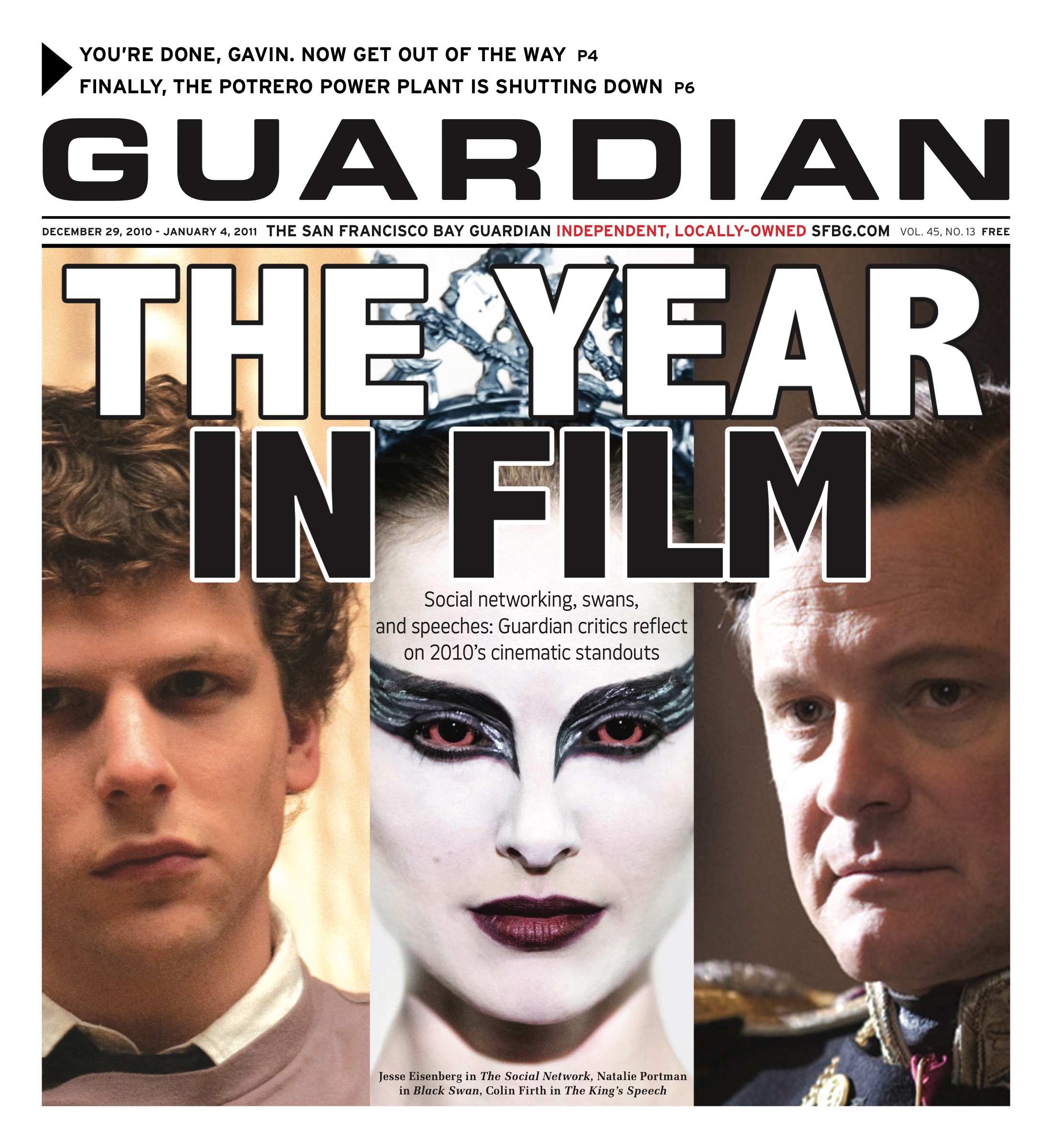
YEAR IN FILM “Bloody bugger to you, you … beastly bastard. Shit. Shit shit shit shit shit shit shit shit. F-fornication. Fuck. Fuck fuck fuck fuck and fuck. Fuck, fuck, and bugger. Bugger, bugger, buggety buggety buggety fuck. Fuck ass. Balls! Balls! Fuckety shit. Shit, fuck and willy. Willy, shit and fuck, and … tits.”

The above is, in toto, the reason why The King’s Speech — a movie that might very well turn out Oscar’s idea of this year’s Best Picture next February — is rated R. This childish explosion of potty-mouth is coaxed from England’s future king (Colin Firth) by his speech therapist (Geoffrey Rush) to demonstrate that the former’s crippling stammer flies away whenever he’s unself-consciousness enough to cuss a bit. It’s a comic moment (one of few, and perhaps the film’s highlight in general) that, by reducing the words to sniggering playground naughtiness — this king is, after all, in a state of arrested development — robs them of any genuine scatology or shock value. They’re just words.

But those words (give or take a few fucks and shits — only the MPAA can or would bother to count every rapid-fire cuss) were still enough to get this otherwise very chaste, polite Masterpiece Theatre exercise classified with Saw 3D and The Human Centipede as viewable by minors only with parental accompaniment. Not that many teens are likely to be lining up for The King’s Speech — certainly far fewer than saw Saw 3D with or without adult chaperoning. But really, this is what they need protecting from?

This was a year in which the usual grousing undercurrent about arbitrary ratings-board standards started to seep overground. There were small hubbubs about two excellent documentaries, The Tillman Story and A Film Unfinished, getting R’s due to cursing on one hand and nudity (among Nazi concentration camp inmates) on the other. In both cases prudishness means these searing indictments of historical wrongs probably can’t be used for classroom educational purposes.

A larger controversy surrounded Blue Valentine, the acclaimed indie feature slapped with an NC-17 for a sex scene so subversive that no one who saw the film at Sundance could recall it; the MPAA rating mystified many. Turns out the scene in question is a happy flashback in this slow-agonizing-death-of-a marriage portrait, with Michelle Williams’ thrusty body language expressing clear enjoyment of Ryan Gosling’s mouthy activities downtown. Nonetheless, there’s nothing more explicit displayed than the outside of her thighs — as one colleague put it, “I’ve seen more of Britney Spears on the Internet.” The drama’s sobriety and its awards momentum finally won a rare MPAA reversal on appeal, reducing its rating to R.

But the case still underlines the injustice of our current system. As Kirby Dick’s This Film Is Not Yet Rated pointed out in 2006, as a tool of the Hollywood mainstream the MPAA routinely judges independent films more harshly than major studio releases. It also exercises double standards when it comes to gender nudity and gender-preference sexuality, and most crucially continues to heighten the American morality gap between depictions of sex and violence.

These complaints have prompted some vague hints of change afoot, albeit more toward hitting torture-porn horror harder than lightening up on the birds ‘n’ bees. In any case, it’s difficult to be very hopeful: for every progressive cultural step forward these days, there seem to be two Tea Party dance-steps back. It was announced earlier this month that Christian pastor and cable honcho Robert H. Schuller had contracted to broadcast G-rated versions of movies like the original Alien (1979) and Predator (1987). OK, so they’ll have bad language and explicit violence removed; but even these eviscerated edits will still offer entertainment predicated on the horrific (if now nongraphically suggested) murders of humans by icky monsters. Giving kids nightmares is more godly (and provides a more “positive message,” per the Rev. Schuller) than showing them (God forbid) a nipple.

Such hypocrisies run rampant in U.S. entertainment and society in general. Media outlets generally refuse to advertise NC-17 films, giving them and their modicum of sexual explicitness the commercial kiss of death while most kids freely access porn online. Screen violence grows ever more desensitizing; explosions of cars, buildings, entire cities, or planets are viewed as harmless while anything truly unpleasant enough to act as a deterrent sparks outrage. (By now the escapist Saw and Hostel movies get shrugged at, whereas the recent Killer Inside Me remake offended many because its protracted scenes of domestic violence were realistically painful to watch.)

Penises are now OK in small doses, albeit only in the clownish contexts of Forgetting Sarah Marshall (2008), Observe and Report (2009), etc. Ironically, any time sex is taken seriously, sans juvenile humor or lurid “erotic-thriller” type judgment, it becomes unfit for allegedly innocent eyes. Blue Valentine‘s good sex, and subsequent bad breakup sex, disturbs the MPAA because it is all too real-world relatable in both its pleasure and fallibility, something you won’t often find in porn, either.

The logic gap grows ever more ridiculous even as our culture wars’ battle lines harden. Imagine a Palin White House two years hence, presiding over a land in which sex education is nonexistent, abstinence clubs are the new Honor Society, and teenage pregnancy rates skyrocket. When in doubt as to the nation’s course, say grace, then settle down to dinner with the kids as you watch a “clean” tube edit of something like 1995’s Braveheart, its medieval spears through the chest trimmed but that humorous throwing of a prince’s homosexual BFF from the castle tower left intact. Then drift off to slumberland, family values affirmed.

Past imperfect

0

arts@sfbg.com

YEAR IN FILM We’re all media scavengers now, but archival sounds and images remain a tantalizing lure for both the documentary profile and its surrealistic double, the found footage film. The first repackages capsules of the past while the second hijacks them — different economies of exchange, to be sure, though perhaps less starkly contrasted to those accustomed to hyperlinking their way through the dustbin.

The use of obscure footage as leverage is exceedingly clear in Jean-Michel Basquiat: The Radiant Child, a film structured around director Tamra Davis’ intimate camcorder interview with the artist in 1985. The close-up portrait gives us Basquiat’s sly intelligence, spacey charisma, and tragic oversensitivity to judgment — all to the good, but Davis’ inability to reckon with the exchange value of her insider access is disappointing. Selling and chronicling are inextricably linked with the celebrity artist, but Basquiat’s early graffiti partner Al Diaz is the only interviewee who addresses the issue of the golden goose frankly.

The Rolling Stones have always excelled at selling themselves, so it’s no surprise to see Mick and Keith’s executive producer credits on Stones in Exile. Fortunately for us, director Stephen Kijack (2006’s Scott Walker: 30 Century Man) recognizes 1972’s Exile on Main Street as a masterpiece of vibe and accordingly focuses great attention on the zonked record’s mise-en-scène. But the strictly MOR slate of interviewees — alas, no Pussy Galore here — makes the scraps of Robert Frank’s long suppressed Cocksucker Blues (1972) feel all the more bowdlerized.

The bankable aura of the rarely seen supplants Frank’s prickly immediacy, and the dream of a rock ‘n’ roll cinema is the poorer for it. If it’s easier to accept the brief stream of Jonas Mekas’ New York City film-diaries borrowed in LennonNYC, that’s because the footage serves a narrow expositional purpose in establishing the bohemian milieu that John Lennon and Yoko Ono embraced — and also because Mekas is himself interviewed. The PBS-produced doc’s failings are the conventional ones, but its archival trove does illuminate Lennon and Ono’s creative collaborations, especially insofar as their art hinged upon probing self-consciousness and the redemptive potential of intimacy.

On the other side of the archival aisle, the mad detectives and film theorists who whisper hidden truths in our ears have become increasingly ambitious storytellers. Johan Grimonprez’s inventive Double Take slips into the realms of the unreal by characterizing the Cold War as a literally Hitchcockian play of ciphers, while Yael Hersonski’s A Film Unfinished submits an oft-cited, little-understood Nazi propaganda film to ontological deliberation. Adam Curtis introduces his most recent raid of the archive, It Felt Like a Kiss, with print titles that speak for all these projects: “When a nation is powerful it tells the world confident stories about the future/ The stories can be enchanting or frightening/ But they make sense of the world/ But when that power begins to ebb the stories fall apart/ And all that is left are fragments which haunt you like half-forgotten dreams.”

As with Curtis’ earlier multipart films, It Felt Like a Kiss registers history as a shifting series of simultaneities and unforeseen consequences. The only slightly tongue-in-cheek cast includes Doris Day, Rock Hudson, Saddam Hussein, Enos the cosmonaut chimp, and everyone above level seven in the CIA. Initially conceived as a multichannel promenade, the film is named for the singularly disturbing pop song Carole King penned for Phil Spector and his Crystals. It’s one of four ’60s sides Curtis builds out as deeply personal, but emblematic chronicles of anguish and dread (the others are “I’ll Be Your Mirror,” “River Deep, Mountain High” and “Wouldn’t It Be Nice?”). In each case, Curtis surveys the decade’s interlocking horror shows with something like poignancy — a new feature of his work.

Atop all the uncanny déjà vus and dream-life convergences, It Felt Like a Kiss also serves up one of the greatest WTF endings in recent memory. After revealing a bunker’s worth of government computers (repurposed from Cold War fighting to credit card debt), Curtis cuts to Pillow Talk (1959). Doris Day is a vision of contentment going to bed, but then something disturbs her — on the soundtrack, a soaring engine noise is followed by a hard cut to black silence. Amazed at how economically Curtis suggests the coming impact, we cue the sequence up again and let our jaws drop when we see Day’s room number: 2001.

To be sure, there’s no rule that found footage films must generate conspiratorial heat. Jay Rosenblatt’s The Darkness of Day materializes a reserved contemplation of suicide using industrial discards — the forgotten nature of these older films itself becoming a token of loss in an elegiac context. Oblique images float upon fragmented suicide stories narrated from many different vantages: near and far, first-person and third, male and female, young and old, anonymous and notable. We hear excerpts drawn from 10 years of a diary of depression, read of an ancient Egyptian’s dispute with his own soul, and learn about the first man to jump off the Golden Gate Bridge.

This last story surfaces with a montage of the bridge’s construction — a monument, but to what? — and might be read as a critique of The Bridge (2006), which unaccountably turned us into voyeurs of suicide. The Darkness of Day travels the path of Night and Fog (1955), regarding trauma indirectly, as traces and shadows. Industrial footage is not the most obvious resource to make darkness visible, but Rosenblatt’s use of mass-produced materials subtly underscore the film’s suggestion that while suicide is always discrete and thus unknowable, it is also a social phenomenon.

For a more concrete cultural history glazed with Debordian wit, Andrei Ujica’s The Autobiography of Nicolae Ceausescu is matchless. After opening with a thoroughly demystified, inquisitorial video of Ceausescu and his wife Elena in 1989 — previously seen in Ujica’s 1992 collaboration with Harun Farocki, Videograms of a Revolution — we double back to the spectacular public funeral for the Romanian leader’s predecessor, Gheorghiu-Dej, in 1965. From here, Ujica proceeds more or less chronologically (and without voice-over) through Ceausescu’s decades in power, collecting speeches, press conferences, soft debates, home movies, inspections of factories and construction sites, and trips abroad to Communist countries and Hollywood (a letdown after the stupefying parades in China and North Korea).

One of the director’s most cunning insights is that since the totalitarian state stages reality to furnish proof of its own dominion — the problem with measuring Triumph of the Will (1933) as documentary — the resulting footage might be considered as if dictated by the leader. But by letting these “autobiographical” materials run at length, Ujica also opens a space for the accidents and lacunae that surely would have been excised from the official record. The fact that it’s so easy to imagine the propaganda version of this footage is part of the point: we calculate where the cuts would have been to “correct” Ceausescu’s diminutive posture and speechmaking, and in that gap lies much of 20th century history. The closest Ujica comes to giving the game away is when he cuts from one of Ceausescu’s baroque rhetorical performance (filmed in black-and-white, as with everything else we’ve seen up to this point) to his cheating at volleyball in a color home movie. It’s a wonderfully rude swipe at rulers everywhere and likely the single most smashing edit of the year.

Arthur Szyk: beauty in fairy tale… and Stalin

0

Nowadays, being up on the news can actually make us stupider (more stupid, damn!), but when cartoonist Arthur Szyk was sketching his dense, fantastically detailed news caricatures, politics were still in need of explication – and all the more better if it was beautiful to boot. How else can one explain why one of the most whimsical artists of the 1930s and ’40s became best known for his sketches of Hitler and Stalin playing poker?

Szyk’s jewel box of an exhibition is on view through March 2011 at that jewel box of a museum, the Legion of Honor. How lovely is the Legion of Honor? Though its offerings are often obscured by its big box fine art peers like the de Young and the SFMOMA, the Legion itself is a French neo-classic temple compared to the blatant modernism of its more centrally-located brethren. Where else, for pete’s sake, can one find a meticulously transposed Louis-whenever parlor room adjacent to a hall full of Rodin sculptures? 

A multi-media art experience, I reflected, passing under a mudejar ceiling from late 15th century Torrijos region of Spain, on my way to the museum’s corner hideaway gallery no. 1 that housed Szyk. Who was a firecracker, really. Born to a Jewish Polish family, Szyk was one of the first political caricaturist to sketch out against the Führer. His Haggadah series (1932-1938) correlated Hitler’s rise with the traditional story of the Israelites’ biblical flight from Egypt. 

Though his original message was somewhat watered down by the drawings’ group publication in 1940 (the publishers erased all the swastikas from the drawings – que what?), it was still considered one of the most beautiful works of the time. Szyk was also outspoken about his adopted country’s lack of action in the face of evil – the US fell under the wrath of his pencil for its sluggish rise to action during World War II. 

The man’s drawings are pure, extravagant beauts. The drowsy, yet watchful eyes of the Legion security guards (legion guards! Drama!) prevented me from nosing in quite as close as I wanted to them – the sentries probably get sick of wiping off the glass – but even so. Even so, there were his illustrations for a deck of playing cards, his whip-smart rendering of a poker game between Hitler and Stalin — with the Angel of Death looking on intently. His sumptuous creations for the 1955 edition of Arabian Nights Entertainment. His faces are so detailed that they bely the fact that they are portraying fictional characters. His details are so extraordinary its no wonder that a lot of adult children will get a sense of time travel vertigo dipping into his stash of kid’s book illustrations. The flowers with faces Szyk brought into being for the 1945 edition of Andersen’s Fairy Tales — well Walt, you have some explaining to do about Alice’s rose garden buds.

You should be witness to all this, of course. While you’re there, check out the Legion’s marquee showing of Japanese and Californian and French-via-Japan prints in the basement (Japanesque, through Jan. 9). And the Legion cafe, of course, which is always crammed full of old people and is an excellent place to enjoy a cup of coffee or esoteric Asian soda pop. 


Arthur Szyk: Miniature Paintings and Modern Illuminations

Through March 2011

Legion of Honor

100 34th Ave., SF

(415) 750-3600

www.famsf.org


Does Mayor Newsom represent SF workers or San Mateo politicians?

2

“Does Newsom represent local workers or San Mateo politicians?” That’s the question being asked  at City Hall today. And it’s threatening to deliver an unwelcome kick to Mayor Gavin Newsom on his way out of City Hall’s revolving doors, as dozens of unemployed construction workers deliver 1,000 Christmas cards that residents of Bayview Hunters Point, Chinatown, the Mission, the Tenderloin and South of Market have signed. The cards urge Mayor Gavin Newsom to “put the Merry into Christmas and the Happy back into New Year” and sign local hire law that the Board passed a week ago.

This special holiday season delivery has been in the works since Dec. 14, when Bayview-based job advocates Aboriginal Blackmen United (ABU) tried to meet with Newsom and get his signature on legislation that a super-majority on the Board support.

But after Newsom was a no-show and his chief of staff Steve Kawa refused to give ABU any assurances, community advocates Brightline Defense Project printed up a thousand of the cards urging Newsom to “put the Merry into Christmas”. And Brightline, ABU, Chinese for Affirmative Action, PODER, and the A. Philip Randolph Institute then asked unemployed workers, activists, and concerned citizens to sign this unusual set of greeting cards.

The move comes a day after the San Mateo County Board of Supervisors voted unanimously to urge Newsom to veto Avalos local hire policy. Local hire advocates suspect this counter-move was orchestrated to give Newsom political cover, should he choose to make the seemingly Scrooge-like move of vetoing, just before the holiday season, legislation that would help San Francisco residents secure work on billions of dollars worth of local tax-payer funded construction projects .

But the San Mateo supervisors claim that San Francisco’s plan, which would mandate that 50 percent of workers on city-funded projects are local residents, threatens to hurt an already sluggish regional economy.

“This is not the time to put isolation around a community,” San Mateo Sup. Carole Groom reportedly said at a hastily convened Dec. 21 special session.
 “If this is rejected, it would be time for all of us to sit down and talk about this,” fellow San Mateo County Sup. Adrienne Tissier reportedly said.

Newsom has until Christmas Eve to either sign or veto the law, though the Board can still override his veto, provided Avalos still has eight votes in the New Year. And if Newsom doesn’t sign or veto the law by week’s end, it will go into effect in 60 days.


San Mateo officials are arguing that the local hire legislation particularly impacts their county, because the law contains a “70-mile” clause that includes the San Francisco Airport, the Hetch Hetchy water system and the San Bruno jail.

Sup. John Avalos previously told the Guardian that project labor agreements protect workers at the airport and working on projects that the San Francisco Public Utilities Commission funds. But Tissier reportedly claimed that San Francisco’s local hire policy would kick in, once new contracts are negotiated.

Reached by phone, Avalos said it’s not clear if the San Mateo supervisors have actually read his legislation
‘If they had, they’d see a lot of ways that is supports San Mateo workers,” Avalos said.

San Francisco’s local hire legislation, which is the nation’s strongest, requires that 20 percent of workers within each construction trade be local residents starting in 2011. That number increases 5 percent annually for seven years, as local workers join trades where community representation is lacking, before reaching 50 percent. In other words, 80 percent of the workforce could be non-city residents in 2011, and even at 50 percent local hire, half of the jobs will still be available to workers who don’t live in San Francisco.
 
“That’s hardly an exclusion especially when you consider that San Francisco taxpayers are making the investments on these projects,” Avalos stated.
He believes that the San Mateo County Building Trades Council pressured the San Mateo Board to pass their Dec. 21 resolution urging a veto on his measure. Either way,  Victor Torreano, vice president of the San Mateo County Building Trades Council was quoted in media coverage of the Dec. 21 vote, saying, “the need for housing in San Francisco and the Peninsula make it impossible for many blue collar workers from sinking family roots in the area.”

Avalos acknowledges that San Francisco International Airport is in San Mateo County, and its workers understandably wants jobs there,
“San Mateo County has to put up with the sound of the airport, and its residents deserve to have jobs there, but this is much ado about nothing,” Avalos said. “But it’s the Building Trades that are uncomfortable with changing slightly their practices.”

Mike Theriault, Secretary-Treasurer of the San Francisco Building Trades Council, acknowledged that his group has never been pleased with Avalos’ legislation.

“But we are resigned to seeing how it plays out,” Theriault told the Guardian. “We think there are better things they could have done to guarantee access of San Francisco residents to careers in our trades.”

Theriault believes that Avalos may not understand the project labor agreement are of limited duration.
“So, they will require an extension of the existing labor agreement,” Theriault said,  noting the legislation states that future extensions would have to comply with the new law.

But Theriault acknowledged that with or without Newsom, Avalos’ legislation still has a chance to move forward.
“If he vetoes it, I understand that the Board will have another crack at it, Jan. 4,” THeriault said, referring to the current Board’s last meeting in January.
 
The Bay Area Council has also announced its opposition to Avalos’ legislation,
 “This troubling trend of intra-county battles being started by the San Francisco Board of Supervisors needs to stop,: Bay Area Council President and CEO Jim Wunderman said in a Dec. 21 statement. “The Bay Area is one regional economy, not nine island states. We need to focus on nurturing the fragile economic recovery in our region, not setting bad policies that pit county against county.  The Bay Area Council urges Mayor Newsom to veto this foolhardy piece of legislation.  Right now, we do not need any more incentives for businesses to leave any county, the Bay Area, or California.”

But advocates for the legislation note that the San Francisco Controller recently estimated that the law will pump $270 million into the local economy over the next 10 years. They hope Newsom will emerge from his warren-like office today and sign the law, delivering a historic Christmas present to the city’s growing ranks of unemployed workers.


But even if he doesn’t, Avalos isn’t sweating it.


“Newsom probably won’t sign it, and he’ll write a letter saying he’s opposed to it,” Avalos predicted. “And even if the new mayor is [SFPUC director] Ed Harrington, he’s been supportive of the measure. So Newsom has to answer his own conscience and ask himself, if he’s going to represent local residents or San Mateo politicians.”


According to Brightline’s Joshua Arce, ABU led about 30 to 40 workers from Bayview, Chinatown, and the Mission up to Room 200 today to drop off 1,000 signed  cards from residents in every neighborhood asking the Mayor to sign the community’s local hiring law by Christmas.
 
“Room 200 was locked, but we kept knocking,” Arce told the Guardian. “Eventually the doors opened and out came [Mayor Gavin Newsom’s chief of staff] Steve Kawa. We showed him all of the Christmas cards that we had for his boss and he thanked us. Ashley Rhodes of ABU explained that since we heard how much the Mayor liked the ABU holiday card last week, we printed up 1,000 more and got them signed by people from every community in San Francisco.”
 
“We asked where the Mayor was in terms of making his decision, he said that the Mayor was still studying all of the issues,” Arce continued. “He brought up the opposition from the San Mateo County Board of Supervisors, so we asked him to tell the Mayor to support us, the thousands of unemployed and job-hungry San Franciscans, over four San Mateo politicians.”
 
“Steve Kawa said that they will be working around the clock to make sure all concerns are addressed, and we showed Steve a card signed by Sup. Bevan Dufty just moments before we came upstairs,” Arce addded. “Sups. John Avalos and Eric Mar also signed Christmas cards to the Mayor.”

According to Arce, ABU left the two huge Santa bags full of cards with Kawa, who picked them up, commenting “These bags are awfully heavy.” 

“I asked him to make sure to tell his boss that the cards were printed on 100% recycled paper,” Arce concluded. “Let’s hope that Mayor Newsom puts the Merry into Christmas and the Happy back into New Year!”

Our Weekly Picks: December 22-28, 2010

0

WEDNESDAY 22

DANCE

The Christmas Ballet

Smuin Ballet’s The Christmas Ballet (previewed previously and now a mini-review) is a welcome antidote to the sentimentality surrounding the holiday season. The first part pays lip service to more or less classical music but the show really takes off in the second half, “The Cool Christmas.” Matthew Linzer as Elvis and Robin Cornwell, giving life to Eartha Kitt, are show-stealers. But then so is Ryan Camou’s high-leaping drummer boy. This entertainment — and that’s what it is — is ballet-based though leavened with Cajun, Irish, polka, waltz, hula, jazz, and tap. This year choreographer-in-residence Amy Seiwert’s added a spritely “Carol of the Bells”; her stark and sculpturally intriguing “Noel Nouvelet,” based on a 15th-century carol, still looks strong. The late Smuin’s wide-ranging musical taste allowed him to come with intriguing versions of familiar material. In this respect, at least, Seiwert seems to follow in his footsteps. (Rita Felciano)

Wed/22–Thurs/23, 8 p.m. (also Wed/22, 2 p.m.);

Fri/24, 2 p.m., $4–$62

Yerba Buena Center for the Arts

Novellus Theater

701 Mission, SF

(415) 978-2787

www.ybca.org


PERFORMANCE

SantaLand Diaries

David Sedaris, one of America’s favorite humorists, got his start with SantaLand Diaries, an essay on his stint working as an elf in the holiday spectacle at Macy’s. Sedaris first shared this humorous holiday anecdote on National Public Radio’s Morning Edition in 1992. Since then it has been adapted for the stage by Joe Mantello as a solo one-act. David Sinaiko stars as Crumpet the elf in Combined Artform’s annual presentation of holiday amusement and laughs. The wacky zaniness of the holidays is captured by Sedaris like none other. Note that no one under 16 will be admitted. (Emmaly Wiederholt)

Wed/22–Fri/24 and Dec. 26–-30, 8 p.m.;

(also Thurs/23, 5 p.m.; Fri/24, 3 p.m.) $20–$30

Eureka Theatre

215 Jackson, SF

www.cafearts.com


MUSIC

San Francisco Symphony

In the last few frenzied days before Christmas, take time to get into the spirit with the San Francisco Symphony in Twas the Night, a program of holiday favorites. From “Good King Wenceslas” to “The 12 Days of Christmas,” this assortment of beloved seasonal tunes will put the whole family in good cheer. Ages 17 and under are half-price and complimentary festive beverages follow the performance, so join in the jolly fun. With Ragnar Bohlin conducting, Robert Huw Morgan on organ, Lisa Vroman singing soprano, and Joan Cifarelli on piano, traditional carols and songs come to life as never before. (Wiederholt)

Wed/22–Thurs/23, 7:30 p.m.; Fri/24, 2 p.m., $15–$67

Davies Symphony Hall

201 Van Ness, SF

(415) 864-6000

www.sfsymphony.org


THURSDAY 23


FILM

Sita Sings the Blues

Inspired by the sudden decay of her own marriage, Nina Paley recreated what she’s called “the greatest break-up story ever told,” the tale of Sita and Rama from Sanskrit epic the Ramayama. The resulting film, produced on the director’s home computer, has been hailed as a miracle of contemporary animation, blending various artistic styles with the music of 1920s blues singer Annette Hanshaw. Using that music created a copyright suit against Paley, who has since released the movie online as part of the Free Culture movement. These screenings benefit the Red Vic, courtesy of the director and Shadow Distribution. (Ryan Prendiville) Thurs/23 and Sun/26, 7:15 and 9:15 p.m.

(also Sun/26, 2 and 4 p.m.), $6–$9

Red Vic Movie House

1727 Haight, SF

(415) 668-3994

www.redvicmoviehouse.com


PERFORMANCE

“Joyful Noise: A Gospel Celebration of Christmas”

The Lorraine Hansberry Theatre is in the midst of its 30th anniversary seasons — and like all previous seasons, 2010-11 is dedicated to “exploring, celebrating, and reflecting the lives of African Americans.” But it’s been a bittersweet year, with the deaths of founding artistic director Stanley E. Williams and founding executive director Quentin Easter, a longtime couple, coming just weeks apart. LHT has dedicated this year’s spin on its traditional holiday gospel musical, Black Nativity, to the pair; the popular performance’s new title and script were created with Williams’ input before he died. But don’t expect a somber affair — the play honors the spirits of its founders with dance, humor, and powerful vocals, and promises to bring joy to all ages, cultures, and faiths. (Cheryl Eddy)

Through Dec. 31

Thurs, 8 p.m.; Fri/24 and Dec. 31, 2 p.m.;

(also Dec. 31, 7 p.m.); Sun/26, 4 p.m., $25–$50

Fort Mason Center

Southside Theater, Bldg D

Marina at Laguna, SF

www.lhtsf.org


EVENT

Latke Ball

While the nerdy Jews will be tittering away at Kung Pao Kosher Comedy (see below), the Jew who just wants to get her grind on (or anyone trying to duck down from tinsel) heads tonight to the annual Latke Ball, the Jewish Community Federation’s annual December fundraiser — usually held Dec. 24 but stepping into the night prior this year outta respect to shabbat. Sure, there are no cutting edge DJs on the bill, but more than 1,000 observant and not-so-much Heebs who refuse to take “closed for the holidays” for an answer? This calls for a mazel tov! — and maybe a Manhattan. (Caitlin Donohue)

9 p.m.–2 a.m., $40

Ruby Skye

420 Mason, SF

(415) 777-0411

www.jewishfed.org/event/latke-ball-2010


PERFORMANCE

Kung Pao Kosher Comedy

While the Jew into sweatin’ to the top 40 is dodging flailing stiletto vamps at the Latke Ball (see above), the more cerebral set heads to Kung Pao Kosher Comedy, comedian Lisa Geduldig’s 18-year-old stand-up alternative to the low-fi claymation specials blasting from your roommate’s TV. The annual event was birthed in a South Hadley, Mass., Chinese restaurant and serves up yucks by offbeat comedians hailing from various corners of Jewdom, all over family-style servings of rock cod with bok choy and Boca Raton-style chow mein. Headliners this year include creepy-cute comedy vet Wendy Liebman, 21-year old prodigy Nathan Habib, and Georgia-born Vietnamese-Jew Joe Nguyen. (Donohue)

Thurs/23–Sun/26, 5 and 8:30 p.m., $42–$62

New Asia Restaurant

772 Pacific, SF

(925) 275-9005

www.koshercomedy.com


SATURDAY 25


EVENT

Safeway Holiday Ice Rink

New York City has its world-famous skating rink at Rockefeller Center, blah blah blah. But why travel to the freezing-cold East Coast when you can get some downtown ice time right here in San Francisco? Possibly rocking a t-shirt while you’re at it? Plunked down in the middle of Union Square, the Safeway Holiday Ice Rink offers 90-minute sessions starting on each even hour. You’ll already be banged up from fighting the crowds at Macy’s and (sweet Jeebus) Forever 21, so it’s well worth taking a shopping time-out to channel your inner Johnny Weir as Union Square’s behemoth Christmas tree twinkles overhead. (Eddy)

Through Jan. 17, 2011

Daily, 10 a.m.–10 p.m. (Fri-Sat, 10 a.m.-11:30 p.m.);

Dec. 31, closes at 9:30 p.m., $4.50–$9.50 (skate rental, $4)

Union Square

Geary and Powell, SF

www.unionsquareicerink.com


MUSIC

“13th Annual Black X Mass”

Gotta love it when you click on an event taking place Dec. 25 and it takes you to the First Satanic Church’s homepage. The Black X Mass, though, is ironically a bit of a godsend. Maybe you don’t celebrate Christmas, or you’re unable to travel to hang with relatives — or perhaps you’re planning to do both, and fully realize you’ll need to decompress after a full-court press of holiday cheer. Whatever the reason, if you’ll be lurking around the dark and lonely streets of San Francisco during the holidays, head to the Elbo Room for Karla LaVey and the First Satanic Church’s annual Black X Mass party. Replace that Santa hat with horns and hail the stylings of Graves Brothers Deluxe, Dimesland, Los Murderachis, the Fuxedos, Theremin Wizard Barney, the Devil Dancers, and more. (Eddy)

9 p.m., $9.99

Elbo Room

647 Valencia, SF

(415) 552-7788

www.elbo.com


SUNDAY 26


PERFORMANCE

“Gallagher’s Holiday Smash Bash”

Like Sinbad, Gallagher has spent a couple decades in relative obscurity. So obscure, in fact, that’s it’s hard to imagine a time when he was popular. Immensely popular. Like, 10 televised specials between 1980 and 1987 popular. (Side note: this type of inexplicable success is known as “the Aykroyd phenomenon.”) Cultural amnesia makes it difficult to admit liking the innovator of prop comedy. But the decline of Gallagher is not due to simply a change in fashion, the way society decided one day that we no longer found giant men hilarious if they wore Hammer pants. No, it’s because of Carrot Top. That fucker single-handedly ruined props for everyone. Tonight, Gallagher may Sledge-O-Matic us back to a simpler time. (Prendiville)

7 p.m., $30

Yoshi’s San Francisco

1330 Fillmore, SF

(415) 655-5600

www.yoshis.com


MONDAY 27

MUSIC

Morris Day and the Time

Few can rock a suit like Morris Day. After bringing himself out of a self-imposed retirement in 2004, the funk-R&B singer and Prince collaborator released It’s About Time, his first solo album in 12 years. Much to his fans’ delight, he also got all the original members of the Time back together to begin touring again. Pieced together by Prince in 1981 as an outlet for material he didn’t necessarily want to release under his own (ever-changing) name, the group eventually carried on itself, thanks in large part to the eccentric and energetic stylings of Day — who also turned in a memorable performance as the Purple One’s foil in 1984’s Purple Rain. (Landon Moblad)

Mon/27–Tues/28, 8 and 10 p.m., $30–$45

Yoshi’s San Francisco

1330 Fillmore, SF

(415) 655-5600

www.yoshis.com


TUESDAY 28


MUSIC

“X-mas With X (An Evening With)”

Legendary Los Angeles punk rock group X distinguished itself from other bands of its era by adding the rock-solid drumming of DJ Bonebrake, the guitar virtuosity of Billy Zoom, and the poetic lyrics and intimate vocal interplay of John Doe and Exene Cervenka. It was this distinctive blend that caught the attention of Doors keyboardist Ray Manzarek, who went on to produce the band’s classic first album, 1980’s Los Angeles. At these two very special shows, Manzarek joins X on stage to perform their debut record in its entirety, lending his talents on the keys that helped shape tunes such as the throbbing “Nausea” and the set-closing “The World’s A Mess, It’s In My Kiss.” (Sean McCourt)

Through Dec. 29

8 p.m., $31

Slim’s

333 11th St., SF

(415) 255-0333

www.slims-sf.com 


The Guardian listings deadline is two weeks prior to our Wednesday publication date. To submit an item for consideration, please include the title of the event, a brief description of the event, date and time, venue name, street address (listing cross streets only isn’t sufficient), city, telephone number readers can call for more information, telephone number for media, and admission costs. Send information to Listings, the Guardian Building, 135 Mississippi St., SF, CA 94107; fax to (415) 487-2506; or e-mail (paste press release into e-mail body — no text attachments, please) to listings@sfbg.com. Digital photos may be submitted in jpeg format; the image must be at least 240 dpi and four inches by six inches in size. We regret we cannot accept listings over the phone.


Homelessness: Newsom’s real legacy

4

OPINION His voice tinged with modest pride, Gavin Newsom recently announced that he has housed 12,000 people since becoming mayor. This is an absurdly high number, four times larger then any street count of homeless people since he has been in office, but it’s been accepted by the media and public.

Homelessness has been a key issue for Newsom. He first got elected in large part by taking it on, and has been celebrated in some quarters as a champion for homeless people.

But digging behind the veneer, removing bus tickets out of town, permanent housing his predecessor, Willie Brown, created, and temporary stays and duplication, there are 1,395 permanently affordable housing units that Newsom can truly take credit for. More frequently his administration has housed people (fewer then 2,000) by leasing residential hotel rooms from slumlords and charging homeless people unaffordable rents to live there.

Only 14 percent of the units have been for families, although they make up 40 percent of the homeless population.

Newsom put three different initiatives on the ballot that have spurred hatred against homeless people. His signature operation was mixing kindness with punishment. This way, he wooed conservatives who saw through the camouflage, and liberals who did not.

Care Not Cash was the first measure. That campaign focused on accusing homeless welfare recipients of spending all their money on booze and drugs. The proponents claimed they would take public assistance away, in return for housing and treatment. The treatment part never came to fruition, and of course proponents never mentioned they were counting shelter as housing.

Care Not Cash catapulted Newsom into the limelight. His self-deprecating charm conveyed the message: “The status quo simply isn’t working.” In the end, benefits were slashed and perpetual shelter vacancies were created while shelter-seekers were turned away. Food lines exploded.

Newsom could have used his power to raise the money to house people — without stealing it from other destitute people. He chose not to.

The next year Newsom ran for mayor and simultaneously put an anti aggressive panhandling initiative on the ballot. In classic Newsom strategy, the proposition loosely defined the term “aggressive” and bizarrely required, but did not fund, substance abuse treatment for perpetrators.

It was the meanest campaign in three decades. Several violent acts were wrongly attributed to homeless people. The Golden Gate Restaurant Association put out billboards claiming homeless people spread venereal disease. Once implemented, the initiative made no visible impact on the number of panhandlers in San Francisco.

Most recently, Newsom introduced Proposition L, an ordinance that could put people in jail for 30 days on a second offense just for sitting or lying on the sidewalk. It passed, and set the parameters for very nasty dialogue about poor people once again in San Francisco.

All three of these votes took place very strictly along class lines — affluent people supported them and poor people did not.

Homelessness is not a lifestyle choice; it’s a symptom of poverty. Yet Newsom’s legacy of hatred against homeless people has made it difficult to amass the public support needed to create true solutions. Overstating his accomplishments and spreading myths about homeless people sets us back. It gives San Franciscans the impression homeless people have the help they need but simply choose to remain out on the cold hard pavement.

In a city filled with thousands of destitute people, it is now illegal to sleep unsheltered. After Newsom’s plaster media façade crumbles, this will be his lasting legacy. *

Jennifer Freedenbach is executive director of the Coalition on Homelessness.


Page street

0

Rebecca Solnit’s Infinite City: A San Francisco Atlas (University of California Press, 158 pages, $24.95) is one of the best ideas a writer has come up with in a long time. By combining private and public support, Solnit was able to give away portions of the atlas in full-color, full-spread map handouts. (My favorite tracked both famous/infamous queer public spaces and the migration of butterflies throughout the city.). In the process, she also gave lectures in public spaces, providing a public service in the name of history and inclusion before dropping this tome on the book-buying masses. Gent Sturgeon’s version of a city-fied Rorschach alone is worth the price of the ticket. From insect habitats to serial killers, Zen Buddhist centers to the culture wars of the Fillmore and South of Market that some call redevelopment; Solnit and her cadre of artists, writers, cartographers, and researchers — Chris Carlsson, Guillermo Gómez-Peña, and Mona Caron among them — give us the infinite depths and limitless potential that can be found in 49 square miles. (D. Scot Miller)

A lot of good and even great books came from the Bay Area this year, but one stands out: a book of poetry, Cedar Sigo’s Stranger in Town (City Lights, 100 pages, $13.95). He is a young writer who improves dramatically each time I hear him read, and his poetry and critical writing are among the wonders of our age. And of the age before, since through him speak the dead poets David Rattray, John Wieners, Robert Creeley, Denton Welch, Philip Whalen, Salvador Dali, Jean Cocteau, Eartha Kitt, Raymond Roussel, Lorine Niedecker, and Cole Porter. When new writers come to San Francisco, they ask me if I’ve met Cedar Sigo. If they don’t know Sigo’s work, then I hand them a copy of the new collection. Don’t have to say much, I just step back a little to avoid the stars and diamonds and apples popping out of their eyes like toast from a toaster, because this crazy work is that crazy good. (Kevin Killian)

Compared with the prosaic grind of the inner city, the Sunset can seem like a — albeit foggy — vacation. Wide streets, surf breaks, dunes fit to get lost in: the neighborhood is just right for an offbeat bohemian getaway. But maybe those are just the reverberations of the past, which western neighborhood historian Woody LaBounty has dug up in Carville-by-the-Sea (Outside Lands Media, 144 pages, $35). This coffee table book illustrates the lives of the Sunset’s first modern-day inhabitants, who constructed a seaside village of retired street cars to inhabit back in the days before the N-Judah. Colorized at times for an Oz-like effect, the photos LaBounty digs up to illustrate “Cartown” reveal a community of artists, families, and enthusiasts — even a women’s cycling club — amid an untamed, oscillating sandscape. Those converted SoMa warehouse apartments suddenly don’t seem quite so rugged, do they now? (Caitlin Donohue)

In a city that boasts literally hundreds of theatrical world premieres per year, it’s astounding how few make it to the printed page. Bravo, then, to EXIT Press, new publishing arm of the venerable EXIT Theatre, for helping to ensure that at least some of our local play-writing talents will be preserved for posterity. And who better to inaugurate the series than Mark Jackson, whose professional development has been closely tied to the EXIT, and to the San Francisco Fringe Festival, which it produces? Far from being merely a collection of “Fringe-y” experimentation, Ten Plays (EXIT Press, 492 pages, $19.95) is a testament to the tenacity of vision. From reimagined Shakespearean classics (R&J, I Am Hamlet) to Jackson’s breakout hit The Death of Meyerhold, the bleakly comedic American $uicide, and the stirring Kurosawa-esque epic The Forest War, what these plays have in common is an audacious commitment to the illimitable possibilities of live theater. Of which, giving these works an opportunity to reach a wider audience is but one. (Nicole Gluckstern)

By any good political standard, John Lescroart’s Damage (Dutton, 416 pages, $26.95) is awful. It’s all about how a criminal uses the technicalities of law to get released (damn liberal judges) and how his family — newspaper publishers with ties to the (damn liberal) political establishment — protects him even as he continues to rape young women. Reminds me of that atrocious movie Pacific Heights, which is supposed to convince you that eviction protection and tenants rights are unfair to the poor landlords. But Lescroart writes about San Francisco, and does a pretty good job describing the city, and his characters are so real and well-crafted that I’m able to set aside the politics. In this case, Ro Curtlee, the rapist, is such an evil, evil bad guy — but a plausible, privileged evil bad guy — that he comes to life in a way that makes you want to kill him yourself. And makes you understand why a cop might feel the same way. And in the world of crime fiction, making you feel pain is half the game. It’ll be out in paper this spring. (Tim Redmond)

What Carl Rakosi was to Objectivism — a significant poet who dropped out of sight only to reemerge an old master — Richard O. Moore is to the SF Renaissance. The 90-year-old Moore was active in Kenneth Rexroth’s libertarian-anarchist circle in the 1940s, but abandoned poetry publishing for the more efficacious mass media of radio and TV, cofounding both KPFA and KQED in the process (and shooting the only footage of Frank O’Hara to boot). But Moore never stopped writing, and his debut volume Writing the Silences (University of California Press, $19.95) offers a brief but tantalizing introduction to more than 60 years of poetic activity. Moore’s diction is spare but memorable; a hawk’s wings, for example, “balance on the blind/ push of air.” Yet his low-key tones are wedded to an experimental sensibility; witness 1960’s “Ten Philosophical Asides,” which might be the first poem in English riffing on Wittgenstein, more than a decade before language poetry. Writing the Silences is thus belated yet ahead of its time. (Garrett Caples)

I commissioned three of the works in Veronica De Jesus’s Here Now From Everywhere (Allone Co. Editions, 130 pages, $26). Her portraits of Michael Jackson and Jay Reatard ran in the Guardian, while I paid out of pocket for her to render a tribute to the poet John Wieners for my boyfriend. Along with just-announced SECA Award winner Colter Jacobsen, who published this book, De Jesus is my favorite creator of drawings in the Bay Area. Like Jacobsen, she delves into memory — her memorial portraits can be seen for free on the windows of Dog Eared Books, where this book is for sale. The charm and value of Here Now From Everywhere is immediate, but the book reveals more of its multfaceted personality with each return visit. De Jesus’ illustrated dictionary of inspirational icons ranges from superstars to half-forgotten pop heroes, from cultural figures to obscure female athletes. It’s a gift. (Johnny Ray Huston)

“I told Micah last night that my new book would be a haunted house.” Berkeley-based poet Julian Poirier’s El Golpe Chileño (Ugly Duckling Presse, 128 pages, $15) is filled with the ghosts of past and present. Essentially a bildungsroman, it tracks Poirier’s protagonist’s growth from youthful journeyman into adulthood though a kind of mixed-genre Theatre of the Absurd. Vaudeville, comics, memoir, film pitch, epistolary, failed novel, poetry, the carnival, and travelogue are all wielded brilliantly in the hands of Poirier, making for a phantasmagoric reading experience where the whole emerges defiantly greater than the sum of its parts. Poirier writes, “I turned my whole brain into a city and wrote down everything I saw happening there.” And indeed it certainly feels that way — the book is ripe with the names of places, of friends living and dead; with lists of dates and years; and with drawings and photographs, making up what Poirier somewhat obliquely labels “The Stolen Universe.” El Golpe Chileño is truly a success of form and content, of the high and low, of pop and elegy. (John Sakkis)

Local hire, Steve Kawa, and the Americas Cup

2

Unemployed workers and community advocates hoping to secure Mayor Gavin Newsom’s support for Sup. John Avalos’ groundbreaking local hire legislation rallied at City Hall December 14 to meet with Newsom’s chief of staff Steve Kawa. But Newsom and Kawa were said to be in intense negotiations over the Americas Cup bid. So, James Richards, founder of Aboriginal Blacks United, waited until Kawa could see him, along with Florence Kong of the Bayview-based Kwan Wo Ironworkers. Joshua Arce of the Brightline Defense Project, and a group of local residents.

“‘Living in the city is so expensive,” Kong observed. “It’s not fair that a lot of local work is being done by workers from outside the city.”

Kawa finally emerged and shepherded folks out of the Mayor’s Office and into a meeting room close to the supervisors’ office. He was uncomfortable with having media at the meeting. But Richards said the group was OK with a reporter. And then he asked Kawa if Newsom would sign Avalos’ local hire law later that day.

“This is a very complex piece of legislation, and if it does become law, that’s when the work begins,” Kawa said, noting that Newsom will have ten days to review it, after its Dec. 14 reading. “Some folks are still concerned about it, partly on the trades union side,” Kawa added.

But Richards pressed his point. “After the Board acts today, we want to talk to the mayor,” Richards said. “We don’t want to wait around another ten days. We want him to assure us.”

But Kawa refused to give assurances. “At the end of the day, 42,000 San Francisco don’t have a job,” Kawa said, claiming the best local jobs program was Jobs Now, under Newsom.  “But the federal government is refusing to extend that program, and now we can’t hire anybody at City Hall and we have to get this economy growing,” he said.

When Joshua Arce of Brightline expressed concern that folks had met privately with Newsom to exert pressure against Avalos’ legislation, Kawa replied that Newsom had concerns that some folks could lose their jobs around San Francisco airport, because, technically, it’s in San Mateo.

“And are we sure this legislation will be successful?” Kawa continued. “The worst thing a government can do is over promise and under deliver. Our question is, you tell me how it will not fail. Because, yes, we want to have local hire, but don’t mislead anybody by saying, we pass this legislation, she gets a job. Our issue is making sure that we are not misleading anyone. Those are the concerns that people have. Will it be successful, as written? Because we can’t mislead your members, James.”

“Tell the mayor, we are here,” Richards said.
And then Kawa was shaking his hand and heading back to the Mayor’s Office, presumably to talk about cups and America.

“It’s a good thing, we are here today,” Richards said to the workers who remained sitting in the meeting room long after Kawa was gone. Many of them were young, black and male–and in search of a job. “Give a round of applause for your own self,” Richards continued. “It’s a good thing to let them know you come down here to take care of your own business.Because don’t nobody…”

He paused and the ABU members in the room immediately picked up the “don’t nobody give a damn” refrain, their voices ringing as one.

“Some times when we push too hard, when we get what we want, he get on a roll and tell all the reasons why he not going to sign. ‘I want to do this, but…” Richard added.

And then Richards turned to the issue of local hire at UC Mission Bay.“They gotta know today that we are hot on their trail,” he said. “Let them go tell that. Let Steve go tell that. Then they know we are fighting that.”

An hour later, when the Board gave Avalos’ legislation a veto-proof majority, Richards, Kong and the rest of the group burst into applause.
“It’s been quite a road to get here,” Avalos said.

“This is the most substantive policy San Francisco has passed in a generation,” Julian Davis observed, as local hire supporters rejoiced by the Tree of Hope, outside the Board’s Chambers.

Inside the Chambers, the Board was voting unanimously to support the city’s Americas Cup bid.

“To win a sailing race, every member of the crew has to work together,” Board President David Chiu said.  And his words could equally have applied to Avalos and the community’s effort to navigate treacherous political seas, get local hire legislation passed and, hopefully, lift everyone’s boat, in the process.

Our weekly Picks: December 15-21, 2010

0

WEDNESDAY 15

MUSIC

Buzzov*en

Legendary sludge metal band Buzzov?en has been wandering the wilderness since the early ’90s, its members ping-ponging between different down-tuned, drugged-out projects. Sludge, an ugly-sounding offshoot of stoner metal, can be traced back to the Melvins, and it was relatively big business in 1994 when Buzzov?en’s second album, Sore, was picked up by Roadrunner Records. That honeymoon was over quickly, and the band’s career has been peripatetic since. Famous for the violence of its live shows and squalling, pummeling riffs, the band is likely to incite a frenzy wherever its brand-new tour may take them. (Ben Richardson)

With Brainoil, Neurotoxicity, No Statik, K. Lloyd

8:30 p.m., $16

DNA Lounge

375 11th St., SF

(415) 626-1409

www.dnalounge.com


MUSIC

John Grant

After the decade he spent fronting dreamy indie-pop group the Czars, John Grant has since gone on record saying he never really felt all that satisfied with the band’s albums. As crazy as that might sound to Czars fans, Queen of Denmark, his new solo album backed by Texas folk-rockers Midlake, is indeed a markedly personal album — and perhaps the type he wanted to make all along. Grant’s 1970s soft rock-inspired arrangements and rich baritone vocals are excellent; but it’s the emotional vulnerability and snarky humor of his lyrics that really define him as a songwriter who is very much deserving of some more attention. (Landon Moblad)

With Jessica Pratt

8 p.m., $15

Swedish American Hall

2170 Market, SF

(415) 861-5016

www.cafedunord.com


MUSIC

Del the Funky Homosapien

The Bay Area’s ambassador of hip-hop, not to the planet but the galaxy and beyond, Del the Funky Homosapien came out of Oakland’s Hieroglyphics crew before lending his unmistakable voice to projects of a stranger variety. A fetish for ginormous words and out-of-this-world concepts culminated in the future blap of 2000’s space jamming album Deltron 3030. A follow-up is supposedly in the can, reportedly ready for release in 2010. At this intimate event, fans will have the opportunity to remind Del that it is mid-December. (Ryan Prendiville)

 With Simple Citizens

Wed/15–Thurs/16, 8 p.m., $30

Yoshi’s San Francisco

1330 Fillmore, SF

(415) 655-5600

www.yoshis.com


THURSDAY 16

DANCE

“DANCEfirst! Modernity/Humanity: The Nzoto Installation

Often the very act of preserving an artifact distances it from its daily meanings. The “Art/Object: Recontextualizing African Art” exhibit now gracing the halls of the Museum of the African Diaspora seeks to right this wrong, inserting ancient costumes, tools, and accessories back into the flourishes of life they once accentuated. The integration of ritual and modernity is also the theme of an upcoming MoAD dance performance, The Nzoto Installation, presented by dance-community bridge-building organization see.think.dance, and featuring international performance artist Byb Chanel Bibene using the nzoto (“the body” in Bantu) of dancer groups to meld abstract thought and tradition with motion and emotion you can feel, now. (Caitlin Donohue)

6–9 p.m., free with admission ($5–>$15)

Museum of the African Diaspora

685 Mission, SF

(415) 358-7200

www.moadsf.org MUSIC


MUSIC

Om

The demise of Sleep marked a sad day for metal fans, but from the resin-soaked ashes of that vaunted South Bay trio emerged two bands that have done much to cheer them up. The success of Matt Pike and High on Fire is a topic to be considered elsewhere; Om is the order of the day. Founded by Sleep’s bassist and drummer, Al Cisneros and Chris Haikus, the meditative metal outfit has taken advantage of the former’s mellifluous playing to craft songs that are at once crushingly heavy and fuzzily embracing. Cisneros is now paired with new drummer Emil Amos, and they’re prepared to rock you into reverie. (Richardson)

With Lichens, Barn Owl, DJ Britt Govea

8 p.m., $16

Independent

628 Divisadero, SF

(415) 771-1422

www.independentsf.com.


FRIDAY 17

THEATER

Mr. Yoowho’s Holiday

In conjunction with Noh Space, Moshe Cohen presents Mr. Yoowho’s Holiday, a story fusing the spirit of adventure with the warmth of the season. Mr. Yoowho embarks on an international journey across geographical borders as well as the borders of the imagination. He meets Taro-kaja, the prototypical spirited trickster hero of Japanese Kyogen Theater, as well as encountering elements of the European circus and Yiddish absurdism. Drawing on aspects of traditional Japanese Noh Theater and Kyogen Theater, Cohen returns to SF after touring extensively through Europe to meld humor, poetry, and absurdity in this heartwarming tale. (Emmaly Wiederholt)

Through Jan. 2, 2011

Preview tonight, 8 p.m., $10

Fri.–Sat., 8 p.m., Sun., 3 p.m., $10–$18

Theatre of Yugen

2840 Mariposa, SF

1-800-838-3006

www.theatreofyugen.org


EVENT

“Hubba Hubba Revue’s Christmas Hanukkah Spectacular”

Who will be the next mayor? What will the new year bring? Which corporate Death Star will the WikiLeaks cabal take down next? The Guardian doesn’t have all the answers to these quandaries of the abyss yet — but we sure as sugar have the inside skinny on who will be taking off their clothes at Hubba Hubba Revue’s holiday burlesque spectacular (you’re welcome). To wit: the winner of “best variety act” at Las Vegas’ Burlesque Hall of Fame, Chicago’s Amazing Bendable Poseable Dolls of Doom, and boylesque troupe the Stage-Door Johnnies. Also, don’t miss (yes!) Hubba’s annual visit from the hang-10 Hasids themselves, Jewish surf band Meshugga Beach Party. (Donohue)

9 p.m., $10–$15

DNA Lounge

375 11th St., SF

(415) 626-1409

www.dnalounge.com


THEATER

Sweet Can Productions

Combining aerial silks, acrobatics, juggling, contortion, hula hoops, traditional circus, physical theater, dance, and live music, Sweet Can Production’s newest show Candid takes its audience into a charming topsy-turvy world where anything can happen. The limits of human imagination are stretched as mundane objects and everyday life transform into a breathtaking circus. Directed by Joanna Haigood and Wendy Parkman with new music by Eric Oberthaler, lighting designed by Tad Shannon, and performances by Beth Clarke, Natasha Kaluza, Kerri Kresinski, and Matt White, Candid aims to reveal the magic inherent in the ordinary. (Wiederholt)

Through Jan. 9, 2011

Schedule varies (opens tonight, 7 and 9 p.m.)

$15–$60

Dance Mission Theater

3316 24th St., SF

www.sweetcanproductions.com


MUSIC

Sub Swara

Bay Area dubstep freaks sometimes forget that the gateway to their bass addiction was a curious mutation of global funk — one that came to prominence in the mid-late ’00’s and mixed Jamaican dread, glitchy electronics, and bhangra flourishes into a heady, invigorating stew. Ground zero for this sound was the excellent Surya Dub party, much missed since its players went off to conquer the world. With a happy rumble, the Surya Dub crew is reuniting at Public Works, teaming up with Bay woofer-killers Slayers Club to bring in New York City duo Sub Swara, keepers of the international bass flame (with a cosmic-funky twist on their latest CD, Triggers). It’ll be a global-eared rumble that reunites seminal Bay influences while leaving you quaking in your Timberlands. (Marke B.)

10 p.m., $10

Public Works

161 Erie, SF

(415) 932-0955

www.publicsf.com


MUSIC

“Monsters of Accordion 2010”

The accordion: for many, it’s the runner-up for most annoying musical instrument (after bagpipes). When used outside of polka, zydeco, cumbia, and other “traditional genres” (read: mainstream pop), it has an attention-drawing, anachronistic quality. To rock it, a player must possess a superhuman degree of cool, like They Might Be Giants and, of course, Weird Al Yankovic. To that list add Jason Webley, the howling one-man band and mind behind Monsters of Accordion, known above all for his ability to convert nonbelievers to the squeezebox. (Prendiville)

With Corn Mo, Renee de la Prade, Petrojvic Blasting Co., and Duckmandu

9 p.m., $14

Slim’s

333 11th St., SF

(415) 255-0333

www.slims-sf.com


SATURDAY 18

MUSIC

Cyndi Lauper

With her string of recent successes, one could say that new wave chanteuse Cyndi Lauper is back. But that really wouldn’t be accurate — the independent firebrand never really went away. Starting with her smash breakthrough 1983 album She’s So Unusual and the string of hit singles that followed, including “Girls Just Want To Have Fun,” “She Bop,” and “Time After Time,” Lauper has continued to release a variety of music, along with appearing in films and being involved with human rights causes. She comes to the city tonight for an intimate club gig — here’s to hoping she can be persuaded to play “The Goonies ‘R’ Good Enough”! (Sean McCourt)

9 p.m., $65

Independent

628 Divisadero, SF

(415) 771-1422

www.independentsf.com


DANCE

Labayen Dance

It’s fun to watch artists who consistently surprise. Enrico Labayen is one of them. For a while, he dropped off the radar — turns out he went home to the Philippines to study native mythologies. When he returned, his first major endeavor became an ambitious Carmina Burana. Now he is taking on the Greeks. Icarus at the Edge of Recession promises to offer a fresh perspective on Daedalus as a CEO and Icarus as a young trader. He is showing this parable of a father sacrificing his son for his own ambition as a work in progress during what he calls a “holiday fun(d)raising event.” (Rita Felciano)

8 p.m., $20 (with pre-show party, 7 p.m., $25)

Garage

975 Howard, SF

(415) 509-3129

www.brownpapertickets.com


TUESDAY 21

MUSIC

Danny B. Harvey

Guitar slinger extraordinaire Danny B. Harvey has played with everyone from the Rockats, Nancy Sinatra, and Wanda Jackson to Bow Wow Wow and the Head Cat. This current tour stop finds him teaming up with his friend and “Rockabilly Filly” Rosie Flores. Harvey’s frantic finger-picking and tasty solos are truly a sight to behold live — especially when you look up from watching his fingers dancing on the fret board and see his expression — he often looks as if he’s enjoying a Jack and Coke at the bar, a big grin on his face and giving almost no indication of the difficulty of making the incredible sounds coming out of his guitar. (McCourt)

With Rosie Flores

9 p.m., $12–$15

Hotel Utah

500 Fourth St., SF

(415) 546-6300

www.thehotelutahsaloon.com

The Guardian listings deadline is two weeks prior to our Wednesday publication date. To submit an item for consideration, please include the title of the event, a brief description of the event, date and time, venue name, street address (listing cross streets only isn’t sufficient), city, telephone number readers can call for more information, telephone number for media, and admission costs. Send information to Listings, the Guardian Building, 135 Mississippi St., SF, CA 94107; fax to (415) 487-2506; or e-mail (paste press release into e-mail body — no text attachments, please) to listings@sfbg.com. Digital photos may be submitted in jpeg format; the image must be at least 240 dpi and four inches by six inches in size. We regret we cannot accept listings over the phone.

Thank you later

0

arts@sfbg.com

YEAR IN MUSIC The past year brought dozens of excellent albums, and hip-hop sounds topped the list. This wasn’t inevitable. Please recall 2009, when critics cited precious little rap in their favorites, save for Raekwon’s Only Built 4 Cuban Linx … Part 2 and Mos Def’s The Ecstatic. But in 2010, both rockists and heads reserved space for Kanye West’s My Beautiful Dark Twisted Fantasy, Big Boi’s Sir Lucious Left Foot: Son of Chico Dusty, the Roots’ How I Got Over, Drake’s Thank Me Later, and Flying Lotus’ Cosmogramma. And let’s not forget minor but important recordings such as Curren$y’s Pilot Talk and Yelawolf’s Trunk Muzik 0-60.

This winning slate confirmed that major label-backed rap is undergoing a renaissance. Nearly every artist made an impact by keeping their eye on the mainstream, from security guard-turned-bad actor Rick Ross recruiting Erykah Badu and Cee-Lo Green for his Teflon Don, to Bun B allowing Canadian teen idol Drake to call himself an “honorary member of UGK” on the former’s Trill O.G. Some complained that these rappers focused too much on claiming the hearts of soccer mama grizzlies and teens raised on Bratz dolls. But after years of boorish thugs peddling D-boy anthems and R&B gimmicks, this new pop sensibility sounded refreshing. (The sole exception may be Ludacris, who found success with Battle of the Sexes by offering a slick and familiar mix of strip club anthems and babymaker suites.)

B.o.B’s The Adventures of Bobby Ray was the most extreme product of these pop mirages. The Atlanta rapper scored two No. 1 hits (“Nothin’ but You” and “Airplanes”), but divided critics and fans by recruiting emo-rock burnout Rivers Cuomo and Hot Topic heroine Hayley Williams for his collection of gooey ballads. At its best, The Adventures of Bobby Ray had a charming innocence; at worst, it sounded like pandering. But at least it offered well-written tunes. In contrast, Nicki Minaj’s grating Pink Friday mashed bad 1980s John Hughes-approved synth-pop and soaring Rihanna choruses into a barely coherent mess. It proved that despite Nicki’s talent for ear-catching stunts, from her star turn as the bisexual chick who’ll do you and your man on Usher’s “Lil’ Freak” to her cipher-destroying rhymes on Kanye West’s “Monster” and Ludacris’ “My Chick Bad,” she was still a disappointingly underdeveloped songwriter.

Lost in the intense debate over the rap major domo was the demise of Definitive Jux. Once the mighty inheritor to the Fondle ‘Em tradition of B-boy nonconformity, and the source of key early-2000s works by Cannibal Ox, Aesop Rock, and Mr. Lif, it sagged under the weight of subpar and underpromoted releases before label head El-P mercifully pulled the plug last February. The news lit up the Internet for a day or two and then was seemingly forgotten. When Noz from cocaineblunts.com asked Yelawolf if he was “heartbroken” over Definitive Jux’s demise, the Alabama rapper answered: “I didn’t even know it ended. Well … I’m not heartbroken about it.” How ironic that Yelawolf was once a lyrical-minded backpacker too, before switching to gritty tales of deep South meth dealers.

There were other disturbing signs that Definitive Jux’s indie-rap scene was no longer ground zero for fledging MCs, from conscious rap advocates Little Brother breaking up, to Minneapolis freestyle ace Michael “Eyedea” Larsen dying at the tragically young age of 28. “Underground rap is dead,” noted Sean Fennessey in a Pitchfork essay hyping Los Angeles collective Odd Future. “In its stead, a different brand of homespun rappers have taken hold. Consider Lil B and Soulja Boy, who have been prolifically working the Web … to achieve their own kind of teenage heroism.”

Underground rap is not dead. It thrives with Bay Area imprints such as Interdependent Media (Truthlive’s Patience) and national players such as Duck Down Records (Skyzoo & Illmind’s Live from the Tape Deck) and Alpha Pup Records (Nocando’s Jimmy The Lock). Some of these labels subsist on scattershot independent distribution. Others recruit majors to achieve wider market penetration, including Stones Throw and EMI Label Services (Guilty Simpson’s OJ Simpson and Aloe Blacc’s retro-soul gem Good Things), and Decon and E1 Music (Black Milk’s Album of the Year). And who can blame them? These days, labels need all the help they can get. However, the principal philosophy of economic and artistic independence as an end unto itself has been forgotten.

In Robin D.G. Kelley’s 2002 book Freedom Dreams, a rapturous appreciation of 20th century black intellectualism, he writes, “Unfortunately, too often our standards for evaluating social movements pivot around whether or not they ‘succeeded’ in realizing their visions rather than on the merits or power of the visions themselves. … And yet it is precisely these alternative visions and dreams that inspire new generations.” Kelley could have referred to the many critics that marked Little Brother as hopelessly elitist for insisting that hip-hop should address more than the spoils of drug wars; dismissed the late Eyedea, Sage Francis, and others as silly white boys for addressing suburban middle-class concerns; and buried Definitive Jux as a repository of uncool, impossibly dense super-scientific lyricism.

By many measures, the indie-rap scene has been a failure. Unlike the network of homespun labels built by punks in the 1980s, the indie-rap scene didn’t create a thriving community without considerable financing from youth-targeting corporations, lifestyle brands, and advertising firms. And perhaps its denizens wrongly castigated dirty South rappers as ignorant, claimed that mainstream superstars like Jay-Z and Diddy were sell-outs, and turned the underground movement into a kind of purity test — all past conflicts that continue to bedevil it today. Yet these dreamers courageously imagined hip-hop culture as not only a way to entertain people and make money, but as a transformative experience that can help instill positive growth and change lives. They built a culture that holds key lessons for future rap generations.

The blog-rap generation doesn’t hold any illusions of being alternative, unless it’s manufacturing limp blasphemy like Odd Future’s use of Nazi imagery. (As Anti-Defamation League spokesman Abraham Foxman told The New York Times in a story on the Holocaust documentary Shoah, “To most kids growing up today, Hitler could be Genghis Khan.”) They’ll use any trope to be successful, from falsely claiming that they’re coke barons to bragging about their limited-edition sneaker collection and how much weed they smoke. There’s a gleeful egalitarianism in their digital miscellany. The beats bang but are same-y and indistinct, and the voices are barely distinguishable. As Wiz Khalifa simply said on his breakout single, “Black & Yellow”: “You can do it big.”

Some critics separated wheat from chaff with technical criteria such as internal rhyme schemes and double-time flow, as if MCs were ice skaters or guitar wankers. But the best artists simply illuminated their money hunger by any means necessary, effortlessly adding interesting twists to tired rap clichés. When Drake crooned on Thank Me Later, “I want this shit forever, man,” he evoked a poor man’s Nat King Cole. And when Curren$y ranted, “A gee is what I am, a jet is what I be” like a Southern Popeye on Pilot Talk II, he was insistent enough that you almost believed him.

And then there was Kanye West and My Beautiful Dark Twisted Fantasy. He created a spectacle out of an hour-long justification for his obnoxiousness, invited the genre’s biggest stars to support his meanderings on chauvinism and virility (or “my black balls”) and, most provocatively, continued a public call-and-response with Gil Scott-Heron. The conversation began with West’s sampling of Scott-Heron’s melancholy “Home Is Where the Hatred Is” for his 2005 album Graduation. Then Scott-Heron replied by using West’s “Flashing Lights” melody for “On Coming from a Broken Home,” the bittersweet coming-of age tale from Scott-Heron’s valiant yet muddled comeback, I’m New Here.

West ended Fantasy by sampling a large section from Scott-Heron’s 1970 spoken-word performance “Comment #1,” and retitling it “Who Will Survive in America?” The poem originally captured the COINTELPRO era and the U.S. government’s eradication of black radicals, but West seemed to use it for a different point. Perhaps he’s saying that fame serves as a protective armor against systemic racism and how “at the airport they check all through my bag and tell me that it’s random.” Or maybe he’s making a wry comment on celebrity culture as the only way to survive in America. Fantasy‘s cryptic epilogue perfectly summarized this year’s rap dreamers, lost in the pop Matrix.

Appetite: Blue Ribbon classics

0

Two of the nicest chefs you’ll ever meet, Bruce and Eric Bromberg (brothers), spread the warmth of their NY Blue Ribbon Restaurants globally. I have happy memories of late nights at the original Blue Ribbon Sushi on Sullivan Street long before Blue Ribbon grew to multiple restaurants around NYC. As I write, they are on their way to Las Vegas to open their first restaurant outside NY. They are also touring the world to launch their Blue Ribbon Classics menu at Renaissance Hotel bars… a brief menu of some of the most popular plates and cocktails from their NY restaurants. In SF, the menu just launched at the Stanford Court on Nob Hill, a recently remodeled, chic lobby bar with a youthful hipness (not your typical Nob Hill).

None of this sounds particularly down-to-earth, I’ll admit. During a media dinner last week, I went in expecting a tasting and brief “meet and greet” with the chefs. I took stairs down to the now-defunct but historic Fournou’s Ovens, an intimate space with the famous stoves lining one wall where whole ducks were roasted daily. The Bromberg bros happily recall their dad bringing them here as kids. There was a long table glowing with candles and fruits, as if at a friend’s intimate dinner. The Bromberg’s oldest brother was present, as was their dad, cousins, and childhood friend (they grew in New Jersey, so we have that in common). As media, we spent an engaging couple hours with the chefs themselves.

The titular ovens from now-closed Fournou’s Ovens

As for the menu, it is glorified bar food, including white bean hummus toasts ($10) drizzled with lemon oil, and their famed fried chicken in the form of wings ($12) with their own Mexican honey. I do have three words I want you to utter when at the Stanford Court bar: pork chip nachos ($6). These are not nachos but tender chicharrones. Yes, it’s a pile of pork rinds, soaked ever so subtly, giving the usual crisp a melting factor, tossed with queso fresco, red onion, cilantro and jalapeno. Addictive. Sip a bright Michelada ($10) using Napa Smith pilsner, fresh lime, hot sauce, garnished with a red and green chile, and you have yourself a happy hour indeed.

Pick up the Bromberg Brother’s recent cookbook to create their elevated comfort food recipes yourself, like their popular spicy egg shooters (also on the menu at the Stanford Court), baked blintz souffle with brown sugar bananas, or “really good brisket”. As the brothers spoke of their mission when founding the first restaurant many years ago, the Blue Ribbon name came from a desire to treat each person, whether a diner or staff, as ‘first place’: important, welcome, cared for. With some restaurateurs, this could come across disingenuous, and not entirely realistic. As I experienced the way we were treated that night by the Bromberg family, I can see they have not only built their success on this philosophy but that they mean every word.

–Subscribe to Virgina’s twice monthly newsletter, The Perfect Spot: http://theperfectspotsf.com

Rep Clock

0

Schedules are for Wed/8–Tues/14 except where noted. Director and year are given when available. Double and triple features are marked with a •. All times are p.m. unless otherwise specified.

ARTISTS’ TELEVISION ACCESS 992 Valencia, SF; www.atasite.org. $7. “Other Cinema: Dead Media,” innovative works using repurposed material, Sat, 8:30.

BALBOA 3630 Balboa, SF; www.brownpapertickets.com. $10. Pink Smoke Over the Vatican (Hart), Thurs, 7.

BRIDGE 3010 Geary, SF; www.peacheschrist.com. $15. “Midnight Mass:” Christmas Evil (Jackson, 1980), Sat, midnight. With director Lewis Jackson in person.

CASTRO 429 Castro, SF; (415) 621-6120, www.castrotheatre.com. $7.50-12. La Strada (Fellini, 1954), Wed, 2:30, 7. “Holiday Horrors:” Gremlins (Dante, 1984), Thurs, 7; Black Christmas (Clark, 1974), Thurs, 9:05. “Midnites for Maniacs: Push It to the Limit Triple Feature:” •Just One of the Guys (Gottlieb, 1985), Fri, 7:30; Point Break (Bigelow, 1991), Fri, 9:30; Maniac: The Restored Director’s Cut (Lustig, 1980), Fri, midnight. With director William Lustig in person. •Cabaret (Fosse, 1972), Sat, 2:35, 7, and Xanadu (Greenwald, 1980), Sat, 5, 9:30. The Nightmare Before Christmas (Selick, 1993), Sun, 2, 3:45, 5:30, 7:15, 9. “San Francisco Film Society Presents:” Sir Arne’s Treasure (Stiller, 1919), Tues, 8. With live score by the Mountain Goats; tickets for this event ($22.50) at www.sffs.org.

CERRITO 10070 San Pablo, El Cerrito; www.rialtocinemas.com. $7. “Cerrito Classics:” White Christmas (Curtiz, 1954), Thurs, check website for showtime.

CHRISTOPHER B. SMITH RAFAEL FILM CENTER 1118 Fourth St, San Rafael; (415) 454-1222, www.cafilm.org. $6.50-10.25. The Girl Who Kicked the Hornet’s Nest (Alfredson, 2009), call for dates and times. Inside Job (Ferguson, 2010), call for dates and times. Today’s Special (Kaplan, 2009), call for dates and times. “San Francisco Grand Opera Cinema Series:” The Elixir of Love, Thurs, 7 and Sat, 10am. “Buddhist Film Festival Showcase 2010,” Wed-Thurs. These shows, $12. Remembering Playland (Wyrsch, 2010), Sun, 4:15. Director Tom Wyrsch in person.

FORBIDDEN ISLAND TIKI LOUNGE 1304 Lincoln, Alameda; www.forbiddenislandalameda.com. Free. “Forbidden Thrills: Creepy Crazy Christmas Classics!:” •Santa Claus Conquers the Martians (Webster, 1964), and Santa Claus (Cardona, 1959), Mon, 7:30.

HUMANIST HALL 390 27th St, Oakl; www.humanisthall.org. $5. “More Bay Area Culture and Performance Art,” presented by video activist Steve Jacobson, Wed, 7:30.

ITALIAN CULTURAL INSTITUTE 814 Montgomery, SF; (415) 788-7142. $3. “Giallo:” Deadly Sweet (Brass, 1967), Tues, 6:30.

LUMIERE 1572 California, SF; www.landmarkafterdark.com. Free. Thurs, 7. “Anime Club:” “Space and Wolf,” Thurs, 7.

PACIFIC FILM ARCHIVE 2575 Bancroft, Berk; (510) 642-5249, www.bampfa.berkeley.edu. $5.50-9.50. “Days of Glory: Revisiting Italian Neorealism:” Il grido (Antonioni, 1957), Wed, 7; Accattone (Pasolini, 1961), Fri, 8:45; Bandits of Orgosolo (De Seta, 1961), Sun, 3. “Grin, Smile, Smirk: The Films of Burt Lancaster:” Birdman of Alcatraz (Frankenheimer, 1962), Thurs, 7; A Child is Waiting (Cassavetes, 1963), Sat, 6:30; The Swimmer (Perry, 1968), Sat, 8:40. “Carl Theodor Dreyer:” Two People (1944-45), Fri, 7; Gertrud (Dreyer, 1964), Sun, 5.

RED VIC 1727 Haight, SF; (415) 668-3994. $6-10. Saint Misbehavin’: The Wavy Gravy Movie (Esrick, 2009), Wed-Thurs, 7:15, 9:15 (also Wed, 2). Machete (Maniquis and Rodriguez, 2010), Fri-Sat, 7:15, 9:30 (also Sat, 2, 4:15). Breathless (Godard, 1959), Sun-Mon, 7:15, 9:15 (also Sun, 2, 4). The Triplets of Belleville (Chomet, 2003), Dec 14-15, 7:15, 9:15 (also Dec 15, 2).

ROXIE 3117 and 3125 16th St, SF; (415) 863-1087, www.roxie.com. $5-9.75. Howl (Epstein and Friedman, 2010), Wed, 7:15. The Temptation of St. Tony (Ounpuu, 2010), Wed-Thurs, 7, 9. “NorCal FreeFly Film Festival,” Thurs, call for times. Bad Santa (Zwigoff, 2003), Fri, 7:15, 9:15. “An Evening with John Waters,” Sat, 7:30. Fundraiser for the Roxie; tickets $250. Home Alone (Columbus, 1990), Sun, 4. Permanent Vacation (Jarmusch, 1980), Mon, call for times. Stranger Than Paradise (Jarmusch, 1984), Tues, call for times.

SUNDANCE KABUKI 1881 Post, SF; www.eggsploitation.com. $20. Eggsploitation (Lahl), Thurs, 7.

VICTORIA 2961 16th St, SF; www.sfcinema.org. $15-25. “Cinematheque Benefit:” Face (Warhol, 1965) and The Velvet Underground In Boston (Warhol, 1967), Wed, 6:30.

VIZ CINEMA New People, 1746 Post, SF; www.vizcinema.com. $10-12. Cast Me If You Can (Ogata, 2010), Dec 10-19, check website for times. YERBA BUENA CENTER FOR THE ARTS 701 Mission, SF; (415) 978-2787, www.ybca.org. $6-8. “International Buddhist Film Festival Showcase 2010:” Shugendo Now (Abela and McGuire, 2009), Thurs, 7:30; •Dream Window: Reflections on the Japanese Garden (Junkerman, 1991), and Inland Sea (Carra, 1992), Sun, 2. “Luminous Darkness,” transgressive videos focusing on erotic ritual and performance, curated by Daniel McKernan, Fri, 9pm-2am (screening continuously during YBCA’s “Noel Noir” fundraiser; tickets $25). “Go to Hell for the Holidays:” Meat Grinder (Moeithaisong, 2009), Sat, 7:30.<\!s>