Mayor

Train tangle

1

The California High-Speed Rail Authority Board of Directors is scheduled to meet Nov. 4 in Sacramento to approve criteria for selecting which of four sections of track will be built first — but the federal government appeared to predetermine that outcome Oct. 28 by awarding the project $715 million in economic stimulus funds that can only be used in the Central Valley.

A classic north-south political battle has been brewing for months as advocates for the San Francisco-to-San Jose section and those for the Anaheim-to-Los Angeles section each sought to get their project going first. But with both sections mired in political and design problems, the feds decided that only the Merced-to-Fresno or Fresno-to-Bakersfield sections could break ground quickly enough to qualify for the funds.

However, San Francisco will still see $16 million of that money, which was allocated to the current Caltrain Station at Fourth and King streets, a station that will also serve the high-speed rail project and the proposed Transbay Terminal downtown.

CHSRA board member Quentin Kopp, who helped create the project as a San Francisco-based state legislator back in the 1990s, had been engaged in a behind-the-scenes conflict with current chairman Curt Pringle, the outgoing mayor of Anaheim, whose dual roles seem to violate state conflict-of-interest rules. But Attorney General Jerry Brown has been dragging his feet on issuing an opinion in the matter while running for governor.

The southern California section is more expensive that the Bay Area one, and there are significant right-of-way issues in Los Angeles County, as well as problems with choosing a site for the station in Anaheim. By contrast, the Bay Area line would use the existing right-of-way for Caltrain, which has been pursuing electrification of its track to improve service and mesh with high-speed rail.

“This is the only section in which the right-of-way is owned by a public entity,” Kopp told the Guardian, although he was careful not to state a preference to avoid improperly predetermining his vote.

But the Bay Area section is also the target of a lawsuit by the cities of Palo Alto, Atherton, Brisbane, Menlo Park, and other jurisdictions that have complained about the fast-moving trains and challenged the project’s environmental impact report. There are also looming issues in San Francisco, where the impending release of this section’s EIR is also raising controversial design issues.

For example, city officials have complained about plans that call for the intersection of 16th and Seventh streets and other streets along the current Caltrain corridor to be grade-separated from the rail line, essentially lowering the streets into sunken culverts. “It seems like that issue is going to come to a head at some point,” Joshua Switzky, a city planner who has worked on it, told the Guardian.

CHSRA spokesperson Rachel Wall called the Central Valley earmark “a game changer. They have predetermined that it could only be used in the Central Valley.” But she also said the allocation was just the beginning of the $17–$19 billion the project hopes to get in federal funding.

“That’s what the private investors are looking for — is the federal government committed?” Wall said, noting that California voters stepped up last year by approving a $10 billion bond measure that will go toward the $40 billion project.

Plans call for the entire Anaheim to San Francisco project to be completed by 2020, with trains traveling at up to 220 mph and making the SF-to-L.A. trip in two hours and 40 minutes.

Kopp said he wasn’t too disappointed that the feds restricted the initial funds to the Central Valley. “It wouldn’t offend me if that is our ultimate decision,” Kopp said. “The Central Valley loves high-speed rail.”

Locals for hire

2

sarah@sfbg.com

It’s no secret that San Francisco’s construction industry is going through hard times, a situation that translates into lost opportunities for working class San Franciscans. But that bad situation is being made worse by contractors on local projects hiring workers from outside the city.

Recent studies reveal that under the city’s First Source program, which requires contractors to make “good faith efforts” to reach the goal of hiring 50 percent of their workers from within the city, San Francisco has failed to meet its goals on publicly funded projects.

Sup. John Avalos has introduced legislation that seeks to address this shortfall by requiring contractors to meet the city’s hiring goals or face fines. But some union leaders whose members don’t live in San Francisco are grumbling that the proposal is not workable.

Local unemployed workers are expressing support for the Avalos legislation, as they step up efforts to get UC San Francisco to commit to local hiring plans at its $1.5 billon Mission Bay hospital construction site, which lies a Muni T-Third ride away from some of the city’s most economically distressed neighborhoods.

And now everyone is anxiously wondering where Mayor Gavin Newsom will land on the legislation and on UCSF’s hiring goals in what may be his last weeks as chief executive of San Francisco.

As of press time, Newsom was running neck-to-neck with Abel Maldonaldo in the lieutenant governor’s race, leaving voters uncertain whether Newsom will be mayor in January or second-in-command statewide — a promotion that would land him a seat on the UC Board of Regents but shift his primary allegiance from the City and County of San Francisco to the entire state of California.

When Avalos stood outside City Hall last month and announced his proposal to mandate local hiring on publicly-funded construction projects, he was joined by Sups. Sophie Maxwell and David Campos, Board President David Chiu, community advocates, construction contractors, neighborhood leaders, and union members.

“My legislation will ensure that San Franciscans have a guaranteed shot to work on the city’s public works projects and that the local dollars invested in public infrastructure will be recycled back into San Francisco’s economy and local communities,” Avalos said.

Avalos’ legislation came in the wake of two reports confirming that local construction workers were having a hard time getting work. A report that Chinese Affirmative Action and Brightline Defense released in August estimated that only 24 percent of workers on publicly funded sites are local residents.

And a report released by L. Luster and Associates in mid-October, at the behest of the Redevelopment Agency and Office of Economic and Workforce Development, found that only 20 percent of workers hired at 29 publicly funded construction projects in the past year were local residents.

Avalos’ legislation would mandate assessment of liquidated damages against contractors and subcontractors who fail to meet minimum local hiring requirements and establish monitoring, enforcement, and administrative procedures in support of this policy. It would phase in these requirements over three years, starting at 30 percent the first year.

Avalos noted that his legislation was developed through a series of meetings with city agencies, the Mayor’s Office, labor and building trade unions, the environmental community, neighborhood advocates, contractors, local hiring advocates, and unemployed workers. And he vowed to keep the roundtable approach.

Patrick Mulligan, financial secretary of Carpenters Local 22, told the Guardian that his union, whose members are specific to San Francisco, generally supports local hiring. “But there are some general concerns with the legislation,” said Mulligan, who has lived his whole life in San Francisco and got his first job through a local hiring program. “We have standing contractual agreements with contractors, so whatever legislation gets passed, it will have to be meshed with the existing situation. If these were boom times, people might see it differently. But it’s hard times at the union hall.”

Mulligan also lamented the lack of process for the community to vet whether UC has a local hiring plan at construction projects that impact their neighborhood. “But contractors want the best workforce they can get. And in lean times, they can afford to be more selective and don’t necessarily want to include training time on the job,” he said. “But we feel that it’s inappropriate for contractors to bring their entire crew from outside of town.”

Michael Theriault, secretary-treasurer of the San Francisco Building and Construction Trades Council, told the Guardian that Avalos’ legislation was unworkable because construction workers cannot afford housing in San Francisco and too few qualified workers live in the city.

“We take workers from San Francisco into our apprenticeship program constantly, but they get to a certain point in their careers and find that the city builds well on the low-end and the high-end, but doesn’t build workforce housing. So they end up in Antioch, Vallejo, Fairfield, and Modesto, and commute back in,” Theriault said. “That problem has not been addressed by the city, and it’s at the root of why local hiring programs aren’t working.”

Newsom spokesperson Tony Winnicker said the mayor “supports stronger local hire requirements” even as he expressed concerns with Avalos’ proposal. “We’ll continue to work with the supervisors, the building trade unions and the community on legislation that achieves both realistic and legally enforceable local job guarantees for city projects,” he said.

Winnicker noted that the city already supports local hiring through CityBuild and the San Francisco Public Utilities Commission. “But we believe we can do better,” he added.

Avalos, whose legislation is scheduled for a Nov. 8 hearing of the board’s Land Use and Economic Development Committee, said he sees his proposal as a starting point. “We’ll see where it ends up,” Avalos told the Guardian. “We could pass legislation that wants 50 percent local hiring next year, and it would probably get vetoed and it wouldn’t be realistic. So we have to phase it in and make sure we are creating a system that is going to push the trades to be more inclusive of local residents.”

Meanwhile, unemployed workers — some in unions, others not — continue to protest the lack of a local hire plan at UCSF’s $1.5 billion Mission Bay hospital project, which is funded through debt financing, philanthropic gifts, and university reserves.

“We want to make sure folks get trained and everything that’s necessary, so there is no dispute,” Aboriginal Blacks United member Alex Prince said at an Oct. 27 protest at the Mission Bay site. The protest came one month after Newsom wrote to UCSF Chancellor Susan Desmond-Hellmann noting that the hospital was breaking ground “just as continuing high unemployment rates were devastating the city’s most distressed communities,including neighborhoods impacted by the Mission Bay expansion.”

“There are estimates that up to 40 percent of the members of our local construction trade unions are currently out-of-work,” Newsom wrote. “It would be helpful if you could share the commitments that UCSF has made on the issue of local hiring, particularly around employing residents of San Francisco’s most distressed communities in southeast San Francisco, and the results of those efforts to date.” Winnicker said UCSF has not yet responded.

Barbara French, UCSF’s vice chancellor for university relations, told the Guardian that UCSF is working to evaluate hiring needs for phase of the project, talking to the unions, and intends to make its findings public in December.

“We have had a voluntary local hiring policy since 1993,” French said, confirming that in the past 17 years, the university has reached a 12 percent local hire rate on average. “Sometimes it was 7 percent, sometimes it was 24 percent … Our [goal] is to reach a number that is beyond what we reached before but which is realistic.”

Recently French told community-based organizations that UCSF hadn’t signed a contract with the contractor at its Mission Bay hospital project, didn’t have the permits yet, and that the recent community celebrations didn’t mark the start of active construction at the site.

French said general hiring at Mission Bay will begin in December. “We don’t get any city funds at this site, so our commitment is voluntary. But we feel very strongly that we have to reach out,” she said.

Avalos acknowledged that UC is not under San Francisco’s jurisdiction and can’t be compelled to do more local hiring. “But we know that they are doing a critical amount of building and investing taxpayer dollars, and that this land use impacts the surrounding community. So it makes sense that we have local hire legislation and access to serious end-use jobs at the hospital.”

Election Night Parties

7

These are heady days to live in San Francisco, what with the Giants’ World Series victory last night, Halloween festivities the night before, and today’s Dia de los Muertos, which I believe is Spanish for Election Night (okay, we know they’re different, but given this year’s electoral slate, we couldn’t resist). It’s also a big election for The City, with our own Gavin Newsom and Kamala Harris seeking statewide office, a pivotal Board of Supervisors election, and some controversial propositions.

As usual, we’ll be covering and blogging all the election action live on this site. But if you’d like to get out there and mix and mingle with the politicos yourself, here’s the list of parties, which will be updating as we learn about more of them:

Board of Supervisors

D2

Janet Reilly – La Barca Restaurant, 2036 Lombard St. @ Fillmore

D6

Debra Walker- 8-10pm Outsider (894 Geary) and 10-12:30am, Great American Music Hall, 859 O’Farrell

Jane Kim: Public Works, 161 Erie Street @ Mission

Jim Meko- Campaign HQ, 364 10th Street

James Keys- Amsterdam Cafe (937 Geary, between Larkin and Polk)

Theresa Sparks: Don Ramon’s, 225 11th Street

Glendon “Anna Conda” Hyde: Eagle Tavern, 12th and Harrison

D8

Rafael Mandelman – Pilsner Inn, 225 Church St., @ Market

Scott Weiner: Harvey’s. 500 Castro @ 18th

Rebecca Prozan: Noe Valley Tavern, 4054 24th St., between Noe and Castro

D10

Lynette Sweet: Campaign HQ, 1 Rhode Island

Chris Jackson: Campaign HQ, 93 Leland Ave.

Dewitt Lacy: Bloom’s Saloon, 1918 18th @ Missouri

Steve Moss: Goat Hill Pizza, 300 Connecticut

Tony Kelly, Potrero Hill Neighborhood House, 953 DeHaro,

Malia Cohen: Poquito’s, 2368 3rd Street

SF School Board

Kim-Shree Maufas – Circulating with stops at Walker Democratic Party parties.

Hydra Mendoza: Mercury Lounge, 1582 Folsom St., @ 11th St.

Margaret Brodkin: home, 45 Graystone Terrace

Emily Murase: 6-9pm 142 Clearfield Drive (Between Ocean and Eucalyptus

Interest Groups

SF Labor Council/Democratic Party: Great American Music Hall, 859 O’Farrell St.

League of Pissed Off Voters: El Rio, 3158 Mission

Conservatives/Tea Party California Council: Pirro’s Restaurant, 2244 Taraval

SF Propositions

No on B – Great American Music Hall, with Dems/Labor

Yes on Prop B/Adachi: Lava Lounge, 527 Bryant Street

Yes on D, Mercury Lounge, 1582 Folsom @ 12th

No on L: Great American Music Hall, with Dems/Labor

Yes on L: Hobson’s Choice, 1601 Haight

State and Federal Races

John Dennis for Congress: Nectar Wine lounge, 3330 Steiner (off Lombard)

Jerry Brown for Governor: Fox Theater, 1807 Telegraph Ave, Oakland

Gavin Newsom for Lt. Gov: Tres Agaves – La Plaza De Agave Room, 130 Townsend @ 2nd

Kamala Harris for Attorney General, Delancey Street Foundation, 600 Embarcadero


Rebecca Kaplan for Oakland Mayor: Everett & Jones BBQ, 126 Broadway, Oakland

Hey, D2 voters: BOO!!!!

19

Why are the rich people in District 2 so scared of Chris Daly, Aaron Peskin, and other progressives? Just the hint that a supervisorial candidate like Janet Reilly might have some vague, tangential connection to a (gasp!) progressive is enough send trembles of fear through their delicate nervous systems, and to fill mailboxes with alarmist warnings of dark progressive plots.

“I eat small children,” Daly deadpanned when I asked him about the campaign by candidate Mark Farrell and some of his wealthy venture capitalist buddies – along with moneyed socialite Dede Wilsey, the yacht-loving, renter-hating Thomas Coates, and their Common Sense Voters SF front group – to hurt frontrunner Reilly’s chances by inaccurately claiming she’s somehow Daly’s puppet.

Nevermind the fact that Daly doesn’t support Reilly, and that he wouldn’t even endorse Reilly a few year ago during her Assembly campaign against Fiona Ma when the Guardian and many progressives were supporting Reilly. “Fiona was a better supervisor than Reilly is going to be,” Daly told us, a prediction that I don’t agree with, but one that shows how ridiculous the website, mailers, and doorhangers that claim Daly is “behind Janet Reilly’s agenda” are.

Nonetheless, Mayor Gavin Newsom, who supports Reilly, has sent out two press releases in the last two days claiming that “Janet Reilly opposes Chris Daly’s agenda as much as I do. She has the full support of our city’s greatest moderate leaders and she will be a strong moderate voice on the board.”

Daly, who is amused by this fearful battle of the rich people, couldn’t agree more. “There is no bigger opponent of Daly’s agenda to build more affordable housing in San Francisco than Gavin Newsom and Janet Reilly. Because that’s my biggest issue,” Daly told us. “Apparently they are afraid of affordable housing in D2.”

But Daly isn’t the only boogeyman who strikes terror into the hearts of the residents of Sea Cliff, Pacific Heights, and other wealthy D2 enclaves. Farrell and his ilk also made such a big deal of Reilly’s association with Peskin, who actually is supporting Reilly, that she announced that if Newsom leaves for Sacramento in January, her vote for interim mayor would only go to a moderate who had never served on the Board of Supervisors with any current members, thus eliminating the chance of supporting Peskin.

Although we at the Guardian held our noses and endorsed Reilly as the best of a bunch of bad choices in San Francisco’s most conservative district, we were appalled during her endorsement interview at just how myopically conservative she had become since her Assembly run, when universal health care was her big issue. Listen for yourself here and decide whether she’s planning to be Daly’s minion.

Geez, what exactly are these people so scared of? Perhaps it’s as simple as Lewis Lapham put it a couple weeks ago, when we discussed the political dynamics of big cities: “The rich are afraid of the poor.”

Steve Moss: The big duck goes on and on and on

30

And so you will remember, from my earlier blog (STEVE MOSS: THE BIG DUCK) that I asked Steve Moss some questions in the critical District 10 race. He answered but ducked the questions, so I put forth the relevant follow up questions. No answer at all. But the blog comments provide some interesting back and forth with Moss supporters and others in the district.  (Yes, I don’t like anonymous comments and I always sign my comments as Bruce and B3.)

Moss told us in the Guardian endorsement interview that he fully supports more sunshine and accountability in non profits. So let’s take him at his word on this one and raise again the questions he has been ducking. PG&E has invested millions of dollars over the past 10 years into Moss, his non profit (and by extension his for profit firm and the Potrero View, which he now owns and uses for his personal and political agenda.)

More, Moss’s non profit collected $1,290,000 in the past three years from the California Public Utilities Commission for energy efficiency projects, according to SF Power’s annual revenues in its 2008 to 20l0 report on its website. Loretta Lynch, former president of the CPUC, explained to us that this money for energy efficiency programs are funded by ratepayers, not utilities, and that PG&E decides each year whether Moss/SF Power gets any of this money and how much. Lynch lives on Potrero Hill.

The report also disclosed that SF Power got $150,000 from the San Francisco Public Utilities Commisson in 2008 and $125,000 in 2009.) Both the CPUC and SF PUC are widely recognized PG&E- friendly bastions. Moss got hundreds of thousands more in previous years since he incorporated his non profit in 2001.  And, according to a statement in the report, Moss is still hustling money from the big polluters in District 10 (from PG&E, Mirant and its power plant and the mayor’s office et al).

This district has been brutalized for decades by PG&E, for starters with the belatedly shuttered Hunters Point power plant and with the still fuming Potrero Hill power plant, and with the concentration of gas pipelines under the district. If elected, Moss would be the first supervisor in memory who would be a direct financial captive of PG&E.

It is only fair to the residents and businesses in his district that Moss explain before election day some basic questions: how much money in total and by year has PG&E invested in him and his non profit and profit businesses? Why has he been secretive about it?
Will he keep hustling PG&E and Mirant for more money if elected? Will he cut his ties to PG&E and the non profit/profit firms and when? How can his constituents trust him considering PG&E’s investments in him?

Other critical questions concern the $250,000 or so investment that the downtown/Chamber/PG&E/real estate/landlord/BOMA gang has made in Moss and his campaign with the full expectation of getting good returns with friendly votes that would most likely be inimical to the interests of his district. Given the huge, unprecedented money gushing into his campaign from commercial landlords, developers, PG&E, and the Chamber gang, how can district residents and businesses trust him on the critical issues of public power, closing down the Potrero power plant, tenant rights, land use, Lennar and other big developments, affordable housing, and protecting the neighborhoods and small businesses?

The critical pre-election question: If Moss can’t answer these key questions fully and forthrightly, and he keeps the Big Duck going, how can he be trusted as a district supervisor?

Full disclosure: I look out from my office window at 135 Mississippi St. at the Potrero Hill power plant, pumping out poisons every minute of every day, courtesy of PG&E and Mirant, and the PUC/City Hall.

Avalos: I have not buckled to anyone’s pressure over local hiring

1

Last week, Sup. John Avalos introduced Local SF legislation to require contractors to meet a local hiring goal of 50 percent. And as the Guardian reported at the time, Avalos’ legislation represents a major departure from the city’s First Source Program, which only requires contractors on publicly subsidized projects to show “good faith” efforts to meet 50 percent goal.  Avalos’ legislation came on the heels of a report from the city’s Office of Economic and Workforce Development that showed only a 20 percent local hire rate in 29 publicly funded projects, despite the existence of First Source.

“My legislation will ensure that San Franciscans have a guaranteed shot to work on the City’s public works projects and that the local dollars invested in public infrastructure be recycled back into San Francisco’s economy and local communities,” Avalos said last week, noting that his legislation was developed over a series of stakeholders meetings with reps from city agencies, the Mayor’s Office, labor and building trades, the environmental community, neighborhood advocates, contractors, local hiring advocates and unemployed workers. And he vowed to keep this roundtable approach going as his legislation moves forward.

So we were surprised to read a Weekly blog post today that claimed that Avalos had allegedly buckled to union pressure and watered down his local hire requirements. Especially since his legislation hasn’t even had its Nov. 8 hearing before the Board’s Land Use and Economic Development Committee…

Reached by phone Avalos clarified that he has not buckled to anyone’s pressure.
“I haven’t backed down on anything,” Avalos said. “And I have not made any amendments to my legislation. I did say when I introduced my legislation that this is a starting point and we’ll see where it ends up. We could pass legislation that wants 50 percent local hiring next year, and it would probably get vetoed and it wouldn’t be realistic. So, we have to phase it in and make sure we are creating a system that is going to push the trades to be more inclusive of local residents.”

Avalos noted that some trades and unions are already doing a good job of hiring San Francisco residents on public works projects, but reiterated that the city’s current policy only requires contractors to present paperwork to show they made a “good faith” effort—and that this approach has fallen far short of the city’s 50 percent local hire goal.

Avalos’ legislation–and his claims about First Source’s shortcomings–are  backed up by two recent studies.

The first report, released by Chinese for Affirmative Action and Brightline Defense Project this August, was titled “The Failure of Good Faith.” It showed that the city’s current policy only “yielded roughly 24 percent on employment opportunities” on public construction projects in San Francisco.

The second report, released by L. Luster & Associates on October 18, was titled “Labor Market Analysis San Francisco Construction Industry.” It confirmed that the construction workforce statewide has been in a “free-fall of job losses for the past four years.”

Noting that the Bay Area has not been as hard hit as other regions in California, the Luster report observed that the tri-county district of San Francisco, San Mateo and Marin counties, which had 45,100 construction jobs in August 2006, “lost nearly one-third of these jobs falling to 31,200 construction jobs by May 2010.”

“In San Francisco, unemployment in the construction sector has had a particularly negative impact on the city’s less educated residents,” the report stated. “For them, construction has provided access to higher paying jobs in a labor market that otherwise might provide them access mainly to positions paying lower end wages. Any local hire effort will be undertaken against the backdrop of this unprecedented construction job loss, and resulting unemployment among the existing San Francisco construction workers.”

One such group of unemployed workers—some of them in a union, others not—could be seen protesting yesterday outside the gates of the construction site on 16th Street in Mission Bay where UCSF has been celebrating the groundbreaking of its new Medical Center, a $1.5 billion project to be funded “through a combination of debt financing, philanthropic gifts and hospital reserves,” according to UC press releases.

But in an email to Joshua Arce of Brightline Defense, UCSF’s Barbara French noted that though UC is “actively working now to evaluate the workforce needs for every trade, for every phase of the project, and intend to make those public in December”, UC has not started construction on the project and won’t until December.
“ We haven’t signed the contract with the general contractor and we don’t yet have our permits,’ French wrote. “ The community may have believed that the celebrations this week truly marked the start of active construction. Not so. These were community celebrations held now in the hopes of getting good weather. “

Meanwhile, Avalos acknowledges that UC is not under the jurisdiction of San Francisco.
“But I know that they are doing a critical amount of building, and investing tax payer dollars there, so therefore the community should have some benefit from that, even though it’s complicated by this being the state’s money, so you could make the argument that all of California’s workers should have access,” Avalos told the Guardian. “But this land use impacts the surrounding community, so it makes sense that we have local hire legislation and access to serious end-use jobs at the hospital, which will include medical and support staff, building and janitorial maintenance and cafeteria related work.”

Avalos noted that the city is building infrastructure all around that project, including parks, Muni and light rail spruce-ups.
“There are huge surrounding investments,” Avalos said.

Either way, here’s hoping that by December, when folks begin to stress about providing for their families over the holiday season, all the workers in the following video clip will be able to put down their bullhorns and pick up decent-paying work, instead. And that this work will last for more than a couple of days.

The. Rent. Is. Too. Damn. High!

3


As continued reports of unprecedented, record-breaking amounts of cash from corporate real estate developers and big landlords flood the Board of Supervisor races, the damaging impact of the Supreme Court’s Citizens United decision is becoming more and more clear. But even worse, Thomas J. Coates, a far-right extremist Republican real estate developer and landlord, is trying to buy the Board of Supervisors so that he can end rent control. Last week, Coates made the largest donation to supervisors races in the 150-year history of San Francisco.

Who is Coates? He spent more than $1 million on Proposition 98 in 2008 trying to repeal rent control statewide. He was the largest single contributor to that campaign, which was so extreme that even Gov. Schwarzenegger and former Republican Gov. Pete Wilson opposed it. Coates gave the maximum contribution allowed by law to George Bush and Dick Cheney’s campaign and funded GOP candidates across the country. Now he’s spending more than $200,000 to elect anti rent control San Francisco supervisors: Mark Ferrell in District 2, Theresa Sparks in District 6, Scott Wiener in District 8, and Steve Moss in District 10.

With this one donation, the stakes in this election for every San Franciscan — especially renters and progressives — became even higher. By spending his fortune here, Thomas Coates hopes to erode San Francisco’s strong rent control laws by electing supervisors who are less sympathetic to renters. Through influencing the election of the supervisors, he also influences the selection of the interim mayor (since the supervisors will choose the next mayor by a majority vote if Gavin Newsom is elected lieutenant governor), which would result in an anti rent control mayor.

To make matters worse, workers and their families are already on the defense fighting Jeff Adachi’s anti-labor ballot initiative proposal (Proposition B), which would make city workers pay huge increases in their health care coverage. Adachi is mischaracterizing his initiative as pension reform even though the bulk of the cuts will come from forcing low-wage workers to pay for their children’s health care.

Wall Street speculators crashed the stock market, causing workers’ pension funds to lose billions and wiping out retirement savings. The losses require local and state governments to spend more to keep the funds solvent. So who do Gov. Schwarzenegger, Republican gubernatorial candidate Meg Whitman, and Adachi blame? The victims: the workers.

Renters and city workers aren’t the only ones under attack. Newsom’s cynical sit/lie initiative (Proposition L) demonizes young homeless kids. Many of these youth are queers who ran away to San Francisco because it is a queer haven, and others are abused kids who left home because it wasn’t safe. If Prop. L passes, for 12 hours a day these kids will be criminalized if they sit or lie on the sidewalk.

All this in one of the most progressive cities in America? If we are under attack from conservatives in San Francisco on some of the most fundamental issues of our city, it’s no wonder the Tea Party is raging in the rest of the country.

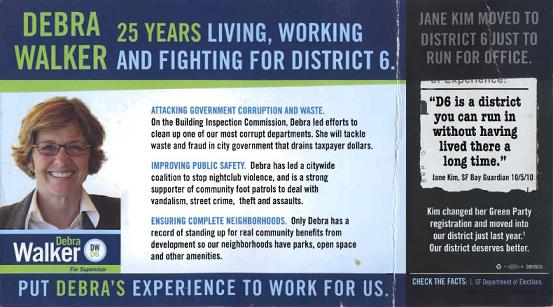
Now more than ever we need labor, progressives, and renters to come together to fight back by voting Tuesday, Nov. 2. Harvey Milk once said, “Give ’em hope.” Show us that hope on Election Day by voting for progressive supervisors, rejecting Adachi’s so-called pension reform, and opposing the so-called sit/lie ordinance. Remember to vote and vote for Debra Walker in District 6, Rafael Mandelman in District 8, No on B, No on K, No on L, and Yes on J and N.

Gabriel Haaland is a local queer labor activist.


Cash not care

5

sarah@sfbg.com

With the general election just days away, campaign disclosure reports show that downtown interests are spending huge amounts of money to create a more conservative San Francisco Board of Supervisors and to pass Proposition B, Public Defender Jeff Adachi’s effort to make city workers pay more for their pensions and health insurance.

Much of the spending is coming from sources hostile to programs designed to protect tenants in the city, including rent control and limits on the conversion on rental housing units to condominiums. An ideological flip of the board, which currently has a progressive majority, could also have big implications on who becomes the next mayor if Gavin Newsom wins his race for lieutenant governor.

At press time, downtown groups were far outspending their progressive counterparts through a series of independent expenditure committees, most of which are controlled by notorious local campaign attorney Jim Sutton (see “The political puppeteer,” 2/4/04) in support of supervisorial candidates Mark Farrell in District 2, Theresa Sparks in District 6, Scott Wiener in District 8, and Steve Moss in District 10.

Prop. B has also been a big recipient of downtown’s cash, although labor groups have pushed back strongly with their own spending to try to kill the measure, which is their main target in this election.

But the biggest spender in this election appears to be Thomas J. Coates, 56, a major investor in apartments and mobile homes and a demonstrated enemy of rent control. He alarmed progressive groups by giving at least $250,000 to groups that support Farrell, Sparks, Wiener, Moss, and Prop. G, legislation that Sup. Sean Elsbernd placed on the ballot to cut transit operator wages and change Muni work rules.

Although Coates declines to identify with a political party on his voter registration, he donated $2,000 to President George W. Bush in 2004. More significantly, he was the biggest individual donor in California’s November 2008 election, when he contributed $1 million to Prop. 98, which sought to repeal rent control in California and limit the government’s right to acquire private property by eminent domain.

Coates, who is also a yachting enthusiast and sits on San Francisco’s America’s Cup Organizing Committee (ACOC), donated $100,000 on Oct. 20 for Farrell, $45,000 for Sparks, $45,000 for Moss, and $10,000 for Wiener through third-party independent expenditure committees such as the Alliance for Jobs and Sustainable Growth.

The group has already received thousands of dollars in soft money from the San Francisco Police Officer’s Association, the Building Operators and Managers Association, the Golden Gate Restaurant Association, and SEIU-United Healthcare Workers, which supports a high-end hospital and housing complex on Cathedral Hill.

Those downtown groups have spent close to $200,000 on English and Chinese language mailers and robo calls in support of Sparks, Wiener, and Moss in hopes of securing a right-wing shift on the board.

Progressive groups including California Nurses Association, the San Francisco Tenants Union, and the SF Labor Council have tried to fight back in the supervisorial races. While downtown groups spent more than $100,000 promoting Sparks in D6, labor and progressive groups spent $13,000 opposing Sparks and $72,000 supporting progressive D6 candidate Debra Walker.

In D8, progressive groups that include teachers, nurses, and transit riders have outspent the downtown crowd, plunking down $40,000 to oppose Wiener and $90,000 to support progressive candidate Rafael Mandelman. So far, downtown groups have spent about $100,000 to support Wiener.

But in D10, the district with the biggest concentration of low-income families and communities of color, downtown interests spent $52,000 supporting Moss and $5,000 on Lynette Sweet while the Tenants Union was only able to summon $4,000 against Moss. The SF Building and Construction Trades Council spent $4,000 on Malia Cohen.

But that’s small potatoes compared to what downtown’s heavy-hitters are spending. The so-called Coalition for Sensible Government, which got a $100,000 donation from the San Francisco Association of Realtors, has already collectively spent $96,000 in support of Sparks, Wiener, Moss, Sweet, Rebecca Prozan in D8, Prop. G and Prop. L (sit-lie) and to oppose Prop. M (the progressive plan for police foot patrols) and Prop. N (a transfer tax on properties worth more than $5 million).

The Coalition for Responsible Growth, founded by Anthony Guilfoyle, the father of Mayor Gavin Newsom’s ex-wife, Kimberly Guilfoyle (who now works as a Fox News personality), has received $85,000 from the Committee on Jobs, $60,000 from the Realtors, and $35,000 from SF Forward. It has focused on spending in support of Prop. G and producing a voter guide for Plan C, the conservative group that supports Sparks, Wiener, Sweet, and Moss

Coates’ donations raise questions about his preferred slate’s views on tenant and landlord rights. A principal in Jackson Square Properties, which specializes in apartments and mobile homes, Coates is the founding partner of Arroya & Coates, a commercial real estate firm whose clients include Walgreens, Circuit City, and J.P. Morgan Investment Management. In 2008, when he backed Prop. 98, Coates told the San Francisco Chronicle that rent control “doesn’t work.”

Ted Gullicksen, director of the SF Tenants Union (SFTU), which has collectively spent $30,000 opposing Sparks, Wiener, and Moss, is disturbed that Coates spent so much in support of this trio.

“Coates was the main funder of Prop. 98,” Gullicksen explained. “His property is in Southern California. He’s pumping a lot of money into supervisors. And he clearly has an agenda that we fear Moss, Sparks, and Wiener share — which is to make the existence of rent control an issue they will take up in the future if elected to the board.”

That threat got progressive and labor groups to organize an Oct. 26 protest outside Coates’ San Francisco law office, with invitations to the event warning, “Be there or be evicted!”

Sparks, Moss, and Wiener all claim to support rent control, despite their support by someone who seeks to abolish it. “I answered such on my questionnaire to the SFTU, which chose to ignore it,” Sparks told the Guardian via text message. “In addition, I’ve been put out of apartments twice in SF, once due to the Ellis Act. They ignore that fact as well.”

Records show that in May 2009, Moss — who bought a rent-controlled apartment building near Dolores Park in D8 for $1.6 million and he lived there from the end of 2007 to the 2010, when he decided to run for office in D10 — served a “notice to quit or cure” on a tenant who complained about the noise from Moss’ apartment. Ultimately, Moss settled without actually evicting his tenant.

“I read about Coats’ [sic] contribution in Bay Citizen,” Moss wrote in an e-mail to the Guardian. “This donation was made to an independent expenditure committee over which I have no control and almost no knowledge. I have stated throughout the campaign, and directly to the Tenants Union, that I believe current rent control policy should remain unmolested.”

But Moss is with downtown on other key issues. He supports Newsom’s sit-lie legislation and the rabidly anti-tenant Small Property Owners Association, whose endorsement he previously called a “mistake.”

Yet Moss, who sold a condo on Potrero Hill in 2007 for the same price he paid for the entire building in 2001, seems to voice more sympathy for property owners than renters, who make up about two-thirds of city residents. He told us, “Landlords feel that they are responsible for maintaining costly older buildings and that they are not provided with ways to upgrade their units in ways that share costs with tenants.”

Another realm where downtown seems to be trying to flip the Board of Supervisors on a significant agenda item is on health care, particularly the California Pacific Medical Center proposal to build a high-end hospital and housing project on Cathedral Hill in exchange for rebuilding St. Luke’s Hospital in the Mission.

The project has divided local labor unions. UHW supports the project and a slate of candidates that its parent union, Service Employees International Union, is opposing through SEIU Local 1021, which is supporting more progressive candidates. The California Nurses Association also opposes the project and candidates such as Wiener who back it.

“A recent mailer by CNA falsely says that CPMC is closing St. Luke’s and Davies,” CPMC CEO Warren Browner recently complained in a letter to the Board of Supervisors. “We are not. We are committed to building a state-of-the-art, high-quality replacement hospital at St. Luke’s and continuing to upgrade Davies.”

But the CPMC rebuild is contingent on the board approving the Cathedral Hill project. So the CNA mailer focused on what could happen if the city rejects the CPMC project: “We could lose two San Francisco hospitals if Scott Wiener is elected supervisor.”

SEIU-UHW’s alliance with downtown groups and its use of member dues to attack progressive candidates places it at odds with SEIU Local 1021 and the SF Labor Council, which has endorsed Janet Reilly in D2, Walker in D6, Mandelman in D8, and Cohen (first choice) and Chris Jackson (second choice) in D10.

“We’re really disappointed that there are labor organizations that feel they have to team up with Golden Gate Restaurant Association, which is against health care [it challenged the city’s Healthy San Francisco program all the way to the U.S. Supreme Court], and with CPMC, which is working to keep nurses from joining a union,” Labor Council Director Tim Paulson said. “This alliance does not reflect what the San Francisco labor movement is about.”

Paulson said that the Labor Council values “sharing the wealth … So we don’t want Measure B [Jeff Adachi’s pension reform] or K [Newsom’s hotel tax loophole closure, which has a poison pill that would kill Prop. J, the hotel tax increase pushed by labor] or L [Newsom’s sit-lie legislation],” Paulson said.

CPMC’s plan is headed to the board in the next couple months, although Sup. David Campos is proposing that the city create a health services master plan that would determine what city residents actually need. Hospital projects would then be considered based on that health needs assessment, rather than making it simply a land use decision as it is now.

Moss told the Guardian that UHW endorsed him because of his positions on politicians and unions. “I agreed that politicians should get not involved in union politics,” Moss said. “The United Healthcare Workers seem to be a worthy group,” he added. “All they said was that they wanted to make sure that they had access.”

But CNA member Eileen Prendiville, who has been a registered nurse for 33 years, says she was horrified to see UHW members recently oppose Campos’ healthcare legislation. “I was shocked that they were siding with management,” she said.

Prendiville believes UHW is obliged to support CPMC’s Cathedral Hill plan, which is why it is meddling in local politics. In his letter to the board, Browner noted that his company and its parent company, Sutter Health, can’t legally do so directly. “The fact is that CPMC and Sutter Health are 501(c)(3) not-for-profit, nonpartisan organizations, and we neither endorse nor contribute to candidates,” Browner wrote.

“When UHW settled its contract with its members [as part of its fight with the rival National Union of Healthcare Workers], they had to publicly lobby for Cathedral Hill,” Prendiville claimed.

SEIU 1021 member Ed Kinchley, who works in the emergency room at SF General Hospital, is also furious that UHW is pouring money into downtown’s candidates and measures. “UHW isn’t participating in the Labor Council, it’s doing its own thing,” he said.

Kinchley said UHW, which is currently in trusteeship after a power struggle with its former elected leaders, is being controlled by SEIU’s national leaders, not its local membership, which explains why it’s aligned with downtown groups that have long been the enemy of labor.

“Sutter wants a monopoly on private healthcare and people like Rafael Mandelman and Debra Walker have been strong supporters of public healthcare,” Kinchley said. “I want someone who can straight-up say, here’s what’s important for families in San Francisco, especially something as important as healthcare. But it sounds like UHW is teaming up with the Chamber and supporting people who are not progressive.”


PG&E fast and loose on repairs, tight-lipped on info

0

It was clear at several times during the Oct. 19 Senate committee hearing that Pacific Gas & Electric Co. had done a poor job of communicating with those affected by the pipeline explosion that brought catastrophe to San Bruno, a practice that is in keeping with its longstanding pattern of secrecy.

Kathy DeRenzi, a survivor who testified at the hearing, noted that she had written several letters to PG&E since the event, addressed to Vice President of Gas Operations Kirk Johnson. “I haven’t heard back from anyone,” she said. DeRenzi also noted that she has been in close contact with many affected residents since the blaze, and very few had received notification that the hearing would be held. “There would’ve been a lot more people here” had they known, she said.

San Bruno Mayor Jim Ruane also complained of the utility’s lack of communication. In the weeks following the blaze, he said, the company started a repurchasing program for residents whose homes had been damaged — but never mentioned it to city officials. “The city was never informed,” Ruane said. “It’s kind of a mixed message when we find out from the media about this program.”

Weeks earlier, the company continued to hide crucial information about its top 100 priority repairs until intense public pressure forced it to release the list. A recent article in the San Francisco Chronicle noted that two key PG&E employees who were on duty the night of the explosion declined to be interviewed by federal investigators about the pressure spike in the gas pipeline, saying they were “too traumatized” to talk.

PG&E also ignores the inquiries of certain media outlets. When a Guardian reporter attempted to approach Johnson to ask a question, media relations representative Joe Molica stood in the way and insisted that Johnson didn’t have time to talk. Asked for contact information so that an interview could be set up later, Molica appeared to search for a business card but came up empty-handed.

He then refused outright to provide his phone number or e-mail address. Asked why a media relations representative could not share his e-mail address with a reporter, Molica scoffed. “Because it will end up on some blog,” he snapped. 


Editor’s notes

0

Tredmond@sfbg.com

At a certain point, you have to stop trying to project what’s going to happen and just wait for the election results. Because what matters now isn’t the $140 million Meg Whitman has spent or Carly Fiorina’s record at Hewlett-Packard or which aide to Jerry Brown called Whitman a whore. It’s who shows up to vote.

If I were Meg Whitman’s campaign manager, I’d stop spending money. Go into hiding. Pretend there’s nothing going on here, no big deal next Tuesday morning — and then pray for rain. Because the way Whitman wins — possibly the only way she wins — is if huge numbers of Californians don’t bother to vote.

If the turnout is reasonable — that is, if enough Democrats realize the danger posed by of the GOP candidate and go to the polls — then Jerry Brown is in. And if that happens, chances are good that the rest of the Democratic ticket — including Gavin Newsom and Kamala Harris — squeaks in, too. And then we can all start to have fun figuring out the future of San Francisco politics.

That, of course, depends on the same factor: Who’s going to show up to vote? Will all the tenants in District 8 — many of them unexcited about Jerry Brown — take the time to vote for Rafael Mandelman for supervisor? Will the progressive voters who have lived in District 6 for a while get to the polls in greater numbers than the conservative newcomers in the pricey condos? Will the next Board of Supervisors — which could be choosing the next mayor — be as progressive as the current board (which also might wind up choosing the next mayor?)

And who’s even on the mayoral short list?

At the Haight Ashbury Neighborhood Council forum Oct. 14, former Supervisor (and potential mayoral contender) Aaron Peskin noted that the person in Room 200 year “is going to have to take out the garbage.” The city’s going to face another awful budget deficit and a progressive interim mayor will have to make a lot of enemies. Who wants to face the voters in November 2011 after making more cuts and raising taxes?

Well, somebody needs to — because the “caretaker” mayor some people are pushing for won’t have the clout to make tough decisions. And frankly, a progressive with the power of incumbency might actually be able to win a full term, even up against a huge downtown war chest.

Fun stuff. Go out and vote.


Steve Moss: the big duck

68

WORKING DOGGEDLY TO PIN DOWN THE EDITOR OF THE POTRERO VIEW WHO IS ALSO A CANDIDATE FOR SUPERVISOR FROM DISTRICT 10

We’ve been trying to pin Steve Moss down on some key questions.  Over the weekend, I sent him some questions by email.  He responded, but ducked or ignored the real points and never gave us any straight answers.

Here’s our exchange, my questions and his answers — unedited,  followed by some comments from me as we doggedly try to make sense of where Steve Moss really stands on key issues in the district.


Dear Steve,

In your October, pre-election issue of the Potrero View, your signed column
compares the Guardian with Fox News and states that we are both  “advocacy groups disguised as news purveyors” who “whip mostly anonymous commentators on their websites to call political candidates ‘weasle, lying, doucebags’ and worse.” You also state that “these same outlets barely take the time to edit–much less fact check–their stories.”

As you know, our reporter Sarah Phelan has done factual reporting on you and your campaign (http://www.sfbg.com/2010/09/14/five-things-you-should-know-about-steve-moss) and she and I have both checked with you to respond to our points before publication.  We will continue our policy by submitting these email questions to you in advance of publication. Our deadline is 5 p.m. on Monday

l. What specific facts do you find inaccurate in our previous reporting on you and your campaign? (You mixed up a comment on a blog with Phelan’s actual story and reporting. Was this intentional?)

2. How much money have you and your various profit and nonprofit enterprises accepted from PG&E during this past year?

How much money have you accepted in total from PG&E during your many years of operating  your profit and nonprofit enterprises? Why did you change the pro-public power View of Ruth Passen to a PG&E-friendly View under your ownership?  (For example, Passen always supported public power but you as the new owner  refused to support the last public power initiative and said it was “too contentious.”)

3. Campaign finance records show that Thomas Coates, a Republican who spent $l million trying to overturn rent control in California in 2008, has just dumped
$45,000 into the so-called Alliance for Jobs and Sustainable Growth in support of your candidacy.  Public records also show that you served a cure or quit notice
to a tenant in your rent-controlled building in District 8. Would you comment on this? And would you state whether you support or oppose rent control?

4.  On the front page of the October View, your lead story reported on the troubles of the Neighborhood House under the headline, “NABE Reeling Under City Budget Cuts.” Your story noted that the Nabe had lost “nearly $400,000 in funding from the Department of Human Services (DHS) and the Department of Children, Youth and Their Families” and that individual donations had dropped by 75 per cent. The result, your story noted, was that the NABE “has been forced to eliminate teen-focused programming, reduce elementary school offerings by 25 per cent, lay-off staff and impose pay cuts.”

Each year, the NABE sponsors the Potrero Hill festival as a benefit to raise much-needed funds. This year the benefit was more critical than ever to reduce its  crippling deficit. Just as the View was going to press earlier this month,  I got a call at the Guardian from a representative of the festival with a startling bit of information. I was told that you, as the owner and editor-publisher of the View, and a candidate for supervisor from our district, were  refusing to run a full page ad for the festival, a key piece of the NABE’s promotion on the hill,if the ad contained the logo of the Guardian as a festival sponsor. 

The representative was concerned that, if you wouldn’t run the NABE ad, that the Guardian as a media sponsor wouldn’t run a NABE ad in the Guardian.
(I told him not to worry, do what he had to do to get the ad in the View, and that the Guardian would run the ad and double up on its promotion for the festival. The Guardian logo did not appear on the Nabe ad in the View but did appear on all other NABE promotions.)

Why did you make this threat to the NABE and its festival benefit? Were you serious?

5. You said in your endorsement interview at the Guardian that, if you were elected supervisor, you would give up the View. Do you still plan to do that, if elected? If so, how would you do that?

 
 Steve Moss responds:

1.  The entire way you’ve covered the District 10 election has been slanted towards the candidate you prefer, and against the candidates you dislike.  From this perspective the Guardian is not serving the role of a newspaper, but rather is acting as an independent expenditure committee on behalf of its chosen candidates and causes.  I’d be happy to select a panel of five independent journalists — you pick two, I’ll pick two, and the four can pick one — to render an opinion about how you’ve run the Guardian during this election cycle, and how I’ve run the View.

2.  In 2010 I believe SF Power has received less than $25,000 in payments related to the small business demand-response program it operates, as sanctioned by the California Public Utility Commission.  I’ve already provided you and your reporter with multiple responses to your requests about SF Power’s successfull advocacy related to CPUC orders requiring PG&E to fund programs focusing on working families and small businesses, all of which, as I’ve repeatedly pointed out, are a matter of public record.

The View has published several articles about community-based energy systems, and effective ways to achieve local control over the power grid, during my tenure as publisher. They are available on our website.

3.  I read about Coats’ contribution in Bay Citizen.  As you know, this donation was made to an independent expenditure committee over which I have no control and almost no knowledge.  I have stated throughout the campaign, and directly to the Tenants Union, that I believe current rent control policy should remain unmolested.

4.  I made no threat to the NABE.  In fact, the festival was featured on the front page of the November issue, with a story inside, and a full page ad.

5.  Yes.  A new editor will be found to run the View if I’m elected to office.


Okay, You aren’t responsive.   Let me try again, point by point:

l. I am not running for office. You are.  Please tell me where we are factually wrong in any of our reporting on you and your campaign.

As you know, we have contacted you in advance of publication for comment. And you have written us twice with generalities but no specifics on inaccurate reporting.

2. You defend your PG&E payments on the basis that it’s actually money from the California Public Utilities Commission that PG&E is required by law to put up for energy efficiency projects. However, Loretta Lynch, former president of the CPUC, told me that PG&E decides who gets the money and that fund recipients that “cross PG&E” are in danger of getting their funds cut off.

In other words, if  you  want to continue to fund your organization with upwards of more than $l million over three years, you must avoid angering the utility.  This may explain why the Potrero View under your ownership has switched from its historic position supporting public power under former owner Ruth Passen to going easy on PG&E and ducking a position on the most recent public power initiative (Proposition H).

The background: Your  non profit collected  $1,290,000 from the CPUC for energy efficiency projects over the past three years, according to SF Power’s annual revenues and estimated budgets from 2008 to 2010 as provided on its website.

The breakdown: $500,000 in 2008, $440,000 in 2009, $350,000 in 2010.

You  also got $150,000 from the San Francisco Public Utilities Commission in 2008 and $125,000 in 2009.  Your  non profit also got $50,000 chunks each year from the Richard and Rhoda Goldman fund, where his wife Debbie Findling works.   The Lisa and Douglas Goldman Fund kicked in $5,000 in 2008 and 2009.  The  Potrero View contributed $5,000 in 2008, $4,500 in 2009, and $5,000 in 2010.  A footnote stated that SF Power “is also informally negotiating with the California Air Resources Board, San Francisco’s Office of the Mayor, Mirant Corporation, and Pacific Gas and Electric Company, among others, for project funding support.”  Did you get any additional money from Mirant, PG&E,  the Mayor, or anybody else? Are you still negotiating? If not, when did you stop?

Lynch explained that “all energy efficiency programs in California are funded by ratepayer dollars that are collected by the utilities as part of each ratepayer’s utility bill.  Thus, California ratepayers, big and small, pay for all energy efficiency programs and each and every program is funded by ratepayers, not utilities.”

She said that the CPUC “sets broad parameters for each utility concerning the amount of overall energy efficiency savings to be achieved and in what customer classes (residential, small business, large business,etc.). But the utilities choose the program providers. The CPUC simply reviews the overall package provided by the utilities to check to see whether the energy efficiency savings targets are met.”

Thus, PG&E each year decides  the amount of money going to SF Community Power. Lynch noted that  some non profit people told her, when she was a commissioner, that “if you crossed PG&E, they would stop the funding.”
 
Lynch mentioned a meeting with you  that showed  PG&E’s influence on you, your non profit and the View. .
She said that, shortly after she was termed out as a CPUC  commissioner in 2009, you  asked her to meet with  him at Farleys coffee shop and asked her to serve on the board of his nonprofit. “I thanked him and said that he should consider my relationship with PG&E before making that offer if he was funded through PG&E, as PG&E and I have a very contentious relationship,  and that they would not be happy if I were on the board. He thanked me for telling him and agreed that I should not serve on the board.”  Lynch lives on Potrero Hill.

3. I followed up my rent control question:  “If state law were amended to allow it, would you support extending rent control to vacant apartments?”  No answer.

4. I got a call from Keith Goldstein, president of the Potrero Hill Association of Merchants and Businesses and co-chair of the festival. He had gotten an email from you  that read: “Please have the festival’s pr agent remove the Guardian’s logo from any complimentary ad the View is providing the festival in this month’s paper.” Why did you make  such an unprofessional move?   Would you have backed out of sponsoring this event if the Guardian logo had remained? Is that how you would behave as a supervisor?

5. If elected, do you plan to sell the View?  Will you continue to operate your non profit and take chunks of money from PG&E? If elected, would your income from PG&E disquality you from voting on PG&E and energy issues? At what point would you sever your relations, if at all,  with your non profit and PG&E?

6. If  you lose, will you (as your wife suggested in an email to friends) move back to your house on Liberty St in Distict 8?

We anxiously  await your response. B3

Newsom could be headed for victory

11

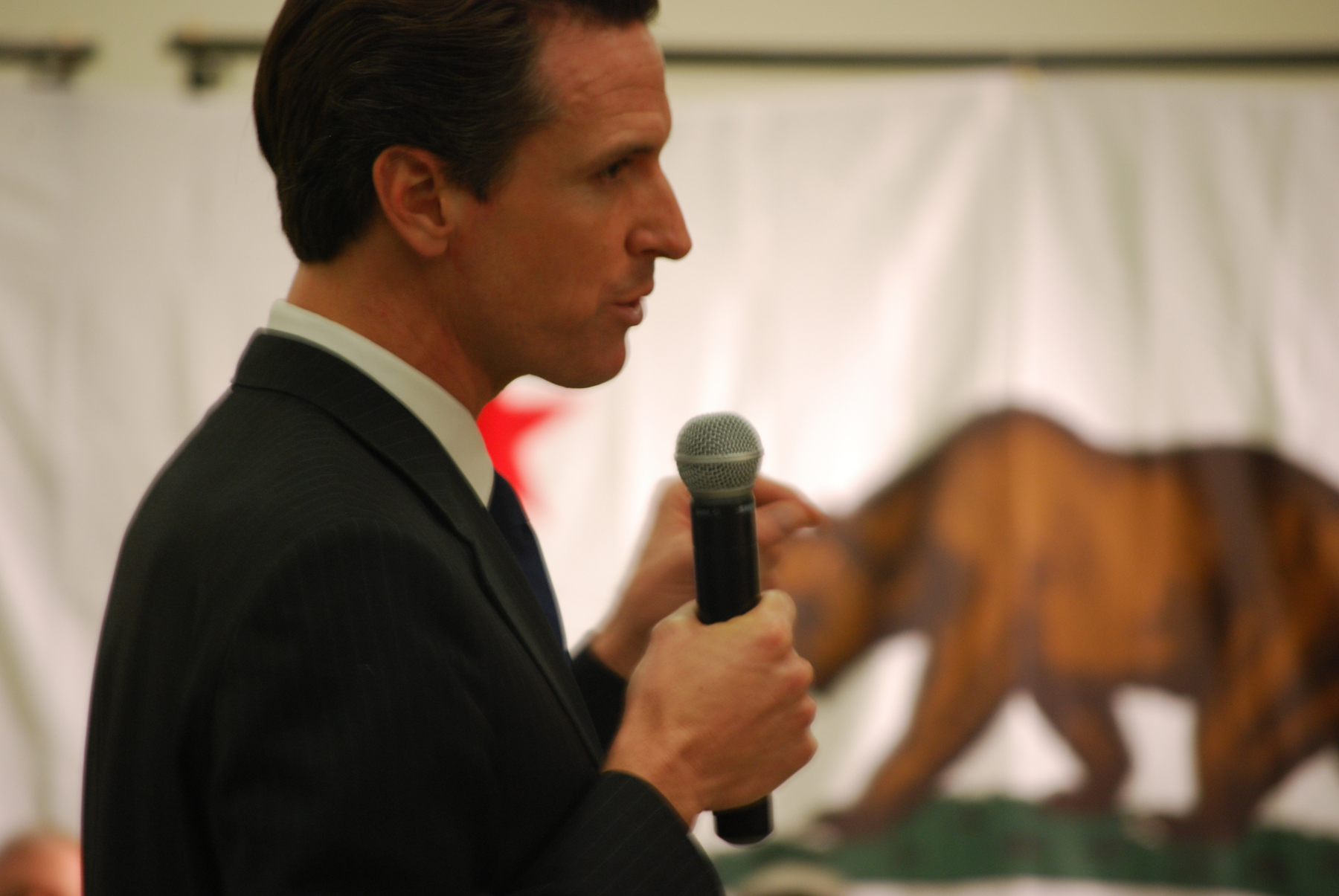
Gavin Newsom seems poised to win his race for lieutenant governor, at least as indicated by his opponent Abel Maldonado’s increasingly desperate campaign tactics and Newsom’s string of newspaper endorsements, including the Spanish language La Opinion, which chose to pass over a moderate Latino that it has endorsed in the past. The only question now is voter turnout, and whether Newsom’s negatives would be enough to drag him down if the Democratic base stays home in this lackluster election.

In its endorsement in Sunday’s paper, La Opinion wrote, “We are deeply disappointed that in this election [Maldonado] has opted for an opportunistic strategy of using images of undocumented criminals to earn political points. This is unacceptable and his charges against Newsom on this issue are inaccurate.” The reference was to Maldonado’s wild charges in an Oct. 15 debate that Newsom created San Francisco’s sanctuary city policies and was responsible for the fatal shootings of Bologna family members, allegedly by an undocumented immigrant who had once been in city custody. The reality was that Newsom inherited the sanctuary city policy and unilaterally weakened it after the Bologna shooting, even refusing to implement legislation approved by the Board of Supervisors (which Newsom vetoed but the board overrode) to require due process before those arrested are turned over to the feds for possible deportation.

While the paper didn’t seem to understand that Newsom has snubbed his nose at San Francisco progressives and petulantly fed a particularly divisive style of politics here, they do rightfully give him credit for running a complicated city, unlike the conservative city of Santa Maria where Maldonado was mayor and always did the bidding of the Chamber of Commerce, something I observed while working at the Santa Maria Times at the time. “The Democratic candidate has implemented solid, progressive management while leading a diverse city during a deep budget crisis. Newsom has proven to be creative, resourceful, and sensitive while forging alliances that improve the quality of life for his city’s residents,” La Opinion wrote. 

Then yesterday, as the Los Angeles Times reports on its blog, when Newsom held a campaign event trumpeting his support by Latino leaders such as Los Angeles Mayor Antonio Villaraigosa and labor leader Dolores Huerta, Maldonado showed up and sat in the back with his advisers during the event. Now that’s just strange.

A California Democratic Party e-mail blast this afternoon used a series of rhetorical questions to describe the campaign’s episodes: “So was Maldonado’s bizarre behavior an egotistical attempt to intimidate other Latinos who came to the event to support Newsom? Does he feel entitled to the appointed position now that he actually has to compete for voters in a real election? Is he desperate for media attention? Or does he just enjoy being a spectator, watching his opponent secure key Latino endorsements while his own campaign falls apart?”

But the real question is whether Democrats can mobilize enough voters to overcome Newsom’s negatives, from his arrogance to his personal foibles. When I did a search for Gavin Newsom’s name on Yahoo, which automatically guesses what you’re asking for based on past queries, the first three that listed were “Gavin Newsom girlfriend,” “Gavin Newsom divorce,” and “Gavin Newsom affair,” an apparent reference to his admitted affair with Ruby Rippey Tourk, who worked for him and was married to his reelection campaign manager.

So, if you support Newsom for this office — or even if you’re just anxious for him to leave San Francisco a year before his mayoral term expires — don’t forget to get out there and vote.

On the margins

3

Sarah@sfbg.com

Franklin is a 20-something computer programmer who shares an apartment with 10 other people around his age, an arrangement that helps him and his housemates come up with $3,500 each month for rent in the Mission, a rapidly gentrifying part of town.

“Everyone is pretty much working, but they are in and out at different times so the house isn’t ever really empty. But there’s usually only three or four of us at a time, ” Franklin told the Guardian, speaking on his cell phone as he rode his bike to work.

But how does an apartment that officially has only one bedroom sleep 10 people? Franklin said there are other rooms in the house — including a dining room and a double parlor that splits into two with sliding doors — and that each of these spaces has a couple sleeping in it. “And there is one person sleeping in a closet and another sleeping in a space atop the bathroom.”

While overcrowding has been a problem in immigrant communities in San Francisco, it’s reaching a new area: young people who have for generations flocked to the city to escape uncomfortable home lives, find a supportive community, and make a new start in life.

Ted Gullicksen, director of the San Francisco Tenants Union, said at least 1,250 housing units annually were lost to condominium and tenancy-in-common conversions in the dot.com and housing bubble years, a loss rate that has slowed only slightly since then.

“Right now, it’s about 1,000 units a year,” he said.

It’s become more common for young people to struggle to pay rent in a town where well-paying jobs are scarce and educational programs have been cut — a triple whammy that means youth with additional challenges are at risk of becoming homeless and getting trapped in vicious cycle of abuse and incarceration.

COMPOUNDING THE PROBLEM

Sherilyn Adams, executive director of Larkin Street Youth Services, which provides housing, medical, social, and educational services to at-risk homeless and runaway youth, says all young people in San Francisco face the same basic challenges.

“And if, in addition, these youth are part of a group like LGBTQ youth, or are youth of color, or immigrant youth, documented or not, then the circumstances and barriers are much more exacerbated,” she said.

Adams said San Francisco has done a lot to add resources for transitional age youth, a group that traditionally has been defined as ages 12 to 24. “But there is still a significant gap in resources, especially for the more disenfranchised groups, because the longer you’ve been on the street, the more complex your issues in terms of substance abuse and mental health.”

Civic leaders, including California Assembly member Tom Ammiano, recently held a rally and candlelight march to raise awareness of the tragic rise in homelessness and suicides among LGBTQ youth. Shortly after, Adams told us, “Youth who came here escaping homophobia in their family or city then face the harsh reality of San Francisco.”

Adams understands that some people see Proposition L, legislation on the November ballot to criminalize sitting or lying on city sidewalks, as a way to address disruptive and aggressive behavior on the streets. “But it becomes part of the larger divide, because youth who come here and are on the street are mostly there because they have no other place. So penalizing them in the absence of services, housing, and education is ineffective at best and really harmful at worst,” Adams said.

Many young people on the brink of homelessness are “somewhat invisible,” and therefore at high risk, she said. “Youth will double, triple up. They will couch surf as a way to be off the streets. And we hear the stories where youth are faced with a Sophie’s choice: Do you sleep on the street, or do you barter with what you have available so as to get shelter? And LGBTQ youth are at particular risk because the more disenfranchised and disconnected you are, the more you have to make impossible choices to survive.”

Jodi Schwartz, executive director at Lyric, an SF nonprofit that focuses on building community and inspiring change in LGBTQ youth, said the group serves 500 youth and reaches out to 800 to 1,000 more each year. “We go into classrooms and talk about hate speech, putting it in the context of racism and other forms of oppression,” she said.

“There’s a misconception that because we live in San Francisco and have a lot more dialogue and interaction with the LGBTQ community, that young people’s experience here is so much better. It may be different, but I wouldn’t say it’s better,” Schwartz said, noting that harassment levels, especially for transgendered youth in local schools, are very high.

HELPING THOSE IN NEED

Young women are another at-risk group, especially if they are pregnant, have kids, or are in the foster or juvenile justice system.

As executive director of the Center for Young Women’s Development in San Francisco’s gritty SoMa district, Marlene Sanchez tries to stabilize at-risk young women, then engage them in policy work so they can advocate for other young people they know.

“We work with young women who are involved in the underground street economies, doing prostitution, drug sales, and selling stolen goods like clothes,” Sanchez said. “We try to reach them on the streets and inside Juvenile Hall, so we take an inside-outside approach.”

Leajay Harper, who coordinates CYWD’s Young Mothers United program, works with young pregnant women inside Juvenile Hall.

“We have all experienced poverty, parents on drugs, and having to take care of younger siblings,” Harper said. “When young moms get incarcerated, they are at risk of having their children taken away at much higher rates. So we started parenting classes that are age and culturally relevant.”

City records show that while only about 12 percent of Juvenile Hall detainees are female, they are twice as likely as their male counterparts to land back in custody for probation violations.

“There are lots of young women with felonies struggling to pay their bills and feed their kids who look out the window and see they can sell drugs. And that often seems like the only option,” Sanchez explained.

City statistics also show that of the overwhelmingly male population at Juvenile Hall, almost half is African American, and that many are inside for what appear to be gang-related offenses.

Easop Winston, a 35-year-old local musician, church pastor, and member of the Visitacion Valley Peacekeepers, regularly visits young men inside Juvenile Hall, where gangs are a topic of discussion every week.

“The same guys that they have been fighting with, they are now incarcerated with,” Winston observed. “So one of the approaches I try to take is rehabilitating how they think about their neighbor. You are killing/fighting with someone who lives one block over. It’s plain genocide”

He credits the juvenile justice system for doing its best, but worries that it fails to rehabilitate youthful offenders with jobs skills, education, and counseling before sending them back into society.

He blames the churches for not doing a better job of making youth feel welcome. “Churches are part of the fabric of our community,” he said. “They need to do more outreach and not have so many rules. They need to accept youth as they are, with their tattoos, piercings, and styles of clothing.”

Winston believes politicians need to do a better job of making sure community-based organizations deliver on their promises to help working class communities of color. At the same time, as he acknowledges, “We can’t cure the world in one day.”

“Over the last five to 10 years, the African American population in SF has shrunk,” he observed. “Everybody is moving to Antioch and Fairfield because people can’t afford to live here. People are losing their jobs. And San Francisco has almost become impossible to live in unless you have a college degree. A lot of what I hear from youth is about economics. They want jobs. They want to be trained.”

PUSHING THEM OUT

Political disputes over the city’s sanctuary city policies on undocumented immigrants — which have left in limbo the question of whether arrested immigrants will get their days in court before being turned over to the federal government for possible deportation — have also been a source of instability for immigrant teens, many of whom are homeless and/or LGBTQ.

Police Commissioner Angela Chan, a staff attorney with the Asian Law Caucus, decried Mayor Gavin Newsom for refusing to implement Sup. David Campos’ due process legislation, which the board approved in November 2009.

“It’s been a little bit upsetting for the many groups that took the democratic process seriously. But these groups are still very committed to these kids,” Chan said. “We are hoping to work with the new U.S. Attorney Melinda Haag to clarify this issue and explain that the top priority of the Obama administration is not to deport undocumented youth.”

Other so-called tough-on-crime initiatives also threaten local at-risk young people. In September, City Attorney Dennis Herrera secured an injunction against 41 alleged gang members in Visitacion Valley, a strategy that progressives fear will accelerate the ongoing displacement of the African American community.

Court documents show that 66 percent of the men named in the injunction are 18 to 25 years old and that many have children in public housing, where lease holders are predominantly women of color.

San Francisco City College Trustee Chris Jackson, 27, is running for the District 10 seat on the Board of Supervisors. Noting that the southeast SF district has some of the highest numbers of poor people and children citywide, Jackson said that youth issues are similar to challenges that other voters face.

“But the context is different,” said Jackson, who previously served on the San Francisco Youth Commission. “Young people care about safe streets because it’s us or our friends who are on them. We care about schools because we are in them and want to go to college. And we are concerned about the future of employment because how do you tell folks to go to school if there are no jobs?”

Jackson notes that in the Bayview-Hunters Point, home to the city’s largest remaining African American community, kids don’t come back if they leave for college. “We see a brain drain. It’s really difficult to retain young people, so it’s important to first make sure that youth’s housing needs are met. And they also need access to careers so that when they graduate, they know there is a job in the city. But right now, youth can’t even find a summer job because of the recession.”

He called for city policies that are based on the needs of current city residents rather than developers’ profits or the desires of well-off outsiders to move here.

“San Francisco is more of an opportunity for Silicon Valley residents than for youth who were born and raised here. And part of the problem is city policies, ineffective programs, and a failure to provide job opportunities for youth,” he said. “Everything for youth has been gutted.”

And those evaporating opportunities are compounded by punitive policies like Prop. L, Jackson said, further alienating young people. “It comes down to how much money you have,” Jackson observes. “If you are rich, you can enjoy the parks, the clubs, the transit. But if you are low-income, especially low-income youth of color, it’s very hard to take advantage of everything the city has to offer.”

Noting that both City College and the San Francisco Unified School District canceled their summer school program, Jackson said, “it doesn’t look like youth are prioritized.”

Jackson was recently at Double Rock (a.k.a. the Alice Griffith Public Housing Project) and he saw four kids under 10 who were at home while their parents were at work. “Why aren’t they in school or in child care? And don’t give me the line that these are hard to serve communities. We have to serve them.”

N’tanya Lee, executive director of Coleman Advocates, agrees that while all young people are struggling in the city, African American children and youth are having one of the worst times.

“We don’t need 5,000 different strategies and initiatives when 90 percent of these kids live in extreme poverty, mostly concentrated in public housing, and you could fit the city’s entire black high school student population into one auditorium,” Lee said.

She wants the city to create a database of these youth and develop specific strategies to help this population before it’s too late.

“No one in city government feels accountable for the outcomes for black children and youth,” she said. “Instead you have one group who are about young people and another who are about economic development — and they have nothing to do with each other. Meanwhile, we’ve lost half of all black families with children in this city in the past 20 years.”

Our 44th Anniversary Issue also includes stories by Rebecca Bowe on ageing out of the foster care system, Caitlin Donohue’s account of the Haight street kids, and Tim Redmond’s editorial on the issues facing our rising generation

The soul of the city

23

tredmond@sfbg.com

44th ANNIVERSARY SPECIAL We all arrived in San Francisco broke: Paulo and me in the ’73 Capri, crawling over Donner Pass with a blown valve and three cylinders firing; Tracy and Craig in the back of a VW van, behind in the payments and on the run from the repo men; Tom and Sharon hitching across the Southwest after Tom, who could bullshit with the best, talked himself out a jail cell in New Orleans. Moak showed up in a rusty Datsun with the wheels falling off. Jane and Danny came on the old hippie bus, the Green Tortoise, $69 across the country.

But we all had a friend who knew a friend where you could crash for a little while. And in the early 1980s you got food stamps the first day and it only took a couple of weeks to get a job waiting tables or canvassing or selling trinkets on the Wharf. And once you’d scraped together a couple hundred dollars — maybe two weeks’ work — you could get a place to live. My first room in a flat in the Western Addition was $120 a month.

We did art and politics and writing and music. After a while, some of us went to law school, some of us became journalists, some of us went into government and education. A few of us fled, and Paulo died in the plague (dammit). But in the end, a lot of us were — and are — San Franciscans, part of a city that welcomed us and gave us a chance.

It was a very different time to be young in San Francisco.

I’m not here to get all nostalgic, really I’m not. There were serious problems in 1982 — raging gentrification was creating clashes in the Mission and the Haight and south of Market that were more violent than anything going on today. And frankly, broke as we were, most of my friends were from middle class homes and were college educated and had a leg up. We weren’t going to starve; we didn’t have to make really ugly choices to eat.

Most of the stories in this special anniversary issue are about marginalized youth — young people trying to survive and make their way against all odds in an increasingly hostile city and a bitter, harsh economy.

But there’s an important difference about San Francisco today, something earlier generations of immigrants didn’t face. The cost of housing, always high, has so outstripped the entry-level and nonprofit wage scale that it’s almost impossible for young people to survive in this town — much less have the time to add to its artistic and creative culture.

I met the 21-year-old daughter of a college friend the other day. She’s as idealistic as we all were. She wants to move to San Francisco for the same reasons we did and you did — except maybe she won’t. Because she felt as if she had to come visit first, to use her dad’s network, see if she could line up a job and figure out if her likely earnings would cover the cost of living. When I mentioned that I’d just up and left the East Coast and headed west, planning to figure it out when I got here, she gave me a look that was part amazement and part sadness. You just can’t do that anymore.

The odds are pretty good that San Francisco won’t get her — her talent and energy will go somewhere else, somewhere that’s not so harsh on young people. I wondered, as I do every once in a while when I’m feeling halfway between an angry political writer and an old curmudgeon: would I come to San Francisco today?

Would Harvey Milk? Would Jello Biafra? Would Dave Eggers? Would you?

If you were born here, would you stay?

Are we squandering this city’s greatest resource — its ability to attract and retain creative people?

The two people who started the Bay Guardian 44 years ago were young arrivals from the Midwest. Bruce Brugmann looked around the city room at the Milwaukee Journal, where he worked as a reporter, and realized there wasn’t any job he wanted there in 10 years. With two young kids and a dream of starting a weekly newspaper in one of the world’s most exciting cities, Bruce and his wife, Jean Dibble, settled in a $130-a-month flat. The Guardian’s first office was a desk in the printers shop. When they paper could finally afford its own space, Bruce and Jean moved the staff into a $60-a-month four-room place on Ninth and Bryant streets.

From the start, the paper was a “preservationist” publication — both in terms of environmental issues like saving the bay and in the larger political sense. The San Francisco Bay Guardian was out to save San Francisco.

The city was under assault — by the developers who were making fast money tossing high-rises into downtown; the speculators making fast money flipping property, ducking taxes, and driving up rents; the unscrupulous landlords who were letting their buildings fall apart while they charged ever higher rent. For the Guardian, fighting this urbicide meant protecting San Francisco values, preserving the best of the city from what Bruce liked to call “the radicals at the Chamber of Commerce.”

For the Guardian, progress wasn’t measured in the number of new buildings constructed, but in the ability of the city to remain a place where artists and writers and community organizers and hell-raisers — and the young people who were always bringing new life to the city — could survive. We supported rent control, and growth limits, and affordable housing policies, and limits on condo conversions, and minimum-wage and sanctuary city laws — and a long list of other things that together amounted to a progressive agenda.

And in 2010, the assault on the young, the poor, the nonconformists, the immigrants, is still on, at full force. The mayor and his allies are pushing a ballot measure that would make it illegal just to sit on the sidewalk. He’s also turning the local juvenile authorities into immigration cops, breaking up families in the process. He’s cut funding for youth services, and wants to make it easier for speculators to evict tenants, take affordable rental housing (especially the flats that young people share to save money) off the market, and create high-priced condos. Virtually all of the new housing he’s pushing is for rich people. He’s shutting down parties and arresting DJs and, in effect, declaring a War on Fun.

What he’s doing — and what the downtown forces want — is the transformation of San Francisco from a welcoming city where the weird is the normal, where the young and the crazy and the brilliant and the broke can be part of (or even drivers of) the culture, to one where profit and property values are all that matter. And that’s a recipe for urban doom.

Richard Florida’s 2004 bestseller The Rise of the Creative Class shook up political thinking by pointing out that cities thrive with iconoclasts, not organization people. Everyone likes to talk about that now, even Mayor Gavin Newsom. But the missing piece, from a policy perspective, is that the creative class — particularly the young people who are going to be the next generation of the creative class — needs space to grow. And that means the most important thing a creative city can do is nurture the very people Newsom and his allies want to drive away.

If Prop. L, the “sit-lie” law, passes, if the rental flats in the Mission that have been home to several generations of young artists, writers, musicians and future civic leaders vanish in the name of condo conversions, if 85 percent of all the new housing in San Francisco is affordable only to millionaires, if the money that helps foster kids and runaways and at-risk youth dries up because this rich city won’t raise taxes, if nightlife becomes an annoyance to be stifled…then we’re in danger of losing San Francisco.

Our 44th Anniversary Issue also includes stories by Sarah Phelan on SF’s disadvantaged youth, Caitlin Donohue’s account of the Haight street kids, and Rebecca Bowe’s look at ageing out of the foster care system

How they’re sitting

182

caitlin@sfbg.com

I’ve been hanging out with the Haight Street kids. Over the course of a week or so, I smoked weed, drank malt liquor, witnessed nasty run-ins with police officers — all events that anyone who has walked down the sidewalks of that legendary street would expect. But I also met people who’d give away their last dollar to a friend, people who know a thing or two about community, and people who don’t see sidewalks only as thoroughfares to commerce.

Ironically, though the homeless kids on Haight are the explicit inspiration for Proposition L, the sit-lie measure on the Nov. 2 ballot, their voices have been significantly absent from the vitriolic debate on its merits and faults. Ironic because of all people, it’s these young men and women — and the citizens of San Francisco who interact humanely with them — who could teach us the most about what public space in San Francisco could be.

I didn’t just stand with a notebook, fire questions, and walk away. I took a seat and spent time with the kids, to see for myself whether its true that they’re harassing people, letting their dogs run amok, and generally ruining everyone’s lives as much as sit-lie supporters say they are. That it turned out to be uplifting was an added bonus. I got to see what many don’t on their way to shop for souvenir bongs, retro dresses, and designer skateboards — the reason young people from around the country come to the neighborhood.

It doesn’t have anything to do with fancy Victorians and boutiques, which may explain the disconnect between the street kids and their detractors. They come for the legacy of individuals brave enough to slough off social mores that Haight-Ashbury residents are so ostensibly proud of — not to mention the companionship of others who are comfortable with their rejection of and by society. They come to share stories and pipes and encouragement, and it was cool to watch a streetscape in San Francisco that wasn’t geared solely to commerce.

And while the young people I talked to told me how much they liked to travel, to live free of convention and without ties to the workday world, after a while most acknowledged that they had left behind families who couldn’t or didn’t care for them, home situations that were uncomfortable enough to make life on the streets seem like a better alternative.

Although violent incidents, uncivil behavior, and threatening dogs are well-documented by other news sources, I didn’t see any of that when I was hanging out on Haight. That doesn’t mean that these things don’t exist — but it might suggest that some of the strident supporters of Prop. L are seeing what they want to see.

SPANGING

Steven, who asked us not to use his full name, is 20 and homeless. He grew up in Stockton, became a welder after high school, then decided he “didn’t want the hassle” of staying put for a wage job. His fingernails play host to an ungodly amount of dirt, but his tight blonde curls, pretty golden eyes (“they look like a lion’s!” says one friend in amazement) and mellow, generous demeanor make him a popular hub among his homeless peers.

It doesn’t hurt that he sells weed, small amounts at a time to passing tourists and acquaintances. He silently passes a pipe around to his companions with the slightest provocation. Steven approached me on the street before he knew I was a journalist, a fact that seemed to make little difference to him.

He says he came to the Haight “for the people,” for the area’s reputation of open souls and unconventional artists that originated in the glory days of Janis Joplin and the Grateful Dead. Like most of the kids I talked to, he eschewed the often dangerous shelter scene to sleep in Golden Gate Park or nearby Buena Vista Park despite the police surveillance that could result in spendy fines for park camping.

Although Steven’s worldly possessions fit into the large camping backpack he carries with him 24 hours a day, and even though he’s been living on Haight less than nine months — broken by a jaunt to Eugene, Ore., where he found it “too rainy” to join the town’s expansive street kid community — he doesn’t plan on being homeless forever. It’s just that nothing about this economic climate inspires him to sell his freedom for a paycheck. He plans to go to a four-year college eventually. He sees an education as the only way to get a “real” job. “But until then, why not do this?” he asks. I’m not sure if he’s waiting for my answer.

“This” is sit on Haight Street and “spange,” the term used for “flying a sign” and asking shoppers and neighbors walking by for money, often in a creative way. Of the many crimes street kids are guilty of in the eyes of supporters, spanging is the only one Prop. L would effect.

If Francisco voters approve it, anyone who sits or reclines on the sidewalk (with exceptions for the handicapped and those with permits — but not for the tired, workers on breaks, or people waiting for buses) will be subject to a fine of $50 to $100 for the first offense and $300 to $500, or a maximum of 10 days in jail, for someone found guilty twice within 24 hours of unduly supporting his or her body on the sidewalk between 7 a.m. and 11 p.m. Similar laws can be found up and down the West Coast — although Portland’s was pulled from the books last year after being found unconstitutional because it targeted the homeless.

I ask street kid after street kid why they’ve chosen this lifestyle. Many wouldn’t have it any other way. “Why do people want us off the street?” says Oz, a 21 year old from upstate New York who deals alongside Steven. “Probably because they can’t do this themselves.”

Though I’m skeptical at first, after a while I see why the unconventional group of “travelers” on Haight choose to spend their time spanging. Conversations get struck up with the most unusual people — the old hippie who bought a new Mad Hatter cap for the weekend, the suburban woman who might or might not like to buy some weed (she can’t decide). When a few businesses ask us to move so they can sweep the sidewalk or clear a doorway, the street kids I’m watching relocate with little protest. Many who walk past Steven seemed to find humor in his sign, which that day reads “Are you one paycheck away from having this be your job too?” He says he likes to switch his message daily. “Keep it fresh.”

By hanging out with the spangers, I get to see a Haight Street with human interaction at its core. People walk by, often dropping off surprisingly generous gifts: a ex-Grateful Dead roadie with a massive beard who lives in Fairfax and stopped by the neighborhood for a quick lunch with his daughter parks in front of Steven’s group and approaches them. “You kids hungry? You look like you could use a pizza.”

He emerges a half-hour later with a large cheese pie and drives away after chatting for a few minutes about the old days, to the glee of the group (many of the street kids are Dead Heads). The kids eat their fill, then start handing out the remaining pizza to people walking by, a comic role reversal. “I like to support the community — they get back all the money they get sucked out of them,” Steven tells me.

“NARCOTIC FUELED, ANTISOCIAL THUGS”

The campaign to put a sit-lie ordinance into effect in San Francisco kicked into gear with a Saturday morning stroll. As San Francisco Chronicle columnist C.W. Nevius — who regularly publicizes complaints against the Haight street kid culture — reported Feb. 27, Mayor Gavin Newsom recently relocated to the neighborhood and saw evidence of drug use on the main stretch of Haight where he was walking with his infant daughter. “As God as my witness, there’s a guy on the sidewalk smoking crack,” Newsom reportedly said.

The mayor threw his support behind a sentiment already being voiced by the Haight Ashbury Improvement Association, a resident-merchant alliance in the area. HAIA sees the street kids as disruptive outsiders. “These are not the flower children of the 1960s. It’s narcotic fueled, antisocial thugs who act like a quasi-gang,” Ted Loewenberg, president of the association, was quoted as saying in Business Week.

Adds the Prop L website: ” … the Haight-Ashbury district — once synonymous with peace and love — this corridor is now a hot spot for street bullies, pit bulls, and drug abuse.” It’s a deft cultural lobotomy that dissociates drugs from the Summer of Love, and a devious one that implies that street kids weren’t major players in that social revolution.

As for the bullies, I didn’t see any violence from the street kids in the days and nights I spent out on Haight Street.

I couldn’t get cops to talk to me about it, either. There were two police officers on foot traversing Haight’s main strip and I introduced myself when they stood chatting with a coffee shop owner in the afternoon sunshine and asked them about the sort of neighborhood complaints they regularly received about the street kids.

“No comment,” Cop No. 1 told me. Okay, Cop No. 2, your thoughts? “I don’t speak English.”

To my requests that they share their view of crime on Haight, I could get one response: “It’s complicated.” Later, when I returned to write down their badge numbers, they were standing silently, staring at a lone young man sitting against a wall next to his skateboard. The kid was looking at the ground. Eventually they handcuffed him and put him in a police car while he pleaded meekly about it “only being a little bit of weed — and I was only skateboarding on the sidewalk.”

The most aggression I witnessed from any party took place while I was tapping my feet to a group of traveling bluegrass musicians performing around 10 p.m. on a Thursday. Their cover of Del Shannon’s “Runaway” had inspired an older homeless man to strike up a curiously graceful stomp dance on the sidewalk. He was so drunk and fully immersed in the music that the bottle of Jim Beam in his flailing hand didn’t even register when the police officer approached him and asked, “What do you think you’re doing?”

The musicians began to pack up. “I could have told you this would happen 20 minutes ago,” one tells me, nodding toward the old man. “Don’t say a word or I’ll fucking take you in,” said the cop, who poured out the half-full bottle and wrote a ticket for the older man, who had made a few feeble protests that ended abruptly with the cop’s obscenity.

The officer said he’d received a complaint about the music, a line I heard from each cop I came into contact with on Haight — including one officer who cautioned a family with a toddler to pack up the bracelets they were selling to pay the towing charges on their van. “People don’t like to see people with kids out here, you better move it along,” the cop said.

“I’ve seen aggression because people start shit,” Steven tells me when I ask him about his experience with street violence. A man has just walked by chanting “dirty, dirty” in Steven’s and his friends’ faces. “They don’t like to see people sit on the ground.”

“There are people who come down here just to make themselves look better,” chimes in Oz. “Like ‘ha ha ha, I have air conditioning.’ All kinds of people start shit”

I asked if they knew they were the focus of a massive political debate in San Francisco. “No, what debate?” asked Steven.

“You mean sit-lie?” Oz asks. “It probably has to do with tourism. I don’t see why else they would do that.”

Even the most well-known recent case of Haight Street violence — which was reported June 11 by New York Times reporter Scott James as having “inspired a grass roots movement” that propelled Prop. L, seems to be a question of mutual aggression on the two sides of the street kids issue.

The story goes that a man named Thomas was hosing down the sidewalk in front of his house — a practice that is growing more common in the Haight to make property inhospitable to the homeless. He found himself “surrounded and engaged in a heated confrontation,” as James reports. Thomas reportedly shouted “Do you want a piece of me?” and a scuffle erupted between him and Chad Potter, a 26-year old homeless man, culminating with Potter being arrested and set free the next day. Thomas says Potter and friends continued to harass him after the incident.

James Orr, 24, is busking with his flute when I meet him sitting by a store that sells flowing hippie skirts and bumper stickers that command future tailgaters to “Coexist.” He’s looking to trade his wind instrument for a banjo, which he plays in addition to guitar. A rolling stone, Orr is in town for the Hardly Strictly Bluegrass festival that weekend — he travels the country going to festivals, and even scored a job recently at upstate New York’s Mountain Jam for the event’s blog site, taking photos with a borrowed camera of performances by (ex-member of The Band) Levon Helm and Michael Franti.

Orr’s quite erudite and eager to “say something articulate” about the situation of the street kids and travelers on Haight. He tells me that yeah, he’s seen aggression go down here on occasion. But he resents those situations leading to laws against sitting on the street.

“It’s another example of the few that do mess up casting a bad light on everyone else. Most of us just want to make some money, put a smile on someone’s face.” As a busker, he finds it baffling that people who are against the presence of the homeless would want him to stop plying his trade by making sitting illegal. “You should point out also that it’s how we make money!” he exclaims.

THE PIT BULLS

Snarling ruffians on frayed rope leashes stalking the city streets! As evidenced by the Civil Sidewalks campaign, dogs — specifically pit bulls — are another source of controversy on the pavement. Last December, SFist identified a C.W. Nevius tirade against the breed as example of its ongoing feature “Pit Bull Hate Watch.” The paper has pointed out that the demonized dogs can make great members of society and are often the subject of a media smear campaign.

But for many homeless youth, their dogs aren’t the means of imposing chaos on the gentry. They keep them for the same reasons we do: friendship, protection, love — and during the days I spent on Haight, it was a pleasure to pat the doggies while interviewing their owners. Most were as gentle and laid back as the kids they sprawled next to, a reasonably expected result from the 24 hours a day of socialization with humans that the homeless lifestyle affords.

Smiley is an inveterate street kid unlikely to go indoors anytime soon. “I don’t know how to do anything else,” she tells me. Now in her early 20s with a shock of magenta, purple, and dirty blonde hair and fanciful purple ear plugs that pierce her lobes before spiraling nearly to her shoulders, she’s been traveling since she was 12 — “a Bohemian by blood,” as she puts it. Not only did her parents move their household regularly throughout her childhood, but their heritage is Romani, from the traveling tribes of Eastern Europe.

For Smiley, travel outside the bounds of business trips and weekend vacations is her life’s norm, and Haight Street’s legacy resounds in her nomadic soul. “Most of the people that travelers idolize were here,” she tells me.

Smiley has a year-old behemoth black mutt with droopy eyes. He obliges her as she leans into him holding her spanging sign, which tells the world the pup needs Benadryl for an upcoming van ride to Southern California. “He’s carsick,” she tells me sheepishly. She admits that the dog can limit her mobility on public transportation, but his benefits outweigh his cost. He keeps her warm at night — and, more important for a young woman who is often on her own, he protects her. For a moment breaking out of tough girl mode, she tell me, “oh yeah, I don’t have to worry about anything when he’s around.”

We talk about the perceived threat of dogs on Haight Street. “They want us to leash them, which I guess I understand — but look at that!” A well-dressed woman in her 40s has her Chihuahua off its leash and it has run into the busy street, with her in hot pursuit. “That dog’s out of control,” Smiley smiles.

PISS

Sitting against a mural on a wall where Haight meets Clayton, I watch Piss, an outgoing, gangly guy in his early 20s with a curly blonde mohawk in a growing-out stage. I ask him where he got his unusual moniker. “I like to get drunk and piss on things,” he says.

Well. Originally from Billings, Mont., Piss has been traveling since his mid-teens. “Let’s just say me and my family don’t get along,” he tells me.

His answers to my questions about why he’s on the streets follow a path I see with many of the younger homeless youth: they insist that the lure of the open road was too hard to ignore, but eventually reveal that their parents kicked them out or were unable to care for them at a young age. Many, like Juju, another small-time weed dealer I met, bounced from family member to family member until frictions with them and their significant others left no recourse but the street.

Piss says he’s been to every state in the country, plus Canada and Mexico. With so many years on the road, he is, as they say, letting his freak flag fly. Piss has a blue, vaguely tribal tattoo that curls around his right eye. He’s wearing white tube socks on the dirty pavement. At first glance, he could be crazy — and maybe he is. Whatever his motivation for travel, it’s not to blend in with the locals.

Piss is also actively spanging passersby in a manner that oscillates between off-putting and charming. “You got some money for some crack and ice cream?” he inquires of a passing trio of young women. They shake their head, but before they’re gone completely he continues “I’m just kidding! I don’t like ice cream! Hey miss, you have a nice ass … day!”

Over the course of the hour that I watch him a stand up routine emerges. Beneath the grime, he’s a charismatic kid with an enviable sense of comedic timing.

As he ranges up and down a 20-foot stretch of sidewalk, belly laughs are elicited from a few targets, dollars surfacing here and there. One man carrying an accordion and wearing an expensive-looking pair of leather Chaco sandals donates a handful of strawberries to Piss and to those of us acting as his entourage.

But Piss’ play is a little rough — like a big puppy — and he’s alienating the people who don’t crack up over crack. A couple of people walk away quickly from his petitions shaking their heads over one of the zingers, their suspicions confirmed about those rowdy Haight Street kids.

He’s not doing anything more than what young travelers do all over the world. Thousands of families bid see you later to young adults en route to Prague, Peru, and Perth each year, where they lug their dirty backpacks through the world’s most wondrous towns.

Of course, these kids aren’t sleeping in the public parks of Cuzco — but in countries with plenty of cheap travelers’ hostels, you don’t have to. And though international flights cost more than the van rides and freight train hops that brought in most of the Haight Street kids, backpackers abroad do the same things: take fewer showers and flaunt social norms — not because they want to cause a problem for the natives of the lands they pass through, but because they are young, and discovering themselves for the first time, and can’t see much past that. Piss isn’t being violent, but he has lost the language to deal with “normies” and he’s seen as unpredictable to the not-traveling, not-disenfranchised around him. Which to those who see public space as a place that should be predictable, mean he’s a threat.

The clash between the settled and transient in the Haight is not new. Indeed, it’s what made the neighborhood famous. As far back as the mid-1960s, officials have been simultaneously fighting and publicizing the Haight’s worldwide reputation as a traveler’s meeting place, a place with a culture of loosened societal moorings and enlightenment through free love, drugs, and art.

Businesses claim that the omnipresent homeless drive away paying customers from Haight Street. It a curious claim in an area where the vagrant hippie culture made the place the tourist attraction it is today, and one that is belied by the entry of Whole Foods, which plans to open a branch this year at a lot at Haight and Stanyan vacant since 2006. When contrasted with the Tenderloin — another neighborhood with a visible street community — and its chronic problems attracting a grocery store, the Haight street kids’ effect on local commerce doesn’t seem to be all that grave.

They certainly aren’t making the place any less desirable of a neighborhood to live in for the wealthy. Real estate website Trulia.com puts the median listing price for homes in the Haight-Ashbury neighborhood at $962,264.

The Haight Street kids I spoke could all too easily see what sit-lie would mean for San Francisco. When you control public space, you control who is in public space — and they have no illusions about whether or not they’re included in the perfect world of those who push the measure. If it’s enacted, the subculture that made Haight famous — part of which still survives today in a different form — would be gone, leaving it sterile and safe for the head shops and clothing boutiques, an even less authentic version of the ’60s love fest their patrons come to the street for. One wonders if a scrubbed-clean Haight is even what the residents and business owners who have thrown their lot behind sit-lie truly want, or if they’ve been duped into sit-lie’s efficacy by the same forces that on a national level have convinced us that curtailing civil liberties will lead to freedom for the real Americans. It comes down to this: What do we want Haight Street to be? Do we want to capitalize and benefit from the accepting, messy, wildly creative legacy the 20th century endowed our streets, or do we want a clean, friendly, outdoor mall? The powers of homogenization and gentrification can demonize the little heathens on Haight Street all they want, but they’ve miscalculated if they think that they don’t belong in San Francisco — after all, Haight created them, not the other way around.

Our 44th Anniversary Issue also includes stories by Sarah Phelan on SF’s disadvantaged youth, Rebecca Bowe’s look at ageing out of the foster care system, and Tim Redmond’s editorial on the issues facing our rising generation

On the edge

0

rebeccab@sfbg.com

It’s a strange and daunting time for anyone just starting out, but youth who age out of foster care are up against particularly harsh challenges.

In July, the national unemployment rate for 16- to 24-year-olds reached a staggering 51 percent, according to the Bureau of Labor Statistics. A recent article in The New York Times Magazine described how, in the face of a bleak job market, 20-somethings today are far more likely than those in past generations to go back to school, travel, volunteer, or complete unpaid internships — extending a phase of impermanence and financial dependency for years beyond what used to be considered the norm. Studies show that nearly half of youth between ages 18 and 25 move back home with their parents at least once.

But young people aging out of the foster care system typically have to face this world of churning uncertainty without the benefit of a safety net. Many post-foster care youth don’t have the luxury of “failing to launch,” embarking on an early career path without pay, or landing back home if nothing else pans out. Foster youth lose their support base at 18, when the state ceases to be their legal guardian. For these young people, who are often the least equipped to achieve financial self-sufficiency, becoming emancipated as a legal adult is no cause for celebration; rather, it’s a source of anxiety.

Most foster youth lack the skills, connections, and resources they would need to transition to independence at age 18 — a prospect that would be difficult even for youth with greater access to resources and no major family history problems. Studies measuring the outcomes for this population paint a grim picture: many wind up homeless, incarcerated, or at risk of losing children of their own by the time they reach their early 20s.

There’s a growing awareness that many of the approximately 5,000 youth who age out of foster care in California every year are slipping through the cracks. Local and state programs have been initiated to improve their chances of achieving independence, but efforts on both fronts have run up against obstacles.

In Sacramento, Assembly Bill 12 — which extends key services for foster youth to age 21 — was signed into law several weeks ago, but the intentions behind it were undermined when Gov. Arnold Schwarzenegger issued a line-item veto of $80 million in funding for child welfare programs. In San Francisco, a housing facility designed for youth at risk of homelessness seems to hold promise as an effective model, yet it has encountered resistance from local neighborhood organizations.

The plight of these young people is both a measure of our compassion and potentially a harbinger of larger societal problems to come.

HIGH STAKES

Kirsten Johnson-Bell is an emancipated youth who turned 18 in January. She has six siblings still in foster care in the East Bay, and she says she has been in more than 20 foster care placements since 2007.

Johnson-Bell told the Guardian that she has housing assistance that will last for 18 months — but she’s already beginning to wonder what will happen after that. “Where am I supposed to go?” Johnson-Bell wondered. If the experience of her peers who’ve exited the system is any indication, her concern is well founded.

Nationwide, nearly 40 percent of post-foster-care youth have been homeless at some point by the time they turn 24, according to survey results released by the University of Chicago and Partners for Our Children at the University of Washington. Just 6 percent had completed college degrees by that age, and only 48 percent were working — mostly in low-wage jobs. More than half of the young men had been convicted of crimes, and roughly three-quarters of the young women had received government benefits to meet basic needs. Teen pregnancy is statistically higher among young women exiting foster care.

Most youth in foster care aren’t housed continuously with a single caregiver, but bounce from place to place, making it tough to form long-lasting relationships. “It’s a fairly rare experience that youth stay in one home, and that means moving schools and moving friends,” notes Rachel Antrobus, executive director of Transitional Age Youth San Francisco (TAY SF), a city-funded nonprofit. Many foster kids take medication for behavioral problems, and it’s common for them to experience emotional upheaval.

“It’s practically inevitable that they’re going to have long-term emotional impacts,” Antrobus said, noting many bear the long-term scars of abuse, neglect, or forced separation from their families for some other reason. “It’s a much longer road, and they have to do it with deeper wounds. Even the kids that are the most together … will likely experience some really dark places in their 20s.”

In San Francisco, there are 1,400 young people in the foster care system, and all but about 500 are in placements outside the city. Lynette Davis, who turned 18 this year, moved from San Francisco to Oakland when she first entered foster care in the eighth grade. Davis acknowledges that she was one of the lucky ones. Rather than move in with a stranger, she went to live with her godmother and remained there until her 18th birthday.

Davis is now living with her boyfriend and his family in Oakland — and the household was in the process of moving when the Guardian spoke with her. Her godmother offered to continue housing her after she turned 18, Davis noted. “But she’s got her own kids. I felt like I should be able to go off and do my own thing.” The requirement in either housing situation is that she must work, go to school, or both, Davis said. She’s attending classes at Oakland’s Merritt College. In the meantime, she’s mired in the frustrating exercise of applying for job after job.

“It’s been pretty ridiculous,” Davis said of her fruitless job hunt. “Sometimes it makes me want to stop and give up. But as long as you’ve got people around you who care about you, it’s okay.”

Many foster kids who didn’t have the support network that Davis did are up against alarmingly high stakes as they age out. “Some people are mothers and they have to pay rent and are looking for more than two jobs,” she said. Asked what she thought were the greatest challenges facing foster youth in San Francisco, she mentioned poverty, gangs, and a lack of job opportunities.

“To be successful, you have to be financially stable,” she said. “With some youth, that’s hard. They don’t have jobs, or they can’t get jobs. They want to find an easy way out.” That’s when they become more susceptible to gangs or drugs, she said. Davis says she was a “rebellious youth” at a younger age, but now she’s focused on her goal of obtaining a degree in psychology so that one day she can go into counseling. When she became a member of California Youth Connections, which aids youth with transitional support, she met other foster youth and realized she could really have an impact.

HELP OR HARM?

The difference between ages 18 and 21 can be critical, so foster youth advocates throughout the state cheered Sept. 30 when AB12, California’s Fostering Connections to Success Act, was signed into law. It allows California to make use of federal matching funds to provide transitional support for qualifying foster youth until age 21. It also authorizes the state to take advantage of a federal subsidy for an existing guardianship program for relatives of foster youth who want to become caregivers. Many foster youth advocates have thrown support behind the kin caregiver model — it can be less traumatic for youth to move in with a grandparent than being suddenly dropped into a strange place.

A major sponsor of A 12 was the John Burton Foundation for Children Without Homes, and policy director Amy Lemley hailed its passage as “the biggest child-welfare improvement in 20 years.” Studies show that youth who receive support beyond 18 are 200 percent more likely to be working toward completion of a high school diploma, 65 percent less likely to have been arrested, and 54 percent less likely to have been incarcerated than those who exit with no support. The benefits could also generate savings by reducing the number of people in prison, on welfare, or in need of publicly funded health and human services. The law will be implemented in 2012.

The law also will provide new housing options. The federal government will chip in to cover more placements in the Transitional Housing Program Plus — nearly axed during the last budget cycle — which offers supervised transitional housing for emancipated youth. Youth may also receive a rent subsidy that could apply in a dorm, a shared-living situation, or another arrangement that fits the youth’s needs. This flexibility is a positive change, Lemley noted. “We’re not telling young people ‘it’s our way or the highway,'<0x2009>” she said.

“If a state like California can do this in the context of its current fiscal deficit, it sends a strong signal to other states,” Lemley said. However, an unexpected line-item veto put a damper on the landmark achievement. Schwarzenegger dealt a blow to the child-welfare system by cutting $80 million in funding for programs the California Legislature had restored, which actually amounts to more like $133 million due to the loss of federal matching funds.

“It’s really just a schizophrenic policy on the governor’s part,” Lemley said. “We were hoping he would have a legacy of the foster care governor, but now it doesn’t seem as if he will have that legacy at all.”

While the deep budget cut isn’t aimed at AB12 directly, Lemley said, it erodes funding for child-welfare workers and forces counties to make painful funding cuts. The overarching effect is that abuse and neglect may go undetected more often, and youth in the system will have fewer available resources once they’re placed.

ANOTHER CHANCE

Of all the challenges facing foster youth who age out of the system, housing is among the most critical, particularly in San Francisco. A partnership between the city, Larkin Street Youth Services, and nonprofit developer Community Housing Partnership (CHP) aims to address this by providing a space for transitional-age youth who wouldn’t otherwise be able to afford housing in the city. Located at the King Edward II Inn near Cow Hollow and the Marina district, the facility would house 24 young people, ages 18 to 24, who are at risk of homelessness.

“By definition, that includes youth aging out of foster care,” explains David Schnur of CHP. The nonprofits are working in tandem with the city’s Human Services Agency and Mayor’s Office of Housing.

Youth housed at Edward II would have access to physical and mental health care, substance abuse and HIV-related services, education and job training, coaching in basic life skills such as budgeting and personal hygiene, and case management, Schnur said. They would be required to contribute a portion of their income, whatever the amount, toward rent.

However, an organized force of opposition has already surfaced from the surrounding community, which comprises one of San Francisco’s wealthiest neighborhoods. “I think people are just nervous about what it means to have a building of this type in the neighborhood,” Schnur noted. To assuage neighborhood concerns, the nonprofits have set up a project advisory committee in hopes of talking it out and bringing everyone on board.

Patricia Vaughey, with the Marina-Cow Hollow Neighbors, is actively opposed to the project but insists that it isn’t out of NIMBY (Not In My Backyard) concerns. “We are not NIMBYs,” she told the Guardian. “We want to find a location that’s suitable. We want to make sure those kids are safe.” She said that criminal activity in the neighborhood made the inn a poor choice. Yet advocates insist that for the youth, the program could mean the difference between a lifetime of hardship and a chance to get their lives on track at a crucial age. “The safety net for these young people is so thin,” Lemley noted. “You might have one person, you might have another. But then the winds of change blow and suddenly the bloom falls off the rose.”

Our 44th Anniversary Issue also includes stories by Sarah Phelan on SF’s disadvantaged youth, Caitlin Donohue’s account of the Haight street kids, and Tim Redmond’s editorial on the issues facing our rising generation

Alerts

0

news@sfbg.com

WEDNESDAY, OCT. 20


Oakland candidates forum

The Alameda County Democratic Lawyers Club hosts at forum featuring the candidates for Oakland mayor and Alameda County Superior Court judge. With the Oakland mayor’s race between well-funded favorite Don Perata and progressive challengers Rebecca Kaplan and Jean Quan heating up as it comes into the home stretch, this could be a fun one.

5–7 p.m., $25 for members, $30 for nonmembers

Everett & Jones BBQ Restaurant

126 Broadway, Oakl.

510-836-7563

demlawyers.org/events

THURSDAY, OCT. 21


Save the Dolphins

Earth Island Institute presents “From Flipper to The Cove to Blood Dolphin$: A Conversation with Ric O’Barry,” a plea to save dolphins for being slaughtered in Taiji, Japan. O’Barry, star of the Oscar-winning documentary The Cove and the Animal Planet TV miniseries Blood Dolphin$, will update his campaign with information and video footage from his recent trip to Japan.

7 p.m., $5–$20 sliding scale

The David Brower Center

2150 Allston Way, Berk.

510-859-9100

www.eii.org/events/dolphin

FRIDAY, OCT. 23


Ports blocked for Oscar Grant

The International Longshore and Warehouse Union Local 10 has called for a shutdown of Bay Area ports to call for justice in the case of Oscar Grant, who was fatally shot by BART police officer Johannes Mehserle on an Oakland train platform on New Year’s Day 2009. “Bay Area ports will shut down that day to stand with the black community and others against the scourge of police brutality,” said Jack Heyman, an executive board member for the union. Mehserle was convicted of involuntary manslaughter in July and is scheduled to be sentenced Nov. 5.

All day, free

Ports through the Bay Area

www.ilwu10.org

jackheyman@comcast.net

SUNDAY, OCT. 24


Sunday Streets

The final Sunday Streets car-free event of the season will for the first time travel through the streets of the Tenderloin and Civic Center area. Bicyclists, pedestrians, and skaters travel a route that passes City Hall, Boedekker Park, Tenderloin Recreation Center, and the Tenderloin National Forest in Cohen Alley, off Ellis near Leavenworth, featuring live performances, the Funkytown Roller Disco, and free bike rental and repair stations. This event also coincides with the second annual Tricycle Music Festival, with live music from 11 a.m. to 2 p.m. on the steps of the Main Library.

10 a.m.–3 p.m., free

Civic Center/Tenderloin

sundaystreets@gmail.com

415-344-0489. ext. 2

www.sundaystreetssf.com

MONDAY, OCT. 25


Earth-a-llujah Revival

Reverend Billy and the Church of Life After Shopping Choir returns to San Francisco as part of their Earth-a-llujah, Earth-a-llujah Revival Tour, bringing the environmentalist and anti-consumerist gospel to the Mission District. Fresh off of a run for the mayor of New York City and successful campaign to get Chase Manhattan Bank to disinvest in mountaintop removal coal mining, Rev. Billy (a.k.a. performance artist Billy Talen, who got his start here in SF) and his flock will fill you with the Holy Spirit and exorcise you of your credit cards. Hallelujah!

7 p.m., $12

Victoria Theater

2961 16th St., SF

(415) 863-7576

www.revbilly.com/events/cali-tour

www.brownpapertickets.com/event/133698

Avalos initiates LOCAL SF

5

Sups. John Avalos, Sophie Maxwell, David Campos and Board President David Chiu, plus community advocates, construction contractors, neighborhood leaders and union members rallied outside City Hall today to announce the launch of LOCAL SF, a campaign for local opportunities and hiring for San Francisco residents. 

And this afternoon, Avalos introduces the first measure of this campaign–legislation mandating local hiring on publicly funded construction projects.

Avalos’ local hiring legislation is a major departure from the city’s current First Source Program. In place for the past decade,First Source only requires contractors on publicly subsidized projects to show “good faith” efforts to meet a local hiring goal of 50 percent. 

By contrast, Avalos’ proposed legislation will require contractors to meet local hiring goals that will be phased in over the next few years.

“My legislation will ensure that San Franciscans have a guaranteed shot to work on the City’s public works projects and that the local dollars invested in public infrastructure be recycled back into San Francisco’s economy and local communities,” Avalos said in a press release,

Avalos’ introduction of this mandated local hiring legislation comes on the heels of a report from the the Mayor’s Office of Economic and Workforce Development that shows only a 20 percent local hire rate in 29 publicly-funded projects, despite the 50 percent local hiring goal and good faith efforts of the city’s First Source program.

Avalos says his local hiring legislation was developed over a series of stakeholders meetings with representatives from city agencies, the Mayor’s Office, labor and building trades, the environmental community, neighborhood advocates, contractors, local hiring advocates and unemployed workers, And he vows to keep this roundtable approach going, as his legislation moves forward.

“Over the next few weeks, I intend to keep a dialogue going with all of these stakeholders to strengthen the legislation as it moves through the legislative process,” Avalos said.
  
His legislation is scheduled to be heard in the Board’s Land Use and EconomicDevelopment Committee in November. And it comes not a moment too soon: with unemployment rates remaining high and major construction projects in the pipeline, it’s critical that city leaders ensure that any related work really benefits the local community.

Willie Brown and accusations of machine politics in D6

70

A political mailer promoting progressive supervisorial candidate Jane Kim was funded primarily by former Mayor Willie Brown through a campaign committee that Kim consultant Enrique Pearce helped start and which was located in his office, the latest strange development in a race that is dividing the progressive movement at a crucial moment and prompting a nasty public debate over political “machines.”

It’s illegal for campaigns to coordinate activities with independent expenditure committees such as New Day for SF, which put out the glossy mailer proclaiming “Another renter supports Jane Kim for District 6 Supervisor” and calling her “The people’s candidate.” The most recent campaign finance statements, filed Oct. 4, listed the group’s treasurer as USF student Brent Robinson and the contact number being that of Pearce’s Left Coast Communications, where Robinson worked.

Pearce told the Guardian that he was involved in starting New Day for SF, but that he severed ties with the group and Robinson “about a month ago” when it seemed they might support Kim. “When it started to go down that path, we said that we can’t do that,” Pearce said, adding that he didn’t know why the forms still listed his phone number or why the receptionist in his office took a message for Robinson from the Guardian, although Pearce said they share a receptionist with other organizations. On Oct. 5, a day after the intial filing, the group filed a form to amend Robinson’s phone number.

The campaign finance form shows the group raised $9,200, including $5,000 from Brown on Sept. 30 and $2,500 from Twenty-Two Holdings LLC, which last year applied for a liquor license for the Wunder Brewing Co. Robinson did not return our calls for comment.

The Bay Guardian and other progressive voices used to decry the corrosive influence on San Francisco politics of the Democratic Party political machine established by Brown and former California Senate President (and current state party chair) John Burton. Although that machine is dormant now, the concept of machine politics has been revived in this election cycle by Kim and her allies, adding an ironic note to her support by Brown.

“I’m not a part of anyone’s machine and I’m certainly not a part of anyone’s master plan,” Kim declared during her June 24 campaign kickoff party, where Brown and former Mayor Art Agnos made an appearance. When I highlighted the remark in my coverage of the event, and its inference that Kim’s progressive rival Debra Walker was supported by a budding progressive political machine, it triggered a raging political debate about the concept that continues this day.

The nastiest salvos in that debate have recently been fired at the Bay Guardian and the San Francisco Democratic Party Central Committee – accusing us of being part of a political machine supporting Walker and excluding Kim (who got the Guardian’s #2 endorsement) – by Randy Shaw on his Beyond Chron blog. Shaw is one of two staff writers on the blog, along with Paul Hogarth, a Democratic Party activist and Kim campaign volunteer.

Shaw founded and runs the nonprofit Tenderloin Housing Clinic, which has millions of dollars in city contracts to administer SRO leases through Mayor Gavin Newsom’s Care Not Cash and other programs. He started BeyondChron a few years ago with seed money from Joe O’Donoghue, who was then president of the Residential Builders Association, a developer group that has sometimes clashed with Walker in her capacity as a member of the city’s Building Inspection Commission.

On Oct. 5 and then again on Oct. 12, Shaw wrote and prominently posted long stories promoting Kim’s candidacy and attacking us and the DCCC for not supporting her more strongly. In the first one, “In District 6, Jane Kim takes on the machine,” Shaw defended Burton but shared the Guardian’s criticism of how Brown behaved as mayor.

“Brown’s power was strictly personal, as became clear when his chosen Supervisor candidates were defeated in the 2000 elections,” Shaw wrote, criticizing political machines and writing that the progressive political movement is not “served when those seeking to run for office feel they must choose between ‘playing ball’ with political insiders and giving up their dreams.”

But is it possible that Shaw’s strident campaigning against Walker – indeed, his protege Hogarth planned to challenge Walker before Kim decided to get into the race – was prompted by Walker’s unwillingness to “play ball” with Shaw and his RBA backers? Should we be concerned that it’s actually Shaw who’s trying to build his own little political machine?

I’ve tried to discuss these issues with Shaw and Hogarth, including sending them a detailed list of questions (as has Guardian Executive Editor Tim Redmond), but they’ve been unwilling to respond, just as they were unwilling to contact us before writing two divisive hit pieces that were riddled with inaccuracies that they’ve refused to correct.

I’ve also left messages with Kim and others in her campaign to discuss machine politics and its implications – as well as Sup. Chris Daly, asking about the sometimes close relations that some progressive supervisors have had with Shaw and RBA developers over the years [UPDATE BELOW] – and we’re waiting to hear back.

But Pearce said voters shouldn’t read too much into a relatively small political contribution from Willie Brown, or from the “colorful writing” of Randy Shaw, emphasizing Kim’s independence and saying that was always what she intended to stress when she raised the specter of machine politics tainting the race.

“Randy Shaw is not a part of this campaign, and Willie Brown is certainly not a part of this campaign,” Pearce told us. In fact, Pearce even noted that his office is not a part of the Kim campaign, that they’re merely consultants to it. And he offered his hopes and belief that in 19 days when this campaign is over, progressives would overcome their differences and find a common agenda again. Let’s hope so.

UPDATE: Daly and I just connected and he had an interesting take on all this. He noted that when Brown was mayor, the base that he brought together included the RBA, Rose Pak and the Chinatown power brokers (who also seem to be backing Kim, who used to work as an activist/organizer in that community), and, improbably, both Labor and Downtown.

“But that’s not Gavin’s alignment, his alignment is just downtown. The RBA guys hate Gavin, mostly just because of who is is, a silver spoon guy who never worked a day in his life,” Daly said. So Matt Gonzalez, the board president who ran against Newsom in 2003, formed an alliance with the RBA and O’Donoghue, who already had a long relationship with Shaw, both personal and financial.

Daly also said that he thinks it’s a personality clash more than anything else that is driving Shaw’s opposition to Walker: “He just doesn’t like Debra.” In turn, that sort of personality-based politics — more than any differences in ideology, vision, or qualifications — is souring people in the two political camps on one another as this close election enters the home stretch. But will those resentments linger after this election? Probably, Daly said, although he plans to actively try to mediate the divide once the dust clears on this race.

“Luckily, we have a lot of young people entering the progressive movement,” Daly said. “There’s always a rejuvenation going on and one day the new leaders will be like, ‘Why do that guy and that guy hate each other?’ ‘I don’t know, I think it had something to do with the 2010 election.”

Maxwell disappoints by endorsing Sweet

10

To be honest, I wasn’t surprised that termed-out Sup. Sophie Maxwell endorsed D10 candidate Lynette Sweet yesterday. Just disappointed. And it’s not just because Sweet refused to come into the Guardian this fall for an endorsement interview (a stance that suggests that Sweet would be depressingly inaccessible to reporters that haven’t drunk her Kool-Aid—a stance that, unfortunately, reminds me of Mayor Gavin Newsom’s attitude towards the media).

I’d been hearing rumors that Maxwell was going to endorse Sweet since February, when Sweet, who’d already racked up Mayor Gavin Newsom’s D10 blessing at that point, showed up alongside Maxwell at the city’s kickoff event for Black history month.

Then there was the fact that during an interview in February for the Guardian’s kickoff article about the D10 race, Sweet spouted phrases that sounded eerily similar to Maxwell’s words.
“D10 is a pretty diverse district, but there is only one common thread: the need for economic development,” Sweet told me.

But a few days earlier when I interviewed Maxwell about a third, and ultimately unsuccessful, attempt to recall her , Maxwell talked of common threads:

 “I’m waiting for people to have a better understanding of what this community is, what the common thread running through it is, and how to use rank choice voting,” Maxwell said, by way of explaining why she wasn’t willing to endorse anyone that early in the race.

Now, it’s understandable that Maxwell would be looking for a candidate to carry on her legacy. But it she was looking for a moderate black female candidate  then why not endorse Malia Cohen, who isn’t hampered by all of Sweet’s dirty laundry—and has raised the most money in the race, so far?

Could it be that Cohen wouldn’t be down for the kind of dirty deal making that was par for the course back in the days when Willie Brown was still mayor and Sweet was the swing vote that crowned Lennar as master developer at the shipyard/Candlestick Point?

Rumor has it that Maxwell is upset at all the corporate money that’s flooding into this race in support of Steve Moss—and that she asked the other candidates to hold a press conference in which they decry this practice. Rumor also has it that Sweet signaled her willingness to join Tony Kelly, Dewitt Lacy, Chris Jackson and Eric Smith–to name a few–in making such a statement. But it hasn’t happened, yet. And the corporate money keeps rolling in for Moss.

Meanwhile, with three weeks until the election, D10 forums are beginning to sound like a parody of a “Lost” episode featuring a 22-member cast that all claim to represent the city’s polluted and economically depressed southeast sector:

“One of us is a BART director, one of us worked at City Hall, one of us is a community advocate, one of us is a City College Board member, one of us is a civil rights attorney, one of us is an affordable housing development director, one of us is a bio-diesel advocate, one of us is a public safety advocate, one of us was raised in the Bayview, one of us served on the Navy’s Restoration Advisory Board,” and so on.

I’m not saying this is wrong. Hell, I love all this diversity of choices. but I am concerned that, come election night, the progressive vote will get split into a million pieces, while deep-pocketed conservative forces like the Chamber of Commerce and Golden Gate Restaurant line up behind one candidate in an attempt to crush candidates that would stand up to their powerful influence at City Hall and truly represent the D10 community

Yes, there is ranked choice voting, and it’s unlikely that one candidate will win a majority of the vote in the first round. But it’s critical at this venture that progressives develop a winning strategy. D10 candidate Ed Donaldson told me recently that if a candidate who doesn’t represent the community’s concerns gets elected, then the community would respond just as they did around Maxwell—and organize a recall.

But wouldn’t it be better if the community can come together behind three truly progressive candidates and help them win the November election?

One of the key challenges in this race will be to win votes in Visitacion Valley, as well as in the Bayview and/or Potrero Hill.

In his latest column in the Chron, former mayor and Sweet supporter Willie Brown alluded to the importance of this in a city with ranked-choice voting:”It’s not getting much attention, but someone has finally figured out how to get the Asian vote out,” Brown observed.”You do it by mail. You get ballots and ballot books into every household, then have the whole family sit down together. The kids help with the translation, everyone talks things over and everyone votes.”

Meanwhile, D10 candidate Tony Kelly told me that Marlene Tran, who is tri-lingual (English, Cantonese, Vietnamese) and has a good handle on community issues in Viz Valley, has confirmed that Kelly is her second-ranked choice (presuming that she votes for herself in first place. of course).

Not a bad strategy–and one that other progressives need to consider, given ranked choice voting–and the brutal reality that they are going to be massively outspent in the next three weeks.


Don Perata — lazy, corrupt and armed

0

The East Bay Express, now in independent hands, is endorsing candidates — which is a very good thing in a community where the daily paper is marginal, at best — and the paper’s editors pretty much agreed with us in the Oakland mayor’s race. They endorsed both Rebecca Kaplan and Jean Quan (along with Joe Tuman), and made about the same arguments we did — Kaplan’s a visionary, Quan’s experienced, either would be fine — and Don Perata would be a disaster. In fact, my favorite part was their “anti-endorsement” — 25 reasons not to vote for Perata — which included some stuff I did know (“he’s lazy” and “he’s corrupt”) and some stuff I didn’t:


Perata has purposely fostered the image of a mobster. Friends and foes have called him “The Don,” he conspicuously carried a gun around with him, and he kept a life-size cutout of Tony Soprano in his senate office. He also posted a plaque in his office that read, “The Peratas,” written like the logo from The Sopranos with a handgun in the place of the “r.”


Don Perata, armed. That’s scary.

East Bay endorsements 2010

31

BART BOARD DISTRICT 4

ROBERT RABURN

Incumbent Carole Ward Allen has been a disappointment, part of the moribund BART establishment that wastes money on pointless extensions, ignores urban cores, and can’t control its own police force. Robert Raburn, a bicycle activist with a PhD in transportation and urban geography, would be a great replacement. If he’s elected, and Bert Hill wins in San Francisco, BART will have two more progressive transit activists to join Tom Radulovich. Vote for Raburn.


BERKELEY CITY AUDITOR

ANN-MARIE HOGAN

Hogan’s running unopposed and we see no reason not to support her for another term.


BERKELEY CITY COUNCIL

DISTRICT 1

LINDA MAIO

Maio in the past has had a decent progressive track record, but lately she’s been something of a call-up vote for Mayor Tom Bates. We’re not thrilled with her more recent positions years (against raising condo conversion fees and for new high-rises downtown), but she has no strong credible opponents. Green Party Jasper Kingeter has never run for elective office before and needs more seasoning.

DISTRICT 4

JESSE ARREGUIN

Arreguin and Kriss Worthington hold down the progressive wing on the City Council. He’s pushed the Berkeley police to stop impounding the cars of undocumented immigrants and is a foe of the development-at-all costs mentality of the mayor.

DISTRICT 7

KRISS WORTHINGTON

It’s disappointing that Mayor Tom Bates and his allies are trying to get rid of Worthington, who by our estimation is the best, hardest-working, and most progressive member of the City Council. He’s been willing to stand up to the mayor when he’s wrong — and has managed to force developers to build more affordable housing. He’s against the mayor’s downtown plan, but sees a way forward to a compromise that includes all the positive elements without big high-rises. Vote for Worthington.

DISTRICT 8

STEWART JONES

Gordon Wozniak, the incumbent, is the most conservative member of the City Council and has been a bad vote on almost everything. He’s going to be tough to beat in this district, but we’re giving the nod to Jones, a teacher, Green Party member, and neighborhood activist. He lacks experience, but almost anyone would be better than Wozniak.


BERKELEY RENT BOARD

ASA DODWORTH

LISA STEPHENS

JESSE TOWNLEY

PAM WEBSTER

DAVE BLAKE

KATHERINE HARR

There’s a six-person tenant slate running, with endorsements from Worthington, Arreguin, and other progressive leaders. The members couldn’t find an easy mnemonic, so they’ve used the last letters of their last names, which, in the right order, add up to SHERRY. We’ve listed them in the order they’ll appear on the ballot.


OAKLAND CITY AUDITOR

COURTNEY RUBY

Ruby’s moved the office forward a bit, and we don’t see any argument to replace her.


OAKLAND MAYOR

1. REBECCA KAPLAN

2. JEAN QUAN

The danger in this race is Don Perata, the former state Senate president, longtime power broker, and friend of developers who has, at the very least, a checkered ethical record that led at one point to a five-year federal corruption investigation (the investigation ended with no charges filed). Perata wants to use the mayor’s office to continue his role as a regional kingpin, and he has the support of Pacific Gas and Electric Co. and the big developers. No thanks.

Two strong progressive challengers are taking him on. Our first choice is Rebecca Kaplan, an at-large City Council member who is full of great, innovative ideas for Oakland. She wants to enforce an Oakland-first hiring law, work on transit-oriented development, and encourage small businesses that can attract some of the $2 billion a year Oakland loses in retail sales from local residents who shop out of town.

Kaplan told us she thinks that if Proposition 19 passes and local government has the right to regulate legal marijuana, Oakland is perfectly situated to take advantage of the new law. By combining pot sales and possibly on-site consumption with new restaurants, bike lanes, and street-level amenities, the city could revitalize neighborhoods and bring in significant new tax revenue.

She’s a big bicycle advocate, would consider a progressive city income tax, and is a strong supporter of public power. She also has a practical sense of how to solve problems.

Jean Quan has been active in Oakland politics for decades. She served 12 years on the school board, eight on the City Council, and has the experience, skills, and vision to run the city. She’s also almost tied in the polls with Perata, despite being outspent dramatically (and being the subject of some nasty, inaccurate Perata hit pieces). She told us she wants to be a cheerleader for the public schools, to work with local businesses, expand the high school internship program, and add city wrap-around services to public schools. She’s had a long, impressive record on environmental issues (she worked with San Francisco on a plastic bag ban and wrote Oakland’s Styrofoam ban). She recognizes that much of the city’s budget problem comes from the police department and police pensions. But she’s a little less aggressive than Kaplan about raising new revenue, and while she fully supports Prop. 19 and the Oakland plan for allowing commercial marijuana operations, she is, in her own words, “relatively conservative” on how far Oakland should go to allow sales and use in the city.

Kaplan’s got more of the cutting-edge progressive vision. Quan’s got more experience and a longer track record. They’re the two choices to beat Perata and save Oakland’s future, and we’re happy that ranked-choice voting allows us to endorse them both.


OAKLAND CITY COUNCIL

DISTRICT 2

JENNIFER PAE

Patricia Kernighan is among the most conservative votes on the council. She’s also representing a wealthy, conservative hills district and will be hard to beat. We’re endorsing Jennifer Pae, community outreach director for the East Bay Voter Education Consortium. She has the backing of progressives like Supervisor Keith Carson and Berkeley City Council Member Kriss Worthington (as well as the Alameda County Green Party). She’s a long shot, but better than the incumbent.

DISTRICT 4

DANIEL SWAFFORD

The front-runners in this race are probably Libby Schaaf, a former aide to Ignacio de la Fuente; Melanie Shelby, a small business owner; and Daniel Swafford, a business consultant. Schaaf is too close to her old boss. We liked Shelby, but she’s awfully vague on solutions to Oakland’s problems — and she voted for Prop. 8. She now says her position on same-sex marriage is “evolving,” and she supports equal rights for all couples. But that’s an awfully big issue to have taken an awfully wrong stand on just two years ago.

This leaves Swafford, a neighborhood activist who grew up in Oakland and was City Council Member Jean Quan’s appointee to the Neighborhood Crime Prevention Council and is a strong advocate of community policing. He gets the nod.

DISTRICT 6

JOSE DORADO

Conventional wisdom says Desley Brooks is almost certain to get reelected to this seat. Her only competition comes from Nancy Sidebotham, whose platform is all cops all the time, and Jose Dorado, a bookkeeper with little political experience. Brooks is a fierce advocate for her district and has been tough on banks and good on pushing local hiring, but has too many ethical problems to merit our endorsement. She has never denied that she kept her boyfriend’s daughter on as a $5,000-a-month aide while the young woman was a full-time student at Syracuse University in New York. When San Francisco Chronicle columnist Chip Johnson challenged some of her ethical lapses, she sued him for libel (the case was dismissed).

Dorado is a neighborhood activist who is running a grassroots campaign and, while he needs more experience, he’s raising good issues (like public financing of elections). And unlike Sidebotham, he’s supporting the revenue measures on the ballot.


East Bay Ballot Measures

BERKELEY MEASURE H

SCHOOL FACILITIES TAX

YES

The East Bay cities have done a much better job than San Francisco at using parcel taxes — a poor substitute for property taxes but still a relatively progressive form of revenue — to support schools and other public services. Measure H would continue an existing tax on residential and commercial buildings — 6.3 cents per square foot on residences and 9.4 cents on businesses — to pay for maintenance on public school buildings. Vote yes.


BERKELEY MEASURE I

SCHOOL BONDS

YES

Measure I is a $210 million bond act to expand and upgrade the public schools. Vote yes.


BERKELEY MEASURE T

CANNABIS PERMITS

YES

Measure T is on the ballot as part of Berkeley’s effort to implement Prop. 19, the statewide pot-legalization measure. Berkeley and Oakland are both ahead of San Francisco in planning for legal marijuana. Prop. T would allow six medical cannabis clinics with cultivation permits, but restrict future industrial pot uses to industrial districts. Vote yes.


OAKLAND MEASURE L

SCHOOL TAX

YES

Another parcel tax for schools, this one $195 a year for 10 years, essentially to offset state cuts. There’s an exemption for low-income taxpayers. Vote yes.


OAKLAND MEASURE V

CANNABIS TAXES

YES

If Oakland goes ahead with its plans to allow large-scale cultivation and passes this tax hike on pot sales (to $50 per $1,000 of gross revenue for medical pot and $100 per $1,000 for recreational pot) the city could take in as much as $30 million a year — almost enough to offset the budget deficit. Vote yes.


OAKLAND MEASURE W

PHONE LINE TAX

YES

Another creative — if imperfect — way to raise some revenue, Measure W puts a modest $1.99 a month tax on phone lines to raise money for the general fund. Vote yes.


OAKLAND MEASURE X

POLICE PARCEL TAX

NO

We typically support any reasonable tax on property to pay for public services, but we can’t back this one. Measure X would impose a fairly high ($360 a year) parcel tax on single-family homes — entirely to pay for cops. The police union has been intractable, refusing to give back any of its generous pension benefits to help solve the budget deficit. We can’t see raising taxes for that department alone when so much of Oakland is hurting for money.


OAKLAND MEASURE BB

POLICE FUNDING

YES

Measure BB would allow Oakland to continue collecting violence-prevention money under a previous ballot measure even if the police department falls below a mandated staffing level. It would give the City Council more flexibility in addressing public safety. Vote yes.


>>VIEW OUR COMPLETE ENDORSEMENTS FOR THE 2010 ELECTION