Mayor

Processing the mayoral transition

5

The question of who will be the next mayor of San Francisco wasn’t any clearer by the end of the Nov. 16 Board of Supervisors meeting, but many expressed a desire for an open and transparent process with accountability to the public. The board approved a motion by Board President David Chiu to have the Clerk of the Board propose an process for selecting a successor mayor, which will come under consideration at the next meeting. But with only a handful of board meetings left before the new board is sworn in on Jan. 8, there is a high level of anticipation.

Clerk of the Board Angela Calvillo confirmed that her office is drafting a proposed process for mayoral selection. Calvillo said the proposal would be submitted for consideration at next week’s meeting, and it will be available to the public on the city website by Friday, Nov. 19.

Essentially, the board could choose from a number of options at its next meeting on how to appoint a successor mayor once Mayor Gavin Newsom vacates office. Whatever the Board decides prior to Jan. 3, when Newsom is sworn in as Lt. Governor, will not have the force of law, since there won’t yet be a vacancy. So a second vote will have to be taken Jan. 4 to make the official appointment. Newsom has said he is “99 percent sure” that he will vacate the Office of the Mayor on Jan. 3.

According to Santa Clara County attorneys — who are filling in for City Attorney Dennis Herrera since he has a conflict-of-interest as a mayoral candidate — neither the Charter nor the Municipal Code dictates a specific process for the Board to use in selecting a successor mayor. So, the board could either follow the regular appointments procedure under the current Board Rules, or it could devise its own process.

The Clerk of Board is now hammering out that unique process, as directed by the board, and the board may vote to modify and adopt that process next week — but since a vote to adopt it would constitute an amendment to the board rules, it would require a super-majority of eight votes.

If there aren’t eight votes, then the board may still opt to set forth an appointment process under the current board rules. “I strongly believe that we do have the ability to effectuate an appointment without amending the board rules,” Sup. Chris Daly said. Daly told the Guardian that he has submitted a motion to take nominations and appoint a successor mayor, which will appear on the adoption without committee reference calendar at next Tuesday’s Board meeting. However, a similar motion put forth by Sup. John Avalos wasn’t able to gain the needed support.

If the board went through the normal appointments process, it would require sending nominees through the Rules Committee for consideration – but since it wouldn’t be practical to have just three members of the board recommend a mayoral appointment to the full board, all 11 supervisors could sit as a Committee of the Whole instead.

The timing is important because if supervisors cannot agree upon a process, or gain enough support for a single nominee, then the task will fall to the new Board of Supervisors, who will be sworn in Jan. 8. If the current board doesn’t reach a decision by Jan. 4, Board President David Chiu will automatically become acting mayor. Once the new board is sworn in, it can continue whatever appointment process has been set in motion or decide to initiate a new process for appointing a successor mayor. If the current board appoints a successor mayor, however, the new board cannot revoke or otherwise affect that appointment.

There are a slew of questions still at play. For example, under conflict-of-interest laws, when some one is nominated as successor mayor, he or she must leave the room and is barred from influencing the process in any way. The idea was bandied about at the Nov. 16 Board meeting to require nominees to respond to questions from the board as part of a public forum, but it’s unclear how a supervisor who has been nominated could respond to questions from his or her colleagues while being sequestered and prohibited from influencing the process.

Although word went out that interested members of the public should show up at City Hall around 4 p.m. Nov. 16 to weigh in on the discussion about appointing a successor mayor, the conversation didn’t get underway till much later.

Sup. John Avalos had submitted a motion to vote on an interim mayor and then vote a second time to ratify that appointment once Mayor Gavin Newsom had vacated office. However, his motion was amended to simply take public input and discuss the process of appointing a successor mayor.

Members of the public waited patiently, and when it was time, they lined up behind the speakers podium wearing neon sunburst stickers that read, “Let the Sun Shine In!” Local writer, artist, and activist Tommi Avicolli Mecca even sang the refrain of the song by that name, before imploring the Supes to “Get this done now, and give us a good, progressive interim mayor.”

Labor activist Gabriel Haaland urged the current board to agree upon an appointment instead of handing the responsibility over to the next board. “People who’ve never held an office hour in their life should not be making this decision,” Haaland said.

Christopher Cook highlighted the challenges that the new mayor would face. “We’re talking about a less-than-average amount of time to prepare for an absolute maelstrom,” with regard to the city budget, Cook noted.

“Let the sun shine in” seemed to be the catchphrase of the evening. Before the public weighed in, Sup. Chris Daly called for an open, transparent process for the appointment of the new mayor. “Conversations about mayoral transition have been happening behind closed doors, not in public session, for the better part of this past year,” Daly charged. “It’s time to hear from the public.”

But just how, exactly, the appointment process will work is anything but clear and sunny – at least for the time being.

Meanwhile, Judge Quentin Kopp, who was a member of the Board of Supervisors when a successor mayor was appointed on Dec. 4, 1978 — one week after the assassinations of Mayor George Moscone and Sup. Harvey Milk — said the process of choosing a new mayor was simpler back then.

In that case, then-Sup. Dianne Feinstein was the only nominee. She was appointed with six votes. Two, including Kopp, voted no, and there were two absences (Harvey Milk had been assassinated one week prior, and Dan White was in jail). Feinstein, who was made to leave the room during the vote, abstained. However, before the vote was called, Feinstein was able to vote against a motion for a continuance — a power she likely would not have had if current political-reform laws were in place.

“It’s simple,” Kopp said. “Why are they complicating it?”

He scoffed at the circuitous discussion happening now, and said some one else had called him with the same inquiry earlier that same day. “Once again, our overpaid supervisors are making work for themselves,” he said. “It’s called busywork.”

And that might be the most insightful statement yet – after all, while the process points are debated over and over again, there is more time for supervisors to determine just who might be able to collect the six votes needed to be elected mayor of San Francisco.

From second to first

5

steve@sfbg.com

In Oakland and San Francisco, the big story of this election was ranked-choice voting, a system that allowed Jean Quan to overcome a nearly 10-point election-night deficit to become Oakland’s next mayor and enabled come-from-behind victories in two races for the San Francisco Board of Supervisors.

Those who never liked this system of letting voters rank their top three candidates — a group primarily affiliated with downtown and the moderates who did well under the old system of low-turnout, big-money runoff elections — felt validated by the outcomes. “Ranked-choice voting an undemocratic nightmare” was the headline on Examiner columnist Ken Garcia’s Nov. 11 column.

But for those who understand this system — a product of the progressive movement — and have supported it, this was a watershed election that showcased RCV’s populist possibilities. In Quan’s smart use of an RCV strategy and the huge gap she overcame to topple Don Perata, they see an opportunity for political coalition-building that could influence next year’s San Francisco mayor’s race and beyond.

Besides Perata, if there’s anyone who could justifiably be unhappy with how RCV worked in this election, it would be Tony Kelly. He finished in first place in the D10 supervisorial race on election night only to be defeated by Malia Cohen, who climbed out of fourth place on the strength of those who ranked her second or third. But Kelly is perfectly happy with how RCV worked.

“I supported it before and there’s no reason not to support it now, even though I’m on the edge of this,” Kelly told the Guardian. In fact, he said the only reason he ran for public office in San Francisco was because of progressive electoral reforms such as RCV, district elections and public financing of campaigns. “These are all things that help grassroots candidates.”

Kelly had a ranked-choice strategy; he and Marlene Tran each encouraged their supporters to rank the other second. The alliance might have been a way to overcome the strength of the district’s strong African American voting bloc, which favored Cohen (she got her biggest and most lopsided bumps when Dewitt Lacy and Lynette Sweet were eliminated). But most of Tran’s votes were exhausted when she was eliminated, meaning that many of her voters didn’t list any second and third choices.

“Without RCV, that black vote would have never come together. It would have splintered,” said Steven Hill, a progressive activist who helped design the system.

In Oakland, progressives and other blocs of voters wanted anybody but Perata, a Democratic Party power broker. So Quan reached out to all voters and was particularly helped by a progressive base that she shared with fellow Oakland City Council Member Rebecca Kaplan.

“One thing Jean Quan does consistently at events is say, ‘I would like your first place votes, and if I don’t get that, I would like your second place votes,” Kaplan told the Guardian. “It was striking to me that she consistently asked for No. 2 votes.”

That strategy, along with Quan and Kaplan running mutually supportive races and encouraging their supporters to list the other second, clearly paid off.

“It rewrites the textbook for how to win with ranked-choice voting,” Hill said.

Hill and Kaplan said Oakland voters proved themselves adept at using the ranked-choice system on its debut there. Hill noted how few exhausted ballots there were, showing that voters understood and used their full options — more so than have voters in San Francisco, which has had the system in place since 2004.

“I think what this says is that RCV worked. Voters overwhelmingly filled out their ballots correctly,” Kaplan said. She also noted how the election demonstrated the possibilities of political coalition-building: “It isn’t so much the coattails of the candidates as the coalition of the supporters.”

But many observers also say the situation in Oakland was a perfect storm of opposition to a single candidate, Perata, who professed ignorance about how RCV worked.

“I don’t think we’ll see something like this again, but it adds to what’s possible,” said David Latterman, a political consultant who works primarily with downtown-backed candidates.

Jim Stearns, a consultant who represents more progressive candidates, said moderate candidates with money usually prevail in runoff elections, and that probably would have been the case in Oakland if voters hadn’t switched to RCV: “I think you would have had a very different result if you’d had a runoff.”

Yet most political consultants still don’t like RCV, particularly those who work with downtown candidates. “RCV just probably won two races for me, coming from behind, and I still don’t like it,” said Latterman, who worked with Cohen and D2 winner Mark Farrell. “I like runoffs. I like candidates having to reach out and prove themselves.”

Of course, that system favored candidates who have the resources to reach out and target a voter base that is generally smaller and more conservative than in regular elections. But all the consultants are now trying to figure out how to make RCV work.

“The priority of any candidate in ranked-choice is to build your base,” Stearns, who is now working on Leland Yee’s mayoral campaign, told us. After that, the strategy is about identifying other candidates whose bases would also support your candidate and figuring out how to reach them. “Ranked-choice voting is a labor-intensive thing because you have to talk to everyone within that short window.”

But even Latterman said RCV will be a factor in next year’s San Francisco mayor’s race given what happened in Oakland this year. “For the first time a second place strategy worked and it can’t be ignored anymore,” Latterman said.

Hill said the progressive candidates and political consultants in San Francisco still need to learn how to work together to increase the turnout of their voters, sell swing voters on the progressive message and policies, and seek to win the race without undercutting those first two goals.

“How do you broaden your coalition and can you do that by having other progressives in the race?” Hill said. “These are the sorts of questions that progressives have to ask.”

Unfortunately, Hill hasn’t seen evidence that progressive campaigns in San Francisco have figured this out, noting how progressive supervisorial campaigns have instead criticized each other in the last few election cycles, such as this year’s D6 race between Jane Kim and Debra Walker.

“That’s the kind of behavior we still see from progressives in San Francisco, but that progressives in Oakland have already overcome,” Hill said. “Unfortunately, conservatives may figure this out first.”

Ultimately, Hill said that for progressive candidates to run strong ranked-choice voting campaigns against better-financed moderate candidates in a high-stakes election like the mayor’s race, they need to be a little bit selfless: “The progressive candidates need to care less about whether they win individually than that a progressive wins.”

The perils of unaccountable power

3

By Saul Bloom

OPINION San Francisco has two redevelopment commissions that together have broad, sweeping authority over land use and development in the city. The Redevelopment Agency Commission and the Treasure Island Development Authority (TIDA) have more power in some respects than the Board of Supervisors — people you actually vote for.

There is no way to overstate the importance of the power of these commissions. The Candlestick Shipyard and Treasure Island projects by themselves account for an area the size of the Presidio. Over the next decade, the commissions will oversee the outcome of the Schlage Lock parcel in Visitacion Valley, the Bayview-Hunters Point Project Area, the Hunters Point Shipyard and Candlestick Point, India Basin, Mission Bay, South of Market, and Treasure and Yerba Buena islands.

Two important questions these commissions raise are: 1) Is It healthy for our city and county to vest so much authority into two essentially unaccountable authorities; and 2) Would it be better to vest this responsibility in the Board of Supervisors — considering that it’s the norm around the state for these local legislatures to also act as redevelopment commissions?

In San Francisco, redevelopment commissioners are appointed by the mayor and confirmed by the Board of Supervisors. The board cannot select its own representatives. The commissions wield the power of independent financial authority, multimillion dollar agency contracts, and the ability to destroy a community near you. This is a substantial amount of authority for an unelected body.

The mayor and six members of the Board of Supervisors are all that is required to allow a commissioner to serve for life. There are no term limits for commissioners. There are no meaningful criteria to judge a commissioner’s appointment. There is no yard stick by which to measure a panel member’s worthiness for reappointment every four years. The board’s confirmation and reappointment process is more a popularity party than a Supreme Court nominee review.

Other than the courts, there is no recourse to a commission decision. During the recent Candlestick Point-Hunters Point Shipyard debate members of the Board of Supervisors learned they actually has to seek the approval of these political appointees to modify an environmental impact report.

As a consequence, the appointment of commissioners is highly political. The power of the two commissions makes appointments prime objectives for influential sectors of the city’s political establishment. Those commissioners who disagree with the Mayor’s Office over important issues are not reappointed.

There’s no need to abolish the redevelopment authorities, which have unique legal benefits, particularly in project financing. But we can modify the way the city oversees the agencies.

In most counties in California the Board of Supervisors also serves as the Redevelopment Commission. While that could be a bit unnerving in a city as complicated as San Francisco, it is difficult to see how the process could become more politicized, less accountable, and less democratic.

Having the board oversee redevelopment would at least ensure that agency plans reflect the needs and interests of all 11 districts — and an elected body could be held accountable for those plans.

San Francisco deserves a dialogue about whether this is the best way to chart our course into a very foggy future. 

Saul Bloom is executive director of Arc Ecology.

Editor’s Notes

0

tredmond@sfbg.com

Imagine if the next mayor of San Francisco was chosen in public. I don’t mean the supervisors voting in public — they’ll have to do that at some point anyway. I mean the various possible candidates going through a process that allows the public to see who’s on the short list — and where those candidates are on the issues.

Sup. John Avalos, with the backing of his colleagues Chris Daly and David Campos, have started the process by suggesting that the board nominate candidates, soon. The idea, Avalos says, is to get a new mayor chosen early so that person can start on the transition process and get up to speed on leading the city.

But there are further steps here. When the supervisors nominate candidates for less significant offices, the Rules Committee holds a hearing and discusses the nominees. What if the supervisors, meeting as a Committee of the Whole, nominated, say, a half-dozen people for the job of interim mayor — then asked each candidate to appear before the group and answer questions?

The voters just overwhelmingly approved a charter amendment that will require the next mayor to appear at a board meeting once a month. There’s no reason the candidates shouldn’t do the same.

The supervisors have every right to ask someone who wants to be mayor what his or her position is on a long list of policy issues. And the pubic has every right to hear the responses.

I know, I know — the candidates would hate it. Standing in front of 11 people, from Chris Daly to Sean Elsbernd, and submitting to the mother of all job interviews would be unpleasant, perhaps unsettling. Some of the top contenders might bow out at the prospect.

But let’s be serious: In a normal campaign, the voters get to see candidates for mayor speak, take stands on issues, and engage in debates. I can’t see the supervisors choosing a new mayor on good faith alone (well, I’d take Tom Ammiano on good faith, but he doesn’t want the job). And if there aren’t any public discussions or interviews, then the only screening process is going to happen privately, with individual board members contacting individual candidates and (most likely) cutting deals.

I think it’s perfectly fair to say to the potential candidates: You want to be mayor of San Francisco? Spend an hour making the case for yourself and fielding questions from the people who are about to hire you. And let the rest of us watch.

Questions for the next mayor

4

EDITORIAL The progressives on the Board of Supervisors are a long way from united on a possible mayoral candidate, and if they can’t come together, the person who finishes Gavin Newsom’s term will be a compromise candidate, either a short-term caretaker (not the greatest option) or someone who’s more in the moderate camp but a candidate the left can work with — for 2011 and possibly four years after that.

We’re glad to see the proposal by Sup. John Avalos to begin the mayoral selection process early. Picking a mayor in a mad scramble on the day Newsom steps down is a recipe for chaos — and potentially a bad outcome. And as the process begins, the last thing the city needs is a mayor chosen through a backroom deal.

But it’s entirely appropriate for progressive board members to set some standards and to ask the people who are angling for the job to make clear exactly what their positions would be on key policy issues.

In other words, anyone who wants to be the interim mayor — and possibly mayor for the next five years or longer — should have to answer, directly and without hedging, question like these:

How much new revenue does San Francisco need to solve its budget problems, and where, specifically, should it come from? This is the central issue facing the city, now and for the indefinite future. San Francisco’s budget has a structural deficit of at least $250 million, and it simply can’t be closed by cuts alone. What taxes will you pledge to support — and put political capital and fundraising clout behind when they go on the ballot?

What specific programs ought to be cut? Everyone likes to talk about the city living within its means, but that ends up leading to a series of death-by-1,000-cuts decisions that year after year devastate services to the poor. Don’t tell us you need to look at budget figures and work it out later; the big-ticket items are no secret. What’s on the chopping block — and what isn’t?

Will you work to promote public power? How will you expedite community choice aggregation, and will you support a ballot measure to replace Pacific Gas and Electric Co. with a full-scale municipal electric utility?

What are your law enforcement priorities? If money’s tight, should the San Francisco police be hassling nightclubs, or should more resources go into the homicide division? How important are foot patrols, and which neighborhoods should get them? Will the SFPD and juvenile authorities continue to turn young people over to federal immigration authorities?

Who should pay to fix Muni? Should the burden of paying for the transit system fall primarily on the riders (through fare increases and reduced services) or should big downtown businesses and retailers (the major beneficiaries of the system) pay more? Should car owners pay higher fees (including parking fees and congestion management fees) to subsidize transit? Which specific fees would you be willing to push for?

Who should the city build housing for? Right now, much of the new housing stock is aimed at the very rich — and San Francisco is turning into a bedroom community for Silicon Valley. Would you set housing policy to conform with the city’s General Plan assertion that more than half of all new housing should be below market rate? How would you make that balance happen? Should the city spend a significant amount of money for affordable housing, and who should pay for it?

Do you agree that public sector jobs are as important as private sector jobs in San Francisco? Would you support the tax plan proposed by Sup. David Chiu?

Do you support giving the supervisors appointments to all major commissions?

Do you think the city should be doing more to stop TICs and condo conversions and to preserve existing rental housing?

That’s just the beginning of a long list of questions — but the progressives on the board should make sure they have answers before agreeing to support anyone, as a caretaker or interim mayor.

A word from the sheriff on the mayoral mix

0

One of the names that’s getting thrown around a lot in the discussions of the interim mayor is Sheriff Mike Hennessey, who’s been in his job longer than I’ve been in mine, and that’s a good while. The idea is that Hennessey — generally a good progressive, and lately very outspoken on Sanctuary City — would serve for the rest of Newsom’s term, but not run for re-election; he wold be the classic “caretaker” mayor.


I’m dubious about the caretaker idea. A short-termer would have to deal with massive budget problems — but without any real power to make long-term decisions. But as far as I can tell, nobody in the local press has bothered to call Hennessey and ask what he thinks, so I gave him a jingle today. As always, he called me right back and was friendly and spoke off the cuff with his usual sense of humor.


The bottom line: He’s fine with the job he has now. He’s never really wanted to be mayor. But if the supes wanted him, he wouldn’t say no.


“It’s realy not something I’m lusting after,” Hnnessey said. “But if the supervisors decide they need a steady hand, someone who has been before the voters, I’d be willing to do it.”


He would also be utterly uninterested in running for re-election. In fact, he’s not even sure he’s going to run for sheriff again; he’s still relatively young (early 60s) but has 32 years in the job and is probably looking forward to a nice semi-retirement. Serving out Newsom’s term would make that decision easy.


On the other hand, he was quick to point out that a caretaker mayor couldn’t do a lot. “The first five months you’d be working on the budget, then the election cycle would start up and you’d just have to try to stay out of the way,” he told me. “You can’t municipalize PG&E in one year.”


Which I think is about right. There are some key pieces of legislation that Newsom has vetoed that a short-termer like Hennessey might be willing to sign, but all the real major decisions would be put off for a year. And the progressives would be giving up the chance to put someone in the mayor’s office would could run for re-election on a progressive platform.


Mike’s not to fond of my bright idea of asking all the potential mayoral candidates to show up and answer questions at a public board hearing, either. “I think that’s a really bad idea,” he said with a laugh. “Because I wouldn’t want to do it.”


A fitting end to Dellums’ mayoral tenure

3

Oakland Mayor Ron Dellums has announced that he won’t give his final State of the City speech tomorrow in person as scheduled, instead performing the legally required duty by simply sending in a written report and video, a fitting end to his terrible tenure as mayor.

“In lieu of a public address this Wednesday, Mayor Dellums has opted to provide a comprehensive, printed State of the City report and accompanying video chronicling his four-year administration. These will be available on line at www.oaklandnet.com on November 17, 2010,” read a memo released yesterday by the Mayor’s Office.

It will be an ignominious end for a legendary political figure who rose from the black power movement of the ’60s to serve a remarkable 13 terms in Congress, where he was a leading voice against war and wasteful military spending. But as mayor, Dellums simply failed to lead a city that desperately needed him, ducking the city’s biggest problems and any sense of public accountability.

When Dellums came to the Bay Guardian offices four years ago to seek our endorsement (which we gave him, hoping he would be better than then-frontrunner Ignacio De La Fuente), Executive Editor Tim Redmond asked him what qualified him to be mayor and whether he was up for coming out of retirement to take on such a demanding job. Dellums responded with fiery indignation – how dare we question his fitness for such a piddling office after such a distinguished political career.

In retrospect, it was a good question, and a telling non-answer. Luckily for Oakland, after two mayors in a row that were legendary if imperious political figures, the city will now have a mayor – Jean Quan (who narrowly beat a man who would have followed in the Jerry Brown/Ron Dellums model: Don Perata) – who is committed to doing the hard work on this very difficult job. We wish her well.

Questions for the next mayor

19

 The progressives on the Board of Supervisors are a long way from united on a possible mayoral candidate, and if they can’t come together, the person who finishes Gavin Newsom’s term will be a compromise candidate, either a short-term caretaker (not the greatest option) or someone who’s more in the moderate camp but a candidate the left can work with for 2011 and possibly four years after that.

We’re glad to see the proposal by Sup. John Avalos to begin the mayoral selection process early. Picking a mayor in a mad scramble on the day Newsom steps down is a recipe for chaos and potentially a bad outcome. And as the process begins, the last thing the city needs is a mayor chosen through a backroom deal.

But it’s entirely appropriate for progressive board members to set some standards and to ask the people who are angling for the job to make clear exactly what their positions would be on key policy issues.

In other words, anyone who wants to be the interim mayor and possibly mayor for the next five years or longer should have to answer, directly and without hedging, question like these:

How much new revenue does San Francisco need to solve its budget problems, and where, specifically, should it come from? This is the central issue facing the city, now and for the indefinite future. San Francisco’s budget has a structural deficit of at least $250 million, and it simply can’t be closed by cuts alone. What taxes will you pledge to support and put political capital and fundraising clout behind when they go on the ballot?

What specific programs ought to be cut? Everyone likes to talk about the city living within its means, but that ends up leading to a series of death-by-1,000-cuts decisions that year after year devastate services to the poor. Don’t tell us you need to look at budget figures and work it out later; the big-ticket items are no secret. What’s on the chopping block and what isn’t?

Will you work to promote public power? How will you expedite community choice aggregation, and will you support a ballot measure to replace Pacific Gas and Electric Co. with a full-scale municipal electric utility?

What are your law enforcement priorities? If money’s tight, should the San Francisco police be hassling nightclubs, or should more resources go into the homicide division? How important are foot patrols, and which neighborhoods should get them? Will the SFPD and juvenile authorities continue to turn young people over to federal immigration authorities?

Who should pay to fix Muni? Should the burden of paying for the transit system fall primarily on the riders (through fare increases and reduced services) or should big downtown businesses and retailers (the major beneficiaries of the system) pay more? Should car owners pay higher fees (including parking fees and congestion management fees) to subsidize transit? Which specific fees would you be willing to push for?

Who should the city build housing for? Right now, much of the new housing stock is aimed at the very rich and San Francisco is turning into a bedroom community for Silicon Valley. Would you set housing policy to conform with the city’s General Plan assertion that more than half of all new housing should be below market rate? How would you make that balance happen? Should the city spend a significant amount of money for affordable housing, and who should pay for it?

Do you agree that public sector jobs are as important as private sector jobs in San Francisco? Would you support the tax plan proposed by Sup. David Chiu?

Do you support giving the supervisors appointments to all major commissions?

Do you think the city should be doing more to stop TICs and condo conversions and to preserve existing rental housing?

That’s just the beginning of a long list of questions but the progressives and other supervisors  on the board should make sure they have answers before agreeing to support anyone, as a caretaker or interim mayor.


Replacing Newsom: no reason to wait

11

Randy Shaw’s calling on the supervisors to wait, and let the next board pick the next mayor. I don’t get his argument. In fact, it seems to me that there’s every reason for this board do its Charter-mandated job.


Think about it: everyone on the board has served for at least a year and a half, and some for a lot longer. They’ve been around enough to have some sense about how political decisions are made and some experience making tough calls. Two of the people who appear to be the new supes — Malia Cohen and Mark Farrell — have never held any elective office before. And if the decision is left to the new board, the first thing that group of 11 people, including four newcomers, will have to do — minutes after they’ve taken the oath of office — is make perhaps the most important decision any of them will face as supervisors.


And in that case, backroom deals made in the interregnum will play and even bigger role.


There’s no “rush.” I don’t think the board should choose a new mayor tomorrow. But I think the supes ought to get the process going — and do it in a way that is open and honest and gives the public faith in the results.


If you want to be appointed by the board to a commission or task force, you have to go before the Rules Committee and be vetted. The committee members ask questions. There’s testimony. Why should the mayor’s job be any different?


The process that makes the most sense would go like this: Starting this week, the supervisors nominate candidates for interim mayor. Everyone nominated is contacted and asked if he or she is interested in the job. Then the ones who want to serve — either as a “caretaker” or with the hope of running in the fall — appear at a series of hearings of the full board, sitting as a Committee of the Whole. Every supervisor gets to ask questions; the candidates respond, and the whole thing is open to the public.


When that’s done — in a couple of weeks — the board can select the best candidate. That person would then start forming a transition team and prepare to take office January 4th, when Newsom becomes lieutenant governor; the board would simply ratify its choice that day.


I’m not going to argue about whether the incoming board is more or less “progressive” than the current board. I am going to suggest that experience matters, that there are serious problems for the new mayor to take on, that the mad scramble approach (the way board presidents are elected) is a bad way to choose a new mayor and that there’s plenty of time to do this right, in the open, between now and January.


Downtown’s one-two punch on RCV

20

Examiner columnist Ken Garcia and Chronicle columnist C.W. Nevius – the Tweedledum and Tweedledee of pro-downtown propagandists – today put out a pair of hit pieces on San Francisco’s ranked-choice voting system, with Garcia stridently calling for its repeal. But if there was ever a good argument for ranked-choice voting, it’s the fact that these two bozos don’t like it.

They use this election’s results to make a case that this system is confusing, slow, and undemocratic, even though the reality is closer to the opposite. They moan that some supervisorial races don’t have clear outcomes yet and that doing RCV tabulations requires more work now by election’s officials, conveniently leaving out the fact that all four contested supervisorial election would be headed for costly and divisive runoff elections a month from now under the old system.

As for being undemocratic, it’s anything but. Would it be more democratic if the D10 race was decided by a runoff between Marlene Tran and Tony Kelly because the African-American vote was divided among too many candidates, rather than going to Malia Cohen, who most D10 voters voted for as one of their top three choices? Doesn’t it count for anything that a majority of D2 voters apparently didn’t want Janet Reilly to represent them? Similarly, in Oakland, it seems clear that a majority of voters did not want Don Perata to be their mayor, and so they listed Jean Quan in their top three votes. And did anyone really want to see progressive Jane Kim and Debra Walker slug it out in a D6 runoff election?

No, what this coordinated attack on RCV is really about is how democratic it really is, letting the people rank their choices from a plethora of options, rather than having our leaders chosen in a low-turnout election when downtown and the rich have a far better opportunity to determine the winner. It’s just too bad that these two columnists aren’t honest enough to admit who they’re shilling for.

As for my more detailed reporting on RCV and its renewed chances for promoting real political coalition-building – the essence of democracy – check out next week’s Guardian.

Yee launches mayoral bid as supervisors consider their options

0

Amid the jockeying for position on who will be San Francisco’s next mayor, Sen. Leland Yee this morning filed paperwork at the SF Elections Department to form a mayoral exploratory committee before a throng of journalists who were invited yesterday for a big “announcement.”

Yee diligently hit his talking points and did little to divert from a script emphasizing his deep local roots, his belief in being a humble public servant, and how this action was “beginning a conversation with San Franciscans” about “what they want of their city government and their next mayor.” Yee used the word “conversation” so many times that an AP reporter asked him to explain his issues and reasons for running without using the word “conversation,” a word Yee still slipped into his answer.

Meanwhile, members of the Board of Supervisors yesterday introduced competing motions for naming an interim mayor to replace Gavin Newsom while he leaves in January to become lieutenant governor. Sups. John Avalos, David Campos, and Chris Daly are seeking to have the board vote on a replacement mayor as soon as next week, while Board President David Chiu asked the board clerk’s office to develop a framework and process for choosing a new mayor. Asked whether he has the six votes needed to take up the matter next week, Avalos told the Guardian, “That’s my hope, but we’ll see.”

While Yee seems focused on winning the mayoral election next fall, rather than winning six votes on the board now, he told reporters, “I have the highest regard for members of the Board of Supervisors…They have a tremendous challenge in front of them and I wish them well.”

In his prepared statement that listed his contact person as Jim Stearns, a political consultant who usually works for progressive candidates and ballot measures, Yee sought to differentiate himself from Newsom, who has had hostile relations with the board throughout his seven-year tenure. “I want to see the Mayor work with, and not against the Board of Supervisors,” Yee said in that statement.

Asked by the Guardian to elaborate on what appears to be a critique of Newsom, Yee demurred. “I’m not going to judge this mayor. History will do that,” he said.

Playing it safe for now could be a sound strategy for Yee, who would be the city’s first Chinese-American mayor and who has a history of endorsing progressive candidates and positions, but who also just raised and spent more than $1.2 million (much of it in big corporate donations that far exceed limits on local donations that his committee will now allow him to begin collecting) on his uncontested Senate reelection, including giving six-figures to Stearns and spending almost as much on polling.

Stearns tells the Guardian that, consistent with his message today, Yee will run a very positive campaign. “We’re going to run a different kind of campaign, a very collaborative campaign,” he said. “This city deserves a different kind of campaign where people are just firing their guns at each other.”

The next mayor

108

tredmond@sfbg.com

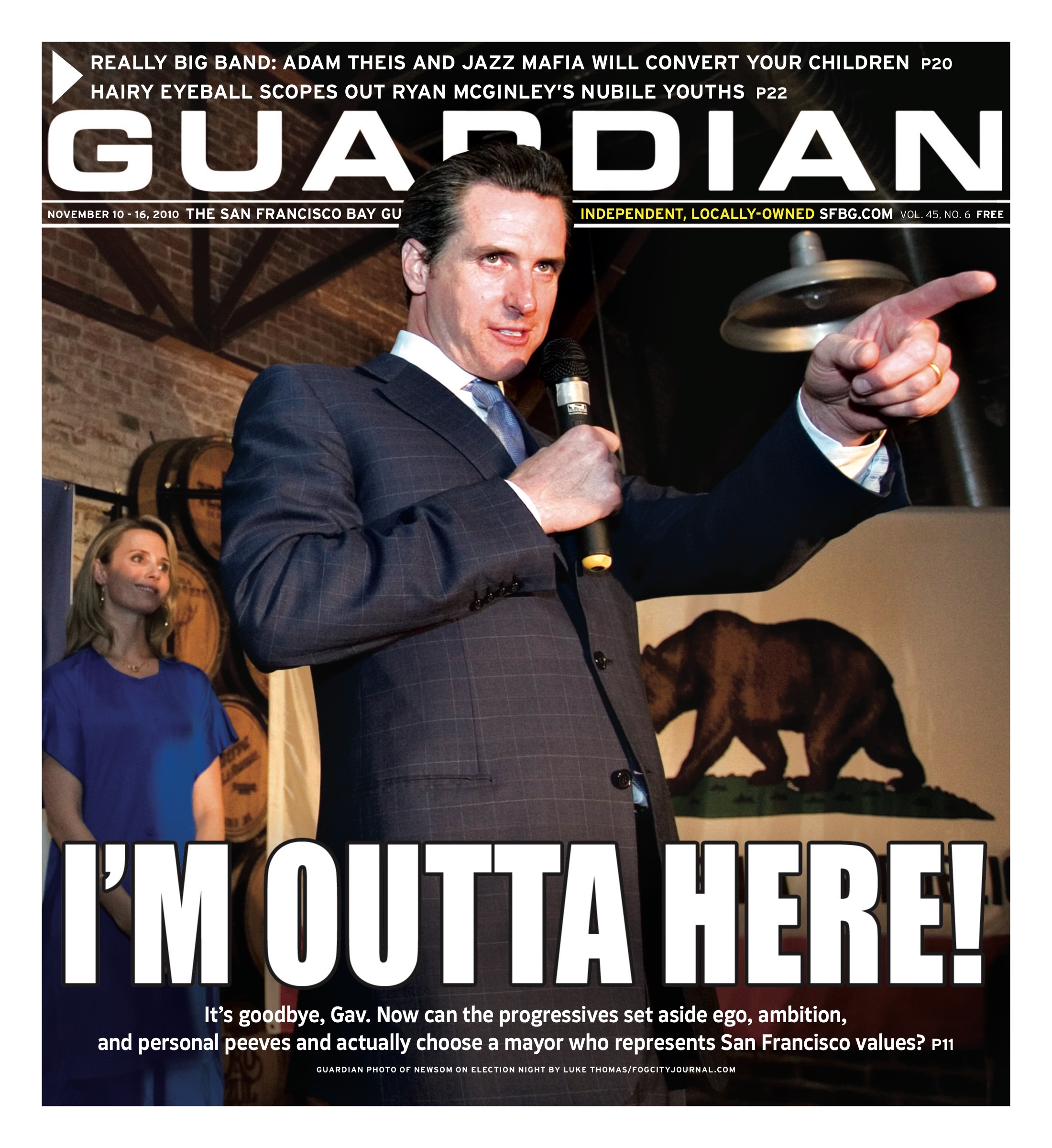
By the time a beaming Mayor Gavin Newsom took the stage at Tres Agaves, the chic SoMa restaurant, on election night, enough results were in to leave no doubt: the top two places on the California ballot would go to the Democrats. Jerry Brown would defeat Meg Whitman in the most expensive gubernatorial race in American history — and Newsom, who once challenged Brown in the primary and dismissed the office of lieutenant governor, would be Brown’s No. 2.

It might not be a powerful job, but Newsom wasn’t taking it lightly anymore. “We can’t afford to continue to play in the margins,” he proclaimed proudly, advancing a vague but ambitious agenda. “There is absolutely nothing wrong with California that can’t be fixed with what’s right with California.”

But around the city, as results trickled in for the local races, the talk wasn’t about Newsom’s role in the Brown administration, or the change the Democrats might bring to Sacramento. It was about the profound change that could take place in his hometown as he vacates the office of mayor a year early — and opens the door for the progressives who control the Board of Supervisors to appoint a chief executive who agrees with, and is willing to work with, the majority of the district-elected board.

At a time when the Republican takeover of Congress threatens to create gridlock in Washington, there’s a real chance that San Francisco’s government — often paralyzed by friction between Newsom and the board — could take on an entirely new direction. It’s possible that the progressives, long denied the top spot at City Hall, could put a mayor in office who shares their agenda.

This could be a turning point in San Francisco, a chance to put the interests of the neighborhoods, the working class, small businesses, the environmental movement, and economic justice ahead of the demands of downtown and the rich. All the pieces are in place — except one.

To make a progressive vision happen, the fractious (and in some cases, overly ambitious) elected leaders of the progressive movement will have to recognize, just for a little while, that it’s not about any individual. It’s not about David Chiu, or Ross Mirkarimi, or Chris Daly, or John Avalos, or Eric Mar, or David Campos, or Jane Kim, or Aaron Peskin. It’s not about any one person’s career or personal power.

It’s about a progressive movement and the issues and causes that movement represents. And if the folks with the egos and personal gripes and career designs can’t set them aside and do what’s best for the movement as a whole, then the opportunity of a generation will be wasted.

Folks: this is a hard thing for politicians to recognize. But right now it’s not about you. It’s about all of us.

It’s an odd time in San Francisco, fraught with political hazards. And it’s so confusing that no one — not the elected officials, not the pundits, not the lobbyists, not the insiders — has any clear idea who will occupy Room 200 in January.

Here’s the basic scenario, as described by past opinions of the city attorney’s office:

Under the state Constitution, Newsom will take office as lieutenant governor Jan. 3, 2011. The City Charter provides that a vacancy in the Mayor’s Office is filled by the president of the Board of Supervisors until the board can choose someone to fill the job until the end of the term — in this case, for 11 more months.

So if all goes according to the rules (and Newsom doesn’t try to play some legal game and delay his swearing-in), David Chiu will become acting mayor on Jan.3. He’ll also retain his job as board president.

On Jan. 4, the current members of the Board of Supervisors will hold a regularly scheduled Tuesday meeting — and the election of a new mayor will be on the agenda. If six of the current supervisors can agree on a name (and sitting supervisors can’t vote for themselves) then that person will immediately take office and finish Newsom’s term.

If nobody gets six votes — that is, if the board is gridlocked — Chiu remains in both offices until the next regular meeting of the board — a week later, when the newly elected supervisors are sworn in.

The new board will then elect a board president — who will also instantly become acting mayor — and then go about trying to find someone who can get six votes to take the top job. If that doesn’t work — that is, if the new board is also gridlocked — then the new board president remains acting mayor until January 2012.

There are at least three basic approaches being bandied about. Some people, including Newsom and some of the more conservative members of the board, want to see a “caretaker” mayor, someone with no personal ambition for the job, fill out Newsom’s term, allowing the voters to choose the next mayor in November, 2011. That has problems. As Campos told us, “The city has serious budget and policy issues and it’s unlikely a caretaker could handle them effectively.” In other words, a short-termer will have no real power and will just punt hard decisions for another year.

Then there’s the concept of putting in a sacrificial progressive — someone who will push through the tax increases and service cuts necessary to close a $400 million budget gap, approve a series of bills that stalled under Newsom, take the hits from the San Francisco Chronicle, and step out of the way to let someone else run in November.

The downside of that approach? It’s almost impossible for a true progressive to raise the money needed to beat a downtown candidate in a citywide mayor’s race. And it seems foolish to give up the opportunity to someone in the mayor’s office who can run for reelection as an incumbent.

Which is, of course, the third — and most intriguing — scenario.

The press, the pundits, and the mayor have for the past few months been pushing former Sup. Peskin as the foil, trying to spin the situation to suggest that the current chair of the local Democratic Party is angling for a job he wouldn’t win in a normal election. But right now, Peskin is no more a front-runner than anyone else. And although he’s made no secret in the past of wanting the job, he’s been talking of late more about the need for a progressive than about his own ambitions.

“If the board chose [state Assemblymember] Tom Ammiano, I would be thrilled to play a role, however small, in that administration,” Peskin told us.

In fact, Peskin said, the supervisors need to stop thinking about personalities and start looking at the larger picture. “If we as a movement can’t pull this off, then shame on us.”

Or as Sup. Campos put it: “We have to come together here and do what’s right for the progressive movement.”

Two years ago, the San Francisco left was — to the extent that it’s possible — a united electoral movement. In June, an undisputed left slate won a majority on the Democratic County Central Committee. In November 2008, Districts 1, 3, 5, and 11 saw consensus left candidates running against downtown-backed opponents — and won. In D9, three progressives ran a remarkably civil campaign with little or no intramural attacks.

The results were impressive. As labor activist Gabriel Haaland put it, “we ran the table.”

But that unity fell apart quickly, as a faction led by Daly sought to ensure that Sup. Ross Mirkarimi couldn’t get elected board president. Instead that job went to Chiu — the least experienced of the supervisors elected in that class, and a politician who is, by his own account, the most centrist member of the liberal majority.

This fall, the campaign to replace Daly in D6 turned nasty as both Debra Walker and Jane Kim openly attacked each other. Walker sent out anti-Kim mailers, and Kim’s supporters charged that Walker was part of a political machine — a damaging (if silly) allegation that created a completely unnecessary rift on the left.

And let’s face it: those fights were all about personality and ego, not issues or progressive strategy. Mirkarimi and Daly have never had any substantive policy disagreements, and neither did Walker and Kim.

In the wake of that, progressives need to come together if they want to take advantage of the opportunity to change the direction of the city. It’s not going to be easy.

“We’re good at losing,” Daly said. “I’m afraid we’re doing everything we can to blow it.”

The cold political calculus is that none of the current board members can count on six votes, and neither can Peskin or any of the other commonly mentioned candidates. The only person who would almost certainly get six votes today is Ammiano — and so far, he’s not interested.

“I know you never say never in politics, but I’m happy here in Sacramento. Eighty-six percent of the voters sent me back for another term, and I think that says something,” he told us.

It’s hardly surprising that someone like Ammiano, who has a secure job he likes and soaring approval ratings, would demur on taking on what by any account will be a short-term nightmare. The city is still effectively broke, and next year’s budget shortfall is projected at roughly $400 million. There’s no easy way to raise revenue, and after four years of brutal cuts, there’s not much left to pare. The next mayor will be delivering bad news to the voters, making unpleasant and unpopular decisions, infuriating powerful interest groups of one sort or another — and then, should he or she want the job any longer, asking for a vote of confidence in November.

Yet he power of incumbency in San Francisco is significant. The past two mayors, Newsom and Willie Brown, were reelected easily, despite some serious problems. And an incumbent has the ability to raise money that most progressives won’t have on their own.

Chiu thus far is being cautious. He told us his main concern right now is ensuring that the process for choosing the next mayor is open, honest, and legally sound. He won’t even say if he’s officially interested in the job (although board observers say he’s already making the rounds and counting potential votes).

And no matter what happens, he will be acting mayor for at least a day, which gives him an advantage over anyone else in the contest.

But some of the board progressives are unhappy about how Chiu negotiated the last two budget deals with Newsom and don’t see him as a strong leader on the left.

Ross Mirkarimi is the longest-serving progressive (other than Daly, who isn’t remotely a candidate), and he’s made no secret of his political ambitions. Then there’s Campos, an effective and even-tempered supervisor who has friendly relationships with the board’s left flank and with centrists like Bevan Dufty. But even if Dufty (who I suspect would love to be part of electing the first openly gay mayor of San Francisco) does support Campos, he’d still need every other progressive supervisor. Campos also would need Chiu’s vote to go over the top. Which means Chiu — who needs progressive support for whatever his political future holds — would have to set aside his own designs on the job to put a progressive in office.

In other words, some people who want to be mayor are going to have to give that up and support the strongest progressive. “If there’s someone other than me who can get six votes, then I’m going to support that person,” Campos noted.

Then there are the outsiders. City Attorney Dennis Herrera has already announced he plans to run in the fall. If the board’s looking for a respected candidate who can appeal to moderates as well as progressives, his name will come up. So will state Sen. Mark Leno, who has the political gravitas and experience and would be formidable in a re-election campaign in November. Leno doesn’t always side with the left on local races; he supported Supervisor-elect Scott Wiener, and losing D6 candidate Theresa Sparks. But he has always sought to remain on good terms with progressives.

All that assumes that the current board will make the choice — and even that is a matter of strategic and political dispute. If the lame duck supervisors choose a mayor — particularly a strong progressive — you can count on the San Francisco Chronicle, Newsom, and the downtown establishment to call it a “power grab” and cast doubt on the legitimacy of the winner.

“But choosing a mayor is the legal responsibility of this board and they ought to do their jobs,” Peskin said.

The exact makeup of the next board was still unclear at press time. Jane Kim is the likely winner in D6 and has always been a progressive on the School Board. She’s also close to Chiu, who strongly supported her. If Malia Cohen or Lynette Sweet wins D10, it’s unlikely either of them will vote for a progressive mayor.

Newsom also might try to screw things up with a last-minute power play. He could, for example, simply refuse to take the oath of office as lieutenant governor until after the new board is seated.

Chiu’s allies say it makes sense for the progressives to choose a mayor who’s not identified so closely with the left wing of the board, who can appeal to the more moderate voters. That’s a powerful argument, and Herrera and Leno can also make the case. The progressive agenda — and the city — would be far better off with a more moderate mayor who is willing to work with the board than it has been with the arrogant, recalcitrant, and distant Newsom. And if the progressives got 75 percent of what they wanted from the mayor (as opposed to about 10 percent under Newsom), that would be cause to celebrate.

But to accept that as a political approach requires a gigantic assumption. It requires San Franciscans to give up on the idea that this is still, at heart, a progressive city, that the majority of the people who live here still believe in economic and social justice. It means giving up the dream that San Francisco can be a very different place, a city that’s not afraid to defy national trends and conventional wisdom, a place where socioeconomic diversity is a primary goal and the residents are more important than the big companies that try to make money off them. It means accepting that even here, in San Francisco, politics have to be driven by an ever-more conservative “center.”

It may be that a progressive can’t line up six votes, that a more moderate candidate winds up in the Mayor’s Office. But a lot of us aren’t ready yet to give up hope.

Additional reporting by Noah Arroyo.

Editor’s Notes

0

tredmond@sfbg.com

Way back in 1986, Tom Hsieh Sr., an architect and one of the most conservative members of the Board of Supervisors, called his colleague Harry Britt — by all accounts the most liberal supervisor — and asked for a meeting. The way both men described it to me at the time, Britt was a little mystified; why would someone who was on the opposite end of the political spectrum want to be pals?

Well, it turned out that Hsieh had a message for his colleague. "Someday," Hsieh told Britt, "the gays and the Asians will be running this town, and we might as well get along."

It’s taken a while, but Hsieh (whose son is a moderate-to-conservative political consultant and activist) was prophetic. One of the little-noticed facts about this supervisorial election is that the majority of the members of the next Board of Supervisors will be either Asian or gay. And the odds are pretty good that the person in the Mayor’s Office in 2012 will be Asian (David Chiu, Leland Yee, Phil Ting) or gay (Tom Ammiano, David Campos, Mark Leno).

I mention that bit of interesting history as a sort of a prelude to the fascinating historic challenge facing progressives in San Francisco today. At a time when the rest of the country seems to be drifting (at least for the moment) to the right, San Francisco has a chance to go to the left. There hasn’t been a mayor the progressives supported in this town in at least 20 years (and that’s if you count Art Agnos, which is a bit of a stretch). With Gavin Newsom (will he be San Francisco’s last straight white mayor?) leaving early in his term, the supervisors could profoundly change the direction of the city.

And they could also duck, punt, or make a terrible mistake.

If the board wants to appoint someone who’s going to promote a progressive agenda, that person not only needs to be able to get six votes in January, but hold on to the seat until November — when the competition will be intense. And any progressive mayor will be vilified by the local daily papers, mocked by the national media, and held to an almost impossible standard by his or her constituents.

You wonder why anyone would want the job.

But taking on that insane challenge is also about history, and about proving that this city is (still) different. And the person in the job is going to need a whole lot of help and support. I have to believe that we’re up to it.

How not to choose a mayor

5

EDITORIAL There are plenty of good arguments among progressives about who would be the best person to replace Gavin Newsom as mayor and how the Board of Supervisors should make that decision. It’s a complicated situation: The next mayor will face a horrible budget deficit, all sorts of tough decisions — and then face the voters in 10 months. And if the board appoints a progressive, that person will face a hostile daily newspaper and several well-funded opponents in the fall.

But we know there are some very bad scenarios, some things the board and the potential mayor contenders shouldn’t do — because in the end, the process needs to be free of any sort of backroom taint.

Here are some basic ground rules for the next two months.

Newsom shouldn’t try to mess around with the selection of his successor. The mayor decided to run for state office with the full knowledge that he would leave behind a vacancy that the supervisors would fill. He has no business playing political and legal games to skew the results. For example, some say Newsom is considering delaying his swearing in, now set for Jan 3, 2011, for a week to prevent the current supervisors from voting on an interim mayor. That would be a bad faith, manipulative move. He made his choice; now he needs to get out of the way and let the City Charter process work.

The current board should have a fair shot at electing Newsom’s replacement. The day after Newsom takes office as lieutenant governor, the current board will meet for one last time — and by law, they should and will have a chance to find a candidate who can get six votes to serve out Newsom’s term. Any parliamentary moves that serve only to delay the vote and push the decision to the new board would be inappropriate.

The idea of a “caretaker” mayor is fraught with problems — and Willie Brown shouldn’t even be on the list. Newsom is pushing the idea of a true interim mayor, someone who won’t run for the job in November and will simply keep the lights on for 11 months. That means ignoring the city’s serious structural problems. A caretaker would have no authority and little ability change things. And the notion that’s being floated around of former mayor Willie Brown stepping in is disgraceful. Brown was a terrible mayor, and a rerun of that nightmare — even of only 11 months — is the last thing San Francisco needs.

Kamala Harris shouldn’t be a player in this game. If Harris, the current district attorney, is elected state attorney general, her job will be open too — and it’s easy to see how Newsom could use that as a plum to get his way. If Harris resigns before Newsom is sworn in, Newsom would get to appoint her replacement — and if that appointee is currently on the Board of Supervisors, Newsom would get to fill a seat on the board too. Harris needs to stay out of that unseemly sort of deal.

All the rules and procedures need to be made public, now. The legalities of this transition are tricky. Could the current board appoint an interim mayor now, knowing that a vacancy will occur, or must they wait until Newsom has actually resigns? Could Newsom delay his swearing in? The supervisors need to get legal advice on every possible scenario — and make it public. The last thing anyone needs in this confusion period is secrecy.

Plenty of people will be unhappy with whatever plays out. But if the process is bad, the result will be a mayor with no legitimacy.

The “Democratic Machine” myth

34

Okay, I read the gloating from Randy Shaw about Jane Kim defeating the “Democratic Party Machine,” which, as far as I can tell, seems to consist of the Democratic County Central Committee and the Bay Guardian. (As I’ve said before, if I were that powerful, things would change around this city ….)


It annoys me because machine politics were once a harsh reality in this town. But not these days.


Let’s look seriously at the supposed immense clout of the DCCC. Everyone from Shaw to The Chron’s C.W. Nevius has been freaking out over the ability of the local Democratic Party to control who gets elected to the Board of Supervisors. And while I think it’s a good idea to have prgoressives control the local party (this is, after all, San Francisco), even a cursory look at election results suggests that this vaunted machine isn’t really running much of anything.


In every contested race for supervisor — every single one — the candidate endorsed first by the DCCC appears headed for defeat. It’s not just D6; The DCCC endorsed DeWitt Lacy in D10, and he finished well out of the picture. The person leading that race today, Tony Kelly, wasn’t even in the DCCC’s top three. The panel backed Rafael Mandelman in D8; Scott Wiener won. The party gave its nod to Janet Reilly in D2, and if early RCV results hold, she’s in serious trouble.


Here’s the facts: With district elections, and a weak mayor, power is far too diffuse in San Francisco today for anyone to operate a political machine. District races this time around weren’t about the DCCC; they were about local campaigns organizing around local issues.


The DCCC helped Debra Walker somewhat in D6 , but it also hurt: In the end, Kim won with a campaign that painted Walker as an old-school machine party politician — and, interestingly enough, according to Paul Hogarth, she won by reaching out to the more conservative voters:


We focused on pitching her biography as a Stanford and Berkeley graduate, who is a civil rights attorney. And Jane Kim was the kind of young professional these voters could relate to. 


If Randy Shaw was right, and a powerful Democratic party machine ran city politics, we wouldn’t all be scratching our heads and wondering who the hell the next mayor will be. I can tell you right now: Aaron Peskin, the titular head of this mighty machine, is pretty far out of the running. Sup. David Chiu, who has pretty much cut ties with Peskin and worked to elect Kim, is one of the top mayoral contenders. It’s also entirely possible that Mark Leno — who is by no means part of any Peskin operation — will wind up in Room 200.


Labor — supposedly part of this machine, too — can’t even agree half the time on its own endorsements — witness the United Healthcare Workers local splitting dramatically with its Local 1021 brothers and sisters in SEIU. UHW backed Wiener, Theresa Sparks and Steve Moss — all candidates opposed by Local 1021.


It’s an unsettled time in local politics, and I hope that the progressives who care about issues, not personalities and silly labels, can come together and choose a mayor who will support a progressive agenda. But that will be a close call, and no doubt will involve a temporary coalition that will fall apart as soon as the deal is done.


Because right now, nobody’s calling the shots in local politics. Just look at the facts on the ground. 

Oakland mayor’s race shows the power of coalitions in RCV elections

7

The Oakland mayor’s race appears to be demonstrating the ability of political coalitions to use a ranked-choice voting strategy to topple an established frontrunner, overturning the conventional wisdom that the top finishers on election day will usually hold their leads through the tally of everyone else’s second and third place votes.

That anomaly is also on display in San Francisco, where it appears the top finishers in supervisorial districts 2 and 10 may lose to the second or even third-place finishers. A preliminary run of the ranked-choice voting (RCV, also known as instant-runoff voting) tally was run in SF on Friday, and elections officials will do another one this afternoon, although votes are still being tabulated and the final results won’t be known for several days.

“Ninety-five percent of the time, RCV doesn’t topple the top finisher,” political analyst Alex Clemens said at SPUR’s post-election wrap-up on Nov. 4, a point echoed by his co-presenter, political consultant David Latterman, based on their research of voting pattern in Australia and other countries that have used the system for some time.

They said the results only change when the candidates finish within a few percentage points of one another, as is the case in San Francisco. But in Oakland, mayoral candidate Don Perata finished almost 10 percent points in front of Jean Quan (34 percent to 24.6 percent), with Rebecca Kaplan close behind at 21.5 percent.

Yet Perata, a classic Democratic Party power broker who once served as president of the California Senate, is disliked and distrusted among the progressives and other grassroots voters who liked both Quan and Kaplan, who encouraged their supporters to rank the other candidate second. And that strategy appears to have paid off.

After 10 round of eliminating candidates and redistributing their votes – with Kaplan the last go, and her votes breaking 3-1 in Quan’s favor – the preliminary results show Quan winning with 51.1 percent of the vote to Perata’s 48.9 percent.

Wow, talk about the power of political coalition-building.

Mayoral question perplexes the pundits

14

Today’s post-election analysis session at the San Francisco Planning and Urban Research Association featured the usual room full of smart political minds from across the ideological spectrum – including those of hosts Alex Clemens and David Latterman – but nobody had any real insights into the big question on everyone’s minds: who will be the next mayor?

Everyone agrees that Gavin Newsom is headed to Sacramento in January, and state law calls for him to become lieutenant governor (and resign as mayor) on Jan. 3. At that point, Board President David Chiu becomes acting mayor, and the current Board of Supervisors is scheduled to meet Jan. 4 and could vote for a new interim mayor. The newly elected board takes office a week later and as its first order of business it will elect a new president, who becomes the new acting mayor, and if the old board can’t elect an interim, then the new one could elect an interim mayor, who would serve until after the mayoral election in November.

It’s tough enough for anyone to get to six votes, particularly considering supervisors can’t vote for themselves, but the deal-making could also involve the district attorney’s job. If Kamala Harris holds her slim current lead for attorney general, the new mayor would get to appoint her replacement. And if Rep. Nancy Pelosi decides to resign, that plum job would mix things up further. So everything is revolving around the vote for mayor right now.

“Everything comes back to this,” Latterman said, as he and Clemens basically had to shrug off questions about who has the inside track to be mayor. There are just too many variables involved, too many possible deals that could be cut, too many ambitious politicians in the mix, not to mention innumerable outsiders who could be tapped (hmmm…Mayor Jones, it does have a ring to it).

Latterman, a downtown consultant who helps update the Progressive Voter Index (created by SF State Professor Rich DeLeon), noted that the citywide results in the election once again showed that the overall city electorate is more moderate than progressive, particularly because the districts that have the strongest voter turnout (Districts 2, 4, and 8) are also some of the city’s most conservative.

As a result, he said, “The city is not voting for a far left mayor come November, so [progressives] will do whatever they can to get a mayor now.” Progressives are indeed hoping to get one of their own into Room 200 in January, and they hope that would allow whoever is chosen to win over enough voters to remain after November.

As a result, conservatives and most moderates will dig in, with many pushing the idea of a “caretaker mayor” so the playing field between left and right is still fairly even this fall.

“This is a World Series for political junkies,” Clemens said, who had the funniest way of casting the question: Normally, about 11 people run for mayor and the whole city picks one, he said, “but this is the opposite.” These 11 supervisors have the whole city to pick a mayor from, and at this point, it’s anyone’s guess who that will be.

What beard does Newsom fear?

7

Mayor Gavin Newsom seemed to jokingly endorse Giants closer Brian Wilson for mayor at the parade Nov. 3rd (and Wilson might have endorsed his BDSM-loving neighbor), but maybe the mayor’s words have been misinterpreted. Maybe he was referring to another local player when he proclaimed the words “fear the beard.” Just a thought.


Newsom endorses Wilson, who endorses “the machine”

11

As Mayor Gavin Newsom prepares to leave San Francisco for the Lieutenant Governor’s Office in Sacramento, he has burned enough bridges here that he’s not going to have much of a role in picking his successor. But he made a play today during the Giants World Series celebration at City Hall that just may resonate with local voters and elected officials alike.

“This town is going to need another mayor soon, and I have just three words: fear the beard,” Newsom said as he wrapped up his speech to a crowd of several hundred thousand fans, giving his cheeky endorsement to the Giants’ star closing pitcher, Brian Wilson.

But during his own speech, Wilson respectfully declined the opportunity. “I don’t think I’m up to that job, but I know someone who is: Where’s the machine?” Wilson told the crowd, appearing to give the nod to the next speaker, Giants star pitcher Tim Lincecum, who didn’t take himself out of the running.

“All I can say is thank you and go San Francisco!” Lincecum said.

So, what do you say, San Francisco? Are we ready for Mayor Lincecum?

Is this a joke? Maybe not, after all, while being interviewed before the festivities began, a jubilant Newsom said, “The politicians need to step out of the way and that’s when you can restore a sense of pride to the city.” And in your case, Mister Mayor, we at the Guardian couldn’t agree more. Have a great trip to Sacramento!

UPDATE: A friend has now clued me in to the possibility that Wilson wasn’t actually endorsing Lincecum, but his BDSM neighbor. Huh? Yeah, I’m not sure either, but check this out: http://www.youtube.com/watch?v=6ckloLGOgVo


Election 2010: SF’s season of political madness

7

You can draw — or not draw — all sorts of conclusions about the meaning of last night’s national election, but I can tell you what the state and local results mean: A season of political madness. As of the first week in January, San Francisco will have a new mayor and (probably) a new district attorney, and neither will be elected by the voters. And if some pundits are correct and Nancy Pelosi decides to retire rather than taking a seat on the back bench, then a once-in-a-lifetime change to take a safe seat in Congress will open up. And man, will the mad scramble be on.


Gavin Newsom will be sworn in as lt. governor the same day that Kamala Harris (if her lead in the polls holds) will be sworn in as attorney general. In theory, that means Board President David Chiu will become acting mayor — with the authority to appoint a new district attorney. That’s if Harris doesn’t step down a day early, allowing Newsom to appoint her replacement. Deals are being offered and tossed around already (and one of the interesting elements is that Chiu has always been interested in the D.A.’s job — which would open up not only the board presidency but his D3 seat.)


Then the current board members will have five days before their terms end to choose a new mayor by majority vote (except that no supervisor can vote form him or herself), and in the meantime, Chiu will be both acting mayor and board president. If the supes can’t make a decision, the new board — and we still don’t know who will be on that board — will get a chance to elect both a new board president (and acting mayor) and a new mayor.


And to make it more complicated, a number of the people being looked at for the mayor’s job — and some of the people who plan to run for mayor next November — would also be very interested in Pelosi’s seat.


This election isn’t over yet — but already, I promise you, the talks are on and everyone’s thinking about the deal.


It’s going to be crazy — and it also offers progressives a rare change to reshape city politics. No matter what happens with the D6 and D10 races, progressives will hold the board majority. If they can work together — thinking about the larger agenda, not just their personal egos — this could turn out very well indeed.

Election 2010: Labor and progressives dodge a bullet

22

Bucking a national conservative, anti-government political trend, San Franciscans stayed with some fairly progressive politics on election night, rejecting a measure to demonize public employees (Prop. B), giving progressive John Rizzo far more votes than his City College of San Francisco board rivals, and taking far more liberal positions in state ballot measures and candidates than California voters, who were already far to the left of national voters.
“We are really happy that Prop. B is going down because it was such a misguided measure. It was not well thought through,” San Francisco Labor Council President Tim Paulson told the Guardian at the party labor threw with the San Francisco Democratic Party at Great American Music Hall. “San Francisco voters are the smartest in America.”
Paulson was also happy to see those voters approve Prop. N, taxing the transfer of properties worth more than $5 million, “because San Franciscans know that everyone has to pay their fair share.”
Another labor priority, Prop. J, the temporary hotel tax increase, lost by a narrow margin after Mayor Gavin Newsom and his downtown allies opposed it, and the online travel company spent millions of dollars to bury Prop. K – a Newsom-created rival measure that would have closed a loophole that lets the company avoid paying the hotel tax.
Rizzo said he was happy to far outpoll Lawrence Wong and Anita Grier as the three incumbents ran uncontested for their City College board seats, which should put him in a leadership position in the troubled district. “There is a tradition at City College that the highest vote getter gets the presidency, so I’m pretty happy,” Rizzo told us on election night.
There were some conservative victories in San Francisco, including approval of Prop. L, which criminalizes sitting or lying on sidewalks, and Prop. G, which will reduce Muni operator wages and change work rules after getting the approval of about 63 percent of voters.
“Ultimately, downtown did well,” progressive political consultant Jim Stearns said, noting how aggressive spending by downtown business and real estate interests ended a string of progressive victories in the last several election cycles, including the likely election of Scott Wiener in D8 and the strong challenge in D2 by Mark Farrell to perceived frontrunner Janet Reilly, who had progressive endorsements.
Stearns said national polls have shown that people are more afraid of big government than big corporations, whereas progressives tend to hold the opposite view. “That national atmosphere definitely had an impact on even races locally,” Stearns said.
But in San Francisco, the progressives retain a strong position in the political debates to come.

Election 2010: The Prozan party

0

Amid a packed bar of Giants fans and political supporters, Rebecca Prozan was greeted with fervent clapping and shouts. Whether or not she wins tonight, her supporters and fans still believe strongly in her and her campaign. Her supporters even sported paper hats with Prozan’s face.


“My base and my supporters is the people I’ve met on Muni or worked with at the mayor’s office, or at the dog park.” She said, excitedly shaking hands, posing for pictures and greeting the crowd.


Her supporters were upbeat about the election results based on her politics and ideals.” It’s easy to read the paper and have thoughts but harder to take action,” Asit Panwala, one of the election canvassers said. “I see her willingness to help people and how she engages with the public.”


Election 2010: Theresa Sparks supporters await results

District 6 candidate Theresa Sparks showed up fashionably late for her own election night gathering at Don Ramon’s Mexican restaurant in the South of Market neighborhood. Election results are still coming in, and she told the crowd, “We’ll just watch it together and see what happens.” Early results show Jane Kim as the favored candidate in the district so far, but as everyone here seems to be telling one another, “it’s going to be a long night.”

Rob Black of the San Francisco Chamber of Commerce was in attendance, as well as Francis Tsang, who works in Mayor Gavin Newsom’s press office. 

Katra Briel said she had known Sparks for years, and was one of the first to volunteer for her campaign. Being out on the streets and talking to voters about the election was “really enlightening,” she said, but “sometimes the things reminded me of the 7th grade — it seemed like more of a popularity contest than being about the issues.” Briel said she sees Sparks as “the kind of person we need in government.”

John Zowine, another campaign volunteer, said he was inspired to do phone banking for Sparks after a five-year stretch without being involved in any campaigns. “I was really impressed with her,” he said. Asked how he was feeling about the outcome of the race, Zowine said, “I would think that with all those endorsements, and Gavin’s support, she should do really well.”


Election 2010: Newsom in, Harris trailing

0

That’s based on very early results. But with Boxer’s numbers creeping up, and Newsom comfortably ahead, it looks as if San Francisco will be getting a new mayor in January. The very early results have Harris pretty far behind, but those numbers will change. Since the early returns are always conservative, thought, the news for Gav is very good.