Mayor

Dick Meister: Clint wasn’t always this politically inept

1

By Dick Meister

Dick Meister is a San Francisco columnist and serious ice cream aficionado who has covered politics for more than a half-century as a reporter, editor, author and commentator. Contact him through his website, www.dickmeister.com

You might reasonably think Clint Eastwood lacks political savvy, given his bizarre presentation at the Republican National Convention.  But he was once plenty savvy, as he showed clearly during his two-year stint as mayor of tourist favorite Carmel, California.

Prior to his election, folks in Carmel and elsewhere tended to think of Clint as just a rugged, handsome movie actor playing at politics. But, boy, were they wrong. Listen to what Carmel resident Jean Lajigian said after Eastwood took office in 1986:

“When I voted for Clint Eastwood, I knew that democracy worked, that we could change things. Since he’s been mayor, there’s been just an upbeat feeling in the community.”

Mrs. Lajigian and her husband Michael were merchants in heavily-touristed Carmel and, as such, had been at odds with local politicians. The politicians did not share the great fondness for tourists expressed by the Lajigians and other merchants. At best, the political leaders believed, tourists were to be endured. They were not to be encouraged, despite the many dollars they spent in the coastal village, aka Carmel-by-the-Sea.

Carmel has marvelous beaches, spectacular ocean views, a loveable colony of sea lions and much more of special interest that draws a large and seemingly endless stream of visitors. Although not fond of tourists, Carmel authorities did allow merchants to set traps for the tourists – but discreet traps.

The use of neon or any other garish means to identify businesses, advertise goods for sale or otherwise attract customers was outlawed. Small wooden signs with elegant lettering were preferred. Nothing was permitted that could cheapen the tasteful display of goods, including cashmere, Shetland and plaid from England, the home country of many residents’ forebears, and the other often imported and invariably expensive merchandise that filled Carmel’s shops – or “shoppes.”

You know those resort towns where stores display notices asking that shoppers carry “no food or drink, please”? In Carmel, the request covered the whole town. Under an ordinance adopted by the City Council a year before Eastwood took office, for example, the sale of take-out food of any kind was forbidden – not even fish and chips to go.

“Litter was a concern – the idea of having people walk around on the streets with pieces of pizza or plastic containers with sundaes and milkshakes . . . the trash tends to end up on the ground,” explained Ken White, chairman of Carmel’s Planning Commission.

Ice cream cones were a particular worry. You know, the way ice cream tends to melt in the sunlight and drip on sidewalks, the way people carelessly toss aside the remains of cones after eating up the ice cream, or drop entire cones on the street, ice cream and all.

The city council took care of that by simply banning the sale of ice cream cones within city limits.

Black market cones might be had occasionally if you knew the right ice cream vendor, but generally there were none to be had anywhere in downtown Carmel. That deeply troubled lots of Carmel citizens.

Ah, but then came Clint to end the suffering, just as he had promised he would during his pro-merchant, pro-tourist and assuredly pro-ice cream campaign for office.

One of the first acts of the newly-elected mayor and the pro-Eastwood majority on the newly-elected city council was to adopt an ordinance that allows the sale of cones. The first permit allowing the sales went to Jean and Michael Lajigian and their store, where they soon were selling Italian gelato cones, along with their chocolate truffles and other treats.  The day they got the permit, declared Michael, was “one of the happiest days of my life, a dream come true.”

You may certainly have considered Clint Eastwood’s convention bit politically lame, but at least, once-upon-a-time, he did show evidence of effective political skills. He brought ice cream back to Carmel!

Dick Meister is a San Francisco columnist and serious ice cream aficionado who has covered politics for more than a half-century as a reporter, editor, author and commentator. Contact him through his website, www.dickmeister.com

D5, Mirkarimi, and 8 Washington

151

Everybody knows that the timing of the Board of Supervisors vote on ousting the sheriff for official misconduct is bad for Ross Mirkarimi. We’re talking about a huge, high-profile decision just weeks before some of the key board members are up for re-election, two of them in hotly contested races. For Sups. Eric Mar and Christina Olague, it’s going to particularly difficult: Mar’s in a moderate district, and he’ll be attacked from the more conservative David Lee if he supports Mirkarimi. Olague’s in a progressive district where Mirkarimi was a popular supervisor, so no matter what she does, she’ll take heat.

But I was a little surprised by Randy Shaw’s analysis, which suggests that Olague will be motivated entirely by political spite:

D5 Supervisor Christina Olague once faced a tough decision on Ross, but since Mirkarimi allies have attacked her on a number of issues it would be very unlikely for her to support him.

That’s pretty insulting. Shaw, who has supported her in the past, is saying that Olague won’t make up her own mind based on the actual issue and case in front of her. She was pretty clear when I called her: “I will vote on the merits of this issue,” she said. “If I was motivated to vote based on who had pissed me off I’d have a hard time voting on anything.”

I’ve disagreed with Olague quite a few times, and one could easily argue that she’ll be under immense pressure from the mayor. (“The mayor doesn’t want a lot from Christina, but he does want this,” one insider told me.) But is it impossible for Shaw to imagine that, in one of the toughest matters she will ever have to handle, the supervisor might actually listen to the testimony, consider the merits of the case, and vote to do what she thinks is right?

Meanwhile, Joe Eskenazi at the Weekly has already announced the Guardian’s endorsement in D5 — which is interesting, since we’re barely started interviewing the candidates. Eskenazi calls Julian Davis “the Guardian’s fair-haired boy” (which, speaking of insults, is not a terribly appropriate way to refer to an African American man), indicating that he’s already our candidate.

For the record: We have not made an endorsement in District Five. We plan to endorse a slate of three candidates for the ranked-choice ballot, and we’ll publish that endorsement the last week in September or the first week in October.


Homeless camp raided

41

California Highway Patrol police, San Francisco police, Cal Trans workers, Department of Public Works, and workers from the mayor’s Homeless Outreach Team descended today on an encampment on Fourth and King.

Yesterday, 40-50 people lived on the sidewalk and under the freeway overpass next to the Caltrain tracks. The encampment had tents, mobile units, and other makeshift housing. One group of residents had a large tent with a well-maintained garden in the front yard.

Another, a woman who several residents said suffered from mental illness, had built a home out of metal that looked like parts of carts, wood, sheets and mattresses. After about four hours this morning, most other residents were moved out of the camp, but she remained, moving and packing suitcases. After Homeless Outreach Team members, police, workers, and humanitarian volunteers approached her, she took a single suitcase and walked to the sidewalk, then sat and watched as her other suitcases, mattresses, and the structures that constituted her house were thrown into a garbage truck.

The eviction began around 8am. Some residents said they were told they could take with them only what they could carry or, if they had something wheeled like a shopping or bike cart, what they could push. Others said they hadn’t been told one way or another what they could take, just that they had to get out.
 
The items in the dump trucks, said CHP Officer Sarah Wrathall, is “the stuff they said they don’t want.” Wrathall said people were given the chance to keep whatever they wanted to, and that items they wanted to keep but could not carry would be stored and tagged for retrieval later.

Jamie Crisco, a resident of the camp who was moving out, said that this was an unusual eviction. “There isn’t usually this dog and pony show,” said Crisco. A large amount of media was present at the eviction.

“Usually they will tell people to get out, and people will start packing. And in the process the workers will come and start taking stuff and throwing it away,” said Crisco, a veteran who had been living in a small trailer for a year.

“I don’t understand that,” added Crisco. “You’re creating a criminal element when you do that. You’re putting people in a position where they have to steal to acquire what just got taken from them.”

According to John Gallagher, an organizer with the Coalition on Homelessness who did outreach at the encampment before it was evicted, trash was pushed safely to the side and the camp was clean and peaceful before this morning’s “clean up.”

“We’re respectful, we’re quiet. Honestly, we keep this area cleaner than they ever could dream to,” agreed one person who was staying in the camp.

Wrathall described a very different situation, saying that the area under the overpass had amassed trash, waste and rats.

She said that the eviction was based on complaints from neighbors and other residents.

“People have a right to complain if they can’t walk down the sidewalk to get to Caltrain,” said Wrathall. She said that some people feared the dogs that lived in the camp.

She said illegal lodging and trespassing was reason enough to evict the camp’s residents. “It doesn’t have to be any other kind of crime.”

No citations were issued this morning.

Camp resident Margaret Stallings said that the camp was very peaceful and neighbors walked on the sidewalk and parked their cars in the adjacent parking lots without issues.

“This is a dead end street,” she said. The area under the freeway is out of the way of most city life and, according to Stallings, “Some people have been underneath there for eight years.”

In an outreach report written based on Gallagher’s observations, he stated that “This camp is so peaceful that I saw more that four people on their way to work walk unafraid right down the middle of camp.”

Patrice Perkins, who had been living in the camp for two and a half months, said that the encampment’s location was relatively tucked away. He expressed frustration that many of the residents will be pushed out towards other parts of SoMa and downtown.

“We found a place where you’re not in public. We’re not bothering anybody here,” he said. He pointed out the no parking signs along the street.

“See, no parking. It’s not being used.”

His neighbor in the camp, James Belcher, said that the eviction was causing him to miss two classes at Laney College. “I missed Civil War History this morning, and I’ll miss math at 10:30,” he said. Belcher said he has been studying for a few solid semesters and earning good  grades while looking for work, but struggling, based in part on issues associated with being a disabled veteran.

“It’s difficult for me to study in this little tent and stay in school,” he said.

One resident, who said she provided first aid at the camp, shared disinfectant wipes with a DPW worker when he expressed a need for them.

One of the city’s stated concerns with the camp was the presence of children, and in Gallagher’s outreach statement he said at least two children lived in the camp. None were present this morning, and Wrathall said that in her previous visits to the camp, she hadn’t seen any.

“I’ve never seen kids here, but if I did, I would take them to CPS [Child Protective Services]. Of if they’re older, 16 or 17, I would connect them to services like Huckleberry House. I would never walk away from someone who is 18 or under in the encampment. Its not safe,” she said.
 
“Homelessness is not a crime. People are afraid for the public to see their children because they will be taken away from them. And for what, the crime of being poor?” said Gallagher.

The Homeless Outreach Team secured rooms for several of the people who were evicted, including Stallings and Crisco.

“They’re housing me. I’ve been waiting on the VA list for housing for four and a half years,” said Crisco. “I’m a combat vet. I used to be a business owner. But life does things to you. Ends up putting you in places you didn’t plan on being.”

Crisco said he was happy to accept the room, but frustrated in general with the way the homeless are pushed around.

“I’m only human. I can only take so much pushing and prodding,” he said. “Sometimes, someone’s going to snap. And they’ll say, it’s the drugs. They never say, maybe it’s us. Maybe its what we’re doing to them.”

About the Mirkarimi poll

193

It’s no suprise that lawyers for suspended Sheriff Ross Mirkarimi are calling a recent poll biased. The poll, paid for by a group of local women, many of whom have been in the forefront of the efforts to remove Mirkarimi from office, found that 61 percent of people wanted the sheriff ousted. More significant, it broke the results down for the supervisorial districts where there are contested elections; the goal, of course, was to put pressure on the supes to support the mayor’s removal efforts.

But nobody has published the actual questions in the poll — although I got a call from Greg Kamin, a San Francisco resident who was among those contacted by the robo-poll, and he said it was unusual, to say the least.

“In a normal push poll, they ask you your opinion first, then give you information to see if it changes your view,” he told me. “In this one, there was just a barrage of negative information first, before they asked a single question.”

One question went more or less like this: Which factors would most convince you the sheriff should be removed — the fact that he pled guilty to false imprisonment, the fact that the Ethics Commission ruled against him, the fact that he was involved in domestic violence, or the fact that he’s on probation?

“There was no way to answer the question that didn’t say you wanted him removed,” Kamin said.

Given the way the poll was structured, Kamin told me, “it’s surprising Mirkarimi got as much support as he did.”

Worth considering.

Also worth considering: For all the talk about domestic violence and zero tolerance and the need to remove the sheriff, there’s been very little discussion about the impacts on the people in the county jail — who are overwhelmingly African American and Latino. It makes a difference who the sheriff is. Someone who really believes in rehabilitation and wants to treat inmates in a decent, humane way can change lives — and radically improve public safety in a state with a 70 percent recidivism rate.

Again: Just something that ought to be part of the discussion.


Good propaganda ain’t cheap. Sorry, no rebates for errors.

27

UPDATED AND CORRECTED BELOW It wasn’t surprising to read Randy Shaw’s misleading praise of Mayor Ed Lee for appointing Rodrigo Santos to the City College board. Much of Shaw’s salary comes from the city contracts that his Tenderloin Housing Clinic administers, so he has turned his Beyond Chron mouthpiece into the equivalent of Pravda in touting the party line of Lee and his supervisorial apparatchiks.

For that blind loyalty, Shaw has been handsomely rewarded. On July 31, the Board of Supervisors even approved a Lee-proposed balloon payout of $91 million to THC for its contract administering the Mayfair Hotel that was retroactive all the way back to 2009. Can anyone imagine another nonprofit that could dig so deeply into city coffers, for work that has supposedly already been done, who wasn’t giving a little something back to these ambitious politicians who sponsored it?

But apparently Shaw – who used to have some progressive credibility before so blatantly selling the movement out a couple years ago – doesn’t need to even get the facts right in his propaganda posts. When I asked him at yesterday’s Lee/Santos press conference whether and why he supported Santos – a villain in most progressive circles – he argued Santos was needed to help win support for Prop. A, the parcel tax for City College.

Shaw said the measure needed a two-thirds vote to be approved, a claim he also made in today’s piece. That didn’t sound right to me, and the Elections Department confirms that it isn’t: Prop. A needs only a simple majority to pass. [[8/23 UPDATE AND CORRECTION: Ernestine at the Department of Elections told me yesterday Prop. A needed only a simple majority, but she called back today to say she was mistaken and that it does indeed require a two-thirds vote.]] Shaw also claimed a couple weeks ago that the Board of Supervisors would delay the Mirkarimi decision until after the election, which also wasn’t true: the Charter requires the board to act within 30 days of receiving the Ethics Commission recommendations.

I sent Shaw a message asking about whether his erroneous beliefs affected his analysis, and to explain the basis for THC’s $91 million kickback, and he hasn’t responded to the questions, as usual. But when you’re a poverty pimp feeding off of political patronage, you’re probably golden as long as you get the politician praise right. Cha-ching!


Full circle

52

steve@sfbg.com

When Mayor Ed Lee suspended Sheriff Ross Mirkarimi in March, he publicly took the position that it was an act of official misconduct when Mirkarimi grabbed his wife’s arm during a Dec. 31 argument, subsequently pleaded guilty to false imprisonment, and was placed on probation for three years.

Lee and his allies said that under those conditions, Mirkarimi could no longer effectively function as the city’s top elected law enforcement officer and that his actions clearly violated the City Charter’s ban on "conduct that falls below the standard of decency, good faith and right action impliedly required of all public officers."

The City Attorney’s Office, through deputies Peter Keith and Sherri Kaiser, has maintained that position throughout the investigation and Ethics Commission proceedings over the last five months. On August 16, on a 4-1 vote, the commission agreed and recommend the Board of Supervisors find its former colleague guilty of official misconduct, which would almost certainly result in his removal from office.

But that simple set of facts and interpretations belies the ugly spectacle that Lee and the City Attorney’s Office actually decided to create — at great cost to taxpayers, Mirkarimi’s reputation, and the public’s faith in the proceedings — over the last five months.

Instead of sticking by their initial position, Lee and his attorneys decided to pile on a long list of other official misconduct charges: dissuading witnesses to his crime, impeding a police investigation, abusing his authority in several ways, engaging in a pattern of abuse of women, refusing to cooperate with a city investigation, lying to officers in a scheme to keep a gun, and other charges.

Almost all of those accusations were included in the original written charges that Lee filed on March 21 — before the city had actually begun its investigation to learn whether there was any evidence to support them. Keith and Kaiser continued to make all those accusations right up until the end.

When the Ethics Commission finally deliberated on August 16, going through each of the main factual allegations against Mirkarimi, one by one, it unanimously agreed that there wasn’t enough evidence to support any of those other charges, even using the "preponderance of evidence" standard that is lower than the "beyond reasonable doubt" standard used in criminal cases.

So in the end, the case against Mirkarimi ended at the same place where it began: with the question of whether pleading guilty to a misdemeanor act of domestic violence warrants the removal of an elected official. But the implications and repercussions of what has transpired over these last five months could be felt for many years, in ways that it’s impossible to predict today.

WHAT IS OFFICIAL MISCONDUCT?


With very few legal precedents to guide them, the commissioners spent most of the nine-hour hearing on Aug. 16 wrestling with how to interpret the city’s untested new official misconduct language, how directly the wrongful behavior must relate to the office, and whether broadly interpreting those two issues gives too much power to the mayor.

Underlying that discussion is the question of whether the statute and the city’s interpretation of it will eventually be struck down as unconstitutionally vague by the courts, which Mirkarimi will likely turn to if the board removes him from office. But the commission pointedly refused to enter that debate, with Commissioner Jamienne Studley saying, "I don’t think determining constitutionality is what I signed on for as a commissioner."

Chair Benedict Hur, the sole dissenter in recommending a finding of official misconduct, expressed far more concern about the precedent they were setting than with the fate of Mirkarimi, whose actions he strongly condemned as "clearly wrongful and unlawful."

"There has to be a direct relationship of the behavior to the office held," Hur said. "If we don’t find a nexus, we are opening this provision up to abuse down the road."

Commissioner Paul Renne led the charge in interpreting misconduct in the broadest possible way, arguing it didn’t even have to be related to his official duties. "There’s nothing in that clause that says the misconduct has to relate to the office," Renne said.

But Hur called that a "dangerous precedent," saying he has "grave concerns" about how such a broad interpretation could be applied in the future. "I have a lot of concerns about where you draw the line if you don’t relate it to official duties," he said.

For example, could members of the Board of Supervisors be removed after getting arrested at demonstrations — as has happened many times before in connections with labor and other disputes — or even for using colorful language with constituents or colleagues that might violate a future mayor’s "standard of decency?"

Mirkarimi attorney Shepherd Kopp said there’s a good reason why recall is the preferred means of removing an elected officials accused of wrongdoing, calling the charter "an imperfect document" that can’t cover all circumstances — indeed, it doesn’t allow for the removal of mayors, even those who commit serious crimes — noting that "this is a rarely brought proceeding and it can have the effect of contravening the will of the electorate."

"These proceedings," Kopp said, "are far too susceptible to the vagaries of politics."

THE PILE-ON


Lee’s decision to overcharge Mirkarimi could be a costly one. The City Attorney’s Office won’t release expenses associated with ongoing legal actions like this one, but most indications are that it will run into the millions of dollars, perhaps many millions depending on how Mirkarimi fares in the courts if he is removed and challenges the city’s actions.

According to the City Attorney’s Office, the official misconduct proceedings against former Sup. Ed Jew in 2007 cost the city $381,505 in legal fees, but that was a relatively short and simple proceeding, with just one Ethics Commission hearing and couple of state court appearances before the case was settled.

By contrast, the case against Mirkarimi has already entailed five months of detailed exchanges between the two sides’ attorneys, covering a wide array of legal issues, and months-long investigations of matters only tangentially related to the core charge. The city has paid out money for expert witness. Mayor Lee cast a wide net to catch the fish that he had already hooked before setting out to sea.

Even if the Jew case had played out to completion, it would likely have cost just a fraction of what Mirkarimi’s will, for a simple reason: Mayor Lee acted quickly and brought a broad array of charges before investigating them. Then-Mayor Gavin Newsom investigated whether Jew really lived in the city and then brought just that narrow charge.

The simple residency question was enough to warrant Jew’s removal, and Newsom didn’t even need to get into the far more serious corruption charges related to Jew being caught with $80,000 in marked bills as part of an FBI extortion sting, for which Jew is still serving a five-year term in federal prison.

Lee has refused to justify his decision to pile on the charges and introduce defamatory declarations unsupported by direct evidence, such as the long declaration of key witness Ivory Madison, most of which was stricken from the record after Commissioner Paul Renne called it "clearly hearsay, clearly having the intention of poisoning the well" and said "a first-year lawyer should know that much of it is inadmissible and it should not have been given to us."

Even though Keith apologized to Renne and the commission, Lee and his lawyers continued to defend much of that declaration and use it as the basis for many of their most incredible accusations.

"You received a great deal of evidence, most of it from the mayor and most of it unchallenged," Keith said in his closing statement, glossing over the multitude of challenges and the fact that most evidence doesn’t support the city’s charges.

Mayoral Press Secretary Christine Falvey wouldn’t address a list of Guardian questions about overcharging the case and continuing to rely on discredited evidence. Instead, the Mayor’s Office stands by this Aug. 16 prepared statement: "I am pleased that the members of the Ethics Commission, following a careful review of the evidence, and in the face of a sustained campaign to distract and misdirect them from the facts, agreed with me that Ross Mirkarimi’s actions constitute official misconduct and fall below the ethical conduct we expect of the sheriff."

City Attorney’s Office spokesperson Matt Dorsey said his office also stands by the process: "We respect Ethics Commissioners’ differing opinions about the remaining counts. But nothing about the commission’s conclusions would cause us to pursue these charges of official misconduct differently if we had to do it over again."

But Mirkarimi’s team says it is Lee who has repeatedly sought to distract and misdirect the public, whether through unsubstantiated claims in his charging documents or Lee’s public statements that Mirkarimi "beats his wife" and other comments that blow a single arm-grab out of proportion.

"What the commission has effectively done is agreed with us that’s the only issue," Mirkarimi attorney David Waggoner told reporters after the hearing, noting that he had offered to stipulate to those facts from the beginning and avoid a prosecution that his closing brief deemed "a dog and pony show." Mirkarimi also told reporters that "the piling on of these charges has weighted us down" and complicated his defense. He added, "I leave this process concerned that the will of the voters is being undermined."

THE PRICE OF OVERKILL


Perhaps it was understandable for the city to use over-the-top tactics on Mirkarimi, who has certainly been weakened by proceedings that generated reams of fodder to be used against him in future elections if he survives the board’s removal vote. But the tactic also seems to have hardened the stance of Mirkarimi’s supporters and fed their conviction that this was a politically motivated prosecution and misuse of public resources.

During more than three hours of public testimony on Aug. 16, with each speaker strictly limited to less than two minutes each, speakers overwhelmingly favored Mirkarimi and condemned the city case as overkill.

"Some of the things done in this case, and the levels this has gone to, is outrageous," said Brenda Barros, who works in the city’s public health clinic and said these resources could be better applied to help the "seriously abused women" she works with. Barros called the city’s case "a political witch hunt."

"I think Mayor Lee has overstepped his boundaries and I think you should find that as well," said Pedro Fernandez, a private investigator and former San Francisco Police officer.

David Elliott Lewis, a member of the city’s Mental Health Board, noted that the Sheriff’s Department has no civilian oversight, making the role of an elected sheriff who is progressive and independent of the city’s good-old-boy police culture all the more important. "Those who claim otherwise are really politically motivated," he said.

One issue left unresolved by the Ethics Commission is whether Mirkarimi should be removed even though the case against him was substantially whittled down. In fact, several commissioners indicated during the hearing that they thought the findings and punishment were separate issues.

"Do you agree that it is a two-step process we have to deal with?" Renne asked Keith, referring to the official misconduct finding and whether Lee abused his discretion by removing Mirkarimi.

"There is a determination of, are the consequences appropriate to the wrongful action," Keith replied.

But later, when attorney Scott Emblidge — who is volunteering his legal services to both the Ethics Commission and Board of Supervisors on this case — offered his interpretation that the charter language requires removal of officials found to have committed official misconduct, the commission accepted that and opted not to consider recommending a lesser punishment to the Board of Supervisors.

Mirkarimi’s team objected to the commission’s rewriting of new charges based on its evidentiary findings, and things got so confusing by the end that the commission decided to meet one more time in early September to finalize its recommendation.

So the case probably won’t get to the board until mid-September. Nine votes are required to remove Mirkarimi and the charter requires the board act within 30 days, meaning that final vote will be just a few weeks before the Nov. 6 election, timing that will only increase perceptions that politics will largely determine its outcome.


Lee appoints Santos, a staunch development advocate, to CCSF board

22

Rodrigo Santos, a structural engineer who heads the pro-development advocacy group San Francisco Coalition for Responsible Growth, had already raised an unheard of amount of money in his race for the City College of San Francisco Board of Trustees, $113,153 in just six months, mostly from real estate and development interests.

Today, he got another big boost when Mayor Ed Lee appointed Santos to fill the vacancy on that board created by the recent death of Milton Marks, giving the ambitious Santos a big advantage in the fall contest and perhaps signaling Lee’s support for making deep program cuts to satisfy the accrediting commission’s demand that CCSF cut expenditures and beef up its reserves.

“Tough decisions and reform are what City College needs at this time,” Lee said at a press conference this afternoon, calling Santos “someone who shares my vision of reform and will support the tough decisions ahead.”

Although Lee said Santos “is committed and passionate about education,” Santos hasn’t been active on education issues before running for this office. His passions seem to lie mostly with advocating for developers and opposing government regulations in front of the Planning Commission and other bodies, where he regularly testifies, and in helping fellow conservatives gain power on city boards and commissions.

The appointment continues Lee’s pattern of appointing and relying on controversial conservatives in key areas, from his chief fundraiser and economic adviser, venture capitalist Ron Conway, to his recent reappointment to the Planning Commission of Republican Michael Antonini, who gave Santos the maximum $500 contribution in his CCSF race.

“I join an institution that must be saved. I am absolutely committed to that goal,” Santos told a press conference in the Mayor’s Office. He said that he will work to “achieve consensus” around solutions to the troubled institution’s problems, while also declaring, “We must support the interim chancellor, Pamila Fisher.”

But rather than someone who seeks political compromise, Santos’ reputation is as more of polarizing and ideologically conservative firebrand who regularly criticizes government and progressives as part of the downtown alliance that includes Plan C, Committee on Jobs, Building Owners and Managers Association, the SF Chamber of Commerce, and the Board of Realtors PAC

“I actually find him to be pretty divisive in trying to work on issues at [the Department of Building Inspection],” Debra Walker, who served with Santos on the Building Inspection Commission. “He always seems to come into a situation attacking and I hope he doesn’t bring that to this board.”

Walker, a longtime progressive activist and former supervisorial candidate, said that she and her political allies have long endured nasty attacks from Santos and his CRG bretheren.

“They spend all of their time attacking progressives and he gets pretty intense about attacking rather than working with people,” she said. “CRG is about getting people elected who are conservative, that’s their whole reason for existence, perpetuating the real estate industry’s impact of city policies, which has had a negative impact on the middle class.”

Asked about that reputation by the Guardian, both Lee and Santos denied it and refused to answer follow-up questions. Santos said CRG has a “diverse membership” and told us, “I don’t know why you would cast that as polarizing.”

Yet its board is made up almost exclusively of real estate and development interests who have shown themselves to be politically ambitious, winning key mayoral appointments to the Building Inspection and Small Business commissions and working with mayoral staffers to hold onto key leadership positions, edging out supervisorial appointees in the process.

Sup. John Avalos, who was targeted by a CRG independent expenditure campaign in 2008, said that he researched Santos’ background on education issues and was a little surprised not to find anything. “More than anything, the appointment says more about Lee’s pro business leanings,” Avalos told us.

It was also telling that Lee included two of the most conservative CCSF trustees in his press conference, Natalie Berg and Anita Grier, but that more liberal trustees Chris Jackson and John Rizzo were neither consulted nor notified directly about the appointment. “I’m sorry the mayor didn’t involve us more or let us know,” Rizzo told us.

While Rizzo didn’t endorse Santos – instead backing Jackson, Steve Ngo, and Rafael Mandelman (who Rizzo said “really does have the best interests of the district at heart”) – he didn’t want to offer an opinion on Santos, saying that he wants to work constructively with him to solve the district’s problems: “I welcome him to the board and hope he will welcome the work we’ve been doing.”

Santos told reporters that he starts every work day with an “open house” at his office from 5:20-8am, discussing various issues with anyone who wants to stop by, before getting into his engineering and administrative work for his firm, Santos & Urrutia. “I will bring that same commitment to City College,” he pledged.

Eliana steals the show at Thursday’s dueling City Hall rallies

48

Eliana Lopez once again stole the show as the Ethics Commission Thursday debated the “ethical fate” of her husband Sheriff Ross Mirkarimi inside City Hall while the Stand With Ross forces and their opponents staged back to back rallies on the City Hall steps.

Eliana sat with and supported her husband during the morning at the hearing on the misconduct case and then made an early afternoon dramatic entrance to the Mirkarimi rally. (The commission later Thursday unanimously rejected most of Mayor Ed Lee’s official misconduct charges against the suspended sheriff but voted 4-l to recommend the Board of Supervisors find him guilty of official misconduct for grabbing his wife’s arm on Dec. 31 and pleading guilty to the resulting misdemeanor charge of false imprisonment.  See Steve Jones Guardian blog.)

Eliana was greeted with cheers as the tv cameras and reporters crowded in on her.  

She spoke with ease and authority, greeted many friends, spoke in Spanish to several Spanish language radio and television reporters, and walked easily through the crowd shaking hands and talking with supporters in two languages.

“We don’t want any more hate,” she said. “We want love.” She said the case was
“about democracy” and she said that the community stands behind her husband.

I asked her about her plans.  She said she had finished her movie in Venezuela and was back living with Ross in their home with their young son Theo.   “I have good feelings,” she said.

The two groups worked out an informal modus vivendi.  The Remove Ross group had a permit for using the steps so they went first with their press conference rally with banners saying “We stand with survivors” and “The facts do matter.” Their group was largely from the three organizations leading the charge against Ross, La Casa de las Madres, Domestic Violence Consortium and Futures Without Violence.

The Mirkarimi group initially gathered across Polk Street, waved signs and chanted “Stand With Ross.” The group then got a permit to use the City Hall steps and held its rally after the first rally ended.  Sharon Hewitt, executive director of the Community Leadership project, said that the city owed an “act of apology for the violence” that it had caused to Ross and his family.

The police officer on duty estimated to me that there were 40 or so in the domestic violence group. My count was about 50 or so.  The Stand With Ross group had more people and they were more spirited in their chants and marching.   

Commission narrows Mirkarimi charges to one but recommends removal

238

The Ethics Commission today unanimously rejected most of Mayor Ed Lee’s official misconduct charges against suspended Sheriff Ross Mirkarimi – including abuse of power, impeding a police investigation, and dissuading witnesses – but voted 4-1 to recommend the Board of Supervisors find him guilty of official misconduct for grabbing his wife’s arm on Dec. 31 and pleading guilty to the resulting misdemeanor charge of false imprisonment.

The sole dissenting vote, Chair Benedict Hur, said he had “grave concerns” that such as a broad interpretation of what behaviors constitute official misconduct would give mayors a “strong tool” to inappropriately remove their political adversaries (or at least invite charges that they were), as Mirkarimi supporters allege is happening now.

But the rest of the commission adopted a broad interpretation of what city officials and voters intended in 1995 when they overhauled the City Charter and added a new official misconduct clause banning “conduct that falls below the standard of decency, good faith and right action impliedly required of all public officers.”

“I have a lot of concerns about where you draw the line if you don’t relate it to official duties,” Hur said, appealing to his colleagues that, “I think this charter provision was meant to be narrow.”

Commissioner Paul Renne – who in earlier hearings had taken a strong role in excluding prejudicial evidence against Mirkarimi and was thought to be a possible vote in his favor – today led the charge in interpreting misconduct in the broadest possible way, arguing it didn’t even have to be related to his official duties, while the three other votes against Mirkarimi made the case that his conduct and conviction were related to a sheriff’s role overseeing the jail and its domestic violence programs.

“I think the voters would be shocked if we were to say a public official who pleaded guilty to domestic violence has not committed an act of official misconduct,” Renne said.

But Mirkarimi’s attorneys and supporters – who outnumbered those urging his removal (mostly domestic violence advocates) by more than 4-to-1 during the three hours of public testimony taken today – say the shocking thing is for a just-elected official to be unilaterally removed from office by a political adversary for reasons that today’s proceedings showed were tenuous.

“No case has ever been upheld in court to remove an elected official for a low-level misdemeanor,” said Paula Canny, the attorney for Mirkarimi’s wife, Eliana Lopez, who sat next to and supported his husband throughout today’s nine-hour proceedings.

Indeed, the city is wading into uncharted waters and the commission had few court precedents to draw from in making its findings. It’s also possible that the charter provision is unconstitutionally vague, as Mirkarimi’s attorneys have alleged, both here and in court, with an earlier judge opting to wait until after the city’s process plays out before ruling on the question.

But first, it will be up to the Board of Supervisors, where nine votes on the 11-member body are required to remove Mirkarimi. Today’s hearing got complicated at the end – as commissioners wrestled with what it means to essentially throw out the mayor’s charges and adopt their own more narrow accusation, and how to present everything to the board – that it decided to hold one more meeting in early September to adopt a summary and send everything to the board, which will then have 30 days to act.  

“I leave this process concerned that the will of the voters is being undermined,” Mirkarimi told reporters after the hearing. Holding his hand, Lopez said, “I’m shocked to see what happened today, but we are fighters.”


For complete coverage and analysis of what happened today, what it means, and what’s next, read next week’s Bay Guardian.

Hate (and free) speech

20

How far can you push free speech? Is it okay for Muni to run ads that are utterly, inexcusably offensive to Arabs and Muslims in the name of political expression?

I’m pretty much always on the side of the First Amendment. And we were furious when a Bay Guardian ad campaign accusing then-mayor WIllie Brown of political corruption suddenly vanished from the sides of the local buses. It’s hard to seek government limitations on any political statement. But if the ads that appeared Aug. 7 on Muni aren’t over the line, they’re pretty close to it.

Here you have an organization described not only by the Southern Poverty Law Center but by the Anti-Defamation League as a hate group buying space on San Francisco buses for ads that effectively disparage a vast religious, ethnic and cultural community as “savages.” The campaign is obviously designed to get publicity; not that many San Franciscans are going to be convinced to join the American Freedom Defense Initiative. Nobody’s opinion on the Middle East will be swayed by this shit.

But this tiny cadre of loonies, led by Pamela Geller, who is really fucking scary, wants attention. In New York, the anti-Muslim group sued when the city tried to take down the same bus ads, and you know they’d love it if that happened here. Muni says it can’t legally pull the ads, which is probably true — although BART has a more restrictive policy.

It’s not just idle rhetoric — this stuff frightens people. “We’re hearing from people that they’re uncomfortable riding Muni,” Zahra Biloo, executive director of the Bay Area office of the Council on American-Islamic Relations, told me.

Obviously, you can’t run ads that enourage someone to engage in violence. Is dehumanizing people and calling them “savages” the same thing? Biloo thinks it’s pretty close: “It’s important for progressive cities to say, ‘not in our city,'” she said.

A change.org petition condemning the ads has more than 2,000 signatures.

On the other hand, I don’t want to give Geller the pleasure of suing San Francisco and making this into a Free Speech cause. Because that’s exactly what she wants, and probably the reason she bought the ads in the first place. So how about this: The supervisors pass a resolution denouncing the ad and the message, and Muni agrees to give CAIR the same number of ads, free, in the same locations (gee, maybe even on the other side of the same buses) to present an alternative message.

At least it’s a start.


Rafael Mandelman enters City College board race

6

After the really bad news that Community College Board member Milton Marks died, there’s some good news: Rafael Mandelman, an energetic, smart, progressive lawyer and member of the DCCC, has decided to run for that board.

City College badly needs the help. There’s a real chance that a state monitor could be placed over the district, robbing the board of much of its ability to set policy and spend money. And even if that doesn’t happen, the state — which disagrees with San Francisco on how community colleges should be run — is going to keep tyring to mess with CCSF.

So it would be nice to have someone like Mandelman, who has political experience but also works for a law firm that does a lot of public-sector work, around to help.

Marks’s untimely and tragic death leaves an open seat and he hadn’t filed to run for re-election. So the mayor has the ability to appoint someone to serve out Marks’s term — and if he does it before Aug. 15, that person can file and run as an incumbent. But for those of us who are getting sick of having so much of our government appointed for us, it would be nice if Mayor Lee would wait until after the filing deadline then name a real caretaker — Mandelman suggests former trustee Tim Wolford, who is now in the business of helping troubled nonprofits. The board will need help in the next four months, and someone qualified — and skilled in dealing with fiscal and political problems — would be an immense help.

But appointing a political hack who is pals with the mayor’s inner circle and sees a shot at running as an incumbent would be a big mistake.

Of course, Lee hasn’t done too well in the “caretaker” department. We’ll see what happens.

Davis snags a trio of top progressive endorsements

36

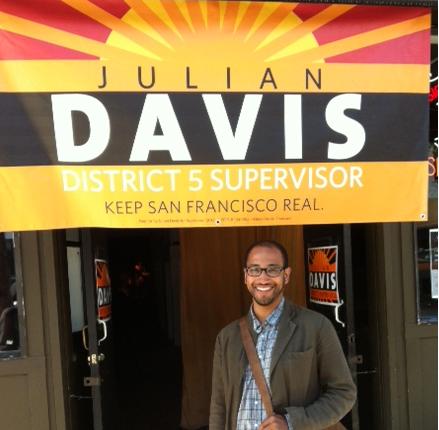
District 5 supervisorial candidate Julian Davis is emerging as the progressive standard-bearer in that competitive race after today receiving the endorsements of a trio of top progressive politicians: Sups. John Avalos and David Campos and attorney Matt Gonzalez, the former board president, mayoral candidate, and D5 supervisor.

Gonzalez had endorsed appointed incumbent Sup. Christina Olague – who he appointed to the Planning Commission in 2004 – but he withdrew that endorsement last month after being frustrated by a series of actions in which she sided with Mayor Ed Lee, moderates, and developers over her longtime progressive colleagues and constituents.

Avalos and Gonzalez are endorsing just Davis, at least for now, while Campos added to his early endorsement of Olague by today endorsing Davis and John Rizzo, who had earlier snagged the other prized progressive endorsement by winning the support of Assembly member Tom Ammiano.

Davis, who was already endorsed by former supervisor and local Democratic Party chair Aaron Peskin, said he’s thrilled with today’s triple endorsement. While some have questioned his anemic fundraising so far, raising less than $10,000 as of June 30, Davis notes that he had been in the race for less than a month before that deadline and that he expects to have more than $150,000 to get his message out.

“What these endorsements signal is a confidence from San Francisco’s progressive leaders, not only in the vision of this campaign, but in our capacity to win,” Davis told us.

Avalos said that he has confidence in Davis’ values, experience, and his ability to run a strong race that will help to reinvigorate the progressive movement.

“Julian is a solid candidate who has been around for years on a number of progressive causes. Running for mayor, I was impressed with his connection to neighborhood issues ranging from small business development to urban cycling and youth and worker rights. His campaign has a good buzz about it, one that I expect will resonate with District 5 residents,” Avalos told us.

Milton Marks, City College defender, dies at 52

3

Milton Marks III, the son of a state senator who for 12 years tried, often against long odds and strong opposition, to clean up the San Francisco Community College District, died Aug. 9 of complications from a brain tumor. The whole city — particularly the college district and its community of teachers and students — should be mourning a genuinely good guy who stood up to corruption and secrecy and was an honest progressive on the College Board back when that was a lonely position.

“Of all the public servants I’ve known, he was the one I really admired most,” his colleague, board member John Rizzo, said. “For all the shit he took, he never wavered. He was the nicest guy in politics, but he never backed down.”

Marks was elected to the board in 2000, when it was a snake pit of sleaze, and he fought valiently — often against the board majority and the administration — to bring accountability and openness to the district.He’s been re-elected twice, and would have been a shoo-in for another term this fall. (Unlike many College Board members, Marks wasn’t constantly running for higher office. He loved City College and saw his role right there on the board.)

With all the problems the college is facing today, Marks and his voice of reason and credibility will be sorely missed.

The mayor will appoint a new member to that seat, and the person will have to run in November.

I don’t know all the details about memorial arrangements; I’m still waiting for the formal statement from City College. The school paper, the Guardsman, has a solid obit you can read here. I’ll fill in more details when I have them.

Meanwhile, we’ll all miss you, Milton. You gave it the good fight.


Inspired pairing: Woods and Peaking Lights at Great American Music Hall

2

“Man, their songs just went on forever,” a fellow in a Velvet Underground shirt exclaimed with mild frustration, as electronic-dub outfit Peaking Lights closed their hour-long set. Similarly to Steve Reich, Neu!, or (ironically, in this case) the VU, the Madison, Wis. duo is quite polarizing in its fixation on extreme repetition. Some find it tedious; others are hypnotized and transported. However, there’s no denying that Peaking Lights’ appeal stems from their disregard for compromise.

Warming up the Great American Music Hall stage for Brooklyn lo-fi folk-rock ensemble Woods, Peaking Lights rounded out the first half of an unusually diverse and compelling double-bill. Whereas a one-two punch of rock bands can impart a distracting sense of competition and redundancy, the decision to pair an acoustic-electric band with an electronic duo was a shrewd one, giving the audience a duality of musical methods to chew on.

Given the current oversupply of disengaged laptop sets, in which musician/producer/DJs plug away mysteriously at their boxes of switches and lights like the Mayor of Oz, Peaking Lights made an impression with their refreshingly old-school approach to electronics. Aaron Coyes’ presence was especially captivating, as he engaged himself in an observable process: loading and unloading tape decks with source material, and manipulating the outgoing sound manually, with the use of knobs and sliders.

During heavily dubby tracks, like “Lo Hi” from their third full-length, Lucifer, released this past June, Coyes channeled the radical techniques of King Tubby and Lee “Scratch” Perry, laying a groundwork of seemingly bottomless bass tones, and cutting through the rumble with sharp, percussive attacks, densely affected by an arsenal of phasers and echoes. His Jamaican-soundsystem-circa-1970 strategy was fascinating to watch, particularly for those with an appreciation for dub reggae and its technological context.

Indra Dunis, the other half of Peaking Lights, imparted a welcome contrast to Coyes’ experimental tendencies, supplying mantric vocals, tapping out infectious keyboard melodies, and taking breaks to shake maracas and dance along to Coyes’ layered grooves.

Whether they qualify as a pop outfit with an experimental bent, or a niche act with populist impulses, this fusion between the familiar and the esoteric is ultimately the source of Peaking Lights’ success. Coyes’ restless experimentation and Dunis’ pop approachability complemented each other beautifully, so it makes perfect sense that they are, in fact, a married couple.

Considering the heady ruthlessness of Peaking Lights’ set, Woods were given a tough act to follow. Often pigeonholed as a pastoral folk act, the four-piece seemed intent on debunking the Pitchforks of the world who dare synopsize their act with single-sentence quips. Resembling Neil Young in their ability to transition seamlessly between low-key, backwoods, campfire anthems and extended, psychedelic jams, Woods showcased their versatility with great conviction, adapting their tunes to the stage with impressive muscle.

Previewing material from the forthcoming album Bend Beyond, Woods were most captivating during their marathon electric-guitar freakouts. At their most energetic, these jams recalled the Flaming Lips’ Embryonic (2009) in their fuzzy, pummeling badassery, eliciting a primitive, visceral response.

The quieter, low-key material, however, suffered from an unshakable sense of been-here-before-ness. Although perfectly serviceable, Woods’ slower numbers were rendered inconsequential by the immediacy of their extended epics, and the high standard set by Peaking Lights’ performance. Given the sheer amount of middling pop music clogging the market right now, it takes a really good song to penetrate our information-age attention spans; some of Woods’ material simply failed to pass that test.

Bandleader Jeremy Earl’s voice also left something to be desired, at times hovering frustratingly between a modal register and a falsetto, without really qualifying as either. Vocals aside, though, Woods’ interplay was smooth and purposeful, with their standard lineup of bass, drums, and guitars accentuated by G. Lucas Crane’s electronic treatments and Jarvis Taveniere’s mandolin strumming.

While Peaking Lights’ novelty and innovation gave them a slight edge over Woods’ more conventional approach, the pairing was inspired, and mutually beneficial for both acts. Woods provided an ideally poppy antidote to Peaking Lights’ experimentation, while Peaking Lights’ avant-garde impulses were emboldened by Woods’ straightforwardness. The music world could use more double-billings as smartly put together as this one.

Olague faces her challengers during first D5 debate

58

Tonight’s inaugural District 5 supervisorial debate will be a key test for Sup. Christina Olague – who has fallen from favor with many progressives after a series of bad votes and prickly or evasive interactions with one-time allies – and a test for the rival candidates who are seeking to become the main progressive champion in one of the city’s most leftist districts.

The elected incumbents on the Board of Supervisors have ended up with surprisingly easy paths to reelection [8/9 UPDATE: with the exception of Eric Mar in D1], leaving D5 – as well as conservative District 7, where FX Crowley, Norman Yee, and Michael Garcia are part of a competitive field seeking to replace termed out Sup. Sean Elsbernd – as the race to watch this year.

Olague has been trying to execute a tough balancing act between the progressive community that she’s long identified with and the moderates she began courting last year with her early support for Mayor Ed Lee, who returned the favor and appointed her to serve the final year of Ross Mirkarimi’s D5 term. But by most accounts, she hasn’t executed the feat well, usually siding with Lee on key votes, but doing so in a waffling way that has frustrated both sides.

Progressive candidates such as Julian Davis and John Rizzo will have plenty of fodder with which to attack Olague as a turncoat, including her votes on the 8 Washington project and Michael Antonini, her strange antics on repealing ranked-choice voting, and her close ties to power brokers such as Rose Pak, who hosted a fundraiser that provided more than half of the $81,333 Olague has raised this year, much of it from developers and other interests outside of D5.

Matt Gonzalez – the former D5 supervisor, board president (from where he appointed Olague to the Planning Commission), and mayoral candidate – was so frustrated with Olague that he withdrew his endorsement of her last month, a decision that her other progressive endorsers are also said to be mulling.

With Mirkarimi tarnished by his ongoing official misconduct probe, the endorsement of Gonzalez could be the most significant in this race, and he told us that he plans to make a decision by Friday, the deadline for submission of ballot statements and a point at which we may hear about other changed or dual endorsements from prominent progressives. Other key nods in the race so far have been Aaron Peskin endorsing Davis and Tom Ammiano endorsing Rizzo, two candidates each vying to become the favorite of the left, with Thea Selby, Hope Johnson, and Andrew Resignato also courting support from the left.

Yet so far, the strongest challenge of Olague seems to be coming from her right, with moderate London Breed leading the fundraising battle with $85,461 as of late June 30, including the maximum $500 donation from venture capitalist Ron Conway – the main fundraiser behind Lee’s election last year – which may be a sign that Olague’s support among moderates is also soft.

Olague may be trying to get back in good with the progressives, last week introducing pro-tenant legislation sought by the San Francisco Tenants Union. But impressions have formed and the pressure is now on, and so far Olague – who didn’t answer our calls seeking comment, another troubling trend – hasn’t performed well in public appearances, mangling organizations’ names and generally not winning over her audiences.

Will Olague step up now that the campaign in entering its public phase? Will another candidate catch fire with progressives? Find out tonight from 6-7:30pm at the Park Branch Library, 1833 Page Street. It’s sponsored by the District 5 Democratic Club, the D5 Neighborhood Action Committee and the Wigg Party.

Or if you miss it, catch the next one on Tuesday, sponsored by the Harvey Milk Democratic Club, starting at 7pm in the Eric Quezada Center, 518 Valencia Street.

Forum tonight cancelled after Mayor’s ‘no stop and frisk’ announcement

30

A community forum to discuss stop and frisk tonight has been cancelled, in the wake of Mayor Lee’s announcement yesterday that he would not be implementing the controversial policy.

“We will not be implementing the stop and frisk program, or variations of that, in San Francisco,” Lee said at a press conference yesterday that was well-attended by neighbors, faith leaders and other interested parties.

Before the announcement, a forum was planned tonight for a panel discussion about stop and frisk at the CCSF Southeast campus. It was organized by filmmaker Kevin Epps, known for Straight Outta Hunter’s Point and Straight Outta Hunter’s Point 2, and the Osiris Coalition.

“There’s still a problem,” Epps said. “But as far as what they had planned on doing, the mayor actually backed off of implementing any part of that.”

Instead of stop and frisk, Lee said, the police will use “interrupt, prevent and organize” (IPO). The program involves keeping tighter tabs and the city’s 200 parolees as well as formerly incarcerated people in general, using computer data to track and send police to high crime areas, and working with community groups to “liaison” between police and residents.

Many hope that the conversation continues, however. “Ed Lee needs to meet with some of the younger people in this community about how to stop this violence,” said Jameel Patterson, organizer with the Bayview-based Black Star Liner Coalition. 

Alerts

0

WEDNESDAY 8

Speak up: stop and frisk Southeast Community Complex, 1800 Oakdale, SF; Stop and frisk — the controversial, pretty much definitely Fourth Amendment-violating policy that police in New York cling to despite protest and that Mayor Ed Lee recently proposed implementing in San Francisco — just won’t go away, despite opposition from pretty much everyone. This panel discussion and opportunity to debate issues relating to the proposed stop and frisk policy. The event is presented by the Osiris Coalition and filmmaker Kevin Epps.

First District 5 debate of the season Park Branch Library, 1833 Page, SF; District 5 is in the center of San Francisco, and much of the excitement of November’s city elections will center on its race for supervisor. A wide range of candidates will vie for the coveted spot that Ross Mirkarimi left to become sheriff. All of the candidates have promised to show up to this first debate in the hotly contested race. The debate is presented by District 5 Democratic Club, the District 5 Neighborhood Action Committee, and the Wigg Party.

THURSDAY 9

Occupy the Bay Berkeley Fellowship of Unitarian Universalists’ Hall, 1924 Cedar, Berk; www.bfuu.org. 7pm, $5-10 suggested donation. Filmmakers Name Name and Namey Namey have been documenting Occupy in the Bay Area since the fall. Come reminisce, learn, and be inspired by their film at its premier. You made this history happen, celebrate it, baby!

SATURDAY 11

Black Riders Liberation Party La Peña Cultural Center, 10pm, $5-10. The Black Riders Liberation Party considers itself the new generation of the Black Panther Party, organizing similar programs to stop police violence and gang violence and feed communities. This Saturday, the Party parties. Come celebrate the Black Riders and meet organizers, bring a canned food donation for a discount.

Pistahan Yerba Buena Gardens, Mission and Third St., SF; www.pistahan.net. 11am, free. This giant annual Filipino celebration goes all weekend. Start off the weekend with a parade from Beale and Market streets to Yerba Buena Gardens, where the festival of music, food, performance and education begins.

Foreclosure victory block party 376 Bradford, SF; www.occupybernal.org. 10am, free. Shortly after we named Ross Rhodes a Local Hero (Best of the Bay 2012) for his work protecting his home and those of his Bernal Heights neighbors from unjust foreclosure, he received a loan modification agreement. Come celebrate with Ross and others from Occupy Bernal with a block party at his house. There will be educational presentations about banks’ predatory role in the foreclosure crisis and efforts to fight back in the morning, followed by general partying.

SUNDAY 12

Lessons from Vermont Eric Quezada Center, 518 Valenica, SF; www.collectiveliberation.org. 3-5pm, free. Yes, we have the Affordable Care Act, but it leaves much to be desired, unless you’re in Vermont. There, Governor Peter Shumlin signed universal healthcare into law in May 2011. But of course, Shumlin didn’t do this alone. Come hear a presentation from some of the organizers who won this victory, all the way from the Vermont Workers’ Center.

MONDAY 13

Undocumented and unafraid Asian Law Caucus, 55 Columbus, SF; www.asianlawcaucus.org. 12-1:30pm, free. The Asian Pacific Islander undocumented student group ASPIRE will lead this talk on the immigration rights struggle. The last talk in the Asian Law Caucus-led summer brown bag series is especially timely as undocumented youth work on figuring out if and how they might benefit from President Obama’s policy directive giving limited amnesty to undocumented college students, and what it means for family and friends, especially those already in ICE custody. This talk on the issues youth without legal status face and how to keep building towards the DREAM Act, which would offer broader protections that Obama’s policy.

TUESDAY 14

Milk Club District 5 debate Eric Quezada Center, 518 Valencia, SF; www.milkclub.org. 7-8:30 p.m., free. A District 5 supervisors race debate hosted by the Harvey Milk Democratic Club. Milk Club President Glendon Hyde, aka Anna Conda, says candidates will cover drug policy, public space, sex worker rights, the housing crisis, queer seniors’ issues, and much more. As an extra special bonus, the debate will be hosted by transgender performer Ben McCoy and the Guardian Managing Editor Marke Bieschke.

Is the War on Fun over, or do we still need to fight for our right to party?

6

On Monday, the Entertainment Commission brings together a slew of City folk and party people at its fourth annual Nightlife Industry Summit. The three-hour affair includes speeches from Police Chief Greg Suhr, Sup. Scott Weiner, and perhaps Mayor Ed Lee, as well as a panel of speakers, and break-out sessions where club owners, security officers, and outdoor event planners can respectively brainstorm, said commission director Jocelyn Kane.

Past summits have resulted in legislation and policy changes, Kane said, pointing to loitering laws and Sup. David Chiu’s parking lot security legislation last year. This year, Kane thinks there aren’t any pressing problems to address or big controversies that have roiled the commission in past years.

“There’s very little violence and our security staff is much more professionalized than they’ve ever been,” she said. “For me, it’s a year when we can raise the bar in terms of programming inside venues and diversifying the patron experience.”

Club owners and event producers will have some free time to swap tips when the structured portion of the day ends. Kane thinks all neighborhoods should attempt to mimic the Mission, where the wide variety of venues allows a partyer to buy a “big fat martini at Blondies, roll down and eat a burritto, and catch some music at the Elbo Room” as opposed to those who spend the evening on Broadway, where “everyone’s offering the same thing.”

Though Kane couldn’t identify any negative issues on the Summit’s agenda, Opel event producer Syd Gris has plenty of grievances he plans to address on Monday. Gris, who will be speaking on the panel for the first time, said what the Guardian coined as the “War on Fun” in 2006 wages on in 2012.

Gris plans to bring up June’s Opulent Temple Massive on Treasure Island, which was designed to be for visitor aged 18 and over, but the San Francisco Police Department captain that oversaw the event insisted it only allow in those of drinking age, “despite ample precedence of events in the city being 18 and over.”

“For them to deny us the ability to do something that happens all the time in the city just because one captain didn’t like it was unfair and had a huge economic impact,” Gris said. “It’s a great example of what’s wrong with how certain things work in the city. Arbitrary decisions that are inconsistent, unfair, and have a deleterious impact on an event producer can be made by small groups of people.”

His was not a stand alone experience, but part of a broader, Gris said. The mellow Fillmore Jazz Festival had to have beer gardens for the first time this year, Power to the Peaceful was cancelled last September, as was LovEvolution this year after the SFPD places onerous restrictions on it.

“I am certainly glad that the conversation is happening with people that need to be hearing about it,” Gris said of the Summit. “Will a real change come out of it? I’m not optimistic but I certainly hope so.”

The event — held in the Main Library’s Koret Auditorium — is free and open to the public, so come fight for your right to party 1-4pm. 

Supervisors prepare to receive Mirkarimi case from Ethics

37

The Board of Supervisors this week adopted a plan for considering ousting their former colleague, suspended Sheriff Ross Mirkarimi, on the official misconduct charges brought by Mayor Ed Lee in connection with Mirkarimi grabbing his wife’s arm on Dec. 31. The Ethics Commission is scheduled to make its final recommendation on Aug. 16, after which it will cull together the mountain of documents and evidence developed over the last four months.

Ethics Commission Executive Director John St. Croix tells the Guardian that it will take at least three weeks after the commission votes to compile an official record that already includes documents that now fill three five-inch-thick binders, which will grow with the “findings of fact” and recommendations that the commission will adopt on Aug. 16.

So the board won’t formally get the case until Sept. 6 at the earliest, at which point it will have a City Charter-mandated 30 days to make a decision, which requires at least nine votes from the 11-member board to remove Mirkarimi from office. Board sources say they want to give supervisors some time to review the voluminous record before the hearing, but still allow for a continuance if necessary, making the likely hearing date Sept. 18 if all goes according to schedule.

“Everything we have so far is available online, so if they wanted to get a head start, they’re welcome to,” St. Croix said of the supervisors.

Despite the fact that the commission spent lots of painstaking hours ruling on the admissibility of evidence – including cutting out most of the 22-page declaration of Lee’s star witness, Mirkarimi neighbor Ivory Madison, with commissioners ruling it was a prejudicial attempt to “poison the well” – St. Croix said the entire record will be passed on to supervisors, with strike-throughs or similar indicators for evidence ruled irrelevant or prejudicial.

“It’s got to be easy to understand because once the board gets it, the 30-day clock is ticking, so it needs to be clear,” said St. Croix, who says he is still weighing how much of the evidence can be transmitted electronically versus in paper form.

The Ethics Commission opted not to explore accusations that Mayor Lee committed perjury on two separate issues during his live testimony, but the issue of whether he consulted with any supervisors is likely to come up again as it goes to the board. Supervisors, who essentially act as jurors in these proceedings, have been legally barred from discussing the case, particularly with Lee.

Building Inspection Commissioner Debra Walker said her friend Sup. Christina Olague told he that Lee once asked her about filing charges against Mirkarimi. Olague denied it, but then told reporters that she may recuse herself from the case. One other supervisor is also rumored to have discussed the case with Lee (who denied it under oath).

When Mirkarimi attorney David Waggoner addressed the board on Tuesday, he asked them to affirmatively declare they have not discussed the case with anyone before deliberating. Any supervisors who recuse themselves would become de facto votes to keep Mirkarimi in office because doing do still takes nine votes, no matter now many supervisors actually vote.

Waggoner also objected to the short schedule – which includes a 10-minute presentation by a representative from Ethics, 20 minutes by the Mayor’s Office, 20 by Mirkarimi’s side, a five-minute mayoral rebuttal, and unlimited questions from supervisors and public comment – saying that it belies the serious and unprecedented decision to override voters and remove an elected official.

“This proceeding is extraordinary in its nature,” he said, objecting to the board adopting essentially the same procedures it uses for appealing routine Planning Commission project approvals.

But St. Croix said he welcomed the board’s shortening of his agency’s presentation, saying its recommendation and the record it compiled should speak for itself. “I don’t even know what the commission would present,” he said. “To try to sell it is not seemly.”

Taser debate takes off once again at Police Commission

11

At a police commission meeting last night, commissioners delayed the vote on a controversial agenda item: adding tasers to the SFPD toolbelt. Specifically, Chief Greg Suhr proposed discussing a pilot program that would allow tasers for the 74 officers who have been trained through the department’s Crisis Intervention Team (CIT) program, created last year.

This is not the first time a police chief has introduced the possibility of tasers. In February of both 2010 and 2011, the police commission discussed adding the less-than-lethal weapon to the SFPD arsenal.  But community opposition, ACLU opinions, and commissioners concerned about the risks of tasers thwarted the effort.

Suhr says he brought up the issue in light of the July 18 killing of Pralith Pralourng. Suhr said he believes that if the officer involved had been equipped with a taser, Pralourng, who wielded only a boxcutter, may be alive today.

Several members of Proalong’s family attended the commission meeting last night. His sister, Savee Pralourng, read a statement asking that her brother’s death not be politicized for police department purposes.

“The SFPD wants to use his death to justify getting tasers,” said Pralourng.

She added other concerns about the police deparment’s handling of the death.“We have not been given any information about his last moments or how he died,” she said. “They need to know how to deal with mental illness, police need to address them differently.”

“This is an issue of the department having options available to them to mitigate the need for lethal force,” Commander Mikail Ali said at last night’s meeting.

But opponennents say that issuing tasers will lead to officers using them in questionable scenarios.

Tasers are called less-than-lethal, but can result in death. The risk of death is increased if the tased individual is child, elderly, pregrant, very thin, has acidoss, or on cocaine or methamphetamine. Police are trained to aim their guns for center mass, but with tasers the risk of death is increased if the subject is hit in the chest– the electric shock’s proxmimity to the heart can cause ventricular fibrillation.

“You have pepper spray, you have billy clubs, you have rubber bullets. What more do you need?” activist Debray “Fly Benzo” Carpenter admonished the police chief.

As a result of last year’s iteration of the year’s-long debate, the police department was tasked with preparing a report on the  potential use of tasers and what other less-lethal options were available.

The report was never completed.

This concerned several commissioners, as well as ACLU attorney Micaela Davis, who presented at the meeting. The ACLU sent a 12-page letter to Mayor Ed Lee outlinging their issues with tasers, and has reported in the past that police use of tasers in Northern California is dangerously unregulated and leads to death at a surprising rate.

Of the top 20 largest police departments in the coutry, San Francisco officers are the only ones without tasers. Even Memphis, the city with a police traning program for interacting with mentally ill people in crisis that has become a national model, recently voted to allow tasers. San Francisco’s CIT program is based on the Memphis model.

The conversation may have been happening for years but, commissioners decided, this new attempt was too hasty. Many were surprised to see the item on this week’s meeting agenda. Many members of the public were angered as well that no public comment period was sheduled for the item, and expressed their opposition to tasers during comment periods meant for other topics.

“The virtue of good government is patience and consideration,” said Commissioner Julius Turma. “I don’t feel fully informed on this issue.” Turman, along with Commissioner Angela Chan, called for a delay on the vote.

Commissioner Petra DeJesus said that if more notice had been given on the vote she would have “asked the city attorney’s office for an opinion on wheather we can tase just a certain population.” The proposed pilot program would put tasers in the hands of only officers who have been through CIT program, a training for interacting with mentally ill people.

Suhr said that was a false characterization. The police department would not be “singling out a demographic of people they might be used on,” he said. Instead, CIT officers simply “have done more training to deal with the mentally ill.”

The CIT program is meant to train officers who will be dispatched to respond to calls involving mentally ill people in crisis. However, these officers do not work exclusively in these situations.

The CIT training, whose formation marked a rare consensus between the police department, commission, community mental health organizations and advocacy groups, have begun but are running behind schedule. Davis argued that to distribute tasers to the officers in the training before they complete it would be premature– and that, if they know that at the end of the training they will get tasers, they may be less inclined to practice crisis intervention using other, less dangerous tools.

Carpenter, who was thrown out of the meeting after he and other activists shouted “he’s lying!” when Suhr reported the number of officer-involved shootings over the past year as well as other interuptions, said the prospect of tasers worries him. “I’ve been pepper sprayed for no reason before,” said Carpenter. “If they had tasers, would they have tased me?”

The comission will continue to research and discuss the issue, and, with more notice, public input into the issue promises to mount. The next police commission meeting will take place August 15. The controversial topic, which has produced what Police Commission Vice President Joe Marshall called “robust conversations” several times before, is likely to produce another in the next few weeks, both in and outside police comission meetings.

“The violence in the southeast sector over the past four days has been devastating to our City– we know we can do much better.  Let’s work together to and create San Francisco solutions to San Francisco problems. The Black Young Democratic Club is open to help facilitate this conversation,” reads a statement the club released yesterday in response to the taser proposal.

“I can guarantee you, you look at the communities of color, those are going to be the folks that are dealing with the police and the tasers,” said Theo Ellington, president of the San Francisco Black Young Democratic Club.