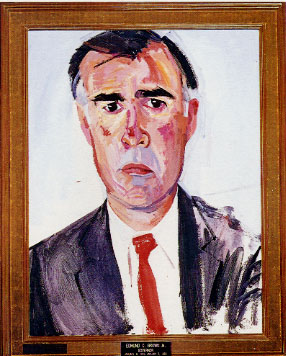
Mark Leno

The “Newsom wins” merry-go-round: What fun

10

Gavin Newsom still hasn’t said for sure that he’s in the race for lt. governor, although just about everyone in town now thinks he’s going for it.

But the very prospect of the mayor leaving office before his term is up has the political classes speculating: Who gets that job? And how does it happen?

It’s actually pretty interesting.

Under the City Charter, the president of the Board of Supervisors becomes acting mayor in the event that the mayor leaves office before the end of his or her term. Then the supervisors, by a six-vote majority, can appoint someone else to the job.

Melissa Griffin lays out one piece of the scenario, which is that the board could appoint a new mayor in advance, without anyone serving as acting mayor.

But there’s much more to the story.

According to a fascinating city attorney’s opinion issued in 1978 (PDF), when George Moscone and Harvey Milk were killed and Dianne Feinstein was board president, no supervisor is allowed to vote on his or her own appointment. Which would mean that if, say, Board President David Chiu wanted the job, he’d need six votes not including his own.

Now the plot thickens. Suppose nobody can round up six votes — that is, a majority of the supervisors can’t agree on a new mayor? Well, Chiu, as board president, would be acting mayor — potentially for the entire duration of Newsom’s term, roughly a year. He’d also remain as board president. It’s the same as if the mayor goes out of the state and names an acting mayor in his place; that person is still a supervisor. So Chiu would have all the powers of both the mayor and the board president — and immense amout of clout for one person at City Hall.

But wait, there’s more: Chiu is board president only until the board elected in November of this year takes office, which would be about five days after Newsom would become lite guv. So unless the current board can choose a new mayor, with six votes (not including the vote of any supervisor being nominated), the new board would elect a new board president — who would instantly become acting mayor at the same time.

And since supervisors are allowed to vote for themselves for board president, any member would be allowed to vote for him- or herself for acting mayor.

Confused yet? Clearly, the folks who wrote the City Charter never actually envisioned this scenario (or didn’t think about it very much).

Of course, what that means that with the current board split the way it is, with exactly six solid progressive votes, someone who isn’t currently on the board (say, Aaron Peskin — or Tom Ammiano, or Mark Leno, or whoever) would have a better chance of getting a majority than a current member, who would need at least one of the moderate bloc votes.

And if Newsom runs, it will make the fall supervisorial elections even more important, because potentially those newly elected supes will be choosing not only a board president but a mayor.

Here’s another fun twist: If District Attorney Kamala Harris is elected attorney general, the mayor gets to appoint a new D.A. But suppose Newsom also wins and is sworn in a few minutes before Harris. Presumably acting mayor David Chiu (a former prosecutor who rumor has it might like to be D.A. himself someday) would choose the new D.A. — and suppose Chiu knows he doesn’t have six votes to be mayor. There’s no reason why he couldn’t appoint himself D.A., leaving a vacancy on the board and a vacancy for board president, which would be filled by anyone who could get six votes, who would then be acting mayor and could appoint a new supervisor to Chiu’s seat. Who could then be the deciding vote on who gets to be mayor.

Whoa. I can’t wait. Run, Gavin, Run.

Alerts

0

alerts@sfbg.com

WEDNESDAY, FEB. 17

Same Sex Marriage Forum

Attend this forum about which entity — the state or the federal government — should define marriage. The forum is led by a panel of experts from human rights organizations and SF Chief Deputy City Attorney Therese Stewart, attorney for the plaintiffs in the current court case challenging Proposition 8.

6:30 p.m., $20

Commonwealth Club

595 Market, 2nd floor, SF

(415) 597-6700


THURSDAY, FEB. 18

Human rights in Chiapas

Hear Victor Hugo López of Fray Bartolomé de las Casas Human Rights Center (Frayba) in San Cristóbal de las Casas, Chiapas, Mexico. López will discuss human rights and the prospects for political change in the region in 2010. Frayba produces human rights reports, defends cases in court, and supports indigenous communities under attack.

7:30 p.m., $5–$10 sliding scale

La Peña Cultural Center

3105 Shattuck, Berk.

(510 654-9587


Wreaking HavoQ

Attend this organizing meeting for Pride at Work, a queer advocacy group fighting for economic and social justice. The meeting will cover upcoming projects such as fighting the gentrification of queer neighborhoods, resisting attacks on immigrants, and advocating for queer workers’ rights.

6 p.m., free

UNITE HERE Local 2

209 Golden Gate, SF

sfprideatwork.org


SUNDAY, FEB. 21

Day of Remembrance

Commemorate the anniversary of Executive Order 9066, which led to the incarceration of 120,000 people of Japanese descent in 1942 during World War II. The event features a speech by California Assembly Member Warren Furutani (D-Long Beach), a performance by Purple Moon Dance Project, a candle- lighting ceremony, and more. Reception to follow at the Japanese Cultural and Community Center at 1840 Sutter.

2 p.m., free

Kabuki Sundance Cinema

1881 Post, SF

(415) 921-5007


Peacemas

Celebrate the anniversary of the peace symbol with an evening of entertainment that includes inspirational clown Wavy Gravy, Selma Vincent as Mrs. T. Bill Banks of the National Association of Rich People, jazz violinist India Cooke, and more.

7 p.m., free

Redwood Gardens

2950 Derby, Berk.

(510) 845-5481


Yeasayers for Prop. 15

Hear Sen. Mark Leno (D-SF), Assembly Member Tom Ammiano (D-SF), and other luminaries speak in support of the California Fair Elections Act, or Proposition 15, on the upcoming June ballot. The act would pilot a voluntary system of public financing for secretary of state campaigns, which means elected officials can spend less time fund-raising and more time solving California’s problems.

1 p.m., free

San Francisco Main Library

100 Larkin, SF

(415) 648-6740


TUESDAY, FEB. 23


A chicken in every yard

Learn the logistics of raising chickens in a urban environment at this workshop with Alexis Koefoed. The Soul Food Farm maven will answer questions about the legality of raising chickens in your area, what it costs to raise chickens, where to buy chicks, and more. There are two sessions.

6 p.m. and 7:30 p.m., $20

18 Reasons

593 Guerrero, SF email info@18reasons.org 2 Mail items for Alerts to the Guardian Building, 135 Mississippi St., SF, CA 94107; fax to (415) 255-8762; or e-mail alert@sfbg.com. Please include a contact telephone number. Items must be received at least one week prior to the publication date.

Let’s push Jerry Brown on PG&E initiative

3

When the state Legislature approved the law allowing cities to create local public power co-ops, the bill specifically barred private utilities from interfering. So it’s easy to argue that Pacific Gas and Electric Co.’s ballot initiative to squash public power is, in fact, direct interference.

After all, the measure would create an almost insurmountable obstacle to creating community choice aggregation.

And the attorney general of California ought to be making that precise argument in court and trying to get this ballot initiative thrown out.

Sen. Mark Leno, a strong foe of the measure, told us he’s been in touch with Attorney General Jerry Brown’s staff, and is urging them to take action. He said he’s been assured the office is looking into the issue.

It will be interesting to see what Brown does. As governor, he was a strong opponent of PG&E’s Diablo Canyon nuclear power plant, and spoke at anti-nuclear rallies, but since then, he’s been awful wishy washy (and has, for example, never been an open supporter of public power.)

Now, however, he’s running for governor — and PG&E is one of the most hated institutions in the state. The old Jerry took on corporate power and positioned himself as a populist; this latest incarnation of Jerry could pick up a lot of progressive support (which he badly needs) and force Meg Whiman into a corner (what, is she going to support PG&E?).

So how about it, Jerry?

(And by the way, the San Francisco supervisors ought to pass a resolution calling on Brown to sue to get this evil measure off the ballot.)


PG&E kicks press out of debate

2

By Brady Welch

news@sfbg.com

It sounded like a great story: a representative of Pacific Gas and Electric Co. agreed to a public debate over the merits of a ballot initiative the company essentially had paid to place on the California ballot. The measure seeks to curtail public power and clean energy in the state. And so far, PG&E has been loathe to discuss it in any open forum.

But on Jan. 27, PG&E’s political consultant, David Townsend, was scheduled to square off with state Sen. Mark Leno, a staunch foe of the measure, before what sounded like a great audience: the Northern California Power Agency, which represents 17 public power providers across the state.

At Sacramento’s Doubletree Inn, I headed to the lobby of the California Ballroom, where I found a woman sitting at a table adorned with the logo of the NCPA. “I’m a reporter here to cover the debate between Sen. Mark Leno and a representative from PG&E,” I said. “Would this be the right place?”

She smiled politely. Sorry, she said, you have to be an NCPA member and registered for the conference.

“I was invited by the senator,” I told her.

“Then you will have to wait until he gets here,” she said curtly.

I walked upstairs to the front desk — and just then, Leno walked through the main lobby’s sliding doors. I introduced myself, walked with him to the conference room, and quickly slipped in with some other attendees. Within three minutes, a man sitting next to me was called to the side by a steward who whispered something to him, and then just as quickly, returned to his seat. He turned to me.

Are you with the media? he whispered.

“I’m with a newspaper,” I said.

He then informed me that the conference was actually private, and sorry, I would have to leave. They would explain more outside.

After I was escorted out, Leno came up to me and explained that there had been a miscommunication. Turns out Townsend didn’t want the media around. And worse, the NCPA folks appeared to be taking his side. Leno arranged for me to hear his opening statement, but that was all.

The senator’s remarks were pointed. He noted that PG&E’s proposed legislation is not an initiative, but an amendment to the state Constitution. He mentioned the curtailing of free enterprise and a demise of state government. He likened the utility’s disrespect for the legislative process to a spit in the face, and at one point openly asked Townsend: “What good is your word?”

The political consultant, for his part, sat quietly. At times he rolled his eyes or bit his thumbs. When Leno was wrapping up, Townsend leaned over to the moderator and whispered something. The moderator then came over to me and said I’d have to leave.

So I walked out — but not without wondering: when exactly did PG&E hirelings get the right to exclude reporters from meetings filled with representatives of public agencies?

Leno himself wasn’t sure. “With all due respect to David Townsend,” he told the Guardian a few days later, “I don’t see why a consultant wouldn’t want to discuss the themes of his campaign in public. I think his decision not to allow the press to hear him speaks for itself.”

Despite multiple calls and e-mails, we couldn’t get NCPA director James H. Pope to tell us why he lets PG&E determine who can — and can’t — attend his sessions. Jane Cirrincione, NCPA’s assistant general manager for legislative and regulatory affairs, told us that Townsend was invited by her boss and was not authorized to speak publicly for PG&E.

But Peter Scheer, director of the California First Amendment Coalition, offered a possible explanation. NCPA, he contends, “is capitulating to PG&E’s demand for secrecy, not for ideological reasons, but simply because if the spokesperson walks, they don’t have a conference. The reasons for excluding the press are basically that mundane and stupid.”

PG&E ballot initiative comes under scrutiny

0

By Rebecca Bowe

Pacific Gas & Electric Company’s statewide ballot initiative, which the utility calls The Taxpayer’s Right to Vote Act, has attracted criticism in a few editorials since the company sank millions into gathering enough signatures to qualify it for the ballot.

The proposed initiative would change the state constitution to require a two-thirds majority of voters to approve new spending or implementation of municipal power programs, such as San Francisco’s community choice aggregation program. The proposal drew fire from California Senate President Pro Tem Darrell Steinberg and Senator Mark Leno, who warned PG&E CEO Peter Darbee in a strongly worded letter that state law prohibits utility companies from interfering with the creation of such programs.

The LA Times, The Sacramento Bee, and members of the California Legislature aren’t the only ones criticizing PG&E’s initiative. A new blog started by former California Energy Commissioner John Geesman, called “PG&E Ballot Initiative Factsheet,” is fully dedicated to airing the dirt on PG&E’s power grab. Written by a California energy insider, it recently noted that the PG&E board has voted to spend $30 million on the initiative.

Geesman also points out that as it’s written, the initiative would actually require a two-thirds majority vote before municipal electricity providers could provide service to new customers:

A close reading of Proposition 16 reveals that its largest impact — whether intentionally or through sloppy drafting — may be in disrupting the ordinary, day-to-day operations of existing municipal utilities which presently provide 25 – 30 % of California’s electricity. …Bottom Line: if you’re a resident of Anaheim, or Burbank, or Glendale, or Pasadena, or Riverside — not exactly socialist towns, but all served by municipal utilities — or any of the other several dozen similarly impacted jurisdictions, your new neighbor isn’t going to be getting his electricity turned on until two-thirds of the voters say so.

Leno seeks to affirm religious freedom

0

By Nima Maghame

As supporters and opponents of same-sex marriage await closing arguments and a verdict in the federal lawsuit challenging Prop. 8’s legality, California State Senator Mark Leno has introduced a new bill that protects clergy who don’t want to perform marriage ceremonies that conflict with their beliefs.

“We so often heard from members of clergy that if Prop. 8 doesn’t pass, they had concern that they would be forced to marry against their beliefs and scared they would lose their tax-exemption,” Leno told the Guardian. So he’s decided to promote a bill that would remove that argument from the anti-gay marriage arsenal.

Restoring majority rule

0

Gov. Arnold Schwarzenegger’s lame duck response to California’s projected $20 billion state deficit has given supporters of more than 30 budget and revenue-related state initiatives now in circulation a renewed sense of urgency as they scramble to gather signatures and qualify proposed solutions to the state’s ongoing financial emergency for the November ballot.

But while this plethora of initiatives reflects widespread frustration over the state’s broken system of governance, disagreement rages over how to fix it and how best to restore majority rule to California.

“These are the hardest decisions a government must make, yet there is simply no conceivable way to avoid more cuts and more pain,” the governor told reporters Jan. 8 as he released a new budget proposal calling for $8.5 billion in cuts to state workers’ wages, health and human services, and prisons; a legally questionable $4.5 billion shift in other funds; and $6.9 billion in federal reimbursements that have yet to be approved.

Even steeper social services cuts are in the works, Schwarzenegger warned, if the feds don’t comply with this request for a bailout. But he refused to target corporations and millionaires as revenue sources, clinging instead to the standard Republican pledge not to raise taxes.

“We didn’t hear him say, ‘We are going to pinch the wealthy and the corporate,'<0x2009>” State Sen. Mark Leno observed. “He is definitely setting his sights on the social safety net.”

Recent revolts within the public university system, including the November takeover of UC Berkeley’s Wheeler Hall, suggest that tuition hikes, layoffs, and reduced study options have brought students to the tipping point.

But UC Berkeley linguistics professor George Lakoff fears that without restoring majority rule to the state’s budget and revenue-related measures, such revolts only address symptoms, not causes, of the impasse.

So Lakoff decided to author the California Democracy Act, an initiative that would replace the state’s two-thirds requirement on budget and revenue bills with a simple majority vote, after Sen. Loni Hancock invited him to meet with a group of Democratic state senators last spring.

“She said the Democrats were having problems getting anything done, and I went away saying, ‘this is ridiculous,'<0x2009>” Lakoff said. “It occurred to me that since the problem came by way of the initiative process, then it was possible to rectify it that way.”

Proposition 13, approved by voters in 1978, limited property tax increases and required a two-thirds supermajority in the Legislature to approve most new tax increase, measures that contributed mightily to the state’s bleak financial situation.

California also requires a two-thirds vote for the Legislature to approve the annual budget, along with only Arkansas and Delaware. On Jan. 5, Sonoma State philosophy professor Teed Rockwell told the Potrero Hill Democratic Club to endorse Lakoff’s initiative, noting that California is the only state to require two-thirds vote on budget and revenue bills.

“I have learned that essentially everything that is uniquely wrong with California results from this one fact,” Rockwell said.

California has the largest number of millionaires in the U.S., but as Rockwell observed, thanks to the fiscal stranglehold of the Republican minority, “We do not have enough money to keep our parks open or maintain affordable tuition at our public colleges. And the extremists in Sacramento want to solve this problem by decreasing taxes on millionaires and increasing taxes on the middle class.”

Rockwell noted that of the 22 states that produce oil in the U.S., all have oil severance taxes, including Sarah Palin’s Alaska and George W. Bush’s Texas — except California.

But while the California Democracy Act simply resolves that “all legislative actions on revenue and budget must be determined by a majority vote,” neither the state Democratic Party nor the major unions are willing to support Lakoff’s measure, citing its bad results in the polls.

Instead, veteran legislator and California Democratic Party Chair John Burton is backing a Hancock proposal that seeks to reduce to a simple majority the Legislature’s voting requirement on budget bills.

Lakoff warns that budget bills merely determine how to slice the pie, while revenue bills determine the size of the pie. This means that if Democrats succeed in only reforming the state’s budget voting requirements, they’ll still be stuck with having to make painful cuts.

But Hancock, who has been living with the results of this fiscal gridlock since she was elected to the state Assembly six years ago and helped sponsor the failed oil severance tax initiative in 2006, believes decisions to cut prison or education spending are not trivial.

“Last year Democrats gave $2 billion in tax breaks just to get one desperately needed Republican vote on the budget,” Hancock told the Guardian. “And now the Republicans are asking for takeaways on environmental and labor protections that they otherwise wouldn’t have any power to negotiate.”

“I am a realistic idealist,” Hancock continued. “I believe we are better off to get the majority vote to pass the budget. That way, the minority might begin to negotiate and have a more rational conversation. I’m very pleased that throughout the state, folks are recognizing that state governance is broken.”

California Tax Reform Association executive director Lenny Goldberg told us it’s hard to choose between the Lakoff and Hancock initiatives.

“It’s a question of what’s achievable, of how to focus energy,” Goldberg said. “Lowering the vote requirement for the budget would eliminate some of the hostage-taking and help reverse the corporate loopholes that the Democrats were forced to accept to get a budget passed. So at least it would make the budget process better.”

But he agrees that budget reform only makes the Democrats solely responsible for the budget, while preventing them from raising revenue.

“So there is some disagreement whether it’s better to do one, if you can’t do tax reform,” he said. “In the end, it’s a strategic, not substantive, question. Is it better to do budget alone, or not at all? Personally, I think we’re better off doing budget reform than nothing — but it’s a close call.”

Hancock and Lakoff both believe that a competing initiative, endorsed by Schwarzenegger and funded by the group California Forward, is the poison pill in the upcoming fiscal equation.

“Unfortunately, it’ll make it harder to raise fees,” Hancock said.

“It should be renamed California Backward,” Lakoff quipped, noting that while the California Forward initiative supports a simple majority on budget bills, it seeks to raise to two-thirds the voting threshold on new fees.

California Forward executive director Jim Mayer said his organization supported Prop. 11, the redistricting measure that passed in November 2008, “as a start to melt the political gridlock.

“And our two initiatives will help legislators do a better job of spending the pie,” Mayer added, noting that his group is talking to Democrats and Republicans as well as counties, cities, and branches of the Chamber of Commerce.

One of California Forward’s initiatives seeks to change the budget vote requirement to a simple majority and create a two-year budget cycle. It also forces the Legislature to use one-time revenues for one-time expenditures — and requires a two-thirds vote on fee increases, raising Democrat hackles.

“When the Legislature attempts to replace what’s currently a tax on utilities with a fee, currently they can do that with a simple majority. But people on the right tend to worry that if you eliminate a tax and call it a fee, it’s illegal,” California Forward spokesperson Ryan Rauzon explained.

The other initiative would allow county governments to identify priorities and raise revenue with a simple majority vote, Mayer said, a plan he claims is about “empowering local governments.”

The battle for District 6

0

tredmond@sfbg.com

The race to replace Chris Daly — the always progressive, sometimes hotheaded supervisor who has dominated District 6 politics for almost a decade — is becoming one of the most important battles of 2010, with the balance of power on the board potentially in play.

Through whatever accident of politics and geography, San Francisco’s even-numbered districts — five of which will be up for election next fall — haven’t tended to fall in the progressive column. Districts 2 (Marina-Pacific Heights) and 4 (Outer Sunset) are home to the city’s more conservative supervisors, Michela Alioto-Pier and Carmen Chu. District 8 (the Castro) has elected the moderate-centrist Bevan Dufty, and District 10 is represented by Sophie Maxwell, who sometimes sides with the progressives but isn’t considered a solid left vote.

District 6 is different. The South of Market area is among the most liberal-voting parts of San Francisco, and since 2000, Daly has made his mark as a stalwart of the board’s left flank. And while progressive are hoping for victories in districts 8 and 10 — and will be pouring considerable effort and organizing energy into those areas — Daly’s district (like District 5, the Haight/Western Addition; and District 9, Mission/Bernal Heights) ought to be almost a gimme.

But the prospect of three progressive candidates fighting each other for votes — along with the high-profile entry of Human Rights Commission director Theresa Sparks, who is more moderate politically — has a lot of observers scratching their heads.

Is it possible that the progressives, who have only minor disagreements on the major issues, will beat each other up and split the votes enough that one of the city’s more liberal districts could shift from the progressive to the moderate column?

A FORMIDABLE CANDIDATE


A few months ago, District 6 was Debra Walker’s to lose. The Building Inspection Commission member, who has lived in the district for 25 years, has a long history on anti-gentrification issues and strong support in the LGBT community.

Jim Meko, who also has more than a quarter century in the district and chaired the Western SOMA planning task force, was also a progressive candidate but lacked Walker’s name recognition and all-star list of endorsements.

Then rumors began to fly that school board member Jane Kim — who moved into the district a few months ago — was interested in running. Kim has been a leading progressive voice on the school board and has proven she can win a citywide race. She told me she’s thinking seriously about running, but hasn’t decided yet.

Having Kim in the race might not have been a huge issue — in District 9 last year, three strong progressives competed and it was clear that one would be the ultimate winner. But over the past two weeks, Theresa Sparks has emerged as a likely contender — and if she runs, which seems more than likely at this point, she will be a serious candidate.

Sparks picked up the kind of press most potential candidates would die for: a front-page story in SF Weekly and a long, flattering profile in San Francisco magazine, which called her "San Francisco’s most electrifying candidate since Harvey Milk." Sparks does have a compelling personal tale: a transgender woman who began her transition in middle age, survived appalling levels of discrimination, became a civil rights activist and now is seeking to be the first trans person elected to the San Francisco Board of Supervisors.

She has experience in business and politics, served on the Police Commission, and was named a Woman of the Year by the California State Assembly (thanks to her friend Sen. Mark Leno, who would likely support her if she runs).

"Anyone who knows Theresa knows that she is smart, a formidable candidate, can fundraise, and will run a strong race," Robert Haaland, a trans man and labor activist who supports Walker, wrote on a Web posting recently.

She’s also, by most accounts (including her own) a good bit more moderate than Walker, Meko, and Kim.

LAW AND ORDER


Sparks doesn’t define herself with the progressive camp: "I think it’s hard to label myself," she said. "I try to look at each issue independently." Her first major issue, she told me, would be public safety — and there she differs markedly from the progressive candidates. "I was adamantly against cuts to the police department," she said. "I didn’t think this was a good time to reduce our police force."

She said she supported Sup. David Campos’ legislation — which directs local law enforcement agents not to turn immigrant youth over to federal immigration authorities until they’re found guilty by a court — "in concept." But she told me she thinks the bill should have been tougher on "habitual offenders." She also said she supports Police Chief George Gascón’s crackdown on Tenderloin drug sales.

And she starts off with what some call a conflict of interest: Mayor Gavin Newsom just appointed her to the $160,000-a-year post as head of the HRC, and she doesn’t intend to step down or take a leave while she runs. She told me she doesn’t see any problem — she devoted more than 20 hours a week to Police Commission work while holding down another full-time job. "I don’t know why it would be an issue," she said, noting that Emily Murase ran for the school board while working as the director of the city’s Commission on the Status of Women.

But some see it differently. "It would be as if the school superintendent hired someone to a senior job just as that person decided to run for school board," Haaland said.

Sparks’ election would be a landmark victory for trans people. For a community that has been isolated, dismissed, and ignored, her candidacy (like Haaland’s 2004 run in District 5) will inspire and motivate thousands of people. And it’s a tough one for the left — opposing a candidate whose election would mean so much to so many members of one of the city’s most marginalized communities could be painful. "A lot of folks will say that the progressives will never support a transgender candidate," Haaland noted.

But in terms of the city’s geopolitics, it’s also true that electing Sparks would probably move District 6 out of the solidly progressive column.

"If we lose D6, it’s huge," Walker noted. "This is where most of the new development is happening, where law-and-order issues are playing out, where we can hope to save part of the city for a diverse population."

More than that, if progressives lose District 6 and don’t win District 8, it will be almost impossible to override mayoral vetoes and control the legislative agenda. And that’s huge. On issue like tenants rights, preventing evictions, controlling market-rate housing development, advancing a transit-first policy — and raising new revenue instead of cutting programs — the moderates on the board have been overwhelmingly on the wrong side.

Kim, for her part, doesn’t want to talk about the politics of the 2010 elections — except to say that she’s thinking about the race and will probably decide sometime in the next two months. But she agreed with my analysis of how any left candidate should view this election: if she’s going to enter, she needs to present a case that, on the issues that matter, she’d be a better supervisor than either of the two long-term district residents with strong progressive credentials already in the race.

"I don’t have an answer to that now," Kim told me. "And when I make my decision, I will."

Leno goes after PG&E initiative

1

By Tim Redmond

State Sen. Mark Leno is asking the leadershiop of the state Democratic Party to pass an emergency measure opposing Pacific Gas and Electric Co’s plans for a statewide initiative against public power.

Leno told me he will travel to San Diego Nov. 14th to personally introduced a resolution to the party’s Executive Board putting the party on record in opposition to the measure. The company has been paying signature gatherers to collect enough names to place the measure on next spring’s statewide ballot.

The board is meeting that weekend. Since this would be an emergency measure, Leno said, any member of the Resolutions Committee could block it. But Leno thinks that’s unlikely; “who,” he asked, “is going to stand up and defend PG&E right now?”

PG&E’s spooky stories headed to your mailbox

0

By Rebecca Bowe and Rachel Sadon

At a Halloween-themed press conference on the steps of City Hall this afternoon, Supervisors Bevan Dufty and Ross Mirkarimi warned that PG&E plans to disseminate misleading information about the city’s Community Choice Aggregation (CCA) program.

The attack comes on the heels of the Board of Supervisor’s approval of a request for proposals for Clean Power SF, San Francisco’s own fledgling CCA, which seeks to provide competitively priced and significantly greener energy than PG&E. The CCA would challenge PG&E’s monopoly in the San Francisco Bay Area, and the utility is expected to fight it tooth and nail.

Sup. Dufty got a heads up from a PG&E employee this morning that mailers criticizing the program would be sent out tomorrow. Recalling last year’s multimillion dollar campaign against Prop H, an initiative for public power, Dufty emphasized that the city does not nearly have the funds to match a misinformation campaign.

Tom Ammiano denounced PG&E and their tactics as “avaricious, criminal, morally corrupt” and “a throwback to robber barons.”

Though the content of the mailers is unknown, it has already created a stir around City Hall and throughout the community that is advocating for community choice. At the press conference, which was scheduled with very little advance notice, Dufty and Mirkarimi were joined by Sup. David Campos, San Francisco Public Utilities Commission director Ed Harrington, state senator Mark Leno, and Sierra Club representatives Michael Borenstein and John Rizzo.

Mirkarimi, chair of the Local Agency Formation Commission (LAFCo), insisted that “San Francisco is steadfast in its commitment to Community Choice Aggregation,” and stressed that “PG&E continues to mock our commitment to green energy and will do everything in their power to circumvent the process.”

The case against Prop. D

0

OPINION Proposition D is a classic developer’s scam. It was written by a mid-Market Street property owner who is spending more than $250,000 million to push hollow propaganda pieces preaching the wonders of his bill. When you strip away the glossy photos and misleading language, Prop. D is an attempt by private real estate owners to put up huge, flashing billboards and keep virtually all the money for themselves.

There is all kinds of misleading information in this thing. Individual signs are limited to 500 square feet — but the legal text encourages property owners to cluster as many signs as they want to display a single, massive, synchronized, electricity-sucking advertisement. What really pisses us off about the campaign for Prop. D is how the backers market it as "for the kids." (Because what kind of monster would vote against helping the kids, right?)

But that’s all a bunch of non-binding fakery. The 20 percent to 40 percent of advertising revenue that doesn’t go straight into the property owners’ pockets would go to the Central Market Community Benefits District — a self-selecting, self-reguutf8g group made up of the very landlords who own the buildings on Market Street. Then the CBD would get to decide how to spend the money with no public input or regulation. There’s no definition of what the "youth programs" would be. The backers also plan on spending money on a new ticket booth and on their own staff and expenses.

Back in 2002, 77 percent of San Franciscans voted to ban new advertising signs anywhere in the city. The Planning Department has issued a brutal analysis of Prop. D, calling it an unprecedented power grab that would strip regulatory oversight of the billboards from the (public) Planning Department and hand it over to the private CBD.

The mid-Market area needs help, for sure. But Prop. D is not the way to do it. If you really want to clean up Market Street, it’s gonna require some actual elbow grease in the neighborhood, some community input, a comprehensive revitalization plan, and real solutions for homelessness. Prop. D has zilch. If developers are serious about helping the underserved youth of the Tenderloin, why is there no binding language requiring a mandatory minimum of money for community benefits? Since when have digital billboards ever improved the quality of life of anyone — let alone cured poverty or homelessness?

We’re pretty bummed at the miserable press coverage of this totally sneaky proposition. We’re joining with a diverse group of community leaders and organizations, including state Sen. Mark Leno, Assembly Member Tom Ammiano, Sups. John Avalos and Ross Mirkarimi, School Board Vice President Jane Kim, Community College Trustee Steve Ngo, SoMa Community Action Network, the Coalition on Homelessness, the Alliance for a Better District 6, Senior Action Network, League of Conservation Voters, Livable City, and others in saying a big "hell no" to Prop. D. If Prop. D somehow does pass, we plan on working to put something on the 2010 ballot that would put real community input and oversight into this clusterfuck.

Jeremy Pollock and Ali Uscilka are on the steering committee of the SF League of Pissed Off Voters, which empowers young people to become politically engaged and educated on the issues. Since 2003 we’ve been organizing broad-based coalitions to create permanent, progressive, grassroots change. Read our entire voter guide at www.theballot.org.

Environmental pork?

0

By Rebecca Bowe

Gov. Arnold Schwarzenegger announced yesterday that he wouldn’t sign any new legislation unless a water plan is in place — and he has some very concrete ideas about what that plan should be. There are about 700 bills awaiting his signature by Sunday.

Siding with Republicans and Central Valley farmers on the water issue, Schwarzenegger has said he would veto any water package that does not include bonds for new dams and reservoirs, at a cost of an estimated $12 billion.

Major agricultural interests are hopeful that these projects will improve their access to water for irrigation, but environmentalists fear that investing in them would take the state down the wrong path when it comes to protecting environmental resources and encouraging more efficient water use. So far, an agreement hasn’t been reached.

As the deadline creeps closer, money is becoming a key concern, especially in the wake of dramatic budget cuts to education and social services. Environmentalists are worried that protections for the Sacramento-San Joaquin Delta will be abandoned in favor of the major water-storage projects forcefully championed by Central Valley farmers who say they’re in dire straits due to unreliable water supply. Sen. Mark Leno told the Guardian this afternoon that as discussions go on, funding for stronger Delta protections is being eyed as a way to bring down the total cost of the water package.

Signaling a reversal from what lawmakers characterized as the “coequal goals” of water reliability and environmental protection at the beginning of the process, Leno says Delta ecosystem protections are now being characterized as “environmental pork” that should have a lower funding priority.

“Republicans are squawking [about the cost], but they won’t let there be any impact on dams, so all the money is coming out of protections for the Delta,” Leno said.

The Chron, the guv and the issues

3

By Tim Redmond

It’s as if the San Francisco Chronicle didn’t recognize that there are real issues facing California — and that the governor is acting like a thug, threatening the future of the state and clowning around like it doesn’t matter.

Check this out: The Chron’s editorial page criticizes Tom Ammiano for standing up to the governor:

But Assemblyman Tom Ammiano crossed the line when he shouted “You lie!” at Gov. Arnold Schwarzenegger during a Democratic fundraiser in San Francisco on Wednesday night. Ammiano reportedly went even further on the crass-o-meter when he suggested that the governor could kiss his posterior.

.

(By the way, this is San Francisco — it’s okay for the daily newspaper to say “ass.”)

And then suggests that this was just a nice event at which

The governor was invited for a brief visit to a Democratic Party event by former Mayor Willie Brown

(By the way, Brown is also a San Francisco Chronicle columnist)

without ever saying that Brown had no business bringing the governor — who is so openly threatening the Democrats with mass bill vetoes that Sen. Mark Leno is forced to ask “are we dealing with the Mob or the governor of California?” — to a Democratic party fundraiser.

Brown was playing his normal games, goofing around and ignoring the life-and-death issues at stake. He and Arnold are buds, and Brown backed Schwarzenegger for governor over a Democrat. He knew bringing the guy into that room would create a furor, and he knew that the governor would love it (it helps him with his conservative base to get booed by San Francisco Democrats.)

Ammiano knows all that, too, and frankly, was somewhat reserved in his comments. I would have gone further; I would have called out Willie Brown for a back-stabbing political stunt.

And don’t the Chron editorial writers have any sense of humor? “You lie” was a joke, guys, a parody. Please: Lighten up, and get a clue.

The Democrats wild night

24

By Tim Redmond

Well, I’m really sorry I missed the Democratic Party gala Wednesday night. Apparently it was quite a show. Brian Leubitz has a great report at Calitics on the unexpected appearance of Gov. Schwarzenegger and the overwhelmingly negative response by the attendees, including Assemblymember Tom Ammiano, who stood up and shouted “You Lie!”

“It was political theater of the type we love,” Ammiano told me.

Seriously, though: Former Mayor Willie Brown apparently told the guv that the event was happening, and since Schwarzenegger was in the same hotel for a President’s Cup event, he decided (perhaps at Brown’s invitation, it’s not entirely clear) just to drop by. And everyone was supposed to act all nice and pretend that they’re aren’t real, serious issues in Sacramento and that the governor isn’t really, really screwing up the state and hurting a lot of people.

“This wasn’t the Legislative Chambers, where you have to put up with this shit,” Ammiano said.. “It’s like this guy just showed up and took a big dump in my living room.”

Labor folks weren’t happy, either, and a bunch of them walked out. Then Ammiano (and we should all give thanks that he’s in the Legislature, reminding everyone what San Francisco stands for) accepted an award and made a speech:

And then he proceeded to bludgeon the Governor’s record. He questioned why he was holding bills hostage to get a bad water deal. He questioned why a Governor who has vetoed the Harvey Milk Day bill would stand up in front of a room that was at least 25% LGBT. He politely asked Mayor Brown to send a message to the governor to sign the bills already.

And finally, Senator Mark Leno closed the proceedings for the evening. Leno took a different tack than Ammiano’s passion. He simply stated the facts. He said that the events of this evening were all funny and stuff, but the fact is that this Governor had cut state workers salaries by 15% with the furloughs. This Governor wanted to cut IHSS salaries to minimum wage. This Governor illegally used the line item veto to slash funding for domestic violence shelters. And that he, and the Senate Democrats, were going to fight him tooth and nail.

And to a loud applause, Leno stepped off the stage and the crowd began to thin. And everybody was saying, “um, wow.”

The other thing Ammiano said in his speech was that Democrats have gotten a little lax on standing up for their friends — and he mentioned both ACORN and Kim-Shree Maufas, and both times was met with huge applause.

And, of course, the Chron’s Carla Marinucci focused her reporton Willie Brown’s comments about how inappropriate this all was and how everyone needed to make nice to poor Arnold. But there are serious issue here that aren’t just fun and games, and when the stakes are as high as they are here, I’m glad to see them Democrats (or at least some of them) deciding not to play so nice with a governor who is smiling while he drives the state into bankruptcy and despair.

PS: Ammiano told me that when Marinucci called him, she seems astounded that he had said “kiss my gay ass” while walking out of the governor’s speech. “I told her, I don’t remember, but I probably did say that,” Ammiano said. “After all, it’s safe sex.”

Will Arnie’s ‘park closure solution’ save Candlestick Point?

3

Text and photo by Sarah Phelan

Monsterskies0925.JPG
Does San Francisco really need to sell Candlestick Point park for Lennar condos?

Governor Arnold Schwarzenegger has unveiled a plan to allow for all state parks to remain open without increasing Parks and Recreation budget appropriation. Does this mean the Bayview’s only major park can be saved? Developers are arguing that if the state sells a chunk of the waterfront property for $50 million, the rest of the park can be saved. But environmentalists disagree, noting that Lennar simply wants the land for luxury condos.

“Working closely with my Departments of Finance and Parks and Recreation, we have successfully found a way to avoid closing parks this year,” Schwarzenegger said in a press release today. “This is fantastic news for all Californians.”

But does this mean that Sen. Mark Leno’s SB 792 is no longer necessary?

Leno’s bill would allow the state to sell a chunk of Candlestick Point State Recreation Area for $50 million, so that developer Lennar, which has entered into a nebulous public-private partnership with the city of San Francisco, can build luxury condos on this waterfront parkland.

Leno’s bill, which the Assembly and the Senate have approved, is sitting on Arnie’s desk awaiting the governor’s signature. But it has faced stiff opposition from environmental groups in recent months.

And their neutrality was only recently secured, based on the spurious argument that, without the bill’s approval, Candlestick Point SRA would have to closed in its entirerity.

But now the Governor is proposing to reduce ongoing maintenance for the remainder of 2009-10, eliminate all major equipment purchases, and reduce hours and/or days of operation at most State Park units, expenditures on seasonal staff, and staffing and operations at State Parks headquarters.

According to Arnie’s proposal, some facilities could close weekdays and be open on weekends and holidays, or portions of a unit could be closed, such as the back loop of a campground. For a park with multiple campgrounds, one whole campground or day use facility could be closed while the rest of the park remains open, while parks that already close due to seasonal conditions could see longer closures.

“Service reductions will be planned to minimize disruptions to visitors, achieve cost savings and maintain park fee revenues,” the memo says.

Hmm. Seems like Arnie’s memo just gave Candlestick Point park supporters more ammo in their ongoing quest to challenge Lennar’s plan to take 23 acres of Candlestick Point SRA.

Lennar never spelled out this plan to take a chunk of the Bayview’s only major park, when they asked voters to approve Prop. G in 2008.

Instead, Prop. G was billed as a way to clean-up the abandoned Hunters Point shipyard and “create” hundreds of new acres of parkland.

It wasn’t until after Prop. G passed, that Lennar began publicly arguing that they would need 42 acres of the existing parkland, if the rest of their plan, which involves building 10,500 housing units on 770 acres of former industrial/ military land, is to pencil out. As for the new acres of parkland, that turned out to be acres of polluted shipyard that Lennar was proposing to cap with a cement cover and convert into a park.

Understandably angered, park advocates beat Lennar down to 23 acres, this fall, during the most recent round of the “parks for condos” battle.

Now, in light of Arnie’s plan and the soon-to-be released environmental impact report for Lennar’s massive redevelopment plan, those battlelines are perhaps, once again about to be redrawn. Only this time in favor of the park.

Stay tuned.

Crunch time

0

sarah@sfbg.com

The proposal by city officials and Lennar Corp. to build more than 10,000 new housing units at Hunters Point Shipyard/Candlestick Point is entering a critical phase, particularly for Bayview-Hunters Point residents who want greater oversight and scrutiny of the project.

Candidates are lining up to replace termed-out District 10 Sup. Sophie Maxwell next year; the project’s draft environmental impact report will be released, considered for approval and potentially challenged; and Lennar officials will seek to get the final development agreement with the city signed before Mayor Gavin Newsom leaves office in 2011, or earlier.

The 770-acre redevelopment plan, which the Mayor’s Office is touting as a shining example of a public-private partnership, has come under repeated attack from community advocates after Lennar’s failures to monitor and control toxic asbestos dust at the shipyard. The crash of the housing market and plunge in the company’s stock price also triggered concerns about the project.

And in light of the U.S. Navy’s recent decision to dissolve the Hunters Point Shipyard Restoration Advisory Board (RAB), the community is concerned that decisions about radiologically-affected dumps and the shipyard’s early transfer from the Navy to the city could occur without important public oversight.

Another aspect of the project — a proposal to build condos on 42 acres of Candlestick Point State Recreation Area — was criticized by the Sierra Club, Arc Ecology, and Friends of Candlestick Park. Lennar argued it was necessary for the project to pencil out and this sale of state land was to be authorized by Senate Bill 792, sponsored by Sen. Mark Leno.

In August, Leno secured the neutrality of the environmental groups and the support of the California Assembly (but not Assembly Member Tom Ammiano, the lone dissenting vote) for an amended version of his bill, arguing that selling 23 acres for $50 million would spare the rest of Candlestick Point SRA from being closed by budget cuts. The legislation now awaits Gov. Arnold Schwarzenegger’s signature.

Now, with the project’s EIR due to be released Sept. 28, people have the chance to register concerns about plans for such a massive development project, which includes condos on the Bayview’s only major park and a controversial bridge over Yosemite Slough.

On Sept. 15, community members packed the Board of Supervisors’ meeting to demand an investigation into their concerns, which also include the apparent inability of Newsom’s African American Out Migration task force to issue its overdue final report about the ongoing exodus of the city’s black population, which this project could exacerbate.

Sup. John Avalos told us he is now gathering information on the issue and hopes to schedule Land Use Committee hearings on the shipyard cleanup and Lennar’s economic health. "The documentation gives real strength and power to the community’s contentions," Avalos said.

He also noted that Maxwell is scheduling a hearing into the dissolution of the RAB, while Sup. Ross Mirkarimi is resurrecting legislation that seeks to put the San Francisco Redevelopment Authority under the control of the Board of Supervisors.

Arc Ecology director Saul Bloom said his group will study the project’s EIR to see if it accurately assesses the effects of Lennar’s development.

"We are concerned about the impact of truck traffic, the bridge over Yosemite Slough, and whether the transportation plan is going to effectively put the Bayview between three freeways," Bloom said. "But we’re going to be even-handed. If the EIR does a good job, we plan to say so."

Jaron Browne of the Bayview advocacy group POWER (People Organized to Win Employment Rights) told the Guardian that her group wants the shipyard cleaned up and the community respected.

"This is not just a Bayview issue," Browne said. "The whole city will be affected by the decisions that take place in terms of the future of affordable housing and environmental protection."

Assembly supports sale of Candlestick Point Park

0

Text and photos by Sarah Phelan

Monsterskies10.JPG

On Wednesday night, as folks were getting ready to watch President Barack Obama’s speech about health care, the State Assembly voted 69-1 in support of an amended version of Sen. Mark Leno’s SB 792.

Leno’s bill, which is now back in the Senate, gives the State the authority to sell 23 acres of Candlestick Point State Recreation Area for $50 million.

Assemblymember Tom Ammiano was the lone dissenter on Leno’s bill with seven others abstaining or not voting.

Those voting “aye” included Assemblymembers Fiona Ma and Nancy Skinner. Florida-based developer Lennar, which has entered into a public-private partnership with the City of San Francisco to redevelop 770-acres at Hunters Point Shipyard and Candlestick Point, is arguing that it needs these additional 23 acres of prime waterfront property to build luxury condos, if the rest of its massive redevelopment plan is to pencil out.

shoreline10.JPG

Initially, SB 792 would have allowed the State to sell 43 acres of Candlestick Point State Recreation Area, the Bayview’s only major park, for condos. As such, it faced stiff opposition from the Sierra Club, Arc Ecology and Friends of Candlestick Point Park.

In its amended form, SB 792 authorizes the exchange of 23 acres, thus preserving 20 acres of existing parkland—a compromise, Leno says, that secured the neutrality of these three key environmental groups.

“I am especially pleased that after months of negotiations, amendments to SB 792 resulted in the neutrality of the Sierra Club, Arc Ecology and Friends of Candlestick Point,” Leno said.

So, what does SB 792’s passage mean for the park’s ecological integrity? And won’t the impact of removing 23 acres from the Bayview’s only major park be magnified, once condos and high rises have been built?

Stop the chemical companies

3

By Tim Redmond

Sen. Mark Leno wants to stop the chemical industry from pumping toxic crap into products used by babies and kids. SB 772 ought to be a slam dunk — but the chemical companies are fighting back. There’s a plea on Calitics for people to get invoved and help.

Leno’s used to this sort of battle, but he told me even he is amazed by the chemical industry’s tactics. IF we can’t win this one — a very mild bill protecting children — you wonder if we can beat these folks at anything.

Protecting babies from fire and chemicals

1

news@sfbg.com

GREEN CITY Profit-driven companies are fighting an expensive and underhanded battle to keep their toxic fire retardants in California’s furniture.

Senate Bill 772, authored by Sen. Mark Leno (D-San Francisco), seeks to exempt certain children’s furniture from California’s fire code, thereby allowing manufacturers the option of forgoing toxic fire retardants and giving consumers the opportunity to raise their babies around chemical-free furniture. But lobbying efforts last week stalled the bill in the Assembly Appropriations Committee, where it will be reconsidered Aug. 26.

California’s onerous standards for fire safety are unique. According to Technical Bulletin 117, established by the California Bureau of Home Furnishings, all furniture manufactured in California must be able to withstand an open flame for 12 seconds without igniting.

While there are other methods that meet California’s standards, such as barriers and safer chemicals, the cheapest way for manufacturers to meet TB 117 is to pour toxic, halogenated chemicals that act as fire retardants into all upholstered furniture.

This means that fire retardants are put in most things in your house — your couch, your mattress, your baby’s pillows and strollers. The companies producing the fire retardants are huge multinational corporations — Albermarle, Chemtura, ICL Industrial Corp. and Tosoh — spending millions on lobbying and in drafting nonprofit fronts.

The fire retardants go by a variety of technical names: polybrominated diphenyl ether, halogenated substances, TRIS, BFRs, CFRs … the list goes on. That chemical family is halogenated chemicals. The only one that is legal in all consumer products is decabrominated diphenyl ether, referred to as DECA. Some of the chemicals that are known to be toxic are only banned from certain products, such as pajamas in the case of TRIS, but are still being poured into everyting from electronics to clothing to upholstery.

SB 772 specifically focuses on four pieces of children’s furniture. After reviewing years of data, the Bureau of Home Furnishings found that bassinets, nursing pillows, strollers, and infant pillows have never caused fire causality. Leno contends, "There is no need to pour chemicals into products that are not fire risks."

Numerous studies and agencies, including the National Toxicology Program and the California Environmental Protection Agency, have linked halogenated chemicals to cancer, thyroid disease, reproductive problems, ADHD, child autism, and long list of other ailments. Some, like Seth Jacobson, spokesperson for Citizens for Fire Safety, argue that the studies are exaggerated and "not scientifically valid".

Any manifestation of these diseases may take years to see or are complicated by other factors, making correlations to specific chemicals difficult to pinpoint. Russell Long of Friends of the Earth believes that this is a comparable scenario to the asbestos crisis of the 1980s. Asbestos was a common household chemical long suspected of toxicity and in 1989, after numerous health and legal battles, the EPA banned it. Decades later the federal government is still spending billions in liability lawsuits affecting more than 600,000 people.

Another issue is bioaccumulation — these chemicals don’t stay put. According to Leno, these chemicals don’t bind to materials. Instead they fall to the floor and become part of dust. In 2006, the California EPA reported that "PBDEs have been measured in house and office dust, indoor air, plant and animal-based foods, terrestrial and marine animals, and in human breast milk, blood, and fat."

In 2008, scientists from UC Berkeley, Harvard, and the Silent Spring Institute found that the levels of PBDEs in Californians are twice as high as other U.S. regions. The California EPA has reported that the highest tissue concentrations of PBDEs are found in California aquatic life, with rising levels in San Francisco Bay harbor seals. Long believes "this is one of the biggest toxic threats facing Californians today".

This is Leno’s second attempt at passing a bill involving these particular issues. The first, SB 706, introduced last year, sought to directly ban the use of toxic fire retardants. SB 706 was named the Crystal Golden-Jefferson Act, in memory of a 41-year-old firefighter who died of work-related, non-Hodgkin’s lymphoma. It is believed she developed the condition after breathing in dioxin (a highly toxic carcinogen) that was released from burning flame-retardants. Oregon, Vermont, Washington, and Maine have already passed bills banning dioxin and have started phasing it out.

Banning chemicals is hard to do. Richard Holober of the Consumer Federation of California says that the petrochemical industry will slightly alter a banned chemical, "sort of chasing one version after another." In the United States, chemicals are mass-produced and distributed until they are found to be dangerous. In Europe, chemicals must be proven safe first.

The most outspoken opposition to both bills, SB 706 and SB 772, is a group called Citizens for Fire Safety. The group, headed by Jacobson, argues that fire retardants saves lives, noting that since California established TB 117 California structure fires have dropped by about 60 percent. Records from the National Fire Protection Association show a drop of 32 percent between 1980 and 2000. Yet other states, including New York, show a drop of 40 percent without a similar fire regulation. The drop can easily be ascribed to an increase in smoke detectors, better education, and more regulations on cigarettes: the number one fire instigator.

Citizens for Fire Safety’s funding is suspicious. Its Web site clearly states "a portion of our funding&ldots;comes from various chemical industry leaders." Indeed, Jacobson says he has no problems accepting funding from the same companies that manufacture the chemicals in question. Leno believes Citizens for Fire Safety is a "concerted business effort to confuse the public."

This nonprofit front is just one of the extraordinary efforts of the chemical companies to stop bills of this nature. According to Holober, the bromine companies spent between $6 million and $9 million on lobbyists and efforts to derail SB 706. This is the largest amount spent by a consumer-interest group in lobbying efforts, Leno and Holober say.

Public records show that the two biggest lobbying efforts on behalf of Citizens for Fire Safety represent the Citizens for Fire Safety Institute, (which is funded by chemical corporations) and a PR group representing the Bromine Science and Environmental Forum. The BSEF represents all the major brominated flame-retardant companies.

Joe Kerr, president of Orange County Professional Firefighters Association Local 3631, makes more reasonable objections to SB 772. Kerr opposes the deregulation until "all the principals are brought to the table. Get the burn ward doctors, and the environmentalists, EPA, and Mark Leno together — because there are good arguments on both sides." In the meantime, Kerr doesn’t want to "throw the baby out with the bathwater." He also voices concern that some consumers will stop buying California products if the state’s fire standard is lowered.
SB 772 is a deregulatory, pro-environment bill that gives the market the option to decide. Any product that does not meet regulations will be labeled accordingly. Leno voiced concern that the labels will confuse the issue and many amendments have been made about where the labels should be placed.
Although the bill was approved by the full Senate in June, heavy lobbying efforts prevailed in the Assembly and it fell three votes short in the Assembly Appropriations Committee last week. Reconsideration has been granted for next week when the bill will need nine votes before it can proceed to the Assembly floor. If SB 722 does not get nine votes, it will be another year before it can be heard again.

Garamendi for Congress

0

EDITORIAL The Sept. 1 special election to replace Ellen Tauscher (who has taken a post with the Obama administration) in the East Bay’s Congressional District 10 includes a large field with several great candidates. In fact, any of the top half-dozen or so Democratic Party candidates would be an improvement on Tauscher, a member of the Blue Dog Coalition who supported the Iraq War.

All these top candidates are good on the issues, including requiring a strong public option in health care reform (most go even further and support single-payer), ending the military’s "don’t ask, don’t tell" policy, withdrawing troops from Iraq and developing an exit strategy for Afghanistan, achieving marriage equality, limiting federal drug and immigration raids, reforming Wall Street, and developing a sustainable energy policy that addresses climate change.

But it’s a tougher decision to choose between the experienced politicians in the race and a couple of attractive newcomers, who argue that fresh faces and new ideas are what’s most needed now in Congress, where the Democratic Party’s huge new majorities have so far produced disappointing results.

The most impressive of these new candidates is Anthony Woods, a smart, charismatic young person of color who has a remarkable personal story. From growing up poor in Fairfield with a single mom and without health insurance, Woods got into the U.S. Military Academy at West Point and then went to Harvard, where he earned a master’s degree in public policy from the prestigious Kennedy School of Government.

Then, after doing two tours of duty in the Iraq War and earning the Bronze Star, Woods informed his commanding officer that he is gay. He was honorably discharged from the military and forced to repay the federal government for his college tuition, in the process becoming a cause célèbre in the LGBT community, which has strongly backed his candidacy.

Adriel Hampton, a former San Francisco Examiner political reporter who now works for the San Francisco City Attorney’s Office, also brings to the race a fresh perspective and intriguing ideas about using technology to engage more citizens with their government. We’re glad they’re running, but they could each use some more political experience before assuming such an important office at this critical point in history.

Fortunately, there are three Democratic Party office-holders in the race. Joan Buchanan is a member of the California Assembly who is running a strong race, while State Sen. Mark DeSaulnier has a more extensive political background, a long list of endorsers (including Tauscher and Sen. Mark Leno), and a strong voice calling for fundamental reforms of the political system, including being an early proponent for calling a constitutional convention in California.

DeSaulnier was the clear frontrunner and would have made an excellent member of Congress — but then Lt. Gov. John Garamendi dropped his plans to run for governor again and got into the race. It was a game changer. Garamendi has been in public service since he was elected to the Legislature in 1974; he later served as deputy secretary of the Department of the Interior under President Bill Clinton and as California’s first and best insurance commissioner, where he learned to play hardball with health insurance companies.

Garamendi has a forceful presence, progressive values, long relationships with key power brokers and knowledgeable advocates, and an unmatched history of intensive work on the most pernicious problems that Congress is now wrestling with, including health care reform and resource issues. From day one, he would be a leader who would help President Barack Obama move his agenda.

"I have the experience and knowledge we need right now in Congress," Garamendi told the Guardian‘s editorial board. He’s right, and he has earned our endorsement. *

‘Can I buy your park?’

0

sarah@sfbg.com

Saul Bloom, executive director of Arc Ecology, recently donned his best suit and a sandwich-board saying "Can I buy your park?" then headed to some of the city’s most popular open spaces: Dolores Park, Golden Gate Park, Crissy Field, and Ocean Beach.

Bloom’s quest? Pose as a developer and videotape reactions to a fictitious proposal to sell 25 percent of the parks for housing, a ruse designed to illuminate how the city and its master developer, Lennar Corp., have never been nearly that honest about their plan to get the state to sell 25 percent of Candlestick Point State Recreation Area so Lennar can build luxury condos on prime waterfront parklands.

Predictably, responses to Bloom’s poll were mainly negative, occasionally violent. "A couple of people tried to clock me over the head," Bloom recalled. "They got aggressive. They said ‘You’re an asshole, man.’ But the predominant reaction was ‘I love my park.’ People asked, ‘Why do you want to sell them?’ They feel there’s not enough open space."

Perhaps the most chilling response came when Bloom told folks about the city’s actual plan to build condos at Candlestick Point SRA in the Bayview District. "Their response was, ‘Oh, it’s in the Bayview? Who cares?’" said Bloom, who fears that apparent indifference to the plight of the Bayview may explain why the city and Lennar see Candlestick Point SRA as a development opportunity.

Arc isn’t the only group accusing Lennar and the city of not properly informing the public that a vote for Proposition G, which was billed as the "clean-up the shipyard initiative" during the June 2008 election, was also a vote to push Senate Bill 792, state tidelands legislation that authorizes the Candlestick Point sell-off.

Introduced by State Sen. Mark Leno in February, SB 792 has since been amended and approved by the full Senate and is currently scheduled for a hearing by the Assembly Appropriations Committee Aug. 19. Passage by the committee is virtually certain, given that it only delays legislation based on fiscal impacts.

But even some Prop. G supporters, including Bloom, are now raising questions about the deal.

San Francisco’s Park, Recreation, and Open Space Advisory Committee (PROSAC) unanimously approved a resolution recommending that the city’s Recreation and Park Commission and the sponsor of SB 792 require both the city and Lennar to "provide detailed accounting of the park and open space acreage in the Candlestick Project." The committee asks that no net open space in the region be lost in the transfer.

PROSAC claims it was in the dark about the deal and asked those who pushed Prop. G to "provide documentation of when PROSAC and any other relevant advisory committees were informed of the intention to purchase state parkland for the Candlestick Project." So far Lennar and the city have pointed to conceptual maps and a couple of notices of public meetings as evidence that the public was adequately informed before voting.

But according to Bloom, who studies the maps and attends the meetings, "There really is not anything other than two graphics, neither of which call out the alteration to the park boundary. You’d really have to know what you were looking for. And why would the city’s own advisory committee be asking Lennar and the city for information if they were in fact told of this plan?"

Adding fuel to the fire is a July 21 resolution by Sups. Chris Daly and John Avalos, which argues that it should be official policy of San Francisco to oppose SB 792 in its current form and remind city lobbyist Lynn Suter "to accurately represent the City and County of San Francisco policy in Sacramento."

The resolution has been assigned to the board’s Land Use Committee and likely won’t be heard until September. It contends that SB 792 is "premature and preempts the process for public input and environmental assessment since the environmental impact reports for the proposed development on Candlestick Point and the Hunters Point Shipyard will not be released until the fall of 2009."

Noting that the state "purchased this beautiful waterfront parkland for $10 million in 1977," Daly and Avalos assert that "this land represents a valuable and irreplaceable asset to the state of California that should not be disposed of for private development."

The resolution notes that many people oppose the transfer "because of the impact of environmental racism caused by selling a clean park to a private developer for condominium construction denying Bayview Hunters Point residents equal access to healthy open space as is enjoyed by other neighborhoods in San Francisco."

As Daly told the Guardian, "Everyone wants the shipyard site cleaned up, development that works for the community, and real open space opportunities on the shoreline. And Prop. G was billed as doing this, which led to a division of people who believed Lennar and those who didn’t."

As a result, Daly said, people like Saul Bloom, who supported Prop. G, are coming out against SB 792. "So now, it seems, the skeptics are right," Daly said. "A lot of promises have been made. But unless you get them in writing, and have an insurance policy, Lennar is not delivering."

But Lennar Communities of California, the developer’s major political action committee, seems to be delivering when it comes to advocating for the park sell-off. In the second quarter of this year, Lennar more than doubled its spending on lobbying, including on SB 792. And Aug. 3, it alerted its Prop. G supporters that help is needed "passing SB 792 through the California State Legislature."

The e-mail blast claims that SB 792 is "straightforward and necessary legislation that reconfigures the state park boundaries at Candlestick Point and exchanges under-utilized land (most of it dirt, rubble, and a parking lot) for tens of millions of dollars of needed new improvements to the state park and a steady stream of dedicated funding to operate and maintain the improved park and open space."

But recently, there has been talk of an SB 792 compromise. According to insiders, the city and Lennar are willing to concede 20 acres of the contested 42-acres of park, although the developer insists it needs to build hundreds of condos (of which only 15 percent will be below market rate) on the 22 remaining acres of state park land if its entire 700-acre development is to pencil out.

Privately, environmental advocates say they may be unable to stop the land grab. And they worry that seven of the 20 acres Lennar is prepared to concede could be inundated by rising seas caused by global warming, as shown in a 2007 study by engineering firm Moffat & Nichol. It would be an ironic fate given Mayor Gavin Newsom’s July 30 announcement of a proposed United Nations center focused on climate change and green technology as part of Lennar’s project.

The Sierra Club opposes selling state parklands, building a bridge over Yosemite Slough, and capping a radiologically-affected dump on the shipyard’s Parcel E2. But the club does not oppose Lennar’s entire redevelopment plan. Arthur Feinstein, the group’s local representative, said, "We’re interested in saving as much land as possible. We are pushing to save the park’s grasslands. It’s existing habitat."

Noting that some amendments to SB 792 have been made, including removing proposed exchanges of parklands for shipyard land, Feinstein said that "there’s now a map that defines the project and no longer carries shipyard land."

Michael Cohen, Newsom’s chief economic adviser, said, "At Leno’s request, we’ve made amendments to address concerns, including taking steps to ensure there is no adverse impact on wildlife habitat."

Cohen called Newsom’s United Nations Climate Center "the perfect institution" for the entire redevelopment project, since it provides the shipyard with a green technology anchor. Cohen said he was unaware of the study showing the area could be flooded by global warming.

"But no one disagrees," Cohen continued, "that the state park will benefit from infrastructure and much needed capital for operations and maintenance."

Leno told the Guardian that his goal is to arrive at the best possible bill. "At the request of the opposition, we did amend the bill so that land at Hunters Point Shipyard won’t be part of any exchange," Leno said. "But it is conceivable that once the cleanup is completed, there could be a gift from the city to the State Parks Commission."

Leno said he hadn’t seen the flood map and joked, "If someone thinks they know exactly where the water is going to stop, they can place some bets now."

Assuming a more serious tone, Leno added that "the entire park system is under threat." He recalled how Gov. Arnold Schwarzenegger proposed to eliminate all General Fund money for parks and said, "We fought back and were able to restore most of the money."

But with the state’s ongoing fiscal woes and political stalemate, "Anyone who believes CPRSA is going to be open and funded indefinitely is not thinking clearly … so this deal has the potential for being an opportunity for our taking responsibility for the future of our state park system."

As currently drafted, SB 792 provides millions for improvements and $700,000 annually for operations and maintenance, Leno explained. "So I’m trying to make a bad situation better in a way that brings along this bill’s opponents so that they see that they are being taken seriously."

The blackout factor

0

news@sfbg.com

459-pge.jpg
This chart shows how customers of Pacific Gas and Electric Co. face far more power outages than customers of any of the public power agencies in the Bay Area

Noel Birbeck makes signs. In a low, nondescript building tucked into a south of Market side street, a printing machine spits out personal greetings and corporate messages in all colors, shapes, and sizes.

Until the power goes out.

"We print things that are up to 50 feet long," said Birbeck, the business manager of Budget Signs. "If the power goes out at foot 35, we have to start the printing process all over and throw out all that time and money that went into the initial printing."

And that, unfortunately, has been happening far too often. In fact, a Guardian review of available data shows that customers of Pacific Gas and Electric Co. lose power much more frequently than customers of municipally-owned and operated utilities.

That costs money and harms the local business climate.

"[Any disruption] is a huge deal," Birbeck said. "If we’re in the middle of a deadline and a customer expects something at a certain time, that can cost Budget Signs a huge amount of money. No one is going to pay you for something that is only kinda done."

The last major outage cost Budget Signs more than $300 in employee and company time as Birbeck and her workers waited for the power to return. It’s a manageable amount, but she insists she can’t put a price on the inconvenience, the uncertainty, and the potential loss of business.

Reliable power is a basic requirement of most businesses. Restaurants and markets need refrigeration, factories need to power production lines, office buildings run large computing systems, retailers need to run cash registers, lights, and credit card machines. An unexpected power outage can cost San Francisco businesses thousands of dollars.

A 2001 study by the Electric Power Research Institute estimates the cost of power disruptions to California businesses is between $11.5 million and $17.8 million annually.

No utility can guarantee year-round power without disruptions, surges, brownouts, or severe weather-related outages. But reliability varies widely among California utilities.

PG&E breaks its service area into districts, and, according to reports it submits annually to the California Public Utilities Commission, San Francisco customers experienced an average of two hours of non-weather-related outages per year over the last six years. (Weather-related incidents are not reported at the district level.)

That’s better than the three-hour average across PG&E’s entire California service area. Still, PG&E customers in San Francisco lose power, on average, 2.5 times as often as customers of other Bay Area utilities.

The Palo Alto Utilities Department, Silicon Valley Power in Santa Clara, Alameda Municipal Power, and the Sacramento Municipal Utility District have dramatically better records, ranging from 82 minutes a year of outage time in Sacramento to only 16 minutes in Santa Clara — and these numbers include all weather-related events.

In other words, the municipal utilities deliver power more consistently and at considerably lower rates — even before factoring in PG&E’s impending rate hike of 3.3 percent to 5.4 percent.

"We consider any widespread blackout a major event," said Larry Owens, division manager at Silicon Valley Power. "Systems can be managed to minimize storm related events — we do [that]."

MONEY FOR MAINTENANCE


There are a number of reasons why these public power sources are more reliable than PG&E: size of the service area, age of the infrastructure, administration of the organization.

"The general concept is that the more complex the topography is and the older the urban areas are … the more unreliable the system is going to be," said Mark Loy, a ratepayer advocate at the CPUC.

"For PG&E there are negative powers of scale," he continued. "They are so large and spread out that being bigger actually makes things more difficult for them to fix. In San Francisco, the circuitry PG&E uses hasn’t even been mapped out in some places, so it is all haphazard and harder to keep on top of."

Public power agencies also have more incentive to invest in maintaining their infrastructure.

Patrick Valath, manager of electric engineering at the Palo Alto Utilities Department, attributes his city’s annual average of only 65 minutes of power disruption to an "aggressive and sustained infrastructure replacement program that is spread over many years."

Alameda Municipal Power’s Alan Hangar said the annual average of only 25 minutes of outage in that city is due to years of building stability and redundancy into the system.

Santa Clara is by far the most reliable utility company in the area, Owens said, and is often ranked second in the nation. "Our current operating philosophy is to load the system with only half of what it is capable of carrying," he said. "That allows us to switch a customer to another circuit quickly, so we restore their power and make repairs on our time, not their time."

He also noted that the vast majority of Santa Clara’s power lines are underground, making them far less susceptible to damage from storms, accidents, and other interference.

Municipal utilities have more freedom than investor-owned companies like PG&E to shift the focus away from profits, revenue, and shareholder returns toward quality and customer satisfaction.

"We are customer-driven," Owens said. "They repeatedly tell us that reliability is the No. 1 priority. The cost of power is second. We have some customers who say they lose $1 million a minute in an outage, and that by far trumps the cost they pay for energy."

THE RIPPLE EFFECT


Business owners don’t need studies to tell them they are losing money because of PG&E.

Arienne Landry, owner of Just for You Café in San Francisco’s Dogpatch neighborhood, faced a blackout during lunch service at her café several months ago.

"The power was out for four or five hours," she said. "During that time I’m paying people to work, but I can’t serve customers without power. I probably lost a couple of grand in sales. It’s not a severe loss, but it takes a little while to catch up."

Birbeck of Budget Signs remembers a power disruption that occurred when she was in the middle of two large printing jobs. She and an employee returned to the shop at 10:30 p.m. after a neighbor alerted her that the power had returned. She said they worked through the night to complete the jobs on deadline.

"They were our two largest jobs for our two largest companies at the time," she said. "Both jobs were over $10,000. Potential loss of either or both of these companies would have been disastrous to a small company. I really couldn’t even put a price on it."

And the cost of an outage doesn’t stop at that initial business. If the power goes out at Birbeck’s sign shop and a sign doesn’t get finished and a deadline isn’t met, Birbeck might lose money or even a client. But that client might have needed that sign for a business event, and that business event may have needed that client … and the losses can go on and on.

Those ripples are larger and go farther in many high tech industries. Larry Owens of Silicon Valley Power said that consistent, reliable power is especially important for the high tech firms located in Santa Clara, including Applied Technologies, Inc., McAfee, Inc., and Intel Corp.

"There are some processes that require a 21-day burn in," he said. "If there is a power outage, they have to start all over again. An outage can cause a company to lose market share or dominance or preferred vendor status. It ripples out a long way."

Some companies have such sensitive systems that a drop in voltage for a mere fraction of a second can shut them down and require rebooting.

"Our customers have become power-quality sensitive," Larry Owens said. "It doesn’t take an outage to harm a business. A fault on a transmission line causes the whole system to dip, a voltage dip. If you have a heavy load, it knocks the voltage down for milliseconds. If it drops enough, companies’ systems drop out."

State Sen. Mark Leno is intimately familiar with the problem — he owns Budget Signs. And he has called on the California Public Utilities Commission to investigate the problem.

"As a San Francisco small business owner, I am personally aware of the lost business I experience as a result of PG&E’s performance failures," Leno said in a press release. A June 18 letter Leno sent to the CPUC noted: "As the commission considers PG&E’s request to upgrade its grid, I would ask you to include both an investigation of these problems and PG&E’s proposed solutions to them."

Almost a month later Michael R. Peevey, president of the CPUC, responded, arguing that PG&E’s reliability rate in 2008 was better in the previous few years. He also pointed out that the utility has a formal process for filing claims and that the commission has no authority over system reliability.

That, Leno said, is unacceptable. "From reading that letter, one would never know that the mission of the California PUC is to be the protector of the ratepayer," he told us. "The ratepayers are being badly served by PG&E and the CPUC."

FILING A CLAIM


In theory, state law requires PG&E to reimburse businesses for losses caused by blackouts. A business owner or manager can find the claim form on PG&E’s Web site or can call the claims office. Each case is assigned to one of the 21 claims investigators who cover the utility’s service area. With the help of supporting documents, investigators look into the occurrence, determine PG&E’s liability and the degree of monetary loss, and compensate the business accordingly. All, according the Web site, within an average of 30 days.

Emily Mitra, owner of Dosa, which operates Indian restaurants in the Mission District and the Fillmore District followed this process — and it wasn’t that simple.

On Dec. 18, 2008, a PG&E transformer blew and both locations of Dosa lost power. Mitra had to contend with food spoilage, staff costs, down equipment, lost business, all of which added up to about $12,000.

"We filed claims, but it was a long process," she said. "A check came for the Valencia Street location immediately but for the Fillmore location, PG&E didn’t even have record of an outage."

After three months of badgering PG&E to no avail, Mitra said she contacted Sup. Ross Mirkarimi’s office and the Small Business Commission.

"I was ready to sue them," she said. "I had dozens of witnesses, but that didn’t seem to faze them. It could have been a coincidence that they found the data right after we talked to the Small Business Commission. But it was a pretty quick turnaround after that."

A check arrived for the full amount of the claim. But Mitra couldn’t claim compensation for the time, energy, and frustration the claims process cost her over its three-month duration.

Birbeck told us PG&E never informed her that there was a formal claims process. "No one ever mentioned a claim to me — that has never been offered at all," she said. That’s a common complaint — although the forms are on PG&E’s Web site, the utility doesn’t widely promote or advertise that fact.

PG&E also asks business owners to provide a slew of paperwork ranging from tax records and bank statements to payroll records, revenue and expense statements, and sales receipts.

"We had to give them a lot of data," Mitra said. Because Dosa’s records are mostly digital and automated, supplying them to PG&E was the least of her problems. But, she conceded, "if you don’t run your business in a way that keeps all that data, it would be a pain in the ass."

Of course, the claims process does nothing to address issues of reliability. Neither does it guarantee that Mitra’s refrigerators won’t fail without notice, leaving her without food to serve.

It is, however, another reminder that San Francisco is not being well-served by its private utility monopoly.


Fixing PG&E’s blackout problem

0

EDITORIAL The electricity that San Franciscans buy from Pacific Gas and Electric Co. isn’t just expensive — it’s unreliable. That’s what figures from the California Public Utilities Commission show (see "The blackout factor, page 8). In fact, PG&E has more blackouts than any of the public power agencies in the Bay Area.

That has a significant impact on local businesses — but neither City Hall nor the small business community is paying much attention to a multimillion dollar problem.

During the worst days of the California energy crisis, rolling blackouts were a regular event, and the press and public talked constantly about the impact of power outages on businesses and the economy. Now that the worst of that crisis is over, many blackouts get no news media attention at all. But the problem is still serious: reliable power is critical to most business in the Bay Area, and even short-term outages can hit the bottom line.

That’s why public power agencies like Silicon Valley Power in Santa Clara and Palo Alto’s municipal utility put substantial resources into infrastructure upgrades and repairs. PG&E, which as a private company seeks to keep costs down to fatten profits and reward highly paid executives, has fallen far behind on its system upgrades. That’s why, for example, underground explosions keep happening in San Francisco, shorting out power systems and plunging neighborhoods like the Tenderloin into blackouts.

State law requires PG&E to pay claims for economic damage caused by system failures. Restaurants that lose frozen food, for example, can fill out a form, go through a cumbersome process of proving the extent of the losses, and get reimbursed. But PG&E rarely advertises or promotes that program, and lots of small businesses know nothing about it or never manage to file claims.

And even the claim process doesn’t cover lost business, lost customers, and the loss of reputation.

State Sen. Mark Leno, who owns a small sign shop (and has suffered from blackouts) has asked the California Public Utilities Commission to investigate PG&E’s reliability and mandate that the company meet basic standards for keeping the lights on. But so far, that agency is ducking. Leno has promised legislation if he gets no results from the CPUC, and he should proceed with a bill that would set minimum reliability standards for private utilities and provide significant penalties for failing to meet those targets.

San Francisco needs to take action on the local level, too. The supervisors should hold hearings on electricity reliability and demand that PG&E executives explain the reason system failures are so much higher here than in other Bay Area communities with public power systems. The Small Business Commission should set up (and publicize) a process for filing complaints about PG&E and include information about filing claims in its outreach material.

And as the city continues to wallow in budgetary disaster, city officials (and small business groups) should take note of the lesson here. Public power is not only cheaper — it’s more reliable. And that means it’s good for business and the San Francisco economy. *

Destroying the California dream

2

By Steven T. Jones

A front page story in today’s New York Times correctly notes that California’s political leaders have abandoned the “California Dream” that made this such a great state: a social safety net that prevented the economic system’s losers from falling too far, a high-quality and affordable education system to give people the skills and knowledge needed to succeed, reliable and efficient infrastructure, and an appreciation for diversity.

“The California dream is, for now, delayed, as demonstrated by the budget state lawmakers and the governor agreed upon late Monday,” Times reporter Jennifer Steinhauer wrote. “At no point in modern history has the state dealt with its fiscal issues by retreating so deeply in its services, beginning this spring with a round of multibillion-dollar budget cuts and continuing with, in total, some $30 billion in cuts over two fiscal years to schools, colleges, health care, welfare, corrections, recreation and more.”

Anti-government conservatives including Gov. Arnold Schwarzenegger and just about every Republican in the Legislature (and many of the Democrats) have succeeded in destroying California as we know it with their mindless “no new taxes” mantra (which even our own Mayor Gavin Newsom pays fealty to as he runs for governor). They need to be recognized for what they are — a hostile threat to civil society, to the basic bargain among people on which government is based — and I’m happy to see the Times help with this analysis.

Things have already gone too far. It’s time to ease our way out of this abyss, and for San Francisco’s leaders to point the way. Some already are. Assessor Phil Ting is pushing for reform of Prop. 13 so commercial property taxes can be based on what the land is actually worth, Sen. Mark Leno is leading the single-payer health reform fight, and Assemblymember Tom Ammiano is trying to legalize and tax marijuana, which would bring in about $1.4 billion in annual revenue and save billions more in decreased enforcement costs.

That’s a pretty good start, but it’s just the beginning of a long slog back from oblivion.