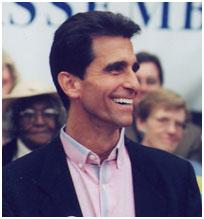
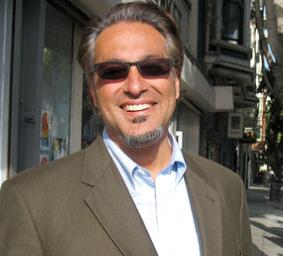
Mark Leno

Truce talks

5

news@sfbg.com

All parties are hopeful for peace in the Guardian-labeled War on Fun after oppressive raids on SoMa clubs have stopped and the feuding sides — mainly the San Francisco Police Department and nightclub owners — are sitting down to truce talks brokered in part by the fledgling California Music and Culture Association (CMAC).

“I’m here to work with you,” Kitt Crenshaw, commander of SFPD’s new Entertainment Task Force, told the crowd at a Nightlife Safety Summit on June 30. “I’m not the enemy. I’m not the ‘War on Fun,’ as they call it. I’m not the Antichrist.” The summit was sponsored by the Mayor’s Office, Entertainment Commission, SFPD, Small Business Commission, and CMAC.

Club owners and the SFPD are attempting to find balance between stifling the entertainment industry with heavy-handed enforcement and doing something about the deadly gun violence plaguing neighborhoods around some San Francisco nightclubs. Owners and party promoters don’t want entertainment permitting power to go back to the SFPD, as Mayor Gavin Newsom has suggested. But recent shootings and the Entertainment Commission’s inability to immediately close problem clubs have city officials demanding change.

Board of Supervisors President David Chiu introduced legislation in early June that would give the Entertainment Commission the authority to revoke the entertainment permits of noncompliant clubs that are consistently scenes of violence. Chiu’s legislation would further extend temporary suspension powers the board granted to the commission in 2009.

“There is strong consensus that the Entertainment Commission needs to do its job. And if this is what it takes to give it more tools, then so be it,” Chiu told the Guardian after the June 25 CMAC Insider Luncheon, where he participated in a forum with entertainment industry representatives. Chiu said he was feeling pressure from his constituents in North Beach to “come down like a hammer on the industry” following several shootings around the neighborhood’s nightclubs this year.

Terrance Alan, a longtime industry advocate and entertainment commissioner, told the Guardian he recently requested that the City Attorney’s Office help define when nightclub owners should be blamed for violence occurring near their business. “If we’re going to hold venues and security teams responsible, we have to tell them and make sure it’s legal,” he said. “The line of reasoning that blames the nearest business will force San Francisco to shut down. The first thing we have to do is stop blaming each other.”

Chiu, speaking to a crowd at the Nightlife Safety Summit, recounted a handful of incidents that pushed him to craft the new legislation. Since the last legislation was passed to strengthen the Entertainment Commission’s power to regulate nightclubs, eight people were shot outside the Regency night club Nov. 15, 2009; 44 rounds were fired outside club Suede, resulting in one death and four injuries Feb. 7; a shooting occurred on Broadway outside a strip club in mid-February; and a police officer was shot outside the Mission District’s El Rincon club on June 19. “And so on, and so on,” Chiu said.

Following the shooting at Club Suede, which had long been a site of violence prior to the gang-related carnage in February, officials were stunned to learn the commission did not have the power to revoke entertainment permits. The most it could do was suspend Suede’s permit to play music for 30 days.

“To hold the commission responsible for something it was never envisioned to do and never given the power to do is where the narrative has gone wrong recently,” Alan said of widespread criticism that the commission just didn’t simply “shut down” Club Suede.

Suede remains voluntarily closed as it bargains with the City Attorney’s Office, which filed a complaint against the club after the shootings. Alex Tse, the lead attorney for the city in the case, told the Guardian there was nothing he could legally do to prevent Suede from reopening before Aug. 10, when the court is scheduled to rule on a preliminary injunction (court mandated closing) the City Attorney’s Office filed. But he doesn’t expect them to reopen because Suede and the city are currently working toward settling the case.

If the incidents Chiu described represent a black eye for San Francisco’s entertainment industry, the California Department of Alcoholic Beverage Control and SFPD aren’t necessarily squeaky clean either. “I sat down with [ABC director] Steve Hardy and told him that where the state was focusing efforts in San Francisco was completely misguided,” Chiu said at the CMAC luncheon. “And I’ve spoken to [California Senator] Mark Leno to try to move them in the right direction.”

The break in the crackdowns of 2009, mostly attributed to severe tactics employed by SFPD Officer Larry Bertrand and ABC agent Michelle Ott, followed a widespread backlash to the sometimes brutal treatment legitimate business owners were receiving in the name of public safety. Back-to-back over stories in the Guardian (see “The new War on Fun,” March 23, 2010) and the SF Weekly, calls to the ABC from city officials, the formation of CMAC, and a Racketeer Influenced and Corrupt Organizations (RICO) suit filed against San Francisco and the rogue officers spurred officials to rein in Ott and Bertrand.

Hardy told the Guardian that Ott is no longer assigned to alcohol enforcement in San Francisco. Bertrand has traded in his plain-clothes for a uniform and hasn’t been seen busting into clubs, beating up the help, or confiscating DJ equipment for several months.

Mark Webb, plaintiff’s attorney in the RICO case, which was moved to the federal court by the City Attorney’s Office, said Bertrand is scheduled to give a deposition for the case July 26. Webb told the Guardian he plans to ask Bertrand questions relating to “a pattern of ongoing and repeated abuses” claimed in the complaint, which includes Newsom and ABC as defendants.

“We’re at a crossroads,” Chiu told the crowd at the Nightlife Safety Summit, adding that if the new power for the Entertainment Commission does not reduce club violence, stronger measures would be taken, whether it’s Newsom’s suggestion to scrap the commission entirely and give permitting power back to the police department or Chiu’s idea to create another “less politicized” body to issue entertainment permits made up of representatives from city department that are affected when nightlife entertainment goes wrong.

“There has been significant dissatisfaction with the Entertainment Commission due to many actual and apparent conflicts of interests,” Chiu said. “Frankly, this is why we may need to move to a different model of who actually makes decisions on permits, because often the people who want to make those decisions are the ones who stand to get the most benefit out of them.”

But club owners and party promoters argue that the police issuing entertainment permits, as they did prior to the Entertainment Commission’s creation in 2002, has a chilling effect on an important part of San Francisco’s economy.

Alan said a civil grand jury found the police department had a conflict of interest in being both the granter and enforcer of nightclub permits, a finding that spurred the creation of the Entertainment Commission.

“I’ve been in the industry long enough to remember when it was in the Police Department’s hands,” said Guy Carson, owner of Café Du Nord and director of CMAC. “Since the advent of the Entertainment Commission, more permits have been issued, which has vitalized the industry.”

Club owners and party promoters don’t want to be blamed for street violence over which they have no control, and they have some political support for that stance. “Clubs don’t create youth gun violence, society creates youth gun violence,” Sup. Bevan Dufty proclaimed to the crowd at the Nightlife Safety Summit, drawing thunderous applause from the room.

“There is a street scene and a club scene, and they do intersect. But a lot of the violence occurs in the street scene,” Carson said. “A lot of shootings that happen relate to people never inside the clubs. That’s a conversation CMAC looks forward to having — to have a little more accurate discussion.”

While he asserts that some nightclubs attract violence to the city from out of town, Crenshaw said he was pleased and surprised at the level of collaboration emerging between entertainment representatives and SFPD. “I got so much positive feedback from it [the Nightlife Safety Summit]. It was a bit overwhelming,” he told us. “I think the industry itself is tired of being labeled as a pariah. They want to change their image.”

Brit Hahn, owner of City Nights and SFClubs, agreed that working with district captains was in the best interest of any club looking to remain profitable. “When something bad happens at a nightclub anywhere in San Francisco, he said at the Nightlife Safety Summit, “it’s bad for all of our businesses.”
Editor’s Notes

23

Tredmond@sfbg.com

Jane Kim, the San Francisco school board president running for supervisor in District 6, has a tough question to answer. When there’s already a solid progressive in the race, Debra Walker, someone who has lived in the district for years and agrees with Kim on almost all the key issues, why is Kim running?

She gave a hint at her campaign kickoff June 24 on how she’s going to portray herself: "I’m not part of anyone’s machine, and I’m certainly not part of anyone’s master plan." It’s an attractive statement — nobody likes machine politics — and the idea that she’s an independent candidate makes her all the more appealing.

Except that it also says something about the progressive movement in San Francisco — and that’s a little disturbing. Because no matter how you try to spin it, when you say you aren’t part of anyone’s machine, you’re implying that maybe your opponents are.

Let me take a step back here, because this is important stuff. There’s a fine line between an effective, organized political coalition that can actually win elections and a political machine, which stifles political innovation and grassroots candidates. And in part it’s about motivation.

When Willie Brown ran San Francisco, it was all about Willie Brown. I’ve never believed the guy had much of an ideology or that any political cause really mattered to him; he loved power, he knew how to use it and he didn’t want to give it up. That was the bottom line.

Now that he’s pretty much out of the picture — although he was at Kim’s party, he’s not a factor anymore — there’s a very different power balance in this city. There’s nobody at City Hall (or in Sacramento, or Washington, or downtown, or anywhere else) who has machine-style control of local politics.

There are people who can build coalitions that work — Aaron Peskin, for example, did exceptionally well with putting together a campaign to elect progressive Democratic County Central Committee elections. And there are people who would love to be power brokers.

But I’ve been around politics here a long time, and I can tell you: Aaron Peskin doesn’t have a machine. Neither does Mark Leno, or Gavin Newsom, or Tom Ammiano, or David Chiu, or anyone else. Thanks in part to district elections, there aren’t many call-up votes on the Board of Supervisors these days. In fact, the left in San Francisco is famously unable to agree on much of anything half the time. Note, for example, the fact that Chiu — often called a Peskin ally — is not supporting Peskin’s candidate in D-6. He’s with Jane Kim.

The thing is, unlike the players in a typical political machine, most of the progressives care about issues. It’s about a shared ideology more than it’s about power. That’s a hugely important difference.

The way the mainstream media has it, the San Francisco left is either fatally fractured and can’t do anything — or it’s becoming a machine. For the moment — a great moment — neither is true. Let’s all keep that in mind. Because when we beat each other up with words like "machine," we undermine the whole progressive movement.

Bad way to start a campaign.

Mirkarimi wants state franchise fee change

1

Sup. Ross Mirkarimi has introduced a resolution calling on the state Legislature to reform the law that allows Pacific Gas and Electric Company to pay a miniscule fee, in perpetuity, for the right to run its lines, poles and cables on and below the city streets.


The franchise fee was signed in 1939, and requires PG&E to pay just one half of one percent of its revenue to the city. Berkeley charges ten times that much. But since the deal has no expiration date, the supervisors can’t renegotiate it.


If San Francisco raised its fee to 5 percent for both electricity and gas the city would pick up an extra $50 million a year.


Both state Sen. Mark Leno and Assemblymember Tom Ammiano have told us they’re looking at ways the state Legislature could end perpetual franchise deals.


Agnos: “I think Gavin’s gonna lose”

11

Former San Francisco Mayor Art Agnos told the Guardian last night that he’d welcome the chance to be appointed a “caretaker mayor” for a year if Mayor Gavin Newsom wins his race for lieutenant governor, but he doesn’t think he’ll get that chance because “I think Gavin’s gonna lose.”

Agnos is one of several names that have been bandied about in the discussions of who the Board of Supervisors might appoint as acting mayor for a year if none of the top candidates running for mayor in 2011 – such as Aaron Peskin, Mark Leno, Leland Yee, or Dennis Herrera – are able to get six votes on the board in January 2010, when Newsom would vacate the Mayor’s Office if he moves on to Sacramento.

“I’m available, but I don’t need it,” Agnos said, noting that he would agree to not run for a full-term in 2011, which would be the main criteria for a caretaker mayor, a concept that would prevent any mayoral candidate from gaining the advantage of incumbency.

But Agnos said that Abel Maldonado, the Republican nominee for lieutenant governor, will be a tough challenge for Newsom, both because he’s a moderate Latino with a compelling personnel story, and because rich Republican gubernatorial nominee Meg Whitman will likely give Maldonado all the money and support he needs so she doesn’t have a Democratic rival as lieutenant governor.

As Agnos told us, “She will give him whatever he need to bury Newsom.”

How SF can get $50 million a year from PG&E

1

EDITORIAL Sup. John Avalos, who chairs the Budget Committee, is looking for ways to bring another $100 million into the city’s coffers this year. There’s a hotel tax initiative headed for the fall ballot. He’s talking about an increase in the real-estate transfer tax for high-end properties. And he and his colleagues are looking into a tax on commercial rents.

Those are all valid ideas. But there’s another way the city can bring in as much as $50 million more a year — without raising anyone’s taxes. It just involves increasing the franchise fee Pacific Gas and Electric Co. pays to the city.

PG&E uses the city’s streets and rights-of-way to run its gas lines and electricity cables; the company doesn’t pay rent for that space. Instead, it pays an annual franchise fee to the city, a percentage of its gross sales. Other utilities pay, too — Comcast, for example, pays 5 percent of its gross to San Francisco every year for its cable-TV franchise.
PG&E pays 0.05 percent for electricity sales, and 1 percent for natural gas.

That deal was reached in 1939. The Board of Supervisors back then gave PG&E the lowest franchise fee in California, a pittance, a fraction of what other cities and counties charge — and the contract has no expiration date. It’s a perpetual deal, something highly unusual.

Sup. Ross Mirkarimi wants to open up the 72-year-old contract for renegotiation and raise the fee significantly. It seems like a perfectly reasonable idea — Berkeley charges PG&E 5 percent for electricity. San Diego charges 3.5 percent. If the city is desperately scrambling for money to close the budget gap, why are we leaving so many millions on the table?

The numbers are big. In 2008, according to the Controller’s Office, PG&E paid San Francisco $3.5 million for electricity sales and $3.16 million for gas. If the city raised both fees to the level that cable TV providers pay, the general fund would pick up another $50 million.

It seems crazy that a franchise deal signed seven decades ago, by a board that was in PG&E’s pocket, should tie the hands of elected officials today. Most legislative bodies have rules barring any laws that would tie the hands of future legislators forever.

It’s particularly ironic for this to happen in the only city in the United States that is mandated by federal law (the Raker Act) to run a public power system.

But according to City Attorney Dennis Herrera, raising the fee would be very difficult; California law allows perpetual utility franchises. If Herrera is right (and no city attorney has ever been willing to challenge PG&E on this), then the state Legislature needs to act.

One idea from Mirkarimi’s office: simply mandate that all perpetual utility franchises increase every year by the cost of living index, up to a maximum of, say, 5 percent. If all the years since 1939 were counted, the city would be at the max today.

An even simpler option: the state could outlaw perpetual franchise deals — something that should have been done years ago — and mandate that all existing deals expire on, say, Jan. 1, 2011. That would give San Francisco six months to negotiate a new deal with PG&E, and the money from that deal would save a lot of city services.

Both Assembly Member Tom Ammiano and state Sen. Mark Leno have expressed interest in a bill that would open up San Francisco’s franchise fee, and both told us that they’re looking into it. Leno already has a bill barring PG&E from using ratepayer money on political campaigns; potentially, a franchise fee amendment could be added to it. The deadline for introducing bills for this session has already passed, so it would be a little tricky to find a way to change state law in the next few months. But it’s worth a try: there’s never been a time when PG&E was less popular in Sacramento. The company violated its own agreement with the Legislature, promising to support the law authorizing local community choice aggregation systems then turned around and spent nearly $50 million to overturn it.

Leno and Ammiano should pursue a bill as soon as possible to get rid of one of the great scandals in city history, a sweetheart deal in 1939 that has saved PG&E billions and cost the city dearly.

How SF can get $50 million a year from PG&E

1

EDITORIAL Sup. John Avalos, who chairs the Budget Committee, is looking for ways to bring another $100 million into the city’s coffers this year. There’s a hotel tax initiative headed for the fall ballot. He’s talking about an increase in the real-estate transfer tax for high-end properties. And he and his colleagues are looking into a tax on commercial rents.

Those are all valid ideas. But there’s another way the city can bring in as much as $50 million more a year — without raising anyone’s taxes. It just involves increasing the franchise fee Pacific Gas and Electric Co. pays to the city.

PG&E uses the city’s streets and rights-of-way to run its gas lines and electricity cables; the company doesn’t pay rent for that space. Instead, it pays an annual franchise fee to the city, a percentage of its gross sales. Other utilities pay, too — Comcast, for example, pays 5 percent of its gross to San Francisco every year for its cable-TV franchise.

PG&E pays 0.05 percent for electricity sales, and 1 percent for natural gas.

That deal was reached in 1939. The Board of Supervisors back then gave PG&E the lowest franchise fee in California, a pittance, a fraction of what other cities and counties charge — and the contract has no expiration date. It’s a perpetual deal, something highly unusual.

Sup. Ross Mirkarimi wants to open up the 72-year-old contract for renegotiation and raise the fee significantly. It seems like a perfectly reasonable idea — Berkeley charges PG&E 5 percent for electricity. San Diego charges 3.5 percent. If the city is desperately scrambling for money to close the budget gap, why are we leaving so many millions on the table?

The numbers are big. In 2008, according to the Controller’s Office, PG&E paid San Francisco $3.5 million for electricity sales and $3.16 million for gas. If the city raised both fees to the level that cable TV providers pay, the general fund would pick up another $50 million.

It seems crazy that a franchise deal signed seven decades ago, by a board that was in PG&E’s pocket, should tie the hands of elected officials today. Most legislative bodies have rules barring any laws that would tie the hands of future legislators forever.

It’s particularly ironic for this to happen in the only city in the United States that is mandated by federal law (the Raker Act) to run a public power system.
But according to City Attorney Dennis Herrera, raising the fee would be very difficult; California law allows perpetual utility franchises. If Herrera is right (and no city attorney has ever been willing to challenge PG&E on this), then the state Legislature needs to act.

One idea from Mirkarimi’s office: simply mandate that all perpetual utility franchises increase every year by the cost of living index, up to a maximum of, say, 5 percent. If all the years since 1939 were counted, the city would be at the max today.

An even simpler option: the state could outlaw perpetual franchise deals — something that should have been done years ago — and mandate that all existing deals expire on, say, Jan. 1, 2011. That would give San Francisco six months to negotiate a new deal with PG&E, and the money from that deal would save a lot of city services.

Both Assembly Member Tom Ammiano and state Sen. Mark Leno have expressed interest in a bill that would open up San Francisco’s franchise fee, and both told us that they’re looking into it. Leno already has a bill barring PG&E from using ratepayer money on political campaigns; potentially, a franchise fee amendment could be added to it. The deadline for introducing bills for this session has already passed, so it would be a little tricky to find a way to change state law in the next few months. But it’s worth a try: there’s never been a time when PG&E was less popular in Sacramento. The company violated its own agreement with the Legislature, promising to support the law authorizing local community choice aggregation systems then turned around and spent nearly $50 million to overturn it.

Leno and Ammiano should pursue a bill as soon as possible to get rid of one of the great scandals in city history, a sweetheart deal in 1939 that has saved PG&E billions and cost the city dearly.

SF mayoral analysis in the NY Times misses the mark

4

I have praised Bay Citizen’s early work and I think Gerry Shih is a smart young reporter, but I think their analysis of who will be San Francisco’s next mayor – which ran in today’s New York Times – was off the mark and shows they don’t yet have a good grasp of this city’s political dynamics. And a big reason for that is – just like the Examiner and the Chronicle – they relied too much on downtown players who consistently misread those dynamics, at least in recent years.

The one thing it got right was naming Aaron Peskin as one of the frontrunners to succeed Newsom if he is elected lieutenant governor. Peskin is really the only politico in town he has been putting big plays together these days, whether it be keeping Democratic Party leadership in progressive hands or defeating the 555 Washington project. So he might be the only one who can count to six with this current progressive-dominated board.

But nobody really thinks David Chiu is a frontrunner, despite Shih’s claim. Chiu has been a pretty good board president, but remember that he was elected as a compromise candidate (with lots of help from Peskin) after the then-frontrunners, Ross Mirkarimi and Bevan Dufty, couldn’t put the votes together. And since then, he has disappointed his progressive colleagues on several votes, making them unlikely to support him for mayor.

Besides, it will be difficult for any supervisor to get six votes when they can’t vote for themselves, which also makes me scoff at Shih’s contention that John Avalos and David Campos are running for mayor (two supervisors who are close to the Guardian and have never indicated to us that they’re running, even when we’ve asked, although they might each eventually become mayors). Ross Mirkarimi is more likely and wants the job, but would have a tough time getting a board majority to give is to him.

Shih told the Guardian that he’s been getting lots of critical feedback on his article today, and while he said Chiu and Peskin are names that kept coming up in his interviews, Shih admits that the attractive narrative of the protege challenging his mentor perhaps skewed the final analysis: “The relationship between those two guys ended up getting played up in the story.”

The article makes several other mistakes as well (and not just the obvious factual errors, like getting the mayoral election year wrong, as well as the year Feinstein left office, both of which have since been corrected online). It left City Attorney Dennis Herrera’s name out entirely, despite the fact that he’s already declared his intention to run for mayor and could certainly be a compromise candidate. Public Defender Jeff Adachi also wasn’t mentioned, even though he has a better chance than half the people on Shiu’s list, such as Willie Brown or Ed Harrington, who downtown may like but progressives really don’t.

Two strong possibilities for mayor – Mark Leno and Leland Yee – were given only passing mention in the article even though they are far more likely choices than Chiu. Both Leno and Yee have aggressively worked both the centrist and progressive sides of the aisle and are in great positions to run for mayor or be appointed by the board.

The hopes for a Chinese-American mayor that Shih placed with Chiu are probably better placed with Yee, who has worked with Rose Pak and other business interests while also having a history of endorsing progressive candidates, which he’ll be able to call in when he runs (and yes, unlike other candidates on Shih’s list, Yee has actually declared his intention to run).

Similarly, Leno has good relations with progressives on the board, which will be tested a bit this fall as he campaigns for moderate supervisorial candidate Scott Wiener and navigates the wedge issue minefield, but it’s easy to see how with the right outcomes this fall and key deals cut, Leno could emerge as the frontrunner.

The dynamics of this thing are incredibly complicated, but if I was in Shih’s shoes and was asked to name the two frontrunners, I’d probably say Peskin and Leno, with Yee a close third and Herrera as an outside possibility. Or it could be none of them if nobody can count to six and the option of a caretaker mayor who agrees not to run later (such as an Art Agnos) seems like the only way forward.

As politicos Alex Clemens and David Latterman said in their post-election analysis on June 10, this is very complicated and will be the subject of many deals by experienced insiders (of which Chiu really isn’t one just yet). “Everyone is gaming this thing out and trying to figure out what happens,” Clemens said.

But there is one scenario in which I could see Chiu figuring prominently, and that’s in what happens if both Newsom and Kamala Harris win their respective state races. Chiu has expressed a desire to be District Attorney, a chance that he might get if he can help play kingmaker with whoever becomes our next mayor.

So perhaps that qualifies him as a frontrunner of sorts after all.

Newsom’s plan for DCCC domination

4

Gavin’s not quite ready to take over the world, or even California, but he’s not leaving office without trying to mess up the progressive majority on the Democratic County Central Committee. The plan he hatched June 15: Ban elected city officials from sitting on the DCCC. The idea: Get rid of Supervisors David Campos, David Chiu, John Avalos and Eric Mar. The overall plan: With the progressive supervisors — who have high name recognition and thus get easily elected — gone, the Newsom allies can take back control of the local Democratic Party.


It’s a pretty blatant move — far beyond Aaron Peskin’s so-called coup. And I must say, it’s a bit hypocritical.


See, the DCCC isn’t just made up of 24 elected members. Every San Francisco Democrat who holds state or national office — or who is a candidate for state or national office — is also an automatic member. So Senator Diane Feinstein is a DCCC member; so is House Speaker Nancy Pelosi, Assemblymember Tom Ammiano and Sen. Mark Leno. And guess who gets a seat this fall? Lt. governor candidate Gavin Newsom. People like Feinstein and Pelosi never show up; at best, they send a proxy. They rarely pay much attention to the local party, don’t help out much with party fundraising, don’t even come to the party’s annual dinner (Newsom didn’t show this year, even though he’s the mayor of a Democratic city.)


There have been members of the Board of Supervisors on the DCCC for years. The late Sue Bierman was always a member, and actually cared about and paid attention to the local Democratic Party. Leslie Katz was a member as a supe, and still is. It’s never been that big a deal to anyone — until the progressives starting winning seats. Then suddenly it’s a horrible conflict.


The real conflict has nothing to do with city officials sitting on the committee; it’s the fundraising issue. The city’s campaign finance rules don’t apply to DCCC races, so candidates for DCCC who are also running for supervisor — Scott Wiener, Rafael Mandelman, Debra Walker — can raise unlimited money for their DCCC races and use that additional name recognition for the fall elections. The thing is, I think most of the candidates who benefit from this loophole agree that it needs to be fixed; Mandelman certainly does, and he’s told me that several times. I couldn’t reach Walker or Wiener this morning, but I’d be very surprised if both of them wouldn’t endorse some kind of contribution limits for DCCC races.


I asked Newsom’s press spokesperson, Tony Winnicker, if the mayor would support fundraising limits. Apparently he doesn’t (or at least, he doesn’t want to push the issue):


“For this November’s local ballot, which the Mayor can place an initiative on, we propose eliminating the potential conflict that exists between City officeholders also holding office as elected County Party Committee members.”


How about getting rid of all the elected officials, and creating a real grassroots county committee? No, that won’t fly with Newsom either. Winnicker:


It’s appropriate for state and federal Democratic elected officials from San Francisco to serve on the Democratic County Central Committee.


The city/local offices — Mayor, Board, Treasurer, Assessor, City Atty, Sheriff, District Atty, Public Defender — are nonpartisan offices who have direct oversight over City business. That’s the difference and conflict. This is a local initiative, so our focus and concern is local good government and local conflicts or appearance of conflicts.


From everything I can figure, Newsom doesn’t want campaign-finance reform and doesn’t want to put the party in the hands of local activists; he just wants to get rid of the supervisors who take positions he doesn’t like. That seems like a pretty bad way to make public policy. 


UPDATE: Just talked to Scott Wiener, who told me he agrees that the whole issue of DCCC campaign spending ought to be on the table. And he said he is not at this point prepared to support Newsom’s initiative. “I have concerns with the number of elected officials on the DCCC,” he said, “but there are times when it’s entirely appropriate to have people who have a demonstrated commitment to the DCCC and then get elected supervisor to stay on it.”

Reading the June election tea leaves

0

Everyone’s reading the tea leaves after the local election. The November supes races will be a huge deal, and it’s really tempting to try to figure out what the DCCC results mean for the fall. Paul Hogarth at BeyondChron takes it on here. Chris Daly (no surprise) disagrees.


Let me see if I can sort some of this out.


Hogarth’s basic argument is that the progressives didn’t really do so well in the election:


“In District 8, moderate Scott Wiener finished 1,400 votes ahead of progressive Rafael Mandelman – as the two face the same electorate in November. The renters’ financial hardship measure, Proposition F, lost badly citywide – and finished far worse in neighborhoods that are usually pro-tenant. Debra Walker fared well in her run for DCCC, but most of her votes were not in District 6 – and results there suggest that another candidate for Supervisor could make such a race highly competitive.”


Hogarth is completely upfront and honest about disclosing that he’s a supporter of one of Walker’s opponents, Jane Kim — a former Green who is now a Democrat (and is very much a progressive), but wasn’t in the DCCC race. Theresa Sparks wasn’t in the DCCC race either. Nor was Jim Meko. There are several strong candidates in that race, and they don’t break down along easy political lines. So looking at how many votes Walker got in D6 seems a little off point; there’s nobody to compare her to.


Back to D8. Hogarth:


“Now we know [the D8 breakdown], and the numbers are even worse for Mandelman. Scott Wiener finished approximately 1,400 votes ahead in District 8 (my vote count shows him at 5,954 to Mandelman’s 4,561.) As a comparison, in December 2002 – the last time District 8 saw a hotly contested race on “moderate v. progressive” lines – Bevan Dufty got 11,000 votes, Eileen Hansen 10,000.”


That would seem to make Wiener the much stronger candidate going into the fall.


But there’s another key factor here: turnout. Low-turnout races are mostly (not always, but mostly) better for the more conservative candidate, and in this case, the turnout was really low. Just 32 percent of the voters went to the polls.


Let’s take a look at the 2002 election, the last time we had an open seat in D 8 with a progressive and a moderate running. In the general election in November, progressive Eileen Hansen came in first, with 9,820 votes to Bevan Dufty’s 8,795. But another progressive, Tom Radulovich was also in the race, and this was before ranked-choice voting. Radulovich got 5,221 votes, the majority of which probably would have gone to Hansen.


Turnout was a little over 50 percent.


In the runoff, in December, turnout dropped to 38.8 percent. Dufty got 11,096 votes, and Hansen 9,995. You could argue that most of the Radulovich votes went to Dufty — possible — but more likely, in the runoff, the more liberal voters who had come out in November to vote for Gray Davis for governor and also voted for Hansen just stayed home in December.


And this fall, Wiener will be more in the position that Hansen was in: There’s a third candidate in the race, Rebecca Prozan, and she’s more likely to take votes from Wiener than from Mandelman. And, of course, there’s RCV this time around — and with two gay men and a lesbian in the race, nobody really knows how the second-choice votes will play out.


Daly plays with the turnout numbers:


For the sake of argument, let’s concede that Mandelman starts out 1000-1400 votes behind Wiener among the 11,000 or so District 8 Democrats who voted for DCCC last week. Given that over 31,000 District 8 residents voted in the 2006 Supervisor race (in a contest that was not the most competitive,) we can assume that at least 20,000 additional people will vote this November. In a 2-person contest, Mandelman would need to win 53.5% of these votes in order to win. Given that less frequent voters trend significantly more progressive, and with the addition of Democratic Party branding and the weight of its mail program, 53.5% is almost assured.


Well, I dunno — in 2002, with a contested governor’s race and a contested D8 race, only 26,600 people voted, but it’s safe to say the numbers will be well above 11,000. And it’s not a two-person contest. But I think it’s also safe to say that those higher-turnout voters are the votes most likely to swing toward Mandelman.  


Jim Stearns, a political consultant with long experience in San Francisco (and no candidate in the D8 race), has another interesting analysis he sent over to me:


“Mandelman’s strategy was to spend his limited resources as part of a team effort to maintain progressive leadership on the DCCC. In so doing, he focused more heavily on slate cards that went district-wide than on mailers in District 8 promoting his own candidacy.


 Wiener, on the other hand, abandoned his fellow moderates and spent his money mostly on his own candidacy. This shortsighted strategic blunder will be extremely costly for Wiener in November.


 The result? Wiener got more votes in District 8, but lost his bid to regain his position as chair of the DCCC. Mandelman got fewer votes, but has significantly increased his chances of winning the Democratic Party endorsement this November. That endorsement is worth far more than the mere 1,000 vote difference between Wiener and Mandelman today.”


None of this means Walker will beat Kim and Sparks in November, or that Mandelman will beat Wiener and Prozan. It just means that I suspect the DCCC results don’t really say much about the relative strengths of any of the candidates when it comes to a focused, district-centered race in a high-turnout fall election.


I emailed Hogarth and ran the turnout argument by him. His response:


I tried to caution in my piece that there’s only so much you can see in the numbers — and that you’re right; voter turnout in November will be a lot higher.  Maybe I should have made this a bigger point.  But progressives are deluding themselves if they think turnout will be as high as it was in November 2008.  And if I were Rafael, I would have reason to worry that Scott did so much better than me in D8.  Also keep in mind that, despite the drop-off of DCCC voters, 48% of people in D8 who participated in this election cast a ballot for Scott Wiener.


Correct — turnout won’t be as high as it was in the presidential race. But it might very well be as high as it was in 2002, when there was a contested race for governor, as there will be this fall. Lots of Democratic candidates — particularly Gavin Newsom and Kamala Harris — will be doing GOTV operations in the city, and while Newsom and Harris won’t be supporting Mandelman, I don’t think either of them will limit their turnout efforts to precincts that run toward Wiener. The more liberal dems who vote in November, the better Harris and Newsom do against Republicans; that’s what they care about.


There’s no question that Scott Wiener will be a formidable contender in November. He’s got money, he’s got Mark Leno, and he’s running in a district that has elected moderate gay men since the return of district elections. But it’s remarkable how well the progressives have done in swing districts of late (see: Eric Mar, John Avalos), and Mandelman will, as Daly says, be the consensus candidate of every progressive group in town. He’ll almost certainly have the Democratic Party — which matters even more when Democrats at the top of the ticket are driving turnout. And he’ll have the same sort of boots on the ground that gave Mar a victory in a very tight race.


At this point, I think Mandelman and Wiener both have a shot at finishing first; it will probably be very close. And Rebecca Prozan runs third.


Oh, and the tenant measure? It lost because there wasn’t an effective campaign behind it. Tenant measures don’t automatically win in tenant-heavy San Francisco; time and again over the years we’ve seen that when there’s a measure that pushes the edge (and face it, I strongly supported Prop. F, but it was pushing the edge) and there’s landlord money against it, you need a full-scale concerted campaign for it. Progressives were paying a lot of attention to the DCCC, and to defeating Props. 16 and 17. Prop. F got lost. I’m not happy about that, but I’m not terribly surprised, either — and I don’t think it means much in the long run.


Chris Daly went a bit too far attacking Hogarth for his connections to Mark Leno, who is a Wiener supporter, and suggesting that the folks at BeyondChron — who are, after all, first and foremost tenant lawyers — are going to be backing Scott Wiener in the fall. I don’t see that happening; I can’t imagine it happening. I just think they read a little too much into the DCCC results.

Editorial: PG&E’s greed backfires

1

The defeat of Prop. 16 showed that unlimited corporate spending on a ballot initiative doesn’t guarantee victory.

EDITORIAL The single most important number to come out of San Francisco on election night was this: 67.49 percent. That’s how many people in this city voted against Pacific Gas and Electric Co.’s monopoly measure, Proposition 16. It’s a statistic that ought to be posted somewhere on a wall at City Hall to remind everyone in local government that the voters sided overwhelmingly against PG&E and in favor of a public option for local electricity.

It’s a landmark victory. On the state level, the defeat of Prop. 16 showed that unlimited corporate spending on a ballot initiative doesn’t guarantee victory, that an underfunded coalition can defeat a giant utility — and that a majority of those in PG&E’s own service area are unhappy with their electricity provider. Public power activists all over the state should take this as a signal that PG&E, and its once-formidable political clout, are on the wane.

In San Francisco — the only city in the nation with a legal mandate for public power — the vote was the most lopsided of any California county. It was the strongest local mandate for public power since the passage of the Raker Act in 1913.

That should be a huge boost for the city’s community choice aggregation (CCA) program. Sup. Ross Mirkarimi, who has been leading the fight for CCA, was pushing hard to get a contract signed before the June 8 vote; like a lot of observers, he feared that PG&E’s vast war chest would overwhelm the opposition. But now that Prop. 16 is dead — and nothing like it will be back in the near future, if at all — the city has a bit of a breather.

That doesn’t mean all work on the contract should slow down. The San Francisco PUC has been mucking around with this deal for more than a year, and needs to bring it to a close. And the city needs to start preparing to answer PG&E’s propaganda campaign with a concerted effort — from the mayor’s office on down — to remind San Franciscans that CCA power will be greener, safer, and in the long run, cheaper than the energy we’re now forced to buy from PG&E.

Any San Francisco politician who stands with PG&E and opposes CCA will do so at his or her peril.

And while San Francisco is moving to implement a modest public power program, state Sen. Mark Leno is moving in Sacramento to limit PG&E’s ability to try another Prop. 16 move — or to spend tens of millions of dollars trying to block local power initiatives. Leno has introduced a bill that would limit the utility’s ability to use ratepayer money on political or public relations campaigns.

The measure doesn’t have a number yet, but the language is brilliant. It directs the California Public Utilities Commission to disallow any political spending that PG&E tries to add into its regulated rates. And since the company has no source of income other that the money it gets from ratepayers, the impact would be to deny PG&E the ability to spend money working against the interests of ratepayers and the public.

"Over the past 10 years, PG&E has probably spent $150 million on political campaigns — and that’s money that came from the ratepayers," Leno said. "This bill is to protect ratepayers."

PG&E will howl about its First Amendment rights — and, indeed, the Supreme Court has of late given corporations who want to influence political campaigns and legislative issues a good bit of leeway. But the fact remains that PG&E is a regulated utility in California, and the state has every right to determine how much the company can charge its customers and to limit how that money is used.

Leno’s bill, of course, could radically change local politics. If PG&E couldn’t spend millions to defeat public power measures, the city would have far more options — and activists should be thinking about how a future campaign to take over the company’s infrastructure might work.

The Board of Supervisors should pass a resolution endorsing Leno’s bill, and the coalition that worked to defeat Prop. 16 should be working to get other cities and counties around the state to sign on.

PG&E’s greed in putting Prop. 16 on the ballot is starting to backfire — and it can’t happen too soon.

PG&E’s greed backfires

0

EDITORIAL The single most important number to come out of San Francisco on election night was this: 67.49 percent. That’s how many people in this city voted against Pacific Gas and Electric Co.’s monopoly measure, Proposition 16. It’s a statistic that ought to be posted somewhere on a wall at City Hall to remind everyone in local government that the voters sided overwhelmingly against PG&E and in favor of a public option for local electricity.

It’s a landmark victory. On the state level, the defeat of Prop. 16 showed that unlimited corporate spending on a ballot initiative doesn’t guarantee victory, that an underfunded coalition can defeat a giant utility — and that a majority of those in PG&E’s own service area are unhappy with their electricity provider. Public power activists all over the state should take this as a signal that PG&E, and its once-formidable political clout, are on the wane.

In San Francisco — the only city in the nation with a legal mandate for public power — the vote was the most lopsided of any California county. It was the strongest local mandate for public power since the passage of the Raker Act in 1913.

That should be a huge boost for the city’s community choice aggregation (CCA) program. Sup. Ross Mirkarimi, who has been leading the fight for CCA, was pushing hard to get a contract signed before the June 8 vote; like a lot of observers, he feared that PG&E’s vast war chest would overwhelm the opposition. But now that Prop. 16 is dead — and nothing like it will be back in the near future, if at all — the city has a bit of a breather.

That doesn’t mean all work on the contract should slow down. The San Francisco PUC has been mucking around with this deal for more than a year, and needs to bring it to a close. And the city needs to start preparing to answer PG&E’s propaganda campaign with a concerted effort — from the mayor’s office on down — to remind San Franciscans that CCA power will be greener, safer, and in the long run, cheaper than the energy we’re now forced to buy from PG&E.

Any San Francisco politician who stands with PG&E and opposes CCA will do so at his or her peril.

And while San Francisco is moving to implement a modest public power program, state Sen. Mark Leno is moving in Sacramento to limit PG&E’s ability to try another Prop. 16 move — or to spend tens of millions of dollars trying to block local power initiatives. Leno has introduced a bill that would limit the utility’s ability to use ratepayer money on political or public relations campaigns.

The measure doesn’t have a number yet, but the language is brilliant. It directs the California Public Utilities Commission to disallow any political spending that PG&E tries to add into its regulated rates. And since the company has no source of income other that the money it gets from ratepayers, the impact would be to deny PG&E the ability to spend money working against the interests of ratepayers and the public.

"Over the past 10 years, PG&E has probably spent $150 million on political campaigns — and that’s money that came from the ratepayers," Leno said. "This bill is to protect ratepayers."

PG&E will howl about its First Amendment rights — and, indeed, the Supreme Court has of late given corporations who want to influence political campaigns and legislative issues a good bit of leeway. But the fact remains that PG&E is a regulated utility in California, and the state has every right to determine how much the company can charge its customers and to limit how that money is used.

Leno’s bill, of course, could radically change local politics. If PG&E couldn’t spend millions to defeat public power measures, the city would have far more options — and activists should be thinking about how a future campaign to take over the company’s infrastructure might work.

The Board of Supervisors should pass a resolution endorsing Leno’s bill, and the coalition that worked to defeat Prop. 16 should be working to get other cities and counties around the state to sign on.

PG&E’s greed in putting Prop. 16 on the ballot is starting to backfire — and it can’t happen too soon.

Leno bill would limit PG&E political spending

5

State Senator Mark Leno is introducing a bill that could stop Pacific Gas and Electric Company from spending ratepayer money on political campaigns.


The bill, which doesn’t yet have a number, would put a serious crimp in the private utility’s ability to launch another effort like Prop. 16 — the $50 million campaign to block public power in California.


The bill wouldn’t stop PG&E from spending money on politics — that might fly in the face of the Supreme Court’s rulings on corporations and campaign finance. It just says that no ratepayer money can be spent — and since PG&E gets the vast majority of its money from ratepayers, the measure would at the very least significantly limit the company’s political efforts.


And since PG&E is a regulated utility, the state of California has every right to control how much money PG&E collects from its customers — and where that money goes.


Not only would the bill ban PG&E from running its own Prop. 16-style statewide campaign, it could block the company from spending tens of millions of dollars to oppose public-power efforts. The bill states that any gas and electric utility with more than three million customers in California (and there’s only one such company)


“shall not spend funds received from ratepayers as authorized revenues on political and public affairs related to state or local governments. For purposes of this section, political and public affairs spending includes any activities involving, directly or indirectly, advocacy of the election or defeat of political candidates and of the adoption or defeat of ballot measures, through the actions of the corporation or through a third party.”


A few years ago, a bill like this would have had little chance in the state Legislature, where PG&E spent lavishly and was relatively popular. But under CEO Peter Darbee, the company has done nothing but piss off legislators. Not one state lawmaker endorsed Prop. 16. It’s safe to say that today, PG&E doesn’t have many friends.


More details to come as I get them.


UPDATE: Here’s Leno’s comment, from a press release I just got:


“PG&E launched a dangerous and misleading political campaign – with ratepayer funds – that had only one goal, to preserve the corporation’s monopoly. The state’s largest electrical and gas company should not be able to use ratepayer-generated profits to write special rules into the state constitution protecting it from competition. This measure ensures that local communities across the state have the ability to launch their own municipal power agencies, which will in turn encourage competition and help keep our rates low.”


UPDATE TWO: I just spoke with Leno, and he noted that the bill has a decent chance, since PG&E at this point “would be hard pressed” to find any friends in Sacramento. “The bill is to protect ratepayers,” Leno said. “It requires the California Public Utilities Commission, when it hears PG&E’s rate cases, to disallow any spending on political campaigns.”


Everyone hates PG&E

5

Well, maybe not everyone, but the results from last night’s election are fascinating. A $50 million campaign, with the opposition struggling to come up with $100,000 — and PG&E still lost. Calitics has a fun comparison that makes one of the key points: The company lost most heavily in its own service areas. People who have to deal with PG&E — and its high rates, poor service, blackouts, botched smart-meter program and financial greed — voted strongly against allowing the company to further entrench its monopoly power. In essence, PG&E lost at home.


A couple of other interesting factors: The results show, I think, that whatever you say about the decline of newspapers, their endorsements still matter. Every major newspaper in the state opposed Prop. 16, and that clearly had an impact. The No on 16 campaign didn’t have the money for any media buys; the press coverage and strong anti-PG&E endorsements had to carry the message.


TURN, Ross Mirkarmi, Mark Leno, Tom Ammiano and consultant Gail Kaufman deserve credit for raising what little money they could and leveraging it into a stunning statewide victory. Considering that the turnout skewed heavily Republican, the defeat of Prop. 16 will go down as one of the great progressive victories in California history.


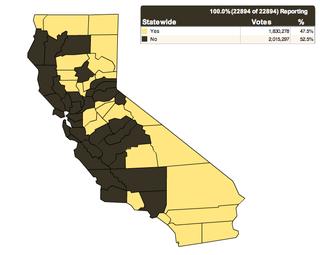
The local numbers were astounding: In San Francisco, Prop. 16 went down 2-1, with 67 percent of the voters rejecting PG&E’s ploy. That’s the strongest mandate for public power I’ve ever seen. Same for the rest of the Bay Area: Alameda County, 64 percent No. San Mateo County, 60 percent No. Marin County, 61 percent No. Mayor Gavin Newsom ought to take a look at the map on the Secretary of State’s website; it shows that the voters he needs to get elected lieutenant governor have rejected PG&E and want a public-power option.


The collapse of PG&E’s attempt to buy democracy in California gives San Francisco some breathing room on its community choice aggregation contract, which is excellent news. The supervisors can now take some time to go over the details — and prepare for the next major battle, the marketing campaign to education local residents about the value of community-controlled green energy.


PG&E is clearly on the run — CEO Peter Darbee has driven the company to a point where it has no friends left. Could be a great era for public power efforts.

How safe is your cell phone?

5

By Brittany Baguio

news@sfbg.com

GREEN CITY In the wake of recent studies suggesting that extensive cell phone use might be linked to some types of cancer, consumer advocates are pushing to require phone companies to publicize the level of radiation their devices emit.

It seems like a simple idea. If fast-food restaurants are required to post the calories and fat content of their junk food, why shouldn’t cell phone companies post the level of radiowave energy coming out of their products? But it’s proving to be a tough fight — in part because the scientific studies are so complex, and also because the industry is fighting furiously against disclosure rules.

The California State Senate narrowly rejected June 4 a bill by Sen. Mark Leno (D-SF) that would have taken a modest step toward better disclosure. Leno’s measure, SB 1212, would have mandated that manufacturers and phone providers disclose radiation levels, or specific absorption rate (SAR), on their Internet websites and online user manuals. They would also be required to state the maximum allowable SAR value, and what it means.

“The federal government has set a standard for this type of radiation and already requires reporting,” Leno told us, “At the very least, consumers should have the right to know about the relative risks of the products they’re buying.”

There’s a similar measure in the works in San Francisco. On May 24, the Board of Supervisors City Operations and Neighborhood Services Committee passed Mayor Gavin Newsom’s plan to require retailers in the city to reveal the amount of radiation released by cell phones. That would make San Francisco the only city in the United States mandating that retailers acknowledge radiation information.

The most recent and largest study focusing on cell phone radiation, the Interphone Study, was released this year. Conducted by 21 scientists in 12 participating countries, the study looked at the long-term risks of certain brain cancers.

The results are mixed. The study found some results of increased risks of tumors, although the authors could not agree on how to interpret the data.

The researchers surveyed 5,000 brain cancer patients, and found that people who were “heavy” cell-phone users (defined as using the phone 30 minutes or more a day) had a slightly higher risk of some kinds of cancer. But, as an Environmental Working Group analysis of the study noted, “most of the people involved … used their cell phones much less than is common today.”

Cell phones emit radiowaves through their antennas, which in newer models are often embedded in the phone itself. The closer the distance from the antenna to a person’s head, the more exposed he or she is to radio frequency energy.

However, as the distance between the antenna and a person’s body increases, the amount of radio frequency energy decreases rapidly. Consumers who keep their phones away from their body while doing activities such as texting are absorbing less radio frequency energy.

The Federal Communications Commission has set a safety level for a phone’s SAR — a measure of radiation energy — at 1.6 watts per kilogram of body mass. All cell phone manufacturers must produce phones at or below this level.

Renee Sharp, director of California’s Environmental Working group, says the evidence doesn’t have to be conclusive to warrant caution. “We aren’t trying to say that cell phones are dangerous because we don’t have definite answers yet and we need more research,” Sharp said. “But when you look at studies with long-term use of 10 years of longer, you see increases in certain kinds of brain tumors. We are trying to give people as much information as we can to make informed decisions because it may or may not impact their health.”

Cell phone manufacturers aren’t required to disclose SAR information directly to phone buyers; they send the data to the FCC. Although the FCC makes this information available on its website, the information is incomplete and hard to find. A list of cell phone SARs information compiled by the Environmental Working Group is at www.ewg.org/cellphoneradiation/Get-a-Safer-Phone.

The telecommunications industry strongly oppose Leno’s bill. Joe Gregorich, a lobbyist for Tech America, an industry group, told us that the requirement in Leno’s bill “has an assumption that a lower SAR is safer than a higher SAR. The FCC, FDA, and Inter Agency Working Group regulate the SAR and have set a SAR threshold where cell phones are considered safe. All cell phone manufacturers make cell phones below this SAR threshold.”

According to Sharp, the FCC’s standards are out of date. “The FCC set SAR standards 14 years ago and has not updated them since,” Sharp said. “This was before we found out that children have thinner skulls and are more susceptible to radiation effects, and before phones developed and exploded into what they are now.”

Prop 16 opponents celebrate

It’s now official: Prop 16 is toast.

With 87 percent of the election results in, Prop 16 was losing, 52.6 percent “no” to 47.4 percent “yes.”

Yes, that’s the measure that the state’s most powerful utility company, Pacific Gas & Electric Co., just sunk a record-breaking $46 million into. 

On election night, victory belonged to a small, brainy group of under-funded green-power activists, filmmakers, bloggers, and attorneys who put their hearts and souls into beating PG&E’s measure. The measure was designed to destroy municipal energy programs that offer an opportunity to depart from PG&E with greener power. Sup. Ross Mirkarimi was a vocal opponent of Prop 16, and the chief supporter of San Francisco’s community choice aggregation program.

Not long after Mirkarimi made an entrance at the Otis Lounge in San Francisco, where opponents of Proposition 16 were glued to computer screens watching election results roll in, the green “Yes” box displayed on the voting results website turned to a “No.”

“We’re winning!” Someone shouted. A cheer arose, and hands shot into the air. Mirkarimi’s face broke into a beaming grin. Public power advocates Eric Brooks, Bruce Wolfe, and Paul Fenn stood nearby, along with Dave Room of the Local Clean Energy Alliance and Ben Zolno, a blogger who created YouTube videos against Prop 16.

Matt Freedman, of The Utility Reform Network (TURN), was perched with a computer on his lap for the duration of the night, and his co-workers, including TURN executive director Mark Toney, clustered around and watched, eyes wide and faces lit up, as things started trending in their favor.

“PG&E has one thing, and one thing only on their side, which is money,” Toney said early in the night, when the numbers were close, but still too early to tell. “The fact that we’re so close is amazing, given that they’ve outspent us 500 to 1.”

State Sen. Mark Leno, an outspoken opponent of Prop 16, made an appearance early in the night, then returned later as things swung in the favor of the opponents.

“I think [Prop 16] represents the epidemic of corporate greed that is so challenging in this country right now, whether it’s banking or the oil industry,” Leno said. “I think a victory tonight would really speak to Calfornia voters rebuking the lies and the deceit” spread by PG&E.

As the results grew stronger in their favor, opponents went into celebration mode. 

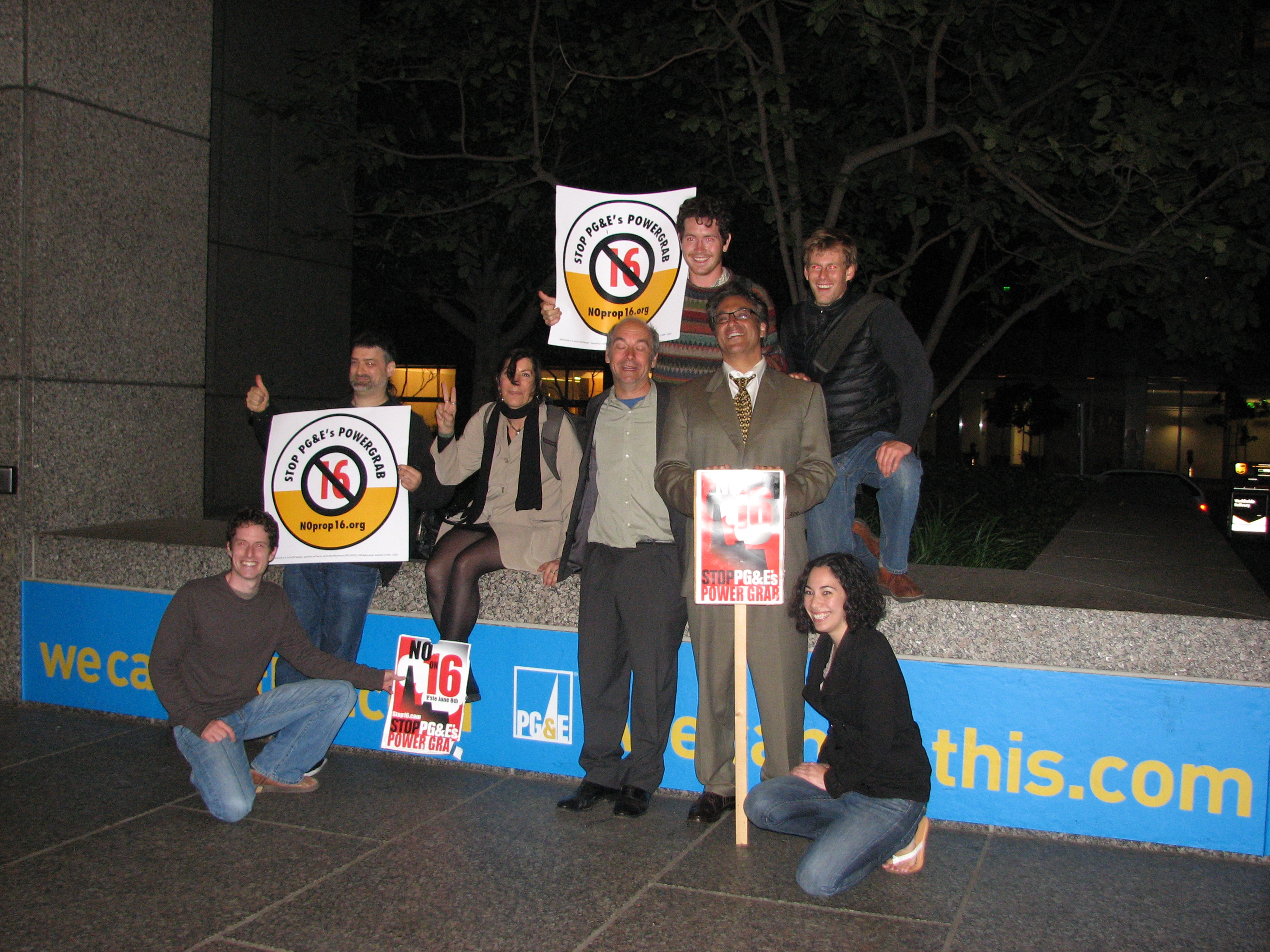
A little after 1 a.m., the exuberant crew took an impromptu stroll to San Francisco’s PG&E headquarters on Beale Street.

Banners adorned PG&E’s fortress-like building. Printed on them was the slogan, “We can do this.”

Note: This post has been updated from an original version.

Harris declares victory in AG Democratic primary

0

San Francisco District Attorney Kamala Harris declared victory in the Attorney General Democratic primary in an energized  speech around 11 p.m. at Mimi Silbert’s Delancey Street Foundation at 600 Embarcadero.

Harris’ speech came soon after the room buzzed with the news that Santa Clara voters had approved a $937 million stadium deal for the 49ers at a site near Great America, and immediately on the heels a rousing introduction by State Sen. Mark Leno.

“With her kind of leadership, we’ll be able to reinvest dollars in the best crime prevention programs,” Leno said.

Harris’s campaign raised $3 million in the Democratic primary, and Leno indicated that supporters would need to “triple or quadruple that in the general election.”

Leno promoted medical parole and praised Harris’ Back on Track program for reducing recidivism rates for young, first time offenders.

“With your help we will elect the first woman to be Attorney General for the state of California,” Leno promised.

 Then Harris took the podium, dazzling in a chic black outfit and pearls.

Acknowledging the work and efforts of her supporters, Harris broke into a big smile.

“I do humbly accept the Democratic nomination for Attorney General of California,” she  said.

She praised good ideas that her fellow Democrats raised during the primary around fighting gang crime, corporate greed and fraud, protecting kids and the environment.

‘It’s been an honor to work with you,” Harris said, promising to call her opponents, “to ask you to help us put those great ideas to work.”

Then she talked about getting “tough and smart on crime” by addressing gang crime, but also focusing on early intervention and truancy.

She talked about cracking down on predatory lenders, supporting health care reform, and protecting California’s environment.

“When the President passed healthcare reform, it was the right thing to do,” Harris said. “People deserve to have medical care when they need it. The Attorney General has got to stand up and support that. It must be the work of the next Attorney General to ensure that the disaster and tragedy that happened in the Gulf of Mexico never happens in California,” she said, warning of attacks on AB 32, which set California’s 2020 greenhouse gas emissions reduction goal into law in 2006. “

And she described her campaign touching down in Modesto, Bakersfield, Oakland and Palo Alto and stretching from “grassroots to net roots,” ,

“We may seemingly be different because of our zip codes, perhaps, but we are all the same in terms of what we want for children.. elders,” Harris said, promising, “to protect poor people, the vulnerable and people who are the targets of bias.”

“We have a lot of work to do before November…but we are clear of purpose, clear of mind,” Harris said. “We believe in hard work, but we also believe that if can be fun work. Let’s celebrate tonight!”

And then she was off the stage, shaking hands with fans .Asked about the possibility of becoming the first female California Attorney General, Harris flashed that dazzling smile.“I’m sure a man could do the job just as well,” she said. “Let’s leave it at that for now.”


Leno cell-phone bill faces crucial test

7

By Brittany Baguio


The State Senate is set to vote as soon as June 3rd on legislation that could require cell phone companies to disclose the level of radiation their devices emit. The bill, by Sen. Mark Leno, is the latest effort to expand consumer awareness of a potential problem that become the center of a heated scientific debate.


Leno’s measure, SB 1212, would mandate that manufacturers and phone providers disclose radiation levels, or Specific Absorption Rate (SAR), on their Internet websites and online user manuals. The SAR would be placed next to the purchasing price. They would also be required to state the maximum SAR value, and what it means.


“The federal government has set a standard for this type of radiation and already requires reporting,” Leno told us, “At the very least, consumers should have the right to know about the relative risks of the products they’re buying.”
       
There’s a similar measure in the works in San Francisco. The Board of Supervisors City Operations and Neighborhood Services Committee May 24th passed Mayor Gavin Newsom’s plan to require retailers in the city to reveal the amount of radiation released by cell phones. That would make San Francisco the only city in the United States mandating that retailers acknowledge radiation information.


Leno’s bill is a response to studies suggesting that radiation levels emitted from cell phones have potential to cause brain tumors and other health problems.


The most recent and largest study focusing on cell phone radiation, the Interphone Study, was released this year. Conducted by 21 scientists, with Australia, Canada, Denmark, Finland, France, Germany, Israel, Italy, Japan, New Zealand, Norway, Sweden, and the United Kingdom all participating, the study looked at the long-term risks of certain brain cancers.


The results are mixed and a bit confusing. The study found some results of increased risks of tumors, although the authors could not agree on how to interpret the results


The researchers surveyed 5,000 brain-cancer patients, and found that people who were “heavy” cell-phone users (defined as using the phone 30 minutes or more a day) had a slightly higher risk of some kinds of cancer. And, as an Environmental Working Group analysis of the study noted, “most of the people involved …. used their cell phones much less than is common today.”


Cell phones emit radio waves through their antennas, which in newer models are often embedded in the phone itself. The closer the distance from the antenna to a person’s head, the more exposed he or she is to radiofrequency energy.


However, as the distance between the antenna and a person’s body increases, the amount of radiofrequency energy decreases rapidly. Consumers who keep their phones away from their body by doing activities such as texting are absorbing less radiofrequency energy.


The Federal Communications Commission has set a safety level for Standard Absorption Rate —  a measure of radiation energy — at 1.6 watts per kilogram of bady mass. All cell phone manufacturers must produce phones at or below this level.


The intensity of radiofrequency energy also depends on signal strength. When a person makes a call, the antenna sends a signal to its closest base station antenna and is then transferred to another person’s cell phone. The further the distance between the cell phone and the base station, the more power it takes to keep the call going.


A study done by Joachim Schuz in Germany in 2006 found a 120% increased risk for a brain tumor, glioma, among people who had used cell phones for at least 10 years. In addition, a study done in 2005 by MJ Schoemaker in Sweden suggested an 80% increased risk of acoustic neuroma, an intracranial tumor, on the side of the head of people who continually used cell phones for at least 10 years.


A study done by Siegal Sadetzki in Israel in 2008 suggested that there was a 49 to 58% increased risk of salivary gland tumors among frequent cell phone users on the same side of the head where the phone is used.


But there are some studies that suggest that cell phones pose no significant health effects to its users. According to California’s Environmental Working Group director, Renee Sharp, those studies produced such results because they focused on acute and medium term effects rather than long term effects. “We aren’t trying to say that cell phones are dangerous because we don’t have definite answers yet and we need more research done,” Sharp told the Guardian, “But when you look at studies with long term use of 10 years of longer, you see increases in certain kinds of brain tumors. We are trying to give people as much information as we can to make informed decisions because it may or may not impact their health.”


Part of the reason consumers are unaware of the radiation levels emitted from their cell phones is that cell phone manufacturers aren’t required to disclose that information directely to phone buyers. Instead they send the data to the FCC. Although the FCC makes this information available on its website, the information is not easily locatable and some links direct visitors to a manufacturer’s website that contains no SAR information. A list of cell phone model SAR information compiled by the Environmental Working Group can be found here.


Based on the Environmental Working Group’s cell phone list, some of the most popular cell phones emit the most SAR. For example, the Apple iPhone 3G can emit from 0.24 W/kg to 1.04 W/kg. The HTC Droid Eris emits 1.19 W/kg. The T-Mobile Sidekick emits 1.34 W/kg. But the award for the cell phone that emits the most radiation goes to the Blackberry 8820, which emits 1.28 to 1.58 W/kg — just below the federal safety limit. The more power a cell phone requires to load extra features and applications, the more radiation the cell phone emits.


According to Sharp, another part of the problem is the FCC’s standards are not protective enough. “The FCC set SAR standards 14 years ago and has not updated them since then,” Sharp told us. “This was before we found out that children have thinner skulls and are more susceptible to radiation effects and before phones developed and exploded into what they are now.”


Other countries echo Sharp’s concern for public safety. Although no country in the world has officially adopted a law requiring a disclosure of cell phone radiation information, some countries have already taken steps make consumers more aware of the potential danger radiation can cause. Consumer advocates in France a pushing a law that would ban advertisements promoting the sale of cell phones to children younger than 14. Countries such as the United Kingdom, Canada, Israel, and Finland have all created recommendations to prohibit children from using cell phones, only use cell phones if necessary, and to use hands free devices to talk on the phone.


The cell phone industry is strongly opposing Leno’s bill. Representatives from Tech America, which represents the industry, and AT&T, a major political player in Sacramento, could not be reached for comment.

PG&E has no friends

2

The full-page ad on the back of the front section of today’s San Francisco Chronicle shows exactly how far PG&E has fallen in its political fortunes.


The Yes on 16 ad lists all endorsers of this godawful ballot measure — and other than the Chamber of Commerce, there’s not one San Francisco politician, community group, or organization on the list. Not one.


In fact, there’s not one statewide elected official. Nobody wants to carry PG&E’s water any more (unless you count the California Republican Party and the San Bernadino County Tea Party, two listed endorsers who will no doubt sway a lot of votes in the Bay Area).


That’s a big change. In past public-power campaigns in San Francisco, the giant utility was able to call in its chits and find a handful of politicians (who had been elected in part with PG&E campaign money) and community groups (who paid their bills in part with PG&E grants) willing to be PG&E shills. Now: Nobody.


Part of that is a reflection of just how bad Prop. 16 is — not one significant newspaper in the state has endorsed it, and most have blasted it. But it also shows how badly CEO Peter Darbee and his minions have alienated the California political world. “Nobody remembers them acting so outrageously,” State Senator Mark Leno told me. “They’ve just gone down a whole new path, and Peter Darbee is leading the charge.”


And if Prop. 16 goes down, PG&E’s fortunes will just fall further.


Beating the reaper

1

rebeccab@sfbg.com

The wholesome-looking woman in the Pacific Gas and Electric Co.-funded Yes on Proposition 16 commercial seems trustworthy. "Voters should have the final say," she intones over a background of soothing music, "because we’re paying the bills."

TV-friendly slogans aside, many have deemed PG&E’s $45 million (a new figure well over the $35 million initially committed by the company — paid for by ratepayers who had no say) Prop. 16 campaign to be a subversion of the democratic process and corporate deception at its worst. And it’s aimed in part at stopping San Francisco — one of PG&E’s most lucrative territories and the home of its central office — from implementing a modest public power program called community choice aggregation (CCA).

But San Francisco may be slipping under the deadline. With a last-minute push by Sup. Ross Mirkarimi and other public-power supporters, it appears that the city will have the legal underpinning of a CCA program in place before the June 8 election.

It’s still complicated and a bit tricky, but under questioning by Mirkarimi April 21, SF Public Utilities Commission general manager Ed Harrington said that the city is going to meet all the necessary deadlines.

Prop. 16 seeks to require a two-thirds majority vote before a local government can move forward with a municipal electricity program. Voter approval of the measure on June 8 would effectively weed out any potential competition within PG&E’s service territory, particularly given that PG&E overwhelms all campaigns with multimillion dollar propaganda blitzes.

Paul Fenn helped craft the state law that created CCA, which allows local governments to purchase power on behalf of their citizens, a vision for an alternative to PG&E that lies squarely in the crosshairs of Prop 16. "Unfortunately, it’s mostly up to Republicans in Southern California how it turns out," Fenn said, because this election will attract conservatives to the polls to decide between gubernatorial candidates in the GOP primary. "Unless people in the Bay Area become aware."

BEAT THE CLOCK


Public power advocates are fighting to stop Prop. 16 — but at the same time, in San Francisco, there’s a frantic effort to gets its own CCA in place. The city is poised to have completed a CCA contract by June 8 — election day.

Although the contract will not be finally approved by committees, the Board of Supervisors, and the mayor until after the election, City Attorney Dennis Herrera says the steps are solid enough to protect the city against the inevitable PG&E lawsuit.

The approaching election day has sent the SFPUC scrambling in a months-long race against the clock to seal the deal on CleanPower SF, the CCA program that envisions offering energy customers the choice of a climate-friendly, 51 percent renewable mix by 2019.

Had the city agency failed to strike a deal with Power Choice Inc. (PCI), the program’s service provider, before the June 8 election, years of effort to get the clean power program off the ground could have gone down the tubes. Mirkarimi, City Hall’s strongest advocate for CleanPower SF, urged the SFPUC to get into gear, nicknaming Prop. 16 "the grim reaper."
Things grew tense in April and May as contract negotiating sessions wore on without success, green-power advocates sparred publicly with the SFPUC, and the "grim reaper" approached. A breakthrough came May 21: the SFPUC announced at a meeting of the city’s Local Agency Formation Commission (LAFCo) that it had finally signed a term sheet agreement with PCI.

A contract based on the terms is expected to be prepared by early June, Harrington said, adding that it could be introduced to the Board of Supervisors on June 8. A month-long review period is expected to follow.

"Today was an announcement of a very critical milestone," Mirkarimi, who chairs LAFCo, noted after the meeting. "I’m delighted to see us turn a corner, and I think … having a term-sheet signed, having a CCA implementation plan approved by the CPUC, and having literature sent out in three different languages to 250,000 households in San Francisco is all a testament that we are, as a city, absolutely serious in implementing and delivering our clean power energy program."

He nonetheless kept cracking the whip on advancing the goals of the program during the meeting. "Any hiccup whatsoever on timelines is a dangerous hiccup," Mirkarimi said.

"We fully expect to meet all deadlines," Harrington responded.

Public power advocate Eric Brooks, who has helped move the CCA program forward since the outset, expressed trepidation at a stakeholders meeting about the SFPUC’s commitment to the program, saying he believed that the city could have cleared the deadline months earlier without having to worry about Prop. 16 as a deadline.

Brooks advocated for Local Power, Fenn’s firm and a city contractor, to play a more central role in program design, saying that as long as the SFPUC remained at the helm, the program would be shaped by "the same inside-the-box thinking" and limited enthusiasm.

LITIGATION LIKELY


Despite recent leaps forward, the common wisdom around City Hall is that CleanPower SF is nonetheless unlikely to escape PG&E’s litigious wrath — particularly if Prop. 16 gets a thumbs up at the polls. If it passed, Prop. 16 would become effective immediately, according to the City Attorney’s Office.

"It’s not a foregone conclusion that Prop 16 will pass," City Attorney’s Office spokesperson Matt Dorsey pointed out. And if it does? "In our view," he said, "San Francisco has already implemented its CCA program," making it capable of withstanding a legal challenge.

"We are talking to the city attorney every single day," Harrington noted during a recent SFPUC stakeholders meeting.

But Fenn warned that a complicated lawsuit could still inflict damage. "Litigation processes can outlast political possibility," he cautioned. "San Francisco may be caught up in the courts." Or, if Prop 16 passes and the program moves forward as planned, "[CCA] might be a weird new variant that only exists in San Francisco and Marin."

Marin County’s CCA program is already up and running, and the Marin Energy Authority recently began providing power to its customers. PG&E — which is bound by state law to "cooperate fully" with CCA implementation — fought it by contacting customers to persuade them to opt out of the program via mailers sent in violation of CPUC laws that only allow CCAs to solicit opt-outs. PG&E earned a sharp rebuke in a May 3 letter from CPUC executive director Paul Clanon, specifically warning the company to "refrain from sending any mailers of this nature in the future."

On May 12, Clanon was back with a second letter. "On May 4, PG&E mailed a letter to every customer that had not opted out of MEA’s service, formatted in a manner that directly conflicts with the direction I provided to PG&E just one day earlier," he wrote. This time, he warned the utility that it was "in danger of the commission’s imposing significant and continuing fines and other penalties."

PG&E responded by saying the mass mailing of illegal opt-out notices had been an accident, and apologized. "They accidentally licked envelopes, accidentally stuck the stamps, and accidentally sent them out?" asked an incredulous Ben Zolno, a Prop 16 opponent, in a phone conversation with the Guardian.

"Nobody quite remembers PG&E acting so outrageously," Sen. Mark Leno remarked to the Guardian in the wake of the debacle. The CPUC later determined that any opt-outs solicited by PG&E’s illegal mailers were void.

At a May 20 meeting, the CPUC bolstered restrictions prohibiting PG&E from printing false statements about CCA programs in mailers but made no move to impose penalty fines. City officials characterized the decision as falling short of the action needed to halt the utility’s attempts to sabotage Bay Area CCAs.

"We would expect the CPUC to tell them to cooperate," Harrington told the Guardian. "What the CPUC said was ‘you can’t lie.’"

Meanwhile it’s up to the CPUC to decide whether to honor PG&E’s request for a $4 billion rate hike, which will amount to an average 30 percent increase on customer bills over three years. "They’re not always guaranteed to get what they ask for," CPUC spokesperson Andrew Kotch noted. Public hearings on the increase are coming soon, with a final decision scheduled for December.

"There have been other sizable rate increases and PG&E keeps coming back for more," says Dwight Cocke of The Utility Reform Network (TURN), which is also part of the Prop. 16 opposition campaign. "Up until recently, PG&E was shutting off 15,000 customers per month" for nonpayment, forcing customers to pay extra deposits and reconnect fees to get their electric service back.

"For a lot of people on fixed incomes and low incomes," he said, "it spirals out of control."

Read up: www.prop16.org; www.powergrab.info

Shake-shake-shake

1

superego@sfbg.com

SUPER EGO And so, my queer peeps, we finally get an official “day” that won’t automatically invoke thoughts of rainbow jock straps, hot pink pasties, inscrutable promotional booths, and Miller Lite sponsorships. I’m talking about the new Harvey Milk Day, May 22, which doesn’t yet involve an Altoids float full of Gold’s Gym refugees or a Virgin sweepstakes. But I’m sure we’ll try our damnedest!

J/k, j/k, don’t get your Pride panties all in a twist, just sayin’. It’s beyond lovely that Mr. Milk is finally being recognized by California, thanks to our perennially tanned, leather-pantsed, and boyish state Sen. Mark Leno. And it’ll be plum-dandy to (hopefully) refocus on the great political legacy of the queer movement.

That’s not to say we’re not gonna have ourselves a little party. All day Saturday, the Castro District will be abuzz with what looks like 20-hundred gonzo events, everything from a “Hotcakes for Harvey” brunch at the Harvey Milk Civil Rights Academy, to the crazy tricycle-race-meets-bar-crawl Tour de Castro with the Sisters of Perpetual Indulgence, to a, duh, “Milk & Cookies Street Fair.” Happily bewilder yourself by visiting www.milkday.org for the full rundown. Then, on Sun/23, the ginormous Kink Armory gets taken over for a hootin’ and hollerin’ Castro County Fair (www.castrocountyfair.org) and a fruity evening Milk Shake party hits 715 Harrison (www.milkshake2010.com). No, we don’t get a day off work, but if you’re queer, you best be workin’ all the time anyway.


TERRORBIRD

Oh yes, Terrorbird is a real thing, with terrorclaws. OK, it’s not that scary, but Terrorbird is one of the biggest local indie and electronic music promoters going, and it’s celebrating its fourth birthday with a beakin’ extravaganza. DJs Sugar & Gold and Disco Shawn work it out between primo acts Man/Miracle, Baths, the Splinters, and Sister Crayon.

Thu/20, 8 p.m., $5. Milk, 1840 Haight, SF. www.milksf.com


JD SAMSON

If you don’t have a kinda-crush on JD Samson, formerly of Le Tigre and now of MEN, you are not human. Samson will bring expertly fun electro-fied rock skills to “create space for rad people to dance and smile and hold each other.” Unicrons and The Workout host, Honey Soundsystem, Distorted Disco DJs, Fonzie, and more open up.

Fri/21, 9 p.m., $10. Triple Crown, 1772 Market, SF. www.triplecrownsf.com


FAREWELL J.PHLIP

Oh man, one of my favorite DJs in San Francisco is leaving, and I can’t even be mad at her because she’s (of course) going to Berlin. You can catch her waving a mind-melting techno adieu at the superior Phonic party at the EndUp on Thursday, or you can watch her wig out with world-famous Dirtybird labelmates Claude Vonstroke, Justin Martin, Christian Martin, and Worthy at Mezzanine. Better yet, do both for a double dose. See ya on the Phlipside, J.

Fri/21, 9 p.m.-4 a.m., $15. Mezzanine, 444 Jessie, SF. www.mezzaninesf.com


NGUZUNGUZU

Completely mad tropical bass rave sounds from this young Los Angeles duo who are blowing up the spotlight with that warped airhorn sound. Catch them rumbling the intimate 222 Hyde space with support from Ghosts on Tape, Disco Shawn, and Rollie Fingers.

Sat/22, 10 p.m., $5. 222 Hyde, SF. www.222hyde.com


SANGUINE SUNDAY

Soulful sassiness all Sunday afternoon at this North Beach throwdown. Mama Feelgood hostesses, soul food is served, tacos cost a dollar, local artists astound, and DJs Centipede, Romanowski, Aebldee, and Honey Knuckles knock on smooth beats of every genres — vinyl 45s only, folks!

Sun/23, 2 p.m.–7 p.m., free. Mojito, 1337 Grant, SF. www.myspace.com/mojitosf


CAPSULE DESIGN FESTIVAL

Look, to go out you don’t just need to have style, you need to be style. Which may explain why I’ve worn the same flannel shirt and Tigers ball cap to the club for the past five years. Meet me at this Hayes Valley afternoon extravaganza featuring more local underground designers than you can shake a wire hanger at (and curated by Javier Natureboy, so you know it’ll be edgy). Let’s put on a new attitude.

Sun/23, 11 a.m.–6 p.m., free. Hayes Green , SF. www.uniondesignsf.com

Drills, baby, drills

2

rebeccab@sfbg.com

The disastrous Deepwater Horizon oil spill in the Gulf of Mexico should be viewed as a wakeup call for the San Francisco Bay Area, Pacific Environment’s Jackie Dragon noted at a May 11 forum on oil spill preparedness and prevention.

The forum was planned even before the April 20 explosion of BP’s rig, triggering the onset of an out-of-control oil spill that has continued to wreak havoc in the Gulf for nearly a month. Up to 100,000 barrels of oil a day could be gushing from undersea pipeline, according to the highest estimates, which would dwarf the damage caused by the 1989 Exxon Valdez spill in Alaska.

Investigative reports in the New York Times in the wake of the spill revealed that the Minerals Management Service (MMS) had issued deep water drilling permits in the Gulf without obtaining permits from a federal agency that assesses threats to endangered species — in violation of federal law — and that MMS routinely overruled staff biologists’ safety concerns. The reports suggest the failure of not only a mechanical device, but an entire regulatory system, in which oil company interests appeared to take precedent over public safety and environmental concerns.

Here in California, environmentalists breathed a sigh of relief when Gov. Arnold Schwarzenegger withdrew his support for Tranquillon Ridge, a controversial offshore oil drilling project planned off the coast of Santa Barbara. Yet the governor’s change of heart doesn’t safeguard California’s coastal territories from a spill. Millions of gallons of oil are transported in and out of the ports every year, and refinery infrastructure dots the coastline.

“It’s all about the initial timeframe,” noted Fred Felleman, an environmental consultant who spoke at the forum. Shaken by BP’s colossal blunder and wary of the string of failures that led up to last year’s Dubai Star oil spill, environmental groups are now pushing for legislation they hope will slash response time by requiring ships to deploy protective boom before pumping fuel, so potential spills could be sopped up immediately.

The precaution would do little to remedy a major spill, however, and it’s just a small piece of a wider response puzzle that entails coordination among volunteers, community groups, and multilevel government agencies to accomplish everything from containing the slick, to cleaning beaches, to caring for impacted wildlife.

Although established protocols and a chain of command are in place for responding to oil spills, several speakers at the forum noted that vigilance tends to wane between these catastrophes. The environmental devastation in the Gulf could prove to be a catalyst for investing more energy and resources into safeguarding against the worst.


LESSONS LEARNED?

Fortunately, the Bay Area has been spared from the sort of devastating blow that is blackening Gulf of Mexico waters, crippling fisheries, and sending tar balls ashore. However, the bay has weathered two comparatively minor oil spills in the last three years, which could be viewed as learning experiences for a bigger incident.

The Cosco Busan spill occurred in late 2007, when a cargo ship hit the Bay Bridge under foggy conditions and released 58,020 gallons of bunker fuel into the bay. According to a detailed account of the incident response, the vessel collided with the Bay Bridge at 8:30 a.m., and the fuel leaked out in a matter of minutes. Two hours later, the estimated amount spilled was reported at 10 barrels (420 gallons), and hours passed before the actual quantity was revealed. The state official who determined how much had leaked arrived at Yerba Buena Island at 9:45 a.m. to perform an assessment but had to wait more than two hours to be transported to the ship.

Speaking at the forum, Zeke Grader, of the Pacific Coast Federation of Fishermen’s Associations, said fishing boat captains with vessels at Fisherman’s Wharf were ready to be deployed instantly to help contain the spill — but the Coast Guard initially turned them away. “This was a relatively minor spill in a bay, and we were totally unprepared to deal with it,” Grader charged. “That is really egregious.” Commercial fishing vessels were finally deployed to help with efforts, most venturing out on day five — long after the damage had been done.

San Francisco Baykeeper, a pollution watchdog group, was inundated with thousands of phone calls from volunteers, but the lack of an overarching volunteer coordination plan between governmental agencies and community organizations made it difficult to plug people in, executive director Deb Self noted. The Office of Spill Prevention and Response (OSPR) is the state agency under the Department of Fish and Game that works in conjunction with the U.S. Coast Guard and the financially responsible polluter to react when a spill occurs. Carol Singleton, an OSPR spokesperson, acknowledged that better communication during the Cosco Busan would have made the response more effective.

The spill affected the Bay Area’s biologically rich ecosystem. Just 421 of the roughly 1,000 oiled birds recovered by volunteers were successfully rehabilitated and released back into the wild, according to the Golden Gate Audubon Society, while nearly 7,000 are estimated to have died. Even a small drop of oil on the feathers of a bird can destroy the animal’s natural insulation, resulting in hypothermia.

Singleton said a well-established oil-spill response strategy is in place. “Every vessel and every facility has a contingency plan,” she noted. “We’re constantly practicing.” Since the Cosco Busan, a volunteer coordination plan has been crafted, she said. Ecologically sensitive areas are mapped out and prioritized, and a network of wildlife care facilities stand ready to take in oiled animals.

Following the Cosco Busan spill, members of the Legislature put forth a suite of proposals that came to be known as the “spill bills,” resulting in a few stronger protections such as spill-response equipment stationed and ready for deployment in high-risk areas, enhanced funding to care for oiled wildlife, and grants to local governments for oil-spill response tools. However, some ideas for stronger protection got killed by Schwarzenegger’s veto pen.

Former Sen. Carole Migden proposed a mandatory spill response time of two hours, but that was vetoed. Sen. Loni Hancock proposed beefing up the state’s Oil Spill Prevention Administrative Fund, which is derived from fees on barrels of oil transported into California ports, by upping the charge from 5 cents to 8 cents per barrel. That was also struck down, as was Sen. Mark Leno’s proposal to establish grants to develop better containment and cleanup technology.

As the disaster in the Gulf continues to unfold, Dragon of Pacific Environment said grassroots environmental organizations might renew pressure for stricter regulations on some of these fronts.


TIMING IS EVERYTHING

Another piece of legislation, inspired by the Dubai Star oil spill, is expected to go before the Senate Environmental Quality Committee in early June. The Dubai Star mishap occurred last October when at least 400 gallons of bunker fuel was released into open water near Alameda.

Far smaller than the Cosco Busan incident, the Dubai Star spill still resulted in the deaths at least 100 shorebirds. It happened at Anchorage 9, two miles south of the Bay Bridge, during a fuel transfer — a routine fill-up that occurs roughly 800 times per year.

The official investigation report hasn’t been released, but U.S. Coast Guard Captain Paul Gugg noted that a faulty valve was to blame. Some 2,000 gallons of oil overflowed, but went unnoticed until someone aboard a tugboat pointed it out, according to Gugg’s account. Most of the oily mess was contained on board, but between 400 and 800 gallons spilled over the port side, instantly creating a toxic plume.

“This particular vessel is equipped with high-level alarms, and high high-level alarms, which did not activate,” Gugg noted.

Under state regulations, vessels are required to respond to spills by deploying 600 feet of boom within 30 minutes, and 600 more feet more within one hour. In the case of the Dubai Star, that didn’t happen, a report released by the San Francisco Estuary Partnership noted. Instead, the slick was allowed to spread.

Assembly Member Jared Huffman (D-San Rafael) introduced AB 234 to establish a requirement for vessels to deploy boom before beginning a fuel transfer, so that a spill could be contained without losing time. The state of Washington has a similar law, noted legislative aid Paige Brokaw, “and their current conditions are pretty similar to our current conditions.” Booming is only effective at slower currents, which makes things difficult since a fuel transfer can take more than eight hours, and currents may shift in that time.

Huffman’s office received a letter of opposition to the bill from OSPR. “Booming is a good method to contain a spill, but it’s not a foolproof method,” said Singleton, the OSPR spokesperson. “To use that one method, it just may or may not work in certain circumstances.” Nonetheless, proponents of the bill say that even partial oil containment in higher currents is better than having no precautionary measures at all.

While the lessons of the past can be instructive, forum participants noted that continuous coordination, communication, and vigilance is the surest path to being able to respond if another oil spill occurs in the Bay Area. Grader, meanwhile, said he knew the best solution of all. “The ultimate prevention,” he said, “is basically getting off our oil addiction.”

Muni reform that might actually work

0

EDITORIAL The 2007 ballot measure that was supposed to give Muni more political independence and more money has failed to provide either. It’s time to say that Proposition A, which we supported, hasn’t worked — in significant part because the administration of Mayor Gavin Newsom hasn’t allowed it to work. It’s time for a new reform effort, one that looks at Muni’s governance structure, funding, and the way it spends money.

There are several proposals in the works. Sup. David Campos has asked for a management audit of the Municipal Transportation Agency, which runs Muni, and that’s likely to show some shoddy oversight practices and hugely wasteful overtime spending. Sup. Sean Elsbernd wants to change the way Muni workers get paid, and Sups. Ross Mirkarimi and David Chiu are talking about changing the way the MTA board is appointed. There are merits to all the reform plans, but in the end, none of them will work if they don’t address the fundamental fact that Muni doesn’t have enough money to provide the level of transit service San Francisco needs.

The basic outlines of what a progressive Muni reform measure would look like are pretty obvious. It ought to include three basic principles: work-rule and overtime reform; a change in the way other departments, particularly the police, charge Muni for work orders — and a sizable new source of revenue.

The work orders are, in many ways, the easiest issue. Last year, the San Francisco Police Department charged Muni more than $12 million in work orders. For what? Well, for doing what the Police Department gets paid to do anyway: patrolling Muni garages, putting cops on the buses, and dealing with Muni-related traffic issues. And a lot of that $12 million is police overtime.

The labor and revenue issues are trickier — mostly because they’re being addressed separately. Elsbernd, for example, wants to Muni workers to engage in the same collective bargaining that other city unions do, which makes a certain amount of sense. But he’s wrong to make it appear that the union and the workers are the major source of Muni’s financial problems — and that approach won’t get far. The bus drivers and mechanics didn’t make millions on large commercial developments that put a huge strain on the transit system — and the developers who profit from having bus service for the occupants of their buildings have never paid their fair share. Nor is it the fault of the union that car traffic downtown clogs the streets and makes it hard for buses to run on time.

We agree that the transit union needs to come to the table and talk, seriously, about work-rule changes. Every other city union, particularly SEIU Local 1021, whose members are among the lowest-paid workers in the city, has given something up to help the city’s budget problems.

But any attempt to change Muni’s labor contract needs to be paired with a serious new revenue program aimed at putting the transit system on a stronger financial footing — and traffic management plans that give buses an advantage over cars. The city can add a modest fee on car owners now, and if a Democratic governor wins in November, it’s likely that state Sen. Mark Leno’s bill to allow a local car tax will become law. That’s part of the solution, as is expanded parking meter hours. (And someone needs to talk about charging churchgoers for parking in the middle of the streets on Sundays.) But Muni also needs a regular stream of income from fees on developers.

And a seven-member MTA appointed entirely by the mayor does nothing for political independence; at the very least, the supervisors should get three of the appointments.

The city badly needs Muni reform — and the elements are all in place. But it can’t be a piecemeal approach.

Muni reform that might actually work

7

EDITORIAL The 2007 ballot measure that was supposed to give Muni more political independence and more money has failed to provide either. It’s time to say that Proposition A, which we supported, hasn’t worked — in significant part because the administration of Mayor Gavin Newsom hasn’t allowed it to work. It’s time for a new reform effort, one that looks at Muni’s governance structure, funding, and the way it spends money.

There are several proposals in the works. Sup. David Campos has asked for a management audit of the Municipal Transportation Agency, which runs Muni, and that’s likely to show some shoddy oversight practices and hugely wasteful overtime spending. Sup. Sean Elsbernd wants to change the way Muni workers get paid, and Sups. Ross Mirkarimi and David Chiu are talking about changing the way the MTA board is appointed. There are merits to all the reform plans, but in the end, none of them will work if they don’t address the fundamental fact that Muni doesn’t have enough money to provide the level of transit service San Francisco needs.

The basic outlines of what a progressive Muni reform measure would look like are pretty obvious. It ought to include three basic principles: work-rule and overtime reform; a change in the way other departments, particularly the police, charge Muni for work orders — and a sizable new source of revenue.

The work orders are, in many ways, the easiest issue. Last year, the San Francisco Police Department charged Muni more than $12 million in work orders. For what? Well, for doing what the Police Department gets paid to do anyway: patrolling Muni garages, putting cops on the buses, and dealing with Muni-related traffic issues. And a lot of that $12 million is police overtime.

The labor and revenue issues are trickier — mostly because they’re being addressed separately. Elsbernd, for example, wants to Muni workers to engage in the same collective bargaining that other city unions do, which makes a certain amount of sense. But he’s wrong to make it appear that the union and the workers are the major source of Muni’s financial problems — and that approach won’t get far. The bus drivers and mechanics didn’t make millions on large commercial developments that put a huge strain on the transit system — and the developers who profit from having bus service for the occupants of their buildings have never paid their fair share. Nor is it the fault of the union that car traffic downtown clogs the streets and makes it hard for buses to run on time.

We agree that the transit union needs to come to the table and talk, seriously, about work-rule changes. Every other city union, particularly SEIU Local 1021, whose members are among the lowest-paid workers in the city, has given something up to help the city’s budget problems.

But any attempt to change Muni’s labor contract needs to be paired with a serious new revenue program aimed at putting the transit system on a stronger financial footing — and traffic management plans that give buses an advantage over cars. The city can add a modest fee on car owners now, and if a Democratic governor wins in November, it’s likely that state Sen. Mark Leno’s bill to allow a local car tax will become law. That’s part of the solution, as is expanded parking meter hours. (And someone needs to talk about charging churchgoers for parking in the middle of the streets on Sundays.) But Muni also needs a regular stream of income from fees on developers.

And a seven-member MTA appointed entirely by the mayor does nothing for political independence; at the very least, the supervisors should get three of the appointments.

The city badly needs Muni reform — and the elements are all in place. But it can’t be a piecemeal approach.

SF nightclubs fight back with new organization

8

In the ongoing War on Fun in San Francisco, a new combatant officially entered the battlefield last night with the launch of the California Music And Culture Association (which strangely goes by the acronym CMAC rather than CMCA). It aims to be a political advocacy organization and to provide members with services such as neighbor relations advice, group insurance, and discounted legal services.

“We’re here to celebrate a new era of nightlife and entertainment in San Francisco,” CMAC President Sean Manchester, owner of Mighty and Wish, told a crowd at Mezzanine that included club owners, lawyers, promoters, performers, and politicians ranging from supervisorial candidates Scott Wiener from D8 to Debra Walker in D6. California Sen. Mark Leno also sent a formal resolution of support for CMAC.

A video prepared for the event included an even wider array of local figures extolling the importance of nightlife to San Francisco, including SF Convention & Visitors Bureau chief Joe D’Alessandro and San Francisco Planning and Urban Research Association (SPUR) director Gabriel Metcalf, who said, “I think it’s great that the nightlife industry is getting organized.”

That organization was prompted by threats and harassment from the San Francisco Police Department, the California Department of Alcoholic Beverage Control, neighbors of some clubs, and Mayor Gavin Newsom and others who have been on a campaign to demonize the industry and its regulation by the Entertainment Commission.

It’s a trend that the Guardian has been writing about for years, and one that I’ll be discussing this Tuesday as part of a panel assembled by SPUR that includes representatives from the SFPD and Entertainment Commission, as well as Sup. Bevan Dufty, who spearheaded the cancellation of Halloween in the Castro.