Local

Pension reform: don’t blame workers

8


By Larry Bradshaw and Roxanne Sanchez

OPINION Members of Service Employees International Union Local 1021, who make up about half of all San Francisco city employees — the lowest-paid half — are currently at the negotiating table with the Mayor’s Office working out a deal to give back $100 million toward the city’s deficit over the next two years. Last year our members gave back $48 million.

Now San Francisco Public Defender Jeff Adachi is proposing a new charter amendment to make city workers pay huge increases in their pensions and health care coverage. Never mind that he draws no distinction between the highly paid managers and the lower paid workers, between those feeding at the trough and those who toil to make and fill the trough. It’s all the rage these days to blame the economy’s woes on public workers, whatever the facts are, no matter who the culprit really is.

Wall Street speculators crashed the stock market, causing workers’ pension funds to lose billions and wiping out their other retirement savings. The losses require local and state governments to spend more to keep the funds solvent. So who do Gov. Arnold Schwarzenegger, Republican gubernatorial candidate Meg Whitman — and Adachi — blame? The victims: the workers.

Insurance companies continue to raise premiums on health care coverage, making money hand over fist. They use those funds to lobby against reforms, from single-payer to the public option. When they win, the costs of continuing to cover workers and their families continue to escalate. Who do Schwarzenegger, Whitman — and Adachi — blame? The victims: the workers.

In an op-ed piece published last week in the right-wing Republican blog FlashReport, Schwarzenegger came out in support of a SB 919, a measure that would significantly increase employees’ contribution to the pension fund and decrease their pension payments upon retirement.

Whitman, who is spending millions of dollars of the money she made at Goldman Sachs in quasi-legal transactions, is proposing to not only double employees’ contributions to their pension fund and reduce the benefit, but to increase the retirement age and eliminate the defined pension benefit for new hires.

Into this company comes Adachi. He is concerned with the deficit since budget cuts have meant that his office has been unable to cover all the cases it is mandated to defend, and now some of those are being contracted out. Welcome to our world, Jeff.

Adachi has only two months to gather at least 70,000 valid signatures to get the required number to qualify for the ballot. It’s highly unlikely that can be accomplished without hiring signature-gatherers.

Herein lies the irony. Adachi is going to have to turn to downtown interests, the very financial and corporate interests that tanked the stock market, and the pension funds, for the money to penalize workers for Wall Street’s crimes.

Certainly San Francisco is facing financial problems. But instead of attacking workers, perhaps Adachi and his friends should join us in attacking the real problem. We are working on ideas for ballot measures that can raise new revenue for the city. Now that the city’s unions have stepped up and given back together $200 million, it’s time for downtown financial interests to contribute. *

Larry Bradshaw is a paramedic and Local 1021 vice president. Roxanne Sanchez is president of Local 1021.

A bit of fairness for Prop. 13

1

EDITORIAL Behind the crisis in the San Francisco schools, behind the city’s fiscal nightmare, behind the state’s intractable budget deficit is one gigantic policy mistake that dates back to 1978. It’s almost impossible to talk, even today, about repealing Proposition 13, the measure that limits property taxes. Millions of homeowners love their low taxes, and even the liberals among them are dubious about giving up their cherished perk.

But it’s entirely possible — and absolutely necessary — to look at amending the measure to end the most blatant inequalities and make the state’s property tax system a little more fair. AB 2492, a bill by Assembly Member Tom Ammiano, would do just that — and it deserves the support of every elected official, every community leader, and every voter who wants to save the state’s basic services and prevent the once-vaunted California education system from falling into irreparable collapse.

Ammiano’s bill starts with the basic premise that commercial and residential property should be taxed differently. There’s a good reason for that: Prop. 13 allows tax reassessments only when property changes hands, and residential property turns over far more often than commercial property. So over the past 32 years, homeowners have been taking on more and more of the property-tax burden.

Then there’s the popular scam big companies use to avoid higher assessments. The legal details are complicated, but the basic deal goes like this. A real estate investor or investment group sets up a corporation called, say, Big Building Inc. and buys a commercial office building. A few years later, when the property has doubled in value, the investors sell to a new group — by transferring 51 percent of the stock in Big Building Inc. There’s a new owner of the property, of course — but on the assessment roles, it still reads "Big Building Inc." — and the owners say that means no ownership transfer and no new assessment.

San Francisco Assessor-Recorder Phil Ting has been complaining about this for years, and a few of these investors have been busted and forced to pay the proper taxes. But it’s hard to keep track of every deal — and expensive to fight the legal battles every time some corporation sets up a convoluted structure to hide an ownership transfer.

Ammiano’s bill would put an end to that. AB 2492 would make state law clear: Any time 50 percent or more of the ownership interest in a company changed hands, all of the real property that company owned would be deemed to have changed hands and could be reassessed.

In fact, the bill would create a rebuttable presumption that all property owned by any publicly-traded corporation would be assumed to have changed hands every Jan. 1. If the company wanted to prove that its stock holdings were substantially unchanged in the past 12 months, it could make that case; otherwise, the buildings get reassessed.

The impact on the state’s finances would be massive, in the multiples of billions of dollars. Local governments would see their budget problems diminish; schools would get more money. And the property tax burden would start to shift back off of homeowners, who now pay far more than their fair share.

Ammiano told us that Speaker of the Assembly John Perez is supportive. Even so, passing even such an obvious, fair amendment to Prop. 13 will be a massive struggle. Mayor Gavin Newsom needs to make a strong public statement of support; so do the mayors of every other Bay Area city. School boards, city councils, county supervisors — this is going to be a battle royal, and they all need to be on board. With this reform, an oil severance tax and reinstating the vehicle license fee, California’s budget problems could be nearly solved. What are we waiting for?

A bit of fairness for Prop. 13

1

EDITORIAL Behind the crisis in the San Francisco schools, behind the city’s fiscal nightmare, behind the state’s intractable budget deficit is one gigantic policy mistake that dates back to 1978. It’s almost impossible to talk, even today, about repealing Proposition 13, the measure that limits property taxes. Millions of homeowners love their low taxes, and even the liberals among them are dubious about giving up their cherished perk.

But it’s entirely possible — and absolutely necessary — to look at amending the measure to end the most blatant inequalities and make the state’s property tax system a little more fair. AB 2492, a bill by Assembly Member Tom Ammiano, would do just that — and it deserves the support of every elected official, every community leader, and every voter who wants to save the state’s basic services and prevent the once-vaunted California education system from falling into irreparable collapse.

Ammiano’s bill starts with the basic premise that commercial and residential property should be taxed differently. There’s a good reason for that: Prop. 13 allows tax reassessments only when property changes hands, and residential property turns over far more often than commercial property. So over the past 32 years, homeowners have been taking on more and more of the property-tax burden.

Then there’s the popular scam big companies use to avoid higher assessments. The legal details are complicated, but the basic deal goes like this. A real estate investor or investment group sets up a corporation called, say, Big Building Inc. and buys a commercial office building. A few years later, when the property has doubled in value, the investors sell to a new group — by transferring 51 percent of the stock in Big Building Inc. There’s a new owner of the property, of course — but on the assessment roles, it still reads "Big Building Inc." — and the owners say that means no ownership transfer and no new assessment.

San Francisco Assessor-Recorder Phil Ting has been complaining about this for years, and a few of these investors have been busted and forced to pay the proper taxes. But it’s hard to keep track of every deal — and expensive to fight the legal battles every time some corporation sets up a convoluted structure to hide an ownership transfer.

Ammiano’s bill would put an end to that. AB 2492 would make state law clear: Any time 50 percent or more of the ownership interest in a company changed hands, all of the real property that company owned would be deemed to have changed hands and could be reassessed.

In fact, the bill would create a rebuttable presumption that all property owned by any publicly-traded corporation would be assumed to have changed hands every Jan. 1. If the company wanted to prove that its stock holdings were substantially unchanged in the past 12 months, it could make that case; otherwise, the buildings get reassessed.

The impact on the state’s finances would be massive, in the multiples of billions of dollars. Local governments would see their budget problems diminish; schools would get more money. And the property tax burden would start to shift back off of homeowners, who now pay far more than their fair share.

Ammiano told us that Speaker of the Assembly John Perez is supportive. Even so, passing even such an obvious, fair amendment to Prop. 13 will be a massive struggle. Mayor Gavin Newsom needs to make a strong public statement of support; so do the mayors of every other Bay Area city. School boards, city councils, county supervisors — this is going to be a battle royal, and they all need to be on board. With this reform, an oil severance tax and reinstating the vehicle license fee, California’s budget problems could be nearly solved. What are we waiting for?

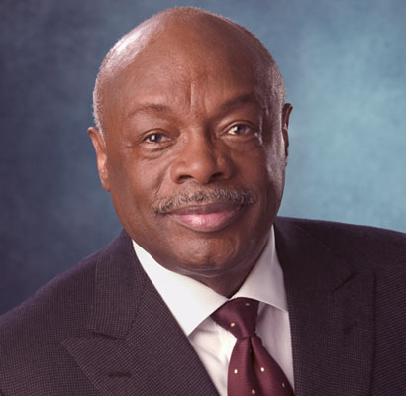
The problem with Willie Brown Jr. Boulevard

3

Ok, Eve Batey has a fun item on SF Appeal: Even the Chronicle, which pays Brown to write his deeply conflicted newspaper column, doesn’t want to see Third Street renamed for the former mayor. That’s probably because Hearst Corp., which owns property on Third Street, doesn’t want to spend the money to change all of its letterhead, documents, mailing address etc. to reflect a street name change. We saw a lot of the same complaints when Army Street was changed to honor Cesar Chavez; some local businesses got mad because of the (modest) costs involved.


I’ve got a much bigger problem with the name change.


You name a street after someone who deserves a major civic honor. Naming a street in the Mission after Cesar Chavez makes a strong, positive statement about San Francisco’s values. So what would Willie Brown Jr. Boulevard celebrate?


One of the most corrupt mayors in San Francisco history, a guy who sold out the city to developers, stood by and allowed the greatest displacement of low-income San Franciscans in modern history, presided over the economic cleansing of San Francisco, and now flaks for PG&E, the pharmaceutical industry, and who knows what other private clients (despite writing about politics in his column, he hasn’t disclosed the list of which political interest groups are paying his sizable legal fees).


Brown’s a fun guy, and I always read his column, and when he did a radio show, he often had me on as a guest, and we joked about the old days, and I have to admit, he’s the life of the party. But let’s not forget the history here; his record in politics stinks.


Besides, he’s still alive — and although he’s smart enough that he’s never been caught doing anything illegal, you never know what trouble he could get into, and how badly he could embarrass the city, in the years to come.

Opinion: Immigration policy, in Arizona and at home

14

Editors note: This is an opinion piece the horrible immigration bill in Arizona — and its connections here in SF.


By Angela Chan


Mayor Gavin Newsom and City Attorney Dennis Herrera have publicly opposed the anti-immigrant bill, SB 1070 in Arizona.  A diverse coalition of civil rights organizations – including the Arab Resource & Organizing Center, Asian Law Caucus, Bernal Heights Neighborhood Center, Central American Resource Center, Community United Against Violence, Equal Justice Society, La Raza Centro Legal, National Lawyers Guild San Francisco Bay Area Chapter, POWER, and Pride at Work SF — applauds both city officials for taking a strong stand against the Arizona bill.  At the same time, we urge Newsom and Herrera to firmly and unequivocally support the implementation of a local policy that protects the due process rights of immigrant youth in San Francisco.


As with SB 1070 in Arizona, the mayor’s policy of requiring juvenile probation officers to report young people to federal Immigration and Customs Enforcement (ICE) before they receive due process has opened the door to racial profiling and torn many innocent youth from their families.


Since July 2008, pursuant to Newsom’s draconian reporting policy, more than 160 youth have been reported to ICE right after arrest, before they even have had a chance to be heard in juvenile court. That means that youth who are completely innocent of any crimes and youth who are overcharged have been reported to ICE.


Despite the veto-proof passage of a policy by the Board of Supervisors last fall that moves the point of reporting from the arrest stage to after a youth is found to have committed a felony, Newsom has insisted on ignoring the new city law.  Herrera, in turn, has yet to advise implementation of the new law.


Like the Arizona bill, Newsom’s policy requires reporting to ICE when local officials – in this case juvenile probation officers – merely have “reasonable suspicion” that an individual is undocumented. The factors that probation officers are required to use to determine reasonable suspicion have come under fire for codifying racial profiling into law.  Such factors as “length of time in the country” and “presence of undocumented persons in the same area where arrested or involved in the same illegal activity” have little to do with accurately determining an individual’s status, and much more to do with targeting the entire immigrant community and those who live in heavily immigrant communities.


In March, a year and a half after the mayor’s policy went into effect, Chief Probation Officer William Siffermann admitted before the Rules Committee of the Board of Supervisors that the latter factor could lead to racial profiling.  A few days later, Herrera stated that this factor had been removed from the policy.  However, if any changes have been made to the written policy, they have not been made available to the public.


Another similarity with the Arizona bill:  probation officers in San Francisco have not been properly trained and do not have the expertise in immigration law to accurately determine which youth are actually undocumented.  Rather, these officers rely on race, ethnicity, language ability, surnames, and accent as a basis for assuming immigration status.
Much like the Arizona bill, Mayor Newsom’s policy goes well beyond any obligations under federal law by requiring that probation officers report suspected undocumented youth to ICE.  As a cadre of legal scholars, including University of San Francisco Law Professor Bill Ong Hing, have repeatedly made clear, federal law does not require that city officials ask about immigration status or report individuals suspected of being undocumented to ICE.


Finally, as with the Arizona bill, the mayor’s draconian policy only compounds the harm to immigrant families caused by an already flawed federal immigration system, which is in drastic need of comprehensive reform. We need humane reform at the federal level, but in the meantime, Mayor Newsom and City Attorney Herrera need to take swift action to restore due process and protect family unity by ending San Francisco’s draconian policy. 


In standing up against racial profiling in Arizona, Mayor Newsom is back on the right track of defending immigrant rights — now is the time to give immigrant youth and families fairness and due process in San Francisco.


Angela Chan is staff attorney with the Juvenile Justice and Education Project at the Asian Law Caucus

MLBPA opposes Arizona immigration bill

2

The Major League Baseball Players Association Executive Director Michael Weiner sent out a letter this afternoon stating that the MLBPA opposes the immigration law recently passed by the state of Arizona.

In his letter, which was sent to City Attorney Dennis Herrera following Herrera’s call to find an alternative to Phoenix for the 2011 All-Star game, Weiner acknowledges that law’s passage “could have a negative impact on hundreds of Major League players who are citizens of countries other than the United States.”

“These international players are very much a part of our national pastime and are important members of our Association,” Weiner states.”Their contributions to our sport have been invaluable, and their exploits have been witnessed, enjoyed and applauded by millions of Americans. All of them, as well as the Clubs for whom they play, have gone to great lengths to ensure full compliance with federal immigration law.”

“The impact of the bill signed into law in Arizona last Friday is not limited to the players on one team,” Weiner continues.”The international players on the Diamondbacks work and, with their families, reside in Arizona from April through September or October. In addition, during the season, hundreds of international players on opposing Major League teams travel to Arizona to play the Diamondbacks. And, the spring training homes of half of the 30 Major League teams are now in Arizona. All of these players, as well as their families, could be adversely affected, even though their presence in the United States is legal. Each of
them must be ready to prove, at any time, his identity and the legality of his being in Arizona to any state or local official with suspicion of his immigration status. This law also may affect players who are U.S. citizens but are suspected by law enforcement of being of foreign descent.

“The Major League Baseball Players Association opposes this law as written,” Weiner concludes. “We hope that the law is repealed or modified promptly. If the current law goes into effect, the MLBPA will consider additional steps necessary to protect the rights and interests of our members. My statement reflects the institutional position of the Union. It was arrived at after consultation with our members and after consideration of their various views on this controversial subject.”

Local superhero vs. evil plastic bag

One unintended, positive side-effect of San Francisco’s plastic bag ban: Fewer opportunities for free-floating bags to lodge themselves into cylcists’ derailleurs, as happened to me this morning on my way to work. It’s still two weeks before the official Bike to Work Day, but I thought I’d share today’s bike-commute anecdote, which belongs in the Restoring Faith in Humanity department.

I was biking through the intersection at Third and Mariposa when it became nearly impossible to pedal, and a passing cyclist yelled out, “There’s something in your derailleur!” I pulled over to check it out, and sure enough, discovered a mangled mess. A black plastic bag had wedged itself so deeply into the gears with just a rotation or two of the pedals that I wondered if I was going to have to tear the whole thing into pieces to free it.

After a minute or so of wrestling with the demonic bag, my fingers were coated in grease and I was beginning to think angry thoughts about whomever let this non-biodegradable menace loose on the world. And then suddenly, from out of nowhere, this random dude on a bike swooped in and asked, “Do you need some help with that?” Er, yes.

This stranger was amazingly helpful, and I don’t know his name, but I feel I ought to thank him (for about the fifth time) here in print. After a couple seconds of wriggling the wedged plastic bag around, he instructed me to rotate the pedals forward some, and voila! It came free, and the curse was lifted. There are cool people in San Francisco. Gracias, mystery cyclist!

Let’s talk

0

SUPEREGO The last time I got on the horn with scaldingly hilarious comedian Sandra Bernhard — one of the few people who can make me blush without pulling down their pants — it was the tail-end of that heady year, 2007. Remember then? Baby electro-hipsters were tiring of Justice, shutter shades caused several horrible traffic accidents, and Sandra was just about to blossom into a full-fledged political scandaleuse, among the first to publicly call out Sarah Palin for her anti-woman stance. (“A turncoat bitch whore in cheap-ass fucking New Vision plastic glasses” — those were fightin’ words back then.) I seem to recall we ranted about tight-fisted lesbians who won’t pay for extra corn bread. Things seemed so innocent …

Sandra’s coming into town to host a star-studded fundraiser for one of my favorite HIV/AIDS charities, Maitri, which cares for people severely debilitated by the disease. Although she’s settled down in New York City with her partner, daughter, and new dog, George, her sharp sense of outrage hasn’t dimmed one whit. This time, our goats were got and blazing over the just-passed, heinous Arizona “immigration law” that effectively criminalizes walking while brown. I love Real America! It’s like a marshmallow with a mullet. And not the hip kind of pony-hair mullet with shaved patches all the kids in Mexico are rocking this year.

“What the fuck is wrong with these people?” Sandra warmed up. “Nobody wants to say that these Teabaggers are racist, but, honey, let there be no question, they are racists. Here we have a handsome, incredibly intelligent black man as president, with a smart, beautiful wife and two great children — and these people are fucking losing their shit over it. They just can’t deal! All these creepy white men in their little super-secret militias who are freaking out because there are so many hot, chic people of color around them.

“Seriously, it makes me want to hurl. ‘Brown people get out!’ All I can say is, they better look into their family tree. We all started brown, honey. You want to take your country back? Back to what? Slavery? When women had to shut up? When we were all sharecroppers? Go have your little fantasy backwards country on the Internet or something. Look, I pay a lot more money in taxes than most of these tea people, and I am just fine with helping people afford health care, helping people get educated, fixing the infrastructure. Whatever happened to compassion? The world is so out of balance. We need to pull together and do what we can to make things better for everyone.”

BLISS

Hosted by Sandra Bernhard

Sunday, May 2, 6 p.m.–10 p.m., $150

Golden Gate Club

135 Fisher Loop, SF

www.maitrisf.org

MEAT VS. DEATH GUILD

Retro madness will surely be the fly on the windscreen, the fetus on your breath when SF’s biggest goth and industrial nights black-celebrate four years of unnerving collaboration. DJs Decay, BaconMonkey, Melting Girl, and more are your skinny puppies.

Fri/30, 8:30 p.m.–late, $8. DNA Lounge, 375 11th St., SF. www.meatsf.com

QUEENSDAY 2010

Did you know that, on one magical day a year, Dutch kids wear bright orange and dance around to Tiësto trance and Hollandaise hip-hop in honor of Queen Beatrix van Oranje-Nassau’s birthday? Neither-lands did I. DJ Marcus brings the hiep hiep hoera.

Fri/30, 8 p.m., $10/$20. Apartment 24, 440 Broadway, SF. www.mjdjevents.com

DEVOTION

Old school househeds will be in soul heaven when this long-awaited reunion of local rhythm giants Ruben Mancias and David Harness smokes out the EndUp, in honor of the ninth anniversary of Mancias’ Devotion party. Peace in the valley, people.

Sunday, May 2, 8 p.m.– 4 a.m., $12. The EndUp, 401 Sixth St., SF. www.theendup.com


The Daily Blurgh: Drop that cornhole, Bieber!

0

Curiosities, quirks, oddites, and items from around the Bay and beyond

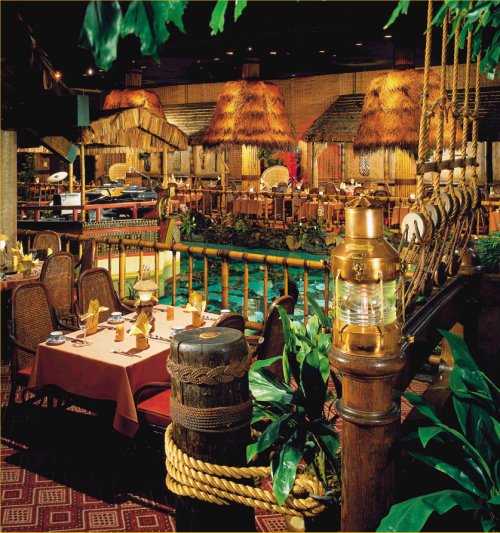
Is the Tonga Room saved? A City Planning Commission report may indicate yes. The report concludes that San Francisco’s finest (imperiled) tiki bar is covered in enough irreplaceable tchotkes and gewgaws to make it a “historical resource.” That might not stop those same tchotkes and gewgaws from being removed, “for public information and education, and/or reuse in an alternate off-site location.” But what about the indoor rainstorm over the lagoon?!?!

*****
Discuss: Michael Bauer notes of his top 10 list of the best breakfasts in San Francisco that many of the restaurants that made the cut “include a woman’s name.” (Also: Boogaloo’s? Really?)

*****

Heil Bieber!

******

Conscientious objection is not an option: “During his tenure as Archbishop of San Francisco, Cardinal William Levada chose not to inform police about a priest who admitted molesting an adolescent boy, an AP story reports. Cardinal Levada is now prefect of the Congregation for the Doctrine of the Faith, which handles disciplinary cases involving sexual abuse by priests.”

*****

Today in unicorns: Unicorn corn holders, ‘Cornz II Men, and a unicorn’s cornhole (SFW).


*****

“[Gary] Gilmore, the notorious spree-killer, uttered the words “Let’s do it” just before a firing squad executed him in Utah in 1977. Years later, the phrase became the inspiration for Nike’s “Just Do It” campaign.”

******

The ever-awesome Ubuweb has uploaded some of the animated films of local artist Kota Ezawa. Here is his rendition of the delivery of the verdict in the O.J. Simpson trial.


Supes try applying pressure to urge CCA contract

At the April 27 Board of Supervisors meeting, Sup. David Campos made a motion to push back board approval for San Francisco Public Utilities Commission infrastructure improvement projects until a contract was in hand for the city’s Community Choice Aggregation program. If a contract isn’t signed by June 8, when voters will decide on Pacific Gas & Electric Co.’s Prop 16 in the June election, the city could be vulnerable to a legal strike against its green municipal power program from PG&E.

“Having watched the very slow process” of negotiating a contract, “I believe CCA should be the top priority,” Campos said.

Sup. Ross Mirkarimi, who chairs the Local Agency Formation Commission (LAFCo) and has been the primary driver behind CCA on the board, acknowledged that asking the board to withhold funding for city infrastructure projects was “an extraordinary act,” but warned that the imminent threat of Prop 16 called for drastic measures. “Given this external threat from a corporation that is doing everything in its power to subvert and deny San Francisco’s right to move forward, it alarms me, like I know some of you, that we do not have a contract in hand … knowing very well the kind of resources and fervor that have been demonstrated or exemplified in the past by the PUC or by the administration or by whatever other combinations of political forces who insist on something getting done by certain timelines and deadlines,” Mirkarimi said.

But while Campos and Mirkarimi won the support of Sups. Chris Daly and Eric Mar, they failed to bring the others around. The tactic of withholding approval on an ordinance in order to send a clear message to a city department about a separate issue “sets a real, real bad precedent for how we’re going to be doing our work here,” Avalos said, though he did voice his support for CCA.

Sup. Sean Elsbernd came out strongly against the move, and made a motion to table Campos’ initial motion to push the vote back for two weeks until a CCA contract was finalized. Then, in one of those dizzying contests the Supes sometimes get into, Daly made a motion to table Elsbernd’s motion to table Campos’ motion to table the vote.

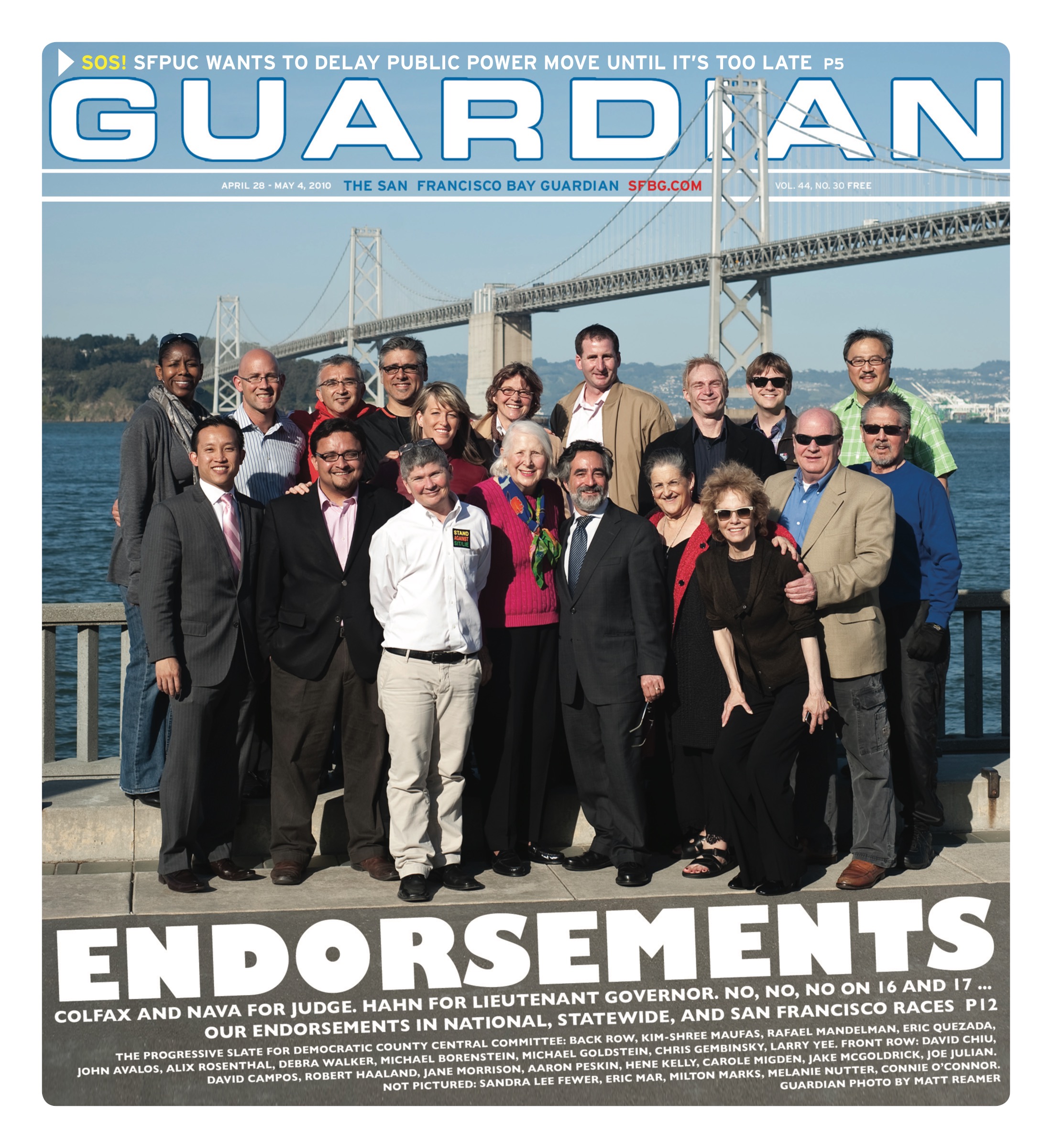
To put it simply, six supervisors voted to move forward with the vote as scheduled, while four voted to hold back on approving funding for SFPUC projects until a finalized CCA contract was in hand. Sups. Mirkarimi, Chris Daly, and Eric Mar voted with Campos to hold off; Sups. Bevan Dufty, John Avalos, David Chiu, Michela Alioto-Pier, and Carmen Chu voted with Elsbernd to proceed. (Sup. Sophie Maxwell was absent.) After that skirmish went down, all ten voted to approve the funding for the SFPUC infrastructure projects.

When reached later by phone, Board President David Chiu said, “We are fully committed to seeing a CCA contract happen before the June election,” and noted that he brought up the urgency of the matter in a meeting with the mayor, who in turn voiced his own commitment.

Welcome to Elm Street (and Crystal Lake): Part Eight

0

In honor(?) of the new A Nightmare on Elm Street, we’re recapping all of the Elms so far. Find more on the Pixel Vision blog.

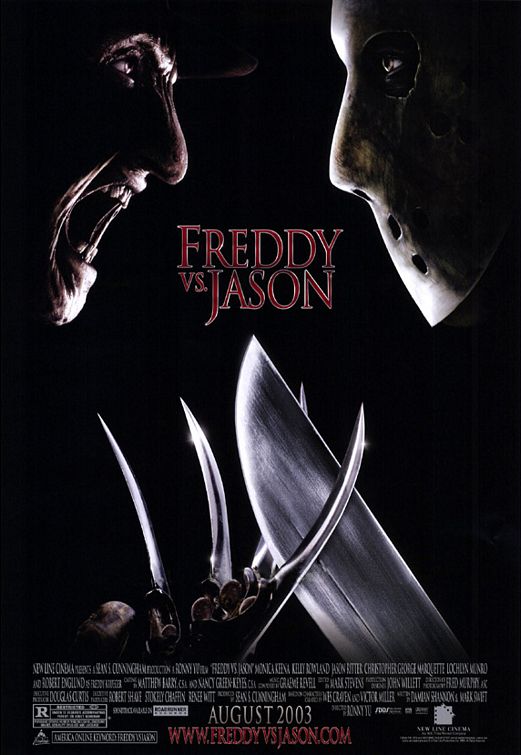
The stage was set for Freddy vs. Jason (2003) long before Freddy’s glove made a cameo at the end of Jason Goes to Hell: The Final Friday (1993) — yet another in a long line of misleadingly-titled films promising the last stand of the boogeyman in question (lest ye forget, Jason X came out in 2001). Who didn’t want to see the wisecracking scourge of Springwood go glove-to-machete with Camp Crystal Lake’s burly maniac? Truly, it would be a grudge match for the ages, with two of the most franchise-able movie monsters (combined total in 2003: 17 films) poised to lure both long-standing loyalists and new blood into the theaters. (And even if the entire film was simply a canny marketing tactic, it worked — Freddy vs. Jason was a huge hit, earning $82 million in the United States alone.)

It goes without saying that all viewers must choose a side. And I don’t mean choosing the side of the generic teen actors (Monica Keena, Jason Ritter, Destiny’s Child-er Kelly Rowland)  — after all, it’s only fun when the bodies start dropping, so that ain’t even an option. I remember attending the Freddy vs. Jason press screening and being outraged that the promotional giveaway item was a paper Jason mask. Hold the (tongue-twisting) phone! No glove bedecked with cardboard razors? No disposable fedora? Clearly, favoritism was being displayed! UNFAIR TO FREDDY!

Um, anyway. Nearly 10 years later, I still have that paper hockey mask, but I hadn’t re-watched the movie since its release. Looking at it again last night, I remembered why: it’s just sort of blah. A huge amount of exposition — wherein we learn that the powers of Freddy (Robert Englund) have been nullified because Springwood grown-ups have taken drastic steps to make all the wee ones forget about him, and if nobody remembers him, they can’t fear him, and if they don’t fear him, he has no strength to sweeten anyone’s sleepytime, etc. etc. — leads to Freddy rousing his fellow hell-dweller, Jason (Ken Kirzinger), from whatever stasis the superhuman killing machine happens to be in this year. (For the record, I kinda liked Jason X. Jason in outer space was such an awesome idea, I didn’t really mind that the movie was so insanely formulaic otherwise.)

Anyway, Jason rises, again, lumbers over to Elm Street, and starts taking out the local under-18 population. Word gets out, thanks to some indiscreet cops and a couple of kids who’ve been institutionalized and medicated for the sole purpose of silencing the Ballad of Freddy Krueger. Oops. There are slicings, dicings, a rave in a corn field (wait — a rave? With glow sticks? In 2003? I hope this is a sign of the sense of humor that enabled director Ronny Yu to helm 1998’s Bride of Chucky), and all manner of bloodshed; at a certain point, Freddy gets pissed at Jason (“That hockey puck!”) for killing wide-awake kids he was hoping to slaughter in their dreams. Important lesson, everyone: it’s hard to reason with a voiceless, soulless, heavily armed killing machine.

SO. One thing leads to another, and Jason gets tranquilized. Freddy goes into his dream, and pretends to be Jason’s nagging-from-the-grave mother, kind of a Mrs. Bates in a turtleneck. Despite all efforts, Jason won’t die, of course. (Is it possible Freddy never saw a Friday movie? That’s Jason’s magic power! He is evil immortal! Like, duh!) The kids intervene by driving Jason’s snoozing body to Camp Crystal Lake. (All this time it was terrifyingly close to Springwood — who knew?)

Elm Street dweller Lori (Keena, whose character’s name may or may not be a reference to Laurie Strode from the Halloween movies) has the bright idea of bringing Freddy into the real world, which is exactly what happened in Freddy’s Dead (1991) and probably a few other Nightmares as well, but at this point, I’m having trouble keeping track. Pretty much, it’s breasty Lori’s only contribution to the film, even though she’s positioned as a Nancy Thompson-style last girl standing. Oh, how times have changed … and gotten worse.

Anyway, at last, Freddy and Jason have it out on the shores of Crystal Lake. There is fire, there are explosions, there’s a beheading, and if you really want to know, neither guy wins. There’s no winner! Haha, sucker! Argh. But, I suppose, the end result was convincing enough to pave the way for another clash of horror titans, Alien vs. Predator (2004), which in turn brought us Aliens vs. Predator: Requiem (2007), which in turn probably helped this summer’s Predators get made, and Predators looks awesome, so I’m not complaining. However, the success of Freddy vs. Jason also no doubt inspired last year’s Friday the 13th remake, which was utter shit (in 3-D), and the brand-new A Nightmare on Elm Street, which opens tomorrow, featuring Jackie Earle Haley instead of Robert Englund in the striped-sweater hot seat. How will Freddy fare? Stay tuned for Louis Peitzman’s review!

The invaluable legacy of Willard Wirtz

2

Dick Meister, formerly labor editor of the SF Chronicle and KQED-TV Newsroom, has covered labor and politics for a half –century.

Never has there been a greater champion of U.S. workers than former Secretary of Labor Willard Wirtz, who died on April 24 at 98. Certainly in more than a half-century of covering labor, I’ve never met anyone more dedicated – or more effective – in winning and preserving vital protections for working people.

That was the lifelong task of Wirtz, who served as secretary under presidents Kennedy and Johnson from 1962 to 1969, a brilliant, charming Harvard Law School graduate who spent his life helping ordinary Americans, especially the poor.

Much can be said of Wirtz’ long and distinguished career in government and academia, and his work in government and private practice as a mediator and arbitrator who helped prevent or settle many strikes and resolve many other serious labor-management disputes.

Wirtz expanded the Labor Department’s job-training and education programs that were developed especially for the underemployed and undereducated and at-risk youth, increased unemployment assistance for those who lost jobs to foreign trade, created literacy programs for workers and sharply and publicly chastised construction unions for their bias against African-American workers.

Wirtz was also a leader in the passage of laws that prohibit discrimination against women and older workers in pay and otherwise. And he was one of the first to call for laws protecting workers with disabilities from discrimination.

Wirtz clearly was what current Labor Secretary Hilda Solis calls “President Johnson’s general in the war on poverty.”

Wirtz himself said of his time as secretary that “If there was a central unifying theme . . . It was in the insistence that wage earners – and those seeking that status – are people, human beings for whom ‘work,’ but not just ‘labor’ . . . constitutes one of the potential ultimate satisfactions.”

I particularly remember a trip Wirtz made to California in 1965 in response to grower requests for creation of an “emergency program” that would in effect restore the highly exploitative Bracero Program that for more than two decades had enabled growers to hire underpaid, overworked and generally mistreated poverty-stricken Mexicans.

The Braceros had to silently accept the rotten conditions or be sent back to Mexico to be replaced by other poverty-stricken Braceros. And domestic workers had to uncomplainingly accept the conditions or be replaced by Braceros – if they were even hired, Growers much preferred the necessarily compliant Mexicans.

Wirtz did his utmost to enlighten the general public about the abysmal conditions of those who harvest most of our fruits and vegetables. He took a whirlwind tour of California’s lush farmlands with a planeload of reporters in a battered DC3, popping up unannounced at farms to ask embarrassing questions and point to conditions that most newspaper readers and television viewers associated only with the dim past recorded by John Steinbeck in “The Grapes of Wrath.” Growers tried to limit his agenda to farms where they had hastily and improved conditions for a token number of workers. But Wirtz would not be denied.

By closely examining the true conditions of Mexican and domestic workers alike, Wirtz was hoping to show the rest of the country the need for major reforms that would promise decent pay and working conditions and deny growers their request for Mexican workers under an “emergency program.”

On the ground, he sped with a busload of reporters over dusty roads from one huge square patch of green and brown to another. We had a hard time keeping up with Wirtz, Neither his good humor nor his seemingly inexhaustible energy lessened as he put probing questions to men and women working in the fields.

At one stop in Southern California, for instance, he strode briskly down one long dirt row after another, a pipe gripped tightly in his teeth, shoes covered with dust, to greet workers as they stooped painfully, grasping the short-handled hoes used to weed and otherwise prepare the strawberry, sugar beet and lettuce crops for harvest.

“Wirtz is my name, good to see you” was a typical icebreaker – first voiced at 5:30 a.m. – only five hours after Wirtz had gone to bed.

At another stop, he walked away shuddering from the communal lavatory in the center of a circle of a ramshackle two- and three- room buildings overrun with barefoot children.

He greeted me, his face twisted in disgust.

“Did you see it?” he asked. “God!”

At yet another stop, Wirtz stood in the center of a field, surrounded by workers, looking out over tall rows of asparagus that covered the land in all directions.

“Where,” he asked the grower, “are the toilets?” The grower, genuinely incredulous that the question would even be asked, explained that “there are none.”

Elsewhere, Wirtz paid a surprise visit to a farm labor camp at breakfast time, finding conditions that “make me ashamed anything of this kind exists in this country. Looking at the food, I wonder how anyone can eat it!”

Wirtz returned from California determined to greatly limit, if not halt, the flow of Mexican workers that growers hired in lieu of improving conditions to attract domestic workers.

As Wirtz and others predicted, curtailing grower use of Mexican workers forced growers to improve conditions in order to attract more domestic workers. The improvements were generally short-lived, however, as growers turned to the masses of undocumented Mexicans for workers.

Yet thanks in large part to Willard Wirtz, the country had seen clearly the great need to improve the conditions of some of our most necessary but most exploited workers. That helped lay the groundwork for Cesar Chavez and the United Farm Workers and others who are continuing the struggle today for decent farm labor conditions.

That’s but a small part of the invaluable legacy of Willard Wirtz, who helped guarantee decent conditions to millions of working people in a wide variety of fields.

What’s not generally known is Wirtz’ role in desegregating the Labor Department staff.  As former Labor Department Director of Information John Leslie notes, at the time that Wirtz became Labor Secretary in 1962, the only African Americans on the staff were messengers and drivers. Leslie recalls that “Bill decided to send a message by starting in the deep South . . .We went to Atlanta and called all the regional directors together . . . and immediately drew agitated opposition.

“Every excuse not to hire blacks in professional positions was given – history, local custom, no qualified Blacks, employee relations ” and more, including an assertion that “our female staff won’t go to the bathroom with Blacks “… Bill quietly answered, ‘Then they will be mighty uncomfortable by the end of the day.'”

Despite the objections of his regional directors, Wirtz prevailed. The Labor Department staffs were integrated, in the South and elsewhere.

We shouldn’t forget, either, Wirtz’ courageous stand against the Vietnam War, including the bombing of North Vietnam ordered by his boss, President Lyndon Johnson. That drew a demand from Johnson in 1968 that Wirtz resign. But two days later, Johnson relented, fearing that Wirtz’ resignation would embarrass him and hurt Hubert Humphrey, the Democratic presidential nominee. Wirtz stayed on, but didn’t mute his opposition to the war.

EVERY CRANNY AND CROOK

Among his other considerable talents, former Secretary of Labor Willard Wirtz was one of the country’s foremost collectors of malaprops. His collection, naturally, was studded with gems from Washington, that font of bureaucratese and other language butchery.

Wirtz, for instance, told of a Labor Department official who insisted that “it’s just a matter of whose ox is being goosed.” And there was:

A newspaperman who ‘d “been keeping my ear to the grindstone.”

A bureaucrat who was certain that “we’ve got to do something to get a toe hold in the public eye.”

A politician who demanded that “we hitch up our trousers and throw down the gauntlets.”

A corporate official who wanted to know “if you’ve got any plans underfoot.”

 Another official who warned that “if this keeps up, we’ll all go down the drain in a steamroller,” One official was concerned that “we’re being sold down the drain.”

But not to worry, said an optimistic official, “We can get this country out of the eight ball.”

“It may not work,” said a high union official, “but let’s take a flying gambit at it.” An Agriculture Department official insisted that “we have to deal with the whole gambit of this affair.”

And that wasn’t the half of it. Consider these gems, also uttered by labor and management leaders and, of course, bureaucrats:

“That kind of business gets my dandruff up.”

“When I smell a rat, I nip it in the bud.”

“That idea doesn’t have a Chinaman’s chance in hell.”

“Let’s don’t go off the deep end of the reservation.”

“If we try this we’re likely to have a bear by the horns.”

“Somebody’s going to think there’s dirty work behind the crossroads.”

“Let’s grasp this nettle by the horns.”

“Somebody’s likely to rear up on his back.”

Wirtz himself was no slouch at malaprops. For example, there was his, “We’ve got to be careful about getting too many cooks in the soup.”

But few men, the secretary included, are likely to top the explanation of an unsuccessful candidate for the Maryland Legislature that Wirtz recalled.

“I think I deserved to win,” he told a gathering of his supporters after his defeat. “I went to every cranny and crook in this district.”

Dick Meister, formerly labor editor of the SF Chronicle and KQED-TV Newsroom, has covered labor and politics for a half-century. Contact him through his website, www.dickmeister.com, which includes more than 250 of his recent columns.

The Daily Blurgh: No more toys for you

0

The Black and White Ball: Not just for the city’s elite anymore.

*****

The Prop 8 trial could wrap in time for Pride, causing either waves of rainbow-colored jubilation to ripple across the LGBT populace or a massive flashback to the bummer November of ’08.

******

“Just because David Morales Colón is dead doesn’t mean he can’t also be stylish. According to Primera Hora, the 22-year-old Puerto Rican man was murdered in his San Juan neighborhood last Thursday. As a tribute to the young man, the Marin Funeral Home treated the body and then dressed him up in his typical riding outfit complete with helmet on top of the Honda CBR600 F4 the man’s uncle had given to him.” (h/t Slog)

*****

Today in local, misguided attempts to legislate the well-being of children: making it illegal for fast food restaurants to pass out toys in kiddie meals.

*****

“Child pornography is great. It is great because politicians understand child pornography. By playing that card, we can get them to act, and start blocking sites. And once they have done that, we can get them to start blocking file sharing sites.” (So, people, can we please create an equivalent to Godwin’s Law for egregious (mis)uses of “child porn” as a rhetorical trump card?)

*****

Will hearing classic children’s books read aloud in the manner of Werner Herzog ever get old? No.

ENDORSEMENTS: Judicial races

2

SUPERIOR COURT JUDGE, SEAT 6


LINDA COLFAX


It’s rare to see an open seat on the Superior Court; judges typically retire midterm and allow the governor to appoint their replacement. And with a Republican governor, the more progressive Democrats have had a hard time getting even close to judicial appointments. Four highly qualified candidates are seeking this seat, and all of them make good cases for election.


Since judicial candidates can’t take stands on most political issues or indicate how they might rule on cases, it’s hard to get a sense of where the candidates stand. But they can talk about their backgrounds and experience — and about how the local courts are run. For example, the Superior Court is managed on a day-to-day basis by a presiding judge, elected by the sitting judges on the San Francisco bench. But those elections are secret; nobody except the judges know who the candidates were; who voted for which one; or what the final tally was. Court administration is done in closed meetings. Most of what happens in the courts is public — but there’s no presumption of cameras in the courtrooms to give the public access to the justice system.


Our choices for judge reflect our interest in a diverse judiciary, judges who have both professional and personal experience that will shape fair decisions — and jurists who believe in open government, including open courts.


Our choice for Seat 6 is Linda Colfax, a deputy public defender with a background in community service (she’s been an ACLU board member) and progressive politics. Like all four candidates, she has impressive legal credentials and trial experience. She also strongly supports sunshine in the courts and told us she would allow the press and public into judges’ meetings when appropriate, supports cameras in the courtrooms (except for cases where a witness or crime victim has to be protected), and efforts to make the courts work more efficiently.


Robert Retana, who grew up in East Los Angeles, has worked in both civil and criminal law, as a prosecutor and a civil litigator. He also has extensive community service with La Raza Centro Legal and the Lawyer’s Committee for Civil Rights. He was awfully vague on cameras in the courtroom and didn’t seem well-informed on open-government issues, but he’s certainly qualified for the job.


Rod Mcleod, a former San Francisco School Board member, told us he won’t raise any money for this race since he thinks judges shouldn’t be captive to special interests. That’s noble, but it also makes it unlikely he’ll be a factor in the end.


Harry Dorfman, a career prosecutor with the District Attorney’s Office, has extensive trial experience but was the least willing of all the candidates we interviewed to expand public access to the courts.


Colfax has the endorsements of Assembly Member Tom Ammiano, Sen. Mark Leno, and Sups. David Campos, John Avalos, and Eric Mar, among others. She would also diversify the bench in a significant way, not just because she’s a lesbian but because she spent her career in the Public Defender’s Office. And since Democratic and Republican governors alike tend not to appoint public defenders to the bench, that background and perspective is rare. Vote for Colfax.


SUPERIOR COURT JUDGE, SEAT 15


MICHAEL NAVA


Another rarity here: a contested race where challengers are taking on a sitting judge. Richard Ulmer, the incumbent, was a Republican living in Hillsborough when Gov. Schwarzenegger appointed him to the bench last year; he quickly changed his registration to independent and took up residence in Park Merced. But two gay men, Michael Nava and Daniel Dean, saw him as potentially vulnerable and, noting the lack of LGBT appointments coming out of the current administration, filed to challenge Ulmer.


Ulmer’s a smart and appealing person with an impressive legal resume, and we see no scandal that would mandate his removal from office. But we also recognize that this is an elected office, and that it’s perfectly acceptable for candidates who think they would better serve the public and the bench to run against an incumbent. In this case, we’re endorsing Michael Nava.


Nava, the grandson of Mexican immigrants, makes the case that judicial appointments can be just as political as elections: out of some 500 judicial appointments, Schwarzenegger has named perhaps five openly LGBT candidates. Nava also would bring a different perspective to the courts. His career has been in the public sector and he currently works as a staff attorney drafting decisions for Superior Court Justice Carlos Moreno. More than anyone else running for judge this year, Nava is an advocate of openness in the judiciary. He told us the courts are the third branch of government and should be held to most of the same sunshine standards at the executive and legislature.


Daniel Dean also makes a compelling case and has extensive courtroom experience as a litigator and judge pro tem. His accessibility and sense of humor would serve him well on the bench, and we hope he continues to seek a judicial slot. But in this race, we’re endorsing Nava.

ENDORSEMENTS: National and state races

15

Editor’s note: the file below contains a correction, updated May 5 2010. 


National races


U.S. SENATE, DEMOCRAT


BARBARA BOXER


The Republican Party is targeting this race as one of its top national priorities, and if the GOP can dislodge a three-term senator from California, it will be a major blow for the party (and agenda) of President Obama. The pundits are happily talking about how much danger Barbara Boxer faces, how the country’s mood is swinging against big-government liberals.


But it’s always a mistake to count out Boxer. In 1982, as a Marin County supervisor with little name recognition in San Francisco, she trounced then-SF Sup. Louise Renne for an open Congressional seat. Ten years later, she beat the odds and won a hotly contested primary and tough general election to move into the Senate. She’s a fierce campaigner, and with no primary opposition, will have a united party behind her.


Boxer is one of the most progressive members of the not-terribly progressive U.S. Senate. She’s been one of the strongest, most consistent supporters of reproductive rights in Washington and a friend of labor (with 100 percent ratings from the AFL-CIO and National Education Association). We’ve had our disagreements: Boxer supported No Child Left Behind, wrote the law allowing airline pilots to carry guns in the cockpit, and was weak on same-sex marriage when San Francisco sought to legalize it (although she’s come around). But she was an early and stalwart foe of the war in Iraq, split with her own party to oppose a crackdown on illegal immigration, and is leading the way on accountability for Wall Street. She richly deserves reelection, and we’re happy to endorse her.


CONGRESS, 6TH DISTRICT, DEMOCRAT


LYNN WOOLSEY


It’s odd that the representative from Marin and Sonoma counties is more progressive by far than her colleague to the south, San Francisco’s Nancy Pelosi. But over the years, Lynn Woolsey has been one of the strongest opponents of the war, a voice against bailouts for the big Wall Street banks, and a foe of cuts in the social safety net. We’re proud to endorse her for another term.


CONGRESS, 7TH DISTRICT, DEMOCRAT


GEORGE MILLER


George Miller has been representing this East Bay district since 1974, and is now the chair of the Education and Labor Committee and a powerhouse in Congress. He’s too prone to compromise (with George W. Bush on education policy) but is taking the right line on California water (while Sen. Dianne Feinstein is on the wrong side). We’ll endorse him for another term.


CONGRESS, 8TH DISTRICT, DEMOCRAT


NANCY PELOSI


We’ve never been terribly pleased with San Francisco’s most prominent Congressional representative. Nancy Pelosi was the author of the bill that created the first privatized national park at the Presidio, setting a horrible standard that parks ought to be about making money. She was weak on opposing the war, ducked same-sex marriage, and has used her clout locally for all the wrong candidates and issues. But we have to give her credit for resurrecting and pushing through the health care bill (bad as it was — and it’s pretty bad — it’s better than doing nothing). And, at a time when the Republicans are trying to derail the Obama presidency, she’s become a pretty effective partner for the president.


Her fate as speaker (and her future in this seat) probably depends on how the Democrats fare in the midterm Congressional elections this fall. But if she and the party survive in decent shape, she needs to take the opportunity to undo the damage she did at the Presidio.


CONGRESS, 9TH DISTRICT, DEMOCRAT


BARBARA LEE


Barbara Lee, who represents Berkeley and Oakland, is co-chair of the Progressive Caucus in the House, one of the most consistent liberal votes in Congress, and a hero to the antiwar movement. In 2001, she was the only member of either house to oppose the Bush administration’s Use of Force resolution following the 9/11 attacks, and she’s never let up on her opposition to foolish military entanglements. We’re glad she’s doing what Nancy Pelosi won’t — represent the progressive politics of her district in Washington.


CONGRESS, 13TH DISTRICT, DEMOCRAT


PETE STARK


Most politicians mellow and get more moderate as they age; Stark is the opposite. He announced a couple of years ago that he’s an atheist (the only one in Congress), opposed the Iraq war early, called one of his colleagues a whore for the insurance industry, and insulted President Bush and refused to apologize, saying: “I may have dishonored the commander-in-chief, but I think he’s done pretty well to dishonor himself without any help from me.” He served as chair of the House Ways and Means Committee for exactly one day — March 3 — before the Democratic membership overruled Speaker Pelosi and chucked him out on the grounds that he was too inflammatory. The 78-year-old may not be in office much longer, but he’s good on all the major issues. He’s also fearless. If he wants another term, he deserves one.


State races


GOVERNOR, DEMOCRAT


EDMUND G. BROWN


Jerry Brown? Which Jerry Brown? The small-is-beautiful environmentalist from the 1970s who opposed Pacific Gas and Electric Co.’s Diablo Canyon nuke and created the California Conservation Corps, the Office of Appropriate Technology, and the Farm Labor Relations Board (all while running a huge budget surplus in Sacramento)? The angry populist who lashed out at corporate power on a KPFA radio talk show and ran against Bill Clinton for president? The pro-development mayor of Oakland who sided with the cops on crime issues and opened a military academy? Or the tough-on-crime attorney general who refuses to even talk about tax increases to solve the state’s gargantuan budget problems?


We don’t know. That’s the problem with Brown — you never know what he’ll do or say next. For now, he’s been a terribly disappointing candidate, running to the right, rambling on about preserving Proposition 13, making awful statements about immigration and sanctuary laws, and even sounding soft on environmental issues. He’s started to hit his stride lately, though, attacking likely GOP contender Meg Whitman over her ties to Wall Street and we’re seeing a few flashes of the populist Brown. But he’s got to step it up if he wants to win — and he’s got to get serious about taxes and show some budget leadership, if he wants to make a difference as governor.


LIEUTENANT GOVERNOR, DEMOCRAT


JANICE HAHN


Not an easy choice, by any means.


Mayor Gavin Newsom jumped into this race only after it became clear that he wouldn’t get elected governor. He sees it as a temporary perch, someplace to park his political ambitions until a better office opens up. He’s got the money, the statewide name recognition, and the endorsement of some of the state’s major power players, including both U.S. Senators and House Speaker Nancy Pelosi. He’s also been a terrible mayor of San Francisco — and some progressives (like Sup. Chris Daly) argue, persuasively, that the best way to get a better person in Room 200 is to ship Newsom off to an office in Sacramento where he can’t do much harm and let the supervisors pick the next mayor.


But it’s hard to endorse Newsom for any higher office. He’s ducked on public power, allowing PG&E to come very close to blocking the city’s community choice aggregation program (See editorial, page 5). His policies have promoted deporting kids and breaking up families. He’s taken an approach to the city budget — no new revenue, just cuts — that’s similar to what the Republican governor has done. He didn’t even bother to come down and talk to us about this race. There’s really no good argument for supporting the advancement of his political career.


Then there’s Janice Hahn. She’s a Los Angeles City Council member, the daughter of a former county supervisor, and the sister of a former mayor. She got in this race way before Newsom, and her nightmare campaign consultant, Garry South, acts as if she has some divine right to be the only Democrat running.


Hahn in not overly impressive as a candidate. When we met her, she seemed confused about some issues and scrambled to duck others. She told us she’s not sure she’s in favor of legalizing pot, but she isn’t sure why she’s not sure since she has no arguments against it. She won’t take a position on a new peripheral canal, although she can’t defend building one and says that protecting San Francisco Bay has to be a priority. She won’t rule out offshore oil drilling, although she said she has yet to see a proposal she can support. Her main economic development proposal was to bring more film industry work to California, even if that means cutting taxes for the studios or locating the shoots on Indian land where there are fewer regulations.


On the other hand, she told us she wants to get rid of the two-thirds threshold in the state Legislature for passing a budget or raising taxes. She supports reinstating the car tax at pre-Gov. Arnold Schwarzenegger levels. She supports a split-roll measure to reform Prop. 13. She wants to see an oil-severance tax to fund education. She’s one of the few statewide candidates who openly advocates higher taxes on the wealthy as part of the solution to the budget crisis.


We are under no illusions that Hahn will be able to use the weak office of lieutenant governor to move on any of these issues, and we’re not at all sure she’s ready to take over the top spot. But on the issues, she’s clearly better than Newsom, so she gets our endorsements.


SECRETARY OF STATE, DEMOCRAT


DEBRA BOWEN


Debra Bowen is the only Democrat running, a sign that pretty much everyone in the party thinks she’s doing a fine job as Secretary of State. She’s run a clean office and we see no reason to replace her.


CONTROLLER, DEMOCRAT


JOHN CHIANG


Like Bowen, John Chiang has no opposition in the primary, and he’s been a perfectly adequate controller. In fact, when Gov. Schwarzenegger tried two years ago to cut the pay of thousands of state employees to the minimum wage level, Chiang defied him and refused to change the paychecks — a move that forced the governor to back down. We just wish he’d play a more visible role in talking about the need for more tax revenue to balance the state’s books.


TREASURER, DEMOCRAT


BILL LOCKYER


Bill Lockyer keeps bouncing around Sacramento, waiting, perhaps, for his chance to be governor. He was attorney general. Now he’s treasurer seeking a second term, which he will almost certainly win. He’s done some good things, including trying to use state bonds to promote alternative energy, and has spoken out forcefully about the governor’s efforts to defer deficit problems through dubious borrowing. He hasn’t, however, come out in favor of higher taxes for the rich or a change in Prop. 13.


ATTORNEY GENERAL, DEMOCRAT


KAMALA HARRIS


There are really only two serious candidates in this race, Kamala Harris, the San Francisco district attorney, and Rocky Delgadillo, the former Los Angeles city attorney. Harris has a comfortable lead, with Delgadillo in second and the others far behind.


Delgadillo is on his second try for this office. He ran against Jerry Brown four years ago and got nowhere. And in the meantime, he’s come under fire for, among other things, using city employees to run personal errands for him (picking up his dry-cleaning, babysitting his kids) and driving his car without insurance. On a more significant level, he made his reputation with gang injunctions that smacked of ethnic profiling and infuriated Latino and civil liberties groups. It’s amazing he’s still a factor in this race; he can’t possibly win the general election with all his baggage.


Harris has a lot going for her. She was among the first California elected officials to endorse Barack Obama for president, and remains close to the administration. She’s a smart, articulate prosecutor and could be one of the few women atop the Democratic ticket this year. We were never comfortable with her ties to Willie Brown, but he’s no longer a factor in state or local politics. These days, she’s more closely allied with the likes of State Sen. Mark Leno.


That said, we have some serious problems with Harris. She’s been up in Sacramento pushing Republican-style tough-on-crime bills (like a measure that would bar registered sex offenders from ever using social networking sites on the Internet) and forcing sane Democrats like Assembly Member and Public Safety Committee Chair Tom Ammiano to try to tone down or kill them (and then take the political heat). If she didn’t know about the problems in the SFPD crime lab, she should have, and should have made a bigger fuss, earlier.


But Harris has kept her principled position against the death penalty, even when it meant taking immense flak from the cops for refusing to seek capital punishment for the killer of a San Francisco police officer. She’s clearly the best choice for the Democrats.


INSURANCE COMMISSIONER, DEMOCRAT


DAVE JONES


Two credible progressives are vying to run for this powerful and important position regulating the massive — and massively corrupt — California insurance industry. Dave Jones and Hector De La Torre are both in the state Assembly, with Jones representing Sacramento and De La Torre hailing from Los Angeles. Both have a record opposing insurance industry initiatives; both are outspoken foes of Prop. 17; and either would do a fine job as insurance commissioner. But Jones has more experience on consumer issues and health care reform, and we prefer his background as a Legal Aid lawyer to De La Torre’s history as a Southern California Edison executive. So we’ll give Jones the nod.


BOARD OF EQUALIZATION, DISTRICT 1, DEMOCRAT


BETTY T. YEE


Betty Yee has taken over a job that’s been a stronghold of progressive tax policy since the days of the late Bill Bennett. She’s done well in the position, supporting progressive financial measures and even coming down, as a top tax official, in favor of legalizing (and taxing) marijuana. We’re happy to endorse her for another term.


SUPERINTENDENT OF PUBLIC INSTRUCTION


TOM TORLAKSON


Two prominent Democratic legislators are running for this nonpartisan post, state Sen. Gloria Romero of Los Angeles and Assembly Member Tom Torlakson of Martinez. It’s a pretty clear choice: Romero is a big supporter of charter schools who thinks parents should be able to move their kids out of one school district and into another (allowing wealthier white parents, for example, to abandon Los Angeles or San Francisco for the suburban districts). She’s been supported in the past by Don and Doris Fisher, who put a chunk of their GAP Inc. fortune into school privatization efforts. Torlakson wants more accountability for charters, opposes the Romero district-option bill, and has the support of every major teachers union in the state. Vote for Torlakson.


STATE SENATE, DISTRICT 8, DEMOCRAT


LELAND YEE


Sen. Leland Yee can be infuriating. Two years ago, he was hell-bent on selling the Cow Palace as surplus state property and allowing private developers to take it over. In the recent budget crisis, he pissed off his Democratic colleagues by refusing to vote for cuts that everyone else knew were inevitable (while never making a strong stand in favor of, say, repealing Prop. 13 or raising other taxes). But he’s always been good on open-government issues and has made headlines lately for busting California State University, Stanislaus over a secret contract to bring Sarah Palin in for a fundraiser — and has raised the larger point that public universities shouldn’t hide their finances behind private foundations.


Yee will have no serious opposition for reelection, and his campaign for a second term in Sacramento is really the start of the Leland Yee for Mayor effort. With reservations over the Cow Palace deal and a few other issues, we’ll endorse him for reelection.


 Correction update: Yee’s office informs us that the senator suports an oil-severance tax and a tax on high-income earners and “believes that Prop. 13 should be reformed,” although he hasn’t taken a position on Assemblymember Tom Ammiano’s reform bill. 


STATE ASSEMBLY, DISTRICT 12, DEMOCRAT


FIONA MA


Fiona Ma’s a mixed bag (at best). She doesn’t like Pacific Gas and Electric Co. and supports public power, but comes up with strange bills that make no sense, like a 2009 measure to limit rent control in trailer parks. Why does Ma, who has no trailer parks in her district, care? Maybe because the landlords who control the mobile home facilities gave her some campaign cash. She faces no opposition, and we’re not thrilled with her record, but we’ll reluctantly back her for another term.


STATE ASSEMBLY, DISTRICT 13, DEMOCRAT


TOM AMMIANO


When the history of progressive politics in modern San Francisco is written, Tom Ammiano will be a central figure. His long-shot 1999 mayoral campaign against Willie Brown brought the left to life in town, and his leadership helped bring back district elections and put a progressive Board of Supervisors in place in 2000. As a supervisor, he authored the city’s landmark health care bill (which Newsom constantly tries to take credit for) and the rainy day fund (which saved the public schools from debilitating cuts). He uses his local influence to promote the right causes, issues, and candidates.


And he’s turned out to be an excellent member of the state Assembly. He forced BART to take seriously civilian oversight of the transit police force. He put the battle to reform Prop. 13 with a split-role measure back on the state agenda. And his efforts to legalize and tax marijuana are close to making California the first state to toss the insane pot laws. As chair of the Public Safety Committee, he routinely defies the police lobbies and the right-wing Republicans and defuses truly awful legislation. We’re glad Ammiano’s still fighting in the good fight, and we’re pleased to endorse him for another term.


STATE ASSEMBLY, DISTRICT 14, DEMOCRAT


NANCY SKINNER


Nancy Skinner has taken on one of the toughest, and for small businesses, most important, battles in Sacramento. She wants to make out-of-state companies that sell products to Californians collect and remit sales tax. If you buy a book at your local bookstore, you have to pay sales tax; if you buy it from Amazon, it’s tax-free. That not only hurts the state, which loses hundreds of millions of dollars in tax revenue, it’s a competitive disadvantage to local shops. Skinner’s a good progressive vote and an ally for Ammiano on the Public Safety Committee. We’re happy to endorse her for another term.


STATE ASSEMBLY, DISTRICT 16, DEMOCRAT


SANDRE SWANSON


Sandre Swanson represents the district where BART police killed Oscar Grant, but he wasn’t the one out front pushing for more civilian accountability; that was left to SF’s Ammiano. And while Swanson was generally supportive of Ammiano’s bill, he was hardly a leader in the campaign to pass it. This is too bad, because Swanson’s almost always a progressive vote and has been good on issues like whistleblower protection (a Swanson bill that passed this year protects local government workers who want to report problems confidentially). We’ll endorse him for another term, but he needs to get tougher on the BART police.

Murder, he filmed

0

arts@sfbg.com

Get your shit peeled/ Check the murder rate, the shit’s real. —Eddi Projex, "Straight from Oakland"

MUSIC/FILM I first met Pretty Black, a member of Yukmouth’s Regime crew, in 2005 at the Mekanix’ studio in Oakland. He arrived with Husalah of the Mob Figaz to record. Goofing off, Hus urged me to get on the song, so I recorded an intro in mangled French, dubbing the pair "les hommes mobs." Black loved the pronunciation (moeb) and thus began one of my least likely rap-world friendships.

For even by rap standards, Black was a live wire. The 25-year-old always had a pistol on him, was always ready to fight, and, with his Range Rover and Lamborghini, clearly made his money off the street, though I didn’t inquire how. He was an angry young man, not someone to piss off. Yet according to Husalah, he had another side.

"Outside the circle, he seemed like the coldest dude on earth," Hus says. "But inside, you knew he was real compassionate. He provided for his niggas. And if you needed something, he was very resourceful."

"Plus," he adds, "if someone tried to fuck with you, he already knocked ’em out before you could even react."

Born in Chicago, Black was christened Ayoola Matthew Odumuyiwa by his Nigerian immigrant parents. When he first came to the Bay, he was known as Verstyle, but soon adopted the more in your face Pretty Black, a pun on the pimp sense of "pretty" (a "gorgeous" man) and his very dark skin. Like albino Jamaican rapper Yellowman, Black transformed a perceived negative — his color placing him on the lowest rung of our country’s caste system — into a defiant positive.

In 2008, on my birthday, May 25 (not, as sometimes reported, on May 30), Black was shot to death at an apartment complex where his relatives lived, a planned assassination. In other words, not random violence or robbery. Except for the killers, no one knows why. I was shocked because, while I could imagine someone wanting to kill him, I’d never known a murder victim. It’s like a candle flame being blown out: one second, fully here; the next, gone. I recalled, too, the last time I’d seen him, at a show featuring the Jacka. As we were catching up, he said, apropos of nothing, "Remember when we met and recorded that song? That was cool. Le moeb!" While ordinary at the time, this circling back to the night we met took on a retrospective uncanniness, as did one of his last songs, also recorded with the Mekanix, on which Black, playing both parts of a phone call, tells himself, "Don’t go outside, nigga. They’re trying to kill you."

BACK TO BLACK


I’ve been thinking about Black lately, in large part due to Land of the Homicide: The Murders in Oakland, CA (HookerBoyFilmz/HBO), a documentary DVD by Oakland filmmaker Dame Hooker. Brought into the game by veteran director Kevin Epps and multimedia journalist JR, Hooker has manned the cameras since 2001, releasing his first DVD, an overview of the local rap scene called The Bay Got Game (HookerBoy), in 2006. He’s also notched artist-oriented flicks like Mistah FAB’s Prince of the Bay (HookerBoy/InYoFace, 2007), among numerous other projects. Camera on shoulder, he’s a ubiquitous presence at any significant function, constantly accumulating footage of anything from a performance to a sideshow to an ass-whupping in high definition.

"I had a camera, but I was just shooting around the hood," Hooker recalls. "I didn’t know how to edit or anything. But FAB, Stalin, Shady Nate — I watched those dudes grow up. I started going to all their shows and they wanted the footage, so I learned how to edit just by watching TV or watching somebody else. Current TV on HBO showed me a lot about how to put it in a format."

Indeed, he nailed the format so well that Current TV licensed some of his footage and hired him and Epps to make content for the program’s Web site, which proved to be the genesis of the Land of the Homicide project.

"We did a pod, a little five-minute segment for Current TV," Hooker says. "It was called Popped in Oakland. I went around to my friends and was like, tell me how you got shot, and they was showing their wounds. HBO wanted me to extend it, and I was doing that already."

Some of the wounds are pretty grisly. One man pulls up a sleeve to display an arm that got sprayed with an AK. The arm is functional but it looks like a tree root, all twisted and gnarled, a permanent symbol of the gun problem in Oakland — which frequently leads the nation in homicides — not to say the entire country. Hooker himself hasn’t been immune to the violence. He shows me some of his own wounds.

"You got to know how to maneuver around here," he says grimly. "You can get shot just by looking at someone wrong. I got shot five times. Somebody thought I looked at them funny. I didn’t have no money on me or nothing."

RANDOM TARGETS


As Hooker’s own story suggests, Oakland’s gun violence often has a random quality to it. People get shot, sometimes killed, by mistake, in addition to intended victims like Pretty Black. One of the more notorious accidental murders was Jesse "Plan Bee" Hall, founder of the classic 1990s crew Hobo Junction, who was shot in 1992 while sitting next to the intended target. Among the interviewees are Plan Bee’s parents, his sister, and his younger brother, Bobby "Blu-Nose" Hall, as Hooker provides an unflinching look at the family’s devastation and grief. Before the end of the film, however, he winds up returning to the Hall residence as Blu-Nose himself is murdered, seemingly, like his brother, a random target.

"I got a large family. None of my family members have passed away like that," Hooker says. "Except my first cousin — we was real close — and my uncle, [and] two uncles, on my mother’s side. All the rest have been friends, but my friends be like my family."

Ordinarily, Blu-Nose’s death would raise a question like what are the odds of someone speaking on camera about gun violence being killed by gun violence shortly afterward? But this being Oakland, the question is: what are the odds of this occurring three times in quick succession? Because this is exactly what happens with Land of the Homicide, separating it from similarly-themed hood documentaries. Another of the main interviewees, a rapper from the East Oakland’s 70s named Hennessey who had many previous wounds to display, is also murdered. Though I hadn’t heard his music, I’d already begun to hear Hennessey’s name here and there; he’d just signed to Thizz for his first major project shortly before his death, and the contrast between his on-camera gregariousness and the extremely dapper corpse we see at his funeral makes a more emphatic argument against the legality of guns than any commentary could.

Pretty Black is the third victim. Although he didn’t have prior wounds himself, Black bumped into Hooker during the filming and agreed to lend his perspective as someone who knew the street life all too well.

"I was going around getting their opinion about the stuff," Hooker recalls. "Most of them was trying to help people, trying to get their hood right. I don’t know if it was a curse doing the DVD or what, but they all died back to back. It was supposed to be about the lives taken in Oakland, but it turned out to be the people that was interviewed."

I don’t think there’s a word for Hooker’s experience here. Obviously the tragic series of murders gives his DVD an authority and authenticity most documentaries couldn’t buy. But the price is not something he would have willingly paid.

"Land of the Homicide, that’s based on really good friends," he said. "DVDs, those don’t matter when it’s someone you know."

Regime genie

0

arts@sfbg.com

FILM While his unauthorized appearance in Team America: World Police (2004) was surely disillusioning, Kim Jong-il is known to be a foreign film fanatic as well as someone with a keen interest in his own country’s popular media. Popular meaning propagandic, and vice versa — distinctions being useless in North Korea’s case. Inappropriate TV and radio signals are jammed; Internet access is scant; lively arts expressions are strictly “official.” Worldwide, only Eritrea rates lower for freedom of the press.

But why complain when a government-supervised communications realm allows the flourishing of such refined entertainment as Let’s Trim Our Hair In Accordance With the Socialist Lifestyle? Thanks to which broadcast series we know that shorter hair is not only more stylish, patriotic, and hygienic, but improves intelligence — because long locks drain the brain of needed nutrients. (Thus explaining the intellectual reputations of hippies and metalheads.)

The “Dear Leader” has also overseen numerous big-screen productions with alluring titles like A Faithful Servant, A Single Mind, Brigade’s Political Commissar and Let’s Go to Mt. Kumgang. In a 50-page pamphlet titled “Great Man and Cinema: Anecdotes,” he spills all about this fabulous showbiz sideline. Well, perhaps not all: one doubts, for instance, that he comes clean about the 1978 kidnapping of leading South Korean director Shin Sang-ok, who after an attitude-improving prison stint was compelled to make 1985’s nationalistic Godzilla-slash-Golem monster saga Pulgasari.

Other Cinema’s “Mayday Parade(e)” program offers a full dose of propagandic kitsch from the Democratic People’s Republic and beyond. Its centerpiece is The Juche Idea, an hour-long exploration of today’s united-front wonderland. There are excerpts from colossal choreographed Pyongyang patriotic displays, lugubrious dramas, poems (“O bureaucratic capitalism!/ Wet slug to be suffocated in eggshells and beer”) and other materials illustrating the regime’s titular essential ideology. Offering outside perspective is the lengthy interview with a South Korean film student who’s expatriated to an artists’ agricultural collective here after unimpressed stopovers in the U.S. and Japan.

You can stop dialing that local Tea Party hotline right now. The Juche Idea is not quite what it appears to be — though so nearly so it’s ingenious. The final section in an ultra deadpan mockumentary trilogy by plain old American Jim Finn, it mixes actual archival and faked footage to satirize revolutionary snowblindness so subtly you might well be fooled. Following his prior efforts’ send-ups of Peruvian Shining Path militants and a nonexistent East German space program, he again shoots and scores.

The most hilariously ersatz segments are those providing lessons in English as both a Socialist and Capitalist language. Speaking their dialogue with genius stiltedness is Oleg Mavromatti as a Russian visitor no doubt impressed to learn that as far as agricultural and other advancements are concerned, “The manure we’re spreading is just the beginning.”

Moving farther eastward, the ATA program offers fun from another People’s Republic. Great Advancement of Chairman Mao Tse-tung’s Thought (1966), better known hereabouts as Mao’s Little Red Video, is a half-hour newsreel/pep rally focusing mostly on China’s first atomic and nuclear bomb tests. These are triumphant, natch; but more important is the fact that the people themselves are “a spiritual atomic bomb” who will inevitably blow decadent capitalist aggressors to smithereens by their sheer purity of rhetoric.

Early arrivals will be greeted by the turntablings of DJ Onanism and partial screening of Situationist prankster René Viénet’s 1977 Peking Duck Soup, or One More Effort, Chinamen, If You Want to Be Revolutionaries! This cheeky collage uses official imagery in service of an illustrated lecture enumerating all the lies, backstabbings, and massacres throughout Mao’s “visionary” rule. Any regime without humor is bound to generate a lot of the unintentional kind, but Viénet can’t help adding his own particular brand of aesthetic snark. Particularly felicitous are the uses of Serge Gainsbourg’s “Je t’aime … moi non plus” and the Singing Dogs’ “Jingle Bells.”

OTHER CINEMA

Sat/1, 8:30 p.m., $6

Artists’ Television Access

992 Valencia, SF

www.othercinema.com

The Daily Blurgh: Staples city

0

Curiosities, quirks, oddites, and items from around the Bay and beyond

Shocker! San Francisco-based company set to profit off of humans willing to pay for amorous companionship.

*****

I Live Here: SF to live at SomARTS this fall.

*****

Google Maps gets you where you want to go (without going through Arizona).

*****

The gist: Breaking down the five, big legal questions in the iPhone case

*****

Which staple city would you rather live in: Ephemicropolis

or The Big Apple?

*****

I’ll see your KFC Double Down and raise you a cheesecake-stuffed pancake. (Offer very valid in Qatar.)

*****

But even if you’re only scarfing down the sprouted wheat bread, you’re still gonna die.

*****

Once-local, now big-in-France melancholy chanteuse Emily Jane White gets some love from NPR for her new album Victorian America.

*****

And speaking of sadness: “It is such a secret place, the land of tears.”  — Antoine de Saint-Exupéry

Burning Man announces its funded art projects

3

Black Rock City LLC has announced its art grants for Burning Man 2010, with its theme “Metropolis: The Life of Cities.” Thirty-five projects were funded to the tune of almost $440,000, which is more than most years but not its peak.

Those receiving funding include well-known burner artists such as Michael Christian, Karen Cusolito and Dan DasMann, Kate Raudenbush, and Doctor Megavolt. The venerable SF-based fire arts collective Flaming Lotus Girls isn’t doing a funded project this year, but veteran FLGs Rebecca Anders and Jessica Hobbs (along with PK Kimelman, an architect and principal member of the local Space Cowboys sound collective) are leading construction of this year’s Temple (known as the Temple of Flux) with support from a gaggle of FLGs and many other Bay Area collectives in Oakland’s American Steel warehouse (the home base for Cusolito and DasMann).

I’ll be working with the Temple crew this year and profiling the project in the Bay Guardian later this summer, just as I did for the FLG’s Angel of the Apocalypse project in 2005 (all of which will be part of my upcoming book, “The Tribes of Burning Man: How an Experimental City in the Desert is Shaping the News American Counterculture,” due to be released in November by CCC Publishing).

Like many of the projects, the Temple of Flux is only getting a small portion of its funding through the art grants (which are funded through ticket sales) and will be holding a series of fundraisers in the coming months, the first being this Saturday night, May 1, at Kelly’s Mission Rock.

Meanwhile, Burning Man founder Larry Harvey will be speaking tonight (April 27) at the offices of the San Francisco Planning and Urban Research Association, which has been excitedly promoting this year’s Burning Man focus on urbanism.

Mexico warns citizens: use extreme caution in Arizona

7

It’s no surprise to anyone who has watched Newsom stubbornly refuse to take responsibility for the consequences of his flawed juvenile immigrant policy that the mayor is playing coy when it comes to the Board of Supervisors’ and the City Attorney’s attempts to institute a boycott of Arizona.


The real surprise in the fallout around Arizona SB 1070 is that the legislation doesn’t include a clause whereby all “aliens” must find a picture of the Arizona state flag, cut out the star in it, and wear it as a “badge,” much like the Nazis required of the Jews.


But Mexico does gets the threat this hateful legislation poses to its citizens. In a new twist on travel advisories, the Ministry of Foreign Affairs of Mexico has warned its citizens in Arizona to exercise extreme caution, whether they are demonstrating against Arizona SB 1070, going about their everyday affairs, attending classes or contemplating accepting work offered from a car on a highway.


“It is important to act with prudence and respect local laws,” the Mexican consulate states. It notes that the new law won’t take effect until 90 days after the end of the current session of the Arizona state legislature, but warns, “however, as was clear during the legislative process, there is a negative political environment for migrant communities and for all Mexican visitors.”


The consulate recommends that Mexican nationals carry available documentation, even before the new law takes place so as to “help avoid needless confrontations.”


“As long as no clear criteria defined for when, where and who the authorities will inspect, it must be assumed that every Mexican citizen may be harassed and questioned without further cause at any time,” the consulate states.


“The new law will also make it illegal to hire or be hired from a motor vehicle stopped on a roadway or highway, regardless of the immigration status of those involved. While these rules are also not yet in force, extreme caution should be used.”


The consulate concludes by reminding folks that “Mexican nationals who are in the United States, regardless of their immigration status, have inalienable human rights and can resort to protection mechanisms under international law, U.S. federal law, and Arizona state law. The functions of the five Mexican consulates in Arizona (Phoenix, Tuscon, Yuma, Nogales and Douglas) include providing legal advice to all Mexicans who consider that they have been subjected to any abuse by the authorities.”


It recommends that Mexicans requiring consular assitance in Arizona use the following toll-free number, available 24 hours a day, seven days a week:1.877.6326.6785 (1.877.63CONSUL).


The CCA “conundrum”

The negotiations for the city’s green municipal power program still haven’t resulted in a finalized contract, and time is running out.

In 42 days, voters will decide whether Prop 16, the ballot initiative dubbed the “Taxpayers Right to Vote Act,” ought to be enshrined into state law. If a simple majority votes yes, the state constitution will be changed to require a two-thirds supermajority vote at the ballot before any municipal electricity program can move forward, effectively making it impossible for local governments to offer alternatives to investor-owned utility companies. Pacific Gas & Electric Co., the 105-year-old utility that gained infamy with the movie Erin Brockovich after it was accused of causing groundwater pollution which led to a cancer cluster in Hinkley, Calif., is poised to spend $35 million to pass Prop 16.

Here in San Francisco, where the vision for a green municipal power program goes back at least half a decade (and PG&E’s monopolistic grip dates back much farther), the plan’s most dedicated proponents have come to view Prop 16 as “the grim reaper.” At a meeting in City Hall last Friday about CleanPower SF, the community choice aggregation (CCA) program that could provide San Franciscans with 51 percent renewable electricity, Sup. Ross Mirkarimi repeated a mantra he’s intoned since approximately last year at this time: “All hands on deck.” Mirkarimi’s face looked tense, and his anxiety about the closing window of opportunity was plain even as he tried to display optimism. If a CleanPower SF program contract is not signed before June 8, when Prop 16 is decided, years of hard work and effort could be lost. With $35 million worth of carefully crafted PR messaging that reveals nothing about the sole financier of the measure or its anti-competitive intentions, Prop 16 has a decent shot at voter approval.

The race against the clock has been intensified by the fact that the San Francisco Public Utilities Commission, the city agency tasked with implementing CCA, has been unable (or unwilling, some critics charge) to broker a deal with Power Choice Inc., the energy service provider selected for CCA. Negotiating sessions have been ongoing since February, with SFPUC staff members, SFPUC General Manager Ed Harrington, three city attorneys, and staff of the Local Agency Formation Commission devoting hours to negotiations. “We are continuing to work hard to secure a contract,” SFPUC Assistant General Manager of Power Barbara Hale told the Guardian.

Yet as the days pass, the absence of a signed contract in hand has program advocates increasingly worried, frustrated, and suspicious of the SFPUC. “My sense, and my fear quite frankly, has been that the level of commitment [from the SFPUC] isn’t there, and if it were there … then we would have a finalized contract,” Sup. David Campos noted at a joint meeting between LAFCo and the SFPUC on Friday.

John Rizzo of the Sierra Club told the Guardian that Harrington approached the environmental group last week requesting that it join the SFPUC in issuing a press release blaming PG&E’s Prop 16 for marring CCA’s prospects. Harrington was ready to announce that the CCA had reached a preliminary contract, but not really a contract at all, since key terms such as a rate structure would not be hammered down till after the June 8 election. The Sierra Club declined to go along with that idea. Such a move would have jeopardized the program’s shot at success. Campos highlighted this problem at the meeting, saying, “Even though there are risks associated with CCA, the risk of not doing this and not having as concrete a contract by the election is greater.”

Green power advocate Eric Brooks noted that he had received a call from Nancy Miller, the executive director of LAFCo, notifying him that the SFPUC felt that Prop 16 had created a climate that made it too difficult to negotiate, and that a press release would be issued explaining as much. In the end, the SFPUC agreed to stay the course at the negotiating table. At Friday’s meeting, there was no mention of pushing the contract back to a later date. Instead, everyone nodded in polite agreement that all hands were, indeed, on deck.

But during his presentation to commissioners, Harrington emphasized the difficulty in meeting the twin program goals: green power on one hand, and competitive pricing on the other. He displayed charts showing how much more expensive wind and solar were than “brown power,” the fossil fuel and nuclear variety currently offered by PG&E. When challenged on the SFPUC’s commitment, Harrington responded tersely, “Staff commitment does not change the economic reality of the world.”

Brooks, who has weighed in and watched the process unfold since the beginning, later charged that Harrington was presenting a wholly different picture from what was originally agreed to as a way of subverting the program. “He purposely showed the numbers so that they would look worse,” Brooks said. “His key trick was … allowing the contractor the option of a 3-to-5 year contract. No one thinks you can pay renewable energy off in three years, that’s ridiculous. … He knows that the plan was to pay this off over 15 years. There’s no way he didn’t know that the idea is to pay it off in 15 years.”

Harrington was not available for comment. But Hale, who did speak with the Guardian, told us, “We’re absolutely open to a longer-term contract.” The problem, she said, has been determining a rate that makes sense both to guarantee the long-term viability of the program while meeting the renewable-energy program goals and the financial commitment necessary to make it worthwhile for the service provider. It’s like a big control board with multiple dials, and the problem seems to lie in twisting the knobs to find the appropriate setting. So far, they haven’t hit the sweet spot.

Meanwhile, the political backdrop of this “conundrum,” as Harrington called it, is that Mayor Gavin Newsom, now a candidate for Lieutenant Governor, would be placed in an awkward position if a Board-approved contract for the CCA program landed on his desk before June 8. If he endorsed the contract with his signature, he would earn the ire of PG&E, a moneyed political ally that could help him reach the office he aspires to. But if he vetoed CCA, it would amount to a stunning display of hypocrisy, since he would be a green mayor rejecting the greenest municipal power program ever attempted. Newsom, who wants to name a street after former Mayor Willie Brown even as Brown is publicly arguing in favor of Prop 16, could avoid that dilemma altogether if the contract negotiations just imploded, or were at least delayed till after June 8.

Events listings

0

Event Listings are compiled by Paula Connelly. Submit items for the listings at listings@sfbg.com.

WEDNESDAY 28

Phases Full Moon Celebration McLaren Park, 2100 Sunnydale, SF; (415) 468-9664. 8pm, free. Join in on this celebration of the passing of the Moon Phases with people from different spiritual traditions and walks of life featuring dancing, drumming, singing, readings, performances, and more.

FRIDAY 30

Journalism Innovations University of San Francisco, Fromm Hall, Golden Gate at Parker, SF; (415) 738-4975. Fri. 1pm-7:30pm, Sat. 8:30am-7:30pm, Sun. 9am-12:30pm; $15-$75 sliding scale. Join over 600 journalists, educators, advocates, and citizens for this conference on shaping the future of journalism featuring workshops, expositions, and showcases of new projects, practices, and ideas. Presented by the Society of Professional Journalists (SPJ) Nor Cal.

Poems Under the Dome North Light Court, San Francisco City Hall, 1 Dr. Carlton B. Goodlett, SF; www.poemdome.com. 5:30pm, free. Celebrate the last day of National Poetry Month by reading a poem of your choosing at City Hall. Space is limited, so readers are selected by lottery and limited to three minutes per poem. Readings will begin with a poem by Maxine Chernoff.

BAY AREA

"Are We Alone?" UC Berkeley, Sibley Auditorium, Bechtel Engineering Center, Hearst at LeRoy, Berk.; (510) 642-8678. 7:30pm, free. Attend this debate where Dan Werthimer, UC Berkeley SETI Program Director, and Geoff Marcy, Professor, UC Berkeley Astronomy Department, will present convincing arguments both for and against the existence of technological life elsewhere in the galaxy. Either the Milky Way is teeming with life or it isn’t; decide who’s right.

SATURDAY 1

May Day Dolores Park, 18th St. at Dolores, SF; www.uainthebay.org. 3pm, free. Celebrate May Day with the anti-authoritarian community at this family friendly event featuring food, drink, activities, speeches, reenactments, and information tables from organizations like Bound Together Books, Homes Not Jails, Indybay, International Workers of the World (IWW), and many more.

National Free Comic Book Day Comic book stores throughout the Bay Area, visit freecomicbookday.com for a list of stores near you. All day, free. Special edition comics from top publishers, like Marvel and DC, will be given away all day. Participating stores include Isotope, Jeffery’s Toys, Caffeinated Comics, Japantown Collectibles, Neon Monster, Comix Experience, and more.

Roots and Culture Shelton Theater, Pier 26, The Embarcadero, SF; (415) 665-8855. 8pm, $2-20 sliding scale. Attend this May Day event that promises to shake loose all the dampness from the rain and economic struggles featuring COPUS, a spoken word, bass, and percussion ensemble, and Heartical Roots, a song-writing collaborative including bass, drums, keyboards, guitar, and Nyahbinghi drums.

Russian Hill Stairways Meet at Hyde and Filbert, SF; www.sfcityguides.org. 10am, free. Learn more about San Francisco history, architecture, legends, and lore on this SF City Guides walking tour featuring magic staircases, gardens, views from 345 feet above the Bay, and stories about the former haunts of writers and artists.

Spring Plant Sale SF County Fair Building, San Francisco Botanical Garden, Strybing Arboretum, Golden Gate Park, 9th Ave. at Lincoln, SF; (415) 661-1316. 10am-2pm, free. Learn about and purchase rare and unusual plants not found at other regional plant stores at this giant sale featuring over 4,000 different kinds of plants, plant related books, treasures, garden gifts, and more.

SUNDAY 2

Art in the Alley Kerouac Alley, Columbus and Broadway, SF; (415) 362-3370. Noon – 6pm, free. Attend this open air art gallery, where over 25 emerging and established artists will showcase their work, including painting, printmaking, glass art, books, photography, jewelry, and more, and celebrate this fabled neighborhood and its artistic roots.

Escape from Alcatraz Triathlon Race begins and ends at Marina Green, Marina at Fillmore, SF; www.escapefromalcatraztriathlon.com. 8am, free. Watch as more than 2,000 amateur and professional athletes compete in a 1.5 mile swim from Alcatraz Island in the San Francisco Bay, followed by an 18 mile bike ride out to the Great Highway through the Golden Gate Park, and concluding with an 8 mile run through the Golden Gate National Recreation Area. The finish is at The Marina Green.

BAY AREA

Go Expo Day Oakland Asian Cultural Center, Suite 290, Pacific Renaissance Plaza, 388 9th St., Oak.; (510) 501-2701. 1pm, free. Learn about the game "Go," which originated in 4,000 years ago in China. Get free lessons, participate in game sets, and get instructional booklets so that you too can one day compete for some big prizes.

Women Entrepreneurs Showcase David Brower Centre, main lobby, 2150 Allston, Berk.; (510) 809-0900. 10:30am, $4 includes light lunch and raffle ticket. Show your support for local, women-owned businesses of all types, listen to live music, and enjoy some food samples.

TUESDAY 4

Beers, Brats, and Bikes Gestalt Haus, 3159 16th St., SF; www.gestaltsf.com. 7pm, $1 suggested donation. Drink beer, eat delicious sausages (veggie options available and also delicious), and commune with other bike lovers at this fundraiser for Hazon, a non profit organization dedicated to promoting sustainable food.