Local

Muni reform that might actually work

0

EDITORIAL The 2007 ballot measure that was supposed to give Muni more political independence and more money has failed to provide either. It’s time to say that Proposition A, which we supported, hasn’t worked — in significant part because the administration of Mayor Gavin Newsom hasn’t allowed it to work. It’s time for a new reform effort, one that looks at Muni’s governance structure, funding, and the way it spends money.

There are several proposals in the works. Sup. David Campos has asked for a management audit of the Municipal Transportation Agency, which runs Muni, and that’s likely to show some shoddy oversight practices and hugely wasteful overtime spending. Sup. Sean Elsbernd wants to change the way Muni workers get paid, and Sups. Ross Mirkarimi and David Chiu are talking about changing the way the MTA board is appointed. There are merits to all the reform plans, but in the end, none of them will work if they don’t address the fundamental fact that Muni doesn’t have enough money to provide the level of transit service San Francisco needs.

The basic outlines of what a progressive Muni reform measure would look like are pretty obvious. It ought to include three basic principles: work-rule and overtime reform; a change in the way other departments, particularly the police, charge Muni for work orders — and a sizable new source of revenue.

The work orders are, in many ways, the easiest issue. Last year, the San Francisco Police Department charged Muni more than $12 million in work orders. For what? Well, for doing what the Police Department gets paid to do anyway: patrolling Muni garages, putting cops on the buses, and dealing with Muni-related traffic issues. And a lot of that $12 million is police overtime.

The labor and revenue issues are trickier — mostly because they’re being addressed separately. Elsbernd, for example, wants to Muni workers to engage in the same collective bargaining that other city unions do, which makes a certain amount of sense. But he’s wrong to make it appear that the union and the workers are the major source of Muni’s financial problems — and that approach won’t get far. The bus drivers and mechanics didn’t make millions on large commercial developments that put a huge strain on the transit system — and the developers who profit from having bus service for the occupants of their buildings have never paid their fair share. Nor is it the fault of the union that car traffic downtown clogs the streets and makes it hard for buses to run on time.

We agree that the transit union needs to come to the table and talk, seriously, about work-rule changes. Every other city union, particularly SEIU Local 1021, whose members are among the lowest-paid workers in the city, has given something up to help the city’s budget problems.

But any attempt to change Muni’s labor contract needs to be paired with a serious new revenue program aimed at putting the transit system on a stronger financial footing — and traffic management plans that give buses an advantage over cars. The city can add a modest fee on car owners now, and if a Democratic governor wins in November, it’s likely that state Sen. Mark Leno’s bill to allow a local car tax will become law. That’s part of the solution, as is expanded parking meter hours. (And someone needs to talk about charging churchgoers for parking in the middle of the streets on Sundays.) But Muni also needs a regular stream of income from fees on developers.

And a seven-member MTA appointed entirely by the mayor does nothing for political independence; at the very least, the supervisors should get three of the appointments.

The city badly needs Muni reform — and the elements are all in place. But it can’t be a piecemeal approach.

Muni reform that might actually work

7

EDITORIAL The 2007 ballot measure that was supposed to give Muni more political independence and more money has failed to provide either. It’s time to say that Proposition A, which we supported, hasn’t worked — in significant part because the administration of Mayor Gavin Newsom hasn’t allowed it to work. It’s time for a new reform effort, one that looks at Muni’s governance structure, funding, and the way it spends money.

There are several proposals in the works. Sup. David Campos has asked for a management audit of the Municipal Transportation Agency, which runs Muni, and that’s likely to show some shoddy oversight practices and hugely wasteful overtime spending. Sup. Sean Elsbernd wants to change the way Muni workers get paid, and Sups. Ross Mirkarimi and David Chiu are talking about changing the way the MTA board is appointed. There are merits to all the reform plans, but in the end, none of them will work if they don’t address the fundamental fact that Muni doesn’t have enough money to provide the level of transit service San Francisco needs.

The basic outlines of what a progressive Muni reform measure would look like are pretty obvious. It ought to include three basic principles: work-rule and overtime reform; a change in the way other departments, particularly the police, charge Muni for work orders — and a sizable new source of revenue.

The work orders are, in many ways, the easiest issue. Last year, the San Francisco Police Department charged Muni more than $12 million in work orders. For what? Well, for doing what the Police Department gets paid to do anyway: patrolling Muni garages, putting cops on the buses, and dealing with Muni-related traffic issues. And a lot of that $12 million is police overtime.

The labor and revenue issues are trickier — mostly because they’re being addressed separately. Elsbernd, for example, wants to Muni workers to engage in the same collective bargaining that other city unions do, which makes a certain amount of sense. But he’s wrong to make it appear that the union and the workers are the major source of Muni’s financial problems — and that approach won’t get far. The bus drivers and mechanics didn’t make millions on large commercial developments that put a huge strain on the transit system — and the developers who profit from having bus service for the occupants of their buildings have never paid their fair share. Nor is it the fault of the union that car traffic downtown clogs the streets and makes it hard for buses to run on time.

We agree that the transit union needs to come to the table and talk, seriously, about work-rule changes. Every other city union, particularly SEIU Local 1021, whose members are among the lowest-paid workers in the city, has given something up to help the city’s budget problems.

But any attempt to change Muni’s labor contract needs to be paired with a serious new revenue program aimed at putting the transit system on a stronger financial footing — and traffic management plans that give buses an advantage over cars. The city can add a modest fee on car owners now, and if a Democratic governor wins in November, it’s likely that state Sen. Mark Leno’s bill to allow a local car tax will become law. That’s part of the solution, as is expanded parking meter hours. (And someone needs to talk about charging churchgoers for parking in the middle of the streets on Sundays.) But Muni also needs a regular stream of income from fees on developers.

And a seven-member MTA appointed entirely by the mayor does nothing for political independence; at the very least, the supervisors should get three of the appointments.

The city badly needs Muni reform — and the elements are all in place. But it can’t be a piecemeal approach.

Pyramid’s new breakfast in a can

0

You know it’s a good day when you’re getting cold beer in the mail! Imagine our delight and surprise at opening up a chilly box of Pyramid Brewery’s new Haywire Hefeweizen… in a can! Hello burners, you have a new option for playa fun time.

Pyramid, we all know you have the most extreme beer names in the game. Your seasonal brews include Fling, Curveball, Juggernaut, and Snow Cap — and don’t even mess with the Ignition Series; Barbed Wire and Outburst. But as extreme as you are, how the hell did you get cold beer to me, via snail mail no less?

Your publicity person is too busy to talk about it. But it’s all good. Your light brew (good for summertime pounding, not so flavorless that you might as well be drinking Bud) floated down to my tummy in a sparkly, drinking in the office kind of way. And with offices from Seattle to Walnut Creek, you’re not quite local-local, but at least you’re West Coast-local. And you make lovely brews. So yaya to that!

Pyramid Alehouse, Brewery and Restaurant

901 Gilman, Berkeley

(510) 528-9880

www.pyramidbrew.com


The Daily Blurgh: Globish With Attitude

0

Curiosities, quirks, oddites, and items from around the Bay and beyond

Don’t worry, San Franciscans: Your Internet friends don’t hate you and you will be followed once again

******

Speaking of friends, whatever happened to N.W.A..’s posse?

******

Me talk pretty one day, indeed. Do you speak Globish? You probably have. And so does the rest of the world.

******

RIP Ms. Horne

*****

Newsflash! Oversharing online can come back to bite you in the ass: “While participation in social networks is still strong, a survey released last month by the University of California, Berkeley, found that more than half the young adults questioned had become more concerned about privacy than they were five years ago — mirroring the number of people their parent’s age or older with that worry.”

*******

This brave, local blogger waited four and a half hours for a bowl of fancy “test ramen” so you wouldn’t have to.

******

Today in corporate sponsorships: Wynnona Judd to shill for Cracker Barrel. I want a pair of the sunglasses. “I love the rocking chairs and I feel really good when I go to Cracker Barrel,” she says. Sparkle Winnie! Sparkle!

Live Shots: How Weird Street Faire, 05/09/10

0

When it comes down to it, we’re all a bit weird. At the back of every person’s drawer there’s at least one pair of sparkle-farkle leggings and a purple wig. (Weird!) After a long winter, the annual, music-filled How Weird Street Faire came at just the right time for everyone to go wacko and let loose for some spring silliness. Check out some of the looks.

Carville: like Black Rock City, but more history-like

0

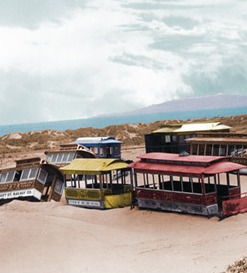
Repurposed streetcars perch haphazardly in dunes not yet cowed by asphalt and the Java Beach coffeeshops. They’re homes to a community of urban escapists and artists. Some of them have front porches, some of them house bicycle clubs. It’s like a Dali painting, it’s like the boxcar children — but it’s also an accurate picture of the first non-indigenous inhabitants of the Sunset, on whom local historian Woody LaBounty has written an awesome book, Carville-by-the-Sea.

The book’s images of 19th century Carville are chicken soup for the boho soul. I want one. My room mate wants one. LaBounty himself says he’d live in one — were the lone streetcars still surviving in the western neighborhoods’ not firmly in the grips of their current owners. There’s even one still-standing house built in 1908 that’s made of three cars; a two street car living room, and a bedroom from one that was horse drawn.

One of Carville-by-the-Sea‘s trippy colorized historical photographs

There used to be hundreds of these things. People moved out to Ocean Beach despite the subpar public transit service that places without sidewalks are often subject to — when the community was first started in 1895 was a steam car that ran out Lincoln Way down to the Cliff House, a service intended mainly for the weekend day trippers. They went to escape the city, to improve their health. There were bars and restaurants in street cars, shoe repair stores, artist studios.

So how did I not know about these things before? LaBounty says he grew up in the Richmond in the ‘60s and 70’s, a few blocks from one of the surviving streetcars, which latched a steampunk-sized hold in his childhood psyche.

More pages from Carville-by-the-Sea. Where’s a Delorean when you need one?

“I loved planes, trains, and automobiles, so living in a street car — it just seemed like the coolest thing in the world,” says LaBounty, who is one of the founders of the Western Neighborhoods Project, proprietor of what is reportedly the most popular SF history website/propagator of history walks, plays, and films by teenagers who interview older residents in their neighborhoods. “I used to watch Wild, Wild West, the ‘60s TV show, and they were living in a train, which I thought was great.”

To research, he began interviewing historians he knew, and motor vehicle enthusiastists, and learning all he could about the old community on the beach. Though he’s privy to all kinds of juicy info on the town’s colorful past, LaBounty found interest in his stories of the bohos and families living on the cars really captured listeners. “We all thought, there needs to be a book on this,” he says. “And then I realized that I should probably write it.”

So here it is, colorized like the postcards of yore for that extra oomph of fantasy creation. Newspaper articles from the 19th century on the streetcars, biographies of the community’s founding members, lots of lovely photos from the dunes.

La Bounty’s doing a series of live talks on his Carville expertise which are open to the public. Just be forewarned: he’s not versed in how to get you a steetcar of your own. Still fun to hear, though.

Carville-by-the-Sea presentation
Wed/19 7 p.m., free
History Guild of Daly City/Colma
Doelger Senior Center
Westlake Park
101 Lake Merced, Daly City
www.carville-book.com

SF nightclubs fight back with new organization

8

In the ongoing War on Fun in San Francisco, a new combatant officially entered the battlefield last night with the launch of the California Music And Culture Association (which strangely goes by the acronym CMAC rather than CMCA). It aims to be a political advocacy organization and to provide members with services such as neighbor relations advice, group insurance, and discounted legal services.

“We’re here to celebrate a new era of nightlife and entertainment in San Francisco,” CMAC President Sean Manchester, owner of Mighty and Wish, told a crowd at Mezzanine that included club owners, lawyers, promoters, performers, and politicians ranging from supervisorial candidates Scott Wiener from D8 to Debra Walker in D6. California Sen. Mark Leno also sent a formal resolution of support for CMAC.

A video prepared for the event included an even wider array of local figures extolling the importance of nightlife to San Francisco, including SF Convention & Visitors Bureau chief Joe D’Alessandro and San Francisco Planning and Urban Research Association (SPUR) director Gabriel Metcalf, who said, “I think it’s great that the nightlife industry is getting organized.”

That organization was prompted by threats and harassment from the San Francisco Police Department, the California Department of Alcoholic Beverage Control, neighbors of some clubs, and Mayor Gavin Newsom and others who have been on a campaign to demonize the industry and its regulation by the Entertainment Commission.

It’s a trend that the Guardian has been writing about for years, and one that I’ll be discussing this Tuesday as part of a panel assembled by SPUR that includes representatives from the SFPD and Entertainment Commission, as well as Sup. Bevan Dufty, who spearheaded the cancellation of Halloween in the Castro.

Uproot: An urban homesteading bonanza

Now that locavorism has been firmly established as a socially acceptable and environmentally positive movement, people are now considering the place of hyperlocal food, which generally refers to edibles cultivated right within the context of urban and suburban communities. Well, that first part is not entirely true.

As highlighted by the recent Chronicle piece on the brouhaha that has some of the agricultural establishment’s panties in a bunch over the “Puritan idealism” and perceived elitism of slow food. Well, in my naïve fantasies, ushering in an era of functional food systems would be a no-duh, universal type of decision.

Anyway, if you haven’t caught the spate of articles lately, like this NYT one or, oh yeah, my own nonrual homesteading guide from our recent FEAST, urban agriculture is at least a bit of the vogue in the Bay Area. And for those of that bent or neophytes wanting to learn more, the Commonwealth Club is hosting a forum with urban farming heroes—Jason Mark of Alemany Farms, Novella Carpenter, the author of Farm City, Christopher Burley of Hayes Valley Farm, and David Gavrich of City Grazing—to discuss their vision of the growing movement within the larger conversation of “organic, local-grown culture.” It’s a great chance to see/ hear the idea-makers behind what could be a viable solution for creating access to healthier, non-corporate foods for everyone in these lean times. Snacks and wine, locally-produced of course, offered.

Location: SF Club Office, 95 Market Street, 2nd Floor
Time: 6 p.m. check-in, 6:30 p.m. program, 7:30 p.m. networking reception
Cost: $12 members, $20 non-members, $7 students (with valid ID)

Buy tickets here

If Nancy Pelosi’s such a ‘progressive’ ….

32

… and even though Randy Shaw has become convinced that she is, I’ve never bought it, and I still don’t. A progressive in Congress would never have privatized a national park. A progressive wouldn’t have ducked same-sex marriage. But whatever — here’s my question for the day:


If Pelosi really believes in progressive causes, why doesn’t she do anything about it at home?


Pelosi’s almost never on the progressive side in local races. She never helps local progressive causes, raises money (which she’s really, really good at) for local progressive campaigns or takes visible stands on local progressive issues. Would it kill the Democratic Party if she helped defeat Prop. 16? Would it be the end of the Democratic majority if she went to bat for her own city’s sanctuary policies (and tried to block the horrible new policy on deporting anyone who gets arrested?)


Pelosi helped push health-care reform through, and that’s a fine thing. But unless you want to redefine “progressive,” I don’t think Nancy Pelosi fits the bill. (And I’m still proud I voted for Harry Britt for Congress.)

Is ICE planning to destroy sanctuary city?

10

Virginia Kice, spokesperson for the Department of Homeland Security’s Immigration and Customs Enforcement (ICE), sounded hopping mad at the way that ICE’s Secure Communities initiative is being represented as undermining San Francisco’s sanctuary policy and possibly creating an even worse federal immigration system.

“It’s just an information sharing system,” Kice told the Guardian. “Any time someone is electronically booked by local or state law enforcement agencies, their fingerprints will be compared up against biometrics in U.S. Department of Justice, the F.B.I. and the Department of Homeland Security (DHS) databases. “


If a match is found, then ICE will do the follow-up investigation, Kice said.

“Not everyone in the system has violated the law,” Kice explained. “They may have applied for an immigration benefit or they could already be naturalized [have become a U.S. citizen]. It just means that they have had an encounter with DHS.”

Alluding to the ongoing debate about immigration law and racial profiling, Kice stressed that this new system doesn’t selectively finger print.

“It finger prints everybody, and because this system uses biometrics, it’s going to be accurate in terms of i.d.ing people who have had prior encounters with D.H.S,” she said.
“Some people use multiple aliases and give misinformation about their history. We know people have escaped deportation this way in the past, but fingerprints don’t lie.”

Local law enforcement officials are concerned that though the new policy is supposed to target folks charged with serious crimes, including murder, rape, sex crimes, serious assault, and resisting arrest, it will also sweep up folks charged with minor infractions, such as being drunk in public, who could now fall into ICE’s hands for deportation, especially if they resist arrest at the time, which happens to be defined as a serious crime.

“Not everybody who is in the country illegally has ever been encountered by D.H.S. and because we don’t have their biometrics, the system would not detect a match,” Kice continued. “But that does not mean they won’t be referred for a follow-up investigation. And it ensures that we get their information shortly after an encounter occurs.”

But despite Kice’s rosy assessment of the federal government’s Secure Communities program which she says has already been set up in 15 other California communities, 20 states and about 160 municipalities nationwide, the San Francisco Sheriff’s Office continued to express unease at how the new program will shift the local landscape.

 “The ground rules in the jails have changed, but not due to any decision on our part,” Eileen Hirst, spokesperson for the San Francisco Sheriff’s Department told the Guardian.

The interlinking automated database will remove the firewall that used to protect folks booked with low-level crimes from being referred to federal immigration authorities.

“The firewall was the discretion of local law enforcement,” Hirst explained.

In San Francisco, the Sheriff’s Department developed laws that were consistent with federal laws, as well as San Francisco’s sanctuary ordinance, which was enacted in 1989.

Under San Francisco’s current “City of Refuge” ordinance, local law enforcement officials refer individuals who are booked on felony charges, or have a history of felony charges, and are foreign born and have previous deportation orders or ICE holds.

But now everyone who gets arrested will be fingerprinted and referred to ICE, not through human intervention, but through a fingerprint database that connects to similar databases in Canada, Mexico and within Interpol.

“DHS, of which ICE is part, has interoperability agreements with California’s Department of Justice, which maintains a fingerprint database for state,” Hirst said.” ICE now has complete access to the DOJ databases and vice versa.”

This fundamental change in policy means that any time anyone is booked in San Francisco, they will be fingerprinted and automatically reported, including folks charged with misdemeanors, such as minor drug possession, low level financial crimes and misdemeanor battery.

“What happens next will depend on DOJ’s response,” Hirst said. “We are putting the word out because it was clear that the immediate community did not know about this.”

Local law enforcement officials say they were verbally informed of the new initiative at a recent meeting at ICE’ office at 630 Sansome Street in San Francisco. Asked if the system will go into effect June, Kice said the agency doesn’t typically inform communities when the program will be deployed, but promised to get back to us.

David Venturella, who has been involved with ICE for years and is currently the head of ICE’s Secure Communities initiative was not available for comment, but Kice sent a fact sheet, which claims the program “is leading ICE’s efforts to modernize and transform its criminal alien enforcement model, through technology, integration and information sharing.”

“This is the first time that the Federal government has used biometric identification technology to enforce immigration laws at the state and local law enforcement level,” the fact sheet states. “This enables ICE to accurately identify dangerous criminal aliens much more efficiently, and in significantly greater numbers. This also helps local law enforcement officials get dangerous criminals off their streets, at little or no additional cost. If an individual’s fingerprints match those of a person in DHS’s biometric system, the new automated process will notify ICE and the participating agency submitting the fingerprints. ICE will evaluate each case to determine the individual’s immigration status and take appropriate enforcement action. Top priority will be given to offenders who pose a threat to the public safety, such as aliens with prior convictions for major drug offenses, murder, rape, robbery, and kidnapping.”

The ICE fact sheet notes that, “Deployment of this interoperable technology across the nation is now underway as is expected to be complete by 2012.”

“Congress has allocated $350 million for Secure Communities in FY 2008 and FY 2009,” the fact sheet continues.  “As of March 2009, Secure Communities has been deployed to 48 sites in seven states – Arizona, Florida, Massachusetts, North Carolina, Pennsylvania, Texas, and Virginia.”

And clearly, it’s already expanded beyond those boundaries and is about to kick in, right here in San Francisco and other Bay Area municipalities.

Benefits: May 5-May 11

0

Ways to have fun while giving back this week

Thursday, May 6

Art Changes Lives 2010: Celebrating Color
Attend this benefit auction for Creativity Explored programs, that positively impact the lives of artists with developmental disabilities and the community that is connected to them. Featuring mistress of ceremonies Peaches Christ, cuisine by Foreign Cinema, cocktails, live music, and more. Auction features original art by Creativity Explored artists. Guests are encouraged to wear chromatic attire.
6:30 p.m., $125
Foreign Cinema
2534 Mission, SF
www.creativityexplored.org

Hysteria
Attend this benefit for the Women’s Community Clinic, a non-profit health care provider for women in San Francisco, featuring a silent auction and a comedy performance by Maria Bamford.
6 p.m., $100
Jewish Community Center
3200 California, SF
hysteria.womenscommunityclinic.org

Kestral Sound Review
Enjoy this benefit project from a local collaborative of music lovers, where curators will showcase up and coming talent through a series of mini festivals they call “Volumes.” Proceeds from the first installment will go to help fight breast cancer. The festival to feature live performances by Bye Bye Blackbirds, Grand Lake, Misirlou, and more, art by Ted Folstand and KC Skinner, photography by Christine Zona, and more.
8 p.m., $5 donation
The Tempest
431 Natoma, SF
www.kestral.org

SF AIDS Foundation Leadership Recognition Dinner
Join other community members and allies in commending vanguards in the community’s efforts to end HIV and AIDS by honoring Dr. Grant Colfax, Director of the HIV Prevention and Research Section in the SF Department of Public Health AIDS Office, Lonnie Payne-Clark, California AIDS Hotline volunteer, fundraiser, and former board member of San Francisco AIDS Foundation and Pangaea Global AIDS Foundation, and Sports Basement, a sponsor and community partner of AIDS/LifeCycle and the Greater Than One training program.
6 p.m., $200
InterContinental Hotel
Grand Ballroom, 888 Howard, SF
(415) 487-3013

Friday, May 7

First Graduate
Attend this Cap and Gown celebration and help support First Graduate, an organization that helps local youth finish high school and become the first in their families to graduate from college. Featuring live jazz, food, dancing, and dessert.
6 p.m., $175
San Francisco City Hall
1 Dr. Carlton B. Goodlett Place, SF
www.firstgraduate.org

Saturday, May 8

National Kidney Walk
Take part in this fundraising walk to help provide resources and raise awareness for the 20 million people with kidney disease in the U.S.
9 a.m.; free to walk, walkers encouraged to raise $200
One Maritime Plaza
300 Clay, SF
www.kidneywalk.org

Peralta Elementary School Community Festival
Help support Peralta Elementary, an Oakland public school for kindergarten through fifth grades, at this spring festival featuring carnival games, sing a song and pot a plant, climbing wall, music, and edible carnival treats.
Noon – 4 p.m., free
Peralta Elementary School
460 63rd St., Oak.
(510) 658-8161

Sunday, May 9

Space Odyssey
Attend Southern Exposure’s annual fundraiser and art auction featuring live and silent art auction, creative projects, food and drink, and music. Proceeds help SoEx continue to be an independent local hub for the Bay Area visual arts community.
7:30 p.m., $35-$65
Southern Exposure
3030 20th St., SF
www.soex.org

Walk to Empower
Join over 1, 000 walkers participating in this Mother’s Day Breast Cancer Walk with a goal of raising $190,000 for those affected by breast cancer.
9 a.m., minimum group purchase of $50.00
Justin Herman Plaza
Market at Embarcadero, SF
www.networkofstrength.org

Quick Lit: May 5-May 11

0

Literary readings, book tours, and talks this week

Jillian Lauren, Anna Quindlen, Bookswap, ghost photos, how to enjoy food and stay slim, New Yorker cartoonists, an author who claims she can revolutionize youir spending habits, and more.

Wednesday, May 5

Swinging from My Heels
The colorful, bawdy golfer Christina Kim teams up with author Alan Shipnuck to write a novel about the 2009 Ladies Professional Golf Association tour.
7 p.m., free
Borders
400 Post, SF
(415) 399-1633


Thursday, May 6

Beatrix Farrand: Private Gardens, Public Landscapes
Listen as author Judith B. Tankard discusses her new book about the life and work of Beatrix Farrand, one of the foremost landscape architects of the early 1900s in a time when most women were barred from the professional world. Tankard’s book presents readers with watercolor renderings of Farrand’s designs, archival photos, and design plans.
6 p.m., $12
Mechanics’ Institute
57 Post, SF
(415) 393-0100

The Big Bang Symphony: A novel of Antartica
Author Lucy Jane Bledsoe will discuss and sign her new novel about three women who become involved in each other’s lives after finding themselves transformed by their time on “the Ice.”
7 p.m., free
DIESEL, A Bookstore
5433 College, Oak.
(510) 653-9965

“The Ecopoetics of Water”
Participate in this special presentation by Professor and poet Brenda Hillman and Biodiversity scientist Healy Hamilton at this “Expert’s Mind” discussion, that asks scholars, poets, artists, scientists, and audience members to reexamine and challenge established ideas.
7:30 p.m., $22
Koret Auditorium
de Young Museum
50 Hagiwara Tea Garden Drive
Golden Gate Park, SF
(415) 354-0437

Picture the Dead
Attend this celebration and launch party for Lisa Brown’s and Adele Griffin’s new mystery book set against the backdrop of the American Civil War. Civil War-era attire encouraged. Featuring raffle prizes, ghost photos taken of all book buyers, refreshments, and special guest host Daniel Handler.
7:30 p.m., free
The Booksmith
1644 Haight, SF
(415) 863-8688
Friday, May 7

Booksmith Bookswap
Bring a book you loved but are prepared to part with and join other smart, creative lit-minded souls of the city for a night of good company, swell atmosphere, delicious Reverie food, free-flowing wine, wise discourse and hilarious anecdotes. Author Lewis Buzbee, of The Yellow Lighted Bookshop and Steinbeck’s Ghost, will be there. You’ll also receive a 20% off discount card.
6:30 p.m., $25
The Booksmith
1644 Haight, SF
(415) 863-8688


Human Rights Zine

Join authors and artists from SFSU for the release of their recently published human rights zine, Survival Rx: Knowledge for Health Equality, that focuses on themes of peace, clean water, food security, indigenous peoples’ and prisoners’ rights.
6 p.m., free
Pegasus Books Downtown
2349 Shattuck, Berk.
(510) 649-1320

Saturday, May 8

Bernal Yoga Literary Series
Enjoy this reading from local writers KM Soehnlein, Maggie Shipstead, Dina Hardy, Karin Cotterman, Francois Luong, Melissa Stein, and Paul Festa. Reception to follow.
7pm, $5 suggested donation
Bernal Yoga
461 Cortland, SF
www.bernalyoga.com


French Women Don’t Get Fat

Hear author Mireille Guiliano discuss her new cookbook organized around her three favorite pastimes, breakfast, lunch, and dinner, and learn from the writer of the ultimate non–diet book on how to enjoy food and stay slim.
11:45 a.m., free
CUESA Teaching Kitchen, North Arcade
Ferry Building
101 Embarcadero, SF
(415) 291-3276, ext. 101

I Hotel
Author Karen Tei Yamashita wrote this book consisting of ten novellas after interviewing activists from the Asian American movement, TWLF Strikers, I-Hotel tenants, and community residents to capture the International Hotel tenants fight against eviction in the Bay Area. The book is illustrated by Leland Wong.
3 p.m., free
Eastwind Books of Berkeley
2066 University, Berk.
(510) 548-2350

Sunday, May 9

Anna Quindlen
Bestselling novelist and award-winning journalist Anna Quindlen will discuss her body of work including her new book, Every Last One, a story about a mother, a father, a family, and the explosive, violent consequences of what seem like inconsequential actions.
8 p.m., $20
Herbst Theater
401 Van Ness, SF
www.city boxoffice.com

Monday, May 10

America, War, and Empire: A love-hate relationship
Newsweek editor and author Evan Thomas will explore our nation’s idiosyncratic urge to invade via the context of the Spanish-American war.
6 p.m., $35
Commonwealth Club
595 Market, 2nd floor, SF
(415) 597-6700

Fix It, Make It, Grow It, Bake It
Hear author Billee Sharp shares her freecycling, budgey-savvy, barter-better wisdom that she expounds in her new step-by-step handbook that can revolutionize your spending habits. Learn how to raise organic veggies, , eco-clean your house, cure minor maladies, save money on small repairs, and more.
7:30 p.m., free
Pegasus Books Downtown
2349 Shattuck, Berk.
(510) 649-1320

Sy Montgomery
Hear naturalist, bestselling author, documentary scriptwriter, and radio commentator Sy Montgomery discuss her new book, Birdology: Lessons learned from a pack of hens, a peck of pigeons, cantankerous crows, fierce falcons, hip hop parrots, baby hummingbirds, and one murderously big cassowary. Don’t miss Montgomery revealing seven essential truths about birds at this reading.
7:30 p.m., free
The Booksmith
1644 Haight, SF
(415) 863-8688

Tuesday, May 11

George Booth and Matthew Diffee
Hear these two New Yorker cartoonists discuss Booth’s new book, About Dogs,  and Diffee’s work on the off-Broadway event, The Rejection Show, featuring the rejected work of otherwise successful comedic writers and performers. With special guest Sophie McCall.
8 p.m., $20
Herbst Theater
401 Van Ness, SF
www.cityboxoffice.com

Chinese Immigrant Poetry of Angel Island
Hear author and scholar Marlon Hom discuss the poetry that thousands of Chinese immigrants inscribed on the walls of Angel Island detention centers during their immigration in the early 20th century, and how these poems give us a rare glimpse into these immigrants reasons for leaving China and their thoughts and dreams upon arrival in the United States.
12:30 p.m., free
111 Minna Gallery
111 Minna, SF
(415) 974-1719

Dead in the Family
Hear author Charlaine Harris discuss her new mystery novel about Sookie Stackhouse, a telepathic Luisiana barmaid and friend to vampires, werewolves, and other odd creatures. the television series True Blood was based on Harris’ Sookie Stackhouse novels.
7 p.m., free
Borders
233 Winston Drive, SF
(415) 731-0665

Private Life
Author Jane Smiley will discuss her novel about a 27 year old girl who marries a self-absorbed, obsessive man in 1905, when women were expected to live utterly subordinated to their husbands, and how historical disasters like the 1906 San Francisco earthquake helped to shape this woman’s private life and how to come to terms with it.
6 p.m., $12
Mechanics’ Institute
57 Post, SF
(415) 393-0100

Some Girls: My life in a harem
Hear author Jillian Lauren discusss her new book outlineing her coming of age, from a punk rock loving girl in New Jersey, to a stripper that winds up in a prince’s harem in Brunei, to the wife of Weezer bassist Scott Shiner.
7:30 p.m., free
Books Inc.
2251 Chestnut, SF
(415) 931-3633

Appetite: 3 culinary gifts for mom

Last minute Mother’s Day gifts needed? Here are a few delectable possibilities:

WINE OF THE MONTH CLUB
There’s nothing like having Mom reminded of your thoughtfulness and love all year… no, not a Christmas Vacation disappointment like the Jelly of the Month Club. Something better: wine. This is the “original” (family-owned since 1972) Wine of the Month Club with a slew of gift options from 1 red/1 white per month for four months to one year of reds or whites only. The club averages $29 a month for the Classic Series or upgrade your wine selections to Vintners Series ($39) or Limited Series ($49). With hand-selected wines from literally all over the globe, the biggest plus if Mom doesn’t like one of the wines is that they promise to send out another selection, no questions asked. In trying out the club for a short time, I can say the Classic level is not for the wine expert as the red in any given month might be a 2007 Frosted Cake Merlot from Napa or a 2006 Gerard Bertrand Syrah/Mourvedre from France. So upgrade your membership if Mom is a wine snob, or if not, she’ll enjoy a broad cross-section of solid wines for every day imbibement, with descriptions, tasting notes and stories behind each region, winery and wine itself. All gift memberships come nicely wrapped so your Mother will feel like it’s Mother’s Day all over again every month.

CLARINE’S FLORENTINES
First trying local (Berkeley) Clarine’s Florentines at the Chocolate Salon, I was impressed… trying them again later, I was hooked. I think your Mom will be, too. This buttery, crispy, golden Almond Brittle on Guittard bittersweet chocolate, is a recipe from Clarine and her Mother, so even the roots of the product have special meaning for Mother’s Day. You can buy a bag at shops around town like Bi-Rite or order directly from Clarine’s to have it shipped.

KUSMI TEA
A favorite of late has been Kusmi’s luxurious teas. Founded in St. Petersburg in 1867, these Russian-style teas have been Paris-based since 1917, so there’s an Old World elegance and refinement with modern sensibilities (even Lady Gaga is a big fan, though that may not be as much of a selling point for Mom!) They’re offering Mother’s Day blends, like Rose Green Tea, though there are crowd-pleasers everywhere, from a lovely Moroccan Spearmint to Sweet Love, a blend of Black China tea, pink pepper, licorice roots, guarana seeds and spices. If Mom’s on a health kick, their Detox mate/green tea with lemongrass is particularly popular… and a rich antioxidant.

Will Arizona trigger even worse federal immigration laws?

5

During interviews with civil and immigrant rights advocates about the complicated dynamics around immigration, several expressed concern that Arizona won’t be the ultimate game changer. Instead, they worried that it could result in the creation of an even worse federal immigration system.  And President Barack Obama, who has been accused of not doing enough to push ahead with federal immigration reform since he came into office, came under renewed fire last week, when he told reporters that “may not be an appetite” in Congress to deal with immigration, after a tough legislative year.

At the time, Obama had already denounced the Arizona bill as “misguided” and outlined a series of steps that he believes needs to happen to bring millions of undocumented residents out of the shadows.

“We are a nation of immigrants,” Obama said. “But we are also a nation of laws. The truth is that 11 or 12 million folks, we’re gonna have to make them take responsibility for what they did. And the way to do that is to make them register, make them pay a fine, make them learn English, make them take responsibility for the fact that they broke the law.”

But when the president praised as “an important first step” an April 29 framework for reform that Sen. Charles Schumer and a handful of other Democratic senators put together within a week of SB 1070’s passage, civil rights advocates voiced concerns.

The Democratic senators proposal includes efforts to enhance border security and create fraud-resistant social security cards. But some immigrant advocates fear such steps will lead to a less democratic society, without addressing the underpinning causes of undocumented immigration such as international trade agreements and the appetite of U.S. employers for cheap, but legally unprotected and easily disposable, migrant workers.

Latino advocate Robert Lovato, who co-founded presente.org and led the successful “Basta Dobbs!” campaign, isn’t convinced that SB 1070 will be the ultimate game changer.

“SB 1070 gives a national platform to the kind of sinister policies that extremist hate groups like FAIR and the Minute Men have been pushing for some time in Arizona,” he warned. “Those policies that have been in effect at the border are now going statewide and perhaps nationally.”

“The Obama administration has expressed brief and tepid concerns but has not done anything to demolish the legal foundation on which these racist policies are built,” Lovato continued.

Lovato points to the Bush administration’s flawed Section 287(g) program, which authorizes local and state law enforcement officials to be enforcers of federal immigration law, and has led to serious civil rights abuses and public safety concerns.

‘Now Obama and the Democrats are going to try and pin the tail of failure for federal immigration reform on the Republicans, ” Lovato claimed, criticizing, amongst other things, the Democrats’ national I.D. card program proposal.

Lovato believes the immigrant rights community and Latinos will rise to the occasion and face “unprecedented sinister hate.”
But he is less confident in spineless Democratic officials.
‘Immigration is a thorny issue, especially for spineless Democrats,” Lovato said. “That Mayor Gavin Newsom would waffle and water down boycott attempts is no surprise.”

Lovato recalled how national Latino organizations begged and pleaded with Newsom not to require local probation officers to refer youth to U.S. Immigration and Customs Enforcement (ICE) before they had their day in court, a policy Newsom ordered in July 2008, when he was running for governor.
Lovato said Newsom’s subsequent failure to respond to the community and their concerns “reflects an utter lack of leadership.”

Meanwhile, the American Civil Liberties Union is urging senators to press Department of Homeland Security secretary Janet Napolitano to terminate the 287(g) programs, and to make sure that lawmakers don’t acquiesce on civil liberties and privacy concerns in their rush to respond to demands for comprehensive immigration reform.

ACLU legislative counsel Joanne Lin told the Guardian that while Northern California does not have any official 287(g) agreements in place, Newsom’s flawed juvenile immigrant policy is part of a bigger and equally worrisome trend.

“The city’s sanctuary ordinance collapses criminal justice and the law enforcement system into one process,” Lin said. “And if we look at the federal Secure Communities Initiative that is now in over 100 jails, primarily those in southwest border districts, everyone is fingerprinted and run through a DHS and FBI database. It’s basically a way for DHS to i.d. everyone who is booked, whether they are here lawfully or their charges as are subsequently dropped or dismissed, and to fast track deportation.”

Luis Echegoyen’s old school Mission cool

3

Back when he was a television star in El Salvador, Luis Echegoyen could have little guessed that fifty year later he’d be performing in his own poetry reading in San Francisco of classic Spanish authors (Sat/8, Mission Cultural Center for Latino Arts). But it’s not the least probable feat that legendary Spanish language Bay area news anchor Echegoyen has accomplished — after all, poetry is his retirement project.

Echegoyen was famous in El Salvador when he made his first trip to the United States. A television and stage star, he had joined a troupe of artists who were performing in high schools and colleges across the country in a sort of cultural education tour for North American students. But when he arrived in San Francisco in November of 1962, he stayed. His sister lived here, and he heard that San Francisco State had a top-shelf drama program, where he planned on continuing the five years of formal stage education he had received back home.

But “I didn’t have the English,” Echegoyen tells me. He’s now a stately older gent in a turned-out suit, reminiscent of his days as a storied San Franciscan Spanish language news anchor. He shares his memories with me in a room at the Mission Cultural Center, and they’re fascinating, scenes set in the familiar streets of the Mission, but with reality set at a different angle from historical currencies.

With the education system unassailable, he turned to what he knew best; Spanish language show biz. His first major project was a radio show called Escala de Fama, which was being recorded in front of a live audience at the Victoria Theater. Echegoyen was a rookie at KOFY, which broadcasted Escala, but he could tell the hosts of the variety show needed help.

“The audience was very rowdy,” he recalls. “The announcers were afraid of the audience, they would hide behind the curtains!” He grabbed the mic, and drew on his years of experience during El Salvador‘s golden age of show business, cracking jokes and walking through the aisles of the Victoria. The spotlights followed him, and he hosted Escala for the next 13 years. Luis had arrived in San Francisco.

It’s fascinating to hear someone talk, as Luis does, about the way the Mission neighborhood was generations ago. It doesn’t sound so very different — sure, less fixed gear bikes — but the immigrant families packed into subdivided Victorians were already there, without many of the resources they needed to thrive. This was back before the advent of the social organizations that today call the Mission home. “Kids didn’t have anywhere to go; no parks, no gyms, no after school programs. I said, ‘okay, we need a park, we need a gym,’” says Luis.

Avance Luis! The man in magazine covers

And if talking with the man taught me one thing, it was this; what Echegoyen decides to do, Echegoyen does. To fix the issues he saw, he got in deep with a whole laundry list of community organizations; Bay Area Neighborhood Development, Mission Coalition Organization, and the Economic Opportunity Council, to name a few. He started working on seniors’ issues, delinquency issues, economic issues. Most importantly, he parlayed his growing radio and television celebrity into making change.

At one point, the Parks & Recreation department responded to his entreaties to build a park almost sarcastically, saying that if he wanted a park for his adopted neighborhood, they’d build it — if he could find an empty lot in the well-populated Mission neighborhood. On his way to shoot a news story with his camera crew, Echegoyen saw one, a dump site in the outer Mission/Bernal Hieghts.

He broadcasted from the site, sitting amidst the rubble. “I said ‘this is an empty lot, and we can use it to build a park. Let’s go to City Hall, and ask for a park to be built in this place.” Which of course, he did himself, only to find that Parks & Rec themselves were the property’s owners. Today, the park is there, testament to Echegoyen’s ability to use his broadcast skills and community position to effect change.

“You have to use the media to benefit the community. I went out on the streets, I found problems. Some of the problems were solved, some not,” he says, looking back at his activist career.

Today Echegoyen is retired, the first Latino inductee in the silver and gold circles of the National Academy of Television Arts and Sciences, a winner of a Lifetime Achievement Special Emmy.

“Luis has always been a leader in the community,” says Cynthia Harris, anchor of Univision KDTV’s En la Bahia, a local Spanish language news show of which Echegoyen was producer and host for many years. During his tenure, Luis brought in neighborhood leaders, as well as  local and international Latino artists. Harris says it was projects like these that reflect Echegoyen’s startling impact on San Francisco. “It was an opportunity for the Latino community to have a say — something that previously that hasn’t existed.”

Clearly, this is a man who’s earned his retirement. Although Echegoyen is active in senior education through AARP, two scholarship organizations for low income students, and is currently toying with the idea of organizing an artists’ flea market in the Mission, his pet project of the moment takes the stage at Mission Cultural Center for Latino Arts this weekend.

He’ll be reading poetry, the Spanish language masters. He’s a connoisseur of the art form, having recently recorded four volumes of poetic anthologies he‘s releasing one at a time on CD. “Poetry is so ample,” he tells me, proudly handing over a copy of volume one. “It’s really painful to be choosing which to include on the CDs.”

Sat/8 7 p.m., $15
Mission Cultural Center for Latino Arts
2868 Mission, SF
(415) 643-5001
www.missionculturalcenter.org

Pigs in Oakland

0

arts@sfbg.com

LIT/NCIBA One gets the sense that Novella Carpenter can do anything. A girl from rural Idaho, she knows how to hack it in "scruffy, loud, and unkempt" Oakland, the murder capital of the United States, amid the drug deals, gun fights, and open prostitution on the urban fringe. She also maintains a healthy, active relationship with her auto mechanic boyfriend (described as "a love sponge"), her many friends, and her local community.

On top of these already impressive competencies, she probably knows as much as Laura Ingalls Wilder about farming: she can grow more types of vegetables than most of us have eaten or even heard of; harvest rainwater; keep bee colonies; make honey; and raise and slaughter chickens, geese, ducks, turkeys, rabbits, goats, and — Jesus Christ!pigs. You learn all this and more in Carpenter’s urban farming memoir, Farm City: The Education of an Urban Farmer (Penguin, 288 pages, $16), winner in the Food Writing category of this year’s Northern California Independent Bookseller Awards. Unlike many others who’ve published books on their stellar accomplishments, Carpenter is bitingly funny, an immensely gifted storyteller, and likeable throughout.

Carpenter always knew that farming made her happy. But recalling the solitude she felt as a child growing up on a farm in Idaho, "a place of isolation, full of beauty — maybe — but mostly loneliness," she "chose to live in the city." At first she couldn’t decide which city she wanted to live in, despite the dearth of progressive cities to choose from. Portland was out of the question for being "too perfect." Austin was "too in the middle of Texas," and in Brooklyn there was "too little recycling." San Francisco was "filled with successful, polished people." So she chose to move to Oakland, which was "just right." In Farm City, Carpenter points to Oakland’s "down-and-out qualities" — the music scene, the scruffy citizenry "who drove cars as old and beat-up as ours" — that made it feel most like home.

Moving to Oakland was the first leg of Carpenter’s journey. The next was to turn her small part of the city into a "modified, farm animal-populated version." Indeed, it is Carpenter’s relationship with her fellow animals that provides the biggest, most startling revelations in Farm City. If you’re an animal lover at heart, as Carpenter is, it seems nothing short of barbaric to raise your own animals, grow to love them, and then stoically kill them one day. But Carpenter thinks the matter through in philosopher’s terms, describing animal husbandry as "a dialogue with life." Raising her animals to be eaten is not a matter Carpenter takes lightly — she recalls the many hours spent Dumpster diving for enough food to feed her ravenous pigs — and, part and parcel, she assumes their slaughter as her responsibility. To render the experience is one of her duties as a writer.

But turning her Oakland habitat into a farm was not an easy process. Farm City, which begins with a cheeky nod to Isak Dinesen’s Out of Africa ("I have a farm on a dead-end street in the ghetto"), chronicles the obstacles, frustrations, fumbles, and profound satisfactions of achieving a major accomplishment through innumerable and successive trials and errors. Carpenter may have a clucking henhouse today, but at one point she had to use Q-Tips and, when they failed, her own fingers to remove backed-up fecal matter from the "blocked buttholes" of her baby chicks (when you have them shipped, they tend to develop digestion problems). In her learning process, Carpenter leaves no stone unturned and no detail — not even baby chicken butts — unexamined.

Color forms

0

arts@sfbg.com

VISUAL ART It’s not immediately apparent walking around Catharine Clark Gallery’s four white, well-manicured rooms, but the space’s three current shows — by two white men and one Asian woman, from diverse locales — share some attributes. Visually, they go by the name Red No. 40, Yellow No. 6, and Blue No. 2; and conceptually, by the terms artifice and appropriation. Together they make for pleasant artificial coloring and sweetening for the eye and brain. Yet as conscious consumers know, that shit leaves traces of guilt, and worse, carcinogens.

Yes, the metaphor is slight and out of context, but so is the entirety of the work at hand. This is intentional, as both solo exhibits — Charles Gute’s "The Corrections" and John Slepian’s "the phenomenology of painting" — and the walk-in-closet-sized-room containing Stephanie Syjuco’s "Beg/Borrow/Steal" function via recontextualization.

For Slepian, whose exhibit sits at the back of the gallery as well as a semi-hidden curtained room in the front, this involves pulling from the dustbins of modernism to reframe staid paintings as video projections that pop, puff, and pivot. One such piece draws from Josef Albers’ Interaction of Color series and puts those famous static colored squares into action to irritating sounds not unlike those found in Fisher-Price toys. This lazy analogy is actually quite apt since the entirety of "the phenomenology of painting" looks and sounds cheap. The projections, while pretty, look like 20-second looped .mpegs you might expect to find in a Introduction to Flash tutorial. And the sounds, well, the young woman working the gallery’s front desk said they weren’t driving her sane. These qualities are surely intentional, as Slepian used the words "silly" and "playful" more than a few times to describe his work during a walk-through discussion on April 10. But the cool tech component doesn’t wow beyond the room’s exit.

In the adjacent room, despite being tucked awkwardly along the gallery’s hallway, Stephanie Syjuco’s works do work. Presented as an introduction, as opposed to a proper solo exhibition (Catharine Clark Gallery promises that early next year), the small survey "Beg/Borrow/Steal" packs a polemical punch. These pieces use their cheapness — sweatshop-aesthetic woven fabrics, rasterized jpgs, blocked and blobbed-out text and pics — for inventive political provocation.

Compared to Slepian’s position of playfulness, Syjuco’s work is disturbingly heavy, physically and conceptually. One of the room’s safety hazards — the other being the "black market goods" buried in black rock and lined precariously along a shelf — is a thick stack of newspapers titled Towards a New Theory of Color Reading (El Dia, Houston, Forward Times, Manila Headline). It illustrates its point through nonillustration: blocking out and color-coding all the content in Houston’s local ethnic newspapers, Syjuco cogently politicizes ad, editorial, and pictorial space via swaths of gaudy red, yellow, and blue.

Charles Gute’s "The Corrections" resides near the gallery’s entrance, and somewhere between Slepian and Syjuco on the heavy-to-playful scale. An art publication proofreader by day and artist by night, Gute wondered what would happen if he were to blur these two roles. The result: copyediting marks derived from, but in lieu of, an original art text context. In other words, circles and squiggles as art in and of themselves.

On paper, Gute’s pieces look swell. The cute and clean abstract shapes might make little to no sense, but they at least appear perceptive. In concept, they balloon — questions surface regarding what is and isn’t art, especially when extracted from within an art industry context, as alienated labor is made visible much to the embarrassment of the original authorial content. The proofs, like those blocks found on Syjuco’s newspapers, politicize the source material, making those sweet, colored marks difficult to ignore. *

CHARLES GUTE: "THE CORRECTIONS"

JOHN SLEPIAN: "THE PHENOMENOLOGY OF COLOR PAINTING"

STEPHANIE SYJUCO: "BEG/BORROW/STEAL"

Through May 15, free

Catharine Clark Gallery

150 Minna, SF

(415) 399-1439

www.cclarkgallery.com

Our 2010 Small Business Awards

culture@sfbg.com

The mallification of America continues apace, with faceless conglomerates training new generations of shoppers to look for the cheapest deals at bland big box outlets, regardless of what “cheap” might actually mean in terms of pollution, transportation, labor, and the local economy. (For starters, out of every $100 dollars spent at a big box, only $43 remains in the local economy, compared to $68 if you buy local.) But in San Francisco at least, the little guys keep on swinging, maintaining unique shops and service companies with a vibrant local feel and contributing to the patchwork of optimism, individuality, and community effort that make the city great. Each year, we honor several of them for sticking to their guns and pursuing their visions.


WOMEN IN BUSINESS AWARD

DEENA DAVENPORT, GLAMA-RAMA SALON

“The higher the hair, the closer to God,” a wise Southern drag queen once said. Here in San Francisco, one of our own heavenly salons, Glama-Rama, is about to get a whole lot more divine, expanding from its homey kitsch digs in SoMa to a new 2500 square foot space on Valencia Corridor, creating 16 new jobs. The driving force behind that expansion is owner Deena Davenport, who combined her hairdressing talent, natural business acumen, and deep connection to the local arts scene into a formula for sheer success when she opened Glama-Rama 11 years ago.

“My dream was not to have a business, but a community space,” Davenport told me. “I wanted a place for all my gifted friends to express themselves. Not just our excellent stylists, but artists, designers, musicians, event producers — we all came together to make this happen. I think that’s the key to our success. We work with all kinds of styles and we don’t price ourselves out of the nonprofit sector. That allows a great mix of clientele, and an element of comfort for everyone.”

Davenport, a creative blur, plans to kickstart a Valencia Corridor merchants association once she gets settled in, and dreams of a future in politics. (She currently hosts a show on Pirate Cat Radio and appears onstage in local productions.) “I’m fortunate to have always had great friends and great landlords — and to be in a business the Internet can’t compete with,” she says.

“By the way, the new space will be two shades of cream with gold accents,” Davenport adds, ever the stylish professional. “We’re taking off our Doc Martens and putting on some heels.” (Marke B.)

GLAMA-RAMA

304 Valencia, SF

415-861-4526

www.glamarama.com


GOLDEN SURVIVOR AWARD

CAFÉ DU NORD

It’s no secret that nightlife in San Francisco has taken a big hit lately. A combination of economic woes and persistent crackdowns by the Department of Alcoholic Beverage Control and local police, a.k.a. the War on Fun, has taken its toll — even on 100-year-old live-venue mainstays like Café Du Nord.

“It’s been tough for us and for everyone out there,” says Guy Carson, who took over the space with Kerry LaBelle in 2003. “They don’t call it ‘hard times’ for nothing. But we love what we do, and we know how to run a quality business. I’ve been promoting live shows since I was nine years old, so you know it’s what I love. You have to be willing to weather the storms.”

The intimate basement space retains its speakeasy vibe and velvet-curtained, cabaret-like setting, while playing host to mighty big names and burgeoning local upstarts. As a “venue with a menu” that serves food and puts on all ages and 18+ shows, Café Du Nord has been specifically targeted by the city and ABC for what Carson calls “differing interpretations of the law.” He looks forward to the upcoming launch of the new California Music and Culture Association, which will bring together several local venues and nightlife activists to fight the tide of local nightlife repression. “When we all work together, we can return the city’s nightlife to its former glory,” Carson says. (Marke B.)

CAFÉ DU NORD

3174 Market, SF

(415) 861-5016

www.cafedunord.com


GOOD NEIGHBOR AWARD

OPPORTUNITY FUND

Eric Weaver put his first nonprofit loan package together in 1995. His small startup, called Opportunity Fund, helped brothers who wanted to expand their pet shop borrow $17,000 for aquariums and fish. The deal worked out well; the pet store prospered, the money got repaid, and Opportunity Fund was on its way to becoming one of the most successful microlending outfits in California.

Weaver, a Stanford MBA and the fund’s CEO, now oversees a staff of 35 that makes loans to small businesses, most of them minority owned, that might have trouble getting financing from a traditional bank. And the nonprofit continues to grow by helping entrepreneurs in the Bay Area get the financing they need to create jobs and build community businesses. “We just made our 1,000th loan,” he told me. “We’re on target to make 200 loans this year, more than ever.”

Unlike most banks, Opportunity Fund sees its clients almost as partners. The staff takes time to help borrowers work up a successful business plan and learn how to manage their finances. “We do one-on-one business counseling with almost all of our clients,” Weaver said.

The group also helps finance affordable housing developments and offers individual development accounts (IDAs)— special savings accounts that come with financial training and grants — for everything from education to home purchases to putting aside the cash it now takes to become a U.S. citizen.

A recent study showed that Opportunity Fund has created or retained 1,200 in the Bay Area. “With a median loan size of $7,000, and a focus on making loans to people who have historically been underserved by banks, Opportunity Fund has been a particularly valuable resource for women, minority, and low-income entrepreneurs,” Weaver noted. He added that 73 percent of Opportunity Fund borrowers are members of an ethnic minority, and 90 percent of borrowers have incomes at or below 80 percent of area median income.

Imagine a traditional bank making a statement like that. (Tim Redmond)

OPPORTUNITY FUND

785 Market Street, Suite 1700, SF

408-297-0204

opportuityfund.org


CHAIN ALTERNATIVE AWARD

NORTHERN CALIFORNIA INDEPENDENT BOOKSELLERS ASSOCIATION

Independent booksellers are a wonder. Up against giant chains like Wal-Mart, facing technological changes like Kindle and online behemoths like Amazon.com (which doesn’t even have to pay state sales taxes), it’s hard to believe they can even survive. Yet they do — in fact, the Northern California Independent Booksellers Association keeps growing.

“The mainstream press wants to write about bookstores closing,” Calvin Crosby, NCIBA’s vice president, told me. “But actually, stores are opening. We have two new members this year.”

The booksellers group keeps the small, community-based stores in the public eye, with promotions, events like the annual NCIBA awards (see page 28) and political lobbying (NCIBA is a big supporter of a bill by Assembly Member Nancy Skinner, D-Berkeley, that would force Amazon to pay sales tax).

One of the group’s biggest tasks is education — reminding the public that local bookstores serve a critical function. “I was at a book-signing recently with a major author, and a bunch of people showed up with books they bought on Amazon and they wanted to trade them for signed copies,” Crosby, who is community relations director at Books Inc., recalled. “I had to explain to all of them that Amazon doesn’t pay taxes and hurts the locals.”

And with 300 bookseller members, NCIBA is helping preserve the notion that buying a book from someone who actually cares about books is an idea whose time will never pass. (Redmond)

NCIBA

1007 General Kennedy, SF.

415-561-7686

www.nciba.com


SMALL BUSINESS ADVOCATE AWARD

KEITH GOLDSTEIN

“Money spent in a small business — far, far more of it stays here in the neighborhood than with a chain store,” says Keith Goldstein, president of the Potrero Hill Association of Merchants and Businesses. A Potrero Hill resident since 1974, and owner of Everest Waterproofing and Restoration, Inc., Goldstein has spent the last six years with the merchant’s association promoting a sense of community in the inclined blocks of Potrero.

He’s overseen the growth of the Potrero Hill Festival from what he calls “a small affair” to a yearly event that’s “great for residents and businesses,” and also serves on the Eastern Neighborhood Advisory Committee, where he works on issues, like new transit plans, that affect local businesses.

Somehow he has found the time to start SEEDS (www.nepalseeds.org), a group that provides infrastructure and health support to underserved Tibetan villages, and is involved in Food Runners (www.foodrunners.org), an organization that links homeless shelters to food sources.

The superlative community member incorporates the ‘buy local’ mentality into every aspect of his life, even placing the administration of the health care plan for his 50 employees into the hands of a fellow Potrero Hill Merchant’s Association member. “It’s all richly rewarding,” Goldstein says of his hands-on role in his neighborhood’s economic viability. “I like to walk around the hill and be able to chat with my neighbors about quality of life issues.” (Caitlin Donohue)

KEITH GOLDSTEIN

Potrero Hill Association of Merchants and Businesses

1459 18th St., SF.

(415) 341-8949

www.potrerohill.biz


EMPLOYEE-OWNED BUSINESS AWARD

RED VIC MOVIE HOUSE

“Once it got going, it was like a perpetual-motion machine. And I have to say, I think it was the collective nature of the thing that’s kept the Red Vic going this long,” says Jack Rix, long time worker and cofounder of the Red Vic Movie House, which celebrates its 30th anniversary this year.

The Red Vic’s employees put a lot into the neighborhood theater’s showings of unique and classic flicks. Each worker-owner does a little of everything, from sweeping the lobby floor to washing dishes. “We’re all utility players here, this is very much a labor of love,” Rix says. Launched in 1980 by community organizers, the theater’s focus has not only been on providing great movies but doing it sustainably, installing solar paneling on the roof and eschewing paper products. “Back then I don’t think the phrase ‘green’ existed,” Rix recalls. “We were trying to be ‘green’ and we didn’t even know it!”

The Red Vic’s workers aren’t the only ones with a certain affection for the theater’s bench seating, environmentally friendly ceramic coffee mugs, and wooden popcorn bowls. Rix says some Upper Haight residents will wait for blockbusters to make their way out of “corporate” movie cinemas to the Red Vic’s second-run screen. “We’re very much a community theater,” he says proudly. (Donohue)

RED VIC MOVIE HOUSE

1727 Haight, SF

(415) 668-3994

www.redvicmoviehouse.com


CHAIN ALTERNATIVE AWARD

OTHER AVENUES

Nestled in a part of the city best known for its tiny pastel homes and bracing sea breezes, Ocean Beach’s Other Avenues is everything you could desire in a neighborhood grocery store: Warm atmosphere, vast swaths of bulk food bins, and a well-edited health food selection, including vitamins, medicines, and cheery shelves of produce. Plus health insurance for all its knowledgeable employees.

Trader who? No need for big box stores near Other Avenues, which has earned a loyal clientele in the 36 years since it first opened its doors. “Since we’re a co-op, I like to think of us as a giant organism,” says Other Avenues worker Ryan Bieber. “Occasionally we lose parts and regrow them. A lot of customers have been coming here for 10, 20 years.” Their loyalty might be in response to Other Avenues’ commitment to keeping its beachside clientele healthy and well. “The aim is to make sure that people have access to things like this,” says Bieber.

Asked what he thinks would happen if one of the chain grocery behemoths encroaches on the shop’s territory, Bieber is unconcerned. “I think people will come here regardless. [We] have been doing this forever and we take pretty good care of ourselves. I think our customers really respond to that. We wouldn’t want a world where there was only Whole Foods — that’d be too boring!” (Donohue)

OTHER AVENUES

3930 Judah, SF

(415) 661-7475

www.otheravenues.coop


ARTHUR JACKSON DIVERSITY IN SMALL BUSINESS AWARD

RAYMOND OW-YANG

Raymond Ow-Yang tends to downplay the impact he’s had on the North Beach-Chinatown artistic landscape. The owner of New Sun Hong Kong restaurant, Ow-Yang put up the funds to have the iconic Jazz Mural painted on the Columbus and Broadway walls of his Chinese restaurant. The artist Bill Weber approached him in 1988 — securing an approximately $70,000 aesthetic gift to the community that Ow-Yang has never sought public recognition for.

“Back then you’re young, you have no brain. I thought, this is nice — it’s something you do because you feel like it,” Ow-Yang recalls dismissively.

“Nice”is an understatement. The mural, which depicts famous San Francisco figures and scenes, has become one of the neighborhood’s visual joys, stopping tourists in their photo-snapping tracks. The gift reflects Ow-Yang’s commitment to the streets he grew up on

He immigrated to Chinatown from Canton in 1962, at age 13. A lifelong entrepreneur, Ow-Yang owned a photo studio, a floral shop, and a restaurant in Oakland’s Chinatown (the original Sun Hong Kong) before opening at 606 Broadway in 1989. The restaurant is open until 3 a.m. every day — a timetable residents can appreciate for more reasons than just Ow-Yang’s post-bar won ton soup. “Before, people were afraid to walk through this area,” says the businessman. “Now there’s a lot more foot traffic — the city even put up traffic lights. With the bright lights [from New Sun Hong Kong], it’s a lot safer in this area.” (Donohue)

RAYMOND OW-YANG

New Sun Hong Kong

606 Broadway, SF

(415) 956-3338


Sounds and slides from May 1 immigration rally

Thousands of people spilled out into the streets of San Francisco on Saturday, May 1, to march for federal immigration reform and to denounce Arizona’s SB 1070, an anti-immigration measure widely perceived as a racist, ill-advised approach to addressing illegal U.S. border crossings. The law makes it a state-level crime to be in the U.S. illegally, and criminalizes failure to carry immigration papers at all times.

Sup. David Campos, who introduced a resolution at last week’s Board of Supervisors meeting calling for a city boycott of Arizona-based businesses until the law is repealed, delivered remarks in Spanish to a crowd of rally participants, which can be heard in the slideshow below. (Those of you with delicate sensibilities may want a heads up that his remarks are interrupted a couple times by a guy screaming “Fuck Arizona!!!” right into the mic.) Campos’ resolution is on the agenda for the May 4 Board of Supervisors meeting.

Here’s a translation of the Supervisor’s remarks: “Power to immigrants! Power to the workers! Power to the Latino community! Power to America! This is our country, we’re Americans like anyone else. We’re sending a clear message to the president and the Democratic Congress. They’ve been elected by the Latino Community. They were elected to pass immigration reform. It makes me proud that San Francisco was the first to send a message to the whole country. We’re going to boycott Arizona. We’re going to send a message to Arizona that they’re not going to violate our rights, that they’re not going to violate this country’s constitution. Let’s send a message to our brothers and friends in Arizona that you are not alone. We’re with you. Power to the immigrants! Yes we can! Let’s keep fighting onto victory!”

Audio and photos by Rebecca Bowe

For a more detailed story about the day’s events and local responses to the Arizona legislation, pick up this week’s Guardian.


The voice of fun

0

steve@sfbg.com

In the midst of a crackdown on San Francisco nightlife, club operators, promoters, entertainers, and supporters of a vibrant urban scene have formed a new lobbying group that seeks to offer a united voice in favor of fun.

The California Music And Culture Association (CMAC), a nonprofit advocacy and education group, launches its first chapter in San Francisco this week.

Discussions about the need to organize have been going on for years among the owners of local nightclubs such as Bottom of the Hill, Mighty, DNA Lounge, and Café Du Nord. They were initially triggered by arbitrary enforcement actions by the California Alcoholic Beverage Control (ABC) and persistent noise complaints by a handful of NIMBY neighbors (see “Death of fun,” 5/24/06 and “Death of fun, the sequel,” 4/24/07).

But in recent months, conflicts between the culture-creators and enforcement agencies have come to head, driven by an aggressive crackdown on parties and clubs led by ABC agent Michelle Ott and San Francisco cop Larry Bertrand (see “The new war on fun,” March 23) and efforts by Mayor Gavin Newsom and other officials to blame youth violence on the entertainment industry.

“This is certainly as bad as it’s ever been,” said Guy Carson, owner of Café Du Nord and a CMAC board member who has run San Francisco nightclubs for 26 years. “We needed an organization that can speak for us.”

So dozens of nightlife advocates have pooled their resources to create CMAC. The organization is supported by membership dues and aims to follow a model similar to the San Francisco Bicycle Coalition, which has more than 11,000 members and has been effective at advocating for their interests.

What’s at stake, Carson said, is San Francisco’s reputation as a vibrant, world-class city that nurtures its artists and welcomes those who come into town for parties and events.

“Do we want to look like Walnut Creek?” Carson asked rhetorically. “I came here because I like a vibrant arts scene, and that requires an infrastructure. It doesn’t happen in a void.”

He said City Hall and the enforcement agencies have lost sight of the important role nightlife plays in creating the city’s culture, and how aggressive enforcement efforts can push club owners — many who are “struggling to survive,” Carson said — over the edge.

“There is a void in the political and public perception of nightlife,” said Frieda Edgette, an employee of the politically connected firm Barbary Coast Consulting, which helped launch CMAC. Edgette added that the group’s goal is “to empower and provide a voice for a constituency that hasn’t had a voice.”

Beyond advocating for the interests of members at city and state levels, CMAC will serve as an information clearinghouse on best practices for maintaining good neighborhood relations and research into the importance of the industry to the economy.

“I’m not sure club owners do all they can to foster good relationship with their neighbors,” said Tim Benetti, owner of Bottom of the Hill, a former deputy city attorney, and current CMAC board member. “So we can play a big role in educating our members.”

Yet he said that a far bigger problem has been the polarization between the nightlife community and entities that try to demonize and scapegoat it for problems ranging from noise to drugs to violence. “There is an antagonism that has developed between nightclubs and enforcement agencies, and we want to end that antagonism,” Benetti said. “Right now, there’s no dialogue.”

Or as Edgette said, “We want to bring all the parties to the table to have a holistic discussion about nightlife.”

So far, efforts to open up that dialogue have gone nowhere. Attorney Mark Webb, who represents some of the victims of harassment and brutality by Bertrand and Ott, publicly called on Newsom to mediate the dispute in March. But he was rebuffed, so last month he filed a racketeering case against the city, arguing that police shakedowns of legal activities amount to a criminal enterprise.

“I was quite disappointed at the reaction to this case,” Webb said. “It’s fallen on deaf ears in terms of trying to get Newsom or others in power to deal with it. Now it’s just in the pile of lawsuits.”

Last week the City Attorney’s Office had the case bumped up to federal court, and Webb said he has subpoenaed police records and sought depositions from Bertrand and his supervisors. Another lawsuit, brought by promoter Arash Ghanadan after he was arrested and, he charges, brutalized by Bertrand in retaliation for filing an earlier complaint, is also being contested by the city.

“We are in a battle for Bertrand’s personnel file,” said Ghanadan’s attorney, Steve Sommers, who is also seeking to depose Police Chief George Gascón about the matter.

State Sen. Mark Leno has helped to mediate the disputes and has been in touch with ABC chief Steve Hardy. “I think we’re going to see some improvement,” Leno said. “I don’t know how aware he was of the activities at the local level.”

Those activities include citing nightclubs for not serving enough food, repeatedly harassing customers at certain disfavored clubs, pursuing noise complaints on behalf of particularly sensitive neighbors, and announcing a crackdown on bars serving infused liquors.

Leno welcomed the creation of CMAC and said that it will be an important voice for a vital and under-appreciated industry, both in San Francisco and in Sacramento, where Leno unsuccessfully pushed legislation to extend the operating hours of nightclubs a few years ago.

“I applaud this effort,” Leno said of CMAC. “There is great wisdom to advocating for this on a statewide basis.” 

CMAC LAUNCH PARTY

With DJs J Boogie, Motion Potion, and more

Thu/May 6

7–11 p.m., $10

Mezzanine

444 Jessie, SF

Lydia Pense & Cold Blood shake the Biscuits and roll the Blues

By Lilan Kane

After 41 years together, local blues-funk outfit Cold Blood still sounds exactly like I imagine they would have when they were fresh to the scene back in the Bill Graham days. I never had the chance to see them before, so the evening I finally caught them, on April 23, was a particular treat for me, an avid Lydia lover. Of course I’m talking about lead singer Lydia Pense. It is near unbelievable how such a big a voice comes out of her pint-sized frame. Time has not faded her soulfulness by any means — she still holds it down like a female James Brown.

On this night, Cold Blood served up a bucket of soul at the popular SF live music venue Biscuits & Blues.  The band consisted of a multi-faceted trumpet-flugelhorn-congas-percussionist, a keyboardist, guitar, bass, and drums.  Opening the night with a cult classic, they performed the popular Willie Dixon tune “I Just Wanna Make Love To You.” This song segued into several cuts from their album, Transfusion, and other hits. The first set also offered a sneak peak into some of the new material that will be released this fall on their first record in years. Fans will not be disappointed from what I heard.

http://www.youtube.com/watch?v=Z8WAW-7FAXA

But it was their second set that really got me hummin’. They pulled out several hits off their most popular record, Sisyphus, including “I’m A Good Woman,” “Funky On My Back,” and for the first time in twenty years, “Too Many People.”  Their cover of “Kissing My Love” was tasty and would have made Mr. Withers proud.  The mélange of macaroni & cheese croquets and original Fillmore soul was the perfect fit for a Friday night in the city.  Their horn section is still on point, the guitar is funky, the keyboards are fresh, the bass and drums are locked in the pocket, and Lydia is on fire.  If you haven’t heard of them or haven’t seen them live, imagine this: Janis Joplin & Big Brother meets Tower of Power meets James Brown.  Be on the lookout for their album set to release this fall.

Event Listings

0

Event Listings are compiled by Paula Connelly. Submit items for the listings at listings@sfbg.com.

WEDNESDAY 5

California Nights: Cinco de Mayo California Historical Society and Museum, 678 Mission, SF; (415) 357-1848. 6pm, free. Celebrate Mexico’s victory over invading French troops in 1862 and the continuous changes and developments in Latino communities throughout California since that time. Featuring complimentary Cinco de Mayo refreshments, DJ music, and admission to the museum’s Think California exhibit.

BAY AREA

Arctic Images David Brower Center, 2150 Allston, Berk.; (510) 550-6700. 6pm; free, RSVP at www.earthjustice.org/arctic. See the beauty of the Arctic along with the impending threats to this iconic region at this photo presentation with acclaimed wildlife photographer Florian Schulz.

THURSDAY 6

Fair Trade Wine Night Participating bars around the city, SF; www.fairtradewinenight.com. 7pm, free admission. Drink wine that tastes good and does good, where $1 from every glass you order will go to TransFair USA, a non profit dedicated to ensuring fair wages, safe working conditions, education for workers’ kids, and health care access for all workers.

Letters from the Other Side ATA, 992 Valencia, SF; (415) 821-6545. 7:30 p.m., $6 suggested donation. Watch this film that documents the realities of immigration and the families left behind through video letters carried across the U.S.-Mexico border, putting a human context onto the immigration debate. Sponsored by the A.N.S.W.E.R. Coalition.

FRIDAY 7

BAY AREA

Oakland Art Murmur Centered around 23rd St. and Telegraph, Oak.; oaklandartmurmur.com. 7pm, free. Wander between 19 Oakland galleries enjoying local art, free wine and snacks, occasional outdoor movies and other surprises. Participating galleries include Front Gallery, Mercury 20, Chandra Cerrito, Rock Paper Scissors Collective, and more. For a full list of participating galleries and for a map visit, oaklandartmurmur.com/map.

SATURDAY 8

Aorta Magazine Million Fishes Arts Collective, 2501 Bryant, SF; www.aortamagazine.com. 8pm, $5-10 sliding scale. Enjoy radical readings of poetry and prose, visuals, live music, and a dance party with DJ Puppet at the release party for the new issue of Aorta Magazine, Cardiac Unrest. Aorta is a self-produced, collectively-created publication that features emerging and established female, queer and transgender artists.

Art, Om, and Fortune Cookies Meet at sculpture on Patricia’s Green, Octavia at Hayes, SF; www.sfbike.org. 11am, $5 donation. Join local artists Erin Augustine and Colleen Mauer for a biking tour of the best outdoor sculptures in SF, followed by a mini-tour of the Golden Gate Fortune Cookie Factory and some light yoga. Bring a sketch book, camera, and thermos of tea.

Bacon Camp Chez Poulet, 3359 Cesar Chavez, SF; baconcamp.org. Noon, free. Share and learn about bacon in an event filled with discussions, demos and participant interaction centered around the uniting theme…bacon. Everyone is encouraged to participate by presenting food, art, demonstrations, judging contests, or volunteering.

Family Art Workshop The Imagine Bus Project, 342 9th St., SF; (415) 252-9125. 1pm, free. Explore an art exhibition from students who participate in the Imagine Bus Project’s after school programs, join in an art workshop led by Marcela Florez, and help create a short illustrated story about "The River of Things I Dream About," that will be included with the exhibit for its duration.

Meet the Animals Randall Museum, 199 Museum Way, SF; (415) 554-9600. 11am, free. Meet a variety of interesting creatures, from rodents to reptiles to birds of prey, that the Randall Museum provides a home to because they can no longer survive in the wild, and learn about California’s diverse and disappearing wildlife. This event is happening every Saturday in May.

BAY AREA

Pagan Festival Martin Luther King Jr. Civic Center Park, Berk.; thepaganalliance.org. 10am, free. Noon parade through Berkeley. Enjoy a procession, interfaith ritual, traditional dance, music, poetry, crafts, authors circle, vendors, food, altars, and more. This year’s theme is "Spiral of Life," which focuses on the turning of the wheel through the seasons and the stages of our lives.

Sweet and Savory Festival Jack London Square, 20th St. at Webster, Oak.; www.sweetshoppefests.com. Sat. 11am-10pm, Sun. 11am -6pm; $12. Celebrate all that is sweet at this two-day confectionary festival featuring goodies from SF Bay Area pastry chefs, confectioners, cupcake fairies, local restaurants, cheese makers, and more including a Champagne Bubble Bar.

SUNDAY 9

How Weird Street Faire Centered at Howard and 2nd St, 37° 47′ 12.4? N x 122° 23′ 53.7? W
San Francisco, Earth; howweird.org. Noon – 8pm; $10 suggested donation, $5 in costume. Enjoy ten blocks of art and celebration, and ten stages of music playing electronica, downtempo, dubstep, breaks, drum and bass, and more. Also featuring performances, colorful costumes, vendors, food and drinks, and a chance to take part in the setting of a new world record at 7:40pm, when all the stages broadcast a special peace song and revelers are invited to join in on the World’s Largest Bollywood Dance.

Walk the Tenderloin Meet at Powell, Eddy, and Market Streets, SF; www.sfcityguides.org. 9am, free. Explore the Tenderloin that evolved from an isolated rural village to it’s crucial role in the start of the California movie industry. Learn about famous madams, see where Billie Holiday was busted for opium, and discover the neighborhood poker clubs.

MONDAY 10

"Leaders at the Lab" Margaret Jenkins Dance Lab, Suite 200, 301 8th St., SF; (415) 861-3940. 7pm, free. Choreographers, dancers, dance-makers, and enthusiast are invited to take part in an intimate conversation with choreographer Simone Forti, where she will discuss the innovative career choices she made in order to flourish in the ever-changing climate of dance-making.