Local

A new community congress

2

Bad times are great times to try new ideas – the second Community Congress convenes Aug. 14 and 15 at the University of San Francisco

EDITORIAL The first time a group of activists from across San Francisco met in a Community Congress, it was 1975 and the city was in trouble. Runaway downtown development was creating massive displacement and threatening the quality of life. Rents were rising and tenants were facing eviction. An energy crisis had left residents and businesses with soaring power bills. The manifesto of the Congress laid out the problem:

“Every poor and working class community in San Francisco has learned the hard way that its interests are at the bottom of the list as far as City Hall is concerned. At the top of the list are the banks, real estate interests, and large corporations, who view San Francisco not as a place for people to live and work and raise families, but as a corporate headquarters city and playground for corporate executives. By using their vast financial resources, they have been able to persuade local government officials that office buildings, hotels, and luxury apartments are more important than blue-collar industry, low-cost housing and decent public services and facilities.”

The Community Congress hammered out a platform — a 40-page document that pretty much defined what progressive San Francisco believed in and wanted for the city. It included district elections of supervisors, rent control, public power, a requirement that developers build affordable housing, and a sunshine ordinance — in fact, much of what the left has accomplished in this town in the past 35 years was first outlined in that document.

Beyond the details, what the platform said was profound: it suggested that the people of San Francisco could reimagine their city, that local government could become a force for social and economic change on the local level, even when politics in Washington and Sacramento were lagging behind. It called for a new relationship between San Franciscans and their city government and looked not just at what was wrong, but what was possible.

That’s something that too often gets lost in political debate today. With urban finances in total collapse, the progressives are on defense much of the time, trying to save the basic safety net and preserve essential programs and services. It seems as if there’s little opportunity to talk about a comprehensive alternative vision for San Francisco.

But bad times are great times to try new ideas — and when the second Community Congress convenes Aug. 14 and 15 at the University of San Francisco, that’s exactly what they’ll be trying to do. It’s not going to be easy — the left in San Francisco has always been fractious, and there’s no consensus on a lot of central issues. But if the Community Congress attracts a broad enough constituency and develops a coherent platform that can guide future political organizing efforts, it will have made a huge contribution to the city.

The event also offers the potential for the creation of a permanent progressive organization that can serve as a forum for discussion, debate, and action on a wide range of issues. That’s something the San Francisco left has never had. Sup. Chris Daly tried to create that sort of organization but it never really worked out. The city’s full of activist groups — the Tenants Union, the Harvey Milk LGBT Club, the Sierra Club, and many others — that work on important issues and generally agree on things, but there’s no umbrella group that can knit all those causes together. It may be an impossible dream, but it’s worth discussing.

The organizers of the Community Congress discuss some of their agenda in the accompanying piece on this page. It should be based on a vision of what a city like San Francisco can be. Think about it:

This can be a city where economic development is about encouraging small businesses and start-ups, where public money goes to finance neighborhood enterprises instead of subsidizing massive projects.

This can be a city where planning is driven by what the people who live here want for their community, not by what big developers can make a profit doing.

This can be a city where housing is a right, not a privilege, where new residential construction is designed to be affordable for the people who work here.

This can be a city where renewable energy powers nearly all the needs of residents and businesses and where the public controls the electricity grid.

This can be a city where the wealthy pay the same level of taxes that rich people paid in this country before the Reagan era, where the individuals and corporations that have gotten filthy rich off Republican tax cuts give back a little bit to a city that is proud of its liberal Democratic values.

This can be a city where it’s safe to walk and bike on the streets and where clean, reliable buses and trains have priority over cars.

This can be a city where all kids get a good education in public schools.

Despite all the economic woes, this is one of the richest cities in one of the richest countries in the history of human civilization. There are no economic or physical or scientific or structural constraints to reimagining the city. The only obstacles are political.

In the next two years, control of City Hall will change dramatically. Five seats on the Board of Supervisors are up in November, and the mayor’s office is open the year after that. The progressives have made great progress in the past few years — but downtown is gearing up to try to reverse those advances. The community congress needs to address not just the battle ahead, but describe the outcome and explain why San Francisco’s future is worth fighting for.

Alerts

0

alert@sfbg.com

THURSDAY, AUG. 5

Power on


Gather with the public power supporters and advocates who brought us the No on 16 campaign, which blocked PG&E’s attempt to solidify its monopoly. Attend a workshop that will analyze the campaign and election victory, discuss current challenges to public power, and find common ground for the future push for true power to the people. The workshop is followed by a festive buffet, awards ceremony, music, and more.

1 p.m. workshop, 5:30 p.m. party; free

The Merchants Exchange Building

465 California, SF

www.celebrateno16.org

Zero waste lunches


Learn about the impact that your daily lunches have on the environment and become more informed about the amount of waste created by takeout food and prepackaged lunches. Find out how you can change your habits, including what to buy at farmers markets and how to pack your food to create zero- waste lunches.

Noon, free

Green Zebra Environmental Action Center

Suite 9, 50 Post, SF

www.thegreenzebra.org

FRIDAY, AUG. 6

Worker Cooperative Conference


The public is invited to attend this national conference on the increasingly celebrated concept of worker cooperatives (think Cheeseboard and Arizmendi). Workshops and speakers will look at worker cooperatives as a remedy for larger social and economic problems such as job loss and environmental damage and will present innovative approaches to common challenges cooperative businesses face in accountability and management, financing, governance, vision, and growth.

Fri. 9 a.m.–midnight, Sat. 9 a.m.–11 p.m.;

Sun. 9 a.m.–5 p.m.; $90–$300

Clark Kerr Conference Center

UC Berkeley

2601 Warring, Berk.

www.usworker.coop

SATURDAY, AUG. 7

"Choking on Oil"


Get together with others who are frustrated by the BP oil spill catastrophe and learn about the surrounding issues at this networking performance featuring poets, artists, special guest speakers, and a silent auction to help raise funds for charities. Hosted by Out of Our poetry magazine.

7 p.m., free

Viracocha

998 Valencia, SF

www.outofour.com

Lantern ceremony


Commemorate the 65th anniversary of the atomic bombing of Hiroshima at this Japanese-style peace event. Participants are invited to decorate candlelight peace lanterns that will be floated at sunset during a ceremony that includes reading a message sent by the mayor of Hiroshima and Japanese bamboo flute music. Materials provided.

6:30 p.m., free

Berkeley Aquatic Park

Addison at Bolivar, Berk.

(510) 595-4626

TUESDAY, AUG. 10

Chew on this

Examine the journey our food takes before it reaches our plates, in what ways the supply chains are broken, and what we can do to fix it. Hear about food justice best practices from local professionals, experts, and activists using a labor perspective. Presented by Pursue: Action for a Just World.

6:30 p.m., $10

Local Mission Eatery

3111 24th St., SF

www.fruitsofourlabor.eventbrite.com

Mail items for Alerts to the Guardian Building, 135 Mississippi St., SF, CA 94107; fax to (415) 437-3658; or e-mail alert@sfbg.com. Please include a contact telephone number. Items must be received at least one week prior to the publication date.

Appetite: 2 sodas for the epicure

2

I’ll get this out of the way: I am not a soda drinker. I stopped drinking Coke in high school when I was getting a lot of headaches, in an attempt to eliminate excess sugar from my diet, and not only did it help, but I never cared to revisit the habit. Of course, there are always exceptions and certainly I have tasted a number of worthy sodas over the years. Here are two of the best producers out there.

TAYLOR’S TONICS
Almost savory, spicy, herbal, Taylor’s Tonics are newer, local sodas, and ones that truly stand out. I love the traveling sideshow, Vaudeville-like spirit to the website and packaging, which reflects the passion for performance art and flair of founder, Taylor Peck, who once even worked as ringmaster for small circuses in San Francisco and New York City. His tonics evoke an old fashioned, American medicine show vibe. Healing powers seem possible in the spicing. They also thankfully uphold a trend away from too-sweet or cloying.

Chai Cola has elements of a traditional chai but a soda effervescence and strong, pleasant bitterness. Mate Mojito is a brilliant refresher that takes the tart of lime and balances it with hints of vanilla, spearmint and Yerba Mate tea. Cola Azteca is a bold, spicy mix of coffee, cocoa and cinnamon bark. I recommend the entire line. Check out Imbibe magazine’s story of these unique sodas and their creator.

Taylor’s Tonics are available in the Rancho Parnassus cafe and at Whole Foods.

FENTIMANS
Another yesteryear presentation comes with Fentimans botanically brewed beverages, around since 1905. Fentimans covers a range of sodas from a Victorian Lemonade or Mandarin & Seville Orange Jigger (jigger being an old English word for “good measure”), the latter balancing various orange juices with fermented ginger and juniper. There’s a shandy, ginger beer, and popular Curiosity Cola, a more herbal, apothecary-style soda. I find Dandelion & Burdock flavor an intriguing, traditionally English soda, infused with dandelion leaves, burdock root, pear juice and a hint of ginger and anise.

Fentiman’s gains rogue status when you find out it were banned in the state of Maine to minors (read more on the company’s blog). Why? Because the sodas are just under 0.5% alcohol by volume, which even the FDA considers “non-alcoholic,” but apparently not Maine, which won’t allow minors to purchase a Curiosity Cola.

Email info@drinkfentimans.com for where to buy it in your area.

Check out Virginia’s culinary itinerary site, www.theperfectspotsf.com

Celebrate popped 16

Pacific Gas & Electric Co. invested some $45 million into a June ballot initiative known as Proposition 16, a change to the state constitution that would have impeded the creation of green municipal electricity programs by requiring a two-thirds majority vote at the ballot. Widely viewed as a bid to secure its lucrative monopoly by snuffing out competitors before they could get on their feet, the utility’s bubble went pop when voters — especially those from PG&E service territory — rejected it.
 
Despite the utility’s deep pockets, a small cadre of public-power advocates and consumer watchdogs across the state worked tirelessly to defeat Prop. 16, employing creativity and volunteer efforts to counter PG&E’s slick, well-funded marketing campaign.

On Thursday, Aug. 5, the No on 16 Campaign Committee and a host of other individuals and organizations who helped defeat PG&E’s ballot initiative will hold a victory workshop and celebration at The Merchants Exchange Building in San Francisco.

The event is two-fold: From 1 p.m. to 5 p.m., a workshop will be held to examine California’s grassroots response to Prop. 16, and to discuss strategies for building a renewable, clean-energy infrastructure throughout the state. At 5:30 p.m., a celebration will get under way with food, music, and a campaign awards ceremony. For more information and to RSVP, attendees should visit www.celebrateno16.org

Sup. Ross Mirkarimi, Marin County Sup. Charles McGlashan, former California Energy Commissioner John Geesman, and others will lead a panel discussion during the workshop. In San Francisco, Mirkarimi was a key opponent of Prop. 16, bringing the Board of Supervisors on board in opposing the initiative, and traveling to Sacramento to speak out against it. He chairs a local commission working to implement CleanPower SF, an ambitious citywide clean-energy program.

No on 16 Victory Workshop and Celebration (free)
Thursday, August 5, 2010; Workshop 1:00-5:00 p.m., Celebration 5:30 p.m. 
The Merchants Exchange Building, Julia Morgan Ballroom, 465 California St, San Francisco

FAIR: WikiLeaks and the U.S. Press

0

Media resistance to exposure of government secrets

The website WikiLeaks posted tens of thousands of classified intelligence documents relating to the Afghanistan War on Sunday, July 25. Spanning the years 2004-09, the documents had been shared in advance with reporters from the New York Times, the British Guardian and the German Der Spiegel, all of which produced long pieces offering their interpretations of the documents.

In corporate U.S. media, the documents produced several narratives. For some, the WikiLeaks revelations were either not all that important, or certainly not as important as the leak of the Vietnam War-era Pentagon Papers. As a Washington Post story put it (7/27/10), “Unlike the Pentagon Papers, these documents–although they are closer to a real-time assessment and although they land in the superheated Internet era–do not reveal any strategy on the part of the government to mislead the public about the mission and its chances for success.” The New York Times (7/26/10) noted that

overall, the documents do not contradict official accounts of the war. But in some cases the documents show that the American military made misleading public statements–attributing the downing of a helicopter to conventional weapons instead of heat-seeking missiles, or giving Afghans credit for missions carried out by Special Operations commandos.

Such comments reflect a somewhat puzzling standard for what qualifies as official deception. But the overriding message of some prominent outlets was that there was little to glean from the disclosures. The July 27 Washington Post provided a remarkable case study. One news story, headlined “WikiLeaks Disclosures Unlikely to Change Course of Afghanistan War,” presented the leaks as good news for the war effort, asserting that the “release could compel President Obama to explain more forcefully the war’s importance,” and conveying White House claims that “the classified accounts bolstered Obama’s decision in December to pour more troops and money into a war effort that had not received sufficient attention or resources from the Bush administration.”

Another Post story, headlined “WikiLeaks Documents Cause Little Concern Over Public Perception of War,” suggested that the White House and Congress were trying to turn the leaks into “an affirmation of the president’s decision to shift strategy and boost troop levels in the nearly nine-year-long war.” The same could be said for the Washington Post, which also editorialized that the WikiLeaks release “hardly merits the hype offered by the website’s founder.”

One area of obvious concern were documents that described attacks on civilians by U.S. and NATO forces. The WikiLeaks files brought this issue back into the media spotlight, but it’s worth considering how different papers treated the issue. One of the Guardian‘s July 26 stories began with this lead:

A huge cache of secret U.S. military files today provides a devastating portrait of the failing war in Afghanistan, revealing how coalition forces have killed hundreds of civilians in unreported incidents, Taliban attacks have soared and NATO commanders fear neighboring Pakistan and Iran are fueling the insurgency.

While the British paper led with civilian deaths, the New York TimesJuly 26 story reported that the archive of classified documents “offers an unvarnished, ground-level picture of the war in Afghanistan that is in many respects more grim than the official portrayal.” The article’s second paragraph describes it as a “daily diary of an American-led force often starved for resources and attention as it struggled against an insurgency that grew larger, better coordinated and more deadly each year.” Ten paragraphs into the piece there is a reference to commando missions that “claim notable successes, but have sometimes gone wrong, killing civilians and stoking Afghan resentment.” But the documents’ numerous accounts of civilians killed by U.S. or allied forces got little attention in the Times‘ write-up, a choice justified that executive editor Bill Keller (NYTimes.com, 7/25/10) attempted to justify by saying that “all of the major episodes of civilian deaths described in the War Logs had been previously reported in the Times.”

The possibility that the leaked documents might lead to more discussion of civilian casualties was frequently raised as a concern in U.S. media. The Washington Post editorial tried to minimize the documents’ revelations on this issue: “The British newspaper in turn highlights what it says are 144 reported incidents in which Afghan civilians were killed or wounded by coalition forces. But the 195 deaths it counts in those episodes, though regrettable, do not constitute a shocking total for a four-year period.” That point of view was echoed on CBS Evening News by correspondent Lara Logan:

Well, the issue of civilian casualties is a major one. And the U.S. has taken a lot of criticism because of this. However, what’s interesting to note is that according to the documents, 195 Afghan civilians have been killed. But also according to the documents, 2,000 Afghan civilians have been killed by the Taliban, which is more than 10 times the number said to be killed by U.S. and NATO forces. And very little is being made of that. If the coverage would indicate that it’s more of an issue for the U.S. to kill Afghan civilians than it is for the Taliban to do so.

The suggestion that this tally of 195 Afghan civilian deaths is comprehensive is absurd on its face, given that the WikiLeaks documents are in no way at all a comprehensive account of any aspect of the war. As the Guardian noted, that number “is likely to be an underestimate as many disputed incidents are omitted from the daily snapshots reported by troops on the ground and then collated, sometimes erratically, by military intelligence analysts.” Estimates of civilian casualties vary, but several thousand noncombatant Afghans were killed by U.S. and coalition forces during these years of the war. As for Logan’s point about who bears more responsibility for civilian killings, there have been various attempts to make such determinations. In 2008, for instance, U.N. monitors counted over 2,000 civilian casualties; when responsibility could be determined, 41 percent of the deaths were attributed to U.S./NATO forces.

On the same broadcast in which Logan offered her critique, CBS reporter Chip Reid stressed that civilian deaths would remain a potent issue for the White House. Reid feared that the Obama administration

may be underestimating the problems here because, yes, people were aware and certainly the president was aware of the problem with civilian casualties, but if we’re now going to be bombarded for days on end with a long series of specific examples, that’s going to make it more difficult for both the Afghan people and the American people to support this war.

It is difficult to imagine that corporate media would be “bombarding” anyone “for days on end” with stories of dead Afghan civilians. Liberal Washington Post columnist Eugene Robinson (7/27/10), for instance, downplayed the importance of WikiLeaks‘ information about civilian deaths:

We already knew that U.S. and other coalition forces were inflicting civilian casualties that had the effect of enraging local villagers and often driving them into the enemy camp. The documents merely reveal episodes that were previously unpublicized–an October 2008 incident in which French troops opened fire on a bus near Kabul and wounded eight children, for example, and a tragedy two months later when a U.S. squad riddled another bus with gunfire, killing four passengers and wounding 11 others.

Old news, in other words–albeit news about which we were unaware.

Post columnist Anne Applebaum struck a different note (7/29/10), congratulating the media for already thoroughly documenting the sorts of events described in the WikiLeaks documents: “If you don’t know by now that the ISI helped create the Taliban, or that civilian casualties are generally a problem for NATO, or that special forces units are hunting for Al-Qaeda fighters, all that means is that you don’t read the mainstream media. Which means that you don’t really want to know.” (It’s true that regular readers of outlets like the Post may be under the impression that Afghan civilian deaths are more of a problem for NATO than they are for Afghan civilians–FAIR Blog, 5/7/09.)

In the new issue of Time magazine (dated 8/9/10), managing editor Rick Stengel notes that WikiLeaks “has already ratcheted up the debate about the war,” and that Time is trying “to contribute to that debate.” They do so with a cover photo of a disfigured Afghan woman with the headline “What Happens If We Leave Afghanistan.” The clear implication is that the Taliban will commit similar atrocities without the presence of U.S. forces. It is difficult to imagine the magazine proposing the opposite: a headline like “What Happens If We Stay in Afghanistan,” accompanied by a photo of the corpse of an Afghan child killed in an airstrike or a house raid.

Stengel argues, “We do not run this story or show this image either in support of the U.S. war effort or in opposition to it,” adding: “What you see in these pictures and our story is something that you cannot find in those 91,000 documents: a combination of emotional truth and insight into the way life is lived in that difficult land and the consequences of the important decisions that lie ahead.”

The idea that the way to respond to the WikiLeaks documents is to highlight atrocities committed by the Taliban is precisely what CBS correspondent Lara Logan called for. And it’s also more propaganda than it is journalism.

FAIR, the national media watch group, has been offering well-documented criticism of media bias and censorship since 1986. We work to invigorate the First Amendment by advocating for greater diversity in the press and by scrutinizing media practices that marginalize public interest, minority and dissenting viewpoints. As an anti-censorship organization, we expose neglected news stories and defend working journalists when they are muzzled. As a progressive group, FAIR believes that structural reform is ultimately needed to break up the dominant media conglomerates, establish independent public broadcasting and promote strong non-profit sources of information.

Legal Brahmins organize against Nava

19

Some of the most prominent lawyers in San Francisco, including two high-ranking judges, have launched a full-scale political campaign to protect Judge Richard Ulmer, a straight white former Republican and Schwarzenegger appointee, against a challenge by a gay Latino Democrat.


Among the Ulmer supporters, who have vowed to raise a substantial amount of money for the fall judicial election, are J. Anthony Kline, presiding justice of the state Court of Appeal in San Francisco and James McBride, presiding judge of the San Francisco Superior Court. They’re joined by a surprising number of leading liberal lawyers, including James Brosnahan, senior partner at Morrison and Foerster, Joe Cotchett, the widely known trial lawyer, and Sid Wolinsky, a founder of Disability Rights Advocates and a lifelong public interest attorney.


And John Burton, the chair of the California Democratic Party, is contacting members of the San Francisco County Central Committee to try to get that panel to rescind its endorsement of Ulmer’s opponent, Michael Nava.


It is, by any standard, an astonishing amount of political firepower for a local judicial race – and it’s all being done in the name of avoiding politicizing the judiciary.


Nava, a former prosecutor who now works as a staff attorney for state Supreme Court Justice Carlos Moreno, finished first among three candidates in the June primary election, and will face Ulmer in a November runoff. Nava finished with 45 percent of the vote, Ulmer with 42. Dan Deal, also a gay man, won 11 percent of the vote, and most observers agree that if he hadn’t been in the race, Nava would have exceeded 50 percent of the vote and won the seat outright.


So Ulmer heads into the fall with a significant disadvantage — Nava needs only another five percent to put him over the top, and has the endorsement of the local Democratic Party, a major factor in a race that typically doesn’t attract much public attention.


That, by all accounts, has given the local judiciary a bit of a scare. Judges by law serve six-year terms, and can face a challenge when they come up for election, but it doesn’t happen often. And there aren’t many elections for open seats. That’s because the vast majority of Superior Court judges retire or step down in mid-term, giving the governor the opportunity to appoint somenone to the post.


And judges typically don’t like running for re-election; it forces them to raise money from people who might appear in their courtroom and makes them get out and about and glad hand in the community — something that isn’t a normal part of a judge’s life.


Ulmer’s only been on the bench a little more than a year, and hasn’t done anything unprofessional or inappropriate; most attorneys who’ve appeared before him consider him an honest, competent judge. But he was appointed by a Republican governor to a bench that critics say is not reflective of the diversity of San Francisco, and if a local Democrat can unseat him, a lot of other judges could be vulnerable.


That’s what drove McBride, who told me he normally avoids politics, into the fray. Early in July, McBride sent an email to every past president of the Bar Association of San Francisco, inviting (some would say summoning) them to a July 7th meeting at the law office of Pillsbury, Madison and Sutro. The tagline talked about the “independence of the judiciary,” but the event turned out to be something of a pep talk and rally for Ulmer.


According to several accounts, Kline made the main pitch: He called this a “game-changing judicial election,” and made the arguments he would publish two days later in an opinion piece in the Recorder, a legal newspaper.


“The unseating of Judge Ulmer, widely considered an outstanding judge, would have a far greater politicizing effect than many realize,” his piece stated.


He added:


“If challenges to sitting judges without regard to their competence and character become acceptable in California, the consequences for our judiciary will be transformative. Exceptionally able but politically inexperienced lawyers will be less likely to seek judicial appointment. Lawyers who do seek appointment might feel it necessary to seek and obtain the political support of well-financed or influential groups, which may want to know where they stand on issues courts decide. Governors will favor judicial candidates possessing the political skills and financial resources necessary to defend themselves. Some judges may think twice about ruling against politically influential parties, lawyers, or interest groups. Judges may establish campaign funds to discourage potential challengers, and lawyers who appear before such judges may feel compelled to contribute.”


And in a move that disturbed some of those present, Kline argued, in essence, that the local court already has considerable diversity, and that the fact that Ulmer is a straight white male shouldn’t be an overriding factor in the race.


“With the election of Linda Colfax,” his Recorder article states, “25 of the court’s 51 members will be women, 10 gay men or lesbians, 9 Asian-Americans; 3 Latinos; and 3 African-Americans. The court must already be the most diverse in the United States.”


McBride told the group that Ulmer would need money — substantial sums of money — to compete against Nava, and made it clear that he needed help raising it. According to some accounts, there was discussion of seeking a war chest of $350,000. The presiding judge also asked the former bar presidents to sign a letter asserting that the election of Nava would be an attack on the judiciary.


Peter Keane, dean emeritus of the Golden Gate University Law School, was among those invited, and the meeting left him deeply disturbed. “It was something disgraceful, the tone of opposition from people like Kline,” he told me. “It felt like a Dick Cheney weapons of mass destruction speech, this fear about the independence of the judiciary. I raised my hand and said I disagree.”


Keane said that “to frame this as an independence of the judicary question cheapens that argument.” Nava, he said, has every legal right to run and make the case that he’d be a better judge than Ulmer. “Ulmer’s been endorsed by the Republicans,” Keane said. “So what’s wrong if Nava is endorsed by the Democrats?”


Keane said he’d voted for Ulmer in June, but was switching to supporting Nava this fall, in part because he sees a powerful attack coming down against the challenger. “A lot of Brahmins in the legal society have gotten stampeded into the lynch mob against Michael,” he said.


In the end, the bar presidents agreed to what Keane called a mild statement saying that party affiliation shouldn’t be the sole basis for making judicial election decisions.


Kline, a former judicial appointments secretary for Gov. Jerry Brown who is widely considered one of the most liberal judges in the state, told me that he barely knows Ulmer, but knows of his pro bono work cleaning up the California Youth Authority. But he said he will continue to speak out for the incumbent because he fears the election of Nava would open the floodgates to challenges against judges on purely political grounds.


McBride confirmed that he called the July 7th meeting and was happy to discuss what happened and his perspective. He told me that it’s difficult and often inappropriate for judges to raise money for campaigns, since the people most likely to be interested in those races — lawyers — often have business before the courts. And he argued that the fear of a challenge could make judges hesitant to rule against powerful interest groups.


“One of the things that came up at the meeting,” he said, “is that judges are the only public officials who are required by the Constitution and their oath of office to act against their constituents.”


But Nava points out that state law provides for judges to face the voters — and potential opponents — once every six years. “This is simply the judges trying to establish standards for the voters to decide when and under what circumstances a judge can be challenged,” he told me. “They want to decide what qualifies someone to be a judge and what doesn’t.”


He said that the argument that the court is already diverse is “offensive.” The court’s own statistics, he noted, show that 70 percent of the judges are white and “most have been appointed by governors of a particular partisan and ideological bent.”


That, of course, is one reason Nava is running against an incumbent: He thinks (probably correctly) that Gov. Schwarzenegger would never appoint him to the bench, and unless Jerry Brown wins this fall, he’ll be essentially unable to become a local judge for years. Of course, if more judges retired at the end of their terms, and create more openings, there’d be less of a problem; lawyers who want to ascend to the bench would have a fair shot at running without taking on any incumbents.


Nava agreed that it was unpleasant and unseemly for judges, or judicial candidates, to go around raising money — but he thinks there’s another solution. “Why don’t they work to make all judicial campaigns fully publicly financed?” he asked. “If Justice Kline wants to do that, I’ll be happy to join him.”


Although McBride said he hopes the Ulmer campaign will be able to raise enough money to reach the voters directly this fall, the focus right now is on the DCCC. “Since the Democratic Party is so dominant in this town, having the endorsement of the party shifts the balance way towards Nava,” McBride told me. Everybody knows the party won’t endorse Ulmer, who was a Republican until he was appointed to the bench, at which point he switched his registration to decline to state. But McBride hopes enough DCCC members will agree to reverse the Nava endorsement to leave the local party neutral in the race.


That’s going to be difficult – it takes a two-thirds vote to change an endorsement. But Ulmer supporters are pulling out all the stops – Burton has written a letter, prominent local lawyers who support Ulmer are calling DCCC members,  and in some cases, cornering them in person.


“I was at an event the other day, and Joe Cotchett comes up and tells me he needs to talk to me,” DCCC member Alix Rosenthal told me. “He corners me and starts talking about how I need to reverse the endorsement of Nava.”


And the power of the Brahmins seems to be having at least some impact – a few of the members who supported Nava in the spring appear to be wavering, and some newly elected progressives are still undecided.


Reversing an endorsement would be highly unusual. “I’ve never seen anything like this done in my eight years on the committee,” member Gabriel Haaland told me.


But no matter what happens at the DCCC in August, when the issue will come up, the relatively low-profile race for Superior Court judge is going to get heated this fall – and Nava will be in the crosshairs.

Congestion pricing plan headed to board this fall

10

San Francisco is now one step closer to becoming the first American city to implement a congestion pricing plan as the San Francisco County Transportation Authority staff prepares to present their final study findings to the Board of Supervisors this fall.

Dubbed the San Francisco Mobility and Access Pricing Study, the investigation considered the costs and benefits of charging drivers a fee to enter or leave the most traffic-burdened areas of the city. The million-dollar study was funded through the Federal Highway Administration’s Value Pricing Pilot program.

“We’ve been looking at how we improve transportation options and conditions today and also how our city can grow in a sustainable and competitive way in the future,” SFCTA deputy director for planning Tilly Chang said Tuesday in the first in a series of public meetings.

According to the Transportation Authority, congestion pricing generally tends to “pick off people on the margin,” prompting drivers who don’t really need a car to ride the bus, walk or bike instead. If the system runs according to plan, commuters would see a 21 percent reduction in time spent on roadways and cause a 5 percent reduction in local greenhouse gas emissions.

“We also want to solve very real and current congestion problems, particularly for our surface transportation,” Chang said. “Our buses are operating on our city streets at rather low speeds.”

What’s more, the system is projected to bolster city revenue by more than $60 million annually. Zabe Bent, SFCTA principal transportation planner, said that extra revenue would be a necessity considering the enormous boom predicted for the city.

“Over the next 20 years, the region expects to add 150,000 residents and 230,000 more jobs,” Bent said. “This is essentially the population of Santa Rosa and all the jobs in Oakland today. So that’s pretty significant growth by 2030.”

Congestion pricing, Bent said, is an option that will both remedy the population increase and lighten the load of an underfunded public transportation system.

“We need to have solutions that are both managing demand and also generating revenue so that we can fund much needed improvement projects,” Bent said. “Some of that, we want to spend on capital improvements that could be provided up front or over the course of the program as well as Muni operating improvements on an annual basis.”

The toll zone has yet to be determined and the exact amount to charge drivers remains subject to change. Bent said that the model evaluated fees between 50 cents and $5. “A $3 fee in peak periods seems like the most viable option,” she said. “We’ve found that cost to be the most balanced. It encourages a substantial number of people to reduce congestion but yet doesn’t overwhelm the system.”

The most likely candidate for paid use is the area east of Laguna and Guerrero streets and north of 18th Street, a section the group is calling the Northeast cordon. A similar program was implemented in London more than five years ago, with drivers subject to fees upon entering central parts of the city. Stockholm, Singapore, and Rome also have congestion charges in place. Most recently, the city of New York supported charging drivers $8 upon entering the highly congested streets of Manhattan. However, the fledgling plan died after reaching the State Assembly last year.

Although the program was modeled after pricing plans in other countries, transportation officials said that the plan intends to account for the uniqueness of San Francisco, perhaps even using current electronic collection technology such as FasTrak.

“We want to preserve the urban design of the city,” Bent said. “We’ve heard ideas of mounting camera-based detectors on our existing mast arms or, potentially, new signs on the streets. Essentially, it would look very much like a red light running camera.”

The Transportation Authority held two informational meetings this week and has plans for two lunchtime webinars in August. Transportation officials said that the meetings were arranged with public feedback in mind, with each session containing an electronic polling segment and ample time for dissenters to ask questions.

To ease the minds of skeptics, Chang was careful to note that the congestion pricing plan would not be approved or finalized immediately.

“By no means would we be looking at doing anything tomorrow,” Chang said. “We understand that now is not any time to be adding to existing burdens and costs, but what we are trying to do is anticipate the city’s growth and development needs.”

Despite the lengthy timeline, the plan has come under attack by business owners and regional commuters. Hut Landon, executive director of San Francisco Locally Owned Merchants Alliance, worried that a $3 fee might deter customers from visiting shops within the cordon, thereby slashing profit.

“Any policy that will have a negative affect on businesses is misguided,” he said. “Local businesses are revenue and job generators and doing something that gives people less incentive to shop in certain areas is, I would argue, bad for San Francisco.”

Newsom’s budget and DCCC hypocrisy

9

Hypocrisy hung thickly in the air at City Hall today as Mayor Gavin Newsom refused to responsively address glaring contradictions on a pair of high-profile policy stances, pursuing naked self interest while cloaking himself in deceptive but high-minded rhetoric. Newsom used the city budget-signing ceremony to effusively praise the labor unions that he publicly shamed into giving back $250 million over two years to balance the budget without tax increases, a budget that cut services and increased various fees and fines.

“Labor has been under attack in this state and country. They’ve become a convenient excuse for our lack of leadership in Sacramento and around the country,” Newsom said without blushing, defending unions against pension reform measures such as Public Defender Jeff Adachi’s SF Smart Reform, which he opposes while continuing to support the need for pension reform.

But Newsom seemed unaware that the layoffs, forced furloughs, and voluntary pay cuts accepted by the unions that he publicly demonized just a couple months ago and now praises – whose support he needs for his current run for lieutenant governor – is connected to his steadfast opposition to new taxes, which he reiterated today: “We balanced the budget without raising taxes. I don’t believe in raising taxes, we don’t need to raise taxes.”

Despite the fact that just 10 percent of San Francisco businesses pay any business taxes to the city, Newsom opposed and this week helped kill a measure by Board President David Chiu to reform the business tax system in a way that would increase taxes on large corporations, lower them on small businesses, create private sector jobs, bring $25 million per year into the city, and expand the tax burden to 25 percent of businesses, including the large banks, insurance companies, and financial institutions that are now exempt. Instead, labor took a deep hit and the city still faces projected $500 million budget deficits each of the next two fiscal years.

But Newsom’s hypocrisy isn’t confined fiscal issues. After the ceremony, he told reporters that he was sticking by his November ballot measure to ban local elected officials from serving on the Democratic County Central Committee, even after last night insisting that body give him a seat, which they had to change the bylaws to accommodate.

At last night’s DCCC meeting, members of an elected committee that includes four progressive supervisors and three current supervisorial candidates called for Newsom or his proxy John Shanley to explain why he is pushing a policy to ban locally elected officials from serving on the DCCC, a body in which elected state and federal officials automatically get seats.

“This mayor is on record as saying local officials should not serve on the committee,” Sup. David Campos said at the meeting, calling for Newsom to clarify this policy contradiction and offer his reasoning for the policy: “We don’t want to do anything that is inconsistent with what the mayor has said so far.”

Chair Aaron Peskin translated Campos’s comments as indicating “some level of irony or hypocrisy,” but Campos objected, insisting “it’s not a personal attack” but a genuine desire to know why Newsom sought to ban local elected officials after progressives won a majority of the DCCC seats in June.

Both Shanley last night and Newsom today gave the same legalistic answers, noting that he’s not serving in his capacity as the mayor, but as an ex officio member who automatically gets a seat for being the Democratic nominee for a statewide office (although the DCCC legal counsel said Newsom wasn’t entitled to a seat because the bylaws only award a seat when the current holder of the office being sought is a Democrat).

But DCCC member Carole Migden objected to Shanley’s answer, saying of Newsom’s effort to unseat duly elected members, “That’s picking a fight, if we want to be clear…That effects my vote, I have to say. It’s disrespectful and unconstitutional.”

DCCC member David Chiu noted that Newsom’s ballot measure would explicitly ban supervisors and the mayor from serving on the DCCC and said that the mayor still had a few days before the deadline for him to withdraw the measure, which he single-handedly placed on the ballot using his authority as mayor.

But today, when asked by the Guardian, Newsom said he had no intention of either withdrawing the measure or explaining it to the DCCC. When we asked about the contradiction in his positions, Newsom said only, “If the voters support it then it would be the right thing to do.”

He was similarly dismissive when other reporters continued to ask about the controversy, gesturing toward me with a dismissive wave of his hand as he said, “Certain people with certain newspapers major in the minor.”

After being told that Newsom is sticking by his DCCC ballot measure, Chiu told us, “I hope the mayor can move beyond the politics of personality and build a party vehicle that is about unity.”


Behind the Scenes: Shooting our 2010 Local Heroes

0

Take a peek at the robo-amazing Blue Sky Studios, as photographers Keeney + Law shoot three of this year’s Best of the Bay Local Heroes. Video by Michael Keeney.

Board had to ask for Lennar’s approval…

0

Images by Luke Thomas

The Board of Supervisors found itself in the humiliating position July 27 of having to ask for the approval of Lennar and the city’s Redevelopment Agency before it could amend Lennar’s massive redevelopment plan for Candlestick Point-Hunters Point Shipyard.

If that’s not an argument for reforming how this city approaches redevelopment, I don’t know what is. Especially since the Board’s meeting illustrated only too well how thoroughly Lennar’s local executives, who used to work for the city under Mayor Willie Brown,  understand this game and how to outfoxed any resistance to their ongoing effort to eat San Francisco whole.

“This is a rare opportunity,” Sup. Sophie Maxwell said ahead of the Board’s 10-1 vote (Sup. Chris Daly was the lone dissenting voice) to approve Lennar’s entire plan. “It focuses public and private investment into an area that has lacked it in the past,”continued Maxwell, who represents the district that encompasses the shipyard and Candlestick Point. ” It’s unmatched by any development project in San Francisco. This project is large and complicated, no doubt. But let us not be fearful of this project because of its scale, because how else can we transform a neglected landscape?”

But who wouldn’t be afraid of a deal that found Maxwell, Board President Chiu and Sups. Michela Alioto-Pier, Carmen Chu, Bevan Dufty and Sean Elsbernd joining forces to vote against Sup. Ross Mirkarimi’s proposal that Lennar be required to include a non-bridge alternative?

And who wouldn’t be doubly afraid, given that these six supervisors took that vote after Michael Cohen, Mayor Gavin Newsom’s top economic advisor, was unable to point to a single document to support his claims that Lennar’s $100 million bridge over an environmentally sensitive slough is actually needed?

Talk about scary.

To his credit, Mirkarimi did a good job of illustrating what’s wrong with a process that allows a private developer like Lennar to pitch plans and get mayoral appointees to approve them, but doesn’t allow San Francisco’s elected officials to make any amendments unless the developer and Redevelopment agree.

At the root of this travesty is the fact that redevelopment law trumps municipal law, a power imbalance that creates a shadow government in those few municipalities in California where the city council or board of supervisors is not the same entity as the Redevelopment Commission.

San Francisco is one such municipality, and, as Mirkarimi explained, this is not the first time that Redevelopment’s plans have trumped the concerns of local residents.

“I’m the supervisor for the Fillmore, the first urban renewal laboratory took place in my district, and I vowed to never let it happen again, ”Mirkarimi said, referring to the massive displacement of African Americans and Japanese Americans that took place when Redevelopment decided to makeover the Fillmore in the 1960s.

“I’ve been told, “Don’t worry, Ross, this is not going to happen. We’re not going to use eminent domain,’” Mirkarimi continued. “Well, Jeez, that’s a consolation! Because even when we’ve exercised our legislative influence and given our blessing, [Redevelopment] unilaterally changed the plan after it left the Board. That suggests a condescending role in which the developer is able to go to the Redevelopment Commission and have a unilateral change.”

Mirkarimi was referring to how proposed rental units on Parcel A, the first parcel of shipyard land released for redevelopment, became for-sale condos at Lennar’s request, without the Board having any recourse, even though the area surrounding the redevelopment is ground zero for the city’s last remaining African American community and home to other low-income communities of color.

Deputy City Attorney Charles Sullivan explained that the s supervisors would require the approval of the developer and Redevelopment to amend Lennar’s latest plan, under Redevelopment law. Failing that, their only recourse would be to reject Lennar’s plan in its entirety–a nuclear option that only Daly seemed prepared to carry through.

Sup. David Campos noted that the city’s legal advice had been “somewhat of a moving target.” His comment suggested the Board had  been misled in the critical weeks before this final vote, including ahead of the Board’s July 14 vote to accept certification of the project’s final environmental impact report.

“When a number of us raised questions about the EIR, we were told we couldn’t, but that we would probably be able to make changes to the substantive plan,” Campos recalled. “But now we are getting a more complicated answer.”

Deputy City Attorney Sullivan said the situation was complicated, because some of the proposed amendments “don’t involve a simple stroke of the pen.”

But Campos pointed to the fact that Board President Chiu had introduced an amendment that only allows for a 41 ft. bridge across Yosemite Slough, thereby halving the width of the 82 ft. bridge that Lennar is proposing to build.

That amendment, which Chiu introduced July 12,  leaves the door open for the 82 ft. version of the bridge, if the 49ers indicate interest in a new stadium on Hunters Point Shipyard, a possibility the city claims is still alive, even though Santa Clara voters approved a new stadium for the 49ers this June.

“So, why can you amend the plan to include a scaled-down version of the bridge but not eliminate it altogether?” Campos asked.

“You can make that motion by voting not to approve the project,” Sullivan said.

“So, the change has to point to something already embedded in the project?” Campos asked.

“Or not be a rejection of everything that’s already been brought forward,” Sullivan replied.

After Mirkarimi proposed his no-bridge alternative, along with a slew of other amendments that Daly, Campos, and Sups. Eric Mar and John Avalos had been working on to strengthen the proposed development, Cohen, Mayor Gavin Newsom’s top economic advisor, huddled somewhere in City Hall along with Kofi Bonner,  Lennar’s top local executive and Fred Blackwell, the head of SF’s Redevelopment Agency to decide which of the Board’s amendments they would accept.

Cohen returned with the amendments organized into three categories: acceptable as written, modified, and completely unacceptable.

And predictably enough (to anyone  tracking Lennar’s insistence on a bridge) Mirkarimi’s no-bridge amendment had been tossed into the “unacceptable” pile.

“With regards to your insistence on the economic reasons for the bridge, please point to which document says that,” Mirkarimi said, leafing through the project materials that were piled on his desk.

Cohen mentioned a number of factors, including an alleged “lessening of attractiveness,” “a lower density product” and a reduction of property tax revenue that would be available through tax increment financing to pay for Lennar’s proposed bridge.

“Yes, but I’m still trying to look for the information, and all I’m hearing is this pitch,” Mirkarimi replied. “The economic study is absent. There are no supporting documents here. This is why I feel it’s justified for use to have a review of this.”

Cohen talked some more about “rigorous public discussion over a number of years.”

“But there is no economic study,” Mirkarimi repeated. At which point a deafening silence pervaded the Board’s venerable chambers, much as if the emperor had shown up without his proverbial clothes.

Deputy City Attorney Sullivan broke the silence by indicating that the only way for the Board to move a no-bridge alternative forward would be to stop all project approvals and send the plan back to Redevelopment.

And Mirkarimi reminded the supervisors that at the Board’s July 13 hearing, Cohen had said that there was no conclusive evidence around the need for the bridge.

But then the Board voted 6-5 against Mirkarimi’s proposal, a move insiders said was more about not pissing off Labor, which hopes to create jobs for iron workers, and not pissing off Lennar, whose control runs deep and wide, and less about being convinced of the actual need to build over the last unbridged waterway in the city’s southeast sector.

And a couple of amendments later, the Board gave its blessing and it was all kisses and hugs and applause in the Board Chambers, even though the folks from Dwayne Jones Communities of Opportunities (COO) program, who usually show up to support the plan, strangely weren’t in attendance, rumoredly because their program has been cut off at the knees in the last few weeks, following Jones resignation as COO’s director.

“I wish we had been able to eliminate the bridge,” Campos told me after the Board’s final vote. “I think part of the challenge we have is to reexamine how Redevelopment works and explore the potential for taking it over.”

Mirkarimi was satisfied that he had dissected the arguments against the no-bridge alternative, but feared that institutional memory is lacking on the Board, and that without fundamental Redevelopment reform, the city is in danger of seeing this kind of travesty repeated, over and over.

“A lot of my colleagues have not been involved in the debacle,” Mirkarimo said, referring to how Redevelopment’s infamous role dates back five decades, and how Lennar has been working the local political scene for longer than most of the Board’s current members.

But Maxwell was all smiles.
“I did my homework a long time ago, that’s why they couldn’t touch the core of the project,” she said. “They just added to and augmented it.”

With Maxwell’s days on the Board drawing to a close, I asked what she’s contemplating doing next.

“Sophie is looking into water policies and conservation,” Maxwell said. “Without blue there is no green.

It was about then that Mayor Gavin Newsom released a press statement that blabbed on in vaguely frothing terms about what would happen next.

“Now we can truly begin the work of transforming an environmental blight into a new center of thousands of permanent and construction jobs, green technology investment, affordable housing and parks for our City,” Newsom said

His words came shortly before Bonner said that Lennar would now start looking for investors, and shortly after Cohen admitted that it could be years before anything in Lennar’s plan actually gets built. But none of them mentioned that the Sierra Club and other environmental groups are planning to sue the City over the bridge, an outcome that could have been averted, Sierra Club officials warned, if the No-bridge alternative had been  included in the final redevelopment plan.

Stay tuned….


Appetite: Smoothing out with Camus’ fabulous cognac

0

Cognac has a taste I’ve yearned to dive more fully into ever since I had my first cognac flight at Brandy Library in NY years ago. I have made attempts to learn more by attending cognac seminars at Tales of the Cocktail in New Orleans or the Manhattan Cocktail Classic. But where is the cognac equivalent to the excellent Ministry of Rum, which, thanks to founder, Ed Hamilton, has done much to educate the country on the complexities and range in rum? There is a stigma to cognac in some circles that it’s too elitist, expensive or unapproachable. As with any spirit, this is not true if you know where to sip.

I am smitten with Camus cognac, the last of the independent, family-owned cognac houses (since 1863) in Cognac, France. Though it’s the fifth largest cognac producer in the world, and readily known in Asia and Eastern Europe, it’s only just beginning to permeate the US market, and is, for the moment, only available in CA through Wine Warehouse (ask for it at your local liquor shop). I had the privilege of enjoying lunch with Cyril Camus, the president and fifth-generation distiller, after I tasted through the line beforehand. By the time I got to my second taste-through with Cyril, it confirmed my initial impressions.

There is much to love in any one of their cognacs, all blended, 80 proof, some with innovative screw-caps which double as a one ounce measuring shot, aged in lightly-oaked cognac barrels so there is less oak influence and a smoother taste.

Camus VS: I serve this one as an introductory cognac for those unfamiliar, and also as proof that cognac can be both exquisite and affordable. At a mere $25 a bottle, this lively cognac balances citrus fruit with subtle vanilla and is light and smooth, while being rich and full. Excellent on the rocks or in a cocktail, you won’t likely find a better deal for cognac at this level.

Lunch with Cyril Camus. Photo by Virginia Miller

Camus VSOP: With a little more oak and vanilla in the profile, this crisp, lively VSOP retails around $45 a bottle and works neat, on the rocks or in cocktails. As their best-seller, I actually prefer the VS, though you won’t go wrong with the VSOP.

Camus XO Elegance: Now we move to greater age and a $120 price tag, but the signature Camus taste of fruit with subtle vanilla, mild oak, even hints of liquorice, remains. This is a fine sipping eaux-de-vie blend that holds up for whisk(e)y drinkers like myself. I could sip it after dinner on a regular basis.

Camus XO Borderies: In a stunning, perfume-like bottle (for the XO Elegance the bottle is clear, for XO Borderies, it’s frosted), this the only non-vintage, single estate cognac in existence, made from 100% borderies grapes in Camus’ vineyards. With a raisin-like sweetness, this silky cognac still remains light, complex with citrus and a robust floral quality balanced by hazelnut and dried fruits. An exquisite imbibement.

Bug love: Paxton Gate’s insect mounting class

0

Say that this morning, as you swept aside your window-sash, eager to let in the “warm” summer breezes that are so characteristic of late July in San Francisco, you saw there on your sill a fuzzy little bumblebee – dead, but for all the world looking like the embodiment of the grassy field and sunflower days of your youth. Now. Have you the instinct to preserve the furry fella in, say a diorama also featuring a map of your childhood favorite municipal park and a cut out image of you at eight, perhaps attired in a swatch of that kitty cat dress you couldn’t bear to be apart from at the time? (Just sayin’.) If that sounds apt, have the local horticulture-taxidermy enthusiasts down at Paxton Gate got a class for you!

In fact, they’ve had a class for you for awhile now – at least as long as teacher Zenaida Sengo has been teaching the store’s weekly insect spreading courses. “People love the class,” she told me over the phone. “Not only do they take away a skill they want to use for their art, but they really seem to bond with each other. You’re sharing a very obscure fascination — you don’t meet people that often that have that fascination for spreading insects.”

Indeed. But Sengo says she’s approached on a regular basis by customers in the store – which, among rare plants and stones, sells taxidermied mice in papal costumes and an impressive rainbow of bugs winged and not winged — who want to immortalize a pretty bee they found on their windowsill, or a creepy crawly that caught their eye hiking.

She’s found that these encounters have happened more and more over the past few years, corresponding with a rise in Paxton Gate’s popularity that she attributes to increased awareness about the environment and natural world. When a particularly inquistive patron comes her way, she points them to the classes, which have the dual benefit of saving insect enthusiasts some cash on professional mounting (ha!), and involving participants more deeply in the nature around them.

It’s a rarefied setting, these courses. Take one, and you will be supplied with all the supplies needed to mount two new friends: a butterfly and a beetle, both of which are introduced to your care for the price of the class. Paxton Gate hopes to debut more subjects in their catalog shortly in response to customer questions about horticulture – orchid mounting and terrarium building are two that come to Sengo’s mind as possible future educational adventures. 

Sengo herself came to Paxton Gate with horticulture experience alone but grew into the store’s unique creature comforts over time, appreciative of the intensively technical, detailed work that is incurred in the spreading, mounting, and pinning of insects. She’s even integrated the buggies into her art outside the store. Peruse her artist website and what surfaces are lucid dreamy, half-finished portraiture and half-animal, half-human forms – but she’s also soaked insects in water to make them pliable enough to pose in domestic settings. 

Throughout the Valencia Street store Sengo’s sets are in evidence – beetles clinging to sticks encased in sheltering belljars, seemingly about to take off in flight. She hopes that this sort of visual stimulation brings more bug fans to the store’s classes. “Insects are beautiful animals. There’s not a large percentage of people that see that, but for the ones that do they’re very special.”


Insect Mounting Class

Every last Thursday through Aug 26 4-7 p.m., $60

Advance registration required

Paxton Gate

824 Valencia, SF

(415) 824-1872

www.paxtongate.com


DCCC seats are fine for Newsom, just not supervisors

3

Mayor Gavin Newsom is seeking to be seated on the San Francisco Democratic County Central Committee when it swears in newly elected members tonight, even though the body’s legal counsel says he’s not entitled to a seat and Newsom has put a measure of the November ballot that would prohibit local officials from serving on that body.

Newsom and his supporters, most prominently DCCC member and District 8 supervisorial candidate Scott Wiener – who fears the progressive-dominated body will endorse and support his more progressive opponent, Rafael Mandelman – argue that being the Democratic nominee for lieutenant governor should give him a seat on the DCCC.

But the longtime legal counsel for DCCC, Lance Olson, doesn’t agree, citing bylaws that indicate that only nominees for statewide offices currently held by Democrats get seats on the body. So District Attorney Kamala Harris, the Democratic nominee to succeed Attorney General Jerry Brown, gets an ex officio seat (those held by state and federal elected officials and regional party leaders) but Newsom doesn’t because he’s running against incumbent Lieutenant Governor Abel Maldonado, a Republican.

DCCC chair Aaron Peskin, a political opponent of Newsom, told us the rules are the rules and that if Newsom thinks that it’s in the interests of the Democratic Party for him to have a seat, “He’s going to need to make an argument why we should amend the rules.” Peskin even offered to introduce a rule change for discussion if Newsom does so.

While Wiener wrote (in a letter quoted by the Chronicle) that seating Newsom would be about party unity, Peskin notes that Newsom has actually been a practitioner of the “politics of spite and division,” particularly after he responded to the success of the progressive DCCC slate in the June election by trying to ban local officeholders from the body (several progressive members of the Board of Supervisors successfully ran for the DCCC), claiming the body should be like a farm team for building the party.

“It really begs the question: why is he seeking to do himself what he doesn’t want others to do?” Peskin asked.

Newsom’s office didn’t respond to our inquires about the matter. BTW, in his letter to Peskin, Newsom proposed that attorney John Shanley be his proxy and journalist and political gadfly Warren Hinckle be his alternate. The meeting begins at 7 p.m. in the state building at 455 Golden Gate.

Herrera’s right to appeal the Alioto-Pier decision

5

I’m not exactly sure what Ken Garcia was trying to say here — his argument is rambling and makes no sense — but Dennis Herrera really had no choice: He had to appeal the Alioto-Pier decision.


The Superior Court ruling in the case screws up the city’s term-limits law. It’s not clear now, for example, when Sup. Carmen Chu will be termed out. It’s not clear whether the mayor can appoint someone midway into a vacant term and essentially give that person an extra two years on the board. And one ruling from one Superior Court judge doesn’t clarify the law (which the judge acknowledged was at the very least ambiguous) or set a binding precedent.


When the voters approved district elections, they also approved term limits; everyone gets two four-year terms. But under Judge Peter Busch’s decision, that’s no longer true.


Suppose, for example (and this is a wild scenario, but such things happen in local politics) that Gavin Newsom gets elected lieutenant governor (entirely possible) and in January, the newly elected supervisors choose the next mayor. Here’s what happens: The board president becomes interim mayor until somebody lines up six votes.


So let’s say (and this just happened with David Chiu) that one of the newly-elected, first-time supervisors — Debra Walker, or Rafael Mandelman, or Scott Weiner, or Jane Kim, or someone else — lines up six votes and becomes board president, and thus mayor. Then he or she immediately appoints a successor as supervisor. That person gets a free four-year term that doesn’t count against term limits at all.


So the city needs clarity, and the only way to get it is to ask the Appeals Court to weigh in. And if it turns out that the current law does, indeed, set a double standard, and that appointed supervisors get special treatment, then the board needs to be a Charter amendment on the ballot fixing the problem.


If Sup. Alioto-Pier wants to claim this is just politics, let’s remember: She’s already run for Congress, for secretary of state, and was planning to run for insurance commissioner until she fell ill this spring. Now that nothing else has worked out, she wants another term on the board. She has every right to challenge Herrera’s opinion, but asking him to apologize is wrong; he’s just doing his job.

BEST OF THE BAY 2010

0

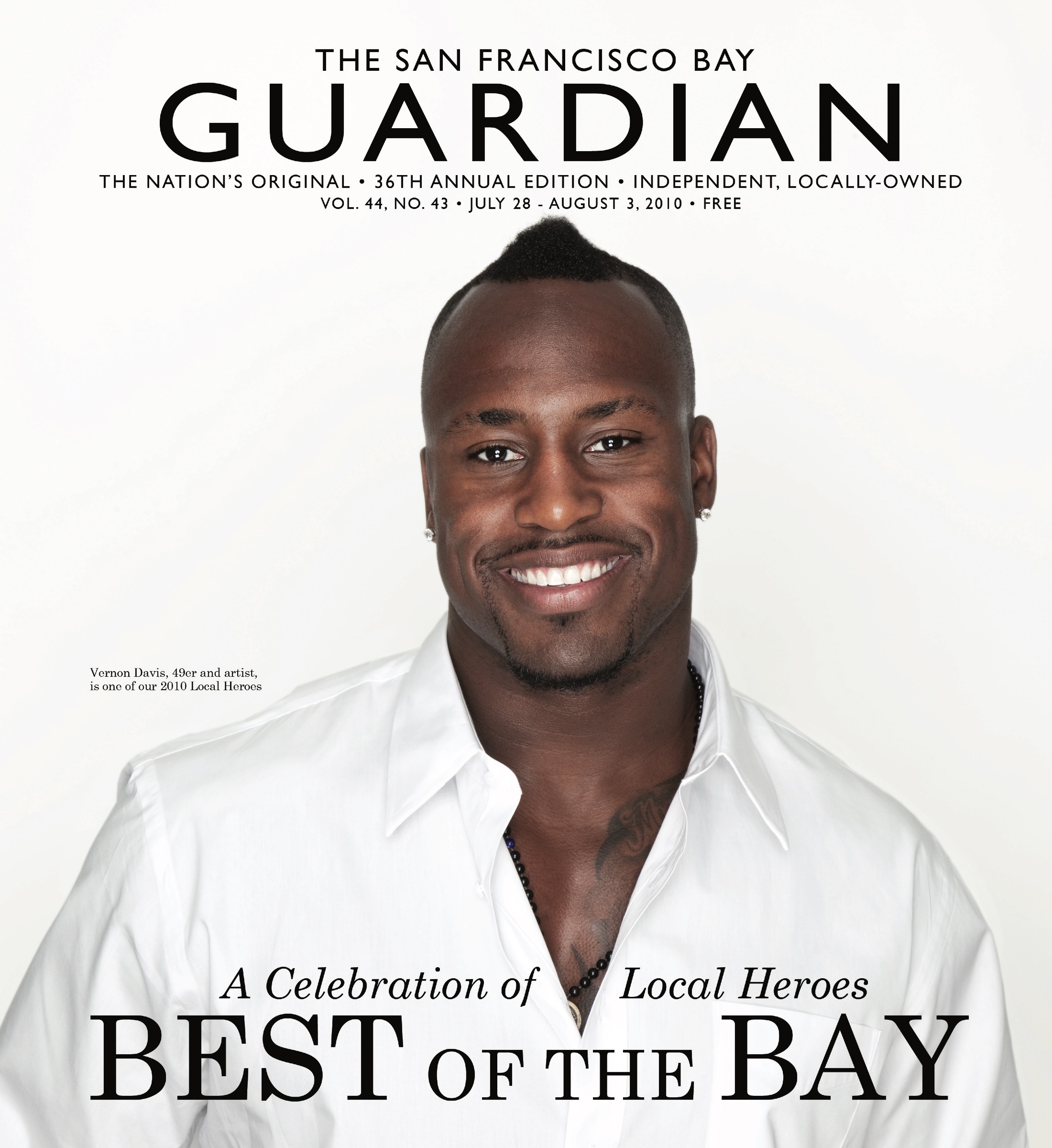
Welcome to the San Francisco Bay Guardian’s Best of the Bay 2010! This is our 36th annual celebration of the people, places, and things that make living here such a ridiculous joy — from Best Burrito and Best Amateur Sports Team to Best Strip Club and beyond.

Thousands of our readers voted in our 2010 Best of the Bay Readers Poll for their favorites in more than 200 categories. You’ll find the results inside — as well as 150 Editors Picks that highlight some Guardian favorites, old and new, that we think deserve special recognition for lighting up our lives this year.

This year our theme is “A Celebration of Local Heroes.” We’ve chosen eight individuals who we feel embody the current spirit of the Bay Area and its unique values. We hope you’ll be as inspired by their stories as we are. But really, our readers and everyone who contributes to making the Bay Area a better place to live are our local heroes. So throw on that magic cape, hop on your pedal-powered Batmobile, and let’s do it!

In 1974, Esquire magazine asked us for ideas for its Best of the USA issue, which led to us publish the original Best of the Bay. Made by the people of the Bay Area for the people of the Bay Area, it’s our annual opportunity to celebrate the people and places that make this city great. We were the first weekly paper to publish a regular “best of” issue. Thirty-six years on — and 44 years after we opened our doors — we’re still going strong.

Editing this year’s installment was a hoot. I shower grateful smooches on all my collaborators, especially my right-hand amiga Caitlin Donohue, creative wiz Mirissa Neff, amazing Local Heroes photographers Keeney + Law, the totally rad Blue Sky Studios, photographer Ben Hopfer, and the ever-supportive Hunky Beau, my own personal Best of the Bay. But most of all I thank you, dear reader, for your generous participation, for making the Bay Area such an astounding place to live, and for turning us on to some great new things this year.

Marke B.

marke@sfbg.com


CELEBRATE WITH US!

The Guardian’s free annual Best of the Bay party is legendary — and you won’t want to miss this one. Schmooze with all the winners at Mezzanine! Rock out with Chuck Prophet, Stephanie Finch and the Company Men, and The Bitter Honeys. Thrill to the hip-hop improv of The Freeze! DJ Ome, Polite in Public photobooth, Burgermeister truck, and more!

Thursday, Aug. 5, 9 p.m., free

Mezzanine, 444 Jessie, SF.

www.sfbg.com/bestofthebay2010


BEST OF THE BAY STAFF

BEST OF THE BAY EDITOR

Marke B.

CREATIVE DIRECTOR

Mirissa Neff

EDITORIAL ASSISTANCE

Caitlin Donohue

ASSISTANT ART DIRECTOR

Ben Hopfer

LOCAL HEROES PHOTOGRAPHY

Keeney + Law

PHOTOGRAPHY LOCATION

Blue Sky Studios

CONTRIBUTING WRITERS

Rebecca Bowe, Bruce B. Brugmann, Kimberly Chun, Paula Connelly, Caitlin Donohue, Cheryl Eddy, Nicole Gluckstern, Johnny Ray Huston, Steven T. Jones, Virginia Miller, Tim Redmond, Paul Reidinger, Charles Russo, Amber Schadewald, David Schnur, Diane Sussman, Stephen Torres

BEST OF THE BAY PHOTOGRAPHY

Ben Hopfer, Mirissa Neff

COPY EDITORS

Caitlin Donohue, Diane Sussman

SPECIAL ASSISTANCE

Liz Brusca, Michelle Neville

ABOUT THE PHOTOGRAPHY

KEENEY + LAW

Michael Keeney and Jasmine Law met at the Brooks Institute of Photography. It didn’t take long for them to realize that their approaches complemented one another. Together they are Keeney + Law, a team that successfully balances being both professional and life partners. In photography, their shared vision is based around the idea of a vignette, where every photo is a short story with an emphasis on good light. Always striving to connect with their subjects, Keeney + Law’s collaborative process was a perfect fit for this year’s Local Heroes portrait project.

www.keeneyandlaw.com

BLUE SKY STUDIOS

The Guardian’s Local Heroes portraits were shot at Blue Sky Studios in San Francisco (with the exception of Vernon Davis, who was shot on location by Peter Bohler). We used Blue Sky’s state-of-the-art Light Grid, which is the first fully robotic lighting mechanism of its kind.

www.blueskysf.com

BEST OF THE BAY 2010

0

Welcome to the San Francisco Bay Guardian’s Best of the Bay 2010! This is our 36th annual celebration of the people, places, and things that make living here such a ridiculous joy — from Best Burrito and Best Amateur Sports Team to Best Strip Club and beyond.

Thousands of our readers voted in our 2010 Best of the Bay Readers Poll for their favorites in more than 200 categories. You’ll find the results inside — as well as 150 Editors Picks that highlight some Guardian favorites, old and new, that we think deserve special recognition for lighting up our lives this year.

This year our theme is “A Celebration of Local Heroes.” We’ve chosen eight individuals who we feel embody the current spirit of the Bay Area and its unique values. We hope you’ll be as inspired by their stories as we are. But really, our readers and everyone who contributes to making the Bay Area a better place to live are our local heroes. So throw on that magic cape, hop on your pedal-powered Batmobile, and let’s do it!

In 1974, Esquire magazine asked us for ideas for its Best of the USA issue, which led to us publish the original Best of the Bay. Made by the people of the Bay Area for the people of the Bay Area, it’s our annual opportunity to celebrate the people and places that make this city great. We were the first weekly paper to publish a regular “best of” issue. Thirty-six years on — and 44 years after we opened our doors — we’re still going strong.

Editing this year’s installment was a hoot. I shower grateful smooches on all my collaborators, especially my right-hand amiga Caitlin Donohue, creative wiz Mirissa Neff, amazing Local Heroes photographers Keeney + Law, the totally rad Blue Sky Studios, photographer Ben Hopfer, and the ever-supportive Hunky Beau, my own personal Best of the Bay. But most of all I thank you, dear reader, for your generous participation, for making the Bay Area such an astounding place to live, and for turning us on to some great new things this year.

CELEBRATE WITH US

The Guardian’s free annual Best of the Bay party is legendary — and you won’t want to miss this one. Schmooze with all the winners at Mezzanine! Rock out with Chuck Prophet, Stephanie Finch and the Company Men, and The Bitter Honeys. Thrill to the hip-hop improv of The Freeze! DJ Ome, Polite in Public photobooth, Burgermeister truck, and more!

Thursday, Aug. 5, 9 p.m., free

Mezzanine, 444 Jessie, SF.

www.sfbg.com/bestofthebay2010


BEST OF THE BAY STAFF

BEST OF THE BAY EDITOR

Marke B.

CREATIVE DIRECTOR

Mirissa Neff

EDITORIAL ASSISTANCE

Caitlin Donohue

ASSISTANT ART DIRECTOR

Ben Hopfer

LOCAL HEROES PHOTOGRAPHY

Keeney + Law

PHOTOGRAPHY LOCATION

Blue Sky Studios

CONTRIBUTING WRITERS

Rebecca Bowe, Bruce B. Brugmann, Kimberly Chun, Paula Connelly, Caitlin Donohue, Cheryl Eddy, Nicole Gluckstern, Johnny Ray Huston, Steven T. Jones, Virginia Miller, Tim Redmond, Paul Reidinger, Charles Russo, Amber Schadewald, David Schnur, Diane Sussman, Stephen Torres

BEST OF THE BAY PHOTOGRAPHY

Ben Hopfer, Mirissa Neff

COPY EDITORS

Caitlin Donohue, Diane Sussman

SPECIAL ASSISTANCE

Liz Brusca, Michelle Neville

ABOUT THE PHOTOGRAPHY

KEENEY + LAW

Michael Keeney and Jasmine Law met at the Brooks Institute of Photography. It didn’t take long for them to realize that their approaches complemented one another. Together they are Keeney + Law, a team that successfully balances being both professional and life partners. In photography, their shared vision is based around the idea of a vignette, where every photo is a short story with an emphasis on good light. Always striving to connect with their subjects, Keeney + Law’s collaborative process was a perfect fit for this year’s Local Heroes portrait project.

www.keeneyandlaw.com

BLUE SKY STUDIOS

The Guardian’s Local Heroes portraits were shot at Blue Sky Studios in San Francisco (with the exception of Vernon Davis, who was shot on location by Peter Bohler). We used Blue Sky’s state-of-the-art Light Grid, which is the first fully robotic lighting mechanism of its kind.

www.blueskysf.com

Best of the Bay 2010 Readers Poll: Shopping

0

2010 READERS POLL WINNERS:

SHOPPING


BEST INDEPENDENT BOOKSTORE

Green Apple

506 Clement, SF. (415) 387-2272, www.greenapplebooks.com


BEST USED BOOKSTORE

Green Apple

506 Clement, SF. (415) 387-2272, www.greenapplebooks.com


BEST SPECIALTY BOOKSTORE

Green Arcade

1680 Market, SF. (415) 431-6800, www.thegreenarcade.com


BEST COMIC BOOK STORE

Isotope

326 Fell, SF. (415) 621-6543, www.isotopecomics.com


BEST MAGAZINE SELECTION

Fog City News

455 Market, SF. (415) 543-7400, www.fogcitynews.com


BEST PLACE TO BUY VINYL

Amoeba

1855 Haight, SF. (415) 831-1200; 2455 Telegraph, Berk. (510) 549-1125, www.amoeba.com


BEST PLACE TO BUY CDS

Amoeba

1855 Haight, SF. (415) 831-1200; 2455 Telegraph, Berk. (510) 549-1125, www.amoeba.com


BEST PLACE TO RENT MOVIES

Lost Weekend

1034 Valencia, SF. (415) 643-3373, www.lostweekendvideo.com


BEST GROCERY STORE

Rainbow

1745 Folsom, SF. (415) 863-0620, www.rainbowgrocery.org


BEST CLOTHING STORE (WOMEN)

Ambiance

Various locations, SF. www.ambiancesf.com


BEST CLOTHING STORE (MEN)

Sui Generis

2265 Market, SF. (415) 437-2265, www.suigenerisconsignment.com


BEST CLOTHING STORE (KIDS)

Chloe’s Closet

451 Cortland, SF. (415) 642-3300, www.chloescloset.com


BEST LOCAL DESIGNER

Colleen Mauer

(415) 637-7762, www.colleenmauerdesigns.com


BEST VINTAGE CLOTHING STORE

Crossroads

Various Bay Area locations. www.crossroadstrading.com


BEST THRIFT STORE

Thrift Town

2101 Mission, SF. (415) 861-1132, www.thrifttown.com


BEST SHOE STORE

Shoe Biz

Various locations, SF. www.shoebizsf.com


BEST FURNITURE STORE

Therapy

Various Bay Area locations. www.shopattherapy.com


BEST FLEA MARKET

Alameda Point Antiques and Collectibles Fair

Main and Navy, Alameda. (510) 522-7500, www.antiquesbybay.com


BEST HARDWARE STORE

Cole Hardware

Various locations, SF. www.colehardware.com


BEST TOY STORE

The Ark

Various Bay Area locations. www.thearktoys.com


BEST SHOP FOR PARENTS-TO-BE

Peek-A-Bootique

1306 Castro, SF. (415) 641-6192, www.peekabootiquesf.com


BEST BIKE SHOP

Valencia Cyclery

1065 and 1077 Valencia, SF. (415) 550-6601, www.valenciacyclery.com


BEST PET SHOP

Cheengoo

2250 Union No. 1A, SF. (415) 337-8481, www.cheengoo.com


BEST PLACE TO BUY EYEWEAR

Eye Gotcha Optometric

586 Castro, SF. (415) 431-2988, www.eyegotchasf.com


BEST CANNABIS CLUB

Harborside

1840 Embarcadero, Oakl. (510) 533-0146, www.harborsidehealthcenter.com


BEST STORE STAFF

Community Thrift

623 Valencia, SF. (415) 861-4910, www.communitythriftsf.org


BEST QUIRKY SPECIALTY STORE

Paxton Gate

824 Valencia, SF. (415) 824-1872, www.paxtongate.com


BEST ECO-FRIENDLY RETAILER

Green Arcade

1680 Market, SF. (415) 431-6800, www.thegreenarcade.com


BEST SPORTING GOODS STORE

Sports Basement

Various Bay Area locations. www.sportsbasement.com


BEST PLACE TO BUY CAMPING GEAR

REI

Various Bay Area locations. www.rei.com


BEST FLOWER SHOP

Church Street Flowers

212 Church, SF. (415) 553-7762, www.churchstreetflowers.com


BEST PLACE TO BUY LINGERIE

Agent Provocateur

54 Geary, SF. (415) 421-0229, www.agentprovocateur.com


BEST PLACE TO BUY SEX TOYS

Good Vibrations

Various Bay Area locations. www.goodvibes.com


BEST PLACE TO BUY FETISH GEAR

Madame S

385 Eighth St., SF. (415) 863-9447, www.madame-s.com


BEST ADULT VIDEO STORE

Folsom Gulch

947 Folsom, SF. (415) 495-6402


Best of the Bay 2010 Readers Poll: City Living

0

2010 READERS POLL WINNERS:

CITY LIVING


BEST LOCAL BLOG

SFist

www.sfist.com


BEST LOCAL WEBSITE

Funcheap SF

www.sf.funcheap.com


BEST ONLINE PERSONALS

Craigslist

www.craigslist.org


BEST POLITICIAN

Gavin Newsom


BEST LOCAL NONPROFIT

GLBT Historical Society

657 Mission, SF. (415) 777-5455, www.glbthistory.org


BEST TV NEWSCASTER

Dana King, CBS 5


BEST LOCALLY PRODUCED TV SHOW

Distortion 2 Static

www.distortion2static.ning.com


BEST RADIO STATION

KFOG, 104.5 FM

www.kfog.com


BEST RADIO DJ OR SHOW

DJ Deevice, Gridlock

www.piratecatradio.com


BEST STREET FAIR

Folsom Street Fair

www.folsomstreetfair.com


BEST HOTEL

Hotel Whitcomb

1231 Market, SF. (415) 626-8000, www.hotelwhitcomb.com


BEST TOURIST ATTRACTION

Golden Gate Bridge


BEST PLACE TO GET A TATTOO

Black and Blue Tattoo

381 Guerrero, SF. (415) 626-0770, www.blackandbluetattoo.com


BEST TATTOO ARTIST

Idexa at Black and Blue


BEST LOCAL ANIMAL RESCUE

Rocket Dog Rescue

www.rocketdogrescue.org


BEST DOG-WALKING SERVICE

Dog Tales Walking and Sitting Service

(415) 948-3840, www.dogtalesunleashed.com


BEST PET GROOMER

VIP Grooming

4299 24th St., SF. (415) 282-1393


BEST VETERINARIAN

Mission Pet Hospital

720 Valencia, SF. (415) 552-1969, www.missionpet.com


BEST DENTIST

Paul Y. Lin, DDS

82 Townsend, SF. (415) 543-6882, www.paulylindds.com


BEST DOCTOR

Erika Horowitz, ND

(415) 643-6600, www.sfnatmed.com


BEST PLUMBER

Heise’s Plumbing

260 Ocean, SF. (415) 333-0704


BEST ELECTRICIAN

Ike’s Electric

3546 19th St., SF. (415) 861-6417, www.ikeselectric.com


BEST MOVING SERVICE

Delancey Street Moving and Trucking

600 Embarcadero, SF. (415) 512-5110, www.delanceystreetfoundation.org


BEST MASSAGE THERAPIST

Joshua Alexander, CMT

(415) 691-4076, www.joshuaalexandercmt.com


BEST ALTERNATIVE HEALING

Immune Enhancement Project

3450 16th St., SF. (415) 252-8711, www.iepclinic.com


BEST COUPLES COUNSELOR

Marriage Prep 101

417 Spruce, SF. (415) 905-8830, www.marriageprep101.com


BEST CAR MECHANICS

Pat’s Garage

1090 26th St., SF, (415) 647-4500, www.patsgarage.com


BEST MOTORCYCLE MECHANICS

Werkstatt

3248 17th St., SF. (415) 552-8115, www.werkstattsf.com


BEST BICYCLE MECHANICS

Box Dog Bikes

494 14th St., SF. (415) 431-9627, www.boxdogbikes.com


BEST SALON

Public Barber Salon

571 Geary, SF. (415) 441-8599, www.publicbarbersalon.com


BEST MASSAGE

In-Symmetry

2221 26th St., SF. (415) 294-5004, www.insymmetry.com


BEST DAY SPA

Blue Turtle

57 West Portal Ave., SF. 170 Columbus, SF. (415) 699-8494, www.blueturtlespa.com


BEST SHOE REPAIR

Anthony’s Shoe Service

30 Geary, SF. (415) 781-1338


BEST TAILOR

Cable Car Tailors

200 O’Farrell, SF. (415) 781-4636


BEST LAUNDROMAT

Brain Wash

1122 Folsom, SF. (415) 431-9274, www.brainwash.com


BEST GYM

Mission Cliffs

2295 Harrison, SF. (415) 550-0515, www.touchstoneclimbing.com


BEST PERSONAL TRAINER

Xavier McClinton, Body by X

5768 Paradise, Corte Madera. (415) 945-9778, www.bodybyxonline.com


BEST YOGA STUDIO

Monkey Yoga Shala

3215 Lakeshore, Oakl. (510) 908-1694, www.monkeyyoga.com


BEST PROFESSIONAL ATHLETE

Tim Lincecum


BEST AMATEUR SPORTS TEAM

Fog Rugby

www.sffog.org


BEST PUBLIC SPORTS FACILITY

Kezar Stadium

755 Stanyan, SF.


BEST PUBLIC POOL

Mission Pool

1 Linda, SF. (415) 641-2841


BEST BEACH

Baker Beach


BEST PARK

Golden Gate Park


BEST NATURE SPOT FOR PEOPLE WITH DISABILITIES

Muir Woods


BEST CAMPGROUND

Angel Island


BEST CAMP FOR KIDS

Tree Frog Treks

www.treefrogtreks.com


BEST PARK FOR DOGS

Fort Funston


BEST SKATE SPOT

Potrero Del Sol


BEST SURF SPOT

Ocean Beach

Best of the Bay 2010 Editors Picks: Shopping

0


Best of the Bay 2010 Editors Picks: Shopping


BEST SUBJUGATION TO A QUEEN

Well before colony collapse disorder became a phrase of terror, Bay Area bee geeks were eyeing their neglected backyard anise and eucalyptus plants as potential ambrosial fill-up stations for honeybees. In 2008, Her Majesty’s Secret Beekeeper entered the scene, giving the city’s swelling ranks of colonial wannabees the ultimate sweet spot: a one-stop source for everything Apoidea. The clean, light-filled store — which has the distinction of being the only urban beekeeping store in the country — stocks backyard starter kits and supplies, those fabulous white hazmat-style suits (and really, haven’t you always wanted one for demonstrations or Halloween?) beeswax candles, books, bee DIY products (i.e., honey and honeycombs), and, yes, bees. Let’s face it, you haven’t really tasted SF or embraced its hive mentality until you’ve drizzled some Gold Fine Crystal over your locally baked artisanal bread.

3520 20th St., SF. (415) 744-1465. www.hmsbeekeeper.com


BEST STEAMY SHOPPING

Shopping at P-Kok can be exhausting. You have to the cross the street, sometimes several times, just to take in all the cute clothes, bags, jewelry, scarves, etc. (and all at affordable prices) at P-Kok’s two Haight Street locations. It’s enough to make you want to find a tranquil garden, flop down on a chaise lounge with a beverage, and soothe your weary self with a sauna. At the P-Kok on the even side of the street (the one at 776 Haight), you can. Formerly the site of a day spa, P-Kok has preserved and replanted the inherited backyard garden sauna — renamed Eden — and rents it for $15 an hour. The best part: it accommodates up to 10. Packed like sardines or solo, it’s the perfect antidote to bustling Haight Street— and the perfect refreshment before going back out into P-Kok(s) and loading up on more cute stuff.

776 Haight, SF. (415) 503-1280, www.pkoksf.com


BEST PLACE TO PLAY FOOTSIE

Distraction is the enemy of sock shopping — you came for ultrathin running socks, but omigod, the store has lilac suede Fluevogs with four-inch heels! Before you know it, you’re out $250 and you still have no socks. That cannot happen at SockShop Haight Street. The small, newish, locally-owned store has nothing but socks and sock-related habiliment, including high socks, low socks, toe socks, boot socks, jock socks, kids socks, dad socks, tights, slipper-socks, and sock monkeys. And within those categories, SockShop goes way deep with wool socks, striped socks, plain socks, dot socks, cotton socks, argyle socks, cashmere socks, skull socks, floral socks, flag socks, food socks, animal socks, music socks, holiday socks, fox socks, blocks socks, and rocks socks … Really, need we say more?

1780 Haight, SF. (415) 396-5400, www.sockshoponhaight.com


BEST MAJOLICA RUSH

OK, not all of us can afford to buy some ancient heap of stones fixer-upper villa in Siena where, caressed by sun and Italian hunks, we blossom into writers (bite us, Under the Tuscan Sun and Bella Tuscany). No, we must make do in our fog-shrouded garrets, scrounging for dropped change for a $2 cappuccino. But at some point, we can all afford to splurge on at least one small piece of authentic Italian splendor to add luster to our hardscrabble lives. That’s when we head to Biordi Art Imports in North Beach, a floor-to-ceiling treasure trove of hand-painted Majolica ceramics. And once you start sipping your coffee from a gorgeous De Simone mug or spooning your gruel from a colorful Eurgenio Ricciarelli bowl, the virtual sunlight comes rushing in. You won’t miss that stinkin’ villa at all. Maybe the hunks.

412 Columbus, SF. (415) 392-8096, www.biordi.com


BEST CACHE OF GRACE NOTES

Be it ever so humble or token, city dwellers always seem to crave some connection to the natural world: the single bathroom orchid, the three desktop seashells, the rock and glass arrangement lining the windowsill. When it comes to finding these small grace notes (outside of illicitly pocketing them from Glass Beach or Muir Woods), our vote goes to Xapno. The small one-woman shop in the Lower Haight offers a beautiful and fragrant cornucopia of the best that nature and humanity create: fresh and dried flowers, plants, vases, candles, jewelry, cards, shells, branches, cacti, books, paper, paintings, and sometimes clothes and shoes. Furthermore, about half the artists are local, including a ceramics student at City College who has been baking baskets-full of delicate ceramic roses in varying shades of ivory, peach, and pink.

678 Haight, SF. (415) 863-8199, www.xapno.com


BEST GIRLY GIFTERIA

Ombre feather earrings, Hollywood Regency lamps, and two-headed chicks by way of the taxidermist — that’s what BellJar is made of. Less evocative of Sylvia Plath’s total collapse than a delicate glass chamber filled with oodles of fascinating objects, the Mission boutique has made a name for itself as the discriminating gothette or vintage girl’s go-to for unique tchotchkes and gifts for loved ones — or, better yet, one’s own bad, sweet self. Here, and on the store’s recently revamped website, you’ll find delightfully retro-esque and oh-so-womanly clothing, witty trinkets that draw inspiration from nature’s bounty, exquisite earrings and necklaces, and founder Sasha Darling’s dark-femme ‘n’ fabulous eye for the Francophile, the girly, and the gorgeously Grimm.

3187 16th St., SF. (415) 626-1749, www.shopbelljarsf.com


BEST HANDCRAFTED NIP-HUGGERS

Seductively snug latex over a perfectly pert nipple — yes, please! Skip the tassels, beads and sequins, and go for a super-sexy set of pasties that show off your breasts and hint at the budding shape beneath. The Heartbreaker pasties by Madame S are individually fashioned by hand in the SoMa fetish wear and sex shop’s very own latex production lab by Madame’s devilishly talented crafters. Hidden in the back behind kinky-costumed mannequins and closed doors, your breast’s friend is taking on a cute, heart-shaped form right now and you should be anticipating ways to fit them into your daily wardrobe. Traditional black- and red-rimmed, these pasties are coquettish, classy, and come-hither all at once. Guaranteed to make jaws drop and temperatures rise with appreciation.

385 Eighth St., SF. (415) 863-9447, www.madame-s.com


BEST GOLD-GILDED GUIGNOL

Nothing celebrates life more than death — or at least, nothing is more invigoratingly creepy than opening a beautifully wrapped gift to find a life-size crown of thorns made with an assortment of deceased birds’ legs. Haight boutique Loved to Death is stocked with goose-bump inflicting fancies, many of which are gold-encrusted and way more thought-provoking than a living bouquet. Say “I love you” with a 24-karat badger-claw brooch, surprise him with a scorpion in a vial, or show her you care by putting an antique baby doll head under her pillow. Taxidermy (no animals were killed in the making — they were dead already), resurrected art, antiques, and goth-hip jewelry are way more fun when they test your lover’s limits. And if your delicate beloved can’t handle your purchase, you’ll get to keep the muskrat mandible gold-gilded earrings yourself.

1681 Haight, SF. (415) 551-0136, www.lovedtodeath.net


BEST HOMEGROWN DISNEY ALTERNATIVE

“We want to make things that have joy and humor, but that people aren’t embarrassed to have lying around their house,” says Gama-Go cofounder Greg Long. When Long and Chris Edmundson quit their day jobs at an East Bay toy company 10 years ago, they were following a dream to make well-designed, cartoon-inspired clothing and products that played off the enormously popular, collectible-crazy pop surrealism movement happening in L.A. at the time. It was a vision that launched a thousand T-shirts. Today, some of Gama’s cute-with-bite stock characters like Tigerlily, DeathBot, and that cuddly ice-bluish fave, Yeti, are common sights on city streets, clubbers’ chests, and shopaholics’ totes. And now there’s Go for your pad too. Guitar-shaped spatulas and “pot” holders that resemble big old Mary Jane leaves make perfect gifts for that urban class clown.

335 Eighth St., SF. (415) 626-1213, www.gama-go.com


BEST SMELL OF AEROSOL IN THE MORNING

Photo by Ben Hopfer

Screw a monument and urban planning: we live in City Beautiful. Walk down nearly any street in SF and there on the pavement and buildings you will find the stencils, murals, super burners, tags, and — how do you say? — art that makes this town rich in color, rich in mind. So where does the discerning street artist go for the tools and gear she needs to make these blocks pop? It’s gotta be 1:AM gallery, where prices on paint pens and aerosol spray trump the art supply and hardware stores every time. (1:AM as in “First Amendment” — and a tagger’s preferred rise and shine.) Not to mention the whole gallery side of the space, which hosts some of the most original sometimes-street artists around — who often tag the outside of the store’s Sixth Street walls in kaleidoscopic temporary letterings and designs.

1000 Howard, SF. (415) 861-5089, www.1amsf.com


BEST MAKEUP AS DRAMATIC AS YOU ARE

Word to the aspiring pageant queens: (apparently) it’s not all about the Vaseline on the teeth and duct-taped boobs. You want that crown, you need a face full of grade-A goos and glosses — and we know just the place to get them, girl. Kryolan Professional Makeup has been in the primp game since 1942, plumping and perking a passel of pretties, including the 2010 Miss USA contestants. But maybe you’re a DIY kind of queen? All good — Kryolan’s got a kaleidoscopic showroom full of the glitz and glamour for them bright lights, including glitter in animal, vegetable, and mineral form (the company produces more than 16,000 products in 750 colors — over the top, just like you!). If you need help slopping it on in style, or just some tips on how to blend with a little subtlety, then strut, mamma, strut to application classes in the same building.

132 Ninth St., SF. (415) 863-9684, www.kryolan.com


BEST RUN TO FREEDOM

Better circulation, cardiovascular health, time to reflect: running makes you free. (Especially if it’s away from an out-of-shape cop.) But pounding these city streets can be tough on the joints and bones. You’d like a little freedom from aching discomfort as well. So jog over to On the Run, an Inner Sunset shoe store that specializes in helping peeps in pain — seriously, half the store’s first-time customers arrive with a doctor’s referral. Its trained staff will send you for a walk on an electronic pad that measures foot pressure, plus pronation and supination (both refer to the angle at which your foot hits the block). They use a fancy device to measure your feet accurately, then hook you up with some sweet kicks that have you feeling fit, fast, and fab. You pay a bit more for all this podiatric prognostication, but hey, all runners know there’s gotta be some pain in the gain.

1310 Ninth Ave., SF. (415) 665-5311, www.ontherunshoes.com


BEST SUCCOR FOR SUCCULENTS

The fog makes a great excuse for those with black thumbs. Usually we can blame our houseplants’ premature striptease of this mortal coil on the clouded vagaries of our mini-ecosystem. However, even fact-based finger-pointing fails when it comes to the death of a beloved succulent. One simply should not be able to kill a cactus. And yet one does. Sigh. Should your astrophytum be stymied or your once-verdant aloe shade into an unbecoming red, Succulence is there. This secret garden store is hidden away on a Bernal Heights video store’s back patio, packed with many a bulbous, spiny, or just plain prickly new friend for you to take home in an inventive recycled planter. But don’t ditch that sickly chum languishing in your window box! Succulence also mixes a special soil blend that can resuscitate even the saddest looking ball o’ spikes.

402 Cortland, SF. (415) 282-2212


BEST TEMPLE OF LIFE

In some lovely, distant universe, all we buy are magnificent orchids, and all the money goes to AIDS prevention and relief organizations. This impractically gorgeous fantasy becomes reality at nonprofit Orchid Mania’s beautifully named Orchid Temple, based in an unassuming house in the Excelsior District that contains a three-climate greenhouse. OM has packed its temple with orchids that resemble dancing ladies, some smelling of blood (all the better to woo their insect pollinators), that will stop your housemates in their tracks with their glory on your kitchen table. Call ahead to alert the temple guards — or show up during the all-volunteer operation’s open orchard hours, 11 a.m.-2 p.m. Sundays — and take your time browsing for a worthy cause. The temple also functions as a bulb foster home to keep rare species from extinction. Let’s just say they’re into the preservation of beautiful lives all around.

717 Geneva, SF. (415) 841-1678, www.orchids.org


BEST ONE-STOP SKULL SHOP

You can’t walk by Martin’s 16th Street Emporium without ogling the ghoulish delights displayed in the windows. Casual strollers might be forgiven for thinking the place is called “The Skull Store” — an apt description, anyway, considering that the store is stuffed floor-to-ceiling with skulls galore. Though it’s not open very often (try Thurs.-Sat. afternoons — look for the pirate flag out front), it’s well worth a special visit to pick up a gift for your favorite skull collector. Sterling silver jewelry is the main attraction, with everything from dangerous-looking knuckle-duster rings (scary skull!) to delicate pendants and earrings (fashion skull!). It also carries skull figurines and other knickknacks, not all of them skull-related, but many of them vintage. Imagine stumbling upon an uber-cool, slightly spooky estate sale. If the estate was owned by Cap’n Blood, that is.

3248 16th St., SF. (415) 552-4631, www.skullsinsf.com


BEST STASH OF CULTURED BOOTIE

Do you need a dashiki-looking starter jacket, a grafted Italian fresco, an antique colored glass chandelier — like, yesterday? Friend, welcome to the power of collection. And welcome to Cottage Industry, the domain of a one Claudio Barone. The Italian-born Barone has spent the last 22 years traipsing about the globe, purchasing goods from indigenous craftspeople (at prices reasonable to all parties involved), and then retreating to Fillmore, treasure secured and ready to be squeezed into his darling shop — waiting for the day when you must, absolutely, positively, have that carved ebony figurine from the Congo, right away! Even if your mission lacks a hysterical level of urgency, do drop by. The piled shelves of goods ranging in price from 10 cents to $30,000 will either heighten or assuage the most pressing case of wanderlust.

2326 Fillmore, SF. (415) 885-0326


BEST FOLDING FANATICS

A gorilla sits in Japantown’s classic origami store. She’s squat and a little wrinkly, but say what you want about her lumps and rolls, she’s fantastically multidimensional — and even carries a little baby on her back. You can expect that kind of artistic wonder from Paper Tree, opened by the Mihara family in 1978 and run to this day by sisters Vicky and Linda, who constructed the primate in question. Not only can their shop meet your most fantastical origami needs (and those for quirky Japanese “office supplies” like sushi-shaped erasers and beribboned money envelopes), but the Miharas are serious about taking a role in their neighborhood community. Their lively origami classes and art, a staple for the last 43 years at the Cherry Blossom Festival, are testament to their desire to share the love of a good fold.

1743 Buchanan, SF. (415) 921-7100, www.paper-tree.com


BEST BEACHY DREAMS

There are those who blow and bluster about the lack of true beach weather in our city of rolling fog. And then there are those that smile and manifest sunbeams. Of the latter faction is Meggie White, whose Marina boutique, .meggie., imparts the same hope for rays as its fetching blonde owner. A breezy interior of hardwood and weathered white fixtures plays snazzy backdrop to .meggie.’s wonderland: fly floral sundresses share racks with the thinnest of sherbet-colored tees and cardigans. So stock up — what if that freak summer sunburst pokes through, and you without your pastels! .meggie. stocks several local designers, and White herself makes a supremely sand-worthy line of hand-forged silver, stone, and shell jewelry. So much more fun than that panicked schlep to J.Crew.

2277 Union, SF. (415) 525-3586, www.meggiejewelry.com


BEST SOLUTION TO THE OMNIVORE’S DILEMMA

Stymied on the menu for tonight’s dinner? Try this: start with a solid base of local, independent business, add two cups of foodie focus, stir in equal parts retro chic and current craze, bake with a product no one can get enough of, and never allow to cool (serve each slice with a celebrity sighting.) Problem solved! Such is the taste of your new culinary North Star, Omnivore Books, which happens to be the hawtest cookbook-only lit shop in Noe Valley. Owner Celia Sack has stocked her shelves with yummy tomes both new and old, and the small space packs in hungry audiences for its stellar author events. Recent speakers have included New York Times food writer Frank Bruni and local cheesemonger Gordon Edgar. It’s enough food inspiration to sate the least decisive dining divas among us.

3885 Cesar Chavez, SF. (415) 282-4712, www.omnivorebooks.com


BEST TL ROUGHNECKS

So you’re headed to psych class at City College one day when, on a dime, you say forget it — I’m going to follow my love and start a mini-skateboard empire in the Tenderloin instead. Welcome to the life of Johnny Roughneck. The boarder opened tee shirt treasure trove Dwntwn Skate Supply to hawk his Roughneck line of skate hardware and give a hand to new designers, like those of TL-repping clothing line The Loin, all while establishing a let’s-have-fun attitude in a neighborhood that often has its odds stacked against it. Occasional barbeques out on the Hyde Street pavement have given the shop some presence on the block, and Dwntwn has even played jump-off to some wildly legit skating events. Check out the video of the Roughneck crew’s 2010 Caltrain tour for Bay skating inspiration.

644 Hyde, SF. (415) 913-7422, www.dwntwnsf.com


BEST PRINTER WITH A PURPOSE

Raising your fist is all well and good, but if your arm gets tired, you’ll want that rebel yell printed on your T-shirt for good measure. After helping to found the Mission’s community screen-printing shop, Mission Gráfica, radical artist Jos Sanches opened Alliance Graphics in 1988. He needed a place where he could continue to churn out his poster print protests against the world’s various sources of evil (capitalism, neoimperialism, commercialism, and a busted justice system, to name some of his faves) — and still be a resource for the progressive causes that to this day need a voice on the street. Does your war cry scream out to be monogrammed on a bumper sticker, backpack, or umbrella? Alliance can get the job done right, with union labor and made in the USA products to boot.

1101 Eighth St., Berk. (510) 845-8835, www.unionbug.com


BEST FAST TRACK TO THRIFT BLISS

Lord, these used clothing stores. The racks of oversized leggings, the bins of kitty-appliquéd sweatshirts, the puff paint visors. (Wait, are those hip now?) Who has the time for such excavations? There are times when you just want to throw your hands in the air like you just don’t care and head to the local Anthropologie. But back down off that ledge! Delisa Sage’s Collage on Potrero Hill can be your one-stop cool kid shop when you haven’t the time to rifle through Grandma’s old church dresses. Skone-Rees has stocked her boutique with well-edited used clothing at prices not too far above Goodwill price gouges. (Her nifty store of scavenged home décor is next door.) And you’ll never find her array of locally-made jewelry and well-preserved boots and slippers at any Salvation Army. But be forewarned: Collage’s collection of late 1990s failed tech startup mascot hats is a bit lacking.

1345 18th St., SF. (415) 282-4401, www.collage-gallery.com


BEST BOUTIQUE STARR

Is there anything that Bianca Starr owner Bianca Kaplan can’t do? After moving on from her and hubby’s bangin’ DJ spot, 222 Hyde, Kaplan turned her eyes from beats to threads — secondhand designer label threads, which her Mission boutique sells to all the fly ladies looking for a clubby, classy, strappy looks (with just a hint of “Dynasty” decadence and chola sass) in which to creature up the night. Dresses, separates, handbags, belts, jewelry, and footwear: no detail is overlooked. Always collaborative, Kaplan picks chic up-and-coming designers to feature at her packed monthly stylist boutique events, and hands them the reigns to her racks for the night. And if you happen to stroll past Bianca Starr (so-called for her childhood friend’s coolest name ever) on a sunny day, you might just catch Kaplan and her girlfriends lounging streetside with a bottle of champagne. Wearing the cutest frocks you’ve ever seen, natch.

3552 20th St., SF. (415) 341-1020, www.biancastarr.com


BEST FANTASY FABRICATORS

Photo by Ben Hopfer

The mother-in-law’s birthday approaches, and all we know is that she likes to knit socks. Maybe we can help out with her frosty feet at the ImagiKnit store we always pass in the Castro? Probably great for some yarn — maybe a little bit fusty, too, though, and maybe somewhat intimidating to those who’ve never pearled. Imagine our surprise as we enter a rainbow wonderland busting with spectacular spun materials — spiky mohair, luminous silk, titillating cashmere, speckled cotton — and staffed by immediately accommodating people who don’t want to stick needles in our naïve newbie eyes. More shock: we run into several of our hippest friends leafing through vintage pattern books and holding court at the DIY wool winders. ImagiKnit’s community vibe and vibrant stock draw us in for hours. In the end we make the momentous decision to knit those socks ourselves. Sorry about the six toes, Mom.

3897 18th Street, SF. (415) 621-6642, www.imagiknit.com


BEST NIBSTER

Fountain pen lovers are a strange bunch. We spend hundreds of dollars on something that’s part status symbol, part jewelry, part objet d’art and, oh, yes, part writing instrument. Sometimes these works of exquisite craftsmanship write beautifully; sometimes they leak, skip, spurt ink all over the paper (and our hands), and don’t write at all. That’s why Stephanie Boyette, the fountain pen expert at Flax, is our favorite nibster. She can help you pick the right pen and ink, tell you how to use acrylic flow enhancers, give you tips on maintenance, and often tell you with a quick glance why your precious pen is malfunctioning. In fact, she’s so devoted that she’s been chosen to work as an apprentice to John Mottishaw, the Los Angeles nib-repair expert who is widely regarded as the best fountain pen surgeon in America.

1699 Market, SF. (415) 552-2355, www.flaxart.com


BEST PLACE TO FLIP YOUR WIG

What’s that on your head? If it ain’t a wig, get thee to the Wig Factory, pronto, because every man, woman, boy, girl, dog, cat, bird, and goldfish needs at least one follicular embellishment to send their look into another, more fabulous dimension. The Wig Factory’s capital selection includes everything from utter realness to costume frivolity — it’s got you covered like Andre Agassi’s cranium after half a can of Ron Popeil’s spray-on hair. Devotees know that Wig Factory is subject to some controversy because of its rules limiting the number of hairpieces you can try on in a single visit, which some people complain about. Such folks conflate whining with Yelping — ignore them. Do you want to try on a wig that’s already been tested by a hundred finicky entitled shoppers who think their scalps don’t stink? We don’t think so. Queens and princesses, beauty is here, on a mannequin head. Kings and princes, you can look like Adam Lambert or a Brylcreemed silver fox in a single fitting.

3020 Mission, SF. (415) 282-4939


BEST MINTY FRESH FASHIONS

It’s easy to show your California love when it’s directed at Mint Mall, a SF-based online clothing shop that mixes fine originals with vintage finds. An appreciation for natural fabrics, an eye for vibrant eras of well-known and obscure labels, and the type of tough dedication required to make the best thrifting finds are three of the special ingredients that make up Mint Mall. But the two main factors are co-owners Corina Biliandzija and Genevieve Dodge, who teamed up over half-a-decade ago and have refined their own designs and vintage visions with each passing day. Mint Mall items are fun to wear and born from the pair’s love and enthusiasm for fashion and everyday style. Native fringe, Aztec or cartoon prints, bell-sleeved tunic tops, Grecian gold thread minis, Bergdorf Goodman floral maxis, Diane von Furstenberg silk wraps, Givenchy platforms, original hoodies — the dynamic duo behind Mint Mall work hard for your closet, so you better treat them right.

www.stores.ebay.com/the-mint-mall


BEST SWEET SHOP TO MAKE A SUPERSTAR PROUD

Even before it opened, Candy Darling had a reputation, thanks to its fabulous name and kicky red plastic sign. Passersby were left to wonder — would it be a candy shop, or a drag queen fashion emporium? Those with a sweet tooth were the ones who received the happy answer, though, to be honest, there’s something wonderfully Grey Gardens about the store’s vintage 1960s or ’70s feel. Candy Darling the Warhol superstar was utterly unique, the essence of feminine glamour, and as soft and lovely as a lilac-scented breeze. Candy Darling the corner shop is a little paradise of sea-salt caramels, milk chocolate turtles, rocky road clusters, English toffee bars, and dark chocolate-dipped candied ginger. It does its namesake proud, which is no small feat. Visit Candy Darling just once and you might never see Mrs. See again.

798 Sutter, SF. (415) 346-1500


BEST BOOK HAVEN FOR ART LOVERS

A great bookstore is almost like an inspiring place of worship, except more fun and more grounded in palpable truth. Some of San Francisco’s best bookstores are nestled into nooks, like the esoteric Bolerium, or ready to move, like 871 Fine Arts. The numbers in this tome emporium and gallery’s name are enigmatic: for years, it brought some historical heart and heft to the art biz maze that is 49 Geary, and now it’s at 20 Hawthorne, another half-hidden location. (So the name’s obviously not address-oriented; perhaps it refers to the year Viking king Bagsecg died?) Owner Adrienne Fish has developed a selection of art books that is simply second to none in SF — 871 mixes old and new titles, is well-organized, and brings a sense of depth and breadth to any movement or era. The layout and lighting are attractive and efficient, and browsers and buyers can also enjoy an art show during a visit, since Fish’s curatorial acumen regarding California art is extra-sharp.

20 Hawthorne, SF. (415) 543-5155


BEST KANDI WHEN YOU’RE RANDY

Great reasons to use a glass dildo: they last longer, they’re less likely to harbor harmful bacteria, they retain temperature well — and on first glance, they more resemble works of fine art than hump handles. It was this urge toward aesthetic excellence that compelled Samantha Liu to open Glass Kandi, the display shop for her online catalog Glass Dildo Me. Liu provides expert guidance to the adventurous singles and curious couples who grace her door, smoothly introducing them to the exact masterpiece of whorled glass and embedded metals that will rev their engines. And don’t worry if you have a lady who likes to accessorize — Glass Kandi’s arsenal of whips, wigs, jewelry, and more is tinglingly top notch.

569 Geary, SF. (415) 931-2256, www.glasskandi.com


BEST SQUEAKY-SHARP WHEELS

It’s a bad cliché. The snooty bike repair dude, sniffing down his (lensless) thick-frame glasses at your beloved, if somewhat mind-boggling, bicycle. Will he overquote you? Will he really fix the problem with due diligence? Will you regret asking him the question in the first place? Blow by those stereotypical scaries and enter the world of Roaring Mouse Cycles. Racks and racks of high-quality road, track, and mountain bikes await to be sized expertly to your frame. (Should your size not be in stock, they’ll order it for you with a perfect-fit guarantee). Plus, the racing enthusiast staff is pro enough to know exactly what your two-wheeled buddy needs to get rolling again. They pride themselves on a steel frame code of service, and definitely won’t hurt your bike — or your ego. You’ll never feel velo-vapid again!

1352 Irving, SF. (415) 753-6272, www.roaringmousecycles.com


BEST REFINED RUGGEDNESS

Photo by Ben Hopfer

Way out west, where Midwestern dreams take form, there’s a Victorian that predates the great 1906 quake. There, you’ll find men’s workwear goods refined to something like an art form. They’re well-arranged in a shop known to sport an American flag or two, not in any jingoistic way, but as a reflection of its “finest quality dry goods”: jeans, shirts, bags, boots, and other masculine items, all selected by Todd Barket, whose design eye has influenced some of the more popular mass-market clothing brands on Market Street. The attire in Unionmade is considerably pricier for the most part, but with a sharpness, durability, and practical ingenuity (they’ve carried Chester Wallace canvas bags built to fit two six-packs) you won’t find for a lower tag. While a different nearby store has Japanese denim for those whose wallets can indulge in jean dreams, Barket stocks Levi’s from the ’40s, ’50s, and ’60s, a tack that taps into the brand’s SF past and relates to it newer brands such as Woolrich and Gitman Tanner. Look for the Unionmade label, or rather, for the stamp on your bag when you’ve made a purchase.

493 Sanchez, SF. (415) 861-3373, www.unionmadegoods.com


BEST FRILLS OF A LIFETIME

If you can’t find something to geek out on in Japantown’s five-story New People Tokyo fashion mall, you’re not doing it right. But not many of the pop culture palace’s multitudinous corners have spawned their very own local subcultures — which brings us to Baby, the Stars Shine Bright, a Harajuku ministore mecca, and one of the original brands responsible for the “Sweet Lolita” dress up movement in Japan. Lady-like Lolita adherents flounce around in intensely festooned outfits otherwise seen only on the most precious of collectible baby dolls. And since this is the BSSB brand’s only U.S. retail source, pretty-pretty princesses come from far and wide to partake in the store’s frillfest of matching dresses, bonnets, Mary Janes, and parasols. For extra credit, the Lolitas can play at BSSB-organized tea parties, held at pinkies-up swank spots all over the city.

1746 Post, SF. (415) 525-8630, www.newpeopleworld.com

 

Local ‘bucha bottlers rise effervescently over booze content controversy

0

At first, we were frightened. My god, they’re taking our kombucha! But though distribution of our liquid love has drastically slowed, there’s one good thing about the ‘bucha alcohol labeling debacle: it’s been great for local businesses. That’s because while bigger companies are halting production, the small scale of the Bay Area’s local kombucha operations are allowing them to dodge the labeling problems of national chains.

In mid-June the hammer dropped. Trashy media found a way to link the sudden dearth of kombucha on shelves to Lindsey Lohan’s hot mess, but the official verdict was that the alcohol content in the live-fermentation tea drinks had tested at levels above the .5% legal limit for non-alcoholic beverages, causing a nationwide forehead slapping Eureka moment who all those who use the stuff as holistic hangover cure. Bay Area distributor UNFI stopped delivering the stuff. Whole Foods and Rainbow Grocery nearly emptied their shelves of our liquid love. GT’s, the country’s largest kombucha producer, halted production of its lines, its current voicemail stating “We are working quickly to identify the possible causes and which lot codes and or regions are being potentially affected. We are trying our best to have product back on the shelves of stores as soon as possible.”

But a few kombuchas remained serene in their squat little bottles. SoMa’s House Kombucha, which has been selling its wares in farmers markets since the fall of 2009 and bottling for stores since early this year, was one of them. “Rather than it sitting on a shelf for six months in a warehouse somewhere, we get our product to our customers pretty fast,” says founder Rana Chang. “We’re not distributing to Michigan.” The problem of heightened alcohol levels has been shown to be caused by the continued fermentation that takes place after kombucha has been bottled, usually after it has left company facilities. In other words, the longer your bottle of ‘bucha sits and waits to be shipped to you or yet another warehouse, the more boozy it will be.

So small outfits, which distribute to their local retail sources a few times a week, have a leg up on the competition. For once! “It’s about time,” says Chris Campagna of Bay Area-based Rejuvenation Company, who says his company ran “a gamut of tests” on its kombucha, but did not pull their bottles from shelves because no labeling disreprencies were found. “It’s becoming apparent the benefit of small local companies. We have to fight for the small amount of shelf space we get, but now we’re seeing an increase in volume, better presence in accounts, and new accounts on the horizon.” 

Chang also noted a considerable uptick in business and said that House is now looking for expanded facilities and to hire new staff to keep up with demand. “It’s been an extraordinary opportunity to get into some stores where [before the voluntary recalls] shelves were so crowded with other products we couldn’t get in,” she told SFBG. A full list of stores selling both Rejunevation and House are available on their websites (including health food standards Rainbow, Other Avenues, and Berkeley Bowl), so dry your eyes, hop on your trike, and head out for some pro-biotic lovin’.

Board progressives ditch their own tax measures

5

After failing to win support from the small business community for a measure that would have helped it and fearing a well-funded attack from large corporations, Board of Supervisors President David Chiu today made the motion to reject his business tax reform ballot measure.
Labor leaders have also raised concerns about not having enough resources to fight for several revenue measures on the November ballot, mostly because they are focused on approving a hotel tax increase, supporting progressive supervisorial candidates, and defeating Jeff Adachi’s measure to increase how much city employees pay for health care and into their pensions.
“There is still not consensus about whether this should move forward,” Chiu said of his measure, which also suffered from being complicated and not easy to explain in an election campaign. It would have created a more progressive payroll tax structure – increasing taxes on large corporations and lowering them on small businesses – and a commercial rent tax that also would have exempted small businesses, raising about $25 million for the city and creating hundreds of private sector jobs, according to the city’s Office of Economic Analysis.
But the fear among some progressives is that too many revenue proposals would hurt their individual chances, given that the ballot will now include a hotel tax increase, a real estate transfer tax on properties worth more than $5 million (which the board approved today on an 8-3 vote), a $10 local surcharge on vehicle license fees, and a parcel tax from the Community College District.
So Sup. Ross Mirkarimi today also abandoned his proposal to increase the city’s parking tax from 25 percent to 35 percent, which would have raised about $25 million per year. Both Chiu and Mirkarimi said their measures were good policy and would have raised desperately needed revenue, but they were bowing to political reality.
“We’re challenged by the practicality of mounting a fall campaign around these revenue measures,” Mirkarimi said at the meeting.
The board voted 10-1 to table both measures, with a dissenting vote by Sup. Chris Daly, who said, “I just disagree with that political analysis.” He said voters would consider the measures individually and “I don’t think disappearing a progressive payroll tax and progressive parking tax are going to help the real estate transfer tax.”