Local

Local hiring — and purchasing

1

EDITORIAL The local hire ordinance that the Board of Supervisors approved last week once again puts the city on the cutting edge of progressive policy. San Francisco’s law, sponsored by Sup. John Avalos, is the strongest in the country, and ultimately will mandate that 50 percent of all the people hired on public works projects live in the city.

The politics of the bill were tricky; the local building trades unions opposed it on the grounds that many of their members live out of town and that hiring decisions should be based on seniority, not on residence. But eight supervisors recognized that a local hire law not only benefits the large numbers of unemployed San Franciscans; it’s also good economic policy for the city.

Numerous studies have shown that money paid out to local residents gets spent in town, and circulates in town, and creates more economic activity. That translates into fewer social and economic costs for the city and increased tax revenue.

There are costs to the law. Someone has to monitor compliance, and that requires additional city spending. Training local workers for union jobs may raise the price of some projects. But in the end, the studies all show that keeping money in the community is worth the price.

Avalos deserves tremendous credit for negotiating with labor and other interested parties, accepting compromises that don’t damage the impact of the measure and lining up eight votes to pass it, so even if Mayor Gavin Newsom vetoes it, the board can override the veto.

Now the board ought to apply the same principle to a local purchase law.

One of the major complaints small businesses have in San Francisco is their inability to get city contracts. The qualifying process is complicated and expensive — and when big out of town corporations with plenty of resources to put together bids can also offer lower prices, locals get left out.

The city spends vast sums of money, hundreds of millions of dollars a year, buying goods and services. Every dollar that leaves town translates into far more than a dollar lost to the local economy.

In fact, a 2007 study by Civic Economics showed that 38 percent of the money spent on locally based retailers in Phoenix, Ariz., remained in town and recirculated in the local economy; only 11 percent of the money spent at chain stores stayed in town.

That’s a huge difference, and would translate into many millions of dollars for the San Francisco economy. (Over time, the impact of local hire and local purchasing laws would be much greater than the one-time burst of income expected from the America’s Cup race.)

There are complications with any local purchase law. Not everything the city needs can be bought locally. Nobody in San Francisco, for example, makes train cars or fire engines. But on everything from office supplies and cars to uniforms and consulting contracts, there are (or could be) local companies handling the city’s business.

As with the Avalos law, there would be costs. Some small local suppliers would be unable to match the price that big chains offer. But the overall economic benefits to the city would greatly exceed those price differentials.

San Francisco currently gives a modest preference in bidding to local firms. But if the supervisors applied the Avalos principle and mandated that, within five years, a certain percentage of everything the city buys would have to go to local firms, city officials would be forced to do what they ought to do anyway: look local first.

Every year during the holiday season, the mayor and business leaders urge residents to shop locally. When the new Board of Supervisors takes over in January, the members should start looking beyond rhetoric and start working on legislation that would keep the city’s money in the city.

EDITORIAL: Local hiring, and purchasing

1

Tomorrow’s Guardian editorial:

The local hire ordinance that the Board of Supervisors approved last week once again puts the city on the cutting edge of progressive policy. San Francisco’s law, sponsored by Sup. John Avalos, is the strongest in the country, and ultimately will mandate that 50 percent of all the people hired on public works projects live in the city.

The politics of the bill were tricky; the local building trades unions opposed it on the grounds that many of their members live out of town and that hiring decisions should be based on seniority, not on residence. But eight supervisors recognized that a local hire law not only benefits the large numbers of unemployed San Franciscans; it’s also good economic policy for the city.

Numerous studies have shown that money paid out to local residents gets spent in town, and circulates in town, and creates more economic activity. That translates into fewer social and economic costs for the city and increased tax revenue.

There are costs to the law. Someone has to monitor compliance, and that requires additional city spending. Training local workers for union jobs may raise the price of some projects. But in the end, the studies all show that keeping money in the community is worth the price.

Avalos deserves tremendous credit for negotiating with labor and other interested parties, accepting compromises that don’t damage the impact of the measure and lining up eight votes to pass it, so even if Mayor Gavin Newsom vetoes it, the board can override the veto.

Now the board ought to apply the same principle to a local purchase law.

One of the major complaints small businesses have in San Francisco is their inability to get city contracts. The qualifying process is complicated and expensive — and when big out of town corporations with plenty of resources to put together bids can also offer lower prices, locals get left out.

The city spends vast sums of money, hundreds of millions of dollars a year, buying goods and services. Every dollar that leaves town translates into far more than a dollar lost to the local economy.

In fact, a 2007 study by Civic Economics showed that 38 percent of the money spent on locally based retailers in Phoenix, Ariz., remained in town and recirculated in the local economy; only 11 percent of the money spent at chain stores stayed in town.

That’s a huge difference, and would translate into many millions of dollars for the San Francisco economy. (Over time, the impact of local hire and local purchasing laws would be much greater than the one-time burst of income expected from the America’s Cup race.)

There are complications with any local purchase law. Not everything the city needs can be bought locally. Nobody in San Francisco, for example, makes train cars or fire engines. But on everything from office supplies and cars to uniforms and consulting contracts, there are (or could be) local companies handling the city’s business.

As with the Avalos law, there would be costs. Some small local suppliers would be unable to match the price that big chains offer. But the overall economic benefits to the city would greatly exceed those price differentials.

San Francisco currently gives a modest preference in bidding to local firms. But if the supervisors applied the Avalos principle and mandated that, within five years, a certain percentage of everything the city buys would have to go to local firms, city officials would be forced to do what they ought to do anyway: look local first.

Every year during the holiday season, the mayor and business leaders urge residents to shop locally. When the new Board of Supervisors takes over in January, the members should start looking beyond rhetoric and start working on legislation that would keep the city’s money in the city.

Oooh, let’s have a border war

17

If San Francisco tries to enact a congestion management fee, San Mateo officials are going to fight back with their own. How fun; a border war. Since I’ve long suggested that our future may be in city-states, not nations, it strikes me as an interesting political moment.


But on a serious note: what would be wrong with a toll in both directions? What would be wrong with asking California motorists, who enjoy among the lowest gas tax rates in the western world and who for the past few years have had a dramatic reduction in annual registration fees, to pay a little more to local government? What’s wrong with making it cost more to drive your car during commute hours?


Yeah, that means it will cost more for a San Franciscan to go shop at Serramonte Mall (during rush hour; who shops then anyway?). So what? That might encourage San Franciscans to shop locally. Yeah, it will cost more to commute by car, in either direction; maybe more people will ride their bikes or take the bus. (Particularly if the money goes into improving transit.)


I’m not going all Smoot-Hawley here, but congestion-management fees — extra charges for driving in certain areas during certain times of day — are generally a good idea. And if San Mateo wants one, too, excellent.


Cities have been fighting for years over who can cut taxes more for big businesses. This seems a much more reasonable fight. So: Border war? Bring it on.


The true cost of local hire

12

Chronicle columnists Phillip Matier and Andy Ross are claiming it will cost $2.2 million annually to carry out Sup. John Avalos’ newly approved legislation that mandates local hire rates on city-funded construction projects,

And Human Rights Commission director Theresa Sparks is claiming it will actually cost $3 million to run the program.

Neither Sparks nor Matier and Ross are talking about the savings the program will create in terms of the need for less law enforcement, if more local residents are hired. Nor do they mention the economic benefit of tax payer dollars being funneled into the local economy, if more San Francisco residents are hired on city-funded construction projects.

As a result, their conversation sounds like an attack on local hire legislation that Sparks says she supports.

“Matier & Ross are about a million dollars off,” Sparks told the Guardian in a voice mail message three days after I first called asking if it was true that HRC was pissed that the Office of Economic and Workforce Development was being charged with monitoring Avalos’ newly approved program.

‘We tried to get them to leave it with us,” Sparks said, noting that HRC already has contract compliance officers overseeing every city contract.

“This will cost $2-3 million more, and it’s unnecessary,” Sparks continued, noting that during her (ultimately unsuccessful) D6 campaign she talked about “inefficiency in government” and here was yet another example of that very same wasteful phenomenon.

‘Rather than approve a project, the agency that creates a program wants to hire its own people and create a whole new infrastructure, “ Sparks said. “We tried to participate in the local hire ordinance, but we were excluded from all the meetings.”

Sup. John Avalos’ legislative aide Raquel Redondiez disagrees that Sparks was omitted from the discussion. And Redondiez has the emails to prove it.

In an Oct. 21 email sent to Redevelopment director Fred Blackwell, Rhonda Simmons in the Office of Economic and Workforce Development, and Sparks at HRC, six weeks before Avalos’ legislation passed on its first reading, Redondiez wrote that Avalos would like to meet with Blackwell, Simmons and Sparks.

“Supervisor Avalos would like to meet with your offices to learn about how current contracts are now tracked for local hiring, lbe [local business enterprises], and union hours,” Redondiez wrote. “As we move forward with the local hiring legislation, we would like to have a deeper understanding of the current tracking practices and possibilities.Please let us know when we can meet in the next 10 days.”

Redondiez email thread shows she got a reply from Guillermo Rodriguez in the Mayor’s Office the same day. But there was no reply from Sparks. Blackwell and Simmons attended local hire hearings at City Hall in November and December. This reporter does not remember Sparks at those hearings, but community advocates say they saw her outside at least one hearing, in November.

So, does this add up to HRC being deliberately excluded from the discussion about how best to monitor local hire, or something entirely different?

Community and worker advocates, who support the legislation, say they tried to reach out to Sparks, but got mixed messages. They say Sparks said she was supportive of the legislation, but that they were left with the impression that HRC wasn’t interested in monitoring the program.

Michael Theriault, Secretary-Treasurer of the Building Trades, which opposes Avalos’ legislation because it believes the measure will pit workers who live here against workers who don’t, didn’t sound like he was advocating to put HRC in charge of monitoring compliance with the mandatory local hire ordinance.
“There is a sense that HRC is about small business advocacy,” Theriault said.

Sparks hasn’t returned my latest call, but I’ll be sure to post her comments here. So stay tuned as we follow the latest twist in the local hire debate. And don’tforget to tune in to tomorrow’s Board meeting (Dec. 14, 2 p.m. at City Hall), when the local hire legislation has its second reading.

Live Shots: Roger Waters’ epic “The Wall,” HP Pavilion, 12/08/2010

4

In the minutes before Pink Floyd mastermind Roger Waters took to the stage at HP Pavilion earlier this week to perform the band’s epic 1979 double album The Wall, the playlist coming through the house speakers gave way to Billie Holiday’s “Strange Fruit,” a song that seemed well-matched for the impending performance. For an artist that is commonly known for romantic jazz ballads, Holiday’s “Strange Fruit” was a defining moment in her career, a point in which she ascended beyond the simplest manifestations of her identity and delved into the  darkest corners of her times.

In a similar sense, there is no easy way around The Wall. Pink Floyd’s last album during their monumental run in the ’70s — Dark Side of the Moon, Wish You Were Here, Animals — was not only their most artistically ambitious, but a lingering challenge to the nature of the band’s legacy. Longview attempts to define Pink Floyd in the realm of blacklight posters, spacey sounds, or a Dazed and Confused mindset, will inevitably get stuck at The Wall: a dark and confrontational album that is ultimately the most emblematic of Pink Floyd’s greatest characteristics.

So, with Waters (at age 67) suggesting that this will be his last tour, it is appropriate that he would finish with his masterpiece. And make no mistake – this was a concert for the ages.

Playing before an enthralled sold-out crowd, Waters put on a spectacle of acid-casualty-inflicting-potential that seemed peerless on numerous fronts. Musically, the material was as dynamic as it was seamless, deftly rendered by a world-class band of musicians over a juggernaut of a sound system. Visually, the staging seemed calibrated past “entertain” and set on “assault”, showcasing a sensory barrage of giant puppets, crashing airplanes, and flying pigs all amidst the construction (and eventual toppling) of a 40ft wall that also served as a towering projection screen for a dizzying array of images and video.

Yet the most notable aspect of the performance was the sheer relevance of the material. This was really an amazing feature, considering that Waters wrote The Wall in the run up to the Reagan-Thatcher era and was now performing it in the aftermath of Bush-Cheney. In this regard, Waters delved deeply into the confrontational aspect of the album’s material, challenging the audience with all-too-timely themes of war, ideology, government surveillance, and the general estrangement of modern human relations. During “Run Like Hell” the projections on the wall at one point showed the Wikileaks-released video of the 2007 Apache Helicopter massacre in Baghdad; not exactly light viewing material to accompany one of Floyd’s classic radio hits.

Waters looked and sounded formidable throughout the concert, stalking the stage with good-humored authority as the wall was erected in front of the band throughout the beginning half of the album. This first set was packed with striking moments, such as the ominous acoustic beauty of “Goodbye Blue Sky” beset by visuals of bomber planes dropping their payloads of -isms  (dollar signs, religious symbols, and corporate logos) on those below. “Another Brick in the Wall (Part 2),” with its re-occurring mantra – “We Don’t Need No Education” – was already a staggering spectacle as a three-story marionette school teacher with laser eyes dwarfed the musicians below, only to then be embellished by a choir of  local school kids filling the stage to sing the later verses.

However, the most poignant moment of the show came during the second set as Waters – who had lost his father as a boy during World War II – performed “Vera” and “Bring the Boys Back Home” beneath video spots of children reuniting with their fathers returning home from war. The final clip – of a young girl going from surprise to gut-wrenching emotion as she first sees her father – left audience members wiping back tears as Water’s sang the line, “Does anybody else in here/feel the way I do?”

The wall came toppling down after the more theatrical rock-opera moments of the second album, culminating with “The Trial” performed  beneath Gerald Scarfe’s hallucinatory animation from the 1982 film adaptation of the album. Waters and company finished the concert amongst the rubble, playing a wonderfully serene and hopeful version of “Outside the Wall.”

Much has been made of the fact that the original staging of this album was a logistical debacle when it was performed in only four cities some 30 years ago, and that the evolution of technology has now made it feasible. Yet, in a similar sense, the album’s material has matured in its own way in this time. Writing during a time of personal crisis in the late 70s, Waters conceived the album as an exploration of human relationships and the many obstacles that hinder them. The timeliness of these themes then — especially after a decade marred by war and a divided population – makes this tour less of a nostalgic throwback and more of manifested vision. Pink Floyd had always been far ahead their time, so there is a fitting logic that it would take three decades for The Wall to be properly realized in concert.

Of course, it’ll be interesting to see if this tour is in fact the last call on an original Pink Floyd experience. Altough the surviving band members are getting on in years (keyboardist Richard Wright died in 2008), they have made some steps at amends recently, and even expressed interest in collaborating again. Perhaps then, there is still time for those walls to come down. After all….when it comes to Pink Floyd, it’s well known that pigs will fly

‘Nutcracker’ and beyond

0

You don’t have to be into winter solstice, Christmas, Hanukkah, or Kwanzaa celebrations to realize that there’s something about December — the end of another decade this time around, the darkest part of the year — that calls out for treats either for yourself or a friend or two. Here are a few dance-related suggestions between now and the end of the year that won’t bust your budget.

Born in Imperial Russia, The Nutcracker has become a peculiarly American institution. Almost against my will, it pulls me in every time. Though bifurcated, the masterful music — no matter its commercialization — pulls together the story of a brave little girl and her adventures. Reasonably priced options exist. San Francisco Ballet’s (through Dec. 27; War Memorial Opera House, SF) starts at $32. Take binoculars, you’ll be fine. The Oakland Ballet Company’s highly acclaimed version by new Artistic Director Graham Lustig (Dec. 23-26; Paramount Theater, Oakl.) starts at $15. Berkeley Ballet Theater’s (Dec. 10-12 and 17-19; Julia Morgan Theater, Berk.) has a one-price ticket for $26. After 20 years, this will be former ODC dancer Brian Fisher’s last Fritz.

If you like your Nutcracker to have sharp edges, the Dance Brigade’s mashup of politics and fun, The Revolutionary Nutcracker Sweetie (Dec. 11-12; Brava Theater, SF; $15–$17), has been reimagined by another generation of grrrl dancers and friends. The Dance Along Nutcracker (Dec. 11-12; Yerba Buena Center for the Arts, SF; $16–$50) was a hoot the first time around and continues to be a splendid mix of circus, dress-up, and community celebration. This year the revelers have invited the Twilight Vixen Revue. The SF Lesbian/Gay Freedom Band does the musical honors — fabulously.

Stepping outside of Nutcracker territory into original holiday fare, Kirstin E. Williams’ all-female Strong Pulse company hooks up with CCSF students for Be Cool, (Dec. 10-11; CCSF Performance Theater, SF; $10–$15) a jazz/ modern dance/hip-hop concert that is guaranteed to resonate all over the Phelan Avenue campus.

If you have never seen ShaSha Higby work her magic with phantasmagoric concoctions of human-made and natural materials, be prepared to being pulled into a world as dreamlike as it is tangible. In Folds of Gold (through Dec. 10-11; Noh Space, SF; $12-20) examines deep winter issues surrounding life, death, and rebirth.

The circus-based Sweet Can Productions newest show, Candid (Dec. 17-Jan. 9; Dance Mission Theater, SF; $15–$60), is sweet but not saccharine-sweet. These performers juggle and subvert cherished concepts as well as objects — brooms, dinner plates, hula hoops — to stretch credulity and the imagination. It’s what happens when life meets art.

With Lo Clásico, (Dec. 17-19; Cowell Theater, SF; $15–$35), Caminos Flamencos — 22 dancers and musicians — are performing Spain’s two major historical dance forms. There is, of course, flamenco, including Yaelisa’s breathtaking Soleares, but also examples of lesser-known Spanish classical dance choreographed to Ravel and de Falla.

WestWave Dance (Dec. 13; Cowell Theater, SF; $22–$68) closes its season with another quintet of new choreography by Pam Gonzales (from L.A.), Alyce Finwall, Christy Funsch, Carolé Acuna, and Ingrid Graham. The festival curates promising work by artists who can’t on their own afford the professional production values WestWave offers.

How about insight into dancers’ thought processes? For free? Chime Live (Dec. 11; Margaret Jenkins Dance Lab, SF; free) offers conversations and showings of work from Margaret Jenkins Dance Lab’s mentoring program. In the monthly program “2nd Sundays” (Dec. 12; CounterPULSE, SF; free), artists show pieces-in-progress and invite feedback. “Dancemaker’s Forum” (Dec. 19; SF Conservatory of Dance, SF; free) workshops new choreography by Manuelito Biag.

Contact improvisation has become a valued tool for choreographers, but it’s also a glorious performance art that redefines the concept of being “in the moment.” One of its originators, the masterful Nancy Stark Smith (Dec. 18; Eighth Street Studios, Berk.; $10–$20) is in town to connect with local and guest practitioners.

The connection between the Odette and Odile characters has puzzled Swan Lake lovers forever; the roles used to be danced by two different performers. SF Ballet’s recent production hinted at one interpretation. For another take, you might want to go to the movies and see Natalie Portman in Darren Aronofsky’s Black Swan (now playing; Bay Area theaters; prices vary).

Elizabeth Edwards, breast cancer and the battle for a cure

2

When the news hit that Elizabeth Edwards had died at 61, I was sitting in the press box at San Francisco City Hall listening to the supervisors debate the merits of local hire legislation. In fact, I only became aware that Edwards had passed away, because Sup. Michela Alioto-Pier, who was sitting in front of me, was surfing the Internet on her laptop and I happened to see the headline.

The news immediately reminded me, all too powerfully, of the brave fight that my sister-in-law Leila, 47, lost last year after a six-year battle with the disease. She left behind a husband and two young sons, and I always feel a mix of pride at how hard she fought and desperation at how she still wasn’t able to win, whenever I remember her long slide towards death last fall.

“I have so much to live for,” Leila often told me, reflecting on how much she loved her husband and sons, how she wanted to finish her novel (which she managed to wrap up in the last months of her life) and how she still wanted to visit so many places and people in the world.

An avid advocate for peace, especially in the Middle East, where her father’s family came from, Leila was not one to give up on a cause, once she had it in her crosshairs. She attacked breast cancer with that same dogged determination. She read everything she could on the topic, changing her diet, modifying her lifestyle, going through chemo and the inevitable loss of her beautiful hair, and, at the end, taking a chance with experimental drugs.

I will never forget her telling me, one gut-wrenching afternoon last September, that the doctors had told her there was nothing more they could do. The disease had gone to her liver, and that she was beginning to feel panic and fear. It wasn’t easy to hear that admission, it must have been even harder for her to share it, and it left me hoping that one day, no other woman would ever have to go through this painful battle again.

I wanted Leila to live to see her sons grow up, to enjoy the company of her husband, to write, travel and work for her goal of world peace. But eventually, it became clear that she was not going to make it. When her death finally came, last October, I felt relief that she was no longer suffering, even as I shed tears for her, her family, and all the folks in the world who are going through similar battles.

So, when I got home last night, I immediately went online and wallowed in the huge wave of grief that Edwards’ death evoked as a symbol of the millions of women who live with and die from cancer worldwide.

Some noted that Edwards had not been conducting regular check ups when she found a lump in her breast (an uncomfortable reminder to all of us who haven’t got a check up recently). Others observed that her diagnosis likely fueled her passion for universal health care and helped the passage of Obamacare (a more welcome reminder that despite all the criticisms of Obama, he has pushed through monumental reforms that many will benefit from).

Some wrote about the ever-present fear for survivors that the cancer could come back, and how this awareness had  served to make them more fully appreciate every moment that they do have. Others pointed to the grim reality that even with access to great doctors, advanced treatment options and money, Edwards still could not prevail, because a cure has still not been found.

I’ll end this tribute to Edwards, my sister-in-law, and all the women who have struggled with this terrible disease with a message that landed in my inbox Dec. 7 from California’s First Lady Maria Shriver:

“I was deeply saddened to learn of the passing of my dear friend, Elizabeth Edwards,” Shriver wrote. “My heart goes out to her loving family. Elizabeth was a mighty warrior, and I’ve long admired her courage, her compassion and her personal quest for truth. She was a public servant, a dedicated mother, a tireless advocate and a loyal friend. She showed up to speak at The Women’s Conference every time I asked, and our audience was always moved by the open and honest way she would share the struggles she faced along her journey. I hope her children know their mother was an inspiration to women everywhere — a truly great woman.”

And I’ll add my hope that this nation will intensify its search for a cure for a disease that is the second leading cause of cancer deaths in women today (after lung cancer) and the most common cancer among women, excluding nonmelanoma skin cancers. According to the American Cancer Society, 1.3 million women will be diagnosed with breast cancer annually worldwide, 465,000 will die from the disease, and about 1 in 35 women die from breast cancer in the U.S. Scary? Yes. Curable? Hell, yeah (I hope and pray). Let’s just make sure it remains a national priority.

Class of 2010: Jane Kim

7

steve@sfbg.com

Despite fears that a candidate backed by downtown could replace firebrand progressive leader Sup. Chris Daly in District 6, in the end it was the two progressive candidates — Jane Kim and Debra Walker — who finished far in front of the large pack of candidates, with Kim winning the race. And she thinks that says something about how the progressive movement has matured.

“To have the two leading candidates be progressives says a lot about the progressive political community,” Kim said. “The race was really between Debra and me in end.”

Kim, a 33-year-old attorney and the outgoing president of the San Francisco Board of Education, has been active in progressive politics in San Francisco for many years, from doing community organizing with the Chinatown Community Development Center to running the short-lived San Francisco People’s Organization, which Daly helped create.

Yet part of her campaign strategy, and the message that she’s sending in the wake of an election that divided the progressive community, focuses on issues and themes that are more common to political moderates: job creation, clean streets, public safety, and neighborhood services.

“I think it’s important for progressives to cross over, and I don’t think it should be viewed as selling out,” Kim told us. “Progressives need to do a good job at maintaining voters’ faith in the progressives’ ability to lead.”

In addition to courting progressive groups and voters, Kim’s campaign aggressively targeted residents of the residential condo towers in Rincon Hill and Eastern SoMa, voters who are generally more affluent and newer to San Francisco than the typical progressive constituencies.

“It’s a lot of new residents who don’t feel like they’re a part of any political faction and they’re really open,” Kim said. “People just want to see that things are better. They want the streets to be clean and safe.”

With a new mayor and new blood on the Board of Supervisors, Kim said this is an important political moment for San Francisco, “a huge opportunity” to redefine San Francisco politics in the wake of Mayor Gavin Newsom and progressive supervisors such as Aaron Peskin, Matt Gonzalez, Tom Ammiano, and Daly.

“The Class of 2000 was able to show how progressive we can be with policy. They really pushed the envelope,” Kim said, citing new worker and tenant protections and programs such as Healthy San Francisco. Now, she said, the challenge for progressives in the Classes of 2010 and 2008 is to show that they can provide effective leadership in realms like public safety and economic development. “If we’re able to lead on those two issues, it would really firm up our leadership of the city,” Kim said, noting that it would also affect the dynamics of next year’s mayor’s race.

While Kim didn’t go into detail about how she intends to deal with what she says is the biggest challenge facing the new board — a budget deficit of $700 million over two years, coming at a time when all the easy cuts have already been made in recent years — she said the city needs to be aggressive in boosting the local economy and ensuring San Franciscans get most city contracts.

“We need to figure out how we can partner with small business to create a diversity of jobs in San Francisco,” she said, noting that the average San Franciscan has more faith in the moderates’ ability to create jobs, something that progressives need to address. But how can she help break the grip that the conservative San Francisco Chamber of Commerce has on small businesses?

“Part of the problem is that small businesses aren’t organized,” Kim said, noting how that hurt Sup. David Chiu’s ability to win support this year for his business tax reform measure that would have helped most small businesses and made some large corporations pay more taxes. “They’re busy running their businesses and they don’t have the time to look at the details, so they just read the briefing of the Chamber of Commerce.”

Kim said she respects the leadership role Daly has played in progressive politics and that she’d “like to be part of the moral compass of the Board of Supervisors.” But she also said that Daly’s sometimes abrasive style unnecessarily hardened the opposition of moderates to important progressive issues.

“He made it harder to talk about affordable housing,” Kim said, noting that the city’s dearth of affordable housing should be an issue that’s important to middle class voters, noting that it includes housing for people who earn up to 120 percent of the median income for the region. But after Daly hammered on the issue, “It was like a bad word coming out, and people would turn off to the issue.”

But she thinks it’s a fixable problem if she and her allies do the hard work, an ability they demonstrated this year by defeating Walker, who had been running for the seat for years and lining up all the key endorsements. “Voters do respond to campaigns that work really hard, and that bodes well for progressives,” Kim said, noting that she intends to reach out to Walker’s supporters. “I don’t think I can be successful as a supervisor if I don’t work with all the camps in the progressive community.”

Class of 2010: Scott Wiener

3

rebeccab@sfbg.com

Scott Wiener, who is 40, gay, soft-spoken, and remarkably tall, seems to have made an impression on voters with his successful campaign for District 8 (the Castro, Noe Valley) supervisor. On a recent Wednesday afternoon, several patrons of a Market Street café stopped to say hello and congratulate him. “I saw millions of signs about you!” one exclaimed.

A deputy city attorney, Wiener claimed one of the most decisive victories among contenders vying for seats on the San Francisco Board of Supervisors. He’s more fiscally conservative than Rafael Mandelman, who was his progressive opponent in the race, and is more in step politically with Mayor Gavin Newsom than San Francisco progressives. Yet Wiener stressed to the Guardian that he should ultimately be viewed as an independent thinker. “For me, it’s about having mutual respect for everyone,” he said. “Even if you disagree on some issues, and even if you disagree on a lot of issues, you can always find areas of agreement.”

Asked about his priorities in office, Wiener put public transit at the top of the list. Over the next few decades, the population of San Francisco and the Bay Area will dramatically increase, he said. “And at the same time, we’ve been underfunding public transportation, and particularly our roads. It could potentially be a catastrophe if we’re not able to not just keep the system as it is, but actually expand it. That is a really big priority.” To raise money for Muni, he doesn’t support extending parking meter hours, but does support a local vehicle license fee. There’s some question surrounding that prospect since California voters approved Proposition 26, which requires a two-thirds majority vote for fees. But Wiener said he wanted to be involved in efforts to implement a VLF in San Francisco.

Another priority is finding ways to stimulate job growth. He approves of the city’s move to use a tax credit for biotech industry businesses as a means of encouraging job creation, but said that mechanism should be used sparingly since it creates a revenue hole. Instead, Wiener said he was more in favor of looking at payroll-tax reform — but only if it doesn’t result in a tax increase.

Wiener also places importance on supporting the city’s Entertainment Commission and preserving San Francisco’s vibrant nightlife. “That’s an issue that I’ve always worked on and I’ll be speaking at [the California Music and Culture Association] next Friday, which I’m hoping will become a really effective voice for that community,” Wiener noted. “It needs a really unified and strong voice. and I want to make sure that we are really prioritizing having a vibrant nightlife and outdoor festival scene, and that we’re not blaming the entertainment community for societal ills like gun violence.” He also mentioned bolstering the Entertainment Commission’s budget.

But might that pro nightlife stance place him at odds with the San Francisco Police Department? “In some ways, I’m from a public-safety background,” he said in response. “I’ve been involved in a lot of safety issues on a neighborhood level. I’ve worked closely with SFPD and I am supportive of Chief [George] Gascon. In a way, I think that gives me some credibility.”

Speaking of working closely with people, whom does Wiener see himself forming alliances with on the new board? “I definitely have a great relationship with Sean Elsbernd and Carmen Chu, and I will be working closely with them. But I don’t agree with them on everything,” he said. Board President David Chiu and Sup. David Campos were both his classmates at Harvard, he noted, so he feels confident in his ability to work with them even if they don’t always see eye to eye. “One thing I see about this board that I’m optimistic about is that I think it’s going to be a more collegial board,” he added.

On the question on everyone’s mind — who will succeed Mayor Gavin Newsom to serve as the interim mayor? — Wiener said he thinks the best idea is to appoint a caretaker mayor. “Next year’s going to be really hard year,” he said and a caretaker mayor could “help make some really hard choices that need to be made. I may not like all of those choices, but they can do something that someone who’s a brand new mayor seeking reelection may be timid about doing.”

Who might he support if the new board selects the successor mayor? “There are some really solid names that have been bandied about, like [San Francisco Public Utilities Director] Ed Harrington or [Sherriff] Mike Hennessey,” he replied.

Wiener’s going to be mostly a fiscal conservative when it comes to the budget. Any new revenue, he said, “should be very policy-based,” for example transit-oriented instead of raising business taxes.

And he has plenty of cuts in mind, including “the way we contract for nonprofits,” looking at shared overhead, and consolidation. He also said that “we need to continue moving forward with pension and benefit reform [and] aggressively address overtime in all departments.” And what can voters expect from Sup. Scott Wiener that’s different from Sup. Bevan Dufty, a mayoral hopeful who currently represents D8? Wiener didn’t go too far out on a limb on that one. “There have been some tenant issues that Bevan voted against and I supported,” he said. “We’ve had times where he’s been to my left, or I’ve been to his left, but I can’t speculate as to the future. It’s going to be case by case.” *

Class of 2010: Malia Cohen

4

sarah@sfbg.com

It took two weeks and 19 updates of San Francisco’s ranked-choice voting system before Malia Cohen, a former Mayor Gavin Newsom staffer and partner in a firm that helps businesses and nonprofits create public policy, was declared the winner of the hotly contested race to represent District 10, which includes Bayview, Hunters Point and Ingleside. The nail-biting time lag was a byproduct of complex calculations that involved 22 candidates, no clear front-runners, and a slew of absentee and provisional ballots.

But when the RCV dust settled, the results proved that the D10 vote continues to break down along class, race, and gender lines. These RCV patterns personally benefited Cohen’s success in picking up second- and third-place votes.

But they also helped D10’s African American community, now smaller than its growing Asian community but still larger that the black community in any other distinct in the city, send an African American supervisor back to City Hall. And it avoided a run-off between Lynette Sweet and Tony Kelly, who won most first-place votes.

Some chalk up Cohen’s victory to her polished appearance, the middle-of-the road positions she took on the campaign trail, and an impressive list of endorsements that include the San Francisco Democratic Party, the Labor Council, the Building and Construction Trades Council, state Sen. Leland Yee (D-SF), Assembly Speaker Pro Tempore Fiona Ma (D-SF), Board of Supervisors President David Chiu, SF Democratic Party Chair Aaron Peskin, and BART Board President James Fang.

But Cohen told us she thinks coalition building was the key. “Endorsements only account for a quarter of the reasons why you win,” she said. “It’s all about building an organization, a net that goes deep and wide.”

Some progressives were alarmed by a Dec. 1 fundraiser to help settle Cohen’s campaign debt whose guest list included Newsom, former Mayor Willie Brown, Sup. Sean Elsbernd, Ma, Building Owners and Managers Association director Ken Cleaveland, Kevin Westlye of the Golden Gate Restaurant Association, and Janan New of San Francisco Apartment Association.

Cohen dismissed concerns over this conservative showing of après-campaign support. “Fear not,” she said. “It is a fundraiser event. And now that I’m a newly elected supervisor, I look forward to meeting everyone. And I will do a great job representing everyone.

So what should we expect from Cohen, who ran as a fourth-generation “daughter of the district from a labor family” on a platform of health, safety, and employment — and will soon represent the diverse southeast sector, which has the highest unemployment, crime, recidivism, foreclosure and African American out-migration rates citywide and is ground zero for Lennar Corp.’s plan to build thousands of condos at Candlestick and the shipyard?

“I’m a bridge-builder,” said Cohen, who attributes her surprisingly tough but open-minded edge to being the oldest of five sisters.

So far, she’s not going out on a progressive limb. She told us she favors a caretaker mayor: “I’d like someone to maintain the business of the city, someone who has zero political ambition,” she said. “That way it creates an even playing field for the mayoral race.”

Cohen says she is determined to address quality of life concerns, including filling potholes, re-striping crosswalks and introducing traffic calming measures, and taking on critical criminal justice issues, including City Attorney Dennis Herrera’s gang injunction in the Sunnydale public housing project in Visitacion Valley. She opposes Herrera’s strategy but notes: “If not gang injunctions, then what? I can’t dispute that they get short-term results, but what about the long-term impacts? We need long-term solutions.”

Cohen supports Sup. John Avalos’ efforts to pass mandatory local hire legislation but is open to “creative solutions” to help get it over the finishing line. “People who live here should be working here,” Cohen said. “But is 50 percent the magic mandatory hire number? I don’t know.”

Cohen, who just survived a foreclosure attempt, has promised to be a “fierce advocate” for constituents facing similar challenges, including those who met predatory loan brokers at church.

But asked how she would cut spending or raise revenue to address the city’s massive budget deficit, she had no specific answer.

Yet Cohen disagrees with detractors who say she lacks experience. “I may look cute, but don’t be misled. I have a public policy background and fire in my belly. I’m a union candidate, I’m smart, I’m talented, and above all, I love the people in D10 and the rest of San Francisco. I want everyone to prosper and receive benefits. So give me a shot.”

Class of 2010: Mark Farrell

0

steve@sfbg.com

Mark Farrell is a 36-year-old venture capitalist and political newcomer who will represent the wealthy neighborhoods of District 2 (Pacific Heights, Sea Cliff, and the Marina) after narrowly beating Janet Reilly, whose extensive political endorsements ranged from the Guardian and local Democratic Party Chair Aaron Peskin to U.S. Sen. Dianne Feinsein and Mayor Gavin Newsom.

Challenging the city’s political power structure is why Farrell said he ran for office, playing up his outsider status and investment banking experience. He told visitors to his campaign website, “I am running for the Board of Supervisors to bring common sense back to City Hall” and railed against “career politicians who run for office again and again.”

In an interview with the Guardian, Farrell said he was motivated to make his first foray into politics by the dysfunction he has heard about at City Hall. “I’ve been frustrated with City Hall over the last few years, from the personal antics to the policies that have come out,” Farrell told us. “I humbly believe I have something different to bring to the table.”

Farrell calls himself a fiscal conservative who believes “our city government has gotten too large and we need to look at that,” a task he thinks he’s well-suited for given his background in finance. Yet when asked what government functions he would eliminate or cut deeply to help close a projected $700 million budget deficit over the next two years, Farrell said he can’t offer any specifics yet, saying only, “We need to make tough decisions.”

Would Farrell be open to new taxes or other revenue-side budget solutions? He told us that he won’t completely reject the idea of new taxes, but that he generally opposes them. “I don’t believe in raising taxes. We can’t raise enough revenue to get out of this problem,” Farrell said. “We need to learn to live within our means.”

Although he opposed Prop. B in this election, Farrell said public employee pension reform needs to be a part of the city’s budget solution, as well as scaling back how much the city gives to nonprofit groups, which provide many of the social services the city supports.

Farrell was born and raised in San Francisco — except for his college years, he’s spent his whole life in D2, where his parents still live — and has been friends with Sup. Sean Elsbernd since high school. Politically, Farrell also identifies with Elsbernd and fellow fiscally conservative Sups. Carmen Chu and Michela Alioto-Pier (who endorsed Farrell to replace her in D2), but he says that he doesn’t want to be politically pigeon-holed.

“I’m very much my own person and I look forward to working with everyone,” Farrell said. Indeed, part of Farrell’s frustration with City Hall politics has been the divisive relationship between the progressives and moderates, which he sees as a hindrance to finding “common sense solutions.”

“The progressive and moderate labels have been relatively destructive to San Francisco,” Farrell said. “We need to get beyond that to focus on issues.”

Yet people’s political values and worldview determine what issues they care about and the solutions they favor. For example, progressives decry the dearth of affordable being built for San Franciscans and cite city studies showing that deficit will get worse as developers build ever-more market rate housing (see “Dollars or sense?” Sept. 28), particularly in a city that is two-thirds renters.

Farrell said he supports rent control (saying he was unfairly attacked during the campaign as anti renter) and sees the dwindling rental stock and lack of new affordable units being constructed as problems, but he doesn’t have a solution to those problems. In fact, Farrell supports allowing more condo conversions, which would make the problem worse, telling us, “I believe home ownership is something we should promote.”

He was also vague about how he will approach land use issues and how tough he’ll be with developers in having them meet city design guidelines and provide affordable housing and other community benefits, saying only, “We need to have sustainable development in the city.”

Yet the issues that do animate Farrell are those typically focused on by conservative D2 voters. Farrell lists his top priorities as seeing to his district’s needs, promoting private sector job creation (“I think a lot of lip service has been paid to it, but not a lot of action by City Hall,” he said), public safety, and quality-of-life issues (he supported Prop. L, the sit-lie ordinance, calling it “very reasonable”). Generally Farrell sees San Francisco as a city in he midst of a serious fiscal crisis, “and I want to create a San Francisco that is secure for the future over the long haul.”

Dufty was Avalos’ eighth vote on local hire

3

History was made at City Hall on December 7, when the Board voted 8-3 to approve local hire legislation for city-funded construction projects.
“This is the strongest local hiring measure in the nation, “ said Sup. John Avalos, the legislation’s chief sponsor. “It doesn’t just have a mandated 50 percent goal. It has a ‘by trade’ mandate. It requires 50 percent of apprentices to be residents. More than anything we are moving away from a good faith policy. That’s a sea change in our local hiring discussion.”
Sup. Sophie Maxwell thanked Avalos “for taking up the mantle” and pushing construction industry legislation that will provide opportunities for ”growing the middle class instead of importing it.”
“This industry closes the economic gap,” Maxwell said,
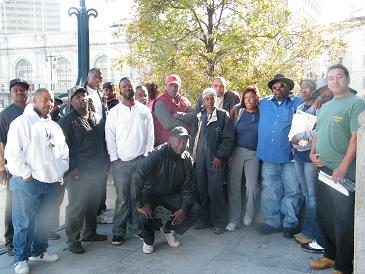
Board President David Chiu, Sups. John Avalos, David Campos, Chris Daly, Bevan Dufty, Eric Mar, Sophie Maxwell and Ross Mirkarimi voted for the legislation. But Dufty was the eighth vote that gave the measure a veto-proof majority. His vote came after he met ABU (Aboriginal Blacks United) leader James Richards and other advocates of unemployed residents. They see the legislation as a way to invest local tax dollars in local communities, reduce crime and poverty, and lessen pollution by reducing workers’ commutes.


“It’s been too long that we have been protesting and fighting this good faith effort,” Richards said.” We need a mandatory policy.”
ABU member Troy, 47, who was born and raised in the Bayview, and has two sons, said he had been unemployed for six months.
“If we don’t work, nobody works, that’s ABU’s motto,” Troy said. ‘We can’t have nobody come from Marin, taking our jobs and pushing us back onto the streets, selling drugs. We gotta put the merry back into Christmas.”


“A lot of moving parts had to come together for this legislation to be successful,” Dufty told the Board, a couple of hours after he met ABU’s Richards. “This is very reminiscent of Healthy San Francisco, which was one of the most monumental changes in the city.”
Dufty said he believes that, much like Healthy San Francisco, local hire legislation is bigger than just San Francisco. “At a certain point, I looked at labor and said, yes, I’m going for this legislation, but not just for San Francisco,” Dufty said. “You want to take this concept to other cities.”


Dufty  was hopeful that Mayor Gavin Newsom will get behind the legislation, before its Dec.14 second reading.
“But I respect that there may be a little bit of coming together between now and the second reading,” he said.
Newsom spokesperson Tony Winniker told reporters that the mayor plans to review the amended legislation and consult with impacted contractors and unions before deciding whether to veto the legislation.
A December 1 report from city economist Ted Egan estimated that the local hire legislation will create 350 jobs and cost the city $9 million annually, or 1 percent of whatever it spends on public works. (San Francisco is set to spend an estimated $27 billion on capital projects over the next decade.)
Vincent Pan of Chinese Affirmative Action, which supports Avalos’ local hiring policy, suggested that the mayor “check the temperature.”
“It would be leadership on the part of the mayor not to veto legislation that’s about San Francisco,” Pan said.

Stage Listings

0

Stage listings are compiled by Guardian staff. Performance times may change; call venues to confirm. Reviewers are Robert Avila, Rita Felciano, and Nicole Gluckstern. Submit items for the listings at listings@sfbg.com. For further information on how to submit items for the listings, see Picks. For complete listings, see www.sfbg.com.

THEATER

OPENING

Joyful Noise: A Gospel Celebration of Christmas Southside Theater, Fort Mason Center; 345-7575, www.LHTSF.org. $25-50. Previews Fri/10, 8pm. Opens Sat/11, 8pm. Call for dates and times. Through Dec 31. Lorraine Hansberry Theatre presents a rechristened version of their Black Nativity production.

Siddhartha, the Bright Path The Marsh Studio Theater, 1074 Valencia; (800) 838-3006, www.themarsh.org. $15-35. Previews Sat/11-Sun/12, 3pm; Thurs/16, 7:30pm. Opens Dec 17, 7:30pm. Call for dates and times. Through Jan 9. Marsh Youth Theater presents a holiday celebration, directed by Lisa Quoresimo.

BAY AREA

Arabian Nights Berkeley Repertory Theatre, Thrust Stage, 2025 Addison, Berk; (510) 647-2549, www.berkeleyrep.org. $34-73. Opens Sat/11, 8pm. Call for dates and times. Through Dec 30. Tony-winning Mary Zimmerman’s production makes a return to Berkeley Rep.

A Christmas Carol Center REPertory Company, 1601 Civic Drive, Walnut Creek; (925) 943-7469, www.centerREP.org. Previews Thurs/9, 8pm; Fri/10, 11am and 7:30pm. Opens Sat/11, 2pm and 7:30pm. Call for dates and times. Through Dec 19.Center REP presents the holiday classic.

ONGOING

Absolutely San Francisco Phoenix Theater Annex, 414 Mason, 4th floor; 433-1235, www.absolutelysanfrancisco.com. $28. Fri-Sat, 8pm. Through Dec 18. Karen Hirst’s one-person musical about lost love.

Babes in Arms Eureka Theatre, 215 Jackson; 255-8207, www.42ndstmoon.org. $24-44. Wed, 7pm; Thurs-Fri, 8pm; Sat, 6pm; Sun, 3pm. Through Dec 19. 42nd Street Moon presents John Guare’s adaptation of the musical by Rodgers and Hart.

Christmas in Hell: The Real and True Story About the Guys Who Saved Christmas Dark Room Theater, 2263 Mission; (800) 838-3006, www.brownpapertickets.com. $20. Fri-Sat, 8pm. Through Dec 18. An original holiday play, written and directed by Jim Fourniadis.

Caligari Studio 385, 385A Eighth St; www.brownpapertickets.com. $10-30. Fri, 8pm. Through Fri/10. Promising new company HurlyBurly stages its adaptation of the 1920 German expressionist film The Cabinet of Dr. Caligari in a Soma bondage club with productive and not-so-productive results. Production values are enjoyably thoughtful (including lighting designer Amanda Ortmayer’s moody use of small portable lights, laser pointers, and snatches of pure, delicious darkness) as the audience mills around a cement room in which actors stand or lie frozen, and in some cases encased, like some macabre wax museum. Daniel Korth’s script makes up in clever, fluid dialogue what it can lack in narrative coherence. But the doom-clouded storyline, featuring a fated romance between an ardent young man (a likeable Eddie Barol) and his somewhat aloof object of desire (a nicely detached yet powerful Shay Wisniewski), is familiar enough in sporadic outline that this isn’t a big deal. The play demands a certain over-the-top performance style, however, which few of co-directors Korth and Mikka Bonel’s otherwise capable actors really carry off (Gerri Lawlor is one of the more notable exceptions). The freedom to walk around the space as action unfolds on surrounding stages (or inaction in cages) is a visual and atmospheric plus. The production’s real limit is that its neo-expressionist dark-carnival invention comes across at times as too borrowed, as when a late-era Tom Waits song is heard. At least it wasn’t one from The Black Rider. (Avila)

Cavalia: A Magical Encounter Between Horse and Man White Big Top, adjacent to AT&T Park; www.cavalia.net. $39.50-239.50. Check website for shows and times. Through Sun/12. Over 100 performers, including 50 horses, take the stage in this circus-like show from Montreal.

Christian Cagigal’s Obscura: A Magic Show EXIT Cafe, 156 Eddy; 1-800-838-3006, www.brownpapertickets.com. $15-25. Thurs-Sat, 8pm. Through Dec 18. Magician Christian Cagigal presents a mix of magic, fairy tales, and dark fables.

Cinderella African American Art & Culture Complex, 762 Fulton; (800) 838-3006, www.brownpapertickets.com. $10-30. Fri/8pm; Sat, 3 and 8pm; Sun, 3pm. Through Dec 19. African-American Shakespeare Company presents the classic fairytale, starring Velina Brown.

Cora Values’ Christmas Corral Exit Cafe, 156 Eddy; 673-3847, www.brownpapertickets.com. $15-25. Fri-Sat, 8:30pm. Through Sat/11. There are Christmas Carol’s and then there are Christmas Carol’s. There are the no-expenses spared varieties with clever rigging and fabulous costumes and larger-than-life characterizations of those classic Christmastide archetypes—the lonely bastard, the beatific poor man, the lovable child. There are the more modest productions, community theatre affairs, with A-for-effort, fun-for-the-whole-family, casual appeal. And then there’s the Cora Values treatment, which throws the whole silly notion of family togetherness out the window and instead throws a party for the orphans of the holiday season—the bah-humbuggers and true unbelievers. In this rock-bottom budget “illiterary

adaptation” of Dickens’ classic in “the most authentic form we know how” a ragtag crew from the Gas ‘N’ Gulp in Rectal, Texas, bumble through a singular interpretation of the tale, punctuated by original comic songs penned by Cora (Sean Owens) and Emmett Cornpike (Don Seaver). Sticklers for textual authenticity or political correctness may cringe at the chorus of the solo song by Tiny Tim (Amanda Ortmayer), “This Won’t Be Another Lame Holiday,” but Dickens wrote a few head-scratching lines himself. Take this description of Marley’s face appearing in Scrooge’s doorknocker: “It&ldots;had a dismal light about it, like a bad lobster in a dark cellar.” “Charles Dickens’ immortal text” Cora remarks dryly. You said it sister. (Gluckstern)

Dirty Little Showtunes! A Parody Musical Revue New Conservatory Theatre Center, 25 Van Ness; 861-8972, www.nctcsf.org. $24-40. Wed-Sat, 8pm; Sun, 2pm. Through Jan 16. Tom Orr’s adults-only holiday show returns, with direction by F. Allen Sawyer and musical direction by Scrumbly Koldewyn.

Golden Girls: The Christmas Episodes CounterPULSE, 1310 Mission; www.ticketfly.com. $25. Thurs-Sat, 7 and 9pm. Through Dec 23. Heklina, Cookie Dough, Matthew Martin, and Pollo Del Mar return with their stage tribute to the sitcom.

The Lion in Winter Actors Theatre, 855 Bush; 345-1287, www.ticketweb.com. $26-38. Wed-Sat, 8pm. Through Dec 18. Actors Theatre of SF presents James Goldman’s play of palace intrigue.

Match Royce Gallery, 2901 Mariposa; 1-866-811-4111, www.matchonstage.com. $12-28. Thurs-Sun, 8pm. Through Dec 18. Expression Productions presents Stephen Belber’s new suspense drama.

The Oddman Family Christwanzaakuh Spectactular! Exit Stage Left, 156 Eddy; (800) 838-3006, www.brownpapertickets.com. $20. Thurs-Sat, 8pm. Through Dec 18. Guerrilla Rep and Beards Beards Beards present a new twisted musical farce.

Party of 2 – The New Mating Musical Shelton Theater, 533 Sutter; (800) 838-3006, www.partyof2themusical.com. $27-29. Sun, 3pm. Open-ended. A musical about relationships by Shopping! The Musical author Morris Bobrow.

*Pearls Over Shanghai Thrillpeddlers’ Hypnodrome, 575 Tenth St; 1-800-838-3006, www.brownpapertickets.com. $30-69. Sat, 8pm. Through April 9. Thrillpeddlers’ acclaimed production of the Cockettes musical continues its successful run.

A Perfect Ganesh New Conservatory Theatre Center, 25 Van Ness; 861-8972, www.nctcsf.org. $22-40. Wed-Sat, 8pm; Sun, 2pm. Through Dec 19. New Conservatory Theatre Center presents the Terrence McNally play, directed by Arturo Catricala.

Ruth and the Sea Stage Werx Theatre, 533 Sutter; www.ruthandthesea.com. $18-24. Thurs-Sat, 8pm. Through Dec 18. Wily West Productions presents Gwyneth Richards in a kooky holiday show, directed by Stuart Bousel.

Shrek The Musical Orpheum Theatre, 1192 Market; (888) SHN-1799, www.shnsf.com. $30-99. Tues, 8pm, Wed, 2 and 8pm; Thurs-Fri, 8pm; Sat, 2 and 8pm; Sun, 2pm (no performances Dec 24, Dec 25, and Dec 31). Through Jan 2. Eric Petersen stars in the stage version of the animated blockbuster.

A Tale of Two Genres SF Playhouse, Stage Two, 533 Sutter; www.un-scripted.com. $10-20. Thurs-Sat, 8pm (also Sat, 3pm; additional shows Dec 20-23). Through Dec 23. Un-Scripted Theater Company performs an improvised musical in the style of Charles Dickens.

The Tempest Exit on Taylor, 277 Taylor; 1-800-838-3006, www.cuttingball.com. $15-20. Thurs-Sat, 8pm; Sun, 5pm. Through Dec 19. In Cutting Ball’s latest foray into Shakespearean realms, three entangled subplots and eleven characters are enacted by just three actors, in order to explore the relationships between the principle characters by representing their internal characteristics through the actions of the more minor roles. Set on an enchanted island (or, in Cutting Ball’s interpretation, at the bottom of a swimming pool) The Tempest begins with stormy weather, but quickly grows into a full-blown hurricane of shipwrecked nobles, nymphs, and drunks, plus the turbulent awakenings of a teenage daughter’s libido, and the rumblings of her over-protective papa. The most effective dual-character is Caitlyn Louchard’s Miranda-Ariel, as both characters are quite under the stern control of Prospero (David Sinaiko) and equally deserving of release. Less affecting yet somehow equally congruous is Sinaiko’s comic turn as the buffoonish Stephano, who stumbles through the forest in his boxer shorts, yet somehow maintains an air of mock dignity that does parallel Prospero’s. Donell Hill’s Caliban-Ferdinand endures his lust-love for Miranda and servitude to Prospero alternating between raw physicality and social ineptness. But since “The Tempest” is littered with characters even more minor, the game cast is stretched too thinly to fully inhabit each, and the entire subplot involving King Alonzo, Gonzalo, and Antonio in particular suffers from this ambitious over-extension. (Gluckstern)

The Tender King Phoenix Theatre, 414 Mason, Sixth Flr; www.secondwindtheatre.com. $20-25. Fri-Sat, 8pm; Sun, 2pm. Through Sat/11. The current firestorm over leaked diplomatic cables and exposed government lies and imperial machinations are nothing new in The Tender King. Second Wind’s debut of Bay Area playwright Ian Walker’s new drama takes audiences back to 1945, a critical period in the structuring of the postwar world as dominated ever since by the American Empire. Walker explores the tensions and contradictions attendant on the countdown to American global hegemony in three characters, two rooms, and one fateful decision. President Harry Truman (Brian O’Connor), newly ensconced in office after FDR’s death, sits drinking in a darkened room (mood-inducing lighting by Rob Siemens) as an ambitious young functionary named Will (Stephen Muterspaugh) arrives to get his John Hancock on the order to drop the new A Bomb on two Japanese cities. In shades of Schiller’s Mary Stuart, Truman delays and evades cunningly, filled with the exuberant knowledge and burden of power. Meanwhile, a semi-romantic, semi-sadistic relationship between Will and a French-German prostitute (Natalie Palan) unfolds in a parallel scene—a complex echo of the shock-doctrine advantage Will advocates to Truman in the face of a stunned and helpless European population. Directed by Walker, the production relies not ineffectively on heightened vernacular language and performances, although the latter while sturdy can feel more rote than in-the-moment, and the neat narrative framework and effervescent dialogue strays into formulaic conceits. Nevertheless, the play’s well-researched and articulated detail as well as forceful conviction make it both worthwhile and generally engaging—not to mention as politically au courant as anything on stage just now. (Avila)

The Velveteen Rabbit Yerba Buena Center for the Arts, Novellus Theater, 700 Howard; 978-2787, www.ybca.org. Call for dates and times. Through Sun/12. ODC/Dance presents Margery Williams’ holiday favorite.

BAY AREA

Becoming Julia Morgan Berkeley City Club, 2315 Durant, Berk; (510) 984-3864, www.brownpapertickets.com. $24-30. Fri-Sat, 8pm; Sun, 5pm. Through Jan 9. Janis Stevens stars in Belinda Taylor’s play about the trailblazing architect.

A Christmas Carol: The Musical Novato Theater Company Playhouse, 484 Ignacio, Novato; 863-4498, www.novatotheatercompany.org. $10-18. Fri-Sat, 8pm; Sun, 3pm. Through Dec 17. Novato Theater Company presents a new adaptation of the holiday classic.

A Christmas Memory TheatreWorks at Lucie Stern Theatre, 1305 Middlefield, Palo Alto; (650) 463-1960, www.theatreworks.org. $19-67. Tues-Wed, 7:30pm; Thurs-Fri, 8pm; Sat, 2 and 8pm; Sun, 2 and 7pm (alos Thurs/23, 2pm and Fri/24, 7pm). Through Dec 26. TheatreWorks presents the seasonal tale by Truman Capote.

East 14th – True Tales of a Reluctant Player The Marsh Berkeley, 2120 Allston Way, Berk; (800) 838-3006, www.themarsh.org. $20-50. Call for times. Through Dec 19. Don Reed’s one-man show continues its extended run.

Lemony Snicket’s The Composer is Dead Berkeley Repertory Theatre, Roda Theatre, 2015 Addison, Berk; (510) 647-2949, www.berkeleyrep.org. Call for dates and times. Through Jan 15. Berkeley Rep premieres the new musical, written by Lemony Snicket, with music by Nathaniel Stookey.

Loveland The Marsh Berkeley, 2120 Allston Way, Berk; (800) 838-3006, www.themarsh.org. $20-50. Fri, 7pm; Sat, 8pm. Through Sat/11. Ann Randolph’s hit one-woman comic show continues its extended run.

Of the Earth – The Salt Plays: Part 2 Ashby Stage, 1901 Ashby; (510) 841-6500, www.shotgunplayers.org. $17-30. Thurs-Sat, 8pm; Sun, 5pm (beginning Dec 19). Through Jan 30. Shotgun Players present the second half of writer and director Jon Tracy’s Odyssey-inspired tale, with music by Brendan West.

*The Play About the Naked Guy La Val’s Subterranean, 1834 Euclid, Berk; (800) 838-3006, www.brownpapertickets.com. $10-20. Thurs-Sat, 8pm. Through Dec 18. Impact Theatre presents an off-Broadway hit, written by David Bell and directed by Evren Odcikin.

The World’s Funniest Bubble Show The Marsh Berkeley, 2120 Allston, Berk; (800) 838-3006, www.themarsh.org. $8-50. Sun, 11am (also Dec 20-23, 11am and Dec 26-30, 11am). The Amazing Bubble Man’s show presents flying saucer bubbles and other wonders.

PERFORMANCE/DANCE

Club Chuckles Hemlock Tavern, 1131 Polk; 923-0925. Wed/8, 9pm. $7. Club Chuckles turns seven with standup by David Liebe Hart and others.

Comedy Returns to El Rio! El Rio, 3158 Mission; (800) 838-3006, www.brownpapertickets.com. Mon/13, 8pm. $7-20. Lisa Gedulgig hosts a monthly comedy night.

Double-Wide White Trash Christmas Show Martuni’s, 4 Valencia; 241-0205, www.dragatmartunis.com. Sun/12, 7pm. $5. A holiday edition of the “Bijou” cabaret showcase.

FoolsFURY 12th Anniversary Gala Theater Artaud, 450 Florida; www.foolsfurygala.eventbrite.org. Sat/11, 7:30pm. $30-60. The local theater ensemble celebrates a birthday.

Forking II: A Merry Forking! Christmas Off-Market Theaters, 965 Mission; (800) 838-3006, www.pianofight.com. Call for dates and times (through Dec 30). PianoFight presents a holiday-themed choose-your-own-adventure play.

A Funny Night for Comedy Actors Theatre, 855 Bush; 345-1287, www.NatashaMuse.com. Sun/12, 7pm. Natasha Muse and Ryan Cronin host an evening of comedy.

Ironic/NOT Ironic! Viracocha, 998 Valencia; 374-7048, www.viracochasf.com. Thurs/9, 9pm. Harmon Leon performs.

Literary Death Match – Holiday Bloodbath Special Elbo Room, 647 Valencia; www.literarydeathmatch.com. Fri/10, 7pm. $7-10. An evening of yuletide literary mayhem.

Mischievous Maidens Christmas Skylark Bar, 3089 16th St; 621-9294. Fri/10, 8pm. Free. A Christmas-themed burlesque night.

Project. B. The Garage, 975 Howard; 518-1517, www.brownpapertickets.com. Fri/10-Sat/11, 8pm. $10-20. Tanya Bello’s company presents Triquetra, a work from this year.

Doug Stanhope Rickshaw Stop, 155 Fell; 861-2011, www.rickshawstop.com. Wed/10, 8pm. $20. The vulgar comedian hits the Bay.

Touring Cast of Shrek Theater 19, Pier 39; 273-1620, www.HelpIsOnTheWay.org. Mon/13, 7:30pm.$35-65. A one-night-only cabaret to raise funds for the Richmond/Ermet AIDS Foundation.

Trashina Cann The Garage, 975 Howard; 518-1517, www.brownpapertickets.com. Wed/8-Thurs/9, 8pm. $10-20. The company presents a new queer dance theater wok titled Legacy.


On the Cheap Listings

0

On the Cheap listings are compiled by Caitlin Donohue. Submit items for the listings at listings@sfbg.com. For further information on how to submit items for the listings, see Picks.

WEDNESDAY 8

k11 Craft Sale 2260 Adeline, Berk.; www.knitoneone.blogspot.com 10am-4pm, free. Awash in holiday shopping events? Us too. Let’s retire to this year-round knit and craft sale. This month gathers 12 creative souls who’d like to stuff your stockings – from cheery note cards, vintage-looking totes, bright dish towels, and more.

“This is Art! Live!” live cable access broadcast Steven Wolf Fine Arts, 2747A 19th St., SF; www.stevenwolffinearts.com. 5:30pm, free. A special viewing party for BAVC show “This is Art! Live!” will give participants a chance to get up all in the quirky program, which consists of home-made commercials, dramatic interludes, and thought-provoking queries like “why are women artists hot?” Weigh in, then stick around for a runway fashion show and libations.

THURSDAY 9

Golden Gate Park holiday tree lighting McLaren Lodge, Golden Gate Park, SF; www.sfrecpark.org. 5pm, free. Bundle up and head to the picturesque McLaren Lodge, the (Golden) gate-keeping chalet off of Stanyan, for the 81st annual lighting of the massive pine in front. The kids will be all rosy-cheeked and distracted by train rides, caroling, and a visit from the portly Claus himself.

FRIDAY 10

Lights on Market Street celebration Procession starts at 1119 Market; reception at The Luggage Store, 1007 Market, SF; www.sfartscommission.org. 5-7pm, free. The three light installations funded by Mid-Market’s recent $250,000 NEA grant ignite one by one tonight in a procession headed by members of Sixth Street’s Bayanihan Community Center, and their traditional Filipino parol lanterns. Come bedecked in your own culture’s style of illuminations and enjoy a reception after at community gallery The Luggage Store.

SATURDAY 11

Bazaar Bizarre Fort Mason Center, SF; www.bazaarbizarre.org. Noon-5pm (Also Sun/12 noon-6pm), free. The Boston-spawned crafteria makes its way across the country to bring Bay Area-ites its hearty dose of DIY communitarianism. Come for 150 booths worth of the city’s best hand-crafties and sate your browsing-induced hunger with a crème brûlée or taco from Off the Grid’s fabulous ambulatory food carts.

Creative Arts Craft & Book Fair Creative Arts Charter School, 1601 Turk, SF; (415) 749-3509, www.creativeartscharter.org. 10am-4pm, free. Throw some ducats towards your local student-centered K-8 school at their annual bazaar, home to handmade crafts and a little sustenance for your holiday season – hot soup, cider, and book readings by the Winter Fairy on the hour.

Glamazonia: The Uncanny Super Tranny Mission Comics and Art, 3520 20th St., SF; (415) 695-1545, www.missioncomicsandart.com. 7-10pm, free. Justin Hall reads from the solo comic book debut of his blonde beehived, body rockin’ super tranny. She’s got Superman in a trance! Bruce Lee’s down on his knees! He’s joined by a swath of other pulp fiction luminaries and oh yes, they’ll have copies for signing.

Hawaiian Holiday Craft and Bake Sale St. Patrick’s Parish Center, 409 Magnolia, Larkspur; 10am-4pm, free. Perhaps you are not destined for a beach-side lounge chair and awkward lei tan lines this winter. Undoubtedly, sweets, you’re not the only one. Also, you can get your plate lunch and island treats all the same at this 11th annual fundraiser for Hula On Productions — the snacks and crafts have been cooked up by members of the Halau Hula Na Pua O Ka La’akea, Hula On’s dance contingent.

Spark! Circus benefit show Vagabond Ballroom, 830 Isabella, Oakl.; (415) 816-4620, www.sparkcircus.org. 8pm-midnight, $10-20 sliding scale. It takes a village to blow a kid’s mind – spend an evening with this one to help fund Spark!’s mission to send 15 members of their fire spinnin’, jugglin’, rappin’, and joke crackin’ troupe to perform for kids in refugee camps, migrant schools, hospitals, and orphanages along the Thai-Burmese border.

MONDAY 13

Lemony Snicket Berkeley Repertory Theatre, 2015 Addison, Berk.; (510) 647-2949, www.berkeleyrep.org. 7pm, free. The dreadful, beleaguered children’s book hero sends his “stand-in,” author Daniel Handler to speak for him as part of Berkeley Rep’s always-free “Page to Stage” series.

The Monthly Rumpus The Make-Out Room, 3225 22nd St., SF; www.brownpapertickets.com. 7-9:30pm, $10. The month’s theme, “Ladies Night,” draws some XX luminaries to the literary reading series stage, including Lusty Lady union organizer Antonia Crane, Michelle Tea, and indie folksters The Yellow Dress.

Where everybody knows your name

0

arts@sfbg.com

HAIRY EYEBALL It can be easy to get cynical about the business side of art, so it’s always refreshing when a local labor of love such as Romer Young — the small Dogpatch gallery formerly known as Ping Pong — demonstrates that growth doesn’t necessarily entail compromising one’s vision.

That vision has always been driven by husband and wife team Vanessa Blaikie and Joey Piziali’s commitment to work that is consistently smart, challenging and often surprisingly personal: from recent Goldie winner Amanda Curreri’s conceptual prompts at forging new social connections, to, most recently, James Sterling Pitt’s table-full of sculpted art-related books and ephemera, an affectionate take on how material possessions can shape creative practice.

“We’ve had very special relationships with our artists because this has always been about putting their work first,” explains Blaikie, when I meet with her and Piziali in the gallery’s cozy back room, which adjoins Piazali’s studio. Inspired by the work of many of their classmates in San Francisco Art Institute’s MFA program, but dismayed by the lack of spaces willing to take a chance on art that was more conceptual or performance-based, Blaikie and Piziali took matters into their own hands and started putting together exhibits.

The gallery’s unusual former name came from the quarterly, ping-pong happy hours Blaikie and Piziali held, a nod to 1970s Bay Area conceptual artist Tom Marioni’s famous statement, “Drinking beer with friends is the highest form of art.”

“We were really trying to activate the space as social sculpture through a non-art event,” Piziali recalls, “but we also had our share of calls asking about equipment rentals.”

Five years later, as the partnerships Blaikie and Piziali formed early on have led to a roster of repeat-showers and a more prominent profile, they decided it was time to change names and reassess how best to shift their operation. “Once you’re not an exhibition space, you start looking at the model of ‘gallery’ and see what that means, “explains Piziali. “But you don’t start a space like this with blood, sweat, and tears only to ask every time, ‘Did we make the bottom line?'”

Though the paddles have been hung up in favor of the, let’s face it, more professional-sounding Romer Young — a combination of Blaikie and Piziali’s mothers’ maiden names — Blaikie’s and Piziali’s core commitment hasn’t changed. Fittingly, they have decided to inaugurate the newly christened space with a solo exhibit by the now New York City-based conceptual artist Chad Stayrook, who contributed one of Ping Pong’s earliest shows.

“It felt only right to honor the growth we’ve undergone,” reflects Blaikie. “When we started, we were doing it because we loved it, and now we’re doing it because we love it and we want it to make sure it can keep growing.”


DOWN MEXICO WAY

Upon entering “Disponible — a kind of Mexican show” at SFAI’s Walter and McBean Galleries, you hear Manuel Rocha Iturbide’s sound installation I play the drum with frequency before you see it — what you see is Hector Zamora’s massive arrangement of hanging metal drying racks. Suspended with fishing line in tiered formations, the drying racks play off of the Brutalist, concrete interior of the Walter gallery while imbuing the space with an ethereal density. The ricocheting clinks, low-end buzzes, and sonorous clangs emitted by Iturbide’s piece — installed in a lofted area above the main gallery — bring Zamora’s installation to life as a fog bank-turned-carousel organ.

Both pieces are less impressive, however, when you attempt to view them individually. Without the extra visual accompaniment, Iturbide’s deconstructed drum kit — played via algorithmically-controlled speaker cones whose vibrations sound the cymbals and drum heads they’re attached to — loses its initial impact. Likewise, separated from Iturbide’s soundtrack, Zamora’s piece resembles the forgotten remains of a half-finished install job.

This creeping feeling of “is that all there is?” that both Zamora’s and Iturbide’s pieces evokes seems, at least partially, by design. The exhibit takes its name from the text on empty advertising billboards throughout Mexico, in which disponible is followed by a phone number. Playing off the double meaning of disponible as “available” and also “potentially changeable” or “disposable,” the curatorial team of Hou Hanru, SFAI’s director of exhibitions and public programs, and Guillermo Santamarina, an independent curator based in Mexico City, aren’t so much devaluing the pieces they’ve selected as they are loosening the conceptual strictures implicit in putting on a show of contemporary Mexican art. I can’t wait to see what Hanru and Santamarina have in store for phase two of the exhibit, which opens in February.

CHAD STAYROOK: UNATTAINABLE BEAST

Fri/10 through Jan. 15, 2011

Romer Young Gallery

1240 22nd St., SF

(415) 550-7483

www.romeryounggallery.com

DISPONIBLE — A KIND OF MEXICAN SHOW (PHASE ONE)

Through Jan. 22

Walter and McBean Galleries, San Francisco Art Institute

800 Chestnut, SF

(415) 749-4563

www.waltermcbean.com

Is your food fair?

0

caitlin@sfbg.com

FAIR FOOD We’ve all worked in a restaurant, haven’t we? I know I have — many — and gosh if they aren’t tricky little employment situations. Overtime, what? Breaks, really? And health care — well who the hell gets health care at a restaurant?

But this being San Francisco, restaurant workers are entitled to all these things courtesy of our hard-won labor laws. Which of course doesn’t mean that workers get them all the time, but that they should. And the bars and eateries that provide these benies — along with job safety, respect, and other luxuries — should be the ones that get the business of the conscientious diner.

Until recently the identity of these decent restaurants was only obtainable by sneaking back into the kitchen to chat. But the advocacy group Young Workers United (www.youngworkersunited.org) is changing that. Its guide to SF restaurants, Dining With Justice, is now in its second year of publication, teaching those who want to know where they can get a nice meal served by someone who is happy and secure in their job.

“It’s kind of a counter to Zagat and Yelp,” YWU organizer Edwin Escobar tells me. Escobar just got done talking about his group’s campaign to a room full of City College of San Francisco students at the school’s “Turn the Tables” teach-in last week. The event was sponsored by CCSF’s labor and community studies program and featured presentations from community groups and SF’s Office of Labor Standards Enforcement.

To research the guide, YWU members interviewed 250 employees at 32 restaurants. The 58-question survey ranked businesses in five fields: compliance with wage and working hours laws, job mobility, job satisfaction, health and safety, and job security. Only nine businesses received stars in three or more the categories; none received five out of five.

“People think, oh, it’s San Francisco, all the workers get treated well. But that’s not the case. Restaurants and retail businesses get away with murder,” Escobar says. His organization provides labor law education and advocacy for low-wage workers around the city in an attempt to stem workplace violations.

Recently, YWU shed some light on some of the troubles faced by workers in a struggle with one of the city’s most beloved type of snack stop: the taqueria. The group helped the Latino staff of the Taqueria Azteca chain (which has locations in the Castro and Noe Valley) recoup more than $2 million in back pay from owners who had cheated them of overtime compensation and even minimal control over their schedules. Escobar says one mother involved in the legal proceedings had been given a choice by management: return to work one week after giving birth or lose her job.

“The workers who get cheated the most in San Francisco are Asian immigrants,” says Shaw San Liu, another speaker at “Turn the Tables.” Liu is a lead organizer with the Chinese Progressive Association (www.cpasf.org), which since 1970 has worked to empower the Chinatown community to deal head on with social inequities. Earlier this year, the association released a report on the state of employment in Chinatown restaurants based on one-on-one interviews with 435 workers. The results were disheartening: 50 percent had worked under-minimum wage jobs; 80 percent had been cheated out of overtime; 64 percent had received no on-the-job training; a majority had been injured on the job; and more than half were paying all medical costs out of pocket.

That’s just not cool in a town that nominally protects workers against all these things by law. Liu says CPA would like to publish a guide similar to Dining With Justice to reward responsible restaurants but has run into cultural stumbling blocks. Law-abiding businesses didn’t want to be singled out as such because, owners said, it would make their neighbors look bad. “Everyone knows minimum wage in Chinatown is $1,000 a month,” says Liu. “They didn’t want to be known as the goody two-shoes.”

There are clear challenges to improving the lot of the person serving you your brunch, burritos, and dim sum. But everyone has a part to play in making it happen. “At this point, we’re just asking consumers to be aware,” Liu says.

Efforts like Dining With Justice are a real step in the right direction. YWU plans to expand its scope next year into other city neighborhoods. “Surely there are more than just nine restaurants treating their workers right in this city. We want to know about them,” YWU organizer Tiffany Crain tells the room of students assembled before her. Crain added that if anyone in attendance works for a good employer, they should call her — just as they should call her if they are getting cheated out of wages or a healthy working environment.

“You want to make money?” Liu asked SF restaurant owners. “You’re going to make money if people think you’re a good employer.” In San Francisco, diners like to think they’re eating sustainably: organic, local, and fair to workers. Also, a chef who is happy in his or her job makes for a better dining experience.

Here are restaurants that scored four stars in Dining With Justice.

Arizmendi Bakery

1331 Ninth Ave.; (415) 566-3117, www.arizmendibakery.com

Arlequin

384 Hayes; (415) 626-1211

The Corner

2199 Mission; (415) 875-9258, www.thecornersf.com

Frjtz

590 Valencia; (415) 863-8272 and 581 Hayes; (415) 864-7654, www.frjtzfries.com

Mission Pie

2901 Mission; (415) 282-1500, www.missionpie.com

Poesia

4072 18th St.; (415) 252-9325, www.poesiasf.com

Zazie

941 Cole; (415) 564-5332, www.zaziesf.com

The class of 2010

4

In about a month, the first class of district-elected supervisors since the 1970s will be gone, termed out, done with the transformative politics they brought to San Francisco. It’s a milestone worth marking: in 2000, when the city returned to district elections, everything changed. Machine-driven politics, controlled by money and mayoral power, vanished almost overnight. Constituencies that were virtually shut out of the corridors of power — tenants, labor, environmentalists, economic progressives, public power activists, the list goes on — suddenly had a seat at the table. Neighborhood issues started to matter. And downtown power brokers were no longer the only game in town.

But term limits mean that none of the members of the class of 2000 can remain in office beyond Jan. 8, 2011; and along with the new members elected two years ago, the class of 2010 will feature four new faces. It’s a diverse group. Two (Malia Cohen and Mark Farrell) have never before run for, much less held, elective office. One (Jane Kim) is Asian, one (Cohen) is African American, one (Scott Wiener) is gay. Farrell, who will replace Michela Alioto-Pier in District 2, is the only straight white guy. (Carmen Chu was reelected from District 4).

Overall, it’s safe to say, the ideological balance of the board hasn’t changed much — but the political approaches will be very different. In 2000, the election was all about then-Mayor Willie Brown, about fighting (or appeasing) the Brown Machine. This group of candidates didn’t run against anything in particular — and with the balkanized nature of local politics, they all have divergent bases of support.

So we sat down with the Class of 2010 and asked them to tell us what they plan to do with the next four years. Two trends emerged: all of the new supervisors want to be seen as independent of any political operation. And most have no clear agenda whatsoever for addressing the biggest problem facing the city — a looming budget deficit that will define almost everything they do in their first year.

At a moment of major fiscal crisis and political change, these four people will on center stage — and what they do could determine both the direction of the city and the hopes of the progressive movement. Click below for our exclusive interviews and profiles:

>>CLASS OF 2010: MARK FARRELL

>>CLASS OF 2010: MALIA COHEN

>>CLASS OF 2010: SCOTT WIENER

>>CLASS OF 2010: JANE KIM


Give the gift of fungal growth

2

And yet, and yet… even after this weekend’s Fungus Fair and my ensuing blithe commentary, I am not quite ready to turn my mind to things unrelated to the mushroom. It’s a little like how I was with beards this summer. Luckily, ‘shrooms are multifarious, earthy, adorable, subversive-leaning, and utterly delicious! Or poisonous, sometimes. Below, my four favorite mushroom gift ideas for the season of buying things “for other people.”

Mushroom mini-farm, $19.50 (photo above)

I actually got this for my boyfriend’s birthday and hid it so poorly that he immediately found it. Luckily, as it hadn’t sprouted yet, he thought it was a foul, mold-covered loaf of bread. Perhaps it is testament to our relationship that he didn’t hurl it into the trash bin, but instead set it out on the kitchen counter for my perusal. No, love, it is not bread – but leave it uncovered and soon this pre-germinated lump of … something… will sprout up to one and a half pounds of delicious mushrooms cultivated by the folks at Far West Fungi, Monterey Bay’s primo mushroom farm. Available in shiitake or tree oyster mushroom. 

1 Ferry Building, SF; (415) 989-9090, www.farwestfungi.com

FUNGIfolio calendar, $7-12 sliding scale

Does your baby-baby love mushrooms and need a calendar? “I love mushrooms so I made this calendar,” says Ramona Hopkins, creator of the FUNGIfolio wall calendar. Perfect! Keep in mind that the Bay Area is home to a year-round bounty of fungal growth with this indie score. Bonus: Ramona will be hawking her wares at the sure-to-be-awesome East Bay Alternative Press Expo this weekend (Sat/11) – so if you’re feeling the need to wax mycologically, she’ll love to oblige. 

fungifolio.blogspot.com

Golden shiitake mushroom ring, $40

Gone are the days when the friendly ‘shroom was confined to the mediums of obvious backpack patches and fimo bead necklaces. Now you may announce your affliation to the basidiomycota phylum as befits you – in sheer class. Scope this wood-metal ring from local Bay jeweler J. Fein – a plump shiitake to sit on your daintly uplifted pinky. Sipping tea while conversating with a loved one on voyages taken, perhaps?

Sold in various Bay Area locations, www.etsy.com/people/jfeindesigns  

All That the Rain Promises and More, $17.99

Oh yes. OH YES. You know you’re not supposed to be heading out on your own, picking up any bulbous what’s-it that you find – that’s how you hurt your liver! In fact, you should probably check out one of the area’s beginner’s mushrooming forays before you hit the duff. But for the armchair mushroom hunter, or anyone who’d like a handy guide of the area’s yummy and yucky fungi friends, California crazy man David Arora’s guide to over 200 species should do nicely. Look at this guy on his book’s cover: he’s trucking around with a loose-cannon grin in a tux, a trumpet, and the biggest damn chanterelle you’ve ever seen. Score!

Bay Area bookstores, www.davidarora.com


Chronicle employees told to accept “substandard” contract

1

After some tough talk about resisting a “substandard offer” from San Francisco Chronicle management, the California Media Workers Guild has decided to urge Chronicle workers to approve a new contract offer that is “essentially the same company proposal” that workers resoundingly rejected just last month. The vote is set for Dec. 13.

Guild representative and longtime Chronicle writer Carl Hall told the Guardian last week that “they basically stiff-armed us” and “refused to negotiate any compromise since October” in contract talks. “We see it as insulting, irresponsible corporate behavior given everything staff has done,” Hall told the Guardian last week.

He told us workers planned to rally against the Chronicle and enlist the help of the community, readers, and local labor leaders. “The company is just not listening, so we’re going to have to get a louder voice to achieve that.” The Guild’s campaign included online testimonials from various Chronicle employees, including conservative columnist Debra Saunders, who began her missive by writing, “I am probably the last person Chronicle readers would expect to see standing up for a union.”

But since then, the Guild has essentially capitulated to management’s demand for a status quo contract, arguing that it’s the best they can get for now despite the 106-29 vote against that contract. “Since then, however, the economy has deteriorated even further, and other media companies in the Bay Area have announced fresh concession demands. At the Chronicle, many Guild members said they were ready to fight, but most recognized it would take some months to build up a potent campaign and public support,” the Guild wrote in a statement on its website. “Given those circumstances, the commitee decided it would be better to accept the current proposed changes — and continue mobilizing in advance of the next round of talks.”

Guardian calls to the Chronicle’s Publisher’s Office were not returned.

Appetite: Delicious giving

0

FOR THE WINO Secrets of the Sommeliers by Rajat Parr and Jordan Mackay — Secrets of the Sommeliers, a new book from local SF treasures (sommelier extraordinaire Rajat Parr and drink writer Jordan Mackay is the best wine book to come across my desk in awhile. Stories from a range of the world’s best somms and winemakers stand alongside insights on tasting, purchasing, storing, pairing, ordering and serving wine. Sections “Thinking Like A Sommelier” and “The Wine List” deliver a true insider’s perspective and expertise. This intelligent, understated book is a must for any wine lover, budding or educated.

FOR THE TIKI FANATIC Beachbum Berry Remixed by Jeff Berry — Whether a retro tiki fanatic or one who prefers drinks reminiscent of an island getaway, this book from modern-day master of tropical cocktails, Jeff Berry (aka Beachbum Berry), satiates. Colorful vintage photos and graphics illumine mid-century history and tiki culture. I’ve tried out a number of the recipes on friends, some from top bartenders, many classic, never-before-published or “lost” exotic drink recipes. I have not run across one yet that is less than crowd-pleasing. Remixed combines Berry’s first two books, Grog Log and Intoxica!, adding 107 recipes for one comprehensive collection.

FOR THE CONSCIENTIOUS COOK Miss Dahl’s Voluptuous Delights: Recipes for Every Season, Mood, and Appetite by Sophie Dahl — A cookbook by a famous model is among the last places I’d look to as a cooking inspiration (I’m skeptical enough of ultra-skinny cooks like Giada). But Dahl is no typical model, having written three books and as a self-professed, avid eater. She’s the daughter of brilliant writer Roald Dahl and actress Patricia Neal. Her oft-discussed weight, modeling at real world sizes (like 10), convinces me she understands “voluptuous”. Her recipes may not be the most challenging on the shelf, rather they are approachable as the book’s layout is charming. Dahl she does not eat red meat: there’s plenty here for a vegetarian. Whether you’re making brown rice risotto with pumpkin or something as simple as flapjacks, Dahl’s personable approach draws you in while her seasonal recipes comfort.

FOR THE DRINK AFICIONADO Boozehound: On the Trail of the Rare, the Obscure, and the Overrated in Spirits by Jason Wilson — Though Boozehound by Washington Post’s spirits columnist Jason Wilson contains over 50 drink recipes, it is more a study on a range of spirits, history mixed with personal experience. His journeys to distilleries around the globe play as engaging travelogue, with breakthrough moments sipping an unusual liqueur or uncovering hype around others. It’s like reading a food memoir but with drink as the backdrop and instigator. The chapter “Bitter is Bella” made me miss Italy’s fabulously bitter palate; I began craving aquavit and bacalao reading Water of Life. His stories of researching tequila in Jalisco, Mexico, or chatting with Borje Karlsson (Karlsson’s Gold Vodka) rekindle my own memories. He explores sips as far-ranging as bianco vermouth, sloe gin, Barolo Chinato and pisco. There is education here, certainly, but via a pleasurable, relaxing read. Like a fine drink, at its finish, I found myself thirsty for more.

FOR THE COCKTAILIAN Speakeasy: The Employees Only Guide to Classic Cocktails Re-Imagined by Jason Kosmas & Dushan Zaric – An elegant book from bartenders behind Employees Only (http://www.employeesonlynyc.com/) in NYC’s West Village, this book lists a range of recipes from classics (e.g. the Martinez) to new drinks that play like classics, such as the Provencal. We have seen compendiums of classic recipes before, but this one ups the game with thoughtful directions and NY flair. Four sections cover categories like aperitifs, punches, cordials and homemade syrups. Inspired by Prohibition-era speakeasies, these two were doing “speakeasy” long before it became a trend. As they state in the section Mastering the Perfect Cocktail: “Every Cocktail Has A Story.” Speakeasy helps you tell stories through the preparation of a drink.

–Subscribe to Virgina’s twice monthly newsletter, The Perfect Spot

SF Weekly gets it all wrong

4

This is a few days late, but still worth noting. After the Supreme Court ruled in our favor and shot down SF’s Weekly’s final appeal in our predatory pricing lawsuit, the Weekly’s Andy Van De Voorde launched another of his notorious screeds aimed at dismissing all of the proven, factual assertions in our case. Fron day one, Van De Voorde’s been wrong about everything — he said the case was stupid and would be quickly dismissed, he said we’d lost at trial, he said we’d lose on appeal … and every step of the way, he’s been proven wrong. Now he’s going after the judges:


Brugmann certainly has been treated like royalty by the city’s elected judges, who function as the legal arm of the local Democratic machine.


But as Bob Egelko, the Chron’s widely respected court reporter, noted in a remarkable blog post, Van De Voorde is simply factually wrong:


The judge who presided over the trial in San Francisco Superior Court, and more than doubled the jury’s damage award against the Weekly, was Marla Miller — appointed by Republican Gov. Arnold Schwarzenegger. The appeals court justice who wrote the ruling upholding the verdict was Robert Dondero — first appointed to the bench by Republican Gov. Pete Wilson, and named to the appeals court by Schwarzenegger. And of the six Supreme Court justices who voted to deny a hearing on the Weekly’s appeal, five were appointed by Republican governors.


I can go even further. The first judge who handled the case, Richard Kramer — who refused to dismiss the suit and tossed most of the Weekly’s pre-trial motions out the door — was appointed by a Republican (Pete Wilson). Of the three judges on the Appeals panel, two — Dondero and James Marchiano — were appointed by Republicans. And while the third justice, Sandra Margulies, was elevated to the appelate bench by Gray Davis, her first judicial appointment to the Superior Court came from a Republican, George Deukmejian.


So there really weren’t any elected Democratic judges in the mix. (And the judges certainly aren’t part of any political machine; the entire local bench, including every single judge, Democrat, Republican or Independent, supported the re-election of Judge Richard Ulmer in November, while the Democratic Party, and the Bay Guardian, supported challenger Michael Nava.)


Sorry, Andy — as has been the case from day one, the facts speak louder than your ranting. The Guardian won this case on the evidence and the legal merits, all the way along.