Labor

SPORTS: Real March Madne$$

0

Everyone’s getting rich off the NCAAs — except the players

By A.J. Hayes

madness.jpg
Played, not paid

Last week, Boston Red Sox players staged what had to be the most ludicrous wildcat strike in the history of labor relations. The entire Bosox team(sters) threatened not to board a plane bound for Japan for a series of games vs. the Oakland A’s, unless club management, or major league baseball, or anyone else but the players themselves, forked over some serious cash.

Painting themselves as championing of the little guy, the Boston players said the trip was off unless each of the team’s coaches, trainers and clubhouse personnel received the same $40,000 bonus that each of the players was to pocket for enduring the hardship of an all-expenses paid, first-class jaunt to Japan.

And they say politicians are out of touch with the average American wage earner.

To drive home their point, the players refused to take their positions for an exhibition game against the Toronto Blue Jays until the matter was settled, making paying fans sit on their hands for 90 minutes at Ft. Myers, Florida.

The world champs finally decided to play ball when MLB and the club agreed to split the cost of paying the support staff. Considering that the bloated Red Sox staff contained nearly 30 coaches, trainers and others last season, that figure came in somewhere in excess of $1 million.

Meanwhile, most sports fans across the nation – even those who know the clubs are traveling to Japan – could hardly give a damn about a few early season baseball games in Tokyo. When Boston and Oakland are done, they’ll still have 160 more games to go.

Most sports fans across the nation are glued to their televisions watching athletes pour out their hearts and sweat in another sport – and receive not a penny. In fact, the players will be lucky to come away with a free t-shirt. It’ll probably be a 50/50 blend too.

In case you don’t own a television or haven’t picked up a newspaper in the past couple of weeks, we’re were in the midst of the NCAA basketball tournament, aka March Madness, aka the Big Cash Cow in Tube socks.

Every one remotely tied to the NCAAs, from the universities to CBS to the sports bars and the zillions of amateur bettors toting their cherished “brackets” will be racking in the dough this month.

Everyone is getting rich except for the one making it all possible – the players.

Hooker science

0

TECHSPLOITATION The outrage over former New York governor Eliot Spitzer hiring an A-list hooker makes me feel like throwing a gigantic, crippling pile of superheavy biology and economics books at everyone in the United States and possibly the world. Are we still so Victorian in our thinking that we think it’s bad for somebody to pay large amounts of money for a few hours of skin-time with a professional? Have we not learned enough at this point about psychology and neuroscience to understand that a roll in the sheets is just a fun, chemical fizz for our brains and that it means nothing about ethics and morality?

The sad fact is that we have learned all that stuff, and yet most people still believe paying money for sex is the equivalent of killing babies on the moral report card. And yet nobody bothers to ask why, or to investigate past the sensational headlines. As far as I’m concerned, the one unethical thing Spitzer did was to hire a sex worker after prosecuting several prostitution rings. That’s hypocritical of him, and undermines my faith in him as a politician.

But let’s say Spitzer hadn’t prosecuted so-called sex crimes before, and all he was doing was hiring a lady for some sex. Here is what I don’t get: why is this bad? On the scale of things politicians can do – from sending huge numbers of young people to be killed in other countries to cutting programs aimed at helping foster kids get lunch money – hiring a sex worker is peanuts. It’s a personal choice! It’s not like Spitzer was issuing a statewide policy of mandatory hookers for everybody.

What really boggles the mind is the way so-called liberal media like National Public Radio and the New York Times have been attacking Spitzer’s morals as much as the conservative Fox News types have. In some cases, they’ve attacked him more. The reasons given are always the same: sex work is abusive to women (male prostitutes don’t exist?), and being paid for sex is inherently degrading.

Let’s look inside one of those heavy economics books that I just beat you with and examine these assumptions for a minute, OK? Every possible kind of human act has been commodified and turned into a job under capitalism. That means people are legally paid to clean up one another’s poop, paid to wash one another’s naked bodies, paid to fry food all day, paid to work in toxic mines, paid to clean toilets, paid to wash and dress dead naked bodies, and paid to clean the brains off walls in crime scenes. My point is, you can earn money doing every possible degrading or disgusting thing on earth.

And yet, most people don’t think it’s immoral to wipe somebody else’s bum or to fry food all day, even though both jobs could truthfully be described as inherently degrading. They say, "Gee that’s a tough job." And then they pay the people who do those jobs minimum wage.

The sex worker Spitzer visited, on the other hand, was paid handsomely for her tough job. The New York Times, in its mission to invade this woman’s privacy (though in what one must suppose is a nonexploitative way), reported that she was a midrange worker at her agency who pulled in between $1000–$2000 per job. She wasn’t working for minimum wage; she wasn’t forced to inhale toxic fumes that would destroy her chances of having a nonmutant baby. She was being paid a middle-class salary to have sex. Sure, it might be an icky job, in the same way cleaning up barf in a hospital can be icky. But was she being economically exploited? Probably a hell of a lot less than the janitor in the hospital mopping up vomit cleaning up after you.

Sure, there are hookers who are exploited and who have miserable lives. There are people who are exploited and miserable in a lot of jobs. But the misery is circumstantial: not all hookers are exploited, just as not all hospital workers are exploited. It’s basic labor economics, people.

Audacia Ray, former sex worker and editor of the sex worker magazine $pread, has pointed out that the public doesn’t even seem to understand what exploitation really means. The woman who did sex work for Spitzer has had her picture and personal history splattered all over the media in an incredibly insulting way. Nobody seems to realize she’s being degraded far more now than she ever was when Spitzer was her client. And she’s not getting any retirement savings out of it, either.

Annalee Newitz (annalee@techsploitation.com) is a surly media nerd who
once hired a prostitute for a few hundred bucks and had a pretty good time.

Newsom’s commission games

0

EDITORIAL Mayor Gavin Newsom didn’t want Debra Walker, an artist and activist, running the Building Inspection Commission. He doesn’t want Theresa Sparks, a transgender woman and community leader, running the Police Commission. And now, we’ve learned, he doesn’t want Robert Haaland, a labor activist and one of the city’s most visible transgender leaders, to serve as vice president of the Board of Appeals.

But of course, the mayor thinks it’s perfectly fine to put two employees of Pacific Gas and Electric Company — an outfit that is suing the city, breaking the law, trying to subvert public power and cheating the public out of hundreds of millions of dollars a year — on city commissions.

This is what the second term of Mayor Newsom, who is now openly running for governor, looks like. It’s not pretty.

We knew the mayor had his sights on higher office, but now that it’s out in the open, almost everything he does at City Hall seems to be aimed not at improving San Francisco but at increasing his odds of moving up in the political world. Why, for example, would Newsom appoint Mary Jung, a PG&E customer services manager, to the Civil Service Commission, and Darlene Chiu, a PG&E City Hall flak, to the Small Business Commission? What possible qualifications could someone whose job involves promoting the interests of a giant corporation that routinely screws small business people have as an advocate for the city’s local merchants? Why would the Civil Service Commission, which deals with city employee issues, need the expertise of someone whose employer wants to prevent the city from creating more public jobs?

Why would Newsom be doing this — if he didn’t need the support of PG&E and its allies for his next political step?

Why would he be directing his appointees to keep out of leadership posts anyone with strong progressive credentials if he weren’t trying to build new bridges to the developers, the big employers, the police unions, and the more conservative interest groups he’ll need for a statewide campaign?

The bottom line is, Newsom needs to stop thinking about running his next campaign and start running the city — because this sort of commission funny business, this practice of treating important agencies that manage key city departments as nothing more than political patronage posts for rewarding allies and punishing enemies, is terrible for San Francisco.

It’s too late to do anything about Mary Jung, but the supervisors can, and should, overturn the Chiu appointment — and let the mayor know that putting PG&E executives on city commissions is unacceptable under any circumstances.

Meanwhile, the Board of Appeals votes for new officers March 19. By tradition, the top posts on the five-member panel rotate based on seniority, with an appointee of the mayor holding one job, and a board appointee the other. But Newsom’s three members have indicated that they won’t allow Haaland — a conscientious commissioner with an excellent record — to serve as vice president. That’s a slap in the face to labor, the queer community, and the supervisors. Newsom ought to show some political integrity and tell his appointees not to suddenly change the rules.

Resistance is futile — or is it?

0

It was a time without precedent in American history. The commander-in-chief voiced his intention to take the country to war — a voluntary, preemptive war with no clear catalyst, no faraway invasion or Pearl Harbor or sinking of the Maine and millions of people shouted their opposition. With plenty of time to avert war, the protesters warned the invasion would be a costly disaster.

They were right. And it didn’t matter.

The war in Iraq was a test of our democratic ideals. It was a test that this country failed, a failure that has been felt by the people of the United States, Iraq, and elsewhere for the last five years. For many, the refusal of the US government to heed the demands of its citizens left them disillusioned and disempowered.

But others say it sparked a political change that woke up an apathetic citizenry, pulled the Democratic Party back to the left, and may have averted war with Iran.

It’s certainly arguable that the presidential campaign of Barack Obama owes its energy and success in part to the antiwar movement — and if Obama wins, he will be the first president in a long time who took office thanks to the support of a strong grassroots progressive movement.

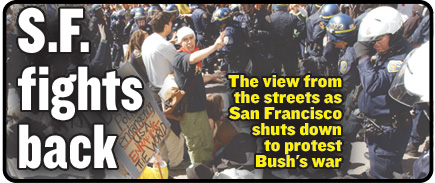
Nowhere was the clash of people power and government will more acute than on the streets of San Francisco, where a series of massive marches, some drawing nearly 100,000 people, filled the streets prior to the invasion of Iraq on March 19, 2003. The onset of war led protesters to effectively shut down the city, resulting in about 2,300 arrests and millions of dollars in costs to the city.

President George W. Bush dismissed the protests, of course, but he wasn’t the only one. Political leaders such as Rep. Nancy Pelosi, then-Mayor Willie Brown and soon-to-be Mayor Gavin Newsom (who didn’t attend any of the marches, unlike progressives on the Board of Supervisors) condemned the peace movement for hurting an innocent city. But with the “battle for San Francisco” making international news, the protesters were more concerned with the global audience.

A month earlier, on the weekend of Feb. 15 and 16, there were coordinated protests against the impending war in about 800 cities around the world, drawing around 10 million people. The peace march in Rome included about 3 million people, earning a listing in the Guinness Book of World Records as the largest anti-war rally in history. People have never made such a loud and clear statement against an incipient war.

Beyond the numbers, the antiwar movement was also right. On every major issue and prediction, the messages from the street proved correct while those from the White House were wrong. The US wasn’t welcomed as liberators. There were no weapons of mass destruction. Iraq after the invasion isn’t a stable democracy or shining beacon to anyone but the new generation of jihadis Bush created.

We can blame a hard-headed president, ineffectual opposition party, failure of the national media, or the national climate of fear following Sept. 11. But rather than refighting that lost battle, now is the time to gain perspective on the events of five years ago and determine what it means for democracy and the post-Bush national agenda.


TO THE STREETS

There were two main umbrella groups organizing protests before the war: Direct Action to Stop the War (DASW) and International ANSWER (Act Now to Stop War and End Racism). ANSWER has remained active and DASW has recently been reconstituted for the fifth anniversary of the war, using direct action in San Francisco as well as other urban centers and outposts like Chevron’s refinery in Richmond, which has reportedly been processing Iraqi oil.

“With the fifth anniversary coming up, we’re going back to direct action on the streets,” said Henry Norr of DASW. “But I don’t have any illusions that it’s going to be like it was five years ago.”

The maddening march to an ill-advised war created a political dynamic in which a broad cross-section of Americans was willing to hit the streets.

“We had a wonderfully diverse group of people, from soccer moms to anarchists,” said Mary Bull, who cofounded DASW, a collective of various affinity groups and concerned individuals formed in October of 2002 as Bush started beating the drums of war.

It was a group fiercely determined to prevent the war — and really believed that was possible. In fact, Bull recalls how she and other members of the group burst out crying at one meeting when a key activist said the war was going to happen.

Richard Becker, who cofounded ANSWER and serves as its West Coast coordinator, said that in the summer of 2002, “we came to the conclusion that [the war] was going to happen.” The group called its first big protest for Sept. 15, 2002, and another one two weeks later. But the movement really exploded on Oct. 26 when almost 100,000 people took to Market Street, much of it a spontaneous popular uprising.

“We were overwhelmed,” Becker said. “We were in a perpetual state of mobilization to keep up with what was going on. But then it didn’t stop the war.”

Did he think they could?

“I think a lot of people thought maybe it was possible to stop it. And we thought maybe it was possible to stop it,” Becker said.

The high point, according to Becker and Norr, was Feb. 17, 2003, when the New York Times ran a front page analysis piece entitled “A new power in the streets” that claimed “the huge anti-war demonstrations around the world this weekend are reminders that there may still be two superpowers on the planet: the United States and world public opinion.” But then Colin Powell went to the United Nations to argue for the invasion, and the Democrats in Congress did nothing, and it became clear war was coming.

Norr stayed out there protesting, being arrested several times and even shot in the leg by Oakland police with a rubber bullet during a protest at the Oakland docks. And he thinks some good came from the experience.

“The lesson for people is the political and economic elites are committed to preserving and extending empire. And they basically say as much in their own writing,” Norr said. “Wars are not anomalies.”

Despite being a frustrating and depressing exercise, most saw benefits to the failed movement. “People got an incredible education about how the system really worked,” Becker said. “Building a movement is mostly about a series of setbacks.”

Medea Benjamin, cofounder of both Global Exchange and CodePink and fixture of the anti-establishment peace movement for years, was upbeat about the protests. “We did our job as citizens. We did what we were supposed to do: organize, get people to take action, get people onto the streets,” she said. “We did everything we could think of.

“What you take from it is we don’t have a very well-developed democracy because the people spoke and the government didn’t listen.”

25war2_Lars1.jpg The ever-evolving “Democracy Wall” on Valencia Street, March 2003, helped stir up debate (Photo by Lars Howlett)


FACING ARREST

The collective action of five years ago starts with a series of personal stories — tens of thousands of them — so let me briefly begin with mine.

My arrival in San Francisco was closely tied to the march to war. I was living in Sacramento and working as the news editor of the Sacramento News & Review when Bush began his saber rattling against Saddam Hussein, but by the end of 2002 I had a falling out with my boss and found myself jobless.

Like most Northern Californians who opposed the war, I came to San Francisco on Jan. 18 to make my voice heard and experienced a bit of serendipity on my way to Justin Herman Plaza: while reading the Guardian on Muni, I saw their advertisement for a city editor, a job that was ideal for me at a paper I’ve always loved. Needless to say, it was a great day, empowering and full of possibilities.

Less than two months later I was on the job, and on the second week of that job I was back on the turbulent streets of San Francisco, part of a Guardian team covering the eruption of this city on the first full day of war. When I stepped off the cable car just after 7 a.m., people were streaming up Market Street and I joined them.

When a large group stopped at the intersection of Market and Beale, I stopped too, taking notes and bearing witness to this historic, exciting event. I had a press pass issued by the California Highway Patrol that allowed me to cross police lines, so when police in riot gear surrounded us and threatened arrest, I held my ground with 100 or so protesters.

After interviewing about a dozen people about why they were there and that they hoped to accomplish (see “On the bus: Journalists, lawyers, four-year-olds — the cops were ready to bust anyone Thursday morning“), I was arrested with the others and taken to a makeshift jail and processing center at Pier 27 (no charges were filed in my case, and charges against all of the 2,300 people arrested here in those first few days of the war were later dropped).

I recently tracked down a few of the people who appeared in my article, including Daphne and Ross Miller, who were at the center of the most interesting drama to play out during our standoff with the police. She’s a family practice physician, he’s an architect, and they live in Diamond Heights with their two children, Emet, who is almost 9, and Arlen, 12, who was away on vacation when the war began.

“We were genuinely shocked that the war started,” Ross told me. “We were at some of the earlier protests and really thought there was no way [Bush] could do it.”

They woke up March 20, 2003, to news that the war had begun and immediately walked to the BART station with Emet and rode to the Embarcadero station, not really planning for the day ahead but just knowing that they had to make themselves heard.

“We were pissed as hell. I don’t think I’ve ever been so angry in my life,” Daphne said.

They quickly came up with a plan. “We basically decided that if anyone was going to be arrested, it was going to be Ross and I’d stay with Emet. But it didn’t end up that way and I ended up in the arrest circle.”

Daphne had their house keys and threw them over the police line to Ross at one point. A photographer in the circle had gotten shots of a man named Roman Fliegel being roughed up by police as they pulled him off his bicycle, which was towing a trailer with a sound system, and decided to throw his backpack with camera gear out as well. When Ross — who had four-year-old Emet on his shoulders — caught it and refused police orders to give it to them, police grabbed Emet and roughly arrested Ross, leaving a gash on his forehead.

“Rage surged through the crowd, and it seemed as if things might get ugly, but the police kept a tight lid on the situation, using their clubs to shove back protesters who had moved forward,” I wrote at the time.

Emet was delivered into the circle with Daphne as the arrests continued, many quite rough. “At that point, as a mom, I had to exercise the most restraint ever,” said Daphne, who was angry about the situation but fearful about what she was exposing her son to. “Please, don’t let any violence happen here,” she pleaded with the crowd. Eventually, commanders on the scene let the mother and child go.

“The officer who let me go said that if he saw me again out there, he would call Child Protective Services on me,” Daphne said. But two days later, still brimming with outrage at her country’s actions, she ditched a downtown medical conference to rejoin the street protests, this time solo.

The couple say they’ve lost friendships over the war and have become more engaged with politics, coming to believe that Bush and the neocons are malevolent figures who knew how badly the war would go and did it anyway to establish a large, permanent military base in Iraq.

“Since that day, we’ve been far more active,” Ross said. “We realized you can’t just trust the system. You have to push.”

But that determination was mixed with feelings of disempowerment and depression. They attended some of the protests that following year, but the couple — like most people — just stopped going at some point because they seemed so futile.

“There was a horrible sense of resignation and a genuine depression that followed,” Ross told me.

The nadir was when Bush was reelected and they considered leaving the country. But then, Ross said, “we decided we’re not just going to run away and we’re not going to accept this.” Looking back, even with the scare over Emet, they express no regrets.

“It was the right thing to do because it was the wrong war to have. I’d do it again and again and again if I had to,” Ross said

They’re guardedly hopeful that Barack Obama could begin to turn things around if he’s elected. “I think the right president can at least start to dismantle this,” Daphne said. “I think thousands of people marching in the streets is something he would listen to.”

25war3_Charles1.jpg A die-in on the streets of San Francisco in March 2007 marked the fourth anniversary of the invasion (Photo by Charles Russo)


WITNESS TO HISTORY

Covering the peace movement in those early days was a heady experience, like reporting on a revolutionary uprising or working in a foreign country where the people are organized and active enough to be able to shut down society and brave enough to risk bodily injury for their beliefs.

I was at the founding meeting of CodePink — which became the most effective group at personally confronting the warmongers and keeping the war in the public eye — one evening at Muddy Waters in the Mission District shortly after the war started.

Looking back, Benjamin rattled off a long list of the alliances the group built — with labor, churches, businesses, and a wide array of social movements — and creative actions intended to build and demonstrate popular support for ending the war.

“We’ve done so many things and what did we get? We got a surge,” she said. “It shows the crisis in our democracy, the crisis of the two-party system, the crisis of a dysfunctional opposition party.”

Yet she said the peace movement has been remarkably successful in convincing the public that the war was a mistake and that it’s time for the troops to come home, even if the Democrats have been slow to respond to that shift.

“The progress we’ve made is turning around public opinion and that’s going to play a big role in the upcoming elections,” she said. For Norr, the role of the news media is a particular sore spot. He was a technology reporter for the San Francisco Chronicle who called in sick on the first full day of war and was arrested on Market Street with his wife and daughter, resulting in suspension by editor Phil Bronstein for his actions.

I wrote several stories on the issue, which culminated in Norr being fired and Bronstein unilaterally banning Chron employees from peace protests. I even borrowed CodePink’s guerilla tactics when Bronstein repeatedly refused to return my calls or address why he had singled out antiwar protesters for uniquely punitive treatment. I confronted him during a speech he gave at the Commonwealth Club (see “Lies and half-truths,” 5/7/03). That was the tenor of the times: we were all tired of being lied to and we decided to push back.

Norr was particularly frustrated with his own paper’s reporting of the war and started sending articles by the foreign press to his paper’s news desk, trying to wake his colleagues up to the pro-war propaganda being passed off as journalism in this country.

He was also disappointed with the country and with the Chronicle — both the management and his fellow reporters, who did little to support him — but the experience caused him to return to his roots as a progressive activist.

“The war and losing the job and everything brought an abrupt end to my consumerist phase and dumped me back into the world of being an activist,” said Norr, who serves on the KPFA 94.1 FM local station board and has made three recent trips to the Palestinian territories while working with the International Solidarity Movement.

Benjamin said Americans shouldn’t expect the next president to end the war — not without lots of pressure from a renewed and vocal peace movement. “This is the time to set the stage for the post-Bush agenda,” Benjamin said. “Don’t put your hopes in Barack Obama in getting us out of Iraq. Put your hopes in the people.”

25war4_Lane1.jpg A rally and nonviolent direct action at the Richmond refinery targeted Chevron on March 15 (Photo by Lane Hartwell)


THE AFTERMATH

The San Francisco Police Department, which spent more than $2 million on overtime costs responding to peace protests between March 15 and April 16, 2003, generally behaved with restraint and professionalism, but there were several exceptions.

The most costly and disturbing incident came when Officer Anthony Nelson began aggressively swinging his long riot baton at protesters, badly shattering the arm of peaceful protester Linda K. Vaccarezza, who suffered a permanent disability in her career as a court reporter.

Nelson’s incident report falsely stated that Vaccarezza had threatened him with a sign attached to a solid pole, but video of the incident later clearly showed there was no pole and that she was retreating when he teed off on her (see “The home front,” 05/19/04).

Vaccarezza received an $835,000 settlement from the city in November of 2004. On Oct. 5, 2005, two and a half years after the incident, SFPD fired Nelson for lying about what happened that day, and the City Attorney’s Office has been successfully fighting Nelson’s appeals in court ever since, putting in more than $100,000 in attorney time and costs into the Nelson and Vaccarezza cases.

The other significant ongoing litigation from the antiwar protests involved Mary Bull, who was arrested during an early protest for pouring fake blood in front of the entrance to Chevron’s San Francisco office before being allegedly strip searched and left naked in her San Francisco Jail cell for 36 hours.

Ironically, Bull was among those who brought a successful class action lawsuit against Sacramento County after she and others protesting a logging plan were strip searched, setting a precedent and led most counties to reform their strip-search policies. She used her share of the $15 million judgment to buy an organic permaculture farm in Sebastopol.

Her San Francisco case, in which Bull won a multimillion-dollar judgment, is still under appeal and now in mediation. Bull said the protests five years ago did make a difference, something she tells those who fret about its apparent failure. “I tell them to look at what issues the candidates are talking about now and I thank them for protesting then.”

“Even though we had millions throughout the world, we were sort of blocked, but now we’re regaining that momentum,” Melodie Barclay, a massage therapist who was also arrested with me on the first day of the war, told me recently. “We can’t judge it by the fact that we didn’t get the momentum we wanted.”

Norr started his antiwar activism working with Students for a Democratic Society in Boston, protesting the Vietnam War, which he said shares many similarities with the current situation, for good or for ill. He said that people tend to forget that while the protests then were huge and helped end the war, the movement did wane after Nixon ended the draft and substituted massive aerial bombardment for boots on the ground.

“The protests dropped off considerably,” he said. “A lot of the things that drove people to take risks in the late ’60s had faded by the early ’70s.”

He thinks the current administration learned a lesson from those days: it’s easier to maintain a war effort if the average citizen isn’t affected.

But there are other factors as well keeping a lid on the antiwar outrage.

“The culture has changed too. Young people are oversaddled with debt. People in schools seem to be docile. The culture as a whole seems to be more individualist and consumerist,” Norr said.

Yet some young people have woken up and many of them are funneling their energies into a peace group that was formed in the summer of 2005: World Can’t Wait, as in: the world can’t wait for the end of Bush’s second term before we change our direction and leadership.

“We don’t just want them gone, we need to repudiate their program,” said Giovanni Jackson, a 26-year-old WCW student organizer. “If we’re going to change anything, we need the youth.”

Jackson was at WCW’s founding convention in New York City, which came just as New Orleans was being flooded and then essentially abandoned by the federal government.

“When [Kerry] lost, people felt demoralized and World Can’t Wait kind of stepped into that situation,” Jackson said. “There was a lot of demoralization in the antiwar movement at that time.”

The group organized protests and student walkouts on Nov. 2, 2005.

“Everyone has their moments of doubt,” he said, “but I’m motivated by the crimes we see everyday.”


THE LESSONS

One of the biggest barriers to galvanizing people and turning the fifth anniversary of the war into something that might make a difference is the presidential election, which is diverting the energy of many potential protesters — and at the same time, offering some hope that a new president may lead to peace.

After all, every single one of the Democratic presidential candidates has promised to withdraw troops from Iraq, with varying timelines and numbers of US personnel left behind. And with enough encouragement, they might be willing to help change the status quo.

Many of the activists who volunteered their time and money to help move the Obama campaign into its front-runner position came out of the antiwar movement, and Obama’s strong stand against the war has been a key factor in his popularity.

Becker and some other activists don’t have much faith that a change in presidents will change the course in Iraq, although he agrees that much of the energy now surrounding Barack Obama derives directly from the antiwar movement.

“There’s been a huge upsurge of hope for Obama and that he might bring about the kind of change we need,” Bull said, adding that she doesn’t share that hope, believing the only path to peace is to pressure Obama and other leaders to commit to more progressive positions.

Norr said, “On one level, people have illusions about the power of peaceful protests. People believe in democracy, as well they should. We feel like the rulers should be paying attention to public opinion.

“It’s a remarkable story how broadly and quickly the American people have turned against the war. Public opinion was certainly ahead of the Democrats.”

And people will only grow more disenchanted with Iraq and its multitude of costs. “The people here are paying for this war, and everyday we have new stories about health clinics being shut down,” Becker said.

Becker was amazed last March as massive demonstrations for immigrant rights seemed to explode out of nowhere. “We think there will be more things like that,” he said.

Because after five years of organizing communities to resist the military-industrial complex’s plans, Becker thinks there’s been some visible progress.

“There isn’t a town or hamlet in the US that doesn’t have activism going on, but you wouldn’t know it from the corporate media,” Becker said. “It’s a mistake for people to feel discouraged.”


Newsom to small business: Drop dead!

0

By Bruce B. Brugmann

And so Mayor Newsom, who wants to run for governor when he still hasn’t learned to manage the city as mayor,
has bestowed the ultimate insult to small business in the City and County of San Francisco.

He has named a City Hall lobbyist for PG@E to the Small Business Commission.

Yes, you read correctly, Mayor Gavin Newsom has appointed Darlene Chiu, a PG@E lobbyst in City Hall, to the SBC.

How in the world does a company that has been screwing small business for decades inside and outside City Hall, stealing our cheap Hetch Hetchy public power for decades and forcing small business and residents to buy its expensive private power, yanking upwards of $650 million a year out of the city’s economy with its high rates, corrupting City Hall for decades with its lobbying muscle, qualify as a member of the Small Business Commission?

We put the issue in a diplomatic question and emailed it to the mayor. His press secretary, Nathan Ballard,
issued this statement this afternoon on Chiu’s glowing qualifications:

“Darlene Chiu was appointed to replace Florence Alberts after her term expired. Darlene has first hand knowledge of the challenges facing small businesses in San Francisco. She grew up working in her family’s these retail businesses in Chinatown, managing nine to l5 employees. She will also bring her knowledge of City government and communications to the Commission, which will be important to the successful operations and promotion of the assistance center.” (As one small business leader told me, “I don’t recall in the requirements of being on the commission that growing up as a child of small business owners quite meets the criteria.”)

No, no, no: PG@E is placing Chiu, via Newsom, on the SBC to help PG@E continue to facilitate the “successful operations and promotion” of further PG@E corruption in City Hall to protect its illegal private power utility in San Francisco. The supervisors can and should move quickly to reject the PG@E appointment.

More: Newsom to the Civil Service Commission: Drop dead. He appointed Mary Jung, a PG@E customer services manager, to the Civil Service Commission.

Meanwhile, as he further cemented PG@E power inside City Hall, he whacked three well qualified and conscientious commissioners: Debra Walker, an artist and activist, from heading the Building Iinspection Commission, Theresa Sparks, a transgender woman and community leader, from running the Police Commission, and Robert Haaland, a labor activist and one of the city’s most visible transgender leaders, from serving as vice president of the Board of Appeals.

Newsom is running for higher office and, as our editorial in tomorrow’s Guardian puts it, “almost everythihg he does at City Hall seems to be aimed not at improving San Francisco but at increasing his odds of moving up in the political world…Why would Newsom be doing this–if he didn’t need the support of PG@E and its allies for his next political step.

“Why would he be directing his appointees to keep out of leadership posts anyone with strong progressive credentials if he wasn’t trying to build new bridges to the developers, the big employers, the police unions and the more conservative interest groups he’ll need for a statewide campaign?” B3

Big book, tiny topic

0

› johnny@sfbg.com

REVIEW This week, I’m reviewing a book about toothpicks, a book about citrus, and a book about pigeons. When I first mentioned this plan to a fellow editor, she said it prompted visions of a surrealist game of Clue: the orange stabbed the pigeon in the study with a toothpick.

In truth, my motivation is pragmatic. I want to draw attention to the publishing industry’s love of big books devoted to tiny topics. It seems that one surefire way of selling a nonfiction tome is by focusing on a very specific subject. For evidence, one need only look at recent efforts such as Pierre Laszlo’s Citrus: A History (University of Chicago Press, 252 pages, $25), Henry Petroski’s The Toothpick: Technology and Culture (Knopf, 443 pages, $27.95), and Andrew D. Blechman’s Pigeons: The Fascinating Saga of the World’s Most Revered and Reviled Bird (Grove Press, 239 pages, $24).

Without snappy cover art and a colon followed by a subtitle, these books would be ready for inclusion in the next edition of Russell Ash and Brian Lake’s Bizarre Books: A Compendium of Classic Oddities (Harper Perennial, 224 pages, $14.95), a collection devoted to ridiculous and arcane tomes. Today, the colon (note that Ash and Lake’s book also sports one) is a way for author and publisher to assert an awareness of the potential absurdity that might arise from inscribing a world history on the head of a pin — or the tip of a toothpick.

Which brings us to The Toothpick. It’s the latest endeavor by a writer who specializes in large books on tiny topics. Petroski’s previous lengthy portrait in words was devoted to the toothpick’s cousin of sorts, the pencil. He brings an ease born from familiarity to his latest project. He also brings an anti-Wikipedia agenda, beginning his toothpick odyssey with a collection of false "stuff rustled up from the wild, wild Web." In the United States, the toothpick does have ties to Charles Forster — as claimed by answers.com and other Web sites — but Forster did not "invent" it, as one online source of misinformation states. If you read The Toothpick, you’ll learn about Forster and about Benjamin Sturtevant, a contemporary who has been erased from the toothpick’s United States–origin myth. Neither Forster nor Sturtevant are the most fascinating men ever to have probed their gums.

The point of Petroski’s toothpick testament is sharpest when he uses his small subject to touch upon ideas from different eras and cultures. Thus, before Forster and his Charles Foster Kane–like name (though not, alas, story) take over, The Toothpick cites a long passage from James Joyce’s 1916 A Portrait of the Artist as a Young Man that cries out for a toothpick, provides illustrations of Chinese toothpicks that look like chandeliers, and notes that the Renaissance was "the golden age of toothpicks." Perhaps literally — there are golden toothpicks, as well as ones made from walrus whiskers.

As its title might suggest, Laszlo’s Citrus: A History presents a fruit-centric — though by no means fruitopian — history of the world. Via the erudite Laszlo, the travels of an orange can blossom into a discussion of religious persecution. Laszlo is a retired professor of chemistry, and his prose presents a mix of stuffiness and frolic, whether imagining a correspondence with the first person ever to write a book about citrus (an 11th-century Chinese governor named Han Yen-Chih), randomly leaping from a descriptive passage into a recipe, or redundantly telling the reader that he is about to tell a story. Ultimately, Citrus does have the passion — if not always the juice — of a labor of love, even when its author favors the kind of obvious symbolism found in this sentence.

In comparison, Pigeons author Blechman is a storyteller who has a way with a hilarious turn of phrase. He writes of "backyard geneticists" who create birds "more akin to a Dresden figurine than a child of nature," notes that the pigeon "has been prized as a source of companionship (and protein)," and confesses his fondness for the Frillback, a breed with feathers that look like they "were dipped in Jheri Curl." Over the course of one winter, he meets as many breeds of pigeon obsessives as he does pigeons. The wildest marriage might be between Parlor Rollers and their owners. Parlor Rollers somersault backward up to 600 feet in a single effort, a display that Blechman deems "the avian equivalent of obsessive-compulsive disorder." When Blechman asks one owner why the birds do what they do, the man replies, "Because they’re retarded, that’s why."

Actually, Pigeons makes a strong case for recognizing and respecting the oft-abused pigeon, a case drawn from no less a source than Charles Darwin’s 1859 On the Origin of Species. Blechman’s book contains some disturbing passages (especially a foray into a Pennsylvania town that made bird slaughter into an annual holiday replete with teen boys delivering body slams) and no shortage of funny adventures. By the end, it transformed the way I view pigeons. Though I’m a vampire for blood oranges and I abuse toothpicks like an addict smokes cigarettes, I’m afraid the other two books didn’t have quite the same impact.

Freedom of Information: 2007 James Madison Award winners

0

Click here for details on the First Amendment Awards Dinner.

Norwin S. Yoffie Career Achievement Award

DAN NOYES (COFOUNDER, CENTER FOR INVESTIGATIVE JOURNALISM)


If journalists were the subjects of trading cards like baseball players, the Dan Noyes rookie card would be just as impressive as a 2008 career highlights card. Think Reggie Jackson: a long, impressive career, spanning multiple organizations and a propensity to come out swinging big at the end of a hard-fought battle.

Over a career spanning 30 years, Noyes has pursued serious investigations, some lasting as long as a year, into everything from questionable Liberian timber imports to illicit gun trafficking from United States suppliers to the Nuestra family gang. Journalism first interested Noyes during the crucial investigative reporting that sparked Watergate scandal in the early 1970s.

In 1977 Noyes cofounded the Berkeley-based Center for Investigative Reporting (CIR), an independent news organization which produces in-depth stories and documentaries for all major news outlets. In 1979, reporting for the ABC News program 20/20, CIR broke a story on a swindling United Nations charity organization and its connections to international drug trafficking.

More recently, Noyes has done a series of print and broadcast pieces concerning gang violence in California and its effect on the lives of those surrounding the lifestyle. Noyes still holds an executive position at the CIR and continues to contribute to the world of investigative journalism.

Beverly Kees Educator Award

CLIFF MAYOTTE


Cliff Mayotte sees his Advanced Acting Class at Lick-Wilmerding High School as one that merges students’ "consciousness and awareness as young adults with their skills and energies as performance artists."

The subtitle of the course is "Theatre as Civic Dialogue," and the eight students enrolled during the 2007 spring semester used all their abilities to pull off a notable show.

After an introduction to Documentary Theatre — a form he described as "oral history turned into performance" — the group selected a topic that was important to them, giving birth to the "Censorship Project."

The students interviewed their peers, teachers, and administrators to gather perspectives on the ways in which expression and opinion can be muted or altered, both voluntarily and involuntarily. They reached out to organizations such as Project Censored, the First Amendment Project, and the Ella Baker Center for Human Rights. They transcribed interviews and studied subjects in order to capture statements, word patterns, and mannerisms of interviewees, then shaped the themes into a 60-minute performance.

Professional Journalists

WILL DEBOARD


"Being a high school sports guy, I don’t get to do this very often," the Modesto Bee‘s Will DeBoard said of his first major foray into investigative reporting. He had gotten a tip that the California Interscholastic Federation was investigating recruiting violations by the football program at Franklin High School in Stockton, which competed with schools in his area. DeBoard asked the school and CIF about recruiting violations, but the football coach flatly denied the allegations and the CIF wasn’t much more helpful.

So DeBoard decided to make formal requests for public records with the help of business reporter Joanne Sbranti, and after fighting through some initial denials, he obtained hundreds of pages of investigatory documents from CIF showing how the school was recruiting players from American Samoa. "It really was a treasure trove of great stuff. We got two weeks’ worth of stories out of these documents," DeBoard said. "It really showed us that what the school was telling us just wasn’t true."

The documents detailed the recruiting scheme and gave DeBoard tons of leads for follow-up stories, including the address of "a home owned by the coach where there were all these gigantic Samoan linemen living there." DeBoard called the effort an "adrenaline rush" better than that caused by the best game he’s covered and a high point of his journalism career.

THOMAS PEELE


Contra Costa Times investigative reporter Thomas Peele has a long history of battling for public records access on behalf of both reporters and private citizens. Peele, who helps with projects for all the newspapers under the Bay Area News Group-East Bay ownership, helped ensure the recovery of thousands of e-mails from the Oakland mayoral tenure of Jerry Brown when he left office to become the state’s attorney general in 2006. Peele also helped conduct a statewide audit of Public Records Act compliance by law enforcement agencies with the nonprofit Californians Aware, which revealed glaring inconsistencies in how police across the state make information about their activity available to the public. And he’s been a major figure in helping the Chauncey Bailey Project pry out new information about Bailey’s murder last year and it’s connection to Your Black Muslim Bakery. He began his career in 1983 at a small weekly in Bridgehampton, N.Y., and moved from there in 1988 to the Ocean County Observer in New Jersey before joining the CCT in 2000.

ROLAND DE WOLK


KTVU-TV producer Roland De Wolk is leading the investigative team of photographer Tony Hedrick and video editor Ron Acker in a quest to get the names of drivers who regularly use FasTrak lanes but don’t pay anything. But to date, says De Volk, the Metropolitan Transportation Commission has been blocking his team’s quest.

De Wolk told the Guardian that his team filed a California Public Records request when the MTC wouldn’t provide information on the amount of money it was losing thanks to drivers who don’t pay tolls when they use FasTrak lanes.

"We asked MTC for specific numbers last summer and got little information. That makes a reporter’s antennae quiver," said De Wolk.

But when he and his team asked for the numbers of people obstructing their plates, the MTC started acting squirrelly, De Wolk said.

"Finally, after six to eight weeks of asking we got an answer: a photo of a car whose plate was blank," fumed De Wolk, whose team continues to push for the names of the 10 most frequent FasTrak violators.

Broadcast News Outlet

KGO-TV


When KGO-TV reporter Dan Noyes and producer Steve Fyffe asked Muni to turn over records of public complaints against its drivers, they were ready for some bureaucratic foot dragging. But they never expected the yearlong grudge match that followed. First, the union representing Muni drivers sued to keep the records sealed. Then Muni’s parent department, the Municipal Transportation Agency, made a backroom deal with the union and released a blizzard of confusing and heavily redacted paperwork that would have made the Pentagon blush.

"It was essentially a big document dump," Fyffe told us. "There was no way to tell one form from another or which driver was which."

Noyes and Fyffe convinced their bosses at KGO-TV to file a lawsuit for full access to the records. The station prevailed, after which Noyes and Fyffe received over 1,200 pages of public complaints about 25 drivers. Recently, the station went back to court after Muni refused to release surveillance tapes of the drivers. As in the previous case, the judge ruled that the public had a right to the materials and forced the transit agency to hand the tapes over.

Fyffe said he sees KGO’s legal successes as small victories in a much larger fight. "I hope in the future that this case will make Muni and other city departments more [responsive] to records requests … these kinds of incremental victories hopefully lead, little by little, to a more open government."

Print News Outlet

SACRAMENTO BEE


The Sacramento Bee operates in a city run by top-tier politicians and their spinmeisters, so the editors and reporters there have placed increasingly high value on using documents to support their stories.

"We’ve always used public records here. Being in a state capital, we’re a little more aware of the necessarily of that," managing editor Joyce Terhaar said. "You just need to be able to tell a story about what’s really happening."

Yet she said that in recent years, the Bee has made a concerted effort to hire public-records experts and to have them share their knowledge with the paper’s staff through regular workshops. And last year, those efforts paid off with a string of big, impactful investigative stories.

Among them was Andy Furillo’s look at how much the state was spending to fight inmate care lawsuits, Andrew McIntosh’s exposé on the lack of oversight for paramedics and emergency medical technicians, and stories by John Hill and Kevin Yamamura on misconduct by the state’s Board of Chiropractic Examiners.

In selecting the Bee, Society of Professional Journalists judges recognized these individual efforts as well as the Bee‘s "institutional support of reporters and their use of public records for numerous stories."

Community Media

THE BERKELEY DAILY PLANET


One of the only ways to uncover corporate wrongdoing is to dig through court records, and it’s the job of the press to report what it discovers, said Becky O’Malley, executive editor for the Berkeley Daily Planet. She was convinced that a prior court order violated the public’s constitutional rights to see court documents, so the small daily newspaper sued and won in a California appeals court last year, making public 15,000 pages of records from a class-action suit filed against Wal-Mart in 2001.

The documents included allegations that the company had denied rest breaks to its workers and deleted hours from paychecks. In the Planet‘s freedom of information suit, the appeals court judges agreed with the paper’s attorneys that the case could set a dangerous precedent where the public would have to prove its right to access court records. "It’s becoming more of a trend for judges to grant permanent seals on court records," said O’Malley. That’s unfortunate, she added, since "the only way the public finds out about bad things going on in society is through court records."

Special Citation Award

CHAUNCEY BAILEY PROJECT


After Oakland journalist Chauncey Bailey was murdered last August, a large group of Bay Area media organizations formed a rare coalition to investigate his death and the activities of Your Black Muslim Bakery, a long-time East Bay institution believed by police to be involved in the killing. Since then, the group has produced several stories complete with audio, video, and photo presentations, the most recent of which is a series by retired Santa Rosa Press-Democrat reporter Mary Fricker detailing the sexual assault allegations made by young women once in the custody of Yusuf Bey Sr., founder of the bakery. Fricker received help from independent radio journalist Bob Butler, investigative reporter A.C. Thompson, and MediaNews staff writers Cecily Burt, Thomas Peele and Josh Richman. Other stories have reported allegations of real estate fraud against bakery associates, explored potential coconspirators in Bailey’s death, and examined the bakery’s ties to several prominent politicians. More about the project — the first of its kind since a group of journalists investigated the murder of Don Bolles more than 30 years ago in Arizona — can be found at chaunceybaileyproject.org, or at www.sfbg.com/news/chaunceybailey.

Public Official

MARK LENO


It was a staff member, Kathryn Dresslar, who told Assemblymember Mark Leno how horrible state agencies had become at complying with the California Public Records Act. Dresslar served on the board of Californians Aware, a group that advocates for open government, and she described to her boss how a 1986 audit by the organization had given every one of the 33 agencies in California government a failing grade.

Ryan McKee, then a high-school student and the son of CalAware board president Rich McKee, had visited each agency and asked for a few simple things. He wanted to see each agency’s guidelines for public access, and he requested some basic information, including the salary of the agency director. Agency after agency refused to follow the law.

So Leno introduced legislation that would have mandated that every agency post its access guidelines on the Web — and included stiff fines for agencies that violated the Public Records Act. "It put some teeth into the law," Leno told us. "And I got 120 of 120 members of the state Legislature to vote for it.

That wasn’t enough for Gov. Arnold Schwarzenegger, who vetoed the bill, saying it wasn’t needed. The governor insisted that he had already ordered state agencies to fix the problem.

"It was a great eye-opener for me, and showed me the resistance this administration has to allowing public access to state government," Leno said. "Without that access the public is at a great disadvantage."

Library

UC BERKELEY’S BANCROFT LIBRARY LOYALTY OATH PROJECT


It might be hard to believe, but in 1949 the University of California Regents, a bastion of higher education, rode the wave of anticommunist fervor and McCarthyism, forcing all UC employees to take a loyalty oath. The Board of Regents adopted the rule that UC administrators pushed forth: denounce communism and swear loyalty to the state, or face losing your job.

As could be expected, people resisted and 31 faculty, workers, and student employees lost their jobs. They appealed the case to the California Supreme Court and eventually were reinstated in 1952, but the controversy cast a pall over the UC’s reputation and divided campuses. With the help of a grant from UC President Emeritus David Gardner, archivists from UC Berkeley’s Bancroft Library and other researchers painstakingly compiled 3500 pages of text, many audio statements, and photos from four UC collections.

The online collection, which went live in December 2007, serves as primary source material for students and researchers who want to understand how UC administrators got embroiled in and came to terms with the McCarthy-era tensions that rocked the country.

Legal Counsel

RACHEL MATTEO-BOEHM


Electronic data is the new frontier for public-records law, and Rachel Matteo-Boehm, a lawyer with Holme, Roberts and Owen, last year won a key case preserving the public’s right to access to what some public agencies have tried to claim was proprietary data.

The county of Santa Clara produced a digital map showing property lines, assessors parcels and other key real-estate data, and that became the basis for a geographic information system tool. The GIS would allow users to plot everything from property taxes to street repairs, public investment, political party registration, school test scores and other trends. But Santa Clara wasn’t giving it out to the public: The database cost more than $100,000, which meant only big businesses could use it.

Boehm went to court on behalf of the California First Amendment Coalition to argue that the data was public, and must be made available without high charges. "As information begins to be collected in electronic form, and governments choose to put information in sophisticated electronic formats, you can run into real public-access problems," Boehn told us.

Boehm convinced a Santa Clara Superior Court judge that the data was indeed covered under the California Public Records Act. Now Santa Clara must make the map available to the public — and other counties with similar data, seeing the results of the suit, are following that rule.

The decision was a key one, Boehm said: "One day we’re going to wake up and all there will be is electronic records," she noted. And if governments can apply different rules to those documents, "you can kiss the Public Records Act goodbye."

Whistleblower

DAN COOKE


When Dan Cooke shared details of an alleged sewage spill on Alcatraz Island with the Guardian, the health of the national park — where he’d been working as an historical interpreter for over a decade — was foremost on his mind. But he lost his job after the story was published — apparently for taking a proactive role in noting details of the spill in the island’s log book and speaking candidly to the press about what he’d seen. Wanting nothing more than a return to his job leading educational tours of the island, he filed an administrative claim with the US Department of Labor against the Golden Gate National Park Conservancy and the National Park Service. And he called the Guardian. We reported his firing. The next time Cooke called, it was to happily report he was back on the job.

Citizen

SUPERBOLD (BERKELEYANS ORGANIZED FOR LIBRARY DEFENSE)


SuperBOLD has accomplished something entirely different from what it set out to do. Originally, the small group of devoted Berkeley public library users organized to oppose the installation of RFID tags in books. "In the process of going to library board of trustees meetings, we discovered they were vioutf8g the Brown Act," said Gene Bernardi, who heads SuperBOLD’s steering committee with Jane Welford, Jim Fisher, and Peter Warfield. They found, among other things, that certain documents were only made available to trustees and a lottery system was employed in selecting speakers during public comment. They took their complaints to the Berkeley city attorney and joined up with the First Amendment Project, which threatened a lawsuit. Things have changed, though it’s still not perfect — city council meetings only allow 10 speakers and the library trustees still play the lottery for public comment, but marginal improvements portend better days.

"Now you can speak more than once," said Bernardi. "Now you can speak on consent calendar and agenda items. So there are more opportunities to speak … if the Mayor [Tom Bates] remembers to call public comment."

Electronic Access

CARL MALAMUD, PUBLIC.RESOURCE.ORG


For years, web pioneer Carl Malamud has sought ways to use the Internet to connect average citizens with their government. His new Web site public.resource.org helps that cause by excavating buried public domain information and posting it online. Though still in its early stages, the site already allows users to tap into hard-to-find records from places like the Smithsonian, Congress, and the federal courts system.

Even though most government records are part of the public domain, fishing them out from the bureaucratic depths can be a daunting and expensive task, even for someone like Malamud. During a lecture at UC Berkeley last year, he related his recent difficulties in acquiring a simple database from the Library of Congress. Instead of turning over the materials, officials at the Library cited dubious copyright protections and presented Malamud with a bill for over $85,000 — all for access to supposedly public information.

Thanks to Malamud’s Web site, that database and millions of other documents are now available with the click of a mouse. Ultimately, Malamud hopes public.resource.org will help bring about an age of "Internet governance," in which every last byte of public data winds up online for all to see, free of charge.

THE SOCIETY OF PROFESSIONAL JOURNALISTS
NORTHERN CALIFORNIA CHAPTER presents the 23RD ANNUAL JAMES MADISON FREEDOM OF INFORMATION AWARDS DINNER

MARCH 18, 2008
NEW DELHI RESTAURANT
160 ELLIS STREET
SAN FRANCISCO
No-host bar @ 5:30 p.m.
Dinner/Awards @ 6:30 p.m.

TICKETS:
$50 SPJ members & students
$70 General public
For more information, contact David Greene (dgreene@thefirstamendment.org)

>

“Cinema Piemonte”

0

PREVIEW The northwestern Italian region of Piemonte is noted for production of wine, wheat, and Fiats. Its principal city, Turin, a.k.a. Torino, was briefly the nation’s capital after unification — and soon afterward became the focus of its early film industry as well. While both crowns were eventually stolen by Rome, the area maintained a role in Italian cinema through the decades. That history is sampled in this weekend of features set in Piemonte, presented by the Associazione Piemontesi of Northern California in collaboration with the Italian Cultural Institute and Regione Piemonte. The four programs run a wide gamut, not least because they span 90 years between them. The closer on Sunday should be a major occasion: a restored print of Giovanni Pastrone’s 1914 Cabiria, the apex of the lavish costume epics that dominated Turin’s industry and proved a huge influence on the likes of D.W. Griffith and Cecil B. DeMille. This three-hour tale of ancient Rome will be accompanied live by pianist Stefano Maccagno, playing his original score. Another big international hit was 1949’s Bitter Rise, a heady brew of neorealism and noir melodrama that made Silvana Mangano — at the time a very well-developed 19 years old — into the first postwar Euro bombshell. Packed into tight clothes as a scheming peasant rice harvester, she seemed the very embodiment of wanton s-e-x years before Bardot, Monroe, and Loren came along. Mario Monicelli’s 1963 I Compagni, a.k.a. The Organizer, is a somewhat more serious labor drama, with Marcello Mastroianni, superb as usual, portraying a professor agitating for improved textile worker conditions at the dawn of the 20th century. Opening the weekend, and serving as its lightest note, is Davide Ferrario’s Dopo Mezzanote (After Midnight, 2004), a whimsical romantic comedy set in Turin’s Mole Antonelliana — a beautiful 19th-century structure that happens to house Italy’s National Museum of Film.

CINEMA PIEMONTE Fri/29, 7 p.m.; Sat/1, 4 and 7:30 p.m.; Sun/2, 4 p.m., free

Cowell Theater, Fort Mason Center, Marina at Laguna, SF

www.piemontesinoca.com, www.fortmason.org

Years of Lead

0

› a&eletters@sfbg.com

REVIEW Reflecting on his work on millenarian Europe, the autonomist and political philosopher Antonio Negri stated, "This is certainly one of the central and most urgent political paradoxes of our time: in our much-celebrated age of communication, struggles have become all but incommunicable."

Long an influential campaign in Negri’s native Italy, autonomia, or self-rule, has received little critical attention from the English-speaking world. Editors Sylvère Lotringer and Christian Marazzi’s Autonomia: Post-Political Politics (Semiotext(e), 340 pages, $24.95), originally released as part of the short-lived Semiotext(e) magazine series in 1980, proffers the first English-language introduction to one of the most controversial movements of postmodernity.

Developed in the vibrant Götterdämmerung of the late 1960s in reaction to the largely corrupt and co-opted Eurocommunist parties, the worker-inspired Potere Operaio and its immediate descendent Autonomia Operaia were a philosophical umbrella, or, as one government critic put it, "a veritable mosaic made of different fragments, a gallery of overlapping images of circles and collectives without any social organization." At its heart, autonomia was a rejection by individuals and marginalized groups of not only the capitalist state but also its traditional ideological enemy — Marxism and its central doctrine of class struggle — for a postideological and immaterial way of life.

Brokered in universities throughout Bologna and Rome but dedicated to labor activism and the street-level situationism of sessantotto (student unrest), autonomia was powered by a number of formidable philosophical proponents. They included Negri, Oreste Scalzone, and Paolo Virno, as well as French sympathizers and arch collaborators Félix Guatarri, Gilles Deleuze, and Paul Virilio. Autonomia collects the various polemics, letters, and récits of these authors in an attempt to again dramatize the revolutionary and sometimes violent struggles between neofascists, unionists, and the ultraleft during the ensuing "Years of Lead."

Semiotext(e) editor Lotringer prefaces this new edition with a short travelogue describing his interactions with the various underground factions of Rome and Bologna in the shadow of politician Aldo Moro’s assassination by the dreaded Red Brigades, or Brigate Rosse. Long associated with the neofascists and socialists as the armed division of the Autonomia Operaia, the Red Brigades began resorting to terrorist propaganda, bombings, and assassination in the wake of government crackdowns in the late 1970s.

Lotringer encounters a gaggle of activists, intellectuals, and simulationists who may or may not pledge loyalty to the Red Brigades and who live in compounds and squats hiding from the omnipresent carabinieri, who continue to surveil the streets. Some are in costume and others spin Velvet Underground records; still others may be government informants or simply thrill to the hip simulacra of espionage. According to Lotringer, this alternative and autonomist space may have accomplished, however briefly, the utopic "non-fascist living" of Deleuze and Guattari.

Throughout Autonomia‘s 300 pages of densely translated text — from theorists and tricksters, reporters and members of the lumpen proletariat — the truly inclusive and sometimes circuitous worlds of the title movement become all the more apparent, yet never transparent. Negri’s contributions are particularly inspiring and frustrating in their brilliant opacity. Ultimately, in rejecting the verticality of hierarchies of power — textual, political, and economic — the autonomists opened up larger interpretative spaces: realms that existed beyond capital and beyond empire.

Solo budgeting

0

› sarah@sfbg.com

Mayor Gavin Newsom is giving his department heads until Feb. 21 to draw up a list of services and positions to be reduced and eliminated, but Board of Supervisors president Aaron Peskin notes this isn’t how city government is supposed to work.

"Technically, things aren’t being cut," Peskin told the Guardian. "Instead, the mayor is signaling that he is refusing to spend the money that has been appropriated by the board in the budget that was voted on and signed last year."

Last summer the Board of Supervisors used the add-back process to appropriate funds the mayor hadn’t sought, thus funding services such as the Workers Compensation Clinic at San Francisco General Hospital and Buster’s Place, the city’s only 24-hour homeless shelter, until the end of fiscal year 2007–08.

But now these same services are being targeted midyear. The mayor announced last November, shortly after he was reelected, that the city faces a projected $229 million budget, so he was demanding an immediate hiring freeze and across-the-board cuts.

As mayoral spokesperson Nathan Ballard reportedly told the San Francisco Chronicle last fall, "Although he wants to trim the fat, the mayor made it abundantly clear he doesn’t want to see a reduction in people sweeping streets or police officers walking beats."

But while city department heads spent the past few months trying to tighten belts, the mayor apparently expanded his, according to budget analyst Harvey Rose’s Feb. 13 report, which details the monetary impact of changes to Newsom’s staff — changes the mayor first announced Jan. 4.

"Don’t think that the irony of the revelations that have been made over the past few weeks has been lost on anyone," Peskin told us, referring to how Newsom added two entirely new positions, increased the pay of senior staff and newly appointed department heads in the Mayor’s Office, and raided the budgets of other agencies to pay for it all.

According to Rose’s report, the budgetary impact of Newsom’s staff changes amounted to an increase of $553,716, with other city departments funding about $1.34 million in annual salaries and benefits for 10 positions assigned to the Mayor’s Office.

These include two newly created jobs — namely, the mayor’s climate change director, Wade Crowfoot, and the mayor’s homelessness policy director, Dariush Kayhan.

Peskin admits that the spending Rose identified is a relative drop in the bucket, compared to the city’s $229 million deficit. "Yes, it’s not enough to significantly close the gap or save a significant number of services, but it’s symbolic," Peskin said, noting that even as homeless shelters are being fingered for elimination, the Human Services Agency is paying $169,624 annually for the mayor’s new homelessness policy director.

"And when voters approved more money for Muni, the mayor used it to hire people to pound out messages about climate change, when the best way to reduce greenhouse gases is to get people out of their cars," Peskin said, referring to Newsom’s new climate change director, hired at an annual cost of $130,112, using the Municipal Transportation Authority’s Safety and Training funds.

"It’s very frustrating and unfortunate," Peskin said, further noting that the $401,392 to terminate Susan Leal without cause as general manager of the San Francisco Public Utilities Commission will come from the city’s water fees.

"This is indicative of the misplaced priorities of the mayor," said Peskin, who doesn’t deny that spending control is required in the face of a looming deficit but resents how the mayor has been trying to do it unilaterally and not in cooperation with the board.

"The budget, by design, is a two-way street," Peskin observed.

Sup. Chris Daly claimed the services being targeted for Newsom’s midyear elimination are "a who’s who of the board’s priorities…. These are human and health services that the mayor has proposed be cut multiple times."

Daly’s legislative aide, John Avalos, who is running for District 11 supervisor, notes that while Daly wanted $33 million for affordable housing, a onetime amount, the mayor took a budget surplus and used it for multiple years, with the police, firefighters’, and nurses’ contracts accounting for his biggest expenditures.

Asked why the city’s deficit has ballooned by $144 million — from the $85.3 million the Controller and Budget Analyst’s offices identified in March 2007 to the $229 million that Newsom’s administration was suddenly projecting last fall — Tom DiSanto, budget and revenue manager for the Controller’s Office, cites an extra $82 million in salaries and benefits.

These include the four-year contracts that nurses and police and fire departments secured last summer, along with five extra police academies, said DiSanto, who also listed $7 million in police crime laboratory debt service, $7.4 million for sheriff inmate housing (required by last year’s Supreme Court order that prisoners can’t sleep on floors), and the $29 million transit set-aside that voters approved last November when they passed Proposition A.

But as DiSanto explains, the city’s budget problem is due not to lack of revenue but to baseline funding and rainy-day reserve requirements, not to mention the political process.

"Right now, with baselines and reserves, 96¢ out of every dollar goes into set-asides, and we’re required to adopt a balanced budget," DiSanto said. "That’s where the cuts come in. If we could access all the city’s revenues, we wouldn’t have a $229 million projected deficit," he added, noting that revenues are up, property taxes are higher than budgeted, and the hotel tax continues to be strong.

Ken Bruce, senior manager at the Budget Analyst’s Office, notes that unlike the federal government, the city of San Francisco has to balance the budget. He also says the current deficit projection comes from the Controller’s and the Mayor’s offices, not the Budget Analyst’s Office.

"In mid-March we get to do a joint forecast," Bruce told the Guardian. "It may paint a better picture, less of a doomsday scenario, but it still leaves us facing difficult policy choices. [The deficit] won’t drop from $230 million to $100 million."

Peskin envisions several long-term solutions, hopefully including positive changes in the White House this fall.

"With every passing year, as the federal government has abandoned the cities, we’ve taken more of a burden, and labor and capital costs have increased," says Peskin, who is mulling changes to the real estate transfer tax and closing a loophole whereby lawyers and accountants in limited liability partnerships have escaped paying payroll taxes.

That said, Peskin sees no easy fixes in the city’s upcoming budget hearings:

"It’s a fluid situation, and it’s all bad."

G-Spot: Valentine’s Day events

0

PARTIES, EVENTS, AND BENEFITS

Amor del Mar Aquarium of the Bay, Pier 39, Embarcadero at Bay; 623-5326, www.aquariumofthebay.com. Feb 14, 6pm, $100. Celebrate San Francisco’s love affair with the bay and support the nonprofit Aquarium of the Bay Foundation at this gala celebration featuring global cuisine, decadent drinks, live music, and exhibitions.

Erotic Playground One Taste, 1074 Folsom; www.tantriccircus.com. Sat/9, 8pm; $30 single women, $50 single men, $60 couples. The Tantric Circus presents a sexy evening of burlesque, striptease, male lap dance, fruit feeding, DJs, and more.

Eternal Spring SomArts Bay Gallery, 934 Brannan; 1-888-989-8748, eternalspring08.com. Sat/9, 2-10pm, $7. Celebrate life, love, arts, and creativity at this all-day event including a fashion show, performances, free classes (hoop, poi, yoga, and more!), DJs, and shopping.

Heroes and Hearts Luncheon Union Square; 206-4478, www.sfghf.net. Feb 14, 11:30am, $300. Celebrate those who have helped the community and support the San Francisco General Hospital Foundation by attending this luncheon and auction of artist-created tabletop heart sculptures.

My Sucky Valentine XIII ARTworkSF Gallery, 49 Geary; 673-3080, www.artworksf.com. Feb 14, 8pm, $15-25. Listen to tales of tainted love and bad sex by good writers including Thomas Roche, Carol Queen, Michelle Tea, and mi blue, all to benefit the Women’s Community Clinic and the St. James Infirmary.

One Night Stand X ARTworkSF Gallery, 49 Geary; 673-3080, www.artworksf.com. Sat/9, 6-11pm, $15-25. Support the Center for Sex and Culture and the SF Artists Resource Center at this sexy multimedia event including live nude models, paint wrestling, erotic food feeding, and performances.

PINK’s 2nd Annual Valentine’s Day Party Look Out Bar, 3600 16th St; 703-9751, www.mypartner.com. Sat/9, 8pm-2am, $25. MyPartner.com cohosts this year’s party and benefit for the GLBT Historical Society. About 300 single gay guys are expected to enjoy an open Svedka vodka bar and hobnobbing with guests like Assemblymember Mark Leno and Sup. Bevan Dufty.

Poetry Battle of (All) the Sexes Beat Museum, 540 Broadway; 863-6306, www.poormagazine.org. Feb 14, 7:30pm; $20 to fight, $15 to watch. Challenge your partner (or future partner) to a battle of spoken word, hip-hop, poetry, or flowetry in the ring at this benefit for Poor magazine.

Prom Pete’s Tavern, 128 King; 817-5040, www.petestavernsf. Feb 14, 9pm, $10. What’s more romantic than prom? Prom in the ’80s! Enjoy music, decorations, mock gambling, and dancing, all to benefit Voices, a nonprofit that works with emancipated foster youths. Admission includes one drink, gambling chips, and a photo.

Queen of Arts: A Profane Valentine Coronation Sssshh…!, 535 Florida; www.anonsalon.com/feb08. Feb 15, 10pm, $10-20. The production team that brought us Sea of Dreams presents a sexy night of DJs, dancing, art, and performance, including Kitty-D from Glitch Mob, Mancub from SpaceCowboys, Fou Fou Ha!, and Merkley.

Queen of Hearts Ball Mighty, 119 Utah; 974-8985, www.goodvibes.com. Feb 14, 8pm, $25. Good Vibrations and Dr. Carol Queen host this decadent fairy-tale-themed costume party featuring MC Peaches Christ, circus performances by Vau de Vire Society, a fetish fashion show, and dancers from the Lusty Lady.

Romancing the Reptiles: Wild Love! Tree Frog Treks, 2112 Hayes; 876-3764, www.treefrogtreks.com. Sat/9, noon-2pm; $40 adults, $25 kids. Join animal care director Ross Beswick as you learn about how animals pick their mates and where baby animals come from.

Sensualité 111 Minna, 111 Minna; www.celesteanddanielle.com/party.html. Feb 15, 9pm; $15 advance, $20 at the door. Wear something sexy to this multimedia Valentine’s Day event featuring aphrodisiac appetizers, exotic rhythms, tarot readings, performances, a raffle, and a no-host bar.

Sweet Valentine’s Cruise Pier 431/2; 673-2900, www.redandwhite.com. Feb 14, 5pm; $48 adult, $34 youth. Join the Red and White Fleet for a romantic, fun, two-hour cruise of the San Francisco Bay, including a lavish appetizer buffet by Boudin and a complimentary beverage.

Transported SF Valentine’s Singles Party Pickup at Rite Spot, 2099 Folsom; transportedsf.com. Feb 14, 7:30pm, $21.49. Join DJs Ana Sia and Felina aboard the biodiesel Transported SF bus for sultry sounds, schmoozing with other singles, and stops at gorgeous outdoor dancing locales.

Woo at the Zoo San Francisco Zoo; Sloat at 47th St; 753-7236, www.sfzoo.org. Sat/9, Feb 13-15, 6pm; Sun/10, Feb 17, noon; $75. This multimedia event, conducted by Jane Tollini of the now-defunct Sex Tours, explores the sexual and mating behaviors of animals. Also featuring champagne and romantic refreshments.

BAY AREA

Flamenco, Candlelight and Roses Café de la Paz, 1600 Shattuck, Berk; (510) 287-8700, www.cafedelapaz.net. Feb 14, 5:30, 6, 8, and 8:30pm; Feb 15-16, 6:30pm; $75-115. The nuevo Latino café celebrates the sweet side of love with three days of dinner plus a show, featuring the acclaimed Caminos Flamencos dance company.

Nest Firecracker Valentine Event Nest, 1019 Atlas Peak, Napa; (707) 255-7484. Sat/9-Sun/10, 10am-6pm, $5. Celebrate Chinese New Year and Valentine’s Day together while shopping for unique gifts and making art projects with scrapbook artist Janine Beard, all to benefit the "Nest Egg" fund through the Arts Council of Napa.

Sweetheart Tea Yerba Buena Nursery, 19500 Skyline, Woodside; (650) 851-1668, www.yerbabuenanursery.com. Sat/9, noon, $25. Enjoy a traditional tea service with a special Valentine’s Day menu, followed by a stroll through the nursery’s gorgeous gardens.

Week of Valentines at Habitot Children’s Museum Habitot Children’s Museum, 2065 Kittredge, Berk; (510) 647-1111, www.habitot.org. Fri/8-Sat/9, 9:30am-4:30pm; Feb 12-14, 9:30am-1pm; $6 per child, $5 for accompanying adult. Contribute to a large heart sculpture and create handmade cards from recycled materials. Bring valentine-making supplies to receive a free adult admission pass.

FILM, MUSIC, AND PERFORMANCE

The Adventures of Priscilla, Queen of the Desert California Palace of the Legion of Honor, 100 34th Ave; 1-866-912-6326, www.legionofhonor.org. Feb 14, 5:30pm, $10-20. The Cinema Supper Club at the Legion of Honor presents this film as part of "The Real Drama Queens" series, including a special exhibition opening at 5:30pm, dinner seating at 6pm (reservations made separately; call 750-7633), and film screening at 8pm.

BATS Improv Valentine’s Day Show Bayfront Theater, Fort Mason Center, bldg B, Marina at Laguna; 474-6776, www.improv.org. Feb 14, 8pm; $10 advance, $15 at the door. Whether you’re flying solo, with friends, or on a date, this audience-participation show is the perfect place to enjoy the funny side of romance.

The Best American Erotica Modern Times Bookstore, 888 Valencia; 282-9246, www.moderntimesbookstore.com. Feb 13, 7:30pm, free. Celebrate the 15th anniversary of the series with this showcase of standout stories, including a hot and edgy piece from Susie Bright.

Boston Marriage Theatre Rhinoceros, 2926 16th St; 861-5079, www.therhino.org. Feb 7-March 2, call or see Web site for schedule, $15-35. Join Anna and Claire and their crazy maid for Theatre Rhinoceros’s version of David Mamet’s same-sex romp.

Brainpeople Zeum, 221 Fourth St; 749-2228, Thurs-Sat, 8pm (also Sat, 2pm); Sun, 2pm. Through Feb 16. $20. American Conservatory Theater presents the world-premiere production of this newest work by José Rivera, screenwriter of The Motorcycle Diaries, about two women who reckon with their pasts in an apocalyptic future.

The Eyes of Love Mechanics’ Institute, 57 Post; 393-0100, www.milibrary.com. Feb 14, 7:30pm; $15 members, $25 public. Back by popular demand, chanteuse Helene Attia will select from her vast repertoire of love songs, classic and contemporary. Admission includes hors d’oeuvres, libations, and dessert.

Hope Briggs and Friends: A Musical Valentine Herbst Theatre, War Memorial Veterans Bldg, 401 Van Ness; 392-4400, www.cityboxoffice.com. Feb 17, 3pm, $25-50. Celebrated soprano Hope Briggs shares favorite opera arias alongside 15-year-old singing sensation Holly Stell and virtuoso violinist Dawn Harms.

How We First Met Herbst Theatre, War Memorial Veterans Bldg, 401 Van Ness; 392-4400, www.howwefirstmet.com. Feb 14, 8pm, $22-35. Real audience stories are spun into a comedy masterpiece in this one-of-a-kind hit show.

In Search of the Heart of Chocolate Delancey Street Foundation, 600 Embarcadero; 310-0290, www.chocumentary.com. Tues/12, 6:30 and 7:30pm, $10. Bay Area filmmaker Sarah Feinbloom screens her new chocumentary, about Noe Valley’s Chocolate Covered and its customers. Screenings followed by a chocolate reception featuring art and live music.

I Used to Be So Hot Intersection for the Arts, 446 Valencia; 626-2787, www.theintersection.org. Feb 14, 7 and 9pm; Feb 15-16, 8pm; $20. InnerRising Productions presents comedian Mimi Gonzalez, a Detroit native who’ll take you on a journey through sexual politics and queer discovery.

Lovers and Other Monsters Hypnodrome, 575 10th St; 377-4202, thrillpeddlers.com. Feb 12-16, 8pm; Feb 17, 7pm; $20-34.50. With a diabolical nod to Valentine’s (and Presidents’) Day, Thrillpeddlers presents a weeklong rotating lineup of live music, exquisite torture, and expert testimony, including Jill Tracy, Jello Biafra, and Creepshow Camp horror theater.

Miss Ann Peterson’s Broken Heart Red Poppy Art House, 2698 Folsom; 1-800-838-3006, www.tangolamelodia.com. Feb 13-16, 8pm, $15. See the premiere of Tango la Melodia’s new multimedia production, a three-night concert featuring original music, poetry, and performance set in the romantic, sexy Roaring ’20s.

Mortified: Doomed Valentine’s Show Make-Out Room, 3225 22nd St; www.makeoutroom.com, www.getmortified.com. Fri/8, Mon/11, 8pm; $12 advance, $15 at the door. Share the pain, awkwardness, and bad poetry associated with love as performers read from their teen-angst artifacts. The creator of the nationwide and NPR phenomenon, David Nadleberg, will be in attendance in celebration of the release of Mortified: Love Is a Battlefield (Simon Spotlight).

Not Exactly Valentine’s Show Purple Onion, 140 Columbus; 567-7488, www.talkshowsf.com. Mon/11, 7pm, $18-20. Presented by Talk Show Live, Beth Lisick talks about her latest work and performs from her slam repertoire, chocolatier Chuck Siegel of Charles Chocolates gives an interview and tasting, Vicki Burns performs a program of "sort-of romantic standards," and Kurt Bodden reads a short story by James Thurber.

Philosophy/Art Salon: What is Erotic? Femina Potens Art Gallery, 2199 Market; 217-9340, www.feminapotens.com. Feb 16, 6:30-8:30pm, $10-25. Philosopher Rita Alfonso joins erotica writer Jennifer Cross and artist Dorian Katz for a brief show-and-tell followed by a Socratic dialogue on the question "What makes for erotic art?"

Romeo and Juliet: Gala 40th Anniversary Screening Castro Theatre, 429 Castro; 863-0611, www.thecastrotheatre.com. Feb 14, 7pm; $25 adult, $12.50 youth. Marc Huestis and the Istituto Italiano di Cultura present a 40th-anniversary screening of Franco Zeffirelli’s romantic classic, with star Olivia Hussey in attendance and a live musical performance.

Valentine’s Day Film Program: Labor of Love Exploratorium, 3601 Lyon, McBean Theater; www.exploratorium.edu. Sat/10, 2pm, free with museum admission ($9-14). In the spirit of Valentine’s Day, the Exploratorium presents a program of short, expressive films about people who love what they do.

BAY AREA

The Gin Game Pacheco Playhouse, 484 Ignacio Blvd, Novato; 883-4498, www.pachecoplayhouse.org. Feb 14, 8pm, $10 special Valentine’s Day price. Bay Area theater vets Norman A. Hall and Shirley Nilsen Hall star in D.L. Coburn’s production of the 1978 Pulitzer Prize-winning play in which two residents of an "aged home" find comfort and competition in the constant shuffling of cards and eventually unravel bits of their past they may rather fold than show.

Giselle Zellerbach Hall, UC Berkeley, Lower Sproul Plaza (near Bancroft at Telegraph), Berk; (510) 642-9988. Feb 14-16, 8pm; Feb 17, 3pm; $34-90. Cal Performances presents Nina Ananiashvili and the State Ballet of Georgia performing the beloved ballet, accompanied by the Berkeley Symphony Orchestra.

Love Fest La Peña Cultural Center, 3105 Shattuck, Berk; (510) 849-2568, www.lapena.org. Feb 14, 7:30pm; $12 advance, $14 at the door. HBO Def Poet Aya de Leon hosts this alt-V Day evening of spoken word and music that focuses on love of self, spirit, community, family, peace, and democracy, including readings from her collection of "Grown-Ass-Woman" poems.

Songs of Love Two Bird Cafe, 625 Geronimo Valley, San Geronimo; 488-0105, mikelipskinjazz.com. Feb 14, 7-9pm, free. Jazz vocalist duo Mike and Dinah Lee present a Valentine’s Day concert at Two Bird, which will feature a special menu.

Viva la Musica! St. Mark’s Catholic Church, 325 Marine View, Belmont; (650) 281-9663, www.vivalamusica.org. Feb 14, 8-10pm, $15. Share a romantic musical evening with heart-melting chamber music, intimate solos, sassy choral numbers, and gifts of chocolate for audience members.

ART SHOWS

Flowers from a Nuclear Winter: A Live Art Installation by Rod Pujante Exploratorium, 3601 Lyon, Phyllis Wattis Webcast Studio; 561-0363, www.exploratorium.edu. Feb 16, 11am-4pm, free with museum admission ($9-14). Cosponsored by the Black Rock Arts Foundation and the Exploratorium, Burning Man artist Rod Pujante performs a live demonstration of transparent-flower making, converting waste into a dreamscape.

Modern Love Lost Art Salon, 245 S Van Ness; 861-1530, www.lostartsalon.com. Feb 14, 5:30-8:30pm, free. Celebrate Valentine’s Day at an opening reception for this show of work selected from Lost Art’s library of more than 3,000 pieces from the mid-20th century.

BAY AREA

Red Cake Gallery: February Open House Call for directions to private home; (510) 759-4516, www.redcakegallery.com. Feb 23, 6-10pm; Feb 24, March 1, 1-4pm; Feb 25-29, 6-8pm; free. Have your cake and eat it too at this post-Valentine showcase of work by Red Cake artists, to be held in a private San Francisco home.

CLASSES AND WORKSHOPS

Aphrodisiac Cooking Class Sur la Table, 77 Maiden; 732-7900, www.surlatable.com. Feb 15, 6:30pm, $170 per couple. Learn to make a delicious, sensual meal at this couples’ class hosted by chef Diane Brown, author of The Seduction Cookbook (Innova, 2005).

Chocolate, Strawberries and Lapdancing Center for Healing and Expression, 1749 O’Farrell; (510) 291-9779, www.slinkyproductions.com. Tues/12, 8pm; $110 per couple, $160 per threeple. Be the best seat in the house at the Slinky Productions lap dance class for couples, which includes chocolate, strawberries, and champagne.

Letterpress Valentines San Francisco Center for the Book, 300 De Haro; 565-0545, sfcb.org. Fri/8, 2-5pm, $65 (including materials). Experienced and novice printmakers alike can enjoy an afternoon making letterpress cards with Megan Adie.

Valentine Special: Xara Flower-Making Workshop Exploratorium, 3601 Lyon, Skylight Area. Feb 14 and 16, noon-2pm, free with museum admission ($9-14). Attorney and Burning Man artist Mark Hinkley teaches attendees how to make fake flowers from recycled bottles. All materials provided; ages 6 and up.

BAY AREA

Celebrating the Masculine and Feminine Odd Fellows Hall, 839 Main, Redwood City; (650) 780-0769. Feb 16, 10am-6pm, $150-175. Join Valerie Sher, Jackie Long, and Jim Benson on a journey toward wholeness as we explore who we are as men and women.

A Night of Bond, James Bond Bay Club of Marin, 330 Corte Madera, Corte Madera; 945-3000. Feb 14, 7pm, $35-45 (includes drinks and appetizers). Skip the prix fixe dinner and join certified matchmaker Joy Nordenstrom for a Bond-themed workshop about cultivating passionate relationships, including a contest for best male and female Bond-inspired costumes.

Voting and drinking (and a 14″ penis)

0

Tuesday, 9:09pm

In anticipation of guzzling free Stella, the Kilowatt has been jammed with voting drinkers since 6pm – well before the Guardian-sposored “Dodge the Drafts” party’s official start time. As for who these drinkers supported today, it’s impossible to guess — even tho I’m surround by fellow Guardian employees, and within eyesight of a woman lustily fingering Obama’s Audacity of Hope. The Obama supporters sharing my table say that the bartenders have informed them that we’re in “Clinton territory.” Who knows?

One thing’s for sure: it’s all about voting and drinking at the mission district bar. The free Stella ran out within an hour.

Stella.jpg
Tonight’s real winner?

I did get some insight from Tim Paulson. The San Francisco Labor Council head tells me that although there’s no official endorsement from his organization, most laborers he know were in support of John Edwards (perhaps because Edwards marched with striking hotel workers three years ago), and that many of those votes are now going to Obama. Nevertheless machinists and teachers endorsed Clinton, while the SEIU favored Obama.

Running on empty

0

› news@sfbg.com

The fourth floor of San Francisco’s City Hall feels remote. Dimly lit and strangely quiet, it conveys a sense of isolation from the powerful people who do their work in the lower levels of the building.

Here, in an unremarkable conference room, is where the San Francisco Peak Oil Preparedness Task Force is conducting its second meeting. Two of its officers are absent, and only one member of the public has turned up to participate. It is an atmosphere that belies the issue’s cataclysmic potential.

The day’s breaking news headlines of oil reaching $100 per barrel for the first time in history is perhaps a harbinger of things to come. One year earlier the price was $58 per barrel. This dramatic increase in such a short span would devastate economies around the world if it continued at anywhere close to that rate.

Chairperson Jeanne Rosenmeier, an articulate, contemplative woman, reiterates the task force’s purpose: "Our charge is to examine how the city is going to handle rising oil prices and possible shortages. That is what we have been asked to do."

The assessment seems like an understatement, perhaps suggesting that the group is merely looking for solutions to how the average citizen could function better without an automobile. Yet in a society built on oil, the consequences of such an energy crisis are likely to be far more sweeping and problematic than merely high gas prices.

While considering models for the study the task force will prepare, Rosenmeier points to Portland, Ore.’s recently completed peak oil report and talks about limiting San Francisco’s effort to outlining the range of scenarios, from small impacts to large. She’s reluctant to acknowledge the extralarge scenario — massive worldwide social unrest and full-scale anarchy in the streets of San Francisco — which she argues would be harmful to the group’s focus.

Jan Lundberg, the task force member in charge of "societal functioning," politely disagrees. Insightful and exuding a sort of deeply ingrained experience, Lundberg has a goatee and a big mane of blond hair that make him look like a Berkeley-ish version of billionaire Virgin CEO Richard Branson. The resemblance is strangely apt when you consider that Lundberg has defected from more lucrative ventures. His family’s business, the Lundberg Survey, has been one of the premier oil industry research authorities in the world for the past few decades, but today Lundberg is volunteering his time to the task force.

"You have to look honestly at what we are up against," Lundberg tells the Guardian. "Only then can you come up with intelligent responses to what is occurring. If it is a tsunami coming, then you take action for a tsunami."

It might come as news to most San Franciscans that a team of seven relatively unknown, politically appointed volunteers is hashing out the hard realities and dire implications of a potentially massive energy crisis. When the Board of Supervisors unanimously passed a resolution (with Sup. Michela Alioto-Pier absent) in April 2006 to acknowledge the looming phenomenon of the global oil supply being exceeded by demand, San Francisco was the first city in the country to do so. It was a precedent that received little attention from the media, perhaps shrugged off as just another wacky resolution steeped in San Francisco values.

For the next 10 months the task force will be preparing a study of mitigation measures to be considered by the city government for implementation into law. Much like the phenomenon of peak oil, their work will also be best assessed in hindsight. For now, some will see them as a team of Chicken Littles sketching a contingency plan for when the sky falls.

Yet if the scientific insights that compelled the Board of Supervisors to form the group prove prescient, then the report that the task force is producing may well be crucial to San Francisco’s very survival.

SLIPPERY SLOPE


Oil has acquired a bad reputation in recent years, as if the resource were not a fossil fuel found in the earth’s crust but a corrupt corporate tycoon spurring international conflicts and gleefully dismantling the ozone layer. Like addicts who blame the substance rather than the habit, we have come to forget that oil is one of the best resources the planet has offered.

"Oil is amazing stuff. The 20th century was basically founded on the wonders of petroleum," explains Richard Heinberg, a professor at New College of Santa Rosa and author of several books, including The Party’s Over: Oil, War and the Fate of Industrial Societies (New Society Publishers, 2003). "Oil is very energy dense and can be made into an amazing range of chemicals and products. Our entire way of life is soaked in petroleum," he says.

This point tends to get lost in the shuffle. It is often forgotten that more than just powering our cars, petroleum is deeply woven into the fabric of our daily lives. Adding up to a global consumption rate of about 86 million barrels per day, oil plays a starring role in agriculture, industry, infrastructure, and transportation. It heats our homes, paves our roads, and grows our food.

So what happens when the global demand for oil begins to outpace the supply? That’s the peak oil question.

"Peak oil is not theoretical. Everyone knows that oil is a nonrenewable resource," Heinberg explains, "so at some point our ability to continue increasing the supply will cease. Everyone knows that it will happen. It is just a matter of when."

Peak oil is inherently a geological concept, formulated by renowned geophysicist Marion King Hubbert. In 1956, as a researcher for Shell Oil, Hubbert presented his theory to the American Petroleum Institute, claiming that the oil output in the mainland United States would peak in the late 1960s or early ’70s. Though dismissed by his colleagues at the time, Hubbert was vindicated when US oil production peaked in 1970 and the nation became forever dependent on foreign sources of petroleum to meet its energy needs.

Hubbert had explained that the production of any petroleum reserve — a single oil well, a particular country, or even the entire planet — follows a similar bell-shaped curve (now referred to as the Hubbert curve). The logic is that as the supply is first tapped, there is a steady increase of oil output that ascends to a peak (or plateau), which represents the maximum amount of oil that will ever be produced from the designated source. As production descends the other side of the curve, the supply is not exhausted, but future yields will always be lower and more expensive to obtain.

For the past 10 years — as the price of crude oil has gone from $12 to $100 per barrel on the world market — scientists, geologists, petroleum experts, and concerned citizens have increasingly pondered the point at which the global oil supply will not only begin to wane but fail to keep up with surging demand.

Proponents of preparing for the impending peak in worldwide petroleum output often cite the steady decline of major oil field discoveries since the 1960s and the alarming number of oil-producing countries that have already hit their peaks. Considering the widespread role petroleum plays in the general day-to-day functioning of our society, an impending decline in overall global production is — to put it mildly — severely worrying.

"People assume that the other side of the peak will be an orderly transition," Lundberg tells us, "but we have no other experience to compare it to."

In 2005 the United States Department of Energy completed a study it had commissioned on the topic of worldwide petroleum depletion titled Peaking of World Oil Production: Impacts, Mitigation, and Risk Management. Popularly known as the Hirsch Report (for principal author Robert Hirsch), the study consulted a wide range of scientific and oil industry experts.

It painted a startling portrait: "The peaking of world oil production presents the U.S. and the world with an unprecedented risk management problem. As peaking is approached, liquid fuel prices and price volatility will increase dramatically, and, without timely mitigation, the economic, social, and political costs will be unprecedented. Viable mitigation options exist on both the supply and demand sides, but to have substantial impact, they must be initiated more than a decade in advance of peaking."

"It is one of the most important government reports of the last half century," Heinberg explains, "because it clearly indicates that this global event of peak oil is going to change everything."

Unfortunately, the Hirsch Report has been mostly ignored by Congress, the George W. Bush administration, and the DOE itself (which did not even publish the study for more than a year after its completion). However, the most troublesome aspect of the report is the fact that a sizable selection of the scientists and activists concerned with the topic believe that we’ve already hit the peak. They believe peak oil is happening right now.

PITCHING THE PEAK


"Most people in this country are energy illiterate," David Fridley says. "We can’t substitute millions of years of fossil fuels with something that we can manufacture in a factory, like biofuels. So most people don’t get this sense of anxiety about the situation we’re in."

Fridley knows a fair amount about energy. Currently a staff scientist leading the China Energy Group of the Lawrence Berkeley National Laboratory, he has spent a large portion of his career working in the Asian oil industry. His deep concern over the implications of peak oil incited him to play a key role in the formation of San Francisco’s task force.

"Having spent a year just thinking about this on my own," Fridley tells us, "and everyone around me telling me I was nuts, I decided to join a local group where I could at least meet up with others and see if we might educate people rather than just talking amongst ourselves."

In 2005, Fridley met Dennis Brumm — a veteran San Francisco activist with an address book containing an A-list of the city’s prime political players — who was looking to raise the city’s awareness of the issue.

Together with local activists Jennifer Bresee and Allyse Heartwell, they set their sights on bringing the issue of peak oil before the Board of Supervisors.

"Tommi Avicolli Mecca of the Housing Rights Committee is a friend of mine," Brumm explains, "so I invited him over to my house one night and had him discuss with us the personalities and quirks of the supervisors and their aides."

Having charted the terrain, Brumm’s small group soon began spending its Thursdays and Fridays for the next six months lobbying the supervisors at City Hall. When technical questions were asked, the group referred to Fridley’s decades-long experience in the industry for expert scientific analysis.

In April 2006, with backing from District 5 Sup. Ross Mirkarimi and District 1 Sup. Jake McGoldrick, the board passed Resolution Number 224, recognizing "the challenge of Peak Oil and the need for San Francisco to prepare a plan of response and preparation."

For Fridley, the resolution and the formation of the task force were matters of appropriate preparation. "We have two oil tankers come under the Golden Gate every day to fill up the local refinery tanks to produce the fuels that keep the Bay Area running," he says. "What would happen if those tankers don’t come in? Or they don’t come for a week? The city has no plan for that, but we have the ability to be better prepared."

HALF EMPTY OR HALF FULL?


When discussing the phenomenon of peak oil, Lundberg prefers to use the term petro collapse. It is a turn of phrase that quickly provides insight into his considerable sense of alarm for the days ahead.

"It is going to be a globally historic event," Lundberg says. "Imagine a nationwide version of [Hurricane] Katrina."

Although ominous in its predictions, Lundberg’s perspective is based on a long road of experience. While he ran the Lundberg Survey with his father in the 1970s, their widely read insider journal for the oil industry predicted the second great oil shock of the decade (in 1979). In the mid-1980s he moved on from the family business to form the Sustainable Energy Institute nonprofit in Washington DC, a move USA Today marked with the headline "Lundberg Goes Green."

As suggested by the title of the online magazine he currently edits — Culture Change — Lundberg has come to view the peak oil phenomenon as being primarily an issue of the American consumer lifestyle.

"We have this crazy way of life based on limited resources that are clearly becoming constrained," he says, "and we’re holding on to yesterday’s affluence without realizing that we have already walked off the cliff."

Chairperson Rosenmeier, one of Lundberg’s colleagues on the task force, is wary that such an explicitly bleak viewpoint may scare public attention away from the matter.

"You have to be careful with peak oil that you don’t immediately leap to ‘We’re all doomed and our economy is doomed,’<0x2009>" she says. "I think there is an intermediate phase, which is what we are being asked to address: the transition from business as usual."

An accountant by trade and a longtime Green Party activist, Rosenmeier ran for state treasurer in 2002, garnering about 350,000 votes. Setting an ambitious pace for her contribution to the report, she recently met with the Mayor’s Office of Economic and Workforce Development to request an analysis of how oil prices are related to the orientation of San Francisco’s economy. For this reason, she appears less concerned with predictions than with producing a heavily researched and well-structured report.

"I have a very strong vision of what I want the report to look like," Rosenmeier says. "I want us to have a uniformity and a more quantitative approach. I do not want to address the disintegration of our society."

The disparity between the views of Lundberg and Rosenmeier reflects the vast spectrum of opinions on how peak oil will manifest, although the extremes go well beyond them: some call peak oil a liberal hoax, while others have converted all of their assets to gold and prepared well-stocked and well-armed bunkers where they can ride out the social and economic storm.

The Web site LifeAfterTheOilCrash.net is now getting as many as 23,000 hits per day. Creator Matt Savinar, a graduate of the University of California Hastings College of the Law, abandoned his law career as a futile concern when compared to the implications of peak oil.

"It is pretty simple," Savinar tells us. "What do you think is going to happen when the oil-exporting countries like Russia, Venezuela, and Iran say, ‘We cannot export any more because we need to keep it for our own people’? The US will react by starting a war."

Although Savinar gravitates toward the most drastic of peak oil’s potential implications, his concerns are shared by some high-profile figures. Rep. Roscoe Bartlett (R-Md.), who has started the small but significant Peak Oil Caucus in Congress, has quoted Savinar’s work in congressional session, while billionaire Richard Rainwater told Fortune magazine he regularly reads Savinar’s site.

Pessimistic about the prospect of mitigating the effects of peak oil, Savinar characterizes the efforts of the San Francisco Peak Oil Preparedness Task Force as "throwing a wet rag at a forest fire." In swinging to the opposite end of the spectrum, the vast chasm between opinions on the matter manifests more clearly. Peter Jackson, the senior director of oil industry activity for the Cambridge Energy Research Associates, recently published the results of an in-depth analysis of more than 800 oil fields worldwide, concluding that the declining output rate of established fields is about half as low as originally expected.

"I think the danger of a peak [in global oil production] in the short term is minimal," Jackson tells the Guardian. "I think there are plenty of new developments on the books of oil companies, and the prospects for growth are good."

While Jackson acknowledges that at some point in the future it will be difficult to increase production, his optimistic viewpoint of the current situation helps to flesh out the dynamics of the overall discussion. As Heinberg explains it, "The debate really is between the near-peak and the far-peak viewpoints."

Yet even as Jackson attracts the ire of near-peak proponents such as Heinberg, he still acknowledges the need for swift preparation efforts. "There is still time to think about these issues and plan for the future," Jackson says. "But the sooner we do that the better."

EATING OIL, GROWING FUEL


Toward the end of the task force’s most recent meeting, the group discusses the city’s potential options for producing its own food supply. As Lundberg points out some of the particulars for pulling up pavement to plant crops, the exchange seems like an excerpt from Ernest Callenbach’s novel Ecotopia (Bantam, 1990).

"Streets cannot be pulled up as easily as driveways or parking lots," Lundberg explains. "There is soil immediately below a concrete driveway, whereas the earth beneath a street is much farther down."

This talk of tearing up asphalt to transform the city’s urban landscape into a viable agricultural venture may seem strange, until one considers how overreliant modern agribusiness has become on cheap fossil fuels.

"About one-fifth of all the petroleum we use goes into some part of our agriculture system," explains Jason Mark, the task force member focusing on the city’s food supply. "Whether that is through transportation and shipping, tractors and farm machinery, or the making of synthetic fertilizers and pesticides — it all demands oil."

Mark notes that the average American meal travels an estimated 1,500 miles from the farm to the dinner table, a startling figure that can be partly attributed to federal policies like the North American Free Trade Agreement that have encouraged export crops rather than diversified farming for local consumption.

"There is no way that San Francisco is going to feed itself in the short term," Rosenmeier says. "Food is going to be a gigantic issue."

In a larger sense, it already is. This past December the Food and Agricultural Organization of the United Nations urged governments to take immediate steps to mitigate "dramatic food price increases" worldwide. Meanwhile, a recent cover story in the New York Times ("A New, Global Quandry: Costly Fuel Means Costly Calories," 1/19/08) cited "food riots" in more than half a dozen countries and asserted, "Soaring fuel prices have altered the equation for growing food and transporting it around the world."

In the US, the Department of Labor’s Consumer Price Index cited a 5.6 percent increase of national grocery store prices in 2007, echoing sizable domestic price spikes in milk, corn, and wheat supplies.

"In a situation where you have sharp increases in the price of fossil fuels, you are going to see spikes in the costs and perhaps even the availability of food," explains Jason Mark, a former employee of Global Exchange and a graduate of the University of California at Santa Cruz’s renowned ecological horticulture program.

Mark now splits his time between editing the environmental quarterly Earth Island Journal and comanaging Alemany Farms. In his task force research, Mark plans to focus on two key challenges: increasing food production within San Francisco and improving both production in and distribution from the farms in the Bay Area.

"The city is pretty lucky because we are surrounded by all of this incredibly productive agricultural land," Mark explains. "If you were to draw a 100-mile radius around Potrero Hill, you could still have a pretty amazing diet."

Of course, the situation is far from simplistic. Climate change has proven to be a wild card in the equation, periodically negating dependable food supplies. Most recently, the entire Australian wheat crop collapsed due to a massive drought, affecting food imports around the world.

Less noticeable, though equally problematic, is the strain that biofuels are putting on food supplies. As increases in oil prices are stimuutf8g demands for alternatives, governments must decide whether crops should be used as food or fuel.

"Increasing our production of ethanol or biodiesel means direct competition with the food supply," Heinberg says. "In other words, we may see millions of people around the world going hungry so that a small percentage of the population can continue to drive their cars."

While such factors translate into a predicament as delicate as it is complex, Mark manages to elude pessimism. "I’m not one of these apocalyptic fetishists inciting for some sort of Mad Max scenario," he explains. "[The task force] is going to come out with a document that, although cautionary in scope, will be really optimistic about how SF can exist as an oil-free city."

GLOBAL WARNING


Amid a vast disparity of opinions from scientists and industry experts expounding both sides of the debate, the San Francisco Peak Oil Preparedness Task Force plans to release its final report in October.

As with the issue of climate change almost two decades ago, the task force members face a long climb toward making an impression on an American population that has shown considerable reluctance to alter its lifestyles.

And while the deliberation over the onset of peak oil is likely to see little decline among skyrocketing energy costs and increasing geopolitical hostilities, the underlying truth may already be far less complicated.

"The era of cheap oil is over," Lundberg says. "Period." *

The next meeting of the San Francisco Peak Oil Preparedness Task Force will be on Feb. 5 at 3 p.m. in room 421 of City Hall, 1 Dr. Carlton B. Goodlett Place, SF. Members of the public are strongly encouraged to attend.

————————————————————–

OIL ALTERNATIVES

In the event of sudden petroleum shortages, how do the alternatives stack up?

Ethanol: The Republican choice for weaning the nation off oil is a lucrative venture for red state constituents in the Midwest. However, the drawbacks are numerous. Corn ethanol requires almost as much oil energy to produce as it is meant to replace. Furthermore, it will require 4.8 billion — yes, billion — acres of corn to match the world’s current rate of annual oil consumption.

Hydrogen fuel cells: Touted by conservatives as some kind of miracle fuel because its tailpipe by-product is simply water vapor, hydrogen is a long way from being a viable fuel for cars, if that’s even possible. It takes even more energy to produce than ethanol and can explode in collisions.

Nuclear: Expensive and unpopular, nuclear power faces numerous logistical hurdles (particularly safety and long-term waste storage) that make it infeasible in the short and middle terms.

Natural gas: A major source of current United States energy consumption (25 percent nationally), natural gas is extremely difficult to ship, making importation from far-off sources impractical. Its supplies are running low in the US, and this nonrenewable fossil fuel is likely to parallel oil in its decline.

Wind: This clean power source is being quickly developed around the world as a major generator of electricity. Currently in the US, it accounts for about 1 percent of domestic electricity production, so offsetting the loss of fossil fuel plants would require a massive commitment. Downsides include the danger to migrating birds and the fact that sometimes the wind doesn’t blow.

Solar: This is Marion King Hubbert’s choice for replacing fossil fuels. It is a renewable generator of electricity, yet the shortcomings so far have been with finding more efficient and less toxic battery technology to store it. But improving research and strong consumer demand for solar panels point to a promising future.

Video Mutants: Booby call

0

› kimberly@sfbg.com

SONIC REDUCER Who can bring together cast-off crocheted critters and KISS? Early ’70s Ann Arbor, Mich., art noise and the Whitney Biennial? Vampires toiling in cubicles and Sonic Youth’s 1992 album Dirty (DGC)? Mike Kelley, man, can.

Ouch — the allusions get bumpy after almost three hours of mind-altering video candy. The medium may be the favored art material of the moment, but it’s only one weapon at the disposal of the cofounder of Destroy All Monsters — the Stooges’ weirder kissing cousins — and the Dirty cover artist. Kelley’s work can be found in major museum collections around the world, and he’s collaborated on video pieces with artists like Paul McCarthy in the past, but Day Is Done, which screens Jan. 31 at the Yerba Buena Center for the Arts, is his first feature, revamped as a narrative-ish stream from the installation version shown in 2005 at Gagosian Gallery in New York City.

Religious icons, ’80s modern dancers, lousy Nazi rappers, bad comedians, and spacey witches and vampires dance, sing, and hold forth throughout the video musical’s 32 chapters, augmented by a Kelley-written soundtrack that encompasses gospel and techno, light pop and monkish drone. Say I’m lost in pop idolatry, but the most wonderfully bizarre moment in this lengthy bizarre wonder arrives during a painful singles mixer furnished with irksome chair-desks as the differences among the assembled women — two African Americans, a white lost Hee Haw extra, a rocker in full KISS makeup, and a gloomy witch — are highlighted by portraits of their respective all-American idols: Kobe Bryant, R. Kelly, Garth Brooks, Gene Simmons, and Brandon Lee, all painted with clunky, thrift store–style passion. After getting an, erm, tongue lashing from the KISS girl for nattering about the largeness of some big stuffed bananas, the hick chick is forced to defend her painting of Brooks staring at a bare breast (in reality painted by Kelley). "But it ain’t even my tit — it’s my momma’s," the backwoods boob protests as the KISS fan sneers with all of Detroit Rock City’s blood-spitting wrath. "Gosh, I hope Garth don’t go for my momma and not for me!"

The rejoinder "That bitch is nuts!" might be a punch line to a half-cocked sitcom, but it’s also the perfect response to the old biddy dressing down a would-be school pageant Madonna for her posture or the blood-drenched hawker of a putf8um MasterCard that supports the "educational complex" — or any other denizen of Kelley’s jet-black-humored, bleakly antic fun house.

Looking back at the video now, however, Kelley can still picture changes to Day Is Done — each chapter a live-action re-creation of an extracurricular activity photo culled from a high school yearbook. For instance, the many students and office workers dressed as depressed vampires and gleeful witches seem a bit too trendy today, even for a man with a taste for monsters. "If I thought about it more, I would have done something less … au courant, I guess," Kelley drawls over the phone from his Los Angeles home. Does he still glimpse kids in full goth regalia? A heavy sigh, then, "Yeah. Also, it’s kind of gone into the art world. A lot of gothy art is being made."

A self-described "maximalist" who has made noise for years as part of Destroy All Monsters — a forerunner of experimentalists here and abroad — and later on his own, the man once pegged as a major proponent of installation-oriented "clusterfuck aesthetics" is clearly driven to strike out in fresh directions all the time. Day Is Done, for example, emerged from his work with repressed memories and his Educational Complex sculpture, a model of every school the Detroit native ever attended, with, he says, "all the parts I couldn’t remember left blank." The original idea for the video — shot over a few weeks in 2005 at an LA park, Kelley’s studio, and his alma mater, California Institute of the Arts — was to "fill in the blanks with screen memory."

"Also because this show was in New York, I thought doing something with a Broadway overtone would be funny because that’s something cultured New Yorkers are embarrassed about!" Kelley says, laughing.

Kelley is obviously still eager to venture into unexamined office parks of discomfort, provoking his viewers by pushing them into the dead spaces that fill the back lots of corporate break rooms and school yards. The artist’s well-known stuffed-animal works similarly evolved from an unspoken exchange with his audience. "When I first starting using that stuff, I was only working with things that were handmade, and it didn’t matter to me what they were — I was more interested in the idea of love and labor," Kelley explains. "But people were really, really fixated on the dolls, and I realized there’s a great kind of empathy for them, and also I realized that much of that empathy had to do with this kind of rise and fixation on child abuse and that whole victim culture that was coming up in the ’80s."

Shortly after one of those discarded dolls popped up on the cover of Dirty, Kelley, bandmate Cary Loren, SY’s Thurston Moore, and critic Byron Coley put together the 1994 three-CD retrospective Destroy All Monsters: 1974–1976 for Moore’s Ecstatic Peace! label to document the original lineup’s work before the arrival of the Stooges’ Ron Asheton and the MC5’s Michael Davis in the band. The founding group re-formed, while Kelley has continued to work sound components into his artwork and make and release music on his Compound Annex imprint.

Has music video ever been part of Kelley’s Wagnerian compendium of interests? "I’ve never been asked!" he says. "I don’t think I would do one for myself — who would show it? It’ll just be another thing that sits in a box in storage, like all my records." Still, his freshly edited feature might work. "It generated a tremendous amount of music," the artist muses. "In a sense, Day Is Done is one giant music video." *

DAY IS DONE

Jan. 31, 7:30 p.m., $6–<\d>$8

Yerba Buena Center for the Arts

701 Mission, SF

www.ybca.org

www.mikekelley.com

Pop op

0

› kimberly@sfbg.com

SONIC REDUCER "Omigod, I totally love that." A doll-faced, teenage dead ringer for Zooey Deschanel gawks dreamily at a dabbed dwarf cactus drifting off the edge of a cream-colored sheet of paper — jaw a-dangling, china blue eyes a-gobbling. It’s not often you catch a snatch of pure rock ‘n’ roll idol worship amid the pristine white walls of a museum space, yet here it was, flowering quietly in the San Francisco Museum of Modern Art room that hosts the shifting collection of Paul Klee prints gathered and loaned by San Francisco’s father of the pill, Carl Djerassi. These days the Klee pieces are sharing space with the whimsy-washed ink, watercolor, and graphite works by San Francisco Art Institute graduate and international psych-folk rock emissary (and Guardian copydesk swear-jar star) Devendra Banhart, who performs at the museum Jan. 17 in celebration of "Abstract Rhythms: Paul Klee and Devendra Banhart."

The small show opened quietly, but judging from the cool kids reverently orbiting the pieces, word is slowly leaking out about this charming clutch of images, which displays both opera lover Klee’s most music-inspired, antic pieces — is that the musical fruit of a bean burrito or bassoon emerging from a posterior in Der Fagottist (The bassoonist)? — and Banhart’s sweetly humorous paper pieces depicting a fictitious fan called Smokey, who’s also the center of his recent, somewhat decentered LP, Smokey Rolls Down Thunder Canyon (XL). Banhart is clearly a man of many gifts: here, Flowering Corn Maiden Smokey and Banded King Snake and Thunder Maiden show off a playful yet refined eye and an overflowing though focused imagination with a transfigurative bent that conjures Giuseppe "Fruit Face" Arcimboldo.

While the word show is increasingly, happily confused in both its musical and visual art contexts — and the term pop becomes more relevant in the art world than in the shiny plastic disc marketplace — the exhibit arrives as yet another instance of the healthy, ever-bubbling and brewing cross-pollination going on between the two types of media since the turn of the century. That highly consensual crossover fever dream is evident at art openings throughout the Bay every first Thursday, and it’s heartening to know that just as music becomes a harder proposition to tackle commercially and art has become a bigger business, musicians are finding their way toward new audiences and artists are coursing toward pop. And while spaces like 21 Grand and LoBot Gallery weather their share of hassles, newbs like the month-old Fort Gallery are throwing open their doors undeterred. The last, a Mission District space, is currently showing collage and sculpture by Ryan Coffey by appointment only — "Until we quit our day jobs," co-owner Jesi Khadivi says with a laugh — but Khadivi and cohort Vanessa Maida promise a mix of art, barbecue, live music, and special soirees like the Jan. 16 movie night that will juxtapose Ranu Mukherjee’s Sustenance short with Alejandro Jodorowsky’s tripindicular The Holy Mountain (1973).

The blend of high art and lowdown sounds isn’t new, ace genre bender Chris Duncan asserts: music-art hybridization "has always been around on different levels, but I think most people who make art also make music, or are very much influenced by music. As far as different mediums and different ways of doing things, the lines are so blurred at this point. For me, I like to keep busy, and I like getting a lot of people involved in stuff. I can get lost in my studio for a long time, and it gets kinda lonesome."

This may explain why Duncan — whose visual art career has been far from dormant, considering his fall solo show at Gregory Lind Gallery — has been dipping his toes into other creative wellsprings: on Jan. 18 he’ll celebrate the first release of SF twosome Pale Hoarse’s The Gospels on his new label, the Time Between the Beginning and the End. Call it a handmade labor of love: Duncan stitched and silk-screened about 100 multihued covers for the limited-edition record. Each one — available at Aquarius Records and via Duncan’s Hot and Cold Web site — promises to shimmer with different tones beneath the pink fluorescent-ink silk screen.

It’s the first record the Oakland artist has made, though he once designed a cover for a Jade Tree split with Songs: Ohia and My Morning Jacket, as well as for Battleship’s Presents Princess (Ononswitch, 2005). "There’s a total Sub Pop Singles Club influence, for sure. Music has always been part of my whole trip, and record collecting was such a big part of my growing up," says Duncan, whose also recently edited his first book, My First Time: A Collection of First Punk Show Stories (AK Press), a project that mushroomed from a slim zine, and he’s embarking on the next issue of the wonderful art zine he assembles with Griffin McPartland, Hot and Cold. (The next issue sounds like a doozy and will include contributions from Colter Jacobsen, Chris Corales, and Hisham Bharoocha and a CD by Golden Bears, a new project from the Quails’ Julianna Bright and Seth Lorinczi.) "Making a record fulfilled the need to hand-make stuff," Duncan continues. "A lot of projects I do outside painting are about gathering and collecting things, doing records, zine assembling. Now I’m inspired to put out a record every year." *

MOVIE NIGHT

With Sustenance and The Holy Mountain

Wed/16, 8:30 p.m., $5 donation

Fort Gallery

83B Wiese, SF

www.fortgallery.com

DEVENDRA BANHART

Thurs/17, 8 p.m., $15–<\d>$20

Phyllis Wattis Theater, San Francisco Museum of Modern Art

151 Third St., SF

www.sfmoma.org

PALE HOARSE

With Raven and Hannah, visuals by Chris Duncan, and shorts

Fri/18, 8 p.m., $6

Artists’ Television Access

992 Valencia, SF

www.atasite.org

For more, see Sonic Reducer Overage at www.sfbg.com/blogs/music.

Bye bye beautiful

0

› a&eletters@sfbg.com

There’s a wonderful moment during the performance of "Bye Bye Blackbird" that opens the 1964 Chet Baker set preserved on a recent Jazz Icons DVD (Chet Baker Live in ’64 and ’79 [Reelin in the Years]). In the midst of the squarish piano player’s solo, the star trumpeter shuffles into the medium close-up frame, shucking a cigarette from his accompanist’s pack. Chiseled even when sporting a stuffy sweater, Baker takes a long drag and glides back to his place on the stage. The pianist plays on, but the camera operator tracks Baker, plainly in the clutch of a lonely lothario.

The cigarette break is more revealing of Baker’s largesse — his ineffable cool and the desire it produced — than any of his softly sustaining trumpet solos for the television program are. It also sheds some light on the side-winding portraiture that marks Bruce Weber’s adoring documentary Let’s Get Lost, filmed during the last months of Baker’s life in 1987 and now playing in a restored print at the Castro Theatre.

The first interview in Let’s Get Lost is with photographer William Claxton, an early admirer of Baker’s who waxes poetic about the revelation of shooting such a naturally photogenic subject. Weber, known for innumerable sleek Calvin Klein and Abercrombie and Fitch spreads, riffles through these striking stills in contact-sheet form, a neat solution to the persistent documentary problem of how to make archival photographs move. Twenty minutes pass before we begin to explore Baker’s music, and there are another 20 minutes after that before we meet his Oklahoma mother, our first whiff of personal history. Backward, it might seem, except for Baker’s being a cipher of his own iconography.

"He was trouble and he was beautiful," an interviewee muses early in Let’s Get Lost, and it might as well be the film’s byline. He was beautiful, possessing a ravaged, introspective glamour attractive to both men and women: writing about Baker’s underfed croon in his excellent liner notes for The Best of Chet Baker Sings (Blue Note, 1953), Will Friedwald notes, "His moony voice twangs like an Oakie [sic]-cum-valley person at times, but more often he achieves geographic — not to mention sexual — ambivalence." Though less remembered today than James Dean or Jack Kerouac, Baker had a comparable rogue appeal, his missing front tooth suggestive of wounded sensitivity, his shoulders bent under the unknowable weight of being himself.

Weber’s velvety black-and-white cinematography has never met a silhouette it didn’t like, and indeed, his documentary is first and foremost a tribute to Baker’s arch stylishness. Insofar as Josef von Sternberg, Leni Riefenstahl, and Michelangelo Antonioni’s idolatrous visions are often said to anticipate modern fashion imagery, Weber must rightly be considered their direct descendent: a fashion photographer turned filmmaker unapologetically devoted to surfaces. He is equally attentive to the silvery bleach of Santa Monica, the inky black swallowing various stage spotlights, and the shadows of heroin abuse running across Baker’s unbearably gaunt 57-year-old face — all shot in an amorous chiaroscuro evocative of the trumpeter’s West Coast cool musical phrasings, his constant drug nod, and the late-night languidness of his smoking and speech.

But, of course, Baker was trouble too, and this is where Let’s Get Lost can feel strained. Though clearly a labor of love, the film shrugs off conclusiveness as casually as one of Baker’s shopworn melodies might. For one thing, Weber isn’t much of an interviewer, asking the musician’s mother, "Did he disappoint you as a son?" and directing one of Baker’s ex-wives to "tell me something romantic." Still, with the recent documentary explosion prizing kinetic revelations at all costs, Weber’s patient accumulation is a virtue in itself. We hear several versions of a story about Baker getting his teeth knocked out, and although none of them paints a convincingly specific picture, we do get the overarching thrust of a sad decline.

Originally released the same year as Gus Van Sant’s similarly loving debut, Mala Noche, Let’s Get Lost gives the lie to the notion that every gaze is created equal. Weber may wrap the disillusionment of Baker’s life in the romanticism of the latter’s demeanor, but the director also gives the spiraling musician space for self-expression (including a couple of lovely, understated full performances) and, in an empathetic final scene, offers to buy him a methadone fix. The film is as recklessly lyrical as Baker was himself, and it’s in this way that — in spite of its shortcomings as biography — Let’s Get Lost has the spiritual heft of an ample epigraph. The ragged icon mumbles about the film’s production being "a dream," and the inevitable fade to black and memorial that follows seem exactly the type of void he’d like to walk into. *

LET’S GET LOST

Opens Fri/18, $6–$9

Castro Theatre

429 Castro, SF

(415) 621-6120

www.castrotheatre.com

Life of the party

0

› amanda@sfbg.com

GREEN CITY Amid the much-hyped speculation about whom Democratic and Republican party voters will choose as their respective presidential nominees this year, California members of the Green Party will vote for their representative Feb. 5.

Candidates Jared Ball, Kent Hesplay, Jesse Johnson Jr., Cynthia McKinney, and Kat Swift met for their only planned debate Jan. 13 at Herbst Theatre in San Francisco, addressing a near-capacity crowd and laying out platforms that are decidedly more aggressive in tackling environmental and social problems than any proposed by the major-party candidates.

The candidates echoed one another on plans for immediate withdrawal from Iraq and shifting funding from the Pentagon into domestic programs for education, health care, and jobs. All professed grave concern about the environment, with Johnson calling the coal-mining method of mountaintop removal "ground zero for climate change."

By the end of the debate, Ball, a Baltimore hip-hop artist and professor in communications studies, fully endorsed McKinney, a former Democratic congressperson from Georgia. He emphasized that his greatest desire was for a strong national movement of people of all races, places, and income levels to continue what he called "incomplete revolutions" in the civil, labor, and women’s rights movements.

McKinney received the longest, most sustained standing ovation of the evening when she said, "Please unite the party. We can’t do it divided." She said the Greens represent the best hope of bringing together the large percentage of the country that’s spurned membership in both the Democratic and Republican parties. "I’ve never seen anything like I’ve seen in the Green Party," she said. "Please come together."

Also on hand — not participating in the debate but taking questions afterward — was Ralph Nader, a presidential candidate in 1996, 2000, and 2004, who hasn’t yet ruled out another run this year. Some Greens and other high-profile figures are urging him not to run and expressing concern that he’s become a polarizing figure who could hurt the party. Nader addressed the issue of party unity by saying, "I have very little to offer about how to unite the Green Party internally."

But he told the Guardian that if powerful institutional forces collude to limit his or the Green Party nominee’s access to the ballot, as he charges they did in 2004, he might run to highlight the need for greater political participation, saying, "I’ll be deciding within the next month." Nader has sued the Democratic Party, the John Kerry–John Edwards campaign, the Service Employees International Union, and a number of law firms and political action committees for allegedly conspiring to prevent him from running for president in 2004.

"Ballot access is a major civil liberties issue," Nader said. "Without voters’ rights, candidates’ rights don’t mean anything."

Yet the five announced candidates and Green Party activists on hand all seemed ready to rally around a new nominee for 2008, even as questions remain about whether the party should pool its energy and resources for national races or focus on state and municipal elections. Greens represent less than 3 percent of San Francisco’s registered voters and are outnumbered by Republicans four to one. Statewide, Greens amount to less than 1 percent. However, nearly 20 percent of California voters and 30 percent in San Francisco decline to state any party affiliation.

"I’m not sure yet that running a presidential candidate helps to grow the party, based on the experiences of the last several presidential attempts, especially in contrast to us focusing on races that can be won locally," Sup. Ross Mirkarimi, a Green who helped found the party in California, told the Guardian outside the debate. When asked if a national Green Party candidate trickles down attention and funding to the grassroots races, he said, "The theory is that it does. There isn’t any concrete evidence that it has coattails."

Since the Nader runs, Greens are wary of being tagged as presidential spoilers, but when that question was posed to this year’s prospects, they denied that it accurately portrays the voting landscape. As McKinney said, "When you’ve got a million black people who go to the polls … and nobody counts their votes … then don’t you dare call the Green Party spoilers."

Editors note: An earlier version of this story erroneously reported that Ralph Nader was the Green Party candidate for president in 2004. Nader ran as an independent. The Greens nominated David Cobb.

Great Scott!

0

› a&eletters@sfbg.com

Though orchestra leader and electronics pioneer Raymond Scott may not exactly have been a household name, his sonic inventiveness succeeded in seeping across the larger social synapse of America’s television generation. Credited with founding 20th-century music’s dubiously named exotica genre — a kind of pop counterpart to art brut that included everything from Claude Debussy’s Javanese tribalism to Clara Rockmore’s theremin, Arthur Lyman’s vibes and chimes to electronic voice phenomena séances — Scott created a corpus that was as unique as it was bizarre.

In fact, Scott’s variety of assorted musical approaches was extraordinary: he composed everything from syncopated so-called cartoon jazz to proto-synthesizer radio jingles to ambient albums for toddlers. "The concept of electronic music for babies in the early 1960s usually strikes folks as either extremely clever and useful or totally insane," says Jeff Winner, aficionado, RaymondScott.com archivist, and coproducer of many Scott reissues. And truly, Scott’s role as a radiophonic designer and a thoroughly American surrealist in the autodidactic tradition of Joseph Cornell or Stan Brakhage is unparalleled in the almanac of recorded music.

It’s appropriate, then, that this new year marks the centennial anniversary of the birth of a man in whose absence the ether of the 20th century may have sounded radically different — or, at the very least, would have had fewer blurbs, blips, and zoinks. In celebration, the Raymond Scott Archive and Basta Records — the geniuses behind the comprehensive Manhattan Research Inc. (2000) and the 1997 reissue of Scott’s Soothing Sounds for Baby, Volumes 1–3 (Epic, 1963) — are planning a yearlong audio bacchanal that will revisit every major era in the composer’s 50-year career. According to Winner, this will include the release of a documentary by Scott’s only son, Stan Warnow; a series of electronic and jazz rarities recordings; and live tribute concerts on the East and West Coasts.

Born Harry Warnow in 1908 to a Jewish Russian immigrant family in New York City, Scott pursued his early passion for science and music by attending a local Brooklyn technical school before entering the Institute of Musical Art (later the Juilliard School) in the late 1920s. He began his professional career as an in-house musician at CBS, where he worked in varying capacities for the television and radio network — as a session man, orchestra conductor, and creative director — for decades.

In the interim, the always resourceful musician recruited five compeers and formed the Raymond Scott Quintette — so called because, according to Scott, using the correct "<0x2009>‘sextet’ might get your mind off music." Under Scott’s direction, the Quintette produced a striking oeuvre that blended the compositional and stylistic aesthetic of big band jazz, the amorphous motifs of soundtrack and sound effects records, and the playful narratives of Gilbert and Sullivan operettas. The song titles alone are surrealism in miniature — "New Year’s Eve in a Haunted House," "Dinner Music for a Pack of Hungry Cannibals," "In an Eighteenth Century Drawing Room," and Scott’s most celebrated and oft-repeated piece, "Powerhouse." So successful were these instrumentals that within months of their debut the Quintette were contracted with 20th Century Fox to score major motion pictures. These songs would also become the adolescent soundtrack of Saturday morning after Warner Bros. secured the rights to the Quintette’s catalog in 1943 and Warner musical director Carl Stalling inserted huge swathes of Scott’s work into the immensely popular Looney Tunes.

Using the generous salary from his work at CBS, Scott bankrolled his own electronics studio — a sort of junior BBC Radiophonic Workshop — which he christened Manhattan Research in 1946. Though its initial function was to produce radio ads and jingles, the Long Island, NY, laboratory’s true purpose was to develop unheard and unimagined forms of electromechanical and synthesized tones. Predating the widespread use of integrated circuits and analog synthesis, the photocell tone generators and polyphonic sequencers constructed at Manhattan Research were completely unprecedented in sound technology.

"Given the amazing, tiny, and cheap technology that’s everywhere today, it’s a real challenge for us moderns to appreciate how difficult and s-l-o-w the process was," Winner explains. "It was always laborious, tedious, and extremely time-consuming. Designing, theorizing, soldering, then testing…. Wiring, rewiring, and testing again and again…. Hour after hour, year after year — literally — decade after decade."

The records spawned from these contraptions — the Clavivox, the Electronium, and the Circle Machine — often consisted of limpid pools of sustained sound multitracked with sharp sine wave helices and processed glitches. The almost childlike primitivism and free-form tonality that template Scott’s work bely its enchanting subtlety, prefiguring the kraut rock pastoralism of Brian Eno and the lush microtones of contemporary digital artists Christian Fennesz and Nobukazu Takemura. In fact, Winner recalls that when a colleague introduced Eno to Scott’s music years ago, Eno "was indeed impressed. He agreed that some of Scott’s electronic music is similar to some of his own."

Though his success as a producer and inventor was subordinated to his very popular role as an orchestra conductor and jazzman — creating a kind of night-and-day personality that alternated between the smiling TV bandleader and the dial-twisting mad scientist — Scott continued his nocturnal research unabated. Along the way, the once-gregarious musician became more obsessive and secretive regarding his unwieldy instruments, some of which extended wall to wall with their untranslatable, blinking consoles.

The fruits of his labor only became clear later, as the impact of Scott’s brilliance was measured in the younger technologists and musicians who joined his mission in the ’50s and ’60s. Budding musical technician Robert Moog began working with Scott long before he invented the first modular synthesizer that bears his name. Motown impresario Berry Gordy was so impressed with Scott’s mysterious Electronium that he recruited the inventor to the label’s expanding R&D department and bankrolled Manhattan Research’s 1971 move to California, where Scott would spend his final professional years toiling unapologetically on the apparatus.

"During [those years,] among the very few who were thinking about electroinstruments, no one foresaw a consumer market for hardware," Winner explains of Scott’s lifelong work. "Almost no one wanted those kinds of sounds yet." With this centennial celebration — and a bevy of new studio discoveries — Scott’s work may finally be recognized for its uncompromising beauty and understood as the revolving soundtrack for a century of technology and dreams, human and machine.

Offies!

0

› tredmond@sfbg.com

It’s gotten to the point where you don’t have to make fun of the president anymore — the rest of the country has gotten so insane that George W. Bush almost looks normal. Just think about 2007:

One presidential candidate said aborted fetuses could have replaced immigrant workers. One said he wanted to be sure to shoot Osama bin Laden with American-made bullets. One said he’d seen a UFO. One said he wanted to deport 400,000 immigrants but was too busy.

A prominent conservative writer said Jewish people need to be "perfected." A bathroom stall in Minneapolis became a tourist attraction.

And Gavin Newsom screwed his secretary, Ed Jew didn’t know where he lived, people ran naked for mayor, Halloween was cancelled … It was, by any standard, a banner year for the Offies.

YES, I SLEPT WITH MY SECRETARY. YES, SHE WAS MARRIED TO MY CAMPAIGN MANAGER. YES, I AM AN ASSHOLE. THE NEWSPAPERS GOT THAT RIGHT.

Gavin Newsom, faced with news of his sordid affair with Ruby Rippey-Tourk, told reporters that "everything you’ve read is true."

SISTERHOOD IS POWERFUL

Jennifer Siebel, Newsom’s girlfriend who said "the woman is the culprit" in the mayor’s notorious affair, posted a message on SFist.com insisting she’s a "gal’s gal."

GOOD ONE, JEN — WAY TO ACCUSE YOUR BOYFRIEND OF DATE RAPE

Siebel said Newsom’s affair with Rippey-Tourk "was nothing but a few incidents when she showed up passed out outside of his door."

THE TRUTH, NEWSOM STYLE

Newsom’s press secretary, Peter Ragone, admitted to posting fake pro-Newsom comments on the SFist blog under a friend’s name.

AND NOW HE CAN CLAIM HE’S REALLY A CELEBRITY

Newsom announced he would go into rehab.

YOU’D THINK A SECRETIVE MAYOR WHOSE PRESS SECRETARY LIES COULD AT LEAST MAKE THE TRAINS RUN ON TIME

The Muni Metro T line opened for business with delays that crashed the entire underground train system.

JEEZ, CAN’T YOU TV PEOPLE FIND A REPORTER WHO WILL STOP ASKING THE MAYOR SO MANY EMBARRASSING QUESTIONS?

Newsom announced on camera that he wasn’t going to talk to ABC’s Dan Noyes anymore, saying, "You just send some other reporters. It’s going to be a lot easier now."

WAIT — ISN’T THERE SOME STATE LAW ABOUT USING YOUR CELL PHONE WHEN YOU’RE DRIVING?

State senator Carole Migden crashed her state-owned SUV into another car in Marin when she took her eyes off the road to answer a cell phone call.

COME TO THINK OF IT, HE DOES HAVE THAT HOLLYWOOD SMILE GOING ON. AND THOSE EYES …

Sup. Chris Daly set off a press furor when he said Newsom was refusing to answer questions about his alleged cocaine use.

THAT’S OK — IT’S HARD TO GET THOSE COSTUMES OFF TO PEE ANYWAY

Newsom’s press office announced that Halloween was cancelled, and the mayor refused until the last minute to allow portable toilets to be set up in the Castro.

CHARITABLE ORGANIZATIONS NEED A LITTLE BRIBERY MONEY TOO

Suspended Sup. Ed Jew, who was charged with accepting $40,000 in cash from a tapioca store chain, insisted he was going to give half the money to a neighborhood parks program.

APPARENTLY, THE MONEY WASN’T THE ONLY THING THAT SMELLED

Jew insisted he lived in a Sunset District house that had no water service and said he showered at his flower store (where reporters were never shown an actual shower).

BY SAN FRANCISCO STANDARDS, HE’S EMINENTLY QUALIFIED FOR PUBLIC OFFICE

Mayoral candidate Grasshopper Alec Kaplan stole Jew’s house numbers, was arrested for playing his guitar naked on top of his purple taxicab, and was sentenced to nine months in jail for threatening a passenger.

AND FRANKLY, IT’S JUST AS WELL THEY GOT HIM OFF THE STREET; NOBODY WANTS TO LOOK AT THAT SHIT

Yoga instructor George Davis was arrested four times while campaigning for mayor in the nude.

UNFORTUNATELY, HE CAME IN FIFTH

Chicken John Rinaldi insisted he was running for second place and considered using the slogan "The other white mayor."

YOU HAVE TO GIVE IT TO HIM: THE GUY CAN PICK HIS ICONS

Paul David Addis was arrested for setting fire to the Burning Man icon four days before it was supposed to be burned, then was later charged with attempting to burn down Grace Cathedral.

POOR JERRY — CAN’T SOMEBODY DONATE SOME MONEY TO HAVE HIM PUT IN A HOME FOR THE TERMINALLY MORONIC?

Jerry Lewis created an imaginary character for his muscular dystrophy telethon called Jesse the illiterate fag.

UNLIKE LUNATIC RIGHT-WING CHRISTIANS, WHO SEEM TO BE DOING JUST FINE

Ann Colbert said that Jews need to be "perfected."

HEY MARTHA, CHECK IT OUT! LET ME POSE FOR A PHOTO! I GOT MY WIDE STANCE ALL READY!

The bathroom stall where Larry Craig was arrested for public sex became a tourist attraction.

AND NOW, THE CELEBRITY NEWS FOR THE SEVEN OR EIGHT PEOPLE WHO STILL ACTUALLY CARE

Britney Spears shaved her head. Paris Hilton went to jail.

THE WORLD JUST GOT A TINY BIT SAFER FOR HUMANITY

Spears’s mother lost her contract for a book on parenting after her 16-year-old daughter Jamie Lynn became pregnant.

NOW IF THE SCALPERS COULD JUST DO A JOB ON THAT WIG

Tickets to the Hannah Montana concert in Oakland were sold for as much as $1,000.

OF COURSE, SHE MAY HAVE SIMPLY BEEN TRYING TO FIT IN THOSE TINY SEATS

Southwest Airlines kicked a woman off a flight for wearing too short a skirt.

WAIT, WE MISSED THE ONE ABOUT FUCKING THINE OWN GENDER. MAYBE HE LEFT IT IN THE TENT

Arkansas governor Mike Huckabee said he would oppose same-sex marriage "until Moses comes down with two stone tablets from Brokeback Mountain saying he’s changed the rules."

WHY EXPLOIT IMMIGRANTS WHEN WE CAN EXPLOIT KIDS OF OUR OWN?

Huckabee announced that if all of the nation’s aborted fetuses had gone to term, the United States wouldn’t need low-cost immigrant labor.

OF COURSE, IF HE’D BEEN GAY OR HAD AN ABORTION, HE WOULD HAVE WOUND UP IN PRISON

Huckabee told Rolling Stone he’d pardoned Keith Richards for a 1975 traffic ticket.

WE LIKE A PRESIDENTIAL CANDIDATE WHO HAS HIS PRIORITIES STRAIGHT

Former New York mayor Rudy Giuliani said he would have liked to have kicked all 400,000 undocumented immigrants out of the city, but he was too busy fighting crime.

OF MAYBE IT WAS JUST THE VULCANS, COME TO MAKE FIRST CONTACT AND CONVINCE US TO SUPPORT SINGLE-PAYER HEALTH INSURANCE

Rep. Dennis Kucinich said he’d seen a UFO.

WE’D HAPPILY PAY $999 NOT TO HAVE TO KNOW

A Los Angeles company called 23andMe offered to test your DNA for $999 and tell you if you’re related to Marie Antoinette, Jesse James, or Jimmy Buffet.

WITH THE CUBAN HEALTH CARE SYSTEM, HE’LL PROBABLY OUTLIVE US ALL

Police in south Florida were put on alert after blogger Perez Hilton falsely announced the death of Fidel Castro.

KILL THE BASTARDS — BUY AMERICAN

Sen. John McCain told workers at a small-arms factory in New Hampshire he would "follow Osama bin Laden to the gates of hell" and "shoot him with your products."

OF COURSE NOT — THEY’VE ALL BEEN TORTURED, BEATEN, OR STONED TO DEATH

Iran’s president said there are no homosexuals in his country.

BUT THEN, SHE TORTURED US FOR 10 YEARS AS MAYOR

Sen. Dianne Feinstein voted to confirm Michael Mukasey as attorney general even though he refused to say that waterboarding is torture.

IT’S NOT IN YOURS EITHER

President Bush said democracy might not be in the "Russian DNA."

WHEN A SIMPLE "CUNT" OR "PUSSY" JUST ISN’T GOOD ENOUGH

A Florida production of The Vagina Monologues sought to avoid controversy by changing its name to The Hoohaa Monologues.

THE 41ST PRESIDENT STARTS WORKING ON HIS PLACE IN HISTORY

President Bush predicted a "nuclear holocaust" if Iran develops weapons of mass destruction.

QUICK, GIVE ME THE BUTTON BEFORE THE BOSS GETS THAT PROBE OUT OF HIS ASS

Vice President Dick Cheney had executive power for two hours and five minutes while President Bush was under sedation for a colonoscopy.

GREAT MOMENTS IN FOREIGN CINEMA

The European Commission put a video clip on YouTube promoting European films by showing 18 couples having sex with the tagline "Let’s come together."

STANCE IS TOO WIDE … STANCE IS TOO WIDE … MALFUNCTION … DOES NOT COMPUTE …

The mayor of Fort Lauderdale, Fla., suggested the city create a robot toilet to combat gay sex in public bathrooms.

COME ON, YOUR HOLINESS — THEY JUST NEED TO BE "PERFECTED"

Pope Benedict XVI declared that Protestants don’t have real churches and their ministers are all phonies.

PERHAPS THE KID CAN’T GO TO SCHOOL ANYMORE, BUT AT LEAST HE WON’T HAVE TO BE PERFECTED BY ANN COULTER

The Supreme Court ruled that a high school student could be suspended for displaying a sign that read "Bong Hits 4 Jesus."

THE OFFIES, OF COURSE, ARE PRODUCED LOCALLY, AND YOU CAN SEE THE QUALITY CONTROL …

A news Web site in Pasadena outsourced its local reporting to India.

BOOM GOES LONDON, BOOM PAREE

Former senator Mike Gravel announced during a presidential candidates debate that the other Democrats frightened him and asked Barack Obama whom he wanted to nuke.

WELL, AT LEAST WE KNOW WHO THE REPUBLICANS ARE GOING TO NUKE

Sen. McCain changed the lyrics of the Beach Boy’s "Barbara Ann" to "Bomb bomb bomb, bomb bomb Iran."

APPARENTLY, MEMBERS OF THE US SENATE DON’T GET OUT MUCH

Sen. Joe Biden declared Obama is "the first mainstream African American who is articulate and bright and clean and a nice-looking guy."

Solar man

0

› steve@sfbg.com

GREEN CITY Two years ago Tom Price called me from the hurricane-ravaged Gulf Coast. We didn’t know each other, but he’d read some of my articles about Burning Man, including "Epilogue as Prologue" (10/4/2005), which culminated my seven-part series by looking at how burners were projecting their culture, skills, and ethos into the outside world.

The most obvious example I used was the group that went straight from Burning Man 2005 to Mississippi to help clean up after Hurricane Katrina, which hit during the event. "If that isn’t applying our ethos, I don’t know what is," Burning Man founder Larry Harvey said in my article. "The very skills needed to survive at Burning Man are the skills needed to respond to a disaster."

Price had been a little busy mucking out flood-damaged homes and rebuilding a Buddhist temple in Biloxi, Miss., but the he’d called home for the past five months had finally gotten an Internet connection, and he’d just found my article. "Dude, we’re still here," he told me excitedly by phone. "It’s happening just like you wrote. We’re doing it."

As I started to learn, Price was an accomplished idealist for whom "doing it" means working to save the world. In college in Utah he spent a year in a shanty he erected in the main college square urging the university to disinvest in apartheid South Africa, and his removal led to a court case that expanded free speech rights. He worked as a journalist chronicling threats to the indigenous Kalahari tribes in Botswana and as an environmental activist and lobbyist in Washington DC, where he eventually became the main contract lobbyist for Burning Man, an event he loves.

In Mississippi he turned an encampment of do-gooder burners into an organization he dubbed Burners Without Borders. Price spoke so passionately and eloquently about what they were doing that I just had to go, working with them (as both journalist and laborer) for a week and writing a Guardian cover story about the experience ("From Here to Katrina," 2/22/06).

It was a project and a moment that seemed to capture both the scale of the environmental problems facing this country and the enormous potential of motivated individuals to creatively deal with them.

From there Burners Without Borders went on to create a program that recycles the huge amount of wood used by the more than 40,000 people who now attend Burning Man every year, donating it to Habitat for Humanity for the construction of low-income homes. And the group has sent contingents to do cleanup work after floods in the Pacific Northwest and cleanup and reconstruction in Pisco, Peru, after the massive earthquake there in 2007.

Price became the first environmental director for Burning Man, reflecting its Green Man theme last year.

One of the most notable projects to grow from that endeavor finally came into full bloom Dec. 18, 2007, when a 90-kilowatt solar array — some of which was used to power the eponymous Man at last year’s event — was placed in the town of Gerlach, Nev., as a donation to the Washoe County School District.

It will give the school free, clean power for the next 25 years, saving the district about $20,000 annually — money that can surely be put to better use than paying for fossil fuels.

The project was a joint venture between venture capital firm MMA Renewable Ventures (which put up the money), Sierra Pacific Power (which offered a substantial rebate for the project), and the Price-led burners who donated their labor.

"MMA put up the money, and the rebate from the utility paid back almost all of it, with the difference made up by Burning Man and its volunteers," Price said.

Price said 10 volunteers — including Eli Lyon, Matt Deluge, and Richard Scott, who were in Pearlington, Miss., with us — worked eight hours per day for 51 days to do the work that made the project pencil out.

Matt Cheney, CEO of MMA Renewable Ventures and a resident of Potrero Hill, said he approached people he knew at Burning Man a year ago, wanting to help the event’s new green goals. "One of the simplest ways to do it was to green up the Man with solar," he said.

Price helped guide the project past the anticorporate sentiments of burners. "A lot of people were afraid that Green Man would spell the end of Burning Man because there was corporate participation," Price said.

Instead, this creative partnership has become a model for the future and a job for Price, who is now executive director of the new nonprofit Black Rock Solar, which aims to replicate the Gerlach project at schools, hospitals, and other public institutions in Nevada and other states.

"We’re taking fiscal capital and social capital and combining them in a way that’s really never been done before," Price said.

John Hargrove, who runs the rebate program for Sierra Pacific Power, agrees the burners have created an entirely new model.

"They’re able to do installations that wouldn’t get done otherwise," Hargrove told the Guardian. "Clearly, they are donating a tremendous value to the project. The Burning Man, Black Rock Solar people are very unique. They’re not in it to make money."

Yet the model they’ve created allows capitalists to make money, albeit at lower returns, by tapping into a universal sense of goodwill and a desire to save the planet.

"We call this not-for-profit work. We’re operating on metrics where we don’t have to make our typical returns," Cheney said, noting that the price points for this project were about 25 percent lower than for a typical big solar project. And he thinks the undeniable public benefits of projects like this will attract more support from powerful players in the public and private sectors.

"It was the right moment in time to do something like this," Cheney said. "It’s one of those good ideas that happened at the right time and has taken on a life of its own."

www.blackrocksolar.org

www.burnerswithoutborders.org

Comments, ideas, and submissions for Green City, the Guardian‘s weekly environmental column, can be sent to news@sfbg.com.

Unhealthy San Francisco

0

San Francisco city lawyers head back to court in the morning, trying to persuade the 9th Circuit Court of Appeals to set aside last week’s court ruling that the city can’t require employers to help pay for Healthy San Francisco. It’s disgraceful that the Golden Gate Restaurant Association challenged the employer mandate on this innovative plan to provide universal access to health care, the product of a compromise between Sup. Tom Ammiano and Mayor Gavin Newsom (a former GGRA member and the later beneficiary of the group’s political support).
But then again, there’s plenty of disgrace to go around here, and plenty of chances for San Francisco political leaders to fix the situation. You see, the judge ruled that the city plan violated the federal Employee Retirement Income Security Act, which prohibits cities and states from demanding more of employers than the federal government has been willing to do. It’s similar to a federal law that prohibits California from enacting tougher fuel efficiency standards than the feds require. In both cases, the laws favor corporate profits and convenience over reasonable labor and environmental standards.
It’s probably not likely that the 9th Circuit will tomorrow rule that the city can make employers pay their fair share for Healthy San Francisco pending appeal. But the last time I checked, wasn’t the Speaker of the House from San Francisco? If the courts rule that good city and state policies keep running afoul of bad federal laws, maybe it time to do something about those bad federal laws. What do you say, Madame Speaker?

Year in Film: Number nine — with a bullet

0

There is something pretty silly, it seems to me, about knocking the concept of the top 10 list. Not in the way that it’s silly to knock year-end awards and nominations, which is kind of like taking the bold position that Joseph Stalin was a prick. No, top 10 lists, being the choices of individuals (sort of — I know I at least can be easily influenced), are not nearly worthless enough for that. What’s silly about knocking them is that doing so requires a denial of the fact that clearly, at some point in human evolution, we were hardwired to appreciate the level of informational tidiness that corresponds to the top 10 list, a smart little package that says unequivocally, "Here’s the deal right here. Now leave me alone." It may not be the best feature of our nature, but by God, it’s ours.

Also silly is the strange assumption that the author or the reader of the top 10 list attaches more importance to it than to the body of considered criticism the writer has composed during the other 364 days of the year. Oftentimes authors knock their lists in their introductions, probably to preempt any charges of presumptuousness or reductionism.

And yet I’m always disappointed when an anticipated top 10 shows up unburdened by commentary, the critic bowing out of delivering some cleverly wrought statement of the obvious. As much as I love the tidy little lists, it is this by-product, this fuzzy mold of qualification growing around the tradition, that, for me, is the real joy of the annual verdicts.

For an undertaking so often characterized by noncritics as arrogant and autocratic, criticism is awfully well saddled with caveats and contingencies, and there are certainly no shortage of self-directed smirks. I used to be terribly impressed by all of this mutinous talk about fuzziness, the perennial anti–top 10 two-step around the idea of inherent artistic worth. But although I’m certainly no less a fan of these pieces than I ever was, I find that these little rebellions tend to lose their sense of urgency as they continue to accumulate. The more of them there are, the more it seems like knocking top 10s is its own charmingly musty, imperfect tradition.

There are a variety of ways to knock the top 10. The safest and probably most respectable is to accessorize such a list with a self-effacing wink, as in this barely registered sigh from a Village Voice blog: "Most of us labor under the delusion that people actually care about what we think, that people will painstakingly scrutinize our top-ten lists and judge us accordingly." (My falsely modest sentiments exactly.) This low-stakes approach can lose respectability, though, with the addition of uninspired aggression, as in Anthony Kaufman’s kvetch from a 2005 top 10 that Indiewire.com apparently bullied him into writing: "As I have written before, I believe the process of creating a top 10 list is a fickle pursuit. And ranking films is even more slippery. But in our hierarchical America’s Next Top Model world …"

I hope I’m not sounding snide — I really am a fan. And I don’t want to imply that I think the list-making practice is (exclusively) onanistic. It is, after all, a key component of the system of checks and balances that tempers an artwork’s rise to historical indestructibility. But I will say it’s the element of solipsism in top tennery I’m attracted to, the peek into the part of the critic’s brain that isn’t worrying about the legacy of the films (I never trust all that crusading rhetoric) so much as just getting it right in his or her own head. All of this refining and complicating what it means to produce something so straightforward as a list feels to me like the critic at play. There’s almost a meditative quality to it.

In 2004, Louis Menand wrote an enjoyably snotty New Yorker article about the absurdity of year-end list making, a piece that is practically a list itself of the list maker’s crimes. It bats at the tradition like a toy mouse, playing the game by proudly working out the rules: "In a mass-market publication, a movie list should contain one foreign-language film that few readers have heard of…. Conversely, in an "alternative" or highbrow publication the movie list needs one blockbuster — one film the critic liked despite the fact that everyone else liked it."

This stuff is like the wrapping paper that ends up being way more interesting than the actual gift. I do get excited over the lists, and I do find them extremely helpful in a limited way, but after about 20, I hardly register them and instead head straight for the disclaimers.

Of course, Menand’s piece is hardly self-effacing. It’s closer to the carnivorous end of the spectrum, where the critic doesn’t worry too terribly about the value of listing itself and is primarily interested in pouncing on the bountiful stupidities the activity has incubated. The takedowns of other critics’ opinions are part cultural quality control, part self-serving bullying, and just good clean fun all around.

You can see all three shining through in one of this year’s early and distinguished offensives, carried out on the blog of one of my favorite film sites, Reverse Shot. (The main page can be pretty ornery, but something about the blog brings out the John Simon in the writers, causing them to rip into people with a wit that’s almost pathologically cruel. Their readers regularly tsk-tsk them in the comments section.)

The Reverse Shot attack was directed at Richard Corliss, who’d pretty much painted a target on his face by writing in Time that Charles Burnett’s Killer of Sheep, number three on his list, is the finest film ever made by a black director. "That’s right," Reverse Shot crows, "the ‘finest film … by a black director’ (note: NOT ‘black American’) is the third best movie of the year behind No Country for Old Men and The Lives of Others. Sorry Spike Lee and Ousmane Sembene, you’ve made some good movies, but nothing quite as good as The Lives of Others." A quality blow, though I have to say the same syllogistic scrutiny would likely topple the logic structures of plenty of worthier top 10s than Corliss’s — you can almost see how the whole concept of the top 10 could be discredited with a simple mathematical proof.

In previous years Corliss has also had to put up with smart-ass crusader S.T. VanAirsdale, who’s made a name for himself over at the Reeler site — both for quality control and for bullying — with his annual "Top 10 Top 10s" list, in which he compiles the year’s most inane examples. It’s been a hoot of a bloodbath the past couple of years, and it should be again (no doubt Corliss will make the team in ’07 too — there was a lot to observe in his Time piece). This year’s list wasn’t posted by press time, but VanAirsdale has written that he’s already prepared to take on "the high tide of hype that washes out entire habitats of superb cinema built throughout the year — and start the clean-up." Hyperbolic and a touch messianic, yeah, but the man gives me something to look forward to when I’ve reached my list threshold, so he can go ahead and have himself a little complex as far as I’m concerned. It’s funny, though, that we have opposing metaphors for all of this list talk. He thinks of it as cleaning up, while I see it as reestablishing the mess.

A wise reader of top 10s already knows this mess is implied and doesn’t need all of the attendant eye rolling. But we don’t need Christmas, either.

JASON SHAMAI’S TOP 10

To avoid condemning syllogisms, the order of the following list is scrambled, and only I have the code. Even the alternates could have been number one. Also, I couldn’t think of a whole lot of movies this year that didn’t bug me at least part of the time, so here is a highly unsatisfying, subjective-like-you-know-your-momma-is (and yet still surprisingly safe) list of what would be the best films of 2007 if I were allowed to have a go at them with my Windows Movie Maker.

1. No Country for Old Men (Ethan Coen and Joel Coen, US) Minus Javier Bardem’s weirdly praised performance of the same old "enigmatic," blaringly quiet psychopath, and the mariachi band, and the unhelpful car thing at the end.

2. Blade Runner: The Final Cut (Ridley Scott, US) Minus the tonally jarring bits of the score.

3. 12:08 East of Bucharest (Corneliu Porumboiu, Romania) Minus the reminder of its elusive transatlantic travel buddy, 4 Months, 3 Weeks and 2 Days, still unseen and waiting to be loved.

4. Away from Her (Sarah Polley, Canada) Minus the roles of Marian and the ultrainformative staffer, the lame "clusterfuck" joke, and Gordon Pinsent’s sweater.

5. Superbad (Greg Mottola, US) Minus the stuff that wasn’t as funny as the really funny stuff.

6. 28 Weeks Later (Joan Carlos Fresnadillo, UK/Spain) Minus Planet Terror‘s having already killed off zombies this year with a helicopter blade, diminishing with its curatorial kitsch a set piece that was shocking and beautiful.

7. Zodiac (David Fincher, US) Minus Chloë Sevigny’s reprisal of every 2-D role in Hollywood calling for a disapproving, killjoy wife.

8. I’m Not There (Todd Haynes, US) Minus the Heath Ledger–Charlotte Gainsbourg Blood on the Tracks strand (see Chloë Sevigny above), the performance of Marcus Carl Franklin, and the vague, uneasy feeling that the movie didn’t really need to be made.

9. Red Road (Andrea Arnold, Australia) Minus the closure.

10. Killer of Sheep (Charles Burnett, US) Minus nothing.

Alternates

The Simpsons Movie (David Silverman, US) Minus everyone’s requirement that it be as brilliant as the show once was.

Once (John Carney, Ireland) Minus the shitty music.

A Mighty Heart (Michael Winterbottom, US/UK) Minus the uncomfortable politics of making such a movie.

Year in Film: Beauty lies

0

› a&eletters@sfbg.com

Unsettling subjects such as fatality by bestiality and landscapes ravaged by industry might conjure coarse, sensationalist images — straightforward visions of debauchery and exploitation. But if you are Robinson Devor or Jennifer Baichwal, they conjure bittersweet visual poetry: Devor’s Zoo and Baichwal’s Manufactured Landscapes are two stunning documentaries released this year that cleverly wield visual beauty to convey an apparent distortion in the human relationship with animals and with the environment, respectively.

Just as there are horror films and melodramas that use intensity and abrasiveness as crutches to make transitory impressions on their audiences, there are well-intentioned social-issue documentaries that amplify atrocity in order to shock viewers into caring. Zoo and Manufactured Landscapes are refreshing and poignant for countering this impulse. They are from the school of subtlety — not subtlety of content, but of form.

Zoo‘s opening shot seems to encapsulate its spirit of patient, elegant reveal. A prick of blue light amid blackness slowly expands and comes into focus as the blue-washed tunnel of a mine where the film’s first narrator — Coyote, a paramedic — worked before he made his way to Washington. It is a scene that contains a discomfort vague enough to be missed, as if we are gradually homing in on a world that will prove unpleasant. The mine’s elongated confinement also portends the halls of the grand stable where mischief occurs later in the film. Concomitantly, the music begins as a delicate support and escalates into a complex, slightly unnerving amalgamation of sounds, including those of a computer modem. The use of a computer’s noises of labor is meaningful because it prerelates to one zoophile’s explanation of how important the Internet was to the solidification of the group that is the film’s focus.

It is partially Zoo‘s structure that lends it an air of elegant subtlety. There is a linear story being told, from the online discovery to the convergence in Washington to the main event and its aftermath, but within that conventional structure is a fluid, relaxed traveling between narrators that has a less obvious logic. This befits the visual style, which is a poetic approximation of events rather than a recording of actuality. Bits of perspective from the various players cohere with a pacing and an order that feel carefully calculated to mimic the way in which uncertainty is slowly dispelled and truth, while withholding promises, comes into focus, fragment by irregular fragment.

Zoo glides between members of the zoophile group and a horse rescuer, a radio show host, and a politician, who all — in varying manners — offer commentary confronting the offensiveness of the men’s behavior. The film’s lightness is largely a result of its minimal contextualization and identification of location and character, as well as its refusal of a rigidly organized rise to climax. When the subjects of its investigation appear in the film at all, it is in an indirect manner. Actors fill in for the condemned men, liquidly guiding viewers through events, but faces are unimportant. Voices, which exude a certain ease even when confidence gives way to defensiveness or befuddlement, are the integral thread in the film’s subjectivity. Zoo features the voices of H and the Happy Horseman, two participants on the ranch, and does an exquisite job of extracting bits of anecdote and emotional response that give a full account with very little. There is a wise reticence here, like a conversation between lifelong friends who speak uninhibitedly but with the understanding that all need not be vocalized. The viewer, as if the film’s friend, can fill in gaps and mentally expand on the subjects’ pointed statements.

There are moments in Zoo when harshness or avidness peeks through the mostly even tones of the voices, such as when a local senator declares that animals — like children — cannot consent to sex with men, but this is diffused by quiescent visuals, the absence of a physical presence, and a refusal to linger on or delve further into these objections. Similarly, Manufactured Landscapes skirts a direct and impassioned address of the offense against humans and nature that it depicts and relies more on the awe of imagery and fastidiously selected and placed bits of commentary. Edward Burtynsky, the photographer whose work the film extends and considers, explains that he wants his daunting photographs of dramatically botched landscapes to be left to viewers’ interpretation. The role of the artist is to competently capture and present in a way that encourages discourse rather than to project a prefabricated message or force a critique.

In Manufactured Landscapes, Baichwal’s vision is consistent with Burtynsky’s. Her video footage of devastation such as that associated with the Three Gorges Dam and gargantuan mounds of e-waste, both in China, is accompanied by Burtynsky’s narration, which contains a rather discreet lament but foregrounds a more ambiguous combination of fact and feeling. A notable difference between her product and his is that hers includes the process of his, so in her film we are able to see that he choreographs the laborers in his photographs. Toward the beginning, he directs the innumerable yellow-clad Chinese workers on the premises of a huge factory, seemingly creating symmetry to convey the atmosphere of this immense and oppressive world. Also, Baichwal uses the clever device of pulling out of a site that Burtynsky photographs to reveal his picture hanging in an upscale gallery. In this way the viewer is delivered a powerful juxtaposition — a suggestion of the conflicted, perhaps ridiculous, consumption of these ironically beautiful photographs by the privileged people who can only relate to the images through their vague complicity in the dusty and oily oppressions of globalization.

It is mostly the visual style — the exquisiteness of the shots — that renders the reception of these films frustrating in a rewarding way; it is a frustration of sensibility and of fundamental sentiments about human nature. Burtynsky briefly comments on the symbolism of the gigantic ships under construction that he photographs in Bangladesh — ships that are built by teenagers who are up to their necks in oil, working in life-risking conditions, and that are used to deliver the oil he uses for his art and transportation. As in other scenes of the film, he and Baichwal enact a subtly sinister symbolism to nudge viewers toward absorbing the absurdity of development without empathy. One triumph of their work is that they slyly fuse concern for the environment (as in alien landscapes blistered with toxins) with concern for fellow humans (as in foreign factory workers who assemble our consumables). Another gorgeous and telling image is of an endless heap of computer parts of various shapes and sizes. It resembles an art installation of some sort, but as the camera slowly pulls out, a gasp forms in reaction to the heap’s vastness, and the viewer learns that the Chinese who rummage for valuable metal are exposing themselves to toxic metals that also make their way into their water.

In Zoo the visual style is more a product of finding a literal representation of the story being recounted and presenting it as a pleasing near-abstraction. Both Devor’s film and Baichwal’s feature a visual poeticism that threatens to detach viewers from the repugnance of reality; but because Zoo is such a cinematic construction, it is particularly susceptible to this numbing effect. So, when it shows a soft-focus, high-lit close-up of blackberries on their thorny vine or a snorting Arabian horse twice framed by square barn windows in the rich blue of evening, it is easy to forget for a moment that the narrators speak of a horse repetitively puncturing his eyes, or of the methods of forced submission.

Because Devor seems to have established a pact with his audience that he will only convey these acts through photo-book semblances of offensiveness, it is especially jolting and seemingly a betrayal when he actually reveals glimpses of bestial sex as the camera pivots around a half circle of flabbergasted witnesses to a video record. Zoo seems to be mocking the audience for wanting this salacious moment, and Devor withholds satiation. He also seems to be playing with the boundaries of effective reveal and withholding and their relationship to juxtaposition. Are these flashes of difficult-to-fathom sex more potent when surrounded by poetic suggestion? Are they a betrayal of the audience, and, if so, are they a meaningful betrayal?

Zoo shares contemplative aerials and slow, smooth pans with Manufactured Landscapes, and these seem integral to the films’ peculiar sort of poeticism. Their aerial views are not the informational establishing shots one would expect from straightforward documentaries, but almost ethereal windings through the air. Rural Washington and a pretzel-like Chinese highway system seem softly haunting, both suggestive of a subterranean depravity of sorts that the filmmakers are hinting toward. The calm control of the gliding camera is more apt to lull than unsettle, but this is counterbalanced by its uneasy turns and a voice-over that, in Zoo, ironically tells of the community’s innocence and, in Manufactured Landscapes, earnestly considers the film’s thematic ill.

Likewise, in Zoo, when the camera languidly pans across peacefully grazing horses in a pasture at night while a horse rescuer describes the profound relationship she has with these beasts, there is a cool, ironic innocence undercutting the otherwise soothing shot. In Manufactured Landscapes, Baichwal’s memorably interminable opening pan across a colossal Chinese factory serves a more direct purpose, but it also creates the same sort of ironic beauty that runs through Devor’s movie. The grace present in these shots may glaze over the horror they convey for some viewers at certain moments, but the manner in which this grace galvanizes a sense of horror that reverberates deeply and authentically after viewing is more interesting. *

KEVIN LANGSON’S TOP 10

1. Manufactured Landscapes (Jennifer Baichwal, Canada)

2. Sicko (Michael Moore, US)

3. The Witnesses (André Téchiné, France)

4. Zoo (Robinson Devor, US)

5. Before the Devil Knows You’re Dead (Sidney Lumet, US)

6. Margot at the Wedding (Noah Baumbach, US)

7. I Don’t Want to Sleep Alone (Tsai Ming-liang, Malaysia/China/Taiwan/France/Austria)

8. Protagonist (Jessica Yu, US)

9. Buddha’s Lost Children (Mark Verkerk, Netherlands)

10. The Other Side (Bill Brown, US)

A lousy casino deal

0

OPINION After spending millions in campaign contributions, four of the state’s wealthiest and most powerful tribes — Pechanga, Morongo, Agua Caliente, and Sycuan — have cut themselves sweetheart deals for one of the largest expansions of casino gambling in United States history.

As a California Indian and vice-chairman of the American Indian Rights and Resources Organization, an organization working to protect the civil rights of Native Americans, I am deeply concerned that the deals on the February ballot — Propositions 94, 95, 96, and 97 — benefit four tribes at the expense of other tribes, the workers at these tribes’ casinos, and California taxpayers.

The big four tribes bring in huge profits from their existing casinos and spend heavily to influence state laws. Yet they are eager to deny California voters their right to decide this issue and have fought to keep these deals off the ballot and prevent the voters from having their say. Could it be that the big four tribes know their sweetheart deals may not hold up to voter scrutiny?

Here are a few reasons to vote no on Props. 94, 95, 96, and 97.

Labor unions oppose the measures because the deals would shower four wealthy tribes with billions in profits but fail to ensure the most basic rights for casino workers, including affordable health insurance. A study conducted by David Farris, a University of California at Riverside professor of economics, found that Agua Caliente’s health coverage is so expensive that 56 percent of the dependent children of casino workers are forced into taxpayer-funded health care programs.

In addition, the expansion of tribal gaming in California has seen an increase in the number of human and civil rights violations, especially within tribes that have gaming operations. These abuses have resulted in thousands of disenfranchised Indians being cut off from or denied health care benefits, elder benefits, education assistance, and other social services provided by their tribal governments.

Other tribes also oppose the deals. Just four of California’s 108 tribes would get control over one-third of the state’s Indian gaming pie. The deals would create dominant casinos that could economically devastate smaller tribes and local businesses. Moreover, the big four deals fail to adhere to the purpose and intent of previous gaming initiatives, which led California voters to believe there would be modest casino expansion and that Indian gaming would benefit all California Indians and taxpayers.

The big four deals would give these tribes an additional 17,000 slot machines. That’s more than all of the slots at a dozen big Las Vegas casinos. As a result, California would become home to some of the largest casinos in the world.

While the big four would make billions of dollars from these new deals, promises to taxpayers would fall short. The claims about the amount of money the state would get under these deals are wildly exaggerated, and the state’s independent, nonpartisan legislative analyst called the tribes’ figures unrealistic. In fact, under these deals the big four tribes themselves would determine how much revenue they would pay to the state.

Join labor unions, educators, public safety officials, tribes, taxpayers, senior groups, and civil rights and environmental organizations and vote no on 94, 95, 96, and 97. *

John Gomez Sr.

John Gomez Sr. is vice-chairman of the American Indian Rights and Resources Organization.