Labor

State by state, unions matter

0

Dick Meister, former labor editor of the SF Chronicle and KQED-TV Newsroom, has covered labor and politics for a half-century. Contact him through his website, www.dickmeister.com, which includes more than 250 of his recent columns.

Union members invariably have better pay and benefits than non-union workers. But, as a new study shows, the number of workers who’ve joined unions varies widely from state to state.

Even in some states with a relatively high number of union members, the number is only a small percentage of the state’s overall workforce, according to the study by the Center for Economic and Policy Research.

For example: Texas , the country’s second largest state, has the eighth highest number of union members — 615,000. But that’s only 6 percent of the Texas workforce. It is, in fact, the country’s fourth lowest rate of unionization and less than half the national average of 13.6 percent.

It’s no coincidence that Texas is a so-called right-to-work state that prohibits unions from negotiating contracts that include union shop provisions which require workers to join the union that represents them in dealing with employers. So why should workers in those states join the union when they can get the union’s services and the pay and benefits it negotiates without even paying dues?

Twenty-one other states have right-to-work laws, most in the South, Southwest and Midwest. They include North and South Carolina, where the percentage of workers in unions is at a national low of less than five percent.  It’s at a national high of more than 25 percent in New York and Hawaii.

California, the nation’s largest state, has the most union members — 2.6 million or 18 percent of its workers.  At the other end of the national scale, the numbers drop way down to Wyoming’s total of less than 20,000 unionized workers, only 9 percent of that right-to-work state’s workforce.

Public employees, who make up 10 to 20 percent of the states’ workforces, have unionization rates ranging from below 30 percent to more than 60 percent.
But what, specifically, do they and the 17 million other U.S. workers who’ve unionized get that other workers don’t get?

 The Center’s study found that union members’ pay is generally about 15 percent higher than that of non-union workers — roughly $2.50 or 15 percent more an hour for an average hourly rate of $6.25.  Union members also typically get benefits that many, if not most, non-union workers lack, such as employer-financed health insurance and pensions.

The conclusion should be obvious. The study’ s author, John Schmitt, noted that the findings show clearly that “unions substantially improved the pay and benefits of workers in every state.”

Beyond that, unionized workers have a greater say, not only about their working conditions, but also in political affairs and community activities, given organized labor’s prominence in such matters.

A large part of the reason many workers nevertheless remain outside of unions is the notoriously lax enforcement of the laws that were designed to guarantee working Americans the unfettered right to unionization. 

His findings, said Schmitt, “strongly suggest that better protection of workers right to unionize would have a substantial positive impact on the pay and benefits of workers in every state.”

The Employee Free Choice Act that’s long been stalled in Congress would provide the needed protection by cracking down on the widespread violation of labor laws. Many employers illegally interfere in unionization drives by disciplining, firing or otherwise intimidating union organizers and supporters.  Even those employers who recognize a union as their employees’ representative often refuse to bargain with the union and discipline employees who protest.

Until the Free Choice Act or something much like it is enacted, the growth of unions in California and every other state will be stunted.
                                         
Dick Meister, former labor editor of the SF Chronicle and KQED-TV Newsroom, has covered labor and politics for a half-century. Contact him through his website, www.dickmeister.com, which includes more than 250 of his recent columns.

California healthcare workers spar over medical facility rallies

4

By Rebecca Bowe

Service Employees International Union-United Healthcare Workers West (SEIU-UHW) is holding a series of rallies today at eight different Bay Area medical facilities to “mark the approval of their new contract and organize to enforce it; and throw out an outside organization that is trying to undermine their progress,” according to a press release.

The “outside organization” refers to the National Union of Healthcare Workers (NUHW), a young union formed early last year in the wake of a deep rift created when SEIU brought UHW workers under its representation through a trusteeship. NUHW later decried the move as a “hostile takeover.”

Workers at the hospitals, which include five medical centers in the Daughters of Charity Health System, are expected to vote soon on whether they would rather remain under the SEIU-UHW umbrella or break away to join NUHW. The eight medical centers employ roughly 3,500 SEIU-UHW members. SEIU-UHW also plans to deliver an open letter to NUHW tomorrow, Feb. 19, at NUHW’s offices in Emeryville.

In conversations with the Guardian about the events, representatives from SEIU-UHW and NUHW each charged that the other side was engaged in spreading lies.

Richard Gutierrez, a member of SEIU-UHW who has been working as a physical therapy aid at the Seton Coastside facility in Moss Beach for a little more than two years, said the rallies were meant to signal to management and NUHW “that we are a united front … united to work against management.”

Gutierrez said he’d been involved in contract negotiations for 18 months, but worried that the newly secured contract would be undermined by pending votes on union representation. “It’s not as strong, because management can drag their tail, and say that right now we’re not going to deal with it,” he said.

Kathleen Blocher, a union member who has worked in the radiology division at Seton Medical Facility in Daly City for more than 30 years, said she didn’t think much of SEIU-UHW’s rallies. “I don’t understand why we’re spending money on a picket when we already have a contract,” she said. “They’re picketing against NUHW, which is not the union of record — yet.” Blocher believes there is strong support for NUHW, in part because she said it is more member-driven than SEIU.

Blocher also took a dim view of the contract secured by SEIU-UHW, because she said certain provisions that were previously in place had been given up.

“To hear that is a slap in the face,” Gutierrez said when we shared this viewpoint. “97 percent of our membership voted to ratify the contract.” He said he believed the contract was strong, pointing to a provision that grants part-time workers eligibility for healthcare benefits, a rare perk in this economy and job market.

According to Gutierrez and Adriana Surfas, who handles communications for SEIU-UHW, NUHW has been trying to delay the vote on union representation because they fear a lack of support for transitioning to NUHW. “I hope it’s done soon,” Gutierrez said. “The sooner it is, the sooner it shows that we are actually SEIU-UHW.”

Blocher dismissed this charge as completely false. “That makes absolutely no freaking sense to me,” she said. “We should’ve had our vote more than a year ago. And SEIU has put up roadblocks the whole way.”

For more on local labor shakeups, read this week’s report.

Labor’s love lost

4

Note: This file has been corrected from an earlier version.

rebeccab@sfbg.com

Two recent events could have major implications for Service Employees International Union Local 1021 — San Francisco’s largest public-sector union and an important ally for progressives — for better or for worse. And this union’s fate seems closely tied to that of the progressive movement in San Francisco.

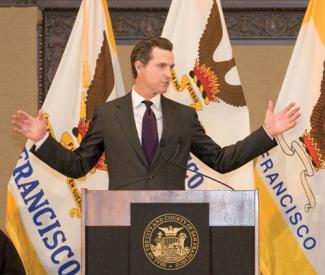
The first event was likened to a “nuclear bomb in the morning paper” by one observer, and might be interpreted as the kickoff to a fierce budget battle. Mayor Gavin Newsom announced that he is considering a plan to help solve next year’s budget deficit by laying off 10,000 full-time city workers and rehiring them at 37.5 hours, which would amount to a sweeping 6.25 percent pay cut for workers and an estimated $50 million in savings for a fiscally impaired city.

Though it was framed by Newsom spokesperson Tony Winnicker as one preliminary cost-saving option among many, the proposal received prominent front-page coverage in the San Francisco Chronicle, even before official discussions were called between the mayor and public sector unions. Since SEIU Local 1021 represents 17,000 members in San Francisco and a majority of the city’s 26,000 total employees, it would likely absorb the greatest impact if such a plan went through.

At the same time the mayor’s startling announcement hit newsstands, SEIU was in the midst of mailing out ballots to its membership for union elections. “I don’t know whether it’s a coincidence, or if the city is taking advantage of the fact that SEIU is absorbed in its elections,” Sin Yee Poon, an SEIU chapter president for Human Services Agency workers, told us while pointing out that the events happened simultaneously.

With three separate slates of candidates vying for control of SEIU Local 1021, grudges between warring internal factions have intensified into bitter sparring matches. The timing is unfortunate — just as SEIU’s internal turmoil is coming to a head, one of its greatest battles is pending over an unprecedented $522 million budget shortfall that looms like a dark cloud over the city. The deficit will surely result in job losses, and the public sector union’s ability to mount resistance even as it wrestles with internal strife is shaping up to be a key question.

This pivotal moment carries wider political implications considering that the progressive organization has in the past helped seal an alliance between San Francisco’s left-leaning leaders and organized labor through the San Francisco Labor Council.

With SEIU besieged by infighting and soon to be hurting from wage slashes and layoffs, more conservative factions of the labor community, such as the San Francisco Firefighters Union and the Building and Construction Trades Council, have recently been butting heads with progressive members of the Board of Supervisors.

At the same time, forces on all sides are beginning to eye the coveted seats up for election in June at the Democratic County Central Committee, a Democratic Party hub that is a cornerstone of local political influence, as well as the seats that will open up on the Board of Supervisors in November. Negotiations between unions and the mayor are ongoing, and mayoral spokesperson Tony Winnicker was quick to note that Newsom is open to options, other than reconfiguring 10,000 city jobs, that organized labor brings to the table. At the same time, the Guardian heard from numerous sources that city workers felt outraged and blindsided by Newsom’s decision to air the plan in the Chronicle instead of bringing stakeholders to the table.

SEIU Local 1021 President Damita Davis-Howard told us she thinks the idea of taking $50 million out of the pockets of working people in a rocky economy is wrong-headed.

“This was devastating,” said Davis-Howard, who is running for a newly created union position called chief elected officer, which is different from the union president, and similar to an executive-director post. “The mayor might as well have raised their taxes, because if you decrease their pay by 6.25 percent, they will still have the same amount of work, they will still have to pay the same mortgage, they will still have to buy the same food, the same PG&E, and they’ll be doing it with a lot less money. If any idea like this were to go through, it would actually remove the very fabric or fiber of San Francisco. It would really cut to the core of the very being of San Francisco. … I don’t see how anybody could believe that we could continue being the city that we love being with this kind of action.”

Winnicker, the mayoral spokesperson, cast it as a plan that could avert hundreds or even thousands of layoffs. “This year the easy decisions are behind us,” he noted in a recent discussion with the Guardian.

Solving last year’s fiscal shortfall was far from easy — budget tussles between frontline city workers and the mayor got ugly, and even then, the city received millions in federal stimulus dollars to cushion the blow. A similar plan of sweeping hourly cuts was floated then too, but it didn’t gain enough traction to move forward.

“The mayor is facing a huge budget deficit, there’s no question about it — but he has not lifted one finger to raise a dime in revenue,” charged SEIU member Ed Kinchley, who works at San Francisco General Hospital. As for how the union might respond if such a proposal went through, he speculated, “I think it’s the kind of thing that could lead to a strike. A big fight.”

While the city charter bars strikes by public employees, Kinchley’s comment indicates the level of frustration among SEIU’s rank-and-file.


The proposal could present a common enemy and a rallying point for a union in disarray. Internal jockeying for elected positions can be fierce in any organization, but for San Francisco’s service-workers union, the rifts are particularly deep.

The elections, which will be decided Feb. 28, mark the first time since a radical restructuring in 2007 that members will collectively decide who should lead. In 2007, the face of SEIU was changed across California when the international president, Andy Stern, began consolidating dozens of far-flung locals into centralized, beefier entities in a bid to maximize political effectiveness (California comprises roughly one-third of the entire union’s membership).

Local 1021 came into existence when 10 locals were conglomerated into one 54,000-member giant — hence the “10-to-one” label — representing health care and frontline service workers from the Bay Area to the Oregon border. 

In San Francisco, where a large segment of its members are based, the shift was interpreted by some as a power grab, and it triggered a period of ongoing strife between those allied with Stern and the international wing on one side, and those dissatisfied with changes they saw as antithetical to the democratic ideals championed by Local 790, its predecessor, on the other.

In the years following the reorganization, Stern began trying to aggregate members by raiding other unions to consolidate power. But campaigns to bring in members from United Healthcare Workers (UHW) and fend off membership losses to the newly created National Union of Healthcare Workers (NUHW) have consumed money and resources that some members told the Guardian would’ve been better spent bolstering national support for health-care reform and the Employee Free Choice Act. According to one source, SEIU spent $10 million on a Fresno battle against NUHW.*

A fight waged between SEIU Local 1021 and UNITE HERE Local 2, a hotel-workers union that was historically allied with Local 1021’s predecessor, left some members especially stung because it marred a longstanding relationship between two groups of frontline workers.

“Andy Stern has concentrated more and more power into the hands of a group of so-called elite members of the union,” Kinchley told the Guardian. Stern’s top-down leadership style and growth-oriented objectives “run pretty harshly against what many of us believe is in the best interest of our workers locally,” he added.

In recent weeks, divisions have deepened further. A staff person who preferred not to be identified for fear of retribution filed charges with the U.S. Department of Labor against a supervisor, who is aligned with the international faction, for alleged harassment and bullying. Another complaint was filed with union leadership alleging that union bylaws were violated when membership money was authorized, but not spent, to conduct a poll without proper approval.*

“There’s a fiscal rogue-ness about it. [Davis-Howard] does whatever she wants, and she spends our dues money without authorization from anybody,” Kinchley charged.

Stern appointed Davis-Howard, and now she is running for election on a slate aligned with the international wing. When the Guardian tried to reach her to discuss union elections, spokesperson Carlos Rivera told us that Davis-Howard found it inappropriate to publicly discuss internal divisions.

Sin Yee Poon is running as her opponent on a reform slate, formed by members disaffected by the international’s modus operandi. “For the whole reform group, we’re disappointed with the general direction of corporate unionism,” Poon told the Guardian. Stressing that she believes grassroots, democratic ideals have eroded since the restructuring, she said members in her camp are agitated when they see resources siphoned into raids on other unions such as UNITE HERE and UHW. “We want it to be member-driven,” she said. “The raiding of other unions is absolutely not OK.”


The internal strife could have a wider ripple effect. SEIU Local 1021 has historically been influential in securing an alliance between the city’s labor community and San Francisco’s progressive leadership. During the last round of elections for San Francisco’s Board of Supervisors, Sups. John Avalos and Eric Mar campaigned and ultimately were elected with strong fundraising support from the labor council.

Yet in recent weeks, several skirmishes pitted certain factions of the labor community against progressive members of the Board of Supervisors. Outrage bubbled up from the firefighters — and ultimately the labor council as a whole — against a charter amendment proposed by Sup. John Avalos that would have extended the minimum number of work hours for firefighters.

Billed as a cost-saving measure, the proposal might have ultimately resulted in fewer firefighter jobs, but it was designed to spread the pain of budget cuts more equitably by grazing public safety departments instead of just inflicting blows on frontline and healthcare workers.

After Labor Council Executive Director Tim Paulson came out strongly against it, Avalos abandoned the idea. A source from within the labor council, who spoke on background only, described it as an opportunity for the labor council to come together and unite on class interests.

The political posturing that came out of that fight shook even Sup. David Campos, who vocally called for equitably sharing the pain during last year’s budget debacle. “This isn’t the way to do it,” Campos said when asked about Avalos’ failed charter amendment. “And I worry about the negative impact on labor and the progressive board. There are larger issues at play here. The entire progressive agenda is at stake. We need to think long-term about the specific issues plus the future of the progressive movement.”

Sup. Sean Elsbernd’s bid to reform the pension system to save money has provoked yet another fight with SEIU Local 1021. Union members argue that if they are asked to contribute to their own retirement funds, which would become mandatory under this proposal, then they should be given the same wage increase that other unions were granted when they agreed to similar terms.

But when Sup. Eric Mar tried to amend Elsbernd’s proposal by inserting language guaranteeing that pay increase, Elsbernd said it would cost the city millions more. If Mar’s amended version goes forward, “you’ll be going to the voters by yourself,” Elsbernd told the progressive-leaning supervisor at a Feb. 9 board meeting.


Another fight has erupted over 555 Washington, a tower proposed to go up beside the TransAmerica Pyramid, which was debated at a joint hearing Feb. 11 between the Planning Commission and the Recreation and Park Commission. For members of the Building & Construction Trades Council, which represents unionized carpenters, plumbers, and other workers in development-related trades, the project represented jobs — the screaming priority in an economy where funding for new construction has trickled to almost nil.

“There is, in general in San Francisco progressive politicians, a knee-jerk reaction to development projects,” Building & Trades Council Secretary Treasurer Michael Theriault told us. As a council representing people whose livelihoods depend on private sector construction, “We have a particular quandary,” he said. “We need politicians who at the same time are friendly to labor and understand that development is an economic tool that can help the city.”

The arm of labor representing Theriault’s council has been slammed with job losses due to the economic downturn, and he’s publicly expressed frustration when projects of this scale are shot down.

“What the mayor did, what Elsbernd did, and what Avalos did are all the same thing: They all staked out a position, put a provocative idea on the table, and forced unions to have a discussion with a gun to their head in a non-constructive way,” Mike Casey, president of UNITE HERE Local 2 and a member of the labor council’s Executive Committee.

A source familiar with the inner workings of the labor council said the tension between building trades and firefighters versus more left-leaning members of the labor community has been in existence for decades, and it isn’t anything new — particularly in the months preceding election season.

Casey challenged the very notion that there is a subculture of the labor council that isn’t progressive, pointing out that labor came together as whole to support Sups. Avalos, Mar, and David Chiu — “and I personally would do it again in a heartbeat,” he added. Internal catfights and struggles for control come with the territory in a democratic, diverse organization, he said. “As a group of working people, I have great regard for the membership [of SEIU Local 1021],” he said. “Occasionally there’s a dustup. In my experience, after the dust settles, more often that not, unions come out stronger for it.”.

*Corrections made to the original file.

A union that made black history

0

The Brotherhood of Sleeping Car Porters was a pioneering union that led the battle from the l930s to l950s against racial discrimination that laid the groundwork for the civil rights movement of the l960s. 

Few of the groups that we should honor during Black History Month are more deserving than the Brotherhood of Sleeping Car Porters, a pioneering union that played a key role in the winning of equal rights by African Americans. The union, the first to be founded by African Americans, was involved as much in political as in economic activity, joining with the NAACP to serve as the major political vehicle of African Americans from the late 1930s through the 1950s. It led the drives in those years against racial discrimination in employment, housing, education and other areas that laid the groundwork for the civil rights movement of the 1960s.

The need for a porters’ union was distressingly obvious. Porters commonly worked 12 or more hours a day, six or even seven days a week, on the Pullman Company’s luxurious sleeping car coaches for a mere $72.50 a month. And out of that, they had to pay for their meals, uniforms, even the polish they used to shine passengers’ shoes. They got no fringe benefits, although they could ride the trains for half-fare on their days off – providing they were among the very few with the time and money to do so. And providing they didn’t ride a Pullman coach. Pay was so low porters often had to draw on the equally meager earnings of their wives, almost invariably employed as domestics, to pay the rent at month’s end. It was a marginal and humiliating experience.

Porters were rightly proud of their work, a pride that showed in their smiling, dignified bearing. But they knew that no matter how well they performed, they would never be promoted. They could never be conductors. Those jobs were reserved for white men. Porters knew most of all that their white passengers and white employers controlled everything. It was they alone who decided what the porters must do and what they’d get for doing it. No point in arguing. No point in even correcting the many passengers who called all porters “George” — as in George Pullman, their boss — whatever their actual names, just as slaves had been called by their masters’ given names. When a passenger pulled the bell cord, porters were to answer swiftly and cheerfully. Just do what the passengers asked – or demanded. Shine their shoes, fetch them drinks, make their beds, empty their cuspidors. No questions, no complaints, no protests. No rights. Nothing better epitomized the huge distance between black and white in American society. Hundreds of porters who challenged the status quo by daring to engage in union activity or other concerted action were fired.

But finally, the administration of President Franklin D. Roosevelt granted workers, black and white, the legal right to unionize, and finally, in 1937, the Brotherhood of Sleeping Car Porters won a union contract from Pullman. The contract was signed precisely 12 years after union founder and president A. Philip Randolph had called the union’s first organizing meeting in New York City. But the long struggle was well worth it. The contract pulled the porters out of poverty. It brought them pay at least equal to that of unionized workers in many other fields, a standard work week, full range of fringe benefits and, most important, the right to continue to bargain collectively with Pullman on those and other vital matters. Union President Randolph and Vice President C.L. Dellums, who succeeded him in 1968, led the drive that pressured President Roosevelt into creating a Fair Employment Practices Commission aimed at combating discrimination in housing as well as employment. FDR agreed to set up the commission — a model for several state commissions – only after Randolph and Dellums threatened to lead a march on Washington by more than 100,000 black workers and others who were demanding federal action against discrimination.

Dellums and Randolph struggled as hard against discrimination inside the labor movement, particularly against the practice of unions setting up segregated locals, one for white members, one for black members. Randolph, elected in 1957 as the AFL-CIO’s first black vice president, long was known as the civil rights conscience of the labor movement, often prodding federation President George Meany and other conservative AFL-CIO leaders to take stands against racial discrimination.

The sleeping car coaches that once were the height of travel luxury have long since disappeared, and there are very few sleeping car porters in this era of less-than-luxurious train travel. The Brotherhood of Sleeping Car Porters is gone, too. But before the union disappeared, it had reached goals as important as any ever sought by an American union – or any other organization. Dick Meister, formerly labor editor of the SF Chronicle and KQED-TV Newsroom, has covered labor and politics for a half-century. Contact him through his website, www.dickmeister.com, which includes more than 250 of his recent columns.

(Dick Meister, formerly labor editor of the SF Chronicle and KQED-TV Newsroom, has covered labor and politics for a half-century.)

Public employees feel blindsided by Newsom’s layoff scheme

39

Mayor Gavin Newsom’s proposal to lay off 10,000 city employees and rehire them at lower pay is being met with outrage by some public-sector workers. The plan, crafted as a way of saving money to balance the city budget, would amount to sweeping pay cuts across the board for a significant number of city workers.

Formal discussions about it are in the earliest stages, and Tony Winnicker, the mayor’s press secretary, described it as “just one alternative that we’re investigating.” Nonetheless, some members of Service Employees International Union Local 1021 are furious that the mayor unveiled this plan in the San Francisco Chronicle instead of at a meeting with the city’s labor leaders.

“As far as we can tell, an idea he has ended up on the front page of the Chronicle that’s had a devastating ripple affect among the people who work for the city and county,” SEIU Local 1021 President Damita Davis-Howard told the Guardian. “We feel like we got a sucker-punch. … We really wish he had talked to us before he governed by press conference.”


Davis-Howard said she’s been inundated with phone calls from angry union members who read the article. “This is the same proposal he floated last year,” Davis-Howard said. “Most of our members believed that they gave up their holiday pay in order to avoid this very thing.”

The proposal, which was briefly considered last year but never moved forward, serves to illustrate just how hard financial woes are hitting San Francisco. The city is staring down a $522 million deficit, and Newsom’s proposal would make up for a mere $50 million in savings.

Winnicker declined to comment on Davis-Howard’s concerns about being blindsided by news of the layoff plan, brushing it off by saying the mayor did discuss it with “some folks in labor.” Instead, he suggested that Newsom is getting serious about solving the budget crisis while the Guardian is just focusing on irrelevant gripes.

“It is an unprecedented budget shortfall, and it is real,” Winnicker said, stressing that the gaping budget gap will have to be bridged without the infusion of federal stimulus dollars that cushioned the blow last year. “The easy choices are behind us.” This layoff plan could prevent “hundreds, if not thousands, of layoffs,” but the mayor is open to other ideas that labor brings to the table, he said.

“That logic is just flawed,” Davis-Howard said when asked about the assertion that the plan could prevent layoffs. “That’s not the way you re-stimulate the economy, by taking more dollars out of the economy. We can’t continue to balance the budget on cuts, because pretty soon the actual fiber of the city and county of San Francisco will be reeling because of the number of cuts that we sustained.”

When asked how SEIU Local 1021 would respond, she said, “I do believe we need to be open-minded, imaginative, and creative in coming up with some revenue-generating measures here.”

No doubt the mayor will receive plenty of suggestions as negotiations continue in the coming weeks.

Editorial: The attack on district elections

0

Nobody can honestly say that the district supervisors have ignored citywide issues or that they don’t have a citywide perspective.

The Chamber of Commerce, the Mayor’s Office, and the San Francisco Chronicle have created, apparently out of whole cloth, a new attack on district elections of supervisors. And although there’s no campaign or formal proposal on the table, the new move needs to be taken seriously.

And it’s important to understand from the start what this is really about.

The Chamber and the Chron are talking about the need for more “citywide perspective,” trying to spin the notion that supervisors elected by district care only about micro-local, parochial issues. But after 10 years of district elections, the record is exactly the opposite. District-elected supervisors have devoted themselves to a long string of exceptional citywide reform measures and have been guilty of very little district pandering.

Consider a few examples:

Healthy San Francisco, the local effort at universal health care that has drawn national attention and plaudits from President Obama, was a product of the district board, led by then-Sup. Tom Ammiano. So was the rainy day fund, which has provided millions to the public schools and prevented widespread teacher layoffs.

The district board reformed the makeup of the Planning Commission, Police Commission, and Board of Appeals.

District-elected Sup. Ross Mirkarimi’s legislation restricting the use of plastic bags has been hailed by environmental groups all over the country.

The district board passed the city’s minimum wage and sick day laws.

The district board created a citywide infrastructure plan and bond program.

Community choice aggregation, a direct challenge to Pacific Gas and Electric Co. that will bring San Francisco clean energy and lower electricity rates, is entirely a product of the district board. So is campaign finance reform, sanctuary city protecting for immigrants, a long list of tenant-protecting laws … the list goes on and on. What significant policy initiatives came out of the previous 10 years of at-large supervisors? Very little — except the promotion of hyper-expensive live-work lofts; the displacement of thousands of tenants, artists, and low-income people; and the economic cleansing of San Francisco, all on behalf of the dot-com boom, real estate speculators, and developers.

People can agree or disagree with what the board has done in the past decade, but nobody can honestly say that the district supervisors have ignored citywide issues or that they don’t have a citywide perspective.

No, this has nothing to do with citywide issues vs. district issues. It’s entirely about policy — about the fact that district supervisors are more progressive. About the fact that downtown can’t possibly get a majority under a district system — because with small districts, big money can’t carry the day.

Under an at-large system, nobody can seriously run for supervisor without at lest $250,000, and candidates who start off without high name recognition need twice that. There’s only one way to get that kind of money — and it’s not from protecting tenants and immigrants and fighting developers and PG&E.

In a district system, grassroots organizing — the stuff that labor and nonprofits and progressive groups are good at — is more important than raising money. So district supes are accountable to a different constituency.

Polls consistently show that people like having district supervisors — and for good reason. With at-large elections, the only people who have regular, direct access to the supervisors are big donors and lobbyists who can deliver money. District supervisors are out in the neighborhoods, take phone calls from community activists, and are far more accessible to their constituents.

So instead of trying to repeal the district system, the Chamber has come up with this “hybrid” effort. The idea would be to reduce the number of districts to seven and elect four supervisors citywide.

What that means, of course, is that a third of the board, elected on a pile of money, will be pretty much call-up votes for downtown. With two more from the more conservative districts, you’ve got a majority.

So this is about money and political control, and about the political direction the city is going, and about who’s going to set that direction. That’s the message progressive leaders need to start putting out, now. And every incumbent supervisor, and every candidate for supervisor, needs to make preservation of district elections a public priority


The attack on district elections

3

EDITORIAL The Chamber of Commerce, the Mayor’s Office, and the San Francisco Chronicle have created, apparently out of whole cloth, a new attack on district elections of supervisors. And although there’s no campaign or formal proposal on the table, the new move needs to be taken seriously.

And it’s important to understand from the start what this is really about.

The Chamber and the Chron are talking about the need for more “citywide perspective,” trying to spin the notion that supervisors elected by district care only about micro-local, parochial issues. But after 10 years of district elections, the record is exactly the opposite. District-elected supervisors have devoted themselves to a long string of exceptional citywide reform measures and have been guilty of very little district pandering.

Consider a few examples:

Healthy San Francisco, the local effort at universal health care that has drawn national attention and plaudits from President Obama, was a product of the district board, led by then-Sup. Tom Ammiano. So was the rainy day fund, which has provided millions to the public schools and prevented widespread teacher layoffs.

The district board reformed the makeup of the Planning Commission, Police Commission, and Board of Appeals.

District-elected Sup. Ross Mirkarimi’s legislation restricting the use of plastic bags has been hailed by environmental groups all over the country.

The district board passed the city’s minimum wage and sick day laws.

The district board created a citywide infrastructure plan and bond program.

Community choice aggregation, a direct challenge to Pacific Gas and Electric Co. that will bring San Francisco clean energy and lower electricity rates, is entirely a product of the district board. So is campaign finance reform, sanctuary city protecting for immigrants, a long list of tenant-protecting laws … the list goes on and on. What significant policy initiatives came out of the previous 10 years of at-large supervisors? Very little — except the promotion of hyper-expensive live-work lofts; the displacement of thousands of tenants, artists, and low-income people; and the economic cleansing of San Francisco, all on behalf of the dot-com boom, real estate speculators, and developers.

People can agree or disagree with what the board has done in the past decade, but nobody can honestly say that the district supervisors have ignored citywide issues or that they don’t have a citywide perspective.

No, this has nothing to do with citywide issues vs. district issues. It’s entirely about policy — about the fact that district supervisors are more progressive. About the fact that downtown can’t possibly get a majority under a district system — because with small districts, big money can’t carry the day.

Under an at-large system, nobody can seriously run for supervisor without at lest $250,000, and candidates who start off without high name recognition need twice that. There’s only one way to get that kind of money — and it’s not from protecting tenants and immigrants and fighting developers and PG&E.

In a district system, grassroots organizing — the stuff that labor and nonprofits and progressive groups are good at — is more important than raising money. So district supes are accountable to a different constituency.

Polls consistently show that people like having district supervisors — and for good reason. With at-large elections, the only people who have regular, direct access to the supervisors are big donors and lobbyists who can deliver money. District supervisors are out in the neighborhoods, take phone calls from community activists, and are far more accessible to their constituents.

So instead of trying to repeal the district system, the Chamber has come up with this “hybrid” effort. The idea would be to reduce the number of districts to seven and elect four supervisors citywide.

What that means, of course, is that a third of the board, elected on a pile of money, will be pretty much call-up votes for downtown. With two more from the more conservative districts, you’ve got a majority.

So this is about money and political control, and about the political direction the city is going, and about who’s going to set that direction. That’s the message progressive leaders need to start putting out, now. And every incumbent supervisor, and every candidate for supervisor, needs to make preservation of district elections a public priority.

Memorial for Charles Lee Smith (1925-2010), passionate pamphleteer

1

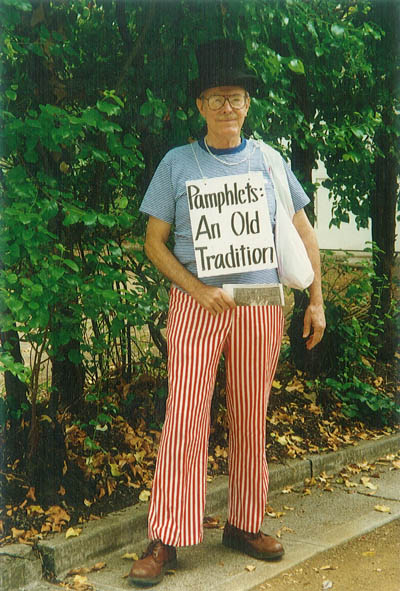
Memorial services for Charles Lee Smith, a classic liberal activist whose hero was Tom Paine and whose passion was pamphleteering, will be held at 3 p.m. on Friday, Feb. 12, at the Friends Meeting House, Walnut and Vine, in Berkeley. He died at his Berkeley home on Jan. 7 at 84.

His wife Anne said that Charlie, as we all called him, fell in December and never fully recovered. She brought him home under hospice care on Jan. 5 and she and his two sons Greg and Jay were with him his last three days.

Charlie first contacted me in the early days of the Guardian in the late l960s. I soon realized that he was my kind of liberal, always working tirelessly, cheerfully, and quietly to make things better for people and their communities. He was a remarkable man with a remarkable range of interests and causes that he pursued his entire life.

He campaigned endlessly for causes ranging from the successful fight to stop Pacific Gas and Electric Co. from building a nuclear power plant on Bodega Bay to integrating the Berkeley schools to third brake lights for cars to one-way tolls on bridges to disaster preparedness to traffic safety and circles to public power and keep tabs on PG@E and big business shenanigans.


When he first began sending tips our way, he was working with, among many others, UC Berkeley Professor Paul Taylor with his battles with the agribusiness interests. He was helping UC Berkeley professor Joe Neilands on his public power campaigns. I remember a key public power meeting that Joe and Charlie put together in a Berkeley restaurant. It brought together the sturdy public power advocates of that era. Charlie did much of the staff work and was seated at the speaker’s table next to the sign that read, Public Power Users Association.

I credit that event and its assemblage of public power activists as inspiring the Guardian to make public power and kicking PG@E out of City Halls a major crusade that continues to this day. Charlie and Joe rounded up, among others, then CPUC commissioner Bill Bennett, consumer writer Jennifer Cross, William Domhoff, the UC Santa Cruz political science professor who was the main speaker, and Peter Petrakis, a student of Neilands’ in biochemistry who researched and wrote the Guardian’s early pioneering stories on the PG@E/Raker Act scandal. (See Guardian stories and editorials since l969.) The room was also full of veteran public power warriors from PG@E battles in Berkeley, San Francisco, and around the bay.

Charlie was a lifelong volunteer for the Quakers and pamphleteered on many of their projects.

My favorite story was how he was helping Dr. Ben Yellen, a feisty liberal pamphleteer in Brawley. Yellen and Charlie were political and pamphleteering soulmates, but Charlie was operating in liberal Berkeley and Yellen was in very conservative Imperial County.

Yellen was blasting away at the absentee land owners who were cheating migrant laborers on health care, on high private power costs of city dwellers, and the misuse of government water subsidies. And so he had trouble getting his leaflets printed in Brawley. He would send leaflets up to Charlie and Charlie would get them duplicated and then send the copies back to Yellen. Yellen would distribute them, mimeographed material on legal-sized yellow construction paper, under windshield wipers during the early morning hours and into open car windows on hot afternoons.

Charlie relished promoting Yellen as a classic in the world of pamphleteering and loved to talk about how Yellen followed up his pamphleteering with several pro per lawsuits, an appearance on CBS’ 60 Minutes television show, and a case that went to the U.S. Supreme Court.

Charlie liked to talk about his triple play of information distribution. He pamphleteered on street corners, prepared more than 50 bibliographies of undiscussed issues (including the best bibliography ever done on San Francisco’s Raker Act Scandal), and circulated his personal essays and cut and pasted newspaper articles. Almost every day, he would take the newspapers from the sidewalk near his house and put them on the front porches of his neighbors. He got some exercise, since his house was on a Berkeley hill, and he endeared himself to his neighbors. He was given the title of “Mayor of San Mateo Road.”

Charlie pamphleteered on more than l50 “undiscussed subjects,” as he called them, in Berkeley, Oakland and San Francisco. He sometimes went out to Palo Alto, Santa Rosa, and Napa, with occasional excursions to Boston and London. His subjects were practical and straightforward but breathtaking in their range: humanizing bureaucracy, employee suggestions, penal reform, illiteracy, migant labor, water, energy, land reform, ombudsmen, coop issues, library use, land value taxation, transportation, disaster recovery planning. He handed out KPFA folios and an occasional Bay Guardian.

He often combined pamphleteering with doing bibliographies to spread the word about the undiscussed subjects.  On the first Earth Day in l970 at California State University, Hayward, Charlie spoke about the evils of automoblies. Then he distributed his bibliography of the Automobile Bureaucracy. In recognizable Charliese, he produced a blizzard of numbered citations on a summary of his speech so the audience could read further on his issues.

He considered pamphleteering as a noble form of communication that “went on during the colonial Period for a l00 years before the revolution and the arrival of Tom Paine in l775,” as he put it in his own pamphlet, “Pamphleteering: an old tradition.” He wrote that his main contribution “is the novel use of sandwich boards to screen out the disinterested while reaching the already-interested and open-minded persons with leaflets on the street, but not invading anyone’s privacy.”

Sometimes, Charlie had news close to home.

He said that giving out pamphlets to one or two people at a time was like holding a meeting with those persons and thus it was possible to have a “meeting” with several hundred people nearly anywhere within reasonable limits. He concluded that pamphleteering was “basic to building support for worthwhile projects” and claimes that it “may even be more effective than other forms of expensive communication.”

Charlie knew how to work the streets, but he also knew how to work inside the bowels of the bureaucracy. He worked for the California Division of Highways (now Caltrans) from l953 to 1987, mostly in an Oak Street office in San Francisco. I admit when Charlie talked to me about fighting bureaucracy, as he often did, I had trouble understanding how he was going about it. But Charlie had his ways.

Executive Editor Tim Redmond recalls that Charlie worked for Caltrans back in the days when the very thought there might be transportation modes other than highways was heresy.

He was an advocate of bicycles, carpools and public transit and Redmond thought that, when he first met Charlie in l984, “he must be like the monks in the middle ages, huddled in a corner trying to preserve knowledge. Nobody else at Caltrans wanted to talk about getting cars off the roads. Nobody wanted to shift spending priorities. Nobody wanted to point out that highrise development in San Francisco was causing traffic problems all over the Bay Area–and that the answer was slower development, not more highways.

“But Charlie said all those things. He told me where the secrets of Caltrans were hidden, what those dense environmental impact reports really showed, and how the agency was failing the public. I had a special card in my old l980s Rolodex labeled ‘Caltrans: Inside Source.’ The number went directly to Smith’s desk.” Charlie usually carpooled from Berkeley to his San Francisco office.

Charlie wrote a leaflet about the “Work Improvement Program” that then Gov. Pat Brown instituted in l960. It was, he wrote, a “novel program to get all state employees to submit ideas to improve their work.” Charlie labeled it “corrupt” and laid out the damning evidence. No appeal procedure. No protection for the employee making suggestions that the supervisor or organization didn’t want to use. No requirement for giving the employee credit for the idea or for following up the idea.

Charlie noted that he was a generalist with lots of ideas, read lots of publications, and was “sensitive to the problems that bother people.” He noted that there were l,500 employees in his Caltrans district who submitted 236 suggestions. Charlie submitted 35 of them.  But, he noted wryly, “my supervisor, Charles Nordfelt, did not respond at all to any of my suggestions.” And then, to make neatly make his point, Charlie listed a few of his suggestions, all of them practical and useful.

Many were adopted without Charlie ever getting credit. Others were adopted decades later. For example, he pushed the then-heretical idea of collecting tolls on a one-way basis only, instead of collecting them two ways. He noted that the tolls are now  being collected on the wrong side of the bridge. They should, he argued,  be collected coming from  the San Francisco side, where the few lanes of the bridge open up to many lanes. This would reduce or eliminate congestion. .

He listed other suggestions that showed his firm and creative grasp of the useful idea. Putting the third stop light on vehicles (which was finally put into effect in 1985). Numbering interchanges. Installing flashing red and yellow lights at different rates. (He  explained that his wife’s grandfather was color blind and drove through a flashing red light when she was with him.) Getting vehicle owners to have reflective white strips on the front bumpers of their cars, helping police spot stolen vehicles. Some of his suggestions are still percolating deep in the bureaucracies and may yet go into effect.

Charlie never got the hang of the internet but he covered more territory and reached more people in his personal face-to-face way than anybody ever did on the internet.

Charlie was born on a homestead farm eight miles from Weldona, Colorado. He attended a one-room school house and then moved on to a middle and high school in Ft. Morgan, Colorado. He got “ink in his blood,” as he liked to say, by working on the school paper called the Megaphone and then as a printer’s devil at the weekly Morgan Herald.

He was drafted into the army in l943 and served as an infantryman with the 343rd regiment, 86th Infantry Division. He was severely sounded in 1945 in the Ruhr Pocket battle near Cologne, Germany, the last major battle of the war. He suffered leg and hip injuries and had a l6 inch gouge  out of his right hip that cut within a quarter inch of the bone. He spent six months in the hospital. He was recommended for sergeant but he refused the promotion and ended the war as a private first class.

After his recovery, Charlie came to the Bay Area and took his undergraduate work at Napa Community College and San Francisco State, then did graduate work in sociology at the University of Washington, and in city and regional planning at the University of California-Berkeley.

In 1949, Charlie joined the American Friends Service Committee and became a lifelong volunteer, working on a host of projects. He did everything from helping with a clothing drive in Napa to being part of the crew that built the original Neighborhood House in Richmond.

Charlie met Anne Read in l954, a college student in Oregon, when she was on an AFSC summer project in Berkeley. Charlie visited the project, spotted Anne, and double dated with her. When she returned to Oregon State for her senior year, Charlie wrote her every single day. The two were married the following summer in June of l955.

Charlie is survived by Anne, two sons Greg and Jay, daughter-in-laws Karen Vartarian and Andrea Paulos, and granddaughter Mabel.

The family asks that, in lieu of flowers, please send a donation in Charlie’s name to the American Friends Service Committee, 65 9th St., San Francisco, Calif. 94l03.

I asked Anne why Charlie, the inveterate communicator, had not taken to the internet. Charlie, she replied, was a print guy and simply could not understand the internet. “He never ever used email,” she said. “He still thought he had to go to a library to make up a bibliography. I think Charlie was so sure that making a bibliography meant a lot of hard work, he couldn’t possibly do it on the internet.”

Well, Charlie, you may have missed the internet but you covered more territory and reached more people in your direct personal way with good ideas than anybody ever did on the internet.

Here are some of Charlie’s favorite pamphlets:
Governor Pat Brown’s Work Improvement Program
Pamphleteering: An Old Tradition
Short Statement on Plamphleteering

Dick Meister: Combating workplace violence

0

Organized labor and its allies are rightly alarmed over the high incidence of on-the-job accidents that have killed or maimed many thousands of workers. But they haven’t forgotten – nor should we forget – the on-the-job violence that also afflicts many thousands.

Consider this: Every year, almost two million American men and women are the victims of violent crime at their workplaces. That often forces the victims to stay off work for a week or more and costs their employers more than $60 billion a year in lost productivity.

The crimes are the tenth leading cause of all workplace injuries. They range from murder to verbal or written abuse and threatening behavior and harassment, including bullying by employers and supervisors.

Women have been particularly victimized. At least 30,000 a year are raped or otherwise sexually assaulted while on the job. The actual total is undoubtedly much higher, since it’s estimated that only about one-fourth of such crimes are reported to the police.

Estimates are that more than 900,000 of all on-the-job crimes go unreported yearly, including a large percentage of what’s thought to be some 13,000 cases annually that involve boyfriends or husbands attacking women at their workplaces.

The Retail, Wholesale & Department Store Union (RWDSU), which represents many of the victimized workers, cites that as an example of the job violence problem that is often distorted by media coverage that “would lead us to believe that most workplace violence involves worker against worker situations.”

The union says that has focused many employers “on identifying troubled employees or disgruntled workers who might turn into violent predators at a moment’s notice. But in fact, 62 percent of all violence at worksites is caused by outsiders.”

As you might expect, those most vulnerable to the violence are workers who exchange money with the public, deliver passengers, goods or services, work alone or in small groups during late night or early morning hours in high-crime areas or wherever they have extensive contact with the public.

That includes police, security guards, water meter readers and other utility workers, telephone and cable TV installers, letter carriers, taxi drivers, flight attendants, probation officers and teachers. Convenience store clerks and other retail workers account for fully one-fifth of the victims.

The American Federation of Teachers is so concerned that it has provided each of its 1.4 million members a $100,000 life insurance policy payable if the teacher dies as the result of workplace violence.

The major violence victims also include health care and social service workers such as visiting nurses, and employees of nursing homes, psychiatric facilities and prisons. They suffer two-thirds of all physical assaults. Many of the victims regularly deal with volatile, abusive and dangerous clients, often alone because of the understaffing that’s become all too common.

It could get even worse, at least for some workers. The RWDSU warns that today’s troubled economic times create additional threats. The danger is especially great for retail workers whose stores are likely to face increased incidents of theft, some involving gun-wielding robbers.

The RWDSU and other unions have been pushing for recognition of workplace violence as an occupational as well as criminal justice issue. That would put it under the purview of the federal Occupational Safety and Health Administration (OSHA) and state job safety agencies.

The federal and state agencies could then issue enforceable regulations designed to lessen the on-the-job dangers of violence, as they do for other hazardous working conditions. A few states do that already, but only for a very limited number of industries.

OSHA has issued guidelines for workers in late-night retail jobs, cab drivers and some healthcare workers, but the guidelines are strictly voluntary. Although the unions’ top priority is for legally binding regulations, they also are pressing employers to meanwhile voluntarily implement violence prevention programs.

Currently, only about one-fourth of them have such programs or any guidelines at all. The RWDSU ‘s Health and Safety Department is offering to help the other employers develop programs.

We have federal and state standards, laws and regulations designed to protect working Americans from many of the serious on-the-job hazards they face daily. Yet we have generally failed to lay down firm guidelines for protecting workers from the workplace violence that’s one of the most dangerous hazards of all.

Dick Meister, former labor editor of the SF Chronicle and KQED-TV Newsroom, has covered labor and politics for a half-century. Contact him through his website, www.dickmeister.com, which includes more than 250 of his recent columns.

Joseph Stiglitz: Muddling Out of Freefall

0

Here is our monthly installment of Joseph E. Stiglitz’s Unconventional Economic Wisdom column from the Project Syndicate news series. Stiglitz is University Professor at Columbia University and the winner of the 2001 Nobel Prize in economics. His new book is Freefall.

NEW YORK – Defeat in the Massachusetts senatorial election has deprived America’s Democrats of the 60 votes needed to pass health-care reform and other legislation, and it has changed American politics – at least for the moment. But what does that vote say about American voters and the economy?

It does not herald a shift to the right, as some pundits suggest. Rather, the message it sends is the same as that sent by voters to President Bill Clinton 17 years ago: “It’s the economy, stupid!” and “Jobs, jobs, jobs.” Indeed, on the other side of the United States from Massachusetts, voters in Oregon passed a referendum supporting a tax increase.

The US economy is in a mess – even if growth has resumed, and bankers are once again receiving huge bonuses. More than one out of six Americans who would like a full-time job cannot get one; and 40% of the unemployed have been out of a job for more than six months.

As Europe learned long ago, hardship increases with the length of unemployment, as job skills and prospects deteriorate and savings gets wiped out. The 2.5-3.5 million foreclosures expected this year will exceed those of 2009, and the year began with what is expected to be the first of many large commercial real-estate bankruptcies. Even the Congressional Budget Office is predicting that it will be the middle of the decade before unemployment returns to more normal levels, as America experiences its own version of “Japanese malaise.” 

As I wrote in my new book Freefall, President Barack Obama took a big gamble at the start of his administration. Instead of the marked change that his campaign had promised, he kept many of the same officials and maintained the same “trickle down” strategy to confront the financial crisis. Providing enough money to the banks was, his team seemed to say, the best way to help ordinary homeowners and workers.

When America reformed its welfare programs for the poor under Clinton, it put conditions on recipients: they had to look for a job or enroll in training programs. But when the banks received welfare benefits, no conditions were imposed on them. Had Obama’s attempt at muddling through worked, it would have avoided some big philosophical battles. But it didn’t work, and it has been a long time since popular antipathy to banks has been so great.

Obama wanted to bridge the divides among Americans that George W. Bush had opened. But now those divides are wider. His attempts to please everyone, so evident in the last few weeks, are likely to mollify no one.

Deficit hawks – especially among the bankers who laid low during the government bailout of their institutions, but who have now come back with a vengeance – use worries about the growing deficit to justify cutbacks in spending. But these views on how to run the economy are no better than the bankers’ approach to running their own institutions.

Cutting spending now will weaken the economy. So long as spending goes to investments yielding a modest return of 6%, the long-term debt will be reduced, even as the short-term deficit increases, owing to the higher tax revenues generated by the larger output in the short run and the more rapid growth in the long run.

Trying to “square the circle” between the need to stimulate the economy and please the deficit hawks, Obama has proposed deficit reductions that, while alienating liberal democrats, were too small to please the hawks. Other gestures to help struggling middle-class Americans may show where his heart is, but are too small to make a meaningful difference.

Three things can make a difference: a second stimulus, stemming the tide of housing foreclosures by addressing the roughly 25% of mortgages that are worth more than the value the house, and reshaping our financial system to rein in the banks.

There was a moment a year ago when Obama, with his enormous political capital, might have been able to achieve this ambitious agenda, and, building on these successes, go on to deal with America’s other problems. But anger about the bailout, confusion between the bailout (which didn’t restart lending, as it was supposed to do) and the stimulus (which did what it was supposed to do, but was too small), and disappointment about mounting job losses, has vastly circumscribed his room for maneuver.

Indeed, there is even skepticism about whether Obama will be able to push through his welcome and long overdue efforts to curtail the too-big-to-fail banks and their reckless risk-taking. And, without that, more likely than not, the economy will face another crisis in the not-too-distant future.

Most Americans, however, are focused on today’s downturn, not tomorrow’s. Growth over the next two years is expected to be so anemic that it will barely be able to create enough jobs for new entrants to the labor force, let alone to return unemployment to an acceptable level.

Unfettered markets may have caused this calamity, and markets by themselves won’t get us out, at least any time soon. Government action is needed, and that will require effective and forceful political leadership.

Joseph E. Stiglitz, winner of the 2001 Nobel Prize in economics, served as Chairman of the Council of Economic Advisers from 1995 to 1997. He is the author of the recently published bestseller, Freefall: America, Free Markets, and the Sinking of the World Economy.

Copyright: Project Syndicate, 2010.
www.project-syndicate.org
For a podcast of this commentary in English, please use this link: http://media.blubrry.com/ps/media.libsyn.com/media/ps/stiglitz122.mp3


The attack on district elections begins

2

I knew it was coming. After ten years of district-elected supervisors promoting progressive policies (minimum wage and sick day laws, universal health care, tenant protections, public power, development limits, affordable housing etc.) downtown has finally figured out how to launch a counter-attack. It was announced this morning in the pages of the Chronicle

I knew it was coming. After ten years of district-elected supervisors promoting progressive policies (minimum wage and sick day laws, universal health care, tenant protections, public power, development limits, affordable housing etc.) downtown has finally figured out how to launch a counter-attack. It was announced this morning in the pages of the Chronicle

The idea is to replace some of the district supes with at-large representatives – say, four of the 11. That Chamber of Commerce is doing a poll on the issue. Expect a November ballot initiative.

C.W. Nevius chimed in, too, arguing in favor of the “hybrid” (sounds so much like an eco-friendly car) system.

The line is going to be this: District supervisors don’t pay attention to citywide issues.

“People like the idea of being able to talk to a district supervisor about neighborhood problems, but also feel that they want someone they can go to with broader, citywide concerns,” said Steve Falk, president and CEO of the San Francisco Chamber of Commerce.

Or as Nevius puts it:

The truth is that San Francisco has more supervisors than any county in California. Is it too much to ask that a few of them have the entire city’s best interest in mind?

Let’s consider for a moment what this is really about.

For starters, get rid of the nonsense about a “citywide perspective.” Even Nevius didn’t try to push that too hard when I emailed him with the facts, to wit: Over the past ten years, district-elected supervisors have devoted themselves to a long string of exceptional citywide reform measures and have been guilty of very little district pandering.

Consider a few examples:

Healthy San Francisco
The Rainy-Day Fund
Reforming the makeup of the Planning Commission, Police Commission and Board of Appeals
Restricting the use of plastic bags
Minimum wage and sick day laws
A citywide infrastructure plan and bond program
Community choice aggregation and green energy
Campaign finance reform
Sanctuary city protecting for immigrants

The list goes on and on.

You may agree or disagree with what this board has done, but nobody can honestly say that the district supervisors have ignored citywide issues or that they don’t have a citywide persoective. No: This has nothing to do with citywide issues vs. district issues. It’s entirely about policy – about the fact that district supervisors are more progressive. About the fact that downtown can’t possibly get a majority under a district system – because with those small districts that Nevius complains about, big money can’t carry the day.

In a district system, grassroots organizing – the stuff that labor and nonprofits and progressive groups are good at – is more important than raising money. So district supes are accountable to a different constituency.

I watched an at-large board for almost 20 years, and it was, by and large, a collection of sold-out hacks who did exactly what the mayor and the downtown donors said. It was really pathetic.

The polls have consistently shown that people like have district supes, so now there’s this “hybrid” effort.

Here’s what it means:

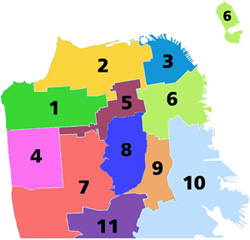
Right now, there are three districts that will generally elect a more conservative representative – D 2 (Michela Alioto-Pier) D- 4 (Carmen Chu) and D-7 (Sean Elsbernd). Districts 8, 10, 11 and 1 are swing districts, and the rest are going to go generally progressive.

So the odds are under this system that the left-leaning constituencies will have at least six votes, and in good times, as many as eight.

Now take four of those votes away, pretty much forever. Set it up so that four supervisors, elected citywide, will be guaranteed downtown call-up votes. Then add in one or two more from the more conservative districts, and you’ve got a majority.

That, my friends, is exactly what this is about, and any effort to frame it as anything else is just spin.

I asked Nevius what the hell he was doing buying the bogus argument that we need citywide perspective – since the district board has already demonstrated that, consistently. Here’s his response:

First, I’d envision the city-wide supes as made to order swing votes. When a district supervisor had a good idea, let’s say Healthy San Francisco, it might not be an issue of critical interest for a district supervisor. But it would be right in the wheelhouse for a city-wide official, who is looking for broad stroke issues to back. And, although you didn’t advance the idea, I’d reject the notion that whomever it was that was elected city-wide would be incredibly conservative and obstructionist. The most moderate politician we’ve elected in this city is Gavin Newsom. Although the Guardian doesn’t agree with him much of the time, he’s still advanced some very progressive ideas. Everyone jumps on the Chris Daly example as why district elections are a problem, but I think we can look beyond that. I think he’s been an aberration. District supes like David Campos and David Chiu have proved they can compromise and govern so I think that’s a good thing. I would never advocate that we get rid of representation in the neighborhoods. But c’mon, 11 little districts in a very small city? As Jim Stearns said, some of the districts are no more than a mile square. Combining some of them would still let residents have someone they could call to get the potholes fixed, but also spread out the areas.

Okay, I didn’t say citywide supes would be conservative. Sean Elsbernd is (relatively) conservative. He’s also independent of any big-money interest and does what he thinks is right. He doesn’t need half a million dollars to get elected in his district.

What I say is that citywide supes would be in hock to big money. I’ve seen it, lived with it. Suffered from it.

And guess what: Healthy San Francisco didn’t need any citywide supes; it passed just fine with the district board.

So what this is about is money and political control, and it’s about the political direction the city is going and who’s going to set that direction. Let’s get that straight and be honest about, and then we can have this discussion.

CPMC’s battle with its nurses continues

2

CNA labor rep Nato Green told the Guardian that CPMC is trying to low-ball its nurses to help pay for the two hospitals and a proposed expansion of its Davies Campus. “It’s to pay for all the construction they want to do…CPMC wants to stick us with a worse contract even than at other Sutter facilities,” Green said, accusing CPMC of trying to break the union. “CPMC believes this is their opportunity to get rid of 60 years of union representation.”

CPMC spokesperson Kevin McCormack said both its salary offers and the health plan it instituted have been as good or better than what CNA has accepted at other facilities, and the reason for the protracted impasse is CNA‘s insistence that workers at the upscale Cathedral Hill hospital be union members.

“The difference is we’re building a new hospital and it might open as a non-CNA facility,” McCormack said, calling the disputed health plan “the same plan that they’ve accepted at other facilities.”

But the NLRB complaint faults CPMC for unilaterally changing the terms of the contract that expired in 2007, first by changing the work hours and duties for pediatric and neonatal nurses last July, then by imposing a new health plan that steeply increases costs for using non-Sutter specialists, in both cases without bargaining in good faith for the changes.

“It was presented at fait accompli, and then they just imposed it. It’s on ongoing systemic problem with CPMC,” Green said. “It demonstrates what we’ve been saying all along, that they aren’t trustworthy.”


On pension reform, a way forward

0

EDITORIAL Sup. Sean Elsbernd is taking on one of the most complicated and politically tricky issues in San Francisco — reforming the pension fund and health care system for retired city employees. He’s right that the system needs reform — but his measure has some serious drawbacks and needs some significant amendments.

The problems facing the system are so confusing, and the legal and financial aspects so arcane, that it’s hard for anyone to grasp the full situation. But we can sum it up pretty simply:

San Francisco’s pension fund is in far better shape than pension funds in many cities and is a long way from any financial crisis. But over the next few years, thanks to weak stock market performance, the city’s cash obligation — the amount of general fund money that must be paid into the retirement system — is going to rise quickly into the hundreds of millions of dollars.

The retiree health care system is in a lot more trouble — with the rising cost of care, the city will be on the hook for a serious amount of money over the next decade or two. And since the obvious answer — a single-payer system that would cut costs immensely — isn’t anywhere on the immediate political horizon, the San Francisco supervisors need to address the problem.

Elsbernd’s proposed fix is also complicated; the main legislation runs 61 pages. But in essence, he wants to make sure all city employees pay directly into the system; raise the amounts new employees, cops, and firefighters contribute; and set up a rainy-day fund to divert excess pension revenue in good years into a trust that could fund health care pension obligations in down years. He’s also going after a scam common in the police and fire departments where people about to retire get sudden promotions and big salary bumps for a few months, then collect pensions based on the higher pay scale.

The first part is — and should be — almost certainly dead. Members of the Service Employees International Union local 1021 agreed several years ago as part of contract negotiations to give up a pay hike; in exchange, the city agreed to take over the workers’ obligation to pay into the pension fund. Changing that, and outlawing any similar deals in the future, is unacceptable to labor and could drag down the whole proposal.

It’s also tricky to raise pension contributions for “new employees” since Mayor Gavin Newsom has been firing people then rehiring them at lower pay rates. Do those people lose their pension seniority? That has to be fixed.

But given the sweet deal cops and firefighters have, it’s entirely appropriate to ask them to contribute more to retirement. And while some city employees actually get and deserve raises in their final year of work (and the language in Elsbernd’s bill doesn’t address this and needs work), pension spiking is a problem that tends to give extra cash to people who are on the higher end of the pay scale at the expense of lower-paid workers.

And the heart of his proposal — to set up a trust fund for excess money in good years — deserves serious consideration. Yes, it’s a set-aside, and yes, there are legal complications. But the cost of doing nothing is too high to ignore.

Elsbernd should have done this differently — he should have met in advance with all the stakeholders and sought to hammer out a compromise. Even so, there’s a lot for progressives to work with here. If Elsbernd is willing to engage with labor and the board majority, and the progressive supervisors are willing to acknowledge the problem and look for amendments that make this bill acceptable, there’s a way for the city to come out ahead.

Sup. David Campos has moved to “split the file” — that is, to turn the Elsbernd bill into two identical measures. The move gives the progressives a chance to make amendments even if Elsbernd doesn’t want to go along, and could wind up giving the supervisors a choice between two competing measures. We’d prefer that Elsbernd work with his colleagues on a measure everyone can back. But in the end, the best option is a charter amendment that fixes the problems Elsbernd has identified — without being unfair to city employees.

And if Elsbernd and the progressives can come to a deal, there’s a lesson here for the mayor: if you try to work with your opponents, you can actually get things done.

Progressives should care about pension reform

2

OPINION In today’s failing economy, with double-digit unemployment and huge government deficits, progressives have a strong interest in ensuring that San Francisco’s pension system remains viable.

After years of working and contributing a percentage of their income to a pension fund, city employees receive a guaranteed annual pension based on an employee’s years of service and his or her pay level at retirement. In the private sector, most employees participate in a 401(k)-type of retirement plan, in which the pension is based on the amount contributed to the fund.

Under the city charter, the city is only required to pay into the pension fund when its liabilities exceed its income. When the fund loses money, as it has in recent years, the city is required to make up the difference.

In 2005, investments losses brought the fund below the break-even mark, requiring the city to pay $175 million in retiree pension and health premiums. Today, that number has grown to $525 million — an increase of 200 percent. Two years from now, in 2013, the amount will grow to $675 million, eclipsing what it costs to run San Francisco General Hospital for one year.

While headlines reporting pensioners who receive $100,000 or more raise the public’s ire, most retired city workers receive modest pensions. Still, there are abuses to the pension system that must be eliminated. A recent civil grand jury report found that some police and firefighters engage in pension “spiking” by promoting employees in their last year of service to increase the amount of their pensions. That practice has cost the city $132 million.

The question of how to address the city’s growing pension liability is now before the Board of Supervisors. A proposed charter amendment would change the contribution levels for police and fire employees hired after July 2010 from 7.5 percent to 9 percent and base pensions on the last three years of the employee’s salary to reduce pension spiking.

Some argue that the measure unfairly targets labor and city workers by eliminating pension formulas that have been used for decades. But with the city’s $522 million budget deficit, if San Francisco’s pension problem isn’t fixed, escalating pension costs will ultimately force city officials to confront this choice: make huge service cuts and layoffs or be unable to meet the city’s retirement obligations to its retired workers. That’s why we have to act now.

Other pension funds have faced this reality. One San Francisco union leader whose fund is paid by its workers told me that his union voted to reduce future pension benefits while increasing the amount of employees’ contributions. “It was a bitter pill, but we knew we had to do it,” he said.

The proposed charter amendment doesn’t go this far and only has a minimal impact on the city’s present pension liabilities since it only changes contribution levels for future employees. However, if the amendment reaches the June ballot, these modest reforms should not become a wedge issue.

Having a sustainable pension fund that protects the futures of workers without bankrupting the city is a progressive value. Progressives should also support ending pension abuses that only benefit a small number of workers at the expense of taxpayers and other workers who contribute to the fund. Pension reform is one step, among others, that must be taken to restore San Francisco’s fiscal stability.

Jeff Adachi is San Francisco’s public defender.

Evelyn Evelyn: conjoined-twin singer bluff?

0

By Chloe Roth

We just received a press release announcing the debut album of Evelyn Evelyn, “the world’s only conjoined-twin singer-songwriter duo.” The twins are apparently the discovery, or, if our doubts are correct, the brainchild, of Amanda Palmer (of the Dresden Dolls) and Jason Webley (accordionist extraordinaire). The press release contains a suspect biography of the purported 25-year-old twins, Lyn and Eva, born in Kansas, orphaned at birth, and eventually rescued from toiling in the circus by Palmer and Webley. Totally plausible.

There is a Wikipedia page about “them.” “Their” MySpace page has music. The domain name evelynevelyn.com belongs to “them.” But do they themselves really exist?


The most relevant signs point to a resounding “no.” The songs on their Myspace page, though charming with their cabaret style and old-timey harmonies, are being sung by male and female vocalists (we’d venture a guess at Palmer and Webley), and seem to be about the twins rather than by them. What’s more, the lyrics reveal these songs not to be Evelyn Sisters creations at all, but rather ditties written and recorded to hype their upcoming debut. In the song “A Campaign of Shock and Awe,” the two voices sing: “Ladies and Gentlemen/ Critics and hipsters/ Have you heard the new disc/ By the Evelyn Sisters…As featured in Rolling Stone, Spin, the New Yorker, and Pitchfork.” Not the most poetic, perhaps, but it gets a point across. The MySpace pictures are either vintage black and white portraits of long-dead twins or artistic renderings of the so-called Evelyns. And then there is the obvious doubt that any sane mother would bestow upon her twins, albeit conjoined, two half-names (Eva and Lyn), like they were some sort of puzzle to be put together (or more appropriately, pulled apart, ack!). Plus their mom supposedly died in labor, which would mean it’s really the orphanage that masterminded the whole thing.

If the Evelyn sisters do indeed exist, and we sincerely hope that they do, then this “campaign of shock and awe” will prove to have been an impressive stroke of marketing genius. But however appropriately vaudevillian it would be of Amanda Palmer to orchestrate a hoax of this magnitude, if the sisters turn out to be the imaginary figments of marketing alone, the audience might prove more disappointed than impressed. So, do they exist or not? I suppose we just have to wait to find out. But how anti-climactic it will be if they don’t exist, and how politically incorrect this article will seem in retrospect if they do.


Meister: Obama’s promise to women

0

It’s time to enact the Paycheck Fairness Act that would allow women to negotiate with employers for equal pay with men

By Dick Meister

(Dick Meister, former labor editor of the SF Chronicle and KQED-TV Newsroom, has covered labor and politics for a half-century.)

One of the most important promises made by President Obama in his State of the Union address has been largely overlooked – his promise to “crack down on violations of equal pay laws, so that women get equal pay for an equal day’s work.”

The need for that is great. Despite the 47-year-old law that promises women equal pay, their earnings remain well below men’s pay. They average only 77 cents for every dollar earned by men, even though their work is obviously every bit as valuable to employers and society at large as the work of men.

The pay discrepancy is even greater for women of color. African American women earn 63 cents and Latinas 52 cents for every dollar earned by men.

It’s estimated that if women were granted equal pay, they could earn as much as $2 million more over the whole of their working lives. It’s also estimated that if women were paid equally, the number of families living in poverty could be reduced by as much as half. Women’s earnings are needed by most families, and in many cases, women are their family’s only breadwinner.

Even women doing the same work as men, or work that’s as valuable to employers as that of their male counterparts, almost always are paid less. It’s as bad for women in the professions as for others. Female nurses, for instance, physicians and surgeons, professors, school teachers and lawyers earn as much as 30 percent less than men in their fields.

President Obama already has signed a bill that should help narrow the male-female pay gap. It was, in fact, the very first bill he signed after taking office – the Lilly Ledbetter Fair Pay Restoration Act. It’s named for a retired tire plant supervisor in Alabama who discovered after nearly 20 years on the job that she was being paid less than male supervisors.

Ms. Ledbetter sued for discrimination under the 1964 Civil Rights Act. But the Supreme Court ruled in 2007 that the law requires workers to sue no later than 180 days after their discriminatory pay rate was set – even if, like Ms. Ledbetter, they don’t discover the pay discrimination until years later. As the result of the decision, hundreds of pay discrimination cases were thrown out of court.

Shortly after the Supreme Court acted, the House passed a bill that would have overturned the court’s outrageous decision. But Senate Republicans, claiming the bill would lead to a flood of unfounded suits against employers, blocked a vote, and President Bush vowed to veto the bill if it ever crossed his desk.

The bill that finally reached Obama’s desk for signing provides that the 180-day time limit for filing lawsuits under the Civil Rights Act doesn’t begin to run until the last discriminatory act by an employer.

What’s most needed now is enactment of the Paycheck Fairness Act that’s been pending for a dozen years. The bill made it through the House last year, but was blocked by Senate Republicans. Obama, who voted for the bill as a senator, is certain to sign the new bill – if it’s not kept from him by a Republican filibuster in the Senate.

The Fairness Act would close loopholes in the 1963 Equal Pay Act that have made it relatively easy for employers to pay women less than their male co-workers holding the same jobs. The law would empower women to negotiate with employers for equal pay; prohibit retaliation against workers who share salary information with co-workers; strengthen government outreach, education and enforcement, and generally make the law much stronger.

There ‘s no doubting President Obama’s firm support for the act. As he’s said, “We won ‘t truly have an economy that puts the needs of the middle class first until we ensure that when it comes to pay and benefits at work, women are treated like the equal partners they are.”

Dick Meister, former labor editor of the SF Chronicle and KQED-TV Newsroom, has covered labor and politics for a half-century. Contact him through his website, www.dickmeister.com

Scraping bottom

0

The job of scrubbing down a city bus after it’s gone out of service is no picnic. At a Jan. 20 Budget and Finance Committee hearing called by Sup. Chris Daly to discuss health and safety impacts related to Municipal Transportation Agency layoffs, supervisors took a virtual tour of a Muni bus that was trashed on multiple levels: tagged inside and out, soiled with vomit, and strewn with garbage. Among the roughly 100 Muni workers who will lose their jobs to midyear budget cuts are 10 “car cleaners” — those unsung heroes who scrub away late into the night, tackling the residue left behind by the Sharpie-wielding, litterbug masses.

“We do send out all of our vehicles clean,” MTA spokesperson Judson True told the Budget and Finance Committee members at the hearing. “We do not send out any of our vehicles with any health issues … and we will not.” Despite his assurances, members of the Board of Supervisors and some Muni staffers voiced fears that with fewer and more overworked car cleaners, the overall experience of riding public transit could suffer.

It’s just one small example of on-the-ground impacts of painful budget cuts inflicted to solve a steep shortfall affecting the city’s transit agency. The fiscal woes aren’t unique to Muni. In coming months, San Francisco city departments across the board will have to contend with revenue shortfalls and find ways to continue providing services with diminished resources.

But with layoffs and other proposals such as raising fares, reducing service, and charging more for discount passes on the table, many are raising objections — including several members of the MTA Board of Directors, a body that is wholly appointed by Mayor Gavin Newsom. In a rare show of defiance at a Jan. 19 MTA Board meeting, several directors even resuscitated the idea of extending parking-meter hours and raising meter fees to generate new transit revenue, an idea Newsom previously rejected.

$49 MILLION IN THE RED

Muni has lost $180 million in state funding over the last three years due to “the nightmare in Sacramento,” as True put it, and no one seems to believe the fiscal crisis can be resolved without some degree of pain.

At the Jan. 19 MTA Board meeting, transit agency Chief Financial Officer Sonali Bose outlined the dismal financial picture, explaining that Muni has been hit hard by declining parking and taxi fees and impacts to the city’s general fund, leaving it about $49 million in the hole for the current budget cycle. After the layoffs, Muni will still face a $17 million problem. To solve it, suggestions include jacking up the historic F Line trolley fare from $3 to $5, charging $30 for discount monthly passes for seniors and passengers with disabilities, and reducing service.

Even against the gloomy fiscal backdrop, the prospect of eliminating jobs to make up for the losses drew serious concerns from MTA directors. “Once somebody’s gone, they’re gone,” Director Shirley Breyer Black noted. “I think moving forward with cuts in these classifications will send us into deeper fiscal crisis.”

All the affected workers — most of them frontline employees — are slated to lose their jobs by May 1, and around one-third of them were dismissed Jan. 22.

Muni Executive Director and CEO Nathaniel Ford emphasized that the decision to cut jobs was not made lightly. But at a Budget and Finance Committee meeting the following day, progressive members of the Board of Supervisors expressed alarm after hearing union members sound off about how the cuts disproportionately affect lower-paid classifications. The majority of layoffs target members of Service Employees International Union Local 1021, San Francisco’s largest labor union, which represents frontline workers across city departments.

“I understand that there are no good decisions,” Daly told the Guardian, adding that a certain group of workers seem to bearing the brunt of the cuts. “What progressive supervisors are calling for is for the budget to be handled more evenly,” he said.

A single Municipal Executives’ Association (MEA) employee — an MTA manager earning between $105,950 and $135,200 per year — was let go during this latest round of about 100 Muni layoffs, according to an agency memo. In the past year, MTA reduced its upper-level management team from 108 to 96 employees. In contrast, 33 members of SEIU Local 1021 — the majority frontline workers earning between $45,656 and $64,272 a year — will be affected by the cuts.

“Unfortunately, when MTA discovered that they had a budget problem, they didn’t bring all parties to the table,” SEIU Organizer Leah Berlanga testified at the Budget and Finance Committee hearing. “The way we got invited was via pink slips. That’s the only time they will talk to people who do direct services.”

When asked whether Muni had assessed mid- and upper-management level jobs to even the scales, True responded that a few mid-level managers were included in the latest round of cuts. One reason the layoffs seem disproportionate, he added, is that there are so many more frontline workers than others. “The budget picture has affected the entire agency,” he said. “No one is happy about these decisions.”

But SEIU Local 1021 characterized the layoffs as misguided, and attempted to identify waste and mismanagement within the agency in a packet of alternative cost-saving measures it submitted to MTA. At the top of the list was the suggestion that the agency eliminate 35 retired Muni employees, who are allowed to work up to 960 hours per year and earn wages in addition to their pensions. And according to the union, there are 21 temporary workers in the agency who’ve exceeded a two-year limit for short-term employment. SEIU recommended that those temps be dismissed too.

SEIU also criticized the decision to lay off 24 parking control officers (PCOs) — uniformed workers who have the unenviable job of issuing parking citations to bring in revenue for the city. “To me, if you do the simple math, it doesn’t make any sense. They make most of the money for the MTA,” said a PCO who testified at the hearing.

According to SEIU’s calculations, eliminating 24 employees who dole out parking tickets could result in a $7.2 million loss for the city in parking revenue. But True said MTA disagrees with this figure, and pointed to an internal memo showing how revenue from parking citations dropped in recent years even as more PCOs were hired. Nonetheless, at the urging of SEIU, the MTA Board agreed to postpone those 24 layoffs until February to buy time to study the impact. For other positions, negotiations between MTA and the union are ongoing. The details on still more layoffs, which will affect transit operators, is yet to come.

Sup. David Campos is asking for a management audit to see if Muni is spending its money efficiently. “I think we should look at best practices and how we’re operating before we finalize any cuts,” he said.

THE PARKING POLITICS

During a round of MTA budget talks last fall, the idea of extending city parking meter hours and raising meter fees was floated as a means of recouping losses — but Newsom balked at the idea, saying higher parking fees could harm small businesses. Now MTA Director Bruce Oka has revived — and endorsed — the concept.

“I can hold my nose and vote on anything, but I refuse to vote on something when I believe we have not looked under a rock for every source of funding,” Oka said at the meeting. “We have to extend the parking meter hours — we have to find dollars. If Room 200 [i.e. Newsom] doesn’t want that to happen, well then … he’s got to come up with a way to do what we need to do. If he’s not going to raise parking meters or extend parking meter time, he’s got to come up with some money.”

Tom Radulovich, executive director of nonprofit Livable City and one of the individuals who helped to create MTA in 1999, summed up Oka’s comments with a note of surprise: “He really called out the mayor,” he said. “I haven’t seen MTA Board members do that — they usually cover for him.”

Radulovich — who is also on the BART Board — says targeting motorists for more revenue instead of transit riders would be more equitable, sustainable, and in keeping with the city’s Transit First goals in the long run. Proposition A, passed November 2007, established “a strong mandate to reduce transportation-related greenhouse gas emissions,” he pointed out. But, he noted, with layoffs that could affect the qualify of service and possibly deter people from riding, “We don’t see how MTA is going to get to those voter-mandated transit goals.” *

MUNI MEETINGS

PUBLIC MEETINGS ON SFMTA BUDGET

Saturday, Feb. 6, 10 a.m. to noon

Tuesday, Feb. 9, 6 p.m. to 8 p.m.

Saturday, Feb. 20, 10 a.m. to noon

One South Van Ness Ave. at Market Street, 2nd Floor Atrium

SFMTA BOARD MEETINGS

Friday, Jan. 29, 10 a.m.; discussion of FY10 options, including Muni service reductions

Tuesday, Feb. 16, 11 a.m.; public hearing on proposed FY10 budget actions

Tuesday, Mar. 2, 2 p.m.; public hearing and possible board approval of FY10 budget actions

Location: City Hall, 1 Dr. Carlton B. Goodlett Place, Room 400

Meister: Labor’s big election loss

0


The loss of a filibuster majority in the U.S. Senate is virtually certain to doom attempts to revive the barely functioning National Labor Relations Board

By Dick Meister

(Dick Meister, formerly labor editor of the SF Chronicle and KQED-TV Newsroom, has covered labor, politics and other matters for a half-century.)

The Senate Democrats loss of a filibuster-proof 60-vote majority seems almost certain to doom attempts to revive the barely functioning National Labor Relations Board, the country’s chief labor law administrator and enforcer.

That, along with its effects on health care reform, is certainly one of the most serious consequences stemming from the election of Massachusetts Republican Scott Brown to the seat formerly held by the late Ted Kennedy.

For more than two years, the five-seat NLRB has limped along with only two members, a Republican appointee of President George W. Bush and a Democratic appointee of President Bill Clinton. The other three seats had been held by Republicans, but were vacated when their five-year terms expired. Democrats, who by then controlled the Senate, refused to confirm the anti-labor Republicans that Bush nominated to replace them.

Who will fight corporate America?

0

By Steven T. Jones
corpflag.jpg
This morning’s U.S. Supreme Court landmark decision overturning a 103-year-old law limiting corporate spending on elections is a huge setback for the people’s ability to counter the power of Wall Street and multi-national corporations, a development exacerbated by signals that the Democratic Party is retreating from even its nominally left-of-center initiatives in the wake of Tuesday’s loss of its Massachusetts seat in the U.S. Senate.

If this morning’s front page San Francisco Chronicle story is to be believed, Democratic congressional leaders are essentially abandoning health care reform and climate change legislation, shifting instead to focus on “creating jobs and cutting the enormous federal deficit.”

And if Mayor Gavin Newsom’s recent initiatives here are any indication, job creation is synonymous with corporate tax breaks, while deficit reduction probably means the elimination of even more government jobs, further enabling private sector excesses. Yes, the political climate in this country is turning as bleak and stormy as the California weather this week.

But at least downpours provide needed water. With progressive institutions from the anti-war movement to minor political parties at their weakest point in many years, it’s unclear who will unite and lead a public that is growing increasingly frustrated with this country’s political dysfunction and uneven economic recovery (that is, corporations are recovering but most people aren’t).

There are a few faint glimmers of hope. The Chron reports on an alliance between UC students and administrators to push for a reversal of deep cuts to education spending. And spending by labor unions was also unshackled by today’s court decision, which could be helpful if that movement wasn’t in such disarray right now and was willing and able to help lead a broad people’s movement.

But the question facing the country right now is this: who can effectively fight corporate America, and who is willing to do so?

Restoring majority rule

0

Gov. Arnold Schwarzenegger’s lame duck response to California’s projected $20 billion state deficit has given supporters of more than 30 budget and revenue-related state initiatives now in circulation a renewed sense of urgency as they scramble to gather signatures and qualify proposed solutions to the state’s ongoing financial emergency for the November ballot.

But while this plethora of initiatives reflects widespread frustration over the state’s broken system of governance, disagreement rages over how to fix it and how best to restore majority rule to California.

“These are the hardest decisions a government must make, yet there is simply no conceivable way to avoid more cuts and more pain,” the governor told reporters Jan. 8 as he released a new budget proposal calling for $8.5 billion in cuts to state workers’ wages, health and human services, and prisons; a legally questionable $4.5 billion shift in other funds; and $6.9 billion in federal reimbursements that have yet to be approved.

Even steeper social services cuts are in the works, Schwarzenegger warned, if the feds don’t comply with this request for a bailout. But he refused to target corporations and millionaires as revenue sources, clinging instead to the standard Republican pledge not to raise taxes.

“We didn’t hear him say, ‘We are going to pinch the wealthy and the corporate,'<0x2009>” State Sen. Mark Leno observed. “He is definitely setting his sights on the social safety net.”

Recent revolts within the public university system, including the November takeover of UC Berkeley’s Wheeler Hall, suggest that tuition hikes, layoffs, and reduced study options have brought students to the tipping point.

But UC Berkeley linguistics professor George Lakoff fears that without restoring majority rule to the state’s budget and revenue-related measures, such revolts only address symptoms, not causes, of the impasse.

So Lakoff decided to author the California Democracy Act, an initiative that would replace the state’s two-thirds requirement on budget and revenue bills with a simple majority vote, after Sen. Loni Hancock invited him to meet with a group of Democratic state senators last spring.

“She said the Democrats were having problems getting anything done, and I went away saying, ‘this is ridiculous,'<0x2009>” Lakoff said. “It occurred to me that since the problem came by way of the initiative process, then it was possible to rectify it that way.”

Proposition 13, approved by voters in 1978, limited property tax increases and required a two-thirds supermajority in the Legislature to approve most new tax increase, measures that contributed mightily to the state’s bleak financial situation.

California also requires a two-thirds vote for the Legislature to approve the annual budget, along with only Arkansas and Delaware. On Jan. 5, Sonoma State philosophy professor Teed Rockwell told the Potrero Hill Democratic Club to endorse Lakoff’s initiative, noting that California is the only state to require two-thirds vote on budget and revenue bills.

“I have learned that essentially everything that is uniquely wrong with California results from this one fact,” Rockwell said.

California has the largest number of millionaires in the U.S., but as Rockwell observed, thanks to the fiscal stranglehold of the Republican minority, “We do not have enough money to keep our parks open or maintain affordable tuition at our public colleges. And the extremists in Sacramento want to solve this problem by decreasing taxes on millionaires and increasing taxes on the middle class.”

Rockwell noted that of the 22 states that produce oil in the U.S., all have oil severance taxes, including Sarah Palin’s Alaska and George W. Bush’s Texas — except California.

But while the California Democracy Act simply resolves that “all legislative actions on revenue and budget must be determined by a majority vote,” neither the state Democratic Party nor the major unions are willing to support Lakoff’s measure, citing its bad results in the polls.

Instead, veteran legislator and California Democratic Party Chair John Burton is backing a Hancock proposal that seeks to reduce to a simple majority the Legislature’s voting requirement on budget bills.

Lakoff warns that budget bills merely determine how to slice the pie, while revenue bills determine the size of the pie. This means that if Democrats succeed in only reforming the state’s budget voting requirements, they’ll still be stuck with having to make painful cuts.

But Hancock, who has been living with the results of this fiscal gridlock since she was elected to the state Assembly six years ago and helped sponsor the failed oil severance tax initiative in 2006, believes decisions to cut prison or education spending are not trivial.

“Last year Democrats gave $2 billion in tax breaks just to get one desperately needed Republican vote on the budget,” Hancock told the Guardian. “And now the Republicans are asking for takeaways on environmental and labor protections that they otherwise wouldn’t have any power to negotiate.”

“I am a realistic idealist,” Hancock continued. “I believe we are better off to get the majority vote to pass the budget. That way, the minority might begin to negotiate and have a more rational conversation. I’m very pleased that throughout the state, folks are recognizing that state governance is broken.”

California Tax Reform Association executive director Lenny Goldberg told us it’s hard to choose between the Lakoff and Hancock initiatives.

“It’s a question of what’s achievable, of how to focus energy,” Goldberg said. “Lowering the vote requirement for the budget would eliminate some of the hostage-taking and help reverse the corporate loopholes that the Democrats were forced to accept to get a budget passed. So at least it would make the budget process better.”

But he agrees that budget reform only makes the Democrats solely responsible for the budget, while preventing them from raising revenue.

“So there is some disagreement whether it’s better to do one, if you can’t do tax reform,” he said. “In the end, it’s a strategic, not substantive, question. Is it better to do budget alone, or not at all? Personally, I think we’re better off doing budget reform than nothing — but it’s a close call.”

Hancock and Lakoff both believe that a competing initiative, endorsed by Schwarzenegger and funded by the group California Forward, is the poison pill in the upcoming fiscal equation.

“Unfortunately, it’ll make it harder to raise fees,” Hancock said.

“It should be renamed California Backward,” Lakoff quipped, noting that while the California Forward initiative supports a simple majority on budget bills, it seeks to raise to two-thirds the voting threshold on new fees.

California Forward executive director Jim Mayer said his organization supported Prop. 11, the redistricting measure that passed in November 2008, “as a start to melt the political gridlock.

“And our two initiatives will help legislators do a better job of spending the pie,” Mayer added, noting that his group is talking to Democrats and Republicans as well as counties, cities, and branches of the Chamber of Commerce.

One of California Forward’s initiatives seeks to change the budget vote requirement to a simple majority and create a two-year budget cycle. It also forces the Legislature to use one-time revenues for one-time expenditures — and requires a two-thirds vote on fee increases, raising Democrat hackles.

“When the Legislature attempts to replace what’s currently a tax on utilities with a fee, currently they can do that with a simple majority. But people on the right tend to worry that if you eliminate a tax and call it a fee, it’s illegal,” California Forward spokesperson Ryan Rauzon explained.

The other initiative would allow county governments to identify priorities and raise revenue with a simple majority vote, Mayer said, a plan he claims is about “empowering local governments.”

Meister: MLK was a working-class hero

0


One of the most important reasons to remember Dr. King was his championing the cause of Memphis strikers and others who sought union recognition

By Dick Meister

(Dick Meister, former labor editor of the SF Chronicle and KQED-TV Newsroom, has covered labor and politics for a half-century.)

“I AM A MAN,” the signs proclaimed in large, bold letters. They were held high, proudly and defiantly, by African-American men marching through the streets of Memphis, Tennessee, in the spring of 1968.

The marchers were striking union members, sanitation workers demanding that the city of Memphis formally recognize their union and thus grant them a voice in determining their wages, hours and working conditions.

Hundreds of supporters joined their daily marches, most notably Martin Luther King Jr. He had been with the 1,300 strikers from the very beginning of their bitter struggle. He had come to Memphis to support them despite threats that he might be killed if he did.

Meister: Get off the bandwagon, Willie

0


City employees and working people generally need all the friends they can get in these perilous times. Willie Brown is not likely to be one of those friends in need.

By Dick Meister

(Dick Meister, former labor editor of the SF Chronicle and KQED-TV Newsroom, has covered labor and politics for a half-century.)

As former Mayor Willie Brown suggested in his Sunday Chronicle column on Jan. 3, “it’s time for politicians to begin an honest dialogue” about civil service. For starters, Willie should get his facts straight and get off the anti-public employee bandwagon that so many politicians are riding these days.

Brown said, for instance, that “the deal used to be that civil servants were paid less than private sector workers in exchange for an understanding that they had job security for life.”

Not so, Willie. Public employees were paid less because, if they were qualified for their jobs – as shown by civil service tests and other means – they were more likely to continue working for the government and were willing to accept long-term benefits – primarily health care and pensions – in lieu of higher pay.

New year, same struggle for hotel workers

0

By Caitlin Donohue

hilton 2 0110.jpg
Hotel workers and their allies block Geary St. traffic last night to announce their boycott of the SF Hilton. Photo by Erik Anderson

Over 1,400 union members and community supporters assembled downtown last night to protest management’s role in contract negotiations with the hotel workers’ union, Unite Here! Local 2. Police arrested 140 activists for their peaceful protest, which blocked traffic on Geary for hours in the blocks surrounding the Hilton San Francisco. The hotel was targeted to announce its addition to a boycott list that now includes seven businesses. Shouts of “when they say ‘cut back,’ we say ‘fight back’!” sounded through the city streets as the sign-toting protesters marched a picket line in front the hotel, symbolic of a struggle whose implications in the labor movement reach well beyond the 9,000 San Franciscan members of Local 2.

Before the rally began, Local 2 member Ringo Mak saw the show of support encouraging. “This shows San Francisco is still a union town!” he said. Mak, a 20-year waiter at the Hilton and member of his union’s bargaining team, was heartened by the numbers turned out by supporters- especially for what it meant in terms of the fight hotel workers had ahead of them. “This is our first action of 2010,” he said, “and it’s a great way to show the Hilton that we’re not giving up.”

The truth about San Francisco’s budget

0

“San Francisco,” SF Weekly recently proclaimed, “is arguably the worst-run big city in America.” That’s a hell of a claim — the levels of corruption and mismanagement in urban America are legendary. But the Weekly’s Benjamin Wachs and Joe Eskenazi set out to prove their case — with a series of mostly anecdotal points that looked at the usual targets: Nonprofits. Unions. And one senior Newsom administration staffer who pretty much everyone agrees was a horrible manager.

We were tempted to just let it go. Sure, there’s plenty of incompetence and waste in the Newsom administration. There’s a need for more accountability in some of the nonprofits that get city money. The police union got too big a raise in 2007.

That pattern also exists in a lot of other big cities. You wanna make a big headline by claiming SF is the very worst? Whatever.
But the heart of the Weekly’s factual analysis was a chart that purports to show that San Francisco spends vastly more per capita than other “comparable” cities. That’s a claim we hear all the time, one that the more conservative political forces constantly use to argue against higher taxes (and in favor of big spending cuts).

So it’s worth exploring a little further. Because when you look at all the facts, the Weekly analysis is just wrong.

Comparing cities is a complex task — urban areas in America are governed in very different ways. You can’t, for example, compare San Francisco to any other city in California because San Francisco is the only combined city and county. Get arrested in Berkeley, and the Alameda County sheriff locks you up, the Alameda County district attorney prosecutes you, the Alameda County public defender takes your case, and the Alameda County courts adjudicate it. And if you win, you ride home on AC Transit — a separate system that isn’t in the budget of either the city or the county.

In San Francisco, all those things are in the same city budget.

But Wachs and Eskenazi decided to get beyond that. “Any time someone tries to point out that San Francisco has serious systemic problems, the response (from the Mayor’s Office, from city bureaucrats, and sometimes even from city activists) is that ‘San Francisco is both a city and a county,’ as if that explained everything,” Wachs told us in an e-mail. “So the comparison was already being made as part of the city’s defense: San Francisco is a city-county, and what appear to be systemic problems are actually just features of being a city-county.

“We proved that isn’t the case: San Francisco’s per capita spending is significantly out of line even when compared to other large city-counties.”
Actually, it’s more than just the city-county distinction. The large cities-counties SF Weekly chose are so dramatically different in the services they do — and don’t — provide that the comparison comes close to being meaningless. Ken Bruce, a partner in the Harvey Rose Accountancy Firm, which serves as San Francisco’s budget analyst and does similar work in other cities, is no fan of wasteful spending. But he told us he wasn’t impressed with the Weekly chart: “I have yet to see a rigorous analysis done comparing San Francisco to other cities,” he said.

And the way the Weekly added up the numbers was, at best, misleading.

For starters, San Francisco runs (and includes in its city budget) an airport, port, public transit system, county hospital, and skilled nursing facility (Laguna Honda), for a total of more than $2 billion. None of the comparison cities do all those things. Or rather, some do those same things — but they aren’t in the local budget.

In Philadelphia, for example, the public transit system is a regional agency. Philly chips in $63 million from its general fund to help the Southeast Pennsylvania Transit Authority (SEPTA). SF pays almost three times that much to run its own Muni, because the overhead costs are included in the local budget. Philly taxpayers spend much more than $63 million on SEPTA — it just comes out of a different budget and funding stream, so it isn’t in the figures the Weekly used. Denver’s transit system is regional too, and thus not in the city-county budget.

In Indianapolis, the city transit system, Indygo, is far less complicated than ours. Jenny Brown, a spokesperson for Indygo, told us she was amazed her city was being compared to San Francisco: “Our transit system is not in the same league as yours,” she said.

Philadelphia also does not pay for a county hospital or include its port or airport in its budget. Neither does Denver.

There’s also a difference in most municipalities between the general fund (locally allocated spending) and the total budget, which includes federal and state money, self-sustaining departments, etc. In Philadelphia that’s a big distinction — more than $3 billion a year — but the Weekly compared Philly’s general fund to SF’s total budget (something Wachs admitted to us was his mistake).

So we took this a step further. First, in Chart A, we compare apples to apples — general funds to general funds. It turns out SF and Philly are relatively close in per capita spending. Then we adjusted the budgets to account for the fact that SF includes in its budget a lot of services other cities and counties budget somewhere else. That makes all the comparison cities a lot closer.

But can you really compare San Francisco — with its diverse and complex population and urban problems — to Indianapolis or Nashville? Even Denver? If even the folks in Indianapolis think that’s kind of bogus, we figured we could do better. So we set out to find some cities that make a more fair comparison. We included Philadelphia, but added Los Angeles and Chicago (New York, by the way, is so big, so complex, and has so many counties, boroughs, and budget items, that it’s not fair to compare that city to any other — even though is would help our case). To account for the city-county issue, we added to the L.A. and Chicago city budgets a percentage of the L.A. County and Cook County, Ill. spending equal to each city’s percentage of the county population. (Not a perfect yardstick, but pretty close).

As Chart C shows, all four big cities are within about 30 percent of each other in terms of per capita spending.

But there’s another big factor — cost of living. The vast majority of the budgets of these cities goes to employee pay and benefits — and it stands to reason that a city with a higher cost of living would have to pay its employees more. And San Francisco has by far the highest cost of living (according to the latest figures from the Council for Community and Economic Research’s ACCRA Cost of Living Index) of all the cities in this chart.

So we adjusted per capita spending by the cost of living index (SF = 169, L.A. 145.4; Philadelphia, 124.1; and Chicago, 110.8) and discovered that in fact all four big cities spend roughly the same per capita — although San Francisco spends the least.

So is San Francisco a service-rich city (like L.A., Philadelphia, and Chicago)? Absolutely. Is SF’s spending far out of whack with what other similar municipalities spend? No, not at all. All things considered, it’s a little low.

PS: The Weekly spent much of its article attacking the lack of accountability in the city’s $500 million’ worth of nonprofit spending. That’s a huge issue, but oddly, the Weekly didn’t quote a single person who supports the system San Francisco uses to distribute services through nonprofits.

We’ve been critical of many individual nonprofits, and some are over-funded, wasteful, and of dubious value. But overall, as labor activist Robert Haaland told us: “The fact that an individual nonprofit isn’t performing up to standard doesn’t mean that the services aren’t needed.”

And there are many who say the San Francisco model is, in fact, a national standard. Margaret Brodkin, former director of the Mayor’s Office for Children, Youth, and Families, helped develop the current system of nonprofit accountability in that office. She has been invited to speak all over the country about the standards and data system they developed. “Others have replicated the data system we had in place. It’s held up as a national model, the data system as well as the standards,” she explained.

So it’s not so simple — and to use a few anecdotes and some inaccurate and misleading figures to call San Francisco the worst managed city in the nation is, well, a bit of a stretch. To say the least.