Kids

Film Listings

0

Film listings are edited by Cheryl Eddy. Reviewers are Kimberly Chun, Michelle Devereaux, Max Goldberg, Dennis Harvey, Johnny Ray Huston, Louis Peitzman, Lynn Rapoport, Ben Richardson, Matt Sussman, and Laura Swanbeck. The film intern is Fernando F. Croce. For rep house showtimes, see Rep Clock. For first-run showtimes, see Movie Guide at www.sfbg.com. For complete film listings, see www.sfbg.com.

OPENING

Armored Matt Dillon, Laurence Fishburne, and Jean Reno star in this action flick about a group of armored-truck workers who plot to steal $42 million. (1:28) Shattuck.
Brothers One’s a decorated Marine (Tobey Maguire) and one’s a fuckup (Jake Gyllenhaal) in this remake of a 2004 Danish film. (1:50) Embarcadero, Presidio, Shattuck, Sundance Kabuki.
*Collapse Michael Ruppert is a onetime LAPD narcotics detective and Republican whose radicalization started with the discovery (and exposure) of CIA drug trafficking operations in the late 70s. More recently he’s been known as an author agitator focusing on political cover-ups of many types, his ideas getting him branded as a factually unreliable conspiracy theorist by some (including some left voices like Norman Solomon) and a prophet by others (particularly himself). This documentary by Chris Smith (American Movie) gives him 82 minutes to weave together various concepts — about peak oil, bailouts, the stock market, archaic governmental systems, the end of local food-production sustainability, et al. — toward a frightening vision of near-future apocalypse. It’s “the greatest preventable holocaust in the history of planet Earth, our own suicide,” as tapped-out resources and fragile national infrastructures trigger a collapse in global industrialized civilization. This will force “the greatest age in human evolution that’s ever taken place,” necessitating entirely new (or perhaps very old, pre-industrial) community models for our species’ survival. Ruppert is passionate, earnest and rather brilliant. He also comes off at times as sad, angry, and eccentric, bridling whenever Smith raises questions about his methodologies. Essentially a lecture with some clever illustrative materials inserted (notably vintage educational cartoons), Collapse is, as alarmist screeds go, pretty dang alarming. It’s certainly food for thought, and would make a great viewing addendum to concurrent post-apocalyptic fiction The Road. (1:22) Lumiere, Shattuck. (Harvey)
La Danse: The Paris Opera Ballet Famed documentarian Frederick Wiseman turns his camera on the storied ballet company. (2:38) Elmwood, Smith Rafael.
The End of Poverty? Martin Sheen narrates this doc about the root causes of poverty. (1:46) Four Star.
Everybody’s Fine Robert De Niro works somewhere between serious De Niro and funny De Niro in this portrait of a family in muffled crisis, a remake of the 1991 Italian film Stanno Tutti Bene. The American version tracks the comings and goings of Frank (De Niro), a recently widowed retiree who fills his solitary hours working in the garden and talking to strangers about his children, who’ve flung themselves across the country in pursuit of various dreams and now send home overpolished reports of their achievements. Disappointed by his offspring’s collective failure to show up for a family get-together, he embarks on a cross-country odyssey to connect with each in turn. Writer-director Kirk Jones (1998’s Waking Ned Devine) effectively underscores Frank’s loneliness with shots of him steering his cart through empty grocery stores, interacting only with the occasional stock clerk, and De Niro projects a sense of drifting disconnection with poignant restraint. But Jones also litters the film with a string of uninspired, autopilot comic moments, and manifold shots of telephone wires as Frank’s children (Kate Beckinsale, Drew Barrymore, and Sam Rockwell) whisper across the miles behind their father’s back — his former vocation, manufacturing the telephone wires’ plastic coating, funded his kids’ more-ambitious aims — feel like glancing blows to the head. A vaguely miraculous third-act exposition of everything they’ve been withholding to protect both him and themselves is handled with equal subtlety and the help of gratingly precocious child actors. (1:35) Presidio. (Rapoport)
*Everything Strange and New See “Triumph of the Underdog.” (1:24) Roxie.
Serious Moonlight From a screenplay by the late actor, writer, and director Adrienne Shelly, Curb Your Enthusiasm’s Cheryl Hines constructs a few scenes from a marriage in various kinds of jeopardy. The caddish-seeming Ian (Timothy Hutton) is on the verge of leaving his powerhouse-lawyer wife of 13 years, Louise (Meg Ryan), for a considerably younger and somewhat dimmer woman (Kristen Bell) when Louise throws a wrench in his plans with the help of a well-aimed flower pot and a roll of duct tape (are there any household problems this miracle material can’t solve?) What follows, with the unpredictable assistance of a gardener (Justin Long) who wanders onto the scene, is a sort of marathon couple’s-counseling session under duress that largely takes place within the confines of their bathroom — a roomy space, but rather smaller than your average therapist’s office. It’s not always easy to be in such close quarters with the pair as they rehash their relationship — a lot of decibels bounce off the walls as Ian yells and Louise endeavors to force him to recall, and feel, what he once felt. And while the circumstances, and the camera, give Ryan and Hutton the opportunity to leisurely express their characters’ conversational and interrelational habits, the larger issues are too much to work through all at once. The faint overlying tone of darker comedy and a scattering of physical gags restrain us from much emotional involvement, the backstory of the marriage gets pieced together in large, unlikely sections, and the film feels like an exercise or a sketch, rather than a deeply considered undertaking. (1:35) Opera Plaza. (Rapoport)
Transylmania Holy Vlad, another vampire movie? At least this one’s a spoof. (1:32).
Up in the Air After all the soldiers’ stories and the cannibalism canards of late, Up in the Air’s focus on a corporate ax-man — an everyday everyman sniper in full-throttle downsizing mode — is more than timely; it’s downright eerie. But George Clooney does his best to inject likeable, if not quite soulful, humanity into Ryan Bingham, an all-pro mileage collector who prides himself in laying off employees en masse with as few tears, tantrums, and murder-suicide rages as possible. This terminator’s smooth ride from airport terminal to terminal is interrupted not only by a possible soul mate, fellow smoothie and corporate traveler Alex (Vera Farmiga), but a young tech-savvy upstart, Natalie (Anna Kendrick), who threatens to take the process to new reductionist lows (layoff via Web cam) and downsize Ryan along the way. With Up in the Air, director Jason Reitman, who oversaw Thank You for Smoking (2005) as well as Juno (2007), is threatening to become the bard of office parks, Casual Fridays, khaki-clad happy hours, and fly-over zones. But Up in the Air is no Death of a Salesman, and despite some memorable moments that capture the pain of downsizing and the flatness of real life, instances of snappily screwball dialogue, and some more than solid performances by all (and in particular, Kendrick), he never manages to quite sell us on the existence of Ryan’s soul. (1:49) (Chun)

ONGOING

Art and Copy (1:30) Roxie.
*Bad Lieutenant: Port of Call New Orleans (2:01) Lumiere, Shattuck, Smith Rafael, Sundance Kabuki.
The Blind Side When the New York Times Magazine published Michael Lewis’ article “The Ballad of Big Mike” — which he expanded into the 2006 book The Blind Side: Evolution of a Game —nobody could have predicated the cultural windfall it would spawn. Lewis told the incredible story of Michael Oher — a 6’4, 350-pound 16-year-old, who grew up functionally parentless, splitting time between friends’ couches and the streets of one of Memphis’ poorest neighborhoods. As a Sophomore with a 0.4 GPA, Oher serendipitously hitched a ride with a friend’s father to a ritzy private school across town and embarked on an unbelievable journey that led him into a upper-class, white family; the Dean’s List at Ole Miss; and, finally, the NFL. The film itself effectively focuses on Oher’s indomitable spirit and big heart, and the fearless devotion of Leigh Anne Tuohy, the matriarch of the family who adopted him (masterfully played by Sandra Bullock). While the movie will delight and touch moviegoers, its greatest success is that it will likely spur its viewers on to read Lewis’ brilliant book. (2:06) Cerrito, 1000 Van Ness, Presidio, Sundance Kabuki. (Daniel Alvarez)
*Capitalism: A Love Story (2:07) Red Vic, Roxie.
Christmas with Walt Disney (:59) Walt Disney Family Museum.
Coco Before Chanel (1:50) Opera Plaza, Shattuck.
Defamation (1:33) Roxie.
Disney’s A Christmas Carol (1:36) 1000 Van Ness.
*An Education (1:35) Albany, Embarcadero, Piedmont.
*Fantastic Mr. Fox A lot of people have been busting filmmaker Wes Anderson’s proverbial chops lately, lambasting him for recent cinematic self-indulgences hewing dangerously close to self-parody (and in the case of 2007’s Darjeeling Limited, I’m one of them). Maybe he’s been listening. Either way, his new animated film, Fantastic Mr. Fox, should keep the naysayer wolves at bay for a while — it’s nothing short of a rollicking, deadpan-hilarious case study in artistic renewal. A kind of man-imal inversion of Anderson’s other heist movie, his debut feature Bottle Rocket(1996), his latest revels in ramshackle spontaneity and childlike charm without sacrificing his adult preoccupations. Based on Roald Dahl’s beloved 1970 book, Mr. Foxcaptures the essence of the source material but is still full of Anderson trademarks: meticulously staged mise en scène, bisected dollhouse-like sets, eccentric dysfunctional families coming to grips with their talent and success (or lack thereof).(1:27) Elmwood, Empire, Four Star, Marina, 1000 Van Ness, SF Center, Sundance Kabuki. (Devereaux)
*Good Hair (1:35) Opera Plaza.
The Maid (1:35) Clay, Shattuck.
The Men Who Stare at Goats (1:28) 1000 Van Ness, Roxie, Shattuck.
*The Messenger (1:45) Albany, Opera Plaza, Smith Rafael.
*Michael Jackson’s This Is It (1:52) 1000 Van Ness, SF Center.
New York, I Love You (1:43) Lumiere.
Ninja Assassin (1:33) 1000 Van Ness, Shattuck.
Old Dogs (1:28) Elmwood, Oaks, 1000 Van Ness.
Pirate Radio (2:00) Elmwood, 1000 Van Ness, Piedmont, Presidio, Sundance Kabuki.
Planet 51 (1:31) Oaks, 1000 Van Ness.
*Precious: Based on the Novel Push By Sapphire (1:49) SF Center, Shattuck, Sundance Kabuki.
Red Cliff (2:28) Embarcadero, Shattuck, Smith Rafael.
The Road (1:53) Embarcadero, California, Piedmont.
*A Serious Man (1:45) California, Embarcadero, Piedmont.
2012 (2:40) California, Empire, 1000 Van Ness.
The Twilight Saga: New Moon (2:10) Cerrito, Empire, 1000 Van Ness, Presidio, SF Center, Sundance Kabuki.
(Untitled) (1:30) Bridge, Shattuck.
*William Kunstler: Disturbing the Universe (1:30) Shattuck.

REP PICKS

The Cardinal In 1963 Otto Preminger was an old-guard titan of prestige Hollywood projects as yet unaware he’d just passed his peak. That this three-hour epic of priestly life got six Oscar nominations –- winning none, including what was only Preminger’s second go at Best Director –- testifies more to its scale and expense than to any great enthusiasm from press or public. Soon the famously tyrannical director would be considered by many a dinosaur in need of extinction so that new, less lumbering species could invigorate the medium. He did go away, too, or at least became irrelevant, via a painful late-career stretch of movies. Still, as a next-to-last effort (preceding 1965 John Wayne war spectacular In Harm’s Way) from his “superproduction” period, the seldom-revived Cardinal is not without interest. Based on a 1950 novel by Henry Morton Robinson, it charts the steady rise of idealistic but occasionally self-doubting Boston priest Stephen Fermoyle (Tom Tryon). Taking him from humble beginnings to Vatican insiderdom, the episodic narrative features Carol Lynley as a sister who becomes (for forbidden love of a Jew) a fallen woman; John Huston, Burgess Meredith, Raf Vallone, and Josef Meinrad as mentoring fellow men of the cloth; Ossie Davis as a black Georgia priest whose agitation against racism attracts KKK violence; and Romy Schneider as the Viennese girl who nearly lures Stephen from his vocation, then encounters him years later as a married woman threatened by the Gestapo. There’s also a completely unnecessary musical sequence with “Bobby (Morse) and His Adora-Belles,” a Passion of the Christ-like whipping scene, and other sporadic incongruities. For the most part, however, The Cardinal is all too steady of pulse, its 175 minutes consistently interesting yet without cumulative power. That’s long been blamed on Tryon, a tall, handsome, placid actor who fails to communicate a difficult role’s inner turmoil. But it’s also the producer-director’s fault. He hews to the cinematic era’s disinterest in real period atmosphere, renders gritty episodes corny, and demonstrates no stage-management flair for big setpieces like a late Nazi riot. Nonetheless, the film’s seriousness about church politics –- especially conflicting personal ethics and institutional necessity –- remains potent. This Film on Film Foundation screening features a very rare surviving 35mm widescreen Technicolor print, and is shown as a sidebar to but not an official part of the PFA’s current Preminger retrospective. (2:55) Pacific Film Archive. (Harvey)

*“Four by Hungarian Master Miklós Janksó” See “They Were Expendable.”

Live Shots: Hip-Hop DanceFest, Palace of Fine Arts, 11/22/09

0

Text and photos by Ariel Soto

hiphopfest1_1109.jpg

hiphopfest2_1109.jpg

hiphopfest3_1109.jpg

For the 11th Annual Hip Hop DanceFest, 11 dance troupes graced the stage for Sunday afternoon at the Palace of Fine Arts. The dance companies hailed from California, South Korea, Norway, Canada, London and New York, showcasing a diverse definition of what hip-hop dance means today. There was some tap dancing, classical music, and Michael Jackson tributes. The ages of the dancers ranged from very young kids to seasoned adults, but their skill and proficiency was perfectly cohesive and steeped full of energy. There was also a spectacular trio, the ILL-Abilities Crew, made up of three dancers with various disabilities who danced with such passion and talent that it brought the whole crowd to a standing ovation. It was obvious after seeing these dance companies perform that hip hop is a dance of all nations, where everyone speaks the universal language for throwing down.

hiphopfest4_1109.jpg

hiphopfest5_1109.jpg

hiphopfest6_1109.jpg

They Might Be Giants: Fact-based rock

0

By Dan Abbott

tmbg2_1109.JPG

Music journalism is a little awkward for me. As a musician, most of the artists I like are those that I have a personal connection with. So most of the articles I’ve written on music have necessarily been prefaced by some sort of full disclosure statement. But though I have never met them, They Might Be Giants has had a disproportionably huge impact on me as both a musician and a lifelong nerd. Is it possible to be objective about them? Of course not! But a full disclosure about TMBG would be longer than article ought to be.

So when I heard the smart-alecky Brooklyn, NY-based duo-cum quintet would be playing two shows in San Francisco promoting their latest record, Here Comes Science, an epic battle ensued between the TMBG fanboy and the intrepid journalist that lurk within me. I’d like to say the journalist won, as my phone interview with guitarist John Flansburgh proceeded with minimal squealing. Thank you, whiskey.

But it is hard to deny the rabid devotion that TMBG inspires, as evidenced by their sold-out Nov. 13 show at the Fillmore. The night before that, a line stretched around the block to see their free six-song performance at Booksmith on Haight, where they signed copies of another release, Kids Go!, a children’s book with accompanying CD. The extraordinarily prolific group has put out three children’s albums in recent years, prompting a bit of head-scratching among fans of their more experimental and gloomy early works.

Our weekly picks

0

WEDNESDAY 25th

MUSIC

Sex Worker


In the current folds of neo-psychedelia, kids don’t require drugs to lose their shit. They need only close their eyes and wait for the neon to swirl, the monologues to multiply. Sex Worker, the solo effort of Daniel Martin-McCormick of Mi Ami, is one such manifestation of this hide-and-seek schizo entanglement, where fits of stretched, ethereal sound get densely layered with Martin-McCormick’s fractured vocal tantrums. Actually, I have no idea what I’m talking about. I’m basing this on two MySpace songs. The truth is, you’re still in town. And you didn’t go home to Utah (or some other whoopee cushion state) because you thought staying in SF during the holiday would be more entertaining than having that same conversation with that same uncle over the same plate of Jell-O and mashed potatoes. And you’re right. This is guaranteed to be more exciting. (Spencer Young)

With Psychic Reality, Jealousy

9:30 p.m., $6

Hemlock Tavern

1131 Polk, SF

www.hemlocktavern.com

VISUAL ART

Ara Peterson: "Turn Into Stone"


Not every artist who has representation has it from a gallery that’s a near-ideal showcase for her or his work. But such is the case for Ara Peterson, whose large-scale experiments with form and color are given the right amount of white space by Ratio 3. "Turn Into Stone" is composed of two bodies of work. The first is a series of backgammon tables designed and created by Peterson and his father, Jack. In terms of influence, these pieces extend patrilineal influence yet further, drawing from the youngest Peterson’s memories of his great-grandfather’s ceramic paintings. The 21-century Albers extended lines of color — or, to use the artist’s phrase "long impervious vibes" — in the other body of work make for a good wood-and-acrylic-paint contrast with Marcus Linnebrink’s current epoxy resin and pigment pieces at Patricia Sweetow Gallery. And that’s not even getting into the show’s giant intestinal orange tubes. (Johnny Ray Huston)

11 a.m.-6 p.m. (continues through Dec. 19), free

Ratio 3

1447 Stevenson, SF

(415) 821-3371

www.ratio3.org

EVENT

San Francisco Gourmet Chocolate Tour


If you’re in the mood for a culinary adventure, you’ll likely love-love-lovey Gourmet Walks’ three-hour tour devoted to treats by local artisan chocolatiers. You might be looking for petit fours of bitter chocolate rust. Or perhaps you’re the type to appreciate crepe de chine encrusted with whole goji berries from your local farmers market, or you’re one of the growing number of dog owners looking for some white chocolate-covered canine biscuits. Maybe you just like chocolate. If any of the above apply, you’ll a chance to encounter a newsstand with 200-plus candy bars and a Swiss place beloved by the mighty Oprah on this jaunt. Oh, and you’ll definitely get a free cup of piping hot cocoa. (Jana Hsu)

10:30 a.m. (also Fri., 10:30 a.m.; Sat., 2 p.m.), $49

Union Square to waterfront, SF

(800) 838-3006

www.brownpapertickets.com

www.gourmetwalks.com

MUSIC

Del Tha Funkee Homosapien


Who is the cousin of Cube, the secret Native Tongue, the psychedelic seer, the time-traveler who had been to 3030 and back before he even met Gorillaz? Dude, it’s Del tha Funkee Homosapien. In addition to a footwear project with Osiris Shoes, Del’s been putting out recordings at a furious pace of late: the latest — after this year’s self-released Funkman and Automatic Statik — might be Parallel Uni-verses (Gold Dust) a collabo with Tame One of Artifacts. The man who prices his music in response to the economy brings his stimulus package to the stage tonight. (Huston)

With Bukue One, Serendipity Project, Hopie Spitshard

9 p.m., $19–$22

Great American Music Hall

859 O’Farrell, SF

(888) 233-0449

www.gamh.com

FRIDAY 27th

DANCE

The Velveteen Rabbit


In a time when babies are practically born with electronic hamsters to pet and Transformers to hug, one wonders whether there still is place in a child’s life for a velveteen rabbit that loses its whiskers and a practically tail-less toy horse. The success of ODC/Dance’s now 23-year-old The Velveteen Rabbit proves that there are plenty of kids, parents, and grandparents who see the fun and heartache in this lovely story about love, loss, and growing up. Of course, it helps that ODC went for quality when they first scratched the money together for a production of this evergreen: KT Nelson for choreography, Benjamin Britten for music, Brian Wildsmith for costumes and sets, and our own Geoff Hoyle for narration. Margery Williams’ story may be a classic, but so is ODC’s translation to the stage. (Rita Felciano)

2 p.m.(through Dec. 13), $10–$45

Novellus Theater

Yerba Buena Center for the Arts

701 Mission, SF

(415) 978-2787

www.ybca.org

MUSIC

Peaches


The first time I saw Peaches was by accident. She somehow snuck herself onto a tour with …And You Will Know Us by the Trail of Dead, a solid yet serious emo rock band. Peaches, too, was solid — or ripe, rather — but only semiserious, and she was neither emo nor rock (despite the suggestion of her most successful song to date, "Fuck the Pain Away"). She was more electroshock than electroclash, dancing provocatively to simple but catchy prerecorded tracks and flaunting giant rubber dildos while Germanic pubic hair spilled out her kid-sized leotard. Since then I’ve learned that it’s imperative to abandon your dull, serious self at a Peaches show. Otherwise she’ll find you in the crowd and call you out by slapping your face with God knows what. (Young)

With Amanda Blank, Wallpaper

9 p.m., $25

Regency Ballroom

1290 Sutter, SF

www.theregencyballroom.com

EVENT

The Great Dickens Christmas Fair


The Great Dickens Christmas Fair aims to take attendees back to the era of the author’s novels, not to mention the holiday season of one of his more popular tales. But it also is a Bay Area tradition that carries its own history, dating back to 1970. The fair has more than its fair share of devoted attendees — among them Father Christmas, Ebeneezer Scrooge, the Cratchit Family (including Tiny Tim), Oliver Twist, Mr. Pickwick, and perhaps even Charles Dickens. They know the truth: nothing’s better for the body than a hot toddy. (Hsu)

11 a.m.–7 p.m. (through Dec. 20)

$10–$22 ($25–$55 for season passes)

Cow Palace Exhibition Halls

2600 Geneva, SF

(800) 510-1558

www.dickensfair.com

FILM

"Otto Preminger: Anatomy of a Movie"


He came from Vienna, and he conquered Hollywood. Well, it took a hot minute — occasional thespian Otto Preminger was also cast as a Nazi in multiple films. But directing was his true talent, and he proved a master in multiple genres: 1944 noir Laura; 1947 Joan Crawford melodrama Daisy Kenyon; 1959 courtroom drama Anatomy of a Murder; 1962 political thriller Advise and Consent; 1957 historical biopic Saint Joan, starring a then-unknown Jean Seberg (who later played the enfant terrible in 1958’s Bonjour Tristesse); 1955 Frank Sinatra junkie drama The Man with the Golden Arm; and 1955’s Carmen Jones, with Dorothy Dandridge leading an all-African American cast. This Pacific Film Archive series, loaded with restored and rare prints of all of the above and more, also tosses in a couple of unclassifiable gems: 1965’s Bunny Lake is Missing (whodunnit?) and 1968’s Skidoo (LSD dunnit!) (Cheryl Eddy)

7 p.m. (Laura) and 8:50 p.m. (Fallen Angel), continues through Dec. 20; $5.50–$9.50

Pacific Film Archive

2575 Bancroft, Berk.

(510) 642-5249

www.bampfa.berkeley.edu

SATURDAY 28th
FILM

Secrets of the Shadow World


Season’s greetings from George Kuchar! San Francisco’s busy underground laureate is featured in a recent documentary portrait, an upcoming SF Cinematheque program of vintage 8mm restorations, and Yerba Buena’s "Tropical Vultures" exhibit. Visit Yerba Buena this Saturday and your gallery admission is good for a special screening of Secrets of the Shadow World (1989-1999). A prime slab of the Kucharesque, this Rockefeller Foundation-funded (!) paranormal video dive incorporates reconnaissance with John Keel, the recently deceased author of 1975’s Mothman Prophecies, along with essayistic inquiries into the ontology of digital imagery and Sasquatch droppings. (Max Goldberg)

2 p.m., Free with Gallery Admission

Yerba Buena Center for the Arts

701 Mission, SF

415-978-2787

www.ybca.org

LIT/MUSIC/VISUAL ART

"You Are Her: Riot Grrrl and Underground Female Zines of the 1990s"


Matt Wobensmith’s zine shop Goteblüd was the toast of the town at this October’s New York Art Book Fair, with Holland Cotter of The New York Times singling it out in a report on the event. Wobensmith has already shared a lion’s-size library of queer zines with curious local paper tigers via Goteblüd’s first local show — now, it’s the paper tigresses’ turn for a treat, thanks to "You Are Her," a pretty much astonishingly expansive — though not if you know Wobensmith’s dedication to the cause — collection of riot grrrl and other female-centric 1990s zines available for viewing and reading. Behold copies of Bikini Kill, Double Bill, Girl Germs, Hey Soundguy (by Corin Tucker), I Heart Amy Carter and Jigsaw (by Donna Dresch), my first love Teenage Gang Debs, and Way Down Low. Behold Sassy in its glossy glory. Be glad you live in SF, where you can see this stuff for real — for realz. (Huston)

Noon–5 p.m. (show continues through Jan. 2010), free

Goteblüd

766 Valencia, SF

www.goteblud.livejournal.com

MONDAY 30th

VISUAL ART


"What About Me?!: New Faces in Contemporary Self Portraiture"


First off, kudos to the Peanut Gallery for its name. Second, the young space’s latest show has a strong sense of variety. At a glance, what I really like are the vast differences between Dean Dempsey’s colorful backlit image of himself times five post-racketball in a locker room; Richard Bluecloud Cataneda’s black-and-white vision of himself times nine in street, ceremonial, and clown guises; and Susan Wu’s 10 card-size drawings that render her face, disembodied, as masks of a sort. These contrasts demonstrate the breadth and potential of contemporary self-portraiture rather than its narcissistic pitfalls. (Huston)

Noon–6 p.m., free

The Peanut Gallery

855 Folsom, #108, SF

(415) 341-0074

www.thepeanutgallerysf.blogspot.com

TUESDAY 1st

MUSIC

Conspiracy of Beards


Few beards exist in the 30-man a capella choir Conspiracy of Beards. This is not surprising, considering they sing the songs of Leonard Cohen, who seems to prefer the scrape of a razor to any soft cushion. If you were rich (or desperate) enough to pay the $90 ticket fee to see Mr. Cohen back in April at the Paramount in Oakland, then you know it was for the words. A poet dressed in a musician’s clothing, Cohen is most potent when his lyrics do all the songs’ work, which they usually do. The a capella setup of Conspiracy of Beards proves to be genius when you hear 30 men singing "Giving me head on the unmade bed." Cohen’s signature synthpop sound is delivered courtesy of the bass vocals on songs like "First We Take Manhattan" and "Tower of Song." And "Famous Blue Raincoat" is more ominous than sad. Don’t be surprised if the Cafe Du Nord suddenly becomes a cathedral. (Lorian Long)

With StitchCraft, King City

8:30 p.m., $10

Cafe Du Nord

2170 Market, SF

(415) 861-5016

www.cafedunord.com
The Guardian listings deadline is two weeks prior to our Wednesday publication date. To submit an item for consideration, please include the title of the event, a brief description of the event, date and time, venue name, street address (listing cross streets only isn’t sufficient), city, telephone number readers can call for more information, telephone number for media, and admission costs. Send information to Listings, the Guardian Building, 135 Mississippi St., SF, CA 94107; fax to (415) 487-2506; or e-mail (paste press release into e-mail body — no text attachments, please) to listings@sfbg.com. We cannot guarantee the return of photos, but enclosing an SASE helps. Digital photos may be submitted in jpeg format; the image must be at least 240 dpi and four inches by six inches in size. We regret we cannot accept listings over the phone.

Pray tell

0

arts@sfbg.com

FILM Oh My God? took the words right outta my mouth about 10 minutes in. It was then clear this "multicultural spiritual quest" about religion worldwide illustrated the three worst trends in contemporary nonfiction filmmaking: the gratuitously first person vanity project; the Koyaanisqatsi (1982) school of globetrotting coffee-table pictorialism; and the "These are important questions. Let’s ask a celebrity for answers!" tactic.

Shot in 23 countries, God?‘s luxury do-gooderism might not compensate for its carbon imprint in any judgmental afterlife. The opening montage of Stuff ‘Round the World is meant to dazzle with the breadth of human experience. Instead, such expensive flash raises a red flag: who funded this? De Beers? Exxon Mobil?

Perhaps writer-producer-director Peter Rodger did himself, being maestro of "numerous car, clothing, and cosmetics companies’ print and commercial campaigns in over 40 countries." That explains a lot. The world is so cluttered with striking images — MTV, advertising, and computer graphics have rendered mere visual brilliance trivial. What’s rare now is the providing of context that makes a picture meaningful.

"Truth is being diluted by too many voices all keen to reference the name of God. But what exactly is God? I decided to go around the world and ask people what they think," Rodger says at the start. Albeit not before Hugh Jackman has brushed his chestnut mane back to announce "God is unexplainable!" Whoa. Why is he here? Rodger presumably lives in that fabulous A-list bubble where success is understood to impart wisdom. Because what can’t money buy?

Oh My God? also includes philosophic two cents from Baz Luhrmann, Seal, Ringo Starr, HRH Princess Michael of Kent, and Sir Bob Geldof. (What, no Bono?) These celebs have zero special to say, but are top-billed — unlike the spiritual leaders, leading academics, and mere proles whose profoundities were likely left on the cutting-room floor.

The movie does have plenty of time for Peter Rodger, our intrepid host for no obvious reason. Surely it doesn’t require his onscreen presence to ask questions like "If God really does exist, why does he permit so much suffering in the world?" We certainly don’t need him to call lingering Katrina devastation "pretty sad," a sentiment as trite as the quick cutaway from some New Orleans kids’ very moving statements is offensive.

Shooting with a real eye for travelogue imagery (sometimes at actual tourist events), Rodgers reduces animal-sacrificing African Maasai tribalists ("very colorful people"), Arizona Native Americans (tribe unidentified), Balinese Hindu priests, and more to exotic dress extras in a 93-minute music video scored by Alexander van Bubenheim as one long world beat mixtape. Tonal slants are predictable: born-again Texans = funny/bad; Tibetan monks = serene/good. OMG indeed.

As in so much human history, the use and abuse of religious ideas now urgently affects us all. Rabbi Yitzchok Adlerstein notes (in a rare moment of permitted garrulousness), "The problem with religion today is that there’s just enough of it for people to learn to hate each other, but not enough to learn to love each other."

Yet Oh My God?‘s Babel of glancingly sampled opinions is just more contradictory noise — a pu pu platter of empty-calorie pictorialism and half-formed big questions at no risk of meaningful exploration. Like that modern lit classic Eat Pray Love, it wrassles eternal issues of being and meaning into the feel-good hollow address of rich people’s problems.

OH MY GOD? opens Fri/27 in Bay Area theaters.

Trimmings

0

superego@sfbg.com

SUPER EGO Child, there is no better place to digest your Thanksgiving giblets than a leather bar. (For all my non-homo homies and vegan amigos, meet me at the rather hopping Mission Hill Saloon — 491 Potrero, SF — for some cheap après-pie Chimay. I’ll bring the family-recovery Vicodin. Is Vicodin vegan? Anyway.) Hunky and slightly distressed-skin leather queens will actually cruise the holiday fat off those chunky drumsticks poking through your peek-a-boo chaps with their hungry, hungry, laser-beam eyes. And let’s not even get into all the "stuffing" double-entendres here because what do I look like, an anal-leather-metaphorologist? Gag, not hardly.

But say, what’s better than a leather bar? Saw VII: Lady Gaga? Nah, it’s several leather bars — which is why I’m harnessing your attention to the upcoming Folsom Friday dead-cow spectacular, hosted by the chacondo folks of SoMa enclave Truck. Board the free shuttle there and get carted to such dark and lovely glories as Chaps, Lone Star Saloon, Powerhouse, Mr. S, Blow Buddies, and Off Ramp Leather to get you good and plucked. I’m not sure why the juicy Hole in the Wall and Eagle Tavern aren’t on the list, but the whole man-megillah’s a testament to our thriving leather scene, once thought strangled by the Web’s insidious tentacles. Flog that bird!

FOLSOM FRIDAY Fri/27, 9 p.m., free. Truck, 1900 Folsom, SF. www.folsomfriday.com

DARK SPARKLE


Goths — always in fashion because they’re above it. They’re even immune to hiatuses, as the 10th anniversary fete for this once-regular, now-rare goth-glam jamboree attests. Return from the grave to rock’s frigid underside with DJs Miz Margo and Sage.

Wed/25, 10 p.m., $5. Café Du Nord, 2170 Market, SF. www.darksparkle.com

NEXTAID BENEFIT


World AIDS Day is Dec. 1, and incredibly on-top charity NextAid (www.nextaid.org) is rolling out a ton of worldwide benefit parties, starting with an all-star bonanza here, with long-standing L.A. techno king D:Fuse, Sen-Sei, Rooz, and Fil Latorre

Wed/25, 9 p.m., $15. Supperclub, 657 Harrison, SF. www.supperclub.com

BASSGIVING


A gaggle of local woofer gobblers of all bass styles invades Paradise Lounge to sauce your canned cranberries. Ginsu-wielders include Smoove, Mozaic, Influence, Uncle Larry, Cruz, and Antibiotik.

Wed/25, 9 p.m.–3 a.m., $5. Paradise Lounge, 1501 Folsom, SF. www.paradisesf.com

JOKER


Poor Joker. This year, the young Bristol, U.K., phenom tried to start a more melodic "purple" dubstep movement to get more women on the dance floor — and was immediately accused of stereotyping. Truth is, he’s got killer bass instincts and soulful taste, a rare combination these days — as rare as women on the dubstep dance floor, in fact. With Lazer Sword, an-ten-nae, and loads more.

Fri/27, 10 p.m.–late, $10. 103 Harriet, SF. www.1015.com

GO BANG!


Pop your cork early this year, love. All-star disco DJ dream team Sergio Fedasz, Stanley Chilidog, Nickie B., Flight, and door-slut Stephen You Guys! are celebrating one year of monthly high-hat spritz at Deco. Plus: Ken Vulsion of Honey Soundsystem and Disochorror.com’s Ash Williams, who’ll be offering a "Cosmic Beardo Lift-Off Set."

Sat/28, 9 p.m.–late, $5. Deco, 510 Larkin, SF

LOWDOWN


Hall and Oates meet hyphy classics in the crunktastic mashup universe of DJ Roots Uno. He’s the house decks wrecker at the new weekly Sunday joint from the too-high LOW SF kids who, when they’re not peeing in someone’s swanky pool, are keeping the electro-disco dream alive.

Sundays, 9 p.m., free. Delirium, 3139 16th St., SF. www.lowsf.com

CHASER


I finally have to put in a good word for my favorite shady lady Monistat’s Tuesday night drag cataclysm at EndUp. (EndUp just turned 36! Where have all the flowers gone?) Every week brings a more thrillingly horrifying theme, with outré performances, rotating DJs, and a bountiful bouquet of mayhem. Outwit, outplay, outlast.

Tuesdays, 10 p.m., $5. EndUp, 401 Sixth St., SF. www.endup.com

Police and prosecutor payback?

0

news@sfbg.com

When officers of the San Francisco Police Department’s Gang Task Force put prominent private investigator Steve Vender in handcuffs the evening of Nov. 19, it marked the crescendo of a years-old rivalry between Vender and the authorities.

But Vender’s indictment for trying to dissuade attempted murder victim Ladarius Greer from coming to court has raised the hackles of some in San Francisco’s community of defense attorneys, including Eric Safire, a frequent employer of Vender who came close to being indicted for witness intimidation himself, and Stuart Hanlon, a prominent local attorney who is representing Safire.

They and others believe Vender’s prosecution is meant to intimidate defense lawyers. Hanlon called the case against Vender "a political move," and said he doesn’t think it’s a coincidence that District Attorney Kamala Harris, who’s running for state attorney general, got an endorsement from new SFPD Chief George Gascón the day after the Nov. 17 indictment.

"You don’t sell lawyers and investigators to get political support," Hanlon told the Guardian. "I have a lot of respect for Kamala Harris … but I don’t support what she’s doing here."

SFPD spokesperson Lyn Tomioka told us there is "absolutely no truth" to the suggestion that Gascón’s endorsement had to do with the Vender case, calling the chief and prosecutor "partners in crime fighting." DA spokesperson Brian Buckelew called the allegation a "false and malicious insinuation" meant to distract from Vender’s transgression: telling Greer in a voicemail that there was a warrant issued for him in Solano County and that it was a good time to visit the "Fresno Riviera."

Vender didn’t tell Greer that he would be arrested if he came to court; nor did he tell him not to testify against Phil Pitney, the man accused of shooting Greer in the head in the Western Addition in April, according to a transcript of the voicemail. But he did seem to insinuate that the case would crumble if Greer didn’t show.

"The last day they have to bring Pitney to trial is Oct. 13," Vender said. "They can dismiss and refile again, and start the whole process all over. But they can only do that one time."

Greer skipped the trial, but Pitney, represented by Safire, still got convicted for attempted murder and other charges and faces a lengthy prison term. Then, on Nov. 10, DA gang unit chief Wade Chow began presenting evidence of Vender’s alleged witness tampering to a grand jury, which indicted him a week later.

Vender declined to comment publicly, but both Hanlon and Safire say he didn’t do anything wrong. Hanlon said Vender was just being friendly to a key witness, like any investigator. "It was banter …," he said. "These kids have no place to go. They don’t leave."

But it might’ve been Vender’s and Safire’s history of zealous criminal defense that precipitated the indictment. Vender’s sparring with SFPD dates back to 2006, when reputed Oakdale Mobster Daniel Dennard walked away from a murder prosecution after the star witness was killed. Vender told SF Weekly that the authorities, lacking evidence, "talked shit, talked shit, talked, and in the end they couldn’t prove anything."

Then there was Jaime Gutierrez, acquitted of murder in back-to-back 2008 trials on self-defense grounds after allegedly blowing away Abraham Guerra, a man Vender discovered was a police informant. Recently prosecutors had to dismiss an attempted murder case against another man, Steven Campbell, in part because Vender dug up dirt on the victim and his girlfriend, a key witness.

Cops also question Safire’s tactics and his close relationships with the reputed Western Addition gang-bangers he sometimes represents. (When police arrested rapper Ronnie "Ron Ruger" Louvier shortly after the 2008 murder of Marquise Washington, for which Louvier was recently convicted, they found him wiping down his tricked-out car with a "Safire for Judge" T-shirt).

More recently, Safire orchestrated the theatrical courtroom appearance of seven men wearing gold grills on their teeth who were meant to resemble his client, murder defendant Charles "Cheese" Heard. When a key witness was asked to identify Heard, all the men stood up, ostensibly to test the witness’s memory, throwing the courtroom into disorder.

Vender, who posted a $75,000 bail the night of his arrest, was arraigned Nov. 23 and will return to court Dec. 7. Hanlon said he thinks Vender will be acquitted: "This is gonna go to trial, I’m sure of that."

Dive In: I’m sensing a theme

0

Bar reviewer Kristen Haney seeks to separate hipster wannabes from real-life dives in this weekly column. Check out her last installment here.

divebarbutter_1009.jpg
Hold the fancy schmancy mixers. At Butter, strawberry soda is better.

Themed establishments frequently leave a bad taste in my mouth. Images of Disneyland and their exorbitant prices, or that one time I had a drunk waitress at Rainforest Café who checked my I.D. by listening to it, do little to dispel my notion that themed equals over-hyped-waste-of-time. However, introduce alcohol, reduce prices, grime it up a bit, and you’ve got me singing a different tune. There are a few places that keep it kitsch without coming across as hokey, and where you don’t have to pay extra for novelty décor and drinks. And that’s a theme I can jump aboard.

Butter:

Finally, a place where you can celebrate trailer park chic and the white trash within. Quality mixers for cocktails include Tang, Sunny D, and grape and strawberry sodas. If you’re more of a purist, you can sip the ubiquitous award-winning Pabst on draft, or opt for a tall boy, complete with paper bag. The food includes a number of microwaved specialties, like tater tots and Frito pie, or you can go really gourmet and get a deep fried PB & J or Twinkie. Go before 10 p.m. any Thursday through Sunday for happy hour prices and to avoid a cover charge.

354 11th St, SF
(415) 863-5964
http://www.smoothasbutter.com/

divebardoubledutch_1009.jpg
Watch hipsters at Double Dutch try to figure out how kids in the ’80s attached their iPods to boom boxes like these.

Double Dutch

Vintage ghetto blasters, ‘80s kicks, and street art adorn the interior of this bar and dance spot. Designed to bring to mind the New York street scene of the same decade that brought us hair metal and acid wash jeans, Double Dutch is a fun take on the traditional nightclub. The dance floor gets packed and sweaty with patrons dancing along to hip hop tracks from a decade they were just old enough to experience the end of, imitating the same break dance moves featured in the pictures of the people plastered to the wall. If you’re nostalgic for house parties where your friend DJing knew how to cut it better than the jokes spinning in the clubs, Double Dutch is more than happy to give you a pleasant case of déjà vu.

3192 16th St, SF
(415) 346-5699
http://www.thedoubledutch.com

Drunk on holiday spirit

0

>culture@sfbg.com


I have to admit it. I love Christmas. I don’t mean the day, or even the presents, though those both have their charm. But I love the whole damn holiday season and everything that comes with it. Little white lights wrapped around trees downtown, fake icicles dangling from apartment windows, plastic nativity scenes in storefronts and Muzak versions of "The Little Drummer Boy" playing in elevators. I like spray snow and real snow and cheap batting that’s meant to look like snow. Ribbons and dangling ornaments, train sets and Santa scenes, really sappy Christmas movies featuring washed-up TV stars. This time of year, I even like the mall.


I’m not sure who to blame this obsession on: My Jewish dad, who considered Christmas a national holiday and therefore only celebrated the season (not the reason)? My Christian agnostic mom, who could never find the right denomination but always found the best Christmas Eve candlelight service, complete with bell choir and carols? Or perhaps it’s something innate in me that made me love the cold weather and warm drinks, the dark nights and bright lights, finding it all comforting and safe and magical. There’s certainly an element of fantasy that’s consistently charmed me: as a kid, my favorite game of Pretend was called Tinsel Fairies – one whose garland outfits and Christmas Tree scenery rendered it purely seasonal. And now, my favorite game of Pretend is called Boyfriend at Christmas – a whimsical daydream that involves mistletoe, a fireplace, and that elusive creature: a man who likes this crap as much as I do.


Whatever the reason, while most people are gearing up for their "Christmas decorations in November?!?" complaints, I’m getting out my calendar to schedule two months of awesome. In fact, I attempted to make a spreadsheet of every holiday fair, festival, and destination I wanted to hit this year, but it turns out there are too many to fit into one calendar year. (Seriously, planners, what’s up with Dec. 5? Does everything have to happen the first weekend of the month?) Instead, I’ve compiled a list of those places, shows, and events that I simply cannot miss.


Marlena’s

Best known as a drag bar, I’ve had my eye on this Hayes Valley watering hole for years, thanks to its Christmas tradition of drowning the place in Santa figurines (more than 800 of them) and twinkling lights. Add an enclosed smoking area, pool table, and amazing jukebox and it’s the perfect stop for a bit of holiday cheer any day of the week.

488 Hayes, SF. (415) 864-6672, www.marlenasbarsf.com


Union Square Ice Rink

Sure, there’s an outdoor ice skating rink at the Embarcadero too, but I prefer this one, situated beneath the giant tree amidst the glittering lights of San Francisco’s downtown. Despite the often annoying music, it’s one of the most beautiful spots to celebrate the holidays in the city. Now if only my pretend boyfriend would come with me and hold my hand&ldots;

Nov. 11-Jan. 18. Sun.-Thurs., 10 a.m.-10 p.m.; Fri.-Sat., 10 a.m.-11:30 p.m. $4.50-$9.50 for 90 minute sessions. ($4-$5 for skate rentals.) 555 Pine, SF. (415) 781-2688, www.unionsquareicerink.com


Let it Snow!

As much as I love this season, even I get sick of the predictable storylines of the Christmas Carol/Nutcracker/Miracle on 34th Street trinity (and their endless adaptations). This year, I’m looking forward to watching the Un-Scripted Theater Company weave an entirely unique story, based on audience participation, and present it in spontaneous Broadway song-and-dance fashion.

Nov. 19-Dec. 19, except Nov. 21 and 26. 8 p.m., $8-$20. Thurs.-Fri., 8 p.m.; Sat., 3 and 8 p.m. SF Playhouse, Stage 2, 533 Sutter, SF. (415) 869-5384, www.un-scripted.com


Black Rock Artumnal Gathering

Considering that Christmas Camp was one of the first theme camps at Burning Man, it seems only fitting to ring in the season with a playa-related event. This gorgeous gala benefiting the Black Rock Arts Foundation – an organization that supports Burning Man-style art outside of Burning Man — features performances by Fou Fou HA! and Lucent Dossier, beats by Freq Nasty, and visuals by Shrine and Andrew Jones.

Nov. 20, dinner at 6 p.m., late entry at 9 p.m. $35-$200. Bently Reserve, 400 Sansome, SF. (415) 626-1248, blackrockarts.org


Dickens Fair

The endless iterations of Dickens’ Christmas tale might get stale (OK, fine. I’ll never tire of Bill Murray in Scrooged), but the festivity of the story’s setting never will. I can’t wait to don my Victorian finest (acquired from La Rosa on Haight Street) and get my Christmas geek on with dance parties, Christmas shops, holiday food and drinks, and hundreds of costumed players roaming winding lanes.

Nov. 27 and Sat.-Sun. through Dec. 20. 11 a.m.-7 p.m. $10-$22. Cow Palace Exhibition Halls, 2600 Geneva Ave, SF. (800) 510-1558, www.dickensfair.com


San Francisco Motorized Cable Car Holiday Lights Tour

So maybe we don’t have horse drawn carriages, but we do have those charming cable cars. Why not channel a West Coast version of Christmas in Central Park by grabbing a blanket and some roasted chestnuts and boarding festively-decorated public transportation for a tour of the city’s lights, including Fisherman’s Wharf, Polk Street Shops, the tree and menorah at Union Square, and stops to appreciate the Golden Gate Bridge?

Nov. 27-Dec. 15, Wed.-Sun., 5 and 7 p.m. Dec. 16-Jan. 3, 5 and 7 p.m. daily. $14-$24. Departs from either Fisherman’s Wharf or Union Square, www.buysanfranciscotours.com/tours/holiday_lights_tour_ccc.html


Women’s Building Celebration of Craftswomen

Who doesn’t love a good holiday crafts fair? Especially one that supports such a good cause. This four-day event features unique hand-made crafts and art pieces by more than 200 female American artists, all supplemented with live music, gourmet food, and a benefit silent auction.

Nov. 28-29, Dec. 5-6, 10 a.m.-5 p.m., $6.50-$12. Herbst Pavilion, Fort Mason Center, SF. (650) 615-6838, www.celebrationsofcraftwomen.org


Vandals Christmas Formal

The punk rock veterans host this year’s version of their legendary holiday show, where they’ll play nearly their entire Oi! To the World album, including (if we’re lucky) that heart-warming family classic "Christmas Time for My Penis." Now the only question is where to get a studded corsage.

Dec. 5, 8 p.m. $16 G.A.; $40.95 with dinner. Slim’s, 333 11th St., SF. www.slims-sf.com


Cantare Con Vivo Choral Concert

My mom has a Master’s in music, so it’s probably no surprise that I can’t make it through a holiday season without seeking out some classic carols. This year, I’ll forego Handel’s Messiah for this stunning 100-voice ensemble, accompanied by brass and organ.

Dec. 6, 3 – 5 p.m. $10-$40. First Presbyterian Church, 27th and Broadway, Oakl. (510) 836-0789, www.cantareconvivo.org


The Making of Mister Magoo’s Christmas Carol

Author Darrell Van Citters discusses his book about the first-ever animated Christmas special, a ’60s classic that’s all but forgotten to new generations.
Dec. 8, 7:30 p.m.-9:00 p.m., free. Cartoon Art Museum, 655 Mission, SF. (415) CAR-TOON, www.cartoonart.org

Santacon
The only thing more delightful than the sight of hundreds of Santas drinking, dancing, and causing a rukus in public is being one of those Santas. Perhaps the best known and loved creation of the Cacophony Society, this annual bar crawl/flash mob/guerilla art piece has become one of my favorite holiday traditions (at least, the parts I can remember). Plus, as a walking and transportation tour led by volunteers, it’s a fantastic way to see parts of the city I’d rarely visit otherwise.
Dec. 12, times and locations TBA. www.santarchy.com

Dance-Along Nutcracker
This year sees Tchaikovsky’s characters translated through a Western lens with "Blazing Nutcrackers," a Wild West-themed participatory dance event with accompaniment by the San Francisco Lesbian/Gay Freedom Band. My plan? To channel Clara, by way of Mae West.
Dec. 12, 2:30 p.m. and 7:00 p.m. gala, Dec. 13, 11 a.m. and 3 p.m. $16-$50. Yerba Buena Center for the Arts Forum, 701 Mission, SF. (415) 978-2787, www.dancealongnutcracker.org

MOCHA Makers’ Studio: Adult Art Night
Call it a throwback to my days doing Sunday School crafts (at any one of several churches), but there’s something appealing about learning to make paper – and then make holiday cards or 3-D shapes and sculptures – while enjoying beer, wine, and each other at this kids’ night for grown-ups.
Dec. 17, 7:30 p.m.-10:30 p.m., $5. Museum of Children’s Art, 538 Ninth St., Oakl. (510) 465-8770, www.mocha.org

Carols in the Caves
For more than 20 years, David Auerbach – better known as The Improvisator – has been sharing the solstice spirit by playing his impressive bevy of instruments in natural caverns and wine cellars. Wondrous, reverent, and – especially during the audience participation part – fun, this is the event I’m perhaps looking forward to most. (But don’t tell the Vandals.)
Weekends Dec.19-Jan. 10. $40-$65. Various wineries. (707) 224-4222, www.carolsinthecaves.com

Have different taste than I do? (Apparently, that’s possible.) Check out our events, music, and stage listings throughout the holiday season. For information on tree lightings at places like city hall, check out www.sanfrancisco.com. And if you’re a fan of Christmas Tree Lanes, visit www.lightsofthevalley.com, a not-for-profit Website compiling information on more than 460 decorated homes in 105 cities, to be updated the day after Thanksgiving.

Keeping up with the Waters’: Berkeley’s way ahead of SF on the school garden game

2

By Caitlin Donohue

edible schoolyard 3 1109.jpg
Look how stoked these Berkeley kids are on their badass school garden program- now where is SF’s?

As San Francisco public schools struggle to keep their salad bars stocked with a few local and organic options, Berkeley kids are benefiting from their town’s legendary reputation for sustainable grubbing.

Alice Waters, doyenne of natural food living and Californian cuisine, adopted Martin Luther King, Jr. middle school all the way back in 1994 and since then has helped to implement a school garden program that I dare say puts a lot of commercial produce growing operations to shame.

The Edible Schoolyard stands on an acre of ground adjacent to King school and plays host to such a variety of organic food that it could supply… well, an Alice Waters’ restaurant for one thing. They’ve got a cavalcade of trees bearing everything from olives to apples, a tea garden, oyster, shiitake and portabello mushrooms, amaranth, quinoa, egg laying fowl, berries and veggies of all stripes. They also have a cider press, a nifty composting system and even a rainwater catchment program set up that saves 200 gallons of water per inch of rain.

Students get the chance to learn all about creating a sustainable food system through a three year schedule of classes that teaches them everything from composting to cooking. The garden also offers community classes on similar subjects (next up: backyard mushroom cultivation!)

edible schoolyard 2 1109.jpg
Restaurantuer Alice Waters keeps Berkeley’s King middle school kids up on their quinoa fix

Students win major sweatshop victory

0

By Tim Redmond

It’s gotten surprisingly little press (outside of the NY Times), but the decision by Russell Athletic to rehire 1,200 workers in Honduras who had been thrown out of work when the company closed a factory in the wake of a union-organizing effort is a very big deal.

It’s easy to criticize student activists; they’re too idealistic, they’re just kids who don’t understand the real world, nobody listens to them anyway, or maybe (as one of my professors at Wesleyan once said about anti-apartheid activists) they just don’t have enough homework.

But the folks at United Students Against Sweatshopsnot only took on a good cause — they developed a brilliant strategy that actually worked. Targeting Russell Athletic made perfect sense for college students: Russell makes millions of dollars off university licensing deals. So students at hundreds of college campuses could work locally, demanding that their school cut its ties with Russell until it settled with the union in Honduras.

The local pressure worked. More than 80 colleges and universities, including Harvard, NYU and Stanford, agreed to cut off the deals that allowed Russell to use their logos on sportswear — and that convinced Russell to turn 180 degrees around and accept the union in Honduras.

“This is the culmination of 12 years of student organizing around this issue,” Shaun Martinez, a 2008 graduate of USC and a national staff organizer for USAS, told me. “We have never before been able to reverse a decision when a company closed a factory to stop union organizing efforts.”

The student group was able to leverage its success with colleges and universities to put pressure on Russell’s other major partners — like the NBA — and when NBA officials started hearing the message, Russell had no choice but to settle.

So chalk one up to the students; they’ve won a major victory not just for organized labor and the anti-sweatshop movement but for campus organizing everywhere.

Smoking out Russoniello

3

Text and photos by Sarah Phelan

Russo11.jpg
How much rope has the Obama administration given the US Attorney for Northern California Joe Russoniello (center) when it comes to prosecuting probation officers around the city’s sanctuary policy?

The resignation of Gavin Newsom’s criminal justice director Kevin Ryan and his mayoral spokesperson Nathan Ballard
could give the mayor the chance to revisit his policy towards juvenile immigrants, smoke out US Attorney for Northern California Joe Russoniello over his claims that not referring kids at the moment of arrest is tantamount to “harboring,” and allow Newsom to connect with seriously alienated members of the city’s immigrant community.

I say “could” because the mayor is notorious for his snippy, thumb-in-yer-face attitude towards anyone that questions his policies.

But I also say “could” because records show the mayor reaffirming his commitment to the city’s original sanctuary policy in April 2008—just days before Ryan, Ballard and Russoniello began arguing for a policy shift.

Granted

0

le.chicken.farmer@gmail.com

CHEAP EATS Some things in life just smell way better than they taste, Kentucky Fried Chicken being an obvious example. There are two kids named Boink and Popeye the Sailor Baby who will one day wonder why their nanny used to take them to Jackson Park all the time. Alameda has a lot of nice playgrounds featuring state-of-the-art sliding boards and other nice touches, such as other children. What Jackson Park has, besides abandoned shopping carts, riff-raff, and a bus stop, is Kentucky Fried Chicken.

I’ve never been inside, but I’m glad it’s there. And the kids … well, even without all the bright-colored plastic, they find plenty to do. They scrape the bark off of piss-soaked trees with little sticks and look for unusual bugs — while their grownup stands nearby, nose to the Colonel, and dreams.

If there’s one thing I will take from my two years as a nanny — besides neck and shoulder issues, some permanent hearing loss, and an addiction to migraine medicines, I mean — well, wisdomwise, I have learned a lot. But the one lesson that really stands out is this: that, though you show a kid a waterfall, wildlife, redwood trees, and sunset, they will be infinitely more fascinated by leaf blowers.

Mind you, this is not to even mention their fascination of fascinations: the garbage truck. You can take my word for it, because nannies know more kids than most parents do. It’s as true as math: the sweeter the adorable little angel, the more obsessed with garbage trucks they will be. And no amount of exposure to Yosemite will help.

Who knows? Maybe it’s innately wise to take natural wonders for granted. When you are one yourself.

Of course, the reverse is also true: some things in life taste way better than they smell. (Fish sauce. I rest my case.)

The point I want to make about bacon fries is that they smell way better than they taste, and they taste (are you ready for this?) … absolutely insanely wonderfully delicious. Go figure! Who would have guessed that french fries, already one of the best things in life, could be improved on by the best thing in life? And here’s where I wish I had actually invented my dream punctuation, the sarcastic mark, instead of just talking about it for 25 years.

Of course … bacon fries!!!

Where to get them is Broken Record, the great bar with the even greater backroom kitchen, way out in the Excelsior District. I’m pretty sure that people have been telling me about Broken Record for a long time. "Broken Record," they said. "Broken Record … Broken Record … Broken Record," they said and said and said. If only I could think of a way to describe what this sounded like.

Nor am I proud to admit that I didn’t listen. Then: the bar, or the restaurant part of the bar changed hands, or chefs, word was, and alas I had missed the boat. The assumption being that the new people would ruin a good thing, and I, being more than a believer — being an all-out act of entropy, found this reasonable to assume.

But change is change. A good thing can go bad, or vice versa, or a good thing can change into an entirely different good thing. Hold on a second, my estrogen patch is coming loose. Or — I was saying — you can just leave the judgment out of it and say that things change.

All I know is I was playing late-night soccer one night out at Crocker, and afterward some folks were getting a beer, and invited me along, and I said no thank you and they said, "bacon fries."

And just like that a new favorite restaurant was born. All I want to do now is play late-night soccer at Crocker. And I haven’t even tried their burgers yet! Supposedly they trim off all the beef fat and grind it themselves, replacing the beef fat with bacon fat.

Why would anyone ever eat a burger anywhere else, not to mention fries? I can think of reasons. Well, geography, for one. But why would anyone live anywhere but here?

I comfort myself with thoughts of sausages. And the knowledge that technically, I did invent the sarcastic mark. I know exactly what it looks like, and have drawn it many times on cocktail napkins, as well as regular napkins.

Broken Record

Mon.–Sat., 6 p.m.–11 p.m.;

Sun., 6 p.m.–10 p.m.

1166 Geneva, SF

(415) 424-6743

Full bar

Cash only

L.E. Leone’s new book is Big Bend (Sparkle Street Books), a collection of short fiction.

Seizing space

0

steve@sfbg.com; molly@sfbg.com

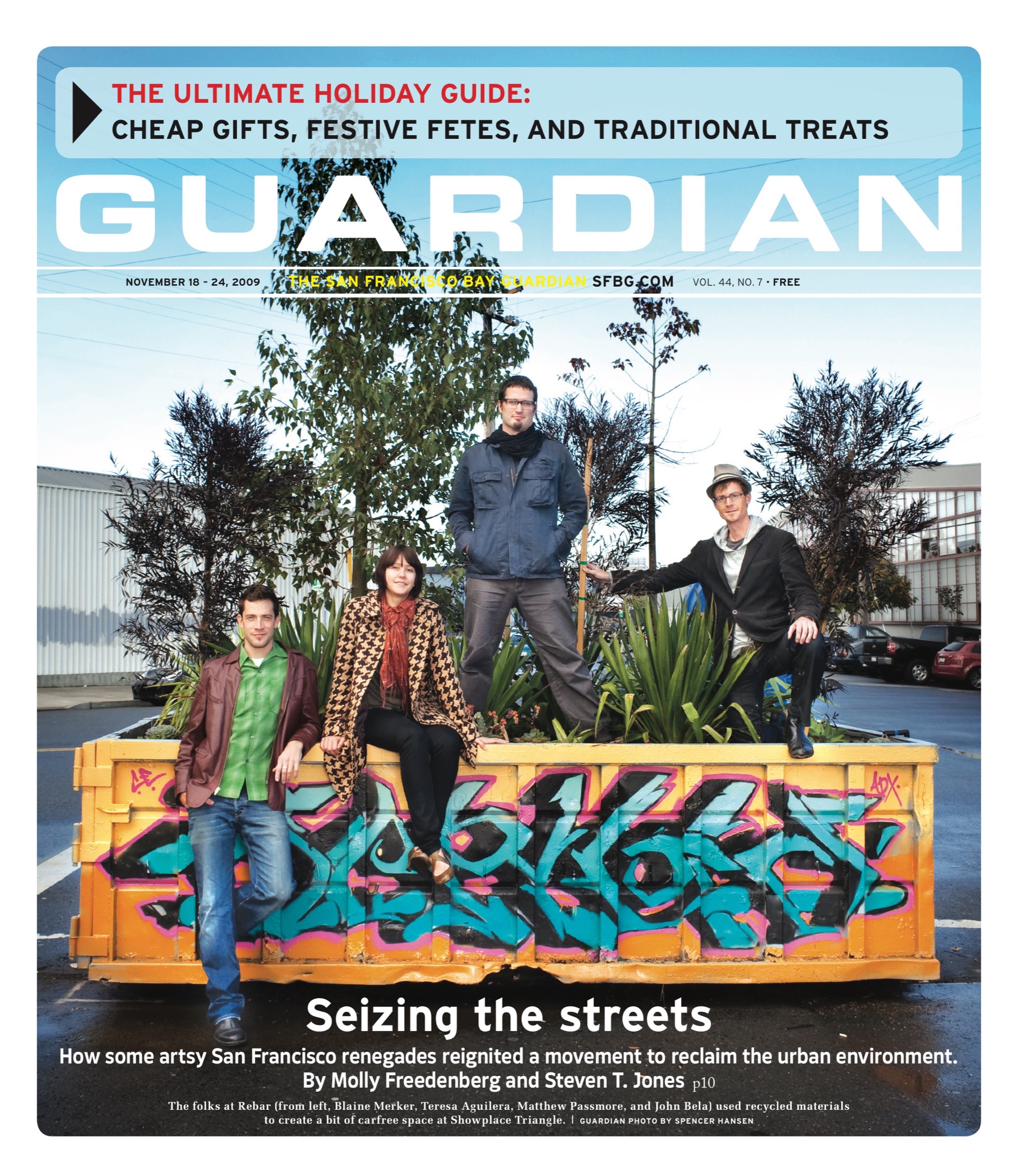
San Francisco’s streets and public spaces are undergoing a drastic transformation — and it’s happening subtly, often below the radar of traditional planning processes. Much of it was triggered by the renegade actions of a few outlaw urbanists, designers, and artists.

But increasingly, their tactics and spirit are being adopted inside City Hall, and the result is starting to look like a real urban design revolution — one that harks back to a movement that was interrupted back in the 1970s.

One of the earliest signs of the new approach emerged in 2005 on the first Park(ing) Day, the brainchild of the hip, young founders of the urban design group Rebar. The idea was simple: turn selected street parking spots around San Francisco into little one-day parks. Just plug some coins in the meter to rent the space, then set up chairs or lay down some sod, and kick it.

It was a simple yet powerful statement about how San Franciscans choose to use public space — and the folks at Rebar expected to get in trouble.

“When we did the first Park(ing) Day in 2005, JB [a.k.a. John Bela] and I were just prepared to be arrested and hauled into court,” Rebar’s Matthew Passmore told us at a recent interview in the group’s new Mission District warehouse space. “But nothing like that happened.”

Instead, City Hall called. 079_realcover.jpg Rebar’s Blaine Merker, Teresa Aguilera, Matthew Passmore, and John Bela at their carfreee space at Showplace Triangle

“We got a call from the director of city greening, who said this is great, I want to meet with you guys and talk about how the city can support this kind of activity,” Passmore said. “Much to our surprise, the city was totally responsive as opposed to shutting us down and imprisoning us.”

Bela said the group discovered that Mayor Gavin Newsom’s administration was looking for just the sort of innovative, cool, environmental ideas that were Rebar’s focus. And that connection merged with other people’s efforts — like sidewalk-to-garden conversions being pioneered by Jane Martin, the urban gardening and bicycling movements, and the unique public art that was making its way back from Burning Man. That created a catalyst for a wide array of city initiatives, from the Sunday Streets road closures to temporary art installations that began popping up around the city to the Pavement to Parks program that creates short-term parks in underutilized roadways.

“It was a single interaction five years ago, and now we have things like Sunday Streets,” Bela told us on Sept. 18’s Park(ing) Day, in which various individuals and groups took over more than 50 parking spots around town. “It’s about reclaiming the streets for people.”

Park(ing) Day itself blew up, becoming a worldwide phenomenon that is now in 151 cities on six continents, and one that the Mayor’s Office is planning to turn into a more permanent plan, with the regular conversion of some parking spots on commercial corridors into outdoor seating areas.

“You had a few guys and a girl who had an idea and now it’s an international event,” Mike Farrah, a longtime Newsom lieutenant who now heads the Office of Neighborhood Services and has been the main contact in City Hall for Rebar and similar groups, told the Guardian.

Locally, the success of events like Park(ing) Day have changed San Francisco’s approach to urban spaces, particularly on land left dormant by the economic downturn. Rebar, the permaculture collective Upcycle, and former MyFarm manager Chris Burley plan to turn the old Hayes Valley freeway property near Octavia, between Oak and Fell streets, into a massive community garden and gathering space. Plans are being hatched for temporary uses on Rincon Hill properties approved for residential towers. “Green pod” seating areas are sprouting along Market Street and there are plans to extend the Sunday Streets road closures next year. And, perhaps most amazingly, most projects are being accomplished with very little funding.

How has San Francisco suddenly shifted into high gear when it comes to creating innovative new public spaces? The key is their common denominator: they’re all temporary. As such, they don’t require detailed studies, cumbersome approval processes, or the extensive outreach and input that can dampen the creative spark.

But San Francisco is starting to prove that dozens of short-term fixes can add up to a true transformation of the urban environment and the citizenry’s sense of possibility.


EVOLUTION OF THE PRANK

Rebar began as a group of friends and artists who came together to enter a design contest in 2004. Passmore was a practicing lawyer and Bela was a landscape architecture student at UC Berkeley. They chose the name Rebar for future collaborations, the first of which was Park(ing) Day.

Passmore, who had a background in conceptual art before going to law school, discovered a legal loophole that might allow for anything from a burlesque performance to a temporary swimming pool to be installed in metered parking spaces. Bela recruited Blaine Merker, a fellow landscape architecture student with whom he’d won a design competition, to join the effort.

Park(ing) Day was a hit, getting great press and igniting people’s imaginations. “We realized after we did it, like, oh, people are really getting this,” Merker said. And Rebar was off. In the following years they added a fourth principal, graphic designer Teresa Aguilera, and took on a number of acclaimed projects: planting the Victory Garden in Civic Center Plaza, building the Panhandle Bandshell from old car hoods and other recycled parts, creating COMMONspace events (from “Counterveillance” to the “Nappening”) in privately-owned public spaces, and designing the Bushwaffle (commissioned for the Experimenta-Design biennale in Amsterdam) to help soften paved urban spaces and create a sense of play.

Through it all, the group maintained its prankster spirit. When they were invited to present the Bandshell project at the prestigious Venice Biennale festival, Rebar members showed up costumed as Italian table-tennis players (a joke that mostly baffled other attendees, they said).

They told us every project needed to have a “quotient of ridiculum.” Or as Bela put it, “That’s how we know project has evolved to the right point — when we’re on the floor laughing.”

As Rebar found success, it was still mostly a side project for members who had other full-time jobs. “We were all playing hooky all the time,” said Merker, who, like Bela, joined a landscape architecture firm after he finished school. “It just got worse and worse.”

So now, they’re trying to turn their passion into a profession, recently moving into a cool warehouse office and workspace in the Mission. “We’re shifting our practice a little to have the same sort of spirit but trying to figure out how we can make that an occupation,” Merker said.

It’s also about moving from those short-lived installations to something a little more lasting, even while working within the realm of temporary projects. As Aguilera said, “A lot of the projects we started with were creating moments to maybe think about. But we’re shifting into more permanent ways to interact with the city.”

They may not be sure where they’re headed as an organization, but they have a clear conception of their canvas, as well as the traditions they draw from (including movements like the Situationists and artists such as Gordon Matta-Clark, who worked in urban niche spaces) and the fact that they are part of an emerging international movement to reclaim and redesign urban spaces.

“We’re not the originators of any of this stuff,” Bela said. “It’s like emerging phenomena happening in cities all over the world. We just happened to have plugged into it early on and we continue to push it.”


EXPANDING THE POSSIBLE

Rebar is strongly pushing a reclamation of spaces that have been rather thoughtlessly ceded to the automobile over the last few decades. “Street right-of-way is 25 percent of the city’s land area. A quarter of the city is streets,” Bela said. “And those streets were designed at the time when we wanted to privilege the automobile.

“So basically, there’s all this underutilized roadway,” he continued. “It’s asphalt and it’s pavement, and the city wants to reclaim some of those spaces for people. That’s a thread we’ve been exploring in our work for a long time, and now it’s elevated up to a citywide planning objective.”

The short-term nature of the projects comes in part from political necessity: temporary projects are usually exempt from costly, time-consuming environmental impact reports. Demonstration projects also don’t need the extensive public input that permanent changes do in San Francisco. But there’s more to the philosophy.

“It stands on this proposition that temporary or interim use does actually improve the character of the city,” Passmore said. “People used to think that if something is temporary or ephemeral, what good is it? It’s just here today, gone tomorrow. But I think now people are realizing that the city can be improved like this.”

And it goes even deeper than that. When people see parking spaces turned into parks, vacant lots blossoming with art and conversation nooks, or old freeway ramps turned into community gardens, their sense of what’s possible in San Francisco expands.

“What we’re remodeling is people’s mental hardware. It’s like stretching. You have to bend something a little more than it wants to go, and the next time you do that, it’s that much easier,” Merker said.

“There’s also a psychological aspect to that. When people see a crack in the Matrix open up, if you will, it can open up a whole lot more than just that one moment,” he said.

For those who have been working on urbanism issues in San Francisco for a long time, like Livable City director Tom Radulovich, this new energy and the tactic of conditioning people with temporary projects is a welcome development. “There is a huge resistance to change in San Francisco, no matter what the change is, and a lot of that stems from fear,” Radulovich said. But with temporary projects, he said, “you can establish what success looks like from the outset.”


BUILDING ALLIANCES

The Rebar folks have been fairly savvy in their approach, making key friends inside City Hall, people who have helped them bridge the gap between their idealism and what’s possible in San Francisco.

“We are a process-driven city, and temporary allows you to create change without fear,” Farrah told us. He said the partnership between the Mayor’s Office and community groups that want to do cool, temporary public art really began in the summer of 2005 with the Temple at Hayes Green by longtime Burning Man temple builder, David Best.

Farrah had connections to the Burning Man community, so he facilitated the placement of the temple along Octavia Boulevard, then one of the city’s newest and least developed public spaces. Next came the placement of another Burning Man sculpture, Flock by Michael Christian, in Civic Center Plaza that fall. Both projects got funding and support from the Black Rock Arts Foundation, a public art outgrowth of Burning Man.

“I saw, after some of the temporary art and special events, how it’s changed people’s ideas about what’s possible,” Farrah said. “There has been a change in the way people view the streets.”

That got Farrah thinking about what else could be done, so he approached BRAF’s then-director Leslie Pritchett and Rebar’s Bela, telling them, “I need you to look at San Francisco like a canvas. Tell me the things you want to do, and I’ll tell you if it’s possible or not. And that’s led to a lot of cool stuff.”

Livable city advocates like Radulovich — progressives who are generally not allied with Newsom and who have battled with him on issues from limiting parking to the Healthy Saturdays effort to create more carfree space in Golden Gate Park — give the Mayor’s Office credit for its greening initiatives.

He credits Greening Director Astrid Haryati and DPW chief Ed Reiskin with facilitating this return to urbanism. “He’s really responsive and he gets it,” Radulovich said of Reiskin. “This is really where a lot of energy is going in the mayor’s office. It seems to have captured their imaginations.”

Another catalyst was last year’s visit by New York City transportation commissioner and public space visionary Janette Sadik-Khan, who met with Reiskin and Newsom on a trip sponsored by Livable City and the San Francisco Bicycle Coalition. Radulovich said her message, which SF has embraced, is that, “There are low-cost, reversible ways you can reclaim urban space in the near term.”

The Mayor’s Office, SFBC, and Livable City partnered last year to create Sunday Streets, which involved closing streets to cars for part of the day. The events have proven hugely successful after overcoming initial opposition from merchants who now embrace it.

Then there’s the Pavement to Parks program — which involves converting streets into temporary parks for weeks or months at a time — that grew directly from the Sadik-Khan visit. Andres Power, who directs the program for the Planning Department, told us the visit was a catalyst for Pavement to Parks: “She came to the city a year ago and inspired my director, Ed Reiskin.”

“We’re rethinking what the streets are and what they can be,” Power said. “It’s rewarding to see this stuff happen and to be at the forefront of a national effort to imagine what our streets could be.”


DE-PAVE THE CONCRETE

Pavement to Parks launched last year, a multiagency effort with virtually no budget, but the mandate to use existing materials the city has on hand to turn underutilized streets into active parks. “It looks at areas where we can reclaim space that’s been given over to cars over the decades,” Power told the Guardian.

At the first site, where 17th Street meets Market and Castro, the city and volunteer groups used planters and chairs to convert a one-block stretch of street that was little-used by cars because of the Muni line at the site.

“We bent over backward to make the space look temporary,” Power said, noting the concern over community backlash that never really materialized, leading to two time extensions for the project. “But we’re now ready to revamp that whole space.”

Another Pavement to Parks site at Guerrero and San Jose streets was created by Jane Martin, whom Newsom appointed to the city’s Commission on the Environment in part because of the innovative work she has done in creating and facilitating sidewalk gardens since 2003.

As a professional architect, Martin was used to dealing with city permits. But her experience in obtaining a “minor sidewalk encroachment permit” to convert part of the wide sidewalk near a building she owned on Shotwell Street into a garden convinced her there was room for improvement.

“At that point, I was really jazzed with the result and response [to her garden] and I wanted to make it so we could see more of it,” she said. So she started a nonprofit group called PlantSF, which stands for Permeable Lands As Neighborhood Treasure. Martin worked with city agencies to create a simpler and cheaper process for citizens to obtain permits and help ripping up sidewalks and planting gardens.

“We want to de-pave as much excess concrete as possible and do it to maximize the capture of rainwater,” she said.

Martin said the models she’s creating allow people to do the projects themselves or in small groups, encouraging the city’s DIY tradition and empowering people to make their neighborhoods more livable. More than 500 people have responded, creating gardens on former sidewalks around the city.

“We’ll get farther faster with that model,” she said. “It’s really about engaging people in their neighborhoods and helping them personalize public spaces.”

San Francisco has always been a process-driven city. “We in San Francisco tend to plan and design things to death, so as a result, everything takes a very long time,” Power said.

But with temporary projects under Pavement to Parks, the city can finally be more nimble and flexible. Three projects have been completed so far, and the goal is to have up to a dozen done by summer.

“We’re working feverishly to get the rest of the projects going,” Power said.

One of those projects involves an impending announcement of what Power called “flexible use of the parking lane” in commercial corridors like Columbus Avenue in North Beach. “We’re taking Park(ing) Day to the next level.”

The idea is to place platforms over one or two parking spots for restaurants to use as curbside seating, miniparks, or bicycle parking. “The Mayor’s Office will be announcing in the next few weeks a list of locations,” Power said. “There have been locations that have come to us asking for this.”

“The idea is to do a few of these as a pilot to determine what works and what doesn’t. The goal is to use their trial implementation to develop a permanent process,” Power said. “We want to think of our street space as more than a place for cars to drive through or park.”

Rebar was responsible for the last of the completed Pavement to Parks projects. Known as Showplace Triangle, it’s located at the corner of 16th and Eighth streets in the Showplace Square neighborhood near Potrero Hill. For Rebar, it was like coming full circle.

“We started doing this stuff about five years ago, finding these niches and loopholes and exploring interim use as a strategy for activating urban space,” Bela said. “And to our surprise, what we perceived as a tactical action is now being embodied by strategic players like the Planning Department.”


REUSE, RECYCLE, REINVENT

The Rebar crew was like kids in a candy store picking through the DPW yard.

“These projects are all built with material the city owns already, so we had the opportunity to go down to the DPW yard and inventory all of these materials they had, and figure out ways to configure them to make a successful street plaza,” Bela said.

So they turned old ceramic sewer pipes into tall street barriers topped by planter boxes, and built lower gardens bordered by old granite curbs.

“We are trying to be as creative as possible with the use of materials the city already has on hand,” Power said. In addition to the DPW yard that Rebar tapped for Showplace Triangle, Power said the Public Utilities Commission, Port of SF, and the Recreation and Parks Department all have yards around the city that are filled with materials.

“They each have stockpiles of unused stuff that has accumulated over the years,” he said.

For her Pavement to Parks project on Guerrero, Martin used fallen trees that originally had been planted in Golden Gate Park — pines, cypress, eucalyptus — but were headed for the mulcher. Not only were they great for creating a sense of place, they offered a nod to the city’s natural history.

But perhaps the coolest material that had been sitting around for decades was the massive black granite blocks that Rebar incorporated into Showplace Triangle. “One of the most interesting materials that we used in Showplace Triangle was the big granite blocks from Market Street that were taken off because merchants didn’t like people encamping there. They were too successful as spaces, so they got torn out,” Merker said.

Bela said they couldn’t believe their eyes: “We saw these stacks of five-by-five by one-foot deep black granite. Just extraordinary. If we were to do a public project today, we could never afford that stuff. There’s no way. But the taxpayers bought that stuff back in the ’70s and now it’s just sitting there in the DPW yard. It’s a crime that it’s not being used, so it was great to get it back out on the street.”

Radulovich said the return of the black granite boxes to the streets represents the city coming full circle. He remembers talking to DPW manager Mohammad Nuru as he was removing the last of them from Market Street in the 1970s, citing concerns about people loitering on them.

“To see them put up again in JB’s project was symbolic of where the city went and where it’s coming back from,” Radulovich said. “It’s almost like the livability revolution got interrupted and we lost two decades and now it’s picking up again.”

Back in the 1970s, Radulovich said the city was actively creating new public spaces such as Duboce Triangle. It was also creating seating along Market Street and generally valuing the creation of gathering places. But in the antitax era that followed, public sector maintenance of the spaces lagged and they were discovered by the ever-growing ranks of the homeless that were turned loose from institutions.

“The fear factor took over,” Radulovich said. “We did a lot to destroy public spaces in the ’80s and ’90s.”

But by creating temporary public spaces, people are starting to realize what’s been lost and to value it again. “These baby steps are helping us relearn what makes a good public space,” Radulovich said.

For much of the younger generation, building public squares is a new thing. As Aguilera noted, “We don’t have a lot of public plazas anymore or places for people to gather. When Obama was elected, where did everyone go in the city? Into the streets. So we’re trying to give that back to the city.”


CARS TO GARDENS

Perhaps the most high-profile laboratory for these ideas is the Hayes Valley Farm, a temporary project planned for the 2.5 acres of freeway left behind after the Loma Prieta earthquake. The publicly-owned land between Oak and Fell streets is slated for housing projects that have been stalled by the slow economy.

“The site’s been vacant for 10 years. They came up with a beautiful master plan. And the moment they’re ready to move on the master plan, there’s an economic collapse, so nothing is happening,” Bela said.

In the meantime, the Mayor’s Office and Hayes Valley Neighborhood Association pushed for temporary use of the neglected site. They approached the urban farming collectives MyFarm and Upcycle. Later, Rebar was brought in to design and coordinate the project.

Now the group known as the Hayes Valley Farm Team has an ambitious plan for the area: part urban garden, part social gathering spot, and part educational space. There will be an orchard of fruit trees, a portable greenhouse, demonstrations on urban farming, and a regular farmers market.

“The different topography of ramps allows for different growing conditions. These ramps are prime exposure to the south,” Merker said. “They create these areas that can produce some really great growing conditions, so it’s kind of funny that this freeway is responsible for that. The ramps actually create different microclimates.”

Most remarkably, the whole project is temporary, designed to be moved in three years. “We’re interested in developing infrastructure and tools and machinery and implements that are sort of coded for the scale of the city: a lot of pedal-powered things, a lot of mobile infrastructure, and smaller things that are designed to be useful in a plot that is only 2.5 acres,” Bela said. “Then when we need to move on, we’ll be able to do that. It’s about being strategic with some of the investments so we can take some of the tools we develop here and move it to the next vacant lot down the street.”

The project has lofty goals, ranging from creating a social plaza in Hayes Valley to educating the public about productive landscaping. “We’re getting away from ideas of turning parks into food production — it can be both,” said David Cody of Upcycle. “We want to just crack the awareness that cities can be multi-use and agriculture doesn’t mean farm.”

This is perhaps the most ambitious temporary project the Mayor’s Office has taken on. “Rebar pushed the envelope on what is possible. I told them it would be a tough one,” Farrah said of the project. But he loves the concept: “You can argue that putting gardens in temporary spaces changes attitudes.”

Symbolically, this land seems the perfect place for such an experiment. “This really is a special spot. If you look at a map of the city, Hayes Valley is in the very center, and this is right in the heart of Hayes Valley,” Aguilera said. “And right now, in the heart of a neighborhood in the heart of the city, there’s this vacant, fallow reminder of what used to be there. We’re looking to turn it into a new beating heart that brings together lots of different parts of the community.”


ACTIVATING DORMANT SPACES

Activating dormant spaces in the city isn’t easy, particularly for properties with pending projects. In Hayes Valley, for example, the Rebar crew was required to develop a detailed takedown plan.

“A lot of development is hesitant to get involved with these interim uses because at the end, they’re worried that it’s going to be framed as the evil, money-hungry developer coming in to kick out artists or farmers,” Passmore said. “But the reality is, they are very generously opening up their space is the first place.”

With last year’s crash of the rental estate and credit markets, development in San Francisco stalled, leaving potentially productive land all over the city. “As the city has gone through an economic downturn, like now, the city has a lot of vacant lots with developer entitlements on them, but nothing is being built right now. Those are spaces the public has an interest in,” Merker said, citing Rincon Hill as a key example.

Michael Yarne, who facilitates development projects for the Mayor’s Office of Economic Development, has been working on how developers might be encouraged to adopt temporary uses of their vacant lots.

“How can we credit them to do a greening project on a vacant lot?” Yarne asks, a problem that is exacerbated by the complication that neither the developers nor local government have money to fund the interim improvements.

He looked at the possibility of using developer impact fees on short-term projects, but there are legal problems with that approach. The courts have placed strict limits on how impact fees are charged and used, requiring detailed studies proving that the fees offset a project’s real cost and damage.

“But there is other value we can give as a city without spending a dollar — and that is certainty,” said Yarne, a former developer. He said developers value certainty more than anything else.

Right now, developers have to return to the Planning Commission every year or so to renew project entitlements, something that costs time and money and potentially places the project at risk. But he said the city might be able to enter into developer agreements with a project proponent, waiving the renewal requirement for a certain number of years in exchange for facilitating short-term projects.

“Everyone wins. We get a short-term use, and the developer gets certainty that they won’t lose their rights,” Yarne said, noting that he’s now developing a pilot project on Rincon Hill. “If that works, that could be a template we could use over and over.”

Radulovich is happy to see the new energy Rebar and other groups are infusing into a quest to remake city streets and lots, and with the use of temporary projects to expand the realm of the possible in people’s minds: “Let’s get people reimagining what the streets could be.”

www.rebargroup.org

MILFbone

0

andrea@mail.altsexcolumn.com

Dear Andrea:

Since you were so good as to weigh in on "cougar" ["Cougar Den," 10/22/08], perhaps you could settle the evident controversy around the correct usage of "MILF?" I think a MILF (Mother I’d Like to Fuck) is the mother of someone in your peer group. If your mom seems as sexual as burnt toast but Jimmy’s mom looks surprisingly hot at the ninth grade bake sale, it makes you reevaluate the sexiness of mothers or, generally, adults over 35. Jimmy’s mother is a MILF, and deserves the special category, only from the intergenerational perspective of a 14-year-old or whatever. It seems, though, that it’s being used to mean any woman who has a kid, which totally gets my back up. I’m 26 with an infant — I’d like to think I’m sexy in my own right and MILF is uncalled for, unless my kid’s friends at play-date start using the term way early. What do you think? Is MILF only referring to women of your parent’s age and above, or does it mean any woman who has (gasp!) had a child?

Love,

Still Hot?

Dear Hot:

I think I’ve weighed in on "cougar" a bunch of times, and fascinated as I am by the way the sexually-not-dead-yet moderately older woman has become the Hottentot Venus of our time — sexualized yet grotesque-ified, exoticized, gawped at, and lampooned — I think I need to leave it alone now. As for "MiLF" and MILFs, we have discussed it and them here, but only once, in passing, when some bozo wrote in about his hot former ex niece-in-law, or something, whom he described as "the very personification of the MILF." And indeed, he did want to F her.

"What does it even mean" I wrote then, "by specifying the ‘mother’ in ‘mother I’d like to fuck?’ Does the speaker intend to make a distinction between the rare mother worth fucking and the unfuckable masses? Or is it really the ‘mother’ part that intrigues, that sexy whiff of fecundity, that milkshake that brings all the boys to our yard? My personal suspicion is that it’s the latter masquerading as the former, that the fascination with the pregnant or baby-toting Heidi Klum or Angelina Jolie is not fueled so much by the fact that they still look ‘hot’ as by the implication that if somebody knocked them up, then so, by extension, could you. But I may be getting a little theory-addled here."

And indeed I think I was. Such subtexts are fun to contemplate, and I do think there’s something to it, but it’s obvious the other element in wanting to F Heidi Klum is simply wanting to F Heidi Klum. And while we’re on Heidi, no pun intended, my husband and I got to teach the "sex and parenting" section at San Francisco Sex Information this past weekend and got to tell my Heidi Klum joke, which is actually no joke, and goes like this:

Q: How do you look like Heidi Klum after you have a baby?

A: Easy. All you have to do is look like Heidi Klum before you have a baby.

Now, on to your specific questions. I’m glad it’s not that you actually aspire to being classified as MILFy and are trying to figure out who has the standing to nominate you. You are more than just musing semantically, though, the way I might while washing dishes or pushing the stroller around. This bugs you! I’m sorry!

I think you have the right of it when you narrow the term to what I’ve always felt was the best use of the (icky anyway) phrase: the mother of one of your friends, a full generation older than you "but" still hot. Stacy’s mom. Or, to hark back to the classics, Anne Bancroft in the leopard-skin coat, coo-coo-ca-choo. And by the way, do you know how old Anne Bancroft was when she played Mrs. Robinson? Thirty-five. Thirty-five! No fairsies playing the hot older woman when you barely qualify as "older," Anna Maria Italiano.

I loved Anne Bancroft.

Since its (fairly recent) inception, the "proper" use of MILF has morphed from "Mrs. Robinson" to, yes, anybody female and parous, of any age, whom the observer, also of any age, deems "fuckable." This is sort of nasty in that it clearly divides the fuckable from the un, probably along the most obvious and cartoonish model (you need to be thin, flat-bellied, big-but-perkily boobed, etc. to qualify). And yes, it also casts those of us who have had kids into a special category, needing to be judged, separate from the nulliparous masses, as still fuckable despite having committed the antisexual sin of reserving much of our time and affection and a good deal of the access of our bodies for (small) people who are not the guys doing the judging. Oops! Sorry, dudes!

It is objectionable. It is kind of gross. But it is also silly and far more their problem than yours.

Love,

Andrea

See Andrea’s other column at carnalnation.com.

Shock and style roll out at the SF Bike Expo

0

By Caitlin Donohue

I make it a point to spend quality time with my bike- you know, the daily commute/traffic battles, satisfying slogs up to Alamo Square Park, maybe an ill-advised wobble back from happy hour every now and then. But no matter how much qt they get with their parents, kids still need social time with their peer group.

sf bike expo 1109.jpg
Andrew Taylor, host of the SF BIke Expo’s dirt jump competition, gets high on the prettest darn bike I’ve ever seen

So because I love her, I’m making a play date for my bike with the San Francisco Bike Expo. The day-long event will be jam packed with kids that ride their bikes even more than I do- there’s a BMX stunt competition and a mountain bike dirt jump contest that seeks to replicate the pants-wetting good times of Evil Knievel’s Cow Palace appearance nearly 40 years ago. Plus, there will be a track stand show down, which is awesome if you’ve never seen a guy on a fixed gear stop for a traffic light (possible).

Sonic Reducer Overage: Grant Hart, ‘In C,’ Flobots, Talk Normal, and more

0

By Kimberly Chun

I recommend taking some cult-cha with your cold cereal — it’ll make the pre-Thanksgiving/Black Friday mania go down easier. More fun stuff than we could fit into print.

Ty Segall and Culture Kids
The raging Goldie ‘09 winner lets it fly with the buskable, combustible Bay Area noise makers. With the Baths. Sat/14, 9 p.m., $7. Amnesia, 853 Valencia, SF. (415) 970-0012.

Turks
The Oakland combo likes its tempos convulsive and screams pitched a few notches above the deep, dark pit of post-punk hell. With Rats Eyes and La Guardia. Sat/14, 9:30 p.m., $6. Hemlock Tavern, 1131 Polk, SF. (415) 923-0923.

Meet the mothers, Mister Mayor

1

Text and video by Sarah Phelan


Abigail Trillin reads a letter from an immigrant mother who wants to meet Newsom in person and hear him explain why he supports a policy that has led to her son being needlessly placed in a federal detention facility in Oregon

As the father of a newborn, Mayor Gavin Newsom is doubtless having sleepless nights and tiring days, as he learns to change diapers, burp and even bathe his young daughter, in between his duties as San Francisco’s CEO.

Presumably, he’s already gained the fiercely protective perspective of a parent–a point of view that could help him realize why it would be humane to meet with the parents of immigrant teens who have been whisked out of the city and away to federal detention facilities in other states, thanks to a policy that Newsom ordered last year.

One such mother wrote a letter requesting a meeting with the mayor to discuss why her son is sitting in a federal detention facility in Oregon, even though the SF District Attorney has dismissed all the charges in his case.

Abigail Trillin, staff attorney with Legal Services for Children, read that letter aloud at City Hall this week, shortly after the Board voted to override Newsom’s veto of amendments to the sanctuary policy (and you can listen to it, by clicking on the video above.)

The Board’s amendments seek to ensure that teens who haven’t done anything wrong aren’t turned over to the feds for possible deportation. The amendments would therefore also ensure that families aren’t needlessly put through hell, just because someone accuses their kids of doing something they never did.

But Newsom has said- indirectly through his spokespeople–that he plans to ignore the Board’s amendments, claiming that his hands are tied by federal law.

The Board believes otherwise and currently a nasty legal battle seems eminent.

In the meantime, families of immigrant children in San Francisco are left worrying if their kid is going to be the next child to be referred to the feds and disappeared to a detention facility in Oregon or Miami or Indiana or wherever for deportation to a country they never knew for a crime they never did.

So if Newsom, as a mayor and a parent, believes in his policy, then surely he is willing to defend and explain it to those directly impacted by his decisions.

Because this isn’t a game, or another piece of political theater. It’s a case of immigrant parents desperately fighting to protect their kids from needless harm, which could include death at the border or being recruited into a gang.

Now, folks tell me stuff like, well, these parents should make sure their kids don’t get into trouble in the first place.
But the truth is that some of these kids didn’t get into trouble in the first place. Or not into trouble that was so serious that it warranted being referred to the feds. And that’s why their mothers have a problem with Newsom’s current policy and want him to amend it, as he has been directed, or at the very least explain it, as mayor of San Francisco, to them in person.

f

Food fights and deportation

0

By Tim Redmond

It’s a good thing these kids weren’t in San Francisco — they might wind up in federal prisons or getting deported.

Appetite: Food for Thought helps Mission grads, Frescobaldi gets Luce

0

Every week, Virginia Miller of personalized itinerary service and monthly food, drink, and travel newsletter, www.theperfectspotsf.com, shares foodie news, events, and deals. View the last installment here.

foodforthought1109.jpg
Digging into some Food for Thought

11/11-11/23 of the Mission’s best restaurants participate in "Food for Thought" to help Mission grads get to college
Do nothing but eat out at one of your favorite Mission restaurants this Wednesday night and you’ll be helping some of the neediest Mission high school grads get to college. With 23 of the ‘hood’s best restaurants participating, a portion of all dinner sales (restaurants have committed anywhere from 25-100% of that night’s sales) go to Food for Thought. In it for the long haul, Food for Thought offers, among other things, tutoring centers for elementary school kids, academic support groups in junior high, and college prep programs for high school students, working with them through each phase of schooling. There’s even raffle prizes at each restaurant, like a trip for two to Mexico. You don’t have to be told twice to eat out at Range, Mission Beach Cafe, Little Star Pizza, or Bar Bambino, do you?
11/11 regular hours at 23 Mission restaurants
List of participating restaurants: www.missiongraduates.org/foodforthought

————-

rest1109.jpg
A Luce interior

11/11 – Luce celebrates its Michelin Star with the Frescobaldi family
It’s an honor for a chef to receive a Michelin star, especially a French chef like our own Dominique Crenn at Luce in the Intercontinental Hotel (she’s also on this season of The Next Iron Chef). Luce celebrates in a big way by cooking a 6-course Tuscan feast, Inspirations of Tuscany, with Marchesi de’ Frescobaldi’s wine estates’ executive chef, Donatella Zampoli. Frescobaldi, the legendary Italian family who even traded their wines with Michelangelo back in the day, will, naturally, be pairing their wines with dinner. Not only is this a rare, special night, but $10 of every 6-course dinner benefits CUESA, so the focus remains local as it is international. Courses include Thomas Family Farms potato gnocchi with bone marrow and lobster paired with a glass of 2006 Attems Cicinis, or sweetbread and beef tongue with potato espuma (foam to you), slow cooked egg and pancetta jus partnered with a 2005 Nipozzano Riserva Chianti Classico. Can’t make it out Wednesday? The party rolls on all month until November 21, with a 4-course Michelin Star prix-fixe menu available any night for $60 per person.
$75; $30 for wine pairings
11/11 – make a reservation during regular hours, 5-11pm
888 Howard Street
415-616-6566

www.lucewinerestaurant.com

The problem of happiness

0

le.chicken.farmer@gmail.com

CHEAP EATS Sometimes it just takes one word, and this week’s one is shoehorn. There. I’m done. And you barely even got your pants down, or your skirt up. Skype is an amazing thing, as is technology in general. As are words.

Yesterday morning, outside a coffeehouse in Guerneville …

Today, inside a coffeehouse in Oakland …

One night I put my laptop on the pillow next to me and slept while she went about her business.

It’s weird (or maybe not) that many of the men who mistreated, malpracticed, or underwhelmed me last year are trying to reconnect right now. Proving once again that straight guys just love a lesbian. Had I thought of this, I would have faked it.

Can I tell you how much pleasure I get from not doing anything at all? Well, I do read their e-mails. After months and months of silence, they suddenly can’t stop thinking about me, they’re sorry they blew it, blah blah blah. And I don’t write back, not even to say, Thank you for blowing it. I met someone a lot better than you.

And a lot better for me. Last month in Joshua Tree she taught me how to be more ladylike. Instead of saying, "I gotta go pee," I can now say, in German, Ich muss mich frischmachen, or roughly, "I have to freshen up" … which is really fun to say before going behind a cactus and squatting over some dirt, then wiping your hands on your jeans.

In New Jersey last week I returned the favor. I taught her how to put gas in a car. She’s never owned a car in her life, but loves to be the driver, and loves to do all the more classically manlier things, like getting the gas. So I showed her how. While the pump was pumping we stood straddling the hose (not really) and kissed real slow and long (really). I forgot where I was.

When the kiss was over, I looked away and accidentally into the wide eyes of a man filling his pickup truck next pump over. His mouth was a little bit open — more from pain, I think, than disbelief. I smiled. He didn’t. His hands were in his pockets.

It’s fun outside of the Bay Area, but good to be back too. This morning I had breakfast at Sconehenge with my friend Hickymajig, and we had a contest to see who was nervouser. She won. But I did not go down without a tremor. And a twitch. And a lightheaded feeling in my legs. And a fluttery stomach, cold sweat, shaky hands, and other more serious symptoms, like I only ate half of my huevos rancheros ($7.50).

The second half is on the floor in my car, fantasizing about lunch. For a restaurant called Sconehenge, Sconehenge has very few things called scones on the menu. But they do have them, and they’re supposed to be great.

But we both ate Mexican breakfasts. Very good. Very very very good. And cheap! And big! My huevos had a huge pile of salsa on top, and a ton of melted cheese. Warm flour tortillas that I slathered with butter, rolled up, and poked into my egg yolks. The rice and beans were delicious. Nevertheless, if Hickymajig reads this it will be from a hospital bed, so I would like her to know that the entire Bay Area, including me, is thinking about her and wishing her well, on buses, in bathrooms, and wherever else Cheap Eats is read. Behind a cactus …

My thing is partly a problem of happiness, which is a good problem to have. My armchair therapists tell me I deserve to be happy, get over it. And I’m trying, I swear. I breathe, I read, I write, I laugh. But my body continues to act as if it’s about to get run over by a minivan.

Maybe I drink too much coffee. And that’s another good thing about Sconehenge. Their coffee sucks. You can only drink one cup, if you’re lucky.

I told you this column was over after the first sentence. So if you made it this far, don’t blame me. It’s nighttime already where my heart is. And here I haven’t even gone to work yet! Kids need me. Their moms, more so. Oy.

Or, take my word for it: schuhlöffel.

SCONEHENGE BAKERY & CAFE

Mon.–Sat., 7:30 a.m.–3 p.m.;

Sun., 8 a.m.–2:30 p.m.

2787 Shattuck, Berk.

(510) 845-5168

No alcohol

MC/V

L.E. Leone’s new book is Big Bend (Sparkle Street Books), a collection of short fiction.

This is it

0

arts@sfbg.com

VISUAL ART In its opening week, the posthumous Michael Jackson film This Is It topped the international box office. It’s a testament to the enduring ardor of his fans. But one day in the not-so-distant future, the film will likely be core material in a media studies program. Perhaps even a Michael Jackson studies program.

In 2005, Candice Breitz, a Berlin-based, South African-born artist whose works of photography and video installation address the psychosocial power of pop, created King (A Portrait of Michael Jackson). Breitz’s multimedia project efficiently makes the case that the musician and his fans are engaged in a deeply complicated relationship, one with an infectious soundtrack. King is direct — 16 Jackson fans, videotaped singing and dancing to the entire Thriller album, are presented together in the gallery on plasma screens. The result is a dynamic image of the entertainer in which he never appears.

The similarly structured 2006 work Working Class Hero (A Portrait of John Lennon) is one of two celebrity-appropriating Breitz works currently on view at SFMOMA. Like a good pop song, it seduces with a hook and takes a complicated foothold in your consciousness. The second piece, 2005’s Mother, isolates scenery-chewing performances by six major Hollywood actresses: Faye Dunaway, Diane Keaton, Shirley MacLaine, Julia Roberts, Susan Sarandon, and Meryl Streep.

"I’m turned on by the potential for the work of art to articulate complex ideas and simultaneously engage a broader audience which might not be as invested in the discourse of contemporary art," the highly articulate Breitz explains in a recent conversation. She offers what she terms "the South Park model," suggesting the subversive cartoon is something you can simply be entertained by or write a PhD dissertation on.

Breitz’s projects frequently manage to have it both ways. The Lennon piece beckons with the sound of familiar songs. But encountering 25 video monitors, each one slightly enlarging a passionate fan, is involvingly witty — and frightening, due to the intensity of the performances. These are people who clearly take the music to heart and have made it their own. Being able to look at them so closely in a gallery is an uncomfortably intimate experience — an effect perhaps achieved by the fact that each participant is recorded alone.

"I’m interested in the ping pong, that they’re there both as individuals who have their own subtle or radically different ways of interpreting their challenge, but also as members of what Benedict Anderson refers to as an ‘imagined community,’" Breitz says. "They don’t know each other, but by virtue of their shared interests they belong to an abstract community." This explanation concisely identifies a key component of the media-dependent condition of modern life.

The scenarios in Breitz’s works have been complicated by the popularity of American Idol and YouTube. Breitz views them with characteristic criticality. "In as much as I am flirting with those formats, there are certain elements of those programs I don’t care to embrace," she admits. "One is the way in which participants are humiliated and stripped of dignity."

The Breitz exhibition recalls Phil Collins’ crowd-pleasing 2005 dünya dinlemiyor, a chapter of his Smiths karaoke video project that SFMOMA presented in 2006. Collins’ piece also accesses powerful pop bonds, allowing one to see young Turkish fans deliver versions of Morrissey’s lyrics in flawless English. Coincidentally enough, Collins made a project (2005’s the return of the rea / gercegin geri donusu) about people who felt damaged and exploited by their participation in British reality TV shows. While one might imagine a rivalry between the artists, Breitz acknowledges an appreciation and dialogue.

"Who did it first?" she asks. "I find it fascinating when different people do something similar at the same time. I find it affirming — there’s a relevance [when] other people are thinking about the same things."

Mutual thoughts seem to have been entertained by the screenwriters of Kramer vs. Kramer (1979) and Mommie Dearest (1981), which are among the vintage film sources for Breitz’s Mother. The piece essentially constructs new meanings from elements such as Faye Dunaway’s over-the-top performance as Joan Crawford and Shirley MacLaine’s fictitious Debbie Reynolds portrayal in Postcards from the Edge (1990). In the process, it spotlights the ways in which we embrace and consume maternal archetypes.

"There’s a tug of war for meaning going on, and at the end of the rope there are all of those existing meanings and identifications and desires already invested in that material," Breitz says. "And then there’s me — I’m doing my best to bring a new translation or angle."

She manages the feat, not least because her perspectives on her material and equipment are so spot-on. "I think of those plasma displays as vitrines," she says of the screens in her works. "They’re like glass boxes in the natural history sense. Almost immediately, what you put into them is something of the past — they’re less objects of our present than documents that refer back to something which was." Like the first time we heard that favorite Michael Jackson song.

ON VIEW: CANDICE BREITZ

Through Dec. 20., $9–$15 (free for kids and on first Tues.; half-price Thurs. evenings)

San Francisco Museum of Modern Art

151 Third St., SF

(415) 357-4000

www.sfmoma.org

Crossing the line

0

sarah@sfbg.com

Estella (a fake name she used to protect her identity) is a single mother of five who came to the United States from Latin America when her oldest daughter was a baby, hoping for a better future for her family.

But thanks to a shift in San Francisco’s sanctuary policy that Mayor Gavin Newsom ordered last year, Estella’s daughter — we’ll call her Maria, now 15 — was seized by federal immigration authorities this fall, ripped from her family and community, and shipped to a detention center in Miami.

Her crime: she got in a fight with her younger, U.S.-born sister.

The experience shattered Estella’s dreams and terrified her family, whom immigration experts describe as "mixed status" because Estella also has U.S.-born children.

It also convinced Estella to speak out publicly to try to convince Newsom that legislation that ensures due process for kids like her daughter is the right thing to do.

Last month, a veto-proof majority of the Board of Supervisors voted to support amendments to Newsom’s current policy in an effort to make sure juveniles get their day in court before being hastily and needlessly referred to federal immigration authorities.

But the next day, Newsom vetoed the legislation introduced by Sup. David Campos, claiming it violates federal law. And now Newsom is refusing to debate the issue with Campos or meet with the community whose kids are at risk of being deported because someone in local law enforcement suspects them of being here without paperwork and accuses them of committing a serious crime.

Under Newsom’s policy, which he ordered without public review in June 2008, city officials are required to refer juveniles whom they suspect of being undocumented felons to U.S. Immigration and Customs Enforcement (ICE) when they book them at Juvenile Hall.

Last month Newsom defended his policy, saying that the city’s sanctuary ordinance, as originally conceived and adopted, was designed to protect law-abiding city residents.

"It was never meant to serve as a shield for people accused of committing serious crimes in our city," Newsom wrote in his veto letter.

His comments followed close on the heels of a San Francisco Chronicle editorial claiming the majority of these juveniles detained are subsequently found guilty of serious crimes.

But this is not true: the Juvenile Probation Department’s 2008 statistics show that 68 percent of the young people arrested in San Francisco that year were found to be innocent.

And as Estella’s story shows, under Newsom’s policy juveniles who have not committed serious crimes are at risk of being reported and detained for possible deportation.

This means a teenager — a 15-year-old girl in this case — could get dropped off in a country she last saw when she was a baby, with no family to meet and take care of her. These kids are at risk of being preyed upon by criminal gangs or "coyotes," often-unscrupulous human traffickers known to abuse and abandon young people during the perilous border crossing.

Most kids in Maria’s situation would want to return to their U.S. home — to their parents, families, friends — the only community they know. But since the federal government has made border crossings increasingly perilous, getting back to the U.S. often requires several thousand dollars in smuggler fees — leaving teens open to harsh exploitation.

In other words, deportation — in Maria’s case, for the crime of a fight with her sister — could be a sentence to years of forced labor, life in a violent gang … or death.

BAD DAY AT SCHOOL


It’s not clear how Maria got into the altercation at school with her sister; fights between siblings and friends in high school are hardly a rare or even terribly remarkable experience. But in this case, Estella told us, a school official reported her daughters’ fight to a social worker, who brought a police officer to Estella’s house for questioning.

As a result, Estella’s daughter was taken to Juvenile Hall. A year ago, she would have had access to a lawyer, who would have helped sort things out. If the fight had been serious or violent, she might have been placed on supervised probation.

But thanks to Newsom’s new policy, probation officers referred her to ICE and its agents swooped in, seized her, and shipped her to Miami.

Ultimately, a juvenile judge in San Francisco recommended Estella’s daughter be put on probation — but by that time, Maria was already in Florida, in a detention center run by a private company under contract to the Department of Health and Human Services’ Office of Refugee Resettlement (ORR).

Detainees have no right to a public defender or free legal services. It’s often hard for their families to find out exactly where they are, so detainees wait in detention for immigration officials to decide what to do next.

Maria was fortunate that ORR recommended temporary reunification. Immigrant advocates say that Estella’s daughter is now back in the Bay Area with her family, but is still under deportation proceedings.

They note that one way parents can get their kids back from ICE is by giving up information — including the names, fingerprints, and addresses of other family members — to federal immigration authorities. But parents are not always willing to do that, especially if it could lead to other family members, including children, being deported.

As of press time, a super-majority on the Board of Supervisors is planning to override Newsom’s veto of Campos’ legislation at its Nov. 10 meeting. But the mayor has said he intends to ignore the Campos legislation — a posture that is not only legally questionable, but leaves immigrant parents facing the ongoing nightmare that their teens could get deported to a country they never knew for a crime they didn’t commit.

Immigrant advocates cite the case of a 14-year-old boy who is under ICE removal proceedings after he brought a BB-gun to school, and a Mexican youth who was deported, even though the District Attorney’s Office dismissed the robbery charges against him.

Patti Lee, managing attorney for the San Francisco Public Defender’s Office Juvenile Unit, described how the feds recently snatched a kid outside juvenile court, even though the District Attorney’s Office had dismissed his case.

"The kid was coming into court with his mother and the ICE agent had a photo of him, and grabbed him outside the building," Lee said. "His mom was hysterical and it was traumatic for our staff."

These are not isolated cases. ICE spokesperson Virginia Kice told us that 150 juveniles from San Francisco have been referred to ICE, and 114 have been taken into federal custody and transferred to detention facilities since Newsom ordered his policy change in 2008.

Immigration advocates say some of the kids have been sent to Yolo County, while others have been shipped to Oregon, Washington, Indiana, and Florida, making visits from family members, who may themselves be undocumented, extremely difficult.

Eric Quezada, an immigrant advocate and the executive director of Dolores Street Community Services, told us that while kids may try crossing the border to rejoin their families and friends, "lacking the serious dollars to come back, many are deported into extreme poverty or to be part of a gang."

Lee notes that federal immigration authorities have a duty to reunite children with their families. "But if the family is undocumented, its members are afraid to step forward, afraid to step into the Youth Guidance Center," Lee said. "So there are some children sent back to their alleged country of origin, without a family and resources. Because we can’t track them, that may be a death sentence."

DEATH MARCH


As a volunteer with No Mas Muertes (No More Deaths), a humanitarian camp in Arizona, SF Pride member Molly Goldberg has seen firsthand what being deported and trying to cross the border means to immigrants in terms of loss of dignity and life.

Arizona has been an immigrant rights testing ground for years. Shortly after its creation as an agency, the Department of Homeland Security provided millions of dollars to build a wall blocking the easiest terrain, forcing border crossers into the most rugged and dangerous areas, Goldberg said.

"They are bottle-necking it so folks cross in the most difficult, deadly area," she said.

Since the wall went up, the numbers crossing have gone down — but numbers dying have gone up. Goldberg said 184 people have died so far this year. But the numbers of dead could be much higher. "Because of the vultures and other scavengers, bodies are gone pretty quickly," she said.

This year, Service Employee International Union Local 1021 organizer Robert Haaland accompanied Goldberg to the border. Haaland says what he saw convinced him of the need for Campos’ amendment.

"I kept thinking about the Campos legislation in terms of seeing the impact of people crossing the border after being deported," Haaland said. He described a makeshift memorial to a 14-year-old El Salvadoran girl named Josseline whom smugglers left behind after she got sick from eating a bad can of tuna, according to her younger brother. He managed to cross the border, but Josseline died after wandering alone and without water in the border’s dry and inhospitable no man’s land for a week.

Others get left behind and die because they are wearing the wrong shoes and end up with badly blistered feet or are too weak to continue the grueling trek. Haaland recalled seeing water bottles that volunteers had left on the coyote trails but had subsequently been slashed, presumably by nativist vigilantes.

"The Border Patrol is using the desert as a weapon and harassing people who go to the border to give humanitarian aid," Haaland said.

That’s where some of the kids Newsom has sent for deportation will wind up.

WHERE ARE THEY NOW?


Although Newsom has made it clear he intends to keep referring kids to ICE, their whereabouts and fate under his policy remains somewhat of a mystery.

Kenneth Wolfe, a spokesperson for ORR, which is responsible for detained juveniles deemed "unaccompanied" (a category they could be placed in if they refuse to divulge the whereabouts of undocumented family members in the U.S.) said he can’t divulge their precise whereabouts because of juvenile confidentiality rules.

Wolfe told the Guardian that kids could be placed in juvenile halls or shelter-like facilities run by private contractors, depending on their crimes. He said ORR is required to report to Congress annually about the program, but the report for FY 2008-09 won’t be available for a few months.

In the meantime, Wolfe e-mailed the Guardian a copy of ORR’s 2007-08 report, which includes a map featuring colored circles to represent the numbers of apprehended kids based on Department of Homeland Security referrals.

The map shows that in 2007-08, less than 100 juveniles were apprehended in Los Angeles, New York, Philadelphia, and Washington; 100-250 were apprehended in San Diego; 1,000-1,600 in Phoenix; and 1,600-2,600 at the U.S.-Mexico border.

Presumably, next year’s map will include a colored circle around San Francisco, representing an apprehension rate similar to San Diego. But it probably won’t reveal which facilities these kids were sent to or whether they were ultimately deported, even though these kids were apprehended on the basis of referrals made by local city officials.

Nor will it show what the local community knows full well: that many deported kids cross back over the border to rejoin their families. Only now, because they have been deported, they are forced to go underground and are at risk if being recruited by gangs.

The federal government’s Unaccompanied Alien Children (UAC) program was transferred from ORR to the Department of Homeland Security in 2003. "The program is designed to provide for the care and placement of unaccompanied alien minors apprehended in the U.S. by Homeland Security agents, border patrol officers, or other law enforcement agencies and are taken into care pending resolution of their claims for relief under U.S. immigration law or released to adult family members or responsible adult guardians," reads the U.S. Catalog of Federal Domestic Assistance. "Resolution of their claims may result in release, granting of an immigration status (such as special immigrant juvenile or asylum), voluntary departure, or removal."

According to a 2008 ORR report, "a great number of UAC have been subjected to severe trauma, including sexual abuse and sexual assault in their home countries or on their journey to the U.S.: gang violence, domestic violence, traumatic loss of a parent, and physical abuse and neglect. In addition, UAC experience the increased probability of ongoing trauma as a result of their uncertain legal status and return to difficult life circumstances."

The report also notes that "UAC have indicated that, among other reasons, they leave their home countries for the U.S. to rejoin family, escape abusive family relationships in their home country, or find work to support their families in their home country."

ORR has approximately 7,200 UAC a year in its facilities, which are operated by organizations such as the U.S. Catholic Conference of Bishops and Lutheran Immigration and Refugee Services. There are more than 41 ORR-funded care provider facilities in 10 different states.

Last year’s ORR report noted that average length of stay in federal detention facilities is 55 days before children are released to family members and other sponsors, move into the adult system, or are returned to their home countries.

"As these programs increase and ICE increasingly places people in them, there’s a financial incentive to keep detaining people." Francisco Ugarte, an immigration lawyer with San Francisco Immigrant Legal and Education Network, told us.

But Abigail Trillin, staff attorney for Legal Services for Children, says ORR is doing a better job of handling juveniles than ICE did. "ORR has the right and obligation to try and place these kids in the least restrictive option," Trillin said. "But being reunified with your family does not in any way change the fact that you are under federal removal proceedings. So you still have a very significant risk of being deported alone to your country of origin."

Having a documented parent helps a juvenile make the case for staying in the U.S. permanently, as does having grounds for asylum. Having siblings who are U.S. citizens or having been here since you were a small child does not significantly help someone’s case.

But ending up in lockup can makes things worse. "If a child is in an ORR secure detention facility, they are less likely to fight their deportation case — a fight that could take up to two years — than if they were reunified with their family," Trillin said. "We have not yet seen a juvenile move from a secure facility to a foster home, but we have in the case of kids who are in ORR shelters for more than three months and have a legal case for staying."

Still, she said it’s possible a child could be flown to an airport in their country of origin without much subsequent support in most Latin American countries. "If they are Mexican, they are flown to the airport in Tijuana, and if there are no relatives, they are turned over to a child welfare agency in Mexico," Trillin said. "I don’t believe that level of cooperation exists elsewhere, though there might be some temporary shelters for them to wait in while their relatives are coming."

All countries of origin will have some involvement, Trillin noted, to the extent that they are contacted because all these kids need travel documentation. But that support is minimal. As she said, "Our country feels that it’s done its duty once the consulates are contacted."

LETTER OF THE LAW


In his Oct. 28 veto letter, Newsom claimed that the supervisors had changed the sanctuary ordinance by "restricting the ability of local law enforcement officers to report juveniles who are in custody after being booked for the alleged commission of a felony and are suspected of vioutf8g the civil provisions of our sanctuary ordinance."

But in a Nov. 2 response to Newsom’s veto, Campos countered that his amendment won’t shield anyone guilty of such crimes and he invited Newsom to publicly debate the issue. "The board and the people of San Francisco deserve to understand more fully why you intend to ignore this policy and the time-honored democratic processes followed in enacting it," Campos wrote. "At stake is the protection of innocent immigrant children that have been unjustly separated from their families."

He also accused Newsom of spreading misinformation about what federal law requires. "City officials have no affirmative legal duty under federal law to expend limited local resources and funding on immigration enforcement," Campos wrote, citing a July 1, 2008 public memo from the City Attorney’s Office and legal experts from Yale Law School, Stanford Law School, and UC Davis Law School who "have all agreed that there is no federal duty to inquire or report."

Noting that the City Attorney’s Office has made it clear that his proposed amendment is "a legally tenable measure," Campos concluded that "the point at which a referral of a minor is made to ICE is ultimately not a legal decision but a policy decision.

"Our criminal justice system rests on the principle that everyone is innocent until proven guilty; that is why providing youth an opportunity to contest a charge in court is a matter of basic due process," Campos continued. "The current policy is creating a climate of fear in immigrant communities, which means that immigrants who have been victims or witnesses to crimes are afraid to come forward."

The City Attorney’s Office has declined to comment on whether the mayor has the authority to ignore properly approved legislation. "We are not going to comment on legislation that’s still in the legislative process," City Attorney spokesperson Matt Dorsey told us.

But Campos believes the mayor lacks any such authority. "Can the mayor ignore legislation because he believes it’s illegal? Does he have the authority to have the final say? I don’t think so," said Campos, who is an attorney.

Trillin sees Newsom’s refusal to debate the issue with Campos as further confirmation that the Mayor’s Office doesn’t have a substantive argument that its sanctuary policy is a good one. "They can’t defend their position. They can’t win on substance," said Trillin, whose organization frequently provides legal guidance and support for immigrant youth.

She noted that the controversy that prompted Newsom’s policy change started with family reunification efforts. City officials were trying to reunite undocumented teenagers who were caught selling crack in downtown San Francisco with their families in Honduras when ICE officials intercepted them at George Bush Intercontinental/Houston Airport in December 2007 and May 2008.

These interceptions led U.S. Attorney Joe Russoniello, who opposed San Francisco’s sanctuary ordinance when it was introduced in the 1980s, to claim that flying youth back to their families without first referring them to ICE was tantamount to harboring criminals.

After the apprehended city officials claimed they were acting in accordance with San Francisco’s sanctuary ordinance, Russoniello convened a federal grand jury to investigate the city’s juvenile probation department. That investigation still hangs over JPD, even as Sen. Barbara Boxer mulls recommending candidates to replace Russoniello.

Meanwhile, right-wing activists have been blaming the city’s sanctuary policy for the tragic 2008 shootings of three members of the Bologna family, after they discovered that 23-year-old Edwin Ramos, the alleged killer and an MS-13 gang member, was apprehended by San Francisco’s juvenile justice system as a teen, but was never referred to the feds.

Facing this firestorm, Newsom caved to public pressure and followed the advice of Kevin Ryan, his Republican criminal justice director and the only prosecutor fired for cause during the 2006 U.S. attorneys firing scandal, by ordering that the city treat juvenile immigrants as adults, referring them to ICE at the moment of arrest on felony charges.

CHILDREN ON ICE


The same day supervisors approved Campos’ amendment, outgoing LAPD Chief William Bratton urged his department to keep its focus on fighting crime, not illegal immigration, plunging headfirst into the controversy over the federal 287(g) program.

Created in 1996 and expanded in the wake of 9/11 purportedly to counter terrorism and violent crime, the 287(g) program allows the federal government to enter into agreements giving local police the authority to enforce federal immigration laws. This has led many immigrants to mistrust and refuse to cooperate with local cops.

"My officers can’t prevent or solve crimes if victims or witnesses are unwilling to talk to us because of the fear of being deported," Bratton wrote in a Los Angeles Times opinion piece.

"I think what Chief Bratton is saying is different from what we are hearing in San Francisco" Campos said. "Mayor Gavin Newsom seems to be implying that San Francisco’s juvenile probation officers have no choice. But really, there is no law requiring them to refer kids to ICE. So it seems that what the mayor is doing is creating a de facto 287(g) program that gives local officers the power of federal agents."

That’s why Campos said it’s important for Newsom to participate in a public discussion of his intentions. "We need to ask the mayor if what he is saying is that JPD is an arm of ICE. If that’s the case, we need to know."

President Obama promised during the campaign that immigration reform would be part of his legislative agenda, but the White House hasn’t acted much on the issue. Yet immigration attorney Francisco Ugarte is hopeful that the tide is turning locally, as witnessed by the outpouring of support for Campos’ legislation. "Thirty-three percent of San Francisco residents are foreign-born," Ugarte observed. "That’s a really high number, a significant part of the constituency."

Russoniello told the Guardian that immigrants are not entitled to the same level of due process as citizens, implying that the U.S. has a two-tier criminal justice system. "There are citizens, and then there are people," Russoniello said.

Ugarte finds such arguments laughable. "The federal government has to make the argument that the Fourth Amendment does not apply to undocumenteds," Ugarte said. "These are hare-brained ideas that stem from hate and fear. The wonderful part of our country is that we have respect in the laws for all."

Ugarte believes that blaming the tragic Bologna murders on the city’s immigrant youth policy is like arguing that putting people on parole leads to crime. "Yes, there are going to be bad apples," Ugarte said. "But that doesn’t mean we can solve our problems by sending people to another country. L.A. thought it could get rid of gangs by deporting people to El Salvador. But guess what? They only grew the problem."

Patti Lee of the Public Defender’s Office doesn’t believe that the sanctuary policy will change unless the Board exerts financial pressure on Juvenile Probation. "I do not believe the policy will change because JPD is under orders from the mayor," Lee explained. "But JPD is supposed to comply with the legislation. So the Board of Supervisors, through its Public Safety Committee, could question JPD’s chief about his current process and why he isn’t complying with it. The board does have control over JPD’s budget, so it can put the squeeze on them."

"When police arrest and detain an undocumented child and bring them into detention charged with a felony, the minute they come in front gate, JPD has been directed to contact ICE," Lee said. "So we are not even aware until a day or two later, when we receive a police report or when we get a house list the next day, if someone is ICEed or not."

If the kids are unaccompanied and there are no family members in town, they typically go to juvenile lock-up for 30 days and then are released to ICE and get deported," Lee said.

"They are being ICEed even if they are adjudicated," Lee added, noting how her department got one youth’s charges reduced to misdemeanors but JPD reported the youth to ICE anyway, based on the current policy that any undocumented person booked on a felony should be reported at the moment of booking. "So they were ICEed without due process," Lee said. "And these are children."