Kids

Flashing lights

0

119-ego.jpg
Guardian illustration of DJ AM, Daft Punk, and Steve Aoki by Matt Furie and Aiyana Udesen

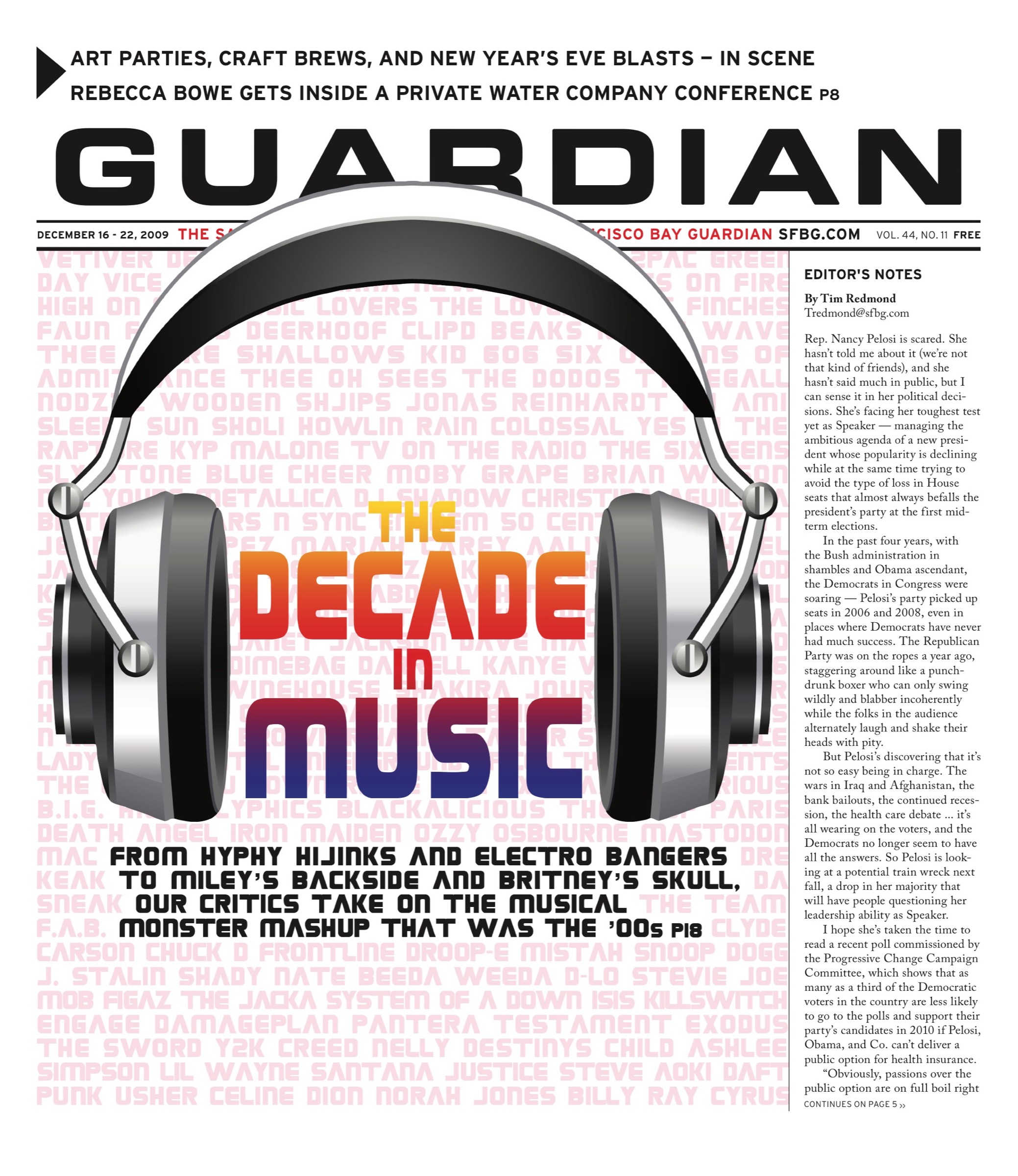
DECADE IN MUSIC Good lord. Who can remember all the strobe-lit twists and turns that Bay Area nightlife slid down in the past decade? Even if I wasn’t utterly and gloriously hung over from 10 years of being 86ed, it would still be a sweat-drenched, dry-iced, hypnotic blear. That’s a lovely thing. The ABC crackdown on underground parties in the late 1990s still held strong — and lively licensed spaces like Café Du Nord, Slim’s, Buckshot, and DNA Lounge as well as many music-oriented street fairs are still feeling the pressure of the War on Fun. But you can’t stop the party. And, baby, we lived through it.

One point about nightlife in general this decade: no one could ignore it. From hip-pop’s odiously capitalist-utopian "da club" to the tourist-trap explosion of global dance music festivals, club culture was on everyone’s radar. Today’s pop stars blithely name-check underground nightlife legends like Leigh Bowery and Larry Levan, and middle-school kids fill their notebooks with fantasy club outfits. Oh yeah, edgy nightlife has been completely commodified — thank you, Steve Aoki and DJ AM — but it’s a testament to its amazing versatility that going out is still enormously subversive fun, and the onslaught of bottle service and stretch-limo-packed music vids have had little impact on a vibrant independent scene. (In fact, the independent scene has gotten a ton of mileage out of parodying and reinterpreting mainstream club dreams.)

The last 10 years of the local club scene certainly gave me a lot to write and think — and drink — about. That was probably nightlife’s most distinctive feature: it finally came into its own as an art form, one that welcomed multiple interpretations while devilishly playing with our heads. The best party promoters in the Bay worked hard not only to present immersive subcultural experiences but also to contextualize their parties in terms of global movements. You couldn’t just fly in a supastar DJ and set the light show on random anymore. Clubgoers rejected that kind of dollar-driven cynicism. They wanted to know how a party would plug them into something different, something relevant, something uniquely of the moment, something beyond.

In short, they wanted personality. At times, this meant that concept trumped music — how many times did you find yourself spazzing on the dance floor to someone’s hodgepodge iPod playlist in 2005, just because that someone was ironically amazing? But it sure was fun for a while, giving dance culture a kick in the fancy-pants and throwing open the door to a glittering array of musical styles. And everybody looked fantastic. Irony freed us from previous expectations like beat-matching, genre hegemony, fashion anxiety, and bland slickness. (It also introduced a flood of unicorns and neon accessories.) Deconstruction at last! For good or ill, but mostly for good, anyone could be a DJ, throw a party, design a flyer, work a look. All you needed was a little space, a big idea, and a sense of adventure. A crowd helped, too, but only if you worried about something as mundane as paying the bills. Reality? Oh, really.

That mid-period chemical peel of irony neatly divided the decade. We cruised and shmoozed into the new millennium on the Boom-bubble back of a lazy lounge wave — the sunny house-lite sighs of Naked Music and Miguel Migs, the mushroom jazz of Mark Farina, OM’s smooth-beats Kaskade, and the friendly turntablism of Triple Threat popping the pink Champagne. That wave soon crested, churning up a foam of pink-slip parties, when discount daytime raves and increasingly baby-powdered coke binges took over. Luckily, happy hour took credit cards. Clubland reverted to a pre-Internet sensibility, with small spaces ruling and breakbeats all the rage again.

Alongside the breaks (a sound the Bay actually had a big hand in developing) the club music menu was still hogged by chunky techno, diva house, Burner trance, retro overload, and sing-along hip-hop. Post-punk, electro-funk, radical eclecticism, and global-eared sounds popped their heads up at times: Joy at Liquid, Milkshake at Sno-Drift, Club KY at Amnesia, Knees Up at Hush Hush, Popscene at 330 Ritch, Step at An Sibin, Fake at Cat Club, roving Bardot-a-Go-Go, and one-offs at 26Mix, Blind Tiger, Jezebel’s Joint, Pow!, Annie’s, Tongue and Groove, Storyville, and Justice League. Electroclash had its brief moment, too — anyone remember Electro Rodeo at Galaxy? — and reggaeton made a thrilling brief appearance. But in general the Bay was a little late in breaking free from the ’90s.

That sounds absolutely pukey, but it wasn’t. Some beautiful nights came out of this period — I’m half-remembering Said’s Afro-house Atmosfere, David Harness’s deep-souled Taboo, and anything at the Top, EndUp, or the Cellar. And living in the ’90s wasn’t so bad considering primo parties like Qoöl, Wicked, Stompy, Thump, Death Guild, and New Wave City maintained a presence. Also, if you were looking for "exotic" sounds, you could easily find them at some of the best ethno-audio spaces, like Bissap Baobab and Café Cocomo. But yes, those four-four beats got tiresome.

Then, around late-2004, came a return of the repressed, an explosion of Day-Glo styles that had been incubating in a clutch of neon-oriented, omnivorous-eared parties like Le Freak Plastique at Hush Hush and DJ Jefrodesiac’s Sex With Machines (later Frisco Disco) at Arrow. Soon San Francisco was in the midst of a small-venue, independent promoter golden age — and a rosy flush of youth. Finally, more than the same four people were throwing parties! And you were never sure of what you’d hear.

After a few debauched months of those rag-tag iPod-oriented shindigs, things sorted out into a handful of heady genres. Technology spookily inserted itself — almost every dance floor was bathed in the light of a little half-eaten apple. Serrato and Ableton software made live edits and mind-boggling mashups, like those heard at Bootie, possible, and timelines fell away to reveal gleaming ahistorical sonic landscapes. Beat-matching gradually came back into vogue, but wittily revealing the seams between tracks became the ne plus ultra of DJ craftsmanship.

The French invaded in the form of Daft Punk- and Justice-inspired electro bangers, spraying young clubbers with American Apparel and shutter shades. To my ears, Richie Panic and Vin Sol were our best balls-out interpreters of this fuck-all party sound and spirit, and Blow Up at Rickshaw Stop its finest venue. Minimal techno made sure hot nerds with little glasses were still in control — Kontrol at EndUp, in fact, was the club that did the most to nurture the Berlin-based sound here, with venue Anu and now the near-perfect 222 Hyde offering various party backup. Genius local minimal players like Nikola Baytala and Alland Byallo worked hard to stretch the boundaries, while Claude Von Stroke and the Dirty Bird Records crew added some much-needed humor.

There was a backlash to all the technology, which revolutionized gay clubs. DJ Bus Station John’s all-vinyl, unmixed bathhouse disco sets goosed the moribund queer scene into exploring its AIDS-shrouded past, and threw open the back door to the far-reaching sets of freestyle and rare ’80s fetishist Stanley Frank and the kiki-technotics of Honey Soundsystem.

London’s dubstep sound morphed into glitch-tipsy future bass — another genre the Bay can claim as its own — before it got a firm party foothold here. Which is more than all right, considering that mutation spawned beloved duo Lazer Sword and led Burner techno giant Bassnectar to change his sonic stripes. Most inspiring to me was the outpouring of global sounds in the Bay, from NonStop Bhangra’s whirling saris to Surya Dub’s growling dubstep-bhangra hybrid, from Tormenta Tropical’s bass-bomping nueva cumbia to Kafana Balkan’s breathless, Romani-delirious funk.

So where are we now? If any moment could be called "post-whatever," this is it. Anything goes, excellently, but it’s accompanied by a feeling that we’ve informed ourselves fully of the past, that we’ve mastered the technology of the present, and that, no matter how intelligent the music, we can still have a damn good time. My only gripe about the past decade in nightlife — other than I wished we’d had a more conscious reaction to war — is, alas, the same one as last decade. Where are all the women? Big ups to Ana Sia, Sarah Delush, Forest Green, J. Phlip, Felina, Dulcinea, Miz Margo, Nuxx, Black, and the Stay Gold, Redline, and B.A.S.S. sisterhoods. But seriously, I hope the teens see less testosterone-driven talent behind the decks. We’ve got the style down — now let’s change the look. OK?

Nothing like it

0

119-hiphop.jpg
Guardian illustration of E-40, Mac Dre, and Mistah F.A.B. by Matt Furie and Aiyana Udesen

Crack baby anthem, you can feel this music — Mistah F.A.B., "Crack Baby Anthem," from Baydestrian (SMC, 2007)

DECADE IN MUSIC In retrospect, it’s easy to see 1999 as the end of Bay Area rap’s glory. The ’90s mob music era was pretty good around here. Too Short had paved the way from releasing local discs to landing a major deal. A spate of acts were signed in the early ’90s (Digital Underground, E-40, Spice-1, the Delinquents) and the mid-’90s (the Luniz, Dru Down, Richie Rich, 3X Krazy), not to mention that the world’s most popular rapper, 2pac, claimed Oakland as his home.

So what happened? 2pac’s murder in 1996, for starters, took the jewel in the Bay’s crown. The second round of signings yielded less sales than the first, with only the Luniz’s debut, Operation Stackola (Noo Trybe/Virgin, 1995), hitting putf8um. Conventional wisdom and conspiracy theory generally hints that the murder of Queens rapper Notorious B.I.G. in L.A. in 1997 — frequently portrayed as a revenge killing for 2pac — turned major label interest away from Bay Area rappers, though it’s unclear whether anyone from the Bay had anything to do with either Biggie’s or Pac’s death. The majors stopped signing Bay Area rappers around that time, a situation that remains largely, though not entirely, unchanged today. The final factor was the purchase of local rap station KMEL by Clear Channel in 1999. KMEL never played enough Bay Area music, but soon stopped altogether, save for E-40 and Too Short, the only two acts to retain their major deals as the new century dawned.

Enter "the drought." With no radio and no major-label interest, Bay Area rap languished. Local alternative rap fared better because its business model usually didn’t include the radio or the majors. Though the Hieroglyphics had been around since the early ’90s, the collective stepped up their activities in the late ’90s and early ’00s. Given their devoted following, heavy touring, and iconic symbol, Hiero was Bay Area hip-hop for many outside the region. The Bay was also home to hip-hop collectives like the Solesides-derived Quannum Projects, whose Blackalicious put out Blazing Arrow through MCA in 2002, during a brief blip of major label interest in progressive hip-hop.

Two of the significant records from this period were Party Music (75Ark/Warner, 2001) by the Coup and Sonic Jihad (Guerilla Funk, 2003) by Paris. A neo-P-Funk dust-up, Party Music achieved much notoriety for its original cover depicting members Boots Riley and Pam the Funkstress seemingly blowing up the World Trade Center. Scheduled for September release, the album was of course put on hold after 9/11 until new art could be arranged. Paris was one of the earliest local acts to go major. He predates the concept of "alternative" rap — when he began, you could be a militant rapper like Chuck D and still get signed. After two years of mind-numbing flag-waving in this country, Paris had the audacity to release an album whose cover depicted a plane about to fly into the White House, and whose lyrics excoriated the Bush administration, accusing it of complicity with the 9/11 attacks. It was a bold action in an otherwise spineless cultural moment.

Meanwhile, the Bay was reloading. Special mention must go to Mac Dre, who, with the Delinquents and a few others, held the scene together in its lean years. Dre went to jail for four years beginning in 1992. When he emerged in 1996, major label opportunities were drying up, but he refused to let it stop him. From 1998 to 2004, he released 11 solo albums on his Thizz Entertainment label, not to mention innumerable compilations and side-projects. At a time when almost no records were selling locally, Dre was moving between 30,000 and 60,000 units. In an increasingly homogenized MC environment, Dre’s distinctive personality shone through, manifesting itself in a series of humorous characters on Thizz: Thizzelle Washington (2003), Ronald Dregan (2004), and The Genie of the Lamp (2004).

During the ensuing hyphy movement (circa 2005-07), debates ensued over who was responsible for the new music. Dre was a huge influence on hyphy’s colorful, comic aesthetics, but he was murdered before he could reap the rewards of his efforts. Producer Rick Rock, one of the Bay’s few national hitmakers, landed a deal with Virgin for the Federation, breaking them onto the radio with the hit "Hyphy" in 2003. Former 3X Krazy-member Keak da Sneak, however, was the man who brought this particular bit of Oakland slang to hip-hop, asserting his own claim with the Traxamillion-produced, local No. 1 "Super Hyphy" in 2005.

In between, newcomers the Team had a 2004 local radio hit, "It’s Gettin’ Hot," and inked a deal with a Universal imprint which ultimately fell through, while producers EA-Ski and CMT got their own protégés, Frontline, a deal with Ryko-imprint Penalty Records. Still in high school, E-40’s son Droop-E also contributed to the sound through radio singles like Mistah F.A.B.’s 2005 track "Super Sic Wid It."

Even this tiny amount of major interest and radio support resulted in heady times: "the drought," it seemed, was officially over. Yet after a couple of years of valuable if lukewarm support, KMEL again stopped playing local hip-hop, and the few major deals haven’t panned out. Clyde Carson from the Team was picked up by Capital, only to be dropped three years later without releasing an album. Mistah F.A.B., who continues to enhance his profile through collaborations with the likes of Snoop Dogg, remains subjected to Atlantic Records’ agonizing delays, which would have killed the career of anyone less determined.

After a couple years, the post-hyphy period of Bay rap took on a discernible personality. Though many complained hyphy was too oriented toward kids, that trend has continued to develop. The new crop of Bay Area acts — including J. Stalin, Shady Nate, Beeda Weeda, D-Lo, Stevie Joe — identify with their high school-age fans, whereas previous generations rapped as adults, even acts like Dre or the Mob Figaz who were still in high school when they began their careers. The generational shift might be considered in terms of the 1980s rise of crack, for whereas Dre, the Jacka, and others dealt crack as teenagers, the current crop was born at this time.

J. Stalin, for example, literally is a crack baby, and all these younger MCs grew up with crack as an established fact of life. The new vibe might be labeled "crack baby music," for this fact is explicitly if inarticulately present as a subject or theme. The anger of this generation manifests in the extreme violence of its lyrics, and the gangsta social consciousness of 2pac’s time is extremely attenuated, though not entirely gone. Its appeal to ghetto youth growing up in this appalling post-9/11 era is perfectly comprehensible. Yet despite its darkness, the current music also illustrates the resilience of this regional culture even in the face of indifference and neglect. In terms of the overall American rap world, there’s nothing quite like the Bay.

Passage

0

le.chicken.farmer@gmail.com

CHEAP EATS Weirdo the Cat, in an act of life-defying cantankerousness, has died. She got wind of my own impending crossing and timed her tumor accordingly, missing by only one day. No, not missing. While it would have been more operatic of her to die in my arms while I was tearfully kissing her goodbye, she let me get to the airport, on the plane, over the continent, over the ocean, up to the terminal, past customs, into the arms of my lover, onto the train, into the taxi, up two flights of stairs with three heavy suitcases, in and out of the bathtub, under the covers and over the rainbow. Then, while the kids were just settling to sleep in the next room, California … then did Weirdo the Cat breathe her last little stinky breath.

That way it would be clear to anyone with a brain bigger than a walnut that I had killed her. Poetically speaking. Ah, but Weirdo the Cat was ever the furry little poet. Only a little bit bitterer. She blamed me (me!) for not drawing her immortal, like other famous felines, with whom she was obsessed — especially Sylvester. I argued that I was a journalist, not a cartoonist, and she produced an eight-pound sledgehammer from behind her back and chased me around the room with it.

It’s true that she mellowed some in her elderly years, just like Grandma Rubino. In the end, she even actually seemed to kind of almost like children, and while they were away would curl up on the floor in their room and purr. I speak here of Weirdo the Cat, not Grandma Rubino.

Anyway, although any lap but mine or Crawdad’s was always strictly out of the question, by the time she had head-butted her last table leg she had socially matured to the point of sometimes actually sniffing strangers before biting them. I speak here of Grandma Rubino, not Weirdo the Cat.

Those three of my readers who have had the pleasure of knowing both these colorful cranks in their more corporal days will understand the confusion. One cursed in Italian, the other in hairballs and half-digested cat food. Other than that they were pretty much the same animal, may they rest in peace.

And in fact may we all get a little bit of sleep tonight. Jet lag — why didn’t I think of it earlier? I write three-act plays and astounding symphonies in my sleep, and then when I’m awake I walk around bumping into things, drooling, and forgetting my hat and purse everywhere. People tell me in Bavarian German that I’ll get over it after a week or so, and I don’t have the heart, or the vocabulary, to explain that, no, this is the way I’ve been since 1992.

There are other advantages to being where I am. For example, I find myself very literally surrounded by sausage, churches, and Christmas. I’ll let you guess which of those represents my idea of heaven.

Hint: some people like mustard on it. I prefer sauerkraut, to my Romea’s dismay, as I also tend to wear her coats and leave my napkins in her coat pockets.

The Stone Age Catholic churches, while pretty to look at, are pure hell on Sunday mornings when they call their faithful to breakfast with gigantic Iron Age dinner bells. It’s enough of a racket to weird out the dead, and to levitate the merely sleeping — in my case before I had quite finished my opus in F-Minor. Romea had to scrape me off the ceiling with a vacuum cleaner attachment.

Christmas itself, I predict, will be more likely to reclaim me here than Catholicism. For starters, it lets you sleep. Then too they celebrate it outdoors, in crowded open-air Christmas markets, featuring not only rampant commercialism but sausage stands! With bockwursts and bratwursts and meter-long sausages.

Whereas church offers warmth. But hey, I can get that at home. Do you know how long a meter is?

While you’re looking it up, lemme tell you where even you can find great bock- and bratwursts and even kielbasa and Italian hot sausages for real cheap: Longs Drugs. Yep, I became addicted when I lived in Rockridge. Trust me …

TOP DOG INSIDE LONG’S DRUGS

(and four other East Bay locations)

Mon.-Sat., 10 a.m.–9 p.m.; Sun., 11 a.m.–8 p.m.

5100 Broadway, Oakl.

(510) 601-1187

No alcohol

Cash only

L.E. Leone’s new book is Big Bend (Sparkle Street Books), a collection of short fiction.

My heart belongs to daddy

0

andrea@mail.altsexcolumn.com

Dear Andrea:

OK, I get it about the hot moms, but what about dads? Does anyone ever talk about them? I remember when our son was younger and my husband would be out with him in the Baby Bjorn or stroller, he would tell me he got a lot more attention from women than he did otherwise. Some of that was really about the cute baby, but really, he was pretty sure those women were flirting with him. What was that about? He had a wedding ring and a kid!

Is there a thing about DILFs like there is about MILFs? It kind of seems like there would be, but it’s not something you ever hear.

Love,

Wondering Mom

Dear Mom:

Kinda. Did you try Googling "DILF?’ There’s a ton more out there than I would have expected, but since you’re not the first one to bring this up, I have been looking. A lot of it is just online porny zeitgeistiness — "people are talking about MILFs, so people will be wondering about DILFs, so I, sex-site owner or promoter or whatever, will make sure there’s something for them to see." The perhaps unexpected (although not to me!) detail is that almost every hit brings you to gay porn. This should not be a big surprise when you remember that there just isn’t a lot of "hot guy!" stuff marketed to women. There is some, but most porn made for women is very couple-y. So "DILF" for porn purposes seems to refer to somewhat older men-for-men, and fits neatly alongside already-existing categories like "daddies." And "daddy" for porn purposes never had the first thing to do with taking the kids to the park. There are also bears, of course, but they are likewise not associated with babies. Not even Baby Bjorns. Ahem.

I did run across "Am I A DILF?" and "How To Be A DILF"-type posts on various dad blogs, but I find something unconvincing about the entire question, not to mention the suggestions. Use hair product? Work out a lot? Really? There is no question that attractive dads get a lot of attention (including a great deal of media attention, if they’re Jude Law or Brad Pitt), but I am not sold on the idea that they are getting it for their abs, let alone their well-gelled hair. Rather, I think a nice-looking guy pushing his daughter on the swings or toting an adorable toddler in a backpack attracts extra attention because (unfairly to today’s crop of fully involved fathers) a father who knows how to be a dad, not just a contributor of genetic material and material support, is still seen as an exception. And he is attractive to women who hope to find such a partner themselves, or who wish that the partner they did have would be more like that. He is not being fetishized for his fecundity (or for keeping his trim figure), nor are most admirers hoping to bed him. The women who are staring are well aware that he is married. Few are seriously plotting or even fantasizing a seduction. Now, for the attractive single dad at the playground …

While I do believe that the good father’s good-fatherliness is a large part of his appeal, it’s worth mentioning here that recent theories in sociobiology have poked giant holes in our previous, somewhat cartoonish view of protohuman, early human, and modern hunter-gatherer sexual politics and economics. It’s no longer safe to assume that women are hardwired to look for one reliable provider to raise our expensive, fragile, slow-maturing offspring with. Newer theories hold that human kids are so expensive and slow-growing that the preindustrial nuclear family could never have supported them. You need relatives, older children, and friends, as well as a husband, to keep a baby safe and well-fed.

This does open up a little room for us to view men, including men with children, as sex objects and not merely provider-objects. But I am just not buying the idea of women (most women, that is) seeing a handsome dad out daddying and thinking, "Now there’s a dad I’d like to fuck." I think most women who find, say, Brad Pitt sexy just find him sexy. There’s no special category for "has kids but is still hot." Rather, I think the sight of a man ministering to or goofing around with his young kids inspires an "aaww!" reaction that is, while not specifically antisexual, certainly not sexy-sexual. It may make you want to marry him or wish you had married him, or hope that when it is time to marry you find someone as handsome-plus-good-with-kids. It adds to a man’s attractiveness as a theoretical life partner, not as a potential fuck buddy. And I do not believe the same goes for MILFs. Having the hots for a dad is never going to carry the enormous cultural madonna-versus-whore weight that the "hot mom" does. And he can be happy about that.

Love,

Andrea

Film listings

0

Film listings are edited by Cheryl Eddy. Reviewers are Kimberly Chun, Michelle Devereaux, Max Goldberg, Dennis Harvey, Johnny Ray Huston, Louis Peitzman, Lynn Rapoport, Ben Richardson, Matt Sussman, and Laura Swanbeck. The film intern is Fernando F. Croce. For rep house showtimes, see Rep Clock. For first-run showtimes, see Movie Guide.

OPENING

Avatar Special effects master and woeful screenplay-penner James Cameron returns, for better and worse. (2:42)

Broken Embraces Pedro Almodóvar has always dabbled in the Hitchcockian tropes of uxoricide, betrayal, and double-identity, but with Broken Embraces he has attained a polyglot, if slightly mimicking, fluency with the language of Hollywood noir. A story within a story and a movie within a movie, Embraces begins in the present day with middle-aged Catalan Harry Caine (Lluís Homar), a blind screenwriter who takes time between his successful writing career to seduce and bed young women sympathetic to his disability. "Everything’s already happened to me," he explains to his manager, Judit (Blanca Portillo). "All that’s left is to enjoy life." But this life of empty pleasures is brought to a sudden halt when local business magnate Ernesto Martel (José Luis Gómez) has died; soon after, Ernesto Jr. (Rubén Ochandiano), who has renamed himself Ray X, visits Caine with an unusual request. The action retreats 14 years when Caine was a young (and visually abled) director named Mateo Blanco; he encounters a breathtaking femme fatale, Lena (Penelope Cruz) — an actress-turned-prostitute named Severine, turned secretary-turned-trophy wife of Ernesto Martel — when she appears to audition for his latest movie. If all of the narrative intricacies and multiplicitous identities in Broken Embraces appear a bit intimidating at first glance, it is because this is the cinema of Almodóvar taken to a kind of generic extreme. As with all of the director’s post-’00 films, which are often referred to as Almodóvar’s "mature" pictures, there is a microscopic attention to narrative development combined with a frenzied sub-plotting of nearly soap-operatic proportions. But, in Embraces, formalism attains such prominence that one might speculate the director is simply going through the motions. The effect is a purposely loquacious and overly-dramatized performance that pleasures itself as much by setting up the plot as unraveling it. For the complete version of this review, visit www.sfbg.com. (2:08) Clay. (Erik Morse)

Did You Hear About the Morgans? A married couple (Hugh Grant and Sarah Jessica Parker) move from Manhattan to a small town after witnessing a murder. (1:48)

In Search of Beethoven After the success of his In Search of Mozart, director Phil Grabsky applies his truth-seeking documentary template to Ludwig van Beethoven, a composer so genius he continued creating (and to a lesser extent, performing) even as he succumbed to deafness. Still photos, paintings, interviews with historians and musicologists, and visits to actual Beethoven haunts, along with dramatic readings of the maestro’s letters (by actor David Dawson) and stern narration (by actor Juliet Stevenson, who also loaned her pipes to Mozart), flesh out this biographical portrait. But its most stirring moments come courtesy of its musical performances (by seasoned professionals) of Moonlight Sonata and other notable works. As the doc proves, there’s no better insight into Beethoven’s tumultuous, sometimes tortured life than the notes he left behind. (2:18) Roxie. (Eddy)

*35 Shots of Rum Claire Denis’s portrait in domesticity is so patiently timed and achingly photographed (by her longtime cinematographer Agnès Godard) that your own life routines are liable to seem freshly poetic in its afterglow. We begin with familiar images of transitory longing: trains switching tracks, keeping time. A man smokes a cigarette at dusk, its embers warming his dark skin. He is Lionel (Alex Descas), a Metro operator who lives simply in a boxy apartment building in the outer rings of Paris. He returns home from work with a rice cooker for his twentysomething daughter, Josephine (Mati Diop), though Denis allows their relationship to remain unclear for a while (she is remarkably free when it comes to exposition). Coincidentally, serious Jo has bought herself a cooker on the same day. There’s a whole untold story about the rice cooker, but Denis is content watching them appreciatively spoon out the first batch in their pajamas. The attention to generations, meals, the trains and the small comic gestures (a well-timed fart, an awry romantic moment in the Seine) all suggest Ozu, but the elliptical rhythms and sensual apprehension of bodies is pure Denis. She once did a documentary about a choreographer (2005’s Towards Mathilde), and she approaches everyday life as a kind of dance. Lionel and Jo’s relationship is unlike almost any other father-daughter dynamic in recent movie memory — nonverbal, but clearly loving. If the other characters are kept at arm’s length, that’s because Lionel and Jo keep their safe haven so closely guarded. Things begin to unspool, as they must, in a memorable restaurant dance sequence that makes exquisite use of the Commodores’ 1985 platter, "Nightshift." (1:39) (Goldberg)

The Young Victoria Those who envision the Victorian Age as one of restraint and repression will likely be surprised by The Young Victoria, which places a vibrant Emily Blunt in the title role. Her Queen Victoria is headstrong and romantic — driven not only by her desire to stand tall against the men who would control her, but also by her love for the dashing Prince Albert (Rupert Friend). To be honest, the story itself is nothing spectacular, even for those who have imagined a different portrait of the queen. But The Young Victoria is still a spectacle to behold: the opulent palaces, the stunning gowns, and the flawless Blunt going regal. Her performance is rich and nuanced — and her chemistry with Prince Albert makes the film. No, it doesn’t leave quite the impression that 1998’s Elizabeth did, but it’s a memorable costume drama and romance, worthy of at least a moderate reign in theaters. (1:40) Embarcadero. (Peitzman)

ONGOING

Armored (1:28) 1000 Van Ness.

The Blind Side When the New York Times Magazine published Michael Lewis’ article "The Ballad of Big Mike" — which he expanded into the 2006 book The Blind Side: Evolution of a Game —nobody could have predicated the cultural windfall it would spawn. Lewis told the incredible story of Michael Oher — a 6’4, 350-pound 16-year-old, who grew up functionally parentless, splitting time between friends’ couches and the streets of one of Memphis’ poorest neighborhoods. As a sophomore with a 0.4 GPA, Oher serendipitously hitched a ride with a friend’s father to a ritzy private school across town and embarked on an unbelievable journey that led him into a upper-class, white family; the Dean’s List at Ole Miss; and, finally, the NFL. The film itself effectively focuses on Oher’s indomitable spirit and big heart, and the fearless devotion of Leigh Anne Tuohy, the matriarch of the family who adopted him (masterfully played by Sandra Bullock). While the movie will delight and touch moviegoers, its greatest success is that it will likely spur its viewers on to read Lewis’ brilliant book. (2:06) 1000 Van Ness. (Daniel Alvarez)

Brothers There’s nothing particularly original about Brothers — first, because it’s based on a Danish film of the same name, and second, because sibling rivalry is one of the oldest stories in the book. The story is fairly straightforward: good brother (Tobey Maguire) goes AWOL in Afghanistan, bad brother (Jake Gyllenhaal) comforts his sister-in law (Natalie Portman), attraction develops, but then — and here’s where things get awkward — good brother comes home. Throughout much of Brothers, the script is surprisingly restrained, holding the film back from Movie of the Week territory. Those moments of subtlety are the movie’s strongest, but by the end they’ve given way to giant, maudlin explosions of angst, which aren’t nearly as impressive. Still, the acting is consistently strong. Maguire is especially good as Captain Sam Cahill in a performance that runs the gamut from doting father to terrifyingly unbalanced. It’s unfortunate that the quiet scenes, in which all the actors excel, are overshadowed by the big, plate-smashing ones. (1:50) 1000 Van Ness, Sundance Kabuki. (Peitzman)

Christmas with Walt Disney Specially made for the Presidio’s recently opened Walt Disney Family Museum, this nearly hour-long compilation of vintage Yuletide-themed moments from throughout the studio’s history (up to Walt’s 1966 death) is more interesting than you might expect. The engine is eldest daughter Diane Disney Miller’s narrating reminiscences, often accompanied by excerpts from an apparently voluminous library of high-quality home movies. Otherwise, the clips are drawn from a mix of short and full-length animations, live-action features (like 1960’s Swiss Family Robinson), TV shows Wonderful World of Disney and Mickey Mouse Club, plus public events like Disneyland’s annual Christmas Parade and Disney’s orchestration of the 1960 Winter Olympics’ pageantry. If anything, this documentary is a little too rushed –- it certainly could have idled a little longer with some of the less familiar cartoon material. But especially for those who who grew up with Disney product only in its post-founder era, it will be striking to realize what a large figure Walt himself once cut in American culture, not just as a brand but as an on-screen personality. The film screens Nov 27-Jan 2; for additional information, visit http://disney.go.com/disneyatoz/familymuseum/index.html. (:59) Walt Disney Family Museum. (Harvey)

Disney’s A Christmas Carol (1:36) 1000 Van Ness.

*An Education The pursuit of knowledge — both carnal and cultural — are at the tender core of this end-of-innocence valentine by Danish filmmaker Lone Scherfig (who first made her well-tempered voice heard with her 2000 Dogme entry, Italian for Beginners), based on journalist Lynn Barber’s memoir. Screenwriter Nick Hornby breaks further with his Peter Pan protagonists with this adaptation: no man-boy mopers or misfits here. Rather, 16-year-old schoolgirl Jenny (Carey Mulligan) is a good girl and ace student. It’s 1961, and England is only starting to stir from its somber, all-too-sober post-war slumber. The carefully cloistered Jenny is on track for Oxford, though swinging London and its high-style freedoms beckon just around the corner. Ushering in those freedoms — a new, more class-free world disorder — is the charming David (Peter Sarsgaard), stopping to give Jenny and her cello a ride in the rain and soon proffering concerts and late-night suppers in the city. He’s a sweet-faced, feline outsider: cultured, Jewish, and given to playing fast and loose in the margins of society. David can see Jenny for the gem she is and appreciate her innocence with the knowing pleasure of a decadent playing all the angles. The stakes are believably high, thanks to An Education‘s careful attention to time and place and its gently glamored performances. Scherfig revels in the smart, easy-on-eye curb appeal of David and his friends while giving a nod to the college-educated empowerment Jenny risks by skipping class to jet to Paris. And Mulligan lends it all credence by letting all those seduced, abandoned, conflicted, rebellious feelings flicker unbridled across her face. (1:35) (Chun)

Everybody’s Fine Robert De Niro works somewhere between serious De Niro and funny De Niro in this portrait of a family in muffled crisis, a remake of the 1991 Italian film Stanno Tutti Bene. The American version tracks the comings and goings of Frank (De Niro), a recently widowed retiree who fills his solitary hours working in the garden and talking to strangers about his children, who’ve flung themselves across the country in pursuit of various dreams and now send home overpolished reports of their achievements. Disappointed by his offspring’s collective failure to show up for a family get-together, he embarks on a cross-country odyssey to connect with each in turn. Writer-director Kirk Jones (1998’s Waking Ned Devine) effectively underscores Frank’s loneliness with shots of him steering his cart through empty grocery stores, interacting only with the occasional stock clerk, and De Niro projects a sense of drifting disconnection with poignant restraint. But Jones also litters the film with a string of uninspired, autopilot comic moments, and manifold shots of telephone wires as Frank’s children (Kate Beckinsale, Drew Barrymore, and Sam Rockwell) whisper across the miles behind their father’s back — his former vocation, manufacturing the telephone wires’ plastic coating, funded his kids’ more-ambitious aims — feel like glancing blows to the head. A vaguely miraculous third-act exposition of everything they’ve been withholding to protect both him and themselves is handled with equal subtlety and the help of gratingly precocious child actors. (1:35) 1000 Van Ness. (Rapoport)

*Fantastic Mr. Fox A lot of people have been busting filmmaker Wes Anderson’s proverbial chops lately, lambasting him for recent cinematic self-indulgences hewing dangerously close to self-parody (and in the case of 2007’s Darjeeling Limited, I’m one of them). Maybe he’s been listening. Either way, his new animated film, Fantastic Mr. Fox, should keep the naysayer wolves at bay for a while — it’s nothing short of a rollicking, deadpan-hilarious case study in artistic renewal. A kind of man-imal inversion of Anderson’s other heist movie, his debut feature Bottle Rocket (1996), his latest revels in ramshackle spontaneity and childlike charm without sacrificing his adult preoccupations. Based on Roald Dahl’s beloved 1970 book, Mr. Fox captures the essence of the source material but is still full of Anderson trademarks: meticulously staged mise en scène, bisected dollhouse-like sets, eccentric dysfunctional families coming to grips with their talent and success (or lack thereof).(1:27) Empire, 1000 Van Ness, SF Center, Sundance Kabuki. (Devereaux)

Invictus Elected President of South Africa in 1995 — just five years after his release from nearly three decades’ imprisonment — Nelson Mandela (Morgan Freeman) perceives a chance to forward his message of reconciliation and forgiveness by throwing support behind the low-ranked national rugby team. Trouble is, the Springboks are currently low-ranked, with the World Cup a very faint hope just one year away. Not to mention the fact that despite having one black member, they represent the all-too-recent Apartheid past for the country’s non-white majority. Based on John Carlin’s nonfiction tome, this latest Oscar bait by the indefatigable Clint Eastwood sports his usual plusses and minuses: An impressive scale, solid performances (Matt Damon co-stars as the team’s Afrikaaner captain), deft handling of subplots, and solid craftsmanship on the one hand. A certain dull literal-minded earnestness, lack of style and excitement on the other. Anthony Peckham’s screenplay hits the requisite inspirational notes (sometimes pretty bluntly), but even in the attenuated finals match, Eastwood’s direction is steady as she goes — no peaks, no valleys, no faults but not much inspiration, either. It doesn’t help that Kyle Eastwood and Michael Stevens contribute a score that’s as rousing as a warm milk bath. This is an entertaining history lesson, but it should have been an exhilarating one. (2:14) 1000 Van Ness, SF Center, Sundance Kabuki. (Harvey)

Me and Orson Welles It’s 1937, and New York City, like the rest of the nation, presumably remains in the grip of the Great Depression. That trifling historical detail, however, is upstaged in Richard Linklater’s Me and Orson Welles (adapted from the novel by Robert Kaplow) by the doings at the newly founded Mercury Theatre. There, in the equally tight grip of actor, director, and company cofounder Orson Welles — who makes more pointed use of the historical present, of Italian fascism — a groundbreaking production of Shakespeare’s Julius Caesar hovers on the brink of premiere and possible disaster. Luckily for swaggering young aspirant Richard (High School Musical series star Zac Efron), Welles (Christian McKay), already infamously tyrannical at 22, is not a man to shrink from firing an actor a week before opening night and replacing him with a 17-year-old kid from New Jersey. Finding himself working in perilous proximity to the master, his unharnessed ego, and his winsome, dishearteningly pragmatic assistant, Sonja (Claire Danes), our callow hero is destined, predictably, to be handed some valuable life experience. McKay makes a credible, enjoyable Welles, presented as the kind of engaging sociopath who handles people like props and hails ambulances like taxicabs. Efron projects a shallow interior life, an instinct for survival, and the charm of someone who has had charming lines written for him. Still, he and Welles and the rest are all in service to the play, and so is the film, which offers an absorbing account of the company’s final days of rehearsal. (1:54) Shattuck. (Rapoport)

Ninja Assassin Let’s face it: it’d be nigh impossible to live up to a title as awesome as Ninja Assassin –- and this second flick from V for Vendetta (2005) director James McTeigue doesn’t quite do it. Anyone who’s seen a martial arts movie will find the tale of hero Raizo overly familiar: a student (played by the single-named Rain) breaks violently with his teacher; revenge on both sides ensues. That the art form in question is contemporary ninja-ing adds a certain amount of interest, though after a killer ninja vs. yakuza opening scene (by far the film’s best), and a flashback or two of ninja vs. political targets, the rest of the flick is concerned mostly with either ninja vs. ninja or ninja vs. military guys. (As ninjas come "from the shadows," most of these battles are presented in action-masking darkness.) There’s also an American forensic researcher (Noemie Harris) who starts poking around the ninja underground, a subplot that further saps the fun out of a movie that already takes itself way too seriously. (1:33) 1000 Van Ness. (Eddy)

Pirate Radio I wanted to like Pirate Radio, a.k.a., The Boat That Rocked –- really, I did. The raging, stormy sounds of the British Invasion –- sex, drugs, rock ‘n’ roll, and all that rot. Pirate radio outlaw sexiness, writ large, influential, and mind-blowingly popular. This shaggy-dog of a comedy about the boat-bound, rollicking Radio Rock is based loosely on the history of Radio Caroline, which blasted transgressive rock ‘n’ roll (back when it was still subversive) and got around stuffy BBC dominance by broadcasting from a ship off British waters. Alas, despite the music and the attempts by filmmaker Richard Curtis to inject life, laughs, and girls into the mix (by way of increasingly absurd scenes of imagined listeners creaming themselves over Radio Rock’s programming), Pirate Radio will be a major disappointment for smart music fans in search of period accuracy (are we in the mid- or late ’60s or early or mid-’70s –- tough to tell judging from the time-traveling getups on the DJs, played by Philip Seymour Hoffman and Rhys Darby, among others?) and lame writing that fails to rise above the paint-by-the-numbers narrative buttressing, irksome literalness (yes, a betrayal by a lass named Marianne is followed by "So Long, Marianne"), and easy sexist jabs at all those slutty birds. Still, there’s a reason why so many artists –- from Leonard Cohen to the Stones –- have lent their songs to this shaky project, and though it never quite gets its sea legs, Pirate Radio has its heart in the right place –- it just lost its brains somewhere along the way down to its crotch. (2:00) 1000 Van Ness. (Chun)

Planet 51 (1:31) 1000 Van Ness.

*Precious: Based on the Novel Push By Sapphire This gut-wrenching, little-engine-that-could of a film shows the struggles of Precious, an overweight, illiterate 16-year-old girl from Harlem. Newcomer Gabourey Sidibe is so believably vigilant (she was only 15 at the time of filming) that her performance alone could bring together the art-house viewers as well as take the Oscars by storm. But people need to actually go and experience this film. While Precious did win Sundance’s Grand Jury and Audience Award awards this year, there is a sad possibility that filmgoers will follow the current trend of "discussing" films that they’ve actually never seen. The daring casting choices of comedian Mo’Nique (as Precious’ all-too-realistically abusive mother) and Mariah Carey (brilliantly understated as an undaunted and dedicated social counselor) are attempts to attract a wider audience, but cynics can hurdle just about anything these days. What’s most significant about this Dancer in the Dark-esque chronicle is how Damien Paul’s screenplay and director Lee Daniels have taken their time to confront the most difficult moments in Precious’ story –- and if that sounds heavy-handed, so be it. Stop blahging for a moment and let this movie move you. (1:49) SF Center, Sundance Kabuki. (Jesse Hawthorne Ficks)

*The Princess and the Frog Expectations run high for The Princess and the Frog: it’s the first Disney film to feature an African American princess, the first 2D Disney cartoon since the regrettable Home on the Range (2004), and the latest entry from the writing-directing team responsible for The Little Mermaid (1989) and Aladdin (1992). Here’s the real surprise — The Princess and the Frog not only meets those expectations, it exceeds them. After years of disappointment, many of us have given up hope on another classic entry into the Disney 2D animation canon. And yet, The Princess and the Frog is up there with the greats, full of catchy songs, gorgeous animation, and memorable characters. Set in New Orleans, the story is a take off on the Frog Prince fairy tale. Here, the voodoo-cursed Prince Naveen kisses waitress Tiana instead — transferring his froggy plight to her as well. A fun twist, and a positive message: wishing is great, but it takes hard work to make your dreams come true. For those of us raised on classic Disney, The Princess and the Frog is almost too good to believe. (1:37) 1000 Van Ness. (Peitzman)

*The Private Lives of Pippa Lee Rebecca Miller’s latest is that seldom-produced thing, the female midlife crisis movie. Daughter to playwright Arthur Miller, a titan of Big Theme manly guilts, her projects are indie-scaled, about troubled domestic minutae, with whimsical twists of fate that methodical realist Arthur would never have countenanced. She’s been consistently interesting since 1995’s striking Angela — first among many narratives from the viewpoint of a child struggling in the shadow of an overwhelming and/or unstable parent. In Private Lives, Pippa (Robin Wright Penn) has her own monstrous parental past. Like many people hailing from chaos, Pippa has turned self-conscious model citizen. In drifting early adulthood, she glommed onto the first man who respected her mind — or did he just recognize a rudderless, much younger woman susceptible to flattery? Ever since she’s been ideal consort to newly retired publisher Herb (Alan Arkin), as well as doting mother to their variably grateful children. Barely 40 and living in an old folks’ village, Pippa is starting to think her life a tad ridiculous. Such nagging but inchoate doubt is underlined by the return of a widow neighbor’s shaggy, somewhat surly son (Keanu Reeves) to Chez Mom after his latest failure at adulthood. Opposites attract, though it’s more complicated than that. Miller’s cluttered canvas also makes room for teensy-to-major characters played by Shirley Knight, Blake Lively, Robin Weigert, Julianne Moore, and Monica Bellucci. As is her wont, she piles on both invigorating insights and a few too many whiplash narrative left turns. But The Private Lives of Pippa Lee has charm and idiosyncrasy to spare. (1:40) Smith Rafael. (Harvey)

A Single Man In this adaptation of Christopher Isherwood’s 1964 novel, Colin Firth plays George, a middle-aged gay expat Brit and college professor in 1962 Los Angeles. Months after the accidental death of Jim (Matthew Goode), his lover for 16 years, George still feels worse than bereft; simply waking each morning is agony. So on this particular day he has decided to end it all, first going through a series of meticulous preparations and discreet leave-takings that include teaching one last class and having supper with the onetime paramour (Julianne Moore) turned best friend who’s still stuck on him. The main problem with fashion designer turned film director Tom Ford’s first feature is that he directs it like a fashion designer, fussing over surface style and irrelevant detail in a story whose tight focus on one hard, real-world thing–grief–cries for simplicity. Not pretentious overpackaging, which encompasses the way his camera slavers over the excessively pretty likes of Nicholas Hoult as a student and Jon Kortajarena as a hustler, as if they were models selling product rather than characters, or even actors. (In fact Kortajarena is a male supermodel; the shocker is that Hoult is not, though Hugh Grant’s erstwhile About a Boy co-star is so preening here you’d never guess.) Eventually Ford stops showing off so much, and A Single Man is effective to the precise degree it lets good work by Goode, Moore and especially the reliably excellent Firth unfold without too much of his terribly artistic interference. (1:39) Sundance Kabuki. (Harvey)

2012 I don’t need to give you reasons to see this movie. You don’t care about the clumsy, hastily dished-out pseudo scientific hoo-ha that explains this whole mess. You don’t care about John Cusack or Woody Harrelson or whoever else signed on for this embarrassing notch in their IMDB entry. You don’t care about Mayan mysteries, how hard it is for single dads, and that Danny Glover and Chiwetel Ejiofor jointly stand in for Obama (always so on the zeitgeist, that Roland Emmerich). You already know what you’re in store for: the most jaw-dropping depictions of humankind’s near-complete destruction that director Emmerich –- who has a flair for such things –- has ever come up with. All the time, creative energy, and money James Cameron has spent perfecting the CGI pores of his characters in Avatar is so much hokum compared to what Emmerich and his Spartan army of computer animators dish out: the U.S.S. John F. Kennedy emerging through a cloud of toxic dust like some Mary Celeste of the military-industrial complex, born aloft on a massive tidal wave that pulverizes the White House; the dome of St. Paul’s flattening the opium-doped masses like a steamroller; Hawaii returned to its original volcanic state; and oodles more scenes in which we are allowed to register terror, but not horror, at the gorgeous destruction that is unfurled before us as the world ends (again) but no one really dies. Get this man a bigger budget. (2:40) 1000 Van Ness. (Sussman)

The Twilight Saga: New Moon Oh my God, you guys, it’s that time of the year: another Twilight chapter hits theaters. New Moon reunites useless cipher Bella (Kristen Steward) and Edward (Robert Pattinson), everyone’s favorite sparkly creature of darkness. Because this is a teen wangstfest, the course of true love is kind of bumpy. This time around, there’s a heavy Romeo and Juliet subplot and some interference from perpetually shirtless werewolf Jacob (Taylor Lautner). Chances are you know this already, as you’ve either devoured Stephenie Meyer’s book series or you were one of the record-breaking numbers in attendance for the film’s opening weekend. And for those non-Twilight fanatics — is there any reason to see New Moon? Yes and no. Like the 2008’s Twilight, New Moon is reasonably entertaining, with plenty of underage sexual tension, supernatural slugfests, and laughable line readings. But there’s something off this time around: New Moon is fun but flat. For diehard fans, it’s another excuse to shriek at the screen. For anyone else, it’s a soulless diversion. (2:10) Empire, 1000 Van Ness, SF Center, Sundance Kabuki. (Peitzman)

Up in the Air After all the soldiers’ stories and the cannibalism canards of late, Up in the Air‘s focus on a corporate ax-man — an everyday everyman sniper in full-throttle downsizing mode — is more than timely; it’s downright eerie. But George Clooney does his best to inject likeable, if not quite soulful, humanity into Ryan Bingham, an all-pro mileage collector who prides himself in laying off employees en masse with as few tears, tantrums, and murder-suicide rages as possible. This terminator’s smooth ride from airport terminal to terminal is interrupted not only by a possible soul mate, fellow smoothie and corporate traveler Alex (Vera Farmiga), but a young tech-savvy upstart, Natalie (Anna Kendrick), who threatens to take the process to new reductionist lows (layoff via Web cam) and downsize Ryan along the way. With Up in the Air, director Jason Reitman, who oversaw Thank You for Smoking (2005) as well as Juno (2007), is threatening to become the bard of office parks, Casual Fridays, khaki-clad happy hours, and fly-over zones. But Up in the Air is no Death of a Salesman, and despite some memorable moments that capture the pain of downsizing and the flatness of real life, instances of snappily screwball dialogue, and some more than solid performances by all (and in particular, Kendrick), he never manages to quite sell us on the existence of Ryan’s soul. (1:49) SF Center. (Chun)

Russoniello has to go

0

EDITORIAL When you look behind the problems San Francisco has had with its sanctuary city policy — the arrest and threatened deportation of kids as young as 15, the threats to city officials trying to protect juveniles, the threats to the new policy Sup. David Campos won approval for — there’s one major figure lurking: U.S. Attorney Joe Russoniello.

He’s the same one who was behind the raids on medical marijuana clubs. He’s a Republican whose former law firm, Cooley, Godward, gets hefty legal fees from representing Pacific Gas and Electric Co. — one of the biggest federal criminals in the land. He served under Presidents Ronald Reagan and George W. Bush.

And it’s a mystery to us why this holdover from a discredited administration is still running the Justice Department in one of the most liberal parts of the United States.

The Obama administration has been slowly replacing Bush appointees with more progressive U.S. attorneys. Some say the process has been dragging on too long — after all, Bill Clinton fired every one of the nearly 100 U.S. attorneys shortly after taking office and started putting his own people in place right away. But in many states, the process has moved forward; 20 jurisdictions have new U.S. attorneys, and nominations are pending in about 10 more.

So why is the process taking so long in California?

Choosing a top federal prosecutor isn’t entirely the job of the president. Under long-held Washington traditions, the senior U.S. senator of the president’s party has tremendous influence over the selection process, and in California, Sens. Barbara Boxer and Dianne Feinstein have split up the duties. Boxer is screening candidates for the Northern District, and Feinstein is handling the Central and Southern Districts. So for all practical purposes, Russoniello’s replacement is going to be chosen by Boxer.

The senator ought to be asking all the candidates the same question San Francisco City Attorney Dennis Herrera recently asked Russoniello: Will you promise not to prosecute individual city workers who follow the San Francisco Sanctuary Ordinance? And she should finalize her choice quickly and send that name to the White House with all due dispatch. Russoniello has to go, and his departure is way overdue.

Herrera, meanwhile, has his own Sanctuary Ordinance challenges: Sup. David Campos has asked Herrera to formally advise the supervisors on the legality of Mayor Newsom’s refusal to follow the immigration policies that a veto-proof majority of the board passed. Newsom claims that the Campos law, which overturns Newsom’s policy of mandating that all juvenile offenders be reported to immigration authorities at the time of arrest, violates federal statutes.

In a Dec. 10 letter to Herrera, Campos warned that Newsom’s move would "establish the dangerous precedent that a mayor can disregard legislation that the board has properly passed.

"To say that this would undermine the board’s authority is an understatement. This is to say nothing of the fact that it would mean that undocumented children would continue to lack basic rights in San Francisco."

So that puts the city attorney — who is almost certainly going to run for mayor himself — on the hot seat. He needs to make a clear ruling that the mayor can’t just ignore city law. And he and Newsom should both be in touch with Boxer to urge her to move rapidly on a new U.S. attorney who will be more favorable to progressive immigration policies.

alt.sex.column: My heart belongs to Daddy

0

By Andrea Nemerson. Email your questions to andrea@mail.altsexcolumn.com. Read more of Andrea’s columns here.

AltSex_Icon.jpg

Dear Andrea:

OK, I get it about the hot moms, but what about dads? Does anyone ever talk about them? I remember when our son was younger and my husband would be out with him in the Baby Bjorn or stroller, he would tell me he got a lot more attention from women than he did otherwise. Some of that was really about the cute baby, but really, he was pretty sure those women were flirting with him. What was that about? He had a wedding ring and a kid!

Is there a thing about DILFs like there is about MILFs? It kind of seems like there would be, but it’s not something you ever hear.

Love,

Wondering Mom

Dear Mom:

Kinda. Did you try Googling "DILF?’ There’s a ton more out there than I would have expected, but since you’re not the first one to bring this up, I have been looking. A lot of it is just online porny zeitgeistiness — "people are talking about MILFs, so people will be wondering about DILFs, so I, sex-site owner or promoter or whatever, will make sure there’s something for them to see." The perhaps unexpected (although not to me!) detail is that almost every hit brings you to gay porn. This should not be a big surprise when you remember that there just isn’t a lot of "hot guy!" stuff marketed to women. There is some, but most porn made for women is very couple-y. So "DILF" for porn purposes seems to refer to somewhat older men-for-men, and fits neatly alongside already-existing categories like "daddies." And "daddy" for porn purposes never had the first thing to do with taking the kids to the park. There are also bears, of course, but they are likewise not associated with babies. Not even Baby Bjorns. Ahem.

Editorial: Russoniello has to go

0


Sen. Barbara Boxer is screening candidates for the U.S. attorney post and now ought to finalize her choice quickly and send it to the White House for appointment

EDITORIAL When you look behind the problems San Francisco has had with its sanctuary city policy — the arrest and threatened deportation of kids as young as 15, the threats to city officials trying to protect juveniles, the threats to the new policy Sup. David Campos won approval for — there’s one major figure lurking: U.S. Attorney Joe Russoniello.

He’s the same one who was behind the raids on medical marijuana clubs. He’s a Republican whose former law firm, Cooley, Godward, gets hefty legal fees from representing Pacific Gas and Electric Co. — one of the biggest federal criminals in the land. He served under Presidents Ronald Reagan and George W. Bush.

Campos to Herrera: tell Newsom he’s not a king

12

LoiusNewsom.jpg
Louis XIV didn’t exactly have a good rap as king of France. Is Newsom in danger of becoming Louis’ SF equivalent?

Text by Sarah Phelan

‘We may have a strong-mayor system of government, but it is not a monarchy,” writes Sup. David Campos in a Dec. 10 letter to City Attorney Dennis Herrera, sent the day that the Board’s veto-proof civil rights legislation to restore due process to undocumented kids is supposed to kick in—except Mayor Gavin Newsom has said he intends to ignore it.

“Nothing short of unprecedented,” is how Campos describes Newsom’s posture—as he urges Herrera to issue a written legal opinion on whether the mayor has “the authority to unilaterally refuse to implement the duly-enacted civil rights legislation at issue, where such legislation was reviewed and approved as to form by you and your office.”

Events Listings

0

Events listings are compiled by Paula Connelly. Submit items for the listings at listings@sfbg.com. For further information on how to submit items for the listings, see Picks.

WEDNESDAY 9

Celebrating Greenaction Greenaction, Suite 712, 1095 Market, SF; (415) 248-5010. 5:30pm, donations appreciated. Celebrate 12 years of fighting for environmental justice with Greenaction at this party to honor community leaders and environmentally progressive San Francisco Supervisors.

THURSDAY 10

Glass of Water Modern Times Bookstore, 888 Valencia, SF; (415) 282-9246. 7pm, free. Hear Chicano poet, writer, and activist discuss his first novel, A Glass of Water.

Good Vibes Personal Shoppers Good Vibrations, 1620 Polk, SF; (415) 345-0400, and 603 Valencia, SF; (415) 522-5460. Thurs.-Sat. 6-9pm, free. Heat up the holidays and let the Good Vibrations on-hand experts help you pick out the perfect gift for everyone on your list, with complimentary wine and chocolates to get you in the mood.

Historic Libations California Historical Society Museum, 678 Mission, SF; (415) 357-1848. 6pm, $50. Try some historic cocktails, like the Boothby, Martinez, Gibson, or Pisco Sour, while learning about the history of mixed drinks and sampling hors d’oeurves. Guests receive a complimentary copy of Anchor Distilling Co. new edition of Cocktail Boothby’s American Bartender.

SF Wine Showcase Crushpad, 2573 3rd St., SF; www.sfwineassociation.com. 5:30pm, $25. Enjoy tastings from 20 boutique wineries that are part of the San Francisco Wine Association and find out what it means to be a high-end urban winery.

FRIDAY 11

Roots of Resistance Intertribal Friendship House, 523 International, Oak.; (510) 836-1955. 7pm, donations welcome. Attend this cultural holiday market and showcase of local artisans and enjoy art, performances, dance, drum, food, and solidarity.

SATURDAY 12

Bazaar Bizarre San Francisco County Fair Building, Golden Gate Park, SF; (415) 519-8527. Sat.-Sun. Noon-6pm, $2. Attend this indie craft show featuring artists and designers from across the country showcasing their DIY, hand-made goods. Half the proceeds from the door go to benefit San Francisco Arts Education programs.

Holiday Leather Brunch Edge Bar, 4149 18th St., SF; (415) 867-5004. 11am, $20. Enjoy bottomless mimosas, bloody marys, food, entertainment, and an auction at this 13th annual leather brunch to benefit the Positive Resource Center.

BAY AREA

Gay Elephants Humanist Hall, 390 27th St., Oak.; (510) 681- 9740. 6pm, $10. Check out this Ganesha Gala and learn to wear a Sari from a drag queen, take a Bollywood dance lesson, discuss ways to travel in India gayly, see Indian movies and more. Proceeds go to Jhilik, a school for tribal kids in India affiliated with Swanirvar.

Latkes and Beer Saul’s Restaurant and Deli, 1475 Shattuck, Berk.; (510) 848-DELI. Sat.-Sun. 11am, free. Take home latkes by the dozen or just nosh on some of these authentic potato pancakes while enjoying local microbrews.

Palestinian Crafts Sale St. John’s Church, 2727 College, Berk.; www.mecaforpeace.org. Noon, free. Help support the Middle East Children’s Alliance while enjoying Middle Eastern food and music and shopping for Palestinian embroidery, hand-blown glassware, ceramics, olive oil, textiles, and more.

Telegraph Holiday Fair Telegraph between Bancroft and Dwight, Berk; www.telegraphfair.com. Sat.- Sun. 11am-6pm, free. Join in the community cheer at this holiday street fair featuring fine art and gift items made by Northern California artists, music, and food vendors. Fair will continue Dec. 19-20, and Dec. 23-24.

SUNDAY 13

Perez Hilton Borders, 400 Post, SF; (415) 399-1633. 2pm, free. Get your brand new autographed copy of Perez Hilton’s new book Perez Hilton’s True Bloggywood Stories, which includes the best gossip of 2009, celebrity interviews, and "Perezzie" awards. Paparazzi encouraged.

Kimochi’s Silver Bells St. Mary’s Cathedral, 1111 Gough, SF; (415) 931-2294. 10am, free. Help support Kimochi’s programs and services for seniors at this unique, budget-friendly Asian and Pacific Island inspired arts and crafts fair featuring jewelry, stationary, ornaments, artwork, candles, and more.

MONDAY 14

Doctors Without Borders Century 9 San Francisco Centre, 5th floor, 845 Market, SF; (415) 538-8422. 8pm, $15. Get a first hand look at the field operations of Doctors Without Borders, a Nobel Peace Prize winning organization, in this documentary that follows frontline aid workers to the war-torn Congo and post-conflict Liberia. This one night only screening will be accompanied by a satellite broadcasted live panel discussion with workers and journalists, moderated by Elizabeth Vargas.

TUESDAY 15

Eating to Save the Earth San Francisco Public Library, 100 Larkin, SF; (415) 557-4400. 6pm, free. Join Linda Riebel, author of Eating to Save the Earth: Food Choices for a Healthy Planet¸ in a lively discussion on the ways omnivores, vegetarians, singles, and families can make environmentally responsible food choices.

Life out of balance

0

arts@sfbg.com

FILM At the start of The Private Lives of Pippa Lee, its titular character is toasted as a perfect enigma-cum-hostess, "the very icon of an artist’s wife." She accepts this with public graciousness and private dismay. Because now, with two kids grown (but still whiny) and a famous publisher spouse retired yet self-absorbed as ever, the praise only underlines a sense that she’s always served others’ needs while never quite figuring out her own.

Ergo Rebecca Miller’s latest is that seldom-produced thing, the female midlife crisis movie. Miller is daughter to playwright Arthur Miller, a titan of Big Theme manly guilts. Writing and directing for another medium — one differently scaled from dad’s own twilight-of-the-gods project The Misfits (1961) — Rebecca unsurprisingly falls some yards from the tree. Her projects are indie-scaled, about troubled domestic minutae, with whimsical twists of fate that methodical realist Arthur would never have countenanced.

They’re all flawed. But Rebecca Miller has been consistently interesting since 1995’s striking Angela — first among many narratives from the viewpoint of a child struggling in the shadow of an overwhelming and/or unstable parent. In 2002, triptych Personal Velocity‘s best segment had Parker Posey cowed by her celebrity father. In 2005’s The Ballad of Jack and Rose, Miller’s husband Daniel Day-Lewis was a dying hippie so close to his teenage daughter she lacks social skills for anyone else.

In Private Lives, Pippa (Robin Wright Penn) has her own monstrous parental past, revealed in 1970s flashbacks with Maria Bello as a minister’s wife wired to explode on Dexedrine. Like many people hailing from chaos, Pippa has turned self-conscious model citizen. In drifting early adulthood, she glommed onto the first man who respected her mind — or did he just recognize a rudderless, much younger woman susceptible to flattery? Ever since she’s been ideal consort to Herb (Alan Arkin), as well as doting mother to their variably grateful children.

Three heart attacks have forced Herb to retire — more or less — and move to a Connecticut retirement-community condo located near friends Sam (Mike Binder) and Sandra (Winona Ryder). Actually, they’re Herb’s friends; it’s Pippa’s job to smilingly endure Sam’s overtures and provide Sandra a shoulder to cry on. Barely 40 in an old folks’ village, Pippa is starting to think her life a tad ridiculous. Such nagging but inchoate doubt is underlined by the return of a widow neighbor’s shaggy, somewhat surly son (Keanu Reeves) to Chez Mom after his latest failure at adulthood. Opposites attract, though it’s more complicated than that.

Miller’s cluttered canvas also makes room for teensy-to-major characters played by Shirley Knight, Blake Lively, Robin Weigert, Julianne Moore, and Monica Bellucci. As is her wont, she piles on both invigorating insights and a few too many whiplash narrative left turns.

But The Private Lives of Pippa Lee has charm and idiosyncrasy to spare. Wright Penn is a deft actress who’s spent too much time as cinema’s Agony Aunt — pall-bearer for so much worry, dismay, tears, and suffering from Forrest Gump (1994) to Hounddog (2007). Here, she’s immaculately poised yet leavened by the comingling of desire and comedy. She’s larky, witty, even goofy at times. It looks good on her.

THE PRIVATE LIVES OF PIPPA LEE opens Fri/11 in Bay Area theaters.

Empty threats

0

sarah@sfbg.com

A controversial change to San Francisco’s sanctuary city policy — requiring due process to play out before city officials turn arrested undocumented immigrant minors over to federal authorities — officially becomes city law this week. But its implementation is still in limbo.

Last month, the Board of Supervisors voted 8-3 to override a veto of the legislation by Mayor Gavin Newsom, who says he won’t implement it anyway because he thinks it violates federal law. Authored by Sup. David Campos, the legislation goes into effect Dec. 10, and the city’s Juvenile Probation Department has 60 days to implement it, meaning the new policy kicks in Feb. 8.

City Attorney Dennis Herrera sought assurances from Joe Russoniello, the US Attorney for Northern California, that he wouldn’t prosecute local officials who follow the amended sanctuary city policy, as Russoniello had intimated to reporters. Russoniello refused to do so.

"I have no authority, discretionary or otherwise, to grant amnesty from federal prosecution to anyone who follows the protocol set out in the referenced ordinance," Russoniello wrote in a Dec. 3 letter.

But as UC Davis law professor Bill Ong Hing said Russoniello hasn’t cited any case law to support his position that following the ordinance could amount to harboring a fugitive from justice.

"It’s no more than hot air," Hing wrote Dec. 4 in a San Francisco Immigrant Rights Defense Coalition Dec. 4 press release. "While Russoniello has been vocally opposed to San Francisco’s pro-immigrant policies for two decades now, nothing will come of his empty threats…There has never been a federal prosecution anywhere in the country against city officials for following sanctuary ordinances."

In fact, it’s possible that Russoniello — a holdover appointee by President George W. Bush — won’t even get the opportunity."

The legal newspaper The Recorder reported Dec. 4 that the Obama administration is close to announcing Melinda Haag, a former federal prosecutor, as Russoniello’s replacement.

"Recently the Justice Department informed Russoniello that he could not hire any more personnel for the office, multiple sources said, which could suggest a choice for his successor is coming soon," the article stated, although it also noted that FBI background checks have yet to be completed. "So even if a successor is chosen soon, it would be several weeks before a name is submitted to the U.S. Senate, much less confirmed."

Despite Newsom’s public statements that he won’t enforce the new law, City Attorney’s Office spokesperson Matt Dorsey recently assured a group of civil rights advocates that Newsom’s comments have "no legal effect," and that Herrera intends to vigorously defend the new sanctuary law.

Representatives of 70 community groups last week showed up at the office to urge Herrera to enforce the law. "Hundreds of community members and community organizations poured our hearts into the democratic process for over a year," Cynthia Muñoz-Ramos of the St. Peter’s Housing Committee told Dorsey. " We worked hard to pass a policy to restore due process rights to undocumented youth. Our city officials must be open and accountable to us. City Attorney Herrera should advise the mayor that he cannot refuse to implement the due process policy. It’s past time to restore due process rights for all of our city’s youth. Justice delayed is justice denied."

After the meeting, Muñoz and more than a dozen community advocates told us they were frustrated by Newsom’s stance and that innocent kids were already being ripped from their families, creating deep-seated fear within the immigrant community that cooperating with local police could result in racial profiling and referral to the feds.

Angela Chan, staff attorney at the Asian Law Caucus, told us, "We agree with City Attorney Herrera’s stated intention to vigorously defend the duly-enacted, legally sound policy. It is paramount for Herrera to take immediate steps to uphold the law, including advising the mayor that he cannot refuse to implement this law."

Crosses and losses

0

a&eletters@sfbg.com

VISUAL ART "Amish Abstractions," the de Young Museum’s exhibition of 48 quilts made primarily by anonymous Amish girls and women, gains its conceptual interest from the unusual pairing of the words Amish and abstraction.

The collectors of these quilts were initially drawn to them by their similarity to works by 20th century abstract artists. While the attendant monograph asserts this juxtaposition several times, within the show itself you only get a disclaimer by curator Robert Shaw. "Many have compared the abstract geometry of Amish quilts to the works of acclaimed modernist painters such as Paul Klee, Piet Mondrian, Josef Albers, Ellsworth Kelly, Clyfford Still, Mark Rothko, and Victor Vasarely," he writes. "Any such comparisons are problematic, however, because they are built on visual coincidence, not on any documented historical connection or known influence in either direction."

The collectors behind "Amish Abstraction," Faith and Stephen Brown, add Frank Stella and Sol LeWitt to such a list. Still, with the exception of Albers, and to a lesser degree Stella and Vasarely, the visual coincidence feels forced. As Shaw points out, it’s a big leap from the ideals of Abstract Expressionism to the ideals of Amish culture: submission to a masculine God, submission to husband and father, humility, community. We are told by the exhibition notes that the quilts are "individual and expressive" and "contradict our preconceptions of Amish society," but there is little exploration of how, why, or where this might be the case within in a culture that restricts both self-expression and self-representation.

Having actually slept under frumpier and more polyester Amish quilts — ones my Amish grandmother and cousins made — I came to this show with low expectations. The quilts, however, are stunning. The concentration of geometric patterns, optical illusions, and bright colors create an energy in the room that feels anything but Amish. The quilts suggest extravagance, hedonism, and the revolt of the body against whatever abstract principle might be crushing it.

It certainly seems that these Amish women might have intuited aspects of Albers’ color theory. Their optical illusions are considerably more restrained than Vasarely’s, and the palette considerably more subdued than Stella’s. Few rainbows here; the Amish women favored black backgrounds and less busy juxtapositions that allow a sense of calm to pervade the constant movement suggsted by the patterns. Yet even the names of some of the patterns are hallucinogenic: Crazy Quilt, Jacob’s Ladder, Crosses and Losses, Old Maid’s Puzzle, Stairway to Heaven, Broken Star, Crazy Star, Sunshine and Shadow.

The radiance and abstraction of the quilts in "Amish Abstractions" suggest transcendence, deep spiritual harmonies, and the pleasures to be found in egolessness. In our own culture, with its pathological celebration of self and merging of personality and advertising, the idea of dispensing with the ego altogether might seem healthy. As Shaw says, "[The quilters] proceed from the place modern artists sought to find, and they reflect the stoic quietude of the Amish — their rich interior world of spiritual calm, shared values, and mutually beneficial self-denial."

The curators do an excellent job of elucidating, in very specific ways, the relationships between Amish and non-Amish communities, and the relationships between quilting patterns and specific local Amish traditions. They discuss the evolution of these specific traditions, but by restricting the quilts on display to the period from 1880 to 1940, they have trapped the Amish in the past, before the widespread use of synthetic fabrics or the "discovery" of Amish quilts by the art market.

Suggesting that historical specificity doesn’t apply to the timeless Amish, the large blow-up photographs throughout the exhibit of Amish children playing and Amish men building barns freeze the Amish in a different past. The photographs date from the 1980s, before the disappearance of affordable farmland sent young Amish men into factories, and before the Amish brand was tainted by meth-fueled megaparties of Amish kids on rumspringa and reality TV shows about corrupting "the innocent."

Since the 1930s, the major function of the Amish, for Americans in general, has been to represent an innocence the rest of us have supposedly lost. America, like the Amish, is imagined to have once been peaceful, rural, white, and untroubled by introspection. But surrounded by the bold colors and intricate stitching of "Amish Abstractions," it is easy to imagine that the Amish women who created them were secret sensualists or feminist mystics. If I didn’t know better, I’d guess they were created by revolutionary cells, possibly lesbians, who drank mushroom tea and let their hair out of their bonnets while their men were out working the fields.

But I do know better. My Amish grandmother was a young woman in Ohio during the 1930s, and so it is possible, although not likely, that she had a hand in one or two of the quilts on display. She left behind a written record of her life, condensed from diaries, a litany marked by births, weddings, and deaths, barns struck by lightning ("There was nothing to do but let it burn …"), accidents and near-accidents, bedbugs and prayer, dead children and epidemics of diptheria, influenza, whooping cough, measles, and delirium. This record is more than 100 pages long, and at times incredibly detailed about trips taken, people visited, and beets canned. Yet three years pass in a single paragraph which begins, "In the summer of 1945 I had a nervous breakdown." My father remembered little about his mother’s "nervous breakdown," but he thought she had probably been given some tranquilizers.

For the Amish, what a person might feel or want is never removed from what the community demands, from the work to be done, and from theological doctrine. Whether this constitutes spiritual calm and mutually beneficial self-denial or deeply oppressive self-abnegation is another question.

AMISH ABSTRACTIONS: QUILTS FROM THE COLLECTION OF FAITH AND STEPHEN BROWN

Through June 6, 2010

de Young Museum

50 Hagiwara Tea Garden Drive

Golden Gate Park, SF

(415) 750-3600

www.famsf.org

Monster mash note

0

a&eletters@sfbg.com

SONIC REDUCER "I’m from the underground. And I’m making pop music and I’m not a bit ashamed about it."

So sayeth Lady Gaga on the cellie last year on the way to a radio show at a Raging Waters in San Demos where she was dying to get wet. Alas, she forgot her Jellies at home and didn’t want to get her towering D Square pumps splashed ("I’ll find a private part of the park and just go in my birthday suit"). Yet I’m sure Christian Siriano could relate to this pop fashionista dilemma — regardless of whether he’d sniff at her taste-defying getups or not. After all Lady Gaga is the pantless, prep-school-bred amalgam of Carole King and Madonna reimagined as a hot tranny mess, a Gossip Girl turned Fame Monster.

OK, Gaga is no tranny, strictly speaking, though at the time she told me she was thrilled about appearing at SF’s Pride Fest ("I grew up in the dance and theater community — I’ve been surrounded by gay men and women and transgendered my whole life!"). Still, this bio queen’s obviously snatched more than a scrap of inspiration from clubland’s OTT drama kids, and she’s rough enough around the edges to make any sex bomb efforts an exercise in wise-ass deconstruction. From the gag of her "Radio Ga Ga" handle to her go-there way with the attraction-repulsion factor, Gaga is enough of a fabulous freak to embrace a gag-able frisson — I’ll be looking for that vomiting video vixen on the megascreen at her upcoming show at the newly reopened Bill Graham Dec. 14.

There’s more than a smudge of Her Dancefloor Madge-sty in the diva’s diamond-hard pop persona, wardrobe switch-ups, and workaholic drive. Lady Gaga impressed me at the time with a disarming sincerity and brusque sweetness: she was eager to be understood by serious music fans who might dismiss her as a throwaway popster. "The level of commitment and dedication it takes to put on a perfect pop show is very difficult," she exclaimed. "And I think some of the underground snobbery is fear and not understanding that discipline.

"Listen, I come from a party background and I used to party like crazy! That was a lot of my source of creativity," she continued. "But my life has changed a lot now, and I can’t do that shit. I got to go to bed, and I gotta wake up, I gotta work out, I gotta go to rehearsal. I got to pound, pound, pound, work, work, work hard so that every time I hit the stage it’s flawless. And if it isn’t flawless, I gotta work myself up to where it is — otherwise I’m just another pop chick with blonde hair."

But unlike Madonna, Gaga, like King, initially came from the flip side of the pop factory: as a songwriter, ghosting, she said, for Britney Spears and Pussycat Dolls. "I started to write pop songs mostly because I’m a classically trained pianist," she explained. "Beethoven and Bach and the structure of those classical pieces are really just rudimentary pop chord progressions. So it was something I understood." A vocal coach pointed out to her how easy it was to play a Mariah Carey tune by ear — "’It’s because you’ve been playing Bach inventions since you’ve been four, and it’s the same kind of idea’<0x2009>" — and she says, "That’s how I found out I had a knack for it, and I’ve been writing, writing, writing, since I was 13 years old."

Those skills came in handy when she started playing piano to beats in her undies at clubs in New York City’s Lower East Side, and had to come back to, for instance, a heckler who yelled, "Why don’t you play something serious?" Her response should be familiar to fans of "Beautiful, Dirty Rich"’s and "Poker Face"’s provocation: "I put my leg up onto the piano with my crotch pretty wide open to the audience, and then I did a very old school George Gershwin ragtime improv on the piano — pretty complicated. The whole idea was ‘Fuck you, I’m going to be sexy, sing about sex in my underwear, and then I’m going to do this really, really difficult piano virtuoso moment and show you it really doesn’t matter.’ People associate glamour and being female and being nude and being provocative with stupidity — there’s a great deal of intelligence and conceptualizing behind my work."

LADY GAGA

Sun/13–Mon/14, 7:30 p.m., $48

Bill Graham Civic Auditorium

99 Grove, SF

www.apeconcerts.com

Our weekly picks

0

WEDNESDAY 9th

DANCE/PERFORMANCE

Keith Hennessy: Saliva: The Making of and Saliva


Saliva is probably Keith Hennessy’s best known and least seen work of the last 20 years. When it premiered on a cold December night in 1988 under a San Francisco freeway overpass — and when it was performed again in March 1989 — it had not been advertised, word got around in the underground arts community. Saliva was a ritualistic solo in which Hennessy forcefully, poetically, and hopefully spoke for his own manhood and for a community caught in the anguish of AIDS. To use spit — an "uncouth" bodily fluid — as healing balm was a revolutionary act in both humanistic and theatrical terms. It may be difficult in 2009 to recreate the sense of pain, helplessness, and fury that generated the work. But isn’t that what memorials are for? Lest we forget, these events are the opening act of a celebration of Hennessy’s work and contribution to the Bay Area that continues in January. (Rita Felciano)

Saliva: The Making of discussion and screening: 7:30 p.m., free

CounterPULSE

1310 Mission, SF

Saliva performance: Sun/13, 8 p.m.; $15–$25 (no one turned away)

check www.circozero.org for location, SF

www.brownpapertickets.com

THURSDAY 10th

MUSIC

Espers


Don’t expect fairy folk and mythical critters to prance through the new Espers album, III (Drag City) — regardless of song titles like "Trollslända." That’s Swedish for dragonfly, band member Meg Baird assures me. Despite appearances and a name that evokes paranormal-minded cultists, it’s clear the group of mostly Philadelphians is more earthy and no-nonsense, as Baird reels off the various scratch song names and ideas Espers toyed with as they were making III — a witchy, intoxicating blend of psychedelia, prog, and English folk revival. For Baird’s interview, see this week’s Noise blog. (Kimberly Chun)

With Wooden Shjips and Colossal Yes

8 p.m., $13–$15

The Independent

628 Divisadero, SF

(415) 771-1421

www.independentsf.com

EVENT

Historic Libations


San Franciscans have long enjoyed a romance with alcohol — from the debauchery of the Barbary Coast era to the modern renaissance of the artisan cocktail, the City by the Bay knows how to knock ’em back. You can celebrate this high-proof history at Historic Libations, a party inspired by Cocktail Boothby‘s American Bartender (Anchor Distilling, 152 pages, $14.95), an expanded reprint of a classic 1891 book by one of the city’s earliest and most influential mixologists. Revelers can sample a variety of uniquely San Francisco cocktails, including the pisco sour and the Martinez. At the end of the festivities, they’ll be given their own copy of the book to take home and consult to perfect historic and potent concoctions. (Sean McCourt)

6 p.m., $40–$50

California Historical Society

678 Mission, SF.

(415) 357-1848, ext. 229

www.californiahistoricalsociety.org.

THEATER

SF Mime Troupe 50th Anniversary Exhibition Birthday Bash


Even if 50 is the new 40, it’s rare for many 50-year-olds to be as robust as the SF Mime Troupe. Challenging entrenched racism, endemic poverty, and politics-as-usual regionally and nationally since 1959, the Mime Troupe has earned theatre’s greatest awards — three Obies, a Tony, and an obscenity trial. Celebrate a half-century of provocative street performance — and toast the next 50 with one of San Francisco’s most venerable, anti-institutional institutions— at this birthday party, which includes a special staging of its 1981 Christmas Carol remix Ghosts, an ode to those displaced by the building of the nearby Moscone Center. Stop back on Saturday for a four-hour interactive workshop with Mime Troupe collective members Ed Holmes and Keiko Shimosanto in which participants will be called upon to create their own "anticonsumption" pageant and parade it through downtown SF. (Nicole Gluckstern)

Performance: 7:30 p.m., free

Workshop: Sat/12, 12:30 p.m., $15

Yerba Buena Center for the Arts

701 Mission, SF

(415) 978-2787

www.ybca.org

www.sfmt.org

FRIDAY 11th

FILM/MUSIC

Artists’ Television Access 25th Anniversary


The year 1984 contained delights and horrors, some more Orwellian than others: Ronald Reagan, Apple computers, Cabbage Patch Kids, Mary Lou Retton, Gremlins, Dynasty, New York’s "subway vigilante," American punk rock, etc. Amid that churning, neon-wearing, Cold War-tensed milieu, Artists’ Television Access was formed, and the activism-through-art hub has been keeping tabs on news and culture ever since. Toast 25 years of independent, radical, community-oriented programming at ATA’s Valencia Street gallery, the site of both a decades-spanning screening of works by staff and associates (Lise Swenson, Craig Baldwin, Rigo 23, Konrad Steiner) and a day-long musical get-down (with Ash Reiter, Eats Tapes, a raffle, and much more). (Cheryl Eddy)

"ATA 25: Quarter Century of Alternative Work": 7:30 p.m., free

"Underground — Experimental — Unstoppable": Sun/13, 11 a.m.–10 p.m., $10

Artists’ Television Access

992 Valencia, SF

(415) 824-3890

www.atasite.org

MUSIC

Eyehategod


Hell yeah, y’all: New Orleans’ legendary Eyehategod is coming to town, seeping into your eardrums on a slow-moving sludge tide of doom, noise, reefer smoke, and fuck-the-system politics. Singer Mike Williams famously overcame his heroin addiction during a post-Katrina jail stint, and the band — semi-dispersed since the early aughts, with most members engaged in other projects (Down, Mystick Krewe of Clearlight, Soilent Green, etc.) — is at last back on the road. Everyone who’s been fiending since 1993’s Take as Needed for Pain (Century Media) can finally feast on what Decibel magazine called "a series of buzzing, lurching dirges steeped in feedback and contempt." (Eddy)

With Stormcrow, Brainoil, Acephalix

8 p.m., $20

DNA Lounge

375 11th St, SF

(415) 626-1409

www.dnalounge.com

DANCE

Mark Morris Dance Company: The Hard Nut


If you have never seen The Hard Nut, Mark Morris’ extraordinarily musical and equally touching and hilarious version of the holiday classic, go now. The times are a-changing in Berkeley as well, and it may be quite some time until this glittering jewel comes back. The company is not scheduled to perform it here again in the near future. Morris set the piece in a cartoon version of the ’60s, removed some of the sugar but not much of the sweetness, kept the family spirit (though somewhat reinterpreted) alive, and heard things in the music as only he can. You will never see a dance of the Snowflakes — brilliant — like that and the grand pas de deux becomes a glorious grand pas de tutti. The score — Morris used every single note — will be performed live by the Berkeley Symphony conducted by Robert Cole. (Rita Felciano)

7 p.m., (through Dec. 20), $36–$62

Zellerbach Hall

UC Berkeley Campus, Berk.

(510) 642-9988

www.calperfs.berkeley.edu

SATURDAY 12th

EVENT

Tetris Tournament


Hey Tetris Master, here’s your chance to finally go out on Saturday night, do something semi-social at an art gallery, and win a prize — all while playing your favorite game of Tuck-Every-Tile-Rack-In-Snugly. But don’t get carried away: although you’ll have a chance to impress everyone with your phenomenal organizational skills, you won’t be taking anyone home. One other thing: you’re not going to have those cute little Tetris ditties to keep you in rhythm. Instead, there will be live bands (Microfiche, White Cloud, and Middle D). They might remind of those well-worn synth loops, but they’re more dynamic, more human. This is the night you’ve been waiting for; don’t let that sheep baaaaaah. (Spencer Young)

8 p.m., $5–$15 (free with membership)

The Lab

2948 16th St., SF

(415) 864 8855

www.thelab.org

FILM

San Francisco Silent Film Festival Winter Event


Perfectly timed as an antidote for all the year-end noise at first-run theaters, the SF Silent Film Festival Winter Event dips into cinema history, unspooling films made long before Peter Jackson got his mitts on CG technology or Guy Ritchie decided Sherlock Holmes should learn kung fu. The four selections include a 1927 Thailand-shot adventure from the future minds behind the original King Kong (1933), Chang: A Drama of the Wilderness; a U.S. premiere (90 years after the fact!) in Abel Gance’s 1919 World War I epic J’accuse; the Tod Browning-Lon Chaney collabo West of Zanzibar (1928); and a pair for Buster Keaton fans: the 1921 short The Goat, and delightful 1924 featurette Sherlock Jr. (Eddy)

11:30 a.m., $14–$17 per film (all-day pass, $52)

Castro Theatre

429 Castro, SF

1 (800) 838-3006

www.silentfilm.org

EVENT

Bazaar Bizarre


Handmade letterpress stationery, Scottish shortbread, dolls dressed up in home-knitted pinafores, wind chimes made from rusted dining utensils — love those old fairs and festivals. This local incarnation of the nationwide Bazaar Bizarre includes a one-woman metal studio, ceramic wares, boutique cupcakes, children’s clothes, hand-bound books, silk-screened apparel — and birds as finger jewelry. There will also be music by Slide and Spin Studios, crafty workshops, and giveaways. Get ready to overdose on cuteness and creativity. (Jana Hsu)

Noon–-6 p.m. (also Sun/13, noon–6 p.m.), $2 (children free)

San Francisco County Fair Building

Golden Gate Park

Ninth Ave and Lincoln, SF

(415) 831-5500

www.bazaarbizarre.org

SUNDAY 13th

MUSIC

Jenny Scheinman


As any music aficionado knows, describing an act that avoids prescribed categories can result in verbal apoplexy of a most unfortunate kind. How then to best convey the many talents of one Humboldt County-born Jenny Scheinman, whose collaborative projects and studio sessions have ranged over the years from avant-garde jazz to moody blues, and whose formidably-wielded violin is the perfect foil for her straight-shooting, honky-tonk-inflected voice? From John Zorn’s Tzadik label to Lucinda Williams’ recording sessions, Sheinman’s been making a widening splash since leaving the Bay Area in 1999. Skillfully combining a wiser-than-her-years strain of down-home melancholia with sturdy yet evocative multilayered orchestral composition, her appeal lies not in a narrowness of focus, but an expansive, expressive musical palette. She’s showcasing her range in three separate sets — an instrumental duet with pianist Myra Melford, a vocal set with guitarist Robby Giersoe, and a final act with singer-songwriter Bruce Cockburn. (Nicole Gluckstern)

8 p.m., $18.50–$19.50

Freight and Salvage

2020 Addison, Berkeley

(510) 644-2020

www.freightandsalvage.org

www.jennyscheinman.com

TUESDAY 15th

MUSIC

Kid Cudi


More Urban Outfitters than the rooftops of Brooklyn, Kid Cudi has successfully capitalized off of Kanye West’s hipster niche. For the MTV crowd in search of someone less embarrassing than West, Kid Cudi is their go-to neon hoodie. He makes intergalactic pop-hop mixed with lazy lyrics like "The lonely stoner needs to free his mind at night" and "I’ve got some issues that nobody can see<0x2009>/And all of these emotions are pouring out of me." A poet he ain’t. It’s more spectacle than speculation. The songs "Heart of Lion" and "Up Up & Away" are infectious with youthful ambition, and we’re reminded this is a kid from Cleveland who now wears his Air Yeezys on the streets of Brooklyn. Is this the future of hip-hop? I don’t know. I just came here to get high and dance in my skinny jeans. (Lorian Long)

8 p.m., $29.75–$33.00

Regency Ballroom

1290 Sutter, SF

415-673-5716

www.theregencyballroom.com

The Guardian listings deadline is two weeks prior to our Wednesday publication date. To submit an item for consideration, please include the title of the event, a brief description of the event, date and time, venue name, street address (listing cross streets only isn’t sufficient), city, telephone number readers can call for more information, telephone number for media, and admission costs. Send information to Listings, the Guardian Building, 135 Mississippi St., SF, CA 94107; fax to (415) 487-2506; or e-mail (paste press release into e-mail body — no text attachments, please) to listings@sfbg.com. We cannot guarantee the return of photos, but enclosing an SASE helps. Digital photos may be submitted in jpeg format; the image must be at least 240 dpi and four inches by six inches in size. We regret we cannot accept listings over the phone.

Music listings

0

Music listings are compiled by Paula Connelly and Cheryl Eddy. Since club life is unpredictable, it’s a good idea to call ahead to confirm bookings and hours. Prices are listed when provided to us. Submit items at listings@sfbg.com. For further information on how to submit items for the listings, see Picks.

WEDNESDAY 9

ROCK/BLUES/HIP-HOP
Donnas, Lilofee Slim’s. 8:30pm, $17.
Bruce Hornsby, Bob Schneider Palace of Fine Arts, 3301 Lyon, SF; www.ticketmaster.com. 8pm, $52.50.
Kim Wilson Blues Revue Biscuits and Blues. 8 and 10pm, $25.
Real, Headslide, Socialized El Rio. 8pm, $5.
“Silicon Valley Rock! 2009” Great American Music Hall. 7:30pm, $25. With Open Source Band, Corinne Marcus and the Kindred Spirits, Whitehalls, Tell-Tale Heartbreakers, Farewell Typewriter, and Marrow.
Son Volt, Sara Cahoone Fillmore. 8pm, $25.
Rosie Thomas, Josh Ottum Independent. 8pm, $15.
Tristeza, Winfred E. Eye, Drew Andrews Bottom of the Hill. 9pm, $12.
“Umloud” DNA Lounge. 7pm, $10-120. Play Rock Band (or just watch) to raise money for Child’s Play Charity.
White Rabbits, Band of Skulls, Lovemakers, Downer Party, DJ Aaron Axelsen Bimbo’s 365 Club. 8pm, $15.
Wild Assumptions, Spot Hemlock Tavern. 9pm, $6.

JAZZ/NEW MUSIC
Average White Band Yoshi’s San Francisco. 8 and 10pm, $25.
“B3 Wednesdays” Coda. 9pm, $7. With Quantum Hum.
Cat’s Corner Savanna Jazz. 7pm, $5-10.
Ben Marcato and the Mondo Combo Top of the Mark. 7:30pm, $10.
Marcus Shelby Jazz Jam Revolution Café, 3248 22nd St, SF; (415) 642-0474. 8:45pm, free.
“Meridian Music: Composers in Performance” Meridian Gallery, 535 Powell, SF; www.meridiangallery.org. 7:30pm, $10. With Sarah Stiles.
Tin Cup Serenade Le Colonial, 20 Cosmo Place, SF; (415) 931-3600. 7pm, free.

FOLK/WORLD/COUNTRY
Gaucho, Michael Abraham Jazz Session Amnesia. 8pm, free.
Lee Gregory Plough and Stars. 9pm.
Harper Simon, Chapin Sisters Café du Nord. 9:30pm, $15.
Sol Jibe, Afrofunk Experience Elbo Room. 9pm, $7.

DANCE CLUBS
Booty Call Q-Bar, 456 Castro; www.bootycallwednesdays.com. 9pm. Juanita Moore hosts this dance party, featuring DJ Robot Hustle.
Hands Down! Bar on Church. 9pm, free. With DJs Claksaarb, Mykill, and guests spinning indie, electro, house, and bangers.
Jam Wednesday Infusion Lounge. 10pm, free. DJ Slick Dee.
Open Mic Night 330 Ritch. 9pm, $7.
Qoöl 111 Minna Gallery. 5-10pm, $5. Pan-techno lounge with DJs Spesh, Gil, Hyper D, and Jondi.
RedWine Social Dalva. 9pm-2am, free. DJ TophOne and guests spin outernational funk and get drunk.
Respect Wednesdays End Up. 10pm, $5. Rotating DJs Daddy Rolo, Young Fyah, Irie Dole, I-Vier, Sake One, Serg, and more spinning reggae, dancehall, roots, lovers rock, and mash ups.
Synchronize Il Pirata, 2007 16th St.; (415) 626-2626. 10pm, free. Psychedelic dance music with DJs Helios, Gatto Matto, Psy Lotus, Intergalactoid, and guests.
Tenebrae Knockout. 10:30pm, $5. Dark, minimal, and electronic with DJs Omar, Josh, and Justin.

THURSDAY 10

ROCK/BLUES/HIP-HOP
Espers, Colossal Yes Independent. 8pm, $15.
Trevor Garrod, Grand Hallway, Goh Nakamura Café du Nord. 9pm, $12.
*Grouch, Mistah F.A.B., Fashawn N’ Exile, One Block Radius, DJ Fresh Slim’s. 9pm, $18.
Hi-Nobles, Barbary Coasters, Mindless Things Annie’s Social Club. 8pm.
Moira Scar, Sweet Nothing, Schwule Stud, 399 Ninth St, SF; www.studsf.com. 9pm, $3.
One F Boom Boom Room. 9:30pm, $7.
*Slits, Go-Going-Gone Girls, Sassy!!! Bottom of the Hill. 9pm, $12.
Todd Snider, Barbary Ghosts Great American Music Hall. 8pm, $21.
“Stevie Ray Vaughn Tribute with Alan Iglesias” Biscuits and Blues. 8pm, $15.
Tainted Love Red Devil Lounge. 8pm, $15.
Troublemakers Union Velma’s, 2246 Jerrold, SF; (415) 824-7646. 7pm, $10.
Your Cannons, Foreign Cinema, Tomihira Hemlock Tavern. 9pm, $7.

JAZZ/NEW MUSIC
Michael Coleman Revolution Café, 3248 22nd St, SF; (415) 642-0474. 8:45pm, free.
Eric Kurtzrock Trio Ana Mandara, Ghirardelli Square, 891 Beach, SF; (415) 771-6800. 7:30pm, free.
Laurent Fourgo Le Colonial, 20 Cosmo Place, SF; (415) 931-3600. 7:30pm, free.
Ahmad Jamal Yoshi’s San Francisco. 8 and 10pm, $22-26.
Mark Manning, Everything is Fine, Sad Bastard Book Club, Divisions, Upward Adobe Books, 3166 16th St, SF; (415) 864-3936. 7pm.
Marlina Teich Trio Brickhouse, 426 Brannan, SF; (415) 820-1595. 7-10pm, free.
“SF Jazz presents Hotplate” Amnesia. 9pm, $5. With Spaceheater playing Rahsaan Roland Kirk.
Stompy Jones Top of the Mark. 7:30pm, $10.
Todd Sickafoose’s Tiny Resistors, Erik Deutsch Hush Money Coda. 9pm, $7.

FOLK/WORLD/COUNTRY
Bebel Gilberto Bimbo’s 365 Club. 8pm, $25.
Morgan Manifacier Socha Café, 3235 Mission, SF; (415) 643-6848. 8:30pm.
Sang Matiz, Dgiin El Rio. 9pm, $7.
Shannon Céilí Band Plough and Stars. 9pm.

DANCE CLUBS
Afrolicious Elbo Room. 9:30pm, $5-6. DJs Pleasuremaker, Señor Oz, J Elrod, and B Lee spin Afrobeat, Tropicália, electro, samba, and funk.
Bingotopia Knockout. 7:30-9:30pm, free. Play for drinks, dignity, and dorky prizes with Lady Stacy Pants.
CakeMIX SF Wish, 1539 Folsom, SF. 10pm, free. DJ Carey Kopp spinning funk, soul, and hip hop.
Caribbean Connection Little Baobab, 3388 19th St; 643-3558. 10pm, $3. DJ Stevie B and guests spin reggae, soca, zouk, reggaetón, and more.
Drop the Pressure Underground SF. 6-10pm, free. Electro, house, and datafunk highlight this weekly happy hour.
From Rum to Whisky: A Murder City Devils Night Thee Parkside. 9pm, free. With speakers Ted Perves and Joseph Tanke, and DJ Johnny Landmine.
Funky Rewind Skylark. 9pm, free. DJ Kung Fu Chris, MAKossa, and rotating guest DJs spin heavy funk breaks, early hip-hop, boogie, and classic Jamaican riddims.
Gymnasium Matador, 10 6th St., SF; (415) 863-4629. 9pm, free. With DJ Violent Vickie and guests spinning electro, hip hop, and disco.
Heat Icon Ultra Lounge. 10pm, free. Hip-hop, R&B, reggae, and soul.
Kick It Bar on Church. 9pm. Hip-hop with DJ Jorge Terez.
Kissing Booth Make Out Room. 9pm, free. DJs Jory, Commodore 69, and more spinning indie dance, disco, 80’s, and electro.
Koko Puffs Koko Cocktails, 1060 Geary; 885-4788. 10pm, free. Dubby roots reggae and Jamaican funk from rotating DJs.
Mestiza Bollywood Café, 3376 19th St., SF; (415) 970-0362. 10pm, free. Showcasing progressive Latin and global beats with DJ Juan Data.
Motion Sickness Vertigo, 1160 Polk; (415) 674-1278. 10pm, free. Genre-bending dance party
with DJs Sneaky P, Public Frenemy, and D_Ro Cyclist.
Popscene 330 Rich. 10pm, $10. Rotating DJs spinning indie, Britpop, electro, new wave, and post-punk.
Represent Icon Lounge. 10pm, $5. With Resident DJ Ren the Vinyl Archaeologist and guest.
Saddlecats Atlas Café. 8pm, free.
Solid Club Six. 9pm, $5. With resident DJ Daddy Rolo and rotating DJs Mpenzi, Shortkut, Polo Mo’qz and Fuze spinning roots, reggae, and dancehall.

FRIDAY 11

ROCK/BLUES/HIP-HOP
Big D and the Kids Table, Sonic Boom Six, Agent Deadlies Bottom of the Hill. 9pm, $12.
Bog Savages Costello’s Four Deuces, 2319 Taraval, SF; (415) 566-9122. 9:30pm, free.
Breathe Carolina, Cash Cash, Kill Paradise, Fight Fair Slim’s. 7:30pm, $15.
Bart Davenport, Danny James and Pear, Sean Smith and the Present Moment Knockout. 9pm, $7.
Druglords of the Avenues, Rockfight, Good Neighbor Policy Hemlock Tavern. 9:30pm, $7.
*Eyehategod, Stormcrow, Brainoil, Acephalix DNA Lounge. 8p, $20.
Fervor, Arcadio Make-Out Room. 7pm.
Flakes Annie’s Social Club. 6pm.
“Hut at the Hut IX: Journey Unauthorized” Independent. 9pm, $20. Benefit for the SF Food Bank and the DA Taylor Charitable Foundation.
Jascha v Jascha, Girls in Trouble Socha Café, 3235 Mission, SF; (415) 643-6848. 8:30pm.
DJ Lebowitz Madrone Art Bar. 6-9pm, free.
Los Lobos Fillmore. 9pm, $42.50.
Mi Ami, Inca Ore, Jozef Van Wissem, DJ Tristes Tropiques Lab, 2948 16th St, SF; www.thelab.org. 8pm, $5.
Mission Players Pier 23. 10pm, $10.
Slowfinger, Badstrip Annie’s Social Club. 9pm, $5 (free before 10pm).

JAZZ/NEW MUSIC
Audium 9 1616 Bush, SF; (415) 771-1616. 8:30pm, $15.
Black Market Jazz Orchestra Top of the Mark. 9pm, $10.
Cannonball Reunion Coda. 10pm, $10.
“Dave Koz’s Smooth Jazz Christmas” Nob Hill Masonic Center, 1111 California, SF; 1-800-745-3000. 8pm, $39.50-99.
Eric Kurtzrock Trio Ana Mandara, Ghirardelli Square, 891 Beach, SF; (415) 771-6800. 8pm, free.
Ahmad Jamal Yoshi’s San Francisco. 8pm, $30.
Lucid Lovers Rex Hotel, 562 Sutter, SF; (415) 433-4434. 6-8pm.
Terry Disley Experience Shanghai 1930. 7:30pm, free.

FOLK/WORLD/COUNTRY
Seth Augustus Revolution Café, 3248 22nd St, SF; (415) 642-0474. 8:45pm, free.
Dave Hanley Band Plough and Stars. 9pm.
Ellis Dolores Park Café. 7:30pm, $10.
Lucas Revolution Amnesia. 8pm, free.
Queen Ifrica, Tony Rebel Rock-It Room. 9pm, $20.

DANCE CLUBS
Activate! Lookout, 3600 16th St; (415) 431-0306. 9pm, $3. Face your demigods and demons at this Red Bull-fueled party.
Bar on Church 9pm. Rotating DJs Zax, Zhaldee, and Nuxx.
Blow Up Rickshaw Stop. 10pm, $15. With DJs Jeffrey Paradise and Richie Panic spinning dance music.
Exhale, Fridays Project One Gallery, 251 Rhode Island; (415) 465-2129. 5pm, $5. Happy hour with art, fine food, and music with Vin Sol, King Most, DJ Centipede, and Shane King.
Fat Stack Fridays Koko Cocktails, 1060 Geary, SF; (415) 885-4788. 10pm, free. With rotating DJs Romanowski, B-Love, Tomas, Toph One, and Vinnie Esparza.
Fo’ Sho! Fridays Madrone. 10pm, $5. DJs Kung Fu Chris, Makossa, and Quickie Mart spin rare grooves, soul, funk, and hip-hop classics.
Frenchie Presents Club Six. 9pm, $10. With DJs Equipto, Best1, Slowburn, Coudee, Musonics, and more spinning hip hop.
Gay Asian Paradise Club Eight, 1151 Folsom, SF; www.eightsf.com. 9pm, $8. Featuring two dance floors playing dance and hip hop, smoking patio, and 2 for 1 drinks before 10pm. Gymnasium Stud. 10pm, $5. With DJs Violent Vickie and guests spinning electro, disco, rap, and 90s dance and featuring performers, gymnastics, jump rope, drink specials, and more.
I Can’t Feel My Face Amnesia. 10pm, $3. With DJs EUG and J Montag.
Fedde Le Grand Regency Ballroom. 9pm, $15.
Look Out Weekend Bambuddha Lounge. 4pm, free. Drink specials, food menu and resident DJs White Girl Lust, Swayzee, Philie Ocean, and more.
Lovebuzz Annie’s Social Club. 9pm, $5. Rock, classic punk, and 90s with DJs Jawa and Melanie Nelson.
M4M Fridays Underground SF. 10pm-2am. Joshua J and Frankie Sharp host this man-tastic party.
Miracle on 17th Street Thee Parkside. 9pm, $2. Bands, DJs Tina Boom Boom and Lydia, shopping, photos with Santa, and more.
Punk Rock and Shlock Karaoke Annie’s Social Club. 9pm-2am, $5. Eileen and Jody bring you songs from multiple genres to butcher: punk, new wave, alternative, classic rock, and more.
6 to 9 800 Larkin, 800 Larkin, SF; (415) 567-9326. 6pm, free. DJs David Justin and Dean Manning spinning downtempo, electro breaks, techno, and tech house. Free food by 800 Larkin.
Treat ‘Em Right Elbo Room. 10pm, $5. Hip-hop, Latin, reggae, and classics with DJs Vinnie Esparza, B-Cause, and Beto.

SATURDAY 12

ROCK/BLUES/HIP-HOP
Alexis Harte Band, Davis Jones, Rebecca Cross Hotel Utah. 9pm, $8.
Aquabats, Action Design, Monkey Slim’s. 9pm, $18.
Captured! By Robots, Grayceon, Dirty Power Bottom of the Hill. 10pm, $12.
Dolorata, Passengers, Two Against One El Rio. 9pm, $7.
Rick Estrin and the Night Cats Biscuits and Blues. 8 and 10pm, $20.
Evangelista, Thrones, Late Young Hemlock Tavern. 9:30pm, $12.
Full On Flyhead, Port Red Devil Lounge. 8pm, $10.
Garage a Trois, DJ Dan Prothero Independent. 9pm, $20.
Jank Amnesia. 7pm, free.
K-9, Distance from Shelter Thee Parkside. 3pm, free. SFFD and Bike Messenger toy drive.
Los Lobos Fillmore. 9pm, $42.50.
Microfiche, White Cloud, Middle D Lab, 2948 16th St, SF; www.thelab.org. 8pm, $5. Event also includes a Tetris tournament.
Edward Sharpe and the Magnetic Zeros, Fool’s Gold Great American Music Hall. 9pm, $16.
Struts, Impalers, Horror-X Annie’s Social Club. 9pm, $10.

JAZZ/NEW MUSIC
Audium 9 1616 Bush, SF; (415) 771-1616. 8:30pm, $15.
Terrence Brewer Coda. 10pm, $10.
Eric Kurtzrock Trio Ana Mandara, Ghirardelli Square, 891 Beach, SF; (415) 771-6800. 8pm, free.
Ahmad Jamal Yoshi’s San Francisco. 8 and 10pm, $30.
“Jazz Jam Session with Uptime Jazz Group” Mocha 101 Café, 1722 Taraval, SF; (415) 702-9869. 3:30-5:30pm, free.
Amanda King Zingari Ristorante, 501 Post, SF; (415) 885-8850. 8pm, free.
Lisa Mezzacappa and Nightshade, John Raskin-Phillip Greenlief Duo Meridian Gallery, 535 Powell, SF; www.meridiangallery.org. 8pm, $10.
Ricardo Scales Top of the Mark. 9pm, $15.

FOLK/WORLD/COUNTRY
Family Style Revolution Café, 3248 22nd St, SF; (415) 642-0474. 8:45pm, free.
Hard Living Band Plough and Stars. 9pm.
Li’ Ol’ Opry, Chuck and Jeanie, Misispi Mike Café International, 508 Haight, SF; (415) 665-9915. 7pm, free.
Joe Purdy, Meaghan Smith Swedish American Hall (upstairs from Café du Nord). 8pm, $15.
Sounds of Lyon Socha Café, 3235 Mission, SF; (415) 643-6848. 8:30pm.

DANCE CLUBS
Bar on Church 9pm. Rotating DJs Foxxee, Joseph Lee, Zhaldee, Mark Andrus, and Niuxx.
Black XXXmas 550 Barneveld, 550 Barneveld, SF; (415) 550-6886. 10pm, $40. With DJs Abel, Luke Johnstone, and Jamie J Sanchez bringing all the naughty boys out.
Bootie DNA Lounge. 9pm, $6-12. Holiday mash-ups with Adrian and Mysterious D, Dada, and more.
Club 1994 111 Minna. 9pm, $10. With DJs Jeffrey Paradise and Richie Panic spinning strictly 90’s.
HYP Club Eight, 1151 Folsom, SF; www.eightsf.com. 10pm, free. Gay and lesbian hip hop party, featuring DJs spinning the newest in the top 40s hip hop and hyphy.
Moped Amnesia. 10pm, $6. Live electronica and DJs.
Reggae Gold SF Endup. 10pm, $5. With DJs Daddy Rolo, Polo Mo’Quuz, and more spinning reggae, dancehall, and remixes all night.
Same Sex Salsa and Swing Magnet, 4122 18th St., SF; (415) 305-8242. 7pm, free.
Spirit Fingers Sessions 330 Ritch. 9pm, free. With DJ Morse Code and live guest performances.
Tormenta Tropical Elbo Room. 10pm, $5-10. Electro cumbia with Uproot Andy, DJ Panik, Disco Shawn, and Oro.

SUNDAY 13

ROCK/BLUES/HIP-HOP
“Blue Bear School of Music Band Showcase” Café du Nord. 7:30pm, $12-20.
“Electronic Puppenhorten Godwaffle Noise Pancakes” Lab, 2948 16th St, SF; www.thelab.org. Noon, $5. With +DOG+, Nux Vomica, Anti Ear, Andrea Williams’ Anais Din, z_Bug, Jolt Thrower, Voracious Garbage Vixens, and Mephitic Ooze.
Faceless, Dying Fetus, Beneath the Massacre, Suffokate, Enfold Darkness DNA Lounge. 7:30pm, $18.
Magik Markers, Sic Alps, Wiggwaum Hemlock Tavern. 9pm, $7.
Mew Mezzanine. 8pm, $20.
Grace Potter and the Nocturnals, Howlin Rain Fillmore. 8pm, $21.
Timothy B. Schmit Great American Music Hall. 8pm, $20.
Static Thought, SpawnAtomic, Jibbers El Rio. 7pm, $5.

JAZZ/NEW MUSIC
Community Music Center Jazz Band Community Music Center, 544 Capp, SF; www.sfcmc.org. 4pm, free.
Ahmad Jamal Yoshi’s San Francisco. 2 and 7pm, $5-30.
Rob Modica and friends Simple Pleasures, 3434 Balboa, SF; (415) 387-4022. 3pm, free.
Kim Nalley, Tammy Hall, Michael Zisman Bliss Bar, 4026 24th St, SF; (415) 826-6200. 4:30pm, $10.

FOLK/WORLD/COUNTRY
Christmas is Best! Amnesia. 9pm, $7-10. With Uni and her Ukelele.
Marla Fibish and friends Plough and Stars. 9pm.
Merle Jagger Thee Parkside. 4pm, free.
Mucho Axé Coda. 8pm, $7.
Rob Reich Red Poppy Art House. 7pm, $10-20. An evening of music and film.
77 El Deora, Maurice Tani Bird and Beckett, 653 Chenery, SF; (415) 586-3733. 4:30pm; free, donations accepted.

DANCE CLUBS
DiscoFunk Mashups Cat Club. 10pm, free. House and 70’s music.
Dub Mission Elbo Room. 9pm, $6. Dub, roots, and classic dancehall with DJs Sep, Vinnie Esparza, and guest Lud Dub.
Gloss Sundays Trigger, 2344 Market, SF; (415) 551-CLUB. 7pm. With DJ Hawthorne spinning house, funk, soul, retro, and disco.
Honey Soundsystem Paradise Lounge. 8pm-2am. “Dance floor for dancers – sound system for lovers.” Got that?
Jock! Lookout, 3600 16th; 431-0306. 3pm, $2. This high-energy party raises money for LGBT sports teams.
Kick It Bar on Church. 9pm. Hip-hop with DJ Zax.
Lowbrow Sunday Delirium. 1pm, free. DJ Roost Uno and guests spinning club hip hop, indie, and top 40s.
Religion Bar on Church. 3pm. With DJ Nikita.
Stag AsiaSF. 6pm, $5. Gay bachelor parties are the target demo of this weekly erotic tea dance.

MONDAY 14

ROCK/BLUES/HIP-HOP
Tab Benoit Slim’s. 8pm, $20.
“Blue Bear School of Music Band Showcase” Café du Nord. 7:30pm, $12-20.
Lady Gaga, Kid Cudi, Semi Precious Weapons Bill Graham Civic Auditorium, 99 Grove, SF; www.ticketmaster.com. 7:30pm, $50.
Maria Muldaur Rrazz Room, Hotel Nikko, 222 Mason, SF; 1-866-468-3399. 8pm, $35.

JAZZ/NEW MUSIC
Hot Foot Swing Band Socha Café, 3235 Mission, SF; (415) 643-6848. 8:30pm.
Lavay Smith Trio Enrico’s, 504 Broadway, SF; www.enricossf.com. 7pm, free.
Mark Levine and the Latin Tinge Yoshi’s San Francisco. 8pm, $14.

FOLK/WORLD/COUNTRY
Toshio Hirano Amnesia. 8:30pm, free.

DANCE CLUBS
Black Gold Koko Cocktails, 1060 Geary; 885-4788. 10pm-2am, free. Senator Soul spins Detroit soul, Motown, New Orleans R&B, and more — all on 45!
Death Guild DNA Lounge. 9:30pm, $3-5. Gothic, industrial, and synthpop with Decay, Joe Radio, and Melting Girl.
Going Steady Dalva. 10pm, free. DJs Amy and Troy spinning 60’s girl groups, soul, garage, and more.
King of Beats Tunnel Top. 10pm. DJs J-Roca and Kool Karlo spinning reggae, electro, boogie, funk, 90’s hip hop, and more.
Manic Mondays Bar on Church. 9pm. Drink 80-cent cosmos with Djs Mark Andrus and Dangerous Dan.
Monster Show Underground SF. 10pm, $5. Cookie Dough and DJ MC2 make Mondays worth dancing about, with a killer drag show at 11pm.
Network Mondays Azul Lounge, One Tillman Pl; www.inhousetalent.com. 9pm, $5. Hip-hop, R&B, and spoken word open mic, plus featured performers.
Spliff Sessions Tunnel Top. 10pm, free. DJs MAKossa, Kung Fu Chris, and C. Moore spin funk, soul, reggae, hip-hop, and psychedelia on vinyl.

TUESDAY 15

ROCK/BLUES/HIP-HOP
Aces Biscuits and Blues. 8pm, $15.
“Blue Bear School of Music Band Showcase” Café du Nord. 7:30pm, $12-20.
Corner Laughers, Anton Barbeau, Allen Clapp Grant and Green. 8:30pm, free.
Davy Knowles and Back Door Slam, Ron Drabkin Independent. 8pm, $15.
Maria Muldaur Rrazz Room, Hotel Nikko, 222 Mason, SF; 1-866-468-3399. 8pm, $35.
Nessie and Her Beard, Awkward Janitor El Rio. 8pm, free.
Sore Thumbs, Get Dead, Super Ego Bottom of the Hill. 9pm, $8.
Tempo No Tempo, Grooms, Young Prisms Hemlock Tavern. 9pm, $7.
Zero 7, Phantogram Warfield. 8pm, $26.50-30.

FOLK/WORLD/COUNTRY
Cohen Revolution Café, 3248 22nd St, SF; (415) 642-0474. 8:45pm, free.
Mucho Axe, Fogo Na Roupa Elbo Room. 9pm, $7.
Slow Session Plough and Stars. 9pm. With Michael Duffy and friends.

JAZZ/NEW MUSIC
“Booglaloo Tuesday” Madrone Art Bar. 9:30pm, $3. With Oscar Myers.
Dave Parker Quintet Rasselas Jazz. 8pm.
Euliptian Quartet Socha Café, 3235 Mission, SF; (415) 643-6848. 8:30pm.
Charlie Hunter Yoshi’s San Francisco. 8 and 10pm, $16-20.
Ricardo Scales Top of the Mark. 6:30pm, $5.

DANCE CLUBS
Alcoholocaust Presents Argus Lounge. 9pm, free. With DJs What’s His Fuck and Crystal Meth.
Drunken Monkey Annie’s Social Club. 9pm, free. Guest DJs and shot specials; also, check out Open Mic Comedy (6-9pm) and punk rock karaoke (9pm-2am) in the back room.
Eclectic Company Skylark, 9pm, free. DJs Tones and Jaybee spin old school hip hop, bass, dub, glitch, and electro.
La Escuelita Pisco Lounge, 1817 Market, SF; (415) 874-9951. 7pm, free. DJ Juan Data spinning gay-friendly, Latino sing-alongs but no salsa or reggaeton.
Rock Out Karaoke! Amnesia. 7:30pm. With Glenny Kravitz.
Share the Love Trigger, 2344 Market, SF; (415) 551-CLUB. 5pm, free. With DJ Pam Hubbuck spinning house.
Womanizer Bar on Church. 9pm. With DJ Nuxx.


Film listings

0

Film listings are edited by Cheryl Eddy. Reviewers are Kimberly Chun, Michelle Devereaux, Max Goldberg, Dennis Harvey, Johnny Ray Huston, Louis Peitzman, Lynn Rapoport, Ben Richardson, Matt Sussman, and Laura Swanbeck. The film intern is Fernando F. Croce. For rep house showtimes, see Rep Clock. For first-run showtimes, see Movie Guide.

OPENING

Invictus Elected President of South Africa in 1995 — just five years after his release from nearly three decades’ imprisonment — Nelson Mandela (Morgan Freeman) perceives a chance to forward his message of reconciliation and forgiveness by throwing support behind the low-ranked national rugby team. Trouble is, the Springboks are currently low-ranked, with the World Cup a very faint hope just one year away. Not to mention the fact that despite having one black member, they represent the all-too-recent Apartheid past for the country’s non-white majority. Based on John Carlin’s nonfiction tome, this latest Oscar bait by the indefatigable Clint Eastwood sports his usual plusses and minuses: An impressive scale, solid performances (Matt Damon co-stars as the team’s Afrikaaner captain), deft handling of subplots, and solid craftsmanship on the one hand. A certain dull literal-minded earnestness, lack of style and excitement on the other. Anthony Peckham’s screenplay hits the requisite inspirational notes (sometimes pretty bluntly), but even in the attenuated finals match, Eastwood’s direction is steady as she goes — no peaks, no valleys, no faults but not much inspiration, either. It doesn’t help that Kyle Eastwood and Michael Stevens contribute a score that’s as rousing as a warm milk bath. This is an entertaining history lesson, but it should have been an exhilarating one. (2:14) Sundance Kabuki. (Harvey)

Me and Orson Welles See “Citizen Welles.” (1:54)

*The Princess and the Frog Expectations run high for The Princess and the Frog: it’s the first Disney film to feature an African American princess, the first 2D Disney cartoon since the regrettable Home on the Range (2004), and the latest entry from the writing-directing team responsible for The Little Mermaid (1989) and Aladdin (1992). Here’s the real surprise — The Princess and the Frog not only meets those expectations, it exceeds them. After years of disappointment, many of us have given up hope on another classic entry into the Disney 2D animation canon. And yet, The Princess and the Frog is up there with the greats, full of catchy songs, gorgeous animation, and memorable characters. Set in New Orleans, the story is a take off on the Frog Prince fairy tale. Here, the voodoo-cursed Prince Naveen kisses waitress Tiana instead — transferring his froggy plight to her as well. A fun twist, and a positive message: wishing is great, but it takes hard work to make your dreams come true. For those of us raised on classic Disney, The Princess and the Frog is almost too good to believe. (1:37) Shattuck. (Peitzman)

*The Private Lives of Pippa Lee See “Life Out of Balance.” (1:40) Albany, Bridge, Smith Rafael.

A Single Man Tom Ford directs Colin Firth and Julianne Moore in this 1960s-set tale of a man mourning the death of his longtime partner. (1:39) Sundance Kabuki.

Uncertainty A knocked-up girl (Lynn Collins) and a guy with a coin in his pocket (Joseph Gordon-Levitt) stand on the Brooklyn Bridge, circle the issue, flip the coin, then bolt in opposite directions. The coin was clearly purchased in some dusty, mysterious Chinatown magic shop from a loopy-seeming octogenarian codger, because at each end of the bridge, the pair reunite for two 24-hour bouts of the title’s psychological state that unspool side by side in time but diverge in mood and pace and genre: on the Brooklyn side, we get a slow-paced family drama; in Manhattan, a pulse-raising action-thriller. In other words, a monument, a monumental decision, and a premise spun out of such pure and visible artifice that it seems unlikely to translate into absorbing filmmaking. It does, though, somehow, in the hands of writer-directors Scott McGehee and David Siegel (2005’s Bee Season, 2001’s The Deep End), who adroitly move Uncertainty’s central characters through familial scenes weighted down by quiet grief, strife, love, and worry and through the more heightened anxiety of chase and gunplay and ceaseless surveillance. While the framework remains a distracting fact, something constructed while we watched and then imposed on us, the film, heavily improvised, is carefully edited to guide us without tripping between the two threads of story. And in each — in what is becoming a pleasurable habit — we watch Gordon-Levitt bring texture and depth to the smallest moments in a conversation or scene. (1:45) Roxie. (Rapoport)

ONGOING

Armored (1:28) 1000 Van Ness, Shattuck.

*Bad Lieutenant: Port of Call New Orleans Consider that ridiculous title. Though its poster and imdb entry eliminate the initial article, it appears onscreen as The Bad Lieutenant: Port of Call New Orleans. That’s the bad lieutenant, not to be confused with Abel Ferrara’s 1992 Bad Lieutenant. The bad lieutenant has a name: Terence McDonagh, and he’s a police officer of similarly wobbly moral fiber. McDonagh’s tale — inspired by Ferrara and scripted by William Finkelstein, but perhaps more important, filmed by Werner Herzog and interpreted by Nicolas Cage — opens with a snake slithering through a post-Hurricane Katrina flood. A prisoner has been forgotten in a basement jail. McDonagh and fellow cop Stevie Pruit (Val Kilmer) taunt the man, taking bets on how long it’ll take him to drown in the rising waters. An act of cruelty seems all but certain until McDonagh, who’s quickly been established as a righteous asshole, suddenly dives in for the rescue. Unpredictability, and quite a bit of instability, reigns thereafter. Every scene holds the possibility of careening to heights both campy and terrifying, and Cage proves an inspired casting choice. At this point in his career, he has nothing to lose, and his take on Lt. McDonagh is as haywire as it gets. McDonagh snorts coke before reporting to a crime scene; he threatens the elderly; he hauls his star teenage witness along when he confronts a john who’s mistreated his prostitute girlfriend (Eva Mendes); he cackles like a maniac; he lurches around like a hunchback on crack. Not knowing what McDonagh will do next is as entertaining as knowing it’ll likely be completely insane. (2:01) Shattuck, Smith Rafael. (Eddy)

The Blind Side When the New York Times Magazine published Michael Lewis’ article “The Ballad of Big Mike” — which he expanded into the 2006 book The Blind Side: Evolution of a Game —nobody could have predicated the cultural windfall it would spawn. Lewis told the incredible story of Michael Oher — a 6’4, 350-pound 16-year-old, who grew up functionally parentless, splitting time between friends’ couches and the streets of one of Memphis’ poorest neighborhoods. As a sophomore with a 0.4 GPA, Oher serendipitously hitched a ride with a friend’s father to a ritzy private school across town and embarked on an unbelievable journey that led him into a upper-class, white family; the Dean’s List at Ole Miss; and, finally, the NFL. The film itself effectively focuses on Oher’s indomitable spirit and big heart, and the fearless devotion of Leigh Anne Tuohy, the matriarch of the family who adopted him (masterfully played by Sandra Bullock). While the movie will delight and touch moviegoers, its greatest success is that it will likely spur its viewers on to read Lewis’ brilliant book. (2:06) 1000 Van Ness, Sundance Kabuki. (Daniel Alvarez)

Brothers There’s nothing particularly original about Brothers — first, because it’s based on a Danish film of the same name, and second, because sibling rivalry is one of the oldest stories in the book. The story is fairly straightforward: good brother (Tobey Maguire) goes AWOL in Afghanistan, bad brother (Jake Gyllenhaal) comforts his sister-in law (Natalie Portman), attraction develops, but then — and here’s where things get awkward — good brother comes home. Throughout much of Brothers, the script is surprisingly restrained, holding the film back from Movie of the Week territory. Those moments of subtlety are the movie’s strongest, but by the end they’ve given way to giant, maudlin explosions of angst, which aren’t nearly as impressive. Still, the acting is consistently strong. Maguire is especially good as Captain Sam Cahill in a performance that runs the gamut from doting father to terrifyingly unbalanced. It’s unfortunate that the quiet scenes, in which all the actors excel, are overshadowed by the big, plate-smashing ones. (1:50) 1000 Van Ness, Shattuck, Sundance Kabuki. (Peitzman)

*Capitalism: A Love Story Gun control. The Bush administration. Healthcare. Over the past decade, Michael Moore has tackled some of the most contentious issues with his trademark blend of humor and liberal rage. In Capitalism: A Love Story, he sets his sights on an even grander subject. Where to begin when you’re talking about an economic system that has defined this nation? Predictably, Moore’s focus is on all those times capitalism has failed. By this point, his tactics are familiar, but he still has a few tricks up his sleeve. As with Sicko (2007), Moore proves he can restrain himself — he gets plenty of screen time, but he spends more time than ever behind the camera. This isn’t about Moore; it’s about the United States. When he steps out of the limelight, he’s ultimately more effective, crafting a film that’s bipartisan in nature, not just in name. No, he’s not likely to please all, but for every Glenn Beck, there’s a sane moderate wondering where all the money has gone. (2:07) Roxie. (Peitzman)

Christmas with Walt Disney Specially made for the Presidio’s recently opened Walt Disney Family Museum, this nearly hour-long compilation of vintage Yuletide-themed moments from throughout the studio’s history (up to Walt’s 1966 death) is more interesting than you might expect. The engine is eldest daughter Diane Disney Miller’s narrating reminiscences, often accompanied by excerpts from an apparently voluminous library of high-quality home movies. Otherwise, the clips are drawn from a mix of short and full-length animations, live-action features (like 1960’s Swiss Family Robinson), TV shows Wonderful World of Disney and Mickey Mouse Club, plus public events like Disneyland’s annual Christmas Parade and Disney’s orchestration of the 1960 Winter Olympics’ pageantry. If anything, this documentary is a little too rushed –- it certainly could have idled a little longer with some of the less familiar cartoon material. But especially for those who who grew up with Disney product only in its post-founder era, it will be striking to realize what a large figure Walt himself once cut in American culture, not just as a brand but as an on-screen personality. The film screens Nov 27-Jan 2; for additional information, visit http://disney.go.com/disneyatoz/familymuseum/index.html. (:59) Walt Disney Family Museum. (Harvey)

*Collapse Michael Ruppert is a onetime LAPD narcotics detective and Republican whose radicalization started with the discovery (and exposure) of CIA drug trafficking operations in the late 70s. More recently he’s been known as an author agitator focusing on political coverups of many types, his ideas getting him branded as a factually unreliable conspiracy theorist by some (including some left voices like Norman Solomon) and a prophet by others (particularly himself). This documentary by Chris Smith (American Movie) gives him 82 minutes to weave together various concepts — about peak oil, bailouts, the stock market, archaic governmental systems, the end of local food-production sustainability, et al. — toward a frightening vision of near-future apocalypse. It’s “the greatest preventable holocaust in the history of planet Earth, our own suicide,” as tapped-out resources and fragile national infrastructures trigger a collapse in global industrialized civilization. This will force “the greatest age in human evolution that’s ever taken place,” necessitating entirely new (or perhaps very old, pre-industrial) community models for our species’ survival. Ruppert is passionate, earnest and rather brilliant. He also comes off at times as sad, angry, and eccentric, bridling whenever Smith raises questions about his methodologies. Essentially a lecture with some clever illustrative materials inserted (notably vintage educational cartoons), Collapse is, as alarmist screeds go, pretty dang alarming. It’s certainly food for thought, and would make a great viewing addendum to concurrent post-apocalyptic fiction The Road. (1:22) Shattuck. (Harvey)

La Danse: The Paris Opera Ballet (2:38) Smith Rafael.

Disney’s A Christmas Carol (1:36) 1000 Van Ness.

*An Education The pursuit of knowledge — both carnal and cultural — are at the tender core of this end-of-innocence valentine by Danish filmmaker Lone Scherfig (who first made her well-tempered voice heard with her 2000 Dogme entry, Italian for Beginners), based on journalist Lynn Barber’s memoir. Screenwriter Nick Hornby breaks further with his Peter Pan protagonists with this adaptation: no man-boy mopers or misfits here. Rather, 16-year-old schoolgirl Jenny (Carey Mulligan) is a good girl and ace student. It’s 1961, and England is only starting to stir from its somber, all-too-sober post-war slumber. The carefully cloistered Jenny is on track for Oxford, though swinging London and its high-style freedoms beckon just around the corner. Ushering in those freedoms — a new, more class-free world disorder — is the charming David (Peter Sarsgaard), stopping to give Jenny and her cello a ride in the rain and soon proffering concerts and late-night suppers in the city. He’s a sweet-faced, feline outsider: cultured, Jewish, and given to playing fast and loose in the margins of society. David can see Jenny for the gem she is and appreciate her innocence with the knowing pleasure of a decadent playing all the angles. The stakes are believably high, thanks to An Education’s careful attention to time and place and its gently glamored performances. Scherfig revels in the smart, easy-on-eye curb appeal of David and his friends while giving a nod to the college-educated empowerment Jenny risks by skipping class to jet to Paris. And Mulligan lends it all credence by letting all those seduced, abandoned, conflicted, rebellious feelings flicker unbridled across her face. (1:35) Albany, Piedmont. (Chun)

The End of Poverty? (1:46) Four Star.

Everybody’s Fine Robert De Niro works somewhere between serious De Niro and funny De Niro in this portrait of a family in muffled crisis, a remake of the 1991 Italian film Stanno Tutti Bene. The American version tracks the comings and goings of Frank (De Niro), a recently widowed retiree who fills his solitary hours working in the garden and talking to strangers about his children, who’ve flung themselves across the country in pursuit of various dreams and now send home overpolished reports of their achievements. Disappointed by his offspring’s collective failure to show up for a family get-together, he embarks on a cross-country odyssey to connect with each in turn. Writer-director Kirk Jones (1998’s Waking Ned Devine) effectively underscores Frank’s loneliness with shots of him steering his cart through empty grocery stores, interacting only with the occasional stock clerk, and De Niro projects a sense of drifting disconnection with poignant restraint. But Jones also litters the film with a string of uninspired, autopilot comic moments, and manifold shots of telephone wires as Frank’s children (Kate Beckinsale, Drew Barrymore, and Sam Rockwell) whisper across the miles behind their father’s back — his former vocation, manufacturing the telephone wires’ plastic coating, funded his kids’ more-ambitious aims — feel like glancing blows to the head. A vaguely miraculous third-act exposition of everything they’ve been withholding to protect both him and themselves is handled with equal subtlety and the help of gratingly precocious child actors. (1:35) 1000 Van Ness. (Rapoport)

*Everything Strange and New In Frazer Bradshaw’s Everything Strange and New, Wayne (Jerry McDaniel), wears overalls too large and a look of pained, dazed acquiescence. It’s as if not just his clothes but his life were given to the wrong person — and there’s a no-exchange policy. He loves wife Reneé (the writer Beth Lisick) and their kids. But those two unplanned pregnancies mean she’s got to stay home; daycare would cost more than she’d earn. So every day Wayne returns from his dead-end construction job to the home whose mortgage holds them hostage; and every time Reneé can be heard screaming at their not-yet-school-age boys, at the end of her tether. Sometimes he silently just turns around to commiserate over beer with buddies likewise married with children, but doing no better. Wayne’s voiceover narration endlessly ponders how things got this way — more or less as they should be, yet subtly wrong. He might be willing (or at least able) to let go of the idea of happiness. But Reneé’s inarticulate fury at her stifling domestication keeps striking at any nearby punching bag, himself (especially) included. Something’s got to change. But can it? Veteran local experimentalist and cinematographer Bradshaw’s first feature, which he also wrote, never stoops to narrative cliché. Or to stylistic ones, either — there’s a spectral poetry to the way he photographs the Oakland flats. (1:24) Roxie. (Harvey)

*Fantastic Mr. Fox A lot of people have been busting filmmaker Wes Anderson’s proverbial chops lately, lambasting him for recent cinematic self-indulgences hewing dangerously close to self-parody (and in the case of 2007’s Darjeeling Limited, I’m one of them). Maybe he’s been listening. Either way, his new animated film, Fantastic Mr. Fox, should keep the naysayer wolves at bay for a while — it’s nothing short of a rollicking, deadpan-hilarious case study in artistic renewal. A kind of man-imal inversion of Anderson’s other heist movie, his debut feature Bottle Rocket (1996), his latest revels in ramshackle spontaneity and childlike charm without sacrificing his adult preoccupations. Based on Roald Dahl’s beloved 1970 book, Mr. Fox captures the essence of the source material but is still full of Anderson trademarks: meticulously staged mise en scène, bisected dollhouse-like sets, eccentric dysfunctional families coming to grips with their talent and success (or lack thereof).(1:27) Empire, 1000 Van Ness, SF Center, Sundance Kabuki. (Devereaux)

The Maid In an upper-middle class subdivision of Santiago, 40-year-old maid Raquel (Catalina Saavedra), perpetually stony and indignant, operates a rigorous dawn-to-dusk routine for the Valdez family. Although Raquel rarely behaves as an intimate of her longtime hosts, she remains convinced that love, not labor, bonds them. (Whether the family shares Raquel’s feelings of devotion is highly dubious.) When a rotating cast of interlopers is hired to assist her, she stoops to machinations most vile to scare them away — until the arrival of Lucy (Mariana Loyola), whose unpredictable influence over Raquel sets the narrative of The Maid on a very different psychological trajectory, from moody chamber piece to eccentric slice-of-life. If writer-director Sebastián Silva’s film taunts the viewer with the possibility of a horrific climax, either as a result of its titular counterpart — Jean Genet’s 1946 stage drama The Maids, about two servants’ homicidal revenge — or from the unnerving “mugshot” of Saavedra on the movie poster, it is neither self-destructive nor Grand Guignol. Rather, it it is much more prosaic in execution. Sergio Armstrong’s fidgety hand-held camera captures Raquel’s claustrophobic routine as it accentuates her Sisyphean conundrum: although she completely rules the inner workings of the house, she remains forever a guest. But her character’s motivations often evoke as much confusion as wonder. In the absence of some much needed exposition, The Maid’s heavy-handed silences, plaintive gazes, and inexplicable eruptions of laughter feel oddly sterile, and a contrived preciousness begins to creep over the film like an effluvial whitewash. Its abundance makes you aware there is a shabbiness hiding beneath the dramatic facade — the various stains and holes of an unrealized third act. (1:35) Shattuck. (Erik Morse)

The Men Who Stare at Goats No! The Men Who Stare at Goats was such an awesome book (by British journalist Jon Ronson) and the movie boasts such a terrific cast (George Clooney, Kevin Spacey, Jeff Bridges, Ewan McGregor). How in the hell did it turn out to be such a lame, unfunny movie? Clooney gives it his all as Lyn Cassady, a retired “supersolider” who peers through his third eye and realizes the naïve reporter (McGregor) he meets in Kuwait is destined to accompany him on a cross-Iraq journey of self-discovery; said journey is filled with flashbacks to the reporter’s failed marriage (irrelevant) and Cassady’s training with a hippie military leader (Bridges) hellbent on integrating New Age thinking into combat situations. Had I the psychic powers of a supersoldier, I’d use some kind of mind-control technique to convince everyone within my brain-wave radius to skip this movie at all costs. Since I’m merely human, I’ll just say this: seriously, read the book instead. (1:28) Shattuck. (Eddy)

*The Messenger Ben Foster cut his teeth playing unhinged villains in Alpha Dog (2006) and 3:10 to Yuma (2007), but he cements his reputation as a promising young actor with a moving, sympathetic performance in director Oren Moverman’s The Messenger. Moverman (who also co-authored the script) is a four-year veteran of the Israeli army, and he draws on his military experience to create an intermittently harrowing portrayal of two soldiers assigned to the U.S. Army’s Casualty Notification Service. Will Montgomery (Foster) is still recovering from the physical and psychological trauma of combat when he is paired with Tony Stone (Woody Harrelson), a by-the-book Captain whose gruff demeanor and good-old-boy gallows humor belie the complicated soul inside. Gut-wrenching encounters with the families of dead soldiers combine with stark, honest scenes that capture two men trying to come to grips with the mundane horrors of their world, and Samantha Morton completes a trio of fine acting turns as a serene Army widow. (1:45) Shattuck, Smith Rafael. (Richardson)

Ninja Assassin Let’s face it: it’d be nigh impossible to live up to a title as awesome as Ninja Assassin –- and this second flick from V for Vendetta (2005) director James McTeigue doesn’t quite do it. Anyone who’s seen a martial arts movie will find the tale of hero Raizo overly familiar: a student (played by the single-named Rain) breaks violently with his teacher; revenge on both sides ensues. That the art form in question is contemporary ninja-ing adds a certain amount of interest, though after a killer ninja vs. yakuza opening scene (by far the film’s best), and a flashback or two of ninja vs. political targets, the rest of the flick is concerned mostly with either ninja vs. ninja or ninja vs. military guys. (As ninjas come “from the shadows,” most of these battles are presented in action-masking darkness.) There’s also an American forensic researcher (Noemie Harris) who starts poking around the ninja underground, a subplot that further saps the fun out of a movie that already takes itself way too seriously. (1:33) 1000 Van Ness, Shattuck. (Eddy)

Old Dogs John Travolta and Robin Williams play lifelong friends, business partners, and happily child-free bachelors whose lives change when the latter is forced to care for the 7-year-old twins (Conner Rayburn, Ella Bleu Travolta) he didn’t know he’d sired. You know what this will be like going in, and that’s what you get: a predictable mix of the broadly comedic and maudlin, with a screenplay that feels half-baked by committee, and direction (by Walt Becker, who’s also responsible for 2007’s Wild Hogs) that tries to compensate via frantic over-editing of setpieces that end before they’ve gotten started. The coasting stars seem to be enjoying themselves, but the momentary cheering effect made by each subsidiary familiar face –- including Seth Green, Bernie Mac, Matt Dillon, Ann-Margret, Amy Sedaris, Dax Shepard, Justin Long, and Luis Guzman, some in unbilled cameos –- sours as you realize almost none of them will get anything worthwhile to do. (1:28) 1000 Van Ness. (Harvey)

Pirate Radio I wanted to like Pirate Radio, a.k.a., The Boat That Rocked –- really, I did. The raging, stormy sounds of the British Invasion –- sex, drugs, rock ‘n’ roll, and all that rot. Pirate radio outlaw sexiness, writ large, influential, and mind-blowingly popular. This shaggy-dog of a comedy about the boat-bound, rollicking Radio Rock is based loosely on the history of Radio Caroline, which blasted transgressive rock ‘n’ roll (back when it was still subversive) and got around stuffy BBC dominance by broadcasting from a ship off British waters. Alas, despite the music and the attempts by filmmaker Richard Curtis to inject life, laughs, and girls into the mix (by way of increasingly absurd scenes of imagined listeners creaming themselves over Radio Rock’s programming), Pirate Radio will be a major disappointment for smart music fans in search of period accuracy (are we in the mid- or late ’60s or early or mid-’70s –- tough to tell judging from the time-traveling getups on the DJs, played by Philip Seymour Hoffman and Rhys Darby, among others?) and lame writing that fails to rise above the paint-by-the-numbers narrative buttressing, irksome literalness (yes, a betrayal by a lass named Marianne is followed by “So Long, Marianne”), and easy sexist jabs at all those slutty birds. Still, there’s a reason why so many artists –- from Leonard Cohen to the Stones –- have lent their songs to this shaky project, and though it never quite gets its sea legs, Pirate Radio has its heart in the right place –- it just lost its brains somewhere along the way down to its crotch. (2:00) Oaks, Piedmont, 1000 Van Ness. (Chun)

Planet 51 (1:31) Oaks, 1000 Van Ness.

*Precious: Based on the Novel Push By Sapphire This gut-wrenching, little-engine-that-could of a film shows the struggles of Precious, an overweight, illiterate 16-year-old girl from Harlem. Newcomer Gabourey Sidibe is so believably vigilant (she was only 15 at the time of filming) that her performance alone could bring together the art-house viewers as well as take the Oscars by storm. But people need to actually go and experience this film. While Precious did win Sundance’s Grand Jury and Audience Award awards this year, there is a sad possibility that filmgoers will follow the current trend of “discussing” films that they’ve actually never seen. The daring casting choices of comedian Mo’Nique (as Precious’ all-too-realistically abusive mother) and Mariah Carey (brilliantly understated as an undaunted and dedicated social counselor) are attempts to attract a wider audience, but cynics can hurdle just about anything these days. What’s most significant about this Dancer in the Dark-esque chronicle is how Damien Paul’s screenplay and director Lee Daniels have taken their time to confront the most difficult moments in Precious’ story –- and if that sounds heavy-handed, so be it. Stop blahging for a moment and let this movie move you. (1:49) SF Center, Shattuck, Sundance Kabuki. (Jesse Hawthorne Ficks)

Red Cliff All Chinese directors must try their hands at a historical epic of the swords and (arrow) shafts variety, and who can blame them: the spectacle, the combat, the sheer scale of carnage. With Red Cliff, John Woo appears to top the more operatic Chen Kaige and a more camp Zhang Yimou in the especially latter department. The body count in this lavishly CGI-appointed (by the Bay Area’s Orphanage), good-looking war film is on the high end of the Commando/Rambo scale. The endless, intricately choreographed battle scenes are the primary allure of this slash-’em-up, whittled-down version of the Chinese blockbuster, which was released in Asia as a four-hour two-parter. Yet despite some notably handsome cinematography that rivals that of the Lord of the Rings trilogy in its painterliness, seething performances by players like Tony Leung and Fengyi Zhang, and recognizable Woo leitmotifs (a male bonding-attraction that’s particularly pronounced during Leung and Takeshi Kaneshiro’s zither shred-fests, fluttering doves, a climactic Mexican standoff, the added jeopardy of a baby amid the battle), the labyrinthian complexity of the story and its multitude of characters threaten to lose the Western viewer –- or anyone less than familiar with Chinese history –- before strenuous pleasures of Woo’s action machine kick in. The completely OTT finale will either have you rolling your eyes its absurdity or laughing aloud at its contrived showmanship. Despite Woo’s lip service to the virtues of peace and harmony, is there really any other way, apart from the warrior’s, in his world? (2:28) Shattuck. (Chun)

The Road After an apocalypse of unspecified origin, the U.S. –- and presumably the world –- is depleted of wildlife and agriculture. Social structures have collapsed. All that’s left is a grim survivalism in which father (Viggo Mortensen) and son (whimpery Kodi Smit-McPhee) try to find food sources and avoid fellow humans, since most of the latter are now cannibals. Flashbacks reveal their past with the wife and mother (Charlize Theron) who couldn’t bear soldiering on in this ruined future. Scenarist Joe Penhall (a playwright) and director John Hillcoat (2005’s The Proposition) have adapted Cormac McCarthy’s novel with painstaking fidelity. Their Road is slow, bleak, grungy and occasionally brutal. All qualities in synch with the source material –- but something is lacking. One can appreciate Hillcoat and company’s efforts without feeling the deep empathy, let alone terror, that should charge this story of extreme faith and sacrifice. The film just sits there –- chastening yet flat, impact unamplified by familiar faces (Robert Duvall, Guy Pearce, Molly Parker) road-grimed past recognition. (1:53) California, Piedmont. (Harvey)

*A Serious Man You don’t have to be Jewish to like A Serious Man — or to identify with beleaguered physics professor Larry Gopnik (the grandly aggrieved Michael Stuhlbarg), the well-meaning nebbishly center unable to hold onto a world quickly falling apart and looking for spiritual answers. It’s a coming of age for father and son, spurred by the small loss of a radio and a 20-dollar bill. Larry’s about-to-be-bar-mitzvahed son is listening to Jefferson Airplane instead of his Hebrew school teachers and beginning to chafe against authority. His daughter has commandeered the family bathroom for epic hair-washing sessions. His wife is leaving him for a silkily presumptuous family friend and has exiled Larry to the Jolly Roger Motel. His failure-to-launch brother is a closeted mathematical genius and has set up housekeeping on his couch. Larry’s chances of tenure could be spoiled by either an anonymous poison-pen writer or a disgruntled student intent on bribing him into a passing grade. One gun-toting neighbor vaguely menaces the borders of his property; the other sultry nude sunbather tempts with “new freedoms” and high times. What’s a mild-mannered prof to do, except envy Schrodinger’s Cat and approach three rungs of rabbis in his quest for answers to life’s most befuddling proofs? Reaching for a heightened, touched-by-advertising style that recalls Mad Men in look and Barton Fink (1991) in narrative — and stooping for the subtle jokes as well as the ones branded “wide load” — the Coen Brothers seem to be turning over, examining, and flirting with personally meaningful, serious narrative, though their Looney Tunes sense of humor can’t help but throw a surrealistic wrench into the works. (1:45) California, Piedmont. (Chun)

2012 I don’t need to give you reasons to see this movie. You don’t care about the clumsy, hastily dished-out pseudo scientific hoo-ha that explains this whole mess. You don’t care about John Cusack or Woody Harrelson or whoever else signed on for this embarrassing notch in their IMDB entry. You don’t care about Mayan mysteries, how hard it is for single dads, and that Danny Glover and Chiwetel Ejiofor jointly stand in for Obama (always so on the zeitgeist, that Roland Emmerich). You already know what you’re in store for: the most jaw-dropping depictions of humankind’s near-complete destruction that director Emmerich –- who has a flair for such things –- has ever come up with. All the time, creative energy, and money James Cameron has spent perfecting the CGI pores of his characters in Avatar is so much hokum compared to what Emmerich and his Spartan army of computer animators dish out: the U.S.S. John F. Kennedy emerging through a cloud of toxic dust like some Mary Celeste of the military-industrial complex, born aloft on a massive tidal wave that pulverizes the White House; the dome of St. Paul’s flattening the opium-doped masses like a steamroller; Hawaii returned to its original volcanic state; and oodles more scenes in which we are allowed to register terror, but not horror, at the gorgeous destruction that is unfurled before us as the world ends (again) but no one really dies. Get this man a bigger budget. (2:40) Empire, California, 1000 Van Ness. (Sussman)

The Twilight Saga: New Moon Oh my God, you guys, it’s that time of the year: another Twilight chapter hits theaters. New Moon reunites useless cipher Bella (Kristen Steward) and Edward (Robert Pattinson), everyone’s favorite sparkly creature of darkness. Because this is a teen wangstfest, the course of true love is kind of bumpy. This time around, there’s a heavy Romeo and Juliet subplot and some interference from perpetually shirtless werewolf Jacob (Taylor Lautner). Chances are you know this already, as you’ve either devoured Stephenie Meyer’s book series or you were one of the record-breaking numbers in attendance for the film’s opening weekend. And for those non-Twilight fanatics — is there any reason to see New Moon? Yes and no. Like the 2008’s Twilight, New Moon is reasonably entertaining, with plenty of underage sexual tension, supernatural slugfests, and laughable line readings. But there’s something off this time around: New Moon is fun but flat. For diehard fans, it’s another excuse to shriek at the screen. For anyone else, it’s a soulless diversion. (2:10) Empire, 1000 Van Ness, SF Center, Sundance Kabuki. (Peitzman)

Up in the Air After all the soldiers’ stories and the cannibalism canards of late, Up in the Air’s focus on a corporate ax-man — an everyday everyman sniper in full-throttle downsizing mode — is more than timely; it’s downright eerie. But George Clooney does his best to inject likeable, if not quite soulful, humanity into Ryan Bingham, an all-pro mileage collector who prides himself in laying off employees en masse with as few tears, tantrums, and murder-suicide rages as possible. This terminator’s smooth ride from airport terminal to terminal is interrupted not only by a possible soul mate, fellow smoothie and corporate traveler Alex (Vera Farmiga), but a young tech-savvy upstart, Natalie (Anna Kendrick), who threatens to take the process to new reductionist lows (layoff via Web cam) and downsize Ryan along the way. With Up in the Air, director Jason Reitman, who oversaw Thank You for Smoking (2005) as well as Juno (2007), is threatening to become the bard of office parks, Casual Fridays, khaki-clad happy hours, and fly-over zones. But Up in the Air is no Death of a Salesman, and despite some memorable moments that capture the pain of downsizing and the flatness of real life, instances of snappily screwball dialogue, and some more than solid performances by all (and in particular, Kendrick), he never manages to quite sell us on the existence of Ryan’s soul. (1:49) SF Center. (Chun)

*William Kunstler: Disturbing the Universe A middle-class suburban lawyer radicalized by the Civil Rights era, Kunstler became a hero of the left for his fiery defenses of the draft-card-burning Catonsville Nine, the Black Panthers, the Chicago Twelve, and the Attica prisoners rioting for improved conditions, and Native American protestors at Wounded Knee in 1973. But after these “glory days,” Kunstler’s judgment seemed to cloud while his thirst for “judicial theatre” and the media spotlight. Later clients included terrorists, organized-crime figures, a cop-killing drug dealer, and a suspect in the notorious Central Park “wilding” gang rape of a female jogger –- unpopular causes, to say the least. “Dad’s clients gave us nightmares. He told us that everyone deserves a lawyer, but sometimes we didn’t understand why that lawyer had to be our father” says Emily Kunstler, who along with sister Sarah directed this engrossing documentary about their late father. Growing up under the shadow of this larger-than-life “self-hating Jew” and “hypocrite” –- as he was called by those frequently picketing their house –- wasn’t easy. Confronting this sometimes bewildering behemoth in the family, Disturbing the Universe considers his legacy to be a brave crusader’s one overall –- even if the superhero in question occasionally made all Gotham City and beyond cringe at his latest antics. (1:30) Roxie. (Harvey)

Heroes of the day: Dave Eggers and ‘Zeitoun’

0

By Caitlin Donohue

dave eggers 1 1209.jpg
Eggers: given the current level of productivity, must be employing 826 Valencia kids as ghostwriters. Photo by Erik Charlton

Post Katrina New Orleans was a fissure unto what a well-meaning country turns into when the laws around civil rights are not made clear in crisis. Did you hear about this? The arrests of suspected looters that were made with little to no hard evidence? The chain link fence insta-jail that was built by maximum security prison inmates outside the city’s Greyhound Station? Guantanamo-like processing for maybe-maybe-not “criminals”?

Dave Eggers’ new book Zeitoun revists this time from the perspective of a man who endured more than most. Abdhulrahman Zeitoun was a father of four with his own construction company when Katrina hit. His decision to stay- during and after the storm- to secure the properties he was working on and help his neighbors led to his disappearance, one that resolved weeks later when it was discovered he’d been arrested and held without charge or access to phone calls.

Perhaps this is giving away too much of the book, but I’m telling you that Eggers’ true account of Zeitoun’s ordeals was one of the most stirring calls to reinforce civil liberties in our country that I’ve heard for awhile. It equals his last effort What is the What for making clear what can happen to good people in times gone bad for lack of other good people doing anything about them. But where What is the What took place in US ignored, civil war torn Sudan and surrounding African countries, Zeitoun could of happened to anyone’s construction worker uncle in New Orleans, USA.

dave eggers 2 1209.jpg
Zeitoun is not furry. Egger’s version of Wild Things is. The logic is clear

So can someone do me a favor and pop on down to Eggers’ signing this afternoon and ask him how the hell he does it? By that I mean, write activist-inspiring novels, head up a national chain of the funnest kids’ writing workshops on the face of the planet, run a publishing company and kick it with Spike Jonze on the screenplay for Where the Wild Things Are?

The man is nuts. Holler at him.

Dave Eggers Book Signing & Chat
Tues/8 1pm, free
Bookshop West Portal
80 West Portal, SF
www.mcsweeneys.net
www.bookshopwestportal.com

Russoniello to Herrera: No Way. Kinda.

5

Text and photos by Sarah Phelan

Russo11a.jpg
The City Attorney’s office has been trying to smoke out Russoniello for weeks on the city’s sanctuary ordinance.

And finally, US Attorney Joe Russoniello has replied in writing to City Attorney Dennis Herrera’s Nov. 10 request that Russoniello provide “reasonable assurance” that his office won’t prosecute local officials who follow the city’s new sanctuary policy.

And it seems that Russoniello’s answer is “no way,” though it’s qualified by conditions that suggest that the feds are only interested in deporting convicted juvenile felons, even as their policies rip innocent kids from their families.

“I have no authority, discretionary or otherwise, to grant amnesty from federal prosecution to anyone who follows the protocol set out in the referenced ordinance,” Russoniello wrote in his Dec. 3 letter to Herrera.

Dorseysmi215.jpg
Meanwhile, a group of community advocates shared their concerns that the sanctuary legislation be duly enacted with City Attorney spokesperson Matt Dorsey (left) today. (See end of this post for further details.)

“We present a case for indictment when there is a reasonable basis for believing that a federal crime has been committed and a conviction can be obtained,” Russoniello wrote, noting that, ”not every case that meets this test is necessarily brought.”

“A number of factors may come into play… including, as you correctly referenced with respect to so-called ‘medical marijuana’ cases, our need to prioritize cases, given our limited resources,” Russoniello stated.

Under the city’s new sanctuary policy, juveniles will get their day in court before being referred to federal immigration authorities in an effort to prevent needless deportations.

This new policy, which takes effect Dec. 10, gives the city’s Juvenile Probation Department 60 days (Feb. 8, 2010) to figure out how to implement the new legislation.

But Mayor Gavin Newsom has said he intends to ignore the policy, claiming it violates federal law, as has Gabe Calvillo, president of the city’s probation officers union. They also cite a federal Grand Jury that Russoniello convened last year to investigate the actions of Juvenile Probation Department officers, who tried to repatriate Honduran teenagers accused of selling drugs, instead of referring them to the feds forl deportation.

conference15.jpg
City Attorney spokesperson Matt Dorsey listens as community advocates express frustration over Newsom’s comments that he intends to ignore the sanctuary legislation, even as Herrera has promised to aggressively defend the policy.

Russoniello has claimed that JPD’s former activities were tantamount to “harboring.” But that procedure was discontinued last year, and it won’t be reinstated, when the city’s amended policy kicks in, in February.

But while Sup. David Campos has repeatedly stated that his sanctuary policy amendments won’t shield anyone found guilty of a felony, Russoniello claims the new policy violates federal law, even as he admits that cases are typically prosecuted by his office in the belief that a conviction can be obtained, and on a priority basis.

Cinthya15.jpg
Dorsey (second right) listens as Cynthia Muñoz-Ramos of the St. Peter’s Housing Committee (far right) requests that Herrera provide the local community with written assurances that the new sanctuary policy will be duly implemented.

Divided world

0

Tamim Ansary is a gifted writer whose 2002 memoir West of Kabul, East of New York: An Afghan American Story is a must-read for anyone wanting to know more about Afghanistan. In this funny, touching book, Ansary, son of an Afghan father and American mother, recalls growing up in a traditional village and later traveling to the United States, where he wound up at Reed College in Portland, Ore., then moved on to San Francisco.
In his new book Destiny Disrupted: A History of the World Through Islamic Eyes (PublicAffairs, 416 pages, $26.95), Ansary sets out to fill the noticeable Islamic gap in English-language world histories. Ansary concedes Edward Said’s point that the West’s view of Islam has been highly “Orientalist” — prone to emphasize sinister “otherness.” But, Ansary writes, “more intriguing … is the relative absence of any depictions at all.” While working as an editor on a world history textbook for U.S. high schools, Ansary fought for inclusion of more Islamic history. His colleagues on the project were less than receptive. In the end, Islam was the focus of just one of 30 chapters. Ansary writes: “In short, less than a year before September 11, 2001, the consensus of expert opinion was telling me that Islam was a relatively minor phenomenon whose impact had ended long before the Renaissance. If you went strictly by our table of contents, you would never guess Islam still existed.”
Destiny Disrupted is a one-stop antidote to that problem. The prose is fun to read, often graceful and never dull, and steers clear of academic jargon. If school textbooks aspired to this level of writing, there would be fewer bored, uninspired kids in the world.
Ansary is adept at culling from and distilling dense histories to present an Islamic view of world history that acknowledges and teases out various competing strains of Islamic thought. The book presents Islam not only as a religion, but as a social project that takes on political and economic questions and includes a complete system of civil and criminal law. Ansary doesn’t have one particular ideological ax to grind, and is clearly a secular, cosmopolitan intellectual comfortable with ambiguity, paradox, and nuance. He refrains from excessive editorializing, but is also not afraid to call a spade a spade when he’s discussing massacres, wars, or imperial conquest.
Here’s Ansary on Egypt in the 1930s: “Egypt would get an elected parliament, but this parliament’s decisions must be approved by British authorities in Cairo. Beyond these few points, Egypt was to consider itself sovereign, independent, and free. Egypt quickly developed a full-fledged (secular modernist) independence movement, of course, which offended the British, because why would an independent country need an independence movement? Didn’t they get the memo? Apparently not.”
Ansary doesn’t apologize for the harsher aspects of Islamic fundamentalism. In one of the book’s more depressing passages, he writes that he doesn’t see how the Muslim “divided world view” on separation of the sexes can coexist in a single society with more Western ideas of gender mingling. Ansary doesn’t offer a solution to that conundrum, but calls for Muslim intellectuals to grapple with it. Unfortunately, the thinkers he cites doing such work are Iranians now largely discredited in their own society as the U.S. ratchets up pressure on their homeland, tainting anyone associated with Western ideas.
As President Obama continues George W. Bush’s policies of military occupation in Afghanistan, it’s to be hoped that books such as Destiny Disrupted and thinkers like Ansary inspire Americans to start thinking about the Muslim world in new ways. Ideally, these new approaches won’t include aerial bombing of civilians and other forms of “collateral damage.”

Triumph of the underdog

0

In Frazer Bradshaw’s Everything Strange and New, Wayne (Jerry McDaniel), wears overalls too large and a look of pained, dazed acquiescence. It’s as if not just his clothes but his life were given to the wrong person — and there’s a no-exchange policy. He loves wife Reneé (the writer Beth Lisick) and their kids. But those two unplanned pregnancies mean she’s got to stay home; daycare would cost more than she’d earn.
So every day Wayne returns from his dead-end construction job to the home whose mortgage holds them hostage; and every time Reneé can be heard screaming at their not-yet-school-age boys, at the end of her tether. Sometimes he silently just turns around to commiserate over beer with buddies likewise married with children, but doing no better. Leo (Rigo Chacon Jr.) is in the middle of a very messy divorce, while Manny (the late Luis Saguar, in a beautiful performance) pretends to be maintaining better than he really is. (He has a surprising secret escape valve, and in one great late scene we realize Leo has one too.)
Wayne’s voiceover narration endlessly ponders how things got this way — more or less as they should be, yet subtly wrong. He might be willing (or at least able) to let go of the idea of happiness. But Reneé’s inarticulate fury at her stifling domestication keeps striking at any nearby punching bag, himself (especially) included. Something’s got to change. But can it?
Cue deus ex machina happy ending. Or so one would in another movie, like Katherine Dieckmann’s supposedly gritty recent Motherhood. But veteran local experimentalist and cinematographer Bradshaw’s first feature, which he also wrote, never stoops to narrative cliché. Or to stylistic ones, either — there’s a spectral poetry to the way he photographs the Oakland flats (few movies have captured ordinary landscapes so vividly). The spinning-in-place sense is underlined by Dan lonsey and Kent Sparling and Dan Plonsey’s score, which melds Philip Glass, Irish folk, and noise-rock caterwaul to externalize all Wayne’s suppressed tumult.
The ordinary wear, tear, and occasional rending of relationships you and I might actually know is portrayed infrequently enough onscreen that when it does turn up, the recognition factor is a little startling. Everything Strange and New seemed a tonic at the Sundance Film Festival this year precisely because it was the kind of indie — quiet, serious, intimate, void of stars and buzz — people complain can’t get made, or even into Sundance, anymore.
Seen again, Everything Strange and New is even better — a film about very small (except to the afflicted), banal (ditto), everyday problems that manages to be mysteriously exhilarating.

EVERYTHING STRANGE AND NEW opens Fri/4 at the Roxie.

Out of reach

0

news@sfbg.com

On a sunny afternoon in Civic Center Plaza, a remarkable bounty covered a buffet table: coconut quinoa, organic mushroom tabouli, homemade vegan desserts, and an assortment of other yummy treats. The food and event were meant to raise awareness about public school lunches, although it was hard to imagine these dishes, brought by well-heeled food advocates, sitting under the fluorescent lights of a San Francisco public school cafeteria.

The spread was for the Slow Food USA Labor Day “eat-in,” a public potluck meant to publicize the proposed reauthorization of the Child Nutrition Act, national legislation that regulates the food in public schools. The crowd was in a festive, light-hearted mood. There was a full program of speeches by sustainability experts and a plant-your-own-vegetable-seeds table set up in one corner of the plaza.

A bedraggled couple who appeared homeless made their way through the jovial crowd and started scooping up the food in a way that suggested it had been a long time since their last roasted local lamb shish kebob. Their presence shouldn’t have been a surprise; most events involving free trips down a food table are geared toward a different demographic in this park, which borders the Tenderloin.

In a flash, an event volunteer was on the case, nervous in an endearingly liberal manner. “Sir,” she began. “This food is for the Child Nutrition Act.” And then she paused, searching for what to say next. I imagined her thinking: “Sir, this food is to raise awareness about the availability of sustainable food to the lower classes, not to be eaten by them,” or, “Sir, this good, healthy, local food is not for you.”

But there was no good way to say what she meant to convey. She knew it, and delivered her final line hurriedly before walking away. “If you could just, well, just don’t take like 25 things, okay?” Indifferent to the volunteer’s unspoken reprimand, the couple continued to eat, ignoring the whispers and stares of the social crusaders around them, who all seemed to take issue with their participation in this carefully planned political action.

It was a telling scene from a movement that has yet to really confront its class issues. Though organic grocery stores and farmers markets have sprung up on San Francisco’s street corners, it remains to be seen whether our current mania for sustainable, local food will positively affect the lower classes, be they farm workers or poor families.

Even iconic food writer Michael Pollan acknowledges the challenge the sustainability movement faces in widening its relevance for the poor, citing the high cost of local and organic food as just one of the issues that Slow Foodies and their allies must tackle before they can count the “good food” movement a success.

LOCAL ORGANIC LABOR

For the average heirloom tomato eater, the words “organic farm” often conjure up an idyllic agrarian picture: happy communes of earnest farmers growing veggies straight from the goodness of their hearts. In reality, a lot of the people who plant, tend, and harvest produce are poorly paid Latino immigrants. And it might come as a surprise that those who work on small or organic farms often face the same exploitative working conditions as those in conventional agriculture.

To learn how organic farm workers should be treated, consider Swanton Berry Farm, whose fields stretch out along the coastal highway just north of Santa Cruz. Swanton was the first organic farm in California to sign a contract with the United Farm Workers, a move that highlights the owners’ conviction that farm workers be viewed as skilled professionals. Employees are offered ownership shares in the farm and are provided health insurance, retirement plans, comfortable housing, and unlimited time off to attend to pressing family matters.

“Organic is a lot cleaner. Working with pesticides, you have to worry about wearing gloves and covering your skin. Here, you can pick that strawberry right off the plant and eat it,” Adelfo Antonio told the Guardian. He has worked these fields for 20 years, the last five as a supervisor. His high regard for his job and employers is apparent. As we talked, he kept at least one eye fixed on his coworkers, who stretched plastic sheets across the dirt of the field to protect their rows of seed from the coming autumn winds.

Antonio said he appreciates the culture of mutual respect on this farm. “People like how they are treated here. When conflicts come up, our management is open to working through them,” he said. A few minutes later, a break was called, illustrating his point. There had been some disruptive behavior in the company housing and a discussion ensued between the crew and one of the farm’s owners about house rules. The group formulated a plan to avoid trouble in the future.

But Swanton’s egalitarian fields are the exception among American organic farms. The average salary of the estimated 900,000 farm workers in California — the birthplace of the organic and farm labor movements in the U.S. — is around $8,500, more than $2,000 below the federal poverty line.

In 2006, the California Institute for Rural Studies put out a rare study of working conditions on the state’s 2,176 organic farms that suggested that in some respects, workers are better off on conventional farms. Although the average wage was higher on organic fields — $8.20 for entry-level work, compared with $7.91 on conventional farms — traditional agriculture outstripped organic on certain employee benefits. A mere 36 percent of organic businesses were found to provide health insurance to their employees, as opposed to 46 percent on conventional farms.

Unable to rely on chemicals for pest control, organic farms often face higher labor costs in the fields. “Wages and benefits should always be viewed in the wider context of sustainability, and that includes a farm’s ability to stay in business from one year to the next, i.e. its profitability,” said Jane Baker, a spokesperson for California Certified Organic Farmers, the state’s major organic certification agency.

The inequity faced by farm workers belies the fact that the organic movement began as an alternative to the industrialized food system. “Back then, we never would have imagined that you’d be buying an organic product that was built on the backs of workers. For us, social justice was every bit as important as the environmental part,” said Marty Mesh, an organic farmer since 1973 and executive director of Florida Certified Organic Growers & Consumers.

Mesh was involved in the debates over the U.S. Department of Agriculture’s first codification of the National Organic Program. He said that although many farmers advocated for regulations surrounding working conditions, the federal government found it hard to stomach labor stipulations. Many involved felt their inclusion would hurt the growth of the organic industry. So the social movement aspect of organic farming was left on the cutting room floor.

That has not been the case overseas. The International Federation of Organic Agriculture Movements, whose organic label is recognized worldwide, adopted explicit social justice language in its basic standards in 2003, stating in their “Principles of Organic Agriculture” document that “organic agriculture should provide everyone involved with a good quality of life and contribute to … reduction of poverty.”

CCOF now offers a dual track certification process wherein California farms can forgo specific IFOAM requirements. The lack of guidelines of worker treatment has led to some problems. “We’ve seen many of the same issues on organic farms that we do in conventional agriculture, on small and big farms alike,” Michael Marsh, directing attorney of California Rural Legal Assistance, told us. CRLA is an organization that regularly provides low cost legal assistance to agricultural workers, whom Marsh has seen bring charges against organic farmers for cases of sexual harassment, underpayment, and job safety concerns.

Sometimes the organic label is even used to justify vioutf8g workers rights. In 2003, the California Legislature considered a bill that would ban “stoop labor,” activities like hand-weeding which require working in bent positions that can cause musculoskeletal degeneration. Organic farmers’ associations lobbied against the bill, claiming that pesticide-free agriculture would suffer under such restrictions. Also, although chemical pest-killers are banned from organic farming, some popular natural pesticides like copper and sulfur have been known to cause irritation of the throat, eyes, and respiratory system.

“This is one of the hardest nuts to crack in the sustainable food world,” said Michael Dimock, executive director of Roots of Change, a San Francisco-based foundation that has developed campaign strategies for improving agricultural working conditions. Three years ago, Dimock left his post as chairman at Slow Food USA, at a time when farm labor conditions “were generally not at the top of the list. Slow Food as an organization is just beginning to figure out what it can do in a meaningful way on this issue.”

Roots of Change has found some success in identifying farm labor challenges and possible solutions through a series of worker-grower forums. It has pinpointed immigration reform as one key to progress. Anywhere from 50 to 90 percent of farm workers in California are undocumented, which puts even fair bosses at risk of being prosecuted for employing illegal immigrants.

Many farm owners turn to labor contractors — essentially agricultural temp agencies — to supply field hands. Use of these middle men largely shields the owner from legal responsibility for illegal hiring, but “the bad farm labor contractors cheat workers, take their pay, and risk their health and safety,” Dimock said.

Some Californian farm labor contractors have become notorious for their disregard of minimum wage and other labor standards, taking advantage of workers who are discouraged to seek help for fear of deportation. The role played by irresponsible contractors is one of many issues that can remain unseen by the buyers of food from farms that rely on the inadequate public information available on agricultural working conditions.

WHEN BUSINESS AND LABOR COLLABORATE

Food management company Bon Appetit in Palo Alto has built a good reputation as a sustainable company, buying its produce and other foodstuffs as locally and organically as possible. “I’ve learned a lot working here,” said Jon Hall, head chef of Bon Appetit’s University of San Francisco cafeteria. “In other kitchens, if you can get something for five cents a pound cheaper, that’s what you buy. If I did that here, people would notice. [My bosses at Bon Appetit] would say, ‘Why’d you buy that?’ ”

But when Bon Appetit executives decided to take on the issue of worker treatment on the farms that supplied their food, they found it difficult to find reliable information on the subject. “We always felt like there was something there that needed to be done and change that needed to take place,” said vice president Maisie Greenwalt. “But we didn’t know who to talk to.”

Her cue to act came from the Coalition of Immokalee Workers, a group from Immokalee County, Fla. The farm workers’ organization brought nationwide publicity to the slavery-like conditions in the area’s tomato fields. Greenwalt accompanied the group on an information-gathering trip to Immokalee and saw firsthand the places where recent immigrants were held to work against their will, living in squalor and being paid little as $20 a week.

Greenwalt saw the travesty as a wake-up call. Collaborating with the Immokalee activists, Bon Appetit developed a workers’ rights contract that all their tomato suppliers must now sign. “After Bon Appetit sent me the contract, I sort of at first didn’t see the point. But then I spoke with the [Coalition of Immokalee Workers] and it made sense. Worker abuse has been around for centuries,” said Tom Wilson of Alderman Farms, one of the company’s tomato growers.
Greenwalt says Bon Appetit cafeterias were prepared to eliminate tomatoes from their menus. “Every chef and manager I talked to said they would rather not serve tomatoes than serve the tomatoes that were coming from these conditions.” But every one of their suppliers signed, agreeing to conditions such as a mandatory worker-controlled safety committee and a “minimum fair wage.”

The success convinced Bon Appetit that this style of food buyer participation is crucial to making positive progress on farm worker treatment. The company is now conducting a nationwide survey of working conditions on organic farms. “Labor’s not a new issue,” said Carolina Fojo, one of the company’s researchers. “But for some reason, people are just now talking about it. We’ve found it can be a sensitive topic for a lot of farmers.”

Visually, Hall’s USF food court is similar to traditional college eateries. But plate-side, Bon Appetit’s commitment to sustainability is clear; specials vary seasonally and food is sourced locally whenever possible. The price for a semester’s meal plan is $3,810, more than twice that of San Francisco State University. Hall’s customers, college students who may eat three meals a day here, often approach him with questions about their food. Queries range from where to how the food was grown, but in no instances that Hall has been aware of, about the workers who grew it.

Labor issues are not the popular cause these days, at least in the sustainable food movement. Unlike the “eat local” and organic food movements, equitable treatment of farm workers has yet to spawn trendy slogans for tote bags or a book on the best-seller list.

One UC Santa Cruz study found that, when asked to rank their concern about food system related topics, Central Coast grocery shoppers assigned higher concern levels to animal treatment on farms than that of humans. But Hall is confident this will change as Bon Appetit and others continue to bring attention to the economically disadvantaged on the front lines of our local and organic food systems.

“This is the next frontier,” he said. “I can see it brewing.”

SERVING THE CHILDREN

In school cafeterias across the city, a different low-income group has its own challenges fitting into the sustainable food movement. San Francisco Unified School District manages one of the city’s most important food sources.

Every school day, Student Nutrition Services dishes out 31,000 cafeteria meals; of those, 84 percent go to students who qualify for free lunch or for the reduced price of $2 for elementary school students. It is not a stretch to say that for many of these kids, this is their one chance at healthy food for the day — certainly their only chance to learn about local and organic food. But the school district faces one of the major issues the sustainability movement has yet to resolve. Local and organic food costs a lot to produce, which makes it more expensive. If pricing was more socially equitable and accounted for living wages for farm workers, costs might rise even more. This is a problem. Federal funds supply about $2.49 for each free student lunch in San Francisco and less for the meals of students who do not qualify for reduced prices. After logistical costs like labor and transportation are accounted for, 90 cents per meal is left over for the food itself.

This is not enough to fund a menu like Hall’s. Given the numbers, it should come as no surprise that examining an average SFUSD school lunch — as San Francisco Chronicle food critic Michael Bauer did in his Oct. 29 “Between Meals” online column — turns up a lot of recently thawed, bland food matter. But this is not to say that cafeteria meals have not seen progress. Student Nutrition Services eliminated junk food in 2003, signaling a new attention to nutrition on a menu previously dominated by pizza and french fries.

Unlike working conditions for farm workers, school lunches have the benefit of visibility to middle class consumers and activists. Demonstrable efforts are being made to send some of that 90-cent budget toward local food. But with such a limited budget, institutions like SFUSD can only address a small slice of what is important about sustainable food. Yes, efforts are being put toward buying kids local, pesticide-free food that doesn’t further jeopardize their future by using excessive fossil fuel on transportation. But these limited efforts do nothing to affect the social aspect of sustainability — those who produce the food are again left invisible.

The school salad bar program, started in 2007, uses organic and local vegetables in its buffet line as much as possible. The majority of the bars are strategically located in schools where more than half the student body qualifies for free and reduced-price lunches, a response to a Community Healthy Kids survey that put the number of ninth-graders who had eaten a single vegetable in the last week at 29 percent. Student reaction to the bars has been encouraging. Many poor families credit them with increasing the amount of produce in their kids’ diets.

“This program is an anomaly,” said Paula Jones, director of San Francisco Food Systems. “Other schools around the country just don’t see things like this.”

But a generation’s worth of antitax sentiment has limited the variety of the salad bars and other attempts at getting fresh food onto kids’ lunch trays. Due to high labor costs, the school district buys pre-chopped vegetables, severely limiting sourcing options. In the meantime, another generation of low-income kids is growing up on processed, packaged foods. Jones said making sustainable food available to all children is an issue the community must help take on. “The bottom line is, it’s going to take a lot of people talking about this to realize this is not just the school district’s problem.”

Jones’ organization works on getting healthy food to the city’s underserved populations. Nutritionally, this is the salient mission of our age. Despite its current vogue, only 10 percent of Americans buy organic, and shoppers who consistently choose healthy foods usually find themselves spending 20 percent more. Several California studies have indicated that socioeconomically depressed neighborhoods have disturbingly high rates of food insecurity and obesity.

Despite the enormity of the challenge, Jones remains positive. “We lead in this issue. San Francisco is ready, and we have the will.” She counts among the city’s biggest successes in this area the fact that all farmers markets, typically more expensive than average supermarkets, now accept food stamps.

THE FRESHEST FOR THE POOREST

On a bright autumn Wednesday, market assistant manager John Fernandez stands outside his “office,” a white van with the Heart of the City logo. The Heart of the City Farmers Market takes place in a plaza just between City Hall and the Tenderloin twice a week, year-round. Fernandez said it has the highest food stamp sales — second only to that of the Hollywood market — in California and has played a role in allowing low income families and individuals in the area to fit local and organic food into their budget.

Fernandez has worked here for 13 years, and said that the use of food stamps has doubled since last summer. Most of his food stamp customers are families and individuals coming back week after week. They pass by the van to have Fernandez swipe their food stamp cards through a machine and hand them the yellow plastic coins used to buy everything from persimmons to what is far and away the market’s most popular item: the live chickens that squawk from cages at one end of the line of stalls.

Efreh Ghanen was one of the shoppers we talked to who felt that being able to use her food stamps at the farmers market had improved the health of her family. Ghanen, who shops with her mother and sister, likened Heart of the City to the Yemeni markets where they bought their food growing up. “The honey, fruit, and vegetables here are fresher,” she said. “They just taste better.”

“I definitely wouldn’t be able to shop here if it weren’t for the food stamp program,” echoed Shana Lancaster. She teaches at Paul Revere Elementary School in Bernal Heights, a position funded through AmeriCorps whose low pay automatically qualifies her for the food stamp program. She selects an armful of organic Gala apples while noting the value of shopping local for working people like herself. “I like supporting the farmers. Everyone here at the market has a story. These days, everyone is struggling.”

But both Lancaster and Ghanen tell us that when they can’t afford to shop at the farmers markets, they head straight for corporate retailers like Safeway and Walgreens, buying whatever they need to get by.

Programs like these are essential if the sustainability movement is to remain relevant and widen its reach. Just as the environment will degrade if industrial agriculture continues unabated, so too will local and organic food sources falter if the majority of our society cannot afford to buy their wares.

In the end, the obstacles are about class. Low-income groups, be they the people who grow the organic food or the schoolchildren who benefit from eating it, need to become more of a focus of the “good food” movement. What Slow Foodies and other activists must keep in mind is that over-accessorizing a cause (as with esoteric artisan products and exclusive dining experiences) makes it less a vehicle for change and more like reshuffling of the same old injustices. Social change, by definition, has to be for everyone. Because elitism tastes as bad as it always has.

For more information, check out “Fair Food: Field to Table,” a multimedia project recently released by the California Institute for Rural Studies. CIRS is one of the leading researchers of working standards on Californian farms and its data is found throughout this article. Watch the Fair Food documentary for free at www.fairfoodproject.org.

Of the earth

0

Boink likes sushi. Specifically he goes for the California roll. Only without avocado. Or seaweed. Or, come to think of it, rice. Boink likes crab.
There’s a sushi joint between their house and the preschool he goes to, and we walk past it and Boink wants sushi. I remember the first time I was surprised, because though we cook everything in the world together, I have rarely seen him eat anything that wasn’t peanut butter and jelly sandwiches with the crust cut off.
“Sushi, Boink?” I said. “You like sushi?”
“Me too,” said his little sister, Popeye the Sailor Baby. “I like sushi.”
Their mom had packed us snacks. “Me three,” I said.
When I was in grade school there was a substitute teacher name of Carmen Pomponio who shaped my life more than any of my teacher teachers, give or take Sister Esther. Carmen Pomponio had black greasy hair, a beard, dark, deep eyes, and a funny way of talking. He spoke in a languid, sibilanced drawl that was not Southern so much as careless, and I suppose I’m in love with him still.
The teacher teachers used to give him elaborate instructions about which chapter in which book to read, etc. They gave him assignments to give to us. They were sick, but still they were thinking about our intellectual advancement.
Carmen Pomponio always looked like he was thinking about something else, and whether we were in the second grade or the sixth, we all knew what it was: Mark Twain. We could see the little paperback bulge in his tweed coat pocket, and knew he wanted to read to us as badly as we wanted to be read to.
From a distance of 2,000 miles and 40 years, it’s impossible to say who was playing whom. But he would go through the motions — the teacher said this, the teacher said that — reading off of a little piece of paper, a sweat starting on his forehead, his fat lips a-tremble, setting us up, against his better judgment, for our actual lesson. And once he had mapped out in substitute-teacher detail what we were all supposed to do, according to our home-sick teacher, he would look up from his notes, a kind of calm spreading over his face like pizza sauce, and say, “Or I could read you some Twain.”
The first time we might not have known what Twain was, especially the way he said it: “Twaayyyn.” But what kid wouldn’t opt for Twain over Teacher? And after he’d read some Twain once, no class in its right collective mind would let him finish outlining his assignments. Sometimes we didn’t let him start. As soon as you saw Carmen Pomponio in your classroom you would beg in chorus, and in his jangly accent, “Read some Twaayyyn! Read some Twaayyyn!”
As far as I can recall, he always did, doing the characters in different voices and everything. Jim. Huck. Tom. Even Miss Watson. And our little brains churned into butter. How anyone in that school could possibly not grow up to be a writer is beyond me.
Carmen Pomponio had his priorities straight. Some things are a little more important than learning, or even playing. The two I’m thinking of, Mark Twain and sushi, are way more important. Both of them, I would argue, are “of the earth.”
At Kobe-Ya, a dive sushi-to-go joint without a lot of raw fish on the menu, Boink and Popeye stand on the bench seats and dissect California rolls with fingers, chopsticks, forks, and … yeah, mainly fingers. Boink breaks the sushi open like shellfish, picks out the crab, and Popeye kind of cleans up after him, also like shellfish. I use the word “cleans” poetically. Most of the rice winds up on the floor, in the cracks on the bottom of their sneaks, and in my hair.
Me, I’m eating noodles, chicken udon, which is $5.50 for a pretty big bowl, and good. Plus it’s fun for the kids, or at least these ones, who get a kick out of playing with steam.
If you have not yet taken a toddler out for sushi, I recommend it. Just leave a big tip because rice is pretty sticky. You know.
KOBE-YA
Daily, 11 a.m.–8 p.m.
2300 Encinal, Alameda
(510) 337-1966
Beer & sake
MC/V

Music Listings

0

Music listings are compiled by Paula Connelly and Cheryl Eddy. Since club life is unpredictable, it’s a good idea to call ahead to confirm bookings and hours. Prices are listed when provided to us. Submit items at listings@sfbg.com. For further information on how to submit items for the listings, see Picks.

WEDNESDAY 2

ROCK/BLUES/HIP-HOP

*Baroness, Earthless, Iron Age Bottom of the Hill. 9pm, $14.
Black Crowes, Truth and Salvage Company Fillmore. 8pm, $51.50.
Dashboard Confessional, New Found Glory Slim’s. 8:30pm, $28.
“Duane Allman Birthday Tribute” Boom Boom Room. 9:30pm, $10. With members of Poor Man’s Whiskey, New Monsoon, Tracorum, and more.
Hiwatters, Middle Class Murder, DariusTX Red Devil Lounge. 8pm, $5-15.
*King City, Mission Street Stranglers, Black Crown String Band Annie’s Social Club. 8pm, $6.
Mass Fiction, Actors, Farewell Typewriter Elbo Room. 9pm, $6.
Mt. St. Helens Vietnam Band, Growlers, My First Earthquake Rickshaw Stop. 8pm, $12.
Luke Rathbone Hotel Utah. 9pm, $12.
David Jacob Strain Biscuits and Blues. 8pm, $15.
“Ten Out of Tenn” Independent. 8pm, $15. With Trent Dabbs, Matthew Perryman Jones, Jeremy Lister, and more.

JAZZ/NEW MUSIC

“B3 Wednesdays” Coda. 9pm, $7. With David Mathews Trio featuring Barry Finnerty.
Cat’s Corner Savanna Jazz. 7pm, $5-10.
Alasdair Fraser and Natalie Haas Yoshi’s San Francisco. 8pm, $22.
Gil Cohen Jazz Duo Moussy’s, 1345 Bush, SF; (415) 441-1802. 6pm, free.
Ben Marcato and the Mondo Combo Top of the Mark. 7:30pm, $10.
Marcus Shelby Jazz Jam Revolution Café, 3248 22nd St, SF; (415) 642-0474. 8:45pm, free.
Realistic Orchestra Yoshi’s San Francisco. 10:30pm, $14.
Tin Cup Serenade Le Colonial, 20 Cosmo Place, SF; (415) 931-3600. 7pm, free.

FOLK/WORLD/COUNTRY

Gregory Alan Isakov, Patrick Park Café du Nord. 9:30pm, $12.
Bluegrass Country Jam Plough and Stars. 9pm. With Jeanie and Chuck.
“Long Night’s Moon presented by Singbird Festival” El Valenciano, 152 Valencia, SF; (415) 826-9561. 8:30pm, $7. Featuring Uni and Her Ukulele, Dina Maccabee Band, Whiskey and Women, and Paper Crocodiles.

DANCE CLUBS

Afreaka! Attic, 3336 24th St; souljazz45@gmail.com. 10pm, free. Psychedelic beats from Brazil, Turkey, India, Africa, and across the globe with MAKossa.
Booty Call Q-Bar, 456 Castro; www.bootycallwednesdays.com. 9pm. Juanita Moore hosts this dance party, featuring DJ Robot Hustle.
DJ Rebellious Jukebox Hemlock Tavern. 9pm, free.
Hands Down! Bar on Church. 9pm, free. With DJs Claksaarb, Mykill, and guests spinning indie, electro, house, and bangers.
Hump Night Elbo Room. 9pm, $5. The week’s half over – bump it out at Hump Night!
Jam Wednesday Infusion Lounge. 10pm, free. DJ Slick Dee.
Qoöl 111 Minna Gallery. 5-10pm, $5. Pan-techno lounge with DJs Spesh, Gil, Hyper D, and Jondi.
RedWine Social Dalva. 9pm-2am, free. DJ TophOne and guests spin outernational funk and get drunk.
Respect Wednesdays End Up. 10pm, $5. Rotating DJs Daddy Rolo, Young Fyah, Irie Dole, I-Vier, Sake One, Serg, and more spinning reggae, dancehall, roots, lovers rock, and mash ups.
Synchronize Il Pirata, 2007 16th St.; (415) 626-2626. 10pm, free. Psychedelic dance music with DJs Helios, Gatto Matto, Psy Lotus, Intergalactoid, and guests.

THURSDAY 3

ROCK/BLUES/HIP-HOP

Agent Orange, Jokes for Feelings, Black Dream Thee Parkside. 9pm, $10.
Alma Desnuda, Highway Robbers, Grace Woods, Earl J. Rivard Great American Music Hall. 8pm, $13.
Soul Burners Revolution Café, 3248 22nd St, SF; (415) 642-0474. 8:45pm, free.
Cold Cave, Former Ghosts, Veil Veil Vanish Bottom of the Hill. 9pm, $10.
Grannies, Turbonegra, Inoculators, Tempramentals Annie’s Social Club. 8pm, $7.
Leigh Gregory and Memory’s Mystic Band, Martin Bisi, Dominique Leone Hemlock Tavern. 9pm, $7.
“A Holiday Benefit: Music for the Kids” Independent. 8pm, $20-35. With Greasetraps. Benefits buildOn.
Less Than Jake, Fishbone, Cage Regency Ballroom. 7pm, $22.
New Maps of the West, Honey, Lambs Bollyhood Café. 8pm, $5.
NOFX, Wax, Dead to Me, Nathan Maxwell and the Original Bunny Gang Slim’s. 8pm, $40.
Split Lip Rayfield, Kemo Sabe Rickshaw Stop. 8pm, $15.
Li’l Dave Thompson Biscuits and Blues. 8pm, $15.
bay area
Throwback Thurs 4 Last Day Saloon, 120 5th St., Santa Rosa; (707) 545-2343. 9pm, $12. Featuring Skee-lo, Rappin’ 4-Tay, and At All Costs.

JAZZ/NEW MUSIC

Terry Disley Washington Square Bar and Grill, 1707 Powell, SF; (415) 433-1188. 7pm, free.
Eric Kurtzrock Trio Ana Mandara, Ghirardelli Square, 891 Beach, SF; (415) 771-6800. 7:30pm, free.
Laurent Fourgo Le Colonial, 20 Cosmo Place, SF; (415) 931-3600. 7:30pm, free.
Goapele Yoshi’s San Francisco. 8 and 10pm, $26.
Marlina Teich Trio Brickhouse, 426 Brannan, SF; (415) 820-1595. 7-10pm, free.
Stompy Jones Top of the Mark. 7:30pm, $10.

FOLK/WORLD/COUNTRY

Al Marshal Quintet Coda. 9pm, $7.
49 Special Atlas Café. 8pm, free.
Valerie Orth Dolores Park Café. 8pm, $10 sliding scale.
Shannon Céilí Band Plough and Stars. 9pm.
“Songwriters in the Round” Hotel Utah. 8pm, $8. With Heather Combs, Damond Moodie, Jesse Brewster, and Rick Hardin.
“Tibet Day” Presentation Theater, University of San Francisco, 2350 Turk, SF; (415) 422-5093. Documentary viewing and concert.

DANCE CLUBS

Afrolicious Elbo Room. 9:30pm, $5-6. DJs Pleasuremaker, Señor Oz, J Elrod, B Lee, and guests Nappy G and Motion Potion spin Afrobeat, Tropicália, electro, samba, and funk.
Caribbean Connection Little Baobab, 3388 19th St; 643-3558. 10pm, $3. DJ Stevie B and guests spin reggae, soca, zouk, reggaetón, and more.
Club Jammies Edinburgh Castle. 10pm, free. DJs EBERrad and White Mice spinning reggae, punk, dub, and post punk.
Drop the Pressure Underground SF. 6-10pm, free. Electro, house, and datafunk highlight this weekly happy hour.
Funky Rewind Skylark. 9pm, free. DJ Kung Fu Chris, MAKossa, and rotating guest DJs spin heavy funk breaks, early hip-hop, boogie, and classic Jamaican riddims.
Heat Icon Ultra Lounge. 10pm, free. Hip-hop, R&B, reggae, and soul.
Holy Thursday Underground SF. 10pm, $5. Bay Area electronic hip hop producers showcase their cutting edge styles monthly.
Kick It Bar on Church. 9pm. Hip-hop with DJ Jorge Terez.
Koko Puffs Koko Cocktails, 1060 Geary; 885-4788. 10pm, free. Dubby roots reggae and Jamaican funk from rotating DJs.
Lacquer Beauty Bar. 10pm-2am, free. DJs Mario Muse and Miss Margo bring the electro. Mestiza Bollywood Café, 3376 19th St., SF; (415) 970-0362. 10pm, free. Showcasing progressive Latin and global beats with DJ Juan Data.
Popscene 330 Ritch. 10pm. With a live performance by stellastarr*.
Represent Icon Lounge. 10pm, $5. With Resident DJ Ren the Vinyl Archaeologist and guest. Rock Candy Stud. 9pm-2am, $5. Luscious Lucy Lipps hosts this electro-punk-pop party with music by ReXick.
Solid Club Six. 9pm, $5. With resident DJ Daddy Rolo and rotating DJs Mpenzi, Shortkut, Polo Mo’qz and Fuze spinning roots, reggae, and dancehall.
Studio SF Triple Crown. 9pm, $5. Keeping the Disco vibe alive with authentic 70’s, 80’s, and current disco with DJs White Girl Lust, Ken Vulsion, and Sergio.

FRIDAY 4

ROCK/BLUES/HIP-HOP

“Battle of the Bands Finals” DNA Lounge. 5:30pm, $12. With Death Between Seasons, Draconian Winter, Gravy Trainwreck, and more.
Black Crowes, Truth and Salvage Company Fillmore. 9pm, $51.50.
Damage Inc, Paradise City, Aaron Pearson Red Devil Lounge. 8pm, $10.
Damn Near Dead Abbey Tavern, 4100 Geary, SF; (415) 221-7767. 9pm, free.
“Dead Hensons Finale Extravaganza” Bottom of the Hill. 9:30pm, $12. With Thunderbleed aka Blind Vengeance and DJ Adam Infantacide.
Dragon Smoke, Ronkat and Katdelic Independent. 9pm, $30.
Forever the Sickets Kids, Rocket Summer, Sing It Loud, My Favorite Highway, Artist vs. Poet Regency Ballroom. 6:30pm, $18.
DJ Lebowitz Madrone Art Bar. 6-9pm, free.
Legendary Stardust Cowboy, Two Tears, Touch-Me-Nots Hemlock Tavern. 9:30pm, $7.
Charlie Musselwhite Biscuits and Blues. 8 and 10pm, $35.
La Plebe, Nothington, Hooks, Frankenstein L.I.V.S. Annie’s Social Club. 8:30pm, $8.
Poi Dog Pondering, Geographer Slim’s. 9pm, $24.
Raw Deluxe Coda. 10pm, $10.
Robin Yukiko Band Brainwash, 1122 Folsom, SF; (415) 861-2663. 8pm, free.
Threes and Nines, Dialectic, Rockodile Hotel Utah. 9pm, $8.
J. Tillman, Pearly Gate Music Great American Music Hall. 9pm, $13.

JAZZ/NEW MUSIC

Audium 9 1616 Bush, SF; (415) 771-1616. 8:30pm, $15.
Black Market Jazz Orchestra Top of the Mark. 9pm, $10.
Eric Kurtzrock Trio Ana Mandara, Ghirardelli Square, 891 Beach, SF; (415) 771-6800. 8pm, free.
“Jazzcracker and Other Delights: Tchaikovsky with a Jazz Twist!” Aidan’s Episcopal Church, 101 Gold Mine Dr, SF; 1-800-838-3006, www.performanceshowcase.com. 8pm, $20. With the Terry Disley Experience.
Lucid Lovers Rex Hotel, 562 Sutter, SF; (415) 433-4434. 6-8pm.
Kally Price Revolution Café, 3248 22nd St, SF; (415) 642-0474. 8:45pm, free.

FOLK/WORLD/COUNTRY

Las Bomberas de la Bahia, Blanca Sandoval, LoCura Brava Theater, 2781 25th St.; (415) 648-1045. 8pm, $16.
Adrian Emberly Socha Café, 3235 Mission, SF; (415) 643-6848. 8:30pm.
Encuentro del Canto Popular festival Accion Latina, 2958 24th St., SF; (415) 648-1046. Featuring LoCura, Rincon Pabon, De La Fe, and more.
Goapele Yoshi’s San Francisco. 8 and 10pm, $28.
Kounterfeit Change Rock-It Room. 9pm.
Pine Needles Plough and Stars. 9pm.
Rocky Dawuni and the Revelation Project, Pleasuremaker Band, DJs Jeremy Sole and
Señor Oz Elbo Room. 10pm, $12.

DANCE CLUBS

Activate! Lookout, 3600 16th St; (415) 431-0306. 9pm, $3. Face your demigods and demons at this Red Bull-fueled party.
Bar on Church 9pm. Rotating DJs Zax, Zhaldee, and Nuxx.
Deeper 222 Hyde, 222 Hyde, SF; (415) 345-8222. 9pm, $10. With DJs Jason Short, Moniker, and more spinning dubstep and techno.
Exhale, Fridays Project One Gallery, 251 Rhode Island; (415) 465-2129. 5pm, $5. Happy hour with art, fine food, and music with Vin Sol, King Most, DJ Centipede, and Shane King.
Fat Stack Fridays Koko Cocktails, 1060 Geary, SF; (415) 885-4788. 10pm, free. With rotating DJs Romanowski, B-Love, Tomas, Toph One, and Vinnie Esparza.
Floor Score Siberia, 314 11th St., SF; (415) 552-2100. 10pm, $6. With DJs Robot Hustle and Stanley Frank spinning fluoro, disco, and homo all night.
Gay Asian Paradise Club Eight, 1151 Folsom, SF; www.eightsf.com. 9pm, $8. Featuring two dance floors playing dance and hip hop, smoking patio, and 2 for 1 drinks before 10pm.
Look Out Weekend Bambuddha Lounge. 4pm, free. Drink specials, food menu and resident DJs White Girl Lust, Swayzee, Philie Ocean, and more.
M4M Fridays Underground SF. 10pm-2am. Joshua J and Frankie Sharp host this man-tastic party.
Oldies Night Knockout. 9pm, $2-4. Doo-wop, one-hit wonders, and soul with DJs Primo, Daniel, and Lost Cat.
Polaris Mezzanine. 10pm, $20. A night of dubstep, glitch and bass heavy dance music featuring DJs Max Ulis, Ana Sia, Heyoka, Billy the Robot, and more.
Punk Rock and Shlock Karaoke Annie’s Social Club. 9pm-2am, $5. Eileen and Jody bring you songs from multiple genres to butcher: punk, new wave, alternative, classic rock, and more.

SATURDAY 5

ROCK/BLUES/HIP-HOP

“Bay Area Derby Girls: Cinco de Malo Prom 2009” Thee Parkside. 9pm, $15.
Black Crowes, Truth and Salvage Company Fillmore. 9pm, $51.50.
Black Hollies, Shys, Hot Lunch Bottom of the Hill. 10pm, $10.
Marcus Foster, Blue Roses Elbo Room. 6pm, $12.
*Husbands, Th’ Losin Streaks, Primitivas El Rio. 10pm, $8.
Midnight Strangers, Spyrals, Tasso Hemlock Tavern. 9:30pm, $6.
*Red Meat, Drunk Horse, East Bay Grease Annie’s Social Club. 9pm.
Sic Wolf, Maniac Martyrs, Lost Puppy Thee Parkside. 3pm, free. Benefit for the Lyon Martin Women’s Clinic.
Two Tears, Ebonics, Dirty Cupcakes Knockout. 5-9pm, $5.
“The Vandals Christmas Formal” Slim’s. 9pm, $16. Also with Voodoo Glow Skulls and Knock Out.

JAZZ/NEW MUSIC

Audium 9 1616 Bush, SF; (415) 771-1616. 8:30pm, $15.
Aram Denesh and the Superhuman Crew Coda. 10pm, $10.
Emily Anne’s Delights Revolution Café, 3248 22nd St, SF; (415) 642-0474. 8:45pm, free.
Eric Kurtzrock Trio Ana Mandara, Ghirardelli Square, 891 Beach, SF; (415) 771-6800. 8pm, free.
Goapele Yoshi’s San Francisco. 8 and 10pm, $28.
“Jazz Jam Session with Uptime Jazz Group” Mocha 101 Café, 1722 Taraval, SF; (415) 702-9869. 3:30-5:30pm, free.
Ricardo Scales Top of the Mark. 9pm, $15.

FOLK/WORLD/COUNTRY

Adam Aijala, Larry Keel Hotel Utah. 7:30pm, $18.
Anna Ash and the Family Tree Socha Café, 3235 Mission, SF; (415) 643-6848. 8:30pm.
Bluegrass Bonanza Plough and Stars. 9pm.
BRWN BFLO, Bang Data, Rico Pabón and De La Fé Brava Theater, 2781 25th St.; (415) 648-1045. 8pm, $16.
Cirkestra Accordion Apocalypse, 2626 Jennings, SF; (415) 596-5952. 9:30pm, $10.
Encuentro del Canto Popular festival Accion Latina, 2958 24th St., SF; (415) 648-1046. Featuring LoCura, Rincon Pabon, De La Fe, and more.
Go Van Gogh Café International, 508 Haight, SF; (415) 552-7390. 7:30pm, free.
Adrian Legg, Teja Gerken Noe Valley Ministry, 1021 Sanchez, SF; www.noevalleymusicseries.com. 8:15pm, $20.

DANCE CLUBS

Bar on Church 9pm. Rotating DJs Foxxee, Joseph Lee, Zhaldee, Mark Andrus, and Niuxx.
Debaser Knocout. 10pm, $5. Arrive wearing a flannel before 11pm and get in free to this 90s dance party with DJ Jamie Jams and Emdee of Club Neon.
Everlasting Bass 330 Ritch. 10pm, $5-10. Bay Area Sistah Sound presents this party, with DJs Zita and Pam the Funkstress spinning hip-hop, soul, funk, reggae, dancehall, and club classics.
Fire Corner Koko Cocktails, 1060 Geary; 885-4788. 9:30pm, free. Rare and outrageous ska, rocksteady, and reggae vinyl with Revival Sound System and guests.
Gemini Disco Underground SF. 10pm, $5. Disco with DJ Derrick Love and Nicky B. spinning deep disco.
HYP Club Eight, 1151 Folsom, SF; www.eightsf.com. 10pm, free. Gay and lesbian hip hop party, featuring DJs spinning the newest in the top 40s hip hop and hyphy.
Leisure Paradise Lounge. 10pm, $7. DJs Omar, Aaron, and Jet Set James spinning classic britpop, mod, 60s soul, and 90s indie.
New Wave City DNA Lounge. 9pm, $7-12. Eighties dance party with Skip and Shindog.
Rebel Girl Rickshaw Stop. 10pm, $5. “Electroindierockhiphop” and 80s dance party for dykes, bois, femmes, and queers with DJ China G and guests.
Saturday Night Soul Party Elbo Room. 10pm, $10. Sixties soul on 45s with DJs Lucky, Phengren Oswald, and Paul Paul.
So Special Club Six. 9pm, $5. DJ Dans One and guests spinning dancehall, reggae, classics, and remixes.
Soundscape Vortex Room, 1082 Howard, SF. With DJs C3PLOS, Brighton Russ, and Nick Waterhouse spinning Soul jazz, boogaloo, hammond grooves, and more.
Spirit Fingers Sessions 330 Ritch. 9pm, free. With DJ Morse Code and live guest performances.

SUNDAY 6

ROCK/BLUES/HIP-HOP

Black Crowes, Truth and Salvage Company Fillmore. 8pm, $51.50.
Dollyrots, Perfect Machines, Departed Bottom of the Hill. 8:30pm, $10.
Generalissimo, Police Teeth, Truxton Kimo’s. 9pm, $6.
Pat Johnson and the Creeps Knockout. 10pm, $6.
Kit Ruscoe Group, Hydrogen Babies, Nice, Man’s Red Fire, Electric Googie Dawgz Café du Nord. 8pm, $10.
*Marduk, Nachtmystium, Mantic Ritual, Black Anvil, Merrimack DNA Lounge. 8pm, $20.
Rademacher, Golden Ghost, Woolly Moon Hemlock Tavern. 9pm, $6.
Jonathan Richman, Tommy Larkins Great American Music Hall. 8pm, $15.
Johnny Vernazza Biscuits and Blues. 8pm, $15.

JAZZ/NEW MUSIC

Terry Disley Washington Square Bar and Grill, 1707 Powell, SF; (415) 433-1188. 7pm, free.
Noel Jewkes, Josh Workman, Chuck Metcalf Bliss Bar, 4026 24th St, SF; (415) 826-6200. 4:30pm, $10.
Rob Modica and friends Simple Pleasures, 3434 Balboa, SF; (415) 387-4022. 3pm, free.

FOLK/WORLD/COUNTRY

“Acoustic Country Christmas” Slim’s. 7pm, $17. With Sara Evans, Darryl Worley, and Mallory Hope.
Jesse DeNatale, Allison Lovejoy Amnesia. 8pm, $7-10.
Goapele Yoshi’s San Francisco. 2 and 7pm, $5-26.
Quin and friends Plough and Stars. 9pm.
Sacred Profanities Thee Parkside. 4pm, free.

DANCE CLUBS

Afterglow Nickies, 466 Haight, SF; (415) 255-0300. An evening of mellow electronics with resident DJs Matt Wilder, Mike Perry, Greg Bird, and guests.
DiscoFunk Mashups Cat Club. 10pm, free. House and 70’s music.
Dub Mission Elbo Room. 9pm, $6. Dub, roots, and classic dancehall with DJ Sep, J Boogie, and guest Dub Gabriel.
Gloss Sundays Trigger, 2344 Market, SF; (415) 551-CLUB. 7pm. With DJ Hawthorne spinning house, funk, soul, retro, and disco.
Honey Soundsystem Paradise Lounge. 8pm-2am. “Dance floor for dancers – sound system for lovers.” Got that?
Jock! Lookout, 3600 16th; 431-0306. 3pm, $2. This high-energy party raises money for LGBT sports teams.
Kick It Bar on Church. 9pm. Hip-hop with DJ Zax.
Lowbrow Sunday Delirium. 1pm, free. DJ Roost Uno and guests spinning club hip hop, indie, and top 40s.
Religion Bar on Church. 3pm. With DJ Nikita.
Stag AsiaSF. 6pm, $5. Gay bachelor parties are the target demo of this weekly erotic tea dance.

MONDAY 7

ROCK/BLUES/HIP-HOP

Califone Great American Music Hall. 8pm, $16.
Grand Lake, Bad Assets, Pine Away Knockout. 10pm, $5.
“Not So Silent Night Competition” Bottom of the Hill. 8pm, $8. Bands TBA.

JAZZ/NEW MUSIC

Nick Culp Socha Café, 3235 Mission, SF; (415) 643-6848. 8:30pm.
Lavay Smith Trio Enrico’s, 504 Broadway, SF; www.enricossf.com. 7pm, free.
Christopher O’Riley Yoshi’s San Francisco. 8pm, $30.

DANCE CLUBS

Black Gold Koko Cocktails, 1060 Geary; 885-4788. 10pm-2am, free. Senator Soul spins Detroit soul, Motown, New Orleans R&B, and more — all on 45!
Death Guild DNA Lounge. 9:30pm, $3-5. Gothic, industrial, and synthpop with Decay, Joe Radio, and Melting Girl.
Going Steady Dalva. 10pm, free. DJs Amy and Troy spinning 60’s girl groups, soul, garage, and more.
King of Beats Tunnel Top. 10pm. DJs J-Roca and Kool Karlo spinning reggae, electro, boogie, funk, 90’s hip hop, and more.
Manic Mondays Bar on Church. 9pm. Drink 80-cent cosmos with Djs Mark Andrus and Dangerous Dan.
Monster Show Underground SF. 10pm, $5. Cookie Dough and DJ MC2 make Mondays worth dancing about, with a killer drag show at 11pm.
Network Mondays Azul Lounge, One Tillman Pl; www.inhousetalent.com. 9pm, $5. Hip-hop, R&B, and spoken word open mic, plus featured performers.
Spliff Sessions Tunnel Top. 10pm, free. DJs MAKossa, Kung Fu Chris, and C. Moore spin funk, soul, reggae, hip-hop, and psychedelia on vinyl.

TUESDAY 8

ROCK/BLUES/HIP-HOP

Average White Band Yoshi’s San Francisco. 8 and 10pm, $25.
California Honeydrops Revolution Café, 3248 22nd St, SF; (415) 642-0474. 8:45pm, free.
Robert Francis Café du Nord. 9:30pm, $10.
Long Thaw, Downfalls, Pegataur Bottom of the Hill. 9pm, $8.
Nervous Tics, Aversions, Complaints Knockout. 9:30pm, free.

FOLK/WORLD/COUNTRY

Devine’s Jug Band, The Gas Men, Sean Corkery Club Waziema, 543 Divisadero, SF; (415) 999-4061. 8pm, free.
Fiddle Jam Socha Café, 3235 Mission, SF; (415) 643-6848. 8:30pm.
Barry O’Connell, Vinnie Cronin and friends Plough and Stars. 9pm.

JAZZ/NEW MUSIC

“Booglaloo Tuesday” Madrone Art Bar. 9:30pm, $3. With Oscar Myers.
Dave Parker Quintet Rasselas Jazz. 8pm.
“Jazz Mafia Tuesdays” Coda. 9pm, $7. With Spaceheater’s Blast Furnace.
Ricardo Scales Top of the Mark. 6:30pm, $5.

DANCE CLUBS

Alcoholocaust Presents Argus Lounge. 9pm, free. With DJs What’s His Fuck, Kate Waste, and Trashed Tracy.
Drunken Monkey Annie’s Social Club. 9pm, free. Weekly guest DJs and shot specials.
Eclectic Company Skylark, 9pm, free. DJs Tones and Jaybee spin old school hip hop, bass, dub, glitch, and electro.
La Escuelita Pisco Lounge, 1817 Market, SF; (415) 874-9951. 7pm, free. DJ Juan Data spinning gay-friendly, Latino sing-alongs but no salsa or reggaeton.
Mixology Aunt Charlie’s Lounge, 133 Turk, (415) 441-2922. 10pm, $2. DJ Frantik mixes with the science and art of music all night.
Rock Out Karaoke! Amnesia. 7:30pm. With Glenny Kravitz.
Share the Love Trigger, 2344 Market, SF; (415) 551-CLUB. 5pm, free. With DJ Pam Hubbuck spinning house.
Shout at the Devil Red Devil Lounge. 8pm, free. Karaoke with a smoke machine and cheap drinks.

Womanizer Bar on Church. 9pm. With DJ Nuxx.