John Avalos

Behind the all-smiles budget

2

news@sfbg.com

When Mayor Ed Lee released his 2011-12 budget proposal June 1, all was sweetness and light at City Hall.

The mayor delivered the document in person, to the supervisors, in the board chambers. Sup. Carmen Chu, chair of the Budget Committee, was standing to the mayor’s right. Board President David Chiu was to his left. There was none of the imperious attitude we’d come to expect in the Gavin Newsom era — and little of the typical hostility from the board.

As Sup. David Campos, who was elected in November 2008, remarked afterward: “It’s the first time since I’ve been elected that the mayor has taken the time to come to chambers. It’s reflective of how this has been a lot more of an inclusionary process.”

Lee went even further. “This is a pretty happy time,” he said. “There are no layoffs, and instead of closing libraries we’ll be opening them.” That earned him an ovation from assembled city leaders, including mayoral candidates City Attorney Dennis Herrera and Assessor-Recorder Phil Ting along with District Attorney George Gascón. “I think this budget represents a lot of hope.”

It’s true that this year’s cuts won’t be as bad as the cuts over the past five years. It’s also true that the pain is spread a bit more — the police and fire departments, which Newsom, always the ambitious politician, wouldn’t touch, are taking their share of cuts.

But before everybody stands up and holds hands and sings “Kumbaya,” there’s some important perspective that’s missing here.

Over the past half-decade, San Francisco has cut roughly $1 billion out of General Fund spending. The Department of Public Health has eliminated three- quarters of the acute mental health beds. Six homeless resource centers have closed. The waiting list for a homeless family seeking shelter is between six and nine months. Muni service has been reduced and fares have been raised. Recreation centers have been closed. Library hours have been reduced.

In other words, services for the poor and middle class have been slashed below acceptable levels, year after year — and Mayor Lee’s budget doesn’t even begin to restore any of those cuts.

“We’re not ready yet to restore old cuts,” Lee told the Guardian in a June 2 interview. “It was enough for us to accomplish a pretty steady course and keep as much. Particularly with the critical nonprofits that provide services to seniors and youth and homeless shelters, we kept them as close as we could to what last year’s funding was.”

But the current level of funding is woefully inadequate. As Debbi Lerman, administrator of the Human Services Network, noted, the people who work in the nonprofits Lee was talking about haven’t had a pay raise in four years — even though the cost of living continues to rise. “Our costs have gone up with cost of inflation,” she noted.

She said the cuts over the past few years have deeply eroded services for children, homeless people, substance abuse programs, and others. “There have been significant cuts to every area of health and human services.”

And in a city with 14 billionaires and thousands more very wealthy people, Lee’s budget is distinctly lacking in significant new ways to find revenue.


THE GOOD NEWS

Just about everyone agrees that the budget process this year has been far better than anything anyone experienced under Newsom. “He [Mayor Lee] listened to everybody,” Lerman said. “That doesn’t mean they fixed everything. Mayor Lee fixed as much as he could.”

At his press conference announcing the release of the budget, Lee thanked Police Chief Greg Suhr for having already made significant cuts through management restructuring and for considering an additional proposed cut of $20 million.

“We want to thank you for that great sacrifice,” Lee said, addressing Suhr, who sat in front row of public benches, dressed in uniform. Lee next acknowledged that adequate funding for social services also helps public safety. “Without those services, officers on the street would have a harder job,” he said.

Lee also praised the departments of Public Health and Human Services for helping to identify $39 million in federal dollars and $16 million in state dollars, to help keep services open and the city safer.

Lee noted that San Francisco no longer has a one-year budget process and has just released its first five-year financial plan as part of its decision to go in five-year planning cycles.

“To address this, I’ve asked for shared sacrifice, ” Lee continued, adding that he recently released his long-awaited pension reform charter amendment, emphasizing that it was built through a consensus and collaborative-based approach.

Lee also said he would consider asking voters to approve what he called “a recovery sales tax” in November if Gov. Jerry Brown is unable to extend the state’s sales tax. That would bring in $60 million — but it is only on the table as a way to backfill further state budget cuts.

Lee observed that San Francisco is growing, the economy is looking brighter, and unemployment is down from more than 10 percent last January to 8.5 percent today. He plugged the America’s Cup, the city’s local hire legislation, the Department of Public Works’ apprenticeship programs, and tourism, both in terms of earmarking funding in the budget for these programs and their potential to boost city revenues.

He said his budget proposed $308 million in infrastructure investments that include enhanced disability access, rebuilding jails, and energy efficiency, and is proposing a $248 million General Obligation bond for the November ballot to reduce the street repair backlog.

“We will get these streets repaired,” he promised.

“This submission of a budget is not an end at all, it’s the beginning of the process,” he continued, going on to recognize Chu for her work getting the process rolling and thanking Budget Analyst Harvey Rose in advance. “I do know his cooperation is critical.”

And he concluded by thanking each of the supervisors. “I will continue enjoying working with you — we need to keep the city family tight and together.”

The sentiment was welcomed by supervisors. “As he said, this is the beginning of the process, and it’s an important and symbolic step” Campos said. “The budget shows that a lot of good programs have been saved. But there is still work to do.

“There are still gaps in the safety network,” he added, singling out cuts to violence-prevention programs. “It’s my hope they will be restored.”


THE BAD NEWS

But even if the cuts for this year are restored, the city budget is nowhere near where it ought to be. “We still had to make cuts,” Lee acknowledged.

“We did consider very seriously a whole host of revenue ideas that we had,” he said. “They were not off the agenda at all.” At the same time, he noted that state law requires a two-thirds vote for new taxes (although that threshold drops to 50 percent in presidential election years). “We decided that it’s not that they were bad ideas, but that we wouldn’t be able to sell them at this time.”

Lee praised some of the revenue ideas that have been suggested in the past year, including the alcoholic beverage fee proposal by Sup. John Avalos, which Lee called “a pretty good idea.” He said that “a year or two from now” an additional sales tax and a parcel tax (for the police or for schools and open space) might be on the agenda.

The city now has a multiyear budget process and projections are supposed to go beyond a single year. But what’s missing — and what nobody is talking about — is a long-term plan to restore critical city services to a sustainable level. That means talking — now — about tax proposals for 2012 and beyond and including those revenue streams in long-term budget planning.

Because the city parks, the public health system, the libraries, the schools, affordable housing programs, and the social safety net are in terrible condition today, the result of year after year of all-cuts budgets. And while the supervisors and the mayor wrangle over the final details, and advocates try to win back a few dollars here and a few dollars there, it’s important to recognize that this budget does nothing to fix the damage.

“We’re about $10 million short of what we need right now to keep service providers at current levels,” noted Jennifer Freidenbach, who runs the Coalition on Homelessness. “But we also need to restore the health and human services system that was slaughtered under Gavin Newsom.”

Avalos introduces SF-San Mateo Local Hire agreement

7

Last year, when Sup. John Avalos introduced and eventually won passage of the city’s landmark local hiring ordinance, a number of battles broke out, as folks in neighboring municipalities began fretting that the new law could shut them out of construction jobs in San Francisco. Avalos worked hard to make sure their concerns were addressed, but he continued to encounter resistance from San Mateo County.
And in February Assemblymember Jerry Hill (D-San Mateo) who is facing term limits and reapportionment, introduced a bill in Sacramento that was intended to limit the reach of the Avalos legislation, which aimed to put more San Francisco residents to work on city-funded construction projects.
Hill’s legislation, AB 356, sought to prohibit the use of state money on local-hire projects and prevent Avalos’ legislation from being applied to the city’s projects in counties within 70 miles of San Francisco, including upgrades to the Hetch Hetchy water system on the Peninsula.
“San Francisco can use its own money any way it wants,” Hill said at the time, “Taxpayers from San Mateo, Ventura, Solano and other California counties shouldn’t have to pay for the increased construction costs that will result from San Francisco’s local-hire ordinance.”
Plus, he said the city should be thinking regionally, not hyper-local.
But, as Avalos repeatedly pointed out, his local hire law doesn’t apply to projects funded with state money, and it only mandates 20 percent local hire this year, gradually increasing to 50 percent local hire over the next seven years.
At the time, the Guardian predicted that Hill’s bill would “probably go down the crapper because the San Francisco legislators, who have a fair amount of clout up in Sacramento these days, aren’t going to support it. Assemblymember Tom Ammiano and state Sens. Mark Leno and Leland Yee have all signed a letter supporting the city’s local hire law.”
And sure enough, after the mayors of San Francisco and Los Angeles, not to mention organizations from San Francisco, Oakland, Los Angeles and San Diego, and the State Building Trades Council made their views known, Assemblymember Charles Calderon requested June 3 that Hill’s legislation by ordered to the inactive file.
Local supporters of Avalos’ legislation say Hill’s bill got pulled because there was no chance in hell that it would ever get out of the State Assembly.
But Hill’s office claims it was because San Francisco and San Mateo reached a deal last week, and that this outcome was Hill’s intention all along.
“What happened was that the Assemblymember Jerry Hill put together a bill and his intention was to get his constituents in San Mateo a memorandum of understanding with San Francisco—and that MOU was signed last Friday (June 3) by San Francisco Mayor Ed Lee and San Mateo County Board President Carole Groom,” Hill’s legislative aide Aurelio Rojos told the Guardian.
And according to a statement that Hill’s office released June 3, Hill welcomed the signing of a reciprocity agreement that “ends a dispute between the counties of San Mateo and San Francisco by creating a level playing field for San Mateo County residents working on construction  projects in the county funded by San Francisco.”
Hill’s press release claims the MOU was “forged following weeks of negotiations that began in February after Hill introduced legislation that would have limited San Francisco’s recently enacted local hire ordinance to its geographic boundaries. The agreement allows contractors working on San Francisco public works projects located in San Mateo County to hire an equal number of workers from the two counties.  As a result of the agreement, Hill has agreed not to move forward with his legislation, Assembly Bill 356.”
 “San Mateo County construction workers will no longer be penalized by San Francisco’s local hire ordinance as a result of the agreement,” Hill said.  “I applaud Mayor Lee and Supervisor Groom for creating a level playing field that will enable San Mateo residents to work on construction projects within their county.”
 Hill claims that  with San Francisco scheduled to award $27 billion in public contracts during the next decade, the city’s local hire  provision would have impacted the ability of San Mateo County residents to work on construction projects in their county, including the San Francisco International Airport, the jail in San Bruno, Hetch Hetchy waterworks and other facilities on the Peninsula.”
Either way, today, Avalos, who has long maintained that Hill either didn’t understand his legislation or was refusing to understand the legislation, and Mayor Ed Lee are introducing a resolution, “approving a local hiring agreement between San Francisco and San Mateo County,” and reinforcing equal opportunity guaranteed under San Francisco’s Local Hire Policy and community-labor partnerships
Avalos, who is running for mayor, apparently led the negotiations alongside Lee to forge the agreement which allows contractors performing San Francisco public works projects in San Mateo County to equally draw workers from San Francisco and San Mateo to meet required staffing levels under the local hiring ordinance.
The agreement covers San Francisco-funded projects located in San Mateo County, including the San Francisco airport.  Under the agreement, San Mateo workers are included by the local hiring requirement for projects  in San Mateo County, and will be able to fill up to half of the local hiring requirement.
“This is a win-win for workers in San Francisco and San Mateo. Whatever we can do to support job creation in the Bay Area region during this very long recession is going to be very meaningful to the families that are struggling to stay in this area,” Avalos said.
“The achievement in securing this resolution is really a testament to the strength of communities united,” said Brightline executive director Joshua Arce. “Sup. Avalos always intended that his legislation would expand, in terms of opportunities on city-funded projects, outside San Francisco. On San Francisco-funded work in San Mateo, San Francisco and San Mateo workers will be working side by side, taking advantage of the local and regional aspects of the legislation.”
Or as Avalos put it,  “The local hiring ordinance is about making sure we create job opportunities in San Francisco when the city invests taxpayer dollars in construction projects. We included the flexibility to craft reciprocal agreements with other cities and counties, and that’s exactly what was accomplished in the deal that was reached between San Francisco and San Mateo.”

Sneaky campaign to draft Lee sullies political environment

92

At a time when City Hall is taking on several important issues – from the budget and pension reform to massive projects such CPMC’s mega hospital and housing project and the redevelopment of Parkmerced and Treasure Island – an ambitious cabal of political operators bent of convincing Mayor Ed Lee to break his word and run for office is poisoning the environment under the dome.

A series of unfolding events over the last week makes it clear that Sup. Jane Kim’s campaign team – political consultants Enrique Pearce and David Ho, Tenderloin shot-caller Randy Shaw, and their political benefactors Willie Brown and Rose Pak – are orchestrating another campaign to convince Lee to run for office, apparently abandoning the mayoral campaign of Board President David Chiu.

The Bay Citizen reported that Pearce was pursuing creation of a mayoral campaign that Lee could simply step into, while blogger Michael Petrelis caught Pearce creating fake signs of a grassroots groundswell for Lee over the weekend. That effort joins another one by the Chronicle and a couple of downtown politicos to create the appearance of popular demand for Lee to run despite a large field of well-qualified mayoral candidates representing a wide variety of constituencies.

And then today, Shaw joined the effort with a post in his Beyond Chron blog that posed as political analysis, praising the John Avalos campaign – an obvious effort to ingratiate himself to the progressive movement that Shaw alienated by aggressively pushing the Twitter tax break deal and Kim’s candidacy – while trying to torpedo the other mayoral campaigns, calling for Lee to run, and offering a logic-tortured take on why the public wouldn’t care if Lee breaks his word.

Pearce and Ho – who sources say have been aggressively trying to drum up support for Lee in private meetings around town over the last couple weeks – didn’t return our calls. Kim, who is close to both Chiu and Avalos, told us she is withholding her mayoral endorsement until after the budget season – which, probably not coincidentally, is when Lee would get into the race if he runs.

Fog City Journal owner Luke Thomas, who Petrelis caught taking photos for Pearce over the weekend – told us Pearce’s Left Coast Communications, “hired me in my capacity as a professional photographer to take photographs of people holding ‘Run Ed Run!’ signs and should not be construed as an endorsement of the effort to draft Ed Lee into the mayor’s race.”

In an interview with the Guardian last week, Lee reiterated his pledge not to run for mayor – which was the basis for his appointment as a caretaker mayor to finish the last year of Gavin Newsom’s term – but acknowledged that Pak and others have been actively trying to convince him to run. Pak has an open disdain for candidate Leland Yee and fears his ascension to Room 200 would end the strong influence that Pak and Brown have over the Mayor’s Office and various department heads.

“I am not running. I’ve told people that. Obviously, there is a group of good friends and people who would be happy for me to make a different decision, so they’re going to use their time trying to persuade me. I’ve told them I’m not interested and I have my personal reasons for doing that but they’re not convinced that someone who has held this office for five months and not fallen into a deep abyss would not want to be in this office and run for mayor. I’ve been honest with people that I’m not a politician. I’ve never really run for office nor have I ever indicated to people that I’d like to run for mayor of San Francisco. That’s just not in my nature so it’s been a discussion that is very foreign to me that has been very distracting for me in many ways because I set myself a pretty aggressive piece of work that this office has to get to. The way I do it is very intensely. I do meet a lot of people and seek their input before I made a decision,” Lee told us.

Even Sup. Sean Elsbernd, who nominated Lee for mayor, told the Chronicle that he doesn’t support the effort to pressure Lee into running and he feels like it could hurt sensitive efforts to craft compromises on the budget and pension reform. When asked by the Guardian whether he would categorically rule out a run for mayor, Lee told us he would.

“I’ve been very adamant about that yet my friends will still come up to me and they’ll spend half their time talking to me about it. And I say thank you, I’m glad you’re not calling me a bum and trying to kick me out,” Lee told us, noting that Pak – a longtime ally who helped engineer the deal to get Lee into office, for which Chiu was the swing vote, parting from his five one-time progressive supervisorial allies in the process – has been one of the more vociferous advocates on him running.

Asked whether there are any conditions under which he might change his mind, Lee told us, “If every one of the current supervisors in office asked me to run and those supervisors who are running voluntarily dropped out.” But Avalos says he’s committed to remain in the race, and his campaign has been endorsed by three other progressive supervisors.

Editor’s Notes

7

tredmond@sfbg.com

Three weeks before the June 25-26 Pride Weekend — which is the unofficial opening of the official fall mayoral race — there are two front-runners: state Sen. Leland Yee and Sup. John Avalos.

I’m not saying either is going to win. Things change quickly in this town. We don’t even know for sure if the incumbent, Ed Lee, is going to be in the final scrum.

But here’s what we do know: Yee and Avalos — right now, today — are doing the things they need to do to emerge from a crowded pack. And the others are either hanging back or flailing around.

Avalos had more than 400 people at his kickoff. State Assemblymember Tom Ammiano was there to endorse him. He’s got window signs all over the east side of town. He’s showing momentum, energy; he’s on track to solidify the progressive base and start moving west. He has agreed to cosponsor the mayor’s pension reform plan (but only if SEIU Local 1021 gets the amendments the union wants).

Yee has figured out a very smart strategy: He realizes that he’s already got name recognition and a west-side base, that he’s never going to get the support of the Chinatown establishment (powerbroker Rose Pak hates him), and that he’s one of at least five candidates fighting over the center. So he’s trying to grab a share of the left.

Yee’s people were thrilled that he and Avalos got the Sierra Club. The more groups that endorse the two together (in any order), the more Yee becomes associated with the progressive standard-bearer. And the more second-place votes he gets on the left. (Don’t kid yourself; this race may well come down to who gets second-place votes on the left.)

And Sup. David Chiu just gave Yee a great big gift. Chiu defied every single tenant group in town and became the swing vote in favor of the Parkmerced project. Now the tenants are pissed — and you know Yee is going to try to take advantage of it.

The frustrating part of that scenario is that Yee was never a good tenant vote when he was a supervisor. That’s his Achilles’ heel on the left — but it’s old history, and the anger at Chiu is here today.

Would Chiu be a better mayor for tenants than Yee? Quite possibly. Is any tenant group thinking that right now? No.

Chiu’s in a tricky spot. He’s trying to be the centrist progressive — and that’s a hard thing to sell to either the center (where he’s one of five candidates) or the left (where Yee is edging him out in cozying up to Avalos).

City Attorney Dennis Herrera hasn’t recovered from the political consultant lobbying mess (not a new story, he’s hardly the only, or even remotely, the worst offender, but damn, it makes him look bad). Former Sup. Bevan Dufty’s doing great at the candidate forums but doesn’t have a breakout move. Assessor Phil Ting is awfully quiet.

It’s only June. But it won’t be “only” anything much longer.

Vote your vote away

The article has been changed from the print version to correct an error.

In a surprising move that is causing a strong backlash from progressives and other groups that have won important reforms at the ballot box, Sup. Scott Wiener is pushing a charter amendment that would allow the Board of Supervisors to change or repeal voter-approved ballot measures years after they become law.

If voters approve Wiener’s charter amendment, among the most vulnerable reforms may be tenant protections such as limitations on rent increases, relocation assistance for no-fault tenant removal, and owner move-in eviction limits, to name a few.

The Rules Committee heard concerned testimony about the proposal May 19 and opted to hold off on voting to send it to the full board for approval until the next meeting on June 2 to allow for more public comment.

If approved, the amendment will be on the November ballot, although the public may be confused about why such an amendment would be on the ballot in the first place. The measure covers ordinances and resolutions that were placed on the ballot by supervisors, and Wiener has said he plans to amend the measure to exempt those placed on the ballot by voter petition. Changes to taxes or bonds are not a part of the amendment because those are required by state law to go to the ballot box.

Paradoxically, Wiener’s reasoning for the proposal is that he believes voters are bogged down with too many ballot measures with complex issues that need changes, measures he claims the board could deal with more efficiently. But critics say it makes progressive reforms vulnerable to attack by a board that is heavily influenced by big-money interests.

At the committee meeting, about a dozen people spoke in opposition to the amendment, saying it seemed broad in scope and would be a more appropriate change at the state level.

Matthias Mormino, a legislative aide to Sup. Jane Kim, who chairs the Rules Committee, said that his boss is still on the fence. “She has concerns and hasn’t made up her mind yet.”

Currently California is one of the last states where a voter-approved initiative cannot be subject to veto, amendment, or repeal, except by the voters.

“It’s not a radical thing,” Wiener told the Guardian about the proposed amendment. “My thinking is that we should do our jobs. We elect public officials to make decisions every week. I wanted to strike a balance where the voters still have a strong say.”

But how strong of a say will the voting public have in cases where voter-approved initiatives are changed by the decisions of a board of politicians with their own influences and bias?

Wiener stated that he had no specific initiatives in mind when he decided to propose the amendment nor was he targeting any kind of legislation, except ones that are “outdated.” Wiener cited an example of updating campaign consultant reporting from quarterly to monthly as a change that needed to happen but could seemingly be a nuisance at the ballot box.

He is proposing a tiered system in which, for the first three years, an initiative is untouchable. In four years, a two-thirds majority vote by the board could make changes to initiatives; after seven years, a simple majority could do so. That means a raft of tenant measures approved in the 1990s could come under immediate attack.

“Does he not like our sick-leave policy?” Sup. John Avalos told us. “It’s so vague and unclear on what he is trying to do. I’m afraid that he is trying to change laws that are popular with the voters. It’s not a democratic way to resolve policy issues.”

Calvin Welch, a longtime progressive and housing activist, has his own theory on Wiener’s proposal. “Voters don’t have a big problem discerning which ones they agree with and which ones they don’t,” he said about voter-approved initiatives.

He did the number-crunching and concluded that of the 983 policy ordinances on the books, 207 (21 percent) were policy initiatives. Of those, 102 (about 10 percent) were approved by the voters.

“Not quite overwhelming the ballot,” Welch said. “The argument that what is promoting this — the inundation of the initiatives — is not borne of the facts.”

Welch believes Wiener is targeting certain landlord and tenant issues that date back to 1978, when San Francisco voters first started adopting rent control measures. “That is what the agenda is all about — roughly 30 measures that deal with rent control and growth control,” he said.

Wiener denies this is an attack on tenants, and claims he doesn’t have a specific agenda in mind. “This is long-term reform, not immediate gratification reform. To take the big, big step, we would have to change state law. This is just a modest first step.”

Welch also took issue with the idea of “election proportionality,” calling the measure an undemocratic power grab since many initiatives in San Francisco’s history were approved with more than 200,000 votes.

“Mayors don’t get 200,000 votes — these measures do,” Welch said. “That a body can overrule thousands of voters undermines the election process of San Francisco. Why not limit government actors instead of the people? It’s about what Sup. Wiener wants to change.”

Budget set-asides have long been a target for legislators, explained Chelsea Boilard, a budget analyst with Coleman Advocates for Children and Youth. Historically in San Francisco, moderate politicians have mostly honed in on social service programs, not those with a lot of clout and political backing, like police and fire budgets. Although the Children’s Fund, which was set up by a charter amendment, would be exempt, other social program priorities set by voters could be eroded.

“The reality is that the police and fire departments don’t have to go to City Hall every year to defend their budgets, but health and human services do,” Boilard said.

While many on the left would love for the California Legislature to have the authority to make changes in the property-tax-limiting Proposition 13 — like by removing commercial property from being taxed at artificially low levels — activists see real danger in Wiener’s measure.

“I think this is bad policy. I know folks are frustrated with Prop. 13, for example, and wish it was easier to amend or repeal. But the way he’s going about this is odd to me,” political activist Karen Babbitt told us. “For one thing, it appears to apply to retroactively to existing ordinances and policy declarations.”

Babbitt also cites legal research indicating that Wiener’s proposal might contradict state law and be subject to legal challenge if it passes. Plus, that challenge could come from any direction since it would allow liberal and conservative reforms to be challenged by the board.

One proposition that would fall under Wiener’s amendment is Proposition L, the sit-lie ordinance approved last year that prohibits sitting or lying on public sidewalks between 7 am and 11 p.m. After a divisive campaign against the measure, police began enforcing it in April. In three years and with enough votes by the board, the board could repeal a law that Wiener supports.

“It’s really interesting,” said Bob-Offer Westort, a civil rights organizer with the San Francisco Coalition of Homelessness. “I have a lot of questions. I guess it cuts both ways. We’d like to see the aggressive panhandling law changed. We’d like to see the sit-lie repealed. There are definitely things, with the right composition of the board, we would benefit from. And there are things that we would not want to see changed.”

Either way, the measure could result in some divisive fights at the board. “One person presenting this as a way to get it done is not the answer,” Avalos said. “I worry that he will use the amendment to dismantle certain voter-approved laws.”

Awaiting consensus

5

news@sfbg.com

Mayor Ed Lee’s pension reform proposal was unveiled May 24 with support from some of those who helped develop it, including investment banker Warren Hellman, Rebecca Rhine from the Municipal Executives Association, San Francisco Chamber of Commerce head Steve Falk, and San Francisco Labor Council Executive Director Tim Paulson.

The plan would dramatically alter the way the city manages employee retirement benefits, starting July 2012, while exempting employees who earn less than $50,000. Lee described it as “serious,” “comprehensive,” and a plan that “reflects consensus.”

Already the legislation to place it on the fall ballot has secured the cosponsorship of Board President David Chiu and Sup. John Avalos, rival candidates for mayor. Other mayoral candidates also offered their support, including former Sup. Bevan Dufty and City Attorney Dennis Herrera.

But there is one notable exception to the support for this plan, a party that has been at the negotiating table where it was crafted: Service Employees International Union Local 1021, which represents about half of the city’s 26,000 employees. The union claims the plan disproportionately affects 500 SEIU members, who are mostly women and people of color and already took large pay cuts last year to avoid layoffs.

Avalos, who described Lee’s proposal as “a sensible approach” and “the right way to go,” has said that if SEIU’s concerns aren’t adequately addressed, he’ll withdraw his sponsorship.

“I’d like to get to a consensus, but if we don’t and 10,000 union workers don’t sign on, I’m going to take my name off as a sponsor,” Avalos said. “We have to find ways to pay for pension benefits without decimating jobs and social services.”

Lee’s measure also didn’t win over Public Defender Jeff Adachi, who claims the proposal won’t make deep enough or fast enough cost savings in the next few years, so he will continue gathering signatures to place a rival measure on the ballot.

So rather than the consensus product Lee hoped the whole city family would be able to convince voters to support, it’s looking like pension reform could again be a divisive issue and one that spills over into this year’s mayor’s race.

Chiu thanked “our brothers and sisters from the labor community” when Lee announced his pension measure, noting that “each city worker that makes more than $50,000 would have to give thousands every year.” He supports the pension deal and hopes SEIU will eventually back it. Avalos and Sen. Leland Yee, another mayoral candidate, seem to be waiting for SEIU to sign on before offering their full support.

Mayoral spokesperson Christine Falvey told us that Lee views SEIU’s concerns as separate from the pension reform proposal. “He appreciates SEIU’s input in the pension reform talks and has committed to sitting down with them and trying to resolve this issue.”

Then there’s Adachi, who helped qualify Measure B, a 2010 pension reform proposal that united labor and city leaders in opposition. He continues to gather signatures to qualify a competing pension measure, needing about 50,000 signatures by early July unless Lee amends his plan to secure greater cost savings in less time.

“My focus is on this issue,” Adachi said, praising Lee’s efforts at achieving consensus. “But is this going to solve this problem so we don’t have to come back within two to three years? It comes down to a math problem.”

Adachi says Lee’s plan doesn’t adequately address the city’s need to save money now.

“The stress period is really in the next four years, so my hope is that the mayor’s proposal could be strengthened,” Adachi said, noting that his proposal yields $90 to $144 million in annual savings, compared to $60 to $90 million annually under Lee’s plan.

“SEIU is right that Mayor Lee’s proposal is inequitable,” Adachi added, noting that Measure B was criticized for being unfair to lower-income workers. “That’s why my new proposal increases pension contribution rates in $10,000 graduations. But under Lee’s plan, a person who earns $100,000 contributes the same rate as someone who makes $50,000.”

He criticized Lee’s plan for requesting only modest increases from safety workers. “Police and fire cost two to three times as much as everyone else’s retirement. They pay 17 percent of what’s in the fund and take out 36 percent. So that means SEIU folks are subsidizing the costs of safety workers’ retirement.”

Adachi acknowledged it would be better to have one measure everyone can support. “But I don’t agree that we should put ineffective reform on the ballot,” he said.

Adachi took a lead role on the issue in 2010 when he qualified Measure B mostly with backing from a few wealthy sponsors, including venture capitalist Michael Moritz, a financial supporter of Republican Ohio Gov. John Kasich and the Ohio Republican Party. Adachi took lots of political heat for the move, but he shrugs off the criticisms.

“It comes down to making sure people understand the issue,” he said. “A year ago, no one was acknowledging that it was a problem, but now everyone does. I’m hoping the board strengthens the proposal. It’s going to take supervisors really looking at this to see if works, not just jumping on the bandwagon.”

According to the Department of Human Resources, Lee’s plan would yield an estimated savings of $800 million to $1 billion over 10 years, with the bulk coming from increased employee retirement fund contributions of up to 6 percent for future and current employees. The proposal raises the retirement age from 62 to 65 for most city workers and from 55 to 58 for public safety workers. It also imposes caps on pensions for new employees.

Lee’s proposal must now make its way through the Rules Committee and win the approval of the full board by July 12, the deadline for supervisors to submit charter amendments. According to the Department of Human Resources, 89 percent of San Francisco’s 26,000 city workers earn more than $50,000. That means only 3,000 city workers fall below the $50,000 cut-off that exempt them from paying extra, under Lee’s plan.

But Larry Bradshaw, a bargaining unit member of SEIU 1021, said that members who make slightly more than that threshold will face pay cuts under the plan, on top of the pay cuts they took last year to avoid being laid off by Mayor Gavin Newsom.

For certified nursing assistants, the shift would amount to a roughly $12,000 annual pay cut, Bradshaw said. Security guards would face an estimated $5,000 per year cut, and clerical workers could face anywhere from $1,000 to $11,000 per year.

These workers faced getting fired and rehired at lower-paid classifications to make up for a revenue shortfall, but the union reached an agreement to stave off the worst pay cuts for those “de-skilled” employees by imposing a one percent across-the-board cut for all members in order to restore the salary cuts.

As SEIU workers take the pay cut to fund pensions, he said union members won’t be able to continue subsidizing the salaries of these deskilled workers.

“So we’re not going to have that option of asking our members to keep funding these workers who have taken this 20 percent pay cut,” he said. “And these are primarily women and people of color.”

But Sup. Sean Elsbernd and other supporters of the pension deal say the plight of these workers is an unrelated issue. “They aren’t a pension issue, so wouldn’t it be more appropriate to discuss them in the collective bargaining context?”

Elsbernd believes Lee’s measure is “fair and equitable,” partly because employees’ pension contributions would be reduced in boom years when tax revenue and stock market gains swell the city’s coffers.

“But Jeff Adachi is throwing a big roll of the legal dice,” Elsbernd said. He noted that city employees have long paid 7.5 percent toward their pensions. “But now, along come two pension reform plans that both challenge that notion.

“And every case in California shows you have to provide a commensurate benefit to change that kind of right,” he continued, arguing that Lee’s proposal is more legally sound because it lowers employees’ contributions during boom years. “So the $60 million that our plan would save is a hell of a lot more secure than the $90 million Jeff claims his plan would save.”

Sup. David Campos has yet to take a position on Lee’s plan, but hopes there is a way to address legitimate concerns about lower-income workers. “There’s no question that we have to do something about pension reform,” he said. “I don’t know if there’s a perfect proposal. But I’m especially intrigued by Mayor Lee’s plan. It recognizes that low-wage workers should not be expected to contribute at a higher rate than higher-wage workers. But we have to put the mayor’s proposal in the context of what else is happening, which is why SEIU’s de-skilling concerns are legitimate.” Campos credited Adachi for highlighting pension reform. “My hope is that we can come up with something that we can all be supportive of, where the mayor and Jeff’s proposals are combined. And while we have to be careful that the balance that has been constructed is maintained, this allows for a dialogue at the board, and for Jeff to be involved, so we can come up with a unified proposal. Because if we are going to address pension reform, we need to do so with a united front.”

David Chiu helps Leland Yee

118

It’s nice, sometimes, to be in Sacramento. You can run for local office without having to vote on local issues. Witness State Sen. Leland Yee, who didn’t have to take a formal position on the Park Merced project — and now can bask in the wonder of seeing David Chiu hand him thousands of tenant votes.


Here’s the deal: Chiu and Yee are both fighting for progressive voters in the mayor’s race. Most progressive groups will endorse John Avalos, but Yee and Chiu want those second-place votes, badly. Yee’s already got his West-side base, and getting a number two nod from, say, the Milk Club or SEIU 1021 won’t hurt him a bit with those voters. But he’s not strong with Chinatown leaders (Rose Pak despises him) and he’s in a race with three (so far) Asian candidates. He’s also contending with a bunch of other center-moderate types (Dennis Herrera, Bevan Dufty) in a very crowded race.


His strategy — and it’s smart — is to court the left, get those second- and third-place nods on the East side of town and emerge from the pack when all the votes are counted. Problem is, that’s Chiu’s natural constituency (or should be) — he talks about “our shared progressive values,” was elected as a progressive and, frankly, can’t win this race just by sticking to the center. It’s just too crowded there with too many people who have won citywide races.


And Chiu just gave up a huge chunk of the city’s left by alienating every tenant group in town.


As Dean Preston of Tenants Together put it in BeyondChron (which is generally quite friendly to Chiu):


 Chiu reached a backroom deal with the developer and provided the crucial sixth vote to approve the largest demolition of rent-controlled housing in San Francisco since the redevelopment of the Fillmore. Despite a good record on tenant rights issues before his work on Parkmerced, Chiu has now earned the distrust of tenants across the city.


The tenants aren’t always a solid bloc. Mitchell Omerberg of the Affordable Housing Alliance and Ted Gullicksen at the Tenants Union don’t always agree on candidates or issues. But there was no division or dissent on this one. Omerberg, who has been known to slide to the center, was adamant that Chiu’s vote — the swing vote to move the project forward — was “deeply disappointing.” He told us: “In general it’s an unwise, immoral plan to demolish a neighborhood. When you demolish people’s homes, you always regret it later.”


So now Yee can go to progressives and say — as he did at the Democratic County Central Committee — that he has all kinds of concerns about Park Merced and make it sound as if he opposes it, and use that leverage to peel some endorsements and votes away from Chiu. It’s ironic: When he was on the Board of Supervisors, Yee was hardly known as a pro-tenant vote. His record on tenant issues, while ancient history in political terms, was going to haunt him with some progressives (and still may). But now he’s gotten a boost — if only because he and Chiu are the ones most agressively working to get endorsements from progressive groups, and Chiu just shot himself in both feet.


Big launch for Avalos, emphasizing unity and integrity

69

John Avalos launched his mayoral campaign yesterday with a spirited event in a sunny SoMa park that drew several hundred enthusiastic supporters, ranging from elected officials such as Assemblymember Tom Ammiano and Sups. Ross Mirkarimi and Eric Mar to representatives of a wide variety of progressive and community organizations.

There was also an unlikely supporter: Sen. Leland Yee, who is also running for mayor but spoke to reporters wearing an Avalos sticker and said he was pleased that Avalos is in the race. The two men were each endorsed by the SF Bay chapter of the Sierra Club over weekend, and Yee’s campaign appears to be trying to court the second place votes from supporters of Avalos, the only solid progressive in the race.

But political sideshows aside, this was a day for Avalos and his supporters to shine, and they demonstrated a larger and more energetic event than other mayoral candidates have managed to pull together so far. And the crowd took the opportunity to emphasize Avalos’ progressive values of integrity and collaboration, in the process taking subtle swipes at the ambitions and egocentrism of other mayoral candidates.

“We are for John Avalos because John Avalos is for all of us,” was the repeated refrain in a strong speech by “progressive Christian pastor” and blogger Bruce Reyes-Chow.

Ammiano noted that it was the birthday of Harvey Milk and said that Avalos is the heir to Milk’s legacy of promoting progressive change through community organizing. “Harvey Milk knew the secret and the secret was grassroots…Without that tethering together, we never move forward,” said Ammiano, whose endorsement of Avalos could be a significant factor in the race, particularly as Bay Area Reporter writers and other LGBT entities support other candidates.

Ammiano offered a few reasons for his endorsement, joking that, “He has the best hair of all the candidates.” But even more important was the issue of integrity and trustworthiness, where Ammiano said Avalos really shines. “Trust is a significant attribute and you don’t see a lot of that [in public life]. And John is honorable,” Ammiano said.

Other speakers from labor and progressive organizations emphasized how Avalos has been fighting for progressive causes his entire adult life. “John cares about the issues we care about and he listens,” said Andrea Buffa of Global Exchange, who also worked with Avalos on campaigns against corporate dominance when she worked for Media Alliance.

“I’m here to fight for John because John fights for all of us,” was the conclusion of the fifth-grade student from San Francisco Community School, who introduced Avalos.

During his speech, Avalos said he was touched by the huge turnout and display of enthusiasm. “It’s such a joy to see you here. My heart is swollen,” he said, before introducing his family and telling a story of his father’s lifetime of union activism on behalf of Los Angeles dock workers. “I learned from him the value of hard work and devotion to something much greater than yourself,” Avalos said.

And the main cause that Avalos has devoted himself to in San Francisco has been the progressive movement, with its commitment to workers rights and social and economic justice. “We see that wealth is accumulating into fewer and fewer hands,” Avalos said, one of several core problems that he said his candidacy is committed to addressing, later adding, “I’m running for mayor to even the playing field.”

While he advocated for creating safe streets for pedestrians and cyclists, stimulating job growth, and adopting a housing policy designed to promote diversity by creating more homes for low- and middle-income San Franciscans, he devoted much of his address to addressing the core problem of wealthy special interests getting their way at City Hall.

“We cannot have the same business as usual that greases the wheels with lobbyists,” Avalos said. “I’ll put the interests of the collective above the interests of the few, day in and day out.”

Avalos cast this year’s mayoral election as pivotal to San Francisco’s future. “As a city, we are at the crossroads and only we can turn the tide,” Avalos told a crowd from which almost 400 people signed up to volunteer on his campaign, closing with a line that echoed Milk’s refrain from almost 40 years ago: “I want to recruit you to this movement.”

Chronicle pushes fake campaign to “draft” Ed Lee

83

Downtown is clearly nervous about not having a reliable horse in the mayor’s race, so much so that a few power brokers are using the Chronicle to drum up a fake “campaign” to convince Mayor Ed Lee to break his word and run to keep the job. And the fact that these liars – those who just six months ago earnestly argued we need a caretaker mayor who won’t run for the office – are pushing this with a front-page, above-the-fold “news” story shows just how shameless they are.

Say what you will about this year’s field of mayoral candidates, but they do represent a broad range of constituencies and they include several seasoned politicians who are well-qualified to be mayor. Sen. Leland Yee has served in a variety of public offices for decades, Sup. John Avalos is a reliable progressive intimately familiar with the workings of City Hall, Dennis Herrera and Phil Ting each hold citywide offices to which the Mayor’s Office is the logical next step, Michela Alioto-Pier is a consistent supporter of ruling class interests, and David Chiu has proven his political skills by engineering his reelection as board president and installing Lee as mayor.

So why exactly do people want to convince Lee to go back on his word, as well as giving up the city administrator position that the board just cleared the way for him to return to with an ethics exemption? Well, the Chronicle article doesn’t really make that clear, all it makes clear is that’s what Willie Brown and Rose Pak – as well as their errand boys, former Sup. Michael Yaki and downtown consultant Jim Ross – want.

And why do they want Lee to remain in the Mayor’s Office? Because they’re the ones who put him there and he has done nothing to challenge the corrupt status quo at City Hall, where corporate desires trump people’s needs every time. Chief-of-staff Steve Kawa is still calling the shots, Brown’s clients and developer buddies are still getting what they want, and Pak still gets to be the de facto leader of Chinese-American interests in City Hall.

They desperately fear that Yee will win the mayor’s race and clean house, kicking out Kawa and all of the Brown and Pak cronies, greatly reducing their power in San Francisco. And the rest of the candidates are too independent and broad-based to guarantee the continued power of Brown and Pak and the downtown interests they represent. Their only hope is that they can cut some kind of deal with Chiu to maintain their influence in the next administration by applying pressure through this article and the others likely to follow in this fake draft-Lee campaign.

To his credit, Sup. Sean Elsbernd isn’t taking part in this shameless charade, instead sticking by the statements he made when he nominated Lee to be mayor, telling the Chronicle that in a year with tough political decisions on the budget, pension reform, and other pressing issues, “this city desperately needed someone who wasn’t going to play election-year politics,” and that, “if he files papers to run for mayor, all that goes away.”

That’s true, along with any illusions that Lee and those who back him have any integrity.

Held underwater

1

sarah@sfbg.com

Since the recession began four years ago, 2,000 homes have been lost to foreclosure in San Francisco. These numbers sound insignificant compared to other counties in the Bay Area, but they primarily have hit communities of color already struggling to remain in this expensive city.

As panelists at a recent seminar on foreclosures noted, the first wave hit the Bayview and the Excelsior, while the second hit the Richmond and the Sunset. And as the recession drags on and more borrowers go underwater, another 2,000 foreclosures are on the local horizon.

Although foreclosures continue to destabilize communities and drain resources from local governments, the banking lobby continues to oppose legislative reforms that would allow more people to remain in their homes. And this deep-pocketed resistance has labor, religious, and educational organizations forming the New Bottom Line coalition in an effort to find grassroots solutions to the crisis.

“Foreclosures are the new f-word,” said Regina Davis, CEO of Bayview’s San Francisco Housing Development Corporation, at SFHDC’s April 29 foreclosure seminar.

Sups. John Avalos and Malia Cohen illustrated that there is no shortage of horror stories about predatory lending and dual tracking, in which borrowers apply for loan modifications while the bank continues to pursue foreclosure. Representatives for Sup. Ross Mirkarimi and Assessor-Recorder Phil Ting noted that the banking lobby has blocked even the most modest reforms, even as uncertainty continues to devastate the housing market.

Avalos said his family underwent a housing crisis in 2009, when his wife left her job to home school their special-needs daughter. “We tried to get a loan modification and were told we could only get it by going into default,” he said, recalling how Mission Economic Development Agency (MEDA) helped them navigate the process. “If this could happen to an elected official, it could happen to anyone.”

Cohen, who lost her condo in the Bayview to foreclosure earlier this year, described foreclosure as “an incredible beast that has ravaged and wrecked the finances of many Latino, African American, and Asian communities who were sold the American dream of homeownership but then had the rug pulled away.”

Mirkarimi aide Robert Selna, a former San Francisco Chronicle reporter, said the banking industry spent $70 million last year to kill legislation by state Sen. Mark Leno (D-SF) and Senate President Darrell Steinberg (D-Sacramento) to end dual tracking. This year, the industry has been opposing SB729, Leno and Steinberg’s latest attempt to require banks to give people a definitive answer on loan modification, identify who owns the loan, and give borrowers legal recourse if banks don’t take these steps.

“SB729 gets to the heart of helping to keep people in their homes, but it’s difficult to combat the spending power of the banking industry,” Selna said.

Ben Weber, an analyst in the Assessor-Recorder’s Office, said approximately 277,000 homes in California are going through the foreclosure process; an estimated 1.8 million California residents are underwater on their mortgage; and California is sixth in “negative equity” nationwide. “Negative equity is one of the best indicators of foreclosures — so can we expect another 1.5 million to 1.6 million foreclosures statewide?” he asked.

Weber noted that Ting is supporting AB 1321 by Assemblymember Bob Wieckowski (D-Fremont), which would require that all mortgage assignments be recorded within 30 days of their execution; prevent notices of default from being recorded until 45 days after any deed of trust has been recorded; and provide consumers with better transparency about who owns their debt. Yet Ting’s office reports that the banking industry has lobbied against this and other foreclosure-related legislation

Weber said the legislation is a response to problems with the industry’s Mortgage Electronic Registration System (MERS), which was introduced 15 years ago. “The mortgage industry wanted to expedite the transfer of mortgages between entities so that they could be sold and resold on Wall Street,” Weber said, noting that the system also allowed the industry to avoid paying recording fees to counties.

MERS records an average of 6,700 deeds of trust annually in San Francisco, and MERS deeds of trust are usually transferred two to four times, Weber observed. “So MERS members avoided — conservatively — $134,000 per year in fees.”

Grace Martinez of Alliance of Californians for Community Empowerment noted that the banking lobby already killed AB935 by Assemblymember Bob Blumenfield (D-Northridge), which sought to charge a $20,000 fee to compensate for the estimated cost of a foreclosure to local government. “That money would have gone back to the city,” she said.

In an April 14 letter, the banking lobby claimed Blumenfield’s bill was a tax that increases the costs of homeownership for new borrowers. “It also serves to discourage the importation of capital into California at a time when the federal government is winding down their involvement in mortgage finance and protracts and complicates California’s economic recovery,” stated the letter, which the California Bankers Association, the California Chamber of Commerce, and other business groups signed.

But Dan Byrd, research director at Berkeley’s Greenlining Institute, reminded the mostly black and brown crowd at SFHDC’s foreclosure seminar that declining property values due to foreclosures have drained $193 billion from African American and $180 billion from Latino communities nationwide. “Folks from these communities who had credit good enough to qualify for a prime loan were given subprime loans with adjustable mortgage rates,” he said

Byrd stressed that homeowners facing foreclosures need to be more financially literate. “A lot of loan documents are written in language that people can’t understand, and they don’t have the money to hire a lawyer,” Byrd said, as he urged politicians to fund organizations that provide financial counseling and education. “Our elected federal officials just cut the budget that supports SFHDC and similar groups.”

SFHDC housing counselor Ed Donaldson said appraisal values make it hard to sell the below-market-rate units that are coming online. “So if we don’t do something about the foreclosure problem, the housing market will continue to unwind,” he said, urging people to protests banks and show up at City Hall and in Sacramento to support reform.

The Rev. Arnold Townsend, vice president of the local branch of the National Association for the Advancement of Colored People, said San Francisco likes to pretend that the foreclosure crisis didn’t really affect the city. “But it did,” he said. “It badly hit people of color that the city, by its policies, doesn’t seem to care if they leave.”

Attorney Henri Norris noted that bankruptcy can be an alternative to foreclosure. “A bankruptcy can stop a foreclosure, at least temporarily,” Norris said. He recommends that people make their loans current and try to get a loan modification approved. “But it’s going to take running a marathon.”

Avalos, who is running for mayor, noted that the city does not fund enough affordable housing and he proposed an affordable housing bond that would include assistance for mortgage assistance, ownership downpayment, seismic retrofitting, and energy efficiency. “I understand that voters see no personal benefit, but it would raise wealth in property values,” he said.

Cohen observed that the federal Homeowners Affordable Modification Program (HAMP), which President Obama unveiled in March 2009, “hasn’t worked” and that most of the important reform proposals are “happening at the state level.” She encouraged people to show support for SB729, but wasn’t ready to declare support for Avalos’ housing bond.

“I want to make sure the climate is ripe, that Sups. Carmen Chu and Eric Mar are included, because their districts will be impacted by foreclosures, and that the support is broad-based,” she said. “But folks can divest from banks that have not treated us right.”

Noting that divestment was the most effective way to end apartheid in South Africa, SFHDC’s Davis invited seminar participants to a free screening of Charles Ferguson’s documentary Inside Job, which shows how subprime loans, dual tracking, and mortgage bundling triggered the 2008 financial meltdown — and how many of the main players are still calling the shots.

But despite SFHDC’s informative seminar and the New Bottom Line campaign’s May 3 protest at Wells Fargo’s annual shareholder meetings in San Francisco, SB729 failed to make it out of committee May 4, when Sen. Alex Padilla (D-Van Nuys) announced he would introduce an alternative dual tracking bill. In addition, Wieckowski turned his MERS reform into a two-year bill, suggesting the votes weren’t there to approve it.

Paul Leonard, California director of the Center for Responsible Lending, observed that SB729 supporters include a broad array of consumer, civil rights, labor, faith-based groups, and homeowners, but the only groups in opposition were the California Bankers Association, the Mortgage Bankers Association, and the Chamber of Commerce.

“I find it remarkable that after the exposure of deep-seeded scandals about robo-signing and the systematic shortcomings of mortgage loan service operators, none of the bills intended to address these issues got out of their first committee hearing,” Leonard said.

In an April 20 letter, the banking lobby claimed that SB729 was “unnecessarily complex,” could overlap and contradict actions by federal regulators and state attorneys general, and promote strategic defaults that would negatively affect communities and cloud title for a year following a foreclosure, leaving properties vacant.

Dustin Hobbs of the California Mortgage Bankers Association claims the average time for a foreclosure is more than 300 days. “This would have dragged it out further, and the last thing we need is more vacant homes and more homes in foreclosure,” he said.

Ting noted that Wieckowski made the call to turn AB1321 into a two-year bill. “But you would have thought we were offering the end of home ownership,” Ting said, noting that the banking industry was shocked when advocates produced a MERS memo that encourages banks to record documents and pay fees. “It basically recommended our legislation,” Ting observed.

“Assignments out of MERS name should be recorded in the county land records, even if the state law does not require such a recording,” a Feb. 16 MERS memo said.

Ting describes MERS as “a Wall Street set-up, the ultimate in smoke and mirrors.”

“We did a little poking around in MERS and found that it would help if the name of the loan owner was recorded,” Ting said, noting that the confusion MERS created is bad for consumers, the real estate industry, and homeowners.

“Part of the problem is computer systems doing what banks used to do,” Ting said. “It ended up with robo-signing and foreclosures being sent to the wrong people. I thought AB1321 was a no-brainer, but we had to take it to five or six legislators before anyone would pick it up. This is a prime example of how a particular industry has made a huge amount of money and is unwilling to bend any rules to give consumers any recourse.”

But CMBA’s Hobbs described AB1321 as “part of a broader attack on MERS.” And an April 21 opposition letter from the banking industry describes it as “creating impediments for attracting capital to California’s mortgage marketplace and imposing significant new workloads on county recorders and clerks.”

Ting says he has heard lobbyists make that argument. “But my assessor recorders organization supported it — and they are mostly not elected officials,” he said, noting the group usually doesn’t get involved in promoting legislation.

Ting admits that it’s hard to get the national reforms that are needed. “San Francisco still has a big part to play. And our legislators are still very powerful, so we have no excuse not to be fighting in Sacramento where the Democrats have a supermajority. I mean, how could these bills not get out of committee? It’s not like we didn’t take amendments, but no level of amendments would have made anything happen.”

“Foreclosures typify this financial and political era,” he continued. “They are about all the things we should have seen coming — and some of us did. But even then, and now, there is political amnesia. For all the families that lost their homes, shouldn’t we do something to make sure this doesn’t happen again? Wall Street was bailed out two years ago, but Main Street is still waiting.”

City officials pedal and praise on Bike to Work Day

6

photos by Luke Thomas/Fog City Journal

Almost every top city official pedaled up to City Hall this morning for the 17th annual Bike to Work Day, all pledging their support for expanding safe cycling opportunities in San Francisco and declaring the bike to be a vital part of the city’s transportation infrastructure that will only grow in importance in the coming years.

“We should all feel proud that we have more to celebrate than ever in the history of Bike to Work Day,” said Leah Shahum, executive director of the San Francisco Bicycle Coalition, which sponsored the event and facilitated the rides by city officials, including riding Sups. Jane Kim and Carmen Chu to work on tandem bikes. Shahum praised the city for rapidly expanding the network of bike lanes and facilities over the last year.

Shahum accompanied Mayor Ed Lee on a ride along JFK Drive in Golden Gate Park (which Lee announced will soon get the city’s next separated green bikeway), along car-clogged Fell and Oak streets, through the Wiggle, and along Market Street toward City Hall.

Lee told us, “I feel good, exhilarated,” as he neared City Hall, where he and officials gave speeches praising bikes and calling for improvements to the system. “I want to experiment with ways to have detached bike lanes on Fell and Oak,” Lee said to the applause of cyclists familiar with competing with cars on those fast-moving streets.

Lee also declared his support for the goals of SFBC’s Connecting the City initiative, which calls for a system of safe, crosstown bikeways, connecting the bay to the ocean and the northern waterfront to the south side of the city. He also called for continuing the green bike lanes on Market Street all the way to the Ferry Building and said, “I’m dedicated to it.”

Board President David Chiu, who sponsored the legislation that set the goal of achieving 20 percent of all vehicle trips by bicycle by the year 2020, said he was proud to see so many bikes on the streets today. “Thank you for showing the world how we roll,” he told the crowd, also voicing his support for the crosstown bike route plan. “We have to imagine safe enough conditions for 8- and 80-year-olds to bike.”

“It makes us a healthier, happier, and more vibrant city when we bike together,” Sup. Eric Mar told the gathering.

Sup. Sean Elsbernd was the only member of the board not to bike today, but his fellow fiscal conservative Sup. Mark Farrell biked in from District 2 and told the gathering that improving the city’s bicycling infrastructure “is critical to our future.”

Chu doesn’t ride a bike, but she hoped on a tandem bike with SFBC board member Amandeep Jawa and told him, “Thanks for helping me see San Francisco in a new way,” noting her new appreciation for the sights, smells, and small details that opened up along a route to work that she usually drives.

Sup. Ross Mirkarimi called his District 5 the “epicenter” for cycling in the city and declared, “It’s time that we take back Masonic Boulevard…to make sure it’s safe for bicyclists and pedestrians.”

Sup. Jane Kim told the crowd, “I grew up a city girl and I never learned how to ride a bike,” but said that former SFBC director Dave Snyder and others have been trying to teach her recently. In her ride in on the back of a tandem bike, “I got to feel how unsafe it is to have cars and buses jostle around you.”

Sup. Scott Wiener told the gathering, “This was my first Bike to Work Day and it’s not going to be my last.”

Sup. David Campos told us he really enjoyed his ride up Valencia Street, where the stoplights are timed to the pace of bicyclists. “It’s the best ride in the city. If we can make more streets like Valencia we’d be in better shape,” Campos told us.

In his speech, Campos said, “We have so much happening around bicycling, bu we also have a long way to go.”

Sup. Malia Cohen said she biked the longest way in to City Hall, all the way from 3rd Street and Thomas, and that she was happy about both the bike infrastructure improvements and carfree events like Sunday Streets. “I want to encourage you all to come out to the Bayview for Sunday Streets [on June 12],” she said.

For all the celebration and improvements to the system, Sup. John Avalos said it’s important to continue establishing respect on the roads for bicyclists. “We have to change many minds about biking in San Francisco,” he said.

To illustrate the increasingly important role that bicycling is playing in San Francisco, SFMTA Commissioner Cheryl Brinkman cited city studies showing a 58 percent increasing in the number of cyclists on the streets of San Francisco over the last four years, noting a comparable increase in Muni ridership or in motorists on the roads would have resulted in gridlock in those systems.

“It’s a good lesson for us,” Brinkman said, voicing support for the goal to creating 100 miles of dedicated bikeways throughout the city in order to promote safe cycling.

Avalos and Chiu vie for bike vote at Sunday Streets

7

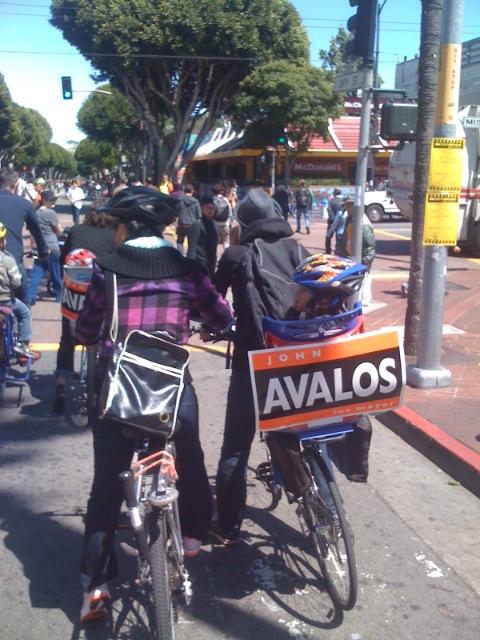
If yesterday’s jam-packed Sunday Streets event in the Mission was any indication, only two mayoral candidates are vying for the votes of bicyclists, skaters, and strolling families who appreciate carfree streets: John Avalos and David Chiu. They were the only two candidates who showed up, and both had lots of supporters with signs to help campaign for them, with Avalos supporters enjoying a slight edge in overall numbers.

It’s a testament to the lackluster field of mayoral candidates this year that Avalos and Chiu were the only ones campaigning at such a popular, cool, and high visibility event. It also foreshadows what is likely to be a tough fight between the two sitting supervisors for a constituency they each need to win.

With more than 13,000 dues-paying members, the San Francisco Bicycle Coalition is the city’s largest grassroots political organization, an active and high-profile group of voters that both candidates have sought to stake their claims with.

Chiu often touts the fact that he doesn’t own a car and bikes regularly, he took a fact-finding trip to Amsterdam with bike advocates last year, and he sponsored legislation setting the policy goal of 20 percent of SF vehicle trips being by bike by 2020. Avalos has the strongest progressive credentials in the race, he sometimes rides his bike from the far-flung Excelsior District, and he has close and deep relationships with many bike-riding political activists.

The choice could determine where bike-advocacy ends and progressivism begins, particularly at a time when Chiu has sought to marginalize Avalos and what was once a solid progressive majority on the board. Chiu has won over some SFBC leaders and snagged a few early endorsements from the bike community (such as SFMTA board member Cheryl Brinkman, who spoke at Chiu’s campaign kickoff), but the endorsements are made by a vote of SFBC membership that is likely to be hotly contested.

Well, hotly contested by the only two candidates who seem to care about the bike vote.

Illinois pulls out of Secure Communities

16

As California considers reforming Secure Communities, Illinois announced today that it is terminating its involvement in the controversial federal immigration program. California and Illinois moves come in face of Washington D.C’s decision to opt out of S-Comm and Washington State’s refusal to participate. And they test ICE’s claims that the program is mandatory, as other states watch these developments.

(UPDATE: Yesterday, I erroneously reported that New York State had refused to participate in S-Comm.That is not the case. New York State does allow jurisdictions to participate, they have a MOA with ICE, and 8 more counties just joined. I confused NY with Washington State, which has refused to join.)

In a May 4 letter to Immigration and Customs Enforcement (ICE), Illinois Gov. Pat Quinn enclosed a notice from Illinois State Police (ISP) director Hiram Grau, notifying ICE that because of its indiscriminate use of the “Secure Communities” deportation program, Illinois is terminating the November 2009 S-Comm Memorandum of Agreement (MOA) between ISP and U.S. Department of Homeland Security’s ICE.”

“The stated purpose of the program, as set forth in the MOA, is to “identify, detain and remove from the United States aliens who have been convicted of ¬serious criminal offenses and are subject to removal (emphasis added), ICE’s statistics on the Secure Communities program, compiled through February 28, 2011, reveal that the implementation of the Secure Communities program in Illinois is contrary to the stated purpose of the MOA: more than 30 percent of those deported from the United States, under the program, have never been convicted of ¬any crime, much less a serious one. In fact, by ICE’s own measure, less than 20 percent of those who have been deported from Illinois under the program have ever been convicted of a serious crime.”

Quinn notes that on November 9, 2010, his office directed ISP to suspend S-Comm until a review of the program and its adherence to the MOA could be conducted. “Upon evaluation of data provided by ICE to the State of Illinois, conversations between ICE and members of my administration, and a new, proposed MOA from ICE, it’s clear that the conflict between the MOA as signed by ISP and ICE’s implementation of the program cannot be resolved to the State of Illinois’ satisfaction.”

“With this termination, no new counties in Illinois can be activated and those counties that were previously activated… must be deactivated and removed from the Secure Communities program,” Quinn concludes.

Illinois’ move comes as California Assemblymember Tom Ammiano’s Transparency and Responsibility Using State Tools (TRUST) Act passes out of the California Assembly’s Public Safety Committee, next stop appropriations. The TRUST Act would allow local governments to opt out of S-Comm or set standards for jurisdictions that chose to participate. Joining Ammiano as co-sponsors of the TRUST Act are Assemblymembers Gil Cedillo (D-LA) and Bill Monning (D- Carmel) and Sen. Leland Yee (D-SF). Endorsers include 80 organizations, local governments and elected officials, including the Santa Clara and Santa Cruz County Boards, San Francisco Sheriff Michael Hennessey, who blew the whistle on S-Comm in San Francisco a year ago, and has endorsed San Francisco Sup. Ross Mirkarimi in the sheriff’s race this fall, retired Sacramento Police Chief Arturo Venegas, and civil rights and faith groups, including the California Partnership to End Domestic Violence, the California Labor Federation, the San Bernardino Catholic Diocese and Equality California.

Advocates hope Ammiano’s TRUST Act will restore balance and accountability to the nation’s immigration system. They charge that S-Comm’s misleading focus, over-broad reach and lack of transparency have eroded trust between police and immigrant communities, making victims and witnesses to crimes reluctant to come forward.

The TRUST Act would make S-Comm an “opt-in” program so local governments can tailor their participation based on local needs.The bill would set safeguards for municipalities that do elect to participate in S-Comm to guard against racial profiling and would ensure that children and domestic violence survivors are not swept up by S-Comm. The TRUST act also upholds the right to a day in court by only reporting for deportation individuals convicted – not merely accused – of crimes.

These moves come fresh in the heels of Congressman Luis Gutierrez’s April 27 appearance in San Francisco, where he was joined by San Francisco Sups David Campos and John Avalos, and Board President David Chiu in asking President Obama for administrative relief from rapidly increasing deportations.
“We need to stop deporting parents and ripping apart all families, including same-sex partners, “ wrote Chiu, Campos and mayoral candidate Avalos. “We need to stop deporting students who would have been eligible for the DREAM ACT. Last year, the U.S. deported an estimated 400,000 immigrants, the highest number of deportations per year in the history of our nation. We must allow our counties to opt out of  “S-Comm” (Secure Communities), which is making our communities less secure, and we support Congressman Gutierrez in these courageous requests. Immigrants are part of the fabric of our communities, and we need to fix our immigration system so everyone who lives here can continue to live as a full member of society without constant fear of safety, security, and livelihood being jeopardized at any moment.”


Guardian poll: dogs and the next mayor

108

The battle over dogs at Fort Funston, Crissy Field and Ocean Beach is now big news at City Hall. The supervisors — or most of them — are worried that a ban on off-leash dog walking in some GGNRA parks would drive more dogs into city parks (likely). But the Sierra Club folks are determined not to let the dogs keep running free because they threaten the endangered plants and animals. (I usually keep my dog on a leash at Ocean Beach because I know how badly she wants to disturb the mating habits of the Snowy Plover, but not all dogs have that burning desire.)


What fascinates me is how big a deal this has become in the mayor’s race. The Sierra Club is a significant endorsement in San Francisco — and from what I’m hearing from my sources in the club, the decision who to back for mayor could well rest not on energy issues, not on the future of clean public power, not on park privatization  … but on dogs. Supervisor John Avalos has great environmental credentials. Sup. David Chiu can make a case for the Sierra Club nod. But both of them may be out of the running — because they voted in favor of asking GGNRA to back off a bit on the leash rules.


So here’s your chance: Dogs in the park or not?


Free polls from Go2poll.com


Canine conflict

34

news@sfbg.com

San Francisco enjoys proximity to natural beauty and recreation on a scale unlike any other major urban area in the country. The 75,000-acre Golden Gate National Recreation Area offers city dwellers almost 60 miles of rugged coastline, forested hiking trails, and scenic beaches to enjoy. In most cases, people can bring their dogs.

While the city is notoriously difficult to raise human children in, four-legged friends flourish in an environment that celebrates their existence. With a multitude of dog-friendly parks, pet hotels, and ubiquitous doggie boutiques to accommodate the estimated 120,000 dogs that call San Francisco home, the canines and their companions form their own political constituency.

So it’s only natural that GGNRA’s Draft Dog Management Plan, which restricts dog walking in the park, has the pet set howling. The plan would limit off-leash dogs to 21 different areas of the park, including some of the most popular places such as Crissy Field, Fort Funston, and Ocean Beach, and ban dogs from some areas, like Muir Beach, where they have long been welcome.

The 2,400-page plan has been in the works since 2002, created out of the need to uphold the agency’s duty to protect the sensitive wildlife and plant species in the park while accommodating a growing population of visitors. Since its unveiling in January, thousands have rallied against it, filing so many comments to the National Park Service that it has extended the public comment period until May 30.

Currently, dogs are allowed off-leash in small fraction of the GGNRA lands and on-leash throughout most of the park. The proposed plan offers six alternatives for each of the 21 areas examined, all strengthening existing — but often ignored — leashing policies and reducing areas where dogs are allowed to roam tether-free.

“This is overly restrictive and unrealistic,” said Martha Walters, chair of the Crissy Field Dog Group. “There are certainly more management measures that can be taken with signage and educational outreach to protect these environments without having to impose this plan.”

Opposition has been widespread among pet owners and groups like the SPCA and Animal Care and Control. The Board of Supervisors voted 10-1 on April 26 to adopt a resolution formally opposing the plan, although the city has no jurisdiction over the area.

“It’s one thing to make sure we protect endangered species, but this plan doesn’t just do that,” said District 8 Sup. Scott Wiener, who authored the resolution. “This is a much more extreme proposal that is a significant restriction to dogs.”

Opponents fear the plan will force more dogs into city parks where overcrowding and aggressive behavior could become problems. Dog owners and advocates stress that responsible dog guardianship can be compatible with environmental stewardship, and that the NPS should better enforce the pet policy already in place.

“This is not right for our community,” said Jennifer Scarlett, codirector of the SPCA. “I would never want to wish harm on any wildlife, but it’s a piece of land stuck in one of the most densely populated cities in the country.”

But the GGNRA is still part of NPS, although many existing national environmental policies have largely been ignored here.

“We don’t get to choose whether or not to fulfill federal mandates,” said Alexandra Picavet, public affairs specialist for the GGNRA.

The GGNRA allows leashed dogs in more places than any other national park, and is the only park in the entire NPS system that allows off-leash dogs. It achieved National Park status in 1972, but its unique position as the backyard of a major city caused it to bend the rules when it came to letting the dogs out.

“The policy was adopted by the superintendent at the time of the GGNRA, and even that wasn’t really enforced,” GGNRA spokesperson Howard Levitt told us. “This was relatively early in the parks history, and in the early days, we didn’t really understand the importance of natural resources and history in the park.”

According to NPS, GGNRA is home to more threatened and endangered species than Yellowstone, Yosemite, Sequoia, Death Valley, and Kings Canyon national parks combined. It has a higher concentration of sensitive species than all but four of the 394 parks in the system.

The new pet plan would not be implemented until late 2012, after public comment is taken and the plan is revised. For six to 12 months, monitoring areas to measure compliance with leash laws will be conducted. If 75 percent of users do not comply, further restrictions will be made.

Current regulations are broken everyday at Ocean Bean and Fort Funston. Like the lax marijuana laws that are synonymous with San Francisco, leash laws have historically been considered more of a suggestion than a rule. At Crissy Field, one of the most popular recreation spaces for off-leash dogs, NPS observed dog owners disobeying the guidelines more than 60 percent of the time.

Many people do not realize that the four-mile stretch of Ocean Beach slated for restriction currently only allows dogs from May to June, or that the Great Meadow of Upper Fort Mason has never allowed the many off leash dogs seen there every day. Dog advocates say better signage about existing rules would help.

“To me, they went this way instead of having any intermediate steps in current policy and off leash areas,” said Rebecca Katz, director of the Animal Care and Control. “I am not supportive of the alternative. This isn’t like any other national park, and we don’t want it to be.”

On a recent visit to Fort Funston, it was evident that the park was, as some environmentalists call it, a de facto off-leash area. Dozens of dogs, most off leash, romped in the windy dunes, far outnumbering dog owners and professional dog walkers. Most dogs happily jumped from car to sand without ever being put on a leash.

Longtime San Francisco resident Candy Deboer and her giant schnauzer, Leila, have been coming to the park for years after finding city parks unsatisfactory.

“Golden Gate Park? I’ve tried that and I ended up stepping over hypodermic needles,” Deboer said. “Plus, I have a dog that loves junkie poop. I grew up camping, hiking, and fishing. I know how to preserve wildlife and take care of a park.”

Many said closing Fort Funston and Ocean Beach in March during tsunami warnings resulted in horribly crowded dog parks, and felt that GGNRA’s plan would deliver more of the same.

“We are using the parks the way they are supposed to be used,” said San Francisco resident Willa Hagerty, who also spoke at some of the hearings on the plan. “If we are doing something wrong, let us know with signs or fences.”

For some, walking dogs isn’t just a means of enjoying the outdoors, it’s a source of income. “The plan would really affect a lot of jobs like mine,” said SF resident and dog walker Josh Boutelle, who impressively handled eight different dogs while on a run for SF Pup Prep. “There will be more incidents in parks when there is crowding.”

Although everyone surveyed at Fort Funston stridently opposed the plan, most supported regulations in some form, from limiting the number of dogs professional walkers can handle to requiring leashes in some parts of the park. Sup. Wiener is also in the process of devising regulations for dog walking in city parks.

But the GGNRA plan has pitted environmentalists against dog advocates. The Sierra Club and Golden Gate Audubon Society support the plan and even argue that more restrictions are needed than proposed. Those groups, along with six other organizations including the California Native Plant Society and Nature in the City, wrote a letter to the Board of Supervisors April 8 opposing Wiener’s resolution.

“The GGNRA was created in part to bring a national park-caliber experience to all Bay Area residents and visitors, not to expand recreation opportunities for dog owners,” the letter states. “Contrary to what some are saying, the proposed plan is not about keeping dogs out of the GGNRA. Rather, it is about inviting dogs into the park in a manner that is sustainable and fair to all park users.”

The Sierra Club has even used the dog debate as a big factor for its mayoral endorsement. Sen. Leland Yee has spoken in support of the plan, while mayoral candidates Sup. John Avalos and Board President David Chiu voted to oppose it.

“I’m concerned that the Sierra Club is going to use a microscope on a tiny, insignificant measure to make a decision on mayoral endorsement,” Avalos told us. “The dog policy is insignificant compared to so many other environmental issues.”

Others disagree. Michael Lynes, director of the Golden Gate Audubon society, thought Wiener’s resolution was hasty and did a disservice to the years of work NPS has put into the plan.

“They keep talking about the impacts to the city, while here they are trying to do something that impacts the National Park,” Lynes said. “The resolution is really strange. It opposes the Park Service’s effort to regulate land in a way that is sustainable and equitable.”

Opponents say evidence of dog-induced damage to wildlife and humans is unclear, but the plan gives hundreds of pages of studies and incident reports. In 2008, nearly 900 dog-related incidents were reported, including attacks on vulnerable populations such as young children, seniors, and, disabled people. In 2005, Guide Dogs for the Blind found that 89 percent of their graduates had guide dogs interfered with by off leash dogs.

Plus, as difficult as it may be for dog lovers to fathom, not everyone wants to be around dogs when enjoying the outdoors. Currently, dogs are allowed on all but one major trail in the GGRNA, and China Beach in the Presidio is the only beach where people can have a dog-free experience.

“At the end of the day,” Lynes said, “people don’t want to change their behavior.”


USF hosts mayoral forum focused on service

2

The University of San Francisco’s Leo T. McCarthy Center for Public Service will host the political season’s first major mayoral candidate forum – this one focused on public service and staged in partnership with the nonprofit group buildOn – on Thursday, May 5, at 6 pm.

Candidates Michela Alioto-Pier, John Avalos, David Chiu, Bevan Dufty, Tony Hall, Dennis Herrera, Joanna Rees, Phil Ting, and Leland Yee are expected to attend. Admission is free and the public is encouraged to attend this event held at USF’s McLaren Conference Center, 2130 Fulton Street.

“The intent of the forum is to help frame the mayoral campaign and also encourage candidates to talk about what drove them to service and how people can get involved in San Francisco, especially the youth,” Corey Cook, assistant professor in the USF Department of Politics, told us. Cook will moderate the event, which will include questions from high school students participating in buildOn and McCarthy Center service programs.

Carrie Pena, buildOn’s communications director, told us, “Students from public high school will ask questions based on bare thoughts on public service and what it means to be a good public servant.”

BuildOn provides programs for students to break the cycle of poverty and illiteracy. About 90 percent of buildOn students go to college. There are 19 schools in the Bay Area working with buildOn and in the previous year, the students contributed more than 24,000 hours to the Bay Area community.

At USF, service learning is a core class part of the graduation requirement where each student dedicates at least 20-25 hours of service per 15-week semester. “Co-hosting a mayoral forum is a fitting project for USF and buildOn because it will engage high school and college students, as well as the greater community, into the process of local politics,” Cook said on the USF website.

Catarina Schwab, buildOn’s vice president of development, said the partnership is a good match: “We aligned with USF because they focus a lot on service. Both were interested in a forum on service. We are even going to have a buildOn chapter at USF.”

And the next chief is…yes, Suhr!

3

Mayor Ed Lee appointed a deeply emotional Captain Greg Suhr as Chief of the San Francisco Police Department during a swearing-in ceremony where the majority of folks were either elected officials, running for election, running each other’s electoral campaigns—or wearing SFPD uniforms.

And in the end it seemed that the choice may have been influenced by pressure from the powerful San Francisco Police Officers Association, judging from the comment Lee jokingly directed at SFPOA leader Gary Delagnes, saying, “Gary, it’s time to get quiet and go to work.”

Lee told a standing-room only crowd that when he returned from Hong Kong to San Francisco four months ago finding a new police chief was his top priority. And that initially it was suggested (Lee did not say by whom) that he leave the SFPD situation alone and allow an elected mayor to appoint the next Chief.

‘While I am an interim mayor, this is not an interim decision,” Lee told the crowd, signaling that while he may be out of office in January, Suhr may be here to stay as the city’s top cop.

“Today, I’ve chosen the best candidate,” Lee continued, thanking Acting Chief Jeff Godown for his work leading the SFPD since former Mayor Gavin Newsom made the shocking decision to appoint former Chief George Gascón as District Attorney.

But while Newsom’s move may have upset the apple cart in the D.A.’s race, it sure seems to be working out well for Suhr.

Describing Suhr as “a police and people’s Chief: and “a reformer from the inside out,” Lee ran through a long list of the new Chief’s contributions to the SFPD. These included Suhr’s 30 years of service, his climb through the ranks to become Captain of the Mission station, his gig as Captain of the San Francisco Public Utilities Commission in a Homeland Security capacity, and, since 2009, as Captain of the Bayview station.

Suhr began by saying he was “speechless.” Donning glasses to read a speech that he had prepared the night before, Suhr choked up when he talked of being “fourth-generation, born and raised in San Francisco.” Recovering his composure, Suhr smoothly changed gears, as he joked how his appointment therefore makes him “a local hire,”—an insider reference to Sup. John Avalos’ recently approved local hire legislation that Mayor Lee is helping enact citywide.

Suhr recalled how he started out as a rookie on the midnight shift in the Tenderloin in 1981. He thanked his family, his friends and his girlfriend Wendy. And then he asked for a moment of silence “ to honor the memory of all the brave officers who have given their lives in the line of duty.”

Lee reclaimed the podium long enough to jokingly ask Suhr  “to investigate the whereabouts of my birth certificate” as his first assignment as the new chief.

Then it was Board President David Chiu’s turn. Chiu described Suhr as someone, ”who knows our streets, walked the walk, and knows the beats, someone who we all feel confident will be able to bring the SFPD the reform that former Chief Godown, Chief Gascón and Chief Heather Fong initiated. “

San Francisco Superior Court Judge Katherine Feinstein, who is the daughter of Sen. Dianne Feinstein and the presiding judge of the Superior Court, recalled how she has known Suhr since the mid 1980s. “I have watched him as each of our careers have moved forward,” Feinstein said, noting how there were some “steps forward and some steps backward” and how, “there were those who thought this day would never come.” (Feinstein’s words were the only reference to some of the less sunny moments in Suhr’s long and distinguished career. These included his 2003 indictment as part of Fajitagate, an incident that involved off-duty officers, a bag of take-out food, a beer bottle and injuries sustained by two local residents. Suhr was cleared of wrongdoing the next year, but was reassigned by then Chief Heather Fong to the PUC position after an incident in 2005, in which a police officer was seriously injured at an anarchist protest, and videographer Josh Wolf was held in federal prison for 226 days after he refused to release unedited footage of the protest.)

Next up was D.A Gascón and his rooster-like shock of silver hair. Gascón noted that when he first came to San Francisco, in the summer of 2009, he had no allegiances to, and no prior knowledge of, people inside the SFPD.

“I looked at Greg Suhr and one of the things that impressed me is how he worked with and related to people,” Gascón said, explaining why he appointed Suhr as Bayview Captain “Not only has he exceeded all expectations he did an incredible job,” he said.

 Police Commission President Thomas Mazzucco said that in the 100 days since the Commission announced it was looking for a new chief, it became clear that Suhr has the support of SFPD’s rank-and-file.

Mazzuco noted that he met Suhr in high school. “I knew he could hold a ball,” Mazzuco added, noting that he subsequently became Suhr’s football coach, even though he is younger than Suhr. “What the Police Commission has brought to us is not only a native son but also a cop’s cop. It’s an honor to have him as his chief.”

And after the swearing-in, the sentiment among officers in blue appeared to be strongly in Suhr’s favor. Lt. Ken Lee of Central Station recalled how he and Suhr went through the police academy together about 30 years ago.

“We went to different assignments but we’ve maintained a friendship,” Lee said. “The moment I met him I liked him. He was a very stand-up person, and as a native San Franciscan like myself, you could tell he had strong ties to the city. He’s a hard worker, he’s very dedicated to what he does.”

Lt. Mario Delgadillo, also of Central Station, said Suhr hasn’t lost his connection to the street. “That also means a lot, when you have a boss who’s walking with you,” Delgadillo said.

Suhr takes over the SFPD as it’s grappling with the fallout from a recent spate of scandals, including videos that Public Defender Jeff Adachi released that appear to show police misconduct at residential hotels and that forced DA Gascón to hand over his investigation of this alleged police misconduct to the FBI. Asked during a media roundtable what his appointment means for Acting Chief Godown, Suhr said Godown has returned to being Assistant Chief of Operations, which was the post he held before Gascón, who recruited Godown from LAPD, was appointed DA.

In response to a question about his top priorities as police chief, Suhr noted, “When I sit down with the mayor this afternoon, the mayor’s going to tell me what his priorities are. My first priority will be blocking the door open on the 5th floor so that if you wanna come see me you can, like it used to be. Then I have to meet with the command staff and captains and get their take on where they think we are, where they think we’re moving forward best, and match that up against how I’ve seen from a position of Bayview, how that matches up. And then see if I can’t meet with different community groups, the different police employee groups and the command staff.”

He didn’t mince words when it came to indicating that SFPD officers are going to be asked to give back during upcoming budget negotiations
“I’m sure that there’s going to have to be adjustments and I look forward to working with a collaborative effort with the mayor and the board and the unions and the rank and file,” Suhr said. “When the economy’s been good we’ve benefited by it, and now that the economy has … gone the other way, to some extent I think that the officers are willing to give back to do whatever needs to be done to keep the city safe.”

So, how does Suhr think he differs from former Chief Gascón? 

”He has a gorgeous head of hair,” Suhr joked. “To put it in a sports analogy, he’s a quarterback shortstop guy, and I’m more of a catcher, lineman, linebacker kind of guy. But I admire him, I think he moved a lot of issues forward for the police department, and I look forward to continuing those initiatives and giving a few of them a shot in the arm that I think were beginning to wane a bit.”

Suhr also talked about how he has always wanted to become a police officer (a comment that suggests he’s not planning to use the Chief’s post as a stepping stone to the District Attorney’s Office).

”When I went into the police department. on Silver Avenue which is now Willie Brown Academy — that was the police academy back in 1991 when I came in — man, we looked at just the regular uniformed police officers with just stars in our eyes, because they were just the sharpest, classiest folks that we were aspiring to be,” Suhr said.

And he indicated that as Chief, he won’t tolerate dishonesty in the face of ongoing investigations into alleged police misconduct. ”The character of a police officer must be above reproach,” Suhr said. “And I think that the investigation will show what it ends up showing, but I don’t think that there’s a police officer in San Francisco that would want to have a dishonest cop and I’d be at the top of that list. So I want all my officers to be of character that is above reproach.

Asked if he welcome clarification around the duties of SFPD officers assigned to the FBI’s Joint Terrorism Taskforce, Suhr said he believed an examination of the wording of the FBI’s most recent memorandum of understanding (MOU) with the department was already under way.

“I believe that the MOU is being revisited,” Suhr said. “I have not been a part of that, but again I think we have a real good policy with regard to our intelligence gathering and that does supercede any ask of any other agency. The officers are bound by policies and procedures. And that policy was well thought out with tremendous community and group input years and years ago, from situations that have not since repeated themselves. I think a lot of people back then couldn’t believe they happened in the first place, but I think measures were well thought out and put in place to make sure we don’t have a problem again.”

And at the end of the day, Suhr expressed the hope that his tenure as Chief would endure long after the interim mayor is replaced by an elected mayor.

”I’m a native San Franciscan, and this is a dream come true,” he said. “It’s my first day. However this story ends, with a little bit of luck (raps on the wood tabletop) it’s not going to end today.”

Editor’s notes

6

tredmond@sfbg.com

The candidates for mayor of San Francisco are already lining up endorsements — the Sierra Club held its interviews April 23, which seems awfully early to me, since some of the most interesting contenders in this town (Tom Ammiano, Matt Gonzalez) have a tendency to jump in at the last minute. And the filing deadline isn’t until August.

But the sooner the big names and organizations are lined up and the money is locked in, the harder it will be for anyone to pull off an August surprise. So unless the redistricting commission seriously messes with Mark Leno’s state Senate seat or Ed Lee bows to the pressure from Willie Brown, Rose Pak, and their allies and decides to go back on his promise and seek a full term, we’re probably looking at a rough approximation of what the voters will face in November.

With John Avalos in the race, the ballot’s become a lot more attractive to progressives. It’s not as if the other major candidates don’t have a lot to offer, and in some cases, they have a lot to offer to the left. There are smart, experienced, qualified people running.

But let’s be honest here: David Chiu, Dennis Herrera, Phil Ting, Leland Yee, and Bevan Dufty all operate somewhere in the squishy political center, a place where tax breaks for corporations are okay, where “homeownership opportunities” tend to trump the needs of tenants, where deals with big private developers are sculpted around the edges but never rejected outright, and where cuts in services are a larger part of the budget solution than taxes on the rich.

Michela Alioto-Pier is off on the far right of the San Francisco political world, and if she looks at all credible and gets any significant traction (and that’s a big if) she’ll be downtown’s favorite candidate. But until now, there was nobody holding the solid progressive banner.

I don’t think that means Avalos’ appeal is limited to the left; he’s in a swing district, and he’s very popular there, and he can talk about small business and community development and open, honest government. He doesn’t sound like a crazy radical; he’s polite and respectful and listens to people.

But I’m glad we have a candidate who won’t try to argue that 25 percent affordable housing at Treasure Island is something to be proud of, or that the Twitter tax break will create jobs, or that social inequality can’t be addressed through local policy. I’m glad there’s someone who can push the discussion and debate out of the middle, can force some of the others who want progressive support to take strong stands, and can liven things up a bit. Because without him, all of the candidates were sounding a lot alike — and I really don’t want to be bored this fall.

Spies in blue

19

sarah@sfbg.com

San Francisco cops assigned to the FBI’s terrorism task force can ignore local police orders and California privacy laws to spy on people without any evidence of a crime.

That’s what a recently released memo appears to say — and it has sent shockwaves through the civil liberties community.

It also has members of the S.F. Police Commission asking why a carefully crafted set of rules on intelligence gathering, approved in the wake of police spy scandals in the 1990s, were bypassed without the knowledge or consent of the commission.

“It’s a bombshell,” said John Crew, a long-time police practices expert with the American Civil Liberties Union of Northern California.

The ACLU obtained the document April 4 under the California Public Records Act after a long battle. It’s a 2007 memorandum of understanding outlining the terms of an agreement between the city and the FBI for San Francisco’s participation in the Joint Terrorism Task Force.

And, according to Crew, it effectively puts local officers under the control of the FBI. “That means Police Commission policies do not apply,” Crew said. “It allows San Francisco police to circumvent local intelligence-gathering policies and follow more permissive federal rules.”

Veena Dubal, a staff attorney at the Asian Law Caucus, agreed: “This MOU confirms our worst fears,” she said.

Dubal noted that in the waning months of the Bush administration, the FBI changed its policies to allow federal authorities to collect intelligence on a person even if the subject is not suspected of a crime. The FBI is now allowed to spy on Americans who have done nothing wrong — and who may be engaged in activities protected by the First Amendment.

FBI activity under this new “assessment” category has since come under fire, and a recent report in The New York Times showed that the FBI has conducted thousands of assessments each month, and that these guidelines continue under Obama.

And if the feds do control San Francisco police policy, then the San Francisco cops could be spying on innocent people — a dramatic change from longstanding city policy. “The MOU is disturbing,” Police Commission member Petra DeJesus told the Guardian. “The department is assuring us that local policies are not being violated — but it looks as if it’s subject to interpretation.”

It’s the latest sign of a dangerous trend: San Francisco cops are working closely with the feds, often in ways that run counter to city policy.

And it raises a far-reaching question: With a district attorney who used to be police chief, a civilian commission that isn’t getting a straight story from the cops, and a climate of secrecy over San Francisco’s intimate relations with outside agencies, who is watching the cops?


SPIES LIKE US

San Francisco has a long — and ugly — history of police surveillance on political groups. SFPD officers spied on law-abiding organizations during the 1984 Democratic National Convention; kept files in the 1980s on 100 Bay Area civil, labor, and special interest groups; and carried out undercover surveillance of political groups focused on El Salvador and Central America.

Those abuses led the Police Commission to develop a departmental general order in 1990 known as DGO 8.10. The local intelligence guidelines require “articulable and reasonable suspicion” before SFPD officers are allowed to collect information on anyone.

Even those rules weren’t enough to halt the spies in blue. In 1993, police inspector Tom Gerard was caught spying on political groups — particularly Arab American and anti-apartheid organizations and groups Gerard described as “pinko” — and selling that information to agents for the Anti-Defamation League.

As the ACLU and Asian Law Caucus noted in a December 2010 letter to Cdr. Daniel Mahoney: “That scandal was not just about the fact that peaceful organizations and individuals were being unlawfully spied upon and their private information sold to foreign governments, but that the guidelines adopted in 1990 had never been fully implemented by SFPD. No officers had been trained on the new guidelines and no meaningful audit had ever been implemented.”

Over the years, the commission has tried to keep tabs on police intelligence and prevent more spy scandals. The general order mandates that local police officials have to request general authority from a commanding officer and the chief to investigate any activity that comes under First Amendment protections — and must specify in the request what the facts are that give rise to this suspicion of criminal activity. The order also states that the chief can’t approve any request that doesn’t include evidence of possible criminal activity.

Those requests are reviewed monthly by the Police Commission and there are annual audits of the SFPD files to monitor compliance — so the notion that the local cops are joining the FBI spy squad without commission oversight is more than a little disturbing.

Officials with the FBI and SFPD are doing their best to reassure the local community that there’s nothing to worry about. But so far their replies seem to duck questions about whether FBI guidelines trump local policies. For example, the MOU states that “when there is a conflict, [task force members] are held to the standard that provides the greatest organizational benefit.”

We asked Mahoney to clarify: does that mean the local cops could be held to the FBI’s standards?

“The San Francisco Police Officer(s) who are assigned to the Joint Terrorism Task Force always have and continue to be required to follow all SFPD’s policies and procedures,” Mahoney replied in a statement.

That’s confusing; do they follow SFPD policies, or obey the MOU?

We asked FBI special agent-in-charge Stephanie Douglas whether SFPD officers are involved in surveillance and “assessments” (that FBI code word for creating spy files on individuals and groups) and whether they are identifying as SFPD or FBI officers.

“The FBI only initiates investigations on allegations of criminal wrongdoing or threats to our national security,” Douglas replied April 21. “Our investigations are conducted in compliance with the Constitution, the laws of the United States, the Attorney General Guidelines, the Domestic Investigation and Operations Guide, and all other FBI policies.”

Okay, that’s typical FBI-speak. Here’s more: “The JTTF is a task force comprised of FBI special agents, agents from other federal agencies, and local police officers who have been officially deputized as federal task force officers (TFOs) who have the power and authority of a federal agent. Because all JTTF TFOs are actually de facto federal agents, they are required to operate under federal laws and policies when involved in a JTTF case.”

So the cops are actually feds. But wait: “Our standard JTTF MOU recognizes, however, that the JTTF TFOs do wear two hats, as it were, and directs JTTF TFOs to follow his or her own agency’s policy when it is stricter than the FBI policy under certain circumstances,” Douglas concluded.

Again: not exactly clear, and not exactly reassuring.

“At some point they need to say whether SFPD officers are engaged in assessments,” Crew said.

These questions have spurred the Police Commission and Human Rights Commission to schedule a joint hearing in May to discuss what the document means, why SFPD never alerted the civilian oversight authorities, and whether a clarifying addendum can be tacked onto the agreement.


SPY FOR US OR LEAVE

The concerns are likely to be intensified by recent developments in Portland, Ore.

Portland dropped out of the Joint Terrorism Task Force in 2005 over concerns that local cops would be violating privacy laws. But in November 2010, the FBI thwarted a bomb plot allegedly linked to terrorists, and city officials came under pressure to rejoin the JTTF.

But Mayor Sam Adams has insisted on language that would bar local cops from doing surveillance and assessments, which, apparently, won’t fly with the feds.

On April 20, Willamette Week, the Portland alternative paper, wrote that Adams “effectively scuttled” Portland’s reentry into its local JTTF because of his anti-spying language.

In an April 19 letter to Adams, U.S. Attorney for Oregon Dwight Holton stated that Adams’ proposal of only allowing officers with the Portland Police Bureau to be involved in investigations and not in FBI assessments was a deal-breaker.

“Unfortunately, as currently drafted, the proposed resolution does not provide a way in which the PPB can rejoin the team,” Holton wrote. “There is a single provision that stands as a roadblock to participation — specifically the provision that seeks to have the City Council delineate only certain investigative steps a task force officer can take part in. Specifically, the resolution seeks to dictate for the JTTF which stages of an investigation task force officers from the [Portland police] can work on.”

“Investigation and prevention of complex crimes and terrorism are typically fluid and fast-moving,” he added. “It makes no sense to ask [Portland police] officers to be in for one part of a conversation, but out for another part of the same conversation as investigators discuss findings from assessments, investigations, etc. in evaluating and addressing terrorist threats in Portland and beyond.”

The message isn’t lost on San Francisco civil liberties activists. If you don’t let your cops join the spy squad, they can’t be a part of the task force.

“It was one thing to join the JTTF 10 years ago when they were operating under guidelines that, while not to the ALCU’s taste, were at least tied to some level of suspicion,” Adams said. “But they have taken their procedures and guidelines and moved them to the far right. It’s one thing to say that it’s necessary for the FBI to do that, and quite another to say that local agencies have to forfeit their own policies — and with no public debate or decision-making.”


ASK THE FEDS FIRST

Further complicating the question of police oversight is the fact that George Gascón, who was police chief when civil liberties groups started asking for a copy of the MOU last fall, refused to turn over the document without asking the feds first.

In a Jan. 4 letter to the ACLU and ALC, Gascón and Mahoney stated that the SFPD could not speak to information about the duties, functions, and numbers of officers assigned to the Joint Terrorism Task Force “without conferring with our partners in the Federal Bureau of Investigation.”

“I am sure you can appreciate the delicate balance we hold in crafting policy that not only supports our mission in the ultimate protection of life, but also in advancing democratic values through collaboration with the communities we serve,” Gascón and Mahoney wrote.

And Gascón is now district attorney.

“It raises the question of accountability,” said Public Defender Jeff Adachi “We want to make sure that police officers working in the city, regardless of whether it be for the feds or the SFPD, are complying with general orders and policies established by the department. But when officers go on an assignment with the feds, we don’t know if they are operating under parameters set by local law.”

Unearthing the FBI’s hitherto clandestine MOU with the SFPD appears to be yet another sign that local police are increasingly being subjected to federal policies not in keeping with local procedures.

As the Guardian previously reported, the 2008 decimation of San Francisco’s sanctuary city legislation and the 2010 activation of the federal government’s controversial Secure Communities program, which both happened during former Mayor Gavin Newsom’s tenure, means that the city of St. Francis now ranks among the top 38 counties nationwide that are deporting “noncriminal aliens.”

Dubal also noted that the FBI came to the SFPD in 1996 asking for help with the task force, but also sought a waiver from the Police Commission so officers could participate without having to follow local rules. “And within two weeks, then Mayor Willie Brown said, not in our town,” Dubal said. “So in 1997, the SFPD said we are not going to join unless we can follow our own rules. And in 2001, when the SFPD joined, it was under an MOU that required them to comply with SFPD rules and was signed in 2002 by then-SFPD Chief [Earl] Saunders.”

Dubal said that after local law enforcement agencies sign an MOU with the FBI, they designate and assign officers to work from FBI headquarters. “In the past, two SFPD officers, paid with San Francisco tax dollars, physically worked in the FBI’s office in a secure room where you can only go if you have security clearance. But they still can’t spy without reasonable suspicion, and they also need audits.”

Crew and Dubal said that in a recent meeting, SFPD officials assured them that local police were following General Order 8.10, but that they are open to creating an MOU addendum to clarify this.

Crew and Dubal remain unsure if the FBI would be agreeable to signing off on that. They note that the FBI has previously stated that its JTTF has sensitive investigations going on so it can’t give the public all the information. “Fine, but the issue is, Are these investigations based on suspicion, or are they based on religious background, associations, ethnicity, and travel patterns?” Dubal said.

They also doubt that the MOU would even have surfaced if not for comments that then SFPD Chief Gascón made, first in October 2009, then in March 2010, that triggered an uproar in the local Muslim, Arab, and Pakistani and Afghani communities.

At the time, Gascón, who has a law degree and graduated from the FBI Academy, had just landed in San Francisco fresh from a stint as police chief for Meza, Ariz., where he drew praise for speaking out against Maricopa County Sheriff Joe Arpaio’s inhumane treatment of undocumented immigrants Given this seemingly progressive stance, Gascón shocked civil libertarians in San Francisco when he said he wanted to unearth SFPD’s intelligence unit, which was disbanded amid scandal in the early 1990s.

“We have to realize that in the post-9/11 world, San Francisco is an iconic city, like New York, Washington. and Los Angeles,” Gascón said. “If somebody wanted to make a big statement about something they disliked about America, doing it here would definitely get attention. We need to know what is going on under the surface of the city.”

But Gascón did not say how a revived police spy unit, which had been shut down in large part due to Crew’s work, would operate. And six months later, he upset Bay Area Muslims during a March 2010 breakfast by reportedly saying that the Hall of Justice building was not just susceptible to earthquakes, but also to an attack by members of the city’s Middle Eastern community who could park a van in front of it and blow it up.

Gascón subsequently claimed that he “never referred to Middle Easterners or Arab Americans,” but that he had instead singled out the Afghanistan and Yemen communities because they pose “potential terrorism risks”

“In light of Gascón’s comments and his desire to resurrect the intelligence unit, people were asking, ‘Is it possible that the SFPD is also doing the same thing?'” Dubal asked, noting that she started getting complaints in 2009 and throughout 2010 about the FBI.

“Folks were saying that the FBI was asking about their religious identity, their family situation, and their political activities,” she recalled. “I certainly saw an upswing in innocent people being contacted. People were saying, ‘What the hell? — the FBI knocked on my door at 5 a.m.'”


COMMUNITIES UNDER SIEGE

A 2011 Human Rights Commission report documents frequent complaints from Arab, Muslim, and South Asian communities facing racial and religious profiling while traveling and unwaraanted interrogation, surveillance, and infiltration by local and federal law enforcement personnel at their homes, places of worship, and workplaces.

The report recommended asking the supervisors and the Police Commission to “ensure that all SFPD officers, including those deputized to the Joint Terrorism Task Force, follow and comply with local and state privacy laws, including DGO 8.10.”

On April 5, the Board of Supervisors voted 10-0 to approve a resolution, sponsored by Sup. Ross Mirkarimi and cosponsored by Sups David Chiu, Eric Mar, David Campos, and John Avalos, to endorse the HRC report.

All this is happening against the backdrop of FBI guidelines that have been loosened twice since September 2011, first by U.S. Attorney General John Ashcroft in the wake of the 9/11 terrorist attacks, then by Attorney General Michael Mukasey in the dying days of the Bush administration, and now by the Obama administration.

And as The New York Times reported in March, records obtained through a Freedom of Information Act request show that between Dec. 2008 and March 2009, the FBI began 11,667 assessments of people and groups for criminal/terror links, completed 8,605 assessments, and launched more than 400 intensive investigations based on the assessments. The FBI also told the Times that agents continue to open assessments at about the same pace

Crew noted that Mukasey’s guidelines marked the first time since 1976 that the FBI has been allowed to do assessments and collect files without a suspicion that a crime has occurred.

Dubal observed that the most relevant documents to emerge from a recent FOIA request to determine if the FBI has engaged in disturbing intelligence gathering activities are those related to “geomapping.”

“The materials are not particular to Northern California, but they show how FBI maps communities based in ethnic concentrations,” Dubal said.

Dubal also pointed to the case of Yasir Afifi, an Egyptian American student from Santa Clara, who found an FBI tracking device on his car when he took it in for an oil change. In March 2011, CAIR filed suit in Washington, D.C., alleging that the FBI violated Afifi’s First, Fourth, and Fifth Amendment rights by failing to obtain a warrant.

DeJesus recently told the Guardian that the Police Commission was never made aware of the MOU’s existence. “The chief should have checked in with the commission president, at the very least,” she said. “The idea that they were not reporting this to anyone is disconcerting.”

“The SFPD does not have the authority to enter into a secret agreement with the FBI whereby some of its officers are allowed to conduct intelligence operations in violation of the Police Commission’s General Order 8.10,” Crew added.

In a Jan. 25 letter to Mahoney, representatives from the ACLU and the ALC noted that “in the past, the SFPD had not previously deferred to the FBI on whether or how to openly address how San Francisco police officers will be supervised and held to well-established and painstakingly and collaboratively crafted San Francisco general orders.”

“These are low-level investigations that require no criminal predicate, meaning that when initiating an assessment, FBI agents can conduct intrusive forms of investigation without any criminal suspicion,” Dubal said. “These include interviewing innocent Americans, infiltrating organizations, using open source data to spy and surveil, going into religious centers such as mosques to spy and surveil, and recruiting and using informants.”


Busy week for immigration reform advocates

12

On Tuesday, April 26, the California Assembly’s Public Safety Committee holds a hearing on AB 1081, Assemblymember Tom Ammiano’s Transparency and Responsibility Using State Tools (TRUST) Act. The TRUST Act seeks to allow local governments to opt out of US Immigration and Customs Enforcement (ICE’s) controversial “Secure Communities” program and to set standards for jurisdictions that chose to participate in S-Comm.

Also on Tuesday, Congressmember Luis Gutierrez kicks off his “Change Takes Courage” immigrant rights tour in seven California cities. Gutierrez lands in San Francisco Wednesday, April 27, and the Bay Area immigrant community and LGBT leaders will host him on the steps of City Hall, as Gutierrez asks President Obama to stop the record number of deportations of immigrant families and students that have already occurred under the Obama administration.

Joining Ammiano in Sacramento on Tuesday as co-sponsors of the TRUST Act are Assemblymembers Gil Cedillo (D-LA) and Bill Monning (D- Carmel) and Sen. Leland Yee (D-SF). Endorsers include 80 organizations, local governments and elected officials, including the Santa Clara and Santa Cruz County Boards, San Francisco Sheriff Michael Hennessey and retired Sacramento Police Chief Arturo Venegas, and civil rights and faith groups, including the California Partnership to End Domestic Violence, the California Labor Federation, the San Bernardino Catholic Diocese and Equality California.

SF Sheriff Michael Hennessey blew the whistle on S-Comm last May, but was unable to stop the feds from activating the program in San Francisco last June. And the most recent batch of S-Comm statistics show that San Francisco, once famed as a sanctuary city, now ranks in the top 38 counties nationwide that deport “non-criminal aliens,” which is ICE-speak for immigrants whose primary misstep is that they are in the country without the requisite paperwork.

Ammiano’s Trust Act hearing comes just days after Congressmember Zoe Lofgren (D- San Jose) called for an investigation into the conduct of ICE officials around advising local municipalities whether they are required to participate in ICE’s S-Comm program.

“You can’t have a government department essentially lying to local government and to members of Congress. This is not OK,” Lofgren said April 22, following the disclosure of hundreds of ICE documents that allegedly show that the agency has been giving intentionally contradictory and misleading information about S-Comm to local officials.

“From then-Attorney General Brown on down, it’s painfully clear ICE deceived Californians about S-Comm,” said Angela Chan, a staff attorney with the Asian Law Caucus. “That’s unacceptable behavior for a government agency in a democracy.”

Advocates hope that Ammiano’s TRUST Act will restore balance and accountability to the nation’s otherwise broken immigration system. They charge that S-Comm’s misleading focus, over-broad reach and lack of transparency have eroded trust between police and immigrant communities, making victims and witnesses to crimes reluctant to come forward.

The TRUST Act would make S-Comm an “opt-in” program so local governments can tailor their participation based on local needs.

The bill would also set safeguards for municipalities that do elect to participate in S-Comm to guard against racial profiling and would ensure that children and domestic violence survivors are not swept up by S-Comm.

The TRUST act also upholds the right to a day in court by only reporting for deportation individuals convicted – not merely accused – of crimes.

Tuesday’s hearing will be followed by Congressman Luis Gutierrez’s Wednesday appearance in San Francisco, which the African Advocacy Network, Asian Law Caucus, Central American Resource Center, Chinese for Affirmative Action, People Organized to Demand Environmental and Economic Rights, Out4Immigration, San Francisco Interfaith Coalition on Immigration, and Dolores Street Community Services sponsored.

Sups David Campos, John Avalos, and David Chiu will join Gutierrez and their message to President Obama is laid out in the following press statement:

“We need administrative relief to uphold the values of opportunity, justice, and human rights for all to move our country forward. With the stroke of a pen, President Obama could put a halt to the rapidly increasing deportations that are taking place. We need to stop deporting parents and ripping apart all families, including same-sex partners. We need to stop deporting students who would have been eligible for the DREAM ACT. Last year, the U.S. deported an estimated 400,000 immigrants, the highest number of deportations per year in the history of our nation. We must allow our counties to opt out of  “S-Comm” (Secure Communities), which is making our communities less secure, and we support Congressman Gutierrez in these courageous requests. Immigrants are part of the fabric of our communities, and we need to fix our immigration system so everyone who lives here can continue to live as a full member of society without constant fear of safety, security, and livelihood being jeopardized at any moment.”