Jobs

The personal history, adventures, experience, and observation of David Copperfuck

0

What’s up with all these "fuck"-ing bands of late? I’m referencing the band name phenomenon: it used to be about being "pink" this or "black" that or "wolf" or "bear" something, but it looks like our favorite four-letter word is now reaping the benefits of name-gaming fun. "Fuck" names might be nothing new — we all recall the Matador Records’ Bay Area outfit that sported the word in its singular form during the ’90s — but it looks like being a "mountain" nowadays just isn’t as cool as it used to be.

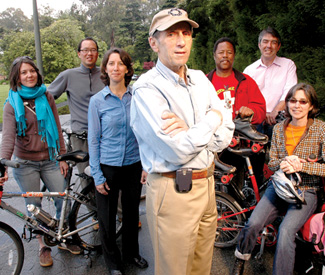
To David Copperfuck — vocalist Molly Samuel, drummer Dean Bein, guitarist Chris Baker, and bassist Avi Klein — the so-called trend is a joke. The mere mention that their moniker snagged top billing in the Onion for an end-of-the-year poll titled "Worst Band Names of 2006" generates a round of laughter from the San Francisco punkers. Baker jokingly reveals while hanging out in Samuel’s bike-littered Mission District apartment that "it was really challenging to shoot ourselves in the foot" and that the quartet were "just fucking themselves over ahead of time" by selecting the alias.

"We weren’t trying to be clever or anything," Bein adds while lounging on a recliner. "We were just trying to capture the essence or magic of a couple of words."

But then nothing serious seems to resonate with this bunch. During our two-hour powwow, the group resembles four giddy college kids stretched out lazily on Samuel’s couches, sipping cans of beer and bullshitting about their day jobs, their obsession with the apocalypse, and various extracurricular activities.

"I’m in a play," Bein says when asked whether any of David Copperfuck’s members currently play in any other bands. "It’s called Jurassic Park 4."

"But you have a show, right?" Samuel inquires.

"Yeah, we’re opening for Japanther," Bein replies before cracking a wry smile.

David Copperfuck formed in San Francisco in the fall of 2005, but their friendship harks back to 2002, when they first met at Oberlin College. The four were actively involved in the school’s indie scene and played in two groups, Red Tape Apocalypse and Zohar.

"This band is sort of an amalgamation of those prior bands," Baker says. "RTA was like straight-up, Blatz-style punk with two singers going full throttle, while Zohar was more about going big-time, playing the long songs, and trying to do something that was beyond our technical skills."

The band members acknowledge that they found it hard to continue after graduation with the two projects, which broke up as everyone began to relocate. By August 2005, the members of David Copperfuck had all migrated to San Francisco and, according to Samuel, knew they were going to start a new group once they got here. And it looks like the Oberlin gang’s West Coast venture was a smart choice after all: in its year-and-a-half existence, David Copperfuck has immersed itself in the Bay Area’s thriving punk community and currently plays out as much as possible.

"I don’t think we’ve ever asked for a show," Klein says. "We never really campaign. That can sound really immodest, but we just have friends, and we are supportive of those people and their bands, and they return the favor, I guess."

And regardless of whether they’re sharing the spotlight with floor crouchers, basement dwellers, or bus rats, the quartet is definitely hip to the unconventional venue. So the title of David Copperfuck’s debut 7-inch, "Chalet Chalet" (Party Turtle), seems fitting. It’s a crunchy mix of three-chord guitars, bass distortion, and frantic drum noise that recalls bands such as the Germs, the Bags, and Crass. Samuel’s distraught bark adds to the fray.

"I feel like our shows are always really fun, because there’s not really any posturing," Samuel offers. "We’re pretty unassuming with the people. We set up, and then it just kind of explodes, and it’s like ‘Here we are.’"

The four hope to soon release dual split singles with Oakland’s KIT and Orinda’s ParasitesGo! and will also embark on their first West Coast tour with Connie Fucking Francis in June. They also run True Panther Sounds, a record label they started in college, which has released albums by Lemonade, Broken Strings, and Standing Nudes. So what took David Copperfuck so long when it came to documenting themselves? Bein confesses that their debut single took a while to make because of their "inexperience with the whole record recording and releasing prospect of being in a band."

"I think we are about as unprofessional as it goes," Klein says with a laugh. "Live is like the only thing we can do."

DAVID COPPERFUCK

With Didi Mau and Manhater

Thurs/31, 9:30 p.m., $5

Eagle Tavern

398 12th St., SF

(415) 626-0880

www.sfeagle.com

Czech, please!

0

› a&eletters@sfbg.com

A faltering economy is the biggest threat to most national film industries, but Czechoslovakia’s had a more distinct misfortune: it was shut down by occupation forces not once but twice. Most famously, the 1960s Czech new wave, in which talents like Jirí Menzel, Ivan Passer, Vera Chytilová, and Milos Forman first flourished, was abruptly dammed by the 1968 Soviet invasion. The type of widespread film-buff culture that brought attention to those directors scarcely existed when — before the Nazis commandeered local studios and permitted only a handful of strictly escapist films to be made for the home market — the country’s cinema had its first golden age.

Before World War II, Czechoslovakia boasted one of the most adventurous and lively — if not widely exported — movie industries in the world. Of course, this meant there was room for a lot of populist fluff. But the 12 features in the Pacific Film Archive’s new series "Czech Modernism, 1926–1949" show why Nazi invaders sensed a celluloid threat: these films are full of playful social critique as well as imaginative stylistic leaps. They assume that an audience is intelligent and that it will enjoy the subversion of authority. These films don’t provide pacification, let alone propaganda.

As playwright and Velvet Underground fan turned president Václav Havel would suggest some decades later, Czech life — at least the urban variety — has long appreciated the intersection of the avant-garde and leftist politics. The region’s geographic location, between the sophisticated capitalist West and the stylistically impoverished Communist USSR, at times seems directly reflected in these films’ colliding influences, from German expressionism to Soviet formalism to an Erich von Stroheim–esque attitude decadence.

The series’ two movies by director Vladislav Vancura apply a mad stylistic energy to subjects that might easily have been played for simple melodrama or pathos. In 1933’s On the Sunny Side, a pair of city children whose friendship bridges the class divide end up dumped in an orphanage when their parents are deemed unfit: first it’s fatherless, accordion-playing Honza, then pigtailed Babula, whose womanizing dad has just bankrupted the family. Frenetic montages contrast the adult worlds of poor and rich, cutting between breadlines and champagne-guzzling flappers. At the progressive home for foundlings, by contrast, equality is ensured by self-government — as a collective, the kids are better able to look after their own welfare than the grown-ups who’ve failed them.

Vancura’s Faithless Marijka, from the next year, is set in the Carpathian Mountains, with local nonprofessional actors as the leads. But it’s no sylvan idyll. The supposedly central tale of a lumberjack’s cheating spouse is nearly lost amid the struggles of laborers to triumph over their greedy oppressors (whose ranks include a disturbing anti-Semitic caricature).

A similar mix of poetic naturalism and Eisensteinian montage marks Karl Junghans’s 1929 silent Such Is Life. Its titular shrug downplays a vigorous look at some ordinary Prague residents, notably a put-upon laundry worker (Vera Baranovskaya, who played the title character of Vsevolod Pudovkin’s 1926 Mother), her loutish husband, and a manicurist daughter pretty enough to attract major trouble. Similar perils await two office girls lured into a lecherous nightlife in 1931’s From Saturday to Sunday, by Gustav Machatý, who would create an international sensation with Hedy Lamarr’s nude swim in Ecstasy two years later. This time romance rather than lust prevails as the more innocent secretary flees a grabby grandpa and winds up meeting her pure-hearted lower-class match.

Mistrust toward the rich and powerful was also a frequent theme in the era’s Hollywood films, in an attempt to please American audiences suffering though the Great Depression, which in turn triggered Czechoslovakia’s economic hardship. But the criticism in such films was usually glib, the solutions fanciful. Not so here. It’s eye-opening to watch a popular hit like Martin Fric’s 1934 Heave Ho!, widely regarded as the best effort from local comedy team Jirí Voskovec and Jan Werich.

Werich plays a dissolute multimillionaire informed one day that his stocks are worthless and he’s broke. Teaming with an unemployed laborer (Voskovec) who’d ranted against factory-shutting fat cats on the radio (before being dragged off), he discovers — after making a mess of various odd jobs — that he’s inherited a huge building. Unfortunately, it’s just a bunch of steel girders, so the penniless duo hit on the scheme of collectivizing construction with other indigent workers, who’ll have a home when it’s finished. Naturally, corporate types try to thwart this truly free enterprise, but they are treated to the ol’ titular gesture. A socialist semimusical with sight gags and assorted silliness, this sure ain’t Gold Diggers of 1933. *

CZECH MODERNISM, 1926–1949

Through June 24; see Rep Clock for schedule; $4–$8

Pacific Film Archive

2575 Bancroft, Berk.

(510) 642-1124

www.bampfa.berkeley.edu

Editor’s Notes

0

› tredmond@sfbg.com

Sup. Chris Daly has kind of a cool idea: he wants to hold a progressive convention to pick a candidate and a platform for mayor. The date is June 2, from 10 a.m. to 5 p.m. The place is the Tenderloin Community School. The idea is for hundreds of grassroots activists to gather, nominate someone to take on Gavin Newsom, and kick off a citywide campaign that will, at the very least, force the carefully protected mayor to come out from behind his handlers and answer some tough questions.

Not everyone thinks this is a good concept — and I’m the first to agree it’s a bit of a risk. It assumes, for example, that there’s a serious candidate for mayor whom we can all agree on and who actually wants to run for the job. And it assumes that we all really want to put the effort into a full-scale campaign against an incumbent who looks pretty close to unbeatable right now.

Neither of these is a trivial issue.

In theory, a nomination convention is a chance for constituents to choose among candidates who are competing for the right to seek office. Four years ago, when we had Tom Ammiano, Angela Alioto, and Matt Gonzalez in the race, a convention would have been fun, if not terribly useful; none of those people would have dropped out in favor of another based on one convention vote. But right now there’s not a lot of competition: nobody who has the profile to launch a credible race has stepped forward and volunteered for the mission. And it would look pretty lame to have the People speak and call for a candidate who then took the stage and declined.

If this is going to work, the situation has to change in the next few weeks. The folks who really don’t want to see Newsom get a bye are talking, and one of them is going to accept the responsibility. Me, I’d be happy with Daly, Matt Gonzalez, Aaron Peskin, or Ross Mirkarimi, but Gonzalez isn’t ready to announce anything at this point, Peskin has told me he’s not going to run, Mirkarimi is being awfully coy, and Daly seems pretty reluctant (although he hasn’t ruled it out, he says he’ll do it only if nobody else will).

Not everyone thinks it’s even worth the fight. Paul Hogarth, writing in BeyondChron.org, argued May 14 that it’s better to save our energy and let Newsom be a weak lame duck for another five years. After all, he hasn’t been able to do much harm — and now and then, he does something decent.

The problem is that the city has serious problems, and it’s not OK for a mayor to be missing in action this long. Think about the murder rate. Think about Muni. Think about the future of blue-collar jobs, affordable housing, and the eastern neighborhoods. Think about the fact that in the next four years, the last big piece of land where San Francisco can preserve blue-collar jobs and build affordable housing will be up for grabs. Think about the city’s soul. Because it really is on the line here — and I’m not ready to hand it over to Newsom again without a fight. *

Out of downtown

0

› steve@sfbg.com

It wasn’t going well for Ted Strawser, predictably. The alternative transportation activist faced an uphill battle March 14 trying to convince a San Francisco Chamber of Commerce committee to endorse Healthy Saturdays, a plan to ban cars from part of Golden Gate Park.

Representatives of the park’s museums and Richmond District homeowners had just argued their case against the measure. “Visitors want access to our front door, and we want to give it to them,” Pat Kilduff, communications director for the Fine Arts Museums of San Francisco, indignantly told the group of two dozen business leaders gathered around a large conference table.

Strawser gave it his best shot: he talked about following the lead of other great cities to create car-free spaces; he said, “Golden Gate Park is one of the best parks in the nation, if not the world”; and he made a detailed case for closure. But around the table there were scowls, eye rolls, and other obvious signs that Strawser was being tolerated, not welcomed. Some — including chamber vice president Jim Lazarus — even started to interrupt and argue with him.

Then the man sitting next to Strawser spoke up. “I don’t think this is fair,” he said. And suddenly, everyone in the room shaped up. Strawser’s ally — his only supporter in the room — was somebody no chamber member could or would dismiss. Warren Hellman doesn’t shout or bang the table — but when he speaks, downtown pays attention.

Hellman, a prominent investment banker, told the committee members that he expected them to show the same respect for Strawser that they had for the previous two speakers. The nonsense ended, immediately.

And by the time Strawser turned the floor over to Hellman, the mood had changed. The group listened raptly, smiled, and nodded as Hellman spoke in his usual folksy, familiar, disarming style.

“It’s not a lot of fun when friends fall out,” he began, “because the previous speakers and many of you all agreed on the necessity of the garage [that was built in Golden Gate Park], and we worked together.”

He pointed out that many in the group had promised during the fall 2000 election to support Healthy Saturdays once the garage was built, although Hellman was now the only member of the coalition honoring that commitment. But he didn’t chide or shame his colleagues. That isn’t Hellman’s style.

Instead, he spoke their language. The garage has never been full and needs the money it can charge for parking to repay the bonds. This isn’t a fight that’s going away, since “part of the conflict is because this park is everybody’s park.” But there are “about 100 compromises not acceptable to either side that would move this forward.” And if a solution can’t be found, there will probably be an expensive ballot fight that nobody wants.

“My conclusion is we should attempt this test,” Hellman told the group. Ultimately, when the vote was later taken in secret, the chamber didn’t agree, although it did vote to back a trial closure after the California Academy of Sciences reopens next year.

At the meeting, Hellman openly called for Mayor Gavin Newsom to get involved in seeking a compromise, something Hellman said he had also just requested of the mayor at a one-on-one breakfast meeting. A couple of weeks later Newsom — who had already indicated his intention of vetoing the measure — did broker a compromise that was then approved by the Board of Supervisors.

As usual, Hellman didn’t take credit, content to quietly play a role in making San Francisco a better place.

Healthy Saturdays isn’t the most important issue in local history — but the significance of Hellman’s involvement can’t be underestimated. His alliance with the environmentalists and park advocates might even signal a sea change in San Francisco politics.

Warren Hellman represents San Francisco’s political and economic past. And maybe — as his intriguing actions of recent years suggest — its future.

This guy is a rich (in all senses of the word) and compelling figure who stands alone in this town. And even though his leadership role in downtown political circles has often placed him at odds with the Guardian, Hellman consented to a series of in-depth interviews over the past six months.

“Our family has been here since early in the 19th century, so we had real roots here,” Hellman told us. His great-grandfather founded Wells Fargo and survived an assassination attempt on California Street by a man who yelled, “Mr. Hellman, you’ve ruined my life,” before shooting a pistol and barely missing.

The Hellman family has been solidly ruling class ever since, rich and Republican, producing a long line of investment bankers like Warren.

Yet the 72-year-old comes off as more iconoclast than patrician, at least partly because of the influence of his irreverent parents, particularly his mother, Ruth, who died in 1971 in a scuba-diving accident in Cozumel, Mexico, at the age of 59. “She was entirely nuts,” Hellman said, going on to describe her World War II stint as a military flier in the Women’s Auxiliary Service Pilots and other colorful pursuits. “She just loved people, a little like I do. She collected people.”

Hellman grew up wealthy and cultured, but he also attended public schools, including Grant Grammar School and Lowell High School. In between, the young troublemaker did a stint at San Rafael Military Academy — “reform school for the rich,” as he called it — for stunts such as riding his horse to Sacramento on a whim.

After doing his undergraduate work at UC Berkeley, Hellman got his MBA from Harvard and went on to become, at the age of 26, the youngest partner ever at the prestigious Manhattan investment firm Lehman Bros. He developed into an übercapitalist in his own right and eventually returned home from New York and founded Hellman and Friedman LLC in San Francisco in 1984, establishing himself as the go-to financier for troubled corporations.

“He is really one of the pioneers of private equity,” said Mark Mosher, a longtime downtown political consultant and the executive director of Gov. Arnold Schwarzenegger’s California Commission on Jobs and Economic Growth, on which Hellman sits.

Hellman became what Business Week called “the Warren Buffett of the West Coast,” a man of extraordinary wealth and power. Among other accomplishments, Hellman took Levi Strauss private, recently made billions of dollars in profits selling DoubleClick to Google, and manages the assets of the California public employee retirement funds (CalPERS and CalSTRS), which are among the largest in the world.

Like many financial titans, Hellman has always been a generous philanthropist, giving to the arts, supporting schools in myriad ways, and funding the San Francisco Foundation and the San Francisco Free Clinic (which his children run). He vigorously competes in marathons and endurance equestrian events, often winning in his age bracket. And he has his humanizing passions, such as playing the five-string banjo and creating the popular Hardly Strictly Bluegrass festival.

But he’s also been a prime facilitator of downtown’s political power, which regularly flexes its muscle against progressive causes and still holds sway in the Mayor’s Office and other city hall power centers.

Hellman founded, funds, and is a board member of the Committee on Jobs, which is perhaps the city’s most influential downtown advocacy organization. Hellman and his friends Don Fisher, the founder of the Gap, and Sen. Dianne Feinstein also started SFSOS, which now wages the most vicious attacks on left-of-center candidates and causes.

When the de Young Museum and other cultural institutions were threatening to leave Golden Gate Park, Hellman almost single-handedly had an underground parking garage built for them, in the process destroying 100-year-old pedestrian tunnels and drawing scorn from the left. The Guardian called it “Hellman’s Hole.”

“We at the Bike Coalition very much started out on the opposite side of Warren Hellman,” San Francisco Bicycle Coalition executive director Leah Shahum told us. “We couldn’t have been more like oil and water on the garage issue.”

But over the past two years or so, Hellman’s profile has started to change. He went on to become an essential ally of the SFBC and other environmentalists and alternative transportation advocates who want to kick cars off JFK Drive in Golden Gate Park on weekends, crossing the downtown crowd in the process. He has shared his wealth with progressive groups such as Livable City, which often fights downtown, and has stuck up for edgy fun seekers over more conservative NIMBY types. He has also publicly repudiated the attacks of SFSOS and its spokesperson, Wade Randlett, and withdrawn his support from the group.

Hellman is still a Republican, but a thoughtful and liberal-minded one who opposed the Iraq War and wrote an article for Salon.com in February titled “If the United States Were a Company, Would George Bush Be Our CEO?” (His answer: hell no.) And to top it all off, Hellman sports a few tattoos and even attended 2006’s Burning Man Festival and plans to return this year.

Unguarded and reflective, Hellman’s comments to the Guardian foreshadow the possible future of capitalism and influence in San Francisco and point to potential political pathways that are just now beginning to emerge.

Our first conversation took place at the Guardian office two weeks before the November 2006 election, when it was starting to look like Nancy Pelosi had a good shot at becoming speaker of the House of Representatives.

“I think this election in two weeks is going to be really interesting,” Hellman told us.

This Republican was cheering for the Democrats to win. “They aren’t my kind of Republicans,” he said of the people in power. Hellman didn’t support the war or approve of how the Bush administration sold it, and he wanted Pelosi and the Democrats to hold someone accountable.

“What I’d like her to do is admit that we can’t get out [of Iraq immediately], but start to talk about what the fallout has been. Discuss the enormous cost in human life as well as money, and how it’s possible the war united the Middle East against us,” Hellman said.

The one thing he can’t abide is disingenuousness. Hellman speaks plainly and honestly, and he asked us to keep particularly caustic comments off the record only a few times during almost six hours’ worth of interviews. He was self-effacing about his political knowledge and seemed most interested in working through the problems of the day with people of goodwill.

Asked what he values most in the people he deals with, Hellman said, “It’s authenticity. Do they believe things because they believe in them, or do they believe in things because they’re cynical or they’re just trying to gain something?”

Locally, Hellman has reached out to people with varying worldviews and come to count many friends among those who regularly battle against downtown.

“I love to know people,” he said. “That’s probably the single thing that motivates me. When someone says to me, ‘How can you be friends with [then–head of SEIU Local 790] Josie Mooney?’ I say, ‘Look, I want to know Josie Mooney. And if she’s awful, then we won’t be friends.’ I’m just fascinated by getting to know people. And virtually always, they’re a little like Wagner operas: they’re better than they sound.”

Hellman was the chair of the Committee on Jobs when he got to know Mooney, who chaired the San Francisco Labor Council and was a natural political adversary for the pro-business group, particularly when Hellman was leading the fight to do away with the city’s gross receipts tax, which has proved to be costly for the city and a boon for downtown.

But after that victory, Hellman turned around and cochaired a campaign with Mooney to retool and reinstate the gross receipts tax in a way that he believed was more fair and helped restore the lost revenue to the city.

“We lost, but he put $100,000 of his own money into that campaign,” Mooney told us, noting that the proposed tax would have cost Hellman and Friedman around $70,000 a year. “I think he just thought the city needed the money. It was a substantive point of view, not a political point of view.”

Mooney considers Hellman both a friend and “an extraordinary human being…. He has made a huge contribution to San Franciscans that doesn’t relate to ideological issues. A tremendous thing about Warren is he’s not ideological, even in his political point of view…. On politics, I’d say he is becoming more progressive as he understands the issues that confront ordinary people.”

Mooney is one of the people who have helped bring him that awareness. When they first met, Mooney said, Hellman told her, “You’re the first union boss I ever met.” That might have been an epithet coming from some CEOs, but Hellman had a genuine interest in understanding her perspective and working with her.

“In a sense, I think that was a very good era in terms of cooperation between the Committee on Jobs and other elements of the city,” Hellman said. “Josie and I had already met, and we’d established this kind of logic where 80 percent of what we both want for the city we agree on, and 20 percent [of the time, we agree to disagree].”

Committee on Jobs executive director Nathan Nayman — who called Hellman “one of my favorite people in the world” — told us that Hellman feels more free than many executives to be his own person.

“He’s not with a publicly held company, and he doesn’t have to answer to shareholders,” Nayman said. “He takes a position and lives by his word. You don’t see many people like him in his income bracket.”

Hellman has become a trusted hub for San Franciscans of all political persuasions, Nayman said, “because he’s very genuine. He’s fully transparent in a city that likes to praise itself for transparency. What you see is what you get.”

Hellman expects the same from others, which is why he walked away from SFSOS (and convinced Feinstein to bolt as well) in disgust over Randlett’s scorched-earth style. Among other efforts, SFSOS was responsible for below-the-belt attacks on Sups. Chris Daly, Jake McGoldrick, and Gerardo Sandoval (whom a mailer inaccurately accused of anti-Semitism).

“If all things were equal, I’d just as soon that SFSOS went away,” Hellman said. “SFSOS started doing the opposite of what I thought they would be doing, so it was fairly easy for me to part company with them. What I thought we were doing is trying to figure out ways to make the city better, not just being an antagonistic, nay-saying attack organization. I’m not a huge fan of Gerardo Sandoval, but I thought the attacks on him were beyond anything I could imagine ever being in favor of myself. And it was a series of things like that, and I said I don’t want anything more to do with this.”

Downtown, they’re not always quite sure what to make of Hellman.

“Every once in a while, he does things that irritate people who are ideologically conservative,” Mosher said. “He took an immense amount of heat for supporting the Reiner initiative [which would have taxed the rich to fund universal preschool].”

He’s given countless hours and untold riches to public schools, doing everything from endowing programs to knocking on doors in support of bond measures and often pushing his colleagues to do the same.

“My connection to him has been through the school district, and he’s really been a prince,” Sup. Tom Ammiano said. “He has even stopped calling me antibusiness. He put a lot of his energy into improving public education, and so he shows it can be done.”

Progressives don’t always agree with Hellman, but they feel like they can trust him and even sometimes win him over. “If you get a relationship with him and you’re always honest about the facts and your own interests, he will listen, and that’s pretty remarkable,” Mooney said. “He shows a remarkable openness to people who have good ideas.”

His appreciation for people of all stripes often causes him to reject the conventional wisdom of his downtown allies, who viciously attacked the Green Party members of the Board of Education a few years ago.

“Everybody said, ‘Oh my god, Sarah Lipson, you know, she’s a Green Party member, she’s the furthest left-wing person on the board,’ blah, blah, blah,” he said. “And I phoned her up one day and said, ‘I’d really like to meet you.’ And she’s — leave aside the fact that I think she’s a very good person as a human being, but she’s a very thoughtful, analytic person. Listening to her opinions about things that are happening in the school district, I really respect that. I mean, what do I know about what’s going on in the school district? I know more now than I did then. But just getting to know people, and maybe get them to understand my point of view, which isn’t that penetrating.”

Many of his efforts have received little publicity, as when he saved the Great American Music Hall from closure by investing with Slim’s owner Boz Scaggs and helping him buy the troubled musical venue. “There are things that you and I don’t even have a clue that he has done,” Nayman said.

“He’s an interesting guy,” Mosher said. “He’s one of a dying breed, a liberal Republican. He has a social conscience and wants to use his money to do good.”

Actually, calling Hellman liberal might be going too far. In the end, he’s still very much a fiscal conservative. He doesn’t support rent control, district elections for the Board of Supervisors, taxing businesses to address social problems such as the lack of affordable health care, or limits on condo conversions.

He also opposes the requirement that employers provide health care coverage, which downtown entities are now suing the city to overturn, telling us, “In general, I don’t think it’s a good idea, because I’m still, even in my aging years, a believer that the marketplace works better than other things…. Universal health care I do believe in, but what I worry is that it’s going to be another damned bureaucracy and that it’s not going to work.”

Yet he doesn’t believe wealth is an indicator of worth, saying of his fortune, “It is luck. Most of what you do you aren’t better at than everyone.”

He doesn’t believe in the law of the jungle, in which the poor and weak must be sacrificed in the name of progress. In fact, he feels a strong obligation to the masses.

As he told us, “My mantra for capitalism — and I didn’t invent this, but I think it’s pretty good — is that capitalism won, and now we need to save the world from capitalism.”

Hellman looms large over downtown San Francisco. His Financial District office offers a panoramic view of the Bay Bridge, Treasure Island, the Ferry Building, and the rest of the city’s waterfront. He likes to be personally involved with his city and the companies in which Hellman and Friedman invests.

“Usually I’m directly involved,” he told us in an interview earlier this year. “I’ve always said that I don’t like to go to the racetrack to just look at the horses. The fun of being a principal is that you’re standing at the track and not saying, ‘Gee, that’s a beautiful gray horse.’ You’re saying, ‘Come on, he’s got to win!’ So I’m almost always invariably invested in the companies that we work with, either individually or through the firm.”

Unlike many Wall Street barons who strive to control a company and bring in new executives, flip it for a quick profit, or liquidate it, Hellman said his firm tries to identify solid companies and help facilitate what they do. “We don’t usually take over companies. I always think that we provide a service to help the businesses,” he said. “Our job is kind of the opposite of owning a factory. Our job is to be sure the people who run the business feel like it’s their business.”

Similarly, he thinks capitalists need to feel a sense of ownership over society’s problems, something he thinks is taking root in San Francisco and other economic centers, particularly among the younger generations. “It’s about understanding how much suffering there is on the other side and trying to figure out how that suffering can be alleviated,” he said. “I think it’s partly good economics that as you bring people up, they’re able to do more for society. If nothing else, they’re able to buy more and shop at a Wal-Mart or something — probably someplace you would wildly disapprove of — and buy goods and services. But I don’t think it’s that narrow.”

Rather, he believes that everyone has a little progressive in them, a little desire to cooperatively solve our collective problems rather than pass them off to future generations. He sees a marked change from his days at Lehman Bros.

“Everybody was into making it,” he said, noting that many capitalists then did charity work as a means of attaining social status but focused mostly on the accumulation of wealth. But, he said, the new generation of capitalists seems genuinely interested in improving the world.

“The feeling for giving back in the next generation, in the now 25- to 35-year-olds, it’s just an order-of-magnitude difference than it was for people who are now in their 40s and early 50s,” Hellman said. “I’m very encouraged.”

Yet the flip side is that, in Hellman’s view, downtown doesn’t wield as much power as it once did. Low political contribution limits have made politicians less dependent on downtown money, creating fewer shot callers, while democratizing tools such as the Internet have broadened the political dialogue.

“For the last 30 years we have become an increasingly tolerant city, and that’s great,” he said. “In the old days, [the Guardian] complained about downtown, and yeah, no shit, downtown really did control the city. The benefit was as that slipped away, the city became fairer and more open to argument. So now downtown hardly has any power at all anymore. In a sense, that’s a good thing. Tolerance grew tremendously when the city wasn’t dictated to.”

That tolerance caused street fairs to pop up all over town and festivals such as Hellman’s Hardly Strictly Bluegrass to blossom in Golden Gate Park. Bike lanes have taken space from cars, events such as Halloween in the Castro have gotten crazier, street protests have gotten bigger and more frequent, and people have felt more free to fly their freak flags. And all that freedom eventually triggered a backlash from groups of isolated NIMBYs who complain and often find sympathetic ears at city hall.

“Sometimes you get the feeling in this city that in the land of the tolerant, the intolerant are king,” said Hellman, whose festival has endured noise complaints even though the music is shut off by 7 p.m. “There is a continuing pressure to do away with fun, because fun is objectionable to someone, [but] we need to think about not creating a new dictatorship of a tiny group of people whose views are not in line with the opinion of most of the people of San Francisco…. You should try to balance the good of a lot of people versus the temporary annoyance of a few people.”

Preserving fun and a lively urban culture is a personal issue for Hellman, who plays the five-string banjo and calls his festival “the most enjoyable two days of the year for me.” He helps draw the biggest names in bluegrass music and acts like a kid in a candy shop during the event.

“I feel very strongly that an important part of our culture is built on the type of music and type of performance that goes on at Hardly Strictly Bluegrass,” Hellman said. From parables set to music to songs of struggle and the old union standards, “that kind of music is the conscience of our country.”

He considers bluegrass a vital and historically important form of political communication, more so than many of the upscale art forms that the rich tend to sponsor. “I’m glad that we have first-rate opera, but it’s equally important that we foster the kind of music, lyrics, etc., that support all this,” he said. “Somebody once said that most of the great Western philosophy is buried in the words of country songs. And that’s closer to the truth than most people think. A big passion of mine is to try to help — and people have defined it too narrowly — the kinds of music that I think have a hell of a lot to do with the good parts of our society.”

Perhaps surprisingly for a Republican venture capitalist from the older generation, Hellman also considers the countercultural freaks of San Francisco to be some of the “good parts of our society.” That’s why he attended Burning Man for the first time last year and why, he said, he loved it, as much for the culture and community as for the art.

“I went to Burning Man because as much as possible I want to experience everything,” he said. “I want to just see directly what it’s like. I knew I’d enjoy it. I never doubted that. But what really overwhelmed me is it was 40,000 people getting along with each other. I mean, it’s pretty intense. There were dust storms and the world’s most repulsive sight: nude men over 70 just dangling along. But I never saw an argument. It was 40,000 people just enjoying each other.”

It was most striking to Hellman because of the contrast with the rest of society. As he said, “I’ve never seen this country so divided.”

While Hellman supports Schwarzenegger — calling him “a good advertisement to California” — he has nothing good to say about his fellow Republican in the Oval Office. He calls Bush’s tenure “an absolute four-star disaster.” The invasion of Iraq is the most obvious problem, he said. “Our war policy has slowly veered from being ‘Don’t tread on me’ to we’re going to jump on your neck.”

But his antipathy to certain aspects of the Republican Party began even earlier, when the religious right began to take over.

“I thought we were not that polarized during the Clinton administration. I was somewhat encouraged,” Hellman said. “Maybe there was an undercurrent of strident religious behavior or strident conservatism, but not the conservatism that I think the Republican Party used to stand for, which was fiscal conservatism instead of social conservatism. Somehow, there was this angst in this country on the part of religious people who I guess felt this country was being taken away from them, and they were the kind of stalwart or underpinnings of society. And they took it back.”

But in the wake of that disaster, Hellman thinks, there is an opportunity for reasonable people of goodwill to set the future political course. As Nayman said of Hellman, “He does believe there is a middle way pretty much all the time.”

Politically, that’s why Hellman gravitates toward the moderates of both major parties, such as Schwarzenegger and Newsom. He looks for people who will marry his economic conservatism with a regard for things such as environmentalism and social justice.

“It’s very tough to be a big-city mayor,” Hellman said. “[Newsom is] probably the best mayor we’re entitled to. He’s got this fantastic balancing act.”

Hellman said downtown hasn’t been terribly happy with Newsom for supporting striking hotel workers, getting behind Ammiano’s health insurance mandate, supporting tax measures, and generally letting the Board of Supervisors set the city’s agenda for the past two years.

“Their measure is he has 80-percent-plus popularity, and he ought to spend some of it. Well, they might not agree with what he would spend it on. And he’s been unwilling to spend very much of it. In some parts of the business community there is disappointment with him, but I don’t think that’s right. He didn’t hide what he would be like.”

What Newsom said he would be — a big reason for his popularity — is a mayor for the new San Francisco, a place where the city’s traditional economic conservatism has been tempered by a greater democratization of power and an ascendant progressive movement that expects its issues to be addressed.

“I don’t like people who are intolerant,” Hellman said. “I don’t like people that are telling you something to get some outcome that, if you understood it, you probably wouldn’t want. I like people that are passionate.”

Asked, then, about Sup. Chris Daly, the nemesis of downtown and most definitely a man of strong political passions, he said, “I admire Chris Daly. I disagree with Chris on a lot of things he believes, but there are also probably a lot of things I would agree with Chris on. And I respect him.”

Hellman is the rare downtown power broker who wants to bridge the gap between Newsom — whom he calls a “moderate to conservative establishment person” — and progressives such as Daly, Mooney, and the Bicycle Coalition. The middle ground, he said, is often a very attractive place, as it was with Healthy Saturdays.

“I’m sure you spend time in the park on Sunday, and it’s a hell of a lot nicer in there on Sundays than Saturdays,” Hellman said. But even more important to him, this is about integrity and being true to what Golden Gate Park garage supporters promised back in 2000.

“They were proposing Saturday closing at that time, which I’ve always thought was a good idea,” he said. “And we made a commitment to them, or I thought we made a commitment to them, that let’s not have Saturday closure now, but as soon as the garage was done, we’d experiment with Saturday closure.”

We brought up what Fine Arts Museums board president Dede Wilsey has said of that pledge, that it was under different circumstances and that she never actually promised to support Saturday closure after the garage was completed.

“There’s a letter. She put it in writing,” he said of Wilsey. “She signed a letter on behalf of the museums saying that when the de Young is done, we should experiment with Saturday closings.”

The Bike Coalition’s Shahum said that even when Hellman was an enemy, he was a reasonable guy. But it’s in the past couple of years that she’s really come to appreciate the unique role he plays in San Francisco.

“He showed decency and respect toward us,” she said. “We never saw him as a villain, even though we disagreed completely. Later he really stepped up and has been a leader on Healthy Saturdays. And what I was most impressed with is that he was true to his word.”

Supervisor McGoldrick, who sponsored the measure, echoed the sentiment: “Hellman was certainly a man of his word who acted in a highly principled way.”

So why does Hellman now stand apart from the downtown crowd? Has he parted ways with the economic and cultural power brokers who were once his allies?

No, he said, “I think they parted ways with me.” *

 

The progressive convention

0

By Tim Redmond

Supervisor Chris Daly is calling for a convention June 2nd to nominate a progressive candidate for mayor. It’s a nice idea, and I’m all for it — except that it would be a pretty major bust if we didn’t have anyone prepared to acutally run for mayor at that point.

So the convention forces the left to get its act together and sets a deadline for someone to come forward and agree to be the nominee. At this point, I’m seeing Ross Mirkarimi and Daly as the only two viable options, and I’m not yet entirely sure either one of them wants to do it. If Matt Gonzalez is going to run, it won’t be at this convention; he’s nowhere near ready to announce anything yet, and he tells me the only way he’d get in the race is later on, if there’s no viable candidate. (If either Daly or Mirkarimi is in the race, he won’t run at all.)

Paul Hogarth at BeyondChron argues that perhaps we shouldn’t bother at all; Newsom hasn’t been able to do all that much damage since he’s so weak, and every now and then he does something decent, so

“progressives should consider what part of their issue-based agenda is really getting stalled. It’s frustrating to have a Mayor who won’t even attend Question Time after the voters approved it, but the real question is whether progressives are better off letting Newsom be a lame duck for the next five years – than awakening a vindictive Mayor who would be more formidable after his re-election.”

I think there’s just too much coming up in the next four years (including the wholesale rezoning of the eastern neighborhoos, which is the last battle for blue-collar jobs and affordable housing in San Francisco) to let Newsom win without a fight. We might as well get on with it.

The promise of high-speed rail

0

EDITORIAL Imagine — there’s a project on the drawing board in Sacramento that would:

Get two million cars off California’s roads.

Eliminate any need for expensive and environmentally damaging new runways at the San Francisco International Airport.

Create tens of thousands of high-paying jobs for economically depressed Central Valley communities.

Generate untold billions of dollars in long-term economic development in the state.

Make the ugly trip from San Francisco to Los Angeles a simple and affordable pleasure.

Represent the single most important contribution California could make to cutting global warming.

Pay for itself in 10 years.

Why isn’t everyone in the state demanding that it go forward immediately?

That’s the strange question about high-speed rail. It makes perfect sense on every level. It’s the sort of project that ought to satisfy every interest group in the state. The environmentalists love it; so does the San Francisco Chamber of Commerce.

Yet Governor Arnold Schwarzenegger is prepared to effectively defund the agency that is planning the project, the California High-Speed Rail Authority, and is moving to ensure that the first installment of the money the project needs won’t be in the next set of infrastructure bonds, on the 2008 ballot.

The governor’s position is baffling, and the only explanations his staffers have offered are so factually inaccurate that they’re laughable. The Democratic Party supports it — but this project needs more than just a few statements of support. It needs to become such a priority for the state that the legislature can force the governor to move forward on it.

A high-speed rail line would carry people from downtown San Francisco to downtown LA in a little more than two hours. At current estimates, the trip would cost about $40. The technology is proven; high-speed rail works all over the world. In terms of energy use, it’s about the most efficient and environmentally sound way of moving people around that exists. The demand is clearly there. The total price tag — about $40 billion for a full build-out from Sacramento to San Diego — isn’t cheap, but every estimate shows that the project will pay for itself a decade after the first trains start running. That’s a great deal, even a spectacular deal, for any public works project.

But time is of the essence. Every year of delay hikes the price of the project by $2 billion. The high-speed rail agency ought to be racing at full throttle to get a plan on the next possible ballot — but instead, the governor’s budget is giving the authority less than a tenth of what it needs to keep going.

The nonpartisan legislative analyst says in a recent report that if the governor won’t fund the high-speed rail authority this year, the legislature might as well shut it down.

This is utter insanity. High-speed rail is crucial to the state’s future and needs a lot more champions. Don Perata, the senate president, and Fabian Núñez, the assembly speaker, need to tell the governor in no uncertain terms that the high-speed rail agency must be funded, and the first installment of bonds must be on the November 2008 ballot.

On point

0

> sarah@sfbg.com

April has been an exceptionally busy month for the artists at the Hunters Point Shipyard. In addition to dusting off work spaces in preparation for the upcoming Spring Open Studio, the 300-member colony is scrambling to track the implications of Mayor Gavin Newsom’s ever-shifting effort to keep the 49ers in town, particularly as it affects the artists who have rented space at the base for 30 years.

Newsom’s latest proposal involves building a football stadium in the shipyard rather than at Candlestick Point. That’s likely to displace a group that claims to be the largest colony of artists in the nation – unless the mayor can find a place for them in his hasty plans.

"Hellzapoppin’" is how shipyard artist Marc Ellen Hamel described the recent flurry of redevelopment-related meetings. Newsom says he needs to fast-track the transfer of the shipyard from the Navy to the city if he is to meet the 49ers’ deadline for being in a new stadium by 2012.

The blitz was triggered by the 49ers’ announcement in December 2006 that they were considering a move to Santa Clara – which team officials in part blamed on Newsom’s inattention – leading some Bayview-Hunters Point residents to complain that they’re paying the price for the administration’s fumble. Newsom has proposed folding Candlestick Point and the shipyard into a giant 2,000-acre redevelopment project – to be managed by the Lennar Corp., whose profits are nose-diving and which is being sued for alleged whistle-blower retaliation in connection with its failure to control toxic asbestos dust at the site.

"Newsom’s latest plan confirms his critics’ worst fears that this is a bait and switch," said builder Brian O’Flynn, who was part of last year’s referendum drive to put the city’s previous Bayview-Hunters Point redevelopment plan on the ballot and this year’s lawsuit to force a vote. "This latest plan is about political coverage for the mayor in an election year."

His group, Defend BVHP Committee, was already concerned about Newsom’s role in thwarting a vote on the old plan and has even more concerns about the new plan. "If the 49ers leave and the stadium plan is off the table, then Newsom’s latest proposal will make way for more condos for Lennar," O’Flynn told the Guardian.

Matt Dorsey of the City Attorney’s Office said that regardless of whether the city was right to strike down the referendum – as he maintains state case law required – the new plan will get more scrutiny. The Board of Supervisors voted in February to support Newsom’s approach to the shipyard but stipulated that the terms of any such transfer "require approval by the Recreation and Park Commission, the Board of Supervisors, and such other possible approvals, including voter approval."

The artists’ colony is waiting to learn the specifics of Lennar’s redevelopment proposal, which talks of creating "permanent space for the artists at Hunters Point Shipyard," along with new waterfront parks, 8,500 units of housing, and job-generating development. So far, Michael Cohen of the Mayor’s Office and Lennar’s Kofi Bonner are only shopping around what they call a "conceptual framework," which vaguely describes the parameters for merging the yard and Candlestick Point.

The city has promised to replace all existing low-income housing at the Alice Griffith projects and to phase in new units carefully so as not to displace current residents. The artists have not received such promises. They don’t know if they’ll end up paying double the price for half the space they currently occupy, which amounts to 248,400 square feet, according to building 101 artist David Trachtenberg.

But with Lennar announcing a two-year planning goal and talking about an arts-themed development, the colony is formuutf8g its own ideas about how such a plan could work.

"The shipyard is almost like an artists’ retreat," Estelle Akamine told us, as five colleagues spoke passionately about the light, desolation, and poppies that attract artists to the base.

"But it didn’t always feel like a retreat," recalled Akamine, who has rented at the shipyard for 18 years. "There was a lot of trauma in the 1980s when we thought that the USS Missouri was going to be home-ported here. So we’re very skeptical of plans. We were born out of politics."

The Mayor’s Office claims the city is working to expedite the cleanup and transfer of the shipyard not only to adhere to the 49ers’ timeline but also to "allow us to move forward with community benefits like parks, affordable housing, and jobs for the Bayview." Trachtenberg believes the mayor has a strong interest in keeping artists at the yard too.

Newsom promotes his proposal as a way to create jobs and revitalize the BVHP economy. Akamine said, "Artists are the tip of the iceberg. We’re the visible part of a huge, largely hidden industry." Recalling how artists in SoMa fell victim to the dot-com boom at the end of the ’90s, Akamine hopes such displaced organizations will be able to relocate to the shipyard.

"Why can’t we have galleries and suppliers down here too?" she asked.

April Hankins, who rents a studio in building 117, wants to see "performance space for productions, community theater and music, and touring groups. We are discussing space for classes. Ideally, it could make San Francisco a destination for the arts."

Dimitri Kourouniotis, who rents in building 116, is stoic about the inconvenience he’s already endured, thanks to the Navy’s radiological remediation on Parcel B, where his studio is situated.

"We have already had to leave temporarily," said Kourouniotis, explaining how a three-week project to remove radiological contamination from sewers and pipes ended up taking five months and left six buildings without running water or plumbing.

Hamel, who’s rented a studio in building 101 for 15 years, wants people to know that there’s "nothing wrong" with the artists at the shipyard. "We’re not contaminated, and none of the artists have had problems with illness from possible toxic elements," she says, while Hankins compares artists to the athletes that Newsom is apparently scrambling so hard to keep.

"Both need an arena in which to exhibit increasing skill," Hankins says. "An artist’s work and an athlete’s performance is their gift to their audience. In showing patronage, ball games with high ticket prices are attended; art is collected. In communities and teams, both nourish the culture of the city for which they perform. It would be a great loss to the Bay Area to have the shipyard artist community become a redevelopment casualty." *

Spring Open Studio runs April 28-29, 11 a.m.-6 p.m., at the Hunters Point Shipyard. For more information, go to www.springopenstudio.com.

Give it a hand

0

> andrea@altsexcolumn.com

Dear readers:

Every few months some harried freelancer charged with coming up with a novel spin on something sexual or other contacts me for a pithy quote. And since I am all about the pith, I will oblige if at all possible. Most recently, the writer was a staffer at Details, which I used to read when it was sort of sceney and kinda gay back in the ’80s but which sunk beneath my radar when it morphed into some sort of younger, more metro GQ. What did I think, the writer wanted to know, about the demise of the hand job? Had the rise of more exotic pursuits among American teenagers sealed its fate, or was good old manual release doomed to fade into obscurity by dint of its own lack of pizzazz? What was the hand job’s appeal, if any? And by the way, did I know any really good horror stories, Indian burns, that sort of thing?

It got me thinking, first about horror stories. As a collector of (other people’s) horrible sex accident stories, I know that hand jobs hardly figure. Skin-to-skin virus transmission is possible, sure, but nobody ever seems to accidentally yank anybody’s equipment clean off or anything. Not even close. Even CBT, cock and ball torture, is rarely as grizzly as it sounds. I did once demonstrate my most successful technique, a two-fisted opposite swivel, for a friendgirl who’d had only girlfriends but was considering branching out. Damned if my little pantomime didn’t look very much like I was administering an Indian (sorry, Native American is it?) burn, something I’d never noticed when doing it for real. Of course, hand jobs are best administered with a generous shot of lube or, at the very least, a palmful of spit. It’s really hard to hurt somebody with a palmful of spit.

So, hand jobs are safe, I concluded, but are they sexy? Is nobody doing them anymore because there’s so much hotter stuff to do, or is it simply that they’re not worth doing? These I couldn’t answer because I’m not sure I buy the premise. There’s no question that there has been a steady trickle (ew) of articles and TV scare pieces about the oral sex "epidemic" among young people, going back at least 10 years. But not only do these fail to convince me that more young people (well, women – these articles are never about a cunnilingus epidemic) are going down, they never say a thing about them eschewing hand jobs in favor of blow jobs. If you compare The National Survey of Family Growth, the best recent research on Americans’ sex habits, published in 2005, with Sex in America, the last decent survey, done in the early ’90s, there isn’t much increase in the incidence of oral sex. Period. There is, intriguingly, an increase in the incidence of anal sex, potentially a much greater health risk. But it doesn’t say a thing about hand jobs, which are, presumably, relegated to the catchall category "any" sex. So no matter how many articles are published insisting that life for the typical American teen these days is one big blow job party (the parts that aren’t taken up with pornographically violent video games and being obese, anyway), I haven’t seen anything supporting it. And before people start freaking out about all those teenagers having anal sex, the increase there was among people in their 20s.

My own take is that hand jobs aren’t dead, they’re just boring. Or at least, boringish. Boringish to receive, depending upon the recipient’s level of desperation and the donor’s skill, of course; boringish to perform (at least compared to the raunchier, more dramatic blow job), and above all boringish to write TV magazine scare pieces about. Nobody dies from them, so nobody cares. Also, while the hand job may figure prominently in some gay male scenes, most straight people kind of forget about them as they leave their teenage groping days behind. This leaves me, an inveterate champion of the underdog, in the position of having to defend the poor, disrespected hand job. Besides the obvious safety issue, they’re, um, easy. They don’t make you gag, not unless something nearly unimaginable disgusting is going on. They’re a good way to learn about penises. This last is true, actually, since for some reason most girls start out believing that a penis ought to be patted gently on the head, like an elderly lap dog, while in truth they can, and ought, to be wrangled, roped, and thrown like a rodeo doggie. Only hands-on learning will do.

So this is what I told the writer from Details: "After its high school glory days, the hand job may go underground, but it’s rarely completely missing from a couple’s repertoire. It’s just that it becomes a tool, or a tool of a tool, rather than an act in its own right. Foreplay without any hand play, for instance, would become sort of a special trick, like writing a paragraph without using any e‘s."

Love,

Andrea

Andrea Nemerson teaches sex and communication skills with San Francisco Sex Information. She has been a theater artist, a women’s health educator, and a composting instructor, but not at the same time. She is considering offering a workshop on how to have and rear twins without going crazy, since she’s currently doing that too.

Small Business Awards 2007: Community Activist Award

0

When Mark Klaiman and Virginia Donohue opened Pet Camp, a kennel for cats and dogs, in 1997 in the Bayview, they wanted to do more than just make money housing pets.

"A lot of businesses drive in, do their work, and leave. They don’t actually get involved in the community," says Klaiman, who with his wife, Donohue, worked for the Environmental Protection Agency prior to becoming an entrepreneur. "We have taken a fundamentally different approach to doing business in the Bayview."

Wedged between Third Street and the Southeast Pollution Control Plant, in a large warehouse complete with a synthetic-grass outdoor play space and a doggie swimming pool, Pet Camp is a stridently green business. It uses huge low-power fans to circulate air, sends its animal droppings to an East Bay methane plant for electricity production, and gets 75 percent of its electricity from a solar-panel-lined roof.

"You get a great view of the settling ponds from our second floor," Donohue says wryly, adding that housing activists threw around the idea of redeveloping their block for new homes.

But the gaseous and chemical smell from the tanks permeates the air, and the housing advocates quickly realized the block might not make for the best living conditions.

The Pet Camp owners are glad about that. They want to stay in the Bayview and have put in countless hours working with others on community projects.

He’s the secretary of the Bayview Merchants Association, which works to ensure that the neighborhood creates and maintains a positive environment for small businesses. During the disruption caused by the construction of the new T-Third line, he helped the group push Muni to develop an ad campaign to let people know that businesses in the neighborhood were still active. They also successfully pressured Muni to speed up the project by making construction crews work weekends and holidays.

"While everyone now thinks the light-rail is going to be great, during the five years it was under construction, it really desecrated Third Street," Klaiman recalls.

The merchant association is also working with the national group Volunteers in Medicine to establish a free health care clinic for Bayview residents.

Pet Camp has a staff of about 20 and offers all employees full benefits and profit sharing. Klaiman says these and other industrial jobs are better than those offered by the tourist and service industries.

For this reason, Klaiman has worked with the Planning Department to retain industrial jobs in the Bayview. Housing activists and other neighborhood merchants have criticized him for that relationship.

According to Al Norman, president of the merchant association, he handles the flack well and takes everything in stride. "He’s levelheaded and evenhanded," Norman says.

At the same time, Klaiman is watchful of downtown developers who are working on changing the Bayview. He keeps track of their efforts through the Planning Department and the San Francisco Urban Planning Association, which has a hand in proposed plans for the area.

"They’re downtown think tank people," Klaiman says in reference to SPUR. "They’re the type of people from north of Market who say they know what is right for the Bayview."

In order to make SPUR sensitive to the needs of Bayview businesses, Pet Camp put together a bus tour for the group to familiarize it with the business community there.

"We should get together as businesses to improve our neighborhood, not just have everything go to downtown," Klaiman proclaims. "And that’s something I think we’ll actually achieve success in – getting better organized out here." (Chris Albon)

PET CAMP

525 Phelps, SF

(415) 282-0700

www.petcamp.com

Small Business Awards 2007: Die-Hard Independent Award

0

In 2000, when Gary Erickson, founder and owner of Clif Bar and Co., told reps from Quaker Oats – the fourth largest consumer goods company in the world – that he needed to go for a walk before signing over his company for $120 million, they thought he was bluffing to secure a larger payout.

"He literally had his pen this close to the contract," recalls Sheryl O’Loughlin, outgoing CEO of the company, as she poises the tip of an ink pen a couple inches above a notepad at her desk. "The way he described it was that his hand started to shake. Something just didn’t feel right."

Erickson chewed over the life-changing dilemma as he walked the block surrounding his Berkeley office building. Did he honestly want to exchange an eight-year enterprise to produce and successfully market an appetizing assortment of energy bars and drinks for the life of an instant multimillionaire and all the attendant comforts it yields – mansions, shopping sprees, and exotic trips?

And how could the company founder not sell when the consensus among consultants, Erickson’s now ex-partner, and even some of his employees was that Clif Bar’s competitors would eat them alive if he didn’t? Deserting the Clif Bar empire before its fated downfall seemed to be the only logical move.

"Nestle had just bought PowerBar, which was really big at the time, and then Kraft bought Balance Bar," O’Loughlin explains. "So naturally there was a ton of pressure to sell, because we [supposedly] couldn’t make it on our own."

In spite of the risk or perhaps because of it, Erickson returned to his office with a new resolve and announced to the investment banker, lawyers, and his stunned partner that the deal was off. He then literally told them all to go home.

"I went from the darkest of dark to the highest of highs the moment I realized I didn’t have to sign that contract," marvels Erickson during a phone interview. The company founder – with his wife and partner, Kit Crawford – is resuming leadership of their company with just under 200 employees.

"I was more excited at that moment than probably any other moment of my life, aside from having children."

A year after ditching Quaker Oats at the altar, Erickson could identify another important reason why he did it. Although he and his partner were promised postacquisition roles in the company, as signing day neared it became clear that this was merely a typical sweet nothing often whispered in the midst of a seductive corporate takeover.

But once Quaker Oats unveiled its plan to move the Clif Bar operations to its offices in Chicago and told Erickson that his people in Berkeley would basically be out of their jobs, he got a whiff of the company’s true oats.

The decision invigorated Erickson and motivated him to define Clif Bar’s bottom line beyond its profits. He came up with what the company now refers to as the Five Aspirations: business, brand, planet, community, and people. This new mission galvanized the creators of Luna, Nectar, Mojo, and Builder’s bars to make 70 percent of each product organic and use biodiesel trucks between their bakery and destination centers.

On the community tip, Clif Bar donates approximately 1 percent of its net sales in the form of food, money, and volunteer time. Each employee volunteers at least 20 community service hours per year during paid work time, which can entail anything from assisting Habitat for Humanity in New Orleans to planting community gardens in Hunters Point.

Though a commitment to green practices and community service has boosted company morale, masseuses, salons, in-office rock climbing walls, personal trainers, and laundry facilities, among other staff perks, also serve to sustain Clif Bar’s people. How’s that for ulterior motives? (Angela J. Bass)

CLIF BAR AND CO.

1610 Fifth St., Berk.

1-800-254-3227

www.clifbar.com

Take 50

0

TAKE 50: SF INTERNATIONAL FILM FESTIVAL

THURS/26

*Golden Door (Emanuele Crialese, Italy/France, 2006). Epic in scope, playful in its stylistic shifts and tonal splices, and sumptuous in its painterly framing and use of light, Golden Door looks on an age-old American saga – an immigrant family’s crossing from the Old World to the new – with startlingly fresh, impassioned eyes. Director Emanuele Crialese (Respiro) turns his sometimes wry, sometimes tender focus on a band of illiterate Sicilian peasants drawn from their dirt-poor village by pre-Photoshop pictures of giant chickens and trees laden with enormous gold coins. Led by an intrepid yet ignorant patriarch (Respiro‘s Vincenzo Amato) and a comical spiritual fixer of a grandmother (Aurora Quattrocchi), the group is joined in steerage by a cryptic gentlewoman (Charlotte Gainsbourg). Ellis Island and its proto-eugenic experiments await – along with dream sequences that fluidly transmit the otherworldly magic of the villagers’ forthcoming American mystery tour. (Kimberly Chun)

7 p.m., Castro. Opening night film and party at City Hall, $85-$125

FRI/27

Black Sheep (Jonathan King, New Zealand, 2006). Something is going baaaaaad in Lord of the Rings country. The usual science experiment-gone-wrong results in the usual creature rampage, as sheep go George Romero on humans at a rural New Zealand ranch. This jolly, diverting, ultimately too-silly horror comedy from neophyte writer-director Jonathan King is duly funny. Still, it overstays its one-joke welcome by a bleat or three. (Dennis Harvey)

10:45 p.m., Kabuki

*A Few Days Later … (Niki Karimi, Iran, 2006). Already a star from her appearances in Tahmineh Milani’s overwrought – but much beloved – melodramas, Iranian actress Niki Karimi looked to the grand master, Abbas Kiarostami, for directing inspiration. In this, her second feature, she beautifully captures a specific brand of avoidance and understatement. She plays Shahrzad, a mousy graphic designer who becomes distracted at work. At home her answering machine constantly squawks about her family’s health and well-being, and her annoying neighbor (Behzad Dorani, from Kiarostami’s The Wind Will Carry Us) keeps parking his giant SUV in her space. To her credit, Karimi never shows the expected hospital scenes, tearful good-byes, or tense confrontations that seem to be looming. Instead, she retreats inside the character’s head and brings the film to a stunningly private conclusion. (Jeffrey M. Anderson)

7:15 p.m., PFA. Also Sun/29, 12:15 p.m., Kabuki; Mon/30, 6:45 p.m., Kabuki

Murch (David and Edie Ichioka, England/US, 2006). Codirector Edie Ichioka is a disciple of legendary film and sound editor Walter Murch (Apocalypse Now, The English Patient), so you know this doc will be nothing less than a glowing portrait. But instead of a simple glorification, it is more an embellished interview (complete with jump cuts during the talking head portions), with Murch using an astounding array of metaphors – besides the obvious "editing is like putting together a puzzle," he also works in painters, sock puppets, kidney transplants, and dream therapy, among others – to explain his approach to his craft. As Murch proves, a talented editor can make a good film great and a great film a masterpiece; it all comes down to an intangible combination of technical skill, sense of rhythm, and artistic instinct. (Cheryl Eddy)

9 p.m., SFMOMA. Also Sun/29, 4:15 p.m., Castro; Tues/1, 1 p.m., Kabuki; May 5, 3:30 p.m., PFA

*Slumming (Michael Glawogger, Austria/Switzerland, 2006). Two arrogant yuppie pranksters (August Diehl and Michael Ostrowski) cruise around verbally pigeonholing others, making playthings of them. Meanwhile, a drunken, derelict poet (Paulus Manker) wanders the streets alternately cajoling and ranting at people. When the pranksters find the poet passed out on a bus station bench, they decide to transport him to a similar spot across the border, without a passport. Director Michael Glawogger (Workingman’s Death) and cowriter Barbara Albert achieve a pleasurable quirky quality with their black comedy, carefully guiding it between the precious and the preachy; they sometimes amusingly present a joke’s payoff before the setup. The film passes easily between immaculate cafes and slush-covered highways, but at its center is Manker’s wonderfully cantankerous performance. (Anderson)

9:30 p.m., Kabuki. Also Sat/28, 1:30 p.m., Kabuki; May 5, 8:30 p.m., SFMOMA; May 7, 6:30 p.m., Aquarius

SAT/28

*All in This Tea (Les Blank and Gina Leibrecht, US, 2006). Tea still has an effete connotation in this country, but David Lee Hoffman is an adventurer of the old order. An unabashed partisan of the fair drink, he regularly travels to China to ferret out farmers and distributors, sampling and savoring the Old World leaves. His dedication is total; we’re hardly surprised when Werner Herzog drops by Hoffman’s Marin home for a spot of tea, because the director is a connoisseur of aficionados, explorers, and cranks. Hoffman is capably eccentric but also unassuming, making All in This Tea a friendly primer. Codirectors Les Blank and Gina Leibrecht bring their usual ethnographic grace to this 10-years-in-the-making project. (Goldberg)

1:30 p.m., PFA. Also Sun/29, 4:45 p.m., Kabuki; May 2, 4 p.m., Kabuki

*At the Edge: New Experimental Cinema (various). Experimental showcases are always an Achilles heel for film festivals big on narrative. They’re often shoehorned with tepid concessions to so-called innovation, although sometimes they yield moments of genuine surprise. This showcase has a bit of both. Paul Clipson’s Super 8 trip of blurred urban lightscapes looks through Stan Brakhage’s kaleidoscope but can’t see beyond it. On the other hand, the sleep of reason produces monsters (slavery, social Darwinism) and some beautiful animation in Atlantis Unbound, in which Lori Hiris morphs her black-and-white charcoal sketches – evoking the mystical art of William Blake or Austin Osman Spare – of 19th-century scientists into slaves, merfolk, and other beings from beyond the pale of the Enlightenment. The banality of evil is also evoked in Xavier Lukomski’s static shots of the serene Drina River Bridge, where, as the voice-over informs us, Bosnians dredged up the victims of genocide. When viewed through a long shot, the horrors of history become more pronounced, given their calm surroundings. (Matt Sussman)

8:30 p.m., PFA. Also Tues/1, 6:15 p.m., Kabuki

*Carved Out of Pavement: The Work of Rob Nilsson On the brink of 70, longtime SF filmmaker Rob Nilsson is astonishingly prolific. No less than four work-in-progress features will be excerpted in this tribute program, including some from the nearly completed "9@Night" series of interwoven fictions made with the Tenderloin Action Group. For all his invention and industry in production, Nilsson hasn’t exactly worked overtime getting his movies seen – except at the Mill Valley Film Festival, where you can count on one or two premiering each fall. The MVFF is copresenting this special show, which will have the filmmaker reviewing a career that stretches back to the mid-’70s SF CineAction collective and 1979’s Cannes Camera d’Or-winning Northern Lights, as well as discussing latter-day digital projects with numerous current collaborators, also present. Excerpts from "9@Night" will also be projected on the SFIFF’s Justin Herman Plaza outdoor screen May 1 to 3. (Harvey)

7 p.m., Kabuki

Fabricating Tom Ze (Decio Matos Jr., Brazil, 2006). Though typically grouped with the explosive Brazilian Tropicalismo movement, Tom Ze has always been too much of an eccentric to fall properly into line. It’s a point made abundantly clear in Fabricating Tom Ze (I still haven’t figured out the title), a generally awestruck doc that makes up for its thin content with plenty of Ze’s indefatigable, abundant speech. Between the interruptions, self-mythologizing, and creative suggestions for the film’s director (all of which Decio Matos Jr. takes), Ze spills over with quixotic, brilliant epigrams on creativity and authenticity. "I have to make a small invention every time I have an idea worthy of becoming music," he reports – as if there were any doubting his inventiveness. (Goldberg)

1 p.m., SFMOMA. Also Tues/1, 8;30 p.m., El Rio; May 6, 3:30 p.m., Kabuki; May 9, 6:30 p.m., Aquarius

*Hana (Hirokazu Kore-eda, Japan, 2006). Hirokazu Kore-eda’s gentle deconstruction of that venerable institution of Japanese film the samurai movie isn’t too much of a departure from his previous features. Hana also focuses on the small, unexpected sense of community that arises out of idiosyncratic responses to tragedy or, in this case, the public’s hunger for it. It’s 1702, and like other underemployed samurai during peacetime, Sozaemon Aoki (Okada Junichi) is restless, as is the general population, which gorges itself on violent revenge plays and romanticized notions of honor. The pensive Sozaemon is bent on carrying out his duty to avenge his father’s death, even if he seems more at home tutoring the kids in the hardscrabble but lively tenement where he lives. His neighbors, who initially tease him about his lack of guts, eventually rally round his failures – and their own lowly status – and celebrate the humble resolve. To paraphrase resident dimwit Mago (Kimura Yuichi), when life gives you shit, make rice cakes. (Sussman)

4:30 p.m., Kabuki. Also May 2, 6:45 p.m.; and May 5, 5:45 p.m., PFA

*The Island (Pavel Lounguine, Russia, 2006). Not to be confused with Michael Bay’s jiggly, blow-’em-up, organ-harvesting gesture toward Logan’s Run. If Andrei Tarkovsky’s movies were lit by God, then The Island sets God to work creating an austere black-and-white landscape of unforgiving snow, rocky shores, hills of coal, and blighted driftwood. By all appearances a mad monk but in this reality a truth-talking, faith-healing saint of sorts, Father Anatoly is doing penance on the island for a wartime act that most reasonable deities would excuse. No such luck for this Russian Orthodox overseer – wearisome monastery politics and the teary negotiations of the sick and injured occupy the sooty savant in this elegantly wrought parable, which puts cheesy stateside Biblesploitation big-budgeters such as The Reckoning to shame. (Chun)

4:15 p.m., Kabuki. Also May 2, 6:45 p.m., Kabuki; May 3, 3:30 p.m., Kabuki

Once (John Carney, Ireland, 2006). A genuine sleeper at Sundance, this small Irish indie charmer will be spoiled only if you swallow all advance hype about its purported brilliance. Sometimes nice is quite enough. Real-life singer-songwriters Glen Hansard and Marketa Irglova play struggling Dublin musicians, one a native busker still living above Da’s vacuum repair shop, the other a Czech emigre supporting her family by selling flowers on the street. Their slow-burning romance is more musical than carnal, climaxing in a studio recording session. Writer-director John Carney’s film manages to play like a full-blown musical without anyone ever bursting into song. Instead, the appealing original folk rock tunes played and sound-tracked here come off as vivid commentary on a platonic (yet frissony) central relationship. (Harvey)

7:15 p.m., Kabuki. Also May 6, 9:30 p.m., Clay

Protagonist (Jessica Yu, US, 2006). Jessica Yu, the Oscar-winning director of the 1996 short documentary Breathing Lessons (she also made 2004’s In the Realms of the Unreal, a haunting look at outsider artist Henry Darger), returns with Protagonist, an initially confusing but ultimately fascinating doc about four men who couldn’t be more dissimilar on the surface. How can the themes of classical Greek tragedy link a Mexican bank robber, a German terrorist, a reluctantly gay Christian, and an aggro martial artist? Yu uses puppet interludes, revealing interviews, and a keen eye for detail as she traces their shared stages of provocation, rage, doubt, catharsis, and so on – proving the journey of an antihero has little to do with setting, be it ancient or modern. (Eddy)

6:15 p.m., SFMOMA. Also Mon/30, 4:15 p.m., Kabuki; Tues/1, 9:15 p.m., Kabuki

*Strange Culture (Lynn Hershman Leeson, US, 2006). The duly strange, as yet unresolved case of SUNY Buffalo art professor Steve Kurtz has spurred local filmmaker Lynn Hershman Leeson’s best feature to date, a documentary-dramatization hybrid. With the man himself still legally restrained from discussing his circumstances, Thomas Jay Ryan plays Kurtz, who as a founding member of the multimedia Critical Art Ensemble had long made work focusing on social justice issues and the intersection between science and government. To create an exhibition on biotechnology, he acquired for carefully safety-measured display some bacteria samples readily available online. When wife of 27 years Hope (played by Tilda Swinton) unexpectedly died of heart failure in her sleep, emergency medical personnel grew suspicious of these unusual art supplies. Soon FBI personnel evicted the distraught widower from his home, quarantined the entire block, and accused him of possessing bioterrorist weapons of mass destruction during an incredibly cloddish investigation. Kurtz’s real-life colleagues and friends were interviewed in a free-ranging yet pointed feature whose actors also step out of character to articulate their concern about the government’s post-9/11 crackdown on dissent, even the rarefied gallery kind. (Harvey)

6 p.m., Castro. Also May 4, 8: 45 p.m., SFMOMA; May 8, 7 p.m., PFA

SUN/29

The End and the Beginning (Eduardo Coutinho, Brazil, 2006). Picking a small town at random and making a film about its residents can be brave filmmaking. It can also be plain lazy, as is the case with Brazilian filmmaker Eduardo Coutinho’s directionless profile of rural Aracas, in the state of Paraiba. Unsurprisingly, people being people, he finds great interview subjects, but he doesn’t bother to connect them to one another or to the town. Only their highly region-specific Catholicism provides any unifying thread. And though Coutinho’s not exactly condescending (beyond some slight Kids Say the Darndest Things baiting of his loonier interviewees), there’s an unspoken mandate to keep things simple: his response to one woman’s enticing hint at her failed law practice is to ask about her sewing. (Jason Shamai)

7:15 p.m., Kabuki. Also Tues/1, 3:30 p.m., Kabuki; May 3, 4 p.m., Kabuki

*Singapore Dreaming (Yen Yen Woo and Colin Goh, Singapore, 2006). With their second feature, Yen Yen Woo and Colin Goh have their hearts in the right place while their eyes are on the prize of capturing a postcolonial city-state clutching at the global economy. The gently humorous, humanist realism of Edward Yang comes to mind while watching this husband-and-wife directorial team’s warm, witty depiction of the everyday lives of a working-class Singapore family who live, dream, bicker in pidgin English and Mandarin, and inhale vast quantities of herbal tea in their high-rise project. Pops buys lottery tickets, hoping to move into a slick new condo. Back from his studies in the States, the pampered son is discovering that in go-go Singapore his degree isn’t quite as covetable as it once was, and the beleaguered daughter is in her final trimester, coping with a demanding yuppie boss and a slacker hubby who yearns to be in a carefree rock band and pees in his father-in-law’s elevator. When disaster strikes, no one is thinking about the matriarch, whose only seeming desire is to properly feed and water her brood, but she ends up providing some unexpected feminist substance, rather than sustenance, under the movie’s wise gaze. (Chun)

8:30 p.m., Kabuki. Also May 4, 1 p.m., Kabuki; May 5, 3 p.m., Kabuki

12 Labors (Ricardo Elias, Brazil, 2006). Part Black Orpheus, part 400 Blows, 12 Labors is a Brazilian feature that revisits the myth of Hercules through the story of a motorcycle messenger’s rehabilitation. A kid from a rough part of Sao Paulo, Heracles gets out of juvie and tries to start a new life. To land a job as a motorcycle messenger, he has a trial day with (you guessed it) a dozen jobs to complete. An artist who never knew his father, he also writes origin stories in comic book form, which mystify his coworkers. Though Heracles’s experiences seem tinted with divinity, he inspires worry on the part of the viewer. Since all good myths have moral purpose, this one finally addresses the very current social issue of juvenile delinquency and rehabilitation in urban Brazil. (Sara Schieron)

9:30 p.m., Kabuki. Also Mon/30, 7 p.m., Kabuki; May 5, 4:30 p.m., Kabuki; May 7, 9:15 p.m., Aquarius

MON/30

*Broken English (Zoe Cassavetes, USA, 2006). "I don’t think Hollywood knows what to do with me," Parker Posey recently opined, despite having a prominent role in Superman Returns. Fortunately for us, Amerindie cinema does still know what to do with her. The SFIFF is hosting a double bill of the pushing-40 actor’s latest, reprising the title figure in Hal Hartley’s Henry Fool sequel Fay Grim and starring in Zoe Cassavetes’s feature debut. Posey is perfect as director-scenarist Cassavetes’s superficially cheery but highly insecure NYC hotelier. Some may think this low-key seriocomedy paces pat single-gal-searching paths – from Helen Gurley Brown’s Sex and the Single Girl to Sex and the City – but in its thoughtful nature and serious treatment of a clinical-depression interlude it roams well outside stock terrain. Even if the fade-out waxes a tad improbably happily-ever-after, Posey’s nuanced performance will make you root for it. (Harvey)

6:30 p.m., Kabuki. Also May 2, 2 p.m., Kabuki

Fay Grim (Hal Hartley, USA/Germany, 2006). A decade ago Hal Hartley made his best movie, the practically epic – by this miniaturist’s standards – Henry Fool. By most estimates it’s been downhill ever since. They love him in France – but perhaps he should never have left Long Island. So it was heartening news to hear he was returning to the world of Henry Fool, better still to know the sequel would revolve around the title character’s scrappy, vulnerable abandoned wife, Fay, who provided one of Parker Posey’s finest hours. She’s still good here, natch, but Fay Grim is all over the map – literally. The convoluted story line journeys from a mild farcical take on espionage thrillers to a murkily serious commentary on world politics. It’s watchable, but once again one gets the sense that with Hartley, the wider his focus, the blurrier it gets. (Harvey)

9:15 p.m., Kabuki. Also May 3, 9:10 p.m., PFA

TUES/1

Congorama (Philippe Falardeau, Canada/Belgium/France, 2006). Quebec writer-director Philippe Falardeau’s story of a revolutionary electric car and a sticky-fingered inventor is part of that ever-widening army of films that plant fairly obvious and poorly integrated details into the first act so that later, when the story is retold from another perspective, they reappear with more context to click Aha!-ingly into place. Though some of the big, unwieldy reveals are a lot of fun in a Lost sort of way, they distract from the more prosaic but more satisfying concerns of the film’s smartly drawn characters. The inventor, for instance, is a not particularly likable person who still has a believably loving, humor-filled relationship with his family. Now talk about a novel concept! (Shamai)

6 p.m., Kabuki. Also May 2, 9:15 p.m., PFA; May 6, 6:30 p.m., Aquarius

Private Fears in Public Places (Alain Resnais, France/Italy, 2006). Alain Resnais’s 17th feature is dreamy and sometimes enchanting, though it doesn’t warrant comparison to the knife-sharp moral plays made during his prime, such as Hiroshima Mon Amour and Last Year at Marienbad. Adapted from a play by Alain Ayckbourn (the two previously collaborated on Smoking and No Smoking), Private Fears in Public Places weaves the love(less) stories of a half dozen Parisians; plotlines intersect, but in light brushes rather than the solemn collisions of Babel and Crash). The artifice Resnais imposes on his film is poetic in miniature – the camera, for example, periodically floats above the set, filming actors as if they were in a dollhouse – but the sum total is stultifying, unhinging an already-adrift narration and making Private Fears in Public Places seem needlessly opaque. (Goldberg)

7 p.m., PFA. Also May 3, 6:15 p.m., Kabuki; May 7, 4 p.m., Kabuki

*Rocket Science (Jeffrey Blitz, USA, 2006). Promising to be the next best coming-of-age cultie with its sure-handed, sharp performances and Freaks and Geeks-like sobriety, Rocket Science finds new agony and indie rock-laced ecstasy in one miserable adolescent’s progress. Or to be specific, one stuttering, 98-pound weakling’s marked, often laugh-out-loud funny lack of progress. The high school years for Hal Hefner (compulsively watchable frail cutie-pie Reece Thompson) seem to be going from bad to sexy once he gets recruited for the school debate team by scarily driven, Tracy Flick-esque champ Ginny (Anna Kendrick). But his travails never quite end even as he attempts to extract nerd revenge and literally find his voice, accompanied by vintage Violent Femmes and hand-clapping quirk pop by Eef Barzelay of Clem Snide. Tapping memories connected to a speech impediment, Spellbound codirector Jeffrey Blitz turns tongue-tied prince Hal’s articulation struggles into the perfect metaphor for every awkward teen’s gropes toward individuation. (Chun)

4 p.m., Kabuki. Also May 4, 6:15 p.m., Clay

No, stooopid – it’s the Stooges! More Ron Asheton chatter

1

Stooges guitarist Ron Asheton is something of a renowned rock god and raconteur of note – the 5-foot-11, blue-eyed Cancer certainly knows how to roll with the punches and spin a tale, even briefly, when not in the shadow of the still great, astonishingly limber Iggy Pop.

stooges-picfirst.jpg
The original model of the Stooges, circa 1969: Scott Asheton (from left), Ron Asheton, Dave Alexander, and Iggy Pop.

Me and Duncan Scott Davidson went off on our fave band in print this week; here’s more of an interview with him, on the phone from the family home he once shared with his bro, Stooges drummer Scott Asheton, in Ann Arbor, Mich.

stoogesnew.jpg
The last three standing Stooges these days: Ron Asheton (from left), Iggy Pop, and Scott Asheton.

Guardian: How does it feel to be on the road now with the fully reunited Stooges?

Ron Asheton: We played in the states before, but only spotty jobs here and there — Jones Beach and some benefit in Manhattan and Roseland. We did All Tomorrow’s Parties in Long Beach but this is the frist time we’re going out here. I know that the Europeans are great — I always say that “I wanna Be Your Dog” is the NEW French national anthem. Because the French love the Stooges so much. We go there so much.

A law school of their own

0

› culture@sfbg.com

In today’s "I’m gonna sue you" world, in which lawyers are called sharks (and often rightly so), getting a law degree from a school that offers the class "Education for a Just, Sacred and Sustainable World" might seem a little backward. However, since the ’70s a number of schools have been encouraging students to study law as a tool for practicing social advocacy — not just for lining corporate pockets (or their own).

One of the Bay Area’s banner examples is the New College of California, which — founded in 1975 out of the civil rights movement — has the oldest public interest law program in the country. But there are other stops for those with lawyerly aspirations. Golden Gate University not only offers certification in public interest law but also gives a number of incentives for students interested in helping local communities. UC Hastings College of the Law has the in-house Civil Justice Clinic, which gives students a chance to add an activist bent to their education. And most other nearby schools — from UC Berkeley’s School of Law to the University of San Francisco — now offer some kind of public interest law specialty.

So what are these programs like? Is this law lite?

Certainly not, Civil Justice Clinic director Mark Aaronson says. For example, clinic courses — which deal with employment law, housing law, and disability benefits among other areas of social interest — are very serious. In fact, students handle real cases and are advised by professional lawyers. As part of the course work in Aaronson’s Community Economic Development Clinic, students may survey community needs or translate court documents for neighborhood residents. The school is even more rigorous thanks to the fact that the yearlong program is limited to just eight students, giving them plenty of firsthand experience handling real-life legal situations. "Lawyers have to learn to lawyer in context, dealing with real problems as they occur — not just hypotheticals in a classroom," Aaronson says.

And UC Hastings’s dedication to this program goes beyond classes and course work. A number of student-led organizations offer a chance for community involvement: one group volunteers at outreach centers in SoMa along with UCSF medical students to provide medical care and legal advice to the underserved.

So where do graduates of these social justice law programs go? Some join private law firms, of course, or find government jobs serving communities in need. But others, such as Paul Hogarth, use their education to do something else entirely.

Hogarth is now the managing editor for BeyondChron.com, a daily news site produced by the Tenderloin Housing Clinic that tries to raise awareness about the Ellis Act and tenant housing rights. But first he attended Golden Gate University with help from its Public Interest Law Scholars Program, a scholarship fund that gives up to $15,000 in tuition aid and a $5,000 internship stipend to five students a year. He says the skills he gained at Golden Gate are integral to his job now.

"Sometimes I’ll write a story about a court case, and I’ll do a legal analysis of it," Hogarth says. "I also cover City Hall, and I can read legislation that’s going through and then say, ‘Well, this is what the law will do.’ "

Had Hogarth chosen to work for a nonprofit or as a public defender or prosecutor, he would’ve been eligible for a generous tuition repayment assistance grant from Golden Gate University.

It seems one of the greatest benefits of joining these programs, though, is being surrounded by like-minded people passionate about social change. For example, Antonia Jushasz, a teacher in the Activism and Social Change masters program at New College, spoke at a protest rally against the Iraqi Oil Law at Chevron Corp. headquarters March 19 with four of her students looking on — making up an impromptu class.

It’s not exactly what most of us think of when we imagine a law education. And graduates from these programs don’t exactly fit the stereotype of one of the world’s most hated professions. But it just proves as there’s more than one way to be a lawyer, there’s also more than one way to become one. So if you imagine your lawyer self as more of a dolphin (or an otter or maybe a sea lion) than a shark, don’t worry. There’s a place for you too. *

NEW COLLEGE OF CALIFORNIA

School of Law

50 Fell, SF

(415) 241-1300

www.newcollege.edu

GOLDEN GATE UNIVERSITY

536 Mission, SF

1-800-GGU-4YOU

www.ggu.edu

UC HASTINGS COLLEGE OF THE LAW

Civil Justice Clinic

100 McAllister, suite 300, SF

(415) 557-7887

www.uchasting.edu

UNIVERSITY OF SAN FRANCISCO SCHOOL OF LAW

2130 Fulton, SF

(415) 422-6307

www.usfca.edu/law

UNIVERSITY OF CALIFORNIA BERKELEY SCHOOL OF LAW

Center for Social Justice

785 Simon Hall

Piedmont and Bancroft, Berk.

(510) 642-4474

www.law.berkeley.edu/cenpro/csj

>

Help them help you

0

› culture@sfbg.com

Following the tornado of cutbacks and downsizing that ripped through the Bay Area, the job market has finally regained its footing, which is great news for all kinds of people, from recent grads to employees unsatisfied with their current jobs. But you don’t have to go it alone.

We’ve asked some of the Bay Area’s experts on job searching — recruiters — to guide those seeking gainful employment. Since these are the people who sell job seekers to potential employers on a daily basis, we figure who better to provide valuable insight about landing that dream job (or dream income)?

Our panel of experts: Linda Carlton, president and CEO of FinanceStaff, a recruiting resource for accounting and finance professionals in Northern California; Daniel Morris, director of staffing at Trulia, a real estate search engine poised to double in size within the next year; and Madison Badertscher, an independent recruiter currently placing engineers and computer programmers in Silicon Valley.

And just in case you’re worried about how the recruiting industry affects local job seekers, keep in mind that the demand for skilled employees is so high — especially in fields such as engineering, finance, and graphic design — that recruiters are forced to look outside the Bay Area in order to find them. This means recruiters typically aren’t threatening local job seekers (though Morris points out there are certainly people who would disagree). Furthermore, recruiters say, the global perspective that international candidates tend to bring to Bay Area–based positions is often a weighty plus.

The general consensus is that the Bay Area job market is enjoying a renewed vigor. The jobs are out there and the conduits to them are many and varied. There is simply nothing to lose by taking advantage of the myriad recruiting resources available to you, whether you are just entering the workforce or still searching for the perfect job. So use this advice, and then go get ’em:

GO ONLINE


As you might’ve guessed, the Internet is a great place to start your search — and from the looks of top job boards such as Monster.com, HotJobs.com, and Craigslist.org, all kinds of companies are hiring. But don’t hesitate to post your résumé online as well — contrary to the popular belief that you’ll just get lost in the shuffle, recruiters say this is the first place they look when trying to fill a position.

Carlton says she starts here because it’s where the most eager candidates tend to post their résumés. Morris agrees, pointing out that it’s the best place to cast a wide net.

WRITE A RESUMESSAY


Keep in mind, though, that your résumé is the only way you’re representing yourself on these job boards. So make sure you’ve put your best foot forward. Carlton recommends thinking of your résumé as an essay. Employers will make inferences from what they see, she says. Anything that could potentially look bad, such as a series of short-term jobs, should be given due explanation. Morris says previous successes should be quantified in a strong résumé. Sales accomplishments, for example, should be listed in quantifiable terms.

If you don’t have tons of experience, though, don’t fret. You might get just as far emphasizing how passionate you are about the potential job. Morris, for example, looks to staff Trulia with employees who have a history of doing more than is expected of them. And though Badertscher says education and relevant experience are important, she points out that credentials can be secondary to a strong willingness to learn.

BEFRIEND A RECRUITER


Job applicants who know exactly where they want to work and what they want to do are often best off aligning themselves with in-house recruiters, who frequently develop close relationships with the hiring staff at their companies. These recruiters know the company culture, including what makes the hiring manager tick.

Applicants who have a range of ideas about what they would like to be doing or where they want to work should look for agency-based recruiters or independent recruiters, as both can help narrow the search.

Agency-based recruiters, such as Carlton, often work with companies that want to be presented with lots of candidates. They also help fill temporary jobs, which can be a great way for a job seeker to test a particular position, company, or industry before making a commitment.

But agency-based and independent recruiters have a bevy of tools to help job seekers identify what they want. For example, Carlton uses a range of personality profiling methods in order to aid applicants, including tests such as Myers-Briggs, Omni Profile, and Kathy Kolbe’s method of measuring how people like to apply themselves.

CONSIDER RECRUITING


With so many companies looking to hire, recruiting itself has become a viable — but somewhat nebulous — career choice. There’s a particularly high demand for recruiters in the Bay Area, thanks to lower unemployment rates. But how does someone become a recruiter?

It’s certainly not an obvious path. Carlton says the best way is to get hired by one of the big national firms, receive some structured training from them, then go out on your own or join a smaller firm when the process becomes intuitive. "The great thing about being a recruiter is that you can do it anywhere," she says.

A wide range of backgrounds can lead to a lucrative career in recruiting. The important thing is getting the skills you need for the job. For example, Morris learned about generating leads and closing deals while working in sales at an Atlanta tech firm. Badertscher learned to be detail-oriented from her previous career in event planning. And Carlton first expressed her interest in talking to people about their careers as a high school guidance counselor — an interest she later supplemented with an MBA from UC Berkeley’s Haas School of Business.

"Recruiting is really a social science — the field can be lucrative, but it’s tough to succeed if money is your main motivation," Carlton says. "I love it when I can help someone find their dream job and help a client find the perfect person. That’s what it’s all about." *

FINANCESTAFF

300 Frank H. Ogawa Plaza, suite 210, Oakl.

(510) 465-6070

www.financestaff.com

TRULIA

500 Treat, suite 200, SF

1-866-7-TRULIA

www.trulia.com

KOLBE A INDEX TEST

www.kolbe.com

>

Another digital divide

0

› annalee@techsploitation.com

TECHSPLOITATION A couple weeks ago I moderated a panel discussion about free wireless Internet access in San Francisco. The audience and panelists included people who work on tech projects for the city, activists from impoverished neighborhoods, and civil liberties wonks. We were there to talk about what to do now that EarthLink has submitted a contract to San Francisco, offering to blanket the region with free wi-fi under certain conditions.

One of those conditions is that anyone who wants high-speed access will have to pay roughly $25 per month for it. So the only free wi-fi will be slow and spotty. Another condition is that Google will provide the software side of this free wi-fi network, potentially serving up location-based ads and keeping track of where people are when they log on the network.

A few minutes after panelists started discussing the EarthLink deal, a debate emerged over whether San Francisco should accept the contract with EarthLink as is or try to change some of the terms. Nicole Ozer from the American Civil Liberties Union was lobbying for more privacy-friendly provisions such as the ones EarthLink included in its contract with Portland; technical experts Tim Pozar and Bruce Wolfe wanted terms that promised better technical infrastructure. While their requests seemed reasonable to the geeks in the room, local teacher George Lee and African American community activist Reverend Arnold Townsend disagreed.

"What you don’t seem to understand," Lee said, "is that there are people in this city right now who don’t have any access to computers at all. They don’t know how to use Google or where to buy a USB drive. They can’t do their homework or apply for jobs because they don’t have Internet access. These people don’t care about being ‘pure.’ They just need to get online." Townsend echoed Lee’s sentiments, arguing that changing EarthLink’s contract would only delay much-needed high-tech resources for people in low-income areas in San Francisco — areas that are also heavily populated by blacks and other people of color.

Townsend said the concerns of civil liberties activists sounded to him like ideological quibbling. He added that Pozar’s and Wolfe’s suggestions for different technological approaches would just take longer and keep members of his community offline. Addressing the techies on the panel, Lee’s former student Chris Green said, "It’s like somebody is bleeding to death, but instead of giving him a tourniquet you’re saying that you’ll drive him to the hospital where you have really great facilities."

Ozer and others pointed out that asking EarthLink for better contractual terms isn’t likely to slow the wi-fi rollout in the city. The Board of Supervisors still needs to deliberate on the contract, and it could be more than a year before the supervisors accept the contract even if they don’t ask for changes. Plus, EarthLink’s technology may not serve the low-income communities. Wi-fi signals have a hard time traveling through walls and may not reach above the second floor on most buildings. It’s possible that EarthLink is courting low-income groups with promises of free wi-fi that the company can’t actually deliver.

Just for the sake of argument, however, let’s assume that EarthLink does manage to deliver wi-fi to low-income communities and that members of those communities can afford to get wi-fi-ready computers. Given that there are so few privacy protections in the EarthLink contract, I worry that we may close one digital divide only to open another.

Already, it’s easy for a company like Google to track what users do online and sell that information to the highest bidder. What happens when companies link that capability with the ability to know where users are physically when they log onto the wi-fi network? We might see a new era in racial profiling, where Google or companies like it sell information to police about what people in black neighborhoods are searching for online. If anybody does a suspicious search for "drugs" or "the Nation of Islam," that person could easily become the object of a fishing expedition by police.

There are many software tools that people use to protect their privacy online, but will impoverished people on the free wi-fi network know about them or be able to use them over slow connections? The new digital divide won’t be between people who can get online and those who can’t; instead, it will be between people who can afford to create privacy for themselves on the Web and those who don’t have the resources to do it. *

Annalee Newitz is a surly media nerd who wants everybody to have equal access to both the Internet and digital privacy.

The Martin Luther King you don’t see on TV

0

It’s become a TV ritual: Every year on April 4, as Americans commemorate Martin Luther King’s death, we get perfunctory network news reports about “the slain civil rights leader.” The remarkable thing about these reviews of King’s life is that several years – his last years – are totally missing, as if flushed down a memory hole. What TV viewers see is a closed loop of familiar file footage: King battling desegregation in Birmingham (1963); reciting his dream of racial harmony at the rally in Washington (1963); marching for voting rights in Selma, Alabama (1965); and finally, lying dead on the motel balcony in Memphis (1968). An alert viewer might notice that the chronology jumps from 1965 to 1968. Yet King didn’t take a sabbatical near the end of his life. In fact, he was speaking and organizing as diligently as ever. Almost all of those speeches were filmed or taped. But they’re not shown today on TV. Why? It’s because national news media have never come to terms with what Martin Luther King Jr. stood for during his final years. In the early 1960s, when King focused his challenge on legalized racial discrimination in the South, most major media were his allies. Network TV and national publications graphically showed the police dogs and bullwhips and cattle prods used against Southern blacks who sought the right to vote or to eat at a public lunch counter. But after passage of civil rights acts in 1964 and 1965, King began challenging the nation’s fundamental priorities. He maintained that civil rights laws were empty without “human rights” – including economic rights. For people too poor to eat at a restaurant or afford a decent home, King said, anti-discrimination laws were hollow. Noting that a majority of Americans below the poverty line were white, King developed a class perspective. He decried the huge income gaps between rich and poor, and called for “radical changes in the structure of our society” to redistribute wealth and power. “True compassion,” King declared, “is more than flinging a coin to a beggar; it comes to see that an edifice which produces beggars needs restructuring.” By 1967, King had also become the country’s most prominent opponent of the Vietnam War, and a staunch critic of overall U.S. foreign policy, which he deemed militaristic. In his “Beyond Vietnam” speech delivered at New York’s Riverside Church on April 4, 1967 –– a year to the day before he was murdered –– King called the United States “the greatest purveyor of violence in the world today.” (Full text/audio here: http://www.informationclearinghouse.info/article2564.htm) From Vietnam to South Africa to Latin America, King said, the U.S. was “on the wrong side of a world revolution.” King questioned “our alliance with the landed gentry of Latin America,” and asked why the U.S. was suppressing revolutions “of the shirtless and barefoot people” in the Third World, instead of supporting them. In foreign policy, King also offered an economic critique, complaining about “capitalists of the West investing huge sums of money in Asia, Africa and South America, only to take the profits out with no concern for the social betterment of the countries.” You haven’t heard the “Beyond Vietnam” speech on network news retrospectives, but national media heard it loud and clear back in 1967 – and loudly denounced it. Time magazine called it “demagogic slander that sounded like a script for Radio Hanoi.” The Washington Post patronized that “King has diminished his usefulness to his cause, his country, his people.” In his last months, King was organizing the most militant project of his life: the Poor People’s Campaign. He crisscrossed the country to assemble “a multiracial army of the poor” that would descend on Washington – engaging in nonviolent civil disobedience at the Capitol, if need be – until Congress enacted a poor people’s bill of rights. Reader’s Digest warned of an “insurrection.” King’s economic bill of rights called for massive government jobs programs to rebuild America’s cities. He saw a crying need to confront a Congress that had demonstrated its “hostility to the poor” – appropriating “military funds with alacrity and generosity,” but providing “poverty funds with miserliness.” How familiar that sounds today, nearly 40 years after King’s efforts on behalf of the poor people’s mobilization were cut short by an assassin’s bullet. In 2007, in this nation of immense wealth, the White House and most in Congress continue to accept the perpetuation of poverty. They fund foreign wars with “alacrity and generosity,” while being miserly in dispensing funds for education and healthcare and environmental cleanup. And those priorities are largely unquestioned by mainstream media. No surprise that they tell us so little about the last years of Martin Luther King’s life. ___________________________________________ Jeff Cohen is the author of “Cable News Confidential: My Misadventures in Corporate Media.” Norman Solomon’s book “War Made Easy: How Presidents and Pundits Keep Spinning Us to Death” is out in paperback.

Stand up for immigrants, Mr. Newsom

0

OPINION President George W. Bush’s war on immigration is wreaking havoc on San Francisco’s immigrant community. Across the Bay Area and in San Francisco, Immigration and Customs Enforcement (ICE) officials have been carrying out raids at homes and workplaces, near schools, and, in broad daylight, on the streets. Hundreds of immigrants have been deported, devastating families, separating parents from United States–born children, and leaving entire neighborhoods in a state of fear.

There are few other neighborhoods that feel the ICE war more than the Mission District, the Latino heart and soul of San Francisco. So it was especially painful to sit through a two-hour town hall meeting orchestrated by Mayor Gavin Newsom on March 26 at César Chávez Elementary School in the Mission. Never once did he acknowledge vocal community members’ concerns over ICE sweeps and civil rights abuses. Instead, as predicted, he kept to the script, selecting two dozen questions out of 70 that were submitted by more than 250 attendees. Despite the loud chants, luchadores dressed in capes and masks, and bold visuals that called for a stop to the ICE raids, the mayor continued to talk and talk and talk some more about the health care access initiative.

Health care access is an important issue — residents and workers throughout the city appreciate the mayor’s efforts and welcome any relief for the thousands of uninsured, low-income, and undocumented residents of San Francisco. But right now the streets of the city are hot, and immigrant families are scared to leave their homes, send their kids to school, go to work, or even seek medical care at General Hospital for fear of being swept up, displaced, and deported.

Fortunately, there are some protections in the city. In 1989 the immigrant-rights movement, with the support of elected officials, established the sanctuary ordinance, which bars city officials, the Police Department, and other city agencies from cooperating with federal immigration officials. But in light of the most recent aggression, the time has come for our mayor and our elected officials to do more.

In 2004, in a rightful act of civil disobedience, a defiant Newsom stood up for justice by marrying same-sex couples, a landmark event in US civil rights history. It’s time for the mayor to once again stand up for justice by supporting the immigrants who make great contributions to this city and the nation.

Mayor Newsom, show us that your stance on civil rights has no limits and is inclusive of immigrant workers and families. Show us that you were not just currying favor or seeking votes but are truly committed to all civil rights issues.

Join with us:

March with the immigrant community to protest the ICE raids.

Convene a meeting with ICE officials, Rep. Nancy Pelosi, Senators Barbara Boxer and Dianne Feinstein, and community members.

Increase city resources for legal and educational services that help immigrants get on the pathway to legalization.

Support the current day-laborer center and use day laborers’ input in the future expansion and creation of worker centers.

Support the immigrant-led planning process in the Mission District, which calls for more affordable housing and jobs. *

Oscar M. Grande

Oscar M. Grande is a community organizer with PODER, People Organized to Demand Employment Rights.

Home run

0

HOME RUN: AFTER THE WAR LUCIDLY STRIKES HOME

Philip Kan Gotanda’s After the War, enjoying an exceptional world premiere at the American Conservatory Theater, is set during 1948 in a Fillmore boardinghouse run by a laid-back jazz musician and second-generation Japanese American named Chester "Chet" Monkawa (Vancouver’s Hiro Kanagawa in an impressive US debut). The bustling Fillmore District of ’48 was a highly diverse neighborhood that in particular mixed an African American business-owning and working class (whose members had recently arrived in the Bay Area from points south to fill jobs in the burgeoning defense industry) with "Japanese Town" residents returned from the horror and shame of forced evacuation and mass incarceration by the US government during the war.

Chet’s laissez-faire boardinghouse (and Donald Eastman’s brilliant two-story revolving set) puts a cross section of the neighborhood under one roof. This tangle of lives grows affectingly more snarled as the story unfolds. The fragility of the characters’ bonds, fraught with divisions between and within various communities, is soon apparent. At the center is Chet, whose background as a no-no boy (one of the interned men who refused to sign a pledge to the US government or volunteer to fight for it) puts him at odds with the tightly coiled local moneylender, Mr. Goto (longtime Gotanda associate Sab Shimono, in a deft performance of supple humor and menace). The latter’s disapproval reflects the bitter divisions among Japanese Americans struggling to regain dignity and a social foothold in the aftermath of traumatic isolation and victimization by their own, racially combustible country.

Given Gotanda’s recent and successful foray into more experimental work with Campo Santo and Intersection for the Arts, After the War marks a return of sorts to the finely crafted realistic dramas — centered on Asian American scenes, yet of delicate existential and social import — that have made him an internationally celebrated playwright. This beautifully conceived and executed period piece, commissioned by the ACT and helmed by artistic director Carey Perloff, places that work on an unprecedented scale. It reminds one that few American playwrights are as capable as Gotanda of carrying on the kind of dialogue on race, identity, and history that the late August Wilson turned into a broad theatrical canvas embracing the evolving American experience. (Robert Avila)

AFTER THE WAR

Through April 22

See stage listings for showtimes

American Conservatory Theater

415 Geary, SF

(415) 749-2228

www.act-sf.org

>

Truth about the eastern neighborhoods

0

EDITORIAL The next battle for San Francisco’s future will be fought in significant part in what the Planning Department calls the eastern neighborhoods — South of Market, the central waterfront, the Mission District, Potrero Hill, and Showplace Square. That’s where planners want to see some 29,000 new housing units built, along with offices and laboratories for the emerging biotech industry that’s projected to grow on the outskirts of the UCSF Mission Bay campus.

On March 28 the Planning Department released the final draft of a socioeconomic impact study of the area, which, with 1,500 acres of potentially developable land, is one of San Francisco’s last frontiers.

For a $50,000 report, the study doesn’t really say much. It puts an overall rosy glow on a zoning plan that will lead to widespread displacement of blue-collar jobs and dramatically increased gentrification. And it fails to answer what ought to be the fundamental questions of anything calling itself a socioeconomic study.

But within the 197-page document are some stunning facts that ought to give neighborhood activists (and the San Francisco supervisors) reason to doubt the entire rezoning package.

On one level it’s hard to blame Linda Hausrath, the Oakland economist who did the study: the premise was flawed from the start. The study considers only two possibilities — either the eastern neighborhoods will be left with no new zoning at all or the Planning Department’s zoning proposal will be implemented. Her conclusion, not surprisingly, is that the official city plan offers a lot of benefits. That’s hard to argue: the current zoning for the area is a mess, and much of the most desirable land is wide open for all sorts of undesirable uses.

But there are many, many ways to look at the future of the eastern neighborhoods beyond what the Planning Department has offered. Neighborhood activists in Potrero Hill have their own alternatives; so do the folks in the Mission and South of Market. There are a lot of ways to conceive of this giant piece of urban land — and many of them start and end with different priorities than those of the Planning Department.

Two key issues dominate the report — housing and employment in what’s known as production, distribution, and repair, or PDR, facilities. PDR jobs are among the final remaining types of employment in San Francisco that pay a decent wage and don’t require a college degree. The city had 95,000 of these as of 2000 (the most recent data that the study looks at), and 32,000 of them were in the eastern neighborhoods.

Almost everyone agrees that PDR jobs are a crucial part of the city’s economic mix and that without them a significant segment of the city’s population will be displaced. "There are two ways to drive people out of San Francisco," housing activist Calvin Welch says. "You can eliminate their housing or eliminate their jobs."

The city’s rezoning plan seeks to protect some PDR uses in a few parts of the eastern neighborhoods. But many of the areas where the warehouses, light industrial outfits, and similar businesses operate will be zoned to allow market-rate housing — and that will be the end of the blue-collar jobs.

When you build market-rate housing in industrial areas, the industry is forced out. That’s already been proved in San Francisco; just remember what happened in South of Market during the dot-com and live-work boom. When wealthy people move into homes near PDR businesses, they immediately start to complain: those businesses are often loud; trucks arrive at all hours of the day and night. City officials get pestered by angry new homeowners — and at the same time, the price of real estate goes up. The PDR businesses are shut down or bought out — and replaced with more luxury condos.

Thousands of PDR jobs have disappeared since the 2000 census, the result of the dot-com boom. And even the Hausrath report acknowledges that 4,000 more PDR jobs will be lost from the eastern neighborhoods under the city’s plan. That’s more than would be lost without any rezoning at all.

The vast majority — more than 70 percent, the report shows — of people who work in PDR jobs in San Francisco also live in San Francisco. Many are immigrants and people of color. A significant percentage live in Bayview–Hunters Point, where the unemployment rate among African Americans is a civic disgrace. What will happen to those workers? What will happen to their families? Where will they go when the jobs disappear? There’s nothing in the report that addresses these questions — although they reflect one of the most important socioeconomic impacts of the looming changes in the region.

Then there’s affordable housing.

According to the city’s reports and projections, two-thirds of all the new housing that is built in the city ought to be available below the market rate. That’s because none of the people who are now being driven from San Francisco by high housing costs — families, small-business people working-class renters, people on fixed incomes — can possibly afford market-rate units. In fact, as we reported last week ("The Big Housing Lie," 3/28/07), the new housing that’s being built in San Francisco does very little to help current residents, which is why more than 65 percent of the people who are buying those units are coming here from out of town.

San Francisco is one of the world’s great cities, but it isn’t very big — 49 square miles — and most of the land is already developed. The 1,500 developable acres in the eastern neighborhoods are among the last bits of land that can be used for affordable housing. And in fact, that’s where 60 percent of the below-market housing built in the city in the past few years has been located.

But every market-rate project that’s built — and there are a lot of them on the drawing board — takes away a potential affordable housing site and thus makes it less possible for the city to come close to meeting its goals. The Hausrath report completely ignores that fact.

Overall, the report — which reflects the sensibilities of the Planning Department — accepts the premise that the best use of much of the eastern neighborhoods is for high-end condos. Building that housing, the report notes, "would provide a relief valve" to offset pressures on the market for existing housing.

But that’s directly at odds with the available facts. The San Francisco housing market has never fit in with a traditional supply-and-demand model, and today it’s totally out of whack. Market-rate housing in this city has come to resemble freeways and prisons: the more you build, the more demand it creates — and the construction boom does nothing to alleviate the original problem.

The new condos in San Francisco are being snapped up by real estate speculators, wealthy empty nesters, very rich people (and companies) who want local pieds-à-terre, and highly paid tech workers who have jobs on the Peninsula. Meanwhile, families are fleeing the city in droves. The African American community is being decimated. Artists, writers, musicians, unconventional thinkers — the people who are the heart of San Francisco life and culture — can’t stay in a town that offers no place for them to live. Is this really how we want to use the 1,500 precious acres of the eastern neighborhoods?

The Hausrath study was largely a waste of money, which is too bad, because the issue facing the planning commissioners, the mayor, and the supervisors is profound. The city planners need to go back to the drawing board and come up with a rezoning plan that makes affordable housing and the retention of PDR jobs a priority, gives million-dollar condos a very limited role, and prevents the power of a truly perverse market from further destroying some of the city’s most vulnerable neighborhoods. *

O’Reilly blog

0

SF Chronicle in Trouble?

By Tim O’Reilly

I hate to play Valleywag, but I’m hearing rumors that the San Francisco Chronicle is in big trouble. Apparently, Phil Bronstein, the editor-in-chief, told staff in a recent “emergency meeting” that the news business “is broken, and no one knows how to fix it.” (“And if any other paper says they do, they’re lying.”) Reportedly, the paper plans to announce more layoffs before the year is out.

It’s clear that the news business as we knew it is in trouble. Bringing it home, Peter Lewis and Phil Elmer Dewitt, both well-known tech journalists, were both part of layoffs at Time Warner in January (they worked for Fortune and Time, respectively), and John Markoff remarked to me recently that “every time I talk to my colleagues in print journalism it feels like a wake.”

Meanwhile, Peter Brantley passed on in email the news that “a newspaper newsletter covering that industry publishes its own last copy”:

“The most authoritative newsletter covering the newspaper industry issued a gloomy prognosis for the business today and then, tellingly, went out of business.
Many newspapers in the largest markets already “have passed the point of opportunity” to save themselves, says the Morton-Groves Newspaper Newsletter in its farewell edition. “For those who have not made the transition [by now], technology and market factors may be too strong to enable success.”

We talk about creative destruction, and celebrate the rise of blogging as citizen journalism and Craigslist as self-service advertising, but there are times when something that seemed great in theory arrives in reality, and you understand the downsides. I have faith both in the future and in free markets as a way to get there, but sometimes the road is hard. If your local newspaper were to go out of business, would you miss it? What kinds of jobs that current newspapers do would go undone?

Click here for source and blog comments

Reilly’s right to sue

0

EDITORIAL One of the more effective ways the courts have kept activists out in the legal cold over the years is to deny them what’s known as "standing" — the right to sue. You want to fight the government in court over the destruction of a wilderness area? First you have to prove that you’ll be damaged by the logging or mining or development — and until relatively recently, unless you personally owned land or a business in the immediate vicinity, you were out of luck. You want to sue to force San Francisco to abide by federal law and create a public power system? No can do: individual citizens have no standing to sue over violations of the Raker Act. Only the secretary of the interior or the city attorney can do that — and neither one has been willing to do so in half a century.

Some of the most important advances in public-interest law have been expansions of the right of standing — the right of individuals to sue over major political issues when the government agencies that are supposed to be watchdogs have failed to do their jobs. But now the two big newspaper chains that dominate the Bay Area want to deny that right to real estate investor Clint Reilly.

In filings March 16, the Hearst Corp. and MediaNews Group sought to get Reilly’s suit against the monopolization of the local newspaper market thrown out of court. The grounds? Reilly is, well, just a citizen. Just a reader of the papers and someone who buys ads in them. Just someone who will suffer the untold damage of losing diversity in media voices in the community. Someone who, the monopolist lawyers say, has no standing to sue.

The problem, of course, is that the government agencies that clearly have standing to try to block two publishing barons from conspiring to end newspaper competition in the Bay Area — the attorneys general of the United States and California — have refused to do anything except smile and look the other way while Hearst and MediaNews go about their diabolical business. So if an individual like Reilly has no right to go to court, then there will be no legal obstacle to the barons’ plans.

The obvious legal answer, of course, is that the judge in the case, Susan Illston, must toss out this specious argument, allow the suit to continue, and get to the serious legal issues at stake.

The case is obvious: the people who will be injured most by the elimination of newspaper competition are the readers, the citizens, the political activists … the public. And if a member of the public can’t sue to stop it, there’s not a lot of hope for justice.

In fact, as Joe Alioto, the attorney for Reilly, points out, the Sherman and Clayton antitrust laws were specifically written to allow individuals to sue over monopolistic practices, "because the authors of those laws didn’t trust the government to control monopolies."

But the real message here is that the new California AG, Jerry Brown, can’t simply follow in his predecessor’s lead and ignore the clear antitrust implications of the MediaNews and Hearst deals. Is Reilly the only one who will stand up against the publishing barons? Where are you, Jerry? *


PS Where is the US attorney’s office, which was so quick to put Josh Wolf in jail, when the real lawbreakers in the publishing business are making millions by eliminating competition?

PPS The San Francisco Chronicle‘s story on the filing, by Bob Egelko, didn’t quote Reilly or Alioto in response. And Reilly’s legal response is under court seal — thanks to Hearst and MediaNews, which have demanded that all documents remain secret. If the media barons don’t justify that secrecy to the court by March 28, the records will be opened. If not, we will continue our so-far-successful court battle to open the records.

Another one bites the dust

0

By Steven T. Jones
Charlie Goodyear, a veteran political reporter for the Chronicle and my colleague on the City Desk NewsHour, has resigned from his journalism jobs to work for high powered flack Sam Singer, whose clients include Lennar Corp., the 49ers, and former Newsom consorts Alex and Ruby Tourk. I like Charlie and have respected his work, so it’s sad to see yet another experienced journalist leave the business. Like most who have done so, Charlie was pushed out by the increasingly unhappy environment at the Chronicle, which is pursuing yet another round of staff reductions, and pulled by the lure of big money offered by the public relations industry.

Another one bites the dust

0

By Steven T. Jones
Charlie Goodyear, a veteran political reporter for the Chronicle and my colleague on the City Desk NewsHour, has resigned from his journalism jobs to work for high powered flack Sam Singer, whose clients include Lennar Corp., the 49ers, and former Newsom consorts Alex and Ruby Tourk. I like Charlie and have respected his work, so it’s sad to see yet another experienced journalist leave the business. Like most who have done so, Charlie was pushed out by the increasingly unhappy environment at the Chronicle, which is pursuing yet another round of staff reductions, and pulled by the lure of big money offered by the public relations industry.

Blow pop

0

› andrea@altsexcolumn.com

Dear Readers:

Can we, may we, talk about blow jobs? I don’t mean the semiotics and social history of blow jobs — those are cool, but were well addressed by Christopher Hitchens last year in Vanity Fair, in which he made an amusing if not entirely convincing case for the blow job as the quintessential American sex act. May we speak, then, not of symbolic blow jobs, but the kind we actually give and receive?

A few weeks back I was laying out my secret plan for getting your sex life back after having a baby and breastfeeding (or while still breastfeeding, for the ambitious) and ended with the postscript "A blow job wouldn’t hurt" (2/28/07). I thought it was funny but have since had several exchanges and conversations about the blow job and whether or not it could, in certain situations, hurt. Well, yes, of course it could, but we weren’t talking about that kind of blow job; perhaps I ought to have been clearer. I should, for instance, have made pretty damned sure that nobody could interpret "A blow job wouldn’t hurt" to mean "Oh, throw the poor old dog a bone; maybe that way he’ll shut up and let you sleep." Just because that sentiment happens to represent the antithesis of everything I believe about how we should speak of and, indeed, treat our partners, doesn’t mean nobody thought that’s what I was saying. If you thought so: hell no, and sorry.

If there’s a flaw in my postbaby sex-life-saving program, it’s that it can only work in the context of an essentially solid, loving relationship. I do have advice for people in the sort of relationship where "maybe he’ll leave me alone now" sex is common and expected, but it’s all pretty similar in that it tends to involve suitcases and real estate and the occasional plane ticket out of town.

Here’s what I really meant: sexual contact — surprise! — is good for your relationship. It makes you feel closer and cuddlier and more, you know, coupley. And if you’ve read that column (or anything else) about oxytocin and prolactin, you’ll recognize that there’s a strong biochemical aspect to this. There are reasons why a decent sex life is considered one of the most crucial components of a good marriage, and it’s not just because people like to have orgasms. Vibrators and weird Japanese comic books can produce orgasms, but they don’t make you feel all bondy and melty — or if they do, you have a problem. So, even if you’re postpartum and don’t have your sex drive back yet and feel yucky about your body and unsure whose breasts those are anymore, you can still get some of those good bondy melty prairie vole–ish feelings going between you and your mate. You can do it even if you don’t want him to touch you much, because it’s likely you still love him and think he’s hot and can still enjoy touching him. With your tongue, if you want. It’s really that simple.

The blow job may not be magic, but I have more faith in it as a postpartum marital aid than I ever could in that standby of lazy self-help writers: the weekend away. The weekend away is like New Year’s Eve in its inability ever to live up to the promise of funfunfun, so why bother? Plus, the good sea air and a continental breakfast, while lovely, are probably not enough to get your hormones back in order. Nursing mothers can’t exactly waltz off for a long weekend away anyway, and not many even want to.

I don’t really believe in any of the self-help fixes when it really comes down to it. Cleaning lady? Great, send her on over, but it won’t fix your sex life. Pampering, time alone, romantic dinners? Yes, please, but it won’t fix your sex life. The nongestating partner may be equally exhausted and distracted, but his libido will be fundamentally unchanged. (This is all very heterocentric by necessity, but it could apply to lesbian couples too, as long as one of them actually carried the child. Don’t write to me about adoptive or male breastfeeding. Seriously, I mean it.) As soon as he gets a good night’s sleep, he’ll be good to go.

Postpartum women cannot be so easily cajoled back into the fold, and you don’t want to give anyone false hope and high expectations just to have them go flat like those postpartum beers which might, sadly, fail to taste anything near as good as you imagined they would back while you were stuck with ginger ale all those months. (Not that I’m bitter.)

What does work, as I said, is sticking together; telling the truth instead of skulking, hiding, and pretending nothing’s changed ("I just don’t feel that sexy yet, hon, sorry," or "I don’t think I’ve got all my feeling back yet. That’s why I’m not coming"); sharing information (it’s hormonal!); and being patient. Oh, and, of course, the occasional blow job.

Love,

Andrea

Andrea Nemerson has spent the last 14 years as a sex educator and an instructor of sex educators. In her previous life she was a prop designer. And she just gave birth to twins, so she’s one bad mother of a sex adviser. Visit www.altsexcolumn.com to view her previous columns.