Interview

Film listings

0

Film listings are edited by Cheryl Eddy. Reviewers are Kimberly Chun, Michelle Devereaux, Max Goldberg, Dennis Harvey, Johnny Ray Huston, Erik Morse, Louis Peitzman, Lynn Rapoport, Ben Richardson, and Matt Sussman. For rep house showtimes, see Rep Clock. For first-run showtimes, see Movie Guide.

OPENING

*Everyone Else See "Nobody But You." (1:59) Lumiere, Shattuck.

The Last Airbender Millions of people out of work, and M. Night Shyamalan is still making movies. (1:34) Presidio.

Love Ranch See "Madam Majesty." (1:57) Embarcadero.

*Restrepo Starting mid-’07, journalists-filmmakers Tim Hetherington and Sebastian Junger spent some 15 months off and on embedded with a U.S. Army platoon in Afghanistan’s Korengal Valley, a Taliban stronghold with steep, mountainous terrain that could hardly be more advantageous for snipers. Particularly once a second, even more isolated outpost is built, the soldiers’ days are fraught with tension, whether they’re ordered out into the open on a mission or staying put under frequent fire. Strictly vérité, with no political commentary overt or otherwise, the documentary could be (and has been) faulted for not having enough of a "narrative arc" — as if life often does, particularly under such extreme circumstances. But it’s harrowingly immediate (the filmmakers themselves often have to dive for cover) and revelatory as a glimpse not just of active warfare, but of the near-impossible challenges particular to foreign armed forces trying to make any kind of "progress" in Afghanistan. (1:33) Bridge. (Harvey)

The Twilight Saga: Eclipse Another one already? Jeez. (2:04) California, Shattuck, Sundance Kabuki.

ONGOING

The A-Team Why was the original A-Team the most popular band of mercenaries on TV? The estimable chemistry and comedic skills of Mr. T; legit Breakfast at Tiffany‘s star George Peppard; conservative commentator Dwight Schultz; and Dirk Benedict, fresh from his role as the original Starbuck on Battlestar Galactica, played a major part, as did the quasi-anti-authoritarian, boyish, blow-’em-up-real-good tone, making it more of a cartoonishly violent kin to MASH than First Blood (1982). The cheeky humor and snappy writing were the real key to The A-Team‘s popularity — the reason impressionable protein units like yours truly tuned in. Director Joe Carnahan (2006’s Smokin’ Aces) and cast seem to have sussed out a bit of that magic, especially when the sun-roasted Bradley Cooper as Faceman and Sharlto Copley as Murdock roll with the what-the-hell non-sequiturs (less sure is the star of last year’s District 9‘s grip on exactly what accent he’s been charged with). But the cinematic version won’t be rehabbing the public’s view of guns-for-hire like Blackwater anytime soon. Liam Neeson lacks the cigar-chomping paternal bravado of Peppard, Quinton "Rampage" Jackson is tasked with the unenviable job of following T time, and the script, complete with the ludicrously elaborate plans and a spark-challenged romance between Cooper and Jessica Biel, is just a rough excuse to watch boys and their toys. (1:57) 1000 Van Ness, SF Center. (Chun)

*Babies Thomas Balmes’ camera records the first year in the lives of four infants in vastly different circumstances. They’re respectively born to hip young couple in Tokyo’s high-tech clutter; familiar moderately alterna-types (the father is director Frazer Bradshaw of last year’s excellent indie drama Everything Strange and New) in SF’s Mission District; a yurt-dwelling family isolated in the vast Mongolian tundra; and a Namibian village so maternally focused that adult menfolk seem to have been banished. Yes, on one level this is the cutest li’l documentary you ever saw. But if you were planning to avoid thinking that is all (or most) of what Babies would be like, you will miss out big time. Void of explanatory titles, voice-over narration, or subtitle translations, this is a purely observatory piece that reveals just how fascinating the business of being a baby is. There’s very little predictable pooping, wailing, or coddling. Instead, Balmes’ wonderful eye captures absorbing moments of sussing things out, decision-making, and skill learning. While the First World tykes firstborns both — are hauled off to (way) pre-school classes, the much less day planned Third Worlders have more complex, unmediated dealings with community. Those range from fending off devilish older siblings to Mongol Bayarjargal’s startlingly casual consorting with large furry livestock. (Imagine the horror of parents you know were their baby found surrounded by massive cows — a situation that here causes no concern whatsoever for adults, children, or bovines.) So accustomed to the camera that it doesn’t influence their behavior, the subjects here are viewed with an intimacy that continually surprises. Babies is getting a wider-than-usual release for a documentary, one cannily timed to coincide with Mother’s Day. But don’t be fooled: this movie is actually very cool. (1:19) Shattuck, Smith Rafael. (Harvey)

*Coco Chanel and Igor Stravinsky Revered for the innovative fashion house that set the bar for style and was always knocked off but never cut prices for the real deal (and still sniffs at online clothing sales), Gabrielle "Coco" Chanel gets her second biopic, as an artist on par with composer Igor Stravinsky in this rhapsodically sensuous love letter to an unlikely romance. It opens with the designer and future branding legend (depicted with burning eyes and pantherine mystery by Anna Mouglalis) attending the controversial, riot-starting 1913 premiere of Stravinsky’s The Rite of Spring in Paris. Recognizing Stravinsky (a viral avant-garde stud-muffin in the hands of Mads Mikkelsen, last in deadlocks and warrior face in Clash of the Titans) as a simpatico radical spirit, Chanel lends her house to the composer. He comes with considerable baggage: a slew of children and a consumptive wife, Katarina (Elena Morozova). Morozova’s performance as the angel-faced earth mother scorned, so blatantly disrespected by the rad lovers madly getting down on the music-room carpet, almost steals the show, but then the house-porn fabulosity of the recreated Chanel villa in Garches — a symbol of their hermetic attraction and shot like a seductive, claustrophobic, black-and-white deco womb — takes over, and we’re back in the thick of CoGor’s somewhat inexplicable affair once again. (1:55) Shattuck, Sundance Kabuki. (Chun)

Cyrus It’s tempting to label Mark and Jay Duplass’ Cyrus as "mumblecore goes mainstream." Yes, the mumblecore elements are all there: plentiful moments of awkward humiliation, characters fumbling verbally and sometimes physically in desperate attempts to establish emotional connections, and a meandering, character-driven plot, in the sense that the characters themselves possess precious little drive. The addition of bona fide indie movie stars John C. Reilly, Catherine Keener, and Marisa Tomei — not to mention Hollywood’s chubby-funny guy du jour, Jonah Hill — could lead some to believe that the DIY-loving Duplass brothers (2005’s The Puffy Chair, 2008’s Baghead) have gone from slacker disciples of John Cassavetes (informally known as "Slackavetes") to worshippers at the slickly profane (with a heart) altar of Judd Apatow. But despite the presence of Apatow protégé Hill (2007’s Superbad) in the title role, Cyrus steers clear of crowd-pleasing bombast, instead favoring small, relatively naturalistic moments. That is to say, not much actually happens. Mumblecore? More or less. Mainstream? Not exactly. Despite playing a character with some serious psychological issues, Hill comes off as likeable. Unfortunately the movie is neither as broadly comic nor as emotionally poignant as it needs to be — the two opposing forces seem to cancel each other out like acids and bases. (1:32) California, Metreon. (Devereaux)

8: The Mormon Proposition (1:30) Elmwood, Sundance Kabuki.

*Exit Through the Gift Shop Exit Through the Gift Shop is not a film about the elusive graffiti-cum-conceptual artist and merry prankster known as Banksy, even though he takes up a good chunk of this sly and by-no-means impartial documentary and is listed as its director. Rather, as he informs us — voice electronically altered, face hidden in shadow — in the film’s opening minutes, the film’s real subject is one Thierry Guetta, a French expat living in LA whose hangdog eyes, squat stature, and propensity for mutton chops and polyester could pass him off as Ron Jeremy’s long lost twin. Unlike Jeremy, Guetta is not blessed with any prodigious natural talent to propel him to stardom, save for a compulsion to videotape every waking minute of his life (roughly 80 percent of the footage in Exit is Guetta’s) and a knack for being in the right place at the right time. When Guetta is introduced by his tagger cousin to a pre-Obamatized Shepard Fairey in 2007, he realizes his true calling: to make a documentary about the street art scene that was then only starting to get mainstream attention. Enter Banksy, who, at first, is Guetta’s ultimate quarry. Eventually, the two become chummy, with Guetta acting as lookout and documenter for the artist just as the art market starts clambering for its piece of, "the Scarlet Pimpernel of street art," as one headline dubs him. When, at about three quarters of the way in, Guetta, following Banksy’s casual suggestion, drops his camcorder and tries his hand at making street art, Exit becomes a very different beast. Guetta’s flashy debut as Mr. Brainwash is as obscenely successful as his "art" is terribly unimaginative — much to the chagrin of his former documentary subjects. But Guetta is no Eve Harrington and Banksy, who has the last laugh here, gives him plenty of rope with which to truss himself. Is Mr. Brainwash really the ridiculous and inevitable terminus of street art’s runaway mainstream success (which, it must be said, Banksy has handsomely profited from)? That question begs another: with friends like Banksy, who needs enemies? (1:27) Lumiere. (Sussman)

Get Him to the Greek At this point movie execs can throw producer Judd Apatow’s name on the marquee of a film and it’s a guaranteed blockbuster. It’s hard to say whether this Forgetting Sarah Marshall (2008) spin-off benefits from the Apatow sign of approval or if it would be better off standing on its own, but it definitely doesn’t benefit from comparisons to its predecessor. Russell Brand returns as the British rock star Aldous Snow, and Jonah Hill, playing a different character this time, is given the task of chaperoning the uncooperative Snow from London to LA in 48 hours. Despite a great cast, including a surprisingly animated P. Diddy, the story is pretty bland and can’t match the blend of drama and comedy that Marshall achieved. Of course, none of that matters because the movie execs are right: if you like Apatow’s brand of humor, you’re going to have a good time anyway. (1:49) Empire, Four Star, 1000 Van Ness, Presidio, SF Center, Shattuck, Sundance Kabuki. (Peter Galvin)

*The Girl With the Dragon Tattoo By the time the first of Stieg Larsson’s so-called "Millennium" books had been published anywhere, the series already had an unhappy ending: he died (in 2004). The following year, The Girl With the Dragon Tattoo became a Swedish, then eventually international sensation, its sequels following suit. The books are addicting, to say the least; despite their essential crime-mystery-thriller nature, they don’t require putting your ear for writing of some literary value on sleep mode. Now the first of three adaptive features shot back-to-back has reached U.S. screens. (Sorry to say, yes, a Hollywood remake is already in the works — but let’s hope that’s years away.) Even at two-and-a-half hours, this Girl With the Dragon Tattoo by necessity must do some major truncating to pack in the essentials of a very long, very plotty novel. Still, all but the nitpickingest fans will be fairly satisfied, while virgins will have the benefit of not knowing what’s going to happen and getting scared accordingly. Soon facing jail after losing a libel suit brought against him by a shady corporate tycoon, leftie journalist Mikael Blomkvist (Michael Nyqvist) gets a curious private offer to probe the disappearance 40 years earlier of a teenage girl. This entangles him with an eccentric wealthy family and their many closet skeletons (including Nazi sympathies) — as well as dragon-tattooed Lisbeth Salander (Noomi Rapace), androgynous loner, 24-year-old court ward, investigative researcher, and skillful hacker. Director Niels Arden Oplev and his scenarists do a workmanlike job — one more organizational than interpretive, a faithful transcription without much style or personality all its own. Nonetheless, Larsson’s narrative engine kicks in early and hauls you right along to the depot. (2:32) Clay, Four Star, Piedmont, Shattuck, Smith Rafael. (Harvey)

Grown Ups In order of star power, Grown Ups casts Adam Sandler, Kevin James, Chris Rock, Rob Schneider, and David Spade as five fortysomething friends who reunite to attend the funeral of their high school basketball coach, and play catch-up over a long weekend together at a cabin by the lake. If you’re expecting five of America’s biggest comedy stars to form like Voltron and make the most hilarious movie of the year, you’ve got a sad day coming. Grown Ups is never the sum of its parts, it’s about on par with Sandler’s other producing/starring affairs, and probably features a lot of the same jokes. People fall in poop and little kids say cute things designed to make audiences awww, but history has shown that’s exactly what a popcorn viewer is looking for. By these standards, Grown Ups is a perfectly summer-y movie. (1:42) Empire, Marina, 1000 Van Ness, Shattuck. (Peter Galvin)

Have You Heard from Johannesburg? The best word to describe Connie Field’s Have You Heard From Johannesburg? is "impressive." At eight-and-a-half hours, the seven-part documentary series spans nearly five decades of the South African anti-apartheid movement. The individual films are well-researched and thought-provoking. The stories are compelling — that is, until you put them all together. The complete series is just too long for those without a strong, vested interest in South African history. It’s simply not approachable for the mainstream, and the approximately three-hour chunks it’s meant to be consumed in are daunting. These films are better suited to a televised series, where viewers could appreciate hearing about anti-apartheid pioneers like Oliver Tambo and Desmond Tutu in smaller, digestible bites. As it stands, Field’s documentary is not likely to find a wide audience — a real pity, given the 10 years of effort she put into it, and the importance of sharing the South African struggle for equality with the rest of the world. (8:30) Roxie, Smith Rafael. (Peitzman)

*I Am Love I Am Love opens in a chilly, Christmastime Milan and deliberately warms in tandem with its characters. Members of the blue-blood Recchi family are content hosting lavish parties and gossiping about one another, none more than the matriarch Emma (Tilda Swinton). But when prodigal son Edoardo befriends a local chef, Emma finds herself taken by both the chef’s food and his everyman personality, and is reminded of her poor Soviet upbringing. The courtship that follows is familiar on paper, but director Luca Guadagnino lenses with a strong style and small scenes acquire a distinct energy through careful editing and John Adams’ unpredictable score. Swinton portrays Emma’s unraveling with the same gritty gusto she brought to Julia (2008), and her commitment to the role recognizes few boundaries. You’ve probably seen this story before, but it has rarely been this powerful. (2:00) Albany, Embarcadero, Sundance Kabuki. (Galvin)

*Iron Man 2 Tony Stark (Robert Downey Jr.) returns, just as rich and self-involved as before, though his ego his inflated to unimaginable heights due to his superheroic fame. Pretty much, he’s put the whole "with great power comes great responsibility" thing on the back burner, exasperating everyone from Girl Friday Pepper Potts (Gwyneth Paltrow); to BFF military man Rhodey (Don Cheadle, replacing the first installment’s Terrence Howard); to certain mysterious Marvels played by Samuel L. Jackson and Scarlett Johansson; to a doofus-y rival defense contractor (Sam Rockwell); to a sanctimonius Senator (Garry Shandling). Frankly, the fact that a vengeful Russian scientist (Mickey Rourke) is plotting Tony’s imminent death is a secondary threat here — for much of the film, Tony’s biggest enemy is himself. Fortunately, this is conveyed with enjoyable action (props to director Jon Favreau, who also has a small role), a witty script (actor Justin Theroux — who knew? He also co-wrote 2008’s Tropic Thunder, by the way), and gusto-going performances by everyone, from Downey on down. Stay for the whole credits or miss out on the geek-gasm. (2:05) 1000 Van Ness. (Eddy)

*Joan Rivers: A Piece of Work Whether you’re a fan of its subject or not, Ricki Stern and Annie Sundberg’s documentary is an absorbing look at the business of entertainment, a demanding treadmill that fame doesn’t really make any easier. At 75, comedian Rivers has four decades in the spotlight behind her. Yet despite a high Q rating she finds it difficult to get the top-ranked gigs, no matter that as a workaholic who’ll take anything she could scarcely be more available. Funny onstage (and a lot ruder than on TV), she’s very, very focused off-, dismissive of being called a "trailblazer" when she’s still actively competing with those whose women comics trail she blazed for today’s hot TV guest spot or whatever. Anyone seeking a thorough career overview will have to look elsewhere; this vérité year-in-the-life portrait is, like the lady herself, entertainingly and quite fiercely focused on the here-and-now. (1:24) Embarcadero, Piedmont, Shattuck, Smith Rafael. (Harvey)

Jonah Hex Based on DC’s dark western comics, Jonah Hex is a jumbled mess of mishandled superhero tropes and obligatory attempts at badass-ery. The title character, a grizzled gunfighter with a distinctive facial scar, could be an engaging outsider antihero, but as portrayed by Josh Brolin, he feels neither as cool nor as tortured as we’re clearly expected to believe. The film has a decidedly ’90s feel to it — think overbudgeted, underthought masterpieces like Wild Wild West (1999) — with its farcically fantastical take on post-Civil War supervillainy. Its ridiculous cast of character actors is almost completely squandered, including archvillain John Malkovich, Aidan Quinn as Ulysses S. Grant, and Will Arnett in an inexplicably serious role. Megan Fox is trying the hardest out of the whole cast, but in a rather sleazy move, her character always seems to appear in soft focus. Oh, and there are a few explosions. (1:81) 1000 Van Ness. (Sam Stander)

The Karate Kid The most baffling thing about The Karate Kid is its title: little Dre Parker (Jaden Smith) never actually learns karate. He practices kung-fu, an entirely different form of martial arts — you know, from a different country. There’s something obnoxious and absurd about the misnomer: the film seems to suggest that if you’ve seen one Asian culture, you’ve seen them all. That aside, it’s not a bad movie. Smith is mostly pretty likeable, and there’s a definite satisfaction to seeing him grow from bullied weakling to kung-fu star. And Jackie Chan gets to exercise his dramatic chops — he even gets a crying scene! But Karate Kid is a "reboot," the preferred term for the endless stream of unnecessary remakes Hollywood keeps churning out. You can’t help but think about the superior 1984 version. Jaden Smith is no Ralph Macchio, Jackie Chan is no Pat Morita, and kung-fu is no karate. Don’t even get me started on the "jacket on, jacket off" crap. Which, if you say it quickly, sounds a little adult for a PG movie. (2:20) 1000 Van Ness, SF Center. (Peitzman)

*The Killer Inside Me This January a Sundance controversy broke. The movie in question was eclectic English director Michael Winterbottom’s The Killer Inside Me, the latest screen version of a beloved and spectacularly nasty noir tale by literary pulp hero Jim Thompson. The protest was that the onscreen violence against women was viciously excessive. The accusation is true: in Winterbottom’s film, violence is horribly immediate, sadistic yet matter-of-fact, almost unendurable — everything movie violence almost never is. There’s nothing remotely comfortable about the highly personal, unnecessary cruelty our antihero wreaks. Sheriff Lou Ford (Casey Affleck), a good ol’ boy in his dusty, back-slappy west Texas hometown of the late 1950s, is a world-class sociopath who depends on lazy small-town gullibility and rote suspicion toward outsiders to literally get away with murder. Lou is shagging local Amy (Kate Hudson) — but gets distracted by Joyce (Jessica Alba), a probable prostitute he’s asked to bum rush outta town. Leading ladies Alba and Hudson are widely perceived as spoiled hotties of little talent — hence perfect battering-rams for pulp-machismo movie violence. What’s cool about Winterbottom’s Killer is that it refuses to let you enjoy the abuse they endure, which is viscerally unpleasant as a fist to the gut. It’s abrupt, grueling, and horrific. At once folksy-nostalgic and vicious, The Killer Inside Me is unabashedly about men who hate women. It successfully translates Thompson’s gambit of insinuating us into the seemingly pleasant, reasonable viewpoint of a protagonist we are then surprised to discover is psychotic and without a conscience. Offended Sundance attendees should’ve gotten a clue: deliberately misleading in its pulp-nostalgia trappings, this is one movie that upsets not gratuitously, but exactly as it should. (1:48) Shattuck, Sundance Kabuki. (Harvey)

Killers (1:40) 1000 Van Ness.

*Knight and Day A Bourne-again Vanilla Sky (2001)? Considerably better than that embarrassingly silly stateside remake, though not quite as fulfilling as director James Mangold’s 3:10 to Yuma (2007) rework, this action caper played for yuks still isn’t the most original article in the cineplex. But coasting on the dazzling Cheshire grins of its stars, Tom Cruise and Cameron Diaz, reunited for the first time since Sky, you can just make out the birth of a beautiful new franchise. Everygirl June Havens (Diaz) is on her way to her sister’s wedding when she collides-cute at the airport with Roy Miller (Cruise). After killing the passengers and pilots on their plane, he literally sweeps her off her feet — thanks to some potent drugs. Picture a would-be Bond girl dragged against a spy-vs.-spy thriller semi-against-her-will — grappling with the subtextual anxiety rushing beneath all brief romantic encounters as well as some very justifiable survival fears. Can June overcome her trust issues? Is Roy the man of her dreams — or nightmares? Mangold and company miss a few opportunities to have more fun with those barely teased out ideas, and the polished, adult-yet-far-from-knowing charisma of the leads doesn’t quite live up to sophisticated interplay of Cary Grant and Grace Kelly, or even the down-home fun of Burt Reynolds and Sally Field, but it’s substantial enough for Knight and Day to coast on, for about 90 minutes tops. (2:10) Four Star, 1000 Van Ness, Presidio. (Chun)

Lovers of Hate Living out of his car after being dumped by Diana (Heather Kafka), perpetually dour Rudy (Chris Doubek) can hardly find a place to take a shower. In stark contrast to his desperate situation, Rudy’s brother Paul (Alex Karpovsky) is a successful children’s fantasy writer, holed up in a borrowed mansion in Utah to work on his next book. Rudy decides to pay his bro an unwelcome surprise visit, but he arrives just behind Diana, who has come to have a serious chat (and also some sex) with Paul. Still in love with Diana, Rudy skulks unnoticed through the tremendous house, playing vengeful voyeur to the new couple’s already rather weird relationship. Lovers of Hate‘s central trinity are not especially nice people, but neither are any of them evil; writer-director Bryan Poyser balances pity and disgust at their painfully human actions, without necessarily making a case for why we care. (1:33) Roxie. (Stander)

Micmacs An urge to baby-talk at the screen underlines what is wrong with Jean-Pierre Jeunet’s new film: it is like a precocious child all too aware how to work a room, reprising adorable past behaviors with pushy determination and no remaining spontaneity whatsoever. There will be cooing. There will be clucking. But there will also a few viewers rolling their eyes, thinking "This kid rides my last nerve." It’s easy to understand why Jeunet’s movies (including 2001’s Amélie) are so beloved, doubtless by many previously allergic to subtitles. (Of course, few filmmakers need dialogue less.) They are eye-candy, and brain-candy too: fantastical, hyper, exotic, appealing to the child within but with dark streaks, byzantine of plot yet requiring no close narrative attention at all. The artistry and craftsmanship are unmissable, no ingenious design or whimsical detail left unemphasized. In Micmacs, hero Bazil (Dany Boon) is a lovable misfit who lost his father to an Algerian landmine, then loses his own job and home when he’s brain-injured by a stray bullet. He falls in with a crazy coterie of lovable misfits who live underground, make wacky contraptions from junk, and each have their own special, not-quite-super "power." They help him wreak elaborate, fanciful revenge on the greedy arms manufacturers (André Dussollier, Nicolas Marié) behind his misfortunes, as well as various human rights-y global ones. So there’s a message here, couched in fun. But the effect is rather like a birthday clown begging funds for Darfur — or Robert Benigni’s dreaded Life is Beautiful (1997), good intentions coming off a bit hubristic, even distasteful. (1:44) Embarcadero, Shattuck, Smith Rafael. (Harvey)

La Mission A veteran S.F. vato turned responsible — if still muy macho — widower, father, and Muni driver, fortysomething Che (Benjamin Bratt) isn’t the type for mushy displays of sentiment. But it’s clear his pride and joy is son Jess (Jeremy Ray Valdez), a straight-A high school grad bound for UCLA. That filial bond, however, sustains some serious damage when Che discovers Jes has a secret life — with a boyfriend, in the Castro, just a few blocks away from their Mission walkup but might as well be light-years away as far as old-school dad is concerned. This Bratt family project (Benjamin’s brother Peter writes-directs, his wife Talisa Soto Bratt has a supporting role) has a bit of a predictable TV-movie feel, but its warm heart is very much in the right place. (1:57) Opera Plaza, Roxie. (Harvey)

*Ondine You want to believe in mermaids, leprechauns, tooth fairies, and Father Christmas — and director Neil Jordan plays with those hopes, and fears, in this unabashedly romantic fable set in a Irish fishing village. Mullet-ed fisherman Syracuse (Colin Farrell), dubbed "Circus," thanks to his days as a drinking fool, is the butt of everyone’s jokes till he happens to catch a mysterious girl (Alicja Bachleda) in his net. She calls herself Ondine, shies away from people, and sings in an unknown tongue to the sea, drawing salmon, lobster, and fortune to the fisherman otherwise down on his luck. His precocious daughter, Annie (Alison Barry), is in need of a kidney transplant — and a measure of hope — and she grows convinced that her father’s hidden-away water baby is a selkie, a mythical Celtic sea creature that can shed its seal skin, bond with humans, and make wishes come true. Unfortunately believing in magic doesn’t always make it so, though Ondine gracefully limns that space between belief and reality, squeezing small moments of pleasure and humor from its rough, albeit attractive, characters and absolutely stunning landscapes in scenes beautifully lensed by onetime Wong Kar Wai cinematographer Christopher Doyle. (1:43) Opera Plaza. (Chun)

*Please Give Manhattan couple Kate (Catherine Keener) and Alex (Oliver Platt) are the proprietors of an up-market vintage furniture store — they troll the apartments of the recently deceased, redistributing the contents at an astonishing markup — and they’ve purchased the entire apartment of their elderly next-door neighbor (Ann Guilbert). As they wait for her to expire so they can knock down a wall, they try not to loom in anticipation in front of her granddaughters, the softly melancholic Rebecca (Rebecca Hall) and the brittle pragmatist Mary (Amanda Peet). Filmmaker Nicole Holofcener has entered this territory before, examining the interpersonal pressures that a sizable income gap can exert in 2006’s Friends with Money. Here she turns to the pangs and blunderings of the liberal existence burdened with the discomforts of being comfortable and the desire to do some good in the world. The film capably explores the unexamined impulses of liberal guilt, though the conclusion it reaches is unsatisfying. Like Holofcener’s other work, Please Give is constructed from the episodic material of mundane, intimate encounters between characters whose complexity forces us to take them seriously, whether or not we like them. Here, though, it offers these private connections as the best one can hope for, a sort of domestic grace accrued by doing right, authentically, instinctively, by the people in your immediate orbit, leaving the larger world to muddle along on its axis as best it can. (1:30) Elmwood. (Rapoport)

The Secret in Their Eyes (2:07) Albany, Lumiere.

Sex and the City 2 Sex and the City 2 couldn’t be anymore brazenly shameless, dizzyingly shallow, or patently offensive if it tried. This is aspiration porn, pure and simple, kitted out in the Orientalist trappings of a Vogue spread and with all the emotional intelligence of a 12 year-old brat. As the first SATC film nearly made short work of any shred of nuance or humanity that Carrie, Samantha, Charlotte, and Miranda carried over from their televised selves, SATC 2 fully embraces the bad pun-spewing, couture-clad clichés the girls have hardened into. Sure they have kids, husbands, career changes, and menopause to deal with, but who cares about those tired signposts of middle age when there is more shit to buy, more champagne to swill, private airlines to fly on, $22,000-a-night luxury suites to inhabit, Helen Reddy songs to butcher, and whole other peoples — specifically, the people of Abu Dhabi, who speak funny, dress funnier, and have craaazy notions about what it means to be "one of the girls" — to alternately boss around, offend, and pity? (Fun SATC2 fact: did you know that in the "new Middle East" women secretly wear designer duds underneath their abayas?) Oh, that one tiny pang of sympathy you feel during the tipsy confessional between Charlotte and Miranda in which they bond over how being a mother and giving up one’s life ambition is difficult? A mirage. Because really, the greater concern is flying back to JFK first class or bust. And let’s not even get into the few bones the film tosses to the homos, such as the opening set piece: a gay wedding only a straight man could’ve thought up, replete with a shopworn Liza Minnelli having her Gene Kelly-in-Xanadu moment. But seriously, Michael Patrick King, don’t get it twisted: Stanford may call it such, but it’s not "cheating" if you’re already in an open relationship. Then again, if being a foil for your straight BFF’s insecurities about the luxe confines of monogamy gets you a gift registry at Bergdorf’s, why not? The laughs are cheaper this time around, but SATC 2‘s fuckery is strictly price-upon-request. (2:24) 1000 Van Ness, Presidio, SF Center. (Sussman)

Solitary Man Consider this another chapter in a larger recession-era cinematic narrative: a kind of corollary to Up in the Air and another dispatch from the flip side of the American dream — namely, American failure. Wheeling, dealing, disgusting, and charming in turns, Michael Douglas manages the dubious achievement of making a hungry and lecherous BMW dealership honcho compelling, even as we roll our eyeballs in disgust. His Ben Kalmen was once at the top of the world, a fairy-tale self-made star whose luxury auto commercials were all over TV, a sharp-tongued wife (Susan Sarandon) and tenderly tolerant daughter (Jenna Fischer) by his side. After his career lands in the crapper, Ben begins a long climb up, trading favors with his girlfriend Jordan (Mary-Louise Parker) and taking her daughter Allyson (Imogen Poots) to his alma mater for her college interview. During this trip down memory lane he renews his ties with old pal Jimmy (Danny DeVito) and befriends budding schlub Daniel (Jesse Eisenberg), all while making some very bad, reflexively womanizing choices. If you can stomach its morally bereft, perpetually backsliding yet endearingly honest protagonist, you’ll be rewarded with on-point dialogue and a clear-eyed yet empathetic character study concerning the free fall of a self-sabotaging, old-enough-to-know-better prick, individualistic to the core and even more. Is Ben as worthy of a bailout, or a second chance, as the American auto industry? The answer remains up in the air. (1:30) Elmwood, Opera Plaza, Piedmont. (Chun)

*Splice "If we don’t use human DNA now, someone else will," declares Elsa (Sarah Polley), the brash young genetic scientist bent on defying the orders of her benign corporate benefactors in Vincenzo Natali’s pseudo-cautionary hybrid love child, Splice. From that moment on, it’s pretty clear that any ethical conundrums the movie raises aren’t really worthy of debate: what Elsa wants to do in the name of scientific progress — splice human DNA into gooey muscle masses to provide said corporation with proteins for gene therapy — is, you know, deranged. Elsa bucks both corporate policy and sound moral judgment and does it anyway, much to the horror of her husband and fellow hotshot research scientist, Clive (Adrien Brody). Her genetic tinkering soon results in the dramatic birth of something akin to a homicidal fetal chick crossed with a skinned bunny. It grows at an alarming rate, and when human characteristics become apparent, Elsa clings to it with the instinctual vigor of a tigress protecting her cub. When Elsa and Clive are forced to hide their creation at Elsa’s abandoned family farmhouse to escape detection from prying corporate eyes, Splice evolves into another kind of hybrid: a genetically engineered Scenes from a Marriage (1973) crossed with the DNA of The Omen (1976) and grafted onto the most very special My So-Called Life episode ever. Not that there’s anything wrong with that. Splice may be a ludicrous, cut-rate exercise in Brood-era David Cronenberg — but it’s a damned entertaining one. (1:45) SF Center. (Devereaux)

Touching Home Hometown boys (Logan and Noah Miller) make good in this based-on-a-true-story tale of identical twins who must divide their time at home between training for major league baseball and looking after their alcoholic father. The brothers, who also wrote and directed the film, aim for David Gordon Green by way of Marin, but fall short of mastering that director’s knack for natural dialogue. Ed Harris is, unsurprisingly, compelling as the alcoholic father, but the actors in the film who are not named Ed Harris tend to contribute to the script’s distracting histrionics. Touching Home has some amazing NorCal cinematography, and I could see how family audiences might enjoy its "feel bad, then feel good" style of melodrama. But while it’s awkward to say that someone’s real-life experiences come off as trite, there are moments here that feel as clichéd as a Lifetime movie. (1:48) Smith Rafael. (Galvin)

*Toy Story 3 You’ve got a friend in Pixar. We all do. The animation studio just can’t seem to make a bad movie — even at its relative worst, a Pixar film is still worlds better than most of what Hollywood churns out. Luckily, Toy Story 3 is far from the worst: it’s actually one of Pixar’s most enjoyable and poignant films yet. Waiting 11 years after the release of Toy Story 2 was, in fact, a stroke of genius, in that it amplifies the nostalgia that runs through so many of the studio’s releases. The kids who were raised on Toy Story and its first sequel have now grown up, gone to college, and, presumably, abandoned their toys. For these twentysomethings, myself included, Toy Story 3 is a uniquely satisfying and heartbreaking experience. While the film itself may not be the instant classic that WALL-E (2008) was, it’s near flawless regardless of a viewer’s age. Warm, funny, and emotionally devastating—it’s Pixar as it should be. (1:49) Empire, Marina, 1000 Van Ness, Sundance Kabuki. (Peitzman)

*Winter’s Bone Winter’s Bone has already won awards at the Berlin International Film Festival and the Sundance Film Festival, but it’s the kind of downbeat, low-key, quiet film that may elude larger audiences (and, as these things go, Oscar voters). Like Andrea Arnold’s recent Fish Tank, it tells the story of a teenage girl who draws on unlikely reserves of toughness to navigate an unstable family life amid less-than-ideal economic circumstances. And it’s also directed by a woman: Debra Granik, whose previous feature, 2004’s Down to the Bone, starred Vera Farmiga (2009’s Up in the Air) as a checkout clerk trying to balance two kids and a secret coke habit.

Drugs also figure into the plot of the harrowing Winter’s Bone, though its protagonist, Ree Dolly (Jennifer Lawrence), is faced with a different set of circumstances: her meth head father has jumped bail, leaving the family’s humble mountain home as collateral; the two kids at stake are her younger siblings. With no resources other than her own tenacity, Ree strikes out into her rural Missouri community, seeking information from relatives who clearly know where her father is — but ain’t sayin’ a word. It’s a journey fraught with menace, shot with an eye for near-documentary realism and an appreciation for slow-burn suspense; Lawrence anchors a solid cast with her own powerful performance. Who says American independent film is dead? (1:40) Embarcadero, Shattuck. (Eddy)

Charlie Murphy: So funny, even Juggalos can dig

0

Charlie Murphy does not want to hear another “Fuck yo couch!” Though the comedian talked his way into fame with his cult favorite skits on the Chappelle Show, in which he shared the stories of hanging with Prince and Rick James back in the days he was brother Eddie’s security detail, that was then, this is now. Or, as he put it to me in a recent phone interview, “that was the Dave Chappelle show. This is the Charlie Murphy show.” Indeed. Murphy’s moved into his own spotlight, headlining his own stand up tour (coming to Cobb’s for a four night run beginning Wed/30) , and sassing up supporting roles in a whole slew of black ensemble comedies on the silver screen. God dammit, he’s a big deal. And even if he’s not gonna punch you in the face for not laughing at his act anymore (see below if that doesn’t make any sense), something tells me it behooves you to be amused anyway. Plus, he killed it at the Gathering of the Juggalos. Charlie Murphy’s on the way!


San Francisco Bay Guardian: You’ve got a lot of projects coming out now, a whole lot of movies opening soon.

Charlie Murphy: Yeah I have this movie with Bow Wow, The Lottery Ticket, that’s coming out in August, and also the Cookout 2. And right now, I have my DVD [Charlie Murphy: I Will Not Apologize] out, and my book, Charlie Murphy: The Making of a Stand Up Guy. It’s all about me keeping people aware of the fact that I’m here and I’m doing this. You got to put your best foot forward at all times.


SFBG: Definitely. That’s a lot of stuff. Is there one project that you were particularly excited about?

CM: My DVD. When I first started doing stand up, no one took me seriously. It was like, he can go on stage and he can make the crowd laugh, but you really think he’s going to stick around with that? Like, this guy, he’s not really one of us. But I did stick around, and I did extremely well. If someone else won’t toot your horn for you, you’ve got to toot your own horn, you know what I mean? You don’t just show up and start doing stand up comedy, and go on a world tour and sell out everywhere, and don’t have bad shows. I did that. And I’m not bragging about it. 


SFBG: Uh huh. 

CM: I’m humble about the fact that I was given the opportunity to live up to the opportunity I was given. But at the same time, no one else was acting like what I did was an accomplishment. So that’s why I put the book together, that’s why I put the DVD together, because everyone was talking about that Chris Rock went over to Europe, to South Africa, to all that. That was supposed to be the biggest comedy tour ever, it was international. Little did everybody know that Charlie Murphy did the same thing. The same year. But I didn’t have a deal with HBO, you know what I’m saying? 


SFBG: You had the advantage of having people in your family that had made that jump into international celebrity before you. The moment that you realized that Eddie was going to be super famous, how did that compare to the moment that you realized that hey, you were going to be famous, too?

CM: There’s no comparison because I can’t feeling another person’s feelings, so I don’t know what that felt like for him. I was proud of him, but I can’t eat his bread. There’s no meal in that for me. 


SFBG: Did I see a Youtube video of you performing at an Insane Clown Posse concert? Did that happen?

CM: Yeah, yeah, I was with the Juggalos, and I would love to do another one.


SFBG: How did that happen?

CM: It was in the woods at night. How it happened — to this day I couldn’t answer your question 100%. I didn’t think it was going to work out the way it did.


SFBG: But they loved you. You could see from the video.

CM: It was mad love, mad love. That was an experience for me because I was told to expect the exact opposite.


SFBG: They have that reputation of being kind of belligerent.

CM: But what I did was I was belligerent with them. So we had a great time.


SFBG: Got along great, then.

CM: Got along just great.


SFBG: I do want to ask you one question about the Chappelle Show. When you heard that he was leaving the show – first of all, how did you hear about it, and second of all, what were your thoughts when you heard he was… taking off?

CM: Disbelief. Didn’t no one believe it when it first took place. I didn’t believe — or understand why. But looking back, it was probably the best thing because I wouldn’t have done all the stand up I have done, and I wouldn’t have been around as many people that I’ve been around had that show kept going, because that was the Dave Chappelle Show, not the Charlie Murphy show. This is the Charlie Murphy show. I’d much rather be at the Charlie Murphy show than anybody else’s show. 


SFBG: You said at one point you moved away from bodyguarding because you became a little too zealous with how you were carrying out –

CM: No no no no. The point I was trying to say was that I’m not a bodyguard, in the sense of a professional. I’m a bodyguard in the sense of, if you mess with anybody in my family I better not be around to hear about it. With my brother, all this stuff was happening, he was being heralded and hyped up as this special person, and we were very proud of him. And as a byproduct of that, if you see somebody going against that, you get very animated. You know, this person is personally threatening your family member, and a special one at that. So I would get extra hyped, and it was very easy to get me to jump on somebody. Several things like… you’re not laughing. Everybody’s laughing, and one person’s not laughing. They might be sitting there with a stomachache. I don’t even think about that. It’s like, what’s your face like that for? And I wanna beat you up. And I would jump on it.


SFBG: Would you go out into the audience?

CM: We’d be in the audience! We’d be walking in the audience, [if] somebody had an attitude, we’d give them a whip.


SFBG: Is getting punched in the face something we should be concerned about if we go to your show in San Francisco? 

CM: No. I’m a professional, and everyone that travels with me is as well. We focus on one thing, living up to the hype, doing a great show, and making sure people want to see us again. Period. So I’m trying to make friends. Make love not war, that’s how it go.


SFBG: Cool. Anything else you want us to know?

CM: Just tell them I’m getting ready to come there and tear it down! Charlie Murphy’s on the way.


Charlie Murphy

Wed/30 (through Sat/3) 8 p.m. (also 10:15 p.m., Fri and Sat), $28.50-32.50

Cobb’s Comedy Club

915 Columbus, SF

(415) 928-4320

www.cobbscomedyclub.com


Shannon and the Clams live on stage

0

Shannon and the Clams are playing a show. The occasion calls for a link to the expanded version of my interview with the trio in the current issue of SCENE. There, you’ll find Blanchard, Shannon Shaw, and Ian Amberson sounding off about warlocks in the woods, sleeping in the fields, what they like and don’t like about Oakland, their favorite death songs and teen romance songs and teen death romance songs, curfews, the sonic appeal of crying, and more. Chow down.

So ya wanna be in pictures? Two calls for onscreen lovemakers

0

Has your lover ever gazed at you over a post coital puff, coughed, and whispered through a cancer-wracked, husky voice (sorry, those damn cigs have me all riled today) “baby, we should be in pictures,”? Of course, right? Like, this morning, probably! Well, fire up that Gchat and ready your Flip on its charger, because you and and he-she-it have a date with destiny — times two! — this Pride weekend. That’s because Good Vibes is running two calls for submissions of homemade/independent sex films, both due Wed/30.


Numero uno: The Independent Erotic Film Festival 

Everyone’s always dreaming of the day when Dr. Carol Queen and Peaches Christ dissect your lovemaking onstage in front of the audience of the Castro Theater! Right? Right? “There’s nothing like discussing film criticism with a bunch of drag queens,” Queen told me in a recent phone interview. Queen, SF’s resident sexpert, one-time Lusty Lady peep show tease, and founder of the Center for Sex and Culture, said the 4th year of the IXFF (which will take place Sept. 23) will be great because “we can see things that aren’t in the genre expectations of porn — it expands peoples’ ideas of what a sex movie is. If people are only looking at porn on cable TV, they’re only seenig a little bit of what sexuality can be.”

And you, gentle reader, can be part of that sexuality expansion! Of course, not everyone’s entry needs to be hard core. Says Dr. Queen, some past films could have made it as a documentary. “Some are different,” she told me. “They’re artier, they’re more personal.” Whatever’s sexy to you, mmkay?

Entries can be up to seven minutes long (keep it short and more of your randy peers can air their nasty bits at the festival). Good Vibes chooses the shorts they air based on how “good” they are, as well as in the spirit of fostering diversity of sexual representation. Oh, and the People’s Choice award winner gets $1,500 — that’ll keep you condoms for days! You can send it in until midnight on Wed/30, which by my count means you have about 5 days and 10 hours to get it up.


Numero dos: “The G-Spot Does Exist” challenge

“We decided to make this film after after all the press about the G-spot not really existing,” said Dr. Queen about Good Vibes and Je Joue‘s new project, Gush: The Official Guide to the G-Spot and Female Ejaculation, the third in the Good Releasing “Pleasure Ed” series (for which she writes and hosts). “It was this ridiculous study they did — they weren’t sex researchers! They asked a lot of dumb questions, got dumb answers.”

The companies will be tapping porn performers to act in G-spot stimulating scenes — with real life partners, and favored co stars, as has been the series’ wont in the first “Pleasure Ed” movies, of which the first two installations focused on cunnilingus and fellatio. “We want people to learn seeing genuine sexual energy,” said Queen.

But they’re also seeking a regular gal who just really likes her spongey mass of pleasure.

“We wanted to see who out there wanted to represent her own skills and knowledge,” Queen told me. They’re accepting submissions in the form of videos, or even an essay and photos. Once you have won the G-spot crown, your next task is to find out who you want to share it with; like the pros, you’ll be performing for Gush with a partner of your choice — even if that’s a Je Joue G-Ki.


For salacious details on how to submit to the The Independent Erotic Film Festival (entries due Wed/30), go to www.gv-ixff.org

For all the gushing glory of “The G-Spot Does Exist” challenge, send videos to: Good Releasing G-Spot Video, 934 Howard Street, San Francisco, CA 94103. Or or or! Just join the rest of the world by digitizing, and sending a link, photo and/or essay to casting@goodreleasing.com

Anti-war groups disappointed with Obama’s speech

3

By Kristen Peters

Bay Area-based anti-war organizations were disappointed that President Barack Obama reaffirmed his support for war in Afghanistan while ousting the commanding general there, saying the doomed and dangerous military intervention is a bigger problem than the generals involved in executing it.

General Stanley McChrystal was today relieved from his post by the president for exhibiting an openly contemptuous view of the Obama administration and other civilian leaders in a recent interview with Rolling Stone magazine, replacing him with General David Petraeus, pending approval from Congress.

“There is a change in personnel, but not a change in policy,” President Obama said during his announcement in the Rose Garden.

That was precisely what the anti-war crowd didn’t want to hear.

“Although there is a personnel change, there is no change in the occupation of Afghanistan,” Nancy Mancias of Code Pink told the Guardian. “The troops are still present. Local groups need to remain focused on bringing our troops home, halt funding and stop the continued occupation overflowing into Pakistan.”

Instead of finding red flags in McChrystal’s insubordinate comments or the RS article’s quotes from disgruntled soldiers and dubious diplomats, Obama simply used the occasion to mix up the staff hierarchy running a war that few think is going well.

“It has proven an incredible waste of resources,” Richard Becker, regional director of the Act Now to Stop War and End Racism (ANSWER) Coalition, told the Guardian. “No one can pretend that anything resembling progress has been made. In fact, it’s just the opposite.”

More deaths have occurred over the last 10 months than have taken place in the last five years of combat. In addition to the staggering number of casualties accompanying the war, it also boasts a hefty price tag. According to organizational leaders, expenditure on the war has just exceeded the $1 trillion mark with no end in sight.

“The war — which will soon enter its tenth year – has meant a complete disaster for the people of our nation, a continuation of disasters for U.S. policy, and has inflicted disaster on the people of Afghanistan,” Becker said.

SCENE: Shannon and the Clams open up

0


A long version of the interview in the current issue of SCENE:

If I’m going to stay up late and go as deep as I can into the night, so far that I’m just about lost and in trouble, I want the sounds of Shannon and the Clams with me. The Oakland group’s album I Wanna Go Home (1-2-3-4-Go! Records) is packed with songs that have been there and will shine a light to lead you back into the day, while letting you have a sip or two and an adventure or three along the way. This is rock ‘n’ roll music, electric-charged by bassist Shannon Shaw’s wild wonder of a voice, guitarist Cody Blanchard’s flair for classic crooning and crying, and drummer Ian Amberson’s fierce reliability. See Shannon and the Clams live. You will believe.

SFBG Shannon, when did you start to sing for fun? What singers did you love as a kid? What kind of stuff forms what you’ve called a “rage cage,” and does singing help you break out of it?
SHANNON SHAW I have been making up songs since I could talk at the ripe age of two. The first song I remember in full came about because I was cast off to spend time in my room for being bad. There, I formed a rage cage (rage cage: an explosion of anger you can’t escape from) and sang a song that lasted the duration of my time out. The lyrics were something like: ‘I’m really a princess, and my mom doesn’t know because she’s evil, and I’m a princess, and my gramma is my real mom who is a queen and she loves me and lives in a castle…my castle, I’m a princess, where’s my castle?” Very sophisticated, eh? I think I was 4ish at the time.
My favorite singers growing up were definitely Roy Orbison, Kermit the Frog, the Mouse Girl from An American Tale, Mrs. Brisby from The Secret of N.I.M.H., Eric Burdon, George Strait, Les Claypool, Ronnie Spector, Shelley Fabares, the Supremes, and Connie Francis. I know it’s a strange combo, but it’s true.

http://www.youtube.com/watch?v=ndApsVCeM54

SFBG Did you all meet at California College of the Arts? What was that experience (meeting and being there) like?
CODY BLANCHARD Yeah, I met Ian and Shannon [during] my second year there. And me and Ian lived in a big house together with 5 people, but we were always really busy with school stuff, so we didn’t even hang out much. We used to have crazy gigantic parties there — that’s where Shannon and the Clams started playing as a band. I wasn’t in the band yet, but I would listen to them practice. 
IAN AMBERSON Cody and I used to live together, but we all joined forces by way of CCA. The music my peers introduced me to had a big impact on my knowledge and taste. CCA is so small that sometimes you form relationships and exchange ideas with people at a higher rate, just by your proximity to others in a context that attempts to promote creativity.

SFBG Cody, you sing an amazing song called “Warlock in the Woods.” Can you tell me a bit about the warlock?
CB The warlock was a child whose mother didn’t want him and ditched him in the forest and tied him up with tree roots. The roots started to grow around him and tell him their secrets and poison his mind. He sort of went into a cocoon of roots, then was released decades later, very mixed-up and manipulated by the dark spirits of the forest. He took a cave as his new home and was convinced that he must capture the hearts of young children and travelers in the woods and put them inside this amulet, which the trees had given him, in order to find his way home and to be free of the forest. In the end, he realizes that all the hundreds of hearts he has taken have done nothing for him and he was still living in a cave, lost in the woods, and that he was tricked by the evil forest into doing their bidding.
I like to write songs about fantastical stuff these days, weird little stories set to song. That’s my favorite kind of song; one that tells a tiny story that you are easily able to follow just by listening.

SFBG What is your favorite item of clothing right now?
CB A rope belt.
SS A ripped-up white Adam Ant V-neck T-shirt that Seth of Hunx and His Punx gave me. While I was on tour with them in France I saw him wearing it one day and said, “I love Adam Ant, I need your shirt.” He took it off of his back and handed it to me. What a good friend! He stood there, nearly naked as a jaybird, to give me the shirt of my dreams. I wear it every Friday night if you ever wanna see it.

SFBG Whose sense of style do you admire?
CB The members of the Lollipop Guild — you know, from The Wizard of Oz. We represent the Lollipop Guild!
SS A really pleasant pie-baking mother of the ’50s, mixed with an ’80s skateboardin’ bad boy.

SFBG What do you like and not like about Oakland?
CB I love that’s it’s not too big or too busy, not overwhelming. All of the neighborhoods are really small and you can find a totally hip fancy neighborhood and then walk a few blocks and be in some scary warehouse district full of abandoned hot dog stands. I like that it’s kind of like San Francisco’s more relaxed little brother. Less freaks here, more quiet — less happening, but still tons of cool stuff. I like a place that doesn’t have too much going on.
I love that there is crazy scary Ghost Town and West Oakland, but then there’s also the Oakland hills with amazing parks like Tilden and Joaquin Miller. I generally wish there were more trees and foliage. I thrive on fauna, and I grew up in a very woodsy suburb. I love the Berkeley Bowl — I guess that’s in Berkeley.
One thing I’m on the fence about is gentrification. On one hand, I don’t like burned-out neighborhoods, but on the other, I hate really expensive stuff and excess and money as an oppressive force. And I know all that stuff is catering to people like me. It makes me feel mixed-up and bad. It sort of destroys the charm of a more naturally evolved neighborhood.
IA Oakland is just a great hub. It sort of feels like being in the middle of a giant cultural sample platter. Having places like Berkeley and San Francisco nearby is nice, while not having to live in those more demanding environments.

SFBG Where do you like to go out at night? 

CB I love movie theaters so much. Usually they’re too expensive, though. My favorite thing is when a theater plays an old movie. I’ve seen Blade Runner, El Topo, The Thing, Jurassic Park, Maximum Overdrive and a bunch of other stuff in the theater. I also love to go to the video store and rent movies. It’s way more fun than Netflix or something, because it’s impulsive and you’re not sure what to get and all these other movies or snacks can catch your eye. Or I love to be around a BBQ or a campfire. My parents have a fire pit. And if there can be fireworks too, then it’s my #1 dream. Or bicycling through the empty night. Or being in a car or a train going across the country, staring out the window.

SS If I had my choice, I would hang out in a wooded area by some railroad tracks with a boombox and a bike.I used to hand out at this old Sunsweet prune factory by train tracks in an old deserted part of downtown Napa. I loved it so much. It was super overgrown with weeds, and surrounded by foliage and abandoned factories. There was a little campfire area nearby and a perfect place to sip on a Friday night sneaky flask. I think I like the feeling of being kind of like a hobo, waiting to hop a train, or camping all hidden in the middle of town. I like having freedom and privacy outside. Part of why Oakland is so rad.

SFBG Shannon, your brothers were at one of your recent shows. What’s it like to have them in the audience?
SS Lucky for me they come to most of my shows. I like them a lot. They are giant and hilarious and love to shake it. They both walk around and seem to have these magic invisible love vests on at all times. It’s really nice to see them dancing around and making people happy.

SFBG Cody, why do think there have been so many great songs about crying?
CB Umm, well crying is something you do instinctively as a baby, and you do it all the time. I guess you laugh and shit and barf a lot too. But maybe when people think of crying it brings them back to that primal state — baby times. It’s a very powerful, uncontrollable emotion. People are drawn to powerful things like that, like when a song has so much power over you it brings you back to a time when you had no control, crying. It is attractive because it is so powerful and so rare. And we try not to cry, so when there’s a song that lets us feel as if we are crying, maybe we love it because we miss that feeling. Or maybe people just want to pretend they are babies. A song about crying might make you feel like a helpless baby, which can be fun. I like to do that. Like Muppet Babies.

SFBG How about death songs, doomed teenage romance or otherwise – do you have any favorites?
SS “Johnny Angel” by Shelley Fabares, “Earth Angel” by the Penguins, “Leader of the Pack” by the Shangri-Las, “Little Town Flirt” by Del Shannon, “I Think We’re Alone Now” by Tommy James and the Shondelles, “Last Kiss” by Ricky Nelson, “Patches” by Dickey Lee. So tragic. Listen to those lyrics — oh my!
CB I love “The Gypsy Cried” by Lou Christie as a doomed romance song. Mostly because the music is soooo great. But also because you don’t really get an answer in that song; the man goes to the gypsy to see what the future holds for his love, and the premonition is so sad and devastating that the gypsy can’t even speak, all she can do is cry.
“Snowman” by Diane Ray is awesome, it’s about building a snowman to replace your former lover. “Don’t Drag No More” by Susan Lynne includes death, and the hook and title are grammatically incorrect — that’s awesome.

SFBG Who are your favorite record producers, past and present?
CB I really love Joe Meek. Ian turned me on to him. Such a weirdo, and his stuff is so experimental for the time [when he was recording]. And he was crazy, which is double interesting, also gay and he couldn’t play any instruments or read notation. So I hear.
Also, Giorgio Moroder is incredible, both his crazy awesome stuff with Donna Summer and his solo stuff. I think he produced the theme for The Neverending Story.
Ennio Morricone is so awesome, such an experimental freak. Big influence. I so dearly love the music from Leon Schlesinger and Harman & Ising cartoons, MGM and Warner Bros. studios. Not sure who was in charge of the music.
Also, those Italian synth weirdos who did soundtracks for all those ’70s Lucio Fulci movies, like Fabio Frizzi and Claudio Simonetti.

SFBG Shannon, what were some of your wildest and favorite experiences on the road in Europe with Hunx and the Punkettes, and what were some of your favorite ones?
SS Probably full-group ghost hunting in underwear in Liege, Belgium, in this abandoned college where we had to sleep. Lots of screaming and giggling and inappropriate flashlight shining.
Also, maybe full-band nude sauna with King Khan and his wife and kids. Those Europeans are quite comfortable with nudity. ‘Twas hard for me, because I’m a former Mormon and a bit of a chunker if you haven’t noticed. In the end, no one gave a shit and it was fun! Glad I did it.
In Paris, we played along a canal that was basically a gypsy camp. Seth wore a banana hammock made of candy that broke at a very inconvenient time. Instead of helping him with his suddenly public family jewels, some demon of entertainment overtook me and made me tear the remaining candies off his bod and throw them to the audience. I think he thought it was funny.

SFBG If you could set up a dream bill packed with bands you’ve never played a show with, who would be on it? What place would be the venue?
SS Gene Pitney, Roy Oribson, Gem, Danzig, Lou Christie and the Tammys, and the Muppet Band.
CB Oh boy, Ennio Morricone, the Lollipop Guild, the Ramones, Devo, King Tuff, Best Coast, Mark Sultan, the Ooga Boogas, Pissed Jeans, the Seven Dwarves (from the Disney cartoon), Roger Miller, King Louie (from The Jungle Book), Motorhead, Jonathan Richman, the Monks and the Frogs.

SFBG Rollercoasters or haunted houses?

SS Haunted houses. Not the fake kind at fairs and stuff. Real ones.
IA Haunted houses. Our favorite is in the Enchanted Forest theme park in Salem, Oregon. It has lots of creepy automatons and surprisingly scary uses of compressed air to scar the crap out of ya.
CB Gosh, tough call. Haunted houses. They have more character and their creation and construction is a more nuanced art form I think. They’re longer and more entertaining and weird and freaky. Although I do love rollercoaster art more than almost anything. The glitter and lightbulbs and bold stripes and stuff. So wonderful, so American.

SFBG Hot dogs or hamburgers?
SS Hamdoggers, I think.
IA The process leading up to both is disgusting, but I really prefer a well-cooked brat over a patty of beef. Hot dogs are so much more mysterious, and have a pleasant snap to them.
CB Hamburger, no contest. Hamburgers are bigger and more filling and it’s easier to fit more cool toppings on them, like cheese and mayonnaise and avocado and pickles and onions and stuff. Although Pink’s Hot Dogs in LA makes me think twice about that statement. Also, vegetarian hot dogs taste like a garbage can, and vegetarian burgers come in all types of weird flavors and textures.

SFBG 45 record parties or drive-in double features?
SS Drive-in! I’ve never been to one. Somebody wanna give me a ride?
CB Drive-in for sure. I go to record parties all the time, but I never get to go to the drive-in because they are so rare these days. I love movies so much, and the drive-in is the ultimate movie experience. You’re outside in the magical summer night and you can do whatever you want in your car. It’s very nostalgic for me. I saw Honey, I Shrunk the Kids at a drive-in when it came out. I don’t think I’ve been to one since.

SFBG Have any of you ever had a curfew, and if so, did you break it? Do you like staying up late at night, and if so, why?
SS Our curfew system at both houses was crappy and confusing. My mom only had one if she was mad or awake, so most of the time me and my brothers would stay under the radar because she went to bed so early.
My little brother Paddy and I would sleep way deep out in our field with our dogs at night when it was hot in the summer. We would wait until we were sure Mom was passed out and then go sneak around in the country with sticks to hit stuff, or dig holes, or whatever hilbilly kids do. And at my dad’s house the curfew was always conveniently right before Are You Afraid of the Dark? came on Nickelodeon or X-Files started. He hates “scary stuff” so much. He didn’t want me and my bros exposed to it because he saw the original Mummy in the ’50s when he was little and is still scarred from it.
CB Yes, I had a curfew, and yes, I broke it constantly. I got grounded once because me and my neighbor friends camped in my backyard with a bunch of TVs and video games and Doritos and 2-liter Cokes and we got bored and snuck out of the yard and ran around the neighborhood, hid from cars, and climbed on the roof of the junior high. When we came back to go to sleep, my parents were waiting and came out with flashlights. A flashlight in your face is so disturbing. We got grounded from each other for a month.
I like the late night and early morning equally. The only thing I don’t like about the late night is that you will probably miss the early morning. Both times are really quiet and there are certain things that are off-limits, like calling people and going to the store. It limits your activity in a fun way. You have to find something weird to do. Someone once told me that there’s a theory that, since more people are asleep at night, there’s less “psychic energy” flying around at night, and so your mind feels different, quieter, more focused. I’m not sure, but I like to believe it.

SFBG It’s perfect that you’ve performed at the Stud. Etta James used to sing there, and  Shannon’s vocal on “Troublemaker” reminds me of her. Do either of you ever feel the presence of ghosts or artists or people you love when writing or performing a song? Who would you most like to join you on stage?
IA I think it would be really awesome to jam with Dick Dale or maybe the piano stylings of Zombies-era Rod Argent.
CB I don’t think think about songwriting enough to feel that. Or maybe I think about it too much. I like to think about Marc Bolan when I sing some new thing to myself. He seemed so enchanted and magical and possessed by some uncontrollable musical spirit. I like to think part of his ghost is inside me, like maybe just the ghost of his hair or something. Or I like to think at least that his ghost likes what I’m singing, and he can hear me through all the noise of the astral plane, because we are alike somehow. I would most like to share a stage with Marc Bolan. We would dress like psychedelic elves and do duets.
SS Roy Orbison is totally my #1, Gene Pitney is my #2, Frankie Valli is my #3, the Beach Boys are my #4, Danzig is my #5.
What would I give to do a show with Roy O.? I don’t think I coild ever have enough gold, doubloons, or talent to sign with him or his ghost. He was so special and unique and genuine. You can feel his troubles and pain like they’re yours when you listen. Earthshattering heartache and longing is his forte.

SFBG What are the Clams up to these days? Are you recording a new album? Can you tell me about some of your new songs?
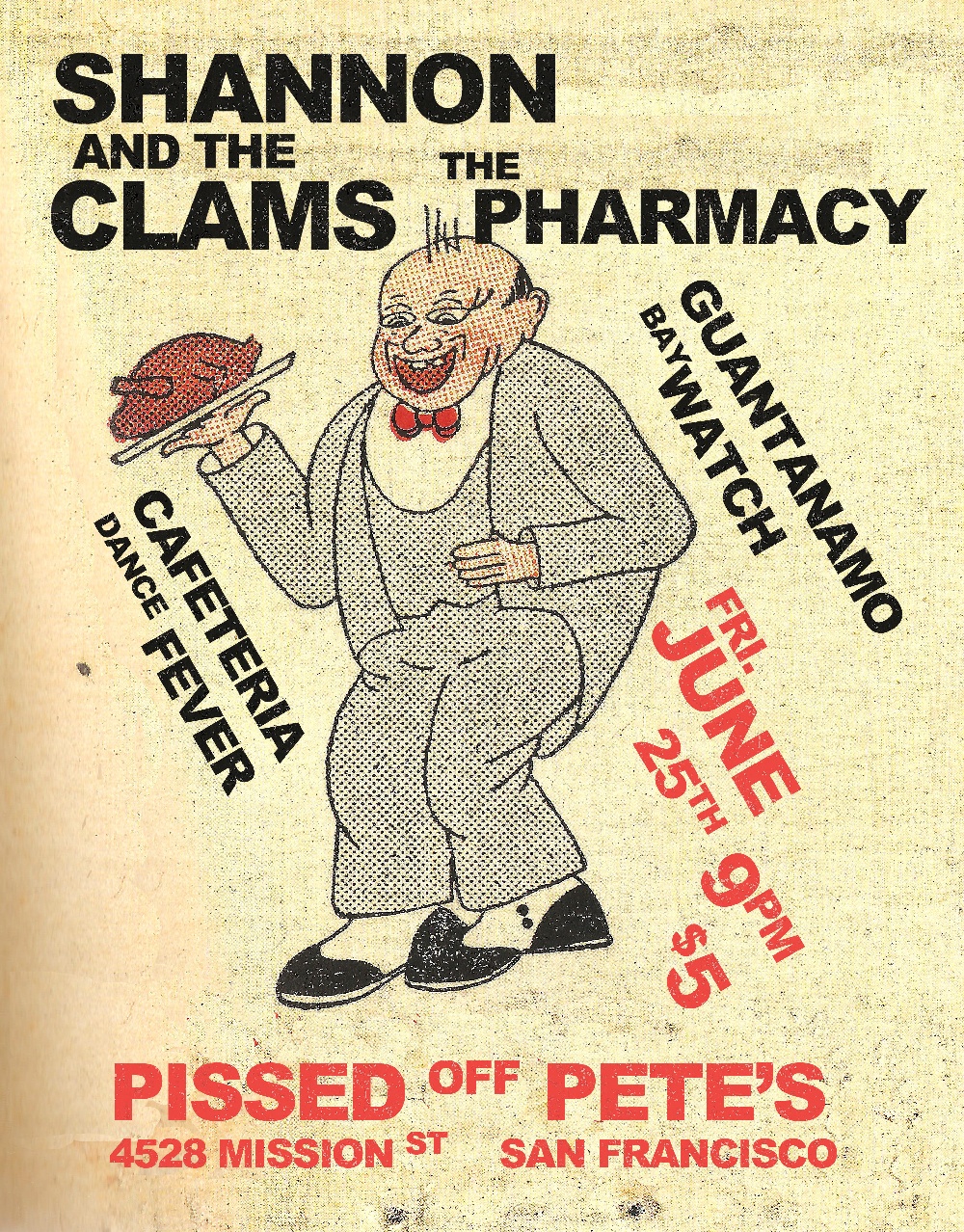
IA We should be recording our new stuff soon, but soon might mean in several months. We are playing with the Pharmacy and Guantanamo Baywatch at Pissed Off Pete’s on 25th. That will be a show worth going to.
CB We’re getting a bunch of material ready for a new album. We have a 7″ of some really old awesome stuff coming out on Southpaw Records, it’s called “Paddy’s Birthday” and it’s so good.
We’re trying to lay off playing so much, we overwork and distract ourselves doing so many shows, although it seems like Oakland loves it when we play two parties a week. We love them!
We’re spending some money on recording equipment. The new stuff has some Buddy Holly-type poppy sparse hop jump fun songs and some dark scary Disney soundtrack haunted forest type stuff, like “Teddy Bear’s Picnic.” Also a lot of ballads like we’ve always done, but they’re vocally weirder, lots of weird doo-wop yelps, Muppet singing and Morricone primal yowling. We’re trying to finally perfect some powerful Everly Brothers/girl group-style harmonies. And we’re experimenting with some super-evil-sounding ’80s punk thrash stuff. I can’t wait to record ’em!


Boom boom boom! SF’s got a horse in the World Cup song race

0

What’s your favorite World Cup song? We’ve covered some smoothies in Gavin Hardkiss’ “Mundo Via Afrika,” and chatted with Eux Autres about their contribution to the games. Salon.com just poured a cooler of haterade all over Shakira’s head for her “Waka Waka,” (probably because they don’t like Fozzie Bear). But there’s tons of delightfully earnest attempts to encapsulate-cash in on the futbol crazy sweeping the globe for the next month. Angelique Kidjo has hit us up with a Curtis Mayfield cover for Africa, and K’Naan… well I love K’naan. His video has a lot of backflips on beaches, which I support. But did you know that SF has a hat-tricking local troubador of our own?

Yes sir, meet Nader DeAik, who had me believing he was a pop star from Bethlehem who was throwing the Bay a bone with a few shows here and there to entertain us with his greatness. But no! He lives here! He is a curly haired, jovial looking man who wants to entertain us with his smiles and Americanized wardrobe (don’t believe me? check out his earlier video shot at the de Young – now that’s an “international” pop star!). He has recorded a song called “Strike!” that you must set aside your criticism, and just revel in. 

Glory in his greatness. San Francisco, you are now represented at the World Cup. I hear Henry Thierry bumps this in the locker room:

Why’d Nader feel compelled to unleash this into our world? “I’m a huge soccer fan, and a player as well,” the soft spoken pop star told me in a recent phone interview. “I wanted to share my excitement and celebration with soccer fans worldwide. I decided to make a song full of energy and spirit.”

So… did tapping into the billions of soccer fans out there (three billion alone took in the opening game this year) up Nader’s bottom line? “It’s a world sport, it’s one of the biggest events in the world. Its great exposure for me. I’ve been getting a lot of great feedback regarding the song.”

“It’s been playing on radio stations in the Middle East, and it’s been playing in clubs here,” says Nader, who added he wasn’t aware of any other Bay composed World Cup songs this year, and that DJs get hyped to play a local joint to whip up soccer spectators into a frenzy.

Fab, Nader. DeAik’s clearly a big believer in the power of the soccer ball to bring people together, so tell us – is it important for the Bay to be represented by a World Cup song (one at least, right?) “Yes absolutly,” he decided. “Soccer is very popular in the Bay area, and I think it’s great not only for the Bay area, but the US as well. The other day I was at a soccer field and I was shooting parts of the music video with the youth. Watching the youth play soccer, sing along to the song. It was just great.”

Nader DeAik

Aug 8, check website for times and prices

The Bethlehem Association 25th Anniversary Convention

Hyatt Regency Santa Clara

5101 Great American Parkway, Santa Clara

(408) 200-1234‎

www.naderdeaik.com

www.bethlehemassoc.org

Before I die, if printing still exists: An interview with Daniel Clowes

0

By Sam Stander

Daniel Clowes has made the leap over the past decade from underground comics hero to a more mainstream identity, with an Oscar nomination for screenwriting, several New Yorker covers, and a comic serialized in the New York Times Magazine under his belt. Despite his raised profile, his newest work, Wilson (Drawn and Quarterly, 80 pages, $15.37), comes closer to home than ever before. The cynical comic strip-based book is largely set in Oakland, of which he is a proud denizen. Clowes recently appeared at Diesel in Oakland, in conversation with McSweeney’s editor Eli Horowitz and the audience. On the setting of the comic, he proclaimed, “I’m pro-Oakland, I’m not sure Wilson is.” He also discussed his forays into film, his debt to Charles M. Schulz and R. Crumb, and the slight controversy over his recent New Yorker cover, among other things.

A lengthy signing followed, where fans presented everything from freshly purchased copies of Wilson to old favorites like David Boring to collector’s items like Lout Rampage for signing. Once the line had dwindled, Clowes sat down for a one-on-one interview.

San Francisco Bay Guardian One of the things I wanted to ask you, if the Oakland observations haven’t been beaten into the ground, was that you also used to live in Berkeley, right? When you were writing Ghost World?
Daniel Clowes Yeah, I was living up by College and Ashby.

SFBG Why are you explicitly writing about Oakland now, and why did you choose to live in Oakland? What do you see as the differences between the different areas?
DC It’s funny, I sort of wound up in Oakland by default. We were living in Berkeley, because my wife was going to Berkeley, and our landlord doubled our rent one month, which I actually didn’t think was legal. And so we said, well, maybe we should try to buy a house. This was years ago. We looked all around Berkeley and it was really expensive, and we found this neighborhood in Oakland that we didn’t even know about, over where we live now, and wound up buying a house there.
You know, I never really thought about Oakland. Even living there for two or three years, I thought, well, we’re near San Francisco and Berkeley. Then I started to walk around and embrace the idea of Oakland. I kind of learned to like Oakland above all its other surrounding cities. I’ve gotten to the point where I almost never go to San Francisco. It’s like, I go to LA more than I go to San Francisco. I just don’t relate to San Francisco at all, and somehow Oakland feels — I grew up in Chicago, and Oakland has this kind of second-tier quality that I find appealing.

SFBG Second-tier?
DC It’s not San Francisco. It’s [its] ugly sister across the Bay, and I prefer that somehow. I was in New York recently, and I was on a block in the Upper East 70s, I think, and I was looking around and I realized every building on the block was a beautiful art deco building built in the ’20s. And I thought, well, Oakland has one building like that. It has the Bellevue-Staten down by Lake Merritt. That’s it. But I’d prefer that, because, to see 20 of them, it has no impact anymore. It’s just, wow, a lot of buildings, and your brain can’t grasp that. But somehow I’m obsessed with this one building in Oakland and I know all about it. I can fixate on that one thing, so I like a city that has one of everything rather than hundreds of the same thing.

SFBG One of the strips in Wilson is him talking about all the bookstores closing down. I was wondering if that was you speaking through him at all, and if so, what bookstore are you saddest to see close down?
DC Well, that was really all about Cody’s. My wife worked at Cody’s, and when I moved here, I sort of agreed to move to Berkeley with my wife because of Cody’s. I thought that [was] something I needed, this world-class bookstore. It was sort of the focal point of my life for many years. I would go there two, three times a week and see what was new, and it just felt like the focus of my world in a way. And when it closed down, it was really hard for me to accept. It was like, you know, you always hear stories of guys who talk about their baseball team leaving town. The guys from Brooklyn are like, “The Dodgers left town in 1958,” or whenever it was. It felt like that to me…Still, when I go to downtown Berkeley and see that empty building, it seems so awful. It seems just like an awful thing that the world couldn’t support that.

SFBG At least it didn’t become a CVS.
DC Exactly.

SFBG [There] was a brief interlude where it was going to be a CVS.
DC Yeah, that’s true. There is that. At least the tomb of Cody’s is still there. And you think, “Well, somebody could just reopen it. Why not? Nobody’s paying rent.”

SFBG Looming over Moe’s.
DC Yeah, I should count my blessings. At least Moe’s is still around, and this place. Better than most cities.

SFBG You were talking about Wilson sort of materializing as a character, [that] you didn’t know who he was at first, but that it was you interacting with him. I was wondering if you’ve ever had experiences with a character who you didn’t have such a productive relationship with, or if you’ve ever had characters who worked against you?
DC Oh, that’s a good question. It’s more that they just run out of — it’s usually a character that I’ve kind of predetermined. Like, I need a character who’s a certain type of person to fit into a story, like, “I need a comic relief character.” Something where you have a role for them, and then they’re never that interesting. I find the best way to do it is to just let the characters come naturally. If they’re forced at all, they tend to [be] artificial. They have to seem like real people. There are characters that I’ve written the hell out of for page after page and they never quite are real people to me. Those are the things that never work, and that I usually have the good sense to throw away before they see print. [Laughs]

SFBG You’ve always had a really strong interest in perversity and human weirdness, and that’s not so central in Wilson. Was that a conscious move away or a permanent move away, or just a change in interests?
DC I think that’s true, you know. I always had a real interest in outsider culture. When I first began doing comics, that kind of thing was so inaccessible. I had a little group of friends who would send me all these weird things. You’d find out about little groups of people who were all linked together by some really odd interest, but they were so segregated. They’d maybe have some little newsletter that they all communicated through, but it felt like the world was filled with these little secret societies. And ever since the Internet has taken hold, it doesn’t feel like that anymore. It feels like the minute anybody hears about any weird little perversion or interest or anything like that, that everybody finds out about it and they know all about it, so it’s sort of lost its interest.
Also, having a child, you sort of reassess what you’re interested in, and you think, would this make me proud for my son to find my collection of books of pictures of freaks, or whatever? You just think, “Ehhh, I’m not sure I want to stand behind that.” Certain [times], you [decide] “I really do think this is cool and I will defend this,” but you weed out a lot of things that were just there because they would get a good reaction out of people.

SFBG Possibly spinning off from that question, but on another angle: You said [during the Q&A] that, specifically, no filmmaker has a strong specific influence on you, but certain films or certain scenes do. Are there any films or scenes you have in mind for Wilson or any of your other works?
DC I feel like Wilson is very non-filmic as far as most of my books go. It’s not about the images at all. A lot of my comics come from ideas that are images, that then turn into stories. Like David Boring and the Velvet Glove thing, and even a little bit of Ghost World. But Wilson was really all about this guy. If it were a movie, it would be more like a Mike Leigh movie or something than a Stanley Kubrick movie. [Laughs]

SFBG And you were saying that to make it into a film would be a strange format for a film.
DC It would be a strange format. I mean, you could certainly rethink it as a story about a guy, and sort of have the same elements, but to replicate the feel of the book would be a very odd thing. That’s the beauty of comics, is you can do all those different styles and they actually resonate off of each other, and even a really amateurish reader, a non-reader of comics, can tell the difference between the styles, whereas in a movie it’d be very hard to do different styles. Only film experts would get that you’re doing, you know, Michael Bay and then Alfred Hitchcock, or whatever.

SFBG Have you seen Natural Born Killers?
DC Yeah, that’s a perfect example.

SFBG Where it’s kind of off-putting at the end of the movie.
DC Right, it’s just a little irritating. Although I think that was the idea, I suppose. I haven’t seen that movie in a long time, I bet it’s really irritating now.

SFBG I’ve never seen all of it, actually. I’ve had friends show me parts.
DC I barely could tolerate it in theaters.

SFBG Woody Harrelson and Juliette Lewis are —
DC Yeah, she’s great. I like him, too.

SFBG In the right role.
DC Yeah, yeah.

SFBG Somebody was asking you about drawing eyes and mouths and conceiving of how people look in each panel, and you were saying that you do [stick-figure] sketches beforehand. How much do you script or plan out or storyboard versus just drawing a comic?
DC It depends on, not even the story, but just on my mood before I start. I usually try to do each story somewhat consistently, but I’m always trying to come up with a new way to do things. Not to be different or to give myself a challenge, but [because] I’m looking for a better way to work. And I always have this carrot dangling in front of me that there’s some other way, that if I could only find that way, it’ll make everything easy. And then it never does, and it always comes out exactly the same, no matter if I script the thing carefully or if I make it up off the top of my head. I could show those comics to a hundred people, and they would have no idea what was the planned-out one and what was the one I just made up. It all turns out the same. And I think that’s true of most artists. You can’t really tell what they’re going through, it’s just their work is always them, you know.

SFBG Do you always get a stack of other people’s works [at signings]?
DC [Holding a thick stack of various printed matter presented by fans] This was a good stack, I’d have to say. Often it’s much more, like, Xeroxed stuff. This actually looks like some pretty decent stuff that people have actually printed up. But yeah, usually you get a big pile of stuff, although not as much anymore, because a lot of people don’t print anything. So now I get business cards, like, “Check out my webcomic.” I have to go type it in at home.

SFBG You have the thing in the little author’s bio in Wilson about [how] you have danielclowes.com reserved.
DC That’s right.

SFBG Do you have any ideas for using that, or anything you want to use it for?
DC Well, my publisher actually said, “Now you have to put something on there, since you said that in the book.” So they just put an ad for Wilson that links right back to their website. I don’t want to get into doing, like, a blog or responding to people, ’cause my life is already so taken up by just responding to e-mails from my friends that I can’t imagine introducing a whole ’nother element of that. But it would be good to make announcements, and just to clarify things. I feel like the average reader doesn’t understand that I used to do a comic called Eightball and the stories were serialized — I figure if there’s some way [to] really concisely explain my career, then I won’t have to explain it to everybody over and over. [Laughs]

SFBG Are the original sequences of Eightball ever going to be made available again, and things that aren’t collected?
DC One of these days we’re going to do the complete Eightball, and do like a hardcover thing, but that’s nine projects down the road or something. But before I die, if printing still exists.

SFBG As far as film projects, is there anything on the horizon or anything you’re excited about working on?
DC With Ghost World, I learned, don’t tell anybody about your film projects until they have a release date. I used to tell people, “Oh, they’re going to make a Ghost World movie,” and then five years later, they finally actually made it. I felt like such a chump. But I wrote a screenplay for this thing that Michel Gondry came up with, this crazy dystopian sci-fi epic. I wrote a script based on his ideas. His son is going to do the drawings for it. I’m not animating it, but I think he wants to do that as his next film, so that should be fun, if that actually happens.

SFBG Have you ever done any animation?
DC I did a video for the Ramones in 1995, and that was it.

SFBG Would you ever do it again?
DC Yeah, I’d like to, I’d like to. I need to sort of come up with an idea that’s only appropriate for animation, and then actually try to get somebody interested in producing it. So there’s lots of hurdles there. [Laughs] But yeah, I’d love to. I feel like I should do that one of these days.


Film listings

0

Film listings are edited by Cheryl Eddy. Reviewers are Kimberly Chun, Michelle Devereaux, Max Goldberg, Dennis Harvey, Johnny Ray Huston, Erik Morse, Louis Peitzman, Lynn Rapoport, Ben Richardson, and Matt Sussman. For rep house showtimes, see Rep Clock. For first-run showtimes, see Movie Guide.

FRAMELINE34

The 34th San Francisco International LGBT Film Festival runs June 17-27 at the Castro, 429 Castro, SF; Roxie, 3117 16th St, SF; Victoria, 2961 16th St, SF; and Rialto Cinemas Elmwood, 2966 College, Berk. Tickets (most shows $8-15) can be purchased at www.frameline.org. All times pm unless otherwise noted.

THURS/17

Castro The Secret Diaries of Miss Anne Lister 7. Off World 10.

FRI/18

Castro The Real Anne Lister noon. "Curious Thing" (shorts program) 1:45. Sasha 4:30. The Owls 7. Grown Up Movie Star 9:30.

Roxie "Hustlers and Exhibitionists: Andy Warhol Retrospective" 7. "Bi Request" (shorts program) 9:30.

Victoria 8: The Mormon Proposition 7. Open 9:30.

SAT/19

Castro "Fun in Boys’ Shorts" (shorts program) 11am. "Fun in Girls’ Shorts" (shorts program) 1:30. Elvis and Madona 4. I Killed My Mother 6:45. A Marine Story 9:30.

Roxie Mississippi Queen 11am. On These Shoulders We Stand 1:30. Postcard to Daddy 4. Hooters 6:30. "Sex, Leather Jackets, and Hustlers: Andy Warhol Retrospective" 9:30.

Victoria "Trans Francisco" (shorts program) 11am. The Adonis Factor 2. "Gay Aesthetics and Iconography in the Films of Andy Warhol" (illustrated talk) 4:15. Arias With a Twist 6:30. The Man Who Loved Yngve 9:30.

SUN/20

Castro "Dottie’s Magic Pockets Live!" 11am. We Were Here: Voices From the AIDS Years in San Francisco 1. The Topp Twins: Untouchable Girls 3:45. The Four Faced Liar 6:30. The Consul of Sodom 9:30.

Roxie Mountains That Take Wing 11am. "Skinnyfat" (shorts program) 1:45. "Generations: Youth and Elders Making Movies" (shorts program) 4:15. Bear Nation 6:45. Out of the Blue 9:30.

Victoria Beyond Gay: The Politics of Pride 11am. Paulista 1:30. "F**king Traditional Values: Queer Women of Color Shorts" (shorts program) 4:15. William S. Burroughs: The Man Within 7. The Queer X Show 9:30.

MON/21

Castro Dzi Croquettes 11am. Swimming with Lesbians 2. Off World 4. The Last Summer of La Boyita 7. Brotherhood 9:30.

Roxie New York Memories 7. "Are You Krazy?" (shorts program) 9:30.

Victoria Riot Acts: Flaunting Gender Deviance in Music Performance 7. My Normal 9:30.

Elmwood The Sea Purple 7. Plan B 9:30.

TUES/22

Castro The Motionless 11am. Sex in an Epidemic 1:15. Is It Just Me? 3:45. Undertow 7. Baby Jane? 9:45.

Roxie Gayby 7. One Night 9:30.

Victoria The Sisters 7. Eyes Wide Open 9:30.

Elmwood William S. Burroughs: The Man Within 7. The Fish Child 9:30.

OPENING

Bluebeard Writer-director Catherine Breillat returns to her 2001 Fat Girl‘s motifs of troubled sisterhood and the adolescent female imagination in this stealthy adaptation of Charles Perrault’s pathological fairy tale. Bluebeard‘s parable of murder coiled around marriage resonates rather obviously with Breillat’s own signature themes, but she avoids obviousness by serving the punishing logic of Perrault’s story chilled. That Breillat is concerned with how the fairy tale is experienced, and specifically the adolescent desires it awakens, is clear from the frame narrative in which two sisters (named autobiographically) ritualistically read "Bluebeard," both of them knowing it (and each other’s reactions) by heart. Their dualities mirror those of the sisters trapped inside the story, the younger of whom, prone to romantic fantasies of castles and marooned by her father’s death, joins Bluebeard in unholy matrimony. Marie-Catherine (Lola Créton) may be a sprite next to the titular ogre (Dominique Thomas), but never underestimate the appetite of a younger sibling. Breillat’s visual style is unassuming in its tableaus, but her mastery of point-of-view and restricted narration brings great insight to the mechanisms of the fairy tale. Créton conjures the younger girl’s familiar mix of confidence and innocence with something like joy, while Thomas plays Bluebeard as a tender foil. He appears nearly forlorn when he uncovers his young wife’s fateful act of disobedience and realizes he will now and forever carry out the terrible deed we expect of him. A sharp turn provides a different moral than we might expect, and while it’s not so self-consciously shocking an ending as Fat Girl‘s, it inscribes the birth of a storyteller named Catherine with far greater piquancy.(1:20) Yerba Buena Center for the Arts. (Goldberg)

*Coco Chanel and Igor Stravinsky Revered for the innovative fashion house that set the bar for style and was always knocked off but never cut prices for the real deal (and still sniffs at online clothing sales), Gabrielle "Coco" Chanel gets her second biopic, as an artist on par with composer Igor Stravinsky in this rhapsodically sensuous love letter to an unlikely romance. It opens with the designer and future branding legend (depicted with burning eyes and pantherine mystery by Anna Mouglalis) attending the controversial, riot-starting 1913 premiere of Stravinsky’s The Rite of Spring in Paris. Recognizing Stravinsky (a viral avant-garde stud-muffin in the hands of Mads Mikkelsen, last in deadlocks and warrior face in Clash of the Titans) as a simpatico radical spirit, Chanel lends her house to the composer. He comes with considerable baggage: a slew of children and a consumptive wife, Katarina (Elena Morozova). Morozova’s performance as the angel-faced earth mother scorned, so blatantly disrespected by the rad lovers madly getting down on the music-room carpet, almost steals the show, but then the house-porn fabulosity of the recreated Chanel villa in Garches — a symbol of their hermetic attraction and shot like a seductive, claustrophobic, black-and-white deco womb — takes over, and we’re back in the thick of CoGor’s somewhat inexplicable affair once again. (1:55) Shattuck. (Chun)

Gravity Was Everywhere Back Then Before it was torn down by a new landowner, multimedia artist Brent Green went to visit the house built by late Kentucky hardware store clerk Leonard Wood — a poor man’s Winchester Mystery House, endlessly elaborated with newly knocked-down walls and weird handmade detailing. This obsessive one-man construction effort was commenced as a hopeful "healing machine" for its other resident, his beloved wife Mary, and continued after her death from cancer. Green built his own backyard replica of the house for this experimental first feature, a sort of live-action stop motion movie whose characters like move like puppets in stuttering frame jumps, with animation, dubbed occasional dialogue, crude intertitles, and some gently fantastical imagery adding to its dreamlike aura. Mary (played by Donna K.) makes a curious living breeding and selling wild bird eggs; Leonard (Michael McGinley), among his other callings, composes and records droning minimalist "church music." They met, purportedly, in a car crash. Green’s strangle-voiced blank verse narration and filmic folk-art affectations can sometimes make Gravity just sit there — certainly it feels longer than its 75 minutes. But it also has an off-center lyricism that in the end serves honorably this story of profound love between two very odd people. The director (who currently has an installation across the street at the Berkeley Art Museum) will appear at this one-night Pacific Film Archive screening. (1:20) Pacific Film Archive. (Harvey)

Jonah Hex Josh Brolin and Megan Fox star in this Wild West-set graphic novel adaptation. (1:81) Elmwood.

Lovers of Hate Living out of his car after being dumped by Diana (Heather Kafka), perpetually dour Rudy (Chris Doubek) can hardly find a place to take a shower. In stark contrast to his desperate situation, Rudy’s brother Paul (Alex Karpovsky) is a successful children’s fantasy writer, holed up in a borrowed mansion in Utah to work on his next book. Rudy decides to pay his bro an unwelcome surprise visit, but he arrives just behind Diana, who has come to have a serious chat (and also some sex) with Paul. Still in love with Diana, Rudy skulks unnoticed through the tremendous house, playing vengeful voyeur to the new couple’s already rather weird relationship. Lovers of Hate‘s central trinity are not especially nice people, but neither are any of them evil; writer-director Bryan Poyser balances pity and disgust at their painfully human actions, without necessarily making a case for why we care. (1:33) Roxie. (Sam Stander)

*The Oath Laura Poitras’ disturbing documentary is a portrait of two men closely bound to al Qaeda, though only one is interviewed. That would be Abu Jandal, a husband, father, current Yemen taxi driver, erstwhile jihadist operating from Bosnia to Afghanistan, and former chief bodyguard to Osama bin Laden. The off-camera one is his brother-in-law Salim Hamdan, a Guantanamo Bay prisoner from late 2001 whom he’d recruited as bin Laden’s driver-mechanic. Was Salim merely a for-hire worker with no knowledge of the 9/11 conspiracy or other terrorist actions? Was his lengthy imprisonment an example of the War on Terror’s flaunting of legal conventions? (After Hamdan won a Supreme Court victory, Congress invented a whole new kind of charge — "material support to terrorism" — to keep him in custody.) These are questions more pondered than answered here. We do, however, get a big close-up dose of Jandal, who laments the harm he might have done his bro-in-law while still counseling young Muslim Yemenites and his own barely-past-toddler son in jihadist righteousness, not excluding justification of killing Western civilians. He comes off as dangerous and charming, a hustler and braggart. Offering further insight into what makes up (or sculpts) a terrorist mindset is a pre-9/11 clip of an elegant, prissy bin Laden — a salt pillar of airless judgment
sure he’s channeling the intentions of Allah. (1:36) Lumiere, Shattuck. (Harvey)

The Sun Behind the Clouds In this doc, the Dalai Lama comments on the 2008 Tibetan demonstrations against Chinese rule. (1:19) Opera Plaza, Shattuck.

Toy Story 3 Somehow, it’s terrifying that in this installment, the toy-owning kid is heading off to college. (1:49) Cerrito, Marina.

*Winter’s Bone See "True Grit." (1:40) California, Embarcadero.

ONGOING

The A-Team Why was the original A-Team the most popular band of mercenaries on TV? The estimable chemistry and comedic skills of Mr. T; legit Breakfast at Tiffany‘s star George Peppard; conservative commentator Dwight Schultz; and Dirk Benedict, fresh from his role as the original Starbuck on Battlestar Galactica, played a major part, as did the quasi-anti-authoritarian, boyish, blow-’em-up-real-good tone, making it more of a cartoonishly violent kin to MASH than First Blood (1982). The cheeky humor and snappy writing were the real key to The A-Team‘s popularity — the reason impressionable protein units like yours truly tuned in. Director Joe Carnahan (2006’s Smokin’ Aces) and cast seem to have sussed out a bit of that magic, especially when the sun-roasted Bradley Cooper as Faceman and Sharlto Copley as Murdock roll with the what-the-hell non-sequiturs (less sure is the star of last year’s District 9‘s grip on exactly what accent he’s been charged with). But the cinematic version won’t be rehabbing the public’s view of guns-for-hire like Blackwater anytime soon. Liam Neeson lacks the cigar-chomping paternal bravado of Peppard, Quinton "Rampage" Jackson is tasked with the unenviable job of following T time, and the script, complete with the ludicrously elaborate plans and a spark-challenged romance between Cooper and Jessica Biel, is just a rough excuse to watch boys and their toys. (1:57) Cerrito, 1000 Van Ness, Presidio, SF Center. (Chun)

*Babies Thomas Balmes’ camera records the first year in the lives of four infants in vastly different circumstances. They’re respectively born to hip young couple in Tokyo’s high-tech clutter; familiar moderately alterna-types (the father is director Frazer Bradshaw of last year’s excellent indie drama Everything Strange and New) in SF’s Mission District; a yurt-dwelling family isolated in the vast Mongolian tundra; and a Namibian village so maternally focused that adult menfolk seem to have been banished. Yes, on one level this is the cutest li’l documentary you ever saw. But if you were planning to avoid thinking that is all (or most) of what Babies would be like, you will miss out big time. Void of explanatory titles, voice-over narration, or subtitle translations, this is a purely observatory piece that reveals just how fascinating the business of being a baby is. There’s very little predictable pooping, wailing, or coddling. Instead, Balmes’ wonderful eye captures absorbing moments of sussing things out, decision-making, and skill learning. While the First World tykes firstborns both — are hauled off to (way) pre-school classes, the much less day planned Third Worlders have more complex, unmediated dealings with community. Those range from fending off devilish older siblings to Mongol Bayarjargal’s startlingly casual consorting with large furry livestock. (Imagine the horror of parents you know were their baby found surrounded by massive cows — a situation that here causes no concern whatsoever for adults, children, or bovines.) So accustomed to the camera that it doesn’t influence their behavior, the subjects here are viewed with an intimacy that continually surprises. Babies is getting a wider-than-usual release for a documentary, one cannily timed to coincide with Mother’s Day. But don’t be fooled: this movie is actually very cool. (1:19) Presidio, Shattuck, Smith Rafael, Sundance Kabuki. (Harvey)

*City Island The Rizzo family of City Island, N.Y. — a tiny atoll associated historically with fishing and jurisdictionally with the Bronx — have reached a state where their primary interactions consist of sniping, yelling, and storming out of rooms. These storm clouds operate as cover for the secrets they’re all busy keeping from one another. Correctional officer Vince (Andy Garcia) pretends he’s got frequent poker nights so he can skulk off to his true shameful indulgence: a Manhattan acting class. Perpetually fuming spouse Joyce (Julianna Margulies) assumes he’s having an affair. Daughter Vivian (Dominik García-Lorido) has dropped out of school to work at a strip joint, while the world class-sarcasms of teenager Vinnie (Ezra Miller) deflect attention from his own hidden life as an aspiring chubby chaser. All this (plus everyone’s sneaky cigarette habit) is nothing, however, compared to Vince’s really big secret: he conceived and abandoned a "love child" before marrying, and said guilty issue has just turned up as a 24-year-old car thief on his cell block. Writer-director Raymond De Felitta made a couple other features in the last 15 years, none widely seen; if this latest is typical, we need more of him, more often. Perfectly cast, City Island is farcical without being cartoonish, howl-inducing without lowering your brain-cell count. It’s arguably a better, less self-conscious slice of dysfunctional family absurdism than Little Miss Sunshine (2006) — complete with an Alan Arkin more inspired in his one big scene here than in all of that film’s Oscar-winning performance. (1:40) Shattuck. (Harvey)

*Exit Through the Gift Shop Exit Through the Gift Shop is not a film about the elusive graffiti-cum-conceptual artist and merry prankster known as Banksy, even though he takes up a good chunk of this sly and by-no-means impartial documentary and is listed as its director. Rather, as he informs us — voice electronically altered, face hidden in shadow — in the film’s opening minutes, the film’s real subject is one Thierry Guetta, a French expat living in LA whose hangdog eyes, squat stature, and propensity for mutton chops and polyester could pass him off as Ron Jeremy’s long lost twin. Unlike Jeremy, Guetta is not blessed with any prodigious natural talent to propel him to stardom, save for a compulsion to videotape every waking minute of his life (roughly 80 percent of the footage in Exit is Guetta’s) and a knack for being in the right place at the right time. When Guetta is introduced by his tagger cousin to a pre-Obamatized Shepard Fairey in 2007, he realizes his true calling: to make a documentary about the street art scene that was then only starting to get mainstream attention. Enter Banksy, who, at first, is Guetta’s ultimate quarry. Eventually, the two become chummy, with Guetta acting as lookout and documenter for the artist just as the art market starts clambering for its piece of, "the Scarlet Pimpernel of street art," as one headline dubs him. When, at about three quarters of the way in, Guetta, following Banksy’s casual suggestion, drops his camcorder and tries his hand at making street art, Exit becomes a very different beast. Guetta’s flashy debut as Mr. Brainwash is as obscenely successful as his "art" is terribly unimaginative — much to the chagrin of his former documentary subjects. But Guetta is no Eve Harrington and Banksy, who has the last laugh here, gives him plenty of rope with which to truss himself. Is Mr. Brainwash really the ridiculous and inevitable terminus of street art’s runaway mainstream success (which, it must be said, Banksy has handsomely profited from)? That question begs another: with friends like Banksy, who needs enemies? (1:27) Lumiere, Shattuck, Sundance Kabuki. (Sussman)

*The Father of My Children Grégoire Canvel (Louis-Do de Lencquesaing) is a perpetual motion machine: a Paris-based veteran film producer of complicated multinational whose every waking moment is spent pleading, finessing, reassuring, and generally putting out fires of the artistic, logistic, or financial kind. But lately the strain has begun to surpass even his Herculean coping abilities. Debtors are closing in; funding might collapse for a brilliant but uncommercial director’s already half-finished latest. After surviving any number of prior crises, Gregoire’s whole production company might finally dissolve into a puddle of red ink and lawsuits. He barely has time to enjoy his perfect family, with Italian wife Sylvia (Chiara Caselli) and three young daughters happily ensconced in a charming country house. Something’s got to give — and when it does, writer-director Mia Hansen-Love’s drama (very loosely based on the life of a late European film producer) drastically shifts its focus midway. Her film’s first half is so arresting — with its whirlwind glimpse at a job so few of us know much about, yet which couldn’t be more important in keeping cinema afloat — that the second half inevitably seems less interesting by comparison. Still, for about 55 minutes The Father of My Children offers something you haven’t quite seen before, an experience well worthwhile even if the subsequent 55 are less memorable. (1:50) Opera Plaza. (Harvey)

*The Full Picture The unusually high proportion of non-native San Franciscans not only underlines our living in a "destination" city, but also suggests that many of us were eager to leave something behind. Certainly it’s no accident The Full Picture’s fraternal protagonists both chose to live here. Yes, it’s a lovely place. It also happens to be 3,000 insulating miles from where they were raised, and where the dragon still dwells. Unfortunately, she can fly: sensible heels clacking militaristically across airport tarmac first clue us to the personality of monster-mother Gretchen Foster (Bettina Devin), who sweetly announces she’s off to visit "my boys" in SF, then breathes fire when that charm fails to secure a first class upgrade. Clearly it’s going to be a bumpy ride. Jon Bowden’s first feature is based on his original play, and this screen incarnation doesn’t entirely leave the whiff of stagecraft behind. It’s smart, fluid, funny, and biting, as well as a nice addition to the roster of movies that really do convey something about living here. (1:20) Roxie. (Harvey)

Get Him to the Greek At this point movie execs can throw producer Judd Apatow’s name on the marquee of a film and it’s a guaranteed blockbuster. It’s hard to say whether this Forgetting Sarah Marshall (2008) spin-off benefits from the Apatow sign of approval or if it would be better off standing on its own, but it definitely doesn’t benefit from comparisons to its predecessor. Russell Brand returns as the British rock star Aldous Snow, and Jonah Hill, playing a different character this time, is given the task of chaperoning the uncooperative Snow from London to LA in 48 hours. Despite a great cast, including a surprisingly animated P. Diddy, the story is pretty bland and can’t match the blend of drama and comedy that Marshall achieved. Of course, none of that matters because the movie execs are right: if you like Apatow’s brand of humor, you’re going to have a good time anyway. (1:49) Empire, Four Star, 1000 Van Ness, Presidio, SF Center, Shattuck, Sundance Kabuki. (Peter Galvin)

*The Girl With the Dragon Tattoo By the time the first of Stieg Larsson’s so-called "Millennium" books had been published anywhere, the series already had an unhappy ending: he died (in 2004). The following year, The Girl With the Dragon Tattoo became a Swedish, then eventually international sensation, its sequels following suit. The books are addicting, to say the least; despite their essential crime-mystery-thriller nature, they don’t require putting your ear for writing of some literary value on sleep mode. Now the first of three adaptive features shot back-to-back has reached U.S. screens. (Sorry to say, yes, a Hollywood remake is already in the works — but let’s hope that’s years away.) Even at two-and-a-half hours, this Girl With the Dragon Tattoo by necessity must do some major truncating to pack in the essentials of a very long, very plotty novel. Still, all but the nitpickingest fans will be fairly satisfied, while virgins will have the benefit of not knowing what’s going to happen and getting scared accordingly. Soon facing jail after losing a libel suit brought against him by a shady corporate tycoon, leftie journalist Mikael Blomkvist (Michael Nyqvist) gets a curious private offer to probe the disappearance 40 years earlier of a teenage girl. This entangles him with an eccentric wealthy family and their many closet skeletons (including Nazi sympathies) — as well as dragon-tattooed Lisbeth Salander (Noomi Rapace), androgynous loner, 24-year-old court ward, investigative researcher, and skillful hacker. Director Niels Arden Oplev and his scenarists do a workmanlike job — one more organizational than interpretive, a faithful transcription without much style or personality all its own. Nonetheless, Larsson’s narrative engine kicks in early and hauls you right along to the depot. (2:32) Clay, Piedmont, Shattuck, Smith Rafael. (Harvey)

Harry Brown Shades of Dirty Harry (1971) for the tea cozy and tweed set: elegantly rendered and very nicely played, Harry Brown might be the dark, late-in-the-day elder brother to 1971’s Get Carter, in the hands of eponymous lead Michael Caine. He’s a pensioner mourning the passing of his beloved wife, his mysterious life as a Marine stationed in Northern Ireland firmly behind him. Then his chess-playing pal Leonard (David Bradley) is terrorized and killed by the unsavory gang of heroin dealing hoodlums who lurk near their projects in a tunnel walkway like gun-toting, foul-mouthed, sociopathic trolls. Harry Brown is, er, forced to forsake a vow of peace and go commando on the culprits’ asses, triggering some moments of ultraviolence that are unsettling in their whole-hearted embrace of vigilante justice. Like predecessors similarly fixated on vengeance in their respective urban hells, a la Hardcore (1979) and Taxi Driver (1976) (Harry Brown echoes key moments in the latter, in particular — see, for instance, its keenly tense, eerily humorous gun shopping scene), Harry Brown is essentially an arch-conservative film, if good looking and even likable with Caine meting out the punishment. The overall denouement just might make some seniors feel very, very good about the coiled potential for hurt embedded in their aging frames. (1:42) Four Star. (Chun)

Holy Rollers Holy Rollers isn’t a movie — it’s a headline stretched out to 90 minutes. Yes, the set-up is worthy of adaptation: Hassidic Jewish kid begins importing ecstasy from Amsterdam. And it’s based on a true story! But the film is far too matter-of-fact, never delving into the important questions that might elevate it past a glorified reenactment. That’s not to say the performances aren’t good. Jesse Eisenberg continues to prove he can do well in leading roles, while supporting actors Justin Bartha and Ari Graynor are both charming, in their own ways. The problem is the material. What is Holy Rollers saying about the war on drugs, or organized religion, or the desire to live above one’s means? Nothing, really. The tone is equally problematic, as it repeatedly fails to find the right blend of comedy and drama. The movie’s major selling point is that it will make you want to visit Amsterdam — you know, if you didn’t already. (1:29) Lumiere, Shattuck. (Peitzman)

*Iron Man 2 Tony Stark (Robert Downey Jr.) returns, just as rich and self-involved as before, though his ego his inflated to unimaginable heights due to his superheroic fame. Pretty much, he’s put the whole "with great power comes great responsibility" thing on the back burner, exasperating everyone from Girl Friday Pepper Potts (Gwyneth Paltrow); to BFF military man Rhodey (Don Cheadle, replacing the first installment’s Terrence Howard); to certain mysterious Marvels played by Samuel L. Jackson and Scarlett Johansson; to a doofus-y rival defense contractor (Sam Rockwell); to a sanctimonius Senator (Garry Shandling). Frankly, the fact that a vengeful Russian scientist (Mickey Rourke) is plotting Tony’s imminent death is a secondary threat here — for much of the film, Tony’s biggest enemy is himself. Fortunately, this is conveyed with enjoyable action (props to director Jon Favreau, who also has a small role), a witty script (actor Justin Theroux — who knew? He also co-wrote 2008’s Tropic Thunder, by the way), and gusto-going performances by everyone, from Downey on down. Stay for the whole credits or miss out on the geek-gasm. (2:05) California, 1000 Van Ness, Sundance Kabuki. (Eddy)

*Joan Rivers: A Piece of Work Whether you’re a fan of its subject or not, Ricki Stern and Annie Sundberg’s documentary is an absorbing look at the business of entertainment, a demanding treadmill that fame doesn’t really make any easier. At 75, comedian Rivers has four decades in the spotlight behind her. Yet despite a high Q rating she finds it difficult to get the top-ranked gigs, no matter that as a workaholic who’ll take anything she could scarcely be more available. Funny onstage (and a lot ruder than on TV), she’s very, very focused off-, dismissive of being called a "trailblazer" when she’s still actively competing with those whose women comics trail she blazed for today’s hot TV guest spot or whatever. Anyone seeking a thorough career overview will have to look elsewhere; this vérité year-in-the-life portrait is, like the lady herself, entertainingly and quite fiercely focused on the here-and-now. (1:24) Bridge, Embarcadero. (Harvey)

The Karate Kid The most baffling thing about The Karate Kid is its title: little Dre Parker (Jaden Smith) never actually learns karate. He practices kung-fu, an entirely different form of martial arts — you know, from a different country. There’s something obnoxious and absurd about the misnomer: the film seems to suggest that if you’ve seen one Asian culture, you’ve seen them all. That aside, it’s not a bad movie. Smith is mostly pretty likeable, and there’s a definite satisfaction to seeing him grow from bullied weakling to kung-fu star. And Jackie Chan gets to exercise his dramatic chops — he even gets a crying scene! But Karate Kid is a "reboot," the preferred term for the endless stream of unnecessary remakes Hollywood keeps churning out. You can’t help but think about the superior 1984 version. Jaden Smith is no Ralph Macchio, Jackie Chan is no Pat Morita, and kung-fu is no karate. Don’t even get me started on the "jacket on, jacket off" crap. Which, if you say it quickly, sounds a little adult for a PG movie. (2:20) SF Center, Sundance Kabuki. (Peitzman)

Killers (1:40) 1000 Van Ness.

Letters to Juliet If you can stomach the inevitable Barbara Cartland/Harlequin-romance-style clichés — and believe that Amanda Seyfried as a New Yorker fact-checker — then Letters to Juliet might be the ideal Tuscan-sunlit valentine for you. Seyfried’s Sophie is on a pre-honeymoon trip to Verona with her preoccupied chef-restaurateur intended, Victor (Gael Garcia Bernal), who’s more interested in sampling cheese and purchasing vino than taking in the romantic attractions of Verona with his fiancée. Luckily she finds the perfect diversion for a wannabe scribe: a small clutch of diehard romantics enlisted by the city of Verona to answer the letters to Juliet posted by lovelorn ladies. They’re Juliet’s secretaries — never mind that Juliet never managed to maintain a successful or long-term relationship herself. When Sophie finds a lost, unanswered letter from the ’50s, she sets off sequence of unlikely events, as the letter’s English writer, Claire (Vanessa Redgrave), returns to Verona with her grandson Charlie (Christopher Egan), in search of her missed-connection, Lorenzo. Alas, Lorenzo’s long gone, and the fact-checker decides to help the warm-hearted, hopeful Claire find her lost lover. Unfortunately Sophie’s chemistry with both her matches isn’t as powerful as Redgrave’s with real-life husband Franco Nero — after all he was Lancelot to her Guenevere in 1967’s Camelot and the father of her son. Still, Redgrave’s power as an actress — and her relationship with Nero — adds a resonance that takes this otherwise by-the-numbers romance to another level. (1:46) SF Center. (Chun)

*Looking for Eric Eric Bishop (Steve Everts) is a single dad, frustrated at his inability to bond with his teenage sons and heartbroken over his failed marriage to Lily (Stephanie Bishop), the woman he walked out on 20 years ago but never managed to get over. Just when things are looking dire, Eric is delivered in surprising, magical fashion by hallucinatory visitations from Eric Cantona, his favorite soccer player, a philosophical Frenchman who was as renowned for his inscrutable press conferences as he was for his scintillating goals. Cantona plays himself, and passes pensive joints with Bishop as they slowly piece his shattered life back together. American viewers might be have trouble deciphering the intricacies of soccer culture or the molasses-thick Mancunian accents, but at its heart the movie (by Brit director Ken Loach) is an amusing, tautly crafted fable of middle-aged alienation giving way to hope and gumption. (1:57) Smith Rafael. (Richardson)

Marmaduke (1:27) 1000 Van Ness.

Micmacs An urge to baby-talk at the screen underlines what is wrong with Jean-Pierre Jeunet’s new film: it is like a precocious child all too aware how to work a room, reprising adorable past behaviors with pushy determination and no remaining spontaneity whatsoever. There will be cooing. There will be clucking. But there will also a few viewers rolling their eyes, thinking "This kid rides my last nerve." It’s easy to understand why Jeunet’s movies (including 2001’s Amélie) are so beloved, doubtless by many previously allergic to subtitles. (Of course, few filmmakers need dialogue less.) They are eye-candy, and brain-candy too: fantastical, hyper, exotic, appealing to the child within but with dark streaks, byzantine of plot yet requiring no close narrative attention at all. The artistry and craftsmanship are unmissable, no ingenious design or whimsical detail left unemphasized. In Micmacs, hero Bazil (Dany Boon) is a lovable misfit who lost his father to an Algerian landmine, then loses his own job and home when he’s brain-injured by a stray bullet. He falls in with a crazy coterie of lovable misfits who live underground, make wacky contraptions from junk, and each have their own special, not-quite-super "power." They help him wreak elaborate, fanciful revenge on the greedy arms manufacturers (André Dussollier, Nicolas Marié) behind his misfortunes, as well as various human rights-y global ones. So there’s a message here, couched in fun. But the effect is rather like a birthday clown begging funds for Darfur — or Robert Benigni’s dreaded Life is Beautiful (1997), good intentions coming off a bit hubristic, even distasteful. (1:44) Embarcadero, Shattuck, Smith Rafael. (Harvey)

La Mission A veteran S.F. vato turned responsible — if still muy macho — widower, father, and Muni driver, fortysomething Che (Benjamin Bratt) isn’t the type for mushy displays of sentiment. But it’s clear his pride and joy is son Jess (Jeremy Ray Valdez), a straight-A high school grad bound for UCLA. That filial bond, however, sustains some serious damage when Che discovers Jes has a secret life — with a boyfriend, in the Castro, just a few blocks away from their Mission walkup but might as well be light-years away as far as old-school dad is concerned. This Bratt family project (Benjamin’s brother Peter writes-directs, his wife Talisa Soto Bratt has a supporting role) has a bit of a predictable TV-movie feel, but its warm heart is very much in the right place. (1:57) Four Star, Opera Plaza. (Harvey)

*Ondine You want to believe in mermaids, leprechauns, tooth fairies, and Father Christmas — and director Neil Jordan plays with those hopes, and fears, in this unabashedly romantic fable set in a Irish fishing village. Mullet-ed fisherman Syracuse (Colin Farrell), dubbed "Circus," thanks to his days as a drinking fool, is the butt of everyone’s jokes till he happens to catch a mysterious girl (Alicja Bachleda) in his net. She calls herself Ondine, shies away from people, and sings in an unknown tongue to the sea, drawing salmon, lobster, and fortune to the fisherman otherwise down on his luck. His precocious daughter, Annie (Alison Barry), is in need of a kidney transplant — and a measure of hope — and she grows convinced that her father’s hidden-away water baby is a selkie, a mythical Celtic sea creature that can shed its seal skin, bond with humans, and make wishes come true. Unfortunately believing in magic doesn’t always make it so, though Ondine gracefully limns that space between belief and reality, squeezing small moments of pleasure and humor from its rough, albeit attractive, characters and absolutely stunning landscapes in scenes beautifully lensed by onetime Wong Kar Wai cinematographer Christopher Doyle. (1:43) Albany, Piedmont, Opera Plaza. (Chun)

*Please Give Manhattan couple Kate (Catherine Keener) and Alex (Oliver Platt) are the proprietors of an up-market vintage furniture store — they troll the apartments of the recently deceased, redistributing the contents at an astonishing markup — and they’ve purchased the entire apartment of their elderly next-door neighbor (Ann Guilbert). As they wait for her to expire so they can knock down a wall, they try not to loom in anticipation in front of her granddaughters, the softly melancholic Rebecca (Rebecca Hall) and the brittle pragmatist Mary (Amanda Peet). Filmmaker Nicole Holofcener has entered this territory before, examining the interpersonal pressures that a sizable income gap can exert in 2006’s Friends with Money. Here she turns to the pangs and blunderings of the liberal existence burdened with the discomforts of being comfortable and the desire to do some good in the world. The film capably explores the unexamined impulses of liberal guilt, though the conclusion it reaches is unsatisfying. Like Holofcener’s other work, Please Give is constructed from the episodic material of mundane, intimate encounters between characters whose complexity forces us to take them seriously, whether or not we like them. Here, though, it offers these private connections as the best one can hope for, a sort of domestic grace accrued by doing right, authentically, instinctively, by the people in your immediate orbit, leaving the larger world to muddle along on its axis as best it can. (1:30) Elmwood, Lumiere, Piedmont. (Rapoport)

Prince of Persia: The Sands of Time It takes serious effort to make a movie with a story dumber than the video game it’s based on. Director Mike Newell somehow accomplishes this feat with Prince of Persia: The Sands of Time, a Disneyfied flop that flails clumsily in the PG-13 demilitarized zone, delivering sanitized violence, chaste romance, and dreary drama. Jake Gyllenhaal plays Dastan, an urchin boy — one jump, ahead of the bread line — adopted by the king and raised to be the wise-cracking black sheep in a family of feuding princes. He’s got Middle East ninja skills — one swing, ahead of the sword — and his infiltration of a sacred city nets him the magical Dagger of Time, a gilded rewind button coveted by his evil uncle Nizam (Ben Kingsley), who wants to use it for, well, evil, and Princess Tamina (Gemma Arterton), who’s sworn to protect it. Pressing a button on the dagger’s hilt allows its wielder to undo past events. If you have the misfortune of seeing this movie, you’ll want one for yourself. (2:10) California, 1000 Van Ness, Sundance Kabuki. (Richardson)

Robin Hood Like it or not, we live in the age of the origin story. Ridley Scott’s Robin Hood introduces us to the outlaw while he’s still in France, wending his way back to Albion in the service of King Richard III. The Lionheart soon takes an arrow in the neck in order to demonstrate the film’s historical bona fides, and yeoman archer Robin Longstride (Russell Crowe) — surrounded by a nascent band of merry men — accidentally embroils himself in a conspiracy to wrest control of England. The complications of this intrigue hie Robin to Nottingham, where he is thrown together with Maid Marion (Cate Blanchett), a plucky rural aristocrat who likes getting her hands dirty almost as much as she likes a bit of smoldering Crowe seduction. A lot of hollow medieval verisimilitude ensues, along with a good bit of slow-mo swordplay, but the cumulative effect is tepid and rote. (2:20) 1000 Van Ness. (Richardson)

The Secret in Their Eyes (2:07) Albany, Embarcadero.

Sex and the City 2 Sex and the City 2 couldn’t be anymore brazenly shameless, dizzyingly shallow, or patently offensive if it tried. This is aspiration porn, pure and simple, kitted out in the Orientalist trappings of a Vogue spread and with all the emotional intelligence of a 12 year-old brat. As the first SATC film nearly made short work of any shred of nuance or humanity that Carrie, Samantha, Charlotte, and Miranda carried over from their televised selves, SATC 2 fully embraces the bad pun-spewing, couture-clad clichés the girls have hardened into. Sure they have kids, husbands, career changes, and menopause to deal with, but who cares about those tired signposts of middle age when there is more shit to buy, more champagne to swill, private airlines to fly on, $22,000-a-night luxury suites to inhabit, Helen Reddy songs to butcher, and whole other peoples — specifically, the people of Abu Dhabi, who speak funny, dress funnier, and have craaazy notions about what it means to be "one of the girls" — to alternately boss around, offend, and pity? (Fun SATC2 fact: did you know that in the "new Middle East" women secretly wear designer duds underneath their abayas?) Oh, that one tiny pang of sympathy you feel during the tipsy confessional between Charlotte and Miranda in which they bond over how being a mother and giving up one’s life ambition is difficult? A mirage. Because really, the greater concern is flying back to JFK first class or bust. And let’s not even get into the few bones the film tosses to the homos, such as the opening set piece: a gay wedding only a straight man could’ve thought up, replete with a shopworn Liza Minnelli having her Gene Kelly-in-Xanadu moment. But seriously, Michael Patrick King, don’t get it twisted: Stanford may call it such, but it’s not "cheating" if you’re already in an open relationship. Then again, if being a foil for your straight BFF’s insecurities about the luxe confines of monogamy gets you a gift registry at Bergdorf’s, why not? The laughs are cheaper this time around, but SATC 2‘s fuckery is strictly price-upon-request. (2:24) Castro, Empire, Marina, 1000 Van Ness, Presidio, SF Center, Shattuck, Sundance Kabuki. (Sussman)

Shrek Forever After 3D It’s easy to give Dreamworks a hard time for pumping out a fourth sequel to a film that never really needed a sequel in the first place. But Shrek Forever After isn’t all that bad — it’s mostly just irrelevant. The film does begin on an interesting note, with Shrek discovering the consequences of settling down with a wife and kids: serious ennui. It’s refreshing to see a fairy tale in which "happily ever after" is revealed to be rather mundane. But soon there are wacky magical hijinks that spawn an alternate universe, a cheap way to inject new life into tired old characters. (You like Puss in Boots? Well, he’s fat now.) Luckily, the voice actors are still game and the animation remains top-notch. The 3D effects are well used for once, fleshing out Shrek’s world rather than providing an unnecessary distraction. The end result is a mildly entertaining addition to the franchise, but like the alternate universe in which Shrek finds himself stranded, there’s no real reason it should exist. (1:33) 1000 Van Ness. (Peitzman)

Solitary Man Consider this another chapter in a larger recession-era cinematic narrative: a kind of corollary to Up in the Air and another dispatch from the flip side of the American dream — namely, American failure. Wheeling, dealing, disgusting, and charming in turns, Michael Douglas manages the dubious achievement of making a hungry and lecherous BMW dealership honcho compelling, even as we roll our eyeballs in disgust. His Ben Kalmen was once at the top of the world, a fairy-tale self-made star whose luxury auto commercials were all over TV, a sharp-tongued wife (Susan Sarandon) and tenderly tolerant daughter (Jenna Fischer) by his side. After his career lands in the crapper, Ben begins a long climb up, trading favors with his girlfriend Jordan (Mary-Louise Parker) and taking her daughter Allyson (Imogen Poots) to his alma mater for her college interview. During this trip down memory lane he renews his ties with old pal Jimmy (Danny DeVito) and befriends budding schlub Daniel (Jesse Eisenberg), all while making some very bad, reflexively womanizing choices. If you can stomach its morally bereft, perpetually backsliding yet endearingly honest protagonist, you’ll be rewarded with on-point dialogue and a clear-eyed yet empathetic character study concerning the free fall of a self-sabotaging, old-enough-to-know-better prick, individualistic to the core and even more. Is Ben as worthy of a bailout, or a second chance, as the American auto industry? The answer remains up in the air. (1:30) Empire, Piedmont, Shattuck, Sundance Kabuki. (Chun)

*Splice "If we don’t use human DNA now, someone else will," declares Elsa (Sarah Polley), the brash young genetic scientist bent on defying the orders of her benign corporate benefactors in Vincenzo Natali’s pseudo-cautionary hybrid love child, Splice. From that moment on, it’s pretty clear that any ethical conundrums the movie raises aren’t really worthy of debate: what Elsa wants to do in the name of scientific progress — splice human DNA into gooey muscle masses to provide said corporation with proteins for gene therapy — is, you know, deranged. Elsa bucks both corporate policy and sound moral judgment and does it anyway, much to the horror of her husband and fellow hotshot research scientist, Clive (Adrien Brody). Her genetic tinkering soon results in the dramatic birth of something akin to a homicidal fetal chick crossed with a skinned bunny. It grows at an alarming rate, and when human characteristics become apparent, Elsa clings to it with the instinctual vigor of a tigress protecting her cub. When Elsa and Clive are forced to hide their creation at Elsa’s abandoned family farmhouse to escape detection from prying corporate eyes, Splice evolves into another kind of hybrid: a genetically engineered Scenes from a Marriage (1973) crossed with the DNA of The Omen (1976) and grafted onto the most very special My So-Called Life episode ever. Not that there’s anything wrong with that. Splice may be a ludicrous, cut-rate exercise in Brood-era David Cronenberg — but it’s a damned entertaining one. (1:45) 1000 Van Ness, Sundance Kabuki. (Devereaux)

Touching Home Hometown boys (Logan and Noah Miller) make good in this based-on-a-true-story tale of identical twins who must divide their time at home between training for major league baseball and looking after their alcoholic father. The brothers, who also wrote and directed the film, aim for David Gordon Green by way of Marin, but fall short of mastering that director’s knack for natural dialogue. Ed Harris is, unsurprisingly, compelling as the alcoholic father, but the actors in the film who are not named Ed Harris tend to contribute to the script’s distracting histrionics. Touching Home has some amazing NorCal cinematography, and I could see how family audiences might enjoy its "feel bad, then feel good" style of melodrama. But while it’s awkward to say that someone’s real-life experiences come off as trite, there are moments here that feel as clichéd as a Lifetime movie. (1:48) Smith Rafael. (Galvin)

Women Without Men Potent imagery has always been at the forefront of photographer and installation artist Shirin Neshat’s explorations of gender in Islamic society, and her debut feature Women Without Men certainly has its share. Loosely based on Shahrnush Parsipur’s novel of the same name, the film follows four Iranian women (down from the novel’s original five) — Fakhri, an upper-class military wife who longs to reconnect with an old lover; Zarin, a traumatized prostitute who escapes captivity; Munis, a housebound young woman reborn as a political dissident; and her friend, Faezeh, who longs to marry Munis’ domineering brother — in the days leading up to the 1953 coup d’etat that overturned democracy and restored the Shah to power. From the suicidal leap — filmed so as to suggest flight as much as falling — which opens the film, to the mist-shrouded groves of a rural orchard that becomes a refuge for the women, each shot is as striking for its beauty as it is uneven in conveying the allegorical significance behind all the lushness. The casts’ largely stilted performances don’t help much in this regard either. "All that we wanted to was to find a new form, a new way," says Munis in voiceover. As a creative act of mourning for Iran’s short-lived experiment in democracy — a moment, Neshat acknowledges in the film’s postscript, that clearly resonated with last year’s Green revolution — Women Without Men ambitiously attempts, albeit with mixed success, to envision just that. (1:35) Elmwood. (Sussman)

Bread and Circuses: Mexico and the World Cup

0

MEXICO CITY (June 11th) — The Caliente Sports Book down the street is buzzing with betters studying dog and horse races, Major League Baseball, even golf, on the multiple screens. Of particular interest are those channels running wrap-ups of the afternoon match between Mexico and 2006 World Cup champion Italy, from which the national team emerged victorious in a final prelim before this year’s edition of the Copa del Mundo gets underway later this week.


Italy, it may be remembered, won the much-coveted cup four years ago on penalty kicks after France was reduced to playing with ten men on the field when super-star Zenedine Zidane was disqualified for ferociously head-butting a rival who purportedly called his mother and sister “whores.” Beating Italy was a decided plus for Mexico’s downtrodden spirits as the Mundiales approach.


One group of aficionados was not much interested in Mexico’s fortunes in the upcoming fandango in South Africa. Instead, they gathered around a big screen in one corner of the betting parlor cheering on the Los Angeles Lakers in a National Basketball Association Finals match-up with the Boston Celtics. “Forget about football,” sneered “El Guerro” Gonzalez, a regular, “this is where the real money gets made.” Because pro basketball games routinely rack up hundred-point scores, betters have multiple opportunities to wager on winners and losers, over and under point spreads, total points in a quarter, and whether Kobe Bryant will hit the next three-pointer.


But the basketball euphoria will dissipate post haste as the World Cup takes center stage. Although the NBA’s despotic commissioner David Stern promotes his product as the world game, basketball hardly holds a candle to what the U.S. provincially terms “soccer” and the rest of the Planet Earth calls football.


Indeed, the “Copa del Mundo” (“Cup of the World”) will soon sweep every other sporting event from the screens — let alone political scandal, of which there is plenty in this distant neighbor nation, including the upcoming Super Sunday gubernatorial elections July 4th, and even droughts, floods, and other natural disasters. The interminable drug war that has taken 23,000 lives in the past three years will move to the backburner. Ditto an economy that is tailspinning out of control — a million workers lost their jobs in the first three months of this year alone despite President Felipe Calderon’s rosy claims of “recovery.”


Speculation about the disappearance of one of the nation’s most powerful politicians will fade from the primetime news, and the first year anniversary of the incineration of 49 babies in a government-run day care center owned in part by the first lady’s cousin will not even be noticed. The military takeover of the great Cananea copper mine and the dissolution of the miners union, is not news. New revolutions — this is, after all, the hundredth year anniversary of our landmark revolution — could rock the land, but for the next month, Mexico will live and die on what happens to the national team in South Africa.
“In football, we find our revenge against the adversaries of our lives,” philosophizes sociologist Jose Maria Candia in a recent Contralinea magazine interview, “if it goes badly at work, in the economy, politics, the project of the nation, when 11 boys put on the green jersey and do well in an international tournament, we feel vindicated by life.”
With 32 national teams from all five continents in the competition for the World Cup, the fate of the “seleccion” will have palpable impact on domestic tranquility. The political outfall of the Mundiales is unpredictable. Pumped up on toxic nationalism and xenophobia, football is a blood sport in southern climes. Honduras and El Salvador once fought a full-fledged war over soccer.


If the national team wins or acquits itself well, success will strengthen the government in charge no matter how poorly it has served the country. Likewise, a shoddy performance can topple rulers. In Mexico, increasingly unpopular president Felipe Calderon, who won high office in fraud-marred elections three years ago, is banking on the national selection’s triumphs in the opening round to invigorate his deteriorating image. Calderon’s bet is hardly a sure thing.


Mexico, Number 17 on the Federation of World Football Federation’s rankings (now the Coca Cola FIFA rankings), plays host South Africa in the inaugural match of the tournament, and “His Excellency” Felipe Calderon (dixit South African president Jacob Zuma) will be a guest of honor. The “Bafana Bafana” (“Boys Boys”) as the locals are worshipped, have won their last four prelim matches and in the 2009 Confederation Cup took Spain, which some football gurus fix as the best team in the world, into overtime. Their fanatics’ incessantly droning “vuvazelas” or plastic trumpets are said to drive opponents mad.


On the other hand, should Mexico beat sentimental favorite South Africa, it will make Calderon few friends on the African continent — five other African teams are in the draw, with war-torn Cote d’Ivoire the cream of the crop.


Aside from the Bafana Bafana, France and Uruguay are the real class of Mexico’s four-team group — while the French have appeared lackadaisical of late, whipping the South Americans is improbable. Anything less than reaching the quarterfinals will not rehabilitate Calderon’s popularity.


Mexico has a young team that fluctuates between indifference and playing out of control. It is anchored by seven Mexican players from the European and Turkish leagues, and the wily but slow-footed veteran Cuauhtemoc Blanco. Burned repeatedly by the national team’s poor performances in the Mundiales, many fans such as Manuel Garcia, a waiter at the old quarter Mexico City eatery Café La Blanca, consider that only divine intervention can save Mexico — and Calderon — from ignominious elimination.


When and if Mexico wins its matches though, wild celebrations are guaranteed to erupt around the gilded Angel of Independence on the bustling Paseo de Reforma — drunkenness, fisticuffs, and hooliganism are de rigor. Flag-draped caravans of honking cars will jam the boulevards of this conflictive megalopolis. On game days, half the population of Mexico, led by its president, will don green jerseys and play hooky from work and school. Saloons will fill to the brim with fans spilling out into the streets, jostling for a peek at the plasma screens. Masses to insure that God is on Mexico’s side will be pronounced from the altars and saints dressed up in the national colors.


Although football is tantamount to religion in this country where 70% of the population lives in and around the poverty line, only the super rich will have the wherewithal to jet off to Africa. Instead, the underclass will monitor the Mundiales at the “FIFA Fan Fest” on giant screens erected in the great Zocalo plaza from which nearly a hundred hunger-striking members of the Mexican Electricity Workers Union (SME), near death after a month of voluntary starvation, will no doubt be evicted so as not to dampen the fiesta.


Televisa and TV Azteca, Mexico’s two-headed television monopoly, which will transmit the games (the premium package includes 3-D) will have the nation eating out of its hands (and guzzling Corona beer.)  The TV monoliths have leased rights to broadcast the Mundiales from the Swiss-based FIFA, the absolute dictator of the sport for the past 106 years that counts 204 out of 208 football federations worldwide on its roster. FIFA TV revenues are expected to top $167,000,000 for the 2010 World Cup.


This year’s Copa del Mundo is awash with drama. Will the Argentine selection, a perennial favorite, graced by the world’s best player, Leonel “the Flea” Messi, blow up under their sometimes psychotic coach Diego Maradona, himself a Mundiales’ immortal? Will the first round match between England and the U.S. (14th on the FIFA listings with a world-class star, Landon Donovan, to prove it) invoke the star-crossed Yanqui upset of the Brits 60 years ago in 1950 in Brazil, the only time these two teams have ever met in the World Cup?


If the U.S. gets by England, a match between Mexico and its hated gringo rival would up the drama quotient here considerably. A face-off between South Korea and North Korea, both of which are in the draw albeit in separate groups, could lead to nuclear confrontation.


How will tiny, bruised Honduras, which played through a coup d’etat to qualify, fare against the big guns? What kind of karmic reward is in store for France, which slimed its way into the World Cup with mega-star Thierry Henry’s illegal hand-slap goal against the Irish? Will Germany be dispirited by the suicide of its troubled veteran goalie (is this a Wim Wenders’ film)? Will five-time champ Brazil, which is hosting both the 2014 World Cup and the 2016 Olympics, be so overloaded with hubris that the selection will forget to play football?


But unquestionably the drama of dramas is focused on host South Africa, the land of blood and gold, Nelson Mandela, Steve Biko, Joe Slovo, and the last great struggle for liberation from colonialism.


South Africa, an unlikely site for the World Cup, was promised the games by Swiss football impresario Joseph Batter during his 1998 campaign to become the czar of the FIFA. Blatter, who was said to have been backed by Middle East oil money, needed African votes to put him over the top. Although Nigeria and Morocco were also proposed to host the 2010 Cup, South Africa, the continent’s fastest-growing economy, was chosen both as a tribute to African football and to Nelson Mandela. Blatter even flew the frail, aging apostle of African liberation, to London to ballyhoo the designation.
Whether the beloved Mandiba will be well enough to attend the inauguration is the drama within the drama.


In his youth, Nelson Mandela was a keen amateur boxer and enthusiasm for sports has colored his life. Football is indeed the national sport of black South Africans, 75% of the population. During Mandela’s 28 years of imprisonment on Robbin Island for the crime of defying apartheid, his fellow prisoners and comrades in the African National Congress (ANC), played football incessantly, taping up rags into balls, and booting them up and down the narrow prison corridors. But Madiba was held in isolation and could never participate.


Nelson Mandela’s vision for the new South Africa encompassed sports as a path to racial reconciliation. If football was a black sport in South Africa, rugby is an Afrikaner obsession — the Springboks were the maximum icon of the apartheid regime. As president, Mandela brought the 1995 World Rugby Cup to Johannesburg, a story fictionalized in the film “Invictus,” and won the hearts and minds of his former persecutors. Now the World Cup 2010 is slated to project South Africa before the world as a dynamic, multi-racial powerhouse.


The truth is always more diffuse. Jacob Zuma, the country’s very corruptible third president, and his predecessors have sunk between $3.7 and $6 billion USD in infrastructure to burnish their images in a nation where 43% of South Africa’s 45.000.000 peoples live on $2 or less a day. The gleaming $300,000,000 Soccer City Stadium where the July 11th finals will be staged, abuts Soweto, the festering high-crime enclave of 3,000,000 mostly threadbare citizens, 30% of whom suffer from AIDS, according to the World Health Organization. Gangs of orphaned children rule the street.


Similarly, the stadium at Port Elizabeth on Nelson Mandela Bay, which came in at $287,000,000, was built over a slum from which hundreds were evicted. A school complex was demolished to make way for the Neusprot venue (only $140,000,000) — 13 such stadiums have risen from the dust amidst a storm of charges of kickbacks, bribery, and favoritism.
If recent history is any hint, the new stadiums will quickly become certifiable white elephants. Even Beijing’s much-praised “Birds’ Nest” coliseum designed for the 2008 Olympics is reportedly tenantless, and the Greek economy just collapsed in part thanks to  the burden of debt incurred for infrastructure for its Olympic Games. 


With a population scuffling just to feed itself, filling all this dazzling stadia with paying customers is problematic. Even the $18 cheap seats — a week’s wages in the cities and a month’s income in some rural areas — are mostly out of reach in a country where 50% of the work force is out of work. To deflect a grave social crisis in the making, the FIFA is offering 120,000 free admissions, about 2,200 seats for each of the World Cup’s 62 contests. Riots have already occurred at “friendly” preliminary games.


Ever since the bad old days of ancient Rome, bread and circuses have been a powerful formula for social control. In South Africa, as in Mexico, the World Cup is designed to make the discontented forget their discontent. For the next month, the violence, corruption, and class and race hatreds that dominate daily life in Mexico, South Africa, and the rest of what used to be called the third world will disappear beneath the social surface.


Although conflict is my bread and butter, I’m not going to miss the 2010 Mundiales for the world. 


John Ross is at home in the maw of the Monstruo watching the World Cup. You can complain to him at johnross@igc.org


Carly learns about open mikes

0

Carly Fiorina just learned a key lesson in modern politics: Be sure the mike is off when you’re saying something stupid.

In this case, it’s no big deal — she wonders why Meg Whitman would go on the Hannity show (“he’s not an easy interview”) — as if what GOP candidates want now is someone who will lob softballs. She jokes about her staffers “wolfing down cheesburgers.” And she makes a really silly comment about Barbara Boxer’s hair being “sooo yesterday” — suggesting that fashion ought to be an issue in the race for United States Senate.

No real harm done — except to show that she’s not really ready for prime time.

Love, danger, and the enjoyable lightness of Delorean

3

On Subiza, Barcelona’s Delorean best all the other acclaimed bands (Tough Alliance, jj) who’ve resurrected the spirit of Madchester, creating something exhilarating with a poignant undertow. Before last weekend’s French Open final, I posted member Ekhi Lopetegi’s thoughts on Rafael Nadal. Now, on the eve of a Thurs/10 performance at Popscene, it’s time for the rest of the interview with Lopetegi, whose relaxed cadences, cigarette voice and thoughtful answers made for a pleasurable conversation.

SFBG One review of Subiza described it as “luminiscent,” and I thought that word was fitting. Were you trying for that kind of effect within the album’s sound?
Ekhi Lopetegi It was a conscious choice. Not that you sit down to try and make a bright, luminescent sound, but there is a feeling or atmosphere you are looking for, and when the record’s on, you recognize you’ve found it. We wanted to make it bright, but not silly. We wanted the sound of enthusiasm.

SFBG “Grow” is one of my favorite songs on the album. The melody is quite immediate and catchy, but it’s also complicated, and so is the sentiment of the song. Could you tell me more about it?
EL It’s one of my favorites. We built this song out of a sample of a British pop rock band, Prefab Sprout.

SFBG I love Prefab Sprout.
EL It’s a sample from the song “Bonny” (from Steve McQueen, 1985). We started to sing over the sample, and build from there. It’s a completely different song. I like the lyrics and the vocals and how it blows up.
There’s a line taken from Holderlin, “Where danger grows, well that’s what it saves.” It’s about love, and keeping up with it. It’s ambiguous — it can save you and also put you in a situation of total danger.

SFBG Some of my favorite songs on Subiza, like “Grow” and “Real Love,” use a female vocal sample as a hook. Was that a conscious decision when writing and recording?
EL We love female vocal samples. We usually use (samples from music) libraries. We’ll take a line, chop it, reverse it, transpose it, pitch it up, pitch it down. It’s almost like homework. We make our own melody.
In “Real Love,” the melody is made from chopped-up vocal samples. In the end, we have this melody that usually works almost as a theme. A lot of songs are built out of this — a small loop. We keep on working until we’ve made a song.

SFBG It might be cliche to reduce what’s happening in Barcelona to a scene, but I wanted to ask you about music there right now, and about Pablo Díaz-Reixa of El Guincho and Coconot, because I’m also a big fan of his music.
EL We love El Guincho. He’s a great musician. A real one. I honestly admire him. We aren’t close friends, but we know each other.
The scene in Barcelona is very vivid, very heterogeneous and spread out. It’s not totally united, but it’s a community. Extraperlo, who El Guincho produced, are an amazing band. We’re all doing our own thing, we each have our own universe.

SFBG The photo collage of the band on the sleeve of Subiza remind me a bit of a recent movie by Albert Serra. Do you like him, or other contemporary Spanish directors like José Luis Guerin?
EL To be honest I don’t know much about Spanish cinema. Though one director I’d really like to start watching is Victor Erice.

SFBG He’s great.
EL I don’t like Spanish cinema as much as films from other countries. My favorite two directors are John Cassavetes and Werner Herzog. To me, they’re the two most important ones who I’ll always watch.

SFBG I’m ending with a subject that you probably hear about too often, but I’ll try to talk about it in a different way. New Order has been an influence for Delorean, but more than that, I’m struck by how hugely influential New Order is on a lot of music being made today. Last year I thought their influence had crested with bands like Memory Tapes, but here we are in 2010 and I’m hearing their spirit and sound in a lot of good music right now. What do you think of them?
EL New Order is always going to be an influence on us. They definitely were a great influence in the past. We identify with them.
They were the first punk band that literally embraced house music. They started to use electronic stuff, not just keyboards and synths, but (instruments used to make) house music and club music. They’re very down to earth at the same time — they’re not fancy people. Their shows are shitty. They’re a bunch of hooligans trying to make great music. We don’t listen to them as much as we used to, but I feel very close to them in a certain way. Not that I like to do shitty shows, but I embrace their attitude.

SFBG What are you listening to now?
EL I’ve been listening to a lot of Roedelius and Cluster. Last year, a lot of Anna Domino, Cocteau Twins, Durutti Column and UK funky dubstep. And Cubahia — my friends here in the States listen to a lot of it.

DELOREAN
With Teengirl Fantasy
Thurs/10, 9pm, sold out (a limited number of tickets will be available at the door)
330 Ritch, SF
www.myspace.com/delorean

Film listings

0

Film listings are edited by Cheryl Eddy. Reviewers are Kimberly Chun, Michelle Devereaux, Max Goldberg, Dennis Harvey, Johnny Ray Huston, Erik Morse, Louis Peitzman, Lynn Rapoport, Ben Richardson, and Matt Sussman. For rep house showtimes, see Rep Clock. For first-run showtimes, see Movie Guide.

OPENING

The A-Team Is nothing sacred? (1:57) Presidio.

The Full Picture See "Mama Drama." (1:20) Roxie.

Holy Rollers Holy Rollers isn’t a movie — it’s a headline stretched out to 90 minutes. Yes, the set-up is worthy of adaptation: Hassidic Jewish kid begins importing ecstasy from Amsterdam. And it’s based on a true story! But the film is far too matter-of-fact, never delving into the important questions that might elevate it past a glorified reenactment. That’s not to say the performances aren’t good. Jesse Eisenberg continues to prove he can do well in leading roles, while supporting actors Justin Bartha and Ari Graynor are both charming, in their own ways. The problem is the material. What is Holy Rollers saying about the war on drugs, or organized religion, or the desire to live above one’s means? Nothing, really. The tone is equally problematic, as it repeatedly fails to find the right blend of comedy and drama. The movie’s major selling point is that it will make you want to visit Amsterdam — you know, if you didn’t already. (1:29) Contemporary Jewish Museum, Lumiere, Shattuck. (Peitzman)

*Joan Rivers: A Piece of Work Whether you’re a fan of its subject or not, Ricki Stern and Annie Sundberg’s documentary is an absorbing look at the business of entertainment, a demanding treadmill that fame doesn’t really make any easier. At 75, comedian Rivers has four decades in the spotlight behind her. Yet despite a high Q rating she finds it difficult to get the top-ranked gigs, no matter that as a workaholic who’ll take anything she could scarcely be more available. Funny onstage (and a lot ruder than on TV), she’s very, very focused off-, dismissive of being called a "trailblazer" when she’s still actively competing with those whose women comics trail she blazed for today’s hot TV guest spot or whatever. Anyone seeking a thorough career overview will have to look elsewhere; this vérité year-in-the-life portrait is, like the lady herself, entertainingly and quite fiercely focused on the here-and-now. (1:24) Embarcadero. (Harvey)

The Karate Kid Is nothing sacred? (2:20)

Kinatay See Trash. (1:45) Yerba Buena Center for the Arts.

9500 Liberty 9500 Liberty spins off co-directors Eric Byler and Annabel Park’s YouTube series of "interactive documentary" footage surrounding a recent immigration policy struggle in Prince William County, Virginia. The Board of County Supervisors passed a resolution in 2007 mandating that police perform an immigration status check on any individual they had "probable cause" to believe was an illegal alien. The filmmakers emphasize the significance of new media in this local battle, as both sides mobilize through aggressive blogging. And you heard the part about how this movie is based on YouTube videos, right? The filmmakers’ sympathies are clear, as they reveal the hateful rhetoric of the anti-illegal immigration forces, but their emotional appeal hardly seems irresponsible — it serves to highlight the humanity often obscured by reductive xenophobia. The film apparently predates the recent Arizona immigration strife, but as the story unfolds, the parallels are both eerie and hopeful. (1:21) Lumiere. (Sam Stander)

*Ondine You want to believe in mermaids, leprechauns, tooth fairies, and Father Christmas — and director Neil Jordan plays with those hopes, and fears, in this unabashedly romantic fable set in a Irish fishing village. Mullet-ed fisherman Syracuse (Colin Farrell), dubbed "Circus," thanks to his days as a drinking fool, is the butt of everyone’s jokes till he happens to catch a mysterious girl (Alicja Bachleda) in his net. She calls herself Ondine, shies away from people, and sings in an unknown tongue to the sea, drawing salmon, lobster, and fortune to the fisherman otherwise down on his luck. His precocious daughter, Annie (Alison Barry), is in need of a kidney transplant — and a measure of hope — and she grows convinced that her father’s hidden-away water baby is a selkie, a mythical Celtic sea creature that can shed its seal skin, bond with humans, and make wishes come true. Unfortunately believing in magic doesn’t always make it so, though Ondine gracefully limns that space between belief and reality, squeezing small moments of pleasure and humor from its rough, albeit attractive, characters and absolutely stunning landscapes in scenes beautifully lensed by onetime Wong Kar Wai cinematographer Christopher Doyle. (1:43) Albany, Clay, Piedmont. (Chun)

*Perrier’s Bounty Not about sparkling water, director Ian Fitzgibbon and writer Mark O’Rowe’s giddy Irish crime tale is this year’s In Bruges (2008): a crass, self-consciously clever, amusingly characterful, and twisty take on Brit gangster tropes, with double-plus good actors and very scenic widescreen photography. Cillian Murphy — convincingly scruffy now that he’s aging out of excessive prettiness — plays a Dublin reprobate whose debt to some shady types is overdue. His attempts to neutralize that situation rapidly envelope the best-friend neighbor he’s secretly sweet on (Jodie Whittaker, Peter O’Toole’s protégée in 2006’s Venus) and the coke addict father (Jim Broadbent) he’s generally estranged from. Perrier’s Bounty
remains crafty and jaunty even as foretold "brutal and tragic events" unfold. Of course it’s contrived — but well contrived, with performances (including Brendan Gleeson as the titular crime boss) and piled-up incidents alike quite enjoyable. (1:28) Opera Plaza. (Harvey)

ONGOING

*Babies Thomas Balmes’ camera records the first year in the lives of four infants in vastly different circumstances. They’re respectively born to hip young couple in Tokyo’s high-tech clutter; familiar moderately alterna-types (the father is director Frazer Bradshaw of last year’s excellent indie drama Everything Strange and New) in SF’s Mission District; a yurt-dwelling family isolated in the vast Mongolian tundra; and a Namibian village so maternally focused that adult menfolk seem to have been banished. Yes, on one level this is the cutest li’l documentary you ever saw. But if you were planning to avoid thinking that is all (or most) of what Babies would be like, you will miss out big time. Void of explanatory titles, voice-over narration, or subtitle translations, this is a purely observatory piece that reveals just how fascinating the business of being a baby is. There’s very little predictable pooping, wailing, or coddling. Instead, Balmes’ wonderful eye captures absorbing moments of sussing things out, decision-making, and skill learning. While the First World tykes firstborns both — are hauled off to (way) pre-school classes, the much less day planned Third Worlders have more complex, unmediated dealings with community. Those range from fending off devilish older siblings to Mongol Bayarjargal’s startlingly casual consorting with large furry livestock. (Imagine the horror of parents you know were their baby found surrounded by massive cows — a situation that here causes no concern whatsoever for adults, children, or bovines.) So accustomed to the camera that it doesn’t influence their behavior, the subjects here are viewed with an intimacy that continually surprises. Babies is getting a wider-than-usual release for a documentary, one cannily timed to coincide with Mother’s Day. But don’t be fooled: this movie is actually very cool. (1:19) Piedmont, Presidio, Shattuck, Smith Rafael, Sundance Kabuki. (Harvey)

*City Island The Rizzo family of City Island, N.Y. — a tiny atoll associated historically with fishing and jurisdictionally with the Bronx — have reached a state where their primary interactions consist of sniping, yelling, and storming out of rooms. These storm clouds operate as cover for the secrets they’re all busy keeping from one another. Correctional officer Vince (Andy Garcia) pretends he’s got frequent poker nights so he can skulk off to his true shameful indulgence: a Manhattan acting class. Perpetually fuming spouse Joyce (Julianna Margulies) assumes he’s having an affair. Daughter Vivian (Dominik García-Lorido) has dropped out of school to work at a strip joint, while the world class-sarcasms of teenager Vinnie (Ezra Miller) deflect attention from his own hidden life as an aspiring chubby chaser. All this (plus everyone’s sneaky cigarette habit) is nothing, however, compared to Vince’s really big secret: he conceived and abandoned a "love child" before marrying, and said guilty issue has just turned up as a 24-year-old car thief on his cell block. Writer-director Raymond De Felitta made a couple other features in the last 15 years, none widely seen; if this latest is typical, we need more of him, more often. Perfectly cast, City Island is farcical without being cartoonish, howl-inducing without lowering your brain-cell count. It’s arguably a better, less self-conscious slice of dysfunctional family absurdism than Little Miss Sunshine (2006) — complete with an Alan Arkin more inspired in his one big scene here than in all of that film’s Oscar-winning performance. (1:40) Opera Plaza, Shattuck. (Harvey)

*Exit Through the Gift Shop Exit Through the Gift Shop is not a film about the elusive graffiti-cum-conceptual artist and merry prankster known as Banksy, even though he takes up a good chunk of this sly and by-no-means impartial documentary and is listed as its director. Rather, as he informs us — voice electronically altered, face hidden in shadow — in the film’s opening minutes, the film’s real subject is one Thierry Guetta, a French expat living in LA whose hangdog eyes, squat stature, and propensity for mutton chops and polyester could pass him off as Ron Jeremy’s long lost twin. Unlike Jeremy, Guetta is not blessed with any prodigious natural talent to propel him to stardom, save for a compulsion to videotape every waking minute of his life (roughly 80 percent of the footage in Exit is Guetta’s) and a knack for being in the right place at the right time. When Guetta is introduced by his tagger cousin to a pre-Obamatized Shepard Fairey in 2007, he realizes his true calling: to make a documentary about the street art scene that was then only starting to get mainstream attention. Enter Banksy, who, at first, is Guetta’s ultimate quarry. Eventually, the two become chummy, with Guetta acting as lookout and documenter for the artist just as the art market starts clambering for its piece of, "the Scarlet Pimpernel of street art," as one headline dubs him. When, at about three quarters of the way in, Guetta, following Banksy’s casual suggestion, drops his camcorder and tries his hand at making street art, Exit becomes a very different beast. Guetta’s flashy debut as Mr. Brainwash is as obscenely successful as his "art" is terribly unimaginative — much to the chagrin of his former documentary subjects. But Guetta is no Eve Harrington and Banksy, who has the last laugh here, gives him plenty of rope with which to truss himself. Is Mr. Brainwash really the ridiculous and inevitable terminus of street art’s runaway mainstream success (which, it must be said, Banksy has handsomely profited from)? That question begs another: with friends like Banksy, who needs enemies? (1:27) Embarcadero, Sundance Kabuki. (Sussman)

*The Father of My Children Grégoire Canvel (Louis-Do de Lencquesaing) is a perpetual motion machine: a Paris-based veteran film producer of complicated multinational whose every waking moment is spent pleading, finessing, reassuring, and generally putting out fires of the artistic, logistic, or financial kind. But lately the strain has begun to surpass even his Herculean coping abilities. Debtors are closing in; funding might collapse for a brilliant but uncommercial director’s already half-finished latest. After surviving any number of prior crises, Gregoire’s whole production company might finally dissolve into a puddle of red ink and lawsuits. He barely has time to enjoy his perfect family, with Italian wife Sylvia (Chiara Caselli) and three young daughters happily ensconced in a charming country house. Something’s got to give — and when it does, writer-director Mia Hansen-Love’s drama (very loosely based on the life of a late European film producer) drastically shifts its focus midway. Her film’s first half is so arresting — with its whirlwind glimpse at a job so few of us know much about, yet which couldn’t be more important in keeping cinema afloat — that the second half inevitably seems less interesting by comparison. Still, for about 55 minutes The Father of My Children offers something you haven’t quite seen before, an experience well worthwhile even if the subsequent 55 are less memorable. (1:50) Embarcadero. (Harvey)

Get Him to the Greek At this point movie execs can throw producer Judd Apatow’s name on the marquee of a film and it’s a guaranteed blockbuster. It’s hard to say whether this Forgetting Sarah Marshall (2008) spin-off benefits from the Apatow sign of approval or if it would be better off standing on its own, but it definitely doesn’t benefit from comparisons to its predecessor. Russell Brand returns as the British rock star Aldous Snow, and Jonah Hill, playing a different character this time, is given the task of chaperoning the uncooperative Snow from London to LA in 48 hours. Despite a great cast, including a surprisingly animated P. Diddy, the story is pretty bland and can’t match the blend of drama and comedy that Marshall achieved. Of course, none of that matters because the movie execs are right: if you like Apatow’s brand of humor, you’re going to have a good time anyway. (1:49) Empire, Four Star, 1000 Van Ness, Presidio, SF Center, Shattuck. (Peter Galvin)

*The Girl With the Dragon Tattoo By the time the first of Stieg Larsson’s so-called "Millennium" books had been published anywhere, the series already had an unhappy ending: he died (in 2004). The following year, The Girl With the Dragon Tattoo became a Swedish, then eventually international sensation, its sequels following suit. The books are addicting, to say the least; despite their essential crime-mystery-thriller nature, they don’t require putting your ear for writing of some literary value on sleep mode. Now the first of three adaptive features shot back-to-back has reached U.S. screens. (Sorry to say, yes, a Hollywood remake is already in the works — but let’s hope that’s years away.) Even at two-and-a-half hours, this Girl With the Dragon Tattoo by necessity must do some major truncating to pack in the essentials of a very long, very plotty novel. Still, all but the nitpickingest fans will be fairly satisfied, while virgins will have the benefit of not knowing what’s going to happen and getting scared accordingly. Soon facing jail after losing a libel suit brought against him by a shady corporate tycoon, leftie journalist Mikael Blomkvist (Michael Nyqvist) gets a curious private offer to probe the disappearance 40 years earlier of a teenage girl. This entangles him with an eccentric wealthy family and their many closet skeletons (including Nazi sympathies) — as well as dragon-tattooed Lisbeth Salander (Noomi Rapace), androgynous loner, 24-year-old court ward, investigative researcher, and skillful hacker. Director Niels Arden Oplev and his scenarists do a workmanlike job — one more organizational than interpretive, a faithful transcription without much style or personality all its own. Nonetheless, Larsson’s narrative engine kicks in early and hauls you right along to the depot. (2:32) Bridge, Piedmont, Shattuck, Smith Rafael. (Harvey)

Harry Brown Shades of Dirty Harry (1971) for the tea cozy and tweed set: elegantly rendered and very nicely played, Harry Brown might be the dark, late-in-the-day elder brother to 1971’s Get Carter, in the hands of eponymous lead Michael Caine. He’s a pensioner mourning the passing of his beloved wife, his mysterious life as a Marine stationed in Northern Ireland firmly behind him. Then his chess-playing pal Leonard (David Bradley) is terrorized and killed by the unsavory gang of heroin dealing hoodlums who lurk near their projects in a tunnel walkway like gun-toting, foul-mouthed, sociopathic trolls. Harry Brown is, er, forced to forsake a vow of peace and go commando on the culprits’ asses, triggering some moments of ultraviolence that are unsettling in their whole-hearted embrace of vigilante justice. Like predecessors similarly fixated on vengeance in their respective urban hells, a la Hardcore (1979) and Taxi Driver (1976) (Harry Brown echoes key moments in the latter, in particular — see, for instance, its keenly tense, eerily humorous gun shopping scene), Harry Brown is essentially an arch-conservative film, if good looking and even likable with Caine meting out the punishment. The overall denouement just might make some seniors feel very, very good about the coiled potential for hurt embedded in their aging frames. (1:42) Four Star. (Chun)

*Iron Man 2 Tony Stark (Robert Downey Jr.) returns, just as rich and self-involved as before, though his ego his inflated to unimaginable heights due to his superheroic fame. Pretty much, he’s put the whole "with great power comes great responsibility" thing on the back burner, exasperating everyone from Girl Friday Pepper Potts (Gwyneth Paltrow); to BFF military man Rhodey (Don Cheadle, replacing the first installment’s Terrence Howard); to certain mysterious Marvels played by Samuel L. Jackson and Scarlett Johansson; to a doofus-y rival defense contractor (Sam Rockwell); to a sanctimonius Senator (Garry Shandling). Frankly, the fact that a vengeful Russian scientist (Mickey Rourke) is plotting Tony’s imminent death is a secondary threat here — for much of the film, Tony’s biggest enemy is himself. Fortunately, this is conveyed with enjoyable action (props to director Jon Favreau, who also has a small role), a witty script (actor Justin Theroux — who knew? He also co-wrote 2008’s Tropic Thunder, by the way), and gusto-going performances by everyone, from Downey on down. Stay for the whole credits or miss out on the geek-gasm. (2:05) California, 1000 Van Ness, Sundance Kabuki. (Eddy)

Killers (1:40) Empire, Marina, 1000 Van Ness.

Letters to Juliet If you can stomach the inevitable Barbara Cartland/Harlequin-romance-style clichés — and believe that Amanda Seyfried as a New Yorker fact-checker — then Letters to Juliet might be the ideal Tuscan-sunlit valentine for you. Seyfried’s Sophie is on a pre-honeymoon trip to Verona with her preoccupied chef-restaurateur intended, Victor (Gael Garcia Bernal), who’s more interested in sampling cheese and purchasing vino than taking in the romantic attractions of Verona with his fiancée. Luckily she finds the perfect diversion for a wannabe scribe: a small clutch of diehard romantics enlisted by the city of Verona to answer the letters to Juliet posted by lovelorn ladies. They’re Juliet’s secretaries — never mind that Juliet never managed to maintain a successful or long-term relationship herself. When Sophie finds a lost, unanswered letter from the ’50s, she sets off sequence of unlikely events, as the letter’s English writer, Claire (Vanessa Redgrave), returns to Verona with her grandson Charlie (Christopher Egan), in search of her missed-connection, Lorenzo. Alas, Lorenzo’s long gone, and the fact-checker decides to help the warm-hearted, hopeful Claire find her lost lover. Unfortunately Sophie’s chemistry with both her matches isn’t as powerful as Redgrave’s with real-life husband Franco Nero — after all he was Lancelot to her Guenevere in 1967’s Camelot and the father of her son. Still, Redgrave’s power as an actress — and her relationship with Nero — adds a resonance that takes this otherwise by-the-numbers romance to another level. (1:46) SF Center. (Chun)

Living in Emergency Filmmakers follow four volunteers of Médecins Sans Frontiéres (MSF) in Liberia and the Congo, from the initial shock of a first-timer to the overwhelming exhaustion of a veteran. Morally ambiguous decisions have left many of them arrogant and bitter and it’s apparent that these people are not the inflated heroes that we might wish, but normal people who were drawn to test themselves in circumstances of little hope. Some fail. Living in Emergency is an interesting glimpse into a provocative world, and the morally icky stuff is sometimes worse than the blood and death on screen. But a glimpse is all it is. The filmmakers clearly have an agenda that doesn’t include time for exploring the lives of any of the doctors, patients or procedures, and they leave the audience wondering whether there might be more lurking beneath the surface. (1:33) Opera Plaza. (Galvin)

*Looking for Eric Eric Bishop (Steve Everts) is a single dad, frustrated at his inability to bond with his teenage sons and heartbroken over his failed marriage to Lily (Stephanie Bishop), the woman he walked out on 20 years ago but never managed to get over. Just when things are looking dire, Eric is delivered in surprising, magical fashion by hallucinatory visitations from Eric Cantona, his favorite soccer player, a philosophical Frenchman who was as renowned for his inscrutable press conferences as he was for his scintillating goals. Cantona plays himself, and passes pensive joints with Bishop as they slowly piece his shattered life back together. American viewers might be have trouble deciphering the intricacies of soccer culture or the molasses-thick Mancunian accents, but at its heart the movie (by Brit director Ken Loach) is an amusing, tautly crafted fable of middle-aged alienation giving way to hope and gumption. (1:57) Smith Rafael. (Richardson)

Marmaduke (1:27) 1000 Van Ness.

Micmacs An urge to baby-talk at the screen underlines what is wrong with Jean-Pierre Jeunet’s new film: it is like a precocious child all too aware how to work a room, reprising adorable past behaviors with pushy determination and no remaining spontaneity whatsoever. There will be cooing. There will be clucking. But there will also a few viewers rolling their eyes, thinking "This kid rides my last nerve." It’s easy to understand why Jeunet’s movies (including 2001’s Amélie) are so beloved, doubtless by many previously allergic to subtitles. (Of course, few filmmakers need dialogue less.) They are eye-candy, and brain-candy too: fantastical, hyper, exotic, appealing to the child within but with dark streaks, byzantine of plot yet requiring no close narrative attention at all. The artistry and craftsmanship are unmissable, no ingenious design or whimsical detail left unemphasized. In Micmacs, hero Bazil (Dany Boon) is a lovable misfit who lost his father to an Algerian landmine, then loses his own job and home when he’s brain-injured by a stray bullet. He falls in with a crazy coterie of lovable misfits who live underground, make wacky contraptions from junk, and each have their own special, not-quite-super "power." They help him wreak elaborate, fanciful revenge on the greedy arms manufacturers (André Dussollier, Nicolas Marié) behind his misfortunes, as well as various human rights-y global ones. So there’s a message here, couched in fun. But the effect is rather like a birthday clown begging funds for Darfur — or Robert Benigni’s dreaded Life is Beautiful (1997), good intentions coming off a bit hubristic, even distasteful. (1:44) Embarcadero, Shattuck, Smith Rafael. (Harvey)

La Mission A veteran S.F. vato turned responsible — if still muy macho — widower, father, and Muni driver, fortysomething Che (Benjamin Bratt) isn’t the type for mushy displays of sentiment. But it’s clear his pride and joy is son Jess (Jeremy Ray Valdez), a straight-A high school grad bound for UCLA. That filial bond, however, sustains some serious damage when Che discovers Jes has a secret life — with a boyfriend, in the Castro, just a few blocks away from their Mission walkup but might as well be light-years away as far as old-school dad is concerned. This Bratt family project (Benjamin’s brother Peter writes-directs, his wife Talisa Soto Bratt has a supporting role) has a bit of a predictable TV-movie feel, but its warm heart is very much in the right place. (1:57) Shattuck. (Harvey)

*Please Give Manhattan couple Kate (Catherine Keener) and Alex (Oliver Platt) are the proprietors of an up-market vintage furniture store — they troll the apartments of the recently deceased, redistributing the contents at an astonishing markup — and they’ve purchased the entire apartment of their elderly next-door neighbor (Ann Guilbert). As they wait for her to expire so they can knock down a wall, they try not to loom in anticipation in front of her granddaughters, the softly melancholic Rebecca (Rebecca Hall) and the brittle pragmatist Mary (Amanda Peet). Filmmaker Nicole Holofcener has entered this territory before, examining the interpersonal pressures that a sizable income gap can exert in 2006’s Friends with Money. Here she turns to the pangs and blunderings of the liberal existence burdened with the discomforts of being comfortable and the desire to do some good in the world. The film capably explores the unexamined impulses of liberal guilt, though the conclusion it reaches is unsatisfying. Like Holofcener’s other work, Please Give is constructed from the episodic material of mundane, intimate encounters between characters whose complexity forces us to take them seriously, whether or not we like them. Here, though, it offers these private connections as the best one can hope for, a sort of domestic grace accrued by doing right, authentically, instinctively, by the people in your immediate orbit, leaving the larger world to muddle along on its axis as best it can. (1:30) Lumiere, Piedmont, Shattuck. (Rapoport)

Prince of Persia: The Sands of Time It takes serious effort to make a movie with a story dumber than the video game it’s based on. Director Mike Newell somehow accomplishes this feat with Prince of Persia: The Sands of Time, a Disneyfied flop that flails clumsily in the PG-13 demilitarized zone, delivering sanitized violence, chaste romance, and dreary drama. Jake Gyllenhaal plays Dastan, an urchin boy — one jump, ahead of the bread line — adopted by the king and raised to be the wise-cracking black sheep in a family of feuding princes. He’s got Middle East ninja skills — one swing, ahead of the sword — and his infiltration of a sacred city nets him the magical Dagger of Time, a gilded rewind button coveted by his evil uncle Nizam (Ben Kingsley), who wants to use it for, well, evil, and Princess Tamina (Gemma Arterton), who’s sworn to protect it. Pressing a button on the dagger’s hilt allows its wielder to undo past events. If you have the misfortune of seeing this movie, you’ll want one for yourself. (2:10) California, 1000 Van Ness, Sundance Kabuki. (Richardson)

Robin Hood Like it or not, we live in the age of the origin story. Ridley Scott’s Robin Hood introduces us to the outlaw while he’s still in France, wending his way back to Albion in the service of King Richard III. The Lionheart soon takes an arrow in the neck in order to demonstrate the film’s historical bona fides, and yeoman archer Robin Longstride (Russell Crowe) — surrounded by a nascent band of merry men — accidentally embroils himself in a conspiracy to wrest control of England. The complications of this intrigue hie Robin to Nottingham, where he is thrown together with Maid Marion (Cate Blanchett), a plucky rural aristocrat who likes getting her hands dirty almost as much as she likes a bit of smoldering Crowe seduction. A lot of hollow medieval verisimilitude ensues, along with a good bit of slow-mo swordplay, but the cumulative effect is tepid and rote. (2:20) 1000 Van Ness. (Richardson)

The Secret in Their Eyes (2:07) Albany, Embarcadero.

Sex and the City 2 Sex and the City 2 couldn’t be anymore brazenly shameless, dizzyingly shallow, or patently offensive if it tried. This is aspiration porn, pure and simple, kitted out in the Orientalist trappings of a Vogue spread and with all the emotional intelligence of a 12 year-old brat. As the first SATC film nearly made short work of any shred of nuance or humanity that Carrie, Samantha, Charlotte, and Miranda carried over from their televised selves, SATC 2 fully embraces the bad pun-spewing, couture-clad clichés the girls have hardened into. Sure they have kids, husbands, career changes, and menopause to deal with, but who cares about those tired signposts of middle age when there is more shit to buy, more champagne to swill, private airlines to fly on, $22,000-a-night luxury suites to inhabit, Helen Reddy songs to butcher, and whole other peoples — specifically, the people of Abu Dhabi, who speak funny, dress funnier, and have craaazy notions about what it means to be "one of the girls" — to alternately boss around, offend, and pity? (Fun SATC2 fact: did you know that in the "new Middle East" women secretly wear designer duds underneath their abayas?) Oh, that one tiny pang of sympathy you feel during the tipsy confessional between Charlotte and Miranda in which they bond over how being a mother and giving up one’s life ambition is difficult? A mirage. Because really, the greater concern is flying back to JFK first class or bust. And let’s not even get into the few bones the film tosses to the homos, such as the opening set piece: a gay wedding only a straight man could’ve thought up, replete with a shopworn Liza Minnelli having her Gene Kelly-in-Xanadu moment. But seriously, Michael Patrick King, don’t get it twisted: Stanford may call it such, but it’s not "cheating" if you’re already in an open relationship. Then again, if being a foil for your straight BFF’s insecurities about the luxe confines of monogamy gets you a gift registry at Bergdorf’s, why not? The laughs are cheaper this time around, but SATC 2‘s fuckery is strictly price-upon-request. (2:24) Castro, Empire, Marina, 1000 Van Ness, Presidio, SF Center, Shattuck, Sundance Kabuki. (Sussman)

Shrek Forever After 3D It’s easy to give Dreamworks a hard time for pumping out a fourth sequel to a film that never really needed a sequel in the first place. But Shrek Forever After isn’t all that bad — it’s mostly just irrelevant. The film does begin on an interesting note, with Shrek discovering the consequences of settling down with a wife and kids: serious ennui. It’s refreshing to see a fairy tale in which "happily ever after" is revealed to be rather mundane. But soon there are wacky magical hijinks that spawn an alternate universe, a cheap way to inject new life into tired old characters. (You like Puss in Boots? Well, he’s fat now.) Luckily, the voice actors are still game and the animation remains top-notch. The 3D effects are well used for once, fleshing out Shrek’s world rather than providing an unnecessary distraction. The end result is a mildly entertaining addition to the franchise, but like the alternate universe in which Shrek finds himself stranded, there’s no real reason it should exist. (1:33) 1000 Van Ness, Sundance Kabuki. (Peitzman)

Solitary Man Consider this another chapter in a larger recession-era cinematic narrative: a kind of corollary to Up in the Air and another dispatch from the flip side of the American dream — namely, American failure. Wheeling, dealing, disgusting, and charming in turns, Michael Douglas manages the dubious achievement of making a hungry and lecherous BMW dealership honcho compelling, even as we roll our eyeballs in disgust. His Ben Kalmen was once at the top of the world, a fairy-tale self-made star whose luxury auto commercials were all over TV, a sharp-tongued wife (Susan Sarandon) and tenderly tolerant daughter (Jenna Fischer) by his side. After his career lands in the crapper, Ben begins a long climb up, trading favors with his girlfriend Jordan (Mary-Louise Parker) and taking her daughter Allyson (Imogen Poots) to his alma mater for her college interview. During this trip down memory lane he renews his ties with old pal Jimmy (Danny DeVito) and befriends budding schlub Daniel (Jesse Eisenberg), all while making some very bad, reflexively womanizing choices. If you can stomach its morally bereft, perpetually backsliding yet endearingly honest protagonist, you’ll be rewarded with on-point dialogue and a clear-eyed yet empathetic character study concerning the free fall of a self-sabotaging, old-enough-to-know-better prick, individualistic to the core and even more. Is Ben as worthy of a bailout, or a second chance, as the American auto industry? The answer remains up in the air. (1:30) Shattuck, Sundance Kabuki. (Chun)

*Splice "If we don’t use human DNA now, someone else will," declares Elsa (Sarah Polley), the brash young genetic scientist bent on defying the orders of her benign corporate benefactors in Vincenzo Natali’s pseudo-cautionary hybrid love child, Splice. From that moment on, it’s pretty clear that any ethical conundrums the movie raises aren’t really worthy of debate: what Elsa wants to do in the name of scientific progress — splice human DNA into gooey muscle masses to provide said corporation with proteins for gene therapy — is, you know, deranged. Elsa bucks both corporate policy and sound moral judgment and does it anyway, much to the horror of her husband and fellow hotshot research scientist, Clive (Adrien Brody). Her genetic tinkering soon results in the dramatic birth of something akin to a homicidal fetal chick crossed with a skinned bunny. It grows at an alarming rate, and when human characteristics become apparent, Elsa clings to it with the instinctual vigor of a tigress protecting her cub. When Elsa and Clive are forced to hide their creation at Elsa’s abandoned family farmhouse to escape detection from prying corporate eyes, Splice evolves into another kind of hybrid: a genetically engineered Scenes from a Marriage (1973) crossed with the DNA of The Omen (1976) and grafted onto the most very special My So-Called Life episode ever. Not that there’s anything wrong with that. Splice may be a ludicrous, cut-rate exercise in Brood-era David Cronenberg — but it’s a damned entertaining one. (1:45) California, 1000 Van Ness, Sundance Kabuki. (Devereaux)

Touching Home Hometown boys (Logan and Noah Miller) make good in this based-on-a-true-story tale of identical twins who must divide their time at home between training for major league baseball and looking after their alcoholic father. The brothers, who also wrote and directed the film, aim for David Gordon Green by way of Marin, but fall short of mastering that director’s knack for natural dialogue. Ed Harris is, unsurprisingly, compelling as the alcoholic father, but the actors in the film who are not named Ed Harris tend to contribute to the script’s distracting histrionics. Touching Home has some amazing NorCal cinematography, and I could see how family audiences might enjoy its "feel bad, then feel good" style of melodrama. But while it’s awkward to say that someone’s real-life experiences come off as trite, there are moments here that feel as clichéd as a Lifetime movie. (1:48) Smith Rafael. (Galvin)

Women Without Men Potent imagery has always been at the forefront of photographer and installation artist Shirin Neshat’s explorations of gender in Islamic society, and her debut feature Women Without Men certainly has its share. Loosely based on Shahrnush Parsipur’s novel of the same name, the film follows four Iranian women (down from the novel’s original five) — Fakhri, an upper-class military wife who longs to reconnect with an old lover; Zarin, a traumatized prostitute who escapes captivity; Munis, a housebound young woman reborn as a political dissident; and her friend, Faezeh, who longs to marry Munis’ domineering brother — in the days leading up to the 1953 coup d’etat that overturned democracy and restored the Shah to power. From the suicidal leap — filmed so as to suggest flight as much as falling — which opens the film, to the mist-shrouded groves of a rural orchard that becomes a refuge for the women, each shot is as striking for its beauty as it is uneven in conveying the allegorical significance behind all the lushness. The casts’ largely stilted performances don’t help much in this regard either. "All that we wanted to was to find a new form, a new way," says Munis in voiceover. As a creative act of mourning for Iran’s short-lived experiment in democracy — a moment, Neshat acknowledges in the film’s postscript, that clearly resonated with last year’s Green revolution — Women Without Men ambitiously attempts, albeit with mixed success, to envision just that. (1:35) Opera Plaza. (Sussman)<\!s>

Shock it to ya

0

El boogie, my love of loves

7 & 11 belong together

Please set free your G

Love & Bravery on forever — Shock-G

After our recent interview, Shock-G — frontman and producer of now-disbanded rap legends Digital Underground, discoverer of 2Pac, and alter ego of the Groucho-nosed Humpty Hump — e-mails the poem printed above. “I need you to put this in,” he writes. “It’s my thank you to fans for letting me move on after DU.” Plus, he adds mysteriously, “it has many meanings.”

It’s a characteristically offbeat request. Eight years on from meeting Shock, it’s still hard to anticipate his moves. The occasion of our phone conversation is a new disc of Digital Underground rarities, The Greenlight EP (Jake Records). The 2008 Jake Records release Cuz a DU Party Don’t Stopa similarly miscellaneous collection misleadingly marketed as “the final DU studio album” — lacked the coherence of classics like Sex Packets (Tommy Boy, 1989) and was panned by critics, so Shock wants to make the status of Greenlight clear.

“I don’t want to give the public the idea like, ‘Yo, we just made a slammin’ new album,'” he says. “DU’s not my purpose right now. It’s more like, ‘I’m cleaning out the closet, look what we discovered.'”

A 7-song EP, Greenlight benefits from its tighter focus. DU completists may recognize obscure gems like “Used 2B a Sperm” — a sci-fi story of Shock as a sperm cell journeying to the egg. Other tracks like “Purplebrainhurrycainhabit,” produced by a then-unknown David Banner, emerge for the first time. 2Pac appears on a bonus 1991 live version of “Same Song.”

But Shock would rather dwell in the present, which is among the reasons he finally disbanded the group. Much of his conversation concerns his whole-food diet, a difficult pursuit when spending 200 nights a year on tour.

“It requires more thought than most people care to put into it,” he says. “What you eat is so important to your future health and clarity of mind. I’m actually in better shape than I was in my 20s and 30s.”

This lifestyle change dovetails with his other reason for ending DU: the increasingly heavy drug use. Motivated by his health consciousness, Shock’s new sobriety is also an artistic decision. In the 1990s, DU performances were theatrical shows, Shock running the group like a band, in a way that gradually lapsed in the new millennium

Yet live performances led to his latest venture, the Shock-G3 Trio. A collaboration with DU’s original DJ, Fuze, on turntables, and early member PeeWee on guitar, the Trio unites what Shock calls DU’s “core musicians,” responsible for most of 2Pac’s first LP, 2Pacalypse Now (Priority, 1991). The format allows Shock to stretch out on keys, as the group jams on the DU/2Pac repertoire, as well as funk, jazz, and whatever else Shock gets in his head.

“The thing about working sober is the small eye signals on stage and PeeWee and Fuze catch them,” Shock enthuses. “Like the audience wants us to go a few bars longer. Or if they’re not feeling it, backing out of those songs. It keeps the shows tight.”

Road rules

0

caitlin@sfbg.com

CULTURE Dear cars: I’m only doing my part to keep the air clean, and I promise you, I’m trying to stay in my lane when I have one. I’m looking as cute as I can astraddle my fly new ride, puffing up hills for health. Alas, your intermittent, unwarranted honk is a sorry companion to my bike high. “Get a car!” is a bummer too. Bicyclists sure enough have to put up with some shit.

Which is why we’re glad to have Eben Weiss, New York City’s outspoken Bike Snob. He’s won raves among the two-wheeled for his blog (www.bikesnobnyc.blogspot.com), which pointedly voices the frustrations of the biking masses. Sure, Weiss is opinionated — don’t get him started on brakeless bikes for civilian use — but in our recent phone interview, he articulated his ideas about transportation with an aplomb and wit I seldom hear elsewhere.

And by gosh, it’s only right he follow grand blogging tradition and put out a book. My chat with Weiss coincided with the start of his tour to promote Bike Snob: Systematically and Mercilessly Realigning the World of Cycling — he hits San Francisco Thursday, June 17 — a project that compelled him to shed the cloak of anonymity under which he had blogged for years. (Turns out he’s a looker.)

Right off the bat he told me, “There’s no such thing as ‘bike culture.'” Them’s fightin’ words in SF, which reveres the idea of a biking class that generates its own social mores, political convictions, and tasty microbrews. “As far as I’m concerned, I like to ride. So my ‘common cause’ is just to be happy. You have a lot of different kinds of cyclists. They do it for fitness, they’re into the environment … It’s like anything else: a lot of people doing a lot of things for a lot of reasons.”

Weiss is of the opinion that terms like “bike culture” have been used by the cycling industry to sell us things, a ploy that leads to the type of fashion victimology so snarkily snapped and captioned on his blog. “A decent bike and a good lock,” Weiss says. “And that’s really all you need. I think part of the reason the cycling media can drive you a little bit crazy is that there’s such an emphasis on equipment. You can spend hundreds or thousands on cycling-specific sneakers, on a bike that looks a certain way. I recommend that you get a bike, any bike. Spend as little money as possible — just you and the bike, that’s it.”

It’s refreshing advice, the kind you don’t usually hear from people who have been city-biking as long as Weiss has. I also asked him about traffic laws — he’s questioned their relevance to biking in the past. Do we obey the stop signs, Bike Snob?

“I think it’s important to remember that breaking a rule because it really doesn’t apply to you is different than breaking a rule because it’s exciting,” he tells me. “Anything that involves stopping is good. People who ride bikes think putting your foot down is an admission of defeat. I think they need to get over that. You have to be nice to pedestrians. You have to treat others with the same respect you want motorists to treat you with. Not riding on sidewalks is a good rule.”

Indeed. He’s also got words for nonbikers that they would do well to heed. Avoid referring to your cyclists friends as “Lance Armstrong,” groping on their top tubes without permission, and asking them whether they’re impotent.

And for God’s sake, quit asking if bike accident victims were wearing a helmet. Weiss, in the traffic safety chapter of his book entitled “Why is Everyone Trying to Kill Me?” has gone on record about his neutrality regarding society’s “all helmet, all the time” insistence, calling it something of a misguided fixation. This is not the politically correct line to walk for a bike activist. He’s caught flack for being seen at road races lacking the proper headgear.

But unlike other prominent figures in the bike world who rally fellow cyclists under one flag or another, Weiss doesn’t consider himself an activist so much as a curmudgeon. (Albeit a curmudgeon with a hot blog, a new book, and a heady slew of good ideas.) His popularity may be a result of his non-hectoring, yet still bitingly impish, attitude — an attitude that, whether he likes it or not, jibes well with the current bike culture. Ride on, Bike Snob, we’ll be reading.

BIKE SNOB BOOK SIGNING

Thurs/17 6:30–8 p.m., free

Sports Basement

1590 Bryant, SF

(415) 575-3000

www.chroniclebooks.com/bikesnob

Delorean is pulling for Rafa

1

Soon I’ll be posting my interview with Ekhi Lopetegi of the Barcelona group Delorean, whose new album Subiza might be the year’s most resplendent. Lopetegi had things to say about luminsecent atmosphere, building songs from vocal samples, the greatness of Prefab Sprout, the rewards and dangers of love, and the rude brilliance of New Order, as well as the looseness of Barcelona’s community of musicians. But for the sake of timeliness, I’m posting his thoughts on Rafael Nadal, before Nadal faces his arch-nemesis and the only player to have beaten him at Roland Garros, Robin Soderling, in the Sunday final of the French Open.

Clay-court tennis brings out nationalistic partisanship. When I interviewed the Björn Borg-influenced Swedish-born electronic duo Tennishero, they made their antipathy for Nadal clear, and Soderling, an entirely different style of player from Borg’s homeland, is now on the brink of wresting control of the clay courts away from Nadal and Spanish dominance. But Lopetegi’s thoughts were a bit more reflective.

SFBG Are you rooting for Nadal to win the French? Do you like him?

EKHI LOPETEGI I was just doing an interview in which the guy asked if I wanted him to win. I definitely was pretty sad when Nadal got injured and struggled for a while and couldn’t find his game. His playing — I like the way he plays, it’s pretty raw, strong and intense. He needs to master his energies better and he has been working on that.

Federer is very classy, like a ballet dancer. Nadal is like a working class player.

I like sports. It’s not just about people competing, it’s something else as well. We’re big soccer fans, and Barcelona and Madrid represent two completely different styles and ideas of what soccer means.

http://www.youtube.com/watch?v=9vrm436HtZQ


Mandela Food Cooperative gets the Redford nod

0

The following is a sentence you wouldn’t be reading a year ago. Yesterday, I went grocery shopping in West Oakland. But, thanks to James Berk, and his fellow worker-owners at the Mandela Foods Cooperative, I did – and way more importantly, residents in an area that went without a source of produce and other healthy foods for years now have a place to buy the food they’ll need to make dinner. Berk’s being honored for his work by the Robert Redford Center’s “The Art of Activism” award (Wed/9), another fist pump from Bob for the Bay’s finest community leaders.

“Having been a resident of West Oakland,” the 19 year old Berk told me in a phone interview “I didn’t have a car. [If you’re] not going to go to Pack N Save, your options were Hungry Man dinners and Hot Pockets.” Berk was sick of it. He took his first steps towards addressing the problems that face Oakland’s low income neighborhoods in 2007, when the executive director of Mandela Marketplace (the food co-op’s umbrella organization), Dana Harvey, came to his high school looking for help with a survey that would address the area’s issues and needs.

Berk jumped on the project, and the survey confirmed what was already obvious to those that responded; corner stores weren’t cutting it when it came to the nutritional needs of families. Thus began a lengthy process to do something about it, a process that Berk was an integral part of. Two years later, on June 6th, 2009, Mandela Food Cooperative opened the doors to its 2,500 square foot storefront in the Mandela Marketplace complex, a colorful stand of buildings across the street from the West Oakland BART stop.

On my trip to see what the Cooperative was all about (and yes, buy groceries), I realized that the store’s aim was to improve more than just the contents of West Oakland’s refrigerators. Small placards near the stacks of fresh (a mix between organic and conventionally grown) veggies and fruits signal one of the place’s least heralded aspects; its purchasing practices don’t just support low income consumers, but producers as well.

Carrots where there once was none in West Oakland

Each card has a photo of one of the co-op’s produce suppliers, and a short note on how they run their farm. “Mandela Marketplace buys direct from small minority farmers, who in a lot of cases wouldn’t be able to provide enough of a harvest to sell to the bigger supermarkets,” Berk tells me. Black and Latino faces beam out from the pictures on the walls, proof that the co-op is working on the larger issue of an inequitable food system that provides no easy breaks for the little guys on the production end, either.

“There’s been a lot of positive feedback,” Berk says. “We have customers we see on a day to day basis, but we can still do more.” With zero storage space, there was initially problems keeping food on the shelves – demand can be difficult to predict, which has been part of the learning process for the store’s worker-owners.

But logistical issues haven’t slowed down the staff of Mandela Food Cooperative, which also runs pop-up markets at senior centers, where limited mobility would otherwise curtail residents’ ability to do their own shopping. Every Saturday in the store, a nutritionist holds an open health and disease prevention class, occasionally cooking with ingredients like quinoa to highlight their role in a healthy diet. The families that come through while I’m in the store can choose among two aisles of bulk foods, locally produced cheeses, soy products, and items from the butcher counter. Berk sees the neighborhood’s enthusiastic reaction to the market as proof it has the power to improve the way people eat.

Nowadays, Berk works a couple days a week at the co-op, does youth empowerment work with WYSE (West Oakland Youth Standing Empowered), and works on Mandela Marketplace’s program that focuses on getting nutritious food and positive businesses practices into convenience stores, the Healthy Neighborhood Stores Alliance. He’s a community leader who tends to minimize his own role in the change he’s helped to create and focus on what it means that his groups have found success.

Berk will share the stage at the Redford Center awards ceremony with co-honorees, actress Rosario Dawson (who in addition to being smokin’ hot, co-founded Vote Latino, and is active in a variety of social causes), and Martha Ryan, whose San Francisco Homeless Prenatal Program has provides medical care and support services to over 3,000 unhoused families a year. Berk’s hopeful that the recognition he and his program are receiving spreads the taste for change to others who are in the same place he was back in 2007.

“Residents who have no prior business experience were able to make this happen,” Berk says. “If we can do it, than others can too. In areas like West Oakland throughout the country, people don’t always have the power to get a loan from the bank. But they have the power to make something like this happen.”

“The Art of Activism”

Wed/9 7-9 p.m., $20

Sundance Kabuki Cinemas

1881 Post, SF

(510) 809-0790

www.redfordcenter.org

Appetite: Giant legs and Willy Wonka — adventures at the Manhattan Cocktail Classic

0

I was one of the lucky ones, spending eight days in NY, my old stomping grounds, for the first annual Manhattan Cocktail Classic, which highlights and celebrates the art of the cocktail and its greatest talents. Or so I thought… I won’t gripe too much, though I will say that despite the stunning transformation of the already gorgeous New York Public Library for the opening gala, a scene rife with cocktail luminaries like Dale DeGroff, Audrey Saunders and Dave Wondrich, along with some of the country’s best bartenders, the crowds were not quite the cocktailians I expected, while some events were far from what was advertised. For example: at the May 17 “contest” at Keen‘s, the competition and notable judges had completely wrapped up and left by the listed START time of the event, leaving only a few cocktails to sample and the incomparably cool, old school Keen’s space to stand around in. I could have spent the same money with more exciting results at any of NY’s great bars.

Let’s recap a few of the best and worst moments of the racous week that was the 1st annual Manhattan Cocktail Classic:

WORST

1. Starvation : At the opening gala, despite spotting Mario Batali, the guy who had supposedly cooked up something special for the night, I never once saw his food. Every other whiff of food was devoured by the time I got near it, mainly in the one air-conditioned room in all of the NYPL, where beloved Fatty ‘Cue served up giant legs of meat, an odd “cocktail party” choice, but hilarious to watch others gnaw on a leg with drink delicately in hand. Once I finally got to the last table with any food, the line was so long it wasn’t worth the wait, despite food-less hours endured with sips of multiple drinks (many of the fruity, vodka, soda, flavorless kind)… a bite never came until I hit a diner at 2am.

A wasteland of unfinished drink & chewed-up meat at Opening Gala. Photo by Virginia Miller.

2. Non-Cocktailian Crowds at the opening gala: I expected a slew of the country’s and NY’s most hardcore drink fans, the kind that mix Jerry Thomas recipes at home, await Mud Puddle book releases, and value craft and taste above a “scene”. Um, try drunken carousers breaking glasses and leaving trash lying around in the historical NYPL? What about having your photo taken with vodka models? Seriously: you, a bottle of vodka, and sexy models in a brightly lit, LA-style photo shoot. Or maybe I’m still just creeped out by the Oompa Loompas or the giant Queen Victoria towering over us in the Hendricks’ Gin area (at least there was Charlotte Voisey mixing cocktails below the Queen).

3. Events not as advertised: I’ve already mentioned the misleading representation of the cocktail competition at Keen’s and the drunken, packed-to-the-gills mayhem of the opening gala where check-in, getting a drink or even entering a room, meant yet another 15 minute wait. And where were the fine cocktails? Several came from our San Francisco crew who manned a number of tables (negronis!), or the playful Willy Wonka-themed candy counter, but there were few even tolerable out of four floors of cocktails.

BEST

1. Astor Center bar and bartenders from around the country: The Astor Center was ground zero for many of MCC’s daily events, panels and classes. The best part was having bartenders from all over New York and the country cover varying shifts. I met mixologists from St. Louis, LA, San Fran, and NY bars like Employees Only, Clover Club and Rye House. Not only did these guys whip up some of the better drinks of the entire event, but they were friendly, chatty, engaging, making the Astor Center feel like your favorite watering hole.

The respite of the Virgin Room. Photo by Virginia Miller.

2. The Virgin Room at the opening gala: What is normally NYPL’s staid, lovely Periodicals Room became the Virgin Room, a detox refuge in the midst of the body-to-body storm of revelers, ego-tripping bodyguards and completely frazzled staff. Coolers were stocked with energy drinks while the latest copies of Interview magazine lined the tables. Never mind that one couldn’t find a bit of water anywhere. At least I could read about Madonna staying sexy in her ’50’s via lamplight.

3. Gin Masters: Let’s call this third one a tie between the gracious English class and knowledge of master distillers, Desmond Payne (of Beefeater Gin) and Sean Harrison (of Plymouth Gin), at the English Gin Seminar on May 16.

4. The Stork Club: At the opening gala, one could catch a welcome respite from the oppressive heat of the rest of the building in the rarely seen NYPL basement, dubbed the Stork Club for the night. Thanks, Diageo, for turning the room into a relaxed but funky party with brassy Budos Band and proper cocktails, including a Bulleit Bourbon Mint Julep and a Mary Pickford made with Zacapa 23 year rum.

Spirit of LCD

0

By Peter Galvin

arts@sfbg.com

MUSIC It’s getting more and more difficult to talk about new music without comparing it with the work of some other band, or to whichever Stones song the guitar reminds you of. It’s useful to be able to pick a reference point and say “It sounds like that,” but you’re walking a slippery slope when you imply that all music is directly derivative. James Murphy is probably incredibly aware of this tendency to make comparisons. As LCD Soundsystem, Murphy crafts intricate, dense dance music, but a quick peek into his record bin likely indicates where his true passion lies. It is a bin well-stocked with records from Bowie, Eno, Talking Heads, and other 1970s rock icons. It is not so strange that Murphy, 40 years young, would be a fan of ’70s rock. But he does seem an unlikely figure to emerge as a 21st-century musician who not-so-subtly melds the music of his formative years into contemporary dance hits.

Murphy’s transformation into indie icon happened almost overnight. First single “Losing My Edge” on Murphy’s own DFA records was one of the most buzzed-about songs of 2002. But in the years leading up to its self-titled album in 2005, LCD Soundsystem soon found itself caught between two futures: solid, if silly, dance music and intricate explorations of genre. In those days, Murphy tended to ad lib goofy lyrics over his tracks well after the musical parts were recorded, inadvertently threatening to sabotage dancefloor-fillers like “Yeah” and “Daft Punk is Playing at My House” with self-conscious sarcasms. It wasn’t until LCD’s second album, Sound of Silver, that Murphy proved how seriously he takes his craft, displaying a happy medium between his urges for humor and reference, and allowing his songs to create their own happy personalities.

This is Happening is LCD Soundsystem’s third album and it’s all happy personality, marking it as the best representation of Murphy’s signature mix of dance and ’70s rock. The album cover showcases Murphy in a suit and tie that recalls Robert Longo’s “Men in the Cities” work, or perhaps riffs on the poster for Jonathan Demme’s 1984 Talking Heads performance film Stop Making Sense. Though the cover is an urgent reference to those other works, it announces Happening as the album where Murphy fully directs his self-awareness toward creating music that recalls and riffs on, but never replicates. For every track on Happening, there is a clear ’70s counterpart (the official tally heavily favors the production of Brian Eno and the vocal affectations of David Byrne), but they all surge with freshness and originality.

Opening track “Dance Yrself Clean” exhibits mumble-mouthed vocals and a drum/bass combo that wouldn’t be out of place with the low-key meditations from Murphy’s recent Greenberg soundtrack, at least until the three-minute mark, when the song explodes with sound. If it were possible to live within a song, I’d live here, in the reverberation of drums and synths that keep the song rolling another five minutes. “All I Want” is a direct homage to Bowie’s Berlin era; Eno guitar fuzz swirls around the refrain “All I want/Is your pity” before laser show synths create the impression that the vinyl is literally melting as it spins. “One Touch” and “Pow Pow” have Murphy doing his best Talking Heads and “You Wanted a Hit” is the album’s one concession to Murphy’s meta-humor, as he snottily expounds on the band’s unwillingness to conform to expectations, but the result is a song so layered and catchy that it hardly takes away from the album’s consistent pacing.

Pacing is a big factor in This is Happening‘s success, and many of Happening‘s nine songs would not fare as well apart from the album experience. On its release in March, “Drunk Girls” struck me as a particularly hackneyed stand-alone single, one that threatened to turn off as many listeners as “North American Scum” did from 2007’s Sound of Silver. So it comes as a surprise to hear how fitting the song is within the context of the album itself. The chanty back and forth of “drunk girls” and “drunk boys,” interrupted by the silver-tongued chorus “I believe in waking up together/So that means making eyes across the room,” is likely to score the trailer for whatever terrible dating show MTV comes up with this summer. But the song doesn’t deserve that grim fate. It’s part of a tangible tone and feel that makes Happening that rare dance record that’s best enjoyed as an album rather than as a collection of singles.

It may be all the rage to reference ’70s and ’80s music these days, but Murphy isn’t that ironic hipster mashing up dance beats with dad-rock, or that London band mimicking the Clash. Playing “spot the influences” in This is Happening is easy, but I don’t believe Murphy intentionally sets out to replicate the records he grew up with — they’re an integral a part of who he is. In a 2005 Pitchfork interview, Murphy admitted, “I’m not wandering under a banner of originality or a myth of no influences. There’s no purity in what I’m doing.” But Happening emerges as an undeniably pure-sounding album anyway. Drawing from the familiar sounds of an era, Murphy has gone beyond recapturing a spark that was already there. He’s created a whole new reference point.

LCD SOUNDSYSTEM

Thurs/3, 9 p.m., $35

Fillmore

1805 Geary, SF

www.livenation.com

“Beach, fun, drinks, girls, and a good time”: Chico Trujillo is your Memorial hangover cure

0

Thank you holiday weekend, you have memorialized whatever brain cells and desire to integrate into the everyday world of not being drunk by 2 p.m. I still had left. I suppose it was a fair trade for all the lovely memories that I of course won’t remember. Shall we turn then, to something fun that’s happening this upcoming weekend (Fri/4 La Peña Cultural Center) to keep us going? A lovely South American cumbia party that goes by the name of Chico Trujillo? Hurry, before sobriety catches you, cue the mp3 and hold on for the interview! 

Click here, then proceed.

Now that the tunes are swirling through those alcohol and sunshine wasted synapses — a note of historical significance. For those who have never ratcheted their hips to a sensual beat on a cobblestone colonial street, cumbia originated in the wilds of Colombia. It was originally played for courtship rituals by the area’s enslaved African population. Throughout the years, cumbia’s rolling stone gathered snippets of the culture around it, rhythms from the indigenous Colombians, the use of European instruments, etc, etc. Let’s just say it was adept at bringing people together to party.

Chico Trujillo (who are good old chicos from Chile), inherited this mish-mash legacy, and saw it the addition of ska — a fact which imparts an evident swagger to their most recent release, Chico de Oro. Although on the whole, Chilean cumbia’s been ceding its popularity to the ear drum exploding beats of reggaeton, Chico Trujillo’s gigs still get crazy and light roofs on fire, I guess symbolically speaking. 

Heartened by how cool it’s proven itself to be in the homeland, Chico’s now taking its show to Gringolandia — they’ll be rocking the stage at La Peña Cultural Center as part of that East Bay progressive organization’s 35th anniversary party. I chatted with the band recently via email, and their responses, I guarantee, will make that first day back on your grind a little smoother to jibe with.


San Francisco Bay Guardian: I’ve heard that most of your shows in Chile sell out. They sound like amazing parties. What makes a good party, in your opinion? 

Chico Trujillo: In Chile, a good party means the best loud music, best drinks, nicest women (and men, I guess), and everybody dancing and singing. But I think that is a good party anywhere. And yes, all of our shows sell out.


SFBG: Oh my. What makes cumbia so awesome?

CT: Its simplicity, and its hypnotizing effect on the people. Once we start, the people just can’t stop, and neither can we.


SFBG: Tell us about the social issues you touch on in your music. Do you consider yourselves activists?

CT: As human beings, we consider ourselves activists, and are very concerned with social issues happening in Chile. Although we may not always agree with the “left” all the time (and almost never with the “right”), we do actively participate in events that we feel are important. [There’s] a lot of things concerning the environment in Chile, the native people’s rights there, etc. We just arrived in the US, and have seen non-stop on the TV things about the oil spill.  We would love to do something, anything to help that out. But as for our lyrics, and the music of Chico Trujillo, well, they speak more to the utopian ideals that we have of beach, fun, drinks, girls, and a good time, a break from the real world – [which is] the only things people should think about when we hit the stage. If everyone lived by the lyrics of Chico Trujillo, the world would be a better place…

Chico Trujillo feat. Tokezon

8-10 p.m., $15-18

La Peña Cultural Center

3105 Shattuck, Berkl. 

(510) 849-2568

www.lapena.org

Digital glam

2

Read our full interviews with the beauty gurus here!

cheryl@sfbg.com

VIDEO Back in April 2001, I wrote a Guardian article about home shopping networks. These days, I have a new fascination, no doubt originating in the same part of my brain that latched onto QVC: YouTube’s beauty gurus. I never did pick up any samurai swords from Shop at Home’s knife guy, but I can now do winged eyeliner like never before.

Filming themselves at their kitchen tables and bedroom vanities, the gurus (YT-speak for “expert”) upload opinions on everything from high-end mascara to dollar-store lip gloss. There are “Tag” videos, which get passed around from guru to guru (“Top 10 MAC Eye Shadows”), popular perennials (giveaway videos score high), and “haul” videos, which detail shopping-trip spoils.

Haul videos have earned mainstream media attention, with a recent New York Times story detailing how some women are making mad cash thanks to YouTube’s revenue-sharing partner program. The ultimate success story? Probably Lauren Luke, a.k.a. panacea81, a bubbly Brit who parlayed her YouTube fame into her own makeup line.

While not all gurus make money off YouTube, many have received free products from companies eager to tap into each channel’s unique audience. Late last year, the Federal Trade Commission ruled that “bloggers or other ‘word-of-mouth’ marketers” must disclose their material connections with a company when endorsing its products. You’ll notice many YouTube beauty vids now have FTC disclaimers (“I got this for free …”) accompanied by guru disclaimers (“… but this is my HONEST opinion!”) tucked into the video description box.

But them’s semantics. Most gurus, paid and otherwise, also provide tutorials of hair and makeup looks using favorite products. If you’re stressed about appearing professional at a job interview, or sexy on a date, YT gurus have got you covered. And they review everything: if you’ve been waffling over whether to drop $23 on a Nars eye shadow, fear not. Someone on YouTube has already bought it, tested it, and deemed it worthy (or not). The best gurus have the kind of charisma that can transfix thousands of viewers — even when the subject at hand is a 15-minute discussion of nail polish.

YouTuber: Lisa Freemont Street (www.youtube.com/user/LisaFreemontStreet)

What you’ll find on her channel: classy vintage hair and makeup techniques inspired by Old Hollywood and pin-up girls.

Her favorite kind of video to make: “My series called ‘Diamonds and Dames’ consists of requested looks by my viewers, based on their favorite hairstyles [from] classic films. These are the most fun for me because they require the most research. I have to figure out what setting was used to create the style or how to tailor the look to my own hair texture or length. I also include music from the year the film was released, to lend some extra credibility to the video, and I tend to really get into character by the end of filming.”

Her audience: “I have come to realize that my viewers range in age from preteen to octogenarian. I love that! The one thing I hope they take away is that if you enjoy and appreciate a vintage style, you should not let the world’s trends sway you. Stay true to yourself and feel pretty all the time, even if you get a few odd looks along the way.”

Her favorite beauty product: “A plain white concealer stick. It can be used to provide a pale base for eye shadow or as a highlight for brows and cheeks.”

YouTuber: Pursebuzz (www.youtube.com/user/pursebuzz)

What you’ll find on her channel: upbeat videos offering hair, makeup, and nail advice. Also, her “How to Fake Abs” makeup tutorial has over 13 million views. Respect.

Why she started making videos: “I started in 2006 on a separate channel to show my friend some makeup tips. After that I received some comments and that grabbed my interest. I was shocked that someone else wanted to know what I had to say. At the time I only saw professional makeup artists applying makeup on models, but there weren’t any videos with makeup artists applying makeup on themselves or on everyday people. I knew I had to start somewhere and I have always read in magazines on how to get (insert celebrity) look. So I broke down Carmen Electra’s look in her Max Factor ad, [showing] it step by step. I have loved it ever since.”

Her most rewarding YouTube experience: “I am huge on understanding that your internal beauty is most important and makeup is just an accessory to your look. So it is rewarding to know that I have reached out to so many people and showed them how to be the best version of themselves.”

Her favorite beauty product: “My love of/obsession with makeup began with my MAC Parfait Amour eye shadow.”

YouTuber: Vintage or Tacky (www.youtube.com/user/vintageortacky)

What you’ll find on her channel: vibrant, colorful eye shadow looks.

Her audience: “I hope that my audience gains some perspective from watching my videos. Yes, I have a beauty channel, but I don’t always go on camera looking picture perfect. I showed my hair when I had a botched dye job, I’ve gone on camera without makeup. I try new hairstyles, hair colors, and makeup. It’s not always pretty, but it’s honest, it’s fun and creative. I hope they learn to have fun with their looks, but not to be ruled by them. My motto is ‘Be vintage or tacky, just be yourself!’ That and to wear sunscreen.”

Her most rewarding YouTube experience: “When people send me messages telling me how much my videos have helped them, with makeup or skincare or self-worth and self-esteem. Knowing that some people just like me and value my opinion and my videos has made me a more confident person.”

Her favorite makeup brand: “MAC, because of their quality and price, their palette system, their diversity of items, their pro line, and their recycling program. And, they don’t test on animals.”

YouTuber: Michele1218 (www.youtube.com/user/michele1218)

What you’ll find on her channel: wearable neutral looks demonstrated in easy-to-follow tutorials.

What inspired her to start making videos: “I have always had a passion for makeup and beauty products and for as many friends as I have, none of them ever shared in my passion. When I stumbled across the beauty community on YouTube, I was hooked! I watched videos for about three months, learned so many amazing techniques, learned so much more about makeup, and found new products that I never knew existed. Once I started to feel comfortable with myself and felt confident, I thought ‘Hey, this might be fun!’. I knew how inspired I felt just watching some of these girls, and I thought it would be great if I can help inspire other girls as well! The rest was history!”

How YouTube has changed: “With so many companies finding out about all the YT beauty gurus it seems like more and more review videos are becoming paid advertisements. Therefore viewers and subscribers are becoming more and more skeptical of the products people are reviewing. When I make a review video, it seems as though I always have to defend it by saying my own money was spent and I was not sent free products or been paid to review. It’s unfortunate because there are a lot of girls including myself that never accept paid reviews and because the ‘bigger’ gurus do it is assumed that we all do.”

Her favorite makeup brand and beauty product? “My favorite makeup brand is MAC and my favorite product is mascara. I don’t care what brand but I can never leave the house without it on!”

Read complete interviews with the beauty gurus.


King Z

2

FILMMAKER INTERVIEW In the event of an actual zombie outbreak, legendary horror director George A. Romero would no doubt survive. For one thing, he stands an imposing six-feet, five inches, and happens to maintain an anti-zombie stronghold — er, getaway — in Cabo San Lucas, Mexico, where he’d just been vacationing before the press tour for the sixth film in his "Dead" series, Survival of the Dead. Plus, Night of the Living Dead came out in 1968, meaning Romero has more than 40 years of experience wrangling the undead. I asked him about that, and more, on his recent visit to San Francisco.

SFBG Did you ever think in 1968 that you’d still be making zombie movies in 2010?

George A. Romero Never. And I never thought of it as a series — it was a film. I didn’t want to make another one, especially after [Night] got "discovered." I said, I really can’t do another one unless I have a strong idea. Ten years later, I knew the people who were developing the first indoor shopping mall that any of us had ever seen, near Pittsburgh. I went out to visit it before it was even open, and the trucks were bringing in all this stuff, and I said, "Jesus Christ, it’s like this Taj Mahal to consumerism" — and then I said, "Ok, this might serve."

Completely serendipitously, I got a call from [Italian horror filmmaker] Dario Argento, and he said, "George, please, you must make another." He flew me over to Rome, stuck me in a little apartment, and told me to write the script [for 1978’s Dawn of the Dead]. That’s when I first started to think, "Boy, I could have fun with this." I could express myself, express my politics a little bit, poke a finger at society, and bring the zombies out every once in a while. The first four [Dead movies] were more than 10 years or more apart from each other. And I liked the idea that they were snapshots of different decades, stylistically and everything else.

After Land of the Dead (2005) — which was the first sort of big one, and I’m not sure I should have studio’d it up, if you know what I mean — I wanted to do something about emerging media and citizen journalism, so I had this idea to go back to Night [for 2007’s Diary of the Dead], go back to the roots, do it real guerrilla-style. Just like with Night, I thought it would be a one-shot deal: "I’m gonna take this little sidebar now, and try to have fun while I’m at it." [The company that financed the film] gave me final cut, creative control — first time since the very early films that I made — and [since] I stayed within a certain budget range, even though it had a limited distribution, it wound up making a lot of money. That’s why [Survival of the Dead] is here.

SFBG Survival of the Dead spins off a minor character from Diary of the Dead. Did you have that story line in mind while you were making Diary?

GAM When [the financers] said, "Well, we made so much money, we gotta do it again," I said, "OK, what if we do it again, and it makes a lot of money? You’re gonna want to do it again. So why don’t we go in thinking of a plan? I could take these characters from Diary, I had ’em all picked out — we could make three films, and I know exactly where they’re gonna go. And I will interweave the stories and introduce plot elements that recur, and characters that meet each other again." Which is something I always wanted to do, but I couldn’t with the first four films because they’re all owned by different people. So I said, we’ll take a broader topic like war, enmities that don’t die, and do this sort of structured set piece. Small budget but bigger scope. Then I thought, well, let’s play around with style too. So I got the idea for doing it like a Western, which came from an old William Wyler film called The Big Country (1958) — it’s the same two old farts shooting at each other. The next one, if we do it, I’d love to do it noir.

SFBG The zombie attack is already underway when Survival begins. The human survivors are almost jaded by their presence — the undead take a back seat to the human conflict more often than not.

GAM Yes, in this film, more than any of the other ones that I’ve done. In a way, if you think of it, my stories are all about the humans, because the zombies could be almost any disaster — it’s just that zombies are more fun for me and for horror fans. But in this one, they’re almost just an annoyance, like mosquitoes. Also, except for Night and Diary, they’ve always started with the thing well underway. I think there’s also a horror tradition there, too — from the second Godzilla movie on, it’s, "Oh, it’s just Godzilla."

SFBG Zombies seem to be enjoying a particularly high pop culture profile these days. What do you think is the reason behind their neverending popularity?

GAM I think video games really popularized them. There’s only been one real blockbuster zombie film, Zombieland (2009), and that’s very recent. It started with Resident Evil, House of the Dead. Now there’s this huge thing, Left 4 Dead. Zombies are perfect targets for a first-person shooter — they’re like the coyotes of monsterland. It’s fun to see them eat a stick of dynamite. But zombie walks — I’ve had my voice piped into Budapest for a zombie walk. What? Thousands of people coming out and doing this. It’s sort of a happening — go out and get drunk. It’s cheap costuming — smear up your clothes, slap some goop on your face, and go stumbling out. Even if you’re drunk, you can still stumble.

SFBG Do you watch the new zombie movies, like Zombieland?

GAM I don’t like them very much. As I said, I think it all started with video games — they have to move fast in video games to make the game fun. So filmmakers like Zack [Snyder], when he did the remake of Dawn of the Dead (2004), made the zombies run. I thought that was crazy. That whole evolution seems to have just warped it. To me, zombies should be like my guys, kind of stupidly stumbling along, and only have power in numbers or when people make mistakes.

SFBG Final question. Do you ever get tired of talking about zombies?

GAM [Laughs] Yeah! *

SURVIVAL OF THE DEAD opens Fri/28 in Bay Area theaters.

Depravity’s rainbow

0

VIDEO What is Trash Humpers? Is it filmmaker Harmony Korine’s rage against his experiences making 2007’s Mister Lonely? Despite being characteristically bizarre, with tales of celebrity impersonators and flying nuns, Mister Lonely was Korine’s most technically polished (i.e., expensive-looking) film to date. By contrast, Trash Humpers, shot on the quick and mega-cheap, literally looks like “an old VHS tape that was in some attick [sic] or buried in some ditch,” per the film’s charmingly lo-fi press kit.

There’s also Trash Humpers’ rather, uh, subversive content. Basically, it’s 78 minutes of shenanigans, starring a trio of ne’er-do-wells who are either wearing elderly-burn-victim masks or are actually supposed to be elderly burn victims. (Nimbleness during some basketball scenes suggests the former, but who knows?) The creepy crew and their pals cavort through an unidentified Nashville, smashing TVs, slipping razor blades into apples, guzzling booze, spanking hookers, setting off firecrackers, cracking racist and/or homophobic jokes, eating pancakes doused in dish soap, and humping trash cans. Lots of trash cans. Primitive video technology (the film was edited on two VCRs) makes everything look even worse, if that’s even possible.

Now, if you or I submitted Trash Humpers, the programmers at the Toronto International Film Festival would chuckle condescendingly and fling it into the nearest (humpable) trash bin. But you have to consider the source: Salon recently dubbed Korine “the most hated man in art-house cinema,” which if true is probably the director’s most cherished triumph. Indie film fans are familiar with his bio (wrote 1995’s Kids, directed 1997’s Gummo) and prickly reputation. He’s also an extremely intelligent guy. He obviously knows that Trash Humpers is going to baffle, amuse, bore, and outrage audiences; he also knows that you’re secretly writing him off as a hipster who makes deliberately crummy art.

So, what is Trash Humpers? I refer you to an interview I did with Korine when Mister Lonely made its way into theaters: “I always wanted to make movies that consisted entirely of moments. I always felt like, in movies, they waste so much time getting to the good part and resolving after the good part. I was just like, why can’t you make movies that consist only of good parts? I like to make things the way I want to experience them. I create an image because no one is giving it to me.” And no one can take it away. 

TRASH HUMPERS

June 3–5, 7:30 p.m.; June 6, 2 p.m., $6–$8

Yerba Buena Center for the Arts

701 Mission, SF

(415) 978-2787, www.ybca.org

Sparkle motion

0

arts@sfbg.com

FILM The wind blowing through the California Palace of the Legion of Honor courtyard would chill ordinary mortals to the bone on this Monday morning in early May. The museum is locked tight but the organ music that keeps wafting through its majestic outdoor columns seems oddly appropriate to the cavorting of two very slender, bare-chested young males and the object of their teasing attention, a spectacularly adorned ballerina. San Francisco Ballet dancers Jaime Garcia Castilla and Martyn Garside, and Trannyshack favorite Matthew Simmons, a.k.a. Peggy L’Eggs, apparently don’t mind a bit of physical hardship in the service of dance. They are the stars of Paul Festa’s new film, The Glitter Emergency.

Commissioned by ODC Theater, Glitter is the centerpiece of Festa’s full-length theater work, The Violin Show which will premiere in fall 2011. Right now on this gray day, the trio — with SFB dancer Myles Thatcher acting as choreographer — is dancing to music that only Festa hears.

He has had the score, Tchaikovsky’s Violin Concerto in D Major, inside his head every since he first heard it as a teenager. Planning a career as a concert violinist, he started to play it at 15. “It’s music I always thought should be a ballet,” he explains in a phone interview from his home in San Francisco. To his ears it sounded like leftovers of some ballet music. Considering that the Concerto was written in 1878, one year after Swan Lake, that is not a surprise.

Growing up gay in the 1980s when there was a “huge closet door” in the way of role models, Festa was always latching on to historical figures who might have been or were rumored to be gay. So the Tchaikovsky concerto was a natural match. He remembers the first movement, in particular as “so extremely joyous, so over the top, so excessively pushing boundaries” that to him it overflowed into camp.

Drawing on his experience performing at the Trannyshack, he decided to perform at least part of the score in drag, pretending to lip-synch the music while actually playing it live. He tried it a few times but it didn’t work. For one thing, Festa remembers, “it’s very difficult to act and play the violin at the same time.” But he also found that, though he could make fun of something that he also deeply loves — an essential ingredient to contemporary drag — he himself could not physically embody that experience. “What I needed,” he explained, “was a drag queen.”

He found her in Peggy L’Eggs; a few years ago, he had accompanied her in a one-legged, roller-skating rendition of Fokine’s Dying Swan. She became Peg-Leg Ballerina, Glitter‘s Cinderella who desperately wants to become a dancer but whose dream seems unrealizable because of a substantial physical handicap. Two evil stepsisters (Rumi Missabu of the Cockettes and Eric Glaser) hold the poor thing captive until the arrival of superhero Stringendo (Festa on live violin) and his two pixie assistants.

It’s not by chance that Festa went into the world of ballet for this parable about hope and transformation. Ballet has long resonated in queer culture, probably in part because of its presentation of an “unnatural,” aestheticized, and idealized body — female and male. In many ways ballet is an absurd art. It shouldn’t be possible. Additionally, it embraces giving pleasure as an end in itself. In some eyes, this makes the art intellectually suspect, unlike modern dance, for instance, which supposedly deals with weightier, more substantial issues regarding the human condition. But for those outside accepted norms of being, ballet can be welcoming.

Since he is comfortable in both worlds, Festa structured his 20-minute ballet film as “a mashup between silent film and music video.” Growing up in San Francisco, he remembers every Friday night going to the Avenue Theater for its double bills of silent movies with live accompaniment. Interestingly, he thinks that silent film may be making something of a comeback, in part because of the work of Lady Gaga.

Though Glitter shimmers with rhinestones, confetti, and silliness, like a lot of ballets, its heartbeat is steady and strong. “Do not turn away from the magic inside you,” exhorts one of the film’s copiously strewn-about subtitles to which our Cinderella responds with the longest batting eyelashes ever seen on a would-be princess. It’s a lesson she will apply when she finally meets her “better” self (SFB dancer Sylvie Volosov).

It’s also a lesson Festa himself had to learn. And he too had a mentor. While still at Juilliard, focusing on becoming a concert violinist, he developed a hand ailment that stopped a budding performance career in music. At the same time, he entered a 15-year long friendship with one of his professors, Albert Fuller, a pioneer in advocating the use of original instruments, who also taught performance practice at Juilliard.

“He and I used to sit at his bar for hours late into the night and listen to music and he would narrate his theater of the imagination.” A Schubert quartet would become a dramatic opera, a Poulenc organ concerto a horror film, and an old washerwoman would dance to Bach. But Fuller also taught him how to live his life. “He had a mantra that he kept repeating: ‘fantasy comes before fact.’ ” It may take a wise old professor or an outrageously silver-clad violinist in seven-inch platform shoes to turn dreams into reality, but as Festa’s Glitter attempts to show, it can be done. And we can laugh all the way through the journey.

Glitter will be shown with Festa’s homage to Fuller, Apparition of the Eternal Church (full disclosure: I have family members who appear in Apparition), a film inspired by Olivier Messiaen’s music.

THE GLITTER EMERGENCY AND APPARITION OF THE ETERNAL CHURCH

Thurs/27, 8 p.m., $10

Supperclub

657 Harrison, SF

www.theglitteremergency.com