Interview

Civil Sidewalks, Lewis Lapham, and the struggle for the soul of cities

114

Cities often get vilified as the cauldrons of all that’s wrong in the world – greed, vice, pollution, and all manner of social ills – but they are also the incubators of ideas that are humankind’s last best shot at solving the social and environmental problems that threaten our long-term stability and prosperity. So ruminating on the indispensable role of cities, as Lapham’s Quarterly does with its fall issue, is more than just an academic exercise or interesting read.

“The Census Bureau counts 232,581,397 Americans, 82.6 percent of the population, living in the nation’s cities, but if our moralists and intelligence services are to be believed, they do so at no small risk to the safety of their persons and the security of their souls,” editor Lewis Lapham, who ran the venerable Harper’s Magazine before stepping down to start LQ, writes in the opening essay of an issue entitled simply “The City.”

Lapham goes on to note the contradiction of how rural areas and suburbs get celebrated as somehow housing the more noble values of the common folk, raising the questions, “If the city is the sewer of vice and a slough of despond, why do so many people choose to live there? On what toxic landfill does the city stand as the embodiment of its ennobling cognate, civilization?”

In an interview with the Bay Guardian, Lapham puts the increasingly important role of cities even more succinctly: “The future is urban.” As the population grows and natural resources become more scarce – and as sea levels rise – the population of cities will swell and the imperative of solving our long neglected problems will grow. And where else but the cities will new ideas find their laboratories?

But in San Francisco and other big cities, many still struggle with what it means to be a city, with all the tolerance for messy urban realities that entails. Witness Prop. L on SF’s fall ballot, which actually seeks to outlaw the simple act of sitting on a sidewalk, or as its proponents call it (in an ironic testament to their desire for order above all things), the Civil Sidewalks Law.

Lapham told me this fear of the great unwashed masses (“The rich are afraid of the poor”), an emotion that has fueled the growth of the suburbs and the massive waste of resources that entailed, has hindered the ability and willingness of city leaders to advocate for common values and define the lead role that cities should be playing in this troubled country.

“We don’t have an idea of the city as a great, good place, and we have to start with that,” Lapham told us. “We have to decide what is a city, what work does it do, what is the value, and how do we promote that value.”

This issue of Lapham’s Quarterly is a good place to start that debate. As always, the journal includes the writings of great thinkers throughout time, from Thucydides writing about Athens in 430 BC to Frederick Kaufman writing about New York City in 2008. Celebrated urbanist Jane Jacobs does a great job of capturing the allure of cities – that special something that seems to escape the fearful promoters of Civil Sidewalks – in an essay she wrote about NYC in 1961.

“Reformers have long observed city people loitering on busy corners, hanging around in candy stores and bars and drinking soda pop on stoops, and having passed a judgment, the gist of which is, ‘This is deplorable! If these people had decent homes and a more private or bosky outdoor place, they wouldn’t be on the street!’ This judgment represents a profound misunderstanding of cities. It makes no more sense than to drop in at a testimonial banquet in a hotel and conclude that if these people had wives who could cook, they would give their parties at home,” she writes. “The point of both the testimonial banquet and the social life of city sidewalks is precisely that they are public. They bring people together who do not know each other in an intimate, private social fashion – and in most cases do not care to know each other in that fashion. Nobody can keep an open house in a great city. Nobody wants to. And yet if interesting, useful, and significant contacts among people are confined to acquaintances suitable for private life, the city becomes stultified.”

Indeed, that was the observation that journalist H.L Mencken wrote about many East Coast as he penned an essay in 1920 celebrating San Francisco as “an American city that somehow managed to hold itself above pollution by the national philistinism and craze for standardization, the appalling progress of 100 percent Americanism, the sordid and pathetic dream of unimaginative, timorous, and inferior men.”

Mencken says he can’t quite put a finger on what makes San Francisco so special, touching on our international influences and the fortitude developed by braving fog, steep hills, and messy urban realities, which he says have given us a unique appreciation for life. “The San Franciscans have learned how to bear it. They are stupendously alive while they are in motion, but they knock off betimes. The town is rich in loafing places: restaurants, theaters, parks. No one seems to work very hard. The desperate, consuming industry of the East is quite unknown. One could not imagine a sweatshop in the town. Puffs of Oriental air come with the fog. There is nothing European about the way life is lived; the color is all Asiatic.”

A decidedly different portrait of San Francisco comes in the journal’s only other entry on this city, written in 1849 by Gen. William Tecumseh Sherman, who helped establish an important military base in a city that had only recently changed its name from Yerba Buena and which was about the explode with the discovery of gold in the Sierras.

“All the town lay along Montgomery Street, from Sacramento to Jackson, and about the plaza. Gambling was the chief occupation of the people. While they were waiting for the cessation of the rainy season, and the beginning of spring, all sorts of house were being put up, but of the most flimsy kind, and all were stores, restaurants, or gambling saloons,” wrote the military man, who didn’t much care for the city.

Yet for those who appreciate the role of cities as generators of culture and incubators of ideas, there’s no question that our future is urban, although even Lapham has his doubts that the great solutions will come from the cities, preferring to see the Internet and its virtual communities as usurping from cities the role of intellectual hubs.

“The intellectual engine of the Bay Area is centered in the Silicon Valley world rather than on Montgomery Street in San Francisco,” he told us, noting how little the financial firms that dominate downtown San Francisco or Wall Street in his home city of New York have to do with addressing the real problems the world faces.

He’s right, of course, but that’s also why the struggles for the soul of cities are so important and consequential, and why the the Bay Guardian has spilled so much ink fighting downtown over our 44-year history. Because to give in to the bankers and Civil Sidewalks crowd is to give up on the city.

It’s not a new struggle, as Friedrich Engels wrote about London in 1844: “Everywhere one finds on the one hand the most barbarous indifference and selfish egotism and on the other the most distressing scenes of misery and poverty. Signs of social conflict are to be found everywhere. Everyone turns his house into a fortress to defend himself – under the protection of the law – form the depredations of his neighbors. Class warfare is so open and shameless that is has to be seen to be believed. The observer of such as appalling state of affairs must shudder at the consequences of such feverish activity and can only marvel that so crazy a social and economic structure should survive at all.”

Four years later, Engels wrote “The Communist Manifesto” with Karl Marx, diagnosing the problems of capitalism and laying out solutions that came awfully close to taking root around the world before they were defeated by Western military and economic powers. Yet the problems persist to this day, manifested most visibly in cities around the world.

Lapham does admit that cities will be the laboratories and incubators of the ideas that are developed. Given the political dysfunction on the state and federal levels, he also agrees with the contention of Guardian Executive Editor Tim Redmond that the age of he Nation-State as the preeminent political authority is passing, and that its likely replacement is the City-State.

“To make democracy work, it needs to be relatively small,” Lapham said, agreeing that localism is the model that is being widely discussed as the answer to many of our political, environmental, and economic problems. And that all comes back to the cities, provided we can seize the opportunity to define ourselves, or as Lapham said, “One of the things we’re missing is the idea of a glorious future of some kind.”

Past presence

0

arts@sfbg.com

LIT/MUSIC/VISUAL ART A present from the past — the paradox within that phrase is as close as one might get to pithily describing hauntology. The term was coined in 1993 by the French philosopher Jacques Derrida to describe utopian specters within capitalist society. But more recently, the music writer Simon Reynolds has specifically applied hauntology — literally, ghost logic — to music, using the term to describe the playfully eerie studio-as-séance-site releases on the British label Ghost Box, and similar recordings.

Since his early days as a journalist for Melody Maker, Reynolds has cannily related French theory to musical phenoms in practical and illustrative ways, whether applying the feminism of Hélène Cixous to Throwing Muses, ideas about jouissance to the sonic innovations of My Bloody Valentine, or Deleuze and Guattari to the jones for acceleration in rave culture. With the release of Reynolds’ most recent book, Totally Wired: Postpunk Interviews and Overviews (Soft Skull Press, 464 pages, $16.95), I thought the time was right to turn the tables and interview him about hauntology and the related library music genre — especially since the current Berkeley Art Museum exhibition “Hauntology” cites him while putting forth a hauntological theory of visual art.

SFBG What do you think about the current interest in library music as culture grows ever more digitized? To me it seems there’s an intrinsic push-pull between searches for rare objects in far reaches, and then their incorporation into digital or online spheres.

Simon Reynolds Certainly there are some music bloggers who specialize in library [music] and go about it in an extremely systematic manner — they aim to upload or share or post every single Bruton or Peer International Library or Chappell release. They work their way through the entire catalog, number by number. These are super-obscure records, and there doesn’t seem to be any kind of discography for a lot of the labels — I guess they weren’t precious about their own output. That must be both attractive and maddening (attractively maddening?) for a certain kind of obsessive-compulsive collector.

People are building a body of knowledge about library music, in the same way that reggae collectors did with the similarly chaotic and massive output of record labels in the ’70s. But it still has the aspect of an unmapped zone, a zone of discovery, which you can’t say about many other areas of music.

SFBG What aspects of library music appeal to you, and what aspects don’t?

SR I like the electronic stuff done by people moonlighting from the BBC Radiophonic Workshop, or by oddball figures like Ron Geesin. Or Eric Peters and Frederick G, who did stuff — electronic weirdness, or effects-laden goofy production-type tracks — for Studio G among other library labels. The Studio G stuff on the Trunk compilation G-Spots is just so luxuriant sounding.

In library music, the weird combination of anything-goes experimentation and un-precious functionalism creates good results, especially when you factor in brevity. Most library tunes are really short. So you get the same alien buzz as from experimental music, but without being detained for 20 minutes to an hour.

I also like the whole mythos and vibe around library music, the idea of all these studios in Wardour Street and thereabouts in central London churning stuff out, with top session players or underemployed composers earning a bit of dough on the side. And of course the packaging, with its uniform artwork for different series and wonderfully distilled evocative track descriptions (“pathetic, grotesque”; “relaxed swing-along”).

The downside is that some library music is just anodyne. A large proportion is sub-music, just splinters of mood or feeling that aren’t developed because they’re meant to underscore or mood-tint brief moments in a movie or TV show. I’m also less interested in the breaks end of library music, the “groovy scene in swinging discotheque” redolent tunes favored by some beat headz.

SFBG How would you characterize or define the relationship between library music and hauntology?

SR What people would consider the classic era of library music — the ’60s and ’70s, when there were groups of musicians in the studio, as opposed to the ’80s and thereafter, when it increasingly became one composer using a digital synthesizer to play all the parts — has heavy associations with the popular culture of that period. Especially TV programs and radio, and particularly children’s TV. Library music was used when there wasn’t a budget to get a soundtrack made, so you got this off-the-peg stuff.

If you’re a child of the ’60s or ’70s, this music has a potent memory-stirring effect, but in a nonspecific way. You hear certain kinds of lite-jazz chords, or melancholic orchestrations, or certain analog synth sounds, and it sets off reverberations inside you, but you can’t place them. (A later generation will probably have the same relationship with digital-era music — we’re maybe getting that with the vogue for video game sounds in a lot of dance music now.)

When hauntologist artists use this material, they can trigger all these emotions. They can also mess with the “science of mood” in library music by making emotions clash and mingle in strange combinations.

The formality and institutional vibe of library releases has a similar appeal to the “benevolent state” stuff that the hauntologist artists are into (like polytechnics, new towns, the BBC when it believed in elevating and educating the common man, etc.). Even though the library labels were commercial ventures, the aura of them is oddly similar to government or educational institutions: kind of stuffy and prim. The artwork relates to the way Penguin and Pelican books looked. It has that “lost Britain” quality.

SFBG Have you heard responses from theorists about your application of Derrida’s concept of hauntology to music?

SR No. I really just stole the word off Jacques because I liked the feel of it. It’s Mark Fisher of k-punk who’s done the more serious mapping of hauntology as a theory onto the music. I think there are definitely some parallels and connections, but Derrida’s thing seems very much bound up with Marxism and philosophy.

SFBG What is particularly hauntological about the Ghost Box label’s recordings, and what are some notable hauntological recordings over time?

SR The “haunty” aspect to the Ghost Box stuff relates to the reverberations I just described. They use samples from the era’s library or incidental music and TV or Radiophonic Workshop scores. Or (in the case of more composed-and-played recordings by Belbury Poly or The Advisory Circle) they write new melodies and motifs that are evocative of that era or in the style of that music.

I think there’s an intrinsic musical appeal and value to this stuff that works on people who don’t have the nostalgic connection. For instance, I know some quite young Americans who really like Ghost Box’s stuff. But if you are of the demographic, it has this extra layer of meaning and effect. It can be bound to a generation, and also to nationality. (Interestingly, it appeals to Australians, who get a lot of the TV from the U.K., and thus have a similar pop cultural matrix of memory).

The Ghost Box artists have a “haunty” aspect in the sense that they’re interested — in a simultaneously playful and serious way — in all kinds of pop culture to do with the supernatural and horror, from the Algernon Blackwood/Arthur Machen tales of cosmic horror, to the Hammer House of Horror movies, to Doctor Who, to ghost stories. Again, there’s a nostalgic aspect in the sense that these things, first encountered as a child, have a profound effect. British children’s TV had some really creepy and macabre stuff on it. In retrospect, you wonder, “What were they thinking broadcasting this stuff to under-10-year-olds?”

Ghost Box has fun with the cultural associations of all this stuff. There is a really pleasing clash of the campy and the genuinely disquieting in the way they handle it. It’s not some goth/industrial scary thing, which I think is where people get confused — they put on the Ghost Box records and discover they’re quite pleasant and enjoyable.

I like the main three Ghost Box groups very much — The Focus Group, Belbury Poly, and The Advisory Circle. And Roj made a cool album, The Transactional Dharma of Roj. The label’s most fully realized, brilliant record is Advisory Circle’s Other Channels. But in terms of individual peaks, I’d say certain tracks on Focus Group’s Hey Let Loose Your Love and Belbury Poly’s The Willows are among the most remarkable music of the past decade. For me they find this place between idyllic and eerie that just presses all my buttons, especially when you add the overall framework — the design and the concepts have this dry, poker-faced humor to them.

A similar vibe is going on in the records by Moon Wiring Club and Mordant Music, who are the other two central hauntologists for me. The Caretaker, a.k.a. Leyland James Kirby, has also done some really great stuff, but it’s more amorphous and drone-y.

SFBG Inside and outside of a deployment of library music, does hauntology appeal to you more than “retrofuturism” as an idea and a practice?

SR They are similar, or they overlap. The Ghost Box guys and Mordant Music are into the whole nostalgia for the future trip. Part of the appeal of something like the BBC Radiophonic Workshop is the futurism of it, the alien impact it had on impressionable ears, now inevitably filtered through a scrim of bygone charm and quaintness.

SFBG What future forms might hauntology take?

SR It may well be that every generation will come up with some kind of working-through of its recent past, the stuff that affected it most intensely as children. If you look at Ariel Pink and all the people he’s influenced who’ve come through recently, it’s bound up with a different memory-set: ’80s pop, MTV, and radio.

HAUNTOLOGY

Through Dec. 5

(Oct 29, 6-9pm “Hauntology at L@te Event with Interdisciplinary Intro Panel and musical performances Indignant Senility, Barn Owl, and Jim Haynes)

Berkeley Art Museum

2626 Bancroft Way, Berk.

(510) 642-0808

www.bampfa.berkeley.edu


Endorsements 2010: San Francisco candidates

53

SUPERVISOR, DISTRICT 2


JANET REILLY


Frankly, we were a little surprised by the Janet Reilly who came in to give us her pitch as a District 2 supervisorial candidate. The last time we met with her, she was a strong progressive running for state Assembly as an advocate of single-payer health care. She was challenging Fiona Ma from the left, and easily won our endorsement.


Now she’s become a fiscal conservative — somewhat more in synch with her district, perhaps, but not an encouraging sign. Reilly seems to realize that there’s a $500 million budget deficit looming, but she won’t support any of the tax measures on the ballot. She’s against the hotel tax. She’s against the real estate transfer tax on high-end properties. She’s against the local car tax. She opposed Sup. David Chiu’s business tax plan that would have shifted the burden from small to larger businesses (even though it was clear from our interview that she didn’t understand it).


She talked about merging some of the nonprofits that get city money, about consolidating departments, and better management — solutions that might stem a tiny fraction of the red ink. But she wouldn’t even admit that the limited tax burden on the very rich was part of San Francisco’s budget problem.


Her main proposal for creating jobs is more tax credits for biotech, life sciences, and digital media and more public-private partnerships.


It’s too bad, because Reilly’s smart, and she’s far, far better than Mark Farrell, the candidate that the current incumbent, Michela Alioto-Pier, is backing. We wish she’d be realistic about the fiscal nightmare she would inherit as a supervisor.


On the positive side, she’s a strong supporter of public power and she has good connections to the progressive community. Unlike Alioto-Pier, she’d be accessible, open-minded, and willing to work with the progressive majority on the board. That would be a dramatic change, so we’ll give her the nod.


We were also impressed with Abraham Simmons, a federal prosecutor who has spent time researching city finance on the Civil Grand Jury. But he supports sit-lie, Prop. B and Prop. S, and opposes most new tax proposals and needs more political seasoning.


DISTRICT 4


NO ENDORSEMENT


We’ve always wanted to like Carmen Chu. She’s friendly, personable, intelligent, and well-spoken. But on the issues, she’s just awful. Indeed, we can’t think of a single significant vote on which she’s been anything but a call-up loyalist for Mayor Newsom. She even opposed the public power measure, Prop. H, that had the support of just about everyone in town except hardcore PG&E allies.


She’s running unopposed, and will be reelected. But we can’t endorse her.


DISTRICT 6


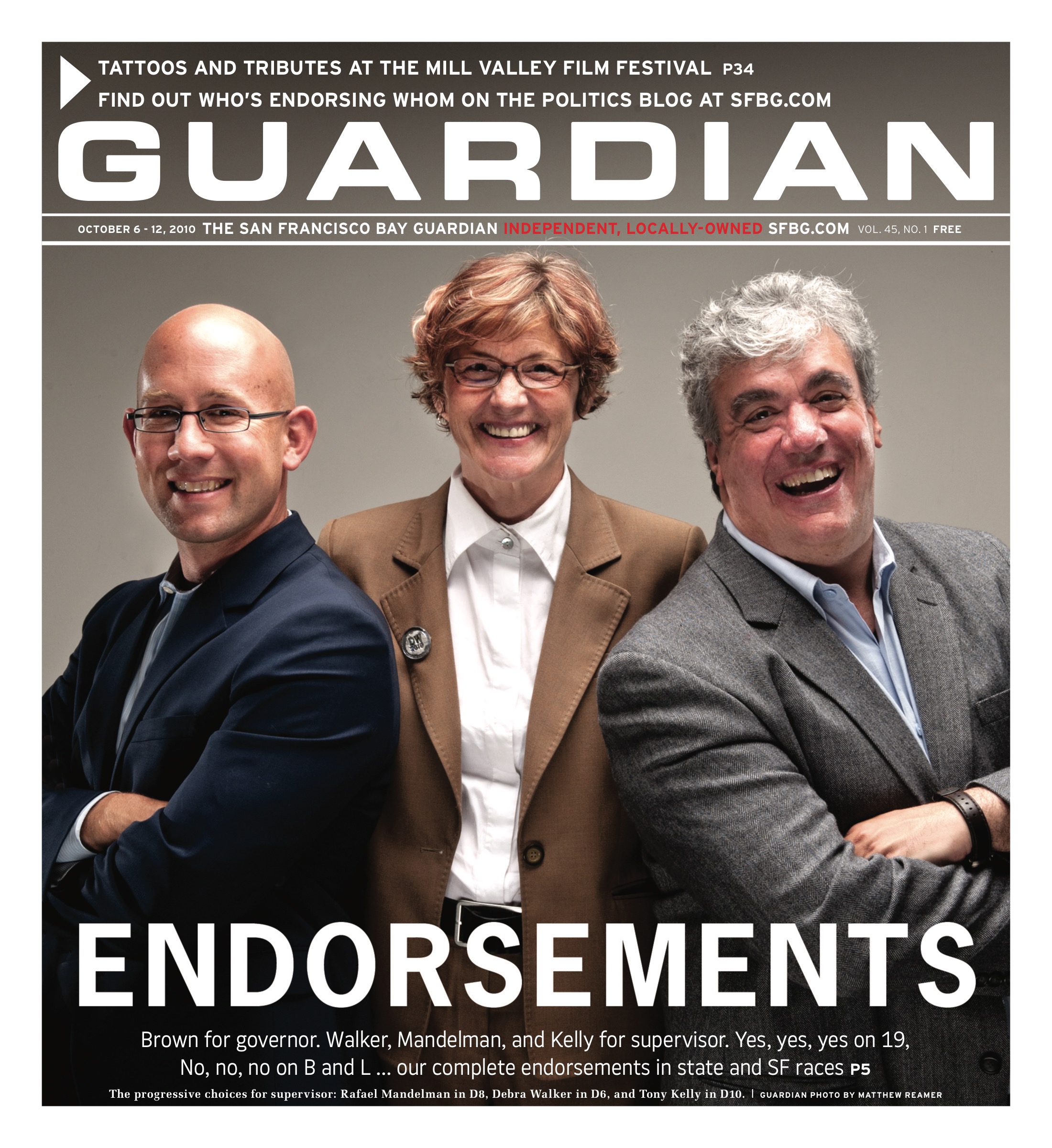
1. DEBRA WALKER


2. JANE KIM


3. GLENDON “ANNA CONDA” HYDE


CORRECTION: In our original version of this endorsement, we said that Jim Meko supports the sit-lie ordinance. That was an error, and it’s corrected below.


A year ago, this race was artist and activist Debra Walker’s to lose. Most of the progressive community was united behind her candidacy; she’d been working on district issues for a couple of decades, fighting the loft developers during the dot-com boom years and serving on the Building Inspection Commission. Then School Board member Jane Kim decided to enter the race, leaving the left divided, splitting resources that might have gone to other critical district races — and potentially helping to put the most pro-business downtown candidate, Theresa Sparks, in a better position to win.


Now we’ve got something of a mess — a fragmented and sometimes needlessly divisive progressive base in a district that’s key to holding progressive control of the board. And while neither of the two top progressive candidates is actively pursuing a credible ranked-choice voting strategy (Kim has, unbelievably, endorsed James Keys instead of Walker, and Walker has declined to endorse anyone else), we’re setting aside our concern over Kim’s ill-advised move and suggesting a strategy that is most likely to keep the seat Chris Daly has held for the past 10 years from falling to downtown control.


Walker is far and away our first choice. She understands land use and housing — the clear central issues in the district — and has well thought-out positions and proposals. She says that the current system of inclusionary housing — pressing market-rate developers to include a few units of below-market-rate housing with their high-end condos — simply doesn’t work. She supports an immediate affordable housing bond act and a long-term real estate transfer tax high enough to fund a steady supply of housing for the city’s workforce. She told us the city ought to be looking at planning issues from the perspective of what San Francisco needs, not what developers want to build. She’s in favor of progressive taxes and a push for local hiring. We’re happy to give her our first-place ranking.


Jane Kim has been a great SF School Board member and has always been part of the progressive community. But she only moved into District 6 a year and a half ago — about when she started talking about running for supervisor (and she told us in her endorsement interview that “D6 is a district you can run in without having lived there a long time.”) She still hasn’t been able to explain why she parachuted in to challenge an experienced progressive leader she has no substantive policy disagreements with.


That said, on the issues, Kim is consistently good. She is in favor of indexing affordable housing to market-rate housing and halting new condo development if the mix gets out of line. She’s for an affordable housing bond. She supports all the tax measures on this ballot. She’s a little softer on congestion pricing and extending parking-meter hours, but she’s open to the ideas. She supports police foot patrols not just as a law-enforcement strategy, but to encourage small businesses. She’d be a fine vote on the board. And while we’re sympathetic to the Walker supporters who would prefer that we not give Kim the credibility and exposure of an endorsement, the reality is that she’s one of two leading progressives and would be better on the board than the remaining candidates.


Hyde, a dynamic young drag queen performer, isn’t going to win. But he’s offered some great ideas and injected some fun and energy into the race. Hyde talks about creating safe injection sites for IV drug users to reduce the risk of overdoses and the spread of disease. He points out that a lot of young people age out of the foster-care system and wind up on the streets, and he’s for continuum housing that would let these young people transition to jobs or higher education. He talks about starting a co-op grocery in the Tenderloin. He proposes bus-only lanes throughout the district and wants to charge large vehicles a fee to come into the city. He’s a big advocate of nightlife and the arts. He lacks experience and needs more political seasoning, but we’re giving him the third-place nod to encourage his future involvement.


Progressives are concerned about Theresa Sparks, a transgender activist and former business executive who now runs the city’s Human Rights Commission. She did a (mostly) good job on the Police Commission. She’s experienced in city government and has good financial sense. But she’s just too conservative for what remains a very progressive district. Sparks isn’t a big fan of seeking new revenue for the city telling us that “I disagree that we’ve made all the cuts that we can” — even after four years of brutal, bloody, all-cuts budgets. She doesn’t support the hotel tax and said she couldn’t support Sup. David Chiu’s progressive business tax because it would lead to “replacing private sector jobs with public sector jobs” — even though the city’s own economic analysis shows that’s just not true. She supports Newsom’s sit-lie law.


Sparks is the candidate of the mayor and downtown, and would substantially shift the balance of power on the board. She’s also going to have huge amounts of money behind her. It’s important she be defeated.


Jim Meko, a longtime neighborhood and community activist, has good credentials and some solid ideas. He was a key player in the western SoMa planning project and helped come up with a truly progressive land-use program for the neighborhood. But he supports Prop. B and is awfully cranky about local bars and nightlife.


James Keys, who has the support of Sup. Chris Daly and was an intern in Daly’s office, has some intriguing (if not terribly practical) ideas, like combining the Sheriff’s Department and the Police Department and making Muni free). But in his interview, he demonstrated a lack of understanding of the issues facing the district and the city.


So we’re going with a ranked-choice strategy: Walker first, Kim second, Hyde third. And we hope Kim’s supporters ignore their candidate’s endorsement of Keys, put Walker as their second choice, and ensure that they don’t help elect Sparks.


DISTRICT 8


RAFAEL MANDELMAN


This is by far the clearest and most obvious choice on the local ballot. And it’s a critical one, a chance for progressives to reclaim the seat that once belonged to Harvey Milk and Harry Britt.


Mandelman, a former president of the Milk Club, is running as more than a queer candidate. He’s a supporter of tenants rights, immigrants’ rights, and economic and social justice. He also told us he believes “local government matters” — and that there are a lot of problems San Francisco can (and has to) solve on its own, without simply ducking and blaming Sacramento and Washington.


Mandelman argues that the public sector has been starved for years and needs more money. He agrees that there’s still a fair amount of bloat in the city budget — particularly management positions — but that even after cleaning out the waste, the city will still be far short of the money it needs to continue providing pubic services. He’s calling for a top-to-bottom review of how the city gets revenue, with the idea of creating a more progressive tax structure.


He’s an opponent of sit-lie and a supporter of the sanctuary city ordinance. He supports tenants rights and eviction protection. He’s had considerable experience (as a member of the Building Inspection Commission and Board of Appeals and as a lawyer who advises local government agencies) and would make an excellent supervisor.


Neither of the other two contenders make our endorsement cut. Rebecca Prozan is a deputy city attorney who told us she would be able to bring the warring factions on the board together. She has some interesting ideas — she’d like to see the city take over foreclosed properties and turn them into housing for teachers, cops, and firefighters — and she’s opposed to sit-lie. But she’s weak on tenant issues (she told us there’s nothing anyone can do to stop the conversion of rental housing into tenancies-in-common), doesn’t seem to grasp the need for substantial new revenues to prevent service cuts, and doesn’t support splitting the appointments to key commissions between the mayor and the supervisors.


Scott Wiener, a deputy city attorney, is a personable guy who always takes our phone calls and is honest and responsive. He’s done a lot of good work in the district. But he’s on the wrong side of many issues, and on some things would be to the right of the incumbent, Sup. Bevan Dufty.


He doesn’t support public power (which Dufty does). He says that a lot of the city’s budget problems can’t be solved until the state gets its own house in order (“we can’t tax our way out of this”) and favors a budget balanced largely by further cuts. In direct contrast to Mandelman, Wiener said San Franciscans “need to lower our expectations for government.” He wants broad-based reductions in almost all city agencies except Muni, “core” public health services, and public safety. He doesn’t support any further restrictions on condo conversions or TICs. And he has the support of the Small Property Owners Association — perhaps the most virulently anti-tenant and anti-rent control group in town.


This district once gave rise to queer political leaders who saw themselves and their struggles as part of a larger progressive movement. That’s drifted away of late — and with Mandelman, there’s a chance to bring it back.


DISTRICT 10


1. TONY KELLY


2. DEWITT LACY


3. CHRIS JACKSON


District 10 is the epicenter of new development in San Francisco, the place where city planners want to site as many as 40,000 new housing units, most of them high-end condos, at a cost of thousands of blue-collar jobs. The developers are salivating at the land-rush opportunities here — and the next supervisor not only needs to be an expert in land-use and development politics, but someone with the background and experience to thwart the bad ideas and direct and encourage the good ones.


There’s no shortage of candidates — 22 people are on the ballot, and at least half a dozen are serious contenders. Two — Steve Moss and Lynette Sweet — are very bad news. And one of the key priorities for progressives is defeating the big-money effort that downtown, the police, and the forces behind the Van Ness Avenue megahospital proposal are dumping into the district to elect Moss.


Our first choice is Tony Kelly, who operates Thick Description Theater and who for more than a decade has been directly involved in all the major neighborhood issues. He has a deep understanding of what the district is facing: 4,100 of the 5,300 acres in D10 have been rezoned or put under the Redevelopment Agency in the past 10 years. Planners envision as many as 100,000 new residents in the next 10 years. And the fees paid by developers will not even begin to cover the cost of the infrastructure and services needed to handle that growth.


And Kelly has solutions: The public sector will have to play a huge role in affordable housing and infrastructure, and that money should come from higher development fees — and from places like the University of California, which has a huge operation in the district and pays no property taxes. Kelly wants to set up a trigger so that if goals for affordable housing aren’t met by a set date, the market-rate development stops. He supports the revenue measures on the ballot but thinks we should go further. He opposes the pension-reform measure, Prop. B, but notes that 75 percent of the city’s pension problems come from police, fire, and management employees. He wants the supervisors to take over the Redevelopment Agency. He’s calling for a major expansion of open space and parkland in the district. And he thinks the city should direct some of the $3 billion in short-term accounts (now all with the Bank of America) to local credit unions or new municipal bank that could invest in affordable housing and small business. He’s a perfect fit for the job.


DeWitt Lacy is a civil-rights lawyer and a relative newcomer to neighborhood politics. He speaks passionately about the need for D10 to get its fair share of the city’s services and about a commitment to working-class people.


Lacy is calling for an immediate pilot program with police foot patrols in the high-crime areas of the district. He’s for increasing the requirements for developers to build affordable housing and wants to cut the payroll tax for local businesses that hire district residents.


Lacy’s vision for the future includes development that has mixed-use commuter hubs with shopping and grocery stores as well as housing. He supports the tax measures on the ballot and would be willing to extend parking meter hours — but not parking fines, which he calls an undue burden on low-income people.


He’s an outspoken foe of sit-lie and of gang injunctions, and with his background handling police abuse lawsuits, he would have a clear understanding of how to approach better law-enforcement without intimidating the community. He lacks Kelly’s history, experience, and knowledge in neighborhood issues, but he’s eminently qualified and would make a fine supervisor.


Chris Jackson, who worked at the San Francisco Labor Council and serves on the Community College Board, is our third choice. While it’s a bit unfortunate that Jackson is running for higher office only two years after getting elected to the college board, he’s got a track record and good positions on the issues. He talks of making sure that blue-collar jobs don’t get pushed out by housing, and suggested that the shipyard be used for ship repair. He wants to see the city mandate that landlords rent to people with Section 8 housing vouchers. He supports the tax measures on the ballot, but also argues that the city has 60 percent more managers than it had in 2000 and wants to bring that number down. He thinks the supervisors should take over Redevelopment, which should become “just a financing agency for affordable housing.” He wants to relocate the stinky sewage treatment plant near Third Street and Evans Avenue onto one of the piers and use the area for a transit hub. He’s still relatively unseasoned, but he has a bright political future.


Eric Smith, a biodiesel activist, is an impressive candidate too. But while his environmental credentials are good, he lacks the breadth of knowledge that our top three choices offer. But we’re glad he’s in the race and hope he stays active in community politics.


Malia Cohen has raised a lot of money and (to our astonishment) was endorsed No. 2 by the Democratic Party, but she’s by no means a progressive, particularly on tenant issues — she told us that limiting condo conversions is an infringement of property rights. And she’s way too vague on other issues.


Moss is the candidate of the big developers and the landlords, and the Chamber of Commerce is dumping tens of thousands of dollars into getting him elected. He’s got some good environmental and energy ideas — he argues that all major new developments should have their own energy distribution systems — but on the major issues, he’s either on the wrong side or (more often) can’t seem to take a stand. He said he is “still mulling over” his stand on sit-lie. He supports Sanctuary City in theory, but not the actual measure Sup. David Campos was pushing to make the policy work. He’s not sure if he likes gang injunctions or not. He only moved back to the district when he decided to run for supervisor. He’s way too conservative for the district and would be terrible on the board.


Lynette Sweet, a BART Board member, has tax problems (and problems explaining them) and wouldn’t even come to our office for an endorsement interview. The last thing D10 needs is a supervisor who’s not accountable and unwilling to talk to constituents and the press.


So we’re going with Kelly, Lacy, and Jackson as the best hope to keep D10 from becoming a district represented by a downtown landlord candidate.


SAN FRANCISCO BOARD OF EDUCATION


MARGARET BRODKIN


KIM-SHREE MAUFAS


HYDRA MENDOZA


Three seats are up on the School Board, and three people will get elected. And it’s a contested race, and in situations like that, we always try to endorse a full slate.


This fall, it was, to put it mildly, a challenge.


It’s disturbing that we don’t have three strong progressive candidates with experience and qualifications to oversee the San Francisco Unified School District. But it seems to be increasingly difficult to find people who want to — and can afford to — devote the time to what’s really a 40-hour-a-week position that pays $500 a month. The part-time school board is an anachronism, a creature of a very different economic and social era. With the future of the next generation of San Franciscans at stake, it’s time to make the School Board a full-time job and pay the members a decent salary so that more parents and progressive education advocates can get involved in one of the most important political jobs in the city.


That said, we’ve chosen the best of the available candidates. It’s a mixed group, made up of people who don’t support each other and aren’t part of anyone’s slate. But on balance, they offer the best choices for the job.


This is not a time when the board needs radical change. Under Superintendent Carlos Garcia, the local public schools are making huge strides. Test scores are up, enrollment is increasing, and San Francisco is, by any rational measure, the best big-city public school district in California. We give considerable credit for that to the progressives on the board who got rid of the irascible, secretive, and hostile former Superintendent Arlene Ackerman and replaced her with Garcia. He’s brought stability and improvement to the district, and is implementing a long-term plan to bring all the schools up to the highest levels and go after the stubborn achievement gap.


Yet any superintendent and any public agency needs effective oversight. One of the problems with the district under Ackerman was the blind support she got from school board members who hired her; it was almost as if her allies on the board were unable to see the damage she was doing and unable to hold her accountable.


Our choices reflect the need for stability — and independence. We are under no illusions — none of our candidates are perfect. But as a group, we believe they can work to preserve what the district is doing right and improve on policies that aren’t working.


Kim-Shree Maufas has been a staunch progressive on the board. She got into a little trouble last year when the San Francisco Chronicle reported that she’d been using a school district credit card for personal expenses. That’s not a great move, but she never actually took public money since she paid back the district. Maufas said she thought she could use the card as long as she reimbursed the district for her own expenses; the rules are now clear and she’s had no problems since. We don’t consider this a significant enough failure in judgment to prevent her from continuing to do what she’s been doing: serving as an advocate on the board for low-income kids and teachers.


Maufas is a big supporter of restorative justice and is working for ways to reduce suspensions and expulsions. She wants to make sure advanced placement and honors classes are open to anyone who can handle the coursework. She supports the new school assignment process (as do all the major candidates), although she acknowledges that there are some potential problems. She told us she thinks the district should go back to the voters for a parcel tax to supplement existing funding for the schools.


Margaret Brodkin is a lightening rod. In fact, much of the discussion around this election seems to focus on Brodkin. Since she entered the race, she’s eclipsed all the other issues, and there’s been a nasty whisper campaign designed to keep her off the board.


We’ve had our issues with Brodkin. When she worked for Mayor Newsom, she was part of a project that brought private nonprofits into city recreation centers to provide services — at a time when unionized public employees of the Recreation and Parks Department were losing their jobs. It struck us as a clear privatization effort by the Newsom administration, and it raised a flag that’s going to become increasingly important in the school district: there’s a coming clash between people who think private nonprofits can provide more services to the schools and union leaders who fear that low-paid nonprofit workers will wind up doing jobs now performed by unionized district staff. And Brodkin’s role in the Newsom administration — and her background in the nonprofit world — is certainly ground for some concern.


But Brodkin is also by far the most qualified person to run for San Francisco school board in years, maybe decades. She’s a political legend in the city, the person who is most responsible for making issues of children and youth a centerpiece of the progressive agenda. In her years as director of Coleman Advocates for Children and Youth, she tirelessly worked to make sure children weren’t overlooked in the budget process and was one of the authors of the initiative that created the Children’s Fund. She’s run a nonprofit, run a city department, and is now working on education issues.


She’s a feisty person who can be brusque and isn’t always conciliatory — but those characteristics aren’t always bad. Sup. Chris Daly used his anger and passion to push for social justice on the Board of Supervisors and, despite some drawbacks, he’s been an effective public official.


And Brodkin is full of good ideas. She talks about framing what a 21st century education looks like, about creating community schools, about aligning after-school and summer programs with the academic curriculum. She wants the next school bond act to include a central kitchen, so local kids can get locally produced meals (the current lunch fare is shipped in frozen from out of state).


Brodkin needs to remember that there’s a difference between being a bare-knuckles advocate and a member of a functioning school board. But given her skills, experience, and lifetime in progressive causes, we’re willing to give her a chance.


We also struggled over endorsing Hydra Mendoza. She works for Mayor Newsom as an education advisor — and that’s an out-front conflict of interest. She’s a fan of Obama’s Education Secretary, Arne Duncan, whose policies are regressive and dangerous.


On the other hand, she cares deeply about kids and public education. She’s not a big supporter of charter schools (“I’ve yet to see a charter school that offers anything we can’t do ourselves,” she told us) and while she was on the wrong side of a lot of issues (like JROTC) early in her tenure, over the past two years she’s been a good School Board member.


There are several other candidates worth mentioning. Bill Barnes, an aide to Michela Alioto-Pier, is a good guy, a decent progressive — but has no experience in or direct connection to the public schools. Natasha Hoehn is in the education nonprofit world and speaks with all the jargon of the educrat, but her proposals and her stands on issues are vague. Emily Murase is a strong parent advocate with some good ideas, but she struck us as a bit too conservative (particularly on JROTC and charter schools.) Jamie Wolfe teaches at a private school but lacks any real constituency or experience in local politics and the education community.


So given a weak field with limited alternatives, we’re going with Maufas, Brodkin and Mendoza.


SAN FRANCISCO COMMUNITY COLLEGE BOARD


JOHN RIZZO


The San Francisco Community College District has been a mess for years, and it’s only now starting to get back on track. That’s the result of the election of a few progressive reformers — Milton Marks, Chris Jackson, and John Rizzo, who now have enough clout on the seven-member board to drag along a fourth vote when they need it.


But the litany of disasters they’ve had to clean up is almost endless. A chancellor (who other incumbent board members supported until the end) is now under indictment. Public money that was supposed to go to the district wound up in a political campaign. An out-of-control semiprivate college foundation has been hiding its finances from the public. The college shifted bond money earmarked for an arts center into a gigantic, expensive gym with a pool that the college can’t even pay to operate, so it’s leased out to a private high school across the street.


And the tragedy is that all three incumbents — two of whom should have stepped down years ago — are running unopposed.


With all the attention on the School Board and district elections, not one progressive — in fact, not one candidate of any sort — has stepped forward to challenge Anita Grier and Lawrence Wong. So they’ll get another term, and the reformers will have to continue to struggle.


We’re endorsing only Rizzo, a Sierra Club staffer who has been in the lead in the reform bloc. He needs to end up as the top vote-getter, which would put him in position to be the board president. Rizzo has worked to get the district’s finances and foundation under control and he richly deserves reelection.


BART BOARD OF DIRECTORS, DISTRICT 8


BERT HILL


It’s about time somebody mounted a serious challenge to James Fang, the only elected Republican in San Francisco and a member of one of the most dysfunctional public agencies in California. The BART Board is a mess, spending a fortune on lines that are hardly ever used and unable to work effectively with other transit agencies or control a police force that has a history of brutality and senseless killing.


Fang supports the suburban extensions and Oakland Airport connector, which make no fiscal or transportation sense. He’s ignored problems with the BART Police for 20 years. It’s time for him to leave office.


Bert Hill is a strong challenger. A professional cost-management executive, he understands that BART is operating on an old paradigm of carrying people from the suburbs into the city. “Before we go on building any more extensions,” he told us, “we should take care of San Francisco.” He wants the agency to work closely with Muni and agrees there’s a need for a BART sunshine policy to make the notoriously secretive agency more open to public scrutiny. We strongly endorse him.


ASSESSOR-RECORDER


PHIL TING


San Francisco needs an aggressive assessor who looks for every last penny that big corporations are trying to duck paying — but this is also a job that presents an opportunity for challenging the current property tax laws. Phil Ting’s doing pretty well with the first part — and unlike past assessors, is actually stepping up to the plate on the second. He’s been pushing a statewide coalition to reform Prop. 13 — and while it’s an uphill battle, it’s good to see a tax assessor taking it on. Ting has little opposition and will be reelected easily.


PUBLIC DEFENDER


JEFF ADACHI


Adachi’s done a great job of running the office that represents indigent criminal defendants. He’s been outspoken on criminal justice issues. Until this year, he was often mentioned as a potential progressive candidate for mayor.


That’s over now. Because Adachi decided (for reasons we still can’t comprehend) to join the national attack on public employees and put Prop. B on the ballot, he’s lost any hope of getting support for higher office from the left. And since the moderate and conservative forces will never be comfortable with a public defender moving up in the political world, Adachi’s not going anywhere anytime soon.


Which is fine. He’s doing well at his day job. We wish he’d stuck to it and not taken on a divisive, expensive, and ill-conceived crusade to cut health care benefits for city employees.


SAN FRANCISCO SUPERIOR COURT


SEAT 15


MICHAEL NAVA


To hear some of the brahmins of the local bench and bar tell it, the stakes in this election are immense — the independence of the judiciary hangs in the balance. If a sitting judge who is considered eminently qualified for the job and has committed no ethical or legal breaches can be challenged by an outsider who is seeking more diversity on the bench, it will open the floodgates to partisan hacks taking on good judges — and force judicial candidates to raise money from lawyers and special interests, thus undermining the credibility of the judiciary.


We are well aware of the problems of judicial elections around the country. In some states, big corporations that want to influence judges raise and spend vast sums on trial and appellate court races — and typically get their way. In Iowa, three judges who were willing to stand on principle and Constitutional law and declare same-sex marriage legal are facing what amounts to a well-funded recall effort. California is not immune — in more conservative counties, liberal judges face getting knocked off the bench by law-and-order types.


It’s a serious issue. It’s worth a series of hearings in the state Legislature, and it might be worth Constitutional change. Maybe trial-court elections should be eliminated. Maybe all judicial elections should have public campaign financing. But right now, it’s an elected office — at least in theory.


In practice, the vast majority of the judicial slots in California are filled by appointment. Judges serve for four-year terms but tend to retire or step down in midterm, allowing the governor to fill the vacancy. Unless someone files specifically to challenge an incumbent, typically appointed judge, that race never even appears on the ballot.


The electoral process is messy and political, and raising money is unseemly for a judicial officer. But the appointment process is hardly pure, either — and governors in California have, over the past 30 years, appointed the vast majority of the judges from the ranks of big corporate law firms and district attorney’s offices.


There are, of course, exceptions, and Gov. Arnold Schwarzenegger has been better than his predecessor, Democrat Gray Davis. But overall, public interest lawyers, public defenders, and people with small community practices (and, of course, people who have no political strings to pull in Sacramento) have been frustrated. And it’s no surprise that some have sought to run against incumbents.


That’s what’s happening here. Michael Nava, a gay Latino who has been working as a research attorney for California Supreme Court Justice Carlos Moreno, was going to run for a rare open seat this year, but the field quickly got crowded. So Nava challenged Richard Ulmer, a corporate lawyer appointed by Schwarzenegger who has been on the bench a little more than a year.


We will stipulate, as the lawyers say: Ulmer has done nothing wrong. From all accounts, he’s a fine judge (and before taking the bench, he did some stellar pro bono work fighting for reforms in the juvenile detention system). So there are two questions here: Should Nava have even filed to run against Ulmer? And since he did, who is the better candidate?


It’s important to understand this isn’t a case of special interests and that big money wanting to oust a judge because of his politics or rulings. Nava isn’t backed by any wealthy interest. There’s no clear parallel to the situations in other areas and other states where the judiciary is being compromised by electoral politics. Nava had every right to run — and has mounted an honest campaign that discusses the need for diversity on the bench.


Ulmer’s supporters note — correctly — that the San Francisco courts have more ethnic and gender diversity than any county in the state. And we’re not going to try to come to a conclusion here about how much diversity is enough.


But we will say that life experience matters, and judges bring to the bench what they’ve lived. Nava, who is the grandson of Mexican immigrants and the first person in his family to go to college, may have a different perspective on how low-income people of color are treated in the courts than a former Republican who spent his professional career in big law firms.


We were impressed by Nava’s background and knowledge — and by his interest in opening up the courts. He supports cameras in the courtrooms and allowing reporters to record court proceedings. He told us the meetings judges hold on court administration should be open to the public.


We’re willing to discuss whether judicial elections make sense. Meanwhile, judges who don’t like the idea of challenges should encourage their colleagues not to retire in midterm. If all the judges left at the end of a four-year term, there would be plenty of open seats and fewer challenges. But for now, there’s nothing in this particular election that makes us fear for the independence of the courts. Vote for Nava.


>>BACK TO ENDORSEMENTS 2010

Ebony Hillbillies string along Hardly Strictly’s biggest year yet

1

Nine hundred thousand people and over 70 bands braved the drifting fog banks for this weekend’s 10th annual Hardly Strictly Bluegrass Festival. With a crowd that size, you have to think logistics. So at my interview with HSB bankroller-birthday boy Warren Hellman well before the madness, I asked who were the up and comers to look out for. I chicken-danced our way through Speedway Meadows accordingly.

“The Ebony Hillbillies,” Hellman told me, chuckling over lead singer – and as the band’s press kit explains, “bones” of the group — Gloria Gassaway’s penchant for abrupt audience interaction. The HSB performance would be its first in the Bay Area, and Hellman was happy to have been its means of infiltration, particularly for Gassaway’s no-nonsense stage presence. “She’s quite a woman,” he said.

Quite a woman indeed. the Hillbillies, hailing from Jamaica, Queens, are helping to sustain the tradition of African-American string bands that started with the genre’s inception in the Appalachians in the 1920s. Black pioneers in the music can seem ironic now, particularly at events like Hardly Strictly where the audience is majority white. 

But so it goes — and some of the weekend’s most exciting shows flew from the fiddles, banjos, and diddly bows of black groups like the Hillbillies and Carolina Chocolate Drops, firmly establishing that bluegrass (and neo-bluegrass, and string bands, and jazz, blues, rockabilly, country, rock ‘n’ roll, everything else that falls under “hardly) doesn’t have to be just for the honkies.

“I love making the audience have a good time. You come to see the show, you want to be entertained, but you also want to enjoy yourself,” Gassaway tells me when we catch up with her after the group’s set on Friday. 

Sporting matching moccasins with fiddle player Henrique Prince, and with purple feathers threaded into her hair, the ebullient Gassaway exchanged my compliment on her flair with an insight into her cultural heritage. Although they were born with blood from the Catawba tribe of the South and North Carolina borderland, Gassaway’s father instructed Gassaway and her siblings never to reveal the secret of their Native-American-ness to teachers at school so that they could avoid possible discrimination. 

“He told us, tell them you’re from Mexico, or African-American, or something – just not Native,” she says. She says she held onto that learned denial until a trip to Europe, during which she realized the beauty of her background. Now Gassaway sports turquoise jewelry onstage while playing the string music that her Black and Native ancestors must have heard almost a hundred years ago. “I’m Native, and I wear my heritage proudly,” she tells me.

Although the Hillbillies’ current configuration experienced its debut in San Francisco this weekend, it was by no means the first time individual band members had played in the City by the Bay. Bass player William Saltner recalled his last time here in the early ’60s. Saltner, a two-time Grammy winner for songwriting – he wrote “Where is the Love?” and co-wrote “Just the Two of Us” – was working with Miriam Makeba, who at the time was exiled from her home in apartheid South Africa. 

“We don’t play bluegrass, we play old tyme music,” Saltner clarifies backstage. “But we claim bluegrass in this crowd,” he continues with a sly smile.

That kind of genre-bending, always evident at HSB, continued throughout the three days of 2010’s festival. MC Hammer kicked off the weekend at his yearly performance at the middle-schooler’s show on Friday morning. Randy Newman, a newly bluegrass-friendly Elvis Costello, Robert Earl Keen, the Avett Brothers, Joan Baez, and Patti Smith all turned in stellar sets that could hardly fall into the “strictly” category. The diversity was reflected in the varying age demographics of the crowd, who for the most part eschewed the sanctity of the blanket that had reigned in years past – those faithful early risers that spread their tarps in front of stages in the small hours of the morning saw their space quickly infiltrated by standing room-only, stage-switching attendees. 

Temperatures in the high 60s did nothing to stem the tide of music fans that flooded the peaks and valleys of Golden Gate Park for the free festival, but they did threaten the Hillbillies’ chances of starting up a dance party with their stomp-ready old tyme strings with their opening act at the Banjo Stage on Friday. “Are you cold?” Gassaway inquired from her seat on stage. “Because I sure am!”

The cold weather seemed to make it difficult to keep strings in shape – the action stopped a few times so that a stoic Norris Bennett could tune his diddley bow, and then later his banjo to perfection. But the challenge seemed to energize the group’s firestarter. Of course, it doesn’t hurt when you can pull Hellman onstage for a little unscheduled entertainment, which Gassaway managed to accomplish in a moment when she spotted the man enjoying the show from the stage’s sidelines.

Perhaps he had it coming for hyping Gassaway’s sass. Hellman did his best to represent the honkies though, bowing out his legs and wagging his elbows in a “broke-legged chicken” dance on her command. But for all his obedience, he’s got a ways to go as far as Gassaway is concerned. A fact which she let him (and us now) know in the intro of a song entitled “Big Fat Men,” an ode to the joys of obese lovers.

Which the wiry Hellman could hardly be described as. Yet. But he’s got a good coach. “I’ve been feeding him cheesecake,” Gassaway tells me. Blow out the candle first, Warren – number ten was a good year for Hardly Strictly.


Downtown money hits district races

42

Downtown cash is pouring into the district supervisorial races.

Ethics Department filings show that an alliance backed by the Chamber of Commerce, the SF Police Officers Association and United Health Care Workers West is dropping major money on Steve Moss in D10, Scott Wiener in D8 and Theresa Sparks in D6. 

Called the “Alliance for Jobs and Sustainable Growth,” the coalition supports the building of a mega-hospital on Cathedral Hill.

The independent expenditure alliance puts UHW, part of the Service Employees International Union, in the odd position of using membership money to attack progressive politics in San Francisco – potentially undermining years of work by another SEIU affiliate, Local 1021.

Campaign disclosure forms show that the Chamber-Police-UHW alliance has spent $20,000 on bilingual (English/Chinese) door hangers for Moss that feature photos of Chamber of Commerce President Steve Falk and United Healthcare Workers political director Leon Chow.

These same interests also spent $20,000 on robo-calls for Moss, with a heavy focus on Visitacion Valley in an effort to secure the Asian vote in the crowded D10, where there is a strong likelihood that the race will be decided by second and third place votes

Word on the street in the Bayview is that former Mayor Willie Brown is pissed off that the Chamber is backing Moss, instead of African American candidate Lynette Sweet, and that termed out D10 Sup. Sophie Maxwell is angry that big corporations are trying to buy an election in the poorest and most ethnically diverse district in town.

But unlike the rumor mill, the money trail doesn’t lie. And from that perspective this is looking like a replay of the June 2008 election, when big businesses bought support for Lennar’s Candlestick Point/shipyard development by claiming it would create thousands of jobs building condos that most workers can’t afford—jobs that have yet to materialize.

This time the battle cry is for jobs building a massive hospital, even though few workers will likely get service from this hospital, which is designed to serve as a regional center for high-end health care.

So far, the same alliance of police and corporate money has plunked down $17,000 for bilingual (English and Chinese) door hangers in support of Theresa Sparks in D6 and another $17,000 for bilingual robo-calls in support of Sparks.

And so far, Scott Wiener has gotten the relatively short end of the corporate money stick: the Alliance has only spent $15,000 on a door hanger in support of Wiener.

This means that the alliance spent $90,000 in a two-week period in September. The numbers lend credence to DCCC Chair Aaron Peskin’s belief that the alliance has a war chest of $800,000, which it intends to use to put pro-downtown candidates into power.

Asked about the support of this alliance, Sparks, Wiener and Moss gave markedly different replies that reveal as much about each candidate as the money behind them.

D6 candidate Theresa Sparks suggested that the Alliance was spending more on her and Moss’ D10 campaign, because it felt Wiener was further ahead in the D8 race than she is in D6 or Moss is in D10.

And Sparks was openly supportive of the Cathedral Hill hospital project. “I’ve been very supportive of that project,” Sparks told us.

Sparks also observed that it was logical that the Chamber would support her.

“D6 has one of the largest numbers of small businesses and one of my biggest platforms has been economic growth, and I think the Chamber has been very supportive of job creation,” Sparks said.

By comparison, Scott Wiener told the Guardian that he has not taken a position on CPMC’s proposed mega hospital on Cathedral Hill.

“Those kind of issues could come before the Board, in terms of CEQA issues, and so I could be conflicted out,” Wiener said.

When the Guardian noted that the Alliance has so far not spent any money on phone banking for Wiener in D8, Wiener said, “I have volunteers doing phone banking.”

As for Moss, he told the Guardian that said he doesn’t have a position on the mega-hospital.

“I haven’t seen the plan,” Moss said. “But I understand that there seems to be an agreement that would maintain St. Luke’s with about 300 beds, but that there is a deep suspicion among the nurses that it’s not economically viable. And there seems to be a much greater need for a hospital in the southeast.”

Moss, however, is with downtown on other key issues: He supports the sit-lie legislation on the November ballot. He also reiterated that he likes the rabidly anti-tenant Small Property Owners Association, whose endorsement he called a “mistake” during a previous interview with the Guardian.

“Landlords feel that they are responsible for maintaining costly older buildings and that they are not provided with ways to upgrade their units in ways that share costs with tenants,” Moss, who sold a condo on Potrero Hill in 2007 for the same price that he paid for the entire building in 2001, and owns a 4-floor rent-controlled apartment building in D8, near Dolores Park, that he bought for $1.6 million in 2007, and where he lived from December 2007 to February 2010.

Moss refused to provide a copy of the lease on his current rental at Vermont and 18th St—something that the Guardian requested in light of an email from his wife that indicated that the family intended to move back to Dolores Park of Moss loses the race.
‘That’s private information,” Moss said, claiming that he does not plan to move back into his apartment building in D8, if he loses in November.

Moss claimed that UHW endorsed him because his position on politicians and unions.
“I agreed that politicians should get not involved in union politics,” Moss said. “The United Healthcare Workers seem to be a worthy group,” he added. “All they said was that they wanted to make sure that they had access.”

All this campaign money drama is playing out against the backdrop of a punishing battle between United Healthcare Workers West and the rest of SEIU. And as these recent filings show, UHW is spending a huge amount of its membership dues to undermine the city’s progressive infrastructure by trying to elect candidates who are not progressive, even though its progressive sister union has endorsed Rafael Mandelman in D8.

SEIU 1021 member Ed Kinchley, who works in the Emergency Room at SF General Hospital, is furious that UHW is pouring all its money into downtown candidates like Moss, Sparks and Wiener and trying to undermine everything that its progressive sister union is trying to do.

“UHW basically isn’t participating in the Labor Council, it’s just doing its own thing,” Kinchley said.

Kinchley noted that UHW is currently in trusteeship, and is being controlled by its International, and not its local membership, thus explaining why it’s doing this dance with forces like the Chamber and the Building Owners and Managers Association, which have long been the enemy of labor.

“Sutter wants a monopoly on private healthcare, and people like Rafael Mandelman in and Debra Walker have been strong supporters of public healthcare,” Kinchley said, Kinchley also noted that he wants supervisors who are willing to state their support for public health care, rather than dodging the issue and hedging their bets, right now.

“I want someone who can straight-up say, here’s what’s important for families in San Francisco, especially something as important as healthcare,” Kinchley said. “but it sounds like UHW is teaming up with the Chamber and supporting people who are not progressive.”

“And it’s not OK for somebody in D10 to say they haven’t seen CPMC’s plans, when people from D10 use St. Luke’s all the time for healthcare, because it sounds like Sutter wants to change St. Luke’s into an out-patient clinic for paying customers,” he continued.

SEIU 1021 activist Gabriel Haaland accused the Chamber, the Building Owners and Managers Association, UHW and the Police Officers Association of putting together a massive political action committee, “to try and steal the election through corporate spending.”

All this leaves the Guardian wondering how Leon Chow, the political director of UHW, who has done good work in the past on health care issues, is feeling about seeing his photograph spreads all over town alongside that of Chamber of Commerce President Steve Falk on door hangers in support of Sparks, Wiener and Moss.
 
As of press time, Chow had not returned our calls, but if he does, we’ll update this post.

The pummeling of SF Labor

18

Click to read sidebar, Brown or Whitman? No contest

With five supervisorial seats open and only one incumbent running, the Labor Council has had a tough time picking the right pro-labor candidates. The easy choices were incumbent Carmen Chu in District 4, with no opposition, and Raphael Mandelman, an exceptionally promising newcomer in District 8. But Janet Reilly in District 2 opposes the Labor Council’s revenue measures. In District 6, where long-time activist Deborah Walker has been endorsed, and in District 8, where Malia Cohen and Chris Jackson are #1 and #2, there are a multitude of candidates, many of them labor friendly.

It’s not an easy year.

Prop. B on San Francisco’s November election ballot confronts the city’s working people and their unions with an unprecedented challenge. The measure, sponsored by Public Defender Jeff Adachi, would severely weaken public employee unions and undoubtedly lead to other serious attacks on workers and unions in private as well as public employment nationwide.

The proposition is by no means the only dangerously anti-labor measure on the ballot, but it ‘s the worst from labor’s point of view, as it very well should be. It’s a prime example of the public-employee bashing that’s become a favorite theme in election campaigns everywhere and, if passed, would set a clear national precedent.

Actually, Prop. B might better be described as a pummeling rather than bashing – and one coming, furthermore, just a few months after city employees took a voluntary $250 million pay cut. Prop. B would steeply raise the employees’ contributions to their pensions unilaterally and prohibit bargaining on the issue in the future as well.

It would arbitrarily lower city contributions to the employees’ health plans, especially dependent care. What employees pay for health care coverage for children and other dependents would be as much as doubled.

The steep rise in the employees’ share of their health care coverage could quite possibly force families to drop city coverage and try to get cheaper coverage on their own. That, of course, is a primary goal of the corporate anti-labor forces and others who seek to balance the budgets of public entities on the backs of their employees.

So what if workers can’t afford to take the kids to the doctor.  Cutting taxes and balancing budgets is a lot more important. Besides, there’s always the emergency room and charity.

But wait! There are yet more major Prop. B flaws. For example: If city health care coverage is changed by increasing the premiums paid by employees, as the proposition requires, the city Health Service system (HSS) would have to forfeit new $23 million-a-year federal grants intended to reduce premiums for employees and retirees covered by the HSS. The system includes, not just city employees, but also school and community college district and SF court system employees and retirees.

There’s even more, much more than enough to energize labor’s troops. They are angry. Very angry. Unions citywide have at least temporarily set aside their sometimes considerable differences and feuding over tactics, jurisdictions and other matters. They’ve come together tightly along with a substantial number of labor’s Democratic Party allies to oppose Prop. B.

And watch out for Prop. G. It’s another favorite of the anti-union, anti-public employee crowd, led in this case by Sean Elsbernd, a very politically ambitious member of the SF Board of Supervisors.

Elsbernd and friends claim their intent is to “fix the Muni,” one of the nation’s most complex transit systems. The Municipal Railway, overseen by the Metropolitan Transit Authority (MTA), is indeed badly in need of fixing. But the principal blame for that does not rest with Muni’s bus and streetcar operators – most of them people of color – as proponents of Prop. G claim. Most of the blame rests with Muni’s overpaid managers, headed by $336,000-a-year executive director and CEO Nathaniel Ford.

As President Irwin Lum of the Muni operator’s union said in a Guardian interview,  “Muni needs to be changed from the top to the bottom.” He sees Muni’s problem as mainly a lack of resources and the political will to pursue them.  Muni officials might also avoid lots of problems if they’d deign to consult regularly with community groups and their leaders on their transit needs.

The public rightly complains of buses not arriving on time, of being passed up while waiting at bus stops, of grumpy drivers and of other certainly legitimate matters.  Naturally, they blame the drivers. But drivers do not make schedules. Under pressure to keep to the schedules made by others, they sometimes speed by waiting passengers. Sometimes they’re slowed by heavy traffic, sometimes by problems with faulty, broken-down down buses or slowed by having to deal with violent passengers. Sometimes, managers making out the schedules don’t properly anticipate such probable delays.

Oh, yes, those grumpy drivers.

Wouldn’t you be grumpy if you had to work a full shift without going to the bathroom? If you had to listen to loud complaints from unruly passengers who sometimes got rough with you and each other?  If you had to weave through heavy traffic for hours at a time? If you had to time your work to unrealistic schedules you had nothing to do with making?

It’s not the drivers who are in charge of replacing badly worn buses and streetcar tracks and equipment, not the drivers who are in charge of negotiating with Muni suppliers for a reduction in ever-escalating fuel prices and other costs. In short, it’s not the drivers who run Muni – though Muni, of course, could not run without them.

So, what do Elsbernd and his anti-labor cohorts want to do to the Muni’s invaluable workers? Here’s the deal:

The City Charter now requires that Muni operators be paid at least as much as the average salary of operators at the two highest paying similar transit systems in the country.  And if benefits granted Muni operators are worth less than those of operators at similar transit systems, the difference is paid to the operators from a trust fund established for that purpose.

Under Prop. G, operators’ pay and benefits would be set by bargaining between union and MTA representatives. If they couldn’t agree, the dispute would be submitted to an arbitrator, whose decision would be binding.

The arbitrator would be required to consider the possible impact of disputed proposals on Muni fares and services. But though all other city unions are also subject to arbitration, there’s no requirement that the arbitrator consider how their proposals would affect the services provided by the union’s members – an unusual requirement that’s virtually unheard of elsewhere.

Prop. G backers presumably see the proposition as a step toward their goal of being able to set, change or eliminate Muni work rules without bothering to consult workers or their unions. They are, you might say, “unilateralists.”

 Taking on Muni operators is only part of Supervisor Elsbernd’s anti-labor romp. He’s also sponsoring Prop.  F, a deceptively simple charter amendment that would seriously impact the 105,000 members of the Health Service System. It’s a stealth proposition, difficult to understand and explain, and thus often brushed aside as a minor ballot measure of no particular consequence.

But Prop. F is capable of doing major long-term damage to HSS members by weakening their position in negotiating with powerful health insurers such as Blue Shield on the size of the premiums HSS members have to pay for coverage and the benefits they receive.

All politicians stretch the truth. It’s part of their game. You needn’t look further than Elsbernd for evidence of that.  He actually claims he put Prop. F on the ballot strictly to save the Health Service System money by eliminating two of the four elections in which HSS members vote for representatives on the HSS Board. This seemingly small change would eliminate the overlapping terms that provide the continuity essential to successful negotiations with health insurers.

The savings would average a mere $30,000 a year, and would not even be available until 2016. Nor is there a guarantee that any of the money would go to the HSS. $30,000? What’s the real motive here?

As for the rest of San Francisco’s ballot measures and candidates, union supporters could hardly do better than to follow the recommendations of the AFL-CIO’s local Labor Council, which almost invariably backs the propositions most likely to be labor-friendly and opposes those that are not. This time, the Labor Council is saying “no” to those decidedly unfriendly Propositions B, G and F.

And don’t forget Props. J, K and N. Hotel workers and others are supporting Prop. J, which is meant to stop the travel industry practice of using online hotel booking to avoid paying SF’s hotel tax. Prop. J also would increase the city’s hotel tax for the first time in 14 years in order to raise some most welcome revenue for the city’s general fund.

However, Prop. K – introduced by Mayor Newsom – could stand in the way. Since Prop. K makes no change in the hotel tax rate, apparently it’s intended to confuse and distract the voters so they won’t approve Prop. J.

The other major revenue measure strongly supported by labor – Proposition N – would increase the city’s transfer tax rate on the sale of property worth more than $5 million from 1.5 percent now to a range of 2 to 2 ½ percent for a property worth $10 million or more. This would also generate millions for the city’s general fund.

Rarely has so much been at stake for San Francisco’s working people and their unions.

Dick Meister, former Labor Editor of the SF Chronicle and KQED-TV, has covered labor and politics for a half-century, Contact him through his website, www.dickmeister.com, which includes more than 250 of his columns.

Crusader of the cables: Fannie Mae Barnes

0

Whoever said a cable car couldn’t be operated on woman power alone clearly had never met the steam engine on this grandmother. Fannie Mae Barnes of Oakland, California was the first woman ever to operate a cable car grip – not because it was a higher paying position, or an easier gig, but because she was told that women didn’t have the strength to do the job right.

Barnes started pumping iron, passed the 25-day grip operator training program notorious for its 80 percent drop out rate, and became a source of civic pride. She even drove the Olympic torch up the Hyde Street hill en route to the 2002 Winter Olympics. A documentary about her achievement, “Getting a Grip,” will be shown tonight at Lunafest, a traveling film festival that screens movies made by and about women to benefit the Breast Cancer Fund. We caught up with Barnes for a phone interview about knocking down one of the city’s diehard gender divisions of labor.


San Francisco Bay Guardian: What made you want to be a cable car operator?

Fannie Mae Barnes: It wasn’t about being a conductor, it was the grip up front, which is totally different from the conductor. In ’98 I went up front and became the first female ever to be certified as a grip. 


SFBG: What’s the difference?

FMB: The difference is this: on the cable car it takes two people to operate, you have the person in the rear that does the back break at any given time it’s needed and collect the fares. Up front you have the gripman that controls the cable car. There’s a huge device that weighs about 375 pounds and it’s called the grip and it grips the cable that’s underneath the ground that’s moving at nine and a half miles per cable speed. It’s a ITAL job. It’s very different from conducting.


SFBG: So you’re lifting a 375 pound weight to operate the cable car?

FMB: As far as pulling back, yeah. The cable car itself weighs eight tons, empty. It’s a miniature train. A lot of guys will try to muscle the grip, but it’s really more a finesse thing – you have to leverage it with your body weight. 


SFBG: How did you become the first woman to operate the grip?

FMB: Well they had said that they always need gripmen because it’s a difficult job. They had mentioned that it was a job that woman could not do because we lacked the upper body strength. So I said hey, come on now, you know, there’s absolutely nothing a woman can’t do. I mean if you can take care of a family, I mean, come on. This was in ’97 that this article came out. So in ’97 I decided I had to step up to the plate and be that woman, so I did it. I worked out extensively for six months to a year. I couldn’t let the year 2000 come into existence without a woman up front. So I did it, February 14th, 1997.


SFBG: What were you doing before you started working at the cable cars?

FMB: I was driving buses. I drove buses for 11 years. Some of my friends who had drove buses had left and were over in the cable cars division, so that’s what I did. And once I started working there I loved it. It’s a totally different scene, you know, you have a lot of tourists and they just want to ride and have fun.


SFBG: What kind of reaction did you get from the other cable car grips?

FMB: Well a lot of the guys were betting money against me that I would not make it. But then I had positive input too from some guys, so I went with the positive side. I knew that I was going to make it because I was training hard for it and it was something that I felt that I could do, and anytime you really apply yourself and it’s something that you want to do, you can do it.


SFBG: What gave you that conviction to know you could be that first woman? Is that something your family taught you?

FMB: Yeah, more or less. My mom always taught me growing up that whatever you want to do hon, you can do it, you just have to set your mind to it and go for it. 


SFBG: So what are you doing with your golden years of retirement?

FMB: I work with an organization, Ghana Women and Children of North America. We’ve only been existence for a year, we do non-profit work with organizations in Africa. We put electricity in a primary and secondary school, we bought them two computers, a printer, and we opened up the Internet for them. 


Lunafest

Featuring films Getting a Grip, Top Spin, and Tightly Knit

Thur/30 6 p.m., $20

Herbst Theater

401 Van Ness, SF

(415) 392-4400

www.lunafest.org


Getting our rocks off: a historical perspective

4

San Francisco is waiting for its Boogie Nights. Unbeknownst to Hollywood, our fair berg was the infant creche of hardcore pornography, spawning a subculture of porn theaters that thrived despite police harassment and political pressure.

We were number one! Luckily, a few brave men are resurrecting our porn golden age money shot – read on for a first look at documentary The Smut Capital of America and an interview with the director himself, Michael Stabile.


Smut Capital is by no means Stabile’s first porn rodeo. The co-editor of Gay Porn Blog, he and Smut Capital editor-cinematographer Ben Leon are both mainstays in the SF gay porn scene. The two were researching their upcoming doc on the life of gay smut powerhouse Falcon Studios founder Chuck Holmes when Stabile came across a New York Times article that inspired the title of their new project, which is a work in progress for which the team is fundraising in order to release the finished film in 2011.

“Until then I’d always thought of it as an industry that emerged from LA, but San Francisco was actually the city that birthed the porno theater. It was the beginning of the sexual revolution, and in a lot of ways these directors were documenting this newly found freedoms.” Stabile attributes the renaissance to hippie women “with really no hangups,” a progressive zeitgeist that had seized the city in the late sixties and early seventies, and film processing studios that were willing to develop sexually explicit material. By the era’s zenith in 1972, there were porno film theaters in neighborhoods across the city.

Not that everyone was down to get all that action on screen. Dianne Feinstein, first in her post as the city’s first female president of the Board of Supervisors and then as SF’s first female mayor, led a crusade focused on cleaning up the Tenderloin, which incidentally included sweeping the neighborhood free of its supply of adult movie houses. What ensued was an orchestrated harassment policy that different porn theaters dealt with in different ways.

Established theaters, Stabile says, actually benefited from the police and media persecution. “They’d come in with cameras, it’d be on the five o clock news and it would be great for them,” he says. “Advertising was very limited at the Chronicle. Feinstein would come in with her troops and would detail everything that was going on. Suddenly there was a way to talk about it, so people would flood into the theaters.” The Mitchell Brothers grew so adept at playing the cat and mouse game, he says, that they would post Feinstein’s office number on their marquee under the words “call for a good time.”

But not everyone prospered. Smaller theaters that depended on a few workers to operate, like Alex DeRenzy’s Screening Room, suffered when police would take key staffers on pointeless joyrides around town before booking them on charges of vice crime. Eventually factors like these, and more importantly the advent of video porn in the 1980s pulled the adult film business down to Los Angeles.

The move shifted the purpose of sex films away from their original role in the Sexual Revolution. Says Stabile “People were doing it here because they enjoyed it, because they wanted their own sexualities represented. It’s not like that in LA for the most part, where even a lot of the gay studios are owned by straight men looking to turn a profit.”

But don’t worry, the party’s not over. One of Stabile’s main goals with the film is not just to highlight good sex gone by, but that which cums and goes even today. When asked whether SF is still a presence in the world of porn, he had no equivocation. “Its one of the great untold stories in the local media – San Francisco has a huge porn presence. Raging Stallion, Falcon, Hot House – seven of the top ten gay porn studios are located up here, there’s Kink.com, porn writers like Violet Blue,” he says.

It appears that the tech savvy and sexual freedom that led to our capital crowning are still alive and well on these city streets. Phew! Now you may now go back to your regularly scheduled local porn browsing.

The test of the Tenderloin

16

caitlin@sfbg.com

This is a story about love and money. Or a story about love, money, and location. — Rebecca Solnit, Hollow City (Verso 2000)

It’s a sunny day in the most maligned neighborhood in San Francisco. I’m walking down a busy sidewalk with an excited Randy Shaw, long-time housing advocate. He’s giving me a tour of his Tenderloin.

“There’s history everywhere you look here,” he notes as we rush about the dingy blocks of one of the city’s most densely populated, economically bereft communities. In a half-untucked navy button-down and square-frame glasses, Shaw reels off evidence of this legacy faster than I can write it down and still maintain our walking pace.

To our left, Hyde Street Studios, where the Grateful Dead recorded its 1970 album American Beauty. Across the street, a ramshackle building that once housed Guido Caccienti’s Black Hawk nightclub, where the sounds of jam-fests by the likes of Billie Holiday and John Coltrane would echo out onto the streets during its heyday in the 1950s. Throughout its history, the Tenderloin has been renowned for its nightlife: music, theater, sex work — and the social space that occurs between them.

Shaw came to the Tenderloin 30 years ago as a young law student and founded and built the Tenderloin Housing Clinic, a nonprofit agency that is now one of the largest property owners in the neighborhood and employs more than 250 full-time workers. Shaw has spent the last few decades fighting to improve conditions in the single-room occupancy hotels, or SROs, once notorious for malfunctioning heating systems and mail rooms that would dump the letters for their hundreds of low-income residents into a pile on the floor rather than fit them into personal lock boxes (which now line the walls of THC’s lobbies).

But that activism isn’t the reason for this tour. No, today Shaw is showing me why tourism can work in the Tenderloin. The heavy iron gate of an SRO is quickly buzzed open as the doorman recognizes him. Inside, working-class seniors mill about aided by walkers — this particular property is an old folks’ home — but over our heads, affixed to a majestically high ceiling, looms a triple-tiered glass and metal chandelier, evidence of the area’s architecturally important past.

“When I show people this,” Shaw smiles at my amazement at this bling in a nonprofit apartment building, “they’re amazed at the quality of the housing.” Further down the road, we peep in at a vividly Moorish geometric vaulted ceiling and a lobby that once housed a boxing gym where Miles Davis and Muhammad Ali liked to spar. Both are now home to the inner city’s poorest residents.

Of course, it’s not just tours that we’re talking when it comes to Shaw’s plans for the future. Shaw has acquired a 6,400-square-foot storefront in the Cadillac Hotel on the corner of Eddy and Leavenworth streets, where he plans to open the Uptown Tenderloin Museum in 2012. He says it will showcase the hood’s historical legacy as well as house a nighttime music venue in the basement. The increased foot traffic, he says, will do good things for public safety (a problem that has been identified as a high priority by the resident-run Tenderloin Neighborhood Association) and bring business to the neighborhood’s impressive collection of small ethnic restaurants.

An increased focus on the Tenderloin’s heritage and public image, Shaw says, will translate to more jobs and a better quality of life for the people who live here. “My goal is to have this be the first area in an American city where low income people have a high quality of life,” he says.

If Shaw is correct, it will indeed be a first. Many cities have attempted to transform low income areas with arts districts — and the end result has typically been the displacement of the poorer residents. Coalition on Homelessness director Jennifer Friedenbach described the process: “Gentrification follows a very specific path. First come police sweeps, then the arts, then the displacement. That’s the path that we’re seeing. Hopefully we’ll be able to avoid the displacement part,” she says.

It’d be great if the Tenderloin took the road less traveled — but will it?

Shaw’s best-case scenario seems unlikely, according to Chester Hartman, a renowned urban planning scholar and author of the numerous studies of San Francisco history and the activist handbook Displacement: How to Fight It (National Housing Law Project 1982). Hartman doubts the Tenderloin will remain a housing option for the city’s poor, given its central location and market trends. “The question is, what proportion will move and what will stay?” he said in a phone interview.

Earlier this summer, the National Endowment of the Arts awarded the SF Arts Commission $250,000 toward an arts-based “revitalization of the mid-Market neighborhood.” The area, which is adjacent to the Tenderloin, is considered by many to be the more outwardly visible face of the TL. In truth, the two neighborhoods share many of the same issues and public characteristics, including high density living and prominent issues with drugs.

Amy Cohen, Mayor Gavin Newsom’s director of neighborhood business development, said the Newsom administration is using the money “to implement arts programming that would have an immediate impact on the street. These activities would then build momentum for the longer-term projects.” At this point, plans for that “immediate impact” have started with the installation of lights on Market Street between Sixth and Eighth streets. Two other projects are also in effect: a city-sponsored weekly arts market on United Nations Plaza and an al fresco public concert series.

It’s hard to distinguish these moves from a general trend toward rebranding the image of the Tenderloin. These streets have already seen Newsom announce a historic preservation initiative that put $15,000 worth of commemorative plaques on buildings; it was also announced they would be added to the National Register of Historic Places, a move that allows property owners deep tax cuts for building renovations.

Cohen said her office has spent time trying to attract a supermarket (something the neighborhood, although flush with corner stores, currently lacks), but efforts seem to be faltering. “Grocery store operators and other retailers perceive that the area is unsafe and have expressed concerns about the safety of their employees and customers,” Cohen said. “The arts strategy makes sense because it builds on the assets that are there. Cultivating the performing and visual arts uses that are already succeeding will ultimately enhance the neighborhood’s ability to attract restaurants, retail, and needed services like grocery stores.”

These days, many of the small businesses in the area have window signs hyping “Uptown Tenderloin: Walk, Dine, Enjoy” over graphics of jazzy, people-free high-rises. Looking skyward, one observes the recent deployment of tidy street banners funded by the North of Market/Tenderloin Community Benefit District that pay homage to the number of untouched historic buildings in the neighborhood. The banners read “409 historic buildings in 33 blocks. Yeah, we’re proud.”

Figuring out who benefits from these new bells and whistles can seem baffling at times. Even the museum plan, which Shaw says will draw inspiration in part from New York’s Tenement Museum, has drawn criticism. A July San Francisco Magazine blog post was subtitled “An indecent proposal that puzzled even the San Francisco Visitors Bureau” and likened Shaw’s attempts to the “reality tourism movement” that takes travelers through gang zones in L.A. and poverty-stricken townships in South Africa.

This seems to be a misconstruction of what he’s attempting. “You know what no one ever calls out? The Mission mural tours, the Chinatown tours,” Shaw says.

And Shaw scoffs when I bring up that PR bane of the urban renewer: gentrification. He takes me through a brief rundown of the strict zoning laws in the Tenderloin, adding that many people don’t believe that poor people have the right to live in a high-quality neighborhood: “I haven’t been down here for 30 years to create a neighborhood no one wants to live in.”

Indeed, thanks to the efforts of Shaw and others, it would be hard for even the most determined developers to get rid of the SRO housing in the Tenderloin.

In the 1980s, community activists struggled to change the zoning designation of the neighborhood, which lacked even a name on many city maps. The area was zoned for high-rise buildings and was being encroached on by the more expensive building projects of tourist-filled Union Square, Civic Center, and the wealthier Nob Hill neighborhood. Their success came in the form of 1990s Residential Hotel Anti-Conversion Ordinance, which placed strict limits on landlords flipping their SROs into more expensive housing.

Hartman remains unconvinced of the efficacy of the protective measures activists have won in years past; indeed, even SRO rental prices have soared. According to the Central City SRO Collaborative, in the decade after the Anti-Conversion Ordinance, rental prices increased by 150 percent, not only pricing residents out of the Tenderloin but out of the city. “Where do they move?” Hartman asked. “It’s probably the last bastion of low-income housing in the city. That changes the class composition of the city.”

“The neighborhood has been changing slowly but steadily,” says District Six Sup. Chris Daly when reached by e-mail for comment on the Tenderloin’s future. He writes that rents in the neighborhood have been consistently rising and that several condo development proposals have crossed his desk. Daly has been involved in negotiating “community benefits” and quotas for low income housing in past mid-Market housing projects, but has been disappointed by subsequent affordable housing levels in projects like Trinity Plaza on the corner of Sixth and Market streets. In terms of the Tenderloin, he said, “it is untrue to say that the neighborhood is immune from gentrifying forces. It is shielded, but not immune.”

But some see the influx of art-based attention to the area as a possible boon to residents. Debra Walker, a San Franciscan artist who is running for the District 6 supervisor post, said she believes arts can be used “organically to resolve some of the chronic problems in the Tenderloin, street safety being the primary one in my mind.”

Though most of her fellow candidates expressed similar views when contacted for this story, western SoMa neighborhood activist Jim Meko said he thinks artists in the area are being used to line the pockets of the real estate industry. “The idea of creating an arts district is an amenity that the real estate dealers want to see because it makes the neighborhood less scary for their upper class audience” he says.

The area clearly has a rich legacy of nightlife, arts, and theater. The Warfield is here, as is American Conservatory Theater, the Orpheum, and the Golden Gate. So is the unofficial center of SF’s “off-off Broadway district,” which includes Cutting Ball Theater and Exit Theater. The Exit has been located in the TL since its first performance in 1983, held in the lobby of the Cadillac Hotel, and sponsors the neighborhood’s yearly Fringe Festival. There are art galleries and soup kitchens, youth and age, and more shouted greetings on the streets than you’ll hear anywhere else in the city.

No one is more aware of this diversity of character than Machiko Saito, program director of Roaddawgz, a TL creative drop-in center and resource referral service for homeless youth. I met Saito in the Roaddawgz studio, which occupies a basement below Hospitality House, a homeless community center that also houses a drop-in self-help center, an employment program, men’s shelter and art studio for adults in transition.

Despite its being empty in the morning before the open hours that bring waves of youth to its stacks of paints and silk-screens, Roaddawgz is in a glorious state of bohemian dishevelment that implies a well-loved space. It could be a messy group studio if not for the load-bearing post in the center of the room covered with flyers for homelessness resource centers and a “missing” poster signed “your Mom loves you.”

We talk about how important it is that the kids Saito works with have a place like this, a spot where they can create “when all you want to do is your art and if you can’t you’ll die.” A career artist herself, she cuts a dramatic figure in black, safety pins, and deep red lipstick painted into a striking cupid’s bow. Her long fingernails tap the cluttered desk in front of her as she tells me stories from the high-risk lives that Roaddawgz youth come to escape: eviction, cop harassment, theft, rape.

The conversation moves to some of the recent developments in the area. Saito and I recently attended an arts advisory meeting convened by the Tenderloin Economic Development Corporation’s executive director, Elvin Padilla, who has received praise from many of the TL types I spoke with regarding his efforts to connect different factions of the community. Attendees ranged from a polished representative from ACT, which is considering building another theater, for students, in a space on Market and Mason streets, to heralded neighborhood newbies Grey Area Foundation, to Saito and longtime community art hub Luggage Store’s cofounder Darryl Smith. Talk centered on sweeping projects that could develop a more cohesive “identity” for the neighborhood.

I ask Saito how it felt for her to be involved with a group whose vision of the neighborhood might be focused on slightly different happenings than what she lives through Roaddawgz. She says she’s been to gatherings in the past where negative things about the Tenderloin were highlighted. Of Padilla’s arts advisory meeting, she says, “I think that one of the reasons I wanted to go was that it’s important [for attendees] to remember that there’s a community out there. Things can get really complicated. It’s hard to come up with decisions that affect everyone positively. If we’re going to say, ‘The homeless are bad; the drug addicts are bad; the business owners that don’t beautify their storefronts…” She trails off for a moment. “I don’t want to lose the heart of the Tenderloin.”

In yet another Tenderloin basement — this one housing the North of Market-Tenderloin CBD, an organization that is known for its work employing ex-addicts and adults in transition — Rick Darnell has created the Tenderloin Art Lending Library. The library accepts donated works from painters and makes them available for use by Tenderloin residents, many of whom have recently moved into their SRO housing and are in need of a homey touch.

Darnell is rightfully ecstatic at the inclusive nature of his library, but has been hurt over its reception at an arts advisory meeting he attended to publicize its creation. “Someone whispered under their breath ‘I would never lend anything to anyone in the Tenderloin,’ ” he tells me. The exclusion that Saito and Darnell sometimes feel highlights the reality that the definition of the Tenderloin might well vary, even among those who are set on making it “a better place.” The arts community appears to suffer from fractures that appear along the lines of where people live, their organizational affiliation, their housing status, and how they think art should play a role in community building.

Sammy Soun is one Tenderloin resident who would welcome an increased focus on art in the Tenderloin. Soun was born in a Thailand refugee camp to Cambodian parents fleeing the civil wars in their country. He grew up in the Tenderloin, where his family lived packed into small studios and apartments.

But he was part of a community, with plenty of support, and lives in the neighborhood to this day, as do one of his four siblings and his daughter. Soun paints, does graffiti, draws — he’s considering transferring from City College to the San Francisco Art Institute. He has worked at the Tenderloin Boys and Girls Club for nine years, giving back to the kids he says “are the future. They’re going to be the ones that promote this place or keep it going — if they want to.” His sister, cousins, and uncles still live in the neighborhood. You might say he has a vested interest in the area’s future.

He finds the incoming resources for the Tenderloin arts scene to be a mixed bag. Soun has never been to the Luggage Store, although it’s one of the longtime community art hubs in the area. He can’t relate to the kinds of art done at the neighborhood’s recent digital arts center, Grey Area Foundation for the Arts, though he says the space has contacted him and friends to visit. His disconnect from the arts scene implies that future arts projects need to work harder on their community outreach — or even better, planning — with artists who call the Tenderloin home.

But Soun loves the new Mona Caron mural the CBD sponsored on the corner of Jones Street and Golden Gate Avenue. Well-known for her panoramic bike path mural behind the Church Street Safeway, Caron painted “Windows into the Tenderloin” after dozens of interviews and tours of the neighborhood with community members. Its “before and after” panels are a dummies’ guide for anyone seeking input on ways to strengthen the Tenderloin community — though the “after” does show structural changes like roads converted into greenways and roof gardens sending tendrils down the sides of buildings, the focal point is the visibility of families. Where children were ushered through empty parking lots single-file in the “before” section, the second panel shows families strolling, children running, a space that belongs to them.

Our interview is probably the first time somebody has asked Soun where he thinks arts funding in the Tenderloin should go. “For projects by the kids in the community,he said.

Truth be told, more art of any kind can only make the Tenderloin a better place — but if you’re trying to improve quality life, focus needs to be on plans that positively affect residents of all ages — art can be a vital part of that, but it should be one part of a plan that ensures rent control, safe conditions, and access to services. After all, if you’re going to rebrand the Tenderloin, you might want to look at the painting on the wall.

False witness: Yael Hersonski on “A Film Unfinished”

0

Documentaries that “tell” the Holocaust tend to employ archival footage generically as a kind of historical flavoring. It’s rare that we are asked to contemplate either the provenance of the images or the individual lives depicted. Yael Hersonski’s A Film Unfinished simultaneously confronts both of these gaps with a taut historiography of several reels of Nazi propaganda footage. Even in the German film’s inchoate form, we easily apprehend the propagandistic moves to further manipulate an already constructed reality (the Warsaw Ghetto) for objective “proof” of the necessity of Hitler’s Final Solution. And yet here before us, flowing at the speed of life, are the faces and places that would be destroyed within months of the filming.

Hersonski attempts to extricate the documentary value of this footage using frame-speed manipulations and edits which call attention to telling movements. She also films elderly survivors watching the footage alone in a darkened theater. In their capacity for recognition and incredulousness, they unravel the German point-of-view. By weaving these live responses with diary entries of those consigned to the ghetto along with the deposition of a German cameraman, Hersonski draws a fragmentary, highly specific account of the Holocaust’s crisis of representation. We discussed the film in a recent email exchange.

San Francisco Bay Guardian: The question of how to use archival footage responsibly is one that haunts the great Holocaust-themed films — Night and Fog (1955), Shoah (1985), and the films of Péter Forgács all find very different solutions. Can you describe the way your own attitudes regarding the appropriation of this archive developed during the time you worked on A Film Unfinished?

Yael Hersonski: During the last decade I became more and more preoccupied with the thought of the near future, when no Holocaust survivors will be left to remember — the time when the archives will be the only source of witness. I’ve tried to examine the possibilities of exploring the image like an archaeologist analyses a palimpsest, and to excavate, by cinematic means, new layers of reality from beneath the known imagery. I admit that [at one] time I felt that Night and Fog and Shoah were all that a filmmaker could express facing such an inconceivable, unprecedented event. For [Shoah director Claude] Lanzmann, the Holocaust lies firmly outside the archive as the ultimately Other, a black hole which threatens to swallow every visual witness, and thus resists the film archive and its raptures.
Forgács faces the impossibility of bearing witness exactly by confronting the contemporary viewer (who knows how it all ended) with private documentation which was abruptly stopped when the photographer himself was no longer capable of documenting, nor his dear ones of being documented. Forgács’ films introduce me again and again to the immense capacity of footage to reveal, in the form of a private history, the traces of an inconceivable past.

My aim in showing the Warsaw Ghetto footage (for the first time in its entire length) and confronting the images with many points of view about the filmmaking itself was not to tell “the true story” of the Warsaw Ghetto, nor to expose the evil of Nazi propaganda (which was obvious even to the German filmmaker who discovered the reels in 1954), but to make the viewers question the way they see these images and through them perceive the past.

SFBG: Did you set out to interrogate the decontextualization of these images in more conventional visual histories of the Holocaust and Warsaw Ghetto? The logic of many Holocaust documentaries, wittingly or not, is that the content of these images can be separated from the context in which they were made — that what we see speaks for itself. Your film challenges this assumption in many ways.

YH: I’ve always felt that the images from the Holocaust were mainly used the same way: as illustrations for many different stories, as visual background between interviews. We see the same images over and over again, [both] because the quantity of footage is finite (only 10 percent from what the Nazis documented on film survived the war), [but also] because of sheer laziness of filmmakers who find it more comfortable to use what’s [familiar]. The superficial use of an image enables it to show almost nothing — or merely repeats the humiliation of the victims that were captured on film as an anonymous helpless crowd. I emphasize a moment [by slowing it down] in which a woman is protesting against the humiliation caused by filming merely by means of her gaze and her body language. When I know this woman was probably murdered a short time after her image was taken, and when I hear at the same time the cameraman who was filming her speaking about how he could not even imagine what was going on, I feel closer to the reality of that image than I did before.

SFBG: How did you come to the idea of having the survivors respond to the archival footage in place of a more traditional question-and-answer interview? As viewers separated from these events, we’re able to treat these archival images as content — whereas I imagine for the person who was there, it’s inescapable that the footage literally represents how they were seen by the Germans. Were you concerned that you might be putting your subjects through a kind of secondary trauma by having them view the footage in such a way that they didn’t have their hands on the controls?

YH: I was looking not only for survivors from the Warsaw Ghetto, but for those who could actually recall the event of the filming in May 1942. I was quite amazed to locate more than the five survivors I interviewed for the film, because obviously the filming was a negligible event compared with the unimaginable horrors that went on there. When speaking with the survivors, I explained to them in detail how the filming would be done — that they would watch the whole film, alone, on the big screen, that it contained atrocious scenes (I described these), and that obviously it would be a difficult experience. Some of the survivors indeed refused to watch it, and some hesitated. Only those who felt it was their personal obligation to [speak to] the silent images, those who told me that the worst horrors exist not in any footage but in their own memories, [those who thought] it important to add their own point of view to the Nazi perspective — only these people were invited to be filmed. Still, I stopped the screening every time a reel was over and asked if they wished to continue. All of them asked to watch to the very end and felt a great relief after doing so.

The decision to film [the survivors] inside a cinema hall and to show the footage in 35mm stemmed from three [priorities]. First of all, I wanted to intensify the experience of the screening as much as I could, for I knew I would not — not in any case — film these survivors again. After they had given me their approval, I knew I had only one chance. I was also aware that the time of interview would be short, since all of them are physically too fragile to sit for more than two hours in such an intense emotional state. If there was a chance someone could recognize a person in the film or add any other important historical information about the footage, the only way to help them remember was to isolate them from their domestic surroundings and show them the film on the big screen.

The second reason relates to the character of the survivors as witnesses. Roughly [speaking], we can say that there are those survivors who won’t talk about the past, who remain silent merely to be able to live…and there are those who ceaselessly tell their stories, who give lectures and interviews, write books, and so on. They find witnessing [to be] their very vocation and destiny. The survivors who were filmed belong to the group who speaks. They have told their stories many times, and because they can’t tell it all any one time, their memory [often narrows] to [a] single narrative. Other details have remained in a less accessible memory. By changing the traditional scenery of the interview and creating a new interactive space [in which] the survivors were not just storytellers but also viewers and witnesses who comment, I hoped to help them to release some of the memories which [remained unspoken] by them.

The third reason was aesthetic: it was important for me to maintain [every aspect] of the film in relation to the archival documents and documentation itself. My initial idea, even before watching the footage for the first time, was to think of these archives as if they were a brain, with memories and even a subconscious. The labyrinth of the archive, with its knowns and unknowns, the desire to restore and remember, which is simultaneously the impulse to destroy and forget, can be used as a metaphor for our own memories and forgetfulness.

SFBG: Given your film’s deliberate consideration of the way the Nazi footage represents a constructed, stage-managed view of the Jews in the ghetto, I think many viewers might be curious why you choose to visually recreate the interview with Willy Wist. Why is this transcript recreated visually, while the various diary entries are only read?

YH: First of all, the diaries were written, [whereas] the preliminary interrogation with the cameraman was recorded on audio reels (the audio reels were recycled for the next interrogation, and therefore only the paper protocols survived). I insisted on emphasizing the various manners of documentation. Until we found the interrogation’s protocol, the only fact we knew about the cameraman was his name. When I first read the protocols, I was amazed to [discover] what a rare witness I was faced with. These images that we were educated to see in bits and pieces, as if they were some kind of an “objective” anonymous documentation of past events — suddenly there was a specific gaze of a cameraman, with his own impressions, speculations, inner monologues and so on, and he describes himself shooting scenes we can actually see in the footage. [It] enabled me to see the footage not merely as a sequence of images but as a real trace of reality, and as the atrociously painful (for the viewer) medium between the perpetrators and their victims. I knew I’d have to create the cameraman’s witness with different tools to distinguish it from other kinds of testimony, to emphasize the presence of a single gaze behind a single camera.

There is another crucial reason for delivering the texts from the protocols visually. After watching the footage for the first time, I felt there was no way to show it all without having any visual breaks between the different reels. At a certain point, our psychological mechanism of self-defense [prevents us from] absorbing more images, and we find ourselves looking yet not seeing. My goal here was quite the opposite: I was trying to figure out a way to enable the viewer to keep his gaze constantly fresh and involved. My solution was to produce visual breaks which would allow the viewer to dive into these dark waters again and again. Delivering the cameraman’s protocols in a visual way was something that helped me do this. But I was very strict in not changing even a single word from the protocols, not dramatizing it in any way, not working with the actors to establish an imaginary character of a cameraman, not interpreting his words, and most of all, not judging him in any way.

http://www.youtube.com/watch?v=Khut0kKn-c8

A Film Unfinished opens Fri/1 in Bay Area theaters.

Endorsement interviews: James Keys

10

James Keys, a former legislative intern in Sup. Chris Daly’s office now running for supervisor in D6, is making economic and social justice the centerpiece of his campaign. He talks, for example, about using city resources to make sure that SRO residents have a chance to move on to more traditional apartments. “We have a lot of housing in the pipeline,” he told us. “But I’m not sure if people are really moving in.”

Keys wants to see the city figure out some want to take over empty apartment buildings to use for housing for SRO residents. “Entities ought to be moving people through SROs and out,” he noted.

He’s a fan of community policing (“there are no cops on the beat in the neighborhood”) and wants to put unemployed people to work doing graffiti removal and cleaning the streets.

He also taked about offering free Muni service (although he had a little trouble explaining how the city would pay for that) and wants to combine the Sheriff’s Office and the Police Department.

You can listen to our interview here:

keyes by endorsements2010

A hardly strictly kind of guy

0

It is not everyday that a San Francisco Bay Guardian culture writer finds herself going for an interview in the Financial District. Something about the fumes of avarice making poor atmosphere for the creative process. But high above the Starbucks and town cars is the banjo-packed office of a rich man who puts on the best free bluegrass festival of the year. And so, for Warren Hellman and his Hardly Strictly Bluegrass (Fri/1-Sun/3), I braved the world of name tags and extravagant corner offices.

Much has been written on the avuncular nature of Hellman. He is an ex-president of Lehmann Brothers, and as chairman of Hellman and Friedman and founding partner of his own venture capital firm, falls just shy of Forbes’ 400 Richest Americans list. He’s a born and bred adherent to a downtown-centric vision of the city, but counts among his buddies union activists and some of the city’s well-known liberal muckrakers. 

But I guess Hellman just likes what he likes. And after I’ve breached the security check-in that takes place in his megalithic office building’s lobby, traveled up to Hellman and Friedman’s well-appointed offices, chit-chatted with his amiable receptionist, and been installed in his office to wait for the man’s arrival from a meeting next door, I realize that central to this category is bluegrass music. His corner office is comfortably packed with stacks of banjos and guitars, a signed CD from Emmylou Harris that wishes him a happy birthday, a metal sculpture that wears aviator sunglasses and a white cowboy hat, thank you plaques from the Berkeley music venue Freight and Salvage, where Hellman is a keystone donor and acted as chairman for the club’s fundraising campaign in years past. It’s impossible to avoid the music in the room, indeed the music is the room

Hellman arrives shortly, limping slightly, but enthused at the prospect of our interview. I tell him it’s great to meet you, Mr. Hellman, an honorific he doesn’t cotton to – Warren it is. He’s wearing a long sleeve denim button down – a look he favors, judging from photos of him taken at different shows and events.

It comes as a shock to the system in this day and age, to meet a billionaire with progressive friends (or, in my case, a billionaire at all), an older man with tattoos who likes to talk glowingly of his trips to Burning Man ensconced in his skyscraper office above the downtown grid. “There’s no fights there!” he tells me of the desert art festival. “Sure, there’s lots of pot, but there’s no violence.” Warren perhaps falls into the eccentric rich guy archetype, but the philosophy inherent in his personal pastimes at times seep here and thre into his politics, at least sporadically. He’s the kind of guy that will endorse the installation of a massive underground parking lot in Golden Gate Park, yet still support closing down the streets that access said lot so that Sundays amongst the trees and museums can be car-free affairs.

So first for the obvious question: why bluegrass, Warren? “People like to ask these ethereal questions,” the man muses in response. I realize quickly that Hellman pulls few punches, answering questions quickly before detouring into favorite stories that more or less illustrate his point. He’s a good talker. “Why do you like bluegrass – why do you like smoked salmon?” 

Fair enough, but why choose to spend your birthday putting on three days of music for the riff-raff (besides the obvious PR bonanza it affords the businessman)? With this query, the billionaire’s eyes alight with a thoroughly unmonetized joy. “It’s the single most fulfilling thing – this is as close to heaven as I’m gonna get,” Hellman says. “To be able to give something that’s really fun to a lot a people that seem to have the same love it as I do… it’s just really fulfilling. And if I could hang out with anyone in my life, it would not be the president of Lehmann Brothers and Goldman Sachs.” 

Hardly Strictly seems to be at its a place that allows Hellman to mingle with people outside the financial business. He’s endowed the festival to continue at least 15 years after he dies. “I’d like it to go on more or less forever,” he says. His desire for meetings of minds across ideological, professional, and personal differences is evident even in the way he conducts our interview — which he treats as though he is meeting a friend for the first time. 

Hellman’s typical routine for this weekend? “You could say what are the peaks of ecstasy,” he chuckles. He worries all week leading up to the event about the weather – this weekend’s sweaty days have perhaps precluded this part — attends the Friday morning MC Hammer (yes, Hammer’s a regular performer at the event) concert for middle schoolers, and then zips around from stage to stage in his golf cart throughout Saturday and Sunday, reaping praise by the untold hundreds of thousands that come to the park to check out the six stages of tunes provided by Hellman each year. 

Oh, and there’s the matter of his band’s performance as well. Hellman plays banjo and sings for the Wronglers, who will be taking the stage at Hardly Strictly at 11 a.m. on Sun/3. They debuted at the festival, and now play gigs all over the country. His travels with the band bring him to bluegrass events year round – when he’s not racing horses, another hobby – and into contact with some great potential acts for Hardly Strictly.

One such group, Hardly Strictly newcomers the Ebony Hillbillies, an all African-American outfit from Jamaica Queens, are Hellman’s personal don’t-miss pick for this weekend. He’s also looking forward to perennial favorites Jimmie Dale Gilmore and Emmylou Harris.

Our time is up, and Hellman’s assistant enters the room to tell him that his next appointment is waiting in the lobby, which doesn’t seem to enthuse him in quite the same fashion that our interview did. Or maybe he’s just good at pretending.

“Oh crap. Well, that was the most fun I’m going to have all day,” he says. Hellman exhorts me to set up another appointment with assistant to talk (“I barely got to find out anything about you!”) and insists on playing me a song about Hardly Strictly that was sent to him by a woman impelled to compose it by her therapist but finally it is time for me to vamoose. We sit convivially, tapping our feet to the beat, Warren every so often blurting out “You have to listen to this part!” Soon, he escorts me to my journey back away from the skyscrapers of the Financial District and returns to his tightly regimented meeting schedule. Moments after our parting, I catch a flat on my bike and am forced to hail a cab to bring me to a neighborhood endowed with such pedestrian things as a bike store. It’s less infuriating than it would have been sans Hellman meet up — I’m still satisfied by our morning time brush between two worlds. 


Hardly Strictly Bluegrass

Fri/1 10:30 a.m.-12 p.m., 2 p.m.-7 p.m.; Sat/2 and Sun/3 11 a.m.- 7 p.m.

Speedway Meadows

Golden Gate Park, SF

www.strictlybluegrass.com


Endorsement interviews: Janet Reilly

3

District 2 supervisorial candidate Janet Reilly is running to represent San Francisco’s most conservative political district, and even though she has the support of many progressive groups and the local Democratic Party, she’s running on a platform of mostly conservative positions. She opposes all the revenue measures on the November ballot and argues that closing the big budget deficits the city faces in coming years should involve “more fiscal discipline” and making cuts to wasteful city programs and the city money going to nonprofit groups.

But when asked how she’d be an improvement on incumbent Sup. Michela Alioto-Pier, an uncompromising conservative who consistently votes against the board’s progressive majority, Reilly says that she has good relationships with local leaders off all political stripes and will therefore be able to play a key role in facilitating good policy discussions and compromises.

Reilly, who ran for the California Assembly on a platform of health care reform a couple years ago, also touted her recent efforts working with the Volunteers in Medicine Institute to open a free health clinic in the Excelsior District, which will open soon and offer no-cost health services to residents of that district and Daly City, two local region’s with the greatest need.

“It activates a potentially powerful group of volunteers in the city,” she said of the program’s volunteer doctors and nurses, many of whom have retired.

Reilly also emphasized the need to stimulate the local economy with business tax breaks and other mechanisms. You can listen to our full interview here:


WS reilly by endorsements2010

Lynette Sweet’s finances: Curiouser and curiouser

4

By this time it’s old news that Lynette Sweet, current BART Board Budget Committee chair and District 10 supervisorial candidate, has some issues with the Internal Revenue Service. She owed the IRS taxes going back to the year 2000, and the consequent lien on her property exceeded $20,000 in 2007.

Sweet says she never knew about the lien and thought she’d paid the taxes.

We’re still trying to figure out exactly how this happened — and the trail gets more and more convoluted.

We first called Sweet early in September, after we read about her tax troubles in the Chronicle. When we asked Sweet how she could have been unaware that the IRS was after her, Sweet told us that she’d been working with the tax firm JK Harris. She and Harris reached a deal to pay the IRS $14,500. She told us she bought a cashier’s check at Wells Fargo and mailed it in. But for some reason, she made the check out to herself, not the U.S. Treasury — so the IRS couldn’t cash it.

Normally, when you owe the IRS money, they let you know. But in this case, Sweet says she heard nothing from the feds.

When the Guardian pressed her, Sweet blamed JK Harris for not having forwarded her any of the mail in question. “I gave them power of attorney,” she said. “They had all the communications from the IRS.”

But we reached the the tax firm recently, and the folks there beg to differ. Gina Anton, Director of Corporate Communications at JK Harris, told the Guardian that any mail the IRS sent, it sent to Sweet. JK Harris’s role in Sweet’s tax kerfuffle appears modest — she hired the firm to merely act as intermediary between herself and the IRS.

Said Anton: “Our role was to obtain documents from both her and the IRS to determine what amount she could afford and what the IRS would consider an acceptable amount.”

JK Harris did not cut any checks, or inspect any checks after Sweet had cut them, Anton told us. Just the opposite: whatever documents the firm had prepared for Sweet, they sent to her for approval before forwarding them to the IRS.

Furthermore, said Anton, JK Harris was trying to reach Sweet for two years, after Sweet sent the IRS the dubious cashier’s check that she had hoped would diffuse her tax problem. Sweet finally returned JK Harris’s calls when she found out the IRS could not cash the check.

It’s all pretty odd for someone who’s worked in the banking industy for 22 years.

Questions surrounding Sweet’s finances reach beyond troubles with the taxman. She told us recently that she has worked at two companies that she never listed on her economic interest statements.

In her discloure forms, viewable at the BART Board website, she lists no sources of income after 2004, when she reported that she was employed by BayCAT (Bayview Hunters Point Center for Arts and Technology). However, in a very short and heated interview Sept. 10, Sweet told the Guardian that after she had worked at BayCAT, she had also worked at the African American Interest Free Loan Association and Trans Bay Cable.

In fact, she said she had worked at Trans Bay Cable, which is building an electricity line from Pittsburg to San Francisco,  until May of this year, when she left the company to run for office.

Which raises the question: If she was working all those years, why do her economic interest statements show no sources of income at all from 2004-2009?

The Guardian has attempted many times over the past week to contact Sweet to follow up on that question, but she’s stopped returning our calls or responding to our emails. (She’s also refused to come talk to us for an endorsement interview.)

Here are the questions her campaign has decided not to answer:

1.) What were Sweet’s periods of employment with the African American Interest Free Loan Association and Trans Bay Cable? Did she receive any income for this work? Whether yes or no, would she like to comment on the nature of that work?

2) What was the source of the tax that Sweet owed the IRS? Was this a tax on income? If so, then for income from work with which companies?

3) Why did Sweet elect to pay what she owed the IRS by means of a cashier’s check? (Why not a personal check?)

We’re also wondering why she didn’t list any income on her disclosure forms or why she made the check out to herself.

If she gets back to us, we’ll let you know.


Endorsement interviews: Chris Jackson

0

In 2008, San Francisco voters elected Chris Jackson to the Community College Board, where he serves as Budget Chair. And from 2007 until spring 2010, Jackson worked as a policy analyst for the San Francisco Labor Council.
Those experiences helped convince Jackson, whose grandfather came from Mississippi to work at Hunters Point Shipyard, of the pressing need for the next D10 supervisor to promote progressive policies that help working class families remain in San Francisco.

“People in D. 10 aren’t asking for market rate housing, they are looking for job opportunities,” Jackson said, clarifying that he wants to see the creation of good-paying, entry-level jobs with health and retirement benefits and the shoring up of local hiring policies, so workers can support their families and stay in the local community.

Jackson plans to create a stable funding source for truly affordable housing. He wants to help Section 8 recipients to rent in San Francisco. He thinks the city needs a different vision of redevelopment—one in which the Redevelopment Commission is brought within the control of the Board. He thinks gang injunctions serve to accelerate gentrification in low-income communities of color. And he thinks the city needs to reduce the number of high-level management positions before it fires and rehires thousands of public health workers at lower wages.

“I believe that the role of the supervisor is to empower local residents and community groups to be voices for real transformative chang,” Jackson said.
You can listen to the full interview here:


Cjackson by endorsements2010

Endorsement interviews: Natasha Hoehn

4

Nataha Hoehn got her start in public education teaching junior high English in the South Bronx, and she’s now working for an education nonprofit. She chairs the After School for All Committee, and is a big fan of community schools for every kid.


Hoehn also wants to see more local control over education spending. The SFUSD, she pointed out to us, has to apply for state funds in 136 categories — textbooks, transportations, etc. “It ought to be a block grant,” she said.


She supports the new school assignment system, including the middle-school feeder; she argues that “moving students in cohorts is an important model.”


Hoehn doesn’t oppose charter schools, but questions the need for many of them, and suggests that the total be capped at 5-7 percent of the district. You can listen to our full interview here:


hoehn by endorsements2010

Endorsement interviews: Elsbernd on Muni reform

3

Sup. Sean Elsbernd came by to talk to us about Prop. G, his ballot initiative to change Muni workers’ pay, and threw in a pitch for Prop. F, a fairly minor change in the way the Health Service Board is elected.


His central argument on Prop. G: Muni workers are the only city employees with a salary guarantee in the City Charter. The law says the drivers have to be paid at the level of the second-highest-paying comparable urban transit district. It’s not that they make too much money, Elsbernd says; it that the Charter requirement puts the city in a bad place during contract negotiations and gives Muni management “zero leverage to make any changes in the egregious work rules.”


Interestingly, the drivers don’t seem to oppose the idea of taking their salaries out of the Charter and negotiating like other city employees. They’re upset about another provision of the Elsbernd measure — a binding arbitration rule. The city has binding arbitration for all labor negotiations, but under Prop. G, if the Muni unions and the city are at an impasse over work rules, the burden of proof would be on the union to demonstrate that its proposals won’t impact service.


“Fixing this,” Elsbernd says, “is central to fixing Muni.”


You can listen to the interview here.

elsbernd by endorsements2010


Fleur De Lis SF shares her spanks

8

Sex blogger Fleur De Lis SF is the friend whose gossip makes you weak in the knees. We published excerpts of an interview with her in this week’s Hot Sluts! Sex Issue, but the full text frontal was so juicy, we giving it to you (hard), as well as some salacious shots from her first domantrix session with the magnetic Lady Ripplee Severin. Fleur is your girl who recounts (to your squeals) stories of meeting men at the grocery store salad bar, only to be ravished by them that night after a day of dirty emails exchanged at the office. The one who is up for any sexual frisson, pleasure, situation, from Craig’s List Casual Encounters to BDSM clubs. What – you don’t have one of those? Well lucky you, Fleur Di Lis SF likes to share. The mysterious online personality — who professes to be a white collar wage slave during the day — is posting her illustrated voyages throughout the city’s sexual underground on the regular.


San Francisco Bay Guardian: How long have you been writing the blog and what inspired you to start it?

Fleur De Lis SF: I posted my first blog on August 6, 2010, a Friday.  The inspiration came from this glorious sexy city.  I went to a sex club and realized that SF has a huge sexual subculture.  So, I just started to explore every aspect of it.  It evolved into a collection of true stories.  It is all non-fiction and yes it all really happened.  In essence SF inspired me and so Fleur De Lis SF was created.  

SFBG: Can you give me a brief description of yourself and how you got involved in sex writing?

FDLSF: I did not ever intend to write about sex.  I sort of stumbled upon it in a way. I am an educated, funny, smart and sexual woman  I have always had an active sex life and I used to entertain my friends with my sexcapade stories.  I am a story teller and so I started to write them down just the way I would tell them aloud.  I realized that my stories would probably entertain more people than just my friends.  Mainly, I want to educate people to embrace sex and sexuality.  I want people to accept who they are and who are we are sexually is a huge part of who we are as people.

SFBG: Do you think there are a lot of misconceptions about women and sex?  

FDLSF: Yes, because I think the misconception is that women don’t want to have sex as much as men.  Women are just as sexual as men and they should own it. 

SFBG: Do you feel that, by talking about sex so openly, you’re making a statement?

FDLSF: I talk about sex openly because it’s nothing to be ashamed of.  Our society does not give people a platform to talk about sex.  Sex stories are always a secret, a taboo, something you hide.  Women should be proud about being sexual that is my statement  there is nothing wrong with being an independent, smart, sexual woman.  

SFBG: What are some of your favorite sexy things in the Bay Area right now?

FDLSF: That would encompass a lot of things.  To me SF is sexy in general.  The people, the vibration, the art and the sexual current that burns brightly throughout it.  SF welcomes every walk of life to be sexual and it provides you with a variety of venues to choose from. 

SFBG: As an observer of the local sex scene, what do you think overall? Is this a really sexy place to be right now? 

FDLSF: I think San Francisco is by far one of the sexiest cities in the world.  SF makes it ok for people to be different and doesn’t judge them along the way.  I think it is my great privilege to live in this beautiful city.  I have just scratched the sexual surface of San Francisco and I can’t wait to see more. 

Franco’s reign

1

FILM Contrary to popular belief, James Franco is not always high; he is just very, very tired. When the near-ubiquitous actor-writer-director-visual artist-scholar-astronaut-Japanese body pillow enthusiast — who recently came out to the Advocate (as straight) — was in town for the Howl premiere at the Castro Theatre last June, he looked suitably exhausted and bedraggled — in an impish, adorable way, mind you.

Franco, who also recently (and somewhat inexplicably) admitted to compulsively masturbating four to five times a day, suffered from perpetual bouts of yawn-talking during his interview with the Guardian. He was a half-hour late due to a professed need for some “alone time.” Draw your own conclusions.

Taking on the outsized persona of poet-provocateur Allen Ginsberg in Howl is yet another item to tick off on his list of improbable accomplishments, which range from studying for simultaneous graduate degrees to starring on the venerable daytime soap opera General Hospital (as the mysterious, um, “Franco”) in between movie gigs and solo art shows.

And an accomplishment it most definitely is. It’s almost inconceivable that the same actor who initially gained acclaim for his uncanny portrayal of James Dean could also perfect the role of another great midcentury icon, the formidable bear-guru of all things counterculture, less than a decade later.

“I guess I thought if I ever played one of the Beats, it would never be Allen Ginsberg,” he admits, a fact that ironically drew him to the role. “It was actually more attractive to play Ginsberg rather than Neal Cassady or Jack Kerouac, who were closer to a James Dean type.” Fortunately for the slight, almost delicate Franco, this wasn’t the Ginsberg that most of us have come to know. “It’s Ginsberg to an age right before he became heavier and bearded and bald, the recognizable Ginsberg,” he explains.

Franco’s passion for the Beats goes back to his rebellious teen years, when he and his friends took regular trips from his Palo Alto home to City Lights bookstore in North Beach. “Everybody loved Kerouac, Burroughs’ Junky, or whatever. But Ginsberg — he was in touch with all the movements that came after the Beat movement, so he always stayed current. Now Ginsberg is probably my favorite.” Surprisingly, a major source of Franco’s inspiration for the role was his older brother, Tom, a sculptor who is “very into meditation.”

Besides an affinity for the darkly offbeat, the late Ginsberg and his onscreen doppelganger might have something else in common: a dangerous flirtation with overexposure. So far, at least, it hasn’t hurt Franco, who still allows himself plenty of me-time to reflect on a brilliant, if overextended, career in his own (very personal) way.

HOWL opens Fri/24 in Bay Area theaters.