Interview

Supervisors and activists decry businesses that deny wages to low-income workers

13

For one of this country’s first government hearings regarding wage theft yesterday (Thurs/12), San Francisco activists, public employees, and politicians alike were determined to find ways to address issues surrounding low-income workers who are paid below minimum wage or otherwise deprived of money they’re entitled to.

Wage theft may involve a number of different violations including payment below the minimum wage, obligation to work off the clock, and denial of overtime and sick pay. Low-income jobs such as construction work, hospitality and domestic care are the most cited types of employment for wage theft and wage theft disproportionately affects communities of color and those with language barriers.

“We are not going to allow any worker in San Francisco to be exploited,” said Sup. David Campos said on the steps of City Hall, later presiding over the Government Audit and Oversight Committee hearing on the issue. “Wage theft affects the lowest wage workers and their ability to make a living and survive in these tough economic times.”

The pre-hearing protest and the meeting was comprised of workers with emotional stories of poverty and injustice. Other speakers included Donna Levitt, the director of the Office of Labor Standards Enforcement, the agency in charge of overseeing claims of employers withholding wages, and Rajiv Bhatia, the director of Occupational and Environmental Health at the San Francisco Department of Public Health.

Levitt said that 500 claims of wage theft have been addressed by the OLSE since the minimum wage law’s inception in 2003. Dan Goncher of Harvey M. Rose Associates, which does budget analysis for the city, cited data showing that the OLSE takes significantly longer to go through the hearing process for back wages than other agencies. However, Levitt mentioned that 97 percent of cases are settled and never go to the City Attorney’s Office for a hearing.

“Very little thought from our policymakers was made on how this was going to be enforced,” Levitt said of the current minimum wage law.

The coalition of community organizations including Young Workers United, Filipino Community Center, Chinese Progressive Association, San Francisco Tenants Association, Unite Here Local 2, Mujeres Unidas y Activas, and others joined together for the protest in order to raise awareness of some proposed amendments to the current minimum wage enforcement law.

Co-sponsored by Campos and Sup. Eric Mar, the amendments would add additional penalties such as raising the fine for employers from $500 to $1,000 for retaliating against workers exercising rights under the current law, the ability to interview employees and inspect payroll records at places of business, the requirement of notifying employees when an employer is being investigated, and to posting of a public notice when an employer fails to comply with a settlement agreement.

“We want to see the city taking a stronger commitment to addressing the issue of wage theft,” said lead organizer of the Chinese Progressive Association Shaw San Liu. “We don’t want this to be a one-day publicity stunt.”

One of the workers, who spoke about his experience of wage theft, recalled working long hours without the assurance of payment. “We would wait for hours for them to come back pay us but they never came,” Jose Cruz, a day laborer and client of La Raza Centro Legal, said about one of his jobs.

Bhatia explained to the supervisors and crowded audience in the committee hearing room that in the last week, 26 percent of the nation’s low wage workers were paid less than minimum wage. He also outlined different steps such as tracking chronic violators and training health inspectors to make referrals to local enforcement agencies in cases of non-compliance, so the SFDPH could support the community efforts in decreasing wage theft.

In addition, both Campos and Board President David Chiu made a point of speaking about how wage theft also detrimentally affects businesses.

“Most businesses play by the rules and those businesses are at a disadvantage when we allow businesses to not follow the rules,” said Campos.

“This is not about workers versus businesses,” Chiu said. “The issue of wage theft effects workers and workers’ families across the city.”

Cycling race

2

caitlin@sfbg.com

In contrast to the alley cat fixie fiends and placid Venice Beach cruisers, some of Los Angeles’ most ardent bicyclists were going unnoticed and underserved by bike advocacy groups. Working class Latinos are often the only ones on two wheels in several of the city’s most disadvantaged communities — but you weren’t going to catch them at Critical Mass or grabbing a seat at L.A. County Bike Coalition meetings.

The organizers of the community group Ciudad de Luces recognized that these riders, often stuck commuting on the L.A.’s most dangerous roads with substandard safety gear and rickety bikes, needed a voice in the development of the city’s biking infrastructure, and were being missed by the biking movement’s traditional outreach tactics.

The organization started distributing bike lights and Day-Glo visibility vests at day laborer centers; started a weekly bike repair workshop at one of the sites in response to popular demand from workers; and, in 2010, convinced the city to install 73 much-needed bike racks throughout the low income Pico-Union neighborhood. Ciudad de Luces coined a term to describe the community it works with: the invisible riders.

Biking is not a white middle class privilege, but many times the popular face of bike activism is perceived as such. In the case of Ciudad de Luce’s struggle for recognition, that meant the minority communities that do ride aren’t given necessary resources to keep them safe and secure. And according to Jenna Burton of the Oakland community bike group Red, Bike and Green, it also harms cycling’s popularity among some prospective riders.

“If you see something that is predominantly white, it’s automatically not going to be as appealing to the black community,” she said in a phone interview with the Guardian. Burton moved to the Bay Area from the East Coast, and was taken by the strong biking culture. Looking for community, she assumed there had to be some kind of African American bicycle meet-up. (“The Bay Area has everything, right?”) She was surprised to find that one didn’t exist.

Burton realized that blacks were underrepresented in the biking community. When she asked acquaintances about their reluctance to pedal through their daily lives, she found that many were intimidated by the ubiquity of bikes in the area. “It can be really intimidating to get out there for the first time. The culture is so strong here, it seems hardcore to people who are curious about biking.”

“There needed to be a targeted effort toward the black community.” Burton’s solution: create an organization that spoke directly to African Americans about why they should bike. She developed a Black Panthers-style three-point plan to break it down. Black people on average make less money and biking is cheap; black people are subject to chronic health problems and biking makes people stronger; black people are often the subjects of environmental racism and biking is a way to speak out against carcinogenic injustice. To spread the word, the group would hold social rides so riders could see that black bike riders really did exist.

Nick James didn’t own a bike, but when Burton told him about Red, Bike and Green, he was compelled to buy one. Already an activist for HIV/AIDS, education, youth, and health causes, James said in an e-mail interview with the Guardian that he believed Burton had hit upon a way to pull all those social issues together — through an experience that would not only be positive, but fun. Now he uses his bike to get to work and run everyday errands.

“Any space where African Americans can get out stress, laugh, communicate, or heal, I’m there,” he said. “Red, Bike and Green is a space where exercise, socializing, and activism flows seamlessly.”

Core volunteers publicized early rides through word of mouth, often handing out flyers to other black bicyclists that they passed in the streets. They found partners in the East Bay’s burgeoning minority biking advocacy network: Cycles of Change, an umbrella organization that includes the LGBT and minority-run Bikery and Changing Gears Bicycle Shop, and P.O.K.E.R. (People of Kolor Everyday Ridin’).

On Saturday, April 23, Red, Bike and Green held its first ride of 2011. Seventy people rode a route that took them through many of Oakland’s black residential neighborhoods — a tactic that organizers employ, as Burton puts it, to make other black people aware that they can rock some handlebars “to build community in our community.”

Since last year, the rides have attracted cyclists from age seven to 65, families, and strangers who can spend the ride connecting and networking. People have used the rides to announce impending garden harvest surpluses, Oscar Grant protests, and job openings.

As Bay Area bike lanes grow smarter and more numerous, and as gas prices soar and environmental issues become more troublesome, it’s pretty much a done deal that more people are going to be riding bikes. And yes, bike movement, that’s something to ring those bells over. But we have to turn the gears democratically: to really improve access to cycling, the needs of all communities have to be taken into account — and that means getting creative with outreach strategies.

Red, Bike and Green uses bikes to carve out a space for its riders — not only in the velo advocacy movement, but in the social fabric of the Bay Area. Burton is confident that the sight of so many black people rolling by will introduce a thought into the heads of spectators — a thought that really shouldn’t need to be introduced but does anyway: “This is our community, there needs to be space made for us too.”


The myth of the poor landlord

112

Early in my career at the Guardian, Bruce Brugmann, the editor, warned me about certain kinds of stories. “You know,” he said, “you can always find a welfare cheat.” It’s true: if you look hard enough, you can always find someone, somewhere, who’s getting an extra welfare check or scamming the system for a few bucks — and if that’s what you write about, you start to give the impression that everyone’s cheating on welfare, and that maybe we ought to crack down on the thieving bastards.


But the problem with welfare isn’t the handful of cheats — it’s the fact that most deserving people can’t get enough money to live on. And there are far more, bigger cheaters in the executive suites.


I thought about that when I read Elizabeth Lesly Stevens’ story in the Bay Citizen about poor Wayne Koniuk.


Listen:


By trade, Koniuk fashions artificial limbs for amputees. By habit, he fits prostheses at no charge for people who cannot pay. This has left him a less-than-wealthy man.


But he does have one substantial asset: a Divisadero Street building that his father, Walter, an orthotist, bought in 1970 and gave to his only son in 2001 so Wayne could run his business on the ground floor and Wayne’s adult children would always have a place to live.


For eternity,” Koniuk recalls his father saying, “my grandkids will always have a place they can go. No matter whatever happens, that building should stay in the family.”


A small problem has come up: Koniuk wants to evict his longtime tenant so his 24-year-old son can have the apartment. And since the tenant is over 60 — and has done nothing wrong, paid his rent on time and been well behaved for roughly 30 years — it’s not easy to get rid of him.


Koniuk, who himself lives in suburban Belmont, gave a half-interest in the building to his older son in 2007 so he could evict a tenant and move in himself. But under San Francisco’s extraordinarily pro-tenant housing laws, landlords can do this only once per building. 


I like that: extraordinarily pro-tenant housing laws.


The sob story of the poor landlord even registered with Sup. Ross Mirkarimi, who has never once voted against single piece of pro-tenant legislation:


Vacancy rates are going up because owners have decided to take their units off the market,” said Ross Mirkarimi, a progressive member of the Board of Supervisors. He attributes that response to “peaking frustrations in dealing with the range of laws that protect tenants in San Francisco that make it difficult for small property owners to thrive.”


Well: Where do I start?


Maybe with the obvious: San Francisco is, overall, an extraordinarily tough place to be a tenant right now — and an extraordinarily excellent place to be a landlord. Between soaring rents and Prop. 13, virtually anyone who owns rental housing in this city is doing well. The pitiful tales of the poor broke landlord who can’t afford the upkeep are, frankly, mostly tales. I have heard hundreds of them over the years. In every single case, it turns out the landlord was a lot better off than he or she claimed.


There’s a good reason for that: San Francisco residential property is immensely valuable. The city’s only 49 square miles, most of it is built up, and almost nobody’s building new rental housing. Yeah, there are dips, but over the past 50 years, property values have gone in only one direction — and thanks to Prop. 13, if you bought the building more than a week ago, your taxes are less than what they ought to be.


There are, indeed, tenants who pay less than market rent, mostly people who have lived in their apartments for a long time and have been protected by rent control — and have somehow avoided the fate that awaits Koniak’s tenant, Robert Murphy, which is eviction.


Murphy pays “only” $525 a month, which seems like nothing compared to the $2,000 or more that Koniuk could probably get for the unit today. But keep in mind: That rent was set 30 years ago, when it was more than adequate to cover his share of the landlord’s mortgage, property taxes and maintenance. When Koniak’s dad bought the place, the building was worth a fraction of its current value. I’m pretty sure the mortgage payments didn’t go up (not as many variable-rate deals back then) — and the property taxes are essentially frozen under Prop. 13. Why should Murphy’s rent go up?


That’s the whole idea of rent control — not to deny landlords a reasonable rate of return on their investments, but to ensure that tenants aren’t punished if property values soar out of control.


And let’s remember: Koniuk didn’t pay a penny for the place — he inherited it from his dad. And he owns it free and clear; he confirmed to me when we talked that the original mortgage was paid off long ago. He complained about the cost of maintenance, but read the story carefully — he gave one of the units to his son, which was lovely but was also his choice. He could have been getting rent from that unit if he wanted more maintenance money. By moving your kids into a building, you become in essence a single-family homeowner. When I have to do maintenance on my house, it comes out of my pocket. That’s just how it is.


And Stevens’ line about Koniuk being a “less than wealthy man” seems a bit of a stretch. He owns a home in Belmont. He owns (free and clear) a building in the city worth well over $1 million. His mother owns another rental building just down the street, as well as a home in the Sunset. “Over the years,” he told me, “my dad bought up properties in the city, and fixed them up and sold them or gave them to his kids.”


And why does he need to evict Murphy? Because, he told me, his son, who is now 24, has moved out of the family home, and Koniuk is paying $1,200 a month to cover his son’s rent. If he could just get more money out of Murphy, he said, he wouldn’t evict him — “I could just use that money to pay my son’s rent someplace else.”


Well: Good for Mr. Koniuk, paying his 24-year-old son’s rent. Again, though, it’s a choice — my parents didn’t pay my rent when I was 24. Most parents don’t. I’m glad this not-wealthy landlord feels he can afford it — but that doesn’t mean a 30-year tenant, a retired union worker who is living on a fixed income, should lose his home.


There’s a fundamental misunderstanding in all of this about the relations between a tenant and landlord and how rental housing is, and should be, treated in San Francisco. I’ll give you my bias, first: I believe that in a city with a world-class housing crisis, and that’s San Francisco, housing should be regulated like a public utility. Landlords should be allowed a reasonable rate of return on their investment, but should not be allowed speculative profit — and should have no financial incentive to evict long-term tenants.


That’s impossible thanks to state law, which bars rent controls on vacant apartments and allows landlords to evict tenants whenever they want and sell the units as tenancies in common, or backdoor condos.


So the best we can do is use the regulatory powers that we have — and they ought to start with the notion (well established in law, and not just in San Francisco) that a tenant who pays rent on time and creates no nuisance has as much right to his unit as the landlord does. It ought to be okay for people to rent apartments and live in them for 30 or 40 years — and know, just as homeowners do, what the monthly nut will be when they retire.


I feel bad for Wayne Koniuk, who seems like a nice guy and a good human being. I feel much worse for his tenant, who is decidedly NOT rich and will have a huge burden paying market rent in this city right now. In fact, if he’s evicted, I don’t know where he’s ever going to find a place to live. He certainly won’t find a comparable place.


Now onto the claim that landlords are holding units vacant because they don’t like tenant-protection laws. First, if that’s true, in this city, and this market, right now, it ought to be a crime — it’s like a store withholding food and water from local residents after an earthquake because it might be more valuable later. The city has the right in a housing emergency to make laws strongly discouraging landlords from keeping housing vacant. The Rent Board ought to study this, and the supervisors ought to act. At the very least, the city ought to have a special tax on vacant residential units.


But I’m not entirely sure how much of that is really going on. Ted Gullicksen at the San Francisco Tenants Union told me it’s pretty rare: “That’s always been a big myth that the property owners put out.” he said. (I remember in the early days of rent control, when landlords insisted that nobody would ever build new rental housing in a city with rent control laws. So San Francisco exempted all new housing from rent control. Didn’t make a damn bit of difference; nobody builds rental housing anyway, because condos are more profitable.)


Stevens, who was very nice and polite when I called her and is a professional reporter who has done some excellent work, told me she didn’t want to talk to me for the record but would be glad to respond to comments on the Bay Citizen website. She pointed to a map of census data showing vacant buildings in San Francisco.


Gullicksen says his read of the data shows that most of the vacant units tend to be unsold condos; the highest concentration is in the Soma/South Beach area where the new condos have been built (and it’s no secret that a lot of them are vacant).


Check it out for yourself. The map function isn’t easy to use, but unless I’m reading the data wrong, the census tract with the most vacant housing is in the Mission Bay area, and the tracts that cover the Mission, the Haight and other tenant-heavy areas have a much smaller percentage of vacancies.


Now, there probably are landlords who keep units vacant; as I say, that ought to be a crime, but it isn’t. But it’s a bid odd for Ross Mirkarimi to talk about this situation the way Stevens quoted him, particularly his line about laws that “make it difficult for small property owners to thrive.”


Mirkarimi told me that he got involved in the case because Koniuk is “a constituent.” (So, by the way, is Murphy.) He reminded me that he’s been one of the best pro-tenant votes on the board (absolutely true). And he told me, for the record, very clearly, that he does NOT favor any relaxation of tenant laws or changes in the restrictions on owner-move-in evictions. “I would never want to change the protections for tenants against evictions,” he said.


I reminded him of the bottom line: Small property owners in San Francisco ARE thriving. The vast majority are doing far better financially than their tenants. This myth of the poor starving property owner with the rich greedy tenants is, frankly, so much horsepucky it’s hard to hear it without screaming.


In the comments section of the story, Stevens goes further on her interview with Mirkarimi:


Mr. Koniuk showed Mr. Mirkarimi the letter demanding $70,000. Mr. Koniuk had offered $45,000. (TBC also has a copy of the letter, and I spoke with the attorney who wrote it). When speaking with me, Mr. Mirkarimi said that “my jaw dropped” when he read the letter. “That letter is negotiated extortion, legitimized,” he said, by the tenant/landlord laws as they have evolved in SF. The Koniuk episode “revealed how greed or special interest can shift [power] to the other [tenant] side.”


Mirkarimi and I went back and forth on this for a while, and in the end, he told me that the statements in the Bay Citizen story “do not reflect my views or my record.” I think that’s true; I think he just got caught up in this one story of this one guy with a situation that isn’t at all the way it looks at first.


I mean, “extortion?” Seriously? What’s wrong with Murphy asking for $70,000 to move out? I don’t think that’s anywhere near enough. As another commenter noted:


You portray the tenant as “greedy” for asking for $70k but is it fair to do so without also stating the fair market value of the property? $70k on a building worth 2 million doesn’t sound so “greedy” specifically when the displaced tenant has to try to find a equivalent unit at market rate; just a guess but that cost per month I’d estimate at close to $3,000/month… do the math $70/3= 2 years at the higher rent. Doesn’t appear so “greedy”, to me.


Here’s what’s fair: Koniuk wants Murphy out so he can move in his son (who presumably won’t be paying rent at all). Fine: he should offer his tenant enough money to rent a comparable apartment in the city for the rest of his life. That’s what Murphy has now — the right to live in his apartment, at a controlled rent, until he dies. And he has a legal, moral and public-policy right to stay there.


The way I see it, Koniuk wants to buy from Murphy the right to occupy that apartment. He wants to buy the unit for his son. He ought to pay fair market value — enough to allow Murphy to buy or rent a similar place at a similar monthly payment.


The commenters who says that’s not fair because Koniuk “owns” the building


Don’t forget Murphy does not OWN the building, he pays for the privilege to live there; he has no right to it otherwise.


are missing a fundamental point. Ownership of residential property in San Francisco is not a single, simple right. It’s a bundle of rights and restrictions. I, for example, own a house in Bernal Heights. I do not own the right to demolish it and replace it with a gas station. (In fact, I don’t have the right to demolish it at all unless I can make a very good case for doing so.) I don’t have the right to drill for oil under the house. I don’t have the right to open a dog kennel in the house. I don’t have the right to add a second unit in the basement and rent it out.


If you buy, or inherit, a building with a longtime tenant in it, your rights as an owner are restricted. You don’t have the right to evict that person or raise the rent except under very limited circumstances. Murphy’s right to live in that house is every bit as solid as the rights of my neighbors not to see my house torn down and replaced with a Burger King.


That’s been a basic principle of real property law for a long time now. Some libertarians don’t like it, but most of society has come to accept it.


It doesn’t matter what Koniuk’s dad wanted; he left his son a building with a tenant in it, and thus he left a property with use restrictions. His dad could have gone to his grave dreaming that his son would turn the place into an amusement park, but that wasn’t going to happen either.


If all of this makes it tough on the poor landlords, I’m sorry: they knew, or should have know, the rules when they got into the landlord business. And virtually all of them can get out easily by selling the building — at a profit — to somebody else who realizes that residential property in San Francisco is, and has always been, an excellent financial investment.


PS: Randy Shaw at Beyond Chron really went after Mirkarimi for his comments, which I understand — Shaw’s been a tenant lawyer all his life and he has every right to criticize an elected official who makes what appear to be anti-tenant comments. What disturbed me is that Shaw never called Mirkarimi for comment; that’s just basic journalistic practice (and always a good idea). I asked him why he didn’t call; my email said:


I have no complaint with what you wrote; as a longtime tenant advocate you have every right (and responsibility) to be critical of a politician who makes statements that appear to run counter to the tenant agenda. I just think it’s fair to call people before you go after them; sometimes, as you well know, quotes that appear in news accounts are incomplete or inaccurate. That’s why I always try to check before I write.


His response:


I see the issue very differently and disagree with your premise.


Which is really, really weak. Pick up the phone, Randy. It’s really not that hard.

Dugan O’Neal talks about directing TV On The Radio’s “Will Do” video

0

A few years back Dugan O’Neal was featured in the Guardian’s SCENE magazine to highlight Two Renegade Cops, the retro 70s pulp TV series he’d created with fellow Bay Area artist Leighton Kelly. O’Neal has since moved to LA to immerse himself in directing music videos and short films. 

It caught my eye that he’d recently directed the TV On The Radio video “Will Do.” The song is off their latest recording Nine Types of Light, an album that has a video attached to each song. The amalgam of those videos has been pieced together as a Nine Types of Light film that you can watch here

With the band poised to play two dates at the Independent next week it seemed high time to touch base with former SF local O’Neal to hear about his experience working with TVOTR and other projects he has on the burner. We caught up with him at his studio in Silverlake. 

San Francisco Bay Guardian: When did you leave SF for LA?

Dugan O’Neal: Two years ago, though it feels like more. I was coming down here a lot after Two Renegade Cops. Leighton and I had a lot of meetings with our management company and every time I came down it made more and more sense for me to be here. And then he went traveling for a year…

SFBG: Are you still doing anything related to Two Renegade Cops?

DO: No, that was just a limited thing. Fuel TV owns it. But Leighton and I have a whole book of ideas that we want to do. He’s still traveling and has this amazing blog where he creates a piece of art every day. So it just made sense for me and Brandon [Hirzel] to move to LA. We were working a lot with David Myrick who was already down here… he shot that SCENE cover for the Guardian a few years ago and he also shot the TV On The Radio “Will Do” video. 

SFBG: Tell me more about working on TVOTR’s video. I hear my NYC friend Ivan Bess was on the project…

DO: Yeah, working with Ivan was great. We shot a bunch of stuff in New York and fortunately he was able to help out with that. 

SFBG: Which parts were filmed in New York?

DO: Everything with the band. The shots that were narrative based with just lead singer Tunde [Adebimpe] and Joy [Bryant] were filmed here in Silverlake. Even the outdoors stuff was done in the neighborhood. 

SFBG: Who designed the goggles?

DO: These twin brothers named Nikolai and Simon Haas. It was crazy because I turned in the treatment to the band on Friday, got the job on Saturday, and was on a plane to New York on Tuesday. Tunde had seen my “Eskmo” video and it resonated with him. And I’d wanted to use the virtual reality idea to create a narrative. But when I got the job we basically had a day and a half to figure out and make the virtual goggles. My rep Danielle had to fly with these crazy contraptions…

SFBG: Wow, with the wires everywhere they must have looked like a bomb…

DO: Yeah they totally looked like a bomb! I couldn’t believe that they didn’t get checked… she just carried them on to the plane! That was kind of disturbing. I mean I got patted down like 40 times…

SFBG: Because of your beard…

DO: Yeah. But TVOTR killed. Most of the people who directed the other videos were friends of theirs. I was the only one who wasn’t already in their circle. But once I started working with them we realized that there were a lot of connections, especially through Kyp [Malone], to my Bay Area family… the Yard Dogs and the folks at Five and Diamond. 

SFBG: How does the “Will Do” video fit into the larger picture of the film?

DO: It’s not like there’s one consistent story or plotline, but all the videos are saying a similar thing in different ways. There’s a cohesive vibe. There are interview parts that tie it all together. The second half feels more like a story because there are about 3-4 videos that lead into one another. 

SFBG: Tell me about the other stuff you’re working on. 

DO: I directed a video for a new artist on Rhymesayer named “Grieves”.. it’s kind of atmosphere and underground hip-hop ish. It’s an awesome song and I got to work with Kyle Mooney of Good Neighbor Stuff. So I’ve been doing that and writing treatments. But any time there’s a lull I’ll make my own stuff. 

SFBG: I saw one of your videos… the one where you’re at the window…

DO: Oh the “Happy Birthday” one… that was fun. But that’s the worst part of this kind of work. You’re always pitching things but then you’re stuck waiting. You have to make sure you’re still producing because that’s how you attract more work. I was really inspired by Leighton’s blog… so I started to created a video every week, just forced myself to hit that deadline. For me it was cool to see the progression, and to see how many times I hit a wall in the middle of producing a video… but finally I just learned to trust the process. 

SFBG: And the move to LA has been good for you?

DO: Yeah. I love it down here. Living in San Francisco was super instrumental to finding out what I wanted to say as an artist and a filmmaker. There was such freedom there and less of a focus on commercial work. A lot of people there just want to create art and everyone’s down to participate. But I always knew I would come back to LA.


Zola Jesus rises from the dust of the rural Midwest

Rural Wisconsin is full of freaks. I can attest to this because I grew up one state west and interacted with similarly entertaining crazies on a pretty regular basis. This brand of strange usually keeps to small town shenanigans, but Nika Roza Danilova translated her weirdness into artistic independence and rose to become Zola Jesus.

As a young child and teen, Danilova became comfortable with the isolation of her surroundings and learned early on that one must seek their own stimulation. She became obsessed with learning to sing opera, but only in the confines of her own home. She listened to instructional tapes, practiced songwriting on her parents’ piano and decided to separate herself from the world before it decided to do so first. As a self-proclaimed freak, Danilova was free to revel in her uniqueness without guilt or remorse. In high school she took on the moniker Zola Jesus, which she called a conscious effort to alienate her peers. 

As a student of French and Philosophy at the University of Wisconsin-Madison, Zola Jesus officially released her first full-length record, The Spoils [Sacred Bones, 2009], earning instant comparisons to rock legends like Siouxsie and placement in the goth rock genre. Her songs are gorgeously epic, ballads of dark rock that haven’t lost their soft parts. Backed by a roaring synth choir, Danilova sings with fierce confidence in an unpretentious, humanized manner. I could write terrible letters to past lovers with Zola Jesus as my muse, or I could happily entwine myself in optimistic dreams with the same soundtrack.

As of late 2010, Zola Jesus had put out four records and played 97 shows. She’s playing her music around the world and getting just as much attention for her songs as her wardrobe. She’s being portrayed as a gothic hottie, getting mentions in Vogue and fashion magazines for her bewitching look. Yet she’s still totally reveling in her bizarre foundations. My favorite Zola Jesus quote to date, as said during an interview with The Quietus

Everyone’s a goth now. It blows my mind. I don’t like to comment on this whole trend because I’ve come to resent myself being associated with it. If goth is trendy then I’m buying fucking polo shirts. They’ll still be black, though.

If only all the Midwest townies could became wonderful creeps like Zola.

ZOLA JESUS

w/Naked on the Vague

Fri/6, 9:00 p.m., $14

Rickshaw Stop

155 Fell, SF

www.RickshawStop.com


Clare Rojas’ safe space

3

As far as books go, Everything Flowers (Chronicle Books, $22.95) may just be my favorite to come out of the Bay Area this year. And not for its revelatory prose or whip-smart characters (it has neither). The small volume is filled with Clare Rojas’ quietly woman-centric, garden-toned designs that – can a book do this? – make me feel supported. I found myself breathing deeply while reading it, as if I’d just shook an asymmetrically packed satchel from my shoulders.

Resolved: I’d either get the heliotropic flower design tattooed on my skin, or I would meet the illustrator. Life being what it is, the latter proved to be the most accessible mission — and I’m glad that it was. Being in a room with Mission School vanguard Rojas is an experience akin to sitting quietly with Everything Flowers – or for that matter, listening to the breathy guitar folk of her alter ego, singer Peggy Honeywell. She creates calming, deep, feminine moments. 

“I feel so much pain being a woman in this world that I just wanted to create a safe place for them.”

Rojas barely seems to take up space in the interview room we’ve somewhat incongruously occupied at Chronicle Books, the company that published her most recent bound project. But behind her quiet presence, there’s a solidity. You have to lean in close to hear what she’s saying – in making you come to her, it’s like she’s subverting the model of self-promotional artist.

Everything Flowers, like the rest of Rojas’ canon, draws on the “super Americana, super Ohio” quilt art she saw her mother create when she was young. Rojas is fond of telling a story about visiting the place her mother used to attend quilting circles. All the cars in the parking lot, she says, were of the radical bumper sticker variety.

“There’s a certain energy and power with the way women express themselves,” she reflects when I ask her why she draws on these historical forms for her own very modern work. “When you make somebody lasagna it’s like love – and not sexy-time love either.”

When Chronicle Books approached her to do a book from which they could also cull art for pretty notecards and a gardening journal, it seemed a perfect fit for Rojas. After many years of what she felt to be acutely political work – the feminist mythology obliquely present behind her past gallery shows – she was ready to “let go of politics and just focus on beauty.” She was ready to draw some flowers, to heal for a moment.

She says. But as she takes me through the gorgeous pages of the book, it’s clear that some of the images (which were created between 2004 and 2010), hold significance for her past the simple desire to represent beauty. But good luck finding out the dirt on them – Rojas is an extraordinarily private person for our world of status updates and “about the author” pages. She tells me she’s “shy” about the paintings in the book, their hidden meanings so deeply personal that she feels weird seeing them on the page for others to examine. The most I get are small chinks in the armor I can peek through if I feel so inclined:

“Becoming an adult, figuring out what you stand for – the garden couldn’t be a better metaphor for growth.” 

Turning to a page with a fuschia design: “That one, I just enjoy painting flowers.” 

A radiating eye: “This one’s political for me.”

What are these politics Rojas keeps talking about? Again, personal. “I always feel like politics start in the home. If we can’t get it straight there…” she shrugs her shoulders, and holds my gaze.

It could have made for a real boring interview. But there’s something about Rojas that put me at ease, even if I didn’t understand quite what she was talking about, or even if we were talking about anything at all besides the literal words coming out of our mouths. After so many years of creating art in San Francisco, she is comfortable in her work. I’d entered the safe space.

“Blue Deer,” whose original now hangs in gate room G of SFO’s international terminal

Now, I’ll look at Everything Flowers and read my own stories on its pages, my frustrations and quiet victories as a female. This too, it seems, is part of Rojas’ plan. “You can only tend your own garden. If you’re happy and taking care of yourself, that resonates too.” 


Everything Flowers book release

Fri/6 6-8 p.m., free

Park Life

220 Clement, SF

(415) 386-7275

www.parklifestore.com


Evicting hoarders

2

news@sfbg.com

People who collect massive amounts of stuff in their apartments often suffer from a mental disability that causes them to become hoarders. Even so, they can face eviction — despite state laws that protect renters with disabilities. And when hoarders get evicted, they usually become homeless.

“Hoarding behaviors may result in a landlord issuing an eviction notice on the basis that the tenant has created a nuisance, fire hazard, or other danger in the building. If the tenant is diagnosed as disabled, the tenant may notify the landlord of the disability and request the landlord provide a reasonable accommodation to enable the tenant to remain in the apartment rather than being evicted,” reads a recent report from San Francisco’s Mental Health Association, which is seeking to educate renters, landlords, and the general public on the issue.

Evictions in San Francisco are on the rise. Between March 1, 2010 and Feb. 28, 2011, 1,370 evictions were filed, an 8 percent rise from 1,269 evictions the previous year. The Federal Fair Housing Act (FHA) and California Fair Employment and Housing Act (FEHA) offer protections to those who have a disability, but landlords say there are liability issues associated with excessive hoarding.

Tenants can fight evictions by asking their landlords for a “reasonable accommodation” whose duration depends on the situation. A reasonable accommodation could be a plan that requires 30 days of cleaning and support service for hoarders in an effort to avoid eviction.

According to Mayoclinic.com, hoarding is labeled an obsessive-compulsive disorder (OCD). But many researchers consider it a distinct mental health problem that can be treated with therapy or counseling. California law defines a disability as a physical or mental impairment that limits one or more life activities, such as walking, seeing, hearing, working, learning, or caring for oneself.

Sandra Stark, 66, hasn’t allowed anyone in her home for five years. She collects kitchenware and antiques. Like most hoarders, she started collecting after a traumatic event. It occurred when she was in her 30s and was gaining weight. Stark had never heard of the term “hoarder” until she watched a special on The Oprah Winfrey Show.

She claims her hoarding is a symptom of depression and disability, not OCD. “I feel like, with my weight, the clutter is a barrier between me and the world that hurt me,” she told us.

Before TV shows uncovered the lives of hoarders, family and friends often were the ones to call for help. These days, hoarders often seek help themselves. A&E’s Hoarders receives 1,000 submissions every month. After we spoke to some hoarders, they were all willing to seek change.

MHA recognized the problem and created a task force in 2007. Its goal was to build a plan of action to combat compulsive hoarding in San Francisco. The task force puts the costs of compulsive hoarding at more than $6 million per year. In 2009, the task force completed its report and estimated that between 12,000 and 25,000 residents in San Francisco struggle with this condition.

Most landlords try not to evict hoarding tenants right away. “Landlords may be compassionate and, in many cases, I believe, try hard to prevent evictions. However, they still have liability insurance and strict guidelines to follow,” said Tim Ballard, a social work supervisor for the city. “It is their responsibility to protect the other tenants, and the painful result used as a means of harm reduction is often the legal option of eviction proceedings.”

He said the heavy cleaning required on a hoarder’s home can cost between $6,000 and $8,000 and can include removing trash to create safety in their home. The largest amount spent was $16,000. Currently, Ballard has 300 clients who are hoarders or clutterers in San Francisco.

On March 10, MHA hosted its 13th Conference on Hoarding and Cluttering. Keynote speaker Christiana Bratiotis, who has her doctorate in social work and is director of the Hoarding Research Project, defined compulsive hoarding as the “acquisition of, and failure to discard, a large number of possessions that appear to be useless or of limited value.”

Michael Badolato, administrative assistant of Broderick Street Adult Residential Facility, attended to find a reasonable approach to deal with a hoarding resident living in his facility. “The challenge of hoarding is the mental health issue involved,” he said. Other attendees included educators, landlords, healthcare workers, attorneys, and hoarders themselves.

One panel discussion topic was how hoarding and cluttering are portrayed in the media. The panel included Michael Gause, associate director of MHA; Robin Zasio, a physician on A&E’s Hoarders; and Kari Peterson, an organizer from Hoarding: Buried Alive. Hoarders was created to show people in crisis and prevent the behaviors through the show.

The panelists claim that in order to show what the crisis is, a sensational aspect is involved. Ceci Garnett, whose mother was featured in an episode of Hoarders, says knowing that others are out there is “worth it to let people know they are not alone.

“And at least now there is treatment,” she continued. “We have to risk sensationalism to start a conversation.”

Ray Cleary, who was on season one of TLC’s Buried Alive, also appeared on the panel. Featured before and after treatment, he is still in the process of recovering. “I didn’t have to throw everything away,” he says. “I still have boxes and don’t know what to do with them.”

Another hoarder, who asked to remain anonymous to avoid eviction, was critical of the media attention on hoarding. “It’s a cult. People are going to make a career off my circumstance — making it a disease.”

These people have “already decided it’s a pre-mental disease,” she continued.

Inside her home near Van Ness Avenue, a small path led from the door to her living room. By the door hung green bead necklaces from years of parades; yellowing stacks of paper filled every space in the rooms. An information junkie, she collects newspapers and books. A San Francisco resident for 45 years, she used to be homeless and has suffered from a head injury. “Throwing something away is like throwing away memory — and that means it’s gone forever,” she says.

When she was homeless, her belongings went to storage. But when she got housing, she couldn’t throw anything away. Everyone she knows who has suffered from a head injury has this problem as well, she says, claiming it comes from gradually mixed emotional issues from losses and her health.

For years she tried to find someone to help her recycle or donate items, but she couldn’t find the help she needed, even from her case manager. Other hoarders claim that most caseworkers aren’t aware of their condition and assume they just need to throw everything out at once — something hoarders don’t feel they can easily do.

Her landlord isn’t involved with the property and doesn’t know of the situation. She would like someone to sit and accompany her as she cleans, but she doesn’t know of any service that provides this. During the interview, she picked up a phone call from someone who was going to stop by later to help. “But they usually flake on me,” she acknowledged. Her hoarding, she says, is part of a physical health issue, not a mental health problem.

But San Francisco does offer places such as the MHA conference to discuss the issue. Hoarders‘ Dr. Zasio says the show helps the people who are willing to go on TV. In exchange for going public, the network pays for six months aftercare, including services such as home repairs and therapy sessions. Although the network recognizes that it gains ratings by sensationalizing the condition for 44 minutes, it also wants to raise public awareness.

Of the 1,370 evictions in San Francisco in the past year, 442 cases were prompted by a breach of rental agreement and 271 cases were for committing a nuisance. These cases could include hoarding, but the city doesn’t specify that in its statistics.

As Teresa Friend from the Homeless Advocacy Project said: “If the person with a disability including hoarding is without family or friends to turn to or is not part of a legal intervention process and evicted, they will end up homeless.”


What to watch, part two

0

WEDS/27

The Ballad of Genesis and Lady Jaye (Marie Losier, U.S., 2011) Once dubbed “the wickedest man in the world”, shock artist and cofounder of seminal industrial music pioneers Throbbing Gristle Genesis Breyer P-Orridge has softened somewhat with time. Her plunge into pandrogyny, an ongoing artistic and personal process embarked upon with the late Jacqueline “Lady Jaye” Breyer P-Orridge, is an attempt to create a perfectly balanced body, incorporating the characteristics of both. As artists, the two were committed to documenting their process, but as marriage partners, much of their footage is sweetly innocuous home video footage: Genesis cooking in the kitchen decked out in a little black dress, Lady Jaye setting out napkins at a backyard bar-b-que or helping to dig through Genesis’ archives of COUM Transmissions and Throbbing Gristle “ephemera,” the two wrapped in bandages after getting matching nose jobs. “I just want to be remembered as one of the great love affairs of all time,” Jaye tells Genesis. This whimsical documentary by Marie Losier will go a long way toward making that wish a reality. Wed/27, 9:15 p.m., and May 5, 6:30 p.m., Kabuki. (Nicole Gluckstern)


THURS/28

Love in a Puff (Pang Ho-cheung, Hong Kong, 2010) In 2007 the global crackdown on smoking made its way to Hong Kong, where the smoking ordinance effectively banned the practice in all indoor areas. This has lead to the explosion of “hot pot packs,” where smokers from varying walks of life come together in solidarity to grab their drags in the streets. That’s the milieu of Love in a Puff, an utterly charming, endearingly funny rom-com from Hong Kong filmmaker Pang Ho-cheung. When Cherie, a pretty Sephora sales clerk and asthmatic with a magenta-hued bob, meets Jimmy, a blandly handsome 20-something advertising exec, over Capri Slims and Lucky Strikes, what follows is a thoroughly modern and tentative courtship waged through dozens of text messages, a dash of karaoke, and a chaste encounter in a Hong Kong “love hotel.” Throw in some haunted car trunks, rogue foreign pubes in bracelets, all night-smoke runs to beat brutal tax increases, and a dry-ice-in-the toilet fetish (“It’s like taking a dump in heaven!” exclaims Jimmy) and you get a thoroughly quirky but never overly cute take on modern romance, one that never blows smoke when it comes to navigating the messy realities of love. Thurs/28, 8:45 p.m., and Sat/30, 1:15 p.m., Kabuki. (Michelle Devereaux)


SAT/30

The Black Power Mixtape 1967-1975 (Göran Hugo Olsson, Sweden/U.S.) Cinematic crate-diggers have plenty to celebrate, checking the results of The Black Power Mixtape 1967-1975. Swedish documentarian Göran Hugo Olsson had heard whispers for years that Swedish television archives possessed more archival footage of the Black Panthers than anyone in the states — while poring through film for a doc on Philly soul, he discovered the rumors were dead-on. With this lyrical film, coproduced by the Bay Area’s Danny Glover, Olsson has assembled an elegant snapshot of black activists and urban life in America, relying on the vivid, startlingly crisp images of figures such as Stokely Carmichael and Huey P. Newton at their peak, while staying true to the wide-open, refreshingly nonjudgmental lens of the Swedish camera crews. Questlove of the Roots and Om’Mas Keith provide the haunting score for the film, beautifully historicized with shots of Oakland in the 1960s and Harlem in the ’70s. It’s made indelible thanks to footage of proto-Panther school kids singing songs about grabbing their guns, and an unforgettable interview with a fiery Angela Davis talking about the uses of violence, from behind bars and from the place of personally knowing the girls who died in the infamous Birmingham, Ala., church bombing of 1963. Sat/30, 9 p.m., Kabuki, and Tues/3, 6 p.m., New People. (Kimberly Chun)


SUN/1

Circumstance (Maryam Keshavarz, France/U.S./Iran/Lebanon) Thirteen (2003) goes to Tehran? The world of sex, drugs, and underground nightclubs in Iran provides the backdrop for writer-director Maryam Keshavarz’s lusty, dreamy take on the passionate teenagers behind the hijabs. Risking jail and worse are the sassy, privileged Atafeh (Nikohl Boosheri) and the beautiful, orphaned Shireen (Sarah Kazemy), who, much like young women anywhere, just want to be free — to swim, sing, dance, test boundaries, lose, and then find themselves. The difference here is that they’re under constant, unnerving surveillance, in a country where more than 70 percent of the population is younger than 30. Nevertheless, within their mansion walls and without, beneath graffitied walls and undulating at intoxicating house parties, the two girls begin to fall in love with each other, as Atafeh’s handsome, albeit creepy older brother Mehran (Palo Alto-bred Reza Sixo Safai) gazes on. The onetime musical talent’s back from rehab, has returned to the mosque with all the zeal of the prodigal, and has hooked up with the Morality Police that enforces the nation’s cultural laws. Filmed underground in Beirut, with layers that permit both pleasure and protest (wait for the hilarious moment when 2008’s Milk is dubbed in Farsi), Circumstance viscerally transmits the realities and fantasies of Iranian young women on the verge. Sun/1, 6 p.m., and Tues/3, 6:15 p.m., Kabuki. (Chun)

The Salesman (Sébastien Pilote, Canada) Indefatigably optimistic on the outside, small-town Quebec car salesman Marcel (Gilbert Sicotte) refuses to slow down, let alone retire — perhaps from fear that grief over his wife’s death would fill any hours left empty, though he’s far too composed to let that show. He has his daughter (Nathalie Cavezzali) and grandson (Jeremy Tessier) to dote on, and his customers to endlessly fuss over and reassure. But there are few customers these days because the local factory workers are on strike, their plant in danger of being shuttered. Sébastien Pilote’s quiet drama carefully accumulates everyday details toward a full understanding of Marcel and his milieu, the stability of both eventually threatened by factors that not even his formidable powers of denial can overcome. It’s the kind of movie so small and unassuming you’re caught completely unaware when it delivers a gut-punch. Sun/1, 6:15 p.m., Kabuki; Tues/3, 8:50 p.m., PFA; and May 5, 2 p.m., Kabuki. (Dennis Harvey)

13 Assassins Before you accuse Japan’s bad boy director Takashi Miike of going all prestige-y by making a Kurasawa-esque samurai pic, consider that his 13 Assassins is actually a remake of what was originally dismissed by many as a Seven Samurai knockoff, the late Eiichi Kudo’s 1963 film of the same name. Koji Yakusho stars as Shinzaemon Shimada, an aging ronin convinced to come out of the proverbial retirement to assassinate a psychotically brutal lord (Goro Inagaki) with a penchant for raping, killing, and wreaking general havoc. Shinzaemon assembles a ragtag team of warriors with varying levels of experience, and the requisite carnage ensues. Featuring solid performances and an impressively choreographed climax, this well-told tale nevertheless feels disappointing stale. The idea of the iconoclastic Miike reinventing the samurai genre is an intriguing one. But while the film at times gnashes the provocative pulp that most Miike devotees have come to crave, it admittedly elicits a measure of old-fashioned respectability that the genre, by default, seems to command like a master ordering his knightly charge. It certainly beheads all its targets, but with something of a shrug of its shoulders. Sun/1, 8:30 p.m., Castro. (Devereaux)


MON/2

Incendies (Denis Villeneuve, Canada/France, 2010) When tightly wound émigré Nawal (Luba Azabal) dies, she leaves behind adult twins Jeanne (Mélissa Désormeaux-Poulin) and Simon (Maxim Gaudette) — and leaves them documents that only compound their feelings of grief and anger, suggesting that what little they thought they knew about their background might have been a lie. While resentful Simon at first stays home in Montreal, Jeanne travels to fictive “Fuad” (a stand-in for source-material playwright Wajdi Mouawad’s native Lebanon), playing detective to piece together decades later the truth of why their mother fled her homeland at the height of its long, brutal civil war. Alternating between present-day and flashback sequences, this latest by Canadian director Denis Villeneuve (2000’s Maelstrom) achieves an urgent sweep punctuated by moments of shocking violence. Resembling The Kite Runner in some respects as a portrait of the civilian victimization excused by war, it also resembles that work in arguably piling on more traumatic incidences and revelations than one story can bear — though so much here has great impact that a sense of over-contrivance toward the very end only slightly mars the whole. Mon/2, 6:30 p.m., and May 5, 8 p.m., Kabuki. (Harvey)


TUES/3

Tabloid (Errol Morris, U.S., 2010) Taking a break from loftier subjects, Errol Morris’ latest documentary simply finds a whopper of a story and lets the principal participant tell her side of it — one we gradually realize may be very far from the real truth. In 1978 former Miss Wyoming Joyce McKinney flew to England, where the Mormon boy she’d grown infatuated with had been posted for missionary work by his church. What ensued became a U.K. tabloid sensation, as the glamorous, not at all publicity-shy Yankee attracted accusations of kidnapping, imprisonment, attempted rape, and more. Her victim of love, one Kirk Anderson, is not heard from here — presumably he’s been trying to live down an embarrassing life chapter ever since. But we do hear from others who shed considerable light on the now middle-aged McKinney’s continued protestations that it was all just one big misunderstanding. Most important, we hear from the lady herself — and she is colorful, unflappable, unapologetic, and quite possibly stone-cold nuts. Tues/3, 9:30 p.m., Kabuki, and May 5, 2:45 p.m., New People. (Harvey)

THE 54TH ANNUAL SAN FRANCISCO INTERNATIONAL FILM FESTIVAL runs through May 5. Venues are the Sundance Kabuki, 1881 Post, SF; Castro, 429 Castro, SF; New People, 1746 Post, SF; San Francisco Museum of Modern Art, 151 Third, SF; and Pacific Film Archive, 2575 Bancroft, SF. For tickets (most shows $13) and complete schedule visit www.sffs.org>.


We who are not as others

0

arts@sfbg.com

SAN FRANCISCO INTERNATIONAL FILM FESTIVAL By coincidence there were two Bigfoot movies at the Sundance Film Festival this year, and both are also playing this year’s SFIFF. One was long and serious: Christopher Munch’s Letters from the Big Man, a fantasy drama eco-parable in which a Forest Service water analyst scouting remote parklands acquires a very hairy stalker — though he means well. The other was only five minutes and not remotely serious: Sasquatch Birth Journal 2 (it’s unclear whether there was ever a first), which provided hidden-camera proof of the species’ existence, caught in a state of universal discomfort.

That was the latest dose of absurdism from Zellner Bros., who weren’t strangers to Sundance (they’ve had other shorts and the 2008 feature Goliath premiere there), but remain little-known to all but a small coterie of fans outside their home base of Austin, Texas. That situation will be somewhat rectified with “From A to Zellner,” which brings the brothers to SF for a program of short works.

Considering that they’ve been making films for at least 15 years (and home movies before that), Nathan and David Zellner are something of a mystery pair. Their website bio reveals that “they were born in Greely, Colorado” — and nothing else. (It does, however, provide photographic evidence of them wearing matching, flared-pant crimson jumpsuits somewhere around third grade, and a video where they sing the theme to 1984’s The Neverending Story with tone-deaf bravado.)

Elsewhere David has said he “typically tackles more of the writing-directing, and Nathan more of the editing and producing. That said, it all overlaps.” They’ve occasionally acted in friends’ movies, including ones by mumblecore biggies Andrew Bujalski and the Duplass brothers, plus 2000’s epically great, virtually unknown underground Road WarriorSmokey and the Bandit collision Radio Free Steve. That aside, far be it from us to further spoil the enigma by requesting an interview.

At their best, the Zellners are like Beckett meets Upright Citizens Brigade, or something like that. Existential rudderlessness almost invariably slaps already hapless protagonists in the face like a wet trout, amid distressed circumstances of deadpan ridiculousness.

Sometimes the humor is overly juvenile or the joke just doesn’t stretch far enough. But their commitment to strange ideas — abetted by considerable flexibility as comic actors inhabiting different characters, accents, mustaches — is more often refreshing, distinctive, and delightful.

Shorts that might show up Sunday, April 24 include Redemptitude (2006), a Australian priest-vs.-angry-wheelchair-bound paintballer confrontation that upends sagas of inspirational forgiveness; the next year’s Aftermath on Meadowlark Lane, a hilariously inappropriate debate (just after a possibly fatal car crash) on the circumcision question; 2004’s The Virile Man, in which husband and father Gary (David) literally calls from the closet to whisper sexual-identity fears to an astrology hotline. Then there’s 2005’s Foxy and the Weight of the World, in which David’s Irish ne’er-do-well Hamish, poisoned by a “vengeful rival,” pours out bitterly self-pitying wisdoms to a beloved pet that would clearly rather be anywhere else than clutched in his dying arms.

The Zellners have made three features to date, all relatively obscure but fairly easy to find on Amazon and such. The aforementioned Goliath is about a rather pathetic recent divorcee (David) distraught when his beloved cat vanishes — something he irrationally blames on the way more pathetic local registered sex offender (Nathan). The brothers are excellent but their material just doesn’t have the weight to float its darker tonal shifts.

Better sustained is 2001’s Frontier, based on an alleged surrealist novel (by “Mulnar Typeschtat”), in which military personnel from civil war-torn Bubovia (David with Wiley Wiggins) canoe to a remote island where they try to enslave the locals (Nathan) and fit in with the Sasquatch-y creature populace. The entire script is spoken in subtitled “Bubovian,” delivered with surprising naturalism.

But the Zellners’ best feature might still be their first. Plastic Utopia (1997) — dust off your old VCR if you want to see it — is an uneven but sometimes deliriously inspired alternative-universe purgatory as viewed by failed mime James (David), whose whining at unappreciative spectators has him in trouble with the Mime Union. His utter inability to succeed (a would-be romance with a novice nun being another obvious dead-end) contrasts with the rebel yell of housemate Frank (Nathan), who drinks, drugs, fucks, lies, steals, and even murders sans consequence. Subsidiary characters like Corduroy Boy, Golden White Boy (both highly memorable), Buster Tuffstuff, and Jogger Joe (Wiggins again) add to the surreal hilarity.

Someday the Zellners are going to hit (fairly) big. But for now it’s obvious they enjoy hitting small, for their own amusement as well as any outsiders who’ve peeked into the tent. It’s indulgently weekend-camping musky in there, but private-joke-funny, too.

FROM A TO ZELLNER

Sun/24, 9:45 p.m., $13

Sundance Kabuki

1881 Post, SF

www.sffs.org


What to watch

0

THURS/21

Beginners (Mike Mills, U.S., 2010) There is nothing conventional about Beginners, a film that starts off with the funeral arrangements for one of its central characters. That man is Hal (Christopher Plummer), who came out to his son Oliver (Ewan McGregor) at the ripe age of 75. Through flashbacks, we see the relationship play out — Oliver’s inability to commit tempered by his father’s tremendous late-stage passion for life. Hal himself is a rare character: an elderly gay man, secure in his sexuality and, by his own admission, horny. He even has a much younger boyfriend, played by the handsome Goran Visnjic. While the father-son bond is the heart of Beginners, we also see the charming development of a relationship between Oliver and French actor Anna (Melanie Laurent). It all comes together beautifully in a film that is bittersweet but ultimately satisfying. Beginners deserves praise not only for telling a story too often left untold, but for doing so with grace and a refreshing sense of whimsy. Thurs/21, 7 p.m., Castro. (Louis Peitzman)


FRI/22

The Good Life (Eva Mulvad, Denmark, 2010) Portraits of the formerly wealthy are often guilty of peddling secondhand nostalgia for some ancien regime while simultaneously stoking schadenfreude toward the now-deposed (just ask Vanity Fair). Eva Mulvad’s melancholy character study of 50-something Annemette Beckmann and her aged mother, Mette, avoids both traps even as her subjects — formerly wealthy Danish expats living on the dole in a cramped apartment in a coastal Portuguese town — offer few inroads for sympathy. Narcissistic and petulant, Annemette blames the loss of her family’s wealth on the 1974 nationalization of Portugal’s then-Communist government, and claims that her cosseted upbringing has made it hard to find a job (“Work doesn’t become me,” she gratingly protests at one point). Mette, who is more likeable, is a resigned realist whose sole comfort, aside from the pet dog, seems to be her knowledge that she is not long for this world. Comparisons to Grey Gardens (1975) are inevitable here, but the Beckmanns simply aren’t as interesting or possessed by as idiosyncratic a joie de vivre as the Beales, making The Good Life a tough slog. Fri/22, 3:45 p.m.; April 28, 6:45 p.m.; and May 1, 9:30 p.m., Kabuki. (Matt Sussman)

Hahaha (Hong Sang-soo, South Korea, 2010) Do you remember a time you behaved badly (not horribly, but bad enough that you felt ashamed) but you didn’t really think about it until long after the fact, say, when getting drinks with an old friend? If you can’t, than the latest from South Korean director Hong Sang-soo will probably jog your memory. As with many of Hong’s films, Hahaha’s premise is similar to the above scenario: two 30-something buds get together and reminisce about their recent trips to the same seaside town. Shown in episodic flashbacks, we start to realize that the incidents and players in their separate accounts overlap into one story filled with terrible poetry, domineering mothers, stalker-ish behavior, and poorly made choices. Hong’s films are primers in how not to treat your fellow human beings (straight dudes are usually the culprits), so take notes. Fri/22, 9:15 p.m.; Mon/25, 9 p.m.; and Tues/26, 3:30 p.m., Kabuki. (Sussman)

I’m Glad My Mother is Alive (Claude Miller and Nathan Miller, France, 2009) Codirected with his son Nathan, this latest by veteran French director Claude Miller is an about-face from his acclaimed 2007 period epic A Secret. Viscerally up-to-the-moment in content and handheld-camera style, it’s a small story that builds toward an enormous punch. Thomas (played by Maxime Renard as a child, then Vincent Rottiers) is a lifelong malcontent whose troubles are rooted in his abandonment at age five by an irresponsible mother (Sophie Cattani). Neither the attentions of well-meaning adoptive parents or the influence of his better-adjusted younger brother can quell Thomas’ mix of furious resentment and curiosity toward his mere, whom he finally develops a relationship with as a young adult. As usual, Miller doesn’t “explain” his characters or let them explain themselves, yet everything feels emotionally true — right up to a narrative destination both that feels both shocking and inevitable. Fri/22, 6:45 p.m., and Mon/25, 9:30 p.m., Kabuki. (Dennis Harvey)

Meek’s Cutoff (Kelly Reichardt, U.S., 2010) After three broke down road movies (1994’s River of Grass, 2006’s Old Joy, 2008’s Wendy and Lucy), Kelly Reichardt’s new frontier story tilts decisively toward socially-minded existentialism. It’s 1845 on the choked plains of Oregon, miles from the fertile valley where a wagon train of three families is headed. They’ve hired the rogue guide Meek to show them the way, but he’s got them lost and low on water. When the group captures a Cayeuse Indian, Solomon proposes they keep him on as a compass; Meek thinks it better to hang him and be done with it. The periodic shots of the men deliberating are filmed from a distance — the earshot range of the three women (Michelle Williams, Zoe Kazan, and Shirley Henderson) who set up camp each night. It’s through subtle moves like these that Meek’s Cutoff gives a vivid taste of being subject to fate and, worse still, the likes of Meek. Reichardt winnows away the close-ups, small talk, and music that provided the simple gifts of her earlier work, and the overall effect is suitably austere. Fri/22, 9 p.m., and Mon/25, 4:30 p.m., Kabuki. (Max Goldberg)

Stake Land (Jim Mickle, U.S., 2010) Not gonna lie — the reason I wanted to review this one was because of the film still in the SFIFF catalog. Rotten-faced vampire with a stake through its neck? Yes, please! But while Jim Mickle’s apocalyptic road movie does offer plenty of gore, it’s more introspective than one might expect, following an orphaned teenage boy, Martin (Connor Paolo, Serena’s little bro on Gossip Girl), and his gruff mentor, Mister (Snake Plissken-ish Nick Damici), on their travels through a ravaged America. As books, films, and comics have taught us, whenever a big chunk of the human race is wiped out (thanks to zombies, vampires, an unknown cataclysm, etc.), the remaining population will either be good (heroic, like Mister and Martin, or helpless, like the stragglers they rescue, including a nun played by Kelly McGillis), or evil — cannibals, rapists, religious nuts, militant survivalists, etc. Stake Land doesn’t throw many curveballs into its end-times narrative, but it’s beautifully shot and doesn’t hold back on the brutality. Larry Fessenden (director of 2006’s The Last Winter) produced and has a brief cameo as a helpful bartender. Fri/22, 11:30 p.m., and Mon/25, 9:45 p.m., Kabuki. (Cheryl Eddy)


SAT/23

The Autobiography of Nicolae Ceausescu (Andrei Ujica, Romania, 2010) Andrei Ujica’s three-hour documentary uses decades of propagandic footage to let the late Romanian dictator — who was overthrown by popular revolt and executed in 1989 — hang himself with his own grandiose image-making. While the populace suffered (off-screen, you might want to bone up on the facts before seeing this ironical, commentary-free portrait), the “great leader” and his wife Elena were constantly seen holding state dances, playing volleyball, hunting bear, and vacationing hither and yon. (We even see them on the Universal Studios tour.) There’s no surprise in seeing them greeted with enormous pageantry in China; but it’s a little shocking to see this tyrant welcome Nixon (in the first-ever U.S. presidential visit to a Communist nation), lauded by Jimmy Cartner, and hobnobbing with Queen Elizabeth. This grotesque parade of self-glorifying public moments has a happy ending, however. Sat/23, 12:45 p.m., Kabuki; Sun/24, 5:15 p.m., New People; May 1, 1:30 p.m., PFA. (Harvey)

Life, Above All (Oliver Schmitz, South Africa/Germany, 2010) It’s tough enough to simply grow up, let alone care for a parent with AIDS and deal with the suspicions and fears of the no-nothing adults all around you. Rising above easy preaching and hand-wringing didacticism, Life, Above All takes as its blueprint the 2004 best-seller by Allan Stratton, Chandra’s Secrets, and makes compelling work of the story of 12-year-old Chandra (Khomotso Manyaka) and her unfortunate family, unable to get effective help amid the thicket of ignorance regarding AIDS in Africa. After her newborn sister dies, Chandra finds her loyalty torn between her bright-eyed best friend Esther (Keaobaka Makanyane), who’s rumored to hooking among the truck drivers in their dusty, sun-scorched rural South African hometown, and her mother (Lerato Mvelase), who listens far too closely to her bourgie friend Mrs. Tafa (an OTT Harriet Manamela), for her own good. Cape Town native director Oliver Schmitz sticks close to the action playing across his actors’ faces, and he’s rewarded, particularly by the graceful Manyaka, in this life-affirmer about little girls forced to shoulder heart-breaking responsibility far too soon. Sat/23, 4 p.m., and April 28, 6 p.m., Kabuki. (Kimberly Chun)

The Mill and the Cross (Lech Majewski, Poland/Sweden, 2010) One of the clichés often told about art is that it is supposed to speak to us. Polish director Lech Majewski’s gorgeous experiment in bringing Flemish Renaissance painter Peter Bruegel’s sprawling 1564 canvas The Procession to Calvary to life attempts to do just that. Majeswki both re-stages Bruegel’s painting — which draws parallels between its depiction of Christ en route to his crucifixion and the persecution of Flemish citizens by the Spanish inquisition’s militia — in stunning tableaux vivant that combine bluescreen technology and stage backdrops, and gives back stories to a dozen or so of its 500 figures. Periodically, Bruegel himself (Rutger Hauer) addresses the camera mid-sketch to dolefully explain the allegorical nature of his work, but these pedantic asides speak less forcefully than Majeswki’s beautifully lighted vignettes of the small joys and many hardships that comprised everyday life in the 16th century. Beguiling yet wholly absorbing, this portrait of a portrait is like nothing else at the festival. Sat/23, 12:30 p.m., SFMOMA, and April 27, 9 p.m., Kabuki. (Sussman)

Mind the Gap Experimental film fans: come for the big names, but don’t miss out on the newcomers. Locals Jay Rosenblatt (melancholy found-footage bio The D Train), Kerry Laitala (psychedelic 3-D brain-dazzler Chromatastic), and Skye Thorstenson (mannequin-horror music video freak out Tourist Trap, featuring the acting and singing stylings of the Guardian’s Johnny Ray Huston) offer strong entries in an overall excellent program. International bigwigs Peter Tscherkassky (the 25-minute Coming Attractions, a layered study of airplanes, Hollywood, and Hollywood airplanes — not for the crash-phobic) and Jonathan Caouette (“Lynchian” has been used to describe the Chloë Sevigny-starring All Flowers In Time, though it contains a scary-faces contest that’d spook even Frank Booth) are also notable. New names for me were Zachary Drucker, whose Lost Lake introduces a transsexual, pervert-huntin’ vigilante for the ages, and my top pick: Kelly Sears’ Once it started it could not end otherwise, a deliciously sinister hidden-history lesson imagined via 1970s high-school yearbooks. Sat/23, 4:45 p.m., and May 1, 9:45 p.m., Kabuki. (Eddy)

The Troll Hunter (André Ovredal, Norway, 2010) Yes, The Troll Hunter riffs off The Blair Witch Project (1999) with both whimsy and, um, rabidity. Yes, you may gawk at its humongoid, anatomically correct, three-headed trolls, never to be mistaken for grotesquely cute rubber dolls, Orcs, or garden gnomes again. Yes, you may not believe, but you will find this lampoon of reality TV-style journalism, and an affectionate jab at Norway’s favorite mythical creature, very entertaining. Told that a series of strange attacks could be chalked up to marauding bears, three college students (Glenn Erland Tosterud, Tomas Alf Larsen, and Johanna Morck) strap on their gumshoes and choose instead to pursue a mysterious poacher Hans (Otto Jespersen) who repeatedly rebuffs their interview attempts. Little did the young folk realize that their late-night excursions following the hunter into the woods would lead at least one of them to rue his or her christening day. Ornamenting his yarn with beauty shots of majestic mountains, fjords, and waterfalls, Norwegian director-writer André Ovredal takes the viewer beyond horror-fantasy — handheld camera at the ready — and into a semi-goofy wilderness of dark comedy, populated by rock-eating, fart-blowing trolls and overshadowed by a Scandinavian government cover-up sorta-worthy of The Girl with the Dragon Tattoo (2009). Sat/23, 11:30 p.m., Kabuki; Mon/25, 6:15 p.m., New People. (Chun)

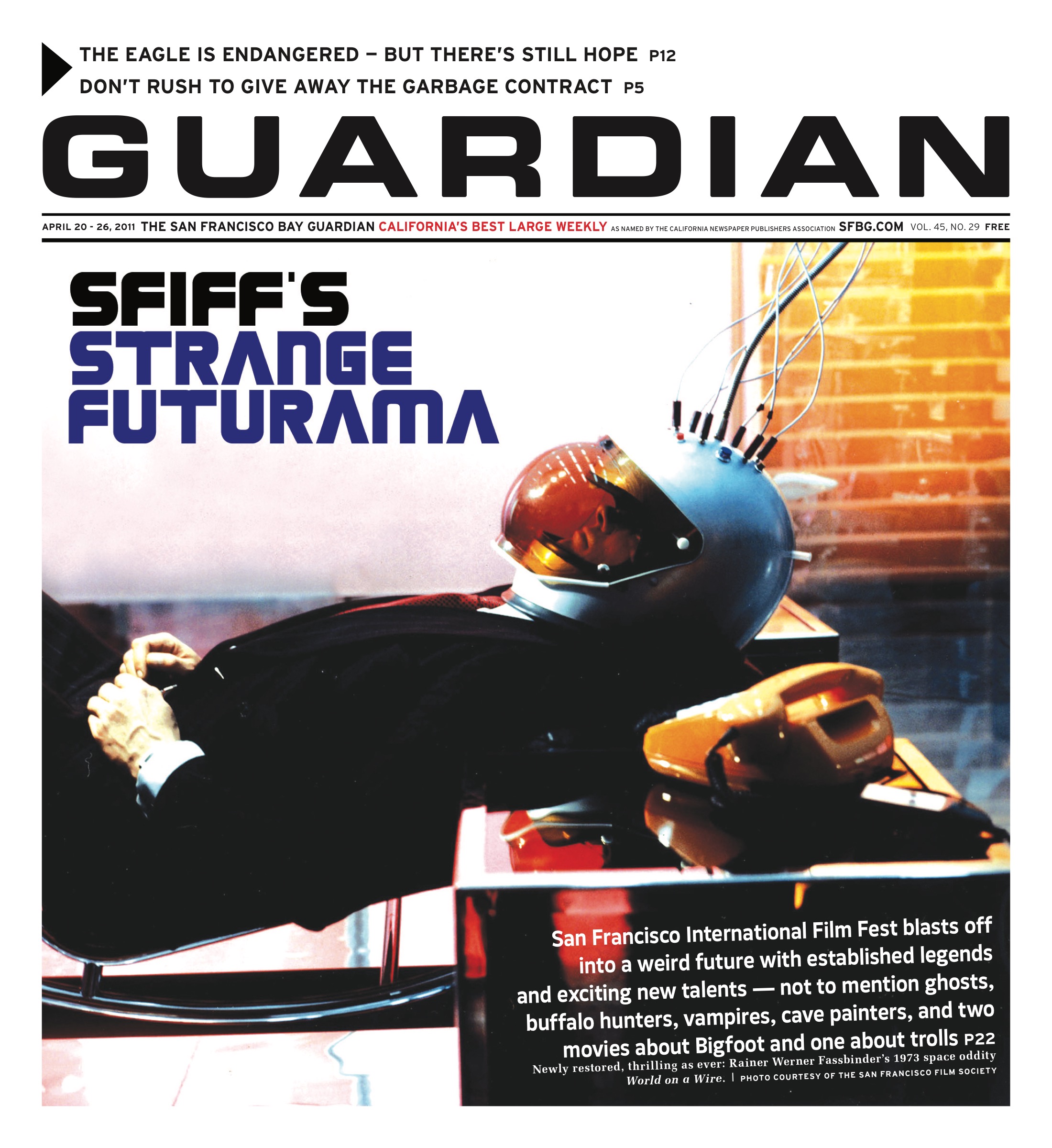
World on a Wire (Rainer Werner Fassbinder, Germany, 1973) The words “Rainer Werner Fassbinder” and “science fiction film” are enough to get certain film buffs salivating, but the Euro-trashy interior décor is almost reason enough to see this restored print of the New German Cinema master’s cyber thriller. Originally a two-part TV miniseries, World on a Wire is set in an alternate present (then 1973) in which everything seems to be made of concrete, mirror, Lucite, or orange plastic. When the inventor of a supercomputer responsible for generating an artificial world mysteriously disappears, his handsome predecessor must fight against his corporate bosses to find out what really happened, and in the process, stumbles upon a far more shattering secret about the nature of reality itself. Riffing off the understated cool of Godard’s Alphaville (1965) while beating 1999’s The Matrix to the punch by some 25 years, World on a Wire is a stylistically singular entry in Fassbinder’s prolific filmography. Sat/23, 8:45 p.m., Kabuki, and April 30, 2 p.m., PFA. (Sussman) SUN/24

A Cat in Paris (Alain Gagnol and Jean-Loup Felicioli, France/Belgium/Netherlands/Switzerland, 2010) Save your pocket poodles, please: Paris, as cities go, is most decidedly feline. From 1917’s silent serial Les Vampires to its uber-cool 1990s update Irma Vep, cat burglars and the Parisian skyline have gone together like café and au lait. Add actual cats and jazz to the mix for good measure (even Disney saw fit to set its jazzy 1970 Aristocats in the City of Light). At just over an hour long, the animated A Cat in Paris is an enjoyable little amuse-bouche that employs all the standards of the cats-in-Paris meme: Billie Holiday warbling on the soundtrack, a dashingly heroic antihero who scales the rooftops as if he studied parkour under Spider-Man, and the titular untamable black cat who serves as his partner in crime. Complete with a climatic Hitchcockian set piece on the rooftops of Notre Dame Cathedral, A Cat in Paris has a refreshingly angular and graphic, almost cubist, feel. Directors Alain Gagnol and Jean-Loup Felicioli’s work certainly doesn’t rank among that of countryman Sylvain Chomet (2010’s The Illusionist), but this family film is worth checking out if kitties up to no good in Purr-ree simply make you want to le squee. Sun/24, 12:30 p.m., Kabuki, and May 1, 12:30 p.m., New People. (Michelle Devereaux)


MON/25

Cave of Forgotten Dreams (Werner Herzog, U.S., 2010) The latest documentary from Werner Herzog once again goes where no filmmaker — or many human beings, for that matter — has gone before: the Chauvet-Pont-d’Arc Cave, a heavily-guarded cavern in Southern France containing the oldest prehistoric artwork on record. Access is highly restricted, but Herzog’s 3D study is surely the next best thing to an in-person visit. The eerie beauty of the works leads to a typically Herzog-ian quest to learn more about the primitive culture that produced the paintings; as usual, Herzog’s experts have their own quirks (like a circus performer-turned-scientist), and the director’s own wry narration is peppered with random pop culture references and existential ponderings. It’s all interwoven with footage of crude yet beautiful renderings of horses and rhinos, calcified cave-bear skulls, and other time-capsule peeks at life tens of thousands of years ago. The end result is awe-inspiring. Mon/25, 7 p.m., and Tues/26, 9:30 p.m., Kabuki. (Eddy)


TUES/26

Nostalgia for the Light (Patricio Guzmán, France/Chile/Germany, 2010) Chile’s Atacama Desert, the setting for Patricio Guzmán’s lyrically haunting and meditative documentary, is supposedly the driest place on earth. As a result, it’s also the most ideal place to study the stars. Here, in this most Mars-like of earthly landscapes, astronomers look to the heavens in an attempt to decode the origins of the universe. Guzmán superimposes images from the world’s most powerful telescopes — effluent, gaseous nebulas, clusters of constellations rendered in 3-D brilliance — over the night sky of Atacama for an even more otherworldly effect, but it’s the film’s terrestrial preoccupations that resonate most. For decades, a small, ever dwindling group of women have scoured the cracked clay of Atacama searching for loved ones who disappeared early in Augusto Pinochet’s regime. They take their tiny, toy-like spades and sift through the dirt, finding a partial jawbone here, an entire mummified corpse there. Guzmán’s attempt through voice-over to make these “architects of memory,” both astronomers and excavators alike, a metaphor for Chile’s reluctance to deal with its past atrocities is only marginally successful. Here, it’s the images that do all the talking — if “memory has a gravitational force,” their emotional weight is as inescapable as a black hole. Tues/26, 6:30 p.m., Kabuki, and April 28, 6:15 p.m., PFA. (Devereaux)

The Sleeping Beauty (Catherine Breillat, France, 2010) Fairytales are endemically Freudian; perhaps it has something to with their use of subconscious fantasy to mourn — and breathlessly anticipate — the looming loss of childhood. French provocateuse Catherine Breillat’s feminist re-imagining of The Sleeping Beauty carries her hyper-sexualized signature, but now she also has free reign to throw in bizarre and beastly metaphors for feminine and masculine desire in the form of boil-covered, dungeon-dwelling ogres, albino teenage princes, and icy-beautiful snow queens. The story follows Anastasia, a poor little aristocrat, who longs to be a boy (she calls herself “Sir Vladimir”). When her hand is pricked with a yew spindle (more of a phallic impalement, really), Anastasia falls into a 100-year adventurous slumber, eventually awakening as a sexually ripe 16-year-old. It all plays like an anchorless, Brothers Grimm version of Sally Potter’s 1992 Orlando. And while it’s definitely not for the kiddies, it’s hard to believe that many adults would find its overt symbolism and plodding narrative any more than a sporadically entertaining exercise in preciousness. Your own dreams will undoubtedly be more interesting — perhaps you can catch a few zzz’s in a theater screening this movie. Tues/26, 6:15 p.m., and April 27, 6:30 p.m., Kabuki. (Devereaux)

THE 54TH ANNUAL SAN FRANCISCO INTERNATIONAL FILM FESTIVAL runs April 21–May 5. Venues are the Sundance Kabuki, 1881 Post, SF; Castro, 429 Castro, SF; New People, 1746 Post, SF; San Francisco Museum of Modern Art, 151 Third, SF; and Pacific Film Archive, 2575 Bancroft, SF. For tickets (most shows $13) and complete schedule visit www.sffs.org>.

Endangered Eagle may still have hope

4

news@sfbg.com

An important community institution never truly dies. It remains in the hearts and minds of everyone it has touched — a fact that that patrons who have lived and loved (sometimes literally) in the Eagle Tavern understand. But that doesn’t mean they’re ready to loosen their talons and let go.

With the help of San Francisco’s supervisors, some seriously committed community energy — and maybe even a Dallas cowboy who likes his leather — they may not have to.

For the past week, patrons of one of San Francisco’s oldest and boldest gay leather bars have been rallying to save their stomping ground from uncertain fate. It started when they found that rumors swirling since early in the year were true: the Eagle was slated to close at the end of April and faced a May 1 eviction.

Since then, defenders of the 12th Street space have scraped together emergency meetings and impromptu marches, a surprise leather night at the Skylark Bar (owned by a believed-to-be buyer), and a demonstration on the steps of City Hall. Letters were sent to the Board of Supervisors, petitions signed, and pink tent campouts planned as vigils.

Through it all, the message carrying most clearly was that the Eagle Tavern is far more than a swingin’ hot spot. “It’s our history and it’s our culture,” said organizer Kyle DeVries at a rally on the steps of City Hall last Tuesday. “And we’re proud of what we’ve given to this city.”

That “what” includes more than $1 million raised through the years at popular Sunday beer busts supporting everything from breast cancer research to AIDS awareness. But it also includes providing a safe haven and sense of belonging for San Francisco’s queer community for more than three decades.

And now, patrons have learned they will eek out another month. Thanks to the huge outpouring of support from Eagle denizens, and political pressure from three San Francisco supervisors, the end-of-April plan to fly the coop has been delayed at least until the end of May, Eagle manager Ron Hennis said.

But since the issue first exploded April 11, efforts to save the sacred space haven’t slowed down. At press time, supporters were planning an April 19 “Tuesday roost” at the Eagle in hopes of pumping energy and cash back into the tavern on a night known to be quiet.

Sup. Scott Wiener, along with Sups. David Campos and Jane Kim, sent a letter to the San Francisco Police Department that reviews liquor license sales in connection with the California Department of Alcohol Beverage Control. The letter reviewed the Eagle’s importance in SF’s queer community and stated that its authors are “adamantly opposed to any sale that would result in the Eagle’s destruction.”

The supervisors urged the SFPD to “closely scrutinize, consistent with applicable legal standards, any requested liquor license transfer relating to the Eagle to ensure that any such transfer will not harm the LGBT community by putting an end to the Eagle.”

So far, these efforts have been promising for Eagle patrons. In a phone interview, Wiener told us that Skylark owner Steve Englebrecht has pulled out of negotiations to buy the place. But the situation remains complex.

Eagle manager Ron Hennis explained that current owners John Gardiner and Joe Banks decided to sell the Eagle a year ago to focus on their other SoMa leather bar, Hole in the Wall Saloon, which has been plagued with high-cost property battles of its own.

Gardiner and Banks didn’t respond to our e-mails. But Hennis said they intended to sell the business — which includes the Eagle name, equipment, and liquor license — to people they felt would maintain the existing spirit of the bar: Hennis, Eagle entertainment coordinator Doug Hilsinger, and Lila Thirkield, owner of the Lexington Club.

Hennis and Hilsinger told us a contract was signed and the deal had progressed through an initial set of inspections and into escrow when the property’s owner, John Nikitopoulos, refused to negotiate a new lease with the prospective owners.

Despite successful conversations up to that point, Gardiner and Banks “turned off and didn’t say why,” Hennis said.

Further complicating the matter, Gardiner and Banks’ lease ran out and Nikitopoulos hasn’t renewed it. He’s been renting the property month-to-month and is reportedly raising the monthly price tag, which has remained the same for the past 10 years.

Hennis said the owners were still paying rent when they were threatened with eviction — which would mean a death sentence for the Eagle unless they could sell the business to a party Nikitopoulos would be willing to negotiate a lease with.

In the midst of the stalemate, Nikitopoulos offered to buy the business (and most important, the liquor license) from Gardiner and Banks, who refused saying they’d already agreed to sell to Hennis and his partners. Nikitopoulos then approached Hennis, suggesting Hennis purchase the business as planned and then sell him the liquor license. When Hennis also turned down the landlord’s offer — without the liquor license, Hennis wouldn’t actually own the bar — he disappeared from the conversations.

At the April 12 demonstration, mayoral candidate Bevan Dufty called for the stakeholders involved to recognize that in a city that “values history — indeed, is defined by history,” the lease on the Eagle is “more than just a business transaction.

“The owner of this building needs to come to the table and talk about this,” he urged.

But Nikitopoulos, a resident of Santa Rosa who inherited the property from his father, hasn’t responded to Hennis, reporters, or even to calls from Sup. Wiener. He was, however, reportedly in communication with Englebrecht when the Skylark owner swept in to purchase the space and liquor license — but not the name or the leather culture.

Though Englebrecht withdrew, supporters worry Nikitopoulos could potentially negotiate a lease with a different tenant — leaving the bar a casualty of SoMa’s continued gentrification.

Longtime Eagle patron Mike Talley, who has lived in SoMa for more than two decades, fears the Eagle would fit perfectly into a familiar story of luxury lofts, astronomical rent increases, and — inevitably — mass evictions. He explained that what the Chronicle’s late columnist Herb Caen called the Miracle Mile — a strip of SoMa gay and leather bars that once numbered in the dozens — now consists of just a few properties “hanging in there.”

Mark Kliem, a.k.a Sister Zsa Zsa Glamour of the Sisters of Perpetual Indulgence, echoed Talley’s concern, saying, “The rest of the entire world is family-friendly. Why can’t we have this one little half-mile area to call queer space?”

It’s worth noting that the Eagle is by no means exclusively gay. It is famous for its Thursday-night rock shows where, according to an Eagle DJ, “a melting pot of hipsters, stoners, and rockers mixed with the leather crowd.”

“Everyone was cool,” he said. “Everyone was welcome.”

Still, the bar has become an icon of San Francisco’s queer community.

Kim, who represents the district, presented the Eagle with a letter of commendation recognizing its 30 outstanding years as a “venue, cultural institution, safe haven, and home for the LGBT community” at the April 12 meeting.

“You can’t threaten something as important as this institution,” Campos added.

Wiener, Kim, and California Sen. Mark Leno also praised the Eagle at Sunday’s regularly scheduled beer bust. Leno lauded the efforts of local drag queen/community organizer Anna Conda, and referred to the week’s events as “Stonewall West.”

If anything, the week of demonstrations has drawn San Francisco’s queer community closer. And there is hope that the crowd can stay together in the spot they claimed for themselves. One white-horse possibility is Mark Frazier, owner of a Dallas bar also named the Eagle — and also home to a leather crowd.

Seth Munter of Herth Realty in San Francisco said Frazier has been eyeing the SF Eagle for more than a year, and that he is “interested and able to participate in continuing the Eagle as it has been, either with partners or on his own.”

Reached by phone in Dallas, Frazier told us he’s dreamt of the business since before his own Eagle took flight in 1995. “I think the San Francisco Eagle has a lot of history and a core base of support,” he said. “Any time you go into a business with so much support, it’s going to be successful.”

Frazier stressed that like the SF original, his Eagle has raised substantial sums for charity. Though he acknowledged that the bottom line of all businesses is to make money, “the successful ones continue to give back to the community — and not only monetarily.”

So far, Frazier said he has “exchanged e-mails with the powers that be” and that he is confident the Eagle’s troubles stem from a “communication gap” he could help fix.

Hennis expressed hope about the possibility of working with Frazier in addition to pursuing other options like historical preservation.

Demonstrators have penned more than 100 hand-written letters to the Historic Preservation Commission urging it to assign the Eagle landmark status. Commissioner Alan Martinez said such a process could cost thousands of dollars and would not “grant the right to dictate businesses or tenants.”

Still, he announced publicly that giving the building historic status is not “about turning the city into a museum — it’s about our history.”

Though landmark status protects the physical property, it would also provide legitimacy, an instantaneous way to tell the building’s story and bind the community together. And no matter what happens with the sale of the Eagle, that’s one possibility that flies.


4/20 fantasy: Ziggy’s new comic book

0

Attention, WonderCon, Ziggy is missing. Repeat, we are missing Ziggy Marley. But only for a second – turns out the “Love is My Religion” star had only wandered away from the Image Comics booth into the dizzying panorama of the comics convention for a moment to snag his son some of the new Green Lantern toys. “He’s into it,” he tells me, smiling as his fixers and Image staff scramble to set up the seats for our interview.

But to be clear about what exactly we’re doing here: Ziggy Marley is releasing a comic book on 4/20. It’s called Marijuana Man, obviously. 

It’s about a hero (a white guy!) named Sedona, a being from the planet Yelram – like, read it backwards — on Exodus, where the for-real (a.k.a., the weed smoking, freedom-fighting, down) Earthlings are trying their best to defeat the evil, environment-ruining, pill-pushing Pharma-Con. Sample Pharma-Con line: “I want to get this over with so we can get back to the business of selling people chemicals they don’t need.” Hiss.

The book really is gorgeous, illustrated by Jim Mahfood of 40 Oz. Comics, who pretty much has the sexy street art graphic novel on lock. I mean, the guy illustrated Colt 45’s label, for chrissakes.

“There’s quality in the textures,” Marley tells me (still smiling, he’s always smiling because love is his religion). “It’s a collector’s edition.” Some characters’ speak with a smoker’s patois, a lushly-proportioned-yet-badass guerilla named MJ – like, think about it – bonds with Sedona in a ecstatic, abstract sex session also patronized by the Lion of Judah and the crashing wave from Katsushika Hokusai’s 36 Views of Mt. Fuji series. And there’s whizzing, crashing battles between Sedona and a Pharma-Con mercenary on a motorcycle that leaps and murders. 

The Marijuana Man gang

But. Ziggy Marley, you have never once made a comic book before. I had doubts, doubts as to whether this book, with its “Ziggy Marley’s” inscribed over its title, was indeed the work of the genial reggae star in front of me. I put it to him: Ziggy, was Marijuana Man really your idea?

He says: yes. Ziggy uses the royal “we,” which is fine because Bob Marley is his dad.

“We had the idea to create a superhero who gets his powers from a plant.” It seems that royal Ziggy, or team Ziggy (this last probably includes Snoopy, his genial bodyguard who takes photos of Ziggy bonding with childrens in Brazil and later bemoaned to me the fact that Shakira got a helicopter to airlift her to a concert in Argentina that the two headlined, while team Love = My Religion had to proceed on a congested road, which I agree isn’t right) were ready for a superhero that got righteous not through the ingestion of toxic chemicals, or prosthetics, or capitalism, but rather natural medicine. 

So Marley had the original idea for the comic, but then chose a crack team of comic professionals to make it come to fruition. “Jim and Joe [Casey, another big deal-guy who wrote the book] would do their thing, and every once in awhile I’d say ‘what about this.’” 

Basically, there’s a cause involved here, and not least because Marley plans to make Marijuana Man‘s 4/20 release an annual occurrence. “Sedona’s a metaphor for the plant itself. We believe the plant is special, if used properly,” he says, admitting that Marijuana Man carries an additional message. To wit: “to get rid of the stigma and the demonization of the plant.”

“I have a vivid imagination,” he smiiiiles. There is nothing more that I want to do with my day past hang out with this happy, sun-shiney man and his comic book dreams, so I start asking him what comic books he likes.

He likes Jonah Hex, “the weirdest Western hero” who was born to a prostitute mother and a father who sells him to the Apaches, whose respect he earns and then loses at the hands of a jealous chief’s son, who messes up his face with a hot tomahawk. Hex becomes a bounty hunter anti-hero. At some point, Hex is catapulted into 2050. When he dies (card game) his body is stolen, stuffed, and unfairly displayed by a touring circus. I think he is later resurrected, and takes to fighting for and against crime again with the Black Lantern Corps. 

“Jonah Hex, he’s a bad good guy, he’s a good bad guy,” Ziggy says. I wish I could walk around WonderCon all weekend with Ziggy Marley and talk about this, but his next interview is already waiting for him and then he has a big stack of Marijuana Man posters to sign for fans. 

“The thing about comic books, it’s a deep thing. They’re not frivolous, they have meaning,” he tells me. “Music fans who love our philosophies and ideas, I think they can relate to that. They’re art. They’re not just about drawing people, hands, and feet.” 

That man, I swear, love him. To celebrate your holiday with Marijuana Man, here’s a website that’ll point you to the nearest comic book store. 

A long time ago, in a galaxy not far away

0

arts@sfbg.com

SCI-FI DOCUMENTARY Recalling a simpler time — before mass commercialization and marketing took over the world of science fiction, pop culture, and fan conventions — local filmmaker Tom Wyrsch’s new documentary Back To Space-Con conveys the story of the home-grown, grassroots-fueled sci-fi conventions of the 1970s, told through interviews with the people behind the events, fans who were there, and rare footage shot on location here in the Bay Area more than 30 years ago.

Coming off the successes of his first two projects, 2008’s Watch Horror Films, Keep America Strong, which looked at the local TV phenomenon Creature Features and last year’s wildly popular Remembering Playland At The Beach, about the now-gone San Francisco beach-side amusement park, it wasn’t hard for Wyrsch to decide on what subject to tackle next.

Several years ago, the late Bob Wilkins, former host of Creature Features, had given Wyrsch a treasure trove of one-of-a-kind 16mm footage taken for his show at a series of Star Trek and sci-fi conventions, showing a great array of fans, their handmade costumes, and of course, the many special guests and celebrities who were on hand.

Wyrsch himself had attended some of these events, the larger ones called “Space-Con,” when he was growing up in the Bay Area. “At that time they were a brand new experience,” says Wyrsch. “To go to these conventions was just fabulous. And they definitely left a mark.”

With his fond memories in place and the opportunity to use Wilkins’ rare original footage, Wyrsch decided to interview the people who helped put on the shows, along with those who had attended the conventions as fans, all to help share the feeling of what it was like back then, which the film does very effectively.

“My approach to making documentaries is to really do two things: First, I want to take people back who actually experienced it. The other part is, I want to be able to take people there who never had a chance to go because they either weren’t in the area or they were too young,” says Wyrsch.

One of the great things about Back To Space-Con is seeing all the homespun costumes that fans wore — this was before the Star Trek movies started being made, and for some of the conventions included here, just before and at the beginning of the Star Wars (1977) phenomenon. There were virtually no official costumes or merchandise, and many of the people interviewed remark how wonderful it was to see such creativity and excitement in their fellow fans.

“[Space-Cons] were fan-based conventions that really did not have anything to do with the industry. They were the fans putting on shows for each other,” says Wyrsch. “In the film you can see how they are the grassroots movement of conventions that led to the ones we have today.”

Wyrsch is grateful to have been able to use so much original film footage, and he hopes viewers will appreciate how rare it is that material like this has survived all this time.

“What the younger generation doesn’t know was that it was very difficult and very expensive to go out in the field and do an interview or to film indoors because of lighting and the old cameras,” he explains. “With video and all the high-tech electronics and computers you can put in the camera [today], you don’t have to worry about that stuff anymore. But back then, it was tough, and with a lot of interviews they would go out and do them and then throw the film away because there was no use to it anymore and it took up a lot of storage space. Bob [Wilkins] kept this, and he kept part of history.”

Wyrsch will be on hand at a special Back to Space-Con premiere event at the Balboa Theater, along with former Chronicle writer and Creature Features host John Stanley, and Ernie Fosselius, the man behind the Star Wars spoof Hardware Wars (1978).

“I think people get to see the simplicity that was there in the seventies, it wasn’t so regimented like they are nowadays,” says Wyrsch. “And people love that.”

BACK TO SPACE-CON

Thurs/14, 7 p.m., $10

Balboa Theater

3630 Balboa, SF

(415) 221-8184

www.balboamovies.com


The online-learning challenge

7

culture@sfbg.com

CAREERS AND ED Mixing, mashing, chatting, tweeting: This is how the University of California envisions the future of learning for what it calls a new breed of students. Also on the syllabus? Podcasting, vodcasting, blogging, and Skype.

Last week, UC was awarded a $750,000 Next Generation Learning Challenges grant, moving it one step closer to a curriculum composed of words that barely existed a decade ago. But some fear — with good reason — that online education will become a low-cost, high-return alternative to traditional instruction. And the students will be the losers.

UC’s Online Instruction Pilot Program grew out of recommendations to explore online learning discussed by the UC Commission on the Future over the past two years. This spring, a subcommittee of faculty and administrators selected 29 courses to be developed over the next two years.

The pilot program is a long-term initiative to evaluate and ultimately increase the role of online education as a regular part of the UC curriculum — a chance to respond, according to the program’s website, to a “transformation” in the way students learn.

The commission promotes online learning as a boon without trade-offs, a way of answering questions of accessibility, efficiency, and, ultimately, costs — and is not shy about outlining the relationship between the three. Chartered to help wiggle UC out of a “vise of rising costs and drastically reduced resources,” the commission is proposing sweeping changes to California’s public university system.


ALL BUT THE KEG PARTY

UC envisions a greater number of students served and increased diversity, “from Kentucky to Kuala Lampur,” according to Law School Dean Chris Edley, cochair of the commission’s Education and Curriculum Working Group.

Edley, one of the most enthusiastic proponents of digital learning, initially referred to online education as an 11th UC campus, promising it would offer an equivalent college experience — minus only the “keg party.”

Critics were quick to condemn the plan as overblown excitement. Concerned undergraduates and skeptical faculty raised questions about the quality of online learning. Angry graduate student instructors (understandably) balked at Edley’s grandiose vision of a cybercampus where “squadrons of GSIs” will serve on the “frontline of online contact” with undergraduates.

Political science professor Wendy Brown is one of the leading critics. “Personal engagement with students is crucial,” she told us in a phone interview. “Real teachers don’t just teach subject matter. You have to know students and where their experience and level of engagement is. I don’t want them just to come out with content — I want them to come out as thinkers … have a new way to analyze the world.”

Brown said she believes that acclimating to the intellectual culture of a university — especially important in the first year — can’t be achieved online. Yet first-year courses are exactly where administrators are looking to channel online efforts.

Administrators hope to relieve pressure on overcrowded gateway math and science courses, as well as freshman reading and composition. As many as 40 percent of first-year students test out of their first semester of reading and composition, indicating that the students remaining are those most in need of attention. Even so, a generous smattering of general chemistry, intro calculus, and reading and composition classes like Humanities 1A are among the pilot courses moving forward.

Craig Evans, professor of mathematics and chair of the course committee for calculus, echoes Brown’s concerns. “I don’t think it’s impossible to make this work, but I think it would be very, very difficult,” he said. “Part of what we do as teachers is applied psychology, things like checking in with students and keeping up morale, in addition to teaching classical mathematics. It’s hard to see how to convey that in an online course.”

Robert Anderson, faculty representative to the Board of Regents and professor of economics and mathematics, agreed that there is “something important about being on campus for four years, rubbing shoulders with students and faculty.”

And when short-term goals — taking pressure off overcrowded introductory courses — are met, what comes next?

The academic senate approved the pilot program on the condition that the necessary funding — as much as $7 million — come from outside sources. With the exception of the $750,000 NGLF grant, that money hasn’t materialized. The university has borrowed money from internal sources; half of that will be directed toward infrastructure development, according to Anderson.

With money-saving rhetoric underlining every stage of the program’s development and millions to be invested in online infrastructure, how will UC officials avoid the temptation to simply use online learning as a revenue source — regardless of what academic benefits pilot program researchers find?


CASH COWS

The answer is: they won’t.

In a post on the Berkeley Blog last summer, Edley attempted to allay fears that an online program would eliminate campus learning by assuring that future online pupils would be “new, tuition-paying, UC-eligible students we otherwise wouldn’t have the room or resources to serve. And any net revenue would be plowed back into supporting the on-campus program.” In this model, off-campus students would be cash cows milked for the additional revenue they could produce.

Though the committee has delayed visions of an entirely online degree since then, crucial questions regarding a long-term trajectory remain: Would online students pay the same price? Would they be accepted exclusively for online matriculation? Would their degrees be identical?

Nobody knows, but already the pilot program is relying on projected revenue from off-campus students to help recoup some of the borrowed $7 million, according to Anderson.

Keith Williams, Edley’s cochair on the commission’s education and curriculum working group, confirmed that UC is planning to offer newly developed classes on a per-credit basis to students enrolled at UC and others.

According to Williams, these new courses will offer full course credit — and the full price tag. Pricing was made consistent with brick-and-mortar courses, Williams explained, to avoid causing UC students to make a tough decision: either pay full price for an on campus course or save money by taking a less desirable online course.

And yes, conveniently, offering the courses at full price does generate revenue to be reinvested. (Williams balked at the phrase “skimmed off the top.”)

Now that the pilot program is underway, administrators are treading more lightly around its money-making intentions. But for a reminder of the project’s origins, one need only look at the commission’s recommendation to up enrollment quotas for nonresident students — a recommendation slated to be met next year.

The commission’s final report explicitly calculates the amount of money ($12,000) that can be generated for each Californian replaced with a nonresident student, stating “each 1 percent increase in nonresident students would generate almost $1 million” — a dubious maneuver at a time when the university claims it must expand online education to meet the shortages of space for its own residents.

The culture betrayed by this vision of UC education is clear — one in which educational models are constructed according to business practices.

Despite the pilot program’s rhetoric of innovation and breakthrough, it’s not the first to fuse Internet with education. Brown is quick to note that despite her criticism of the pilot program “[she] is not a Luddite.” She described to us how the faculty is increasingly making use of online educational aids.

Many professors choose to broadcast their lectures online, allowing students — and anyone else for that matter — to virtually peek in on a lecture, either live or with a delay of hours or days.

Currently, more than 40 UC Berkeley lecture halls are fitted for video and/or audio recording. Thousands of transmissions, from biology to history, have been uploaded to iTunes and YouTube (see sidebar).

Although webcasts are highly popular with students — and students are undoubtedly the main priority for the program — people are tuning in from all continents, according to Benjamin Hubbard, who runs the webcast program.

For Hubbard, webcasts “[broaden] the window of access to all the scholarly activity on campus. We are fortunate in that we are public university, so first and foremost we have a mission of community service and making this content freely and publicly available matches this mission.”


THE PUBLIC OPTION

Recognizing the enormous challenges of decreased accessibility and increasing cost, a growing consortium of educators and researchers are building momentum and developing a vision for a truly public online educational program.

Lisa Petrides, president and founder of the Institute for the Study of Knowledge Management in Education, calls herself a “public education fanatic.” She told us that the instead of using online teaching as a money-maker, schools can adopt a principled, egalitarian approach.

Petrides is a signatory of the Capetown Declaration, a manifesto for the open education movement. The declaration calls for collaboration that cuts across institutional lines; for the use and promotion of free educational resources; and for policy support for open education.

“You start to have this pedagogical collaborative community that can use resources in this way, changing how we teach and how we learn,” she said. To take analogy for computer software, Petrides says her movement is akin to the open source movement.

Now there’s an innovative approach to online education — with its eyes on the future, not its pocket.


Sinisterism and lost hills: The Slow Poisoner joins forces with Fantomas in San Francisco

0

In conjunction with the continuing “Fantomas by the Bay” series presented by City Lights, the Cultural Services of the Consulate General of France, and the Mechanics’ Institute Library, here’s an interview with the Slow Poisoner, who may be casting a musical shadow over the Fri./8 event, “An Elegant Threat.” The man also known as Andrew Goldfarb holds forth on his Fantomas bonds, surrealist activity in San Francisco, and the Slow Poisoner’s current and next moves.

SFBG What is your interest in Fantomas, and do you have any favorite Fantomas-related works?
Andrew Goldfarb I first discovered French villain Fantomas during an absinthe binge abroad, and was immediately drawn to his unrepentant sinisterism and stylish fashion sense, especially the black mask and top hat combination. I would say that aside from the original 1911 literary serial, my favorite Fantomas work is the 1915 film series, because there’s nothing that captures the decadence of criminal Paris like a hand-cranked silent movie tinted with blood.

SFBG You’re a native San Franciscan. Do you feel there is surrealist activity present here at the moment, and if so, what are its facets?
AG As long as San Francisco is coated with a thick coat of fog in the morning, the City will remain mysterious, and surrealistic activity will be present. I’d say my favorite examples of modern surrealism in S.F., aside from the schizophrenic rants posted on telephone poles in the Tenderloin, are the costumed noise bands that flourish in the Mission District, such as the Spider Compass Good Crime Band, which features two oversized vultures, one of whom plays lounge music on an organ while the other generates electronic dissonance with analog synthesizers. Very entertaining, and feathered.

SFBG What is the Slow Poisoner up to these days?
AG I just completed a roots-rock-opera about ghosts and liquor, which is titled Lost Hills. It tells of my days as a traveling curio salesman, my brief engagement to a phantom hitchhiker, and my eventual hanging (after some misfortunes involving a tainted Mint Julep). I’ve been illustrating it with felt art, kindergarten-style. I’ve also just brewed up a new batch of my Slow Poisoner Miracle Tonic, which is made with pure Egyptian oil and is proven effective in the treatment of Consumption, Women’s Troubles, Gout, Neuralgia, Wandering Limbs, Stoutness, Onanism, Disinterested Bladder, Elephantiasis, Cholera, Barnacles and Boils, The Fits, Excessive Abscesses, Necrosis, Lavender Fever and General Wasting.

FANTOMAS BY THE BAY: AN ELEGANT THREAT
Fri/8, 8 p.m.
Location undisclosed and secret (invitations available at the front desk of City Lights); free
(415) 362-8193
www.citylights.com

Mayoral staff member to direct America’s Cup Organizing Committee

The San Francisco Ethics Commission voted unanimously on March 14 to waive a pair of ethics rules in order to allow Kyri McClellan, a project manager in the Mayor’s Office of Economic and Workforce Development (OEWD), to become executive director of the nonprofit America’s Cup Organizing Committee (ACOC). The fundraising arm of the America’s Cup effort, ACOC’s role in bringing the world-famous sailing regatta to San Francisco is to secure corporate donations to offset city costs.

For months, McClellan has been on the city’s side of the negotiating table in discussions with ACOC to hash out a memorandum of understanding (MOU) concerning its fundraising obligations to the city. Without skipping a beat, she’ll now be interfacing with the city on the ACOC side. At press time, it was unclear whether McClellan had already started her new job, but her voicemail with OEWD was still in service. We left a message, but haven’t heard back.

McClellan sat down with the Guardian last November for an interview about the America’s Cup. She seemed knowledgeable and organized — and race organizers were clearly impressed with her performance. Regardless of how qualified she may be, however, the Ethics Commission’s decision to grant these waivers raises the question of whether McClellan received special treatment from the very entity that’s tasked with ensuring ethical government conduct.

The move also raises concerns about a revolving door between the Mayor’s Office of Economic and Workforce Development and the powerful private-sector interests behind the prestigious sailing event. Rather than preserving the ethical barrier that the rules intended, ACOC will now gain a team member who has detailed knowledge of OEWD’s inner workings.

In order to accommodate McClellan, commissioners agreed to waive two post-employment restrictions for city officials. The first is a yearlong post-employment communications ban, and the second prohibits former city employees from receiving compensation from city contractors for two years.

To better understand the intent behind these bans, the Guardian phoned the Ethics Commission and was connected to Deputy Executive Director Mabel Ng. She explained that the communications ban prohibits former city employees from taking private-sector positions that interface with the same department they worked for, “because you might have some undue influence.”

The two-year ban on receiving compensation from city contractors is meant to ensure that city officials engaged in negotiating contracts are not doing so to secure an outcome that would benefit them personally. “This again, just to make sure that when you are negotiating a contract … you’re doing this on behalf of the city,” Ng said.

Asked to explain the commission’s reasoning behind the granting McClellan the waivers, Ng said it was because “it determined that there would not be a potential for undue influence … because it seemed like [ACOC’s] interests were aligned with the city’s interests.”

As one ethics commissioner pointed out during the meeting, however, the same could be said of virtually any nonprofit entering into an agreement with the city.

Asked what would happen if ACOC somehow failed to raise the agreed-upon funds, placing McClellan in the position of having to explain the shortfall or re-negotiate with her former coworkers, Ng allowed, “If something like that happened, there might be a conflict.”

And what justification was given for waiving the ban on former employees receiving compensation from city contractors? “For that one, in the law itself, it says the commission may waive it … if it would cause extreme hardship,” Ng explained. “There would be a hardship, because … this is a great opportunity for her, and there was a short timeline for her to do it.”

Pressed on that point, Ng confirmed that the “hardship” in this case was the possibility of being barred from a great job opportunity, not the threat of financial impact or job loss.

The other issue, Ng said, was that without McClellan serving in that post, the committee’s fundraising effort might not be successful. “It just seemed like, you need to have somebody take charge,” she said. “The committee may suffer without her at the helm. If she were not able to do that, the committee — which plays a very crucial role in this — may not be able to meet its obligations.”

When we mentioned to Ng that the committee was composed of some very well-connected individuals, she noted that she was not familiar with its membership.

As we reported in previous coverage of the America’s Cup, ACOC is a veritable who’s who. Hollywood mogul Steve Bing, who’s donated millions to the Democratic Party and funded former President Bill Clinton’s 2009 trip to North Korea to rescue two imprisoned American journalists, is on the committee. Tom Perkins, a Silicon Valley venture capitalist, billionaire, and former mega-yacht owner, has a seat. George Schultz and his wife, Charlotte, are members. Billionaire Warren Hellman, San Francisco socialite Dede Wilsey, and former Newsom press secretary Peter Ragone are also on the committee. And that’s to say nothing of the less well-known investors, or the honorary members — elected officials serving at all levels of government. Would a powerful crew such as this have a difficult time raising money without McClellan’s leadership? Seems like a stretch, but that reasoning was offered as a factor in the decision to grant the waiver.

In an odd twist, McClellan might also be working alongside her former boss on the America’s Cup effort. In January, ACOC named its “first ever” Ambassador at Large: Lt. Governor Gavin Newsom.

While several ethics commissioners raised questions before granting the waiver, the vote ultimately came to 4-0 in favor of McClellan’s request. Board President David Chiu sent his legislative aide, Judson True, to speak in support of issuing the waiver.

Is Burning Man going communal or selling out?

60

“Man on the move,” the headline I gave to my current Guardian article and an extended personal blog post on the announcement that Burning Man will next month form a nonprofit group to eventually run the event, raises a number of interesting issues that are likely to be vigorously debated within this huge, active burner community in the coming months and years.

How should Burning Man be governed? What is the event worth – if it can even be quantified – and who created and should benefit from that value? Are Black Rock City LLC board members being selfless stewards of the culture in giving up control or are they being greedy control freaks in holding on for six more years and expecting a big payoff in the end? Or, like much about this dynamic culture, is the truth somewhere in the middle?

Event founder Larry Harvey’s big announcement last week, made during a speech that was unusual for its insights into the thoughts and internal dynamics of the BRC board, stressed how to value an event whose central ethos opposes such commodification.

“I thought it was time the owners stepped out from behind the veil of secrecy,” Harvey told me during a follow-up interview this week. He repeatedly emphasizes the benevolence of a corporate board voluntarily giving up control over its assets and revenue stream. “What we’re doing, as far as normal capitalism, is aberrant…What we’re doing is giving up a lot of money.”

But the way that Harvey is trying to frame this issue seems antithetical to how most burners see the event and culture that they’ve spent decades helping to create, from using the term “owners” to describe the six board members to suggesting Burning Man has any relation to “normal capitalism,” even to the claim that there’s “a lot of money” to give up, and that they might be more entitled to that money than the thousands of burners who have contributed their sweat equity to the event.

“We have people who have 10,000 volunteer hours at Burning Man,” says Chicken John Rinaldi, a longtime burner and critic of how Harvey and the board have run the event, believing that they have always overstated their importance considering Black Rock City is built each year almost entirely by its participants. “This event throw itself.”

Yet Harvey and the other board members, such as Michael Mikel and Marian Goodell, insist that the board plays an important role in shepherding the event and the culture that has grown up around it, which is why they plan on waiting three years to turn control of the event over to the new nonprofit, the Burning Man Project, and another three years after that until they liquidate their ownership of the name and associated trademarks and are paid for their value.

“We want it to get on its feet and be able to raise money on its own,” Harvey said of the nonprofit. The board is also creating a committee called the Philosophical Center “to ensure the cultural continuity as we pour Burning Man into a new vessel.” Mikel said he insisted on that because “for me, it’s not about the art. It’s really about the culture.”

The nonprofit board will be comprised of the six LLC board members and at least seven more members that those six members will select, and Harvey said they are doing interviews now, including talking to many longtime burners who were represented at last week’s summit of Burning Man regional leaders from around the world. Chicken said it was offensive that Harvey would tell this gathering that it would take six years before they’d have full control over Burning Man.

“What they’re saying is it’s going to take years to pass the torch over, and they’re saying this to a room full of people who have been involved in Burning Man for decades,” Chicken said. He was particularly critical of Harvey’s statement that the board discussed coming up with a value for Burning Man and dividing that by six. “Once that comes out of someone’s mouth, the bets are off.”

Chicken’s conclusion: “They’ve turned Burning Man into a commodity. They’re selling the event.”

Burning Man doesn’t have much by way of assets now, and its roughly $12 million annual revenue stream from selling tickets goes almost entirely to staging the annual event and supporting the year-round operations of the organization.

But once the nonprofit forms up and starts taking tax-exempt donations and finding other ways of diversifying its revenue stream for the three years before the current board members cash out, Chicken predicts the board members will walk away with about $1 million each. “But I’m not going to let them get away with it,” pledged Chicken, who has already starting agitating and rabble-rousing in online forums, just as he did in 2004 when he launched the rebellion that became known as Borg2.

Harvey has confirmed the board members will walk away with well more than the $20,000 that they’re currently entitled to if they resign, “but we’ll have to work for a living,” he said. Mikel told me, “It’s never been about the money, for me it was there was no succession plan. I really want Burning Man to continue beyond my involvement with it.”

Yet they also said that the bitter divisions on the board have evaporated since the new plan was developed. “Now that we can all see the future,” Mikel said, “we’re getting along wonderfully.”

But Chicken says he’s determined not to let these six board members, who have been getting the highest salaries for the last six years anyway “simply for ordering the PortaPotties,” profit from an event he helped created that has always been been about communal effort and decommidified relationships.

“Burning Man should be a labor of love,” he said. “I think Burning Man should exist outside of commerce.”

Guardian City Editor Steven T. Jones is the author of The Tribes of Burning Man: How an Experimental City in the Desert is Shaping the New American Counterculture.

Photos of Larry Harvey from April 1 speech by

Ana Grillo Photography and Multimedia Productions

WonderCon diaries: Chris Cosentino is… Wolverine’s new buddy!

0

I had seen chef Chris Cosentino (of Bay Area offal ground zero Incanto, also a The Next Iron Chef contestant and host of the Food Network’s Chef Vs. City) in person for the first time a few weeks ago – he’d just made an incredible multi-course meal for a bunch of beer journalists at Anchor Brewery and was racing around, saying hi to people and describing his thought process on the various beer-food pairings. My tablemates, friends of Cosentino, told me he had a comic coming out at WonderCon, or something. So I gave him a shout – hey, dope local angle on the convention, since I knew I was going anyway.

Maybe I should have known when I saw the massive poster of Cosentino in the Ferry Building at the stand of his other business, Boccolone Tasty Salted Pig Parts (signed by the man himself, “pork is the new vegetable,”), a few days later that this was going to be no mere small press comic release.  

Perhaps a nice interview about his project for some pre-event coverage? — I inquired of the king of offal. “You have to speak with Marvel first before anything can be written sorry it’s their protocol,” he replied. Marvel! At which point I embarked on the epic voyage that is reporting on Marvel Comics, much of which involves intriguing email exchanges with C.B. Cebulski, senior V.P. of “creator and content development.” Marvel, like most of the major comic labels, luxuriates in a cycle of suspense and sneak peeks. So are Cebulski’s emails: vague, then bombshell! Damn, they’re good at what they do. 

Which is to say, the convention approached and I still had no idea what the hell Chris Cosentino had to do with WonderCon, or Marvel at all for that matter. I dug out of C.B. that he was indeed, going to be the special guest at Marvel’s “Welcome to the X-Men” panel, so that at least I would be present for when the bomb was detonated. Still, Chris — are you going to be an X-Man? “No I’m not an X-Man,” is all his email in return said. So what the hell — ? Suspense!

On Friday Cebulski sent me the artwork of the upcoming Cosentino Marvel appearance, which was probably a big deal that I should have tweeted about immediately: Wolverine and the chef in a meat locker poised for battle, Wolverine with his metal alloy adamantium claws, Cosentino brandishing a pair of shiny butcher knives. Best friends! 

I was hooked. Thusly, I ferreted out said Marvel presentation on Saturday, the first WonderCon event I attended and the only time I would attend a major label event this weekend, I think. I saw Cebulski and Cosentino enter, was briefly and glancingly greeted by the two, watched Cebulski assume a spot at the panel table, Cosentino grab a seat towards the back of the conference room with a friend, and then the panel began discussing upcoming X-Men releases to a rapt audience, who cheered when individual series (there are many within the X-Men universe, of course): suspense, sneak peek!

“I can’t say a lot about what’s involved — but there are lots of giant robots involved,” said a much-loved Marvel artist on the panel. And on: “something drastic will be happening in the X-Men universe — I don’t think I can say much more about it.” Suspense, sneak peek! 

And then, the artwork I’d been sent earlier flashed on screen, with Cosentino’s figure replaced with a black shape with a question mark in the middle. And then, Cosentino! I think it’ll be bigger news on Chowhound, judging from the lukewarm  WonderCon entusiasm levels expressed upon his introduction. He arose from his seat towards the back of the room and assumed a spot at the panel table.  

“It’ll be very food centric, very San Francisco-located,” Cosentino announces of his impending dance with the X-Men universe. “We’re gonna have fun with this one.”

“I grew up being infatuated with Wolverine. As a little kid, I used to sit there and stare at my hands,” he says, the best line of the panel: the audience chuckles, remembering their own metal alloy adamantium dreams. Cebulski, panel moderating, asks what Wolverine’s favorite restaurant is. 

“He has so many food loves,” Cosentino replies, unwilling to pigeonhole his childhood hero. “Japan, Germany.” Which is to say: read the comic book! You can, it comes out in June exclusively in digital form. I for one, will be stoked to see where Cosentino takes Wolverine on whatever shredding and stabbing mayhem ensues – North Beach for cioppino? Nobu’s late night meaty buffet? 

Anyway, the audience members that surfaced for the post-panel Q&A was less intrigued with these culinary concerns. The closest ask came from a young man from the South Bay. When, he wondered, will the X-Men be spending some time on the peninsula? He sees them in San Francisco, Oakland, and Marin all the time, so he’d like to know. “I want to see X-Men on my street!”

“You want to see X-Men destroy your house and your street,” a panelist says, by way of very inconclusive response, albeit one that incites much enthusiasm from the questioner and the rest of the audience. Seeing one’s house destroyed by ones heroes being the ultimate honorific here in this crowd of Marvel enthusiasts, save becoming a character oneself. 

Anyways, now our chefs are cartoon characters. What’s next, the anime version of the Tamale Lady? Alice Waters vs. Godzilla? 

More WonderCon tidings are on their way, later this week. Ziggy Marley will be involved. How’s that for a tease, Marvel?

The Guardian endorses: Jello Biafra for Mayor!

On every level, the San Francisco mayor’s race is critical. San Franciscans will decide whether a fiscally conservative candidate backed by downtown interests will continue Gavin Newsom’s legacy of gutting critical services while refusing to raise taxes, or if a progressive will lead the city into a new era.

San Francisco needs a mayor who is motivated not by campaign donations from corporate fat cats, but by true San Francisco values. The city needs some one who is ready to fight the war on fun, by boldly having more fun than the warmongers can possibly stand.

What San Francisco needs is Jello Biafra. In a rare early endorsement, the Guardian has thrown its support behind Biafra for mayor. Formerly the lead singer of legendary punk rock group the Dead Kennedys, he is now the front man of Jello Biafra and the Guantanamo School of Medicine. In 1979, Biafra ran for mayor against former Mayor Dianne Feinstein and former state Sen. Quentin Kopp. His campaign motto was There’s Always Room for Jello.

“I am honored,” Biafra said when he was notified that he had received the Guardian’s endorsement for mayor. “After all, how could I be any worse than the last elected mayor, who turned out to be a horrible Frankenstein of Dianne Feinstein, Gray Davis and Tom Cruise?”

Biafra went on to talk about his campaign platform. “I would immediately reverse all [Newsom’s] mean-spirited, bigoted, anti-homeless laws, and instead hire all the panhandlers to work for the city on a 50 percent commission to help balance the budget,” he said.

Biafra said San Francisco could take a cue from Austin, Texas for another revenue-generating measure. “I would … declare the outlying strip on 11th and Folsom to be a music district, like they did on Sixth Street in Austin Texas, instead of having the police harass them and shut them down. This has brought in a huge amount of tax revenue for Austin, by the way.”

As part of this plan, the city could “use the revenue to buy back KUSF for the people of the city,” he added.

Biafra has a refreshing approach to ending police misconduct and promoting reform within the San Francisco Police Department. “Police officers should be an elected position,” he told the Guardian. “Every four years, you run for election, voted on by the district you patrol. You couldn’t just run off and hide in Novato after beating and shooting people anymore.”

An honest mayoral candidate, Biafra doesn’t pull any punches – not even when it comes to criticizing the Guardian, which has been the only publication to endorse his campaign so far. “I think the Guardian blew it when they came out against the initiative to rename our sewage plant after George W. Bush,” he said. “I think that would be a great idea. I’ll bring that one back, too.”
Rather than minimum wage, Biafra would like to implement a maximum wage, which has been proposed by the California Green Party.

“What should the wage be? Let’s be generous: Two hundred grand, and then you’re done,” Biafra decided. “You can live really well on that kind of money. Everything else goes back to the public purse, and you’ve got schools, you’ve got health care for everybody, transportation for everybody, people can even go to law school on the public’s dime – and why not? I mean, what about just giving some of that money back to people who didn’t make the $200,000 and guarantee people income, instead of talking about welfare cheats?”

When he ran for mayor in 1979, Biafra generated a great deal of attention with his proposal to require businessmen to wear clown suits between the hours of nine and five. But he said this required some explanation: “This is only in downtown,” he noted, “because this is a response to Feinstein’s campaign to clean up Market Street. She meant the Tenderloin, I meant downtown where Chevron and Bechtel and Bank of America and the other looters hold court.”

http://www.youtube.com/watch?v=bPhfUOsT71c&feature=related

Biafra said he also planned to bring back another proposal from his first mayoral bid: “Create a board of bribery, to set fair standards and public rates for liquor licenses, building code exemptions, police protection, and most importantly, protection from the police,” he explained.

As for the re-naming of Candlestick Park, Biafra had a flash of inspiration during his endorsement interview. “Isn’t there those little bags of junk food under the brand Emperor Norton for, you know, dried bread chips and stuff? How about, if they’re going to sell off the name Candlestick Park — or for that matter, finally name our baseball stadium after something other than a phone company — how about Emperor Norton Park?” Biafra suggested.

Vote for Jello Biafra for Mayor of San Francisco. After all, as he told us, “I would definitely be better than the last elected mayor. Then again, so would a cockroach.”

Vote early, vote often, and vote like your city depended on it!

P.S.: If Jello Biafra doesn’t win, we’ll kill ourselves.

Jello Biafra and the Guantanamo School of Medicine will launch their latest album, Enhanced Methods of Questioning, at Slim’s on June 4.

April Fool’s. Kinda.

Fernando Di Leo, glorious bastard

0

ITALIAN CRIME CINEMA Italian cinema has a long history of innovators, but — like every other country, albeit more so — it survived commercially for decades via genre imitators. Fellini, Antonioni, Visconti, Pasolini, Bertolucci, and so on couldn’t have existed without the fiscal cushion provided by genre-feeds to the international market: first via mythological muscle man fantasies that reduced Hollywood’s Cecil B. DeMille-styled antiquity epics to more cost-effective displays of simple brawn, spear-throwing, and horse-riding over Hollywood-level stars and production values. Then via spaghetti westerns that made Clint Eastwood the star he hadn’t become on home turf, reworking a quintessentially American genre toward border-blurring maxi-minimalism.

That was the 1950s and ’60s. Fernando Di Leo began as a scenarist, contributing to myriad spaghetti westerns including Sergio Leone’s Dollars films, though he never liked the genre. (“Happily, I have a great capacity for writing incredible crap.”) He stirred controversy with early directorial efforts about female sexual frigidity and juvenile delinquency, really hitting his stride with a series of the violent crime dramas that dominated 1970s Italian commercial cinema — alongside horror films and the neverending sex comedy genre.

Often tapping the “elephant’s graveyard” of past-prime Hollywood actors who preferred to take starring or lucrative “guest star” roles in European films rather than support whippersnappers back home, these movies were made with the international market in mind. Some are even baldly imitative of The French Connection (1971), The Godfather (1972), Serpico (1973), and other influential U.S. hits of the era, to the point of unconvincingly fudging cultural and geographic compasses.

But while Di Leo’s films duly mixed veteran American actors into “Europudding” casts, his poliziotteschi exercises (he later voiced a preference for the term “noir”) were specifically Italian, with strong undercurrents of social criticism toward corrupt cops, politicians, and church officials — particularly those who’d disingenuously claim the Mafia “no longer existed.”

It certainly existed in these movies, four of which are showcased in “Fernando Di Leo: The Italian Crime Collection,” a box set representing DVD specialty label RaroVideo’s launch into the U.S. market. (It’s simultaneously releasing Fellini’s 1971 circus homage The Clowns as well.) It’s quickly apparent why this director was a professed huge influence on Quentin Tarantino, though they differ in politics (does QT have any?) and taste for verbal pyrotechnics (of which QT has arguably too much). The flamboyant tough guys played by beloved character actors, intricately internecine plots, explosions of outré violence, and vintage leisure-suited cool, however, passed from one to the other like DNA.

Caliber 9 (1972), first of the “Milieu Trilogy,” starts out as an unremarkable series of you-hit-me, I-hit-you shootings and explosions in the wake of the disappearance of $300,000 after a robbery. Primary suspicion falls on stony Ugo (Gastone Moschin, hitherto a comic actor), a bagman just out of prison who steadfastly denies that he absconded with the loot belonging to crime boss “the Americano.” But by the end every last viewer certainty has been overturned.

Mario Adorf, cast as the loudest, most obnoxious of Ugo’s mob tormentors, becomes the lead in that same year’s The Italian Connection, playing a small-time Milan pimp framed for a heroin shipment’s theft — and as a result hunted by two imported U.S. hit men. They’re sleazy career villain Howard Silva and John Ford’s towering, poker-faced fave Woody Strode, who both worked for Di Leo again. (He enjoyed repeatedly working with certain actors.) They provided the model for John Travolta and Samuel L. Jackson’s scrapping double team in 1994’s Pulp Fiction.

A private-screening-room massacre at the start of 1973’s The Boss doubtless provided blueprint for the fiery climax of 2009’s Inglourious Basterds. Not that the two are otherwise related — this tale of Sicilian mob wars has a don’s university-student daughter kidnapped by rivals as revenge for that earlier act, then “rescued” by Silva’s stone-cold contract killer.

But the misogyny that surfaces fairly briefly in Caliber and Connection takes alarming precedence here: adapting to her gang-raping captors like fish to water, Rina (Antonia Santilli) proves a nymphomaniac pothead alcoholic, insatiable every which way. She’s a degrading “rich bitch” cartoon that must have horrified its few female viewers at the height of women’s lib. (No wonder Santilli abandoned her short screen career almost immediately afterward.) At least The Boss outruns that sour shit with a last lap of spectacular twistiness. A professed womanizer, Di Leo now seems like an auteur who should have left female characters the hell alone.

The RaroVideo box ends with 1976’s exceptionally stylish and perverse Rulers of the City, a.k.a. Mr. Scarface, in which a child survivor of a mob slaughter (Fassbinder regular Harry Baer) grows up to avenge himself on don Jack Palance (“Just looking at him and my asshole twitches,” an underling opines), who exercised reptilian zest decades before his exhibitionist-pushup Oscar comeback. But he’s not the only one: a Shirley Temple-bewigged chanteuse vamp (Gisela Hahn) in see-through lingerie sings about abortion just before being glimpsed in a postcoital five-way with participants including too-pretty ice-blond Al Cliver (a.k.a. Pierluigi Conti). Culminating in a foot race as clever as the automotive climaxes of Bullitt (1968) and The French Connection, this is a baroque, self-mocking melodrama you’d be hard-pressed not to love.

Di Leo ended the decade with two highlights among many lurid debtors to 1972’s Last House on the Left: Notorious To Be Twenty (1978), whose free-spirited young heroines meet a brutal fate all the more shocking for its coming out of the blue after 80-odd minutes of comic frivolity; and Madness (1980), wherein Joe Dallesandro terrorizes a bourgeoisie household. But the films Di Leo liked to make were now unfashionable in a shrunken market, Italian financiers favoring crass new local tastes for gore-horror and softcore sleaze. After two dispirited mid-1980s action films he retired, still in his early 50s. Before his 2003 death he enjoyed revived attention thanks to cult enthusiasts led by guess who. These movies all look sharp in their DVD restorations, offered English both dubbed and subtitled. (There were precious few “original language” Italian features then — everything was post-synched, into whatever required languages.) The box set’s accompanying booklet features a 2001 interview with the director in which he’s both frankly self-critical and astonishingly hubristic.