Interview

We need a hero

0

caitlin@sfbg.com

HERBWISE News coverage of the Olympics have successfully converted the world’s premier sporting event into a gossip fest befitting a British royal family divorce, and talk of record-setting Olympic swimmer Michael Phelps’ pot smoking have ignited the cannabis blogosphere. But not so fast: Phelps hasn’t owned up to smoking weed since 2009, when he was spotted ripping a bong during an extended break from training. He told CNN in an interview that aired just last week that the feeling of having the photo published was “the lowest of the low.” Perhaps the cannabis world should look elsewhere for celebrity endorsement…

THERE’S ALWAYS SNOOP

“Kids were walking around light-headed. The animals and everything.” Oakland radio DJ cum-MTV News executive producer Sway had the pleasure of introducing Snoop Dogg’s latest reincarnation at a recent press conference (still available online if this abbreviated sum-up doesn’t cut it for you.) But before he introduced Snoop Lion, he wanted us to know Dogg had smoked out Sway’s guest house on a recent visit — so badly, in fact that it took weeks to air out. Think of the children!

Snoop is. He just recorded Reincarnated, a roots album with Diplo. The first single “La La La” already available to buy. The rapper said the project is for his fans that can’t stomach his career’s gangsterisms. “I can’t just keep taking them to a dead end street and dropping them off,” he said. “I got to teach them how to fish, how to plant, how to grow.” Oh, and he’s bored. ” I’m a wise man in this music industry,” he said. Onto the next genre, where he at least has to hustle.

“I’ve always said I was Bob Marley reincarnated,” the Lion mused. The rebirth apparently took place on visit to a Jamaican temple. A priest informed Snoop “you are Brahimi, you are the light, you are the lion.” Said Snoop, “from that moment on, it was like I began to understand why I was there.” Helpfully, Vice cameras were on hand for the meeting, for Snoop getting dreadlocks, and for the creation of the album. A documentary named Reincarnated will be debuting at the Toronto International Film Festival, but surely the intrepids of Vice Media will be happy to bring it your way after that.

When Sway asked him straight up if he’d be converting to Rastafarianism, Snoop said that being a rasta was more about lifestyle than religion. “It’s the way you live, it’s the way you do what you do. I felt like I’ve always been Rastafari. I just didn’t have my third eye open. But it’s wide open right now.”

What his tri-eye see? Will Snoop Lion shake his mane at cannabis Prohibition in the United States? What would Bob Marley do?

WWBMD?

Tuff Gong would certainly not have been stoked had he been in the Bay on July 31, when SF dispensaries Vapor Room and HopeNet shut their doors for the last time after receiving prohibitory letters from US Attorney Melinda Haag. The next day, activists took to the streets in a mock funeral for medical cannabis, touting “Cannabis is Medicine: Let the States Decide” signs, a coffin, and a paper mache version of Haag to the US Federal Building, where she has an office.

BOOK BEAT

New release exploring the complications involved in ending Prohibition: Marijuana Legalization: What Everyone Needs to Know (Oxford University Press, 288pp, $16.95), co-authored by Oakland’s Beau Kilmer. Kilmer is the co-director of RAND’s Drug Policy Research Center, and appears to be recommending a cautious approach to making pot legal — a prospect being voted on in three states in the fall election.

Saving City College

43

news@sfbg.com

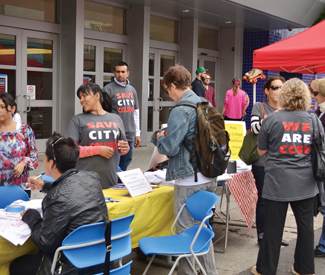
CAREERS AND ED City College of San Francisco (CCSF) is fighting for its life, and that struggle has turned old enemies into new allies. Suddenly, past differences seem less important than the need to work together, bringing a new sense of unity and purpose to the troubled community college.

In June the school was sanctioned and ordered to “show cause” from the Accrediting Commission of Community and Junior Colleges, putting it on the brink of losing its accreditation — certification necessary for the college’s degrees to be worth anything and for the school to secure federal aid (see “City College fights back,” July 17).

Twelve workgroups comprised of faculty, staff, administrators, students, and college board members are working feverishly to prove by October that the school is making major progress. Otherwise, it could face dire consequences.

While few people with any education or political background believe the school will actually close, there are serious consequences if its accreditation is revoked. A special trustee assigned by the state chancellor’s office could assume the powers of the college’s board or the school could be merged with another community college district.

The only college in California to ever suffer both of those fates was Compton Community College in 2006. Though the two colleges serve wildly different communities, many speak of their fates in the same breath. Its shadow hangs over City College like a ghost of what is to come.

WORKING TOGETHER

The newfound sense of common purpose was displayed on Aug. 1 in CCSF conference rooms, where once-battling special interest groups and employees gathered to tackle problems that have plagued the school for years.

The feuds aren’t just of interest to political geeks and college insiders. Infighting and a dysfunctional governance structure had stalled the school from tackling urgent issues, according to the accrediting commission.

“During interviews, criticism regarding the efficiency of the institutional governance process was revealed. The criticism centered on the length of time to reach a recommendation. It was also noted that there may be misunderstanding regarding the role of a recommending body versus a decision-making body,” according to the commission’s report.

That snippet of the 66-page critical report represents years of strife at the school, not only among the school’s elected trustees but also between the board and other college groups on issues ranging from placement testing to school site closures.

The 12 newly formed workgroups — constituted by the Chancellor’s Office and comprised mostly of faculty, administrators, and trustees — met to discuss issues and make recommendations to the system’s decision-making authorities: the Chancellor’s Office and Board of Trustees. One of the workgroups is in charge of evaluating that very decision-making system, with 14 people from different college constituencies hashing out a new style of democracy for the school.

At their first meeting, the members brought in stacks of papers to hand out — research on best practices and policies in college governments around the state and the nation. This particular workgroup discussed how an ideal student government should run, and how to enact those changes at City College.

The workgroups are brainstorming sessions, and each one has a different task ahead of it, including how to measure student learning, leveraging technology to streamline the school, facilities planning, and fiscal planning. Each workgroup acts independently, although some themes and members overlap.

The Board of Trustees is scheduled to meet and report on the progress of the workgroups on August 14 — the day before fall semester classes begin.

A final, preliminary report based on the findings of the dozen workgroups is expected to be completed before the accrediting commission’s October 15 deadline. With everything on the table, from staff layoffs to campus closures, CCSF is an anxious institution facing an uncertain future.

THE GHOST OF COMPTON’S PAST

In Compton, faculty and staff lived in constant fear of losing their jobs between 2002 and 2006, while the school was at risk of losing accreditation. Its path offers some lessons for CCSF.

“From three or four years prior to the accreditation being revoked, every March everybody got a pink slip and then you found out, you know, whether or not you actually had a job to come back to the next year,” Ann Garten, the community relations director of El Camino Community College District, told the Guardian in a phone interview.

El Camino swooped in to save Compton from total closure when its accreditation was revoked in 2006. The fate of employees at City College is a mystery for now, but based on Compton’s experience, part-time faculty are most at risk.

During spring semester, City College had nearly 1,700 instructors, approximately half of which were part-timers, according to college payroll documents. The school’s faculty are represented by the American Federation of Teachers Local 2121.

Classified workers — those who perform services such as administrative support, technology services, and grounds maintenance — could also be at risk. Their numbers exceeded 800 during the last fiscal year, according to the school’s assistant director of research, Steve Spurling.

They are represented by the Service Employees International Union Local 1021, a large and active union that also represents most city workers. In recent years, both unions have already taken pay cuts and freezes on raises and accepted furlough days to help plug the college’s fiscal holes.

If a special trustee were to take over, these workers would become even more vulnerable. But even without a special trustee, will there be layoffs?

Though there is no definitive answer yet, “everything needs to be on the table,” Trustee Steve Ngo told us. Yet most indications are that part-timers are at the most risk.

“I’m not convinced [full time faculty] pay cuts are what is called for. Our part time is the highest paid in the country,” CCSF Chancellor Pamila Fisher told the Associated Student Presidents, made up of elected leaders from CCSF’s eight main campuses. “We pay them health care. That’s unheard of” and could be re-evaluated, she said.

Yet it’s also possible that more creative and aggressive fundraising could save the part-timers and other college functions. Alisa Messer, president of AFT local 2121, said statewide categorical funds exist expressly to help fund part time faculty health care costs, she said, although not all colleges follow through.

“AFT 2121 has been a leader in this state, and in fact in the nation, on increasing parity for part-time/contingent faculty,” Messer said. “We will not allow this crisis to be an excuse to roll back significant progress that has been made on the rights of our most vulnerable faculty.”

The commission’s June report dinged the school for spending higher than average levels on salaries and benefits, 92 percent of their funds to be exact, while other community colleges in the Bay Area have figures in the low to mid 80s.

Yet many of CCSF’s defenders say that comparison isn’t fair or accurate, noting San Francisco’s higher cost of living and the fact that the district provides health coverage to part-time faculty, which most other community colleges in the state do not provide.

SERVING STUDENTS

As the college unites, many conflicts that remain boil down to the question of open access. CCSF currently operates with what it sees as a true community college ethos, where the varied needs of a diverse student population are balanced.

Recent high school graduates preparing for transfer mingle with adult students continuing their education, while English as Second Language (ESL) learners work towards proficiency and others seek new technical skills or transition to a new career.

Many students also take so-called “personal enrichment” courses — one time classes in the arts or languages, for example — that state government has de-prioritized as the budget hole has gotten deeper.

“I think we have to spend money better,” Ngo said, concerning “non-credit” courses, which are primarily classes for adult learners. He pointed to the fact that ESL classes are a full semester long, despite a unique “hop in, hop out” structure to the lessons, which gives students flexibility in their attendance over the course of the semester.

Reducing the number of weeks in a semester that those classes meet could be one possible strategy for saving money, he said. He emphasized that the college needs to work with hard data, and that calculations from what could be saved by such moves aren’t finished.

The number of campuses within the district is also being re-evaluated. “Yes, one of things we’re looking at is whether we should have nine sites. Centers may be combined. We don’t know if that will pay out yet,” Chancellor Fisher told the student presidents, referring to complex funding formulas that could actually prevent CCSF from saving money by closing campuses.

Fisher said officials are researching the possibility of combining campuses in close proximity, which drew a mixed reaction from the presidents. Bouchra Simmons, the Downtown Campus student president, said that combining the Civic Center and Downtown campuses would be disastrous.

“[Downtown Campus] is already pushed to capacity in terms of class size,” Simmons said. And the reverse, moving Downtown Campus students into Civic Center, would make it difficult for her to drop her daughter off at child care and still be able to make it to school on time.

Emanuel Andreas, Southeast Campus president, disagreed when it came to his constituents. “We understand what is happening, and everything needs to be on the table,” he said.

The threat of campus closures and a reduction in non-credit classes are all part of the attack on open access, as some students have said. To combat that, they’ve formed a new student group aimed at educating the city about what they stand to lose.

Project Unity is comprised of Occupy CCSF students, former student trustee Jeffrey Fang, student body President Shanell Williams, and other students, led by the newly elected student Trustee William Walker. They’ve rallied for their school at City Hall, where Supervisors Eric Mar and John Avalos have sponsored a resolution to support City College.

Project Unity met at the Mission Campus shortly after supporting the resolution, and started to plan a grassroots campaign to educate the city and its residents about open access.

Bob Gorringe, a member of Occupy San Francisco, was on hand to help the fledgling group strategize. “[Trustee] Anita Grier came out to the Occupy action council, and she was very open,” Gorringe told the group on July 31, referring to the longtime board member who is not exactly known for her radical tendencies.

Students taking such a vested interest in their college should come as no surprise, considering what happened to Compton before it folded into El Camino.

Although Compton never actually closed, it hemorrhaged students as public fears of the college closing grew larger, and the student body dropped to around 2,000 when El Camino took over, Garten told the Guardian.

Some students went elsewhere, but many appear to have just abandoned the education system.

“We looked at two or three colleges around Compton and none of us had a significant increase in students from the Compton district” enrolling, Garten said.

In other words, it looked like many disillusioned students had simply dropped out, something that nobody wants to see in San Francisco.

MOVING FORWARD

Just over two months remain for CCSF and its supporters to hash out a preliminary plan. Aiding them is a team of experts that will create a detailed report on everything related to the college’s financial woes — possibly the most critical problem area.

The Fiscal Crisis and Management Assistance Team, or FCMAT, explained their process to the college on August 3.

Without revealing any specific details, Michelle Plumbtree, the chief management analyst of FCMAT, warned an audience of a couple dozen interested people that its report would seem negative, but only because that’s exactly what the report is supposed to be: a critical review of problem areas.

“You guys are doing incredible things…But that’s not what we talk about [in our reports],” Plumbtree said.

Mike Hill, another FCMAT team member, succinctly layed out the biggest obstacles to City College’s fiscal future. “This is not a one year problem…We’re looking at three years. What makes that complicated is the governor’s tax, and the parcel tax,” Hill said, referring to Prop. 30 and the San Francisco ballot measure City College sponsored. “There are four scenarios… It’s not predictable.” Prop. 30, the tax measure placed on the ballot by Governor Jerry Brown, wouldn’t raise new revenue for community colleges. If it passes, they simply break even, staving off more drastic cuts. But the parcel tax offers more hope for CCSF, if city voters approve it. It would free up $14 million in revenue for this fiscal year, restoring some of what was lost and prevent the deep cuts and scaled back mission that the school’s support most fear.

Instrumental duo Silian Rail includes ‘every/one’

0

Do artists need vocals and lyrics to demand audience attention in a place like the Bay Area, where there are new musicians popping up left and right? Eric Kuhn and Robin Landy, better known as instrumental duo Silian Rail, have found the answer to that question to be a resounding “no.”

With a handful of locally well-received releases under its belt and an upcoming headlining show at Bottom of the Hill, Silian Rail has clearly made it work thus far without words. The band’s songs run on a driving rhythm paired with carefully crafted guitar work. The complexity of its sound has continued to kept critics and fans coming back for more – a happy discovery for many, that expansive instrumental music can hold their attention.

For a recent companion piece, however, the band added something somewhat foreign to its repertoire, through collaborations with other artists: vocals. “We do have a couple singers on this album,” Kuhn says.

“Our choice to be an instrumental band is not something we ever really talked about. The way we play together emerged quite naturally – [Landy] plays guitar, I play drums…We thought it would be a fun excuse to collaborate with friends and see what they would contribute.”

Silian Rail’s collaborative recent EP every/one (released in May of this year as a companion to the each/other album) will benefit United Roots Oakland, with all of the proceeds going towards its community engagement programs in the arts and media. That EP includes Lewis Patzner (Judgement Day, the Devotionals), Thao Nguyen, Andrew Maguire (Thao and Mirah, DRMS, the Devotionals), Colleen Johnson (Upside Drown), and Winston Goertz-Giffen (Saything).

“The Bay Area music scene is great – not just to blow smoke up the collective ass of the Bay Area,”  Landy says with a laugh. “It’s non-competitive and very supportive. It seems different than LA or New York in that way… I’m just guessing.”

Kuhn says the title of the album, every/one, is a reflection on the tension and paradox of the strength of a collective or a collaboration versus the importance of individual freedom.

“The songs are more or less all from a similar thematic world, which are various texts, films, experiences relating to non-normative psychological functioning – an attempt at sensitively referring to what is classically termed ‘mental illness’,” Kuhn explains.  

“[We] have a lot of empathy for these perspectives, and relate to them in many ways, and respect the non-normative psychological individual as being someone often possessing of an ability to see beyond the arbitrary limits placed on our experience of the world by the various social codes and ideologies that are part of the status quo. There is a wildness and also a directness and a poetic nonsense clarity that we find inspiring and that generally tickles our fancy.”

The band discovered United Roots Oakland at an Occupy Oakland event, where there were young kids free-styling. “It’s an awesome thing to have a creative outlet for kids, [and] to have competent adults there to coach them,” Landy says.

And since the EP was a collaboration, it seemed strange for the band to personally collect a profit from it, Kuhn says, which is they decided to donate.

Silian Rail has a long history of creative endeavors with other musicians. It first gained attention through its connection with other East Bay acts such as Tartufi, Birds & Batteries, and Low Red Land as the group Thread Productions. Although Thread is no longer active, a lot of what the group used to do still happens informally – the bands frequent each others’ shows, try to spread the word on upcoming concerts, and often perform live together.

“It was a hugely helpful idea at the time,” Landy says. “Lynne Angel from Tartufi still plays with us. Our new record is super lush, so we needed extra instrumentation, and she was kind enough to lend her talents. Tartufi still does a lot of broader community organizing around music. I have no idea how they find the time and energy to do it!”

Yet Silian Rail seems to pack in a lot projects in too. Its working towards scoring more film projects – its music has already turned up in various indie films, short clips, and videos, such as an ad for “Farm Fresh Cocktails” (which both Landy and Kuhn found quite odd). Essentially, the Silian Rail sound seems ideal for soundtracks.

But the band’s own music, of course, always comes first. They’ve both long been drawn to creating music. They were friends who grew up together in North Carolina, and parted ways at 13, only to find one another in California many years later.

“Having a guitar with me through adolescence was a lifesaver, having that emotional outlet.” Landy says, reflecting on the importance of music.
Another charitable activity on the band’s plate: it just finished a session at Bay Area Girls Rock Camp – a nonprofit organization that “empowers girls through music” –  in Oakland before our interview. At the camp, musicians teach workshops, host group activities, and perform live.

“Kids are so honest that we were more nervous to play in front of a group of five to 12-years-olds then we are playing a packed venue in San Francisco,” Landy says, “They asked us why we don’t have a singer.”

“With these arts programs, it’s not like if kids have something to do, their problems will go away, it is clearly more complicated; but music can serve as an outlet.”
Kuhn adds: “Music is a means of expression and communication that transcends a lot of barriers – things like technology – more than just language and culture. It holds a fundamental power to enable communication with people.”

For such a technically impressive band, I was impressed to find out that Landy had no formal training on guitar “I don’t really know what I’m doing at all, which has mostly helped my style evolve. I am free to experiment and do things in a different way. It’s all abut making happy mistakes; of course there are benefits to knowing what you’re doing, but it is also a benefit for me to not know. The way I learn things, it probably would have been a waste of time anyway.”

“I did play flute in band during middle school,” she says. “But guitar is basically the opposite of those instruments.”

While Eric had a moderate amount of formal training (he took guitar lessons in high school and “tried to be a music major in college”), he now learns to write for different instruments for new songs without proper lessons. “I needed to write violin and cello parts for songs I’m doing on the new album, so I sat down with a music book and did that.”

“I’m inspired by painters,” he muses. “The idea of fearlessly exploring new territory and always pushing ourselves to new places.”

Silian Rail
With Shuteye Unison, B. Hamilton
Thu/9, $10, 9pm
Bottom of the Hill
1233 17th, SF
(415) 626-4455
www.bottomofthehill.com

You, too, can win a gold medal in popcorn eating: new movies!

0

This weekend, it’s all about the Women’s Marathon at the London Olympics! If my calculations are correct, I will have to basically stay up all night Saturday to catch the race (11am London time is uggghhhh our time), or descend into a spoiler-free cave where no NBC-borne spoilers can find me before the highlight reel.

Anyone needing a break from gorging on Olympic track and field coverage, however, has an array of options at the movie theater, including two standout docs about mystery men (The Imposter and Searching for Sugar Man) and William Friedkin’s rip-roaring (and NC-17) latest, Killer Joe. Plus, Lovecraft!

Hollywood’s big money is on the Total Recall remake, which stars an agreeable Colin Farrell and is directed with reasonable amounts of style by Len Wiseman (of Underworld series fame; naturally, wife Kate Beckinsale has a juicy part). But if you really want to see Total Recall, stick with the 1990 Verhoeven-Schwarzenegger version. The do-over adds nothing and contains zero quotable lines on par with “Get your AHH-SS to Mars!”

Short takes on other notable releases this week (including a Bresson revival, ooh la la) after the jump.

Bill W. Even longtime AA members are unlikely to know half the organizational history revealed in this straightforward, chronological, fast-moving portrait of its late founder. Bill Wilson was a bright, personable aspiring businessman whose career was nonetheless perpetually upset by addiction to the alcohol that eased his social awkwardness but brought its own worse troubles. During one mid-1930s sanitarium visit, attempting to dry out, he experienced a spiritual awakening. From that moment slowly grew the idea of Alcoholics Anonymous, which he shaped with the help of several other recovering drunks, and saw become a national movement after a 1941 Saturday Evening Post article introduced it to the general public. Wilson had always hoped the “leaderless” organization would soon find its own feet and leave him to build a separate, sober new career. But gaining that distance was difficult; attempts to find other “cures” for his recurrent depression (including LSD therapy) laid him open to internal AA criticism; and he was never comfortable on the pedestal that grateful members insisted he stay on as the organization’s founder. Admittedly, he appointed himself its primary public spokesman, which rendered his own hopes for privacy somewhat self-canceling — though fortunately it also provides this documentary with plenty of extant lecture and interview material. He was a complicated man whose complicated life often butted against the role of savior, despite his endless dedication and generosity toward others in need. That thread of conflict makes for a movie that’s compelling beyond the light it sheds on an institution as impactful on individual lives and society as any other to emerge from 20th-century America. (1:43) Elmwood, Roxie. (Dennis Harvey)

Crazy and Thief Former S.F. resident Cory McAbee of the Billy Nayer Show, as well as cult film faves The American Astronaut (2001) and Stingray Sam (2009), returns for one night only in this multimedia event under the umbrella of his new enterprise “Captain Ahab’s Motorcycle Club.” The Vogue Theatre event will offer music and conversation after a screening of McAbee’s latest. Crazy and Thief stars his children, two-year-old Johnny and slightly senior Willa, in a 52-minute adventure that has them following a “star map” all by themselves around Brooklyn, then journeying out to the country via train. En route they improvise nonsense songs, cross paths with strange adults suspicious and helpful, ride a Mickey Mouse hobby horse, and so forth. A color effort that’s sort of an elaborate home movie compared to the director’s fancifully comic, black and white prior films, it nonetheless gets pretty far on the cuteness of toddlers and a soundtrack of original songs that find McAbee rocking like a five-year-old might — something that’s also pretty cute. (:52) Vogue. (Dennis Harvey)

http://www.youtube.com/watch?v=GPgA79KSpfU&feature=plcp

The Devil, Probably This seldom-revived 1977 feature from late French master Robert Bresson was his penultimate as well as most explicitly political work. Newspaper clips at the start betray where these 95 minutes will be heading: they introduce Parisian Charles (Antoine Monnier) as a casualty, a suicide at age 20. The reasons for that act are probed in the succeeding flashback, as we observe his last days drifting between friends and lovers, quitting student activist groups, and generally expressing his disillusionment with everything from politics to religion to human interaction. Then 70, Bresson expresses his own disenchantment in solidarity with the youthful characters by including documentary shots of pollution, clubbed baby seals, A-bomb explosions, and other dire signs of “an Earth that is ever more populated and ever less habitable.” That essential message makes The Devil, Probably more relevant than ever, but unfortunately it’s also one of the filmmaker’s driest, most didactic exercises. There are a few odd, almost farcical moments (as when the constant pondering of man’s fate extends to a spontaneous philosophical debate between passengers on a public bus), but the characters are too obviously mouthpieces with no inner lives of their own. In particular, Charles remains an unengaging blank in Monnier’s performance, which is all too faithful to the director’s usual call for “automatic,” uninflected line readings from his nonprofessional cast. Nothing Bresson did is without interest, but here his detached technique drains nearly all emotional impact from a film ostensibly about profound despair. (1:35) SF Film Society Cinema. (Dennis Harvey)

Girlfriend Boyfriend The onscreen title of this Taiwanese import is Gf*Bf, but don’t let the text-speak fool you: the bulk of the film is set in the 1980s and 90s, long before smart phones were around to complicate relationships. And the trio at the heart of Girlfriend Boyfriend is complicated enough as it is: sassy Mabel (Gwei Lun-Mei) openly pines for brooding Liam (Joseph Chang), who secretly pines for rebellious Aaron (Rhydian Vaughan), who chases Mabel until she gives in; as things often go in stories like this, nobody gets the happy ending they desire. Set against the backdrop of Taiwan’s student movement, this vibrant drama believably tracks its leads as they mature from impulsive youths to bitter adults who never let go of their deep bond — despite all the misery it causes, and a last-act turn into melodrama that’s hinted at by the film’s frame story featuring an older Liam and a pair of, um, sassy and rebellious twin girls he’s been raising as his own. (1:45) Metreon. (Cheryl Eddy)

Klown A spinoff from a long-running Danish TV show, with the same director (Mikkel Nørgaard) and co-writer/stars, this bad-taste comedy might duly prove hard to beat as “the funniest movie of the year” (a claim its advertising already boasts). Socially hapless Frank (Frank Hvam) discovers his live-in girlfriend Mia (Mia Lyhne) is pregnant, but she quite reasonably worries “you don’t have enough potential as a father.” To prove otherwise, he basically kidnaps 12-year-old nephew Bo (Marcuz Jess Petersen) and drags him along on a canoe trip with best friend Casper (Casper Christensen). Trouble is, Casper has already proclaimed this trip will be a “Tour de Pussy,” in which they — or at least he — will seize any and every opportunity to cheat on their unknowing spouses. Ergo, there’s an almost immediate clash between awkward attempts at quasi-parental bonding and activities most unsuited for juvenile eyes. Accusations of rape and pedophilia, some bad advice involving “pearl necklaces,” an upscale one-night-only bordello, reckless child endangerment, encouragement of teenage drinking, the consequences of tactical “man flirting,” and much more ensue. Make no mistake, Klown one-ups the Judd Apatow school of raunch (at least for the moment), but it’s good-natured enough to avoid any aura of crass Adam Sandler-type bottom-feeding. It’s also frequently, blissfully, very, very funny. (1:28) Roxie. (Dennis Harvey)

Survivor recounts life of rape and abuse by Your Black Muslim Bakery leader

8

Editor’s Note: This story is part of the Chauncey Bailey Project, a collaboration of Bay Area media outlets (including the Guardian) to investigate Bailey’s murder by members of Your Black Muslim Bakery.

By Louise Rafkin, Center for Investigative Reporting

 In 2002, five years before journalist Chauncey Bailey was murdered by members of Your Black Muslim Bakery, a woman identified only as Jane Doe 1 stepped forward to report decades of sexual abuse, welfare fraud and violence by the bakery’s leader, Yusuf Bey Sr.

She was prepared to hand over to Oakland police DNA from three of her children evidence that Bey had impregnated her, the first time when she was 12 years old.

Given the history of violence by members of Your Black Muslim Bakery, this was a risky move. But the woman was fueled by a mother’s anger. Her daughter, then 18, alerted her that Bey was trying to abuse her – his own daughter.

Now a devout Christian, Jane Doe 1 has decided she no longer wants to be the nameless whistle-blower. Her name is Kowana Banks and, in her first public interview, she said she made the decision to come forward to help other children trapped in similar situations. She hopes to publish a book about her experiences.

“Abused people go one of two ways: Either they are going to self-destruct or they’re going to make a difference,” said Banks, 44. “I’m going to make a difference.”

The violent saga of Your Black Muslim Bakery is fading into Oakland history, but wounds remain among Bey’s victims and family members today marks the fifth anniversary of the murder of Bailey, the Oakland Post editor who had been investigating the bakery’s finances.

The facts behind Banks’ story have been outlined in court proceedings and depositions, but her decision to come forward allows her to detail her unique insider’s perspective as a victim and survivor.

Today, Banks is an optimistic, composed woman who has moved on as best she can. One of her three children by Bey, Yusuf V, 25, is in San Quentin State Prison for his part in the 2007 kidnapping of two Oakland women, one who was tortured, a crime related to the bakery’s demise. The other two are doing well.

Banks considers the three to be the “blessing out of what happened to me.”

Married for 18 years to a man she met after leaving the bakery, Banks says the bitterness and anger that grew from her childhood abuse dissolved when she fell in love. The couple have two children together.

“But it’s difficult to look back and know I was just a child then and that no one cared,” she said.

Throughout her childhood at the bakery, Banks said she felt abandoned by the social welfare system, invisible even to those at local hospitals where she – and many other underage girls at the bakery compound – gave birth to multiple children while still children themselves.

She delivered the first of three children by Bey at Alta Bates Hospital in Berkeley at 13. A social worker questioned Banks about the paternity of her son, she said, but under the watchful eye of one of Bey’s “wives,” Banks kept silent. Later, she said she told a child protection worker that she was working long hours and not going to school.

“She told me she would check into it, and I never saw her again,” Banks said.

Bey, a self-appointed minister who gave himself the title of “Dr.,” was formerly a hairdresser. He opened Your Black Muslim Bakery in the late 1970s, espousing black self-reliance and his own interpretation of Islam, which included racist attacks on whites. Nevertheless, in his more than 30 years in North Oakland, Bey gained the support of local business leaders, clergy and politicians eager to align with the underclass.

In 2003, Bey died before facing trial, setting off the struggle for power and control that escalated into mayhem and multiple murders. Banks said she saw the violence coming.

“You cut off the head,” Banks said, “and the body will go crazy.”

Molestations began at age 8

Banks, who was born in the East Bay, said her father was a drug addict who met Bey’s followers while doing jail time for drug-related crimes. Banks can’t remember her mother, who she said abandoned her as a toddler, along with a younger brother and older sister.

In 1976, Banks’ father brought the children to live at the bakery compound, where he’d gotten a job. A hive of single-family homes, retail storefronts and apartments clustered on the corner of San Pablo Avenue and 59th Street in North Oakland, the compound housed bakery workers and Bey’s sprawling family of children and women he called his wives.

One Sunday night in 1976, Bey invited Banks to spend the night in his apartment, telling her she could play with his baby daughter. Banks was nervous and thought it strange to spend time with Bey, then 41. But her older sister had spent the night there and returned toting candy and new clothes. She said that night marked the first time Bey molested her. She was 8.

Bey told her to tell no one, she said. If she did, she would be killed.

“But he didn’t stop with me,” she said. “He told me he’d murder my whole family, everyone.”

Banks believes her father did not know about the incident, but the family moved away soon after that first molestation. They lived in Hayward for a while, and later, Banks’ father left her and her siblings with a grandmother near Monterey.

In 1978, after another arrest, her father brought them back to the bakery and left them with Bey.

Not long after, Banks said, Bey came into her bedroom above the bakery while she was sleeping, and raped her. She was 10 and remembers wearing one-piece pink zip-up pajamas. After the assault, she sought help from Nora Bey, then 23, one of the minister’s many “wives.” Banks’ father had surrendered his paternal rights so Yusuf Bey could receive welfare for their care; the court appointed Nora Bey, later known as Esperanza Johnson, as their legal guardian.

“ ‘I need you to help me because he’s trying to do things to me,’ ” Banks recalls telling Nora Bey. “And her comment was, ‘Oh, girl, he’s not going to do anything to you that he hasn’t done to anyone else.’ ”

Living in various bakery-owned homes, Banks was kept out of public school. She was smart, though, and soon became an integral part of the bakery, which sold pies and sandwiches from its San Pablo Avenue storefront. She learned bookkeeping and taught basic math and reading at the bakery’s school. Her life was regimented; she baked from 4 to 8 a.m., taught in the bakery’s combined school and day care until 6 p.m., and then wrapped bakery products until 10 p.m.

It was not until several years later that Banks even received a wage, just $25 per week.

At the time, Banks remembers not understanding why those living in the compound all were so isolated from outsiders, why they were punished for sneaking out once to see a movie, “The Wiz.”

“But as an adult, I understand now,” she said, “because he had secrets, and he didn’t want those secrets to get out.”

Learning Bey’s doctrine

In the bakery’s school, Yusuf Bey’s doctrine was drilled into the children. Girls were taught to cover their heads; everyone was addressed as “brother” or “sister.” Bey preached the superiority of men over women and of blacks over whites. Whites, he said, were “the devil” and responsible for all the world’s problems.

“The men were the ceiling, and women were the floor,” Banks said, quoting Bey.

She, however, was hardly subservient, growing into a feisty and hardheaded young woman, often chastised for speaking out against unfair treatment.

“I was known for saying whatever was on my brain,” Banks said.

Once when Banks complained about the long hours of work, she said she was forced to get up even earlier. When one of the other women found Bey with Banks in his bedroom late at night, the woman’s questions were silenced with a beating. Banks was then given a beating herself.

Banks said Bey tried to turn others against her and, because her mother was white, called her “nobody but the devil.”

But he continued to rape her repeatedly. At 13, she gave birth to the first of the three children she would have with Bey.

All the while, Banks said, Bey received – and kept for himself – welfare payments and food stamps intended for Banks, her siblings, others and eventually the children born as a result of the rapes. Bey was said to have more than 40 children and called up to 100 women his wives.

The atmosphere of fear was total, Banks said. In 1986, a young man, Peter Kaufman, who’d spoken out about having seen Bey rape a boy in the bakery’s bathroom, turned up dead on a nearby side street, shot in the head. Beatings – for both women and men in the bakery community – were commonplace.

Bey, Banks said, was a persuasive man who used intimidation, violence and a flashy lifestyle to control his mostly down-and-out followers, many of whom were parolees. There were cameras in the bakery and microphones in every room to monitor conversations. Among the women, the abuse was ubiquitous and unspoken. It was some time before Banks realized that Bey was molesting her sister, too.

Banks said she was instructed by Nora Bey not to identify him as the father of her children on their birth certificates. And Banks wasn’t allowed to choose names for her kids. Particularly painful to Banks was that her second son was named Yusuf by Nora Bey.

Banks said she had nowhere to turn. She blames racism, fear and a hands-off attitude for the lack of oversight by welfare officials and police.

“They were fed Brother Bey’s line that he was doing a lot for the black community,” she said. “No one wanted to intervene.”

Escape from bakery life

For years, Banks dreamed of leaving. But under the constant threat of violence, she waited. She planned to leave at 18, but was again pregnant. In 1988, then 20, she became romantically interested in a man her own age she met at the bakery. Bey caught wind of this and held a meeting at which he directed his other women to teach Banks a lesson by beating her.

Warned of her impending punishment, Banks made her escape that night, Aug. 28, 1988. A cousin on her father’s side agreed to pick her up. As she was collecting her children, Bey confronted her and threw her belongings at her.

“I picked up as much as I could that he threw at me and packed it into the car,” said Banks, laughing at the memory. “I don’t think he realized he was helping me.”

At first, she “felt so free” in a world outside the bakery, but soon she began to live in fear that Bey would send someone to harm her.

“My fear was a stranger that I didn’t even know would walk up to me and do something, because of course they had pictures of me,” she said.

Moving forward with her life was difficult, and keeping hold of the children she had with Bey ultimately proved too much of a challenge. Banks found work at restaurants as a server, but money was always tight. Bey wouldn’t pay child support, and the welfare she received never seemed to be enough.

“I was just a child when my kids were born,” she said. “It would be different if today I was having children, or even 20 years ago.”

Soon, Bey, exerting his power, sent for the kids, and they returned to the bakery. The boys spent most of their childhood there. Banks said her daughter, despite spending some time at the bakery and with foster families, mainly grew up with her.

At the bakery, Bey tried to turn her kids against her, Banks said, telling them she wanted them only for their welfare checks. While still a child, her oldest asked why she didn’t live with them at the bakery, like the parents of the other kids. Banks explained to him that “it wasn’t a good place” for her.

“I felt it was a better environment for men than it was for women,” she said, noting that at the time, she assumed Bey would not molest his own children.

In 1989, she met her husband through an acquaintance. The couple had their two children in the ’90s.

More than a decade passed. Banks took community college classes, found work in restaurants, earned her GED diploma and occasionally visited her boys at the bakery. There was constant intimidation; she feared retribution for leaving and was always looking over her shoulder.

Concern for daughter prompts action

Banks never told her kids about her abuse. It was hard to watch her boys be lured in by Bey’s flashy lifestyle – a Mercedes or Cadillac was always parked curbside – but Banks held out hope that she had been right, that it really was a better place for boys than it was for girls.

In June 2002, her 18-year-old daughter, who was working at the bakery but living elsewhere, told Banks a story that suggested Bey had tried to molest her. Banks was devastated, unable to even ask her daughter for details.

“I prayed, asking God who was going to stop him,” said Banks, then 34. “And then, suddenly, I knew it was me.”

With DNA testing available, she could prove Bey’s paternity. It offered the proof she had always hoped to find. In an angry phone conversation with Bey, she told him her plan.

“You, sir, are a rapist and a child molester, and let me tell you what I’m going to do to you,” she recalls saying. “First, I’m going to go to the police, and I’m going to press charges against you, and then, when I’m done, I’m going to sue you and I’m going to take all your money. And then I won’t have to ask you to help your children, my children, with anything else, because I’m going to have all your money.”

Bey, she said, told her she’d soon be “floating in a river.”

To show Bey her determination, she called him again from a phone at the Oakland Police Department. “He knew from that day forth that it was over for him,” she said.

Three months later, Bey was taken into police custody. With DNA test results in hand, Banks pressed felony criminal charges of rape and assault. Bey posted bail, but died in the hospital a year later before facing the criminal trial.

Banks was disappointed that Bey never faced a trial but took pleasure in knowing that he had at least faced the charges.

“He lived a long life of getting away with it,” she said. “By the grace of Jesus, I know he’s boiling in hell.”

Another Jane Doe revealed

Along with two other women, Banks also filed a civil suit, alleging that Alameda County did nothing to protect them. The county eventually settled with Banks and the two other Jane Does, admitting no liability.

Another of the Jane Does in the suits, a former foster child who worked at the bakery between 1994 and 1996 and was raped by Bey, also has decided to publicly identify herself for the first time.

Malikha Hardy said she reported her abuse on three occasions to a county social worker, to a guidance counselor at juvenile hall and, in 1996, to the Oakland police. No one followed up until seven years later, she said, when an Oakland detective working on Banks’ case turned up at her door.

“The people feared Bey,” Hardy, now 32, said in a recent phone interview. “He had people who would do anything for him.”

To protect the two women, California Watch is not providing information about their current whereabouts or employment. During multiple interviews for this story, a family therapist was present to provide support.

Having wrestled with low self-worth, nightmares, and other aftereffects of childhood trauma, Banks is writing a book about her life with the therapist’s help. She credits her conversion to Christianity with making it possible for her to smile again.

“I’m resilient, and I’m positive,” Banks said. “I say, ‘If people are preying on you, God has chosen you.’ ”

Banks remains in contact with her son Yusuf V, who is imprisoned at San Quentin and serving a 10-year sentence as part of a plea agreement in the kidnapping incident.

“I’m trying to reform my son’s way of thinking,” Banks said. “Him sitting in one spot is the best time for me to do it, because his mind is open.”

During a recent visit to the former bakery compound, Banks said she thinks the reign of terror is now over. Many of the buildings have been sold or renovated; little is left to indicate what went on, outside or inside. The old bakery is a beauty supply store. The former school is a martial arts studio.

As Banks walked through memorable rooms and haunted hallways, she recounted stories both benign and horrific.

“I’ve seen stuff here,” she said, “that will scare me for the rest of my life.

This story was edited by Robert Salladay and Amy Pyle and copy edited by Nikki Frick and Christine Lee.


This story was produced by the independent, nonprofit Center for Investigative Reporting in collaboration with the Chauncey Bailey Project. For more, visit www.cironline.org and www.chaunceybaileyproject.org. Rafkin can be contacted at Louise.Rafkin@gmail.com.


Don’t say mommy blogger, but mommies should be blogging

0

There is good and bad about the rise of the “mommy blog,” says mother and author Kate Hopper. Good: women should write! Writing spreads one’s voice, motherhood can be an intense time. Bad: why must we qualify them as something apart from any other blogger, memoirist, etc. Hopper promises to discuss these topics — and more saliently, how you can get started on a chapter of your own — at her upcoming appearance at Good Vibrations‘ mothers-specific hang-out, which also features Carol Queen speaking about post-natal nookie, on Wed/1. We caught up with her before she hit SF to get a sneak peek at her relationship with the written word.

SFBG: What’s with the current mommy blogger vogue? Haven’t women always been writing about parenthood? Why is it so popular right now, and why use that particular label?

KH: Women have been writing about parenthood for a long time, but not in [these] numbers and not so publicly. The Internet and blogging have given women a forum to write about their lives in a way that hasn’t happened before. Countless mother bloggers have really found a sense of community in the blogosphere. Motherhood can be so isolating, and blogging can help combat that isolation. And they can make money. I have never advertised on my blog, but I know it can be lucrative.

About the label: I really dislike the term “mommy blogger,” just as I dislike the term “momoir” to describe memoirs that have anything to do with motherhood. The names people use to describe literature or movies — or anything — have an impact on how those things are perceived. And when you categorize books as “chick lit,” “mommy lit,” “momoir,” and blogs as “mommy blogs” you make it easier for people to discard these books and blogs. They are viewed as less serious, less important. Once something is labeled “momoir” or a “mommy blog” people don’t take it seriously as literary venture. And there are some really amazing books and blogs being written by mothers right now.

The motherhood literature I read and review (and the motherhood blogs I read) deal with more than the minutiae of daily life with children. They are dealing with issues of identity, with loss and longing, neurosis and fear, ambivalence and joy. They are about transformation and how we see ourselves in relation to the world in which we live.

SFBG: At what point did you realize motherhood would become the primary thing you write about?

KH: I began writing about motherhood in 2004, a few months after my older daughter was born prematurely. Stella was born two months early and spent a month in the hospital, and the long winter months that followed home with me. At the time I was in the third year of the MFA program at the University of Minnesota, and I had to withdraw from school in order to stay home and care for my fragile and extremely fussy daughter. Up until that point, writing had been the way I processed what was happening in my life. But I couldn’t think much less write in those early months.

It was only when Stella was five months old that I finally realized I needed to find my way back into words. So I went to the coffee shop near our house and pulled out paper and a pen. And the images of my daughter — a miniature thing on an open warming bed, her legs splayed like a frog’s, a white ventilator tube taped over her mouth, purple veins tracking across her skull like spider webs — came spilling out. After an hour, words covered the page. And for the first time since Stella was born, I felt grounded and the world felt a little bigger. I felt less alone. I’ve been writing about motherhood ever since, though in recent years, I’ve spent more time helping other women get their motherhood stories down on paper.

SFBG: You teach women how to write. Is there a particular challenge that you see as being particularly difficult for your students?

KH: One thing that always comes up when you’re teaching creative non-fiction is the ethics of writing about the people in your life. This ethical dilemma is heightened for women writing about their children, because it’s our job as parents to protect these small people. I always tell my students not to worry about this as they are beginning to write. If they do, they will self-censor and might not get to the heart of the stories they need to write. But before they decide to send a piece of writing about their children out into the world, it’s important to acknowledge how their children might react to reading it. It’s a very personal decision and there is no right or wrong way to it, but it’s important to know what you feel comfortable with — what’s the line you won’t cross? — and then trust your gut.

SFBG: Who, in your opinion, are the best mommy bloggers in the game today?

KH: I’m not sure I can say who the “best” motherhood bloggers are, but I know whose writing resonates with me. A few of my favorites are Rachel Turiel, Kristen Spina, Jenn Mattern, Heather King, and Elizabeth Aquino. They are all very talented writers, and their posts are reflective and well thought out. They also all write from the heart and aren’t afraid to be honest. I really respect that.

Kate Hopper at Mommy’s Playdate

Wed/1 7-9pm, free

Good Vibrations

1609 Polk, SF

www.goodvibes.com

Dick and a smile

4

caitlin@sfbg.com

SEX “I was basically wearing a wet sock full of sweat,” porn crossover star of the year James Deen tells me. “There was hair everywhere, I was pulling hair out of the girl’s mouth.”

Perhaps another interviewer would not have led with questions about Deen’s recent involvement in an offbeat Kink.com panda gang bang production. Hey, this isn’t TMZ. And who doesn’t already know the standard gossip about the 26-year old, who has shot porn nearly every day of his life since turning 18?

(Just in case:) This year, Deen became the youngest performer ever to take home the industry’s vaunted AVN Award for Best Male Performer. He recently landed a starring role alongside Lindsay Lohan in a new, non-porn feature film penned by Brett Easton Ellis and directed by Paul Schrader, writer of Taxi Driver, American Gigolo, and Raging Bull.

Anyone remotely familiar with the Deen canon knows about the Deenagers, the actor’s legions of underage fans who fill Tumblr with odes to his dick and smile. These superfans were immortalized in epic fashion by an ABC Nightline segment which host Terry Moran introduced with this warning of corruption and apocalypse: “For any parent concerned about what their teen does online, the huge popularity of the young man you are about to meet may be deeply disturbing.”

But like I said, these facts have been written into public record, and dammit, I want to talk about panda porn. Because although Deen’s crossover from Simpsons porn parodies (he played Moe the Bartender, and fucked Cookie Kwan) to The Lohan and Perez Hilton coverage is certainly interesting, the fact that he has also been shooting brutal BDSM porn for years says something else entirely. And he doesn’t think anything of it! Perhaps this flip, blogging, boy-door-faced individual is the first real sign that BDSM porn is coming out of the closet (dungeon, steel-barred cage), and into mainstream consciousness.

BAMBOOZLED

In PANDAMONIUM!!! PANDA LULLABY!!! PANDA PORNO!!!!! adult star Ashli Orion is subjected to the penises of six, raping panda bears. One of these panda bears was Deen, in a furry suit with a custom-made dick hole.

“But I thought pandas were supposed to be nice!” Orion pants, surrounded by hazy pink lighting, artfully-placed bamboo shoots, and silent pandas who mostly remove their furry paws by the end of the scene because their fluffy baseball mitts turned out to be prohibitive to the nitty-gritty of sex acts.

The mini-movie could be considered the first Kink.com furry shoot — a wry twist on director Princess Donna’s usual product released through Kink subsite Bound Gang Bangs.

Not all of Kink’s regulars, and especially not the Bound Gang Bang enthusiasts found PANDAMONIUM!!! to their liking. User comments expressed their concern that Orion wasn’t even bound. Given the limited mobility of the men in the panda suits, she had to be mobile for copulation to even be possible. “I spent a lot of time holding fur out of the shot so we could see the penetration on camera,” said Princess Donna in an email interview.

“Some people think it’s the best thing that ever happened, some people think it’s the worst porn ever made,” she continued. “That’s what happens when you take risks.”

But Deen says he did the panda gang bang — just like every other project he takes — less because of the viewers, or for the chance to express himself creatively, as much as the kicks. “Princess Donna said she had this idea, I said that’s amazing. While it was going on, I just wanted it to end. There was hair everywhere. But the second it was done and we were all hanging out after I was like, I wanna do it again.”

Deen thinks nothing of a work schedule that takes him from vanilla scenes for Digital Playground to deliberately humiliating public sex in Spain for Kink to Dallas XXX parodies.

“It’s completely standard,” he says in our phone interview. “For pretty much every freelance talent, you go where the call takes you.” Sure, there are a few sex acts that Deen will not perform. These include sex with a person who is not into it, sex with clowns, and sex with men. He apologies to me for this last stipulation. “I’m a lame old straight boy.”

And the fact that Deenagers now refer to him affectionately as Baby Panda? (At ‘5″8, Deen made a shorter bear than his suited Kink peers on the shoot.) No dissonance there, says Deen, who hawked T-shirts emblazoned with the nickname on his website. There was no coordinated attempt to wind up alongside Justin Beiber and Robert Pattinson on dorm room walls, he says. “I’m not Joe Camel. I’m just going out and doing my job.”

Deen has minimal support staff besides his publicist. During our interview, I express my disbelief that a person that has sex for a living wouldn’t be worried about getting exploited without someone to review contracts, approve press requests. Deen shrugs it off. “There’s no reason to battle over everything, just be nice. You catch more bees with ants — honey, vinegar, whatever it is.”

Maybe everything really is just that simple. So seems the tale of Deen’s porn provenance. As a teenager, he heard Jenna Jameson tell a radio host that being in skin flicks simply took a complete lack of modesty, superhuman stamina, and an ability to ejaculate on command. He began proving he had those skills by having public sex at parties. Soon, he was on his way to 300 shoots a year, a figure that seems shocking to those unfamiliar with the standards of those unfamiliar with the grinding nature of the porn industry.

And now, Hollywood is knocking, seemingly uncourted by Deen himself. Ellis bagged him for The Canyons role by tweeting that he was interested in Deen for his low-budget, Kickstarter-funded film. (That momentous tweet mentioned the actor would have “to act and be full-frontal naked banging girls and guys realistically.” Will Deen’s comfort zones shift for fame?)

The two had dinner to talk about the writer’s vision for the tale of disaffected 20-somethings moping around drop-dead beautiful LA locations. Ellis, Deen relates to me, has a somewhat cynical view of modern-day celebrity. “People like Charlie Sheen, his acting didn’t make him famous,” Deen explains. “It was because he was Charlie Sheen.” As actor with next-to-no inhibitions and a famously goofy tell-all blog, Deen was perfect material for Ellis’ experiment in equating stardom with sheer exposure.

And sure enough, Deen is now getting a taste of what’s it’s like to live life à la Sheen — or put more aptly, à la Lohan. All it took was for the two to duck out of a restaurant for a smoke break and paparazzi blew up the Interwebs with rumors they were sleeping together.

This kind of thing seems besides the point for someone like Deen, who it would appear rarely sleeps with someone without posting a picture of their distended orifice on his blog. If the LiLo rumors had been true, he wrote on his site, “I think I would tell everybody.” And search engine optimize it with a shot of her boobs, one wants to add.

“I’m not surprised, because he’s that type of guy,” says a post-panda Orion when I contact her about Deen’s recent rise in profile. “He’s very charismatic and he has a look that’s definitely commercial, so I’m not surprised that he would get into Hollywood, you know what I’m saying.”

And for all of Nightline‘s tut-tutting, porn stars have been making waves in clothes-on culture for decades. Traci Lords appeared on Roseanne and Married With Children. Ron Jeremy, Nina Hartley, and Jenna Jameson have all made Hollywood features. And nowadays, even the hardcore stuff is surfacing more and more — like in Rihanna videos and 50 Shades of Grey, a 2011 novel that has become so ubiquitous that sex activists I’ve interviewed refuse to even say its name, so quick was it to sloppily spotlight their subculture for the viewing pleasure of soccer moms, et. al.

Switching between kink erotica and vanilla porn doesn’t seem to be that unusual anymore for adult talent. “When I first started there was a more clear delineation between ‘porn’ models and ‘BDSM’ models,” says Princess Donna. (“Donna is Kink.com. Without her, the company wouldn’t be as successful, and that’s a fact,” says Deen.) “Most BDSM porn didn’t have penis-in-vagina sex in it,” she continues. “Now that it does, you there is a huge crossover.”

Of course, there are other reasons why porn actors shift between kinds of erotica. It’s because they want to get paid.

“I’m a crazy nympho,” says Orion in a phone interview. “I’m down for everything and I always have been. But there’s a lot of girls who are like no, I would never have sex with [that] guy, or never in my ass, no kink. And now, that’s what they’re doing because they have no money!” In the era of low-budget gonzo porn and the consumer’s unwillingness to pay for any kind of media “You can’t rely on girl-girl scenes to pop up everyday if everyone is competing for that,” says Orion.

So maybe Deen is right, and he’s just a guy who is riding high on porn practicalities coupled with an increased tolerance of sluttiness and bondage in pop culture today.

Where will it all lead? I ask him about his career goals to round out our chat. “I want to keep myself in a constant state of smiles,” he says. “I like to smile. I am currently smiling.”

Doing what, pray tell? He has the day off from The Canyons‘ hectic shooting schedule that’s had him sleeping in odd, daytime spurts. What does James Deen do when he gets a moment to spare? Oh, you know. “I’m shooting some porno,” he says.


Film Listings

0

Film listings are edited by Cheryl Eddy. Reviewers are Kimberly Chun, Max Goldberg, Dennis Harvey, and Lynn Rapoport. For rep house showtimes, see Rep Clock.

OPENING

The Babymakers The Babymakers would be better titled The Anxiety-Wracked Sperminators. Longtime couple Audrey (Olivia Munn) and Tommy (Paul Schneider) have it all — good looks, smart mouths, crazy-cute chemistry — except the requisite rug rats. Despite Tommy’s trepidation, they try and try and try, only to discover, after much tortuous testing of the neurotic would-be baby daddy, that the man has been shooting sleepy and unmotivated seed. Fortunately, Tommy sold a batch of the still-vital stuff to a local sperm bank in order to buy Audrey’s ring five years ago. So swallowing the shame of purchasing nuptial bling with said whack-off money, Tommy and his gang (Kevin Heffernan, Wood Harris, and Nat Faxon) enlist the help of Indian mobster Ron Jon (director Jay Chandrasekhar, channeling Alfred Molina in Boogie Nights) embark on likely the first sperm bank break-in in cinematic history. With Chandrasekhar (2005’s The Dukes of Hazzard) in the director’s seat, the overall effect is that of a slightly ham-fisted indie striving for sitcom-like appeal — its easy laughs fall slightly short of cheap-date status, and the narrative contortions The Babymakers undergoes to achieve its tidy wrap-up undercut the revelry. Too bad for its attractive leads: the bright and beautiful Munn has been languishing in second-banana parts for too long, and the woefully neglected Schneider has a talent for bringing an angry edge-slash-intensity to every role. (1:38) (Chun)

Bill W. Even longtime AA members are unlikely to know half the organizational history revealed in this straightforward, chronological, fast-moving portrait of its late founder. Bill Wilson was a bright, personable aspiring businessman whose career was nonetheless perpetually upset by addiction to the alcohol that eased his social awkwardness but brought its own worse troubles. During one mid-1930s sanitarium visit, attempting to dry out, he experienced a spiritual awakening. From that moment slowly grew the idea of Alcoholics Anonymous, which he shaped with the help of several other recovering drunks, and saw become a national movement after a 1941 Saturday Evening Post article introduced it to the general public. Wilson had always hoped the "leaderless" organization would soon find its own feet and leave him to build a separate, sober new career. But gaining that distance was difficult; attempts to find other "cures" for his recurrent depression (including LSD therapy) laid him open to internal AA criticism; and he was never comfortable on the pedestal that grateful members insisted he stay on as the organization’s founder. Admittedly, he appointed himself its primary public spokesman, which rendered his own hopes for privacy somewhat self-canceling — though fortunately it also provides this documentary with plenty of extant lecture and interview material. He was a complicated man whose complicated life often butted against the role of savior, despite his endless dedication and generosity toward others in need. That thread of conflict makes for a movie that’s compelling beyond the light it sheds on an institution as impactful on individual lives and society as any other to emerge from 20th-century America. (1:43) Elmwood, Roxie. (Harvey)

Crazy and Thief Former S.F. resident Cory McAbee of the Billy Nayer Show, as well as cult film faves The American Astronaut (2001) and Stingray Sam (2009), returns for one night only in this multimedia event under the umbrella of his new enterprise "Captain Ahab’s Motorcycle Club." The Vogue Theatre event will offer music and conversation after a screening of McAbee’s latest. Crazy and Thief stars his children, two-year-old Johnny and slightly senior Willa, in a 52-minute adventure that has them following a "star map" all by themselves around Brooklyn, then journeying out to the country via train. En route they improvise nonsense songs, cross paths with strange adults suspicious and helpful, ride a Mickey Mouse hobby horse, and so forth. A color effort that’s sort of an elaborate home movie compared to the director’s fancifully comic, black and white prior films, it nonetheless gets pretty far on the cuteness of toddlers and a soundtrack of original songs that find McAbee rocking like a five-year-old might — something that’s also pretty cute. (:52) Vogue. (Harvey)

The Devil, Probably This seldom-revived 1977 feature from late French master Robert Bresson was his penultimate as well as most explicitly political work. Newspaper clips at the start betray where these 95 minutes will be heading: they introduce Parisian Charles (Antoine Monnier) as a casualty, a suicide at age 20. The reasons for that act are probed in the succeeding flashback, as we observe his last days drifting between friends and lovers, quitting student activist groups, and generally expressing his disillusionment with everything from politics to religion to human interaction. Then 70, Bresson expresses his own disenchantment in solidarity with the youthful characters by including documentary shots of pollution, clubbed baby seals, A-bomb explosions, and other dire signs of "an Earth that is ever more populated and ever less habitable." That essential message makes The Devil, Probably more relevant than ever, but unfortunately it’s also one of the filmmaker’s driest, most didactic exercises. There are a few odd, almost farcical moments (as when the constant pondering of man’s fate extends to a spontaneous philosophical debate between passengers on a public bus), but the characters are too obviously mouthpieces with no inner lives of their own. In particular, Charles remains an unengaging blank in Monnier’s performance, which is all too faithful to the director’s usual call for "automatic," uninflected line readings from his nonprofessional cast. Nothing Bresson did is without interest, but here his detached technique drains nearly all emotional impact from a film ostensibly about profound despair. (1:35) SF Film Society Cinema. (Harvey)

Diary of a Wimpy Kid: Dog Days The titular hero (Zachary Gordon) returns in the third family comedy adapted from Jeff Kinney’s YA novels. (1:34) Presidio.

Girlfriend Boyfriend The onscreen title of this Taiwanese import is Gf*Bf, but don’t let the text-speak fool you: the bulk of the film is set in the 1980s and 90s, long before smart phones were around to complicate relationships. And the trio at the heart of Girlfriend Boyfriend is complicated enough as it is: sassy Mabel (Gwei Lun-Mei) openly pines for brooding Liam (Joseph Chang), who secretly pines for rebellious Aaron (Rhydian Vaughan), who chases Mabel until she gives in; as things often go in stories like this, nobody gets the happy ending they desire. Set against the backdrop of Taiwan’s student movement, this vibrant drama believably tracks its leads as they mature from impulsive youths to bitter adults who never let go of their deep bond — despite all the misery it causes, and a last-act turn into melodrama that’s hinted at by the film’s frame story featuring an older Liam and a pair of, um, sassy and rebellious twin girls he’s been raising as his own. (1:45) Metreon. (Eddy)

The Imposter See "Foolin’." (1:39) Lumiere, Shattuck.

Killer Joe See "The Friedkin Connection." (1:43) Embarcadero.

Klown A spinoff from a long-running Danish TV show, with the same director (Mikkel Nørgaard) and co-writer/stars, this bad-taste comedy might duly prove hard to beat as "the funniest movie of the year" (a claim its advertising already boasts). Socially hapless Frank (Frank Hvam) discovers his live-in girlfriend Mia (Mia Lyhne) is pregnant, but she quite reasonably worries "you don’t have enough potential as a father." To prove otherwise, he basically kidnaps 12-year-old nephew Bo (Marcuz Jess Petersen) and drags him along on a canoe trip with best friend Casper (Casper Christensen). Trouble is, Casper has already proclaimed this trip will be a "Tour de Pussy," in which they — or at least he — will seize any and every opportunity to cheat on their unknowing spouses. Ergo, there’s an almost immediate clash between awkward attempts at quasi-parental bonding and activities most unsuited for juvenile eyes. Accusations of rape and pedophilia, some bad advice involving "pearl necklaces," an upscale one-night-only bordello, reckless child endangerment, encouragement of teenage drinking, the consequences of tactical "man flirting," and much more ensue. Make no mistake, Klown one-ups the Judd Apatow school of raunch (at least for the moment), but it’s good-natured enough to avoid any aura of crass Adam Sandler-type bottom-feeding. It’s also frequently, blissfully, very, very funny. (1:28) Roxie. (Harvey)

Searching for Sugar Man See "The Comeback King." (1:25) Embarcadero.

Total Recall Frankly, the 1990 Verhoeven-Schwarzenegger version didn’t need remaking, but Len Wiseman (of Underworld series fame) and star Colin Farrell are here with a new take on Philip K. Dick’s short story "We Can Remember It For You Wholesale" anyway. (1:58) California, Presidio.

ONGOING

Abraham Lincoln: Vampire Hunter Are mash-ups really so 2001? Not according to the literary world, where writer Seth Graham-Smith has been doing brisk trade in gore-washing perfectly interesting historical figures and decent works of literature — a fan fiction-rooted strategy that now reeks of a kind of camp cynicism when it comes to a terminally distracted, screen-aholic generation. Still, I was strangely excited by the cinematic kitsch possibilities of Graham-Smith’s Lincoln alternative history-cum-fantasy, here in the hands of Timur Bekmambetov (2004’s Night Watch). Historians, prepare to fume — it helps if you let go of everything you know about reality: as Vampire Hunter opens, young Lincoln learns some harsh lessons about racial injustice, witnessing the effects of slavery and the mistreatment of his black friend Will. As a certain poetic turn would have it, slave owners here are invariably vampires or in cahoots with the undead, as is the wicked figure, Jack Barts (Marton Csokas), who beats both boys and sucks Lincoln’s father dry financially. In between studying to be a lawyer and courting Mary Todd (Mary Elizabeth Winstead), the adult Lincoln (Benjamin Walker) vows to take revenge on the man who caused the death of his mother and enters the tutelage of vampire hunter Henry (Dominic Cooper), who puts Abe’s mad skills with an ax to good use. Toss in a twist or two; more than few freehand, somewhat humorous rewrites of history (yes, we all wish we could have tweaked the facts to have a black man working by Lincoln’s side to abolish slavery); and Bekmambetov’s tendency to direct action with the freewheeling, spectacle-first audacity of a Hong Kong martial arts filmmaker (complete with at least one gaping continuity flaw) — and you have a somewhat amusing, one-joke, B-movie exercise that probably would have made a better short or Grindhouse-esque trailer than a full-length feature — something the makers of the upcoming Pride and Prejudice and Zombies should bear in mind. (1:45) SF Center. (Chun)

Ai Weiwei: Never Sorry Unstoppable force meets immovable object — and indeed gets stopped — in Alison Klayman’s documentary about China’s most famous contemporary artist. A larger than life figure, Ai Weiwei’s bohemian rebel persona was honed during a long (1981-93) stint in the U.S., where he fit right into Manhattan’s avant-garde and gallery scenes. Returning to China when his father’s health went south, he continued to push the envelope with projects in various media, including architecture — he’s best known today for the 2008 Beijing Olympics’ "Bird’s Nest" stadium design. But despite the official approval implicit in such high-profile gigs, his incessant, obdurate criticism of China’s political repressive politics and censorship — a massive installation exposing the government-suppressed names of children killed by collapsing, poorly-built schools during the 2008 Sichuan earthquake being one prominent example — has tread dangerous ground. This scattershot but nonetheless absorbing portrait stretches its view to encompass the point at which the subject’s luck ran out: when the film was already in post-production, he was arrested, then held for two months without official charge before he was accused of alleged tax evasion. (He is now free, albeit barred from leaving China, and "suspected" of additional crimes including pornography and bigamy.) (1:31) Lumiere, Shattuck, Sundance Kabuki. (Harvey)

The Amazing Spider-Man A mere five years after Sam Raimi and Tobey Maguire’s Spider-Man 3 — forgettable on its own, sure, but 2002’s Spider-Man and especially 2004’s Spider-Man 2 still hold up — Marvel’s angsty web-slinger returns to the big screen, hoping to make its box-office mark before The Dark Knight Rises opens in a few weeks. Director Marc Webb (2009’s 500 Days of Summer) and likable stars Andrew Garfield (as the skateboard-toting hero) and Emma Stone (as his high-school squeeze) offer a competent reboot, but there’s no shaking the feeling that we’ve seen this movie before, with its familiar origin story and with-great-power themes. A little creativity, and I don’t mean in the special effects department, might’ve gone a long way to make moviegoers forget this Spidey do-over is, essentially, little more than a soulless cash grab. Not helping matters: the villain (Rhys Ifans as the Lizard) is a snooze. (2:18) Metreon, 1000 Van Ness. (Eddy)

Beasts of the Southern Wild Six months after winning the Grand Jury Prize at Sundance (and a Cannes Camera d’Or), Beasts of the Southern Wild proves capable of enduring a second or third viewing with its originality and strangeness fully intact. Magical realism is a primarily literary device that isn’t attempted very often in U.S. cinema, and succeeds very rarely. But this intersection between Faulkner and fairy tale, a fable about — improbably — Hurricane Katrina, is mysterious and unruly and enchanting. Benh Zeitlin’s film is wildly cinematic from the outset, as voiceover narration from six-year-old Hushpuppy (Quvenzhané Wallis) offers simple commentary on her rather fantastical life. She abides in the Bathtub, an imaginary chunk of bayou country south of New Orleans whose residents live closer to nature, amid the detritus of civilization. Seemingly everything is some alchemical combination of scrap heap, flesh, and soil. But not all is well: when "the storm" floods the land, the holdouts are forced at federal gunpoint to evacuate. With its elements of magic, mythological exodus, and evolutionary biology, Beasts goes way out on a conceptual limb; you could argue it achieves many (if not more) of the same goals Terrence Malick’s 2011 The Tree of Life did at a fraction of that film’s cost and length. (1:31) Bridge, California, Embarcadero, Smith Rafael. (Harvey)

Bernie Jack Black plays the titular new assistant funeral director liked by everybody in small-town Carthage, Tex. He works especially hard to ingratiate himself with shrewish local widow Marjorie (Shirley MacLaine), but there are benefits — estranged from her own family, she not only accepts him as a friend (then companion, then servant, then as virtual "property"), but makes him her sole heir. Richard Linklater’s latest is based on a true-crime story, although in execution it’s as much a cheerful social satire as I Love You Philip Morris and The Informant! (both 2009), two other recent fact-based movies about likable felons. Black gets to sing (his character being a musical theater queen, among other things), while Linklater gets to affectionately mock a very different stratum of Lone Star State culture from the one he started out with in 1991’s Slacker. There’s a rich gallery of supporting characters, most played by little-known local actors or actual townspeople, with Matthew McConaughey’s vainglorious county prosecutor one delectable exception. Bernie is its director’s best in some time, not to mention a whole lot of fun. (1:39) Opera Plaza, Shattuck, Smith Rafael. (Harvey)

The Best Exotic Marigold Hotel (1:42) Opera Plaza, Shattuck.

Brave Pixar’s latest is a surprisingly familiar fairy tale. Scottish princess Merida (voiced by Kelly Macdonald) would rather ride her horse and shoot arrows than become engaged, but it’s Aladdin-style law that she must marry the eldest son of one of three local clans. (Each boy is so exaggeratedly unappealing that her reluctance seems less tomboy rebellion than common sense.) Her mother (Emma Thompson) is displeased; when they quarrel, Merida decides to change her fate (Little Mermaid-style) by visiting the local spell-caster (a gentle, absent-minded soul that Ursula the Sea Witch would eat for brunch). Naturally, the spell goes awry, but only the youngest of movie viewers will fear that Merida and her mother won’t be able to make things right by the end. Girl power is great, but so are suspense and originality. How, exactly, is Brave different than a zillion other Disney movies about spunky princesses? Well, Merida’s fiery explosion of red curls, so detailed it must have had its own full-time team of animators working on it, is pretty fantastic. (1:33) 1000 Van Ness, SF Center, Shattuck. (Eddy)

Dark Horse You can look at filmmaker Todd Solondz’s work and find it brilliant, savage, and challenging; or show-offy, contrived, and fraudulent. The circles of interpersonal (especially familial) hell he describes are simultaneously brutal, banal, and baroque. But what probably distresses people most is that they’re also funny — raising the issue of whether he trivializes trauma for the sake of cheap shock-value yuks, or if black comedy is just another valid way of facing the unbearable. Dark Horse is disturbing because it’s such a slight, inconsequential, even soft movie by his standards; this time, the sharp edges seem glibly cynical, and the sum ordinary enough to no longer seem unmistakably his. Abe (Jordan Gelber) is an obnoxious jerk of about 35 who still lives with his parents (Mia Farrow, Christopher Walken) and works at dad’s office, likely because no one else would employ him. But Abe doesn’t exactly see himself as a loser. He resents and blames others for being winners, which is different — he sees the inequality as their fault. Dark Horse is less of an ensemble piece than most of Solondz’s films, and in hinging on Abe, it diminishes his usual ambivalence toward flawed humanity. Abe has no redemptive qualities — he’s just an annoyance, one whose mental health issues aren’t clarified enough to induce sympathy. (1:25) Smith Rafael. (Harvey)

The Dark Knight Rises Early reviews that called out The Dark Knight Rises‘ flaws were greeted with the kind of vicious rage that only anonymous internet commentators can dish out. And maybe this is yet another critic-proof movie, albeit not one based on a best-selling YA book series. Of course, it is based on a comic book, though Christopher Nolan’s sophisticated filmmaking and Christian Bale’s tortured lead performance tend to make that easy to forget. In this third and "final" installment in Nolan’s trilogy, Bruce Wayne has gone into seclusion, skulking around his mansion and bemoaning his broken body and shattered reputation. He’s lured back into the Batcave after a series of unfortunate events, during which The Dark Knight Rises takes some jabs at contemporary class warfare (with problematic mixed results), introduces a villain with pecs of steel and an at-times distractingly muffled voice (Tom Hardy), and unveils a potentially dangerous device that produces sustainable energy (paging Tony Stark). Make no mistake: this is an exciting, appropriately moody conclusion to a superior superhero series, with some nice turns by supporting players Gary Oldman and Joseph Gordon-Levitt. But in trying to cram in so many characters and plot threads and themes (so many prisons in this thing, literal and figural), The Dark Knight Rises is ultimately done in by its sprawl. Without a focal point — like Heath Ledger’s menacing, iconic Joker in 2008’s The Dark Knight — the stakes aren’t as high, and the end result feels more like a superior summer blockbuster than one for the ages. (2:44) Balboa, Marina, Metreon, 1000 Van Ness, Sundance Kabuki. (Eddy)

Farewell, My Queen (Benoît Jacquot, France, 2012) Opening early on the morning of July 14, 1789, Farewell, My Queen depicts four days at the Palace of Versailles on the eve of the French Revolution, as witnessed by a young woman named Sidonie Laborde (Léa Seydoux) who serves as reader to Marie Antoinette (Diane Kruger). Sidonie displays a singular and romantic devotion to the queen, while the latter’s loyalties are split between a heedless amour propre and her grand passion for the Duchess de Polignac (Virginie Ledoyen). These domestic matters and other regal whims loom large in the tiny galaxy of the queen’s retinue, so that while elsewhere in the palace, in shadowy, candle-lit corridors, courtiers and their servants mingle to exchange news, rumor, panicky theories, and evacuation plans, in the queen’s quarters the task of embroidering a dahlia for a projected gown at times overshadows the storming of the Bastille and the much larger catastrophe on the horizon. (1:39) Albany, Embarcadero, Piedmont. (Rapoport)

Ice Age: Continental Drift (1:27) Metreon, 1000 Van Ness.

The Intouchables Cries of "racism" seem a bit out of hand when it comes to this likable albeit far-from-challenging French comedy loosely based on a real-life relationship between a wealthy white quadriplegic and his caretaker of color. The term "cliché" is more accurate. And where were these critics when 1989’s Driving Miss Daisy and 2011’s The Help — movies that seem designed to make nostalgic honkies feel good about those fraught relationships skewed to their advantage—were coming down the pike? (It also might be more interesting to look at how these films about race always hinge on economies in which whites must pay blacks to interact with/educate/enlighten them.) In any case, Omar Sy, portraying Senegalese immigrant Driss, threatens to upset all those pundits’ apple carts with his sheer life force, even when he’s shaking solo on the dance floor to sounds as effortlessly unprovocative, and old-school, as Earth, Wind, and Fire. In fact, everything about The Intouchables is as old school as 1982’s 48 Hrs., spinning off the still laugh-grabbing humor that comes with juxtaposing a hipper, more streetwise black guy with a hapless, moneyed chalky. The wheelchair-bound Philippe (Francois Cluzet) is more vulnerable than most, and he has a hard time getting along with any of his nurses, until he meets Driss, who only wants his signature for his social services papers. It’s not long before the cultured, classical music-loving Philippe’s defenses are broken down by Driss’ flip, somewhat honest take on the follies and pretensions of high culture — a bigger deal in France than in the new world, no doubt. Director-writer Olivier Nakache and Eric Toledano aren’t trying to innovate —they seem more set on crafting an effervescent blockbuster that out-blockbusters Hollywood — and the biggest compliment might be that the stateside remake is already rumored to be in the works. (1:52) Clay, Piedmont, Shattuck. (Chun)

Jiro Dreams of Sushi Celebrity-chef culture has surely reached some kind of zeitgeist, what with the omnipresence of Top Chef and other cooking-themed shows, and the headlines-making power of people like Paula Deen (diabetes) and Mario Batali (sued for ripping off his wait staff). Unconcerned with the trappings of fame — you’ll never see him driving a Guy Fieri-style garish sports car — is Jiro Ono, 85-year-old proprietor of Sukiyabashi Jiro, a tiny, world-renowned sushi restaurant tucked into Tokyo’s Ginza station. Jiro, a highly-disciplined perfectionist who believes in simple, yet flavorful food, has devoted his entire life to the pursuit of "deliciousness" — to the point of sushi invading his dreams, as the title of David Gelb’s reverential documentary suggests. But Jiro Dreams of Sushi goes deeper than food-prep porn (though, indeed, there’s plenty of that); it also examines the existential conflicts faced by Jiro’s two middle-aged sons. Both were strongly encouraged to enter the family business — and in the intervening years, have had to accept the soul-crushing fact that no matter how good their sushi is, it’ll never be seen as exceeding the creations of their legendary father. (1:21) Four Star, Opera Plaza. (Eddy)

Madagascar 3: Europe’s Most Wanted (1:33) SF Center.

Magic Mike Director Steven Soderbergh pays homage to the 1970s with the opening shot of his male stripper opus: the boxy old Warner Bros. logo, which evokes the gritty, sexualized days of Burt Reynolds and Joe Namath posing in pantyhose. Was that really the last time women, en masse, were welcome to ogle to their heart’s content? That might be the case considering the outburst of applause when a nude Channing Tatum rises after a hard night in a threesome in Magic Mike‘s first five minutes. Ever the savvy film historian, Soderbergh toys with the conventions of the era, from the grimy quasi-redneck realism of vintage Reynolds movies to the hidebound framework of the period’s gay porn, almost for his own amusement, though the viewer might be initially confused about exactly what year they’re in. Veteran star stripper Mike (Tatum) is working construction, stripping to the approval of many raucous ladies and their stuffable dollar bills. He decides to take college-dropout blank-slate hottie Adam (Alex Pettyfer) under his wing and ropes him into the strip club, owned by Dallas (Matthew McConaughey, whose formidable abs look waxily preserved) and show him the ropes of stripping and having a good time, much to the disapproval of Adam’s more straight-laced sister Brooke (Cody Horn). Really, though, all Mike wants to do is become a furniture designer. Boasting Foreigner’s "Feels like the First Time" as its theme of sorts and spot-on, hot choreography by Alison Faulk (who’s worked with Madonna and Britney Spears), Magic Mike takes off and can’t help but please the crowd when it turns to the stage. Unfortunately the chemistry-free budding romance between Mike and Brooke sucks the air out of the proceedings every time it comes into view, which is way too often. (1:50) 1000 Van Ness, SF Center, Sundance Kabuki. (Chun)

Moonrise Kingdom Does Wes Anderson’s new film mark a live-action return to form after 2007’s disappointingly wan Darjeeling Limited? More or less. Does it tick all the Andersonian style and content boxes? Indubitably. In the most obvious deviation Anderson has taken with Moonrise, he gives us his first period piece, a romance set in 1965 on a fictional island off the New England coast. After a chance encounter at a church play, pre-teen Khaki Scout Sam (newcomer Jared Gilman) instantly falls for the raven-suited, sable-haired Suzy Bishop (Kara Hayward, ditto). The two become pen pals, and quickly bond over the shared misery of being misunderstood by both authority figures and fellow kids. The bespectacled Sam is an orphan, ostracized by his foster parents and scout troop (much to the dismay of its straight-arrow leader Edward Norton). Suzy despises her clueless attorney parents, played with gusto by Bill Murray and Frances McDormand in some of the film’s funniest and best scenes. When the two kids run off together, the whole thing begins to resemble a kind of tween version of Godard’s 1965 lovers-on the-lam fantasia Pierrot le Fou. But like most of Anderson’s stuff, it has a gauzy sentimentality more akin to Truffaut than Godard. Imagine if the sequence in 2001’s The Royal Tenenbaums where Margot and Richie run away to the Museum of Natural History had been given the feature treatment: it’s a simple yet inspired idea, and it becomes a charming little tale of the perils of growing up and selling out the fantasy. But it doesn’t feel remotely risky. It’s simply too damn tame. (1:37) Balboa, California, Metreon, 1000 Van Ness, Piedmont, Presidio, SF Center. (Michelle Devereaux)

Prometheus Ridley Scott’s return to outer space — after an extended stay in Russell Crowe-landia — is most welcome. Some may complain Prometheus too closely resembles Scott’s Alien (1979), for which it serves as a prequel of sorts. Prometheus also resembles, among others, The Thing (1982), 2001: A Space Odyssey (1968), and Event Horizon (1997). But I love those movies (yes, even Event Horizon), and I am totally fine with the guy who made Alien borrowing from all of them and making the classiest, most gorgeous sci-fi B-movie in years. Sure, some of the science is wonky, and the themes of faith and creation can get a bit woo-woo, but Prometheus is deep-space discombobulation at its finest, with only a miscast Logan Marshall-Green (apparently, cocky dude-bros are still in effect at the turn of the next millennium) marring an otherwise killer cast: Noomi Rapace as a dreamy (yet awesomely tough) scientist; Idris Elba as Prometheus‘ wisecracking captain; Charlize Theron as the Weyland Corportation’s icy overseer; and Michael Fassbender, giving his finest performance to date as the ship’s Lawrence of Arabia-obsessed android. (2:03) Metreon. (Eddy)

The Queen of Versailles Lauren Greenfield’s obscenely entertaining The Queen of Versailles takes a long, turbulent look at the lifestyles lived by David and Jackie Siegel. He is the 70-something undisputed king of timeshares; she is his 40-something (third) wife, a former beauty queen with the requisite blonde locks and major rack, both probably not entirely Mother Nature-made. He’s so compulsive that he’s never saved, instead plowing every buck back into the business. When the recession hits, that means this billionaire is — in ready-cash as opposed to paper terms — suddenly sorta kinda broke, just as an enormous Las Vegas project is opening and the family’s stupefyingly large new "home" (yep, modeled after Versailles) is mid-construction. Plugs must be pulled, corners cut. Never having had to, the Siegels discover (once most of the servants have been let go) they have no idea how to run a household. Worse, they discover that in adversity they have a very hard time pulling together — in particular, David is revealed as a remote, cold, obsessively all-business person who has no use for getting or giving "emotional support;" not even for being a husband or father, much. What ultimately makes Queen poignantly more than a reality-TV style peek at the garishly wealthy is that Jackie, despite her incredibly vulgar veneer (she’s like a Jennifer Coolidge character, forever squeezed into loud animal prints), is at heart just a nice girl from hicksville who really, really wants to make this family work. (1:40) Embarcadero, Shattuck, Smith Rafael. (Harvey)

Romantics Anonymous An awkward, bumbling Parisian chocolatier named Jean-Rene (Benoît Poelvoorde) falls for his gorgeous, equally awkward sales rep, Angélique (Isabelle Carré), while never missing an opportunity to say the wrong thing, surrender to shyness, or panic under pressure. It’s crucial for films involving such protracted awkwardness to give the audience something to cling to emotionally, but instead we’re handed a limp, formulaic story, sorely underdeveloped characters, and lazy writing in which the protagonists act uncharacteristically stupid/gullible/oblivious for the sake of plot-expedience. Amélie (2001) mined similar thematic territory, but its success lay in the depth of its characters; Romantics Anonymous is about little more than the idea of two hopeless romantics, and that’s simply not enough to hold interest. It’s beautifully scored, lovingly shot, and steeped in vintage French atmosphere — but that doesn’t compensate for sketchy characterization and weak, predictable storytelling. (1:20) Roxie. (Taylor Kaplan)

Ruby Sparks Meta has rarely skewed as appealingly as with this indie rom-com spinning off a writerly version of the Pygmalion and Galatea tale, as penned by the object-of-desire herself: Zoe Kazan. Little Miss Sunshine (2006) directors Jonathan Dayton and Valerie Faris helm this heady fantasy about a crumpled, geeky novelist, Calvin (Paul Dano), who’s suffering from the sophomore slump — he can’t seem to break his rock-solid writers block and pen a follow-up to his hit debut. He’s a victim of his own success, especially when he finally begins to write, about a dream girl, a fun-loving, redheaded artist named Ruby (scriptwriter Kazan), who one day actually materializes. When he types that she speaks nothing but French, out comes a stream of the so-called language of diplomacy. Calvin soon discovers the limits and dangers of creation — say, the hazards of tweaking a manifestation when she doesn’t do what you desire, and the question of what to do when one’s baby Frankenstein grows bored and restless in the narrow circle of her creator’s imagination. Kazan — and Dayton and Faris — go to the absurd, even frightening, limits of the age-old Pygmalion conceit, giving it a feminist charge, while helped along by a cornucopia of colorful cameos by actors like Annette Bening and Antonio Banderas as Calvin’s boho mom and her furniture-building boyfriend. Dano is as adorably befuddled as ever and adds the crucial texture of every-guy reality, though ultimately this is Kazan’s show, whether she’s testing the boundaries of a genuinely codependent relationship or tugging at the puppeteer’s strings. (1:44) Metreon, Shattuck, Sundance Kabuki. (Chun)

Sacrifice Power-mad General Tu’an (Wang Xueqi) engineers the slaughter of the entire Zhao clan — including the newborn son who’s the last of the line. But the baby’s been swapped with the child of the doctor, Cheng Ying (Ge You), who delivered him, and the deception train pretty much goes off the rails after that. Suffice to say the Zhao heir survives while Cheng Ying’s wife and infant do not, and Tu’an is none the wiser. Revenge seems the only logical move, so Cheng Ying patiently waits years for the boy to grow up and learn martial arts from Tu’an, plotting that he’ll reveal the truth when the (kinda bratty) child becomes capable of killing his beloved "godfather" — a.k.a. the guy who massacred his family (and the family of his adoptive father). If that sounds complicated, know that this epic from Chen Kaige (1993’s Farewell My Concubine) has over two hours to get through all those plot mechanics. Also, it’s gorgeously shot, mixing the classy trappings of a big-budget historical melodrama with thunderous battles and scenes of brutal violence. (2:10) Four Star, SF Film Society Cinema. (Eddy)

Safety Not Guaranteed San Francisco-born director Colin Trevorrow’s narrative debut feature Safety Not Guaranteed, written by Derek Connolly, has an improbable setup: not that rural loner Kenneth (Mark Duplass) would place a personal ad for a time travel partner ("Must bring own weapons"), but that a Seattle alt-weekly magazine would pay expenses for a vainglorious staff reporter (Jake Johnson, hilarious) and two interns (Aubrey Plaza, Karan Soni) to stalk him for a fluff feature over the course of several days. The publishing budget allowing that today is true science-fiction. But never mind. Inserting herself "undercover" when a direct approach fails, Plaza’s slightly goth college grad finds she actually likes obsessive, paranoid weirdo Kenneth, and is intrigued by his seemingly insane but dead serious mission. For most of its length Safety falls safely into the category of off-center indie comedics, delivering various loopy and crass behavior with a practiced deadpan, providing just enough character depth to achieve eventual poignancy. Then it takes a major leap — one it would be criminal to spoil, but which turns an admirable little movie into something conceptually surprising, reckless, and rather exhilarating. (1:34) SF Center, Shattuck. (Harvey)

Savages If it’s true, as some say, that Oliver Stone had lost his way after 9/11 — when seemingly many of his worst fears (and conspiracy theories) came to pass — then perhaps this toothy noir marks his return: it definitely reads as his most emotionally present exercise in years. Not quite as nihilistic as 1994’s Natural Born Killers, yet much juicier than 2010’s Wall Street: Money Never Sleeps, this pulpy effort turns on a cultural clash between pleasure-seeking, honky Cali hedonists, who appear to believe in whatever feels good, and double-dealing Mexican mafia muscle, whose apparently ironclad moral code is also shifting like drifting SoCal sands. All are draped in the Stone’s favored vernacular of manly war games with a light veneer of Buddhistic higher-mindedness and, natch, at least one notable wig. Happy pot-growing nouveau-hippies Ben (Aaron Johnson), Chon (Taylor Kitsch), and O (Blake Lively) are living the good life beachside, cultivating plants coaxed from seeds hand-imported by seething Afghanistan war vet Chon and refined by botanist and business major Ben. Pretty, privileged sex toy O sleeps with both — she’s the key prize targeted by Baja drug mogul Elena (Salma Hayek) and her minions, the scary Lado (Benicio Del Toro) and the more well-heeled Alex (Demian Bichir), who want to get a piece of Ben and Chon’s high-THC product. The twists and turnarounds obviously tickle Stone, though don’t look much deeper than Savages‘ saturated, sun-swathed façade — the script based on Don Winslow’s novel shares the take-no-prisoners hardboiled bent of Jim Thompson while sidestepping the brainy, postmodernish light-hearted detachment of Quentin Tarantino’s "extreme" ’90s shenanigans. (1:57) 1000 Van Ness, SF Center. (Chun)

Shit Year Santa Cruz artist Cam Archer’s 2006 debut feature Wild Tigers I Have Known was a texturally gorgeous but content-lite exercise that often seemed like an extended audition for the role of Next Gus Van Sant. (The real one was, in fact, its executive producer.) This sophomore effort strikes pretty much the same (im-) balance. Colleen West (Ellen Barkin) is a famous, now middle-aged actress who decides to retire — why, we don’t know, particularly since she only seems more brittle, dissatisfied, and hollow upon retreating to an isolated home in a woodsy area. (She doesn’t even seem to like nature.) There, she tolerates a sorta-friendship with an irritatingly chirpy neighbor (Melora Walters), endures a visit by the irritatingly uncomplicated, stable brother she was never close to (Rick Einstein), and recalls an unfulfilling affair with her much younger co-star in a play (Luke Grimes). She also imagines (?) appointments with a terse interrogator (Theresa Randle) offering some sort of futuristic experience-simulation service in an eerie all-white environ. While one questions whether there actually was one, per se, Archer’s fragmentary script alternates these flashbacks, surreal interludes, and present-tense expressions of existential ennui ("I’m surrounded by a world of nothing," Colleen moans) into pretty formations. The film’s B&W photography (by Aaron Platt), editing, production design, musical choices, etc. are all impeccably mannered. But our protagonist’s bored self-absorbsion and self-pity, lacking any backgrounding psychology, is ultimately as vacuous a dead-end as it is when Vincent Gallo is baring his soul. Having a bitchy, platinum-haired Barkin do the job for Archer makes the effect a little campier, but no more resonant. That said, this movie would probably seem brilliant if watched on quaaludes. (1:35) Roxie. (Harvey)

Step Up Revolution The Step Up franchise makes a play for the Occupy brand, setting up its fourth installment’s Miami street crew, the Mob, as the warrior dance champions of the 99 percent — here represented by a vibrant lower-income neighborhood slated for redevelopment. Embodying the one percent is a hotel-chain mogul named Bill Anderson (Peter Gallagher), armed with a wrecking ball and sowing the seeds of a soulless luxury monoculture. Our hero, Mob leader Sean (Ryan Guzman), and heroine, Anderson progeny and aspiring professional dancer Emily (Kathryn McCormick), meet beachside; engage in a sandy, awkward interlude of grinding possibly meant to showcase their dance skills; and proceed to spark a romance and a revolution that feel equally fake (brace yourself for the climactic corporate tie-in). The Mob’s periodic choreographed invasions of the city’s public and private spaces are the movie’s sole source of oxygen. The dialogue, variously mumbled and slurred and possibly read off cue cards, drifts aimlessly from tepid to trite as the protagonists attempt to demonstrate sexual chemistry by breathily trading off phrases like "What we do is dangerous!" and "Enough with performance art — it’s time to make protest art!" Occasionally you may remember that you have 3D glasses on your face and wonder why, but the larger philosophical question (if one may speak of philosophy in relation to the dance-movie genre) concerns the Step Up films’ embrace of postproduction sleights of hand that distance viewers from whatever astonishing feats of physicality are actually being achieved in front of the camera. (1:20) 1000 Van Ness, SF Center, Shattuck. (Rapoport)

Take this Waltz Confined to the hothouse months of a summer in Toronto, Take This Waltz is a steamy, sad takedown of (rather than a take on) the romantic comedy. That’s only because it’s very romantic and very funny, often at once, but otherwise the film has nothing in common with its generic sistren. It’s a feel-good movie for the cynics, directed by actor turned director Sarah Polley (2007’s Away From Her). Margot (Michelle Williams) is a writer married to Lou (Seth Rogen), who is sweet and caring and cooks chicken for a living. Both are in their late 20s, and they are obviously each others’ first loves. It is a love like that of children: idealistic and blooming, but they never have a serious conversation. Enter neighbor Daniel (Luke Kirby) — a conventionally sexier man than Lou, more swarthy and sweaty. Soon, Margot is conflicted and confused, torturing herself with some heavy emotional gymnastics and flip-flopping. Williams is always good at using her face to convey feeling. In one of two scenes of the film set on a Scrambler carnival ride, the entire arc of Margot registers on her facial gestures, from scared to elated to uncertain as the Buggles’ "Video Killed the Radio Star" surrounds her. Margot may be indecisive, but she is never docile about her desires. She does, inevitably, make a decision and there is eventual closure, unlike most everything else out there in the indie ether. (1:56) Opera Plaza, Smith Rafael. (Ryan Lattanzio)

Ted Ah, boys and their toys — and the imaginary friends that mirror back a forever-after land of perpetual Peter Pans. That’s the crux of the surprisingly smart, hilarious Ted, aimed at an audience comprising a wide range of classes, races, and cultures with its mix of South Park go-there yuks and rom-commie coming-of-age sentiment. Look at Ted as a pop-culture-obsessed nerd tweak on dream critter-spirit animal buddy efforts from Harvey (1950) to Donnie Darko (2001) to TV’s Wilfred. Of course, we all know that the really untamable creature here wobbles around on two legs, laden with big-time baggage about growing up and moving on from childhood loves. Young John doesn’t have many friends but he is fortunate enough to have his Christmas wish come true: his beloved new teddy bear, Ted (voice by director-writer Seth MacFarlane), begins to talk back and comes to life. With that miracle, too, comes Ted’s marginal existence as a D-list celebrity curiosity — still, he’s the loyal "Thunder Buddy" that’s always there for the now-grown John (Mark Wahlberg), ready with a bong and a broheim-y breed of empathy that involves too much TV, an obsession with bad B-movies, and mock fisticuffs, just the thing when storms move in and mundane reality rolls through. With his tendency to spew whatever profanity-laced thought comes into his head and his talents are a ladies’ bear, Ted is the id of a best friend that enables all of John’s most memorable, un-PC, Hangover-style shenanigans. Alas, John’s cool girlfriend Lori (Mila Kunis) threatens that tidy fantasy setup with her perfectly reasonable relationship demands. Juggling scary emotions and material that seems so specific that it can’t help but charm — you’ve got to love a shot-by-shot re-creation of a key Flash Gordon scene — MacFarlane sails over any resistance you, Lori, or your superego might harbor about this scenario with the ease of a man fully in touch with his inner Ted. (1:46) Metreon, 1000 Van Ness, Shattuck, Sundance Kabuki. (Chun)

To Rome with Love Woody Allen’s film legacy is not like anybody else’s. At present, however, he suffers from a sense that he’s been too prolific for too long. It’s been nearly two decades since a new Woody Allen was any kind of "event," and the 19 features since Bullets Over Broadway (1994) have been hit and-miss. Still, there’s the hope that Allen is still capable of really surprising us — or that his audience might, as they did by somewhat inexplicably going nuts for 2011’s Midnight in Paris. It was Allen’s most popular film in eons, if not ever, probably helped by the fact that he wasn’t in it. Unfortunately, he’s up there again in the new To Rome With Love, familiar mannerisms not hiding the fact that Woody Allen the Nebbish has become just another Grumpy Old Man. There’s a doddering quality that isn’t intended, and is no longer within his control. But then To Rome With Love is a doddering picture — a postcard-pretty set of pictures with little more than "Have a nice day" scribbled on the back in script terms. Viewers expecting more of the travelogue pleasantness of Midnight in Paris may be forgiving, especially since it looks like a vacation, with Darius Khondji’s photography laying on the golden Italian light and making all the other colors confectionary as well. But if Paris at least had the kernel of a good idea, Rome has only several inexplicably bad ones; it’s a quartet of interwoven stories that have no substance, point, credibility, or even endearing wackiness. The shiny package can only distract so much from the fact that there’s absolutely nothing inside. (1:52) Albany, Lumiere, Marina, Sundance Kabuki. (Harvey)

The Watch Directed by Lonely Island member Akiva Schaffer (famed for Saturday Night Live‘s popular digital shorts, including "Dick in a Box"), The Watch is, appropriately enough, probably the most dick-focused alien-invasion movie of all time. When a security guard is mangled to death at Costco, store manager and uber-suburbanite Evan (Ben Stiller, doing a damn good Steve Carell impersonation) organizes a posse to keep an eye on the neighborhood — despite the fact that the other members (Vince Vaughn as the overprotective dad with the bitchin’ man cave; Jonah Hill as the creepy wannabe cop; and British comedian Richard Ayoade as the sweet pervert) would much rather drink beers and bro down. Much bumbling ensues, along with a thrown-together plot about unfriendly E.T.s. The Watch offers some laughs (yes, dick jokes are occasionally funny) but overall feels like a pretty minor effort considering its big-name cast. (1:38) Four Star, 1000 Van Ness, Presidio, SF Center. (Eddy)

The Well-Diggers Daughter Daniel Auteuil owes a debt of gratitude to Marcel Pagnol, courtesy of his breakthrough roles in the 1980s remakes of the writer and filmmaker’s Jean de Florette and Manon of the Spring. He returns the favor with his debut directorial work, reworking the 1940s film and crafting a loving, old-school tribute to Pagnol. The world is poised on the edge of World War I; Auteuil plays salt-of-the-earth Pascal Amoretti. The poor widower does the town’s dirty work (oh, the dangerous symbolism of hole-digging) and cares for his six daughters — his favorite, the eldest and the most beautiful, Patricia (Astrid Berges-Frisbey), has caught the eye of his assistant, Felipe (Kad Merad). The happy home — and tidy arrangement — is shattered, however, when Patricia meets an inconveniently dashing pilot Jacques Mazel (Nicolas Duvauchelle), who sweeps her away, in the worst way possible for a girl of her day. "You’ve sinned, and I thought you were an angel," says the stunned father when he hears his beloved offspring is pregnant. "Angels don’t live on earth," she responds. "I’m like any other girl." Faced with the inevitable, Auteuil and company shine a sweet but, importantly, not saccharine light — one that’s as golden warm as the celebrated sunshine of rural Provence — on the proceedings. And equipped with Pagnol’s eloquent prose, as channeled through his love of the working folk, he restores this tale’s gently throwback emotional power, making it moving once more for an audience worlds away. (1:45) Opera Plaza, Shattuck. (Chun)


Inside a panda gang bang, from a woman who has been there

5

Last month, Kink.com director Princess Donna (perhaps you remember her Guardian advice column?) took a risk and made a gangbang movie featuring bad, bad pandas. Per usual, change was hard. Some members rebelled — “I haven’t even watched this because there is nothing about pandas fucking a girl that would make me get remotely aroused,” said one user in the video’s comments section.

“The reaction was exactly what I expected it to be,” Donna told us in a email interview. “Some people think it’s the best thing that ever happened, some people think it’s the worst porn ever made. That’s what happens when you take risks.” People, can’t a woman take risks every once in awhile? She didn’t get to be the director of three Kink.com subsites for nothing. “My ideas make money for the company, that is my role,” Donna said when we asked her about the part she plays at the Armory. “But my focus was never on what people would think, my focus was on feeling free to express myself creatively and allowing myself the freedom to create things regardless of what the response would be.” 

The video is kind of gorgeous, especially (and perhaps this is our ignorance showing but) for a gang bang porn. You get a full storyline — panda hallucinations! Freakouts at the bank! — before porn starlet Ashli Orion is subjected to five panda penises. Well, human penises (including that of porn crossover star James Deen, whose participation is the subject of our cover story next week) sticking through custom-designed cock holes in panda suits, but you get the idea. 

>>GET BEHIND THE SCENES OF THE PANDA GANGBANG WITH KINK.COM’S “MAKING OF” VIDEO 

 What would it be like to be in a Kink.com panda gang bang? To the best of Donna’s knowledge this was the first, so really only one woman knew the answer to our question: the baby-faced Ashli Orion, star of PANDAMONIUM!!! PANDA LULLABY!!! PANDA PORNO!!!!! So duh, we called her up. 

SFBG: So tell me about how you found out about the panda porn.

AO: I didn’t find out I was doing the panda porn until I got to Kink that morning. I got off the plane and I saw Princess Donna and she was like “guess what, we’re going to do a panda porn!” and I was like are you serious? Oh my gosh. Because it was Gang Bang, so I was like pandas? This is gonna be great. I was so excited, I was so stoked. 

SFBG: Have you shot for that site before?

AO: I have actually, I shot a scene with Lily Labeau – James was also in that one, we were actually just bound up. It was Bound Gang Bangs, there was no panda suits. 

SFBG: Damn. What was it like shooting the panda porn?

AO: You know what, it was really fun. We got to do an intro, kind of like a movie monologue, like montage at the beginning. I saw the pandas, they’re so cute, and I totally forgot I was there for bondage, and then they start smacking me around. I was like oh fuck, I forgot I’m getting beat up now. I’m like, I thought pandas were nice! 

SFBG: Right, I watched the movie and your lines in it were the best. 

AO: I haven’t watched – only the trailers. 

SFBG: You haven’t watched the thing?

AO: I watched the beginning, but I hate watching myself. You know, I don’t know I hate seeing myself naked. 

SFBG: Yeah, I hear you. That’s unique, though.

AO: It was pretty cool and crazy because all the guys, they’re, you know, they’re all fit, but they have these big [panda] bellies so their cocks couldn’t come out all the way. And there was hair everywhere, in my mouth, on their cocks, in my pussy, in my ass. It was nuts, it was just like – I don’t even know how it turned out. It was like, whoa pandas!

SFBG: Pandas everywhere. Did Princess Donna tell you why she wanted to shoot with pandas?

AO: She just told me she wanted to do something crazy, like out of the box. Is there a real reason I don’t know?

SFBG: No no, I was just asking. 

AO: Yeah, she just wanted to do something different because she was sick of doing the same old thing. She used me because I’m down for anything usually. 

SFBG: Yeah totally. When you were shooting it did you think at all of what the audience reception was going to be like?

AO: I was actually really excited. I don’t know, I thought it was funny. I figured if I was younger and not in porn I would show it to my friends, like viral porno. Look at these pandas fucking this girl!

SFBG: Have you kept track of the member comments on the website?

AO: Yeah, I did actually. I saw how horrible they were because they were like “we want to see a Bound Gang Bang, not pandas. This is a different site, I’m canceling my membership, I’m not into furries.” And then other people were like “ooo I have a new fetish. I love furries.” Everyone has their opinions, mine is just like, we created something creative and cool and I was down for it.

SFBG: Are you open to these types of projects in the future?

AO: Oh, totally! 

SFBG: Kitties!

AO: Oh my gosh, I would love kitties. I’m a crazy cat lady. 

best of the bay 2012: BEST DIY PANDA BAIT

0

“If just owning a bamboo bike was the end goal, we’d just build them for you,” said Justin Aguinaldo in a Guardian interview back in February. “For us, it’s about empowering more people and providing them with the value of creating your own thing.” Aguinaldo’s Tenderloin DIY cycling hub Bamboo Bike Studio doesn’t just produce two-wheeled steeds whose frames are made of easily-regenerated natural materials — it teaches you useful bike-making skills so that you can be the master of your own self-powered transportation destiny. Buy your bike parts (kits start at $459), and then get yourself to tinkering. After a weekend-long session with Bamboo Bike Studio’s expert bike makers, you’ll have a ride that’s ready for the hurly-burly city streets.

982 Post, SF. www.bamboobikestudio.com

Best of the Bay 2012: BEST CUMMUNITY CENTER

0

Nenna Joiner’s done a number on us. In a Bay Area full of superlative sex shops, her Feelmore510 — which opened a year and a half ago — has run away with our sex-positive souls. What makes her business stand out? It could be her rainbow of pornos (Joiner herself makes skin flicks that have an emphasis on racial, sexual, and body-type diversity) or, it could be the pretty store design, with erotic art displayed in the shop’s plate-glass windows. You’ll often find Joiner at her store as late as 1:30am: besides outfitting her customers with stimulating gear, she hosts in-store sex ed lectures and movie screenings. “Sex is a basic need for survival,” she told the Guardian in an interview earlier this year. We agree, and that’s why Feelmore510’s a new East Bay necessity.

1703 Telegraph, Oakl. (510) 891-0199, www.feelmore510.com

Best of the Bay 2012: BEST SMOKE ON THE AIR

0

BEST SMOKE ON THE AIR

We love the activists on the medical marijuana scene, but you can’t attend one of the Bay’s many cannabis expos without noting that the vast majority of attendees are of the male persuasion. This is precisely what tickles us green about Merry Toppins and Vaperonica Dee’s weekly Mutiny Radio podcast Cannabis Cuts. The young women spend hours intelligently dissecting the pot news of the day, playing chilled-out stoner tunes, and conducting smooth interviews with many of the area’s Mary Jane movers and shakers. “We’re changing the idea that there could be a profile of a standard cannabis activist,” Dee told us in a recent interview. And, since public perception of stoners could be the one thing that’ll change repressive federal policy, that’s an important sound byte, indeed.

Tuesdays, 4 p.m.–6 p.m. www.mutinyradio.org

Best of the Bay 2012 Editors Picks: Shopping

0

Best of the Bay 2011 Editors Picks: Shopping

BEST CHARGE AHEAD

Though electric bikes far outnumber cars in communities from Chinas crowded cities to mountainous towns in the Swiss Alps, they have yet to catch on here in the States. Regardless of the reason, and despite SF’s hilly terrain — quite possibly the perfect venue for the bikes’ charms — the owners of New Wheel make this list for sheer entrepreneurial derring-do. Karen and Brett Thurber went ahead and opened the city’s first e-bike-focused store, where they also do repair, hawk sleek Euro-designed accessories, and host the neighborhood’s first e-bike charging station. The station, designed as a gas pump from that not-so-distant era when we needed to drive cars to work (we are writing you from the future), also charges cell phones, digital cameras, and more — quite the charge for the Bernal Heights community.

420 Cortland, SF. (415) 524-7362, www.newwheel.net


BEST FRESH PREP

Guardian photo by Brittany M. Powell

Holy Vampire Weekend, Kanye — no need to waste your time drooling over the archives of Street Etiquette, the sharpest neo-preppy style blog of our time. Fulfill your up-to-the-minute Ivy League-ish yearnings (with a dash of street-level snazz) at Asmbly Hall, the Fillmore men’s and women’s clothing shop for the sophisticated prepster. The natty clothes aren’t priced too outrageously (button-down shirts are around $80), and familiar classics are tweaked with unique elements like scalloped collars and stripy inseams. Husband-wife owners Ron and Tricia Benitez have reworked an old mattress store into an absolutely lovely space with brick walls and blond wood floors. Here’s where you’ll score that funky two-tone cardigan, irreplaceable Macarthur shirt, or dreamy summer beach dress. You’ll have to supply your own air of undergrad gravitas.

1850 Fillmore, SF. (415) 567-5953, www.asmblyhall.com


BEST SHUTTERBUG SECRET

Hidden in a corner of the beloved Rooky Ricardo’s Records store is the domain of Glass Key Photo owner and photography enthusiast Matt Osborne. From a funky wedge of floor space, Osborne offers a top-notch, well-edited, and cheap selection of cameras, film, and darkroom gear. Much of his treasure is stored in an old-school refrigerator case, making for an appealingly bizarre shopping experience. Customers thirsty for hard-to-find photographic gear should check out Glass Key before the bigger-name stores — even if the refrigerator doesn’t hold the key to your photographic fantasies, Osborne is happy to special order what he doesn’t have. He also earns rave reviews for his camera repair skills, and sells root beer to thirsty shutterbugs.

448 Haight, SF. (415) 829-9946, www.glasskeyphoto.com


BEST VINTAGE MEGAVAULT

It is no secret that San Francisco has thrifting issues. Due to the admirable commitment to cheaply bought fashion (and high incidence of broke, under-employed drag queens), most of our used clothing stores are heavily picked over — or well-curated, with ghastly price tags to match. Those sick of fighting could do worse than steer their Zipcars north. In Sebastopol sits Aubergine, a high-ceilinged mega-vault stuffed with vintage slips, half-bustiers — clearly geared toward the Burning Man strumpet — menswear, and the occasional accessibly priced Insane Clown Posse T-shirt. Racks on racks on racks on racks — and if you need a break from bargain browsing, you’re in luck. The shop has its own cafe and full bar, where many nights you’ll find live music from gypsy dance to jazz drumming.

755 Petaluma, Sebastopol. (707) 827-3460, www.aubergineafterdark.com


BEST BLEMISH-VANISHING BOTANICS

The charming, chatty cashiers at the Benedetta Skin Care kiosk in the Ferry Building have clear, shiny skin, but it’s not due to the local produce from the farmers market outside. Based in the Petaluma, Benedetta offers organic, botanics-based, sustainably packaged products that actually work. Take a tip from your freshly scrubbed lotion sellers: rather than loofah-ing your skin to a pulp with packaged peroxides that — let’s face it — sound kind of scary when you actually read the fine print, refresh with the line’s perfectly moist Crème Cleanser that leaves skin smelling like a mixture of rosemary and geranium. From anti-aging creams to deodorants and moisturizing mist sprays, this small company offers treats for all skin types — perfect for popping in next to your small-producer cheese wheels and grass-fed charcuterie.

1 Ferry Building, SF. (415) 263-8910, www.benedetta.com


BEST TOME TRADE

Interested in perpetuating a bibliophilic mythos among your houseguests? Turned on by the image of sitting quietly by a roaring fireplace, sipping a brandy, and reading Kafka amid towers of dusty tomes? Well, the Bay Area Free Book Exchange has those tomes for you to own. Since its opening in 2009, the Exchange has given away more than 245,000 free books for the sole joy of making knowledge accessible in book form. The nonprofit is run by a collection of book-lovers in El Cerrito who sell some of the donated volumes on eBay in order to pay rent, electricity, and other expenses. The rest of the stories, however, make their way to the Exchange’s storefront, where every weekend customers are invited to take up to 200 titles at once. Stock your bathroom with freaky medical guides? Actually read the books you snap up? We’ll let you work out the ethics on your own.

10520 San Pablo, El Cerrito. (510) 705-1200, www.bayareafreebookexchange.com


BEST INDIE KITCHEN MENAGERIE

Guardian photo by Godofredo Vasquez/SF Newspaper Co.

It can be hard to beat the sheer variety offered by your Ikeas and Bed Bath & Beyonds when it comes to fresh new flatware or an upgrade on your trusty college-era rice cooker. Lucky for local business fans (which we assume you are if you’re this deep into our Best of the Bay issue), there’s a little-guy alternative: Clement Street’s Kamei Restaurant Supply. Kamei has dishes for every occasion: light blue earthenware plates with fetching designs of cherry blossom trees, coffee mugs shaped like barn owls and kitty cats, tea sets, sake sets, and every cooking utensil a chef could desire — plus paper umbrellas with koi fish prints and flip-flops. Maybe ‘cuz with all the savings you’ll spot in Kamei, you’ll be able to afford more beach trips.

525 Clement, SF. (415) 666-3699


BEST CUMMUNITY CENTER

Guardian photo by Amber Schadewald

Nenna Joiner’s done a number on us. In a Bay Area full of superlative sex shops, her Feelmore510 — which opened a year and a half ago — has run away with our sex-positive souls. What makes her business stand out? It could be her rainbow of pornos (Joiner herself makes skin flicks that have an emphasis on racial, sexual, and body-type diversity) or, it could be the pretty store design, with erotic art displayed in the shop’s plate-glass windows. You’ll often find Joiner at her store as late as 1:30am: besides outfitting her customers with stimulating gear, she hosts in-store sex ed lectures and movie screenings. “Sex is a basic need for survival,” she told the Guardian in an interview earlier this year. We agree, and that’s why Feelmore510’s a new East Bay necessity.

1703 Telegraph, Oakl. (510) 891-0199, www.feelmore510.com


BEST AU NATUREL FOR OENOPHILES

Much of the wine we drink is stuffed full of chemical preservatives. Purists like wine critic Alice Feiring have raised a hue and cry over the industry’s reluctance to force producers to label these ingredients. We have to give it up to a little shop off of Polk Street for supporting the so-called “natural wine” movement which encourages additive-free imbibement. Biondivino is charming enough in its own right: library-style shelves full of luscious Italian pours, among which proprietor Ceri Smith has made sure to include many natural wines. And because these bottles tend to be produced by small scale vineyards, Biodivino helps support the little guys, too. Sure, sometimes all you can spring for is a bottle of three-buck Chuck (natural wines can be pricey) — but props to Smith for giving consumers the choice.

1415 Green, SF. (415) 673-2320, www.biondivino.com


BEST DIY PANDA BAIT

“If just owning a bamboo bike was the end goal, we’d just build them for you,” said Justin Aguinaldo in a Guardian interview back in February. “For us, it’s about empowering more people and providing them with the value of creating your own thing.” Aguinaldo’s Tenderloin DIY cycling hub Bamboo Bike Studio doesn’t just produce two-wheeled steeds whose frames are made of easily-regenerated natural materials — it teaches you useful bike-making skills so that you can be the master of your own self-powered transportation destiny. Buy your bike parts (kits start at $459), and then get yourself to tinkering. After a weekend-long session with Bamboo Bike Studio’s expert bike makers, you’ll have a ride that’s ready for the hurly-burly city streets.

982 Post, SF. www.bamboobikestudio.com


BEST LITERARY VALHALLA

For lovers of esoteric literature, 2141 Mission is a dream come true. The unassuming storefront (the building’s ground floor is occupied by the standard hodgepodge of Mission District discount stores) belies a cluster of alternative bookstores on its upper levels. Valhalla Books is flush with titles in their debut printing; Libros Latinos holds exactly that; lovers of law history will find their joy in the aisles of Meyer Boswell; and the building’s largest shop, Bolerium Books, holds records of radical history — volumes and magazines that together form a fascinating look at the gay rights, civil rights, labor, and feminist movements (and more!). Most visitors make the pilgrimage with something specific in mind, but walk-ins are welcome as long as they have a love of the printed page.

Bolerium Books, No. 300. (415) 863-6353, www.bolerium.com; Libros Latinos, No. 301. (415) 793-8423, www.libroslatinos.com; Meyer Boswell, No. 302. (415) 255-6400, www.meyerbos.com; Valhalla Books, No. 202. (415) 863-9250


BEST EXQUISITE ADZES

Some chefs drool over the copper pots at posh cooking stores. Artists lovingly caress the sable brushes in painting shops. But what aspirational retail options exist for the you, the craftsman? Home Despot? Perish the thought! Luckily, your days of retail resentment are over. At the Japan Woodworker, you can fondle high-end power tools to deplete your paycheck, plus tools hand-made in traditional Japanese style — like pull saws, chisels, and adzes — which are not only beautiful, but quite affordable. If you’re the type of person who savors doing things the slow way, the tools found here will do much to imbue your projects with love and care. And if you’re not, perhaps it’s time you paid a little more attention to detail — a very Japanese value, indeed.

1731 Clement, Alameda. (510) 521-1810, www.japanwoodworker.com


BEST BUSHELS OF BUDS

Ever rolled your eyes at the endless articles on flower arranging found in home magazines — as if you had the money or the time? Then you might be due for a visit to the San Francisco Flower Mart. The SoMa gem sells cut flowers of every description at wholesale prices, making it the perfect playground for those looking to get plenty of practice, per-penny, poking stems into vases. And if your Martha Stewart moment doesn’t seem imminent, there are plenty of other fixin’s — giant glass balls, decorative podiums, fish tanks, driftwood, grosgrain ribbons, flamingo-themed party supplies — to rifle through. It’s the perfect place to while away your lunch break: it smells great, and it even has a perky little cafe to caffeinate your midday visit.

640 Brannan, SF. (415) 392-7944, www.sfflmart.com


BEST NEIGHBORHOOD FIXTURES

Photo by Godofredo Vasquez/SF Newspaper Co.

Hey, you with the dreams of a better bathroom! There’s no need to put up any longer with that cracked toilet bowl, that faulty faucet, that perma-grody bathtub, or that shower head that suddenly switches into “destroy” mode at the worst possible moment (i.e. right in the middle of herbal-rinsing your long, lustrous hair). Head down — or direct your responsible landlord down — to the cluster of independent home supply stores at the intersection of Bayshore Avenue and Industrial Street in Bayview-Hunter’s Point. There you’ll find K H Plumbing Supplies, a huge family-owned and operated bathroom and kitchen store with everything you need to fulfill your new fixture fantasies. The staff is extra-friendly and can gently guide you toward affordable options in better-known name brands. Even if you have only a vague idea as to which of the thousand bath spouts will reflect your unique personality, they’ll find something for you to gush over.

2272 Shafter, SF. (415) 970-9718


BEST GET LIT

Back in college, you probably had that friend who dressed up as a Christmas tree on Halloween and had to dance near a wall outlet all night so he could stay plugged in. Or … maybe you didn’t. Either way, costumes that light up are no longer just for burner freaks and shortsighted frat bays. With a little help from Cool Neon, anyone can get lit in an affordable el-wire wrapped masterpiece of their own creation. Wanna cover your car with LEDs? This place can do it. Creative signage for your business? No problem for these neon gods. And even if you’re just missing the sparkly, lit-up streets of the holiday season, Cool Neon can oblige: its Mandela Parkway façade is a light show in itself.

1433 Mandela, Oakl. (510) 547-5878, www.coolneon.com


BEST ART SQUAWK

Sure, on any given Sunday the Rare Bird is flush with vintage duds for guys and gals, antique cameras, birdhouses, jewelry, and trinkets. But for all you birds looking to truly find your flock, fly in to this fresh store on third Thursdays during the Piedmont Avenue Art Walk. Rare Bird proprietress Erica Skone-Reese hatched the event a year ago, and has chaired the art walk committee ever since, giving all those art-walk lovers who Murmur, Stroll, and Hop (all names of Bay Area art walks, for the uninitiated) a place to home in between first Fridays. Can’t make it when the Ave.’s abuzz? No worries. Rare Bird curates an always-changing list of featured artisans — like Featherluxe, who’ll fulfill your vegan feather-extension needs should you have them — and recently began offering classes in all art forms trendy and hipster, from terrarium making to silhouette portraiture.

3883 Piedmont, Oakl. (510) 653-2473, www.therarebird.com


BEST PLACE TO STASH YOUR NERDS

Got nerdy friends you just can’t understand? Feel bad asking them to explain, for the tenth time, the difference between RPG, GMT, MMP, and D&D? WOW them with a trip to Endgame. Not only will they find others who speak their language, but — because they can spend hours browsing board games, card games, toys, and trinkets — you’ll have them out of your hair … at least until you can look up what the heck they’re talking about on Urban Dictionary. Add an always-open game room, plus swapmeets, mini-cons, and an online forum, to equal more nerd-free hours than you can shake a pack of Magic Cards at. Just be careful you don’t find yourself lonely, having lost your dweeby mates to Endgame’s undeniable charms. Or worse: venture in to drag them out and risk being won over, yourself.

921 Washington, Oakl. (510) 465-3637, www.endgameoakland.com


BEST KNOBS OF GLAMOUR

In addition to being part of a string of friendly neighborhood hardware stores, Belmont Hardware‘s Potrero Hill showroom brims unexpectedly with rooms of fancy doorknobs, created by the companies who design modern-day fittings for the likes of the White House and the Smithsonian. A gold-plated door handle with an engraving of the Sun King? A faucet set featuring two crystal birds with out-stretched wings, vigilantly regulating your hot and cold streams of water? It’s all at Belmont Hardware. With a broad range of prices (you can still go to them for $10 quick-fix drawer knobs and locks, don’t worry) and an even broader scope of products, Belmont represents a world where hardware can inspire — check out the local chain’s four other locations for more ways to bring the glory home.

Various Bay Area locations. www.belmonthardware.com


BEST ONE-UP ON INSTAGRAM

The square aspect ratio and grainy filters of everyone’s favorite $1 billion photography app turn perfectly good shots crappy-cool with the swipe of a finger, allowing smart phone users everywhere to take photos way back. But to take photos way, way back, you have to be in the Mission for a tintype portrait at Photobooth. These old-timey sheet-steel images were once popular at carnivals and fairs; even after wet plate photography became obsolete, tintypes were deemed charmingly nostalgic — a sort of prescient irony that pre-dated hipsterism yet neatly anticipated it. Perhaps that same appreciative irony applied to the tintype’s tendency — due to long exposure time — to make subjects look vaguely, yet somehow quaintly, sociopathic. Or, as the Photobooth website delicately puts it, “Traditionally, tintypes recorded the intensity of the individual personality.”

1193 Valencia, SF. (415) 824-1248, www.photoboothsf.com


BEST REALITY TV-STYLE SCORES

Gold Rush Alaska? Deadliest Roads? Swamp Life? Though you love ’em, it’s hard to apply what you’ve learned during those late-night trashy-television-and-junk-food binges. But fans of Storage Wars and American Pickers, rejoice! At the Santa Cruz Flea Market, you’ll meet folks who locker for a living and travel hours to sell their scores — everything from fur coats to antique fuel tanks. Pick through yourself to see what invaluable treasures turn up: belt-driven two-seater motorcycle? Check. Handmade blown glass, Civil War memorabilia, bootlegger’s copper still? Check, check, check. Come for the farm-fresh produce, aisles of leather boots, plastic whosee-whatsits and electronics of dubious provenance, or, if Man Versus Food is more your style, challenge a massive stuffed baked potato or shrimp ceviche tostada.

Fridays, 7am; Saturdays, 6am; Sundays, 5:30am; $1-$2.50. 2260 Soquel, Santa Cruz. (831) 462-4442, www.scgoodwill.org


BEST HOGWARTS GREENHOUSE FOR MUGGLES

They may not scream when you uproot them or ensnare you with insidious vineage, but the exceptional succulents, epiphytes, and bromeliads at Crimson Horticultural Rarities will certainly tickle your fancy — in a perfectly harmless way. Find everything necessary to cook up an enchanted garden or adorn your dorm room (four-poster bed not included) in singular style. Proprietresses Leigh Oakies and Allison Futeral indulge your desires with oddities ranging from the elegant to the spectacular to the slightly creepy, and will even apply their botanical wherewithal to help you create a whimsical wedding. Or, if your potions kit needs restocking, Crimson can supply sufficient dried butterflies and taxidermied bird wings to oblige you. (Collected, cruelty-free, from California Academy of Sciences.)

470 49th St., Oakl. (510) 992-3519, www.crimsonhort.com


BEST POLKA PURVEYOR

Though Skylar Fell fell in love with the squeezebox via a happy exposure to the punks of the East Bay’s Accordion Plague back in the 1990s, she knows to pay homage to the masters. Fell apprenticed with master repairman Vincent J. Cirelli at his workshop in Brisbane (in business since 1946!) and at Berkeley’s now-defunct Boaz Accordions before opening Accordion Apocalypse in SoMa. The shop, which both sells and repairs, also stocks new and antique instruments in well-known brands (to accordionists, that is) Scandalli, Horner, Roland, and Gabanelli. Fell will fix you up if you bust a button on your beloved accordion, and she has made her store into a hub for lovers of the bellows — check out the website for accordion events coming up in or out of the city.

255 10th St., SF. (415) 596-5952, www.accordianapocalypse.com


BEST ILLUMINATI

Situation: You’ve just moved into a new place, only to look up and discover that the previous owner somehow Frankensteined three different desk lamps from the more aesthetically challenged end of the 1990s into a living room light fixture. It must die. Worse: Your aunt just gifted you the most generic Walmart wall sconces ever for your housewarming present, and she is coming to stay next month. Perhaps worst of all: You’ve just discovered a gorgeous 1930s pendant lamp in the basement, but it’s banged up terribly and who the heck knows if it works? Solution to everything: the wizards at Dogfork Lamp Arts, headed by owner Michael Donnelly. Services include restoring and rewiring antique lamps and light fixtures, and even reinventing ugly ones — making glowing swans of your awkward mass-market ducklings. (We discovered Dogfork’s magic at the new Local’s Corner restaurant in the Mission, where a pair of Pottery Barn lamps were transformed into wonderfully intriguing, post-steampunk sconces.) Rip out that gross track lighting and put up something unique.

199 Potrero, SF. (415) 431-6727, www.dogfork.com


BEST STYLE FOR APOCALYPSE SURVIVAL

Triple Aught Designs fills a post-North Face niche almost too-perfectly: the outdoor apparel company is locally based (it’s headquartered in the Dogpatch) and personable (the recently opened outlet in Hayes Valley offers a friendly, intimate shopping experience). It is also light-years ahead in terms of tech and design: hyper-strong micro-thin jackets and hoodies in futuristic battleground colors so styley we’d seriously consider sporting them on the dance floor, plus elbow armor and space pens that zip right past wilderness campouts and into Prometheus territory. We’re particularly enamored of the Triple Aught backpacks — these strappy beauts could have been nabbed from a boutique on Tatooine, a perfect look for riding out the coming apocalypse.

660 22nd St.; 551 Hayes, SF (415) 318-8252, www.tripleaughtdesign.com


BEST SPLASH OF GREEN

Guardian photo by Godofredo Vasquez/SF Newspaper Co. 

Need a bit of gentle encouragement before you open your home to an exquisite orchid? Will it take a little nudge before carnivorous pitcher plants share space with your beloved ironic porcelain figurines? Maybe a delicate hand is called for when it comes to developing a chic terrarium habit. Michelle Reed, the owner of indoor plant paradise Roots, has no problem with all that — her gorgeous little boutique is there to help green up your apartment and let the sunshine in. Besides delectable, mood-brightening plants for your inner sanctum, the store also stocks a healthy selection of local art to elevate your interior design aesthetic, as well as a neat array of planters and supplies (we’re in love with the heart-shaped wall planters that look like little light sconces). Let your tight, high-rent space breathe a little easier with help from Roots’ little friends.

425 S. Van Ness, SF. (415) 817-1592

Free Shamu! ‘Death at SeaWorld’ event tomorrow

0

Just a reminder that Wed/25 is the date for author David Kirby’s local event to promote his new book, Death at SeaWorld: Shamu and the Dark Side of Killer Whales in Captivity. Check out my interview with Kirby in the July 11 Guardian here; his website features updates on SeaWorld’s battle with OSHA over allowing trainers to enter the water with killer whales after the much-publicized death of a trainer.

But there’s more, Kirby told me when we spoke:

“Death at SeaWorld also absolutely refers to all of the orcas who have died at SeaWorld, and continue to die at SeaWorld. To me, the whales are as important as any of the people in the book — Tilikum [the whale caused the trainer’s death] becomes a main character that you get to know. I used to tell people when I was writing the book, it’s like Jaws, only it’s non-fiction, more people die, and you actually care about the whale.”

Earth Island Institute’s International Marine Mammal Project and St. Martin’s Press will be hosting tomorrow’s event, which features Kirby in conversation with Mark Berman (seen in Keiko: The Untold Story) and Rose Aguilar of KALW’s Your Call.

Wed/25, 7pm, free (seating on a first-come, first-served basis)
The Hub
901 Mission, Ste 105, SF
www.deathatseaworld.com

Charo talks flamenco guitar, San Francisco, and bulls

0

Unfortunately, Charo had to cancel all of her Yoshi’s shows this weekend due to illness. We enjoyed the conversation so thoroughly, we’re publishing it anyways. Get well soon Charo. 

Maria Rosario Pilar Martinez Molina Baeza. Charo. Cha-rrr-o (roll those Rs). The name brings to mind glittering sequined bodysuits, impossibly high hair, flashes of iconic moments sitting across from Johnny Carson or arms hooked with Dean Martin in the 1970s, and the perplexing catchphrase that made it into our shared lexicon: cuchi-cuchi.

Passionate, skilled flamenco guitar is the other thing that should be there in your conscious when you dream of Charo. The comedian-actress-drag icon has been playing guitar since before she hit puberty, back in ’50s Murcia, Spain.

These days, when she’s not grand marshaling pride parades or guest-starring on shows such as VH1’s Surreal Life, Charo is showcasing her variety talent at massive money venues: Las Vegas casinos, Southern California casinos, any dazzling commerce hotspot with slots and craps.

She was set to play far more intimate flamenco concerts at Yoshi’s this weekend and seemed beyond thrilled — or at least, that’s what she kept saying during a hyper half-hour conversation a few weeks back. Here are some of those interview highlights:

On San Francisco: “I’ve got a tremendous admiration for the city of San Francisco. There is nothing in these United States of America with the same light and energy. It’s a beautiful city, and there are a lot of cool people there.”

On performing: “To me, I’m never too happy with the success of yesterday. It’s always, what’s new? What can I do to improve? And what I discovered is that people really love and respect when I play guitar. I like comedy, and beautiful costumes and everything. But when I play the guitar, I feel like the audience is in disbelief and so respectful and appreciative.”

On flamenco guitar: “Flamenco is the spirit of excitement, passion, energy, and the position of the body; it’s telling you a story.

“In Spain, in the summer, the gypsies go to farms to help the owners take care of the animals. My grandma was nice and let them camp. They would say goodbye to the sun during sunset and make a bonfire and dance and play pure flamenco. It was so exciting around the campfire — no machine can produce what they do!

“So I began playing with them, and became part of their group. At ages 8 and 9 I knew buleria, rhumba, alegrías. Then when I auditioned for Andrés Segovia in Madrid, he was so impressed.”

On the media: “They were always a little ahead of the mentality. When I came to the United States in the 1950s, many audiences didn’t know the grandeur of musical flamenco or Latin salsa, but the media always knew it. So when I was playing heavy duty bulerias, the audience was thinking ‘okay, why doesn’t she do cuchi-cuchi?’ but the media would say, ‘this girl knows what the hell she’s doing.'”

On dealing with emotions: “When people say ‘ah, so beautiful! Everything is pink!’ that’s bullshit. Seriously, not every day is pink. But with my guitar, I try to make it easier. I go to a room with no telephones and no problems, pick up a guitar, and put my negative thoughts away.”

On reality TV: “When I appeared [on The Surreal Life], your generation had fun with me — the accent and energy, the guitar. So I’ve turned down two offers already for reality shows. One was to put cameras in my house. We are crazy! We would make the Kardashians look like they have a big case of diarrhea. I don’t know if you’ve seen the old reruns of The Beverly Hillbillies. But we are here in Beverly Hills with a bull.

“Jennifer Lopez was my neighbor; she probably is one of the people who have called the police department because, okay, I’ll bring mariachi at 10 o’clock, or we have big paella parties with flamenco. [But] the answer is, I do have a project coming, but it’s set in Hawaii where we have a house. It’s comedy, fun, and music.”

More on that bull: “His name is Manolo — it comes from the most famous matador in Spain, who was killed by a bull in the town where I was born. I hate bull fighting with a passion. They torture bulls before the fight. The young Spanish people hate it like me.

“I made a video complaining against the cruelty of bull fighting and I had a baby bull in the video — at the end of filming, I ended up with a baby bull. He didn’t know he was a bull. He’d be like ‘eh, mama mama!’

http://www.youtube.com/watch?v=5phOPenZV2g

The neighbors complained ‘we saw a bull’ and we said, ‘no! It’s a big dog!’ [laughs]. I made a deal that he also has a residence in Malibu on a huge ranch that belonged to the late Bob Hope. [Manolo] is officially supposed to live there, but he has visiting rights here.”

For refunds, contact the Yoshi’s Box Office at (415) 655-5600.

Full-flavored beer talk with Russian River Brewing Co.

1

Over the past 30 years, California microbrew has conquered niche markets and infiltrated the mainstream in its evolution from “social lubricant” to “serious, artisanal product.” Arguably, no individual is more responsible for this spirit of innovation than Vinnie Cilurzo of Russian River Brewing Company, based in Santa Rosa.

Acclaimed for his generously hoppy beers, which possess a cult following of Trekkie-like fervor, Cilurzo is credited with inventing the double IPA early in his career in San Diego; and Russian River’s elusive, seasonally released Pliny the Younger was recently determined, by popular vote, to be the best beer in the world.

However, Cilurzo’s mavericky side is perhaps best reflected in his sour ales: a highly specialized range of Belgian-derived brews, revered in beer-geek circles for their complexity. Aged in wine barrels for years at a time, with the addition of fruit like sour cherries and currants, and often subjected to the risky practice of spontaneous fermentation, sours are as temperamental as they are inefficient in respect to time, cost-effectiveness, and space preservation. Often called “wild ales,” these beers require a knowledgeable, experienced brewer to tame them.

I spoke with Cilurzo over the phone recently about his approach to sour beers, his brand’s esteemed reputation, some recent collaborations with Sierra Nevada and Toronado, and his favorite hops, as well as the various brews gracing his fridge at home. Beer lovers, and novices alike, read on:

SFBG You make a pretty diverse lineup of beers. Is there anything that your beers have in common? Anything that ties them all together?

Vinnie Cilurzo They’re all, for the most part, full-flavored beers. Obviously, we have a pretty eclectic lineup, from our super-hoppy beers [Pliny the Elder; Blind Pig IPA], to the Belgian beers [Damnation; Sanctification], to barrel-aged beers [Supplication; Beatification]. And then we make a lot of session-type beers at the pub. I’m not sure there’s anything that ties them together, other than from a quality standpoint, you know, being Russian River. But we like having the diversity at the brewpub for sure, and the brewpub is hands-down the main part of our operation.

http://www.youtube.com/watch?v=bYzqf0Ukssg

SFBG “Sour” is a pretty popular umbrella term for a whole range of beers. Do you accept that term? Reject that term? How do you classify them?

VC I’m fine if someone wants to call them sour, or barrel-aged, or whatever they want to call them. I think, for the most part, the beer connoisseurs know what they are. You know, on occasion, a non-beer-enthusiast will buy a bottle and be surprised when they find it is sour in flavor. It doesn’t say it on the front of the label, but we don’t make a huge deal out of it, either way. Barrel-aged funky beers… is the term we tend to go with, typically [laughs].

SFBG Looking at opposite ends of the spectrum, what do you think is a good barrel-aged beer to start out with, for someone who’s looking to jump in? What’s a good example of one that goes all the way, and just does something radical?

VC We have three main barrel-aged beers, and then the fourth being Sanctification, which is the 100% brett-fermented, and we add bacteria to it. The Sanctification is probably the mildest. We purposefully make it less sour and less tart, so that, maybe a person that’s new to the funky beers can maybe taste one of these, as sort of an entry level funky, barrel-aged beer…

On the most extreme side, I would definitely go with Consecration, which is 10% alcohol, and we age it in Cabernet Sauvignon barrels. There’s currants added to the barrels, so that provides sugar for the secondary fermentation. That’s definitely got the biggest, boldest flavors, not only from the beer part of it, but the wine contribution, and the barrel contribution, and although it’s not over-the-top sour, there’s just a lot of big, bold, complex flavors there.

SFBG Also, Beatification. That’s the only one that’s completely spontaneously fermented, right?

VC Yeah, it is. That, too, could also be considered, probably on the pretty extreme side of the funky beers, in that we do 100% spontaneous fermentation… In Belgium, a spontaneous beer would originally be called a Lambic, but that’s a protected term that can only be used in Belgium. We obviously respect our friends in Belgium making lambic, so we’ve come up with this kind of playful term called “Sonambic” (a contraction between Sonoma and Lambic.)

So, we have multiple batches of Sonambic aging all the time, and then we take different batches, blending them together to make Beatification. Beatification is, typically, a once-a-year release.

SFBG Since this beer’s picking up these wild yeasts, do you think they have a specific flavor profile that you would not get if you were aging these beers in Belgium, or somewhere else?

VC No, I think they’re wild yeasts that are inherent to brewing these types of beers, in general. So, if you know how to manipulate your environment, you can probably get these types of flavors to come through. But, it certainly takes time.

SFBG You mentioned “manipulating your environment.” These sours, you’ve been making them for a while. Do you feel like you’ve kind of gotten the variables down, and know how to control it, pretty much every step of the way?

VC We have a good handle on it, but the beer is always in control. The time when you start feeling that you know what you’re doing, the yeast and the bacteria will throw a curveball at you, that’s for sure. So, the beer really does tell you when it’s ready. It’s weather dependent; it’s temperature dependent; it’s seasonally dependent; it’s what was in the barrel before; it’s how long you clean the barrel. For the spontaneous beers, specifically, it’s how long we leave the wort in the koelship, which is the open fermenter. There’s so many variables. So, you have to be very, very pliable, and be able to go with the flow, if you will.

http://www.youtube.com/watch?v=q9-umFtNSVE

SFBG Moving on, there’s the Toronado 25th Anniversary collaboration

VC Yeah, we’ve got that in the bottle now. Four-and-a-half years ago, we made Toronado’s 20th anniversary beer, [Toronado owner] Dave Keene liked it a lot and asked me if I’d do the 25th anniversary. We actually started it about a year ago, so by the time the Toronado 25th anniversary happens, which is Aug. 11, it’ll have been about a year-and-a-half project.

We started brewing them in the spring of 2011, and we just bottled it recently. It’s a disproportionate blend of the six beers… Dave and I made the blend ourselves, so he came up here one day a while back. We sat down and tasted through all the beers first, and created the base blend, started tweaking it here and there, and got it to a point where we were happy with it.

SFBG Are there any other San Francisco-centric collaborations going on? Any other collaborations with breweries, in general?

VC We do have a big one coming out, but it was actually brewed at Sierra Nevada, so it was a Russian River / Sierra Nevada collaboration… specifically between Brian Grossman [Sierra Nevada owner Ken Grossman’s son] and I. Brian and I are very close friends so, we wanted to do a beer together.

We didn’t want to do something that we both make already, so hoppy beers were out. Being that we do sour, barrel-aged beers, that was out. And, also, there was no way that Ken was going to allow bacteria at Sierra Nevada. But, they had never used brettanomyces before, and Brian thought his dad would be okay with that. So, I started working on a recipe on our pilot brewery here, and then Brian started working on his dad to get him to sign off on the project. Finally, Ken was okay with it.

We came up with an original recipe here at our brewery, on our little half-barrel pilot system, and then we handed that recipe off to Sierra Nevada, and they brewed it for several months, on their 10-barrel pilot brewery. Then, once we dialed the recipe in, there, and made a couple more tweaks to the recipe, it was ready to go. Earlier this year, January, we brewed it there in Chico on their 100-barrel system, and it got bottled mid-February. They start shipping it out late this month, to all their respective distributors throughout the country.

The beer is called Brux, which is short for bruxellensis: a strain of brettanomyces. You’ve got multiple strains of brett, and so we chose the bruxellensis strain as the one we wanted to use, as it had the best flavor profile. So, it’s bottle-conditioned with the brettanomyces, and that’s one of the flavor components, although there’s contributions from the main yeast, and all kinds of nice, beautiful, round flavors in the beer. I’m really excited about it. It’s probably one of my favorite beers I’ve ever brewed before.

SFBG Given all these American breweries innovating with Belgian beers, is there anything you’d like to see American beer culture pick up from Belgian beer culture?

VC Glassware, to me, is something where we could do a better job. That’s looking internally at ourselves, too. We could do a better job getting pubs and restaurants to use proper glassware, even for our own beers. It’s a little more difficult to do. But yeah, that is a part of the Belgian culture that I do absolutely love.

SFBG Is there a glass that you feel that your sours are particularly well served in?

VC If you’re at home drinking Belgians or sour, barrel-aged beers, I’d say: try a pint glass with half the beer, and put the other half in a wine glass, if you don’t have a stemmed, beer-type glass, and see if you can tell the difference. I think you can tell a big difference, particularly in aroma, and obviously some flavor, as well, by using a non-pint glass. A wine-type glass works a lot better.

http://www.youtube.com/watch?v=kZEISow-vM4

SFBG Moving on to your hoppier beers… Are there any hops in particular that you feel you have an affinity for?

VC Simcoe would be the main hop. If not the first, we were one of the first breweries in America to use Simcoe, back in the late ‘90s when it came out originally. That is kind of the predominant hop that you get in Pliny the Elder, [which] we’ve been making since 1999. I think I first messed around with Simcoe in ‘97 or ‘98 back when it was an experimental hop called YCR-014.

We originally designed the Pliny recipe around Simcoe, and we also use it in Pliny the Younger. A little bit goes into Blind Pig IPA. Then, we have this new beer called Row 2/Hill 56, which is a 100% Simcoe beer. The name Row 2/Hill 56 references the exact location of the very first ever Simcoe vine, up in Yakima, that was grown through the experimental program. So, it was in the second row, and the 56th hill into the hopyard.

It’s sort of a deconstructed pale ale. There’s only three farms in the world that grow Simcoe, and they’re all in Yakima Valley, so… we pelletize the hops separately, and process them separately, [adding] the hops to the brew kettle based on the farm, not just by the variety. Normally, when you’re doing a hop addition, you’re looking at it, saying, ‘I’m gonna add Cascade, or Simcoe, or whatever the recipe is.’ In this case, it’s all Simcoe and it’s farm specific.

We use a ton of other hops, too: CTZ, Amarillo, Chinook, Cascade, Centennial. In the Belgian beers, we use a lot of Styrian Golding, Sterling, Saaz, and Northern Brewer.

SFBG You’re basically credited with inventing the double IPA in San Diego, and it’s developed a lot since then. What do you think about that?

VC To be honest with you, it doesn’t really mean that much to me. If I was the first, then great. If not, then no big deal. It really is amazing, though, to see the amount of hops being used in the craft beer industry right now. I was at the Hop Growers’ Convention earlier this year, and there was a fact that was thrown out, that by the end of 2013, if craft beer grows at the same pace that it is now, craft brewers in general will be using the exact same amount of hops as all the big breweries in America, the big industrial breweries, making industrial lagers. So, it does go to show that we use a lot of hops, and we use them rather inefficiently, as Matt Reynoldson at Firestone Walker says. Anyways, it’s nice for people to recognize me, but it’s not the end-all by any means.

SFBG I read in a previous interview that Orval is your favorite beer.

VC Yeah, you can always find Orval, Duvel, and Sierra Nevada Pale Ale in my fridge at home. Those are my three go-to beers at home. But, there’s some other great little Belgian breweries. There’s a little brewery in West Flanders called De Ranke that makes a beer called XX Bitter, that is a beautiful, hoppy Belgian beer. There’s a small startup brewery (well, they’ve been in business for several years now) in Brussels called De la Senne, and they make a beer called Taras Boulba, that’s just absolutely beautiful, as well.

SFBG Do you think Orval’s rubbed off on the way you make beer? Do you look to it for inspiration?

VC Well, Orval is a brett-finished beer, and until we’ve done this beer with Sierra Nevada, Brux, it was actually the first brett-finished beer we’ve really done on any kind of scale. Although we have made one or two at the pub over the years, they were single, one-off batches, so, we use brettanomyces at Russian River as just a part, just one component of the barrel-aged beers, where Orval is a brett-finished beer. It’s refermented in the bottle with brett, so I would say that Brux is more Orval-esque than anything Russian River has ever done, because we are souring our beers, and brettanomyces doesn’t make the acidity; bacteria makes the acidity in the barrel-aged funky beers. Brett just contributes a funky, earthy flavor and characteristic.

Although I do plan to put more of those style beers out, and I really love that style of beer, it’s actually not something we’ve done a lot of. When we made Brux with Sierra Nevada, it was as much a learning curve for me as it was for Sierra Nevada, who had never used brett before.

SFBG Are there any American brewers who you feel are approaching beer from a similar angle that you are? Or, just some that you feel are doing a really good job?

VC Top of the list is Sierra Nevada. I love what they do. Their commitment to quality is like no one else, and it was really neat to kind of be a part of a process there, with a beer like Brux. And, although they don’t do funky beers, they are my everyday, go-to beer at home. They’re doing a tremendous job, but yeah, there’s lots of breweries.

Although you don’t get it here in California, I love what Brooklyn Brewery is doing. They’re doing some phenomenal Belgian inspired beers. Particularly, they’ve got a beer called Sorachi Ace which is a saison. Just a really beautiful beer. Allagash are some of my favorite Belgians. There’s a little brewery down in Central Valley: Kern River Brewing. They make a really good IPA. The list is too long. I mean, there’s just so much good beer being made in the US right now.

Probably, in the big picture, the US is leading the way in innovation now for beer, whereas in the past, you probably would have said Belgium, or Germany, or something like that. But really, it probably is American breweries doing it. All these little breweries coming up with all these crazy, wacky beer recipes, you know?

City College fights back

19

news@sfbg.com

When your options are bad, terrible, and unthinkable, how do you choose which way to go? And should that decision be graded on a curve that takes into account the dire fiscal circumstances facing most public colleges in California these days?

City College of San Francisco (CCSF), which serves more than 90,000 students a year, last year did what some consider unthinkable: laying off administrators and leaving a reserve fund at dangerously low levels in order to save classes and stave off faculty layoffs. The current $187 million operating budget has a reserve of only $2.2 million, or just over 1 percent compared to the state-recommended 5 percent.

Such decisions may cost the college its accreditation and threaten its very existence, but they also represent legitimate differences over what role educational institutions should play in their communities.

In June, the college came under fire for administrative and financial mismanagement by the Accrediting Commission for Community and Junior Colleges, a private organization that evaluates K-12 schools and higher education institutions every six years.

Although the commission applauded the school for its commitment to students, it placed the school under its most severe sanction before accreditation is terminated: “show cause.”

It identified eight problem areas that the college has failed to address since 2006, which include measuring student learning outcomes, attaining financial solvency, and revising the college’s mission statement to reflect current fiscal realities.

“The team finds that the current, ongoing funding for San Francisco City College appears insufficient to fully fund the mission of the college as it is currently conceived,” the commission wrote in its June report. “The team advises the college to assure the mission of the college is obtainable based on accurate short-term and long-term funding assumptions.”

Essentially, the commission is recommending a refocusing of the school’s mission to prioritize college transfer classes. The report went on to say that too many people making decisions through a highly decentralized governance system slowed down or halted altogether the college’s ability to make cuts where it needed to — or where the state and commission thought cuts should be made.

These competing visions of how community colleges should continue to exist have driven a wedge between local college officials and state-level decision makers — a clash made clear through City College’s accreditation woes.

“It’s not that City College isn’t doing a good job, it’s that these are emerging trends we have,” former Student Trustee Jeffrey Fang said. “In the long run, it might actually improve City College. The bad part is that it came at a time when we are so strapped and mired neck deep in political games.”

Those games have starved funding for public education statewide, in the process redefining the role of community colleges.

“City College has a very ambitious mission. Part of that mission is that it’s a true community college,” CCSF spokesperson Larry Kamer said. “Now, decisions are being made de facto by the budget and we need to re-evaluate that mission.”


PUTTING THE “COMMUNITY” IN COLLEGE

Adult education used to be integrated into K-12 districts. But over the years, two-year “junior” colleges took over that responsibility, transforming them into today’s “community” colleges.

The newly minted community colleges began serving thousands of immigrants learning English, job seekers needing new skills, and elderly citizens looking to continue their education. But when California’s budget crisis hit a critical point, that all began to change.

Three years ago, the California Legislature said when the community colleges cut courses, they shouldn’t cut courses involving transfer, career technical education, and basic skills, State Community College Chancellor Jack Scott said in a phone interview.

Scott is responsible for overseeing all 112 community colleges in California, a quarter of all community colleges in the country. He’s on the cusp of retirement, and the end of his tenure has been marked with the changing mission of the colleges he oversees.

“I want it clearly understood that I personally want to see the community colleges offer all the classes it wants to,” he said. “But with scarcity, you have to prioritize. If you offer the same classes you did before, you’ll go bankrupt. Something has to give.”

The state agreed and asked community colleges to prioritize enrollment, with a focus on recent high school graduates who plan to transfer to a university in two years and anyone else seeking a degree or certificate.

If community colleges can’t afford to offer classes sought by their broader communities, and K-12 schools are ill-equipped to plug back into that task, does the notion of continuing adult education just fade away?

David Plank, executive director of policy analysis for California Education, a Stanford University-based research center, says it just may: “I don’t think that responsibility will be reimposed on K-12 districts because it was always seen as a sort of add-on supplementary responsibility.”


BUDGET WOES TRICKLE DOWN

California’s Master Plan for Higher Education — which mandates that community colleges provide classes for everyone — only worked as long as there was money to fund it. But Plank says that money has been steadily shrinking since 1978 when voters passed Proposition 13, which capped property tax increases and raised the voting threshold for the Legislature to increase other taxes.

As funding from Sacramento has been slashed by more than $500 million in the past year alone, California’s 112 community colleges have turned away more than 300,000 students trying to enter the system. If Governor Jerry Brown’s tax proposal wins in November, community college funding will stay at about the same level, but if it fails, the system will see further cuts of more than $340 million.

“The system now is breaking down,” Plank said. “We’ve finally reached a point where the state’s share is too small to hold things together. We see tuition going up at very rapid rates and a substantial deterioration both in access and affordability.”

In flush times, community colleges could serve everyone — rich and poor, those seeking new skills and others working toward a new degree. Now, the community college system faces two choices if it’s unable to find new sources of revenue: continue on the path of deep cuts, or change its priorities altogether.

City College Board member Steve Ngo cites new statistics that show enrollment in English as Second Language (ESL) classes are trending down, a sign that those classes should be cut first. “The community should lead. If the demand is down, you’re not serving your community,” he said.

Yet others say community colleges should strive to serve everyone who needs them.

“Some [classes] are really valued by our Pacific Islander population, but their enrollment may not be as high. Should those classes go away? I don’t think so. It’s something I feel like the whole college community needs to come to grips with” CCSF math instructor Hal Hunstman said.

City College ESL instructor Susan Lopez said her classes have been cut about 29 percent over a decade, which she considers drastic.

“Despite that large and somewhat intentional reduction, we still serve 20,000 annually throughout the city. By comparison with our very large ESL Department, the English Department serves only 7,000,” Lopez said. “How could we abandon those who are most educationally needy and often desperately poor in favor of those who are less needy?

“We need to step up adult education across the board,” she said. “The problem is all the pressure to do less and to fund less of this type of education.”


SMOTHERED ON ALL SIDES

The accreditation commission is an independent body, but it’s been pressured too.

“In the current climate of increased accountability, our regional accrediting associations find that tight spot to be more like a vice,” a commission newsletter said in 2006. “On one side are forces at the national level ready to throw out regional accreditation in favor of a federal approach; while at the local level, they are faced with institutions resistant to rapid change and increased scrutiny.”

In the past year, private entities ponied up thousands of dollars to help usher in a new numbers-based approach to education. In 2011, a 20-member body comprised of public and private representatives was charged with evaluating the community college system.

Called the California Community College Student Success Task Force, its creation was mandated by the state, but to many people it reeked of privatization.

Several private organizations funded the task force’s work, including the Lumina Foundation, an educational research and grant-making institution with ties to the American Legislative Exchange Council (ALEC), a controversial lobbying group for private interests that authored the Stand Your Ground gun law.

By fall 2011, students, faculty, and administrators across the state began to question the task force’s methods and recommendations, which initially included proposals to cut many non-credit and enrichment courses, restrict financial aid, prioritize transfer students, and cap the number of units one person could take.

Under the veil of increasing so-called “student success,” the task force was asking schools to prioritize limited funds and change their missions to once again become “junior” colleges — a fate that City College has refused to accept.

City College’s Board of Trustees passed a resolution in November 2011 opposing the task force, nearly unanimously, with Ngo the sole dissenting vote. Then-Chancellor Don Griffin warned that the task force’s agenda was a transparent attack on open access that would disproportionately affect poor people and people of color, imploring the board to reject its recommendations.

“They’re talking about taking over the vehicle of community colleges and turning it into something else,” Griffin said. “We have to take a hard stand because everybody around the state is watching City College of San Francisco.”

Students and faculty at City College joined the fight. They spoke out at Board of Governors meetings in Sacramento. They wrote letters, emails, and scathing editorials. The school’s student-run school newspaper, The Guardsman, led a statewide campaign opposing the task force.

Despite the public’s concerns, the California Community Colleges Board of Governors adopted the task force’s final report in January.

“As wonderful as open admissions is, if it’s a false promise to an objective, it fails,” Peter MacDougall, Board of Governors member and task force chair, said at the January meeting.

“Our objective is to have that promise realized, that’s what the recommendations are intended to achieve.”

Ultimately, the initiative succeeded, shifting priority enrollment to students who are freshly in the college system. The Task Force report is now Senate Bill 1456, sponsored by Sen. Alan Lowenthal and commonly known as the Student Success Act of 2012.


AHEAD OF THE PACK

As everyone waits with crossed fingers hoping for a favorable outcome at the ballot in November, City College officials are fighting keep the school open.

“Do we alter our mission slightly, or fundamentally? It’s not clear yet what we’re going to do,” Ngo said.

The trustees have until October to present the commission with a plan and then until March to prove they can achieve it. In the meantime, the commission requires that preparations be made for potential closure, which Interim Chancellor Pamila Fisher and other CCSF officials say won’t happen.

Only two other community colleges received a “show cause” order this year: College of the Redwoods and Cuesta College. Yet as of January, 25 percent of California’s community colleges are under sanctions, according to the accreditation commission documents.

Federal funding hinges on the certification and other educational institutions, such as the University of California and the California State University systems, only accept transfer credits from other accredited institutions.

Everyone seems to agree that City College is too big to fail — with more than 90,000 students, it’s the largest community college in the nation — but how it will look and operate in the future remains unknown.

City College already cut dozens of classes this year — including many with students already enrolled after the spring semester began. But City College isn’t alone in its plight.

Santa Monica Community College caused an uproar earlier this year when it proposed charging more for popular classes. As of July 1, classes cost $46 per unit but under Santa Monica’s proposal students would pay $180 per unit for courses in high demand.

When students protested this two-tiered payment system in April, police pepper-sprayed them, just five months after UC Davis students received the same brutal treatment for holding a non-violent Occupy-style action against their own tuition hikes.

“What we see is a move towards privatization, in the sense that we are now expecting students to pay a larger share of the cost,” Plank said. “Over certainly the last 40 years, California has been steadily disinvesting in post secondary education.” Whether tuition increases at the CSUs and UCs in the near future depends on whether voters approve Brown’s tax proposal this November. City College’s financial future hinges not only on the governor’s tax proposal, but a local parcel tax initiative as well. City College needs both to pass in November just to break even. “A lot of San Francisco’s workforce is educated at City College,” City College board member Chris Jackson said, adding that for poor and working class people, it’s the only affordable option. In addition, as veterans return from foreign conflicts, ex-offenders are released from prison and enrollment capped at the state universities, Jackson said, “We need local investment in City College.”

Heads Up: 7 must-see concerts this week

0

Use a selection of mixtapes as a base crust, add a pinch of sweet Young Magic, some crunchy Grass Widow(s), extract of Phono Del Sol and warm Summer Soul, along with a creamy dollop of pastoral My Best Fiend. What have you got? The week in San Francisco sound pie. Stick a fork in it.

Unfortunately, that recipe was supposed to include two spicy shakes of the flamenco passion of Charo, but she had to cancel her Yoshi’s shows this week due to illness. Here’s wishing her a speedy recovery. Check out this sexy video to see what we’ll be missing. Heartbreaking, really.

But don’t let it bring you down. Here are your must-see Bay Area concerts this week/end:

Young Magic
Last time Australian electronic-psych trio Young Magic swung through town, then opening for Youth Lagoon, we declared them a band to watch. Here’s your chance, don’t blow it.
With Quilt, Shock
Tue/17, 8pm, $10-$12
Rickshaw Stop
155 Fell, SF
(415) 861-2011
www.rickshawstop.com
http://www.youtube.com/watch?v=2ydYhTG4LbI

Churches
Local power-pop trio Churches (with members of Rogue Wave, Port O’Brien, and Grand Lake) channels reflections of the past, those rough, alienating, fresh hell years of high school in the loud grunge angst of the ’90s.
With Waters, Tijuana Panthers, Chasms
Wed/18, 9pm, $10-$12
Brick and Mortar Music Hall
1710 Mission, SF
(415) 800-8782
www.brickandmortarmusic.com
http://www.youtube.com/watch?v=Dztzf2Z8Nw8

Mixology, Mixtapes and Remixes
More of an event than a straight-forward show, Mixology, Mixtapes, and Remixes does still have a rough sonic edge: music swapping, DJs, live music. The San Francisco Mixtape Society (recently profiled in SFBG) is hosting a swap, so bring a mixtape, CD, or USB stick inspired by the creepy/sensual theme of “night creatures.” There’ll be DJ remixing by Friendzone, Yalls, and Giraffage; along with performances by ethereal Heathered Pearls and Gorillaz co-founder Dan the Automator.
With Push the Feeling (epicsauce DJs and YR SKULL) 
Thu/19, 6pm, $10-$12
California Academy of Sciences
55 Music Concourse, SF
(415) 379-8000
calacademy.org
http://www.youtube.com/watch?v=rKw58G4APDc

Grass Widow
Its been called out here before as an absolute must-see, apologies. However this is the official album release party, so…go, celebrate Internal Logic with this harmonizing local post-punk trio. And read our interview with the band in this week’s issue.
With American Splits, Wax Idols, the Worlds Longest Guitar Solo with Breaks
Fri/20, 9pm, $10–$12
Rickshaw Stop
155 Fell, SF
www.rickshawstop.com
http://www.youtube.com/watch?v=meCV2sfThYA

Summer Soul Friday Night
San Francisco has a way of letting us float through a teenage Shangri-La, well into adulthood. Summer Soul Friday Night, hosted by the Bold Italic and Dusty Stax, sounds as though it will vibe like the Enchantment Under the Sea meets Motormouth Maybelle’s record store. There’ll be sharp-dressed young men in ties and ladies in skirts or dresses (as required) swaying to the soulful punch of the Gold Star Band, lead by Quinn DeVeaux and featuring guest star crooners Carletta Sue Kay, Paula Frazer, Tahlia Harbour of Sonny and the Sunsets, and Freddie Hughes, among others. Also included: Dick and Sama of Rooky Ricardo’s spinning vinyl, and a summer cocktail by Templeton Rye.
Fri/20, 8pm, $30
Verdi Club
2424 Mariposa, SF
summersoulfridaynight.eventbrite.com
http://www.youtube.com/watch?v=sRHgav4AoCc

Phono Del Sol Music and Food Festival
Phono Del Sol returns this weekend, and the price is still right:  just $7 to $10 max (unless you go VIP) for the pleasure of chilling in the grass with pals while rollicking locals Fresh & Onlys, sincere globe-trotters Unknown Mortal Orchestra, and Santa Barbara synth-and-flute freaks Gardens & Villa fill the park with sweet music. Produced by the Bay Bridged blog, this year’s curated lineup also includes Vivian Girl Katy Goodman’s shimmery solo effort La Sera, along with Northern California bred acts such as Dominant Legs, Sea of Bees, and Mwahaha.
Noon-6pm. $7–$10.
Potrero Del Sol Park
25th Street at Utah, SF
www.phonodelsol.com
http://www.youtube.com/watch?v=GaUDCpTxmj4

My Best Fiend
“My Best Fiend cranks out pastoral ballads of human frailty that mutate slyly into psychedelic, space-bound epics. The Brooklyn outfit’s debut full-length, In Ghostlike Fading, emanates a distinctly ’70s vibe, recalling the heady propulsion of Pink Floyd’s looser, slower jams; the stoned disillusionment of David Crosby’s If I Could Only Remember My Name; the sun-drenched melancholy of Neil Young’s Harvest.”  — Taylor Kaplan
With White Cloud
Sat/21, 9pm, $10
Brick & Mortar
1710 Mission, SF
(415) 800-8782
www.brickandmortarmusic.com
http://www.youtube.com/watch?v=7P61iJ_I4i8

High summer: Shots from Quincy and the High Sierra Music Festival

0

Ever wonder what it’s like to be a festival photographer? Allen David has been going to camping festivals in California for decades. He sent us over action shots from the July 5-8 High Sierra Music Festival, and wrote up his bird’s eye view of the Quincy, Calif. happenings — including his assessment of Hasidic reggae-rapper Matisyahu’s child-rearing skills

Last week, I packed up my vintage Beemer with all my camping needs; beers and crazy clothes. My trusty camera and I were headed up to High Sierra Music Festival in Quincy. 

My drive took me up State Route 70 along the Feather River, one of my favorite places to cruise in California. Whenever you feel too hot, there is always a spot to pull over and cool off in the churning river. At sunset I reached the will call booth and waited in line with other festival revelers to earn my entry into a weekend filled with music, dancing, drinking, and debauchery.

My first mission after gaining entry was to meet up with Matisyahu for a brief interview. I was running late. Finally backstage, I found his publicist, who told me that Matisyahu was wandering around the festival with his two young boys. He said to stick around for a while, and Matisyahu would eventually show up. I waited with my friend Rachel for about a half-hour, ’til we were really starting to crave beers. But as we were leaving the bandstand we saw a very tall, clean-cut young man walking towards us with two young boys holding his hands. I asked him if he was Matisyahu. He was.

Maybe it was because his kids were running around our feet, but our conversation revolved around fatherhood. He’s quite a dad. The way he encouraged his young sons seemed to empower them — the eldest sang us a song while sitting on dad’s lap. Half way through, Matisyahu began to back his son up with some of the greatest beatboxing I’ve heard.

After our chat, my friend Rachel and I found the rest of our friends from the Samba Stilt Circus camped in a barn, which had a slight smell of pigs and horses. After some thorough investigation we found a stall that didn’t smell too bad, and made it our weekend home.

My favorite act of the whole week was a band I never had heard of before. I was spending time at shower camp (the camp that operates free showers for all fest-goers) with one of my best buds, Turner. Off in the distance I heard what sounded like the theme song from the classic TV show Nightrider, only with a Bollywood feel. I was drawn to the music like a rat to the Pied Piper. 

When we finally found the stage in question, I was delighted to find that a tuba was being used to replace the electric bass in the band, Red Baraat. The group’s horn section, awesome grooves, and stunning good looks kept me shaking for two hours. At one point I checked out the rest of the crowd, only to find one of my other favorite acts from the festival were dancing along with me, March Fourth Marching Band.

As night progressed, and people preceded into the altered dimensions that booze — and possibly other things? — give you access to, people seemed to wake up and look for their next destinations. Many people went into the late night venues, yet as I am on a restricted photographer’s budget, I found the $30 extra to be a little much for me. I found friends and wandered around the festival enjoying the company of strangers that were on the same page as me.

Monday came, and I had to focus on the sad task of packing up camp. Yet once the Beemer was packed up and we were on the road, the Feather River greeted us with another great swimming hole, washing another great weekend into the past.

Exchange is good

0

MUSIC The heyday of the mixtape was the 1990s, when a mix required a gentle touch with the pause button, careful calculations to make sure the songs fit on the cassette, and a delicate winding of the tape spool with the pinky finger, advancing the clear tape to the magnetic. They took hours to complete. They were fragile, often made in a torrent of teenage lust and given with sweaty palms.

With the San Francisco Mixtape Society, you get a semblance of that experience.

Every few months, the group holds free mixtape exchanges at the Mission District’s Make-Out Room. What happens is this: people come to the event with a mix (cassette, CD, or USB stick), and everyone gets a number. When your number is picked, you give your mix to the person who called your number. Then, you pick a number, and you get a mix in return. Each event has its own theme, to give attendees a spark of inspiration.

Most mixtape exchanges occur by word of mouth, or by invitation-only. Co-founders Annie Lin and John Verrochi, Brooklyn transplants, met by attending similar events in Brooklyn, which were low-key, “just hang outs in bars. We wanted to create an event that could accommodate more people, and make it easier to participate,” Lin said in an interview last week. The two of them started the exchange partly because there weren’t any events like it in San Francisco at the time.

“When I moved here I felt like there wasn’t really a channel for people that like music to meet other people that like music. When you go to a show, you really can’t talk to people. Part of it grew out of wanting to meet cool people as a newcomer to the city with no established clique. The nice thing is that a lot of people have actually come together,” said Lin.

“There’s two connections that you’re forced to have,” explained Ashley Saks, a member and organizer of the society. “One is with the person you’re giving your [mixtape] to, and one is the person you’re getting the mixtape from.”

“There is a dating aspect,” said co-founder Verrochi, “though we don’t promote that. You usually make them for someone you care about, so it kind of has this courting thing to it. People have definitely hooked up.”

The society gives a free beer to those who make a mix on cassette, and awards prizes in categories such as Best Art.

“We were thinking we would get to see cool graphic art, like really cool album covers,” Verrochi said. (He works by day as an art director.) “But it’s turned into these art objects. Tiny sculptures.”

Cases have been hand knit, papier-mâché’d, and encased in world globes. One person made a 3-D dollhouse. Another made a lemonade stand out of Popsicle sticks. The winner of the last event — the theme was “Under the Covers” — made a coffin. Inside was a collection of mixes that together formed a skeleton. The track listing came in a funeral booklet.

“You never know what you’re going to get,” said Lin. “You know you’re going to get something. You might get something huge and crazy, like a Noah’s Ark.”

Besides winsome cover art, coveted mixes are well-sequenced and tell a story. “Editing is the secret,” said Lin. “In this era it’s so easy to say, ‘Let’s get on Spotify and do a search for titles that have the theme in the name.’ With a really good mixtape, someone really thought about the tone or the flavor of the theme, and how the songs come together over all. It’s more than just an algorithmic search for songs, which is easy to do.”

One memorable mixtape was made for a Treasure Island Music Festival event. The theme was “Hidden Treasure,” and the tape was called “Pirate’s Booty.” “Every single song on that mixtape was about ass,” Verrochi said.

Interest in the SF Mixtape Society has grown beyond its own events. Music festivals like SXSW have asked the group to run exchanges, and mixtape enthusiasts in Toronto and San Diego have asked how to start similar groups. It’s a reflection of people’s desire to do more than share music on the internet.

“We live in a curation culture,” said Lin. “People make playlists and share them on Spotify. Like, ‘Here’s all the songs that I’m listening to right now on this playlist in random order.’ A mixtape is sharing, yes, but it’s also selecting exactly what it is you’re going to share.”

“I think why people like our event is you actually have to show up in person, you have to create an object and hand it to them. And there’s this really tangible quality to it,” Verrochi said.

The SF Mixtape Society’s next event, themed “American Summer,” occurs Sun/15 at the Make-Out Room; a smaller exchange will take place as part of the California Academy of Sciences’ “Mixology, Mixtapes and Remixes at NightLife” event July 19. *

Caught in the FBI’s net: the extended interview

15

From June 20 through June 23, the FBI and local police departments and district attorney’s offices throughout the United States were engaged in Operation Cross Country, three days of stings targeting pimps for arrest.

According to the FBI, the mission was successful. “Nationwide, 79 children were rescued and 104 pimps were arrested for various state and local charges,” a press statement released the following week reads.

In the Bay Area, the operation resulted in “the recovery of six children, who were being victimized through prostitution, and the arrest of seven individuals, commonly referred to as pimps.”

Also caught up in the Bay Area sweep: 61 adult prostitutes — ten consensual sex workers for every underage victim.

The Guardian caught up with one such consensual sex worker swept up in Operation Cross Country. “Maya,” 22, an escort in Richmond, was targeted because officers believed she looked under 18 in her ads.

This is an extended version of the interivew with “Maya” published in this week’s paper.

Bay Guardian: Tell me about the arrest.

Maya: I got a phone call. All he said to me was that he was nervous and had never done this before, and that he was looking for somebody to party with. So I never said anything sexual, and he didn’t either. There was absolutely no premise.

So I went to the hotel room. I walked in the door and I said, I’m glad that I found the right room. I put my bag down. I turned to the side and there was another man standing there, and my immediate thought was that I was going to get taken advantage of by another person. But then- I can’t even, I don’t know how many officers it was. Some came out of the bathroom, and they said Richmond PD, you’re under arrest, put your hands behind your back. They arrested me.
They had me in handcuffs, they questioned me for a while. Then they took me back to a different place where they read me my rights and questioned me, then they took me to a different police station to get booked. So all in all, I was in custody for about six hours. So I guess the way that it works with that is, the phone call is initiation and showing up to the hotel room is an act in furtherance. Entrapment is legal for that in California.

BG: What was the questioning like?

M: You know, I’ve been through a lot of things in my life. Family tragedies. Just like a lot of people. But that was definitely hands down, probably top five most traumatic events in my life.  I’ve never felt so degraded. Because of the questioning, because they really badgered me and broke me down. And I’ve always been such a strong person that I think that was the hardest part of it, they really took advantage of me and put me in a very vulnerable space. Because they were very, very adamant about, basically getting me to say that I have sex for money.

They didn’t read me my rights until about an hour and a half after I was in custody. And they were sitting there asking me, why do you have condoms in your bag? I had a vibrator, I had lube, and I had condoms with me. So they just sat there and asked me about it.

There were four men and one woman in the room, and they were all sitting there making jokes. One of the officers was very adamant about telling me that he would never pay me that much for my services.

BG: You’ve said they lied to you, what did they lie to you about?

M: They told me that that day they had caught an underage girl, but then I read the newspaper article about the sting about it, and they said the youngest girl that they got that day was 20. So they were trying to make it seem like they were helping all these women, helping all these girls get away from this lifestyle, when in reality they’re just busting girls like me. Who totally- this has made my life infinitely worse.

They looked through my phone and looked through my pictures, and questioned me about every picture in my phone. They were like, is this your pimp? They read my text messages, they listened to voice mails from my family. They don’t care.

BG: Did you tell them that you didn’t have a pimp?

M: Yes.

BG: And they didn’t believe you?

M: Well, not at first. Because when I got arrested- my boyfriend is my safety call. I call him after I get into the room to let him know that I’m OK, and then I call him when I’m leaving . And if I don’t call him and let him know that I’m OK, that means that there’s a problem. So I knew that he was going to call and I didn’t want him to have a heart attack worrying that I was hurt or something like that. So I had to tell them that he was going to call, and they assumed he was my pimp because of that. But after they talked to him and all that, they realized that he wasn’t. Like, I’m saying they- you know, they’re trying to deal with these girls who are completely not in the realm of who I work with and what I do. Whatsoever.

BG: Have you experienced an arrest before?

M: No, never been arrested before.

BG: The sting was for underage people being trafficked.  Do you think that’s a big problem? What do you think about that issue?

I do think that it’s a problem, absolutely. But this is the very unfortunate thing about what I do for work. Whether you want to call it prostitution or you want to call it escorting. So I do think absolutely it’s a problem, but it’s very important for people to know that it’s not the same thing, it’s really, really not.

I love my job, it’s unfortunate that this happened. I went to school for psychology, my main interest in human sexuality, and I was sort of doing this as a way to get into the field, essentially. I would absolutely consider it a form of therapy. Absolutely. Because I genuinely care. That’s why it’s the girlfriend experience. So yes, human trafficking is absolutely a problem. It’s not in my realm. I don’t support it, of course not. But there’s nothing that I can do about that unfortunately.

BG: Do you have any thoughts on how police could better track down trafficking in a way that doesn’t put you and other people who are in a totally different line of work in danger?

M: Yeah, I think that they need to not go after the girls, they need to go after the pimps. That’s it, period. It’s not fair to prosecute us…When it comes down to it, they say that they’re really trying to go after the pimps, but it sure doesn’t seem like it.

For me, for instance, I’m probably going to get two years’ probation, up to 60 days in jail and hundreds of dollars in fines. Now I’m out of work, can’t get a job, and I have prostitution on my record. You know, it’s just- it doesn’t help anybody.

BG: You’re out of work?

M: I can’t put ads up. I don’t have another job right now. So of course I can find work in the future, but it’s- it was abrupt. Basically everything that I’ve worked for. Because I’ve been doing sex work since I was 18. So people might not look at it this way, but its sales. It’s marketing. I’ve built my little empire with that. I’ve built the reviews, and I’ve built the experience, and essentially they just swiped it all away from me.

People I’m sure will read this article and either be completely unsympathetic or, if they take the time to really think about it, it’s a service, like any other service. This is the oldest profession in the world. If you, I’m a good and caring person. People give it such a bad name. Like the police, they think that us girls are just hustlers and pieces of shits and we’re just trying to make money and we don’t care. Which is absolutely not the case. Three quarters of the reason I do this job is because I care.

BG: It strikes me what you were saying about the police officer saying I wouldn’t pay that much. Were there other degrading things said?

M: In total I probably talked to about 10 different officers. Every single one of them, their first question was, how old are you? And when I said 22, they got this look of disgust, and they were like, oh, you’re so young. I had multiple officers tell me, you’re a victim and you don’t even know it. Just trying to break me down.

I don’t care if they’re officers, I don’t care what they do for a living. They’re still men.  And when you come in and you’re a prostitute, they look you up and down. And they’re thinking about that. And I had the officer asking me questions like oh, how do you clean your vibrator. Just unnecessary questions, where obviously they’re getting some sort of gratification out of it. My interest is human sexuality and psychology, and I know, also because of this job, I know how to read a man and how to read what they’re thinking. And like I said, when you get booked as a prostitute you just get treated like a piece of meat and they all look at you like one. They’re just completely unsympathetic, I had to sit in a jail cell in Richmond, there was blood on the walls and there’s MS-13 tags everywhere…. And they keep telling me, you did this to yourself, you put yourself in this position, and it’s your fault you’re here. And they kept telling me, you need to get out of this life.

They all just joked, they were all laughing and joking. I had an officer, I was telling them why I have condoms and he said “I call bullshit!” and they all fucking laughed at me. I was a joke to them. They were all just sitting around laughing the whole time. And they’re sitting there watching the A’s game, I’m just sitting in handcuffs in the corner crying.

It was bad enough that it took me about a week before I could even see people again. It was, yeah.  I couldn’t see anybody, I couldn’t tell anybody about it. Pretty much cried all the time.

BG: I was wondering if you could talk more about pimping, because people have told me that the definition of pimping has led to peoples boyfriends getting busted for pimping. Could you talk about pimping in general, what it means, what falls under it?

M: I can only tell you so much because I don’t have a pimp. But for the standard they use to evaluate if someone’s a pimp or not, I know they were asking my boyfriend if he set up dates for me. So I think it’s the setting you- I imagine if he had driven me to my appointment, he probably would have gotten in trouble also. So it’s the driving them, being the driver, setting up appointments. And I know they asked me a lot, and I heard them asking another girl who got arrested around the same time as me, they kept asking her if she gave him money for anything. So I think that’s it, if you give them money, if they drive you, if they set up your dates. They asked me, because my boyfriend got surgery recently and I’ve been helping him out with that. And they kept prying, asking if I gave him money for groceries, if I gave him money for anything. They try to trick you. But other than that I don’t have any thoughts on pimping, other than its terrible.

BG: Have you ever met people who were forced into what they’re doing?

M: No…I mean, we’ve all done things for money. You know, desperate times. Whether it’s working some shit job- I mean, I look at it as a job. So in the past when I was younger yeah, you know, trying to make rent. You know, maybe I’ll do something that I wouldn’t want to do as much, or not get paid as much for it. But it’s like shit, beats working at Taco Bell. You know, that’s the way you look at it. I’d rather have one appointment with a guy instead of making the same amount of money working 20 hours that week. Its’ just the way you look at. It takes a certain kind of person to do this kind of work, its now- people sometimes think it’s easy money. It’s not easy money. It takes a certain person, it takes an emotionally stable and sexually stable person to do this work sustainably. It’s definitely tolling. It’s tolling because its therapy. It’s tolling because I listen to people’s problems, it’s not tolling because of the sexual aspect at all. You know, that’s anatomy. It’s not the way that people think. People always concentrate on the physical attributes, when realistically there’s so many more psychological attributes that go into this kind of work.

BG: Have you gotten any help from sex workers rights organizations?

M: I did have a therapist that’s sex-worker friendly offer me free sessions. I might take him up on that, but- you know, the event was traumatizing. I’m not traumatized by my work. I can tell the story and that’s pretty much enough for me. I don’t really need therapy for being a sex worker. I love my job. It makes me happy, its great.

BG: What do you love about it?

M: I love meeting different people, I love the psychological aspects. I just have so many fantastic stories, and amazing people that I’ve met. I saw a guy recently who, after our session he was telling me that his wife had died about six months previous that he had married to for 42 years, and he started crying. And my mother passed away when I was younger, and so we were able to relate on that. And I gave him my lessons on how I dealt with it, and he had never really had somebody tell him that, and he was very touched. And I know that he will take those lessons that I taught him and use them for his grieving process.

So it’s things like that. People don’t realize how much therapy it really is, how many of these people just want some intimacy…we’re human beings, we need sexual outlets. That’s just the way that we are.

“Maya” invites anyone who has been in a similar situation or wants to talk to contact her at mayaarticle8719@yahoo.com.